BY ASHER BOISKIN, LEO NYBERG AND ARIA LYNN-SKOV STAFF REPORTERS
Ahead of U.S. Education Sec -
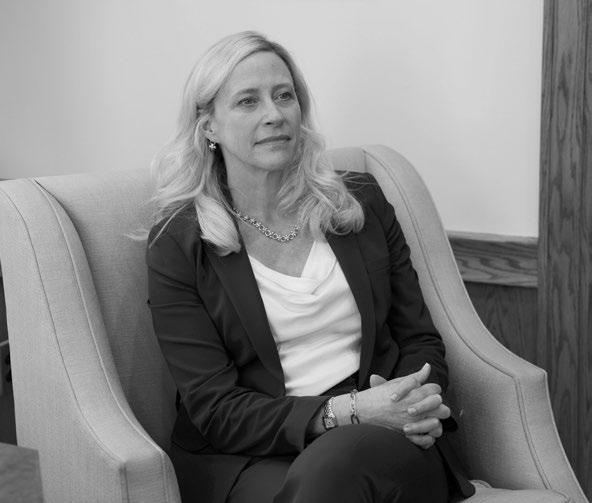
retary Linda McMahon’s scheduled appearance at a Buckley Institute event this month, University President Maurie McInnis commended the independent Yale-adjacent organization for inviting her.
McMahon is slated to speak about diversity, gender and the government’s education policies at an April 16 event hosted by the Buckley Institute, a group that brings conservative voices to campus. The secretary, a member of President Donald Trump’s cabinet, oversees a Department of Education that has canceled billions of dollars worth of federal funding grants to universities across the country.
“Buckley does an amazing job, as do many of our other student groups, of inviting leaders to come speak on consequential topics,” McInnis said in an interview on Tuesday. “I applaud that they have invited her.”
Both McMahon and Trump have called for the Education Depart -
SEE M c MAHON PAGE 4
Instructors let go as cuts force ‘trade-offs’
BY JAEHA JANG STAFF REPORTER
More than 120 students and alumni recently signed a letter addressed to Yale College Dean Pericles Lewis to express “deep concern” after film studies lecturer Shakti Bhagchandani told her students that Yale would not renew her contract due to budget tightening measures. German lecturer Austen Hinkley spoke to his 72-person “Marx, Nietzsche, Freud” lecture about his contract non-renewal, which he also said was impacted by budget cuts.
Lecturer Matthew Morrison, who teaches a course in medicine and the humanities, wrote in an email to his former students that “Yale has, as yet, not renewed my contract for next
BY ASHER BOISKIN, ARIA LYNN-SKOV AND LEO NYBERG STAFF REPORTERS
Eleven members of the Yale Political Union, including its president, met with University President Maurie McInnis and Yale College Dean Pericles Lewis over lunch on March 24, and the group posed for a photo posted last week on the University’s official Instagram account. But even after floating the union in October as a potential reason President Donald Trump’s administration has spared Yale from targeted funding cuts, McInnis told the News on Tues-
year, conceivably due to its newly straitened financial situation.”
Bhagchandi, Hinkley and Morrison are all part of the instructional faculty, a group that comprises the non-tenure track positions of lecturers and lectors, who have limited job security even under more normal budgetary circumstances.
In an email to the News, Faculty of Arts and Sciences Dean Steven Wilkinson acknowledged that recent pressure on Yale’s bud
get impacted contract decisions. It remains unclear how likely the contracts’ renewals would have been without the austerity measures caused by an impending endowment tax hike.
BY LEO NYBERG STAFF REPORTER
Two new trustees will join the Yale Corporation in July, University President Maurie McInnis announced in a Tuesday press release.
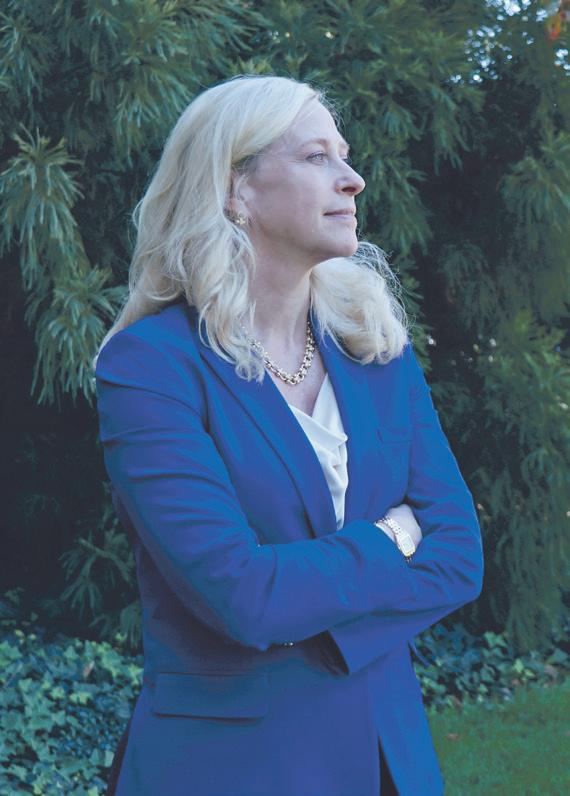
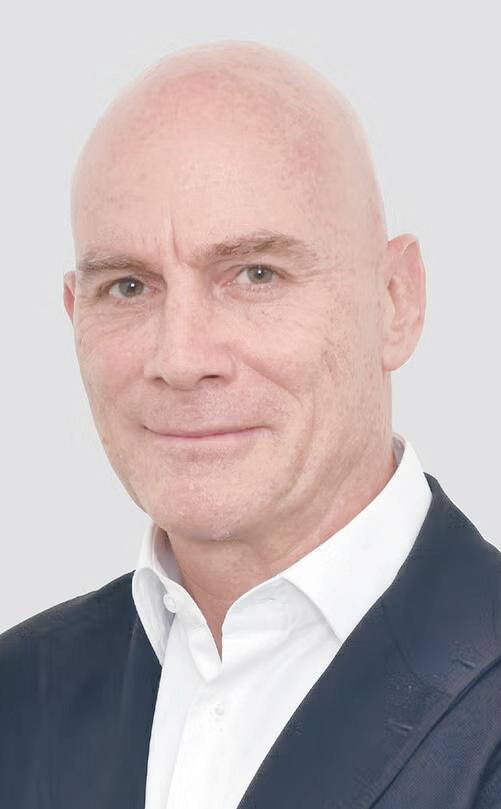
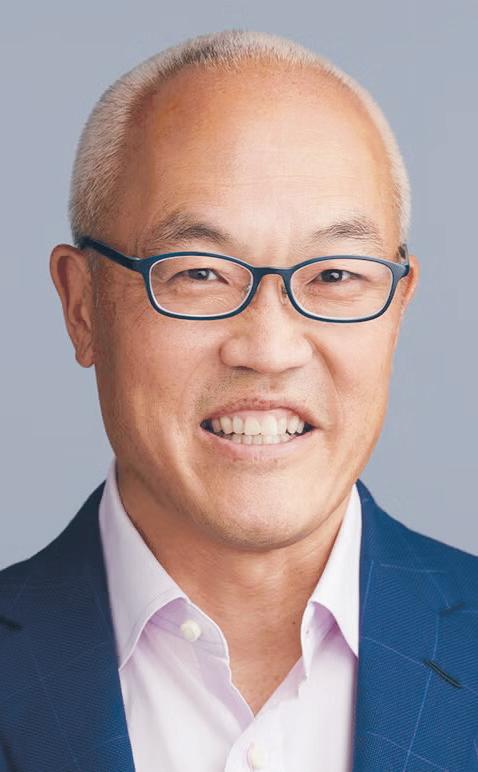
Derek Chang ’89, a media executive, and Philippe Costeletos ’87, the founder of a private investment firm, will join the Corporation, the governing body that steers the University’s long-term institutional priorities. Chang and Costeletos both have backgrounds working as business executives, according to their biographies included in the announcement.
Chang and Costeletos were both named successor trust -
Three Yale military slots said to be
BY ARIA LYNN-SKOV, LEO NYBERG AND ASHER BOISKIN STAFF REPORTERS
A senior Pentagon official told the University that three military fellowship posts at Yale will not continue next school year, according to Yale’s veteran and military affairs liaison.
A February memo signed by Defense Secretary Pete Hegseth indicated that two Yale spots for “military students” affiliated with the Senior Service College Fellowship would be impacted. But the military affairs liaison, Holly Hermes, wrote that she was told by the Pentagon official that the depart-
ment was ending three fellow slots — two Army fellows and one Marine Corps fellow.
“Yale has met with a senior official in the Department of War who confirmed that the February 27 memorandum affects just placements of Senior Service College Fellows,” Hermes wrote in a statement provided to the News by Yale’s central communications office.
In late February, Hegseth announced that the Pentagon would cut ties with Yale and other universities, calling the schools “woke” and accusing them of failing to properly educate military leaders.
ees, meaning they were elected to their positions by the current members of board, according to the Corporation’s bylaws.
“I’m grateful and pleased that Derek and Philippe have agreed to join the board and share their experience and expertise with Yale,” McInnis is quoted as saying in the press release. “Each one brings both leadership experience in complex organizations and a clear commitment to Yale’s mission and people.”
Chang, who grew up in Hartford, is the president and CEO of Liberty Media, the parent company of Formula 1 and Live Nation. According to the Tues -
BY SABRINA THALER STAFF REPORTER
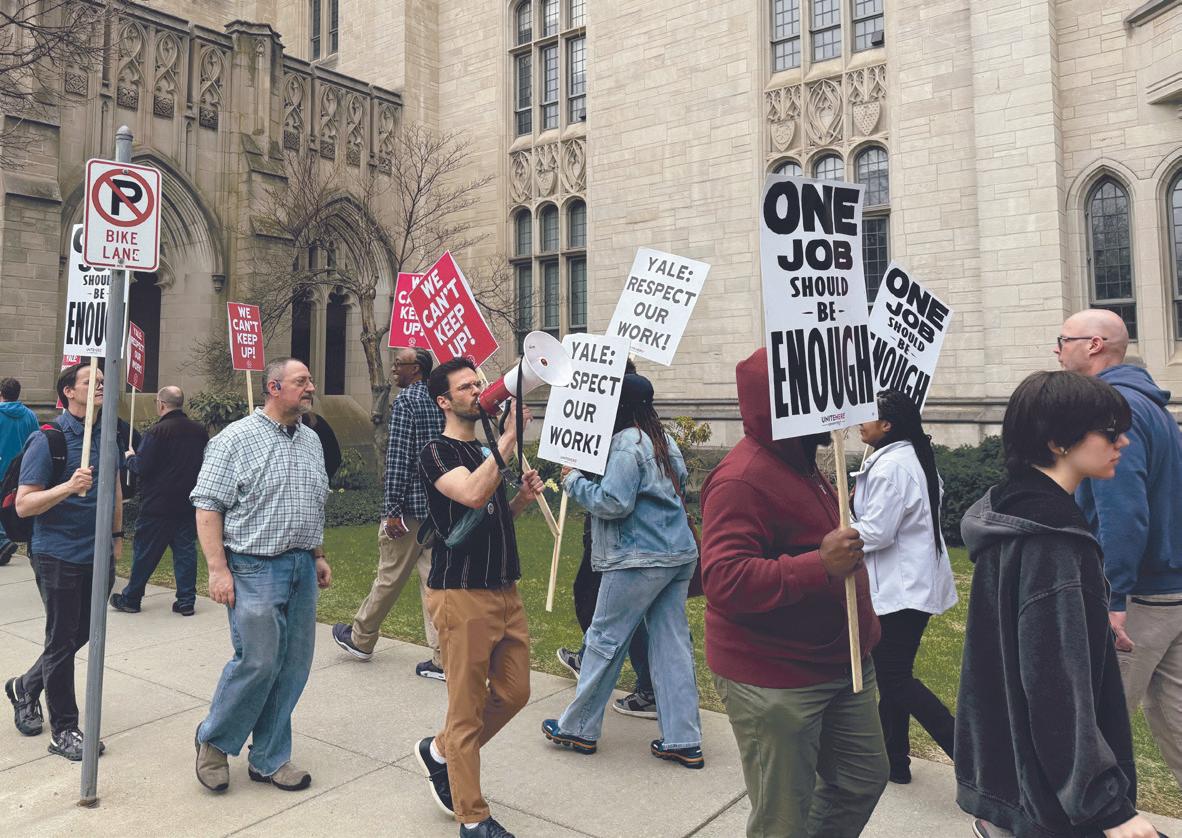
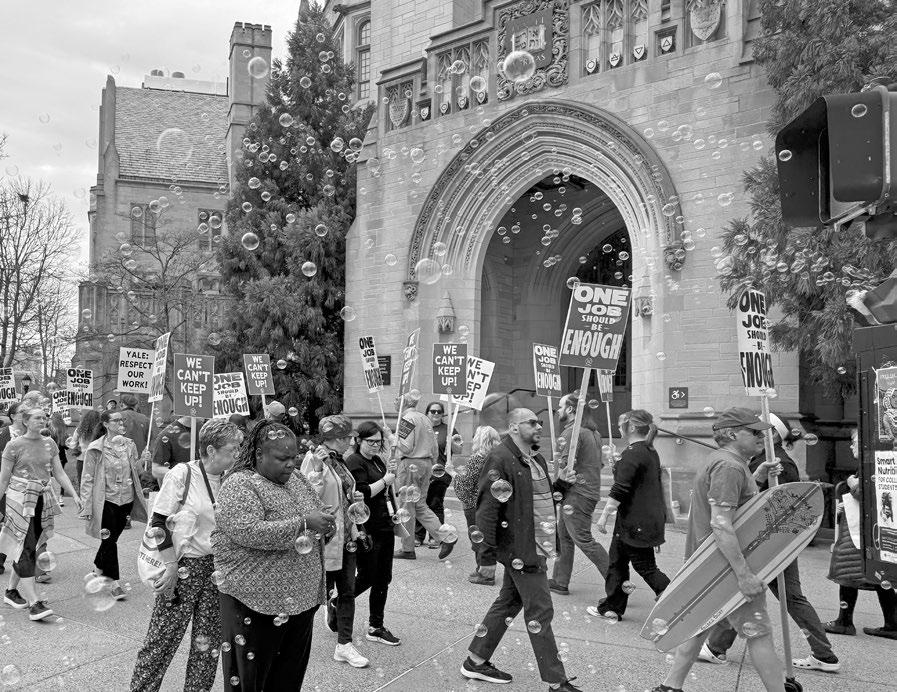
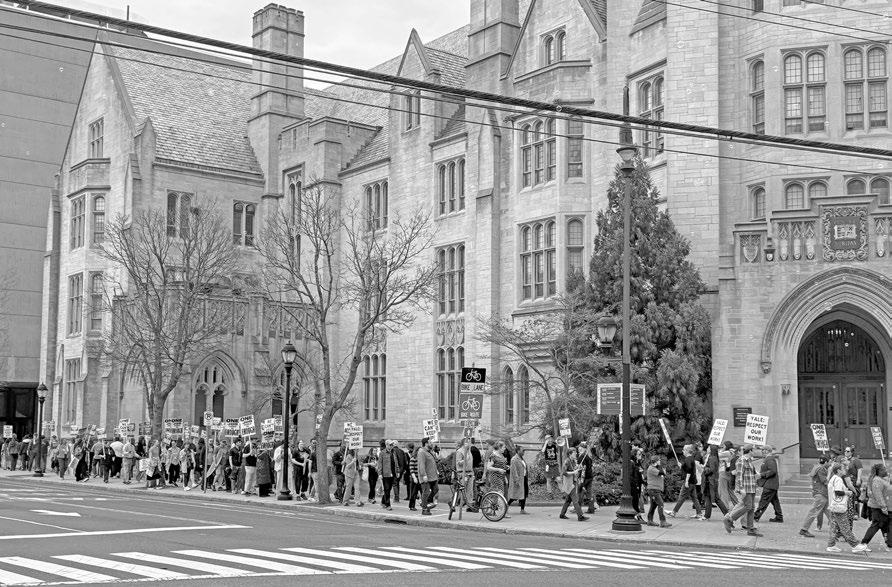
Bubbles, rally cries and handmade signs floated down Grove and Prospect Streets on Wednesday afternoon as members of UNITE HERE Local 34, Yale’s union of clerical and technical workers, surrounded Sheffield-Sterling-Strathcona Hall to demand a contract that accommodates the rising costs of living for workers. The demonstration — which was made up of roughly 750 participants, Local 34 communications director Ian Dunn estimated — is the most recent in a series of protests the union has held during its ongoing contract negotiations with the University.
The union’s current memorandum of
agreement with Yale is set to expire in January, and leaders have repeatedly said that their current wages have not kept pace with inflation.
“Our members are hurting, working second and third jobs,” Lisa Stevens, the president of Local 34, said in an interview during the protest.
“They’re hurting when it comes down to utilities, and we know the cost of fuel just jacked up. So we are just trying to keep our head afloat.
We’re not asking for anything extra.
We just wanna be able to keep up.”
The Consumer Price Index, which measures changes in the cost of goods like food and energy across the country, rose 2.4 percent from February 2025 to February 2026,
BY OLIVIA CYRUS AND ANAYAH ACCILIEN STAFF REPORTERS
Turning Point USA, the youth conservative organization co-founded by Charlie Kirk, has a chapter in formation on Yale’s campus.
The organization — founded by Kirk and Bill Montgomery in 2012 and aligned with President Donald Trump — advocates for conservative principles on campuses across the nation. Kirk was shot and killed in September while talking to students at a university in Utah.
At Yale, the Turning Point chapter’s leaders say they will strive to add to diversity of thought on campus through speaker events and activism.
According to the Yale chapter’s constitution, Turning Point’s mission is to “educate students about conservative principles and promote American patriotism on college campuses.” Its leaders see Turning Point as unique among other largely conservative groups on campus such as the Buckley Institute and Yale College Republicans, because it is neither a debate society nor affiliated with the Republican Party.
“TPUSA is not here to offend anyone or insult anyone,” the chapter’s vice president, Diego Victoria ’27, said. “I think the biggest misconception anyone might have would be that what we’re trying to do is provocative or trying to force ideas on anyone, but rather it’s the complete oppo-
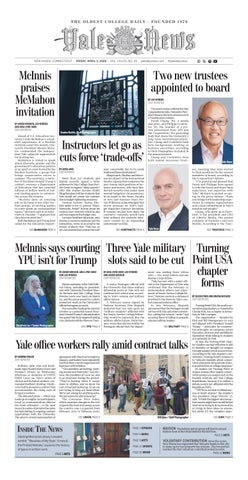
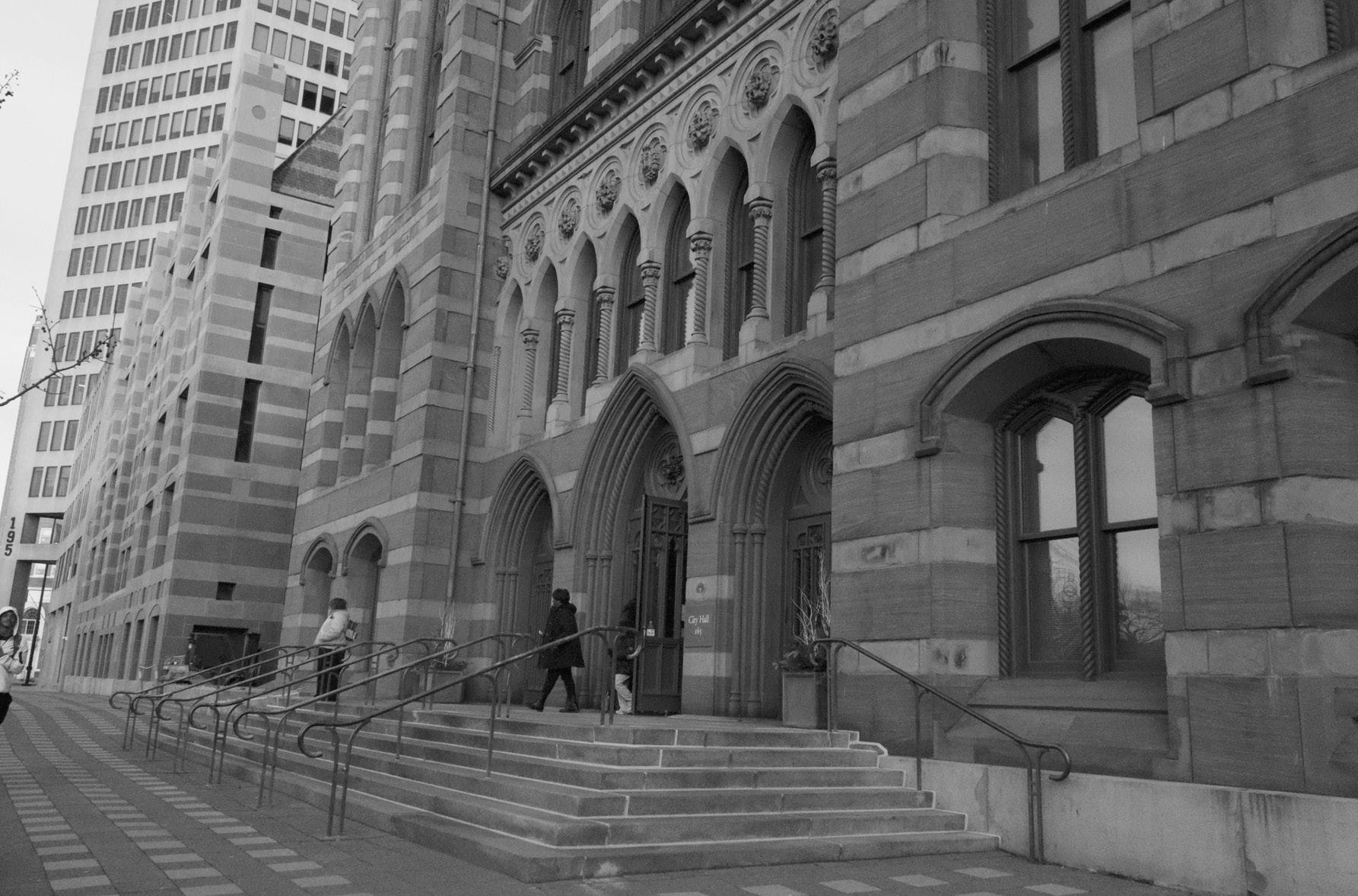
Braden Mathis, Staff Photographer
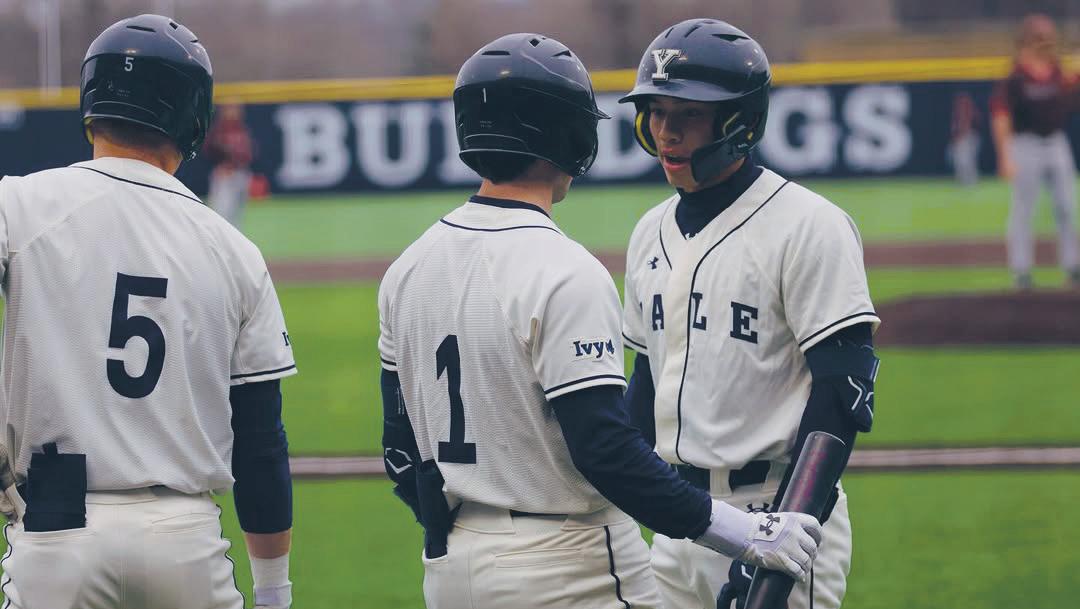
Will Qian / Staff Photographer
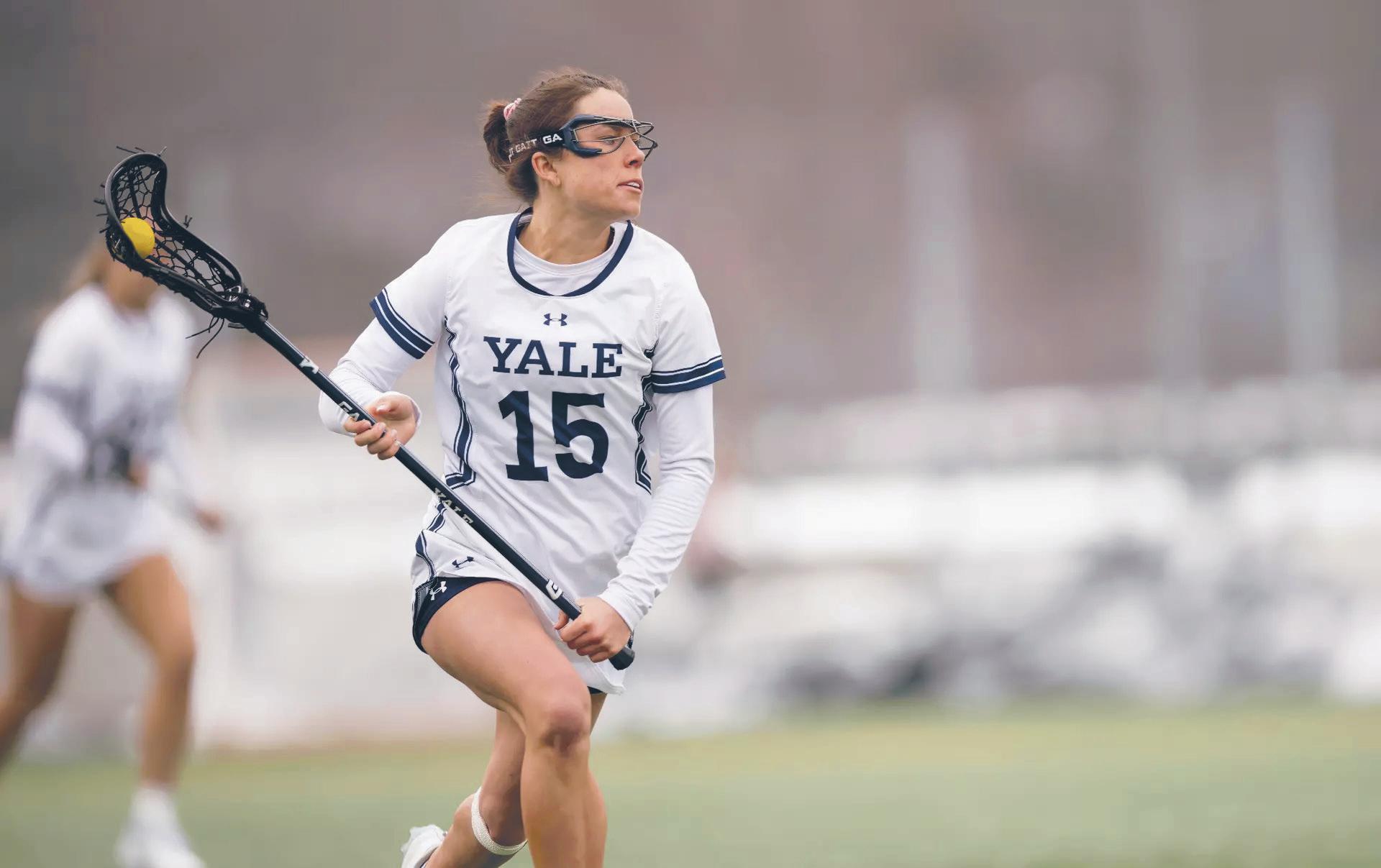
Christinia Lee / Senior Photographer
SEE MILITARY PAGE 6
This Day in Yale History, 1988
March 3, 1988 / Students blast CIA for recruitment
By Rob Fuentes
Approximately twenty-five students gathered early yesterday afternoon in front of University Career Service to protest CIA on-campus recruitment. The agency’s district officers conducted job interviews as the students carried placards denouncing “illegal activities” and chanted “stop the terror, stop the lies, we don’t want no goddamn spies.”
“We hope we can influence students towards being a little less receptive towards the CIA,” said Jennifer Middleton ’88, a member of the Democratic Socialists of America. “And we’re letting the CIA know that all of Yale is not happy with Yale’s substantial historical involvement with the CIA.
A similar protest three years ago led to the arrest of six students when students stormed the CIA interviewing room.
Behind the Headline
By Jaeha Jang
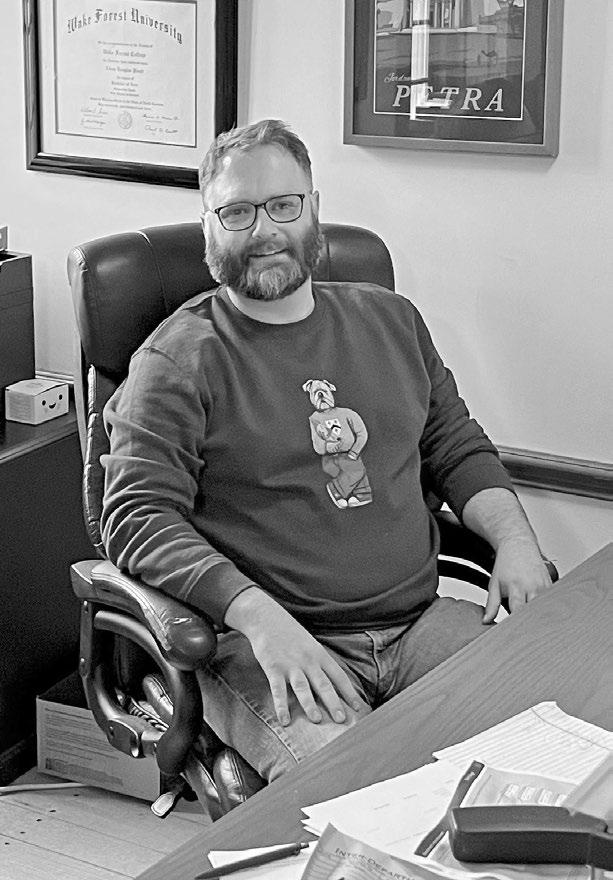
Throughout last week, a plethora of sources shared with me individual stories of lecturers’ contracts not being renewed, and these decisions being attributed to Yale’s budget cuts.
Recognizing a trend across departments, I interviewed a German professor in his office, read through a petition signed by more than 120 people and called various students about the nowdeparting professors’ impact on their learning. What emerged was a story not only of these recent non-renewals but also of the inherent precarity of these short-term contracts.
Read “Instructors let go as cuts force ‘trade-offs’” on page 1.
JANE CALLANAN
STAFF COLUMNIST
HANNAH OWENS PIERRE
Grades should measure mastery, not competition
Anyone who has taken a class in the Yale Economics Department has probably had the following experience. Before the midterm, as students become increasingly concerned about placing at the top of their class, professors express remorse, saying something along the lines of, ‘If it were up to me, there would be no grade cap.’
Last week, the News published a piece by Sofia Heredia ’29 titled “Value intellect, not high grades,” in which the author voices support for “harsh action” to combat grade inflation. This includes a consideration by Yale College Dean Pericles Lewis of a Harvard faculty proposal to cap the number of A’s at 20 percent of students in each class. While I sympathize with the desire to address grade inflation, capping A’s would create a worse problem than it solves.
that adjustment would look like: Students will still fear getting low grades, and for good reason, as acceptance rates for prestigious post-graduate opportunities drop. Consequently, they will avoid more challenging classes and take courses below their ability levels. Smart students will realize that the best way to guarantee success is to study what they are already proficient at. Such a system penalizes not only students but also professors, who know their students and are best able to assess their performance. It demands that they enforce rigid and arbitrary guidelines against their better judgment. A professor may be forced to choose between giving two students of equal ability an A-minus each, merely to conform to grading standards. This problem would be especially acute in the humanities, where grades are rarely determined by raw exam scores alone. Professors grading a paper must weigh the originality of an argument, the quality of the writing, and the precision of the analysis. Those judgments are already difficult; requiring professors to sort students artificially into a fixed distribution would make them even more arbitrary.
Heredia is right that the “A should retain the value of excellence.” To accomplish this goal, we must ask: What does excellence mean? When I envision a student producing excellent work in a class, I imagine someone who goes the extra mile. They attend office hours, ask thoughtful questions, engage deeply with the material, and apply it skillfully. In other words, an A should be attainable for any student who fully masters the content of a course.
A grade cap, however, ignores this standard of excellence. According to the proposal that Dean Lewis is considering, excellence means one thing and one thing only, and that’s whether you happen to score higher than the students in your class.
The flaw with this system is clear. Some years, it would be more difficult to achieve an A simply based on the pool of students who happen to take the course. An A would no longer mean excellence, but instead be a measure of relative performance, based on factors that students cannot control. Yet, mastery of content should not depend on how well one’s classmates perform. Multiple people — in fact, more than 20 percent of the students — can master a course’s material simultaneously.
Heredia claims that “It will be on students and faculty to adjust over time.” Here is what
An added harm of a grading cap proposal is the level of competition it will foster among students. In courses where class discussion is required, students will be desperate to one-up one another rather than engage in open dialogue and good-faith debate.
And not only will student relations decline, but the proposal would worsen an already severe mental health crisis among college students, in which over a third report symptoms of depression and anxiety. Data has consistently found that receiving low grades is a risk factor for stress, anxiety and depression among college students. The number of Yale students seeking mental health support — at least 20 percent of current students — would increase, causing long wait lines and shortages for Yale’s services.
To be fair to Heredia, she envisions adopting a grade cap with some additional considerations. But the most fundamental part of this suggestion must go. By all means, Yale should take steps to improve grading practices — anyone who has taken Game Theory with Ben Polak knows that reexamining the Credit/D/Fail practice is one place to start — but to do so at the cost of student learning, well-being and intellectual growth would be unwise.
HANNAH OWENS PIERRE is a sophomore in Benjamin Franklin College studying Ethics, Politics, and Economics and Psychology. Her column examines Yale policies and broader politics. She can be reached at hannah. owenspierre@yale.edu.
Throughout four years as a teaching fellow, I’ve seen my colleagues do many kinds of work for their students. They’ve taught them tough concepts, trained them in research skills and advocated for them to faculty and administrators for honors, scholarships and extra attention during a crisis. William Barbee ’26 argued in a recent column for the News that a new University committee should rein in liberal graduate students. His column offers an opportunity to reflect on the relationship of the TF, the undergrad and the academy.
Barbee wants intellectual diversity at Yale, which is a good goal. He also wishes that his history TFs would give conservative voices in the classroom more space. He argues that “promoting academic freedom” of this sort “may, in some cases, necessitate restricting it.” The TF deserves less freedom in how they teach their section, while the conservative undergraduate deserves more room to share their opinion.
One observation here is that if Barbee came to Yale looking for intellectual diversity, then he’s found it: his conservatism is jostling with the perceived liberalism of his TFs, making for what sound like frustrating but energetic exchanges in section that expose Barbee to views very different from his own. The subject expertise of the TFs, to say nothing of their authority in the classroom, may give them the final word in these cases. If by intellectual diversity Barbee means the freedom to argue his views without pushback, then Yale offers no shortage of additional venues to try it: not just the senior societies or the Buckley Institute, but office hours, the dining hall and, indeed, the News. If departments are choosing their graduate students correctly, then the TFs you encounter at Yale will come from many backgrounds, from small colleges and state
schools across the country to a range of international universities. Your intellectual culture is made richer by this diversity. This is true not least because schools that are unlike Yale are much better at recruiting talented students from backgrounds outside of the widening but still narrow identity groups that Yale College selects for. The independent-minded energy of the TF will rarely last into the first job that inaugurates them into the professoriate. Not too long ago an undergraduate and — with luck — soon to be a professor, the TF
WHATEVER THE ALIGNMENT OF YOUR POLITICS, THE OVERBRIMMING ENTHUSIASM OF A PASSIONATE TF SEEMS A WONDERFUL THING FOR A STUDENT.
is bound to have issues with the academy just like Barbee does. Even if their solutions don’t always align with yours, that spirit of critique is one thing you have in common. In my own experience, I can say that TFs try on different teaching personae. Some are able to cultivate a mysteriousness that obscures their relationship to course materials. For others, this practiced indifference either isn’t possible — their subject position too clearly overlaps with the topics under discussion — or else declined in favor of a more direct approach. The sharp edges of a punchy TF don’t make a “curricular hijacking.” Their performance reminds us that graduate school attracts students for many reasons: an orientation
toward the truth, the belief in the importance of the subject, an occasionally irrational enthusiasm for their research or the desire to persist through this cultural moment to rejuvenate embattled disciplines.
Controlling for politics in this bundle would neuter some of the urgent lifegiving energy of the classroom. Whatever the alignment of your politics, the overbrimming enthusiasm of a passionate TF seems a wonderful thing for a student.
Because some of Barbee’s TFs are liberal, he worries “that the modern university has become a mere front for indoctrination.” He also cites the spirit of William F. Buckley, Jr. as the genius loci of his column. Barbee will remember that for Buckley, there is no such thing as a university without ideology. In Buckley’s “God and Man at Yale,” he advocates that Yale replace the spirit of atheistic socialism suddenly dominant in the faculty with a return to his own preferred Christian free-market capitalism. We know that this is not the opposite of ideology but the swapping-out of one ideology for another. Meanwhile the suggestion of a hotline to report liberal TFs is probably a step too far toward the awful, self-destructive paranoia of Buckley’s 1950s. Nevertheless, TFs at Yale are lucky to have students like Barbee in their sections: bold, articulate, contrarian, mostly civil. If a TF gives a bad grade on a paper just because a student is conservative or disagrees with the TF’s politics, that would be very bad indeed. I have seen no evidence it happens. If a student disagrees with a TF — or with a professor, or with the orientation of a field — then the very best thing they can do, and what I encourage Barbee to do, is what their TFs have done: take a risk on graduate school in order to correct the record.
BEN CARD is a doctoral candidate in English and Early Modern Studies. He can be reached at ben.card@yale.edu.
FROM THE FRONT
Non-renewals of lecturers’ contracts draw criticism
“The decision to not renew some appointments following the end of their contracts was a hard one,” Wilkinson wrote. “We have a responsibility to meet the critical teaching needs of the College, which necessitates difficult trade-offs given the unprecedented budget challenges caused by the increased tax on Yale’s endowment income.”
Last year, Congress passed a bill that included a tax hike on elite universities’ endowment investment returns that will go into effect this July. Yale’s administration, which has projected that the tax increase will cost the University about $300 million annually, has responded with austerity measures such as staff layoffs and cuts to graduate school enrollment, as well as budget-tightening across schools and divisions.
While Wilkinson emphasized that the administration considered the College’s “most urgent teaching needs” in making contract renewal decisions, faculty and students criticized some non-renewal decisions, saying that the departing instructors contributed greatly to Yale’s educational mission and suggesting that administrative staff would be a better target for budget tightening.
Faculty also told the News that the recent contract non-renewals — and the lack of formal justification for them — highlight the precarious nature of short-term contracts among instructional faculty.
Yale’s faculty handbook notes that these shorter-term appointments, which are between one semester and three years, “carry no presumption of reappointment and no expectation of long-term employment,” and reappointment depends on “continued need for the position, the availability of resources for the position, and the performance of the faculty member.”
Wilkinson wrote that the non-renewed appointments make up less than 4 percent of the fulltime equivalents among total instructional faculty. He declined to comment on the individual cases
of faculty whose contracts were not renewed.
According to Wilkinson, the number of instructional faculty full-time equivalents will still be greater in the 2026-27 school year than it was in the 2024-25 school year.
Yale’s Teaching Resource Advisory Committee “carefully” considers each renewal decision with “teaching needs” in mind and input from department chairs, Wilkinson added. In some cases, his office has hired new lecturers and lectors to teach courses necessary for major requirements and graduation, Wilkinson wrote.
In an interview with the News, Lewis also said that curricular need is the “highest priority” for hiring decisions for lecturers.
“In all of these budget decisions, we’re trying very hard to have the minimum possible impact on students’ educational experience, but that doesn’t mean there’s no impact,” Lewis said.
Daphne Joyce Wu ’26, who is in Bhagchandani’s upper-level seminar and organized the letter, said in a phone interview that Bhagchandani told her students that her contract was not renewed because of the budget pressure the University is facing in light of the endowment tax hike.
Bhagchandani declined to comment for this article.
The letter describes Bhagchandani, affectionately called “Professor Shakti” by students, as “one of Yale’s most beloved and respected professors.”
“Without Professor Shakti, we are deeply concerned on how students who came to the FMS major with a love for the writing behind films will be able to continue their creative journey,” the letter also says, referring to the Film and Media Studies program. “Many of us chose to pursue FMS precisely because of the opportunity to learn from her.”
The letter also recognizes “the financial pressures that Yale is currently facing” and notes that the request is made not lightly, but “out of a sincere belief that losing Professor Shakti and the
Official’s department has investigated Yale
ment to be eliminated. The department has investigated Yale for alleged campus antisemitism and, more recently, for a partnership with a program the department accused of racial discrimination.
McInnis said Tuesday that she was not “aware of” plans for her to meet with McMahon during the secretary’s upcoming visit.
When asked if she believed the Education Department should be scrapped, she stopped short of clearly answering affirmatively or negatively.
“I don’t believe — I — the U.S. Department of Education serves many wide and diverse functions, many of which serve our students very well,” she said, mentioning Pell Grants as an example. “I certainly think that those functions are absolutely vital and need to continue,” she added, emphasizing the word “functions.”
When asked what she would most want to convey to McMahon if given the chance, McInnis said she would highlight the University’s commitment to open inquiry.
“I would stress what an extraordinary educational opportunity Yale was able to provide to students who have wide ranges of views,” McInnis said.
McInnis added that Yale provides “open opportunities for debate and dialogue.”
Last month, McInnis met with members of the Yale Political Union — another group she has pointed to as an example of Yale’s culture of open debate.
At a Family Weekend talk in October, McInnis raised both the YPU and the Buckley Institute as possible reasons why the Trump administration has not targeted Yale with the punitive funding cuts that have hit many peer institutions, adding that there was “no obvious answer” to the question. In the interview
screenwriting program would be a profound and irreconcilable loss for generations of film students and Yale undergraduate education at large.”
Alex William Chen ’28, the speaker of the Yale College Council, wrote in a text message to the News that the petition is “evidence that the student body fundamentally disagrees with some of the choices that were made.” Some of this year’s non-renewals have been “genuinely confusing and disheartening for many in the student body,” Chen added.
Linden Skalak ’26 also said in a phone interview that Bhagchandani’s departure is “devastating.” Many students are worried about their thesis process without a screenwriting professor to guide them, she added.
Wu pointed to an alternative group of employees that Yale could downsize.
“The bureaucracy at Yale is just insane,” Wu said. “They take up so much money, and they’re so bloated that it’s inefficient. So why are we cutting the professors that students love and not turning towards the bureaucracy? Like, let’s cut some of the bureaucrats in the system.”
University spokesperson Karen Peart did not respond to the News’ request for comment about students’ criticism of the number of administrative employees at Yale. In a January email to the News, Peart wrote that staff positions, “including those that support the university’s academic, operations, and clinical enterprise, are crucial to faculty work and to Yale’s ability to carry out its mission.”
Hinkley, who teaches the course “Marx, Nietzsche, Freud,” also learned recently that his contract would not be renewed. Hinkley said in an interview that he was “already kind of living on borrowed time” because he was told upon being hired in 2023 that he would only be able to renew his contract for one more year, but his department advocated for a third year’s contract at the end of last school year.
“I think there were hopes that we could find a way for me to continue here, but with the budget-
ary situation as it is, that is definitely not possible,” Hinkley said, adding that he was “told informally” by departmental colleagues that “they had been trying to figure something out for me and that the administration has stonewalled their attempts.”
Adam Bear ’27, who is in Hinkley’s lecture, said in a phone interview that he found the news of Hinkley’s non-renewal “upsetting” and that many of his best classes have been taught by lecturers like Hinkley.
“If somebody’s hired primarily for the purpose of being a teacher as opposed to also for their research, I think that maybe there’s more of an impetus to be a great teacher,” Bear said. “So the fact that they’re the first people on the chopping block when budget cuts come around feels antithetical to the idea of Yale College as a liberal arts institution meant to teach people.”
While he recognized that Yale is navigating budget constraints and “you can’t really get rid of tenured faculty,” Bear said there are employee groups besides lecturers, such as administrators, whose salaries could be reduced.
“I have to imagine there are people who contribute less to Yale than Austen Hinkley who are probably paid much more than him,” Bear said. Felix Fein ’26, who has had both Hinkley and Morrison as instructors, said in a phone interview that the impacts of contract non-renewals among “beloved” instructional faculty will be “immense and regrettable for the University and the whole undergraduate experience.”
Morrison — who added in his email to students that whether he is brought back or not, it has been “one of the greatest gifts” of his life to be their teacher — wrote in an email to the News that all he can say is that he is “endlessly grateful for my students for my time here.”
Fein said instructional faculty members’ jobs, by definition, are to teach and mentor undergraduates, and “if any faculty are
being cut,” not renewing these contracts would have “the most impact” on undergraduates.
“Frankly, I think the issue is higher up,” Fein said. “Why is the University asking faculty, but specifically the dean of faculty, to be making cuts? I think if cuts need to be made, this area is unacceptable.”
Hinkley also said that his position as lecturer was “sort of set up” to be impermanent and that administrators could easily “cut” his job under budget pressure. Amid “great uncertainty about the future,” he said, he has to constantly apply for other positions and produce research while teaching full-time.
Daniel HoSang, the president of Yale’s chapter of the American Association of University Professors, wrote in an email to the News that instructional faculty are “central” to Yale’s undergraduate curriculum and broader academic mission.
“It is demoralizing to see the university respond to budget pressures in ways that disproportionately affect those who are often the lowest paid and have the least job security,” HoSang wrote. “Non-tenured faculty play an essential role in meeting the needs of our students, yet their contracts are structured in ways that make them especially vulnerable during moments of financial strain.”
HoSang mentioned that other institutions, such as Brown and Northwestern, have carried out salary freezes or reductions for senior administrators during periods of budgetary pressure, “explicitly framing those decisions as a form of shared sacrifice and leadership.”
“It is not clear whether comparable measures were seriously considered here before moving forward with this wave of non-renewals for our most vulnerable colleagues,” HoSang wrote.
Yale employs 12,058 staff members, according to its fact page.
Contact JAEHA JANG at jaeha.jang@yale.edu.
McInnis met with YPU students
day that she was not courting the group in an effort to avoid future cuts.
on Tuesday, she said she had not been courting the political union to stave off future cuts.
In March, McMahon’s department opened a Title VI investigation into Yale and other universities’ partnerships with the PhD Project, an organization that assists members of underrepresented groups at business schools.
The department announced in February that Yale and 30 other universities had reached deals with the government to end their partnerships with the PhD Project after the department alleged the organization unlawfully “limits eligibility based on the race of participants.”
McInnis said on Tuesday that she did not know the specifics of Yale’s relationship with the PhD Project or the terms of the resolution the University reached with the Education Department.
“I do not know the exact details of that. It’s an association with the School of Management,” McInnis said, when asked about the nature and extent of Yale’s former relationship with the organization.
A School of Management webpage, whose text was captured by an internet archive and later removed, described the school’s diversity programs and said that in 2020 the school had “increased its engagement with the PhD Project.”
McInnis suggested that Yale’s Office of the General Counsel could provide information about the resolution. A University spokesperson did not respond to the News’ request for comment from the office.
The U.S. Department of Education was founded in 1979.
Contact ASHER BOISKIN at asher.boiskin@yale.edu, LEO NYBERG at leo.nyberg@yale.edu and ARIA LYNN-SKOV at aria.lynn-skov@yale.edu.
McInnis said students told her about their experiences on campus and with the union specifically, and she denied drawing the political union closer to stay out of the federal government’s crosshairs.
“I’m not,” McInnis said when asked if she was courting the union’s members for that purpose. “I am meeting, as I often do, with different groups of students about a variety of different topics to hear about their perspectives as Yale students.”
McInnis added that students at the meeting spoke “about what they’re majoring in and what they’re studying” and told her about “their Yale experiences.”
The post on Yale’s Instagram account, which was shared jointly by the accounts of the political union and Lewis, stated that the student leaders discussed “their work fostering dialogue across different perspectives.”
The political union comprises seven parties. This semester, guest speakers at weekly debates have included Curtis Sliwa, the former Republican candidate for mayor of New York, and Kevin Roberts, the president of the conservative Heritage Foundation.
“Ever since President McInnis joined Yale University as its president,” union president Mór Szepesi ’27 said Tuesday, “she has frequently referred to the Yale Political Union in very public forums in order to point at the unique debate culture and free dialogue and expression that we have at this university, which really sets us apart.”
At a Family Weekend talk in October, McInnis suggested that the Yale Political Union, which offers students opportunities for debate, may be a potential reason for why Yale has avoided the same pressure from the Trump administration that other peer institutions have faced alongside funding freezes.
“Whether it is that long tradition, the long tradition we have of encouraging open debate from something like Yale Political Union or the Buck-
ley Institute, or whether it’s we’re at the end of the alphabet, I don’t have that answer,” McInnis said at the Family Weekend talk.
In a February interview with the News, McInnis denied credit for keeping Yale out of the Trump administration’s crosshairs. Dartmouth and Yale remain the only Ivy League universities that the Trump administration has not singled out for federal funding cuts.
An Instagram post about the Yale Political Union’s meeting with the administrators, made by the union, stated that the group’s representatives had discussed with McInnis and Lewis “the state of the Union, its impact on Yale, and its needs for the future.”
Szepesi declined to comment on the details of what they discussed but talked about their broader goals in setting up the meeting. Other student attendees declined to comment on the meeting, deferring to Szepesi’s statement.
“We wanted to be able to meet with President McInnis for multiple reasons,” Szepesi said. He added that another part of the reason was for the union to provide context about the
organization and highlight their ideals, values and missions.
Szepesi spoke about rising costs, particularly “with respect to security” as financial concerns for the union. He said that part of the reason for having a long-term relationship with Yale administrators is to increase their awareness of the union’s issues and to “hopefully be able to count on their support should it be needed in the future.”
“We are very thankful for the president’s office for extending this opportunity,” Szepesi said, adding that he appreciates that the door is “open for future collaboration.”
McInnis, along with Yale Corporation members, met with student leaders at an invite-only event in February ahead of the Corporation’s first meeting of the semester.
The Yale Political Union was founded in 1934, according to its website.
Contact ASHER BOISKIN at asher.boiskin@yale.edu, ARIA LYNN-SKOV at aria.lynn-skov@yale.edu and
M c MAHON FROM PAGE 1
FROM THE FRONT
NEW TRUSTEES
Media executive, investment firm head
day announcement, he was previously the CEO of NBA China and held leadership roles with DirecTV, Charter Communications, TCI Communications and YES Network, which broadcasts New York Yankees games.
Live Nation — the events promotion company that includes Ticketmaster — recently reached a $280 million antitrust settlement with the U.S. Justice Department, the department announced early last month. The Justice Department, with 30 state and district attorneys general, sued Live Nation in 2024 for engaging in alleged “anticompetitive behavior” that drove ticket prices up for fans.
Live Nation denied allegations that it was operating an illegal monopoly and said it faces a competitive market, according to The New York Times.
Chang’s tenure as the CEO of NBA China was also marred by controversy, according to an Associated Press wire report announcing Chang’s departure from the organization. In October 2019, the Houston Rockets’ general manager posted a tweet supporting pro-democracy protestors in Hong Kong, igniting a firestorm with Chinese state streaming services and sponsors, who responded by cutting ties with the Rockets, according to CBS News. Chang stepped down as CEO in May 2020.
He is also part of the Committee of 100 — a group of prominent Chinese-Americans who aim to “advance constructive relations between the U.S. and Greater China.”
The Yale Media, Entertainment and Sports Business Association — a student club — hosted Chang at an event on Tuesday evening.
During his time at Yale, Chang majored in history and was a coxswain for the men’s heavyweight crew team, according to the Tuesday press release.
Costeletos is currently the chairman of RIT Capital Partners, a British securities investment firm founded by Jacob Rothschild. Costeletos worked in finance for over thirty years after he graduated from Yale with a degree in mathematics, the announcement said.
Costeletos is a member of the President’s Council on International Activities at Yale, a council of more than 80 people that provides the University president with guidance on Yale’s “international agenda” and meets on campus annually, according to a webpage from the president’s office.
The meetings have focused on Yale’s activities in China, international student admissions and Yale’s international programs, according to the webpage.
Maryana Iskander LAW ’03, a trustee, is also on the council.
Costeletos has also worked on Yale’s For Humanity campaign, a fundraising campaign that has raised more than $6.4 billion since it began, according to its website. He has also worked with the Yale Center for Emotional Intelligence and the University Council, the announcement said.
The appointments of Chang and Costeletos will bring the Corporation back to its regular size of 16 trustees. Those trustees are joined on the board by three members who serve because of their titles: the University president, the Connecticut governor and the lieutenant governor.
McInnis served as a successor trustee from 2022 to 2024.
Contact LEO NYBERG at leo.nyberg@yale.edu.
Local 34 pushes for wages to fit inflation
according to the most recent data published by the Bureau of Labor Statistics. CNBC reported on Tuesday that average gas prices in the United States have topped $4 per gallon as oil supplies are constrained by the country’s ongoing war in Iran, which may risk further inflation across economic sectors.
Protesters appeared to hold some of the same signs they carried at marches in September and November, which said “One Job Should Be Enough” and “We Can’t Keep Up.”
“I think that Local 34 and 35 have been a real supporter of the city of New Haven, and there are tons of people that are walking on this picket line at a time that we’re all in an affordability crisis,” the Rev. Scott Marks, director of local activist group New Haven Rising, said.
According to Marks, Wednesday’s protest drew clergy, organizers with New Haven Rising and representatives from UNITE HERE Local 35, the University’s maintenance workers union.
Yale President Maurie McInnis’ office is located in Sheffield-Sterling-Strathcona Hall. Jennifer Garcia, the union’s secretary-treasurer, said the organization hopes to “problem solve and negotiate in good faith with the University.”
For Dessara Bryant, a technology lead for Yale’s Information Technology Services office who attended Wednesday’s protest, receiving more pay would mean being able to more easily put food on the table when her 19 year-old-son comes home from college. It would also reduce a strain on everyday needs, she said.
“When it’s break time, and I’ve got to stock the fridge, my bank account says ‘ouch,’” Bryant said in an interview at the protest.
All Bryant and her fellow union members want from Yale, she said, is “respect and a decent wage to take care of our financial responsibilities.”
Other protestors, meanwhile, voiced frustration with what they described as the University’s reticence to meet workers’ needs.
“It’s so frustrating to see Yale, which has more in its endowment than many countries have their GDPs, trying to pretend that they can’t afford to give us livable wages,” Julia Fraivillig, an administrative assistant at the School of Management and Local 34 member, said in an interview at the protest. “That frustrates me, and that’s part of what motivates me to get out here.”
Fraivillig said that the union’s current contract — which became active in January 2022 — contained a “pretty good raise,” but that workers’ wages were no longer suitable to meet rising costs. They said they’ve had to rein in their spending, skip social gatherings and opt to make handmade gifts for their partner to save money. They also described struggling to afford rent, which recently prompted them to search for a second job.
“The university began negotiations with Locals 34 and 35 last summer and looks forward to a positive, productive process that results in a fair agreement for all parties,” Yale’s Head of Union Management Relations Joe Sarno wrote in an email to the News. He added that Yale respects the unions’ “right to gather peacefully.”
Members of Local 34 have received a base wage increase every year since their ongoing memorandum of agreement took effect in 2022, the document indicates.
Jen Ongley, a chair’s assistant in the Physics Department, noted Yale’s strong record of supporting its workers.
“Part of what drew me to Yale in the first place was being able to get a good union job with things like a pension and job security and actu-
ally decent benefits,” Ongley said in an interview at the protest. “That was part of why I wanted to work for Yale. And I think it’s really important that we preserve that and that we strengthen it, especially in this current national climate.”
UNITE HERE has 13 local affiliates operating in Connecticut.
Contact SABRINA THALER at sabrina.thaler@yale.edu.
Group returns to Yale after killing of Kirk
site. We just want to create a space on this campus that continues to include those ideas but also have them discussed actively.”
Victoria said in an interview with the News that he was originally approached by Turning Point about starting a chapter at Yale shortly after the assassination of Kirk.
Victoria said he believes that misconceptions from the “general media on the left” falsely characterize Turning Point as a “hateful organization.” However, Victoria hopes that the organization can provide a space for Yalies to consider a conservative approach to politics and ponder their personal values.
Turning Point has faced criticism across social media platforms for attacking public education and for promoting traditional gender roles, among other views.
Chapter president Carlos Perez ’29 said the group of students applied to become a student organization before winter break, having received approval to start a chapter from the national Turning Point organization.
Turning Point had previously existed at Yale; Facebook posts from 2019 list the Yale chapter as active, but there are no additional posts for subsequent semesters.
Melanie Boyd ’90, Yale College’s dean of students, confirmed in an email to the News that the “group is currently going through
the new organization onboarding process” in accordance with the usual procedure.
When asked if the chapter’s national leadership and affiliation with Kirk factored into administrators’ review of the chapter as a student group, Boyd wrote that “Yale college has a number of registered student organizations that are connected to a larger national/international organization.”
Victoria stressed the need for a diverse range of political voices at a “liberal echo chamber” like Yale. Victoria and Perez said they have already begun recruiting well-known speakers for future events.
“Buckley still attempts to be politically neutral while being dedicated to free speech,” Perez said, explaining the difference between the Buckley Institute and the Turning Point chapter. “We really hope to be explicit in that we want to bring conservative ideals to campus through speakers that espouse our beliefs and get these conversations going at Yale.”
Lauren Noble ’10, the Buckley Institute’s founder and executive director, wrote to the News when asked whether her organization was politically neutral that it is “an educational organization” hosting events which “attract students across the political spectrum.
“No other organization has come close to bringing as many conservative voices to Yale’s campus over the
past 15 years,” she wrote, adding that “As a 501(c)(3) organization, we cannot endorse candidates for political office by law.”
Manu Anpalagan ’26, the founder of Yale College Republicans, wrote to the News that the key distinction between the Yale College Republicans and Turning Point lies in their structure, noting that the latter operates as a nonprofit while his group represents a political party, giving it greater leeway to engage in political activity.
Anpalagan also argued that the College Republicans’ affiliation with a long-established national political party gives it a stronger connection to the broader American public, which he said is central to its mission. By contrast, he suggested that Turning Point and the Buckley Institute, as newer organizations focused primarily on college campuses, may have a more limited connection beyond academic settings.
Perez envisions hosting collaborations with other Turning Point chapters in Connecticut and New York and has already been in talks with leaders from other Ivy League schools hoping to kickstart their own chapters of the organization.
A year from now, Perez and Victoria hope not only to attract notable speakers to their events, but also to make students feel comfortable both agreeing and disagreeing with one another and maintain longevity at Yale.
“It’s not just about ‘Did we get X department secretary or this person from the conservative movement to come and talk?’” Perez said. “But the most important thing is what did they talk about and how did students feel about the events, even if a lot of them might have disagreed, and did they consider a new perspective.”
Avi Rao ’27, the speaker of the Yale Political Union, attributes the conservative organization’s presence at Yale to Turning Point’s expansion to more colleges nationwide after the assasination of Kirk. Rao said he believes that American politics are experiencing a trend of younger voters shifting away from the Democratic Party.
“I actually think this type of group is really important and I’m quite happy, despite not being a member of Turning Point, that there exists a conservative counterpart to this type of organization on campus,” Rao wrote to the News. “It will certainly diversify political activity on this campus, which I think is a good thing, even though I might disagree with what that activity is.”
Erika Kirk, the widow of Charlie Kirk, is the chief executive officer of Turning Point USA.
Contact OLIVIA CYRUS at olivia.cyrus@yale.edu and ANAYAH ACCILIEN at anayah.accilien@yale.edu.
Will Qian / Staff Photographer
with the University continue, members of Yale’s union of clerical and technical workers repeated their calls for pay that
“Small cheer and great welcome makes a merry feast.”
One Marine, two Army fellowship positions set to end
“Yale continues to maintain that the university makes a significant contribution to the education of military officers and Senior Service College Fellows should be able to choose Yale,” Hermes added.
When asked in a Tuesday interview with the News to respond to Hegseth’s criticism, University President Maurie McInnis touted Yale’s partnership with the armed forces.
“Yale University has a long-standing and productive relationship with both our active duty and our veteran communities,” McInnis said, citing the Reserve Officers’ Training Corps program and veteran students. “Those individuals are an incredibly important part of our community, as are the current 24 active duty members of the armed forces who are part of the educational opportunities here.”
Pressed about whether Yale practices “woke indoctrination,” as Hegseth has alleged, McInnis said: “I believe that we provide access to an education that brings diverse
viewpoints, that brings many voices to the table, that welcomes open debate and dialogue.”
In the February memo, Hegseth lists new potential partner institutions, including Liberty University and several public universities. According to the memo, the alternative institutions meet the criteria of “intellectual freedom, minimal relationships with adversaries, minimal public expressions in opposition of the Department, and Graduate-level National Security, International Affairs, and/or Public Policy Programs.”
A Marine Corps fellow at Yale’s Jackson School of Global Affairs studies international history and security studies, such as the Grand Strategy class — a year-long course on statesmanship and geopolitics — while conducting research.
John Gaddis, a professor of military and naval history who has taught Grand Strategy, wrote in an email to the News that the Pentagon’s move to cut ties with Yale was misguided.
“The Marines are and have long been a war-fighting organization. But
to expect them to fight -- or to prepare to fight -- with no knowledge of lessons to be learned from wars previously fought, as well as wars providentially avoided, would be more than short-sightedness: it would be selfblinding. Yale has provided such lessons for well over a decade. What possible benefit can there be now from having that relationship severed?” Gaddis wrote.
The Jackson School, founded in 2022, hosts programs such as the Blue Center for Global Strategic Assessment and the Schmidt Program on Artificial Intelligence, Emerging Technologies and National Power, which both conduct research with defense applications.
McInnis said the Jackson School is the latest home to Yale’s “long history of studying national security, statecraft, important international issues.”
In addition to opportunities for undergraduates, military involvement at Yale includes active duty service members at a variety of schools, such as the Jackson School, the School of Management and
the Graduate School of Arts and Sciences. Some are here through shorter fellowships, like the yearlong Marine Corps Visiting Fellows program, while others are pursuing yearslong doctoral degrees.
Brandon Colas GRD ’15 ’27, a lieutenant colonel, is pursuing a doctoral degree at Yale’s Political Science Department, researching trends in military recruitment through the Army’s Advanced Strategic Planning and Policy Program.
Next year, Colas said in an interview, he is continuing his degree with Yale but will be stationed at the Fort Knox Army base in Kentucky, working with the Army’s recruiting command. Yale requires political science doctoral students to live near Yale for three years, with many students going elsewhere to do research or other groups for the final years completing their degrees.
Colas stressed the value of being able to do military research at Yale, highlighting his collaboration with faculty. While none of his colleagues “have worked directly on military recruiting systems before,” Colas
said, “they’re just really good at what they do.”
“So when it comes down to, like, statistical modeling, or if I want to understand more about American demographics, I’ve always got someone that I can ask,” Colas said. He called the expertise at Yale in statistics and game theory “invaluable” to his research.
“It took a lot of work to put the military back on Yale’s campus, and I don’t think we should walk away from that,” Colas said.
The ROTC program returned to Yale in 2012 after a four-decade hiatus.
In March, Major Nicholas Dockery JGA ’23, who graduated from the Jackson School in 2023, was approved by Congress to receive the Medal of Honor for his actions in Afghanistan in 2012.
Contact ARIA LYNN-SKOV at aria.lynn-skov@yale.edu, LEO NYBERG at leo.nyberg@yale.edu and ASHER BOISKIN at asher.boiskin@yale.edu
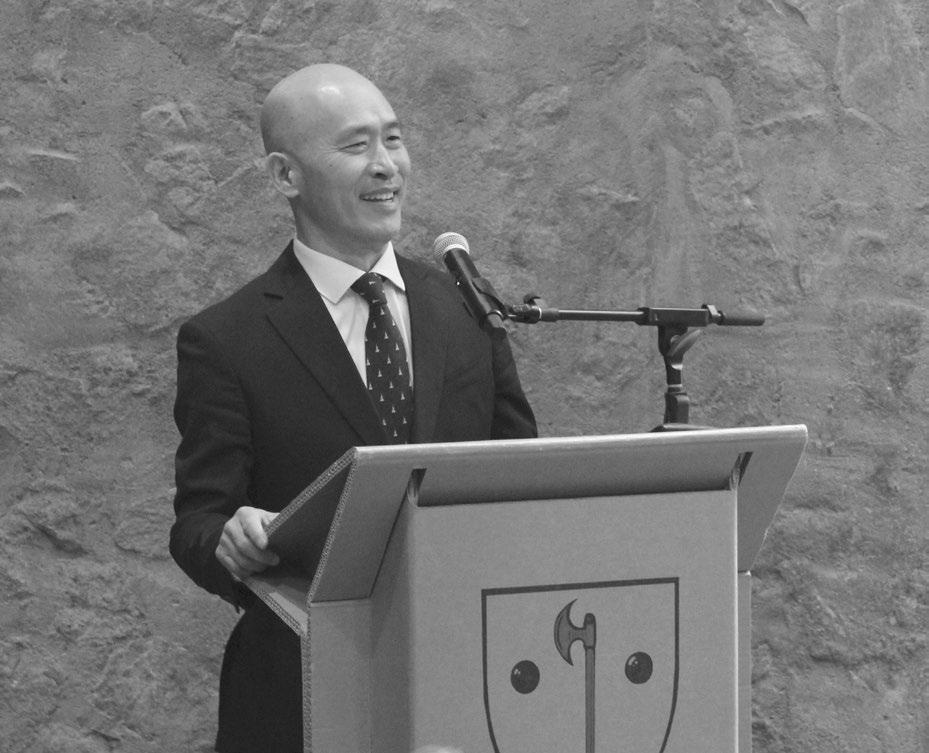
Hwansoo Kim named next Morse head of college
BY ARIA LYNN-SKOV STAFF REPORTER
A religious studies professor, Hwansoo Kim, will be the next Head of Morse College, Yale College Dean Pericles Lewis announced in a crowded Morse dining hall on Monday evening.
Lewis, Kim and current Morse Head of College Catherine Panter-Brick spoke at the announcement ceremony. PanterBrick is one of three college heads set to step down at the end of the year, and she is the first whose replacement has been announced.
“As the next head, I hope that Morse will always be a place for the true exchange of ideas, genuine friendship and small kindnesses to others,” Kim said to an audience that included Yale students and faculty.
Kim has been at Yale since 2018, and he is currently teaching the classes “Buddhist Monastic Experience” and “Readings in Korean Religions.”
Kim is married to Rev. Sumi Loundon Kim, who has served as the Buddhist chaplain at Yale since 2018. They have two children, a daughter who is a current sophomore at Yale and a son who is an incoming first year in the class of 2030, according to an email Lewis sent to Morse College students shortly after the dining hall announcement.
Kim was appointed to a fiveyear term that begins on July 1, Lewis announced in his email.
Kim studies East Asian religious history and Korean Buddhism. He is the author of several books, including “The Korean Buddhist Empire: A Transnational History, 1910-1945.” Kim was the director of graduate studies for Duke’s graduate program in religion, and while at Duke, he spent nine years as faculty-in-residence. Kim spoke fondly about his memories living on Duke’s campus and said he is looking forward to living in Morse.
After Panter-Brick spoke, students applauded and chanted “Head PB!”
“I want to enjoy myself at Morse from today until graduation,” Panter-Brick said in an interview after the ceremony.
Panter-Brick has been Morse’s head of college since 2015, having served the maximum 11 years allowed. When asked what piece of advice she would give to her successor, Panter-Brick stressed being in the moment.
“We plan so much in life,” she said, emphasizing that it’s important to “savor the moment.”
“That’s what students taught me,” she added.
Contact ARIA LYNN-SKOV at aria.lynn-skov@yale.edu.
Davenport dean to step down for Divinity School position
BY HAILEY YOUNG STAFF REPORTER
The dean of Davenport College announced in a Thursday email to Davenport students that he will be departing from his role in June.
Adam Ployd, a divinity and religious studies lecturer at the Yale Divinity School who was appointed to the residential college dean role in 2023, is stepping down after accepting a position as the Associate Dean for Spiritual Formation at the divinity school, according to his email. According to Ployd, the divinity school extended him the offer “within the last few weeks,” and the school first advertised the position in December 2025.
“I will always carry Davenport in my heart and will strive to ‘do better’ and to model gnomelike behavior in all that I do!” he wrote in his announcement, referring to Davenport’s mascot, the gnome.
Ployd is the latest residential college administrator to announce plans to step down. In recent weeks, the Berkeley College dean left her role and Silliman College’s dean announced that she would be stepping down at the end of the academic year. College heads from Saybrook, Morse and Berkeley are also set to step down in June.
Yale College Dean Pericles Lewis has also recently announced changes to advising and course registration for incoming first years, which are set to be piloted over the summer and fully integrated by 2027. Under the changes, residential college
deans will become first years’ primary academic advisors. Ployd stressed, however, that his move was not related to the institutional shifts within Yale College.
“My decision to join the Div school was fully driven by my passion for graduate theological education and not by any of the changes within Yale College,” he wrote to the News.
Ployd, who is an ordained deacon with the United Methodist Church, has previously held positions in graduate education, most recently serving as the vice principal of Wesley House at the Methodist Theological College, according to his biography on Davenport’s website. He has also held positions as an assistant professor at the Eden Theological Seminary and as a lecturer at the University of Cambridge.
In his message to students, Ployd described his departure as “bittersweet,” highlighting his appreciation for the Davenport community.
“My time as a gnome has been one of the most important and rewarding periods of my professional life,” he wrote.
Ployd especially emphasized the role students have played in shaping his “incredible” tenure as a dean.
“It is the students that really make the residential college community what it is,” he wrote. “You have trusted me with some of your most delicate difficulties and shared with me your highest triumphs.”
This balance of trust and care, he wrote to the News in an email, was
extended both ways, as Ployd was also met with an outpour of support amid personal loss last year.
“I hope I have been able to show a modicum of that same support in my role as dean,” he Ployd wrote to the News. “I hope that the kindness and care that I strived to show will continue to be reflected in the kindness and care that Davenport students show one another and the wider world around them.”
Ployd also reflected on how he strove to balance the responsibilities he held as an enforcer of academic and undergraduate regulations while prioritizing students’ wellbeing.
For Zachary Jacobus ’26, a Davenport first-year counselor, those values were reflected in Ployd’s attentiveness to students.
“He genuinely cares about helping students however he can. In my capacity as a Davenport student, I have always received good advice whenever I have come to Dean Ployd with questions,” he said.
Aaron Lin ’28, a Davenport senator and college aide, echoed the descriptions of Ployd’s accessibility and responsiveness.
“Dean Ployd is really easy to talk to and a great listener. I’ve had a lot of questions about course requirements for my major, and he is very quick to reply to emails. I can also sometimes just pop into the office to talk with him,” he said. “I think Dean Ployd was really amazing as dean. I think it is really sad that he is leaving.”
Davenport College was founded in 1933.
Contact HAILEY YOUNG at hailey.young@yale.edu.
Jaeha Jang, Contributing Photographer
At a ceremony on Monday evening in the Morse College dining hall, Yale College Dean Pericles Lewis announced that religious studies professor Hwansoo Kim will start as the next head of Morse College on July 1.
Will Qian, Staff Photographer Davenport College Dean Adam Ployd announced on Thursday that he accepted an offer to be an assistant dean at the Yale Divinity School. He will depart from his role in Davenport College in June.
“Just when the caterpillar thought the world was over, it became a butterfly.”
CHUANG ZHU
Hacking helpfully, Yale senior co-founds a startup and wins rewards
BY MELISSA ADAMANTIDI STAFF REPORTER
A Yale senior who earned 2 million United Airlines miles for identifying a significant vulnerability in the airline’s computer systems has co-founded an artificial intelligence cybersecurity startup to help companies fix software weaknesses before they can be exploited.
The startup, Strix, founded by Alex Schapiro ’26 and Ahmed Allam, develops automated tools that scan code and applications for security flaws — a practice known as ethical hacking. According to Allam, Strix is currently in the seed stage and working with enterprise clients as it expands its platform and product capabilities.
The idea for the company grew out of the founders’ interest in
identifying how systems break.
Allam wrote to the News that his background in AI and early experience exploring software vulnerabilities led him to build tools that could scale that process.
“I was always curious about how systems worked, where they broke, and how they could be improved,” he wrote.
Schapiro’s path into cybersecurity followed a similar trajectory, beginning with hands-on experimentation while building applications in high school.
“In high school I would be building apps where I would need to scrape data from websites, and that data wasn’t always easily accessible. So I would find ways around it to get the data I needed, and often when doing that I would find much more data was public than the website was
expecting,” Schapiro wrote to the News.
Over time, that curiosity developed into a sustained focus on identifying vulnerabilities and reporting them responsibly.
“My mom also is in the cybersecurity field so I have always been exposed to it,” he wrote.
“Beyond that, I love helping people out, so hacking a company and telling them how to fix it is a great way to protect the users because otherwise their user data could be exposed.”
Earlier this year, Schapiro identified vulnerabilities in United Airlines’ systems, earning a total of 2.6 million airline miles through the company’s bug bounty program — including one reward of 2 million miles for a particularly major vulnerability — he told the News.
“This recent experience with United also was super memorable —
my first ever official bug bounty was from United my freshman year of college, for 250k miles, but this time I was able to get the maximum reward possible,” he wrote. Schapiro wrote that he has seen a rise in vulnerabilities as artificial intelligence tools make it easier to build and deploy software quickly, often without strong security protections.
“Especially in the age of AI I have seen way more vulnerabilities than ever before, which is why I decided to co-found this company that can help companies who are building fast using AI to ensure the code they are pushing is secure,” he wrote.
Strix aims to address that issue by automating the process of identifying vulnerabilities, allowing developers to continuously test their applications rather than relying on periodic audits.
“Normal penetration tests, what it is called when you pay someone to proactively hack your app, cost anywhere from $10-20,000, so this is a much more affordable way to make sure your app is secure, and it does it every day on every code change so you can be confident about the code you are pushing,” Schapiro wrote.
For Schapiro, the distinction between ethical and unethical hacking is defined by how vulnerabilities are handled.
“It is not ethical to hack an app and exploit it, but it is ethical to hack an app without changing any information on it and just disclosing it right away to the company so they can fix it before a bad guy targets them,” he wrote.
He added that companies’ responses to vulnerability disclosures can vary. Some get angry or defensive, he wrote, but most react positively.
Beyond the company itself, ethical hacking raises broader legal questions about how cybersecurity is regulated.
Yale Law School professor Scott Shapiro said in an interview with the News that while ethical hacking is intended to improve security, it exists within complex legal boundaries.
“Ethical hacking is understood to be a practice whereby a hacker tries to find and or exploit vulnerabilities for the purposes of making products safer,” Shapiro said.“So it’s ethical hacking because you’re doing it because you’re trying to harden the system.”
However, he emphasized that intent alone does not determine legality.
Shapiro also questioned whether current legal frameworks adequately incentivize companies to prioritize security and warned that artificial intelligence may intensify existing vulnerabilities.
“So I think it’s just like spewing bugs into cyberspace,” he said.
Yale’s Digital Ethics Center, founded in 2023, focuses on the ethical and societal implications of emerging technologies.
Contact MELISSA ADAMANTIDI at melissa.adamantadi@yale.edu.
In second lecture as Yale fellow, Brooks shares how not to be a ‘jerk’
BY LEO NYBERG AND ARIA LYNN-SKOV STAFF REPORTERS
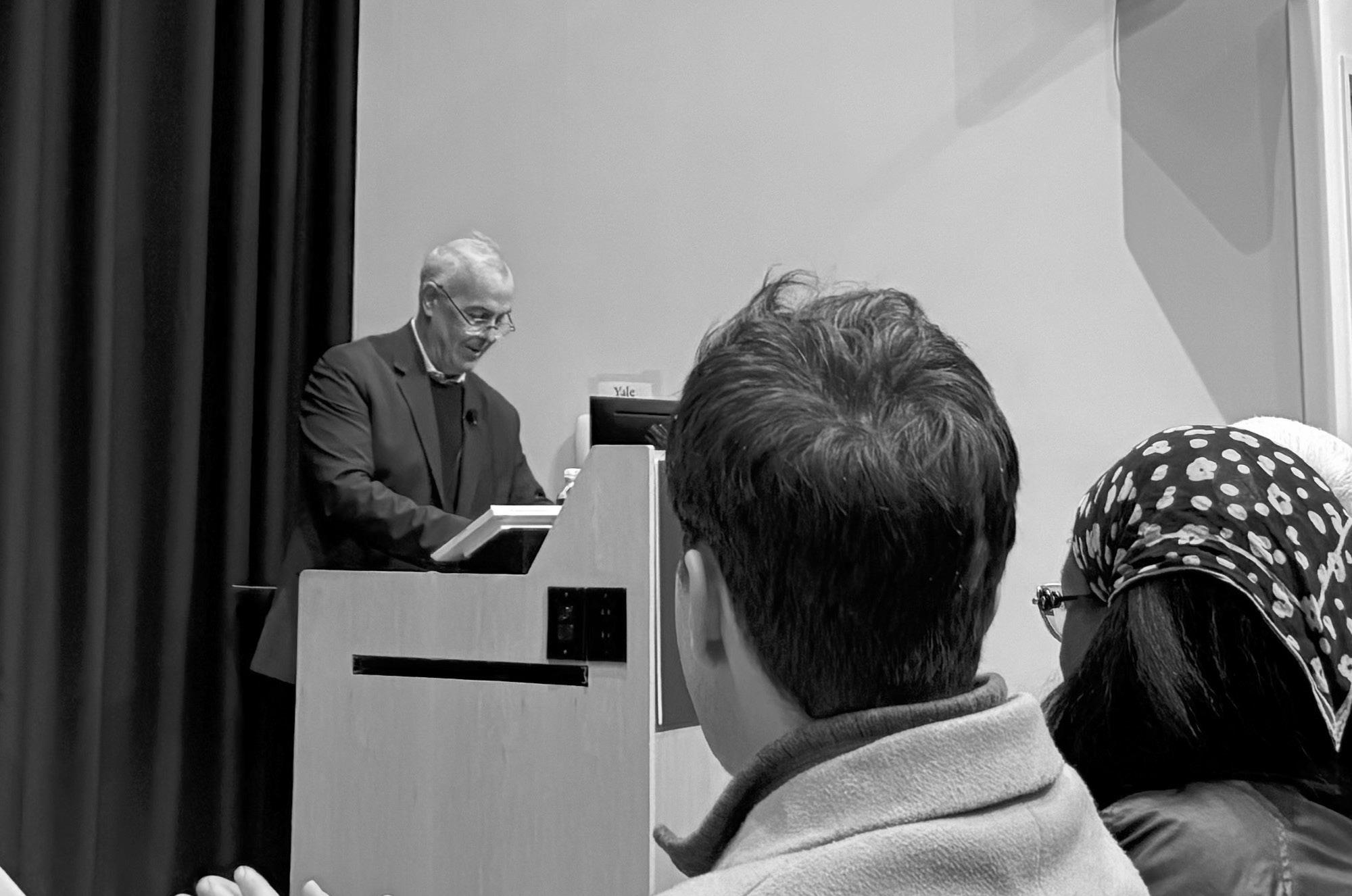
David Brooks, the former New York Times columnist who was recently appointed as Yale’s first presidential senior fellow, gave a lecture on Tuesday about a topic he felt was not important to discuss at Yale: “How to be Ambitious Without Being a Jerk.”
“The students here don’t need this topic. If you were a jerk, you’d all be at Harvard” Brooks said, drawing laughs from the audience in a nearly packed Henry R. Luce Hall.
In the lecture, Brooks detailed what he believes are the best ways to have successful academic and professional careers. He emphasized passion, curiosity and the “gleam” he sees in students’, young children’s and even adults’ eyes when they speak about a topic that excites them.
Brooks is in the first semester of his five-year appointment as the inaugural presidential senior fellow. The fellowship program, which was established by University President Maurie McInnis to bolster intellectual diversity on campus, was announced in January. Brooks is currently the only fellow. Tuesday’s lecture was his second of a four-part series this semester.
Brooks drew laughter from the audience on at least 26 occasions throughout his lecture, which included lines about God, sex and the New York Mets, his favorite baseball team.
Tuesday’s lecture, like his first talk on why he still considers himself a conservative, drew a large crowd — largely made up of people around Brooks’ age. Throughout the talk, Brooks did not pitch specific career paths but instead encouraged students to find “a certain lane” and follow their passions.
“I think what stood out to me most was that there was such a beautiful wealth of examples,” Krish Ramkumar ’28 said about Brooks’ lecture. “There’s one way of going about a talk like this where you just say moral principles, one after the other, and then you hope
one of those sticks. Or you can just give so many real world, lived examples of ambition, and the different ways that it manifests, and then you can construct your own picture from that.”
During the question-and-answer session, Ramkumar asked Brooks to expand on the “how not to be a jerk” part of his lecture.
Brooks answered that focusing on individual goals, like belonging, instead of worshipping concepts like money or power lead to ambition that is also kind.
“I think his response is very useful about aligning your desires,” Ramkumar said, adding that Brooks’ answer did not preclude any fields like business or finance but instead encouraged students to keep “people first” while pursuing their ambitions.
In his lecture, Brooks also said that “technological sloth,” which he called the ability to farm out intellectual work to artificial intelligence, is a “spiritual poison” for society.
“My fear for AI — and nobody knows anything about AI, and I don’t know any, claim to know more than
anybody else,” Brooks said, “is that the 10 or 20 percent of humanity that likes to think will use AI to power their thinking, and they’ll be really impressive. But the 80 percent of humanity that doesn’t like to think will use it as a substitute for thinking.”
Like the last lecture, Brooks’ talk was followed by a seminarstyle discussion open to interested students.
Earlier in the day, Brooks spoke at a Yale Law School event with Emily Bazelon ’93 LAW ’00, a writer for The New York Times
Magazine and a research scholar at Yale.
Brooks’ next lecture, which is titled “How America Recovers from All This: A Hopeful Vision for our Common Future,” is set for April 7 and will be held in Sheffield-SterlingStrathcona Hall.
Contact LEO NYBERG at leo.nyberg@yale.edu and ARIA LYNN-SKOV at aria.lynn-skov@yale.edu.
KALINA SABALA MONTES / CONTRIBUTING PHOTOGRAPHER A practice called ethical hacking helps identify software vulnerabilities so they can be fixed. Alex Schapiro ’26 has won over 2 million airline miles from United and co-founded a company using AI tools to pick out cybersecurity weaknesses. ARIA LYNN-SKOV / CONTRIBUTING PHOTOGRAPHER David Brooks, Yale’s inaugural presidential senior fellow and a former New York Times columnist, gave a lecture on Tuesday that focused on the value of students having passion and curiosity.
ARTS
“Sweet April Showers do spring May flowers.” THOMAS TUSSER
This MAISON show will feature more clothes designed by students
BY KIVA BANK AND GEMARD GUERY STAFF REPORTERS
MAISON, a fashion and art collective at Yale, will be holding its annual fashion show on Friday to feature work from 21 designers, six of whom are current Yale students.
The show’s theme is “The Architecture of Memory,” which aims to explore the ways in which fashion and clothing hold memories, culture and value, organizers said.
“Clothing itself is so beautiful and so sentimental for a lot of people,” Audrey Bae ’28, the president of MAISON, said in an interview.
“What we aimed to do is make this deeply intimate and personal.”
The outfits are inspired by the designers’ own experiences with childhood, illness, loss and future aspirations. Many pieces incorporate people’s heritage and cultures into the clothing as well.
Maxwell Tanksley ’26, MAISON’s head of fashion design, said that for his designs, upcycling played a role in the theme.
“One of the oldest concepts
to even exist in architecture is renovation,” Tanksley said.
“Upcycling is more or less the fashion version of that. It’s not that the piece isn’t functional anymore, but that it no longer suits the needs of whoever’s using it.”
In years past, the show has been held at Tsai CITY and has had about 200 attendees. However, this year, the show will be held at the Omni Hotel with an expected attendance of 400 to 500, Bae said.
This year, the collective prioritized members being able to sew and create their own outfits, unlike past years, when the group mainly focused on styling garments.
Tanksley, who is the only designer who stayed with MAISON since last year, said that this year the group accepted everybody into the organization. He also said MAISON underwent a series of changes in the design process, including teaching people how to sew.
“This year, we decided to put a lot more effort into creating a place at Yale for people who are not just interested passingly in fashion but who actually want to
learn to sew or can already sew,” Tanksley said. In the past, design had not been a significant component of the MAISON experience. Bae said that this year she wanted to prioritize students being able to design their own pieces.
For the upcoming show, Tanksley led a team of 14 students within MAISON and set up weekly sessions where he and team members practiced their sewing skills.
Four members of the team were capable of sewing and designing their own collections independently and are credited in the show as individual designers, while others who don’t have as much experience are credited as part of the MAISON fashion design team, Tanksley said.
Two of Tanksley’s collections will be presented at the show on Friday, one with the MAISON design team and another personal collection he designed in collaboration with Chloe Hong ’25, who also goes by her brand name: Cloud9 Hanfu. He said Hong was a part of MAISON in 2024 and
fashion and art group will host its annual fashion show at the Omni Hotel for the first time and is expecting to accommodate a larger audience than it has in past years.
continues to contribute as an outside designer to the group’s shows.
Sixteen of the outfits in the show were crafted in-house by MAISON members, according to Bae.
Many of the other designers are from other schools or live locally, Bae said.
“We wanted to incorporate some designers who are students or very recent grads at fashion schools,” Bae said. “Even though we have a design team, we don’t have enough designs in house to be able to see the whole fashion show.”
Pieces from designers from the Parsons School of Design, the Fashion Institute of Technology, Pratt Institute and New York University will be included in the show.
MAISON also collaborated with Fashion Week Connecticut and New Haven Fashion Week — organizations that help prospective designers begin their fashion career.
The club worked alongside Travis Bivans, the creative producer of Fashion Week Connecticut, who helped facilitate collaborations with local organizations, ran a model walk workshop and got models from Fashion Week Connecticut involved in the show.
The show is also sponsored by many different businesses. A few, such as Yepoda, COSRX, Tony’s Chocolonely and KIKO Milano, will be providing products for gift bags that will be given to attendees.
Bryan Canales ’29, who is part of MAISON’s publicity team, said that he helped design flyers for the upcoming show. He described the club as a “good creative outlet.”
“I think the coolest parts of MAISON are the student fashion designers,” he said.
Canales remarked that publicity has played a larger role in the organization this year in an effort to garner interest from sponsors and attendees, especially because this year’s show is at a larger venue.
“We need to do a better job of actually selling out the venue,” Canales said. “Getting the tickets proves that we are deserving of this venue, that we can actually sell it out.”
Tanksley said that MAISON has also made other changes within the organization for its upcoming show.
He referenced “The Pretty Boy Manifesto,” an Instagram statement written by Jaxon Havens ’26 after he
decided not to present his work in the 2024 MAISON fashion show. In the statement, Havens said that the board members of MAISON were not “active in the construction of clothes” and that the collective did not offer financial support for its designers to offset the costs of materials. These factors, alongside exclusionary modeling practices, were part of his decision to not participate as a designer.
Tanksley said he stayed with MAISON as a “reformer” and built on the criticisms in Havens’ piece to make improvements to the organization.
Tanksley said MAISON was also criticized for working with outside designers and styling clothes rather than making them in-house, which led to the creation of his design team.
He said the group established “more transparency with designers and models” this year, adding that MAISON does not scout models. He said MAISON made its existing process clearer when holding open casting calls for Yale students.
“You’re putting a lot of yourself out there, and we want to really respect and be cognizant of that, right,” Tanksley said.
“Ultimately, I make the clothes, but without a model, it’s just a pile of fabric.”
He added that MAISON recently implemented a policy that limited one look per model to reduce the number of models who are not selected to walk in the fashion show. This year, 83 models were selected out of 102 who auditioned, according to Tanksley.
“Models come in, we measure them, we take their photos, then we pass them off to designers who then choose the models,” Tanksley explained.
He said that if a model was not selected, it was because the garments that were already made didn’t fit them.
MAISON’s fashion show on Friday will feature a performance from the Shades of Yale, according to its flyer.
Contact KIVA BANK at kiva.bank@yale.edu and GEMARD GUERY at gemard.guery@yale.edu.
Sterling library exhibit celebrates long history of tyops — er, typos
BY GEMARD GUERY STAFF REPORTER
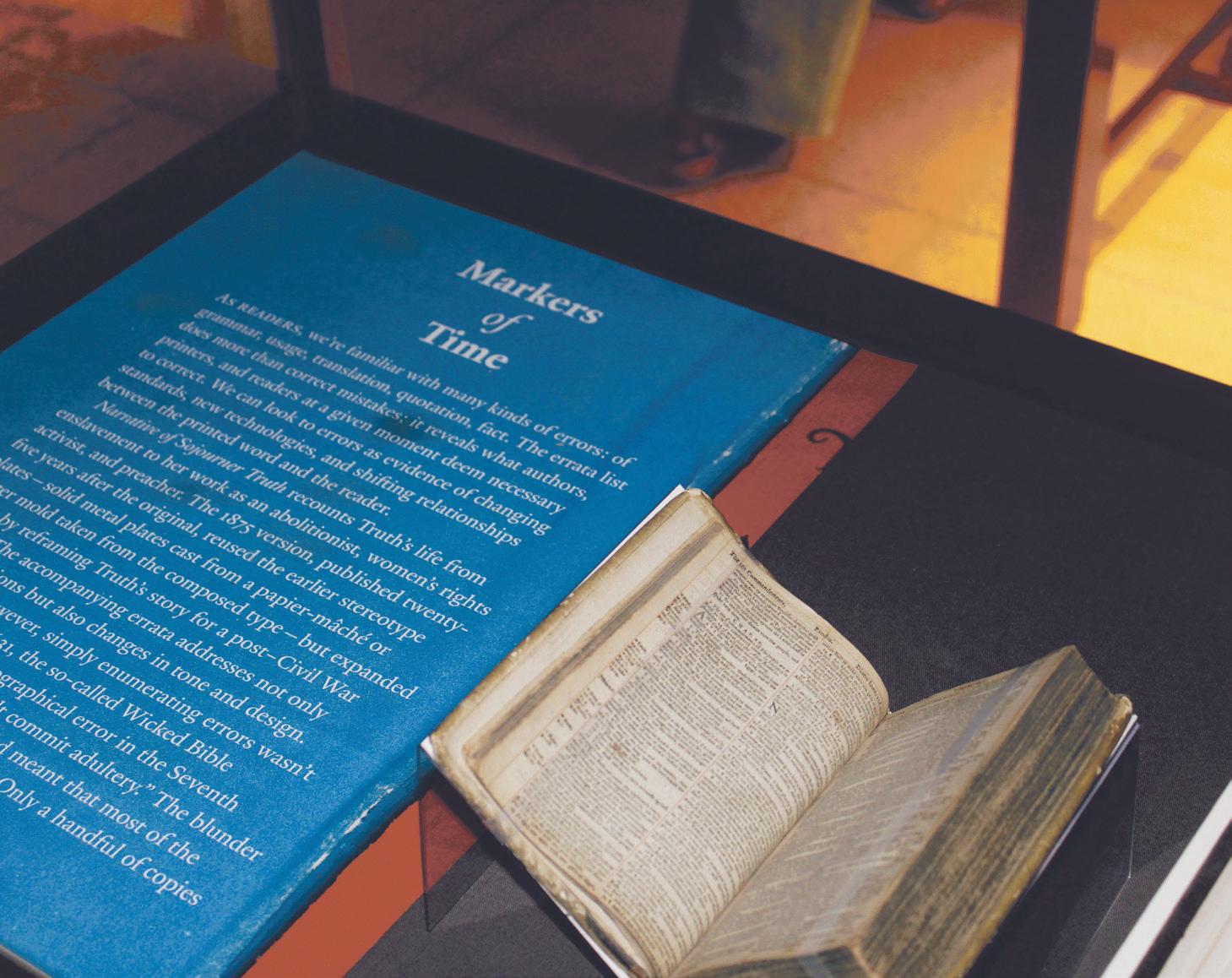
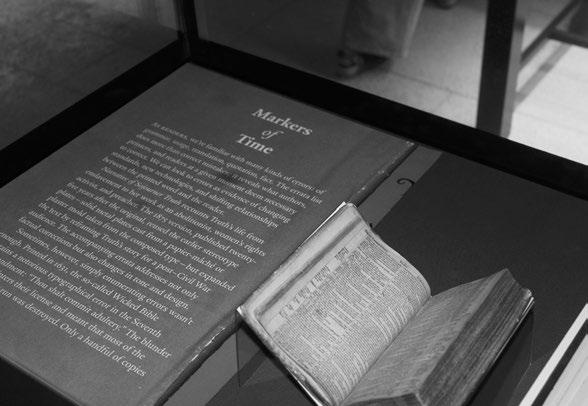
Yale opened a new exhibit focused on typos on Monday in the Hanke Exhibition Gallery in Sterling Memorial Library.
The exhibit, which is called “‘Beauties of My Style’: Errata and the Printed Mistake,” explores the different ways that errata, or errors in printed writing, have been addressed and utilized across almost 500 years of history.
“As someone who, when I write something, can usually hardly read it again, the fact that so many authors would go to the trouble to not just suggest a correction, but that their readers would reproduce that correction in the book, was so powerful,” Rachel Churner, one of the exhibit’s curators and a lecturer in visual studies at The New School, said in an interview.
Churner curated the exhibit with Geoff Kaplan, a lecturer in graphic design at the Yale School of Art and a fellow in Jonathan Edwards College.
Churner and Kaplan co-own no place press, a publishing company that aims to uplift marginalized authors who may have nontraditional perspectives on a wide range of cultural and historical topics, according to its website.
The idea for the exhibit came after a conversation between Kaplan and Rachel Herschman, the exhibitions and publications program director for the Beinecke Rare Book and Manuscript Library.
Herschman, who is also a fellow in Jonathan Edwards, learned that Kaplan and Churner were already working on a book about errata for no place press, she said.
“I asked him to submit an exhibition proposal for the Hanke gallery, and I loved the proposal,” Herschman said. Kaplan looped Churner into the exhibition, and they continued the curatorial process together.
According to Herschman, the Hanke Gallery was selected to house the exhibit for its small size compared to the Beinecke. The gallery still maintains the same high standards of conservation, light and security that allow for the display of special collections materials. Herschman said the space was the “right size” for the “size of the story” Kaplan and Churner wanted to tell.
Research for the exhibit took over a year, mainly spearheaded by Kaplan as a faculty member, Kaplan said.
“We could frame this conversation into a story of selfflagellation, but we were intrigued
by other, more intellectual, emotional ways of understanding the human condition,” Kaplan said.
Churner and Kaplan both said that selecting what to include in the exhibit was challenging. According to Churner, the Beinecke’s extensive catalogs and archives made it difficult to narrow down a final selection.
Churner noted that the exhibit could theoretically be curated two or three times with entirely new pieces.
One of the errata, “Thou shalt commit adultery,” comes from a copy of the 1631 “Wicked” Bible. Most copies of the version containing that typo were immediately destroyed.
In the book on view in the gallery, viewers will find a correction written on the page of the Bible.
The errata slip of James Joyce’s “Ulysses” that lists Joyce’s more
than 200 mistakes from the book’s first edition is also in the exhibition.
A portion of the exhibition’s name, in fact, refers to a statement written by Joyce before he released “Ulysses” where he describes his mistakes as “beauties of my style hitherto undreamt of.”
Herschman and the curators hope the exhibition will show students and other visitors that mistakes are not only acceptable but also a source of celebration. “Mistakes are perfectly acceptable, and maybe even necessary, in moments of knowledge production,” Kaplan said. “The mistake, the goof, is part of that process.” The exhibit will remain on display until Nov. 29.
Contact GEMARD GUERY at gemard.guery@yale.edu.
COURTESY OF AUDREY BAE
The
ARTS
“The deep roots never doubt spring will come.”
MARTY RUBIN
Young filmmakers will take the spotlight at Yale’s student-run festival
BYANGEL HU STAFF REPORTER
The Yale Student Film Festival will soon offer an exclusive glimpse into the worlds of both student and professional filmmaking through screenings and speaker sessions.
Now in its 11th year, the festival received nearly 400 student submissions from over 50 countries, according to its organizers. Around 40 films were selected for screening by a programming team composed of Yale students.
The student films are grouped into four genres: animation, documentary, experimental and narrative, along with an additional category for high school students. The chosen films are entered for a variety of awards, such as “Best Directing,” “Best Cinematography” and “Best Editing.”
“That is, I would say, the first and foremost reason why we’re here — to celebrate the new generation of student filmmakers and give them a platform both to exhibit their work and find audiences and connect the local community with artistic culture at its most daring,” Reese Weiden ’27, the festival’s co-director, said.
Through international outreach and outreach to local high schools, the festival sought to “increase the visibility of other cultures,” according to co-director Florence Barillas ’27.
Linden Skalak ’26, the programming director, was responsible for curating the lineup of films that would be screened. Skalak noted that the mission of the festival was to “amplify student voices and the kinds of things that only young people can make films about.”
“We’re looking for something that’s just very honest and unique to the filmmaker,” Skalak said in a voice memo to the News. “What unites all the films that we have for the festival is a sense of voice and vision.”
Additional events include an exclusive sneak peek of the unreleased A24 film “The Death of Robin Hood” and a talk with the film’s director Michael Sarnoski; a conversation between Carter Bays, the co-creator of “How I Met Your Mother,” and Brittani Nichols ’10, a writer on “Abbott Elementary”; and a pitch opportunity for student filmmakers to share their ideas to a panel of industry experts, who will offer feedback and prizes.
For the festival directors, this year’s programming is especially significant because more than half of the festival’s speakers are women, which is “different than years past and different than what you see in the industry,” Weiden said.
“We’re three women wanting to enter the entertainment industry, and we really wanted to champion women’s voices,” Barillas added.
The “Business of Entertainment” panel is comprised entirely of women: Christie Marchese, the founder and CEO of Kinema, EVP Entertainment Partnerships and Publicis Media; Liz Massie ’86, the senior executive producer of Warner Bros. Discovery; Anna Barnes ’01, the president at Little Monster Films; and Shana Waterman ’94 LAW ’00, the executive producer of “Forever.”
In order to represent a variety of interests, the festival will feature a new panel called “Cinema Beyond Entertainment,” which will “shed light onto careers that are not really in
the mainstream notion of being in the film industry,” Barillas said.
“We’re creating a platform for young filmmakers just at the beginning of their career to really help them see themselves represented,” Weiden said.
One highlight of the festival is a talk with Yale lecturer Paul Grimstad, which Barillas will moderate. Grimstad, who is the director of undergraduate studies for the Humanities program, acted in Paul Thomas Anderson’s 2025 “One Battle After Another,” which won the Academy Award for Best Picture, and
Ronald Bronstein’s 2025 Oscarnominated film “Marty Supreme.”
The festival will also bring alumni filmmakers Delilah Napier ’19 and Lucy Powers ’19 back to campus for a screening and discussion of their feature film “Floating Carousel.”
“Floating Carousel” previously won the “Ultra Indie Award” at the 2025 Woodstock Film Festival, where it premiered.
Weiden emphasized the importance of the festival in creating a space for the Yale and broader New Haven community
to experience watching films together, especially because there are currently no movie theaters in New Haven.
“Movie theaters are spaces that are such essential elements to community-building. Not having that feels detrimental to the overall community, so we try to fill in that gap,” Weiden said.
All the Yale Student Film Festival events are free and open to the public.
Contact ANGEL HU at angel.hu@yale.edu
Mexican folk dance group to bring telenovelas from screen to stage
BY CHUER CINDY ZHONG CONTRIBUTING REPORTER
Ballet Folklórico Mexicano’s spring showcase, called “Telenovela en Vivo,” will debut at the Off-Broadway Theater for two performances on Friday, aiming to immerse the audience in the nostalgia of watching various television shows as children.
Telenovelas, Latin American soap operas, are “highly dramatized stories that really rely on certain themes of marriage, love and heartbreak.
There’s villains always,” Pablo Macias Lopez ’27, one of the group’s artistic directors, explained. “And we have that in real life, so the fact that we go to the screen to look for that as well is of interest to me.”
Macias Lopez described some of the questions he grappled with as he was designing the showcase.
“How can you share that experience of watching something on TV, which a lot of us have had as kids?” Macias Lopez said. “How can you make this be something that people can connect to, and in some ways be comedic and heartbreaking?”
Originally a group of some 25 people, Ballet Folklórico Mexicano previously worked with the former head of Ezra Stiles College, Alicia Schmidt Camacho, to plan performances at the Crescent Underground Theater between Ezra Stiles and Morse Colleges.
“But due to the group getting so large, we couldn’t fit in Crescent anymore,” Aimee Perales ’27, the group’s co-president, said. “So we moved to Off-Broadway.”
Perales credited the group’s growth to what she perceived as an increase in Mexican students and the group’s addition of “non-Latinos, who are interested in learning more about the culture through dance, which is so beautiful to see.”
Alejandra Coronado ’29, one of the new performers in “Telenovela en Vivo,” echoed this sentiment.
“It’s been not only great for me personally to move and interact with my culture in a new way, but to talk to other people who are on that same journey,” Coronado said. “I feel like in a community such as Yale, it can be very easy to get lost in the amount of workload and pressure and different cultures and who you have to be as a student before a person.”
Each semester, the theme of the showcase is decided by Ballet Folklórico Mexicano as a whole. In the fall 2025 semester, the group choreographed dances celebrating “Mujeres Divinas,” or “Divine Women,” and in the spring 2025 semester, their showcase theme was “Rutas de Mexico,” or “Routes of Mexico.”
“‘Rutas de Mexico’ was really the turning point for BF in terms of getting more technical and more intentional with our themes,” Perales said. With “Telenovela en Vivo,” she said they hope to continue that trajectory.
Macias Lopez told the News that “Telenovela en Vivo” would fully use the technology at the Off-Broadway Theater, including a video wall.
“I think that screen has really allowed us to explore a lot of new creative pathways by allowing dynamic backgrounds that can move and shift, and that really allows audiences to connect with the media and visual storytelling in a way that we were more limited to in previous years at the Crescent Theater,” Macias Lopez said.
“Telenovela en Vivo” will last approximately two hours, including a 15 minute intermission.
Contact CHUER CINDY ZHONG at cindy.zhong@yale.edu.
COURTESY OF BALLET FOLKLORICO
COURTESY OF BRONWEN PAILTHORPE
“So live in the light of resurrection and renewal of this world, and of yourself, in a glorius, never-ending, joyful dance of grace.”
TIM KELLER
Residents at budget hearing urge funding for climate office, food aid
BY NELLIE KENNEY & JESSICA HICKLE STAFF REPORTER
Residents called for the mayor’s new city budget to fund climate services and food pantries at a Board of Alders Finance Committee meeting on Tuesday.
About 40 residents gathered in the Aldermanic Chambers at City Hall as the committee heard public testimony on Mayor Justin Elicker’s proposed budget for the coming fiscal year. An additional dozen activists from the New Haven Climate Movement gathered at the back of the room, hoisting signs with messages reading “the earth’s future is our future” and “stop denying our earth is dying.”
Of 26 total testimonies, ten spoke in support of Elicker’s proposal for continued funding of the city’s Office of Climate and Sustainability after the federal funding that paid for it expired. Another eight called for continued city funding for the Coordinated Food Assistance Network, a group that is focused on creating a unified system of food assistance in the greater New Haven area. Funding for that group was not included in Elicker’s proposed budget.
All ten of the residents who testified about the Office of Climate and Sustainability supported its continued funding.
The office was created in 2022 using funding from the American Rescue Plan Act. That year, the Board of Alders voted to allocate $1 million toward funding personnel for the office through the end of 2026. In Elicker’s new proposed budget, funding for the office would come from the city’s general fund.
New Haven residents and climate activists urged alders to approve Elicker’s proposal.
“In the face of a growing climate crisis that is only
accelerating, we cannot afford to take a step backward. Maintaining momentum is not optional. It is needed,” Andrew Zielinski, a board member for the Urban Resources Initiative, a Yale program engaged in community forestry activities throughout New Haven, said.
Ward 24 Alder Evette Hamilton said in an interview that she shared many of the residents’ concerns.
A common thread through many residents’ testimonies was the call for more money from Yale.
“We’ve got Yale going on. Why are we starving today?” resident Cheryl Rabe asked.
Earlier this month, Yale pledged to increase its voluntary payment to New Haven to around $29.9 million in the coming fiscal year. The University’s total payments to the city are set to equal $230 million over the next seven years. The increase came after many local union leaders called on Yale to up its yearly payments to $110 million to compensate for money the University does not pay in taxes.
In addition to climate funding, residents testified in support of funding for the Coordinated Food Assistance Network. In the 2025-2026 fiscal year, the city allocated $345,439 to the network. Continued funding was not included in the mayor’s new proposed budget.
In a statement published in the New Haven Independent, Elicker wrote that “As a city, we work to identify funds and meet many important priorities — and the budget is a collaborative process with the Board of Alders. Of course, CFAN [the Coordinated Food Access Network] is welcome to participate in the budget public hearings once again this year.”
Supporters of the network asked alders to restore and
increase its funding to $500,000.
Several residents noted that demand for food assistance will only continue to grow as a result of federal cuts to programs like the Supplemental Nutrition Assistance Program. The One Big Beautiful Bill Act, which was passed in 2025, will reduce funding for the program by approximately $186 billion over 10 years, according to the Harvard Kennedy School.
“This funding is needed now more than ever because food is a right, not a privilege,” New Haven resident Susan Harris said.
In an interview, Ward 17 Alder Sal Punzo acknowledged that the
public testimony included “a lot on CFAN,” referring to the food assistance network.
Punzo said he has “witnessed” the lines of people waiting for food assistance on Saturday mornings. “Food is important. It’s a necessity,” he said.
Residents also voiced support for the New Haven Free Public Library. Fair Haven resident and library board member Lee Cruz testified that funding for the library has not kept pace with locals’ demands for its services.
“Last year alone, more than 420,000 people walked through our doors, not just to borrow books, but to access
computers, apply for jobs, attend programs, participate in civil life,” Cruz said.
Punzo said that finding additional funding for services was “complicated.”
“You have to look at every department, every aspect of the budget,” he said.
The Board of Alders Finance Committee meets on the second Monday of every month at 6 p.m. at City Hall.
Contact NELLIE KENNEY at nellie.kenney@yale.edu
Contact JESSICA HICKLE at jessica.hickle@yale.edu.
Before latest Yale-city deal, 90 years of New Haven’s calls for money
BY NELLIE KENNEY STAFF REPORTER
This month, Yale President Maurie McInnis announced that Yale will pay around $230 million to New Haven over the next seven years.
Thirty-six years ago, the city and University struck their first voluntary payment deal, which involved only $1.17 million and was linked to the fire department’s budget, according to the News’ coverage from the time. In the years since, the voluntary contribution has been a topic of frequent discussion and reevaluation among Yale administrators, city politicians, residents and students.
“Successive mayors — DeStefano, Harp, and Elicker — and presidents — Levin, Salovey, and McInnis — and the parties have each made substantial growth” to the “partnership” between the city and the University, Michael Morand, New Haven’s city historian and former
Yale associate vice president for New Haven and state affairs, wrote in an email to the News. Morand wrote that the city’s call for payment from Yale dates back “at least” to the 1930s. In 1937, a committee assembled by then-Mayor John Murphy presented a brief to the Yale Corporation requesting that Yale contribute money to pay for city services the University relied upon, according to a News article written that May. The presenters acknowledged that Yale provided “cultural aid” to the city but argued that Yale should also make an “annual cash contribution” to offset the “withdrawal of property from the taxable property list,” the article reported. All Yale property used for academic purposes is exempt from local property taxes due to Yale’s status as a non-profit. As of last year, 56 percent of New Haven property value is tax exempt, the New Haven Independent reported. The
state’s Payment in Lieu of Taxes Program, which was first instituted in 1969, is intended to offset the loss of tax revenue in cities like New Haven with large nonprofits.
The University refused to make such a payment in the 1930s, and over the next five decades, town and gown clashed repeatedly over taxes on Yale properties, including Ingalls Rink, the Yale golf course and housing for married students, according to the News’ coverage.
Jonathan Einhorn, who served on New Haven’s Board of Alders from 1976 to 1991, said in a phone interview that Yale’s tax exemption was the “nub” of the relationship between Yale and New Haven, adding that during his tenure as alder it was “in the back of the administration and the aldermen’s minds when Yale would come to the city and request approval for something.”
The “spirit of contribution” began in the 1990s, Einhorn said. He credited that spirit in part
to the city realizing that it had a “valuable asset” in Yale, as well as to Yale realizing the importance of the city being “safe” for students. In 1991, the murder of Yale student Christian Prince ’93, who was shot on the steps of St. Mary’s Church on Hillhouse Avenue, “brought home the message to Yale,” Einhorn said.
The early 1990s were marked by financial difficulty for New Haven. Between 1986 and 1990, New Haven went from being ranked the seventh poorest city in the United States to the fourth poorest, according to a 1990 News article.
In 1990, Connecticut State Rep. Patricia Dillon SPH ’98 proposed a bill which would have allowed Yale land not used for educational purposes to be taxed, Dillon said in a February phone interview.
Instead, Yale and New Haven arrived at their first voluntary contribution agreement, which Dillon said “kind of mooted” the bill. At the time, Dillon had speculated that her willingness to withdraw the bill from the finance committee was a major factor in the agreement’s success, the News reported.
Then Mayor John Daniels and former Yale President Benno Schmidt ’63 LAW ’66 announced the agreement, which included a commitment by the University to make annual payments for fire services on its tax exempt properties, as well as to pay taxes on the Yale golf course, in April of 1990, the News reported at the time. Simultaneously, the city sold the University portions of Wall Street and High Street that cross through Yale’s campus. Daniels died in 2015, and Schmidt died in 2023.
The agreement was approved by the Board of Alders in October of 1990 by a 19-7 vote.
Einhorn said he had qualms with the closure of city streets by Yale but added that the 1990 deal began to “warm the relationship” between Yale and New Haven.
The 1990 agreement set the city and University on a “new path,” Morand, who was also an alder at the time, wrote.
In 2005, the University added
a payment of $1.8 million in addition to its established fire service payments, which at that point amounted to about $2.3 million annually, according to a News article from the time. The additional payment was calculated by a formula which multiplied the number of student dormitory beds and full-time university employees by $250, and was linked to inflation.
John DeStefano, who served as the mayor of New Haven at the time, said in a phone interview that it is “hard to draw a line between what happened in 1990 and what happened in 2005 and what’s happening now.”
DeStefano said he didn’t remember the exact considerations that went into the 2005 payment formula but said that “whatever we did was largely aimed at getting to a number that both the University and the city felt was reasonable, and then we created a formula to get to it.”
During his tenure, DeStefano viewed the University’s tax exemption as an “issue having to do with the state of Connecticut and the tax structure that existed in the state of Connecticut,” rather than with Yale, he said.
Asked about the voluntary contribution before the deal was announced this month, Governor Ned Lamont SOM ’80 pointed to Yale’s large contribution to the New Haven economy.
“Yale will tell you they contribute more to the New Haven economy than probably any other Ivy League does to their community,” he said in an interview. “Does that mean they can’t do more? No, they can do more.”
“They’re a big piece of that community, and they own a big piece of the community, which is tax exempt,” Lamont added.
Yale owned more than 300 parcels of land in New Haven in 2025, totalling over 850 acres, according to an article in CT Insider.
Elijah Hurewitz-Ravitch contributed reporting.
Contact NELLIE KENNEY at nellie.kenney@yale.edu.
JESSICA HICKLE / CONTRIBUTING PHOTOGRAPHER
The Board of Alders Finance Committee received input from residents and city departments on Mayor Justin Elicker’s proposed city budget for the upcoming fiscal year.
SPORTS
“My
BROWNING
Bulldogs look to steady the ship in upcoming series against Princeton
BASEBALL
BY JUSTIN LEAHY CONTRIBUTING REPORTER
The Yale Bulldogs (13–9, 4–2 Ivy) have been on a rollercoaster through their first month of Ivy League play.
Last weekend, the Bulldogs bounced back after a tough series against Brown (11–11, 5–1 Ivy) with a sweep against Penn (8–14, 3–3 Ivy), but just two days later, Yale fell to Fairfield (12–11, 7–2 MAAC) 9-6 midweek.
The Bulldogs will next take on Princeton (7–16, 2–4 Ivy) this weekend in a road series.
Against Fairfield, Yale led 6-5 through seven innings, but the Stags tallied a three-run home run to take the game away and break Yale’s four-game win streak. Bright spots for the Elis included Garrett Larsen ’27 and his three hits, as well as the first homer for rookie Bryce Miller ’29. Additionally, Kaiden Dossa ’27 hit a double to stretch his on-base streak to 15 games. The trio of Miller, Dossa and Larsen has shown consistent offensive prowess through the first month of Yale’s season.
While the Fairfield loss diminished a bit of momentum that came after the sweep over Penn, the mood heading into the Princeton series is still positive, according to Dossa.
“After this weekend I think that we have really found our identity as a team on both sides of the ball and seeing what we do best,” Dossa wrote to the News.
“We are all feeling confident and excited to take what we have learned from this past weekend into this coming Princeton series.”
The team’s deep, aggressive lineup has reached double-digit run totals more than five times this year. Jack Dauer ’28 leads the team with 24 RBIs, and Yale has seven players with more than 10 RBIs.
“With our deep lineup, I like to focus on doing everything I can to find a way to get on base and then let our offense do what we do best,” he wrote. “It’s all about passing the baton, doing your job, and then staying on the attack.”
Heading into the Princeton series, the big question is the rotation.
Jack Ohman ’28, Yale’s ace and the reigning Ivy League Pitcher of the Year, has struggled in back-to-back starts, allowing 14 runs in his past two outings against Brown and Penn.
“Everyone on the team knows that Ohman will bounce back and we are going to do everything we can to have his back,” Dossa wrote to the News. “It was really cool to have two of our seniors, Dan Cohen and Tate Evans, step up with two amazing starts putting us in a spot to win those games even when Jack didn’t have his best stuff the day before.”
Daniel Cohen ’26 earned the honor of Ivy League Pitcher of the Week after a completegame shutout against Penn. Tate Evans ’26 struck out nine in his first collegiate start and gave Yale some needed rotation depth in a weekend when Ohman got pulled from the mound in the third inning of his start. Also, Teo Spadaccini ’27 provided a
solid relief appearance in the doubleheader against Penn, and has posted a 1.76 ERA through the first month of the season. This Yale team, which was originally picked to place second in the Ivy League preseason poll, still has a lot to prove. A series win against Princeton this weekend would help reinforce the Bulldogs as an Ivy title contender. So far in Ivy play, the Tigers have beaten Cornell (4–16, 2–4 Ivy) in a series and lost to Brown, like Yale did. Yale and Princeton will play a doubleheader on Saturday, and the final game of the series is set for Sunday.
Contact JUSTIN LEAHY at justin.leahy@yale.edu.
Bulldogs fall short against Army for second loss of the season
WOMEN'S LACROSSE
BY AZARA MASON STAFF REPORTER
Despite outscoring Army (9–2, 4–0 Patriot) in the second half, the Yale Bulldogs (9–2, 3–0 Ivy) could not overcome an early deficit, falling 12-8 to the Black Knights after Army opened the
game with a decisive 5-0 run.
The Bulldogs entered the matchup ranked No. 5 in the nation. After the loss to Army West Point on Tuesday at Reese Stadium, however, Yale dropped to No. 19.
Army wasted no time getting points on the board on Tuesday. Three consecutive goals from attacker Brigid Duffy in a fiveminute span helped put Yale in an early 5-0 hole early on in the first quarter. With under two minutes to go in the opening quarter, the Bulldogs finally broke through. Finding her way to the eightmeter mark, attacker Lily Spinner ’27 scored to put Yale on the board and cut the deficit to 5-1. Shortly after, attacker Kelly Holmes ’28 converted on another freeposition opportunity, narrowing the gap to 5-2 heading into the second quarter.
Back-to-back goals from attacker Ashley Newman ’26 then brought Yale within one at 5-4.
However, Army responded with a 4-0 run to close out the half and extend its lead to 9-4.
Back-to-back goals from the Black Knights to open up the second half put Yale in its biggest deficit of the game, down 11-4. Two goals from Holmes and Ashley Kiernan ’27 cut the Army lead to five to close out the third quarter 11-6.
Two-time Ivy Offensive Player of the Week Kate Gould ’29 had her first and only goal of the game less than
six minutes into the fourth quarter. At that point, the Bulldogs were only down four with nine minutes left on the clock, so they were still within striking distance.
With a little over four minutes to go in the game, Newman potted her third goal of the game to bring the Bulldogs within three. Newman’s hat trick of goals was the most of any Bulldog player on Tuesday afternoon. Despite the push in the second half, the Bulldogs ran out of time and fell to the Black Knights 12-8.
Head coach Erica Bamford credited Army’s performance while expressing confidence in her team’s ability to respond.
“First, credit to Army for coming out and playing an exceptional game today,” Bamford wrote in a text message to the News. “While our performance and the outcome weren’t what we wanted today, I am confident we have a great team who will be ready for Saturday.”
The Bulldogs remain undefeated in Ivy League play and will look to bounce back this weekend.
They will travel to Hanover to face Dartmouth on Saturday at 3:30 p.m.
Contact AZARA MASON at azara.mason@yale.edu.
Yale splits doubleheader, looks ahead to road series against Penn
SOFTBALL
BY SONIA GUPTA CONTRIBUTING REPORTER
The Yale softball team (10–20, 3–6 Ivy) split a doubleheader against Rhode Island (8–15) on Tuesday, battling through extra innings in a 2-4 loss before earning the victory in a 9-6 win at the DeWitt Family Stadium.
To open Tuesday’s action, Yale struck first with Grace Westmoreland ’28 delivering a two-run single to give the Bulldogs an early 2-0 advantage. But Rhode Island fought back to tie the game 2-2, eventually sending the game into extra innings.
In the eighth, the Rams capitalized on small ball, using a sacrifice fly to take the lead before adding another run on a single to left. Rhode Island held Yale scoreless in the bottom half, and the game ended in a 2-4 loss for the Bulldogs.
Yale showed resilience and turned the page in the second game. After falling behind 2-5 in the top of the third inning, the Bulldogs responded immediately.
Elena Ohe ’27 and Jane Littleton ’29 each reached base to start the bottom of the third and then Isabella Fortini ’27 brought home two runs. The Bulldogs kept the pressure on to retake a 6-5 lead.
Rhode Island briefly tied the game in the fourth inning, but Yale delivered the decisive blow in the fifth. Ella Cross ’28 drove in a single, and the Bulldogs tacked on two more runs to close out a 9-6 win.
In the circle, Meredith Henderson ’27 earned her first win of the season with four innings of pitching.
The split provides some momentum as Yale heads into its first Ivy League series on the road — but the challenge ahead looks to be steeper than last season’s matchup. In the 2025 season, Yale won all three of their games against Penn, but last year’s Quakers squad also limped to a measly 1–20 Ivy record. This spring, however, Penn (12–15, 3–3 Ivy) looks much improved, and is currently tied for second place in conference standings alongside Harvard (11–14–1, 3–3 Ivy),
Brown (10–14, 3–3 Ivy) and Dartmouth (5–13, 3–3 Ivy).
The Bulldogs enter the weekend at the bottom of the Ivy table but hope to continue Tuesday’s offensive surge against con -
ference pitching. With multiple teams clustered near the top, the series presents a midseason opportunity for Yale to climb the Ivy standings. In Philadelphia, first pitches are
slated for 12:30 p.m. on Saturday and 12:30 p.m. on Sunday. Contact SONIA GUPTA at sonia.gupta@yale.edu.
Yale women’s lacrosse team suffered a rare loss on Tuesday, falling 12-8 against Army West Point.
LIZA KAUFMAN / PHOTOGRAPHY EDITOR After a series of ups and downs, the Yale baseball team hopes to take down in-conference rival Princeton this weekend to secure its position as a contender for the Ivy League title.
COURTESY OF NOAH VAN DICK
The softball team will face off against the University of Pennsylvania this weekend after splitting a doubleheader against Rhode Island on Tuesday.
MEN'SLACROSSE
BY LIZA KAUFMAN STAFF REPORTER
The Yale men’s lacrosse team (4–4, 1–2 Ivy) will travel to Hanover to face off against the Dartmouth Big Green (4–5, 0–2 Ivy) on Saturday afternoon.
After upsetting defending national champion Cornell (5–3, 2–1 Ivy) 13-12 last weekend in Ithaca to clinch the squad’s first conference win of the season, Yale climbed to No. 18 in the national rankings.
“It was definitely good to get a top 10 win under our belts, but I think our confidence in our ability has remained unshaken,” first-year long stick midfielder Gaetano Cicotello ’29 wrote in a text message to the News. “We always have known what we are capable of, Saturday’s game was just everyone else getting to see it.”
A four-goal performance from attackman Peter Moynihan ’27, including the game-tying and game-winning goals, and 20 saves in net from Ben Friedman ’28, notably a save on Cornell’s attempt at a game-tying goal at the five-second mark, earned the two Bulldogs Ivy accolades. Moynihan was named Ivy League Offensive Player of the Week, and Friedman claimed Ivy League Defensive Player of the Week. Following last weekend’s performance, Friedman is now second in the conference and sixth nationally in saves per game.
The Bulldogs will now look to ride that momentum as they travel to Hanover to face the Big Green, the bottom-ranked team in the Ivy League.
Dartmouth has struggled to find consistency in both nonconference and Ivy League play this season. In their season opener, the Big Green suffered a devastating 5-13 loss to Boston University (5–4, 3–1 Patriot) but then bounced back
TRACKANDFIELD
BY INEZ CHUIDIAN STAFF REPORTER
The Yale track and field team will head to the George J. Sherman Family Sports Complex in Storrs, Connecticut, this weekend for the annual UConn Dog Fight Invite.
in New Hampshire with three consecutive wins over Vermont (4–4, 2–1 AEC), Merrimack (3–8, 2–3 MAAC) and Siena (8–2, 4–0 MAAC). However, a trip out west to Salt Lake City resulted in a 10-17 loss to Utah (6–3, 1–0 ASUN). Back on the East Coast, Dartmouth defeated Fairfield (4–6, 1–2 CAA) 16-10 before its Ivy opener. In their first in-conference matchup at Harvard (8–1, 2–0 Ivy), the Big Green led the thenundefeated Crimson by one at the half, but a Harvard 10-goal second half sealed the victory for the Crimson. The team suffered another loss in a quick trip down to Charlottesville, Virginia, where it fell 7-18 to UVA (6–4, 1–0 ACC).
Last weekend, in its Ivy home opener, Dartmouth came out hot, jumping out to an early 4-0 lead over Penn (5–4, 2–1 Ivy). However, the Quakers responded with four of their own to level the score. In the second quarter, the Big Green found the back of the net four more times, while holding the Quakers scoreless. Dartmouth led 14-9 at the close of the third, but a Penn sevengoal fourth-quarter run powered the Quakers to a 16-14 victory. With the loss last weekend, Dartmouth will enter Saturday’s matchup on a three-game losing streak. On the other sideline, Yale will come in with some momentum, having defeated the defending NCAA champions, Cornell, last weekend in Ithaca.
The Bulldogs also have history on their side. Yale has won 14 of the two squads’ last 15 meetings since 2009, going a perfect 7-0 on the road in Hanover. In 2022, Yale won by its largest margin, 23-6.
Last year, when the Elis hosted the Big Green at Reese Stadium on Yale’s senior day, the seniors helped extend the win streak to 14 with a 21-12 victory. The Bulldogs jumped to an early 4-0 lead and never looked back. Chris Lyons ’25
scored a game-high six goals, while Leo Johnson ’25 recorded four goals and four assists and Johnny Keib ’25 notched a hat trick. After steamrolling Dartmouth, Yale punched its ticket to the 2025 Ivy League tournament. Now, the Bulldogs will look to keep up the streak and secure their second conference victory, but that will not be an easy task. Although the Big Green are 0-2 in the Ivy
League, they nearly upset the Quakers last weekend, to whom the Bulldogs fell two weeks ago.
Yale can be certain that Dartmouth is hungry for its first Ivy win of the year.
“Going into Dartmouth, our coaches have made sure to let us know how much of a battle we are in for on Saturday,” Cicotello wrote. “Dartmouth was up big on Penn, a team that we lost to, so no one is taking this game lightly at all, we are all well aware of the implications this game has on postseason play.” Faceoff is slated for 12 p.m. at Scully-Fahey Field, and the game will be streamed on ESPN+.
Contact LIZA KAUFMAN at liza.kaufman@yale.edu
This meet, which marks the third weekend of outdoor competition this spring, comes at a key point in the season for the team, with the Bulldogs looking to build momentum as they enter into a busy month of April. So far this spring, Yale has already racked up multiple podium finishes, including a school record, in opening season meets.
“The start of outdoor season
has been solid for us,” women’s captain Makayla White ’26 wrote to the News. “There’s been a lot of focus on getting quality reps in, especially coming off indoor.”
As winter fades and temperatures rise, the transition to outdoor racing hasn’t been without its challenges. Athletes must adjust not only to new events but also to the unpredictability of the elements.
“We’ve had to deal with some tough conditions,” White added. “But the mindset has stayed consistent: take advantage of every opportunity to compete and keep building.”
The outdoor season also expands opportunities across the roster. With events like the 10,000-meter, 1,500-meter, 100meter, 3,000-meter steeplechase, 110-meter hurdles, 400-meter hurdles, hammer throw, javelin, discus and heptathlon, which are exclusive to outdoor competition, more Bulldogs are getting chances to compete.
The wider range of events has already led to further success for the Bulldogs, especially in the throws. At last weekend’s UMass Flagship First meet, four of Yale’s 12 podium finishes came in throwing events.
“I’m feeling really excited and energized about how the team has performed so far,” junior Chu Anueyiagu ’27 wrote to the News.
Anueyiagu won the hammer throw for Yale last Saturday and is looking forward to what’s in store for the coming weeks, he said.
“As for the rest of the outdoor season, I think you should expect to see some more big throws coming soon,” he said.
Last year’s Dog Fight Invite featured several programs including Northeastern, Dartmouth and Boston College. Out of the seven competing programs, the Bulldogs finished third on the women’s side and sixth on the men’s.
This weekend, Yale will look to keep their positive spring trajectory going and improve on last year’s results.
The UConn Dog Fight Invite is a one-day meet, with events beginning at 11 a.m. on Saturday.
Contact INEZ CHUIDIAN at inezchristina.chuidian@yale.edu.
LIZA KAUFMAN / PHOTOGRAPHY EDITOR
The men’s lacrosse team moved up to No. 18 in the national rankings after beating Cornell, the defending national champions. The Elis hope to build on last weekend’s success with another road conference win
COURTESY OF YALE ATHLETICS On Saturday, the Bulldogs will match up against the University of Connecticut Huskies and other teams from around the Northeast.
WEEKEND
// BY HELEN ZHANG
the glow i mistook for goD
Whether kowtowing before gilded statues, reading Louise Glück for the first time or almost falling in love, no experience has felt as holy to me as a lightshow on the Caribbean seafloor. Fifty feet below the surface, swallowed in darkness, I was convinced I glimpsed the neurons of god’s mind.
On my final scuba trip in Utila, Honduras, I dove below the waves with the setting sun. That night, the boat and divers held the only lights polluting the sky. Flashlight in hand, fins on feet, I penguin-wobbled to the edge of the speedboat and threw myself into the whipped, meringue-textured waves. As we descended, the last of daylight’s warmth slipped off my skin like silk. Neutrally buoyant, we hovered above the reef and scanned it for nocturnal life, flashlights as bright as lightsabers. The reef was more vibrant at night than day — at such depths, red wavelengths are swallowed by the water in natural light.
Gorgonian sea fans swayed in synchrony; lobsters frat flicked; needlefish slept in suspension, cradled by the current. I met an octopus, a juvenile jackknife, two pufferfish and a couple barracudas, forgetting the hand signals for all of them except stingray (an upside down middle finger) and whale shark (a “W” on the forehead). No matter what the Google AI overview tells you, the latter creature rarely graces Utila with its presence. Despite being painted on multi-story murals, embroidered on hats at every souvenir shop and strung as a ceramic charm on my anklet (now a tan-line tattoo), whale sharks are more myth than fish on this island. Every local has a different explanation for their absence: the invasion of raccoons, the loss of blue crabs and, most plausibly, the human race. I was still delusional enough to keep an eye out for a diurnal, hollow-mouthed, spotted giant in the periphery of my flashlight.
Near the end of the dive, we knelt on a patch of sand beside the reef and turned off our flashlights. Bioluminescent plankton sparkled from my wiggling fingertips and blooming bubble-breaths before dissolving into the darkness, brief as a blink.
All at once, living constellations of neon green bodies surrounded me, pulsing at regular intervals of space and time, falling in cascading synchrony. Kneeling on the seabed, bubble-blowing, I had never been closer to prayer.
The locals call them “string of pearls.” Found only in Caribbean waters during moonless nights, they are bioluminescent snot-trails emitted during the mating ritual of tiny male ostracods, which sounds more preposterous than magic itself. Unlike Keats’ fear that science would “unweave the rainbow,” knowing this only made the artistry of the world harder to dismiss. The divine was never otherworldly, but in the pulse of an atrium, a sea firefly, a cicada’s rib — all dancing in synchrony to a song beyond the range of human hearing. The moment we surfaced, a yawp tore from my mouth, drawing a wobbly beam of light from my dive buddy. To this day we still don’t know what possessed my voice. I floated on my back, stargazing, certain that aliens existed both above and below me.
On the boat ride back, I asked the captain for the song he was playing to bottle up this moment (The Doors’ “Roadhouse Blues”), peeled off my second and third skin (two wetsuits) and airdried in the breeze. I ended the night sipping Leyde’s pineapple juice — a boxed drink I savored so much I had to finish half a liter of it in front of airport security — before falling asleep in my swimsuit. Perhaps if I held off on washing the salt from my hair, the memory would have marinated a little longer.
Contact HELEN ZHANG at helen.zhang@yale.edu.
PROFILE
Desmos invites Elena Miinea ’29 to all-hands meeting after WKND feature
When Elena Miinea ’29 first began using Desmos to make art, she was working in a medium most people associate with homework, not creativity.
In January, I wrote about how Miinea turned the graphing calculator into a tool for visual composition. She layered equations into intricate digital forms and then translated them into physical works, like her piece “Diatom Mandala.”
A few days later, I received an unexpected email from a reader of the News. Desmos CEO Eli Luberoff ’09 reached out to me to say that the piece made his day and asked if I could pass his message along to Miinea, inviting her to share her experience.
After I forwarded the email to Miinea, she told me the email felt almost unreal.
“I thought it was so crazy,” she wrote. “I never thought something like this would happen.” Until recently, she had not publicized her art beyond her immediate community. The fact that one article led so quickly to a much larger opportunity felt, to her, both surprising and fitting.
“This is the type of thing that would only happen at Yale,” she said, reflecting on how the news of her work traveled into entirely unexpected places.
Miinea said that, over email, the Desmos team expressed their enjoyment of her unconventional use of the platform. They especially admired her combination of digital art with physical media, she said. The Desmos team told her they are always looking for people who use Desmos in unanticipated ways.
// BY LEONARDO CHUNG
built around spiderweb-shaped fractals, as well as another work that used 2D Desmos to create a floral collage.
Across all three artworks, Miinea focused on the same underlying idea: Desmos had become part of the way she learned, experimented and arrived at the final work. The openness of Desmos, she said, was central to her portfolio and the way she thinks about math — as both an
she was guest speaking at a conference. But the atmosphere quickly dissolved her nerves. The team, she said, was welcoming from the start, and their meeting opened with shoutouts celebrating each other’s accomplishments from the month. The Desmos team said they had even mailed a custom notebook for her with her artwork printed on the cover, along with a shirt and stickers. Some of the comments she received have stayed with her.
Soon after reaching out by email, the team invited Miinea to present on Zoom at an “all-hands” meeting.
Her presentation focused primarily on “Diatom Mandala,” the piece she had built by generating forms in Desmos, collaging them in Procreate, printing the composition onto a linen canvas and drawing diatoms herself with a white paint and a toothpick. But the talk expanded beyond “Diatom Mandala.” Miinea also discussed “Evolving Gossamer,” a virtual reality piece
CULTURE
academic subject and a visual language.
Preparing to speak was, in some ways, harder than the talk itself, Miinea said. Part of the challenge was deciding what to emphasize in her presentation.
“It was hard to decide exactly what to focus on,” she said. But once she narrowed in on the specific role that Desmos played in her sustained artistic investigation, the presentation began to take shape. The meeting was looser than Miinea expected. She said she logged onto the Zoom preparing for something formal, even dressing as though
One person told her they would love to have a print of her work in the office. Another said that they would enjoy taking a course taught by her. Miinea said these responses motivated her to think more seriously about what it might be like to share her work publicly. Since then, she said she has begun thinking about product creation and building a digital space where people can view her pieces. She’s even contemplating making art content on YouTube that explains her process. What stayed with her most was the team’s interest in seeing the platform used in ways they would have never imagined. That, she said, is now part of her artistic motivation going forward. She wants to keep making work that catches her audience off guard.
Miinea is interested in experimenting with newer features, including custom color for 3D graphs, and continuing to explore the relationship between mathematics, nature and culture that already exists in her work.
Looking back, Miinea never thought her art could be more than a hobby. But Desmos’ invitation to present to the team widened the scope of what Miinea imagined possible. What began as private experimentation on her laptop has become unexpectedly far-reaching. Miinea was already an unconventional artist, but this wider recognition has made her more excited to continue working outside of the box.
Contact LEONARDO CHUNG at leonardo.chung@yale.edu.
A first year’s guide to Camp Yale
If you’re a newly admitted Yale student, choosing which Camp Yale program to participate in is one of the first decisions you will make. The orientation program form arrives in your inbox far before you choose your classes or enter shopping period. Each Camp Yale program promises to build community and tries to sell you a different version of what that pivotal first week could look like. Yale describes Camp Yale as a required part of the opening days, with the programs meant to connect new students to one another, with upperclassmen, the University and, in some cases, New Haven.
First-Year Outdoor Orientation Trips, or FOOT, is by far the most popular Camp Yale program — over 600 first years participated this past year, according to the FOOT website— and it attracts an obvious kind of energy.
FOOT includes four days of backpacking in the Northeast filled with campfires and conversations on the trail. Each FOOTie also shares what’s called a “hometown,” an opportunity for them to tell their life story to the rest of their group.
It’s clear how a bonding experience arises from being collectively sweaty and underslept. Notably, FOOT is designed for all levels of camping experience. The options range from six-mile hiking days to short basecamp hikes and even arts or journaling trips. There is certainly something to be said for outdoor bonding, but the results are mixed: I know FOOT groups that still get dinner every week, and some that rarely reconvene.
Harvest has a similar outdoorsy closeness, but instead of hiking, students spend several days on farms across Connecticut harvesting, planting, cooking, camping, and also sharing hometowns. Both of these options are for people who would like the kind of friendship formed without phone service.
While FOOT and Harvest boast tight-knit communities, other on-campus programs have a reputation for getting students acquainted with the larger social scene. It’s the first week after all, so Old Campus suite parties run amok. You might not meet your future best friend there, but it might be nice to get a head start on accumulating the people you’ll wave to for the foreseeable future.
These on-campus programs can be interest-based. BUILD is for the students whose ideas of fun include
creating things with code, 3D printers, laser cutters and microcontrollers. While no experience is required, Yale notes that a programming background can be an asset. To be honest, I don’t know anyone who participated in BUILD.
Meanwhile, LAUNCH leans toward innovation and entrepreneurship. The program includes workshops in Tsai CITY, alumni examples and even a trip to Six Flags. It is the choice for people who enjoy saying “yes” to projects before knowing how exactly they will be done. This program is significantly smaller than FOOT or Harvest, with only about 75 frosh participating this past year.
Camp Yale Arts is likely the easiest program to picture if you’d like a soft landing. Its official description promises sketching, remixing, sculpting, improv, movie screenings, museums and “real beds” — perhaps the strongest sales pitch on the whole webpage! Camp Yale Arts seems built for students who would like to integrate themselves into a creative community but who may feel intimidated by the prospect of diving into the deep end of the on-campus arts scene. Yale says no art experience is required.
Other programs are less hobby-focused and more about creating connections specifically within New Haven. Aptly named, Cultural Connections prioritizes relationships, support systems and the importance of identity, with traditions like a poetry jam and talent show. More difficult conversations about privilege and belonging are also integrated into the program.
Orientation for International Students, which is run by international students in conjunction with the Office of International Students and Scholars, is available for students coming to Yale from abroad. The program includes social activities, information about Yale resources and an exploration of New Haven. Out of the entire Camp Yale lineup, Yale Reserved is possibly the most self-aware option. Designed for more introverted students who may enjoy quieter, lower-pressure environments, Yale Reserved helps build a community that doesn’t force participants into nonstop extroversion — what sort of community that is, I’m not sure.
Other programs turn outward. FOCUS on New Haven, hosted by Yale’s Dwight Hall, is grounded in
// BY LEONARDO CHUNG
service, local exploration and venturing beyond the gates of Yale. I did FOCUS, and I would definitely say that your experience will depend on what your FOCUS activity is — my group was, strangely enough, assigned to the same farm as a Harvest group. The program’s diversity certainly makes it a mixed bag.
Yale Campus Recreation introduces students to the Payne Whitney facilities, athletic activities, club and intramural sports and fitness education.
The truth is that none of these programs are true “personality tests.” Plenty of introverts do FOOT. Plenty of artists do FOCUS. Plenty of others pick at random. None of these programs are a permanent label. Some programs throw you immediately into the woods, some into workshops and difficult conversations, and others into art-making, service or a quieter community. Many people will tell you that their pick ended up mattering less than who they met once they had chosen.
Contact LEONARDO CHUNG at leonardo.chung@yale.edu.
COURTESY OF ELENA MIINEA
JANE CALLANAN
WEEKEND TUNES
// BY CIELO GAZARD
Everybody loves a comeback, especially music lovers waiting on their favorite bands to get back together. Reunion tours are a huge deal in the music industry. A new generation of music lovers get to see bands from yesteryear for the first time. Longtime fans get to hear their favorite songs once again. The musicians themselves take in a lot of cash. Last year Oasis’ reunion tour grossed over $400 million, making it the second-highest grossing tour of 2025.
But why do bands reunite decades after their critical and commercial peak? If a band’s legacy is considered intact after a few years of musicmaking, why do these musicians feel like they still have to prove themselves to a new audience?
Perhaps the most obvious reason for why bands reunite after years of inactivity is the money. While it is unknown how much the Gallagher brothers were offered to reunite after 16 years of bickering, it’s safe to assume they were given a figure in the tens of millions of dollars. If a band’s catalog isn’t moving money as much as it was a few decades ago, a tour is a surefire way to make some quick cash.
However, some musicians haven’t been swayed by the pleas of investors and fans to reunite. Robert Plant reportedly turned down $800 million to reunite with Led Zeppelin on a 2014 world tour. The two other surviving members of the band and Jason Bonham, son of drummer John Bonham, whose 1980 death broke up the band, allegedly said yes to the offer. There probably won’t be a Led Zeppelin reunion. If there was, the news would be a world headline.
The death of an important band member usually means a band shouldn’t reunite. However, that doesn’t stop some bands from going back out on the road. The most shocking reunion announcement for me, apart from Oasis’, was the news that Rush reunited for an upcoming world tour.
On Sunday, Rush performed at the 2026 Juno Awards with their new drummer Anika Nilles. It’s the first time the band has been on stage since the death of drummer and primary lyricist Neil Peart. The band sounded really tight and gave a great performance, but is this really Rush or just a vanity project for the two surviving members? Maybe they are proving that they can still rock in their fifth decade in the music business, even when a core member is dead. If bands operate like
a musical Ship of Theseus, it could be entirely possible that a band with no original members can reunite for a socalled “reunion” tour.
If the music is what matters most, why do some post-reunion bands release new music sporadically, if they release new music at all? The allure of the reunion tour for many bands might just be performing for huge crowds once again. Huge crowds may not want to hear new music and would be content with hearing the classics live. I don’t deny that there have been some great bands who’ve reunited and released great new music after a long hiatus. I’m ready to be proven wrong if Rush somehow releases a new album without Peart’s lyrical input or if Oasis finally get back in the studio.
What happens then when reunions are permanent? Bringing up Led Zeppelin again, the band has only ever reunited for two standalone concerts since its 1980 breakup: once in 1985 at Live Aid with Phil Collins on drums and once in 2007 with Jason Bonham. It was made clear that the band was not going to tour again following these performances. Reports are currently circulating that Oasis will return to the road next year. But will Oasis return to the stage every other year from here on out?
In my opinion, some bands are better broken up than reunited. I may upset some Beatles fans by saying this, but I’m glad that the band never reunited. Even though people begged for the Beatles to get back together, including Lorne Michaels, who famously offered the band $3,000 to reunite on SNL in 1976, it never happened. And that’s only strengthened the band’s legacy. They had a perfect eight years of making music and changing the music landscape.
I don’t deride musicians for wanting to go back out on the road to get that rush of the crowd once again. I’d be a hypocrite if I said reunion tours are pointless. I’ve never seen the vast majority of my favorite musicians at their supposed “peaks.” I never got to see the Beatles perform at Shea Stadium or Oasis at Knebworth Park. But I got to see Paul McCartney and Oasis at MetLife Stadium. I wasn’t transported back to their heydays, but I got to create my own memory that I can tell others about. From a legacy perspective, I wouldn’t say a reunion tour does the band justice. But for the fans’ sake, I understand.
Contact CIELO GAZARD at cielo.gazard@yale.edu.
// BY ESMERALDA VASQUEZ-FERNANDEZ
Summer 2024 was Brat summer. Summer 2025 was all about the TV shows “Love Island” and “The Summer I Turned Pretty.” I did my best to live up to the expectations those summers set, but a community college student in Mission Viejo wasn’t finding herself in Charli’s boiler room on a Thursday afternoon. This summer, I’m old enough to fully embody the loudness and confidence of what Brat summer entailed AND the love and lust of TV show summer. Luckily for me, this summer seems primed to be defined by Between Friends’ newest album: “WOW!”
“BLOW” is the perfect song on the album to headline this summer’s vision. The song is a nontraditional love song that remembers the thrill of a past relationship. Its distorted beat and crooning lyrics feel like the perfect synthesis of Brat and yearning in “The Summer I Turned Pretty.” Who doesn’t want to spend the summer with someone they’d “follow wherever”?
This album is sonically loud — like putting your “head in the speaker” loud — and feels like a celebration of love and living. Nothing screams summer more than a 35-minute album that mixes bedroom pop, alternativeelectronic and a sibling duo to make all siblings jealous.
Savannah and Brandon Hudson made their debut with the highly rated EP album “we just need some time together” back in 2019. I love the entire EP. It’s one of the top three albums ever made in my personal charting. “affection,” “better friends” and “blushing!” are incomparable both lyrically and sonically to any other songs I’ve listened to. I stream “affection” about 50 times a week no matter the season or time of day.
Despite how much I love it, this EP definitely feels like fall. But WOW! is perfect for this upcoming season.
My favorite song on the new album is “JAM!” There’s something about the electronic keyboard and Space Invaders-reminiscent synth in the song that makes me feel like I’m transcending out of my own skin. It really does feel like I’m flying “a little higher right under the radar” and that my body is like a “light beam super clean and bright.”
Between Friends doesn’t just sound like summer. Check the duo’s Instagram: They look like they’ve been pulled from a 2000s summer catalog. Personally, I want to steal Savannah Hudson’s entire wardrobe. Her use of bedazzled bikini tops, neon leg warmers and feathered boas — even her bikini bottoms over bright leggings screams “It Girl.” She is that girl. Her striped black and white leggings remind me of a pirate costume, but in a good way. Her outfits could be sourced from Party City and Goodwill, but she pulls it off seamlessly. I’m jealous. This album is the perfect one to follow the past two summers. The album was produced by Max Martin, who’s produced a handful of notorious summer hit songs. Without a doubt, this album should be everyone’s newest obsession. The album was released at the start of August 2025 — it waited its turn. The electric laser strobe on the album cover reminds me of summer in an underground bar in Europe. It is safe to say I know what I am JAMming for this summer.
Contact ESMERELDA VASQUEZFERNANDEZ at esmeralda. vasquez-fernandez@yale.edu
LUCAS CASTILLO-WEST
REVIEW
‘Vanilla Ice Spice’: Henry Cohen navigates sex and the one-person play
// BY STEPHANIE ALTSCHUL
On Henry Sims Cohen ’29
At a loss for questions to ask my good friend and campus celebrity Henry Sims Cohen ’29, I stripped the word count back. I asked him which three words might best describe him over a chicken burrito at 10 p.m. last Monday. He started on a tangent, introduced me to a friend passing by and named at least a dozen words I didn’t request. He finally gave me these three: “Vanilla Ice Spice.” “Vanilla Ice, like the rapper, and Ice Spice, like the rapper,” he said.
Forgive the periodical allusion, but “extra, extra,” may be two more words added to Henry’s description, although I think his endearing, relatable and uninhabitable demeanor may, ironically, exceed linguistic containment. To illustrate: when I sat down with Henry to discuss his upcoming one-man show, “To All the Boys I’ve Fucked Before,” we ended up discussing the queer experience, theater, Stonewall, the constraints of communication and “catching print” — a new internet pseudoscience in which one may attempt to measure the size of a penis through a “print” seen through pants.
On Influence
In addition to being a full-time student and actor starring in five shows this semester alone, Henry is somewhat of a celebrity on TikTok. He rejects responsibility for any influence he may have through this social media engagement. “I hope I’m not an influencer,” he told me. “I don’t want to encourage any of the behavior I show in my content.”
On ‘To All the Boys I’ve Fucked Before’ Henry’s one-man show, “To All the Boys I’ve Fucked Before,” is, at least on its surface, an hour of chaotic, deeply personal stories about Henry’s rich love life. He describes the show as a comingof-age story through absurd, often uncomfortable memories. The show moves quickly between punch lines and confessions, the building blocks of what he calls “crazy sex stories that I know entertain people.” Henry knows that it’s not “a perfect piece of theater.” It’s a little too messy — too rough on the edges — and all the more charming for it.
As Henry puts it, audiences can expect to cry from “laughter, sadness or horniness,” but he wants to make sure audiences know what they’re getting into: “you’ll be stimulated intellectually, gutturally, or perhaps sexually,” he told me. “And also note that I do not get naked or touch you, so dampen your expectations.” Despite all of these content warnings, the show, which was inspired by a short one-man play that Henry submitted as an assignment for his class, “Composing and Performing the One-Person Play” with professor Hal Brooks ’88, has become less about shock value than about making sense of his own life. His stories, however explicit, double as a lens through which to view identity, desire and what it means to grow up queer in a moment that is both highly visible and strangely isolating. Comedy holds the whole performance together, allowing Henry to approach themes that may otherwise feel too heavy — but never too personal.
On Theater
PERSONAL ESSAY
There’s a fairly decent chance that if you see me walking around campus or sitting in the library I’ll be accompanied by the same person: a sprightly blonde adorned in gold jewelry with a pair of wired earphones perpetually in her ears. We met at the beginning of freshman year. She is my best friend and, to the vast majority of our friends and acquaintances, the other half of our dynamic duo. (We do not refer to ourselves as a dynamic duo, to be clear.)
We talk about everything. She gauges my mood and what I am thinking before I have the opportunity to tell her. It’s comforting to be known like that, and also frustrating. I can never surprise her. I get angrier at the people who wrong her than I do the people who hurt me. She is, as far as I am concerned, my person and a second sister.
Even as I write this article, she is beside me.
We have often spoken about it, the phenomenon of our closeness. It is sometimes confounding and terrifying to me that we are so deeply intertwined when we only met a year and a half ago. But I can say, without a shadow of doubt, that she knows me as well as only my family does.
College is a strange place to meet a person like that — someone who, you know, will see you through life and you through theirs — when you’re dimly aware that they have no idea who you were before arriving on this campus. I do not know her hometown. Before March,
theater
talks about performance as both escape and self discovery, and he is drawn to “that whole high of being another person.” He’s unsurprisingly poetic about his theatrical history, its importance in his life and its ability to shape actor and audience in tandem. In a culture that’s increasingly self-centered, theater offers something unique.
“There’s something so powerful about being in a room of people you don’t know and doing something together,” he told me. “When the curtain goes down and the lights come up, you realize you lived through something together.” This, he thinks, holds true for both those on and off the stage.
On Individuality
Besides the roles that Henry plays, I asked him what about himself is unique. The question prompted another three-minute monologue on his hopes for society and his disappointment in our generation’s portrayal in media: “addicted to their phones, group texts to the whole school, super woke in a pejorative way, super wrapped up in things that don’t matter.”
“I wanted to offer a different reading of Gen Z life via my show” he told me, a reading that may be unique in some facets but is carefully and intentionally filled with shared experiences, emotions and laughter. Henry spent a few minutes explaining the semantic issue with uniqueness, and we were carried into yet another tangent with other late-night visitors of Good Nature Market.
On Jokes
In passing, Henry told me his greatest fear. “Every time I tell a joke, I worry that it’s the last joke I’ll ever tell,” he told me. “Jokes are always so spontaneous;
// BY REETI MALHOTRA
she had never seen mine. She cannot comprehend the stories I tell her of my life before Yale. I can only vaguely imagine her life in Cullman, Alabama.
I had the privilege of bringing Sophie home over spring break. I’d concluded that bringing my friends home was futile a long time ago. Being known entirely, in all of my contexts, was an asymptotic pursuit. The day-long air journey and severalthousand-dollar round-trip tickets made the visit to Singapore a hypothetical and distant ambition.
But in January, I realised I hadn’t yet organized a spring break trip. As an international, I had nowhere to go; as a student fatigued by the first half of the semester, I wanted a reprieve from this campus. I rang my dad and rolled my eyes as he casually raised the possibility.
“Why don’t you and Sophie just come here?”
I dismissed the notion. It would be too expensive and I would indubitably get bored and then so would she. For a quick getaway, we could go to Bali or Thailand if the monsoon season had passed, but those were big ifs. Conditionals clouded the idea.
But prices were curiously low. With strategic miles maneuvers and discounts, I could get two round-trip tickets from Singapore to New York, from Singapore to Ko Samui — an island in Thailand — and an idyllic resort stay for the same price as my usual round trip home. Eyes-wide, I proposed the idea to Soph.
there’s not a formula for a joke, it’s always something that’s just a little off in a funny way.” This, certainly, could double as a description for Henry himself.
On Homosexuality
Henry came out in seventh grade without a clear role model. Even in a moment of saturated queer visibility — “the age of Grindr,” as he puts it — he remembers feeling dissatisfied. Access to gay media doesn’t translate to understanding. “Being queer is an identity you have to seek out to learn about,” Henry told me. A lot of that process, as he tells it in his show, happened through sex.
“I’ve had sex with so many different kinds of people that I’ve learned so much about the world,” he says, only half-joking. In the show, those encounters become amusing stories that double as informal education. For Henry, these are moments where identity is clarified or complicated but never resolved. The humor keeps the show moving, but there seems to be an underlying question: What does it mean to live out a version of queerness that previous generations fought for?
“Now, you can quote this. I want to see you writing this one down,” Henry interrupted. “This is a sneak peak into my script.” He contemplated the wording for a second before vocalizing, “part of you feels that if you’re not taking 5 dicks every weekend, then what was Stonewall for? Marsha P. Johnson did not throw that brick so you can keep your legs closed.”
Henry’s show, “To All the Boys I’ve Fucked Before,” will be showing in the Nick Chapel Theater in Trumbull College April 16 through April 18.
Contact
STEPHANIE ALTSCHUL at stephanie.altschul@yale.edu.
“It’ll be my first time in Asia,” she responded. I was stunned. She was on board.
Our friends lauded the trip with harmless envy. “You will have so much fun,” was the general refrain. “Are you going to club? Where are you going to take her? Tell me everything when you’re back.”
But when we returned to campus, and the inevitable requests for debriefs began in earnest, I had little to share. We did have our fun, yes. But what I will remember most is how Sophie became a part of all of my worlds in a manner that I feel little desire to share. She bonded with my parents; they consider her a new daughter under their wings. She became friends with my sister; she messages us both for advice now. When I woke up at 10 a.m. — the product of jetlag having struck my body — I found Sophie sitting in the living room, sipping chai with my parents, having already been up for hours.
Our bond became stronger. My best friend at Yale became my best friend everywhere. In the grand scheme of our lives, she has known me for less than 10 percent of my lifetime. But she has seen me through the highest highs and lowest lows, the home I left behind and still long for, the life I am building and wish to lead with her right next to me.
Contact REETI MALHOTRA at reeti.malhotra@yale.edu.