Chief Karl Jacobson on Friday pleaded not guilty to two charges of larceny connected to allegations that he embezzled more than $85,000 from public funds.
The New Haven Independent reported that Jacobson and his lawyer submitted the plea on Friday morning in the New Haven Judicial District courthouse.
The not-guilty pleas are listed next to each of Jacobson’s charges on the Connecticut Judicial Branch
SEE JACOBSON PAGE 4
YCC leaders elected from different tickets Jacobson pleads not guilty
BY ANAYAH ACCILIEN STAFF REPORTER
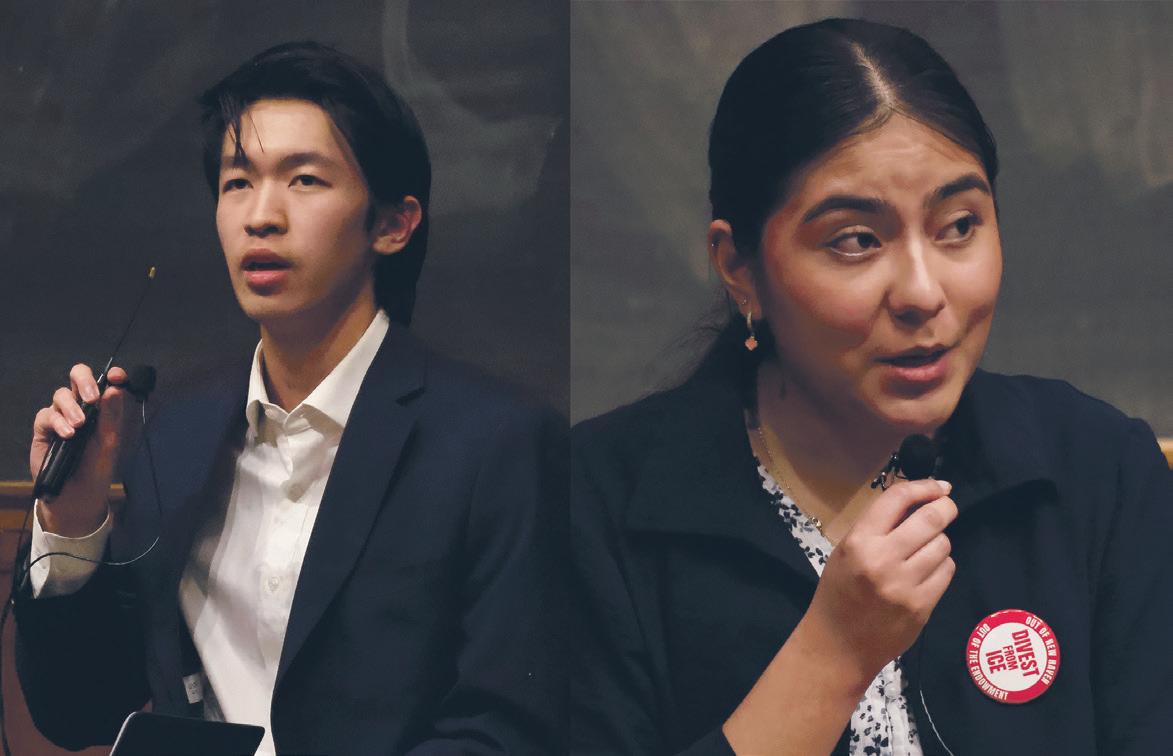
Alex William Chen ’28 and Michelle Jimenez ’28 were elected to be next year’s Yale College Council president and vice president.
In the presidential race, Chen, who ran on a ticket with Brendan Kaminski ’28, defeated John Robert Walker ’28, who ran alongside Jimenez, by 231 votes. Jimenez defeated Kaminski by 431 votes. Jalen Bradley ’27, the vice president of the YCC, announced the results in an email to the student body on Saturday.
The current president and vice president, Andrew Boanoh ’27 and Bradley, as well as their predecessors, ran for their positions on the same ticket and campaigned with shared platforms.
Chen said that he is excited to have the opportunity to work with Jimenez
Spring Fling limits tickets for Larsson
BY KIVA BANK STAFF REPORTER
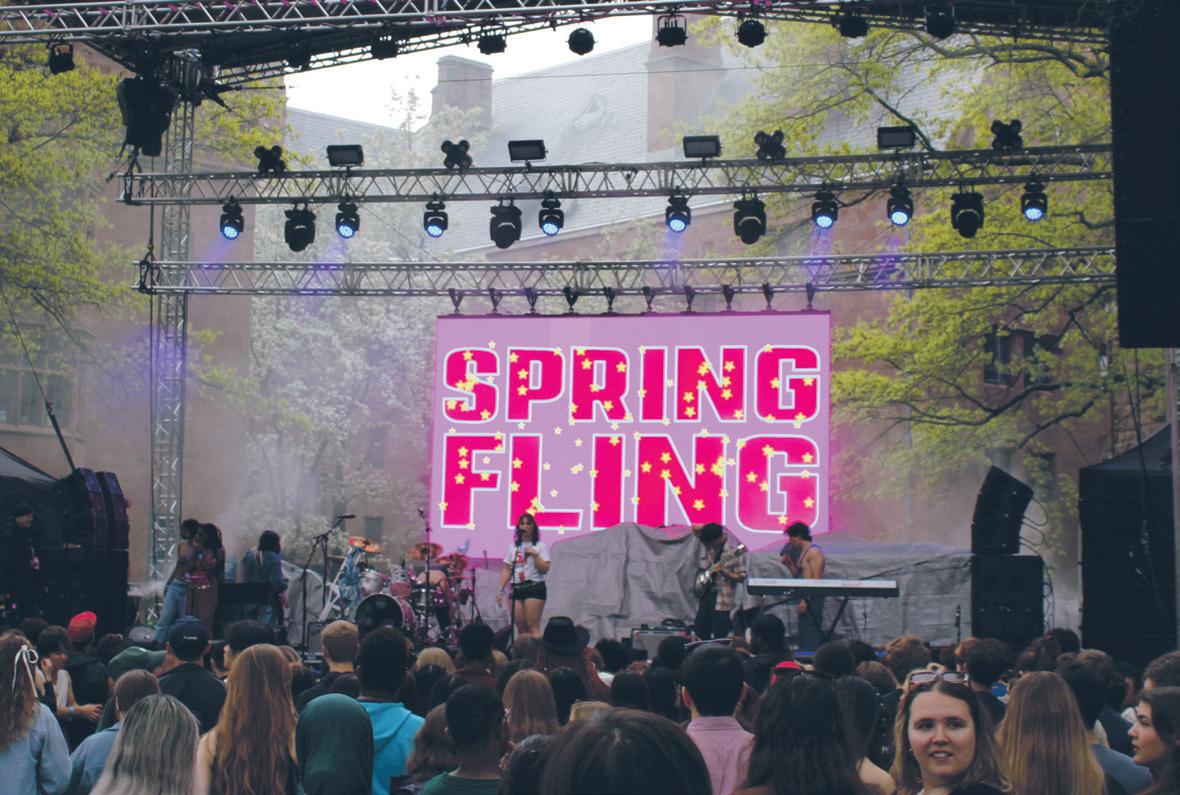
The Spring Fling Committee limited the number of tickets available to guests and graduate students this year.
In past years, each student has been allowed to bring one guest to Spring Fling, but the committee placed limits on attendance this year after administrators approached the committee with concerns of high attendance due to the “popularity” of this year’s artists, according to production chair Jalen Freeman ’27.
This year’s concert will feature Swedish pop star Zara Larsson as the headliner, with British singer-songwriter Aluna and rapper Sheck Wes opening the concert. Larsson has over four billion streams across platforms and over 68 million monthly listeners on Spotify. Rapper Ken Carson, who replaced NLE
Choppa as the headliner of last year’s headliner, has 6.5 million monthly Spotify listeners.
Hannah Peck, the associate dean of students, wrote in an email to the News that tickets have never been distributed for Spring Fling through a registration process before. “Once Zara Larsson was announced as the headliner, the committee and the YCDO staff were flooded with requests for tickets,” Peck wrote, referring to the Yale College dean’s office. According to Peck, the registration process was implemented to ensure all undergraduate students would be able to attend.
In an email to the News, Freeman said that administrators cited security as the primary reason for limiting attendance, noting that surpassing capacity limits requires additional “permits,
because she brings a “fresh and experienced perspective” that he believes will “complement” his own.
“It is going to be super important that Michelle and I are sitting down, running through our ideas, seeing where the overlaps are, where some differences might be and then eventually unifying them into a strong message,” he said in an interview. “We will be able to work strongly as a team and as a unified force regardless of us running on different tickets originally.”
Chen said that he envisions his role as president as being “a first among equals in the unified interests of advocating for the student body.”
“I have gratitude for the other candidates who made me a better person,” Chen said. “I have deep appreciation and respect for Brendan, SEE YCC PAGE 4
BY LEO NYBERG STAFF REPORTER
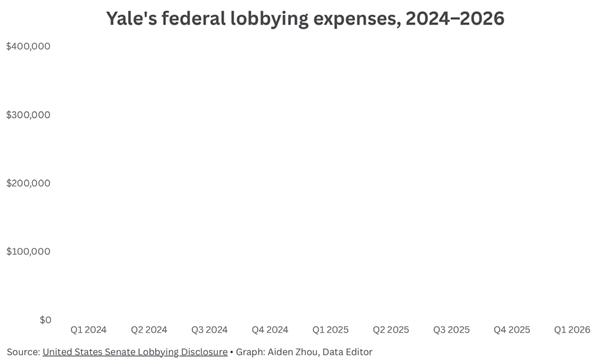
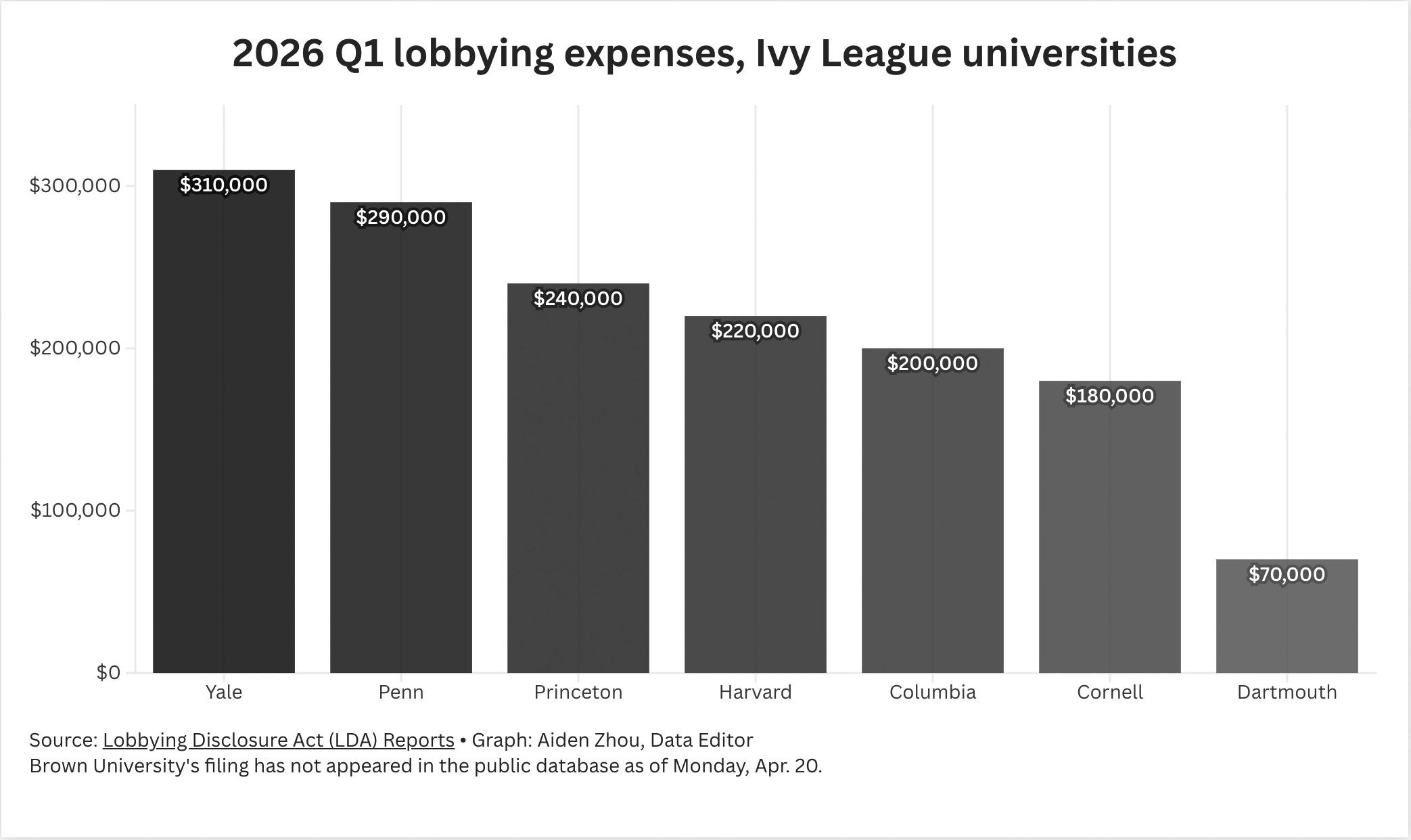
As the Trump administration entered its second year, Yale spent $310,000 on lobbying in the first quarter of 2026 after dropping record sums on advocacy last year.
Yale’s quarterly disclosure, which was released Monday, revealed the amount Yale spent on federal lobbying from January to March and the bills and provisions the University engaged with. Yale’s lobbying expenditures skyrocketed to $1.24 million during the first year of the Trump administration, more than doubling the amount it spent lobbying in 2024.
Yale outpaced its Ivy League peers in lobbying expenditures during the first quarter, the reports show. As of Monday evening, Brown had not filed its first quarter report. In 2025, Yale
peers
spent the second most in the Ivy League, trailing only the University of Pennsylvania, which spent $1.27 million.
Under a bill signed into law by President Donald Trump over the summer, the University is set to face a steep endowment tax hike, from 1.4 percent to 8 percent. Unlike peer schools like Harvard, Cornell and Columbia, Yale has avoided targeted funding cuts from the White House. Yale and Dartmouth are the only two Ivy League universities who have been spared from punitive cuts by the federal government. Dartmouth spent $70,000 on lobbying this quarter, the least of any Ivy League school. Lobbyists are required to disclose the amount of money they spent on advocacy, as well as the
McMahon, McInnis meet at Yale
BY CORINNE COWAN STAFF REPORTER
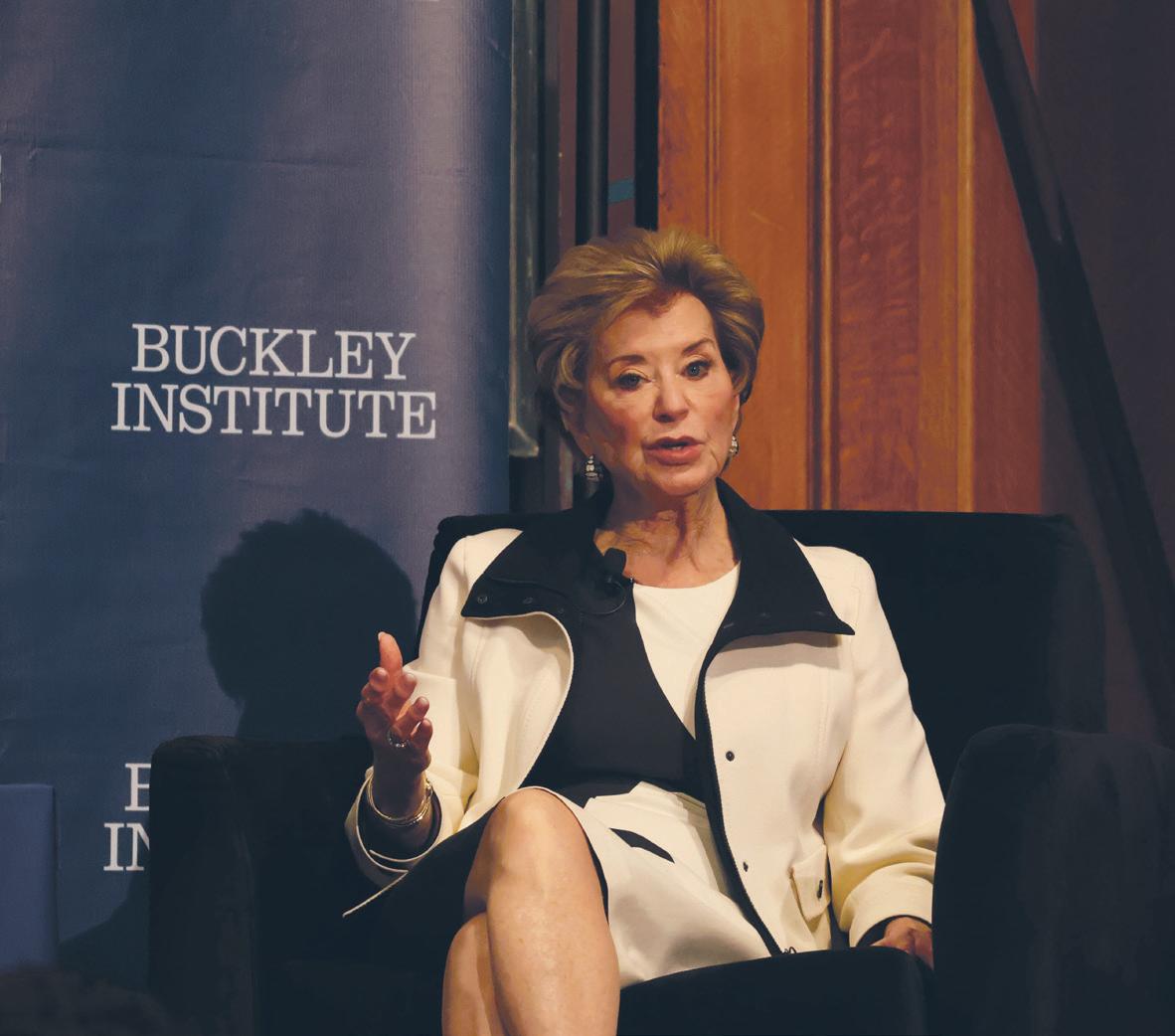
Linda McMahon, the United States’ secretary of education, spoke with University President Maurie McInnis about grade inflation on Thursday, McMahon said at a Thursday evening Buckley Institute event that attracted a crowd of around 300 people.
McMahon’s conversation with McInnis came the day after the president released a report drawn up by the Committee on Trust in Higher Education, which diagnosed campus issues causing declining public trust in universities and recommended 20 reforms. The report called for Yale to take responsibility for dwindling public trust in higher education, which McInnis did in
Trustees give to Democrats
BY LEO NYBERG STAFF REPORTER
Members of the Yale Corpora
tion donate almost exclusively to Democrats. The composition of the board of trustees has drawn scrutiny from student activists and campus organizations on both the left and the right.
The sitting trustees, who were chosen by either alumni election or appointment by the board, skewed toward Democrats in their political donations. Newly released Federal Election Commission filings show that, between January 2024 and April
2026, the trustees donated just over $950,000 to committees and campaigns affiliated with the Democratic party, around $150,000 to committees not affiliated with either party and no donations to Republican or thirdparty candidates or committees.
The conservative Buckley Institute noted “political bias” towards Democrats on the Corporation in a February report, while cardboard signs calling for the Corporation to divest from Palantir and ICE are staples at campus protests. At a divestment protest last week, organizers said the trustees manage
Yale like a hedge fund and do not reflect students’ values.
“Yale does not track or comment on the political affiliations of members of the Yale Corporation,” University spokesperson Karen Peart wrote in an email to the News. She added that Yale is committed to “fostering open debate, preserving freedom of expression, and creating an environment in which a wide range of ideas can be expressed and heard civilly.” Corporation members donated to campaigns across the country
SEE MCMAHON PAGE 5
William Qian / Staff Photographer
William Qian / Staff Photographer
Baala Shakya
Reeti Malhotra / Contributing Photographer
Behind the Headline: IS THE RESIDENTIAL COLLEGE DEAD?
By Olivia Woo
In September, during my second-ever meeting with Yale College Dean Pericles Lewis, I asked the dean about his efforts to reverse the post-pandemic trend of students moving off campus. I did not know at the time just how successful those efforts had proved; my recent rough calculations based on figures obtained in February suggest that 53 percent more of this year’s juniors lived on campus compared to last year’s. The apparent efficacy of Yale College’s policies in promoting on-campus living was interesting to square with something we have observed about the College — namely, a marked decline in the popularity of the residential college system. I spent about 4,000 words on a protracted story spanning the history of college housing policies from the 1930s to present-day, which have since been bisected into two articles, one focusing on the twentieth century and another, specifically on Lewis. In the midst of my archive-searching, I came upon a series of articles about the purported “offcampus exodus” during the 1990s, one of which suggested that the residential college system had died. In the special issue housed within these pages, we attempt to evaluate this theory — over 30 years later.
YDN OPEN HOUSE
By Olivia Cyrus
Over about a month, I went through at least 70 newspaper articles about the first-year counselor program between the 1930s and the modern day. Looking through the archive was a blast and a true testament to how necessary and informative the News’ archive is. In reading through the archives, I made a list of names that were listed as former freshman counselors and ethnic counselors and reached out via LinkedIn, Instagram messages, and work emails. I had some really interesting conversations with former FroCos from the 1980s and 90s, especially about their tenure and how the program, in all its phases and newness, allowed them as students to assume positions of leadership and, sometimes, be occasional political advocates for students. Something that I found to be interesting, which wasn’t included in the article, was how some colleges, due to not having enough FroCos, would offer students from other colleges the opportunity to be FroCos in colleges they weren’t assigned to. In all, I’m super happy that I was able to contribute to the final product.
GUEST COLUMNISTS
VICTOR ASHE
DONALD GLASCOFF
For a stronger Yale, open trustee elections
On May 24, 2021, the Yale Corporation summarily terminated the long-established petition process to become a candidate for election as a Yale alumni trustee. Under the petition process, alumni could stand as candidates if they obtained signatures from 3 percent of eligible alumni voters. Senior trustee Catharine Bond Hill GRD ’85 wrote in a statement that the principal objective was to eliminate “issues-based candidates.”
One of this piece’s authors ran as a petition candidate in 2021. He was not elected. He had hoped to bring new perspectives to the Yale Corporation. He was a lawyer, the mayor of Knoxville, Tennessee and the U.S. ambassador to Poland. The other author, a retired Wall Street lawyer with an interest in freedom of expression and diversity of opinion, joined forces with alumni across class years to launch a court challenge of the new, ill-considered and hastily announced Yale policy. We consider ourselves loyal supporters of our great university.
THE CORPORATION HAS LIMITED THE DIVERSE VOICES NEEDED AROUND ITS TABLE, SUPPRESSED THE EFFECTIVE ARTICULATION OF POLICIES AND OPTIONS BY CANDIDATES AND FAILED TO ASSURE THE FREE EXPRESSION OF IDEAS.
Our goals were not debatable “issues” of the type condemned by Bond Hill. What is also not debatable is the effect of the revised policy upon the university. The Yale Corporation, with the stroke of a pen, became a selfperpetuating entity whose alumni members are only people selected to run for election by the Alumni Fellow Nominating Committee — a standing committee of the Yale Alumni Association.
A nonprofit board needs trustees who can bring different perspectives, work with others, listen and consider different views and always focus on the overall best interests of the university. Yet, in our experience, the Alumni Association is an “insider” group, dominated by
Yale. It has no separate legal status. It is a constituent part of the university. Connecticut courts have now spoken. We lost. Three courts heard our case and decided it on what we consider very narrow bases. But is the new policy good for Yale?
As Nicholas Lemann noted in a recent piece in The New Yorker, the historical “compact” of government support for university research is at an end and may not be fully restored by some future administration. Only the Yale administration knows if the new policy has materially affected contributions by alumni to Yale. We know it has eliminated contributions by many alumni who supported our litigation.
The Yale Corporation should reverse its decision. The Corporation has limited the diverse voices needed around its table, suppressed the effective articulation of policies and options by candidates and failed to assure the free expression of ideas. It has remained closed and alienated donors.
Yale has seen this movie before. Direct election of alumni trustees began in the third quarter of the nineteenth century. Yale’s finances were wobbly and its future uncertain.
The “Young Yale” movement forced the creation of six alumni trustees to balance the self-selecting successor trustees who still hold the numerical majority today.
As the late campus historian Judith Schiff once observed in the Yale Alumni Magazine, those constituting the movement were concerned that a board composed solely of Connecticut clergymen were charged with guiding and raising donations for a national university without appropriate training or breadth of experience.
Many alumni today share a similar concern about narrowness of focus among trustee candidates, either not identified in advance — the successor trustees — or those chosen by a small committee in the Yale Alumni Association on which university officers sit. New election procedures should reinstate direct nomination of candidates to become the six alumni trustees, a minority on the Yale Corporation. The new rules should include a realistic timetable for candidates to gather support and a much lower threshold of petition signatures. A change which does not result in real change is no change.
VICTOR ASHE graduated from Yale College in 1967. He can be reached at vhashe@aol.com.
DONALD GLASCOFF graduated from Yale College in 1967. He can be reached at donglascoffjr@gmail.com.
GUEST COLUMNISTS
ZOE KANTER
SOPHIA LIU
Standing our ground at the Women’s Center
In 1970, in the dimly lit basement of Durfee Hall, something extraordinary began. Members of the first classes of Yale women gathered to speak about the discrimination they faced from administrators and male peers alike, often for the first time. As Anne Gardiner Perkins ’81 described in her book “Yale Needs Women,” these gatherings were sanctuaries.
These first women at Yale forged the Yale Women’s Center, the oldest continuously operating women’s center at a major university in the United States, according to co-founder Elizabeth Spahn. Since then, 198 Elm Street has been a haven for feminist advocacy, birth control distribution and intersectional community organizing. It is a physical safe space for gender minorities, a launching pad for political action and a living inheritance passed from one generation of Yale women to the next.
In December 2025, the Yale College Dean’s Office presented the Women’s Center board with two pathways. In the first, the center would be absorbed into the Dean’s Office as a cultural center — directed by professional Dean’s Office staff, stripped of its political mission and required to reflect the neutrality of Yale College. In the second, the center would be downgraded to a Registered Student Organization, drop its designation as a “center,” lose all paid student employment and face an uncertain future in its Durfee Hall space, which could be revoked at any time due to “renovations, operational needs or RSO policy shifts.”
This moment seems representative of the nationwide gutting of diversity, equity and inclusion infrastructure. Since August 2023, at least 31 genderand sexuality-based resource centers have closed across 23 college campuses. Yale is a spineless participant in this trend. Yale portrays its mission as “improving the world today and for future generations.” Yet its defanging of the Women’s Center is another notch in its hypocritical record of continued investment in weapons manufacturers and repression of student organizing. This forced choice is also contiguous with the Women’s Center’s history. In 1987, the Dean’s Office ruled that the Center must allow a anti-abortion group
to affiliate with the center, after the center’s board had previously rejected them. “The Yale Women’s Center has always been an expressly political organization,” the board responded in an open letter published in the News. Lisa Hoffman ’88, a board member, believed the Dean’s Office would “like the Center to become [like] a student center for 45 percent of students. If that’s what they want it to be, they should give us more space and more funding.”
Hoffman likely meant this as a hypothetical. But almost 40 years later, the choice between space and funding or being political became real. The Women’s Center of 2026 was faced with losing our political vision and maintaining institutional support, or maintaining our vision and losing our employment and foreseeably the physical space. In line with its history and politics, the Women’s Center has chosen the latter.
THE WOMEN WHO FOUNDED THIS CENTER IN 1970 WERE NOT NEUTRAL. THEY DID NOT ASK PERMISSION TO IMAGINE SOMETHING BETTER.
The women who founded this center in 1970 were not neutral. They did not ask permission to imagine something better. They built a sanctuary in a basement and refused to leave. As their inheritors, we cannot bargain away what they built.
The center’s history is vibrant, at many times contentious, and thoroughly political. The 1980s center hosted groups ranging from Yalesbians to to Spinsters Opposed to Nuclear Genocide.
In 1984, the center was a hub for student organizing during the strike of Local 34, Yale’s Clerical and Technical Workers Union. According to alumna Alexa Bradley ’85, the center organized for classes to be held
off campus so students and faculty could avoid crossing the picket line. They wrote letters, organized vigils and staffed picket lines.
As more women enrolled at Yale, political action was a constant at the center. Almost all of it was volunteer-based: The Women’s Center only gained paid staffing in 2008, reportedly as a consolation prize of sorts after Zeta Psi fraternity pledges posted to Facebook a photo holding a sign reading “We Love Yale Sluts” in front of the center. In the 2010s, the Center continued its focus on sexual assault advocacy after DKE pledges chanted “No means yes, yes means anal” on Old Campus. According to alumna Sally Walstrom ’12, the Center strove to improve remediation options for sexual violence survivors and strengthen disciplinary procedures for offenders, leading an overhaul of the first-year consent education which created workshops that we still use in 2026.
Now, we’ll be reverting to our pre2008 days of volunteer staffing. If, in your time at Yale, you have stopped by the Center for an emergency tampon or condom, napped on the Center’s colorful couches or drunk tea from the Center’s kettle; if you, like us, have found a home in the center, or if you haven’t been inside yet — we invite you to volunteer as a Women’s Center staffer.
The Yale Women’s Center will continue as a registered student organization, with less institutional security but more freedom than ever. We will deepen our roots in New Haven. We will organize without asking permission. We will return to our hard-earned history.
ZOE KANTER is a junior in Saybrook College studying Ethics, Politics, and Economics and Human Rights. She is the Women’s Center’s Historian. She can be reached at zoe.kanter@yale.edu.
SOPHIA LIU is a junior in Berkeley College studying Neuroscience and History of Science, Medicine, and Public Health. She is the Women’s Center’s Board Coordinator. She can be reached at sophia.liu@yale.edu.
FROM THE FRONT
provisions or bills they engaged with, according to the Lobbying Disclosure Act. In its report, Yale did not disclose whether it advocated for or against various bills or provisions.
Richard Jacob, Yale’s chief lobbyist, and a University spokesperson did not immediately respond to request for comment.
According to the disclosures, Yale lobbied a variety of House of Representatives and Senate committees that are considering the Financial Accountability in Research, or FAIR, model for their fiscal year 2027 budgets.
The FAIR model, which calls for increased transparency about the federal funding of research administrative costs, has not yet been introduced in Congress.
In an interview last month,
Yale President Maurie McInnis said the new model was among the University’s lobbying priorities, and she spent some time in Washington, D.C. advocating for it.
Yale also lobbied for “provisions related to research security and graduate education of military personnel” in a bill authorizing funding for the Department of Defense, the disclosure says.
Three graduate student military fellowships at Yale will end after this year, Yale’s veteran and military affairs liaison told the News.
In February, Defense Secretary Pete Hegseth announced that the Pentagon would cut ties with universities he considers “woke.”
“Already we are boldly launched upon the deep; but soon we shall be lost in its unshored, harbourless immensities.”
MOBY-DICK HERMAN MELVILLE
“Yale continues to maintain that the university makes a significant contribution to the education of military officers and Senior Service College Fellows should be able to choose Yale,” Holly Hermes, Yale’s military and veterans affairs liaison, wrote to the News at the time.
Ex-police
website. The site indicates that the most recent update to the case’s online record was made early Saturday morning. The case is pending, and Jacobson is scheduled for his next court date on June 2, according to the website.
In February, Jacobson was arrested and charged with stealing $81,500 from the New Haven Police Department’s Narcotic Enforcement Program Fund, which paid confidential informants, and $4,000 from the New Haven Police Activity League Fund between 2024 and 2026.
The application for his arrest warrant described Jacobson’s
The University continued lobbying related to provisions of the DETERRENT Act, a bill in the House focused on increasing the requirements for universities to disclose donations from foreign sources.
Republicans, including Trump, have long suggested that universities might be influenced by foreign entities, especially China, through donations and research funding.
In an interview earlier this year, McInnis said Yale has “a number of measures in place” to prevent “concerns” related to donations from foreign sources. She cited Yale offices and committees that work to ensure there
are no perceived or actual risks related to foreign funding.
“Most of our funding has come from our own alumni who just happen to be international and live in other places,” McInnis said.
In October, a Yale spokesperson did not directly answer whether Yale supports or opposes the DETERRENT Act.
Yale continued advocacy from previous quarters on one of Trump’s artificial intelligence initiatives, National Institutes of Health research funding, a bill on compensation for student athletes and loan caps for graduate students. Ivy League schools spent $1.51 million in total on lobbying from January to March.
Contact LEO NYBERG at leo.nyberg@yale.edu.
chief in court over embezzlement
gambling habit and indicated that he gambled more than $4 million on two sports betting sites between Jan. 1, 2025 and Jan. 5, 2026.
Jacobson resigned from his role as police chief in early January, hours before Mayor Justin Elicker announced in a press conference that he had appropriated money from a fund dedicated to the department’s confidential informants program. When confronted by three assistant chiefs, Jacobson admitted to stealing $10,000 from the fund, Elicker said.
In the weeks after Jacobson’s resignation and arrest, community members expressed shock at
what Elicker said was a “betrayal of public trust.”
“I felt for Chief Jacobson, because of what he’s done in New Haven and what he’s built for the last number of years,” Tirzah Kemp, the director of New Haven’s Department of Community Resilience, said in a January interview with the News. “So, I think it took everyone a couple days to really wrap our heads around it.”
According to the application for his arrest warrant, Jacobson was the only person with control over the Narcotic Enforcement Program Fund, which is used to make controlled drug purchases and pay people who offer the
police department tips for narcotics investigations.
“No one is above the law and that includes the chief of police,” Mayor Justin Elicker said in a statement to the New Haven Independent. “It is important that former Chief Karl Jacobson is held accountable for his actions and that the criminal justice process takes its course.”
In March, Elicker nominated David Zannelli, the former assistant chief of police, to serve as the department’s permanent chief. Reeti Malhotra contributed reporting.
Contact SABRINA THALER at sabrina.thaler@yale.edu.
Chapel St. now goes two ways downtown
BY TAJRIAN KHAN AND NELLIE KENNEY STAFF REPORTERS
A portion of Chapel Street is opening to two-way traffic on Tuesday morning after decades of carrying traffic in one direction only.
The part of the street being converted stretches from Chapel Street’s intersection with York Street to its intersection with College Street at the edge of the New Haven Green.
Last week, the Department of Public Works milled and repaved the road. With new road markings added on Monday evening, the street is set to open to twoway traffic on Tuesday morning. The city hopes to eventually convert the whole street to two-way, according to a press release by the mayor’s office last Monday.
“Restoring this portion of Chapel Street to two-way traffic will help improve circulation downtown, make it easier for residents and visitors to access local businesses and destinations, and support a more accessible and connected downtown for everyone,” Mayor Justin Elicker said in the press release.
In 1959, the city unveiled plans to convert downtown streets — including parts of Elm Street, Wall Street, College Street and Chapel Street — to one-way only, according to the News’ coverage from the time. Those plans were met with resistance from local business owners, who worried that the
change might harm their businesses, the News reported.
Ward 1 Alder Elias Theodore ’27, who represents a downtown district that includes much of Yale’s campus, said he is “excited” for the change.
“This conversion has been in the works for multiple years, and all research suggests that two-way streets improve traffic flow and pedestrian safety,” he added.
Theodore said he hopes that after an initial period of adjustment, “people are going to be comfortable.” Meanwhile, city staff and police will help direct traffic along those blocks of Chapel Street, he said.
Chapel Street is part of New Haven’s “High Injury Network,” which identifies the city streets responsible for the most injuries and fatalities, according to an informational flyer provided by the city’s transportation, traffic and parking director, Haley Simpson. Two-way streets should reduce turning conflicts at busy intersections and encourage slower driving, the flyer said.
The conversion was part of the city’s larger Safe Routes for All project, according to the press release from the mayor’s office. That project is supported by a variety of funding, including an $11 million federal grant from the Biden administration’s Infrastructure Investment and Jobs Act, the press release said.
Urban Studies Professor Jacob Koch ’10 walked the length of
Chapel Street with students from his class “Greening the City—Urban Forestry, Urbanism and the Climate Crisis.” In an email to the News, he wrote that because the street bisects various parts of the city, it embodies “much of New Haven’s urban character along a single street.” He added that he was “excited about anything that will truly make streets safer for all users.”
The key to that, Koch wrote, is “not just the physical changes” but also “combining that with enforcement and public information.”
“It might be hectic the first week or so, but then people will get used to it,” Taylor Ikehara, an employee at Atticus Bookstore Cafe on Chapel Street, said.
“When they started construction on State Street, it was confusing at first, but after a week it was fine,” he added, pointing to the City’s ongoing State Street reconstruction project.
Montana Dickerson ’27, an urban studies major, wrote to the News that as a driver, she’s “thrilled about reduced downtown congestion,” but as a pedestrian, she worries “about the adjustment for New Haven residents used to looking only one way before crossing Chapel Street.”
Dickerson added that she thinks the change is a “necessary precursor for the full realization” of the Downtown for All legislation, which Elicker signed into law in December. The legislation amended zoning laws in order to
allow for increased housing density in downtown New Haven.
“With denser housing will come more traffic and thus the need to increase circulation throughout the city,” Dickerson wrote.
Jhan Setthachayanon ’26, another urban studies major, wrote that he thinks that the conversion is a “valid change” despite possible “short term frustrations due to unfamiliarity and old habits.”
Setthachayanon added that the conversion represents the beginning of a “culture change.”
“No longer is the car solely prioritized in Downtown, but we now recognize the importance of considering other vulnerable road users, like pedestrians and bikers,” he wrote in a text message to the News.
On Monday afternoon, Yale’s Office of New Haven Affairs emailed community members about the planned change and urged drivers to “follow updated lane markings and signals and remain alert for pedestrians and turning vehicles.”
“We encourage everyone to use extra caution and allow time to adjust to the new traffic pattern,” the message said.
Chapel Street was one of the original streets laid out in New Haven’s nine-square grid plan of 1638.
Contact TAJRIAN KHAN at tajrian.khan@yale.edu and NELLIE KENNEY at nellie.kenney@yale.edu.
Chen, Jimenez prevail
YCC FROM PAGE 1
who ran alongside me in an incredible manner and gave it his all. He was able to change the minds of many people and inspire them to participate in this election.”
Jimenez said in an interview with the News that although she was disappointed that her running mate, Walker, did not win the election, she is “obviously really honored that the student body had trusted me to take on this role.”
“It’s gonna take meetings to figure out our vision, sitting down and trying to synthesize, talking about what each of us really wants to get out of the role and how we can compromise and work together,” Jimenez said, referring to her plan for working with Chen. “I think we did run on a lot of similar issues. At the bottom of it, we both agree there’s a lot of issues, and so I think we’re just gonna work together to problem solve through different perspectives.”
Jimenez said that she is most looking forward to working closely with the YCC senators to improve efficiency.
Walker, who ran for president with Jimenez, said he felt relieved when he saw the results of the election because he trusts Chen and Jimenez “to fight for the respect we deserve from Yale.”
“We had maybe had competing visions for how to best advocate for students and stakeholders of this institution,” Walker said. “But all of us, all of the candidates, were united in the same fight. It’s always been us versus admin and the small group of decision-makers that continuously disrespects students and workers in New Haven.”
This year’s candidates criticized administrators’ cuts to student funding programs as the University tightens its budget in anticipation of an endowment tax hike set to cost Yale an additional $300 million per year. Candidates called for more transparency from administrators about budget cuts.
Oriana Dunker ’29 was elected to be next year’s events director.
Contact ANAYAH ACCILIEN at anayah.accilien@yale.edu.
FROM THE FRONT
“And there is a Catskill eagle in some souls that can alike dive down into the blackest gorges, and soar out of them again and become invisible in the sunny spaces.”
MOBY-DICK HERMAN MELVILLE
Pair privately talks grade inflation before Buckley event
MCMAHON FROM PAGE 1
her email sharing the report with the Yale community.
“It was really very beneficial today to sit with the president of Yale as well to talk about grade inflation,” McMahon said at the Buckley Institute event in Sheffield-Sterling-Strathcona Hall.
University spokesperson Karen Peart confirmed in an email to the News on Thursday evening that McInnis and McMahon “discussed higher education and workforce development, including affordability and grade inflation.”
At the Buckley event, which was called “The Roadmap to Restoring American Education” and moderated by Buckley Institute Student President Tori Cook ’27, McMahon touted her work reforming education. As secretary, McMahon has called for
eliminating bureaucracy at the Education Department.
Many of the issues with higher education that McMahon spoke about were also identified in the committee’s report, including grade inflation and affordability.
In an interview with the News last month, McInnis praised the Buckley Institute for inviting McMahon to speak at Yale. At a Family Weekend talk in October, McInnis suggested that organizations like the Buckley Institute may have helped Yale avoid targeted federal funding cuts.
McInnis said in an interview last month that she was not “aware of” plans to meet with McMahon. Peart wrote that the secretary’s schedule and meeting with McInnis was only confirmed on Wednesday.
McMahon took part in a “roundtable discussion,” Peart wrote to the News. The spokesperson
declined to share who was at the discussion or what was discussed.
Though McMahon did not specifically discuss the committee’s report at the Buckley event, she outlined several hopes that align with many of the items, including the way professors teach classes at Yale.
“They should challenge those students to think as much as possible,” McMahon said.
The report recommends a mean grade-point average of 3.0 for Yale College and establishing “a devicefree policy—no phones, laptops, or tablets—as the default in classroom settings.” McInnis wrote in her email that she directed the Committee on Teaching, Learning and Advising “to confront grade inflation directly within Yale College.”
McMahon also spoke about free expression at universities.
“What we’re looking at relative to the university campuses is to make sure that university cam-
puses are places where there is freedom of thought, freedom of expression. The opportunity to have a good debate, to do it civilly, to make sure that students feel safe on campus,” McMahon said.
However, the secretary also denied that it was the federal government’s explicit role to change culture on campuses.
McMahon also brought up ensuring that students get returns on their investments. She emphasized the need for higher education to direct students towards “successful opportunities for career employment.”
The committee pointed to Yale’s high cost of attendance in its report and recommended that Yale “raise the income limit on the ‘no tuition’ guarantee for undergraduate students.”
In addition to the visit with McInnis and the roundtable discussion, McMahon toured Yale
and described the construction on part of Science Hill, which is set to be a finished new research building in 2030, as “incredible.”
McMahon added that research funding “can also be a tool for the federal government to say ‘a university is not spending this money wisely.’”
Jason Hockenberry, an associate dean of the Yale School of Public Health and a member of the Committee on Trust in Higher Education who was at the event, said he appreciated McMahon’s presence.
“I’m quite impressed that she’s traveling around the country right now,” Hockenberry said in an interview.
McMahon was a member of the Connecticut Board of Education from 2009 to 2010.
Contact CORINNE COWAN at corinne.cowan@yale.edu.
Foreseeing big crowds, concert organizers cap tickets
emergency services and security,” as well as other “personnel and requirements” in order to ensure that the concert “remains safe and compliant with the City of New Haven’s regulations.”
Peck wrote that the city permit requirements for Spring Fling would be different if attendance reached over 10,000.
Freeman also cited the Spring Fling budget as a factor for capping attendance.
“According to admin, the increase in security elicited by surpassing capacity would be far beyond what our budget could handle,” he wrote.
Freeman said the decision to cap attendance was made by the Yale College dean’s office, the fire marshal, Yale Security and the Yale Police Department, which initially limited capacity to 8,000. However, the committee pushed back against the limit because “there has never been such a thing before,” according to Freeman, and was able to secure an additional 500 slots.
Peck said that they expect all 8,500 people to attend, as opposed to the usual 4,000 to 6,000 attendees.
Registration for guest tickets opened at 7 a.m. last Tuesday morning with approximately 1,200 slots available, and students eager to secure one were met with prolonged loading screens and error messages on Yale Connect due to high traffic.
Graduate student tickets, which were formerly unrestricted, were limited to 1,100 in total.
The new ticketing process was in accordance with a school wide email sent by the Spring Fling Committee on April 6. In an email to the News, the committee cited Yale administrators as the reason for those changes.
“We hope it is clear that most, if not all of these decisions, were made by administration and
not the Spring Fling Committee,” Mateo Felix Castillo ’27, the talent chair of the committee, wrote in the email. “As a committee, we try our hardest to satisfy student interests, and frequently negotiate with admin in order to get better student outcomes, but there are naturally decisions beyond our control.”
Guests were not allowed to attend Spring Fling in 2023 after the concert was relocated due to weather to College Street Music Hall, where it proceeded with a limited capacity of 2,000 on a first-come, first-serve basis for Yale students. Freeman referred to those circumstances of capping attendance as an “exception” since the concert normally takes place on Old Campus.
Freeman said that the amount of tickets allocated to undergraduates, graduates and guests was determined by the funding sources for Spring Fling. He said that the majority of the budget is funded by the student activity fees paid by undergraduates, so the committee prioritized undergraduate tickets.
Freeman said that 800 — 10 percent of the tickets — were initially made available for graduate students, because ten percent of the Spring Fling budget came from the President’s Fund, which partially comes from fees paid by graduate students.
The period for graduate student registration ran April 8 through 12, but an additional 300 tickets leftover from unclaimed undergraduate tickets were made available last Friday morning, capping graduate student attendance at 1,100.
Freeman said the committee added 500 tickets from the remaining ones left in the undergraduate pool to the guest limit, but the 1,700 guest tickets still sold out on Tuesday, the day of release.
“The inability of Yale Connect to handle said high volume was unanticipated by the commit -
tee, as we were under the impression that the issues regarding site traffic and bandwidth would be addressed in advance, since administration was aware of the registration process,” Freeman wrote in an email to the News.
Felix said that additional server power was acquired from CampusGroups, the Yale Connect vendor, and the issue with Yale Connect was resolved around 11 a.m.
“We announced that the issue had been fixed shortly after on our Instagram, but did not want to email the student body out of concern that increased traffic would break the website once more,” Felix wrote.
In a phone interview, Kamile Makselyte ’27 said she happened to see the Instagram announce -
ment four minutes after it was uploaded and was able to get a guest ticket for her brother around 11:30 a.m.
She said she thought the registration process was a “little funky.”
She initially experienced issues registering for a guest when she logged on to Yale Connect earlier that morning. She said she hadn’t realized that the ticket registration opened at 7 a.m., which she said was “an egregious time for tickets to drop.”
Felix said the committee received many complaints from students.
At 7:40 a.m., the committee sent an email notifying students of the technical issues, but Makselyte said she thought they would have solved the problem by the time she logged on around 8:40 a.m.
Caroline Sloper ’28 also experienced issues registering for a guest ticket.
In a text message to the News, she wrote that she was “very excited” to see the lineup and planned to bring her sister who is also a “big fan” of the artists. Sloper wrote that she kept trying to register for a guest ticket “periodically” throughout the day until she succeeded around 11:30 a.m.
However, both Makselyte and Sloper said they experienced no issues registering for their own tickets the week before.
Spring Fling will take place on April 25.
Contact KIVA BANK at kiva.bank@yale.edu.
Trustees’ political tilts draw scrutiny from left and right
TRUSTEES FROM PAGE 1
during the 2024 election cycle, 2025 off-year elections and the 2026 midterm elections. Former Vice President Kamala Harris, during her 2024 campaign for president, received around $500,000 from Yale’s trustees, the filings show.
“The lack of political diversity on the Yale Corporation is unfortunately not a surprise,” Lauren Noble ’11, the founder and executive director of the Buckley Institute, wrote to the News. “We are confident that Yale, with its incredible resources, can identify at least one conservative within its network of over 130,000 alumni to serve as a trustee.”
The Buckley Institute published a report in February on the trustees’ political donations, party membership and political work. The report claimed that the Corporation had a “partisan bias” toward Democrats.
A handful of the current trustees have worked for Democratic presidential administrations. William Kennard LAW ’81, who now works with an investment firm he co-founded, served as the Federal Communications Commission chairman under President Bill Clinton and as ambassador to the European Union under President Barack Obama. Joshua Steiner ’87 was chief of staff of the Treasury Department in the Clinton Administration. Neal Wolin ’83 LAW ’88 also served in Obama’s Treasury Department as the deputy secretary and as the acting secretary for a month.
While Noble criticized what she sees as lackluster political diversity on the Corporation, she said she was encouraged by University President Maurie McInnis’ recent remarks praising the Buckley Institute’s choice to invite Education Secretary Linda McMa -
hon to speak at an event. Noble wrote that she believes McInnis “is beginning to look for a cure to this institutional affliction.”
A new report from the Committee on Trust in Higher Education, which McInnis shared with the Yale community on Wednesday, calls for the University to “build trust with the trustees” and proposes a faculty liaison to the board.
“We also recommend that the Board of Trustees include, at all times, experienced scholars and academic leaders among its members,” the report says. “Trustees drawn exclusively from business and finance, however capable, will inevitably require the administration to translate between institutional decisions and academic consequences.”
Two candidates for Yale College Council president, who also attended an Endowment Justice Collective rally last week, both pointed out that the Corporation’s
composition skews towards backgrounds in finance and hedge funds.
“It’s frustrating that a board of 17 undemocratically elected trustees that are in positions to make decisions on behalf of this institution have their own interests and values that don’t align with the values of our community,” candidate John Robert Walker ’28 said, noting that he believes trustees are more concerned with the University’s financial well-being than ethical investment.
“It’s disheartening in some ways that it’s an unelected body, people with very specific backgrounds,” Alex William Chen ’28, another candidate, said.
In 2021, the Corporation eliminated the petitioning process for alumni trustee elections. The process had allowed alumni to petition for a place on the ballot if they could get signatures from three percent of alumni eligible to vote.
Now, the Alumni Fellow Nominat-
ing Committee selects the candidates that appear on the ballot. The removal of the petitioning process drew pushback from alumni and students at the time. Noble said the decision “signaled an unhealthy fear of dissenting viewpoints.”
In 2021, the Board of Trustees published a statement that said part of the reason for the change was that petition candidates often focused on “promoting specific policy goals,” which the Corporation said was inconsistent with good governance. The Connecticut Supreme Court recently declined to hear a lawsuit brought by alumni demanding to reinstate the petition process.
The governor and lieutenant governor of Connecticut are both ex officio members of the Yale Corporation. Aria Lynn-Skov contributed reporting. Contact LEO NYBERG at leo.nyberg@yale.edu
LARSSON FROM PAGE 1
Baala Shakya
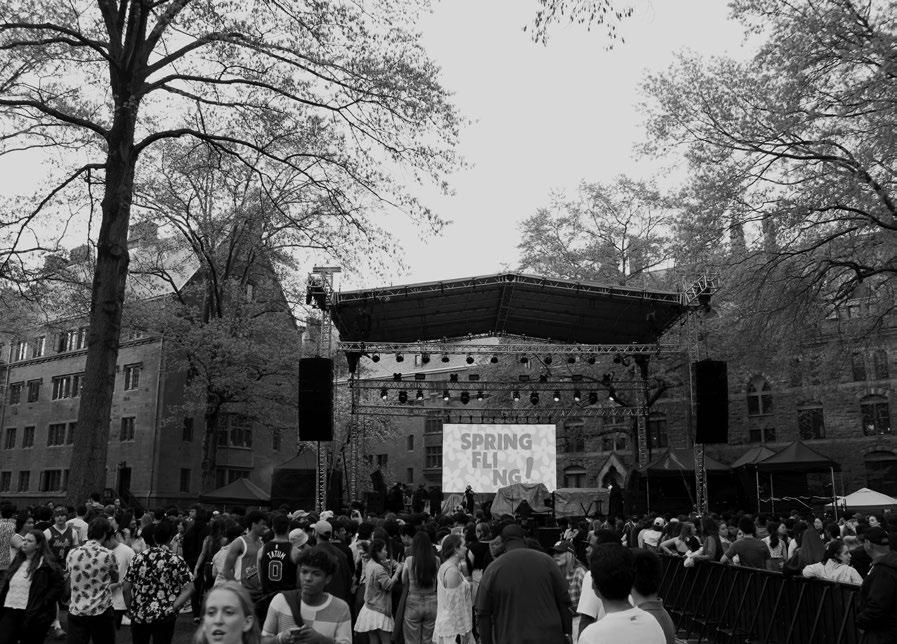
Considering the popularity of Zara Larsson, administrators expect thousands of more people than usual to attend the concert.
“For, d’ye see, rainbows do not visit the clear air; they only irradiate vapor. And so, through all the thick mists of the dim doubts in my mind, divine intuitions now and then shoot, enkindling my fog with a heavenly ray.”
MOBY-DICK HERMAN MELVILLE
New Haven had a very snowy winter. Can climate patterns explain it?
BY TYLER MATUKONIS STAFF REPORTER
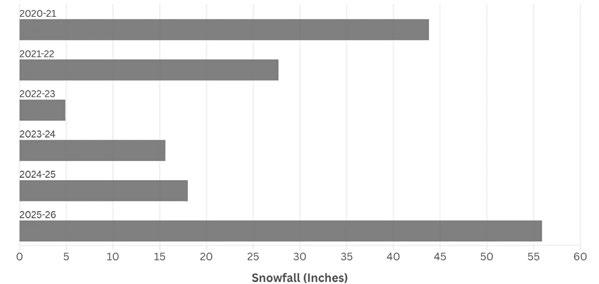
Before the sun came out, New Haven weathered two back-toback snowstorms this winter — after nearly a decade without a blizzard.
A Jan. 25 winter storm blanketed the streets of New Haven with more than a foot of snow. On Feb. 22, another storm coated the city with an additional 15 inches. Forecasters initially underestimated the intensity of both storms and increased their predictions in the days leading up to them.
Forecasters generate snowfall predictions from data collected by radar, satellite imagery and computer models. The data often includes temperature, atmospheric pressure, humidity and other rapidly changing
factors that influence weather, making snowfall predictions prone to inaccuracies.
Although short-term forecasting of weather tends to be more accurate, it also helps to look at long-term patterns.
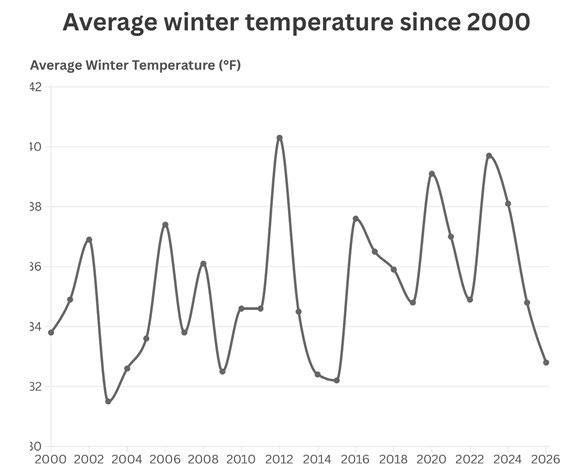
When considered from year to year, the average temperature of New Haven during the winter seems volatile and erratic.
However, the El Niño-Southern Oscillation, or ENSO, which shifts between the phases of El Niño and La Niña, drives climate variability across North America, including in New Haven.
During the El Niño phase, warm waters in the Pacific Ocean lead to warm and dry conditions in the northern parts of the United States. Conversely, during La Niña, cold water causes the same region to become colder and
wetter — conditions that are more favorable to snow formation.
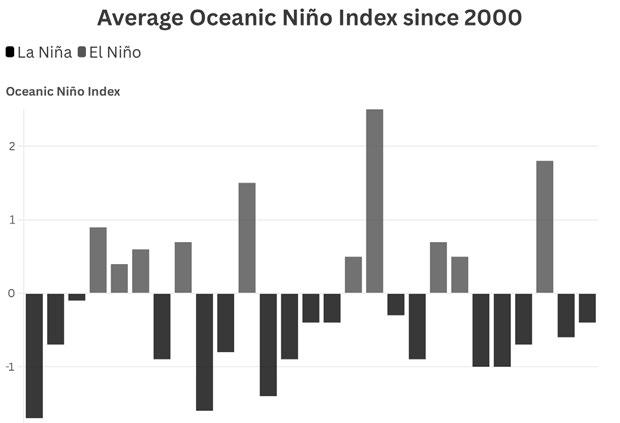
The Oceanic Niño Index measures the extent of each phase, with positive values indicating El Niño conditions and negative values indicating La Niña.
The News plotted New Haven’s winter season snowfall totals against each year’s average Oceanic Niño Index value to understand the relationship between widespread climatic patterns and local precipitation.
Many of the peaks in total winter snowfall occurred during years where the city experienced La Niña conditions, including 2001, 2018 and 2021. That aligns with the tendency for La Niña conditions to promote snowfall.
However, a year like 2003, when significant snowfall occurred alongside moderate El Niño conditions, demonstrates that El Niño and La Niña alone do not capture the factors that influence snowfall.
A weak La Niña lingered throughout the early months of 2026, bringing approximately 27.4 total inches of snowfall, an increase from previous years.
According to the National Oceanic and Atmospheric Administration, the tropical Pacific is now in a neutral state with a “Super El Niño” on the way.
Contact TYLER MATUKONIS at tyler.matukonis@yale.edu.
Tweed-New Haven Airport nears runway expansion as concerns persist
BY MICHELLE SO STAFF REPORTER
A long-standing plan to build a new 84,000-square-foot terminal and expand the runway at TweedNew Haven Airport appears to be one step closer to implementation.
This month, the Tweed-New Haven Airport Authority published a memorandum of understanding about its runway expansion project, representing a non-binding agreement among New Haven, East Haven, the airport authority and Avports, an airport operator.
“While there are many additional steps moving forward, the MOU provides a framework to address traffic, parking and environmental concerns and the provision of
information, ongoing discussions, technical review, and coordination among the Parties,” a statement from the four parties read. While the document formalizes the plan, Lorena Venegas, a lifelong East Haven resident, has long been skeptical of the airport’s plans and has actively been fighting the runway’s development. In 2019, Venegas learned about the airport’s plans for its biggest expansion yet. Without formal political experience, she began attending town meetings, interested in the environmental and public health problems in her backyard.
In 2021, Tweed laid out plans to expand its runway by 1,035 feet to accommodate larger airline jets,
a move that could impact nearby wetlands and local residents. Financing the project, jumping environmental regulation hurdles and facing the public have all posed challenges to the airport.
“I started realizing people didn’t know what was happening, and that the more questions that I asked, there were no answers,” Venegas said in an interview. “And at the same time, I know that East Haven is very vulnerable.”
Venegas, who runs a Facebook page dedicated to anti-Tweed activism, told the News that the new memorandum of understanding about Tweed has been “full of misspellings and misinformation.”
“That MOU as it is, it says that we have implemented noise monitors. We haven’t. It says we’ve implemented air pollution monitors, and we haven’t,” Venegas said.
Tom Cavaliere, a Tweed spokesperson, told the News that the airport has committed to two programs: the Residential Sound Insulation program and the Residential Indoor Air Program.
The sound program has distributed nearly $12 million in federal funding to soundproof more than 180 homes since 2014, according to Cavaliere. The airport identified eligible properties through noise
studies, with a new study planned after the completion of Tweed’s proposed runway extension. The air program, funded by Avports, provides medical-grade HEPA air purifiers to eligible households in New Haven and East Haven.
“HVN is also the only U.S. airport to offer free air purifiers in response to community concerns around odor,” Cavaliere wrote to the News.
However, some residents say the program has its shortcomings. Katherine Bennett and her husband are both retired teachers who live in East Haven. Bennett has felt that the policy left some residents like herself out of the mix.
“People always line up on the street because there’s not enough parking and stuff, and waiting for people to come in on planes. You know, they’re idling, but I can smell it,” Bennett said in an interview.
Despite only living a half mile from the perimeter, Bennett said she does not qualify for the air purifiers.
Bennett says she is disappointed by the pollution caused by the airport and, in regards to the expansion project, hopes Connecticut’s Department of Energy and Environmental Protection “shuts it down.”
The department — which inde-
pendently enforces Connecticut’s stricter state laws protecting wetlands, water quality, wildlife and flood control — is conducting a technical environmental review of Tweed’s runway expansion and terminal construction projects.
Last month, Tweed postponed its monthly community meeting, originally scheduled for March 25, in order to complete answering questions for its environmental review process. Residents were given little notice ahead of the cancellation, according to Venegas. Regarding the delayed information session, Cavaliere wrote: “HVN has committed to holding public informational sessions at key milestones — including the virtual session already held and a future session at a later stage in the process. We expect that session will take place no earlier than May and will announce the date as the process advances.”
The extra time is needed for Tweed’s team to “turn its full attention to responding to DEEP comments and advancing the application,” according to Cavaliere.
The airport now called Tweed opened in 1931.
Contact MICHELLE SO at michelle.so@yale.edu
Judge orders eviction of The Place 2 Be from New Haven location
BY NICOLAS CIMINELLO STAFF REPORTER
The Place 2 Be’s embattled restaurant owner received a court-ordered eviction notice on Friday due to frequent failures to pay rent on time.
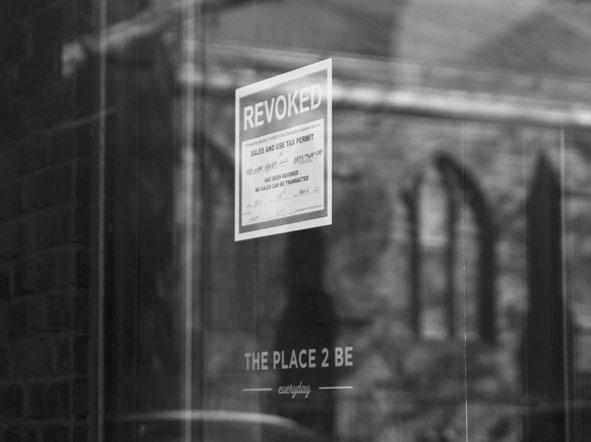
Gina Luari, who founded the self-described “millennial brunch” chain, has faced two previous eviction notices for the restaurant’s New Haven location since March of last year. In both eviction cases, Luari came to an agreement with her landlord. Luari has faced other legal issues in recent months. Connecticut’s Department of Revenue Services revoked The Place 2 Be’s sales and tax use permits in late March, shuttering all three restaurant locations across the state.
Tiffany Thiele, the director of communications for the Connecticut Department of Revenue Services, wrote in an email to the News that the restaurant’s permit had not been restored. Luari attended an eviction hearing on April 7 about her alleged non-
payment of rent in February.
After the hearing, Judge Alayna Stone ’04 ruled in favor of Luari because her landlord, Michael Schaffer ’72, had continued to accept her late rent payments. Stone wrote that Schaffer could either receive late payments or ask for a court-ordered eviction, but not both. However, Stone also acknowledged that Schaffer was “understandably frustrated and simply wants possession” of the building, given Luari’s complicated history as a tenant.
On Thursday, Schaffer’s attorney Phillip Pires filed another affidavit of noncompliance over Luari’s alleged nonpayment of rent in April. Pires alleged that Luari owed Schaffer $11,954.50.
The following day, Stone ordered an eviction because Luari had previously agreed in August that any more missed rent payments would waive her right to appeal an eviction notice.
In the past year, Luari has faced other legal issues, including multiple eviction proceedings for other restaurant locations.
New Haven police arrested Luari
last September for writing a bad check for $10,000, though she told NBC Connecticut in November that it had been an honest mistake.
“We had a lot of events that happened to us within the last year and a half. We had two floods, we had a fire, we had embezzlement,” she said at the time. “We were trying to navigate them the best we could.”
Two of Luari’s other restaurants have been recently evicted. The Hartford seafood bar RAW* was evicted in October 2025, and court paperwork indicated that Luari owed the landlord over $18,000. The Bakery by TP2B, a breakfast restaurant affiliated with The Place 2 Be chain, was evicted in September 2025.
The Place 2 Be opened its fifth location in New Haven in December 2022, branding itself as a “millennial food concept” with the mantra “Go Bottomless.” Founded in 2015, the restaurant quickly gained a large following on multiple social media platforms, with 12,000 followers on Facebook.
As of March, only three locations remained: New Haven, Hartford and West Hartford. Each was
down by the Connecticut Department of Revenue Services that month. Luari, her attorney Brian Steele and Schaffer did not respond to the
shut
News’ emailed
Alex Hong / Staff Photographer
Last month, The Place 2 Be was shuttered after losing its sales and tax use permits. On Friday, a judge ordered the restaurant’s eviction after its owner allegedly failed to pay rent on multiple occasions.
Zoe Berg An agreement among New Haven, East Haven, the airport authority and the airport operator confirmed the parties’ move forward with the Tweed expansion plan.
“Through its inexpressible, strange eyes, methought I peeped to secrets which took hold of God.”
MOBY-DICK HERMAN MELVILLE
At lecture, Jackson criticized her court’s use of its emergency docket
BY HENRY LIU STAFF REPORTER
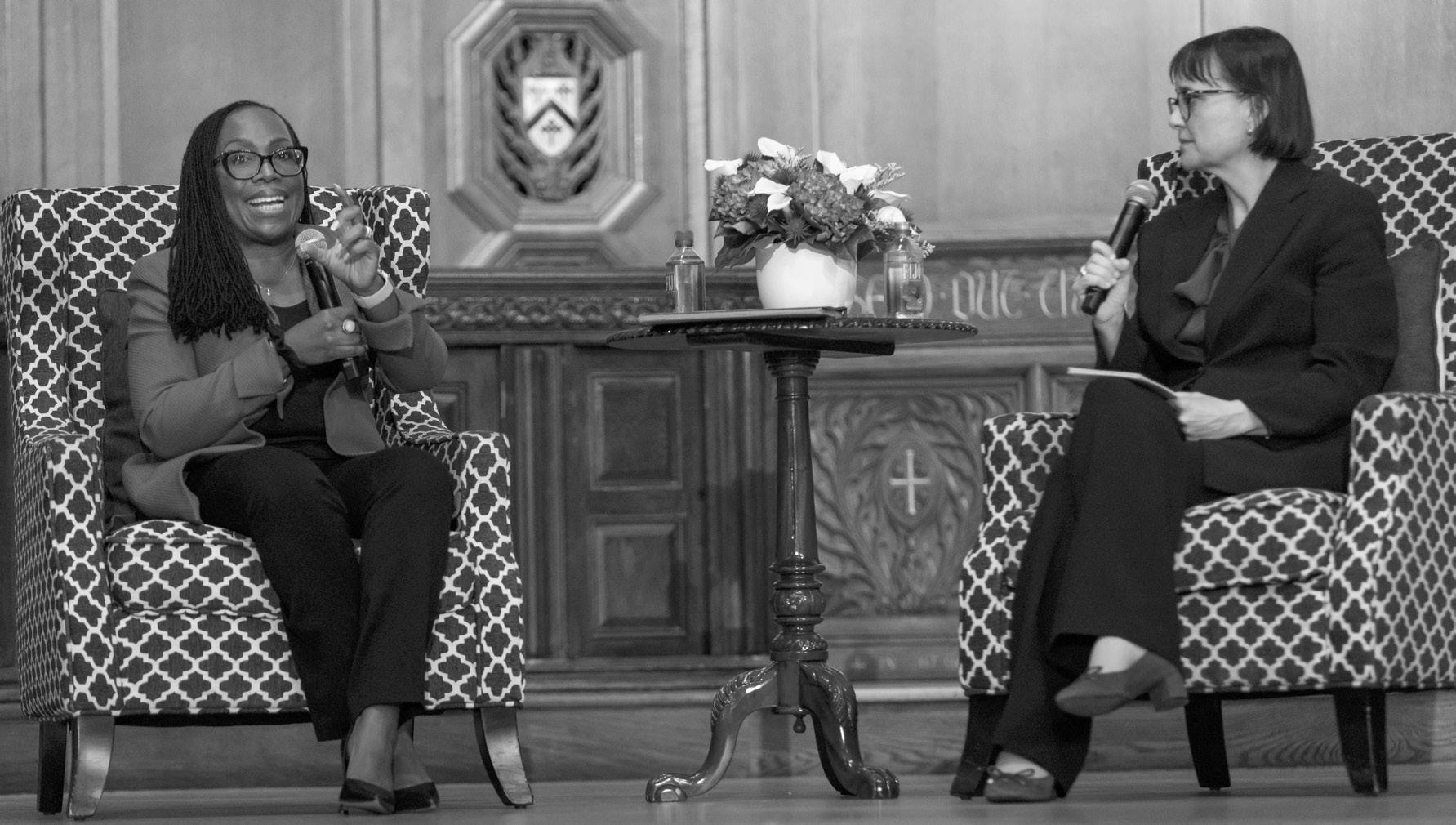
On Monday, Justice Ketanji Brown Jackson criticized the Supreme Court’s use of its emergency docket in a lecture to a packed audience of Yale Law School affiliates in Battell Chapel.
Jackson argued that the court’s use of the emergency docket has allowed it to inject itself into controversial issues without a complete review of the facts, eroding public trust.
“I would like to start by saying that I’ve come neither to praise the emergency docket nor to bury it,” Jackson said.
The event was open to the Law School community and newly admitted law students present on campus for an admitted students program, who were seated together in the balcony, according to Law School spokesperson Alden Ferro.
Though the event was closed to the press, the Law School on Wednesday released a video of Jackson’s remarks.
In her introductory remarks, Dean Cristina Rodríguez ’95
LAW ’00 described Jackson’s participation in high school speech and debate competitions, her time at Harvard as an undergraduate and law student and her clerking for Justice Stephen Breyer, whom Jackson would ultimately replace.
“Justice Jackson’s career embodies many of the same values that animate this institution: a rigorous, scholarly, analytical bent, a dedication to public service and a steadfast commitment to the rule of law,” Rodríguez said. Jackson came to the lectern to rapturous applause. Calling the emergency docket now part of the “public zeitgeist,” Jackson laid out the purpose of her speech as explaining what the emergency docket is, how the Court’s use of it “has become problematic” and how it can be addressed.
The emergency docket, sometimes called the shadow docket, lets petitioners seek immediate relief from the court, in a process that has been criticized for producing brief, unsigned orders and uneven results, with some cases given immediate relief while others are not heard.
To illustrate the emergency docket, Jackson used an analogy of two neighbors disputing ownership of a backyard shed. If one neighbor scheduled the shed’s demolition, the other could seek a preliminary injunction while the ownership claim was litigated — and if the court granted it, the first neighbor could appeal and request a stay to lift the injunction and allow the demolition to proceed.
“Neighbor A’s stay request is the kind of ask that is at the heart of many of the controversial opinions that the Supreme Court has recently issued,” Jackson said.
Jackson also discussed how emergency docket requests have changed since she clerked at the Supreme Court in the 1999-2000 term, noting that most are now non-capital requests rather than matters of life and death involving the death penalty.
Jackson criticized the current court for deciding too many stay requests, which she characterized as interfering with the work of lower courts when it would have been better for the case to proceed through
Justice
two days later.
regular processes.
“Sometimes, discretion is the better part of valor,” Jackson said, adding, “The high court is, after all, a court of final review, not first view, as we are fond of saying, and of course, the Supreme Court is not and does not know everything.”
To combat the misapplication of the emergency docket, Jackson proposed a solution based on the principles of exigency and equity. Exigency, or demonstrating a need for urgency, would offer a threshold for the court to intervene in fewer cases, while equity would shift the court’s focus away from the merits of a case and toward the potential harms of its ruling.
After the speech, Jackson sat with Rodríguez for a questionand-answer session, during which Rodríguez asked if Jackson knew why the court had lately been so willing to jump into politically contentious cases.
Jackson conceded that she did not know, but proposed that part of the reason may be that the court’s increasing willingness to grant stays, which has had a snowball effect in encouraging more stay requests.
“If you build it, they will come,” Jackson said, invoking a line from the classic baseball movie “Field of Dreams.”
When asked about her forceful and at times solo dissents, Jackson
framed them as embodying core American values like freedom of expression while also keeping an eye on the future.
“You are doing that in part for history and the future, because you hope that at some point, better, cooler heads will prevail and someone will agree with your view,” Jackson said.
Ilani Nurick LAW ’27 said Jackson spoke with “such clarity and persuasiveness.”
“You get the details of really what this alternative could look like, where the court deals with this issue of the emergency docket in a far more measured way,” Nurick said.
Elizabeth Bailey LAW ’27 agreed, saying it was “amazing” to hear directly from Jackson.
Trenaj Mongo LAW ’26 also praised Jackson’s speech, saying that the packed audience waited with a “palpable sense of anticipation” and excitement.
“I was just blown away—not only by the strength of her ideas, but by how effortlessly she communicated them. It was the kind of experience where you find yourself wanting more, wishing it didn’t have to end,” Mongo wrote to the News.
Battell Chapel has an audience capacity of 844.
Contact HENRY LIU at henry.liu.hal52@yale.edu.
Pop-ups bring new flavors to campus, courtesy of student cooks
BY OLIVIA CYRUS STAFF REPORTER
Outside of the Jonathan Edwards College dining hall on Easter Sunday, a small index card with “Pop-Up Bakery inside!
2-4pm TODAY!” taped to the door stopped hungry Yalies before they entered.
The small pink and green sign was the work of Brianna Yang ’29, a longtime baker from Pennsylvania. That Sunday was her first pop-up.
Yang has been baking on and off since high school, inspired by Instagram reels and videos of stage cooks. It wasn’t until December that Yang turned to the Jonathan Edwards student kitchen for baking consistently.
“It was like a coping mechanism because there were moments where I felt like I needed an outlet and a way to make friends,” Yang said. “So I would spend a lot of time in the kitchen just baking.”
Across campus, food-centered groups like Yang’s are cropping up to provide Yalies avenues for creativity and connection through food.
The menu for Yang’s pop-up included black sesame Rice Krispies treats, strawberry matcha thumbprint cookies, ube butter mochi, miso date banana bread and miso brown butter cookies. Her favorite flavor among the spread: matcha.
“My parents would find me matcha powder from Mexico, and I’d end up having nothing else to bake with, so I made a lot of matcha creme brulee, matcha cookies, matcha cheesecake,” Yang said. “I think it’s just a very comforting flavor for some reason.”
Another new cooking organization, the Yale Supper Club, was born from the minds of Amelia Wyler ’28 and Eli Breyer Essiam ’28. Wyler, a former employee at the Union League Pâtisserie, and Essiam, a former employee at a Parisian
restaurant, came together to ponder how to bring their professional culinary experience to an academic setting like Yale.
Both Saybrugians, they met through mutual friends and came together to host their first pop-up dinner on Sunday.
“We just both really like cooking, and we wanted to create a setting where we could kind of explore food really and test our abilities and share food for the love of community,” Wyler said.
Attendees at the event were charged $65 each, which Wyler said hardly covered the cost of ingredients and silverware.
This first dinner was less about generating a profit than it was about being experimental and “trying to get the methodology down,” Wyler said.
The pair began reserving the kitchen and spaces in the college and thinking about what kind of cohesive, multiple-course menu they wanted to create as early as September, Wyler said.
The theme of the evening was “Prometheus” and featured a bone marrow brulee and liver pate, edible clay “pebble” potatoes and lava cake to symbolize the story of the Greek hero.
Yang’s fall cooking in JE was inspired in part by Kai Zhang ’26, who also started a cooking pop-up group. Zhang, who helped Yang set up her event, started a pop-up inspired by traditional Chinese flavors whose name is pronounced Wei Dao House, using the Chinese word for flavor.
In April, Yang posted on her Instagram account a video about her desire to host the event. For Yang, the goal would be an event where “the vibes are super nice, warm and intimate and fun for a community.”
Over the span of a week, Yang put the pop-up together, planning recipes, posting advertisements online, purchasing the specialty ingredients like black sesame and booking the JE kitchen.
“Sharing food is a very good way to build community and also get people to step out of their comfort zones with whatever cuisines they’re trying,” Yang said. “I think the basis of it is this idea of sharing and creating and presenting yourself on a plate, like ‘This is me, I hope you like it.’”
At the start of the event, Kelly Tran ’27 made a beeline for the ube butter mochi and black sesame Rice Krispies, whose “flavor profiles” stood out to her.
“She’s always around JE and there’s so much community,” Tran said, referring to Yang. “You always see her cooking and smiling, and she’s such a bright face so I was like ‘Bro, I’m gonna stop by and support and eat the food because it’s always so good.’” Yang said she hopes the
event will inspire other Yalies to share “whatever niche little skills” or passions with their peers. In the future, she aspires to bake treats incorporating yeast and laminated dough and flavors such as yuzu, saffron and jasmine.
Wyler and Essiam, for their part, are already planning future Yale Supper Club events, with their next dinner titled “Metamorphosis.”
The two believe that what differentiates their organization from other pop-up clubs is that they have “no barrier to entry.”
They said that the increase in food-related organizations and pop-ups at Yale could be attributed to more Yalies’ wanting in-person experiences and shared dinners.
“I enjoy having dinner with people and making it more of an occasion versus just going to the dining hall with friends,” Wyler said. “We had a dress code and all these things that make dinner an occasion and something that’s memorable. I think that’s pretty valuable.”
Jonathan Edwards College is located at 63 High St. Contact OLIVIA CYRUS at olivia.cyrus@yale.edu.
“It’s a bit more chef-oriented. We’re not trying to make a profit here. We’re genuinely just trying to explore, and it’s very experimental. It’s about the experience, not just dinner,” Essiam said. “Everyone came away saying that was something they’ve never experienced before.”
COURTESY OF HAROLD SHAPIRO
Ketanji Brown Jackson spoke to the Yale Law School community about the Supreme Court’s emergency docket in a Monday talk, a video of which was released
COURTESY OF JANE CALLANAN
One baker recently sold black sesame Rice Krispies treats and ube butter mochi in Jonathan Edwards College, while a pair of students inaugurated the Yale Supper Club with the theme “Prometheus.”
MARTIN PERALTA / STAFF PHOTOGRAPHER
ARTS
“A good laugh is a mighty good thing, and rather too scarce a good thing; the more’s the pity.”
MOBY-DICK HERMAN MELVILLE
‘The Last Five Years’ offers a love letter and goodbye to Yale theater
BY ZOE FROST STAFF CRITIC
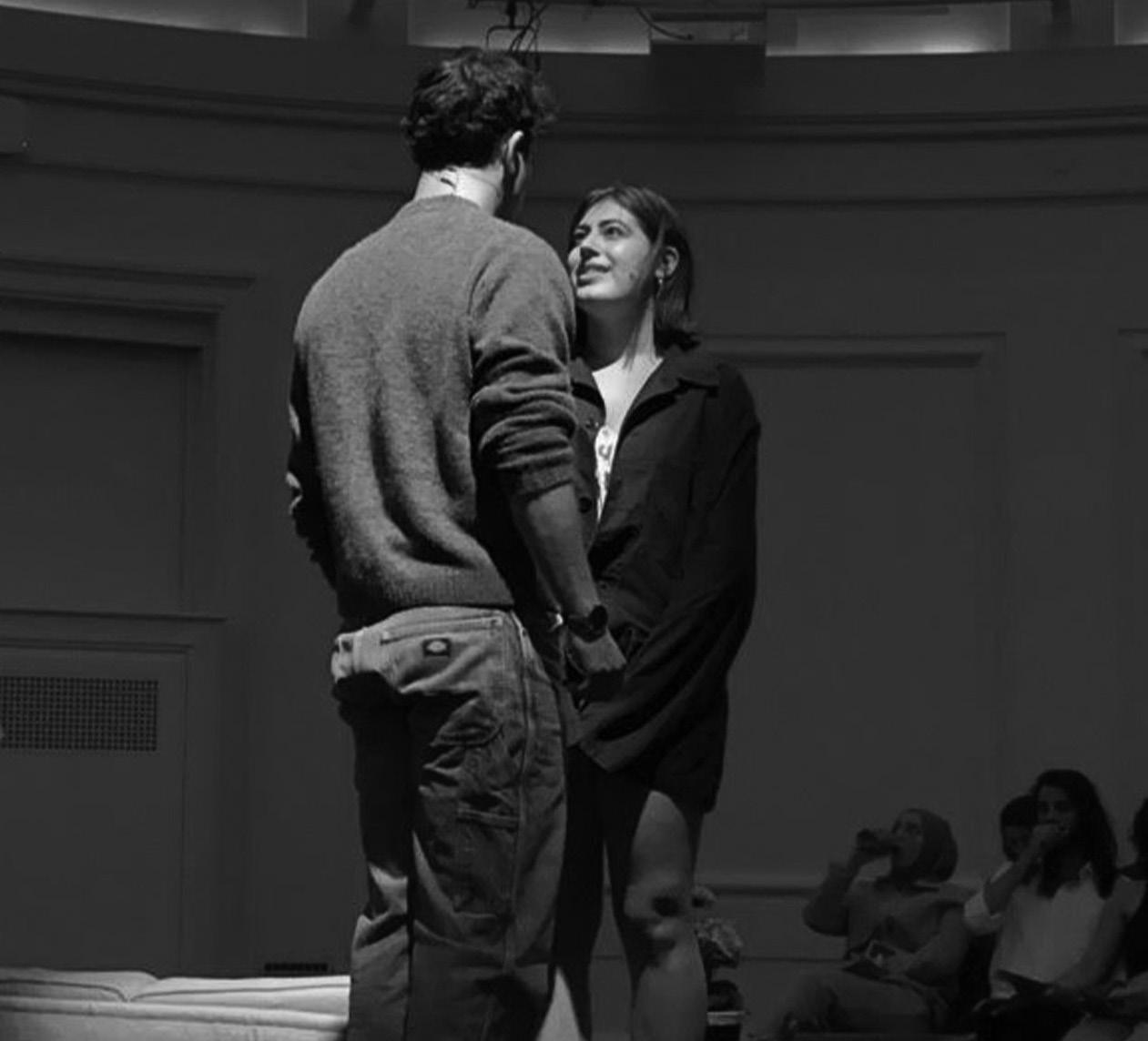
Since its premiere in 2001, Jason Robert Brown’s “The Last Five Years” has remained an inescapable pillar of modern musical theater. Past productions of the twocharacter show have cast famous pairs like Norbert Leo Butz and Sherie Rene Scott, Nick Jonas and Adrienne Warren and, most recently, Ben Platt and Rachel Zegler. This weekend, a production in the Schwarzman Center’s Dome under the direction of Alastair Rao ’26 featured two big names of Yale College’s own theater scene: Ben Heller ’27 and Hannah Kurczeski ’26.
The musical follows Jamie and Cathy, two young artists in New York, as they fall in and then out of love. Jamie’s story runs chronologically forward and Cathy’s backward, the pair meeting in the middle on their wedding day. In the opening numbers, the audience witnesses Jamie at his most ecstatic and in love, while Cathy is disillusioned and lonely. At the show’s close, Cathy giddily reflects on their first date while Jamie moves his belongings out of their apartment.
Kurczeski’s past credits at Yale have included highly characterized, larger-thanlife roles like Schwarzy in “The 25th Annual Putnam County Spelling Bee,” Paulette in “Legally Blonde,” Joanne in “Company” and Sally Bowles in “Cabaret.”
With a powerful belt known to practically every theater-going undergraduate on campus, she seems most in her element leading large companies and riotous pits through showstopping numbers.
The role of Cathy, however, required her to step back and down to embody a character deeply unsure of herself and her marriage. Alone on The Dome’s stage and accompanied by a small pit led by the virtuosic Justin Wang ’27, Kurczeski opened the show gently, singing with incredible care and control rather than the wonderful bombast that her Yale roles so often exhibit. Throughout the evening, she leaned into the tension between Cathy’s different
emotions: at times cautious and forlorn, then unraveling into anger and overflowing with affection.
In “I’m a Part of That,” Cathy reflects on her love for Jamie despite his preoccupation with his writing. Kurczeski sang with candor, her performance a heartbreaking and resigned confession of an unrequited commitment to her husband. She also brought humor to the role: the witty lyrics of “A Summer in Ohio” were delivered playfully, with Kurczeski teetering on the line between determined optimism and extreme frustration at being stuck doing regional theater “40 miles east of Cincinnati.”
Heller seemed at home in the part of Jamie, embellishing Brown’s eclectic score with stylized runs and his signature vibrato. He is accustomed to playing narcissistic, romantically problematic men — Franklin in “Merrily We Roll Along,” Bobby in “Company” and Caldwell B. Cladwell in “Urinetown,” to name a few — and his performance on Saturday evening conveyed both the charm and cruelty that make Jamie’s character complicated and compelling.
Jamie sings “A Miracle Would Happen” just after the pair’s wedding, lamenting that his marriage to Cathy means he cannot sleep with other women. On Saturday evening, Heller leaped across the stage in frustration, singing about how he wished “every girl would look like Mister Ed” with infectious and hilarious energy. Later, in “Nobody Needs to Know,” Jamie attempts to justify himself after waking up next to another woman. Jamie’s assertions that “it’s over, it’s done” and “nobody needs to know” were undercut by Heller’s guilty delivery of the song’s lilting and modest melody. At times, both Kurczeski and Heller demonstrated a studied and practiced understanding of their characters’ nuances and challenges — each actor especially shined when portraying the older versions of their characters, jaded and worn down by the last five years. Less
convincing, unfortunately, were their portrayals of their characters as young and smitten with one another. In chronologically earlier songs like Jamie’s “Shiksa Goddess” and Cathy’s “Goodbye Until Tomorrow,” Heller and Kurczeski leaned so much into the happiness and naivete of their characters that they became less real, appearing more as caricatures of young lovers rather than complex people who happened to also be in love.
Perhaps the largest challenge of a show like “The Last Five Years” lies in the solitary nature of each actor’s performance: Although most songs are delivered to the
other character, the actors sing them alone onstage. An important directorial choice must be made, then, about where the other character is in the space of the theater. During some songs, I felt unsure if Jamie was sitting on the couch next to Cathy or somewhere at the back of the audience as she sang; in others, I wondered if Jamie was singing to himself in frustration, or really speaking to Cathy as she sat at the desk. More specificity of space within the set and the theater would have taken this production to the next level and transformed two exquisitely executed vocal performances into a storytelling feat.
Along with Kurczeski and Rao, producer Abby Asmuth ’26 and stage manager Elizabeth Stanish ’26 will graduate in a few weeks, leaving Yale College theater behind them. In many ways, this production — about young artists and staged in the heart of Yale’s campus — felt like a love letter to the artistic community to which they have contributed so much. Their absence will certainly be felt upon our return to campus in the fall.
Contact ZOE FROST at zoe.frost@yale.edu.
Berkeley College Orchestra marks 50 years with concert in Woolsey Hall
BY GEMARD GUERY STAFF REPORTER
The Berkeley College Orchestra hosted its 50th anniversary concert on Sunday.
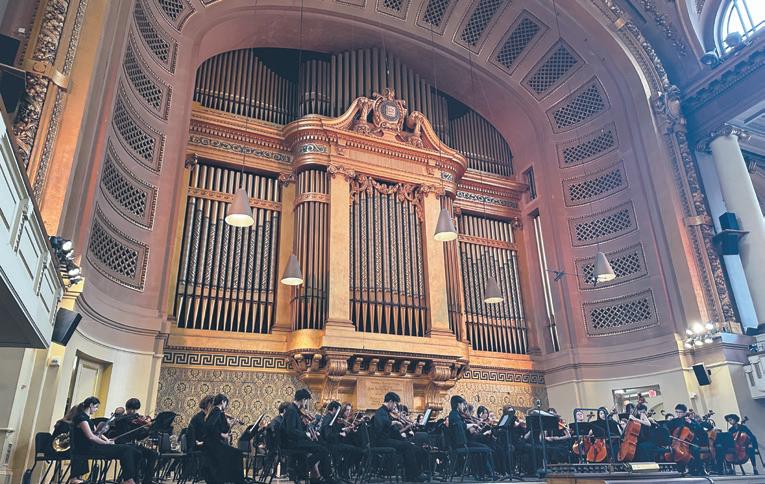
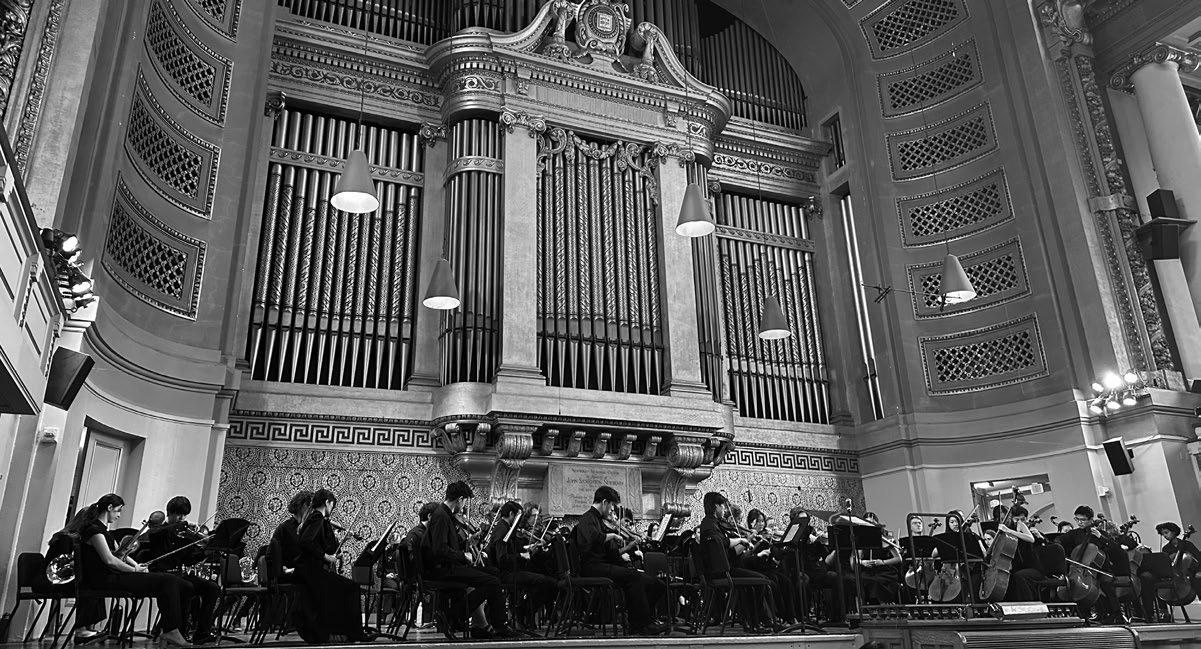
In Woolsey Hall, the orchestra performed one of its most ambitious undertakings with alumni from across the country, as a celebration of the orchestra’s history and impact on Yale’s campus.
“It’s become even bigger to so many of our alumni,” Taylor Burke ’27, one of the orchestra’s presidents, said. “It’s been a really rewarding experience because there
are people who work across such a wide range of things, because that’s really the heart of BCO, that it’s for anybody who loves to play music.”
The student-run orchestra, originally known as the Berkeley Chamber Players, was formed in 1975.
The group wouldn’t become the Berkeley College Orchestra until Scott Speck ’83, a music major and member of Berkeley College, proposed the change. Speck now serves as artistic director and principal director for the Chicago Philharmonic Orchestra. According to the orchestra’s
website, each residential college at Yale used to have its own distinct orchestra. However, due to limited involvement, most could only perform smaller pieces.
Over time, the Berkeley College Orchestra combined with Saybrook College’s orchestra. Most students involved were not music majors, a trend that has continued to this day.
“I was thrilled that something that I had the idea to start back then continued to be relevant and continued to be a need within the Yale community,” Speck said. “It’s much bigger, and they’re performing in many more diverse places.”
The orchestra is heavily supported by Berkeley. It receives funding from the college and rehearses in it, after which members eat in the Berkeley dining hall. Students do not need to be members of Berkeley to be a part of the orchestra. The orchestra is also open to graduate students and professors.
Head of Berkeley College David Evans ’92 played in the orchestra as an undergraduate student and has continued during his tenure as head of college, which will end after this semester.
According to Burke, the group has grown since the COVID-19 pandemic, with the support of Nicole Lam ’25. The orchestra has grown from a group of around 15 people to an ensemble of about 75. At the concert, the orchestra performed Tchaikovsky’s Fourth Symphony and closed with his “1812 Overture.” The latter piece was written to be accompanied by cannons. Unfortunately, that feat proved impossible for the orchestra, because Woolsey Hall does not allow pyrotechnics, Burke said.
However, with the help of the Yale Symphony Orchestra, the Berkeley orchestra was able to recreate the sound of canons using bass drums and Mahler hammers from the YSO’s performance of Mahler’s Second Symphony.
Lam — who served as the Berkeley College Orchestra’s music director for three years and recently finished work as an assistant conductor for a “Phantom of the Opera” national tour — played the Mahler hammer during the performance.
Harrison described the closing as the “loudest and grandest” in the orchestra’s history, so much so that the wind section had to wear earplugs.
The final piece also featured orchestra alumni, who had gathered for a rehearsal earlier in the day. Evans had also gathered brass players to create an off-stage brass section. Thus, the finale was performed with over a hundred musicians playing at the same time.
“It was as loud as we wanted to be,” Harrison said. “It was a really memorable production, and everyone played very well. It was everything we wanted it to be.” Berkeley College was founded in 1934. Contact GEMARD GUERY at gemard.guery@yale.edu.
COURTESY OF ABIGAIL YADEGAR
A show of contrasting chronologies, “The Last Five Years” uses intimate melodies and emotional overtures to tell a story of love won and lost. Hannah Kurczeski ’26 and Ben Heller ’27 played the musical’s two characters in The Dome.
COURTESY OF LAURENTIA WOO The 50th anniversary concert celebrated the orchestra’s history by bringing together current members and alumni for a finale performance. For one piece that Tchaikovsky wrote to be performed with cannons, the orchestra found an alternative sound.
THROUGH THE LENS
A TRIP TO “AH-BEETZ”
Photos by Martin Peralta Staff Photographer
WOMEN'S LACROSSE
BY AZARA MASON STAFF REPORTER
The No. 10 Yale women’s lacrosse team (12–2, 6–0) secured a one-goal victory over its rival, the Harvard Crimson (5–8, 1–5), on Saturday.
The Crimson put up more goals against Yale’s secondranked scoring defense than any opponent this season, but the Elis held strong and overpowered Harvard to pick up another win.
In the first two minutes of play, midfielder Kate Gould ’29 notched an assist and goal to put the Bulldogs up 2-0. Gould went on to finish the day with five goals and two assists.
Harvard responded, tying the game at 3-3 midway through the opening quarter. Back-to-back goals from midfielder Meg Bohan ’29 then gave Yale a 5-3 lead to close out the quarter.
Yale’s fouls early in the second quarter proved costly, as Harvard capitalized with back-to-back freeposition goals to even the score at 5-5.
The teams exchanged goals throughout the half, but back-
to-back Harvard goals in the final four minutes gave the Crimson a 9-7 lead heading into halftime. Harvard finished the half with just nine shots on goal — a testament to its efficient shot selection and accuracy.
Five minutes into the second half, Harvard gained their largest lead of the game, up 12-8. A goal from midfielder Whitney Froeb ’29, however, was the start of a 4-0 Bulldog run to close out the third quarter. The Bulldogs had tied it 12-12.
Less than two minutes into the final quarter, Harvard’s Charlotte Hodgson sniped a shot from a difficult angle to give the Crimson a 13-12 lead.
With nine minutes remaining, Ashley Kiernan ’27 found Gould, who buried a deep shot to tie the game at 13. That marked Keirnan’s fourth assist of the afternoon.
With under six minutes to play, Yale had an initial shot attempt stopped, but attacker Kelly Holmes ’28 rode the Harvard clear, applying persistent pressure to successfully check the Crimson player and force a turnover. Holmes then sprinted back to goal and fired a shot to put the Bulldogs ahead 14-13 with 5:05 remaining.
From there, Yale’s defense held strong under pressure, keeping the Crimson scoreless for the remainder of the game. The Bulldogs secured a 14-13 victory.
The win was followed by a Senior Day celebration at Reese Stadium, where attackers Megan Kitagawa ’26 and Ashley Newman ’26, along
with defenders Jordan Messina ’26, Emmy Pascal ’26, Bella Saviano ’26 and Sarah Waits ’26, were honored. The Elis will travel to Ithaca for their final regular season game against Cornell (8–6, 3–3) on Saturday. Yale will look to finish conference play undefeated. With Cornell currently sitting as the fourth seed and Yale as
Bulldogs clobber UAlbany Great Danes, extending
MEN'S LACROSSE
BY LIZA KAUFMAN STAFF REPORTER
The No. 12 Yale men’s lacrosse team (8–4, 3–2 Ivy) delivered one of its most dominant defensive performances in recent years on Saturday afternoon. In the dogon-dog battle at Reese Stadium, the Bulldogs came out on top, soundly defeating UAlbany (8–5, 5–0 AE) 15-2.
With an efficient offense that capitalized early and a dominant defense that held the Great Danes scoreless through the half and only allowed two goals, the Elis were in full control of the game from the opening faceoff. Saturday’s victory extended the Bulldogs’ win streak to five.
Prior to the game, the program honored its nine-member senior class for their contributions during their four years. Families joined seniors David Anderson ’26, Nicolas Boudreau ’26, Brody Coleman ’26, Hugh Conrad ’26, Konrad Miklaszewski ’26, Eric Platten ’26, Sam Riecken ’26, William Sheehan ’26 and captain Patrick Pisano ’26 for a ceremony on the field.
“Senior Day meant a lot to me,” Sheehan wrote in a text message to
the News. “More than anything, it made me appreciate the guys I’ve gone through this with, especially my fellow seniors and the rest of the team. Sharing that day with them made it really special.”
Pisano echoed Sheehan, noting that while the day was emotional for the senior class, it also highlighted the contributions of the entire team.
“It was very emotional to potentially play our last ever home game as a senior class, but it was also very nice to see every senior on the field at some point during the game,” Pisano wrote in a text message to the News. “Overall, an amazing senior day and all of the younger guys played their hearts out which means so much to us.”
After honoring the seniors, the Bulldogs got straight to work.
Yale came out firing from the opening whistle.
“You could feel it from the start, and I think that gave us a lot of momentum,” Sheehan wrote.
Offensively, eight different Bulldogs found the back of the net.
First-year attackman Sean Grogan ’29 led the offensive unit with four goals and two assists, followed by senior attackman Anderson, who notched a hat trick. Midfielders Cole Cashion ’27 and Cole Jackson ’27 each potted two goals. Attackman Connor Gately ’28 recorded a four-point performance with a goal and three
assists, while Sheehan had a goal and assist of his own. Luke Pascal ’28 and Flynn Leonard ’29 rounded out the unit, each scoring one goal.
Yale’s offensive unit also went a perfect three for three on man-up opportunities and was extremely efficient, converting 34 shots into 15 goals.
On defense, the Bulldogs set the tone early, holding the Great Danes scoreless for the first 30 minutes. The first half shutout was Yale’s first since 2016 at Fairfield, and the two goals given up marked the fewest in a single game since Yale played Lehigh in 2014. Yale’s penalty kill held UAlbany to only one for six on man-up opportunities.
The Elis came out hot and took care of business straight away to jump out to an early five-goal lead. Cashion sparked the offense with two unassisted back-to-back goals at 14:00 and 9:36 to open the scoring. From there, the goals just kept rolling in. Gately found Grogan to extend Yale’s lead to 3-0, and then, at 1:43, goalie Ben Friedman ’28 assisted Sheehan to cushion Yale’s lead. But the Bulldogs weren’t done yet. At the 13-second mark, Pascal potted a goal of his own to close out Yale’s dominant firstquarter performance, up 5-0.
In the second quarter, the Yale offense was once again all gas, no brakes, putting up another four
unanswered goals, while the defense continued to turn away UAlbany’s chances of getting on the board. Jackson netted his first of the day at 9:27. Then, the Gately-to-Grogan connection struck again, putting Yale up 7-0. First year Dylan Blekicki ’29 recorded an assist on Anderson’s man-up goal, and then Grogan assisted Leonard to score his second career goal. As the buzzer sounded, the Bulldogs went back into the locker room leading 9-0.
The Great Danes struck first in the third quarter to finally get on the board. However, the Bulldogs answered right back with three of their own. The Gately-to-Grogan connection proved unstoppable for a third time, as Gately found Grogan on the doorstep for a hat trick and restored Yale’s nine-goal lead.
Thirty seconds later, Blekicki recorded his second assist as Grogan capitalized on a man-up opportunity to push Yale’s lead to 11-1. Gately rounded out the three-goal run with an assisted goal of his own. At 3:32, the Great Danes found themselves with a man-up opportunity and capitalized to net their second and last goal of the game, but they stood no chance against the Yale squad. At the close of the quarter, Yale led 12-2.
In the final 15-minute stretch, the Elis added another three unanswered goals to finish off a game that was all but over in the
at azara.mason@yale.edu.
first 15 minutes. Anderson shined, scoring twice back to back. On the first, Grogan assisted Anderson on a man-up goal. Then, the seniors got it done as Sheehan found Anderson for a behind-the-back shot to give Yale a 12-goal lead. At 9:53, Jackson recorded his second of the day to cap off Yale’s offensive surge. As the clock ran down, the team rushed the field to celebrate Yale’s 15-2 Senior Day victory.
Having sent the seniors out right in their final home game at Reese Stadium, the Bulldogs will now gear up for their final regular season game at Brown (6–6, 1–4 Ivy). With only one bid remaining for the post-season Ivy League tournament, a win next weekend is crucial. Riding a five-game win streak, the Bulldogs are well positioned to return to New Haven with an Ivy playoff berth.
“I think this win streak is one we should continue to ride heading into Brown, but we cannot let our preparation or effort waiver as we go through this week,” Pisano wrote.
Faceoff is slated for 12 p.m. on Saturday at Stevenson-Pincince Field in Providence, and the game will be live-streamed on ESPN+. Contact LIZA KAUFMAN at liza.kaufman@yale.edu.
LIZA KAUFMAN / PHOTOGRAPHY EDITOR
The women’s lacrosse team secured the Ivy League regular season title on Senior Day with a 14-13 win over Harvard on Saturday.