

BY JAEHA JANG AND OLIVIA WOO STAFF REPORTERS
In the hours after University
President Maurie McInnis shared the Committee on Trust in Higher Education’s report on Wednesday afternoon, faculty members praised its purpose and frankness, while students questioned whether it sufficiently dealt with the pressures faced by undergraduates.
The report, which was written by a committee of 10 professors, examines a wide range of campus issues, including the cost of attendance, the admis -
SEE REACTIONS PAGE 5
BY ARIA LYNN-SKOV AND LEO NYBERG STAFF REPORTERS
On Wednesday afternoon, University President Maurie McInnis unveiled an extensive report by the Committee on Trust in Higher Education about Yale’s — and other elite universities’ — failure to maintain public trust.
The report called for changes touching on a wide range of issues, from grade inflation to admissions and from campus discourse to the cost of attendance. How these
recommendations will be implemented remains unclear: McInnis accepted some of the proposals in full, referred some questions to various committees and left some of the suggested changes unaddressed in the email she sent to the University community to share the report. In her email, McInnis accepted the committee’s call for Yale to take responsibility for plummeting public trust. “We must acknowledge how we have fallen short,” she wrote. Since McInnis formed the committee in April 2024, it has
BY ANAYAH ACCILIEN STAFF REPORTER
Counteracting administrators’ cuts to student funding programs is central to the campaigns of the four students still running to be the next Yale College Council president.
After President Donald Trump signed the One Big Beautiful Bill Act, which included a provision to increase the tax on the wealthiest universities’ endowment incomes from 1.4 to 8 percent, University administrators announced that schools and divisions across Yale would have to reduce their budget targets.
Since that announcement, Yale College has consolidated the International Study Award and the Summer Experience Award into a single summer
grant opportunity and reduced the size of its staff. Amid the budget tightening, YCC presidential candidates said they think it will be essential for them to be in the room when future budgetary decisions are made.
“I think first and foremost, the student body deserves a clear and concise explanation as to why these changes are being made on campus,” candidate Sahra Wahedi ’27 said in an interview. “We will get them those answers. And second of all, we will ensure that further changes that are made, we are able to receive notice of them prior to that, and that we’re able to ensure that FGLI students have the resources they need to thrive on campus,” she added,
gathered research and held listening sessions as part of its work to compile the report.
“Ours is the academic mandate,” law professor Sarath Sanga LAW ’14, a member of the 10-person committee, said in a Wednesday interview. “And now she has the leadership mandate. So it’s hers to implement,” he added, referring to McInnis.
Yale’s mission At the core of the report’s 20 recommendations was a proposal to
BY ASHER BOISKIN, ARIA LYNN-SLOV AND LEO NYBERG STAFF REPORTERS
A faculty committee assembled by Yale President Maurie McInnis on Wednesday released a report examining a vast range of campus issues to identify causes of and potential solutions to public wariness of higher education, prompting McInnis to say the University must accept some fault for declining trust.
McInnis formed the 10-member Committee on Trust in Higher Education last April, during her
second semester as University president — and three months after President Donald Trump took office, having promised an aggressive approach to overhauling American universities. In its sprawling 58-page report, the committee criticized certain University policies and listed 20 recommendations for reform. It suggested that for Yale to restore public trust, it should rethink its approach to financial aid, clarify and change admissions policies, promote more
Is Yale’s bureaucracy too big? Budget crunch

BY ASHER BOISKIN STAFF REPORTER
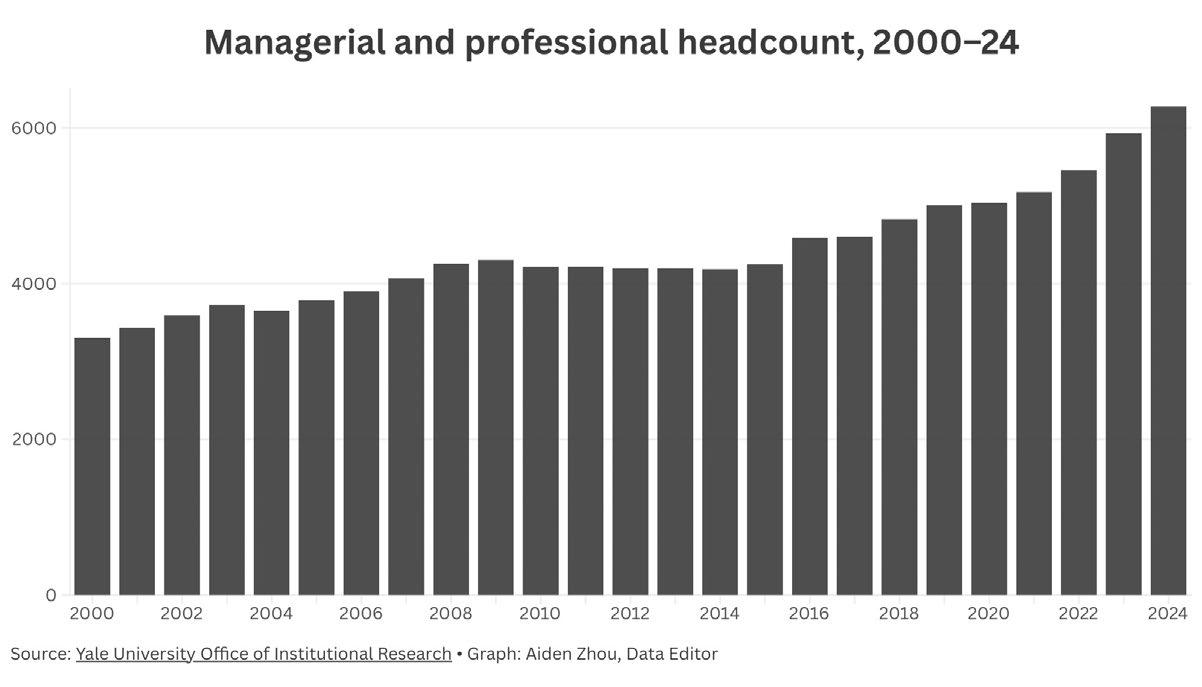
Yale’s managerial and professional staff has nearly doubled since 2000. The University is now facing a $300 million bump in its endowment tax bill that is forcing hard questions about what all of the bureaucracy is for. Since 2000, Yale’s managerial and professional head count has grown from roughly 3,300 employees to around 6,300, according to the Office of Institutional Research. In that same period, undergraduate enrollment grew by around 1,500 students. In 2018, the Chronicle of Higher Education found that Yale had the highest manager-to-student ratio of any Ivy League university and the fifth
SEE BUREAUCRACY PAGE 6
BY SABRINA THALER AND ELIJAH HUREWITZ-RAVITCH STAFF REPORTERS
The Trump administration filed a lawsuit against New Haven on Monday, alleging that the city’s so-called “sanctuary policies” interfere with federal law.
The lawsuit was the latest in a series of legal battles between Mayor Justin Elicker and President Donald Trump since the beginning of his second term — but this time, New Haven was the
defendant. The city has signed onto five lawsuits and 20 amicus briefs against the Trump administration, including one last February aimed at protecting sanctuary cities from federal overreach, according to city spokesperson. The complaint alleges that New Haven’s “sanctuary policies,” which restrict local authorities’ collaboration with federal immigration enforcement, disregard federal law and threaten public safety. It also claims that sanctuary cities provide “criminal aliens
Silicon Valley leaders told University President Maurie McInnis that AI technology will make a Yale degree more valuable, she said in an
with safe harbor from federal law enforcement detection.”
In 2020, Elicker signed an executive order designating New Haven a “welcoming city,” which prohibited city employees and police from making arrests or detentions based on Immigration and Customs Enforcement detainer requests or warrants, “unless required by law.” The policy also restricts city employees and police from inquiring about a person’s immigration status.
“Sadly, but unsurprisingly, the
Trump Administration’s lawsuit contains inaccuracies and untruths about New Haven’s Welcoming City executive order,” Elicker said in a statement emailed by a spokesperson. “We are confident we are on the right side of the law – and, equally important, we are confident we are on the right side of history. We will continue to stand up to President Trump and we will continue to defend our residents, our city and our values.”
Elicker said that the policy is “compliant with all local, state
and federal law,” and affirmed that the city was committed to arresting any individuals that commit violent crimes. Over the course of his second presidential term, Trump has directed ICE to carry out a large-scale detention and deportation campaign across the U.S., an effort which drew intense national scrutiny earlier this year after federal agents killed two American citizens during its
SEE LAWSUIT PAGE 5
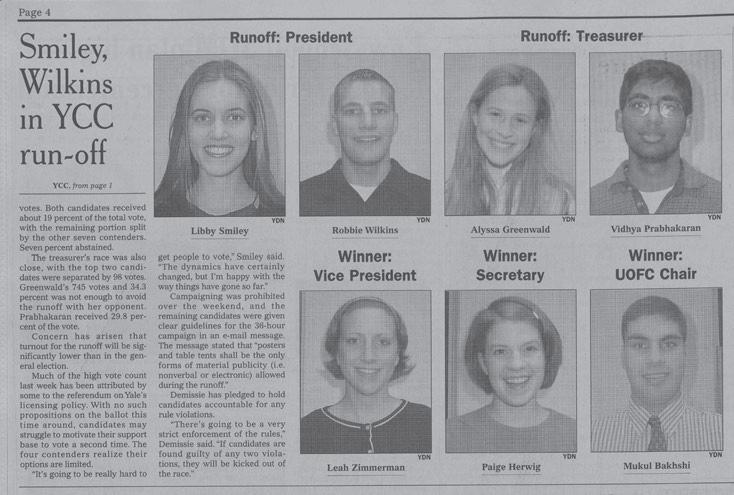
April 17, 2000 / Smiley, Wilkins qualify for presidential run-off
By Bret Ladine
It’s not over yet. Close vote tallies in last week’s YCC elections have forced runoffs for the offices of president and treasurer. The race has also seen a formal public reprimand of a presidential candidate by the YCC Election Committee.
Libby Smiley ’02 will face Robbie Wilkins ’03 in the race for president, and Alyssa Greewnwald’03 will contend against Vidhya Prabhakaran’03 for treasurer. The runoff election begins today at 9 a.m. and will end tomorrow at 9 p.m.
Wilkins received a formal reprimand Sunday night for failing to remove approximately 15 to 20 campaign signs from various locations on campus, including some in his own dormitory.
By Tyler Matukonis
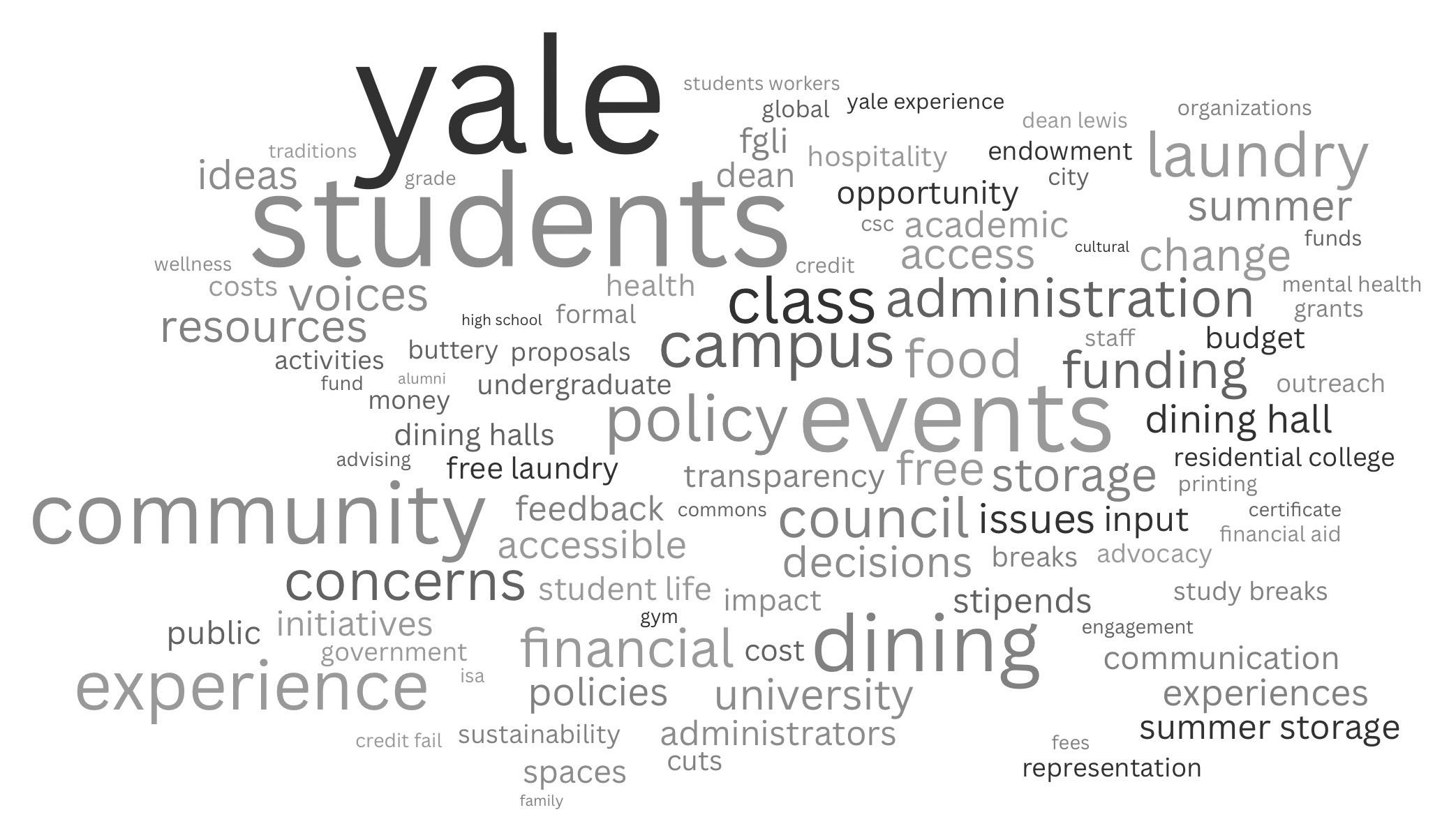
The Yale College Council spring 2026 election candidate statements document is long — spanning 56 pages. Not only are there statements for the president, vice president and events director positions, but also statements from candidates running for class presidents and residential college senators. While the candidates have varying goals, I worked to determine what topics were most frequently mentioned.
In a similar way that U.S. News analyzed President Trump’s address to congress in early March, I performed a term frequency analysis of candidate statements using a Python program. After cutting out common words like “a” and “the”, the number of unique words, in addition to two and three word phrases, were tallied. When looking at the results in a word bubble, where size represents frequency, terms like “dining” and “funding” were some of the most prominent. While these themes may not be reflected in each candidate’s statement, this analysis was helpful in highlighting broad trends.
Read “What words appear most in YCC candidate statements?” on page 7.



JOHN ROBERT WALKER
MICHELLE JIMENEZ ROSENTHAL
Last year, Yale told students on financial aid that one of their summer fellowships was cut. Then their storage money. Then a chunk of the cultural centers’ budgets.
The explanation, when there was one, was brief: we can’t afford it.
But Yale’s endowment grew by $4.5 billion last year. One month of gains is enough to pay the endowment tax. There is no version of that math where Yale is the victim.
We’re JR and Michelle, and we’re running for Yale College Council President and Vice President. We met on the Dwight Hall Student Executive Committee. We both want to go into public interest law. And two years in, here’s what we’ve learned about how this place functions.
Yale runs on an information gap. Without citing their sources, administrators tell you donor priorities have shifted away from summer funding. They claim to be fighting for us behind the scenes while they bow, in public, to politicians who want to gut higher education. The gap is the strategy: if you don’t know what’s happening, Yale gets to frame its choices as inevitable. They aren’t.
Yale is one of the richest institutions on earth, with an endowment surpassing the GDP of 110 countries. When it tells you it can’t afford to fund summer experiences we were promised, or to keep the lecturers you love, or to stop investing in the companies building surveillance tools for immigration law enforcement and the Israeli military, it isn’t describing a budget. It’s choosing a set of priorities.
So here’s what we’re running on:
Respect for students means Yale restores what it has cut. Stop treating financial aid like a marketing brochure, treat it like a promise. Lift the time, place and manner restrictions that govern how we gather on our own campus, whether we’re throwing a performative male contest or holding a protest.
Respect for workers means a $22 student minimum wage so students don’t have to work 19 hours a week to keep up. Stop quietly pushing out the lecturers of classes we love. Join the Fair Food Program.
Respect for New Haven means Yale remembering where it lives. Yale deploys its tax-exempt status to withhold property taxes on a third of the city’s land, leaving New Haven $110 million short each year of the fully-funded schools and affordable housing our city deserves. Yale refuses to meet student demands to divest from surveillance startups and detention camps, companies that help ICE terrorize our neighbors. We’ll continue fighting for Yale to do right by our city. Every spring, two people write an op-ed like this one. They list off their resumes. They promise students a “seat at the table.”
They win, and then nothing much happens. That’s because the YCC they inherit isn’t built for students to build power. It’s built to pass unimaginative resolutions and send politely worded letters that administrators politely ignore. It has quietly settled into an institution Yale can point to when it wants to claim student consent on a decision it would’ve made anyway.
The YCC’s only real job is to be the organizing body for Yale students, and it is failing. An organizing body is built out of relationships, not resolutions.
The YCC’s petition to restore the cut summer grants showed that the YCC can mobilize students. But the petition didn’t build lasting power and failed to create future opportunities for escalation. Instead, student leaders accepted a closed-door meeting that didn’t go anywhere but a campaign website. We need leaders willing to hold the line on student demands for full restoration of the funding.
Yale moves when students don’t organize alone. The “Yale: Respect New Haven” street painting outside SSS is a reminder. In 2021, students, unions, faculty and New Haven residents came together to demand respect, and Yale conceded a historic increase in its payments to the city. That coalition is the only thing administrators have ever been afraid of, and coalition-building is what we do best. Michelle lost sleep for weeks organizing 300 Yalies to support 300 Troup School students in the Season of Giving drive. JR organized a YCC divestment referendum with over 3,330 voters and built support from a U.S. senator for student movements on campus.
Yale protects its reputation above all else, which is where the leverage is. Bulldog Days. Commencement. Donor weekends. Every admissions cycle, every press cycle. Those are the moments when student voices reach the audiences Yale actually listens to, and that’s how movements here have always won. Let’s rebuild the YCC into a body that tells students the truth, connects them to the people already organizing and turns them out in numbers Yale can no longer ignore.
Yale has the money. What it doesn’t have, yet, is a student body organized enough to win the respect we deserve. We’re running to build one.
JOHN ROBERT WALKER is a sophomore in Ezra StilesCollege studying history. He can be reached at johnrobert.walker@yale.edu.
MICHELLE JIMENEZ is a sophomore in Pauli Murray College studying Global Affairs and Economics. She can be reached at michelle.jimenez@yale.edu.

STAFF COLUMNIST
NATE STEIN
When I joined the Yale Glee Club at the beginning of my first year, I thought I knew what I was signing up for: a small part in Yale’s musical tradition and membership in a tight-knit community of musicians. This proved to be true, but what I did not expect was just how much the Glee Club would challenge my assumptions about people and politics. It has taught me that some of the most meaningful disagreements happen in the places we least expect.
I used to enter many situations at Yale with a level of caution. As a conservative student here, I think it was almost instinctive. Because most of my peers don’t agree with me, starting a conversation could be tricky. At the very least, since Trump’s victory in 2024, it was difficult to find much nuance when I talked about current events. Some people were angry that I would support any of his policies in the first place; others were annoyed that I would vote for him despite disagreeing on several key issues. In either case, I always prepared for outrage and pushback.
Given what I know about the political makeup of music departments and music schools, both at Yale and around the country, I expected that a group like the Yale Glee Club would be ideologically uniform. I figured that political differences especially would either go unspoken or would be unwelcome. I imagined that, at best, my views would be quietly tolerated and, at worst, outwardly judged. But I never expected much real engagement, and in that sense, I could not have been more wrong.
One of the defining features of the Glee Club is our corny use of the prefix “gl-” — perhaps most notable in our “glamilies,” which are smaller groups that welcome the first years into the Glee Club and try to make an 80-person choir feel a little bit more intimate.
My glamily last year had members from all four classes and from
different religions, hometowns, upbringings and political ideologies. It was with them that I had my first truly open conversations at Yale about politics. Over the course of the year, we discussed Trump in his second term, religion, campus protest, Glee Club repertoire and everything in between. We disagreed often, and passionately, but we were good listeners. It never felt performative or condescending. It wasn’t a competition of who could speak the loudest or get the most words in. We genuinely tried to understand one another. We asked questions. And as stupid as it sounds to even say, we always approached our conversations in good faith.
MY GLAMILY LAST YEAR HAD MEMBERS FROM ALL FOUR CLASSES AND FROM DIFFERENT RELIGIONS, HOMETOWNS, UBRINGINGS AND POLITICAL IDEOLOGIES.
In so many places — around campus, online and in the world beyond Yale — there’s a tendency to reduce one another to labels, headlines and straw men. Real conversations become impossible. Unexpectedly, what I’ve found in the Glee Club, especially within my own glamily, is a refusal to let that happen. I have been incredibly surprised by how willing most people are to listen, think, ask questions and disagree respectfully, challenging ideas but
STAFF COLUMNIST
not dismissing the people who espouse them.
Before I started at Yale, I assumed that special conditions and carefully curated spaces were necessary for meaningful dialogue across difference of opinion. But productive disagreement doesn’t demand perfect conditions. My time in the Glee Club has shown me that it is possible to disagree well in unexpected spaces — perhaps not everywhere and definitely not all the time but maybe more often than we might think. Precisely where I expected to find an echo chamber, I found a community that was genuinely open to engaging despite our many differences. I was wrong about this little corner of the Yale community, and I’m sure I would feel the same way about other groups, too, regardless of the extracurricular activities or shared interests that bring them together. So now nearly two years into my time at Yale, what was once total caution has become cautious optimism. I don’t mean the kind that ignores the complexities of our nation’s politics or pretends that deep-seated disagreements can be cleanly or easily resolved. I mean the kind which suggests that we might be underestimating one another, that there are more opportunities for good-faith conversation than we might originally assume and that sometimes those opportunities exist in the places we least expect. My time in the Glee Club has shown me that these opportunities are worth pursuing whenever possible, and I would urge my peers to pursue them, too.
NATE STEIN is a sophomore in Saybrook College studying Political Science. His column looks for nuance in arguments about freedom of speech and viewpoint diversity. He welcomes your thoughts, critiques and questions at nate.stein@yale.edu.
HANNAH OWENS PIERRE
Last Friday, Sen. Rick Scott of Florida argued on X that Yale should lose its federal funding because the Yale Political Union was planning to host left-wing streamer Hasan Piker. “An elite private university that hosts an antisemite who says a Senator should be killed, capitalists should be killed, and the U.S. deserved 9/11, shouldn’t get ONE CENT from taxpayers,” he wrote. Scott is right about one thing. Piker, in his support for leftwing extremism, has said horrific things, such as defending the Sept. 11, 2001 attacks, claiming the terrorist organization Hamas is “a thousand times better” than Israel and calling for Scott to be killed. His political perspective is grounded in a hatred of America, the country that allowed him to make millions of dollars, and a violent contempt against those who disagree with him.
When I debated the left-wing streamer Destiny this past winter at Yale, I publicly criticized him for making similar statements inciting violence against conservatives and mocking Charlie Kirk’s death.
And yet, Scott’s reaction to these comments is far more troubling than anything Piker has said.
In America, we are lucky enough to have a constitutional guarantee of freedom of speech. The First Amendment states that Congress should pass no law “abridging the freedom of speech.” Let’s be clear about why this is. The First Amendment is not designed to protect only speech that we agree with. In fact, it is meant to do the exact opposite: The way to tell if a country truly protects free expression is whether it allows the most disgusting and disturbing speech possible.
Of course, the First Amendment does not protect direct incitement to imminent violence. But offensive, inflammatory and even reckless political rhetoric has long been protected. In Texas v. Johnson, the Court held that burning the flag, an action I find to be reprehensible, is constitutionally protected. So too is the so-called “hate speech” that liberals frequently rally against. And so too are Piker’s comments, grotesque as they may be.
To be fair, Scott is not calling for any law to bar Piker from speaking. But what he is doing is almost as dangerous. If successful, his call for Yale’s funding to be completely cut in response to hosting a controversial figure would send a message across the whole country: Universities cannot host speakers who hold views that are outside of the current Overton window. This is the definition of chilling speech, and it goes against what our First Amendment is designed to promote, even in private institutions like universities.
A consequence of such a norm being established would be the absolute desecration of the modern university. Schools like Yale would no longer invite guest speakers who seem too radical, nor invite discussion on their ideas. Yet, these ideas would not go away. As we saw during the COVID-19 pandemic, censoring speech regarding vaccinations had backfire effects. Shutting down debate is unsurprisingly not a great way of convincing people.
Is there really a great difference between a policy that prohibits universities from hosting certain debates and one that threatens to destroy them if they do? In both cases, the result is the same. There will be less dialogue and less expression overall.
It is important to note that Scott is making this call not as a regular citizen, but as a United States Senator. He has real political power. And he is choosing to exercise his power by attempting to shut down a public debate. Although his actions are not directly unconstitutional, they do violate the spirit of our Constitution, in the same way that cancel culture, although itself protected, undermines the spirit of our Constitution.
To be clear, in hosting Piker, the Yale Political Union is not endorsing his views. The union is notably chaired by a member of its Party of the Right and contains many conservative members. Rather, the union is doing what it is designed to do: promote open debate and free expression. Piker’s debate with the union on Tuesday was an opportunity for students to confront him on his past statements and defend America against its critics. In a truly free society, we enjoy the right to debate and mock those with unsavory views to prove them wrong in the court of public opinion. What we don’t have the right to do is to prevent them from speaking entirely. Free speech is not valuable because it makes us comfortable. It is valuable because it protects the right to hear and challenge even the most offensive ideas. By threatening Yale funding for merely engaging in debate, Scott rejects our core American values.
HANNAH OWENS PIERRE is a sophomore in Benjamin Franklin College studying Ethics, Politics, and Economics and Psychology. Her column examines Yale policies and broader politics. She can be reached at hannah.owenspierre@yale.edu.
intellectual diversity, restrict technological devices in classrooms and address grade inflation, floating that Yale College should have around a 3.0 mean grade-point-average.
“In its report, the committee calls on Yale to reflect on and take responsibility for our role in the erosion of public trust. I accept this judgment fully,” McInnis wrote in a University-wide email Wednesday afternoon. “This decline did not come out of nowhere, nor did it happen overnight. And we were certainly more than mere bystanders. We must acknowledge how we have fallen short.”
In a brief Zoom interview with the News on Wednesday afternoon, McInnis said that she “can’t say that I have any disagreements” with the committee’s report.
The Trump administration has wielded its power to pressure universities into complying with its education agenda, slashing funding for universities it says have refused to cut diversity programs or address alleged campus antisemitism and lacking ideological diversity. While Yale has avoided targeted funding cuts, it has felt the wide-reaching effects of the administration’s policies, including its endowment tax hike that has set off cutbacks across the University budget.
“We undertook this task at a difficult moment for higher education in the United States,” the report’s introduction, addressed to McInnis, reads. “You encouraged us to take the long view. As you noted, the problem of declining trust did not emerge out of nowhere over the past few months or years.”
The committee, co-chaired by sociology professor Julia Adams and history professor Beverly Gage ’94, gathered research over the summer before kicking off a series of listening sessions open to Yale community members. The committee also hosted a speaker series focused on the future of higher education.
The committee’s report recommends that Yale change its mission statement to say, in line with the current Faculty Handbook, that the University’s “mission is to create, disseminate, and preserve knowledge through research and teaching.” That would remove the current mission statement’s commitment to “improving the world today,” its call to educate “aspir-
ing leaders” and its mention of “an ethical, interdependent, and diverse community.”
“These are all worthy goals. But they are not what makes a university a university,” the report reads.
The report asks the University to bolster academic life by adopting a “device-free policy—no phones, laptops, or tablets—as the default in classroom settings” and by changing its approach to grading.
The committee wrote that “decades of inflation and compression have rendered the college grading system almost meaningless.” In addition to suggesting a “college-wide standard,” such as the 3.0 mean grade-point-average, the report suggests that the registrar’s office “compute course percentiles” — which would show “where a student stands relative” to classmates — to include on transcripts.
McInnis wrote in her email that “grade inflation is another area which requires our focus” and that “raising the bar for ourselves will also raise trust in our university.” She has directed the Committee on Teaching, Learning and Advising to “confront grade inflation” in Yale College, an effort that the College’s dean, Pericles Lewis, has already discussed.
The committee also wants Yale to shake up its undergraduate admissions processes, which has long been the subject of intense intrigue and debate. In the recently completed admissions cycle, the regular decision acceptance rate calculated by the News sat below 3 percent.
The report lauds Yale’s current undergraduate admissions system for “yielding a class of talented students” but refers to the system as “subjective and hard to explain.”
The committee recommended that the University be more transparent about “how undergraduate admissions actually works,” reducing “preferences for special classes of applicants” — listing varsity athletes and the children of alumni, donors, faculty and staff — and creating “a minimum standard of academic achievement necessary for consideration.”
To establish that “minimum standard,” the committee advised that Yale College require an “a minimum SAT score or a Yale-specific entrance exam,” which it suggests would “spare a meaningful number of applicants time and emotional invest -
ment in an application that will not succeed.”
In her email to the Yale community, McInnis did not specifically indicate whether she would accept the committee’s recommendations on reforming the admissions process, but added that she referred the committee’s recommendations on admissions to the Presidential Council on Yale College Admissions, which she wrote “will consider them as it prepares to finalize its recommendations.”
The report also looks at concerns related to the cost of a Yale education. The total sticker price of undergraduate tuition and fees next year will be $94,100 per student, a 3.92 percent increase from this year’s term bill.
“On this issue, there is little divide between Republicans and Democrats, conservatives and liberals, those attending public and private universities,” the report reads. “Nearly everyone agrees that the cost of higher education is too high. Rising tuition rates bear out this complaint.”
The committee recommended that the University “substantially raise the income limit on the ‘no tuition’ guarantee for undergraduate students” and “do everything possible to make the financial aid system more comprehensible, predictable, and fair.”
Yale College recently announced that it will cover the cost of tuition for families earning under $200,000 and all costs for families earning below $100,000.
The committee’s report finds, however, that the process of applying for Yale’s financial aid is “laborious, frustrating, and unpredictable.” The report suggests that “many families do not believe such aid exists,” and cites a study that finds many believe “colleges and universities, like other businesses, are primarily out to make a profit,” despite being non-profit organizations.
The report says that a “high tuition-high aid model” has “had a disastrous impact on public trust. By its nature, the system is complicated, unpredictable, secretive, and highly variable. These factors tend to reduce trust rather than increase it.”
The committee wrote that it stands with the view of the influential 1974 Woodward Report which recommended that the University “treat free speech as a first principle.”
“We share that view,” the report reads, recommending the
University work to expand campus ideological diversity and encourage faculty and students to “resist self-censorship.”
“The campus has not been immune from pressures toward conformity, intimidation, and social shaming that have affected the rest of higher education and, indeed, the rest of American society,” the report reads.
The report describes some students as feeling uncomfortable sharing their political views in the classroom or in research. It cites a survey from the Buckley Institute — a Yale-adjacent organization that describes itself as “a home for enlightened conservative thought” — that found that a majority of students across the country feel intimidated in expressing their opinions or beliefs in class.
Departments and schools should “self-study” the breadth of their “intellectual and methodological commitments” and identify the “diversity of perspectives” among
curricula, according to the report.
In the Wednesday afternoon interview, Gage said that “lots of people have made the case” that conservative voices are “underrepresented” at Yale.
In addition to co-chairs Adams and Gage, the committee’s members were School of Medicine professor Anton Bennett, Slavic languages and women’s, gender and sexuality studies professor Marijeta Bozovic, Sterling professor of English David Bromwich ’73 GRD ’77, finance and economics professor Judith Chevalier ’89, public health professor Jason Hockenberry, environment professor Anthony Leiserowitz, astronomy and physics professor Priyamvada Natarajan and law professor Sarath Sanga LAW ’14.
Contact ASHER BOISKIN at asher.boiskin@yale.edu, ARIA LYNN-SKOV at aria.lynn-skov@yale.edu and LEO NYBERG at leo.nyberg@yale.edu
refocus Yale’s mission statement on creation and spread of knowledge.
The committee pitched a more focused mission statement, drawn directly from Yale’s Faculty Handbook: “Yale University’s mission is to create, disseminate, and preserve knowledge through research and teaching.”
sides, it is imperative to understand what we are here for and what universities do best,” the report explains. “That requires clarity, not diffusion, of purpose.”
Taking responsibility for declining trust in universities and focusing on the committee’s proposed mission — which were the first two recommendations of the report — are the “direction we should be
“Trust is earned by doing what you say you’re going to do — and, ideally, doing it well. In recent years, however, universities have expected to be all things to all people: selective but inclusive, affordable but luxurious, meritocratic but equitable.” THE
Yale’s current mission statement, adopted in 2016, includes language about “improving the world today and for future generations,” educating “aspiring leaders worldwide” and a “diverse community of faculty, staff, students, and alumni.” With the adoption of the committee’s recommended mission statement, that language would be gone.
“At a moment when higher education is being buffeted from all
going,” Sanga said, adding that the rest of the report “in some ways follows from that commitment.”
“Trust is earned by doing what you say you’re going to do—and, ideally doing it well. In recent years, however, universities have been expected to be all things to all people: selective but inclusive, affordable but luxurious, meritocratic but equitable,” the report reads.
In the classroom: lower grades and laptops down
Grade inflation is one problem the University could tackle immediately, the committee’s report suggested.
“Decades of inflation and compression have rendered the college grading system almost meaningless as an academic measure,” the report says. “Previous efforts to reverse that trend have failed, in part because individual faculty, who rightly control grading in their own courses, have had no institutional framework for acting collectively.”
One of the solutions the committee floated was establishing a mean grade-point average of 3.0, which equates to a B average at Yale College.
Professors have wrestled with the difficulty of deviating individually from the trend of high grades, and some have suggested that intervention by administrators is needed.
Sanga recognized that the report’s discussions of grading and technological devices in the classroom were two “big things” likely to catch students’ attention.
The report recommended establishing “a device-free policy—no phones, laptops, or tablets—as the default in classroom settings,” though it said faculty may depart from such a policy for “compelling pedagogical, research, or practical reasons,” and “students with documented needs must be accommodated.”
“The technologies of the 21st century have transformed teaching, research, and learning in many positive ways,” the report
says. “Constant distraction, especially in the classroom, is not one of them.”
The report also recommended that the University Registrar calculate “course percentiles” — a mechanism to show how a student placed relative to their peers in a course — and place the percentiles on transcripts. The committee wrote that this change could be implemented immediately.
In her email, McInnis did not say whether the course percentiles or 3.0 mean GPA will be implemented, but wrote that grade inflation is an “area which requires our focus.” She urged the Committee on Teaching, Learning and Advising to “confront grade inflation directly within Yale College.”
In February, a faculty committee at Harvard recommended a cap on A grades at 20 percent, allowing up to four additional A’s per class.
In a February interview with the News, Yale College Dean Pericles Lewis said that the Committee on Teaching, Learning and Advising is “aware of what’s going on at Harvard and will be looking closely at it.”
Free speech and academic freedom
The report calls on Yale to protect free speech and support academic freedom, which McInnis called “foundational principles” in her email announcing the report.
“Yale’s administrators have repeatedly affirmed the Woodward Report as the basis for uni -
versity policies on free speech and campus protest,” the report says, referring to the influential 1975 report that outlined guidance for having “a free interchange of ideas” on Yale’s campus.
“Even so, the campus has not been immune from pressures toward conformity, intimidation, and social shaming that have affected the rest of higher education and, indeed, the rest of American society,” the report adds.
McInnis wrote that she accepts “without reservation the committee’s recommendations to protect free speech and support academic freedom.”
Last month, Provost Scott Strobel announced the formation of a new committee focused on academic freedom. The Committee on the Principles of Academic Freedom will examine the “historical, legal, and ethical foundations of academic freedom” and release a statement on “the principles that guide the academic freedom of Yale faculty” by the end of 2026, according to Strobel’s announcement.
The report lists “support academic freedom” as an individual recommendation, specifying that it “differs in meaning from free speech.”
McInnis first announced the creation of the Committee on Trust in Higher Education in a message to the Yale community on April 11, 2025.
Contact ARIA LYNN-SKOV at aria.lynn-skov@yale.edu and LEO NYBERG at leo.nyberg@yale.edu.
sions process, a lack of political diversity and grade inflation. It lists 20 recommendations, including reforming financial aid policies, setting public standards for admissions, streamlining bureaucracy and setting a 3.0 mean grade-point average for Yale College.
“This is a serious and admirably honest report, one that the administration and the broader university community need to engage carefully and searchingly,” English professor Jonathan Kramnick wrote in a text message to the News. “Its core insight strikes me as exactly right: that restoring public trust depends above all on recommitting to what universities do best, which is to create and share knowledge through rigorous teaching, scholarship, and open intellectual exchange.”
classroom where “students are fully present and ideas can be tested openly.”
In order to improve engagement in the classroom, the report recommends a default “device-free policy” from which faculty may deviate for “compelling pedagogical, research, or practical reasons,” while accommodating “students with documented needs.”
Before the report was released on Wednesday, Yale College Dean Pericles Lewis said in an interview that at a recent faculty meeting, professors had unanimously agreed to endorse a more lenient policy than the report’s on regulating device usage, which is that professors should have the choice to enforce a “technology-free space.”
The Wednesday report from the Committee on Trust in Higher Education also charges faculty members to “create
“Thisisaseriousandadmirably honestreport,onethatthe administration and the broader universitycommunityneedto engagecarefullyandsearchingly.”
Mór Szepesi ’27, the president of the Yale Political Union, said in a Wednesday phone interview that he has been “following President McInnis’ initiatives around ensuring free expression sand free speech.” He said that he was “overall pleased” with the committee’s report.
Other faculty members generally praised what they described as the report’s honest and thoughtful nature.
Political science professor Dan Mattingly ’04 GRD ’08 called the report “thoughtful and well-considered” and described its conclusions on the decline in public trust as “sobering.”
“I think the recommendations should all be taken seriously, and I’m glad that President McInnis is doing so,” he wrote in an email to the News.
History professor John Lewis Gaddis also praised the report’s candor.
“I’m impressed,” Gaddis wrote in an email to the News. “This report speaks straightforwardly in a worthy cause, a tone too rarely heard in the recent past.”
Kramnick added that the report’s prioritization of Yale’s academic mission should be taken seriously at “a moment when so many forces are pulling the university in competing directions.”
Some faculty and students drew attention to the report’s references to academics.
“There is arguably no greater threat to higher education than the devaluing of teaching and learning,” the committee’s report reads.
English professor Lloyd Sy wrote in a text message to the News that he hopes to see a
classrooms where open inquiry and intellectual debate thrive,” recommending that they establish principles to “ensure that a Yale education does not come with a political litmus test.”
Lewis wrote in an email to the News after the report’s release that he thought the committee had released “a very thoughtful report with a lot of good analysis and important recommendations.”
Szepesi said that he does not think the report sufficiently addresses the fact that “a lot of the censorship that happens happens because students try to police one another.”
Guidelines such as the ones suggested in the committee report, Szepesi said, are helpful in “setting out the parameters of a discussion” but cannot promote “cultural rewiring” in the same way that encouraging disagreement through debate can.
“That would be a disservice to Yale, if we reduced the issue to something that can just be solved through a series of guidelines that we outlined,” he continued. “I don’t think we can reasonably assume that there are a series of words that every professor can say that will, for some reason, solve the issue of trust in higher education.”
Global Affairs lecturer Ted Wittenstein ’04 LAW ’12 wrote in an email to the News that he was “very pleased” about the report and McInnis’s support, especially the recommendations on increasing intellectual diversity on campus.
“Regardless of one’s own personal political views, everyone benefits from a university
community where free, open, respectful, and rigorous debate is a hallmark of the Yale experience, both inside and outside the classroom,” Wittenstein wrote. “Trust is earned over time when communities across the country gain confidence that their views and values are represented among our students and scholars.”
The committee’s recommendation regarding grade inflation — “a 3.0 mean, or some other college-wide standard” — sparked mixed reactions.
Lewis said before the report was released that the Yale College faculty has not “had any voting on anything” like grade caps, which he said he was considering in February after a Harvard committee released a report recommending a 20 percent cap on A grades.
“McInnis has urged the 202627 Yale College Committee on Teaching, Learning, and Advising to explore grading issues in Yale College, and I will charge it to do so,” Lewis wrote on Wednesday.
Physics professor A. Douglas Stone wrote that he is “delighted” that the committee “took a strong stand” on grades.
“Setting a 3.0 grade pt average is a way of signaling seriousness but I suspect that won’t end up being what our new system will be, and I don’t think students should panic due to that headline,” Stone wrote.
Ali Otuzoglu ’27 said that he did not feel strongly about what the average GPA among undergraduates should be, but he emphasized that faculty should “address discrepancies between majors and departments” in grading standards.
Earth and Planetary Sciences professor Michael Oristaglio ’74 GRD ’74 criticized the recommendation that Yale enforce a mean GPA.
“Would any Yale department be content if an outside visit
ing committee reviewed the faculty and gave the department a solid ‘B’ grade? Probably not,” he wrote in an email to the News. “If Yale’s select and truly exceptional faculty would not be happy being rated ‘B’, why would they imagine that Yale’s select and truly exceptional students would be happy with that rating.”
William Zhu ’29 said in an interview that he thought the implementation of a mean 3.0 GPA would be “counterintuitive.”
Because Yale’s rigorous admissions process “filters for the best of the best students,” Zhu said, he thought it made sense that the average Yale undergraduate GPA would be high. He added that the “job market’s already very competitive,” and posited that “grade inflation definitely can be fought, or at least thought about in a more constructive way.”
Sociology professor Julia Adams and history professor Beverly Gage ’94 co-chaired the Committee on Trust in Higher Education.
Contact JAEHA JANG at jaeha.jang@yale.edu
OLIVIA WOO at olivia.woo@yale.edu.
FROM PAGE 1
Operation Metro Surge in Minnesota. Amid that operation, Trump threatened to cut funds to states with “sanctuary cities,” which Elicker rebuked at the time.
In August, ICE carried out Operation Broken Trust, a fourday operation in Connecticut that the agency said resulted in the arrest of 65 immigrants.
For the past year and a half, Elicker has consistently antagonized the Trump administration, taking a rhetorical approach that highlights a sharp contrast between what he describes as New Haven’s values and the president’s.
Along with New Haven and Elicker, the suit names Connecticut Gov. Ned Lamont SOM ’80 and Attorney General William Tong as defendants.
In addition to its suit against New Haven, the Department of Justice complaint targeted Connecticut for its enforcement of the Trust Act, a 2013 law that limited communication with federal immigration enforcement and compliance with ICE detainer requests outside of certain cases. Amendments in 2019 and 2025 expanded the scope of the policy.
The lawsuit also takes issue with a statement on immigration that Tong released last month, which says that Connecticut’s policy is to “respect, honor and protect immigrants and immigrant families in compliance with state and federal law.”
The Justice Department alleges that the March statement and the Trust Act each stand “as an obstacle to the accomplishment and execution of the full purposes and objective of Congress.”
A spokesperson for the attorney general did not say whether Tong released that policy guidance knowing a federal lawsuit was imminent. The spokesperson, Janice Yu, wrote in an email that Tong’s office was “aware that the Department of Justice had brought unsuccessful challenges against other jurisdictions but would note that Connecticut also received a letter from DOJ in 2017 confirming that Connecticut was in compliance. Nothing in law has changed that would alter that 2017 DOJ determination.”
The mayor’s spokesperson, Lenny Speiller, wrote in an email that Elicker, Tong and their staff have “been in conversation” about the lawsuit.
“Once the parties are served, the city and the state will determine the best legal defense,” Speiller wrote.
Rep. Rosa DeLauro called the law-
suit "politically motivated” in a statement emailed by a spokesperson.
New Haven is “not a ‘sanctuary jurisdiction,’” she said. “The description has no legal meaning. Our state and local laws reflect a longstanding constitutional principle that the federal government cannot commandeer local officials to carry out its inhumane enforcement agenda.”
Tabitha Sookdeo ENV ’26, the executive director of the statewide immigrant advocacy group Connecticut Students for a Dream, said she was confident that the attorney general’s office would be able to defend the Trust Act, but worried the lawsuit might discourage state lawmakers from advancing bills in the ongoing legislative session that would further protect immigrants.
“When fellow immigrants and people impacted by detention see these types of lawsuits coming down the line, unfortunately, it’s just like one more thing, right? It’s one more thing to have to worry about,” Sookdeo said. “Does this mean that there might be a similar pattern of what happened in Minneapolis, that we might see increased enforcement activity here in Connecticut? I certainly hope not.”
Glenn Formica, a New Haven-based immigration lawyer, called the lawsuit “frivolous” and said he did not anticipate that it would yield a temporary injunction as it moves through the state court system. Formica pointed to a federal statute establishing that states and localities can, but are not required to, form agreements to communicate or cooperate with federal immigration enforcement.
“I just don’t think that this lawsuit is going to change anything,” Formica said in a phone interview. “I don’t think it’s going to have a chilling effect on policymakers. I don’t think it’s going to cause people to stay home in fear. I think, if anything, it’s going to trigger indignation, and frankly, probably more protections.”
He echoed Sookdeo’s concern that the lawsuit could be a pretext to a targeted enforcement crackdown in Connecticut, but said that an effort of this kind would be a “profoundly stupid move” given the fallout the administration faced after Operation Metro Surge.
The Department of Justice currently does not have a permanent attorney general.
Contact SABRINA THALER at sabrina.thaler@yale.edu and ELIJAH HUREWITZ-RAVITCH at elijah.hurewitz-ravitch@yale.edu.
“There are as many worlds as there are kinds of days, and as an opal changes its colors and its fire to match the nature of a day, so do I.”
JOHN STEINBECK
highest in the nation among fouryear private colleges.
Faculty members have spent years pressing the University to explain and examine that growth. But the budget pressure Yale now confronts has renewed questions among some faculty members about whether the administrative workforce’s growth over the past two decades was ever justified.
“The positive part of all of this mayhem that is occurring is that it will force a rearrangement,” Ronald Coifman, a Sterling professor of mathematics, said in an interview, referring to the scheduled endowment tax hike that President Donald Trump signed into law last summer. “And let’s hope it is a positive rearrangement.”
On Wednesday, the Committee on Trust in Higher Education — a group of 10 professors convened last year by University President Maurie McInnis — released a report with sweeping recommendations for reforms to address the causes of public skepticism of universities. Among the report’s 20 recommendations: “Streamline bureaucracy.”
“The oft-heard criticism of disproportionate bureaucratic growth or so-called administrative bloat in U.S. higher education matters for both external and internal trust,” the report says. “Yale has its own internal responsibility to streamline bureaucracy.”
McInnis has set “efficiency” as a goal since the first semester of her presidency. She told the News in a late March interview that she had asked Geoffrey Chatas, who in the fall became Yale’s senior vice president for operations, “to focus on operational efficiency” and “try to find the places within our operations that hopefully we can operate more efficiently.” She said she wants to “be able to drive more dollars towards our academic priorities,” but acknowledged that the University is a “complicated machine.”
Managerial and professional staff make up Yale’s administra -
“Size and Growth of Administration and Bureaucracy at Yale.”
The report tracked the rising number of Yale administrators and how their salaries had grown, even as faculty pay remained comparatively stagnant. It noted that academic department chairs, in a FAS Senate meeting in 2020, had described an “onerous bureaucracy” that was slowing down decision-making and reducing funds available for academic purposes.
The report also made clear that its focus was not “concerned with the many members of the Yale community who fill staff and support positions” but rather “the general administrative structure of the University, and on its overall size and functioning.”
“Yale’s fundamental mission is research and teaching,” the report read. “The apparent disproportionate rise in administrative positions and costs rel -
“You’vegottogoinandcarefully lookatwhereyou'respending resourcesandreallyask yourself,‘Isthisapriority?’”
tion. They are residential college deans and dining hall managers. They deal with human resources, career development, financial aid, fundraising and more across the sprawling university. Unlike Yale’s clerical, technical, service or maintenance staff, they are not unionized.
In a February interview, McInnis said that the University “can save money in some of those administrative units,” as well as in procurement and construction. Asked whether she felt regret about layoffs resulting from the current budget tightening, McInnis said: “Obviously, but the financial reality of any university is we can only spend the money that is available to us.”
Referring to the way different parts of Yale would meet constrained budget targets, McInnis added: “Universities are mostly people.”
An on-and-off discussion
When faculty raised concerns to the News about administrative growth in 2021, Provost Scott Strobel pushed back.
In a letter to the News that November, Strobel wrote that he took “strong exception to any view of Yale that privileges the needs of our students and faculty while dismissing the invaluable contributions of any of our staff.” He pointed to the COVID19 pandemic as evidence of what the administrative workforce makes possible, praising administrators who had kept the University running under emergency conditions. Nonetheless, professors continued to call attention to administrative growth.
In January 2022, the seven-member Governance Committee of what was then called the Faculty of Arts and Sciences Senate produced a draft report titled
ative to faculty positions and costs may well be to some degree in the service of that mission, but it requires explanation.”
That same month, the FAS Senate decided to table discussion of the draft until a later date, after some faculty questioned its calculations, according to the group Faculty for Yale.
The FAS Senate later rejected a revised version of the report, the group’s website says.
None of the Governance Committee’s seven members from that period accepted the News’ request for an interview. One member cited her fatigue with the issue.
“I gave enough of my time to this important question when I was on the Senate a few years ago,” Hélène Landemore, a professor of political science, wrote in an email to the News. “It made no difference whatsoever so now I’m focusing on problems I think I can actually meaningfully contribute to solving.”
When Faculty for Yale formed in December 2023, the group described itself as “a spontaneously coalescing group of faculty drawn from across the university.” Among the measures it endorsed was a “thorough reassessment of administrative encroachment” on faculty searches, classroom requirements and student orientation programming.
When McInnis became Yale’s president in July 2024 — two years after the draft FAS Senate report was released — operational efficiency was one of the first subjects she heard about repeatedly in meetings with Yale affiliates, she told the News in November of that year.
McInnis said she had heard about university processes “that may require more steps than seem necessary or take longer to enact than seem necessary.”
Trump intervenes
In January 2025 — during the seventh month of McInnis’ presidency — Trump returned to the Oval Office, bringing with him a promise to shake up higher education. He soon began to pitch the “One Big Beautiful Bill,” a massive legislative effort that, among other things, initially proposed increasing the tax on wealthy university endowments like Yale’s from 1.4 to 21 percent.
In a budget update addressed to Yale faculty and staff in early March 2025, Strobel, Chief Financial Officer Stephen Murphy ’87 and Jack Callahan ’80, Chatas’ predecessor as the senior vice president for operations, warned that the University might “face serious financial challenges in the coming months,” particularly in light of “recent actions taken by the federal government.”
Later that month, more than 100 Yale faculty members signed a letter addressed directly to McInnis and Strobel, calling for a freeze on new administrative hires and a faculty-led audit of administrative positions.
The letter described Yale as sitting at the “collision of two opposing forces: extraordinary financial strength and runaway bureaucratic expansion.” The letter called for a “top-to-bottom audit of non-academic positions,” which, it argued, “would not only generate immediate savings—potentially in the hundreds of millions—but would send a resounding message: Yale prioritizes intellectual vitality over bureaucratic inertia.”
Philosophy professor Daniel Greco, who signed the letter, wrote to the News that part of his motivation was “frustration” that the 2022 FAS Senate report had stalled without a clear explanation.
In May, after Trump’s One Big Beautiful Bill passed the House of Representatives, McInnis asked members of the Yale community to urge their senators to challenge the bill. In McInnis’ estimation, the bill posed “a greater threat to Yale than any other bill in memory.”
In mid-June, Republican senators lowered the proposed tax on the wealthiest universities’ endowment returns from 21 to 8 percent — the rate that Trump signed into law the following month. Yale responded by enacting a 90-day hiring pause in June 2025, reducing non-salary expenses by five percent and delaying construction projects.
Beginning in July 2026, Yale will owe the federal government an estimated $300 million a year. Tightening Yale’s budget to address the impending tax increase has become a primary concern across campus.
In October, the University announced a “one-time” retirement incentive program for managerial and professional staff. And in December, Strobel, Murphy and Chatas warned of layoffs in a letter to faculty and staff. Some layoffs have already arrived, although their extent remains unclear. Yale College Dean Pericles Lewis told the News in February that “a very small handful of layoffs” has contributed to his office’s 7.5 percent staff reduction.
‘Compliance, expectations, federal regulations’ Todd Constable — a professor of radiology, biomedical imaging and neurosurgery at the Yale School of Medicine — feels that administrative expansion at the University has become “totally
out of control” and made it more difficult for him to apply for academic grants.
“It used to be the case that one admin in our department and one in grants and contracts needed to sign off on such grant submissions,” Constable wrote in an email to the News. “My latest submission required signatures from nine admins.”
For a recent grant proposal to the National Institutes of Health, Constable explained that nine administrators needed to “be in the loop,” including two required to approve the submission.
The nine administrators, according to a screenshot Constable provided to the News showing a grant application portal, were a proposal manager, a finance manager, an associate director of finance, a research affairs director, a senior finance manager, a senior financial analyst, a senior manager for research administration, a sponsored projects coordinator and a pre-award manager.
“This was for a straight forward grant involving only my home department,” Constable wrote.
Coifman, who has taught at Yale for more than 40 years, said that “sort of a level of incompetence” has spread across the University because of administrative growth. He attributed the change to a proliferation of legal and regulatory requirements that universities increasingly needed staff to manage.
“The regulatory level has increased substantially,” Coifman said. “So they need more people to fill up papers. And people need to fill up more required forms all the time. So the bureaucracy has increased.”
McInnis, for her part, agrees with Coifman’s argument about regulatory explanation, and pointed in the March interview to “a variety of compliance, expectations, federal regulations” that have emerged over the past two decades. The report by the Committee on Trust in Higher Education suggests that “these requirements have become unstable and unpredictable, whiplashing colleges and universities from year to year.”
But McInnis also thinks that critics who focus on aggregate head count are not accounting for how much the University has changed. McInnis pointed out that, over the past two decades, Yale has added two new residential colleges, a stand-alone Faculty of Arts and Sciences administration, the School of Engineering and Applied Science, the Jackson School of Global Affairs, a School of Public Health and a significantly expanded medical enterprise.
“So the institution is wildly different, more complex, serves more people, has more faculty, has more students,” McInnis said. “If you look at the staff-to-faculty ratio, it is slightly lower than it was 20 years ago. That’s the context.”
Chad Loose, Yale’s senior associate provost for strategy and data analysis, noted in an email to the News that approximately 4,500 of Yale’s roughly 12,000 staff are in the medical school alone.
Howard Forman, a professor of radiology, biomedical imaging and public health policy, said the medical school’s growth reflects an expansion of clinical research and patient care, not waste.
“If you’re running five times as many clinical trials as you did 20
years ago, it should not surprise you that you have five times as many program coordinators and project directors as you had before,” Forman said in a phone interview.
‘Is this a priority?’
On the question of curbing administrative growth, there was little consensus among those interviewed by the News beyond the view that blanket cuts are the wrong approach.
“You’ve got to go in and carefully look at where you're spending resources and really ask yourself, ‘Is this a priority?’” Paul Weinstein Jr., who teaches at Johns Hopkins University and worked on higher education policy in the Clinton administration, said in a phone interview.
The growth at Yale mirrors a national pattern. Between 1975 and 2005, the faculty head count at universities nationwide grew by slightly more than 50 percent, while the number of administrators increased by approximately 85 percent, according to Benjamin Ginsberg, a professor of political science at Johns Hopkins University and the author of “The Fall of Faculty.”
Ginsberg said reversing the trend would require outside pressure. He suggested that universities “spending more money on administration than on teaching” should lose their nonprofit status, which provides them with tax benefits.
The Committee on Trust in Higher Education recommended in its report that the University “undertake a transparent review of its administrative structure, conducted jointly with faculty and measured against the academic mission.”
“The governing principle should be clear,” the report reads. “It should be hard to administratively expand, and easy to contract.”
John Whelan, Yale’s vice president for human resources, wrote in a statement provided to the News before the report’s release that the “university continues to monitor its growth and resource allocation, including leadership positions, to ensure alignment with Yale’s academic mission.”
Todd Zywicki, a law professor at George Mason University and former Dartmouth College trustee who has written about administrative growth in higher education, said in a phone interview that “the only way that this is going to get under control is to starve the beast,” and that pressure from the federal government is needed.
Leslie Brisman, an English professor, said change can come from within. Brisman, who wrote that other professors are “more alert to the interferences and waste associated with administrative bloat” than he is, raised concern about the issue with McInnis’ predecessor, Peter Salovey GRD ’83 ’84 ’86.
“There are deans galore and supervisors everywhere,” Brisman wrote to the News. “I can summarize this opinion briefly by pointing to my unsolicited advice to President Salovey when he first took office: Every time you are tempted to establish a new deanship, consider eliminating one instead.”
The One Big Beautiful Bill passed the Senate last year after Vice President JD Vance LAW ’13 cast the tiebreaking vote.
Contact ASHER BOISKIN at asher.boiskin@yale.edu.
referring to first-generation, low-income students.
This year, the YCC sponsored a petition to restore the two distinct summer awards. As of January, the petition had been signed by a quarter of undergraduates.
Over the weekend, Andrew Boanoh ’27 and Jalen Bradley ’27, the current YCC president and vice president, wrote to the student body to encourage them to sign an open letter decrying alleged financial threats to the Yale Sustainable Food Program. Yale College spokesperson Paul McKinley confirmed that the program was “undergoing changes to the size of its staff,” though he did not specify whether the change was a result of budget cuts.
Wahedi said that her campaign focuses on “the fact that students should have to push hard to have their basic quality of life or their constitutional rights on campus.” For Wahedi, “empowering Yale” means ensuring that the entire student body has the ability to translate Yale’s budget into “better, everyday experiences” for student life.
Wahedi is not alone in that sentiment. Other candidates’ platforms have also focused on the YCC’s relationship with the Yale College dean’s office.
Alex William Chen ’28, the current speaker of the YCC Senate, said
he was encouraged to run for YCC president when he met with Yale College Dean Pericles Lewis, who was “upset” and “visibly frustrated” in a meeting to discuss reduced summer grant opportunities. Lewis did not respond to a Thursday request for comment on Chen’s description. He also did not respond to a request for comment about candidates’ criticisms of his office’s budget tightening measures.
“I think it’s worthwhile that student groups like the YCC try to find ways to help low-income students,” Lewis said in an interview last week. “The part that I’d just like to make clear is that we’re increasing financial aid for low-income students next year.”
John Robert Walker ’28, a student organizer with the Endowment Justice Collective running for president, said he wants to unite student workers and New Haven residents during upcoming union contract negotiations, calling for Yale to “negotiate contracts in good faith so that once an agreement is reached, everyone feels like their labor is valued in our educational community.” He also criticized administrators for making cuts to student resources “in an increasingly disrespectful manner” and said that the YCC has been “ineffective in countering these pressures from the administration.”
“I have spent the last year learning
how power functions at this institution, and these goals and strategies used to organize with the Endowment Justice Collective can translate into building student power for widely popular demands,” Walker said in an interview.
Paul Park ’27, another candidate, said that “written agreements with Yale College on what the student consultation actually means” is necessary for redefining the way Yale administrators consider the student body when making budget cuts. Park believes that students should be a part of the decision making process.
“These stipends that YCC is paying for is a good temporary bandage, but it shouldn’t be necessary. It shouldn’t be necessary for YCC to be paying out of their budget, out of their funding, to make up for the administration’s cuts,” Park said in an interview. “We’re then losing more money that we could be spending for students. And a big sentiment that I’ve felt or that I’ve heard when I was walking around talking to people is that they felt they wanted more student life. They wanted more community building events.”
Cemre Keles ’28 and Remy Strichartz ’29 dropped out of the presidential race before the debate between candidates, which was held on Sunday.
Contact ANAYAH ACCILIEN at anayah.accilien@yale.edu.
BY ARIA LYNN-SKOV AND LEO NYBERG STAFF REPORTERS
Yale College Council President Andrew Boanoh ’27, along with around 25 other invited student leaders, had lunch with members of Yale’s board of trustees in February.
The four presidential hopefuls vying for Boanoh’s position had differing opinions on whether they would take such a meeting next year, but all candidates said they would try to bring student demands to the trustees’ attention.
Trustees of the Yale Corporation, the University’s main governing body, have faced student and alumni criticism for not engaging with students on issues like divestment from companies with ties to U.S. Immigration and Customs Enforcement and Israel. At an Endowment Justice Collective rally last week, which encouraged divestment from companies with those ties, students held signs that read “Trustees you can’t hide” and “Yale Corp, WYA?” — an abbreviation for “where you at.”
“I would refuse to meet with the Board of Trustees until they’re willing to engage with the entire student body in good faith,” John Robert Walker ’28, a presidential candidate and organizer with the Endowment Justice Collective, said in an interview at the rally. “I will not be a pawn that the Corporation uses to legitimize its relationship to the student body and to student leaders.”
Ahead of the most recent Yale Corporation meeting held on Feb. 28, roughly 100 students walked to Sheffield-Sterling-Strathcona Hall, which houses University President Maurie McInnis’ office, and delivered letters urging the Corporation to divest from companies tied to ICE. Organizers said they rallied students to send a total of 1,300 emails to the Yale Corporation ahead of passing out the physical letters. The number of emails sent through the online petition is now over 2,400.
In its last meeting of the year, the YCC Senate voted to adopt a public statement calling for the Corporation to divest from companies with connections to ICE. Previously, the Advisory Committee on Investor Responsibility, which makes recommendations to the Corporation, has rejected student pitches for divestment from weapons manufacturers, natural gas compa -
nies and Palantir — a data analysis company that has contracted with the Trump administration and the Department of Defense. University spokesperson Tina Posterli previously confirmed to the News that the advisory committee did not recommend changes to Yale’s investment policies in response to those requests. Posterli added, “It’s important to note that just because a topic is reviewed by the ACIR, it does not mean the Endowment holds the investment.”
Alex William Chen ’28, another presidential candidate, also attended the divestment rally last week but said he would take a meeting with trustees if given the opportunity.
He said his primary goal in such a meeting would be to “elevate issues” the Corporation does not usually hear, like the divestment calls at the rally.
After the YCC presidential debate on Sunday, candidates Sahra Wahedi ’27 and Paul Park ’27 said they would also meet with trustees if invited.
“I would take up that opportunity,” Wahedi said in an interview.
“I think members of the YCC rarely have the opportunity to engage directly with the board of trustees, with members of higher administration. So I would definitely take that spot up.”
She added that she might also invite leaders of groups like Yalies4Palestine and the Endowment Justice Collective, and she might send an email to students asking them to submit questions to potentially ask the trustees.
Boanoh told the News in March that in advance of his lunch with the trustees, students reached out to him about campus issues ranging from free laundry to divestment.
Park said he would be willing to take the meetings and that it was important for the YCC to “expand its borders” and talk to senior administrators and trustees “from the perspective of students.”
“Change is not going to happen by itself unless we advocate for it,” Park said.
Voting for YCC elections begins on Thursday at 9 a.m. Anayah Accilien contributed reporting.
Contact ARIA LYNN-SKOV at aria.lynn-skov@yale.edu nd LEO NYBERG at leo.nyberg@yale.edu.
BY ANAYAH ACCILIEN AND TYLER MATUKONIS STAFF REPORTERS
In the race for positions in the Yale College Council, concerns over University budget cuts have emerged as a central theme across campaigns, shaping how candidates describe both the student government’s role and its relationship with administrators.
A News analysis of candidate statements and campaign materials across races for president, vice president and events director shows repeated emphasis on financial language. The word “summer” appeared 21 times, while “funding,” “financial,” “president” and “administration” each appeared roughly 20 times. “Laundry,” often used by candidates to reference student services and everyday costs, appeared 38 times.
The word “storage” was mentioned 24 times and “summer storage” an additional 15. The YCC Senate recently passed a stipend program after Yale College Dean Pericles Lewis affirmed that summer storage support for first-generation, low-income students would be officially phased out this year. YCC leaders said they were “disappointed” to not have received prior warning. President Donald Trump’s signing of the One Big Beautiful Bill Act, which includes a provision to increase the tax rate on the endowment incomes of the wealthiest universities’ from 1.4 to 8 percent, caused Univer-
sity administrators to implement budget cuts across Yale’s schools and divisions.
Candidates’ complaints largely focused on the ways budget cuts have impacted Yale College, which this year combined the noncompetitive International Study Award and the Summer Experience Award into a single summer grant opportunity, reduced the staff of the Yale Sustainable Food Program from four to three and reduced the size of its administrative staff.
Candidates differed in their assessments about how to help students who are being affected by recent cuts, with some describing stipends as necessary short-term support and others arguing that they risk shifting responsibility for student support away from the University.
Alex William Chen ’28, the current senate speaker, said in his campaign materials that he led a petition opposing the consolidation of summer funding programs, which drew more than 1,700 signatures. Throughout his campaign, he has highlighted his advocacy related to the summer grant changes and said he pressed administrators on financial decisions affecting students.
Sahra Wahedi ’27, a current senator, has pointed to her experience meeting with administrators in her role as the deputy director of financial policy. She said students should receive earlier notice of administrative decisions and more consis -
tent communication about any changes affecting funding and campus services.
John Robert Walker ’28, a student organizer with the Endowment Justice Collective, criticized the YCC’s ability to respond to administrative decisions and called for broader organizing that
would include Yale workers and New Haven residents.
Paul Park ’27 cited conversations with 243 students, 209 of whom said they were unfamiliar with the YCC or viewed it as ineffective. His campaign emphasized cost-of-living concerns, including student services and funding reductions, and called
for clearer communication between the council and the student body. Polls for YCC elections open at 9 a.m. on Thursday.
Contact ANAYAH ACCILIEN at anayah.accilien@yale.edu and TYLER MATUKONIS at tyler.matukonis@yale.edu.
“There
are far, far better things ahead than any we leave behind.”
C.S. LEWIS BRITISH AUTHOR
BY ASHER BOISKIN, ARIA LYNN-SKOV AND LEO NYBERG STAFF REPORTERS
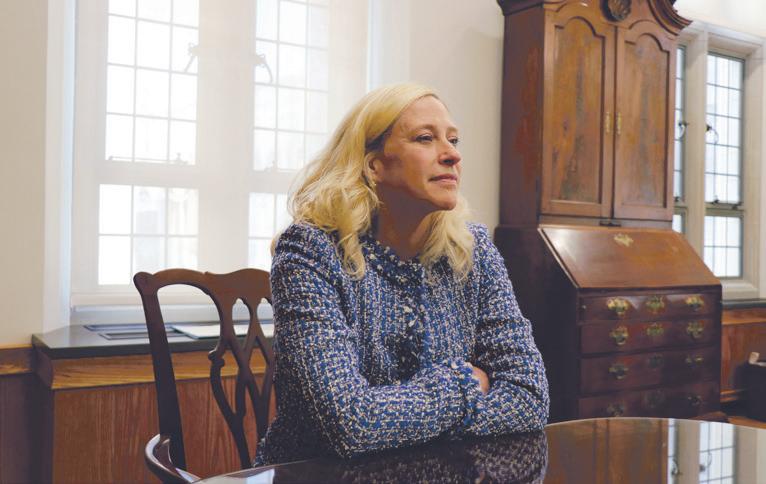
Tech leaders recently told University President Maurie McInnis that the proliferation of artificial intelligence will increase the value of a Yale education, she said in an interview last month.
McInnis said she spent a week of spring break in Silicon Valley meeting with tech executives, who she said told her that a liberal arts education that promotes critical thinking will be increasingly valuable in a world that is becoming dominated by AI.
“The kind of education provided at Yale is going to become more valuable,” McInnis said those leaders told her.
McInnis declined to share the names of the leaders she met with,
writing to the News that she usually does “not share specific details about my private meetings.”
The executives she met with stressed that “we need more than ever” students who have received liberal arts educations and “can think and make connections across disciplines, who know how to ask hard questions, see unexpected connections,” McInnis added.
“We need more, and this was kind of a joke that somebody was saying, but it kind of sums it up. It was, you know, ‘what we really need are more philosophy majors,’”
McInnis said in the interview.
Referring to students, she added that it will also be important for Yale to “construct educational experiences where they both become really expert users of the tools that are available to them, but
that they not cognitively offload the hard work.”
At Yale, new AI-focused student groups have emerged in the past two years, and professors have taken various approaches to implementing the technology and regulating its use in their classrooms. Last semester, professors teaching Yale’s introductory economics lectures embraced AI, allowing students to use the technology to complete problem sets.
In August 2024, Yale committed to investing more than $150 million over five years into its artificial intelligence infrastructure. In an email sent to the Yale community at the time, Provost Scott Strobel wrote that the money would be used for “computer infrastructure, access to secure generative AI
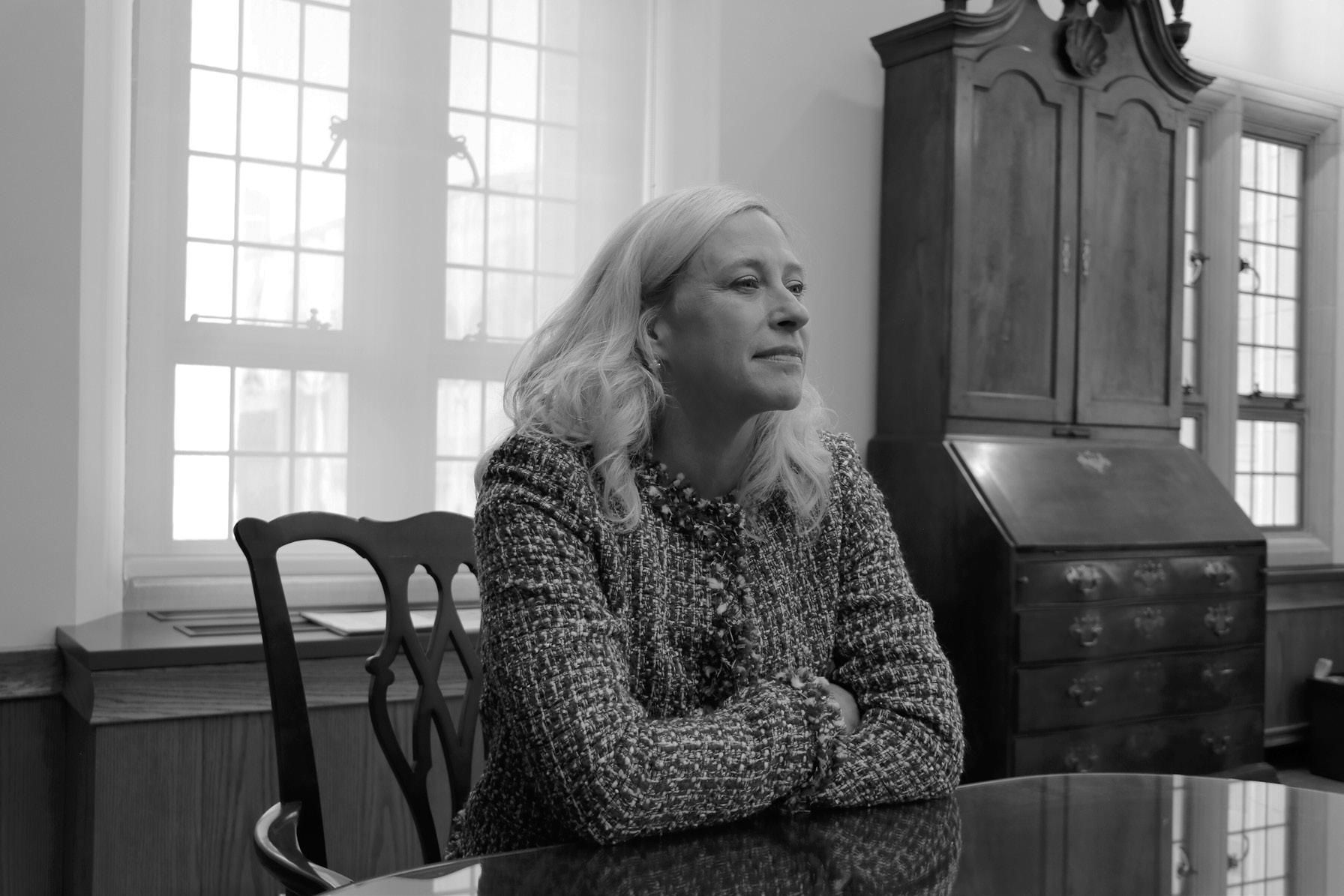
will make a Yale degree more valuable, she said in an interview.
tools, targeted faculty hires, seed grants, and opportunities for interdisciplinary collaboration.”
In her email to the News, McInnis said she “discussed the $150 million commitment Yale made in 2024” with the tech leaders.
Richard Levin GRD ’74, who was Yale’s president from 1993 to 2013, is now chairing Anthropic’s higher education advisory board, which will guide the company’s AI models, like Claude, for education.
“They want to co-develop a vision with the university partners,” Levin said about Anthropic in a phone interview. “They realize the experts on teaching and learning are the professors and universities, and so I think they are quite eager to collaborate.”
Levin said faculty tend to be “conservative” in their approach to new technology, but said if he were leading a university, he would want to be at the “forefront” of artificial intelligence and new technologies.
Yale faculty members interviewed by the News expressed concern that students’ use of AI could limit original thinking, but they offered different perspectives about whether the University should embrace it.
“I think it’s something we’re going to have to adjust to,” political science professor Steven Smith said in a December phone interview. “We can’t prohibit AI. It’s just going to be a fact of life, just like a few years ago the laptop or Wikipedia became a fact of life.”
Smith said that AI can be a “useful resource” if it “doesn’t become a substitute for thinking.”
“The more recent development of artificial intelligence is even more discouraging, because I have had papers and responses submitted to me which were obviously cribbed or taken off of artificial intelligence,”
Near Eastern Languages and Civilizations professor Benjamin Foster said in a December interview.
“And students think that, you know, you can deceive the faculty,” Foster added. “You can’t.” Foster said he thinks that “many
students are substituting artificial intelligence for thinking,” and that they are spending “too much time in a parallel, electronic universe and are not engaged.”
Jeff Dinski is a development officer at Ellucian, a Virginiabased firm that provides artificial intelligence services to hundreds of universities including Princeton, which uses them for fundraising efforts, Dinski said in an interview.
“I think AI might actually slow some of the pull towards things like computer science and coding because I think those are the jobs that are getting disrupted the most,” Dinski said.
He said he is “optimistic” that learning technology skills, including artificial intelligence, alongside a liberal arts education will be valuable in a job market influenced by artificial intelligence.
During a late February Yale Corporation meeting, trustee Felicia Norwood LAW ’89 said that Yale trustees had “been learning a lot about AI” when asked about the contents of their closed-door meetings.
“Yale’s trustees regularly engage with issues shaping higher education and society,” University spokesperson Karen Peart wrote to the News in March following the trustees’ meeting. “Recent discussions about artificial intelligence reflect the university’s commitment to preparing students to lead in a world where these technologies are increasingly important.”
Strobel assembled the Yale Task Force on Artificial Intelligence in January 2024.
Jerry Gao contributed reporting.
Contact ASHER BOISKIN at asher.boiskin@yale.edu, ARIA LYNN-SKOV at aria.lynn-skov@yale.edu and LEO NYBERG at leo.nyberg@yale.edu.
BYASHER BOISKIN, ARIA LYNN-SKOV AND LEO NYBERG STAFF REPORTERS
Sen. Richard Blumenthal LAW ’73 of Connecticut wrote on X this month that the Trump administration had “crippled Yale research” and warned that apparent “silence or even reticence on such despicable policies is hard to explain.”
Blumenthal’s series of posts came days after University President Maurie McInnis commended the Buckley Institute, which describes itself as “a home for enlightened conservative thought,” for scheduling an upcoming event with Education Secretary Linda McMahon. The posts did not mention McInnis but included a link to the News’ article about her praise for the Buckley Institute.
When asked to respond to Blumenthal’s comments, McInnis declined to engage directly.
“I appreciate the senator’s long-standing support for higher education and friendship with Yale, and I respect the senator for sharing his views,” McInnis wrote to the News. “Typically, it is my practice not to comment on public statements.”
In his post, Blumenthal, a Democrat, wrote that McMahon and President Donald Trump have “slashed student scholarships, demeaned&threatened academic freedom” and “blatantly violated statutory&constitutional protections for Yale&all Americans.” He added that the pair had “worked to dismantle the entire Dept of Ed.” Without specifying who he believed had been silent, Blumenthal wrote that he understood “standing up to Trump&his minions may seem risky” but that “the Administration’s destructive policies deserve a retort.” His chain of posts also referenced former Yale history and global affairs professor Timothy Snyder, pointing to Snyder’s book “On Tyranny” and one of its admonitions, “Do not obey in advance.”
In a March interview with the News, McInnis said that the University has “long had support
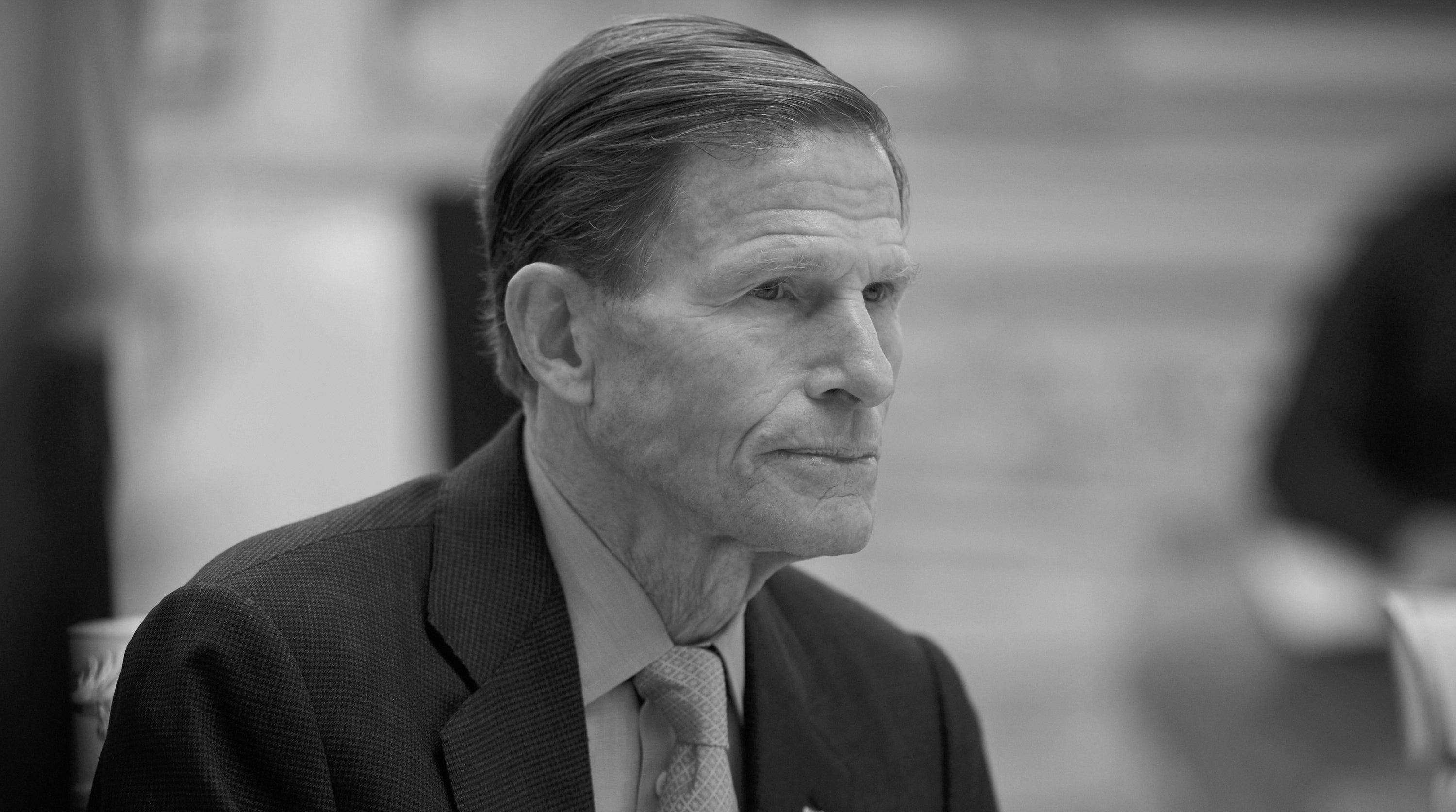
COURTESY OF WIKIMEDIA COMMONS
In response to Yale President Maurie McInnis’ comments praising the Buckley Institute for inviting Education Secretary Linda McMahon, Sen. Richard Blumenthal wrote that the Trump administration’s “destructive policies deserve a retort.”
from many lawmakers,” pointing to “our local Connecticut ones” as an example. She added that “both senators and congresspeople are among those champions” for Yale in Congress. McInnis adopted a policy of institutional neutrality in October 2024, following recommendations from the Committee on Institutional Voice, which advises Yale leaders to limit public statements on political matters except in rare cases. She has said her priority is working with lawmakers behind the scenes, and lobbying has been a core part of her presidency.
In a January phone interview, American Studies professor James Berger said that Yale and other elite institutions should “stand up” in the face of the Trump administration’s attacks. University presidents should be “at the barricades,” he said, adding that the University should
“just be really clear on what higher education is about and stand up for it.”
Micah Draper ’28, the financial policy director for the Yale College Council and the Sophomore Class Council president, said while he believes bringing a range of perspectives to campus is important, so is standing up for higher education.
“I think the University would be doing a disservice to their students if they weren’t bringing in people of alternative perspectives,” he said but added that McMahon — who is slated to speak at the Buckley Institute event on Thursday — is “part of an administration that is attacking our university” and “causing student life to kind of become degraded.”
“I think that the university should perhaps be a little more aggressive towards these things that we all can agree are wrong,” Draper added. “Obviously, we all go to Yale University. We
believe in higher education. And so, this increase in taxes, financially, budgetary — clearly are attacks on these institutions that we believe in.”
McMahon’s department opened an investigation into Yale for cooperation with a program for business school students that the department alleged was discriminating based on race. In February, the department announced they had reached a resolution agreement with Yale and 30 other universities who had agreed to cut ties with the program.
Lauren Noble ’11, the founder and director of the Buckley Institute, disagrees with Blumenthal’s remarks.
“Senator Blumenthal seems to define ‘diversity of views’ as his own view, expressed at three different press conferences in front of five different cameras,” Noble wrote to the News. “The Buckley Institute both prefers and practices a more literal definition.”
“We are grateful that President McInnis has publicly recognized the value of our efforts to facilitate
robust campus discussion about important topics facing our country,” Noble added.
Yale and Dartmouth are the only Ivy League schools that have not had federal funds punitively frozen by the Trump administration. McInnis has previously suggested that the presence of groups like the Buckley Institute and the Yale Political Union, which encompasses seven political parties, may be among the reasons Yale has avoided the targeted cuts that have hit Harvard, Columbia and other peer institutions. McInnis in February denied credit for keeping Yale out of the Trump administration’s crosshairs.
Contact ASHER BOISKIN at asher.boiskin@yale.edu, ARIA LYNN-SKOV at aria.lynn-skov@yale.edu and LEO NYBERG at leo.nyberg@yale.edu.
“Not knowing when the Dawn will come, / I open every Door”
BY SASHA CABRAL AND JERRY GAO STAFF REPORTERS
Financial constraints on the Yale Sustainable Food Program have caused its staff to be reduced from four to three people, and the future of the Food, Agriculture and Climate Change certificate program is uncertain, according to a Yale College spokesperson.
Over the weekend, rumors swirled around campus that the program’s director, Mark Bomford, was let go and that the certificate program was eliminated. Students circulated a petition, which Yale College Council President Andrew Boanoh ’27 and Vice President Jalen Bradley ’27 emailed to the student body, calling for “transparency” about budget cuts affecting the sustainable food program and for a meeting with Yale College Dean Pericles Lewis.
According to Ivy Pete ’26, a student who has held multiple positions with the sustainable food program, the petition was signed by 1,380 people, of whom 1,150 identified themselves as undergraduates. The letter claims that Bomford’s position was eliminated. Bomford declined to comment when reached by email on Sunday. The Yale College spokesperson, Paul McKinley DRA ’96, did not respond to the News’ question about whether Bomford’s position was the one eliminated.
“This morning I printed the open letter with the attached 1,400some odd signatures — a 42-page document — and also made copies of 40 handwritten letters authored by students outlining the impact that Mark Bomford had on their Yale careers and also their significant concern about the future of the YSFP
without a director,” Pete said in a phone interview on Monday evening.
The sustainable food program focuses on educational and academic work about food and agriculture. According to its website, it manages the Yale Farm and is committed to developing “food-literate leaders.”
“The farm, together with the YSFP, will continue its focus as a space for teaching and student engagement, now with a slightly smaller, three-person staff, down from four,” McKinley wrote to the News on Sunday. “This change reflects necessary financial stewardship while preserving Yale’s commitment to the program.”
Numerous student groups promoted the petition over the weekend. The Spring Fling Committee, for example, urged students to sign the open letter both in an email to the student body, as well as at their annual Battle of the Bands concert, which was held at the Yale Farm on Saturday.
The open letter claimed that private donors offered to fund Bomford’s position “upon notice of Director Bomford’s termination,” and that the dean’s office turned down the offer.
McKinley denied on Monday that the College rejected donor support, writing that the letter’s claim was “inaccurate.”
“We explored a number of options to expand financial support for the program, but ultimately the available funding was not sufficient to sustain it at its current staffing level,” McKinley wrote.
In February, Yale College Dean Pericles Lewis told the News that the College’s staff size shrunk by 7.5 percent due to budget tightening caused by the University’s anticipation of an increased endowment tax hike.

Hi’ilei Hobart, a professor on the Food, Agriculture and Climate Change certificate’s faculty committee, said in an interview that she became aware of “some uncertainties about the Yale Sustainable Food Program’s future” in November.
Similarly, Deborah Coen, another professor on the certificate’s faculty committee, wrote to the News that she heard about the removal of the program’s director in November.
Now, Hobart says that she believes “the plan is for the certificate program to be sunset at the end of this academic year.”
According to McKinley, “Students currently enrolled in the certificate program will be able to complete it; after a consultation process, faculty will decide whether it continues in the future.”
Both Coen and Hobart told the News that they have taught courses
BY LEO NYBERG AND SARAH RIVAS STAFF REPORTERS
Sheffield-Sterling-Strathcona Hall was buzzing on Tuesday evening an hour before Hasan Piker, a well-known left-wing Twitch streamer, walked up to the podium to address the Yale Political Union.
Piker spoke in favor of the resolution “End the American Empire.” In his speech, he criticized U.S. Immigration and Customs Enforcement, Israel and capitalism, and he claimed that “the American empire” was “in the process of dying.”
Four days before the event, Sen. Rick Scott wrote on X that the Trump administration should “IMMEDIATELY revoke” Yale’s federal funding because the student group was hosting Piker, who said during a livestream last year that “if you cared about Medicare fraud or Medicaid fraud, you would kill Rick Scott.” Scott, a Florida Republican who spoke at a Yale Political Union debate in October, was previously the chief executive of a hospital company that was investigated for fraud and later paid $1.7 billion in settlements to the government.
“I’m especially sad that Senator Rick Scott couldn’t make it,” Piker said Tuesday in his opening speech, drawing laughs from the audience.
“I’m sure he had many opinions on whether or not we should end the U.S. empire and the global capitalist system, which is what I’ll be talking about today. And then your grandparents are probably going to hear about it on Fox News tomorrow.”
Yale Political Union President Mór Szepesi ’27 said Tuesday’s debate saw the most demand he had seen for a political union event.
“Earlier this semester, when we hosted New York mayoral candidate Curtis Sliwa, I stood on this very stage at this very podium and proclaimed that I could say without a shred of a doubt that I have never seen this level of excitement for a guest of the Yale Political Union,” Szepesi said as he introduced Piker. “That distinction was perhaps short-lived.”
“It was electric,” Kai-Shan Kwek-Rupp ’28, who gave a speech opposing the resolution, told the News after the event. “I really
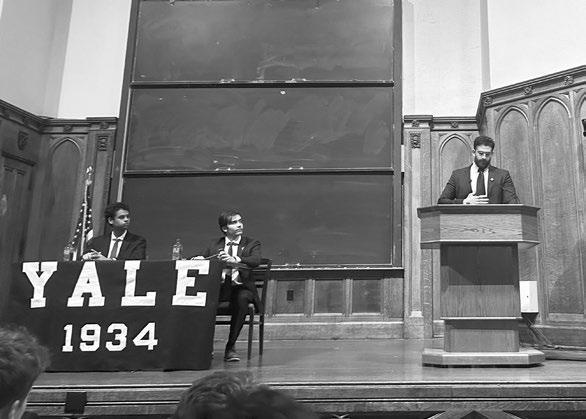
appreciate that the community cares about it, as the national headlines are reflecting, it’s really contentious and so it’s good to have civic engagement at Yale and it’s really good to have people disagree who are willing to listen to each other.”
Avi Rao ’27, the Yale Political Union’s speaker, said that while the increase in attendees brought “more energy” to the debate, every student speaker was “able to speak, have questions, not be interrupted.”
The crowd thought they spotted Piker entering three times and began to applaud, only to realize each time that someone else had entered the back door of the hall. When Piker entered, the lecture hall erupted into applause.
“This is a guy that has a modern media presence,” Cemre Keles ’28, a member of the political union’s Independent Party, said in an interview. “He reaches to our demographic exactly, people that are our age.”
In his remarks, Piker traced the history of what he called America’s “imperial roots” from the SpanishAmerican War through World War II and the Cold War — which he described as “an endless series of butcheries, each more perverse and more tragic than the last.”
“What was the point of defeating the Nazis if we went on to dominate so much of the globe as violently as we have?” he asked.
After the fall of the Soviet Union, which Piker argued was “one of the greatest catastrophes of the 20th century,” America had “no more big enemies left” to beat and turned “the gun on itself.”
“No matter what we say here, the American empire is going to inevitably fall,” Piker said.
Piker argued that the American people still had power to “manage the retreat” of the American empire from the world stage, preventing it from ending “in a much more violent way.”
Students who argued against the resolution suggested that the United States, while in need of reform, should remain as a global superpower.
“Power does not evaporate, it changes hands,” Kwek-Rupp said, arguing that “an American empire is greatly preferable” to the dominance of other global powers.
Similarly, William Flanigan ’27 argued against Piker’s vision of a “weak, retreating America.”
“We do not have to accept anything less than what we know this country can be,” Flanigan said.
The resolution passed by a vote of 54–31, with three members of the union abstaining.
Contact LEO NYBERG at leo.nyberg@yale.edu and SARAH RIVAS at sarah.rivas@yale.edu.
that involve the Yale Farm, and they noted the importance of Bomford and his position.
The changes have caused concern among current and former students, as well as faculty, who have been involved with the program and say they are concerned about its future.
“Without a director, there is no strategic and academic vision. I worry that Dean Lewis is determined to move the YSFP’s operations into merely extracurricular Yale College student life, and not an integral part of the academic and educational experiences that we have here,”
Pete said.
“The change will not affect the YSFP’s student fellowships, which will continue through the farm, or the support the farm provides to academic departments and programs,” McKinley wrote on Sunday.
In addition to the Yale Farm, the sustainable food program also runs
the Harvest orientation program for first years.
Gustavo Dominguez ’27, a Harvest leader who completed a summer internship with the sustainable food program, said he also was notified of the cutbacks from an email from a coworker associated with the farm. He said that made the changes feel as if they were “sort of kept under the wraps.”
“I don’t think there are a lot of other spaces at Yale where you’re able to sort of learn about agriculture, learn about food in a situation like that,” Dominguez said.
“It really does feel like an uncertain time for the farm.”
Bomford has been the director of the program since 2011, according to its webpage.
Contact SASHA CABRAL at sasha.cabral@yale.edu and JERRY GAO at jerry.gao.jg2988@yale.edu.
BY HENRY LIU STAFF REPORTER
Todd Blanche, now the acting attorney general, was announced last month as a speaker for an event scheduled by Yale Law School’s Federalist Society chapter.
The conservative group’s plan to host Blanche for its spring banquet on May 1 was announced in an email sent to its mailing list in late March and obtained by the News.At the time of the email, Blanche was the deputy attorney general. He became the acting attorney general after President Donald Trump fired Attorney General Pam Bondi on April 2. When asked if Blanche would still be attending the event, Yale Federalist Society President David Haungs LAW ’26 declined to comment.
A spokesperson for the U.S. Department of Justice wrote in an email to the News that the department’s press office did not have access to Blanche’s schedule.
As deputy attorney general, Blanche served as the department’s second-incommand, overseeing roughly
115,000 employees across the Justice Department, which includes 93 U.S. attorney’s offices, as well as the FBI, the Drug Enforcement Administration and other agencies, according to a profile on the Federalist Society’s website.
Prior to President Trump’s reelection in 2024, Blanche served as Trump’s personal defense attorney in three of the four criminal cases brought against him. Although he was unable to prevent Trump’s 2024 conviction in New York, he helped delay the federal cases related to classified documents and the 2020 election, neither of which ultimately went to trial.
The Federalist Society’s email invitation to the spring banquet said the event would include a cocktail hour, dinner and remarks by Blanche. “Dress code is formal,” the email said. According to The New York Times, Blanche was a registered Democrat before he represented Trump.
Contact HENRY LIU at henry.liu.hal52@yale.edu.
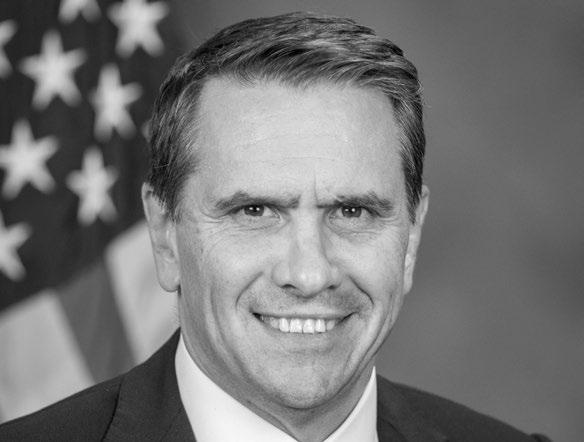
“There
are far, far better things ahead than any we leave behind.”
C.S. LEWIS BRITISH AUTHOR
BY REETI MALHOTRA AND LARS WINKLER STAFF REPORTER AND CONTRIBUTING REPORTER
Residents living near downtown bars and nightclubs that legally serve under-21 patrons non-alcoholic beverages say the establishments have caused fear, frustration and disrupted sleep.
In interviews with the News, three residents who live near the bars described nightlife around the clubs as more than an occasional inconvenience, saying that crowds, noise and violence have changed what it feels like to live downtown.
City officials are instituting a slew of legislative measures to crack down on the clubs that legally host people
who are under 21, which are often called juice bars. According to city officials, juice bars are designated areas within bars and nightclubs that legally serve minors non-alcoholic beverages. Often operating alongside all-ages events that also serve alcohol to patrons over 21, the improper management of these spaces — particularly when hosting large late-night events — has attracted thousands of youth and resulted in illegal alcohol sales to minors, disorderly conduct, fights, sexual assaults and shootings, Mayor Justin Elicker said at a press conference this month. Elicker cited the fatal Halloween shooting of Norwich resident Alexa
Acevedo as a particularly “tragic and egregious” example. Acevedo was killed during downtown festivities, many of which were held at juice bars, that attracted 7,000 to 10,000 attendees, the mayor said.
“We’ve had enough, and as a city, we are doing something to confront this problem,” Elicker said.
Three specific violators of existing regulations are Gotham Citi Cafe, Rumaj Nightclub and Secrets, which together have been the sites of 250 calls for service and several citations in the past seven months, Elicker said.
In response to allegations of non-compliance, a spokesperson for Rumaj Nightclub who refused to provide a name, citing wishes for the statement to be on behalf of the whole staff, wrote in an email to the News that the establishment “fully complies with the City of New Haven’s juice bar regulations on a weekly basis” and submits “all required notices” while maintaining “ongoing communication with the New Haven Police Department.”
The spokesperson added that Rumaj is located “on one of the busiest streets in New Haven” and “directly across from the city’s main public parking garage,” which results in “significant concentration of foot traffic on Crown Street” that may be unrelated to the nightclub.
“Our priority remains safety, compliance, and responsible operation. We take these responsibilities seriously and believe our procedures reflect that commitment. We view ourselves as an asset to the downtown community and remain dedicated to providing a
safe and enjoyable environment for all guests,” the spokesperson wrote. Gotham Citi Cafe and Secrets were unreachable by phone. When a reporter visited the two establishments, no one was available to comment on the accusations.
Residents living nearby described the issue as both a safety problem and a steady erosion of daily life. Ruth Yeazell GRD ’71, a Yale professor who lives near Gotham Citi, said Friday nights can become “pretty horrible” because crowds leaving the nearby clubs can linger in the street until 2 or 3 a.m., shouting and playing music.
Yeazell said she loves living downtown and enjoys the energy of city life but that the atmosphere around the clubs has become increasingly difficult to tolerate.
For Yeazell, the issue was not only about noise and disruption but also about safety, especially after the recent shootings.
Bill Dully, another nearby resident, said the impact has unfolded gradually, beginning with late-night noise and disorder and escalating into violence outside his building.
“It’s affected us in layers,” Dully said. “The first layer is simple quality of life.”
He said residents have dealt with screaming, music and public disturbances on weekend nights, and argued that city officials should take stronger action against Gotham Citi.
Dully said residents living nearby have repeatedly tried to raise concerns with club management but felt that their efforts had gone unanswered.
Under current municipal ordinance, juice bars are only required
to provide advance notice to the police chief’s office before hosting an event. Failure to do so yields a penalty and fine, Elicker explained.
However, new proposed regulations, including a zoning ordinance akin to those placed on smoke shops and a state bill, aim to provide New Haven officials with “common sense tools to make existing juice bars safer and hold repeat violators accountable,” Elicker said.
According to Elicker, the new zoning ordinance will prohibit new juice bars from opening.
Under the proposed bill, current juice bars will be required to adhere to limited hours of operation, which are currently 1 p.m. to 1 a.m. on weekday nights and up to 2 a.m. on weekend nights. Capacity will also be limited at juice bars, enabling law enforcement to reject or terminate a juice bar event due to available police capacity to manage mass crowd activities on the streets.
The sale of alcoholic beverages alongside and during juice bar operations will also be prohibited, with possible liquor license suspensions in the case of violation, according to Elicker.
The three juice bars are within three blocks of each other downtown. Rumaj and Secrets are neighbors on Crown Street, while Gotham Citi sits on nearby Center Street.
Contact REETI MALHOTRA at reeti. malhotra@yale.edu and LARS WINKLER at lars.winkler1@outlook.com.
BY NELLIE KENNEY STAFF REPORTER
New Haven library leaders are calling for the Board of Alders to approve a proposed funding increase — and maybe a little more.
Mayor Justin Elicker’s $733.3 million proposed budget includes around $5.7 million, or around 0.76 percent of the total, for the New Haven Free Public Library. The number represents an increase from the approximately $5.5 million allotted to the library this fiscal year, although a slight drop in terms of the percentage of the overall budget dedicated to the library. Many library leaders would like to see more funds.
“We do feel that our request this year for contractual services and personnel and our books line is really justified because our library is something New Haveners rely upon, and it is a heavily utilized resource,” Maria Bernhey, the city librarian and the library system’s director, said of the current proposed budget in a phone interview.
The library faces higher costs than it has in previous years, Bernhey said. One reason for the increase to the expected budget is that the city’s longtime book distributor, Baker and Taylor, announced in September that it would be shutting down, she said. Baker and Taylor’s financial difficulties leading up to its closure meant that the library last year lost
a longtime 40 percent discount on book purchases, Bernhey said, which created a “pricing challenge.” That challenge coincided with “general inflation” and both rising costs and demand for digital library materials, Bernhey said.
The library also requested a bump in funding for contractual services, including security and utilities funding for Sunday hours, Bernhey said.
At a public hearing before the Board of Alders Finance Committee on March 31, three members of the library’s board of directors testified in support of the budget — and called attention to the fact that it fell short of 1 percent of the city’s total budget, which board member Lauren Anderson ’99 said the board has been calling for it to reach “for years.”
The 1 percent number traces back to a report created by Elicker’s transition team in 2020 which crafted policy goals for his first term as mayor. The report suggested that the increase should be “implemented in stages as the City’s financial status improves.”
Library board member Giulia Gambale wrote in an email that “a budget of 1% of the total city budget will help NHFPL address rising costs of books, e-books and digital materials.” She added that “NHFPL also needs to address staffing needs and maintenance costs to keep our library folk safe and comfortable.”
Andrew Giering LAW ’11, the president of the library’s board of directors, also testified at the March budget hearing. He spoke in “strong support” of the library’s proposed budget, he said, adding that “our library has many more needs than are reflected in the current budget.”
Giering wrote in an email that it is “shameful that New Haven funds our Library at a piddling 0.76% of the General Fund,” pointing to other cities in Connecticut, including Bridgeport and Hartford, which have allocated a higher percentage of their general funds to their libraries.
The budget proposed by Bridgeport’s mayor for fiscal year 2027 would allocate about 2 percent of its general fund, or around $12 million, to the library. Hartford’s budget for the 2025-2026 fiscal year allocates around 1.6 percent.
In a phone interview, Elicker rejected the notion that the library budget should be decided according to an “arbitrary percentage.”
“I’m always working to make sure that as much as we can, we’re providing resources for our community while also not increasing taxes to a point where residents can’t afford to live in New Haven,” he said. He added that the city has put more money into pensions and debt service, leading to an increase in the overall city budget which “makes the library percentage, even though
it’s increased significantly in actual dollars, look smaller.”
Elicker said that his long-term goals for the library were “around programming,” not “a random dollar amount.”
These goals include increasing library hours and keeping the library open on Sundays, he said.
In a letter to the Board of Alders Finance Committee which she provided to the News, library board member Claudia Merson urged alders to “support the library’s full request — and if the means exist, to go further.”
“It is truly a library for all of us: the youngest children and the oldest adults, the “fancy” housed and the unhoused, the employed and those seeking work, longtime residents and those who have just arrived,” Merson wrote. “Approving this budget request is an investment in the people of New Haven.”
The New Haven Free Public Library opened in 1887, according to its website.
Contact NELLIE KENNEY at nellie.kenney@yale.edu.
BY TAJRIAN KHAN STAFF REPORTER
State officials presented major redesigns for New Haven Union Station’s platforms and tunnels to 50 residents at a public information meeting at the New Haven Free Public Library’s main branch on Tuesday.
The project is slated to cost $402 million and will be entirely funded by state and federal grants, Jonathan Kang, the project manager, said at the meeting. As part of the project, the train station’s existing four platforms will be rebuilt and extended to allow for more train cars to stop at each platform. The existing canopies will be replaced with a single full coverage canopy system, which “eliminates the need for heated platforms,” Kang added.
“The purpose of the project is to replace aging infrastructure, but
while we are there, we also have the opportunity to provide better rail service to commuters and protect them from the heat and cold,” he said.
Architectural leads from HNTB, the firm handling the project’s design, showed renderings of the proposed central atrium with an arched truss canopy that will cover all four platforms along with “origami canopies” covering the length of each platform on either side.
“We have a contemporary design for the platforms without overshadowing the historic main structure,” Zuhair Hussaini, the lead architect of the canopy structure, said. “The canopy will include skylights and curtain glass to allow natural light coming in from all sides.”
“We’re using a faux wood material throughout the entire platform, which gives a nice, inviting, and warm feeling to the entire space,” Hussaini
added. Faux wood — an aluminum panel with a wood-patterned print — is more durable and cost-effective while maintaining the warmth effect, he explained. Matthew Casamassina, the lead architect of the tunnel redesign, also presented renderings of the proposed upgrades to the existing underground tunnel that connects the main building with the platforms.
“Our goal is to really open up the tunnel, maximize the ceiling height, open up floor space and provide ample lighting,” Casamassina said. The new design uses lighter and darker colors in different parts of the tunnel to “improve wayfinding” for commuters, he said.
Construction will start in spring 2029, after necessary “signal improvements” are complete, Thomas Laliberte, a project manager from the engineering firm WSP, said.
“We will be taking one platform out of service at a time,” Laliberte said. “The intention is to maintain the existing rail service.”
As part of the redesign, the Connecticut Department of Transportation will add new “benches, vending machines, security cameras, blue light phones, signage, trash receptacles, shelters and wind-screens” to platforms and replace aging elevators with larger ones, Laliberte added.
Earlier this year, the department announced twin $113 million projects for upgrades to the State Street Station. Project representatives at the meeting also highlighted two other projects at Union Station: the $316 million mixed-use development on the station’s east parking lot and proposed upgrades to the main building’s interior. Both Laliberte and Kang emphasized that all infrastructure
in the station will be “brought up to code and latest ADA standards,” referring to the Americans with Disabilities Act.
At the end of the presentation, two attendees asked if the improvements would result in faster trains in the northeast corridor.
“There are lots of ongoing projects at the department to make trains faster, but there are clearance issues in the entire corridor,” Kang responded. “This will not save half an hour in travel time, but small improvements here and there will add up, and hopefully we will get there in the future.”
New Haven Union Station was the 12th busiest station in the country in 2025, according to the U.S. Bureau of Transportation Statistics.
Contact TAJRIAN KHAN at tajrian.khan@yale.edu.
BY LIZA KAUFMAN STAFF REPORTER
“Golden
slumbers fill your eyes. / Smiles await you when you rise.”
THE BEATLES "GOLDEN SLUMBERS"
major role in leading the team this year,” Michalik wrote in a text message to the News. “They’ve led with energy, consistency, and have instilled a belief within the team on how good we can be. Guys in every class will tell you how close this team is and that speaks to their leadership.”
The No. 12 Yale men’s lacrosse team (7–4, 3–2 Ivy) will return to Reese Stadium for its final home contest against the University at Albany (8–4, 5–0 AE) on Saturday afternoon.
Before faceoff on Saturday afternoon, Yale will honor its nine seniors for their contributions to the team over their four years as Bulldogs.
The team will graduate attackman David Anderson ’26; midfielders Nicolas Boudreau ’26, Brody Coleman ’26 and William Sheehan ’26; defensemen Konrad Miklaszewski ’26, captain Patrick Pisano ’26, Eric Platten ’26 and Sam Riecken ’26 and goalie Hugh Conrad ’26.
The day will be bittersweet as the senior class takes the field at Reese Stadium for one last regular season game.
“Every huddle we break with a loud ‘ONE!,’” first-year midfielder Flynn Leonard ’29 wrote in a text message to the News. “The senior class has made this team a brotherhood where we are all one. We lose together, win together, and battle together. I’ve never been a part of something like this before, and I owe it to the seniors who have made it their intention.”
Leonard further credited the senior class with easing his transition to college lacrosse and making him feel welcome at Yale from his first day repping the Bulldog jersey.
“Having 9 seniors that are always there to help has been amazing,” Leonard wrote. “The jump from high school to college can be more of a leap, but they have made the process straightforward. Whether it’s lacrosse, school, or something else, each guy has helped me find my own identity here at Yale. I’m super honored to be a part of this team.”
The senior class has set the tone for a close-knit, team-first culture.
Junior long-stick midfielder Luke Michalik ’27, who has played alongside the seniors for the last three years, emphasized the senior class’s consistency and leadership, describing the group as “selfless and dedicated.”
He added that their energy and belief in the team’s potential have helped unify the roster.
“Each senior has served a
Leonard echoed Michalik, describing the class in one word, “leadership,” and pointing to their ability to guide the team through both highs and lows while consistently leading by example.
“Each senior has led us through the ups and downs of the season in their own way. It’s been incredibly motivating to be led by such a group, especially being a freshman,” Leonard wrote. “They don’t let the highs get us too high, and the lows bring us too low. The senior class is unselfish and they all lead by example.”
That standard of respect, excellence and teamwork extends beyond the turf and game days into everyday interactions, something that sophomore longstick midfielder Francis Keneally ’28 has especially valued in the senior class.
“The senior class has done a great job of being leaders and creating a culture where everyone is striving to succeed, whether on or off the field,” Keneally wrote in a text message to the News. “Also just a great group of guys, everyone on the team hangs out outside of lacrosse which has only made us closer as a team.”
After celebrating the seniors, the squad will take to the field to face the Great Danes, looking to extend the Bulldogs’ win streak to five and send the senior class out on a high note. The team will hope to continue building momentum heading into the final week of the regular season next weekend at Brown (6–5, 1–3 Ivy).
When Yale and UAlbany faced off last season, despite jumping out to an early lead, the Bulldogs fell to the Great Danes 14-15 in an overtime nailbiter. However, with Yale’s strong performances this season, particularly in the last month, the Elis are well positioned to defend home turf given their recent offensive surge.
The Bulldogs will enter Saturday’s matchup riding the momentum of a four-game win streak, including three decisive Ivy League victories over Cornell (8–3, 3–1 Ivy), Dartmouth (4–7, 0–4 Ivy) and Harvard (9–2, 3–1 Ivy).
The Great Danes will arrive in New Haven hot on a six-game win streak after clinching the America
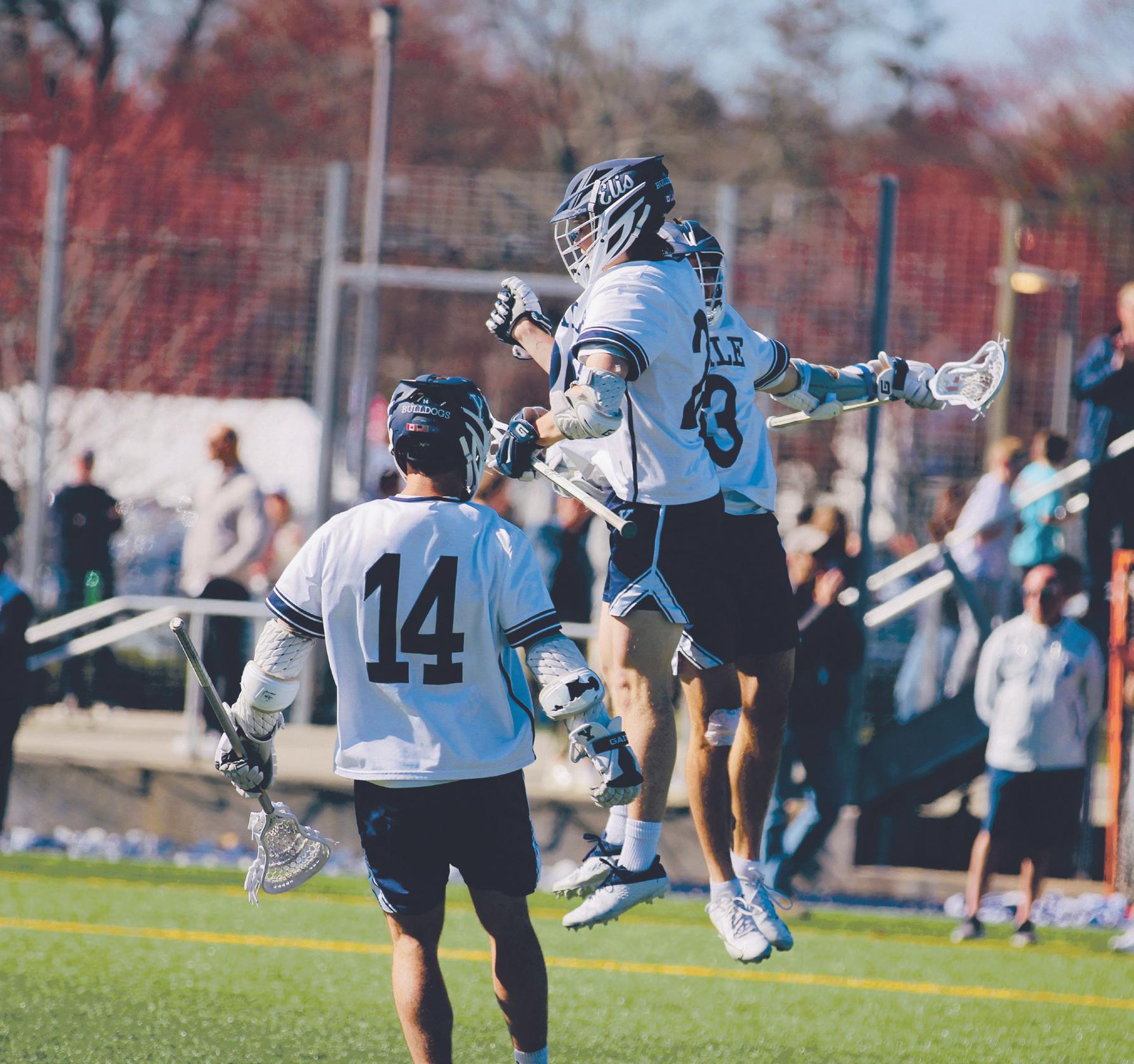
East Regular Season Championship following last weekend’s 12-9 victory over the University of Vermont (4–6, 2–2 AE). Despite the team’s recent success, the Great Danes struggled in early nonconference play. UAlbany opened the season at home with two losses to Cornell and Penn (5–6, 2–3 Ivy), before picking up their first win at Drexel (8–4, 4–1 CAA). However, the team remained inconsistent, falling to UMass (9–4, 2–3 Atlantic 10), beating Hobart (2–9, 0–4 Atlantic 10) and dropping their final nonconference game to Georgetown (6–4, 3–0 Big East) before starting America East play in mid-March.
In conference, the Great Danes hold a perfect 5-0 record, defeating each conference foe they have faced since March 14. Senior attackman Silas Richmond, who was selected by the Philadelphia Waterdogs as the fifth overall pick in the Premier Lacrosse League draft on Tuesday night, leads the conference in goals, assists and
points per game. Nationally, Richmond is ninth in goals per game, 11th in assists per game and second in points per game.
On the other end of the field, Yale’s offense has exploded in recent games, tallying at least 13 goals in the last four matchups. Against Dartmouth, Sheehan led the offense with four goals, followed by Peter Moynihan ’27, Dylan Blekicki ’29 and Sean Grogan ’29 with two each. The Bulldogs then kept piling on the goals against Harvard, as Cole Cashion ’27 led the way with five and Luke Pascal ’28 notched a hat trick. In Tuesday night’s matchup on Long Island, Grogan, Sheehan and Cashion each recorded hat tricks.
UAlbany holds a slight edge in its penalty killing percentage of .591 to Yale’s .553, but Yale’s defense has proven itself in recent weeks, notably shutting down Harvard’s then eighthbest nationally scoring offense and holding the Crimson to just 2-for-6 on extra-man opportunities. Pisano and Michalik have anchored the unit.
Pisano is second in the conference and 27th nationally in caused turnovers per game and Michalik is fifth in the conference. In the cage, Yale’s Ben Friedman ’28 is first in the Ivy League and eighth nationally in saves per game averaging 13.5, and he has the second best save percentage in the Ivy League and 17th nationally of .556. He edges out UAlbany goalie Brady Smith, who has a slightly lower 0.500 save percentage. With a home crowd behind them, the Bulldogs will look to extend their win streak and send the senior class off with one final statement at Reese Stadium.
“We are certainly going to miss them next year but they have shown us the way and created a unique culture that will last beyond their time here,” Michalik wrote.
Faceoff is slated for 4 p.m. on Saturday, with Senior Day festivities set to precede the game.
Contact LIZA KAUFMAN at liza.kaufman@yale.edu.
BY JUSTIN LEAHY STAFF REPORTER
The Yale Bulldogs (20-10, 9-3 Ivy) are hungry and on a hot win streak. The Bulldogs are looking to keep their place atop the Ivy League. They’ve won three straight series against Ivy League opponents — Penn, Princeton and
Harvard — and they will head up to Cornell this weekend. Of the Bulldogs’ past nine conference games, they’ve only lost one. They also haven’t lost consecutive Ivy League games all year.
Garrett Larsen ’27, who holds the Ivy League lead in batting average with .404, gave insight into the current state of the clubhouse.
“The boys are feeling pretty good,” Larsen wrote to the News. “Knowing that we have
more in the tank while winning is a great feeling.”
On Wednesday, Yale came back from down 4-0 to defeat cross-town rival Quinnipiac 6-5 (14-20, 7-8 MAAC) in a 12 inning thriller at George H. W. Bush ’48 Field. The Bulldogs trailed by four runs into the fourth inning. However, they soon clawed themselves back into contention. In the fifth inning, Jack Dauer ’28, the reigning Ivy League Rookie of the Year, hit a

double down the left-field line, sending Chris DiPrima ’27 home and cutting the Bulldogs’ deficit to one.
Later, in the eighth inning, captain Davis Hanson ’26 hit a single with the bases loaded to tie the game up at a score of 5-5. Finally, in the bottom of the 12th inning, Colin Sloan ’27 lined a walk-off single to left field. The walk-off hit gave Yale the victory and also made Sloan a walk-off hero for the second time this year.
In addition to their strong offensive comeback, the Bulldogs won the rivalry game with the help of the immaculate performance on the mound by Nick West ’29. West threw 103 pitches in six innings of relief and only gave up one earned run before going on to earn the victory.
In addition to West’s lategame heroics, Kaiden Dossa ’27 also extended his on-base streak to 23 games. The midweek game was overall an impressive allaround victory for Yale on both sides of the diamond.
The Bulldogs have a halfgame lead over Brown (8-3 Ivy) in the Ivy League standings, with nine conference games remaining. If they keep their current momentum, they’re on track to be one of the top four teams in the Ivy League, which would secure their place in the Ivy League tournament.
On Friday, the Bulldogs will travel up north to Ithaca to face Cornell (6-21, 4-8 Ivy). The Big Red have struggled this year,
in both conference and nonconference games, and are tied for last place, with Harvard, in the Ivy League standings. The Big Red also currently have a five game losing streak. But Yale should not write off Cornell, which has shown some flashes of strength at home, including a series win over Dartmouth just two weeks ago.
“We are feeling good, but continuing to take it day by day and game by game, continuing to stack good days before heading up to Ithaca,” Dossa wrote to the News.
The series will be an important chance for Yale to build a buffer gap in first place before a crucial road trip to Columbia the weekend after next. Last year, while the Bulldogs were the in-season winner of the Ivy League, Columbia won the Ivy League tournament and advanced to the NCAA Super Regionals.
“The goal is to not just make it into the tournament, but to be in a spot to win it,” Dossa wrote to the News, referring to the conference tournament. “It is important that we take one game at a time to get to the spot we want to be in come end of May.”
Yale and Cornell will play on Friday at 1 p.m. Then, on Saturday, the Bulldogs will play the Big Red in a doubleheader, starting at 11:30 a.m.
Contact JUSTIN LEAHY at justin.leahy@yale.edu.

BY INEZ CHRISTINA CHUIDIAN STAFF REPORTER
After a weekend of recordbreaking performances, the Yale track and field team is heading into another busy slate, with plans to split across three meets.
Last weekend, Constanza Acevedo ’29 reset her own javelin school record, while later in the week, Mason Evans ’26 earned the Delaney Kiphuth Student-Athlete Distinction Award, an accolade granted to the student-athletes with the top cumulative grade point average over four years at Yale.
Looking ahead, the distance runners will travel to WinstonSalem, North Carolina, to compete at the Wake Forest Invitational on Thursday. This unscored meet will serve as a tune-up opportunity for the team, with championship season racing just two weeks away.
At the Wake Forest Invitational, the Bulldogs will face unfamiliar opponents, such as the University of Georgia and the University of Illinois Urbana-Champaign.
The warmer North Carolina
BY LIZA KAUFMAN STAFF REPORTER
The No. 12 Yale men’s lacrosse team (7–4, 3–2 Ivy) routed the Hofstra University Pride (3–9, 1–3 CAA) 16-9 in a Tuesday night matchup at James M. Shuart Stadium in Hempstead, New York.
The Bulldogs made the quick trip down to Long Island and returned to New Haven with their fourth straight victory, building on a 13-12 upset victory over Cornell (8–3, 3–1 Ivy), an 18-7 win over Dartmouth (4–7, 0–4 Ivy) and a 15-9 upset victory over Harvard (9–2, 3–1 Ivy).
“During this stretch what’s been helping us the most is just being really intentional in every practice,” attackman Connor Gately ’28 wrote in a text message to the News. “Our coaches have done a great job of setting the game plan for each week and we’ve all been focused on making sure to work towards it. Now more than ever it is important to improve each week and our focus in practice has helped us do that.”
climate should benefit the team, which has spent much of the spring battling New England’s unpredictable weather.
“The New England weather’s always a bit unpredictable this time of year,” men’s captain Andrew Farr ’26 wrote to the News “But we’ve done a great job as a team focusing on the controllables and not letting it impact our mindset heading into competitions. Even in less-than-ideal conditions, we’ve already seen a number of PRs, school records and all-time top-10 performances this season.”
On Friday, athletes not competing at Wake Forest will head up the road to Storrs to attend the University of Connecticut’s Northeast Challenge, a meet that Yale has not previously attended. The competition will feature regional programs, including Northeastern University and St. John’s University, while also allowing the Bulldogs to face familiar Ivy League opponents like Dartmouth.
The weekend concludes at home. Yale will host the Mark Young Invitational on Saturday at the Dewitt Cuyler Athletic Complex. After a meet last year that produced numerous personal bests, the Bulldogs will look to carry

their momentum onto their home track. The first competition of the week, the Wake Forest Invitational, will commence on
Each of the Ivy victories was significant. Against the Big Red, the Elis took down the defending national champions. Beating the Big Green, the squad extended its win streak against Dartmouth to 15. And last weekend, the Bulldogs served the Crimson their first Ivy loss of the season and second overall loss, while also cementing Yale’s dominance in the rivalry. Following last weekend’s victory over then-No. 5 Harvard, Yale jumped five spots in the Inside Lacrosse weekly media poll, and Harvard fell four spots to No. 9.
Touching down in Long Island, seven different Bulldogs scored in the 16-9 victory. Attackman Sean Grogan ’29, midfielder William Sheehan ’26 and midfielder Cole Cashion ’27 each recorded hat tricks.
Gately, who ranks first in the conference and 15th nationally in assists per game and third in conference and 41st nationally in points per game, posted a six-point performance with two goals and four assists, in addition to four ground balls to lead the team in points. Grogan also notched an assist to finish second in points with four. Dylan Blekicki ’29 and Asher Ziv ’29
each found the back of the net twice, and faceoff specialist Nick Wehmeyer ’28 scored once.
Gately attributed his six-point night to Yale’s ball movement and possession advantage.
“I think we just focused on sharing the ball tonight and fortunately I was on the receiving end of a lot of great ball movement from our offense,” Gately said.
The Bulldogs dominated at the X, going 24-for-28 on faceoffs led by Wehmeyer’s 18-for-21 and Ben Cuomo’s ’29 6-for-7 to control possession. Yale also won the hustle battle, picking up 43 ground balls compared to the Pride’s 29.
Grogan similarly credited the offense’s chemistry and teamwork in contributing to his second career hat trick and four-points.
“I honestly think the guys around me made it easiest,” Grogan wrote in a text message to the News. “When we all work as a whole, everything’s pretty free flowing and efficient.”
Yale hit the gas from the opening faceoff and never hit the brakes, tallying eight goals in the first quarter. Sheehan opened the scoring at 13:08 with a behind-the-back shot. A minute later, Gately recorded his first
assist of the night on Ziv’s first goal to extend Yale’s lead to 2-0. Although the Pride’s Trevor Natalie clawed back to cut the deficit to 2-1 at 9:58, the Elis answered right back with two of their own. At 4:58, Grogan found an open Blekicki, and 30 seconds later, Grogan buried it unassisted to cushion Yale’s lead 4-1.
Natalie scored his second of the quarter to put the game within two, but he was no match for the Bulldogs, who found the back of the net four more times in the final two minutes, including three in the final 30 seconds. At 2:12, Cashion potted the first unassisted, and then at the 27 second mark, the Gately to Ziv duo struck again to put Yale up 6-2. With 20 seconds left in the quarter, Wehmeyer won the faceoff and then drove to the cage. Even though there were only seconds left, the Bulldogs were not done yet. Midfielder Tristan Ghosh ’27 assisted Gately to close out the eight-goal quarter for the Bulldogs. Hofstra trailed Yale 8-2 heading into the second quarter, but after controlling possession and tightening up defensively, the Pride held the Elis scoreless. The Pride potted three unanswered to trim the defi-
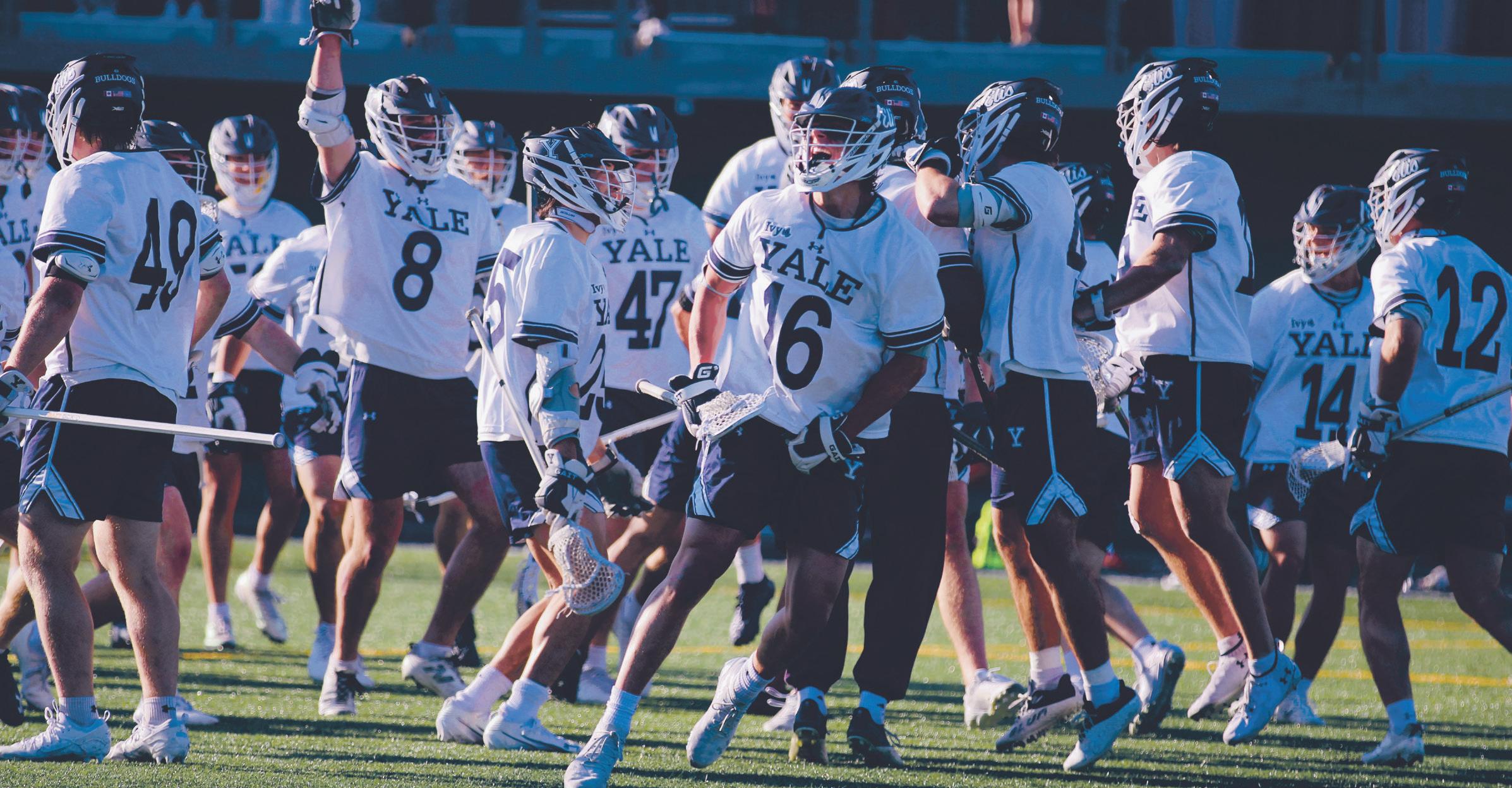
cit to 8-5 at the end of the first half. The Bulldogs came out recharged in the third quarter, putting up six goals to Hofstra’s one to seal the victory. Cashion struck early at 14:12 to extend Yale’s lead to 9-5. Natalie responded a minute later for a hat trick, Hofstra’s sole goal of the quarter. The Bulldogs followed up with five unanswered, as Gately, Grogan and Sheehan shined. Gately started the run, wrapping around the net to score unassisted, his second goal of the night. 49 seconds later at the eight-minute mark, Grogan tallied another to put Yale up 11-6. Then, in the final five minutes of the quarter, Gately and Sheehan were unstoppable. The two connected twice for Sheehan to score back-to-back for a hat trick. Grogan finished off the stretch with his second goal of the quarter to notch a hat trick of his own to close the quarter with Yale leading 14-6.
With Yale’s eight-goal lead at the end of the third quarter, the Pride struggled to bring the game back within reach. Despite tallying two consecutive goals early in the fourth quarter, Yale still held a six-goal advantage. At 8:02, Blekicki buried his second of the game. Hofstra responded with one more of its own to cut the deficit to six, but a Cashion goal at 4:44 restored Yale’s seven-goal lead and capped off scoring.
With Tuesday night’s victory, head coach Andy Shay reached a career milestone, earning his 200th win at the Division I level.
Grogan noted the impact of Shay’s experience on the program in his first season as a Bulldog.
“It’s been a great experience working with Coach Shay this year,” Grogan wrote. “You can also tell how much he cares about every guy on the entire roster, and it really makes guys respect him and work hard for him.
I’m glad I got to be a part of his 200th win.”
Back in New Haven, the Elis will now gear up to host the University of Albany (8–4, 5–0 AE). As the final home game of the season, it will also mark Senior Day. The team will honor its nine senior class members ahead of the game.
Faceoff is slated for 4 p.m. on Saturday at Reese Stadium.
Contact LIZA KAUFMAN at liza.kaufman@yale.edu.
Earlier this month, MAISON at Yale held its annual fashion show at the Omni Hotel. The event had all the glamour you’d expect from Yale’s most well-known fashion collective: sleek set design, beauty samples for VIP guests and a mix of student and professional models. What differed from previous iterations of the show was a greater attempt at diversity.
Shades of Yale, an a cappella group that focuses on music from the Black diaspora, opened the show. Nancy Walker, a Connecticut native who has been designing for 30 years, displayed clothes inspired by African heritage made of mudcloth, wax prints and cowrie shells. That was not accidental: Conscious efforts towards diversity were being made to reckon with past allegations.
In 2024, Jaxon Havens ’26 uploaded “The Pretty Boy Manifesto” to his Instagram profile, detailing why he chose not to participate in that year’s Maison show as a designer. Havens referred to MAISON’s leadership as “fashion snobs” and raised a number of issues, such as lack of compensation for designers and “excluding certain bodies from modeling.” The cloud of exclusion has hovered over MAISON ever since, spurring conversations that go beyond Havens’s grievances — especially about race.
“There’s definitely some validity to this statement,” co-president Josh Chen ’27 said when asked if MAISON lacks racial diversity. MAISON was founded by a predominantly East Asian group of friends, and according to Chen, that demographic’s dominance of the club has continued. “Especially as new members are interested and start looking into the club, especially at the beginning, if they’re seeing a predominantly East Asian group, that could very easily create feelings that, ‘Oh I might not belong with this group of people,’” he admitted.
Kellsie Lewis ’27 founded Fashion Lifestyle at Yale, often referred to as FLY, in 2023 “to add an additional option” to the fashion lineup on campus. “As Black and brown artists are largely underrepresented in the broader global fashion realm, FLY seeks to be a space where diversity is the norm rather than the fantastical,” Lewis wrote in an email.
In theory, MAISON and FLY are both serving students with the same interests. However, even interest in fashion has become stratified across racial lines at Yale. Theoretically, the admissions office admits students from a variety of ethnic backgrounds to have us intermix — befriend one another, learn from one another, and have tough conversa-
tions about belonging together. Instead, there seems to be a sentiment on campus that this space is for “us” and that space is for “them.”
Self-segregation seems to be the de facto choice at Yale. I spent the past couple of weeks surveying friends, acquaintances and complete strangers to discover why.
Sudanese-American student Allam Elmana ’29 said he found himself spending most of his time with other Black students as a consequence of his extracurricular activities, which include Desta, Yale’s Eritrean-Ethiopian dance team; the Yale African Students Association; the Yale Black Muslim Student Association and the Yale Africa Innovation Symposium. “I feel like people find their friends in their extracurriculars,” he said, adding that he “unintentionally” ended up with friends of the same race.
Allam’s experience is one that rings true for much of Yale’s Black community, including myself. Yale University is the poster child for the predominantly white institution. It’s wealthy, prestigious and older than the United States of America. But somehow, as a Black transfer student, I’ve never been so surrounded by a community that resembles me.
Back home in California, most of my friends were not Black. That was largely due to circumstance — I went to a high school where the Black population was small, and my neighborhood was situated in the predominantly white part of town. The fact that my friends didn’t look like me never bothered me. Things changed when I moved across the country to attend Yale. Naturally, moving so far was nerve wracking. In my anxiety to find spaces that reminded me of home, I gravitated towards the obvious: cultural spaces where I felt welcomed. After a year on the board of Desta, and attending events hosted by the Yale African Students Association and the Eritrean-Ethiopian Students Association, I’ve realized that for the first time in my life, most of my friends are Black.
There are no spaces on campus advertised as exclusively white. However, a lack of formal decree does not negate social understanding. “I’m part of mostly cultural clubs, but the competitive clubs, I was kind of worried about applying for,” Elmana said, citing student organizations centered around law or consulting. Clubs focused on funneling students through the pre-professional pipeline are often ethnically homogenous. Since many of them keep their selection process shrouded in mystery, we can’t be
sure whether this is intentional or coincidental.
But imagine a wide-eyed first year approaching one of these groups’ tables at Bulldog Days, already nervous about going from simply joining clubs in high school to having to sit for multiple rounds of interviews. She gets to the table and realizes no one looks like her. Does she care? Should she?
“As a freshman, I wanted to be part of a fashion-forward space, but not one that required me to minimize my expression or risk discrimination. Creating FLY became a way to intentionally curate a safe space on campus,” Lewis wrote.
What does it take to not fall into the trap of self-segregation at Yale? Which is the effortful path, and which is the subconsciously chosen one? My own experience is that gravitating towards Black spaces came naturally. Is the lack of ethnic diversity around me Yale’s doing, or my own? If I feel unwelcome somewhere, is it a reflection of the group or my own projection?
“Last year and this year, we’ve made it a point to take, accept anyone and everyone who wants to be a part of this organization,” Chen said of MAISON. “So anyone who’s submitted an application is welcomed with open arms into our org.”
Despite having her own fashion organization to run, Lewis ended up walking in MAISON’s 2026 show as a student model. She was curious to see whether MAISON had truly adjusted where criticism had been leveled.
“This past year, I noticed visible efforts toward change — greater inclusion of student designers, more diversity across their social media, and shifts in leadership,” she wrote. “While I can acknowledge recent improvements, my individual experience doesn’t erase the organization’s legacy. E-boards change, legacies remain.”
If asked whether racially segregated groups on campus should exist, I don’t know what my answer would be.We benefit from surrounding ourselves with a diverse range of backgrounds and experiences. In theory, there wouldn’t ever need to be groups that prioritize making space for one ethnic group or another like FLY. But we don’t live in a utopia where established institutions always have their arms open, even if they say they do. When the alternative is not playing at all, it’s no wonder Yale students are forming their own teams.
Contact HANA TILKSEW at hana.tilksew@yale.edu.
// BY ELLA PIPER CLAFFY
Scott Patterson — that’s right, Luke Danes of “Gilmore Girls” — is coming to New Haven.
Specifically, he’s performing with his band at Toad’s Place on Wednesday, April 29, the third stop on his Midnight Highway Tour. And on April 13, I — that’s right, the biggest “Gilmore Girls” fan out there — interviewed him about it.
This tour, according to Patterson, is “designed for people to celebrate and have fun.” The band includes the keyboardist Zoux, who was also a part of the Patterson band SMITHRADIO, guitarist Miles Schon, son of Journey founder Neal Schon, and has Dylan Wilson on bass, Matt Hankle on drums and Spencer Geer playing guitar along with Schon. They have also recently added a back-up singer, Yale graduate Maiya Sykes.
Patterson seems genuinely excited about this bunch; he says that “they’re encyclopedic in their knowledge of styles and rhythms and beats” and consistently push him to make the music more complex and grow as an artist. He’s excited to give the band the chance to play a set with no prerecorded tracks.
“It's like going back into our garage and playing live, and being able to solo, and being able to create, and being able to play off each other and pay attention to one another while the song is going and while the show is going,” he said. When he talks about that freedom of playing music as a kid, he speaks from experience.
Before SMITHRADIO, before “Gilmore Girls,” before even Patterson’s six-year stint in minorleague baseball, he was in a college band called The Wretched Ones at Rutgers University. He had his hair dyed green at the time, and when his sister came to visit she insisted on shaving his head,
// BY CIELO GAZARD
saying he lived up to his band’s name. Although The Wretched Ones never took off, Patterson’s love of music and songwriting has remained. The set for the upcoming tour is about 90 minutes, with 21 songs that are a mix of covers and his originals.
Let me pause for a moment to explain how surreal this newsgathering process was. I have been watching and rewatching “Gilmore Girls” with my mom every summer since I was ten years old, and my mom and I — like most other mothers and daughters — swear that the show was somehow modeled after us. We think we have a better claim to that comment since I am an only child and she is a single mom. All this to say, for the half hour that I chatted with Scott Patterson, I thanked my lucky stars that I happened to see his face on that flyer outside Toad’s.
Patterson is performing at Toad’s not because of the Yale and “Gilmore Girls” connection — he’s actually never been to New Haven before — but because of the club’s storied musical history. Toad’s is the stop on tour he’s most excited for. He’s also excited to play for college students, a generation that he says is “discovering classic rock.”
“They love it. And they want to hear more of it, and that's what we're gonna give them,” he promised.
Patterson says all this from the perspective of someone who’s seen many of his favorite artists live. Fifteen years old and spending the sumer in New York City with his sister — who was at the time a comparative literature professor in New York City, an “artsy fartsy type, as I have always been,” he said — he would go watch Patti Smith play at CBGB. One night, having heard that she was looking for a new piano player, he approached her and offered to take on the job himself. She peered out at him over her sunglasses and told
him he looked a little too young.
As an “artsy fartsy” type myself, it was wonderful to hear one of my favorite actors self-identify. It was also so strange, since the face I was looking at — Luke Danes’ face — shouldn’t have said any of that. On the show, Luke is curmudgeonly and, culturally, pretty tapped out. At one point in the show he rejects buying a David Bowie CD for his girlfriend, Lorelai, because he thought Bowie had dressed up as a pirate. So it was somewhat foreign to have this guy chat with me about Patti Smith and The Who and Bruce Springsteen. I asked him what that was like, to be a person in his own right and yet constantly represent a beloved character for the rest of the world. He admitted that most fans were probably seeing his tour announcement and wondering if this would have been the band Luke would form. (As a fan myself, I can tell you it is decidedly not.)
“It’s not like we tailored the show around that, but, you know, this tour is really to celebrate with the fans,” he said. Patterson has no problem with embodying Luke, and on the contrary says he derives a lot of joy from it. Whatever city he’s in, if he’s at a restaurant or walking down the street, there’s always a “Gilmore Girls” fan to say hello to. He doesn’t think he deserves credit for the happiness the show brings fans, but he’s happy to be on the receiving end of it. There was never a chance that he tried to move away from the character of Luke.
“I mean, in musical analogies and musical terms, I was in Led Zeppelin, and the band broke up after seven years. What am I going to do after that?”
He attributes the success of the show to the dedication the other actors felt, as well as their commitment to make something great. In all of his pursuits,
Patterson feels he has always been “striving to be the best at something.” That drive, he says, is at the end of the day all that matters.
“I didn’t have a backup plan,” he told me about the years in his late 30s and early 40s, before he was cast as Luke. “I was either going to make it or I was going to be, you know, at 80 years old put on a stretcher and led out of my studio apartment in West Hollywood.”
After a successful acting run and fulfilling years in music, Patterson doesn't plan on slowing down. A selfdescribed “grinder,” he didn’t strike me as the type to hang up his hat any time soon.
After Patterson left CBGB that one night, crestfallen that Patti Smith had rejected his offer of piano-playing, Smith chased him down. He and his sister were halfway down the Bowery when Smith called out after him: “Hey! Good luck, okay?”
A few days before his opening night, I have the same sentiment to offer him. Contact ELLA PIPER CLAFFY at ellapiper.claffy@yale.edu.
Old rock stars never die; they simply fade away. Or they go on an endless streak of farewell tours. Musicians seem to have a very hard time leaving the stage. Some announce their retirement but then return a few years later. Some swear that they will never retire even as they enter a seventh decade in the music business.
The farewell tour has become a music industry institution. It almost guarantees high ticket sales — and even higher prices — and major press coverage for bands and artists looking to perform for fans one last time. However, farewell tours also seem to guarantee an eventual return to the stage, with the number of major acts not keeping to their word. By buying into these farewell tours, are we supporting pathological liars, or are these artists simply uncertain of when
their last performance will be?
When these older musicians were in their glory days, the idea of touring well into one’s seventies and eighties was unheard of. In 1972, Dick Cavett ’58 asked Mick Jagger, then 29, if he saw himself performing at age 60. Jagger said, “Easily.” This elicited laughter from the audience. Rock music was still a young person’s genre in 1972. The image we still associate with the term “rock star” tends to be someone who is in their twenties or thirties. And yet, some of the genre’s heavyweights are still out there, including the Rolling Stones, and performing well past 60-years old. For some musicians, time is on their side.
We’ve grown accustomed to seeing old rock stars out on the road: the Rolling Stones routinely sell out stadiums. Bruce Springsteen & the E Street Band are currently
touring the United States. But the bulk of these artists’ sets are made up of songs written when they were in their twenties about twentysomething experiences in the 1960s and ’70s. Some songs age better than others, and the passage of time adds some gravitas to lyrics dealing with heavy subject matter. Other songs, however, don’t. Although a classic of British rock from the mid-1960s, the potency and urgency of a song like “My Generation” by the Who is lessened when it’s sung by someone in their eighties rather than someone in their twenties. The line “I hope I die before I get old” takes on a much more ironic — even somber — tone when sung by the two original members of the band who did not fulfill the lyric’s aspiration.
Although band members may be sidelined by the side effects of age, their fourth farewell tour can still go on. If a guitarist isn’t playing as well as they did in the past, a band can simply get another one to fill in.
Singers tend to get the most blame for bands sounding “too old to rock.” With the passage of time, vocal cords become less elastic, meaning the fast vibrations needed to produce and project a note takes more effort. Particularly in the higher registers, age diminishes a singer’s range. A key change can only do so much to hide the aging process. Many rock musicians never received proper musical training. Many sang while sick for too many nights in a row without proper rest. The larynx is a muscle that needs to be trained to use at a high level, especially in the professional world of live performance. A vocal injury for a singer is like an ACL tear for a professional athlete, and the voice is rarely the same after surgery. We go to concerts to hear the classics like they sound on the record. But some artists can’t sing the song
the same way they once did. Is it time for those artists to pack it in and retire? It makes no sense to me that some older musicians who know they cannot perform at the same level as they did twenty years ago still demand high ticket prices, even for the nosebleeds. While there are some musicians who genuinely must tour to pay the bills, many of these “legends of rock and roll” are richer than God. Most don’t know when to bow out until it is too late.
Thanks to the Internet, there’s a treasure trove of concert bootlegs and official live recordings from when musicians were at their live performance peak. If we can easily find these videos and listen to the old records from the comfort of home, why then do we still shell out hundreds of dollars to see these old farts on stage now? We as music fans and concertgoers are sometimes too blinded by nostalgia to see the reality of the situation. There is no doubt that some older musicians can still put on an amazing show, well into their seventies and eighties, but some need a reality check for the sake of their fans.
There are plenty of older musicians going out on the road this year and next, potentially for the last time. If you happen to be one of those lucky fans who score a ticket to see these musicians of a bygone era, remember that it won’t be like seeing them in 1976. There’s something unique about that — something quite odd, too. Some great musicians never get to grow old, never get to see their music revered by millions. Some burn out, others fade away, and maybe, for some, the latter is much more lucrative.
Contact CIELO GAZARD at cielo.gazard@yale.edu.
// BY BEATRICE BARILLA
CLARIS SHIN
I walked up the familiar gravel path, enjoying the spring sun’s glow, golden in the early evening. A crowd of students gathered to enjoy each other’s company and the smell of fresh pizza; conversation hummed over live guitar music. But something was off. The normally joyful air was tense. The wooden picnic tables — usually dedicated to a crafting or farming lesson — were instead populated by students writing letters to the dean of Yale College. The very farm in which they sat was under threat.
I first visited the Yale farm last fall to paint flowerpots with the Yale Student Environmental Coalition. Under twinkling fairy lights, I met others who enjoyed spending time in nature and wondered why I had never visited this magical place before. The weekly Friday pizza evenings and community “Knead 2 Know” talks, which spotlight community figures involved in sustainable food production, became a fixture of my Yale experience. The warmth of the Yale Farm community, a space for peer connection, environmental service and sustainability is no secret among Yalies. Their stories demonstrate how the space had a profound impact upon their intellectual development and sense of self.
Mary Ayala ’29, a culinary events manager at the Yale Farm — “aka one of the pizza makers,” she says — told me about her first workday at the farm.
“Some people were out in the fields while the culinary team was busy prepping food. I was chopping and caramelizing sooooo many onions, but we were blasting music and chatting away the whole time. Some people were forming dough balls, others were tending the fire, and others were chopping and preparing veggies and sauces. It was this amazing, coordinated chaos.”
Ayala said she loves how the farm
// BY STEPHANIE ALTSCHUL
Le Labo’s eau de parfum, Thé Noir, has gone viral. When I’m “taking a lap” around a crowd on a Saturday night, I pass a minimum of three individuals of indeterminate gender cloaked in the distinctive smoky signature. My high school ex-boyfriend was obsessed with the fragrance and, to my dismay, the popular scent makes me feel like I’m being haunted by scented specters of my past every time I smell it.
Yale, at least to my nose, seems to be infatuated with smelling good. Even the orange-shirted athletes on cross campus earlier this week sported a distinctive olfactory layer of something other than eau de locker room and musk gymnasio.
As evidenced by our very own Yale Student Fragrance Organization — whose fragrance-making workshops regularly draw waiting lists of over 200 students — the people have an insatiable scent obsession. I factor myself into this calculation a disproportionate amount. I consider myself a fragrance fan, yes, but

probably a little more than just that, given the embarrassing sum I’ve surrendered to the hobby in the past year and a half.
I’m not alone. Social media influencers like Jeremy Fragrance, Professor Perfume and Paul Fino command millions of views and are just three of dozens of viral creators whose content is devoted entirely to the subject. There’s likely some economic masochism at play — fragrance is one of the most aggressively price-gouged commodities on the market. Without a doubt, fragrance collecting is a vanity hobby filled with sculptural, expensive bottles that unsubtly signal wealth. The obsession comes from a materialist need to have more things. It’s fun to see the shiny 50mL bottles adorn my desk. As devoted as I am to my collection, I could not fathom displaying it if the bottles weren’t beautiful.
The trend envelops people. In a conversation on Beinecke plaza in between classes, Sofia Teifeld ’29 shared her

thoughts. She told me that “when you're walking by someone on Cross Campus that has perfume on it makes you want to put some on too.” There’s a bandwagon quality to it, cultural pressure that reframes smelling good as the baseline for not smelling bad.
Sebi Green ’29 pointed to the internet as an accelerant. “On the internet, it’s become this whole thing that rolls into looksmaxxing culture,” he told me. “You need to smell good to be memorable and desirable.” Sebi, if I’m not mistaken, was sporting my personal demon Thé Noir, which is genuinely a good scent and is getting all too much hate in this article. But still.
Feeling vaguely disillusioned from the field following my various Thé Noir-filled outings, and perhaps a little depressed thinking about the scent-shaped gap in my bank account, I turned to Mr. Yale Fragrance himself, Brody West Falchuk ’28 — my friend crush and fellow Piersonite.

He is, refreshingly, a true believer. There isn’t a shadow of doubt in his mind that fragrance is an art form. After 20 minutes with him, I found myself reluctantly agreeing. I started by asking whether he has a signature scent — something I could prescribe to the masses as an alternative to the Thé Noir epidemic. He told me he rarely wears a scent casually. “If you work as a chef the last thing you want to do is cook yourself dinner.” Understandable, I guess. But tell me more. How did it start? “I went perfume shopping with my sister,” he said, “and I’ve always been a very scent-oriented person, the chemistry behind it is fascinating.” Potentially sensing my
welcomes everyone and how it encourages deeper connections with the land and with people over a shared meal. “It’s where I find peace and a deeper sense of purpose, to be a steward of the earth and to build real, meaningful human connections,” she said.
Maia Roothaan’s ’26 experience and mentorship with the Yale Farm has been essential, she said The farm prepared her for her work with the Maroon people of Suriname on Amazon rainforest conservation. From guiding her in research to providing a shared community, she says Yale Farm was “the biggest contributor to her intellectual curiosity at Yale.”
Yuki Heeger ’29, a Yalie from New Haven, told me that she remembers planting carrots at the farm in elementary school. She told me that New Haven elementary schools often have field trips there to teach kids about food production and foster a connection between them and the land. It’s a small memory, but it shows that the farm has impacts beyond Yale. It is interwoven into the lives of the greater New Haven community.
Ella Adebonojo ’28 told me that the Yale Farm informed her academic and community identity, while allowing her to spread awareness about food systems across campus and beyond.
Between these stories and my own experience, it’s no wonder that the rumored firing of the sustainable food program’s director and elimination of the Food, Agriculture and Climate Change certificate program caused uproar. This place is special to the hearts and minds of so many on and off campus. The Yale Farm doesn’t just grow crops — it grows community.
Contact BEATRICE BARILLA at beatrice.barilla@yale.edu.
continued apprehension, Brody took on a poetic air, as if he had rehearsed a profragrance soliloquy just for the occasion. “Fragrance is an art you can wear on your body,” he said. “You heavily experience it when you’re with someone, it’s a personal commitment and something that you bring into every space you enter.”
I could get on board with this.
The more he described the industry, filled with noses, who are practically designers for fragrance, the more I began to come around. “We’re in the Golden Age of fine fragrance right now,” Brody told me. I had wondered if working in the industry for Heretic Parfum last year had ruined the magic for him at all. It hadn’t. “The more I engaged with the art, I became enveloped and enamored with the magic. The more access you have and the more freedom you’re given, the more magic there is to create.”
Now, I’m hesitant to label fragrance as anything except an accessory. Not smelling bad does not, technically, require the intervention of a master nose. But I have come to accept that fragrances bring a particular kind of joy into my life, within reason, when informed by a budget. Maybe that’s the right way to go about it. As Brody puts it: “Everyone needs to wear clothes, you can’t go outside naked, but something like a fine fragrance, you’re just wearing it because it makes you happy.”
The student fragrance club has evolved exponentially since its birth a few years ago. The team has grown in size and in passion, and, beyond their workshops, they are in the midst of creating a series of Yale-inspired fragrances for the Yale fragrance aficionado, potentially capable of surpassing Thé Noir as the new fragrance that will haunt my every waking moment.
Contact STEPHANIE ALTSCHUL at stephanie.altschul@yale.edu.