BY ANAYAH ACCILIEN AND SARAH RIVAS STAFF REPORTERS
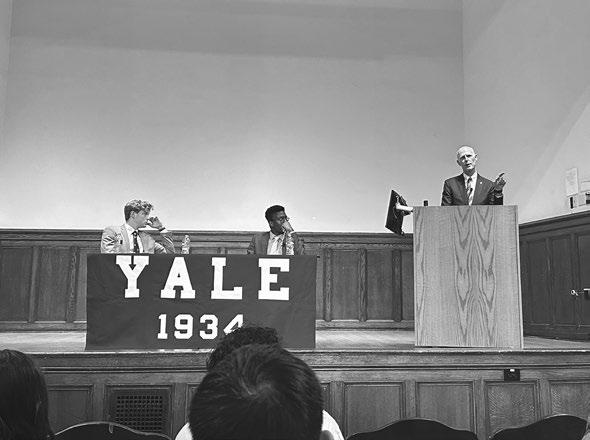
Sen. Rick Scott called on Friday for the federal government to cut off funding from Yale over the Yale Political Union’s decision to host the left-wing streamer Hasan Piker, who previously suggested that Scott should be killed.
Scott — a Florida Republican who spoke at the political union last semester in favor of the resolution “Buy American” — posted on X that the government should “IMMEDIATELY revoke” Yale’s federal funding.
While Republicans were developing President Donald Trump’s 2025 “One Big Beautiful Bill,” Piker said during a livestream — responding to comments by House Speaker Mike Johnson that Republicans were focusing on Medicaid fraud — that “if you cared about Medicare fraud or Medicaid fraud, you would kill Rick Scott.” Scott was the chief executive of a hospital company that later paid $1.7 billion in settlements to the government relating to fraud.
Piker, a controversial Twitch streamer and political commentator, is scheduled to speak at the
Three more college deans leaving roles
BY OLIVIA WOO STAFF REPORTER
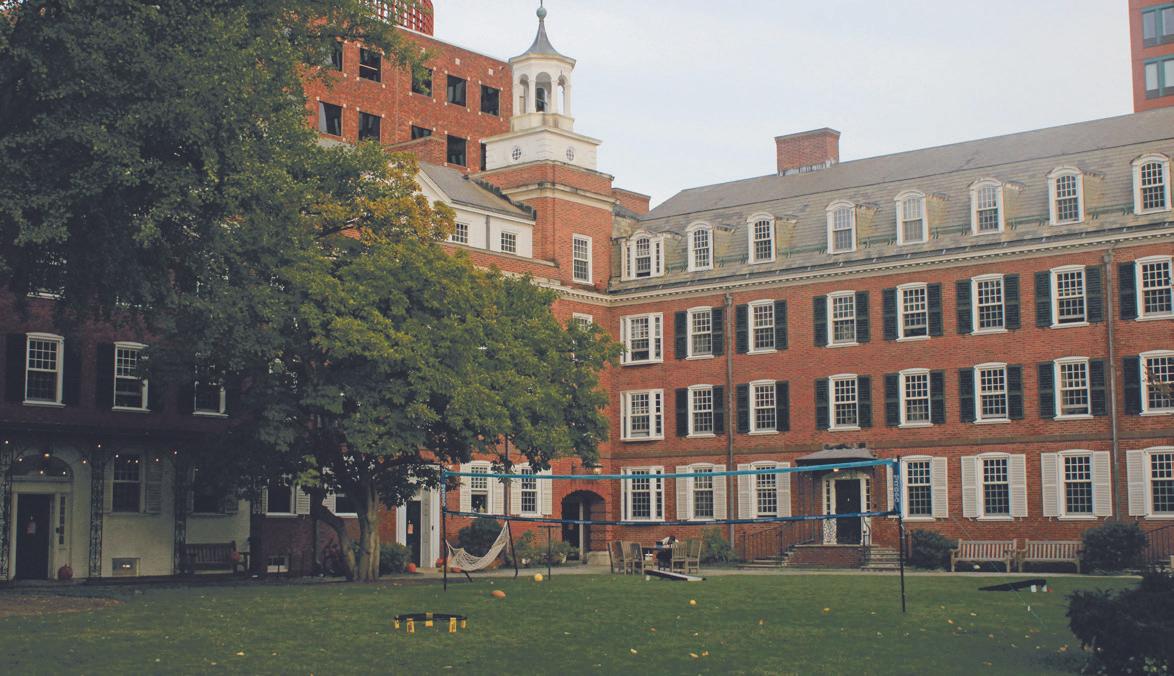
Three residential college deans announced Friday that they will be leaving their posts at the end of the semester, doubling the number of deans’ departures announced in the past month. In emails sent simultaneously to their respective residential college communities, Branford Dean María del Mar Galindo GRD ’22, Grace Hopper Dean David Francis and Timothy Dwight Dean Sarah Mahurin GRD ’11 each shared that they would continue to work as university administrators, but in different capacities — Galindo as an administrator at Colby College in Maine, and Francis and Mahurin as Yale College associate deans.
“These three all told me this week about their decisions and we coordinated the announcements so it would be more efficient,” Yale College Dean Peri -
Candidates debate how to bolster
BY ANAYAH ACCILIEN AND SARA AGRAWAL STAFF REPORTERS
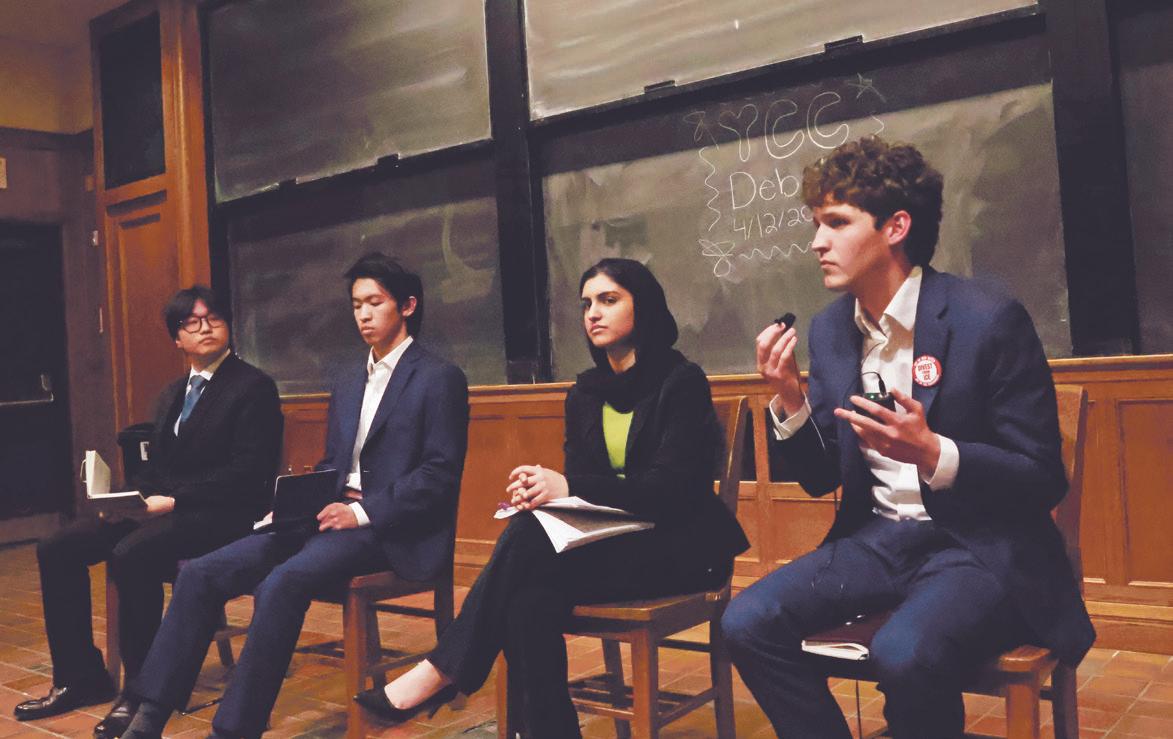
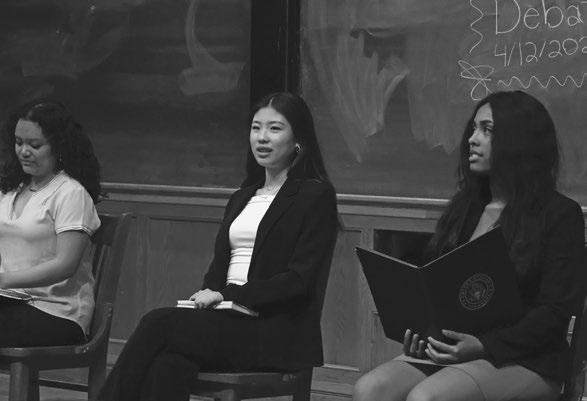
Around 75 students gathered in a Linsly-Chittenden Hall classroom to listen to a Sunday evening debate between candidates running for positions on the Yale College Council.
Three debates — for president, vice president and events director of the organization — took place in the span of two-and-a-half hours. Andrew Boanoh ’27 and Jaden Bradley ’27, the current president and vice president, moderated the debate, in which candidates gave opening statements, responded to general questions and gave brief rebuttals. They then fielded candidate-specific questions and questions from the audience.
As of Sunday, only four candidates were still running for president. On Thursday, when campaigning began, six students were running for the position, but Cemre
Keles ’28 and Remy Strichartz ’29 dropped out of the race before Sunday evening’s debate. Four students remain in the race for vice president, and three for events director.
Sahra Wahedi ’27, who is running for president, emphasized her “institutional memory” as a rising senior and a long-time representative in the student government. Wahedi was a representative on the First-Year College Council and has been a Pierson College senator for two years.
“Unfortunately, the bureaucracies of the YCC run deep, but I have the experience to change the system from within,” Wahedi said in her opening statement.
John Robert Walker ’28, another presidential candidate, emphasized that the YCC should function as a public advocate for the student body to ensure that administrators listen to students, faculty, workers and
cles Lewis wrote to the News on Sunday. “Since a lot of academic administration jobs start July 1, it is very common to give notice in early April to allow about three months for finding a successor.”
On March 17, Lewis sent an email to the Berkeley College community announcing that Bárbara Cruvinel Santiago ’17 had departed her role as dean during spring recess. A week later, Silliman Dean Tycie Coppett announced that she would be stepping down to serve as an interim assistant dean at Yale College, and, a week after that, Davenport Dean Adam Ployd announced that he would leave the role to to take on a new administrative role at the Yale Divinity School.
Lewis said in a Wednesday interview that the quick succession of the first three departures was coincidental, and he wrote
English sections slashed due to cuts
BY JAEHA JANG STAFF REPORTER
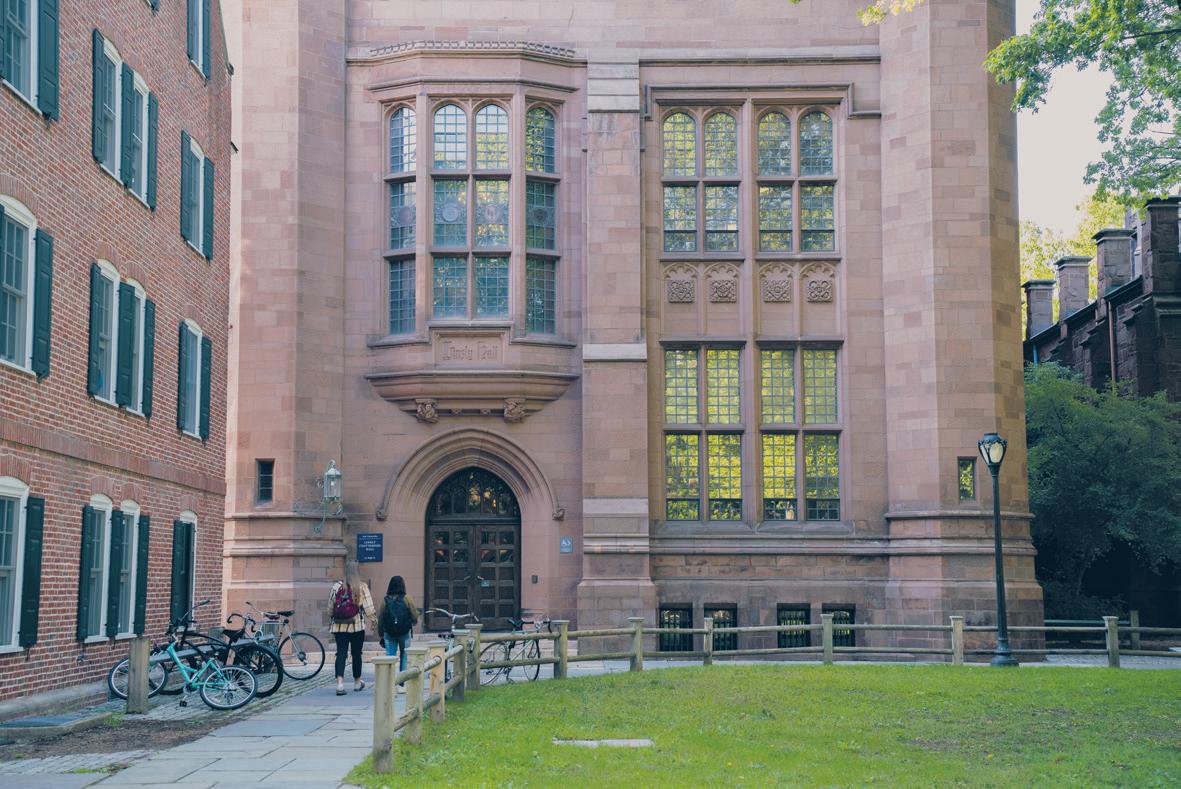
The English department has nearly halved the number of sections of an introductory writing course, from 32 last fall to 17 this fall, as budget cuts constrain academic offerings at Yale.
In addition to that decrease in the fall sections of English 1014, “Writing Seminars,” the number for English 1020, “Reading and Writing the Modern Essay,” has dropped from 17 to 14.
The reductions are among the latest impacts on undergraduate academics of budget pressure in anticipation of an upcoming endowment tax hike. They come on top of decisions not to renew the contracts of several instructional faculty members, which the Faculty of Arts and Sciences dean described as being affected by budget “trade-offs.”
“These reductions were imposed upon us by the FAS Teaching Resource Advisory Committee, which has also imposed an increase in class size,” Feisal Mohamed, the English department’s director of undergraduate studies, wrote in an email to the News. “As a department, we are deeply concerned that the incoming class will not be able to find seats in introductory writing courses, and that those who do will receive less individualized attention.”
English 1014 and English 1020 are both listed on the English department’s website as introductory courses. Steven Wilkinson, the dean of the Faculty of Arts and Sciences, wrote in a Sunday email to the News that his office asked the English department to increase
Two alumni vying for trustee seat
BY LEO NYBERG STAFF REPORTER
Two candidates, an executive at a performing arts center and a medical entrepreneur, are squaring off to become a trustee on the Yale Corporation.
The Corporation, Yale’s board of trustees, is the governing body that steers the University’s longterm priorities and investments.
The Corporation’s bylaws call for 16 trustees — 10 successor trustees, who are chosen by the board, and six alumni fellows, who are elected for six-year terms by alumni. Three ex-officio trustees, the University president and Connecticut’s governor and lieutenant governor, are also on the board. The alumni fellow candidates were chosen by Yale’s Alumni Fellow Nominating Committee.
“Your vote to select a candidate who will bring valuable perspective and expertise to our board is vital in shaping Yale’s future,” Yale President Maurie McInnis wrote in a letter preceding the candidate biographies.
The alumni fellow election opened after a 2022 lawsuit contesting how alumni can be nominated as candidates for the election was rejected last month by the Connecticut Supreme Court.
The suit, levied by Victor Ashe ’67 and Donald Glascoff Jr. ’67, attempted to restore the alumni petitioning process, which allowed candidates to petition for a spot rather than be nominated.
Yale College alumni who have held degrees for over five years and all graduate school alumni are eligible to vote between Michael Singer ’95 GRD ’00 ’02, an oph -
thalmologist and self-described “serial entrepreneur,” and Mariko Silver ’99, the president and CEO of the Lincoln Center for the Performing Arts in New York.
An alumni fellow election webpage includes circa-600-word statements from Singer and Silver as well as videos of the candidates answering what makes a Yale education unique and what higher education should contribute to society in the next ten years. Singer’s response touched on trust, while Silver emphasized the value of research.
Candidates traditionally do not campaign for the role, according to the elections webpage.
“During this time of uncertainty for higher education,” McInnis wrote in her letter, she SEE ALUMNI PAGE 5
Democrats mull governor choices
BY NELLIE KENNEY STAFF REPORTER
Seventy-four delegates from New Haven — one of the largest delegations in Connecticut — will vote on the next Democratic nominee for governor of Connecticut next month.
New Haven’s delegates are set to convene in Hartford on May 16, along with about 2,000 other delegates from across the state, to vote for candidates in a number of statewide executive offices, including governor, lieutenant governor and attorney general. The candidates who get the most votes at the con-
vention will receive the party’s formal nomination in advance of a primary election this August. Currently, only one of the seats in the lineup is contested — the governor’s. Incumbent Gov. Ned Lamont SOM ’80 is squaring off against Hamden’s state Rep. Josh Elliott, who has pitched himself as a more progressive option.
“People err on the side of incumbency, but I do believe that this is a different election where I think people are going to want to see more to elect someone for a
SEE DELEGATES PAGE 5
William Qian / Staff Photographer
Abby Assouad / Staff Photographer
Wobbanight via Wikimedia Commons
This Day in Yale History, 2006
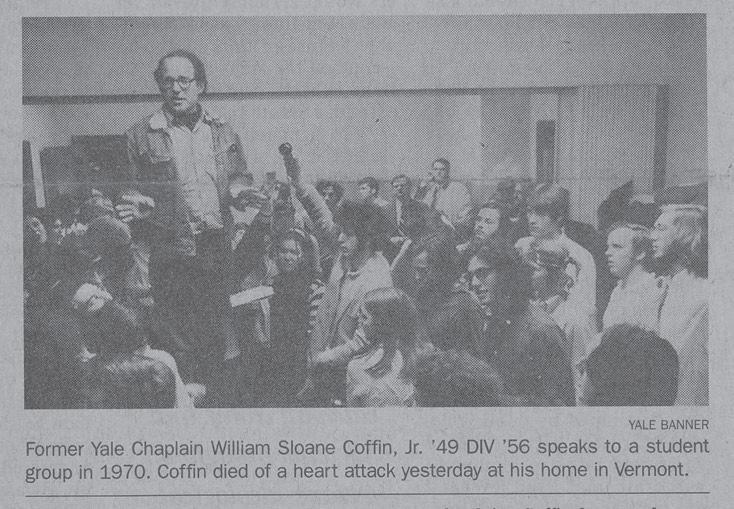
April 14, 2006 / Activist, chaplain Coffin dies at 81
By Charlotte Martin
The Rev. William Sloane Coffin, Jr. ’49 DIV ’56, a former Yale chaplain, CIA agent and celebrated life long activist, died Wednesday in his Vermont home at the age of 81.
Coffin, a liberal Presbyterian minister, dedicated his life to social justice causes ranging from civil rights to the Vietnam War and nuclear proliferation. He leaves behind a legacy of unabashed social activism and inspiring religious leadership that extended beyond his time at Yale — first as a student and later as University chaplain from 1958 to 1975. He had been suffering from heart problems for several years, culminating in a fatal heart attack Wednesday afternoon.
“He was a prophet to the people and a pastor to the nation,” said current University Chaplain Rev. Frederick Streets, a friend and admirer of Coffin.“His voice was part of a chorus of men and women who were singing for freedom and justice in America.”
Behind the Headline
By Olivia Woo
Last Friday afternoon, as I squandered the sunny weather down at a table in Bass Library, I received a startling text. “TD DEAN DOWN,” my friend wrote. I couldn’t believe, at first, that yet another residential college dean had decided to leave the role after three had already announced their departures within weeks of one another post-Spring Break. Coupled with the recent replacements of three heads of college, the semester was already feeling like a moment of upheaval among residential college administrators.
I quickly learned that Timothy Dwight was not the only college whose dean had announced their departure that afternoon — in fact, the deans of Grace Hopper and Branford had released similar emails at 1:01 p.m. This wasn’t a coincidence; Yale College Dean Pericles Lewis wrote to me that the announcements had been coordinated among the three deans.
Lewis also told me that Grace Hopper Dean David Francis and Timothy Dwight Dean Sarah Mahurin would be filling the roles vacated by Abby Douglas, his chief of staff, and Risa Sodi — a name many students might recognize from their Yale inboxes.
Read “Three more college deans leaving roles” on page 1.
CORRECTION:
about the next dean of the David Geffen School of Drama’s next dean. She is Kiva Bank, not Banks. On
same page, an article about Yale President Maurie McInnis’ recent lobbying trip to Washington, D.C., misrendered a comment she made in an interview with the News. McInnis said the Financial Accountability in Research, or FAIR, model was “a primary topic of conversation,” not conservation.
BRADEN MATHIS
Yale is not a democracy. Nor should it be.
Student complaints about university administrations are as old as universities themselves.
A recent grievance at Yale has been aimed at proposed measures to curb grade inflation, in particular by capping the number of A grades available to be awarded in each course. An opinion piece by Ami Gillon ’27, citing a similar editorial in The Harvard Crimson, decries “grade caps and Yale’s blind bureaucracy.” Underlying Gillon’s attack on grade caps, however, is an assumption that our administration has strayed from genuine consultation with Yale’s student “constituents.” While his critiques and analysis of the Yale administration are prescient, Gillon misses the increasing recalcitrance of the student body which itself has failed recently to act thoughtfully or cooperatively.
Yale is not a democracy for, of or by its students. It’s an academic institution, meant to create and disseminate knowledge. We, the students, owe it to future generations to steward it well, even at the expense of our own transcripts.
Despite Gillon’s claim that grade inflation is an “unfathomably complex” issue, the reality is quite the opposite: Grade inflation is a remarkably simple process — not altogether different from monetary inflation — and is well-explained in a recent News article. As the News correctly notes, grade inflation is fundamentally a collectiveaction problem: Professors and departments award higher grades in an effort to attract students, and students conversely tend to take courses which will benefit their transcripts and job prospects. But far from relieving stress, the surge in high grades has made failure all the more painful, with a single non-A grade disqualifying students from first-round Phi Beta Kappa consideration and a minimum 3.90 GPA now standard to achieve any Latin honors. Risk-taking and intellectual humility become nearly impossible when success means perfection, and, as grades go up, the chance to distinguish one’s resume through classroom work becomes ever harder. Restoring rigor is not possible without addressing the incentive structure that allows professors to liberally award A’s.
Gillon calls grade caps “senseless, misguided and fundamentally myopic,” yet the opposite seems to be true. A proposal being considered by Harvard faculty, which would allow professors to offer classes with satisfactory/unsatisfactory grading and which would use course grade distributions to calculate academic honors, is both nuanced and practical. Far from myopic, grade caps make shortterm sacrifices for the possibility of bringing back meaningful grades and returning to a status quo where such caps are no longer needed.
While Harvard’s faculty has taken concrete steps toward systematically addressing grade inflation, students here at Yale and at Harvard seem unconcerned about grade inflation’s detrimental effects. Far from offering solutions, the Yale College Council has instead proposed measures to expand Credit/D/Fail opportunities which would further drive down the value of an A. Further, criticisms of grade caps without any real alternative proposals reflect a broader trend of students bristling at change without consideration for others or the future. Amidst a wave of necessary budget cuts in response to the very real burden of a $300 million tax hike on Yale’s endowment gains, the undergraduate student experience here has stayed remarkably consistent, especially when juxtaposed with staff layoffs, departmental budget cuts and slashed graduate enrollment. Yet, I have heard far more complaints about dining quality and small changes to the student experience than I have heard concern for laidoff workers. Certainly, our administration is far from faultless, and many complaints are justified. Yale College Dean Pericles Lewis’s gaffe telling students “not to buy too much stuff” when ending summer storage funding demonstrates a blatant misreading of student concerns, and the annual parade of dead-on-arrival YCC referenda attests to the opacity of university decision-making with regards to student voices. Gillon himself offers many good critiques of the administration, as well as an insightful analysis into some of its structural issues.
But university administration is necessary, especially given the inability of the student body to look beyond its short-term selfinterest. The first universities had no dorms or lecture halls; they were simply guilds of professors or students. Students were key partners in academic life. Recently, as the university has grown to offer more amenities and benefits, the student body has become less of a partner in academia and has acted more like its clientele. If we cannot maintain our role as the custodians of academia, then we cannot blame the faculty and administration for picking up the slack.
As we approach another Yale College Council election season — no doubt to be filled with vague promises pandering for student votes — we should look beyond our own bright college years to consider our part in improving higher education. But until we demonstrate that the student voice deserves to be heard, we should not demand respect.
BEN ROSENTHAL is a senior in Morse College studying History and Ancient Egyptian. He can be reached at benjamin.rosenthal@yale.edu.
Yale is finally headed in the right direction
Linda McMahon, the United States’ secretary of education, is coming to campus this Thursday for a Buckley Institute event; she’ll be telling us how she intends on “restoring American education.”
Many are skeptical of her motivations, given that the Trump administration appears to be intent less on restoration and more on evisceration when it comes to American universities. I too find it unlikely that McMahon has got Yale’s best interests in mind.
But does this make the substance of her critique — and those from others on the right — invalid? Does it mean that our country’s institutions of higher education, Yale among them, have done nothing wrong? Surely not.
In the last decade or so, Yale has indeed become more of a safe space-loving, identity politics-obsessed echo chamber than a serious research university or liberal arts college. Why is it that only 2.4 percent of our faculty are Republicans, according to a report based on voter data? It cannot merely be, as some have advanced in the News, the result of a qualification or intelligence gap.
Further, how strange is it that when we teach “Intermediate Portuguese II,” we cannot help but subtitle it, “Decolonizing the Gaze”? Good-faith criticism and good-faith reform of our university must take place on these grounds or their bad-faith equivalents will instead.
This brings me to a recent piece in the News decrying “Yale’s institutional contradiction.” Manu Bosteels ’28, the piece’s author, appears to disagree with me completely. He thinks that Yale’s new commitment to institutional neutrality has undermined itself in
WHY IS IT THAT ONLY 2.4 PERCENT OF OUR FACULTY ARE REPUBLICANS, ACCORDING TO A REPORT BASED ON VOTER DATA?
making several “concessions to the American right.”
I’m skeptical of Bosteels’ narrative. I think not one of President Maurie McInnis’ acts that he lists — not hiring David Brooks, nor failing to make a campuswide statement after the Brown University shooting in December, nor applauding the Buckley Institute last week for inviting McMahon to speak — constitutes a “contradiction” or a lapse or an unevenness in our institutional neutrality. Rather, each represents a reasoned and prudent shift away from a status quo which has been hurting Yale for years.
RATHER, EACH REPRESENTS A REASONED AND PRUDENT SHIFT AWAY FROM A STATUS QUO WHICH HAS BEEN HURTING YALE FOR YEARS.
First, let’s take McInnis’ supposed failure to make a statement after the Brown shooting. Is it really true that she thought “speaking about the murder of university students would violate Yale’s new model of neutrality,” a standard Bosteels finds “chilling”?
No, of course not! The complaint at the time was that the Yale administration only informed students about how it was tightening security protocols in the wake of the shooting, without also providing “an emotional response.” Now, is that really something which a university president ought to be accountable for? Or is there a sense in which we Yale students are legal adults with the faculties of emotional regulation necessary to make it through a scary news story? Perhaps the new standard, which frees us to feel and to cope without institutional handholding, is more respectful to our maturity — a change for the better.
What about McInnis’ applause for McMahon? Well, I think it’s been taken out of context. McInnis didn’t release a statement out of the blue; rather, a News reporter asked her for comment and made a story out of it. McInnis praised some various functions of the Department of Education and then applauded the invitation insofar as it served the general Buckley Institute ethos of “inviting leaders to come speak on consequential topics.” Not so objectionable in the end. And finally — Brooks. Is he a hack, since he once wrote offhand that Thai restaurants are easier to find in blue-voting cities? Has his legacy been tarnished by virtue of a single appearance near Jeffrey Epstein at a TED conference in 2011? Bosteels calls Brooks a “journalist of less-than-perfect renown” on account of these failings. Brooks’ appointment, according to Bosteels, was not a change from politicallymotivated hiring practices to blind meritocracy, but a blatant attempt by McInnis “to placate conservatives who think Yale is too lefty.” Such a claim is almost laughable. Brooks is an incredibly accomplished and capable figure — he’s worked at The New York Times for almost a quarter of a century and written several bestsellers. He’s given three lectures here at Yale already — I was in attendance at the second and found him insightful and inspiring. Brooks is not an ideological diversity hire. He’s not a hack, and he’s not a pedophile. He’s simply more conservative than the average Yale professor. He thinks identity politics are bad and damaging. True, Yale would not have likely hired a guy like him 10 years ago — but isn’t it good that that’s changed? I love Yale, and I want it to survive and to prosper. And that means taking conservative criticism seriously. It means adapting and reforming; it means neutrality and openness and restraint. Yale’s administrators are fallible, and I expect them to fail often — but hiring Brooks is not a failure, and the project of institutional neutrality has so far been a successful one.
ARI SHTEIN is a first year in Saybrook College. His column mostly consists of the airing of grievances. He can be reached at ari.shtein@yale.edu.
The diversity conservative students want
Recent columns in the News debating the reason for Yale’s dearth of conservative voices miss the greatest issue at hand: contemporary conservatives’ hypocritical disregard for conversation. At Yale, political discussion has become a battle for ideological superiority. The relative absence of conservative students and faculty in academia is concerning. But it is not caused by discriminatory behavior against conservatives. Contemporary conservatives advocate for ideological diversity at universities while denigrating diversity, equity and inclusion — DEI — initiatives, demonstrating a hypocritical tendency. By misrepresenting racial and queer identities, claiming them to be part of a “woke agenda,” conservatives seem to reject diversity in academic settings, while simultaneously using the language of diversity to push for their political ideology to be embraced and given credence as an identity-based characteristic.
As an African American student, I find that the current public response to DEI initiatives demonstrates the need for racial visibility. If contemporary conservatives choose to be “colorblind,” why don’t they also adhere to ideological blindness — making the issue of lacking conservative representation in academia a non-issue? Contemporary
conservatives must pick their battle: a crusade against diversity initiatives, or an acknowledgment that pushes for diversity can include race alongside ideology in order to fully promote inclusivity. We must either be blind to all or take notice of everything.
In her column for the News, Hannah Owens Pierre ’28 described “progressivism” as the major intellectual root of many of Yale’s courses — particularly those offered by the Women’s, Gender and Sexuality Studies program. She seems to describe these classes as almost overbearing to conservative thought, instead of welcoming debate from student participants.
As an avid fan of WGSS classes, my experience has been that such “progressive” courses do not ask students to regurgitate concepts and connect them to a liberal framework. Instead, they call on us to intellectually reframe and question our perspectives. The papers we write in these classes welcome conservative thought as long as a student grounds it appropriately in intellectual discussion.
Conservative thought has always been — and still is — welcomed in academia; it intellectually contributes to Yale’s grand ideological spectrum.
Conservatives are welcome to challenge the prevailing narratives
of Yale’s courses and departments. However, conservatives cannot dismiss progressive areas of academia on grounds of ideological superiority. Intellectual conversation requires a code of ethics, independent of political ideology, to which all must adhere: a code that calls for conservatives to not dismiss progressivism as inferior — or under a reductive term such as “woke.”
In order for conservatives to be more present in institutions like Yale, there needs to be conversation. But conversation cannot be based on an intent to win. I think about the essay question on how students handle disagreement included in the application to Yale College — the question is a testament to understanding how a student engages with opposition. Conservatives have the right to refute an argument, but are they refuting the argument at hand because of critical reasoning, or because of a fear of perceived intellectual hierarchy?
When conservatives converse at Yale, and engage with opposing views without the intent to assert political superiority, students will bear witness to a more ideologically diverse academic environment.
THOMAS MULUGETA is a first year in Branford College. He can be reached at thomas.mulugeta@yale.edu.
FROM THE FRONT
“I keep turning over new leaves, and spoiling them, as I used to spoil my copybooks; and I make so many beginnings there never will be an end.”
Two newly departing deans will fill Yale College posts
DEANS FROM PAGE 1
on Sunday that the fact that three more deans will step down was also “just a coincidence.” Santiago, Ployd and Coppett were all in their first terms as dean — Santiago in her second year and Ployd and Coppett in their third.
Galindo is in her fourth year as dean, Francis in his eighth and Mahurin in her 12th.
Lewis said last month that the role of residential college dean comes with fewer long-term career possibilities than an assistant professorship, a role from which faculty members can be promoted to more senior positions. While some residential college deans stay in the role for three or four terms — spanning nine or 12 years — he added that most tenures last only a term or two.
“Being a dean is a great sort of entry-level job,” Lewis said on Wednesday. “We would love to keep every dean for around six to nine years and then let them go. But sometimes something comes up and you’re in your third year and it’s great or sometimes you love being dean so long, you stay for 12 years. There’s nothing wrong with that.”
Timothy Dwight students
praised Mahurin, who has served 12 years as Timothy Dwight dean.
“Having someone so established was a great resource. And I’m just a little bit concerned about someone getting accustomed to the job while I’m getting accustomed to college,” Suraj Shah ’29 said. “It was just really surprising seeing three deans choosing to take a different job.”
Raymond Ellis ’29 said Mahurin “has been a very big part of what makes TD so special.”
Unlike the other two deans who announced their departures on Friday, Galindo will no longer serve as a Yale administrator after this year. Galindo wrote in a Sunday statement to the News that her “time as dean of Branford has been some of the most profoundly meaningful of my life.”
“What I feel more than anything right now is immense gratitude,” she wrote in her Friday email to students. “I have had the privilege and honor of walking alongside you for several years, and I hope you will take it from me: I know first-hand how immensely powerful you each are.”
Johann Ortiz Castillo ’26 characterized Galindo as a “really compassionate person” and a “community pillar,” and said that
he was “very sad to see her go.” He recounted that, during Galindo’s first meeting with his class after they moved in first year, “she knew my name. I had never interacted with her.”
He added that he thinks the six deans leaving this semester seemed to be “kind of a big number.”
“I think it’s very telling that they’re probably not happy with the University and how they’re dealing with politics,” Ortiz Castillo speculated.
Lewis told the News last month that Yale College is working on altering its advising system in the coming years, “to where your main adviser will be a residential college dean.” Course advice will primarily come from residential college deans as opposed to college advisers, Lewis added.
None of the six departing deans responded to an inquiry asking for their thoughts on those changes to Yale College advising. Francis, the Hopper dean, and Mahurin, the Timothy Dwight dean, will begin in their new roles on July 1, according to a Friday email that Lewis sent to his colleagues. They will replace current Yale College interim chief of staff Abby Douglas and Risa Sodi GRD ’95, the associate dean of aca -
demic affairs, respectively. Lewis said that after he learned earlier this semester that Douglas and Sodi would not continue in their roles this fall, his office “advertised the roles to everyone with an assistant dean–level position in Yale College in early March.”
Mahurin and Francis applied for those roles and were interviewed between late March and early April, according to Lewis.
On LinkedIn, a posting for Mahurin’s future job dates to about three weeks ago, and a posting for Francis’s role has existed for two weeks.
“As Chief of Staff, Dean Francis will run my office and will be closely in touch with all branches of Yale College and other university offices,” Lewis wrote in the Friday email. “He will also assist Pam Schirmeister, Deputy Dean of Yale College, on various academic initiatives.”
Phineas Scovel ’28, a Hopper student, said he did not know Francis very well, but said he was surprised by his departure from the college. Scovel said he thought the trend of departing deans was “kind of indicative that there’s changes in the administration.”
“Maybe he should figure out
why they’re all leaving if he says it’s a coincidence,” he said of Lewis.
On Sunday, Mahurin wrote to the News about her excitement that her new role will allow her to approach advising both as a strategist and through one-onone meetings with students.
“I will miss TD, my home for 12 years!” she wrote. “I do plan to be an active and engaged member of the college fellowship going forward.”
After working at Yale for “36 glorious years,” Sodi wrote on Sunday, she decided to leave the post that Mahurin will soon fill because the “timing was right,” and because she wanted to join her husband in his retirement.
Lewis said last week — before the three latest dean departures were announced — that his office hopes to conclude the searches for new residential college deans in May.
“We will be bringing some candidates to campus to meet the heads and, if the students are available, the students, but it will mostly be around exam time,” Lewis said. “So students may be a little bit busy.”
Yale has 14 residential colleges.
Contact OLIVIA WOO at olivia.woo@yale.edu.
Rick Scott slams Yale for YPU’s inviting Hasan Piker
SCOTT FROM PAGE 1
political union’s Tuesday debate on the resolution “End the American Empire.” He has previously faced criticism about past remarks including a suggestion that the United States “deserved” the Sept. 11, 2001, attacks and statements minimizing sexual violence during the Oct. 7, 2023, Hamas-led attack on Israel.
“This is WILD. I spoke at the Yale Political Union last year on why we need to buy made in America products. Now, they are hosting a guy who said I should be killed,” Scott wrote in a post on X. “Yale receives billions from the federal government—President Trump and Congress need to IMMEDIATELY revoke it. An elite private university that hosts an antisemite who says a Senator should be killed, capitalists should be killed, and the U.S. deserved 9/11, shouldn’t get ONE CENT from taxpayers.”
The University has not had its federal funding revoked as part of targeted pressure from the Trump administration, though many faculty members have lamented the impact of the administration’s broad cuts to research funding. Many of Yale’s peer institutions have faced punitive funding cuts under Trump, and in 2025 the University spent 1.2 million — far more than in previous years — on lobbying efforts.
Yale President Maurie McInnis in October floated the possibility that the political union’s culture of open debate had contributed to Yale’s avoidance of targeted federal funding cuts. She and Yale College Dean Pericles Lewis met with lead-
ers of the group last month.
Asked about Scott’s comments, Yale spokesperson Tina Posterli wrote in a statement to the News: “Yale treats statements advocating violence with the utmost seriousness and condemns any form of hate or discrimination. The university also seeks to balance these concerns with a longstanding commitment to free expression as a fundamental value and a shared responsibility — including for student-run organizations, which issue their own invitations to speakers independent of the university.”
Yale Political Union President Mór Szepesi ’27 emphasized in an interview with the News that the union does not endorse the speakers it chooses to host.
“We bring in speakers so that we can challenge them on their assumptions and the arguments that they make in this world,” Szepesi said. “The fact that a student organization’s regular Tuesday debate has become discourse in the national media and has been commented on by prominent politicians and journalists speaks to the idea that our organization, the Yale Political Union, is one that is a central part of not just the Yale experience, but of Yale’s unique university experience at large.”
“We just bring in someone who’s vocal and has influence,” Szepesi said. “And Hasan Piker most definitely is vocal and has influence and has a lot to comment on in terms of the specific issues in today’s politics today’s day and age.”
Szepesi said the political union aims for a “balanced guest
list” and does “mass outreach” to potential speakers. He said the group does not go through any vetting process with the Yale administration before confirming its speakers.
For Kaustuv Mohanty ’29, Piker’s value as a speaker on campus comes from his impact among younger audiences as a digital creator through the streaming platform Twitch. That allows the political union to spotlight the influence of “contemporary voices” alongside “traditional academic” ones, Mohanty added.
“In terms of Yale’s values, I think that inviting someone does not immediately endorse their actions or what they believe, but rather, invites an opportunity for valuable debates and engagement,” Mohanty wrote to the News.
Avi Rao ’27, the Yale Politi
cal Union’s speaker, said in an interview that a week before every debate, he and the floor leaders of the left and the right send out a debate framing which encompasses what the resolution means and what it means to either affirm or negate it. Then, through a process of pitching and workshopping speeches, Rao said, the group’s leaders can ensure that the debate is concentrated on the topic instead of a controversy that surrounds the speaker who has been invited.
“We’re not having a discussion. We’re not having some sort of moderated event where the guest just gets to say what they think,” Rao said. “We have a debate where three people on one side and three people on another
side discuss and debate what we should do about this topic.”
Trent Page ’28, a member of the union’s Party of the Left, told the News that “having Hasan is great for Yale’s campus.” Page added that “it is very disingenuous to try and cancel” Piker when right-wing figures are “dominating our political sphere” and saying “much more inflammatory things” than him.
Carlos Perez ’29, a member of the union’s Conservative Party and the president of Turning Point USA’s new chapter at Yale, told the News that while he values the YPU’s commitment to “ideological diversity,” he believes that the debate with Piker is a “very different” situation because of Piker’s
rhetoric, “which isn’t just inflammatory, but is blatantly violent.”
“It’s language that is very antithetical to the mission of Yale University in terms of promoting an environment of free speech grounded in mutual respect, in pursuit of the good,” Perez said. “And ultimately, it’s really just anti-American.” When Rick Scott spoke at a Yale Political Union debate in October, the resolution “Buy American” passed by a single vote, 39–38.
Contact ANAYAH ACCILIEN at anayah.accilien@yale.edu and SARAH RIVAS at sarah.rivas@yale.edu.
English department forced to reduce writing sections
section enrollment for English 1014 and English 1015, “Literature Seminars,” from 14 to 15.
Wilkinson wrote that his office, which oversees the Teaching Resource Advisory Committee, reduced the number of sections in English courses “based on information on student numbers and past enrollments, and to meet teaching needs in a very constrained budget environment.”
Wilkinson added that “English was then able to choose where to distribute those reductions” and that the department then “prioritized areas, like creative writing, where student demand has increased substantially in recent years.”
Mohamed, however, wrote that his department wasn’t given much choice.
“I would characterize it differently than Dean Wilkinson has done,” he wrote. “We were given a reduced allocation across the board,
with reductions in expository writing and creative writing. This significantly constrained the degree of choice that we could exercise.”
Faculty and students slammed the reductions, expressing concerns about fewer students being able to receive personalized attention in the affected courses.
English senior lecturer Heather Klemann, who co-directs English 1014, wrote in an email to the News that demand for the program has remained consistent or increased over recent years. If 17 sections is the final number for the fall, she added, “we will need to get the message out to deans to encourage first-year students to consider taking 1014 in the spring.”
While Wilkinson wrote that programs are still finalizing their fall course offerings and that sections may be added over the coming weeks and the summer, Mohamed told the News that the current offerings for the introductory writing courses are “pretty much final for the fall.”
“I would’ve hoped those making these decisions would have placed more value on undergraduate student learning,” Klemann wrote. “Yale students are incredible; they deserve as much.”
According to Yale Course Search, 497 students have been enrolled in 45 sections of English 1014 this academic year, averaging around 11 students per section. The 14-person cap for each section has been meant to avoid under-enrolled courses after add/ drop period and “target a class size of 12,” according to Klemann. Wilkinson wrote that the increased section size of 15 is “still well within Yale College expectations, in order to allow for individualized attention.”
He cited the handbook for directors of undergraduate studies, which caps writing seminars at 20 students, with sections led by graduate students capped at 15 students.
English senior lecturer Kim Shirkhani, who directs English 1020, wrote in an email to the News that any
significant expansion of section size would make it more difficult to conduct the course’s “signature” writing workshop, which is known for “featuring only a few students at a time,” Shirkhani added. The student cap for English 1020 has not changed, but the number of sections is dropping by three from last fall to the coming one.
“Given that we’re not fully meeting the demand for 1020 seats as it is, with more students coming and fewer sections being offered next year I worry about that math,” she wrote.
Ishani Singh ’29, who took English 1014 last fall, wrote in an email to the News that the “intimacy” of the course allowed her to improve her writing skills and better connect with her professor and seminar peers.
“I fear that with larger section sizes, it will be hard to discuss topics deeply, and the course loses its meaning and goal,” she wrote. Stella Duran Gonzalez ’29, who also took English 1014, wrote in a text message that the program is
a “great class” for first years and non-English majors to explore writing and topical interests.
“Cutting offerings would make writing less accessible to those who aren’t in the humanities,” she wrote.
“My fear is that these really valuable learning opportunities and spaces to make friends and express yourself will instead be replaced by extremely large lecture style classes, where making friends and expressing yourself can be difficult and daunting.” Wilkinson wrote that introductory writing courses are offered across Yale College’s curriculum “by a variety of departments and programs including English.” Many courses will still allow students to fulfill their writing distributional requirements, he added.
English was the seventh most popular major at Yale in fall 2024, according to a University fact sheet.
Contact JAEHA JANG at jaeha.jang@yale.edu.
Sara Agrawal / Contributing Photographer
Sen. Rick Scott wrote Friday that Yale should lose its federal funding due to the Yale Political Union’s invitation of Hasan Piker, an online political commentator who suggested on a stream that Scott should be killed and is scheduled to speak Tuesday.
ENGLISH
FROM THE FRONT
“The beginning is always today.”
Four remaining presidential hopefuls face off at debate
New Haven residents. His ticket with Michelle Jimenez ’28, who is running for vice president, calls for Yale to “respect us.”
During the debate, Walker also promoted divesting Yale’s endowment from companies like Palantir and Flock Safety, which he called “exploitative and extractive.”
Students this year have made similar requests to the Advisory Committee on Investor Responsibility, which makes divestment recommendations to the Yale Corporation, but their pitches have been rejected. University spokesperson Tina Posterli previously wrote to the News “that just because a topic is reviewed by the ACIR, it does not mean the Endowment holds the investment.”
When asked by an audience member when he would make the decision to weigh in on divisive issues as YCC president, Walker, who said he assumed the question was in reference to “popular demands among students,” such as divestment, defended his position.
“These things that we’re saying are controversial are only controversial if you want to be in finance, or if you want to be a consultant, or if you want to go be in D.C. in two years,” Walker said. “The job description is to be a public advocate on behalf of a student body.
And I do have experience advocating loud, vocally, publicly for the things that I believe in.”
To the same question, Wahedi responded that she would also “stand up for the political issues that you express, you care about,” including “divestment from weapons manufacturing.”
During the presidential debate, candidate Alex William Chen ’28, the current speaker of the YCC Senate, said he has “dared to fight” during his
term. He spoke of his achievements in the senate, such as leading a petition against the combination of the International Studies Award and the Student Experience Award into a single summer grant opportunity, which drew over 1,700 signatures.
Paul Park ’27, another presidential candidate, said in his opening statement that he asked 243 students on Cross Campus, “What is the YCC?” and that 209 of those students “did not know what the YCC is, or simply said that it was useless.” Park said that the YCC should be a bridge between administrators and students, and that it has a problem with trust.
Responding to a question about managing the roughly $1 million budget that the YCC controls, candidates discussed the effectiveness of allocating stipends to students, especially in areas where University funding programs have been cut.
“The YCC has taken upon itself to incorporate too many of these stipends, and that lets the administration let loose and rely on us for those stipend models,” Wahedi said. Wahedi added that student leaders should instead push administrators to reverse the types of changes that cause the YCC to allocate stipends.
Recently, the YCC passed a bill to fund stipends for at least 127 students’ summer storage costs, after the phaseout of a Yale College program that provided funding for summer storage to low-income students.
While Chen agreed that the stipend model was “broken,” he also claimed credit for producing the $12,000 stipend fund to offset students’ summer storage costs. Chen said that stipends “should be an incubator for what Yale could take over.”
Walker said that providing stipends “absolutely kills the student energy and frustration that exists on campus around these issues” and stands in the way of creating change.
During the debate, Chen asked his fellow candidates: “How are Sahra and JR and, perhaps, Paul, too, actually planning to do this stuff that they’re demanding?” Chen said that his campaign was putting forth actionable proposals.
Wahedi responded that, through meetings with administrators in her role as the deputy director of financial policy on the YCC, she has facilitated tangible progress.
Walker said that Chen was missing the “bigger picture.”
“It’s not just about engaging alumni. It’s about engaging workers, students, New Haven community members, and these are people that I have all built relationships with in the organizations that I’m a part of,” he said. “I have not been in the YCC the last two years because I’ve been spending my time working with community members.”
Before the presidential debate, the four students running for vice president debated their visions for the role.
Brendan Kaminski ’28, a current Saybrook senator and the vice presidential candidate on Chen’s ticket, wants to “dare to defy convention.”
“I think we have to rethink how we use the YCC as leverage,” Kaminski said, adding that he hopes to organize a cross-Ivy League protest on Capitol Hill against federal funding cuts to universities.
Briana Dubon ’27, Park’s running mate, said that her campaign focuses on transparency and accountability. Dubon said that she wants to restore trust between Yale and New Haven, and she emphasized the need for frequent “digestible updates” of what Yale administrators and YCC leaders are discussing behind the scenes.
Jimenez, Walker’s running mate, emphasized her ticket’s mission to “demand respect” for all members of the community, including students, workers and New Haveners. She said that she and Walker met through Dwight Hall, an organization of various service groups, and highlighted her commitment to outreach.
Keles, a senator for Silliman College and Wahedi’s running mate, said that “he can’t promise anything too heavy” because “nothing is given,” a phrase he repeated twice. He said that although there are limits to the YCC’s power, “that doesn’t mean we should stop fighting.” He also said that students should feel like they have a “seat at their own table.”
Three students running for the events director position emphasized their excitement to seek input from the student body.
Oriana Dunker ’29, an events director candidate who is the current
secretary for the First-Year College Council, emphasized her focus on “starting with students and ending with what students want.”
Bomin Koo ’29, another candidate, said that because she grew up in a rural, small town, her goal is to create a “tight knit community and home” for all Yalies.
Alejandra Paez Penaloza ’28, a candidate who has served on the YCC events executive board, said that she believes the Yale student body is “more similar than we think.” Paez Penaloza said that she is ready to plan realistic events that will include “a little bit of everything from everyone.”
Elections for president, vice president and events director will begin on Thursday.
Contact ANAYAH ACCILIEN at anayah.accilien@yale.edu and SARA AGRAWAL at sara.agrawal@yale.edu.
New Haven delegates weigh candidates in primary
DELEGATES
third term. So I don’t predict where delegates are going to go,” Vincent Mauro Jr., the chair of New Haven’s Democratic Town Committee, said in a phone interview.
Mauro added that because many of New Haven’s delegates are elected officials themselves, they will likely “talk to their friends and neighborhoods” and “then make their decision.”
New Haven’s Democratic Town Committee, or DTC, selects delegates “a little differently” from other Connecticut municipalities, Mauro said.
Democratic delegates in Connecticut are required to be registered party members and to live in the district they would represent, according to the Connecticut Democratic state party rules. Slates of delegates are determined either by their local DTC or by a caucus. The New Haven DTC votes on the city’s delegates, but the people nominated
are usually “elected town committee members, they are elected alders and they are state delegation members,” Mauro said.
The delegates to the May convention include Mayor Justin Elicker, New Haven’s two state senators, state representatives, alders, union leaders, city officials and DTC ward co-chairs, according to a list submitted to the city clerk’s office.
One delegate, Ward 7 Alder Christine Kim ’99, said she plans to speak to her constituents before deciding her vote.
“I’m starting to reach out to my ward because I’m their representative,” Kim said, adding that the delegates “haven’t heard from all the candidates.”
Lamont visited the New Haven DTC on Thursday, April 2, to pitch policy plans and take questions from local Democrats, including many convention delegates. He spent about 45 minutes answering questions, Mauro said. Elliott has not yet visited the New Haven
DTC, although Mauro said they hope to schedule him “in the next couple weeks.”
“I know he has not attended a lot of DTC meetings,” Mauro said of Lamont. “I’m happy he came to New Haven.” Ward 22 Alder Jeanette Morrison, one of the delegates who attended the meeting, said in a phone interview that one of the topics Lamont focused on was increasing funding for special education.
Education funding in general is at the top of her mind, Morrison added.
“My own question always is how do we change the formula that provides generally more money to the schools to be able to really educate our kids,” she said, pointing to the state’s Education Cost Sharing formula, which allocates money to schools according to their number of students and factors like household income.
The amount prescribed by the formula has remained the same since 2013 without adjustment for
inflation, according to the School and State Finance Project, a nonpartisan policy group.
“I feel like Governor Lamont is doing a really good job in trying to partner with our delegation and really addressing the needs of our community,” Morrison said. She added that because she had not yet met Elliott, she couldn’t “speak to his platform.”
Delegate David Weinreb, who is a teacher in Fair Haven, also pointed to education funding as a top concern.
Weinreb said in a phone interview that he feels Lamont “consistently misses the mark” and “doesn’t see that there’s actually dire need in ensuring that all schools can thrive.”
“In this moment,” he said, his vote “would be for Rep. Elliott.”
Delegate Raymond Jackson, who serves as a DTC co-chair for Ward 21, said over the phone that he was worried about education funding and violence in schools. Jackson said that he did
not attend the meeting Lamont visited because he felt Lamont “only came down here to see” if he could “get our support again.” Lamont’s campaign did not immediately respond to an email requesting comment.
Delegate Laura Cahn, a local environmental advocate, wrote in an email that she was away during Lamont’s visit. She has encouraged the governor’s campaign staff to support several environmental bills, including one about transparency in pesticide reporting, she wrote. Cahn added that she is a “big fan” of Lt. Gov. Susan Bysiewicz ’83 and that she supports State Treasurer Erick Russell. Both are up for reelection this year. The first governor of the state of Connecticut was Jonathan Trumbull, who served from 1769 to 1783. Trumbull is the namesake of Yale’s Trumbull College.
Contact NELLIE KENNEY at nellie.kenney@yale.edu.
Voting to decide new trustee now open to graduates
is “particularly grateful” for the trustees’ counsel.
“Higher education is succeeding in its mission much more than the headlines would suggest,” Singer said in his video. “Times will always change, and there will be new challenges socially, politically, financially and pedagogically. So I like to focus on guiding principles, and one of the important principles is trust. Yale and higher education should continue to foster trust between the public and academia.”
Singer “arrived at Yale as a Pell Grant student from Appalachian Pennsylvania with only $500 in his pocket,” his candidate statement said.
In his statement, Singer credited mentors at Yale who taught him how to write scientific research papers and led him to pursue Yale’s joint medical and doctorate degree program.
Singer founded four medical companies, and he is one of over 200 entrepreneurs-in-residence at Yale, a group of experts who can be “sound-
ing boards” for Yalies considering founding or working on a startup, according to the program’s website.
He is also on an advisory board at the School of Medicine.
He said “compassion” is another principle that should be important to Yale.
“We should also use scholarship to improve the welfare of animals and the health of the planet,” Singer said, tying the principles to the Yale for Humanity Campaign, with which he worked.
Singer is the co-founder and director of Cartesian Therapeutics, which develops cell therapies for immune diseases.
In her video, Silver noted her interactions with faculty as one of the major reasons she thinks Yale is unique.
“We are in a moment when people are asking questions about the value of higher education and the value of publicly funded research, but I believe they have never been more important,” Silver said in her video.
Silver said she helped lead an “extensive” transformation of
Arizona State University, which she described in her statement as “changing the funding model for public institutions of higher education, fostering economic development in Arizona, and spearheading international partnerships.”
After her time at Arizona State, Silver was an advisor to Arizona Governor Janet Napolitano. When Napolitano was named President Barack Obama’s secretary of homeland security, Silver went with her to Washington, D.C., and led the department’s international affairs office. She also served as an advisor to Columbia University’s vice provost before her time at Arizona State.
Currently, Silver is the president and CEO of Lincoln Center, which houses organizations including the Juilliard School and the New York City Ballet. She was previously the CEO of the Henry Luce Foundation, whose namesake was a Yale alumnus and journalist. The foundation manages scholarships and grants for democracy and ethics
At Yale, Silver played rugby, skied and danced, she said in her statement.
The winning candidate will replace Carlos Moreno, whose sixyear term is ending. When Moreno was elected in 2020, the election process looked different.
In 2021, the Corporation did away with the alumni petitioning process, which allowed alumni to appear on the ballot if they gathered signatures from 3 percent of the alumni eligible to vote. Now, the candidates are picked by the Yale Alumni Fellow Nominating Committee.
In a statement at the time, the Corporation cited groups pushing single issues during elections as the reason for the switch.
“Two groups have used this path in recent years to advance candidates with platforms promoting specific policy goals,” the statement from the board reads.
In 2022, two alumni mounted a lawsuit against the change, which the Connecticut Supreme Court declined to hear in March after it was
unsuccessfully argued in the state’s district and appellate courts.
“When I’m voting for president, I know what Donald Trump and Joe Biden and Kamala Harris are thinking and I know how I should engage my vote accordingly. We’re going to be voting for one of two candidates who are handpicked for us by the Yale Alumni Committee,” Ashe, a plaintiff in the lawsuit, said.
The 2021 trustee announcement noted that the alumni petition process was used infrequently and that candidates were usually selected by the committee.
McInnis recently announced that two new successor trustees, media executive Derek Chang ’89 and private investment firm head Philippe Costeletos ’87, will begin their roles in July.
Voting in the alumni fellow election is open until 11:59 p.m. on May 17.
Contact LEO NYBERG at leo.nyberg@yale.edu.
William Qian / Staff Photographer
Students running for president, vice president and events director of the Yale College Council promoted their platforms and answered questions at a debate on Sunday evening.
ALUMNI FROM PAGE 1
College term bill climbs to $94,100 as students object to funding cuts
BY ISOBEL MCCLURE AND SASHA CABRAL STAFF REPORTERS
Undergraduate tuition and fees for the 2026-27 academic year will total $94,100 per student — marking a 3.92 percent increase from the current year’s bill.
This increase is consistent with those in past years, which have remained within the range of 3.78 to 3.94 percent since the 2018-19 term bill. Next year’s total bill is divided into $72,500 for tuition and $21,600 towards housing and food combined, compared to $69,900 and $20,650 in the 2025-26 term bill respectively.
“Students who are on financial aid will not see their bills increase. The financial aid is increased by the same amount as the tuition increase,” Yale College Dean Pericles Lewis said in an interview this week, adding that it would “be a mistake” to interpret the tuition increase as hitting low and middle income students.
“I want to make it clear that the tuition increase affects students who are not on financial aid,” he said.
In a Tuesday email, Yale College Council President Andrew Boanoh ’27 and Vice President Jalen Bradley ’27 announced a motion which is set to ask students if they “support a student referendum condemning the Yale administration for raising tuition while reducing investment in undergraduate student life” and urging “an immediate pause on tuition increases and restoration of funding to core student programs.” The motion, proposed by Alex Greene ’26, was passed at the Yale College Council meeting last Sunday.
“It’s very problematic to me that as that tuition is rising,” Greene said, “student cuts are
happening. In other words, students, their families are paying more for an experience that is less funded.”
He described seeing the Yale undergraduate experience be “quietly eroded” over time. He cited recent examples including the end of Collegesponsored summer storage funding for low-income students and the University’s not renewing contracts for certain instructional faculty members.
An increase in the Yale undergraduate population by 100 students per year, which was announced last February and began with the class of 2029, seemed “problematic” to Greene given that administrators were “not investing a corresponding greater amount in student funding, but moving in the opposite direction.”
Lewis said the term bill is “probably a little less than inflation in the costs of higher education” and that the Higher Education Price Index generally rises “a little faster than retail inflation.” The 2025 higher education inflation rate was 3.6 percent, while the 2025 Consumer Price Index grew by 2.41 percent from February 2025 to February 2026.
The term bill “increases every year,” and the amount of the increase “depends on a lot of things that are unpredictable,” Lewis said. He said the College spends less when the economy improves, because “maybe some people who would have applied for financial aid won’t apply or won’t need it,” and more when it weakens.
Other student leaders besides Greene similarly criticized the tuition increase amid cuts to student programming.
Sahra Wahedi ’27, who currently serves as the Yale College Council’s deputy director for financial policy, also noted the storage aid program’s end and the replacement of the
International Study Award and the Summer Experience Award for financial aid recipients with a single non-competitive grant.
“It’s a little hypocritical of them to raise tuition while they continue to remove things the University is known for,” she said, adding that given “Yale’s $44 billion endowment,” she would expect administrators to “work towards improving student life,” rather than cutting programs that students “originally applied to Yale for.”
An upcoming jump in the federal tax on wealthy universities’ endowments, enacted last year and set to go into effect this summer, has led administrators to tighten budgets across the University.
Brian Moore ’26, a former YCC presidential candidate who previously worked in the Yale Investments Office, said he supports the referendum, but would desire more specificity in what is meant by “core student programs.”
“Without an immediate, actionable request, it can be difficult to get the administration to come to the negotiating table,” he told the News. Moore also called for administrators to make a more concerted effort to incorporate student voices into discussions on Yale finances.
The Office of Undergraduate Financial Aid calculates financial aid using the new term bills, which means “increases in the term bill are matched by
increases in need-based Yale scholarship,” Mark Dunn ’07, the office’s senior associate director for outreach and recruitment, wrote to the News.
In January, Yale announced that undergraduates whose families have annual incomes and typical assets below $200,000 would have free tuition, and the entirety of the cost of attendance will be free for families with incomes below $100,000. The change applies to the incoming class of 2030 and future students.
Olivia Woo contributed reporting. Contact ISOBEL MCCLURE at isobel.mcclure@yale.edu and SASHA CABRAL at sasha.cabral@yale.edu.
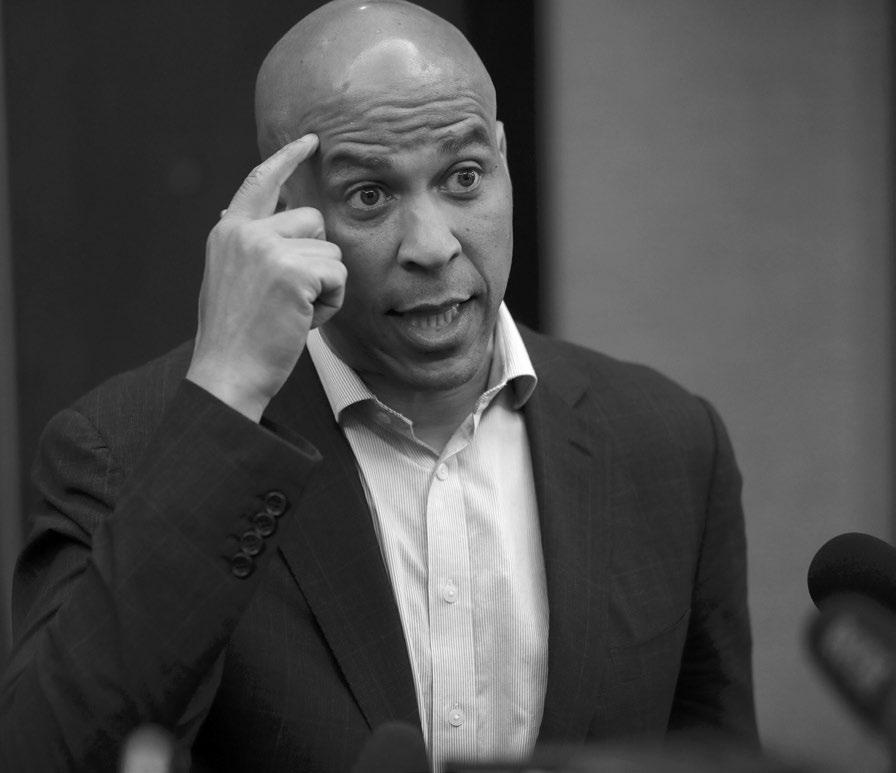
In letter, Cory Booker urges Yale to make farmworkers’ rights pledge
BY JERRY GAO STAFF REPORTER
Sen. Cory Booker LAW ’97 wrote a letter to Yale Hospitality last month, urging the University to join a farmworkers’ rights initiative.
Booker’s one-page letter, dated March 26, added to the Yale Student/Farmworker Alliance’s campaign for Yale Hospitality to participate in the Fair Food Program. Student organizers have hosted screenings and petitions, and recently marched to Yale Hospitality’s offices in an
effort to pressure the University to join the program. “As a proud alumnus of Yale Law School (Class of 1997) and a longtime advocate for a healthier and more equitable food system, I write to urge Yale Hospitality to join the Fair Food Program (FFP),” Booker wrote, later adding that “Yale has long been a leader in both scholarship and social responsibility.” Booker, a New Jersey Democrat who ran for president in the 2020 Democratic primary and is seen as a potential 2028 contender, is a member of the Sen -
ate’s Agriculture, Nutrition and Forestry Committee. In the letter to Yale’s assistant vice president for Hospitality, Jodi Smith Westwater, Booker referred to his personal experience with the Coalition of Immokalee Workers, the group that created the Fair Food Program.
Student/Farmworker Alliance member John Robert Walker ’28 shared Booker’s letter with the News. Booker’s office confirmed that the senator wrote the letter but did not respond to the News’ emailed inquiry about what prompted him to do so.
Alexa Gotthardt, a Yale Hospitality spokesperson, wrote in a statement on April 7 that the University has “received the letter and a response is forthcoming,” but did not respond to the News’ questions about whether Yale Hospitality has reconsidered its position.
Gotthardt referred the News to a previous statement in which she wrote that Yale “is not currently positioned to become a formal signatory to the FFP, given its role further downstream in the supply chain,” but that the University is “aligned with the program’s goals.”
The protest last March was organized by the Student/Farmworker Alliance. Walker, who has since announced his candidacy for Yale College Council president, wrote in an email to the News that the alliance had contacted Booker, who then agreed to write the letter.
“Despite Senator Booker’s letter urging Yale to join the FFP, an official resolution from the Yale College Council, a petition signed by hundreds of students, and no clear reason for not joining the program, Yale Hospitality has refused to take any goodfaith steps toward joining the FFP,” Walker wrote. According to the alliance, its petition had 300 signatories by the end of March.
According to the Fair Food Program’s website, buyers that participate in it — including companies such as McDonald’s and Walmart — must agree to buy produce from farms that guarantee certain worker protections and abide by a code of conduct. Buyers also agree to pay a premium of one cent per pound picked, which goes to farmworker wages.
Yale Hospitality has said that it hopes to source more produce from program-affiliated suppliers. According to Gotthardt, more than 64 percent of Yale Hospitality’s tomato purchases through suppliers are sourced from growers affiliated with the Fair Food Program, and the
University hopes to increase its percentage of tomatoes from program-approved growers to 90 percent.
Booker’s letter discussed his experience with the Coalition of Immokalee Workers.
“The FFP was created by the Coalition of Immokalee Workers (CIW), who I had the pleasure of meeting while participating in the Food Inc. 2 documentary, which highlights the systemic abuses farmworkers face,” Booker wrote. “I learned from the CIW about the extreme poverty, sexual harassment, and labor trafficking faced by many farmworkers, and the power of market-driven accountability to create real change.”
Booker wrote that joining the program would set “an example for students, alumni and peer institutions about the power of ethical purchasing decisions and institutional leadership in ending longstanding abuses and transforming labor conditions for farmworkers for generations to come.”
According to Walker, the group is in the process of contacting more alumni to support the group’s campaign.
“We’ll contact dozens more prominent alumni in the weeks ahead, and we expect many will follow Senator Booker’s example and call on Hospitality to support the human rights of the farmworkers who grow our food by joining the FFP.” Walker wrote.
Booker graduated from Yale Law School in 1997. The Law School’s dining hall was independently operated prior to 2011 and stopped accepting undergraduate swipes in 2009. According to its website, Yale Hospitality now operates Café Law, which serves “coffee, sandwiches, salad, or soup for lunch, and plenty of snacks.”
Contact JERRY GAO at jerry.gao.jg2988@yale.edu.
GAGE SKIDMORE / WIKIMEDIA COMMONS
Sen. Cory Booker, a Yale Law School alumnus, wrote a letter last month to Yale Hospitality, throwing his weight behind a student campaign for the University to join the Fair Food Program.
Students teach workshop on how to use Anthropic’s AI tools
BY MELISSA ADAMANTIDI STAFF REPORTER
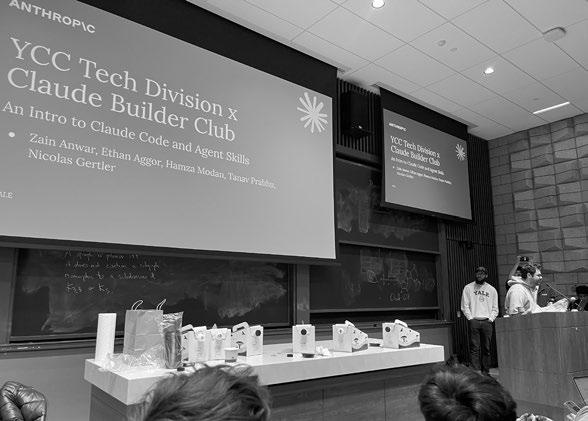
More than 100 Yale students packed Davies Auditorium on Thursday evening for a Claude agentic tools workshop, which provided a hands-on introduction to Anthropic’s artificial intelligence tools and was co-hosted by the Yale College Council’s tech division, the Yale Claude Builder Club and the Yale Entrepreneurial Society.
The event marked the first major initiative from the YCC tech division, which is a pilot program that was launched this year. Over 150 students preregistered for the workshop — a figure that organizers said reflected a growing demand on campus for programming that introduces non-technical students to emerging technology.
“Events like this are meant for students to really discover what’s out there and also not feel intimidated,”
Joseph Elsayyid ’26, a Davenport College senator and the chair of the tech division, said. “When you have so many changes and so much development happening so fast, especially young people like us get intimidated, but workshops like this
show that it’s actually quite easy to dip your toes in, and you can be really shocked at what can happen.”
Presenters walked the crowd through a series of live demonstrations with both Claude Code and Claude Cowork, Anthropic’s agentic AI tools, which utilize a user’s file system, browser and installed applications to execute tasks. Using its help, the presenters coded a simple video game, generated a slide deck from academic research papers, constructed websites for local businesses and integrated Claude with Gmail and Google Calendar.
In one demonstration, a presenter used Claude to locate a friend’s contact information and send a birthday dinner invitation, pulling from email and calendar data in real time. The crowd clapped enthusiastically when the AI successfully sent the message after a few attempts.
“The next step is the agentic phase, where you’re not only asking and getting an answer from these chatbots, but you’re also getting the agentic side where it’s doing stuff for you on your computer,” Zain Anwar ’29, a member of the tech division, said. According to Anwar,
every student who attends one of the workshops gets Claude Pro for free for six months.
“Accessibility is the best way for you to learn,” Anwar added.
Nicolas Gertler ’27, who co-leads the Yale Claude Builder Club, helped organize the event. Gertler described himself as a liaison between Yale student groups and Anthropic, and he promotes the company’s products on campus. He said he applied to be an ambassador for Anthropic through its worldwide campus program.
“We’re representing Anthropic, promoting on campus and getting students to use Claude,” Gertler said.
Elsayyid framed the YCC tech division’s broader mission as aiming to help Yale students develop a nuanced understanding of AI’s capabilities.
“It’s important for Yale students to develop a working relationship of what AI can and cannot do, as well as what aspects of their exploration benefit from automation and what areas they think they can focus on building skills that still need human refinement,” he said.
Throughout the evening, the organizers emphasized Anthropic’s AI program as a tool that is relevant across disciplines and, at several
points, said that none of the tools they demonstrated required any programming knowledge.
Anwar, who described himself as a non-technical student, said he has used Claude Code to build websites and products in the healthcare and biotech space.
Alder sends children scrambling for Easter eggs at hunt in the Hill
BY NELLIE KENNEY STAFF REPORTER
of kids raced for thousands of Easter eggs in the
annual egg hunt hosted by an alder in the Hill on Saturday.
Tables and tents surrounded a field behind the John C. Daniels School of International Communication as children swinging colorful baskets, grocery bags and popcorn buckets queued outside the area roped off for Ward 3 Alder Angel Hubbard’s second
NELLIE KENNEY / CONTRIBUTING REPORTER
Hundreds gathered on Saturday for an Easter egg hunt organized by Ward 3 Alder Angel Hubbard and funded by local motorcycle and social clubs, continuing a tradition started last spring.
annual Easter egg hunt. Hubbard directed the crowd from a temporary stage provided by the city’s parks department. Bubbles drifted, music blared and hot dogs sizzled.
“I need the other wards to see that Ward 3 is lit today,” Hubbard said in a speech before the hunt began.
Also milling through the crowd were members of local motorcycle and social clubs — including the Presidents Motorcycle Club, of which Hubbard is the sergeant at arms, she said. Several clubs pitched in to help fund and organize the hunt. That funding supported a range of prizes, including bicycles, two TVs and heaps of games and teddy bears.
Before the start of the egg hunt, Hubbard invited the family of Kaiden Phillips, a 15-year-old boy who was fatally shot in Newhallville in September, to the stage. Hubbard presented the family with a city citation of condolence and named the first round of the egg hunt in Phillips’ honor.
“For every egg, for every kid, for every laughter that we do today is in honor and memoriam of him,” Hubbard said.
The youngest children opened the hunt accompanied by their parents,
dashing across the field to gather eggs. Most eggs contained candy, but a few golden eggs corresponded to special prizes.
Inez, 9, won a blue stuffed bear after she found a golden egg. She said she was “happy” about receiving the bear. She had not decided what to call it, but was considering “Bluey,” she added.
Marcia Perkins, who attended with her grandchildren, said it was her first time at the egg hunt.
“I think it’s wonderful for the children, bringing them outside on this beautiful day that we finally have,” she said.
During a time in which “there’s a lot going on,” Perkins said that it was “great getting the kids together, making new friends, some from other schools.”
The Infamous Fusion Drill Team & Drum Core, a local youth drill team, performed. They were followed, in between the second and third rounds of the hunt, by another local youth team, the Elite Drill Squad and Drum Corps.
Several city leaders, including Board of Alders President Tyisha Walker-Myers, Board of Alders Majority Leader Richard Furlow and acting-New Haven Police
Chief David Zannelli, were among the crowd.
Zannelli said the hunt was
“something the city needs more of.”
“We need more events like this, showcasing unity and togetherness, rather than just getting together when there’s a crisis,” he said.
Hubbard encouraged attendees to call her “Yummy,” a nickname she said she grew up with. In a speech near the end of the event, she told the crowd that she did not hold the hunt because of her position as alder. “I did that because I am Yummy, period,” she said.
“We all had nicknames,” Hubbard said of her family in an interview. “And my mom — it was never ‘mom’ or ‘mama,’ she was ‘Honey Ma.’” Mary Ogman, or “Honey Ma,” died last August, and Hubbard dedicated the final round of the egg hunt in her honor.
“This right here is my mom,” Hubbard said. “She would have been dancing, throwing money. This is all her.”
The egg hunt began at 1 p.m. and lasted until around 4:30 p.m.
Contact NELLIE KENNEY at nellie.kenney@yale.edu
Local sculpture exhibit explores themes of migration and memory
BY ANGELINA KOVALCHUK STAFF REPORTER
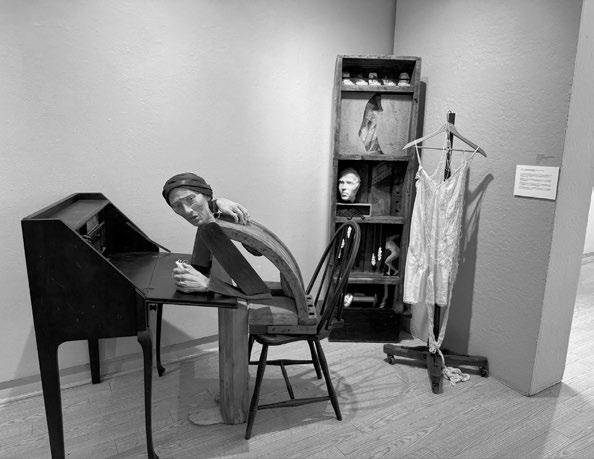
With a new exhibition called “Passages,” the New Haven Creative Arts Workshop is inviting visitors to consider themes of migration and memory.
The exhibition, which spans two floors of the gallery, showcases works from Susan Clinard and Fethi Meghelli, two prominent artists who have worked in New Haven. The exhibition is free and open to the public, and will be open until Saturday.
“Strength and vulnerability, pain and joy, hope and sorrow all come together in memorable experiences of a shared humanity that tug at one’s heart,” Judy Birke, the curator, stated in a press release.
In an email, Clinard wrote that the exhibition seeks to look “beyond individual experience and engage shared histories and collective narratives, seeking connection rather than division.”
Clinard’s sculptural collection,
“The Weight We Carry,” approaches that connection through traversing generations.
A trio of ceramic figures carrying weights behind them convey emotional burden through form and expression, exploring theories of intergenerational trauma.
“By showing these figures that are dragging, pulling, lifting these weights, it was envisioning how we push through difficulties that we carry, not in our own life, but also from our generations before
us,” Clinard said at an artist talk on Sunday. “But we can change those forms. They can get lighter, they can move, they can open, they can lessen.”
Clinard and Meghelli also confront movement and boundaries through works exploring migration and displacement.
“We feel deeply compassionate about the plight of those thrown into instability,” Clinard wrote. She wrote that the works honor the “brave and inspiring stories of countless refugees and immigrants who’ve found themselves transplanted in New Haven.”
Meghelli cited his experiences as an Algerian immigrant in France and the United States as inspiration for his work.
“Over the years, there were always things happening around me or even outside me, and it touches me proudly. And so I had to produce images that show that time, this time, all the time,” Meghelli said at the artist talk.
The featured works offer additional commentary on the uncertainty of the contemporary world. “Lady Liberty 2026,” a 6-foot sculptural depiction of the Statue of Liberty crammed into a coffin-like box, expresses a “present loss of our democratic values and principles,” Clinard said.
Clinard and Meghelli also explored found and discarded materials in their work. “One can see the evolution of materiality in the work over the decades,” Clinard said.
The exhibition also invites visitors to reflect on their own human experiences, such as through pieces like “The Carrier of Our Wishes,” a 7-foot tall sculpture covered in multicolored ribbons, each with written wishes from people who have viewed the sculpture. A note and basket of ribbons accompany the sculpture, inviting viewers to write their own “wish” and tie it onto the sculpture.
Clinard stated that she hopes visitors walk away with the impression that art is instrumental
in reviving the human spirit.
“It is a language of its own, interpreted and felt by the viewer,” Clinard wrote. “My hopes are that people walk away with a sense of connectivity, of beauty, of wonder and with questions that they may have to grapple within themselves.”
The New Haven Creative Arts Workshop gallery is located at 80 Audubon St.
Contact ANGELINA KOVALCHUK at angelina.kovalchuk@yale.edu.
MELISSA ADAMANTIDI
ANGELINA KOVALCHUK / CONTRIBUTING PHOTOGRAPHER
“Passages,” an exhibition at the New Haven Creative Arts Workshop that considers themes related to trauma and displacement, will be on display until Saturday.
ANGELINA KOVALCHUK / CONTRIBUTING PHOTOGRAPHER
ARTS
“Time
flies over us, but leaves its shadow behind.”
NATHANIEL HAWTHORNE THE MARBLE FAUN
Battle of the Bands brought funk and energy to Yale Farm
BY ANNA ZOLTOWSKI STAFF CRITIC
There is perhaps nothing that better encapsulates American alternative collegiate culture than a battle of the bands. Students cheer for their friends, bands strive to out-shred other bands and, despite the competition, the community is united by a shared desire to support independent student music.
That sense of community became all the more evident at the Yale Farm on Saturday, when students basked on picnic blankets under much anticipated April sunshine at Yale’s Battle of the Bands, where six bands vied for one of two spots available to open for Zara Larsson, Sheck Wes and Aluna at Spring Fling. Spring Fling announced on Sunday evening that the student bands Couples Therapy and Sunday Scaries won the competition.
The first of six bands was Assistant to the Professors, a quartet of faculty members. They opened their act with “Little Wing” by Jimi Hendrix, followed with “Where Is My Mind” by The Pixies. Their smooth and funky dad-rock beats serenaded the audience and their children, who ran circles around the stage. The faculty members’ attempt at getting hip with the kids underscored that Battle of the Bands was an event for the whole Yale community, toddlers included. Sunday Scaries, the largest of the six groups, played next. Beginning with “Locked Out of Heaven” by Bruno Mars was a fantastic choice to establish a high-energy vibe. Lauren Walker ’27 and Erin Kearney ’27 sang a beautifully harmonized lead vocal line, especially in their rendition of Sara Bareilles’ “Love Song.”
Sunday Scaries was the only band to include a violin, which,
at first, felt like a gamble. Would it remind the audience of sitting in stiff Woolsey seats rather than mosh pits on Old Campus? But the risk paid off: Justine Xu ’27 nailed her violin solos and supported Sunday Scaries’ big band sound with her constant bowing.
Third came the band Bird. Mila Volpe ’28 on lead vocals was a clear standout of the afternoon. Her voice was lush and jazzy, an unexpected complement to bluesrock standards like “Fortunate Son” by Creedence Clearwater Revival. Bird’s setlist, although entirely made up of cover songs — like every other set of the afternoon — felt uniquely fresh and exciting.
Grove Street Band performed fourth. Driven by a constant beat on the bass drum, they seamlessly transitioned from “Ain’t No Sunshine” by Bill Withers into “Crazy” by Gnarls Barkley. This genre switch-up was unexpected, yet their growly rock tone persisted throughout. Although proficient and consistent musicians, more flexibility in their tone would have better showcased their skills as performers.
After four musically-proficient bands, Couples Therapy brought all that and then some. Joey Cumpian ’26, who sang lead vocals alongside Pilar Bylinsky ’26, shouted for the crowd to get their “booties up” and come dance in front of the stage. With a mass exodus from the picnic blankets spread out on the grass, it was clear that the party had started. The two former Whiffenpoofs harmonized through “WHERE IS MY HUSBAND!” by RAYE and “You Go Down Smooth” by Lake Street Dive.
Supporting singers of such a caliber required an adept band. Greg Mann ’28 on drums backed each verse, chorus and bridge
‘Once’ captures fleeting
BY CAMERON NYE STAFF CRITIC
As one descends into the Saybrook Underbrook, New Haven is suddenly transformed into the heart of Dublin.
Dated beer and tobacco advertisements form a pasted collage on the wall. Glass bottles line a dilapidated mahogany bar. Empty stools beckon, inviting patrons to pull up and crack a Guinness. What completes the alehouse immersion is the cohort of live performers. Twanging guitars and mellow fiddles are accented by a thumping seat drum. Their players bellow beloved Irish anthems, laughing and carrying on while fumbling through The Pogues’ “Fairytale of New York.”
It’s clear that “Once” takes place across the pond, but just in case the audience hasn’t been clued in, the obligatory preshow announcement is delivered in a thick Irish inflection.
The musical — directed by Will Sussbauer ’27, a Yale Herald editorin-chief and a fellow theater critic — opened Thursday night, but, as a special treat, I was allowed
with a reliable, steady beat.
Closing with “Ain’t It Fun?” by Paramore, Couples Therapy solidified itself as a band full of capable, flexible performers who know how to bring the energy. Couples Therapy’s party of a set was a tough act to follow, but Don’t Sell Me the Dog put up a good fight as the last band to perform. Their first song, “You May Be Right” by Billy Joel, had a folk-rock feel, enhanced by Hugo Lehrach ’26’s husky lead vocals. The band was precise in a comfortable, worn-in kind of way. They closed out Battle of the Bands with “American Girl” by Tom Petty and the Heartbreakers.
A 1970s upbeat hit was a perfect choice for the last act. Battle of the Bands reminded me that Yale students are eager to support one another, whether it be at the Yale Farm or on the stage. However, the afternoon wasn’t simply a chance to listen to friends shred the electric guitar — or violin — but a highstakes competition. I breathed a sigh of relief when the Spring Fling committee revealed on Instagram that Couples Therapy made the lineup. Their funky, groovy style will nicely complement Larsson’s popstar vibe. Don’t Sell Me the Dog was my second
pick, for their reliable folk-rock sound which has been a student favorite for years. But students voted instead for Sunday Scaries, whom I still trust to deliver a rocking set at Spring Fling. Undercutting the integrity of the event was the fact that any student could vote to determine the winners, even if they didn’t attend Battle of the Bands. Despite that, this year’s lineup is funky and full of energy. I eagerly await their performances at Spring Fling.
Contact ANNA ZOLTOWSKI at anna.zoltowski@yale.edu.
REVIEW
intimacy in ballad after ballad after ballad
to attend the show’s invited dress rehearsal on Wednesday.
“Once” centers around the relationship between a 30-something Irish busker and vacuum repairman, referred to as Guy, and a witty Czech pianist, referred to as Girl, who takes a liking to him and the tender ballads he writes. Together with a motley crew of friends, they record a demo of his songs, forming an intense emotional connection that eventually shatters, highlighting the beauty of love in a single, fleeting moment.
Based on John Carney’s film of the same name and featuring music by Glen Hansard and Markéta Irglová, this ballad-driven musical finds a new space in the Saybrook Underbrook that, despite my own proclivities against contemporary musical stylings in theater, gleams as a stellar display of vocal talent. What makes “Once” so different from a traditional musical is its central gimmick: The actors are doing double duty as both the cast and the orchestra. Throughout the show, they strum acoustic guitars
and grasp fiddles, accompanying one another through prolonged anthems and the occasional jovial ditty. The ensemble, composed of Celtic and Czech confidants, add an integral lilt to the production’s pub-like atmosphere. Their commitment is commendable. Acting alone seems tough enough without playing an instrument.
While “Once” certainly is not the first musical to experiment with this styling, it does feature a more contemporary sound that can make this musical device more palatable. It also helps that most of the music is diegetic, so it makes sense that these characters are constantly playing music: They are at an open mic night or in a recording studio. Music represents one of the signature unifiers of the show.
I’ll be honest. I tend to prefer musicals with full orchestral pits, bombastic overtures, electric dance numbers and heart-wrenching torch songs that are performed in the textbook musical theater styling.
“Once” has none of those things. Instead, its score centers primarily on instrumentally stripped, emotionally intense ballads. “Once” leans hard into the coffeehouse, live-music atmosphere — the kind of bar scene where, for some, the draw is a guy with a guitar trying out his new material. For me, that’s usually a cue to leave. That live-pub energy initially gives the show a sense of spontaneity, until the setlist begins to settle into something far more uniform. At the beginning, the characters blaze through these numbers with a kinetic rush, but by the middle of Act 2, the sheer volume of slower ballads made me feel like I was being forced to watch “The Voice.”
The plot itself glistens as a gigging musician’s wet dream. Act 1 opens with a man pouring his heart out on the side of the road. He’s observed by someone who resolves herself to see him achieve stardom and dedicates herself both financially and emotionally to realizing that goal. Along the way, he solves every hurdle by whipping out his trusty guitar and serenading his antagonists until they are overcome by his musical capabilities. Every time he sings, onlookers ogle with puppy dog eyes, staring in disbelief that they have the opportunity — nay, the privilege — of witnessing God’s gift to music perform.
Then, finally, after she begins to let her guard down and allow herself to love again, he jets off to New York City to rekindle an old flame, losing the love of his life in the process. Yes, I’m being cynical, and these qualms are not necessarily the fault of Sussbauer & Co. Carney’s cheesy book just wasn’t my cup of tea. If you’ve ever thought about busking or are a fan of Mumford & Sons concerts, then you will love this show — I won’t deny that. Also undeniable are the performances of John Colbert ’26 and Sadie Pohl ’26 as Guy and Girl. Colbert brings a guttural yet delicate edge to Guy. One moment, he wails while seemingly beating his guitar, his gorgeous tenor invading
your eardrums until your bones begin to quake. The next, he retreats into a lofty falsetto that heals the very air through which he just sliced. His tantalizing yells and enthralling riffs seize the audience from the very first strum of his guitar.
On the other hand, Pohl’s soprano unfolds with urgency and contemplation, straining for a dream that lies just out of reach. Her initial fragility morphs into strained introspection, all while perched behind a baby grand piano. Her rendition of “If You Want Me” feels taut, sometimes blooming with soaring high notes, sometimes splintering with sentimentality, but always searching for the meaning in her life.
The pair is the engine driving the production. When they sang together, I set aside my qualms and sank deep into my chair. For a moment, I understood why “Once” is so critically acclaimed. I understood why it swept the 2012 Tonys. I understood why its song “Falling Slowly” won an Academy Award. Pohl is undoubtedly the star of the show. For as impassioned and breathtaking her vocals are, it is acting that serves as the show’s emotional heart. It’s clear she has a deep understanding of her character. Her honest, heartbreaking and at times refreshingly comedic performance illuminates the underlying tragedy of her character: a single mother who, despite her best intentions, deprives herself of any sympathy.
“Once” may never fully win me over. Its earnestness still veers dangerously close to being saccharine. But in the intimate confines of the Underbrook, it doesn’t have to be. When Colbert and Pohl sing, the show sheds its clichés and becomes something far more immediate: two people, a handful of instruments, and a fleeting connection. The production invests in the ephemerality of love, and, ironically, that message remains permanent.
Contact CAMERON NYE at cameron.nye@yale.edu.
ANNA ZOLTOWSKI / CONTRIBUTING PHOTOGRAPHER
Of the six bands that performed on Saturday, Couples Therapy and Sunday Scaries won the chance to perform at Spring Fling.
COURTESY OF ANGELICA PERUZZI
The 2012 musical turns the Saybrook Underbrook theater into a Dublin bar and the scene of triumphant singing.
THROUGH THE LENS
SLIVERS OF SUNSHINE
Photos by Braden Mathis Staff Photographer
WOMEN'S LACROSSE
BY AZARA MASON STAFF REPORTER
The Bulldogs (11–2, 5–0 Ivy) faced the University of Pennsylvania Quakers (6–6, 4–1 Ivy) on Saturday. Both teams entered the matchup undefeated in Ivy League play and tied for first in the standings, but the day ended with Yale firmly atop the conference leaderboard.
With the win, Yale also became the first team to secure a berth to the Ivy League tournament.
A little over five minutes after the opening draw, Penn got the first goal of the game to put Yale down 0-1. Yale’s defense, however, was quick to get back on the right foot.
Yale, currently ranked No. 12 in the nation by ESPN, has leaned on one of the top defenses in the country. The Bulldogs rank second in Division I in scoring defense, allowing fewer than seven goals per game, while goalie Niamh Pfaff ’28 holds the seventh best save percentage nationally.
On Saturday, Yale’s defense, and Pfaff, held Penn to just four goals. Pfaff tied her career high
with 11 saves en route to holding Penn to its lowest goal total since 2017. Captain Emmy Pascal ’26 played a critical role in limiting Penn’s opportunities, recording four caused turnovers and six ground balls.
Pascal’s first ground ball of the afternoon sparked a key transition moment, as she sprinted downfield and found Kate Gould ’29 at the top of the 8-meter arc. The play marked Pascal’s first career assist and was an example of Yale’s ability to truly turn defense into offense. After Gould’s goal, the game was tied 1-1.
Less than a minute later, Penn responded with a quick goal to reclaim the lead. A successful freeposition shot with 3:35 remaining in the first quarter extended the Quakers’ advantage to 3-1. Yale began to respond in the second quarter, as attacker Ashley Kiernan ’27 scored just three minutes in to cut the deficit to one. Gould added another with three minutes remaining before halftime, tying the game at 3-3 heading into the break. In the first three minutes of the second half, Yale’s backto-back goals from attacker Kelly Holmes ’28 and midfielder Whitney Froeb ’29 gave the Bulldogs a two-point lead at 5-3.
Attacker Nell Ducey ’29 converted a free-position shot with 4:36 remaining in the third quarter to give Yale a three-goal lead heading into the final frame.
Penn answered less than a minute into the fourth quarter, ending the Bulldogs’ 5-0 run, but it would be the Quakers’ only goal for
the entire second half. With just over three minutes remaining, Kiernan delivered a crisp pass from behind the cage to Ashley Newman ’26, restoring Yale’s three-goal advantage. The Bulldogs held on from there to secure a 7-4 win. Yale will look to pick up
another win over Harvard (5–7, 1–4 Ivy) on Saturday to remain undefeated in Ivy play. Faceoff is slated for noon at Reese Stadium.
Contact AZARA MASON at azara.mason@yale.edu.
Bulldogs upset Harvard, handing the Crimson their first Ivy loss
MEN'S LACROSSE
BY LIZA KAUFMAN STAFF REPORTER
The No. 17 Yale men’s lacrosse team (6–4, 3–2 Ivy) upset the No. 5 Harvard Crimson (9–2, 3–1 Ivy) 15-9 on a sunny Saturday afternoon at Reese Stadium.
The win marked the Bulldogs’ third straight conference victory.
With Reese Stadium filled to capacity on Alumni Day, the Bulldogs hosted Harvard for one of the season’s most anticipated matchups. Former players on the lacrosse team and members of several other Yale teams, including football and men’s and women’s hockey, joined the 1,450 fans in attendance.
“The energy was amazing. We get so excited after any win, whether it’s an early season one or one down the stretch,” goalie Ben Friedman ’28 wrote in a text message to the News. “Was an added bonus to have the alumni there, who know what it’s like to have that feeling.”
Before the rowdy sea of Yale Blue and Harvard Crimson, the Elis
handed the Crimson their first Ivy loss and second overall loss of the season, sending them on a long bus ride back up north.
Saturday’s victory extended Yale’s win streak to three and marked the team’s third upset of the season, including two over top-10 teams.
In February, the Elis steamrolled Boston University 16-11 at home and then edged past the defending national champions Cornell 13-12 in Ithaca at the end of March.
Yale controlled possession throughout, winning 18 of 28 faceoffs and scooping up 32 ground balls to limit Harvard’s chances. In the cage, Friedman made 10 saves, and the Bulldogs’ man-down unit held Harvard to just 2-for-6 on extra-man opportunities.
“We have gotten better each week at flowing together and making sure our rotations are on time, but ultimately having Ben Friedman in the net helps tremendously,” senior defenseman Eric Platten ’26 wrote in a text message to the News. That cohesion showed on Saturday, particularly in the Bulldogs’ man-down execution.
“We’ve been prepping our man-down defense for weeks now, and it’s always a focus in
every practice,” Friedman wrote. “Coach Fossner is all about the details in film, making sure we are communicating and connected. I think that just showed on gameday because we’ve been so buttoned up in practice.” In the 15-goal offensive explosion, seven different Bulldogs scored. Cole Cashion ’27 led the way with a career-high five goals, followed by Luke Pascal’s ’28 hat trick, the first of his collegiate career. William Sheehan ’26 and Dylan Blekicki ’29 each potted two, and Nick Wehmeyer ’28, Connor Gately ’28 and Peter Moynihan ’27 also each found the back of the net once.
The Bulldogs came out firing, setting the tone early and stunning the Crimson with their efficiency to take a 5-2 lead in the first quarter.
Although Harvard got on the board first at 11:53, Pascal answered seconds later to equalize the score and set off a four-goal run for the Bulldogs. From behind the net, Gately passed to Sheehan, who buried it to give Yale a one-goal lead. First-year attackman Blekicki then followed up with his first goal of the day, and Sean Grogan ’29 found Cashion to put Yale up 4-1. After Harvard goalie Graham
Stevens gave up four early goals, the men’s hockey team chanted “it’s all your fault.”
With 90 seconds remaining in the quarter, Harvard tallied its second goal to cut the deficit, but Pascal restored Yale’s three-goal lead at the 38-second mark to cap off a strong first quarter for the Bulldogs. As the buzzer sounded, the football team started the first of many “Harvard sucks” chants of the day.
Harvard’s Sean Jordan struck 10 seconds into the second quarter to bring the score within two, but Cashion quickly responded. Seconds later, Nathan Cobery put up another for the Crimson, to which the Elis answered with three consecutive of their own. Asher Ziv ’29 found an open Sheehan for his second of the day. Less than a minute later, Gately scored unassisted to double Yale’s lead to 8-4. At 3:16, with only three seconds left on the shot clock, Gately connected with Cashion for a first-half hat trick. Shortly thereafter, the Crimson capitalized on a man-up opportunity to trim the deficit to 9-5, but after a Harvard turnover, Blekicki scooped up the ball to notch his second goal of the game. With Blekicki’s goal, Yale led 10-5 at the end of the half.
The Bulldogs came out hot in the third, putting up two in quick succession. At 9:36, Moynihan pushed the lead to six, and 10 seconds later, Wehmeyer won the faceoff and then converted. Cobery added his second of the day for the Crimson to bring it back within six, but Cashion’s top-shelf shot, his fourth goal of the game, restored Yale’s seven-goal lead. Then, the Crimson responded with two of their own: Cobery recorded a hat trick and Teddy Malone, the Crimson’s top scorer who struggled all day against Yale’s defense, finally got his name on the board. Even with Harvard scoring two back-to-back, Yale held a fivegoal advantage at the close of the quarter. In the final 15 minutes, the Bulldogs continued to generate offense while the defense held off the Crimson, squashing any remaining hope of a comeback. At 10:38, Cashion potted his fifth goal
of the day to double his total this season. As the game wound down, Pascal notched a hat trick to make it 15-8, and Harvard closed out the scoring with a man-up goal at 4:18. After a successful clear at the 52-second mark, the Bulldogs ran out the clock as Yale fans jumped to their feet and the team rushed the field in celebration of the upset over rival Harvard.
While the Harvard game may carry added weight for Yale fans, the team is viewing the victory as just another step towards a playoff berth.
“Each game is a playoff game to us, so beating Harvard means just as much to us as beating anyone else,” Platten wrote. “The energy after the game was electric thanks to the crowd that came and supported us.”
Saturday’s victory was crucial, strengthening Yale’s position for an Ivy League tournament berth. While the Bulldogs will still need to beat Brown (6–5, 1–3 Ivy) in their final Ivy contest later this month, Yale is in a good position for a tournament appearance, particularly after Penn’s (5–6, 2–3 Ivy) loss to Princeton (9–2, 3–1 Ivy) over the weekend.
“I think if you were to ask most guys on the team they wouldn’t say yesterday was an upset at all. We all feel very confident in what we can do as a team,” first-year longstick midfielder Gaetano Cicotello ’29 wrote in a text message to the News. “It took a few games for us to figure it out, but going into the homestretch we all know what we are capable of, and we think we can beat anyone.”
Before they face Brown on April 25, the Elis will travel to Hempstead, New York, to play Hofstra (3–8, 1–3 CAA) in a Tuesday night matchup and then return to New Haven on Saturday for their final home game and Senior Day against UAlbany (7–4, 5–0 AEC).
Faceoff is slated for 7 p.m. on Tuesday at James M. Shuart Stadium and 4 p.m. on Saturday at Reese Stadium.
Contact LIZA KAUFMAN at liza.kaufman@yale.edu.
LIZA KAUFMAN / PHOTOGRAPHY EDITOR
Both Yale and Penn entered Saturday’s matchup tied at first place in the Ivy League standings, but Yale’s 7-4 win secured the Bulldogs’ place atop the conference.
LIZA KAUFMAN / PHOTOGRAPHY EDITOR
In front of a packed home crowd on Alumni Day, the No.