

BY SABRINA THALER STAFF REPORTER
Michael Mapuvire is well on his way to a career in business. He’s studied marketing, business ethics and consumer psychology and hopes to run his own accounting firm some day.
Before that, though, the 15-yearold will have to graduate high school.
Mapuvire is a student at Metropolitan Business Academy, a public magnet school in Wooster Square. The school is one of New Haven’s 15 interdistrict magnet schools, which enroll students from surrounding towns and run specialized academic programs such as Mapuvire’s “Business and Communications” pathway.
As students like Mapuvire fill the labs, art studios and business classrooms of New Haven’s interdistrict magnet schools, their administrators are at work on a stubborn problem: To keep the schools running, they must recruit enough suburban students,
including more who are not Black or Latino — or prove that they’re at least trying to.
Connecticut requires that at least 25 percent of students not identify as Black or Latino or an interdistrict magnet school risks not receiving essential operating grants. All but two of those schools in New Haven, including Metro, do not clear that bar. New Haven’s population is roughly 35 percent white, 31 percent Latino and 29.5 percent Black, according to the United States Census Bureau.
If a school fails to meet that rule, intended to expose students in urban centers to a more integrated peer group, administrators must submit a document proving to the state they have seriously invested in recruiting suburban, largely white families. New Haven Public Schools administrators say they are pulling out all the stops.
“We’ll do billboards along the suburban corridors, I-95 and 91,” Marquelle Middleton, the district’s

director of school choice and enrollment, said in a Zoom interview. “We have a commercial that runs on cable. We do radio spots on both urban and suburban radio. In the past couple years, we’ve done digital marketing, telling our vendor specifically who our niche market is, so that’s moms, non-minority moms of a certain age with kids in the household.”
Nearly three decades after Connecticut landed on school choice as a desegregation measure, the sought-after diversity in New Haven’s interdistrict magnet schools — measured by the presence of students who are neither Black nor Latino — has dwindled. It’s a trend that is challenging district administrators and highlights long-standing tensions among the city, its surrounding suburbs and other towns in the state.
The magnet schools’ main draw is a plethora of specialized, career-oriented curricular programs. First graders can become “environmental stewards,” sixth graders can specialize in engineering and high schoolers can have their pick between dance, social justice or healthcare coursework.
Every year, prospective families rank a list of schools by preference and wait to see their child’s placement. For Mapuvire, a Black student who lives in the Amity neighborhood in northwestern New Haven, Metro was his top choice after he was wait-listed from a technical school in Milford.
“From what I heard from Metro, it’s like, it has that business school mindset,” Mapuvire said in a phone interview. “I honestly enjoy Metro thoroughly.”
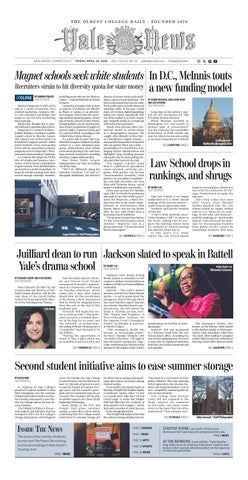
BY ASHER BOISKIN, ARIA LYNN-SKOV AND LEO NYBERG STAFF REPORTERS
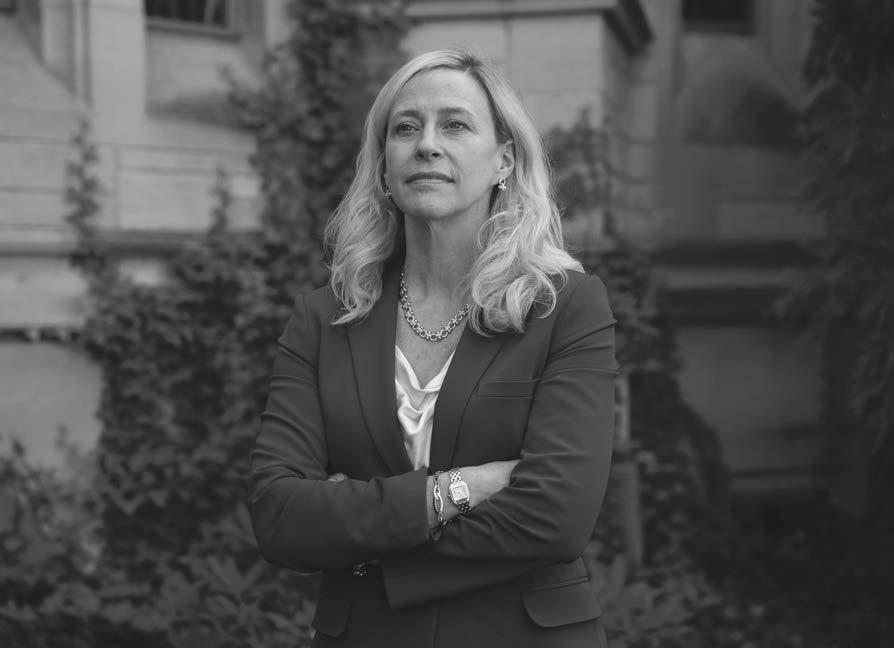
Long days in the nation’s capital are not uncommon for Yale President Maurie McInnis. When McInnis traveled to Washington, D.C., last month, “a primary topic of conservation” was the Financial Accountability in Research, or FAIR, model, she said, for which she was advocating to increase transparency in federal
BY HENRY LIU STAFF REPORTER
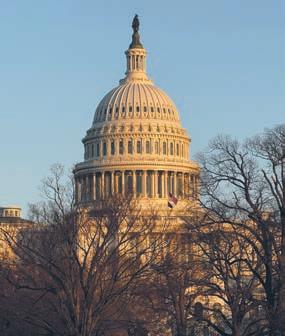
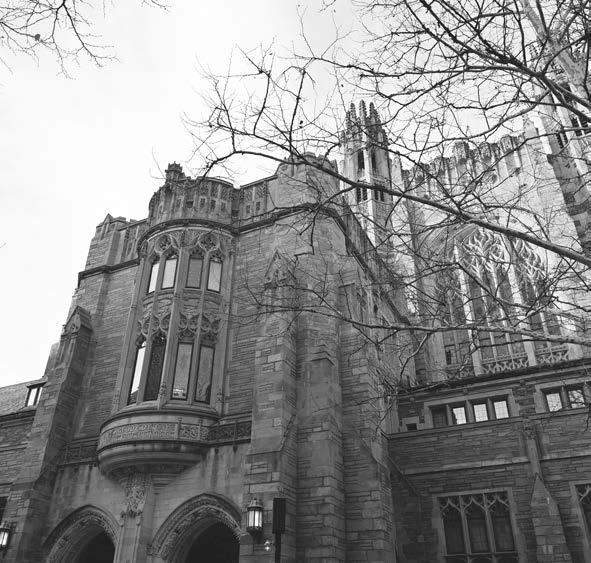
Yale Law School is no longer ranked first in U.S. News’ annual rankings of the best law schools — a spot it has occupied since 1990.
Students and faculty brushed off the fall.
“I don’t think anybody cares,” Colin Dunkley LAW ’26 wrote to the News, adding that he suspects the rankings matter more for students at schools moving into and out of the top 14. In this year’s U.S. News report, the Law School moved
down to second place, where it is tied with the University of Chicago. Stanford now occupies the top spot.
Yale’s drop comes four years after former Dean Heather Gerken decided that the Law School would no longer submit data to U.S. News for its rankings. At the time, she characterized the rankings as “profoundly flawed.” She criticized the rankings for discouraging students from public service careers by classifying students who were
BY HENRY LIU STAFF REPORTER
BY GEMARD GUERY AND KIVA BANKS STAFF REPORTERS
Evan Yionoulis ’82 DRA ’85, the current dean and director of Juilliard’s drama division, will be the next dean of the David Geffen School of Drama and artistic director of the Yale Repertory Theatre.
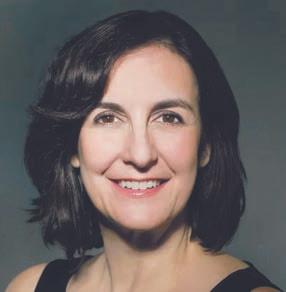
Yale President Maurie McInnis and Provost Scott Strobel announced Yionoulis’s appointment in a University-wide email on Tuesday afternoon, which came over a year after James Bundy DRA ’95, the current dean of the drama school, announced that he would be stepping down from the role at the end of this academic year.
Yionoulis will begin her tenure as dean on July 1. She previously served as a resident director of the Rep for 20 years, and she directed 14 productions, including William Shakespeare’s “Cymbeline” and “Richard II,” at the theater.
“Having the opportunity to return to Yale, a place which was so formative to me as an artist and
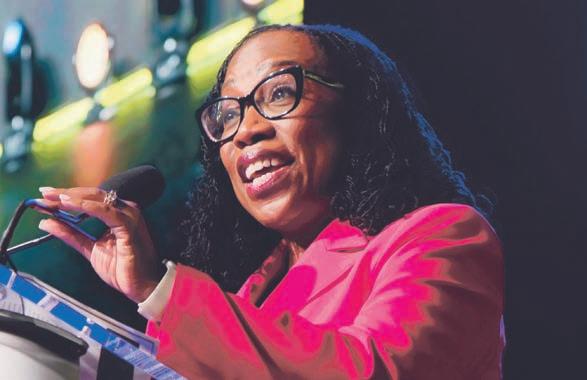
Supreme Court Justice Ketanji Brown Jackson is scheduled to visit campus to deliver a lecture before an audience of Yale Law School affiliates on Monday.
Jackson — the court’s newest member and the first Black female justice — is set to speak about the emergency docket through which the Court handles urgent disputes on a shorter timeline than its normal process. She will deliver the James A. Thomas Lecture, entitled “Equity and Exigency: A First-Principles Solution for the Supreme Court’s Emergency Docket,” on Monday at 4:30 p.m. in Battell Chapel.
“The emergency docket has become an increasingly powerful force,” Hannah Terrapin LAW ’26 wrote to the News. “I’m eager to hear the Justice’s perspective, especially considering the attention that she pays to the impact of the Court’s
jurisprudence on the lives of everyday people.” Jackson’s visit was announced in a February email from the Law School dean’s office. According to a Law School spokesperson, the event is open only to registered attendees from the Law School community and is at capacity.
BY OLIVIA WOO STAFF REPORTER
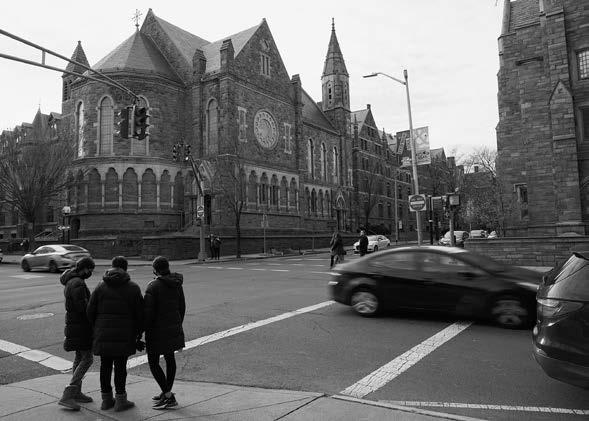
In response to Yale College’s phaseout of aid for students to store their belongings over the summer, Dwight Hall student leaders on Monday evening announced a new flatrate $50 storage option for low-income students.
The Dwight Hall plan is the second student-led initiative that has emerged to fill in for the College’s storage aid program, which began in
The owner of
2023. On Sunday, the Yale College Council Senate voted to disburse at least 127 stipends of up to $100 each to ease the burden of summer storage costs, and the council’s president and vice president announced Tuesday that students will be able to submit requests for those funds beginning Wednesday. Some details of the YCC and Dwight Hall plans remained unclear, a week after a News article confirming that the College would wind down its summer storage aid
set off an outcry among undergraduates and a flurry of activity among student leaders.
In an email to the student body on Monday, Dwight Hall Student Equity Coordinator Topher Allen ’27 and co-Coordinators Allie Ruiz ’28 and Carrie Lange ’27 wrote that Dwight Hall had allocated the contents of three pockets of its budget — which Ruiz said consisted of about $9,000 — to the storage alternative.
The Dwight Hall leaders wrote that the summer storage aid phaseout was
“the latest in a succession of FGLI policy setbacks” this year, referring to first-generation, low-income students and citing November’s cuts to non-competitive summer grants for low-income students.
Yale College Dean Pericles Lewis did not respond to the News’ request for comment on the claim. Last week, Lewis wrote to the News that his office understood “that summer stor-
April 10, 1989 / 300 Yale Students Rally for ‘Choice’ In Washington
By Bob Milius
Carrying signs reading, “Skull and Bones for Pro-Choice” and “Bush Should Have Been Aborted,” some 400 members of the Yale and New Haven communities joined hundreds of thousands of abortion rights activists in Washington yesterday to defend women’s legal right to an abortion.
“We’re scared,” Ellen Davidson ’90 said. “We’re coming to the realization that the thing we’ve taken for granted can be taken away.”
The Supreme Court will hear arguments April 26 in a Missouri case that pro-choice and anti-abortion forces agree could significantly alter the 1973 Roe v. Wade decision that gave women the right to an abortion.
By Sabrina Thaler
Over the course of my time reporting for the News on education in New Haven, my editors and I noticed a conspicuous pattern: New Haven’s public schools have specific, often very long names. They referred to the schools’ unique “themes” — business, international communication, arts, engineering, aquaculture and architecture, to name a few. I quickly became curious about how they had gotten so specialized.
Myself a graduate of a public magnet school in Maryland, I started my reporting confident. I knew that school themes were intended to attract students from across a large geographic area and to give families autonomy in the school choice process. But as I interviewed the administrators who oversaw many of these schools’ development in the 1990s and 2000s, I realized that the story was more complicated. Many of these schools enrolled students from beyond New Haven’s boundaries. They had complex roots in a state Supreme Court case, 30-year-old legislative negotiations, racial segregation in Connecticut and the state’s hyper-local governance model.
I spent two months interviewing past and present district administrators, a demographer, school-level educators and policy experts, learning about a system whose purpose was to “diversify” schools in a surprising way: by enticing white, suburban families to send their kids to school in urban environments with high populations of Black and Latino students.
As I learned about this fraught history, I also met some of the passionate students who attend these schools each day. They go to class, hang out with their friends and want to positively impact the world. They’re grateful to have picked where and how they learned. I hope you’ll read more about them and where they spend their weekdays.
Read “Magnet schools seek white students” on page 1.



COLUMNIST AMI GILLON
OK, I’ll bite.
I’ve read the Harvard report and the Yale Daily News articles; participated in formal discussions with the Poorvu Center faculty and student advisory groups; and had many informal conversations with colleagues and students. So, as a faculty member, what do I think we should do about grades?
A key question seems to be whether grades represent some vague sense of “mastery” of the material, in which case there should be as many A’s as individual instructors deem appropriate — a situation which has resulted in the current relentless trend toward upward grade homogenization, with its attendant ills — or whether grades should rank students, in which case numerical quotas are required, and other problems arise. But as the meme says: why not both?
Suppose we adopt the 20-percent-plus-four standard for A grades — 20 percent of students in a course can receive an A, as well as an additional four. Note that if the percentages are rounded upwards, a 16-student seminar could have as many as eight students receiving A’s, so in practice, small classes could still have half the grades be A’s. We could even increase the percentage, perhaps to 30 percent of students, for upper-level classes such as humanities junior and senior seminars, senior projects and 4000-level STEM courses.
To recognize really outstanding work, we could invent the grade of A-plus, which Yale does not currently offer: let’s say 5 percent of students in a course plus one can get that, or 10 percent in upper-level courses (up to three A-plus grades in our hypothetical 16-student seminar), and the faculty member would have to write a justification for why each A-plus student’s performance merits such an honor. Such justifications could be used as a systematic basis for various kinds of prizes and honors, which are necessarily a relative ranking at the highest level.
But at the same time, for the A-minus grade we could formally adopt a “mastery” criterion — we could even call this grade “M” to indicate that it means something qualitatively different than just a weaker A. As an operational definition of “mastery”, we might set the standard that an M indicates that the student’s work fully justifies pursuing the subject at a higher and deeper level. One would expect lots of M’s — indeed, the ideal grade distribution would be all A’s and M’s — but the grade would convey something specific about the student that applies across disciplines, and there would be some accountability, in that one could tell post facto if M grades are legitimate by student performance in subsequent courses.
B grades would then indicate satisfactory work, but with perhaps some sort of remediation or tutoring recommended prior to
more advanced study. C’s would mean that the student gets credit for the course, but more advanced study is not recommended, perhaps not even allowed. D’s should be abolished — that grade currently means the student ought to fail, but the instructor doesn’t want a big argument about it. One of the deepest student anxieties about any of this is that their grade point averages will go down, and they will be less competitive for jobs and graduate programs. But any such competition requires relative rankings, so if everyone gets a 4.0, then such decisions have to be made on some other basis. This situation paradoxically leads students to neglect their coursework in favor of frantic efforts to distinguish themselves in other ways, while still needing the A.
Some of these problems might be mitigated by changing the wholly arbitrary — albeit time honored — equation mapping letter grades onto GPA numbers.
For example: if A-plus = 4.0, A = 3.9, M = 3.8, B-plus = 3.5 and B = 3.2, then there would indeed be almost no 4.0 GPAs — which is a good thing, as the relentless pursuit of perfection is one of the most negative features of the current system. But since the values of M and B’s or B-pluses are higher than they are now, those grades would cause less “damage,” and the median GPA would likely change very little. The presence of A and A-plus grades could thus signal truly outstanding work without significantly diminishing a typical student’s GPA.
Alongside all of this, I would advocate that in a student’s first semester — maybe even their whole first year — all courses should be graded Credit/Fail, thus reducing the effect of prior preparation and adjustment to college on student anxiety and ultimately GPA.
The Massachusetts Institute of Technology instituted a form of this system, with positive effects. By encouraging students to focus purely on learning and growth rather than outcomes when they first arrive, we might hope to shift the culture away from grades altogether. There are doubtless many legitimate objections to this particular scheme, as there would be to anything one could devise. But folks, we gotta do something. The mounting effects of grade inflation on student course selection and behavior; the anxieties it introduces for students and faculty alike; the degradation of the classroom learning environment; the toxic political situation that currently surrounds higher education: all of these make some kind of action essential. If we don’t summon the will to make a change ourselves, change will be forced upon us.
CHARLES BAILYN is the A. Bartlett Giamatti Professor of Astronomy & Physics. He graduated from Yale College in 1981. He can be reached at charles. bailyn@yale.edu.

Our venerable college seems keen on following Harvard’s example in considering a cap on A grades. This, we are told, will usher in a new golden age of learning. When grades are artificially lowered — when they “mean something” again — greatness and dignity will be restored to our institution’s once-hallowed halls.
So goes the reasoning of our college’s leaders. But like many of the student life and student-adjacent “reforms” this administration has implemented, grade caps are senseless, misguided and fundamentally myopic. They’re useful in one way, though: they provide a lens through which to more broadly view the philosophy of our college’s leaders.
No golden age will sprout from a regime of grade caps. A sizable portion of the student body will continue to opt for shortcuts and workarounds to obtain a prized A, rather than learn for the sake of learning. The ostensible goal of an undergraduate education — that is, education — will not come any closer to returning to our longlost lyceum.
As a notable editorial in the Harvard Crimson argued, one must perform marvelous mental gymnastics to believe that “a tool as crude as a quota” will solve these unfathomably complex problems.
We’ve seen this policy play out before with disastrous consequences, at a comparable school with a comparable student body. In the 10 years Princeton maintained its grade deflation policy, the college’s satisfaction ratings, among both students and faculty, plummeted. Anxiety roiled the college’s campus. Classmates, as one contemporary Princetonian noted, viewed each other as competitors rather than peers. And Princeton’s
administration was ultimately forced to axe the policy after mounting criticism. It requires enormous hubris to believe the policy would fare any better at Yale today. As with many of the policies our college’s leaders implement — or form a committee to deliberate on their implementation — grade caps are the equivalent of slapping a band-aid on a bullet wound. No, sorry. They’re akin to slapping a band-aid on a patient’s left arm when the bullet pierced his right.
We’ve seen this playbook used time and again. We’ve seen it with housing policy changes and storage space removal and the demise of shopping period. And we’ve seen it most recently with the rollback of the first-year registration timeline. Even after 110 first-year counselors signed onto a petition that eloquently refuted Yale’s stated and hypothetical reasons for implementing the policy, administrators maintained their course of action, claiming the rollback would reduce stress. For whom — the course registrars? The change, along with the even more recent termination of summer storage funding for low-income students, disadvantages the very student populations that this administration claims to most empower.
Our college leaders preach democracy, yet ultimately pay little more than lip service to students’ genuine concerns. Our college leaders, ensconced in onion-like layers of bureaucracy, seem to lack any pulse on the thoughts and anxieties of the community they purport to serve. They chain themselves to doublespeak solutions that paper over chasmic cracks. And they do this all while peddling dispassionate statements and dishonest language
that further illuminate their profound lack of comprehension of this university beyond its administrative structures.
Over the course of conversations with administrators and professors, I have been regaled with tales of a time when this college’s leaders made it a goal to seek the views of its constituents. To keep intact the things that worked and only fix the things that were truly broken. But then, there came a shift. Maybe it began when the dean of Yale College and the dean of the Faculty of Arts and Sciences became two distinct positions, as some have told me, or when college leaders were no longer recruited from residential college positions, as others have relayed, or when Yale amassed an endowment large enough that it no longer needed to busy itself with the views of those other than unelected bureaucrats.
Top officials, my interlocutors all agree, now wield their offices to satisfy their own ambitions — to make changes for the sake of making changes, to add a few more lines to their resumes, regardless of the consequences. Our college leaders venerate the all-alluring idols of efficiency and change while slaughtering the once-sacred cows of community and tradition.
Only when our deans and directors — whether current or new and more inspired — cut through these layers of bureaucracy and recommit themselves to the mission of this school can they truly begin to recenter the things that matter. Only when they start to once again make sacrosanct our community and traditions can they eschew senseless change for meaningful reform.
AMI GILLON is a junior in Saybrook College studying History. He can be reached at ami.gillon@yale.edu.
Universities have a strange tendency to shoot themselves in the foot.
In October 2024, President Maurie McInnis and the Yale administration adopted the recommendations of the Committee on Institutional Voice, advising faculty members and campus leaders not to comment on issues of current events, with certain exceptions. I am not someone who is antiadministration on principle. University administrations often make good decisions that benefit students and help improve and support higher education. So despite feeling skeptical of a policy that seems designed to appease conservative critics, I was willing to consider the utility of a certain sort of neutrality.
In the time since that report’s adoption, I’ve become resolute in my skepticism, and disappointed in Yale choosing to curry favor from a federal administration and a political movement explicitly organized against institutions of higher education.
I was initially suspicious that the policy would be invoked most often to justify silence on events that conservatives do not want publicized or discussed. Indeed, McInnis invoked the policy to explain her silence after the December 2025 shooting at Brown University. I don’t believe anybody expected McInnis to condemn the lack of gun control or call for political action, but the idea that speaking about the murder of university students would violate Yale’s new model of neutrality was chilling. Back in January, I wrote about the potentially misleading nature of the Buckley Institute’s report on faculty diversity and its abuse by conservative pundits to argue that Yale discriminates against conservatives. I was disappointed a month later when I read that McInnis had chosen David Brooks, a former opinion columnist for The New York Times, to be the inaugural President’s Senior Fellow.
Brooks has contributed articles to several publications — including The New York Times — that decry the wokeness of higher education.
In a 2023 article, he wrote that “ideological activism is replacing intellectual inquiry as the primary mission of universities.” In 2024, Brooks wrote a piece titled “The Sins of the Educated Class.” In it, he argues Ivy League leftists suffer from false consciousness: that their political opinions are not based on ideological convictions but on a desire to repent for their privilege.
My frustration with Brooks’ appointment does not stem from his political persuasions. It stems from his disingenuousness as a journalist. For example, upon arrival in New Haven, Brooks revealed to the News that he believes the media narrative around wokeness in higher education — to which he contributed — is seductive and even deceptive.
This is not the first inconsistency in Brooks’ writing. In a blistering critique of Brooks’ 2000 book “Bobos in Paradise” and his article “One Nation, Slightly Divisible”, Sasha Issenberg details how Brooks’ claim to sociological analysis is marred by a willingness to invent convenient facts. Infamously, Brooks used his position as a journalist for The New York Times to write a piece downplaying the Epstein files — calling the scandal overblown — before the next batch of files included images of Brooks at a dinner party with Jeffrey Epstein.
The dinner was left unaddressed in Brooks’ initial article. I am disappointed that, in the wake of conservative outrage over alleged hiring discrimination, McInnis chose to appoint a prominent centerconservative journalist of lessthan-perfect renown to a newly created fellowship, allowing Brooks to bypass any semblance of a meritocratic hiring process. The decision sends a distinctly non-neutral message: McInnis is appointing a conservative professor to placate conservatives who think Yale is too lefty.
And as recently as last week, McInnis told the News that she applauds the Buckley Institute’s invitation of United States Secretary of Education Linda McMahon. Yet the Department of Education, McMahon and the Trump administration have abused their authority to lay siege to American higher education, including through questionable investigations into Yale.
You might point out that Yale was spared targeted research funding cuts faced by Harvard, Cornell, Columbia and other peer schools. But tell that to the Yale employees who have been laid off, the researchers whose labs have closed and the students whose stipends and fellowships have been merged, reduced or eliminated as a result of federal research funding cuts and an increased tax on university endowments.
For an institution that claims neutrality, Yale seems to be making quite a few concessions to the American right, including to individuals whose actions suggest a hostility to higher education itself.
We should keep in mind that, for many of Yale’s most prominent detractors, the motivation behind their criticism is not a desire to see universities succeed. I doubt McMahon is concerned about the quality or prosperity of American higher education. Elon Musk and Donald Trump are hardly champions of a college degree. Rather, colleges and universities remain among the few institutions in American civil society capable of resisting the new right’s authoritarianism. These “concerns” about Yale and other institutions are but thinly veiled pretexts for destabilizing any potential opposition. At some point, institutional neutrality will become an institutional contradiction. The question is, when?
MANU BOSTEELS is a sophomore in Pauli Murray College studying Philosophy. He can be reached at manu.bosteels@yale.edu.
“To Ammu, her twins seemed like a pair of small bewildered frogs engrossed in each other’s company, lolloping arm in arm down a highway full of hurtling traffic...”
SCHOOLS FROM PAGE 1
The school choice solution
New Haven Public Schools’ push to build magnet schools in the late 1990s and 2000s was fueled in large part by a landmark state Supreme Court case on school integration.
In 1996, the Connecticut Supreme Court ruled in Sheff v. O’Neill that “racial and ethnic isolation” in Hartford-area schools constituted a form of illegal segregation under the state constitution, violating students’ right to “equal educational opportunity.” Black and Latino students were concentrated in Hartford public schools, while the surrounding districts were overwhelmingly white. The court ordered the state legislature to intervene.
The next year, legislators in the General Assembly responded with several remedies. One involved the development of magnet schools in urban centers that would attract students from across town lines with special programs.
Ed Linehan, who supervised New Haven’s magnet schools during their development in the 1990s and 2000s, said the preexisting public schools in cities like New Haven and Hartford had historically seen lower scores on state performance exams, deterring families who could afford to live elsewhere.
“How are you going to convince a family in Woodbridge or Guilford or North Branford or North Haven to have their kids get on the bus and go to school in New Haven, in lower-performing school districts?”
Linehan asked in a phone interview.
“The state, understanding that challenge, said, ‘Well, they’re not applying to a school district, they’re applying to a school. And so that school has to have a specialized offering, and it has to have a clear benefit for why a family would consider it.’”
The 1997 legislation created an avenue for school districts to be fully
Roughly 29 percent of Ross Woodward’s students come from out of the city. The student population is 51.9 percent Latino, 32.4 percent Black and just 7.6 percent white, meaning that it fails to meet the state’s “reduced isolation standard” of 25 percent of students not identifying as Black or Latino.
When interdistrict magnet schools in New Haven don’t meet the state’s diversity mandates, they are required to submit a “compliance plan” outlining how the school has sought to recruit the target students and how they can better hone their strategy, according to Middleton, the district’s school choice director. He described the documents as “exhaustive,” spanning 50 pages and requiring two or three months to complete.
In her compliance reports, Finn said she outlines how she spends time advertising Ross Woodward’s magnet theme to prospective families, including those in suburban towns.
“We are a classical-studiesthrough-a-digital-lens-themed school,” she said. “In eighth grade, we’re reading Charles Dickens or Emily Brontë.”
She has traveled to popular family destinations, such as a trampoline park in Hamden and a Chuck E. Cheese in Orange, to tell parents about her school’s program, she said.
“It always is shocking to me how few people from East Haven and North Haven know that we're an option,” Finn said. “People think New Haven, and you think downtown traffic and terrible bus commutes and all this negative, negative. And then I’m like, ‘Oh, no, I’m off of Exit 8 on 91.’”
The option to submit a compliance plan emerged in 2020 after the onset of the COVID-19 pandemic.
Before then, schools that didn’t meet the state’s diversity standards could lose their state grant funding — a risk that, in 2018, prompted New Haven Public Schools to shutter Cortlandt
“Wearetakingadvantageof invitingtheirsuburbanpeers here so that we can create theseexperiencesforourkids.”
reimbursed by the state for all capital expenditures associated with the construction of schools that would demonstrably “reduce racial, ethnic and economic isolation.” The funding boosted an effort already underway to rebuild and modernize New Haven’s public school buildings.
“We were like, ‘Shit. We’re gonna, you know what? We’ll rebuild every school,’” John DeStefano, who was New Haven’s mayor from 1994 to 2014, said in a phone interview, referring to the conversion of some local school buildings to interdistrict magnet schools with full state reimbursement.
Linehan said that by the time his tenure in the district ended in 2006, it was operating 18 interdistrict magnet schools, some brand-new and some converted from existing schools.
Within about a decade of their establishment, New Haven’s interdistrict magnet schools appeared to be making a difference, a 2009 report by researchers at University of Connecticut found. Students of color in the New Haven, Hartford and Waterbury school districts experienced “considerably more integrated peer environments” in interdistrict magnet schools than other schools, the report said.
The report also found that the magnet school students outperformed those at non-magnet schools across several criteria, with higher attendance rates, lower drop-out rates and better performance on standardized tests. The researchers conducted school climate surveys of students, which determined that the schools’ diversity fostered closer relationships across racial groups than in non-magnet settings.
Still, in the 2007–08 school year, most Latino and Black students enrolled in New Haven’s interdistrict magnet schools attended schools with less than 20 percent white enrollment.
From Chuck E. Cheese to 50-page reports Elizabeth Finn directs recruitment efforts at Ross Woodward Classical Studies Interdistrict Magnet School, promoting the K-8 school in Quinnipiac Meadows to prospective families within and beyond New Haven.
V.R. Creed Health and Sports Science High School after it failed to meet the reduced isolation requirements.
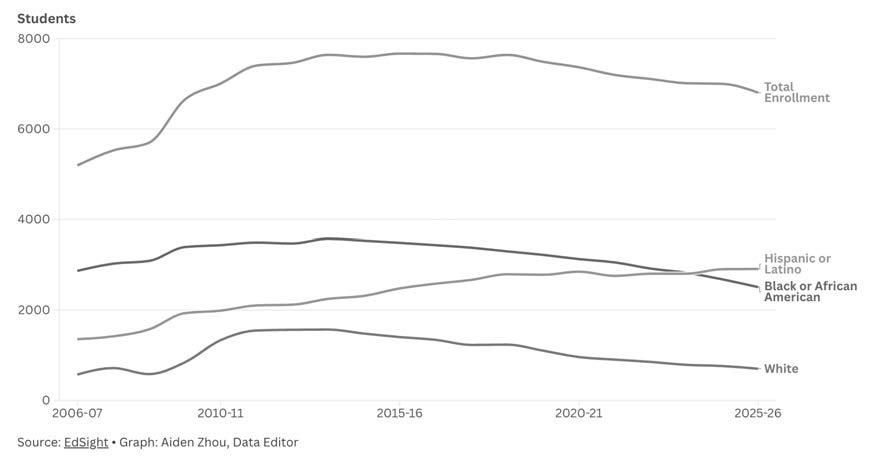
Demographic data released by Connecticut shows an overall rise in Latino enrollment in New Haven’s interdistrict magnet schools as the proportion of Black and white students has declined since 2007, the earliest year for which data is available on a state website.
In 2007, Cooperative Arts & Humanities Magnet High School enrolled 27.8 percent white students, 22.5 percent Latino students, and 49 percent Black students, the News reported at the time. Today, according to state enrollment data, that school enrolls only 12.7 percent white students, 40 percent Latino students, and 42.7 percent Black students. Most of the district’s interdistrict magnet schools have seen a similar shift over the past 20 years.
According to data provided by Connecticut’s Department of Education, most of New Haven’s interdistrict magnet schools continue to meet Connecticut’s residency standard for interdistrict magnet schools, which requires that no more than 75 percent of the students at each be residents of the host school district.
But one significant reason for the magnet schools’ shrinking white population, district leaders told the News, was that the suburban areas they recruit from are simply less white than they once were — a demographic trend affecting schools far beyond New Haven and Connecticut.
William Frey, a demographer and senior fellow at Brookings Metro, said in a Zoom interview that an aging white population and largely Latino immigration have contributed to an increasing proportion of people of color among American youth, including in historically white suburbs.
According to Michele Bonanno, the New Haven district’s supervisor of magnet grant programs, its magnet admissions process is race-blind: Administrators cannot see applicants’ races. West Haven and Hamden, two neighboring towns, have populations with near-parity between white and non-white residents. Branford, a more distant suburb, has
85.4 percent white residents. North Branford, just above it, has 91.5 percent white residents.
“So it’s made it harder where we have to go further into the suburban areas to attract families,” Middleton said. “But the reality is that a family living in, let’s say, Stratford or Milford, may not see the immediate value of coming into New Haven to help create and support diversity.”
Middleton said he thought state leaders should play a larger role in helping parents in suburban areas recognize the value of a more diverse education, perhaps through an incentive program for suburban towns to send their students into city schools.
Finn said that many of the suburban families she meets are impressed to learn about some of the offerings at Ross Woodward, like its two gym teachers, drumline and band programs and frequent school programming open to families. But she conceded that some families might choose to remain in their home districts because of extracurricular programs or after-school care not offered in New Haven.
Finn said suburban districts don’t have an incentive to promote interdistrict magnet schools to their students.
“Realistically, districts don’t advertise for other districts,” Finn said. “I do think that that’s kind of silly, in my professional opinion, especially if you’re having a child that’s not being successful. Maybe interdistrict magnet schools offer some of those extra programs to help other kids be successful that might not be offered in a home district.”
The superintendents of the public school districts in Milford, Guilford, North Haven, North Branford, Woodbridge and East Haven did not reply to the News’ inquiries about their role in interdistrict magnet schools enrollment.
A solution in vain?
For years, New Haven government and school district leaders have attributed many of the school system’s internal challenges — the elimination of staff positions, struggling facilities, school closures — to insufficient support from the state.
Connecticut’s public education system is different from that of many other states in that Connecticut municipalities operate their own separate school districts within the same borders. Because most funding for Connecticut public schools comes
from local tax dollars, towns with higher property values and more taxable property can spend more money on their schools.
During the 2024–25 school year, New Haven spent $21,346 per pupil, while the nearby towns of Guilford, Hamden and Branford — with higher median household incomes — spent $23,841, $24,882, and $29,396, respectively. Some policy advocates think these disparities are exactly what has prevented interdistrict magnet schools — designed to make town borders “permeable,” as Linehan, the schools’ onetime supervisor, put it — from reversing deeply entrenched segregation.
“I don’t know if anyone thought that just creating a magnet school system was going to solve how segregated Connecticut towns and schools are. That was not a realistic goal,” Michael Morton, the deputy executive director of the State + School Finance Project policy organization, said in a Zoom interview.
“We’re very segregated by town, which means we’re very segregated by school district,” Morton said. “And that hasn’t changed. And it’s not the fault of magnet schools that that hasn’t changed.”
In her majority opinion in Sheff v. O’Neill, then chief justice of the Connecticut Supreme Court Ellen Peters made a similar observation about the state’s municipal school districts.
The 1909 districting statute dividing the state’s school districts along town lines was, Peters wrote, “the single most important factor contributing to the present concentration of racial and ethnic minorities” in the Hartford region.
Elizabeth Horton Sheff, the lead plaintiff in the original Sheff v. O’Neill case and now an activist for integrated education in the Hartford region, said that the preservation of “local control” has held the state back from uprooting segregation in its public schools.
“Sheff is not meant to be a panacea,” she said of her case. “It never was, and it never will be.”
‘Create these experiences for our kids’
Beyond the specialized themes and the marketing investments, New Haven Public Schools’ strategy for attracting diverse suburban students is straightforward: “school improvement,” in the words of Bonanno, the magnet grant supervisor.
She described the district’s extensive efforts to strengthen opportunities at all of its schools, including career training, partnerships with professional institutions like Yale New Haven Hospital and dual enrollment courses at local universities. The grant funding the district receives to operate its interdistrict magnet program supports those opportunities.
“We are taking advantage of inviting their suburban peers here so that we can create these experiences for our kids,” Bonanno said. “Because without that, we simply do not have the resources to do it on our own.”
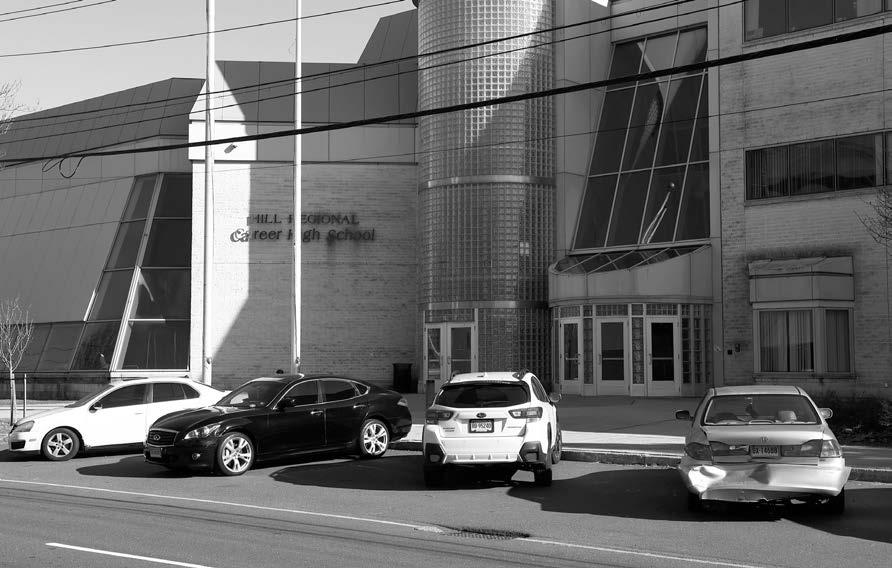
Hill Regional Career High School is located blocks away from the Yale School of Medicine and Yale New Haven Hospital. The school’s magnet programs focus on health and business, bolstered by ties to Yale and dual enrollment courses at Southern Connecticut State University. According to the school’s 2025–26 course catalog, one class includes “bimonthly visits to observe in the Yale Medical School Cadaver Lab,” while others offer training for students to become emergency medical technicians and certified nursing assistants.
The school also belongs to the majority of interdistrict magnet schools in New Haven that don’t meet the state’s “reduced isolation” standard. Of Career’s 626 students, just 8.5 percent are white, 5.75 percent are Asian and 3 percent identify as two or more races, according to state enrollment data. The rest are Black and Latino.
Sophomore Jelwa Hemat immigrated to the United States from Afghanistan when she was 4 years old, and said that many of her peers at Career hail from a variety of places, including Puerto Rico and Jamaica.
“The diversity in our school really shows you a different perspective,” Hemat said. “It also shows you what people can go through, because there’s people from all over the world, and once you hear their stories, you’re genuinely shocked.”
She said she would call Career diverse, with the caveat that “there’s not a lot of white people that go to our school.”
Hill Regional Career High School is located at 140 Legion Ave.
Contact SABRINA THALER at sabrina.thaler@yale.edu.
“I keep turning over new leaves, and spoiling them, as I used to spoil my copybooks; and I make so many beginnings there never will be an end.”
LOUISA MAY ALCOTT LITTLE WOMEN
RANKING FROM PAGE 1
awarded Yale’s post-graduate fellowships for public service as unemployed. Using public data, U.S. News continued to rank Yale Law School and other schools that stopped reporting data.
Several law students and professors largely dismissed the significance of the Law School’s new rank.
In a statement to the News, Law School spokesperson Alden Ferro wrote that the school “is focused on providing a rigorous and excellent legal education and increasing access and opportunity to law school and the profession,” adding that “we are proud to have sparked a movement away from these rankings four years ago.”
After Yale announced that it would stop submitting data to U.S. News for its law school rankings, Harvard, Stanford, Columbia, Berkeley and Georgetown also announced they would stop providing data. According to the Washington Post, 62 law schools did not provide data for the rankings as of 2023.
Sterling professor Akhil Reed Amar ’80 LAW ’84 cast the rankings in a different light, saying “we’ve never been number one in every respect, but we’re still clearly number one in many of the most important respects,” specifying Yale’s “intellectual tradition” and its “dominance” in producing the next generation of leaders and scholars.
According to the latest U.S. News rankings, Yale is ranked first for three graduate subjects — history, constitutional law and fine arts.
In 2019, Amar wrote an opinion article for the Los Angeles Times criticizing the rankings as imperfect. Amar told the News that he “stands by every word” of that article, emphasizing that he wrote it when “Yale was indisputably number one.”
In the article, Amar praised the effect the rankings had on Yale’s image, writing “thanks to U.S. News, most recruits need little persuasion; we have them at ‘hello.’ So my grapes are not sour and my gripes are not self-serving.”
Professor and former Law School Dean Harold Koh bashed the rankings as flawed and useless.
“We don’t need, and have never needed, US News to tell us who
we are. The whole point of leaving these rankings, which everyone knows are deeply flawed, was not having to care about how a magazine fiddles each year with its rankings to help sell more magazines,” Koh wrote to the News.
“Are they piqued because we left? Who knows or cares?”
“But Yale Law School has always judged itself by its own values, and it is and will continue to be the exact same unique school today as it was yesterday,” he added.
Eric Gertler, the executive chairman and CEO of U.S. News, has defended his company’s rankings. In an opinion article published in the Wall Street Journal in 2023, Gertler wrote, “But absent U.S. News’s academic rankings, it’s difficult to find accurate, comprehensive information that empowers students to compare institutions and identify the factors that matter most to them.”
“Our rankings don’t capture every nuance. Academic institutions aren’t monolithic or static; comparing them across a common data set can be challenging,” he continued. “But we reject our critics’ paternalistic view that students are somehow incapable of discerning for themselves from this information which school is the best fit.”
Students were also critical or indifferent about the new rankings.
Sam Haddad LAW ’26 wrote to the News that he does not find U.S. News’ rankings credible in assessing law schools, calling their methodology “deficient.”
“US News and World Report should utilize criteria that actually matter: student well-being, postgraduate debt, and longterm employment outcomes, not circular, elitist categories like ‘selectivity’ or ‘reputation,’” Haddad wrote to the News.
Hannah Terrapin LAW ’26 wrote to the News that she felt most students were “apathetic” about the change in rankings because they were aware that Gerken had stopped reporting data to U.S. News to allow the school to focus more on low-income students and students pursuing public-interest careers.
“I have benefitted tremendously from the Law School’s generous financial aid, so it will always remain #1 in my heart, regardless of what US News reports,” Terrapin wrote.
U.S. News has published its report ranking universities and colleges since 1983.
Contact HENRY LIU at henry.liu.hal52@yale.edu.
the Supreme Court’s current conservative supermajority.
Jackson was nominated to the court in 2022 by then-President Joe Biden and took her seat that summer. Jackson has voted consistently with the court’s liberal bloc and has authored forceful solo dissents, some of which have drawn the ire of conservatives and her fellow justices.
In a case last year in which the Supreme Court ruled that lower courts could not block President Donald Trump’s executive order limiting birthright citizenship through nationwide injunctions, Jackson issued a foreboding dissent.
She wrote that the court’s decision would allow “executive lawlessness” to flourish. “Eventually, executive power will become completely uncontainable, and our beloved constitutional Republic will be no more,” Jackson wrote.
Justice Amy Coney Barrett, writing for the majority, called out Jackson by name.
“We will not dwell on Justice Jackson’s argument, which is at odds with more than two centuries’ worth of precedent, not to mention the Constitution itself,” Barrett wrote, adding that Jackson “decries an imperial Executive while embracing an imperial Judiciary.”
In an interview with the News, Sterling professor Akhil Reed Amar ’80 LAW ’84 praised Jackson’s ques-
tioning at the Supreme Court’s birthright citizenship case last Wednesday. Amar filed an amicus brief in the case and was present in the courtroom during oral arguments.
“She was absolutely spectacular in the birthright citizenship case at oral argument,” Amar said, calling it “a really triumphant performance on her part.” When asked about Jackson’s philosophy as a justice, Amar demurred, saying that “it takes a while sometimes to grow into the role” and argued that Jackson was “now perhaps at an inflection point.”
Justice Sonia Sotomayor ’79 gave the James A. Thomas Lecture in 2014. Other past speakers for the lecture have included Randall Kennedy LAW ’82, a professor at Harvard Law School, and Chai Feldblum, an activist for LGBTQ rights. The lecture series was created in 1989 to honor James Thomas LAW ’64, a long-serving associate dean of the Law School who oversaw admissions for 35 years.
Ilani Nurick LAW ’27 wrote that he was excited to hear from Jackson because the talk would offer an opportunity to see how abstract classroom principles are applied in the courtroom.
Jackson graduated from Harvard Law School in 1996.
Contact HENRY LIU at henry.liu.hal52@yale.edu.
age is a challenge” and stressed that the aid’s end “was not a new decision, but I recognize that we could have communicated it more effectively.”
The Dwight Hall leaders’ email included a link to an interest form for the program, which asks students for their name, NetID and a confirmation that they believe they “meet all eligibility criteria.” Students will “likely qualify” for the storage option if their home address is more than 150 miles from Yale’s campus, if they live on campus and if they are eligible both for a full federal Pell Grant award and a “zero parent share” financial aid award.
“At this stage, our response from students has been robust
but is within the projected range of demand we anticipated,” Allen wrote to the News on Tuesday evening, referring to the volume of student responses to the interest form. “I’m personally in active discussions with several alumni and donors who are deeply passionate about issues of student equity at Yale. We are prepared to quickly scale up the infrastructure as donor support accelerates.”
Over 1,000 current undergraduates qualify for a “zero parent share” award, according to a Yale News article. The Dwight Hall storage option will not be available to students who live in nearby cities like New York City and Boston, given that they fall within 150 miles of New Haven. Last summer, Yale College disbursed up to $225 of summer storage aid to students who fell
under similar criteria. According to an email sent last April, the aid was available to “on-campus residents during both the Spring 2025 and Fall 2025 terms, with a parent share of up to $10,000 and whose permanent residency zip code exceeds 150 miles from New Haven.”
Ruiz said on Monday night that the Dwight Hall initiative was the first supplementary aid program for low-income students to come from Dwight Hall’s Student Executive Committee, and was spearheaded by Allen in his role as the inaugural student equity coordinator.
“We just created the role this year. And so this is exactly the type of work that we wanted him to be doing,” Ruiz said of Allen. “It really aligns with Dwight Hall’s goal, which is to be passionate about public service and help at-risk communities, and that includes marginalized students at Yale just as much as it includes all the other marginalized communities that we engage with.”
In a Tuesday morning email to the student body, YCC President Andrew Boanoh ’27 and Vice President Jalen Bradley ’27 thanked “friends at Dwight Hall” for the storage solution and encouraged students to use it as “an avenue to spend” the YCC stipends that will be disbursed in the coming weeks.
In the email, Boanoh and Bradley also solicited support for a forthcoming referendum that would ask whether students “condemn the Yale administration for raising tuition while reducing investment in undergraduate student life.” The bill proposing the referendum — separate from the stipend pro -
gram — passed unanimously at the final YCC Senate session of the semester on Sunday.
Ruiz said Boanoh and Bradley had been “thought partners” amid Dwight Hall’s formulation of the storage solution.
“The stipend program is wonderful, and I’m really happy that they’re doing something for FGLI students, and we also are doing our own thing,” Ruiz said. “There’s no competitiveness between the two, it definitely came from a collaboration of like, let’s put our minds together and figure out, ‘What are the ways that we can help students as much as possible?’”
Ruiz characterized the storage solution as an “emergency response” to the confirmation that student aid would be phased out. Last year, low-income students received notification from Yale College administrators about the summer storage support available to them on April 11. Anthony Arcangelo ’29 said on Tuesday that he was glad to learn of Dwight Hall’s storage solution, adding that “as a consumer, it’s always good to have options.” Arcangelo lives in East Haven and said that he had offered up his home to his suitemates before the storage option and stipend programs were announced.
He said that a day after he had learned that Yale College summer storage funding would end, he received an email from a storage company listing storage services that were “super expensive.”
“I was like, dude, there’s no way I’m gonna make my suitemates pay for this next year,” Arcangelo said. “I just sent out a text, like, ‘Hey, if anybody needs to store anything’ — because
they’re not from here — ‘I could find space in my house.’” A Yale College-sponsored summer storage guide from last year estimated the cost of unsubsidized summer storage — excluding transportation and supplies — to be upwards of $390. For $50, the newly announced Dwight Hall storage option will hold student belongings in “secure, fully insured, weather-proof storage containers that will be stored in an access-controlled off-site location managed by a private company,” Allen wrote.
“We’ve worked around the clock over the past week to negotiate discounted rates and terms most favorable to our FGLI peers,” he added.
Dwight Hall leaders also solicited Camp Yale student leaders — who stay on campus after classes end in May and move in earlier than most students in August — to support the transportation of their peers’ belongings to and from storage units. An email sent on Monday to incoming FOCUS leaders offered pay of $22 per hour, to be earned during 4-hour shifts from May 4 to 7 and Aug. 24 to 27. John Robert Walker ’28, an advocacy coordinator at Dwight Hall, said he “organized outreach to various Camp Yale Programs to get the initiative fully staffed.” According to Walker, over 60 students have filled out a non-binding form stating their interest in working the program.
Dwight Hall was founded at Yale in 1886.
Contact OLIVIA WOO at olivia.woo@yale.edu.
“If it’s your job to eat a frog, it’s best to do it first thing in the morning. And if it’s your job to eat two frogs, it’s best to eat the biggest one first”
funding of research administrative costs. McInnis’ ongoing lobbying efforts have been a focus of her presidency since President Donald Trump took office.
“I was there for 22 hours last week,” McInnis said in an interview on March 31. “Flew down late one night, had meetings all day and then flew back late that same night.”
During her trip, McInnis said she met with “a variety of senators and members of the House of Representatives.” McInnis added that she does not “usually like to say which lawmakers we meet with” and that the recent trip included meetings with lawmakers who were “generally receptive.”
“The big topic on the table,” McInnis said, “relates to facilities and administrative costs, or the things that are sometimes called indirect costs.”
The Trump administration has slashed funding from several of Yale’s academic peers while making policy demands. The federal government has not taken similarly targeted action against Yale — something that McInnis denied credit for in February — though Yale researchers have been impacted by sweeping federal funding cuts. Yale spent $1.2 million on lobbying in 2025, more than doubling the amount the University spent before Trump began his second term.
“The last 15 months, I think, has taught all of us in higher education the importance of listening broadly to the American people, listening to the criticisms of those who think we can be working on things and doing a better job,” McInnis said in the interview last week. “So I’d say the main lesson I have learned is we need to listen and ask ourselves, ‘Where are there areas that we believe we should be working to improve?’”
McInnis said the University has “long had support from many lawmakers” and that members of Connecticut’s congressional delegation “are among those champions” in Congress for Yale and higher education.
“Schools like Yale have opened doors for generations of students,” Senator Richard Blumenthal LAW ’73, a Connecticut Democrat, wrote to the News. “We are lucky to have so many incredible institutions of learning in Connecticut, including Yale, and I count their leaders as my most valuable partners in fighting to make college more accessible and affordable to students and to invest in their success.”
In February 2025, the National Institutes of Health proposed a blanket cap to indirect cost rates of 15 percent, “in lieu of a separately negotiated rate for indirect costs in every grant,” the agency’s notice read.
The cap was a substantial decrease from Yale’s negotiated rates for indirect costs, as high as about 70 percent. Indirect costs include a university building’s utilities, lab maintenance and administrative functions.
McInnis — who spoke out against the proposed cap last February — said that, when the cuts were proposed, “at the root of that was the sense that American taxpayers don’t understand how that money is spent.”
She said the goal of the FAIR model was to have a “considerably more transparent” system.
Several organizations — including the Association of American Universities, on whose board of directors McInnis sits — came together to form a group to develop a new model in response to the cuts. The Joint Associations Group on Indirect Costs is made up by experts including former government officials and university administrators.
The group developed the model and proposed FAIR as a replacement for the current reimbursement system that uses negotiated rates for individual universities.
The FAIR model splits research costs into three categories, separating the costs currently categorized as indirect into two buckets. One of those buckets would include costs specific to each research project, and the other would cover institution-wide operational costs necessary for research, according to an Association of American Universities webpage about the proposed model.
McInnis said she plans to pay another visit to Washington later
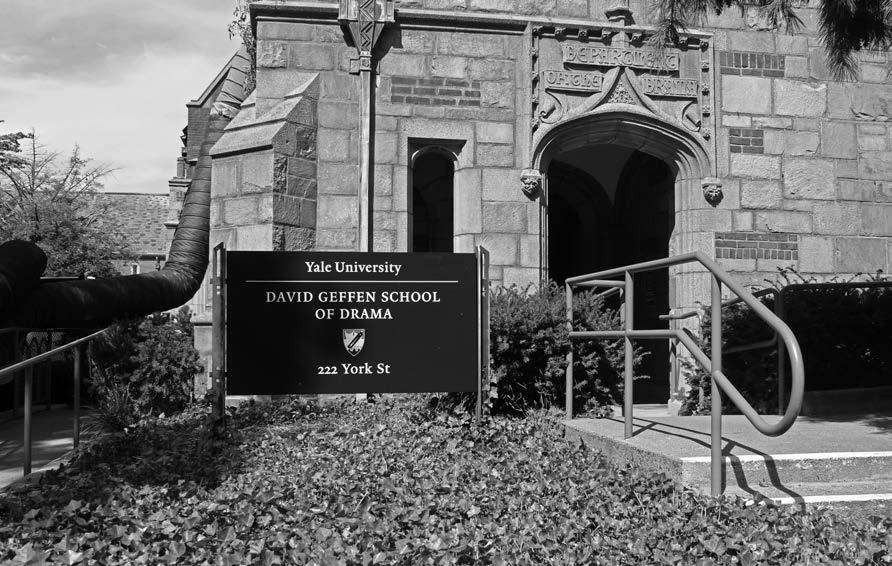
In July, Yionoulis, who previously taught at the David Geffen
a teacher, is incredibly meaningful for me,” Yionoulis wrote in a statement provided to the News by University Spokesperson Karen Peart.
Bundy, who has been the dean of the drama school since 2003, wrote in an email to the News that he has known Yionoulis for over three decades.
“Evan Yionoulis is a brilliant artist, teacher, and field leader,” Bundy wrote. “I am confident she will bring extraordinary focus, spirit, and invention to her role as Dean and Artistic Director.”
Yionoulis made significant contributions within the drama division at Juilliard, according to the announcement. In 2024, Yionoulis transitioned Juilliard’s master’s program in acting into a tuition-free model. She also established a teacher development fellowship program that provided mentorship and development support to aspiring acting, dance and vocal performance teachers.
As part of Bundy’s efforts to make Yale’s drama school more financially accessible, in 2021, it became tuition-free as a result of a
$150 million donation from entertainment mogul David Geffen. While serving as a dean at Juilliard, Yionoulis also taught in the drama division.
Before going to Juilliard, Yionoulis worked in the faculty at Yale for two decades, according to her profile on the Juilliard website. She was a professor of acting and directing.
“Having worked for her at the start of my career as a teaching assistant, I know she will be a superb guide to our faculty and staff, and an inspiration to students in every discipline of the theater,” Bundy added. Yionoulis, a graduate of Yale’s directing program, served as the chair of acting at the drama school for five years beginning in 1998. In that role, Yionoulis grew the curriculum and faculty size of the school’s acting department.
As an undergraduate at Yale, Yionoulis studied literature and theater studies. She participated in the Yale Dramatic Association and was a member of Saybrook College.
Bundy, who has been the longest-serving dean at the drama school, will retire from that post at the end of the academic year but
will continue teaching at the Geffen School and within Yale College.
Nancy Yao, the assistant dean of student life at the drama school, said in a phone interview that Bundy is an “exceptional” artist and colleague.
“It was really hard for me to imagine who could follow in those footsteps,” she said. “I understand that there were many amazing candidates, and I think that’s really the biggest testament to his legacy is that others wanted to continue and saw it as a place that they wanted to be.”
Yao said she is looking forward to Yionoulis’ tenure because the incoming dean is someone who has attended both Yale College and the drama school and has experience in a leadership position at a “comparable institution.”
“I’m really excited for the new dean to make her mark,” Yao said.
The David Geffen School of Drama was renamed in 2021 following the gift by the David Geffen Foundation. It was originally called the Yale School of Drama.
Contact GEMARD GUERY at gemard.guery@yale.edu and KIVA BANK at kiva.bank@yale.edu.
this month for a meeting with the association, and added she will probably spend an afternoon on Capitol Hill during that trip.
McInnis said that the concerns she encounters when meeting with members of Congress “vary wildly.”
The top three issues that come up, she said, “are also the top three that come up in polling with the American people: cost, access and is it a place that truly welcomes all viewpoints?”
In October 2025, Pew Research reported that an increasing percentage of Americans believe higher education is trending in the wrong direction.
The University announced in January that Yale College would offer free tuition to families earning under $200,000 annually. McInnis has praised the Yale-adjacent Buckley Institute, which bills itself as “a home for enlightened conservative thought,” and met in March with student leaders of the Yale Political Union, an organization that hosts debate among its politically varied parties. Contact ASHER BOISKIN at asher.boiskin@yale.edu, ARIA LYNN-SKOV at aria.lynn-skov@yale.edu and LEO NYBERG at leo.nyberg@yale.edu.
David Hogg was a survivor of the 2018 mass shooting at Marjory Stoneman Douglas High School, a co-founder of the March for Our Lives movement and more recently a vice chair of the Democratic National Committee until last June. On Tuesday evening, Hogg spoke at the Yale Political Union in favor of the resolution “Resolved: No Country for Old Men.” Hogg, an upstart 25-year-old in the Democratic Party, wasted little time getting specific in his speech. Hogg argued against what he characterized as a status quo of gerontocracy.
“Our generation does not have representation in Congress,” Hogg said.
Hogg gained prominence following his advocacy as a survivor of the 2018 shooting in Parkland, Florida. Hogg left the DNC after facing criticism for trying to back his own group, Leaders We Deserve, as a challenge to Democratic incumbents.
“We need people in government who are there to properly represent their constituents,” Hogg said. “In America, we don’t have kings.” Hogg set some limitations on his argument. He explicitly rejected age quotes and dismissed age-based term limits, adding that these would be ill-advised fixes that would make the system even more corrupt.
In his opinion, the best solutions would include overturning the Supreme Court’s ruling in Citizens United, paying elected officials more and barring members of Congress from owning stocks for the rest of their lives.
Hogg also invoked leaders such as former President Lyndon Johnson. Johnson entered politics young, and his willingness to sacrifice Democratic support in the South to enact the Civil Rights Act, Hogg argued, showed the leadership of someone with decades of experience from starting off young.
After Hogg spoke, Fernanda Ribeiro Wambier ’29 argued against the resolution. She contended that there was an intrinsic value in perspectives shaped by lives lived outside of political culture.
“When I think of great politicians, I think of people who have sacrificed for their country,” she said, “but I also think of people who have the mentality to think of certain ideas others may not have.”
Aidan Wong ’29 argued against the resolution, using an international lens to contend that gerontocracy is a symptom of political instability and not its cause.
This resolution, “No Country for Old Men,” passed 65 to 25.
Contact JUSTIN LEAHY at justin.leahy@yale.edu.

“There
are as many worlds as there are kinds of days, and as an opal changes its colors and its fire to match the nature of a day, so do I.”
BY ARIA LYNN-SKOV AND NELLIE KENNEY STAFF REPORTERS
Twelve people were recognized for improving town-gown relations at a Wednesday luncheon held in the President’s Room at Yale’s Schwarzman Center.
About 90 people gathered around tables laden with rolls and plates of frisée salad — the first of three courses — to hear the announcements of the Seton Elm-Ivy Awards. The attendees included representatives of Yale and New Haven, including University President Maurie McInnis, Mayor Justin Elicker, three New Haven alders and the superintendent of New Haven’s public schools.
“These awards illuminate the power of service and showcase how collaboration can bring people together, especially now in this moment of uncertainty,” McInnis said in a speech before the honorees were presented with certificates.
McInnis highlighted Yale’s recent voluntary contribution deal with New Haven, which she called “just one of the ways that we are continuing to build on three centuries of partnership.” In early March, McInnis and Elicker announced that Yale would increase the amount it gives in annual voluntary payments to New Haven by about $5 million this fiscal year. The payments will total around $230 million over the next seven years.
Elicker spoke after McInnis and also highlighted the voluntary contribution deal, calling the University’s recommitment to the payment “historic.”
Members of Yale’s Office of New Haven Affairs presented four attendees with the Elm Award, which
recognizes city residents.
This year’s winners were Mark Abraham ’02 MPH ’23, for his work compiling neighborhood-level data as the executive director of the local nonprofit DataHaven; Robert Bettigole ’76 SOM ’83 and Christopher McLeod ’77, for their investments in biotech as managing partners of the venture capital firm Elm Street Ventures; and Dina Natalino, for her work connecting Yale with New Haven Public Schools, for whom she currently works as a supervisor for college and career pathways.
“The award signifies that the work we are doing with Yale is having an impact,” Natalino said in an interview after the event. “And it’s humbling to know that other people are recognizing the impact that it’s having on our students.”
The recipients of the Ivy Award, which recognizes Yale affiliates, included faculty members James Bonz ’09, Leigh Evans ’95 and Tatiana Moylan ’22 for providing clinical training to New Haven teens through the Yale Simulation Academy; Kevin Charbonneau, for his innovation as the director of Yale’s Environmental Health and Safety Department; and Andrei Harwell ’06, for his collaborative approach to urban planning as the director of the Yale Urban Design Workshop. Two Yale undergraduates, Katelyn Wang ’27 and Johan Zongo ’27, were this year’s recipients of the Undergraduate Ivy Award, which was first established as a category in 1984. Wang and Zongo are the co-presidents of Bright Spaces, a public art organization within Dwight Hall that collaborates with local businesses to paint murals around the city.
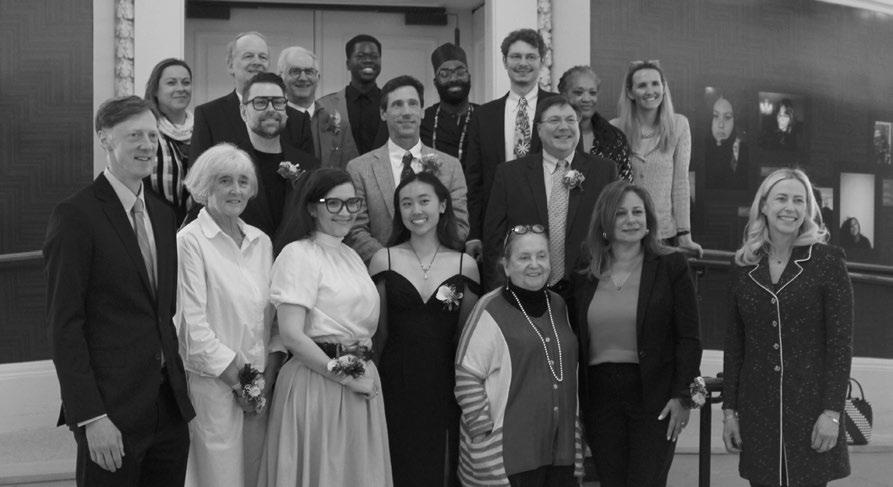
XIMENA SOLORZANO / HEAD PHOTOGRAPHY EDITOR At the annual awards ceremony, University President Maurie McInnis and Mayor Justin Elicker recognized both city residents and Yale affiliates for work that strengthens the relationship between the city and the University.
“They have turned public art into a powerful catalyst for community activism and youth mentorship,”
Karen McIntosh, the director of community affairs in Yale’s Office of New Haven Affairs, said when introducing Wang and Zongo. “Since taking the helm in 2024, they have worked to ensure that the diversity of New Haven is reflected in the city’s public landscape.” Wang said she has known about the awards since her first year.
“I always thought it was really cool,” she said. “I read stories about the other undergraduates,and I was very inspired.”
“So often this kind of work goes unrecognized,” Zongo said. “It’s just nice knowing that there is a platform for people to do what
they’re interested in and have a positive impact and have some kind of recognition for that.” Houngan Collin Edouard GRD ’27 received the Graduate/Professional Ivy Award for his work connecting Yale musicians with local activists and his involvement with the city’s refugee and immigrant communities. Edouard wrote in a text message after the event that he was “deeply appreciative of the support” shown to him, but added that in the light of the “collective efforts” involved in his accomplishments, “receiving this award feels somewhat paradoxical, as the essence of unity and shared encouragement should ideally be recognized as the standard, not the exception.”
The awards are funded by an endowment established through the Community Foundation for Greater New Haven by philanthropists Fenmore Seton ’38 and Phyllis Seton, who pitched the idea to a Yale administrator at Mory’s in 1979, according to a pamphlet provided at the ceremony. The Setons’ daughter, Diana Waterley, attended Wednesday’s luncheon. In an interview before the ceremony, Waterley called the luncheon a “wonderful tradition.”
Contact ARIA LYNN-SKOV at aria.lynn-skov@yale.edu and NELLIE KENNEY at nellie.kenney@yale.edu.
BY QAMAR AL-TAMEEMI CONTRIBUTING REPORTER
Yale Law School professor David Schleicher and former New Haven alder Eli Sabin ’22 LAW ’26 spoke to a room of about 20 students on Monday in an event sponsored by the new student group Yale Abundance.
The pair spoke about the challenges of pursuing zoning reform in New Haven. Schleicher is a scholar of property law and urban finance, and Sabin, a current law school student, is now a Democratic candidate challenging an incumbent state legislator.
“I thought it shined a light — a lot of them — on the challenges and the things that they’re facing, especially with the new vision of how they’re
reshaping the downtown,” attendee Nicholas Yee ’27 said, adding that he had recently read the book “Abundance” by Ezra Klein and Derek Thompson — an inspiration for the student organization that sponsored the event.
Sabin spoke about lessons from a political science senior thesis at Yale about zoning reform in Berkeley, California, and Minneapolis, Minnesota. In a phone interview, he said that seeing residents priced out of New Haven has motivated him to work on housing affordability.
“And so my takeaway from this was that the bang for your buck, basically, of housing reform, was on the side of trying to rezone a downtown or a commercial corridor
where you would more realistically see the ability for a developer to come in and build something at scale,” Sabin said of his thesis.
Sabin noted that focusing on the downtown area in New Haven was easier because there would be less opposition to big buildings in the area. Before stepping down from the Board of Alders in January, he championed a new rezoning plan passed by the Board of Alders in December that rezoned much of the city’s downtown for greater density.
Sabin expressed skepticism of the city’s earlier inclusionary zoning ordinance, passed in 2022, that mandated affordable housing in new developments. Sabin said it has been difficult to tell what the impact of the policy has been, adding that no new
developments have been built under it.
“But I would say that it was very helpful from a political and messaging perspective to have down — have inclusionary zoning in the background of this effort,” Sabin said.
In 2022, the New Haven Independent quoted Sabin’s endorsement of the legislation as Ward 7 alder. “I believe this is one of the most important pieces of legislation that the board has voted on in a number of years, at least since I’ve joined this body,” he said at the time.
At the event on Monday, Sabin and Schleicher also discussed the unique challenges of housing reform in Connecticut. In particular, Schleicher cited the prevalence of minimum acre building requirements in the state and the
lack of bipartisan efforts to adjust zoning laws.
In an interview, Schleicher cited fears of home owners skeptical toward zoning reform which included homeowner’s fears of declining home value, issues like traffic or construction noise, or a general fear of change. Sabin also cited high interest rates as a difficulty for development in the past few years. Connecticut’s housing market, meanwhile, is on a hot streak. The real estate website Zillow predicted in January that the Hartford metro area would be the most competitive housing market in the nation in 2026.
Contact QAMAR AL-TAMEEMI at qamar.al-tameemi@yale.edu.
BY NICK CIMINIELLO AND CHANTAL EULENSTEIN STAFF REPORTER
AND CONTRIBUTING REPORTER
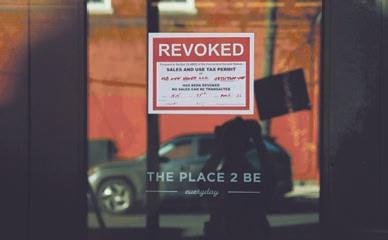
The owner of the recently shuttered trendy brunch spot, The Place 2 Be, faced eviction proceedings in New Haven’s housing court on Tuesday morning.
The landlord, Michael Schaffer ’72, a former chair of the New Haven Development Commission and current Silliman College fellow, alleged that the restaurant’s owner, Gina Luari, had not paid her rent on time for the third time in 13 months.
“We’re done,” Schaffer’s attorney, Philip Pires, said of the legal fights at the hearing. “We don’t want to do this anymore.”
The legal spat was just one of multiple issues currently facing The Place 2 Be. All three of the restaurant’s locations were shut down late last month due to the revocation of its sales and use tax permits by the state, the New Haven Register first reported.
“I can confirm that the New Haven The Place 2 Be location does not have a valid sales tax permit,” Tiffany Thiele, the director of communications for the Connecticut Department of Revenue Services, wrote in an email to the News. She declined to comment further about the restaurant.
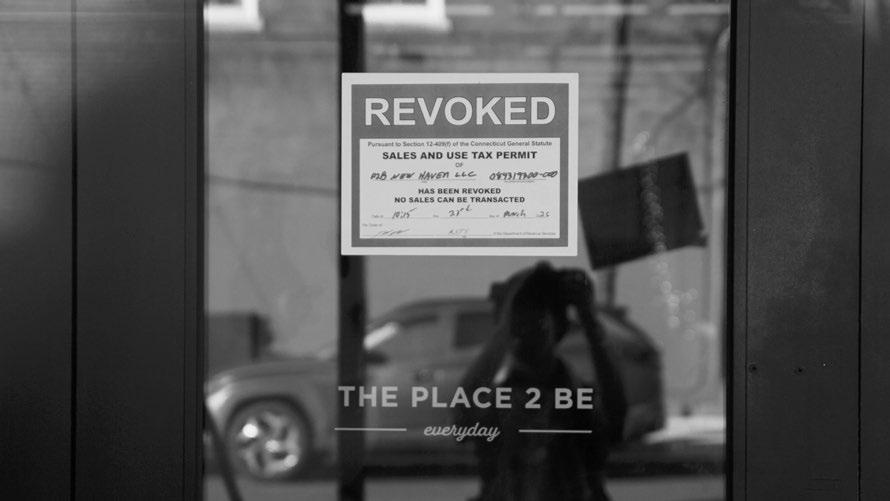
On Tuesday, Judge Alayna Stone ’04 had not reached a decision on the eviction case. She told Luari and her lawyer that timeliness, not just making the payments in full, was an important part of fulfilling the lease agreement.
However, Stone also pointed out that Schaffer had continued to accept late payments from Luari near the end of 2025 without complaint.
Brian Silver, Luari’s lawyer, asked the court to grant her grace, as it typically does when a tenant does not comply with a court order deadline but does attempt to make payments.
Silver explained that Luari made the February and March payments, even though they were late. He argued that the payments Schaffer was demanding included costs that had not been listed on the original lease.
Silver showed evidence of Luari’s most recent wire transfer form to show that Luari had made her most recent payment in full, and indicated that his client wished to keep the lease.
“This is a commercial business that my client has invested a lot of money into,” Silver said.
Pires said that the terms of the original agreement stipulated that there were no more grace periods for late payments by emphasizing that “time was of the essence” concerning payments.
“There are deadlines,” Pires said.
“The deadline appears to not have been satisfied.” Schaffer filed for eviction over nonpayment of rent in February of last year, according to a complaint. In a proceeding that May, the two sides agreed to a temporary solution, in which Luari pledged to pay what she owed Schaffer.
The tenant and landlord ran into another issue in July that year, when Schaffer alleged that Luari had not been following the terms of the agreement. In that case, Stone restored Luari to good standing. Then, in February, there was another issue over late payments, which led to Tuesday’s hearing.
In court on Tuesday, Schaffer and his attorney pressed for a courtordered eviction, pointing to the myriad of issues they had run into with Luari.
“We don’t want to keep coming back to court every few months, doing amendments for the stipulation and chasing them for this,” Pires said.
In September, New Haven police arrested Luari for writing a bad check in the amount of $10,000, CT Insider reported. Before its permit revocations, The Place 2 Be operated locations in New Haven, West Hartford and Hartford.
Contact LARS WINKLER at lars.winkler@yale.edu.
“Truth, which is important to a scholar, has got to be concrete. And there is nothing more concrete than dealing with babies, burps and bottles, frogs and mud.”
JEANE KIRKPATRICK , FORMER U.S. AMBASSADOR TO THE UNITED NATIONS
BY ANYA GEIST STAFF REPORTER
Across campus, students are noticing a growing entrepreneurial scene as more Yalies turn toward tech-driven innovation.
Student organizations are expanding programming, creating networks with investors and arranging opportunities for founders. Over the last two weekends, students have organized events inviting investors and other student entrepreneurs to campus, and participants at those events pointed towards a proliferation of similar events at Yale.
“The Yale builder community has been growing a lot in recent years,” Filippo Fonseca ’28, a student who participated in at least one of the recent events, said.
At YPitch, an event run by Yale Undergraduate Capital Partners on Friday, undergraduates, graduate students and alumni representing 10 startups pitched their projects to an audience of peers and venture capitalists, most of whom were Yale alumni, according to Mae Chew ’27, a co-president of the group. YPitch was the “centerpiece” of a week of panels and events with founders and venture capitalists, Chew wrote to the News.
The weekend before, Major League Hacking, an organization that runs student hackathons worldwide, hosted YHack, a two-day hackathon that drew more than 600 students from around the world to build code and hardware and network with sponsors. Some Yale students said events like YHack increase Yale’s visibility in the startup world.
YHack and YPitch are only a few events in a series of efforts by various Yale clubs to promote student entrepreneurship. The
Yale Entrepreneurial Society will be hosting 12 student founders in its first student hacker house in San Francisco this summer. The Yale Computer Society hosted a hackathon centered on agentic AI last month and hopes to run further hackathons in the fall, its co-president, Ryan Fernandes ’28, told the News. Startups “still need a lot of talent,” Steven Zhou ’27, the co-director of YHack, said. “These tech companies, and a lot of startups, have a lot of trouble finding them, so I thought it’s just like a perfect opportunity to reinvigorate a club,” he added, referring to YHack. Before the COVID-19 pandemic, YHack drew more than 1,400 hackers to Payne Whitney Gymnasium, according to a News article from 2015. In 2024, though, the event only drew around 250 participants, a 2024 News story reported.
This year, from the 600 participants, 244 projects were submitted, and around 40 winners were chosen from categories that included hardware, personal artificial intelligence agents and best solo hack. Though most students were undergraduates from the United States, some participants came from graduate programs or schools abroad. Prizes were worth upwards of $1,000 for the winning teams.
At YHack, Fonseca and his co-founder Emir Ahmed ’28 created PosturePoke, a wearable posturecorrecting device. For Fonseca, YHack was just one of an increasing number of startup events at Yale. He mentioned that more investors visit campus for events and that Y Combinator, a startup accelerator and venture capital firm, has visited campus twice within the last year to meet with students.
So, when he and Ahmed saw YHack announced on LinkedIn, they were excited to participate
in a meaningful building event on campus, Fonseca said.
At YHack, students also had the opportunity to meet representatives from some of YHack’s sponsors, learn more about their products and network with them.
Kyle McVeigh, a founding engineer at LavaAI, an AI-based marketing tool, said that his goal by attending YHack was to encourage students to use LavaAI and gather feedback from them.
“Being where the engineers are, being where the programmers are,” McVeigh said, “it’s exactly where we want to be.”
In addition to providing an interesting and meaningful experience to participants, Zhou and his co-directors, Michael Gao ’27 and Perryn Chang ’27, said they hope that Yale’s reputation in the startup world will improve due to events like the hackathon.
“You don’t think of us as a tech powerhouse,” Zhou said, referring to Yale.
Zoya Hussain ’29, who helped organize YHack, said she believes the event could expand in future years. This year, for example, the hackathon largely took place on select floors of Kline Tower, 17 Hillhouse, and in Davies Auditorium and O.C. Marsh Lecture Hall. Hussain noted that it would have been nice to have a larger space for participants, such as Payne Whitney Gymnasium, which YHack used in past years.
“I think it was just us having to redevelop our like ethos and like our reputation in the eyes of Yale so that hopefully in future years, we can provide a better space for our participants,” Hussain said.
Hussain, who is also a member of Yale Undergraduate Capital Partners, and was working at the welcome table for YPitch, emphasized the importance of
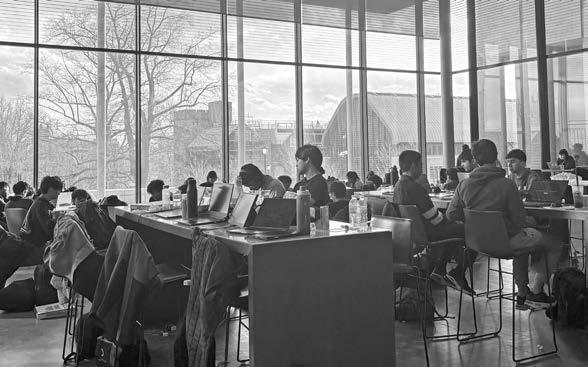
events like YPitch, where many students had built projects over the course of months.
“I think it’s really important to be able to have a space where students have the opportunity and agency to explore their ideas for the first time, and people who are genuinely putting faith in that and willing to back and support those students,” Hussain said.
Though Hussain is only a first year, she has already noticed the energy around startups at Yale. She mentioned that at the beginning of the year, a presentation by the Yale Entrepreneurial Society said that more Yalies than ever are taking gap semesters to work on building projects.
“As a computer science major, every other conversation I’ve had is with students who are cultivating and fostering their ideas for the next big thing or some solution that they finally feel empowered to start pursuing because of the wealth of resources and support at Yale, which is really amazing to see,” Hussain said.
Chew emphasized that the goal of YPitch was to expose students to investors and support them as they seek to grow their projects, while also signaling to venture capitalists that “there is serious founder talent coming out of Yale.”
Chew attributed some of the growth of the Yale startup scene to the increasing accessibility of the tech world.
“The barrier to building has dropped dramatically: AI tools, no-code platforms, and cloud infrastructure mean you can prototype something meaningful as an undergrad,” Chew wrote.
“Students are increasingly thinking of building as a viable and exciting path, not just something that happens after you’ve done two years in consulting or banking, and we want to help support it the best way possible.”
Many YHack participants worked on their projects in Steep Cafe.
Contact ANYA GEIST at anya.geist@yale.edu.
BY MELISSA ADAMANTIDI STAFF REPORTER
A group of writers convened on campus Wednesday to discuss artificial intelligence and its implications for writing, language and the humanities.
The event, which was called “AI and the Future of Humanities” and organized by The Yale Review, featured writers Ayad Akhtar, Daniel Kehlmann and Meghan O’Rourke ’97, the magazine’s executive editor. James Surowiecki GRD ’95, a col-
umnist for The Atlantic and a senior editor at The Yale Review, moderated the conversation about the ways AI has already altered the work being produced in their spheres.
Kehlmann, a German novelist whose work has been translated into 40 languages, said his relationship to AI is unresolved.
“It’s neurotic,” he said. “I have a very neurotic relationship to AI, and I think most of us do.” Kehlmann said the source of his neurosis is a contradiction he cannot reconcile: The same technol-
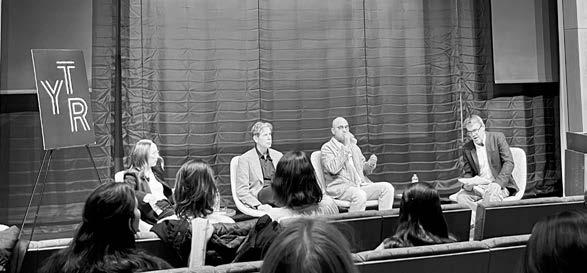
ogy he finds “indispensable” may also destroy civilization. He said he regularly uses the large language model Claude for research, including to brief himself on geopolitical events. One time, he used AI to pull from Albanian-language news media before meetings with Albanian public figures, he said. He added that AI hallucinations have become a minimal concern, comparable to the error rate to that of a skilled human researcher.
Akhtar, a Pulitzer Prize-winning playwright whose Broadway play “McNeal” centered on AI and literary appropriation, said he had been sensing something algorithmically structured about cultural production since 2018, years before large language models were publicly accessible. He described a feeling that sentences, novels and television had taken on some predictability, a preexisting logic he could not yet name.
Akhtar said that using the technology has complicated his own relationship to writing, forcing him to double down on honing his craft even as he watches certain abilities erode.
“It has both sharpened and dulled my ability with language,” he said. “It is transforming my thought processes.”
Despite that tension, Akhtar argued that AI would ultimately clarify rather than erase what is distinctly human.
“AI is going to make ever more clear the distinction between the machine and what we are,” he said.
“Conversations about the interior, and what we may or may not want to call the soul, are going to become more relevant.”
Kehlmann said he was not particularly concerned with the prospect of AI producing better novels than people.
“There’s something really not interesting about a novel not written by a human being to me,” he said.
O’Rourke predicted a growing divide between commercial production, which AI will increasingly shape, and noncommercial or avant-garde work.
O’Rourke, a poet, said the technology is disruptive, but she warned against reducing it to a binary of utopia versus catastrophe. She argued that what AI reproduces is not a text or an object but cognition itself.
“The thing that’s being reproduced now is not the thing we made,” she said. “It’s our own minds.”
O’Rourke added that many computer scientists have told her they do
not fully understand how the models they built are working, and that the models sometimes surface things they did not ask for.
Kehlmann said he believes the engineers behind AI are “not really philosophically equipped to deal with the size of their own achievement.”
Kehlmann said that if AI continues developing at its current rate, humanity may find itself inside a philosophical experiment. He said he holds out hope that sufficiently reasoning entities, artificial or otherwise, will arrive at the same moral conclusions any rational being would.
“I have moments when I think this is our only chance,” he said. “I hope Kant is right.”
Surowiecki said one of the most pressing challenges ahead is not mistaking a fake video for real, but rather the reverse, when people dismiss genuine footage as AI-generated. He said that skepticism, while appropriate, creates a problem with no easy solution.
The Yale Review, which was founded in 1819, is the oldest literary quarterly in the United States.
Contact MELISSA ADAMANTIDI at melissa.adamantidi@yale.edu.
BY NELLIE KENNEY AND BRETT PENK
REPORTER
& CONTRIBUTING
The Board of Alders unanimously approved the mayor’s appointment of Daniel Coughlin as the chief of the New Haven Fire Department on Monday.
Mayor Justin Elicker nominated Coughlin in late January, alongside three other department heads. Former Chief John Alston Jr. retired at the end of the same month.
Coughlin, who has worked for the New Haven Fire Department since 2002, has served as chief in an acting capacity since then. Previously, he was the assistant chief of operations. Coughlin will be sworn in as chief on Tuesday.
“Chief Alston promised to raise us a fire chief from within the New Haven ranks and he delivered,”
said Ward 24 Alder Evette Hamilton, who spoke on behalf of the Aldermanic Affairs Committee to encourage alders to approve Coughlin’s appointment.
Three other alders spoke in favor of Coughlin’s nomination before the vote.
“He is a New Haven kid from a firefighter family. He has risen through the ranks,” Ward 10 Alder Anna Festa said in an interview.
“Shows we have growth within the fire department, and people within the ranks can move up.”
Coughlin was born in Fair Haven and has served as a firefighter, lieutenant, captain, battalion chief and assistant chief of operations during his 24-year tenure at the New Haven Fire Department, according to the press release announcing his nomination.
In an interview after the board approved his appointment, Coughlin said he is a fourth-generation firefighter.
“This is actually the first promotion that my father’s not alive to pin my badge on me, but I know he’s very proud of what’s going on,” Coughlin said, adding that he was “extremely honored” by the appointment.
Coughlin said he “didn’t wait for the confirmation during the acting time” but rather “hit the ground running.” His current priorities are firefighters’ mental health and recruiting from within New Haven, he said.
The department recently completed a peer support training, Coughlin said. Later this month, the department plans to swear in four clergy members
who will offer “spiritual guidance” to firefighters, he added.
“We are going to get out there in the community. We’re going to find new ways to reach New Haveners. I’m going to get into schools, I want to designate a point person to oversee recruitment and community outreach,” he said.
Ward 1 Alder Elias Theodore ’27 said he was looking forward to working with Coughlin.
“I am glad to see a person born and raised in the community in the role,” Theodore said.
The swearing-in ceremony took place at City Hall on Tuesday at 11 a.m.
Contact NELLIE KENNEY at nellie.kenney@yale.edu and BRETT PENK at brett.penk@yale.edu.
BY HAILEY YOUNG & ANAYAH ACCILIEN STAFF REPORTERS
The Berkeley College community gathered in the dining hall on Monday to welcome their next head of college, Jaehong Kim, an engineering professor who previously chaired the Chemical and Environmental Engineering Department.
At the announcement ceremony, Kim was joined by his wife, Yanghee Kim, and his daughter, Hazel Kim ’25, a recent graduate of Yale College who was in Berkeley.
“I got to know Berkeley a lot more than other residential colleges because Hazel already spent four years here,” he said, referring to his daughter.
In that time, Kim was able to learn about Berkeley’s student body, facilities and resources, as well as the widespread admiration the current head, David Evans, holds within the college, Kim said.
“I will do my best to convince Hazel and all of you that I can be just as cool as David Evans,” Kim said to the group gathered in the Berkeley dining hall.
Kim admitted that “becoming cool” will not be his primary goal as Berkeley’s head of college.
“I’ve been a professor for 24 years, and the most fulfilling part of my career has been helping students grow and watching them become more capable, more confident and more themselves,” he said. “And that is the reason why I’m so excited about becoming the head of college.”
Yale College Dean Pericles Lewis also took a moment to present
Evans and his wife, Associate Head Lely Dai Evans, a plaque recognizing their leadership and service to Berkeley College over the past ten years.
“He is to all who know him, an avid Berkeley enthusiast,” Lewis said about David Evans, while praising Lely Dai Evans for her “love for Berkeley, talent and music.”
In his speech, David Evans highlighted the gratitude he and his wife hold for the Berkeley community.
“Lely and I have been thoroughly touched and transformed by our decade of living and raising our children right in the vibrant center of undergraduate life, sharing all these experiences,” Evans said. “Jaehong and Yanghee, you will have the time of your lives,” he added. Kim said he will make himself as visible as possible to students, promising to open his office to connect with students over academic affairs or personal conversations.
“I will help support and sustain a community — a community where you can exhale after a long day, where you are going to be heard and taken seriously, where your conversation goes way beyond what’s in the textbook and where you know you can ask for help when you need it,” Kim said. “My goal for Berkeley: to be the place you are proud to call your home base, your community and your people.”
Kim said he is hopeful that he and the Berkeley students will begin “searching for these answers together” in the fall. He expressed confidence that as he learns more

about what makes Berkeley unique, “we can continue the tradition of being the best residential college at Yale.”
Bedirhan Ozmen ’29, a Berkeley senator, said in an interview that although he was saddened by the departure of Evans, he was optimistic about Kim beginning his role as Berkeley’s head of college.
Hazel Kim ’25 said in an interview that she feels lucky for the unique opportunity of getting to return to Yale.
“I grew up around here, and I always got to see my parents, who
“Ever since coming here so many months ago now, he made it really fun and exciting to be here,” Ozmen said about Evans. “However, I do not feel that distraught because according to the speech I heard just now, we’re essentially just getting another amazing one, just taller,” Ozmen added, pointing to Kim.
were 20 minutes from here,” Kim said. “Now, when I come home, I just get to be here. I never have to miss a HarvardYale game. All of my friends are excited about this too.” Berkeley College opened to students in 1934.
Contact HAILEY YOUNG at hailey.young@yale.edu and ANAYAH ACCILIEN at anayah.accilien@yale.edu.
BY ARIA LYNN-SKOV & LEO NYBERG STAFF REPORTERS
David Brooks delivered his third — and so far best-attended — of four talks of the semester to a packed Sheffield-Sterling-Strathcona Hall auditorium Tuesday afternoon.
In January, Yale announced that University President Maurie McInnis
had selected Brooks as the inaugural fellow for the new Presidential Senior Fellowship program. Leaving his role as opinion columnist at The New York Times, he began his five-year appointment in February. After his first lecture detailed his conservatism and current politics, the second moved from politics and instead focused on ambition. He
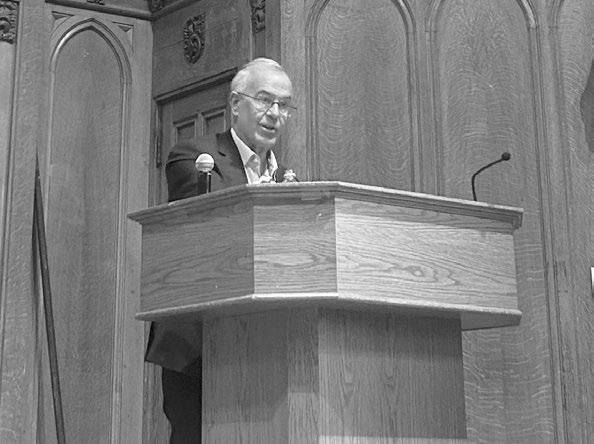
returned to politics in his Tuesday lecture, which was titled “How America Recovers from All This: A Hopeful Vision for our Common Future.” Around 250 people attended — a mix of students, staff and community members.
Brooks framed his discussion of modern politics in terms of a series of cultural “paradigm shifts” since World War II. A culture of “moral realism” in the 1940s morphed into the “liberation” culture of the 1960s and ’70s, then the “bourgeois backlash” that followed in the 80s and finally today’s “decade of resentment,” he said.
He said that President Donald Trump is “resentfulness personified” and believes that Trump has capitalized on a “loss of faith” in the American dream.
Brooks, however, remains optimistic.
“One option is that in the decade ahead we will see levels of distrust, alienation and resentment we have never seen before. I don’t think that’s going to happen,” Brooks said. Instead, he thinks people will look at this “moment of frustration” and move back towards a “humanistic core” involving theology, literature and philosophy.
“And so I think there will be a humanistic turn,” Brooks said. “Humanism is the perfect antidote
to nihilism.”
While much of Brooks’ lecture was about cultural history, he focused during the question-and-answer portion on charting a path forward after Trump.
Brooks said he thinks Democrats should try to be the opposite of Trump’s style. Instead of emulating Trump, they should try to frame themselves as morally sound, as former Transportation Secretary Pete Buttigieg and New Jersey Senator Cory Booker LAW ’97, Brooks said.
Brooks also heaped praise on New York City Mayor Zohran Mamdani. Brooks said he disagrees with Mamdani on almost all political issues but praised the mayor’s positivity and willingness to work for New Yorkers.
“I’m a political foe of Mamdani’s but a personal admirer,” Brooks said.
One audience member asked why America has not yet elected a female president.
Brooks said he thinks America could elect a female president, but the Democrats’ two female nominees had “flaws in their campaigns.” He said former Secretary of State Hillary Clinton LAW ’73, the 2016 nominee, failed because she “was seen as the epitome of the establishment” and Kamala Harris only had 100 days to run her campaign.
Attendees told the News they enjoyed the event.
“I really appreciated the talk,” Ami Gillon ’27 said. “I appreciated especially the optimism, almost the unbridled optimism that Brooks brought to the talk, but I do think it might be a little trickier than what was outlined to get to the cultural shift that Brooks looks for.”
Brooks also drew New Haven resident superfans.
“Over the last two years he has helped me maintain my belief in humanity, my belief in our country, my belief in myself,” Julia Merkt, a New Haven resident, said. “His wisdom is so profound, he is so open to the different aspects of our lives and what’s going on and you never feel like he is being overly conservative or overly progressive.”
After the event, Brooks held a seminar-style discussion exclusively for students.
Brooks’ final lecture of the semester, “How to Fall in Love with Someone,” is scheduled for April 20 in Luce Hall.
“I think a flaw of the Democratic Party is they pay too much attention to demographics and not enough to positions,” Brooks added.
Contact ARIA LYNN-SKOV at aria.lynn-skov@yale.edu and LEO NYBERG at leo.nyberg@yale.edu.
BY HAILEY YOUNG STAFF REPORTER
On Monday, Yale College Dean Pericles Lewis spoke about being Canadian in an intimate talk hosted by history professor Jay Gitlin ’71 MUS ’74 GRD ’02.
Before a group of about 20 students, staff and alumni, Lewis contrasted Canadian collectivism with American individualism and talked about higher education in the two countries, including the discrepancy between Canadian admissions and highly selective American universities.
“I’ve lived pretty much my whole adult life in the U.S., and I’ve actually been in Yale for half of my life, as of next year,” Lewis said. “But being Canadian, I think, shapes a lot of my basic political assumptions, although I think those have been tempered by my time here. I also think it shapes some of my personality in the sense of how I interact with people.”
Lewis reflected on how his international perspective — shaped by differences he has encountered in political systems, cultural norms and
education — continues to shape his identity as a Canadian at Yale.
Lewis said Canada’s parliamentary system emphasizes “consensus and polls,” which he contrasted with the heavy polarization and individualism found in American politics. He said the Canadian model shaped his communication and leadership styles of working towards agreement rather than emphasising conflict. Lewis also shared that his grandfather Andrew Brewin was a civil liberties advocate who served as a member of Parliament.
His extensive time in the United States has come to shape the way he views liberty, Lewis said, adding that he considers Canadian manners and their emphasis on collective outcomes as well as an American focus on individual rights.
Lewis said he considers himself “a strong First Amendment, free speech kind of person,” explaining that he now tends to be more on the side of “allowing the freedom, even if it offends people, or even if it causes some conflict or some instability.”
Lewis also discussed his
undergraduate education at McGill University and reflected on the structural differences between the Canadian and American education systems. Canada publicly funds a small number of colleges, he said, with largely equal opportunities across each institution, while the American system is more decentralized and unequal.
These distinctions, Lewis said, are manifest in the different admissions practices.
“They don’t leave room for what we call holistic admissions, where we take into consideration people’s leadership opportunities and potential,” he said, while acknowledging challenges in the approach of elite American universities, such as upholding “fairness in a holistic admissions system.”
For Canadian student Claire Zhong ’28, having Canadian voices highlighted through the speaker series Gitlin runs was particularly exciting. Zhong resonated with Lewis’ reflections on navigating
cultural differences in education and government systems.
“It’s neat to see Canadian representation in university leadership and I feel like this series, along with other Canadian studies and club events, adds to a sense of Yale as a home away from home for
Canadian students,” she said. Lewis was appointed as dean in 2022 and previously served as Yale’s vice president for global strategy.
Contact HAILEY YOUNG at hailey.young@yale.edu.
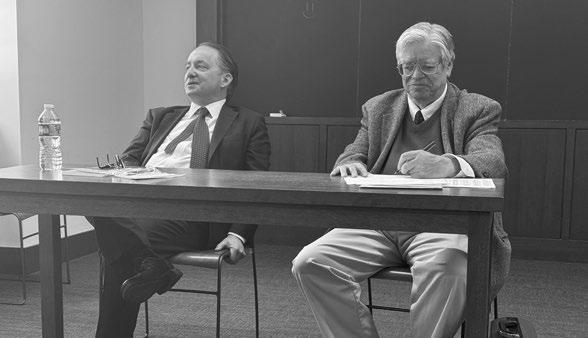
“Have
you ever been struck by a sudden desire for - soup?”
THE FROGS ARISTOPHANES
BY ELLIE KOO STAFF CRITIC
Textiles and fabric are never just materials.
“Soft Landing” renews this idea with refreshing introspection. In this group exhibition at the 63 Audubon gallery on view from March 30 to May 6, artists assert their visions for the world through textiles and fabric, which operate simultaneously as nods to the past, mechanisms for the present and portals to future possibilities.
The exhibition, organized by Moshopefoluwa Olagunju ART ’27, moves through a range of cultures and histories, materials and media. What remains consistent, however, is the artists’ recognition that what they create is never wholly their own but instead emerges against the backdrop of everything that has come before them. That reflection — visible across several works — is both grounding and invigorating.
Alexzandria Robin’s “Bubblegum Western” features a doll-sized figurine wearing a pink, quiltpatterned dress that is accompanied by a second dress hanging above it, evoking elements of costume, dress-up and play.
Yet something more complex unfolds here. The doll is far more dynamic than a typical play figure: its spidery fingers stretch eerily outwards while its feet angle awkwardly inward. The dress, made of simple cloth patterned with polka dots, plaids and florals, feels traditional and modest, but it exposes the figure’s bust in a way that seems almost accidental, producing a quiet sense of discomfort. The face is even more striking — pouting, with yellow and red eye makeup, its expression feels surreal and chiseled, more aggressive and hardened than the smooth serene expression normally plastered upon a play doll.
Through this unsettling transformation of familiar materials and symbols, Robin seizes the history of textiles and consumer culture and pushes against its boundaries, revealing what these forms mean to her.
A pair of digital prints nods to history with contemporary vivacity.
Nadine Nelson’s “Caribbean Black Queens 1” and “Caribbean Black Queens 2” present portrait-style photographs of Caribbean women dressed in traditional textiles. Taken alone, the grainy blackand-white images evoke the aura of historical documentation or archival artifacts.
Nelson surrounds these figures
with colorful backgrounds and beadwork, reframing them in a new visual context. The patterns and beading still reference longstanding traditions of textile and craft, but the engagement with various materials infuses the portraits with tactile dynamism and presence. By imbuing them with this renewed vitality, Nelson simultaneously honors the cultural histories these women embody while shortening their temporal distance from us. Other works approach the human presence more obliquely.
Reggie Woolery’s “Tronie #4” and “Tronie #5” evoke ghostly traces of humans — suggestions of who or what was once there. Displayed in glass cases reminiscent of natural history museums rather than art galleries, the works consist of tattered embroidery hoops. Holes puncture the fabric, while dark hues of violet and navy deepen the sense of decay.
The ragged material creates an eerie sensation that complicates how the viewer might approach the object: as an artifact, artwork or something in between. The title introduces another layer of meaning. A “tronie” refers to a genre of 16th- and 17th-century Dutch painting centered on exaggerated expressions or exoticized faces, with Johannes Vermeer’s “Girl with a Pearl Earring” among the most famous examples. In an ironic reversal, Woolery’s “tronies” depict no identifiable figure at all. Instead, they shift attention away from the individual maker toward the collective cultural history and memory carried within the fabric and object themselves.
Turning directly to the right of Woolery’s work, another pair of abstract pieces continue this exploration of material history.
Inkpa Mani’s “Muki: Guadalupe” and “Muki: Rosalia” incorporate a variety of materials, including soil, earth pigment, stone and fabric. The textured earth materials contrast with domestic calico quilting patterns, while a heavy basalt stone weighs upon the composition.
The materials stack vertically, guiding the viewer’s eye to work up and down in a rhythmic motion that prompts questions about what lies above and below — and why. Mani’s uniquely ephemeral compositions challenge the linearity of space and time, connecting the present moment with the long histories of humanity and the planet itself.
Not every work carries equal impact. Madeline Eldridge’s “Pillowpet” offers intriguing

tactile possibilities through its polyfill stuffing and bright colors, but it does not quite pack the same punch as other pieces in the exhibition. Its placement in the corner of the already small gallery space limits its effect; the slight claustrophobia of the setting prevents the tactile sensations from fully emerging.
Given the exhibition’s emphasis on texture and material presence, a larger space might have allowed viewers to engage with the works from multiple distances and
indulge more fully in how viewing experiences shift with proximity.
The exhibition draws loose inspiration from the quilts of Gee’s Bend, Alabama. These quilts, made by women from that rural Alabama community in the Black Belt, function both as sites of tradition and history and as spaces for individual artistic experimentation, a way for quiltmakers to follow their creativity with pattern, shape and color.
“Soft Landing” successfully
channels this spirit, presenting works that combine artistic vision with historical awareness. In our contemporary moment, where art often leans towards technological novelty and mechanized production, the exhibition offers a firm reminder of the enduring power of craftsmanship and how even the most familiar materials can be continually reimagined.
Contact ELLIE KOO at ellie.koo@yale.edu.
BY GEMARD GUERY STAFF REPORTER
The Beinecke Rare Book and Manuscript Library’s spring exhibit, “Unfurling the Flag: Reflections on American
Patriotism,” is now on display.
The exhibit is in commemoration of America’s semiquincentennial and explores how patriotism has changed in American history through the lens of Yale’s special collections.
“We really wanted to activate the Beinecke and Yale’s special collections materials to provide a reflective space for people to come in and think about the origins and applications of patriotism over the last 250 years,” Joshua Cochran, the
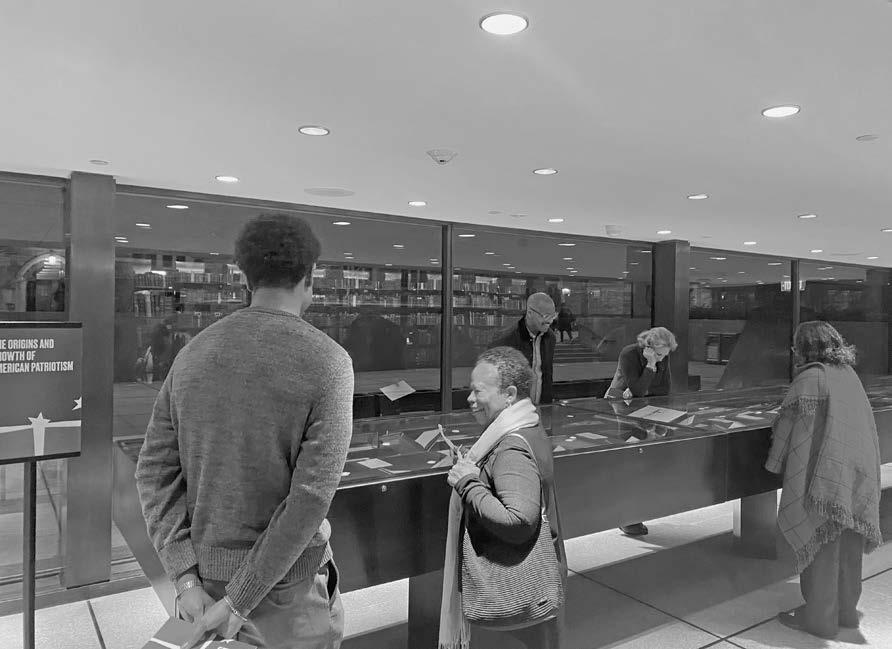
Beinecke’s curator for American history and diplomacy, said.
“Patriotism has evolved over time through conversations, through bloodshed, through protest, through dissent, and we wanted to highlight those moments,” he added.
According to a brochure available in the Beinecke, the exhibit reflects on how patriotism functions as a belief in American society and how different forms of media shape a collective national identity.
History professors David Blight and Beverly Gage ’94 — two of the three professors who taught the popular “America at 250: A History” DeVane lecture course in the fall — offered consultation for the exhibition’s script and made suggestions about sources available in Yale’s archives that the exhibit could use.
“I hope people get a sense that patriotism is never a static thing,” Blight said. “It’s always changing, and it can cause great triumph and great darkness.”
The exhibition uses various documents to explore patriotism’s place in various social movements throughout American history.
Topics in the exhibit include “Declaring Independence,” “Print Culture and the Rise of American Patriotism,” “Inclusion and Exclusion,” “Patriotism and the Military” and “Patriotism, Dissent and Justice.”
Among the pieces in the exhibition is one of 26 original copies of the Declaration of Independence printed on July 4, 1776. The typescript version of Frederick Douglass’ speech “What to the Slave Is the Fourth of July?” is also in the exhibition.
Cochran said one of his favorite pieces is a drawing of a partially completed American flag by Saul Steinberg from the January 1976 issue of The New Yorker.
Cochran said he enjoyed getting to see the vast depth of the Beinecke’s collections.
“It really was an amazing way to look at the collections and work with a diverse set of perspectives on patriotism,” Cochran said.
David Jon Walker — the exhibition’s graphic designer, who designed how the cases would be laid out — echoed many of Cochran’s sentiments.
He said the exhibit presents a unique opportunity to reframe and rethink patriotism in the United States.
“I hope what visitors get from the documents in the show is that the past repeats itself,” Walker said. “We are having many of those same conversations about voting rights, civil rights and freedoms. I think people have lots to take away and draw parallels to.”
The exhibit will be on display at the library until Sept. 27. Contact GEMARD GUERY at gemard.guery@yale.edu.
“‘Oh
drat,’ said Toad. ‘Not only do my feet hurt, but I have lost one of the buttons on my jacket.’”
ARNOLD LOBEL (FROG AND TOAD ARE FRIENDS)
BY AUDREY KIM STAFF REPORTER
Yale’s heavyweight crew team will travel to Princeton this weekend for its second regatta of the spring season.
“We are looking forward to the racing this weekend where we’ll be competing three times in two days against a handful of the top teams in the country,” head coach Mike Gennaro wrote to the News. “The objective during this part of the season is to continue making progress across all of our crews. That is our goal every day at practice on the Housatonic.”
While the Bulldogs were able to clinch the Albert Cup over Brown on day one of the Sarasota Invitational in late March, all three of their competing boats finished sixth of six in the finals on the second day.
“We are excited to get down to Princeton to race against a group of good schools. It’s a great opportunity to get a bunch of races in over the two days and test the speed we have been working on in training. I’m sure it will be great racing and I’m looking forward to lining up to race,” Angus Gray-Cheape ’28 wrote to the News.
Throughout the last few weeks, the Elis have been making up for lost time on the water, since this year’s extreme winter season kept the team in their indoor facilities for longer than usual.

According to heavyweight assistant coach Dan Williamson ’23, the team is usually allowed back on the Housatonic on Feb. 1, but the Bulldogs were not able to return to the water until the end of February this year. The Housatonic River freezes in the winter, meaning that the Bulldogs have to wait until the ice melts to make their return to the Gilder Boathouse.
Yale’s Payne Whitney Gymnasium houses indoor rowing tanks that allow the crews to practice indoors, but their indoor practices can’t replicate the dynamic wind and current conditions that boats face on the river.
are looking forward to the weekend,” Williamson wrote to the News.
“The team is, as usual, very excited to race again this weekend. We learned a lot from our racing in Sarasota two weeks ago and we now get to go test the things we have been working on against some very competitive teams at the Princeton Invitational. Spirits are high and we
Yale will be looking to make significant progress in the coming weeks as it prepares to race for four consecutive weekends, giving the crews plenty of preparation for the Eastern Sprints Championship and the national championships in May.
“The races on our schedule leading up to the Eastern Sprints Championships on May 17th are opportunities for us to test our speed and gather information that will help us improve throughout the season. The squad is eager and excited to line up and compete this weekend,” Gennaro wrote.

head to the Springdale Country Club in Princeton to play in the Princeton Invitational this weekend.
The Bulldogs will face a competitive 12-team field, including six other Ivy League programs, as well as Saint Joseph’s, Seton Hall,
The Princeton Invite will take place on Saturday and Sunday in Princeton.
Contact AUDREY KIM at audrey.kim.ajk234@yale.edu.
Temple, Georgetown and Rider.
With conference rivals making up more than half of the line-up, the invitational offers an early preview of the competition awaiting at the Ivy League championship.
Last year, the Bulldogs placed fourth at the Princeton Invitational with 582 points. They finished just one stroke behind third-place Seton Hall and three strokes behind runner-up Rutgers at 579 points. Those teams will be returning to Princeton this weekend.
“Our team has momentum coming from the Schenkel Invitational, and I am very confident in our team and that we are going to play well in these next couple of weeks,” Matthew Lin ’28, a sophomore who recently won his second collegiate title, wrote in a text message to the News.
“Our main goal is to win the Ivy League Championship,” Lin added.
“I have full confidence in our team and believe we have what it takes to bring home the title.”
With that goal in mind, each tournament carries added weight as
the Bulldogs refine their play against top competition. High expectations bring added pressure, but for Lin, that pressure is something to rise to, not to avoid.
“I think our biggest strength is how much we all desire to get better each day and to win. We all push each other and make each other better,” captain Will Lodge ’26 wrote in a text message to the News.
That sentiment was echoed by first year Preston Howe ’29, who pointed to the team’s tight-knit bond as the secret behind their success.
“What makes this team special is our camaraderie,” Howe wrote in a text message to the News. “With only 7 guys this year, we have grown very close. We’re all cheering for each other more than anyone. It’s a great feeling. We’re going to show what we’re all about over the next few weeks.”
The Princeton Invitational will begin on Saturday and end on Sunday.
Contact LIBERTY ADAMS at liberty.adams@yale.edu.
BY REMI CLARK-REDSTAR
REPORTER
In the final stretch of its season, the Yale men’s tennis team will next face off against Dartmouth, coming off of a win against Cornell and a loss against Columbia.
With the remainder of the season being only Ivy League teams until the NCAA tournament, the men’s tennis team currently has a record of 15-6, having twice gone on winning streaks of six games. Against Dartmouth, the team’s record is seven wins to 10 losses, with last year’s matchup against the Big Green resulting in a 1-4 loss for the Bulldogs.
“We are always looking to get better at being aggressive in doubles and taking the net. We are also always getting better at competing and being tough,” Jason Shuler ’27 said.
Dartmouth is currently on a two-week win streak, having beaten Penn and Princeton. Both of those teams defeated Yale in their last matchups.
Last weekend, the Bulldogs, coming off a win against Brown
the week before, played Cornell, a team that had bested them in the previous outing. Against Cornell, in doubles, Yale started hot with the Vignesh Gogineni ’26 and Edward Liao ’28, and Shuler and Dylan Tsoi ’27 duos claiming their points early. Jim Ji ’27 and Eric Li ’26 put up a valiant defense but ultimately fell to the Big Red 4-6.
Transitioning from teams of two to individual matchplay, Gogineni, Liao and Shuler secured the wins necessary for a Bulldog triumph. Li and Ji fought well but were defeated. Yale ultimately won the match 4-2.
“The key to success was handling the conditions,” Liao told the News. “It was extremely windy that day and whoever adjusted the best was going to come out on top.”
With their win streak at six, the Elis returned to the CullmanHeyman Center the next day to take on Columbia.
Fielding the same lineup as Saturday, the doubles had a rough start to the Sunday campaign against the Lions. Shuler and Tsoi, and Ji and Li were defeated 3-6 and 2-6, while Gogineni and Liao’s match went

unfinished 5-5, giving Columbia the doubles point. In the singles, Gogineni, ranked No. 45, brought down the No. 6 ranked player Michael Zheng. His win was followed by Li’s own gritty triumph. The rest of the singles went down swinging, and the final score of the match was
2-5, a Columbia win.
“They played a really good doubles point,” Shuler said, “and they kind of just took the momentum from there. They got a couple of wins in straight sets too, which made it tough to come back. Super proud of the seniors for getting wins, especially
Vignesh beating the best player in college tennis.”
The Dartmouth matchup will take place on Friday at 3 p.m. at the Cullman-Heyman Tennis Center.
Contact REMI CLARK-REDSTAR at remi.clark-redstar@yale.edu.

BY AZARA MASON STAFF REPORTER
Yale’s women’s lacrosse team (10–2, 4–0 Ivy) will face off against the University of Pennsylvania (6–5, 4–0 Ivy) on Saturday at Reese Stadium. Both teams currently share the top spot in the Ivy League standings and are undefeated in the conference.
Penn will be coming off of a threegame win streak, having recently beat No. 21 Princeton by one in double overtime. Prior to that game, the Quakers beat Columbia by six and Harvard by two. Four of their five losses this season have been to teams with top 20 national rankings.
Midfielder Lindsay Thomas ’28 acknowledged the Quakers’ recent win over Princeton but expressed excitement for the chance to put an end to Penn’s winning streak and claim the first-place standing.
“We are very excited. They are one of our biggest rivals and are a very good team,” Thomas wrote to the News. “They just came off a big
“The
win against Princeton and we’re currently tied in the Ivy standings so it is an important game for us to maintain our standing as the top of the Ivy League.”
In Saturday’s matchup, the stakes will run far deeper than the current battle for first in the Ivy League.
The last time the Bulldogs faced the Quakers was in the semifinals of the 2025 Ivy League Tournament, when Yale and Penn entered as the No. 2 and 3 seeds, respectively. In a dramatic and high-stakes matchup, Yale scored the game winner in the final 13 seconds to advance to the Ivy championship game.
Other recent games between the Bulldogs and Quakers were similarly intense. Their two previous meetings before the 2025 Ivy League tournament game were both overtime thrillers, with Yale coming out on top each time. In the more recent of those overtime battles, the Bulldogs scored in the final 12 seconds of quadruple overtime to secure the win.
Penn’s speed stands out across both its attack and midfield. Penn attacker Regan O’Brien received the honor of Ivy League offensive player of the week two weeks ago.
Catherine Berkery, who is currently third in the Ivy in goals per game — averaging almost a hat trick a game — is another threat.
Yale midfielder Kate Gould ’29 noted the importance of slowing the Quakers down defensively, while also emphasizing the Bulldogs’ focus on efficiency on the offensive end.
“Penn is a very fast team, so we are working on slowing the ball down as much as possible as we transition into our defensive end,” Gould wrote to the News.
This season, Yale’s defense has been one of the best in the nation and is currently ranked second in Division I in scoring defense by allowing fewer than seven goals per game.
Gould also highlighted the Bulldogs’ offensive approach as they prepare for Saturday.
“Going into our attacking zone, we are working on taking highpercentage opportunities and being smart with the shot clock,” she wrote.
Alison Cole ’99, the current executive director of Yale’s alumni association and a former captain and all-American on the women’s lacrosse team, praised the team’s success this season.
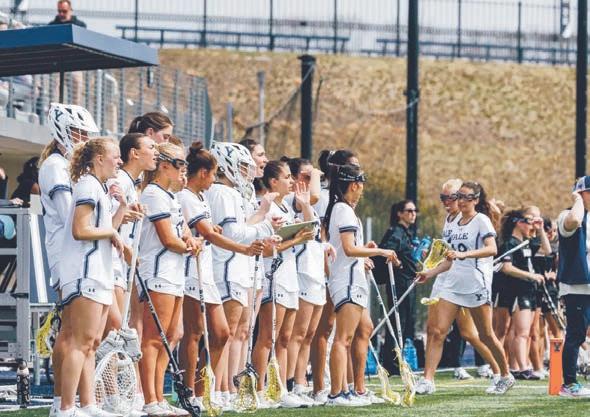
“It gives me so much joy and pride to see the women’s lacrosse team high-up in the national ranks,” Cole wrote to the News. “I know how hard the players and coaching staff work every day to bring home these victories. They are simultaneously carrying on a tradition of
excellence while reaching even greater levels of success.”
Faceoff against Penn is slated for noon on Saturday.
Contact AZARA MASON at azara.mason@yale.edu.
BY JUSTIN LEAHY CONTRIBUTING REPORTER
The Yale Bulldogs (17–9, 7–2 Ivy) are set to play Harvard this weekend, and they are riding their best stretch of the year.
In the last two weekends, Yale swept both Penn (11–15, 5–4 Ivy) and Princeton (7–20, 2–7 Ivy). On Wednesday night, the Bulldogs runruled the University of New Haven (3–21, 3–9 Ivy) with a final score of 20-0 in Yale’s most lopsided victory of the year. This weekend, Yale will host its fiercest rival, Harvard (5–17, 4–4 Ivy), for a three-game series.
The sweep at Princeton last weekend was one of the most complete performances the Bulldogs have put
up the entire year. In the series opener on Friday, Daniel Cohen ’26 tossed six strong innings, followed by a dominant three-inning shutout performance by Tate Evans ’26. With the strong relief performance by Cohen, Yale went on to win a tight game 7-6. On the following day, Jack Ohman ’28 had the start on the mound. Ohman, the reigning Ivy League pitcher of the year, had allowed 14 runs in his past two starts. However, in this start, Ohman had the bounceback that the Bulldogs were looking for. He threw six shutout innings and struck out nine Tigers, helping the Bulldogs take the second game 12-7. In the latter half of Saturday’s doubleheader, Evans made his second collegiate start. He threw six scoreless innings, but the Bulldogs were down two runs heading into the
ninth. In the top of the final frame, Yale rallied valiantly and Jackson Hays ’29 notched a go-ahead single, helping the Bulldogs complete the sweep, 5-4. The win pushed Yale’s Ivy League win streak to six.
On Wednesday, the Bulldogs got off to a hot start and never looked back. Yale had its highest run total of the year, taking the game 20-0 in a seven inning mercy-rule win. Garrett Larsen ’27 tallied three hits and scored four times, Kaiden Dossa ’27 walked five times and scored four runs and Hays had three stolen bases and scored thrice. The game, although heavily lopsided, was a great midweek tune-up for Yale ahead of hosting Harvard.
When asked about the current momentum of the team, captain Davis Hanson ’26 told the News
that the squad has found the level of cohesion that it’s been building toward all season.
“The guys are in a great spot, and we have really come together as a team and have found our identity,” Hanson wrote to the News. “We really have a special group of guys who love competing with each other. Looking forward we are really just looking to stack competitive days.”
Numbers wise, Dossa now leads the Bulldogs with 14 extra-base hits, Jack Dauer ’28 leads the team with 27 runs batted in, Larsen leads the team with 13 multi-hit games and the rookie catcher, Bryce Miller ’29, has now reached base in 20 consecutive games.
The Bulldogs were originally picked to finish second in the Ivy League. Now, seated in first place,
they will face Harvard, a team that lost its first 12 games of the season and is currently ranked in the middle of the conference standings.
“The Harvard series is always special,” Hanson wrote to the News. “The upcoming weekend is something I look forward to every year but it really isn’t more important than any other Ivy League series. Being that the Ivy League is only 8 teams, every win counts”
On Saturday, the first game at George H.W. Bush ’44 Field kicks off at 11:30 a.m. and the second one follows at 3 p.m. On Sunday, the third and final game of the series will start at noon.
Contact JUSTIN LEAHY at justin.leahy@yale.edu.
BY LIZA KAUFMAN STAFF REPORTER
The No. 17 Yale men’s lacrosse team (5–4, 2–2 Ivy) will host No. 5 Harvard (9–1, 3–0 Ivy) at Reese Stadium on Saturday.
The rivalry showdown comes on the heels of Yale’s 18-7 victory over Dartmouth (4–6, 0–3 Ivy), the team’s second straight Ivy road win, and will coincide with Yale’s Alumni Day. On Saturday, the program will welcome back generations of players for one of the oldest rivalries in college sports.
“It’s just an Ivy win, admittedly against a great team, but I don’t focus on a team’s resume,” head coach Andy Shay wrote in an email to the News, referring to last weekend’s victory. “Our league is incredibly deep and competitive and all the games are hard.”
Harvard’s perfect 3-0 Ivy record places the Crimson atop the conference standings, while Yale currently sits in fourth, just ahead of Penn (5–5, 2–2 Ivy). With the regular season winding down, Saturday’s matchup carries significant postseason implications for the Elis: Only the top four
teams qualify for the post-season Ivy League tournament.
Riding momentum from backto-back Ivy wins, including an upset victory over the defending national champions Cornell, Yale will look to carry that energy onto its home turf against Harvard.
Sophomore attackman Connor Gately ’28, who is first in the Ivy League and 14th nationally in assists per game, emphasized that the team will prepare for this weekend’s high-stakes matchup as it has all season.
“I think the energy is definitely focused going into this weekend,” Gately wrote in a text message to the News. “Obviously Harvard is a big opponent, but we want to treat it as just the next game on the schedule and trust the coaches’ game plan for Saturday.”
Although the Bulldogs fell to the Crimson 11-14 last year in Cambridge, Yale has won 10 of the last 17 meetings between the two squads. Backed by a strong home crowd, the Bulldogs will look to defend Reese Stadium and hand the Crimson their first Ivy loss. Saturday’s game will have the Elis facing off against the nation’s second-most efficient offensive unit and eighth-best scoring offense. Senior attackman Teddy Malone leads the Harvard squad with 29 goals. Defensively, Harvard
boasts the Ivy League’s top penalty-kill percentage — preventing goals while a man down — at .759.
On the Yale side, the Bulldogs’ man-up unit, which is ranked second in the conference at .579, found success last weekend in Hanover, scoring three man-up goals during a four-minute penalty. Replicating that efficiency against Harvard’s disciplined defense will be a greater challenge, but the Elis think they have what it takes.
“Offensively, I think we are excited to face another strong opponent and show what we are capable of,” Gately wrote.
On the other end of the field, Yale’s defense has emerged as a key strength. In the Ivy League, captain Patrick Pisano ’26 and Luke Michalik ’27 are second and fourth, respectively, in caused turnovers per game.
Pisano was named the Ivy League defensive player of the week for his strong performance on both ends of the field in the game against Dartmouth. Defensively, he picked up three ground balls and caused three turnovers, and offensively, he notched a pole goal, his first as a Bulldog.
In the cage, the matchup is nearly even. Yale’s Ben Friedman ’28 leads the Ivy League and ranks fourth nationally with 13.88 saves
per game, while Harvard’s Graham Stevens sits close behind at 13.50, ranking eighth nationally. Stevens holds a slight edge in save percentage with .570 to Friedman’s .552. Pisano emphasized that the team’s focus this week remains on preparation.
“Everyday is a must win practice,” Pisano wrote in a text message to the News. “We all have post season stakes in mind, but the main focus is always the day at hand. I expect every guy to give everything they have in them this weekend.”
That mindset will be put to the test against a red-hot Harvard squad. The Crimson opened their season 8-0, highlighted by a statement win over then-No. 1 Syracuse (9–3, 1–1 ACC).
However, the Crimson’s current near-perfect record does not tell the whole story, as they have shown signs of vulnerability in recent weeks. Harvard fell 17-7 to then-No. 4 North Carolina (10–1, 1–0 ACC). The loss to the Tar Heels was a devastating blow for the Crimson, who returned to Cambridge not only with their first loss of the season, but also with their first loss to a lower-ranked team.
Last weekend, the squad narrowly escaped with a 12-10 win over Brown (5–5, 0–3 Ivy) after a back-and-forth contest. The
Crimson and the Bears battled neck-and-neck for the full 60 minutes. Brown scored four unanswered to take an early 4-1 lead midway through the first quarter. However, the Crimson were able to bring it within one by the end of the quarter, and eventually took a one-goal lead at the end of the half. The Bears retook control in the third quarter to lead 9-8, but in the final 15-minute stretch, a four-goal run by Harvard proved decisive in sealing the victory for the Crimson. Although Harvard’s record looks better on paper, Yale beat both Dartmouth and Boston University (5–5, 3–2 Patriot) by greater margins: The Bulldogs cruised to an 18-7 victory over the Big Green and downed the then-No. 18 Terriers 16-11. With momentum on its side and a home crowd behind it, Yale will look to extend its win streak and strengthen its postseason position in one of the season’s most anticipated matchups.
“Great opportunity to defend our home turf and encourage all students to come out,” Pisano wrote. Faceoff is slated for 3:30 p.m. on Saturday at Reese Stadium.
Contact LIZA KAUFMAN at liza.kaufman@yale.edu.

// BY REETI MALHOTRA
Helen Keller, a disability rights activist, author and figure of popular culture fascination, writes about her life before language in her 1903 autobiography, “The Story of My Life.”
Keller elucidates a dreary scene. She compares her experience to being trapped at sea in a dark, dense fog. Keller describes her fevered, anxious quest for something to happen, her “wordless cry” for light that might illuminate the inarticulable, murky melange of feeling contained within her. She had no way to recognize or express her feelings, no language by which she could comprehend her existence.
That agonizing restlessness was only assuaged by her teacher, Anne Mansfield Sullivan, who taught Keller her first word and filled her world with possibility.
I was introduced to this excerpt from Keller’s wider narrative in my high school’s “Theory of Knowledge” class, a mandatory International Baccalaureate course that compelled us to question how we know what we know and often left me stumbling out of a class with a pounding migraine.
My teacher, Mr. Scheelbeek — who remains one of the most intelligent people I have had the privilege of learning from — pointed to the stark feat that Keller’s unique circumstances had led her to accomplish: articulating life without language, acquiring language and extending her capacity to think by gaining language.
In other words, Keller’s story pointed to a striking, yet hardly contemplated, revelation: without language, our lived experiences become inaccessible to even ourselves. Language therefore becomes more than a mere tool for expression and communication passively acquired from infancy and our first words. It is painstakingly honed over a lifetime and deeply intimate — the only means by which we can make sense of ourselves.
Of course, it is one thing to think in language — to articulate one’s stream of consciousness. It is another thing entirely to put pen to paper or fingers to keyboard to translate thoughts into coherent prose on a page. The latter act is more vulnerable. Writing, after all, demands exposure: the looming presence of the potential, unseen reader, who can analyze and evaluate your language and, in turn, you. It is maybe for this reason, amongst others, that artificial intelligence has become such an attractive tool to some. But if the relationship between language and lived experience is as true and profound as Keller illustrates it to be, what happens to our ability to understand ourselves when we outsource the very language we use to make that understanding possible?
I do not have a firm answer. So, I decided to experiment with the large language model ChatGPT. I asked the model:
RM: Given this opening, write the next paragraph that flows from my argument, emulating my voice.
CHATGPT: I began to notice this tension in my own writing in ways that were, at first, almost imperceptible. What started as a harmless convenience—asking an AI to smooth an awkward sentence or suggest a more precise word—gradually reshaped how I approached the act of writing itself. I would paste in paragraphs I had laboured over, not to clarify what I meant, but to make them sound more polished, more assured, more like what I imagined “good writing” ought to be. And yet, when I read the revised version, I often felt a quiet dissonance. The sentences were undeniably better—cleaner, more fluid—but they no longer felt entirely mine. In relinquishing the struggle to find the right words, I had also, in some subtle way, relinquished the process by which those words had come to carry meaning for me at all.
The model’s response intrigued me because it wasn’t entirely incorrect. I had used AI-powered assistants like Grammarly in the past, which parse through your writing, sometimes even prompting “rewrites” for clarity. Yet, syntactical structures that did not sound like me — including excessive negation and “purple prose,” relying on flowery, figurative language that sounds good while bearing little substance — turned me away from the approach. The “dissonance” was thereby felt and true. But were the sentences “undeniably better?” I would argue no. AI cannot account for the stylistic and register choices made by a writer. It vies for algorithmic standardization that vanquishes individuality.
I similarly disagreed with the act of relinquishing. AI merely fit into the “struggle to find the right words,” the means by which I had sought to temper my voice and make it clearer for my taciturn, overlooking reader. The words would only lose their meaning when they did not sound like me, and that would only happen if I were to turn to AI entirely. But I think this would be futile, destructive and destabilizing — not simply because I desire to be a journalist and author, but as a human being who wishes to maintain that capacity to articulate her own lived experiences without the assistance of a computer aggregating data that lacks the ability to know or inhabit her mind.
Contact REETI MALHOTRA at reeti.malhotra@yale.edu.
// BY STEPHANIE ALTSCHUL
Acorns without their hats were the unspoken symbol of my high school crosscountry team. In pre-race warm-ups, we snatched nuts off the ground and sent them spinning around our palms, giving our hands motion for the next three miles and our legs a lucky boost.
Lucky talismans have carried me through the most treacherous parts of life — overdue essays, mainly. A childhood blanket, a silk charm gifted by my favorite teacher and a keychain from a far-off city have bestowed me with the good fortune I’ve needed to conquer the everyday struggles of a teenage girl — overdue essays, mainly.
As we approach the last two weeks of classes, and my last year as a “stupid frosh” — thanks, Fizz — I’m all the more grateful for my lucky charms. I can confirm, in fact, that finals are approaching because of the pre-law panic and the age-old question filling HQ classrooms: Should I Credit/D/Fail an A-minus?
During these trying times, I find myself reaching for something constant: a charm, a symbol or a scrap of memory that I hope
is endowed with luck enough to raise my microeconomics grade a few points – and it seems my cross-country good luck charms have disappeared into the ether.
While a nondescript belief in “luck,” whatever that means, is relatively shared among students I spoke with, the talismans vested with such a power vary wildly. I interviewed a few lucky first years to see how they’re faring, and, selfishly, to find a replacement for my habitual acorns after the Old Campus resident rodents snatched them all up.
Paulina McConnell ’29 totes a sentimental flashcard. I asked her to recount its story earlier this week.
“My best friend and I trudged to his house on the day of the first fall rain in California, made the flashcards before our AP Euro final, and burnt the edges on a spiced cardamom and cinnamon candle,” she told me. “For my birthday, he made me a flashcard of the 'causes and effects of Paulina’s 16th birthday’ and seared the edges off. It smelled like the candle. I would pick it up and give it a good smell before my biggest tests.”
Besides her flash card, Polly is no stranger to the luck of a mindful moment before a big test. “I also love to meditate,” she says. “Just lay on the floor of my room the morning of and clear my head completely.”
Mindful routines become superstitions on high-pressure days. Kai Zou ’29 is careful not to leave his room without taking a few deep ritual breaths to steady himself. The last time he forgot, it ruined his concentration in the testing room, he claims.
Most people I spoke to regarding lucky tokens mentioned a special necklace or bracelet with sentimental value. I ascribe this pattern to how easy it is to remember — I make a wish whenever I rotate my necklace clasp to the back of my neck, while Hazel Dye ’29 wears a necklace with her initials that reminds her of home.
During a study break in the Elm, Hazel pulled out a purple hippo stuffed animal from her backpack: Pebble.
“I bring her to every class; she’s like a lucky token throughout the day,” she told me. Superstitions aren’t a big part of her test-day routine, but before curtain, she partakes out of habit. “In theater, everyone’s superstitious,” she told me. “If you say ‘Macbeth’ in a theater, it curses the show. I like to think that I’m not superstitious about those things, but then again, why take the risk.”
For the most part, though, these lucky practices seem to be personal energy bolsters. Kiara Gonzalez ’29 told me about the evil eye bracelet tradition in her family.
“Evil eye bracelets, or mal ojos, have been
gifted to me from my close family members since I was little. Whenever they’d break, my mom would explain how they had absorbed the negative energy in my surroundings.”
“I’ve been told that they don’t work unless gifted to you by someone who loves you,” Kiara elaborated. “It has a lot to do with someone else's love protecting you, I think. My mom gave me another over break and I feel like she’s protecting me whenever I wear it.”
Teresa Ng ’29 detailed her ritual coffee before an exam. “If I have to do something nerve-wracking, I always have a coffee with me. It’s not even about the caffeine. It’s about the habit, the process and the ritual.”
As we barrel toward reading week, I find myself surrounded by people who are, likewise, looking for light at the end of the tunnel, a path back to the routine of normalcy and moderately acceptable sleep schedules. A talisman promises this return. Lucky tokens work because they’ve worked before; we give them emotional power by proxy. They’re lucky simply because we believe them to be.
As we descend into the pits of finals week, line your pockets with luck. Steal an acorn from an Old Campus squirrel, print out a photo of your dog, select a lucky bead from the floor of lower-level Bass Library or find some ephemera on the side of the road. Weave your personal history into a tiny, insignificant object. Let it be a compass through the weeks ahead, and remember that it’s only good luck if you believe it is.
Contact STEPHANIE ALTSCHUL at stephanie.altschul@yale.edu.
// BY ANNA PAPAKIRK
My hometown of Cincinnati, Ohio, is colloquially known as Porkopolis. In the 19th century, it was one of the nation’s largest meatpacking centers. Pigs were so numerous they could be found running unsupervised through the streets. Given the city’s unique association with pigs, Cincinnati hosts the Flying Pig Marathon every May.

rosiness when we heard the news. 10 miles? Just three short of a half marathon?
We both looked at each other again, this time nervously. We explained to the staff member that we were not that serious about running, but she told us it would be “chill” and that we by no means had to complete the entire course. We could tap out at any point.
I enjoy running for pleasure, but I had no intention of running the race this year. The Flying Pig Marathon is one of the biggest events of the year. Thousands of Cincinnati runners participate in the 5K and marathon event. For me, it’s one of those occasions where I think to myself, “I’ll run a marathon when pigs fly.”
When given the choice between sitting on one of San Juan’s sandy beaches or running up and down Cincinnati’s hilly terrain, I would definitely choose the former to be my spring break plans. First and foremost, I want to relax. Second, I love
Feeling slightly more reassured, we ultimately decided that we’d do it but put no pressure on ourselves to do all of it.
Sunday morning rolled around, and we made our way back to the Lululemon store. The energy of the group was electric. The running group wasn’t the typical clique of ultra-elite athlete best friends who’d been running together for the past 10 years.
As we ran, my expectations were proven wrong. Each mile after the next, we got to know everyone in our group a little better. Some were training for Cincinnati’s annual Flying Pig Marathon. Some were college students, like us. Others had jobs that had taken them all over the United States. It was fascinating to learn everyone’s story and their “why.”

ANNA PAPAKIRK
exploring new places, and traveling to Puerto Rico was a novel experience for me. Nevertheless, over the break, I somehow found myself in sneakers on one Cincinnati’s brutal uphill climbs. Allow me to explain.
On Friday, March 13 — that should have been an ominous sign — I wandered into my local Lululemon store. My friend Sophie and I had just finished a run, our first run in weeks, and upon entering, a staff member approached us.
“Did you just come from a run?” she asked.
I wasn’t sure if it was because we looked extremely strong and athletic or sweaty and red in the face, but something about our look screamed “runners.”
“Yes!” we replied in unison.
Next thing we knew, she invited us to participate in a Lululemon-sponsored run club that upcoming Sunday — just two days away. Sunday’s weather was supposed to be exceptionally pleasant: 70 degrees and sunny, perfect for an outdoor activity. Sophie and I looked at each other and thought, “why not?”
And then, we got roasted like pigs. The anticipated route was 10 miles.
Our faces drained of our post-run
At about three miles in, we were feeling great — no pain, not out of breath. In fact, we were slightly chuckling, incredulous that we were actually doing this. What made the experience even more pleasant was the camaraderie we built with our fellow runners.
We were laughing until the halfway point. Approaching the fifth mile, fatigue set in slightly, but we had been cruising downhill most of the time, so the run wasn’t that arduous yet. But what comes down must come back up. As we looped back around, I knew this would be a tough finish. My heart beat faster. My breathing grew louder. The lactic acid muscle build-up in my quads crescendoed to a maximum burn.
Nevertheless, the group’s unwavering energy also intensified. Everyone was handing out high-fives, cheering one another on and offering words of encouragement to get us through the final stretch. Inspired by my fellow runners, I didn’t want to stop. Ultimately, though, we did. At about mile eight, we had to throw in the towel and walk for a bit before running the final mile — but we felt far from defeated. If anything, we couldn’t have been prouder.
I spent the first week of spring break tanning in San Juan, the only sweat on my face coming from the sun, not physically exerting myself on the hills of Cincinnati. While my gold medal performance was certainly the most unexpected part of my spring break plans, it was also surprisingly the most rewarding. So, the next time you’re thinking, “I could never do that,” put on your running shoes. Join that run club. And make it the day when pigs fly.
Contact ANNA PAPAKIRK at anna.papakirk@yale.edu
When I got bored back home in suburban Texas — which was quite often — I would drive to the top of a parking garage and watch the city. Over the years, the lights that made up my city got brighter and multiplied, the town expanding into the rural nothingness around it. All I knew, all I had ever known, was that I wanted to get out.
I imagined a world that was culturally intense — a community where I could freely embrace every part of myself. Images of New York City were pinned on my walls, and I had Pinterest boards of all the foreign places I could never imagine going. On my walks to school I daydreamed about life in a big city, severed from the place I grew up. I went back to the parking garage roof periodically throughout high school. The city was growing unprecedentedly quickly with new families, and every time I returned the lights seemed to stretch a little further. I had always felt taunted by the unknown darkness beyond the city lights. But every time the sphere of the city grew and a new bit of land was illuminated, the world became a little less mysterious. When I got into Yale at the end of senior year, the end seemed in sight. I had so much fun at Bulldog Days. Senior year I developed a very clear vision of the college girl I would become: My confidence would magically grow, I would get tattoos, I would be able to grow my political activism.
In my first semester at Yale, I reached for my vision in every moment. I got the “Call me by your name” quote “Is it better to speak or to die” tattooed on my ribs, made as many friends as possible and never missed a single party. On the outside, I had achieved my goal. I had gotten out of suburban Texas and the new version of me was untouched by all I had experienced back home. I barely reached out to my hometown friends and posted all the time
// BY RIYA NADKARNI
with my new ones.
But if I really looked, I caught glimpses of my hometown self all around campus. When I laughed, I would hear my mother. I surprised myself by listening to choir music after I swore to never join another choir. After hating stillness my whole life, I craved those rare moments of silence on campus. Everyone moved fast here. Instead of making small talk with the people at the crosswalk, jaywalking was optimal and all my meals lasted less than 25 minutes. I didn’t understand why I was so unhappy at a place I had dreamed of being at my entire life. I hated boredom, the bustle exhausted me and my dream of expanding my horizons had become a dizzying reality. Upon reaching the massive milestone of college, I didn’t transform — I became more aware of all things I couldn’t let go.
My father, a math nerd, once told me that life is not a step change function but one of incremental change. In normal terms, a milestone does not change my future, but sums up my work to that point. I finally understood this wisdom when I returned to the top of the parking garage during spring break. The metroplex had grown so big that now the lights extended beyond my line of sight. For a moment, the old restlessness crept in and I felt the hunger to outrun the limits of this place. But it didn’t settle the same way it used to. In New Haven, I had morphed into the version of myself that I’d always imagined — more confident, more outspoken, more willing to take up space. It took coming home to realize that girl hadn’t been created at Yale. I was looking at the lights and for the first time, I wasn’t imagining another life. I was recognizing my own.
Contact RIYA NADKARNI at riya.nadkarni@yale.edu

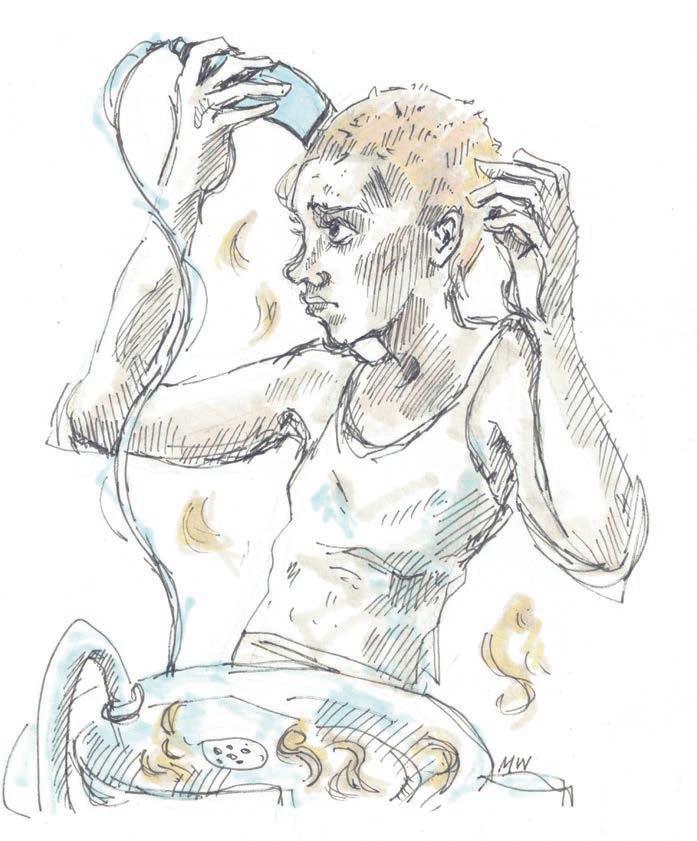
// BY MADISEN FINCH
One of my fun facts, in the eternal game of get-to-know-you, is that I shaved my head. In the context of other icebreakers, the choice seems less consequential. As if it’s just something I did on a whim, comparable to running a 5K or visiting the world’s largest whatever. It doesn’t carry the weight it once did.
In the summer of 2020, I was convinced that I was going to die without having ever done something I was truly afraid of. Hair is something that is both inconsequential — as my military-bald dad would say — and vitally important to self understanding. I shaved my head as a way to check the smallest box on the bucket list of my life.
The pandemic allowed me to hide behind turned-off cameras. I wasn’t hiding out of shame but from the newness of it. The first buzz of clippers on the crown of my head, the first shower and sunburn all exposed me to a side of the world I wasn’t entirely ready for. I hadn’t realized the degree to which my hair had shielded me, physically, from a harsh world. The pinpricks of regrowing hair under my fingertips were a constant reminder of the change.
There is something singular about having no barrier to hide behind. Without strands of hair to pull or twirl between my fingers, my hands had to grow steady. I had always been the only person in my family who could curl or braid hair, but without any styling, my confidence had to come from somewhere other than how I looked. In those first few months, centering around something else — something internal — was the most important.
When the awkward growing-out phase began, so did the discomfort that comes with being markedly different. In small-town Kansas, with the type of beliefs I had — and with my willingness to fight for them — I felt that I had to compensate by fitting in other areas. Returning to school, while the hair I had intentionally scraped away was returning to me, I neglected those social expectations.
What I didn’t realize when I first reached for those clippers — or when I went to the salon because my mom would never let me do it myself — is that a bald head announces something to the world. For me, someone who was able to make the decision without being forced to lose my hair, it meant that I was something to look at. I became a symbol that others desperately wanted to unpack.
So, hair was as central to my identity after I lost it as it was before. I became the odd one out.
What I haven’t told you in these first few hundred words, maybe because I am still the same girl who hid behind those
turned-off cameras, is that shaving my head had something to do with me trying to figure out who I was. It was an act of acceptance, maybe, for the side of myself that would have been punished by the “Don’t ask, don’t tell” policy that was central to my military-brat upbringing.
With every look in the mirror I was trying to find that young girl who figured something out about herself. I was looking for the girl who realized she didn’t always like the guy, the girl who was ostracized, the girl who just didn’t get it. I was looking for that girl when I shaved my head, and with every passing comment or pointed remark, I think she was pushed to the surface like a fractured bone. As a young, queer kid, the shaved head became inner confidence. And self-exploration. And acceptance. To others, it became something to pick at and pull apart.
I wish I remembered more of those growing-out phases. I blanked out the slurs that came with being visibly gay for the first time, that came with being someone so willing to stand out.
I blanked out the insults that revealed more of me than the fleshy color of my scalp. Even as my hair continued to grow, brushing my shoulders, the air of difference surrounded me.
I have never been able to write about what happened to me when I had no protection, when I didn’t have the boundary of hair. The bareness of the experience revealed to myself, and others, the corners of myself I hadn’t been able to verbalize.
To this day, when I look in the mirror I secretly fear — hope? expect? — I have a buzz cut again.
I am not certain who I would be if I hadn’t shaved my hair. I don’t think I would be as open with my identity, as confident in the parts of myself that aren’t the way I look. I don’t know if I would have been harassed or outed if I hadn’t shaved it off. I like that it eased the burden of communication — I never really had to tell anyone I liked girls because a buzz cut usually does that for you. But I can’t see that girl in the mirror anymore. The longer my hair gets, the smaller she seems.
Hair is identity, and choice and protection and everything I didn’t understand when I decided to get rid of it. I have never regretted that buzz cut because it allowed me to reveal the pieces of myself I wasn’t ready to show. It made the decision easy because I hadn’t realized I made it.
Two truths, one lie: I had a buzz cut. I am a military brat. I miss it.
Contact MADISEN FINCH at madisen.finch@yale.edu.
People love to say it: “I liked it before it got popular.” Usually half-jokingly, but not really joking, because no one says it unless they mean it a little. They don’t say it just about music, but also about restaurants, brands, movies, authors and even clothing. The point is always: I found it early. I found it when it was still small. I found it when it meant something different. It normally sounds pretentious. But the reasons people want what’s niche aren’t so mysterious or unique. It feels good to encounter something that isn’t already being thrown around and handled by everyone else. A song might still feel like yours when it hasn’t been turned into background music at parties or stripped into three different TikTok audios or had a thousand people saying, “this song changed my life!” There is a difference between finding a thing by yourself and receiving it after it has already been certified by the rest of the world. Less nobly, people like feeling ahead of others. They like feeling that they are quicker-witted or more unique than the rest. Ever since I began drinking coffee, I was essentially the only person I knew who ordered straight black iced Americanos. At the time, I enjoyed the faint sense that it marked me as somewhat different — it was a preference that was slightly uncommon. Then I visited Korea, where black iced Americanos are everywhere. They are practically the default order at cafés — so standard that they barely register any statement at all. I still ordered my iced Americanos, of course, but the meaning of the choice had changed for me. Evidence of some private specificity in the States turned out to be, in the Korean context, almost generic. Most people aren’t sitting around consciously plotting how to build their personality or identity through obscure things, but I do think a lot of us enjoy the little charge of having preferences that are specific to us. It is flattering in a way, and it sends the message, “I am not interchangeable.”
I think this must be why people become so weird when their hidden gems become popular — when their favorite piece begins to attract too many people for their comfort. Usually people assert their pre-popularity connection with something as if defending its quality, but sometimes what is really being mourned is exclusivity. The said thing itself did not get worse, but it did lose its ability to make someone feel “rare.” Now, the someone is being grouped into a crowd. Obviously, people do sincerely love obscure things. Sometimes, less is indeed more. Smaller things really are better — or, at least, they feel less exhausted. There is something quite nice about finding a genre of art before it comes with a whole category of person associated with it. Obscurity can give things room to breathe. Yet, people are certainly not innocent about taste either. Taste has become one of the easiest ways to signal almost anything besides merely what one likes. Intelligence. Sensitivity. Coolness. Money. Irony. Seriousness. Even goodness. People read others through tiny choices: what you wear on your feet, what kind of olive oil you buy, whether the tote bag you bought is funny on purpose or old enough to prove that you did not buy it for the joke. None of this is exactly deep, but it does cut through the surface into how we are judged.
I think this is why niche taste can become so addictive. It offers a tempting fantasy: If you choose precisely enough, you can make yourself precise. Different from the rest. Pick the right books, the right films, the right musicians, and you can become legible to yourself and unmistakably “you.”
But I don’t think this really works. A person is not automatically deeper because their favorite band has only a few thousand monthly listeners on Spotify. Sometimes popular things are popular just because they are good. Sometimes the honest answer is the boring answer. And sometimes the most secure kind of taste is, well, not obscure at all.
Contact LEONARDO CHUNG at leonardochung@yale.edu

// BY MADISEN FINCH
Yale is known for being the gay Ivy. This nickname appears as early as 1987, when Julie V. Iovine ’77 claimed that at least a quarter of people on campus were, at the very least, not straight. This moniker was one that I did not expect to include queer women. But after speaking to the four women that created WLWixers, I believe I might have been proven wrong.
The constraints of Yale’s identity as a gay Ivy has been discussed across numerous publications after Iovine’s original article in The Wall Street Journal. A Rolling Stone article in 2001 claimed that “queer students don’t even show up for protests; they’re too busy fitting in and hooking up.” From a Yale Daily News article from 2014, it seems that the experience of gay men on campus, “comes at the expense of other LGBTQ groups at Yale. The ‘G’ looms so large over Yale’s sexual landscape that lesbian, bisexual, transgender and queer students are often overlooked.” Nearly a decade later, The New Journal published a piece discussing the now defunct Sappho group that was once a hub for queer women on Yale’s campus.
In part because of the gap that was formed when Sappho disappeared, four first years founded the WLWixers — a group of women-loving women, who mix.
I walked into Trumbull’s dining hall with one of the group’s founders, Michaela Snyder-Braasch ’29, and we immediately sat down with Adelaide Hayden ’29 — who goes by Addie. The ease of the familiarity between Michaela and Addie, and other members of the group who trickled in, was immediately apparent. I got the impression that this was a group of women who truly cared about one another.
Riley Yang ’29 — dubbed RY ’29, Yale’s Top Gay, on the anonymous social media platform Fizz — walked in with Bella Gainey ’29. The latter, while not one of the original four founders, has reportedly had just as much of an impact on the group. Delilah Sonnenshein ’29, a News staff member, was the final of the four founders to get to our cramped table, and she was welcomed in with hugs and excitement. Before I had even started the interview I was privy to a flurry of laughs, inside jokes and references to shared stories.
Originally inspired by the First Year Formal and its implicit requirement to set up suitemates with dates, the four “started making a little list, for the people we still had to set up because we were kind of cross referencing,” Riley said. Soon, “the list went to 20 names,” and it made more sense to mix them together. As evidenced by this article, and by the fact they nearly doubled their guest list for
their second gathering, it grew beyond just that first mixer.
The rest of campus party culture is “very heteronormative,” as Addie framed it. “It all feels like it’s surrounded by a bunch of men.” The WLWixers offer an inclusive alternative.
Their first email, sent by the “Top Gay” herself, reads “I know what you are.” So, too, do the WLWixers know what they are. “Lesbianism is inherently community,” Riley begins before being cut off by the group’s laughter. “The community already exists, this is just a way of bringing it together,” Riley explains.
As for their notoriety and their ability to include more queer women in the mixers, they have shifted focus from matchmaking to friendship and attempted to tone down the publicity. A nowdeleted Instagram account included videos of one
of the mixers, but the group removed the post after deciding it jeopardized the sanctity of the community the four founders created. They aren’t certain, however, when the next best time to host a mixer will be or if the opportunity will present itself at all.
The mission of WLWixers was to successfully set up dates for First Year Formal, and to create a community. At the completion of these goals, “We don’t have to stick to a strict regimen,” Delilah explained. “It can become a more casual thing.”
“It’s nice to have a space with no men,” Addie said, taking a modern interpretation of Yale’s gay Ivy reputation. I happen to agree, and even though there are no official plans for more mixers, I am excited to see what comes next.
Contact MADISEN FINCH at madisen.finch@yale.edu.
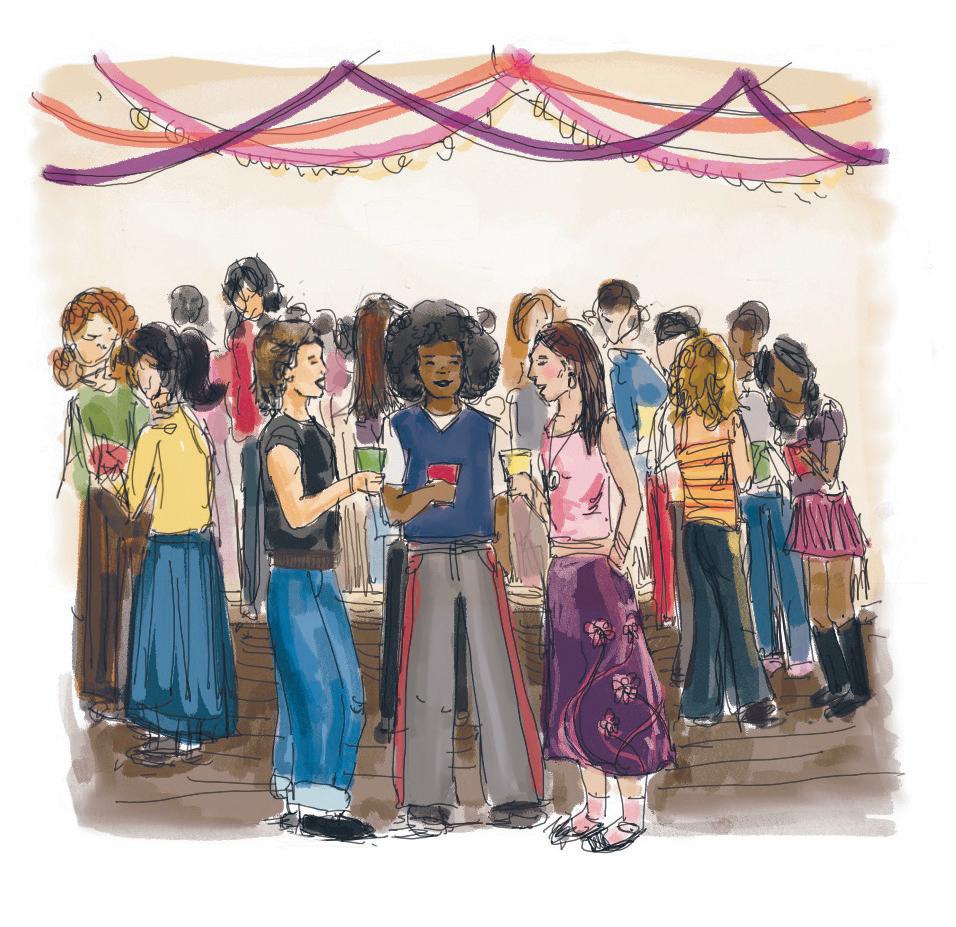
// BY ESMERALDA VASQUEZ-FERNANDEZ
I find myself saying, “I am good. Just a little stressed, but it’ll all work out” almost automatically after someone asks, “How are you doing?” Thus is the struggle of balancing being honest about how I feel — which is, typically, stressed — with a desire to assert my capabilities. Time and time again, I hear my peers stress about internships, clubs and job applications. These stressors have tangible implications on their life, in theory at least. “If I don’t get into this club, I will never be able to get into consulting” is a sentence I vividly remember hearing at the Extracurricular Bazaar back in August. Now, I am not trying to discredit the tangible applications these organizations have on their lives. Being involved in Yale clubs and career opportunities probably does have a positive correlation with securing a high earning job.
My complaint about the complaining culture at Yale — yes, I am complaining, too — is that often such culture is rooted in more of a habit for being negative than a real indication of a problem that needs fixing or addressing.
A quarter the way through the calendar year, I am reflecting on my goals. One of them is to limit my complaining and negative talk both internally and in social settings. The American Brain Foundation notes that, “those who have very high negativity bias are prone to experience very high anxiety.” I am not a psychologist, but I agree that the correlation with the nature of being negative and seeing fault in everything contributes to higher anxiety. If
the focus is only on the negative, then even an almost magical place like Yale can be clouded by uncertainty and distress. There are always things in the world to worry about, but it is often the small resolvable problems that cause the most stress. NewsWeek notes that people tend to panic over small things but stay calm in a real-life crisis.
People complain about all types of things. It is natural for stressed out college students to want to vent at any given opportunity. I mean I know that half of my calls back home consist of expressing uncertainty. There is nothing wrong with talking about feelings, and I do think that, in a lot of ways, complaining makes people feel better because they feel validated and understood by those around them, like Psychology Today suggests. Early on in my relationship with a class friend, one of the easiest conversations to reach for is dogging on a discussion post. My concern about this complaining culture is that people leave dinner and coffee outings more depleted than they arrived. Sometimes I feel like if I am not complaining about every issue that clouds my mind, then I must not be working hard or involved enough around campus. I can’t help but think that if I am not in a constant rush of adrenaline to get work done I must be taking it easier.
Oftentimes, this effort to bond or communicate my involvement can accomplish the opposite. In fact, I find myself most inspired by and attracted to those who are productive without making complaints and stress their entire personality.
Of course, negative talk isn’t just about people’s outlooks on their own lives. A lot of people find comfort in reinforcing their self-perception by offering their unsolicited opinion of others, especially when it comes to judging and gossiping. Intentional or not, people often project their own insecurities onto near strangers by speaking negatively about them. This is something that should be left well behind, but it’s college, and sometimes this high school habit hasn’t dwindled in weekly or daily conversations.
A certain amount of complaining can be healthy. I do feel better after giving my older sister a call to talk about the slew of inconveniences currently barraging me. But I also know that almost all of my accomplishments have been rooted in my desire to change, evolve and grow. The flaws and habits I have found have come from deep reflection and failures, but hardly any good, besides momentary relief, has come from complaining about small things and putting others down.
Three months into 2026, I have re-committed myself to not letting small things hold so much mental power. In complaining, I find momentary relief, but the real change in my life comes from my continuous effort in shifting my focus to be more positive and working on my personal, academic and economic goals.
But then again, I am complaining about complaining.
Contact ESMERALDA VASQUEZ-FERNANDEZ at esmeralda.vasquez-fernandez@yale.edu.
STARTING A JAM BAND WITH YOUR FRIENDS