Yale is again trying to shore up its signature system for undergraduate living. Policies and promises only go so far.
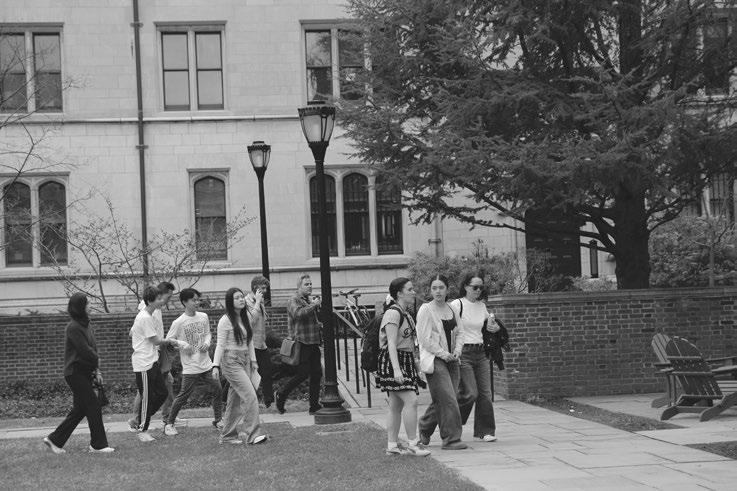
Alex Hong / Staff Photographer
Yale is again trying to shore up its signature system for undergraduate living. Policies and promises only go so far.
Seniors said the feeling of community in their residential colleges, which Yale promotes as the “heart of the Yale experience,” diminished as more classmates left them.
BY JAEHA JANG AND ARIA LYNN-SKOV STAFF REPORTERS
The residential college system is the “heart of the Yale experience,” according to the Yale undergraduate admissions website. Tour guides emphasize that each college is its own community. High schoolers planning to apply say that the amenities of the colleges stand out.
But Yale College seniors told the News that while the cohesive nature of the residential college system does foster social interactions, that sense of community fades throughout their four years at Yale as older students move off campus.
“I was really under the impression that, similar to Harvard, the vast majority of students remained on campus all four years,” senior Debbie Lilly ’26 said in a phone interview. “But that’s definitely not the case. And I think, as someone who did stay on campus through senior year, it definitely has negatively impacted how close I feel to the community.”
In the 2024-2025 academic year, nearly 26 percent of undergraduates lived off campus — a share that has steadily increased over the past two decades. This figure has nearly doubled since 2004, when about 13 percent of students lived off campus.
Great expectations
According to a Yale website, approximately 85,000 visitors pass through the Yale Visitor Center every year. Another website calls the residential college system
“the cornerstone of Yale College’s mission.”
“I think coming in, I had this idea that residential colleges were kind of the main community that you make a lot of friends in,” Sarah Jacobs ’26 said. “It seemed like something that was very unique compared to other schools, where community might be a little bit harder to find.”
Tours offered by Yale’s Visitor Center include those aimed at high school students and those for the general public. All touch on details about residential life and aspects of the colleges, from butteries to gyms to the Pierson-Davenport printing press.
Tour guides emphasize the support structures within the colleges, detailing the college-specific resources available to students. Guides outline the ways that students can seek both academic and personal help from members of their residential college communities, from first-year counselors to academic advisors.
While high schoolers visiting Yale had varying levels of familiarity with the college system before their tours, many said that the colleges’ unique amenities caught their attention.
Allison Guo, a high school junior from New Jersey, said she hadn’t heard about the residential college system before going on a tour. She said she thought it sounded “interesting” and liked hearing about specific amenities like Silliflicks, the movie theater in the basement of Silliman College.
Devi Simons, a high school sophomore from Philadelphia, said she knew the basics of the system before her tour — the 14 colleges and most first years living on Old Campus — but said she was drawn to fun facts like Berkeley being split between North Court and South Court and having
“It
“I figured it would play a large role in my social life based on what I’d heard from students in the past,” Lilly said. If anything, she was concerned that it would be difficult for her to branch out beyond her college community.
Zane Glick ’26 said his impression of the system from the beginning was that “it’s a marketing tactic to present a sort of social life at school.”
“I mean, it’s just what Yale puts out,” he said. “People are excited to go to Yale,” he added, but “aren’t necessarily excited to be in” a particular college.
A ‘very communal aspect’
When he arrived at Yale, Joshua Rodriguez ’26 said that he found “a really good group of people” in his residential college.
“It was much easier to make friends with people who were living right downstairs from you,” he said.
But he added that his residential college faded into the background of his Yale experience as he became an upperclassman.
“For me, it was definitely the cornerstone my first year and halfway through my sophomore year. And it made a big part of my life,” Rodriguez said. “But once you get more into your academics and once you start finding your groups, it starts becoming like a background thing.”
While most seniors told the News that they found a social community in their residential colleges, they acknowledged that the cohesion lost its effect throughout their time at Yale as they and their peers moved off campus.
But, many still touted the benefits of the system.
Alicia Shen ’26 said that the physical proximity of the residential college has been its “greatest value” to her. Living in one place and seeing the same faces around provides “a sense of comfort,” and she will miss her college, including the familiar basement, where she knows “where everything is,” she added.
“Your friendship and the social belonging you feel from that are heightened or enhanced by the fact that you live in the same space, or you live at least in the same college, where you can pop over and come by like any time,” she said. “I think there’s a very communal aspect to that.”
Lilly said it was “nice” to have had the “constant through line” of her residential college during her four years, and to have gotten to know the faculty and staff in her college. It’s also comforting to know that she can live in the same building if she wanted to, especially considering that students at other universities have more limited housing options, she added.
Jacobs, however, said that even after she moved off campus her junior year, it was nice to visit her friends in Silliman and “go into their suites without really asking.” It felt like home, she said, even after she moved off campus.
Shubh Gupta ’26 said that he also enjoyed the social aspect of his college.
“I just remember freshman year, so many great memories running into people in entryways and the buttery, in the courtyards, spontaneous volleyball sessions in the courtyard that just made me essentially think, ‘Yeah, I’m never going to leave the residential college, I’m going
“kind of felt like a stranger.”
“It was really hard for me to be persuaded to stay on campus senior year because the community that I once knew, first year and sophomore year, had kind of disappeared, which was really disappointing,” she said.
Lilly added that she was surprised to see “half or maybe of half” her class move off campus junior year. But she said she doesn’t blame those who have chosen to move off campus to pay less rent.
“I really cannot blame people for mov-
tinctive, tight-knit community in his college because it is such a big college. During his first year, he found his closest friends not in Silliman but in the orientation program hosted by the Office of International Students & Scholars, as well as in his classes, he said.
Moving off campus — because he wanted a kitchen and his own space — did not bring Chen closer to his residential college community.
“I oddly don’t have a lot of close friends
ing off campus because of just how incredibly expensive it is to remain on campus and how unreasonably priced it is,” she said.
Glick said the residential college is more conducive to getting physically close to people, but “not exactly” to getting socially close to people. He lived next to a girl in Ezra Stiles College in both their sophomore and junior years, he said, but he has never had a conversation with her.
“Yale doesn’t really care, nor does the residential college system really care, about whether or not you’re able to find a community within your residential college,” Glick said. “That’s really all just pure advertising and marketing.”
was really hard for me to be persuaded to stay on campus senior year because the community that I once knew, first year and sophomore year, had kind of disappeared, which was really disappointing.”
underground facilities.
Yasmine Weinberger, a high school junior from Washington, D.C., also said that the specific amenities stood out. She particularly liked how her tour guide mentioned the various college traditions, highlighting the Silliman movie theater.
Seniors told the News that they expected the residential college community to be a big part of their lives throughout their four years.
Lilly said that the residential college system is one of the things that made Yale stand out to her, and that while many high schoolers are intimidated by the social life in college, the idea of having a “microcosm of the greater university” was appealing.
to be in TD all four years,’” Gupta said.
Gupta, however, acknowledged that his experience was not the case for everyone.
A lot of students simply end up in situations where “they just don’t like the people around them” or don’t have many overlapping interests, he said.
Gupta himself moved off campus to ensure he had a single.
A fade over four years
Lilly, who stayed in Franklin, said that even as someone who stayed on campus, her sense of community diminished as her friends moved off campus. While she used to walk into the dining hall and recognize many faces, by junior year, she said she
“For the most part, Yale disappears after freshman year,” he added. Many support systems and social spaces that students are automatically a part of — most notably the FroCo system — disappear, and while Yale “kind of makes up for that fact” by moving students into residential colleges, he said that alone does not make students close to each other.
Yale College Dean Pericles Lewis said in an interview this month that for many students, the residential college system is still a “very, very big part of the Yale experience.”
That was especially evident at his recent announcement ceremonies of new heads of colleges, Lewis said, where he saw “hundreds of students applauding with great vigor” for outgoing and incoming heads.
“Probably some of the students who move off campus have not as strong an attachment to their residential colleges, but I really think that, for the most part, people have a very strong connection to their residential colleges,” Lewis said.
While Lewis recognized that the College’s peer mentorship programs have been “mostly focused” on first years, he added that Yale has “done a lot in the last few years” to expand academic advising programs for sophomores.
Koby Chen ’26, who is in Silliman College, said that he didn’t find much of a dis -
in Silliman anymore,” he said. “Maybe I have, like, two.” Gupta said he moved off campus also because he wanted to save money on meal plans and rent. Even on campus, he always felt “a little bit jaded” that he was paying the same price for a smaller room in Timothy Dwight College that students pay for larger rooms in Franklin or Murray.
Gupta added that the shift in his sense of community was “not bad” when he moved off campus, adding that although most of the “quantity” of his social interactions came from within his college, he always felt like his closest friends were outside.
“A lot of the quality of my social interaction was coming outside of TD anyways,” he said, adding that “So it didn’t even feel like that large of a shock.”
Rodriguez, who also said his “only motivation” to move off campus was financial reasons, said that he “definitely lost that connection to JE in a sense” when he moved out of Jonathan Edwards College.
He feels “a little disconnected” from his college because he no longer bumps into people on the stairs or in his suite, he said. He said he tried his best to come back for meals in the dining hall, but he slowly stopped going.
Mandy Zhang ’26 said “there’s something very special” about sharing facilities and eating breakfast and dinner every day with familiar faces, as well as seeing her college’s dean and head walk around in the same grounds.
But Zhang said she lost this communal connection — “just by nature of proximity” — when she moved off campus. Now that she is off Yale’s meal plan, Zhang added, she only goes to the Pierson dining hall when a friend is willing to provide a guest meal swipe for her.
About 62 percent of undergraduates lived off campus in 2020, at the height of the COVID-19 pandemic.
Olivia Woo contributed reporting.
Contact JAEHA JANG at jaeha.jang@yale.edu and ARIA LYNN-SKOV at aria.lynn-skov@yale.edu.
BY OLIVIA WOO STAFF REPORTER
At Yale-NUS College in Singapore, where Pericles Lewis was the president before he became Yale College’s dean, every unmarried undergraduate was required to stay on campus all four years. But in New Haven, juniors and seniors can opt to live outside of dormitories, and more chose to do so after the pandemic.
Lewis has implemented a series of policy changes to counteract the off-campus drift, in line with Yale College’s strategic plan for 2023 to 2028. The plan outlines potential ways to strengthen residential college communities, both by “encouraging students to live in the residential colleges while responding to their desired living arrangements” and by working on recruiting and retaining residential college heads and deans.
In September, Lewis said that newly-extended residential college dining hours and a meal plan with unlimited swipes would “make it easier to stay on campus.” In this spring’s housing process, upperclassmen who could not fit into their colleges were given more agency over where they would be annexed to live elsewhere next school year. And rising juniors now have priority over rising seniors in the housing draw.
The housing priority switch seems to be helping fill more beds in the residential colleges. For the current academic year, 63 percent of juniors chose to live on campus, up from 41 percent last year, according to associate dean of residential college life Ferentz Lafargue.
Lewis said last month that, in light of the percentage of on-campus beds that are expected to be occupied this fall, the proportion of juniors living on campus next year could be even larger.
“We expect that 95 percent of the beds will be full,” Lewis said about on-campus housing next year. “That’s been our goal.”
Yale College gave rising juniors first priority in the housing draw. It seems to be helping fill empty beds — at some cost to the oldest undergraduates.
students and alumni.
Lewis said in September that when half of the junior class lives off campus, few of them move back for their senior year. Lewis said his hope was that “almost all juniors would decide to stay on campus, and then maybe half of the seniors move off,” predicting that Yale College “could probably house everybody in that case.”
Yet Julien Amsellem ’27 said last month that he does not know of a single rising senior in his college, Silliman, who had not either been forced into annex housing or had their housing group disbanded as a result of the priority change.
Amsellem, who serves as the Junior Class Council president, called the change to housing draw priority “a little asinine.”
“As an administration, as a dean, you can make these claims that you’re student-focused and you want to bring back all these traditions and you want to make Yale, Yale,” Amsellem said. But he claimed the policy rollout created inequities among students, ensuring “that the class of 2027 and the class of 2026 would be the only two classes who actually never got to truly choose first.”
Last academic year, 59 percent of juniors lived off campus — a spike that Yale College Senior Associate Dean Burgwell Howard said was connected to changes in living trends induced by the pandemic.
“The pandemic was the real interesting breaking point in a lot of patterns,” Howard said in a February interview. “Students were like, ‘Well, I don’t want to go back to Nebraska if I have to be taking my classes on Zoom. Why don’t I just live with my buddies here in New Haven, and I’ll take my classes on Zoom?’ And so patterns kind of get established and so we’ve been kind of reconfiguring.”
“I never thought that my hand would be forced like this.”
The change to the housing draw priority —a centerpiece of Lewis’ efforts to keep students living in their colleges — has stripped seniors of their preferential treatment, prompting concerns among some
The priority switch, which was initially announced to students in November 2024, gave current juniors and seniors equal priority in picking their housing for this academic year. Beginning with the housing
process for next year, rising juniors have priority over rising seniors.
John Meeske ’74, who served as a College administrator from 1974 to 2014, said he was “quite shocked” to learn two years ago that rising seniors would lose housing priority.
“I thought, geez, times have really changed,” he said. “I realized they must be doing it for a reason, and I’m sure it must be a good reason, but I just was so shocked that it was so different from what it was in my time both as a student and working for Yale.”
Nancy Edwards ’88, an officer for her graduating class, told the News that alumni with whom she interacted were “really pissed off” by the change. She recalled that some wrote letters to Lewis demanding an explanation for the priority switch, asking, “What are you doing? What is happening here?”
“Basically people thought it was like, you’re treating seniors like second-class citizens,” Edwards added. She said that when she was a student, “seniors were guaranteed” singles, and lamented that her youngest son and his girlfriend — both current seniors — were denied that guarantee.
Several generations of Yale College students had the option to never live in their residential colleges at all, as they were permitted to live on their own after one year on Old Campus. In 1995, a sophomore on-campus requirement was implemented to ensure that students lived in their colleges at least one year. Lewis said last month that he had considered expanding the mandate by “making junior year on campus mandatory.”
He said that the policy initiative was dropped because “we only have so many beds. That would mean pushing a lot of seniors off campus.”
Though Amsellem said that he does not know of anyone who has been completely forced off campus, he said the majority of rising seniors he’s spoken to have had a “pretty miserable” housing draw. “It’s just been a battle of attrition trying to see who actually ends up staying on campus and who doesn't,” he said.
Amsellem said that his group entered the Silliman housing draw as one of five groups vying for what appeared to be three quintets of singles. The group submitted its preferences, he said, under the understanding that, should they fail to draw one of the quintets, they would be given the chance to regroup and pick where they would be annexed through the new secondary housing draw.
But in a move that Amsellem said was “really disingenuous and manipulative,” Yale Housing made available a fourth
quintet, located in Arnold Hall, made up of two double rooms and a single. Amsellem said the suite was added to the housing draw process after his group had already submitted its preferences. Arnold Hall is located on Elm Street, adjacent to Davenport College.
Amsellem said his group was told that they could either accept the placement in annexed housing or move off campus.
“I was mind-boggled,” he said. “I never thought that my hand would be forced like this.”
Amsellem said he will be living off campus next year, after his group got “lucky” in quickly securing a lease. He said that he had always planned to stay on campus all four years, adding that he feels residential college life is a “pivotal part of the Yale experience.”
Lewis said last month that he preferred a situation in which at least two-thirds of the junior class chose to live on campus, instead of half of them moving off for both their junior and senior years, “even if that results in a few more seniors moving off.”
“That’s okay with me,” he continued. “I think when you’re a senior, you have a little bit more maturity, you’re getting ready for adult life. And so learning how to cook your own food or maybe clean your own apartment or whatever, that’s quite reasonable.”
Lewis said unsatisfactory housing draw results for seniors come as an “unfortunate side effect of the fact that we don’t quite have enough excellent rooms for every student to live on campus.”
Traugott Lawler, who was the master of Ezra Stiles College from 1986 to 1995 and acting master from 2002 to 2003 — before the title was changed to head of college in 2016 — has said he was “of two minds” regarding the choice to give rising juniors priority over rising seniors.
“I was talking about this with my wife, and she was saying that it can be good for a senior to live off campus to get used to what’s going to follow after they graduate,” Lawler said in an interview. “But that would be too bad if you don’t have a lot of seniors in the college. Because you need senior leaders.”
Lewis said last month he thought that “juniors actually provide a lot of leadership to student organizations, including in the residential colleges.”
For the 2026-27 school year, the cost of on-campus housing and food totals to $21,600.
Isobel McClure contributed reporting.
Contact OLIVIA WOO at olivia.woo@yale.edu.
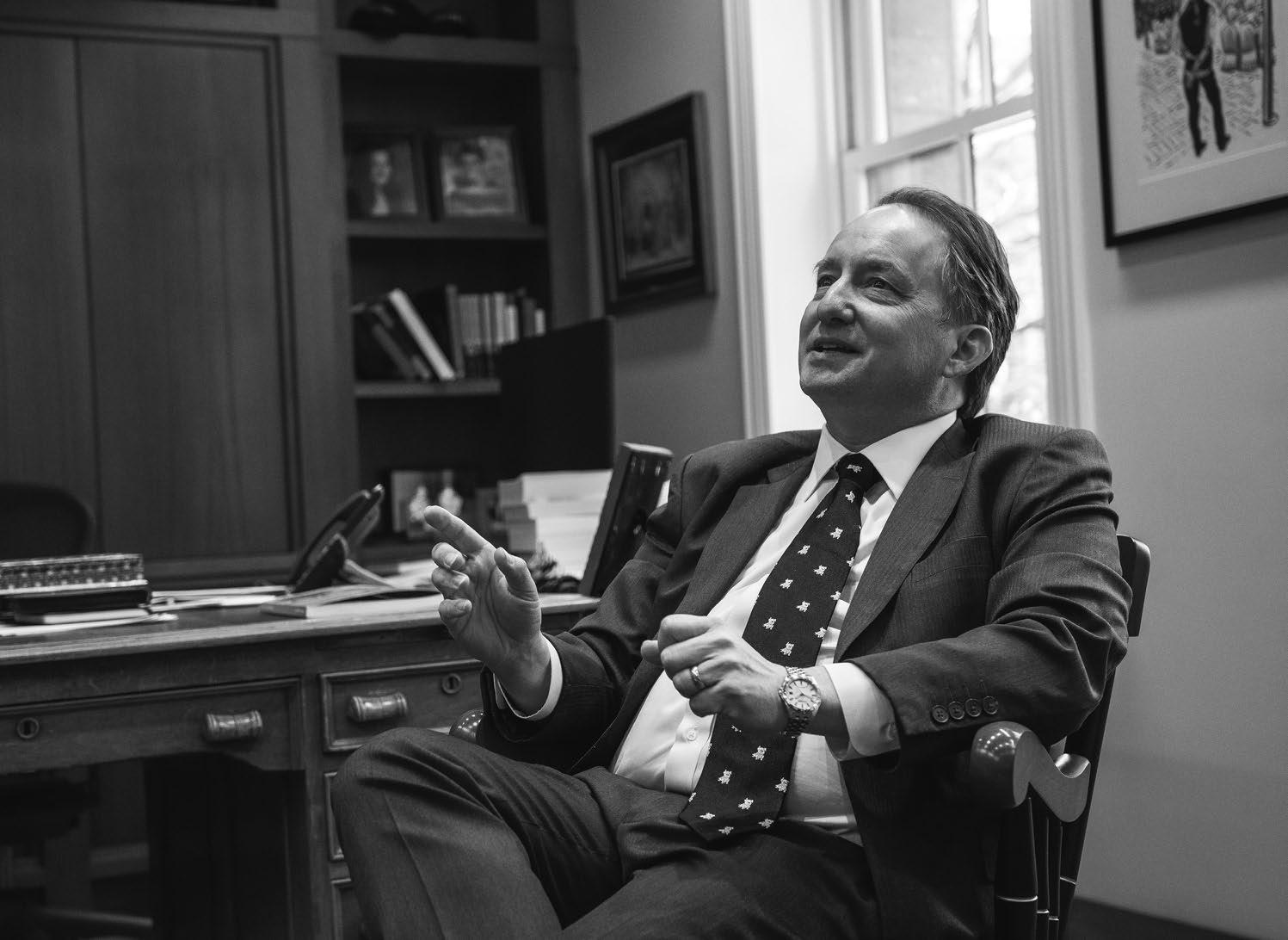
BY SARA AGRAWAL AND HENRY LIU STAFF REPORTERS
One hundred years ago, Yale College boys lived scattered around New Haven in boarding houses and in Old Campus dormitories. Students ate meals in exclusive eating clubs and at Commons. The residential college system, which has come to be a hallmark of the Yale College experience, was in its first stirrings.
Now, the residential college system is more developed than ever. There are twice as many colleges today than there were when the first seven opened in 1933. Two opened to students within the last decade.
But undergraduates are still dispersed between on-campus dorm rooms and the neighborhoods in New Haven surrounding Yale’s campus. In the 2024-2025 academic year, 1,757 undergraduates lived off-campus — more than twice the number who lived off-campus in the 2019-2020 school year, according to data from the Office of Institutional Research.
After the COVID-19 pandemic, which caused administrators to implement policies requiring a large portion of students to live off campus, the number of students living off campus during normal school years increased dramatically.
In response, Yale administrators have made a push to bring students back to campus, shifting which classes get priority in the room draw to encourage rising juniors not to move off campus in the first place.
With some students skeptical of the value of on-campus living and administrators insisting that residential life is a cornerstone of the Yale College experience, students’ living habits before the opening of the first seven colleges in 1933 offer a view of what undergraduate life looked like without a residential college system.
A scattered student body
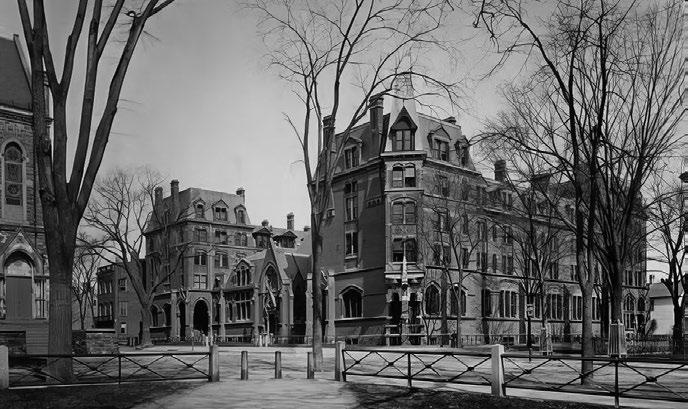
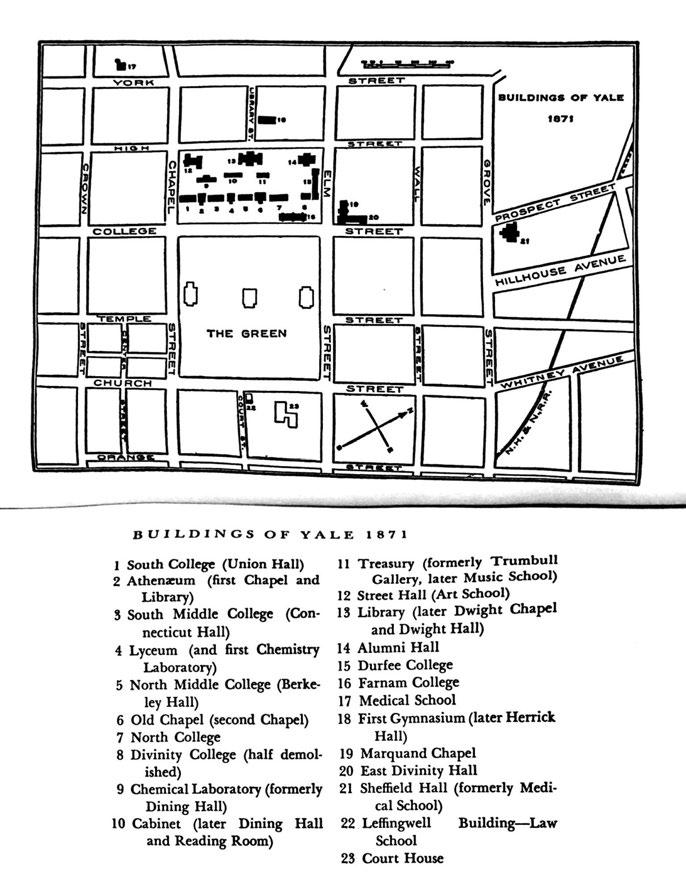
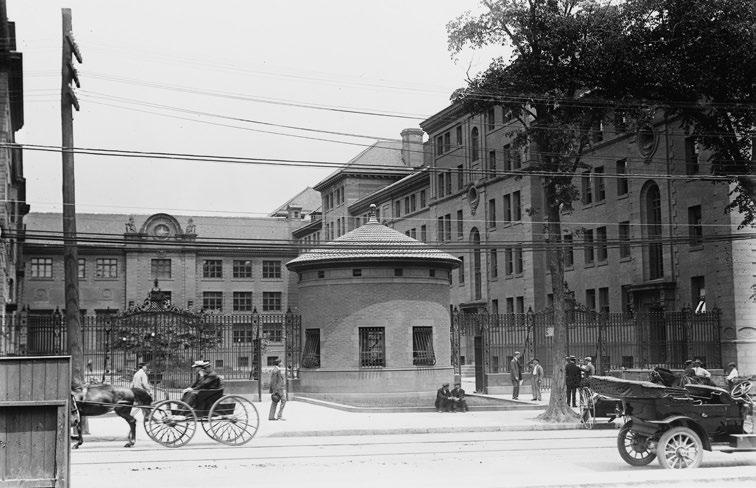
In the 1860s, most first years and sophomores lived off campus, and seniors and juniors competed for the limited desirable rooms in the Brick Row, a strip of dormitory buildings on College Street, through a lottery system. Low-quality food and a lack of beds contributed to a prevalence of students
living off campus.
In the following decades, policies and residential construction spearheaded by various University presidents aided in bringing social and residential life back onto Yale’s campus.
River Sell ’25, who wrote a paper tracing the development of Yale residential culture in the 19th century for the class “Yale and America,” said in a phone interview that in the second half of the 19th century “you have a series of presidents who are all really committed to the quadrangle idea, to creating a literal fortified wall on the edge of Old Campus.”
In his 1915 book “Yale Yesterdays,” Clarence Deming wrote that rich students bought high-up slots in the lottery from poorer students and formed cliques in certain entryways.
Commons was established in 1866, but the silky dumplings and hearty pastas of today’s dining hall were nowhere to be found. Instead, breakfasts were “hashed up from the remnants of yesterday’s dinner, and fried into a consistency that baffled digestion,” Lyman Hotchkiss Bagg wrote in his 1871 book “Four Years at Yale,” which led to students’ dissatisfaction and “bread-andbutter rebellions.”
Social life was centered around fraternities and the eating clubs where students took their meals. The members of these clubs, run by a poor student “steward” partnered with a townsperson, governed themselves and decided which new students would be admitted. Often, Bagg writes, prep school acquaintances formed elite clubs at the start of their first year.
Sell mentioned that Yale’s integration with New Haven was tense at times, with brawls occurring between students and townspeople.
“You had a growing town, a growing college, students who were, you know, very entitled and Protestant, unlike a lot of the new Catholic immigrants. You had tensions,” Sell said.
As such, administrators, led by professor Noah Porter, convinced the wealthy businessman Henry Farnam to donate money for the building of new halls that faced inward in a quadrangle, thereby isolating college life from the streets of New Haven.
Farnam Hall was the first to be built, but
many quickly followed. According to Sell, new buildings, such as Phelps Hall, were designed to be a fortification against the town.
The new dormitories of Old Campus, with their superior ventilation and heating, drew many students to live on campus.
However, beyond Old Campus, much of the campus of one hundred years ago looked different than today’s Yale. At the corner of Elm and College street sat the Divinity School, which would be torn down in 1931 for Calhoun College.
The residential college plan
As Yale made its way into the 20th century, new problems arose with the residential system.
Enrollment numbers were increasing by the year. According to “A Yale Book of Numbers,” a compilation of statistics by historian George Pierson, in 1890, 832 undergraduates attended Yale. By 1930 that number had more than doubled to 1680 undergraduates, even despite a drop in enrollment and a gradual recovery during and after World War I.
Increasing enrollment created a housing shortage, and the administration became so concerned that in 1923 they capped the freshman class at 850 students, according to Brooks Mather Kelley’s “Yale: A History.”
A larger Yale was a problem, also, because it undermined the sense of “solidarity” that students found within the small community of each class year, Charles Seymour, the university provost and soon-to-be master of Berkeley College, wrote in a 1933 essay for The Yale Alumni Weekly.
Creating a residential system similar to those at Oxford and Cambridge might solve this problem, some administrators suggested.
“The College Plan seeks to capitalize values characteristic of the old Yale, some of which run the danger of disappearance under modern conditions. Change is necessary in order to avoid decay,” Seymour wrote. By 1925, President James Rowland Angell was actively pushing for a residential system. What the University lacked was donors to finance the new project.
In January 1930, the News reported the announcement of Edward S. Harkness’
“splendid gift,” which would finance the first eight residential colleges, including carving two colleges out of the Memorial Quadrangle — composed of the now-named Branford College, Saybrook College and Harkness Tower.
Harkness, a graduate of the class of 1897, donated nearly $16 million to build several residential college quadrangles. Harkness was one of the wealthiest individuals in the country at that time, with a family fortune from investments in Standard Oil.
Branford, Calhoun, Davenport, Jonathan Edwards, Pierson, Saybrook and Trumbull Colleges opened in September 1933, the News reported at the time. The eighth college, Berkeley, was still being built and would open the next year.
Harkness’ gift made possible “provision” for students “who might otherwise be deterred by reason of the requirement that ten meals must be taken in the college dining halls” through a work-study program that would cover “full board in the college dining hall,” the News reported.
Mitigating the effects of socio-economic class differences among students was one of the appeals of the new residential model.
Jay Gitlin ’71 MUS ’74 GRD ’02, who teaches the course “Yale and America,” said in an interview with the News that a purpose of the residential college system was “recapturing, even though Yale University is now growing larger, this kind of small, friendly environment” in the 20th century when people were more anonymous.”
Gitlin said that disparities in the experiences of students of different social classes were a result of the housing shortage before the construction of the new colleges.
“There was a sense of trying to produce a more democratic environment where everybody got along, even if you were wealthy and you weren't.” However, that effect was limited because “some colleges were more hightoned than others,” Gitlin said.
The ninth residential college, Timothy Dwight, opened in 1935.
Contact SARA AGRAWAL at sara.agrawal@yale.edu and HENRY LIU at henry.liu.hal52@yale.edu.
Administrators’ problem has often been overcrowding.
BY OLIVIA WOO STAFF REPORTER
The residential college system at Yale College has been in place for nearly a century. It was initially implemented in 1933 “in order to encourage everybody to live on campus,” according to Yale College Dean Pericles Lewis — a goal that Lewis himself has embraced and repeatedly acted on during his tenure as dean.
But Lewis’ post-pandemic push to keep students on campus is only the latest in a long line of administrative efforts to influence students’ housing decisions. Since the inception of the residential college system, a motley assortment of wars, class size fluctuations and pandemics have pushed and pulled students on and off campus — trends which generations of Yale College administrators have addressed through different policy approaches.
A mandate that undergraduates reside on campus for all four years of college, which was implemented in 1962, led to a series of overcrowding crises in student dormitories. In 1964, after a consequent housing shortage on Old Campus was resolved, the News falsely predicted that overcrowding would “not be a problem after this year.”
But administrators would confront the issue again several times over the following decades. And in the mid-1990s, a countervailing trend coalesced in an off-campus exodus, already prompting the News to ask: Had Yale come upon the “end of the residential colleges?”
When demand exceeded supply
When the residential colleges opened to students in 1933, they attracted more students than they were able to hold.
Between 1850 and 1915, fewer than 55 percent of undergraduates had lived in Yaleowned buildings, according to data published by Yale historian George W. Pierson, who graduated from Yale College in 1926 and received a doctorate in 1933, in his 1976 “Yale Book of Numbers: Historical Statistics of the College, 1701-1976.”
The opening of the Harkness Memorial Quadrangle — which was later reconfigured into Saybrook and Branford Colleges — in 1917 gave seniors “wonderful and romantic accommodation” on campus, according to Pierson, but it wasn’t until the residential college system came about that Yale housed the vast majority of undergraduates.
The 10 residential colleges that opened in the 1930s, Pierson wrote, were “so attractive that by World War II almost 90 percent of Yale’s undergraduate students were housed and well housed in collegiate buildings.”
During the war, however, student quarters became more cramped. According to Pierson, the military had removed beds and installed double-decker bunks, which increased rooming capacity on campus.
Lewis said “a huge increase in enrollment” after World War II was accompanied by the conversion of single rooms to “dou-
“Because of over-crowding in the existing ten colleges we have had a more liberal policy in permitting students to live off campus than heretofore, and than we will have,” then-Dean of Undergraduate Affairs Richard Carroll said in 1962. “Those who were given permission to live off campus because of crowding will be expected to return to their old colleges or apply to the new ones.”
Carroll’s hard line did not hold for long, however. In December 1965, the Executive Committee announced a policy allowing upperclassmen to petition to move off campus, though they would still “be expected to participate in their residential college life,” keep on “the minimum meal contract” and submit a “progress report” each semester on how their off-campus experiences helped them work toward a specific academic project.
Less than three years later, in May 1968, the Yale Corporation moved to further ease restrictions on off-campus housing for students after their freshman year.
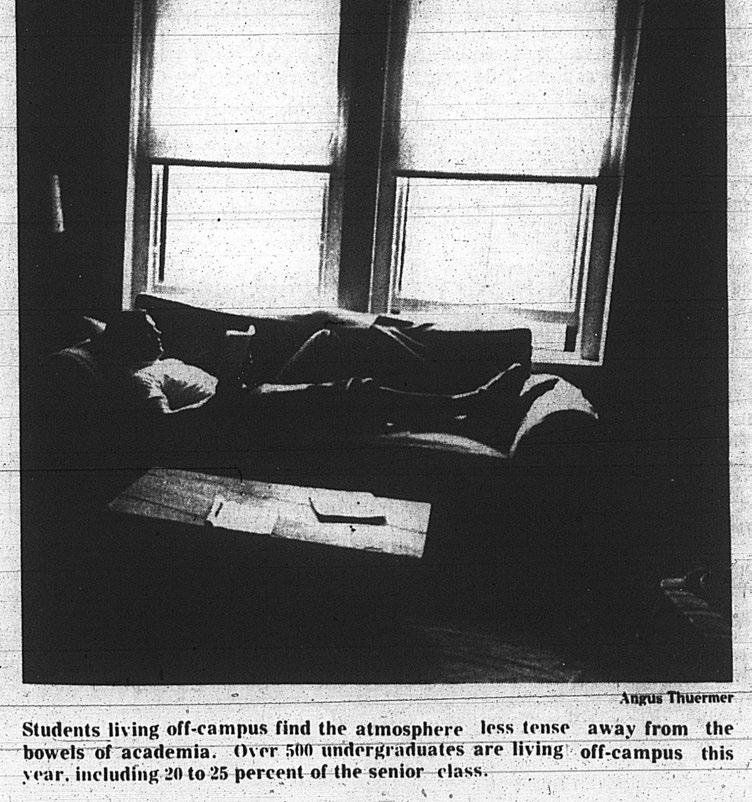
In the three years following the relaxation of the housing policy, the number of off-campus dwellers increased by over 400, the News reported in 1971. That year, 20 to 25 percent of the senior class chose to move out of their colleges.
Administrators were not fully on board with the trend. In 1970, Yale levied a $150 fee — $1,257 in today’s dollars — on all students living off campus. Student protests soon prompted a removal of the fee.
In a 1971 interview, Dean of Undergraduate Affairs John Wilkinson shared a stance on seniors leaving campus that echoes the one Lewis now holds over 50 years later. “After three years of dormitories, I can see why they might want a change,” Wilkinson said.
Concern about on-campus overcrowding — worsened when the University overshot its undergraduate enrollment goal in 1975 — also led students to move off campus, according to an ad hoc committee convened that year to examine the effects of crowding on student life.
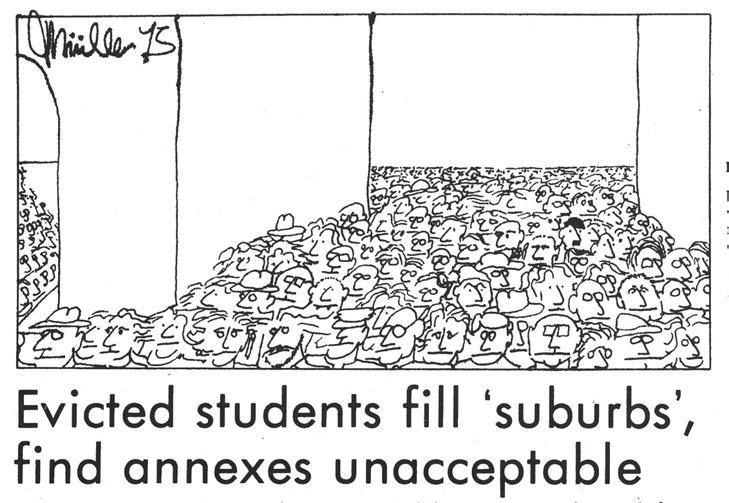
Overcrowding during those years forced administrators to annex students both to on-campus buildings like St. Elmo’s Annex — now Rosenfeld Hall — and off-campus apartments on streets including Howe, Prospect, Park and Temple.
Some students would also receive a “polite, or sometimes not so polite, shove” to move off campus, a dean said at the time.
John Meeske ’74 moved off campus during his senior year, but cited a reason other than escaping overcrowding: to live with his soon-to-be-wife.
“We became a couple as students, and then we got married right after senior year, essentially, but my wife had accelerated by one year and she went into the Yale Divinity School, and because of that, she and I moved off campus in what became my senior year,” Meeske said in an interview in February.
Shortly after his graduation, Meeske began working in the Yale College Registrar’s Office, and then in the dean’s office. In his role as an administrator, Meeske would
“I’ll rent you an apartment right across the street in the Taft apartments and it’d be a nice apartment, because we really need your room to put freshmen in.”
bles with bunk beds and that kind of thing.” Pierson’s numbers indicate a jump in enrollment from 1,520 undergraduates during the 1940-41 academic year to 3,339 in 1947-48, though the figure soon dropped, hovering around 2,400 during the 1950s.
In 1960, overcrowding in residential colleges necessitated the conversion of some triple rooms into quadruples. A Timothy Dwight secretary, faced that year with the task of fitting 20 extra students in the residential college, reportedly sighed, “We’ll be fitting them in somewhere.”
A hard line drawn, then loosened
Overcrowding during those years led administrators to allow students to live off campus, but the opening of Morse and Ezra Stiles Colleges for the 1962-63 school year prompted them to crack down on the practice.

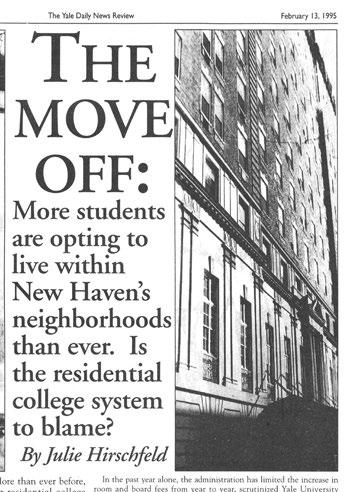
students are isolating themselves from this diverse community” on campus. He added that the University had been pursuing a “carrot” policy, encouraging students to choose on-campus living on their own.
For the 1994-95 school year, administrators decided to reduce a typical $200 to $300 increase in the room-and-board fee to a bump of only $30. But the tactic failed to incentivize students to stay on campus, the News reported in 1995. A year later, several students maintained that their expenses off campus were still lower than they would have been had they stayed in their colleges.
Administrators ultimately drew a hard line: In March 1995, off-campus privileges were revoked for sophomores, beginning with the class of 1999.
“If sophomores are moving off campus, they may not even be experiencing living in a residential college,” Meeske said in February this year when asked to describe the rationale behind the decision, although he noted that the change was made before he was involved in housing policy. “The feeling was that students should at least have that experience, and then, if they decide to move off campus, at least they’re choosing from a position of knowledge.”
Only around 10 percent of undergraduates who lived off campus at the time were sophomores. Some students protested the decision as overreach by the administration, but administrators characterized it instead as a return to a norm — in which sophomores lived on campus — that had only been disrupted in the prior decade.
However, Meeske noted in a 1995 interview with the News that there was not enough space for every off-campus student to move back on.
Sending students to the Taft
One year after the sophomore policy was instated, an abnormally large class of 2000 matriculated to Yale, forcing administrators to contend both with an unexpected influx of first years and a fully on-campus class of sophomores. Flooding on Old Campus only compounded the resulting housing shortage, and Meeske, now an associate Yale College dean, had to think outside the box — of campus.
singles into doubles.
“In the top of Vanderbilt, those very big suites under the eaves on the fifth floor, there were a couple of rooms that had very large spaces,” Meeske recalled. “We took off one of those spaces in each of several suites and made them into a double bedroom.”
Meeske said he devised plans for these alterations by poring over floor plans of campus buildings and offering his suggestions to architects. He had studied architecture as an undergraduate at Yale, and said he “was a great student of these floor plans.”
In an interview with the News in 2002, Meeske characterized the 1996 housing squeeze as “the closest we ever came” to forcing students off campus.
The lure of renovated colleges In the two decades after Meeske’s 1996 negotiations, demand for off-campus living peaked and dipped, leading to — and often resulting from — students being sent to live outside of their colleges.
grapple with what he described as the worst moment of overcrowding yet seen in the College’s history.
‘Students are isolating themselves’
As the 1980s came to an end, administrative concerns and student complaints regarding overcrowding returned. In the middle of the 1990s, an off-campus exodus prompted the biggest housing policy change in recent memory — forcing sophomores to stay on campus. By 1995, off-campus living had gained such popularity that 17.4 percent of students had opted to leave their residential colleges, citing reasons such as overpriced, low-quality food and run-down, crowded dormitories.
Meeske said at the time that administrators were “certainly very concerned that
“I had to negotiate to rent some apartments that were in the Taft apartments,” Meeske recalled in February, referring to the building at the corner of College and Chapel Streets. “We had a few upperclassmen who were annexed to the Old Campus, and I had to convince those students, ‘I'll rent you an apartment right across the street in the Taft apartments and it’d be a nice apartment, because we really need your room to put freshmen in.’”
“Obviously we can’t put freshmen by themselves in the Taft apartments and not be part of a community,” Meeske said. “That wouldn’t make any sense.”
In addition to moving those students — two juniors in Calhoun College, which has since been renamed as Grace Hopper — to the Taft, the University also moved two suites of Saybrook first years into the college proper and forced a Yale official out of their York Square quarters to accommodate Morse students, the News reported.
Around this time, Meeske said last month, alterations were made to Bingham, Vanderbilt and Welch Halls to repurpose extra spaces into proper rooms and turn existing
As colleges underwent renovations, beginning with Berkeley in 1999, it became evident that the condition of a student’s residential college factored into their decision-making calculus. Reports by the News between 1999 and 2009 suggested that upperclassmen were more likely to stay on campus if their colleges had been renovated.
Meeske told the News last month that his own experience as an undergraduate informed his recommendations for renovations during that period.
“I was trying to push them to create as many single bedrooms as possible. The architects weren’t necessarily inclined to do that,” Meeske said, adding that he wanted to prioritize guaranteeing singles for seniors.
“That push kind of came back from my student days and seeing how that was seen as desirable in those times.”
While much of the Yale undergraduate experience may have changed since Meeske was a student, the prevailing preference for single rooms has not. Yale has 14 residential colleges.
Contact OLIVIA WOO at olivia.woo@yale.edu.

The state of the colleges is ‘strong’
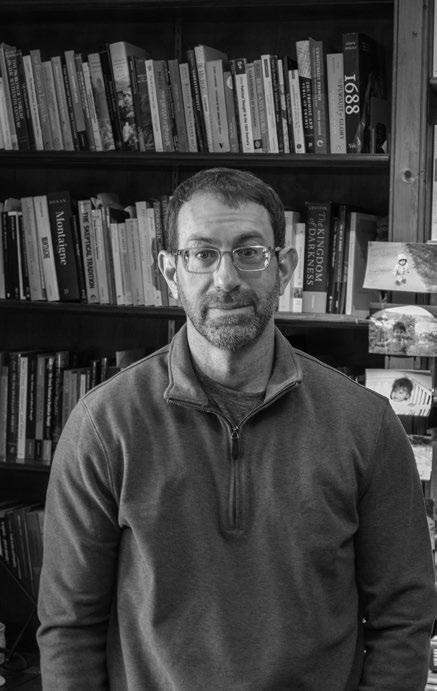
The state of the residential life among undergraduates at Yale is “strong,” according to Benjamin Franklin Head of College Jordan Peccia.
During his three years leading Franklin, Peccia wrote in an email to the News, his college has been “completely full.”
Peccia added that he knows many other institutions “would love to emulate our residential college system” and that he sees every day “how our college provides enriching social and academic experiences for our students.”
“The thing in life that’s important to us, that I think a lot of us discount so much, is building relationships with other people and the richness of your life,” he said in an interview. “I work really hard in trying to get to know all of our students. It’s not impossible for me to have a close relationship with all 530.”
The rise in students living off campus over the last decade may be “difficult” to identify, he added, considering effects of the COVID-19 pandemic and the increased size of Yale College.
Peccia pointed to his college’s fresh traditions, including an annual “Olympics” between Franklin and Pauli Murray College, as well as the fact that its first years live in the college, unlike 10 other colleges, whose first years live on Old Campus.
“I think having everybody in a college is good,” Peccia said. “That’s such a great way to network, just even within your college, to be talking to people in different classes.”
While his college is young, he added, it’s “a really good way to be” that budgets are distributed equitably among residential colleges, so that students do not have to watch other college’s students “you know, drink champagne, while you can’t do anything.”
In fact, Peccia said, “it sometimes can be easy to build a positive culture when you are not burdened by the way of doing things in the past.”
Benjamin Franklin College opened to students in 2017. Hannah Liu contributed reporting.
Interviews by Jaeha
‘More power to them’ to go Moving off is ‘detrimental’
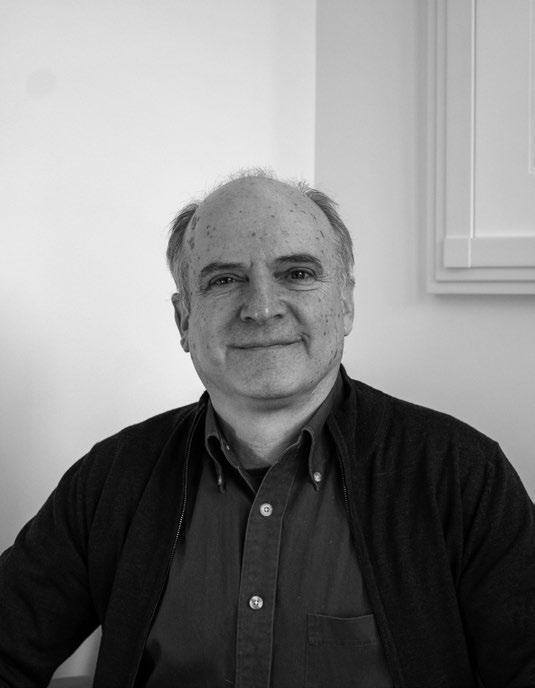
The state of the residential life among undergraduates at For Grace Hopper Head of College Samuel Moyn, “it’s totally reasonable to live off campus.”
While he thinks the purpose of college is to “learn who to be in this short life you have” and living in a residential college with a diverse community allows students to expose themselves to “all the different ways to explore existence,” Moyn acknowledged that this perspective appeals to “some and not others.”
If students think their desires and preferences are better fit for off-campus housing, then “more power to them,” he said.
Moyn said he hasn’t seen “an exodus that would fundamentally undermine the community” in Hopper. The college’s bedrooms are full and don’t have the space to accommodate every student anyway, he added.
Moyn mentioned various hypotheses as to why a large share of students may be living off campus. One is that the “consumerization of universities” has resulted in the understanding of universities as a product to be customized, Moyn said. Another is that the residential colleges are physically declining, he added.
“I don’t have a strong view about why it could be happening. I don’t even think it’s necessarily wrong,” Moyn said. “It could have to do with the cell phones, could have to do with streaming.”
According to Moyn, his goal as the Hopper’s head of college is to make it more “amenable” to what students want.
“It’s not like the colleges are a static institution. I’m here mainly for fan service,” he said. “Like, what can I do to make this college more inviting?”
Grace Hopper College was called Calhoun College until 2017.
When molecular biophysics and biochemistry professor Michael Koelle became the Head of Ezra Stiles College last year, he was surprised by the extent to which students are living off campus, he said in a March interview.
As the “number one distinguishing feature of Yale College,” Koelle said, residential colleges provide a sense of community. Large numbers of students moving off campus, he said, could have a “detrimental effect.”
“Why did you come to Yale? You came to Yale to be around these amazing people,” he said. “It’s just inevitable that you won’t feel that same sense of community here, won’t benefit from this community when you’re living off campus.”
When he talks to students about off-campus housing, Koelle said he tries to ensure that they understand the “less apparent” costs of living off campus, which include the costs of food, utilities, furniture and storage.
“There could be a rude surprise moving off campus, finding that it’s actually not costing less than it would cost on campus,” Koelle said. “There’s also this ineffable thing that’s hard to quantify, which is the loss of community.”
In addition to the lingering effects of the COVID-19 pandemic, when many students moved off campus, Koelle said he thinks one “issue” that has been pulling students away from campus is the “beautiful new apartment buildings” in New Haven that have been marketed “very cleverly” to Yale students.
The landlords of these apartments often require students to sign leases before Yale’s housing draw, and they set prices that “appear attractive relative to housing costs at Yale,” Koelle said. Koelle praised efforts by the Yale College Dean’s Office to keep juniors on campus, including the recent move to give them priority in the housing draw and to allow students annexed from their colleges to choose where they live on campus.
“If I had a choice between students moving off of campus and really being siloed away from campus, off in their apartment building with their little friend group there, versus being on campus and being more a part of the Yale community, I prefer to have them here on campus,” Koelle said, acknowledging that annexed students may be separated from their college’s sense of community. Koelle teaches “Biochemistry and Biophysics” this semester.
and Hannah Liu. Words by Jaeha Jang. Contact Jaeha Jang at jaeha.jang@yale.edu.
Alex Hong and Dani Klein / Staff and Contributing Photographers
BY HANNAH LIU AND SASHA CABRAL STAFF REPORTERS
In 2017, Yale opened two new residential colleges, the first since 1962: Pauli Murray and Benjamin Franklin.
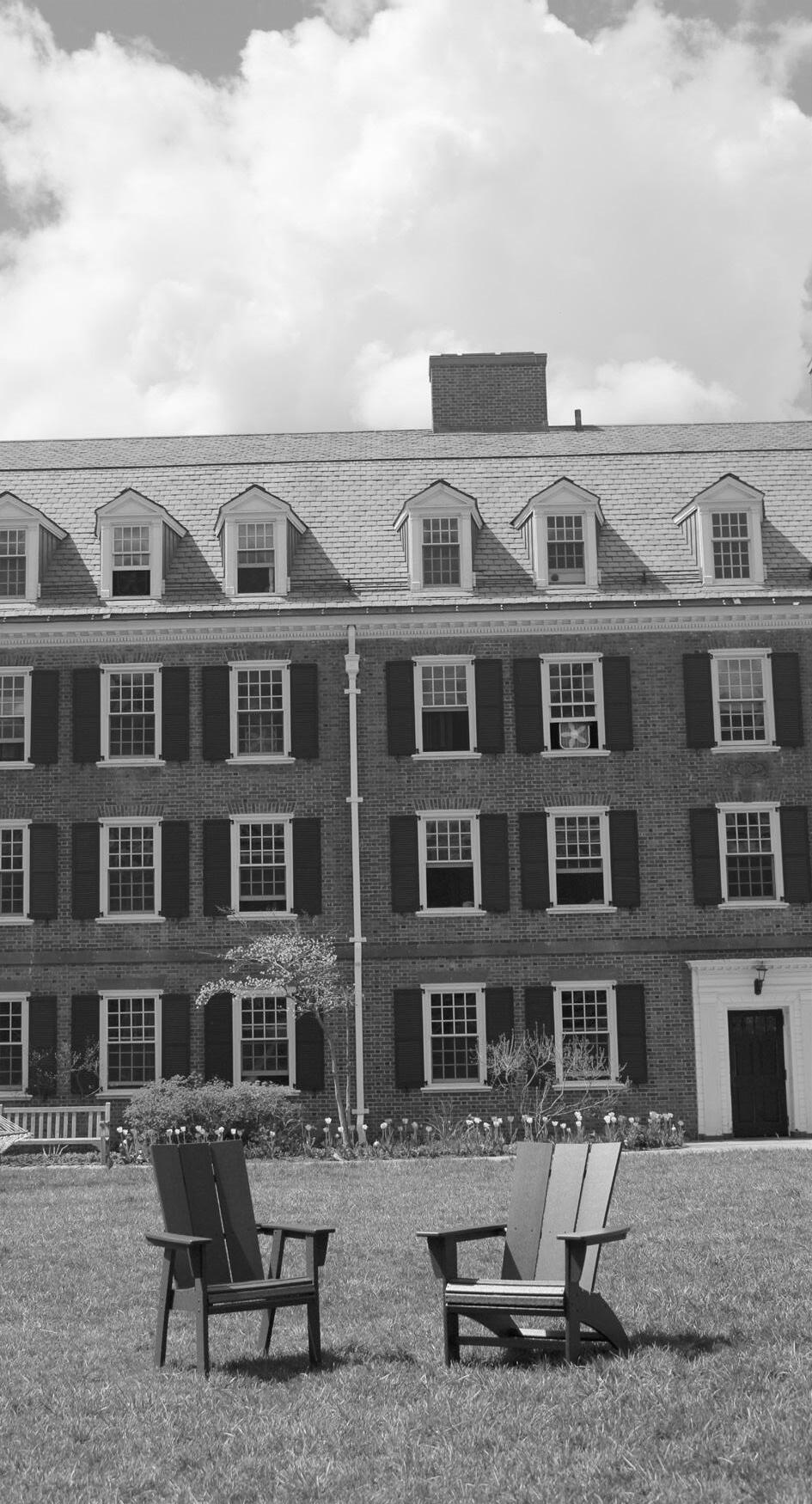
Over the past decade, Franklin and Murray students have designed their traditions from the ground up, providing a front-row view into the status and evolution of individual residential colleges’ cultures.
When Jay Mehta ’24 GRD ’25 arrived at Franklin as a first year in 2019, he did not feel a strong sense of pride or culture in the college. Over time, he said, he slowly grew more involved, putting on an original musical in Franklin’s facilities and eventually returning as a Franklin graduate affiliate.
“Franklin has changed over time and really blossomed,” Mehta said. “When I first got to Franklin, it was very new still. It felt like it didn’t really have a culture or its own sort of pride and identity, the way old colleges did, like we hadn’t yet figured out who we are. I have no idea when that changed, but by the time I graduated, went from college and then did the masters program, I feel like it has.”
Mehta mentioned returning to Franklin recently for the first time since graduation and, while sitting in the Franklin courtyard, realizing how much the place felt like home.
Several Franklin and Murray students described actively participating in starting new traditions.
During the pandemic, students in Franklin created the college’s annual Christmas album, which continues to be produced every year, under the name “Yale Franklin Founders.” Made in the Franklin recording studio with college resources, the project is meant to showcase Franklin’s musical talent and creative spirit.
“We wanted to make this a very open community project in the first two years,” Tony Ruan ’25 GRD ’25 said. “We would literally grab people coming in from the hallways to sing with us.”
In her first year, Coco Ma ’25 MUS ’22 founded a club called the Sci-fi and Fantasy Society. The group hosted events including a college-wide screening of “Dune” and college teas with fantasy authors such as Holly Black.
“It was really cool getting to see a lot of my friends or even students that I didn't know very well, all connecting over a shared passion, which was books, writing in general, becoming authors and fantasy sci-fi,” Ma said. She added that Franklin college administrators and staff were always supportive of ideas for new traditions.
Aaron King, who has been the dean of Pauli Murray since 2024, mentioned the Pauli Pumpkin Patch as another example of a new tradition. He voiced appreciation for Murray students’ living in a “newer” part of “an old institution.”
“We don’t have an event that’s been going on for decades, but we get to create those if we choose to. Even small things that come up become kind of a fun memory, like the Pauli Pumpkin Patch that came a few years back,” King said. “These are small things that kind of become part of the story and culture of this newer space.”
The Franklin and Murray College Councils have also taken charge in establishing traditions.
“It’s like a double-edged sword because, on one hand, we’re so young that we don’t really have a ton of traditions,” Murray College Council President Ben Braecklein ’27 said. “But on the other hand, because we don’t have these set traditions, we also get this really cool chance to try and build the traditions that will be for the future. A good example of that is I suggested to the office and then the head of college that we have a Christmas tree.”
Students are not the only ones shaping culture. Murray students also credited Head of College Tina Lu, known as Prof T, and King for creating a welcoming environment. Franklin alumni and students mentioned Head of Operations Maria Bouffard as a source of support and inspiration, in addition to the rest of the college and dining hall staff.
Franklin’s and Murray’s basement murals,
handpainted by students, also reflect efforts by students and staff to foster college pride and culture.
Benjamin Franklin Head of College Jordan Peccia remarked that students get to shape not just social traditions but also the college’s academic culture. He mentioned building new collections of art pieces and books. By now, he said, the college has acquired several thousand books.
Franklin and Murray’s relative newness offers an abundance of opportunities for North Campus students to create their own college character and form new traditions — suggesting that residential college culture, however modest, is important to Yale undergraduates.
“I feel like we still have an influence in making traditions in culture, and it’s far more flexible,” Marc Firpo ’29 said. “Where I feel like you look at JE, you know, one of the first ones being founded — it’s a bit harder to kind of have an influence there.”
Holden Lee ’29 said that Murray and other residential colleges have distinct characteristics, but the differences among them are minor. “I wouldn’t say there’s a distinctive characteristic, because it is a random group of students at the end of the day,” Lee said. “But I do think there is this little sense of, like, trauma bonding from walking to Old Campus all the time or it being nice that we’re so close to Science Hill, you know, for early classes. And also having, like, the best dining hall is obviously something to be very proud of.”
First years in Benjamin Franklin, Pauli Murray, Silliman and Timothy Dwight colleges live in their residential colleges in their first year.
Contact HANNAH LIU at hannah.liu@yale.edu and SASHA CABRAL
BY HANNAH LIU AND SASHA CABRAL STAFF REPORTERS
Looking for flexibility
Clara Díaz Suárez ’28 of Jonathan Edwards College will be living off campus next year, trading Yale housing for a shared house with her sailing teammates. For Suárez, the decision came down to independence and comfort.
“I want to have a kitchen, liberty to eat my meals whenever,” she said in an interview. Having a more private space and the ability to cook on her own schedule ultimately outweighed the conveniences of residential college life, Suárez said.
Suárez said that her experience living in Yale housing has not always been positive. While she declined to go into detail, she said that dissatisfaction played a role in her decision to move. Living in a house, she hopes, will offer more stability and personal space than the residential system can provide.
She is looking forward to sharing a home with her teammates, a setup that blends independence with built-in community, Suárez said. Suárez is one of many undergraduates who move off campus in search of greater autonomy and a more tailored living situation. For her, off-campus life promises both comfort and camaraderie.
Uniting with friends across colleges
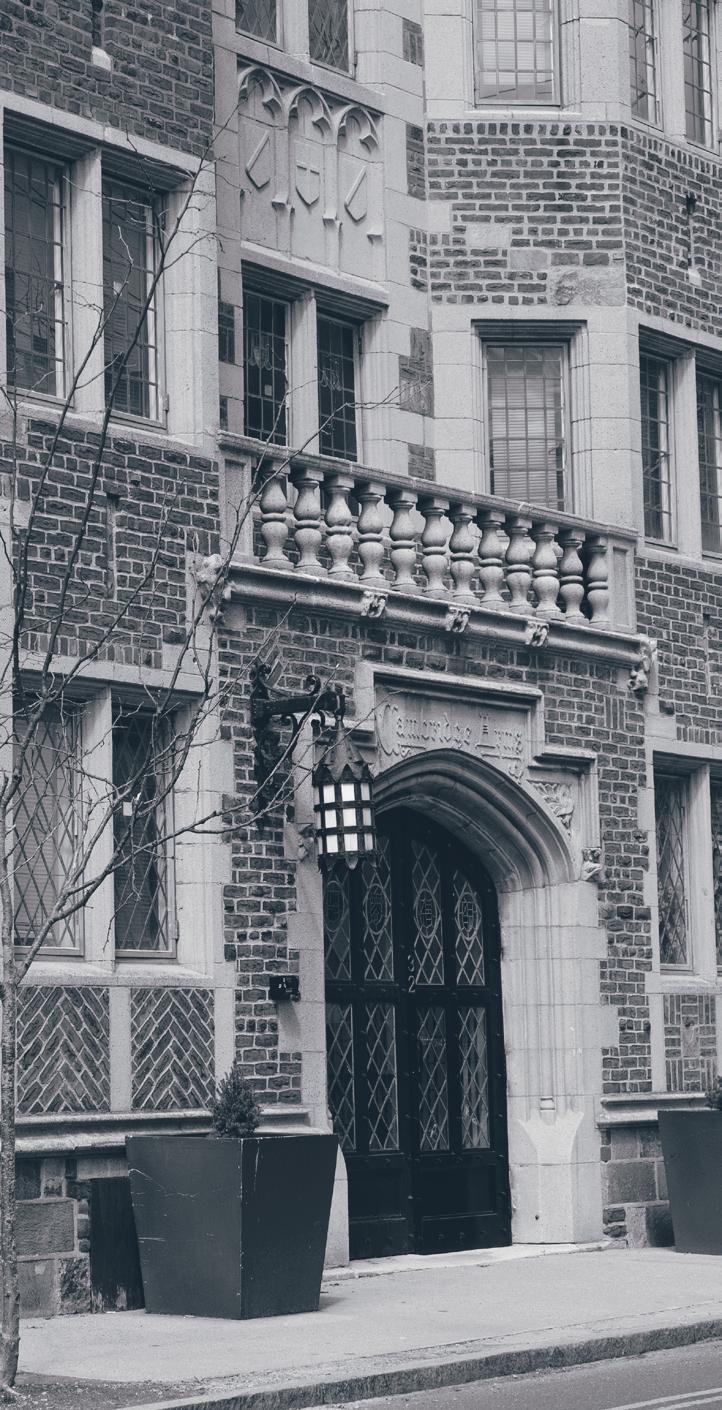
Addy Gorton ’28 is a sophomore in Jonathan Edwards College moving off campus next year to the Cambridge Oxford Apartments on High Street.
“A lot of my close friends are in other residential colleges,” Gorton said in a phone interview when asked why she chose to move off campus. Gorton said she will be living with three friends from three different residential colleges.
Gorton added that she is “excited” to have a kitchen. Gorton said that a group of seniors passed the lease for the apartment down to her and her friends.
Gorton expressed her appreciation for Jonathan Edwards and said she will miss living so close to its courtyard.
“I’m only moving like half a block away,” she said. Gorton added that living close to campus was one of her priorities when she was looking for off-campus housing.
Gorton said she will miss “being close to a lot of people that maybe I wouldn’t bump into on the daily.”
“It’s nice that we’re kind of confined to this one thing we have in common, which is Jonathan Edwards,” she added.
Location, location, location
Noah Lee ’28, a sophomore in Ezra Stiles College, plans to stay on campus for his junior year.
Initially, he thought his undergraduate experience would naturally include living off campus, he said in a phone interview.
“A lot of my siblings have lived off-campus in their college experiences,” Lee explained.
However, for Lee, his experience living in Stiles so far influenced his decision to continue living on campus. He said that Stiles is “centrally located” for many of his classes, which tend to be between Linsly-Chittenden Hall and the Humanities Quadrangle.
“I also work in Stiles, in the office, so everything was kind of more compact there,” Lee added. “I’m probably more tapped into my college community than the average person.”
Lee was also discouraged by the lifestyle adjustment that moving off campus would require, he said.
“Especially amidst what I expect to be the hecticness of junior year, I think I’m a little
scared of that honestly,” he said.
Lee is also close to his current suitemates, he said, and their “rapport” and the benefits of residential college life are keeping him in the dorm room.
“There’s just something very endearing to me about being able to go to the buttery at midnight and then go straight back to my room nowadays without having to walk, I don’t know, 20 to 30 minutes,” he said.
Lee is currently living in a sextet suite this year and will be in a quintet next year. He will live in a single bedroom next year, he said.
Inspired by upperclassmen
Aubrie Williams ’28, a sophomore in Davenport College, will be living off campus next year in Crown Towers.
Initially, she was not planning on living off campus, she said.
“You have the rest of your life to live in an apartment and you only have four years to live in a residential college,” Williams said.
During Williams’ sophomore year, however, she experienced an “upperclassman influence” from those already living off campus. Additionally, she said she noticed that many of her peers were planning on doing the same.
Williams said her decision to move off campus came down to hearing others’ experiences.
“I feel like also hearing like personally from someone about a good experience they’ve had has a lot more like power than anything else,” she said.
When deciding between living in a house or an apartment, Williams said “it kind of came down to thinking about safety a lot,” which is why she chose an apartment.
Williams and her friends chose to live in Crown Towers based on “the price and then all the amenities and the location,” she said.
Contact ARYA STAPLETON DHILLON at arya.stapletondhillon@yale.edu and MELISSA ADAMANTIDI at melissa.adamantidi@yale.edu.
BY SARAH RIVAS STAFF REPORTER
During the spring semester of her freshman year, Eshi Nair ’27 decided to go on a beach trip with Saybrook College’s Asian affinity group, Saysians. While the beach was “miserable and cold,” Nair said, she huddled up on a picnic blanket eating Trader Joe’s snacks with other members of Saysians.
Nair was amazed to meet so many Saybrook upperclassmen who were eager to become her friends, which transformed a bad beach day into one of her “best experiences,” she said.
“I think already having different residential colleges sets up students coming to Yale to feel like they have a family, they have like a group. But having affinity groups kind of takes it a step further,” Nair, now a co-president of Saysians, said.
Saysians isn’t the only residential college-specific club on campus. A select number of residential colleges have student-led organizations that promote connection across grade levels and through cultural identity — clubs ranging from the Stiles Knitting Circle to Trumbull’s Black affinity group Blackbull.
That opportunity, however, is not available across the board. In many colleges, clubs do not exist or have become dormant, leading some students to wish for more investment in college-specific groups.
Zara Chinwuba ’29 said in a phone interview that while the peer liaison program was a “great opportunity,” it didn’t give her “access to any of the upperclassmen that
BY ANNA KOONTZ STAFF REPORTER
Before the cross country race even began,
Katie Meine ’27 stood out from all the other contestants. She was wearing a fake white beard, rocking a floppy red hat and practically radiating Davenport College pride.
Meine is one of Davenport’s five intramural secretaries. The week before, she had reached out and advertised the meet to her peers.
“They’d respond with ‘Do I have to be fast?’ The easy answer to this was, ‘No, of course not, I’m going to be running it in a gnome costume,’” Meine wrote to the News. “I think we got a lot of people who wouldn’t normally participate to show up that way.”
Intramural sports, known as IMs, have been a part of the Yale College experience since the early 1900s. Students competed by class year until the introduction of the residential college system in 1933, when intramurals became a college bonding experience.
The popularity of intramurals has fluctuated throughout Yale’s history. In 2011,
could share in that same identity.” Yale’s peer liaison program connects first years with older students who can introduce them to identity-based groups, such as cultural centers.
Chinwuba said that a lack of Branford-specific clubs has created “a gap” between the different classes.
Many students who participate in residential college-specific organizations agree that they can offer intimate social experiences.
Ifeoluwa Olorunlogbon ’28, a member of the executive board of Blackbrook, Saybrook’s Black affinity group, said that many Black students in Saybrook enjoy attending events hosted by Blackbrook or the Afro-American Cultural Center.
Olorunlogbon added that at a school where “everyone’s proud to be part of their resco” and “everyone’s proud of their identity and their ethnicity,” Blackbrook offers her a chance to celebrate “the intersection” of things she’s “really proud of.”
“I’m not just proud to be Black. I’m not just proud to be Saybrusian. I’m proud to be one of how many Black Saybrusians,” Olorunlogbon said.
Nair added that residential college-specific affinity groups were “less intimidating” than University-wide ones due to their smaller scale, which allows them to function like a “family home.”
Nair said that she enjoyed meeting people with a “similar background” and “exposure to food and culture” through Saysians. Since the group’s events are open to “everyone,” they are a great way for people unfamiliar with Asian culture to “learn about
other people’s cultures,” she added. Many students whose colleges do not have affinity groups expressed a desire for them.
Nelly Cepeda ’29 said that Pauli Murray College “would benefit” from affinity groups. Cepeda said that because the peer liaison program is “restricted to first-years with one senior PL,” she was concerned about meeting other Murray students with a similar identity once she finishes her first year.
Kyler Parker ’29, a student in Murray, told the News that the college has a “lack of culture” among its students and believes that the issue “could be easily solved” by the formation of residential college groups.
“I just think that there’s absolutely no reason that such a vibrant space as Murray, full of vibrant people, couldn’t organize in these ways and build new connections between different affinity groups,” Parker said.
Alexa Parchment ’28 said that it is more difficult to attend events at the Af-Am House because it is “on the polar opposite side of campus” from Benjamin Franklin College, but an affinity group in Franklin could help ease that concern.
Claire Billings ’29, however, said that she feels satisfied with the peer liaison program, which offers her a “point of contact” to engage with other Asian students in Franklin.
“I think if you have an affinity group, you need a certain number of people to be attending or to be involved. Whereas if you have PLs, it’s less consequential to the impact of the program if you don’t have a lot of people tapping in,” Billings said.
Billings added that she questioned whether “dividing it up further” into affinity groups was helpful within the small residential colleges.
For Peyton Nguyen ’29, although Pierson does not have affinity groups, the college has a strong sense of community “because Pierson’s so small and kind of in the middle of nowhere.”
Although groups can easily become dormant, it is also relatively easy to restart college clubs if students are interested in doing so.
“It is kind of a revolving door in the sense that a lot of them will like, there are ton that exist, and then as people want to start more, the college is pretty welcoming for people restarting or starting new clubs,” Emma Popowitz ’27, the president of Silliman’s Student Activities & Administration Committee, said.
Kaya Basnet ’27 said she was able to restart the Stiles Garden Council, which was “really big” in the “early 2000s,” but had “ended around 2010.” Basnet said that doing activities with other members of her residential college has “genuinely” made her feel like Stiles is her “home” at Yale.
“Whenever I do things in Stiles, it’s like, I know every single person who’s like, here around me, and it’s like, we’re just doing this little thing that belongs to us,” Basnet said.
The Stiles Knitting Circle was established in 2018, according to a Stiles website. Contact SARAH RIVAS at sarah.rivas@yale.edu.
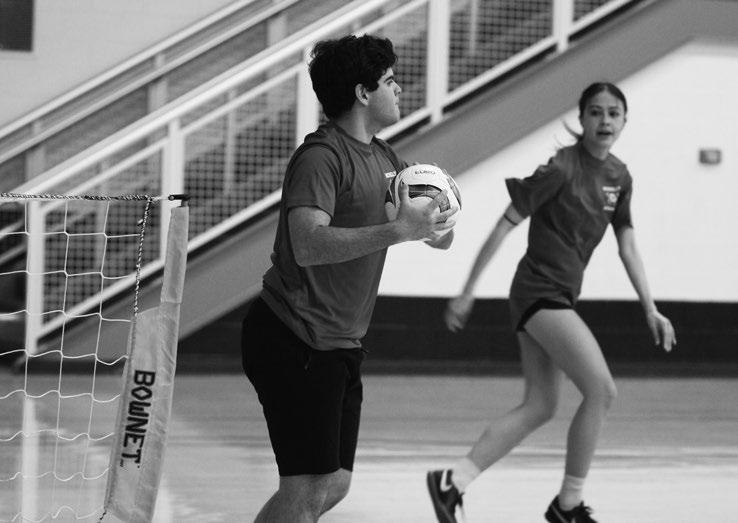
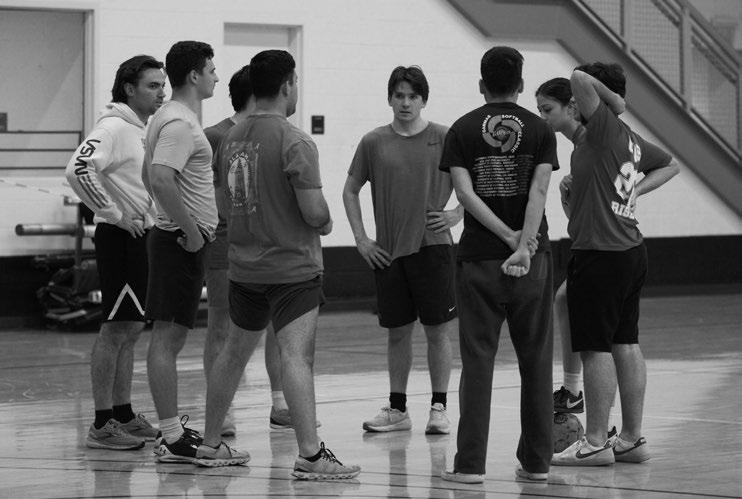
the News reported that 25 percent of undergraduates regularly participated in intramurals that year — up from 54 percent in 1942, the article noted. Last year, 19.4 percent of undergraduates participated in an intramural at least once, according to data provided by head intramural secretary Natalie Haase ’27. Despite the historical decline, a subset of the student population continues to embrace these sports and introduce new recruitment strategies to sustain them.
“I think they are a great source of residential college pride,” Matthew Chen ’27, the Yale College Council’s communications director, wrote to the News. He added that he participated in intramural volleyball a couple times during his first year. “Win or lose, students can feel closer to each other and the college they are representing knowing that they participated in this joint effort.”
Decades of recreational sports at Yale Brighton Risch ’28, an intramural secretary for Jonathan Edwards College, has noticed that students’ relationship with intramurals has changed over time.
“Student enthusiasm, participation,
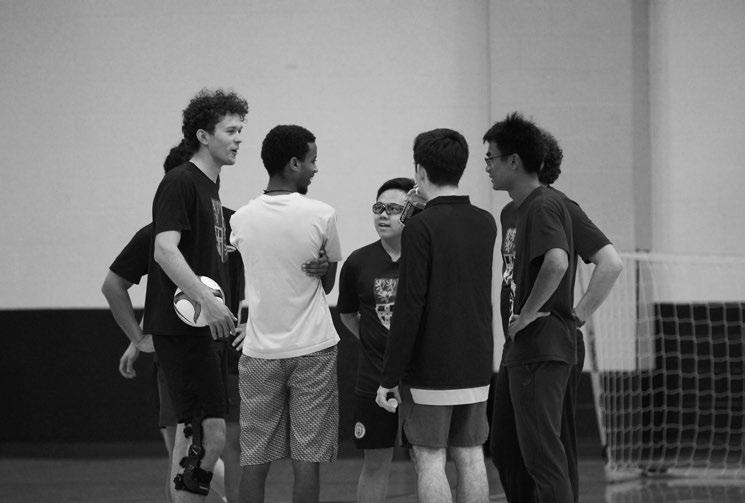
and rates have definitely dropped. In JE, if you walk around the basement, you will see many pictures of IMs from the past, and it’s clear it isn’t quite the same today,” Risch wrote to the News.
The JE buttery boasts framed memorabilia of the 1977-78 intramural ice hockey team. A group photo shows 18 people, including the team’s founder, smiling on the rink and identified by name. Another frame displays an alumnus’ jersey alongside a descriptive gold plaque.
The Berkeley College buttery also contains several black-and-white photos of intramural football teams, dating from 1942 to 1956. Each shows upwards of 20 male students posing formally in uniform.
Through the eras, recreational sports at Yale have served evolving purposes. At the turn of the 20th century, the motivation for intramurals seemed to center on the need to improve students’ physical fitness.
A 1918 News article included a listing of Yale’s intramural offerings: baseball, crew, track, tennis and lacrosse. In another article, a year later, the professional sportswriter Hugh Fullerton presented his support for intramurals.
“It always has been a shock to me to attend a big game at New Haven or at Cambridge and see fifty wonderfully prepared, perfect physical men representing five or six thousand fellows, four-fifths of whom were flabbily-muscled and physically unfit,” Fullerton wrote. “To me the majority represented the school — the others represented the skill of hired coaches.”
Student teams were organized by class year until Yale established the residential college system in 1933. That same year, three alumni donated the Tyng Cup, which has since been bestowed each academic year to the college that wins the most points through intramurals.
Recreational athletics today and onwards
Anna Calkins ’27, an intramural secretary for Morse College, wrote to the News that intramurals let students form new bonds across their college.
“First-years can meet and connect with upperclassmen, and it’s a great way for people living off campus to stay connected to the college community,” Calkins wrote.
A News article in 2011 assessed the longterm trend of declining intramural participation and credited the shift to the relatively recent increase in extracurricular activities, giving students less free time in their schedules for cornhole or a soccer match. It also pointed to a drop in varsity athletes’ off-season participation in intramurals.
Nevertheless, intramural secretaries have developed strategies to encourage more student participation. They range from Meine’s dressing up as a gnome to simply reaching out to friends when a team needs a couple extra players.
Several colleges use social media to advertise intramurals. The Saybrook College intramural Instagram account has over 30 posts from this semester, featuring edited videos with dramatic music. One song contains specialized lyrics, listing other residential colleges and saying “they don’t wanna be us.”
In Trumbull College, an Instagram account promotes weekly intramural schedules and spreads information about the time and location of upcoming games.
Several intramural secretaries noted that a team’s culture varies year to year as new students enter and older ones graduate. The frequent turnover can provide fresh energy.
Meine spoke to the contributions of new first years, writing that their “new talent and passion” is what “keeps the excitement alive.”
At the other end of the undergraduate experience, intramurals still carry weight for those in their final semester.
“There’s a sense of urgency to participate before graduating,” Asher Barondes ’26, a Saybrook intramural secretary, wrote. “That feeling of ‘this is our last shot’ naturally energizes our class, and I believe that enthusiasm has had a trickle-down effect.”
Ezra Stiles College currently holds the Tyng Cup as the 2024-25 champion.
Contact ANNA KOONTZ at anna.koontz@yale.edu.
Liza Kaufman / Photographery Editor
BY ISOBEL McCLURE STAFF REPORTER
Sixteen years after Yale College moved to equalize funding across its residential colleges, the College administration is central in overseeing college finances and opportunities. But the legacy of college-specific donations continues to linger in parts of undergraduates’ residential college life.
Today, roughly $250,000 in base discretionary funds are allocated to each residential college, Yale College Dean Pericles Lewis told the News, although the amount varies slightly depending on the number of students. According to Lewis, the $250,000 is supplemented by other program funding, such as for Creative and Performing Arts, or CPA, awards, which lands at a budget of around $500,000 for a “typical residential college head.”
“It’s an ongoing conversation about what’s best to be done centrally and what’s best to be done in the 14 different colleges,” Lewis said last month.
Before the centralization of college funding mechanisms in 2010, some colleges managed their own separate endowments, according to Steven Smith, a political science professor who was Branford College’s master, the equivalent of a head of college, from 1996 to 2011.
“There was increasingly a push to bring about more equalization, and with equalization comes centralization,” Smith said. “And I think the University basically wanted to control the money too.”
A move to centralize, and equalize
The College moved to centralize residential college funding following the 2008 financial crisis, when the University navigated a “serious blow” to its endowment and severe budget cuts, former University President Peter Salovey GRD ’83 ’84 ’86, who was Yale’s provost at the time, wrote to the News.
Salovey wrote that the decision aimed to equalize students’ access to resources across the colleges. Existing disparities across the colleges, with older colleges often having greater resources, were seen as unfair to undergraduates “randomly assigned” to their college, Salovey wrote.
In 2010, the University announced the equalization of residential colleges’ funding. The three wealthiest colleges’ budgets were reduced, while the others’ were raised or remained level to match the others, the News reported at the time.
“We did what students have been clamoring for for years,” then President Richard Levin GRD ’72 ’74 told the News in 2010. “We made
funding more equitable.” The 2010 change arrived around the time when eight operations managers started working with the colleges.
Smith recalled financial disparities between the colleges had increased “pretty dramatically,” including during the time when he led Branford.
“Two or three of them were enormously wealthy, private endowments and all kinds of things, and some were kind of just barely treading water,” Smith said. He recalled one residential college, which Smith declined to name, taking a group of seniors to Europe on a paid-for spring break trip.
The University encouraged donations not specific to particular residential colleges, Salovey wrote, and altered the discretionary funds colleges received so that funds were fairly equal.
In 2010, Jonathan Holloway GRD ’91 ’93 ’95, then the master of Calhoun College — a role now called head of Grace Hopper College — and the chair of the Council of Masters, said “a decade of incredible endowment growth” had exacerbated differences across the colleges, which were once negligible, as college-specific endowed donations grew.
“That was leading to a difference in opportunities for students,” Holloway said.
Residential college finances in 2026
Lewis said “a lot of factors” contribute to whether funding opportunities are administered at the residential college or Yale College level.
He noted that processing candidates’ applications for funding through colleges creates greater proximity between the people reviewing applicants and the students.
“But it’s also a lot of work, and so some fellowships that used to be managed in 14 different residential colleges are now managed more centrally,” Lewis said. “It does help with that question, well, maybe Hopper had a lot of applicants, but Trumbull didn’t, and so you can even things out a little bit more.”
The CPA, the Richter Summer Fellowship and the Mellon Senior Research Grant are administered through the residential colleges and are consistent across the colleges, with a little variation, according to Lewis.
“Every residential college receives the same amount of funding to support art in the college, and they use the fund to make CPA awards,” Associate Dean for the Arts Kate Krier DRA ’07 wrote. She noted that the funding also went toward art spaces in the colleges and activities such as trips to see Broadway shows.
Yet donors can still support “residential college activities” and “support specific capital projects,” such as renovations to a
college, according to Joan O’Neill, the University’s vice president for alumni affairs and development.
Lewis told the News that donors may also contribute to a particular residential college by funding events and book purchases — money that must be spent immediately.
An exception to the rule is the Jonathan Edwards Trust — established in 1966 by alumni and faculty affiliated with Jonathan Edwards College and not overseen by the dean’s office.
The trust is “an independent organization, incorporated separately from Yale,” Miko McGinty ’93 ART ’98, its chair, wrote.
“Over many years it has supported a small number of programs within the College, primarily through ‘culture draw,’ a lottery through which small groups of students attend cultural events, mostly in New York, with a fellow of the college,” McGinty wrote.
McGinty cited upgrades to the JE dining hall’s sound system as an example of projects that the trust was involved in.
J. Frederick Berg Jr. ’66, a current Saybrook College fellow, noted that he supported projects including renovating the Saybrook dining hall and enlarging the gym — each of which are examples of “capital items.”
When asked about alumni’s reactions to the centralization of college funds, Berg described
some “pushback,” particularly among graduates of Jonathan Edwards and Pierson.
However, Edward Silberman ’65 told the News that he was unaware that donating to specific colleges was ever a possibility.
“I can’t even remember getting any specific outreach from Pierson, which was my college,” Silberman said. He donated annually to Yale over several decades, he noted. However, Silberman decided to stop contributing following the 2021 decision to end alumni petitions for nominations to the Yale Corporation.
“In my ecosystem of alums, I’ve not heard anyone ever talk about the importance of donating to their residential college. I know that it happened. I’ve never heard my classmates or people I overlap with suggest that that’s particularly important to them,” Stephen Bumbaugh ’88 told the News.
He noted that while Yale should be “careful” when regulating how alumni can contribute, “maintaining the equality of the experience for students who come from all over the world and come from this vast tapestry of background,” which he noted was central to the college system, was “critically important.”
Contact ISOBEL M c CLURE at isobel.mcclure@yale.edu.

BY OLIVIA CYRUS STAFF REPORTER
On fall Monday nights in Timothy Dwight College, first-year counselor Scott Darling ’94 wasn’t enforcing rules, but instead was crowding eight first-year athletes into a single common room to watch Monday Night Football.
Darling used his budget as a first-year counselor, or FroCo, to be a “big brother” figure and become more involved with the college, he said in an interview. In 1938, Yale began its resident counselor program. At the time, the program included 24 counselors. Today, Yale College has 132 first-year counselors after 358 people applied for the job. Throughout its history, the program has provided varying levels of funding for counselors, which can draw seniors to stay on campus as paid mentors.
Victoria Mnatsakanyan ’27 is an incoming first-year counselor for Timothy Dwight, more than 30 years after Darling’s tenure. For Mnstsakanyan, the allure of being a FroCo lies in her ardor for her residential college. Though she lives off campus now, the junior
said she is looking forward to mentoring first years and building her college’s community.
“I was excited to be connected to my residential college community again,” Mnatsakanyan said in a phone interview. “I still go back there every Sunday night for family dinner and meetings with the college council, but I do miss that collegiate feel that you don’t really get off campus.”
As a member of Timothy Dwight, where FroCos live in the residential college rather than Old Campus, Mnatsakanyan said that “instilling that sense of pride” in the University and the residential college system was all the more important.
Over the last four years, interest in the FroCo position has climbed from 183 applicants in spring 2023 to 358 for both the 2025 and 2026 application cycles. In 2024, Yale began providing FroCos with a pay increase that would cover the full costs of room and board.
When asked if the financial support is an incentive to maintain interest in the role, Yale College Dean Pericles Lewis said that demand for the role of FroCo has not been a problem.
“We have had lots of demand for the position,” Lewis said. “The decision to make it full room and board was just based on a sense of what is fair compensation for the amount of work involved and the nature of that work.”
In May 2023, the incoming counselor class launched a petition demanding that Yale provide stipends grand enough to cover full room and board. By June, the petition accumulated 653 signatures. Although administrators obliged the following month to increase wages by about $1,000 for each counselor, none of the salaries were sufficient to cover total living expenses, which were $19,180 at the time.
“Paying FroCos fairly increases the number of people willing to do this job,” Matthew Merritt ’24, who was a Branford College FroCo, wrote to the News in 2023. “Paying FroCos fairly decreases the need to hold a second job, allowing FroCos to be more available to their first years.”
Yale increased FroCo compensation in response to a petition signed by more than 600 students — some of whom were first-
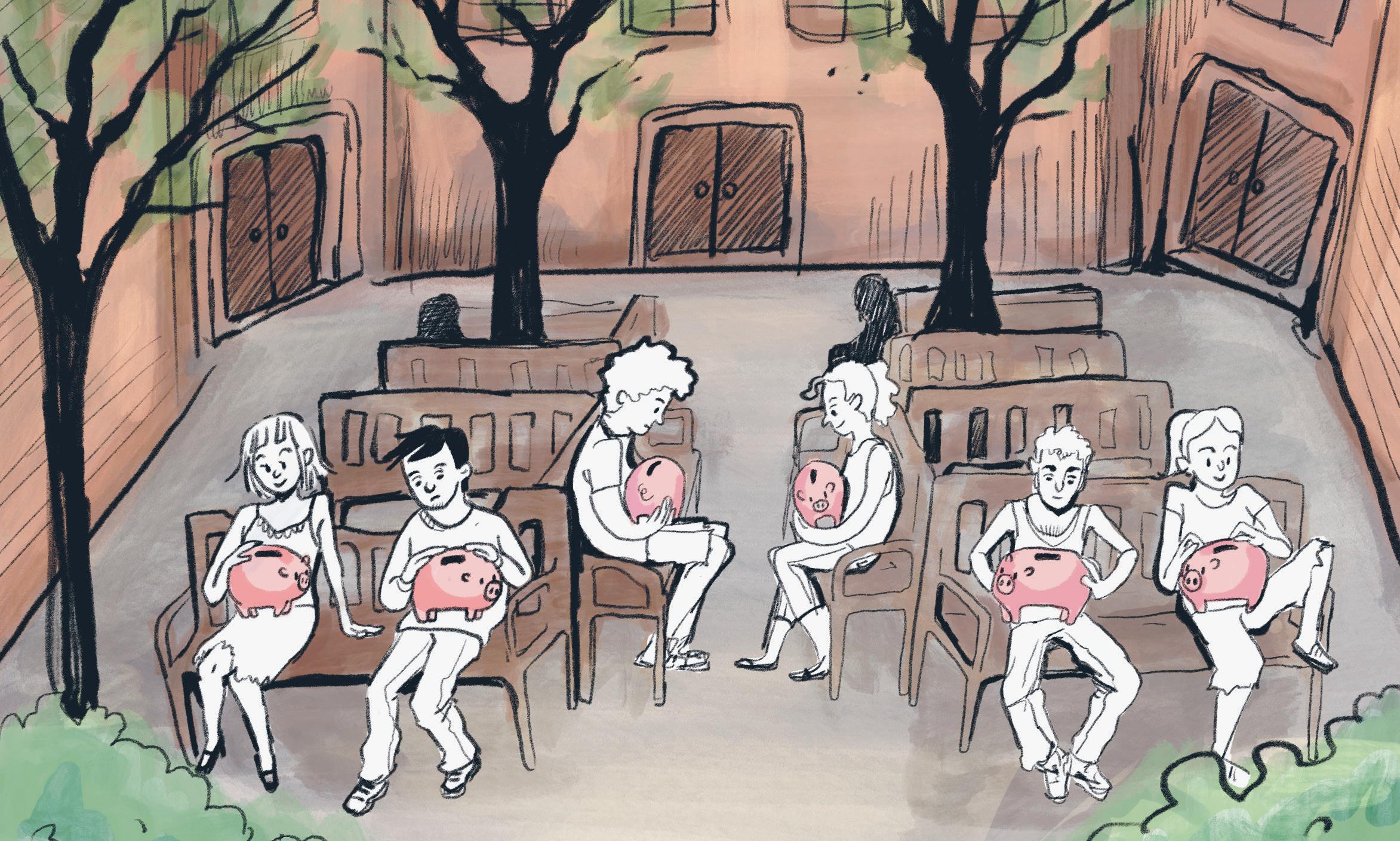
Maia Wilson / Staff Illustrator
year counselors — in 2023. Following the petition, counselors were given a stipend of $19,900, which was set to the value of room and board fees.
In the midst of the petition for increased funding, Cynthia Sutanto ’24 posed that the increased stipend would assist FroCos in their duties and help diversify future counselor classes.
“While Yale likes to boast that they have diverse FroCo cohorts, the inadequate pay dissuades many students, especially low-income students, from applying,” Sutanto said. “If the petition's requests are granted, I think we’d see a more diverse class of FroCos, which will better serve first years.”
The program’s original compensation entailed free housing, 110 free meals per year and an allowance to host events of $225 dollars, according to the News’ archives.
In 1978, though, FroCos’ allowance was cut down to $75 dollars and their meals to just 90 per year. The changes also came as rooming fees increased by $75 dollars for the following school year.
Then Silliman-counselor Tim Delaney ’79 wrote that the new $75 budget disturbed him and would make it difficult for counselors to establish strong relationships with first years.
Today, incoming FroCos said the compensation was not a leading factor in their decision to apply for the role.
Taylor Burke ’27, a rising counselor, said that he knew he wanted to be a FroCo as early as his first year due to the impact of his own first-year counselor.
He said he is interested in the role for “the love of the game” instead of for the financial incentive.
Others, like Erin Hu ’27, a rising FroCo in Branford, said the benefits matter. She said that many rising seniors, in a crunch to find housing, begin to look for off-campus housing in January. However, in her case, she knew that by being a FroCo she could bet on both financial and housing stability.
“$20,000 is a lot of money, regardless of how much aid you receive or not,” Hu said. “Not only am I getting this $21,600, but I also don’t have to think about moving off campus, which is extra time and effort, money, logistical planning and whatnot.”
This year, Benjamin Franklin College had the most first-year counselor applications of all 14 colleges, with 34 applicants.
Olivia Woo contributed reporting.
Contact OLIVIA CYRUS at olivia.cyrus@yale.edu.