“I told you so”
Vindicated journalists
Battling Iran’s internet blackouts
Have critics lost their backbone?
“I told you so”
Vindicated journalists
Battling Iran’s internet blackouts
Have critics lost their backbone?
Wednesday 6 May
The Brewery, London

Expect dynamic sessions on the skills you need to succeed in magazine media, hear directly from Gen Z talent reshaping the industry, and put your questions to industry leaders who’ve been where you are.

Hosted by:
Rachel Richardson, Creator Highly Flammable Newsletter Previously Head of Editorial for Snap

This is your space to ask questions & accelerate your career
Scan for a chance to win a ticket
Taking on the role of editor for the 50th anniversary of a magazine which has been shaped by decades of relentless talent, brilliance and resilience, was daunting. How do you commemorate a legacy that has nurtured generations of journalists? And how do you do justice to these years of success in just one issue?
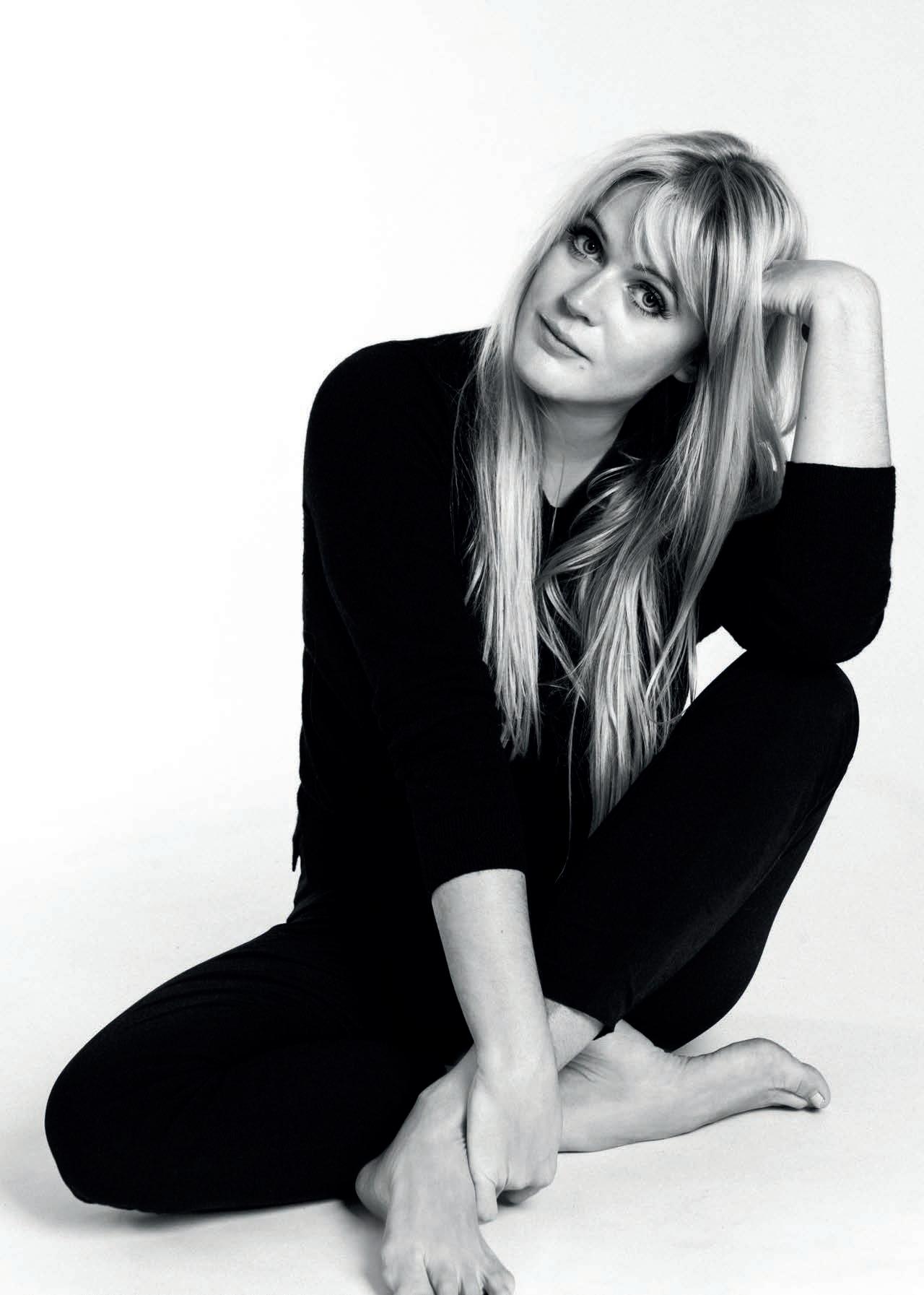
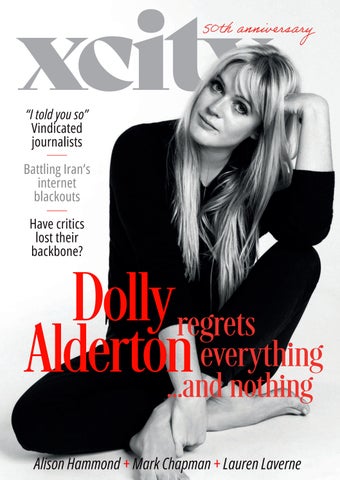
Choosing this year’s cover star, however, required no second thought. Dolly Alderton, an alumna who has long inspired my peers, brings a rare versatility and an unapologetic honesty to her work that felt deeply aligned with this moment. But this same fearless spirit in the quest for truth, is something that runs far beyond our cover. It threads through every page of this edition.
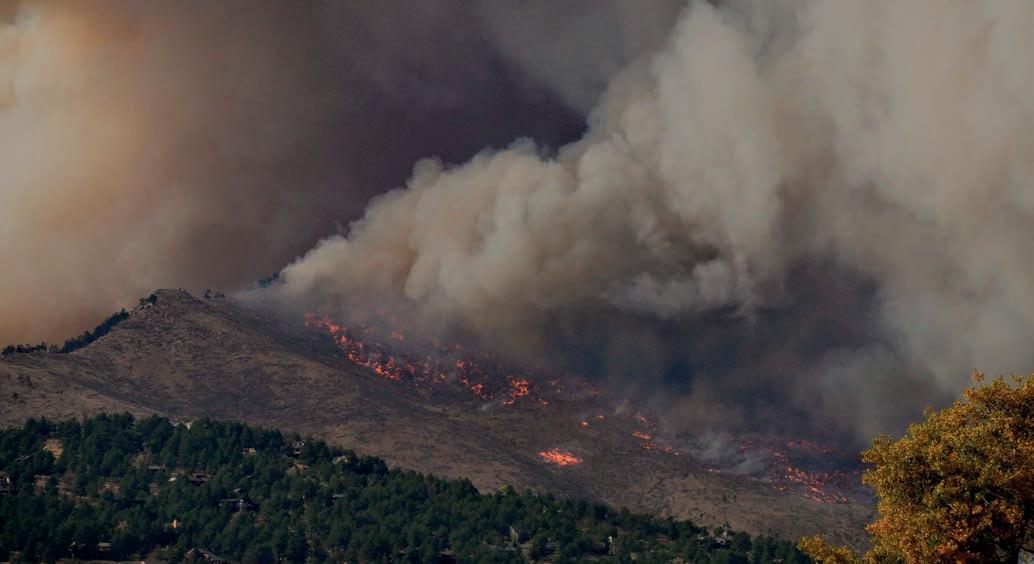
While Alderton re ects on how truth shaped her career (p.57), our writers explore what it means to report with courage in far more precarious circumstances: from the work of Earshot in documenting Gaza (p.42), to journalists pushed to the frontlines of the Californian wild res (p.26). Elsewhere, we highlight deaf journalists navigating an industry that has not always been built with them in mind – yet continues to be reshaped by their presence and persistence (p.117).
This year’s edition also includes a dedicated 50th anniversary section, where we delved into the archives of XCity covers to trace the evolution of the magazine across the decades (p.80). Alongside this, we celebrate some of City St
George’s most in uential gures in journalism, including the remarkable Marcelle D’Argy Smith (p.86), former Cosmopolitan editor, the everinsightful reporter and lecturer, David Roper (p.84) and Malvin van Gelderen (p.85), a man whose design skills have graced this magazine in years past.
Throughout our issue, one thing has remained constant. These de ant writers and people lie at the heart of our stories: the unapologetically bold, the quietly determined, the voices that refuse to be overlooked. It is those who are willing to be vulnerable yet driven who carve out space for themselves and others.
I feel incredibly proud of the range of voices in this year’s edition, and deeply grateful to have worked alongside such a commi ed and thoughtful team. As we step into a journalism industry that is evolving –gradually, but meaningfully – towards greater diversity, I carry a real sense of purpose about where we might go next.
If this year’s edition has taught me anything, it is that our journalism lives and breathes through the people behind it and it seems this will always be true, whether it’s the 5th, 50th or 100th anniversary of XCity
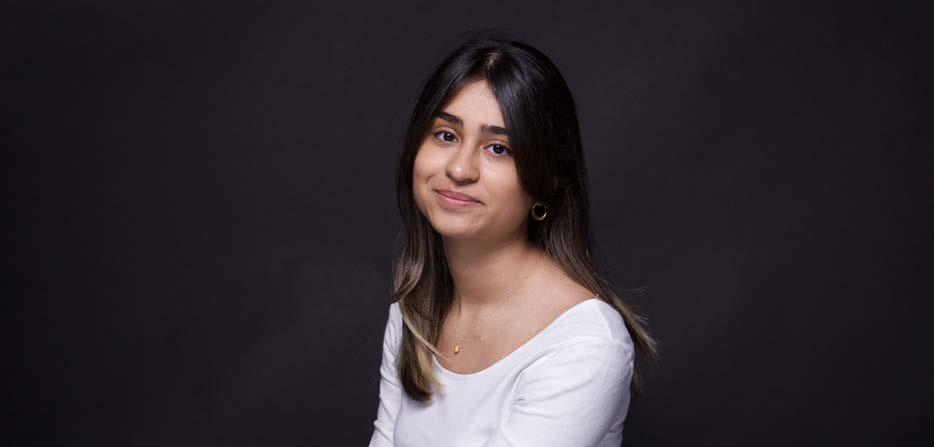
Mia Raja Editor
Contributors: Scarle Clarke, Daisy Dempsey, Jack Dennison-Thompson, Daniel Farthing, Robert Flynn, Ioan Hazell, Lara Hedge, Madison “Sonni” Hendrickson, Florence Ingleby, Ines Jeveons, Liv Le wich, Sydney Lobe, Kaeah Sen, Anfal Sheyx, Annalise Smith, Hannah Stiven, Róisín Teeling, Meadow Wa ret, Josh Wilkey and Suzannah Young
With special thanks to our creative consultant William Jack and our printers, Magazine Printing Company/Stephens & George Ltd.
For any enquiries, please email Ben Falk at ben.falk@citystgeorges.ac.uk Instagram: @xcitymagazine
Day in the life: Alan Rusbridger
AI freelancers
When the threats follow you home
Farewell expenses: the party’s over!
XCity through the decades
City journalism: 1976 v 2026
David Roper pro!le
Malvin van Gelderen & Richard Keeble
Marcelle D’Argy Smith
50 years of the Journalism Dept
Starter packs for MA students
Falling in love at City
Lauren Laverne
Desert island dinners
What it’s like to be sued
Meme accounts to news accounts
HIV photojournalism at 45


Are you smarter than an AI chatbot?
For the love of Alison Hammond
Good morning, Greenland
Deaf journalists deserve to be heard
Knobbly monsters
Fiona Bruce pro!le
Reporting the World Cup underdogs
Wikileaks at 20
Humanitarian reporting is in crisis
Some liked it hot: Gossip writing
When journalists are vindicated
Mental cost of content moderating
Building The Nerve in a month
Trumping the First Amendment
Death of the homepage
Coursemates to soulmates
Journalism students might soon get a study abroad option as part of the new deal
By Claudia Watson
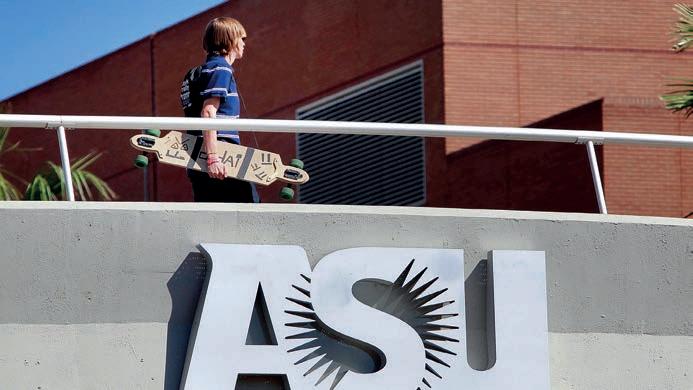
Atransatlantic alliance between one of the US’ most prestigious journalism colleges and the journalism department at City St George’s, University of London is being considered.
In January, newly appointed Head of Journalism, professor Karen Fowler-Wa , visited Arizona State University’s (ASU) Walter Cronkite School of Journalism and Mass Communication, to explore a possible collaboration.
This comes a er the success of ASU London, a joint venture between the two universities that allows students to complete a three-year bachelor’s degree in London and a one-year master’s in Arizona.
Prof Fowler-Wa said: “We are hoping to work with ASU on joint investigative journalism projects that have a global perspective and impact, and also to develop opportunities for sta and student exchange.”
This academic year is an especially exciting one for Prof Fowler-Wa to join City St George’s as the Department of Journalism is celebrating its 50th anniversary. Whilst this milestone o ers a chance to look back and
Choose Your Own Adventure
Lime Bike
By Róisín Teeling
Magazine MA graduate Esme Hewi took home Postgraduate Student of the Year at the 2025 PPA Next Gen Awards, marking the 17th time in 18 years that a City St George’s student has won the prestigious industry prize.
Ms Hewi said she was “shocked” to learn she had won. “I’d honestly forgo en I’d applied,” she admi ed. “My lecturer texted me saying, ‘you legend – congratulations,’ and I had no idea what it was about. I wasn’t expecting to win at all, so it was a really lovely surprise.”
celebrate the university’s history, it is also a chance to look forward thanks to an upcoming review of the postgraduate o ering (PDR).
“It’s all about futureproo ng and making sure everything is relevant for the digital age. We’re thinking digital rst because that’s the world students are going to be working in.”
Prof Fowler-Wa also emphasised the importance of maintaining the excellent alumni and industry connections City St George’s is renowned for.
“We’re celebrating the 50th anniversary and we have 6,000plus alumni as a result of that, many of whom are in really incredible jobs. We also have those who aren’t alumni but are in the industry and will employ our students because they know they can trust them. “Continuing to strengthen these relationships is imperative to ensuring City’s journalism department continues to thrive for the next 50 years.”
Discussing her new role, Prof Fowler-Wa said: “The global context has become even more challenging since I joined, so to be championing journalism and leading a team that believes in the critical importance of journalism to wider society is a responsibility that I do not take lightly.”
You pedal away on a lime bike in the direction of Westminster. You arrive at a political journalism event. The securtiy guard tells you that you are not on the list. What do you do? Run past the bouncer into the event (p14) Argue (p10)
Ms Hewi showcased a range of work produced during her master’s course. This included a street-style vox pop lmed in Shoreditch exploring heartbreak and modern dating, a satirical quiz created for XCity and her nal project examining conversations about love among China’s missing girls generation, who grew up in the wake of the one-child policy.
Ms Hewi said: “I think the judges saw that I had range. I realised during the course that I shouldn’t try to be just one type of journalist. I wanted to experiment, to be playful in some pieces and more serious in others.”
Now working as a social media editor at The Times, Ms Hewi credits the intensity of the course with preparing her for the fast-paced newsroom environment. She said: “It was stressful at times, but it teaches you resilience. You learn not to take edits personally and to keep pushing your ideas.”

By Róisín Teeling
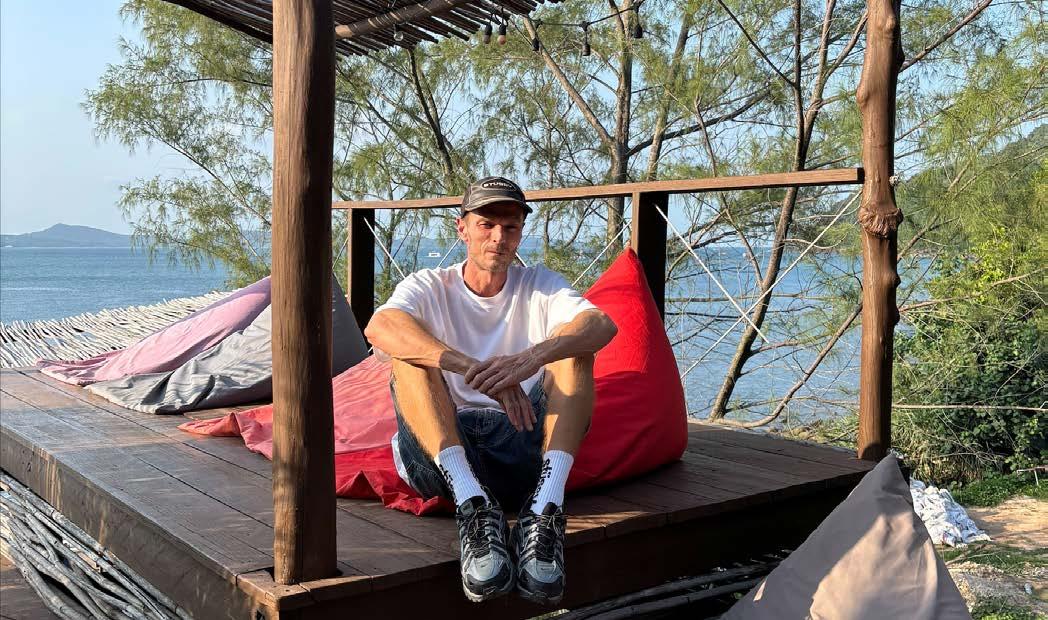
When City St George’s alumnus Jon Trap was made redundant from Time Out London, he made a decision that completely changed his life.
Armed with a redundancy payout that he said was signi cantly improved by membership of the National Union of Journalists, Mr Trap packed up his life in London and moved to M’Pai Bay on Koh Rong Sanloem, a small island o the coast of Cambodia.
Mr Trap said: “The original plan was to build a workspace here because I was freelancing. I thought I’d build it and spend six months here and six at home.”
In 2018, he bought land on a hill and began building his dream co-working space. By early 2020, it was almost nished, but the pandemic shut down global travel – and with it, the ow of digital nomads for whom the space had been designed.
Mr Trap spent nearly a year cut o from the outside world, not writing. “It killed me,” he said. “I lost all sense of meaning.”
During Cambodia’s Covid lockdowns, Trap and his partner spo ed a new opportunity in a stretch of oceanfront land on the market for cheap. They bought the land with a friend and in three months built a cli -side bar, Bar Bok Bowie, alongside two local families in the village.
Today the bar bankrolls a new phase of Mr Trap’s career, giving him the freedom to pursue the music writing he has always wanted to focus on. “I de nitely made a clear, conscious decision of ‘f this’,” he said, describing the moment he walked away from London.
A er completing his studies in 2007, Mr Trap entered the industry at a time when print still dominated. As the shi to digital accelerated and opportunities for magazine writers shrank, he said he became increasingly disillusioned.
“I always came from a print background,” he said. “Print was king for me. When things moved online, it didn’t feel as valuable.”
Cambodia had long been part of his life between commissions.
While freelancing in Asia, Mr Trap discovered M’Pai Bay.
On the island, his days begin early, writing in the morning before the heat sets in. A ernoons are spent at the bar, followed by late-night calls with collaborators in the UK.
He has returned to journalism through the niche he knows best – electronic music. Mr Trap now writes for record labels, producing artist interviews and telling the stories behind in uential labels and scenes.
Recent projects include a documentary marking 30 years of Goldie’s Metalheadz label and an upcoming autobiography with jungle pioneer DJ Die.
He said: “It feels like real journalism. I’m nding out stories from the eighties and nineties that have never been told or wri en about.”
Looking out from Bar Bok Bowie today, Mr Trap said Cambodia’s tourism scene has shi ed since he rst arrived.
“Four years ago there were hardly any Cambodian tourists here,” he said. “Now they’re the majority of our customers.”
For Mr Trap, the distance from London has brought clarity. Time away from the industry helped him realise how central writing was to his sense of purpose.
“Writing is a muscle,” he said. “If you don’t use it, it dies.”
The iconic course will now run as MA Journalism
By Miranda Crawford and Hannah Mayer
Major structural changes, including the rebranding of the Newspaper course, are coming to City St George’s, University of London’s MA Journalism programme in September 2026.
In the past, the Magazine, Broadcasting, Global Financial and Investigative courses have been pathways of the overall MA Journalism programme. They will now run as standalone MA programmes, while the Newspaper MA will be replaced by the newly titled MA Journalism.
The Newspaper course was launched in 2009 as part of the MA Journalism programme, but will be renamed to modernise the title and re ect a wider curriculum.
Director of the Newspaper MA, Paul Solman, said that the name change has already a racted more applicants.
“We’ve been thinking for some time that the title ‘newspaper’ might be misleading to potential applicants,” he added.
The programme retained its name because sta believed it described the content rather than the format of the media.
“We’ve come to the conclusion that most people, when they think of a newspaper, think of a thing printed on paper,” said Mr Solman.
This will not be the only change. “We are doing more to emphasise multimedia journalism,” said Mr Solman. There will also be a new core module on careers and employability and an elective on AI journalism.
Other new modules include Sports Media and Communications, and an
Choose Your Own Adventure
Audience Strategy elective. There will also be an arts and lifestyle strand within the MA, although this only involves students taking existing electives, rather than new content.
Despite the changes, Mr Solman said: “The fundamental content remains similar to what we’ve been doing for years. The current course has been incredibly successful.”
However, the introduction of the AI and employability modules mean that some existing ones will be cut.
According to Jason Benne o, senior lecturer in journalism, the O ce for Students guidance states that courses must be “coherent”. The university interprets this as limiting the number of modules that a student can take.
As a result, the Film, TV, Video and Radio elective module will not be running next year.
Dr Ben Falk, programme director for the Magazine MA said: “Anyone who’s interested in the world of movies will still get an opportunity to write about them, either in other electives or on the main course.”
He added: “It’s good to freshen stu up – especially in journalism.”
By Lara Hedge
The Centre for Journalism and Democracy, a research institute based at City St George’s, University of London has pledged to publish two key reports annually.
Alumni including Jodie Ginsberg, Pippa Crerar and Kamal Ahmed sit on the advisory board.
Led by Professor Mel Bunce, the 2025 Index on International Media Freedom Support ranked 30 countries on how they actively support media freedom beyond their borders through diplomatic, funding and safety initiatives.
Developed under UN Women’s EU-funded ACT to End Violence against Women Programme, a report on the escalation of online violence against women in the public sphere was also led by the department’s Dr Julie Pose i and Dr Lea Hellmueller.
By Emilia Gould
PA Media has ned City St George’s, University of London for the use of a stock image that did not have a Creative Commons license.
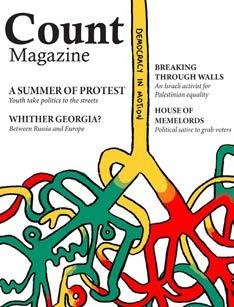
The image was part of the digital version of The Count, a magazine produced by the 20232024 International MA cohort.
The article, headlined ‘How proportional representation could get young voters to the polls in the UK’, was published in June 2024. In December 2025, the students received a ne over email.
The students used Google Search with the Creative Commons usage lter enabled to source the image, which features a ballot box.
Symbols in the bo om righthand corner of the image led students to believe it was free to use for non-commercial purposes. The photograph was
By Ellen Morris
Miranda Levy, a freelance journalist and visiting lecturer at City St George’s, University of London, has landed a book deal writing about The Beatles a er spo ing a call-out in a Facebook group.
The health and lifestyle writer has published two books: A Rough Guide to Babies on navigating the early days of motherhood, and The Insomnia Diaries, about her own experience of mental health and insomnia.
In a Facebook group for freelance journalists, Ms Levy noticed a post asking for pitches as part of a series of books on di erent music artists. Ms Levy suggested The Beatles, expecting competition, but was surprised to have secured it.
“I remember the day John Lennon was shot,” Ms Levy said. “I was 12 then. I just became really quite obsessed in my
only used for the online version of the article and was not included in the print magazine.
Yuen Chan, director of the International MA, continued the communication with PA Media. She explained that students were misled by the symbols, and said: “The website is a non-commercial entity created for educational purposes and is online for two years only.”
Ms Chan asked if the £610 fee could be waived due to the educational nature of the website. To consider a reduction, PA Media required “proof of una ordability, for example your latest Pro t and Loss statement, or a 30 day bank statement with the key data redacted”.
“It came as a huge surprise to all of us,” said Lara Lovrič, who was deputy editor of The Count
Ms Chan called the situation “unfortunate”, and added: “It is
really disappointing, given that the students made a lot of e ort to not use photos for which they did not have permission.
“The one good thing is that it reminds students to take your own images or be creative about how you illustrate things.”
A PA Media spokesperson said in an email: “It is important that you understand photographers and organisations such as PA make their living from the licensing of their images, and without these payments, they would not be able to continue to take the great images that we all need.”
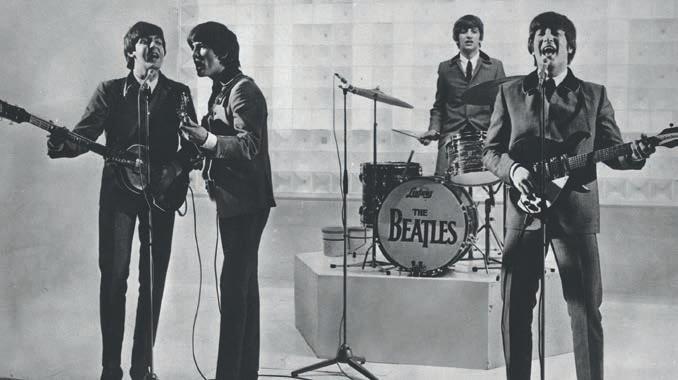
teens. It’s a love that stayed with me.”
The book will go through each album and explain the songs in context, from the drugs the band members were using to the Vietnam War.
Ms Levy teaches the Health and Science specialism at City St George’s and writes regularly for The Telegraph and The Daily Mail. “You start o doing one thing and you can really evolve.
I would say it’s really good to specialise, but it’s quite nice to be able to do lots of di erent things at the same time.”
Ms Levy said: “As a freelancer, it’s really hard to not work every second you are awake.
“Work can be feast or famine. Some periods you have none, and suddenly you have loads. The reason I’m doing this is because I love The Beatles so much.”
By Larissa Steel
A debut album by an awardwinning journalist, also an MA Magazine Journalism alumna, will be coming out this autumn.
British-Chilean journalist and singer-songwriter, Naomi Larsson Piñeda, whose stage name is Naomi in Blue, will be releasing Is this body mine?, an emotive collection of “ nger-picked folk, explosive rock and singer-songwriting soul searching”. Ms Larsson Piñeda, the deputy features editor of Hyphen, said: “There’s a mix of stu in there. And I’ve got my rst song in Spanish that I wrote, which is cool.”
Ms Larsson Piñeda explained she was seeking an alternative creative outlet from journalism: “During the pandemic, I recorded my rst EP and realised how much I loved it. It gave me something else that I felt maybe I’d lost in the career of journalism.”
Ms Larsson Piñeda has since released two EPs and stays in Chile for a month every year, o en playing gigs with Chilean band Matorral.
The album took shape during a week-long recording session with producer Gus White in Wiltshire, where the songs were recorded live in only a handful of takes. She said: “The recording process had that feeling of rawness and life to it.”
“It was really amazing to have whole weeks of just doing music and pu ing myself into that side of my life and my identity,” she added.


By Emilia Gould
New journalism courses on responsible AI use and entrepreneurial ways to make freelancing pay are being introduced at City St George’s, University of London this year.
From September 2026, postgraduate journalism students at City St George’s will be able to choose two new modules: AI Journalism and the Future of News, and Journalism Entrepreneurship and Platform Development.
AI Journalism and the Future of News will allow students to explore ways to ethically use AI, from data analysis and visualisation to creating avatars and voice clones aiming to enhance interactive storytelling. The module will teach students how to ethically incorporate AI into the di erent stages of news gathering, production and dissemination.
The module will be led by Dr Rana Arafat, a senior lecturer at City St George’s, who also leads the Visual AI Manipulation and Generative Disinformation working group at the Public Tech Media Lab in the University of Wisconsin-Madison.
In a recent Reuters Institute survey, 97 per cent of respondents believed that back-end AI automation, using intelligent and automated programmes to
optimise data management and processing, will be “important” by the end of the year.
Dr Arafat said: “AI is not replacing journalism or taking jobs away from our students. On the contrary, at a time when AI-driven manipulation and disinformation are on the rise, the role of journalists has never been more critical. Understanding this technology is essential, not to surrender control to it, but to use it responsibly and e ectively.
“AI causes challenges for journalists, especially in nonWestern newsrooms. This course will help students to learn about counterstrategies for overcoming these challenges.”
The Journalism Entrepreneurship and Platform Development module will look at building the expertise necessary to work as a freelance journalist today, with topics including how to write newsle ers and Substacks, alongside other areas of individual enterprise, like social media and website development and dynamic news presentation. This module will be taught by Dr Irving Huerta, who is currently the module leader for Data Journalism.
Dr Zahera Harb, director of postgraduate studies, said: “In our shared modules, we wanted to re ect the developments in the marketplace, in consultation with the industry, our alumni and our students.”
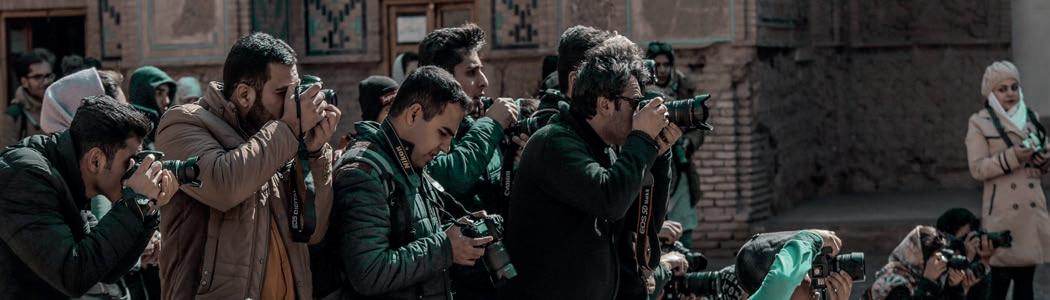
“is using everything they have to shut down the narratives”
Researcher reveals Iranian agents are spying and tracking journalists
By Mia Raja
Journalists reporting in and outside of Iran are having their phones hacked, being followed by government agents and targeted by smear campaigns, a City St George’s graduate reporting on the war torn country has told XCity.
Dr Sanam Mahoozi, an Iranian journalist and City St George’s research associate, has been reporting for The New York Times on Iran since before protests erupted in December 2025.
Iranian authorities responded to civilian protests demanding political change with an internet blackout on 8 January 2026. Since then, the ability to cover the con ict has been limited for journalists worldwide.
Dr Mahoozi said the government rarely responds to requests for comment, so publications must instead rely on o cial statements, social media posts and state media to provide insight.
“The government is using everything they have to shut down the narratives. They hack journalists’ phones, send agents to follow them, have surveillance and smear campaigns.”
“Nobody is on the ground,” Dr Mahoozi added, except for the few bureaus which remain there. “Sources on the ground are very di cult to get. Ordinary people are very scared to talk to the media because they get reprimanded for it.
“So maybe 95 per cent of the time, sources are anonymous.”
Access to local news outlets and on-the-ground sources
vanished almost overnight, isolating over 90 million people from the outside world, with only limited internet access available through circumvention tools like virtual private networks (VPNs)
Information has largely been pieced together from a small number of people with access to satellite internet services, such as Starlink, as well as from activist networks operating outside the country. While Telegram is used internally, the app is heavily censored.
But Dr Mahoozi noted that it is not only the government’s interference that presents severe barriers in reporting, but also the opposition.
“The opposition can become very aggressive and sometimes violent. They a ack journalists all the time.”
With family still in the country, reporting on Iran is invariably personal for Dr Mahoozi.
“It can be very up and down –adrenaline and then depression. It’s very di cult to navigate for somebody who’s new to it.”
Dr Mahoozi noted that the key to coping with the feelings involved is o en dissociation from the con ict.
“You get used to detaching yourself from the news,” she said. “You have to learn how to detach yourself and accurately report.
“I’m working around 16, 17 hours a day, so I’ve become desensitised. I don’t feel as much as I used to. For a journalist, when you’re working like this, maybe it’s a good thing.”
War on truth:
“We can’t give up this fight”
By Sonni Hendrickson
Journalists were urged not to “surrender” in the ght against misinformation in Trump’s America at an event to commemorate 80 years since Alistair Cooke’s Le er from America was rst broadcast.
The panel discussed trust, fragmentation and grappling with the “bare-facedness” of Trump’s lies. “It’s very hard to accept that this is normal. We are in a new normal and [need] to react accordingly,” said Jonathan Freedland, host of The Guardian’s Politics Weekly America podcast.
“I think there are such things as facts. I think there is such a thing as truth, and I think it’s our job to stick to that,” said Jon Sopel, presenter of The News Agents and former BBC US editor.
He added: “Trump is a genius in terms of his visceral understanding of how journalists operate.
“We have to calmly, resolutely, determinedly, politely but rmly say ‘this is not true’ from time to time.”
By Róisín Teeling
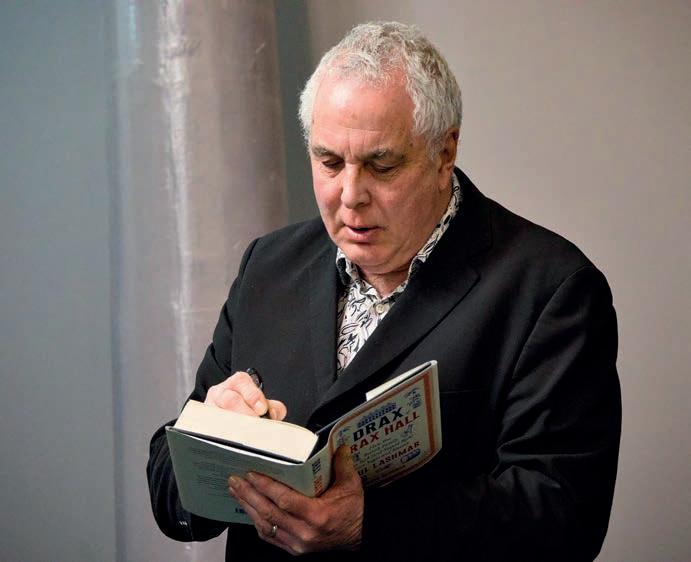
The former Head of the Journalism Department at City St George’s, University of London, Paul Lashmar, has retired from the department.
Dr Lashmar joined City St George’s in 2017 and in 2018 became an Associate Professor of journalism. He served as Head of Department from 2019 to 2021. He remains a liated with the university as an Emeritus Fellow.
He explained that joining City St George’s was like coming home for him, saying: “When I came to City, people understood what I was saying.”
Before entering academia, Dr Lashmar spent decades working as an investigative journalist and producer across newspapers, television and documentaries, including The Observer, The Independent, ITV, Channel 4 and the BBC.
He said the de ning quality for an investigative journalist is persistence: “Anybody tells you that you have to be obsessive as an investigative journalist. I’m obsessive.”
One of the most challenging
periods of his tenure came during Covid. Dr Lashmar said journalism at City St George’s was “one of the few university courses that were taught through Covid,” continuing inperson teaching while much of higher education moved online.
“That required a huge amount of trust by sta and students,” he added. “I think it was very good for the mental health of all concerned, because people were engaged, they weren’t just at the end of computers.”
Since retiring from City St George’s, Dr Lashmar has focused on research and writing. Over the past ve years, he has led extensive investigations into the Drax family – a landed gentry family with deep slave plantation ties – and Britain’s colonial plantation economy.
This resulted in the book Drax of Drax Hall: How One British Family Got Rich (and Stayed Rich) from Sugar and Slavery, published last year.
“I’ve retired from City, but I’m still doing journalism and doing books,” he said. “That’s what takes up most of my time.”
By Ellen Morris
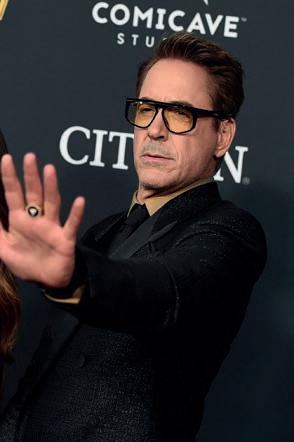
The Programme Director of MA Magazine Journalism at City St George’s, University of London is republishing his Robert Downey Jr. biography a er 15 years.
Dr Ben Falk’s biography Robert Downey Jr.: The Fall and Rise of the Comeback Kid was originally released in 2010, and will be republished by Pavilion Books on 19 November 2026 to coincide with the actor’s return to Marvel as Doctor Doom in Avengers: Doomsday
At the heart of the book is one of Hollywood’s most extraordinary bounce-back stories. Downey’s addiction to heroin and multiple prison sentences in the late 1990s and early 2000s seemed certain to end his career.
“It’s kind of mind-blowing what he went through,” Dr Falk said. “You’d never have thought he’d come back from it. Because it was pre-social media, he got away with it in a way he never could have today.”
“I’ve been copy-clinicing myself and red-lining everything that didn’t work the rst time,” said Dr Falk.
“Given that he’s coming back to the Marvel universe as an Oscar winner, it felt like a good time to update it.”
The number of shorthand students dwindles
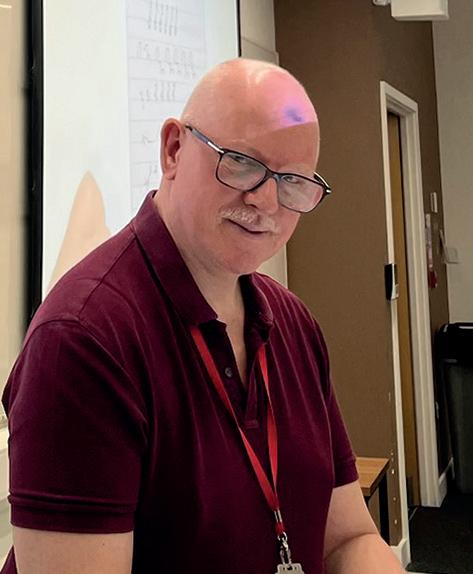
Statistics obtained by XCity reveal a 15 per cent decrease in the number of journalism MA students enrolling for shorthand lessons in 2025-2026 compared to the previous year.
The number of undergraduate students enrolling in the module remained at an all-time low for the second year running. Just four undergraduates enrolled this year, down from ten students in 2023-2024.
These numbers come two years a er City St George’s, University of London’s shorthand course underwent several changes in 2023-2024. A restructuring to the module saw the previously separate BA and MA shorthand cohorts joining together in one shared class, running 9am to 11am from
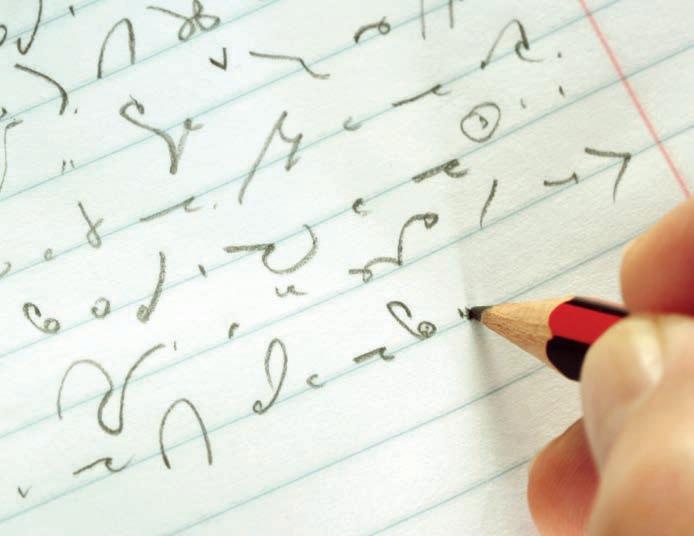
Monday to Wednesday.
With this change came a rule that no ma er how many master’s students took the module, a minimum of four undergraduates must enroll for it to go ahead.
Richard Ward, City St George’s shorthand teacher of over 10 years, said he has raised concerns about the changes impacting enrolment with the directors of the university’s journalism courses multiple times.
This year, Mr Ward nearly found himself in a situation where the course could not go ahead, when just four undergraduates enrolled.
Mr Ward said: “Yes, the demand is going down, but there is still demand there. To me, they can’t really cut the course down much further.”
He added: “Some students said to me, ‘the only reason we came to City was because we know you still o er shorthand’.
“I had one student who thought she’d come and see what it was like. She said, ‘I would never have thought of doing this, but because you’ve given me this wonderful skill, I’ve now got a wonderful job that I like’. That to me is wonderful.”
For Mr Ward, the course’s restructuring revealed a need to encourage students to try
the symbolic writing skill and to reevaluate the class’s timing.
Undergraduate students have informed him that the reason they can’t take the module is because of the early morning slot it has been allo ed: 9am to 11am, three times a week. Some feel they cannot commit to a ending.
As the module is only available as an elective for BA students in their second year, undergraduates do not have the option of taking shorthand in third year, when their academic schedule would align be er with the morning slot.
Mr Ward added: “There’s not enough time set aside for shorthand. When I rst started, we used to do 10 hours a week. It went down to eight, now it’s down to six. And I’m still expected to get the same kind of results.”
To make the course more accommodating, Mr Ward suggested making shorthand mandatory for master’s students undertaking the Newspaper course and re-separating the modules to create more sociable teaching hours for undergraduates.
He added that he hopes to continue teaching at the university: “I enjoy doing it and I enjoy ge ing students a skill that they don’t normally learn.”
Interactive theatre performances could cure media disengagement, says young journalist
By Claudia Watson
Anew form of journalistic theatre that brings reporting centre stage made its City St George’s, University of London debut this January.
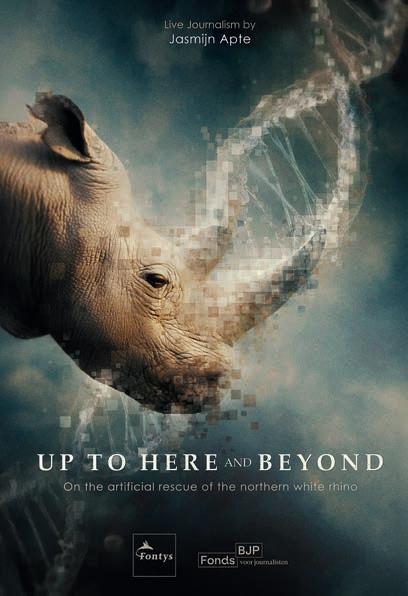
Jasmijn Apte, a 22-year-old journalist, performed her ‘live journalism’ piece Up to Here and Beyond, using props and audience questioning to explore white rhinoceros extinction and new methods to conserve endangered species.
Ms Apte emphasised live journalism’s ability to re-engage younger audiences. “Modern journalism is facing a lot of di culties. There’s an increase in distrust in the media. Young people don’t watch the news or read the newspaper. By combining journalism with the arts, complicated stories can be made entertaining and easy to comprehend.”
Dr Glenda Cooper, Associate Professor in Journalism Studies at City St George’s, echoed this sentiment. Dr Cooper, who co-founded live journalism organisation News on Stage, said: “The idea behind live journalism is to bring journalists and audiences back together. It’s deeply democratic. You’re
presenting directly to a live audience who can question you.”
Live journalism does not di er much from traditional journalism, Dr Cooper added. “We’re interviewing people, sourcing and fact-checking. What sets live journalism apart is the immediate relationship with the audience.”
She emphasised the importance of accurate journalism, both on and o stage. “The facts come rst. We’re thinking about how we can present them in an interesting way, but we’re not twisting the story or distorting it.”
transparency is a ractive.”
Whilst live journalism is still in its edgling stages in the UK, it has seen huge success in countries like the US, Finland and Germany, prompting discussion about whether the medium could be the future of news reporting, according to Dr Cooper.
She explained: “We know the problems facing media outlets. Live journalism could be a way to re-engage audiences. Its
Dr Cooper has already worked with several City St George’s graduates, transforming nal projects on topics such as fat shaming at drama schools and deepfake pornography into live journalism performances.
She hopes to soon see live journalism become an accepted submission format – and perhaps even a module.
“The kind of storytelling skills that live journalism o ers you are something I would really like to see in the curriculum. It would be great to build City St George’s up as a real centre of excellence.”
By Grace Bishop
Former CEO of the Refugee Council, Enver Solomon, has been recognised as an O cer of the Order of the British Empire (OBE) in the 2026 King’s New Years Honours List for his services to refugee rese lement.
During his ve-year tenure, the MA Newspaper alumnus raised the charity’s pro le, centring refugees in its work.
The Refugee Council has
Choose Your Own Adventure Run past the bouncer into the event: You distract the bouncer, run past him and nip inside. On your way to the bar, you spot Rachel Reeves. What do you do? Quiz her about your student loan debt (p23)
helped thousands of refugees, including those eeing from con icts in Sudan, Ukraine and Afghanistan, to nd housing and jobs and to learn English.
Mr Solomon has since stepped down from his role at Refugee Council and has been appointed as chief executive of national charity Nacro, which supports vulnerable individuals with complex needs.
a sel e with her (p19)
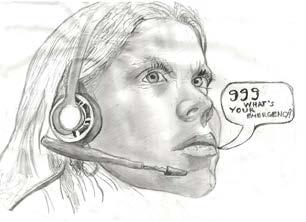
By Harry Speirs
Viewers tuning in to Channel 4 Dispatches last year would have seen a recent MA Investigative Reporting graduate taking on an adrenaline-inducing job –operating the phones at a 999 call centre.
Graduating the month before, Hebe Johnson went undercover in October 2025 for the programme 999 Undercover: NHS in Crisis to expose the immense pressure that those delivering medical advice experience.
Ms Johnson said: “It’s not like I cried every shi , but you quickly learn that everybody is a ected emotionally by di erent triggers. Our job as journalists is to educate the public on topics like this to make real change.”
She praised her team at Channel 4, made up of over ve producers and a shooting director to check the quality of lm.
She said: “The access I got as a journalist was unbelievable and everybody was being very careful to look a er me in the call room and on the team.”
Ms Johnson was struck by the emotional toll that rst responders to accidents or complex health conditions deal with daily over the phone.
“The system is at its knees and call handlers are running on fumes while they are working. You are knackered, tired and o en unable to process the constant stream of grief,” she said.
Ambulance service call handlers are being stretched past the breaking point, according to reports by media outlets such as the BBC which show that some control rooms have experienced over seven times more calls this January than in December last year.
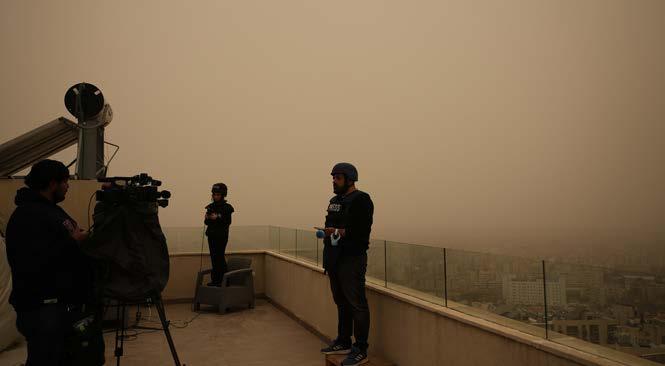
By Lara Hedge
Apanel of independent experts should be set up to investigate journalists who have been targeted and killed because of their work in the media, a conference at City St George’s, University of London was told.
The call for media organisations to rally behind the creation of an international investigative task force was made by Jodie Ginsberg, chief executive of the Commi ee to Protect Journalists (CPJ), at the 34th James Cameron Memorial Lecture, which was held on 4 March 2026.
This follows the killings of 129 journalists in 2025, a record death toll.
“The idea is to create a group of international jurists and legal experts who would help investigate the cases of journalists who have been targeted for their work,” said Ms Ginsberg.
She added: “Now is the most dangerous time to be a journalist.”
A recent report by the CPJ found a sharp uptake in the use of drones to kill journalists, with 39 documented cases last year, 28 of which were commi ed by Israel Defense Forces (IDF). “A few years ago, the number was two,” said Ms Ginsberg.
The IDF were responsible for two thirds of the total 129 killings of press members in 2025, according to the CPJ’s report. It also found that the IDF have commi ed more targeted killings of journalists than any other government’s military since the
CPJ began documentation three decades ago.
The top ranking countries for the killing of journalists are Israel, Sudan, Mexico and Russia. The CPJ wants to understand in more detail “to what extent armies and military groups are using drones to deliberately target journalists”.
Ms Ginsberg hopes that the international investigative task force will provide another avenue to prosecute the countries responsible for the violence against journalists and may use the international courts, such as the International Criminal Court (ICC), which prosecutes individual criminal responsibility.
“Having the countries who are o en responsible for the deaths of journalists also be responsible for the investigations into these deaths means that you get no, or very li le, accountability,” Ms Ginsberg said.
The task force was rst proposed by the High Level Panel of Legal Experts on Media Freedom, which advises the Media Freedom Coalition. “The CPJ is now identifying countries that would be supportive of the idea of the task force and identifying ways to stand up its feasibility,” she added.
“We need to nd new ways to move the needle on impunity,” said Ms Ginsberg, “because the level of journalist murders that go unpunished has remained almost static over the last 10 years, despite being identi ed as the key issue that keeps the environment for journalists unsafe.”
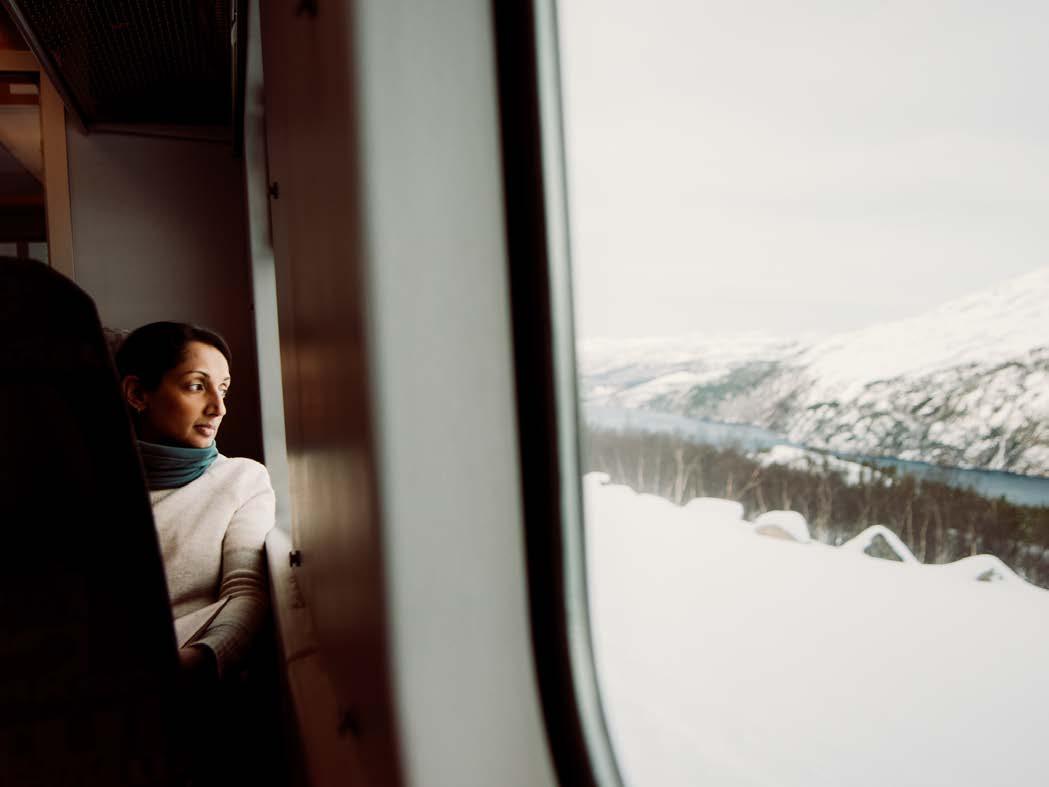
travel writing go hand in hand.
She explores this in her latest book, Moonlight Express: Around the World By Night Train, which she wrote alongside the Gazan con ict.
Ms Rajesh said: “I travelled throughout the whole period of the genocide. I was constantly on the move, listening to people’s conversations about it. It fed very much into how I was writing and viewing things around me.”
Her acknowledgement of the geopolitical climate in which she writes is not always warmly received, with some readers preferring that she keeps her politics separate from her work.
“For a lot of people, travel
like if I didn’t bring geopolitics in, something would be missing.”
Discussing the importance of inclusive reporting, Ms Rajesh also talked about her journey to becoming a travel writer and publishing her rst book, Around India in 80 Trains. She found the portrayal of India to be narrow and unrepresentative.
“I had always known I wanted to write a book about India,” she explained, because all the books she’d ever read on India were by “white, very privileged, colonial men. Even quite contemporary writing still had a perspective I could not recognise.”
While working at Time Out, Ms Rajesh came across an article on India’s domestic airlines linking
By Grace Bannister
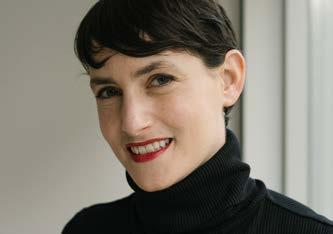
A guide for journalists on how to cover populism and controversial topics is being compiled by Dr Ayala Panievsky, a City St George’s, University of London academic.
Newsroom CPR (Covering Populism Rights) is due for publication this spring and will take in uence from her book, The New Censorship, an exploration of the news-scape in the age of disinformation and democratic backslide.
Dr Panievsky, who is co-
Choose Your Own Adventure
Tube
authoring the guide with Michael Hauser Tov, a Haaretz journalist, said: “We hope it will give journalists some ammunition to know what to work with.”
She explained that it will tackle questions she has received as a researcher and will provide journalists with actionable advice to respond to a acks on media.
Dr Panievsky said: “We answer questions that we know many journalists will be facing in the near future – what to do when a political leader is bashing your
linking the cities – trains.
She embarked on a journey across India and documented her experiences on a blog named 80 trains.com, forming the basis of her rst book.
In her latest book, Ms Rajesh explores the mystery and charm of overnight trains and their post-pandemic popularity.
She said: “I felt like lockdown really pushed people back towards being a lot more engaged with your surroundings. I also saw how much people were excited by the nostalgia and romance of sleeper trains.”
The paperback version of Moonlight Express: Around the World By Night Train is available in June.
competitor or when you’re being accused of fake news.”
She continued: “As a researcher you always hear the criticism of ‘so what should we do’ and ‘all you say is what not to do’, so I hope this will be a tangible tool that we can o er people in the industry. We’re trying to make it an everyday resource.”
You ba le your way on the Northern Line at rush hour, and you stand crushed between a banker talking loudly through his Airpods and an East London ‘creative’ with a mullet. A er an hour of delays, you arrive at an event and walk to the bar. What’s your drink of choice?
An overpriced pint (p36)

By Larissa Steel
In a new non- ction book, The Times columnist and City St George’s, University of London Magazine MA alumnus, Ben Machell, explores human relationships with the supernatural.
The book follows the life of Tony Cornell, a paranormal investigator who worked on 800 cases between the 1950s and his death in 2010.
Mr Machell said: “If you told me when I was at City that I would be writing books about supernatural investigators, I wouldn’t have believed you. But by my last day, I would’ve thought that’s probably not even the weirdest thing I’ve wri en about now.”
As a member of the Society for Psychical Research, Mr Cornell followed a methodical approach. “What this means is a paper trail,” said Mr Machell. This was ultimately the key to the book’s creation. Through the Cambridge University Library, Mr Machell gained access to Mr Cornell’s archives and found boxes of the parapsychologist’s photographs, notebooks and interviews with people who claimed to have experienced paranormal activity.
When approaching a topic like the supernatural, Mr Machell said it is important to remain sympathetic. “You have to work really hard to not wink at the camera or roll your eyes.”
Ordinary people o en have extraordinary experiences but that doesn’t mean they are deluded, he explained.

The broadcaster says algorithmic echo chambers risk misrepresenting the views of the BBC
By Harriet Curzon
Nick Robinson, the presenter of Radio 4’s Today Programme, has warned about the potential dangers of US tech controlling how social media platforms present BBC news.
The former BBC political editor spoke to City St George’s, University of London’s students about the future of impartiality in broadcast media.
Mr Robinson addressed the issue of broadcasters using social media to distribute news. He said: “I think we’ve got to be careful, haven’t we? When you clip something, obviously you’re taking a li le sample of somebody’s views and you’ve got to be careful it doesn’t look as if the BBC is presenting that as its view or the truth. That’s a challenge.”
Mr Robinson acknowledged the issue of echo chambers on the algorithm. He said: “The algorithm is not run by the BBC. It’s controlled by YouTube, X, Instagram or whoever. We’re not trying to
target certain people.
“Inevitably, we’ve got to think about the way in which our products are consumed and the algorithms that are run largely by US tech rms determine that.”
An earlier discussion with City St George’s students focused on whether broadcasters should platform views that some audiences consider hateful.
On the importance of impartiality, Mr Robinson said: “If people only listen to output that they already agree with on key debates, it becomes almost impossible to have a civil conversation and to respect people’s disagreement with you.
“If you’re saying something deeply controversial, whether it be, ‘I don’t think a man should marry a man’, a controversial view on trans rights, or a controversial view about refugees or immigrants, of course, we should air those people.
“I don’t think it’s the BBC’s job to censor people who certain people think are promoting hate. I don’t think it’s our job.”
By Lucy Dover
A!nal year BA Journalism student who represented Great Britain in American football has returned to the pitch just months a er fracturing his neck.
Ben Coulthard, who played for the men’s national team and will graduate from City St George’s, University of London in 2026, sustained a severe fracture during a tackle while playing for the Cologne Falcons in Germany in May 2025. The injury is one of the most serious spinal fractures in sport.
Mr Coulthard was in recovery for !ve months. He said: “Obviously, being in East Germany, speaking the bare bones of German, I couldn’t really understand what the doctor was saying at the hospital. I was delirious,” he explained. He added that the injury was “extremely scary for
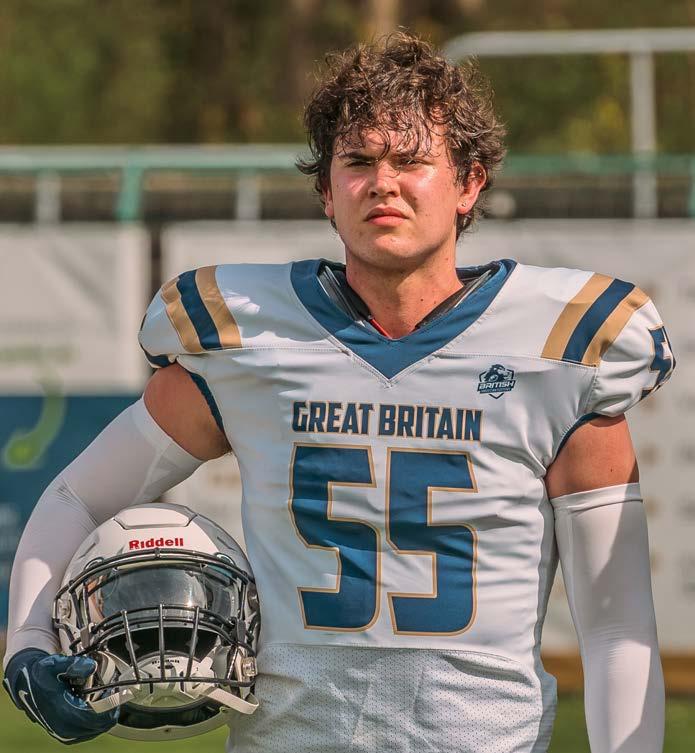
me and the people around me”. Mr Coulthard returned to City WolfPack American Football Club, the university’s o cial team, in September 2025. He said: “There’s a lot of stu that I’ve had to work on mentally when it comes to tackling. My body is subconsciously doing everything it can to get out of the way. It really put a block on my GB training. I didn’t make the team this year.”
The accident has reshaped his priorities. “I’m not too worried about rushing back in,” Mr Coulthard said. “If it works out that way, it works out that way, but I won’t be particularly upset.
“I’d love to work in journalism but I’m in no rush to get out of academics,” he added. Mr Coulthard is now considering postgraduate study and has been interviewing for internships in !nancial journalism.
By Annalise Smith
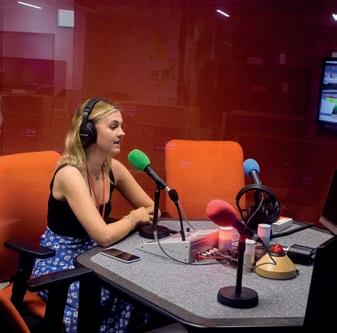
MA Podcasting, which is currently o ered by the Department of Journalism, will be reworked into an MA Media Production programme from September 2027 and moved into the Department of Media, Culture and Creative Industries (MCCI).
Professor Karen FowlerWa , head of the Journalism Department, said: “It will move to the MCCI group on the basis that a lot of podcasts are creative, not about journalism.”
No longer a standalone MA within the journalism department, MA Media Production will not o er core journalism modules, such as Media Law and Journalism Ethics. In place of MA Podcasting, the Department of Journalism is considering a longform journalism course, such as producing documentaries. Despite these changes, podcasting will remain as a module for journalism master’s students.
By Alina Ja er
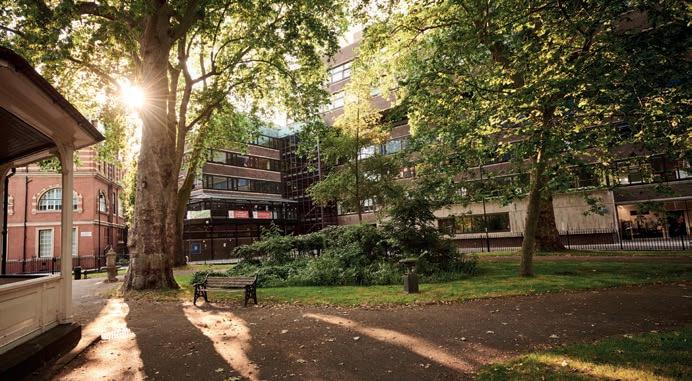
A10-day, intensive storytelling summer school is due to come to City St George’s, University of London’s School of Communication & Creativity (SCC) this July.
Dr Ben Falk, Associate Dean of Enterprise, Engagement and Employability for the SCC and Programme Director for MA Magazine Journalism, will run this crash course specialising in broadcasting, podcasting and professional writing.
Dr Falk said: “The elevator pitch is simple: come to the best university for media and storytelling in the country, one of the best in the world for journalism, and learn more skills, use our facilities, meet likeminded people and also have an amazing cultural experience in a brilliant city.”
Students on the course will create a television show in a day, learn how to make and market a podcast and improve their professional social media skills. “I want it to be really practical, really fun, showing the best side of this kind of industry which should be creative, enjoyable and engaging,” said Dr Falk. Applicants do not need a background in professional journalism, just a curious a itude. Dr Falk said that the summer school is a great option
Choose Your Own Adventure
for those who are not sure about their next career move.
“This is an opportunity to try things out,” he said. “If you’re a lawyer, but you fancy coming to London and doing a bit of creative writing, then fantastic. If you work for your university paper in Thailand, and you want to come do some podcasting, brilliant. If you’re a student in She eld and you want to come down and make a TV show in a day, then you can absolutely do that as well.”
Dr Falk added that he expects around 20 to 30 participants, with a lot coming from overseas. The programme will also include historical tours and sightseeing around London.
“I think it would be pre y mean of us to say ‘come to London’ and then say ‘you have to stay inside the whole time’,” said Dr Falk. “Any storyteller knows that you need to go out and be part of the world, and London is an amazing place to do that.”
Students will also develop skills to help them in the workplace. “I think that learning or practicing any new skill is always good for employability,” said Dr Falk. “Obviously, we’re really hands-on as a university. It’s not just learning the theory, you’ll be making stu and ge ing your hands dirty.”
Erasmus MA to specialise in crisis and conflict
By Daniel Farthing
The Erasmus Mundus course will specialise in crisis and con!ict from September 2026, marking a new chapter for the long-running international programme.
The Erasmus Mundus MA in Journalism, Media and Globalisation, now in its 21st year, is led by Dr James Rodgers, working alongside Dr Zahera Harb, Dr Lea Hellmueller and Professor Jane Martinson.
The City St George’s, University of London portion of the course previously specialised in business and nance journalism. “We’ve changed our focus, and that obviously plays into a lot of our research strengths and journalistic experiences in the department,” said Dr Rodgers.
The programme will continue to follow its previous structure, where the rst year of study is taught in Denmark, at the Danish School of Journalism and the Aarhus University, and the nal year at City St George’s.
Students will undertake four electives in term three, choosing from new additions such as Humanitarian Reporting, Reporting the Middle East and Political Reporting, before completing their dissertation.
The change re!ects the challenges journalists face today. “Sadly, because of the world we live in, crisis and con!ict is a very important thing to be studying,” Dr Rodgers said.
Be bold and say: “this is boring, goodbye” Your frenemy is fuming, but you run to your mate, and they greet you with open arms. “Shall we just sack this networking o ?”, they say – and you jump for joy. They suggest ge ing fun drunk somewhere down the road, and you both run out of this event into the sunset. You’ve won!
Most people in British cities will come across The Big Issue on their daily commute.
A er 19 years at the magazine, Paul McNamee stepped down as editorial director in March, ahead of its 35th birthday this September. McNamee began his career working on local newspapers in Northern Ireland, before co-founding the music magazine Blank. He has won the British Society of Magazine Editors’ British Editor of the Year award four times.
What makes the Big Issue unique, aside from its method of sales?
Paul McNamee, outgoing editor of the Big Issue, speaks with Phoebe Pascoe about seat-of-the-pants journalism, outlaw guest editors and running The Stone Roses’ favourite magazine ●
There’s always been a lot of useful access with the Big Issue that goes back long before my time. When The Stone Roses came back in the early nineties, they wanted to give the interview to the Big Issue rather than anybody else. Everybody else wanted this globally, and they gave an interview to the Big Issue. That set the standard. People thought, “This is a title that we need to take seriously.” Big Issue is also not politically aligned. It’s never been tied to a political party. John Bird, the founder, is still the owner, and he’s got something of an outsider spirit, and that’s been imbued into the fabric of the Big Issue. So we do like to poke the bear. We do like to have a less respectful approach and a itude than other titles. That allows us to have a particular cheek that others don’t have.
What has been your favourite issue of the magazine to work on?
I’ve seen hundreds and hundreds of magazines out the door, but there are some that do stick in the mind. With the one we did with the gra ti artist 10 Foot last March, I didn’t know what to expect. You’ve probably seen his gra ti across London. He’s somebody who doesn’t really court publicity because he has been in jail and
he doesn’t want to go back. I liked him immediately. He was really smart. He made me look di erently at how we think about the world around us and how we face the world. Also that magazine sold so fucking many copies, it was amazing. I loved working with Armando Iannucci because he’s a hero of mine. He put Alan Partridge and Malcolm Tucker from The Thick of It together in conversation about Brexit. We ran this very long, sweary piece. That was a thrill.
“We like to poke the bear”
Two years ago, we worked with the charity Mencap. I wanted to do something with Mencap that allowed young people particularly, but anybody who had mental disabilities, who were seen as being less or limited, to give them a platform to say, “No we’re not. We can do this.” So we – they – put together this whole magazine. That was a remarkable edition.
What has surprised you most in your career so far?
That I’ve never got bored. Although I’m not sure that surprises me – maybe it surprises other people. We get to work with really interesting people. Also, you can see the impact all the time. If I’m walking down the street and I see somebody buy a magazine, I know what that one sale means to that person who’s selling it, and how life changing, in that moment, that one sale can be.
What is the most challenging part of your job?
The challenge with Big Issue is to get it right every week. Because the great
majority of money comes from sales on the street, you are at the mercy of so many variables that you have no control of, like the weather. You don’t know if the sales force are going to show up every Monday morning. It’s like running the Grand National track before the race has started, and everyone else is just waiting at the start line. Every week feels like a success story just to get it out.
Why did you choose now to leave the Big Issue?
A er you’ve been there for a very long time, you become very comfortable. Although the Big Issue doesn’t really let you become comfortable, actually, because it’s constantly changing. It’s seat-of-thepants a lot of the time. It’s hard. But anyway, they’ve got a big anniversary year coming and I think it’s a good time to allow somebody else to take over and see what they can do.
Critics used to be unafraid to make or break careers. But when a digital army is primed to destroy any dissenting opinion maker, Anna Sta ord and Ines Jeveons ask...

What is the role of the critic?
I’ve learnt – as Spider-Man is told by his uncle – with great power comes great responsibility. You learn early not to be mean about small, independent restaurants because you close them, and then you’re pu ing people on the street. I tend to be much meaner – really unsheathe the sword – if they’ve already got a place in Abu Dhabi, Dubai, and Kuala Lumpur. If they’re opening here and they’re no good, fuck them. I will shred them because I want to stand up for British business.
How do you choose which restaurant to review?
I’m usually in a panic. I look at the Hot Dinners website [a London restaurant guide] to see what’s coming up. I’m aware of TikTok and PRs who send me preferences – but I don’t go with them unless I couldn’t get in somewhere. I don’t want my bill paid. I wouldn’t take so much as a free glass of champagne. They’d never know I was there unless they recognised me, which they usually do.
What is your view of the London food scene? Restaurantism in this country has a reputation of being sort of mean. A.A. Gill and Michael Winner were mean because English restaurants used to be shit. This industry has grown up with the birth of the internet – we’re now a food capital. We’ve got restaurants which are much be er and we’ve seen how terrible a world would be without restaurants and how hard they’re working to make us happy.
Do you think that criticism has gone so ? I think that all critics are less mean than they were, including me, who was really the meanest. I occasionally get a li le wrap on the knuckles from an editor. But only for something really bad. I choose what I write and I tell them how much I’d like to be paid. If I get into any controversy, I expect them to support me 100 per cent. Because of lockdown, everyone got an insight into how fragile the industry was. You suddenly felt massive sympathy for the chefs and waiters –this thing that made life so wonderful was taken away from us. I want restaurants to survive. I don’t want to make them cry. I want to nd good places and be lovely about them.
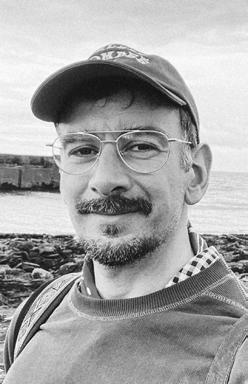
How do you think criticism has changed? I think it’s changed drastically twice. The rst came with social media, speci cally Twi er. There was this sudden in ux of new voices into criticism, which was all to the good. As social media became more polarised, it generated lots of noise. Now, algorithms are burying contributions from humans in favour of paid posts or whatever kind of insane diatribes are proving most magnetic to users. Any semblance of real lm discussion is gone.
What does the future look like for young critics?
There is a big issue at certain outlets where there is not enough of an editorial duty of care to young writers. Because they’re young and relatively inexperienced, they’re coaxed to write slightly crazed and unsubstantiable opinions that get absolutely demolished when they reach the light of day. Editors should be intervening to reach a decent, well-reasoned argument. But they are understa ed and hungry for clicks.
What do you think about in uencers in criticism?
The encroachment of in uencers beat is a real ‘crossing the Rubicon’ moment. In uencers will see anything in order to get the freebie. Any lm is great if they’re invited to the premiere. Any star is the funniest person in the world if they’re allowed to sit down with them for ve minutes.
Why did you leave social media?
Some lunatic started writing nasty comments on pictures of my kids on Instagram. Everything was deleted a er that. I vanished from places where people could orchestrate pile ons. I would encourage every critic to do this. It was freeing, not having to worry about pu ing a foot wrong or being read in the most bad faith way imaginable. You can’t write honestly as a critic when you’re worrying about this stu
What do you think we’ve lost in criticism?
Jobs. The most poisonous factor of the so-called democratisation of criticism is the vanishing of paid work. There are few opportunities for people like me who came from non-media backgrounds. The fact that there are no tenable entry-level jobs anymore means that people with potential to grow into good critics are simply not ge ing support early in their career.
How do you think the role of the critic has changed?
I think being a critic used to have a lot more gravitas than it does now. I don’t think it’s a bad thing that critics aren’t lauded – people say everyone’s a critic and I think that’s good. In the old days, people relied on a critic to tell them what to go and see. Now they’re more likely to see whatever is making the biggest splash.
What do you think about in uencers in criticism? There are legitimate lm reviewers who might also come under the umbrella of in uencer because they have a big following. I think that’s where it gets a bit murky, when you don’t know if you can trust your favourite person to give a completely sincere review, because they might be ge ing paid further down the line.
Have you experienced much backlash?
As a broadcast critic, people would text in if they disagreed with something I said, but it was de nitely less of a pile on. I love reading reviews that I don’t agree with, because they might pick up on something that went completely over my head. I think we’ve forgo en how to have nuanced conversations. The importance of having an alternative perspective keeps criticism running.
What do you think we have gained in criticism? We are hearing more voices that aren’t just the older white male, and that can only be a good thing. There are more women ge ing into criticism.
What do you love most about being a critic? It’s so important to raise up lms that you might not hear about – that feels really good. You’re genuinely helping someone in the industry who has worked their arse o . If I manage to get that out to more people, it feels like a really important aspect of my job.
What would you say to a young, emerging critic?
It’s so vital to keep your voice, because that’s where your integrity comes from. When you start building a readership, they will trust you. It takes guts to be honest, but this is also just lm we’re talking about. If you have an opinion, somebody else out there will share it and feel seen.
What do you think about anonymous critics? If we don’t know who you are or what you stand for, I think that’s quite detrimental. If there isn’t a human name a ached, it could have come from anywhere.
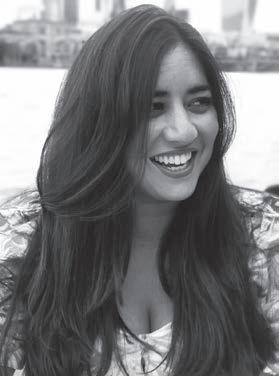
Why did you choose to be anonymous? I want to be in control of my image. Because of the sex stu , I wouldn’t want my face a ached to what I write. People would immediately make assumptions about me. I’m actually kind of prudish.
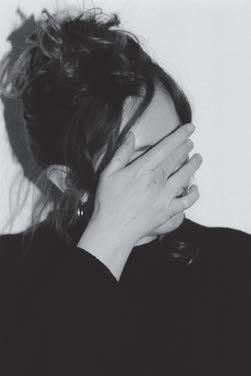
Has your time as a chef inform your criticism? One hundred percent. When I rst started out, I was a c***. I was slating places because I had no idea how hard these poor bastards were working. As I spent more time in kitchens, I felt the impact of critics and how much it meant to a team of chefs. When you spend time on the other side, you have an innate respect for restaurants, even if they are shit.
What do you think about in uencers in criticism? I’m biased on both sides. I kind of am an in uencer now, it’s awkward to say. When you have people following you, you want to send them in a good direction. I get sensitive when people shit talk in uencers because I guess that’s what I am. Who doesn’t want to feel like a VIP? It’s sexy and cool. I don’t care that in uencers have power, just don’t bring a ring light into a restaurant.
How do you think social media has changed criticism?
It’s diluted because of paid ads. If you’re a normal person, you’re not going to accept a free meal and then walk away and say ‘oh that was shit’. If you’re a restaurant critic, you’ve probably learned loads about food, whereas if you’re someone that just likes to get pictures of food, you probably don’t know as much.
I think the lightness of touch in criticism has come from people not wanting to o end or get in trouble. The lightness of touch on social media is because people want to get free stu , or they haven’t eaten enough variety of food in their life.
Have you faced much backlash?
If you put yourself online, you have to deal with that. I don’t really get much, considering that I’m a woman who talks about herself a lot. You’d think that I’d get a lot more hate as a woman who is empowered and talking about sex. The only online bullying I’ve had is from women, which sucks.
What is the purpose of a review?
I think it’s to entertain, not to educate. Sometimes reviews upset chefs, but I don’t think they have as much power as people think. My goal is to immerse you in a restaurant that you haven’t been to yet. That’s why we mustn’t take any of this too seriously – we are just talking about food. The only serious thing is making sure that people who work their arse o aren’t going bankrupt.





Freelance critic featured in Dazed, i-D, The Independent
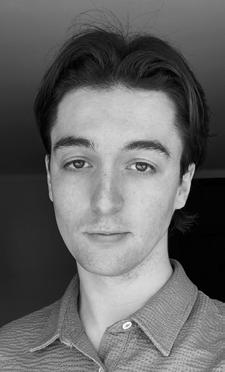
You wrote a scathing review of Hamnet Independent which receieved heavy backlash. Did you anticipate the response? This time I didn’t. My initial response was pride, because it meant people were reading my work. I saw so many people saying it was a Hollywood hit job. They were implying that I was in some way paid o by producers to plant negativity about the lm. It literally has to be a deep state conspiracy, it can’t just be that I didn’t like it.
Do you regret writing the review?
I don’t regret any of it. I wasn’t trying to be provocative, I just didn’t think it was a well-made lm. It was depressing to see people struggle to comprehend that I could dislike it – they hadn’t allowed for an alternative opinion. I don’t know how many PRs are going to be my best friend going forward, but the alternative is censoring my own opinion and that’s not a good way to go.
What do you think about in uencers in criticism?
I don’t think we need any more in uencer critics. We need people who are vocal, but sincere. We need that type of spine in a critic, far more so than somebody who is just in it for the free popcorn.
criticism has gone so What I pick up from a lot of reviews now is a very light opinion. I think reviewing still serves the same purpose but it’s de nitely less of an art. The industry has changed so much that not everyone can be a Pauline Kael or Peter Bradshaw. Those critics can write whatever and the editor just hits publish. I think the democratisation of some criticism is a good thing. I’ve had Le erboxd for 12 years and it’s wonderful, but it has displaced the role of the critic and that’s true in all elds.
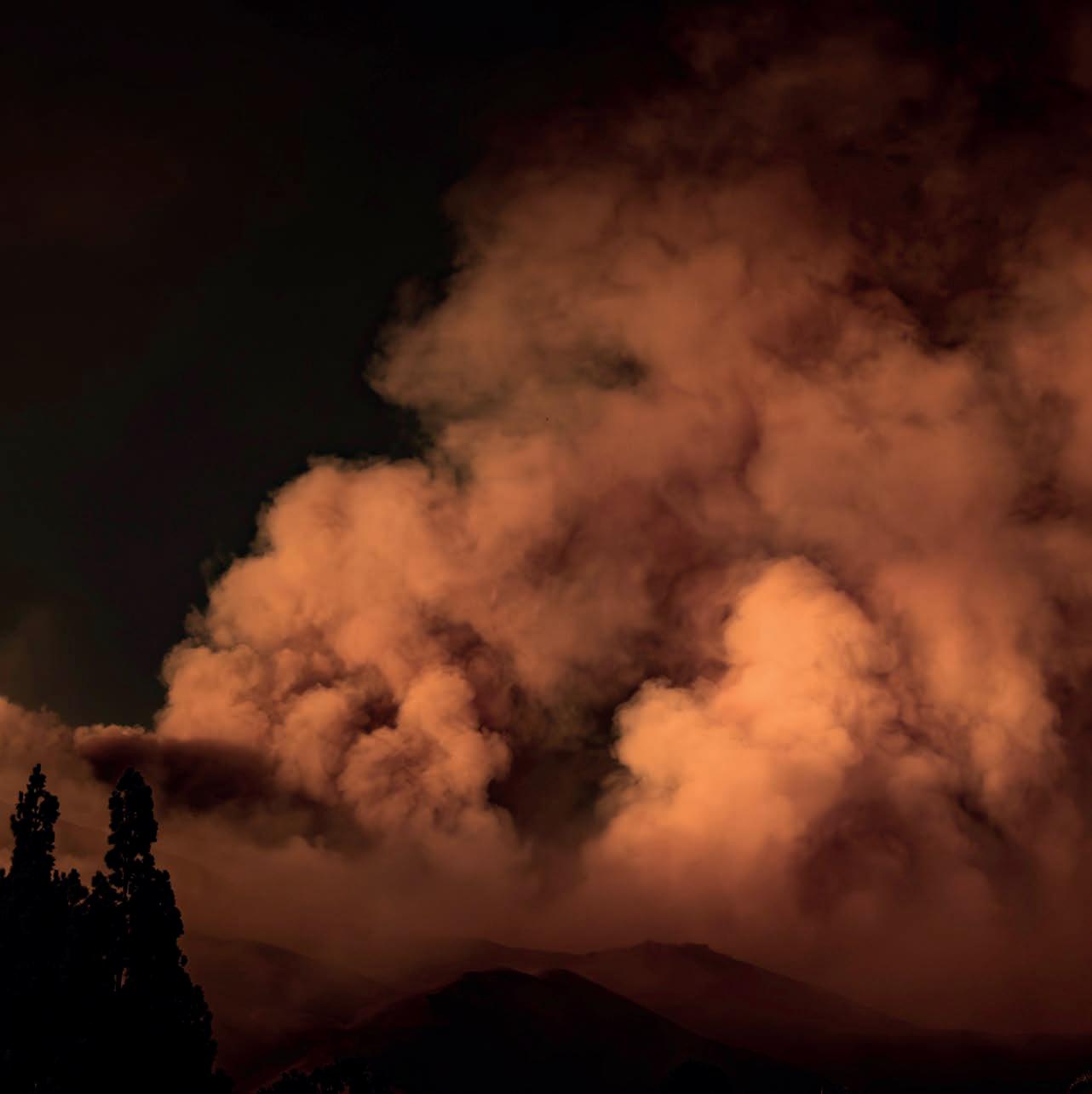
When the LA !res broke out last year, local reporters were thrust to the frontlines. Sydney Lobe speaks to four journalists who documented the inferno from its roaring centre
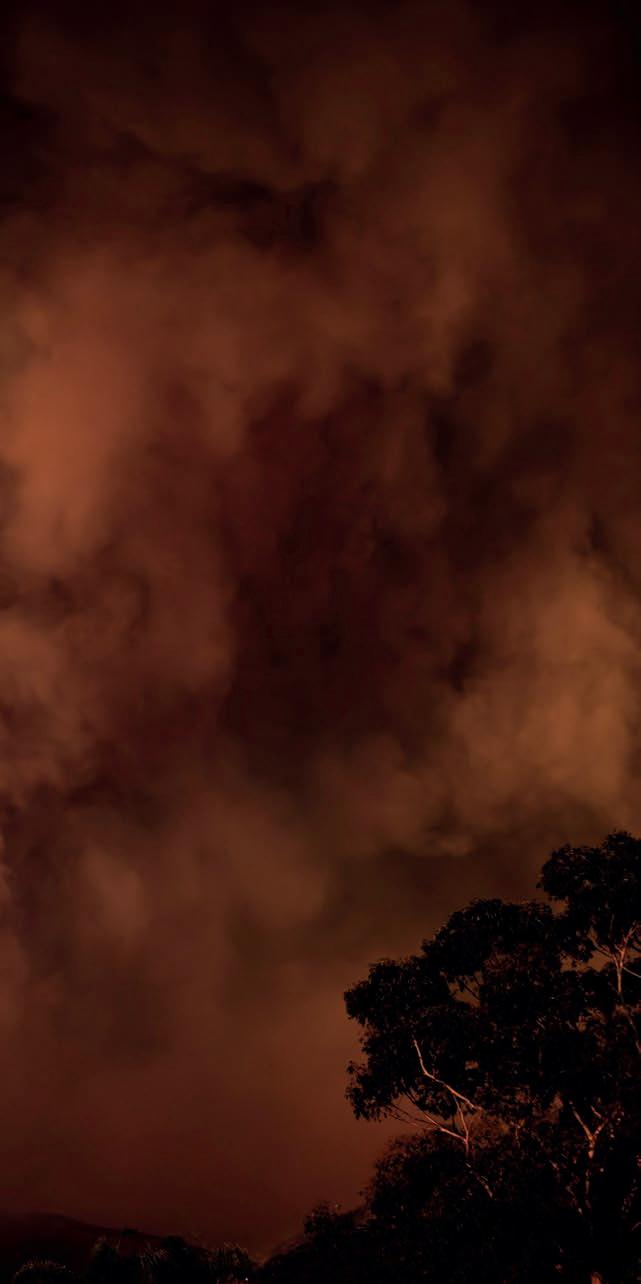
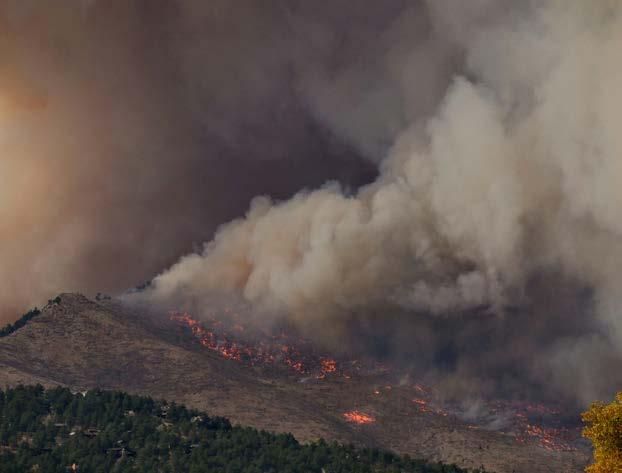
The view from the Los Angeles Times o!ce on 7 January 2025 was surreal. Noah Haggerty, a 23-year-old science and environment reporter, stood at the window, dumbstruck by the sight of Eaton Canyon 30 miles away. Plumes of black smoke billowed into an amber sky.
“One of the editors had walked over to my desk. It was my boss’ boss, which is never a good thing,” recalls Haggerty. “He said, ‘Are you able to cover re today?’ and I said, ‘Yes, where is it?’ and he just pointed out the window. We could already see the smoke rising.”
Within 20 minutes, Haggerty, who was used to writing daily news from the comfort of his o!ce chair, was in his car driving toward the ames. By later that day, a windstorm had driven the
wild re into foothill areas, including Altadena and Pasadena in north-eastern LA. The hills beyond the city were enveloped in a uniform glow, like a single ember. Patches of wild re had met across the San Gabriel Mountains, razing everything to the ground.
Los Angeles became hell-like for the next 24 days, as a total of 14 wild res expanded across LA and San Diego. It was one of the most destructive and costly natural disasters in US history. Nearly 60,000 acres of land and 20,000 homes and structures were scorched, close to 200,000 people were displaced and 31 people died. Some estimates put economic damages at around $250bn (£190bn).
The impact of the Eaton and Palisades res was felt around the world – partly, no doubt, due to the e$ect that the disaster had on California-dwelling celebrities, who shared their stories of loss and survival to their international fanbases.
But the reportage of the re, which millions followed from around the globe, was the responsibility of local journalists. It took the nerve of many LA reporters to bring the world on-theground coverage of the res, leaning on their tenacity and commitment to their cra to remain at the centre of the inferno all month long.
For some of these reporters, a year hasn’t been long enough to recover from the work they did and the things they witnessed last January. Others are still reporting on the res, only now their stories focus on the a ermath.
The coverage of the LA res highlights another issue – the importance of local news reporters at a time when the US is seeing regional media outlets face dramatic cuts and closures. Local reporters aren’t just crucial to telling the heavy stories of regional disasters because they’re a uned to the a$ected community – they’re essential witnesses and storytellers in times of crisis because they are the a$ected community.
Haggerty didn’t have time on the morning of 7 January to focus on anything beyond what was unfolding in front of him.
He collected protective gear from a cabinet in the o!ce, including a yellow reresistant jacket and a high-protection face mask, got in his car and followed the Paci c Coast Highway for an hour, with no sense of where exactly he was being dispatched to. He had previously reported on a smaller mountain re, but the scale and severity of this one was overwhelming.
“On the drive, I was going through the stages of grief,” he says. “I was coming to terms with the fact that for the next few days, I was going to be in a disaster.”
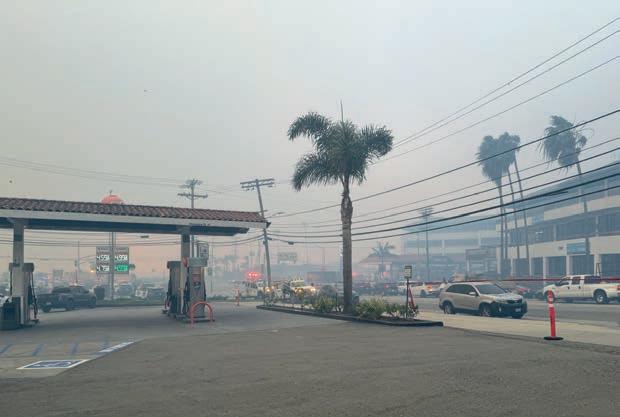
Acrid black smoke seeped into his vehicle. Even with the windshield wipers on high, he could hardly see the valley palms rolling in the Santa Ana winds. When emergency sirens began to sound through the smoke, Haggerty knew he was ge ing close. Then, through plumes of smouldering pine, he saw rst responders, retrucks and people eeing from their homes on foot at a choke point in the road.
“I was just driving towards the smoke until I couldn’t drive anymore,” says Haggerty. His stopping point was a bo leneck on the Paci c Coast Highway that most Palisades residents were evacuating through. He parked his car and started interviewing. That was where Haggerty spent his rst day eld reporting. →
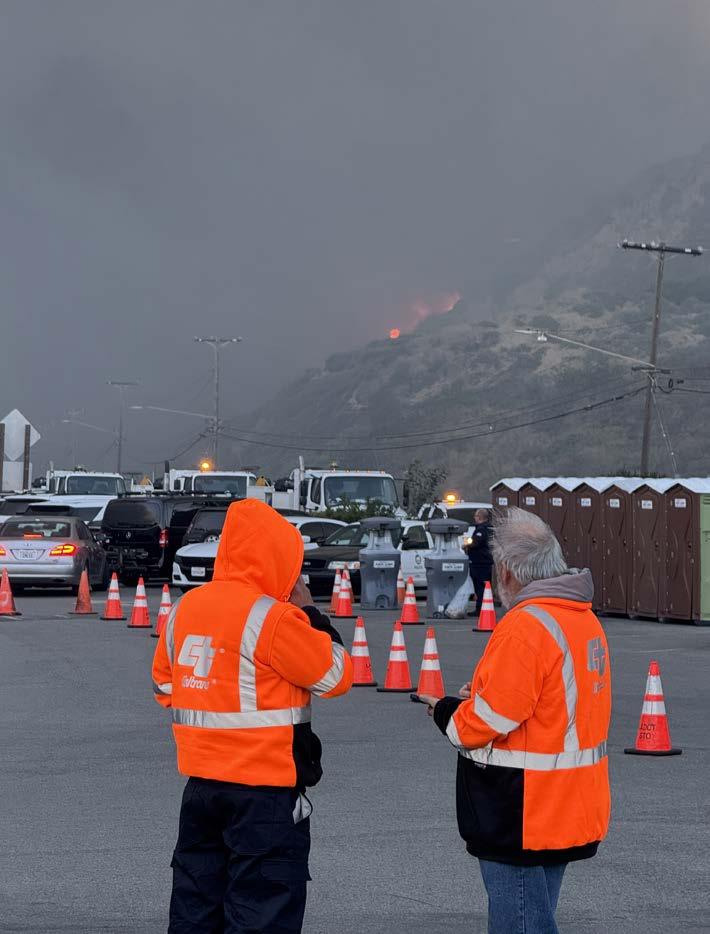
Haggerty !nished work at 7pm that day, and arrived at a Taco Bell parking lot at the base of the Eaton Canyon by 5am the following day to pick up where he le o . The location was central to evacuation in the !rst few days of the !re, so it became his dispatch spot. Haggerty spent 12-hour days in the lot, !nding “anyone and everyone that’s going to talk” – so long as they were of sound mind to give informed consent –and recording conversations with evacuees on his phone until he learned something new that “felt important”.
He would rush to his car, type up a few paragraphs on Slack, and send them “into the void”. His colleagues in the LA Times o$ce would use his sporadic !eld reporting to construct breaking news stories. Haggerty says he had no idea what stories he was actually “on” in a day – he was just reporting what he heard.
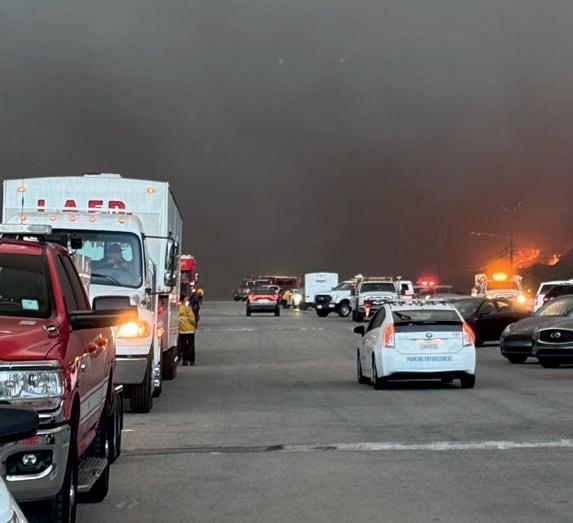
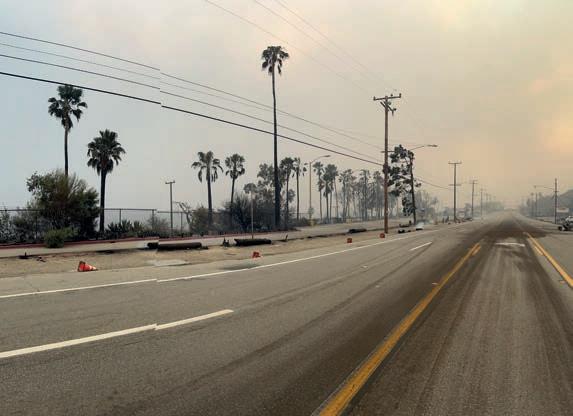
!re front is, where there are homes in danger, where there are people in danger. I’m trying to get grounded and understand where I need to be to bear witness to what’s going on.
“I am trying, literally, to see through the smoke.”
“It was traumatic. We were all sharing that”
“It was very disorienting,” says Haggerty. “In the chaos of an emergency, it’s extremely di$cult to get a sense of what is actually happening.”
He explains this is true for !rst responders as well as journalists. When a wild!re breaks out, how do those in charge communicate clearly to residents what’s going on?
“Wild!res happen over a huge area with not a lot of immediate information about where the active
As a local wild!re reporter, Haggerty was one part of a sizeable and collaborative machine at the LA Times. His colleagues in the o$ce were reporting from a “bird’s eye view”, covering air quality, the number of a ected acres, containment strategies and evacuation orders. Haggerty says he didn’t know any of that information while he was reporting.
“I knew what was happening at the intersection of Sunset Boulevard and Palisades Drive,” he says. For Haggerty, reporting on the immediate, local impacts of a disaster !lls the gaps between the broad, summative updates. It’s part of journalism’s public service, he says. The acreage lost may make headlines, but it is never the whole story.
Katharine Gammon, 44, was planning her family’s evacuation from their LA home with her husband and their two young sons when she made the choice to report on the wild!res. Gammon, a freelance environmental and climate journalist, covered the LA !res for The Guardian, The Atlantic and Scienti c American
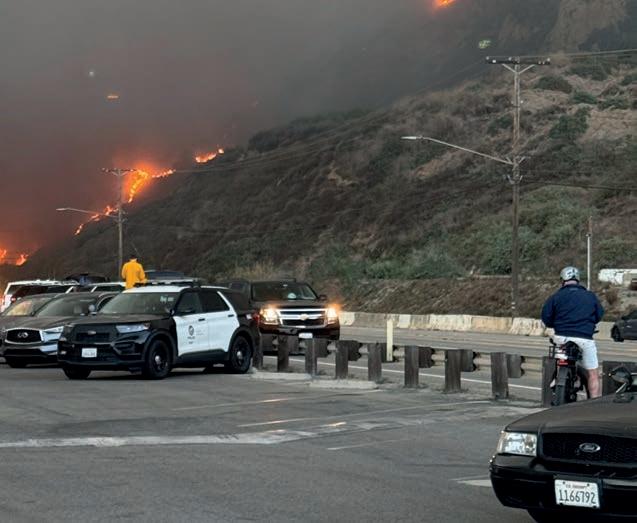
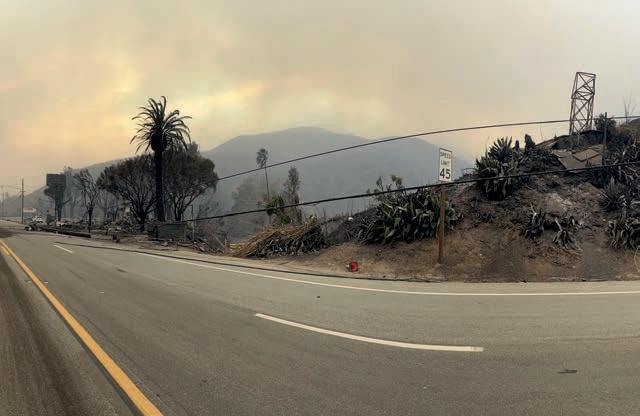
It wasn’t the !rst time she’d reported on an environmental disaster, but it was the !rst time she’d researched and interviewed for a story while actively evacuating her home.
“I found myself covering [the !res] because I was living through them,” Gammon says.
She had planned to go hiking in the Palisades on the morning of 7 January with a friend. They cancelled when they saw severe wind warnings and by the evening, her family was sheltering indoors from the wind scratching at their windows.
“I knew I was going to be covering this for my publications,” she says. As she laid awake that night, the cogs were already turning. Who would she call? What story would be most needed? Though her family’s Santa Monica house was outside the evacuation zone, was it best for her children’s health to evacuate sooner than later?
“That night, I slept very li le,” Gammon says. “The evacuation zone kept marching closer, so we formulated a plan to leave.”
Gammon, her husband and their two sons, aged nine and 12, packed up the car the next morning. They drove north to Santa Barbara where they could stay at a friend’s house until the !res were contained. On the drive, Gammon entered a Palisades neighbourhood WhatsApp group chat, where she watched residents whose homes were burning text each other in real time.
She pitched her !rst assignment to Atmos from the passenger seat of her family’s getaway vehicle. She was assigned the story right away: to report on the recently evacuated or actively evacuating Palisades residents who were watching their homes burn down from Ring doorbells and Tesla cameras.
As she was writing the doorbell story, Gammon was living through the same dystopian nightmare. “I’m terri!ed about my own neighborhood and we’re watching ash rain down, looking through the cameras that we have installed on our house.”
Gammon says she knew that she wasn’t going to be doing the kind of reporting that the LA Times and other local news outlets were doing – house by house, neighbourhood by neighbourhood.
Instead, she was speaking to the people watching their homes being incinerated, whilst fearing for her own neighbourhood and trying to get her family to safety. It was as hard as it sounds, says Gammon. When her family arrived in Santa Barbara, she continued to steal away moments to work, patching together stories whenever possible in her car.
“What I had to o er were glimpses into stories like these – how technology was changing in real time the way that we were experiencing a climate linked disaster.”
Phil Hopkins, 71-year-old associate publisher and general assignment reporter at Local News Pasadena, is used to quickly becoming an expert on all manner of things. The 2025 !res were no exception.
“Embercast is a word that I didn’t know,” he says. “But now, I’m quite familiar with it.”
The night of 7 January was the “most horrifying” for Hopkins and his wife, who live a mile south-west of Eaton Canyon. Hopkins’ wife was in the middle of preparing a late dinner when she spo ed an orange glow in the distance through the kitchen windows.
The night winds howled and the pair stood frozen, watching the $ames glow in the dark. →
“I said, ‘That’s Eaton Canyon,’” Hopkins recalls. He checked the anemometer, a spinning device that measures the speed and direction of wind, on the roof. It read that winds were blowing at 70mph.
“My wife, being the smarter of the two of us, said ‘We need to go now. Right now.’”
With a bag full of wedding photos, clothes, a camera and a tablet, they pulled out of the driveway and snaked down small, dark streets –the streetlights already stricken by what would become citywide power outages – toward the main southern artery. Palm fronds !ew past their car as they drove.
“We had no idea where we were going. We were just ge ing away,” says Hopkins.
The couple spent the next ve nights at an evacuation site for Altadena and Pasadena – a hotel behind the Pasadena Convention Centre, where hundreds of others were also sheltering.
Hopkins remembers the view through many of the hotel room windows: parents si ing in silence with their frightened children, amidst piles of luggage and pet carriers, all wondering what to do next.
“It was frightening. It was traumatic. We were all sharing that.”
No meals were being served in the hotel and no one was coming to the rescue of the many families whose means were rapidly depleting while the res raged on.
From the hotel, Hopkins got the news that the Local News Pasadena o$ce was in the evacuation zone. “Nobody’s going into the o$ce. There is no o$ce,” he says. The news team was spread out, telling the story of emergent disaster from their respective posts. Hopkins began typing out the stories he heard at the convention centre on his wife’s tablet, having le his laptop at home in the frenzy of evacuation.
Tony Briscoe’s eld reporting began when the active res had been contained near the end of January 2025. Being the LA Times’ air quality reporter is (as far as Briscoe, 35, is concerned) as important a job as it gets.
“How many other beats a ect you 20,000 times a day? That’s how many times you inhale,” he says.
His work on the frontlines began long a er Haggerty’s, once the active re had been contained and cleanup started.
Briscoe was on the scene a day into the hazardous materials cleanup, watching crews hired by the US Environmental Protection Agency begin the tremendous task of clearing a destroyed neighbourhood, one item at a time.
He stood among the rubble in central Altadena, a landscape that had been completely levelled. Briscoe remembers seeing a chimney here, a dishwasher there, sometimes the husks of cars.
“It was absolute, total devastation for miles. To see a few dozen folks in hazmat suits just start with plastic bags was surreal,” says Briscoe. They began by picking ba eries out of the ruins, working their way through the destruction, while pickup trucks drove back and forth from the site of the wreckage to hazardous waste facilities.
“It’s a story that only local media can do”
“Reporting that is very di$cult,” says Hopkins. “You’re feeling the story, you’re living the story and you’re telling what happened to you as well as what happened to everybody around you.”
While disaster reporting came back to Hopkins like “muscle memory” – he had previously reported on myriad other catastrophes – there were new moral hazards to consider and technical challenges to overcome. He was writing breaking stories with limited phone and tablet ba ery in an area that’s power lines had been completely destroyed.
It was perhaps most jarring to adjust to an unfamiliar news pace as a reporter for a local press. The small team at Local News Pasadena was used to working on a weekly publication cycle – a story or two a day, maybe a dozen stories a week. Suddenly, their small-time operation was thrust into a media restorm. Eyes around the world were watching.
“We’re thinking: ‘What do we know? What have we seen? What can we document and what’s possible for us to cover?’”
For Hopkins, that meant “news you can use”, which started with a series of 14 articles called ‘Fire Recovery 101’, le ing the community know what to expect and how to protect themselves. As local reporters, the team knew what their neighbours were up against and how best they could stay safe in a speci c, tailored way.
“It’s a responsibility you have to your community as a local reporter,” says Hopkins.
In nearby neighbourhoods, residents were already returning to their homes one or two days into cleanup, which struck Briscoe as alarming. Things were still exploding, from propane tanks to cars, and bangs echoed through the city. “That was the rst sense of, ‘How well are local authorities working together?’ and ‘Is this being done the right way?’”
The majority of Briscoe’s coverage of the res, beyond air quality reporting, concerned investigating cleanup procedures. This included a soil monitoring investigation that the LA Times launched a er Briscoe and his colleagues realised there was no mention of soil testing in the state of California’s o$cial cleanup plan.
“We went out and did it ourselves. It was a critical safeguard that was taken away,” says Briscoe. Older homes were built with prohibited materials – like lumber coated with arsenic or lead paint – which would have been in the ash covering the ground and could have seeped into the soil a er recent heavy rain.
Because these chemicals could increase cancer risk and harm children’s cognitive development, the reporting team contacted residents of the rst homes to be cleaned and asked if they would be open to free soil testing.
Although the state asserted their con dence that there wouldn’t be lingering contamination, the LA Times’ investigation proved otherwise. Arsenic, lead and mercury were found in the soil, in quantities higher than what the state deems acceptable.
“There were, unfortunately, so many lapses in government response,” says Briscoe. “It speaks to the need for journalism in these times. The fact that we were asking these questions – I don’t know that these answers would have been reported if we just took government accounts for it.”
It was fortunate, says Briscoe, that the LA Times had enough resources and team members to do the kind of reporting which held people in power to account.
But the newspaper is under !nancial pressure. Having made 20 per cent of its sta redundant in 2024, it continues to operate at a loss of around $40 million (£30 million) per year. And the LA Times is a well-resourced publication compared to other regional newspapers across the US. Many areas in LA county are “news deserts” without any local coverage at all.
In fact, 55 million Americans live in “news deserts” spanning 1,500 counties, where newspapers are either nonexistent or have become ghosts of their former selves, producing minimal original coverage. And investigative initiative, like that of Briscoe and his team, is far from the only reason why local newspapers are crucial to the health of US cities.
One of Hopkins’ stories for Pasadena Local News that went viral during the emergency was about a trusted local weather expert who posted an alert to Facebook urging citizens to “Get out!” According to Hopkins, that was well before any noti!cations from the police department came through to anyone’s phones – at the time, tra c was already bo$lenecked at the main road out of town. The post saved “hundreds of lives”, the outlet reported.
“When people are helicoptered into a disaster zone from other news organisations, they come in with a deadline. They’re trying to get a story, or they’re looking for bad news,” Hopkins says. “They know nothing about what’s important to folks.”
For example, the fact that the Black community in Altadena was disproportionately a ected by the wild!res didn’t make it into the mainstream news until months a er the !re was contained, says Hopkins.
“There are many folks who lost a lot of history, a lot of creative community,” he says. “That’s an example of stories that only local media can really do well, because they understand the history. They understand the detail. The li$le details mean a lot.”
When Gammon was reporting on the !res, she also saw her responsibility as serving her community. In her article for The Atlantic about falling ash, she wanted to answer questions that her neighbours and school principal had. Keeping her professional and personal life separate while reporting on the disaster was impossible. By the end of the month, she found herself exhausted and burnt out.
Hopkins felt the same. He recalls covering airplane crashes, storms and previous !res in his career as a journalist, saying “thank God
there’s usually a break between them” – although it’s never a guarantee.
While he sees himself staying on the wild!re beat for the long haul, Haggerty isn’t without his reservations about the moral hazards of the job. The hardest part for him is being a human in the midst of a disaster and not being able to help in the traditional sense.
As a journalist, he says it’s his job to “maintain objectivity, whatever that means, observe, and report”. But when he’s spending his days with !re survivors who don’t know if their houses are safe or if their families are alive, the instinct to drop everything and help is overwhelming.
Sometimes, Haggerty says, he’s the only person bearing witness to the most traumatic moment of somebody’s life.
For him, that means it is the top priority to simply be there with that person – to ask if they need water, if they need to take a break, if they understand the implications of what it means to talk on the record. The challenge is to !nd the line.
“I think it’s helpful for me to remember the role that I have and the importance that it carries,” he says. Over the last year, many people have personally thanked Haggerty for the work that he and his team have done for the Los Angeles area. That is enough, he says, to alleviate the weight of the emotional, physical and mental burden of disaster reporting, at least most of the time.
“People can trust us to make sense of this chaotic disaster. That’s something this world and this community needs.” ●
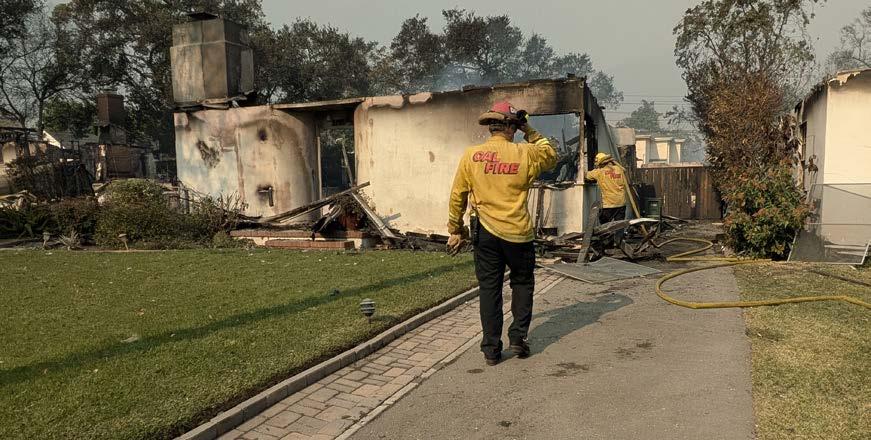
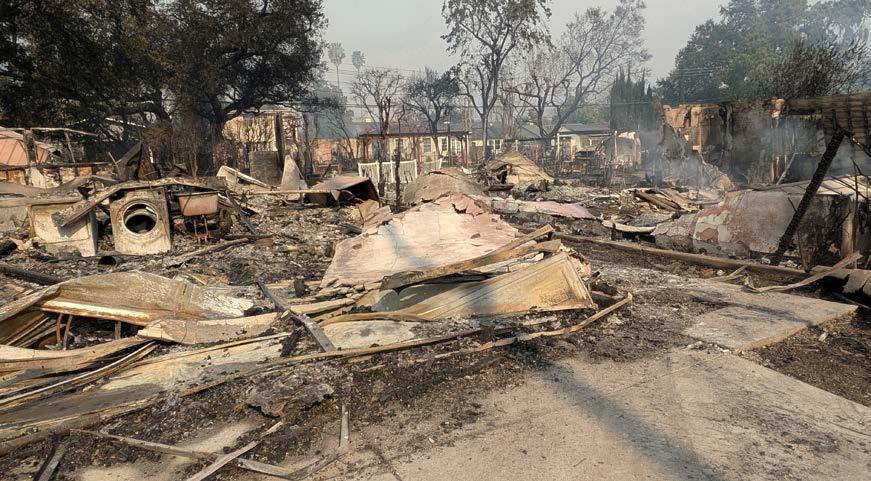
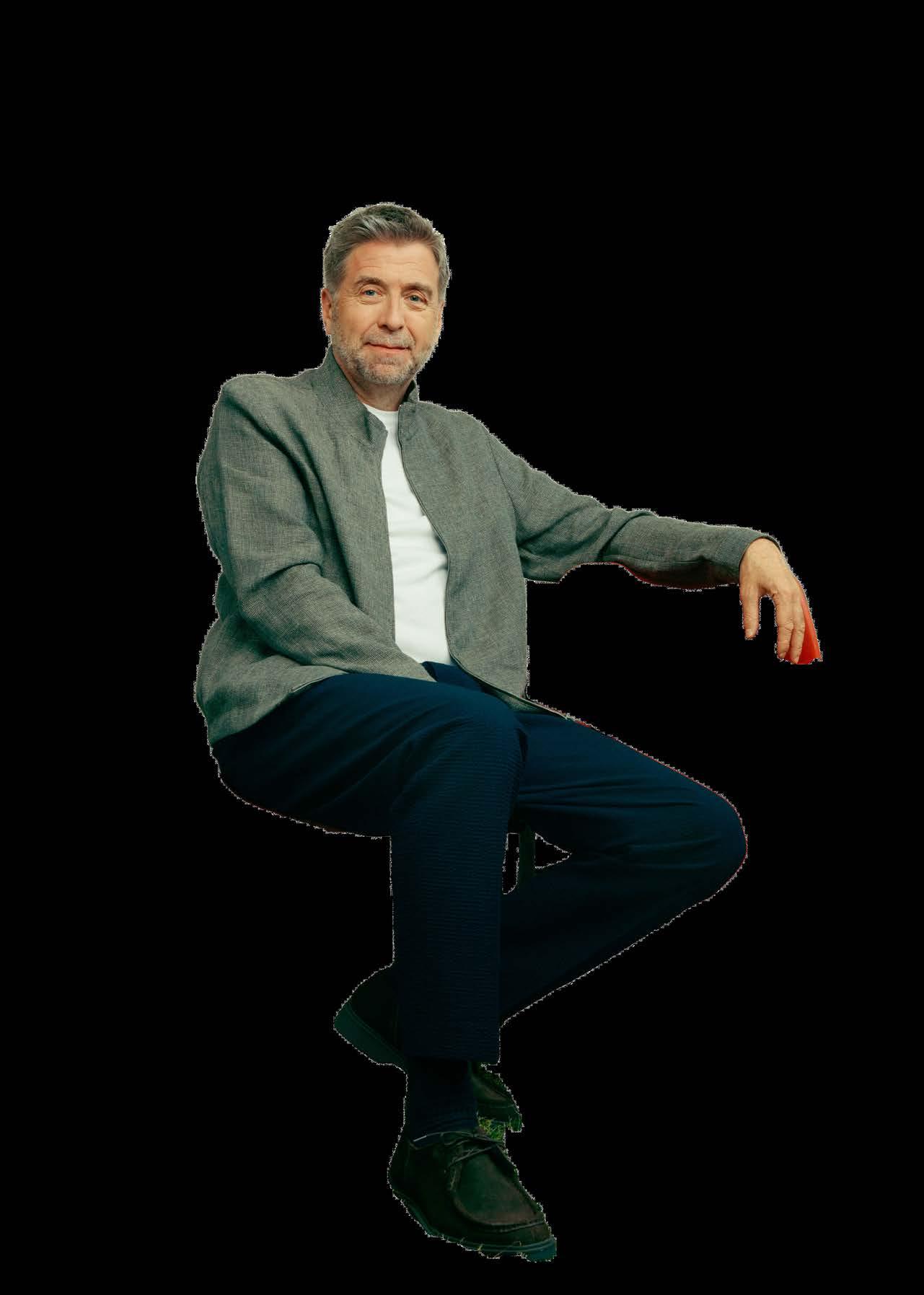
A!er a wrong turn out of To enham Court Road station, with our only recording devices threatening to die and running from our original choice of meeting spot (a café blasting heavy metal), a question sets in to us two newbie hacks. Are we really the right people to be meeting one of sports broadcasting’s biggest names?
With a back catalogue stretching over 30 years, Mark Chapman is at the top of his league. He’s the BBC’s go-to host for almost anything involving a ball: cricket, golf, rugby league, NFL, Match of the Day (1 and 2). Half an hour before we meet, we re o one last ustered email to explain the change of location. He arrives bang on time. Sauntering unassumingly down a noisy Market Street is the face of BBC Sport. Not that you can see his face – he’s wearing a waterproof grey pu er jacket with the hood up.
Minutes later he’s inside, starting the conversation with an unpretentious warmth and o ering to buy our co ees.
We na er about his prep for the World Cup, which will see Chapman je ing o to North America in a few months. A memory comes to mind: he recalls heading to one of the nal matches of a big tournament and being on a ight full of England fans who, unsurprisingly, recognised him. He’s still grateful to meet people who like his work, but he agrees with his hero Terry Wogan, who said: “Radio and television are the best jobs for the introverted extroverts.” A lot of people in broadcast fall under this category, including Chapman.
“I absolutely love my job,” he says. “When the mic goes up and the camera's up, you're doing it and you love it and away you go. But there’s a number of times where the a ention just kind of really freaks me out. I walk around with a hood up a lot.”
us who joined and said ‘don't be here longer than three years’.”
Serendipity runs throughout Chapman’s early career. The same guy who asked Chapman what he wanted to do got him a meeting with a colleague from Radio 5 Live. A!er a brief stint on a achment as a cricket reporter in the north east, he returned to continuity announcing until a Radio 1 job came up. One of the recruiters was none other than the 5 Live contact he’d met with. The day a!er the interview, Chapman got his dream.
“I had moved into a new at with the woman who was going to be my wife. She worked in the theatre and was out working when I got a phone call to say I got it. I burst into tears, because that was all I ever wanted.”
One of the reasons he got the job, Chapman was told, was because he knew how to write short links for sports bulletins.
“The only reason my writing was tight was because I was writing six and eight second links when I was continuity announcing,” he says. Such coincidences have meant Chapman’s main advice for anyone is simple: “Don’t rule anything out. You never know how it might come back around.”
His introduction into Radio 1 came through a stint as a sports reporter on Sco Mills’ drive time show, an experience that did indeed come back around.
“I’m very conscious, whether it’s TV or radio, of the people who’ve gone before me”
Chapman rarely does interviews with mainstream press anymore. His last solo interview was more than ve years ago, but he said yes to XCity because we’re students, and because he is an alumnus of the Broadcast Journalism MA.
Chapman was born in Wardle in Lancashire, but spent his teenage years in Sale, Greater Manchester. At 13, his family moved house and the kitchen telly was replaced with a radio. Chapman would come downstairs every morning to nd his dad listening to Today on BBC Radio 4, and switch it to his other hero Simon Mayo's breakfast show instead. From there, Chapman’s dream was born –presenting on Radio 1. Even now, he prefers radio to television – in his words, “by a country mile”.
A!er ge ing his postgraduate degree at City St George’s, Chapman looked for a way into radio. Drowning his sorrows in a bar over a rejection from a BBC Sport production scheme, he spo ed another listing: a continuity announcer job, primarily for BBC One and Two. The advertisement wanted someone with “northern undertones” to their voice.
“I was dreadful. I was so bad at it,” he says. “But, it got my foot in the door. The very rst day I got there, a guy introduced himself to three of
Recently, his teenage children have been showing Chapman 15-year-old clips of him and Mills performing hoax prank calls on the show. “They’re like: ‘Is that you? Really? What were you doing?’” It was a chaos that could only be captured on the radio, Chapman says. “Nobody would ever do that on telly.”
Like his hero Mayo, Chapman has become a mainstay for the BBC’s agship stations. He joined Radio 1 as a newsbeat sportsreader on Sara Cox’s show in 1999. From 2004, Chapman was presenting various things, even teaming up with ‘Comedy Dave’ for Chris Moyles’ breakfast show. In 2009, he moved to 5 Live, another of Mayo’s stomping grounds. In 2016, he started 5 Live Sport’s Saturday a!ernoons.
“Even sometimes ahead of having my kids, I had the biggest joy of my life doing a Saturday a!ernoon,” says Chapman. “I’ve done it for over 10 years. I could happily do it for another 10.”
A sense of gratitude is palpable as he reminisces on starting out. “In my rst years at Radio 1, I used to wake up either pissed or in a cold sweat thinking ‘jeez, if that hadn’t followed that, and I was still doing continuity...’ Nothing against that job! But I just wanted my dream.”
It was that primetime rush hour slot and Monday evenings on 5 Live which arguably put ‘Chappers’, as he’s colloquially referred to, on football fans’ radars. We suggest that, thanks to radio, he has become the soundtrack to car journeys back from games or en route to work. He passionately agrees: “It’s exactly that.”
“People come up to me and go: Oh my god, I listen to Sara's breakfast show, or you and Sco in the a!ernoons!’ It makes me feel quite emotional and it is quite humbling,” he says. “Those car journeys are a massive part of people's lives.”
The word ‘responsibility’ seems to particularly resonate with Chapman, who repeats it throughout the conversation. In every instance,
he crosses his arms and looks up slightly to think about it. “I'm very conscious, whether it's TV or radio, of the people who've gone before me,” says Chapman.
Much like connecting with his audiences, he feels a responsibility to live up to bygone greats. “Those voices that ma!ered to me when I was in a car, listening – they got it right and were very important. Now, I’m obsessed with making sure we get it right and making sure the show is strong as a team, so that when we do move on, whoever takes over then has it in the same position as when I took over. That really ma!ers to me. There is a responsibility.”
If that responsibility wasn’t enough, Chapman then took on a post which many football fans would consider the best job in the world – hosting Match of the Day. The BBC’s iconic football commentary programme boasts an average weekly viewership of 6.9 million.
A er hosting Match of the Day 2 from 2013, it was announced in January 2025 that Chapman would take on the responsibility of presenting the agship show alongside co-hosts Gabby Logan and Kelly Cates.
It went down like this: a er presenting Final Score with Logan and standing in for Clare Balding as rugby league presenter, reminding producers that he actually liked the sport, Chapman got the call. This time, in the car on the school run.
“I was thinking they were going to o er me Final Score, so I was like, ‘oh OK, great’,”
“I’ve always been somebody to stay in my lane”
Chapman says. “I think they probably thought when I found out that I might be more happy and excited,” he adds, but he was aware he was replacing friend Colin Murray. “I was just a bit concerned about how that was being managed because we go back a long way.”
A agship presenting role like Chapman’s comes with di erent responsibilities in the digital age. Armchair pundits online are gaining views and trust, no ma!er how accurate their analysis. Highlights are compiled on YouTube immediately a er a game’s completion. Illegal streams allow us to watch 3 o’clock games that are banned from being broadcast live. Chapman agrees the game has changed. Can Match of the Day compete?
“My view on it is to make it as watchable as possible in the chats that I have with the guests.” He adds that the audience needs “a bit of opinion, a bit of fun and a bit of in-depth analysis to nd a real balance across the hour.”
A conversation about Match of the Day can’t be had without discussing its most famous, or
Choose Your Own Adventure
Be Bold:
infamous, host. Gary Lineker, who presented the show from 1999 to the end of last season in 2025, stepped down following criticism of his outspokenness on social media. Chapman is a far cry from his predecessor in this regard.
He points at his phone. “These,” he says frustratedly, “are horrible.” Anyone banking on an Instagram post anytime soon should think again. He’s on “the accounts”, as he endearingly calls social media, but he refuses to use them.
“I won't publicise anything. I won't post anything. If you want me to work, great. But I'm not doing any of that. I'm not interested.”
When Lineker was suspended in 2023 for comparing government policies to 1930s Germany, the controversy sparked a wider debate – should the BBCs broadcasters be held to the channel’s impartiality rules oair? It’s complicated, Chapman suggests, considering his stance carefully.
“I'm just doing my job,” Chapman reasons. “It’s not about me. That’s why I don't want to put myself on social media. I don't see myself as the face of anything, or even the voice of anything.
“My view is, I'm a sports presenter. Why would anybody want to listen to me? What right do I have? Some people go ‘you're not using your platform and you're not doing this and you're not doing that’. But what value do I have to speak out on various things? The things that I do want to help with are causes and stu that is close to my heart, so I do that in a very private way. I've always been somebody to stay in my lane.”
The pair did meet a er Chapman got the job, but not to compare notes.
“We were at an event together,” Chapman remembers, where Lineker “did say to me, a er it had all been announced, that somebody had said to him, ‘have you phoned them to give any advice?’”
Lineker had replied: “Why would I ring them to give them any advice? It's not like they're starting out. They're all really sort of top of their game.”
But Chapman does feel the weight of stepping into such a high-pro le role, recalling initial ji!ers before his maiden Saturday night broadcast.
“I hadn't been nervous for years. I was nervous because I knew the a!ention on it and that you had to nail the opening and the goodbye.”
Six at whites down, the end of our conversation lingers. Chapman checks if there’s anything else we’d like to know. Time for one last burning question: what does he actually think of the nickname Chappers? He smiles and sighs.
“When I joined 5 Live there was this big discussion about trying to get people to stop calling me that,” Chapman says.
“There's something a bit weird about being 52 and called by a nickname. I would always prefer Mark over Chappers. But it's endearing and it was a time in my life. I embrace it because of what that period was and then also think, well, that's now 17 years ago this year that I le . We could move on.” ●
Your frenemy is fuming, you run to your mate, and they greet you with open arms. “Shall we just sack this networking o ?”, they say. They suggest ge!ing fun drunk somewhere down the road, and you run out of this event into the sunset. You’ve won! 34 xcity
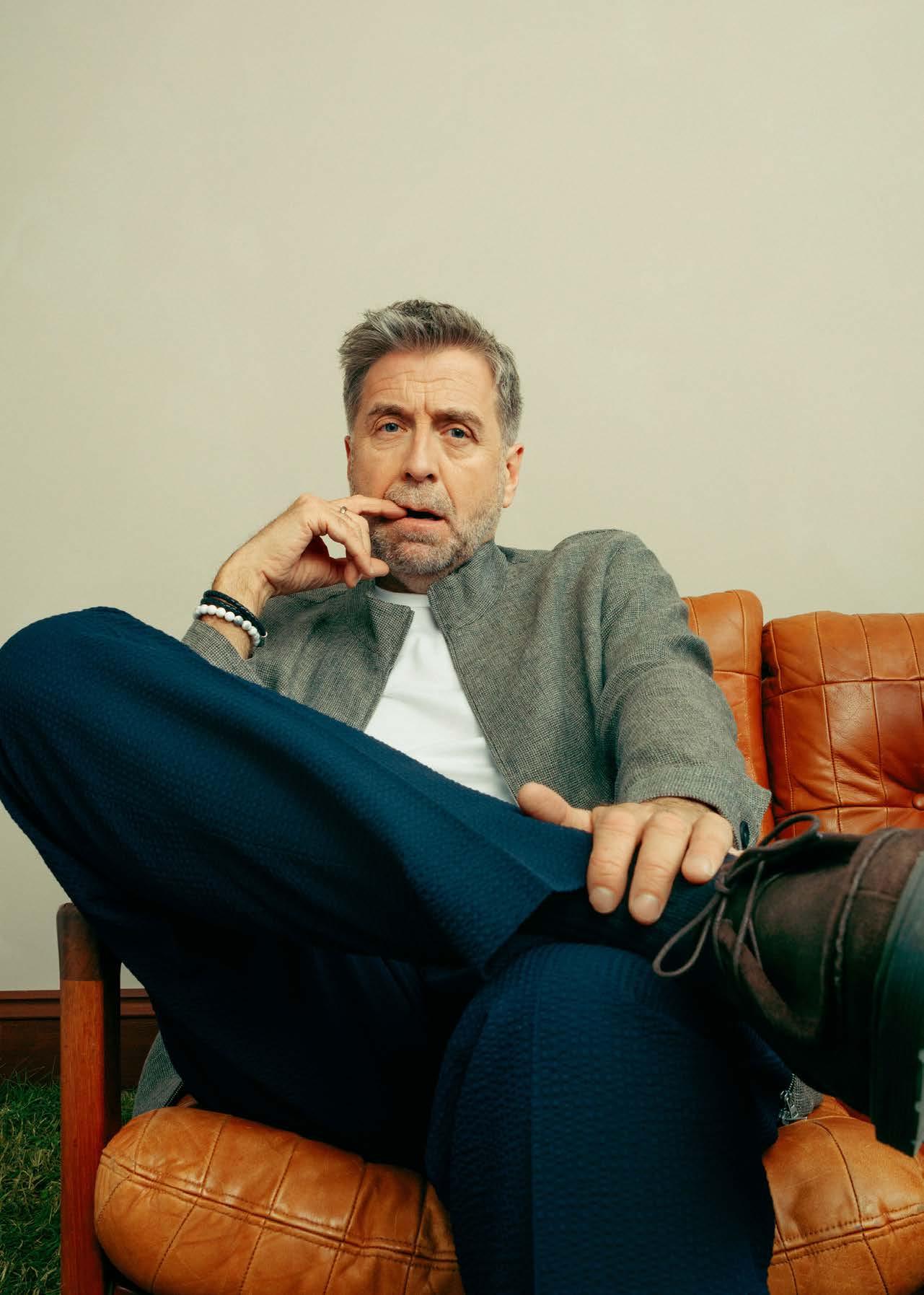
“I don’t see myself as the face, or even the voice, of anything”
Women writers enter the confession booth with Scarle Clarke and Mia Raja to come clean about aggravating exes and ducking drama
Confessional writing, whilst not front line reportage, can place the writer in the ring line. It’s entertaining, it’s intimate, it’s profound. But when the writing is personal, so can be the cost. Esther Walker, Annie Lord, Bryony Gordon and Hannah Ewens have all built careers by writing candidly about their inner worlds. Here, the writers discuss some of the consequences of confessional storytelling – from navigating backlash and di cult conversations, to the pressure of continually mining your own life for material.
Esther Walker Freelance writer for The Times and The i Paper
Have you ever fallen out with someone because of what you wrote about them?
My sister didn’t talk to me for six months. I was pregnant with my second child and I found out it was a boy. The Daily Mail asked, “Can you write a piece about how you really don’t want to have a boy?” and I was like, “Yeah, sure, hilarious.”
My sister at this point had three boys. She let it be known through my mum that she was really annoyed with me, and my brother-in-law called my husband, Giles, and said that this was a bit close to the bone. You kind of mean it, but also you ham it up and exaggerate stu
Another friend of mine, when I started out as a gossip columnist on the Evening Standard (now The London Standard), told me a story about a date she’d been on with a famous person and obviously that went straight into the paper. She then didn’t talk to me for a year – I actually didn’t notice because we weren’t really that close.
An overpriced pint
How do you decide where your boundaries lie?
Being a journalist has always been a dangerous job because unless you’re doing something really quite anodyne, it’s always something that someone doesn’t want you to write, right?
It can be personally, emotionally and socially dangerous. You learn where your boundaries are. Unfortunately, you have to have one or two of those horrible experiences in order to nd out who you are and what it is you want to do.
What advice would you give, especially to young women, who want to go on and write about themselves?
If you want a career in journalism, rather than to just be very hot for three years and then vanish – and if ge ing married and having a family is on your radar – then writing pieces about yourself has to be one thing you can do, but you have to be able to do other things.
Newspapers and magazines don’t think about you or your wellbeing at all. Unless [an editor] knows you really, really well, they will never say, “Are you absolutely sure about this?” They’ll just go, “Brilliant. She wants to steam her vagina and let us take photos.”
I’ve been working in newspapers since I was 23 and every single year, you get a young woman who does the sex or dating column, and mostly, it doesn’t end well.
They quite o en leave journalism and nd it very di cult to sustain any kind of relationship, because men do not want to be wri en about.
I remember when I was young, I didn’t really care. I didn’t care about these people, so it was ne. But when you did mention them, even obliquely, they felt out of control. They felt emasculated. Luckily, my husband wouldn’t care what I wrote about him.
→
£8.50 for a Neck Oil now? Just as you thought this night couldn’t get worse for your mind, soul and bank account. You accept defeat, look away and tap your HSBC. There is a journalist standing next to you looking equally bewildered. What do you do?
Run away (p157)
Neck your pint and chat to the journalist next to you (p161)
“
It’s seen as ‘women’s writing’ and as women, we’re brought up to be considerate of everyone else
Hannah Ewens
“ [Editors will] just go: brilliant. She wants to steam her vagina and let us take photos
Esther Walker
“
When a man writes about what happens in their head they win a f*cking Pulitzer
Bryony Gordon
“
One ex used to read my columns to try to understand me better
Annie Lord
Annie Lord, freelance writer for Vogue and VICE
Your VICE article about the end of your ve-year relationship launched your confessional writing career. How did you approach writing about (and naming) your ex?
I was probably hurting a lot. If I’m being honest, I probably wanted a reaction from him.
I think part of me wanted to write him a le er or something. I can’t remember exactly what I wrote in that piece, but I don’t think I would have said anything that he would nd embarrassing or really personal. I didn’t reach out to ask if he was okay with it, though. At the time, I was very set on the idea that I have a story and I want to tell it.
Do people typically know when they’re the subject of your writing?
I once wrote an article about the girl my ex was with a er me. I don’t think we’d even met – she was just a mutual friend. We’re actually friends now, but that happened way later. It wasn’t like we bonded over him or anything. Every now and again, we’ll talk about it and I just think, “that’s so crazy that I did that.”
One ex used to read my columns to try to understand me be er. I think that must have been quite jarring because my actions weren’t always lining up with what I was saying in the column. I did really like him, but I think I was also ge ing really freaked out about commitment.
Hannah Ewens, freelance writer for Vogue, Rolling Stone and The Guardian
Has your confessional writing ever resulted in a disagreement? How do you deal with the fallout of that?
I really pissed my ex o with a piece for Rolling Stone. It was about Saturn returns –the astrological transit – but I was also re ecting on a past relationship, thinking, “why was I even in [it]?” because it didn’t t me at all. I wasn’t writing about him speci cally, it was more about my own perspective on the relationship.
He did end up ge ing really angry. I just doubled down and said, “you’re dating a journalist – you know this is my job.” I wasn’t revealing any personal details about him, so tough. I had sent him the passages that related to him. But when he read the overall piece he, for some reason, felt slighted. I try to be diligent. I think most writers do [but] I used to be way more careful and now I feel a li le bit more careless.
Bryony Gordon, columnist for The Daily Mail
How do you navigate writing about other people in your stories?
I’ve got pre y rm boundaries on it now and I actually weirdly always have done. I can be horrible about myself like, I can throw myself under the bus, but no one else.
I will write about someone if they give me their permission to. My husband doesn’t care [when I write about him]. He doesn’t read anything I write.
“ I can throw myself under the bus, but no one else
Confessional writing is also so gendered. It’s seen as ‘women’s writing’ and as women, we’re brought up to be considerate of everyone else.
What advice would you give, especially to young women, who want to go on and write about themselves?
A part of me wants to say “wait until something is less fresh and raw before you actually end up publishing it,” because stu does live forever and you can’t take it back.
I’ve wri en pieces when it was too soon. Something I wrote for The Observer was about healing culture, and I was going through a really dark time – I was trying every kind of psychospiritual healing I could get my hands on. I ended up writing about it while I was still in the middle of it.
I think the piece is slightly messy, but I also think if I’d waited too long, I wouldn’t have published anything about it at all and I quite like that it’s there, even if it makes me sound a bit insane because other people feel insane too.
Have you ever had any experience of fallout from confessional writing?
No, I haven’t. In a novel, I wrote about a badly-behaved man who I had a ing with in my twenties and even he read it and was like, “fair play, I was a dick”. I don’t really write horribly about other people gratuitously – only when they behave like dicks.
So, with an abusive exboyfriend or something, I’ve wri en columns about that. But my story is my story to tell.
Do you think there are any risks that come with personal writing and sharing intimate stories online?
Of course there are risks. However, I think sometimes women in particular focus on those too much as a way to shame themselves for talking about their interior lives. I have never allowed myself to be shamed for talking about the way I feel. O en, for women who write about their personal lives, it’s called confessional journalism; whereas when a man writes about what happens in their head, they win a fucking Pulitzer.
The whole point of my writing is to remove those barriers and that shame. So I don’t dwell too much on the risks of people knowing about who I actually am because it’s who I am. And if they don’t like it, fuck them. ●
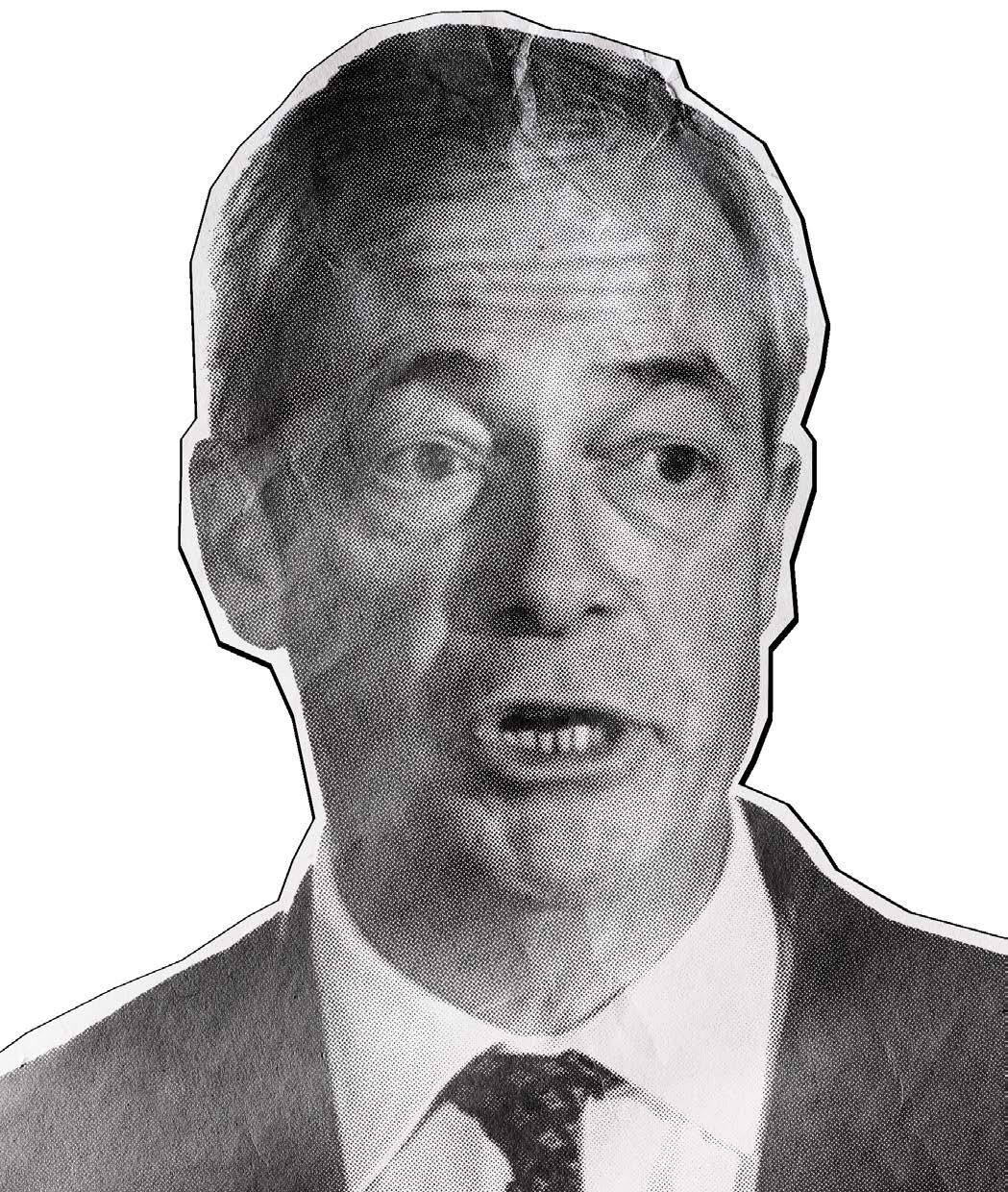
Reform is riding high in the polls and is rarely out of the headlines, but does not play by the rules. Emilia Gould and Mia Raja spoke to political reporters and editors to nd out how they navigate the challenges presented by the country’s youngest party
In August 2025 Reform council leader, Mick Barton, banned the party’s 41 No inghamshire County councillors from speaking to No inghamshire Live and removed the organisation from all media mailing lists from the council, following a disagreement over the paper’s coverage of local government reorganisation.
A er just over a month the ban was li ed on the basis of Article 10 of the Human Rights Act and breaches of the councillors’ code of conduct.
Following these problems with her local Reform leader, Natalie Fahy, editor of No inghamshire Live, said: “Journalism is the fourth emergency service. Banning it is absolutely ridiculous.”
Saba Salman, Private Eye, political writer
“Private Eye tackles Reform the same way we do the other parties, we’re led by their wrongdoing, incompetence and lack of accountability. Where Reform di ers is in its sudden rise, so it demands greater scrutiny. People who’ve never been tested in public o ce have suddenly been elected and been swept into town halls – which has come as a bit of a shock to
many of them who didn’t count on actually ge ing elected and having to do the job.
Once in post, they’ve been handed responsibility for huge budgets and leading essential services like education or social care and most of them haven’t a clue what they’re meant to be doing. So they leave. And while all that local chaos is relentless, on a national level, Tory bighi ers are defecting to Reform and the old parties are either imploding or withering away.”
Jack Elsom, The Sun, political editor
“We write about Reform in the same way we would any other party: responsibly, accurately and fairly. The biggest change since they burst onto the scene has been the sheer volume of press conferences they now hold, far more than any of the other parties.
Unlike other leaders, Nigel Farage will also almost always take every question from every journalist who a ends. While that is undeniably good for journalism – the more access to politicians the merrier – it does mean making editorial decisions about just how much to cover. Like every story, they’re judged on their news value to our readers.”
Dan Bloom, POLITICO, political editor
“Nigel Farage’s way of handling the media — ooding the zone with multiple press conferences per week where hacks are granted 20-plus questions each, and giving sharp, combative answers — is a pre y novel challenge for all journalists. As with all parties, we have to ensure Reform’s arguments are conveyed fairly without us laundering partisan claims or a acks untested. There is so much said that it can be easy to forget things Reform said two weeks ago. The party structure where so much power has been vested in Farage (though Reform says this is changing) has also been a novelty for a party leading national polls.
Part of our coverage is for the Westminster bubble (via London Playbook) while another part is about translating for Brussels and Washington D.C. – where we have a big presence. We are helping explain to readers overseas who these people are and why they need to care. In particular, there’s a job to do in showing how Reform’s rise ts (or doesn’t) within a broader surge of populism in the western world.”
Craig Munro, Metro, senior politics reporter
“Metro is proudly apolitical. I believe we’re one of only two national newspapers that has never endorsed a party at an election. In my opinion, this stance is particularly crucial in Metro’s case, since we’re provided for free to millions of people on public transport across the UK.
People who want something engaging, informative and fun to read on their journeys between home and work. Many of those people will be interested to learn about the latest moves from Nigel Farage and Reform – indeed, many of them may be considering voting for the party. For that reason, I believe the most important element of my coverage should be clarity: not just describing what has happened, but providing as much context as possible to also give a sense of why it has happened.”
Rebecca Hutson, The News Movement, editor-in-chief
“We approach all our political coverage with a raised eyebrow and always with our audience in mind. Westminster bubble stories about intrigue, gossip and political machinations are alienating at worst,and boring at best. Reform is making a play for younger voters – so we hold them to account, as we do all political parties. Everyone deserves access to fact-based, impartial journalism to help them understand the world around them. Reform o ers simple answers to complicated questions – we think everyone deserves a bit more detail.”
“It’s not about platforming or not platforming. We are here to reflect what people voted for”
Natalie Fahy, Nottinghamshire Live, editor in chief
Aubrey Allegre i, The Times, chief political correspondent
“Reform UK poses unique challenges for journalists. By Nigel Farage’s own admission, it is a party in its relative infancy – even if some of its leading gures have been on the political scene for many years. Having led in every opinion poll since last May and been the biggest winner of the last set of local elections, Reform has earned the right to be taken more seriously as a credible party.
But covering its policy positions has been challenging, given some have been junked and others changed. Some senior gures are also not elected – such as Zia Yusuf, the party’s head of policy –meaning they are not held to account in a democratic forum like parliament as much as some other opposition parties. However, Reform are undoubtedly keen for coverage. Farage ensures he takes a question from every journalist. That’s not to say he always answers them directly, though he’s hardly alone in that respect. I’ve had my own fair share of challenges in covering Reform, but try to treat them as I do any political party: in a nuanced and neutral way.”
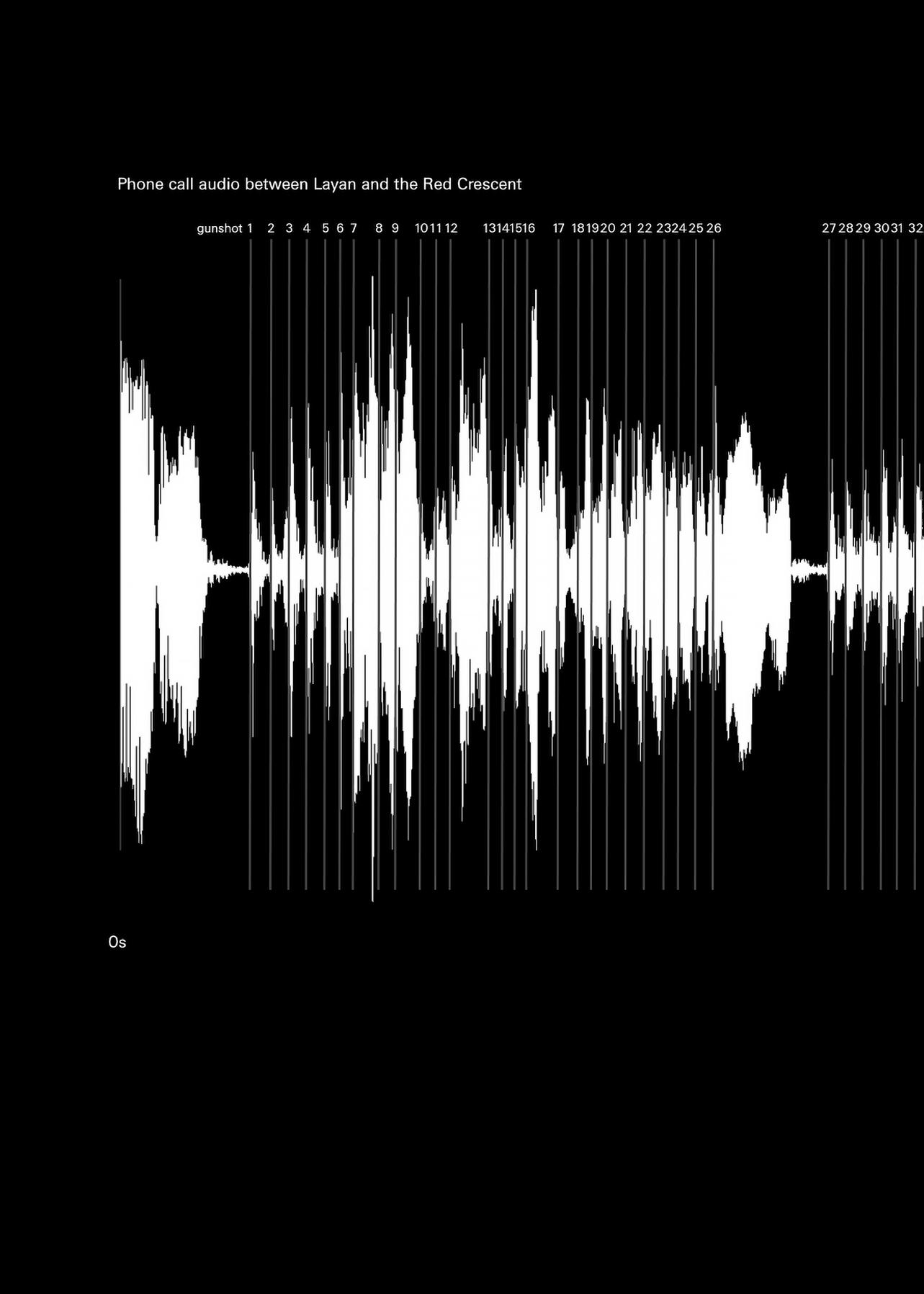

When a ve-year-old girl, Hind Rajab, and her cousin, Layan Hamada, were shot in Gaza City, Israel denied involvement. Using six seconds of sound, investigative group Earshot reconstructed their nal moments and made Hind’s name a rallying cry. Jude Jones reports
“I’m so scared, please come. Come take me. Please, will you come?”
Those were the last words of ve-year-old Hind Rajab, who was on the phone with the Palestinian Red Crescent (PSC) for three hours before Israeli soldiers shot her. She was waiting to be rescued from her family’s Kia Picanto that had been caught in a tank’s cross re.
The crumpled, bullet-ridden car, which had taken refuge at a petrol station as it tried to leave an evacuated zone in Gaza City on 29 January 2023, also contained the bodies of Hind’s six family members, each killed in front of her. She waited hours for help and, when Israeli authorities nally gave the PCS permission to send an ambulance, that was shot at too, killing Yusuf al-Zeino and Ahmed al-Madhoun inside.
“We believe whoever shot Hind was likely close enough, even in a tank, to see her,” explains Fabio Cervi, a researcher at Earshot, the journalistic team that helped reconstruct Hind’s nal moments, “possibly close enough to hear her voice”.
Earshot is a not-for-pro t organisation that studies – in its own words – instances of state, environmental and corporate injustices whose primary evidence is sound.
“Sound is everybody’s problem,” explains Cervi, “Imagine you’re running from gun re: you might not see everything happening, but you will hear it all.”
Working with ears alone might seem a constricting medium, forcing researchers to approach situations blind. But the group’s investigations, in the three years since its founding, have been expansive in their imaginative scope and physical scale, like the journalistic equivalent of a trope-ridden lm character losing their sight, only to start conceiving the world in crisp, vivid and vibrant sound.
Investigations have spanned from Paris to Belgrade, but o en localise in the Middle East. This has
ranged from “ear-witness” interviews to demonstrate that Serbian police had red an illegal sonic cannon at an antigovernment vigil in the capital, to a website simulating the sound that a massive wind farm that Israel plans to erect in the occupied Golan Heights region of Syria would assail onto locals. These methods are –journalistically, at least –experimental. But this is also the group’s greatest strength, its members all coming from a medley of creative backgrounds. Founder Lawrence Abu Hamdan moonlights as a Turner Prizewinning sound artist who has been exhibited at the Tate Modern. Cervi himself is a part-time musician with degrees in music production and architecture.
Cervi is reluctant to call the group’s work journalism outright, partly due to this methodological intermingling of sound, digital art, interview and forensics, though he hopes a new Substack will change this. But their work has still been championed by and featured by a more traditionalist pantheon that includes Agence France-Presse and Le Monde, for whom Earshot investigated an a ack on its journalists by an Israeli drone in Lebanon, and The Washington Post
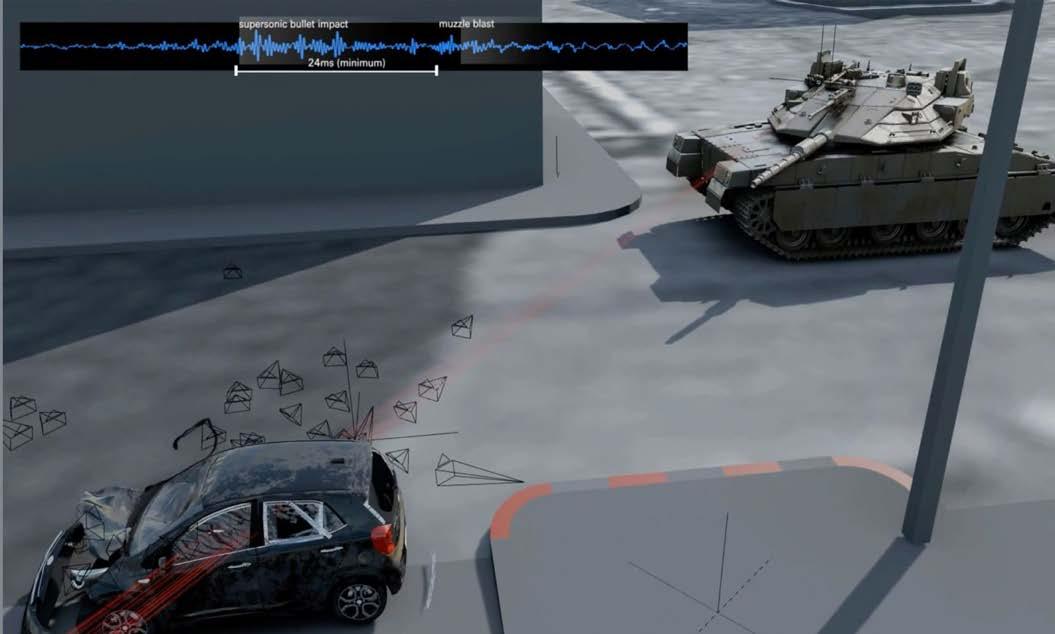
The Hind Rajab case itself was commissioned by AlJazeera Arabic to establish, based on the phone calls between Hind and the Palestinian Red Crescent, whether Israeli weapons were responsible for her death or if, as Israel had claimed, none of its soldiers were in the area.
Cervi believes the evidence is conclusive: an Israeli tank killed Hind Rajab and her 15-year-old cousin Layan Hamada, who can also be heard on the call. “This investigation documents a war crime that to this day remains to be accounted for,” he says. This is the story of that investigation, as told by Cervi on behalf of Earshot.

Stage one
We received almost an hour of audio recording from Al-Jazeera of the conversations between the PCS’s dispatchers and Layan and Hind. We decided to focus on six critical seconds, when the gunshots that killed Layan can be heard.
Stage two
In these six seconds of recording, 64 audible gunshots are red. For a weapon to discharge that many bullets in such a short span of time, it would have to shoot in the 750900 rounds per minute (rpm) range. This exceeds the rate of re for an AK assault ri e, the weapon most commonly associated with Hamas, which res at around 600rpm.
However, the rpm does tightly match that of an FN MAG. The FN MAG is a type of a machine gun commonly mounted on Israeli Merkava tanks. At standard se ings, it res between 750 and 850 rpm, is capable of shooting as many as 1,000 rpm. This puts it plausibly within the calculated range.
On the phone call, Layan pleads: “They are ring at us, the tank is next to me.” Our audioballistic analysis, satellite imagery found by research group Forensic Architecture and Sky News showing that Merkava tanks were in the area around Layan’s time of death, vindicates her nal words. The girls were not shot in a cross re with Hamas militants, as Israeli o cials tried to claim. An Israeli tank killed them.
“This year, Hind would have been eight. She is still waiting for justice”
A er establishing that Layan had been killed by an Israeli tank, we needed to determine whether the shooter would have known they were ring at children. To do this, we needed to re-analyse the recording and calculate how far away from the vehicle the tank might have been, based on the speed of sound.
When gun re is recorded, what you are listening to is two sonic events. The rst is the supersonic noise of the bullet breaking the sound barrier as it travels past the recording device, like a whip cracking. The second is the slower, thudding sound of the bullet as it exits the muzzle of the gun.
By calculating the milliseconds-long gap between these two events, it is possible to calculate the approximate distance of the weapon from the audio device when it was red.
In this case, the time between the two sounds across the 64 individual gunshots varied from 24 to 40 milliseconds. If we assume that the ring weapon was an FN MAG machine gun, which uses 7.62 calibre bullets that travel at 840 metres per second, then the furthest away the tank could have been from Layan and Hind’s car was 23 metres. At closest, it would have been just 13 metres from the car. Either way, the shooter would have seen Hind and Layan in their line of re.
Since the killing of Hind, her name has become a rallying cry in the global ght for justice in Palestine. When protestors at Columbia University occupied Hamilton Hall, a building on the university’s campus, in 2024, they renamed it ‘Hind’s Hall’ in her honour. In 2025, Tunisian director Kaouther Ben Hania released The Voice of Hind Rajab, a cinematic retelling of Hind’s death using the same audio that Earshot’s team analysed.
The lm, which debuted at the Venice, received an almost 24 minute-long standing ovation, the longest in the festival’s ninedecade history.
Earshot has, following the Hind Rajab investigation, continued to work in Palestine. In February 2026, it published a 52-page reconstruction of an Israeli a ack on Palestinian aid workers, based on audio from a six-minute video and two phone recordings, concluding the deaths were intentional.
Meanwhile, the Hind Rajab Foundation (HRF), a Palestinian advocacy group, has submi ed Earshot’s audioballistic analyses to the International Criminal Court as part of a 120page dossier alleging war crimes and crimes against humanity in Palestine, an accusation that Israel denies.
This year, Hind would have celebrated her eighth birthday. She is still waiting for justice. ●
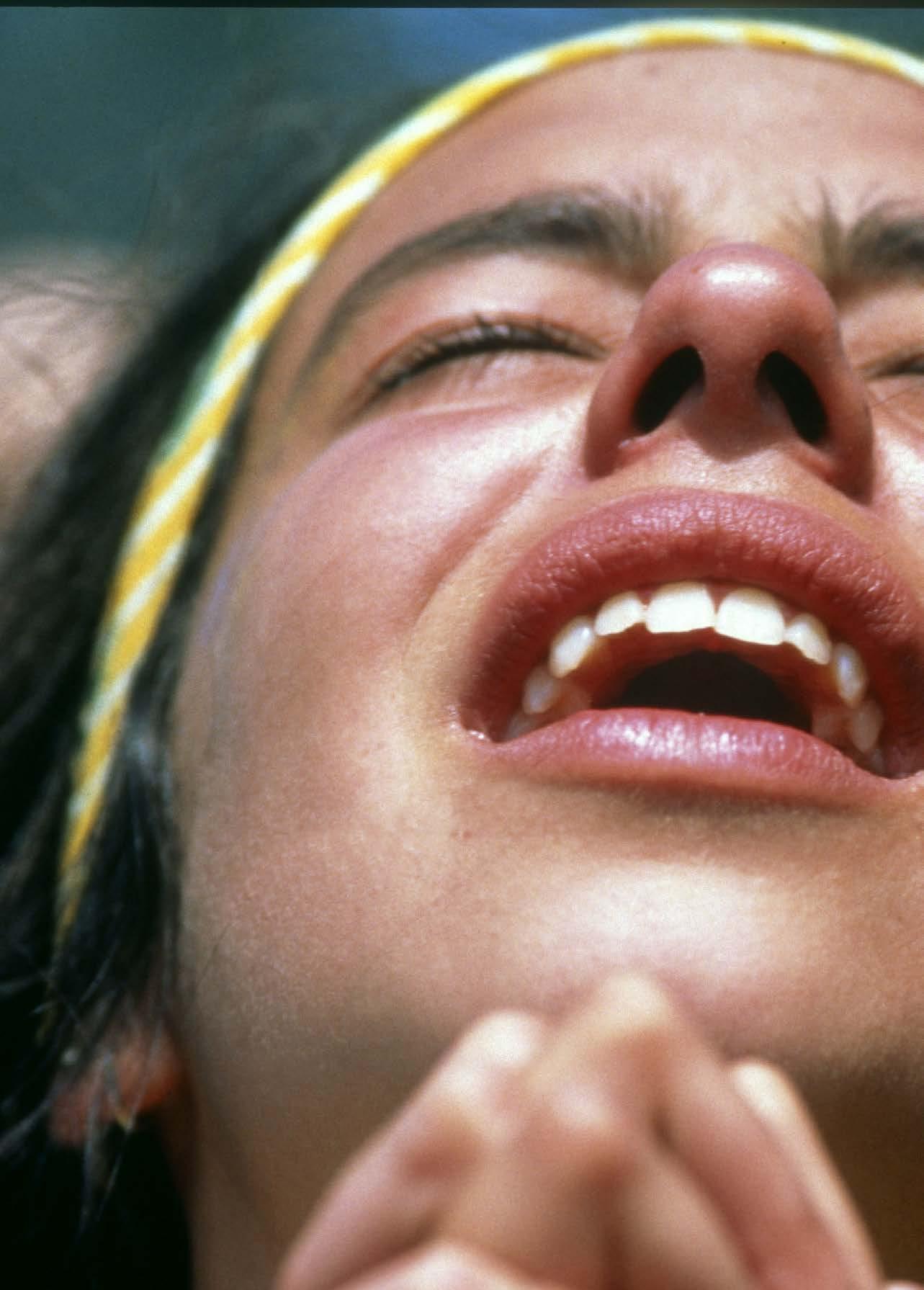
By Lara Hedge, Jack Dennison-Thompson and Daniel Farthing
Mark Leech
1994 World Cup nal shootout, at the Rose Bowl in Pasadena, California.
“During the penalty shootout I noticed these girls behind me with unbearable tension in their faces, so I decided to focus on them for a while.
This girl was almost in a frenzy about the outcome of the match, it was wri en on her face, and she only had eyes for the action, she was not acting for the camera.”
Brazil eventually beat Italy 3-2 on penalties.
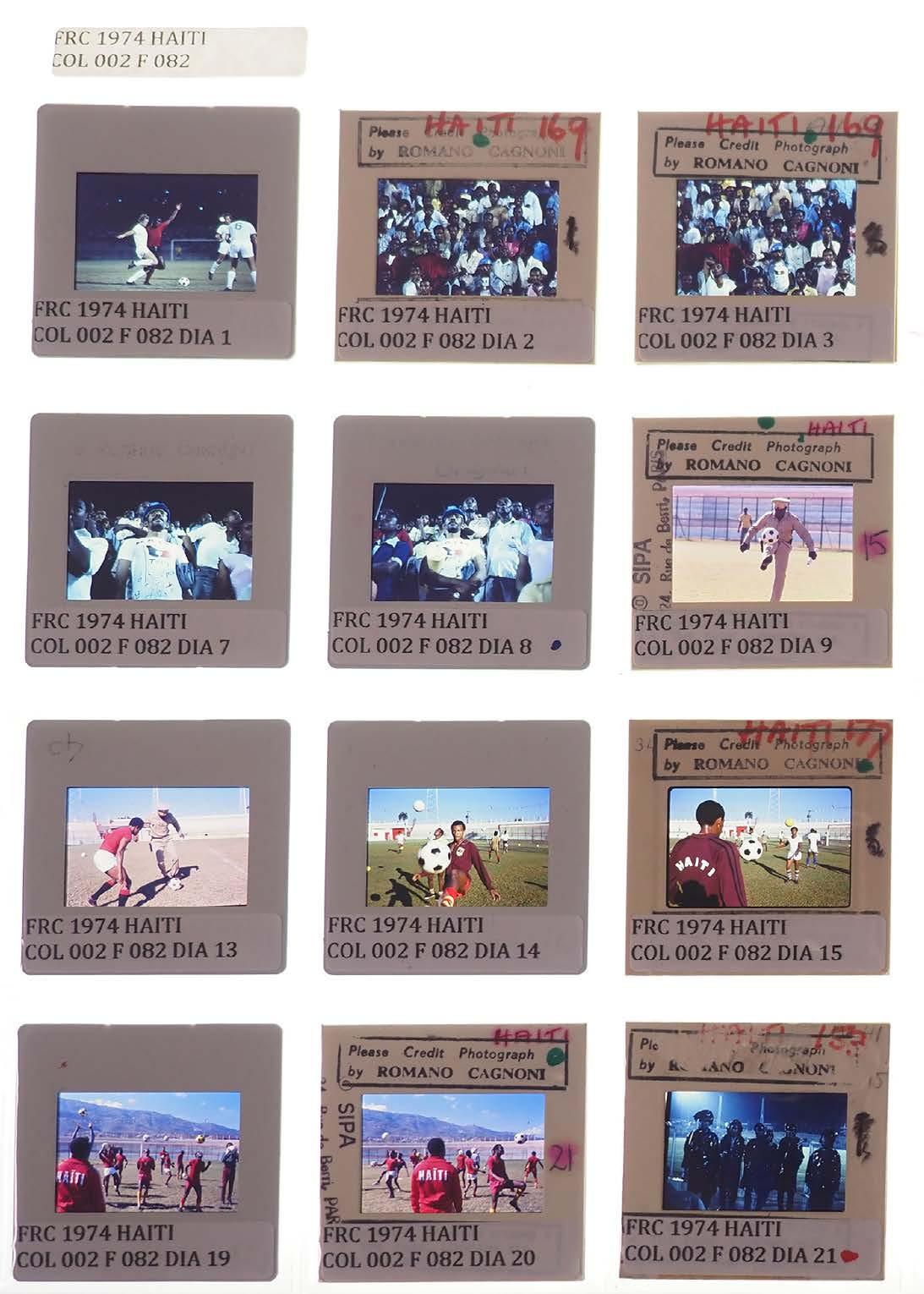
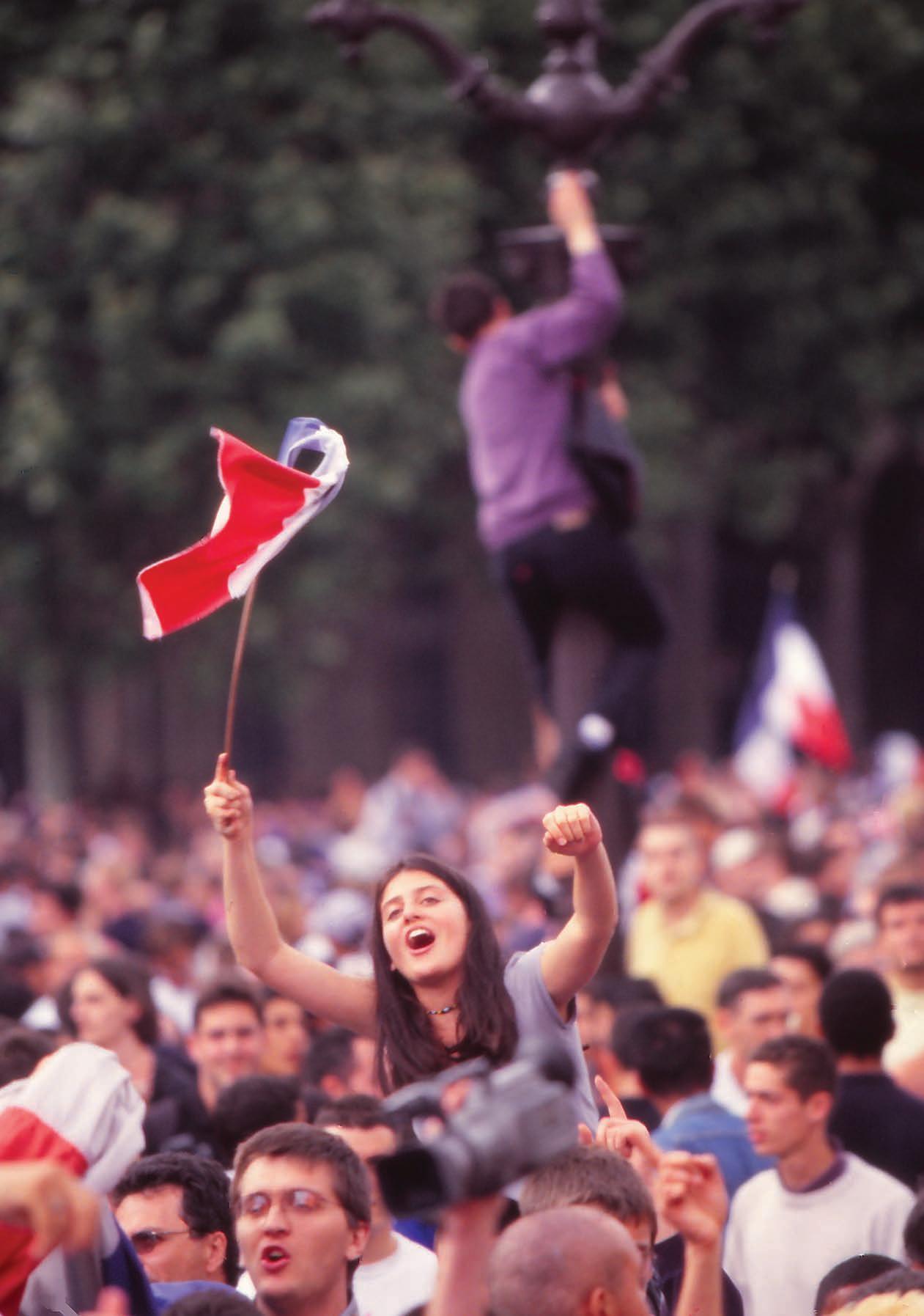
Owen Franken
Paris, World Cup nal 2018, France vs Croatia.
French fans gather in front of the Hotel de Ville – Paris city hall. “I kept my eye on cheering people and other interesting and emotional moments. This girl was exceptional, high up and waving the ag.”
France would win the match 4-2.
Ricardo Mazalan
Cape Town, South Africa, Uruguay vs Ghana, July 2, 2020
“I was in Cape Town to cover the Germany–Argentina quarter nal the next day, and that night I went to a local bar knowing Ghana’s match would be huge. Ghana were one step away from becoming the rst African team to reach a World Cup semi- nal, in the rst tournament ever held on African soil. With the game tied 1–1 in the nal seconds of extra time, Luis Suárez handled a goal-bound header on the line. Ghana got a penalty, missed it, and Uruguay advanced on penalties. What could have been history became heartbreak.”

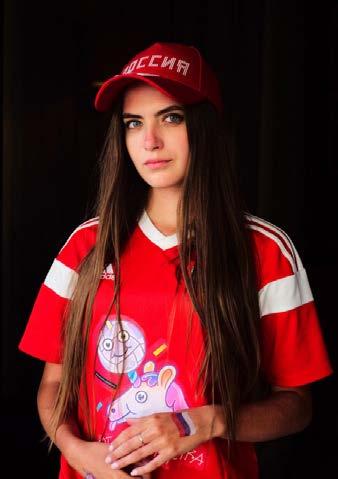
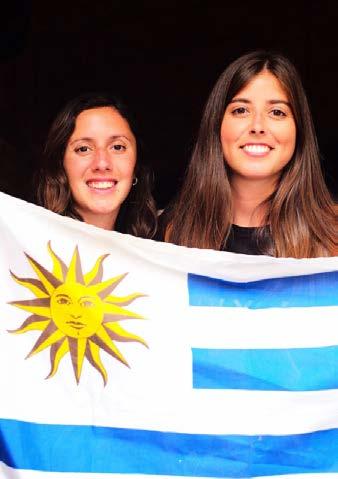
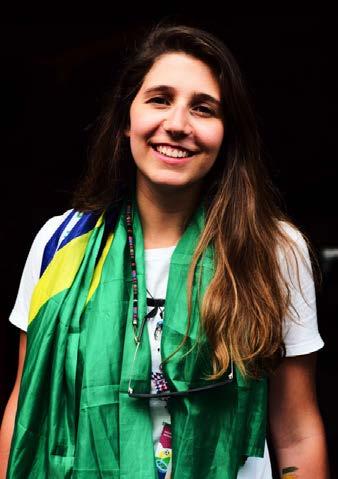
Mandl World Cup Girls, 2018
“TV stations mainly zoomed in [on] one type of female fans and there were many examples during the World Cup of very one sided TV coverage of female fans, only showing women that were perceived as ‘hot’ by the broadcasters.”
“With the [2018 Russia] World Cup coming up, I thought about how I could embrace female fan culture and desexualise the topic.”


Restaurants have long functioned as informal newsrooms. Eve Williams and Kaeah Sen ask journos why eateries are the perfect place to get a scoop
Senior editor at i-D Magazine
Where is your favourite place to take a source?
My favourite place is a hotel bar like at The Marlton in New York. It’s elevated but not like a restaurant where they’re nagging you – it’s more laissez-
faire. In a celebrity interview, the goal is to make everyone feel as relaxed as possible.
What’s the worst thing to order when interviewing a source? Food can actually be quite distracting. Arguably, it’s important not to spend time focusing on the dish, but the person. I o en go with co ee and a mu n. It’s ino ensive and innocuous.
Do you have any memorable interview meals or locations that stand out?
My most memorable interview was with 2 Girls 1 Bo le [a pair of TikTokers]. We were at McDonalds, they brought all their own stu , and they put me in their music video.
Freelance journalist and cook
Where is your favourite place to take a source?
There are the places I really like to eat at with somebody, talk, have a couple of glasses of wine, enjoy somebody’s company and let them relax and listen to stories, and then there are other places where you can actually hear the tape. In a proper food environment, they’re much more likely to relax and talk to you in a way that doesn’t feel as though you’re on a junket and they’re not so guarded. The restaurant can also become part of the conversation.
Do you have any memorable interview meals or locations that stand out?
One would be interviewing [novelist] Douglas Coupland in Vancouver. We did this interview and I was super nervous, so I think I drank two glasses of wine in really quick succession, but he was just completely brilliant and it was a really positive experience.

Freelance journalist and author
What’s the best place to take a source?
Freelance journalist and author
Where is your favourite place to take a source?
An editor might say, “let’s meet somewhere signi cant and meaningful to them.” And the PR would just be like, “yes, this ee shop is very signi cant and meaningful,” and it’s just a ee shop. So you have to take them at their word.
There are some places I think are just classic PR choices. The Ham Yard Hotel, I’ve been to the restaurant/brasserie there so many times. I think because it’s a relatively quiet bit of Soho, but still central enough that anyone can get to it.
Wine bars and other places like en good, especially in the back where there’s not that many people. And it’s very nice to be treated like a celebrity by association because you’re with the person you’re interviewing.
What’s the worst place to take a source?
I think a place with distractions which can take away from the fact that you’re trying to have a deeper, more meaningful conversation with somebody you don’t actually know. I de nitely did the odd interview in LA where people would be like, “I want this but not with that and that on the side, and this without that, and then some egg whites.” You sit there thinking, “I really hope this works out because they’re gonna be so distracted by the fact that that’s not an egg white omele e.”
Soho House is good because
I put an inordinate amount of thought into venues for interviews. The more e ort you put into something, the more fate intervenes and fucks things up. So, especially when I used to do celebrity interviews, I would walk around our meeting site ahead of time trying to work out the best cosy or snug or private place to sit face-to-face and have an intimate conversation. Then invariably, having found the perfect table, I would drag the celeb in there and the lights would be up brighter and there would be Magic FM playing at top volume.
Do you have any memorable interview meals or locations?
I did an interview with Harry Styles in a pub in Hampstead that started out as the perfect environment for an interview. We were at a nice corner table. But he is incredibly fucking famous and people kept pausing their conversations to half listen in. As we were having our conversation, the room kept ing quieter and quieter, to the point that it just fell silent and we were having this murmured conversation – not at all what I had in mind.

I’ve done interviews everywhere, including my own kitchen table. Once, my son was o school and it was too late to re-arrange an interview with Peter Capaldi. He ended up coming over and having a cup of tea in my house.
Where do you get the best interviews?
I think anywhere more secluded. So the table’s away from the door, it’s away from people walking past and asking for sel es and autographs.
Do you have any memorable interview meals or locations that stand out?
Olivia Cooke and I went to an East London wine bar and she immediately ordered a glass of red wine. She’s really fun. Bella Ramsey ordered tractor baked beans, I think it was literally baked beans on top of white bread cut out in the shape of a tractor, which I found very sweet and hilarious. ●



Author, columnist and screenwriter
Dolly Alderton is in hiding. The author, agony aunt, screenwriter and City St George’s alumna does what she always does when she needs to get her head down. She escapes to her much loved Devon retreat, safe from the distractions of friends and the pull of her local. “There’s just nature and no one can make me go to the pub,” she explains. Her current mission is to put the !nishing touches to her Net ix script – Alderton is hoping to deliver an era-de!ning take on Pride and Prejudice. And you can see why she picks the south Devon co age for some self-imposed exile and inspiration. Flipping her camera, she shows us the view from her writer’s room. Just metres away, sand stretches across the bay towards the rocky headland.
Dolly Alderton chats to Harriet Curzon and Mia Raja about passing the torch, regrets, and Mr Darcy coming back to haunt her →
The 37-year-old arrives on the call somewhat ustered a er back-to-back meetings – we have been told we have a strict 30 minutes with her. But our half-hour quickly expands into an hour and becomes the kind of anything-goes conversation you might expect if we had successfully lured her to the pub. Her long blonde hair is half-tied up in a messy bun as we discuss modern love and relationships and drinking too much
– topics she’s covered in her sprawling career, most recently in her Sunday Times Style agony aunt column, Dear Dolly, but also in her !ction novels Ghosts and Good Material. And although Alderton is under pressure to deliver on di erent projects, she gives us her undiluted energy.
At 29, Alderton had released her memoir Everything I Know About Love. It has since sold over one million copies in the UK alone and been translated into more than 25 languages. In 2022, the book was transformed into a hit BBC series.
Now, having established herself as the voice in many millennial women’s heads, Alderton is being trusted with an altogether di erent love story, as she is handed the reins to Net ix’s adaptation of the iconic Jane Austen novel, airing later this year.
She is not the !rst person to adapt Pride and Prejudice – and she is under no illusion that her version will be the last. “Pride and Prejudice will continue to be made until we’re living on Mars,” she says.
Net ix has promised the six-part series, which will be directed by Euros Lyn for the 250th anniversary of Jane Austen’s birth, will stay “a faithful, classic adaptation of the novel”.
Alderton writes characters which haunt readers long a er they close the book, as with Good Material, her 2023 novel about a 35-yearold comedian dealing with a complicated breakup. She she will no doubt do the same with Austen’s characters in their latest onscreen iteration.
dating columnist, long before she’d envisioned landing this gig for Net ix, she spoke about Darcy. In a Guardian article about the event, Alderton was quoted saying the romantic hero had had an “insidious ripple e ect on dating culture right up until now.”
“Let me tell you something about that article that’s going to haunt me every day that I do marketing and press,” she begins, defending her stance between laughs.
“Cheltenham Literary Festival and Sebastian Faulks, one of the greatest novelists of our time, persuaded me to go do a big debate, which was like ‘Who’s The Biggest Shit – Heathcli or Darcy?’”
So Alderton got up on stage, walked up to the mic and let rip.
Understandably, a er her years as a dating columnist, she thought the festival was looking for her to “make comparisons about Darcy and ghosting and regency balls and Tinder.”
She throws her hands in the air in resignation. Li le did she know that eight years later, she’d be making the adaptation, and the only record of Alderton talking about Pride and Prejudice’s love interest would be “basically [her] trying to impress Sebastian Faulks and a room full of Tories in a marquee at Cheltenham Literary Festival to get a cheap laugh”.
Between anecdotes like this, she drops tidbits of wisdom. “Be careful what you say at literary festivals, because you never know how that’s going to follow you around for the rest of your life.”
What will almost certainly follow Alderton for the rest of her life are her readers, many of whom are millennial women who are particularly evangelical about her writing. Goodreads reviews on her collection of agony aunt columns include comments like: “Oh Dolly… my wise, parasocial older sister, I love you so much”; and “I want to be best friends with queen Dolly ugh, I love her so much.”
But she won’t choose between the previous Pride and Prejudice adaptations. “The nineties were a sexy time – we got a Darcy that was simmering with passion. Then, Ma hew [Macfadyen] was a more indie, cooler Darcy.”
“Generationally, we project the Darcy that we need,” she says, stopping herself before giving any clues away. “You can wait and see the Darcy that this generation is going to get.”
Played by Slow Horses’ Jack Lowden, this generation’s Darcy has one core di erence to his predecessors. “I quite like the idea of being a ginger Darcy,” Lowden told the BBC, “it is one of the great last barriers to be broken down.” And we agree – this generation needs a ginger Darcy.
The trailer, released on 24 February, teased the adaptation which will also feature Olivia Colman as the giddy Mrs Bennet and Emma Corrin as the rebellious Elizabeth Bennet.
Alderton wasn’t quite so diplomatic about Pride and Prejudice’s brooding hero at Cheltenham Literary Festival in 2018. Having just le The Sunday Times Style a er three years as their
“You never know what’s going to follow you around for the rest of your life” →
But Alderton doesn’t view her own work in the same way her fans do. We ask her if she regrets anything she has wri en. “I mean, all of it,” she laughs. We wonder if she’s joking.
Though her memoir was !rst published in 2018, just last year an audio clip from Everything I Know About Love went viral on TikTok, with 2.8 million posts stringing together videos and photos of their friends to the quote: “Nearly everything I know about love, I’ve learnt from my long-term friendships with women.”
She notes: “Certain experiences about being a woman, being a young person, being an open-hearted person, looking for love, being a heartbroken person, being a person who’s trying to work out who they are, are universal for all of us.”
Having shared so much of her life online and in print, many young women could probably write a book titled Everything I Know About Dolly, with readers o en speculating about her career and the perceived ease at which it came.
But, as Alderton re ects on her younger self with healthy doses of compassion and criticism, she explains that her entry into the industry wasn’t as simple as one lucky break.
She grew up with her parents in Hertfordshire, where she went to St Margaret’s School in Bushey. She pauses. “Let me be really thoughtful about how I say this. My life
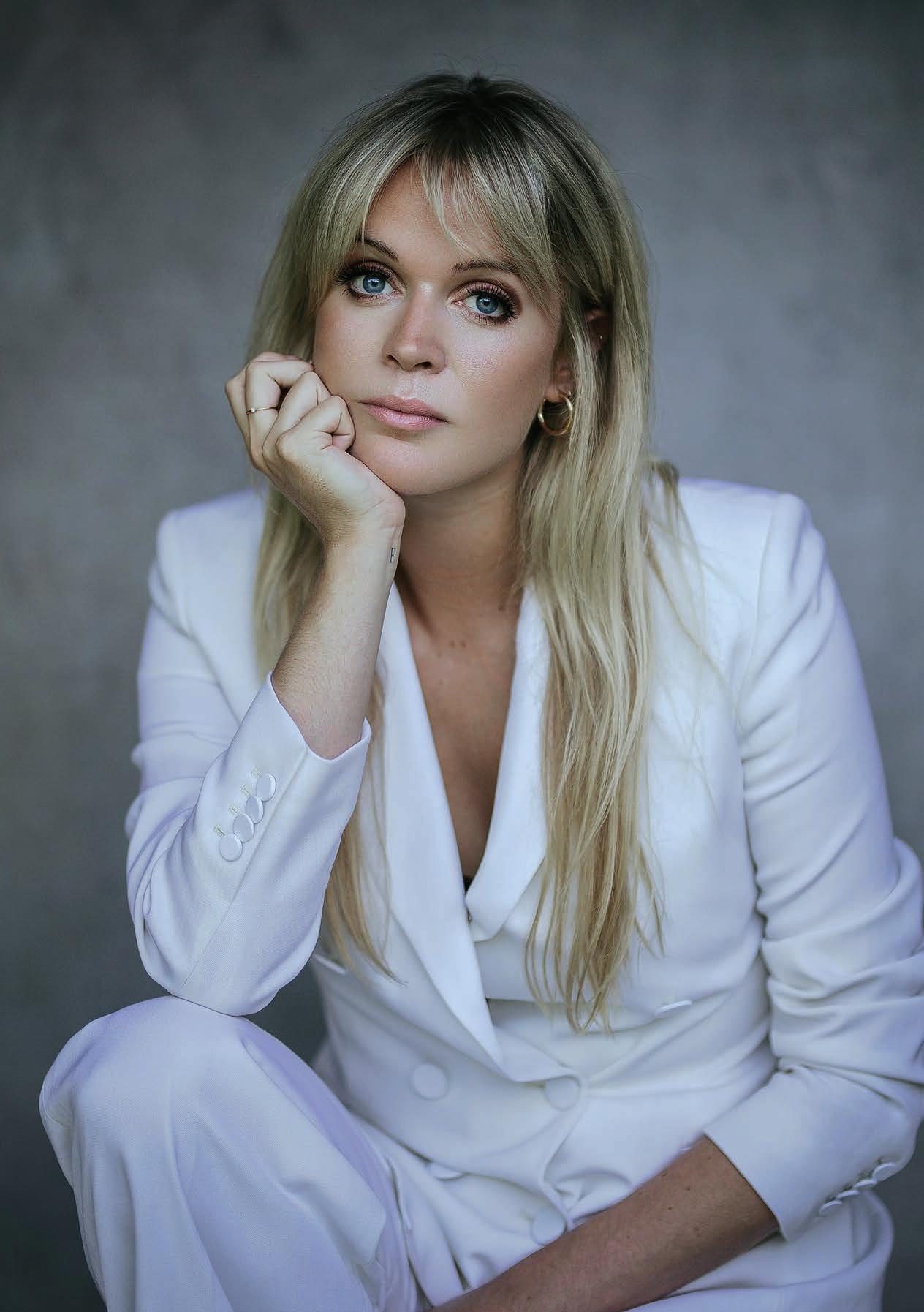
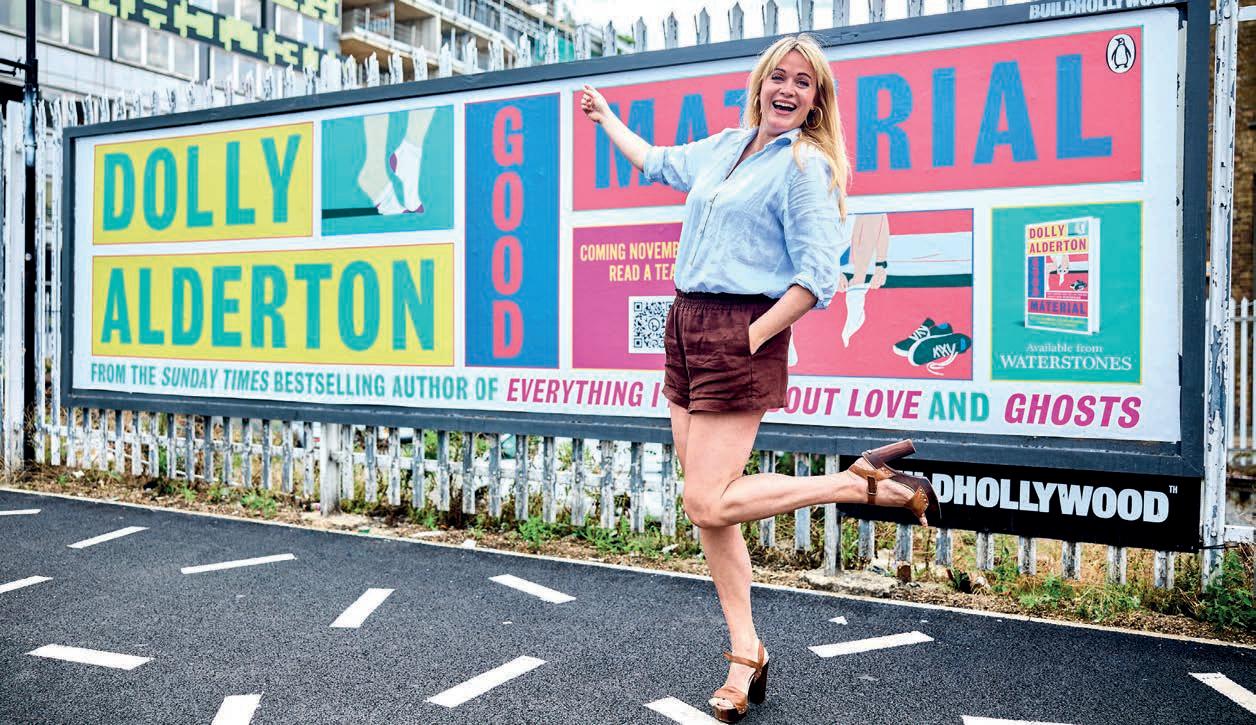
came with a lot of privilege. I went to private school, I had the money to do [the City master’s] course. I think that’s something that has to be acknowledged.”
And she did get “very, very lucky” at the age of 22, when a story producer from Made in Chelsea took a chance on her. He had stumbled upon a series of reviews of the reality TV show which she had penned as open le!ers. He found them funny, and printed copies for all the producers to read. Then they asked her to their East London o ce and gave her a job as a story producer on the show: “How can I not think of that as a kind of fairytale magic?”
“I was a high-functioning alcoholic”
But Alderton’s magical beginning did not come without its fair share of fondly remembered frog kisses. Having wri!en extensively online from the age of 15, she had accumulated a blog the length of Leo Tolstoy’s War and Peace by the time she was hired to write professionally. “No exaggeration – I worked out how many words it was.”
She wrote and put on plays, entered poetry competitions, spent summers performing at Edinburgh Fringe and worked her way through 50 magazines. By the age of 22, Alderton had all but exhausted the literary scene. She recalls “being paid £50 a week to write about the best ca!le that produce the best beef in the British Beef Guide” at Country Life
A er ve years working on Made in Chelsea, she went on to work in development with a creative team. “I was desperate to move into more scripted work.”
But Alderton accepted this wouldn’t be an easy transition. “I was ready to take a massive step down and start at the bo!om,” she says.
She became a script assistant on the comedy series Fresh Meat. It was the “best job ever” because she could just be silent and observe the show’s creators Jesse Armstrong (Succession)
and Sam Bain (Peep Show).
A er a few years on the freelance scene, her big break into national journalism came in 2015, when Alderton became a dating columnist for The Sunday Times Style magazine. Alongside Cosmo Landesman, she mined her love life weekly for entertainment and cultural commentary for their It’s a date column. She tapped out in 2017, and three years later became the magazine’s agony aunt in her own column, Dear Dolly. Equal parts warm and cynical, she transitioned from analysing her own life to advising readers on their own personal blunders.
But there’s a di erence between drunkenly advising your friend to go to that guy’s house and publicly counselling readers on everything from “I’m 28 and I’ve never had sex. I feel so much shame” to “My boyfriend has a secret child”. In an interview with Harper’s Bazaar, Alderton noted she was reluctant to compile her many Dear Dolly’s into a book when she herself was constantly learning. “I make mistakes on, like, an hourly basis.”
Many of these youthful mistakes were willingly chronicled in Everything I Know About Love, in which she shared intimate tales of complicated relationships with friends, family and herself.
“I have a really complex relationship with my younger self who wrote all that stu ,” she says.
And it wasn’t easy to get to grips with the complexities of confessional writing: “If you two went out for dinner tonight and had a glass of wine and both shared something very personal about your lives and trusted each other with that, that’s what you’re doing when you write a considered memoir and considered rst person journalism.”
She, of all people, is aware that this exposure is rarely without consequence. “It comes at the cost of a sense of vulnerability and overexposure
and that feeling of danger at times,” she says. Since she has stopped writing so intimately, people still crave this connection and will “stop at nothing to try and get it,” whether that be by making up lies about her life or invading her privacy.
“Occasionally, I yearn for another type of career where my personality sits completely behind the work and my work kind of speaks for itself, and people don’t really know anything about me.”
But she is cautious: “I think it’s really childish and very bra!y for me to wish that, and I wouldn’t change any of it because I feel this huge gratitude that people had listened to what I had to say and were curious about me and my life and my thoughts.”
People resonating so deeply with her and her words is something she wouldn’t change for the world. But being hailed as a ‘voice of the millennial generation’ by media outlets and book reviewers alike is a hard burden to bear. She notes the irony of the title when around 80 per cent of media and arts “look like [her]”.
She has distanced herself from the moniker; “people don’t really care about my generation anymore.” She remembers a time where every comment writer was despairing over or analysing millennials, but now, “millennials are just wine mums who do yoga and are annoying bosses at work.” She’s grateful that moment has passed for her.
Another moment she is grateful to have survived is the chaos of her year on the City MA Magazine course. We ask Alderton what she was like as a master’s student. Her answer is fabulously, classically Dolly: “nightmare”.
a er their talks, handing out business cards, she also wasn’t one of the students who didn’t give a shit. While she struggled to turn up to a lecture on time or pass exams, even redoing her nal coursework, Alderton spent her City days proactively pitching freelance to places where she’d interned.
“Crucially, I wanted to write things that were emotionally honest and funny. But I could have been told that where I would have ended up would be a column, writing, advertising copy, novels, personal essays, plays or scripts – and I would have jumped at any of them.”
She may not have had business cards at the ready, but her nerdiness came from 10 years of “hoovering up” everything she loved – A.A. Gill’s columns, Carrie Bradshaw’s pretend columns, Nora Ephron’s movies, Martin Amis’ novels, Sylvia Plath’s poetry.
“There was de nitely a hunger and ambition and a creativity and diligence to me, but I o en think when I look at myself, education was wasted on the young.”
Despite Alderton’s unconventional master’s experience, she broke out of her bad habits once a week for one teacher in particular. Alderton came alive in former Cosmopolitan editor Marcelle D’Argy Smith’s classes. D’Argy Smith was a visiting lecturer at the time and ran writing workshops for magazine students like “The Last Time I Cried” and “What My Mother Taught Me”. “I would never miss an assignment for Marcelle’s class,” she says. “I would torture myself for the assignments.”
“Millennials are just wine mums who do yoga and are bossesannoying at work”
“I was a high-functioning alcoholic,” she says. “I’d have this incredibly long, very bumpy journey on the Metropolitan line feeling so nauseous every day, o en on about an hour’s sleep.”
“I’m not proud of my year at City,” Alderton continues. “This is not an excuse, but I was always too young for every university milestone that I hit.” She was born on August 31st at 11.45pm. Fi een minutes later, and she would have been in the year below; she had only just entered her twenties when she got to City.
Looking back on her chaotic 21-year-old self, she laughs. “Like, why didn’t I do the shorthand course?”
“I wish I could’ve -” she stops, and re ects for a moment. “I’ve always been very bad in my life at being in the present. I’ve always been trying to end game. And I think because of that, I didn’t make the most of City and absorb everything.
“But I had a lot of fun. I had a lot of fun that year,” she clari es.
While Alderton’s ambition outside the classroom drove her during her time at City, it was sometimes a curse. “I was career-obsessed. That had always been my problem at school. I had always been obsessed with my career and disinterested in the really necessary stepping stones that it took for me to get to that career.”
And while Alderton wasn’t one of the “nerds” who, she described, would run up to speakers
She reminisces on the “creative mathematics” of D’Argy Smith’s classes, writing articles “without any adverbs or adjectives” and being encouraged to be “fantastical and silly and playful and mischievous and experimental with language”.
When we ask D’Argy Smith what she remembers of her former student, she recalls Alderton’s “huge beehive, tiny shorts and ripped tights”.
“I remember thinking ‘if she wants to get a job, she won’t get one dressed like that’,” she laughs.
But long a er Alderton combed out the beehive and (hopefully) threw away the ripped tights, the same voice that was inspired by D’Argy Smith is now inspiring and advising a new generation of journalists. “If you write from real life very early on, you’re kind of inviting a readership or an audience to watch you grow up.” She has learnt to give some experiences breathing room before writing about them, though: “the metaphor and poeticism of the lessons, and the meaning of ‘disaster’, is so much more poignant ve years out.”
Now, Alderton is a li!le more careful with what she shares and a lot more interested in the stories she can tell beyond her own life.
As we sit where she sat years ago, preparing to navigate the chaos of love, work and friendship, we’re comforted by the reassurance that Alderton got there rst, and lived to write the tale. She concludes: “Now it’s like – you guys can fucking go through that. Enjoy!” ●
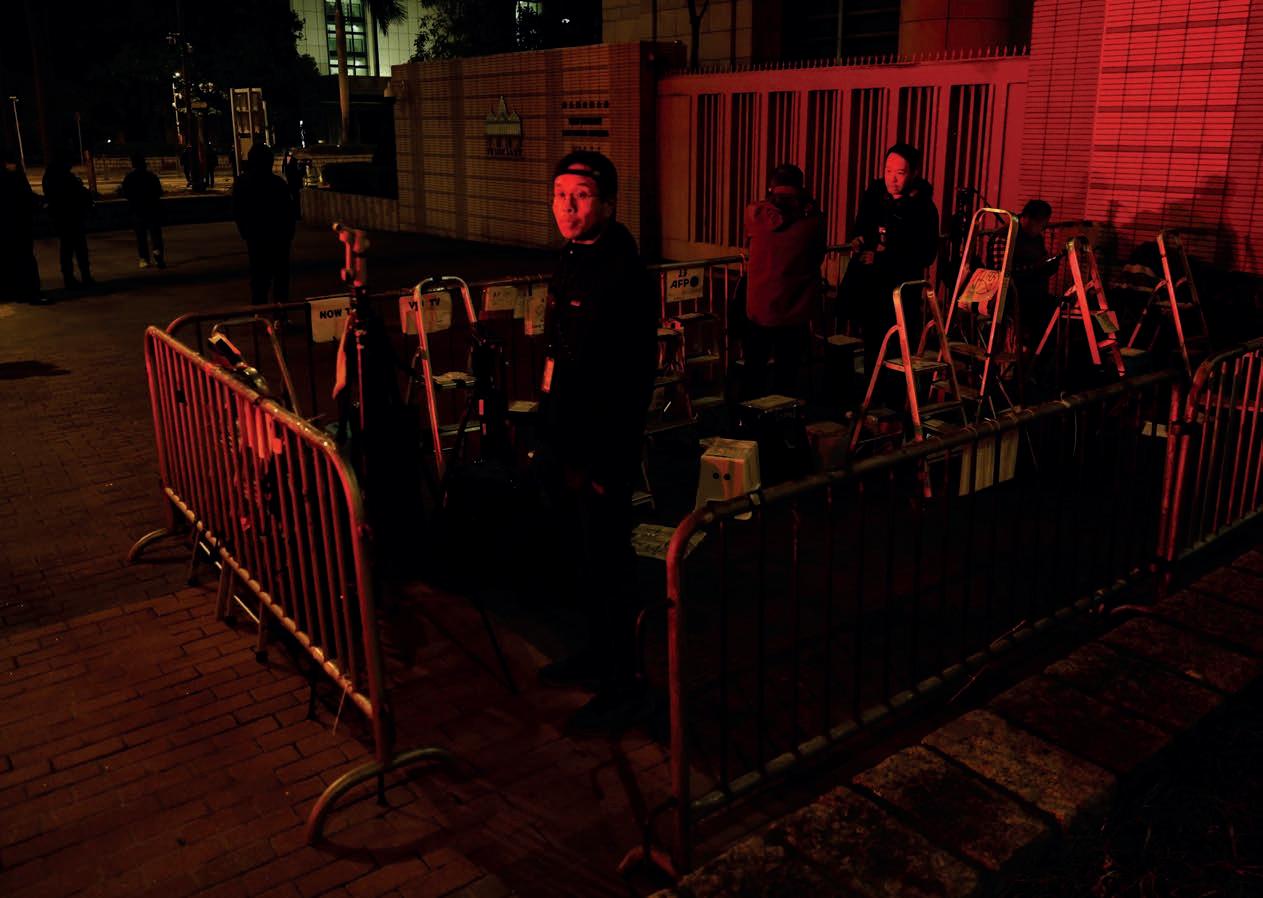
In Hong Kong, reporting now demands caution at every turn. Larissa Steel and Róisín Teeling examine how journalists work when freedom is at stake
It has been almost six years since the implementation of the controversial National Security Law (NSL) in Hong Kong, and ve years since 500 police o cers raided the newsrooms of the now-defunct pro-democracy media organisations Stand News and Apple Daily.
The NSL was introduced in 2020 and is widely perceived as a response to some of the largest protests the city had ever seen, where people marched in opposition to an extradition bill which would have allowed Hong Kong suspects to be sent for trial in China.
In 2021, Apple Daily, a tabloid known for being outspoken about and critical of Chinese leadership, had their assets frozen and were forced to close a er allegations of breaching the NSL, resulting in at least 900 journalists losing their jobs. Earlier this February, six of their former editors and sta members were sentenced to jail time ranging from six to 10 years, with the organisation’s founder, Jimmy Lai, sentenced to 20 years imprisonment. By then, Lai had been held in custody for over ve years.
Critics of the NSL widely consider the law to be draconian and anti-democratic, one that has sti ed press freedom in the city. Since its introduction, a total of 385 individuals have been arrested by the National Security Department and more than half have been charged, according to a police statement from February 2026. At least
28 journalists have been prosecuted and eight currently remain detained, according to Reporters without Borders.
Editors, legal advisors and academic lawyers in Hong Kong now tend to ‘err on the side of caution’, a recurring phrase heard o en when speaking about the current state of reporting in the city. As a result, Hong Kong’s reporting has been stripped down to its bare bones: opinion articles and features are carefully constructed, experts are no longer quoted and legal advice is requested at every turn.
In a city where the dust has yet to se&le, the editors of Hong Kong’s newsrooms nd themselves playing “edge ball” – a term crystallised during Lai’s national security trial. Borrowed from table tennis, this phrase means to operate in the grey area and to skirt around the rules to avoid punishment.
Explaining how he operated at Apple Daily, Lai told the court: “Something that is speci cally red line, I would not touch. But something that is a blur, I may take a risk of crossing the red line, not knowing that I would crossing [sic] it, that’s why edge ball.”
During a press conference about Lai’s verdict, Hong Kong’s Secretary for Security, Chris Tang Ping-keung, claimed that Lai’s case had nothing to do with freedom of press. “If anything, the defendants have used journalism as a guise to
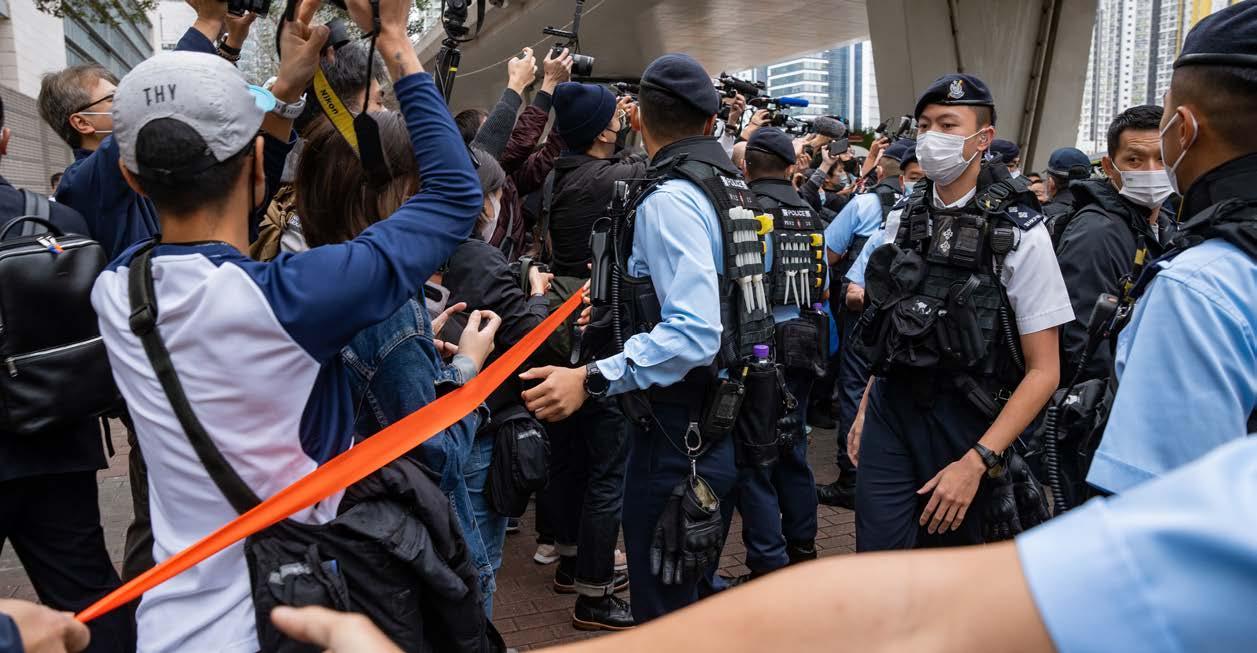
“Don’t do journalism, it’s all too risky”
harm our country and Hong Kong over the years.”
The remaining independent newsrooms in Hong Kong now nd themselves questioning where the NSL’s boundaries lie, leaving editors and journalists playing edge ball whether they intend to or not.
“If a person was arrested for breaching the NSL, they would need to prove a negative,” says Dr Eric Lai (no relation), an academic lawyer and author. It’s a law considered de-facto deprived of bail, as clients would need to prove they would not commit anything to endanger national security, he explains. Journalists are now o en advised to refrain from publishing. He adds that legal advice received is almost always “counterintuitive to the mission of the journalist”.
Tom Grundy, founder and editor of independent English media website Hong Kong Free Press (HKFP), says: “The authorities will say nothing has changed, which feels a bit odd for me, because so much of my bandwidth now is spent navigating the red lines and trying to understand what’s happening and ensure that we remain compliant and safe.”
Grundy raised the example of reporting on an unlawful burning of a Chinese ag, and asked the question: “Can I put that in my news reporting?” If faced with a situation like this, Grundy would reach out to the police, judiciary and relevant authorities to check. “The response I usually get is, ‘You must obey the relevant rules and regulations. No one is above the law.’ I can approach a lawyer, and they will tell me to not do any of this. ‘Don’t do journalism. It’s all too risky.’”
Navigating the grey area can be overwhelming, Grundy says. “You can imagine how many may overcompensate, self-censor and stay on the safe side.”
Over the years, the barriers to accessing
information have slowly been raised in the city. Dr Eric Lai says that “investigative journalism is becoming more di cult as the government is shelving previous annual reports and complaints from public access.”
Grundy says that “fewer questions are allowed at a time” in government press conferences, while other independent media outlets have faced rejections to their license to access these conferences. Dr Eric Lai says that journalists o en work together “on a kind of tacit understanding, because most of those who can get a permit are for-pro t outlets”. He adds that foreign media outlets are in a more advantageous position compared to local journalists, because “the reputational cost of expelling all foreign media from the city is too high.”
Journalists on the ground noticed that since early 2026, “the police began se ing barriers outside the court to limit the media and reporters into staying in a speci c zone,” says a local reporter who wishes to remain unnamed. As a result, it has become more di cult for journalists to interview people in line for court. Even without the physical barriers, nding people to interview has become far more di cult.
With pressure ever-mounting, publications would rather report the facts without citing any
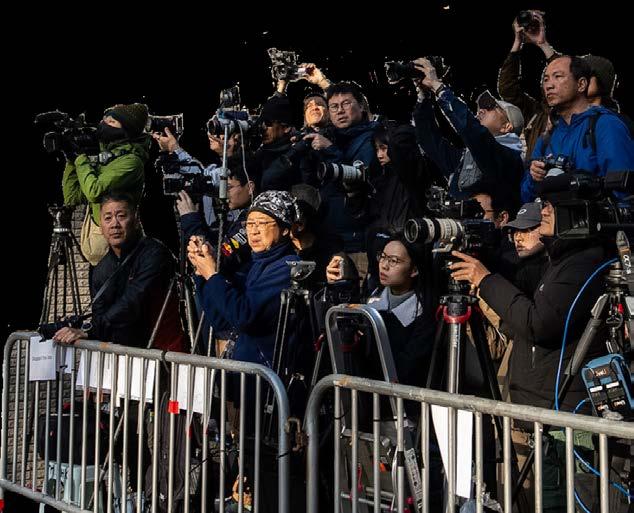
HKFP’s opinion articles are cushioned with a disclaimer, “HKFP is an impartial platform & does not necessarily share the views of opinion writers,” clarifying that their opinion pieces aim to “constructively point out errors or defects in the government, law or policies.”
Dr Eric Lai explains that opinion writers should provide a solution to the problem that they’re critiquing or they run the risk of breaching the NSL. Writing with a “view to improve” the law is an exemption to sedition, but he says that whether or not it’s constructive is very subjective. “So far, no legal case has successfully used this exemption as a defense.”
Grundy adds: “If you’ve got a very critical opinion piece, you might run it at the same time as an opinion piece that’s more friendly to the establishment.”
“If editors want to include Western statements condemning the government, they will also report the local government’s response to that,” Dr Eric Lai says, this technique maintains “balance or impartial reporting” to prove that they’re not simply reporting with an agenda.
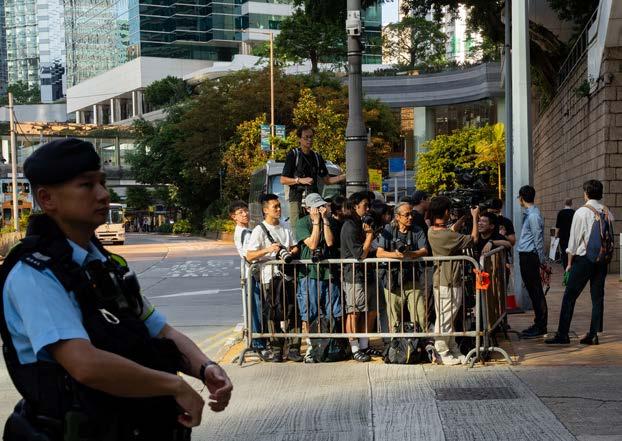
The remaining independent newsrooms have reported facing immense bureaucratic scrutiny. HKFP and “almost all of the independent news sector” recently went through a 20-month-long tax audit. Grundy says, “Agence France-Presse wrote that maybe the days of traumatic arrests and high-pro le crackdowns against journalists are over and it will become a lot more ‘knock at the door’ and bureaucratic scrutiny like this.”
He adds that newsrooms o en receive “angry messages” in the post demanding the removal of their articles. A legal advisor for an international paper, who did not wish to be named, said that his client’s servers were no longer in Hong Kong, but this did not mean the newspaper fell outside the reach of the NSL.
Speaking about the intimidation and harassment they have faced, Grundy says: “We all were persuaded [a er] speaking to the Hong Kong Journalists Association (HKJA) to publish [about the harassment] all at the same time, because if one person had just published, they would come under more re.”
Although not in regular contact, Grundy says that the heads of independent news outlets across Hong Kong keep in touch through the HKJA, so they know what might be coming next. “We all
can read what’s happening to each other. And through the journalist association, we kind of keep in touch. For instance, during the taxing, we were able to discuss who is a bit further along in the process so that those further back could understand what’s coming next.”
Even if a journalist is based outside of Hong Kong, “whatever you publish that is accessible in Hong Kong comes under the scrutiny of Hong Kong law,” says the legal advisor. Those that are outspoken may risk having a bounty placed on them, or being arrested if they return to the city.
For journalists covering Hong Kong from outside the city, the pressure is not as imminent but still a concern. “I would say it is, in inverted commas, quite safe,” says Stephen Vines, a British former journalist at Radio Television Hong Kong and Apple Daily. The authorities almost never act against diaspora journalists because accusations of subversion would not hold up in foreign courts.
“I’m not prepared to be the means of your execution”
Even when sources in Hong Kong are willing to be named, Vines shields them to prevent potential retaliation. Re ecting on the 2019 protests, he recalls young front-line participants telling him: “I don’t care if you use my name. I’m prepared to die for Hong Kong with all this.” He declined to publish their names. “I said, ‘Well, I’m not prepared to be the means of your execution.’”
Gloria Chan, the co-founder of UK-based Hong Kong diaspora media organisation Green Bean Media, also argues being abroad comes with more freedom. “We won’t change the fact because we are too worried about something,” she says. Despite worries about the NSL, she follows standard practices of protecting her sources, focusing on accurate reporting rather than fear.
Chan says this pressure is not something that you can measure, but something that can be felt. “For people living in Hong Kong, their life is to live together with the NSL. And our lives right here is to live together with transnational repression.”
When looking towards the future of journalism in Hong Kong, Eric Lai envisions that court reporting will remain a core part of local coverage as political trials surge in the city. He says these journalists are able to survive because they do objective reporting, typically with no expert opinion included. “As long as there is open justice, they will have lots of information to tell the public.”
Working in the grey area is now the new normal, and journalists reporting on Hong Kong can’t a ord to ignore the NSL. Instead, those that stay in the city keep it tucked at the back of their minds.
“We choose to stay, because there is still some modicum of press freedom, despite everything,” says Grundy. “We’re still here – [local independent news outlets] Inmedia, The Collective, The Witness and Hong Kong Court News are still here. We can still go to the courts and bear witness. We can still go to the legislature and write the rst dra of history, and we can still go to press conferences and ask awkward questions of o cials.
“Despite it being really terrifying, one jumps out of bed because it’s meaningful being the only and last independent English news outlet here. We keep calm and carry on.” &
Kyle Lam/ HKFP
One hundred years since its foundation, Ioan Hazell documents the rise and fall of the seminal music magazine, Melody Maker
When Lawrence Wright, a British songwriter from Leicester, established a magazine for his music publishing business, it is doubtful that he or anybody else could have anticipated the cultural phenomenon it was destined to become. Started from the basement of 19 Denmark Street in London in January 1926 under the title The Melody Maker and British Metronome, the magazine was soon rebranded Melody Maker and would go on to become a leading weekly title in the British music press.
Upon its launch, the magazine was initially aimed at dance band musicians and frequently featured promotion of Wright’s own music. But as jazz fever took root in Britain and the transatlantic sounds of rock ‘n’ roll began to make their way across the ocean, a new chapter opened for the magazine.
In the 50 years that followed, Melody Maker would earn favour among successive musical giants for its insightful and musically minded coverage, which set it apart from competitors like NME. But as the new millennium rolled around, the neck-and-neck ght to dominate the music press would
come to de ne the magazine’s story.
One-hundred years since its foundation, this is the story of Melody Maker, as told by Chris Welch, Richard Williams, Allan Jones, Simon Reynolds, Cathi Unsworth, Simon Price and Paul Gorman – journalists at the frontline of the 20th century’s successive musical revolutions.
“Melody Maker needs a bullet up its arse. I’m the gun, pull the trigger”
Chris Welch: As a young jazz fan, growing up in the ies and sixties, Melody Maker was the Bible. It had these wonderful critics like Max Jones, Bob Dawbarn and Bob Houston, who really knew what they were talking about.
It was in October 1964 that I applied for a job. Melody Maker was in the IPC [the group that owned Melody Maker] building, which they shared with lots of other magazines. I was tucked away in the corner of the openplan o ce with my giant metal
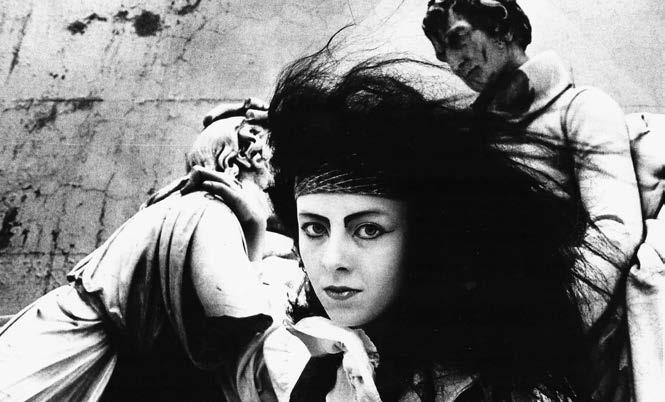
typewriter and a black Bakelite phone on my desk. We were all always covered in ink from changing typewriter ribbons. The o ce was like a cross between a trade union and the army: everyone was highly lewing and most had been in the army or the air force. The sense of humour was heavily sarcastic.
In 1970, Welch became features editor. During his 15 years at Melody Maker, he encountered rock’s biggest names, o en under highly unusual circumstances.
Chris Welch: I covered James Brown in 1966 when he was playing at the Granada Cinema in Brixton. I went to the venue and the PR guy didn’t want to let me through, so I said, “Do you want the front cover or not?”, which got me backstage.
When I arrived at his dressing room, he was si ing over a twobar heater with a towel across his back. It was a boiling hot day and I couldn’t gure out why on earth he was doing that. Later, of course, I saw the show and he came on stage dripping in sweat – that’s when the penny dropped.
On another occasion, I interviewed Van Morrison while he was eating a huge bowl of peanuts. He was tossing them into the air and trying to catch them in his mouth. The problem was, he missed almost every time. When we stood up to leave, the entire oor was covered in nuts.
As the sixties drew to a close, Melody Maker had become a leading voice in the modern music press.
Richard Williams: When I joined in 1969, it was a place that ran on enthusiasm. At that point we were approaching 200,000 sales per week. All the major labels had sub-labels, where they would put their more progressive acts and whenever they signed anyone, they would take out a four-page spread. We had a huge pagination, stu ed with display ads, but also seven or eight pages of classi ed ads at the back for musicians – jobs that musicians wanted, instruments for sale, loon pants and patchouli oil. We were making a lot of money for IPC, so they didn’t interfere.
It was a lively o ce, typewriters clacking and phones ringing. We had a small reviewing
room with a record player in it; nothing very elaborate. Of course, we got a lot of records to review. You would stagger out with half a dozen new albums every night.
Despite the magazine’s success, in 1970, many of Melody Maker’s sta le their positions to establish the weekly pop and rock paper, Sounds; a massmigration that would force the magazine in a new direction.
Richard Williams: Threequarters of the sta le to establish Sounds. Jack Hu on, the editor, went to be editorin-chief and he tried to take the entire sta with him. He asked me if I wanted to go, saying that Sounds would be a le -wing Melody Maker and an independent, so we wouldn’t have IPC looming.
I’d never felt that IPC were looming, so I said, “I came to London to work on Melody Maker and I’d rather turn Melody Maker into a le -wing version of itself than go somewhere else.”
A lot of new people were brought in, which meant everybody got a bump up. One week I was a junior reporter, the next I was the features editor, the week a er that, I became assistant editor.
Chris Welch: I got three pay rises in a single day.
Despite organisational changes, the magazine’s jazz roots remained robust, and reporting continued as the scene evolved. In the summer of 1972, Williams met legendary jazz musician and composer, Charles Mingus.
Richard Williams: Mingus was playing at Ronnie Sco ’s and staying somewhere in Shepherd
Market, London, so we arranged to meet at a café with outdoor tables. When he arrived, he blocked out the sun; he was so big. He sat down and talked for about an hour and a half, eating quite a lot in between. I only asked a few questions.
In the mid-Seventies, Melody Maker’s long-time competitor NME altered their strategy to engage the younger generation. As NME reported on the shi towards punk music, Melody Maker fell behind again. In 1974, an art student named Allan Jones, prompted by his girlfriend to sign up for a job requiring ‘no previous journalistic experience’, submi ed his application. “Melody Maker needs a bullet up its arse,” he wrote in his conclusion. “I’m the gun, pull the trigger.”
Allan Jones: Although the advert had said there was no need for previous experience, I’m not sure any of the sta expected they would actually hire somebody with no experience. They were a very straightlooking bunch and there was no music in the o ce. I had worked in the mail order department of a bookshop before starting, and that was a more rock’n’roll place than Melody Maker
As a new hire looking in from the outside, Jones sensed the threat from competitors. His seniors, still riding high on the success of the sixties, remained oblivious.
Allan Jones: They weren’t looking for anything new. They were complacent. I remember bringing up how exciting something in NME had been; an interview that Melody Maker had
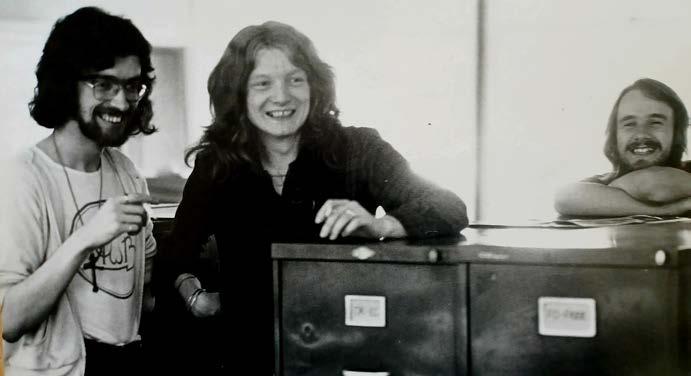
turned down with Keith Richards. When I asked whether anyone was worried about how sales were going at NME, nobody seemed to be bothered. They really didn’t see the growing threat. By the end of that year, NME had overtaken us in sales.
But Melody Maker persisted in keeping up with rock’s giants.
Allan Jones: When I joined the queue to interview Lou Reed, I’d had no time to prepare anything. There were two people in front of me, and they both came out within ten minutes, white as sheets. One of them got so nervous that he unravelled the entire spiral of his reporter’s notepad.
I went in knowing that I might not be there very long and turned on my recorder as I went through the door. Good thing I did, because as soon as I arrived, Lou went on a tirade that was nearly 27 minutes long. He barely took a breath. His rst words were, “Fucking hell, what toilet did Melody Maker nd you in?”
I tried to dive in, but it was like trying to ag down a train, there was no hope. A er almost half an hour there was a pause and I asked, “Is this the real Lou Reed? How many Lou Reeds are there?” At that, he sat back, smiled and said, “What a great question. There’s loads of Lou Reeds and I do them be er than anybody. Sit down and have a drink, let’s talk some more.”
NME continued to dominate the sales war. In 1978, now-editor Richard Williams proposed a redesign, a decision that would face internal backlash and unforeseen setbacks.
Allan Jones: The mistake they made when they got rid of the former editor, Ray Coleman, was that they didn’t properly get rid of him. They gave him the nominal title of editor-inchief and he took the role very seriously. He would either veto or request more work on anything Richard proposed, so the redesign took almost two years.
Then, the week that we were nally due to relaunch, with a £250,000 TV ad campaign commi ed, a strike started, and publication of Melody Maker and all other IPC titles was suspended.
Richard Williams: The management tried to get me to do what was called a scab issue, which is one produced without union participation. I didn’t want to do that. I was a union member – always had been – so I resigned before the redesign could happen.
When Allan Jones became editor in 1984, the magazine’s downfall looked inevitable.
Allan Jones: I knew I’d be managing decline rather than pushing Melody Maker towards new circulation. Through the late eighties we did well out of goth, but that was passing. We did be er out of shoegaze and grunge because we got in very early.
As a new wave of writers was dra ed in, the magazine regained its reputation as the home of intelligent music criticism.
Simon Reynolds: By 1987 and 1988, Melody Maker had established itself as the paper that put new bands on the front cover before anyone else. It was also the paper with the most amboyant writing. We never caught up with NME in sales, but we usurped its role as the intellectual leader in terms of criticism and pushing new sounds.
When I rst worked there, we were based in a modern o ce building on High Holborn, but the Melody Maker o ce itself was shabby and very messy. I remember a big table that was covered in an enormous mound of discarded packaging – mailers for records, press releases – along with beer cans and over owing ash trays. These were the days when smoking in the o ce was still allowed and widely done.
Cathi Unsworth: Every Tuesday morning was like market day, where all us freelancers would come in to pitch ideas at a general forum with the whole editorial sta . You had to have your contacts and know what was going on as it was survival of the wiliest in there and not for the faint hearted.
A lot of wheeler-dealering was done in the Stamford Arms at lunchtime, in sessions that
Choose Your Own Adventure
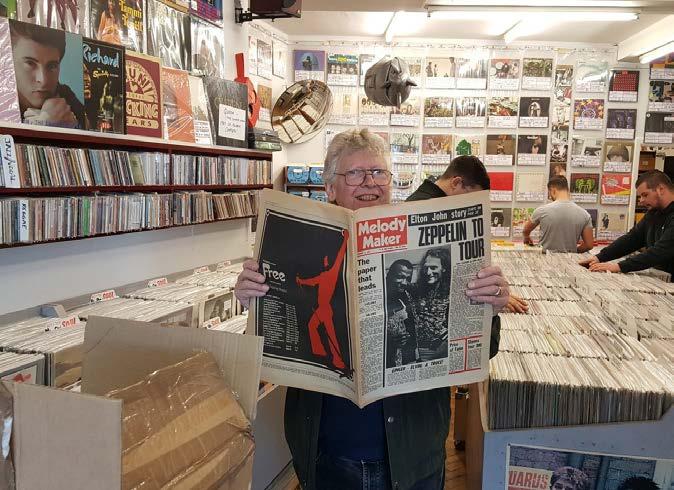
usually went on for hours, so Christ knows how the paper actually came out each week.
Simon Price: I was own out to LA to interview Depeche Mode in about 1993 or 1994. For one reason or another, the interview kept being postponed, but I was put up in the Four Seasons, Beverly Hills, on Depeche Mode’s credit card. The hotel had complimentary limousines, and I was told to just stick around and get anything I wanted on room service.
The room was bigger than anywhere I’d lived in real life. I was there for about a week, ge ing limos all over LA, charging everything to my room. Eventually, they told me the interview wasn’t going to happen in person. When I went home to London, my gas and electricity had been cut o because I couldn’t a ord the bills – that was the kind of duality that summed it all up.
Even with writers like Unsworth, Reynolds, Price, and Evere True covering the rise of grunge, Melody Maker was unprepared for the blow that Britpop would deliver to sales.
Allan Jones: In terms of the Manchester scene, we had Happy Mondays on the cover very early on. We even gave The Stone Roses their rst front cover, so we were thriving. But then Britpop came and absolutely unravelled us.
Simon Reynolds: Suddenly the bands who appealed to the core of Melody Maker’s readership were being covered everywhere: in glossy magazines, in newspapers, on TV.
Paul Gorman: Melody Maker limped on but nobody was very interested. Mojo had launched, as had Select There was very li le le for Melody Maker to grasp onto. In a sign of absolute desperation, in 1997, they ran the Spice Girls on the cover.
NME sustained itself in a di erent way because it got political. There was something going on at NME that you could recognise as being in the tradition of being radical and outspoken.
Simon Price: When you have a world without meaningfully criticised art, you get the art you deserve. If artists are uncriticised, they become complacent.
In 1997, Allan Jones resigned as editor and Mark Sutherland, former editor of NME, took his place. During the three years that followed, many long-serving writers le the magazine amid ideological disputes and sales saw a signi cant decline.
Melody Maker was subsumed by NME in December 2000, ending half-a-century of competition. Yet many fans and sta still remember the iconic legacy of the magazine today.
Cathi Unsworth: I still cannot believe that any of it happened. ●
Talk to them: You turn around and chat to the MP to ask more details. They tell you to piss o and mind your own business. However, the person they were cha ing to speaks with the security guard and they let you into the event. You spot your old frenemy from the MA Broadcast Journalism course at City St George’s si ing on a table in the corner. What do you do?
Governments are increasingly using internet blackouts to suppress dissent. Miranda Crawford and Isabelle Blakeney speak to journalists reporting from the darkness
In early January 2026, freelance journalist Deepa Parent was at home in Paris when she received a disturbing message. A source described seeing mass graves of Iranian protestors massacred during the government’s brutal crackdown.
Parent’s source had messaged her on Telegram during a brief moment of internet connection via an illegal Starlink terminal, then disappeared o ine. She poured over satellite images of the area but couldn’t identify the graves her source described. Her last resort was to ask an Iranian contact to get on a bike and scope out the mass graves himself. It took Parent and her coreporter 10 days to verify the report before it was published in The Guardian. By then, the estimated death toll in Iran had reached 30,000.
An increasing number of journalists and media outlets across the globe are struggling to overcome the challenges created by internet blackouts. This form of repression is on the rise globally. According to the United Nations, there have been at least 300 internet shutdowns in over 54 countries in the last two years. Since September 2025, governments in Afghanistan, Tanzania and Uganda have a empted to limit and control the spread of information by imposing blackouts, particularly in the context of political pressures such as elections and protests.
In Iran, that tactic reached a brutal extreme. On 8 January 2026, the government imposed what international policy thinktank Chatham House described as “one of the most extensive internet shutdowns ever recorded”. As protests erupted over dire economic conditions, the Iranian regime embarked on a massacre under the cover of digital darkness.
It was three weeks until the internet began to return intermi ently, but during that time the regime had carried out the deadliest crackdown in decades, according to Amnesty International.
A er the US and Israeli missile strikes began
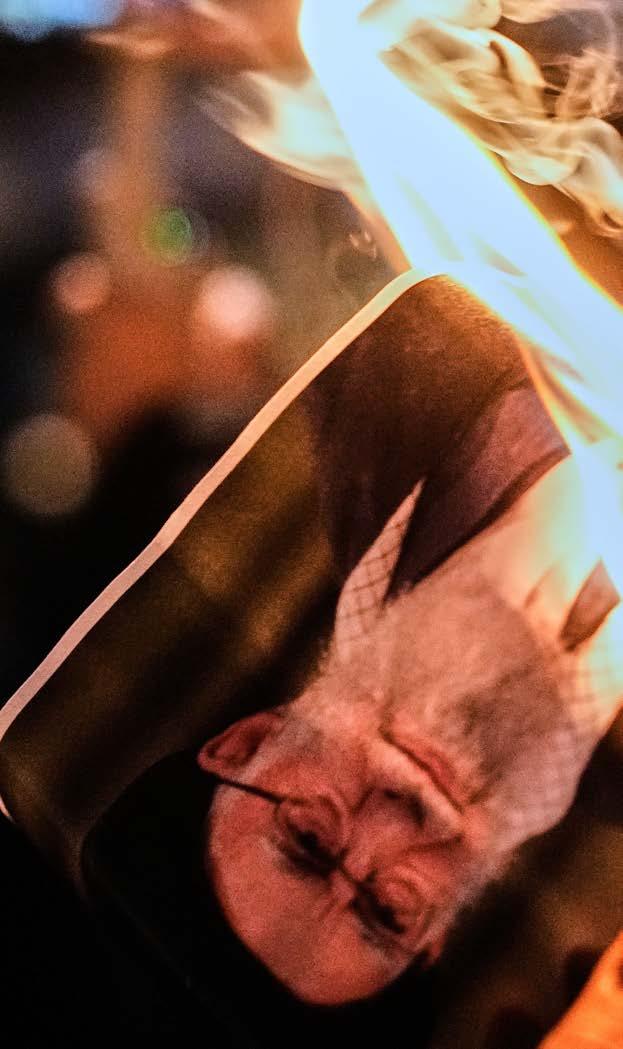
at the end of February, a second blackout was enforced that was almost as extreme as January’s shutdown. In the midst of an international warzone, foreign journalists were once again cut o from all communication with Iranian citizens.
Christina Lamb, chief foreign correspondent at The Sunday Times, explains how reporting during the rst blackout in Iran came with unprecedented challenges. “The blackout in Iran is rare because in other cases we’ve had some ability to get information through di erent means,” Lamb says. “Whereas this really is an absolute shutdown.”
Even distinguished journalists like Lamb had trouble ge ing a visa to report on the ground. “Countries are now denying access [to journalists], which is not something that ever used to happen,” she says.
The extent of the blackout, combined with Iran’s government-controlled internet, tapping of citizens’ phones and inability for foreign journalists to report on the ground, has required journalists to rethink their methods of reporting. When the Iranian government shut o the internet on 8 January, the only information foreign reporters could access was images of body bags in a morgue, broadcast from state television.
Communication with citizens was restricted to infrequent messages via Starlink terminals
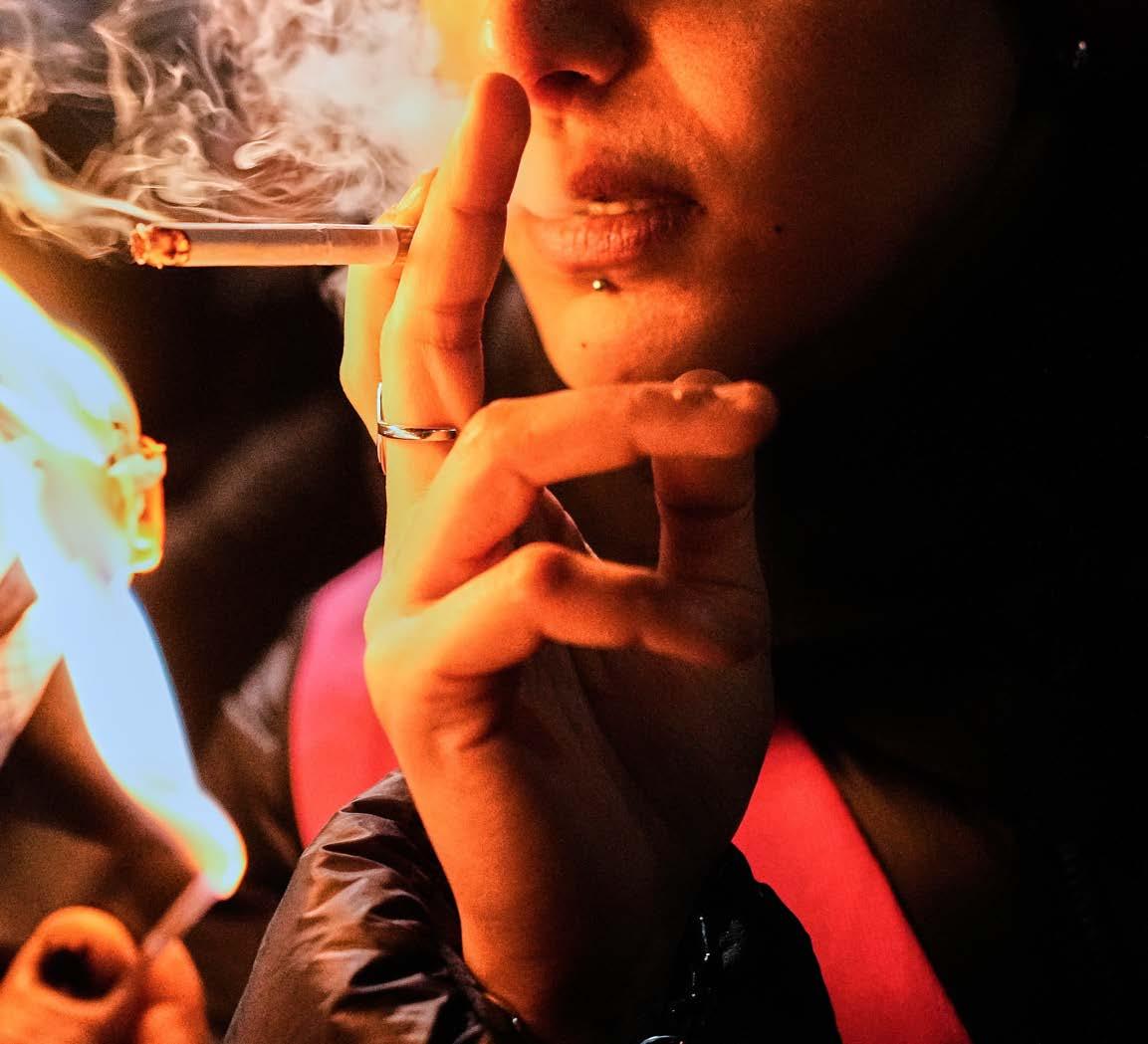
– satellite internet networks from Elon Musk’s SpaceX – when sources were nally able to send videos of what they had witnessed.
For Ruth Michaelson, the Middle East correspondent at The Observer, one of the biggest challenges was receiving information at a delay.
“The internet blackout felt like we were trying to poke holes in a huge wall to try and see what was happening,” she says. “Every account felt incredibly precious.”
With citizens’ phones regularly tapped and searched by the government, having a network of trusted sources from inside and outside Iran was critical. On 1 February 2026, The Observer published Michaelson’s report on Tehran’s “bullet fee” – a charge for each bullet lodged in the deceased’s corpse – demanded by Iranian o cials
“The internet blackout felt like we were trying to poke holes in a huge wall”
to return dead bodies to families. “The account came through an extremely trusted third party who was close to both my colleague and the family involved,” Michaelson says. “The source was too scared to speak on the phone, so they had to wait until they were able to see each other in person to say what had happened.”
Michaelson works with a co-reporter, an Iranian in exile, who has to remain anonymous for her safety. She provides vital sources, information veri cation skills and can speak Farsi. “It’s a real travesty to not be able to share a byline with this person,” Michaelson says. “Their work is so essential.”
Parent similarly only speaks to a small network of friends and members of the Iranian diaspora with links into the country. “My reporting is limited, especially when the internet is down, because I only rely on people I already know,” she says. “I never take people who come to me.”
In a piece published in February in The Guardian, Parent reported on mourners singing and dancing as part of de ant funeral rituals.
She discovered the rituals through videos shared on social media that she veri ed with the help of a trusted Iranian activist known by his pseudonym Vahid Online. Then, when the brother of a 17-year-old protestor reached out to
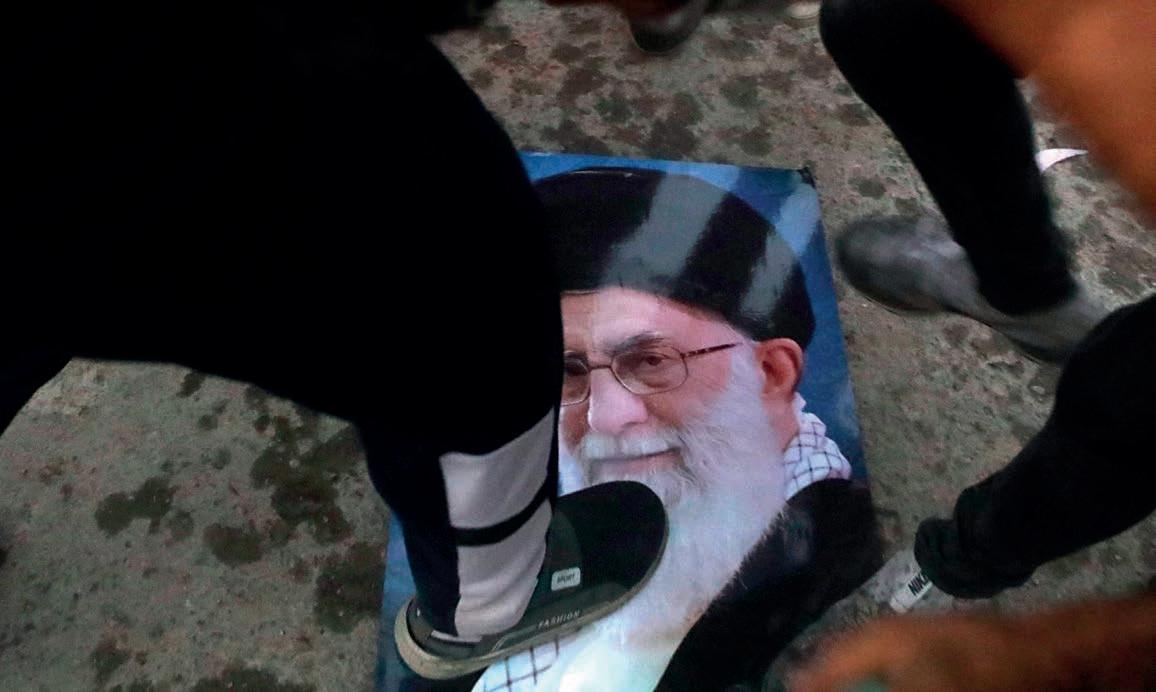
share his story, it took multiple steps to verify his identity, including cross-checking his family pictures and birth certi cate with Parent’s existing network of diaspora sources.
“We get information in such a patchy way, it’s never a continuous conversation,” Parent explains. “I’m sometimes awake until three in the morning waiting for a call.”
“I’ve seen some unbelievable scenes,” she continues. “Some of which I haven’t made public and just have on my phone. I have a 10-minute video of body bags in a morgue that I’ve spent hours looking at again and again. There’s just so much bloodshed.”
Starlink is a network of satellites that provides high-speed internet from space. It was launched by Elon Musk’s aerospace company SpaceX in 2019 and provides coverage to around 150 countries and territories. Starlink terminals are currently illegal in Iran, but are widely relied on during internet blackouts as the satellites bypass Iran’s bre-optic cable network. In January 2026, it was reported that SpaceX waived its monthly subscription for Starlink users in Iran, allowing them to use the terminals for free.
To protect her sources in Iran, she uses collapsing messages on Telegram and never takes screenshots of her conversations. Instead, she immediately copies the messages into a Google Doc of witness testimonies. “I have some 20 testimonies that I haven’t used yet,” she says. But storing that information is crucial when piecing together accounts that can create a veritable report. “Even if it’s a one-line sentence, it can be used for a later article.”
The internet blackout has blocked the spread of information both ways. Before Israel and the US launched a acks, citizens were completely cut o from any news of foreign intervention or aid. “They were hoping that the world would react and topple the regime,” Parent says.
“The morale was low because they’d done their bit – they’d gone out, they’d fought for freedom, and they were gunned down.”
The Iranian regime has a empted to repress communication with foreign media outlets by imposing strict “anti-espionage” laws that prohibit the use of Starlink. However, Parent
says that many Iranians are beyond caring for their safety. “They went out on the streets in January despite witnessing people ge ing shot in the head,” she says. “The worst thing that could happen is they could be killed. They’re ready for it.”
Parent emphasises that it is her ethical duty to protect sources from harm even if they express disregard for their own safety. “We’ve killed stories whenever there was doubt over a source’s safety,” she says.
“I’m happy to do that because no story is more important than the person.”
When the blackout hit, Middle East reporters like Parent and Michaelson were able to draw on a pre-existing network of contacts to obtain and verify information. However, Dan Howells, a security producer at ITV News, did not have this safety net.
While Howells was still able to report on Iran using open-source footage, he regrets not having access to personal sources. “When you start telling the tales of con icts through satellite images, you literally only have a top-down view,” he says. “Unless you’ve actually done the traditional journalism of building a network of contacts within a country, you’re going to be stuck.”
“The biggest lesson I’ve learned is that you’ve got to build your contacts when the story isn’t happening, so you’ve got them when it is,” he says.
During the January blackout, Howells’ main source of information was Telegram channels, where he had to si through an onslaught of opensource videos of violence against protesters. With so many unveri ed accounts, he had to work hard to ensure any footage he used was legitimate.
“I’m sometimes awake until three in the morning waiting for a call”
“Anyone who’s been on Telegram will know that it’s like a high-pressured hose pipe of largely sewage, just spilling out into your face,” he says. There’s o en useful information hidden within this sewage, but it requires an expert eye to si through it.
For example, Howells now recognises certain tell-tale signs of legitimacy like gas pipes on buildings that are unique to Iran. However, bots and engagement farmers will pick up unveri ed videos and repost them on social media claiming to be fact, which makes it di cult to contain the spread of misinformation.
He’s also quick to acknowledge the importance of resisting the speed of the news cycle. “We need to make sure we don’t believe everything we see on X,” he says. “We have to take a moment to properly scrutinise what’s coming out – that’s been a real change, increasingly over the last couple of years.”
Journalists well-versed in the Iranian media ecosystem face similar challenges when verifying videos. Soroush Pakzad is a reporter with BBC Persian – one of the largest foreign Persianlanguage broadcasting channels, which provides news to both the Persian diaspora and citizens inside Iran via VPNs. Having reported on the country for over 10 years, he constantly receives
footage directly from sources inside Iran.
One of the biggest obstacles Pakzad has faced has been the purposeful spread of misinformation. He describes instances of planted stories that wrongly describe citizen deaths, only for those citizens to appear alive on state media days later. “This is a strategy used to discredit news organisations,” he says. “So we have to be very careful.”
Pakzad also explains how, since the 2009 presidential elections, Iranians have learned to become “citizen journalists.” For example, if citizens are recording a protest, they will narrate the footage, explicitly stating the location and the date in order to pin the video to a speci c event.
“In spite of all the complications, over the years we have created this kind of network where our audience knows how to reach out to us,” he says. “This is the only way they can get past this censorship and have their voice heard in the outside world.”
As internet blackouts become commonplace internationally, the blackout in Iran is a reminder of the importance of traditional journalistic values: prioritising human sources over online information, cultivating trusted networks and meticulously verifying claims despite barriers.
Michaelson re ects on the unique challenges this period has posed. “This is the worst crackdown on dissent in Iran since the 1979 revolution – possibly in its history,” she says. “It’s one of the worst pieces of political violence in decades.
“We as journalists have to make sure we don’t let our standards slip in any way, otherwise we’d be doing a disservice to a story of great importance.”


Photo: Alan Rusbridger
The former Guardian editor-in-chief tells Ellen Morris about print dying, breaking the Snowden story and cheese on toast
I wake up at about 8am and do the Wordle in bed, then walk my dog Brodie or have muesli for breakfast. This is all very new. For 49 years, I went to an o ce every day. This is the rst time in my life I haven’t rushed out the door. I’m still nding a routine. By 9:30am, I’ve skimmed six newspapers on my iPad. Strange to say, having worked in print for most of my life, but I nd the screen easier to read. The conversation about print dying is one I’ve been having for 30 years. I became editor of The Guardian in 1995 and went to
America the year before just to use the internet. It felt like you had to go there to use it. I saw my role as ge ing the paper ready for the digital age. I write a weekly column for The Independent and Prospect and have a new freelance job at The New World. I use a program called Scrivener. If I could bequeath journalists one tip, it’s to invest in it. I’ve wri en three books and my columns on it. Nobel Prize winner Paul Krugman put it well when he le his The New York Times column for Substack: a column lets you develop obsessions, you can keep coming back and adding to what you know. It’s di erent from si ing on a soapbox.
Lunch is cheese on toast, or a salad from the Mediterranean place up the road in Kentish Town. Sometimes I break and play the piano. It uses a di erent part of the brain and kept me sane during the Assange and phone-hacking stories, which were very stressful.
Editing The Guardian, I’d get home at 9pm, have supper and go back to work. When I stopped in 2015, it took about a year to realise what a body that wasn’t ooded with adrenaline all day felt like. I was the 11th editor in 180 years. When I came in, it was just words in print and our economic model was se led, then there was a complete digital revolution and we had to reinvent everything.

The Snowden story stands out. We were si ing on hundreds of thousands of the most secret documents anyone had ever seen. Trying to keep them safe, trying not to be arrested under the O cial Secrets Act, trying to publish responsibly. I took my iPhone to meet Snowden in Moscow. A er ve minutes a huge red warning appeared on the screen. It was overheating. He said, “That’s because every intelligence agency in the world is currently trying to go through your phone to see me.”
I go to bed at around 11pm and I have an audiobook in my ear throughout the night. I discovered that I needed something to distract me into sleep. I’ve been listening to Edward Gibbon’s The History of the Decline and Fall of the Roman Empire for about ve years. I couldn’t tell you the rst thing about the Roman Empire, except it sends me to sleep. ●
Journalism needs a captcha update, Alina Ja er and Larissa Steel takes a look into what editors can do about it
Type the characters above: Continue
AI writers are in ltrating the newsroom. Alina Ja er and Larissa Steel verify the humanity behind the headline
In August 2025, Jacob Furedi, founder and editor of Dispatch magazine, received a pitch. So far, so normal. Li le did he know it would soon become the centre of a scam posing fascinating threats to the media landscape. “Hi Team,” the email begins. “The bodies arrive by night.”
The pitch was sent by a self-described freelance journalist called Margaux Blanchard. She wanted to write about Gravemont – a decommissioned mining town in rural Colorado, which was apparently repurposed into “the world’s most secretive training grounds” for investigators practising large-scale fatality responses.
“I’m the right person for this because I’ve reported on hidden training sites before, have clearance contacts in forensic circles, and know how to navigate sensitive, closed-o communities with empathy and discretion,” wrote Blanchard.
To some editors, Blanchard’s pitch would seem like quite the scoop. On rst read, it seems timely, exclusive and in line with Dispatch’s commitment to exploring the world’s peripheries. But Furedi quickly realised there was one critical issue –neither Blanchard nor Gravemont actually existed. A er doing some basic research and asking for more information, Furedi says that he “could tell from the tone, the language and stu that it was all a bit o ” and became somewhat irritated that the sender was wasting his time.
Press Gaze e later reported that Margaux Blanchard’s internet presence and pitches were AI-created, made by Quebec-based hoaxer Tim Boucher. Though Furedi caught on to this scheme, other editors did not fare so well – Wired, Index on Censorship, Business Insider and SFGATE all published articles wri en by Blanchard, who
insisted on being paid through PayPal.
“A legitimate publication should be a trusted source amongst all of this potential AI slop,” says Charlo e Tobi , Press Gaze e’s UK editor. “If they undermine that trust and brand by publishing questionable content like this, I think that can do fairly long term damage.”
Notably, Blanchard is not the only fauxfreelancer on the market. Another scammer, who went by Victoria Goldiee, had AI-wri en work published in The Cut, The Guardian and Architectural Digest
“I have this image in my head of these factories where people just pump out pitches that are completely AI-generated”
“There’s de nitely been a rise in these AI pitches over the past 18 months or so,” says Furedi. “I have this image in my head of these factories where people just pump out pitches that are completely AI-generated.”
Furedi adds that in recent months, many of these pitches seem to be coming from Kenyabased senders. In another instance of freelancer fraud, The City AM Magazine editor Steve Dinneen investigated a striking pitch from a Chicago-based so-called journalist, Joseph Wales, an alias for a proli c AI article generator named Wilson Kaharua, who is based in Nairobi. Kaharua, who City AM described as “smart, articulate and charming”, explained that even limited payments for freelance journalists can go a long way in Kenya.
When asked about her pay, Blanchard told Furedi that her standard rate was “670 to 500 pounds” for ve to seven days on the ground –a “really weird” and speci c range that raised another red ag for Furedi.
Aside from monetary motivations, disinformation expert Dr Julie Pose i says foreign state actors and those with special interests are e ectively trying to entrap journalists who are supposed to prioritise credibility. “The mission is not just to in uence communities and policies, but also speci cally to undercut the credibility of journalists and news organisations that publish such fraudulent content,” Dr Pose i says. Editors need to consider the potential rami cations behind their writers’ hot take. “How e ective is that hot take as a tool for manipulation?”
Of course, misinformation is nothing new. “It has always been there with the history of propaganda,” says Zeryihun Legese, a researcher studying the impact of generative AI on the global media landscape.“With gen AI, the pace, the scale, the speed with which it can in uence news gathering and production is huge.”
When editors receive a pitch, it’s no longer just a yes or no. Dr Pose i says that AI freelancers reinforce the need for human veri cation processes during commissioning and before publishing.
Boucher says that, by posing as Blanchard, he found that “as long as what you’re o ering as a source aligns with what is needed editorially, or
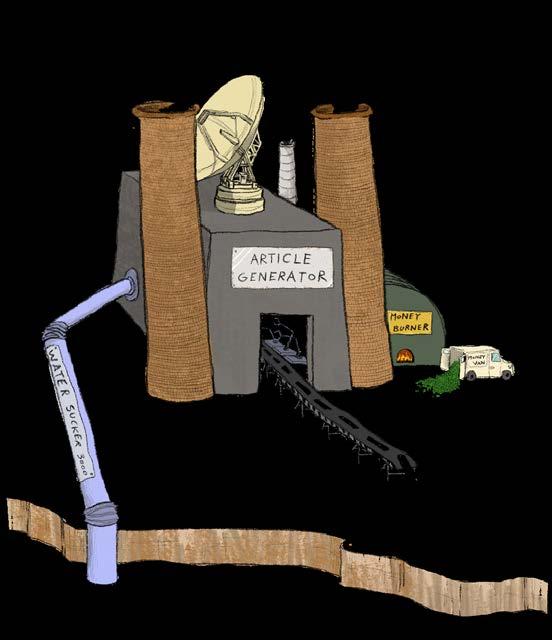
con rms existing assumptions, then it gets run without much critical analysis.” He says: “Journalists and editors are in a rush to ll out content demands as quickly as possible, and don’t really go through the steps to verify information or even the identities of people involved.”
According to Legese, AI-wri en copy from a fake freelancer can get published when a journalist makes certain mistakes. Firstly, they assume that they were conversing with a human when discussing pitches. Secondly, they fail to enact standard simple veri cation acts which could have unmasked the scammer’s identity.
“It’s a li le bit of an indictment on the way that the media landscape has been shi ing over the past years, with all of its cuts,” says Furedi. “If you’re going to cut your factcheckers and want to rely on AI to write stu , this sort of stu is gonna slip through.”
Legese adds that layo s and smaller newsrooms shouldn’t be an excuse for irresponsible journalism. He says that while many editorial teams will use AI as an e ciency-optimising tool, they must also establish robust rules to prevent scandals like this one.
“Look at Wired, for example,” says Legese. “It’s highly resourced, focused on digital and electronic stu . They’re the people that should be able to si through this, but they fell for it.” ●
Mike Janssen, digital editor of media trade publication Current, also received AI-powered pitches from Blanchard and others. He says that these emails tend to be overly broad, with giveaway headings and generic language that smacks of AI. For example, a stylistic choice ChatGPT tends to use is “it’s not this – it’s that.”
“You can tell by the very bland font,” Furedi adds. “Certain words might be put in bold.”
While looking out for these red ags, Janssen says that editors should also request and review writing samples. “That’s how I determined Margaux was a scam – they had clearly tampered with PDFs to make them look like their clips. That said, Margaux went on to write articles for websites that looked more legitimate – if I had seen those clips, I may have been fooled.”
If clippings are shared, double check the stories’ case studies as AI-generated articles o en include hallucinations, such as made-up sources.
“If it doesn’t quite smell right, it probably isn’t,” Furedi says. He jokes that AI-wri en pitches are like alcohol-free beer. “It looks the same and it’s o en packaged in a pre y bo le, but when you taste it, there’s something missing.”
Additionally, use simple techniques to con rm the writer’s identity. It can be as simple as se ing up a video call, researching the writer and cross referencing their ID and bank details.
“We don’t need a huge, sophisticated technology to catch AI,” says Legese. Editors need to recognise the dangers that come with generative AI and close the awareness gap.
Blank them: As you walk right past them, the frenemy notices and approaches you anyway. She’s ranting about how no one wants to buy her new sex advice podcast – it’s all excruciatingly awkward. You notice your real friend from your old course walks right past you. They say something about a possible job opportunity. What do you do?

Tell the frenemy: “This is boring, goodbye” (p34)
Listen for the job (p151)

What Nadine White remembers most is the sound – a barrage of noti cations blasting across the room.
Like everyone else in January 2021, she had been working from home, in the thick of the pandemic she was both reporting on and living through.
She quickly darted over to her phone to investigate the onslaught. “I thought it was some sort of hoax at rst,” she says.
She refreshed the page a couple of times, trying to process the fact that the rapid re hate tweets she was receiving stemmed from the actions of then Minister for Equalities, now Conservative Party leader, Kemi Badenoch.
White had asked Badenoch’s o ce for a right of reply on a story about Covid’s disproportionate impact on Black, Asian and other ethnic minority communities.
Instead, she was tagged in a public thread accusing her of being “creepy and bizarre”. The pile-on was immediate. The language of the tweets followed a pa ern – “Race baiter”, “Race gri er”, “Le y journalist”.
something she has grown accustomed to. But this felt di erent. “One threat is too many.”
The threats were not abstract. They were speci c, physical and directed.
“I had just lost my sister to Covid,” she says. “It was a di cult time personally. The abuse certainly compounded anxiety and distress. At the time, I felt quite helpless. I didn’t have an immediate plan of action. It was quite overwhelming.”
She put the phone down. For many women in public life, that is where the story is supposed to end, at the edge of the screen. But it rarely does.
She didn’t expect to start fearing for her life. “There was someone who sent a knife to my DMs,” she says. “Someone else told me to watch my back, that they’re coming for me. Fear quickly set in.”
White had experienced online abuse before. As a journalist reporting on race and inequality, it is
White’s experience exempli es a disturbing trend researchers have been documenting for years. A study published in 2021 by Unesco and the International Center for Journalists (INFJ), titled ‘The Chilling’, found that one in ve of the women journalists and media workers surveyed reported that digital violence had led to o ine threats, harassment or physical a acks.
By the end of 2025, new research commissioned by UN Women, the organisation’s agency for gender equality, found that 70 per cent of women in public-facing roles had experienced work-related online abuse. Among women journalists and media workers, the gure was even higher, at three in four.
Even more worrying was the growth in o ine danger. Forty-two per cent of women journalists linked online abuse to real-world threats or harm, including stalking, physical assault and swa ing, the false reporting of a major emergency at a target’s home address, in order to trigger a heavy police response.
Lucia Osborne-Crawley, a journalist who has covered the Epstein case extensively, told The Guardian in March 2026 that she had been groped, followed and o ered drugs by individuals a empting to intimidate her and warn her o her investigative work.
Lead researcher of both the Unesco and UN projects, Dr Julie Pose i, argues that this trajectory of harassment was inevitable, enabled by big tech platforms and, increasingly, conservative politicians.
“Misogyny has been pushed into the mainstream,” says Dr Pose i. As her team discovered, perpetrators of digital violence enjoy impunity. The challenge to female freedom of expression is frequently overlooked or accepted. Governments regularly fail to take media platforms to task for their failures in safeguarding.
Six years since ‘The Chilling’ was rst published, its ndings and warnings have become only more urgent, as the speed and ease with which users can enact digital abuse against female journalists increases at a frightening pace.
Jess Davies, women’s rights activist and author of No One Wants to See Your D*ck –an investigation into online misogyny – was horri ed to see the in ux of sexually explicit AIgenerated images being produced by X’s arti cial intelligence chatbot, Grok, at the end of 2025.
Within hours of speaking out, Davies had su ered a similar fate to those women she had been trying to speak up for. The most graphic showed her wearing a cling- lm bikini, with her breasts clearly visible underneath.
“You can never really prepare yourself to see your own image being violated like that,” Davies says. “You know it’s not you, but that sense of having your bodily autonomy and your consent stripped from you by a total stranger feels really violating and threatening.
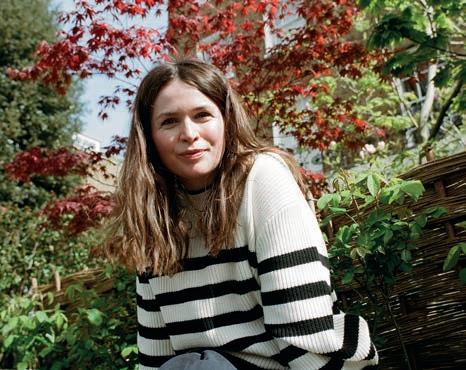
fall on the female victims to protect themselves by heightening their online privacy se ings, organising mutual support networks and even a ending self-defence classes.
White describes ltering abusive terms from her accounts, locking her pro les and screensho ing threats “just in case”. But the adjustments do not end when the screen goes dark. “There have been times I’ve double-checked the door,” she says. On some occasions, she has taken taxis to work rather than walking. “You do think about it,” she adds, “about who might recognise you.”
“Someone told me to watch my back, that they’re coming for me”
“It’s a way to try to humiliate and degrade and silence you – to scare you into silence.”
She admits that as her public pro le has grown, so has the concern for her physical safety. “Every time I go through the courtyard in front of my house, I do a double-take because I’m always thinking, ‘what if someone’s found me?’”
To many grappling with the problem of the threat to woman journalists, the solution appears obvious. Tech companies and newsrooms must take women’s safety seriously and integrate protective measures at every level of design and policy.
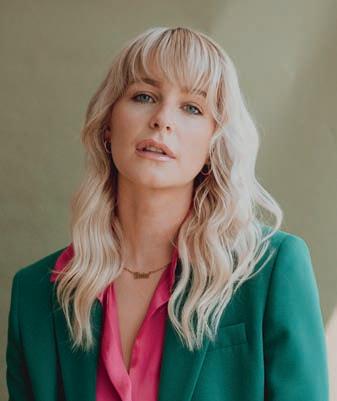
Until then, the responsibility will continue to
The research by the UN concluded that the primary intention of digital misogyny was to induce fear amongst the women who dare to speak out and silence them.
Many advocates for women’s safety refuse to back down for that reason precisely. “When you feel resistance, it probably means you’re doing something that’s worth doing,” says Sophie Gallagher, a journalist and activist who successfully campaigned to criminalise the sending of unsolicited nudes, known as ‘cyber ashing’. Gallagher received “more dick pics, anger and bile” than ever when she began to speak out about the issue in 2022.
Despite the landmark change in law, Gallagher is not naive about the future of potential violence against women. “Things have got worse,” she says, pointing to the reversal of Roe v Wade in the US, the prevalence of manosphere in uencers and the recent survey from King’s College London which found that almost a third of Gen Z men believe that women should obey their husbands. “The law alone does very li le if it’s not put into practice or paired with education.”
Yet despite there being so many reasons for despair, Gallagher identi es one core reason to remain optimistic: the persistent work of women who continue to ght for the right to speak and be heard, despite the risks they face. “There’s real rebellion in women showing up and continuing to speak out. Whenever I see women doing that, it gives me hope. If we don’t have hope, we have nothing.” ●
Lucy Morgan takes a look back at those nostalgic days of (paid for) excess
With industry spending tighter than ever, the ‘golden age’ of journalism has never felt further away. The days when budgets could be milked to eye-popping excess, champagne was gulped down over weekday lunches, and ve-star hotels were de rigueur now belong to the past. But instead of mourning the long-gone era, here are some of those who experienced it rsthand to remind us of its glory.
In my early twenties, I worked for The Mail on Sunday and I was sent to Cannes Film Festival with unlimited expenses, where they put me up in this apartment on the beach. Every morning, I’d wake up with a hangover, swim in the sea, then go and meet my xer who got me into all the parties. We took taxis to parties in the hills and ate in the top restaurants every single night. I was introduced to oysters and things I’d never eaten
When I rst started, an old hand said “journalism is a champagne lifestyle on beer money” and I knew what he meant. I went from event to event and barely needed to drink water because I was having so much champagne poured down my neck. I got my rst big break writing a gossip column for The Observer in 1989 – I wrote a piece on the inauguration of George H. W. Bush in New York, where they covered my accommodation. I didn’t know the names of any hotels, so I just booked into the one I knew my parents had stayed in: The Algonquin in Times Square. In the late eighties, it was the place. When I got back, I put in my expenses, and I remember the editor saying: “Who the hell said you could stay in The Algonquin?” I put in the bill for $900, which doesn’t sound like much, but this was over 30 years ago. She was not happy, but I just blamed it on the old editor. Compared to what was going on elsewhere in the paper at the time, it was probably relatively modest.

I was on a music trip and the late-night conversations got round to collective nouns, and someone said: “What’s the collective noun for journalists?” The answer was an expense account. The big thing back in newspaper land in the 1980s was car mileage, which sounds rather unglamorous. Newspapers used to pay per mile if you were travelling. Wherever you were, you’d claim that you were staying with your aunt in Grimsby or something, and in my case, I’d just go to the gig and drive there. It was 85p a mile and then I’d say “now you owe me £4,000 please”. There were no receipts or proof. I quickly co oned on to the fact that there’s ways to get receipts. You’d go to a bar or restaurant, $ip the barman a few quid and he’d give you a receipt book or tear ten blank receipts and you’d ll them in the coming weeks. You did that with taxis as well, give him a few quid and he’d give you loads of blank invoices. It was quite creative.

At BBC Radio 5 Live, one of my jobs was to wine and dine people to secure a base to broadcast from the Olympics. The best place we identi ed for Sydney in 2000 was the Bondi Icebergs Winter Swimming Club. Armed with a decent entertainment budget, a colleague and I were sent to Australia to make the deal. We were given a guide to Aussie slang and we loved one of the phrases for being drunk, ‘pu ing on the wobbly boot’. Many handshakes and beers later, we were in a be ing room meeting everyone but one bloke in the corner, who nodded and didn’t say anything. “He’s known as The Pope,” we were told. There was racing on TV and they encouraged us to bet. We weren’t sure if expenses would cover gambling, but the 100 to one shot nohoper was a horse called… Wobbly Boot. We decided to slap 10 Aussie dollars on the nose. Unbelievably, it won. I immediately ploughed back some of the winnings on drinks for everyone as we were told to come back the next day to sign the deal. As we le round of drinks arrived even though we hadn’t ordered any. “They’re from The Pope,” said the barman. “Because of you, he had a tenner on Wobbly Boot well.”
Emmy award-winning White House and congressional correspondent
I worked with ESPN and, in the nineties, they were cash rich. At the time, I turned their job o ers down because they were based in Connecticut, in a very cute town, but I didn’t want to live there because it was an hour and 45 minutes from New York or Boston. I was single, there was nothing to do there and I wanted a social life. They said: “No y you in.” I was own in and out every week and I was just one of the many that were. They would have a limo waiting just for me to take me to and from the airport. A couple months into having the limo, I turned it down and asked them to just rent me a car because it felt like a

I was at heat when it was the rst Pop Idol in 2001 and the nal was between Will Young and Gareth Gates. We knew we were more likely to sell more issues if Will won because there was more interest around him, but everyone was saying that Gareth would win. And so, I and everyone else in the o$ce began hammering the phone lines to vote for Will. Literally, vote, repeat, vote, repeat. But then the nance director emailed me because she thought she’d caught me out. She asked why I’d called this speci c phone number 1,000 times because it had cost us so much money. But I took so much delight in replying: “Well thank you for your interest but as a result of the excessive calls, we sold X thousand more issues that week which made us X thousand more pounds, so I think that was a pre y good investment.”
ights and hotels I got in the 1980s were through blagging. I would blag a trip to India for two months and get three stories commissioned by a magazine who paid for the whole trip. I realised if you ask for something that’s going to cost more, people will pay it. When I was in my early twenties, someone told me that the ight to anywhere in the world would never be more than the cost of an advert in a national newspaper. I got a double-page spread The Telegraph and I got a free ight to Australia in business class. I saw it was actually rst class, so I called the paper and said if I’m going to write di erent stories, I really need to be in up.

This year marks the 50th anniversary of City St George’s journalism department and, of course, XCity. This annual tradition has become a time capsule for each year’s MA Magazine alumni. Grace Bishop has a look back through the decades, from the mid seventies to the latest edition in 2025 featuring Marina Hyde. From traditional newsle er styles to more colourful features, each year has created a showstopper.
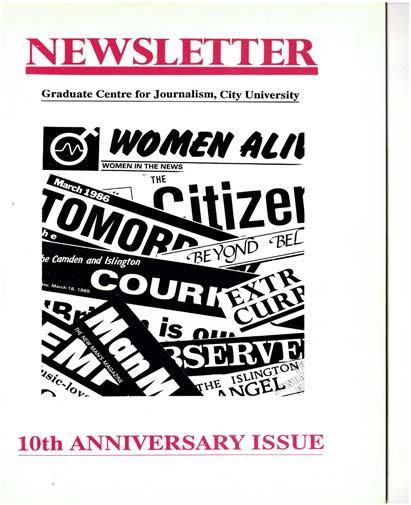
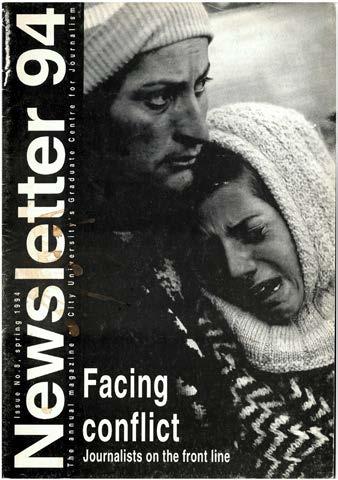
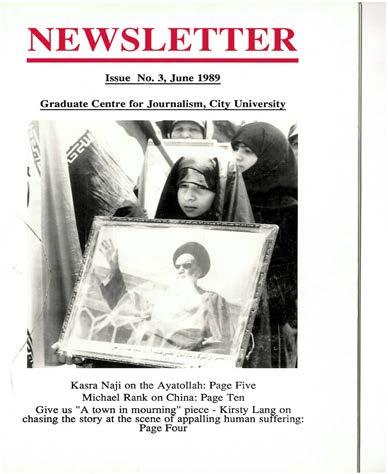
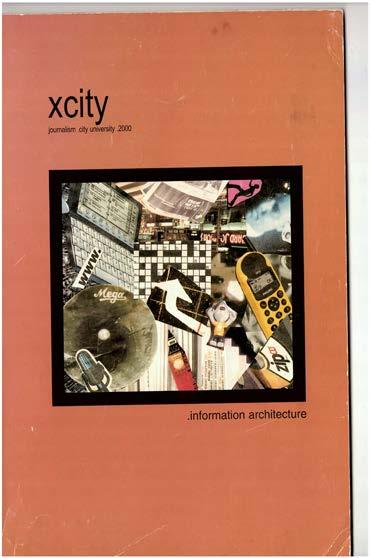
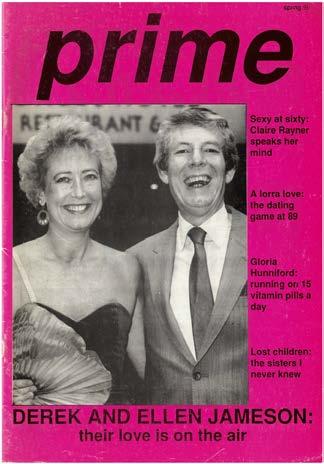
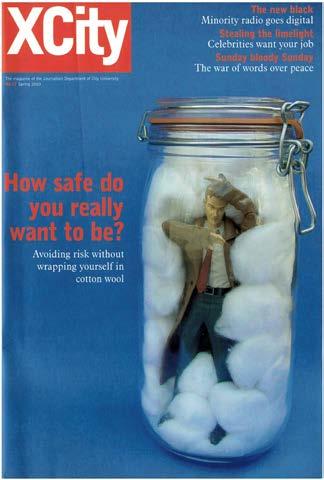
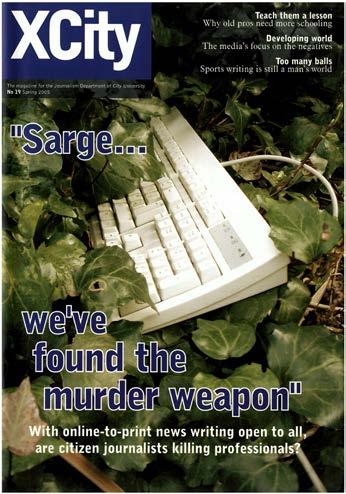
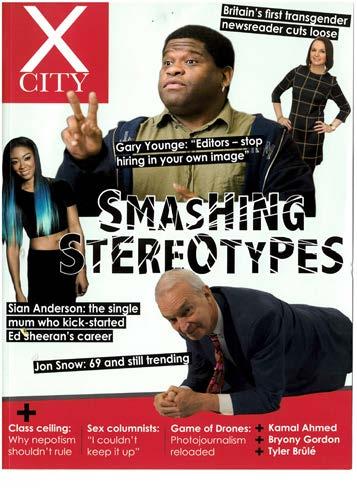

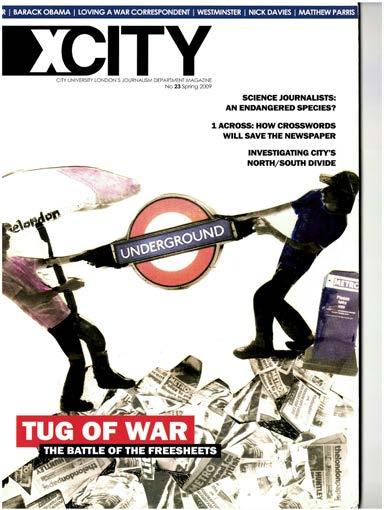
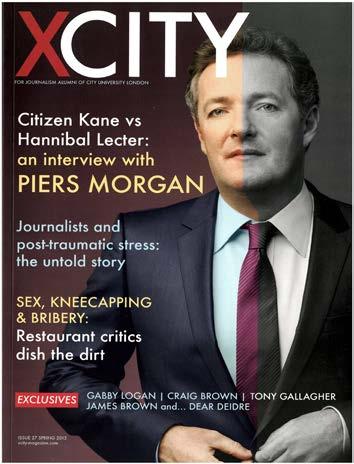
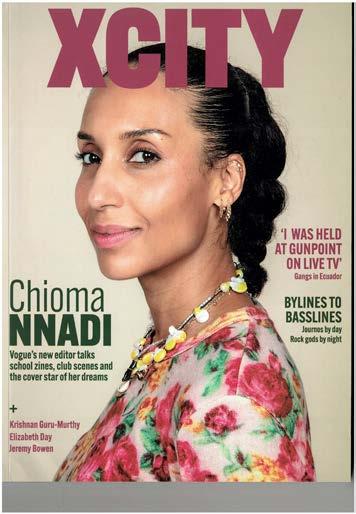
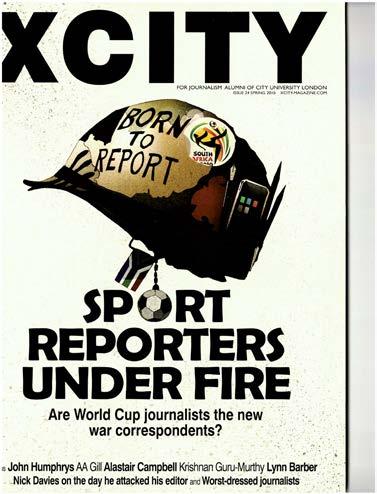
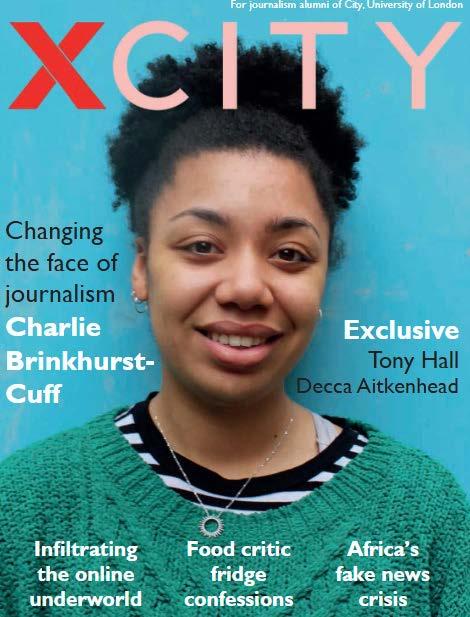
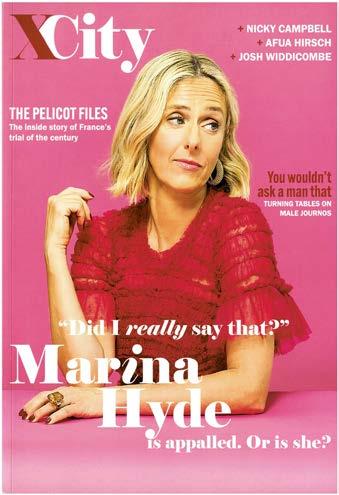
Ever wondered what life looks like for two journalism graduates 50 years apart? Jon Slattery and Remigius Kim talk to Olivia Fee and Liv Leftwich to compare their course experiences and navigating graduate life
Jon Slattery looks back on studying at City St George’s in the very frst year journalism was taught. Back then, there was only one course on ofer — the diploma. Slattery reminisces on student life without social media, trips to meet editors at The Guardian and the reality of fnding a job in the 1970s.
What did a typical week look like for you?
In those days, the focus was on newspapers. From the practical side of stuf, we used to go to courts, council meetings and parliamentary debates. There were 13 of us. We all got on very well and it was a manageable size, so it worked really well. From Monday to Friday we just used to turn up at 9am and sometimes we’d work into the evening if we were going out doing practical work.
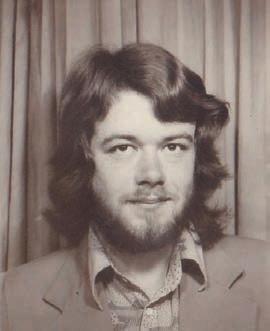
We looked at law for journalists, public administration, history of the press and structure of the press. We also did shorthand, which we had to pass to get the accreditation for the NCTJ. Our shorthand teacher, Harry Butler, was a bit of a legend. He was quite a remarkable character — wore a bow tie.
We’d go to The Guardian, where we would look at the practical way of putting the paper together. In the frst week we went to see Sir Harold Evans, who was the editor of The Sunday Times. We all sat around his big editorial table and he chatted away to us, it was very inspiring.
How did you feel about employment prospects when you graduated?
We were very much geared towards the local newspapers — that was seen as the frst step of employment.
Ten of us went to work for local and regional papers, two went into magazines and one went into book research.
City was very good at contacting
the regional newspaper groups and asking, “do you have any vacancies?” We did have people come in and interview us or ofer us interviews through City itself.
Do you think it’s harder to fnd a job now compared to 50 years ago?
I think there are fewer jobs now. There was a time when the course had got itself quite well established, that people were being recruited right onto national papers.
In our day, there was still some suspicion about graduates, because there was a feeling that journalism was a trade rather than a profession. You always had to start from the bottom and prove yourself. Whereas, after a while, there was a feeling that graduates could go onto an international paper straight away.
Who inspired you while at City? I really liked Tom Welsh, who was the director of the course.
There was one court reporter called Reg who came in and told us all about the juiciest, most scandalous court cases that he had covered.
What advice would you give to a current City student?
Sometimes the best bit of journalism is when you start. I would say, try and keep writing if you can. The trouble is that you tend to get pushed into the editing side of things.
Interviewing people and thinking how you’re going to write it is at the heart of why journalism is so interesting.

Remigius Kim talks XCity through his time at City studying Newspaper Journalism. He recalls the nancial pressures of student life in London, the grind of writing patch stories and, of course, his cohort’s regular visits to the Dame Alice Owen pub
What did a typical week look like for you?
It was very intense. Every week we would write about our patch, which is essentially this area that you’re assigned to cover. My patch, Hackney Central, was infamous for having lots of stories, but everybody is busy – no one really wants to talk to you.
In the rst couple of weeks, I was really frustrated because I had all these stories, but no sources that could speak to me on time for me to actually cover it.
Day-to-day in a typical week, I would wake up and go to shorthand for 9am. The class was two hours and very intense. Then we would have a seminar with our tutor and then go o and do our own thing.
For much of the day, there was a lot of freedom with what you do. When was really busy I would be trying to do as many interviews as I could.
The hours we did depended on the day. On days where there was shorthand and media law it was around eight hours, but some days we would only go in for sub-editing and that was just two hours.
There were a variety of modules: ethics, media law, sessions on SEO, sub-editing, weekly seminars and lm & TV were spread out across the year. I also did a rst person narrative module that was a very concentrated two week module.
I currently work in productions at Studio 35, and we’ve recently wrapped a short lm, Cravate Noire, where I was the producer and screenwriter.
Do you think it’s harder to nd a job now compared to 50 years ago?
Yes, partly. But I think with our generation, there’s just so much pressure to secure a job as soon as we can and the cost of living is so high in London. Rent is going up and it’s very di cult to sustain yourself without any form of employment.
For a lot of young people, you always know where you’re going to end up the year before. It will always be another year in school or another year at university. For a lot of people, it’s very daunting to graduate and then realise, “Oh shit, I have no idea what I’m going to do in October.”
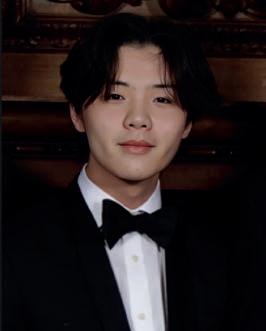
Who inspired you while at City?
Jonathan Hewe . His resilience, compassion, along with his fearlessness in posing the right questions fundamentally embody the spirit of what it means to be a journalist.
What advice would you give to a current City student?
How did you feel about employment prospects when you graduated?
The process was very competitive. I was pre y passive by the end of it. I’m obviously very passionate about journalism still, but I’m just not too sure that I want to work for a newspaper.
There was the Daily Mail’s graduate scheme that everybody was going for and the same with The Times. Everyone was going for the same roles and it was cu hroat.
When I did my nal project, I really enjoyed writing long form, investigative pieces. That’s what I enjoy doing – then I can send it o to a newspaper of my choice, rather than work for a speci c publication that breathes down my neck. Or worse yet, you cover a piece and they tweak it to suit their own political views.
I’d rather write a piece that I truly believe in about an issue that I think is important to raise and then pitch it to a newspaper. I think that’s more authentic than working for a speci c publication.
Don’t worry that much. I worried and stressed way too much in the beginning and throughout the year, especially when the nal project came around and there were two weeks le to do it. I still needed ve sources. It seems impossible, but it’s very doable.
The tutors could be very demanding, but they’re also there to help you. They’ve done this and they know how challenging journalism can be.
Don’t stress too much. Everything works out in the end &


Re ecting on 40 years of teaching at City St George’s, David Roper speaks to Claudia Watson about corduroy jackets, interview crashes and student clashes
As someone who makes his students secure a celebrity interview as part of his class, and having himself interviewed the likes of Madonna and Ma Damon, readers may wonder if legendary City St George’s lecturer, David Roper, has ever found himself starstruck.
The answer is no, although he has o en found himself disappointed.
“I once asked Alan Rickman, ‘Why does a great actor from the Royal Shakespeare company want to be in Robin Hood?’ He looked at me and asked, ‘Why would a c*** like you ask a question like that?’ and then le I wouldn’t say I was starstruck.”
When he’s not playfully antagonising the rich and famous, Roper can be found in the journalism department, where he has been a lecturer for over forty years.
Along with his now-trademark moustache, Roper spends term two ‘Roperising’ - the term used by one of his previous students to describe the lifelong bene t his teaching had on her work.
“I didn’t know much about City beforehand,” he explains. “I had a colleague at The Guardian who didn’t enjoy what he was teaching there. A er a term, he said, ‘Do you want to do it?’”
Roper never trained as a journalist, at least not in the way he trains students today. Instead he was advised to pursue a career in teaching a er obtaining his degree in modern languages.
He laughs: “I thought, no, I don’t want to be si ing in a room with leather patches on a corduroy jacket. But I did end up doing some European Philosophy teaching at the University of Kent.”
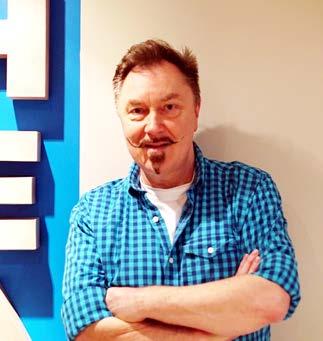
“If I learned how to be a journalist anywhere, it started in David’s classes”
- Geraint Price, former student
A er two years, Roper hung up his blazer and began working at John Calder publishing house where he edited Samuel Becke ’s novels to perfection – his pay being docked for anything less than. It was here he was tasked with bringing theatre magazine Gambit out of the doldrums, which he successfully did a er landing an interview with screenwriter, Tom Stoppard.
His work then plunged him into the strange world of niche magazines, before he was headhunted as a theatre critic for Time Out. Then came The Guardian, BBC and Channel 4, to name just a few, before he assumed his position at Citywhere his unique teaching style has made him something of a legend.
“I don’t like to tell students what they’re going to be doing for the next 10 weeks,” he says. “I would rather have an element
of joint adventure. Surprise is something I use.”
Roper is well-known within the journalism department for springing phone interviews on unsuspecting students. He is also fond of disarming them with questions about their deepest fears. But what keeps Roper coming back a er over 40 years in the job is the feeling that he has something to o er.
“It might sound immodest, but I’ve been very lucky,” he says with a smile. “My students get good grades, and I get good feedback. I watch BBC News at Ten every night and see at least two of my students. I’m not saying it was my work that got them there, but I’m pleased to see that what they’re doing is good, reputable and probably quite satisfying.”
However, Roper’s time at City hasn’t been entirely smooth.
“There was one occasion when I thought a student was going to lamp me for a low mark,” he shares with a deep exhale and shake of his head. “They turned out to be very good and competent, but I didn’t enjoy that.”
Roper’s students will quickly realise that he is a busy man, not inclined to wait around. For those who fail to notice this, his introductory email which states his intolerance for lateness is a clear tell. The rules of his class are simple: never start a sentence with ‘the’, have a hook or sling your own, and always be on time.
If you’d like to thank Roper for this instruction – or bribe him into skipping his randomised phone interviews – he is partial to a Negroni and all manner of chocolate.
If you were thinking of asking him his age, don’t bother. “Any journalist can work that out.” ●
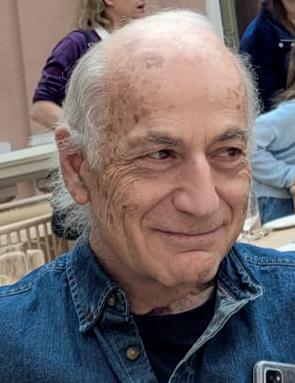
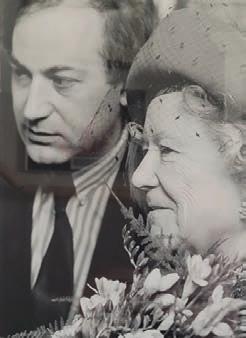
Anyone who studied magazines or newspapers at City St George's in the past 30 years knows Malvin van Gelderen. The design and layout tutor re ects on his career in and out of the department.
How did you start in the industry?
When I was at school, I drew a penguin and noticed all the other children standing behind me and looking together with the teacher. I realised I was the best artist in the class and liked the a!ention. I knew then that my career had to be something to do with art. The next step was art college. A"er a year, I joined a pop group with some other students in the early sixties. We were paired with a top 10 singer called Heinz to become Heinz & The Wild Boys. I toured with Heinz for a year and eventually got a position at a commercial photography studio.
When did you have your rst break?
I started on a romance magazine called True which was popular at the time. I moved on from that to many other women’s magazines and eventually ended up at Horse & Hound where I met the Queen, who used to read it. I then freelanced. I worked on the The Mirror for 3 years, working for Robert Maxwell. He used to arrive sometimes in a helicopter and land on the roof. If you had the window open, all the layouts used to y out the window.
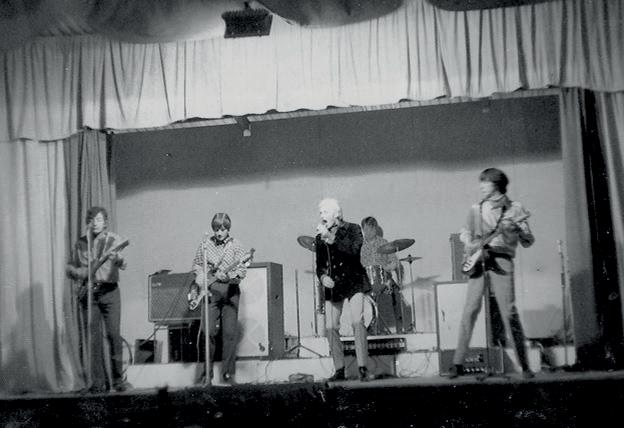
Anfal Sheyx speaks to two City icons about their time in the department
What was the department like when you started?
In 1986, before computers, I instructed students how to draw layouts on paper templates. Students had to stick photocopies of pictures to size or draw pictures to scale on a projector called a Grant machine. It was a very time consuming process.
What are your best memories of City?
It's very rewarding to teach. It’s great to engage with so many students at a university level. I would try to get my point of view over, but not always succeed. A"er explaining why I did not like the layout, sometimes the students would gang up on me and say "Well we like it"!
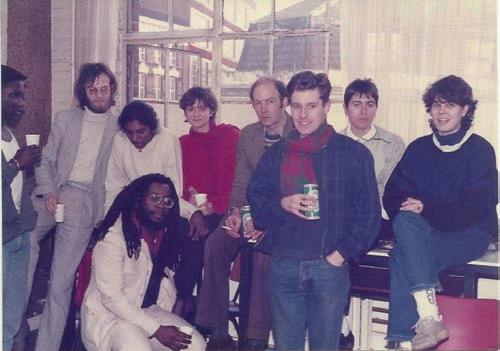
ran the International MA from 1984-1991 and the Journalism and Social Science BA from 1992 to 2003. He is now an honorary professor of journalism at the University of Lincoln.
What was the journalism department like in 1984 when you joined?
I knew very li!le about international journalism then. The students were usually experienced journos in their own countries, so I had to learn very quickly.
We would drink wine at sta meetings. Today, vast amounts of paperwork are needed. Back then, there was nothing of the sort. [My boss] John Dodge would simply say, “We’ve had no student revolts this year, have we? No, so that’s good.”
And we would return to the wine.
Do you have any favourite memories?
I have a lot of wonderful memories from my 19 years at City St George's. With Bob Jones, I developed a dissertation model for the International MA which required students to present 20,000 words of investigative journalism. We required no theoretical underpinnings. In its very essence, journalism could be seen as a distinct, academically rigorous form of literature.
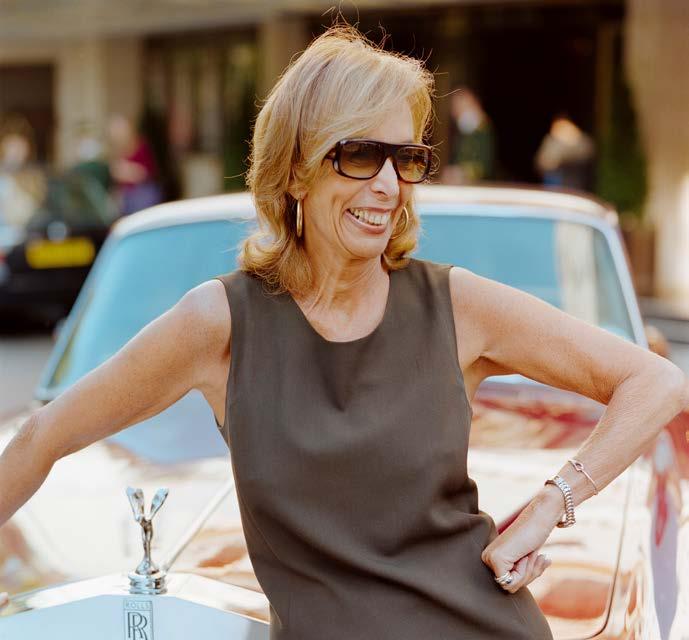
arcelle D’Argy
Smith’s central London apartment is an Aladdin’s cave for aesthetes. There is hardly an inch of space on the walls of the early Victorian townhouse, which could almost consider Hyde Park its back garden. In one painting a woman faces away from the artist, shrouded in a leopard print fur coat and matching pillbox hat.
Books pepper every corner, each shelf a celebration of artists, from Francis Bacon to the entire works of the late A. A. Gill, the celebrated critic and D’Argy Smith’s former friend. Beneath the ornate Persian rugs lie traditional cream and black tiles. “They were great in the days of smoking,” says D’Argy Smith. “You could just stamp it out on the !oor.”
D’Argy Smith is most well known for her time as editor of Cosmopolitan, from 1989 to 1995, a time she remembers fondly. “It’s quite nice being successful – you should try it for a bit. The view from the top of the mountain is lovely.”
In 1991 D’Argy Smith won Women’s Magazine Editor of the Year, and 12 months later Cosmopolitan was voted Magazine of the Year. “Mine was a very lucky generation,” she
The former Cosmopolitan editor and City lecturer teaches Emilia Gould about 60lb penises, how to care for a pet monkey and the art of writing
became a secretary. She soon fell into selling advertising – and found that she was accidentally fantastic. Over time, D’Argy Smith became publisher and editor of British and International Art and Antiques Yearbooks, alongside devising and running art tours. She travelled extensively, spending three months of each year negotiating with dealers in Europe, the USA and Hong Kong.

says, “it was Camelot. There was the pill, you could have sex with your boyfriend! As women, we walked into jobs.”
Far from the glamour of fashion weeks and long lunches, City St George’s alumni will remember D’Argy Smith for the “Structure and Style” workshops that she ran from 1992 to 2014. For three hours at a time, students were encouraged to explore their writing styles, reading out loud in small, intimate groups over tables pushed together.
Before her time at the top of the mountain, a er leaving school at 17, D’Argy Smith
A er being made redundant, D’Argy Smith travelled to New York in 1982 to study creative writing at Columbia University. She fell in love, both with the city and with writing. “I thought, ‘I’m never going to be lonely again, I can always read, I can always write’.”
“I’ve never had a CV,” she says; she landed her job at Cosmopolitan a er meeting the editor in a li She believes she got the job because she “was tanned and quite well dressed”. She is shocked at how many people wear jeans to work today: “It’s like not washing.”
Wi icisms pour from D’Argy Smith today as though her salary is still dependent on writing the most salacious headline.
“I slept with every man I found a ractive, because you don’t nd that many men a ractive,” she quips. One of her favourite cover lines from her time at Cosmopolitan read: “Read all about it – the 60lb penis”. Shocked readers who purchased the publication opened it to discover an article about sperm whales.
Since leaving Cosmopolitan, D’Argy Smith has not picked up the magazine. “Rather like with a man, once I le I lost interest.”
Headshots of D’Argy Smith from various fabulous eras

of her life are framed in her apartment, red hair ablaze and mouth upturned in a knowing smile. “You have three major relationships in your life: with your body, your face and your hair,” she says. “I always liked my body, I didn’t really understand my face and my hair was shite.” Today, aged 85, her hair is an ashy blonde, falling neatly in loose coils. The gold bangles on her wrist chime as she moves. “I think I stopped being insecure at 70,” she says.
The Hyde Park apartment was once also home to D’Argy Smith’s pet monkey, Hash, purchased from a pet shop near London Zoo. Hash had to be rehomed with a friend, an intellectual who was not particularly fond of the primate’s narcotic-inspired name. Ever the cheeky monkey, Hash refused to respond to any a!empts at changing his name – D’Argy Smith was delighted. “I’d have loved to have been Jane Goodall,” she says.
Though she still enjoys travelling, particularly the idyllic beaches of Malta, D’Argy Smith’s love a air with London is long lasting. “I’m not a Great Britain fan, I’m a London fan – I love my city. You stumble home in your pyjamas and nobody gives a rat’s arse.” It is very hard to imagine D’Argy Smith wobbling through Westminster in her nightwear. The grey winter weather, however, is not much to her liking. “I used to fall in love in autumn, that was a good time.”
In 1999 D’Argy Smith ran for the pro-European Conservative Party: “I thought everyone was pro-European.” She was responsible for the appointment of Cosmopolitan’s very rst political editor, Lesley Abdela. Despite describing recent party leaders as “political anaesthetic”, D’Argy Smith remains passionate about social issues: “I still have my ‘don’t a!ack Iraq’ badge.”
to write be!er, anybody.”
“Delight and entertainment, that’s lovely,” she says, “But the great writers reveal wisdom and truth, they tell you about humanity.” She laughs about “driving students mad” with her feedback, but knows that it helped them improve. “I wanted to be driven mad. I wanted constructive criticism all my life.”
“Good writers agonise, and the truth is, so you should.” The maxim for writing, she asserts, is that “good enough is never good enough”.
Phones were not allowed in D’Argy Smith’s workshops, and absolute focus was essential. “You had to write your way in. Our time together was too valuable – I saw it as valuable and I think they did too.” The workshops invited honesty and vulnerability: “People’s lives played out in their writing, from alcoholism, to incest to domestic abuse.” D’Argy Smith relished both the eagerness of students, and their willingness to open up to their peers. “I could have gone on doing it until the day I died.”
Perhaps due to the readership of Cosmopolitan, the workshops o en a!racted the female population of the cohorts. “The boys that did come were the show o s” says D’Argy Smith, remembering one occasion when a young male student entered the workshop exclaiming, “I can’t wait to write the word penis!”
Despite never having a!ended university herself, D’Argy Smith received an honorary doctorate of the arts from City St George’s. “I swanned down the aisle at Southwark Cathedral,” she says. She was less pleased with the mandatory doctoral beret. “It
“She’s impossibly romantic about writing – she says the words ‘a writer’ like others say ‘the President’ - but all the be!er for that. When you get it right, it can be the greatest of things. And I think, more than anyone else I’ve known, Marcelle reminds you why.”
“Forbiddingly strict but always fair, and helpful. Her criticisms were invariably spoton. And impressive that such a tiny person with such a tiny voice could silence a classroom of cocky unkempt twentysomethings, the moment she swept wordlessly into the room.”
“My enduring memory of Marcelle is of her wa ing into the classroom where she taught us on a Friday a ernoon, draped in fur and cashmere, smelling of expensive perfume. She was always so glamorous and full of tidbits of gossip about celebrities.”
“I SLEPT WITH EVERY MAN I FOUND ATTRACTIVE, BECAUSE YOU DON’T FIND THAT MANY MEN ATTRACTIVE”
was the ugliest day of my life.”
Although she never had children, D’Argy Smith speaks about her time at City St George’s with maternal care. “I loved going in, it was one of the sweetest things I ever did. I think I felt like a mother bird, feeding all the open mouths.” She rmly believes that writing is a cra , not an art: “It’s like tennis; there are rules. You can teach anybody
Walking around the at, D’Argy Smith laments: “I feel 241 years old.” Though, she has found many moments of pleasure in aging. “The trick is to keep your mind and body going at the same time.” D’Argy Smith does not write anymore, (“I’ve got nothing to say”) but
continues to teach her creative writing workshops from her home, still using work from City St George’s as positive examples. Re ecting on her vibrant and varied life a ectionately, D’Argy Smith smiles. “There are a few things in life I’ve loved that I could pinpoint – you have these knots of love in your heart – the monkey, a few men, New York and my time at City.” ●
Pictures of Marcelle courtesy of David Harrison, who can be reached via his website at www.davidharrison.info
1976
The journalism department opens its doors at 223227 St John Street to 13 students for a diploma 1981 Radio Journalism Diploma startsonly ve students are enrolled
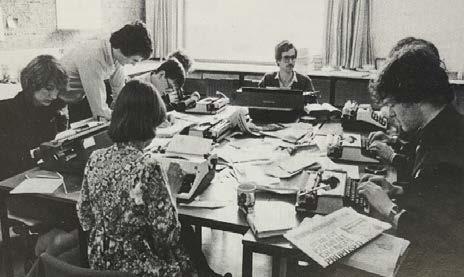
1982
Periodical Diploma (to become Magazine Diploma in 2004) and International Diploma begin
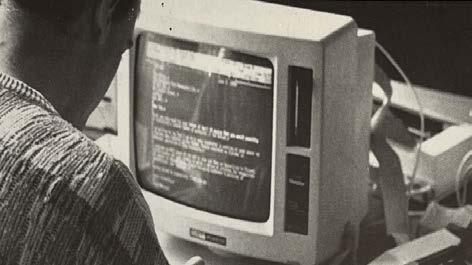
1987
1988
The Department of Journalism reaches 100 graduates Broadcast Diploma is launched
1990
The journalism department moves from 223-227 St John Street to the College Building
1994 Journalism students start to use email
1996
Professor Hugh Stephenson steps down – Professor Rod Allen becomes department head Celebrations are held to celebrate 20 years of journalism at City with wine, food and “no speeches”
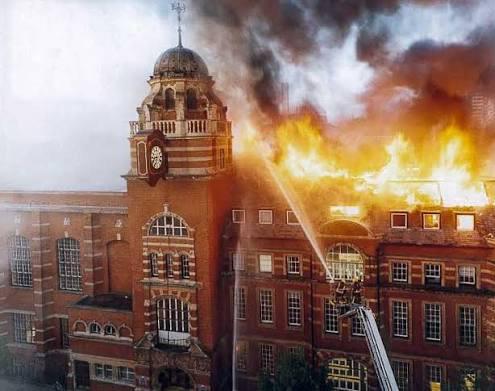
2000
City joins the dot. com world as postgraduate periodical students create www.bobs-youruncle.com
Newsle er, an early iteration of XCity, is published using Amstrads, IBMs, the Ventura Publisher Package and a laser printer
2001
A re breaks out in the College Building, forcing portions of the space to close for two years causing £10m in damage. CNN incorrectly reports that the journalism department was destroyed
1984
The Graduate Centre for Journalism is founded and would go on to be granted departmental status in 1987
Journalism Postgraduate Diploma (PgDip) is launched
1986
Professor Hugh Stephenson becomes head of the Graduate Centre for Journalism
Sixty typewriters are thrown out and replaced with Amstrad PCWs
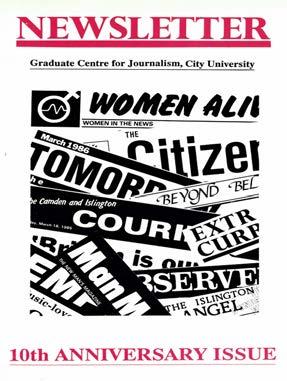
2005
Professor Adrian Monck becomes head of the journalism department
By Emmy Raynor
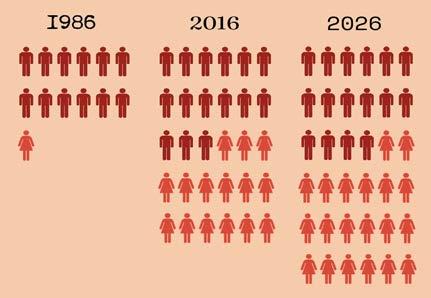
2023
The journalism department launches the UK’s rst Podcasting MA

2008
2021
City, University of London merges with St George’s to become City St George’s
The Department of Journalism becomes part of the newly established School of Communication and Creativity
Dr Mel Bunce becomes head of the department
Master’s degrees begin to be o ered as an alternative to diplomas, replacing them entirely the following year
The Investigative MA is launched
2006
Journalism, Media and Globalisation (Erasmus Mundus)
PgDip begins
2026
City St George’s Department of Journalism turns 50
562 students are enrolled - 322 postgraduates, 225 undergraduates and 15 postgraduate research students
2025
Professor Karen Fowler-Wa takes over as department head from Dr Glenda Cooper, who had been interim head since 2024
Dr Paul Lashmar takes over as head of the department
A new journalism wing costing £12m opens in the College Building, equipped with a TV studio, four radio studios and ve newsrooms
Professor George Brock replaces Professor Adrian Monck as department head
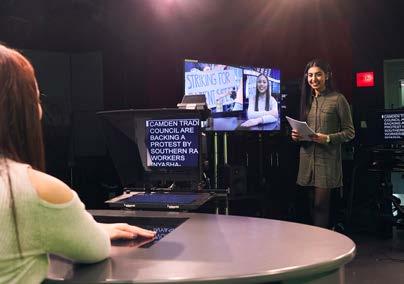
Professor Suzanne Franks becomes the rst woman to be head of the Department of Journalism
Political Journalism and Financial Journalism MAs begin to accept students
The Bureau of Investigative Journalism opens at City
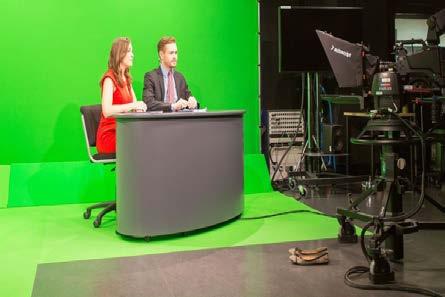




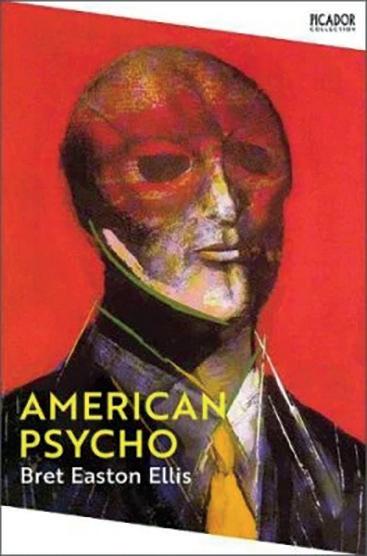




Want to be like a City St George’s Journalism MA student? Wolstencro lays out the stereotypes







Bernd Debusmann Jr. and Sarakshi
Rai met at City University on the International Journalism MA and graduated in 2014. Twelve years later they live in Washington DC where they work as political correspondents at The Hill and the BBC.
Tell us the story of how you rst met.
Bernd: Before the course started, Sarakshi was living at home in India and got to City a week or so late. I was collecting money for a party I was organising and she caught my eye, so I went to ask her for-
Sarakshi: No, no. I think Bernd was collecting £10 for this party and I went to give it to him and he was just totally uninterested in being friends. And I was just like, “Okay, this is literally my !rst day in class and he doesn’t want to even chat!”
Bernd: Yeah, I was playing it cool.
Sarakshi: So he says. We ended up in the same circle of friends. We started properly dating in the second half of the year. It was really fun because we were exploring the city at the same time. I interned at The Times, he was at The Telegraph and the o ces were close by. We’d meet up for post work drinks, or we’d go to these international a airs and foreign policy discussions at King’s in love with more than just journalism at City
Choose Your Own Adventure
Go and talk to them:
College. Invariably we’d end up si ing together and having the most interesting conversations about foreign policy in the Middle East and journalism.
What are the pros or cons of being in a relationship with another journalist?
Sarakshi: You need to have someone who gets that journalism is long hours at work. During the 2024 election, I was at the Republican National Convention and he was on the trail covering Donald Trump’s campaign – he was at the scene where Trump was almost assassinated. Then he’s back and leaves to go to the Democratic National Convention. It’s also part of what drew us to journalism: we love the thrill of the chase.
What do you remember about your time at City?
Sarakshi: Our International Journalism professor, John Owen, was so instrumental, not only in our relationship – we would always sit together in his class – but he’s also been so supportive of our careers. Every couple of months we’ll get a really sweet message from him. It’s really nice to see he still remembers us and is always there for our big moments. →
Your frenemy starts gossiping about her secret relationship with a certain famous journalist. She asks you not to tell anyone or spill the secret to any outlets, as she’ll lose her job at The i Paper What do you do?
Keep the secret and ask for work experience (p172)
Sell the story to the Daily Mail (p25)
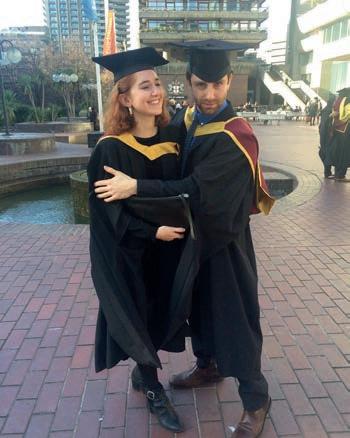

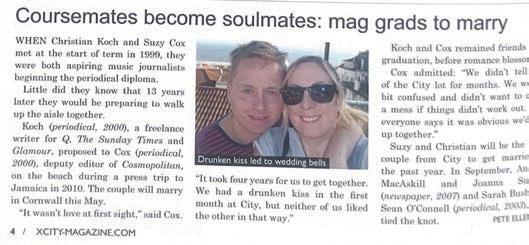

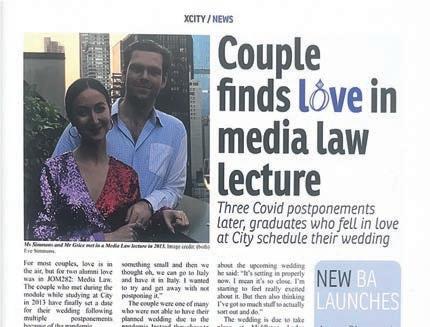

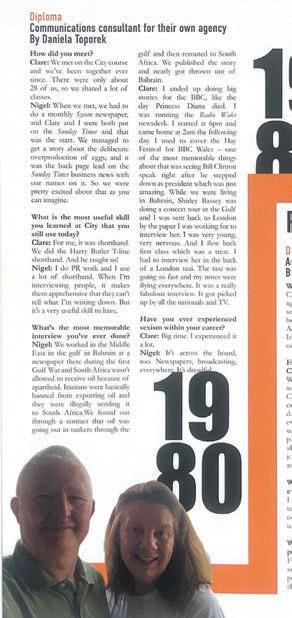
Kate Samuelson and Tom Brada met during their undergraduate studies at Bristol University but came to City together to pursue journalism. They both graduated in 2014 – Kate graduated from the Magazine MA and Tom from TV and Current A airs. Living in London, they both now work at the same large media organisation and Kate has also co-founded Cheapskate London, an award-winning weekly newsletter about a ordable things to do across the capital.
What are the perks and/or challenges of being married to a fellow journalist?
Tom: I work in news, which means my lifestyle is quite funky – one day I might be on crazy early, the next day crazy late. And because we’re working in the same industry, Kate gets it. Whereas I think if I was in a relationship with someone who was like, “Why the hell aren’t you coming home?” it would be tricky. It really works for our lifestyle.
Kate: Tom’s been helpful when I work more on news, because Tom’s always worked the news.
So, to be able to ask, “What do you think is a good angle for this story”, or, in my old job at The Week Magazine, I had to talk about quite complex news stories and it would be really helpful to discuss it with Tom and practice with him. He’d also know what the news line was and what the most interesting parts of the story are, so having that journo brain has always been useful both in life and our careers.
Have you ever worked at the same place?
Tom: Yeah, we now both work at the same media organisation but we’re in completely di!erent teams. Before, I used to work at the Press Association and Kate did some work experience while
I was there, so we have worked ‘together’ a lot, really. Now we’re at the same place, it’s like when we were back at City – we sometimes commute in together but then don’t see each other all day.
Do you have a favourite story / career moment of each other’s?
Tom: For Kate, I’d say Cheapskate. I’ve watched her do Cheapskate in her spare time with her best friend and it’s just extraordinary how much she puts into it, considering it’s not her main job.
In 2023, Cheapskate won the Georgina Henry Award. It was like a culmination of a reward for their insane e!ort, so it felt like a big win. Starting your own thing is unnerving and you o en question whether you have time. It just felt like massive validation, and it’s paid o!. Now Cheapskate has a life of its own and it keeps growing. She recently employed someone from City, a Magazine graduate, actually. We know graduates from City just get it and they’re perfect to bring on board. So now it’s like Cheapskate has its own li le life force built out of City. ●

Magazine media has never been more dynamic. From newsletters, social, award-winning creative, and captivating events to stunning print, unmissable podcasts, licensing opportunities, data and analytics, and much more.

TO DISCOVER WHAT A CAREER IN PUBLISHING COULD LOOK LIKE
WANT TO SHAPE THE FUTURE AT BRANDS SUCH AS:







Find Yourself in Publishing is brought to you by the PPA, the UK’s association of magazine media and trusted editorial brands.
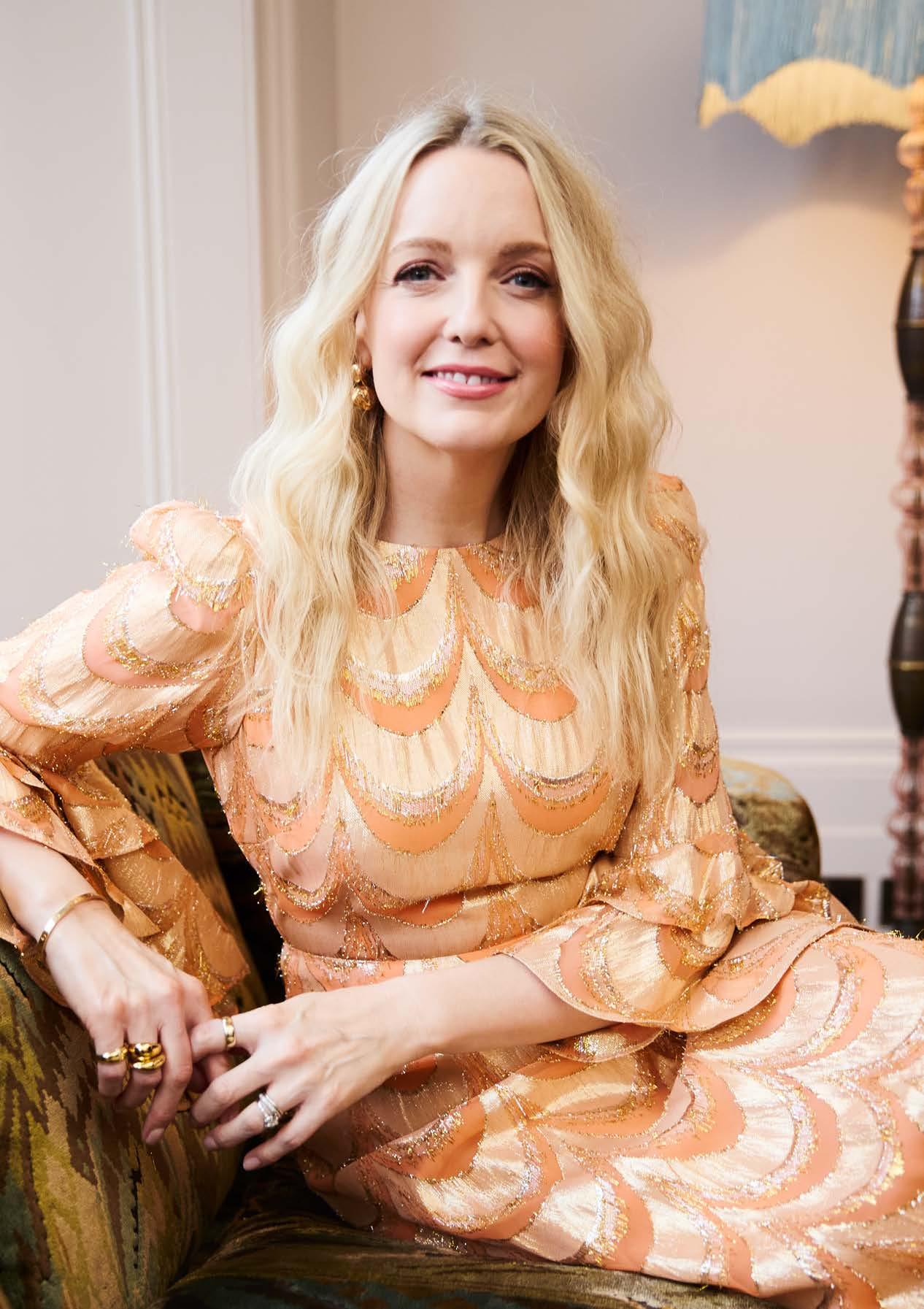
“He told me all my questions were sh*t”
One
of Britain’s best-loved DJs and presenters speaks to Meadow Wattret and Isabelle Blakeney about her rock‘n’roll beginnings, nightmare interviews, and the pressure of hosting Desert Island Discs
Though she’s one of the most revered British broadcasters around, Lauren Laverne seems more like a roadie who has just stumbled o! a tour bus than a radio host. She’s just got home from work and answers our Zoom call in her car, before spending the next ve minutes bustling into her study. Vintage posters of indistinguishable rock bands line the walls and her desk is strewn with trinkets and Vinted parcels. As she nally nestles into her seat with a smile, her out t comes into view – a black and white jumper which reads “To The Disco”. She’s interrupted by her dog, Cosmo, and two cats before we start. “Oh my god,” Laverne says, shooing them away to no avail. “OK, there’s gonna be quite a lot of animals. Let’s just live with it.”
Forging ahead amidst chaos isn’t new to Laverne, either as a radio host or in her previous life as the frontwoman of the pop-punk band Kenickie.
She has recently go en home from a holiday, having cut her trip short when she got the call to lead the Q&A at a live screening of Paul McCartney’s new documentary, Man on the Run. That aspect of her work, Laverne says, “is a complete honour”. McCartney is one of the “brilliant” people she would drop anything for.
“I was listening to his music from the womb, so that’s massively signi cant and meaningful to me, to get to meet him and have conversations.”
McCartney is a rare case, though; usually, Laverne doesn’t get starstruck around celebrities. Fame, she says with that half-smirk, is more of a “chemical thing”: “When you actually get up close to it, there’s nothing there.”
Perhaps she has picked up this lack of awe when interviewing countless big names over
her two-decade career on telly and radio. Since hosting various music chat shows in the early 2000s, the 47-year-old has been on-air even more regularly, starting o! DJing on Xfm (now Radio X) before ge ing a Saturday show slot on BBC Radio 6.
Nowadays, her schedule is packed with appearances on The One Show, on her Radio 6 weekday morning show and on Radio 4’s beloved Desert Island Discs. With the la er, she does feel the expectation to deliver.
“There are some subjects where there’s extra pressure,” she says. “Doing Jens Stoltenberg
“It was like being plugged into the mains for three hours”
when he was the head of NATO, or Steven Spielberg… you’ve got 49 minutes to make a 47 minute programme. That’s it. It tends to be in those kinds of situations that I would get stressed out, I suppose.”
Hosting Desert Island Discs, as Laverne has done since 2018, is a particular career milestone –she is one of just ve people to have had the job.
Not only did she have to live up to the legacy of a programme which has aired since 1942, she also had to live up to the work of her beloved predecessor and former Discs host, Kirsty Young. Knowing the weight of responsibility that comes with the job, Laverne preps heavily.
She does as much watching, reading, listening and thinking as possible and has her questions
ready. “Then on the actual day, you can just have a conversation,” says Laverne.
She has been praised for her ability to disarm typically tight-lipped guests, such as the model Kate Moss. By ge ing her to laugh about “sneaking into nightclubs”, she then seamlessly transitions to pressing her on tough topics like Johnny Depp’s trial and drug use.
“You have to be emotionally agile in the moment and just go with what that person is o ering you. I think it’s about responding to other people and being OK with who they are,” she says.
To that end, Laverne sees an interview as something more profound than a character analysis.
“It’s a snapshot of that person on that day, isn’t it? We all contain multitudes. Humans postrationalise a lot, to make our lives make sense. In the rearview mirror, we all do that.”
When in the booth and about to record, Laverne has another trick for ge ing a conversation o the ground: asking her guests how they feel about coming on the show. “It is an iconic programme,”
“Part of my job is to remain neutral –sometimes it’s been hard”
she says, “so I think most castaways are nervous about it, even if they’re very con dent people on some level. They want to get it right because they know how far the programme reaches and how much people love it.
“Bear in mind that we’re not news. We’re not having to hold people to account or whatever. I always felt quite relaxed about moments of quiet or the more gentle people.”
That down-to-earth relaxation isn’t typically associated with radio hosts. Broadcasters are o!en generalised as the kind of people “who need everybody to be like ‘AH!’,” as Laverne puts it. Conversely, alternative music DJs generally have a “nerdy” or “shy” reputation. Laverne doesn’t belong in either category.
Perhaps that is down to her unusual career beginnings as a musician: her band Kenickie, which she founded with her brother Pete Go!on in 1994, released two albums, played at Glastonbury and reached cult status, according to The Guardian, before disbanding in 1998. At their nal gig, Laverne announced to the audience: “We were Kenickie… a bunch of fuckwits.”
Mid-call, she brings us over to a picture of the band taken for the November 1995 issue of The Face magazine, which is hanging on her wall. Laverne looks particularly Debbie Harry-esque. Her rock‘n’roll start also shaped her interviewing style. Her biggest pet peeve? Overlylong questions.
“I fucking love a short question. All my favourite broadcasters, that’s what they do. The questions are short because you’re not trying to show o . It’s show, don’t tell.”
One artist in particular didn’t respond so well to that style: Laverne’s worst interview ever was with The Fall’s Mark E. Smith.
“They were my favourite band when I was young, but it was just an absolute nightmare,”
Laverne says.
“He told me all my questions were shit, but then he put me in a song a!erwards. The men of the eighties, I cannot explain to you.”
Luckily, Laverne’s not losing sleep over whether her interviewees like her or not.
“The worst thing that you can do as an interviewer is go into the interaction needing the person to like you. [Smith] cured me of that, which is a very good thing.”
Laverne’s no-nonsense aphorisms recur throughout our conversation. “Remember, when you’re interviewing, if anyone’s a dick to you, it’s them, it’s not you.” It’s the likely result of being raised in what she has previously called a “liberal, political, lively, noisy” home. She grew up in Sunderland in a big working-class family. Her father was a sociology lecturer, and her mother was a teacher and Labour councillor.
It’s part of the Desert Island Discs job description to rub shoulders with di erent personalities. Just the other day, she interviewed Kemi Badenoch, when moments before broadcast, the arm of her glasses fell o . “One of the engineers had to go and get a really tiny screw,” Laverne laughs.
She also has a history of being outspoken, infamously calling the Spice Girls “Tory scum” in the run-up to the 1997 general election. For a self-described “political person”, one can imagine interviewing the leader of that same party might be a challenge.
Thus far, Laverne’s answers have been laced with wi icisms, swearing and reassurances for us to take our time. In response to a question about whether the ferocious impartiality of the Beeb might be constraining, her considered Desert Island Discs voice comes out. She acknowledges that the BBC needs to be for everyone. But keeping her political views private was still a “big adjustment”.
“Having gone from growing up in a very political environment and having my own views on things, I had to sort of choose to do it. I take it seriously as part of my job is to remain neutral,” she says before pausing.
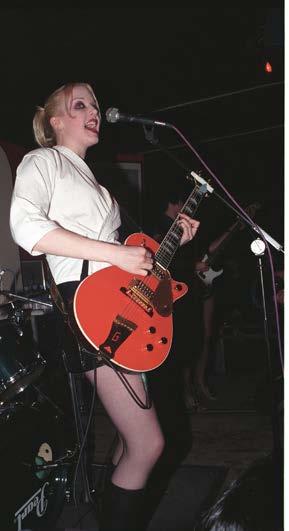
“Sometimes it’s been hard. Obviously, there are things that you feel very passionately about, or moments that...” She looks up to nd a word.
“That cut you emotionally.”
She continues:
“Having to learn to take a minute, and then think, and then react, I think it’s made me more thoughtful in my own life and my own politics. It’s made me more considered in the way that I engage with issues.
“It enriches your life to talk to people with a whole range of views, some of
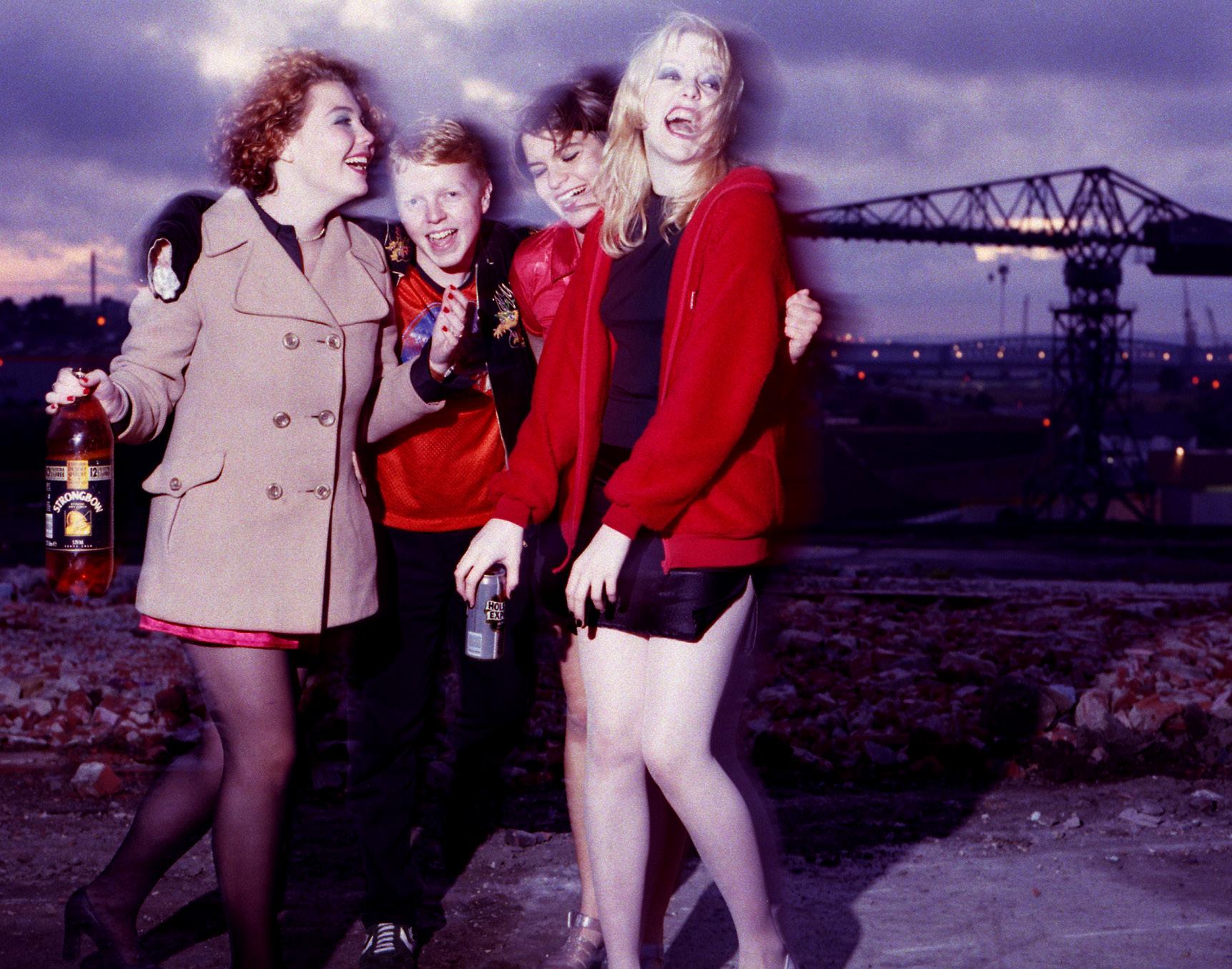
which you agree with, some of which you don’t.”
Would she draw the line at someone like Nigel Farage?
Laverne gives us a knowing look. “There would be lines that I wouldn’t be willing to cross.”
As a broadcaster, Laverne has witnessed the rapidly changing radio landscape !rst-hand. But bringing a programme with an 80-year legacy into the era of podcasting has been a surprisingly smooth ride. Predictably, episodes with the likes of Adele and Kate Moss saw signi!cant streams with the younger generation, but she reveals that listeners o en surprise themselves with the interviews that resonate most. “People say to me, ‘Oh, I hadn’t heard of them before, I didn’t know their name, but then they just had this amazing story that blew me away.’”
Laverne’s shortlist of personal favourite castaways includes Arsenal legend and pundit Ian Wright (“you could ask him anything”) and Serbian performance artist Marina Abramović (“it was like being plugged into the mains for three hours”). But while she loves these electrifying moments, it’s the more tender castaways that she’s keen to speak about the most.
“I remember doing Bob Mortimer’s episode,” Laverne smiles. “Bob is very silly and fun and playful – but when we sat down to do his episode, it was not that side of him at all. It was vulnerable and sad. There was a lot in his story that really
touched people.”
In 2025, Laverne interviewed Mina Smallman, whose daughters, Nicole Smallman and Bibaa Henry, were murdered in 2020. This interview, she explains, was a reminder of the importance of pu ing aside preconceptions and leaning into a conversation’s natural emotional arc. “Mina’s story is truly tragic and infuriating but actually, on the day, we laughed a lot when talking about the other elements of her life – her family life, her memories. That was lovely, to be able to do that, because then you got a sense of her girls as fullyrounded people, as people who had these rich lives, that would be tragically taken away.”
The episode particularly required the “emotional agility” Laverne spoke of earlier. Such a way with people is built on learning how to process her own trauma: in 2024, she was diagnosed with cancer and stepped back from her hosting commitments to take time to recover.
Laverne has talked publicly about !nding peace during that time with the support of her children, Fergus and Mack, and her husband, DJ and television producer Graeme Fisher. She greets the la er warmly as soon as she gets home when the interview begins. About a quarter of the way through, her eldest son Fergus walks in to collect the Vinted parcel he le behind and Laverne gets him to wave a “Hello!” to us.
Her cancer diagnosis followed a di cult &
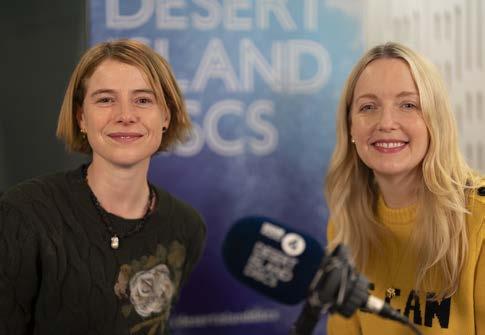
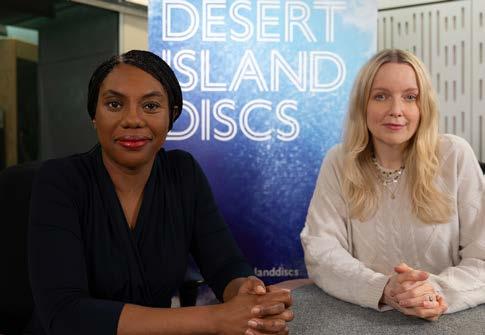
period in Laverne’s life, having just lost both of her parents in quick succession, balancing work and childcare as she aided them through their end-of-life care. Being diagnosed during this time was “really, really di!cult” – but also rewired her mindset.
“I was more certain than ever about how I wanted to approach work, but also just life, really. I want to make programmes that feel constructive and like they add something good to the world,” Laverne says.
That spirit of openness surfaced when Sir Gareth Southgate appeared as a castaway in December 2024. Southgate had also had a whirlwind year, resigning from his long stint as England manager earlier that summer.
“Gareth was like, ‘fucking hell, are you all right?’, and I was like, ‘yeah, I’m all right. Are you all right?’,” she recalls. “It was actually quite nice, because we both just had that moment of acknowledgement. We both knew we’d been through the mill, and it was going to be okay. And I think we had a be er conversation because of it.”
Authenticity seems to be what Laverne is describing, and what she herself has in spades. “I think that’s it,” she explains. “If you bare all to some extent, I think you get more of a human response back.” ●
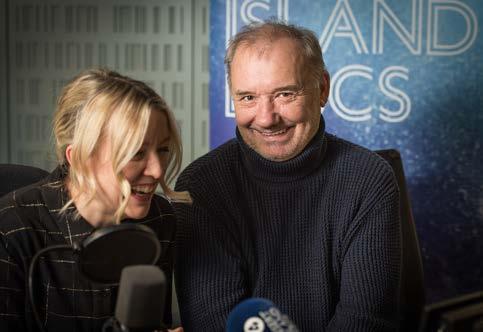
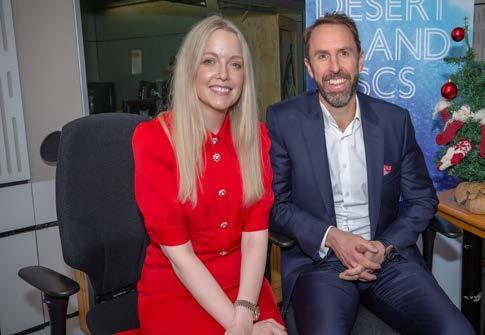
’sDesert
What are your three desert island discs?
‘Here Comes the Sun’ by The Beatles, ‘Now Westlin Winds’ by Dick Gaughan and ‘On My Own’ by Ulrich Schnauss – that was me and my husband’s tune from back in the day.
Luxury item?
I would take the V&A. The whole museum.
Favourite interviewees?
Ian Wright is up there as one of those conversations you never forget. Cillian Murphy was really lovely because he’s very private, and to show what a lovely person he is was really wonderful. I just did one with Jessie Buckley. I could talk to her all day.
Favourite castaway ever?
Kenneth Williams. He took his own life not long a er. It ends with him talking about Voltaire’s Candide: Optimism, and how we must cultivate our garden to have a meaningful life. To have it as an epitaph for him is quite special.
Accept the job:
You accept the job and take to LinkedIn to announce your new role at celebration reaction here)

STARTER
Baked goat’s cheese served over mixed greens with nuts, drizzled with honey. I never regret ordering a goat’s cheese starter.
MAIN
My husband’s spicy spaghe!i bolognese, just in case he’s not coming with me. It’s perfect. Before I was in my 20s, I wasn’t exposed to anything cooked with chillies. When I eventually got into it, I couldn’t get enough!
DESSERT
Am I allowed to go back to the 1980s? If so, I’m ordering M&S’s peanut bu!er chocolate dessert. It had layers of di erent chocolate and peanut bu!er. This was before salted caramel caught on. My mother would serve it as a special treat – it takes me back to my childhood.

STARTER
When I was in my early 20s, I had a spicy seafood soup served in a coconut in Thailand. It was the most delicious thing I’ve ever put in my mouth.
MAIN
I do love a baked potato. Preferably with tuna and sweetcorn –if I’m feeling crazy, I’ll throw in a caper or olive.
DESSERT
Crème brûlée all the way. Just the best.

STARTER
I imagine I’m on a beach of some sort, so I’ll probably have some with hot pepper sauce. Reminds me of what I would eat in my youth in Freetown and on the sands of Tokeh, where I would spend my weekends.
MAIN
Easy. Medium rare steak with Béarnaise sauce or fried chicken wings. You know what? At this point, I’ll have both. I’m er all. Carnivorous talons serve a protective and survival mujadara, which is my favourite dish in the entire world. It’s Levantine – lentils en add walnuts because I’m wild like that.
DESSERT
I don’t have much of a sweet tooth. There must be some sort of fruit on this island. Perhaps some melon? Figs? Coconut? ers are a er lunch treat, so tradition has become habit.
MAIN

ny things. Too delicious.
Sunday roast, de nitely. I don’t have meat, I’m veggie, so it’s all trimmings. A really good Yorkshire pudding. That, for me, is the most important element.
DESSERT
There are so many things I can’t eat now, post-cancer treatment – I’m allergic to all kinds of things. But in my fantasy, I can eat anything, so: sticky to ee pudding. With custard and ice cream and cream.

Isabelle Blakeney and Miranda Crawford ask journalists for their favourite three-course meals

STARTER
Golgappas and aloo chaat from a food stall near my old o ce in Delhi, where I worked as a reporter for a business paper in the early 2010s.
MAIN
I’d have the white lasagne from Quality Wines in Farringdon. Because... it’s just incredibly delicious.
DESSERT
I don’t have a sweet tooth, so I usually drink wine instead of eat dessert. Sometimes, I like to drink very dry sherry a er a meal – even though that’s backwards if you are a traditionalist.
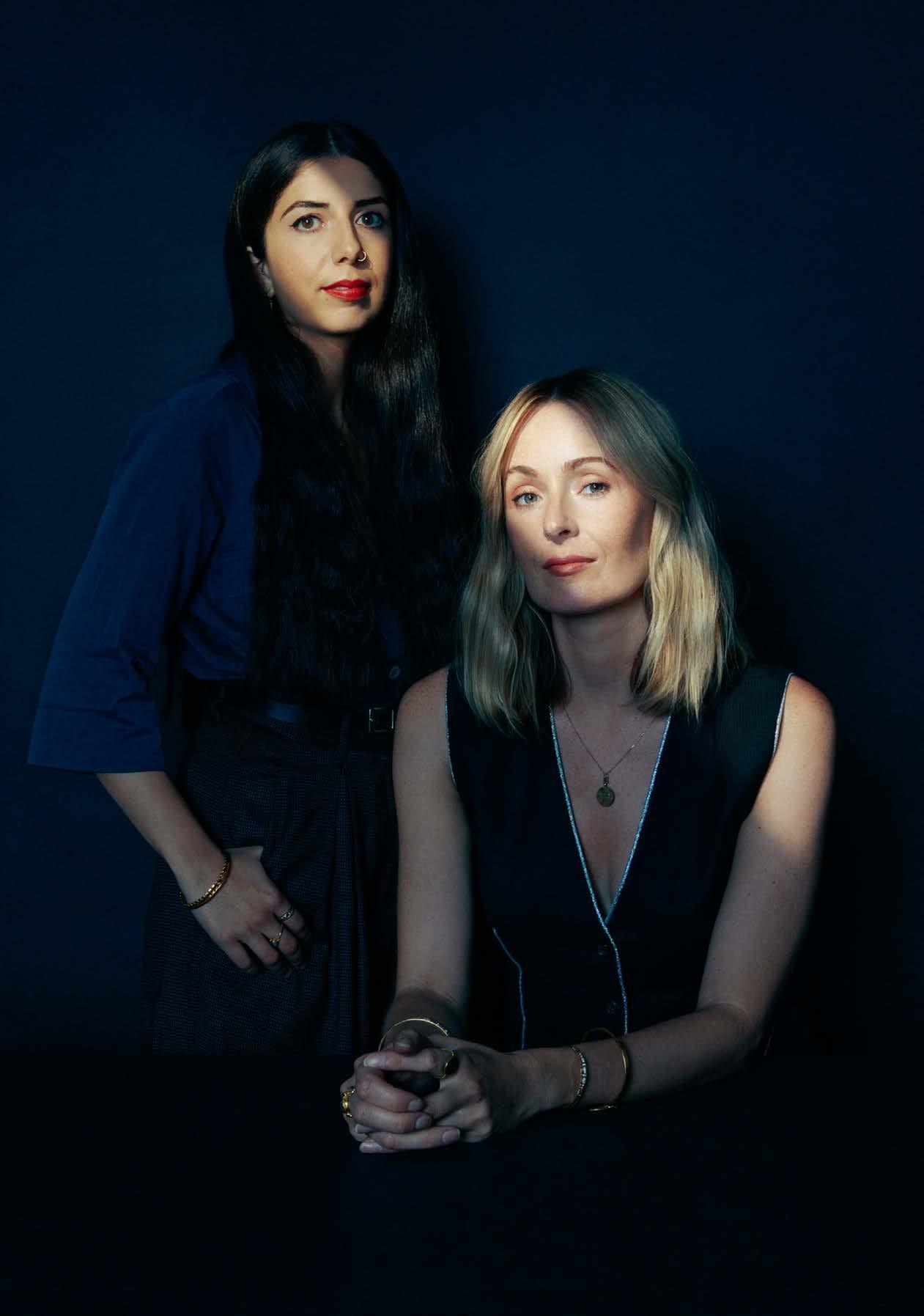
From court ba les to SLAPPs, the lawfare waged at journalists has never been more relentless. Julia Bo oms speaks to the unlucky targets
When Guardian journalists Sirin Kale and Lucy Osborne walked out of the Royal Courts of Justice for the nal time last spring, leaving behind the austere halls of Court 13, the relief was indescribable. It had been six punishing weeks on trial for the libel claim brought against them by actor and lmmaker Noel Clarke for their investigation into allegations of sexual misconduct, for which he was seeking £70 million in damages.
Neither had met Clarke before the trial. “Initially, it was odd seeing him, but when you’re in court every day for weeks, it becomes strangely normal,” says Osborne. Clarke claimed that he had been the victim of an unlawful conspiracy, and that some of his accusers were lying, at least in part. The courtroom was tiny, both sides sat on the same benches most days, only metres apart, listening and watching as the procession of witnesses passed through, week a er week.
The journey up to the trial itself cast a long shadow over the two writers for the three years since Clarke sued in 2022. “I found out we were being sued when I was still in hospital a er the birth of my son,” continues Osborne. Both journalists worked on litigation throughout their maternity leaves, and it had been impossible to switch o from the trial. “Lucy and I were unable to work on many other projects that we wanted to take on during that time, for years, due to the obligations of the trial,” adds Kale. “It had an immense personal and professional toll.”
But at the tail end of summer 2025, their verdict nally came: they won on the grounds of both truth and public interest. In the new year, the pair would be named Women of the Year at the Women in Journalism awards. And, exactly two weeks a er that, Clarke would be arrested on suspicion of a empted rape, exposure and sexual assault by touching.
Yet, even for journalists who win cases with watertight defences, the experience of being sued can be deeply traumatising. In UK libel law, the burden of proof is heavily weighted against the defendant. “Journalists are routinely bullied, threatened or sued, just for reporting what is true and in the public interest,” says Kale.
“I had to cash in my pension just to keep standing and pay the lawyers”
Regardless of the outcome, our legal system is designed to punish the journalists who nd themselves dragged through it. Weaponised by the deep-pocketed and thinskinned as a form of reputation management, the system has long silenced journalists even before cases reach the courtroom. Gill Phillips, former legal advisor to The Guardian, says ‘Strategic Lawsuits Against Public Participation’ (SLAPPs) – intimidating legal threats that have li le-to-no substance but are intended to nancially and psychologically exhaust its target – pose a growing danger to media freedom in the UK.
Phillips also worked alongside Osborne and Kale on preparing their defences before publication and trial and describes how the pair were “brilliant”, “resolute” and “solid” throughout gruelling cross-examination. “I was the subject of what I felt to be unacceptably personal questioning from Mr Clarke’s lawyers,” says Kale. “It felt that they had been instructed by Mr Clarke to make my questioning as aggressive and unpleasantly personal as possible. There were a acks on my personal character and integrity.”
“Sirin had it worse than me in terms of the more personal questions,” adds Osborne. “It was hard to watch her have to go through that.” Yet Osborne herself was questioned over three days, longer than any of the other witnesses. “I was asked why I didn’t question the credibility of one source due to the shortness of her skirt or the fact she’d been drinking alcohol,” she recalls. Before publication, the pair had forensically corroborated claims with a source’s family and friends; by the time the last article was published, The Guardian had spoken to over 100 sources.
“Being cross-examined was extremely nerve-racking but, a er four years of having our journalism questioned, to nally be able to get up there and defend was also a relief,”
says Osborne. For both, the experience had anything but a chilling e ect. “If anything, the experience of being sued has made me more ambitious than before,” Kale adds.
The pair’s hard-won triumph was not only a victory for the women who stood in court, but for investigative journalism in the UK. In most cases, the majority of libel threats in the UK and increasingly in the US, are se led with payouts or retractions as many organisations do not have the resources or appetite to ght o vexatious threats. The number of claims actually issued are just “the tip of the iceberg”, according to Phillips, with the threat itself constituting a silent form of censorship. Journalists may nd it easier to simply avoid certain topics or characters likely to get them in trouble. →
“SLAPPs are not just about the nationals, it’s about smaller journalists, freelancers and campaigners,” Phillips continues. For freelancer and activist Clare Rewcastle Brown, receiving threats has been a routine part of the job for years. In 2015, she uncovered the 1Malaysia Development Berhad (1MDB) scandal, a sprawling money-laundering scheme that saw billions siphoned from state funds into the pockets of powerful individuals. Rewcastle Brown’s reporting on the a air, widely described as one of the largest nancial scandals in modern history, was seen as contributing to the ruling coalition’s unprecedented defeat in the country’s 2018 general election.
In total, Rewcastle Brown says she has received “about two dozen” individual libel threats throughout her career, many originating from London law rms representing overseas clients linked to 1MDB, levelling accusations ranging from defamation to copyright breach to privacy infringement. In 2017, Rewcastle Brown found herself in the London libel courts, defending herself against a claim brought by Hadi Awang of the Malaysian Islamic Party.
From ling the case to gathering information and reviewing material with lawyers, every stage was draining. “I had to cash in my pension just to keep standing and pay the lawyers,” she adds. “It destroyed me nancially to just stand my ground.” Still, she refused to capitulate, fearing that her opponents might weaponise the litigation to their advantage in the looming election. “I was damned if I was going to give in,” she recalls. “I wasn’t going to let them do that to an entire country. If I gave in, I would let down a nation of people who deserve be er.”
The case never got to a judgment, but the plainti s ultimately caved and reached a se lement. The total costs of the case was estimated to have been £3m, but the ordeal came at a deeply personal cost for Rewcastle Brown. “For a period of two years, my family and I had to look at the extreme likelihood that we would lose the roof over our heads,” she continues. “It was so stressful, the pressure of the cost.”
Rewcastle Brown says she was also covertly targeted by rms working in tandem with PR out ts, private investigators and hackers to coordinate
“If you don’t get a letter from Carter-Ruck or Schillings, then you’re not doing your job properly”
complex smear campaigns against her. “There was a whole web of deception to get inside my computer, to intimidate me, to follow me around, to threaten me,” she says. “They’d go behind my back, writing to newsrooms to defame me, saying I was a mad woman, that I was being paid by the Malaysian opposition, that I was forging the material.”
“I found myself being approached through people I knew. They were ge ing at me through people I felt I could trust.” She recalls one situation in which someone entered her home and claimed they’d protect her computer but instead downloaded its contents. Ironically, she became the target of the defamation she was herself accused of. PR rm Bell Po inger went as far as creating a Wikipedia page with falsehoods about her life, which she eventually managed to get corrected. There is no suggestion that those people who had their Wikipedia entries altered by Bell Po inger knew about the
changes.
“This kind of bullying, in most cases, is going to work, and journalists are going to be intimidated and silenced,” says Rewcastle Brown, who is so -spoken but becomes more animated as she continues. “It’s deterring big newsrooms because they can’t sustain these costs either, and they’re not covering the stories they should.” She had initially taken 1MDB to a national UK paper who had agreed to run the story. But a er receiving their right of reply responses from “a handful of billionaires”, the piece was massively scaled down. “Do not underestimate the in uence of the legal lobby. They run our world,” she continues. “By far the biggest clients in the world now are a handful of rich people.” Particularly deep-pocketed claimants have also been known to participate in ‘forum shopping’, the practice of plainti s choosing a speci c court or jurisdiction likely to

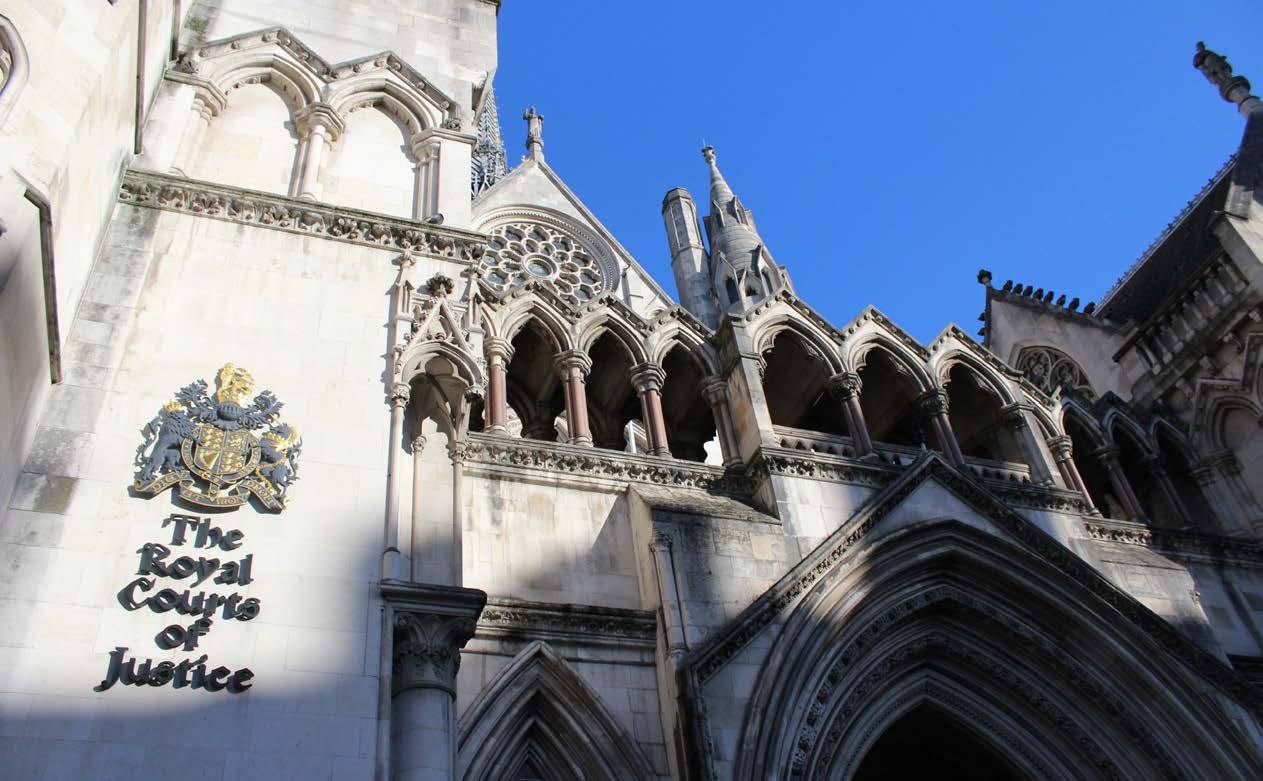
be favourable towards their case. Freelance journalist John Sweeney, who has previously worked for The Observer, and BBC’s Panorama and Newsnight, was sued for civil and criminal defamation by the Barclay brothers, billionaire owners of the The Daily Telegraph, in 1996 a er Sweeney landed on one of the Channel Islands owned by the brothers, and made comments on BBC Radio Guernsey about the twins’ links to The National Enquirer

The claimants chose the French courts on the basis that a small number of people living in France could listen to Radio Guernsey. “I had a sense that the prosecution and the judge were shocked by this abuse and that’s why I was found not guilty,” says Sweeney. However, when the twins appealed, Sweeney lost the case and had to issue an apology or face litigation alone and risk losing his job. “I was a father with two young kids and I was married at the time. I remember thinking, ‘I cannot do this to my family’.”
Sweeney acknowledges that, on air, he had misspoken and got a detail incorrect, but maintains the thrust of what he was saying was factually true. “The Barclay twins used their money to shut me up,” he says. “My free speech, my right as a journalist to give these newspaper owners
proper scrutiny, was thwarted by their money.”
Sweeney describes himself as “old-school Fleet Street”. “If you don’t get a le er from CarterRuck or Schillings, then you’re not doing your job properly,” he chuckles. Like Rewcastle Brown, Sweeney rst started receiving a slew of threatening le ers, in his case while working on a documentary on Scientology for Panorama. “The le ers came on a trolley. There were three big, heavy boxes of legal threats and Roger Law, our in-house BBC lawyer, had to read every word. He didn’t sleep for a whole night,” he recalls. “The test of a good reporter is ‘how well does the in-house lawyer know you?’”
“I do believe that proper journalistic scrutiny of power and money is one of the things that make our country great. We’ve got to defend that,” Sweeney adds. Unlike some US or Canadian laws, the UK currently does not have any comprehensive, standalone antiSLAPP statues. In 2023, the Economic Crime and Corporate Transparency Act introduced the rst statutory provisions as part of wider changes to Civil Procedure Rules. However, Phillips says the law narrowly applies to economic crime and has subjective elements about the claimant’s intention, which is “almost impossible” to prove. It’s unclear how courts
will interpret these currently untested powers, speci cally how the de nition of the SLAPP itself is interpreted.
“There’s quite a lot of momentum around having a standalone law,” Phillips continues. “I think the Labour Party has given some indications that they’re interested in discussing it.” A model law dra ed by the anti-SLAPP coalition, an alliance of campaigners and media groups, proposes a lter mechanism that empowers courts to dispose of SLAPPs, as well as outlining penalties and protective measures.
A speci c and universal antiSLAPP directive would grant powers to throw out baseless legal claims and provide an e ective deterrent to abusers of the law. The current law not only undermines the public interest but actively enriches a legal system corrosive to democracy. “We live in a country with very challenging libel laws for journalists,” continues Kale. “Journalists are people. I think the public should be aware of the challenges we face in trying to hold powerful people accountable.” ●
12:45 AM

With 75 per cent of young people ge!ing their news from social media, Mia Raja speaks to the faces behind three of the biggest meme accounts in Britain
It’s unlikely most in uential journalists in history began their news careers by publishing Peppa Pig clips.
But with July 2025 research nding that 75 per cent of 16 to 24-year-olds got their news from social media, a shi is clearly happening.
Posting funny videos or images, known as memes, these popular accounts are expanding beyond humour to include commentary on current events, political issues and crime reports, transforming internet humour into a source of income and, in the process, reshaping how younger generations consume their news.
But who are the people behind these accounts and do they have a plan?
@Balplanet, a social media account which posts memes on music, news and culture, was founded eight years ago by west-Londoner Adnan Rajpoot.
The 24-year-old started the account when he was 16, and now boasts over 303k followers on Instagram.
Reporting on news was not his initial intention. “I was just posting funny things,” he laughs. “I never thought it would be this big. I just thought, I’m bored. I’ve got nothing else to do.”
Rajpoot initially posted rap parodies and is most well known for his comic voiceovers to Peppa Pig clips.
However, when lockdown hit in 2020 and fewer social interactions were caught on video, Rajpoot was receiving less meme-worthy content to repost. To keep the account alive, he decided to broaden the style he published, branching out to news.
His younger fans remained loyal, despite the pivot. They now turn to his account for trusted news – and he understands exactly why.
“[I post] things that are a age groups between 17 and 26,” he says. “They come to trust my page because they think it’s reliable now, up to date, and o sometimes quicker than traditional media.”
But, beyond that, accounts like Rajpoot’s win the support of young people over major news outlets because of their accessibility.
“My content is easier to digest for them so rather than all that long-form reporting, I’m just talking to them like they’re my friend.”
While undeniably successful, journalists might question the reliability of these self-proclaimed
news accounts. Rajpoot insists his news comes straight from reliable sources.
“I source my news from a mix of reputable outlets, o cial statements, or on the ground reports of things that are happening. I post news that someone has posted before and within the rst ve minutes, I repost it in my own words.
“I cross check information across multiple di erent sources and if it is something that’s still developing now, I make sure that that’s clear.”
“You’re always going to be a bad guy to someone”
Unlike most outlets, Rajpoot doesn’t have a team of trained journalists to rely on, let alone one trained journalist.
“I run this by myself,” he says. “No one else is logged into the account. I’ve got friends around me


but I don’t see them as colleagues.”
Navigating this world of journalism without prior training is something Rajpoot has had to “learn along the way”. But he knows things are changing.
“Pages like mine change how people consume news now,” he says. “We sit between traditional journalism and real time digital reporting.”
Some of these news meme pages take a completely di erent approach. @Voiceboxy has over 58k followers and advertises its posts as ‘parody’. The account regularly posts ctional headlines featuring prominent gures in the press such as ‘Fortnite has announced collaboration with Je rey Epstein’ and ‘Breaking: Lionel Messi posts retirement video’.
Luka Kuzmanic, the 17-year-old behind the successful account, is based in Croatia yet engages a mostly UK and US based audience.
“I was 13 when I started,” he explains. “I realised my friends spent so much time on their phones and I just thought, ‘how can I turn this into something meaningful?’”.
But with false headlines popping up on social media users’ feeds between legitimate news posts it can be di cult to di erentiate the truth from a ‘parody’ post.
“I write ‘parody’ in my bio so Instagram doesn’t take my stuff down”
“I think it’s obviously all satire,” Kuzmanic says. “But I write ‘parody’ in my bio so Instagram doesn’t take my stu down.”
Elsewhere, with around three times the number of followers as @Balplanet and een times more than @Voiceboxy, @TheShadeBorough is a media platform with 941k followers covering celebrity news, viral moments and culture, through a Black British lens.
Like Rajpoot, Helena Okunzuwa, co-founder of The Shade Borough, understands her audience.
“We want to be part of something. We want to be part of a community,” she explains. “People wonder, ‘What are other people thinking?’ and look at the comment section”.
“When we rst started, it was more from an entertainment lens, but then our followers – we call them our residents – used to send us news in DMs because they wanted to give their opinion.”
It was this which shi ed Okunzuwa’s concept of what The Shade Borough could be.
“I’m just talking to them like they’re my friend”
“We thought, ‘you know what? Our audience wants more from us.’ They don’t just want entertainment. They want to know about, for example, what Keir Starmer’s done but they don’t want to sit down and watch the Prime Minister’s Questions. They just want to know how something will a ect them.”
Okunzuwa admits that verifying news within a smaller team is inevitably di cult.
“We know that our audience value speed, but we don’t want to be pu ing out just anything. We wear multiple hats. Generally, when it comes to news, we highly rely on traditional media outlets.”
The Shade Borough has previously been accused of presenting one-sided narratives.
Okunzuwa explains the frustrations of this when new followers, or residents, discover her page: “The new audience that comes to the platform only tends to see the controversial stu because it’s the controversial stu that makes the loudest noise.”
She hesitates: “This is one of my rst interviews because we’re trying to take back that narrative.”
But Okunzuwa defends The Shade Borough and what they do, explaining that they’re not instigators of con!ict but rather re!ections of conversations that the public or their followers are already having.
“If anything’s trending, no ma er how controversial it is, we’re not creating that chaos, it is what’s already happening,” she says. “We give it context and a space to unfold, le ing people share their feelings about that no ma er what those feelings are.”
Okunzuwa thinks these types of controversies are unnecessarily blown out of proportion.
“You’re always going to be a bad guy to someone,” she admits. “So if you’re reporting on news that’s not positive, you’re a bad guy to the person you’re reporting on, right? But that’s just the reality of the story.”
“You’re not breaking people’s phones, you’re not hammering people’s houses, you’re not crossing any lines, that’s just the story.” ●
Glass of white wine: Ah! Pinot on tap it is. You are the epitome of class. You !oat around the room with an air of sophistication and begin your elegant hellos and how is (partner/wife/husband) to other journalists with ease. You chat to one of your favourite journalists and they ask what your current job is. What do you say?
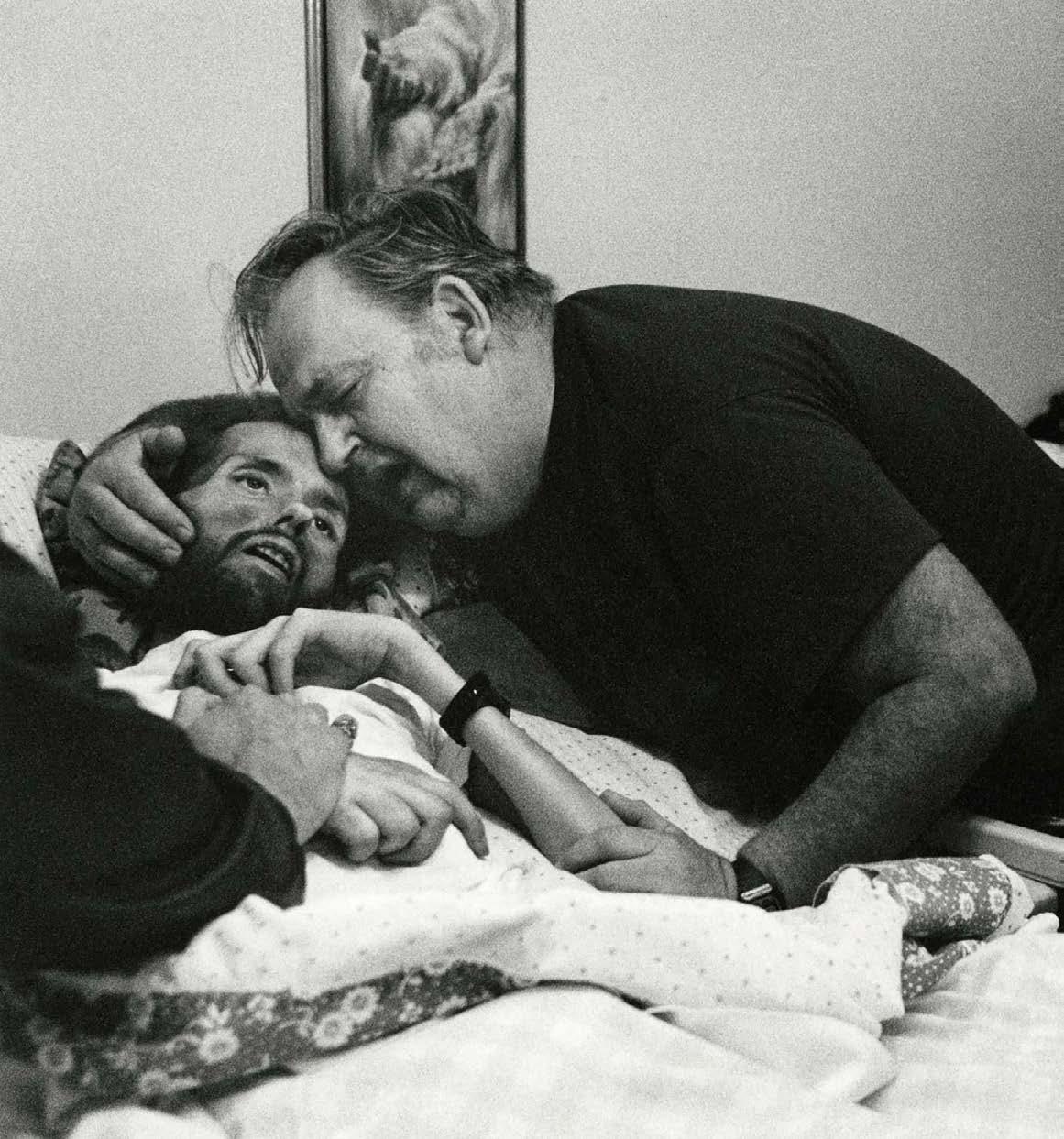
“I WANTED TO SHOW LOVE STILL EXISTED”
A condition steeped in prejudice and stigna, HIV has proven a particularly di cult subject for photojournalists. As Donald Trump’s axing of UNAIDS funding threatens to undo decades of progress, Jude Jones and Lily-Rose Morris-Zumin spoke to photojournalists about the images that have de ned the crisis
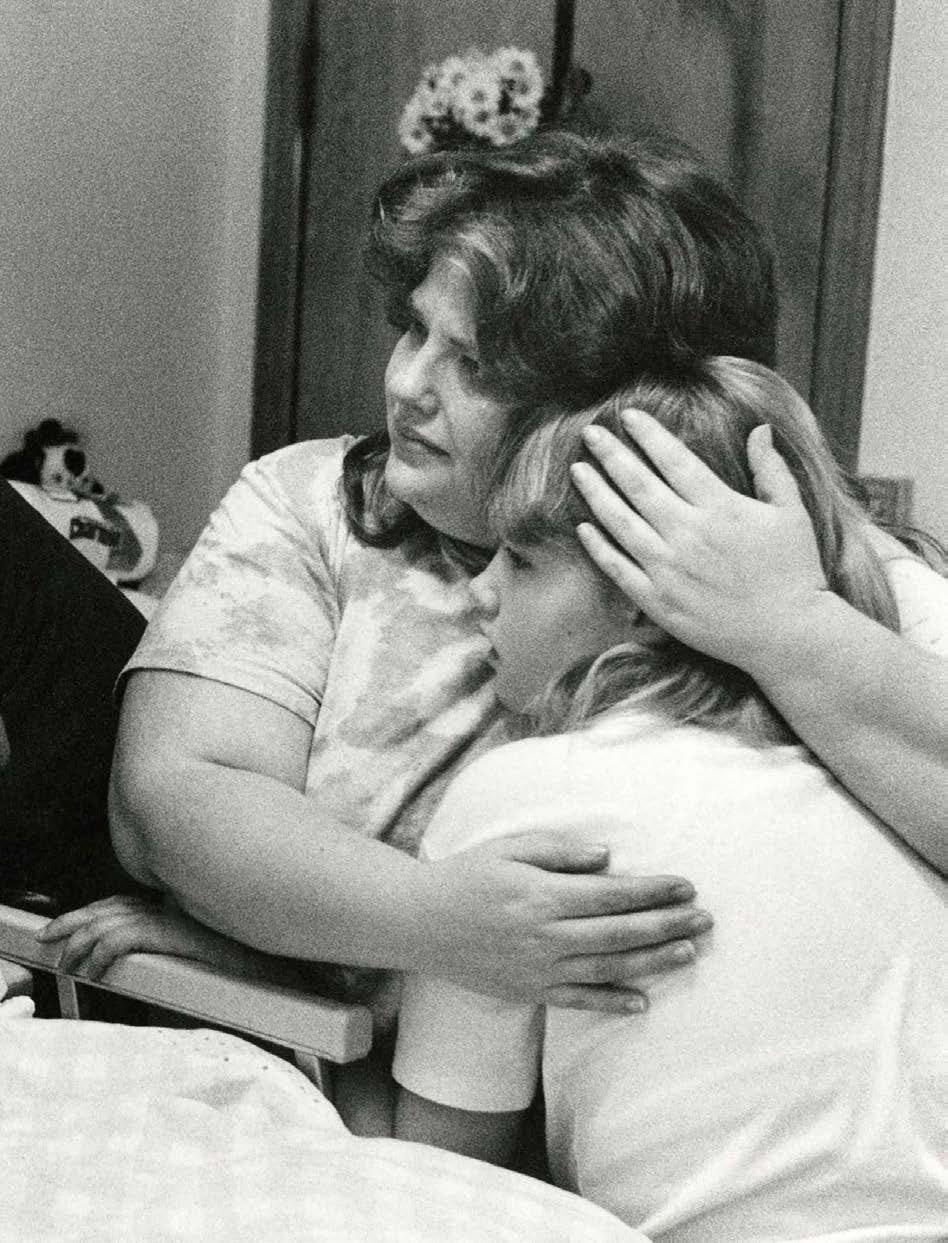
“I told the beautiful souls I photographed during that horrific pandemic that I would keep telling their stories for as long as I could”
– Billy Howard
“I was a racted to AIDS as a photographic subject and began volunteering at the Pater Noster House, an AIDS hospice in Columbus. I was at the hospice when HIV activist David Kirby was dying, his family already knew me and invited me in to photograph them saying their nal goodbyes.”
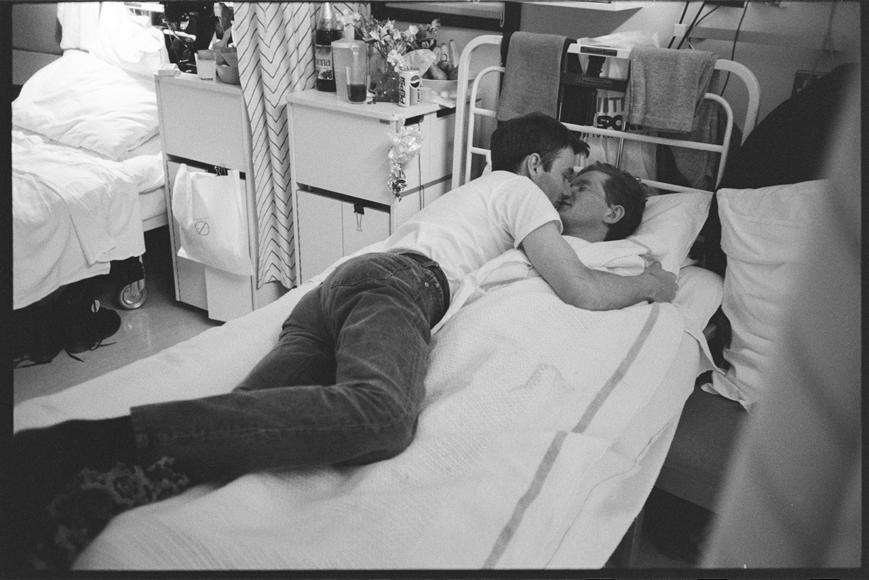
“Broderip Ward at Middlesex Hospital was the rst dedicated ward for people a ected by HIV in the UK, opened by Princess Diana in 1987. Six years later, I was given the opportunity to photograph life on the ward, although a lot of people were scared of the camera. This image shows John, who had been diagnosed with HIV, and his partner, Michael, sharing a tender kiss at a time when people were still scared of touching people with HIV. I wanted to show the compassion and that, even and especially here, love still existed.”
“Doug was one of the people who wanted to remain anonymous due to the stigma at the time, he covered his face in his image. But now, he’s out and proud of his survivorship. He is the only person su ering from HIV/AIDS in the book to survive. We have stayed in touch on and o for almost 40 years, since I photographed him in 1987. He’s a talisman for me, to all the people that have been lost.”
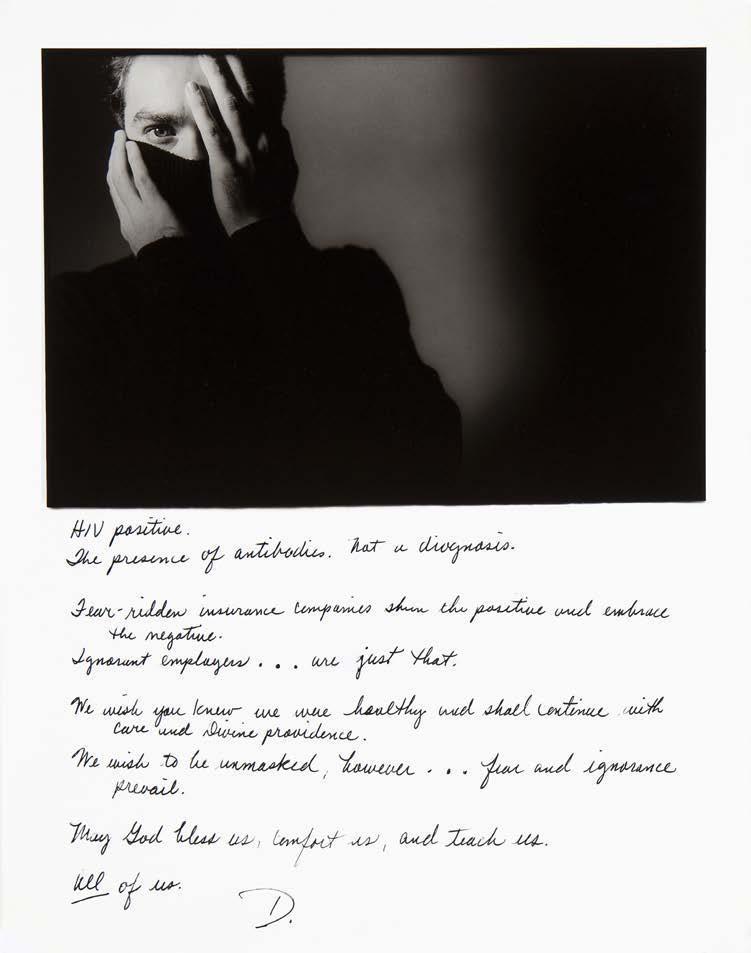
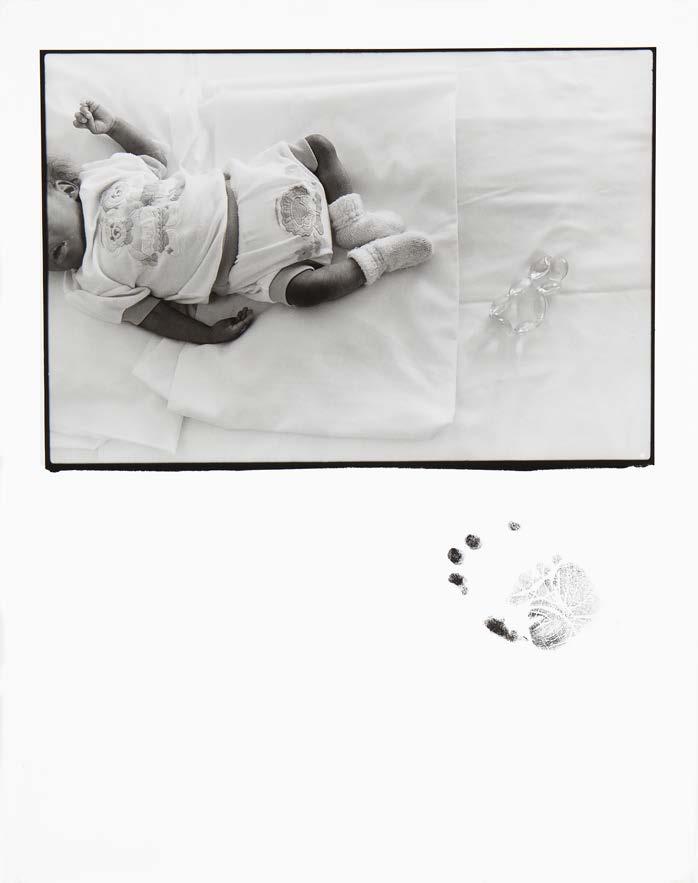
Gideon Mendel
“I started covering HIV in Africa in the early nineties, when three quarters of the 36 million people living with HIV were in the continent. Slowly, antiretroviral treatments were becoming available, but not the global South. In June 1997 I was in Mwanza, Tanzania and noticed a mother, Dorika, carrying her 30-yearold son, Joseph, who had been living with HIV for 10 years. Every day, she would carry him outside to enjoy the sun from a shady spot and talk with his friends. I was struck by the motherly compassion. The image looked like a pietà, an image of the Virgin Mary holding the dead Christ.”
Billy Howard
“The baby is “Baby T,” she was born in a public hospital. Her parents were drug addicts and abandoned her. The doctor got an ink pad and we placed her foot print under her photograph. She is the only child I photographed so I made her anonymous. I wanted her to represent all the a ected children, and frankly, I don’t think I would have survived photographing more than one. I asked the doctor what she needed and he said she needed a walk in the park. She died two weeks a er I photographed her.”
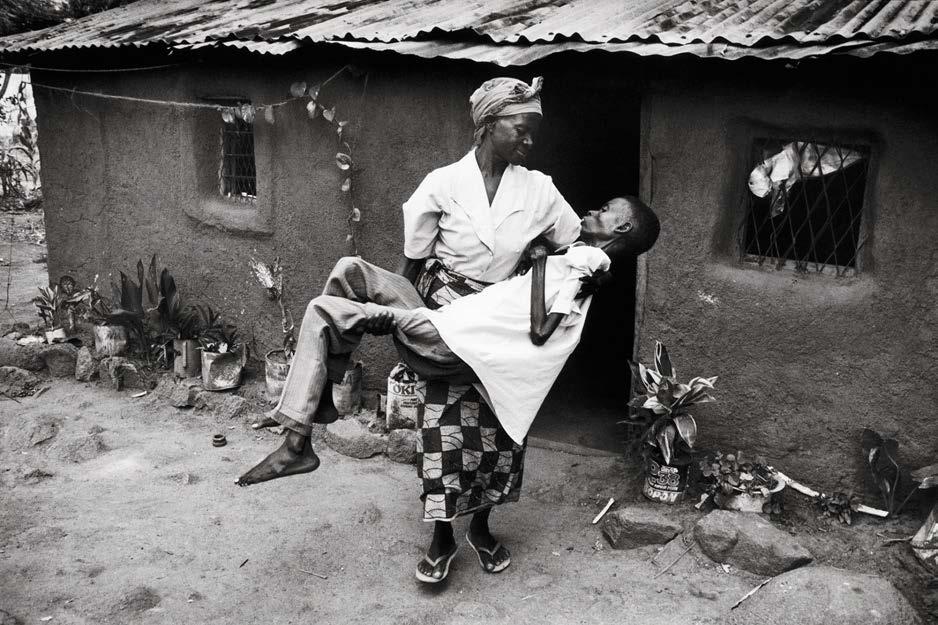
Identify the AI-generated headline in each section below:

MP mistook charity rowers as possible ‘illegal migrants'
House of Commons forced into lockdown a!er MP brings AI-generated evidence to migration debate
Sta$ 'banana-proof' areas for Swedish minister's phobia

Awkward moment Kim Kardashian’s daughter North West asks followers for money on Instagram.
Kim Kardashian speaks out on removing Meghan Markle, Prince Harry photos from Kris Jenner’s party

Rabbit escapes home, returns later with di$erent family
Kim Kardashian reveals North West ‘refused’ to a end event over out%t row

In uencer postpones daughter’s birthday – because it’s too close to Christmas
Rare ‘tooth-in-eye’ surgery restores man’s vision a!er two decades
Eating cheese at night makes you 34% more aerodynamic
0-2
Bot Bait: Media literacy might not be your strong suit – perhaps best to check with someone else!
Choose Your Own Adventure
Dog accidentally shoots owner a!er ge ing paw stuck in trigger guard, Memphis police say
Valentine’s Day: My cat Romeo takes ‘Viagra’

OpenAI’s new model quietly billed user $47,000 a!er misinterpreting ‘do whatever it takes’ as %nancial advice
Infrared contact lenses allow people to see in the dark, even with their eyes closed
Two AI chatbots speaking to each other in their own special language is the last thing we need
Bot Nuisance: You can likely suspect when an Instagram Reel is AI, but you still check the comments for con%rmation.
Bot Assassin: You’re proof that Arti%cial Intelligence has nothing on Human Intelligence.
Lie! Tell them you are already successful. You can’t bring yourself to admit that you keep refreshing LinkedIn. You blurt out that you are currently working on the culture desk at The Times. They are the Assistant Culture Editor at The Times and say they have never seen you before. Go back to the start.
She’s Hugh Jackman’s favourite interviewer and has Britain’s best laugh. Alison Hammond reveals all to Phoebe Pascoe

Alison Hammond knows how this interview will end. In fact, she knows how every interview will end. Before Hammond, 51, was a host on This Morning or co-presenting The Great British Bake O , she was a child actor.
Now, she treats every interview as a threeact play with a beginning, middle and end. “If they throw to me and I’ve got two minutes live on air,” she says, “Then I know I want people to go on a journey, and this is the journey I’m going to take.”
In 2002, Hammond entered the Big Brother house. Twenty-six years old and in £3,000 of debt, the show o ered a tidy £70,000 in prize money.
Hugh Jackman once told her that she was his favourite journalist to be interviewed by. If Hammond is making her guests laugh, then she is laughing too: a brilliant, foghorn cackle. But even if she’s commanding the interview, she’s not always in control of its reception. “There are things that have gone viral and I wasn’t happy with it.” Like when she fell o a bench during which she has presented alongside Noel Fielding since 2023. “It was so unladylike,” she says, “but people loved it.” The fall was an accident, Hammond reiterates, but that was part of what made it so popular. “I was morti ed. I would have preferred that it didn’t come out,” she says. “That’s where you have to separate the world of what people like and your own ego.” She does still hate it when she cries on screen, though. “I think I’m an ugly crier. So whenever I cry, I ask them ‘Don’t put that in.’”
“I think I’m an ugly crier. So whenever I cry, I ask them ‘Don’t put that in’”
She was only on Big Brother for 15 days, but quickly secured a job a erwards as This Morning’s showbiz reporter. Hammond immediately gained a reputation for ge ing celebrity interviewees to crack – not with emotion, but with laughter. This was, in part, thanks to her boldness: whether catching actors o -guard with audacious jokes or unexpected physical gags.
“I genuinely am a li le bit klutzy, that is just me,” she says. But her ability to be reliably, riotously funny – and bring out the same in her interviewees – isn’t down to clumsiness. Anyone can fall over. It’s how she responds to it. “When I used to do interviews with people, I could see that they were bored,” she says. “I could see that they wanted a li le bit of a pick me up, so I would provide that.”

As host of Bake O , Hammond sees herself as a counsellor of sorts for the bakers. “Yes, we’re there to make a television show, but also I’m there to take care of them.” Hammond has participated as a contestant on the celebrity iteration of the show. “I know what it feels like to be in that position, where you’re baking under stress with Paul and Prue [Hollywood and Leith, respectively] there.” But, she says, the pressure is obviously higher for the rest of the bakers: “It’s something that these people have wanted their whole life – to get on the show, rst of all, and then to prove themselves as bakers.”
The role of caretaker is one she ful onscreen and o . “I think, of course, life experiences give you that compassion to understand what other people are going through.” In 2020, Hammond’s mother, who she was incredibly close with, passed away. Her father died a few months later. “It’s not necessarily a great thing for you to be an empath because it’s stressful. I genuinely take on other people’s stresses and other people’s pain,” she says. When she le the hospital the morning that her mother died, Hammond was approached by a fan asking for a sel e. It was 6am on what was perhaps the hardest day of her life, but she took the photo. This willingness to connect with others is also what makes Hammond so funny, and such a brilliant presenter. She turns what might be merely humorous moments into iconic ones, as with her interview with Ryan Gosling and Harrison Ford, in which neither could stop laughing, or when she was nearly arrested by Italian police live on air. On screen, these moments are comic relief. But in life, her ability to pivot without ge she’s kept going. In 2007, when her son was still a toddler, she found herself without enough work to


pay her mortgage, and picked up shi s at a local hairdressers. She has been on a slew of reality I’m a Celebrity…Get Me Out of Here, Celebrity Fit Club, Celebrity Strictly Come Dancing and Celebs Go . Yet her essence never seems to change. “I just realised people like authenticity. They can tell straight away when you’re trying to be something
Many reality TV contestants explicitly dream of the kind of work and longevity that Hammond has had. But does she think reality television can prepare you for life as a journalist? “Absolutely not. It doesn’t prepare you,” she says. “I think what prepares you is working. It’s not until you’re on the job that you realise, ‘Oh my God, this isn’t as easy as you think’.” Even her own son, Aidan, thought she was “stealing a living”. Then, he joined her on a shoot and worked 17 days in a row. “A erwards, he had a new respect for what I do, and he said: ‘Mum, what you do is incredible. Fair play.’”
Gaining that respect can prove di cult when part of your success stems from appearing ortless. As Hammond has taken on more demanding broadcasting roles, she has been scrutinised by the public, despite how widely she is beloved. In 2021, she began presenting Friday episodes of This with Dermot O’Leary. The pair took over from Eamonn Holmes and Ruth Langsford, who had been hosting the show on a Friday for 15 years. “That was quite challenging because people didn’t want them to go,” she says. “It was also quite challenging taking over from Paul O’Grady,” as she did in 2024 on For the Love of Dogs, er the presenter passed away. Her own experience lling big shoes is something her newest Bake O colleague, Nigella Lawson, will also have to tackle when she replaces Prue Leith as a judge on the next season. “I’m so sad that Prue’s gone, but you know what? It’s a new beginning.”
For Hammond, a challenge isn’t a reason to say no. “If I feel passionate about it, I’m going to do it. So if other people don’t like it, it’s not their life, is
Compassion underscores all of Hammond’s work, but that’s not an excuse to underestimate her. “People just think I’m messing around having a laugh. Yes, I do have a laugh, don’t get me wrong, ” she says. “But I’ve also researched everything. If this messes up or if the camera stops working or a presenter for some reason has to disappear, I’m on it. I’m going to be able to carry on.”
And I believe her. Because when the interview ends, I am smiling, just as she knew I would be. ●
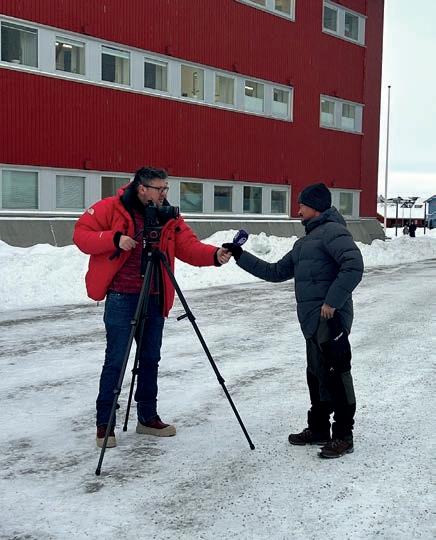
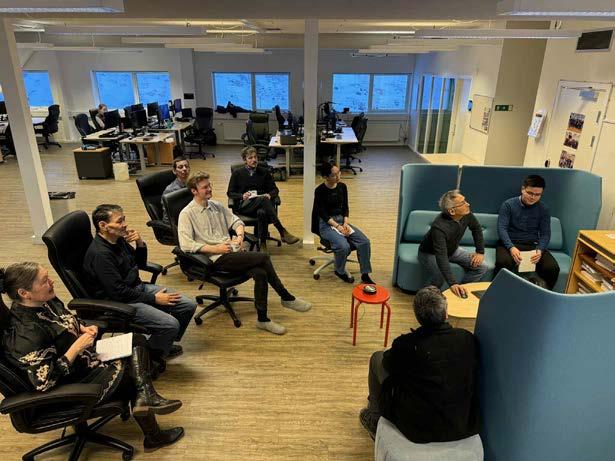
Two journalists from KNR, Greenland’s primary news organisation, speak with Robert Flynn and Maya Dennis about Trump, misinformation and sta shortages
In a country like Greenland, an island with a population of less than 60,000 people, day-to-day news o en focuses on local events and cultural gatherings. With an estimated 35 to 40 professional journalists working on the Nordic island in 2017, the latest available data, ge ing these charming stories out daily is normally manageable. However, when US President Donald Trump o handedly mentioned using military force to acquire their country, what was expected of these journalists changed overnight.
“We have been covering a lot of America’s relationship to Greenland recently, there are debates and interviews arranged every week on the topic,” says Andrea Christiansen, the editor of two radio programmes at Kalaallit Nunaata Radioa (KNR), Greenland’s national broadcasting organisation. She has been a journalist at KNR, reporting from Greenland’s capital of Nuuk, for almost a decade.
One of KNR’s leading directives is reporting on all news in Kalaallisut, the native Greenlandic language, before occasionally reporting in Danish. This directive has been integral in informing the native Inuit population on the US’s ongoing a empts to acquire their country. Inuit Greenlanders make up 89 per cent of the country’s overall population, roughly 90 per cent of whom say that Kalaallisut is their rst language.
“Radio is a special thing in Greenland,” explains Christiansen. “Radio connects the hearts of our
listeners, from Greenlanders on our coast to those living in America.”
KNR was originally founded solely as a radio station in 1958 but eventually branched out into television in 1982. Almost 70 years later, KNR still broadcasts around the clock through its radio station with a variety of short and longer programmes.
The radio broadcasts cover a number of topics, from current a airs and societal issues to culture, history, sports, debate and entertainment.
Greenlandic music, especially in the last few months, is sometimes interspersed between segments so as not to overwhelm KNR’s listeners with constant news.
“Greenlanders are used to having us on the radio in the morning. There are a lot of the population who are a ached to the radio shows,” says Christiansen. Unfortunately, the stories on music gatherings and artistic events that bring many Greenlanders comfort haven’t been on the programme as of late.
Between visits from the Trump administration, discussions of a hostile congressional bill, the threat of tari s on Greenland and Trump’s consideration of military force to obtain the territory in January 2026, mass reporting from across the globe on every bit of US’s involvement with Greenland has dominated the media for well over a year at this point. These events have le Greenlanders overwhelmed a er being thrust onto an international stage. →
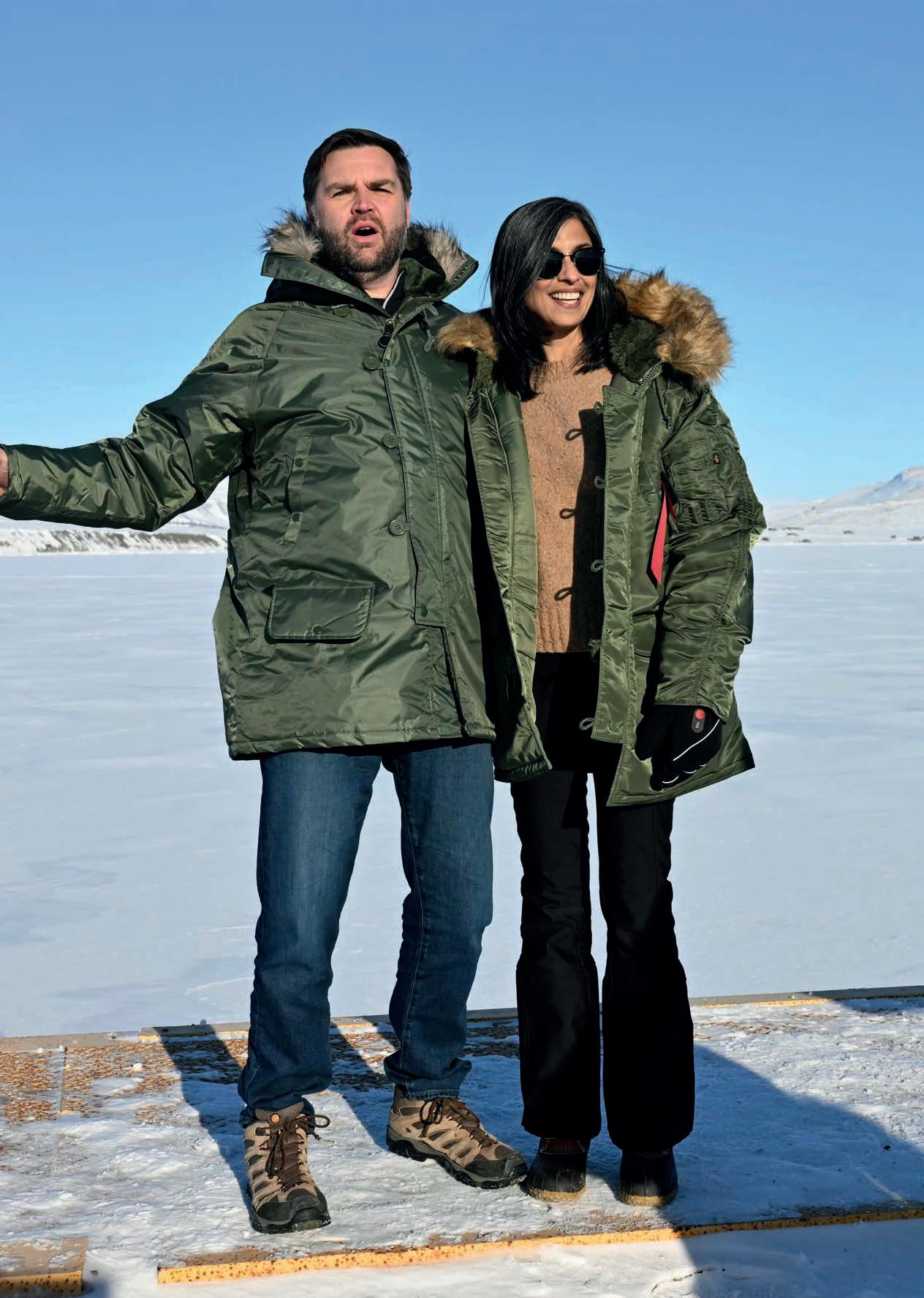
“Nowadays journalists are only aiming for sensation. That is what we have experienced with the president of the United States. If he says a single word, it goes on to become a sensation,” says Christiansen.
“We try to avoid that. We provide di erent angles by arranging debates with Greenlandic politicians and Inuit rights associations that are more suitable for Native people, so that incoming news is not so overwhelming,” says the radio editor.
For example, in February 2026, Trump o ered a hospital ship to the country of Greenland, mentioning that the country’s population “are sick and not being taken care of”.
“A er American senators found out that the healthcare system here is o en struggling and lacking healthcare specialists and doctors, I think the issue was passed on to the American president and then suddenly he said there was a ship being sent,” Christiansen explains.
While reporting on Trump’s spontaneous o er launched via his Truth Social account would seem tempting to most, the team at KNR chose an alternative angle.
“With the latest news on the hospital ship, we didn’t report on the ship directly. Instead, we focused on the struggling hospital system that we have here and provided debate on that subject with a few Greenlandic politicians,” says Christiansen.
“It has de nitely been overwhelming. At the beginning of the year, it was truly intense. At the same time, I think many of us working in Greenlandic media made a conscious decision that we simply had to give everything we had,” says Ann-Sophie Greve Møller, a KNR news reporter who reports on Greenland’s political
“Radio
relationship to Denmark from Copenhagen.
This strain was made worse by the broadcasting organisation laying o a h of its sta in 2022. Since then, KNR has consistently reported issues related to sta shortages, releasing a public statement on its struggles in 2024.
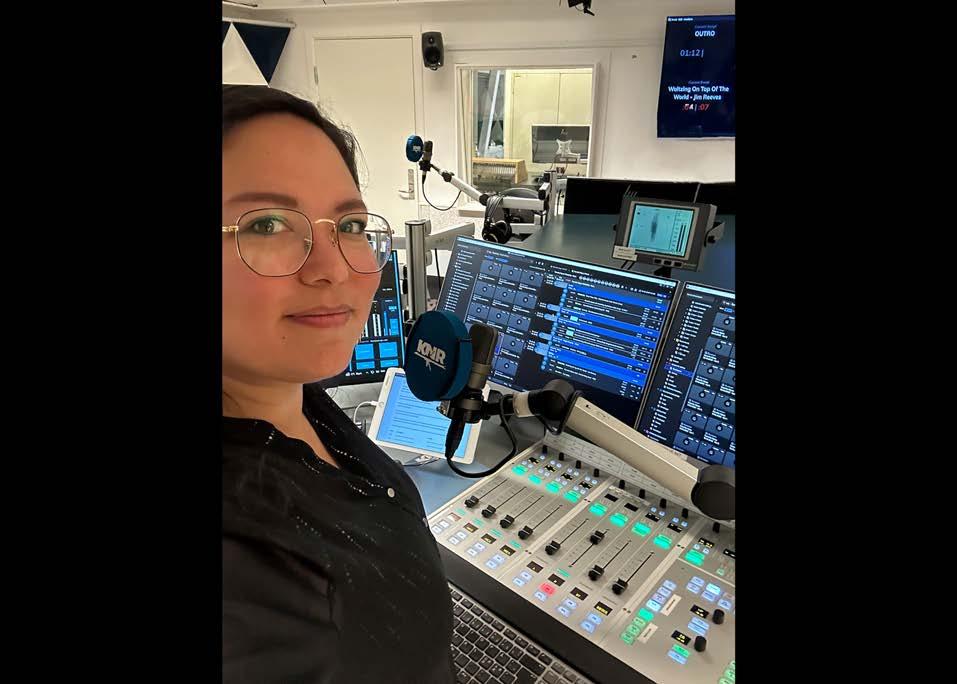
The radio editor explained that the news promoted predominantly healthy debate online. “Some people felt that the ship o er was a joke and others felt that having more doctors might be of bene t. It went both ways.”
While KNR’s e orts on providing alternative angles on the US’ relationship to Greenland has prioritised the Greenlandic population, it has le the news team with a heavy workload week-toweek.
Despite being the country’s largest media station, KNR’s news team is composed of only 15 or so reporters who are o en expected to cover stories and topics that they are completely unfamiliar with.
“We are a relatively small team producing content for three di erent platforms – radio news, TV news and online articles – in two languages, Greenlandic and Danish,” explains Greve Møller, who is quick to mention that she and the rest of her tight-knit team have remained resilient despite pressure to report on international news.
“We’ve been good at staying calm under pressure and maintaining a positive atmosphere,” she says. “We’ve managed to stick together and support one another throughout.”
Alongside Greenlandic journalists needing to focus on Trump’s interest in their island, Greenland has become increasingly more susceptible to misinformation. Having to catch up to the pace at which misinformation is spreading across the island has caused even more issues for the KNR news team to deal with.
During the lead up to Greenlandic parliamentary elections in March 2025, several posts and accounts impersonating Greenlandic politicians appeared on social media platforms such as Facebook. These fake posts, some of which promoted pro-Russian sentiments, sparked emotionally-charged debate online.
“We are such a small group of journalists. It can be di cult to fully safeguard against it, but we do our utmost to be thorough, including careful factchecking.
“In many larger news organisations, it’s common to have dedicated researchers or a legal department to support this process. We don’t have those same resources, which means that the responsibility rests squarely with us as journalists,” says Greve Møller.
Despite the layo s, misinformation and Greenland being thrust onto an international stage, the journalists at KNR have continuously tried to uphold their role as the primary news outlet on the island while focusing on their culture and their population.
As Christiansen puts it: “The oneness in our community is what we try to highlight; this is our strength, that is what we are good at. That is what we have been focusing on during these tough times.” ●
A itudes are slowly changing, but barriers and prejudice remain, report Meadow Wa ret and Harriet Curzon
In a round table conversation, you tend to be ignored,” says Digby Cook. “That costs.” Cook is a selfemployed broadcaster and newspaper journalist, and he is deaf. He can still recall the looks he received from colleagues in an editorial meeting when he was beginning to lose his hearing. They were the kind of looks which suggested he wasn’t paying a ention, or was giving “idiotic suggestions”, he says.
For some time, deaf people have been underrepresented in journalism. A 2024 report by Birmingham City University revealed that, in 20202021, deaf people made up less than one per cent of professionals working in the UK broadcasting industry, despite roughly one in ve adults (18 per cent) in the UK having a form of hearing loss. The report also found a shortage of registered British Sign Language (BSL) interpreters in the UK media. Currently, only 20 per cent of articles about deafness are authored by deaf journalists, according to a Public Library of Science study from February this year.
Cook started to lose his hearing when he was around 40 due to a hereditary condition which both his grandparents and parents also had. A er watching his mother become increasingly isolated from her family as a result of her deafness, Cook didn’t want to “surrender in silence”.
But this wasn’t the case in most newsrooms. “I think some people who had hired me in the past for various jobs didn’t [hire me again] because they thought that I was impaired,” he says. “I’ve done good work for people who didn’t call me again.”
“Sometimes I’d just go home and put my head in my hands. I’m not really a woe-is-me kind of person, but there were times when I thought ‘damn it’.”
There are various schemes designed to open doors for deaf journalists and make newsrooms accessible workplaces.

So he continued working in journalism as his hearing deteriorated. Cook’s career has now spanned more than two decades. A er starting o newswriting for Canada’s Global Television network, he reported for various Australian newspapers and produced news for CBC Toronto. Now profoundly deaf, the medical term for somebody with a hearing loss of 95 decibels or greater, he writes predominantly for Hearing Tracker, a publication dedicated to hearing-related news with a primarily deaf readership.
In this role, Cook can speak freely about his experiences to like-minded, interested people.
Disability Con dent, a voluntary UK government initiative designed to encourage employers to recruit and develop disabled people, is now being reformed a er criticism that it allowed employers to accredit themselves without having to employ disabled people. In January 2026, the government outlined plans to ensure accredited employers make ‘progress’ with employment.
Access To Work, started in 1994, is a government scheme which provides practical and nancial support to ensure disabled people can access and stay in employment.
The la er is imperative for Paul Harrison, a deaf broadcast journalist at the BBC. BSL is his rst language, and he relies on interpreters to communicate, paid for by Access To Work.
Harrison, who was born profoundly deaf, joined the BBC through their positive action employment scheme, Extend, in 2014. He worked for BBC News for seven years. Before the scheme accepted him, he had applied to many journalism jobs, got to the nal stage and then failed. He had the necessary skills, but his deafness had made it di cult to gain the relevant experience which employers required.
Now, he communicates with sources and other journalists by way of interpreters. “Interpreters are my ears and my mouth,” he explains.
“Physically, I’m able to be freelance and independent. But I need the interpreter,” he
explains. “It’s small things that enable us to miss opportunities like that.”
He recalls a few instances, just a er meeting someone, where they would ‘go around the houses’ to get to the point. “It took me a very long time to understand what they were saying.”
Erika Jones, a deaf broadcast journalist at the BBC, notes that the hurdles for deaf people in journalism go beyond talking with sources and colleagues. The networking involved in journalism can be di cult to partake in if you are deaf, she explains. “Journalism relies a lot on who you know, so that is problematic for a deaf person. They don’t have those networks in the same way,” Jones says, partly because the deaf community rarely overlaps with the predominantly hearing space of journalism. This unaccommodating hiring process results in undiverse newsrooms.
It takes some people considerable time to realise that deaf people are more than capable of working in journalism. These microaggressions happen “all the time”. Recently, she arrived on location to lm for Country le, when somebody stopped her, surprised, and asked: “You drove here on your own?”
These patronising narratives can extend into work itself. Harrison has o en felt people are afraid to give deaf or disabled people feedback or criticism.
This is a di erence encompassed in the disparities between BSL and English.
companies may struggle, which could dissuade them from hiring deaf individuals.
Jones agrees that being a deaf journalist requires additional e ort. “Not only do you have to do your job, but you also have to work harder to break down stereotypes,” she says. “In TV, there’s quite a high turnover of sta working on di erent projects, freelancers coming in and out, so you’re constantly having to do that.”
“I’m not really a woe-is-me person, but sometimes I just think: damn it”
“Society creates the barriers, not me,” Jones says.
Jones has been profoundly deaf from birth and got into journalism over 10 years ago. A er ge ing a role in a shortterm contract for See Hear, a agship BBC programme centred on deaf stories, editors spo ed her talent and asked her to stay on in the role. Now, she is assistant producer on the Investigations team for the BBC’s Country le. But Jones says having an interpreter is o en met with microaggressive reactions in the workplace. “At the extreme end, hearing people assume deaf individuals are uneducated.”
On occasion she has felt that colleagues were wondering: “‘Why are you working in a similar position as me?’”
Choose Your Own Adventure
“BSL is quite a direct language. It’s very blunt, direct to the point. English is a li le bit more nuanced. It’s layered and follows British culture.”
Newsgathering was “a great job, but not deaf friendly”, he says. Interviewing the public required more thought than simply walking out the o ce and knocking on doors. Each time, Harrison would have to ensure he had an interpreter who was willing to a end every interview with him.
While larger media organisations may be able to cover the di erence of interpreter costs, smaller independent
Cook has learnt that being “upfront” about being deaf is incredibly important, both practically and to break down stereotypes. “You have to be insistent,” he says. Whether colleagues were malicious or felt “it was just too much trouble trying to accommodate me,” he isn’t sure. Nevertheless, he is certain “things are ge ing be er” for deaf people in journalism thanks to increasingly helpful technology. For onthe-ground broadcasting, Cook’s interviewees are ed with a microphone which connects to headphones Cook wears oncamera. New AI hearing aids have allowed him to di erentiate between background noises and connect to Zoom via Bluetooth.
The experience of hearing journalists and deaf ones can also unexpectedly overlap.
Walk away and chat to other people: You are too starstruck by Chanté to carry on talking to her, so you make an excuse to leave. Go back to the start.
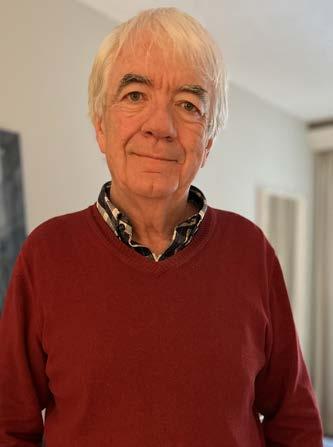
Modern journalism’s reliance on technology – microphones, video recorders and cameras – o en “mirrors the access needs that one is likely to have as a deaf journalist,” says deaf journalist Liam O’Dell. Noisy, crowded environments that he might struggle to report in would also prohibit transcription technology from functioning, and so a hearing journalist would also struggle.
O’Dell has worked as a freelance journalist for 14 years, covering politics and pop culture for sites such as indy100. He has also wri en frequently for The Limping Chicken, a publication which focuses on deaf news and culture.
While he believes many
newsrooms have a good understanding of deafness, “whether that is re ected in the writing and the output is another ma er entirely.”
“The reports and content being published is still indicative of a very outdated and backwards thinking around deafness and disability,” he says, gesturing toward some right-leaning publications. Coverage o en focuses on “impairment” or disadvantage rather than lived experience.
A ention and understanding around deafness is o en formed by “ at in the pan coverage” from mainstream outlets and by journalists who are not part of the community, O’Dell explains. While there is sustained reporting being done by deaf journalists who are able to avoid stereotypes or misconceptions, they “have got a fraction of the platform those outlets have.”
Mainstream outlets have a tendency to “dip in and out, as and when they see t” when it comes to news stories about deafness. This is one reason O’Dell feels it is important to advertise himself as a deaf journalist on his website and in his social media biography. He explains: “If there is someone from the community looking for someone to cover a story that a ects them, there is a degree of trust and reliability that can come from signposting that you are a member of that community.”
Tell the truth and admit you are currently job hunting
You sigh, admi ing that you are still job hunting. They nod in sympathy but mention they have just been promoted to Assistant Culture Editor at The Times How do you respond?
This sporadic coverage is projecting a one-dimensional narrative which reinforces stereotypes and fails to re ect the breadth of experiences within the deaf community.
“We’re not monolithic,” Harrison says. Individual deaf journalists have di erent lived experiences and needs, many of which the media industry is not built to accommodate.
“On an individual level, people are open-minded, people are becoming more accepting. But on an industry-wide level, [it] de nitely needs more exibility,” says Harrison. Though his experiences with employers have improved, he knows there is a long way to go. “They’re de nitely be er, but they can always do be er.” ●
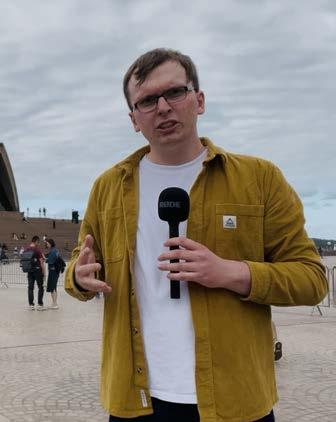
Spend the next 15 minutes congratulating them (p169)
Ask for work experience (p126)
The practice of rephrasing a subject in a fresh or alternative manner has become a hackneyed staple of journalese. Julia Bo oms documents the playful pursuit of the ‘subsequent reference’
‘The Columbian star, philanthropist and committed believer in the veracity of hips’: Shakira
Also referred to as a knobbly monster, a name which originated from a journalist writing in The Sun about a fatal crocodile a ack in the 1990s, these epithets form the basis of a new book by Juliet and Ma hew Maguire, the married couple behind famed X account @secondmentions.
Unbeknownst to most journalists, they just might be living with a peculiar a iction: monologophobia, the fear of using a word more than one time in a single sentence or even paragraph. Nailing the tricky second mention has been re ned into nothing less than a tabloid art and a veiled opportunity to aunt one’s literary dexterity.
A er fostering a mutual joy for spo ing second mentions, the Maguires set up an X (formerly Twi er) account in 2013 dedicated to sharing their favourites they’d found. “People just started sending them to us,” Juliet tells XCity. She is currently a product manager at the BBC but has previously worked at local and national papers. “Sometimes it was journalists sending ones that they had wri en themselves that they were quite proud of.”
Over 10 years, the husband-and-wife team cultivated something of a cult following, dedicated to scanning the news for the next chuckle-worthy knobbly, and last year decided to turn their side venture into a book, The Li le Book of Second Mentions.
‘The sweat-less wonder’: Prince Andrew

‘The
Caribbeanaccented rodent star of CBeebies’: Rastamouse

‘The malevolent rabbit’: Bad Bunny ‘The equine protagonist’: Black Beauty
Alliterative puns, excessively long descriptions and those that ridiculously overcomplicate a simple subject are some popular forms. Examples include Dominic Cummings being referred to as ‘the ophthalmologically challenged former prime ministerial adviser’, and vegan sausage rolls being ‘the magical stumps of meat-free stodge’. Maguire adds: “I think it’s also the ones where you don’t expect to nd a second mention that really tickle.”
The wordplay device has actually enjoyed a long and varied history. “In ancient Greece, poets like Homer would use so-called epithets when discussing gures,” says Maguire. “Athena was referred to as ‘the bright-eyed Goddess’ and Odysseus, ‘the great tactician’.” They’ve also been referred to as ‘elegant variations’ in the early 1900s, as a means to avoid excessive overt repetition, however over- owery language was frowned upon. “They have not always been the most well-respected literary devices, but we love them and think they add a bit of avour.”
Courtesy of The Li le Book of Second Mentions: some examples of subjects with their corresponding ‘textured beasts’. ●
‘The hyperactive 90s gungemeister’: Mr Blobby

‘Knobbly Monster’: Alligator

‘The wibbly wobbly treat’: Jelly
‘The Tudor Tubster’: King Henry VIII

‘The 4lb citric whopper’: Extra-large lemon

‘The floating zoo’: Noah’s arc ‘The fibrous bad boy’: Bran flakes
Choose Your Own Adventure
Martini: You are the life of the party, mainly here for the free canapés. The event is the perfect excuse to network with some Dutch courage. As you turn around, Chanté Joseph bumps into you and spills your drink all over your out t. What do you do?
an argument (p171)
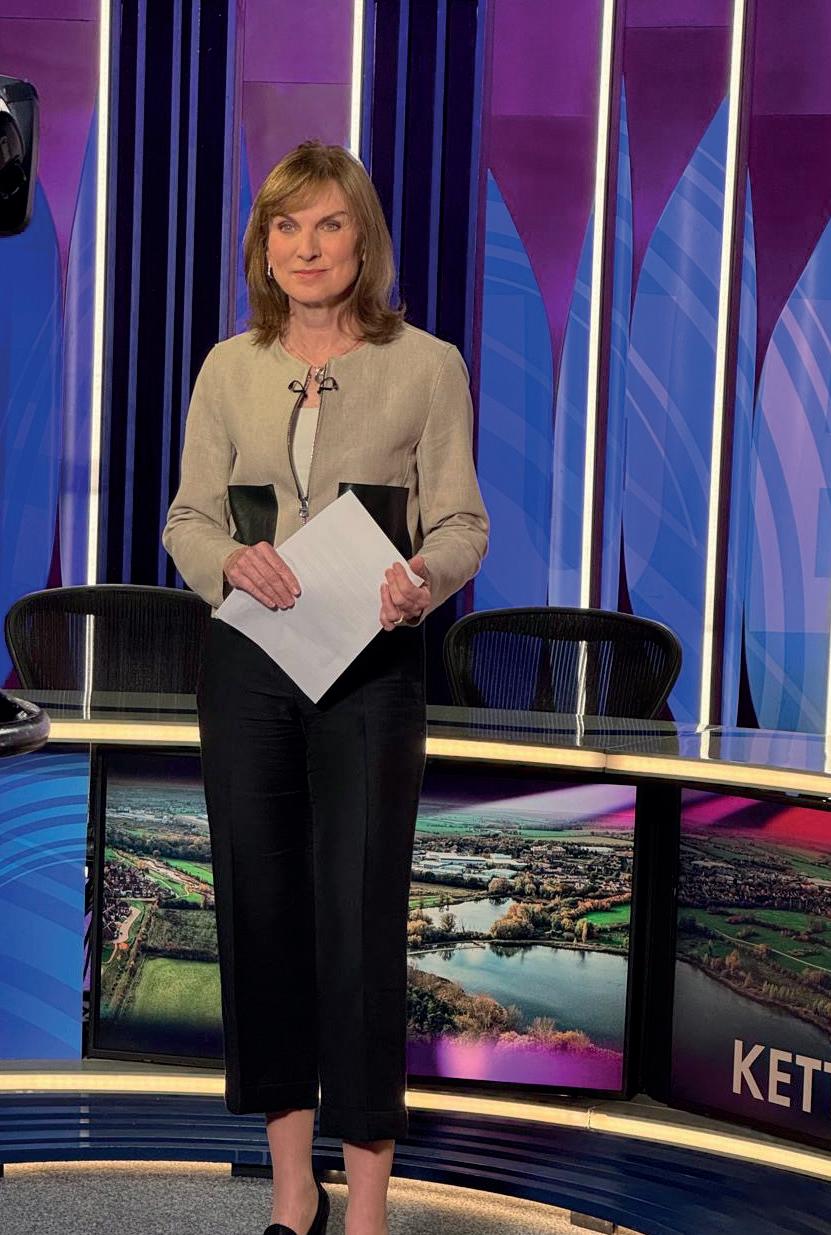
Fiona Bruce talks to Florence Ingleby and Harriet Curzon about helming
Question Time, fame and pushing boundaries in a male-dominated industry
For many journalists, being compared to Trotsky or A ila the Hun would be a professional slur. Not for Fiona Bruce. These remarks, tweeted a er an episode of BBC’s Question Time, are now framed on her o ce desk. These are, to her, tokens of success in the impartiality game.
She joins us from her London home, fresh from her weekly Question Time editorial meeting. Her o ce occupies a small side room in what appears to be a very large house. Behind her is an immaculate garden.
The scene suits the duality of her working week. On Thursday, she is the steely arbiter of Question Time’s weekly scu es. On Sunday, she appears as the upbeat host of Antiques Roadshow
This year marks 25 years since Bruce became the BBC’s rst female presenter to call a general election. She has become one of the corporation’s most recognisable faces – fronting News at Ten through the Iraq War, Brexit, the pandemic and successive leadership ba les. In 2019, she became the rst woman to host Question Time She is, without a doubt, one of the best known journalists in British broadcasting.
The Bruce brand that viewers recognise – polished, robust and, to some, impenetrable – has been rmly established. Yet she insists this composure didn’t come naturally to her in her younger years.
When re ecting on the role of women in broadcasting, Bruce remarks that, “in 1989, it would have been inconceivable that a woman would have been asked to present what was then the nine o’clock news. It just wouldn’t have happened. A woman wouldn’t have been asked to present Question Time and a woman wouldn’t have been asked to do the general election period. It was not even up for discussion.”
“I was in the right place at the right time. And that’s been true for a number of things I’ve done.” Though she notes: “I’ve pushed boundaries where I can.”
Over Bruce’s career, people have o en interrogated her strategy, but she insists “there was literally no plan, no strategy.”
Like most presenters, she says her career was out of her hands. Decisions about job o ers were taken at “a sort of nose bleeding stratosphere above your head,” she remarks. And these nosebleeding decisions are far from achieving diversity in the industry.
“No one had ever talked to me like that before, but I must have got something good”
“In my twenties, the one thing that kept being said to me was the importance of having gravitas. I had as much gravitas as this pen.” She holds up a bogstandard ballpoint.
“I have met some young women journalists at the BBC who emanate authority, even in their midand early twenties, and I’m in awe of them. I wasn’t like that. I guess I must have got it at some point though.”
It is di cult to imagine her authority as something assembled through trial and error. Instead, it reads as something that came preinstalled.
Bruce studied French and Italian at Oxford University between 1982 and 1986 – part of a well trodden path into British journalism, a profession in which as many as 54 per cent of journalists have historically been educated at either Oxford or Cambridge.
A er graduating, she experienced “a couple of career false starts” before beginning her career in 1989, when aged 24, she joined BBC Panorama as a researcher.
She recalls investigating the so-called ‘river companies’ illegally channeling money from the British United Industrialists to the Conservative Party. “One of the people I was investigating found out, confronted me and shouted in my face, ‘you e ng bitch’.”
“No one had ever talked to me like that before, but I must have got something good.”
Her skill for investigation comes from what she describes as “a healthy mistrust of authority” and “a desire to always understand why something is happening, rather than just react to it”.
In 1995, only around 17 per cent of people seen or heard in broadcast news were women. Women have greater presence in broadcasting today, making up 50 per cent of the workforce at the BBC, according to the BBC Equality Information Report. However, only 13.9 per cent of the total BBC sta are from ethnic minority backgrounds, and women of colour are assumed to make up a small proportion of that. Voices on-screen remain disproportionately white and male, particularly in political and economic reporting.
In regard to how things have changed for women in broadcasting, Bruce says: “Some things have improved and some things haven’t.”
When asked about her 2009 comment in The Guardian, when she was quoted as saying, “if you look like the back end of a bus, you won’t get the job,” Bruce concedes the industry has not changed much.
“It might have changed a bit. It used to be a real crucial factor, I think. But it still is a factor,” she says. “In television generally, just in my neck of the woods, it’s de nitely ge ing be er, but I’m not sure it’s an even playing eld on that score.”
“We are still overcoming, since time immemorial, what has been considered a woman’s place in society,” she says. “And I see great strides forward. I see other strides backwards.”
In terms of misogyny online, Bruce cites this as a key reason for avoiding a public-facing social media presence, observing that “the misogyny faced by female broadcasters is horrendous”.
She adds that she does not see it as her role to voice personal opinions in a public forum.
“I have thought about posting things, but I’m not in the position that some others are, breaking stories – that’s a completely di erent purpose, and it’s not the territory I’m in. What would I even be saying?”
“Every time I’d have to pause and think, ‘Can I say this? Do I want to be saying this?’ It feels like a problem waiting to happen, and I can do without that.”
“If you’re not going to express opinions on social media, I’m honestly not sure what it’s for.”
While Bruce herself does not have a public social media pro le, it doesn’t stop others from posting on her behalf. “I’ve had myself put through AI, pretending to sell commercial products or things.”
live, she reached for a glass of water and noticed her hand was trembling. “I’d say that feeling lasted three minutes, probably not even as many as ve, and then I was away. And I loved it.”
Bruce’s stint on Question Time is arguably what propelled her into the ranks of the most high-pro le broadcasters in Britain. Question Time remains one of the most popular programmes in the BBC schedule, typically drawing between 1.7 million and 3.5 million viewers.
She remembers the nerves she felt hosting her rst night. The programme was aired from Islington, and that morning paparazzi were already gathered outside her house. When the show went
When asked about the show, she is precise about the mechanics. The audience, she explains, is the result of thorough research into voting history and declared political preference.
“We bend over backwards more than any programme I can think of to make sure that our audience is representative of vote sharers. I can comfortably say with u er con dence, every week, this audience is balanced.”
“The fact that you’re hearing people who may disagree with you is not because the audience has been biased one way or the other. It’s because it’s not full of people who agree with you.”
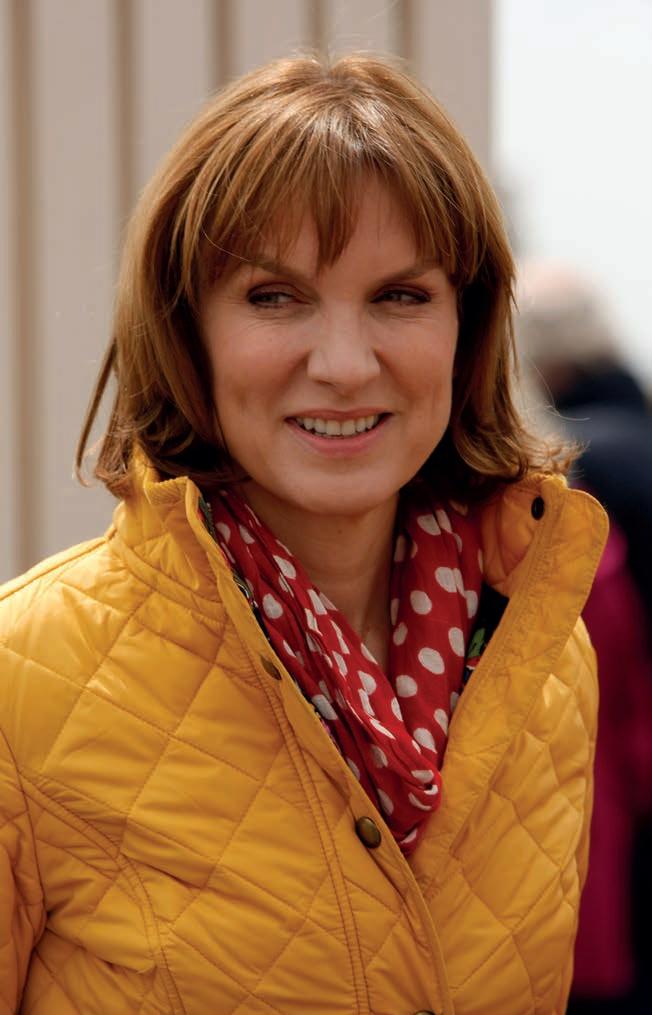
While Question Time insists on impartiality, it also, unmistakably, serves as both a platform and a forum. In recent years, that balance has drawn increasing scrutiny, particularly over the prominence a orded to Reform. Last June, the BBC faced criticism a er featuring the party in Scotland, despite not having any elected MPs there. In contrast, the Green Party only appeared on four editions of Question Time during 2025 – a third less than Reform.
Bruce’s e ort to be balanced comes across in her interview. Every answer she gives seems ltered through the BBC’s strict code of impartiality – precise and measured. It’s something she must have learnt over 35 years of working for a cooperation where total neutrality is expected. The result is both impressive and forbidding.
On the future of journalism, she’s candid. “What worries me is how hard it is going to become to know what you can and can’t trust.”
For Bruce, this era only reinforces the importance of accessible and trustworthy broadcast media. “I suppose I would say this when I work for the BBC – but I think it’s also true of ITV and Sky,” she says. “Once you haven’t got that, that way lies perdition, I think.”
As traditional broadcasters are looking for new ways to counter this era by maintaining current viewership and a racting younger viewers, Bruce notes: “One way is to have more young people in the industry and onscreen.”
Her advice to young people breaking into the industry is to “never be afraid to not take no for an answer” – she adds, “in brackets, without being an arsehole.”
This seems to come naturally for Bruce, who laughs: “Assertiveness is not something I struggle with.” ●

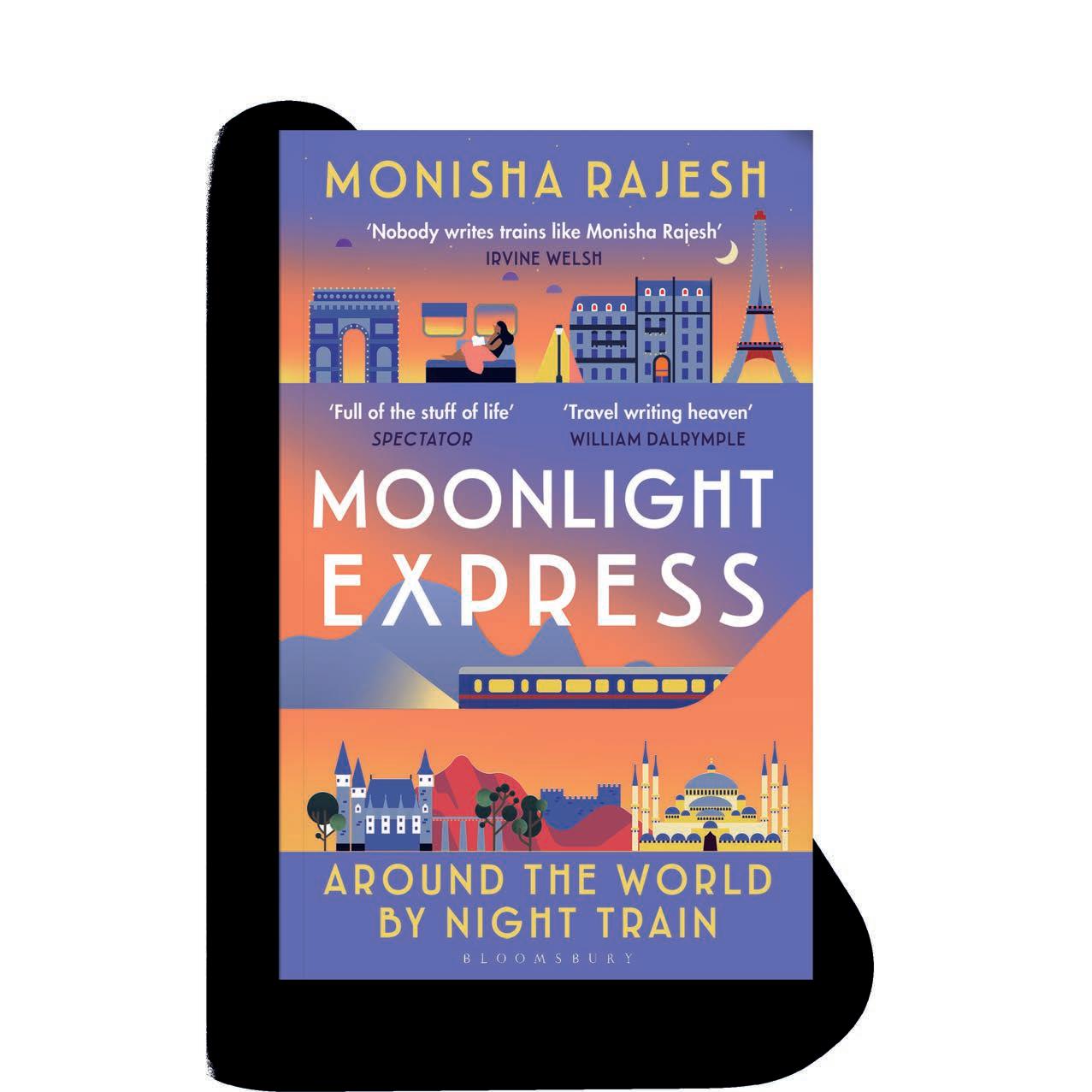

The 2026 World Cup includes debuts from some of the most unlikely nations. Daniel Farthing and Josh Wilkey speak to the reporters covering the minnows on the world’s stage
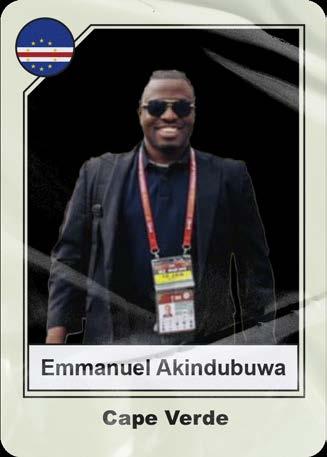
West African football reporter
Emmanuel Akindubuwa describes Cape Verde, a nation of 529,000, as “one giant party” a er the team secured World Cup quali cation.
A broadcast journalist for over a decade and a senior sports journalist at BBC News Africa since 2023, Akindubuwa has become a prominent voice in West African football. When Cape Verde quali!ed he was the !rst reporter on BBC News giving his thoughts on the team’s fortunes.
With the 2026 World Cup being mostly held in the US, MAGA politics have already begun to seep in to tournament discussions. A complete travel ban has been placed on both Haitian and Iranian fans and journalists.
These restrictions have put signi!cant obstacles in the way of African journalists like Akindubuwa and he now feels
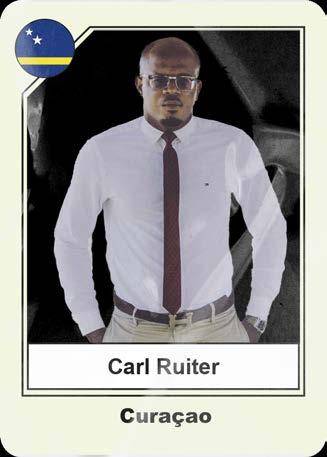
Sports writer, commentator and radio show host Carl Ruiter will be in the US this summer, reporting on his national team at their historic World Cup debut.
Despite working with a small editorial team at the country’s largest newspaper Extra Curaçao, Ruiter hopes people-focused reporting will distinguish his output from larger competitors: “We will speak to the fans coming to the stadium, travelling from Curaçao for the !rst time to a World Cup.”
With a population of just 185,000, the Caribbean island is the smallest nation ever to reach the !nals, half the size of previous record-holder Iceland.
“I try to be as neutral as possible when I talk about the national team,” Ruiter says. “The people who watch my show want to see neutral reporting
it is unlikely he will be able to a end the tournament in person.
“The US government has very strict regulations on African countries. It’s essentially impossible to get the nonimmigrant visa required for journalists to do our jobs,” he says.
However, restrictions have never stopped journalists from doing their jobs before. This is no di erent for Akindubuwa, who has various methods in mind for accessing players such as se ing up live feeds, conducting virtual interviews and forging agreements with American journalists from the West African diaspora.
To those from the wider media who will be ge ing access to the Cape Verde camp, Akindubuwa knows why you should be paying a ention: “Anyone who is looking out for who the giant killers at the World Cup will be… Cape Verde should de!nitely be one of the names on your lips.”
– not a fan.” Yet when Curaçao quali!ed in November, emotions spilled over and he admits he was overwhelmed. “I took one minute to myself,” he says. “And then I was reporting again.”
Given the 8,000-mile round trip, Ruiter must a end interviews and press conferences via video call. A worthwhile challenge, he says, “so the nation can get to know more about how [the team] prepare for that speci!c game.”
As his fellow countrymen step onto the global stage, Ruiter has another goal in mind: to commentate in his native Papiamentu. While Papiamentu is the island’s native tongue, Dutch remains the o cial language. “That is my dream,” he says, “so [the world] can learn about our language and learn about our culture for the !rst time.”
Choose Your Own Adventure
Ask for work experience
You ask for work experience. They give you their email and you send over your CV, and you receive an invite for work experience next week!

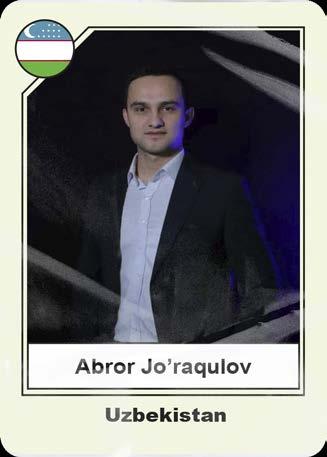
Abror Jo’raqulov has covered Uzbekistan since 2018 when he began reporting from training sessions during his rst year at the University of Journalism and Mass Communications of Uzbekistan.
A!er cu ing his teeth at local papers, Jo’raqulov transitioned into television at the national sports channel Sport TV.
“Fanaticism is a help not a hindrance” he says. When it comes to reporting on the national side, journalistic neutrality is cast aside. “We are allowed, even expected, to be their ultimate supporters,” says Jo’raqulov.
Uzbekistan quali ed for the World Cup for the rst time last June. Covering an underdog has its advantages says Jo’raqulov, who has close ties with the team’s media sta With this comes the best chance of documenting a David-andGoliath upset. Like Argentina-
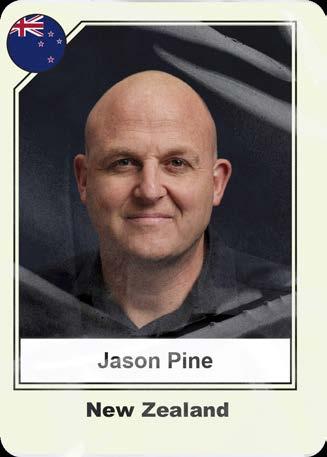
Though he started his career in 1992 as a music radio broadcaster for a small provincial station, Jason Pine is now one of the most prominent sports broadcasters in New Zealand.
He has been a live radio commentator since 2007 and a TV commentator for Sky Sports NZ since 2026.
The access Pine gets to the squad will make British sports journalists jealous. Pine con dently asserts that it would only take a couple of phone calls for him to interview Chris Wood, New Zealand’s star striker. He credits the country’s much smaller football and media eco-system for this.
But covering one of the World Cup’s smallest countries, where sports media is a less lucrative market, has its drawbacks. “The aim is to be there. But I’m
beaters Saudi Arabia at Qatar 2022, shock wins become big talking points. “While everyone writes about giants like Brazil or England, a story about a smaller country becomes a ‘new discovery’ for the world.”
If Uzbekistan are riding high, Jo’raqulov could be the rst reporter the world turns to for comment.
And while ESPN might boast greater resources, Jo’raqulov believes smaller organisations are be er placed to pivot when stories break. “Large media organisations o!en move slower,” he says. “We can deliver stories while they’re still ‘hot’, capturing fascinating moments o cial cameras miss.”
While many xate on stats, Jo’raqulov will focus on human experience. “We dive into what ma ers most to our audience,” he says. “The atmosphere, the raw emotions of the players, and the lives of fans.”
sure it won’t have escaped your a ention that travelling to the US, Canada, Mexico, to cover the World Cup, is extremely expensive. The air travel is not so bad. The accommodation however, we’re not talking about ash hotels here. You’re looking at eye-watering prices just for your average Airbnb.”
If Pine’s costs are covered and he makes it to the World Cup, he’ll apply his meticulous method of commentary to every All Whites game: “Early in the week I’ll prepare a grid for each team with players stats, history, quirky facts and other content that can be dropped into the call,” he says. “I like to get to the game nice and early so I’m not rushed and when the starting lineups are con rmed, I’ll handwrite them in playing formation to have in front of me. Then when the game starts, I’ll usually use about 10 per cent of what I’ve prepped!” ●
James Rodgers, City St George’s, University of London
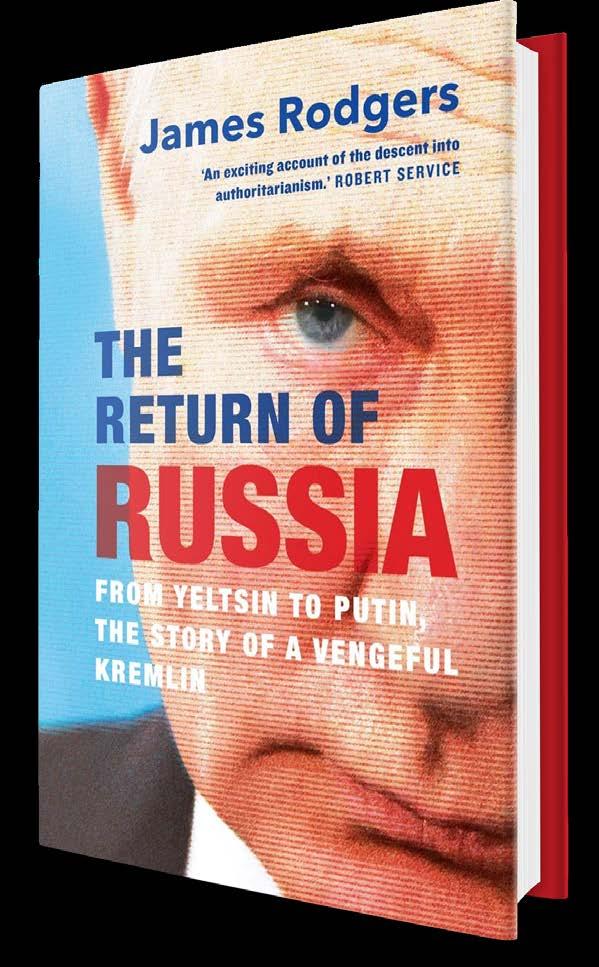
‘An exciting account of the descent into authoritarian threats to dissidents and neighbouring countries told by a fne correspondent who was there at the time.’
Robert Service, author of Kremlin Winter: Russia and the Second Coming of Vladimir Putin

To get the book in hardback at the discounted price of £16 (rrp £20), use the QR code above (or find the book on yalebooks.co.uk), add it to your cart and use the code 26SPR when prompted at the checkout.
Offer runs until 30th April 2026.
“They thought you could automate the whole process of journalism. They were wrong about that”

WikiLeaks changed investigative reporting but as Julian Assange became entangled in legal ba les, the platform’s in uence faded. 20 years a er its inception, Hannah Stiven and Jack Dennison-Thompson explore the legacy
In 2006, editors leaned over desks clu ered with broadsheet newspapers and BlackBerrys. Whispers spread of a new platform promising total anonymity for whistleblowers. It o ered a digital dead drop – encrypted, untraceable, borderless. The site aimed to pierce the secrecy of the world’s most powerful governments and institutions. Reporters swivelled in their chairs. The WikiLeaks website had appeared and with it, the suggestion that journalism had been blown up forever.
Then came the buzz. Julian Assange, a hacker with a shock of white hair and a deep distrust of traditional institutions, began to morph from obscure activist to quasi-journalist. Sources were invited to upload secret documents through encrypted channels. The format was radical – vast searchable databases of raw documents that reporters could trawl through themselves.

The promise, as The Guardian’s former investigations editor David Leigh puts it, was a “wonderful machine” where “everybody would be able to leak everything in an u erly secure fashion because nobody could nd out who did.”
At the start, WikiLeaks was presented as a decentralised, nearstateless force, built as a network rather than a hierarchy. But the truth was more complicated.
“There never was any WikiLeaks. It was a small, dysfunctional group. Julian was the Messiah, [other members] were the disciples,” Leigh re ects.
Early releases caused ripples, not shockwaves. Poorly organised, bureaucratic leaks were noted between 2006 and 2008 – a ling cabinet emptied onto the internet. The leaks included civil service handbooks, the Guantánamo Bay standard operating procedures manual, a Kenyan presidential corruption report and internal Scientology documents. →
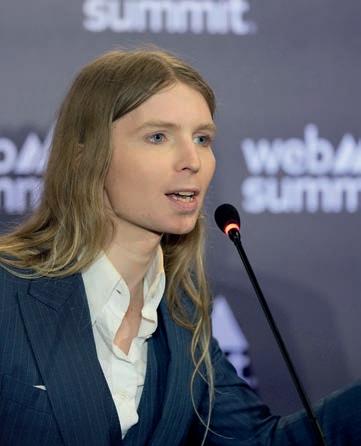
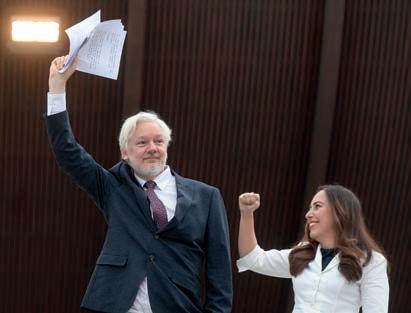
The explosion
In 2010, everything changed. US Army intelligence analyst Chelsea Manning leaked hundreds of thousands of classi ed government les, stating that she wanted the public to understand the realities of war and US foreign policy. The cache included the Afghanistan and Iraq war logs, US diplomatic cables and footage of a 2007 Apache helicopter strike in Baghdad (the ‘Collateral Murder’ video) which killed twelve people, including two Reuters journalists.
Heather Brooke, an investigative journalist who has focused on freedom of information (FoI) ma ers, says that database journalism had been growing through bulk FoI requests as citizens demanded answers from governments.
But WikiLeaks “made it cool”, says James Ball, an investigative journalist who worked brie y at WikiLeaks in 2010 before joining The Guardian and The New World
The paradox
But Assange was wrong on one major count. Far from disrupting legacy media, WikiLeaks found it needed the establishment it tried to sha er. For the 2010 Manning leaks, it partnered with The Guardian, The New York Times,
Der Spiegel, Le Monde and El País. The released documents required veri cation, redaction and context reporting.
Leigh says fragments of facts like “17 killed in action” appeared in incident reports and implied the death of militants.
“You’ve got piles of content, quite a lot of which was actually lies,” he says. “Although you had to learn new techniques of interrogating material, it was absolutely crucial to preserve those traditional journalistic skills of distinguishing truth from lies, which you don’t do by automating. You do it by going there, bearing witness, seeing people, using your judgment.”
For Christian Christensen, a professor of journalism at Stockholm University who has wri en about WikiLeaks’ strategy, a paradox lies at the heart of the organisation. It was deemed a technological disruptor, a platform that could make traditional journalism obsolete. However, he explains, “The language of the military [ les] is impenetrable unless you’re a military expert. That’s why [WikiLeaks] worked with those newspapers, because they were experts.” Simply posting raw les was not enough, the data dumps needed judgement and credibility. He adds that the hybrid model “ironically

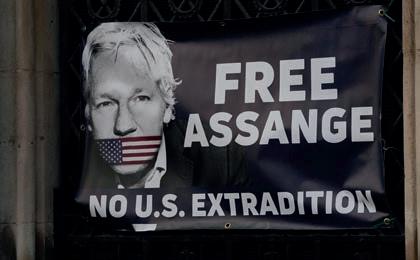
remind[ed] people just how important journalism is”.
The legacy
Bulk datasets forced investigative reporters to learn skills which are now standard practice, visible today in journalists’ scrutiny of the Epstein les. Leigh says the new journalistic skills required were “not just about searchability, but about how you apply human intelligence to automated stacks of data”.
He adds that techniques were used to get meaningful stories out of new mountains of content. “We found a new rocket system called HIMARS which was highly classi ed at the time,” Leigh recalls. “We could discover by searching in the right way the occasions on which it had been secretly used in Afghanistan.”
The discovery turned sca ered entries in a dataset into evidence of previously undisclosed military activity – information that would have stayed hidden using traditional reporting methods.
Ball also remembers how steep the learning curve was. At one stage, the Afghanistan logs were opened in an outdated version of Microso Excel that “cut o 30,000 rows of data”, illustrating the technical obstacles journalists faced


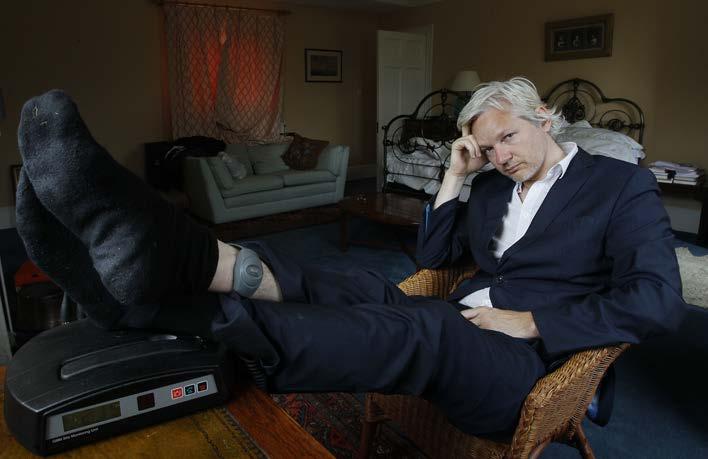
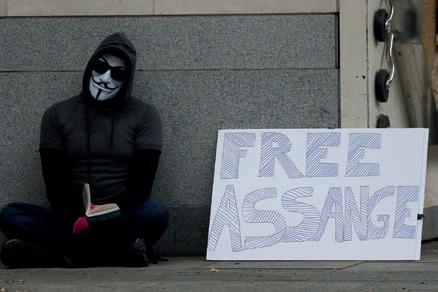


while manually handling les.
Once the data was cleaned and loaded into visual analytics so ware Tableau, however, the reporting possibilities changed dramatically. Within a day, he could generate “timelines, visualisation of where deaths had happened, types of emerging stories”.
The fallout
Manning’s arrest, a er con ding in acquaintances who alerted US authorities, and subsequent 35-year sentence (later commuted), sha ered the illusion. Technology alone could not protect whistleblowers. “Journalism isn’t done by machine,” Leigh says. “It’s done by people.”
As Assange’s personal legal ba les escalated, the WikiLeaks structure began to lose its direction. Allegations emerged from Sweden and he sought asylum in the Ecuadorian embassy in London before later ghting extradition from inside Belmarsh prison.
The organisation faltered, and releases became sparse. Documents dried up. Gradually, the public presence of WikiLeaks shi ed. Its social media feeds grew combative, defensive and increasingly personalised around Assange.
Brooke saw an early glimpse
of what would become a de ning feature of digital politics –“the dark arts of information warfare”. Assange “used Twi er, now X, in a very weaponised way. Assangistas, as I call them, would ood the feed with insults. That was really new as Twi er had always been this very nice, collegiate place.” Criticism blurred into conspiracy.
The optimism that a borderless internet would strengthen democracy began to erode.
Ball believes the audience played a role in the shi . “It was the beginning of cancel culture in some way,” he says. People ock to information that a rms their existing beliefs rather than challenges them.
“[People think that] if you give people lots of information to trawl through, they do the hard work themselves,” he adds. “They don’t. They will generally take the narratives that you put on it.”
WikiLeaks forced newsrooms to rapidly start investing resources, paying for data teams and switching focus to data journalism. Ball explains that WikiLeaks in uenced the techniques The Guardian used to cover the 2013 Edward Snowden leaked documents. However, if WikiLeaks imagined a world where technology and
automation replaced journalists, its real legacy is the opposite. Two decades later, the biggest leaks in history – from the Panama Papers to the Pandora Papers – are investigated not by algorithms, but by networks of international reporters working together.
There has been no Assangelike gure since. WikiLeaks marked a singular moment in history.
Despite its borderless claims, WikiLeaks has been de ned by national power. “Almost everything that happened was rooted in very clear national interests,” Christensen says. Information ows globally but national laws applied for Manning’s prosecution, Assange’s Swedish legal proceedings, asylum and extradition discussions.
“WikiLeaks had a very simpleminded belief in the infallibility of machines,” Leigh says. “They thought you could automate the whole process of journalism. And they were just wrong about that.” Ball sees the irony of WikiLeaks. “Julian Assange would hate that WikiLeaks’ legacy might be making mainstream journalism be er.” ●

Photo: Simon Townsley
funding cuts to physical threats, Daisy Dempsey and Harry Speirs speak to the journalists navigating the perils of humanitarian reporting
Youmna El Sayed, a journalist who covered the Gaza Strip for international news channels, had just 15 minutes to grab her reporting equipment, press vest and helmet before her hotel was evacuated during a bombardment by Israeli forces.
While she was working in the centre of Gaza City in October 2023, her husband and four children were sheltered at home as their neighbourhood came under a ack. “I spent an entire night just praying my family would be alive,” she remembers.
It was a week a er Hamas had carried out a series of a acks on Israel, killing about 1,200 people and taking 251 hostages. In response, Israel launched a massive bombing o ensive in Gaza. Over 75,000 Palestinians have been killed in the violence since.
“In the morning, when I eventually could go back home to check on them, I just dropped my gear and ran,” she recalls. Thankfully, her family were physically unharmed, but the event took a mental toll on all of them.
“The worst thing for me was that I never felt safe going out to report, and I always had my mind and my heart worried that my kids at home would not be safe or they would be targeted,” says El Sayed. “It was honestly unbearable. It was mentally unbearable.”
El Sayed is not alone. This year is set to be one of the toughest years on record not only for the world’s most vulnerable people, but also the dwindling number of humanitarian reporters who report on them, as their funding has su ered crippling cutbacks.
Despite the United States Agency for International Development (USAID) playing a vital role in funding to both foreign aid and media platforms worldwide, the Trump administration has gradually been shu ing the organisation down since January 2025. Funding streams were frozen and aid deliveries were put on hold.
In February 2026, the US Congress cut their foreign aid budget by 16 per cent from the level of the previous year.
Belinda Goldsmith, Global Media Director at Save the Children International and head of the Humanitarian Reporting specialism at City St George’s, University of London, underlined the need for the perseverance of humanitarian reporters despite setbacks in funding.
“Reduced funding for foreign media reporting leads to a lack of jobs, making global crises less visible, whilst lowering public awareness and political pressure to respond to escalating human rights violations. Without journalism, so much su ering around the world would go unreported and perpetrators would not be held to account,” she says.
“What you must understand,” Goldsmith adds, “is that less humanitarian reporting and international spending on aid organisations worsens the su ering of vulnerable populations, leaving them without the basic things they need to survive like food, healthcare and shelter.”
Sudan has shown what happens when such reporting doesn’t take place. Journalists have been starved, displaced, exiled, abducted and killed, with many people across the globe having no idea that a con ict is taking place.
Female journalists have been raped while a empting to report on the ongoing civil war between the Sudanese government and the paramilitary Rapid Support Forces (RSF).
Sara Qudah, Regional Director for the Middle East and North Africa for the Commi ee to Protect Journalists (CPJ), a press freedom group, lived and worked in Sudan for many years. There, she witnessed rst-hand a lack of funding, international aid and a targeted a ack upon journalists by militant groups.
The lack of reporting means information about the civil war is scarce. “There’s an information siege,” she says. “Even I don’t understand or know what is happening, because there’s no information ow. It means that the public is being denied the truth.”
Now, living in Paris with her husband, she feels disconnected from the con ict. “I don’t understand or know what is happening, because they are targeting the people reporting on it.”
This is not an isolated incident. Since 7 October 2023, over 270 journalists have been killed in Gaza.
In many places, reporting is suppressed to the extent that veri cation of information is di cult, and at times impossible. In Iran, for instance, organisations like the CPJ are struggling to record what’s happening as the country experiences continued turmoil.
Prior to the death of the country’s supreme leader, Ali Khamenei, Iran was enduring its second month of a nationwide, government-led internet blackout in response to mass anti-government protests.
“We are unable to understand what’s going on in these countries in full, which makes it harder to have an accurate narrative, and harder to bring justice for humanitarian reporters,” says Qudah.
“There is no way to verify the numbers of Iranian citizens killed,” Qudah explains, “because there’s no way to connect with journalists on the ground.”
Persistently and increasingly targeted, journalists are at the very core of raising money, awareness and advocating for the human rights of the vulnerable populations around the globe.
The CPJ recorded 2025 as the most lethal year for journalists with 129 journalists reported to have been killed whilst working in areas of unrest.
The threats to humanitarian journalism are not limited to the threat of physical violence against reporters. With the rise of social media, traditional reporting styles are facing an existential crisis.
Simon Townsley, an acclaimed photojournalist who has won the British Press Photographer of the Year Award multiple times, says the role of photography in the humanitarian sector is also under threat. →
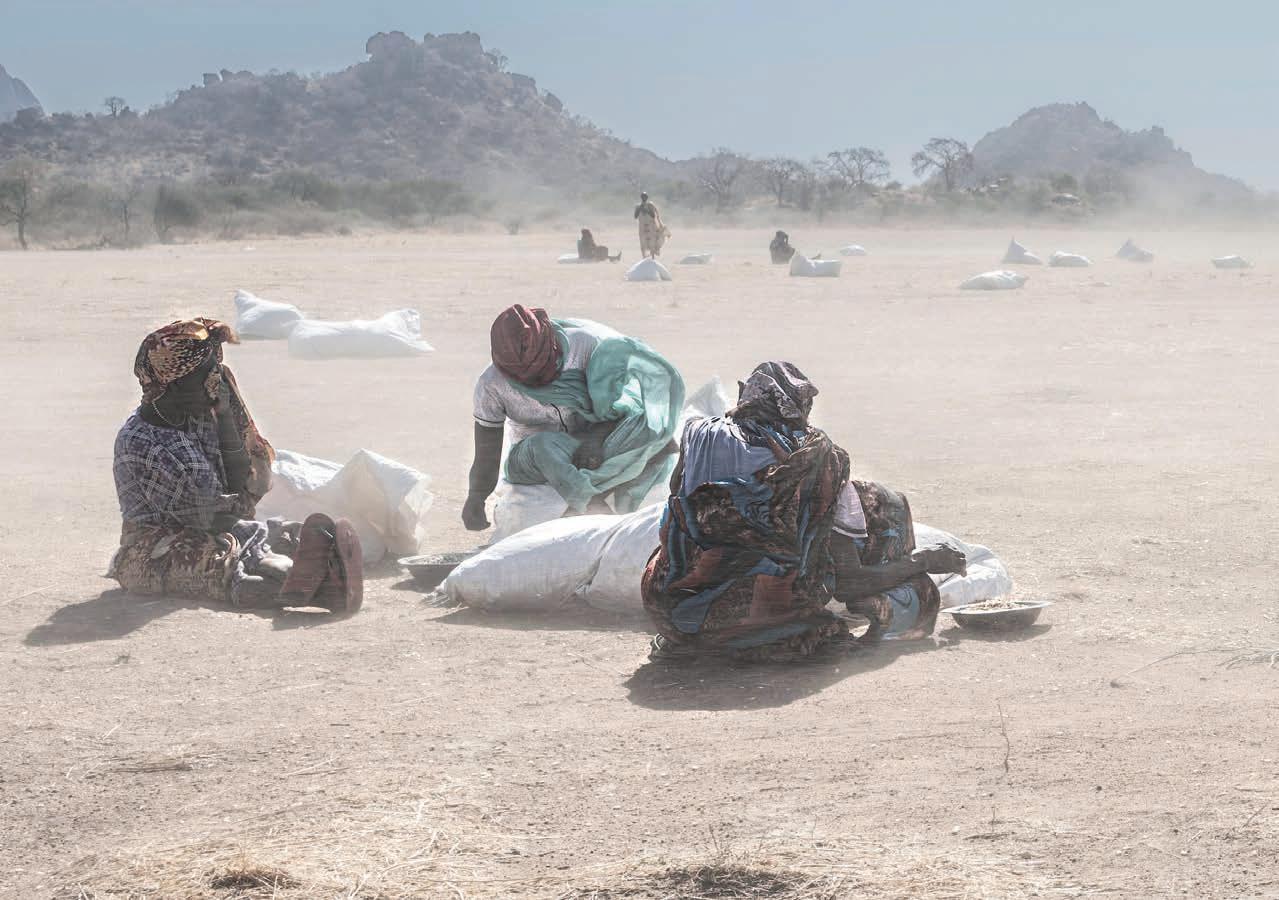
With almost four decades of experience working for organisations like The Sunday Times, and currently on the Global Health Security team at The Telegraph, Townsley is no stranger to capturing the a ermath of the world’s most pressing humanitarian disasters
“Those on social media are not journalists and the whole concept of a citizen journalist is dangerous. Photographers are trained disseminators of truth and information, not activists,” Townsley says.
Personal health and safety is something
He argues that a photograph taken properly on the ground encapsulates everything that you feel, taste and hear in a moment. “Accurate and impartial photography is under a ack and is massively underrated in the humanitarian sector,” Townsley says.
Legal complications are also common for humanitarian reporters. Veteran war correspondent and academic Luke Hunt points to another growing pressure on journalists: Strategic Lawsuits Against Public Participation, commonly known as SLAPPs.
“What is happening in Gaza right now with the targeting of journalists has all the earmarks of a serial killer”
Townsley will put on the line while taking a photograph. In August 2025, he and his team risked exposing themselves to mpox, a viral illness which can cause a painful rash or lesions, at a quarantine zone in Freetown, Sierra Leone.
“This was in a government-run hospital in the region and the local medical teams didn’t give us any equipment, but informed us to not touch anything,” he says.
Those reporting on mpox or other such viruses are at constant risk of falling seriously ill, especially when not wearing personal protective equipment: “Two days later, at a Doctors Without Borders hospital, we were given a visor, hood and gloves. We quickly realised this is what we should have been wearing all along,” Townsley says.
SLAPPs, according to the Bureau of Investigative Journalism, are legal threats used by the wealthy to censor public interest in journalism. They aim to silence critical speech or political expression and are common across the humanitarian sector.
In the rst half of 2025, Hunt, who writes about Southeast Asian society and politics for multiple outlets, was sued for defamation in a SLAPP.
Alongside several journalists at the Asia-Paci c current a airs magazine The Diplomat, Hunt was threatened with legal action by a Cambodian commercial bank:
“In Cambodia, defamation is a criminal o ence and pre-trial detention laws are harsh. SLAPPs such as these are not designed to go to court, they
Simon Townsley
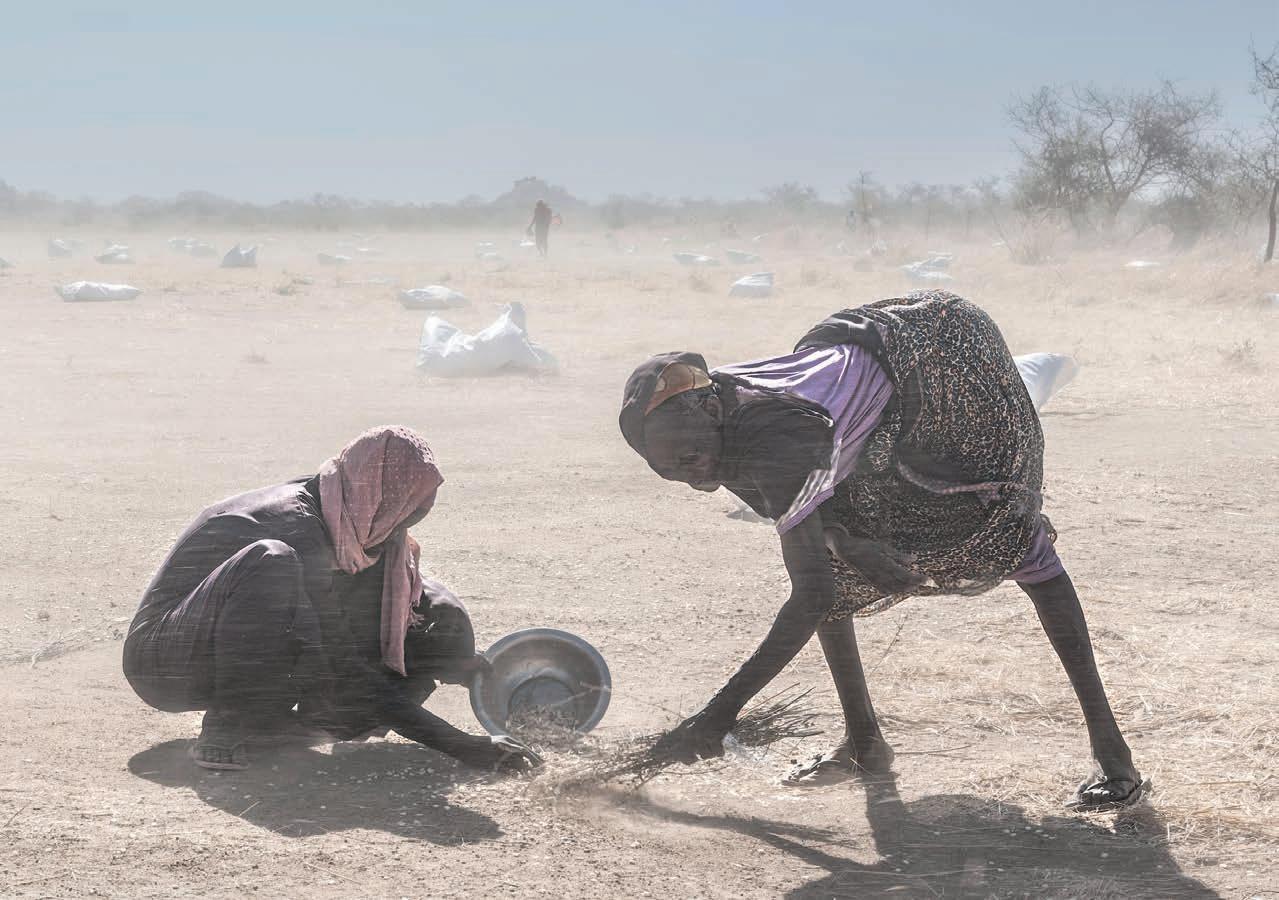
are designed to intimidate and silence,” Hunt says.
“SLAPPs are a product of our times, the digital age, and every dickhead who thinks their opinion ma ers over facts,” Hunt claims, currently involved in a project that involves helping child soldiers in Myanmar.
In all of Hunt’s three decades of reporting on con icts and geopolitics in Southeast Asia and the Middle East, he emphasises that today’s environment is unprecedented for journalists, especially those covering Gaza.
“What is happening in Gaza right now with the targeting of journalists is worse than a genocide, it has all the earmarks of a serial killer,” Hunt warns, underscoring both the physical and systemic threats facing reporters on the ground.
El Sayed agrees – as a Gazan journalist, she is no stranger to war. Throughout her life, she has experienced “big wars”, “small wars” and “local escalations”. This current war, she says, is di erent. “For years, as a Palestinian journalist, we were targeted while covering protests and covering wars, but this time, no one is safe. Everywhere is the eld,” she says.
“I remember once it was 2pm and the last meal my four children had was at 3pm the day before,” El Sayed recalls. “They hadn’t eaten anything because I couldn’t nd bread.”
This was only weeks before the Israeli Defence Forces threatened the lives of El Sayed and her family; soon afterwards, they had to leave their homeland and flee to Egypt as refugees. According to El Sayed, the threats came as a direct result of her pervasive reporting on the ongoing Israeli bombardment of
Palestine.
Since then, it’s been estimated by the World Peace Organisation that almost 10,000 people have died from starvation in Gaza. The actual death toll is presumed to be signi cantly higher, but with the scope of humanitarian data limited, it is impossible to be certain.
“I’m not talking about people who are poor, I have the nancial means and even I can’t provide my children with food. There isn’t any,” El Sayed con rms.
“My ve-year-old, Juju, stopped telling me she was hungry. She’d been telling me she was hungry for hours, and then she stopped. She realised that there was no food.”
El Sayed was not simply having to report the absence of food for a ve-year-old child or the loss of a family home – she was living through it all whilst relaying the conditions of Gaza to the outside world. These are the reporting circumstances that the international community knows, but according to El Sayed, we do not truly understand.
Reporters are working within infrastructures that are crumbling around them. Most of the time, it is with no equipment and no resources. Many journalists are reporting while displaced, a empting to document events while also navigating the same shortages of food, shelter and safety as the communities they cover.
They are conditions that are a serious threat to humanitarian reporting and international justice work alike. Qudah is clear: “When you kill a journalist, you are basically erasing the evidence of war.” ●
Ines Jeveons and Julia Bo oms delve into the ever-changing trade of celeb ti!le-ta!le
In 1999, Vanity Fair christened the ‘90s “the Tabloid Decade” – a “down-and-dirty bon re” of wild celebrity love triangles, rock star blunders and general A-list debauchery. Unbridled in its pursuit of the famed and fortuned, celebrity journalism in the ‘90s came to embody the so-called ‘golden age’ of tabloid paparazzi and ‘fair game’ reporting. Gossip journalists feasted on the lives of celebrities. It was a time when being a truth-sayer was the exception to the rule.
But as a!itudes change towards gossipy staples like body shaming and drug use, as well as tipping points like the Leveson Inquiry and the subsequent lawsuits, the traditional idea of a gossip journalist as a headline profession has slowly petered out. Title acts such as The Mirror’s “3am girls” (a special Piers Morgan commission) –Polly Graham, Jessica Callan, Eva Simpson – the Charlie’s Angels of tabloid media, trailed o into more ‘serious’ media roles, leaving their early-morning slots in the land of Von Dutch caps and low-rise skinny jeans.
It’s not that the world is more ethically conscious by any stretch; personalised social media platforms like TikTok have spawned gossip juggernauts such as pseudonymous Instagram account DeuxMoi. YouTube and TikTok personality Celebritea Blinds pedal their tip-o s out to 527.7k followers, with videos garnering up to two million views. In lieu of veri cation, Blinds starts each video with a caveat: “All of these items are alleged not con rmation.”
If the media of the 90s and 2000s was an unregulated gossip machine, it had been powering up for years. Robert Plunket, HRH of American gossip, made great use of an all-access pass in 70s and 80s New York as a fringe actor-cum-
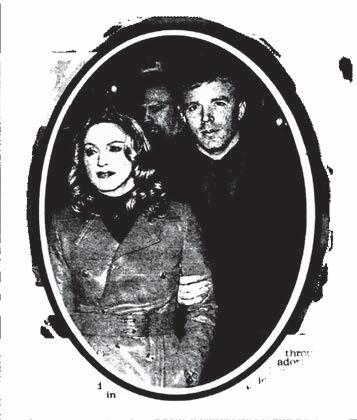
novelist. He appeared in Martin Scorsese’s A!er Hours and Plunket used his ve seconds of lmic fame to irt with New York’s upper echelon. “Cher came running up to me and said, ‘You were great!’” he remembers.
In 1985, Plunket took up a post as Sarasota Magazine’s lead gossip columnist, Mr. Cha!erbox, inspired by Evelyn Waugh’s gossip columnist character in Vile Bodies. Cruelty was never his motive – the essence of Mr. Cha!erbox was humour, entertainment and never the straight truth. “I know in journalism, the important thing is telling the truth. I never tell the truth. I tend to make up stories, exaggerate, and always bring the focus back to myself, rather than focus on what’s really going on.”
a premiere because Tom Cruise was walking through,” says Gordon, who joined the paper’s trifecta in 2001. “The sta said: ‘Mr Cruise does not want anyone to see him walking through this hall. You need to go!’ It wasn’t him personally locking me in a cupboard.”
But the work ultimately wasn’t the right t for Gordon. “Look, I was a really shit gossip columnist,” she admits. “I was not good at it. I quit a er three months and hated every moment of it.”
Plunket’s slice of the A-List birthed his novel Love Junkie, deemed the “Madame Bovary for the heyday of New York” by Penguin. This christened him as the author du jour and even had Madonna musing on a lm adaptation. Plunket spent a (now notorious) a ernoon lounging in Madonna’s bed discussing the next steps for her favourite novel; “She [Madonna] would tell me how to write.”
By this stage the tabloid had fully industrialised readers’ appetites for showbiz, and journalists were hired in spades to catch and sell celebrity stories at magazines like Closer, OK! and Sneak. Bryony Gordon joined The Daily Mirror as a ‘3am girl’ in 2001, part of a revolving trio of celebrity columnists who were active until 2016. The 3am gra involved documenting raucous ‘hardy’ partying by cornering celebs in toilets or other unlikely places. “I remember ge!ing

their way in. “The world is much more guarded, so you have to be much more careful about what you write and who you write about.”
The moral stakes of the work was also a burden. Former 3am girl Polly Graham now works as an English teacher. “I felt I had become a slave to bylines, with li!le thought to the consequence of my stories,” she wrote in the British Journalism Review in 2021.“As a showbiz reporter and gossip columnist, I had li!le sympathy for my subjects. Why should I?”
The onset of the internet made it harder. “As showbusiness editor, I was expected to ll the online space with daily o erings which I hammered out and published with a total lack of quality control.”
to a halt.
“I never tell the truth”
It was widely acknowledged that many celeb stories were likely based on fabricated or unsubstantiated fodder, common practice across showbiz reporting during this era. In 2007, Private Eye reported that former 3am girl Jessica Callan said quotes for interviewees were made up by journalists, and was surprised they were never sued for “having imaginary conversations”. Another former celeb journalist described the 90s and 2000s as “pre-post-truth”, in which gossip journalists relied on interpretive tip-o s from callers. For every honest tip about Lily Allen, they would scavenge another about Angelina Jolie, if the editor requested more variety for that week’s column. The source would be called and given ten minutes to ‘ nd’ the quote.
But as the 2000s gave way to the 2010s, titles like Reveal, New!, Star and Now folded. The Leveson Inquiry, the rise of PR, online mass media and later in uencers, social media and its tidal waves of cancel culture all played a part in shi ing the gossip economy on its axis. The freewheeling gossip train as readers knew it slowly chugged
One of the last remaining gossip corners is Popbitch, a weekly celebrity newsle!er that has been sating inboxes with the most scurrilous of ‘sleb’ scandal since 2000. The le!er, distributed to 300,000 inboxes every Thursday a ernoon, contains a mix of whispered celebrity blind items, intellectual humour and pointless trivia wri!en in plain-text HTML format, so it can be read surreptitiously at a work computer. It’s wri!en with the razor-sharp satire of 90s UK gossip forums, but stories must be both ‘pop’ and ‘bitch’. They must be salacious, but they must also be funny.
Camilla Wright, the co-founder of Popbitch, began her career as a celebrity and music freelancer in her 20s before se!ing up the newsle!er. Wright, now based in Dubai, runs a sports PR company alongside the newsle!er, though she returns to PBHQ’s Soho o ces regularly, where four sta members work full time. Popbitch is known for irting with the limits of defamation law and picking up the exclusives that mainstream media has spiked, scrubbed or sanitised: phone hacking, Jimmy Saville (AKA Sir Jingle Jangle) and MeToo.
But such scoops are o en more di cult to come by. “It’s go!en easier, but also harder in a certain way these days. With the growth of social media and people worrying about their jobs so much, it’s harder to pass on tips.” Celebrity partying goes on behind closed doors, making it harder for journalists to wrangle
Wright is quick to shut down stories that are outright fabrications. Unveri able stories might linger in editorial purgatory for years. For items that sound plausible, Wright asks around, informally cha!ing with carefully chosen lawyers, PRs or journalists. Only a er exhaustive veri cation will a story make it into the newsle!er.
In 2008, Max Beesley sued Popbitch over an allegation about his personal life. “When we started up, I don’t think anyone knew what internet law was like – it was kind of a Wild West and we were the guinea pigs,” she adds. “Very quickly we were ge!ing legal le!ers.” Now, the risks commonly outweigh the rewards, and Wright always does a thorough read-through before hi!ing send on a Thursday. “I always want to make sure that I’m happy with it, and that anybody else who works for us feels completely safe in everything they’ve done and nothing is on their shoulders.”
Despite di culties reporting, Wright is certain the appetite for Popbitchery hasn’t gone anywhere.
“Everybody in the media likes to know that they’re being talked about.”
What happens when nobody believes a journalist? It is a feeling many know too well. Daisy Dempsey and Grace Bannister investigate
When Dan McCrum was nally vindicated a er years of scrutiny over his reporting on Wirecard, the relief was overwhelming. “I can only imagine it’s like winning the FA Cup,” he says. “I jumped up and down and ran around screaming like a lunatic.”
For six years, The Financial Times investigative journalist had been digging into the German payments company, once one of Europe’s most celebrated nancial tech rms. His reporting exposed evidence that billions of euros in company accounts did not exist and that pro ts reported by the business were potentially fabricated.
When the Financial Times published the investigation, McCrum thought he might have secured one of the biggest scoops of his career. Instead, he found himself under suspicion. The German regulatory authority, BaFin, accused him of market manipulation and collusion with short sellers, opening an investigation into the journalist’s reporting rather than the company itself.
What should have been a moment of professional triumph instead was the beginning of a gruelling legal and reputational ba le.
Years can pass before investigative journalists are proved right. In the meantime, reporters can be sued, publicly discredited, or even investigated themselves. Their work o en challenges powerful corporations, governments, and institutions with vast resources to defend their reputations.
The stakes are high, not only for the stories they pursue, but for the journalists themselves. The pressure of legal ba les, reputational a acks, and prolonged stress takes a toll on their mental health and professional integrity.
That pressure formed the backdrop to McCrum’s investigation into Wirecard. What began as a relatively routine inquiry into doubts surrounding the company’s accounts gradually uncovered something far more serious.
“We knew we had a big story, for the rst time we were able to use the F-word – fraud – in print,” McCrum recalls. Over a period of six years, he found evidence that Wirecard had been using three business partners in Asia to arti cially in ate revenue.
Following the publication of his investigation, Wirecard’s share prices fell sharply. The rst article published wiped roughly €1 billion from the company’s value. By June 2020, Wirecard’s shareprices had fallen by a further 99 per cent.
“When you see that a company is suddenly worth €8 billion euros less than it was ve minutes ago you get that unse ling feeling of ‘God, I really hope this is right’,” says McCrum.
Initially, Wirecard adamantly rejected McCrum’s claims. For months he was tailed by private investigators.
“At times it was genuinely scary,” McCrum recalls. “I felt that if I got hit by a bus, maybe people wouldn’t care, or maybe they’d think I got what was coming to me. The only way out was to prove that they were the bad guys.”
He was also investigated for market manipulation by the Financial Times itself, although he was eventually absolved of any wrongdoing.
Despite feeling vulnerable and at times undeniably scared, the backlash emboldened McCrum. “I didn’t want to let these bastards get away with it.”
It was a tenacity that paid o . In June 2020, Wirecard led for insolvency a er disclosing that €1.9 billion in cash it had claimed to hold did not exist. CEO Markus Braun was arrested and charged with fraud and embezzlement and is currently being held in Stadelheim Prison, Germany. His criminal trial is ongoing with a projected end date of later this year.
McCrum’s investigation is one of the most dramatic examples of investigative reporting uncovering misconduct in the face of intense pushback. But it is far from the only instance.
In 2004, The Sunday Times investigative journalist, Brian Deer, published an article in response to claims
made by then-eminent gastroenterologist, Andrew Wake eld.
Wake eld had argued, in a 1998 paper in The Lancet, that the MMR vaccine was causing autism in children. It sparked international alarm and helped to fuel what would become the modern anti-vaccine movement.
“It was clear pre y early on this wasn’t true,” Deer explains. “You simply can’t make these claims as de nitively as Wake eld was making them.”
Mainstream media outlets were somewhat slow on the uptake. Wake eld’s study did not garner nationwide a ention until almost ve years later.
But once they gained traction, his sensationalist claims caused record low MMR vaccination rates in 2003, dropping from 92 per cent to 80 per cent. Some areas, such as south London, saw inoculation uptake fall as low as 65 per cent.
It was a year later when Deer published his rst article in which his ndings were clear: Wake eld had received funds from a rm of lawyers preparing legal action against the manufacturers of the MMR vaccine. Moreover, the children in the study had been sent to him by campaigners involved in those e orts.
“They were trying to nd evidence to substantiate the funding of their lawsuit by a British government agency, the Legal Aid Board,” Deer explains.
Months prior to this, Wake eld had patented a
“I felt that if I got hit by a bus, maybe people wouldn’t care, or maybe they’d think I got what was coming to me”
o ering it as an alternative to the one-o shots he claimed caused autism. If successful in gaining traction on his design, the surgeon stood to make millions.
Despite this, segments of the anti-vaccine movement, including campaigners and online conspiracy communities, continue to cast doubt on Deer’s integrity to this day. For years, Deer has faced accusations from antivaxxers who claim that he was working for drug companies.
“For every story I run, there’s been ten times as much work dealing with the abuse, the complaints and the lies,” he says. “Outrageous stu , people suggested that I stole hospital records. It just goes on and on. There were times when I did think it would have been easier if I’d never
Wake eld maintains his innocence.
The same cannot be said for Lance Armstrong who, a er a 14-year-long investigation by Irish sports journalist David Walsh, infamously confessed to doping, live on air, on The Oprah Winfrey Show in 2013.
A cancer-survivor, Lance Armstrong had dominated the international cycling league, winning the Tour de France seven times. It was the success story everybody wanted to believe. That is, everybody but Walsh, who suspected the athlete was doping from very early on. Beginning his investigation in 1999, Walsh wrote numerous articles on Armstrong in the
drugs, including EPO, growth hormones and testosterone. She was instrumental in the investigation.
Walsh’s reporting was ultimately proven to be true in 2012, when the United States Anti-Doping Agency concluded that Armstrong had run the most sophisticated doping programme in the history of sport. The cyclist was stripped of all seven of his Tour de France titles and banned from competitive cycling for life.
The following year, he publicly admi ed to using performance-enhancing drugs during an interview with Oprah Winfrey. In the a ermath, The Sunday Times successfully recovered the se lement money it had paid Armstrong years earlier.
“There were times when I did think it would have
For Walsh, it was an exoneration. “I was never going to walk believed people needed to know. It was that ageold question, would you prefer a beautiful lie or y ugly truth.” rst cyclist to cheat and he won’t be the last,” Walsh continues. “But he le, the most successful, and the lie he
dismissed and Walsh was the villain with a pen gunning for survior-hero-cyclist success story. Yet, while all-consuming and at times frightening, they were all ultimately rewarding ning for each
about the most joyous thing rms. “There will never be another story that energises me in quite the same way. If I were feeling generous, I’d send Lance a Christmas card every
MRóisín Teeling and Florence Ingleby speak to content moderators verifying the world’s most distressing con icts
“You’re permanently exposing yourself to a nefarious brainwashing exercise”
One screen showed a motorway outside Kyiv, another a grainy vertical clip pulled from Telegram.
“It was probably the rst major breaking news story where an entire nation was lming on their phones,” Taylor recalls.
By nightfall, he was part of a team that had traced locations, timestamps and landmarks, piecing together a war from the uploads of strangers.
arch 2026: black rain falls over parts of Iran in a thick, oily downpour.
In Tehran and Beirut, so-called penetrator bombs drop from the sky. Shaky footage emerges from Minab of families si ing through the wreckage of a collapsed school in search of their children, holding up school bags and books to the camera.
Clips bounce across platforms, reframed, mistranslated and reposted. Some are real, some are fake. In reputable news organisations, every single one has to be checked. For journalist Paul Brown and his team at BBC Verify, it is their responsibility to monitor each piece of content and ask journalism’s perennial questions – where, when and, if possible, why? The work sounds clinical, involving geolocation, timestamps and satellite passes. But, ultimately, Brown is examining the raw evidence of war and establishing whether the worst crimes imaginable have indeed happened.
“There’s usually a moment a er the end of a particularly intense shi where you experience a rebound e ect,” says Brown. “Your brain shi s to become more re ective on the reality of what you have spent the day covering.”
Veri cation units are the hidden frontline of modern journalism. These small teams con rm what is real and what is fake, o en under relentless pressure and with li le public recognition. The work is technical and exhausting. While fact-checking units are no longer expanding, with platforms cu ing support and AI sold as a shortcut, the labour of veri cation remains an essentially human endeavour and requires confrontation of the darkest sides of human behaviour.
Back in February 2022, when Russia launched its full-scale invasion of Ukraine, journalist Jack Taylor was called into the Sky News o ce at 6am. Phones buzzed. Editors hunched over monitors.
For journalists covering con icts in the Middle East or Ukraine, the routine involves spending hours cross-checking skylines, analysing upload times and dissecting footage frame-by-frame. The material ranges from ba le eld videos and drone recordings to CCTV clips, social media livestreams and graphic images of civilian casualties. Similar methods are applied to election disputes, political violence and major criminal cases. The material is not always violent, but it is o en emotionally corrosive.
The e ects of encountering distressing material every day can accumulate over time. As Gavin Rees, senior advisor for training and innovation at the Global Center for Journalism and Trauma (GCJT), explains: “It is possible for people who are working immersively with second-hand trauma to get into di erent forms of trauma-related mental health di culties, of which the most wellknown is post-traumatic stress disorder.” The risk, he says, is tied to the repeated exposure to the material.
Taylor likens it to a glass slowly lling with water. “Each violent clip, each distressing image, adds a li le more. The over ow might not come from the most graphic footage, but from something much smaller. It’s not always the thing you expect that over ows the water glass.”
A 2024 study, titled ‘Journalism on the Digital Frontline and the Mental Health of Investigators’, found that prolonged evaluation of eyewitness media can a ect psychological wellbeing. The Eyewitness Media Hub reports that 52 per cent of journalists encounter distressing material several times a week. Similarly, research from the Dart Center for Journalism and Trauma found that 20 per cent of newsroom sta display symptoms of PTSD, with nearly double experiencing secondary trauma (witnessing something traumatic secondhand).
For August Graham, a fact-checker at PA Media, the impact is subtle but persistent. Working in a two-person team, Graham explains, “You’re permanently exposing yourself to stu that might
just be there for clicks or might be there as a nefarious brainwashing exercise.”
Sometimes, he says, it follows him o the clock. “I’ve caught my brain pulling up a random conspiracy theory while I’m walking down the street, and I must go, ‘No, hold on, I know that’s not true.’ I have context. I’ve checked it. Even with a sceptical mindset, if you’re seeing this stu several hours a day, ve days a week, it seeps in.”
What worries Graham most are the moments when he doesn’t realise his worldview is being quietly reshaped by the misinformation he encounters daily. “It’s exhausting to constantly have that debate in your own head,” he says.
Elana Newman, research director at the GCJT, o ers an analogy for the emotional hazards veri cation workers face. She compares exposure to graphic content with radiation, stressing that such material is toxic and must be handled with care. Just as a radiation worker watches a Geiger counter and evacuates when the needle spikes, journalists should notice the warning signs, step back and give themselves the care they need before the dose becomes toxic.
“It is legitimate to have reactions,” says Newman. “With these things that people are asked to view repeatedly, it is reasonable to be upset. It shows that you’re a moral human being and you haven’t lost your sense of sensibility.”
Despite the urgency of their work, the expansion of veri cation teams has slowed since its initial rise in the 2010s. Duke Reporters’ Lab recorded that between 2014 and 2022, the number of veri cation projects worldwide increased from 110 to 453. The report also shows that, since 2025, this number has decreased, even with the rise of con ict across the globe. That drop comes as tech platforms such as Meta wind down formal fact-checking partnerships, leading to fewer articles being published and potential sta ng cuts at some partner organisations.
Even the current fact-checking units tend to be small. According to Duke’s Reporters Lab, in 2024 nearly three-quarters of organisations reported having 10 or fewer full-time employees and more than 40 per cent operated with ve or fewer sta . At the same time, about 42 per cent said they had expanded their team, while roughly 15 per cent reported cu ing sta
This mixed landscape re ects a broader shi The cutbacks in platform funding, combined with newsroom budget pressures, mean veri cation teams are more vulnerable to nancial shi s than they were just a few years ago.
A possible solution to the exposure could lie in the root of the problem itself. AI is increasingly being explored as a tool to help limit the impact of distressing material on journalists’ mental health. It promises faster, cheaper results and new tools are emerging to help reporters navigate the ood of content by spo ing manipulated material before they spend long periods examining it themselves.
For instance, the BBC verify team used Google’s SynthID watermark detector to verify an image of an explosion near a US military base in Iraq, which was proven to be AI-manipulated. The image had been generated from a real photograph the team had previously veri ed, showing a cloud of dark smoke rising over Erbil International Airport. Subsequent human analysis revealed inconsistencies such as unusually shaped structures in nearby buildings and an unrealistic reball, while the AI tool was used to con rm the suspicion.
As such, the technology acted more as a second pair of eyes than a replacement for veri cation work, accelerating a process that still ultimately relies on human judgment.
The paradox is clear, the same technology producing an overwhelming volume of synthetic and disturbing content is also being positioned as the tool to manage it. As AI systems become more advanced, so too does the material they generate, o en forcing veri cation teams to spend additional time scrutinising images and videos that turn out to be fake.
The cumulative weight of this work remains largely invisible. The negotiation between speed and responsibility, detachment and empathy creates a form of emotional labour that, for many veri cation workers, can be hard to cope with. While the public tends to experience the nished story, these journalists experience the chaos that precedes it.
In terms of the structural support available to journalists, it doesn’t seem to exist. To help cope with occupational stress, Newman points to coping strategies such as reducing alcohol and
“You almost don’t want to sign off, because you know what is to come”
tobacco use, working in good lighting, taking regular breaks on shi and avoiding working overtime. Yet, when the material is in front of you, disengagement can feel like negligence. The more serious the content, the less possible it seems to look away. So, many don’t.
“I experienced a delayed response to the October 7th a acks and it can be a highly emotional moment,” says Brown. “Knowing it’s coming is part of the process of managing it, but there are still moments at the tail end of a shi where you almost don’t want to sign o , because you know what is to come.”
We had a month to put the whole thing together,” laughs Carole Cadwalladr, Pulitzer Prize-!nalist investigative journalist and cofounder of new online media title, The Nerve. “It was really like jumping o the cli . We had no idea whether it would land,” she says.
The female-led publication was founded by !ve journalists formerly of The Guardian and The Observer, who broke away from the la er following the December 2024 announcement of its sale to Tortoise Media.
The team – senior editors Sarah Donaldson, Jane Ferguson and Imogen Carter, creative director Lynsey Irvine and Cadwalladr – !rst met at The Observer’s weekend culture and politics supplement, The New Review, then got to know each other well on the same paper’s 2018
Cambridge Analytica investigation.
The Nerve’s so launch took place in Liverpool on 30 September 2025 during the Labour Party conference, with a live panel featuring broadcaster Carol Vorderman, comedian Stewart Lee and !lm critic Ellen E. Jones, who now all work with the publication. The choice was tactical: in the midst of the political energy but far from London.
Named a er the quality the founders believe the media needs in the current political climate, The Nerve produces a mix of serious reporting alongside culture and entertainment news.
“People are overwhelmed with so much news,” Cadwalladr says. “We want to see judgement. We want it to be fun.”
Their recent investigations have revealed the funding behind Reform and the UK government’s £670 million deals with US data-analytics company Palantir Technologies Inc. Part of the ethos behind the venture is inventing a new business
Hannah Stiven speaks to co-founder Carole Cadwalladr about the new femaleled news title The Nerve →
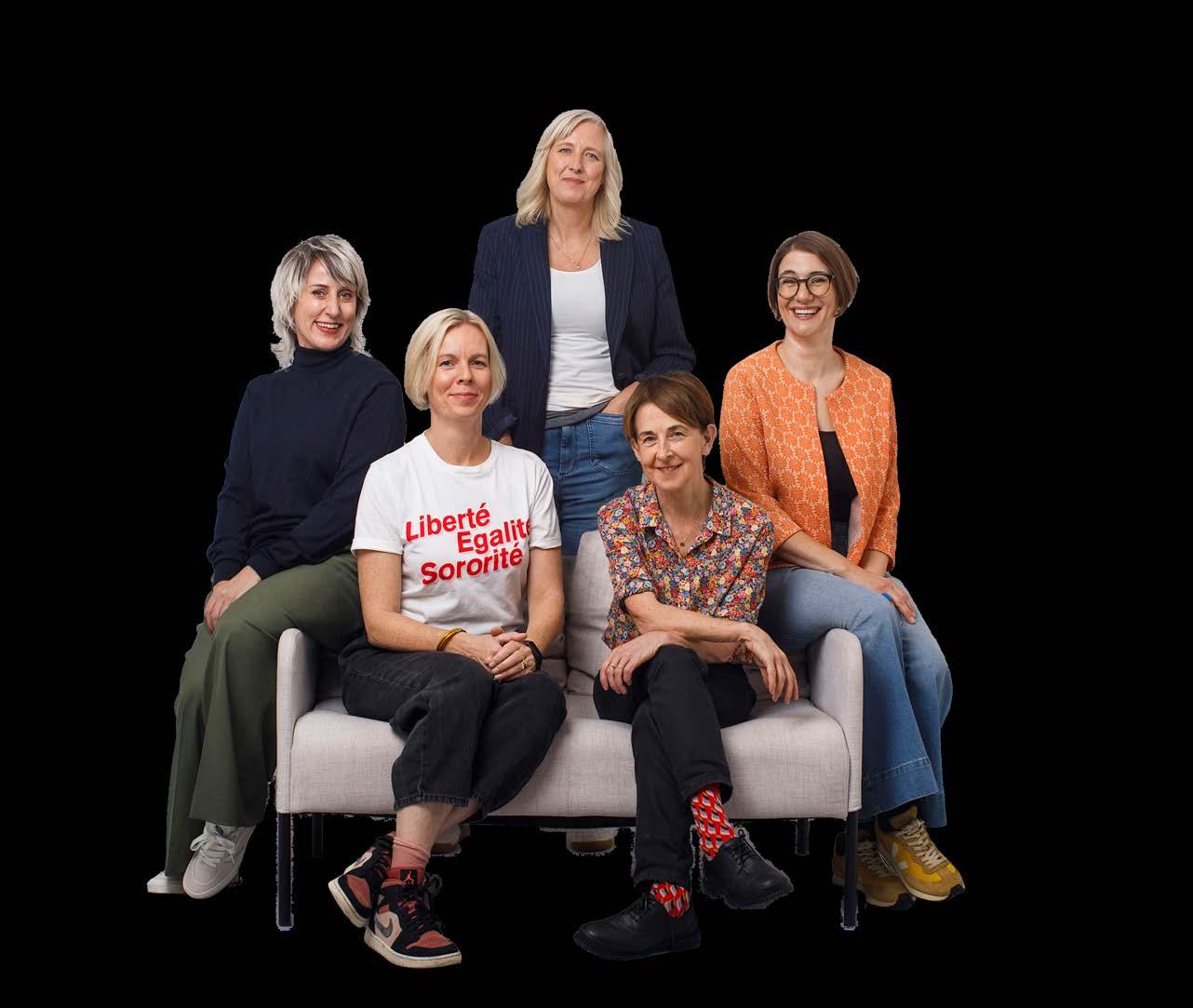
model for journalism. “We fundamentally believe that journalism needs to kill what it eats,” Cadwalladr says. Digital media’s growth era was fuelled by large cash injections from Silicon Valley venture capital, Cadwalladr says, adding that many media start-ups “did great things but burned through the cash.” She adds that the UK media model o!en relies on billionaire owners who “decide to turn o the money tap”, arguing that most news organisations in the UK “are owned by right-wing o shore oligarchs with a political agenda.”
Unlike other media organisations, The Nerve aims to stay smaller and closer to readers. The team debated whether to launch on Substack. “There’s so much energy in that, it’s where lots of new insurgent media outlets are now,” Cadwalladr says. In the end, they launched on beehiiv, a newsle er platform which markets itself as an all-in-one publishing system, starting with a beta website and twice-weekly newsle ers. There is no paywall, so non-paying subscribers can still access the content. The publication relies on memberships costing £6.95 per month or £68 per year, with a £250 founding member tier that includes live events and other bene ts.
In its rst week, The Nerve saw an in ux of 9,000 subscribers, surpassing its rst month’s target of 1,000 paying members. InPublishing reported in March 2026 that 12 per cent were paying subscribers and the newsle er open rate was over 60 per cent. At the time of writing, the publication had approximately 21,000 Instagram followers.
Cadwalladr says audiences previously expected to get quality news for free but “they are gradually realising that there is a cost to them.” She adds that “a free and independent press is one of our best bulwarks against the kind of authoritarianism that we’re seeing on the rise pre y much everywhere.”
Although they have enjoyed being small and grassroots, Cadwalladr believes it is worth bringing in more money to scale to the next stage. She says: “We’re paying for everything out of revenue, and that is incredibly rare for any new media organisation. The investors we’ve talked to are really impressed by that.” Two philanthropic foundations have given grant money to The Nerve to fund its public interest reporting, and build out more resources for investigations. However, insurance is expensive. As Cadwalladr puts it, “I am seen as a liability,” following a widely publicised defamation claim brought against her by Arron Banks, a businessman and Leave.EU campaign founder and donor. Despite Cadwalladr winning the majority of the case, the litigation increases The Nerve’s premiums. “We just have to bite the bullet and pay that.”
“Newsroom culture is o!en quite macho,” Cadwalladr explains, but supporters have responded well to the “di erent energy” that The Nerve brings. In particular, Christopher Wylie, the Cambridge Analytica whistleblower, thought it was signi cant that the team of journalists was all

female. “He trusted us in a way in which he didn’t trust male journalists and editors, frankly,” she adds.
Outside the ve main editorial sta , there’s a wider network of “family and friends”. Many prominent former The Observer editors have joined the team, as have comedian Stewart Lee and psychotherapist and writer Philippa Perry. In true start-up style, recruitment can be eccentric: one sta member approached Cadwalladr when she was walking her dog and now works as a researcher.
“Journalism needs to kill what it eats”
The plan for 2026 is to produce more video content for news, improve the YouTube channel and develop the biannual magazine. “I’m good friends with Peter Jukes, executive editor of Byline Times,” Cadwalladr says. “I’ve followed them on their journey and they’ve found that print is a natural paywall. It’s increased their subscribers overall, and people like receiving it.”
The Nerve’s trial run at print was covering the conviction of former MEP Nathan Gill, who was convicted of taking bribes in return for pro-Russia interviews and speeches, and they produced a news package on the day Gill was sentenced in November 2025. “We based ourselves in a co ee shop on Fleet Street for the day of the trial,” she explains. “[A team member] came along with a box of the printed specials. There had been some confusion so it turned out to be smaller than we thought. [We realised] we’d reinvented the pamphlet. That’s how journalism began: in the co eehouses of Fleet Street! We’re back to our roots.”
Ask why your Vogue pitches keep being ignored: You mention that you are a freelancer, but your pitches to Vogue keep ge ing ignored. Chanté promises to chase this up for you. You feel proud that you’ve successfully cha ed with an important journalist. What do you do next? Options: Add her on LinkedIn (p149), Walk away and chat to other people (p156) ●
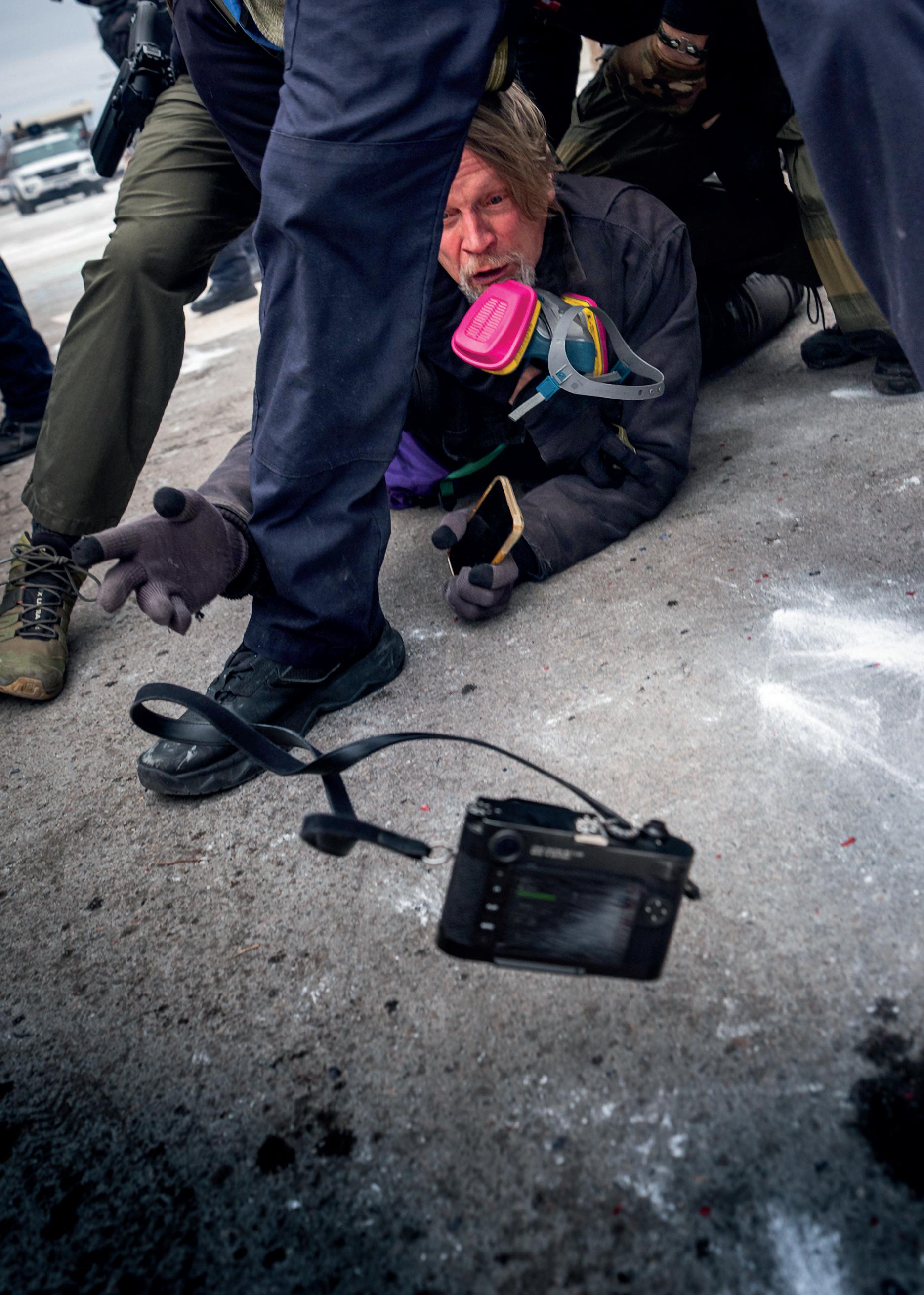
ICE arrests, shrinking access and intimidation. Lucy Dover and Lara Hedge examine how Trump’s second term is testing the tenacity of journalists
Misleading. Biased. Exposed. This is what the White House thinks of the global and domestic press. A new webpage for the White House appeared in November 2025 where they regularly publish their “media o ender of the week”. Publications listed include CNN, The New York Times and the BBC.
Since 1791, the rst amendment of the US constitution has prohibited Congress from restricting ve fundamental freedoms: religion, assembly, petition, speech and press. From the beginning of Donald Trump’s second administration, reporting in the US has become like “drinking from a rehose”, says Sky News US correspondent James Ma hews.
Trump has never been a fan of critical press. However, in the last year, the White House has begun waging an outright war against press freedom. Reporters Without Borders claim that this is an a empt to seize control of reporting in the US, profoundly reshaping the conditions in which journalism is produced.
The Trump administration is treating journalists as partisans instead of reporters of truth, and is framing journalism around a culture of denial. During a press conference in January 2026, Niall Stanage, a columnist for The Hill, asked White House press secretary Karoline Leavi about the detainment of US citizens by Immigration and Customs Enforcement (ICE) o cers. He was met with an accusation of being a “biased reporter with a le wing opinion” and brandished a “le wing hack”.
The pack of press given access to Trump’s administration has been reshu ed. The White House barred Associated Press reporters from the Oval O ce, until a federal judge ordered them to restore the news organisation’s access. They also banned The Wall Street Journal from Air Force One for “fake and defamatory conduct”. Instead, far-right news websites known for publishing conspiracy theories, such as Breitbart News, are now being given disproportionately favourable access.
For Ma hews, the issue is less about a single outlet and more about how access is being used to shape coverage. “The media is an important check on the government and holding misuse of power to account. [They] are now in the business of surrounding [themselves] with friendly journalists.”
Those outside of Trump’s close media circle are nding it increasingly di cult to report. “You have a president who will produce absolute denial if there’s any hint of controversy,”
“I understand they do things like that to criminals, but not to journalists”
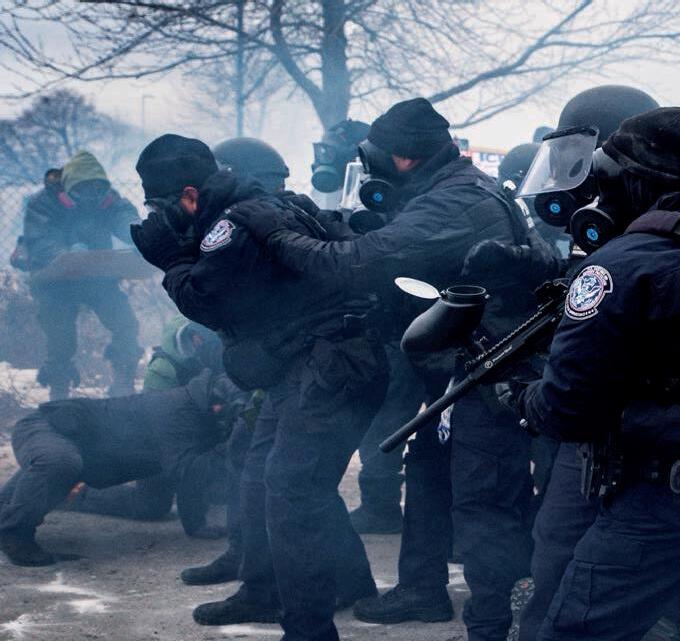
says Ma hews. “Trump is a master of the nonanswering of questions, ba ing it away and steering journalistic interaction.”
A new policy by the Department of War, formerly the Department of Defense, has restricted journalists’ access to the Pentagon unless they report o cially-authorised information. More than 30 news organisations up and le their posts in October 2025 in response to this unprecedented violation of press freedom.
The Trump administration is using all levers at its disposal to neuter what was previously conventional journalism, even targeting journalists reporting on the controversial actions of ICE.
Emmy award-winning Salvadoran reporter
Mario Guevara was arrested by ICE agents whilst livestreaming an anti-Trump protest in June 2025. Guevara was wearing his press vest and badge. He was held in an ICE detention centre for 112 days before being deported to El Salvador on 3 October 2025.
“If you are an immigrant reporter, you are at permanent risk because freedom of speech and freedom of press is not the same in the US now as previously,” says Guevara. “Right now, you are considered an enemy for publishing stories about ICE.” Placed in solitary con nement for 70 days in a small cell, Guevara claims he was only allowed two hours of sunlight per day. “I understand they do things like that to criminals, but not to journalists.”
Guevara had a working visa for 22 years. He claims the judge on his case ruled that his reporting was a “threat to the community”.
Documentary photographer John Abernathy tells a similar story a er being violently tackled and detained by ICE agents for documenting the Whipple Federal Building protest in Minneapolis on 15 January 2026 – an event that he says le his body “periodically shaking for weeks”.
“I was at least 10 feet o the road, on the opposite side of the street and facing away from
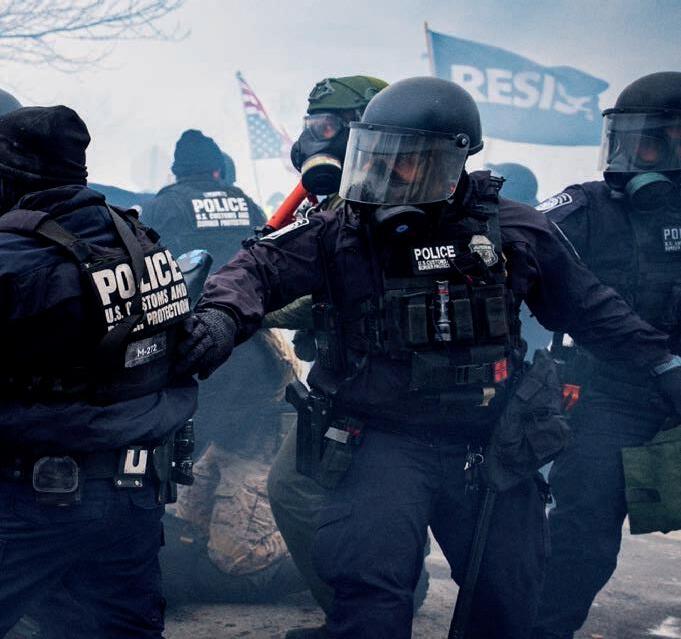
the crowd when I was taken down by 20 to 30 ICE o cers, their black boots surrounding me.”
While in detention, Abernathy was told that ICE agents had a video of him bear-spraying his people. “I didn’t have any people there,” he says. “I am not a protester. I am a photographer.”
He continues: “I had two agents with their knees on my back and three on top of me. They held my face down to the ground and deployed a tear gas canister in close range. The cloud was so thick, I couldn’t see through it. I gured I had maybe three breaths le .”
For Abernathy, navigating ICE o cers is the hardest part of his work in Minneapolis. “You need to decide for your safety purposes, how risky is the event? If the agents are there, what kind of weapon are they carrying and how erratic are they?”
Traditionally, a press vest will be used for your protection. For Abernathy, using personal protective equipment is now a normal part of the job. He has tested out multiple combinations of goggles, face masks, helmets and bullet vests to nd the ideal combination for his safety.
Abernathy’s is not the only case of journalists being treated, and punished, as protestors. Don Lemon, former CNN host turned independent reporter, was arrested by the FBI a er covering the Minnesota church protest on 18 January 2026, where protestors rallied against a pastor who allegedly worked for ICE. Lemon released a statement on his Instagram claiming he was there in a journalistic capacity. “The First Amendment has been the underpinning of my work,” he wrote in the statement. “I will not be intimidated, I will not back down.”
The Washington Post reporter Hannah Natanson’s home was raided by the FBI in January 2026, as part of an inquiry related to classi ed information leaked from the Pentagon. “I think partly why they went a er her is because she has done tremendous reporting,
“Trump is the newsmaker-in-chief”
“Trump is the newsmaker-in-chief”
against the odds, about [the administration’s] e orts to dismantle the federal government and the executive branch,” says Dan Balz, chief correspondent at The Washington Post Ma hews says the di culty is compounded by the pace of the news cycle itself. He has been covering US-based stories since 2022 and has found his reporting increasingly centred on Washington following Trump’s inauguration in January 2025. The presidency dominates coverage to such an extent that stories arrive faster than they can be fully examined. “Trump is the newsmaker-in-chief,” he says. “Nobody’s got time to explore a single development to its fullest extent, because there’s another huge story coming down the pipe.” Ma hews believes that this is part of the White House’s strategy to avoid scrutiny.
He says: “All we can do as journalists is to labour the facts, and allow our audience to make up their own mind, which is increasingly di cult.” As a result, journalists are not responding to factual disagreement so much as institutional refusal to acknowledge those facts at all, leaving stories unresolved even a er they have been evidenced.
This is a sentiment shared by Balz, who says: “[The Trump administration] have come in with a plan. They’ve tried a shock and awe approach to keep everyone o balance.”
Despite these odds, Balz feels optimistic about the tenacity of journalists, saying: “They’re not being intimidated by e orts to distract them. They are redoubling traditional journalistic practices –nd sources, break stories, tell people things they didn’t know and hold those in power to account.”
Balz uses the Pentagon as an example of this, saying that The Washington Post has continued to break stories, even without access to the building. What happens next, Ma hews suggests, depends on whether these government pressures continue unchecked. When asked how reporting in the US could look in ve years, he is stark, saying: “It will be a pre y dark place for journalistic freedom. The pa ern is clamping down on who reports and what gets reported and if it continues, they would like to control the media full stop.”
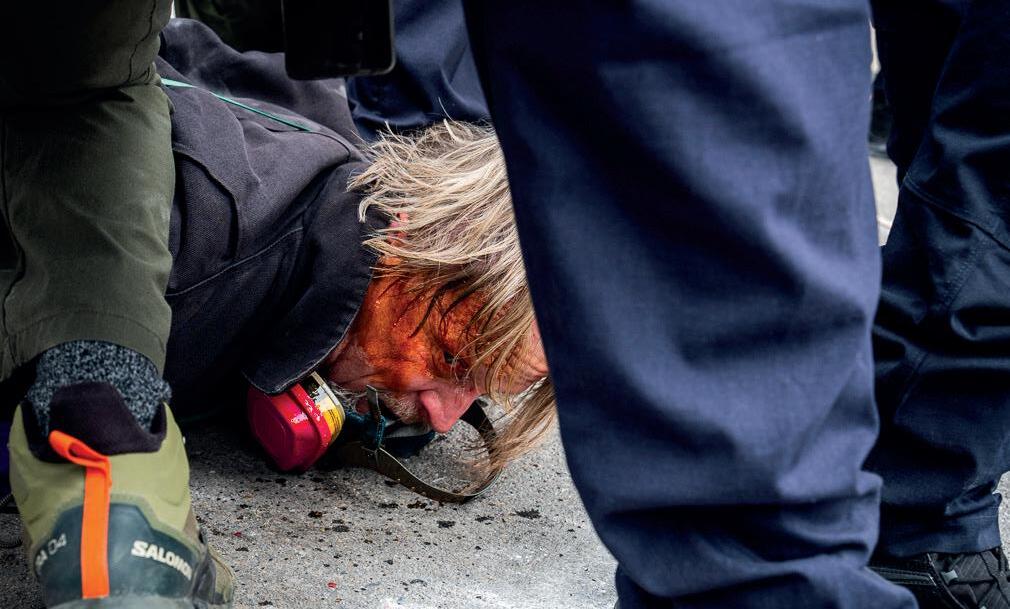
OF THE OF THE OF THE OF THE OF THE OF THE OF THE OF THE OF THE OF THE OF THE OF THE
As audiences dri in through side doors – social feeds, search and AI – the homepage is losing its place as journalism’s main entry point. Lily-Rose Morris-Zumin investigates what’s behind the homepage’s decline
Ah, the homepage.
For most of the internet’s history, there it has been: a grid of headlines, carefully arranged by editors and stories stacked in columns, the digital equivalent of a newspaper’s front page.
But, like many once-essential media forms – the pamphlet, the typewri#en circular, the ink-andquill periodical – the homepage may be dri!ing towards obsolescence.
Data suggests this is not just a change in users’ habits, but in media’s infrastructure. In January 2026, the Reuters Institute for the Study of Journalism warned that publishers could lose more than 40 per cent of search referral tra$c over the next three years, as search engines increasingly provide AI-generated answers directly on the results page rather than sending users through to news sites.
So what does that mean for the homepage itself, once the gatekeeper, the entry point and the centre of a digital media brand?
For Nic Newman, senior research associate at the Reuters Institute, those numbers signal a loss of its central role. “The front page, a single editor-curated set of stories, is becoming less
important,” he says. “People increasingly pick and choose from multiple sources and come in through side doors like social media, AI chatbots or messaging groups.” As audiences arrive from elsewhere, the homepage is no longer the starting point, but just one stop among many – o!en bypassed entirely.
This movement away is already trickling with increasing porosity into the media landscape. One such publisher trying to shi! away from the homepage – by abandoning it entirely, in fact – is Eliza, DMG Media’s gen-Z fashion and lifestyle brand.
Joanna Bridger, Eliza’s co-founder and editorin-chief, says the decision re ected where its audience already was. “A lot of publishers were using Instagram and TikTok as marketing platforms to drive people back to their websites,” she says.
“But our audience were engaging with our content most on social media, so we kept asking ourselves: why are we trying to pull them away from the places they’re already spending their time?”
That decision re ects a wider change in how
the homepage functions. Maddy Reid, editor of BRICKS Magazine, an independent London fashion publication, says it is “no longer the primary discovery tool it once was.” Instead, she suggests, publishers are having to rethink how audiences encounter their work altogether.
“You can’t just have a static homepage anymore,” agrees Charlie Campbell, a digital strategist. “It has to work harder to keep people there and give them something they’re interested in.”
At The News Movement, a socials-!rst news platform, that logic extends to how stories are wri en in the !rst place. “We write in a way that translates naturally to social media,” says journalist and producer Anwen Sleath. “We’re not taking long articles and breaking them down a#erwards. Everything is built for the platforms !rst.”
This ‘platform-!rst’ approach is visible in The News Movement’s own homepage, which mirrors social media: articles appear as vertical videos, to be watched rather than read. The homepage appears as an a#erthought, and Sleath makes clear it isn’t the priority: “We write in a socially native way, in the language we use and the stories we cover.”
In fact, a 2024 Forbes survey suggested that 45 per cent of gen Z are more likely to use TikTok’s search function than Google. “AI search functions are also surfacing video alongside text pieces almost as o#en,” says Jack Cummings, former editorial director of multiplatform at VICE. “One strategy now is to optimise social video with search terms so it ranks within Google’s AI results.”
Cummings, now head of social at Intrepid Travel, says brands are increasingly moving away from traditional publishers. Instead, they are collaborating with creators and large social pages that already command signi!cant followings. Traditional outlets, he says, “don’t always have the same followers, the same buzz, or hit the same target markets,” pointing to Intrepid Travel’s recent collaboration with the viral Instagram page Feminist, which has more than six million followers.
“Platforms can deliver enormous reach – but they control the tap, and can turn it off overnight”
homepages, with BuzzFeed ge ing around 75 per cent of its tra$c from social media by 2014. Investors poured in, pushing valuations into the billions and prompting a reported $650 million acquisition o er from Disney.
The model proved fragile. When Facebook changed its algorithm in 2018, tra$c collapsed across the industry. BuzzFeed later shut down its news division in 2023, while VICE !led for bankruptcy the same year. For publishers building audiences through social feeds, the lesson was brutal: platforms can deliver enormous reach. But they also control the tap – and can turn it o overnight.
Cummings says the industry quickly discovered the limits of platform-!rst publishing. “It’s much easier to monetise content on a website you own than on social media platforms,” he says, pointing to the value of the homepage as a space publishers control.
“You can’t just have a static homepage anymore – it has to work harder to keep people there”
But the idea of building media companies around social platforms is not new. In fact, the industry has tried it before and watched it unravel.
Cast your mind back about a decade, to the meteoric rise of BuzzFeed and VICE, earlier examples of social-!rst publishing whose spectacular ascent ended in what The Guardian described in 2023 as an almost Greek-tragic “Icarus” downfall.
During the 2010s, BuzzFeed and VICE were hailed as the future of digital media, building huge audiences through social platforms rather than
He also highlights the instability of these platforms, recalling an emergency strategy meeting at Intrepid in 2025 when TikTok brie y went o ine in the United States a#er a potential ban – a reminder of how quickly access to audiences can disappear.
Mel McVeigh, creative director of Wide Open Road Studio, a digital consultancy agency, argues that “the website is now part of a portfolio rather than a destination you drive all your audience to.” But that shi# comes with its own risks. Like Cummings, she points to the fact that without a homepage at the centre, audiences are never fully yours – they belong to the platforms that host them.
The homepage once acted as the hallway of media – the entrance into all the di erent rooms: politics down one corridor, culture down another, fashion, opinion, investigations. As that hallway fades, media brands no longer live in one place. Instead, they dri# through the strange ether of social feeds, bending mercilessly to the whims and will of the algorithm. ●
Ask to add her on LinkedIn: You ask to add her on LinkedIn. #LinkedInWarrior! The next day you see that Chanté posts a photo that you took together at the event to all her followers. You go viral! As you refresh your inbox, you see an email inviting you for an interview at Vogue.

Dating apps are, at best, a necessary evil and, at worst, a part-time job. There are too many pro les, too much information and an overwhelming sense that everyone is simultaneously overthinking and under-invested.
In the olden days (the nineties), people met partners at university without optimising their personalities into three prompts and a curated Spotify anthem. So why wouldn’t we take a leaf out of our esteemed alumni’s book?
I am not a quali ed matchmaker, nor do I have any background in psychology. I have, though, watched a concerning amount of reality dating television.
So, armed with a Google Form, a vague understanding of human behaviour and a chatbot, I set out to do what dating apps – and possibly God – have been a empting for years: to match people who, in theory, might get along.
Participants were asked to describe their personalities, interests and what they were looking for in a partner. Some answers were thoughtful. Others less so: one listed “being tall” as a non-negotiable. Another simply wrote “you”. I fed the responses into ChatGPT, which then suggested matches.
There were a fair amount of last-minute nerves, cancellations and emotional unrest. I introduced the couples via email, sharing their AIgenerated personal summaries with them before they met
In a sea of endless swiping, Amina Lounas turns back the clock and sets up some old school blind dates

ChatGPT says: Mia is a brunchloving vodka cranberry enthusiast with strong opinions and con dent energy. She appreciates someone who knows what they want and isn’t afraid to match her vibe. Expect fun conversation and maincharacter energy.
ChatGPT says: Adam brings con dent, social energy with a so spot for aquariums and sports podcasts. He’s the kind of person who can banter easily but also lock into a proper conversation.
How did you feel going into a blind date?
Mia: Surprisingly relaxed. I’m generally quite anti-dating apps, but a blind date felt slightly more organic. There was nothing to overthink and I could actually learn new things about him on the date.
First thoughts?
Mia: I was lucky he’s good looking, right? [Editor’s note: He is].
Do you think you got on well?
Mia: I have a really speci c type so this was a good way to explore outside of that and meet someone I wouldn’t have met otherwise.
“It was nice to meet someone outside my usual type”
Thoughts on dating apps?
Mia: Dating is such an anxietyinducing thing anyway. You throw messaging and social media into the mix, and it’s like overthinking overload. Everyone’s aware that they’re one of many people who have been swiped on too, and that makes an intimate thing like dating feel quite heartless and cold.
How was your date?
Adam: Super sweet, very nice, very nice.
Do you think you got on well?
Adam: Because we hadn’t ever met before there was a lot to talk about – what courses we were doing, what we were ge ing on with, interests.
How did it feel going into a date blind?
Adam: Apparently some people had a look on LinkedIn. But how many times have you met someone you’re now best friends with, who when you rst met you didn’t like very much? You’ve got to give it time, got to see where it goes.
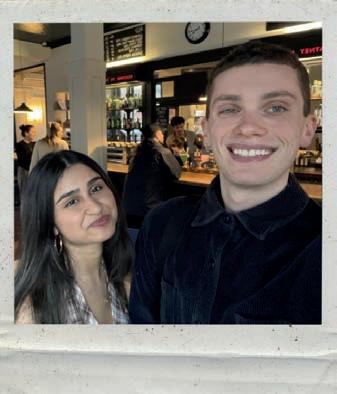
Choose Your Own Adventure
ChatGPT says: Ma!hew mixes sporty interests with print journalism vibes. He’s social and likely to have a strong opinion on something niche. Con dent and curious energy.
ChatGPT says: Harriet is tequilashot, karaoke, travel-anywhere energy. She’s spontaneous, lively and brings chaos in the best way. She keeps things exciting.
What was your rst impression of your date?
Ma : We’re both big personalities but I was happy to let her talk so I think it worked.
You’re both on journalism courses - had you ever crossed paths before?
Ma : I had never seen her before, not even in a law lecture!
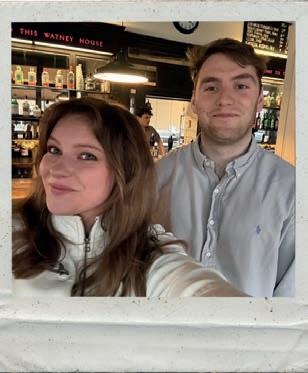
Would you normally look someone up on social media before a date?
Harriet: LOL obviously.
“There
was talk of karaoke at the end”
Do you think dating apps make people overthink dating?
Harriet: I think they prevent spontaneity – they force everything to be over-organised and over-analysed.
How was it?
Harriet: There was talk of karaoke at the end. And he paid for everyone’s drinks!
ChatGPT says: Millicent is con dent, curious and a selfdescribed “eccentric”. With a clear interest in people and a journalistic instinct to ask questions, she’s bound to be great company.
ChatGPT says: Josh is humour-led with a tendency to lean into the “plonker” persona rather than take dating too seriously. With a so spot for Pokémon, he’s the kind of person who will happily turn a rst date into a debate.
First thoughts?
Josh: Relief that she wasn’t bailing and that she was welldressed!
First thing you noticed about your date:
Josh: That she’s a true journalist. She asked a LOT of questions.
Did anything awkward or funny happen?
Josh: Besides waiting an unusually long time for a Dame Alice margarita, nothing I can think of. Although she did call me a nerd at the end.
Describe your date in 3 words: Josh: Relaxed, interesting (in a good way) and ‘GB News’.
“We had a few disagreements”
Do you think you got on well?
Josh: I think we got along. It took a li!le while for us to come out of our shells but we got there eventually. There weren’t any awkward silences but we had a few disagreements on where to draw the line on working with certain publications. Nothing like a media ethics debate to set the mood!
What was the rst thing you noticed about them?
Millicent: His style and that he was very sweet. Keep listening:
How were you feeling going into the date?
Millicent: I am a serial rstdater, so I felt quite con dent going into it.
What did you talk about rst?
Millicent: We talked a lot about journalism and our two courses, and also about the whole blind date for a magazine situation.
If you had to describe the date in three words, what would they be?
Interesting, cha!y and sunny.
Would you normally look someone up on social media before a date?
Millicent: If I know their name then yes, to be completely honest. Because I could see Josh’s name in his email address, I did look him up on Instagram.

Of course, in true Gen Z fashion, several participants immediately looked each other up, so the “blind” aspect didn’t last long. As for second dates, they’re not exactly ooding in, but I’m choosing to a!ribute that entirely to pre-date Googling, and absolutely nothing to do with my otherwise awless matchmaking abilities.●




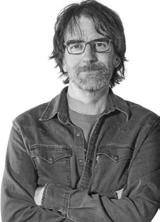

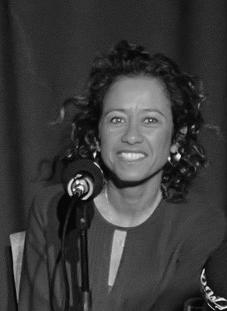

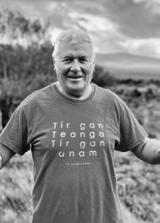
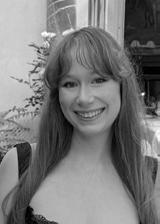








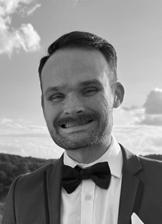
l i s t i n g s
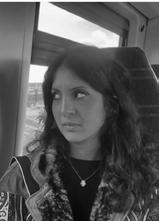
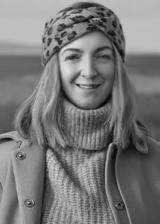
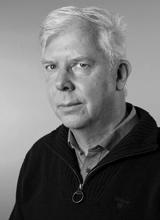
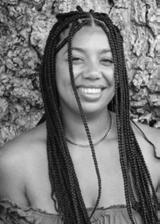


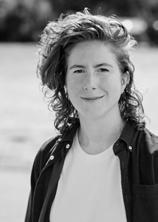
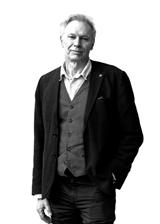
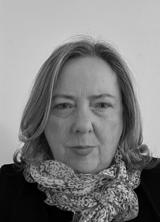



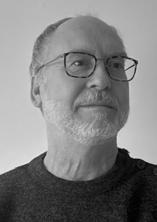


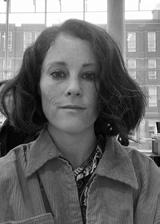

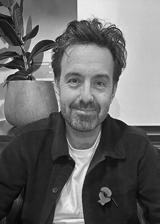
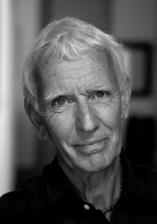
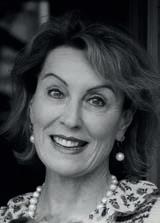
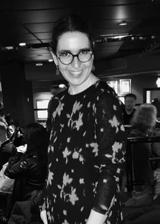
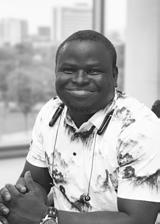
A typical day in journalism a er graduating from City?
I landed at the new international airport in Lagos at the zenith of Nigeria’s oil boom and took a taxi through the epic go slows –tra c jams – to the o ces of The Punch, a Nigerian daily newspaper, where I had been hired as an amateurish but enthusiastic production editor. As we arrived in the compound, the Afrobeat star Fela Aníkúlápó Kúti and his entourage were threatening
‘78 ‘77
Africa Con dential (Diploma)
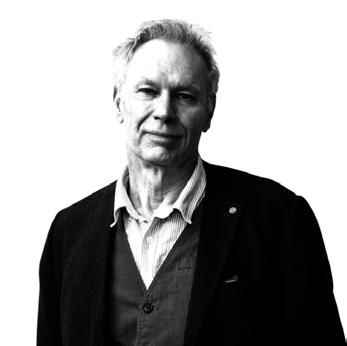
to occupy the newspaper’s administrative buildings unless he was paid the royalties on his new record, Unknown Soldier – the publishers had a sideline running a record label. It turned out to be a tremendous introduction to Nigerian politics, business and music all in one day. My new colleagues introduced me to Fela and his brilliant musicians who invited us to the Shrine, Fela’s legendary music venue, that evening. They also ensured that Fela received his royalties cheque.
The worst, most memorable or best rejection in journalism?
I applied in my teens for a reporter’s job on Sight and Sound, a lm industry journal, thinking I would be able to blu my way in and take a fast-track to becoming the Guardian’s lm critic. Completely wrong – it turned out to be a rigorous interview and quickly exposed my shallow pretensions of lm bu ery. End of fast-track thoughts.
By Isabelle Blakeney
Ghostwriter, freelance (Diploma)
What’s the best advice you’ve received?
Keep it simple. It applies to everything – questions, answers, writing and decisions. Never overcomplicate.
Handwriting or typing?
Typing. I love it. I think through my ngers when they hit a keyboard.
Which module most shaped your journalistic practice?
The greatest in uence when I did the City course was Harry Butler and the shorthand he taught us with humour, skill and rigid discipline. I passed my 110 words per minute test and it’s been valuable to me ever since. I still use it all the time, even in my shopping lists.
Choose Your Own Adventure

By Eve Williams
Ask for details on how to apply: She gives her personal email and details on how to apply. A er the event, you stumble back home and send your CV and cover le er. When you wake up in the morning, you realise there is a glaring error – you accidentally a ached a photo of an ingrown toenail you planned to send your doctor instead of your CV. Go back to the start.
‘80
What’s a journalist’s most important tool?
Curiosity. I teach creative writing and one workshop, for which I have a special t-shirt that reads “IQ For Creative Writers”, focuses on the importance of asking questions. The IQ does not stand for “intelligence quotient” but “I question”. Curiosity is important for both creative writing such as novels, as much as it is for journalism.
When you’re out of ideas, where do you go?
Inside my own head, or a walk along the beautiful beaches of west Donegal on the Wild Atlantic Way in Ireland where I now live, with my two dogs: Einstein, a rescue dog from a Romanian Black Sea village, and Lugh, the Celtic Sun God, a homegrown Donegal border collie.
What was your favourite story you wrote at City?
My favourite story was one that emerged from a training stint
‘81
the BBC Radio Wales 1pm news bulletin. I never did that again.
on The Sunday Times during my postgraduate year at City. It was about a young Irish boy who was severely physically disabled yet wrote a bestselling book. It became the lead story in the City student magazine.
By Julia Bo oms
the door slammed in your face sometimes you were welcomed in by people who wanted to share their experience.
Best feedback you received from a tutor?
What’s the biggest mistake you made early on?
Asked by my editor to top and tail a recorded voice piece from a reporter, I le in a false start overlap which resulted in the F-word going out at the top of
‘81
Interview that made you nervous?
Interviews which involved knocking on doors unannounced, particularly at homes of bereaved families. I learned over the years that while you have to be prepared to have
The best feedback was not always the most positive. I remember at City having to lay out a newspaper front page for a seasoned sub-editor from The Times foreign desk who was terribly nice and very funny but made it pre y clear that I had a lot to learn.
By Scarle Clarke
What’s been your most unexpected career moment?
Before the Beijing Olympics two decades ago, the Chinese government was - brie yanxious to show how open and progressive it was by le ing the BBC come in and do some normal journalism. I was running Question Time and spent six months negotiating a way to broadcast an edition of the programme
from Shanghai. The Foreign Ministry kept playing games with visa approvals so I gambled on se ing them a deadline a er which we’d just pull the whole thing. The visas suddenly arrived, David Dimbleby and the team duly delivered the programme - handing an ultimatum to the Chinese government hadn’t been in the career plan...
By Honor Wolstencro
Former chief correspondent, The Independent (Diploma)
Where do you nd inspiration?
As a reporter and later, with human rights organisations, I found (and nd) it inspiring to see what a di erence the courage of ordinary people
can sometimes make to their own and others’ lives.
What is your fondest memory of your time at City?
Partly, the obvious: trips with friends to the pub at the end of the day I remember through a fond haze. I am still in touch with fellow-students all these years later. On coursework: I enjoyed the chaos of an exercise when we had to le/update as a breaking and changing news story about a train crash
You are overwhelmed and run away: With no underachievers to cling onto to feel be er about your career, the toilet is the last option. You pretend you need to quickly reapply lipstick. It’s not like anyone’s even noticed you’re gone, though. Go back to the start. ‘83
unfolded.
What’s the harshest feedback you’ve received?
I had applied to Reuters and was interviewed in their grand o ces at 85 Fleet Street. My interviewer told me I was not and would never be a journalist. Like many others in similar circumstances over the years, that curt disimissal made me determined to show this might not be the whole truth. I have o!en re ected on that oneliner. I am glad it didn’t put me
By Grace Bannister
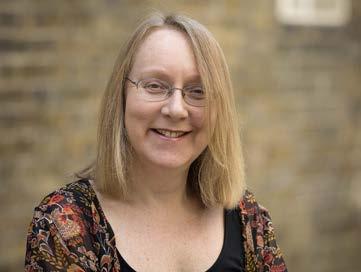
What did you think the future of journalism would be when you were at City St George’s? How does that compare to 2026? We were told that the future was in TV and to grab any chance to work in broadcasting. Now the future is, er, let me just ask AI.
What surprised you most about studying journalism at City St George’s?
We seemed to be able to waltz into work experience that gave us a real career boost. I went to The Times, The Herald and The Yorkshire Post. A!er City, there were plenty of local and regional newspapers for us to cut our journalistic teeth on, which was fantastic training.
What word do you overuse?
I write books about dyslexia to inspire children, teens and others. Sometimes when I hear myself say “dyslexia”, my heart sinks ever so slightly, as I think anyone around me is thinking, “not dyslexia again.”
By Miranda Crawford
Choose Your Own Adventure
‘85 ‘84
The last great article you read? The best comment piece I’ve read recently was in The Times by James Marrio! who suggested that conviction about almost anything in this fantastically, fastchanging world is probably the least apt response. He writes so intelligently and so thoughtfully, about every subject he chooses. He is about to present a programme on the radio about reading. I shall be listening.
What’s been your most unexpected career moment?
I remember covering a dispute where Sherlock Holmes’s London address was in 1990. The ctional address was 221b. There was no actual period building covering that address. The reason I remember this story was we decided to approach it like a Sherlock Holmes mystery. That meant I had to dress up as Sherlock Holmes and visit both the o ces of Abbey National there and the new museum. I
How do you handle writer’s block?
Possibly one of the reasons that I want to become a theatre critic (apart from loving the theatre) is that it is entirely reactive and responsive rather than proactive. Of course my rst sentence is important – I want readers! But if I am stuck, there is o en a quote/an image from the play that I can use as a prompt and go from there.
was photographed as Sherlock Holmes and we eventually ended up at the Sherlock Holmes pub (just o Trafalgar Square) to consider where the
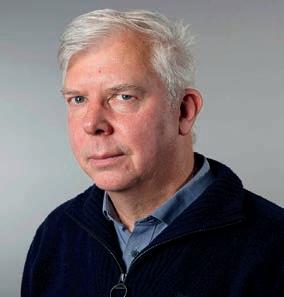
What’s been your most unexpected career moment?
I would never have guessed that working as a full-time author would lead to a second career in journalism. I had just published my third book when The Guardian approached
me and asked if I could write for them. The two careers have now worked so well together for the last 25 years.
Best writing snack?
Over the last few years, especially when on a tough book or Guardian deadline, I’ve developed the strange old habit of eating three dates with my post-lunch co ee. Healthier than chocolate and almost as tasty.
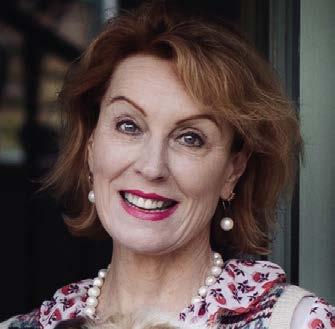
Which module at City most shaped your journalistic practice?
The writing modules were those I enjoyed most and got most out of – anything which helped me become a sharper writer and develop my own style.
By Harriet Curzon
truth was. A few pints later we had forgo!en the question.
What was a typical day like when you rst graduated?
My rst job as a journalist was working for my own father’s photographic news and press agency (People in Pictures). This involved covering stories with a photographer. This being the mid-1980s we had a dark room and photographic processing facilities – being pre-digital days.
By Jack Dennison-Thompson
‘86
Best feedback you received from a tutor?
My tutor at City, way back in 1985, was a lovely man called Bob Jones. A er he read my dissertation, he advised me, “there is a book in this, you should think about writing books.” It led me to where I am today, having wri!en 14 books.
By Maya Dennis
What piece of work taught you the most?
Receiving my !rst libel le er at The Lawyer magazine. Aside from the shock of a !ve-page diatribe from an angry solicitor over a seemingly innocuous diary story, the importance of fact-checking soon became abundantly clear and a lifelong lesson!
Interview that made you nervous? Ge ing a meeting during The Troubles with the late and
notorious John McMichael, head of a loyalist paramilitary group in Belfast. I was led down a dark corridor in the bowels of the UDA Shankill Road headquarters by one of his henchmen and suddenly woke up to the danger of the situation I was exposing myself to. Thankfully I got out alive with an extremely interesting interview.
By Lucy Dover
Choose Your Own Adventure
‘88 ‘87
Journalist, freelance (Newspaper)
What piece of journalistic work you've produced over your career has taught you the most?
I wouldn’t say one particular piece but, in general, working with international colleagues has taught me a lot, especially – and don’t laugh – Americans. They can be very meticulous. Being hot on the trail of weapons of mass destruction
in Iraq in 2003 with an American colleague was particularly eye-opening.
Do you prefer handwriting or typing?
Typing. Is writing whole pieces longhand still a thing? How about dictating them to the foreign desk, as in a Graham Greene or Evelyn Waugh novel?
By Olivia Dunn
Ask if their company are hiring journalism graduates You !nd out that they are the Features Editor at Grazia. You mention that you have just graduated from your Magazine Journalism course at City. They say they are a City alum and ask if you'd like to come in for work experience. Success!
Editorial director, Radio Times and British Film Institute (Periodical)
Who would you host a podcast with?
The Pope. Isn’t he the one celebrity yet to make a podcast?
An Archbishop of Canterbury once told me his favourite television show was The Simpsons. An excellent choice, if a bit surprising. The Pope’s TV selections would necessarily be more Catholic.
What’s the biggest mistake you made early on?
Thinking of journalism as a career. It’s a series of opportunities that might look like career with hindsight. But it’s not linear and certainly doesn’t feel like it at the time.
By Grace Bannister
What was your !rst big byline?
“Women’s ba!le over the bitch” in the Kingston Informer, when I was doing work experience at my local paper three years before I studied at City. It was a story about a row over the ownership of a whippet. It involved someone who’d been an o cial for the local RSPCA, a proper investigative piece. I was a bit shocked by the headline.
‘90 ‘90
What scared you about the industry when you started?
At rst, I used to be scared of vox popping because I was always naturally shy. But knowing that you’re motivated by doing good, ethical journalism is liberating. I always tell journalism students: the worst they can say is no.
And what excited you?
I was hugely excited by the fact that no two days would ever be alike and I’d get to see inside so
many important institutions, from No. 10 to a lm set. I’ve never been bored in my job. I’m as full of enthusiasm as I was the day I started.
By Olivia Fee
What was your !rst big byline?
I went on a January work experience from City to NME, which is where I always wanted to end up and was commissioned to write an album review. That was a
huge moment. I chose a record I knew I’d dislike, gave it a very clichéd kicking, comprehensively proved I didn’t know what I was talking about and got dropped –not unreasonably. Fortunately, I came back in the summer as a freelance sub and gradually inveigled my way back into the writing team. I don’t think I learned my lesson about what I should and shouldn’t try to review for about another decade, though.
What are your Desert Island Disc !ve songs?
I really struggle to make lists and charts out of the music I love nowadays, so I’m going to cheat a bit and give you ve from 2025: 'Dogeared' by Armand Hammer, 'Graut' by Bitchin Bajas, 'Perseverance Flow' by Natural Information Society, 'Lehjibb' by Noura Mint Seymali and 'One More Day' by The Tubs.
By Robert Flynn
What did you think the future of journalism would be when you were at City? How does that compare to 2026? We didn’t really think about the ‘future of journalism’ when I rst started. The industry was in good health and the Murdoch revolution had fed through to a vibrant era in the 1990s. In 2026, we are looking at a
di erent landscape. The future of journalism is at stake and it is great to see how positively our great, vital industry is responding.
What’s been your most unexpected career moment? Being live on air with David Dimbleby on the night of the Brexit vote. I thought, “My
goodness, this is a moment of history and here I am.” That and meeting Bono.
By Heather Gosling
What’s a journalist’s most important tool?
The ability to think of the most pertinent questions and keep asking them until you get answers. I learnt that one from Newsnight presenter Jeremy Paxman’s famous interview in
1997 with Michael Howard, the former Home Secretary, during which Paxman asked Howard the same question 12 times without ge ing a satisfactory answer. It can be revealing when a politician repeatedly fails to answer a straight question. We need to report it when that happens.
What do you think journalism will look like in 50 years? No idea. But I hope people recognise that good journalism is worth paying for. Social media
Chief sports correspondent, The Times (Newspaper)
What was your rst big byline?
It was while working at The Leicester Mercury while at university in Loughborough, about a famous runner who’d been a acked. I ran with him so I managed to persuade him to take photos and they splashed it in Mercury Amazingly I didn’t get paid for
it – I was too naive at the time. What’s been your most memorable interview?
When I sat down with Lance Armstrong and Emma O’Reilly. During the interview he revealed to us that the president of the International Cyclist Union at the time had helped him to cover up some doping instances.
giants make vast pro ts from us by deluding us into thinking they give us all the news we need.
What is your fondest memory of your time at City?
Linda Christmas, the legendary Newspaper Journalism tutor, being very kind and welcoming to my four-year-old son, Sam, when I had to bring him to classes at City one day.
By Emilia Gould
By Grace Bannister
What is the most memorable interview you’ve done?
Not my interview, but I was on a press trip with Vespa in Rome some years ago. It was midnight and we were riding our Vespas round the Colosseum. A journalist from the Metro had to park up to take a call from Gladys Night.
What was a typical day like when you graduated?
My rst job in journalism was on the news desk of trade magazine, Design Week, based in London.
This was about 1994, and nearly everyone smoked at their desk. First thing, we went through the newspapers to spot stories we could follow up on. Once stories had been assigned, we were on the phones much of the day trying to get comments from designers, mostly about branding jobs, sometimes about who’d sacked who. At lunchtime, we queued up at a sandwich bar round the corner run by an elderly Italian couple and their three sons. A er work, we sometimes went to the Star & Garter
or the John Snow. Or we got free drinks and canapes at a fancy work event put on by a printing company.
By Ioan Hazell
What’s the best advice you’ve received?
I remember our tutor, Harrie Gilbert, asking us who the most important person is when we’re writing. I said the editor – the correct answer is, of course, the reader. Having edited several magazines since then, I’d add to that the money people – clients, advertisers and CEOs – and learning to nd the sweet spot.
Neck your pint: You decide to swi ly neck your pint and chat to the person standing next to you. You bond over hating networking. What do you do?
What is your fondest memory of your time at City?
Honestly loved it all – summer saw a heatwave, the peak of Britpop, Blur versus Oasis. My memory of City is all wrapped up in that.
Ask if they want to go to a karaoke bar down the road (p165)
By Ruby Smith
Ask if their company are hiring journalism graduates (p158)

What is one journalistic rule you always break?
Twice I’ve ignored the principle that anything anyone says in an interview is fair game, unless they specify beforehand that it’s o! the record. A couple of interviewees – from the arts, not politicians – have said in the heat of the moment
Journalist,
something that I knew would make the headline of the feature and probably generate a news story as well. I’ve gone back and asked, “Are you sure this is what you want to say?” Some journalists would just go ahead and publish and that’s ne but I think, “Why burn the contact for short-term gain?”
What is one thing you’ve learned from City that you still use today?
To keep meticulous contact details for everyone you ever speak to. Keep your contact book (do people still have those?) up to date. It’s well worth it.
By Sonni Hendrickson
What’s the worst career advice you’ve ever received?
Don’t work on any non-terrestrial shows.
What surprised you most about studying journalism at City?
I was surprised by how practical it was – really geared towards careers. Then also how great the people were. More so than as an undergrad. I felt I was much more surrounded by like minds.
What did you think the future of journalism would be when you were at City? How does that compare to 2026?
I guess the answer is an obvious one. Broadcast journalism now operates in a much more fragmented and personalised market. The audience has more choice and so the o!er needs to work harder to break through the noise. For good and ill.
By Florence Ingleby
Arts writer and broadcaster, freelance
What’s been your most memorable interview?
Muriel Spark. I wrote my dissertation on her. I had to pinch myself when I found out I was going to be paid to sit down and talk to her at length. Or, Sir Michael Gambon when he was rehearsing as Falsta! at the National, for my lunch with the Financial Times. Again, a pinch yourself moment.
How did a!ending City change how you read the news? I’m not sure it changed how I read the news. The broadcasting course trained me in how to write the news. But I quickly abandoned this for interview-led features that allowed me to use my own voice, in a way that news reporting doesn’t.
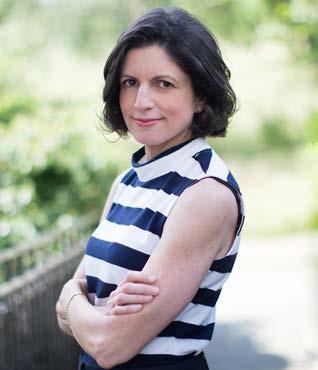
By Alina Ja er
Travel correspondent, The Daily Telegraph (Periodical)
Best writing snack?
Co!ee, co!ee, co!ee. And more co!ee. And a KitKat. The chunky version.
What has been your most unexpected moment of your career?
Tumbling into travel journalism by accident and making a 20-year specialism of it. I
found myself pitched into the freelance world at short notice, when the magazine I was working for closed, but suggested the right idea to the right editor at the right time. One door closes, another one opens etc, etc. I guess the lesson here is to seize your opportunities when they arrive.
By Grace Bannister
‘00
Head of brand, Stylist (Magazine)
What were the things you were more scared and excited about in the industry when you graduated?
Scared about not ge ing into consumer mags. Our tutors always stressed how competitive it was and how we should widen our aspirations, but I knew I wanted in on that world. Excited about collecting bylines!
There is nothing more thrilling than seeing your name nally in print as a young journalist.
What’s the best advice you’ve received as a journalist?
Always think: What’s new, why now and why us? It ensures ideas stay fresh, relevant and audience-speci c.
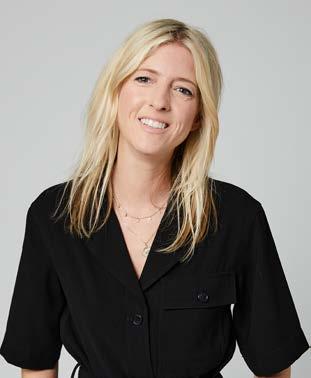
By Jude Jones
What’s the worst career advice you’ve ever received?
That you have to be very pushy and outgoing. I don’t believe you need to be the loudest voice in a newsroom to work as a journalist.
How do you handle writer’s block?
I don’t su er from writer’s block so much as writer’s delay. Writing the intro or
honing the angle usually comes on a walk, in the shower or somewhere other than looking at my screen.
What surprised you most about studying journalism at City? Honestly? How hard it was to nd work a erwards. I’m sure it’s a million times harder today. But I’ve been very lucky. I did temporary media roles a er
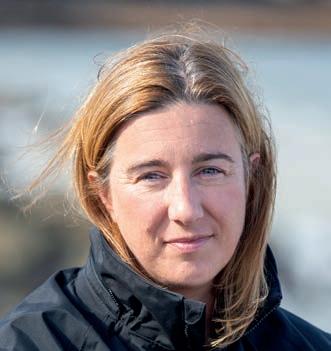
leaving City in 2001. I fell into sports journalism with a junior role the following spring and have worked solidly in that sector ever since.
By Liv Le wich
What’s the most useful skill City taught you? The discipline of writing engaging copy to tight deadlines.
Best feedback you received from a tutor?
The most useful feedback for me tended to be advice and guidance on how best to angle and structure longer-form features.
Deadline you’ll never forget?
The one for my latest book, Small Earthquakes: A Journey Through Lost British History in South America. I had seven months to complete an 80,000-word manuscript. It was a challenging but rewarding process.
Which tutor inspired you the most at City?
Marcelle D’Argy Smith. I can’t remember what her class was o cially termed, but for now I’ll call it “writing about really personal things then weeping round a table.” Of course, I also adored Dr Barbara Rowlands and Harrie Gilbert.
Who would you choose to host a podcast with?
Someone really cha y so it takes the pressure o . I suppose it would be another
author – I write ction now, so possibly my friend Daisy Buchanan as she has a beautiful soothing voice and is a podcast host pro, which would be helpful as I am not.
What was your rst big byline? It would have been something for The Liverpool Echo where I did a lot of work experience before
‘03
By Sydney Lobe
I came to City. They were so generous in giving me a shot and sending me o to interview whichever celebrity had turned up in the area. Every day was a “what is happening” moment.
By Grace Bannister
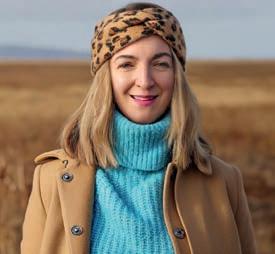
Journalist, copywriter and translator, freelance (Periodical)
Interview that made you nervous?
I interviewed Damon Albarn and Graham Coxon on stage for a press conference in Madrid in 2023, translating back and forth between English and Spanish. Damon has a reputation as being a slightly di cult interviewee and he was, in a way, although he told

Best feedback you received from a tutor?
“I will let you join this course, you’ve convinced me.” Lis Howell, 2004, a er the new rule to have Englishlanguage tests mandatory for foreign students. We had a long conversation and then I asked her whether my language skills needed a certi cate.
me later it’s like he has to put on a certain character to do press conferences. Anyway, I made him laugh and that seemed to melt the ice a li le.
What is your fondest memory of your time at City?
The people there were lovely, teachers and students alike. But maybe the fondest
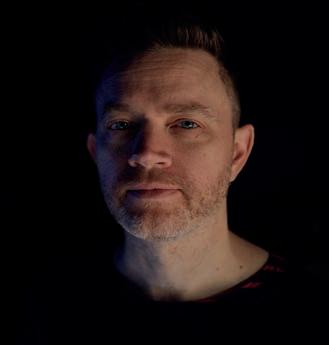
memory is more of a realisation that you could actually make a living in journalism.
By Ruby Smith
Journalist, Al Jazeera (Broadcast)
What’s a journalist’s most important tool?
Curiosity and truth. Call them traits or tools, if you’re equipped with those two, decades later you’ll still enjoy doing journalism. In the post-truth, Trumppleasing world, let your compass nd the truth and challenge the status quo.
Choose Your Own Adventure
What was your rst big byline?
The last interview before the arrest of Imran Khan, Pakistan’s former prime minister.
By Phoebe Pascoe
Ask if they want to go to the karaoke bar down the road: From the window, you spot the neon glow of a karaoke bar. You ask if your new friend wants to go and their face lights up with excitement. But when you start to sing, everyone in the room winces and covers their ears. You run out in embarrassment. Go back to the start.
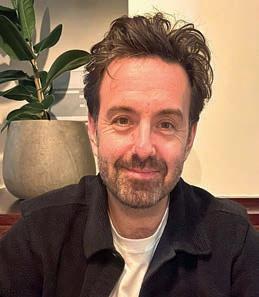
What do you think journalism will look like in 50 years?
In 2076, global media will be dominated by two or three giant conglomerates producing everything from tailored, AI-cra!ed news and entertainment to virtual reality experiences. In small corners of these vast empires, there will be journalists working on
niche publications for elderly customers still willing to pay for quality, human-led stories. Their existence will be tenuous, their output hard to nd. I’ll be one of the nonagenarian subscribers trying to keep the re alive.
What was your rst big byline?
A feature for a mass market Sunday tabloid. Only when it was published, I discovered that they
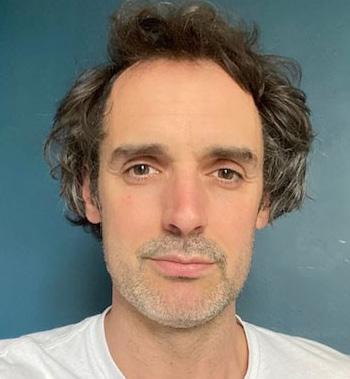
Journalist’s best tool?
Online networking tools like LinkedIn keep me connected to journalists, referral sources and potential leads. Those connections are extremely valuable.
Interview that made you most nervous?
I once interviewed Alfonso Cuarón for an article in The Independent. It was a long time ago and he could probably
What’s a journalist’s most important tool?
Curiosity. And (earned) con dence to back it up.
Your favourite interview? Anything where the format falls apart and you can see human beings in action.
had decided to credit my work to a Big Brother contestant. I didn’t work in newspapers again for a while a!er that.
What’s your go-to interview question?
Whose picture was on the wall of your childhood bedroom?
By Lily-Rose Morris-Zumin
What story do you wish you’d wri en?
Simon Parkin’s: ‘Shooters: How Video Games Fund Arms Manufacturers’.
‘08
Principal, Avenue Group (International)
tell I was very green. He was incredibly gracious and down to earth. These days, I commission articles and social media posts more o!en than I write them. One of the more interesting collaborations recently was working on content with Gavin Newsom, the governor of California, about saving water.
By Lily-Rose Morris-Zumin
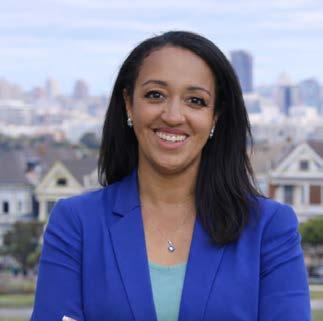
By Hannah Mayer
Nora Fakim
When you graduated, what things were you scared/excited about in the industry?
I graduated a!er the nancial crisis in 2009, so I was already warned that the industry was going to be tough to get into. But this did not stop me from persisting for internships and looking at other options like comms. I was appointed as the BBC News Morocco correspondent two years a!er I had graduated from City.
What’s the piece you’re most proud of?
I’m most proud of my BBC World Service documentary podcast I presented called My Mixed Up World. I was proud because I pitched the idea to present a show on mixed identity for ve years and I got the call to do it on the weekend Meghan Markle was marrying Prince Harry.
What’s the most useful skill City taught you?
City taught me to be selfsu cient and to learn
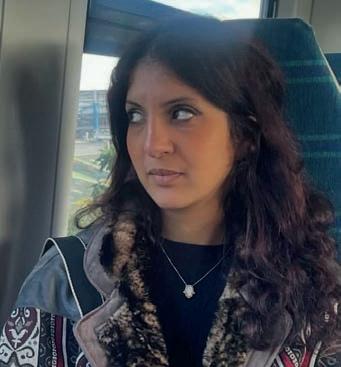
multiplatform skills. This prepared me when I was reporting in Morocco for the BBC and it still helps me now!
By Lucy Morgan
What’s the worst career advice you’ve ever received?
To apply for the jobs you don’t want as practice rst. It’s not only a waste of everyone’s time but it’s a silly, negative mindset to assume you’re not good enough yet and that you can’t just go straight into pu ing yourself forward for jobs you’ll actually enjoy. I say just go for it.
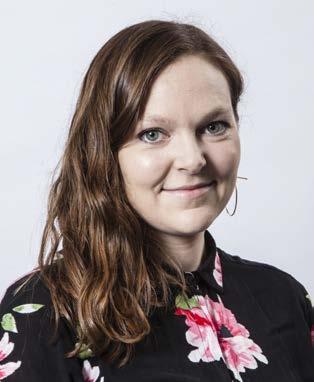
Choose Your Own Adventure
When you’re out of ideas, where do you go?
Most of my favourite ideas crop up when I’m already out on a trip and they might be something completely di erent to what I’m out there covering already. As great as social media can be for nding stories, it is also contributing massively to overtourism, which is making beloved destinations not all that great anymore.
What is your fondest memory of your time at City?
That’s a tie between the music journalism specialism with the legendary Stevie Chick and Friday nights at The Peasant – bring that pub back!
Clare Vooght
Journalist, freelance (Magazine)
By Ellen Morris
What’s the worst career advice you’ve ever received?
My year at City graduated into hustle culture when making your job your identity was seen as fundamental, aspirational even. I don’t think there’s anything wrong with having to hustle during periods of your career, but as a long-term strategy, it’s unsustainable at best. A recipe for burnout at worst.
‘12

Music or silence when you write?
At the risk of being a cliché, I listen to music to focus. I’m subscribed to a platform called Endel which makes personalised soundscapes. I used to make do with Spotify, but when an album called Concentration music for work was top of my Wrapped, the piss-taking from my husband became so relentless that I had to !nd an alternative.
What skill did you struggle with at rst?
As an introvert, all the cold calling and vox popping involved in journalism did not come easily to me. City did a great job of forcing me out of my shell and ge ing me more comfortable with that.
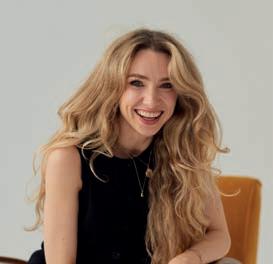
How did City change how you read the news?
When you understand how the news is constructed, you read it in a di erent way. Every story I read, I’m paying a ention to the decisions that have been made. It’s a useful exercise to think about all the alternative ways a story could have been wri en. If it’s the kind of story you wish you’d wri en yourself, you can learn a lot by dissecting it.
‘13
What is a journalism cliché you hate?
That you need to be relentless and assertive to get ahead. People want to work with people who are talented and motivated, but also who are pleasant to be around. Emotional intelligence is vital for your employability, as well as for the quality of the journalism you produce.
What is the best advice you have received?
You can’t communicate a process or a concept convincingly and elegantly if you don’t properly understand it !rst. Invaluable for health and science journalism, but applicable across the board and across platforms.
What’s the biggest lesson you learned from City?
If you don’t ask, you don’t get. Last year I saw Jameela Jamil speak at an event about the death of a close friend. I was so moved by her words that I DMed her asking for an interview for my newsle er. I had less than 500 subscribers at the time, but she agreed. promoted it to her audience of millions.
By Grace Bannister
By Lily-Rose Morris-Zumin
At City, what was the worst moment you had on patch?
I don’t think I ever successfully found a piece of information that was considered news, so probably all of it. Features forever.
By Emmy Raynor
What’s been your most unexpected career moment?
I had to get a man, known in the press as the Naked Rambler, into a studio in London. He agreed to the idea but then
kept ge ing arrested on his rambles. The morning of the assignment he was obviously locked up again. I don’t think I’ve ever moved as frantically searching for another life model as I would’ve had to volunteer myself if not!
What’s the funniest thing you’ve overheard in a newsroom?
Not overheard exactly, but I once saw The Sunday Times Magazine art director unplug the deputy editor’s keyboard and we all watched him try to type an email,
ge ing crosser and crosser about it, jabbing his !nger. He was in his ! ies and therefore typed with one !nger onto the keys. Everyone found that funny, even the deputy editor in the end.
By Daisy Dempsey
What is the most memorable interview you’ve done?
De!nitely interviewing Lana Del Rey for the cover of Rolling Stone UK. She is my favourite living artist, but we spoke in 2023 when she was on the cusp of becoming as big as she is today. It’s always amazing when you get to pro!le someone in the middle of a major shi . She’s an intuitive person and it felt like we were communicating without words, quite telepathically. That happens sometimes when you’re both really locked in, but this was magical.
What is one thing you’ve learned from City that you still use today?
That great journalism is a product of many people working together. You can always improve your work by bringing someone else on board, especially if you’re the protective writer who pitched and wrote the piece.
Writer and editor, freelance (Magazine)
What are your 5 Desert Island Disc songs?
‘Get It On’ by T. Rex, ‘Avril 14th’ by Aphex Twin, ‘Miss World’ by Hole, ‘Slow Burn’ by Kacey Musgraves and ‘Video Games’ by Lana Del Rey.
By Kaeah Sen
Spend the next 15 minutes congratulating them: You keep gushing about how much you love their work. They smile and then walk away. You decide that this whole journalism thing isn’t for you and make a quick pivot to PR. You’d rather earn a stable income to work with annoying people than do it for free at a packed pub. You apply to an entry level role for a famous crisp brand and join the dark side. Go back to the start.

What’s the funniest thing you’ve overheard in a newsroom?
Someone had initially pretended they could speak Italian but then had to confess they couldn’t when asked to translate a statement.
Your non-negotiable when reporting?
No taking shortcuts. Sounds obvious, but it’s always clear when journalists haven’t put the work in, whether that be poor sourcing or not doing
What’s the most useful skill City taught you?
Not a skill exactly, but I learnt de nitively that journalism is vocational and the best way to learn is to do.
Best feedback you received from a tutor?
The only feedback (classically)
that I remember was negative, I was too friendly towards an interviewee, apparently!
Deadline you’ll never forget? I was the features editor on our uni paper for the week and loved the intensity of it all.
By Grace Bannister
enough research to nd interesting angles for interviews.
Did you take Shorthand? Thoughts?
I didn’t and never really considered taking it. I’ve yet to encounter any reason to use it during my career!
By Meadow Wa ret
How did you imagine your career starting out?
I always imagined I’d get in at a magazine I loved, but doing the most demeaning, bo!om-of-theladder job possible. Instead, I ended up doing slightly cooler jobs at slightly less cool places.
What’s your weirdest writing ritual?
If I hit a wall, I’ll stop and play a game of bullet chess on my
phone. I suck at chess, but it’s just relaxing enough to give me a reset.
What was your favourite story you wrote at City? Covering the university strikes in the middle of a blizzard. All of our professors were out for a week, marching in the streets, and we spent a day following them around through the snow.
By Harry Speirs
Your go-to interview question?
“Could you explain that to me like I’m a child?” As a journalist, you should never be afraid to ask simple questions to make things clearer for your reader, even if it is a li!le embarrassing.
What’s the story you wish you’d wri en?
It’s a few years old, but Jessica Pressler wrote a piece on Anna Delvey. It was an amazing story that went onto become a successful Net ix show. It was brilliantly reported and
an insight into how true crime stories don’t always have to be grisly and violent.
What’s the harshest feedback you’ve received?
Early in my career I got asked to totally rewrite a story. I felt devastated and like a failure at the time. I’m glad it happened. It’s never a bad idea to nd someone you trust and who can help you.
By Grace Bannister
Choose Your Own Adventure
What’s been your most memorable interview?
Interviewing a former spy under house arrest for his role in the fraud of his FBI-wanted boss, who’d disappeared. Not too long a er the interview, he disappeared himself.
Your go-to interview question?
I think the answer that consistently elicits the most interesting information – o en with some follow-ups – is simply by asking at the end, “Is there
anything you’d like to add?”
Which tutor inspired you most at City?
Jenna Corderoy, the FoI Queen. She, together with Investigative MA course leader Dr Richard Danbury, taught me so much about thinking creatively and pursuing di erent routes to nding information.
By Hannah Stiven
Start an argument with them for ruining your out t. Ask them to buy you another drink.
You are now blacklisted from Vogue. Chanté Joseph pens an article about why it isn’t boyfriends that are embarrassing, but you. Security is called to escort you out. You hang your head in shame. Go back to the start.
What’s a journalist’s most important tool?
Picking up the phone and calling people, you have to have the con!dence to do that.
Publication you still dream of writing for?
The Guardian’s long reads –they do brilliant, well-wri"en, narrative long-form journalism covering interesting topics.
We need more investigative narrative storytelling.
The most interesting feedback you received from an editor?
To have the con!dence when dealing with sensitive and complex stories and not to let people with strong agendas sway you either way.
By Larissa Steel
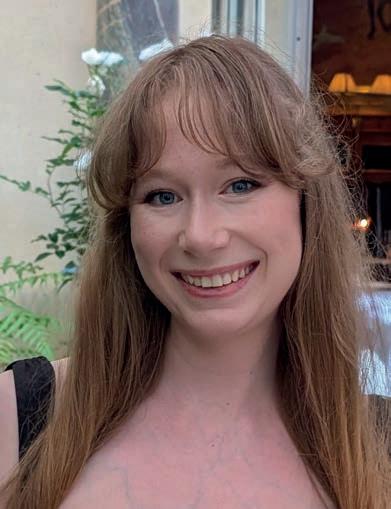
What is your fondest memory of your time at City?
The time I probably think back to most is production fortnight. I was seated near all my friends from my Project X group and remember laughing and cha"ing a lot. I still see my friend, Jungmin all the time!
What is the best advice you’ve received?
Honestly, Ben and Jason are so right when they tell you how important meeting your deadlines is. The thing that makes editors want to work
with you again is making it easy for them – !ling good, accurate copy on time.
When you’re out of ideas, where do you go?
I’ve been loving Substack lately! I only joined recently, but I feel like it’s all the best creativity of Instagram and TikTok with none of the toxicity and it’s much slower paced. I really like that I can build a network of like-minded people on there, too.
By Anna Sta ord
Choose Your Own Adventure
Keep the secret and ask for work experience in exchange
You tell her that you will happily keep the secret if she can help you get work experience at the I Paper. She agrees. You get an email inviting you for work experience on the news desk at the I Paper. Congrats!
‘23
What’s the most useful skill City taught you?
I studied Investigative Journalism and developed strong open-source intelligence skills, particularly in pro!ling public o"cials. This training signi!cantly strengthened my ability to dig into records, verify information and uncover details that might otherwise remain hidden.
Best feedback you received from a tutor?
“Unlearn, relearn and keep
‘24
learning.” That advice, given in the context of adapting as an international student, has stayed with me. It reshaped how I approach both journalism and personal growth.
A deadline you’ll never forget?
The weekly patches. I covered Bloomsbury and had to !le reports from my beat every week. Meeting those deadlines was demanding, but it built my discipline and sharpened my ability to deliver under pressure.
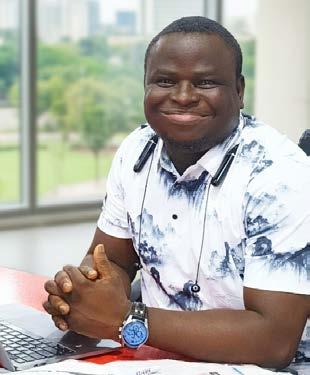
Freelance video journalist, The Telegraph (Digital and Social)
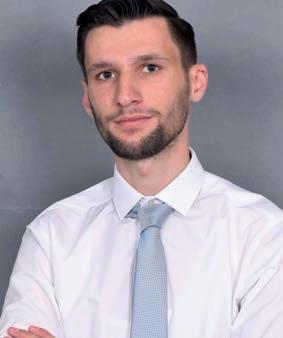
What's the most useful skill the City taught you?
Resilience. The Master’s was incredibly demanding, with constant deadlines and relentless tasks. I was also freelancing on the side to make ends meet, so at times it was really rough. But honestly, I am so grateful for it. I learned how to function even under immense pressure. It’s an essential skill in journalism. It is actually something I’m still working on now.
‘25
What is the most memorable interview you've done?
I interviewed the Albanian men's football team manager (and former Arsenal player) Sylvinho, ahead of the 2026 FIFA World Cup Quali!ers match against England. I asked him who he would pick as number 10 if he were the England manager. My interview with him made the
By Talia Tacchia
Best feedback you received from a tutor?
"Students like you, are what we do this for," Jane Martinson. I hope she’s okay with me quoting her, haha! People go into journalism for di erent reasons, so it's important to hold onto tutors whose values align with yours. This job is tough; !ghting alongside people you trust and, most importantly, can learn from is what keeps you going, even when you have doubts.
exclusive story for talkSPORT. com
Which tutor inspired you most at City?
Dr James Morris, who is the pathway director of the Digital and Social Journalism MA, motivated me while I was doing my master’s !nal project in video format.
By Róisín Teeling
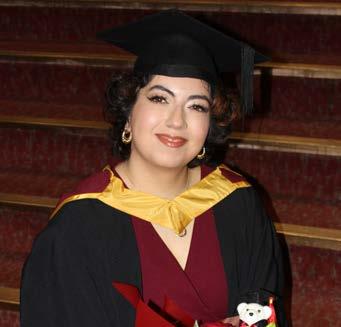
By Grace Bannister
Editorial Assistant, FT (Global Financial Journalism)
Can’t get enough of our silliest synonyms? Test your knobbly monster knowledge in our prickly puzzle, by Jude Jones and Julia Bo oms
3. The now-popular “business up front and party in the back” style (6)
5. The beloved British balladeer (5)
8. Mr Loaf (he’s a bat out of hell) (8)
9. The whiskered rodents (9)
12. The southern pizza, pasta and ma a economy (5)
13. The spicy cough (of pandemic proportions) (5)
15. The original single-monicker superstar (4)
16. The doyenne of dough (4, 5)
17. The bobbed and barbed icon (4, 7)
18. Aural appendages (4)
1. The heavy-breathing Jedi turncoat (5, 5)
2. The cakey lepidopteran (sold in M&S) (5)
4. The bubbly beverage (8)
6. The opthalmologically challenged former prime ministerial advisor (7, 8)

7. The piggy comestible (4, 3)
10. The arachnid avenger (9)
11. The famous clear liquid (5)
14. The pet-terrifying “ooh”elicitors (9)
17. Anna Wintour, 18. Ears

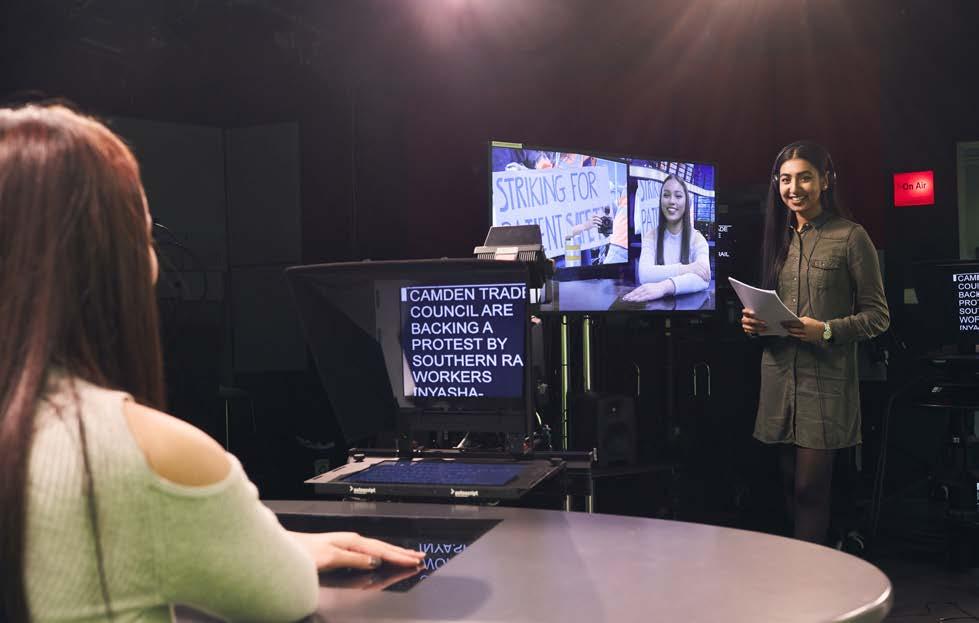
Dates: '0 –'( July '0')
Location: City St George’s, University of London, Central London
London is a global capital of media, communication and literature. City St George’s, University of London is situated at its heart.
The summer school will be taught by tutors who combine academic expertise with extensive experience in professional journalism, media and writing. Under their guidance, you will work individually and in teams, in studios as well as classrooms, to acquire the skills needed to produce rst-rate writing and multi-platform content.
or
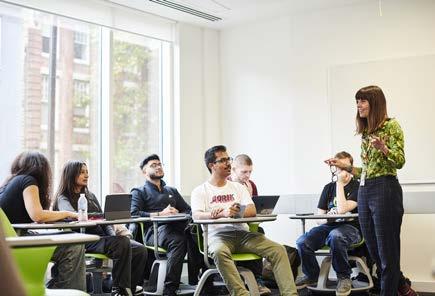
Join us in London for an unforgettable 10-day summer school exploring the worlds of media, journalism, and creative writing at one of the UK’s most dynamic universities.
Whether you dream of working in a newsroom, writing a novel, producing a podcast, or creating for the screen — this immersive programme o ers you the chance to learn, create, and connect in the heart of one of the world’s most exciting media capitals.
At City St George’s, learning means doing. By the end of the summer school, you should be able to:
• Understand the fundamentals of what makes a successful podcast
• Apply your broadcast skills in a more e ective way
• Understand what makes good professional social media content.
You’ll take part in interactive, skills-based workshops led by media professionals and university experts, including:
• Make a TV programme in our professional studio
• Create your own podcast from concept to broadcast
• Develop your storytelling voice
• Write and edit short features, reviews and creative pieces
• Collaborate with international peers on real creative projects.