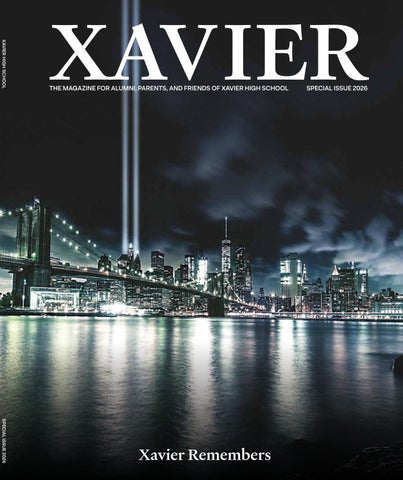
XAVIER HIGH SCHOOL SPECIAL ISSUE 2026
THE MAGAZINE FOR ALUMNI, PARENTS, AND FRIENDS OF XAVIER HIGH SCHOOL
Xavier Remembers
SPECIAL ISSUE 2026
A message left on the 9/11 Memorial & Museum’s Survivor Tree, a symbol of New York’s resilience, in June.
SPECIAL ISSUE 2026
Xavier High School Jack Raslowsky P’16 President Edward Young P’22 Interim Headmaster Shawna Gallagher Vega, APR Vice President for Communications and Marketing Editor, Xavier Magazine Contributors Angeline Boyer Ralph Dinielli Rose Duger David Orlando ’17 Jennifer Reeder Victoria Santamorena Astrea Slezak Maggie Murphy Stockson Cynthia Tavlin Photography Dan Bassini Thomas Franklin / Reuters Getty Images Alison Lorenz Michael Marmora Design Erbach Communications Group How to Reach Us Xavier Magazine 30 West 16th Street New York, NY 10011 news@xavierhs.org
In This Issue 2.
From the Board Chair
4.
From the President
6.
From the Archives
10. The Sacred Act of Remembering 16.
How They Lived
30.
Walking With Families
34.
“A Burden We Carry Gladly”
40. The Story of an Extraordinary Community 52. In Memoriam
Xavier’s Mission Founded in 1847, Xavier High School is an academically rigorous, Catholic, Jesuit college preparatory school in New York City that educates intelligent, motivated young men of diverse backgrounds and means. Xavier teaches students to take responsibility for their lives, to lead with integrity, to act justly in service of others, to pursue excellence in every endeavor and to deepen their relationship with God. Ultimately, Xavier forms young men who will go forth to transform the world for God’s greater glory. On the Cover The annual Tribute in Light remembrance. Sustainability In keeping with Xavier’s commitment to sustainability, this publication is printed on FSC-certified paper.
XAVIER MAGAZINE
1
/// FROM THE BOARD CHAIR
Returning Home to the Place That Sent Us Forth
“Jesus said to them again, ‘Peace be with you. As the Father has sent me, so I send you.’” —John 20:21
Parents, Friends, and Sons of Xavier: When I was a kid growing up in Bay Ridge, I remember using that word all the time. Sent. My mom sent me to the store. My dad sent me to my room. My parents sent me to Xavier. The root of the word sent is said to have come from the Greek word apostello, meaning “to send forth with a commission or mission,” and from
2
XAVIER MAGAZINE
apostello you can clearly see the origins of the word apostle, which means “one who is sent.” Today, I don’t hear my own children or any of their friends saying that much anymore. My children don’t talk about the things my wife and I send them to do, but they talk about the things they choose to do. Or the things we allow them to do. Maybe that’s a real change. Maybe it’s just my perspective shift from being a child to being a parent. Or perhaps I have not done enough yet to send them forth with a clear sense of purpose. The Xavier mission statement consists of three sentences. The first tells you who Xavier is; the second describes what Xavier does. The third explains why: Xavier forms young men who will go forth to transform the world for God’s greater glory. At its heart, Xavier’s mission is to send young men of purpose into the world to fulfill their own unique mission. And I believe there is an implication embedded within the act of being sent; eventually, you return. You return after completing whatever task has been entrusted to you, whether a small thing like returning home after your mother sends you to the store, or the greatest example of all, when Jesus Christ returned to the Father after being sent into the world for our salvation. I can’t say I fully understood what it meant to be sent before 9/11. But in the minutes, hours, and days that followed the attack on the World Trade Center, amid the despair, grief, confusion, and anger, I began to understand. To be sent is to find yourself utterly lost and yet still know where to return. It is to struggle to comprehend how something so terrible could happen and how so many people you knew and loved could be taken so suddenly, while at the same time praying that they had returned to God and were now resting in His embrace. Like so many others, I returned home during that time. But I did not return only to my childhood home. I returned to the place my parents had sent me. The place that had helped form me and then urged me to go forth. That was not always 16th Street. Sometimes
it was Rathbones. Sometimes it was St. Francis de Sales. Sometimes it was St. Thomas More in Breezy Point, followed by The Blarney or Connolly’s afterward. There were tears and embraces. Stories and laughter. Sadness and anger. So much anger. There were countless emotions expressed in countless places. Through it all, there was always Xavier. Like many in the Xavier community, I lost classmates, teammates, and a roommate on 9/11. And like so many others, in a moment when I felt completely lost, home was the only place where I knew I could find comfort. It was during those days that I realized Xavier was home to me every bit as much as the house in which I was raised. As the weeks turned into months and the months into years, my prayers evolved. At first, I searched for an explanation. I asked how God could allow something like this to happen. Over time, those prayers became different. I found myself wondering whether the Sons of Xavier who displayed such extraordinary courage that day had, in some way, been sent for that very purpose. I still wonder. I wonder whether Sean Lugano was sent to remain in the tower and help others, even at the cost of his own life. I wonder whether Jimmy Riches was sent to run into that tower for the same reason. I wonder whether Mike Glover was sent to run toward the fight overseas amid the chaos that followed the towers falling. I do not know the answers to those questions, and I am not sure I ever will. Whether those young men and many others were sent here for those specific reasons or not, today we remember and honor them for the bravery they displayed, the lives they touched, and the sacrifices they made. And I take comfort in believing that, when their work was done, they were called home to God. The Xavier mission is more than a three-sentence statement. It is in many ways a call to action. An invitation for Xavier alumni to live out that mission each day as they go forth to transform the world for God’s greater glory, in ways both great and small.
Like many in the Xavier community, I lost classmates, teammates, and a roommate on 9/11. And like so many others, in a moment when I felt completely lost, home was the only place where I knew I could find comfort. It was during those days that I realized Xavier was home to me every bit as much as the house in which I was raised.” As we mark the 25th anniversary of 9/11, I offer my deepest gratitude to the Xavier alumni who embody that mission through lives of service and sacrifice. I thank the first responders who have run toward danger when others were fleeing from it, both in the past and today. I also honor those who have defended our nation and those who continue to serve in the armed forces. Their examples remind us that a mission is not simply something we recite. It is something we live. And so I offer an invitation. To the Xavier alumni who are wondering how to live out that mission in their own lives, I invite you to come back home. Come back home for comfort. Come back home to reconnect with the values that helped shape you. Come back home to discover new ways to serve. Come back home to remember that you were sent forth for a purpose. Come back home for any reason or no reason at all. Because Xavier is more than the place our parents sent us. It is the place that helped shape us, challenged us, and prepared us to go forth into the world. And when the world feels uncertain, when grief leaves us searching for answers, or when we simply need to be reminded of who we are and why we were sent, Xavier will always be here to welcome us home. Paul Enright ’91 Chair, Board of Trustees
XAVIER MAGAZINE
3
/// FROM THE PRESIDENT
Choosing Life
Dear Sons of Xavier, Parents and Friends, On September 11, 2002, I began my final year as principal of Saint Peter’s Prep marking the one-year anniversary of the 9/11 attacks. Like the day of the attacks, it was a beautiful day. Blue skies and sunny. The students and faculty gathered outside for a prayer service that morning along Grand and Warren Streets. Deuteronomy was the starting point for my reflection that day: Choose life, so you and your descendants may live. (Deut. 30:19)
4
XAVIER MAGAZINE
We remembered those alumni, parents and friends of Saint Peter’s who were lost, and we remembered the response of our community and our nation to the attacks. It was not a story of death and destruction, although the death and destruction were very real, up close and all too personal; it was a story of life, of choosing life, deliberately and intentionally. Choosing life as we buried our dead, consoled one another, and doubled down on community by loving and caring for one another. Faith sustained us. Faith was a source of strength, and a roadmap to the future. We were once again reminded that the story does not end on Good Friday. The betrayal, the suffering and the death were all too real for Jesus. The disappointment, the confusion, the fear and the emptiness were all too real for the disciples: for Peter, for James and John, for Paul, for Lazarus, for Mary and Mary Magdalene. We experienced this and more on September 11, 2001. Yet death was not the end for them, for us or for those we lost that day. Easter transformed all that. Christ’s resurrection put an end to death in all its forms. For those who died, and for those they left behind. The resurrection invites us into new life, new life with God in heaven and on earth. In the days, weeks and months that followed—with grief and loss as our oft-present partners—we entered more deeply into this new life. We were, and remain, an Easter people. This was my experience across the river at Saint Peter’s Prep 25 years ago. Masses in homes. Bagpipes of mourning, and of hope. Prayer. Songs. Hugs. Presence. Words spoken and unspoken. Family and friends working the pile. Teachers working to bring normalcy to students and one another in the most abnormal of times. While Jim Keenan, S.J. and I were doing our best to accompany our community across the river, Dan Gatti, S.J. ’59 and Dave Ciancimino, S.J. ’77 were doing so here on 16th Street. Doing so with Kevin Cuddihy ’86, Janet Bonica, Jim Coughlin, S.J., Vin Biagi, S.J. ’67, Lorraine Longing and so many others working, in ways large and small, to be with and for Xavier.
Every community has their own 9/11 story of those lost and the community’s response. Xavier was an anchor when storms abounded. An anchor for those who never wandered far from 16th Street. An anchor for those who spent years working abroad and recently arrived back in the States. An anchor for students who lost their parents that day, and for faculty members who lost family members. An anchor for those who were questioning their faith, and for those who were doubling down. An anchor for freshmen who were just beginning their time among us, and for our Sons who graduated decades before. Twenty-five years later this magazine is part of that anchor. We have invested a lot in marking this 25th anniversary. I am grateful to all who by their work or generosity have made it possible for us to do so. Some have asked, why? Why a special edition of the magazine? Why a documentary on that day at Xavier? Why commission a memorial painting? Why an all-school read about 9/11? Why the speakers, panels and year-long program? There has never been any malice in those questions, but some do wonder. Are we living in the past? Are we asking people to reexperience their pain and trauma? Is this a good use of time and resources? As I have come to know Xavier over the years, I can say with confidence that our marking of the 25th anniversary of 9/11 is very much who we are. It is rooted in obligation. It is rooted in responsibility. It is rooted in resurrection. It is rooted in being an Easter people. The question for me is, how could we not mark this 25th anniversary in its fullness? We owe it to JR, Edmund, Chris, Mike, John, Jimmy, Matt, Sean, James and Charlie. We owe it to their families, and to their friends. We owe it to the generations who know little of the attacks or of what followed. We have this obligation as Sons of Xavier, educators and people of faith. Ultimately, our work is a Eucharistic work. We remember. We celebrate. We believe. This magazine remembers those we lost, remembers the events of the day, and the days, weeks
This magazine celebrates the lives of those we lost, and the family and friends who love them. It celebrates a community that for generations has been home for young men, and the older men they become. It celebrates a community that is a source of strength for our city, our nation and our church. It celebrates life.” and months that followed. It shares remembrances and recollections. It shares artifacts. It shares reflections. By remembering, we invite others into the experience of those days, the trials and tribulations, the sorrow and the solace. This magazine celebrates the lives of those we lost, and the family and friends who love them. It celebrates a community that for generations has been home for young men, and the older men they become. It celebrates a community that is a source of strength for our city, our nation and our church. It celebrates life. This magazine witnesses to our beliefs. Our belief in a God who loves us. Our belief in a God incarnate who understands our pain, our suffering and our sadness. Our belief in a God who conquered sin and death. Our belief in a God of life and love. I share this magazine with you in hope. I hope it helps you remember, celebrate and believe. I hope as well that it invites you to join us in all we do this year and beyond: to remember, celebrate and believe. Choose life, so you and your descendants may live. (Deut. 30:19) In peace, Jack Raslowsky President
XAVIER MAGAZINE
5
/// FROM THE ARCHIVES
History Preserved Thanks to a meticulous records-keeping process, Xavier’s archives contain moving, detailed files that illuminate Xavier’s swift reaction to the 9/11 tragedy. Notes, emails, news clippings, and condolence letters from around the world paint a portrait of a community united in its darkest hour.
6
XAVIER MAGAZINE
SUPPORT AND SOLIDARITY FROM THE NATION AND THE WORLD In addition to notes of support from countless Jesuit schools, Xavier’s archives feature myriad cards, letters, and drawings from students across the globe.
XAVIER MAGAZINE
7
/// FROM THE ARCHIVES
You have served as figures of hope, inspiration, and faith within your community, for other high school students in this country, including us, and for your entire nation. It is no exaggeration to define each one of you as American heroes. You have displayed monumental courage through this tragedy, and we at Georgetown Prep are confident that you will remain courageous...” LETTER FROM GEORGETOWN PREPARATORY SCHOOL, OCTOBER 2001
8
XAVIER MAGAZINE
MAROON AND BLUE, WE’LL SEE YOU THROUGH Xavier’s courage in the face of its tremendous losses attracted considerable media attention, including a December 2001 front-page article in The New York Times. Reporter Jane Gross spoke of Xavier drawing on its “legendary network” to support students, alumni, and families, and of an emblematic moment after the September 19 alumni memorial Mass when a police officer—a Son of Xavier himself—shut down 16th Street, grabbed a megaphone, and led more than a thousand mourners in “a chorus of the school’s fight song...‘maroon and blue, we’ll see you through!’”
© The New York Times
“ They can challenge our hearts but not change them,” repeats the Rev. David S. Ciancimino, class of ’77 and Xavier’s headmaster, at the many memorial Masses he has offered. “This is our great sanctuary, if you will.” —THE NEW YORK TIMES, DECEMBER 2001
XAVIER MAGAZINE
9
/// XAVIER REMEMBERS
John Ryan ’74
Jimmy Riches ’89
10
XAVIER MAGAZINE
Edmund McNally ’78
Chris Hanley ’84
Matthew Burke ’91
Sean Lugano ’91
The Sacred Act of
Michael Andrews ’85
John Farrell ’87
James Coyle ’93
Charlie Heeran ’96
Remembering
Xavier has always considered it a duty to remember. In every regular issue of this magazine, the In Memoriam pages bear witness to lives that have shaped this community. Inside the 16th Street entrance, memorial plaques honor the Sons of Xavier who made the ultimate sacrifice in World War I, World War II, and the Korean and Vietnam Wars. Another plaque honors the 10 alumni who perished at the World Trade Center on September 11, 2001.
XAVIER MAGAZINE
11
/// XAVIER REMEMBERS
A prayer card marking the 10th anniversary of 9/11.
T
his physical construct to memory is unsurprising considering that Xavier is Manhattan’s oldest Jesuit school. Remembering goes beyond ritual; it is an active expression of faith. “It is not just monuments or plaques or lists of names,” said President Jack Raslowsky. “It’s recognizing the sacredness of life and the sacredness of lives. These remembrances are reminders of the breadth and depth of the people who’ve shaped the institution, and the breadth and depth of the institution’s shaping of other people.” 9/11 was a defining moment for the nation, the city, and for Xavier. The catalog of loss documented in a December 2001 front-page New York Times story by Jane Gross was profound: 60 members of the immediate and extended Xavier family killed at the World Trade Center, including alumni, parents, and close relatives of faculty and staff. The devastation was compounded by the loss of 10 alumni whose lives were taken far too soon. John “JR” Ryan ’74,
12
XAVIER MAGAZINE
Edmund McNally ’78, Chris Hanley ’84, Michael Andrews ’85, John Farrell ’87, Jimmy Riches ’89, Matthew Burke ’91, Sean Lugano ’91, James Coyle ’93, and Charlie Heeran ’96 were men in their prime. Husbands, fathers, and providers. Brothers, sons, and boyfriends, some only a few years graduated from Xavier with long futures ahead. Twenty-five years later, their absence remains deeply felt. “These alums were known,” Raslowsky emphasized. “These alums were known by people here. They were coached by people here. Their brothers were here. They were neighborhood kids you could find in Brooklyn, Manhattan, Queens, or Rockaway. And so there was, I think, a particular closeness that they had to Xavier that we continue to value.” “The Xavier community will always remember these guys,” Mike Tolkin ’85, then a Xavier English teacher and head rugby coach, told a Daily News reporter at the alumni memorial Mass at the Church of St. Francis Xavier—attended by more than 1,400 people, with an overflow crowd lining the steps and spilling out onto 16th Street, where they listened to
the service on loudspeakers—on September 19, 2001. Another Mass was held on September 17, the first day the school reopened to students. The liturgies and other gatherings held that fall united the community in grief and solidarity. “It allowed us to mourn our missing, share our sorrows, cope with our fears, and strengthen our resolve and hope as we move forward in a world much more unfamiliar than the one we awakened to that beautiful late summer morning in early September,” wrote Joe Gorski, then the Director of Advancement, in the fall 2001 edition of the Xavier Alumnews.
Xavier never forgets
principal celebrant. Jim Coughlin, S.J., a Xavier faculty member on 9/11, will preach the homily. (When Xavier gathered for its first schoolwide Mass after the attacks, Gatti presided and Coughlin delivered the homily.) “Remembrance” will be blessed and dedicated that night, and the documentary will be screened for the first time. Additional events are planned throughout the school year. In 2024, The Washington Post reported that 37 percent of Americans were not yet born or too young to have a meaningful memory of 9/11. By 2030, the U.S. Census Bureau predicts the majority of Americans will be too young to remember the
Xavier has remembered the lives lost on 9/11 every year since. Larger gatherings involving a Mass at the Church of St. Francis Xavier have been the custom for milestone anniversaries. The 20th anniversary memorial Mass in 2021 occurred as the nation continued to recover from COVID-19, with much of the worship conducted in masks. In other years, the remembrance of 9/11 coincided with the Mass of the Holy Spirit, or a more intimate prayer service was held in the Student Chapel with personal reflections on the Sons of Xavier lost or the reading aloud of their profiles from the New York Times series The September 11 memorial plaque in the Xavier lobby. “Portraits of Grief.” Whatever attacks. Xavier’s efforts, in particular this magazine form remembrance takes, Xavier never forgets. and the documentary, create a permanent record for The 25th anniversary commemoration will take current and future Sons of Xavier to understand what several forms. In addition to this magazine, Xavier transpired that day and its impact on their community is memorializing the event with a documentary and school. recounting 9/11 and its aftermath on 16th Street Raslowsky asserts there is an institutional through the eyes of faculty, administrators, students, responsibility to remember. This sacred remembrance and families. Xavier has also commissioned a includes the blessings as well as the sorrows. 9/11 painting, “Remembrance,” by Jesuit artist Michael is deeply embedded in the school’s institutional Tunney, S.J. (see “Remembrance Through Art,” memory because, as he says, “Xavier was a source of page 15), and an archival display is planned. comfort, a source of strength, and an anchor in a very A vigil Mass at the Church of St. Francis Xavier unsettling time when the world was upside down. will be held on September 10. Daniel Gatti, S.J. ’59, It was true for the families of those who were lost, it who was president of Xavier on 9/11, will be the
XAVIER MAGAZINE
13
/// XAVIER REMEMBERS
was true for alumni, it was true for students and their families. People needed to know that they could get through it, build forward, and that things would be okay. Xavier provided that.”
It’s recognizing the sacredness of life and the sacredness of lives. These remembrances are reminders of the breadth and depth of the people who’ve shaped the institution, and the breadth and depth of the institution’s shaping of other people.” —JACK RASLOWSKY
Responding with love More than a dozen individuals who were faculty, staff, or students at Xavier on 9/11 were asked to recount their most vivid memories of that day. Two themes emerged from the stories and reflections shared (see “The Story of an Extraordinary Community,” beginning on page 40). First, many recalled the persistent urgings of thenHeadmaster David Ciancimino, S.J. ’77—echoing the words of the alumni memorial Mass homily given by Vin Biagi, S.J. ’67—not to surrender their hearts to hate and divisiveness in one of the country’s darkest moments. The message has stayed with community members over the decades. “What we stand for as an institution stands in stark opposition to the attacks of 9/11,” said Raslowsky, who arrived on 16th Street in 2009. “If you’re going to claim to be a faith-based institution rooted in the Gospel and the teachings of Jesus Christ, it’s going to stand for love, community, and wrestle with what it means to love your enemy.” A second theme echoed in every recollection: the way the Xavier community navigated fear and uncertainty with resilience, compassion, and care. It was apparent to New York Times journalist Jane Gross, who observed at the time, “Here, then, there is an identifiable path out of the darkness, a set of wellestablished rituals to help 1,000 students, teachers, and staff members move from grief to renewal. And so to spend several days inside this 150-year-old school 14
XAVIER MAGAZINE
is to appreciate one of the rarer phenomena of the trade center disaster: a wounded place that is actually coping, in specific, regular, and reliable ways.” That sense of community is the manifestation of the love St. Ignatius invites us to reach for: active, mutual, and “shown more in deeds than in words.” Sixteen years after attending the Class of 1960’s 50th reunion, Raslowsky is still struck by the words of one Son of Xavier who reflected, “We may not have realized it at the time, but we were loved deeply there by the faculty, by the Jesuits, and by one another. And that made all the difference.” “The response to being loved is to love,” said Raslowsky. “Love allows the care to happen.”
“He was everything a Xavier alum should aspire to be” Several scholarships established at Xavier—including the Edward C. Murphy Memorial Scholarship, the John J. Ryan ’74 Memorial Scholarship, and the Sean Lugano ’91 Memorial Scholarship—honor the values and principles lived by those who died at the World Trade Center while providing an example, and support, to current and future generations of Xavier students. Ryan, an equity trader who worked in the South Tower, was an inspiration to his classmates. “He was everything a Xavier alum should aspire to be,” said Bill McKiernan ’74. “Smart. Thoughtful. A gifted athlete who was kind to everyone. The type of man you hope your daughter will one day bring home for the family to meet.” Ryan’s father created the John J. Ryan ’74 Memorial Scholarship after the death of his son, and for their 50th reunion, the Class of 1974 generously raised funds to endow the scholarship for students with financial need in perpetuity. “Endowing the scholarship was an obvious choice,” said McKiernan. “John was special and a highly regarded member of the class, and the fact that a deserving student would be able to attend Xavier because of the endowed scholarship was very important to us.” Edward Murphy, a managing director at Cantor Fitzgerald, did not attend Xavier. His brother, Fr. Daniel Murphy ’65, a retired priest of the Diocese of Paterson, New Jersey, used his share of the proceeds from the 9/11 Victim Compensation Fund to endow a scholarship in honor of his brother. Their parents, Evelyn and Daniel Sr., valued Catholic education and
worked hard to ensure their children had access to excellent schools. Eddie, as he was affectionately known by the family, was the youngest of three. He attended Paul VI High School in Clifton, New Jersey, which closed in 1990, so his brother thought of Xavier. Daniel Murphy described his brother as a deep thinker, a committed caregiver to their widowed mother, and a generous supporter of community organizations in Clifton. He loved the energy of New York City and ran multiple marathons. Murphy, who is connected to the day-to-day life of 16th Street as an adjunct member of the Campus Ministry team and through his involvement with the Holocaust Studies Program, said it’s been gratifying to see the impact of the scholarship. “I’m deeply impressed by how these young men are being formed spiritually and academically with regard to social justice issues and overwhelmed with the quality of the holistic education,” he said. “I’m very thankful that in some way, my family and I can help a young man receive that education.” Murphy believes his brother would agree. “Education was very important to Eddie. I think he would be happy to know that a young man is receiving a quality education.” The Sean Lugano ’91 Memorial Scholarship was the first scholarship funded by the Friends of Sean Lugano, a nonprofit established by his family. The annual award supports a rising senior who plays football and rugby, sports that were a formative part of Lugano’s Xavier experience. “We wanted the award to go to somebody who embodied Sean,” said John Lugano ’87, his older brother. “He doesn’t need to be the quarterback or captain. He needs to be the hustler. The young leader you want to win.” This year’s recipient, Salvatore Vitale Jr. ’27, said the award is an honor and a challenge because “I have to live up to the name of Sean Lugano.” Vitale noted that today’s Xavier teams are deeply influenced by the players and alums lost on 9/11. “The emphasis on family and brotherhood is deeply instilled within us from the time we are freshmen to the end of our tenure at Xavier, and no matter the team, we are all brothers,” he said. “It doesn’t matter when you graduate—50 years ago or 20 years from now—we’re all brothers. The brotherhood is real.”
REMEMBRANCE THROUGH ART After Xavier commissioned Michael Tunney, S.J. to create a painting commemorating the 25th anniversary of 9/11, the Jesuit artist considered one question: “How does the Xavier High School community remember their alumni, colleagues, and friends gone before them?” The answer— “They gather in prayer and salute them”—is captured in “Remembrance,” a large-scale oil painting that will be blessed and dedicated on September 10. The painting depicts three students in prayer for and in salute of the 10 Sons of Xavier who died at the World Trade Center on September 11, 2001. As he created the piece, Tunney was mindful of the dozens of close relatives of Xavier faculty, staff, and students lost that day, which influenced how the 10 figures are represented in the artwork. Instead of muted hues, Tunney used vibrant Xavier colors of maroon, blue, and gold to give the painting a hopeful air. Hope is something the artist wants people to take away from “Remembrance,” along with the recognition “that the only way we’re going to get somewhere is by going to the cross, praying to the Lord, and being part of a community that is working to make a positive difference in this world based on their faith.” “Remembrance” will have a permanent home on the second floor of Fernandez-Duminuco Hall. Tunney previously created “Friends in the Lord: Ignatius, Francis, and Peter” in honor of Xavier’s 175th anniversary and “Cross, Knot, Stripes: A Mural for Keenan Commons,” named for Jim Keenan, S.J., the 29th president of Xavier. XAVIER MAGAZINE
15
/// PORTRAITS OF THE FALLEN
HOW THEY
16
XAVIER MAGAZINE
LIVED
XAVIER MAGAZINE
17
/// PORTRAITS OF THE FALLEN
18
XAVIER MAGAZINE
John Ryan ’74 Steady. Reliable. Kind. That’s how family and friends remember John J. Ryan Jr. ’74. Yet the understated picture those words paint belies the outsized impact the West Windsor, New Jersey resident made on those who loved him. “JR had a quiet strength about him,” recalled Patty Ryan, his wife of more than two decades. “He showed up for people, whether it was his clients or the kids he coached in our community, and especially for our own kids.” An equity trader and senior vice president for Keefe, Bruyette & Woods, JR grew up in the business: both his father, John, and younger brother, Patrick, worked on Wall Street. His office on the 89th floor of the South Tower provided expansive views of New Jersey, which beckoned him home every night in time to help his three children—Laura and twins Colin and Kristen—with their homework. Now grown, his kids fondly remember their dad’s love for military history: the intricate war dioramas he’d create in the basement and detours to battlegrounds on family road trips. JR’s generous spirit extended far beyond his family. A dedicated youth sports coach, he helped found several travel programs. “He knew every kid’s name,” Patty said, adding that her husband would spend time at night devising plays to make sure every player, no matter their skill level, got the chance to score.
Small gestures of kindness often blossomed into meaningful relationships. During JR’s freshman year at Xavier, a half nod indicating an empty seat on the bus to football camp led to a lifelong friendship with Ed Haskins ’74. For the next four years, the pair rode the train into the city together, Ed joking with classmates while JR studied or napped. They became as close as brothers, eventually attending the College of the Holy Cross together. Later, their longtime friendship extended to their wives and kids. “The amazing thing is, we were so different, but we never grew apart,” Ed said. “We would talk three or four times a week to catch up. Xavier always remained a big part of his life. The relationships were just so very powerful. Before 9/11, JR took a Xavier rugby player named Sean Lugano ’91 under his wing and they worked together. I like to think that they were together that day as the towers came down.”
“ Xavier was a big part of his legacy, but JR’s biggest legacy is his family. He just loved them so much.”
—ED HASKINS ’74
Two years ago, members of the Class of 1974 marked their 50th Xavier reunion with a celebration and announcement that they would endow the John J. Ryan Memorial Scholarship honoring their classmate and former football quarterback and co-captain. “I hope his family knows how special John was to our class and how highly we regarded him in the Class of 1974,” said Bill McKiernan ’74. JR’s enduring legacy embodies his care for others. In addition to the Xavier scholarship, a West Windsor softball field and a Princeton teen center for kids experiencing grief both carry his name. The teen center is especially close to Patty’s heart—it’s run by Good Grief, an organization that provides support for grieving children. Today, Patty is active with Good Grief and as an advocate for 9/11 families. “Xavier was a big part of his legacy, but JR’s biggest legacy is his family,” Ed Haskins noted. “He just loved them so much.”
XAVIER MAGAZINE
19
/// PORTRAITS OF THE FALLEN
Edmund McNally ’78 Edmund McNally ’78 was the quintessential problem solver. As a senior vice president and director of technology at Fiduciary Trust International, he responded at all hours of the day and night to IT emergencies. Always a steady presence, Edmund embodied a deep sense of responsibility, stepping up for his family following the death of his father, and later, to provide a good life for his wife, Liz, and their three daughters.
“ He was always thinking of everyone else.” —MARY MCNALLY WALLACE Those responsibilities might feel like a burden to some, but not to Edmund. “He was always thinking of everyone else,” recalled his sister, Mary McNally Wallace. “Edmund was driven by duty and loyalty, and yet he loved to have fun. He was a big kid at heart.” Growing up in Queens, Edmund attended public school until his junior year of high school, when he transferred to Xavier. His father, Dr. Edmund F. McNally ’45, a respected gastroenterologist and medical school professor, valued the discipline Xavier instilled in young men. When his father passed away, the younger Edmund—who was just 19—became
20
XAVIER MAGAZINE
a male role model for his four younger sisters. That included teaching Mary and her friends to dance: “We were a bunch of 10-year-olds, and Edmund brought his college friends to our childhood living room. We all danced to new wave music. It was so much fun. My friends still talk about it today.” After graduating from Xavier, Edmund attended New York University before transferring to Adelphi University, where he met the love of his life, Liz McCartney. The couple married and had three daughters: Erin, Brienne, and Shannon. “Liz and the girls were Edmund’s whole world—he deeply, deeply loved them,” said Mary, who worked with her brother for several years at Fiduciary Trust International. “When you walked into my brother’s workspace, it was filled with pictures of the girls. His priority was providing a good life for his family.” At Fiduciary, Edmund instituted a four-day work week for the IT staff to attract top talent, but also so employees could spend more time with their families. He filled his spare hours playing tennis with Liz and going to the beach near their home in Fair Haven, New Jersey, where he rode boogie boards and dug in the sand with his daughters. On a family trip to Disney, he took his girls on all the rides—the big kid Mary remembers so well. A survivor of the 1993 World Trade Center bombing, Edmund accepted the responsibility to create a crisis management plan for the company in case of future attacks. On September 11, while others evacuated, he stayed behind on the 97th floor of the South Tower to implement the plan. Trapped in the crumbling building, he called Liz to calmly remind her about insurance policies and work benefits. Then they said their final goodbyes. In the ensuing years, the McNally and McCartney families rallied around Liz and her daughters, constant reminders of Edmund’s love and commitment to caring for others. Liz passed away in December 2024, and today, the family remains close, supporting the couple’s now-adult daughters in their grief. “It’s that kind of quietness that you don’t realize until someone’s gone,” Mary said. “The space is empty now, but Edmund’s wisdom, kindness, and joy are still a big part of our family. Whenever there’s a problem, I think, ‘What would Edmund do?’”
Chris Hanley ’84 “Don’t be anxious about tomorrow. For tomorrow will have anxiety of its own.” These are the words Chris Hanley ’84 chose for his senior quote in the Xavier High School yearbook. They are a reflection of how the Son of Xavier lived his life with ease, warmth, and a quiet confidence. Chris was the beloved son and only child of Marie and Joseph Hanley. Born and raised in Manhattan, he was a true New Yorker in every sense. After graduating from Xavier, he went on to Boston College. At the time of his death, he was working as a sales representative for Radianz, a financial services technology company. Those who knew him described a responsible young man who loved finance, photography, and good music. He called his parents every morning without fail. When a friend reached out asking if he would be a godfather to the child of a couple he had never met, Chris said yes. The way he dressed and carried himself was noted by many who knew him. A profile in Boston College’s student newspaper described him as a “quintessential New Yorker, well-dressed, motivated, and wellmeaning.” His Xavier classmates concurred. According to Mike Caloni ’84, Chris carried himself
in a way that was “almost aristocratic,” yet he was never anything but humble and “the type of guy you would want to be around because he was so easygoing.” J.P. Kennedy ’84 remembered the particular energy Chris brought to their days at Xavier—what he called a “chaotic joy.” “Chris and I were partners in crime in driver’s ed,” J.P. recalled. “We spent our sessions navigating the Meatpacking District and the West Village, which in the mid-’80s was quite the gauntlet for two 16-year-olds. I was the dedicated class clown, and Chris was just as mischievous, though he was much better at not getting caught than I was. We famously made our instructor’s life very difficult. The poor guy had a law degree and made the mistake of telling the class. Chris and I spent the entire semester heckling him, wondering aloud why a lawyer was teaching us how to parallel park. We eventually had to be banned from the same car because we couldn’t stop laughing long enough to drive. That is how I’ll always see Chris: young, full of life, and laughing in the back of a classroom on 16th Street. It was a privilege to know him.” That sense of joy never left him. During his time at Xavier, Chris was a member of the photography club, a passion he carried with him throughout his life. According to The New York Times, “He had an eye for special objects—a street grate in Paris, a license plate in the Virgin Islands, a gondola in Venice.” He found beauty in the details that most people walked past without a second glance.
“ That is how I’ll always see Chris: young, full of life, and laughing in the back of a classroom on 16th Street. It was a privilege to know him.” —J.P. KENNEDY ’84 While his office was at Rockefeller Center, Chris was attending a conference at Windows on the World on September 11, 2001. When the attacks occurred, he made one of the first 911 calls released publicly in the aftermath of the tragedy. Those who heard it were struck by how calm, collected, and polite he was. Those who knew him—especially his parents, Marie and Joseph, who have since passed on—were not surprised at all.
XAVIER MAGAZINE
21
/// PORTRAITS OF THE FALLEN
Michael Andrews ’85 Michael Rourke Andrews ’85 was a man of few words. Quiet and private by nature, Mike had a gruff exterior that often hid his dry sense of humor, unwavering loyalty, and especially the kindness that those closest to him never forgot.
“ Mike loved baseball, and his father thanked the Lord for finally giving him a southpaw. Mike and Dad could play and talk baseball nonstop, much to Mom’s dismay.” —JOE ANDREWS ’78 A few years before the September 11 attacks, he opened a Manhattan bar, Coppersmith’s, with five friends from his hometown of Rockaway. At the time, Mike was working on Wall Street at Cantor Fitzgerald, and his family had no idea he had become a business owner until they received invitations to the grand opening. On that opening day, Mike was surrounded by those who mattered most: his parents, Edward and Elizabeth; his six siblings, Mary Beth, Joe ’78, Jeanne, Chris ’82, Paul ’86, and Marianne; and his longtime girlfriend, Liz Smith. Mary Beth still remembers how unexpected it was to see her quiet brother in his element, welcoming guests and helping run the bustling restaurant.
22
XAVIER MAGAZINE
For the Andrews family, baseball was a tradition that connected generations. The family’s seasons were dominated by the Yankees. Mike’s brother Joe recalled: “Mike loved baseball, and his father thanked the Lord for finally giving him a southpaw. Mike and Dad could play and talk baseball nonstop, much to Mom’s dismay.” The close-knit Andrews family shaped Mike in countless ways, according to Mary Beth. “Mike’s story certainly begins with our parents, who gave us a solid foundation and life compass,” she said. Their mother was at the heart of that close family dynamic, and as a result, Mike loved to tease her mercilessly, added his sister Jeanne Jamin: “The Mike I knew was a young man of few words who would torture my mom, who was a woman of many words. She would say, ‘Can I ask you just two questions?’ and he would answer, ‘Yes, but you just used one, so you have just one left.’” Like his brothers, Mike attended Xavier, making the hour-and-a-half commute from Rockaway each day by bus and train. It became another shared experience that strengthened the close bond among the Andrews siblings. Mike played baseball at Xavier and later at Fairfield University. When Mike and his brothers would return home from college, their mother would announce, “The boys are back in town,” and the Andrews home would be filled with good-natured ribbing. Marianne recalled, “They would tease each other and play fight. The whole house would shake.” Beneath Mike’s reserved nature was a deep love for the simple moments in life, like watching Yankees and Notre Dame games with his dad, spending summers at Rockaway Beach with friends, and listening to music. To this day, hearing a Bruce Springsteen song brings memories of Mike rushing back to Marianne. Mike’s generosity was legendary to family and friends. Always the first to give a birthday or holiday gift, he never made a big production of it. He would simply walk by, hand the recipient a brown paper bag, and say, “This is for you.” He had a special relationship with his nieces and nephews, who loved that their uncle always seemed to have a dollar or two ready for them. While Mike may not have filled a room with words, he is remembered fondly for filling the lives of those around him with laughter, loyalty, and love.
became a vice president and partner. Although he did very well professionally, John never self-identified with his job. According to Margaret, it was never about the trade he made or the client he landed; it was about the people with whom he worked. When John was killed on September 11, 2001, the loss was felt deeply across his family, friends, and in Rockaway, which lost many members of its community that day. Margaret remembers that while so many families were facing personal tragedies, it was also a community tragedy. John Farrell ’87 Every year, when Brooklyn Jesuit Prep selects the recipient of the John Farrell Spirit Award, the school looks for an eighth grader who embodies the qualities that defined John: warmth, generosity, and a great sense of humor. Although the school makes the final selection, John’s sister, Margaret, always asks one question: “But is he funny?” It is the most fitting tribute to a man whose sense of humor defined him. John Farrell ’87 was quick, witty, and distinctly Irish. He loved a turn of phrase. He laughed easily at others and at himself, and he brought that joy to everyone around him. John grew up in Rockaway with a childhood Margaret describes as “idyllic,” in a neighborhood with a deep sense of community. He was the loving son of Marie and Jim Farrell and a devoted brother to Margaret, Jim, and Kevin ’91. The Farrells were members of St. Francis de Sales parish and attended school there. John went on to Xavier before continuing his Jesuit education at the College of the Holy Cross. Being a man for others showed up in his loyalty to friends, his pride in his colleagues, and his instinct to put people before achievement. “When I was in college he looked out for me,” said Tim McGovern, who credits John for taking a homesick freshman under his wing. “Everything that has happened since he died is still him looking out for me.” In 2002, Tim and his wife, Maura, named their first-born son Liam Farrell McGovern to honor John and the impact his friendship had on their family. Shortly after graduating from Holy Cross, John joined Cantor Fitzgerald as an assistant trader in the government bonds division. Over time, his honesty, diligence, and care for his clients were rewarded, and he
“ I can’t help but think that this is God’s work of building something from something broken.” —MARGARET FARRELL In the years that followed, John’s parents established a scholarship in his memory through the New York Nativity Schools, a network of Jesuit-sponsored, tuitionfree middle schools for underserved youth. Today, the scholarship takes the form of an award given to a Brooklyn Jesuit Prep eighth grader who displays a love of learning, care for others, and a sense of humor. For more than 20 years, his friends from Xavier and Holy Cross gathered annually to support the scholarship. Tim McGovern helped organize the event, which always began with Mass in the Student Chapel and continued at a neighborhood bar. The people who filled the pews and barstools were people who brought out the best in John and each other. To Tim, the relationships that grew from honoring John’s life are one of the greatest reflections of his legacy. For Margaret, the annual tradition also became something unexpected and deeply personal. John’s friends became her friends. “I can’t help but think that this is God’s work of building something from something broken,” she said. John Ryan ’87, a fellow Rockaway resident who experienced the community loss, agreed. “Giving back made everyone feel a lot better. You come together, new friendships are made, and it helps ease the pain of the loss.” When Brooklyn Jesuit Prep selects the recipient of the John Farrell Spirit Award, the school looks for someone bright, but not necessarily at the top of the class. Someone a little like John. Which is why, every year, after all the deliberation is done, Margaret always asks: “But is he funny?” XAVIER MAGAZINE
23
/// PORTRAITS OF THE FALLEN
Jimmy Riches ’89 It’s not a cliché to say that firefighter Jimmy Riches ’89 would have given you the shirt off his back. He did just that when a friend once admired his favorite basketball jersey. After Jimmy was killed on 9/11, the friend visited the Riches home wearing the jersey. Jimmy’s brother, Timmy ’91, said, “That story shows what kind of a person Jimmy was—a real man for others.”
“ It’s up to us to keep their memories alive.” —TIMMY RICHES ’91 Growing up, the four Riches boys—Jimmy, Timmy, Danny ’00, and Tommy ’03—were taught by their dad to always do right by others. An FDNY officer, Jim Riches Sr. held several jobs so the family could afford Catholic education for the boys, who all eventually followed in their father’s firefighting footsteps. “My dad was a man of great faith and was adamant about Catholic education,” Timmy said. “‘Do the right thing’ was his motto for everyone. He’d tell us, ‘If it doesn’t seem right, it’s probably not right.’” Protective and loyal, Jimmy had an expansive personality that filled the Riches home. He loved a good laugh as well as music from bands like Van Halen and The Police. A standout basketball player,
24
XAVIER MAGAZINE
Jimmy transferred to Xavier for his junior year and Timmy registered as a freshman because Jim felt that Xavier’s curriculum would benefit the boys. “Jimmy had to sit out his junior season of basketball because of the transfer,” Timmy recalled. “He had a phenomenal senior year and got a scholarship to Belmont Abbey College.” After his college graduation, Jimmy spent eight years with the NYPD before taking a job with the FDNY. Known for his practical jokes at the firehouse, he quickly became serious whenever the bell rang. His unit was one of the first to respond to the World Trade Center on 9/11. For months following the attacks, Jim worked at Ground Zero to recover his son’s remains. On March 25, 2002, Jim was joined by Timmy, Danny, and Tommy in carrying Jimmy’s body, draped in an American flag, out of the pit. Later, Jim got back to work at Ground Zero to provide closure for other 9/11 families. Through the years, Jim honored Jimmy’s memory by advocating for those affected by 9/11. Traveling to Washington, D.C. and Guantanamo Bay, Cuba, he spoke out for justice for victims’ families and better health benefits for the emergency workers who began falling ill. Jim retired as a deputy chief in 2007 and passed away on Thanksgiving Day 2025 from a 9/11-related illness. Today, the boys and their mother, Rita, continue to honor the legacy of both father and son. Timmy and Danny are both retired from the FDNY, and Tommy is an FDNY captain. The Firefighter Jimmy Riches Memorial Golf Outing has funded scholarships for children of first responders at Xavier in honor of Jimmy, and at Xaverian High School in honor of firefighter Dennis P. O’Berg, a family friend who also died on 9/11. The Riches family will mark the 25th anniversary of the attacks at the 9/11 Memorial, then meet up at Jimmy’s favorite restaurant (Chadwick’s in Bay Ridge, owned by Stephen Oliver ’80) to tell stories, laugh, and remember the father and son who gave so much. “My dad was really committed to helping others, and that’s the way Jimmy lived, too,” Timmy explained. “Now it’s up to us to keep their memories alive. As my dad would say, it’s all about doing the right thing.”
One of seven siblings, Matt was raised in Sunset Park and spent summers with his family in Breezy Point. He followed his older brothers, John ’84 and Paul ’87, to Xavier, and was followed by his younger brother, Kevin ’94. Matt played football and rugby. The starting quarterback his senior year, Matt led the Knights to a 7-0 shutout against New Utrecht, the Bensonhurst team coached by his dad. Jay didn’t mind; he still has the newspaper clipping from the game.
Matthew Burke ’91 Parents don’t always have an objective view of their children. In the case of Matthew Burke ’91, they didn’t need one. When Matt perished in the North Tower of the World Trade Center on 9/11, people from every phase of his life reached out to his parents, Alice and Jay Burke. All saw what the Burke family saw: a kind, generous spirit who knew his own mind and earned the respect of others. A classmate from Our Lady of Perpetual Help, the grammar school Matt attended in Brooklyn, wrote to the family, “When you are kids, there are geeks, losers, jocks, and just plain old jerks, and Matt befriended them all! He was always his own person.” Matt’s boss at Cantor Fitzgerald described the assistant equities trader as the ultimate team player who was progressing at a phenomenal pace. “He was a rare combination of a considerate, thoughtful person and an aggressive, eager, and hungry young trader.” Matt’s greatest gift was his ability to connect with others. “He took everything in,” Alice said. “My neighbor used to say, ‘Matt’s always looking in.’ He might be standing off to the side, smiling when things were funny, but he was taking it all in. He always knew how to handle people.” “He didn’t have to be in the spotlight,” said Jay, who served on the Xavier faculty for eight years and was assistant headmaster on 9/11. “Matt was a good listener. He took things in, treated everyone the same, and never condemned anyone.”
“ The way he lived his life and knowing how people loved him—that’s been a great consolation for us.”
—ALICE BURKE
Matt’s social circle grew even wider at Fordham University. During midterms one year, he went out partying with friends. When Alice got wind of it, she phoned, concerned. Matt told his mom not to worry. “The world is run by C+ students,” he said. Matt continued to hone his people skills, bartending in college and after graduation before joining Cantor Fitzgerald. “The way he lived his life and knowing how people loved him—that’s been a great consolation for us,” Alice said. So are the many reminders that keep Matt’s memory alive. His monogram, MJB, appears on the 9/11 Memorial & Museum’s Last Column, the steel beam that survived the collapse of the World Trade Center. Matt’s friends, with the help of the FDNY, inscribed his initials on the top of the beam along with his photo before it was stored at JFK Airport while the museum was under construction. The Chowderheads, Matt’s crew from Breezy, still gather every year at a bench that bears his name in the Rockaways. The Matthew J. Burke Memorial Scholarship provides deserving young men with financial need the opportunity to attend Xavier, and the Matthew J. Burke Memorial Award is presented annually to the student-athlete who best exemplifies qualities of excellent character—generosity, compassion, and loyalty to the school. The Burkes appreciate the messages they’ve received from the scholarship recipients over the years. “It’s always a deserving student,” said Jay. “It’s always someone like Matt.”
XAVIER MAGAZINE
25
/// PORTRAITS OF THE FALLEN
Sean Lugano ’91 In the spring of 1988, Sean Lugano ’91 and his father, John A. Lugano, traveled to Washington, D.C. for a rugby tournament Xavier was not expected to win. On the car ride down, John indicated to his son how tough the competition would be. Sean, a freshman rugby player, thought differently and told his father, “We’re going to win because our team really believes.” Xavier captured the Eastern Championship that year, “which was so like Sean,” said Mike Tolkin ’85, head rugby coach at the time. “It wasn’t overconfidence. He was always really positive, always enthusiastic, and always wanting to learn and do better.” “Seany loved everyone, and they loved him,” said John Lugano ’87, the eldest of the five Lugano siblings. “He was a friend to everyone. He was inclusive before that even became a thing.”
“ Seany loved everyone, and they loved him. He was a friend to everyone.” —JOHN LUGANO ’87 The Lugano clan grew up in Stuyvesant Town. John was an entrepreneur; Eileen, their mother who passed away in 2023, was an ESL and GED teacher for the New York City Board of Education. When John A.
26
XAVIER MAGAZINE
Lugano died in 1991, John assumed the father figure role in the family and Sean became the big brother who kept everyone going. The irrepressible joy and energy Sean carried throughout his youth stayed with him in adulthood. He captained the rugby team at Loyola University Maryland and continued to play rugby for the New York Athletic Club after graduation. John recalled a post-college weekend where the three-time AllAmerican played the entire NYAC game, stayed out late with friends, and finished the New York City Marathon—which he had not really trained for—the very next day. When John balked at responding to a party invitation out in New Jersey, his younger brother replied, “If somebody thinks you’re important enough to invite you to their party, you’re going to let them know that they are important enough to go.” Sean was a sales trader for Keefe, Bruyette & Woods on September 11, 2001. His office was on the 88th floor of the South Tower. “I still miss this guy every day. I think of the fun and joy he would have had with where our lives would be,” John said. The family has no remains of Sean. The two places John goes to be near his brother are the reflecting pools at the 9/11 Memorial and Xavier. A nonprofit named Friends of Sean Lugano formed after 9/11 to celebrate Sean’s life with an annual event the first Friday in February that still draws a crowd 25 years later. Fundraising proceeds established a scholarship for a Xavier football and rugby player, built the rugby field named for Sean at Loyola Maryland, and continues to support worthwhile causes that were important to the Son of Xavier. Mike Tolkin says Sean would approve of the work the nonprofit is doing. “He was always the one to say, ‘Let’s move forward. Let’s be positive.’” John estimates that 70 percent of the people who come out to support Friends of Sean Lugano today never met Sean. The torch has passed to a younger generation. “It’s the kids of Xavier alums who are now coming, the kids of Loyola alumni, and Sean’s old roommates from college,” he said. “Every one of these guys has a son named Sean.”
James Coyle ’93 From the moment he visited 16th Street in eighth grade, James Coyle ’93 fell in love with Xavier. “He really grew up there,” said his mother, Regina Coyle. Whether he played football, baseball, or was assigned the job of selling tickets for the Xavier Dramatics Society, James was open to all sorts of possibilities. From Regina’s perspective, this allowed a shy young man to come into his own. “He wasn’t always the star of the team, but he was the one diving on the ground for the ball. He just worked hard at everything.” From a young age, James knew he wanted to help others. The Marine Park, Brooklyn boy couldn’t be Luke Skywalker (he was a big fan of Star Wars), so he set his sights on the FDNY instead. James joined the Fire Cadet Academy while enrolled at Brooklyn College, graduated as valedictorian, and served as an EMT for three years. Ever the problem solver, he got resourceful when the parking spot reserved for the ambulance in downtown Brooklyn was routinely unavailable. “Don’t worry. We’re going to get that parking spot,” he reassured his partner. In the middle of the night James returned, painted the street curb
yellow, and secured the ambulance’s spot. He officially joined the FDNY in 2000, following the path of his two grandfathers, Louis Baldassano and James Coyle, and was assigned to Ladder Company 3 in the East Village. Louis, who passed away in early 2001, gifted James his old fire helmet which the new firefighter treasured. “I think firemen and cops have that extra sense of daring,” Regina said. “James was quiet and shy, but he didn’t avoid taking a risk or doing something that was hard.” That’s how James ended up at the World Trade Center on September 11, 2001. He was on vacation, but he had come in to help with a cooking segment being filmed for a local morning show. When the emergency call came, the Ladder 3 captain told James and two other probationary firefighters to remain at the firehouse. The threesome took a cab to the World Trade Center instead. James, age 26, never made it home. Regina was not surprised by her older son’s decision to join his company at Ground Zero. “James always wanted to be someone who helped people. He would tell me all the time, ‘Ma, I’ve got to live every minute of every day.’ And that’s what he did.” Years later, Regina visited the 9/11 Memorial in Lower Manhattan, but she didn’t feel her son’s presence there. She found him a few blocks over on Maiden Lane when she came upon two men painting the curb yellow just as a fire truck drove down the street. For anyone who knew and loved James, it was a powerful sign of the good he put into the world.
“ James always wanted to be someone who helped people. He would tell me all the time, ‘Ma, I’ve got to live every minute of every day.’” —REGINA COYLE “Remember him as being a Son of Xavier,” she said. “Remember that he loved Xavier from the minute he walked in and loved being a part of it. That he embraced life and lived every moment of it.”
XAVIER MAGAZINE
27
/// PORTRAITS OF THE FALLEN
Charlie Heeran ’96 Charles Francis Xavier Heeran ’96 had the rare ability to light up any room he entered. Charismatic and generous, he made a lasting impression on everyone he met. Friends, in fact, could easily recall the exact moment and circumstances of meeting Charlie—a testament to the genuine connections he forged throughout his short life. A gifted storyteller with an infectious sense of humor, Charlie valued friendship and family above all. He was the brother and son you could count on. The friend who dropped everything to lend a hand. “He was just a good person,” said his father, Bernie Heeran, a retired FDNY firefighter. “Charlie was very well-liked.”
“ At the age of 23, he was doing things most people wouldn’t dream of.” —SEAN HEERAN One of five siblings, Charlie Heeran grew up in Rockaway Beach alongside his older brother, Sean, his fraternal twin, Billy, and his sisters, Bernadette and Annemarie. Their parents, Bernie and Barbara, worked hard to send their kids to Catholic school. While Sean and Billy attended Monsignor McClancy Memorial High School in Queens, Charlie transferred to Xavier as a sophomore so he could play rugby—a decision that would shape some of his happiest years. 28
XAVIER MAGAZINE
“He loved rugby, and he loved Xavier,” Bernie said. That passion stayed with him after graduation. When Charlie and Pete Hayden ’96 got to the University of Scranton, they founded the rugby club team together. Although father and son were drawn to different sports—Bernie spent decades coaching basketball, while Charlie found his home on the rugby pitch— they shared a close bond. Charlie worked the bar at the family restaurant, the Harbor Light Pub in Belle Harbor, and spent many summers lifeguarding at Rockaway Beach, where his courage and quick action saved many lives. Charlie was also ambitious. He left lifeguarding in 1999 for a summer internship at Cantor Fitzgerald, which turned into a job offer after graduating from Scranton in 2000. His hard work and drive made him a standout trader at the institutional equities desk. “At the age of 23, he was doing things most people wouldn’t dream of,” his brother Sean told the Scranton Journal. “He worked with and earned the respect of multimillion-dollar money managers who were twice his age.” “My brother’s work ethic is something I admired,” said Bernadette, who was a freshman at Scranton on 9/11. “I hope that our youth today know that in troubling times working to your full potential will always count for something.” Charlie was working in the North Tower when the first plane struck the World Trade Center. His death spurred some of the people who were closest to him into service. Sean and Billy left their careers on Wall Street and joined the FDNY in 2003. Charlie’s longtime friend, Michael Glover ’97, postponed law school and joined the Marine Corps. A lance corporal, he told everyone he was fighting for Charlie. Michael died in Fallujah, Iraq, in 2006. Sean and Billy were promoted to captain and lieutenant, respectively, at a poignant ceremony held days after the 17th anniversary of the attacks in 2018. Bernie told CBS New York that Charlie was watching over the ceremony. “It’s a good day,” he said. “It’s a good day.” Bernadette thinks about her brother every day. “Life can be very unfair,” she said. “If 9/11 taught us anything, I hope it encourages people to live their life to the fullest.”
XAVIER MAGAZINE
29
/// XAVIER REMEMBERS
Walking with Families
30
XAVIER MAGAZINE
James, Rose Ellen, and Patrick Dowdell at the 9/11 Memorial in June.
James and Rose Ellen Dowdell at the 9/11 Memorial.
A
fter the second plane hit the World Trade Center on September 11, 2001, Headmaster David Ciancimino, S.J. ’77 called an emergency meeting in the library. The terrorist attack unfolding in Lower Manhattan exceeded any disaster plans the school had in place. Director of Guidance Lorraine Longing had assumed her role just a week before and was suddenly at the center of coordinating the school’s response. “Pretty quickly, we realized that parents of students were working in the towers and that others were firefighters and police officers responding to the site,” said Longing. “As a staff, we went into action to brainstorm how to provide support.” First, the school made an announcement: Anyone who thought a loved one was at the towers should come to the library, where a phone bank had been installed. At the same time, administrators assembled lists of Xavier families that could be affected. Soon, emotionally fraught students descended on the library to call loved ones. “As they heard from family members, students returned to class and the numbers began to dwindle. We went from hundreds down to 20s and then 10s—until finally, there were just a few students left,” Longing recalled. One of those remaining in the library was James Dowdell ’02. His father, Kevin Dowdell, was an FDNY lieutenant and devoted father to James and his older brother, Patrick ’01. Together, the father and sons loved to surf near their home in Breezy Point and marched in a pipe and drum band, with Patrick on
bagpipes and Kevin and James on drums. “Kevin was so proud that the boys attended Xavier,” said Rose Ellen Dowdell, Kevin’s wife. “Both Patrick and James played Xavier rugby, and whenever Kevin was in Brooklyn he’d go to their practices to watch.” A senior on 9/11, James didn’t go to the library at first because his father normally worked in Queens. It was only when he called Rose Ellen hours later that he found out no one was answering the phone at Kevin’s firehouse. Later that night and in the days that followed, the Dowdell family waited for word about Kevin. In the months following the attack, James and Patrick—then a freshman at Iona College—traveled at night to the World Trade Center site to help first responders search for their dad. Kevin was never found.
“ Xavier was already a community that prayed together. Our message to the kids was, ‘Don’t let this hurt your heart or take away your faith.’” —LORRAINE LONGING By the time James returned to Xavier, faculty and staff had enacted a plan to support students—those who had lost family members and others trying to process the horror. Counselors were visible in classrooms, and faculty encouraged students to share their feelings. The Student Chapel was open all day for anyone who needed a quiet moment in prayer. Since James had trouble sleeping at home, he often took naps during free periods on a couch in
XAVIER MAGAZINE
31
/// XAVIER REMEMBERS
Austin Vukosa ’12 with his father, Alfred.
32
XAVIER MAGAZINE
Fr. Ciancimino’s office, no questions asked. “Xavier did their absolute best in terrible circumstances,” recalled James, now an FDNY lieutenant himself. He wears badge 927, his dad’s badge number. “Faculty weren’t just your teachers—they were so much more. Everyone responded with true humanity. The worst of times brings out the best in people, and Xavier really rose to the occasion to take care of everyone.” Rose Ellen and Patrick took comfort in knowing that James was getting plenty of support at Xavier. “My mindset became, ‘I need to be the man of the house,’” said Patrick, who later transferred to the United States Military Academy at West Point and spent five years in the military, including tours of duty in Iraq and Afghanistan. “James having that support network and stability at Xavier meant I didn’t have to worry about him as much.” Longing recalled faculty and staff trying to process their own personal grief while providing support to students: “At that point, faculty were really hurting. We knew several students and staff had lost family members. We also started hearing about alumni who had been killed.” During those first weeks back, Longing shared with colleagues that her sister-in-law,
Laura Longing, had also perished on 9/11. That school year was marked by tragedy beyond the attack on the World Trade Center. In November, American Airlines Flight 587 crashed in Rockaway, killing four people on the ground connected to Xavier: Thomas and Helen Concannon, the parents of Mike Concannon ’84, as well as Christopher Lawler ’95 and his mother, Kathy. One month later, senior Christopher Fagan ’02 was killed in a car accident. “That was the hardest year for me, personally and professionally,” said Longing, who left Xavier in 2003 and is now district director of guidance for the Nyack School District. “Yet we were able to offer an elevated level of support through the Jesuit education the kids were already getting. Xavier was already a community that prayed together. Our message to the kids was, ‘Don’t let this hurt your heart or take away your faith.’” For years to come, staff remained mindful that incoming students could still carry trauma from the attack. Kieran Halloran, S.J. ’10 arrived at Xavier five years after 9/11. He was only 9 when his father, FDNY Lieutenant Vincent Halloran, was killed. As a result, Kieran’s memories of his dad are cloudy: a house filled with laughter, family camping trips, and lots of love. The loss consumed the young boy. “I was just an angry young kid,” he said. In a new environment and with another 9/11 anniversary looming, Kieran had a rough start at Xavier. A teacher referred him to the counseling office, and Michael LiVigni P’21, then the headmaster, gave Kieran permission to miss as much school as he needed to mark the anniversary with his family. “The compassionate, warm community at Xavier gave me the strength to keep moving,” Kieran said. “In the middle of freshman year, I remember sort of waking up and actually feeling excited to go to school.” Since grief manifests in different ways, Xavier adapted its response to the needs of individual students. Austin Vukosa ’12 wasn’t comfortable publicly sharing the loss of his father, Alfred Vukosa, who had been an information technology associate at Cantor Fitzgerald. Only 7 when his father was killed, Austin also doesn’t remember much about his dad, a man filled with life and joy who played baseball and football in the park
FDNY Lieutenant Vincent Halloran with his son, Kieran Halloran, S.J. ’10.
with his sons. Austin’s younger brother, Adam Vukosa ’17, has no memories of his father. Gifted students, both Austin and Adam found Xavier to be a supportive environment that nurtured their academic ambitions while providing them an outlet to process their loss. “During my first year at Xavier, I probably spent a couple hours a week talking to my guidance counselor,” recalled Austin, who now works in the investment banking group at Cantor Fitzgerald, his father’s former employer. “It was definitely a supportive environment, but never in a pushy way. Xavier did a very good job, despite a difficult situation.” Today, the Xavier community continues to honor those lost in myriad ways. Kieran Halloran, now a Jesuit priest who was ordained in 2025, said Xavier’s example impacted him greatly: “The lesson I learned is to be more present with people, the way so many others have been present with me. I feel that if I can commit myself to making sure this kind of tragedy
Kieran Halloran, S.J. ’10 celebrates an alumni Mass in Florida.
doesn’t happen to others, then I’ll have spent my life well.”
“ The worst of times brings out the best in people, and Xavier really rose to the occasion to take care of everyone.” —JAMES DOWDELL ’02 Patrick Dowdell, whose family established the Lieutenant Kevin C. Dowdell, FDNY P’01 ’02 Memorial Scholarship at Xavier, echoed that sentiment: “My family often gets asked what never forget means. We tell people it’s about paying it forward, doing something worthy of the sacrifice people like my father made—whether it’s in your community, for your family, for the city, or for the nation. For us, never forget really means being a man for others.” XAVIER MAGAZINE
33
/// THOSE WHO SERVED
34
XAVIER MAGAZINE
“A Burden We Carry Gladly” Dermot Shea ’86 was among thousands of first responders who raced to the World Trade Center on September 11, 2001. From his Hudson Yards office overlooking the Freedom Tower, the 44th NYPD Commissioner recounts the events of the day and reflects about members of the Xavier community who served, continued to serve, and those who made the ultimate sacrifice.
You served at the World Trade Center on 9/11. What do you remember about that day? I always go back to how I found out. My wife was at work, and my daughters were in school. I happened to be off that day and took my son to visit my mom. When she opened the door, I could see something was wrong. I looked at the TV, saw what was going on, jumped back in the car with my son, called my wife, and said, “Meet me at home. I have to go to work.” And that was the beginning of a very long day. I was a lieutenant in narcotics and had been working in the Bronx for only a few months. I broke every speed limit on the way down; the radio was on when the towers fell. You didn’t know what you were driving into. Are we at war? I guess we’ll find out when we get there. The rest of the day was honestly a lot of helplessness. How so? People did what they could, but anyone who was down there quickly realized there really wasn’t much to do. It’s like the stories of everyone rushing to the blood banks to give blood, but there was nobody to receive that blood. You felt the same way. People still wanted to help in the weeks and months that followed, which was a beautiful thing for the country at a tragic time. A lot of us worked the midnight shift at Ground Zero, the only time they could get people and really use them. When asked, every hand went up to volunteer. You’d work your regular shift and go down there for the midnight shift, which went on for the better part of a year. It was surreal. What do you remember about New Yorkers in the days and weeks that followed? It really is locked away in my brain, but the immediate thing was the rallying around. You would drive down the West Side Highway through checkpoints, and the streets were lined with New Yorkers waving flags. Restaurants opened their doors to feed
XAVIER MAGAZINE
35
/// THOSE WHO SERVED Firefighters raise the American flag at Ground Zero on September 11, 2001.
first responders; people brought home-cooked meals. That was a beautiful side to the story that meant a lot. It’s sad that feeling of unity couldn’t stay longer. There were a lot of good stories that took place but then you juxtapose it with stealth fighters flying over New York City in the days right after. I think that’s an important piece of it, too.
Opposite page: © Thomas E. Franklin – USA TODAY NETWORK via Imagn Images
How do you think first responders were changed by that day? That is a difficult question. For those of us who were there, it’s never far from you even if you’re not thinking of it constantly. It’s something you can’t avoid. There were tremendous losses in the Fire Department, Port Authority, Police Department, and New York City as a whole. Little did we know the bigger loss would come afterwards. In the case of the Police Department, we lost 23 people that day and today, we are almost at a loss of 500 officers from certified cancers attributed to 9/11. FDNY lost 343 firefighters on 9/11 and many more have died since from related cancers and illnesses. So it’s something you can never forget when you’re going to funerals and still losing people at a very tragic rate.
People still wanted to help in the weeks and months that followed, which was a beautiful thing for the country at a tragic time. A lot of us worked the midnight shift at Ground Zero, the only time they could get people and really use them. When asked, every hand went up to volunteer.” The 9/11 Museum’s Last Column, which bears the initials of Matthew Burke ’91 and stands as a reminder of tragedy and hope for new life.
That was something you dealt with often as Police Commissioner. For sure. One thing the Police Department and Fire Department are very good at is not forgetting the sacrifice of those who have been lost. You are intimately aware of the families left behind. New York City is a great place, a big place, but it’s one degree of separation, I find. Everyone knows somebody affected by 9/11. I’ve spoken publicly about one thing you don’t fully understand prior to being named Commissioner. You have to take care of the public. You have to keep crime down and the city safe. And you have to carry your police officers and their families, too. You hope there will never be a bad incident, but inevitably there is. And whenever police officers are lost, it truly never goes away for their families and kids. You don’t know this until you’re living it. There are literally remembrance Masses for the NYPD every day. There’s a whole ecosystem of people who have lost loved ones that for them, it’s not 20 years ago, it’s every day in the last 20 years. I don’t think the public fully understands that, nor should they have to bear that burden, but it’s a burden
XAVIER MAGAZINE
37
/// THOSE WHO SERVED
we carry gladly and with pride. We take immense pride in the fact that your kids will have somebody to go to school with them on their first day if their father was lost. And that has multiplied by hundreds now since 9/11. I spoke with a friend today who has one of the toughest jobs in the NYPD; he oversees employee relations. He’s in Albany right now putting up 43 names of NYPD officers lost in the last 12 months at the New York State Police Memorial outside the Capitol. Almost all the names are from 9/11 illnesses.
As a young man at Xavier, you may not know what you’re going to do with your life, but you know there’s a greater cause out there and that you can serve in many ways. ... I think that’s the common thread that runs through the generations. And when bad things happen, Xavier runs to help.” So when you ask me what’s the impact on cops, how do you even put that into words? It’s really important whether it’s COVID, a terrible act of violence, or, in this case, 9/11, for the families and for the police officers now to know that if this were to happen to you, there is a community and city that will stand behind you. The COVID pandemic made a lot of people in healthcare and teaching rethink or pivot careers. That wasn’t the case for first responders after 9/11. I don’t think leaving entered many people’s minds at all. I think the opposite. Knowing today all the risks, people would do the exact same thing, rush to the scene. Maybe take different precautions, and certainly there’s lessons to be learned there, but that’s who firefighters and cops are, and that’s why they choose these professions.
38
XAVIER MAGAZINE
The one degree of separation you describe extends to Xavier, which has a long tradition of service and was greatly impacted by 9/11. What do you think makes Xavier graduates run toward danger rather than away from it? I would argue that people don’t just wind up at Xavier; they are pulled there for different reasons. The school shapes your future without you even knowing it at the time. As a young man at Xavier, you may not know what you’re going to do with your life, but you know there’s a greater cause out there and that you can serve in many ways. Whether it’s teachers, coaches, or other students, being around like-minded people and receiving such a quality education puts you in a stronger place moving forward. I think that’s the common thread that runs through the generations. And when bad things happen, Xavier runs to help. You now come to work at Hudson Yards every day and see the Freedom Tower from your office. What does the tower represent to you and the city’s first responders? I love it. It shows resilience and that we’re not going anywhere. One memory I will have until I die is being down there the first week with the fires still burning and the pile in every direction. The reflecting pools that mark where the towers stood take my breath away. To see something come out of that makes me proud. Proud of this country that I love immensely. Most of today’s Xavier students were born nearly a decade after 9/11. What would you want them to know about first responders that day? I spoke at a Washington, D.C. memorial for 9/11 a few years ago and told three stories. The first story was about the loss of a fireman and a police officer and how their kids, babies at the time, go into law enforcement and the FDNY, and choose to live a life of walking in their fathers’ footsteps. The second story was about a detective who worked for me and found out he had cancer at a routine screening. After the diagnosis, there was one
A painting memorializing five fallen firefighters from Engine 214 and Ladder 111 that hangs in fine arts teacher Denise Iacovone’s classroom.
thing he couldn’t do, and that was look at the posters at One Police Plaza—the one with the 23 names of officers lost on 9/11 and the one with the names of those who became sick after 9/11 and died. “I don’t want to see that poster and everything it represents,” he would say. The detective became sicker, but before we lost him, he had come to grips with it in a way. “I knew what it meant for me, but I can get off the elevator and look at those posters,” he said. The third story I like to tell is about my younger brother, Paul, the smart one in the family. He was a CPA who worked across from the Trade Center up until a month before 9/11. He’d just enrolled at Fordham Law School and is the perfect example of how many people were called to serve after 9/11. He finished law school, enlists in the U.S. Army, and gets
his congratulations letter on passing the bar in basic training. The Army at some point realized they had a CPA and a lawyer. Paul was pulled into the JAG and he rose up the ranks over a 20-year period of service. So, three very different stories that for people who were too young to remember or not yet born, tell a bit of the history of 9/11—the good, the bad, and everything in between. There was certainly a lot of tragedy around 9/11 but a lot of beauty and good that came out of it, too. Dermot Shea ’86 served in the NYPD for 30 years. He was named the 44th New York City Police Commissioner in 2019. Shea retired from the NYPD in 2022 and now serves as president of Related Commercial Management Company.
XAVIER MAGAZINE
39
/// FACULTY REMEMBER
The Story of an Extraordinary
The 20th anniversary Mass in 2021.
40
XAVIER MAGAZINE
Community
More than 1,100 students, faculty, and staff walked into Xavier High School on September 11, 2001, for what was expected to be a beautiful, busy, and utterly ordinary day. Twenty-five years later, faculty and administrators who were here—as well as students who later made Xavier their professional home—reflect on the events that transpired that day and the catastrophic loss of some 60 members of the Xavier community. People shared different details and memories of 9/11 and the days and weeks that followed, but every account includes a larger truth best summed up by Xavier’s then-Headmaster, David Ciancimino, S.J. ’77: “The story of 9/11 is the story of an extraordinary community and the way that community responded.”
XAVIER MAGAZINE
41
/// FACULTY REMEMBER
DAVID CIANCIMINO, S.J. ’77 Headmaster of Xavier High School, 1997-2004
its mission and values, its strength, its unity, and its commitment to educating young men has always been there—but never more powerful and palpable than in
“ C H O O S E C O M PAS S I O N , TRU TH , A N D PE AC E ” When I think back on 9/11, what stands out to me is the strength of the Xavier faculty, staff, and students—the Xavier community we always talk about. We kept the class schedule rolling, and as things kept progressing, all we wanted to do was to keep our school, our kids, our faculty and staff safe. Folks were heroic that day—they jumped in and did what needed to be done to care for the kids and each other. And that got us through a very difficult day… In the aftermath of 9/11, what stayed with me was the alumni memorial Mass at the Church of St. Francis Xavier. Fr. Vin Biagi preached, and what he said is still never far from my prayer or my heart: “What terrorists want when they attack is for us to surrender our hearts. They are after our hearts, and we can’t let that happen. That’s not who we are or who we are called to be.” It’s also important to remember the context of that year. There was a plane crash in Rockaway on November 12. One of our graduates, Brendan Lawler ’98, lost his mom, Kathy, and his brother, Christopher ’95, when the plane fell out of the sky. And one of our students, Christopher Fagan ’02, died in a terrible car crash on December 22. When I think of the months and years that followed, I always say that day revealed boldly the essence of the Xavier community. Where prayer, faith, and care for one another is real. Where the care for Xavier and everything that it represents is real. Where
Xavier’s rallying cry after 9/11 (seen here in an archival note written by then-Headmaster David Ciancimino, S.J. ’77) was inspired by a homily given by Vin Biagi, S.J. ’67. Ciancimino repeated these words often as Xavier recovered from its tremendous losses.
42
XAVIER MAGAZINE
those days and in the years that followed. September 11 only strengthened what had already been there. On my desk here in Buffalo is a piece of glass from the World Trade Center. It’s my own memorial to those days, if you will. I keep it on my desk for a few reasons. One, it makes people ask, “Why do you have this piece of glass?” and I tell kids or faculty the story [of September 11]. But I also tell them, “Don’t forget. Thousands of lives were rescued that day. It was FDNY’s greatest rescue.” I’d say this piece of glass is also a reminder for me that holds the folks we lost in remembrance.
“ I always say that day revealed boldly the essence of the Xavier community. Where prayer, faith, and care for one another is real. Where the care for Xavier and everything that it represents is real.” My prayer today remains fundamentally the same. We’re in the business of changing hearts, or at least deepening hearts, because we’re going to change the world one heart, one mind, one student at a time. That’s why we’re in the business. My prayer remains always—choose compassion, truth, and peace over any kind of hatred or despair. It’s God’s hope for all of us and why we’re looking to form the hearts and minds of the kids entrusted to us.
PATRICK DORMER P’17 History Teacher
“ TH E S TR E N GTH O F TH E C O M M U N IT Y WAS E V I D E NT ” I remember when I found out a plane hit the first tower. It was during first period, and I was in the old faculty room, and for some reason, I just called my wife and told her that we were safe. I was glad I did, because it would be a few hours before I would be able to call her again. I remember we tried to keep the students isolated from the news as much as possible that day. It was easier then because there were no smartphones, and the students did not have computers with them at all times. We had to pull all the shades down along 15th Street so the students would not be able to see the smoke.
JANET BONICA Registrar, 1991-2014
“ E V E RYO N E J U S T F E LT E V E RYO N E ’ S PA I N ” Mornings are always crazy at Xavier. September 11, 2001 was the first week of school so it was extremely busy. Students have issues with their schedules, we might need to find a teacher a larger classroom, different areas of the building need to be supervised—there’s just a lot going on. The phones were ringing like they do every morning. Melba Nuñez, who was the headmaster’s secretary, called out to us, “Parents are saying the World Trade Center has been hit.” I didn’t believe it.
Fr. Ciancimino, the headmaster at the time, made it possible for all the students to call home. He got the rotary phones that we used for the Annual Fund phone-a-thon out and let every student call home since cell phones were not working that day. We made sure the students were safe until it was possible for them to go home. Before I left the building that day, I went up to the roof with Mr. Gibbons, and we could just see the pillars of smoke rising up from where the towers used to be. I remember how quiet the subway was when I was heading home. No one was speaking; everyone was stunned. The days following the attack were filled with fear, and what I remember most was when we got back to school, there was a feeling that we were going to be okay. The strength of the community was evident and helped all of us move forward and heal. Today, when I teach the events of 9/11, it is usually in the context of America and its role in world politics. I try to help everyone understand the history of the Middle East, which is such a complicated issue.
It made no sense. Soon, phones all over the city were jammed and no one could get through. One parent had the brainstorm to send the school a fax—the lines were working and somehow faxes started coming in. No one knew what was happening or if we were being attacked. There were 1,000 students in our care. Fr. Ciancimino had to put a plan together and make sure everyone was safe. No student could leave unless someone came to pick them up; they’d sleep at the school if they needed to. Parents came and picked up groups of kids from their neighborhood. There was so much loss. Everyone just felt everyone’s pain. Xavier always had a strong feeling of community; we were always all in it together. After 9/11, everyone came together to grieve the loss of family, the loss of friends, and the loss of what happened to the city. The Jesuit motto of being “a man for others” or a “person for others”—that really says it in a nutshell. Everybody was a person for others.
XAVIER MAGAZINE
43
/// FACULTY REMEMBER
“ ...knowing that the Xavier community lost so many, I knew I’d find people who knew this trauma well, and who would help me cope, which is exactly what they did.” PETER QUARTUCCIO ’02 English Teacher
“I’VE NEVER SEEN N E W YO R K S O EMPTY” I remember the absolute silence in our 3K classroom when Fr. C got on the PA and calmly, solemnly said, “Two planes have crashed into the World Trade Center.” There was a frenzy during the free periods following the announcement, however, as students confidently claimed that the Sears Tower, the White House, and other national landmarks were destroyed on September 11: “9/11,” one kid said, “like 9-1-1.” Xavier set up telephones in the library so that concerned students could call their parents who might have been near Ground Zero. My dad answered, but other parents did not. After school, my friends and I decided not to take the recently re-opened train home; instead, recognizing the day’s horrific significance, we walked downtown to the last police barricade to see our smoldering towers. People were crying and staring.
The air reeked of heat and death. I remember that black smoke was all I could see. By the time we were ready to turn back, the trains had stopped running again, and we returned to Xavier. We were among the last in the building when Janet Lee and Jerry McKinney offered to drive us home. McKinney was a retired police officer, and he showed his badge at each of the countless checkpoints to get us out of Manhattan. As we drove, I remember being terrified at the sight of desolate streets; even during COVID, I’ve never seen New York so empty. There was some John Wayne quotation playing on the radio, “Face the Flag and Thank God it’s Still There,” as the DJs announced their new broadcasting site and now tallest building in Manhattan, the Empire State Building. When I got back to Rockaway at about 6:30 p.m., I finally saw the images pretty much everybody in the world had seen: two commercial airliners exploding inside a New York City landmark. Until then, I thought the towers were destroyed by missiles or enemy fire, not hijacked passenger planes, and I grew sick. That sickness never waned. In the months that followed, the stench, the skyline stained with streaks of smoke, the endless blaring of bagpipes, all made September 11 a permanent trauma, but knowing that the Xavier community lost so many, I knew I’d find people who knew this trauma well, and who would help me cope, which is exactly what they did.
/// FROM THE ARCHIVES
“ Fr. Ciancimino, on behalf of the Xavier students I would like to thank you and all of the Xavier staff for your services during this crisis. ... You gave us hope, and a place to be, a sanctuary from a city in terror. Again I thank you for all you have done and may God bless you and the rest of Xavier.” —EMAIL FROM AN ANONYMOUS XAVIER STUDENT, SEPTEMBER 12, 2001
44
XAVIER MAGAZINE
JAMES COSTA ’02 History Department Chair
“ M Y OTH E R H O M E , X AV I E R , WO U LD N OT B E U N S CATH E D ” I was a senior on 9/11 and I had a free period that morning. I was in the library when a student came up to me and said, “Some idiot crashed a plane into the World Trade Center.” Within minutes, I heard an announcement that all students must remain in their classrooms at the end of first period. All students who had a free period, like me, had to report to the Commons Gym for second period. As I moved from the library to the Commons Gym, I noticed the school was different. Faculty and administrators moved quickly through the hallways. Everyone was quiet. Fr. Ciancimino spoke over the loudspeaker. He informed us about what happened to the World Trade Center. He directed any students who had family that worked near the Trade Center to head to the library. I made my way to my third period class, but I watched a number of people head toward the library with looks on their faces that I will never forget. In third period, my teacher had a TV and we watched the news. We were all quiet; we were all scared. Then another announcement came asking all students whose parents were FDNY to head to the
library. A few students left the room at that moment. Classes continued until lunchtime. Each class was the same: the teachers asked us how we were doing and reminded students to go to the library if they hadn’t yet heard from parents. I noticed that a few of my friends had left to go to the library and didn’t come back to class. I worried about them. By lunchtime, Fr. Ciancimino announced that students could go home once a parent or family member came to pick them up. At lunch I spoke to my friends who lived in Brooklyn and Queens; they knew they would be waiting a long time for their parents to arrive. We talked about who did this and what would happen next. A few of my friends said they would join the Army as soon as senior year ended. Many did, but many more joined the FDNY. At some point during lunch, a teacher came to tell me that my sister was waiting to take me home. We walked down Fifth Avenue toward my house. The sky behind Washington Square Park was full of smoke. We had to show our ID twice at checkpoints to get to my grandmother’s apartment. I spent the rest of the day with my grandmother, thinking about what just happened and worrying about my friends at Xavier and their families. My city had been attacked and the country was in shock. My own family would be safe at home, but I knew that would not be the same for so many others. Most of all, I knew that my other home, Xavier, would not be unscathed. During the next few days I received more news about my Xavier family. I wanted to be back on 16th Street to mourn with and support my brothers.
DANIEL J. GATTI, S.J. ’59 President of Xavier High School, 1997-2009
“ FATH E R , H AV E YO U S E E N M Y FATH E R? ” A few days after 9/11, I was walking to St. Vincent’s Hospital in my clerics to see if I could help. The hospital was ready to receive any wounded, but they received no one. As I walked toward St. Vincent’s, a woman approached me and around her neck was a picture of her father. She came up to me in tears. “Father, have you seen my father?” I was speechless, but somehow responded, “I haven’t, and I am so sorry for you.” For days and weeks, people were in the neighborhood looking for and wanting to know what happened to their loved ones. It was a terrible time of deep sadness and suffering, but I think back on how our headmaster, Fr. Ciancimino, the counselors, the faculty, and the Xavier administration responded. They kept the school running in as normal a fashion as possible at the time. The whole community came together. Twenty-five years later, I remain grateful for the tremendous response of the Xavier community.
XAVIER MAGAZINE
45
/// FACULTY REMEMBER
DENISE FUSCO IACOVONE Fine Arts Teacher
“WE RAN, AND WE WEPT” On that morning, my husband, Rocco, and I heard a report that a small plane had hit the Twin Towers. We were both free and decided to walk to Fifth Avenue. The conversation on the way was about how a small plane could get so off course. Then we heard screaming from the corner, just a few steps away. We ran to see the second plane hit the towers and explode in smoke and flames. Everyone was screaming and running into the street, until it settled into an eerie, complete silence. Everyone we could see was standing facing south. People poured out of buildings, hung out of windows in disbelief. New York City was under attack. What was happening? How could the towers withstand this multi-story hole with flames pouring out? Would the people get out? Then we saw the start of the worst of it—tiny, unidentifiable figures falling out of the building. The horror was palpable. We stood there, stunned, until Rocco said, “We have to get back to Xavier; they’ll probably lock down!” So we ran, and we wept. We made it inside just as the announcement for lockdown was coming over the loudspeaker. I went to class at the start of the period. The boys were scared, worried, and asking questions. We all talked about it, as best we could, with no information,
being careful to leave TVs and radios off. The day went on like that, but some boys and faculty and staff had family in the towers. The guidance department immediately set up a place to gather for anyone who wanted to speak to a counselor. Soon after, the towers collapsed. The worst of it was getting worse. We had been told that we had enough food on hand to feed everyone for three meals, so we thought we would be sleeping over until we could be sure everyone was safe. Xavier set up phone banks, and we all stayed at school making calls and proctoring groups until every single student was accounted for. It was 7 p.m. When Rocco and I left, we saw zombies walking up Fifth Avenue. Men and women in business suits, covered in white ash, tears streaming down their faces. Ladies carrying their high heels as they walked barefoot in Armani suits covered in white powder. We stopped a few victims and walked them over to the paramedic teams that were set up along the route. Then we walked home to Stuy Town in silence. And still the worst got worse. I saw the face of one of our boys on a lamppost; they were looking for him. I had just spoken to this young alum. Overwhelming grief became incomprehensible grief. Jet fighters started to fly low over the city, their booming engines crisscrossing overhead. Again, terror. No one knew if they were ours or this unknown enemy. When we were almost home, we saw a church with her doors open and sacred music wafting out. We went in and sat quietly just to be with people, even if they were strangers. It was a nondenominational church, but that day we were all nondenominational. All just humans; all afraid, all grieving, all united in prayer. That was the best moment of the worst day.
/// FROM THE ARCHIVES
“ My heartfelt thanks and appreciation for the incredible job everyone did in helping our sons deal with the tragedies of Tuesday. I knew my son was safe and you cannot imagine the calm that brought me on a day of mind-numbing grief and disbelief. The times I was able to get through on the phone I spoke with calm, reassuring staff members who assured me of your commitment to the boys’ safety...” —EMAIL FROM MAUREEN MCKEOWN P’04, SEPTEMBER 13, 2001
46
XAVIER MAGAZINE
/// FROM THE ARCHIVES
“ During Tuesday’s tragedy, I could not help but think of Xavier all day. ... My prayers are with you—and I know in my heart that nothing can destroy the spirit and soul of Xavier High School..” —EMAIL FROM ANTHONY CARRERAS ’99, SEPTEMBER 13, 2001
GREG DOLAN ’89 P’21 ’27 Physical Education Teacher
“ IT WAS TH E Q U I E TE S T I H AV E E V E R H E A R D TH E GY M ” In the days after 9/11, I remember vividly a presentation led by history teacher Joe Sweeney ’85 P’23 regarding Islam and how the actions of a few shouldn’t mask what the religion of millions actually focused on. It was the quietest I have ever heard the gym. Unfortunately, students have seen attacks on a variety of people more and more over the last 25 years. When I talk about 9/11 with students, I talk about how Xavier’s community made sure people were reunited with their families well into the night. I also talk about how, although there were always faculty members at memorial services, the academic day stayed on task in order to make the school day a time when the community could step away from that terrible day—for at least six hours.
SHANE LAVIN ’03 Vice President for Advancement
“X AVI E R RE MAI N E D TH E CO N STANT ” I remember being in my first-period religion class. It was one of the first days of my junior year. We had a very normal, unremarkable class. When the period ended, someone came to the door and discreetly said something to Mr. Napolitano. He came back in visibly affected and he then lowered the shades in the classroom. The bell didn’t ring and we sat in the classroom. Clearly, something was up but we didn’t know what. I figured it was some run-of-the-mill issue, and we would continue on with our day more or less as usual. At some point, Fr. Ciancimino, the headmaster,
came over the PA and announced that two planes had crashed into the World Trade Center. In that class were a few classmates with family members who were first responders or worked at the World Trade Center. I can remember their faces in those moments. The rest of the day was a blur as classmates went to the library to make calls and try to reach loved ones. Others were picked up by family members. Many of the subways were shut down and at some point, after they started up again, we were released. I began to work my way home with a few classmates who also lived in Queens and the streets were chaotic. I was finally able to reach my parents on the phone and make it home. The days that followed were confusing. News of classmates who lost loved ones in the attacks, Xavier alumni, so many questions about what happened. It was a lot to process, but Xavier kept us grounded and focused. So much changed for so many, for our city, our country, and ultimately our world, but Xavier remained the constant. The steady presence in our lives.
XAVIER MAGAZINE
47
/// FACULTY REMEMBER
ISRAEL SALVADOR Spanish Teacher
“A P OW E R FU L S E N S E O F S O LI DA R IT Y WAS E V I D E NT ” Every time I see the Freedom Tower in its greatest splendor, I reflect on the memory of the magnificent Twin Towers alongside the fragility of life, and the profound meaning of freedom represented in the new tower. We, as New Yorkers, learned to shape a new face of freedom after 9/11 and effectively re-envisioned our world. I remember sitting in my classroom on September 11, 2001. There were no classes on my schedule for the first two periods, and for a long while, there was nothing but a haunting silence. When the news finally broke, the atmosphere shifted from confusion to a profound sense of shock.
“ As teachers, this shifted our roles forever; we had to be incredibly sensitive about the topic, carefully navigating the grief in our classrooms for many years afterward.” Because of the immediate chaos and the shutdown of transportation, we were unable to leave the school until the evening. For many of us, students, staff, and faculty, the journey back was an ordeal in itself, as we had to walk long distances toward homes that no
longer felt quite as safe as they had that morning. The walk home across the Brooklyn Bridge is a memory I will never forget; the atmosphere felt heavy, almost sinister. As I joined the sea of people trekking across the span, a profound sadness took hold. Looking back toward the skyline, the air was thick with the scent of ash and the sight of smoke, making the world feel unrecognizable. In the days that followed, we stayed home, not returning to school until the following Monday. When we finally gathered again, a powerful sense of solidarity was evident among the staff and students alike. We were all reeling from the loss of people we knew—neighbors, friends, and family members who never came home. As teachers, this shifted our roles forever; we had to be incredibly sensitive about the topic, carefully navigating the grief in our classrooms for many years afterward. We learned to navigate the collective trauma of our students while managing our own. It was no longer just about teaching a curriculum; it was about holding space for a generation forever changed by that day. Even today, when discussing the events of September 11 with students, I ensure the conversation is approached with profound respect for all those affected by this tragedy. I emphasize not only the gravity of the attacks but also highlight my admiration for the first responders, logistics personnel, and everyday heroes who worked to make our world safer. Our school community proactively cared for both the victims and our student body during that time. Ultimately, I emphasize how this immense tragedy demonstrated the resilience, dignity, and stoicism of New Yorkers, showing our capacity to grow stronger in the face of adversity.
/// FROM THE ARCHIVES
“ We just want to thank you on behalf of our family for taking such good care of our son. Reflecting on the tragedy of that day we can’t thank you enough for keeping him safe and calm. ... He is only four days into his freshman year and he loves the school. We just want to thank you for providing this safe haven. God bless you all...” —EMAIL FROM MARIA AND JOSE SAA ’76 P’05 ’11, SEPTEMBER 14, 2001
48
XAVIER MAGAZINE
CHRIS STEVENS ’83 History Teacher
“A G R E AT TE S TA M E NT TO TH E A M E R I CA N S PI R IT ” On September 11, I was teaching history in 3D7, which is still my classroom today. At the end of first period, math teacher John Verlezza knocked on my door and told me to keep the kids in class beyond the end of the period. There was going to be an announcement that “a plane had hit one of the towers of the Twin Towers in Lower Manhattan.” Nobody knew what was happening. It wasn’t until a second plane hit the second tower that people realized it was a terrorist attack. It was amazing how quickly the Xavier administration developed a crisis plan to care for the students. Internet access was immediately shut down to reduce access to the panic. A bank of 30-plus phones was set up in the library for students whose family members lived or worked in the area of the Twin Towers to try to contact their loved ones. Students who wanted to use those phones were sent to the library while teachers were instructed to continue teaching the students they had in front of them to help keep their minds busy. A clearinghouse with student class schedules and attendance rosters was set up in the gym, to meet with parents or relatives who came to Xavier and wanted to pick up students from school early, along with runners who would retrieve students from class to unite them with their parents. Uncertain of the extent of the threat, the administration thought students were safest at Xavier unless parents or family members came to collect them. At one point during the day, while I continued to teach class with my north-facing windows open, we heard a woman scream, “Oh my God, it collapsed.” Uncertain what that meant, but knowing it could be nothing good, we closed the windows and continued with class. By the end of the day, when people had a better understanding of the situation, the administration organized information sessions by borough, Westchester, Long Island, and New Jersey in separate areas of the school, where kids were sent to get an update about the travel conditions in order to make their way home. All were informed that cots and food would be available at Xavier if they could not make it home, and that they should return to school if they needed. Most faculty volunteered to stay late to receive and care for students if they needed to use Xavier as a shelter that night.
After students were dismissed, I climbed to the roof with maintenance director Frank Leahy and others to get a view of downtown. The dust and smoke coming from the area was surreal. Only a handful of students needed to return to Xavier, so I made my way home to Wayne, New Jersey, at about 8 p.m. It wasn’t until I got home at around 9 p.m. that I got a real understanding about what happened as I watched the news. The devastation and the clean-up forced Xavier to be closed to students for the rest of the week, but the administration was planning the return ASAP. The leadership admin team met on Wednesday. Counselors were included in the planning on Thursday, and the entire faculty came in on Friday so that marching orders on how we would proceed and care for students could be explained. I remember being very impressed with the intentionality of the preparation and of Fr. Ciancimino’s consistent message of love and support instead of anger or retaliation. He told us, “If the terrorists change our hearts and minds, then they’ve already won.” One of my most amazing recollections was that on the first school day back after the tragedy, we only had five freshmen absent—a great testament to the faith that families had in the school to care for their sons, but also a great testament to the American spirit that would not be intimidated. There was a distinct feeling of empathy and compassion around the city. Everyone just seemed a little more patient and patriotic than usual. Finally, I remember the many memorial Masses at the Church of St. Francis Xavier which often had 16th Street closed because of the crowds that spilled out of the church and into the streets. Some came for consolation, others came to give support; many came to be part of something spiritual and good in the face of such hateful destruction.
/// FROM THE ARCHIVES
XAVIER MAGAZINE
49
/// FACULTY REMEMBER
MARGARET GONZALEZ P’24 English Teacher, Co-Director of Student Activities
“ I WAS N E V E R M O R E PRO U D TO B E A N E W YO R K E R ” When we realized what was happening was a terrorist attack, the school went on lockdown. Faculty were positioned in key places as Fr. Ciancimino and his team navigated this terrible new situation that was unfolding in real and terrifying time. Greg Dolan and I were asked to be in the lobby because we knew the parents, those who could get to us, were going to be coming to get their kids. And boy, did they come. Our long history of discipline and courage under fire served us well that day. Parents were in a total panic. Some were frantic, others were shocked—all of them just wanted to get their boys. But we also knew we were accountable for who left the building and who remained. We were responsible for every single student’s wellbeing. We quickly organized a running system and we kept the parents at the entrance doors. A parent would give us a name, and we had an upperclassman go find out where they were from the Dean of Students, get them, and we would hand them off to their parent. This sounds like it went smoothly except that no one knew when the next plane was going to crash, where it was going to crash, how many more were in the sky, were there other acts of violence planned for the city—these fears manifested in crescendos of panic outside our doors. Our system was not moving quickly enough for some parents and at times it resembled a mob scene outside. Greg and I did our best to calm and reassure, but it was not easy. I was seven months pregnant with my first child. I was just beginning to understand that primal instinct of
protection for your own children, but I witnessed it full blown on that day. Four children later, I 100% empathize with all of those parents, those who fell apart and those who didn’t. Most of us had never encountered evil like that before. There was no right or wrong reaction, but it all came from a place of fierce love. The following day my husband left early to go work near the site. His company owned buildings at the World Trade Center, and he was helping to clean up. I could not stay inside. I needed to feel that I was taking back my city, so I left and just started walking. Clearly other New Yorkers felt the same. I joined waves of people who were walking the streets—there was an unsaid feeling of “no way are they keeping us inside and afraid.” It was comforting, and it was collaborative. I found myself on the steps of St. Patrick’s Cathedral with thousands of people who had the same needs. St. Patrick’s was a symbol of immutability, of physical prowess, of New York. Inside, the hum of the rosary, the shared grief, the warmth, and closeness of the bodies brought solace and solidarity. At one point I looked over, and there was Mike Chiafulio. We hugged and that was Xavier in that one moment— friendship, faith, love, and recognition of something bigger than ourselves. It is still hard for me to talk about 9/11. I feel like it lives right above my heart and below my throat. When I have to speak of it my throat gets dry and my heart starts to ache. It is still only September 12, 2001. When my students ask me, I do tell them all the details of the day—it is important for them to know these things. I have now become a primary source! But I do not emphasize the terribleness of it. I talk about how I was never more proud to be a New Yorker—that we came together in our collective grief and shock and showed the world what it meant to be kind and good. I have kept Fr. Ciancimino’s mantra from that day near and real: “They cannot change our hearts.” This is what I emphasize to my students. Evil is a choice. So is love. Choose love.
/// FROM THE ARCHIVES
“ I attended the Mass on Wednesday and was deeply moved. These are difficult times for everyone and yet the feeling of family at Xavier on Wednesday was tremendous. The support of alumni and friends was incredible, but not surprising. The bond of love and kinship I witnessed is a result of the Xavier experience. I wanted to thank you for allowing all of us to come together and mourn as a group. God bless Xavier High School.” —EMAIL FROM DENNIS TOBIN ’84, SEPTEMBER 21, 2001
50
XAVIER MAGAZINE
JOE MCGRANE P’20 Physical Education Department Chair
“ X AV I E R WAS A PL AC E O F R E FU G E ” On the morning of 9/11, I was in the PE office listening to the Jim Kerr Rock and Roll Morning Show. It was and still is my morning ritual—I love music. It was interrupted by breaking news that a plane had crashed into the World Trade Center. There were few details, and initial reports suggested it was a prop plane. The station went back to the music, and I didn’t think much of it. I went out to teach my first period class in the main gym and midway through the class, Sergeant Jones, the legendary drill instructor and a combat veteran, passed through on his way to Larkin Hall. He said, “Mac, that was no prop plane. We’re being attacked.” I immediately called my wife, who was six months pregnant with our first child, to tell her I was safe. I was lucky to get through as landline service was spotty and there was no cell service. We had recently moved to
MIKE TOLKIN ’85 Former English Teacher
“ W E LI V E I N E AC H OTH E R ’ S HOUSES” There’s an old Irish expression that goes, “We live in each other’s houses,” meaning we’re protected in the shelter of each other. This was especially true on 9/11. It was chaotic from all sides, but everyone was really committed to being together and
Rockland County, and I was thankful she was far from the city. I couldn’t reach her the rest of the day. Soon after, parents who worked in the city were showing up to the school unannounced to pick up their sons. To keep track of each student’s dismissal, the Headmaster’s Office set up a command post in the main gym. They had binders with that old dot matrix computer paper with the names and addresses of every student. When it was deemed safe, the remaining students were dismissed to the trains. Some of the Brooklyn trains were out of service for most of the day so John McGoldrick and I sat in the gym bleachers with the remaining boys until we received an update from the MTA. John and a crew of 20 boys from Bay Ridge were the last to leave Xavier. It was early evening. On that day, anyone who lived or worked below Canal Street was told to walk north. I remember people walking into the school to use the bathroom, rest, wash up, or to just say a prayer. Xavier was a place of refuge. We had a pay phone in the gym lobby near the women’s bathroom. I remember a man in his mid-50s telling me through tears how he saw people jumping to their death. That has always stuck with me. I don’t remember his name, but I’ll never forget his face.
trying to figure it out. If a ship goes down in the middle of the ocean and you’re all in the water together, you get in a circle and help each other out. That’s what it was like. Faculty, students, and parents all came together in a strong way. People helped each other out in any way they could—whether it was providing a place to stay when someone couldn’t get home or providing emotional support. I think that’s what really stood out about that time. That spring, we dedicated the rugby season to the rugby guys we lost—Matt Burke ’91, Charlie Heeran ’96, and Sean Lugano ’91. We usually had very good seasons, but that year wasn’t. We got through it, but competing and winning felt very secondary.
25TH ANNIVERSARY COMMEMORATION September 10, 2026 Dedication of “Remembrance” 4:30 p.m. Documentary Screening 5 p.m. Vigil Mass at the Church of St. Francis Xavier 6 p.m. Reception to Follow
All are welcome. The Mass will be streamed live at xavierhs.org/livestream. XAVIER MAGAZINE
51
IN MEMORIAM ALUMNI
CHILDREN AND SIBLINGS
John Ryan ’74
Michael Armstrong, brother of Gerard Armstrong ’81
Edmund McNally ’78 Christopher Hanley ’84 Michael Andrews ’85 John Farrell ’87 Jimmy Riches ’89
Giovanna Gambale, sister of Matt Gambale ’98 Christopher Grady, brother of Patrick Grady ’88
Matthew Burke ’91
Mark Hindy, son of George Hindy ’59 and brother of Gregory Hindy ’87
Sean Lugano ’91
Arnold Lim, brother of Jorge Lim ’81
James Coyle ’93
Michael Lunden, son of Francis Lunden ’53
Charles Heeran ’96
PARENTS Kevin Conroy P’06, father of Matthew Conroy ’06 Thomas Cullen P’01, father of Sean Cullen ’01 Lieutenant Kevin Dowdell P’01 ’02, father of Patrick Dowdell ’01 and James Dowdell ’02 Gus Economos P’05, father of Constantine Economos ’05 Robert Foti P’08, father of Robert Foti ’08 Lieutenant Vincent Halloran P’10, father of Kieran Halloran, S.J. ’10 Captain Timothy Stackpole, father of Kevin Carlton Robert Twomey P’01 ’03, father of Emeric Twomey ’01 and Robert Twomey ’03
Edward Murphy, brother of Fr. Daniel Murphy ’65 Jackie Sayegh, sister of George Sayegh ’87
OTHER FAMILY Caesar Alvera, uncle of former math teacher Gene Ragasa Chris Alvera, cousin of former math teacher Gene Ragasa Frank Callahan, uncle of Matthew Byrne ’00 Emeric Harvey, uncle of Emeric Twomey ’01 and Robert Twomey ’03 Laura Longing, sister-in-law of former Director of Guidance Lorraine Longing Leon Smith, Jr., cousin of former faculty member Sergeant James Jones, USA (Ret.)
Alfred Vukosa P’12 ’17, father of Austin Vukosa ’12 and Adam Vukosa ’17
SPOUSES Lucy Fishman, wife of Gene Springer ’86 Eugenia Piantieri, wife of Tony Piantieri ’72 Moira Smith, wife of James Smith ’79
We remember those named above as well as those unnamed who died on September 11, 2001. We continue to update this list as members of the Xavier community share the names of loved ones who perished in the attacks. If you would like to submit a name, please email us at news@xavierhs.org. We hold all lost that day in our prayers. 52
XAVIER MAGAZINE
FROM THE ARCHIVES
2001
The Xavier Alumnews—the predecessor of Xavier Magazine—honored the 10 alumni lost at the World Trade Center on the cover of its fall 2001 issue. Inside, dozens of parents, spouses, siblings, and other relatives and friends were also remembered. “Many members of the Xavier High School community were deeply and tragically affected,” the Alumnews noted. “Grief has been our presiding emotion. There has been, however, a second reaction to the tragedy, and even as we mourn those we have lost, we have come together as a community to carry on for those who remain.”