Wyoming’s Karen Budd-Falen outlines current priorities at DOI
During the National Association of Farm Broadcasters Washington Watch event, held on April 28 at the U.S. Department of Agriculture (USDA) Headquarters in Washington, D.C., Department of the Interior (DOI)
Quick Bits
Webinar Series
The National Academies of Sciences, Engineering and Medicine will host a webinar series titled “Wildfire Preparedness, Response and Recovery: Health System Resilience in the Era of Complex Fire Risk” beginning in June. The three-part series will include the topics of wildfire preparedness on June 1, wildfire response on June 8 and wildfire recovery on June 15. For more information or to register, visit nationalacademies. org/projectsCHPP-BHS-26P-736
WGFD Meeting
The Wyoming Game and Fish Department (WGFD) will host a public meeting at the WGFD Pinedale Regional Office on June 2 at 6 p.m. to gather public input and answer questions regarding proposed changes to multiple regulation chapters. Proposed updates and statements of reason are currently available on the WGFD website. For more information, visit wgfd.wyo.gov
WBC Meeting
The Wyoming Beef Council (WBC) will meet via videoconference on June 16 at 7 p.m. to review and approve the Fiscal Year 2027 budget and marketing plan. A copy of the agenda and a link to the meeting can be obtained by contacting WBC Executive Director Ann Herne at 307-777-6399 or ann.herne@wyo.gov.
Conference
The National Bison Association’s (NBA) Western Regional Bison Conference is scheduled for June 26-27 in Syracuse, Utah. NBA invites bison stewards and enthusiasts from across the West to find inspiration and connection through networking opportunities, educational forums and herd tours. Tickets are $150 per person, and scholarships are available. The deadline to register is June 12. For more information, visit nationalbison.org/wp-content/ uploads/2026/03/2026-Western-Bison-Conference.pdf
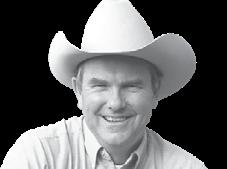
Deputy Solicitor for Parks and Wildlife Karen Budd-Falen of Cheyenne outlined the Trump administration’s priorities for western lands management and “restoring rancher resilience through significant policy reform.”
To begin, Budd-Falen, a fifth-generation Wyoming rancher originally from Big Piney, shared her return to DOI was motivated by a desire to ensure ag producers have a stronger
Lawn and Garden Care
Rule Revised
USDA, WLSB update guidance on brucellosis vaccination tags
The U.S. Department of Agriculture (USDA) has updated federal guidance regarding the use of orange metal National Uniform Eartagging System (NUES) tags for brucellosis calfhood vaccination, prompting the Wyoming Livestock Board (WLSB) to revise portions of its state rules as well.
These changes were discussed during two meetings held by WLSB in May, where Wyoming State Veterinarian Dr. Hallie Hasel explained the updated guidance and outlined its impact on producers and veterinarians across the state.
Extension experts offer management tips for protecting plants during drought
Following a warm, dry winter with exceedingly low snowpack across the Cowboy State, Wyomingites are preparing for the possibility of widespread drought conditions this summer.
Drought poses threats to agriculture and horticulture alike, on both small and large scales.
As summer approaches with the promise of dry days ahead, Extension
U.S. Meat Export Federation hosts spring conference
Livestock and grain producers, red meat processors and exporters and other key stakeholders gathered in Oklahoma City May 20-22 for the U.S. Meat Export Federation (USMEF) Spring Conference.
Oklahoma Secretary of Agriculture Blayne Arthur welcomed the group, detailing the importance of international trade to Oklahoma’s agricultural economy.
Arthur, who is also a cattle producer, shared highlights from a recent visit to Japan where she met with USMEF staff and saw firsthand how U.S. red meat is merchandised and served in the Japanese market.
USMEF Chair Jay Theiler, executive vice president of corporate affairs for Idaho-based Agri Beef Co., also shared recent experiences from international markets.
In April, Theiler led a USMEF delegation to Mexico City, Mexico for a market tour and a two-day USMEF symposium which attracted importers and other prospective customers from throughout Mexico.
In late April, Theiler traveled to London to participate in events celebrating the return of duty-free access for U.S. beef in the United Kingdom.
Red meat exports outlined
USMEF President and Chief Executive Officer Dan Halstrom gave attendees an overview of the latest export results for U.S. pork, beef and lamb.
He also offered insights on key developments affecting market access for U.S. red meat, including the recent announcement China had finally renewed registrations for
experts with the University of Wyoming (UW) and South Dakota State University (SDSU) offer advice on caring for lawns and gardens during drought.
Watering well
Making the most out of a limited water supply is crucial to effective lawn and garden maintenance during drought.
First and foremost, following official water use restrictions wherever they are in place is of utmost importance, stresses UW Extension Horticulture Specialist Jennifer Thompson in a May 19 UW Ag News article.
Please see GARDENING on page 4
Metal bangs tag updates
According to Hasel, USDA will once again allow veterinarians to use existing orange metal NUES tags for official calfhood vaccination (OCV) in cattle, bison and yak heifers between four and 12 months of age if the tags are already in stock, but tags can no longer be ordered or manufactured.
“This all came about as a result of an R-CALF USA lawsuit happening right now,” Hasel explained. “USDA added the ability for
Wyoming sugar industry discussed
During the Wyoming Agricultural Bankers Conference, held May 13-14 in Dubois, Wyoming Sugar Company President and Chief Executive Officer (CEO) Mike Greear gave a presentation on the history and economic impact of Wyoming’s sugar industry.
Greear included background on the Wyoming Sugar Company and an overview of the U.S. sugar program, as well as some current challenges and opportunities facing the sugar industry.
Wyoming Sugar Company
Sugar production has been a key industry in the Big Horn Basin since the early 1900s. By 1909, Greear explained local growers were beginning to grow and
harvest sugarbeets in the Worland area and ship them by railroad to Billings, Mont. to be processed.
In 1917, the Wyoming Sugar Company of Ogden, Utah completed construction of the first sugarbeet factory in Worland. Construction took just one year, according to Greear, and cost a total of $1 million.
The factory changed hands throughout the decades, acquired first by Holly Sugar Corporation in 1925 and then by Imperial Sugar in 1988 before a coalition of local growers, business owners, employees and community members banded together to form the Wyoming Sugar Company and
Adobe Stock photo
May 11, 1935 was one of the greatest days for those living in rural areas across America. This was the day President Franklin Roosevelt signed an executive order (EO) creating the Rural Electrification Administration (REA).
A year later, Congress passed the Electric Cooperative Corporation Act, which allowed states to adopt and enable the formation and operation of not-forprofit, consumer-owned electric cooperatives.
Before this, life on farms and ranches was harsh. The only lights were candles or kerosene lamps. Some farms and ranches had wind chargers and huge nonefficient batteries or generators and power plants.
There wasn’t any refrigeration, unless families had a cellar close to the house or an ice house with blocks of ice cut during the winter and stored under straw or coal dust.
Cattle were worth two cents a pound, and sheep were a penny and a half. I don’t think it was much in those days, although I don’t know if that’s true or not.
In the early days, Roosevelt wanted to use this EO to loan existing electrical companies funds to provide rural electricity, but they balked at that and didn’t want the government providing funds to a customer-owned nonprofits either.
But loan applications from rural-based cooperatives were pouring in, and the REA soon realized electric cooperatives would be the entities to make rural electrification a reality.
Cooperatives around the country started utilizing these low interest loans, and before long, they began repaying the government back sooner than expected.
The cooperatives proved to existing electrical companies that were powering cities and towns that they were wrong. These cooperatives brought new life to farms, ranches and rural dwellers.
Housewives didn’t have to heat irons on the stove and had refrigeration to keep food fresh. Everyone could read at night and listen to the radio without running their batteries down.
Farmers and ranchers were discarding troublesome windmills and putting electrical pumps in the ground to provide running water in the house, barn and corrals. These water wells also opened thousands of acres of grazing for livestock and wildlife.
The Wyrulec Company was the first rural electric cooperative in Wyoming and will celebrate 90 years in service this year. Fourteen more cooperatives followed around the state. There is a state board chosen from these cooperatives, and each cooperative elects a board from its members.
As with 90 years ago, REAs are built and governed from the bottom up.
The largest growth of America’s cooperatives came within four years after World War II. The number of rural electric cooperatives doubled and the number of consumers connected with REA electricity more than tripled. The miles of energized line grew more than five times.
By 1953, more than 90 percent of U.S. farms and ranches had rural electricity. Back then, a mile of powerline cost close to $1,000 to build.
Today, about 99 percent of rural areas have electric service, and REA is now known as the Rural Utilities Service, existing under the U.S. Department of Agriculture.
I still have the memory of finally getting REA electricity. The linemen were hooking up the new powerline to the meter, and when they finished, they flipped on the breakers and told me to run to the house to see if it had got there. It had.
GUEST OPINIONS
Each year on World Bee Day on May 20, the agriculture community takes a moment to appreciate the role bees play in our food system. But one of the most common misconceptions I see, both inside and outside of agriculture, is pollination begins and ends with honeybees.
The reality is much broader, which is good news because it provides more opportunities for all of us to play a part in protecting and engaging with our local pollinator communities.
If we focus too narrowly on one species, we risk missing the bigger opportunity, which is protecting the full ecosystem of pollinators upon which agriculture depends.
Pollination is bigger than bees
Honeybees have earned their place in the spotlight. They’re efficient, well-managed and essential to many cropping systems. They’re also relatively domesticated, as shown by the many amateur beekeepers popping up in rural and suburban communities.
In the U.S. alone, there are an estimated 2.7 million honeybee colonies supporting agriculture, according to the U.S. Department of Agriculture’s (USDA) National Agricultural Statistics Service (NASS). But they’re only part of the story.
Pollination is powered by a much more diverse network, one which includes native bees, flies, butterflies, beetles and even animals like hummingbirds and bats. In fact, more than 100,000 different species contribute to pollination across natural and agricultural systems.
Some of these contributors are easy to overlook.
Flies, for example, are critical to pollinating crops like cacao. Without them, chocolate wouldn’t exist. Bats pollinate many fruit crops, particularly in warmer regions. Even butterflies, while less efficient than bees, play an important role simply because of the ground they cover.
By Dr. Caydee Savinelli
This diversity is essential to the American food system. Our food security depends on a range of pollinators which can adapt to different environments, weather patterns and landscapes. No single species can do the job alone, and this is exactly why it is such an important story to tell.
Why it matters more than ever
Pollinators sit at the center of our food system.
Roughly 70 percent of the top food and fiber crops rely on pollination, according to the USDA, and about one out of every three bites of food we enjoy is connected to the process.
These are foods people interact with every day – fruits, vegetables, nuts, seeds and even the spices and beverages that make meals more enjoyable.
Beyond yield, pollination improves crop quality and supports plant diversity. Cross-pollination helps create stronger plants which are often more resilient to disease and environmental stress – something we don’t always see directly but absolutely benefits the system as a whole.
There’s also a broader economic impact. Pollination contributes billions of dollars in value to U.S. agriculture each year, reinforcing just how deeply connected pollinators are to both the farm and the food we rely on.
This is why protecting pollinators isn’t just an environmental effort – it’s directly tied to the long-term viability and productivity of our industry.
Small actions, real impact
The encouraging part is supporting pollinators doesn’t require large-scale change. Some of the most effective actions are also the most accessible.
Planting a diversity of flowers outside of your house or apartment – especially native species that bloom at different times of year – can provide a steady source of food throughout the season. Even small spaces like backyard gardens, patios or field edges can
make a meaningful contribution. It doesn’t have to be perfect.
One of the simplest ways to help is by creating habitat for native bees. Unlike honeybees, many native bees are solitary and don’t live in hives. They need safe, sheltered places to nest, which are often harder to find in more managed or urban environments.
This is where something as simple as a mason bee house can make a difference. These small “bee boxes” are inexpensive, easy to set up and highly effective at supporting native bee populations. It’s a practical step almost anyone can take.
Just as important is recognizing pollination is a shared system. Farmers, researchers, companies, communities and individuals all have a role in supporting it.
A shared responsibility
Across agriculture, there’s growing recognition pollinator health is something we have to work on together.
Efforts to create habitat, manage land thoughtfully and increase awareness all contribute to a stronger system, but none of them work in isolation.
What gives me optimism is this is an area where progress is both visible and achievable. The practices supporting pollinators are within reach, regardless of location or background.
World Bee Day is a good reminder of how much we rely on pollinators, but it’s also a reminder supporting them is something we can all participate in, no matter where we live or work.
The more we expand our understanding beyond the familiar honeybee, the better positioned we are to support the full system keeping our food supply moving and build a deeper connection to the role each of us can play in this effort.
Dr. Caydee Savinelli is the U.S. head of stewardship at Syngenta Crop Protection, LLC in the U.S. This article was originally published by Syngenta on May 19.
• 605-695-1990 • calli@wylr.net
NEWS BRIEFS
L.E.A.D. applications open
The application deadline to participate in the Wyoming Leadership, Education and Development (L.E.A.D.) program is rapidly approaching, and agriculture producers and agribusiness men and women are encouraged to apply.
The Wyoming L.E.A.D. program, a 16-month adult leadership initiative, is designed to create an outstanding, highly motivated group of agricultural leaders in Wyoming.
Up to 16 individuals will be selected to participate in the program which begins in September. The program includes nine in-state seminars, a national study seminar in Washington, D.C. and an international study tour. Participants will devote approximately 40 days to the study seminars.
According to Wyoming L.E.A.D. Director Cindy Garretson-Weibel, “The program is often a springboard for those who want to get more involved in shaping the future of agriculture in Wyoming and at a national level.”
The comprehensive program includes seminars focused on agriculture and natural resource issues, as well as personal development and leadership training, said Garretson-Weibel.
The educational seminars are presented by qualified professionals and industry experts and cover topics including communication, policy and decisionmaking, entrepreneurship, marketing, value-added agriculture, government and political affairs, natural resource management and leadership.
Potential participants submit an application, then participate in an interview. Final candidates are chosen by a selection committee based on their leadership potential, commitment to participate and other criteria.
L.E.A.D. participants pay a tuition fee to participate in the program, and more than 280 individuals have graduated from the Wyoming L.E.A.D. program since its inception in 1984.
The program is administered by the Wyoming Agricultural Leadership Council, a nonprofit organization.
Applications for Wyoming L.E.A.D. Class 19 will be accepted until June 10.
For application forms and other information about the program, visit wylead. com or contact Garretson-Weibel at wylead@gmail.com or 307-214-5080.
Drought webinar scheduled
As drought conditions continue to affect much of Nebraska, beef producers are being forced to make difficult decisions about herd and forage management.
To support producers navigating these challenges, Nebraska Extension will host a free webinar on June 11 from 6:30-8 p.m.
Titled “Management Options in Drought,” the webinar will feature University of Nebraska-Lincoln specialists who will cover key management practices and decision-making strategies to help mitigate the effects of drought.
Topics include drought outlook, range and pasture
conditions and production, confinement feeding cows, early weaning calves, planting summer annuals for forage and new drought planning tools.
Agricultural Meteorologist Eric Hunt, Cow/ Calf Management Specialist Karla Wilke, Range and Forage Specialists Mitch Stephenson and Jerry Volesky and Tonya Haigh with the National Drought Mitigation Center will provide practical guidance for those in drought conditions.
Patrick Lechner, program chief with the Nebraska Farm Service Agency, will also discuss available drought assistance programs.
WGFD seeks comments
The Wyoming Game and Fish Department (WGFD) is accepting public comment on a draft version of Wyoming’s 2027 State Wildlife Action Plan (SWAP) through July 27.
In addition, a virtual webinar providing opportunities for public comment and discussion is scheduled for June 30 from 1-2 p.m.
According to WGFD, Wyoming’s SWAP provides a statewide roadmap for conserving species which warrant additional attention, known as species of greatest conservation need (SGCN).
SWAP also unlocks approximately $500,000 in federal funds each year through the State Wildlife Grants program, which are matched by the state of Wyoming and partnering organizations.
Wyoming updates its SWAP at least every 10 years to ensure the roadmap reflects the most up-to-date science and environmental conditions.
The SWAP revision is coordinated by WGFD, but it is a blueprint for SGCN conservation across the state.
The 2027 SWAP reflects engagement from over 100 experts from more than 20 organizations. Through this collaboration, the SWAP identifies voluntary, non-regulatory and priority actions the state can pursue.
Public, stakeholder and partner engagement are key components of the SWAP.
WGFD encourages review of the 2027 SWAP and invites public feedback, which can be submitted by completing an online survey, filling out a paper copy available at all regional offices or providing comment at the virtual public meeting on June 30.
The draft 2027 SWAP, along with additional information on how to provide public feedback, is available at wgfd.wyo.gov/wyoming-wildlife/wyoming-state-wildlife-action-plan
Wyoming Game and Fish Department meeting set
The Wyoming Game and Fish Department (WGFD) will host a public meeting in Lander on June 3 to gather public input and answer questions regarding proposed changes to multiple regulation chapters.
The meeting will be held at 6 p.m. at the Lander Regional Office, located at 260 Buena Vista Drive in Lander.
Proposed regulation updates and statements of reason are currently available at wgfd.wyo.gov
The public comment period for Chap-
ters 35, 47, 51, 54 and 62 is open until 5 p.m. on June 10, and the public comment period for Chapter 44 is open until 5 p.m. on June 18.
Public comments will be shared with the Wyoming Game and Fish Commission prior to their July 14-15 meeting in Sheridan. Interested parties can submit comments in person at meetings, online at wgfd.wyo. gov/get-involved/public-input or by mailing comments to WGFD, Regulations, 3030 Energy Lane, Casper, WY 82604.
CAB Feeding Quality Forum set
The Certified Angus Beef (CAB) 2026 Feeding Quality Forum is scheduled for Aug. 4-5 in Amarillo, Texas.
CAB invites producers to attend the forum and discover practical solutions and useful insights to help drive profitability across operations during two days of engaging content.
The 2026 Feeding Quality Forum brings cattlemen together to explore practical solutions, timely market insights and real-world strategies designed to support their bottom line.
The event will feature two days of engaging sessions, industry-leading speakers and valuable networking opportunities
to help producers navigate their business with confidence.
In addition to lectures, attendees can participate in one of two Beef Blitz preevent tours with a choice between Caviness Beef Packers Harvest Facility or Caviness Beef Packers.
Each tour costs an additional $50 to attend and has limited capacity, available on a first-come, first-served basis.
Attendees may register for half price at $125 through June 15 or full price at $250 from June 15 to July 1. Students may register for $50 until July 1.
For more information or to register, visit cabcattle.com/feeding-quality-forum/
RCPP SUBAWARD PUBLIC ANNOUNCEMENT
To attend remotely via Zoom, register online at link. edgepilot.com/x/vaHK7DMu 3bEriZMYlYPYYI?u=https: //go.unl.edu/drought2026
A recording of the webinar will be made available following the event for those unable to attend live.
For more information, contact Nebraska Extension Beef Specialist Aaron Berger at 308-235-3122.
The Wyoming Water Development Commission (commission) was awarded a Regional Conservation Partnership Program (RCPP) grant from the U.S. Department of Agriculture (USDA) Natural Resources Conservation Service (NRCS) to provide drought resiliency through enhanced water management in the Upper Colorado River Basin in Wyoming, which includes the Green River and Little Snake River watersheds. The Wyoming Water Development Office (office) has authority to administer the RCPP grant #3207 on behalf of the commission. The office, NRCS and contributing partners will assist producers and Water Management Entities (WMEs) through the RCPP process with their NRCS Conservation Practices, such as installing sprinklers, converting open canals to pipe, improving diversions, lining conveyances, bank stabilization, etc. WMEs apply directly to the office for subawards, while producers apply to NRCS for cost-share reimbursement.
The office is pleased to announce that we are now accepting applications for subawards under the RCPP grant #3207. You can find more details by visiting the website below. Contact the Office Grants Administrator at (307)777-7626 or wdc.GrantsAdministrator@wyo.gov with any questions. https://wwdc.state.wy.us/RCPP/RCPP.html
Thompson recommends prioritizing watering practices and planting decisions based on growing length and personal preferences.
“Prioritize which plants take the most time to grow and which you value the most,” Thompson writes, noting trees often take the most time to grow and provide large benefits including shade, energy savings, wind protection and screening.
“Young trees which haven’t established their root systems need the most consistent watering,” Thompson explains. “Shrubs often take the next longest amount of time to grow in Wyoming landscapes, followed by perennial plants and then annuals.”
For gardeners navigating drought, Thompson emphasizes vegetable plants do not generally produce well without adequate water. With this in mind, she recommends reducing veg-
etable gardens to whichever plants are most enjoyed fresh and saving lesserloved veggies for a later, wetter growing season.
Whatever the garden size, utilizing a drip irrigation system can be an efficient way of watering without promoting weed growth, according to Thompson.
In terms of timing, watering early in the morning or late in the evening when outside temperatures are coolest and avoiding watering during rain or snow storms can help individuals get the most out of their watering schedule.
“To keep water from being lost to evaporation, water when temperatures are cooler and it is not windy,” Thompson says.
“The evening or early morning hours of 6 p.m. to 10 a.m. are generally cooler and less windy.”
Absorption test
In order to make the best
use of water, Thompson recommends wetting soil just to root level. She notes root depths vary based on plant type, with trees tending to have deeper water-absorbing roots than vegetables or grass.
To test absorption depth, Thompson outlines a simple test which can be performed by inserting a screwdriver into stressed soil.
“In more permanent plantings such as turf, trees and landscaped areas, you can use a screwdriver to check how deeply irrigation water has penetrated the soil,” Thompson writes.
“When you know your soil is dry, select a small area and water it for roughly 10 minutes at a rate that keeps the water from pooling or running off,” she continues. “Let it sit for half an hour, then return to the site and try to push a screwdriver at least six inches long into the soil.”
“See how far you can
push it down before you have much resistance, then try this again on a nearby patch with similar soil which has not been watered,” she adds. “If the screwdriver goes into the watered soil more easily, you can now judge approximately how deep the soil is moist with the screwdriver.”
Thompson emphasizes this test will not work for all soil types, particularly in very sandy soils where there is little resistance in both sites.
Irrigating efficiently
Regarding sprinklers and irrigation, examining water systems for signs of damage and inefficiency can help homeowners spread out their water usage effectively and prevent overwatering.
“Many lawns are overwatered,” Thompson notes. “The best step homeowners with irrigation or sprinkler systems can take to save water is to examine the system to make sure they are not overwatering.”
Water needs for turf throughout Wyoming vary
CATTLE COUNTRY VIDEO Slagle Ranch 2 Loads of Black Pairs. Solid Mouth. Tagged to Match. Located near Newcastle, WY. Immediate Delivery. Rep: Michael Schmitt 307532-1776. www.cattlecountryvideo.com
DISPERSALS
Frontier Land Co. 210 Mostly Blk few Bwf/Char Cow Pairs, Complete Dispersal, 3 yr olds to SM, Not Tagged to Match, Not Exposed back to Bulls, Cow Shots in Fall: Full Vac. Program, Poured, Spring Shots: Pre-Guard 10, Poured, Calf Shots: Bovi-Shield Gold 5, 7-way, Steers are Knife Cut, Calves are Slick, Selling only due to drought conditions Ross Cochran 20 Mx Cow Pairs, Partial Dispersal, Mx Ages, Tagged to Match, Calves born in April/May, Calf Shots: Ultra 8, Steers are Banded, Calves are Not Branded, Cow Shots: Vira Shield 6+VL5, Poured, Selling due to drought conditions
BREEDING BULLS
Frontier Land Co. 4 Blk Angus Yearling Virgin Bulls, EPD’s will be available day of sale
PAIRS
Beck Ranch 70 Blk Cow Pairs, Running Ages, Tagged to Match, Calves at side are 3 weeks old, Shots at Birth: 7-way Berry Family Trust 50 Blk/Bwf Cow Pairs, Mx Ages, Tagged to Match, Cow Shots: Vira Shield 6+VL5, Scour Guard 4KC, Calf Shots: Multimin, Nasalgen 3 PMH, Vision 7 w/Somnus+Spur, Steers are banded, Calves are NOT branded, Cows have not been Exposed back to Bulls, Selling only due to drought conditions
Don & Karen Simmons 36 Blk Cow Pairs, Mx Ages, Not Tagged to Match but calves have been worked Mehling Family Trust 15 Blk Cow Pairs, Mx Ages, Tagged to Match
FRIDAY,
JUNE 5, 2026 - ALL CLASSES
by elevation and season, with one to two inches of water per week being sufficient for most lawns during the summer, according to Thompson.
Checking water lines for leaks and ensuring sprinklers are directing water toward plants rather than spraying onto sidewalks or driveways are two additional simple – yet crucial – practices to reduce water waste.
Mulch can also help retain soil moisture, and Thompson recommends incorporating mulch to as many shrubs, perennials, annuals and vegetables as possible, making sure application methods allow for water to penetrate the soil.
Mowing practices
When it’s time to trim grass, both Thompson and SDSU Extension State Climatologist Laura Edwards recommend mowing high, with mower height set anywhere from two-and-a-half to four inches.
“Mowing high gives the lawn a deeper and larger root system, keeps moisture in, defends against weeds and keeps the soil cooler,” Edwards explains. “Mowing too short during dry conditions can injure or wear out dormant grasses to the point where they may not come back during cooler conditions.”
Thompson also recommends using a mulching mower rather than bagging grass clippings, and Edwards emphasizes the importance of keeping mower blades sharp since dull blades can damage grass leaves.
“Sharpen lawn mower blades twice a year,” Edwards recommends. “A dull blade tears at the grass, forcing it to use 40 to 60 percent more water to recover.”
In addition, Edwards reminds landscapers to never remove more than one-third of grass at a time, as any more removal can cause unnecessary stress to lawns.
Minimizing drought damage
In addition to smart watering and maintenance practices, experts also agree putting large landscaping projects on hold and delaying fertilizer applica-
tions during dry weather are essential to protecting plants and minimizing long-term damage.
“Drought is not a good time to do large landscape renovation projects, even if you are converting from high water use plants to low water use plants,” Thompson says, emphasizing almost all plants need extra water when they are first planted which is not practical during drought.
“If plants are drought stressed, do not fertilize unless you see signs of deficiency,” she adds. “Fertilizer often contains salts which can increase drought stress in plants unless they are thoroughly watered after fertilization.”
Allowing grasses to go dormant when the weather gets hot can also help preserve turf, according to Edwards.
“When conditions get too hot and dry, cool-season grasses will go dormant. Dormancy means active shoot growth will stop,” Edwards explains. “Grasses may turn brown and some may die, but the crown, rhizomes and roots are still alive.”
During this time, Edwards recommends applying just enough water to keep the turf alive – roughly onequarter to one-half of an inch of water every two-to-four weeks – until drought conditions improve.
“Once it cools down or rain starts to fall, shoot growth will begin again and the lawn will green up,” Edwards explains.
Reducing foot traffic on drought-stressed lawns and reducing garden vegetables to the essentials are two additional simple ways to minimize potential longterm drought damage.
“Drought is a time to make the best use of the water available to us and to start thinking about changes we might want to make in the future to have more drought-resistant landscapes,” Thompson concludes. “In the meantime, we persevere and look forward to a greener time ahead.”
Grace Skavdahl is the editor of the Wyoming Livestock Roundup. Send comments on this article to roundup@wylr.net.
& 5th, 2026
Fall Round Up - Cheyenne, WY September 10th, 2026
Zach Johnson Lingle, WY –307-575-2171***Jeff Ward – Laramie, WY 307-399-9863
Tam Staman – Crawford, NE 308-631-8513***Justin Smith - Lusk, WY 307-340-0724
Garrett Nunn - Laramie, WY 307-460-1649 *** Scott Redden - Burns, Co 970-596-3588
voice in federal policymaking.
“The reason I left the ranch in Wyoming and came back to DOI the second time is because of the people I get to talk to every day,” she said. “Quite honestly, there hasn’t been a president who has cared about farmers and ranchers since Ronald Raegan. It wasn’t because other administration’s disliked producers, but we’ve never been the big dogs in the room. It’s time now that we are.”
Grazing reform
A major focus of BuddFalen’s address was on recent and upcoming changes to grazing regulations on federal lands allotments.
First, she touched on DOI’s draft grazing rule, which was released on May 12 – shortly after she spoke at the event in Washington, D.C. – and noted the U.S. Forest Service is developing its own updated rule as well.
She also pointed out DOI recently expanded categorical exclusions for projects such as pipelines, water troughs and grazing permit renewals; is working on reforming the National Environmental Policy Act process to speed up range improvements and permit renewals; is reviewing archaeological clearance requirements under the National Historic Preservation Act to reduce delays for range improvement projects and recently signed a memorandum of understanding with USDA to improve coordination between fed-
eral lands managers.
After the floor was open for questions and BuddFalen was asked what she believes is the biggest misconception about producers grazing livestock on federal lands, she nodded to longstanding criticism that federal grazing fees are low.
“I think the biggest misconception is these are cheap or free lands and farmers and ranchers just get to use them, but nothing is further from the truth,” she said, explaining the formula for today’s federal grazing fees account for the investments ranchers make on public lands that may be otherwise overlooked.
“If you lease somebody’s private property, they take care of the fences and the water improvements,” she said. “None of this is true on federal lands. Ranchers have to do every bit of it by themselves, and when you calculate all of those additional costs into the federal lands grazing fee formula, it comes out to the same as private land lease rates.”
In addition, Budd-Falen emphasized grazing is not only economically important, it’s also beneficial to land health and wildlife habitat when properly managed, pointing to recent studies showing well-managed grazing can benefit sage grouse habitat, improve soil health, control invasive weeds like cheatgrass and help reduce wildfire fuel loads.
Wildlife management
Further, Budd-Falen discussed several hot button wildlife management issues impacting producers in the West including wolves, grizzly bears and wild horses.
When it comes to wolves, she explained management authority varies depending on region and listing status under the Endangered Species Act.
In most of Wyoming, Montana and Idaho, wolves are primarily managed by the state. However, other populations, like the Mexican wolf in New Mexico and Arizona, remain federally protected.
Budd-Falen explained DOI is reviewing regulations regarding situations where wolves are causing excessive livestock loss or threatening public safety.
She also noted the department is pursuing downlisting the status of grizzly bears from endangered to threatened in some regions, along with developing a 4(d) rule to allow states more management flexibility.
She stated, “This will provide a lot of management flexibility for states so they can take a more active role in managing their own grizzly populations. This is the first step in trying to get relief to states like Wyoming and Montana where grizzly populations are over management numbers.”
Wild horse management was also brought up during the discussion.
On this topic, BuddFalen said DOI is developing a new rangeland health ini-
tiative focused on balancing wild horse populations with available forage and water resources during worsening drought conditions.
“When grazing, wild horses can destroy the land they’re living on. They tromp out water holes, and it’s not just bad for the land, it’s bad for the horses,” she said. “We are putting together a plan, which we should be able to release soon, based on rangeland health.”
The plan, she explained, looks at the feasibility of conducting more gathers and using reproductive management tools, although she acknowledged the high costs associated with long-term wild horse holding facilities.
Drought and wildfire concerns
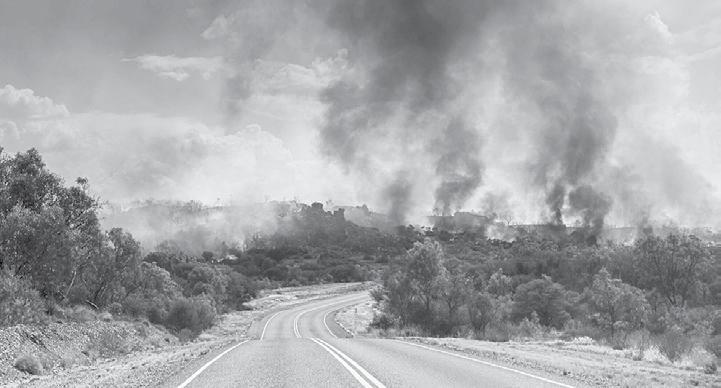
Additionally, BuddFalen’s discussion centered around ongoing drought conditions across the West and growing concerns over what could become a severe wildfire season.
She noted, although DOI announced $20 million for strengthening local wildfire suppression efforts in February, concern is growing this amount of funding won’t be enough.
In response, DOI is
working on evaluating vacant grazing allotments and additional grazing opportunities for livestock on wildlife refuges where grazing is compatible with refuge purposes.
“The U.S. Fish and Wildlife Service is going through what they call a compatibility determination of every wildlife refuge to determine if there’s some additional grazing for livestock that can occur on these refuges,” Budd-Falen explained.
She continued, “I’m afraid this is going to be a horrendous wildfire year,
but we are working hard on agreements with local ranchers and fire departments so we can get fires put out faster and they don’t burn out of control.”
Whether it be livestock grazing, wildlife management or wildfire control, Budd-Falen stressed the importance of collaboration and including producers in federal lands management throughout the entirety of her address.
Hannah Bugas is the managing editor of the Wyoming Livestock Roundup. Send comments on this article to roundup@wylr.net.
CLAY CREEK ANGUS
RBDG webinar set
The public is invited to join Wyoming Rural Development staff to discuss the Rural Business Development Grant (RBDG) program during a webinar on June 3 at 1 p.m. which will discuss eligibility, available funding, the application process and more.
Strategic economic development applications must be submitted by June 15 at 4:30 p.m., and regular applications are due on June 30 at 4:30 p.m.
The RBDG program is a competitive grant designed to support targeted technical assistance, training and other activities leading to the development or expansion of small and emerging businesses in rural areas with fewer than 50 employees and less than $1 million in annual gross revenues.
Eligible applicants include rural cooperatives if organized as a private nonprofit corporation, state government agencies, towns and communities, nonprofit corporations, institutions of higher learning and federally recognized Tribes.
Individuals and for-profit businesses are ineligible for the RBDG program.
RBDG grants may be used for rural projects to finance and facilitate development of small and emerging rural businesses, feasibility studies and business plans, distance learning networks, employment-related adult education programs and more.
Prior to the webinar, interested applicants should establish a SAM.gov account. SAM registration is a requirement of a complete RBDG application.
To register for the webinar, visit zoomgov.com/ webinar/register/WN_IkmrtzA_TcmwRYfko1T5gg
For more information, contact Loan Specialist Lynelle Barber at 307-233-6721.
OBITUARIES
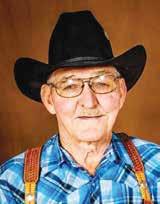
Ronald Virgil Garretson passed away peacefully at his home in Saratoga on May 16 with his family by his side. He was an active member of the Saratoga and Encampment communities, and his cowboy spirit, sense of humor and patriotism will be missed.
Ron was born on Nov. 4, 1942 to Virgil Richard and Elinor Louise (Meyer) Garretson. He had four older sisters.
He was raised in Elk Mountain on the family ranch, where he helped with
all ranch duties and was particularly fond of the cowboy aspects of ranching. Even as a boy, he often rode his horse to school because he loved being horseback and disliked walking anywhere he didn’t have to.
He graduated from Elk Mountain High School in 1960, and in 1964, he married his high school sweetheart Joyce Buckendorf of Elk Mountain. They were married for 62 years, and they had two girls – Cynthia (Cindy) Rae and Shawn Renae.
Ron continued to work for the Garretson Ranch for a few years after high school and spent most of his cowboy career in Carbon County.
Early in his career, Ron broke horses for Phil Freese, a horse trader in Rawlins. He also trained horses at the Polo Ranch in Cheyenne and cowboyed for the Eureka Pool near Baggs.
When he married Joyce in 1964, he worked for John Orton near Elk Mountain, then he had jobs with Millie Sanger near Encampment and Elmer Peterson at Walcott.
In 1967, he went to work for the One Bar Eleven
Ranch between Saratoga and Encampment. He was in charge of the Angus cattle herd and remained there for the next 10 years, where he and Joyce raised their two daughters. Several nephews also found their way to the ranch, where Ron shared the cowboy way of life with them.
In 1977, Ron went to work for the Carbon County Road and Bridge Department, and he and Joyce purchased a small place of their own, where Ron still trained, traded and raised horses. In addition, Ron continued to “day ride” for numerous local ranches, including the Nixon Ranch, Jack Creek Ranch, McIlvaines and others.
In 2008, after more than 31 years, Ron retired from the county as the Carbon County Road and Bridge Department supervisor.
Ron was a founder of the Donald Erickson Memorial Chariot Races in Saratoga, and he ran his own teams for many years, ultimately serving on the Interstate Chariot Racing Board of Directors.
Ron was also an avid antique tractor collector and an early member of the Chug-N-Tug Old Time Tractor Club in Encampment, participating in the annual tractor pull.
Ron deeply valued his community and the people in it. He was involved in the Search and Rescue
in Encampment for many years and the Encampment Riverside Lions Club. He attended every parade and local rodeo he could and enjoyed visiting with friends and family.
He was inducted into the Wyoming Cowboy Hall of Fame in 2014.
Ron is preceded in death by his parents Virgil and Elinor Garretson, sisters Rose Arlene Sikes and Esther Louise Fossett and his youngest daughter Shawn Renae Janson.
He is survived by his loving wife Joyce of Saratoga; daughter Cindy (Clay) Weibel of Cheyenne; grandsons Eric Duncan of Casper and Dylan Janson (Tiffany Prejean) of Leesville, La.; granddaughters Brook Weibel and Cassidy Weibel, both of Cheyenne; greatgrandchildren Marshal Duncan, Breanna Janson, David Wyatt Janson and Kutter Janson and sisters Virginia Jackson of Douglas and June Haynes of Torrington, along with numerous cousins, nieces and nephews. Cremation has taken place with Casada Funeral Home in Rawlins, and a memorial service will be held at 4 p.m. on June 20 in Saratoga at the Sale Barn at River Meadows. The turnoff is located one mile east of the Snowy Range Junction. Donations received will be given to local community organizations Ron loved.
veterinarians to go ahead and start using the orange metal tag as a brucellosis vaccination tag if they have it in stock.”
Under the updated rule, orange metal NUES tags will be placed under the same restrictions as Wyoming’s yellow metal OCV tag, and orange tags applied after Nov. 5, 2024 may only be used for brucellosis OCV, not for adult brucellosis vaccinations, retagging animals that lost their metal tag, regulatory brucellosis or tuberculosis testing or as official ID for interstate movement.
Hasel stressed the change does not restore orange tags to their former status as official identification.
“If the orange metal tag is or was applied after Nov. 4, 2024, it is no longer considered official ID,” she explained. “It’s for brucellosis vaccinations only, just like our yellow tag.”
Hasel also reiterated veterinarians may continue using remaining inventories of orange metal tags they already possess, but no additional tags are available.
“All the USDA is saying is if veterinarians have them in stock, they can use them up but they cannot order anymore,” she said. “They are no longer available. Period.”
She further noted, beginning on June 1, Wyoming veterinarians will be able to purchase yellow OCV tags.
Like the orange tags, yellow tags may only be applied at the time of OCV and are not considered official identification for interstate movement or regulatory testing.
Electronic ID tags of any color can also be used in cattle, bison and yak for brucellosis OCV vaccinations, adult brucellosis vaccinations, re-tagging animals that lost their metal tag, regulatory testing of brucellosis or tuberculosis and official ID for interstate movement.
Unlike the metal vaccination tags, 840 EID tags may also be purchased and applied by either producers or veterinarians through a variety of vendors.
Other changes
Because of USDA’s changes, WLSB officials introduced several revisions to Chapter 2 state rules governing brucellosis vaccination and identification requirements during a board meeting on May 22.
Hasel and Senior Assistant Attorney General J.D. Sater reviewed the changes, including updates to the definition of a Wyoming OCV tag, noting the revised language adds orange USDA metal tags to the definition alongside Wyoming’s yellow metal tag.
Under the proposed rule, a Wyoming OCV tag would include “a yellow metal OCV tag with a Wyoming shield or an orange tamper-resistant metal nine-digit USDA identi-
fication tag” placed on or after Nov. 5, 2024.
The revised definition also clarifies these tags “satisfy Wyoming identification requirements for OCV but do not satisfy federal requirements for movement across state lines or as official individual identification.”
Additionally, board members approved several minor wording and formatting changes within the rules package.
Sater explained the board had previously prepared rules for public comment, but the process was paused after USDA announced its update regarding the orange tags.
“What needs to happen today is, if the board is good with these changes, to again vote to approve to put them out for public comment,” Sater said.
Board Member Hugh Hageman moved to approve the revisions and Board Member Lindsay Wood seconded the motion, which passed unanimously.
Hannah Bugas is the managing editor of the Wyoming Livestock Roundup. Send comments on this article to roundup@wylr.net.
FDA approves Moxidectin
The U.S. Food and Drug Administration (FDA) has approved Moxidectin Oral Drench for Sheep for the treatment and control of internal parasites in sheep.
Moxidectin paralyzes the muscles and nervous systems of internal parasites, preventing parasites from feeding, moving or reproducing. Eventually, the parasites die and are eliminated from the animal’s body.
Moxidectin Oral Drench for Sheep contains the same active ingredient –moxidectin – as the approved brand-name drug product Cydectin Oral Drench for Sheep, which was approved in 2005.
The FDA determined Moxidectin Oral Drench for Sheep is bioequivalent to
the brand-name product.
Moxidectin Oral Drench for Sheep is available over the counter in one-liter and four-liter bottles. The recommended rate of administration into a sheep’s mouth is one milliliter per 11 pounds of body weight, which provides a dose level of 0.2 milligrams moxidectin per 2.2 pounds of body weight.
Sheep must not be slaughtered for human consumption within seven days of treatment and, because a withholding time in milk has not been established for this product, FDA warns producers not to use it in female sheep providing milk for human consumption.
Xtreme Broncs bonus announced
According to a May 26 Northern Ag Network article, the Northern International Livestock Exposition (NILE) is teaming up with the Dutton Ranch Darby Xtreme Bareback Broncs event to offer a $100,000 bonus to any Professional Rodeo Cowboys Association (PRCA) cowboy who can win both competitions in the same year.
The Dutton Ranch Darby Xtreme event is scheduled for June 6-7 in Darby, Mont., and the inaugural Riggin Masters event will debut during the weeklong NILE Stock Show and Rodeo in Billings, Mont. from Oct. 16-17.
Both events are sanctioned as PRCA Rank45 Xtreme Broncs events and count toward PRCA World Champion points. The
bonus monies do not count for PRCA points, but are an added value incentive.
PRCA Bareback Director Caleb Bennett expressed what this means to the bareback bronc riders, stating, “Bareback riders used to be a dying breed. In the past few years numbers have gone up. It’s because of events like these that fuel the fire for the guys wanting to ride rank bucking horses.”
Darby Rodeo Association President Cal Ruark said, “We are very excited to partner up with the folks at the NILE and make Montana the bareback bronc capital of the rodeo world. This is an exciting time for the Rank45 Xtreme Bronc series. We have record entries for our 2026 Darby event, and this bonus incentive will make it even more exciting.”
U.S. beef establishments.
This impasse had kept most U.S. beef ineligible for export to China for about the past year, but some shipments have now resumed. However, Halstrom cautioned, China must remove significant technical barriers before the market can be considered fully reopened.
“While this wasn’t solved last week, it’s going to be focused on in the very near future,” Halstrom said. “And I can tell you this –we have customers in China who are ready to go now.”
Halstrom also applauded a recent breakthrough with Saudi Arabia, in which Saudi officials agreed to remove barriers which had effectively locked most U.S. beef out of the market for the past 12 years.
“This is a big, big deal which could lead to exports as high as a couple hundred million dollars per year once the business gets going,” he said. “For both China and Saudi Arabia, I want to thank the Office of the U.S. Trade Representative and the U.S. Department of Agriculture for their tireless efforts to reopen these mar-
kets. These are tremendous wins for our industry.”
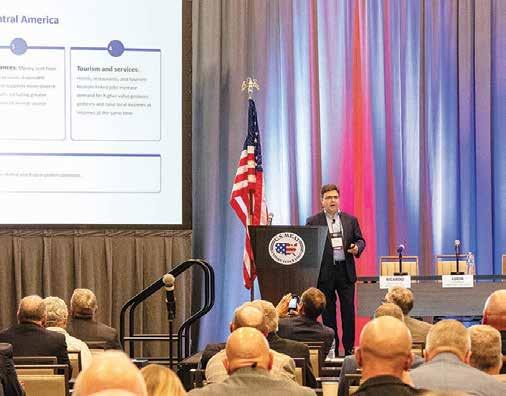
The presentation concluded with an economic and political overview of Central America – one of the fastest growing regions in the world for U.S. red meat exports. Last year, Central America took nearly $600 million in U.S. pork exports and more than $200 million in U.S. beef, with significant potential for further growth.
CAFTA outlook provided Ricardo Zúñiga, founding partner of consulting firm Dinámica Americas, offered an optimistic outlook for Central America going forward, thanks in large part to the stability provided by the Central America-Dominican Republic-U.S. Free Trade Agreement (CAFTA).
“Let me give you the headline right up front –CAFTA survived a very tough year,” Zúñiga said. “CAFTA was not in the news, and this is some of the best news there could be because it’s not the case for many free trade agreements the U.S. has been either renegotiating or set-
ting aside. In the case of CAFTA, it’s been largely respected.”
But Zúñiga cautioned, political transitions can have a rapid impact on market conditions in Central
Austin Snook • 307-290-2161
Taylor Snook • 307-290-2273
Craig Deveraux • 307-746-5690
Dan Catlin • 406-671-7715
Clint Snook • 307-290-4000
Cheyenne Seymour • 605-641-0638
Casey Sellers • 307-217-2614
Jim Forbes • 307-351-5932
America, so U.S. companies should monitor these situations carefully.
He added U.S. migration enforcement can dramatically impact remittances to Central America, which represent a significant portion of consumers’ disposable income in the region.
“I don’t know if people realize how much remittances from the U.S. are a part of the growth story for U.S. meat exports to Central America,” Zúñiga explained. “But they are a huge part of why U.S. beef and pork products are becoming more and more a part of the diet in the region.”
Innovative marketing strategies discussed
During the last day of the conference, a panel discussion detailed innovative marketing strategies and activities which have helped expand demand for U.S. red meat in Asian and Latin American markets.
Panelists included Jihae Yang, USMEF vice president for the Asian Pacific, who shared insights from Taiwan,
Daniel Escoz • 307-217-1440
Tye Curuchet • 307-351-8666
JJ Butler • 307-231-6878
Chris Rodriguez • 307-217-2172
Kyle Kallhoff • 605-881-1526
Kade Kinghorn • 307-620-0525
Jake Underwood • 307-660-5989
Donny Scantling • 307-217-0537 "From
May 27, 2026 - No Report
Thank you for your business!
South Korea and Japan.
One of the latest innovations in Japan is the marketing of U.S. beef short plate as a barbecue cut available to retail consumers. While short plate has long been a staple of Japan’s foodservice sector, new variations of the cut are gaining traction at supermarkets and other retail outlets.
In Taiwan, Yang explained how USMEF is working with 7-Eleven convenience stores to expand the availability of chilled U.S. beef cuts. She noted this is a marketing breakthrough not previously achieved in Taiwan, or even in Japan and Korea, which have long been considered the leading-edge markets for the convenience store sector.
In South Korea, Yang explained USMEF has partnered with retail giant E-Mart to heighten awareness of Prime grade, chilled U.S. beef cuts, including the chuck eye roll, top blade and chuck flap tail.
Lucia Ruano, USMEF representative in Central America and the Dominican Republic, offered highlights from campaigns to inform health-conscience consumers about the nutritional and fitness benefits of U.S. red meat.
She also spotlighted online training tools to help educate prospective customers and other key decisionmakers about the attributes of specific U.S. pork and beef cuts.
Ruano noted USMEF has also expanded its engagement with restaura-
teurs and foodservice purchasing managers in the region, showcasing the attributes of underutilized U.S. pork and beef cuts which can enhance the range and quality of restaurant menus.
USMEF Latin America Representative Homero Recio addressed USMEF members on developments in other Western Hemisphere markets, including Colombia and Mexico.
Recio explained the presence of U.S. pork continues to expand in Colombia’s retail sector but noted the introduction of underutilized beef cuts in a wider range of retail venues has also opened new doors for U.S. beef.
USMEF also has promotional activities planned in conjunction with the upcoming FIFA World Cup soccer tournament – which is wildly popular in Colombia – allowing retail customers to qualify for entry into VIP viewing venues. Recio further highlighted Cantina Vibes, a campaign in which USMEF has expanded the penetration of U.S. pork and beef variety meats in Mexico’s casual dining sector and explained how U.S. pork jowls are being merchandised as a flavorful, convenient, high-protein snack by street vendors and at stadium concession stands.
Factors impacting demand addressed
Additionally, USMEF members gained insights from a distinguished panel
A warm welcome – Oklahoma Secretary of Agriculture Blayne Arthur welcomes U.S. Meat Export Federation (USMEF) members to Oklahoma City May 20-22. USMEF photo
of livestock industry experts including Dr. Derrell Peel of Oklahoma State University, Dr. Nevil Speer of Turkey Track Consulting and Don Close, senior animal protein analyst with Terrain.
The panel addressed factors impacting protein demand in both the international and domestic markets, noting the important role exports play in bolstering the profitability of livestock producers and incentivizing industry expansion, but expansion of the beef cattle herd has been elusive due to factors such as volatile grazing conditions, hay availability and persistently higher operating costs.
“You cannot stabilize the cow inventory by not killing cows,” Close explained. “If we’re not keeping replace-
ment heifers on top of that, we’re going to continue to decline. By not killing cows and not replacing with females, the average age of our cow herd is getting substantially older. When we finally do start to expand, we’re going to have to retain enough females, not only to rebuild what we’ve lost but we’re going to have to retain additional replacement females because of the accelerated attrition of the cows that are still out there.”
The tight cattle supply has fueled misperceptions about the impact of trade, with some media outlets suggesting exports reduce availability for U.S. consumers.
Peel illustrated the benefits of trade by drawing a comparison to households that periodically fill their home freezer with a full
range of beef cuts.
“I always remind producers – because they almost all have freezer beef – what it’s like when you get down to the stuff in the bottom of the freezer,” he said. “By exporting cuts we don’t like to eat as much, trade allows us to clean out the bottom of the freezer so we can focus U.S. demand on the cuts we really want.”
Speer highlighted the benefits producers have realized from raising higher grading cattle to meet consumers’ demand for highquality beef. He contrasted the current situation with the 1980-90s, when the beef industry was losing the battle for consumer dollars spent on protein.
“Now we’re in a whole new realm,” Speer said. “This is what’s bringing consumers back – quality and the consistency. And it didn’t
just happen. We’ve gotten better at genetics, we’ve gotten better at management and we’re starting to listen to consumers, and it makes all
the difference in the world.”
USMEF collects and analyzes market intelligence, implements promotional programs and collab-
orates with industry stakeholders and governmental agenies to increase U.S. red meat exports. For more information, visit usmef.org
APHIS announces funding for chronic wasting disease prevention
The U.S. Department of Agriculture’s Animal and Plant Health Inspection Service (APHIS) will provide approximately $12 million to support efforts by states and Tribal governments, research institutions and universities to control and prevent chronic wasting disease (CWD) in wild and farmed cervids.
APHIS will competi-
tively fund the most promising projects aimed at developing innovative tools or methods, supporting state and Tribal CWD control programs at the local level and providing indemnity payments to cervid owners with pending claims.
This includes approximately $6 million to support critical projects to
control and prevent CWD in farmed cervids, approximately $5.5 million to support research and management of CWD in wild cervids and approximately $500,000 to support CWD prevention and management on Tribal lands.
CWD is an infectious, degenerative disease of cervids which causes brain cells to die, ultimately
leading to the death of the affected animal.
The disease has spread widely and the limited number of tools, as well as their efficacy, impacts the ability to effectively control the disease.
Cooperative agreement funding in previous years has resulted in the development and implementation of predictive genetics to
assist farmed cervid owners in breeding for less susceptible deer, the removal of CWD-positive farmed cervid herds, increased diagnostic capabilities, increased CWD surveillance in wild cervid populations, hunter and public education and carcass disposal options to reduce spread of CWD.
This year’s investment
OPTIMIZE PERFORMANCE:
will allow state departments of agriculture, state animal health agencies, state departments of wildlife or natural resources, federally recognized Native American Tribal governments and organizations and research institutions and universities to further develop and implement CWD research, management and response activities.
As forage quality drops, proper supplementation becomes critical. Anipro delivers PROTEIN, ENERGY and FORTIFIED MINERALS through Liquid, Mineral, and Tub formulas—tailored to boost cattle health and PROFITABILITY across all operation types.
OVER 35 YEARS OF PROVEN NUTRITION:
Anipro Xtraformance Nutrition combines PREMIUM QUALITY INGREDIENTS with expert consulting and UNMATCHED SERVICE. Trust our seasoned nutritionists to optimize your herd’s performanceand INCREASE YOUR PROFITABILITY.
Market access developments – U.S. Meat Export Federation (USMEF) President and Chief Executive Officer Dan Halstrom gives members an update on recent market access developments for U.S. red meat. USMEF photo
CALENDAR
May 29-31 Sixth Annual Powder Basin Classic, the CAM-PLEX, Gillette. For more information, visit showman.app/shows#/powder-basin-classic-c80d or @PowderRiverBasinClassic on Facebook.
May 30-31 Dusty Vaquero Days, the CAM-PLEX, Gillette. For more information, visit dustyvaquerodays.com
May 30-31 Wind River Flywheelers 30th Annual Antique Engine and Tractor Show, Shoshoni. For more information, call Sonja Holm at 307-921-9371, Cindy Leonhardt at 307-851-9681 or Dave Stark at 307-850-2744.
June 1 Wyoming Game and Fish Department Aquatic Invasive Species Inspector Training, 9 a.m.-4 p.m., Green River Regional Office, Green River. For more information or to register, visit wgfd.wyo.gov
June 1 Uinta Veterinary Hospital Free 4-H Sheep and Goats Class, 6-7 p.m., Uinta Veterinary Hospital, Fort Bridger. For more information, call 307-783-0570 or e-mail uinta@uwyo.edu.
June 1 Wildfire Preparedness, Response and Recovery Webinar Series: Preparedness, 12-3 p.m., online. For more information, visit nationalacademies. org/projects/CHPP-BHS-26-P-736
June 1-2 2026 Annual Tractor and Equipment Safety Course, Legacy of the Plains Museum, Gering, Neb. For more information or to register, visit unmc.edu/ publichealth/cscash/outreach/farm-safety-days.html
June 2 Wyoming Game and Fish Department Public Meeting, 6 p.m., Pinedale Regional Office, Pinedale. For more information, visit wgfd.wyo.gov/
June 3 Wyoming Rural Business Development Grant Program Webinar, 1 p.m., Zoom. For more information, contact Lynelle Barber at 307-233-6721. To register, visit zoomgov.com/webinar/register/WN_IkmrtzA_TcmwRYfko1T5gg
June 3 Wyoming Game and Fish Department Public Meeting, 6 p.m., Lander Regional Office, Lander. For more information, visit wgfd.wyo.gov/
June 3 2026 Annual Tractor and Equipment Safety Course, Sheridan County Fairgrounds, Gordon, Neb. For more information or to register, visit unmc.edu/ publichealth/cscash/outreach/farm-safety-days.html
June 3-5 Wyoming Stock Growers Association Cattle Industry Convention and Trade Show, Holiday Inn Convention Center, Cody, For more information or to register, visit wysga.org
June 4 University of Wyoming Extension Wildfire Webinar Series: Positive and Negative Impacts to Wildfire Habitat, 6-7:30 p.m., Zoom. For more information, visit wyoextension.org/wrir/wildfire-webinar/
June 5-6 38th Annual Overland Stage Stampede Rodeo, gates open at 6 p.m., performance starts at 7 p.m., Green River. For more information, call 307-872-0514. To purchase tickets, visit rodeoticket.com
June 6 Wyoming Free Fishing Day. For more information or a complete list of events across the state, visit wgfd.wyo.gov
June 7 Wyoming Game and Fish Department Aquatic Invasive Species Inspector Training, 9 a.m.-4 p.m., Jackson Regional Office, Jackson. For more information or to register, visit wgfd.wyo.gov
June 8 Wildfire Preparedness, Response and Recovery Webinar Series: Response, 12-3 p.m., online. For more information, visit nationalacademies. org/projects/CHPP-BHS-26-P-736
June 8-12 University of Wyoming 2026 Ranch Camp, Ladder Ranch, Carbon County. For more information or to apply, visit bit.ly/4rkLAe2
June 9-11 Southeast 307 Livestock Show Clinic, Platte County Fairgrounds, Wheatland. For more information or to register, contact Hannah Cesar at hcesar@ uwyo.edu or 307-322-3667.
June 10 Growing Food in Wyoming Masterclass: Pests and Pollinators, 7-8 p.m., Zoom. For more information or to register, visit dirtworkswyo.com
June 11 Nebraska Extension Management Options in Drought Webinar, 6:30-8 p.m., Zoom. For more information or to register, visit go.unl.edu/drought2026
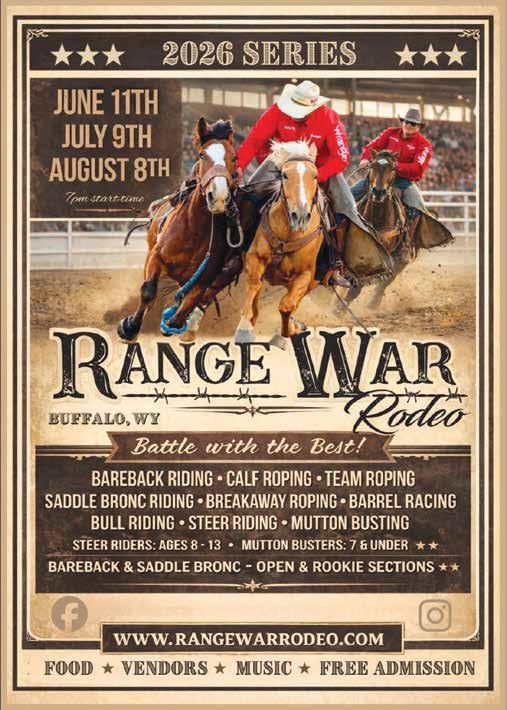
June 11 2026 Range War Rodeo Series, 7 p.m., Buffalo. For more information, visit rangewarrodeo.com
June 11-14 Wyoming Range Hunting and Fishing Expo, Sublette County Fairgrounds, Big Piney. For more information, visit wyomingrangeexpo.com
June 14-20 College National Finals Rodeo, Ford Wyoming Center, Casper. For more information or to purchase tickets, visit cnfr.com
June 15 Wildfire Preparedness, Response and Recovery Webinar Series: Recovery, 12-3 p.m., online. For more information, visit nationalacademies.org/projects/CHPP-BHS-26-P-736
1 CharX Cow, 1445# $17900 Schlager, John - Worland
1 Blk Cow, 1625# $17250
1 Blk Cow, 1325# $16500
Sorrels, Jamie - Fort Washakie
1 Red Cow, 1265# $17100 Caines Land & Livestock - Hyattville
1 Blk Cow 1340# $16800
Wiechmann, Douglas - Ten Sleep
1 Blk Cow 1680# $15850
• Upcoming Sales •
June 11 – All Class Cattle
June 25 – All Class Cattle, Sheep & Goat
July 9 – All Class Cattle
July 23 – All Class Cattle, Sheep & Goat
Aug. 6 – All Class Cattle
Aug. 20 – All Class Cattle, Sheep & Goat
Spring Catalog Horse Sale, Bowman Livestock Marketing, Bowman, N.D., 605-484-3784, 605-210-1124, bowmanlivestockmarketing.com
Cowgirl Cadillacs Horse Sale, Sheridan, cowgirlcadillacs.com
Superior Livestock Auction Corn Belt Classic, South Sioux City Marriott Riverfront, South Sioux City, Neb., 800-422-2117, superiorlivestock.com
National Rambouillet Show and Sale, South Dakota State Fair Park, Huron, S.D., rambouilletsheep.org
Northern Livestock Video Early Summer Special, 866-616-5035, northernlivestockvideo.com
June 30 Cattle Country Video High Plains Showcase, UW Marian H. Rochelle Gateway Center, Laramie, 888-322-8853, cattlecountryvideo.com
July 6-10
Superior Livestock Auction Week in the Rockies, The Steamboat Grand, Steamboat Springs, Colo., 800-422-2117, superiorlivestock.com
Hard Liquor and Morphine Kills Editor
Dear readers, in a past Postcard we explored the copper mining town of Dillon, which was built on booze, and a few of its colorful characters.
This week, we relate the sad tale of a famous weekly newspaper writer and editor who met his tragic death because of hard liquor and drugs.
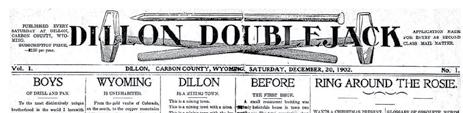
Journalist Grant Jones Grant Jones was a daily newspaper writer from the Midwest who came to south-central Wyoming in 1901 to promote the Grand Encampment mining district and eventually established a weekly newspaper called the Dillon Doublejack high atop the Sierra Madre Mountains in Carbon County.
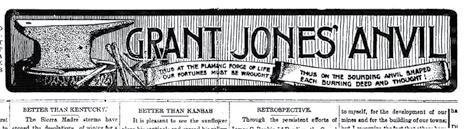
Jones, writer and editor of the Dillon Doublejack in 1902-03, was noted for his wit in both his reporting and his column “Grant Jones’ Anvil.”
He was also famous for leaving the mountain mining town of Dillon to “go on one of his running drunks” for several days.
Legend has it he left his newspaper office shortly after putting out the weekly paper to visit the towns of Encampment, Saratoga, Rawlins, Battle and other bergs for a liquid refreshment.
He returned to the DoubleJack office a week later – just before deadline – and announced to his printer he had visited many towns throughout the region and “the patrons loved last week’s paper so much, this week we’ll just change the date and run it again.”
We can’t vouch for the truth of this tale, but the files of the DoubleJack contain two issues with the same news, just different dates.
Jones is best remembered for his good nature, humor and stories of mythical creatures which inhabited the Rocky Mountains, such as “Googly Woo” which
brought laughter throughout the land.
The career of Jones in the town of Dillon was unfortunately short, and his tragic death in June of 1903 reads almost like a melodrama.
As Jones was recovering from one of his supposedly frequent “running drunks,” a cabin mate who was addicted to morphine attempted to ease Jones’ trembling by administering a shot of the drug.
The combined effect of the liquor and the drug killed the 31-year-old journalist, thus ending the Dillon DoubleJack and its most colorful editor.
The name of the paper was a tribute to the miners of the region with the
moniker “doublejack” being the term used to describe the “star drill” and the heaviest sledgehammer wielded by the miners in their work. See illustration on masthead.
In his original dedication of the paper to the miners, Jones wrote: Boys of drill and pan To the brotherhood whose members see the word “welcome” on fewer doormats and know more about hospitality, travel over more miles of land and see fewer railroad tracks, eat more bacon and see fewer hogs, drink more milk – condensed – and see fewer cows, worship nature more and see fewer churches, regard women with more chivalry and see fewer of them, judge men better and wear fewer starched shirts, undergo more hardships and make fewer complaints, meet more disappointments and retain more hope than any other class of men in the whole wide world. To the brotherhood of quartz and placer prospectors and miners, I dedicate the Dillon Doublejack – Grant Jones
Grant Jones poses in front of the “Office Saloon” in the adjoining mining town of Battle. Also shown are copies of the masthead and column logo featured in the Dillon Doublejack. Photo by Jack Ledbetter from Dick Perue/Bob Martin collection in Grand Encampment Museum. Historical Reproductions by Perue
Summary As of May 22, 2026
Compared to last week Slaughter lambs 10.00 to 35.00 lower. Slaughter ewes steady to 5.00 lower. All sheep sold per hundred weight (CWT) unless otherwise specified. Slaughter Lambs: Choice and Prime 1-3: San Angelo: No test.
Ft. Collins: No test. Replacement Ewes: Medium and Large 1-2: San Angelo: No test.
Billings: No test.
Ft. Collins: No test. South Dakota: No test. Sioux Falls: No test.
Sheep and lamb slaughter under federal inspection for the week to date totaled 33,000 compared to 35,000 last week and 39,326 last year.
Source: USDA AMS LPG Market News, San Angelo, Texas National Wool Review As of May 22, 2026
Domestic wool trading had 1,655,529 lbs of confirmed trades
Source: USDA- CO Dept of Ag Market News Service, Greeley, CO
Montana Hay Summary
As of May 15, 2026
Compared to last report(5-01-26): Hay sold mostly 10.00-15.00 higher. Hay supplies across the state are very light and demand is very good. Hay prices continue to increase as ranchers search for hay. Conditions across the state remain dry and both producers and ranchers continue to show concern for hay availability. Lower quality hay continues to see strong demand as ranchers search for hay to feed cows while they wait for there to be enough grass to turn out. Spring rain and snow showers were very light across much of the state, however some western mountain snow was seen this past week as a system clipped the northern and Northwestern portions of the state. Dry and dusty conditions were seen this week across much of Northeastern Montana with some roads closed on Thursday due to low visibility from blowing dust. No new crop contracts were seen this week as producers were overwhelmed with interest for hay. Most producers took a back seat and decided to wait to see how much hay they can produce and how the market develops over the next few weeks. Producers in Northeastern Montana report large swaths of winter kill due the January ice storm. There is a major concern over how much hay will be produced this summer. Many irrigation districts have already announced they will have a very short irrigation season due to low river and stream flows. This, coupled with drought conditions and heavy winter kill will limit the volume of hay produced. According to the drought monitor 59.58% of the state is in Moderate drought or worse, up 2.40% from 2 weeks ago. 32.64% of the state is in an Severe drought or worse, up 4.34% from 2 weeks ago. 6.08% of the state is in Extreme drought or worse, up 0.91% from 2 weeks ago. 0% of the state is in Expectational drought, unchanged from 2 weeks ago. Notably, 87.34% of the state is abnormally dry, down 6.94% from 2 weeks ago. N/A - Hay Conventional
Source: USDA AMS Livestock, Poultry
Market News, Billings,
Entries open for the World Forage Analysis Superbowl
Entries are currently being accepted for the World Forage Analysis Superbowl, which is open to all forage producers across North America.
The 2026 contest, held in conjunction with World Dairy Expo, is set to award over $26,000 in cash prizes, made possible by generous award sponsors and led by Lallemand Animal Nutrition, the awards ceremony sponsor.
The World Forage Analysis Superbowl is comprised of nine divisions which evaluate samples through lab and visual analyses.
The winning entry of each division earns a cash award of $2,500, with additional cash prizes presented
to second through fifth place.
A Grand Champion Forage Producer is also named in the contest and receives a check for $2,500, and the Grand Champion First-Time Entrant is awarded a $2,000 cash award. Special awards also include the $1,000 Quality Counts Award for Hay/Haylage sponsored by AgriKing, Inc. and the $1,000 Quality Counts Award for Corn Silage sponsored by Silostop. All award winners will be recognized at the Forage Superbowl Reception on Sept. 30 at World Dairy Expo in Madison, Wis.
In 2025, 232 entries were submitted from 12 states, including Iowa, Illinois, Indiana, Kansas, Michigan,
Minnesota, New York, Ohio, Oklahoma, Wisconsin and Wyoming.
The World Forage Analysis Superbowl is organized in partnership between Dairyland Laboratories, Inc.; Hay and Forage Grower; U.S. Dairy Forage Research Center; University of Wisconsin and World Dairy Expo.
The deadline to submit corn silage samples is July 9, while all other entries must be submitted by Aug. 20.
The $45 entry fee provides entry into the contest along with a detailed sample analysis which is sent to entrants after judging is complete. For entry forms and more information, visit worlddairyexpo.com
CLASSIFIEDS
NOTICE: Publication in this newspaper does not guarantee the legitimacy of any offer or solicitation. Take reasonable steps to evaluate an offer before you send money or provide personal/financial information to an advertiser. If you have questions or believe you have been the victim of fraud, contact the Wyoming Attorney General’s Office, Consumer Protection Unit, 109 Capitol Building, Cheyenne, WY 82002, 307-777-6397 TFN
Events
LOOKING FOR RANCH ASSISTANT PROPERTY MANAGER: Full-time position for large ranch located in Park County, WY. Responsibilities include: Lawn care, irrigation, agricultural equipment maintenance and general residential, building and property maintenance. Salary range of $45-$60K depending on experience. Living on property is required for employment. House and vehicle will be provided. Property is located 10 minutes from downtown Cody, WY. Position is available for immediate hire. Please send resumes to mgiliati@acpg.com 6/13
Gottsch Livestock Feeders is looking for
WASHAKIE COUNTY IS SEEKING APPLICANTS FOR A SEASONAL GROUNDSKEEPER FOR THE WASHAKIE COUNTY FAIRGROUNDS: This position pays $16/hour and offers up to 40 hours/week. Applications are available at www. washakiecountywy.gov/ employment and may be returned to the Washakie County Clerk, 1001 Big Horn Ave., Worland, WY 5/30
Brands
Cattle
YEARLING BLACK ANGUS BULLS: AI sired by heifer bull Connealy Patent. Semen tested. Minatare, NE. Call Byron Miller, 303-818-8152, leave message 6/6
BEST LAST CHANCE SALE!!
LYTLE RED ANGUS is offering private treaty bulls from our herd founded on 30+ years of selection for fertility, consistency and efficiency. Highly adaptable, our bulls have proven themselves from Arizona to New York state. Age-advantaged and yearling bulls available. Passed breeding service exams and ready to go!! Visit www.lytleredangus.com or call Zeb, 605-441-7658. To view photos, go to www.wylr.net in the classifieds 6/20
SALE * CHRISTENSEN RED ANGUS * SALE: Registered, vaccinated and fertility tested bulls. We have a deep carcass, high ADG packaged with moderate to low birthweights available. Call 406-208-4315 or e-mail criters64@gmail.com 6/6
RED ANGUS HIGH-ELEVATION
YEARLING BULLS FOR SALE IN NORTHEASTERN UTAH: Out of AI and bull-bred sires. Will be trich and semen tested. $3,500/ head. Bar Lazy TL Ranch, David, 435-828-1320, barlazytlranch@gmail.com 6/13
Riders for their feedyard in Red Cloud, NE. The main focus of the Cowboy/Pen Riders are spotting, pulling, diagnosing and taking cattle to the hospital and shipping fat cattle. This person will need to be a team player who is seeking a long-term position. You will have the opportunity to work with and learn from some of the best in the industry. We offer a benefits package that includes health insurance, dental, vision, 401(k), health savings, life insurance and paid vacation. Retention bonus offered to full-time employees. Incentives paid out at 6 months and 1 year of employment. If you are interested stop by and fill out an application or visit our website at Call Mike Faimon at 406-469-1585 or Davin Arnold 970-301-3098 for more information.
REGISTERED WYOMING BRAND FOR SALE: RHC, RHS, RJH, renews Jan. 1, 2033. One electric iron. $1,500. Call Rob, Laramie, WY 303921-3253 6/13
WYOMING BRAND FOR SALE:
5/30
WANTED RECIP COWS: Must be open!! Two to 6 years old, Red Angus or Angus-based cows. For more information, call Corie Mydland, 406-8555598 (cell), Trans Ova Genetics, Joliet, MT 5/30
www.gottschcattlecompany.com
FULL-TIME RANCH MANAGER: BISON RANCH, SHERIDAN, WY. We are seeking a dedicated, experienced ranch manager to join our growing bison ranch operation. This is a hands-on role for someone who takes pride in hard work, reliability and caring for land and livestock. Responsibilities: Daily care and management of bison herd. Maintaining fencing, equipment and ranch property. Assisting with feeding, health checks and handling livestock. General ranch maintenance and upkeep. Supporting ongoing growth and operations of the ranch. Requirements: Prior ranching or livestock experience (bison experience preferred but not required). Strong work ethic and reliability. Ability to lift heavy items and perform physical labor daily. Self-motivated and able to work independently. Available to start immediately. Salary starts at $145,000 and up. This is a full-time position with opportunity to grow alongside a rapidly expanding ranch. Apply today if you’re ready to work hard and be part of something being built from the ground up. Call Landon, 205-531-9819 or e-mail sheryl@ bisonunion.com 6/13
MEATCUTTER WANTED: Valley Foods in Saratoga, WY has an immediate opening for a meatcutter. Experience is preferred but not necessary. Ideal candidate is self-motivated, efficient and customer service minded. Pay DOE. Send resume to valleyfoods9024@ hotmail.com 6/6
AGRI-ONE FINANCIAL: Farm/ ranch and all commercial loans. RATES AS LOW AS 5%. We have been helping with all aspects of agricultural, commercial financing and management for years. LET US HELP YOU on a consulting level with management to increase profitability, deal with and fix credit problems and for all your financing needs. WE CARE AND HAVE WORKING PROGRAMS designed for the farmer/rancher and not the banker. Please call Steve, 303-773-3545 or check out our website, www.agrionefinancial.com. I will come to you and get the job done!! 6/13
REGISTERED WYOMIING BRAND FOR SALE, lazy RM. RRC, RHH, renews in January 2027, 2 sets of hot irons and 2 sets of electric irons. $3,000. Calls only, 307899-3737 5/30
FOR SALE: Male and female Hangin’ Tree/Border Collie cross puppies. The dam is Border Collie and the sire is Hangin’ Tree. Ready to go with all of their shots in 2 weeks. Very good companions and stock dogs. $300/each. Call 406-939-1699 5/30
Services Services
TWENTY-EIGHT BLACK
PAIRS: April-May calves. Cows are big, slick and in good shape. Various ages, but mostly older. Have not been mouthed. Been on irrigated pasture and tubs. Calves are tagged. Asking $4,200/pair. Come look. Located near Pavillion, WY. Call for more information, 307-840-0593 5/30
REGISTERED BLACK ANGUS BULLS FOR SALE: Zoetis 50K DNA tested, full EPDs available. Fertility tested. Light birth EPDs plus good maternal traits. Delivery available. Neal Ranch, call Lyle, 406-6791976, Ty, 307-752-4419 or Perrie, 406-660-2055. To view photos, go to www.wylr.net in the classifieds 6/6
REGISTERED ANGUS YEARLING AND 2-YEAROLD BULLS FOR SALE, visit www.crookedcreekangus. com or call 785-332-6206, St. Francis, KS 8/29
SIMANGUS YEARLING BULLS FOR SALE BY PRIVATE TREATY: Bulls priced for every budget. Bulls have GE EPDS, are homozygous polled, most are homozygous black. Bulls can be inspected at Dilka Cattle, pictures available by request. Bulls sired by BAS Money Maker, Gibbs Essential, Gonsior Batman and CCR Pounder. All bulls guaranteed for first breeding season. Information on the bulls may be requested by email at thedilkas@aol.com or calling 970-396-8791 5/30
3/H SIMMENTAL RANCH, PLAINS, MT OFFERS POWERFUL SIMANGUS BULLS: Yearlings and 18-month-olds sired by top AI genetics. Bred for performance, soundness and longevity, with a strong emphasis on calm disposition. These bulls are built to work and last in real world conditions. Call Alan at 503-9316815, to find the right fit for your program. To view photos, go to www.wylr.net in the classifieds TFN
4/10
SUMMER PASTURE WANTED FOR YEARLINGS: Seeking summer grass for 2026. For 500-1,500 head. Wyoming, Colorado, Nebraska, South Dakota. Prefer long-term potential, competitive rates offered. Call Jon, 831-240-5795 TFN
SPENCER & SONS ANGUS: Offering yearling Black Angus bulls. Sons of Sterling Pacific, Top Gun, Alcatraz plus and Raven Powerball. ALSO, 2 Red Angus heifer bulls. Thirtyone years AI breeding. Reasonably priced, Fromberg, MT. Call 406-425-3814 5/30
REGISTERED ANGUS
YEARLING BULLS: Breeding soundness, fertility tested and PAP tested. Ready to go to work. Call Paul at TAG Double H Cattle Co., Ten Sleep, WY, 307-690-4225 5/30
YEARLING ANGUS BULLS: These bulls are grown, not fattened, will get out and cover cows. Many will work on heifers. We will deliver. Call Joe Buseman, 605-351-1535 5/30
REGISTERED BLACK ANGUS YEARLING AND 2-YEAR-OLD BULLS: For sale private treaty. Performance and fertility tested. Delivery available. REPLACEMENT HEIFERS available. TRANGMOE ANGUS RANCH, Glendive, MT. Call 907-232-6093, 406-687-3315 or 406-989-3315 6/20
HEREFORD BULLS FOR SALE: Sixteen coming 2-year-olds, 13 coming yearlings, 5 older herd bulls. Home raised on forage, never grain. Horned and polled. Average price for 2-year-olds, $3,800 and yearlings, $3,700. Call Rick Rausch, 605-380-0784, e-mail rrs@venturecomm.net 6/13
TWO-YEAR-OLD HEREFORD BULLS: Canadian registered. Fertility checked. View photos at www.workingherefords.com Estermann Herefords, 308-3404159 or 308-963-4473 5/30
BROWN SWISS BULL: Six months old, Select Sire breeding, $2,500. Call 307-358-9323 6/6
LOOKING TO LEASE A RANCH FOR APPROXIMATELY 150-200 HEAD OF COWS. Prefer area in Johnson and Sheridan counties. Call 307-290-1643 6/20
Ranch for Lease
PARK COUNTY, WY RANCH NEAR CODY, WY IS AVAILABLE FOR A LONG-TERM LEASE: The ranch has over 50,000 acres and supports an irrigated hay base with BOR water rights. Carrying capacity is 700 animal units year-round with hay production. Willing to split the hay ground and grazing. Please email Melanie Giliati at mgiliati@ acpg.com for details 5/30
RANCH HORSES WANTED: Sound, rope broke and gentle. Call 605-347-3403 or 605-4999088 5/30
SimAngus
Brown Swiss
SILVER STATE INTERNATIONAL RODEO JUNE 29JULY 6: Winnemucca Events Complex, Winnemucca, NV.
$20,000 ADDED money. ALL STAR TEAM: Each state will pick 5 contestants to represent their state. The team with the most points will win $1,500 cash. Prizes include: Cash prizes, saddles for event winners and buckles for 2nd-4th and go round prizes, 1st-3rd. For more information or to register online, visit www. ssir.us, call Kathy, 775217-2810 or e-mail silverstate10@yahoo.com. Check us out on Facebook 6/20
SPRING’S HERE!! BOOT UP AT MOSS SADDLES, BOOTS AND TACK!! $AVE ON BOOTS!!! HONDO, BOULET, JUSTIN WORK BOOTS, TWISTED X (boots and shoes) and more!! Something for everyone!! GREAT selection of GIFTS for GRADUATION and FATHER’S DAY!! WE CAN ship!! Shop Moss Saddles, Boots and Tack, 4648 West Yellowstone Highway, Casper, WY 307-472-1872. Our family serving yours for 50 years!! Check us out on Facebook or our website 5/30
Custom Book Maker
CUSTOM BOOT MAKER: Boot and shoe repair, service nationwide. Shock Boot Repair, 307-680-9219, Gillette, WY 5/30
FOR SALE: Eighteen ft. camper trailer, 1980’s, $1,000; One pickup box trailer and 1 flatbed trailer, single axle, $1,000; ATV trailer with dump bed, UTV trailer with dump bed and UTV trailer with flatbed, $500 OBO; 2006 Yamaha TW200, $1,500; 2004 Suzuki 400 ERCE, $1,000; 2000 Polaris 425 ATV, $2,000; 1997 Seadoo watercraft, 3 person, $1,000 and Kawasaki 2009 750 UTV, $10,000. Call 307-358-1866 5/30
2012 FORD F650 FLATBED: 6.7L Cummins, Allison automatic. Good condition, 18’ flatbed, Vanair PTO driven air compressor, 161,000 miles. Best offer. Golden, CO. Call Eric at 720-312-9582. To view photos, go to www.wylr. net in the classifieds 6/13
FOR SALE: New Holland 7150 hydroswing, low acres. Rowse 9’ pull type sickle mower. CIH 1100 9’ pull type sickle mower. H&S 12 wheel finger rake. Phillips 4305 43’ rotary harrow. New Holland 195 manure spreader, 410 bushel with slop gate, double floor chains, tandem axle. Behlen Country cattle working chute with automatic headgate. Apache portable creep feeder. Burns portable loading chute. 2019 Mack day cab semi, MP8 engine, 10 speed manual transmission, tires like new, air ride, aluminum wheels, 646,581 miles. 2019 Diamond C 22’ dovetail car trailer with ramps, 8,000# axles, low miles. Vermeer BP 7000 bale processor with hydraulic deflector. Miller Pro 18’ chuckwagon with tandem running gear. John Deere 714A and 716A chuckwagons with John Deere tandem running gear. H&S 7+4 16’, 20’ and 24’ chuckwagons with bunk feeding extensions and tandem 14 ton running gear. J&M 385 gravity box with 12 ton gear, truck tires. 12’ and 14’ HD box scrapers with tilt. All in very nice condition!! Call 605-9995482 5/30
Repairs & Maintenance
MONIDA OATS: $16/cwt.
Combine run, great for seed or feed. Will auger into truck, trailer or large totes/ag bags. Located between Powell and Cody, WY. Certified scales on site. Call or text Knopp Farms for details, 307-2540554 7/18
HAY FOR SALE: 2025 grass/ alfalfa, first and second cutting alfalfa, millet, haybet barley and CRP hay. ALSO, 2025 GRINDING HAY available. All in net-wrapped round bales. Semi load delivery available. Call for pricing, ask for Klint, 701-290-4418, if no answer, send a text or keep trying 6/20
ALFALFA AND GRASS HAY
AVAILABLE!! Large scale hay farm with our own trucks for convenient/consistent delivery. Lab tested 125-200+ RFV, large squares 3x4x8 available. Stored inside sheds immediately after baling. No rain. No bale wastage due to weathering!! Call/text Zach’s cell 204557-0939 or e-mail zach@ redriverforage.com. To view photos, go to www.wylr.net in the classifieds 6/13
BARLEY STRAW: Certified weed-free small squares, $4/ bale. ALSO, 5x6 round bales, $125/ton. GRAIN OATS, wheat and barley, $20/cwt. Greybull, WY area. Call 307762-3878 or 307-899-4714, leave message 6/13
PREORDER YOUR 2026 NEW CROP ALFALFA HAY AT VALLEY VIDEO HAY MARKETS, LLC: Representing the best producers in eastern Wyoming and western Nebraska. Call Barry McRea, 308-235-5386, www.valleyvideohay.com 5/30
ATVs, UTVs, motorcycles, heavy equipment and tractors. Repair or rebuild gas or diesel engines. ALSO FOR SALE: 1986 Ford 460 motor with an auto transmission, only 30,000 miles, runs good for $1,500 and 4 cylinder Caterpillar engine, $5,000 and Hydrovac with new Caterpillar engine and pumps, $7,000. Call 307-358-1866 5/30
Equipment Equipment
Fencing
MONTANA RAILROAD SERVIC-
ES: Railroad ties, switch ties and other railroad materials for fencing and landscaping. Best pricing and quality in the region. Call 406-9623514, Silesia, MT. Located 10 miles south of Laurel, MT (off of Clarks River Rd., the old highway). Visit our website at www. mtrrservices.com 5/30
RAIL TIES: #1-9 ft., #1 and #2-8 ft. SWITCH TIES: 12 ft. and 14 ft. USED CULVERTS: Three ft., 2 ft., 18” and various lengths. ALSO, 14 pieces of heavy duty schedule 80 PVC, 3.5” ID, 20’ long with stainless steel couplers. Call EMC2, 307-630-2345 or 307-5345253 5/30
LODGEPOLE PRODUCTS, 307-742-6992, SERVING AGRIBUSINESSES SINCE 1975!!
Treated posts, corral poles, buckand-rail, western rail, fence stays, rough-sawn lumber, bedding. SEE US at www.lodgepoleproducts.com and click our “Picking A Fence Post” tab to see why folks choose our posts!! TFN
Pipe
PIPE FOR SALE!! 2 7/8”, 3 1/2” tubing, 4” drill pipe, 4 1/2” casing, 5” casing, 7” casing. Rods 3/4”, 7/8” and 1” located in Montana, can ship anywhere. Call Mike, 602-758-4447. To view photos, go to www.wylr.net in the classifieds 5/30
“The man who stops advertising to save money is like the man who stops the clock to
ALFALFA HAY FOR SALE: 2025 and 2024, various RFV, various protein and various prices. Tested by Dairyland Labs. Call 605-530-8089, Miller, S.D. 5/30
FORD F250 XL 4x4: Reliable farm/ranch truck, well-maintained, manual transmission and locking hubs, gas engine. Runs strong and has been a dependable truck. Two brand new rear tires, front tires in good shape. I have maintained it and made necessary repairs. Known issues: Some rust on the body, dent on driver-side bed, interior driver-side door handle is broken and needs replaced. Solid truck overall. Ready to work, haul or be a dependable winter vehicle. Clean title, 156,000 miles, $15,000. ALSO, 14’ flatbed trailer with 4 new tires, $1,500; chainsaw like new, $700; chopsaw, $200; brand new laser level with stand, $1,400; really nice flock of laying hens, $20/each. Call/text Reba at 307-701-1073, Cheyenne, WY 6/6
TEMCO FLATBED: Came off of pickup cab and chassis. 8’ width x 8’.6” length, 5th wheel hitch. $1,500. For dimensions, call Rob, Laramie, WY, 303-9213253 6/13
FOR SALE: 2022 JOHN DEERE 915 NINE SHANK RIPPER. Bought new, used on less than 250 acres. Call 970-6862250 5/30
LODGEPOLE OUTDOOR FURNACES, 307-223-2046. Your authorized Central Boiler Dealer. Get your outdoor wood furnace today!! Efficient wood heat. Heat multiple buildings. Invest in your heating, don’t just pay for it!! See us at www.cb.lodgepoleproducts. com!! 5/30
CASE IH STEIGER 335 TRACTOR: Four wheel drive, serial #Z8F109603, 3,389 hours, CHEAP horsepower, pre DEF, bareback, always shedded, tires 50%, 12 speed transmission, guidance ready, deluxe cab, CLEAN!! $87,500, Chugwater, WY. Call 307-331-0446. To view photos, go to www.wylr.net in the classifieds 6/20
Property for Sale
TIPI HILLS RANCH
TAMU experts offer tips for protecting horses and livestock from wayward wildfires
The 292± acre ranch is cross-fenced into four pastures and owner-rated for 15 cow-calf pairs, with a main residence, two guest accommodations, set among rolling terrain near Fort Laramie.
$ 1,350,000
fort laramie , wyoming Scott Leach • 307.228.7086 scottleach @ hallandhall.com
www.ownwyoproperty.com Torrington, Wyoming
rbandemer@gmail.com Cell: 307.532.1717
IRRIGATED 80+ FARM AND HOME : Classic, beautiful ranch-style home with a blend of country charm. Situated on 80 + acres with an irrigation well for the wiper pivot. Features a versatile Cleary building, well-maintained livestock corrals and a character filled antique loft barn. Positioned 6 miles northeast of Henry, NE in Sioux County. $775,000. Pictures at www.buyaranch. com. Call Casey Essert, Land Broker, 307-532-1750 TFN
Oil/Mineral Rights
WE BUY MINERALS, ROYALTIES AND OVERRIDES: Anywhere, any size. We offer maximum value for your assets. Call 1-866-687-2456 or e-mail innerarityoffice@gmail.com today 8/1
PREMIER PIVOT AND GRASS PASTURE IN GOSHEN COUNTY, WY: This well designed 368+ acres hay and pasture property features an 86+ acre Reinke center pivot contiguous to native grass pasture with a stock well. The entire property is fully enclosed with perimeter fencing, with the center pivot separately fenced. Pivot is planted to alfalfa. Property can be split. $759,000. Pictures at www.buyaranch. com. Call Casey Essert, Land Broker, 307-532-1750 TFN
ADVERTISE IN THE ROUNDUP! CALL 800-967-1647 OR 307-234-2700.
Angus & SimAngus Bulls
Powerful Genetics at Affordable Prices AI Sired by the Best Bulls in the Business High Elevation Reputation Cattle For Sale Private Treaty For more information: P\T LIVESTOCK Pete Thompson | 307-709-8351
SELL
Rural, wide-open spaces offer a peaceful life – except when the smoke and amber glow of a wildfire loom on the horizon. Whether a wildfire is quickly approaching or has ignited nearby, large animal owners must be prepared to protect their horses and livestock.
Dr. Kyle Johnson, a clinical assistant professor and Veterinary Emergency Team faculty member at the Texas A&M University (TAMU) College of Veterinary Medicine and Biomedical Sciences (VMBS), discusses methods to protect herds and homesteads against wildfires and how to safely evacuate animals during an emergency.
Environmental safety
Creating a protected and fire-conscious environment is key in slowing down or deterring a wildfire from reaching large animals and structures on a property. Property owners can do this by approaching fire safety in zones.
“Implementing features incompatible with fire growth can give owners vital time for evacuating livestock,” Johnson said. “The goal is to create a defensible space around a barn in case of an approaching fire.”
The first zone – called the immediate zone – is the first five feet around the barn or structure. This area should not contain any flammable materials such as plants, firewood and propane tanks.
Other tips to keep in mind for the immediate zone include keeping a structure’s roof, particularly its shingles, in good repair to prevent hot embers from igniting it; keeping gutters clean and free of flammable debris; regularly removing cobwebs from the structure and ensuring electrical systems, fans and lights are kept in working order.
“Next is the intermediate zone, which is roughly five to 30 feet from the barn,” Johnson said. “In this area, landscaping choices and routine maintenance
can greatly reduce wildfire risks.”
Tips to keep in mind for the intermediate zone include choosing fireresistant, drought-tolerant plants; using nonflammable groundcovers like stone or gravel instead of mulch; keeping grass mowed to less than four inches; pruning tree limbs and ensuring tree canopies do not extend to within 10 feet of a structure.
“Finally, the extended zone extends up to 200 feet past the intermediate zone,” Johnson said. “In this area, the goal should be to limit a wildfire’s path to a structure by removing dead trees and ensuring there is sufficient distance between neighboring trees.”
“It’s important to be aware of fire conditions in your area,” Johnson added. “These tools can help ranchers and horse owners know their area’s current fire risk and allow them to see actual fire incidents in their vicinity.”
Evacuation efforts
Despite having fireresistance efforts in place, some wildfires may rage past defenses and infiltrate structures on a property, making evacuation necessary.
When evacuating animals from within a barn, Johnson recommends calmly but quickly haltering and leading them toward a secure pasture out of the
fire’s path or off of the property altogether.
Wildfires may also blaze through pastures full of horses and livestock, which can present additional challenges.
“When faced with a wildfire, animals will follow their natural instincts and move away from it,” Johnson said. “When an animal is pastured, however, their ability to move away is limited.”
Evacuation is the best option, but it is not always possible as wildfires are unpredictable and can move quickly across open terrain.
“In an emergency situation, many ranchers will cut fences to allow horses and cattle to move away from the fire,” Johnson said. “It’s important to speak with neighbors to create a hypothetical plan, as the best option may be cutting a fence to allow animals to move onto a neighbor’s property.”
It’s best to avoid cutting fences allowing livestock access to roads, as this creates a hazard for both animals and drivers.
Identifying ownership
Once the wildfire has subsided, the next battle may be locating dispersed animals – a task made easy if they have an identifier.
“It’s critical for horses and livestock to have proper permanent identification – like microchips, tattoos or brands – before disas-
ter strikes so they can be returned back to their owners once the emergency is over,” Johnson said.
“There are also a variety of non-permanent forms of identification – both commercially available and homemade – which owners can use, including halter tags, plastic neck or ankle bands and shoe polish or spray paint to mark animals with a name or telephone number,” he added. If ear tags or cattle brands are used, it’s important to properly register them with the county, if such a program is in place.
In addition to identification, it’s helpful to take photos of horses from all sides to ensure they are returned to their rightful owner post disaster.
In the midst of a wildfire emergency, horses and livestock depend on their owners to have a formidable plan to ensure their safety and well-being.
Wildfire preparation is not a suggestion – it’s a lifesaving necessity to shield animals against flames that may reach their home.
Pasture Talk is a service of TAMU VMBS. Stories can be viewed at vet med.tamu.edu/news/tag/ pasture-talk, and suggestions for future topics may be directed to vmbs-editor@tamu.edu. This article was originally published in Pasture Talk on May 21.
by Lee Pitts
Tis the season when I get new Wranglers, because – due to very heavy early rains – the ryegrass has headed out in my world and it is already standing at eye level. This means pinkeye season is here, and I’m having to rip apart perfectly serviceable jeans to make eye patches – thus the new Wranglers.
Even with my bad eyesight I can still see a bunch of white orbs staring back at me when I go out to check on the cattle, and because of my short-sightedness, the cases I detect are already in the advanced stages. My eyes have always been bad. One look at my ugly horse would tell you that. My wife is pretty, but that was an accident – I met her on a blind date. Last year was also a really bad year for pinkeye. Every time I went riding I saw spots in front of my eyes. I don’t know why they call it pinkeye.
On one occasion, three calves were looking back at me through white eyes. I called them the Three Stooges.
Remember the scene where they were always poking each other in the eyes with two fingers? Eh, eh, eh. Larry had one weepy eye, Moe had a foreign substance in his eye and both of Curly’s headlights were out. There was actually a fourth Stooge, but I couldn’t corral him. I guess he didn’t want to be seen in their company.
Getting three blind calves in the corral can be a traumatic experience. In my case, it was like the blind leading the blind.
The first step in restoring the Three Stooges’ vision to 20/20 was spraying their eyes with cow Murine and cover-
ing their white peepers with patches. This is where the Wranglers come in. Usually my wife cuts up my old jeans and uses them as patches, but all of my old jeans had holes in them so she cut up perfectly serviceable five-yearold jeans that still had a few miles left on them.
We tried finding old jeans at thrift stores in the area but they all had cute little designs on them which would humiliate any selfrespecting cow or calf that would wear them.
The patches are kept in place on the animal with eye patch glue. At least this is the theory.
The glue will keep your fingers glued together for two months, but it won’t keep the patches on the calves for more than two days.
Then you have to get the afflicted animals in all over again.
Because there is a glue buildup, the patches stay on for shorter and shorter periods each time, but the calves are easy to spot. The glue forms a distinctive circle around the eye.
In the case of Curly –the calf with two bad eyes –it made him look like he was wearing bifocals.
My wife and I had to bring in the Three Stooges on four different occasions, and in the process of treating them, my wife actually contracted the infectious disease.
I was getting fed up with being a cow optometrist, and my blind wife wasn’t much help in bringing in the calves so I resorted to using “Super-Bondo Indus-
Strength Crazy
The patches stayed on for six months.
The day came when I needed to sell the calves, so I had to remove the patches. I couldn’t wait to see if the Three Stooges had been cured, so I ripped off the patches and the vote was disappointing – the eyes had it. Curly either needed an eye transplant or a white cane. Moe still had spots in front of his eyes but he could see them better, and two out of three of my patients recommended seeing another doctor.
The whole episode traumatized my wife to the point of wanting nothing more to do with cattle, but that was when she had her eyes open. She is still in the dark about it now.
trial
Glue.”
Wildfire preparedness – To stay ahead of potential wildfire impacts, experts recommend horse and livestock owners create a protected, fire-conscious environment and have a solid evacuation plan in place. Getty Images photo
purchase the factory from Imperial in 2002.
By 2009, the company transitioned to completely grower owned. Greear took over as CEO in 2017, and by 2018, the Wyoming Sugar Company transitioned from a limited liability company to a grower-owned cooperative model.
Also in 2018, Wyoming Sugar Company joined the United Sugars Corporation to enhance their market reach and distribution capabilities.
Today, the Wyoming Sugar Company is one of seven sugarbeet cooperatives in the U.S., and growers operate under a “right and obligation” model to ensure adequate throughput, according to Greear.
“What this means is to own shares in a sugarbeet
company, members have the right to grow products and have them processed, as well as the obligation to grow,” Greear explained. “It makes sure we always have throughput to the factory.”
“Over the last 10 years, there’s been a lot of hard work from our growers, our board and the team we put together,” Greear added. “It’s been everything –the partnerships, the small town and the growers. It’s an example of Wyoming people coming together to make something happen. Our company has come a long way.”
Economy and future
Sugar production remains a vital component of the Big Horn Basin’s local economy. Greear credits the success of the Wyoming Sugar Company to the growers.
Lawsuit settled
According to a May 22 News Channel Nebraska article, the JBS-owned Swift Beef Company has been ordered to pay $1.25 million to the state of Nebraska after an agreement was reached alleging the Swift Beef Company violated Nebraska’s Environmental Protection Act.
The complaint alleged the Grand Island, Neb. plant caused water pollution on a number of occasions, including when the smaller of its anaerobic lagoons failed and discharged approximately two million gallons of wastewater and sludge to waters of the state.
It also alleged violations of operation and maintenance requirements, surface water quality standards and permit conditions.
Court records say the beef plant generally processes over 5,500 cattle each workday and, through its pretreatment system, discharges approximately 4.5 million gallons of wastewater each day.
In January 2024, the plant’s north anaerobic lagoon failed and approximately four million gallons of liquid wastewater and lagoon sludge were discharged. Approximately two million gallons went to the Grand Island Utilities Ditch.
Hall County District Court Judge John Marsh signed a consent decree between the two parties with Swift Beef Company paying $1.25 million. The document says the two sides agreed the settlement is in the public’s interest and approval and entry of it is the most appropriate means of resolving their dispute.
Bookmark and Beyond
Each year, to showcase their understanding and appreciation of Wyoming’s essential resources, second- through fifth-grade students from across the state create bookmarks illustrating a Wyoming resource message through Wyoming Agriculture in the Classroom’s Bookmark and Beyond Program. This year, 13 winning designs were printed and distributed throughout the state. For coming weeks, the Roundup will share photos of the 2026 Bookmark and Beyond finalists.
“Our growers are sugarbeet growers first,” Greear says, emphasizing although many also raise other crops and cattle, their main priority is growing sugarbeets.
Additionally, Greear notes many affiliated growers are young or come from multi-generational operations with strong succession plans in place, creating a unique situation which he believes sets the industry and the Wyoming Sugar Company up for continued success.
Greear also highlighted the innovative spirit of Wyoming Sugar Company, emphasizing it was the first to implement Roundup Ready sugarbeets when they became available in 2008 and noting the company prioritizes simple, effective technology to keep operations running smoothly.
“In our region, year
after year, we’re in the top two for either the highest sugar content or the highest yield,” Greear added. “It’s a great area to grow sugarbeets, which really helps.”
In 2025, Greear noted the Wyoming Sugar Company saw near-record sugar production of 489,000 tons and annually, the company supports upwards of 300 local jobs.
Challenges and opportunities
Greear also gave an overview of the U.S. Sugar Program, a federal commodity support system for sugar producers administered by the U.S. Department of Agriculture, as well as some challenges and opportunities facing domestic sugar producers.
“The U.S. Sugar Program is over 30 years old, and it was designed with this concept – if we want to raise sugar in the U.S. and have it available in
the U.S., we have to protect our domestic producers from the treasuries of foreign countries,” Greear explained.
He also explained the program mandates 85 percent of sugar purchases be made from domestic producers and places limits on sugar imports from foreign countries, particularly Mexico and Brazil.
While the program serves as a safeguard for sugar producers, it leads to higher prices for consumers, and Greear admitted oversaturation caused dramatic drops in the market in 2025.
Today, Greear says the sugar surplus has been remedied and markets are beginning to come back up, but other challenges still remain.
Impending drought conditions and pest problems pose potential threats to the growing season, and
anti-sugar narratives stemming from proponents of the Make America Healthy Again movement have led to decreased demand in some areas.
The rising popularity and accessibility of appetite-suppressing GLP-1 medications are also resulting in decreased demand for sugar, Greear admitted.
Despite these challenges, Greear remains optimistic and emphasized the resilience of the grower community and upward trends in sugarbeet sales per hundredweight.
“My mantra is to just take it one week, one month and one year at a time, keep pushing through and letting growers make the right business decisions,” Greear concluded. Grace Skavdahl is the editor of the Wyoming Livestock Roundup. Send comments on this article to roundup@wylr.net.
TOP: Fifth-grade finalist – Created by Marshall Williamson, fifth grade, Moorcroft Elementary, Moorcroft, taught by Ethan Johnson, sponsored by the University of Wyoming College of Agriculture, Life Sciences and Natural Resources
BOTTOM: Third-grade finalist – Created by Justus Roberts, third grade, Wind River Elementary, Pavillion, taught by Brian Wright, sponsored by Wyld Gear