A Look Inside
Preventing foreign material hazards on beef operations discussed Page 7
Zoonotic disease risks in scouring calves outlined Page 9
Electrolyte therapy can offer critical boost during calving season Page 15
Preventing foreign material hazards on beef operations discussed Page 7
Zoonotic disease risks in scouring calves outlined Page 9
Electrolyte therapy can offer critical boost during calving season Page 15
In the 14th snow report for Water Year 2026, the state’s snow telemetry data reads 84% of median, with a basin high of 112% and a basin low of 3%. Last year, the state was at 99% and at 101% in 2024. The report and a map displaying basin snow water equivalent percentages of median for the state may be found at wrds. uwyo.edu/wrds/nrcs/nrcs.html
The Wyoming Game and Fish Department has scheduled a Sage Grouse Implementation Team Meeting for April 8 at the Wyoming Oil and Gas Conservation Commission Office in Casper. The meeting will be held in person only and will start at 10 a.m. For more information, visit wgfd.wyo.gov/wyomingwildlife/sage-grouse-management/sage-grouse-executiveorder#SGIT
The U.S. Fish and Wildlife Service and the U.S. Department of the Interior are requesting public comments regarding the management of the Colorado gray wolf program, grizzly bears and Mexican wolves. Three rules are proposed for renewal without change, and the 60-day comment period is open until May 11. Comments may be filed online at federalregister.gov/documents/2026/03/12/2026-04789/agency-information-collectionactivities-endangered-and-threatened-wildlife-experimentalpopulations
Applications for the Gary Beach Memorial Scholarship are open now through July 20. The scholarship amount is $1,650 and available to junior level or higher college students enrolled at the University of Wyoming or an accredited Wyoming community college. Applicants must be pursuing a bachelor’s degree in environment and natural resources, water resources, rangeland ecology and watershed management or a related field. For more information or to submit an application, visit wynaturalresourcefoundation.com/what-we-do/education-2/.
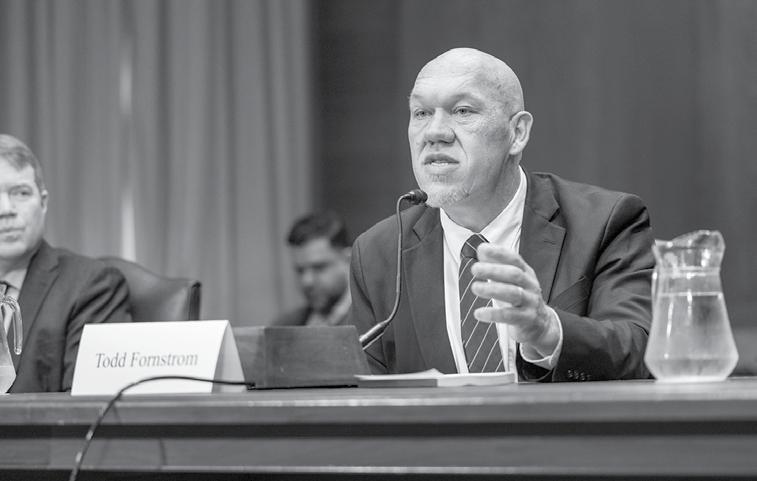
Wyoming Farm Bureau Federation (WyFB) President Todd Fornstrom testified on March 11 before the U.S. Senate Environment and Public Works Committee on the impacts diesel exhaust fluid (DEF)
requirements have on farmers and ranchers.
The hearing examined Senate Bill 3135, the Cold Weather Diesel Reliability Act, legislation aimed at addressing reliability issues facing
diesel-powered vehicles and equipment in freezing temperatures.
Fornstrom’s testimony Fornstrom, a fourth-generation farmer from Pine Bluffs, spoke on
Iowa-based seedstock operation produces strong bulls, fertile females
For Jason and Jessica “Jess” Schroeder, owners of 7 Oaks Angus in Durant, Iowa, strong sires and functional females pave the road to profit for customers across the nation.
The Schroeders have been making a name for themselves as seedstock producers since 2015, honing their genetic program over the years to offer some of the highest-quality Black Angus cattle in the country.
This year, 7 Oaks Angus bulls topped the charts across several categories at the 2026 Midland Bull Test (MBT) in Columbus, Mont. – the largest feed efficiency testing program in North America, which evaluates approximately 1,100 purebred bulls from over 200 consignors representing more than 32 states every year.
Please see 7 OAKS on page 23
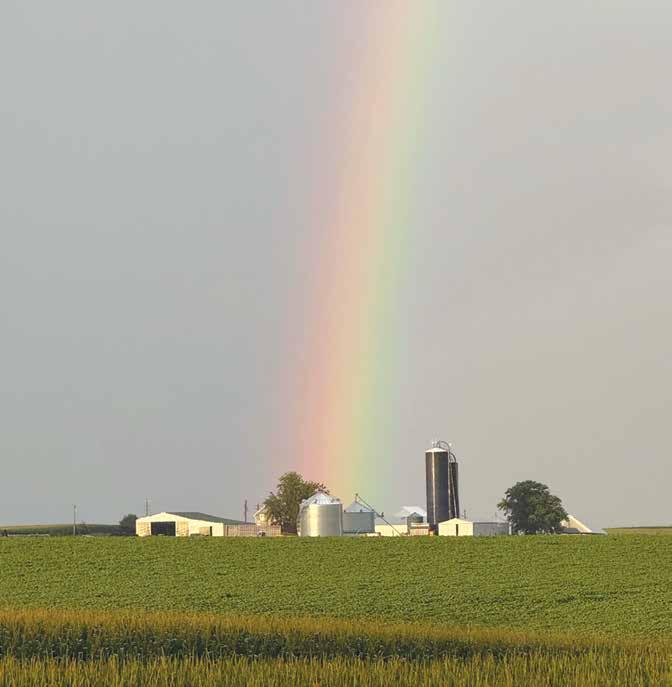
7 Oaks Angus – Jason and Jessica Schroeder have been developing quality Black Angus cattle through their seedstock operation, 7 Oaks Angus, since 2015. Pictured is the 7 Oaks Angus farm in Durant, Iowa. Courtesy photo

Fueled by a dangerous combination of dry grass, low humidity and powerful winds, historic wildfires burning across central and western Nebraska have scorched more than 800,000 acres and left widespread destruction in their wake.
The worst of the fires was ignited on March 12 and quickly burned through the Nebraska Sandhills and surrounding rangelands, claiming one life and creating immediate and long-term challenges for the area’s agricultural producers.
In fact, state officials have deemed the second weekend of March as the worst weekend of wildfires in Nebraska state history, surpassing the previous record for wildfire size and scope set in the extreme drought of 2021.
While firefighting efforts have made progress in recent days – aided briefly by calmer winds and cooler temperatures – conditions remain volatile. Red flag warnings signaling extreme fire danger are expected to persist, with forecasts calling for continued high winds, warm temperatures and low humidity.
Historic fires
Now dubbed the largest wildfire in state history, the Morrill Fire was ignited by an electrical fire sparked by high winds, which also led to the flame’s rapid spread –traveling approximately 70 miles in less than 12 hours.
As of March 18, the Morrill Fire had burned more than 643,074 acres across Morrill, Arthur and Garden counties with 67 percent containment.
The fire claimed the life of 86-year-old Arthur, Neb. resident Rose White who was trying to escape the blaze. The flames decimated the White family’s homestead,

National Ag Day highlights the industry’s critical role in America
National Ag Day is an annual, nationwide effort to acknowledge and celebrate the important role agriculture plays in everyday life and the U.S. economy.
This year’s celebration falls on March 24, right after National Ag Week, which runs from March 15-21.
The importance of ag
The observance of National Ag Day was established in 1973 by the Agriculture Council of America (ACA), a nonprofit composed of leaders across the agriculture, food and fiber industries who are dedicated to improving the public’s understanding of how agricultural products are produced and why the industry is essential.
According to ACA, National Ag Day encourages Americans to understand food and fiber production, recognize agriculture’s economic impact and appreciate the availability of safe,
On March 16, roughly 3,000 unionized workers at the JBS Swift Beef Company in Greeley, Colo. initiated a labor strike due to ongoing contract disputes.
Members of the United Food and Commercial Workers (UFCW) Local 7 Union say the decision comes after eight months of ongoing contract negotiations with JBS which have failed to resolve issues the union refers to as “unfair labor practices.”
Ongoing negotiations
On March 6, UFCW Local 7 representatives announced plans to cancel a contract extension between workers and JBS, citing a failure by the company to resolve “unfair labor practices and secure a contract which shows workers the dignity they deserve.”
“For months now, JBS has been insisting on poverty-level wages for workers at the plant, offering less than two percent in average annual wage increases – far below the level of inflation in Colorado – while at the same time putting all of the risk of rising healthcare costs on workers,” says UFCW Local 7 President Kim Cordova in the March 6 press release. “Meanwhile, despite being the world’s largest protein producer, JBS has been stealing from workers’ paychecks to fund the company’s profits. JBS can afford to do better.”
The contract extension cancellation quickly progressed into plans for initiating an Unfair Labor Practice (ULP) strike,

As consumers shop in grocery stores for vegetables, most select conventionally-grown products.
Sometimes, when I get to the last vegetable stand and see it is labeled organic, I stop and wonder if I’m cheating myself and my family by not buying organic products, but I see the higher cost, think to myself, “What the heck,” and head to checkout.
I read when it comes to choosing between organically-grown and conventionally-grown vegetables, the answer depends on what your priorities are.
Usually, organic vegetables are grown without synthetic pesticides, herbicides or genetically-modified organisms.
Both organic and conventional vegetables are grown under strict guidelines set by the U.S. Department of Agriculture (USDA), but there are even more guidelines organic vegetables have to meet.
In some cases, conventional farming inputs are used for organic farming because an organic substitute simply doesn’t exist. In these cases, a deviation may be approved by the USDA’s National Organic Standards Board, so the crop can still be labeled organic.
There are no existing scientific studies showing one method of farming is better than the other, as both have their pros and cons.
Some of the pros of organic farming include less fertilizers and pesticides, which means lower chemical runoff and, in many cases, higher soil biodiversity.
On the other hand, organic farming usually requires more land due to lower average yields per acre. Depending on the crop or location, it could be up to 25 percent more land, which would result in a larger carbon footprint than conventional crops for the same pounds of vegetables grown.
It would be even more for frozen vegetables transported across the country.
In ideal growing conditions, organic yields can be comparable to conventionally-grown fields, but these conditions don’t exist all of the time.
Currently, the U.S. and the rest of the world don’t have enough arable land to replace fields with organically-grown products if we wanted to switch over.
One of the reasons organic vegetables are more expensive in the grocery store is the field yield difference – organics require more land.
Conventional inputs also make it easier to get higher yields from substandard soils. This would keep overall costs down, which would make vegetables cheaper to produce and hopefully cheaper to buy.
On the important issue of nutrition, studies have shown organic and conventional vegetables are broadly similar in terms of vitamins and minerals, although studies show organics may have slightly higher antioxidant levels.
Most importantly, it comes down to personal preference about which fruits and vegetables to buy.
We all need to eat more fruit and vegetables, just be sure to wash them really well.
We’re privileged to live in the U.S. where our food prices are the lowest in the world. World travelers are amazed at our grocery stores.
It’s the same as buying a Ford or Chevy, grain-fed or grassfed beef and drinking water from a plastic or reusable water bottle – it’s up to you.

Livestock
Wyoming Livestock Roundup (USPS # 005-774) is published weekly by Maverick Press, Inc. P.O. Box 850 • Casper, WY 82602 Periodicals postage paid in Casper, WY Fax: 307-472-1781 • E-mail: roundup@wylr.net
www.wylr.net
DENNIS SUN, Publisher • Cell: 307-262-6132
HANNAH BUGAS, Managing Editor • hannah@wylr.net GRACE SKAVDAHL, Editor • grace@wylr.net
CANDICE PEDERSON, Production Coordinator • candice@wylr.net
JODY MICHELENA, Advertising Director • jodym@wylr.net
DENISE OLSON, Classified Sales Manager • 307-685-8213 • denise@wylr.net
ANDREA ZINK, General Manager • andrea@wylr.net
CURT COX, Director of Livestock Field Services • 307-630-4604 • curt@wylr.net
CALLI WILLIAMS, Livestock Field Services Rep. • 605-695-1990 • calli@wylr.net
Roundup • P.O. Box 850 • Casper, WY 82602
National Agriculture Week is celebrated every year in March on dates announced by the Agriculture Council of America.
This year, the celebration runs from March 15-21 and is a nationwide effort to tell the true story of American agriculture and remind America’s citizens agriculture is a part of all of us.
The patron saint of rural communities and farmers
Honoring and praying for farmers at daily Mass, especially during the first week of spring, has been a blessed tradition. It is an appropriate time to look back at history.
The life story of St. Isidore is an inspiration to everyone.
St. Isidore and his wife Maria de la Cabeza lived in Madrid, Spain around 1110. He came from a poor and humble family, and from childhood, he worked as a farm hand on the estate of wealthy landowner John de Vargas.
St. Isidore’s most distinguishing trait in life was praying and attending daily Mass. He loved the Earth, was
By Klodette Stroh
honest in his farming practices and domestic animals and birds showed their attachment to his kindness.
However, Isidore’s coworkers and Master de Vargas became disturbed about the amount of time he was taking from his work, so de Vargas decided to see for himself if reports which had come to him were as bad as they sounded.
One morning he hid himself in the field where St. Isidore was supposed to be plowing. On this day, St. Isidore returned even later than usual from his morning worshipping. The other workers had already finished their jobs and had left the field, while St. Isidore’s job was still untouched.
Master de Vargas was just about to approach St. Isidore, but something told him to wait and see what would happen. St. Isidore set to work and seemed to be making great progress, and as the employer watched, he saw the reason – two angels were working side-by-side with St. Isidore, each guiding a plow and racing in holy
rivalry to see who could get the most work done.
After this, whenever anyone asked de Vargas about St. Isidore’s work, he would simply answer, “Angels are his helpers.”
By Sacred Congressional of Rites on Feb. 22, 1947, St. Isidore was designated as the patron saint of rural communities and American farmers, and each year during National Agriculture Week, daily Mass is celebrated for American farmers.
America’s agriculture industry
Our country celebrated its first National Agriculture Day on March 21, 1973.
The history of agriculture goes back to the birth of America.
George Washington, the father of our nation, suggested congressing the establishment of a National Board of Agriculture in 1766, as agriculture was the stepping stone in which our young nation needed to start.
In 1800, the average annual value of

On March 17, the U.S. Department of Interior (DOI) announced $889 million in investments for critical water infrastructure projects across the West made possible by President Donald Trump’s One Big Beautiful Bill Act (OBBBA).
The funding will support Bureau of Reclamation (BuRec) projects in California, Idaho, North Dakota, South Dakota, Utah and Wyoming which improve water conveyance, expand storage and modernize the infrastructure which supports American communities and agriculture.
Signed into law on July 4, 2025, the OBBBA provides $1 billion to BuRec through 2034 to restore and expand existing water conveyance systems and increase surface water storage capacity across the West.
“Under Trump’s leadership, the OBBBA is delivering major new investments in western water infrastructure,” said Secretary of the Interior Doug Burgum. “These investments strengthen our nation’s water security, modernize aging infrastructure and support the farmers, communities and industries that depend on reliable water supplies. By helping ensure strong agricultural production and efficient water delivery, this investment also supports more stable and affordable food prices for American families.”
Wyoming will receive $100 million for long term-repairs to the Fort Laramie-Goshen irrigation tunnels in the southeastern part of the state to reduce the risk of future system failures.
On March 17, U.S. Sens. John Barrasso and Cynthia Lummis and U.S. Rep. Harriet Hageman (all R-WY) issued statements applauding the announcement.
“After years of fighting to deliver a solution to this problem, we are proud to announce the Goshen Irrigation District is receiving the help it urgently needs to repair and restore its aging irrigation tunnel,” said Barrasso.
Additionally, California projects will receive $540 million to support improvements throughout the state’s Central Valley; North Dakota will receive $100 million for the Eastern North Dakota Alternate Water Supply Project and $8 million for the Garrison Diversion Unit; Idaho will receive $30 million for the Lewiston Orchards Irrigation District; South Dakota will receive $11 million for the Belle Fourche Siphon lining project and Utah will receive $100 million to replace to 110-year-old Highline Canal near Duchesne, Utah.
According to a March 13 article in The Fence Post, Colorado House Bill 26-1067, Diseased Livestock Indemnity Fund, has passed its third reading in the Senate.
Sponsored by State Reps. Karen McCormick and Ty Winter and State Sens. Byron Pelton and Dylan Roberts, the bill seeks to expand allowable uses of money in the livestock indemnity fund to address livestock health threats and rename the fund the “Livestock Health Preparedness, Response and Diseased Livestock Indemnity Fund.”
A bill summary on the Colorado General Assembly website explains, currently, money in the Diseased Livestock Indemnity Fund may be used only to pay indemnity to a livestock owner whose herd has been sold for slaughter or destroyed because the herd was exposed to or diagnosed with an infectious or contagious disease.
The updated bill expands the permissible uses of the money in the Diseased Livestock Indemnity Fund by allowing the commissioner of agriculture to authorize using the money to prepare for and respond to certain emerging threats to livestock health.
The updated legislation would expand allowable uses to include infectious or contagious diseases which pose a threat to livestock, as well as biological or chemical contaminants of animals which pose a threat to livestock, according to The Fence Post article.
Colorado State Veterinarian Dr. Maggie Baldwin testified in favor of the changes before the Senate Agriculture and Natural Resources Committee.
“In order to ensure we’re adequately prepared and able to respond to the threats which could impact our food security, we need to have adequate resources including funding to build and maintain resilience against new and ongoing livestock health crises,” Baldwin said. “Given the current state budget constraints, we feel this is a fiscally responsible way to meet our ongoing needs.”
The Bureau of Land Management (BLM) is urging residents and recreationists to exercise increased caution as elevated fire conditions develop across Wyoming, including in the High Desert District, Wind River/Bighorn Basin District and High Plains District.
Despite cooler overnight temperatures, vegetation across much of these districts remains dormant, with live fuel moisture at seasonal lows.
Areas without snow cover are particularly susceptible to ignition and rapid fire spread. A combination of strong winds, above-average temperatures and low relative humidity are all conditions which can contribute to fast-moving wildfires.
“Even though it may not feel like peak fire season yet, current conditions create a real potential for wildfires to start and spread quickly,” said Mark Randall, fire management officer for the High Desert District. “A single spark in the wrong place can have significant impacts.”
BLM reminds the public to be aware of current fire restrictions and elevated fire conditions, with fire restriction information available at blm.gov/programs/fire/regionalinfo/wyoming/fire-restrictions
Additionally, the public is encouraged to remain vigilant and report any wildfires immediately to local authorities.







On March 6, Wyoming State Engineer Brandon Gebhart announced, in accordance with Wyoming water law, priority administration will continue on water rights diverting from the North Platte River and its tributaries upstream of and junior to Pathfinder Reservoir, priority of Dec. 6, 1904 and between Pathfinder Dam and Guernsey Reservoir, junior to a priority date of April 20, 1923, until such time as the administration is lifted, but no later than May 1.
The North Platte River system continues to experience below-average winter snowpack and streamflow conditions this winter and multiple years of drought resulting in low reservoir storage carryover.
Gebhart indicated the combination of below-average snowpack conditions and low carryover storage in the U.S. Bureau of Reclamation reservoir system requires the administration of water rights junior to Pathfinder and Guernsey reservoirs. Based on the existing water supply, snowpack and forecasted runoff, water supplies are anticipated to be below average in 2026.
The priority administration actions for the affected water users will be carried out pursuant to state law by water commissioners assigned to various portions of the North Platte River Basin.
Wyoming State Engineer’s Office personnel will be in direct contact with the affected water appropriators and will also be available to assist water users with their questions. Follow up correspondence with affected users will happen as rapidly as possible.
The State Engineer’s Office will continue to closely monitor the water supply conditions and make adjustments to the administration actions warranted to reflect the changing situation.
For more information, contact Gebhart at 307-777-6150, Division One Superintendent Josh DeBerard at 307-532-2248 or josh.deberard1@wyo.gov or North Platte River Coordinator Michelle Hubbard at 307-777-7641 or michelle.hubbard @wyo.gov.
A Missouri man wanted for his connection to an alleged $220 million cattle fraud scheme has been taken into federal custody, according to a March 11 Western Ag Network article.
Joshua Robert Link, former executive director of Agridime LLC, was apprehended by federal and local agents at the Los Angeles International Airport in Los Angeles on March 11.
On Feb. 11, a federal grand jury based in Fort Worth, Texas indicted Joshua and his wife Tia Link –along with Jed Wood, Taylor Bang and Royana Thomas – for their roles in an alleged fraud scheme carried out through Agridime LLC, an online beef and cattle market company accused of operating a Ponzi scheme to defraud customers across the nation.
Tia served as the marketing director, Wood served as the operations director, Bang served as a cattle broker and Thomas served as the financial controller.
Wood has been charged with three counts of wire fraud, one count of conspiracy to commit wire fraud and one count of money laundering.
Tia was charged with three counts of wire fraud, one count of conspiracy to commit wire fraud and one count of money laundering.
Bang was charged with eight counts of wire fraud, one count of conspiracy to commit wire fraud and one count of money laundering.
Thomas faces six counts of wire fraud, one count of conspiracy to commit wire fraud and one count of money laundering.
If convicted, the defendants face up to 20 years in federal prison on each wire fraud count, 20 years of imprisonment for wire fraud conspiracy and up to 10 years in prison for each money laundering count.

Applications for the 2026 Wyoming Centennial Farm and Ranch Program are now open and interested families are encouraged to apply.
The Wyoming Centennial Farm and Ranch Program honors families who have owned and operated the same farm or ranch for 100 years or more.
Every two years, the Wyoming State Historic Preservation Office and its program partners host a celebration to honor these families.
A yearbook featuring the histories and photos of the honored Centennial families is published following each celebration, and more than 300 families have been honored through the program since it was reestablished in 2006.
“The history of Wyoming’s farms and ranches is the history of Wyoming. Its people and Centennial families have played a key role in preserving Wyoming’s heritage,” writes the Wyoming State Historic Preservation Office in a press release. “A Centennial farm or ranch embodies the story of a landscape uniquely tied to a family’s history. These farms and ranches are not just a part of history –they remain vital today and hopefully well into the future.”
The deadline to apply is July 1. For more information or to fill out the application, visit wyoshpo.wyo.gov/ and follow the Centennial Farm and Ranch Program link.
Interested applicants may also contact Casey Woster at 307-777-7530 or cassandra.woster@wyo.gov or Renee Bovee at 307-777-6312 or renee.bovee@wyo.gov for more information.
On March 17, the Wyoming State Fair (WSF) issued a press release outlining an expanded master plan and detailing the next phase of planning and development for the fairgrounds.
WSF officials say the plan sets a clear path forward, honoring more than a century of tradition while positioning WSF for continued growth, innovation and community impact.
The newly released expanded master plan represents the eighth master plan in WSF’s 120-year history and builds on progress made since 2020.
To develop the plan, the WSF Master Planning Team completed a comprehensive inventory of the fairgrounds, identified priority projects and conducted facility assessment evaluations following meetings with a wide range of community and statewide stakeholders.
Using these findings, the team began drafting recommendations with careful consideration of operational needs, infrastructure conditions and long-term sustainability to ensure proposed improvements are both practical and aligned with WSF’s mission.
The team behind the updated master plan includes the WSF Board, WSF General Manager Courtny Hinds, WSF Operations Supervisor AJ Deines, State of Wyoming Construction Department Project Manager Ryan Scranton, Jared Hoffman of Plan One Architects and Chip Overton of K/O Fairground Planners, along with additional stakeholders and supporting partners.
“Our traditions are timeless, but the infrastructure that supports them must evolve,” says Hinds. “This master plan ensures we are investing in fairgrounds which honor our heritage while creating the capacity, safety and functionality needed for the future.”
To view the WSF Master Plan in its entirety, visit wystatefair.com
According to a March 16 Farm Progress article, Ritchie Bros. Auctioneers’ parent company RB Global will acquire the Nebraska-based agricultural auction company BigIron Auctions later this year.
The agreement will allow RB Global to expand its U.S. agricultural equipment marketplace, adding BigIron’s $885 million in annual gross transaction value to RB Global’s portfolio.
“BigIron brings a talented team with deep ag sector knowledge and an established sales footprint which will continue operating as a stand-alone brand while being complemented by the Ritchie Bros. industrial footprint,” says RB Global Chief Executive Officer Jim Kessler. “This will create opportunities to serve even more customers through a combination of onsite, offsite and digital channels and solutions.”
“RB Global values our culture and shares our respect for the agricultural community,” adds Mark Stock, cofounder of BigIron. “Through this combination, we gain a larger platform and additional resources, which is expected to help us deliver even greater choice and liquidity to all the sellers we serve.”
The transaction is expected to be completed in the second half of 2026, subject to customary closing conditions and regulatory approvals.
Until closing, RB Global and BigIron will continue to operate as independent companies in the ordinary course. For more information, visit rbglobal.com
behalf of nearly 12,000 WyFB members and more than five million members of the American Farm Bureau Federation.
“Clean air and water are essential to successful farms and ranches,” Fornstrom said. “Agriculture depends on natural systems, and the quality of the air and water surrounding a farm strongly influences crop growth, soil health, livestock well-being and overall productivity.”
Fornstrom explained, while DEF systems were introduced to reduce emissions from diesel engines, they have created operational challenges for agriculture.
Equipment used on farms often operates in extreme conditions, including freezing temperatures, dust and vibration, which can affect the reliability of DEF tanks, pumps and sensors.
“Living and farming in
Wyoming, dealing with DEF in the winter can feel like a battle against both the cold and the clock,” Fornstrom said. “If DEF freezes or the system triggers an engine derate, it can bring a tractor or combine to a halt right in the middle of critical planting or feeding windows.”
The Cold Weather Diesel Reliability Act would allow manufacturers to suspend automatic engine derates or shutdowns when temperatures fall below freezing and would require the Environmental Protection Agency to provide exemptions for equipment operating primarily in cold regions.
Fornstrom thanked Sens. Dan Sullivan (R-AK) and Cynthia Lummis (R-WY) for introducing the legislation to address the challenges DEF systems pose in cold

agriculture exports was $23 million, which accounted for 75 percent of total experts
According to data from the Bureau of Economic Analysis, agriculture, food and related industries contributed roughly $1.537 trillion to U.S. gross domestic product.
Agriculture is a renewable resource to feed U.S. citizens and assure security.
According to the American Farm Bureau Federation, net farm income has dropped significantly from 2022 highs, with corn and soybean farmers seeing income fall by 45 percent. Total farm debt is reaching record levels, often exceeding $560 billion, threatening the viability of many family farms.
Please keep in mind, less than 1.5 percent of America’s population is farmers.
Foreign governments support their farmers by heavily subsidizing their cost of production. They influence domestic price supports and handouts for inputs such as fertilizer, seed and equipment.
A good example of economic benefit of agriculture in America is that U.S sugar farmers have not received government payments since the expiration of the U.S. Sugar Act of 1974.
The cost of production is the farmer’s responsibility and risk, which keeps going up. Cost of seed, fertilizer, chemicals and the high price of fuel, plus capital investment in equipment and upkeep of it is back breaking.
Please keep American farmers in your prayers. In the past few years, low commodity prices have been jeopardizing many of our farmers’ livelihood.
I salute our beans, corn, barley, soybean, wheat, sugar, cotton, peanut and livestock ranchers. They represent love of family and love of our country. Farmers are in partnership with God, and their perseverance is admirable.
My mother use to tell me, “By perseverance, the snail reached the Ark.”
Klodette Stroh is the sugar chairman for Women Involved in Farm Economics. She can be reached at strohfarms@tritel.net.
climates and urged Congress to address the broader challenges DEF systems pose for farmers and ranchers.
“The agricultural community believes Congress should go further and carefully weigh the environmental benefits of DEF systems against their reliability issues and economic costs,” Fornstrom concluded. “Farmers and ranchers are calling for the elimination of DEF requirements on agricultural equipment so producers can focus on productivity, efficiency and feeding our country.”
WyFB is a grassroots organization dedicated to preserving individual freedom and supporting agriculture in Wyoming. For

Greg & Janette Starck 140 Blk/Bwf/Hereford few Rwf Strs & Hfrs, 600-750#, Weaned 120 days, Bunk Broke, Been on a Ground Hay and Corn Silage Ration, Branding Shots: Vision 7 w/Spur, Pyramid 5+Presponse, Weaning Shots: Vision 7 w/Spur, Pyramid 5+Presponse, No Implants, Steers are Knife Cut, Heifers are Bangs Vac. & Guaranteed Open, Home Raised, April/May Calves
Steve Remund 56 100% Blk Angus Sired Strs, 750-875#, Weaned a long time, Fed a TMR Feed Ration, Spring Shots: Bovi-Shield Gold 5, Endovac, Ultra Choice 8, Fall Shots: Vista Once, Vision 8 Somnus, Ivomec Plus, Permectin II Pour On, Summered at 8000’, Nice set of Steers
Darcy Garhart 30 Blk Strs & Hfrs, 750-800#, Weaned since October, Running out on grass, Bunk Borke, Branding Shots, Booster Shots in February & Poured, No Implants or Antibiotics, April/May Calves, Home Raised, Gentle, Heifers are Replacement Quality
WEANED CALVES
TTT Ranch 355 Mx Strs, 475-650#, Weaned a long time, Running Out, Grass/Alfalfa/Barley Hay Mix, Agfinity Western Dry Grass, Balancer High
Protein Lick Tubs, Branding Shots: Vista Once SQ, Vision 7 w/Somnus, Weaning Shots: Vista Once SQ, Vision 7 w/Somnus, Nasalgen 3 PMH, Cydectin, Knife Cut, May/June Calves, Ultra Green and Ready to go back to grass
****186 Mx Hfrs, 450-600#, Weaned a long time, Running Out, Grass/Alfalfa/Barley Hay Mix, Agfinity Western Dry Grass, Balancer High Protein Lick Tubs, Branding Shots: Vista Once SQ, Vision 7 w/Somnus, Weaning Shots: Vista Once SQ, Vision 7 w/Somnus, Nasalgen 3 PMH, Cydectin, May/June Calves, Ultra Green and Ready to go back to grass
****14 Mx Bull Calves, 450-575#, Weaned a long time, Running Out, Grass/Alfalfa/Barley Hay Mix, Agfinity Western Dry Grass, Balancer High Protein Lick Tubs, Branding Shots: Vista Once SQ, Vision 7 w/Somnus, Weaning Shots: Vista Once SQ, Vision 7 w/Somnus, Nasalgen 3 PMH, Cydectin, May/June Calves, Ultra Green and Ready to go back to grass
Nine Iron Ranch 250 Blk Strs & Hfrs, 550-600#, Weaned a long time, Been on a Hay/Silage & Beet Pulp Grower Ration, Complete Vac. Program, Electric fence broke Albertson Cattle Co. 160 Blk/Bwf Strs, 575-800#, Weaned last fall, Bunk Broke, Been on a Grower Ration, Complete Vac. Program, High Elevation ( Mountains of Colorado), Home Raised
Paul & Nancy Landeck 160 Mostly Hereford few Blk Strs & Hfrs, 450-725# (mostly 550-650#), Weaned the last of October, Hay Fed, Cake Broke, Complete Vac. Program, Home Raised, Long time Customer of Torrington Livestock Markets
Howard B Lee Family 116 Blk Strs & Hfrs, 450-550#, Weaned since September, Bunk Broke, Been on a Light Grower Ration, Free Choice Lick Tubs, Branding Shots: 7-way, Pyramid 5+Presponse SQ, Poured w/Ivermectin, Steers are Knife Cut, 1-iron (13 hd is not branded) Pondersosa Ranch 72 Hereford Strs 7 Hfrs, 475-525#, Weaned a long time, Been on a High Roughage Grower Ration, Complete Vac. Program, Wintered for Grass James Jankowsky 65 Mx Strs & Hfrs, 600-650#, Weaned since November, Bunk Broke, Been on Hay and Corn, Branding Shots: Ultrabac 7, Vira Shield 6 Stoltz Cattle Company 48 Blk/Bwf/Rd/Rwf Strs & Hfrs, 500-510#, Weaned 150 days, Been on a Light Grower Ration of Silage, Beet Pulp, & Hay, Branding Shots: Bovi-Shield



products.
The national event also aims to build awareness of industry-related career opportunities for younger generations to keep American agriculture sustainable for generations to come.
“Agriculture provides almost everything we eat, use and wear on a daily basis, but too few people truly understand this contribution,” states the ACA website. “This is particularly the case in our schools, where students may only be exposed to agriculture if they enroll in related vocational training. By building awareness, the ACA is encouraging young people to consider career opportunities in agriculture.”
The website continues, “Each American farmer feeds more than
165 people – a dramatic increase from 25 people in the 1960s. Quite simply, American agriculture is doing more and doing it better. As the world population soars, there is an even greater demand for the food and fiber produced in the U.S.” National Ag Day festivities
With the theme “Together We Grow,” the 2026 celebration aims to highlight the broad network behind America’s ag production and will include a multitude of local and national events held both online and in person.
To kick off the celebration, ag enthusiasts and industry officials will gather on the U.S. Department of Agriculture’s (USDA) Whitten Patio in Washington, D.C. for Ag Day at USDA, featuring
guest speakers U.S. Secretary of Agriculture Brooke Rollins, American Farm Bureau Federation (AFBF) President Zippy Duvall and Small Business Administration Administrator Kelly Loeffler.
The event will also include discussions held by a student panel and a commodity group, as well as a video presentation of the national essay contest award winners.
Festivities will continue with the Farm Journal Foundation National Ag Day Celebration – including a planting ceremony, brief remarks from USDA officials and lunch – from 12 to 2:30 p.m. and the Taste of Ag Reception in the Kennedy Caucus Room from 5:30 to 8 p.m.
All events will be livestreamed free of charge through the Ag Day Virtual Event.
Additionally, prior to National Ag Day,
+1.1, WW: +81, YW: +131 and Milk: +29 Buyer: Silver Bit Angus Ranch, May, Idaho
Lot 43 – LCC Badlands 535 – Price: $26,000 DOB: 1/24/25 Sire: Ellingson Badlands Dam’s Sire: Sitz Resilient 10208 EPDs: BW: -1.9, WW: +68, YW: +128 and Milk: +22 Buyer: Darren Carraway, Meridian, Idaho
Lot 4 – LCC Republic
Top Sellers
Lot 25 – LCC Jameson
N47 – Price: $27,000 DOB:
1/19/25 Sire: Basin Jameson 1076 Dam’s Sire: Leadore Upward Z23 EPDs: BW:
51 – Price: $24,000 DOB: 1/11/25 Sire: Raven Republic I564 Dam’s Sire: Square B North Star 8052 EPDs:
For more information on National Ag Day, to view helpful resources for hosting an event or to tune into the Ag Day Virtual Event on March 24, visit agday.org.
AgriPulse will host its annual Ag and Food Policy Summit on March 23 at the National Press Club in Washington, D.C.
The day-long event will include discussion on a wide variety of market expansion topics, with an impressive lineup of speakers including U.S. Environmental Protection Agency Administrator Lee Zeldin, Office of the U.S. Trade Representative Ambassador Dr. Julie Callahan and Senate Ag Committee Chairman John Boozman (R-AR).
Other speakers in attendance will include representatives from AFBF, the National Council of Farmer Cooperatives, National Rural Electric Cooperative Association, National Milk
BW: -0.8, WW: +87, YW: +159 and Milk: +30 Buyer: Pat Hendren, Mud Lake, Idaho
Lot 17 – LCC Eternity 5124 – Price: $20,000 DOB: 2/10/25 Sire: Sitz Eternity 739L Dam’s Sire: Tex Playbook 5437 EPDs: BW: +1.7, WW: +79, YW: +141 and Milk: +43 Buyer: Kyla Karoleski, Grant, Mont.
Lot 18 – LCC Eternity 5102 – Price: $20,000 DOB: 2/6/25 Sire: Sitz Eternity 739L Dam’s Sire: Sitz Logo 12964 EPDs: BW:
Producers Foundation, National Oilseed Processors Association, National Corn Growers Association, National Sorghum Producers, American Egg Board, Cargill North America, U.S. Meat Export Federation, CoBank and Elanco, among many others.
Public participation
Whether attending a national event in Washington, D.C. or simply observing from home, ACA encourages all Americans to take some time during the week to celebrate ag.
Suggested daily activities include everything from preparing farm-totable meals or contacting legislators about farm policy to sharing agricultural experiences on social media or volunteering in
-0.3, WW: +80, YW: +130 and Milk: +29 Buyer: Justin Baker, East Port, Idaho
Lot 26 – LCC Jameson
N45 – Price: $20,000 DOB: 1/18/25 Sire: Basin Jameson
1076 Dam’s Sire: Leadore Upward Z23 EPDs: BW: +0.3, WW: +100, YW: +165 and Milk: +36 Buyer: Kyla Karoleski, Grant, Mont.
Lot 27 – LCC Jameson N29 – Price: $20,000 DOB: 1/14/25 Sire: Basin Jameson 1076 Dam’s Sire: GDAR Load Up 046 EPDs: BW: +0.3, WW: +83, YW: +143 and Milk: +27 Buyer: Jud Whitworth, May, Idaho
Lot 45 – LCC Badlands
543 – Price: $20,000 DOB: 1/26/25 Sire: Ellingson
classrooms to teach students about agriculture. Other recommended events include farm tours, classroom visits, agricultural fairs, petting zoos and commodity-based cookoffs. Some communities may even host National Ag Day breakfasts, farmers markets or public exhibitions to highlight locally produced goods and agricultural practices.
To help with these festivities, the ACA website offers planning guides and resources for individuals and organizations interested in hosting events. Hannah Bugas is the managing editor of the Wyoming Livestock Roundup. Send comments on this article to roundup@ wylr.net.
Badlands 0285 Dam’s Sire: Sitz Accomplishment 720F EPDs: BW: +2, WW: +85, YW: +152 and Milk: +20 Buyer: Jay Murnian, Miles City, Mont.
Lot 46 – LCC Essential 529 – Price: $20,000 DOB: 1/24/25 Sire: A A R Essential Dam’s Sire: Sitz Stellar 726D EPDs: BW: +0.5, WW: +71, YW: +122 and Milk: +28 Buyer: Wayne Baker, East Port, Idaho
Lot 63 – LCC Architect 5118 – Price: $20,000 DOB: 2/10/25 Sire: S Architect 9501 Dam’s Sire: Riverbend Fortress F024 EPDs: BW: +0.9, WW: +87, YW: +157 and Milk: +28 Buyer: Ed Snook, Salmon, Idaho
Reported By: Kade Kinghorn, WYLR Field Editor March 14, 2026 Buffalo Livestock Marketing, Buffalo Auctioneer: Curt Westland


Lot 5 – MTR Institution 1455 – Price: $12,500 DOB: 2/19/25 Sire: Kenny Institution 2010 Dam’s Sire: S A V Remmington 5609 EPDs: BW: -3.4, WW: +63, YW: +111 and Milk: +30 Buyer: Merlin Ranches, Buffalo Lot 1 – MTR True Grit 1625 – Price: $11,000 DOB: 2/20/25 Sire: Basin True Grit 1021 Dam’s Sire: S A V Remington 5609 EPDs: BW: +0.3, WW: +68, YW: +120 and Milk: +30 Buyer: Rule Livestock, Buffalo
Lot 10 – MTR Institution 1875 – Price: $10,000 DOB:
2/28/25 Sire: Kenny Institution 2010 Dam’s Sire: MTR Titlest 619 EPDs: BW: -3.7, WW: +60, YW: +103 and Milk: +29 Buyer: Tom Gorzalka, Clearmont
Lot 26 – MTR True Grit 497N – Price: $10,000 DOB: 2/2/25 Sire: Basin True Grit 1021 Dam’s Sire: Tehama Patriarch F028 EPDs: BW: -2, WW: +93, YW: +155 and Milk: +34 Buyer: Belus Brothers, Buffalo MTR




Foreign material and toxin consumption by beef cattle can lead to significant health problems, reduced performance and economic losses.
Cattle producers take great pride and care in how they manage their farms and ranches, from providing proper nutrition to stewarding their land and ensuring excellent animal care.
Yet, even with the best intentions, foreign materials and toxins can quietly find their way into feed, water or pastures.
Understanding where they come from and how to prevent exposure is a key part of protecting the herd.
Foreign materials and toxins often slip in through everyday farm activities such as repairing fences, running equipment, feeding hay or dealing with weather-stressed crops.
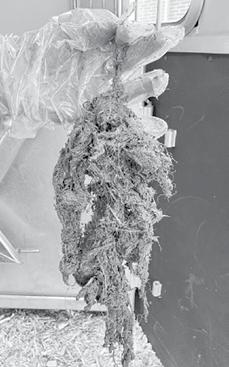
A small piece of wire, leftover net wrap or contaminated feed sources might not seem like much, but if consumed by cattle, they can trigger health issues, lost performance or even death.
Understanding hardware disease
When cattle consume sharp metal objects like
Breeding soundness examinations (BSE) of bulls reduce the risk of poor breedup of cow herds.
One component of a thorough bull evaluation is measurement of scrotal circumference, which is done by pushing the testicles firmly to the bottom of the scrotum and placing a flexible measuring tape snugly around the widest point.
Scrotal circumference
A bull’s scrotal circumference provides a good indication of total testicular weight and the amount of sperm-producing tissue. This measurement is particularly informative when assessing bulls one to two years of age but also has value when testing mature bulls.
Testicle growth is very rapid from the time of weaning until when bulls are relatively sexually mature at about 15 months of age. After this, testicles continue to slowly grow so 90 percent of final testis size is achieved by the time bulls are two years old.
Scrotal circumference of bulls around yearling age is a better predictor of the onset of puberty than age or weight, and greater yearling testicular size also predicts earlier puberty of both his bull and heifer offspring.
The most common reason a yearling bull fails to pass a semen evaluation is immaturity and low levels of testosterone. One study found 20 percent of 11-month-old bulls, 51 percent of 13-month-old bulls and 61 percent of 15-month-
nails or pieces of wire, the items can settle in the reticulum and irritate or puncture the stomach lining.
In the worst cases, these foreign objects can migrate and damage the heart, causing severe illness or death. This condition is known as hardware disease – or bovine traumatic reticuloperitonitis –and it can be both dangerous and costly.
Signs of hardware disease include depression or dullness, general discomfort like teeth grinding or grunting, an arched back, going off of feed, brisket swelling or loss of body condition.
Common sources of metal pieces include cables on fences or feed bunks, fragments from feed processing equipment and scrap materials left on the ground.
Prevention goes a long way, and there are several preventative practices which can be implemented, including using magnets or scalpers to remove possible debris from feed, covering metal cables with plastic sleeves, avoiding materials which deteriorate over time, practicing regular equipment and facility maintenance and keeping yards and
feeding areas clean.
Twine and net wrap
Twine and net wrap are among the most common foreign materials consumed by cattle and are some of the easiest problems to avoid.
These materials are indigestible and can build up in the rumen leading to blockages and digestive tract injury.
Signs of twine or net wrap consumption include weight loss, abdominal pain, poor coat condition, lethargy, diarrhea, bloating and/or straining to defecate.
Prevention is key. Once consumed, there is no easy fix.
Taking a few extra minutes to remove and properly dispose of twine and net wrap before feeding, perform regular maintenance of equipment and facilities and inspect feeding areas for foreign materials can save a lot of trouble down the road.
Toxins put cattle at risk
Toxins can be difficult to spot, but their impact can be serious. Exposure can lead to reduced feed intake and poor performance or, in some cases, sudden illness or death.
Some of the most com-
mon toxins beef cattle may be exposed to include mycotoxins from contaminated or moldy feed; botulism from decaying carcasses, spoiled silage or poorly preserved hay; nitrates from weatherstressed plants or excess nitrogen fertilization and prussic acid from plants such as sorghum, Sudangrass, Johnson grass, chokecherry and treated canola seed. Risk increases during drought or frost stress.
Other common toxins include those in plants such as hemlock, poison hemlock, death camus, lupine, red maple, oak, locoweed, monkshood, tansy, ragwort, common tansy, henbane, stinkweed and tall larkspur, as well as lead from improperly disposed batteries, contaminated water sources, lead pipes or lead based paints.
Preventing exposure to toxins
Preventing toxin exposure involves awareness, monitoring and good management practices.
Individuals should test feed and water sources suspected of contamination or considered high risk such as grain screenings and distillers’ grains.
Watch the weather.
Moisture levels during growth and harvest affect mycotoxin risk. For example, cool, moist conditions during flowering favor ergot growth, while warm, moist conditions favor fusarium development.
Properly store feed. Keep feed dry and well ventilated to prevent mold growth and spoilage.
Vaccination programs can also help protect against certain toxins, such as botulism or clostridial diseases.
Work with a nutritionist and veterinarian to design balanced diets and monitor toxin exposure. If exposure is suspected, contact a local veterinarian to confirm and document the toxin exposure.
Rotate pastures, avoid overgrazing and inspect fields regularly, especially after frost or drought, to minimize exposure to toxic plants and moldy feed.
Routinely check pastures for lead sources such as discarded batteries.
Stay informed through Extension programs, industry groups, agronomists and other farm advisors. Consider implementing a preventive control plan to identify hazards and reduce risks.
A few proactive steps
can prevent cattle from accessing foreign materials and toxins, which is essential for maintaining herd health, protecting performance and avoiding preventable losses. Taking the time to walk pastures and feeding areas and regularly inspecting cattle, facilities, feed and water sources can help catch problems early.
BCRC is funded by a portion of the Canadian Beef Cattle Check-Off and strives for excellence in the production of Canadian beef and forage through research, innovation and Extension. For more information, visit beefresearch.ca
old bulls had a passing level of normal sperm.
This rapid increase in the percentage of normal sperm in the months around one year of age is supported by improved sperm motility over the same time frame.
Heritability and nutrition
The heritability of scrotal circumference is moderate to high, but in addition to the contribution of genetics, nutrition of young bulls can also influence scrotal circumference, age at puberty and testicular development.
The earliest phase of nutrition is the preweaning diet composed of a bull calf’s dam’s milk and then milk plus forage.
This preweaning period is very important as early nutritional restrictions can cause permanent reduction in tes-
ticular development which can delay puberty despite adequate postweaning nutrition.
After weaning, feeding high-energy diets is associated with larger yearling scro tal circumference and earlier puberty compared to lower energy diets. Although, some of the larger scrotal circumfer ence may be due to scrotal fat.
High-energy rations con tinued past 12 months of age may result in excessive scro tal fat which interferes with the ability of the testicles to stay cool. This leads to lower sperm production and more sperm defects.
High-energy diets that don’t result in excessive scro tal fat do not appear to nega tively affect fertility.
While yearling bulls receive the greatest focus, guidelines from the Society

for Theriogenology – a veterinary organization for reproduction – require the scrotal circumference of bulls older than two years of age be greater than 34 centime
diagnosed pregnant and to take longer to become pregnant after calving. Bull fertility is a critical driver of herd fertility, and the measurement of scrotal
Dr. Bob Larson is a professor of production medicine and executive director of Veterinary Medicine Continuing Education at Kansas State University in Manhat

where Rose was born, raised and spent her entire life.
To the east, the Cottonwood Fire consumed 128,036 acres south of Interstate 80 with 78 percent containment as of March 18. According to InciWeb, the cause of this fire is still under investigation.
South of the communities of Halsey, Neb. and Dunning, Neb., the Road 203 Fire scorched 35,916 acres and initiated a closure order for the Nebraska National Forest. InciWeb notes the area’s steep, remote terrain and heavy dead and down timber have made it challenging for crews to get in and out of the incident, but as of March 18, the fire was 76 percent contained.
The Anderson Bridge Fire west of Valentine, Neb. also contributed to the destruction on a smaller scale, tearing through about 17,400 acres with 60 percent containment as of March 18.
Devastating losses
In the aftermath, Nebraska ranchers are facing catastrophic losses.
While many were able to move their cattle to safety in time, the loss of rangeland, forage and fencing will present a major obstacle moving forward.
In an interview with KETV, Nebraska Rancher Glenna Sherfey says, “I would say 95 percent of our grazing land is gone, and 95 percent of our fences are probably gone as well.”
Sherfey goes on to note, without grass or adequate feed supplies, she and her neighbors are now faced with difficult decisions as they shift their priorities away from spring calving toward immediate recovery efforts like rebuilding fences and securing feed.
Other ranchers tell KETV they expect the financial toll to be significant, as replacing fencing alone can cost up to $15,000 per square mile.
Combined with lost hay, damaged equipment and potential livestock health issues, total losses could take years to recover from.
Community response
In response to the historic fires, Nebraska Gov. Jim Pillen issued an emergency proclamation on March 13 for the counties of Morrill, Garden, Arthur, Keith, Lincoln, Dawson and Frontier to unlock statewide support resources.
He also issued a statewide burn ban, effective through March 27, in an effort to prevent further incidents.
According to the governor’s office, Pillen’s actions authorized deployment of the Nebraska National Guard to assist local fire crews, along with deployment of a fixed-wing suppression aircraft and Nebraska Army National Guard helicopter and crew.
Local communities have rallied together to support
one another and offer assistance to those in need.
Donation centers for hay and fencing supplies have been set up across the region, and relief funds have been organized to assist producers with recovery costs.
Drop off and pickup points for feed and fencing materials include Crusty’s Feed Store in Arthur, Neb.; Kraupies Northport Lot in Bridgeport, Neb.; Oshkosh Truck Shop and Heartland Lumber in Oshkosh, Neb.; Gordon Livestock Market in Gordon, Neb.; Grant County Fairgrounds in Hyannis, Neb.; Sugar Valley Stockyards in Gering, Neb.; Farnam Hay Bank in Farnam, Neb.; Ogallala Ag Supply in Ogallala, Neb.; ProMix Sales and Service and Maline Seed and Fence in Gothenburg, Neb. and Miller Repair in Maxwell, Neb.
The Nebraska Department of Agriculture (NDA) is also taking donations of hay, feed, fencing materials, equipment and household supplies to distribute to those in need and has opened a free Hay and Forage Hotline to connect those donating supplies to those who need them.
Additionally, monetary donations can be made to the Nebraska Cattlemen Disaster Relief Fund, Nebraska Sandhills Rancher Fire Relief, Nebraska Farm Bureau Disaster Relief Fund and Western Fire Relief Fund United Way,

as well as to funds erected by the Oregon Trail Community Foundation, Gordon Livestock Market, St. John’s Lutheran Church and Flatwater Bank.
There are also several mental health resources available for those affected by the recent devastation, including the Rural Response Hotline, 988 Sui-
cide and Crisis Hotline and Disaster Distress Helpline. At the federal level, executive actions have been taken to reduce regulatory barriers and expedite the delivery of feed, water and other critical supplies to affected areas, while state and federal agencies, including the U.S. Department of Agriculture’s Farm
Service Agency and Natural Resources Conservation Service, are working to provide assistance programs for livestock losses, forage replacement and infrastructure repair. Hannah Bugas is the managing editor of the Wyoming Livestock Roundup. Send comments on this article to roundup@wylr.net.
Hay and fencing material drop off and pickup points
• Crusty’s Feed Store, 10 Swanson Dr., Arthur, Neb.
º Contact Jason Christensen at 308-764-2259 or 308-764-7090
• Farnam Hay Bank, Farnam, Neb.
º Contact Kent Pieper at 308-569-2360
• Gordon Livestock Market, 108 Foch St., Gordon, Neb.
º Contact Patsy Tines at 308-282-1171 or 605-441-8544
• Grant County Fairgrounds, Hyannis, Neb.
º Contact Wyatt Thurston at 682-262-0942
• Heartland Lumber, 410 Main St., Oshkosh, Neb.
º Contact Jordan Russell at 308-458-7470
• Kraupies Northport Lot, 9920 US-385, Bridgeport, Neb.
º Contact Del Ray Kraupie at 308-279-1692 or Jake Kraupie at 308-279-0235
• Maline Seed and Fence, 77865 Road 414, Gothenburg, Neb.
º Contact Shane Maline at 308-529-0781
• Miller Repair, 560 South Pine, Maxwell, Neb.
º Contact Ivan Miller at 308-582-4303
• Ogallala Ag Supply, 1210 N Hwy 61, Ogallala, Neb.
º Contact Shawna Speck and Tayler Speck at 308-284-6424 or Mark Speck at 308-726-5665
• Oshkosh Truck Shop, 400 E. Ave. A, Oshkosh, Neb.
º Contact Kirk Schoeneman at 308-241-0809
• ProMix Sales and Service, 511 Cottonwood Dr., Suite 100, Gothenburg, Neb.
º Contact Tyler Rodman at 308-337-4431
• Sugar Valley Stockyards, 815 Morrison Rd., Gering, Neb.
º Contact Steve Flower at 308-641-0366 or Jake Kraupie at 308-279-0235
Monetary donation funds
• Flatwater Bank, Ricketson, Neb.: 308-537-7181
• Gordon Livestock Market: 605-441-8544
• Nebraska Cattlemen Disaster Relief Fund: nebraskacattlemen.org
º Donations can be made online at paypal.com/ncp/payment/V3XV7YS8JRQW8 or mailed to Nebraska Cattlemen Disaster Relief Fund, 4611 Cattle Drive, Lincoln, NE 68521-4309
• Nebraska Sandhills Rancher Fire Relief: 308-778-6562
º Donations can be made online at kearneyfoundation.fcsuite.com/erp/donate/ create/fund?funit_ or mailed to Nebraska Sandhills Rancher Fire Relief, PO Box 291, Oshkosh, NE 69154
• Nebraska Farm Bureau Disaster Relief Fund
º Donations can be made online at nefb.org/disaster or mailed to Nebraska Farm Bureau Foundation, Attn: Disaster Relief Fund, PO Box 80299, Lincoln, NE 68501-0299
• Oregon Trail Community Foundation: 308-635-3393
• St. John’s Lutheran Church, Curtis, Neb.: 308-537-7181
• Western Fire Relief Fund United Way: 308-635-2522
Mental health resources
• Rural Response Hotline: 800-464-0258
• 988 Suicide and Crisis Lifeline: Call or text 988
• Disaster Distress Helpline: Call or text 800-985-5990
Other resources
• Nebraska Department of Agriculture Hay and Forage Hotline: nda.nebraska.gov/ promotion/hay
The Wyoming Game and Fish Department (WGFD), in collaboration with conservation partners, is pleased to announce a statewide tour for the documentary film “Carrying Capacity: The Hunt for Resilience.”
The short film explores the complexity of managing two iconic Bighorn sheep herds – the Jackson and Ferris-Seminoe herds – through the eyes of scientists, managers and hunters. The film was made possible by the support of the Wyoming Wild Sheep Foundation, Teton Conservation District, University of Wyoming Monteith Shop, Maven Optics, First Lite, Seek Outside, Weatherby and FHF Gear.
The tour combines high-quality cinema with community forums to discuss the future of Wyoming’s Bighorn sheep and aims to foster a dialogue about how hunting – including ewe harvest – serves as a vital tool to keep populations healthy and resilient against disease.
“We want these events to be more than just a movie night,” said Rene Schell, WGFD information and education supervisor. “Our goal is to have a more informed
conversation with the community on how these herds are managed.”
Film showings have been scheduled for March 25 at 6 p.m. at the Carbon County Higher Education Center in Rawlins, March 26 at 7 p.m. at the Gryphon Theatre during the Wild and Working Lands Film Festival in Laramie, April 11 at 12:30 p.m. at the Dennison Lodge in Dubois, April 23 at 5:30 p.m. at the Buffalo Bill Center of the West in Cody and May 7 at 6 p.m. at the Center of the Arts in Jackson.
WGFD says several screenings will offer a welcome reception with refreshments, localized updates on nearby herds and open question and answer sessions or panel discussions with biologists.
“We hope people will come enjoy the screening and stay for the discussions with biologists afterward,” Schell added. “It’s a great opportunity to stay connected to the wildlife we all care about.”
For more information, visit wgfd.wyo. gov/news-events/wyoming-game-and-fishannounces-managing-resilience-bighornsheep-film-tour-and-forum
According to the Center for Disease Control and Prevention, zoonotic diseases are pathogens which can spread from animals to humans and lead to illness.
There are several different germs with the potential to be zoonotic – some more prevalent than others.
While it is important to familiarize oneself with all potential areas of concern, this article will focus on diseases which may be more commonly observed following contact with young, scouring calves.
Cryptosporidiosis
Cryptosporidiosis (crypto) is a common disease caus-
ing severe, watery diarrhea in both animals and humans.
Crypto is caused by a very small parasite called Cryptosporidium, which can live in the environment for months.
Once ingested by the animal, the parasite completes its life cycle in the intestines and is shed in the feces.
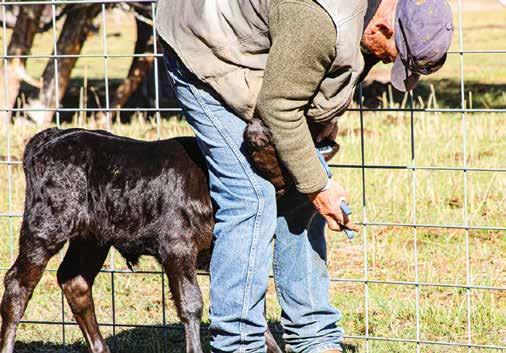
Crypto can be spread to humans through oral contact with contaminated soil, water or feces. Zoonotic transmission often occurs during calving season when treating infected calves.
Salmonellosis
Salmonella is a wide-
spread, gram-negative bacteria which may cause diarrhea in young calves, with dairy calves being most prevalent. Infected cattle range in age from under one month to adult, with most patients lacking adequate colostrum intake at birth.
A human outbreak from contact with dairy calves infected with salmonella occurred in 2018, leading to 56 cases with 17 hospitalizations.
Salmonella can also be spread by ingestion of contaminated food sources, including unpasteurized milk.
E. coli
E. coli is a bacteria

affecting calves between one to four days of age.
Newborn calves are exposed to E. coli through environmental contamination. Risk of infection increases when calving in contaminated environments.
E. coli can be directly spread to humans through fecal-oral contamination.
Prevention
Zoonotic diseases can be prevented with proper protection.
Consider an isolation area for treating sick calves that can be thoroughly
cleaned and disinfected.
A footbath containing disinfectant is helpful to prevent the spread in and out of the treatment area. Once the footbath contains organic material, it should be replaced with a fresh solution.
Designate footwear and outerwear which can be easily cleaned or disposed after use, and keep a separate area to store work clothes once inside.
Wear gloves and avoid touching oneʼs face when around animals.
Always wash hands with soap and water, especially before eating or drinking.
While all people are susceptible to these diseases, young children, elderly and immunocompromised individuals are at greater risk.
Biosecurity is vital to prevent the spread of disease in both animals and people.
Dr. Lindsay WaechterMead is a Nebraska Extension beef educator. This article was originally published by Nebraska Cattlemen Magazine in February.



While tariff and trade tribulations garnered headlines throughout the year, U.S. dairy largely shrugged off the situation and posted export numbers which nearly surpassed recordyear 2022, according to Corey Geiger, lead dairy economist for CoBank.
“To be fair, 2025 might have had a chance to be even better and break those 2022 records had there not been geopolitical issues on the trade front,” he said. “In fact, the largest catalyst supporting growth in sales was the market conditions in which the U.S. had lower cheese and butter prices when compared to the world’s top two dairy exporters – the European Union (EU) and New Zealand.”
Digging into the numbers
U.S. dairy export volume and value rose to the highest levels in three years.
Sales volume grew four percent when compared to the prior year to reach 5.1
billion pounds of total milk solids, according to Geiger. Those milk solids accounted for 17 percent of total U.S. milk production.
While volume grew four percent, total value of sales grew an impressive 15 percent over the past year to reach $9.63 billion.
Both metrics were just shy of the 2022 all-time records of 5.3 billion pounds and $9.66 billion in sales.
“Speaking of records, Mexico remained the top customer, accounting for 27
percent of exports by value or $2.6 billion in sales,” Geiger said.
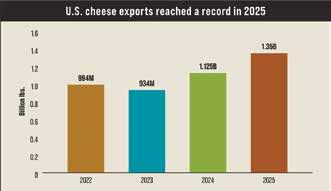
Cheese exports led the way, climbing 20 percent from a year ago to reach a record 1.35 billion pounds on what was the 30th anniversary of the creation of the U.S. Dairy Export Council, founded by the nation’s dairy farmers via the Dairy Checkoff.
In 2025, cheese sales topped 110 million pounds in eight of the 12 months last year. Prior to 2025, Gei-
ger said cheese exports had never topped this figure in a single month.
“Sales grew in 32 of the 37 countries that purchased U.S. cheese, with 24 rising by double-digit growth. Mexico was the lead buyer of U.S. cheese and nonfat dry milk and skim milk powder. Lower cheese sales in five major markets were largely due to tariff-related
impacts,” he noted.
Butterfat exports proved critical
In 2025, butterfat exports posted an impressive year by skyrocketing 167 percent higher year-over-year to reach 269 million pounds.
“This was the first time butterfat exports exceeded 220 million pounds in one year,” Geiger said. “Although Canada had the largest market share of U.S. butterfat purchases, U.S. sellers diversified market reach with big gains in the Middle East and North Africa, the EU and Mexico, and for the sake of the conversation, most of the butterfat exports to Canada crossed the border for further food manufacturing and return to America for placement on store shelves.”



Had it not been for strong butterfat exports, domestic markets would have been awash in butterfat as production grew from 9.93 billion to 10 billion pounds in 2025. This 4.77 percent growth, when looking at federal order data, represented record growth and momentum throughout the year as June through December posted growth rates from 5.2 to 6.3 percent for butterfat production in any given month, Geiger explained.
“This strong growth in the second half of the year caused spot CME butter prices to fall from the $2.44 per pound on Aug. 1 to under $1.50 by midNovember,” he said. “This provided a market-clearing opportunity as November
moved a record 33.7 million pounds and December topped this number at 34.6 million pounds of butterfat.”
Higher butter prices
The market-clearing situation is one of the main reasons spot CME butter prices rebounded to over two dollars per pound by early March.
“Without those exports, there would have been little chance Class III futures rebounded to over $18 per hundredweight (cwt) and Class IV to over $19 per cwt in early March trading on the CME,” he said.
According to Geiger, market volatility will not be going away anytime soon given the strong potential for growth in butterfat output by American dairy farmers. On top of this, geopolitical tensions via tariffs and military conflicts will add more volatility to global trade.
“Given this situation, it would be a good time to look at risk mitigation strategies to secure some milk prices which were not on the board to start this year,” he said.
To some extent, U.S. milk output had mirrored the EU with growth hovering under two percent levels from January through April. Then, output began trending higher with June through November milk moving 3.3 to 4.5 percent higher, Geiger said.
Fran O’Leary is the senior editor for Wisconsin Agriculturist. This article was originally published by Wisconsin Agriculturist on March 16.
Are fire ant mounds popping up in yards, gardens or pastures? As temperatures rise, so does fire ant activity.
The good news is science-backed ways to control fire ants can eliminate entire colonies, not just the visible ones.
Dr. Robert Puckett, Texas A&M AgriLife Extension Service entomologist and associate professor in the Texas A&M Department of Entomology, has helped landowners across Texas and around the world fight red imported fire ants. He offers expert advice for getting rid of fire ants’ annoying mounds and fiery stings.
“There are a few reliable research-backed options and approaches when it comes to fire ant control,” he said. “It just comes down to how quickly you want results and your budget to reach the desired level of protection.”
Puckett’s recommended annual fire ant treatment method costs about $25 to $35 per acre.
What is the best way to control fire ants?
Puckett said the most effective way to control fire ants is to use granular fire ant bait.
Fire ant mounds are the clearest sign of a colony and its underground activity.
New colonies start when flying queens mate, land and dig into the soil to lay eggs. This means new colonies can start even if visible, established colonies are routinely treated.
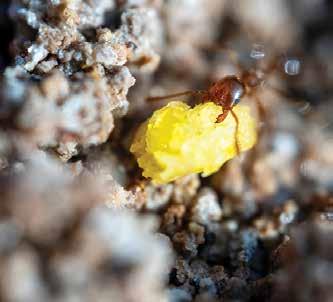
Granular baits work because worker ants pick up the bait and carry it back to the colony to feed other ants – including the queen. This method eliminates the entire colony.
“Studies have shown time after time fire ants have an extremely efficient foraging behavior and dominate those baits,” Puckett said.
How long does it take bait to work?
Puckett said store-bought baits vary in price and how quickly they work. In general, the cost of bait typically reflects how quickly it eliminates a colony.
Lower-cost baits may take six to eight weeks to eliminate a colony, while more expensive ones usually work in less than a week.
“There is really just a cost-versus-time-to-kill-decision matrix to consider when using baits,” he said. “But I am confident in our field research which tells me using these products is effective. Some just take longer.”
How should you apply ant bait?
Puckett recommends a few key steps when applying bait.
Sprinkle bait around the mound’s perimeter rather than directly on the mound. When disturbed, ants go into defense mode and won’t collect bait.
Apply bait when temperatures are about 70 degrees Fahrenheit or above. This is when ants are actively foraging.

FOR SALE OR RENTAL
BIG SELECTION OF BIG TEX TRAILERS
1918 FORD MODEL T PICKUP
EXCELLENT CONDITION - $19,500 $16,500 2013 MACK 600, 306,406 MILES EXTENSIVE ENGINE WORK DONE - $39,500
2008 LANDOLL 53’ HYDRAULIC TILT TRAILER. AG PULL OUTS. LOW MILEAGE USED ON RANCH TO MOVE BALER+SWATHER. NEW PAINT AND DECK. $75,000 OBO.
2007 KW W900L, STUDIO SLEEPER, 625 CAT, 18 SPEED TRANS., 40,000 REARS, PTO, HEADACHE RACK ENCLOSED, 315,000 ACTUAL MILES, $150,000 OBO.
2016 KUBOTA MX5200D TRACTOR
2023 CAT D6 DOZER CAT320 EXCAVATOR
2023 CAT 420 BACKHOE 2023 CAT 906 LOADER
2018 CAT 930M LOADER 2022 FRIESEN TRAILER AIR COMPRESSOR CAT REACH FORKLIFT (TELEHANDLER)
2023 SA CARGO TRAILER 6X10 NEW PULLED 1500 MILES - $7,000.00
2024 BIG TEX 25GN-40DG1-MRBK - $24,500 2013 JLG G6-42A EXTENDED BOOM SKYJACKSJ7135 SCISSOR LIFT THE BEST PRICES YOU CAN FIND!!!!
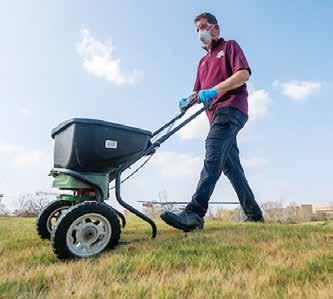
Check the forecast and avoid applying bait within 48 hours of rain.
Broadcast bait around the yard once or twice a year. This routine will help treat visible mounds and new colonies that aren’t visible. Follow the label. The
typical application is one to 1.5 pounds per acre. Using more is wasteful and doesn’t improve results.
What are some organic or garden-safe options?
When controlling ants in a vegetable bed or for individuals who prefer an
organic approach, Puckett recommends using products containing spinosad. These products are the best alternatives to insecticides with synthetic active ingredients.
Another option is to slowly pour boiling water onto the mound and stir with a stick, but this method requires caution and often repeated attempts. Adam Russell is a communications specialist for Texas A&M AgriLife. This article was originally published by AgriLifeToday on March 10.
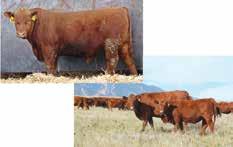
Selling 240 Red Angus
231 Bulls and 31 Heifers
Plus 30 commercial heifers
1:00 pm at our ranch 10 miles west of Sheridan
Online biddding will be available on DV Auction and Superior Livestock
Beckton is the Foundation Herd of the Red Angus breed 80 years of performance evaluation and genetic selection brings you industry leading genetics for Total Efficiency
Calving Ease and Calving Percentage Efficiency More total live calves per cow in the herd - 16 of the top 20 sires in the entire Red Angus breed for Calving Ease EPD are Beckton sires or descended from Beckton sires.
Cow Herd Efficiency Moderate sized cows have lower feed maintenance requirements. More cows per acre means more calves per acre. The average size of our mature cow age 5 and older is 1100-1150 pounds. We list the act ual weight of each dam for every bull in our sale catalog.
Growth and Feed Conversion Efficiency Rapid and cost efficient gain to market weight - 14 of the top 20 sires in t he entire Red Angus breed for Dry Matter Intake EPD are Beckton sires or descended from Beckton sires.
Overall Profitability 14 of the top 20 sires in the Red Angus breed for HerdBuilder Index are Beckton sires or desccended from Beckton sires.
Beckton sires have long been the Red Angus breed’s leading choice for calving ease and for functional, maternal females
Additional Facts:
• All 20 of the top 20 sires in the breed for low Birth Weight EPD are Beckton sires or descended from Beckton sires.
• 15 of the top 20 sires in the breed for Heifer Pregnancy EPD are Beckton sires or descended from Beckton sires
• 11 of the top 20 sires in the breed for Stayability EPD are Beckton sires or descended from Beckton sires
Finally: On the consumer’s dinner plate - Beckton’s many generations of DNA selection for beef tenderness make our




Jan. 29, 1933 – March 11, 2026
Robert “Bob” Henry Borgialli, age 93, passed away at his home in Buffalo on March 11 with his family by his side. Bob was born on Jan. 29, 1933 to Charlie and Ruth Borgialli at the Marshall and Hazel Cullum home in Newcastle. He grew up on the family ranch and attended grade school at the Borgialli Country School.

Bob later attended Newcastle High School, where he participated in rodeo, football and FFA.
He graduated in 1951 and was offered a football scholarship to Chadron State College but instead chose to remain on the family ranch while working in the oilfields.
In August of 1951, Bob
A familiar voice to Midwestern farmers for over 60 years, many producers relied on his farm reports on WGNAM and WGN-TV based in Chicago to make their decisions regarding when to plant, harvest or make major financial decisions based off his farm reports.
He began at WGN Radio in Chicago in 1960 when Dwight Eisenhower was president. In fact, there were a total of 12 different men who had served as U.S. presidents throughout Samuelson’s career as a farm broadcaster.
enlisted in the Wyoming National Guard and served until his honorable discharge in October of 1959.
In August of 1960, he moved his family to Buffalo, where he purchased the Zahradnicek Ranch on Rock Creek. He continued ranching there for the rest of his life.
Bob took great pride in his work and was especially proud that at 92 years old he was still harrowing fields and swathing hay. He was always looking for ways to improve his cattle operation through genetics, vaccines, minerals and hay quality.
A long-time advocate for the agriculture community, Samuelson reported not only on the news impacting farmers, but the needs of producers and rural Americans.
Throughout the years, Bob ran his ranch while also working full time for various companies. In October of 1976, he went to work for the city of Buffalo, where he later became a city works foreman. He retired in 2000 at the age of 67.
Bob enjoyed playing cards and spending time with his family. In 2022, he was inducted into the Cowboy Hall of Fame.
He was preceded in death by his parents, three brothers, one sister and two grandsons.
Bob is survived by his
Samuelson was born on March 31, 1934 on a dairy farm near Ontario, Wis. At the beginning of his career, he said he dropped out of the University of Wisconsin after three months because they were not teaching him how to be a radio announcer. He later enrolled at the American Institute of the Air in Minneapolis. His first radio job was in 1952 at WKLJ in Sparta, Wis., where he was a polka disc jockey. It was the summer of 1952.
He worked for three Wisconsin radio stations before he was hired at WGN in Chicago in 1960. He hosted a show called “Top O’ The Morning” on WGNTV beginning in the 1960s. It was also at WGN where he hosted the National Barn Dance, which was the direct precursor of the Grand Ole Opry.
The program originated at WLS-AM in 1924, but was dropped by the station and picked up by WGN-AM in 1960. Samuelson was host until the show’s cancellation in 1968.
Samuelson also hosted “U.S. Farm Report,” a tele-
son Bob (Diana) Borgialli of Buffalo; daughters Judy (Chris) Hansen of Eagle Point, Ore., Cindy (Randy) Black of Belfry, Mont. and Dianne (Rick) Farris of Buffalo; sister Dorothy Bartlett of Kansas; 10 grandchildren; 27 great-grandchildren; 14 great-great-grandchildren and many nieces and nephews.
Services for Bob will be held at the Summit Wesleyan Church in Buffalo on March 18 at 2 p.m. with Pastor Stephen Martin officiating. Memorial donations in Bob’s memory may be made
vision farm show with fellow legendary Farm Broadcaster Max Armstrong. This program was syndicated to 150 television markets across the country.
Both Samuelson and Armstrong were the Chet Huntley and David Brinkley of farm broadcasting. Together, they were the trusted voices for farm news and information for 42 years.
Samuelson became popular for his ability to explain agribusiness and food production in an understandable way. He and Armstrong would talk about agriculture from a studio in Chicago over hundreds of net-

may be made at harnessfuneralhome.com
worked stations. He would explain corn production and beef demand to thousands of suburban housewives, among others.
Samuelson was also a leader among farm broadcasters across the country. He was a member of the National Association of Farm Broadcasting (NAFB) for nearly 70 years. In 1965, he served as president of NAFB.
He was also named NAFB Farm Broadcaster of the Year in 2003 and inducted into the NAFB Hall of Fame in 1999. Samuelson was also inducted in the Radio Hall of Fame in 2003.






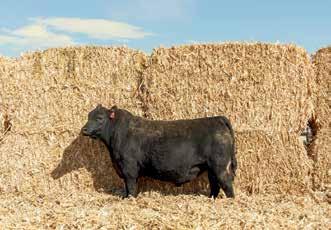

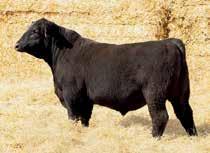
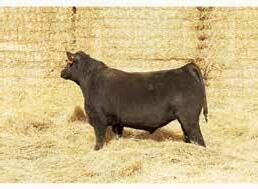
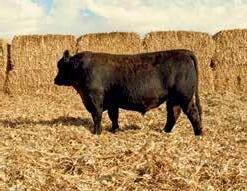

April 11, 1935 – March 9, 2026
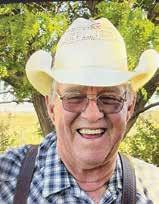
William “Bill” Hollingsworth passed away on March 9.
He was born on April 11, 1935 in Derby, Conn., the third of eight children born to Florence (Schlitter) and Harold Hollingsworth.
Bill grew up in Shelton, Ct. where his pastimes included playing baseball, swimming, fishing and singing in the church choir.
Bill graduated from Shelton High School and then joined the U.S. Army. He trained at Hohenfels Infantry Training Center in Hohenfels, Germany and was stationed in Kornwestheim, Germany.
After his service, Bill returned home and helped build a water tunnel into the town of New Haven, Conn. Bill’s boss offered him a job as a high scaler in Fremont Canyon near Alcova, so Bill drove out west.
Bill met Sherolyn Minchow at the Riverbend Café while he was working in Fremont Canyon. After attending a Sweetwater Dance, they became inseparable and were married on July 2, 1960.
Bill worked as an underground miner in Shirley Basin and helped operate the family ranch alongside the Webers, raising cattle and growing hay.
Eventually, Bill and Sherolyn purchased the ranch near Alcova and raised their two daughters on it. His family was his pride, anchor and heart of every decision he made. He filled his life with stories he loved to tell to anyone who would listen.
For over 30 years, Bill was a hunting outfitter and guided hunts all over Wyoming. He made many lifelong friends through this
business.
Bill was an avid hunter and was lucky enough to draw three Bighorn sheep licenses during his lifetime. Along with hunting, he enjoyed snowmobiling, playing cribbage, rock hunting and creating amazing items out of the rocks he found.
Bill believed strongly in helping others and wanted to give back to the community. This belief allowed him to serve on the Alcova School District Board of Trustees and then later on the Natrona County School District Board of Trustees where he served for 20-plus years.
He was instrumental in building the gym at Alcova School before Natrona County consolidated all of the boards in the county.
During his later years, he started working at Industrial Lubricant, then P&H MinePro and lastly for Major Metal Service out of Gillette. He loved working at the large mines, which took him from Wyoming to Montana and even into Washington. He made sure he was friends with all of the gatekeepers at each mine so he was never turned away when he showed up.
He is preceded in death by his wife Sherolyn of 53 years, his parents, his brother Harold Hollingsworth and his sisters Mildred Batza and Florence Bialek.
Bill is survived by his daughters Shannon (Dean) Jackett and Tanya (Paul) Schimpf; grandchildren Blair Jackett, Taylar (Colton) Jackett, Kaylee (Logan) Schimpf and Lane (Emma) Schimpf: great-grandchildren Braylee Condelario and Elsie Schimpf and sisters Dorothy (Bob) Blake, Patti (Dennis) Maguire, Linda (George) Walters and Carol (Michael) Coelho.
A celebration of life will be held on April 11 at 11 a.m. at the Elks Lodge in Casper.
In lieu of flowers, donations to the Central Wyoming Hospice and Transitions would be appreciated by the family.
July 26, 1969 - March 10, 2026

Reported By: Curt Cox, WYLR Field Editor March 13, 2026
Public Auction Yards, Billings, Mont. Auctioneer: Roger Jacobs 96 Yearling Angus Bulls Avg. $8,515 30 Two-Year-Old Angus Bulls Avg. $9,850
Top Sellers
Lot 4 – Sitz Phenom
692N – Price: $120,000 DOB: 1/14/25 Sire: HF
Hi-Country 7L Dam’s
Sire: Sitz Stellar 726D
EPDs: BW: -0.8, WW: +70, YW: +126 and Milk: +28 Buyers: Harrell Herefords and Angus, Baker City, Ore. and Scott Angus Cattle, Belgrade, Neb.
Lot 60 – Sitz Equity
671N – Price: $120,000 DOB: 1/15/25 Sire: Sitz
Insignia 12031 Dam’s
Sire: Sitz Incentive 704H
EPDs: BW: +0.7, WW: +92, YW: +155 and Milk: +28 Buyer: Grimmius Cattle, Hanford, Calif.
Lot 8 – Sitz HiCountry 723N – Price: $110,000 DOB: 1/17/25

EPDs: BW: +2.7, WW: +103, YW: +163 and Milk: +24 Buyer: JJ Angus, Connellsville, Pa.
Lot 46 – GMAR Armstrong N244 – Price: $15,000 DOB: 2/5/25 Sire: S Armstrong Dam’s Sire: Spring Cove Reno 4021
EPDs: BW: +0.7, WW: +80, YW: +135 and Milk: +34 Buyer: Circle L Angus, Dillon, Mont.
Lot 91 – GMAR Armstrong N496N – Price: $15,000 DOB: 2/25/25
Sire: S Armstong Dam’s Sire: Soo Line Motive 9016 EPDs: BW: +0, WW: +68, YW: +121 and Milk:
Sire: HF Hi-Country 7L Dam’s Sire: Sitz Stellar 726D EPDs: BW: +0, WW: +65, YW: +122 and Milk: +40 Buyers: Ridl Angus, Dickinson, ND. and Bruner Angus, Drake, N.D.
Lot 1 – Sitz Prototype 729N – Price: $100,000
DOB: 1/10/25 Sire: HF Hi-Country 7L Dam’s
Sire: Sitz Asset 402C
EPDs: BW: -2.4, WW: +74, YW: +118 and Milk: +30 Buyer: Lindskov LT Ranch, Isabel, S.D. Lot 7 – Sitz HiCountry 694N – Price: $45,000 DOB: 1/14/25
Sire: HF Hi-Country 7L
Dam’s Sire: Sitz Asset 402C EPDs: BW: +1.3,
+33 Buyer: Troy Klassen, Vona, Colo.
Lot 100 – RAR Foundation N951 – Price: $15,000 DOB: 3/26/25 Sire: FHCC Foundation 1558 Dam’s Sire: Sitz Incentive 704H
EPDs: BW: -0.3, WW: +84, YW: +148 and Milk: +32 Buyer: Fortune’s Triangle S, Interior, S.D.
Lot 78 – GMAR Armstrong N370 – Price: $14,000 DOB: 2/10/25
Sire: S Armstong Dam’s Sire: JMB Traction 292
EPDs: BW: +0.4, WW: +88, YW: +150 and Milk: +40 Buyer: Troy Klassen, Vona, Colo.
WW: +76, YW: +128 and Milk: +38 Buyer: Wilson Angus, Watford City, N.D.
Lot 31 – Sitz Eternity 685N – Price: $45,000 DOB: 1/15/25 Sire: Sitz Eternity 739L Dam’s Sire: Sitz Investment 660Z EPDs: BW: +0.3, WW: +69, YW: +133 and Milk: +21 Buyer: Chapman Cattle Company, Stettler, Alberta, Canada Lot 63 – Sitz Insignia 618N – Price: $45,000 DOB: 1/20/25 Sire: Sitz Insignia 12031 Dam’s Sire: Resilient 10208 EPDs: BW: +0, WW: +86, YW: +140 and Milk: +19 Buyer: Bill Brennan, Pony, Mont.
The Sims family invites everyone to come together to share memories, stories and laughter, in rememerance of the life and legacy of Lacee Sims – someone who meant so much to so many. A celebration of life will be held on May 2 at 1 p.m. at the Roundhouse and Railyards at 1500 Main Street in Evanston.

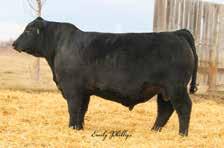



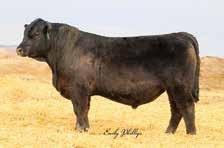


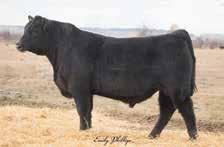










Why do the first 21 days of the breeding season for heifers matter?
In beef cattle operations, the reproductive performance of heifers is a critical factor affecting both shortterm productivity and longterm herd sustainability.
One of the most influential benchmarks in herd management is the ability to establish pregnancy in beef heifers within the first 21 days of the breeding season.
This early pregnancy window isn’t just a matter of convenience – it has profound and measurable effects on the longevity and overall productivity of the herd, as well as on a producer’s bottom line.
Establishing pregnancy in the first 21 days of the
breeding season sets the foundation for a more productive and profitable herd.
Heifers which conceive early are more likely to calve early in their first calving season, which offers several advantages.
First and foremost, earlycalving heifers have more time to recover and resume their estrous cycles before the next breeding season, increasing their chances of becoming pregnant in their second breeding season and remaining in the herd as productive cows year after year.
Research consistently demonstrates heifers that breed and calve earlier remain in the herd longer and have greater lifetime productivity. They produce more calves with greater weaning weights
over their lifetime, and they are less likely to be culled for reproductive failure.
In contrast, late-bred heifers often struggle to maintain the optimal calving interval, resulting in fewer total calves, lower weaning weights and a greater likelihood of being removed from the herd prematurely.
Calves born earlier in the calving season benefit from more favorable calving conditions, more feed days to weaning and less exposure to disease.
These advantages translate into higher weaning weights and improved overall herd performance.
Effect on longevity and long-term sustainability
Longevity in the cow herd is a key driver of prof-
itability. Every year a heifer remains productive reduces the cost of replacement heifers and maximizes the return on investment for the producer.
When a heifer fails to conceive early, she faces a cascading series of disadvantages.
Late calving means less time to recover before the next breeding season, which increases the risk of failing to become pregnant, resulting in culling.
Over time, this pattern leads to a herd with fewer high-producing, long-lived cows and more frequent turnover of replacement heifers.
A 2013 study analyzed longevity data collected on 16,549 individual heifers at the U.S. Meat Animal

Research Center.
Data was limited to heifers which conceived during their first breeding season.
Heifers were grouped into 21-day calving periods and were determined to have left the herd when they were diagnosed not pregnant at the end of the breeding season. Heifers that calved with their first calf during the first 21-day period of the calving season had increased longevity compared with heifers that calved in the second 21-day period or later.
The genetic progress within a herd depends on retaining the best-performing animals.
Early-conceiving heifers demonstrate superior fertility and adaptability – traits which are desirable to propagate in future generations.
By prioritizing early pregnancy establishment, producers can accelerate genetic improvement and build a more resilient herd.
Economic implications
The economic benefits of establishing pregnancy in the first 21 days are substantial.
Early-conceiving heifers contribute more calves over their lifespan, leading to greater revenue from calf sales. They also require fewer interventions and less management input, reducing labor and veterinary costs associated with late-bred or open heifers.
A uniform calving season, achieved by early conception, streamlines management practices.
Producers can plan for labor, more efficient feed and health interventions, minimizing disruptions and maximizing resource use.
In contrast, extended calving seasons complicate management and increase the risk of disease outbreaks, nutritional deficiencies and calf mortality.
How to get more heifers pregnant early
Achieving high rates of earlier pregnancy requires a multifaceted approach which combines nutrition, management, genetics and reproductive technologies.
Optimal nutrition is the cornerstone of reproductive success. Heifers should enter the breeding season at a target body condition score (BCS) of five or six on a nine-point scale.
Underconditioned heifers may not cycle regularly, while over-conditioned animals can also face reproductive challenges.
Providing a balanced diet with adequate energy, protein, minerals and vitamins ensures heifers reach puberty and maintain regular estrous cycles.
Monitor weight and BCS regularly leading up to the breeding season, supplement with minerals that may be deficient in the region and those that are critical for reproductive health and adjust feed rations based on pasture quality and forage availability.
Estrous synchronization programs can dramatically increase the number of heif-
ers cycling at the start of the breeding season. By aligning estrous cycles, producers can ensure more heifers are ready to conceive during the first 21 days.
Use protocols to induce puberty in prepubertal heifers, combine estrous synchronization with artificial insemination to introduce superior genetics and maximize conception rates and closely monitor heifers for signs of estrus and inseminate them at the optimal time.
Selection of heifers from dams with a history of early conception and calving can also improve herd fertility over time.
Focus on traits such as reproductive efficiency, calving ease and maternal instincts when choosing replacement heifers.
Use expected progeny differences for fertility and calving interval to guide selection decisions and retain heifers born early in the calving season, as they are more likely to conceive early themselves.
Additionally, healthy heifers are more likely to conceive and maintain pregnancies.
Implement a comprehensive health program including vaccination, parasite control and routine veterinary checks.
Vaccinate for reproductive diseases such as bovine viral diarrhea, infectious bovine rhinotracheitis and leptospirosis; control internal and external parasites to prevent nutrient loss and disease transmission and address lameness, injuries or other health issues promptly to maintain optimal reproductive performance.
Key takeaways
Establishing pregnancy in beef heifers within the first 21 days of the breeding season is a pivotal management goal with far-reaching implications for herd longevity, productivity and profitability.
Early-conceiving heifers become the backbone of successful cow/calf operations, contributing more calves and remaining productive for years.
By focusing on nutrition, reproductive management, genetics, health and breeding practices, producers can maximize early pregnancy rates and ensure a sustainable, high-performing herd for years to come.
Investing in strategies to get more heifers pregnant early is not just good practice, it’s essential for the long-term success of any beef cattle operation.
Through careful planning and proactive management, producers can reap the rewards of a herd characterized by longevity, fertility and profitability.
Dr. G. Cliff Lamb is the director of Texas A&M AgriLife Research, the state of Texas’ premier research agency in agriculture, natural resources and life sciences. This article was originally published by Angus Journal on Feb. 19.
One of the most common and dangerous challenges posing threats to young calves is dehydration.
Electrolyte therapy can provide a life-saving boost for sick, scouring and dehydrated calves.
To help producers prepare for bouts of calving season sickness, experts offer advice on understanding and administering electrolytes in order to support struggling calves.
Electrolytes explained
Electrolytes are essential minerals which help ensure proper bodily functions and overall health in calves. Levels can be depleted quickly by illness and environmental factors leading to dehydration.
In mild cases, electrolyte therapy can offer a much-needed boost to young calves’ immune systems.
In an April 2019 Hubbard Feeds article, Dairy Research Nutritionist Ellan Dufour explains young calves are typically around 70 to 75 percent water by bodyweight and must be well hydrated in order to stay healthy and grow to their full potential.
“When calf diarrhea hits, it is critical to reverse the effects of dehydration to avoid metabolic acidosis, weakness, severe weight loss and/or mortality,” Dufour notes. “Oral
rehydration by electrolyte therapy is an effective way to reverse the symptoms of dehydration.”
Electrolyte products are mixed with water and typically include a combination of sodium, energy, amino acids and alkalizing agents designed to get calves back on their feet, according to Dufour.
Dufour notes water is the most important component of oral rehydration solutions, adding most good supplement options will contain key electrolytes such as sodium, potassium and chloride, along with glycine, dextrose, alkalizing agents and gelling agents.
A Feb. 2013 BEEF Magazine article emphasizes the importance of reading oral electrolyte labels carefully, noting products vary widely and ingredients can sometimes be presented in ways which make comparisons difficult.
For this reason, consulting a veterinarian or nutritionist to evaluate choices ahead of the calving season can help producers choose the best fit for their operation to keep on hand when sickness strikes.
Stressors and symptoms
Experts note everything from extreme weather conditions, stress events, poorquality colostrum and common calf illnesses can lead
to dehydration due to rapid depletion of electrolytes.
Of these, diarrhea or scours is one of the most common culprits of electrolyte depletion.
“A scouring calf is a dehydrated calf,” notes Dufour, adding dehydration can often be identified by symptoms including diarrhea, depression, dry gums, sunken eyes and weakness.
After dehydration has been confirmed, experts with the Canada-based Beef Cattle Research Council (BCRC) recommend inserting two fingers in the calf’s mouth to test the suckle reflex, noting in cases of mild to moderate dehydration where calves are still strong enough to suckle, oral electrolytes can be administered at home and may help restore health.
If symptoms progress beyond mild dehydration, however, BCRC notes veterinary intervention or intravenous fluid therapy may be necessary
Administering electrolytes
Once a dehydrated calf has been identified, understanding when and how to administer electrolytes is critical to restoring health.
The two most common methods of administering electrolytes are using a nipple bottle or esophageal tube feeder with oral fluids.
“For a calf with a strong
suckle reflex, oral fluids may be given through a nipple bottle,” writes Paige Carlson in a March 2023 Drovers article. “However, in cases where a calf is too weak or ill to have the motivation to drink electrolytes, the esophageal tube feeder is an effective tool.”
In an April 2022 article for VitaPlus, Dr. Megan Weisenbeck recommends producers dissolve oral electrolyte products in at least two quarts of warm water – around 100 to 105 degrees Fahrenheit, which is roughly the same temperature as milk.
Whichever way oral fluids are administered, Weisenbeck and other experts state the importance of not mixing electrolytes with milk or milk replacer as this practice defeats the hydration purpose of electrolytes and can lead to negative side effects.
Instead, producers caring for dehydrated calves should continue feeding milk or milk replacer and administer electrolytes an hour after feeding, as calves depend on nutrients provided by their normal liquid diet to regain strength.
“Very few electrolyte formulations contain sufficient calories to support maintenance and gain,” says Weisenbeck. “Calories derived from milk or milk replacer are
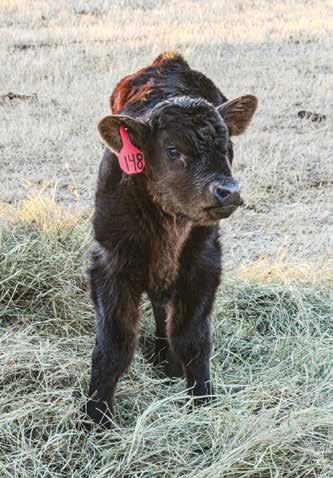
important to allow the calf to defeat the pathogen.”
In addition, BCRC emphasizes the importance of designating separate bottles for electrolytes and cleaning equipment thoroughly after each use.
“Talk to your veterinarian about a protocol for feeding oral electrolytes as the amount needed will change depending on how dehy-
drated the calf is,” BCRC concludes. “Continue giving electrolytes until the calf has stopped scouring, even if they look like they have recovered, because they still have the potential to be dehydrated.”
Grace Skavdahl is the editor of the Wyoming Livestock Roundup. Send comments on this article to roundup@wylr.net.

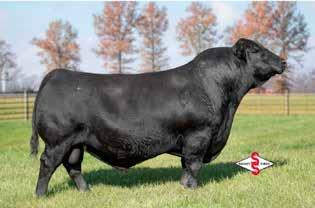
March 21 Wyoming Wool Growers Association Lambing School, Kaycee. For more information or to register, visit wyowool.com/lambingschool2026
March 23 University of Wyoming Extension Pesticide Safety Education Program, 12-4 p.m., Weston County Fairgrounds, Newcastle. For more information or to RSVP, contact the Weston County Extension Office at westncty@uwyo.edu or 307-746-3531.
March 23 Sublette Antelope Migration Corridor Working Group Public Meeting, 8 a.m.-4 p.m., BOCES Board Room, Pinedale, in person or online. For more information, visit sites.google.com/view/wywildlifemigrationadvisorygrp/sublette-antelope
March 23 Wyoming Game and Fish Department Hunting Regulations Public Meeting, 6 p.m., Wyoming Game and Fish Headquarters, Cheyenne. For more information, visit wgfd.wyo.gov
March 23 Wyoming Game and Fish Department Hunting Regulations Public Meeting, 6 p.m., Northwest College, Powell. For more information, visit wgfd.wyo.gov
March 23 Wyoming Game and Fish Department Hunting Regulations Public Meeting, 6 p.m., Washakie County Fairgrounds, Worland. For more information, visit wgfd.wyo.gov
March 23 University of Nebraska Planting Annual Forages Under Irrigation for Grazing and Feed Webinar, 6:30 p.m., Zoom. For more information or to register, contact Aaron Berger at aberger2@unl.edu or 308-235-3122.
March 23 AgriPulse Ag and Food Policy Summit, National Press Club, Washington, D.C. For more information or to register, visit agri-pulse.swoogo.com/2026-dcsummit/.
March 24 Wyoming Game and Fish Department Hunting Regulations Public Meeting, 6 p.m., Platte Valley Community Center, Saratoga. For more information, visit wgfd.wyo.gov
March 24 Wyoming Game and Fish Department Hunting Regulations Public Meeting, 6 p.m., Fire Station, Lovell. For more information, visit wgfd.wyo.gov
March 24 Wyoming Game and Fish Department Hunting Regulations Public Meeting, 6 p.m., Mountain View School Administrative Building, Mountain View. For more information, visit wgfd.wyo.gov
March 25 University of Wyoming Extension Pesticide Safety Education Program 9 a.m.-12 p.m., Dubois Town Hall, Dubois. For more information or to RSVP, contact the Fremont County Extension Office at rmeeks2@uwyo.edu or 307332-2363.
March 25 Wyoming Game and Fish Department Hunting Regulations Public Meeting, 4 p.m., Cokeville Town Hall, Cokeville. For more information, visit wgfd. wyo.gov
March 25 Wyoming Game and Fish Department Hunting Regulations Public Meeting, 6 p.m., First State Bank, Wheatland. For more information, visit wgfd.wyo.gov
March 23 Wyoming Game and Fish Department Hunting Regulations Public Meeting 6 p.m., Greybull Townhall, Greybull. For more information, visit wgfd.wyo.gov
March 25 Wyoming Game and Fish Department “Carrying Capacity: The Hunt for Resilience” Film Screening, 6 p.m., Carbon County Higher Education Center, Rawlins. For more information, visit wgfd.wyo.gov
March 25 Wyoming Game and Fish Department Hunting Regulations Public Meeting, 6 p.m., Carbon County Higher Education Center, Baggs. For more information, visit wgfd.wyo.gov
March 25 Wyoming Game and Fish Department Hunting Regulations Public Meeting, 6 p.m., Carbon County Higher Education Center, Rawlins. For more information, visit wgfd.wyo.gov
March 25 Wyoming Game and Fish Department Hunting Regulations Public Meeting, 7 p.m., South Lincoln Training and Event Center, Kemmerer. For more information, visit wgfd.wyo.gov
March 25 Beef Cattle Research Council Strategies For Reducing Calf Losses Webinar, 7 p.m., online. For more information or to register, visit beefresearch.ca
March 26 University of Wyoming Extension Pesticide Safety Education Program 12-4 p.m., Natrona County Extension Office, Casper. For more information or to RSVP, contact Ann Cormican at acormican@natronacounty-wy.gov or 307235-9400.
March 26 Wyoming Game and Fish Department Hunting Regulations Public Meeting, 4 p.m., Crook County Courthouse, Sundance. For more information, visit wgfd.wyo.gov
March 26 University of Wyoming Ranching in the West Seminar Series, 5 p.m., Laramie, in person and online. For more information or to register, visit uwyo. edu/uwag/rmal/ranching-in-the-west-seminar-series.html
March 26 Wyoming Game and Fish Department Hunting Regulations Public Meeting, 6 p.m., Goshen County Library, Torrington. For more information, visit wgfd.wyo.gov
March 26 Wyoming Game and Fish Department Hunting Regulations Public Meeting, 6 p.m., Fremont County Library, Rawlins. For more information, visit wgfd. wyo.gov
March 26 Wyoming Game and Fish Department Hunting Regulations Public Meeting, 6 p.m., Cody Regional Office, Cody. For more information, visit wgfd.wyo.gov
March 26 Wyoming Game and Fish Department Hunting Regulations Public Meeting, 6 p.m., Superintendent’s Office, Evanston. For more information, visit wgfd.wyo.gov
March 26 University of Wyoming Extension Sheep Task Force Lambing Webinar, 6-7:30 p.m., Zoom. For more information, contact Jedidiah Hewlett at jhewlett@uwyo.edu or 307-358-2417.
March 26 Wyoming Game and Fish Department “Carrying Capacity: The Hunt for Resilience” Film Screening, 7 p.m., Gryphon Theatre, Laramie. For more information, visit wgfd.wyo.gov
March 26 Wyoming Game and Fish Department Hunting Regulations Public Meeting, 7 p.m., U.S. Department of Agriculture Building, Newcastle. For more information, visit wgfd.wyo.gov
March 28 Stockmanship and Stewardship, State College, Pennsylvania. For more information, visit stockmanshipandstewardship.org/
March 30 University of Wyoming Extension Pesticide Safety Education Program, 1-5 p.m., Sundance Courthouse Basement, Sundance. For more information or to RSVP, contact the Crook County Extension Office at crookcty@uwyo.edu or 307-283-1192.
March 30 Wyoming Game and Fish Department Hunting Regulations Public Meeting, 6 p.m., Laramie Regional Office, Laramie. For more information, visit wgfd.wyo.gov
March 30 Wyoming Game and Fish Department Hunting Regulations Public Meeting, 6 p.m., Niobrara County Fairgrounds, Lusk. For more information, visit wgfd.wyo.gov
March 30 Wyoming Game and Fish Department Hunting Regulations Public Meeting, 6 p.m., Green River Game and Fish Regional Office, Green River. For more information, visit wgfd.wyo.gov
March 22-23
March 23
March 23
March 24
March 25
March 25
March 26
March 26
March 26
March 26
March 27
March 27
March 27
March 28
March 28
March 28
March 28
March 28
March 29
Leachman Cattle Spring Bull and Female Sale, Meriden, 970-568-3983, leachman.com
Snowshoe Cattle Company Annual Bull Sale, at the ranch, Arthur, Neb., 406-647-5233, snowshoecattle.com
Sidwell Ranch and Frank Herefords 10th Annual Production Sale, Columbus, Mont., 406-861-4426, 307-631-6012
Northwest Wyoming 48th Annual Bull Sale, Riverton Livestock Auction, Riverton, 307-868-2595, 307-272-4911
NJW Polled Herefords Bull Sale, NJW south ranch, Sheridan, 307-7518289, 307-751-9470, njwherefords.com
McCumber Angus Ranch Annual Production Sale, at the ranch, Rolette, N.D., 701-871-1072, 701-871-9800, mccumberangus.com
Gibbs Red Angus Annual Production Sale, Glasgow Stockyards, Glasgow, Mont., 406-977-2852, gibbsredangus.com
Gartner~Denowh Angus Ranch 59th Annual Production Sale, at the ranch, Sidney, Mont., 406-489-0172, 406-480-2761, 406-489-1762, gdar-angus.com
Schuler Red Angus 44th Annual Bull Sale, at the ranch, Bridgeport, Neb., 308-262-0306, schulerredangus.com
Vermilion Ranch Spring Performance Sale, heifers sell at 12 p.m., South Pryor Development Center, Billings, Mont., Fifth Annual Online Embryo Sale, at 5 p.m. PAYS, Billings, Mont., and online at northernlivestockvideo.com, 406-670-0078, 406-672-5844, vermilionranch.com
Vermilion Ranch Spring Performance Bull Sale, PAYS, Billings, Mont., 406670-0078, 406-672-5844, vermilionranch.com
Lisco and M Diamond 34th Angus Bull Sale, M Diamond Ranch, Glenrock, 307-359-0167, 307-359-1162, mdiamondangus.com, liscoangus.com
Mills Cattle Company Annual Production Sale, St. Onge Livestock, St. Onge, S.D.,307-756-2030, 307-756-2648, millscattle.com
Sinclair Cattle Company 22nd Annual Production Sale, Buffalo Livestock Marketing, Buffalo, 307-254-1477, sinclaircattle.com
T-Heart Ranch High Altitude Bull Sale, at the ranch, LaGarita, Colo., 719850-3082, 719-850-3083, t-heartranch.com
Valley View Charolais Ranch 58th Annual Bull Sale, Midland Bull Test, Columbus, Mont., 406-270-0222, vvcrbulls.com
Diamond Peak Cattle Company Bull Sale, Loma Livestock Market, Loma, Colo., 970-756-8600, diamondpeakcattle.com
University of Wyoming Fourth Annual High Altitude Bull Test and Sale, Cliff and Martha Hansen Teaching Arena, Laramie, 307-766-2329, 209-7538227, 307-460-8129, uwyo.edu/anisci/outreach/index.html, DVAuction.com
Bird and Animal Auction, Dawson County Fairgrounds, Lexington, Neb., 308-233-1799, Facebook @JGraceAuctions


A column in the Casper Daily Tribune dated April 12, 1927 reads: Somehow or another, people, as a rule, have not regarded the hen as a very important element in the wealth of the nation, nor has poultry been considered one of the major products of the farm or the country at large.
Yet, in 1923 the farm value of poultry and poultry products exceeded the value of all the cattle raised by $1.5 million.
They were worth nearly $8 million more than all of the wheat raised and approximately $4 million more than all of the fruit and fruit products of the entire U.S.
Not so bad for the hen, which only a few years ago was expected to do little more than to provide pin money for the farm wife.
Every day, poultry is becoming more and more a favorite food product, so that from 1920-24, the number of chickens in the U.S. increased 43 percent, while during the same period, the number of eggs produced increased 20 percent.
The value of poultry products in the country, according to Harry B. Lewis, a writer for National Geographic Magazine, is exceeded at the present time by only five
other agricultural products – dairy products, corn, cotton, hay and forage and swine.
The poultry population of the north-central states, generally referred to as the Corn Belt, is estimated at two million.
Raising poultry commercially has gone forward at a tremendous rate in the last few years, and perhaps the greatest example of what is being accomplished along this line is found in the Petaluma Valley of California.
This valley is but 12 miles wide and 30 miles long, and in this area in 1926, White Leghorn hens produced pure white eggs in sufficient numbers to fill 1,400 railroad cars.
These were shipped to the markets on the Atlantic Coast, where they com-
manded the highest prices because of their color and the fact they were accurately graded to size.
Last year, one egg out of every 50 laid in the U.S. came from Petaluma, Calif. In the height of the season, one plant there handles and candles as many as a million eggs a day.
One reason for the increasing popularity of poultry is it is a crop which never fails if properly attended to.
The season may be backward for field crops and these may be blighted by drought or other dispensations of fortune or climate, but the poultry man who knows his business and attends to it is certain of his crop of eggs and table birds.
Furthermore, the hen flourishes from one border of the country to the other, and while some farms may have but a few, others may have hundreds, the total mounting to an astonishing figure.
For years, the hog was pointed to as the mortgage lifter, but this animal has little on biddy at the present time.
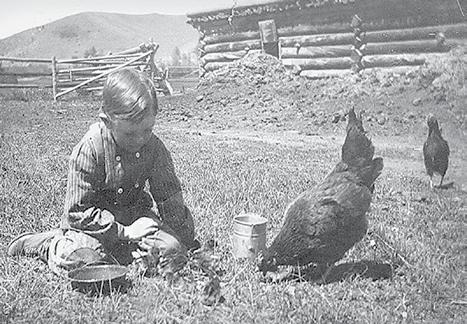
Source: USDA AMS Livestock, Poultry & Grain Market News, Torrington National Sheep Summary As of March 13, 2026
Compared to last week slaughter lambs traded steady and slaughter ewes steady. All sheep sold per hundred weight (CWT) unless otherwise specified. Slaughter Lambs: Choice and Prime 1-3: San Angelo: 80-90 lbs 350.00-380.00.
Billings: No test.
Ft. Collins: 90-100 lbs 347.50-360.00; 100-110 lbs 350.00367.50; 110-120 lbs 275.00-370.00; 120-130 lbs 255.00320.00; 140-150 lbs 242.50-255.00; 150-170 lbs 210.00230.00.
Sioux Falls: 50-60 lbs 430.00-485.00; 70-80 lbs 380.00430.00; 80-90 lbs 355.00-430.00; 90-100 lbs 355.00-395.00; 100-110 lbs 315.00-340.00; 110-120 lbs 300.00-330.00; 120130 lbs 265.00-297.50; 130-140 lbs 250.00-256.00; 140-150 lbs 225.00-260.00. Slaughter Ewes: Good 2-3: San Angelo: 147.00-185.00.
Billings: No test.
Ft. Collins: 100.00-172.50. Sioux Falls: 105.00-150.00. Feeder Lambs: Medium and Large 1: San Angelo: No test.
Billings: No test..
Sioux Falls: 40-50 lbs 445.00-515.00; 50-60 lbs 420.00-485.00; 60-70 lbs 390.00-460.00..
Ft. Collins: No test. Replacement Ewes: Medium and Large 1-2: San Angelo: No test.
Billings: No test.
Ft. Collins: No test.
South Dakota: No test.
Sioux Falls: 4-6 Open 80-90 lbs 195.00 per unit. Sheep and lamb slaughter under federal inspection for the week to date totaled 39,000 compared to 37,000 last
Source: USDA AMS LPG Market News, San Angelo, Texas National Wool Review As of March 13, 2026 Domestic
Source: USDA- CO Dept of Ag Market News Service, Greeley, CO Wyoming Hay Summary As of March 19, 2026
Compared to the last report all reported hay sales sold steady. Demand was good as dry condition prevail.upon for this report are pretty much out of hay. Only a few have hay left to sell. Some producers in the west have three string small square bales of teff grass and timothy hay left to sell with most having the alfalfa hay sold. It will be an interesting year for the farmers and hay producers that rely on runoff water for irrigation needs. Some irrigation districts have already informed customers of the limited amount of days they may have water. Early reports some districts are saying 40 days of water and that is it! Currently the state’s SNOTELs are reading 84% of median with a basin high of 112% and a basin low of 3%. Last year the state was at 99%, and at 101% in 2024.
Source: USDA AMS
Torrington
&
Montana Hay Summary
As of March 6, 2026
Compared to last report(2-20-26): Hay sold mostly steady to 10.00 higher. Hay supplies in central and western Montana are very tight and have tightened even more since the last report. Some ranchers are buying hay as insurance due to drought concerns while others are buying hay to make it to grass. With both types of buying seen over the last few weeks this has tightened supplies further. Hay to ship north along the highline is being delivered mostly from 215.00-245.00/ton, a slight increase from last report. Freight costs are also increasing due to the sharp increase in fuel prices over the last week. Many ranchers are trying to expand herds but are worried about hay supplies and higher inputs going forward. Hay supplies in rounds remains tight. Some producers are already talking about 2026 contracts as drought concerns weigh on everyone’s minds, however no offers or contracts have been established as of this writing. According to the drought monitor 66.73 of the state is in Moderate drought or worse, up 13.16% from 2 weeks ago. 19.70% of the state is in an Severe drought or worse, up 6.48% from 2 weeks ago. 4.17% of the state is in Extreme drought or worse, unchanged from 2 weeks ago. 0% of the state is in Expectational drought, unchanged from 2 weeks ago. Notably, 94.79% of the state is abnormally dry, up 4.74% from 2 weeks ago. N/A - Hay Conventional
On March 17, National Cattlemen’s Beef Association (NCBA) Chief Executive Officer Colin Woodall issued a statement disputing online rumors regarding an alleged unknown animal disease circulating in a feedlot in the Texas Panhandle and reminding producers to remain vigilant in verifying information about animal health concerns.
“NCBA is aware of online rumors alleging a new or unknown animal disease is circulating in a feedlot in the Texas Panhandle. These claims are false,” Woodall says. “Animal health officials from the U.S. Department of Agriculture and state officials in Texas, along with leaders at Texas Cattle Feeders Association, have confirmed there is no such disease present.”
“Spreading unverified information like this is not only irresponsible, it is harmful to cattle producers, the beef supply chain and consumer confidence in a safe and wholesome product,” he continues. “Our industry depends on transparency, science-based animal health protocols and strong collaboration with state and federal animal health authorities.”
307-234-2700 • 1-800-967-1647 • Fax: 307-472-1781 • E-mail: denise@wylr.net or jodym@wylr.net
Website: www.wylr.net Weekly Deadline: Tuesday, 5:00 p.m.
NOTICE: Publication in this newspaper does not guarantee the legitimacy of any offer or solicitation. Take reasonable steps to evaluate an offer before you send money or provide personal/financial information to an advertiser. If you have questions or believe you have been the victim of fraud, contact the Wyoming Attorney General’s Office, Consumer Protection Unit, 109 Capitol Building, Cheyenne, WY 82002, 307-777-6397 TFN
37TH ANNUAL WWCA MEMORIAL WEEKEND GUN SHOW MAY 23-24 IN RIVERTON, WY AT THE FREMONT COUNTY FAIRGROUNDS: Join the Wyoming Weapons Collectors for 250+ tables of heritage and history. Enjoy the NWTF youth range and Sunday Cowboy Church. Fri. May 22, vendor setup. Sat. May 23 and Sun. May 24, open to public. Entry $7/daily, $10/weekend, kids 12 and under FREE. Reserve tables at www.wyomingweaponscollectors.com or call 307-3494914 4/4

GOTTSCH LIVESTOCK FEEDERS LLC Red Cloud, NE
SUPERIOR CONTRACTING LLC IS SEARCHING FOR AN EXPERIENCED HEAVY EQUIPMENT OPERATOR TO WORK REMOTE: Duties will include operating, maintaining and inspecting heavy construction equipment (e.g., excavators, bulldozers, loaders, backhoes, graders, cranes) to perform earthmoving, material handling, site preparation and related tasks safely, efficiently and according to project plans and regulatory requirements. Operator must read and follow work orders, site plans, grade stakes and instructions from supervisors or engineers. Report mechanical issues promptly and coordinate repairs with maintenance staff or vendors. Position equipment accurately using survey references, GPS or laser grade systems to meet project tolerances. Load/unload materials, secure loads and assist with rigging and signaling when required. Follow site safety plans and OSHA regulations; use PPE and operate equipment in accordance with manufacturer and company safety procedures. Communicate effectively with site crews, foremen and traffic control personnel; assist with site setup and cleanup. Maintain daily logs of hours, material moved and work performed. Participate in safety meetings and trainings. Strong situational awareness and commitment to safety. Good communication and teamwork skills. Comfortable working outdoors in varied weather and at construction sites. Possible overtime, early starts, or weekend work depending on project schedules. Valid driver’s license required and must pass a drug screen. Call 307-331-0257 or e-mail accounting@scllc19. com 4/25
IMMEDIATELY SEEKING FULLTIME FARM/RANCH INDIVIDUAL FOR A REMOTE NORTHEAST WYOMING RANCH: The role supports the current foreman and works alongside to ensure smooth and efficient operation of livestock, haying, equipment and facility management. Applicant must have a strong agricultural background and a hands-on approach to problem solving and daily ranch work. This is a longterm position and offers a clear path to increased responsibilities, pay and leadership. Housing is provided. Will not consider drug addicts or alcoholics. Must have a clean driving record. Please send resume with references and telephone number by mail or e-mail to: PeeGee Ranch, 1251 Lower Powder River Road, Arvada, WY 82831, pgranch@ rangeweb.net. NO telephone calls 4/4
AGRI-ONE FINANCIAL: Farm/ranch and all commercial loans. RATES AS LOW AS 5%. We have been helping with all aspects of agricultural, commercial financing and management for years. LET US HELP YOU on a consulting level with management to increase profitability, deal with and fix credit problems and for all your financing needs. WE CARE AND HAVE WORKING PROGRAMS designed for the farmer/rancher and not the banker. Please call Steve, 303-773-3545 or check out our website, www.agrionefinancial.com I will come to you and get the job done!! 3/21

REGISTERED WYOMING BRAND FOR SALE: LRC, LTH, renewed to March 1, 2033. $7,500. Call 307358-3078 4/11

REGISTERED WYOMIING BRAND FOR SALE, lazy RM. RRC, RHH, renews in January 2027, 2 sets of hot irons and 2 sets of electric irons. $3,000. Calls only, 307899-3737 3/21

REGISTERED WYOMING BRAND FOR SALE: LRC, LSS, LSH. Comes with 2 fire irons and 3 electric irons. Two of the electric irons are brand new. Can be used on horses, cattle and sheep. $3,750. Call or text for more information, 307-5757065 4/4

WYOMING BRAND FOR SALE: RHC. One iron brand and electric iron available. $2,500 OBO. Call 307-635-7252 4/4

REGISTERED WYOMING BRAND FOR SALE: RHC, RHH, no earmarks, registration #A0715200, renewed to Jan 1, 2027. Comes with cattle irons and horse irons. $750 OBO. Call/text 520-904-8305 or e-mail griz-2006@hotmail.com 3/28

FOR SALE: Wyoming registered single iron brand, RSC, RHH. Two hot irons available (1 cow iron and 1 calf iron). Asking $3,995 for this easy to read brand. Registered until January 2029. Call 307-2542790 3/21


SIMANGUS YEARLING BULLS FOR SALE BY PRIVATE TREATY: Bulls priced for every budget. Bulls have GE EPDS, are homozygous polled, most are homozygous black. Bulls can be inspected at Dilka Cattle, pictures available by request. Bulls sired by BAS Money Maker, Gibbs Essential, Gonsior Batman and CCR Pounder. All bulls guaranteed for first breeding season. Information on the bulls may be requested by e-mail at thedilkas@aol.com or calling 970-396-8791 4/4
www.gottschcattlecompany.com
Come Join the Gottsch Livestock Feeders Family! Gottsch Livestock Feeders is looking for Cowboys/Pen Riders for their feedyard in Red Cloud, NE. The main focus of the Cowboy/Pen Riders are spotting, pulling, diagnosing and taking cattle to the hospital and shipping fat cattle. This person will need to be a team player who is seeking a long-term position. You will have the opportunity to work with and learn from some of the best in the industry. We offer a benefits package that includes health insurance, dental, vision, 401(k), health savings, life insurance and paid vacation. Retention bonus offered to full-time employees. Incentives paid out at 6 months and 1 year of employment. If you are interested stop by and fill out an application or visit our website at Call Mike Faimon at 406-469-1585 or Davin Arnold 970-301-3098 for more information.
SUPERIOR CONTRACTING LLC LOCATED IN WHEATLAND, WY, A FAST GROWING IRRIGATION COMPANY SERVICING PLATTE COUNTY, SOUTHEAST WYOMING AND SURROUNDING AREAS, IS IN SEARCH OF AN IRRIGATION TECHNICIAN SPECIALIZING IN THE INSTALLATION, maintenance and repair of precision agricultural irrigation equipment, primarily center pivots. One year minimum irrigation industry experience with certification. Proficient in technical knowledge of irrigation systems and troubleshooting along with system installation, assembly, diagnostic, repair, preventative maintenance and technology management. Able to work outdoors and operate heavy equipment. Must be able to perform labor-intensive tasks. Must be willing to work independently, possess excellent recordkeeping, and have exceptional customer service skills. Must be able to be on call 24 hours during peak season. Training and continuing education provided. Valid driver's license required and must pass a drug screen. Call 307-331-0257 or e-mail accounting@scllc19. com 4/25
WYOMING STATE PARKS IS HIRING ENERGETIC EMPLOYEES FOR THIS SUMMER!! The employment period will run from May until September. Apply here: www.governmentjobs.com/ careers/wyoming by searching “State Parks.” Join our team this summer! Maintenance and fee employees will be paid $10-$16/ hour and law enforcement staff will be paid $18-$22/hour. Housing may be available. EEO/ADA employer 4/11
CALVING AND BRANDING HELP WANTED AT CROSS FOUR RANCH, MILES CITY, MT: We provide housing and groceries along with beef. Competitive wages offered. Experience needed. Contact Julie at 406-232-4527 (office) or 406-852-0070, e-mail resume to jnowicki420@gmail. com 4/4
RANCH HAND/GROUNDS
KEEPER: Full-time position at a family-owned ranch near Cody, WY and located in the Shoshone National Forest. Position entails lawn care, irrigation, heavy equipment operation, carpentry, equipment maintenance, building maintenance and overall residential and agricultural property maintenance. Experience is welcome but will train the right candidate. The ideal candidate will be reliable; have a strong work ethic; be able to perform individually and with a team; be a self-starter and enjoy working outdoors. Benefits include health, with optional dental and vision; paid-time off and 401(k) with employer matching contribution. For the right candidate housing on property is also available. Salary based upon previous experience. Send resumes to emilyb@colliergroupoffice.com and cg1@ colliergroupoffice.com 5/2
LOOKING FOR RANCH ASSISTANT PROPERTY MANAGER: Full-time position for large ranch located in Park County, WY. Responsibilities include: Lawn care, irrigation, agricultural equipment maintenance and general residential, building and property maintenance. Salary range of $45-$60K depending on experience. Living on property is required for employment. House and vehicle will be provided. Property is located 10 minutes from downtown Cody, WY. Position is available for immediate hire. Please send resumes to mgiliati@acpg.com 3/21

ENGLISH SPRINGER SPANIEL PUPPIES: Four female puppies available the end of March. Born Jan. 30. Both mom and dad are AKC registered. Price includes deworming and first shots, $1,200. Call 307-871-6875. To view photos, go to www.wylr.net in the classifieds 4/4
WANTED RECIP COWS: Must be open!! Two to 6 years old, Red Angus or Angus-based cows. For more information, call Corie Mydland, 406-8555598 (cell), Trans Ova Genetics, Joliet, MT 3/21
TWO-YEAR-OLD HEREFORD
BULLS: Canadian registered. Fertility checked. View photos at www.workingherefords. com. Estermann Herefords, 308-340-4159 or 308-963-4473 4/4


REGISTERED ANGUS BULLS FOR SALE: Calving ease, growth. AI sired. Docile. Delivery available. Earhart Farms, Powell, WY 307-2728876 4/11
MYDLAND ANGUS RANCH: Yearling Angus bulls. Performance tested, EPDs available. Home raised. Call 406-5913404 or 406-855-5598 4/4
YEARLING ANGUS BULLS: These bulls are grown, not fattened, will get out and cover cows. Many will work on heifers. We will deliver. Call Joe Buseman, 605-351-1535 4/4
SALE * CHRISTENSEN RED ANGUS * SALE: Registered, vaccinated and fertility tested bulls. We have a deep carcass, high ADG packaged with moderate to low birthweights available. Call 406-208-4315 or e-mail criters64@gmail.com 4/11
RED ANGUS HIGH-ELEVATION
YEARLING BULLS FOR SALE IN NORTHEASTERN UTAH: Out of AI and bull-bred sires. Will be trich, semen tested and fed for free until April 15. $3,500/head. Bar Lazy TL Ranch, David, 435-828-1320, barlazytlranch@ gmail.com 6/13


red and black Akaushi,
2- & 4-year-olds.
FOR SALE, PERCHERON CROSS HORSES. Call 605-2101785. To view photos, go to www. wylr.net in the classifieds 4/4
AQHA VERY GENTLE, WELL BROKE, NO BUCK, 10-YEAROLD BAY MARE. She has been used on the ranch for sorting, pairing and used in the mountains. AQHA FILLY AND STUD BORN MAY 2025. The filly is out of Ifwhizswereguns. The stud is out of HF Mobster. They are very gentle and halter broke. ELEVEN-YEAR-OLD GRAY, BROKE MUSTANG MARE. She was used as a broodmare and could be used as a recipient mare. For more information, please call 307679-3126 3/21
Bulls Available Lingle, WY
FAITHFUL FEEDERS: Heifer development, backgrounding and grass calf prep. Billings, MT. Call Ryan, 406-6960104 4/11
IRRIGATED PASTURE FOR 100 PAIRS: Five to 6 months, 2 miles from downtown Cody, WY. Taking offers. Contact Brandon Harrison for details, 307996-6363 3/21
PASTURE OR RANCH LEASE WANTED, Long-term preferred. ALSO, looking for hay ground to lease or put up on shares. Call Jonathan Cheney, 605-5690469 3/21
SUMMER PASTURE WANTED FOR YEARLINGS: Seeking summer grass for 2026. For 500-1,500 head. Wyoming, Colorado, Nebraska, South Dakota. Prefer long-term potential, competitive rates offered. Call Jon, 831-240-5795 TFN
TO LEASE A RANCH FOR APPROXIMATELY 150-200 HEAD OF COWS. Prefer area in Johnson and Sheridan counties. Call 307290-1643 3/28
DOUGLAS, WY IRRIGATED
ALFALFA LEASE: 400 acres irrigated alfalfa equipped with farm operated 7 tower electric center pivots on deep bottom silt loam in the North Platte Valley sheltered by hills, cottonwoods, Russian olives, berry bushes. Well rooted pure alfalfa stand in triticale rotation. Woven wire fence, ponds, well, spigots, ravines, corn feeders, housing, corral, bird shed/cage. Waterfowl, deer, antelope, turkey, fish. Long term. Share interest, equipment, harvest/grazing plan. I-25 exit Douglas, WY. Call 605-484-5455. To view photos, go to www.wylr.net in the classifieds 3/21
BEST OF THE BIG HORNS HORSE SALE APRIL 11, Buffalo Livestock Marketing, 44 TW Rd., Buffalo, WY. Online bidding through www.cattleusa.com, register 3 days prior to sale. Contact Ellen Allemand, 307-751-8969 or Kay Lynn Allen, 406-6975882. Visit us on Facebook for updates 4/4
RIDE, WORK, ROPE AND PLAY!! Great selection of Quality GLOVES, mohair CINCHES, wool saddle PADS and blankets. Over 300 BITS in stock!! $AVE on BOOTS: HONDO, BOULET, JUSTIN WORK BOOTS, TWISTED X (boots and shoes) and more!! WE CAN ship!! Shop Moss Saddles, Boots and Tack, 4648 West Yellowstone Highway, Casper, WY 307472-1872. Our family serving yours for 50 years!! Check us out on Facebook or our website 3/21
CUSTOM BOOT MAKER: Boot and shoe repair, service nationwide. Shock Boot Repair, 307-680-9219, Gillette, WY 3/21
ARE YOU IN NEED OF A NEW HERDER CAMP OR A PERSONAL RANGE CAMP FOR YOUR FAMILY? Contact us at Western Range Camps and see what we can build for you. We specialize in quality, handcrafted camps built to your specifications. Contact us today to design the camp just right for you. Western Range Camps, 435-4625300, heidi@wrcamps.com, 1145 S. Blackhawk Blvd, Mt. Pleasant, UT 84647 3/21
MOFFAT COUNTY SHEEP SHEARING SCHOOL, CRAIG, CO APRIL 17-19 : This 3-day shearing school provides hands-on, instructed experience in shearing sheep and an introduction to equipment maintenance. No previous experience needed. E-mail megan.stetson@colostate. edu or call 970-826-3402 for registration information and questions 3/28
Serving Fremont County, Wyoming and the surrounding areas.

HarvXtra® alfalfa with Roundup Ready® technology, Roundup Ready® alfalfa and conventional varieties available! Plant the best!
Buffalo Brand Seed for annual forages, cover crops, pasture grasses, small grains and custom mixes.

Call Today!
Bryan Warner • 307-850-7668 (cell)
OPEN POLLINATED SEED CORN out produces hybrid for silage and grazing quality grain, $69/bushel +S/H. Call 217-8573377 or text cell 217-343-4962, visit website www.borriesopenpollinatedseedcorn.com 3/21
FEED/GRAIN FOR SALE: Alfalfa, cane and millet hay. Large squares and rounds. Semi loads only. Will deliver. Call 970-2272760 4/11
HAY FOR SALE: 3x3 and round bales of grass or alfalfa/grass mix. Delivered only. Call 605-840-0015 3/21
ALFALFA, 3x3 bales, shed stored. ALSO, CERTIFIED TRITICALE STRAW, long stem round bales, $130/bale. ALSO, TRITICALE GRAIN $0.35/lb. bulk or totes. Farson, WY. Call 307-3500350 4/4
VALLEY VIDEO HAY MARKETS, LLC: Representing 40 of the best growers in eastern Wyoming and western Nebraska. Call now for your spring needs, Barry McRea, 308-235-5386, www. valleyvideohay.com 4/4
DAIRY QUALITY ALFALFA FOR SALE: Call for pricing, 605-4309809 3/21
CERTIFIED WEED-FREE PURE ALFALFA HAY: 2025 third and first cutting available in small squares, averaging 7080 lbs. Will load trucks and any open trailer. MONIDA OATS: $16/cwt. Combine run, great for seed or feed. Will auger into truck, trailer or large totes/ag bags. Located between Powell and Cody, WY. Certified scales on site. Call or text Knopp Farms for details, 307-2540554 3/28
HAY FOR SALE: 2025 grass/ alfalfa, first and second cutting alfalfa, millet, haybet barley and CRP hay. ALSO, 2025 GRINDING HAY also available. All in net-wrapped round bales. Semi load delivery available. Call for pricing, ask for Klint, 701-290-4418, if no answer, send a text or keep trying 3/28
CERTIFIED BARLEY STRAW FOR SALE, 3x4 bales. Cody, WY. Call 307-899-1952 TFN
100 Head Saturday • April 11, 2026 Preview: Fri. 8 AM - 5 PM; Sat. 9 AM - 1 PM Sale: 2 PM Lemhi County Fairgounds, Salmon, ID Call for information or catalog: Sale Manager: Fred Snook 208-756-2125 • Fax: 208-756-6809 • 44 Cemetery Lane, Salmon, ID 83467 or vist: www.salmonselectsale.com
RETIREMENT SALE!! Brand new medium weight corral panels, 12 ft. long x 5 ft. high, if buy minimum of 100, $90/panel. Brand new Cattle Master squeeze chutes, $2,850. Calls only, no texts, 208-651-8698 4/4
LODGEPOLE OUTDOOR FURNACES, 307-223-2046. Your authorized Central Boiler Dealer. Get your outdoor wood furnace today!! Efficient wood heat. Heat multiple buildings. Invest in your heating, don’t just pay for it!! See us at www.cb.lodgepoleproducts. com!! 3/28
Livestock Equipment
Fencing
LODGEPOLE PRODUCTS, 307742-6992, SERVING AGRI-BUSINESSES SINCE 1975!! Treated posts, corral poles, buck-and-rail, western rail, fence stays, roughsawn lumber, bedding. SEE US at www.lodgepoleproducts.com and click our “Picking A Fence Post” tab to see why folks choose our posts!! TFN
Livestock Equipment

HAY FOR SALE: Grass and alfalfa hay. ALSO, grass/alfalfa mix, forage wheat and straw. Round bales and 3x4 square bales. Delivery available!! Call 307-630-3046 3/28
CERTIFIED BARLEY STRAW FOR SALE, 3x4 bales. Cody, WY. Call 307-899-1952 TFN
QUALITY HAY FOR SALE: Grass, grass/alfalfa mix and straight alfalfa, net-wrapped large round bales, no rain. Western Ne braska location. Pick up or deliv ery available for fee. Call or text 303-906-2691 3/21
BARLEY STRAW: Certified weed-free small squares, $4/bale. ALSO, 5x6 round bales, $125/ton. GRAIN OATS, wheat and barley, $20/cwt. Greybull, WY area. Call 307-762-3878 or 307-899-4714, leave message 3/21
FOR SALE LIVESTOCK EQUIPMENT: Custom made steel round bale feeders, WW 12.6 Chaparral corral panels, WW Longhorn chute, calf table and Yamaha 5500 portable generator, electric and pull start. Call 970-391-0731 or 970-213-0454 for more information 4/4
PIPE FOR SALE!! 2 7/8”,


FOR SALE: 2022 Kenworth T680 day cab semi, PACCAR engine, automatic transmission, air ride, aluminum wheels, 486,242 miles, very nice. 24’ portable ground hay/ bale feeder. Vermeer BP 7000 bale processor with hydraulic deflector. Miller Pro 18’ chuckwagon with tandem running gear. John Deere 714A and 716A chuckwagons with John Deere tandem running gear. H&S 7+4 16’, 20’ and 22’ chuckwagons with bunk feeding extensions and tandem 14 ton running gear. J&M 385 gravity box with 12 ton gear, truck tires. Sunflower 30’ cushion gang disc with 3 bar mulcher. Gehl 1410 manure spreader, 410 bushel with slop gate, double floor chains, tandem axle. Meridian 240 seed tender, all hydraulic and roll tarp. Burns portable loading chute. 12’ and 14’ HD box scrapers with tilt. Farm King 8’ snowblower with hydraulic spout. All in very nice condition!! Call 605-999-5482 4/4



2001 FORD F250 SINGLE CAB: 7.3L Powerstroke diesel, flatbed, 169,000 miles, 6 speed, new clutch, recent engine work, $9,500 OBO. Call 307-2541087 3/21
2015 F350 4X4, diesel, dual wheeled, REGULAR CAB WITH HYDRABED, custom bumper, grill guard and air bags. 161,000, miles, excellent tires and very good condition. Text or leave voicemail at 307-2160392 for information 3/21
USED IRRIGATION PIVOTS FOR SALE, www.zimmag.com ● 2014 Zimmatic 8500 7 tower 1,286’, 5,132 hours ● 2020 Zimmatic 8500 7 tower 1,286’, 500 hours ● 2013 Valley 7000 7 tower 1,336’, 3,882 hours. Call 402910-3236 3/21
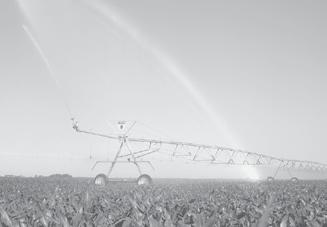
Reinke center pivot sales and field design
Parts



PRIME PASTURE RETREAT: Beautifully situated in the shadow of 66 Mountain near Hawk Springs Reservoir. Features a classic older 1 1/2 story home framed by a beautiful shelter belt. Private yet convenient setting 6 miles north of LaGrange, WY, 73 + total acres. Build your dream home and barns. $300,000.
PREMIER PIVOT AND GRASS PASTURE IN GOSHEN COUNTY, WY: This well designed 368 + acres hay and pasture property features an 86 + acre Reinke center pivot contiguous to native grass pasture with a stock well. The entire property is fully enclosed with perimeter fencing, with the center pivot separately fenced. Pivot is planted to alfalfa. Property can be split. $759,000.
HIGHWAY 92 HIGH PRODUCTION FARM: Prime 200+ acre farm featuring 2 Zimmatic center pivots, excellent soils, 2 older, livable homes and 191 acres of reliable water rights from the Goshen Irrigation District. Unbeatable location along Highway 92, 6 miles south of Torrington, WY, for convenient access. A strong producer and solid investment at $1,250,000. Pictures at www. buyaranch.com. Call Casey Essert, Land Broker, 307-5321750 TFN
Hunting & Fishing
MARCH 29-31 : PETSKA FUR WILL BE BUYING ALL RAW/ DRY FUR DEER/ELK HIDES AND ANTLER, IN THE FOLLOWING TOWNS AND LOCATIONS: MARCH 29 : Ft. Bridger 3:40-4 p.m., Cash Store; Evanston 4:40-5:10 p.m., Jody’s Diner. MARCH 30 : Kemmerer 7-7: 20 a.m., Ham’s Fork Station/Sinclair; Cokeville 8:10-8:30 a.m., Flying J Truck Stop; Afton 9:309:50 a.m., Tractor Supply; Thayne 10:05-10:20 a.m., Farmer’s Feed (drive thru); Etna 10:20-10:30 a.m., Etna Trading Post (drive thru); Alpine 11-11:30 a.m., Grey’s River Saloon; Hoback Jct. 12-12:20 p.m., Hoback Market/Exxon; Bondurant 12:4012:50 p.m., Elkhorn Bar (drive thru, call/text Greg); Bondurant 12:55-1:05 p.m., Post Office (drive thru, call/text Greg); Daniel 1:30-1:45 p.m., The Den (drive thru, call/text Greg); Pinedale 2-2:30 p.m., Gannett Sports; Big Piney 3:15-3:30 p.m., Public RR Visitor Info. lot; La Barge 4-4:15 p.m., All American Fuel (drive thru call/text Greg); Fontenelle 4:30-4:45 p.m., (drive thru, call/text Greg); Green River 5:50-6:10 p.m., (drive thru call/text Greg). MARCH 31 : Rock Springs 7:15-8 a.m., WY Wool Warehouse; Wamsutter 9-9:10 a.m., Wamsutter Conoco (drive thru, call/ text Greg); Rawlins 10-10:20 a.m., Tractor Supply; Saratoga 11:15-11:45 a.m., Saratoga Feed & Grain; Elk Mountain 12-12:45 p.m., Conoco on I-80 (drive thru); Hanna 12:45-1 p.m., Hometown Market (drive thru call/text Greg); Medicine Bow 1:05-1:15 p.m., JB’s (drive thru, call/ text Greg); Rock River 2-2:15 p.m., Rancher’s Supply (drive thru); Laramie 3-3:45 p.m., West Laramie Fly Shop. For more information, call Greg, 308-750-0700 or visit www. petskafur.net 3/21

I’ve been writing a weekly column for 46 years, and people often ask me where I get my ideas. My answer is always the same, “From you.”
I am gifted with the remarkable talent of “directional hearing.” I can be in a crowded convention center with 1,000 people in it and somehow listen to a couple out on the periphery argue about who made a sexier cowboy – Costner or Eastwood. It was definitely Clint by the way.
I’m also a pretty fair lip reader, so no one’s conversation is safe.
Here’s an example.
When I was a road agent, whenever I got stuck in this particular cow town, I’d frequent a restaurant called Dirty Mike’s. After Dirty Mike died, people started calling the place the Burp and Belch, but I think its real name is Heimlich’s. If not, it should be.
The last time I was there, the place was packed with cowboys and roustabouts, but clear across the room, I could hear a hippie couple arguing about which was greener – a Prius or a Tesla.
He was about 65,
nearly bald except for a ponytail of white hair, was wearing a diamond earring in both ears and was dressed in cargo pants, flip flops and a Hawaiian shirt. I figured him for a retired philosophy professor.
His arguing companion was female – I think – who was attired in a tiedye T-shirt, shorts that were stretched to their outer limits and shoes made from plastic. If she didn’t work for the government in some capacity, I’ll eat the paper this is printed on.
I listened to their enviro-twaddle until I couldn’t take it anymore, then I made a few notes on a napkin and gave it to them as I left.
It said:
FYI, I’d like to set you straight on a few things.
I’m sorry they had no vegan fare, but you probably shouldn’t go looking
for it in a restaurant with 12 white pickup trucks parked out front, all with border collies in the back.
Also, there is no “Brussels Sprout Surprise” on the menu, it’s probably just a dried gob of gravy.
Your waiter won’t know if the water is gassed, pre-bubbled or comes in a green bottle all the way from France.
Everything is fried in this joint except the coffee, the ice cream and the pie.
Also, there is no freerange chicken in the chicken fried steak. Come to think of it, there’s no chicken in it at all.
There is too plenty to see in this “hick town,” you just gotta know where to look, and those “weirdlooking” animals you saw on your way into town weren’t some kind of camel, even if they did have a hump in their back.
Those were some of Rodeo Bill’s bucking bulls.
I’m sure Bill wouldn’t mind if you climbed his nine-wire electric fence to go pet the nice bullies.
You won’t find anyone in this municipality who knows the secret to world peace, but they are smart enough to know cows do far more burping than farting, cattle aren’t destroying the ozone and, as a general rule, bovines don’t eat trees.
No, the building where you saw all of those pickups, trailers and big cattle trucks parked is not a slaughterhouse.
It’s the auction barn, and today is sale day.
If you insist on eating vegan around here, your best bet is the sale barn café. If you go, make sure and speak in a real loud voice so all of the ranchers can hear you say you want a Beyond Beef burger.
Please be advised, there’s also no place in town to buy four new tires for your Smart Car to replace the slashed ones. If you couldn’t tell by all of the pumpjacks and drilling rigs, this is fossil fuel country. I hope you’re greenie car is all “gassed” up, because you won’t find a public space to get free juice within 300 miles of here.
I’ve always found the people here to be friendly, but then I don’t have a bumper sticker on my car saying, “Ban Fracking Now” or “Make Our Planet Green Again.” Finally, cows don’t live in feedlots. In fact, most cows have never stepped foot in one. It might surprise you to learn we’re vegetarians too, only we’re the second-hand kind – cows eat the grass and we eat the cows.
The Sublette Antelope Migration Corridor Local Working Group is scheduled to hold its second meeting in Pinedale on March 23 from 8 a.m. to 4 p.m. The meeting will take place in the BOCES Board Room in Pinedale and will also be available via livestream to allow for broader public participation.
The local working group was convened under Gov. Mark Gordon’s Executive Order 2020-1 to make recommendations concerning the potential designation of the Sublette Antelope Migration Corridor and to ensure the balance of wildlife conservation with the realities of Wyoming’s multiple-use landscape. “This process is about hear-
ing from the people who live and work on this landscape,” Gordon said. “Wyoming has long demonstrated we can protect our wildlife while supporting the livelihoods and industries that sustain our communities. The goal of this working group is to make sure any path forward reflects this balanced approach.” In the second meeting, the
local working group is tasked with evaluating how potential corridor designation would align with existing management plans and land uses, identifying areas of compatibility or conflict and beginning discussions on possible recommendations which will then be presented to the governor for determinations on designation.
The meeting will also include opportunities for public comment in both the morning and afternoon sessions, and a third meeting will take place in Rock Springs on April 3. For more information about the working group and future meetings, visit sites.google.com/ view/wywildlifemigrationadvisorygrp/sublette-antelope
which was announced in a March 9 press release one week before the strike began.
UFCW Local 7’s member-led bargaining committee claims to have met with JBS officials more than two dozen times and failed to reach a mutually agreeable contract, leading to an alleged 99 percent of workers authorizing the ULP strike.
Union representatives say the dispute centers on issues regarding wages, rising healthcare expenses and increased prices of necessary protective gear required for job safety.
“JBS workers deserve wage increases that keep pace with inflation, support their health, protect their retirement and allow workers to work with dignity and respect,” write union representatives in a March 9 press release.
Instead, the union alleges JBS has been “charging many workers $1,100 or more in order to offset the company’s expenses for life-saving equipment needed to ensure worker safety” while proposing insufficient wage increases and upping the cost of healthcare premiums.
“The goal of negotiations is never to go on strike,” Cordova adds in the press release. “But when the company violates workers’ rights and ignores workers’ concerns about safety and health, the company gives workers no choice but to stand together in solidarity and show the company they cannot be silenced.”
JBS responds
A March 9 CBS Colorado article details the response from JBS officials following the strike announcement.
According to the article, the company disputes the workers’ allegations and stands firmly by a presented contract offer which JBS Spokesperson Nikki Richardson calls “strong, fair and consistent with the historic national contract reached in partnership with UFCW International” in 2025.
Richardson adds this agreement “has already deliv-
ered higher wages, a secure pension and long-term financial stability for team members at other major facilities.”
In a March 7 letter to the union, JBS USA’s Head of Labor Relations, Environmental Health and Safety and Security Matthew Lovell says JBS has made “meaningful movement on significant economic and non-economic issues” throughout the contract negotiation process.
“It is the union, not the company, who abruptly walked away from the negotiation table without providing any response to our updated offer, offering no further conversation or attempting to reach a deal,” Lovell continues.
The article also notes JBS plans to move production to other facilities during the strike to minimize impact to customers, partners and the broader marketplace.
Market impact
JBS is the largest meatpacking entity in the world, employing more than 270,000 workers worldwide and spending roughly $3.1 billion on livestock every year.
The Swift Beef Company plant boasts one of JBS’s biggest employee bases, and the strike has led to some concerns and uncertainty regarding cattle markets while the dispute remains ongoing.
Cash cattle prices weakened as packers slowed slaughter schedules in the days following the announcement of the strike, with southern live cattle trading roughly four dollars lower and northern dressed cattle falling by about three dollars, according to a March 9 Rural Radio Network Midday Market Report by Alex Makovicka.
However, a March 16 Drovers article published after the strike began notes cattle markets were not heavily impacted, with live and feeder cattle futures actually opening higher on the morning of March 16.
Industry experts quoted in the Drovers article say slaughter capacity should not suffer too much as the strike continues.
The University of Nebraska-Lincoln’s (UNL) Agronomy and Horticulture Department is offering several scholarships for students pursuing studies in agriculture, crop or plant sciences.
The Nebraska Seed Trade Association (NSTA) Freshman Scholarship offers $1,000 for incoming UNL students planning studies in agriculture, crop or plant sciences. Candidates must possess a strong interest in the area of seed industry, crop production, seed technology or plant breeding and major in a degree program offered by the Department of Agronomy and Horticulture, College of Agricultural Sciences and Natural Resources (CASNR) or the Institute of Agriculture and Natural Resources (IANR) at UNL. The deadline to apply is April 1.
The NSTA Upperclassman Scholarship offers $1,000 for sophomores and above pursuing agriculture, crop or plant science studies. Students must have sophomore class standing or above at the UNL and be pursuing any degree program in the Department of Agronomy and Horticulture, CASNR or IANR. The deadline to apply is April 1. For more information or to apply, visit necrop.org/ resources/scholarships/?utm_source=chatgpt.com or neseedtrade.org/scholarships?utm_source=chatgpt.com
“With the limited cattle supply we’re dealing with, we still have excess slaughter capacity,” says Don Close, senior animal protein ana lyst at Terrain Ag. “It’s going to give way more leverage to the packers, but it will help them shore up their negative margins.”
“Any disruption in
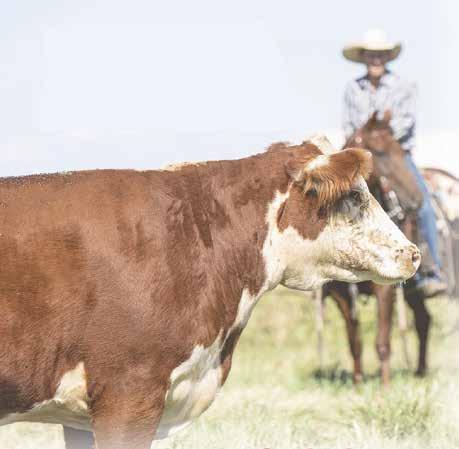






The Angus Foundation will host the 25th Annual Angus Foundation Golf Tournament in Louisville, Ky. on July 13. Held in conjunction with the 2026 National Junior Angus Show, the tournament promises a day of friendly competition and fun while supporting the foundation’s mission to advance education, youth and research.
“Celebrating 25 years of this tournament is something special,” said Jimmy Stickley, Angus Foundation donor coordinator. “The enthusiasm of our sponsors
and participants continues to propel the Angus Foundation forward. We’re excited for a great day on the course and for the impact this event creates.”
Sponsorship options are available for state and regional Angus associations, individuals, businesses, farms
and ranches with promotional opportunities available at seven sponsorship levels including beverage cart, tournament prizes, clubhouse, hole-in-one, tee box, hole and flag.
Sponsors will be recognized in the tournament program, luncheon, post-event
news release, Angus Journal and on the Angus Foundation website, and the sponsorship deadline is May 1.
Player registration is open through June 20. Registration is $125 and players receive 18 holes of golf, a golf cart rental, a continental breakfast and a Certified
Angus Beef brand lunch. Mulligans will be available at the course for $20 with a limit of one per player. For player registration, sponsorship opportunities or more information about the golf tournament, visit angus.org/foundation or call 816-383-5100.
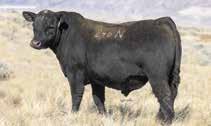
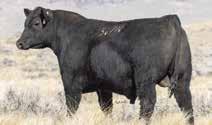
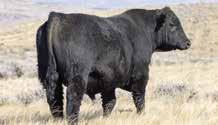
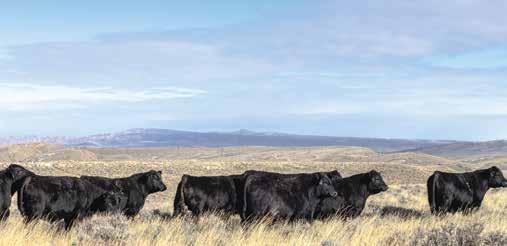


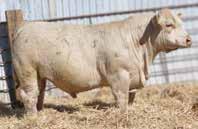
Building a business Roots in the cattle industry run deep for both the Schroeders, who have been around Black Angus cattle all of their lives.
Jason grew up showing Angus cattle, and Jess spent her childhood helping run her family’s commercial operation.
The couple purchased their farm from Jason’s grandfather in 2013 and began building up their cow herd with the original intent of raising show cattle.
Two years after purchasing the farm, however, the Schroeders decided to pivot away from show cattle and take a leap of faith by diving into the seedstock industry full time.
In the beginning, Jason says striking a balance between desired phenotypes and proven performance was a trial-and-error process which took a bit of time to figure out.
“When we went into the seedstock world, we focused heavily on genetics,” Jason says. “We wanted to make the cattle look how we wanted them to through genetics – we always knew where we wanted to go, but we found out we couldn’t do it all at once.”
Today, 7 Oaks Angus continues to hone their genetics to produce exceptional purebred and commercial cattle known for functionality and fertility in bulls and heifers alike.
Functionality and fertility
On the female side, Jason highlights the longevity and mothering ability of Angus cattle as two exceptional traits which set the breed apart.
Females are held to high standards at 7 Oaks Angus. Jason notes good feet, good udders and docility are top priorities.
Fertility is also of utmost importance, and Jason explains mother cows must breed back within a 62-day window to remain in the herd.
“Fertility is huge for
our cattle,” Jason says. “We don’t want something hanging around just because she’s special genetically. If a cow doesn’t do her job, she can’t stay.”
“The mama cow is what runs the breed and what got us to where we are,” he adds.
Strong sires
In addition to raising fertile and functional females, 7 Oaks Angus has produced several top-performing sires renowned for their carcass quality and efficiency.
Jason notes 7 Oaks Angus first got involved with MBT in 2023 through a partnership with Eagle Grip Cattle Company of Denair, Calif.
“Our family decided to venture into MBT because there are a lot of great commercial cattlemen everywhere in the country and it’s a great place for us to send our bulls,” Jason says.
This year, 7 Oaks Angus sent 15 bulls to MBT and several saw success across various categories.
Specifically, bulls consigned by 7 Oaks Angus came out on top as the Angus Champion Pen of Three, with lots 63, 64 and 65 recording an MBT Index of 115 for their exceptional performance across average daily gain, nursing ratio, yearling ratio and efficiency ratio.
Additionally, 7 Oaks Angus consigned the 2026 MBT Champion Weight per Day of Age (WDA) Bull – lot 63, sired by Virginia Tech Statesman – which recorded the winning WDA value of 4.22.
Future plans
As 7 Oaks Angus continues to grow, Jason says creating an opportunity for the couple’s four children – Peyton, Lane, Shealynn and Tuff – to carry on the business if they choose is a priority.
He emphasizes both he and Jess are working to ensure continuing 7 Oaks Angus for another generation is an option rather than an expectation, encouraging their children to pursue
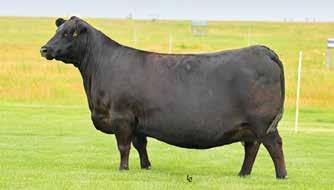
other passions in addition to helping out on the ranch.
Still, he adds each of the kids spend a lot of time doing things to help 7 Oaks Angus be successful from sorting cattle and loading trucks to
helping out at MBT. Jason says he looks forward to continuing to develop quality genetics and build relationships with other seedstock producers while serving a vast range







of customers throughout the cattle industry. Bulls consigned by 7 Oaks Angus are scheduled to sell at the 2026 MBT Final Sort Sale on April 3, and the Schroeders offer pri-





vate treaty sales throughout the year. Grace Skavdahl is the editor of the Wyoming Livestock Roundup. Send comments on this article to roundup@wylr.net.








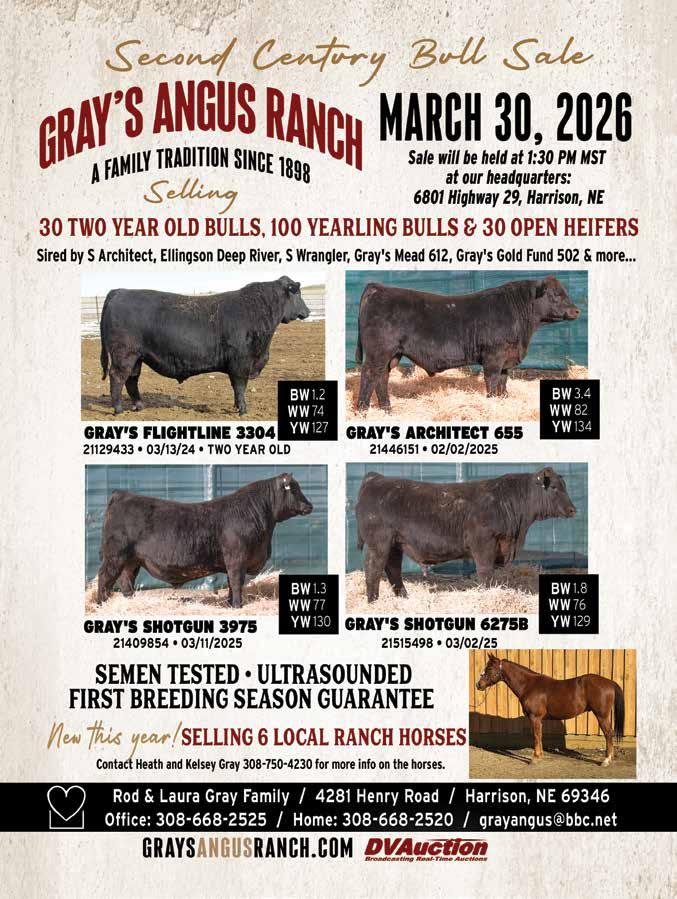
U.S. pork exports trended higher year-overyear in January, led by another outstanding performance from leading market Mexico, according to data released by the U.S. Department of Agriculture and compiled by the U.S. Meat Export Federation (USMEF).
January beef exports were lower than a year ago due to the prolonged lockout in China, but export value per head of fed slaughter was more than $415 – the highest since March – and reflects solid demand in other markets.
Beef variety meats were a major bright spot, with export value topping
the previous monthly high reached in December.
Broad-based growth for January pork exports
January pork exports totaled 250,861 metric tons (mt), up three percent from a year ago, while value increased four percent to $692.1 million.
In addition to Mexico, exports were larger yearover-year to Japan, South Korea, Canada, Central America, Colombia, the Dominican Republic, the Association of Southeast Asian Nations (ASEAN) and Taiwan.
“Very impressive start to the year for U.S. pork in Mexico and other Western Hemisphere markets,
but strengthening demand in Asian destinations is especially encouraging,” said USMEF President and Chief Executive Officer Dan Halstrom. “The U.S. industry continues to capitalize on consumers’ growing demand for convenience-oriented products at both retail and foodservice, and this is reflected in our recent export results.”
Beef variety meats shine in January
Beef exports totaled 92,558 mt in January, down 10 percent yearover-year, but value fell just three percent to $780.1 million, as exports have commanded higher prices.
However, prices are
still not being maximized to the degree which would be possible with China back in the mix.
When excluding China from the January results, exports increased five percent in volume and climbed 16 percent in value.
January beef shipments trended higher year-overyear to Korea, Japan, Taiwan, the Caribbean, the ASEAN and South America, with export value also increasing to Mexico, Canada and Central America.
Beef variety meat exports were especially strong in January, increasing six percent from a year ago to 27,511 mt – the largest in more than four years
– while value soared 46 percent to a record $126 million.
“Beef variety meat value reaching new heights for the second consecutive month is great news for cattle producers and for the entire supply chain,” Halstrom said. “With cattle numbers being tight, it is more critical than ever to maximize the value of every animal, and while much of this export growth was driven by tongues and skirts going to Japan, demand was strong in a wide range of markets.”
January lamb exports down slightly Coming off a robust performance in 2025, Jan-
uary exports of U.S. lamb muscle cuts totaled 238 mt, down seven percent from a year ago, while value fell one percent to $1.44 million.
Exports increased yearover-year to the Bahamas, Japan, Taiwan, Costa Rica and Panama, but shipments to Mexico trended lower and no exports were reported to Canada.
USMEF collects and analyzes market intelligence, implements promotional programs and collaborates with industry stakeholders and governmental agencies to increase U.S. red meat exports. For more information, visit usmef.org
TUESDAY, MARCH 24
Hellyer Ranch- 13 Blk Ang Bred Heifers. Bred to LBW Popo Agie Black Angus bulls to calve May-June. Received Triangle 5 fall of 2025 and Virashield VL5 and Vision 7 this spring & 2 rounds of Guardian. Fancy, one iron Cows!! All Cows have Popo Agie Genetics!!
BRED COWS
Hellyer Ranch- 28 Blk Ang Bred Cows. (10- 3&4 Yr old Breds,7- 5&6 Yr old Breds, 7- 7&8 Yr old Breds, 4- 9+ yr old Breds) Bred to Black Angus Popo Agie bulls to calve May-June. Rec Triangle 5 fall of 2025 and Virashield VL5 and Vision 7 this spring. Fancy, one iron Cows!! All Cows have Popo Agie Genetics!!
Jeremy & Terri Castle- 44 Corriente 2&3 Yr old Cows. Exposed to a Black Corriente bull to calve April/May. 3 Blk Ang Bred Cows. Bred to a Black Angus bull to calve April/May.
BULLS
1 Heiferette, 1120# $227.50 COWS

Northwest Angus Association- Black Angus Yearling & 18 Month Old Bulls From: Obsidian Angus, Hoggs Angus, Lazy BV Cattle, JOH Ranch & WYO Angus. Bulls will be BVD, Semen & PAP tested. (1:00 PM) Representing 27 herd sires. Contact Fred Thomas 307-868-2595 or any Breeder to request a catalog or more information fkdramsrus@ gmx.com.
CALVES
Glenn Millard- 80 Blk Ang/AngX Bulls & Hfrs 400600#. Hay fed , High Elevation, Green!!
TUESDAY, MARCH 31
& HORSES
TUESDAY, APRIL 14