Volume 38 Number 13 • July 18, 2026
®
The Weekly News Source for Ranchers, Farmers and AgriBusiness Community • www.wylr.net
A Look Inside Nitrate testing is critical during drought years.................. Page 6 Test your ag knowledge in this month’s crossword puzzle.......... ...................................... Page 14 Mental health resources for Wyo ag producers highlighted by UW Extension................ Page 15 Legislation introduced on ag tariff-rate quotas............ Page 15
USDA launches program to boost independent beef processors On June 30, U.S. Secretary of Agriculture Brooke Rollins announced the Strengthening Processing for U.S. Ranchers (SPUR) Program, a temporary $500 million assistance program aimed at supporting eligible small and
mid-sized processing facilities. The program comes in the midst of historically low cattle numbers and is designed to help preserve independent processing capacity. “America’s ranchers deserve a
strong, competitive marketplace that rewards their hard work and preserves opportunity for generations to come,” says Rollins in the corresponding press release. “Today, historically tight cattle
Please see USDA on page 8
Wyoming Pioneer Association photos
NHSFR Qualifiers
Quick Bits
Wyoming athletes gear up for National High School Finals Rodeo
EO Reissued On July 8, Gov. Mark Gordon reissued the Wyoming Mule Deer and Antelope Executive Order (EO) 2020-1, pursuant to Section 14, to include the Sublette Antelope Migration Corridor. All previous versions of the EO should be replaced. The reissued EO is available at governor.wyo.gov/state-government/executive-orders.
Workshops The Wyoming Stock Growers Association (WSGA) will host five ranch succession workshops featuring University of Missouri Farm and Ranch Transition Specialist Wesley Tucker on July 30 in Evanston, July 31 in Afton, Aug. 1 in Kemmerer, Aug. 3 in Pinedale and Aug. 4 in Rock Springs. The sessions are free to the public, and refreshments will be provided. For more information, contact the WSGA office at info@wysga. org or 307-637-3942.
U.S. Drought For the contiguous 48 states, the U.S. Drought Monitor (USDM) showed 46.47% of the area in moderate drought or worse as of July 16, compared with 47.20% during the second week of July. As of July 16, about 116 million people live in areas now in drought, compared with 122.4 million the week before.
USDA Aid U.S. Secretary of Agriculture Brooke Rollins announced the U.S. Department of Agriculture (USDA) is making significant improvements to its disaster assistance and commodity loan programs, as outlined in the Working Families Tax Cuts Act, to celebrate the one-year anniversary of President Donald Trump signing the act into law on July 4, 2025. As part of the commitment to put farmers first, USDA’s Farm Service Agency is strengthening disaster assistance support for livestock producers, orchardists and nursery tree growers; increasing Marketing Assistance Loan rates and expanding Marketing Assistance Loans to better help cotton and sugar producers. For more information, visit fsa. usda.gov/.
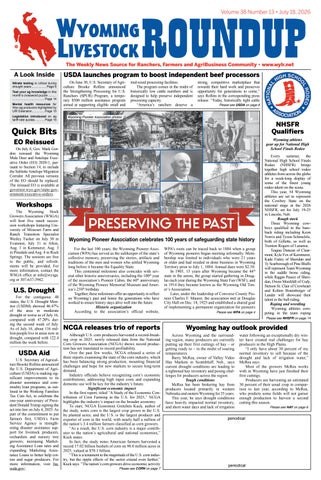
Wyoming Pioneer Association celebrates 100 years of safeguarding state history For the last 100 years, the Wyoming Pioneer Association (WPA) has served as the safekeeper of the state’s collective memory, preserving the stories, artifacts and traditions of the men and women who settled Wyoming long before it became the Equality State. This centennial milestone also coincides with several other historic anniversaries, including the 100th year of the association’s Pioneer Cabin, the 60th anniversary of the Wyoming Pioneer Memorial Museum and America’s 250th birthday. Together, these milestones offer an opportunity to reflect on Wyoming’s past and honor the generations who have worked to ensure history stays alive well into the future. Historic organization According to the association’s official website,
WPA’s roots can be traced back to 1884 when a group of Wyoming pioneers began meeting informally. Membership was limited to individuals who were 21 years or older and had resided or done business in Wyoming Territory prior to July 1, 1884. Annual dues were $2.50. In 1905, 15 years after Wyoming became the 44th state in the union, the group started gathering in Douglas each year during the Wyoming State Fair (WSF), and in 1914 they became known as the Wyoming Old Timer’s Association. Later, under the leadership of Converse County Pioneer Charles F. Maurer, the association met at Douglas City Hall on Dec. 18, 1925 and established a shared goal of implementing a permanent organization for pioneers Please see WPA on page 4
Every summer, the National High School Finals Rodeo (NHSFR) brings together high school rodeo athletes from across the globe for a week-long display of some of the finest young rodeo talent on the scene. This year, 54 Wyoming athletes are set to represent the Cowboy State on the national stage at the 2026 NHSFR, set for July 19-25 in Lincoln, Neb. Rough stock Three Wyoming cowboys qualified in the bareback riding including Keon Norris and Tyson Schmelzle, both of Gillette, as well as Trenton Rogers of Laramie. Teague Duncan of Clearmont, Kyle Fox of Kemmerer, Kade Fraley of Sheridan and Ty Scarborough of Pine Bluffs will represent Team Wyoming in the saddle bronc riding, while Riggin Pearce of Sheridan, Owen Monfeldt of Cody, Stetson St. Clair of Crowheart and Kolton Bonenberger of Lander will showcase their talent in the bull riding. Roping and wrestling Wyoming athletes competing in the team roping Please see NHSFR on page 14
NCGA releases trio of reports Although U.S. corn producers harvested a record-breaking crop in 2025, newly released data from the National Corn Growers Association (NCGA) shows record production has not translated to record profitability. Over the past few weeks, NCGA released a series of three reports examining the state of the corn industry, which has been balancing strong production, mounting financial challenges and hope for new markets to secure long-term demand. Industry officials believe recognizing corn’s economic contributions, addressing high input costs and expanding domestic use will be key for the industry’s future. Significant economic impact In the first report, titled “A Study of the Economic Contribution of Corn Farming in the U.S. for 2025,” NCGA highlights the industry’s impact on the broader economy. To start, NCGA Economist Gretchen Kuck, author of the study, notes corn is the largest crop grown in the U.S. by planted acres, and the U.S. is the largest producer and exporter of corn in the world, with nearly half a million of the nation’s 3.4 million farmers classified as corn growers. “As a result, the U.S. corn industry is a major contributor to the nation’s agricultural and national economies,” Kuck states. In fact, the study notes American farmers harvested a record 17.02 billion bushels of corn on 98.8 million acres in 2025, valued at $70.1 billion. “This is a testament to the magnitude of the U.S. corn industry, but the ripple effects of the sector extend even further,” Kuck says. “The nation’s corn growers drive economic activity Please see CORN on page 7
Wyoming hay outlook provided Across Wyoming and the surrounding region, many producers are currently putting up their first cuttings of hay – or getting ready to – in the midst of soaring temperatures. Barry McRea, owner of Valley Video Hay Markets in Scottsbluff, Neb., says current drought conditions are leading to a tightened hay inventory and posing challenges for producers across the region. Tough conditions McRea has been brokering hay from producers located primarily in western Nebraska and eastern Wyoming for 25 years. This year, he says drought conditions have heavily impacted normal inventory, and short water days and lack of irrigation
water following an exceptionally dry winter have created real challenges for hay producers in the High Plains. “I only have about 30 percent of my normal inventory to sell because of the drought and lack of irrigation water,” McRea says. Most of the growers McRea works with in Wyoming have just finished their first cuttings. Producers are harvesting an estimated 30 percent of their usual crop in comparison to last year, according to McRea, who predicts some fields will not garner enough production to harvest a second cutting this season.
periodical
periodical
Please see HAY on page 6
2
Wyoming Livestock Roundup • Volume 38 No. 13 • July 18, 2026
Consumers Are More Selective When Buying Protein In its latest quarterly outlook, CoBank notes, “Consumers continue to pay premium prices for beef despite historically tight cattle supplies and elevated retail prices. At the same time, lowercost protein alternatives such as pork and chicken have not absorbed as much From the Publisher demand as market fundamentals would Dennis Sun suggest.” The report says, “This disconnect highlights the importance of factors beyond price, including taste preferences, perceived quality, convenience, meal habits and foodservice menu offerings. While pork, chicken and eggs often provide a lower cost per gram of protein, consumers have shown a willingness to continue purchasing beef even as prices remain elevated.” CoBank continues, “Animal protein markets are becoming increasingly out of sync with changing consumer purchasing behavior. Supply responses vary significantly by species, creating different market conditions for beef, pork and poultry producers.” The report suggests protein purchasing decisions are influenced by a combination of economic and lifestyle factors rather than price alone. This is good news for ranchers raising cattle in the short term, but long term it may be a hindrance. There is a monster out there called a drought which is affecting over 54 percent of the nation’s cattle herds. Since about May, ranchers in drought-stricken areas have been selling their cattle as they have no forage or water. Under income tax laws, if they buy back cattle in a certain time period, they won’t have to pay taxes on the income received for those cattle. If cattle keep going up in price, it is going to be hard to restock cattle herds, as producers could be buying them for a higher price. We all know it is going to take more cattle numbers for beef products to lower in price. For years now, cattle producers have been using better genetics to provide consumers a more tasteful and tender Prime cut of meat, and it is working. They are selling high Choice or Prime cuts of meat to individuals who want to lose weight, eat more protein and recognize the health benefits of beef. An issue – which is good for both beef producers and consumers – is the U.S. Department of Agriculture (USDA) announcing a voluntary “Product of USA” label to identify products including beef which are truly born, raised, harvested and processed in the U.S. Some cattle producers wanted a mandatory U.S. label, but nobody could decide who was going to foot the cost of having it. So far, the voluntary label is working, and USDA has announced 10 additional meat and poultry companies are planning to use it. Also, food companies are changing the way they are measuring their perceived food safety success by simply demonstrating compliance with rules and regulations. Now most food companies are not only being inspected to ensure their food safety, but they are being challenged to prove their food safety compliance to the USDA. The USDA is also providing dollars to help fund small to mid-size meat processing facilities. We all like to eat, but it is more enjoyable if we trust our food is safe, nutritious and healthy.
Wyoming Livestock Roundup Reporting the News by the Code of the West
Wyoming Livestock Roundup (USPS # 005-774) is published weekly by Maverick Press, Inc. P.O. Box 850 • Casper, WY 82602 Periodicals postage paid in Casper, WY Fax: 307-472-1781 • E-mail: roundup@wylr.net
Phone: 307-234-2700 800-967-1647 • www.wylr.net
DENNIS SUN, Publisher • Cell: 307-262-6132 e-mail: dennis@wylr.net HANNAH BUGAS, Managing Editor • hannah@wylr.net GRACE SKAVDAHL, Editor • grace@wylr.net CANDICE PEDERSON, Production Coordinator • candice@wylr.net JODY MICHELENA, Advertising Director • jodym@wylr.net DENISE OLSON, Classified Sales Manager • 307-685-8213 • denise@wylr.net ANDREA ZINK, General Manager • andrea@wylr.net CURT COX, Director of Livestock Field Services • 307-630-4604 • curt@wylr.net CALLI WILLIAMS, Livestock Field Services Rep. • 605-695-1990 • calli@wylr.net
Subscription Rates: 1 year: $60; 2 years: $90; 3 years: $130 Postmaster: Send address changes to: andrea@wylr.net Wyoming Livestock Roundup • P.O. Box 850 • Casper, WY 82602 Member: Wyoming Stock Growers Association Wyoming Wool Growers Association Wyoming Farm Bureau Federation • Wyoming CattleWomen Livestock Publications Council • National Cattlemen’s Beef Association Fremont County Cattlemen's Association Green River Valley Cattlemen's Association Wyoming Angus Association Converse County Stock Growers Association Carbon County Stock Growers Association
This publication is © 2026 by Maverick Press, Inc.
GUEST OPINIONS From Research Labs to Ranch Gates: Wyoming FFA and the Next Generation of Agriculture By Teresa Milner When many people picture agriculture, they imagine tractors in a field or cattle grazing behind a fence. These images still exist across Wyoming’s landscape, but they only tell part of the story. Today’s agriculture blends tradition with science, technology, business management and research in ways many people never see. Across Wyoming, thousands of students are learning what modern agriculture really looks like through agricultural education programs and the Wyoming FFA Association. FFA members don’t just study agriculture in the classroom – they apply it through hands-on projects known as Supervised Agricultural Experi-
ences (SAE). These projects place students in real-world situations where they must manage livestock, conduct research, operate businesses and solve practical problems. For Hannah Lupher of the Jim Bridger FFA Chapter, this work often begins before sunrise on her family’s ranch near Mountain View. Lupher relies on teams of draft horses to feed cattle and move livestock during the winter, but her responsibilities extend far beyond tradition. She also manages irrigation systems, monitors soil fertility and works with advanced breeding programs within the ranch’s cattle operation. In Worland, Molly Glanz of the Chief Washakie FFA Chapter has
turned a summer chore into a growing agribusiness through her entrepreneurship project, Molly’s LawnCare. What began as simply mowing lawns has developed into a turf management operation where Glanz conducts market analysis, sets competitive pricing and maintains her own equipment while applying technical knowledge of turf science to improve the quality of the lawns she services. Agriculture also reaches into Wyoming’s wildlife and outdoor industries. Sam Bowen of the Upton FFA Chapter has developed an SAE working as an intern guide with 7J Outfitters in Sundance. Through this placement, Bowen Please see FFA on page 4
Wyoming Livestock Roundup • Volume 38 No. 13 • July 18, 2026
3
NEWS BRIEFS Investigation recommended The American Sheep Industry Association (ASI) is celebrating news the U.S. Trade Representative (USTR) officially recommended the U.S. International Trade Commission (ITC) launch a formal safeguard investigation into lamb meat imports. The recommendation is based on the petition ASI filed in October 2025 on behalf of 42 state associations and more than 100,000 U.S. sheep farms and ranches. USTR’s decision draws directly on the market data, import trend analysis and documented financial injury ASI submitted as part of the petition. The case ASI assembled is grounded in data. U.S. lamb imports grew from 213.6 million pounds in 2020 to 309.3 million pounds in 2024, a nearly 45 percent increase. By 2024, imports captured roughly 70 percent of the domestic market. Imported lamb was sold at prices averaging 10.8 percent below domestic product, with some pricing gaps approaching 19.5 percent. These disparities have displaced U.S. production, eroded profitability and put American sheep operations at serious risk. ASI developed the petition with legal counsel Kelley Drye and Warren LLP and economists at Georgetown Economic Services LLC. The resulting public and confidential reports gave USTR a comprehensive record of the injury domestic producers have sustained. The ITC investigation will begin immediately. The commission will collect testimony and data from all interested parties, hold a public hearing and make its own determination on whether lamb imports have caused serious injury to U.S. producers. Under the statutory timeline, the determination typically comes within 120 days. ASI says it will be present and active throughout the process by submitting documentation, providing testimony and making sure domestic producers have a strong voice in the process.
Grazing updates proposed The Bureau of Land Management (BLM) has proposed updates to their federal lands grazing regulations for the first time in more than 20 years. The proposed regulations make updates to ensure the agency incorporates the best available science and monitoring, improves the ability to use grazing as a land management tool and a key forage source for food and fiber production and protects ranchers’ access to federal lands. One key point in the proposed regulations includes improving landscape analyses to conduct a “step-down process” where the agency would conduct assessments of overall land health and identify causal factors for any disturbance or impacts found. This causal factor analysis will inform the agency which use is causing the condition on the landscape and authorizes the agency to adjust this use, rather than always defaulting to adjusting grazing, which addresses the longstanding burden grazing permittees have borne on behalf of other uses. Other key points include applying greater flexibility to administration of all permits by giving an additional 21-day window on permits to be responsive to range conditions; requiring grazing permittees to be engaged in a production-oriented business, eliminating abuse from groups who never had any intention to graze the allotment; protecting permittees who may want to take temporary non-use for personal or business reasons; improving the billing process to save both BLM staff time and reduce burdens on permittees and suggesting changes to the appeals process to protect permittees’ ability to contest bad decisions.
USDA launches new tool The U.S. Department of Agriculture (USDA) is putting farmers first by offering them a new option to schedule appointments online with their local Farm Service Agency (FSA) office. Following a successful pilot program, FSA is now using a digital appointment platform across the agency to allow producers to make farm program or farm loan appointments online at their convenience. Producers can schedule appointments through FSA’s digital platform, Microsoft Bookings, using a mobile device, tablet, laptop or desktop computer. To assist producers in finding their local FSA office to make an appointment, FSA has also launched a new FSA County Office locator which is searchable by state and by county. Each county office contact page has a unique link for producers to make an appointment online and shows contact information for the local FSA office and the farm loan team. Appointments may be held in person or online with the local FSA office depending on producer preference. For more information or to book an appointment, visit fsa.usda.gov/development/microsoft-bookings-calendar.
USDA awards grants Settlement reached
John Deere reached a right-to-repair settlement with the Federal Trade Commission (FTC) and five states requiring the company to make repair resources available to independent repair shops nationwide, according to an FTC order filed in a federal court on July 8, putting in place a permanent injunction requiring the company to open its repair ecosystem. The lawsuit, originally filed in the U.S. District Court for the Northern District of Illinois in January 2025, sought to stop what the FTC said was “anticompetitive conduct” on the part of John Deere. The states of Illinois, Arizona, Minnesota, Michigan and Wisconsin joined the lawsuit. The FTC order defines repair resources to include John Deere’s Operations Center PRO Service. John Deere is required to “make available to every owner and independent repair shop on fair and reasonable terms, on a license, subscription or purchase basis, repair resources equivalent to those John Deere then makes available to John Deere dealers,” according to the FTC order, contingent on when access is granted at more than 50 percent of John Deere dealer locations. “Defendant neither admits nor denies any of the allegations in the complaint,” reads the FTC order. “For purposes of this action only, defendant admits the facts necessary to establish jurisdiction.” Among the tools to come, the company will be required to make available the full suite of product improvement programs (PIP) by Dec. 31. This is important because the settlement covers both the mandatory PIPs, as well as the “fix as fail” category John Deere previously kept more restricted, according to the settlement. PIP information has largely been available only through John Deere dealers, but the settlement requires anyone who is doing their own repairs to have full PIP access. John Deere is required to make most of the repair resources available immediately. Others will have deadlines later, including Dec. 31, to deliver the health insights, digital technology assessment criteria solutions, fluid sampling and offline mode capabilities. The FTC order sunsets in 10 years, ending John Deere’s obligations. There will be a four-year window after the deal expires for plaintiffs to sue if they discover violations occurred before the order ends.
On July 7, U.S. Department of Agriculture (USDA) Secretary Brooke Rollins announced the second cohort of Fiscal Year (FY) 2026 Patrick Leahy Farm to School Grants, completing the largest ever single-year financial investment in the history of the grant program. This year, USDA awarded a total of nearly $20 million to 68 projects to empower more American farmers, producers, ranchers and fishermen to serve their local foods in school meals, summer meals and childcare settings. The Patrick Leahy Farm to School Grant Program increases the availability of local foods in child nutrition programs and connects children to the sources of their food through local procurement, education, taste tests, school gardens and field trips. USDA announced the first cohort of FY26 grantees in April. For more information or a complete list of project descriptions for all of this year’s grantees, visit fna.usda.gov/f2s/farmto-school.
NGLC program launched Recent wildfires across Nebraska have left many ranchers facing difficult questions about forage recovery, grazing management, infrastructure repairs and what comes next. To help navigate these decisions, the Nebraska Grazing Lands Coalition (NGLC) is launching a new Post-Wildfire Stewardship Resilience program, offering free, one-on-one consultations to Nebraska ranchers affected by wildfire in 2026. The program connects ranchers with an experienced range management professional who will visit the operation, walk the pastures, discuss recovery goals and concerns and help evaluate practical options to move forward. Support may include conversations around grazing rest and recovery timing, forage availability and stocking decisions, infrastructure repair priorities, monitoring approaches to track recovery and strategies to strengthen long-term ranch resilience. Each participating ranch will receive an on-site consultation, practical recommendations tailored to their operation and follow-up support as recovery progresses. The pilot is open to any Nebraska rancher affected by wildfire in 2026. Because this is a pilot program, space is limited. If demand exceeds availability, preference will be given to young and beginning ranchers. Participation is free of charge. For more information or to sign up for the program, visit nebraskagrazinglands.org/ or contact Executive Director Laura Nelson at laura@nebraskagrazinglands. org or 308-235-8420.
Best Buys in Used Equipment TRACTORS/LOADERS
HAYING & FORAGE (cont’d)
Case IH MXM190, MFD, cab & air, front weights, low hrs,1 owner .......$95,000 Case IH MX170, MFD w/ ldr, grpl ......................................................$89,500 Case IH MX240, 4 WD w/ duals .......................................................$89,000 Case IH 7140, 4 WD..........................................................................$34,500 Case IH Tractor ................................................................................. $7,500 Massey Ferguson 4243 w/ ldr, 1840 hrs............................................$39,500 JD 420 Dozer, antique ....................................................................... $7,500 2007 Case Super M Extendahoe, 4 WD, Backhoe, 2,600 hrs ..........$59,500 Kobelco Trackhoe ..............................................................................$49,500 Ford 4000 Tractor .............................................................................. $7,900 Ford 800 Tractor w/ ldr ...................................................................... $2,900 8N Tractor w/ blade ........................................................................... $2,900
Hesston 4910 Baler w/ accumulator .................................................$24,500 Hesston 4900 4x4 Baler w/ accumulator ..........................................$24,500 Case RS 561 Round Baler ...............................................................$19,500 Case IH 8555 Small Baler ................................................................$17,500 Case IH 561 Mesh Wrap Baler .........................................................$14,900 Case IH 8840 Swather, 16’ head ......................................................$32,500 Hesston 8450 Swather, 16’ head..................................................... $29,500 Hesston 8400 Swather .....................................................................$32,500 Vermeer Rake R2300 .......................................................................$29,500 Krone Swadro PC880 Rake .............................................................$14,900 Case IH 96 Side Delivery Rake ..........................................................$2,900 Skid Steer Mount, 15 pack Bale Grabber ...........................................$3,900 10 pack Bale Grabber.........................................................................$1,950 New Holland 1037 Bale Wagon ..........................................................$7,900 Hesston 1170 Hydroswing, 16’ head ................................................$12,900
HAYING & FORAGE Hesston 4910 Baler w/ accumulator .................................................$39,500
MISCELLANEOUS EQUIPMENT Lakeland Wagon Portable Bunk Feeder, 6’ x 24’................................$7,500 1502 Tub Mixer .................................................................................$19,500 NDE Feeder 2654.............................................................................$29,500 1994 Kenworth w/ Knight 3070 Feed Box ........................................$79,000 Peecon Feeder/Mixer Wagon .......................................................... $29,500 Case IH 5-Bottom In Furrow Plow ......................................................$9,500 Case IH 140 4-Bottom In Furrow Plow ...............................................$3,950 Case IH 155 4-Bottom On Land Plow ................................................$3,950 Kewnanee 15’ Roller Harrow ..............................................................$2,950 Brillion 30’ Roller Harrow ..................................................................$54,000 Leon 808 Loader, bucket & grpl..........................................................$7,900 Dual Loader ........................................................................................$1,950 14’ Chisel Plow ...................................................................................$3,900 MF 5 Bottom Plow ..............................................................................$3,200 Case IH 365 Vibrashank.....................................................................$7,950 International 21’ Vibrashank ...............................................................$3,960 Krause 955A 25’ Disc .........................................................................$7,900 Meyers 3 PT Ditcher ...........................................................................$1,950 Meyers Pull-Type Ditcher ...................................................................$1,950 Meyers 2400 Manure Spreader ........................................................$19,000 CASE IH 575 Manure Spreader .......................................................$19,000 JD 915 5 Shank Ripper ......................................................................$7,950 Case IH 11 Shank Ripper ...................................................................$2,950 Pico 7 Shank Ripper ...........................................................................$2,950 Field Cultivator, 28’ .............................................................................$7,900
Frontier BT2308 Rototiller ..................................................................$7,900 Rhino 950 3-Way Hydraulic Blade ......................................................$7,900 Eversman 24’ Folding Land Plane ....................................................$14,900 Eversman 3212 Land Plane ...............................................................$2,900 22” or 30” Morman Creaser, 9 row w/ markers ...................................$4,950 Ford 700 Truck w/ stack retriever .......................................................$9,500 IH 4700 Truck w/ flatbed and forklift attachment ................................$9,500 Pickup flat bed for dually ....................................................................$2,900 Set of IH Duals 18.4 x 38 w/ clamps......................................................$750 Bradco Aster 9000 Skid Steer Post Pounder......................................$4,900 New 20’ Duralite Stock Trailer ..........................................................$30,000 1995 Travalong 4 Horse Slant w/ extra large dressing room & rear tack .....$8,950 Stationary Loading Chute ...................................................................$6,900 New Arrowquip Hydraulic Cattle Chute ................................. Call for Pricing Allied 2300 Vibrator ............................................................................$2,950 Case IH 5400 Grain Drill.....................................................................$2,950 10 pack Bale Grabber.........................................................................$1,950 Folding 3-Sided Shelter 8’ x 20’ x 9’ ...................................................$6,500 2002 32’ Wanderer Wagon Camper Toy Hauler .................................$7,950 1 1/4” 6 Rail 20’ Continuous Fence Panels ........................... Call for Pricing 3 PT Rhino Blade ..................................................................................$200 Palpation Cage ......................................................................................$200 Powder River Horse Feeder ..................................................................$300
CARLSON EQUIPMENT 77 Zuber Road • Riverton, WY 82501 • (307) 856-8123 carlsonequipment@gmail.com
Visit our Web Site at: www.carlsonequipment.com
4
Wyoming Livestock Roundup • Volume 38 No. 13 • July 18, 2026
WPA continued from page 1 who had resided in Wyoming for 25 years or more. By Jan. 8, 1926, WPA was incorporated, with the first official annual meeting taking place on Sept. 15, 1926 at the historic Princess Theater in downtown Douglas. It was here funding was approved for the construction of a permanent log cabin to serve as the association’s headquarters for future annual meetings. However, in the first four years, interest in WPA skyrocketed, reaching over 700 people by 1930, and the annual meeting was forced to move to a larger venue once again. In the years following, WPA kept busy – the Wyoming Pioneer Memorial Museum was erected in 1956, the Pioneer Cabin was restored and expanded in 1967, the “Runnin’ With the Big Boys” bronze statue by late Wyoming Artist Jerry Palen was placed outside of the museum’s entrance in 2011 and the Ruthe James Williams Memorial Conference Center was completed in 2012. While annual meetings were paused during World War II and again in 2020 during the COVID19 pandemic, WPA has gathered every other year to celebrate Wyoming’s pioneering history. Colorful characters WPA President Doug Cooper, the grandson of former President Tom Cooper who served in the early 1930s, acknowledges the uniqueness of the association compared to others established throughout Wyoming history. “The pioneers had a lot of similar characteristics. In the frontier days, the people who settled Wyoming were mostly young, adventurous and hardworking,” Coo-
per says. “The lazy, the sick and the people who had a lot of responsibility back East generally didn’t leave, so it made for a very cohesive group of people.” “When they formed WPA, it wasn’t just the men who got together – they opened membership up to everyone – and there was some animosity between cattlemen and sheepmen at the time, but it never showed up between the pioneers,” he continues. The inclusive and harmonious nature of WPA made for a membership as colorful and rich in history as the organization itself. Cooper highlights a few of these iconic characters, including WPA’s first President John C. Hunton, whom WPA’s 2026 newsletter describes as “a Confederate soldier turned intrepid Wyoming pioneer, writer and business owner who had countless friendly runins with all manner of desperadoes over the course of 60-some-odd years, engaged in at least two highly contentious love affairs and shot the head off a rattlesnake when he was almost 90, thus saving the life of a small child.” Cooper notes Hunton fought in the Battle of Gettysburg and was involved in the infamous Pickett’s Charge, where roughly 6,000 Confederate soldiers were wounded, captured or killed. Hunton eventually settled on a ranch near Bordeaux and became a prominent Wyoming rancher, hotel owner and bullwhacker, supplying commodities to forts along the Bozeman Trail. “Another story I am pretty proud of is one of our members took the very first photograph of Yellowstone National Park, and the pho-
Torrington Livestock Markets PO Box 1097 • Torrington, WY 82240 307.532.3333 Fax: 307.532.2040
ABOVE: Crown jewel – The Wyoming Pioneer Association (WPA) describes the iconic Pioneer Cabin as the original jewel in the association’s crown. Erected in 1926, the cabin originally served as a permanent meeting place on the Wyoming State Fairgrounds until membership outgrew the space. Today, the building stands as a lasting tribute to Wyoming’s pioneering families, and each August, it comes alive with visitors, vendors and whispers of the past. WPA photo BELOW LEFT: Commemorative coins – In honor of its 100-year anniversary, the Wyoming Pioneer Association (WPA) commissioned 100 limited-edition commemorative silver coins, which are available for purchase while supplies last. Coin No. 100 will be auctioned off during the annual meeting on Aug. 13 at the Ruthe James Williams Memorial Conference Center in Douglas. WPA photo
tograph was used in Congress in the 1870s as part of the reason they created the park,” Cooper adds. Iconic cabin According to the organization, the Pioneer Cabin is the “crown jewel” of WPA. During its first official meeting, members voted to build a 24- by 41-feet log cabin near the entrance of the Wyoming State Fairgrounds to serve as a permanent meeting place. Plans were drawn up by Surveyor and State Engineer L.C. Bishop, and Maurer oversaw construction efforts. Douglas-based Builders Andy Johnson, Eli Peterson and Carl Engdahl were contracted to build the cabin, and the project was completed just in time for the 1927 annual meeting. Its usefulness as a meeting hall was short lived, however, as membership and artifact donations quickly outgrew the building, so it served as a venue to display artifacts for the next 35 years instead. Today, after restoration efforts saved the cabin from deterioration in the 1960s, the
building still stands as a lasting tribute to Wyoming’s pioneering families, and each August during WSF, it comes alive with visitors, vendors and whispers of the past. Symbolic museum The Wyoming Pioneer Memorial Museum is another WPA treasure. Following an appropriation by the Wyoming Legislature in 1955, the museum was constructed by Fulton Construction Company of Douglas and officially dedicated on Aug. 31, 1956. Today, the museum complex also includes the Pleasant Valley Schoolhouse, the Camp Douglas Officers’ Club State Historic Site and Fort Fetterman, and under Superintendent Jenna Thorburn and other museum staff, it has continued to expand its collection of relics and exhibits for individuals of all ages to enjoy. In 2025 alone, the museum, Camp Douglas and Fort Fetterman welcomed more than 800 students through school field trips and educational programs and 800 adults Continued on next page
Chuck Petersen 307-575-4015 Lander Nicodemus 307-421-8141
www.torringtonlivestock.com
FRIDAY, JULY 24, 2026 - PAIR/BRED SPECIAL & ALL CLASSES “Like Us”
for Sale Updates, Results and News
CATTLE COUNTRY VIDEO PRODUCTION SALE SCHEDULE
Oregon Trail Classic - Gering, NE August 4th & 5th, 2026 Frontier Fall Round Up - Cheyenne, WY September 10th, 2026
www.torringtonlivestock.com - 307.532.3333
TORRINGTON LIVESTOCK AREA REPS Michael Schmitt - Torrington, WY 307-532-1776*** Ty Thompson – Lusk, WY 307-340-0770 Zach Johnson Lingle, WY –307-575-2171***Jeff Ward – Laramie, WY 307-399-9863 Tam Staman – Crawford, NE 308-631-8513***Justin Smith - Lusk, WY 307-340-0724 Hunter Dockery - Lusk, WY 307-340-1202 ***Ben Kukowski - Kaycee, WY 307-217-1472 Garrett Nunn - Laramie, WY 307-460-1649 *** Scott Redden - Burns, Co 970-596-3588
Colorful character – Former Wyoming Pioneer Association (WPA) President John C. Hunton is one of many colorful characters in the association’s history. Hunton fought in the Civil War in the Seventh Infantry Company A of the Confederate Army of Northern Virginia before settling on a ranch in Wyoming. WPA photo
FFA continued from page 2 assists experienced guides during elk, turkey, mule deer and antelope hunts while learning about wildlife behavior, land navigation and ethical hunting practices. His experience reflects the important connection between agriculture, natural resources and Wyoming’s outdoor heritage. Agriculture also intersects with research and social science. Brody Medina of the Cheyenne Frontier FFA Chapter recently conducted an agriscience research project examining how economic pressures tied to agriculture may affect the mental health of young people in agricultural communities. His work involved designing surveys, analyzing data and presenting findings – skills reflecting agriculture’s growing connection to science and community wellbeing. Experiences like these are why FFA plays such an important role in preparing Wyoming’s future workforce. Through agricultural education, students learn the technical knowledge, leadership skills and professional responsibility required to sustain the industries that shape Wyoming’s economy and landscape. From ranches and research projects to wildlife management and business leadership, Wyoming FFA members are already demonstrating agriculture today is far more than tractors and cows – it is a dynamic field which continues to evolve with every new generation. Teresa Milner is the head of media and communications for the Wyoming FFA Association. She can be reached by visiting association.wyffa.org/wyoming-ffa-staff/.
Wyoming Livestock Roundup • Volume 38 No. 13 • July 18, 2026
Continued from previous page
through lectures and community events. Museum personnel also expanded outreach programming, presenting at conferences across the state and introducing several new exhibits. One of these new exhibits will be on display just in time for visitors to gather at WSF. “This exhibit will feature Douglas’ very own H.W. ‘Bud’ Turner, who was an extraordinary fighter pilot in World War II,” WPA explains in its 2026 newsletter. “His daughter Gay Bolln has been instrumental in get-
ting this exhibit completed. She donated Turner’s World War II Army-issued leather flight suit and other items to the museum, as well as a new, beautiful display case to showcase these artifacts for the exhibit.” Centennial celebration In addition to celebrating 100 years of the Pioneer Cabin and 60 years of the Wyoming Pioneer Memorial Museum, WPA will also celebrate its 100th birthday during the annual meeting on Aug. 13 at the Ruthe James Williams Memorial Conference Cen-
5
ter in Douglas, in conjunction with the 2026 WSF. Registration will begin at 10 a.m. at the conference center, followed by the association’s business meeting at 11 a.m. After lunch at noon, attendees will gather for the annual WPA group photo, followed by cowboy poetry performances by Tina Willis, Echo Klaproth and Larry Phillips. During this time, WPA will also auction off an original bronze maquette of Palen’s “Runnin’ with the Big Dogs” – a smaller version of the iconic sculpture depicting two pronghorn racing alongside a jackrab-
bit which has greeted visitors outside of the Wyoming Pioneer Memorial Museum since 2011. The association has also commissioned 100 limited-edition commemorative silver coins in honor of its 100-year anniversary. Coins are available for purchase while supplies last, with coin No. 100 set to be auctioned off during the annual meeting. In addition, WPA is offering members another opportunity to leave a permanent mark through its newest branded board project. Fiftytwo handcrafted, branded boards will be displayed
New lamb feeding facility approved According to a July 2 Western Ag Network article, after months of public meetings and debate, the Stillwater County Commission approved a conditional use permit allowing the Hollenbeck family to move forward with a new indoor lamb feeding facility near Molt, Mont. For sheep producer Henry Hollenbeck, the decision marks a major milestone – not only for his family’s operation, but for Montana’s sheep industry as a whole. “We feel like the infrastructure in the lamb industry needs something like this in our area,” Hollenbeck said. “We’ve been feeding lambs for multiple years, and we believe there’s an opportunity to better serve different markets with this facility.” The proposed facility will feature a 120-feet by 450-feet enclosed feeding
barn equipped with slatted floors and an underground manure storage system. Once operational, it will have the capacity to house approximately 4,500 lambs at one time. The project will be constructed adjacent to the Hollenbeck family’s existing grain elevator property near Molt, Mont. The proposal initially faced opposition during the county planning process, with concerns centered primarily on the facility’s location near the community. The county planning board ultimately recommended denying the permit. However, the Stillwater County Commission held its own public hearing, allowing both supporters and opponents to present testimony over the course of nearly three hours. Hollenbeck said the family assem-
ROUND UP YOUR OWN 40 ACRE RANCH FROM $63,900*
Summer Close Out Special
10% off list price • 10% down payment Low 5.9% owner financing available Limited inventory – ranch is approximately 90% sold out Call now, for best selection of the remaining parcels.
bled a team including veterinarians, engineers, contractors and industry experts to answer questions and explain the project’s design and environmental safeguards. With county approval now secured, the Hollenbeck family will complete final permitting requirements through the Montana Department of Environmental Quality before construction begins, and Hollenbeck expects earthmoving to start within the next couple of weeks. If construction proceeds on schedule, Hollenbeck expects the first lambs to enter the facility by late fall. The new facility is expected to add important finishing capacity for Montana’s sheep industry while creating additional opportunities for producers throughout the region as demand for domestic lamb continues to grow.
For more information about the Wyoming Pioneer Association, visit wyomingpioneer.org. inside of the Ruthe James Williams Memorial Conference Center, and members can purchase a board for their brand for $250 each. Prior to the annual meeting, WPA will also host a public casino night fundraiser, scheduled for Aug. 7 from 7-9 p.m. at the conference center. The evening will feature blackjack, poker, roulette, craps, food, beverages and prizes, with proceeds supporting the associ-
ation’s preservation efforts. As WPA celebrates a century of preservation and looks forward to the next, its mission remains unwavering from the original vision established in Douglas 100 years ago – ensuring the legacy of Wyoming’s pioneers lives on for generations to come. Hannah Bugas is the managing editor of the Wyoming Livestock Roundup. Send comments on this article to roundup@wylr.net.
6
Wyoming Livestock Roundup • Volume 38 No. 13 • July 18, 2026
Experts emphasize importance of nitrate testing amid drought conditions As dry conditions continue to present challenges for ag producers across the country, experts with South Dakota State University (SDSU) Extension remind producers to remain vigilant about the increased risk of nitrate accumulation in feedstuffs. In a July 1 press release, SDSU Extension Sheep Field Specialist Jaelyn Whaley offers insight on the importance of nitrate testing in hot, dry conditions. “With current drought conditions, the risk of high nitrates in forages is increased due to slowed photosynthesis and conversion of nitrate into proteins,” Whaley writes. “Be diligent about testing forages prior to haying or grazing to prevent the negative impacts nitrates can cause, specifically in ruminant animals.” Nitrate toxicity According to a June 26 Progressive Farmer article written by Russ Quinn, high nitrate levels in hay and forage can pose serious health risks in livestock. Pregnant animals and ruminants such as cattle, sheep and goats are especially susceptible, while non-ruminant livestock including horses, mules and swine are less sensitive to nitrate toxicity. In a June 18 Angus Beef Bulletin article, SDSU Extension Forage Field Specialist Kim Ricardo and SDSU Extension Crop and Livestock Systems Field Specialist Parker Witt examine risk factors and manage-
ment strategies regarding nitrate toxicity. Ricardo and Witt explain nitrates are found in many forage species including millet, oats, wheat, corn, sorghum, sorghum-sudangrass, kochia, pigweed, lambsquarter, bromegrass and orchardgrass. “Plants absorb nitrates from the soil through their roots, and these nitrates are normally converted into amino acids, proteins and other nitrogen-containing compounds,” the experts write. “While all forages contain some level of nitrates, certain management and environmental conditions can lead to accumulation at toxic levels.” Ricardo and Witt further note fields which received significant nitrogen fertilization or manure applications prior to drought, as well as plants under drought stress, pose the greatest risk. Risks and symptoms Nitrate toxicity occurs when livestock consume forages with excessive nitrate levels, causing rumen microbes to convert nitrate to nitrite which interferes with the blood’s ability to carry oxygen and leads to symptoms such as rapid or labored breathing, weakness, muscle tremors, staggering, abortions and, in severe cases, sudden death. Environmental factors including drought, frost, hail damage and extended periods of cloudy weather can lead to increased nitrate
FOR SALE OR RENTAL BIG SELECTION OF BIG TEX TRAILERS
1918 FORD MODEL T PICKUP EXCELLENT CONDITION - $19,500 $16,500 2016 KUBOTA MX5200D TRACTOR 2023 CAT D6 DOZER 2023 CAT 420 BACKHOE 2023 CAT 906 LOADER 2018 CAT 930M LOADER 2022 FRIESEN TRAILER AIR COMPRESSOR CAT REACH FORKLIFT (TELEHANDLER) 2023 SA CARGO TRAILER 6X10 NEW PULLED 1500 MILES - $7,000.00 SKYJACKSJ7135 SCISSOR LIFT 2024 WHEEL LOADER SDA140W - $7,500 2025 FD18L MINI EXCAVATOR - $7,950 1982 FREIGHTLINER 6X4 T/A 4000 GALLONS WATER TRUCK $24,500 2007 INTERNATIONAL 4200 4X2 2000 GALLONS WATER TRUCK $26,500 THE BEST PRICES YOU CAN FIND!!!! Call us today! 307.856.1254 10749 N. Hwy 789, Riverton, WY 82501
HAY continued from page 1
Adobe Stock photo
accumulation, according to Ricardo and Witt. Because nitrate toxicity can lead to reduced performance, illness or death in livestock, Witt emphasizes testing forage before feeding is an important management practice. “Don’t let a preventable nitrate issue turn valuable forage into a costly liability,” says Witt in the Progressive Farmer article. “Free nitrate testing through SDSU Extension helps forage producers preserve feed value and helps livestock owners make informed management decisions before animal health, forage utilization or profitability are affected.” Testing and management strategies To reduce the risk of nitrate toxicity, experts recommend utilizing nitrate testing resources such as the ones available through SDSU Extension. Nitrate test strips can give producers a quick, lowcost screening tool to estimate the nitrate levels in their hay and forage. The testing process is relatively simple and involves clipping forage from just above the soil surface from multiple locations, then placing the samples in a dry paper bag before transporting to the testing facility. “Quick tests can indicate the presence of elevated nitrate levels, but laboratory analysis is necessary to accurately determine nitrate concentrations and guide appropriate forage management decisions,” write
Ricardo and Witt. Whaley emphasizes if field test results indicate nitrate levels at 1,000 parts per million or higher, the sample should be sent to a lab for further testing, while a negative result means producers can safely hay or graze a field. For management strategies, Ricardo and Witt note if elevated nitrate levels are detected, forage can often still be used safely by diluting it with low-nitrate feedstuffs, limiting intake or gradually adapting cattle to feed. “When adapting cattle to higher-nitrate forages, proper supplementation is critical to prevent overconsumption and allow rumen microbes time to adjust,” write Ricardo and Witt. “Producers should also avoid turning hungry cattle directly into pastures containing high-nitrate forages.” Ricardo and Witt further recommend avoiding overgrazing droughtstressed forages in general to protect against the likelihood of excessive nitrate consumption. Further, they remind producers rainfall following drought conditions does not immediately alleviate nitrate concerns, and nitrate levels may actually significantly increase for several days after a rainstorm, as plants resume nitrogen uptake faster than they can convert it into protein. Grace Skavdahl is the editor of the Wyoming Livestock Roundup. Send comments on this article to roundup@wylr.net.
He adds many producers in the region are beginning to plant forages like millet and sudangrass in place of corn, beets or beans in hopes of boosting supply come fall, but as long as drought conditions persist, the yield from these crops may also be impacted. Supply and demand As supply tightens and demand increases, McRea says he and other producers are looking to neighbors to the north and east where there is greater availability of crops to help fill hay inventory. McRea notes he is currently purchasing hay from farms in eastern Nebraska, Kansas and Iowa in an attempt to bolster inventory, but also points out the high costs of freight and shipping pose another challenge. “It’s a tough situation, but it’s part of life,” McRea says. Highs and lows Data compiled in a July 9 U.S. Department of Agriculture Agricultural Marketing Service Wyoming Direct Hay Report echoes McRea’s outlook for the most part, highlighting steady prices and high demand along with low water availability and a light cutting across most reporting areas. “Most hay producers have been getting a lot of calls from all over the nation and are shipping quite a lot of hay out of state, mostly in small squares,” the report states. “Some producers have been getting irrigation water since the last report, but total feet will be a lot shorter than normal.” In terms of volume, the report notes tonnage has been light on the first cutting in most reporting areas, highlighting 670 tons of hay traded during the reporting period in comparison to 1,505 tons recorded at the same time last year. Overall, current drought conditions continue to squeeze hay supply throughout the region, as producers continue to hold out hope for relief from soaring temperatures and lack of rainfall. Grace Skavdahl is the editor of the Wyoming Livestock Roundup. Send comments on this article to roundup@wylr.net.
WYLR photo
Daniel Escoz • 307-217-1440 Austin Snook • 307-290-2161 Tye Curuchet • 307-351-8666 Taylor Snook • 307-290-2273 JJ Butler • 307-231-6878 Craig Deveraux • 307-746-5690 Chris Rodriguez • 307-217-2172 Dan Catlin • 406-671-7715 Kyle Kallhoff • 605-881-1526 Clint Snook • 307-290-4000 Kade Kinghorn • 307-620-0525 Cheyenne Seymour • 605-641-0638 Jake Underwood • 307-660-5989 Casey Sellers • 307-217-2614 Donny Scantling • 307-217-0537 Jim Forbes • 307-351-5932 Office • 307-684-0789 • Auctioneer: Curt Westland • 605-210-3329
"From the ring, to the video, and in the country, we market your livestock the competitive way."
July 15, 2026 - No Sale Thank you for your business!
• Summer 2026 Schedule • July 22 - Weigh Up Special - Selling All Classes • July 23 - Open Consignment/Loose Horse Sale July 29 - NO SALE - ENJOY THE JOHNSON COUNTY FAIR! • August 5 - Yearling Special Plus Regular Weigh Up Sale August 12 - NO SALE! • August 19 - Regular Weigh Up Sale • August 20 - Open Consignment/Loose Horse Sale August 26 - Yearling Special Plus Regular Weigh Up Sale • September 5 - Big Horn Classic Performance Horse & Production Sale
To view the consignment lists visit our website • www.buffalolivestockwyo.com
Wyoming Livestock Roundup • Volume 38 No. 13 • July 18, 2026
CORN continued from page 1 far beyond their farms, supporting local communities and boosting the broader U.S. economic engine.” The report also outlines corn production in 2025 generated $142 billion in total economic output, contributing 56 percent to the nation’s gross domestic product and supporting more than 482,000 jobs, which accounted for roughly $32 billion in wages. Additionally, researchers found each bushel of corn generated about $8.34 in broader economic activity, with impacts reaching all 50 states and more than 500 industries. Rising input costs Titled “Productive but Priced Out: The Input Cost Challenge Facing U.S. Corn Growers,” NCGA’s second report suggests American corn growers face a competitive disadvantage due to significantly higher production costs compared to international competitors. Conducted in partnership with the agricultural research firm Kynetec, the report compares input prices paid by crop farmers in the U.S. and Brazil for both corn and soybeans from 2023-25. “The U.S. is the world’s largest corn producer, while Brazil is the largest soybean producer,” explains
NCGA Chief Economist Krista Swanson, author of the report. “In both countries, many farmers grow both corn and soybeans, but the relationship between the crops differs.” Swanson notes differences in crop rotation and production systems between the two countries affect how farmers invest in seed, crop protection, machinery and land, which makes direct cost comparisons challenging. Therefore, NCGA and Kynetec evaluated the crops together to provide a more complete picture of the relative cost competitiveness of U.S. and Brazilian agriculture. “The analysis does not assume every product or production system is directly comparable, but it provides a stronger basis for understanding broad cost differences across major input categories,” Swanson admits. Researchers found U.S. corn producers paid 68 percent more for corn seed on average than Brazilian farmers, as well as double the amount for some herbicides and fungicides, depending on the crop, product category, active ingredient and year. U.S. insecticide prices were also higher, averaging 87 percent more than those paid in Brazil.
NCGA Vice President Matt Frostic notes these findings confirmed concerns many producers have expressed for years. “I think there has long been a belief among U.S. farmers we pay more for the same products compared to our international counterparts,” Frostic says. “This work confirms our fears – we are paying substantially more for our inputs, but the price gouging that is happening for U.S. farmers is even worse than many of us suspected.” Swanson further acknowledges discussions about the farm economy often focus on high commodity prices but leave out the part about rising input costs. “In recent years, rising input costs have put intense pressure on corn farmers,” Swanson states. “It’s easy to focus on corn prices when talking about the farm economy, but it misses a big part of the story. The other side of the equation is what farmers are paying to put a crop in the ground, and those costs have kept climbing to levels that are becoming unsustainable.” In response, NCGA says it is calling for increased transparency from input providers and for pricing to better reflect the current economy, while also pursuing policy to help U.S. producers remain more globally competitive and leg-
7
Adobe Stock photo
islative reform to consider impacts on farmers before approving certain countervailing duties. Future demand NCGA’s third report, “America’s Crop for America’s Future,” focuses on expanding demand for U.S. corn. In the report, the association outlines a longterm strategy to create new demand and identifies three emerging sectors where it believes corn-based products could gain significant market share. This includes maritime fuels, where capturing 10 percent of the global market using corn-based ethanol could create demand for roughly three billion bushels annually; sustainable aviation fuel, where ethanol-to-jet technologies could generate approximately 1.7 billion bushels of annual demand if corn
captures 10 percent of the market and biobased products and biomanufacturing, where replacing petroleumbased chemicals and plastics with corn-derived feedstocks could represent as much as 6.6 billion bushels of new annual demand. “U.S. corn farmers are the most productive and innovative farmers in the world, and the crop they grow deserves markets to match their potential,” states NCGA President Jed Bower. “This report is about building the next chapter for corn – not just defending what we have but opening doors to industries that can fuel our energy security, reduce carbon emissions and create lasting demand for Americaʼs crop.” Additionally, NCGA’s third report reaffirms several of the association’s policy priorities including nationwide, year-round access to
E15 and renewed efforts to expand export opportunities through trade agreements like the U.S.-Mexico-Canada Agreement. “Corn farmers can and will provide new, surprising solutions for this country if given the opportunity to do so,” NCGA concludes. “To seize this opportunity, NCGA is already hard at work to position corn as the right solution in the eyes of new industries and customers and to foster a policy and regulatory environment which removes market access barriers and better supports market diversification. Corn is America’s crop, and with the right opportunities, it can be an integral part of America’s future.” Hannah Bugas is the managing editor of the Wyoming Livestock Roundup. Send comments on this article to roundup@wylr.net.
8
Wyoming Livestock Roundup • Volume 38 No. 13 • July 18, 2026
USDA continued from page 1 supplies, the Biden administration’s anti-cattle focus, consolidation in and foreign ownership of meatpacking and the reemergence of New World screwworm have created extraordinary market conditions which are placing significant pressure on our independent and regional beef processors.” “Through the SPUR Program, USDA is taking targeted action to preserve the independent processing capacity ranchers rely on, strengthen competition across the American beef supply chain and support rural communities across the country,” she adds. U.S. processing capacity According to USDA, beef processing in the U.S. has been heavily concentrated for decades, with four companies controlling nearly 85 percent of the market share – two of which are foreign owned. At the same time, the nation’s cattle inventory has fallen to its lowest level in roughly 75 years, creating tight competition among processors attempting to secure cattle for harvest. USDA officials acknowledge these conditions have disproportionately affected independent and regional processors, which often lack the purchasing power of larger companies but are still important to the industry.
USDA Undersecretary for Farm Production and Conservation Richard Fordyce says maintaining small to midsized processing facilities will arguably be even more essential as producers begin rebuilding the national herd. “Competitive supply chains help ensure American ranchers have reliable markets for their cattle,” Fordyce states. “Through the SPUR Program, USDA is bolstering market opportunities for ranchers and supporting a resilient beef industry.” USDA Undersecretary for Food Safety Mindy Brashears further notes small and mid-sized beef processing facilities are key to maintaining diversity in America’s food system. She comments, “Supporting this processing capacity helps preserve market options for U.S. ranchers, strengthens regional supply chains and ensures American families continue to have access to safe, high-quality beef produced here at home.” The SPUR Program Funded under the Commodity Credit Corporation Charter Act, the SPUR program will provide up to $500 million in direct payments to eligible beef processors in an effort to offset the increased cost of purchasing cattle during a period of limited supplies.
Unlike previous grant programs which have largely focused on facility expansion, the SPUR Program is intended to provide temporary financial relief to existing processors experiencing unusually high procurement costs and will be administered through USDA’s Farm Service Agency (FSA) via targeted outreach. Rather than holding a general application process, FSA will use existing Food Safety and Inspection Service records to directly contact eligible federal, TalmadgeAiken and Cooperative Interstate Shipment inspected plants, and eligible processors will qualify for payments by meeting benchmarks tied to 2025 production levels. Operations which successfully maintain or exceed these thresholds will receive variable reimbursement rates. “Further, eligible entities must be U.S. owned and cannot be nationally dominant in beef processing or owned by an entity that is,” USDA emphasizes. “For purposes of the SPUR Program, nationally dominant will be defined as an entity holding a market share greater than or equal to the entity holding the fourthlargest share of the beef processing market.” While USDA hasn’t finalized a payment date, agency officials say application materials and specialized calculations will be distributed to eligible facilities in
the near term. Additionally, the department notes the program will complement the USDA Plan to Fortify the American Beef Industry and USDA Small Processors Action Plan, both of which focus on strengthening domestic processing capacity, supporting valueadded marketing opportunities and improving long-term supply chains resilience. USDA also underscores maintaining regional processing supports branded beef programs, including products marketed under the agency’s “Product of the USA” label and ensures consumers continue to have access to domestically produced beef. Industry reaction The launch of the SPUR Program amassed mixed reactions across the ag industry. Organizations including the U.S. Cattlemen’s Association (USCA) and America First Policy Institute (AFPI) voiced support for the program, noting they have long advocated for stronger independent processing infrastructure. “We want everyone to have access to great American beef, and a great way to show this is by giving our small and mid-sized processors a hand up so they can compete in a very tense market,” says USCA President Justin Tupper in a statement published on July 1. “We appreciate this timely announcement from USDA and see it as a meaningful step toward stronger, more competitive markets for U.S. cattle producers.” USCA Independent Processors Committee Chair Patrick Robinette also comments, “For years, USCA has advocated for policies
to strengthen independent, American-owned processing capacity because competition begins with access to harvest capacity. America’s independent beef processors are the backbone of a competitive cattle market. When these plants remain strong, ranchers have more marketing options, rural communities keep goodpaying jobs and consumers benefit from a more resilient food supply.” “The SPUR Program recognizes the extraordinary challenges processors have faced during historically tight cattle supplies and represents an important investment in preserving the regional processing capacity our industry cannot afford to lose,” Robinette adds. “We appreciate USDA recognizing the essential role these processors play in strengthening competition, supporting American ranchers and securing the future of our nation’s beef supply chain.” AFPI Chair of Rural Policy Christie Mullin also praised the initiative, stating, “American ranchers should not have to depend on foreign countries or meatpacking giants to get their products to market, but because of the large-scale consolidation of the beef processing market over the past few decades, they often don’t have other options.” “The USDA’s new program is necessary to promote competition, expand options, provide certainty for producers to build their businesses on and, most importantly, allow families to continue supplying their neighbors with quality, American beef,” Mullin concludes. Other groups like the Meat Institute welcomed
assistance for small to midsized processors but voiced concerns the program does not address the industry’s underlying issue of limited cattle supplies. “Beef packers from the very large to the very small are losing millions of dollars a week due to the tight cattle supply while the industry struggles with the smallest U.S. cattle herd in 75 years,” states Meat Institute President and Chief Executive Officer Julie Anna Potts. “Packers of all sizes are reducing shifts and some have been forced to close facilities. We simply need more cattle.” She continues, “The SPUR Program will help some of the Meat Institute’s members, but it will not increase the cattle supply. Government policies intended to reduce the rising cost of beef for consumers should give cattle producers the certainty they need to retain heifers and grow the herd.” Potts says policies encouraging producers to retain replacement heifers and rebuild the national herd would be more helpful – and ultimately necessary – to improve long-term cattle supplies and ease pressure across the processing sector. However, by helping independent processors remain operational through historically tight supplies, USDA hopes the SPUR Program will help preserve marketing opportunities for ranchers and position the beef industry for recovery as cattle numbers begin to rebound. Hannah Bugas is the managing editor of the Wyoming Livestock Roundup. Send comments on this article to roundup@wylr.net.
WVMA celebrates 50th anniversary During its recent Summer Meeting held in Saratoga, the Wyoming Veterinary Medical Association (WVMA) celebrated the association’s 50th anniversary of its official incorporation. The association dates back to the 1940s but was not officially incorporated until 1976. The highlight of the celebration was the recognition of 21 of the association’s past presidents. Dr. Fred Emerich of Cheyenne served the association as its president for two different terms from 1986-87 and again from 2009-10. During the 50th anniversary celebration, WVMA awarded Emerich with its highest honor – the 2026 Distinguished Veterinarian Award. WVMA Board Member Dr. Tiffany Healey presented Emerich the award, noting his lifetime achievements in the veterinary profession and exceptional work in fulfilling WVMA’s mission of promoting the health and welfare of animals
Courtesy photo
in Wyoming, supporting both peer and public education efforts and serving the profession in matters of governmental and political advocacy. Dr. Chelsea Croghan of Cheyenne was also recognized for her dedication and service as the 2025-26 president. Dr. Joe Dona of Casper was installed as the 2026-27 president and was presented the WVMA Team Effort President’s Traveling Bronze. In addition to Dona’s appointment as president, Dr. Kelsie Speiser of Lara-
mie will serve as presidentelect, Dr. Kevin Dickey of Thermopolis assumes the position of vice president and Dr. Jessie Courtney of Gillette remains secretary/ treasurer. Dr. Amanda Shively of Rawlins, Dr. Caitlin Blackburn of Riverton and Dr. Paul Fornstrom of Pine Bluffs will also serve as board directors. Dr. Tiffany Healey of Cheyenne and Dr. Rose Digianantonio of Cheyenne will continue to represent WVMA as the American Veterinary Medical Association delegates.
Wyoming Livestock Roundup • Volume 38 No. 13 • July 18, 2026
9
10
Wyoming Livestock Roundup • Volume 38 No. 13 • July 18, 2026
CALENDAR
EVENTS July 31
Submit your events to: Editor, Wyoming Livestock Roundup, P.O. Box 850, Casper, WY, 82602, or e-mail to roundup@wylr.net.
July 31-Aug. 2
EVENTS July 17-26 July 18-25 July 18-26 July 19-21 July 21-25 July 22 July 22-25 July 22-Aug. 1 July 23 July 23-Aug. 1 July 24 July 24-Aug. 1 July 24-Aug. 1 July 24-Aug. 2 July 24-Aug. 2 July 24 -Aug. 2 July 25 July 25-31 July 25-Aug. 1 July 25-Aug. 1 July 25-Aug. 2 July 25-Aug. 3 July 27-30 July 27-Aug. 2 July 28-Aug. 1 July 29-Aug. 8 July 30
Cheyenne Frontier Days, Cheyenne. For more information or to purchase tickets, visit cfdrodeo.com. Washakie County Fair, Worland. For more information, visit washakiecountyfair.com. Teton County Fair, Jackson. For more information, visit tetoncountyfair.com. Ag Media Summit 2026, Hyatt Regency St. Louis at the Arch, St. Louis, Mo. For more information or to register, visit agmediasummit.com/. Park County Fair, Powell. For more information, visit parkcountyeventsandfair.com/home. University of Wyoming Field Day, 9 a.m., James C. Hageman Sustainable Agriculture Research and Extension Center, Lingle. For more information or to RSVP, e-mail sarec@uwyo.edu or call 307-837-2000. Sublette County Fair, Big Piney. For more information, visit sublettecountyfair.com. Albany County Fair, Laramie. For more information, visit albanycountywy. gov/435/Albany-County-Fair. Bureau of Land Management Day of the American West Wild Horse Adoption Event, Cheyenne Frontier Days, Frontier Park, Cheyenne. For more information, visit blm.gov/whb. Uinta County Fair, Evanston. For more information, visit uintacountywy. gov/1080/Uinta-County-Fair. Wyoming Game and Fish Department Aquatic Invasive Species Inspector Training, 9 a.m.-4 p.m., Sheridan Regional Office, Sheridan. For more information or to register, visit wgfd.wyo.gov. Platte County Fair, Wheatland. For more information, visit plattecountyfair.org. Niobrara County Fair, Lusk. For more information, visit wyoextension.org/ niobraracounty/niobrara-county-fair. Johnson County Fair, Buffalo. For more information, visit johnsoncountyfairgrounds.com. Goshen County Fair, Torrington. For more information, visit goshencounty. org/226/Goshen-County-Fair. Campbell County Fair, Gillette. For more information, visit campbellcountywy. gov/959/County-Fair. Growing Food in Wyoming Masterclass: Fertilization and Soils, 7-8 p.m., Zoom. For more information or to register, visit dirtworkswyo.com. Hot Springs County Fair, Thermopolis. For more information, contact Sadie Eckley at hscfairgrounds@gmail.com. Crook County Fair, Sundance. For more information, visit crookcofair.com. Fremont County Fair, Riverton. For more information, visit fremontcountyfair.org. Weston County Fair, Newcastle. For more information, visit westoncountyfair.org. Sheridan County Fair, Sheridan. For more information, visit sheridancountyfairgrounds.com. American Lamb Board Targeted Grazing Workshop, Plymouth, Ind. For more information or to register, visit lambboard.com/grazing-workshops. Big Horn County Fair, Basin. For more information, visit bighornfair.com. Sweetwater County Fair, Rock Springs. For more information, visit sweetwaterevents.com. Laramie County Fair, Cheyenne. For more information, visit laramiecountyevents.com/fair. Succession Planning Workshop featuring Wesley Tucker, 2-5 p.m., 122 Bear River Drive, Evanston. For more information, e-mail info@wysga.org or call 307-638-3942.
Big horn Basin
LIVESTOCK AUCTION LLC
bighornbasinlivestock.com
Worland, WY
Call to Consign Cattle Sale Barn: 307-347-9201 Danny Vigil: 307-388-0781
Visit Cattle USA for broadcasting and online bidding – auctions.cattleusa.com
• Upcoming Sales • July 23 – All Class Cattle, Sheep & Goat Aug. 6 – All Class Cattle Aug. 20 – All Class Cattle, Sheep & Goat Danny Vigil • Owner and Northern Livestock Representative Layne Weber • Field Rep & Auctioneer • (307) 331-2222
July 31-Aug. 8 Aug. 1 Aug. 1-8 Aug. 3 Aug. 3
Succession Planning Workshop featuring Wesley Tucker, 1-5 p.m., 100 N Washington Street, Afton. For more information, e-mail info@wysga.org or call 307-638-3942. Fourth Annual Wyoming Sheep and Wool Festival, Park County Fairgrounds, Powell. For more information or to register, visit wyomingsheepandwoolfestival.com. Lincoln County Fair, Afton. For more information, visit lincolncountyfair.info. Succession Planning Workshop featuring Wesley Tucker, 1-5 p.m., 215 State Highway 233, Kemmerer. For more information, e-mail info@wysga.org or call 307-638-3942. Carbon County Fair, Rawlins. For more information, visit carboncountyfairgrounds.com. Succession Planning Workshop featuring Wesley Tucker, 1-5 p.m., 155 S Tyler Ave., Pinedale. For more information, e-mail info@wysga.org or call 307-638-3942. Wyoming State Board of Control Statutory Meeting, 8 a.m., Roundhouse and Railyards, Evanston. For more information, visit seo.wyo.gov/board-of-control.
SALES July 20 July 21 July 24 July 27-31 Aug. 4-5 Aug. 10-11 Aug. 15 Aug. 17 Aug. 17-21 Aug. 22 Aug. 23
Northern Livestock Video Auction Summertime Classic, 866-616-5035, northernlivestockvideo.com Tri Brothers Equipment Summer Consignment Auction, Torrington, 307575-2427 307-338-8216, tribrothersauctions.com Stellpflug Cattle Company “New Frontier” Female Sale, at the ranch, Guernsey, 307-351-1712, stellpflugcattle.com Superior Livestock Auction Video Royale, Winnemucca, Nev., 800-4222117, superiorlivestock.com Cattle Country Video Oregon Trail Classic, Gering Civic Center, Gering, Neb., 888-322-8853, cattlecountryvideo.com Western Video Market, Little America, Cheyenne, 530-347-3793, wvmcattle.com Montana Horse Progress Days Sale, Moore, Mont., 406-366-4667, montanahorseprogressdays.com Northern Livestock Video Auction Early Fall Preview, 866-616-5035, northernlivestockvideo.com Superior Livestock Auction Big Horn Classic, Sheridan, 800-422-2117, superiorlivestock.com Memory Ranches Fourth Annual Foal Sale, at the ranch, Wells, Nev., 208412-6156, 208-695-0399, memoryranches.com RQHBA 26th Annual Horse Sale, Besler’s Cadillac Ranch, Belle Fourche, S.D., 605-641-0669, 605-639-9482, rqhba.com
POSTCARD from the Past
Compiled by Dick Perue rrichardperue@gmail.com
Recalling the Local Character in Verse Nearly every pioneer town in Wyoming worth its salt had or has a good “town drunk” – the local character who entertained tourists, told tall tales, drank a few beers, rode the bar stool better than a bronc, raised a little hell and then returned to his work. Many similar characters are depicted today in cowboy poetry and tales around the campfire. The legend of Alkali Ike and many like him will be portrayed this weekend at the Grand Encampment Cowboy Gathering in Encampment – the hometown of Daniel Bellows, better known as Alkali Ike. Following is one of the poems written by Maude Wenonah Willford in her book of stories and poems by a pioneer entitled “Over the Hills and Prairies of Wyoming.” Reprinted with permission from her family, the poem goes as follows. Alkali Ike By Maude Wenonah Willford This is Alkali Ike I’m tellin’ about, he works for the A–A.
In summer he hazes little doggies about, in winter he forks out their hay. In color, Ike’s hair is strawberry roan, his face is as freckled as sin. He’s long and lank and limber and lean, with a devilish cleft in his chin. In straddlin’ a bronc or twirlin’ a rope was he good, Pard? I’ tellin’ a man! He could squint at a steer, guess at his weight and hand back a nickel in change. At spottin’ a horse or selectin’ a bull, he was good as ever you’ll find. But when it came to pickin’ a girl, the poor fool! He must have gone blind! Ike married a gal named Sally O’Moore, she came up from Medicine Bow. She was shy as a colt, just ready to bolt, all cinched up and ready to go. She was balky and stubborn with a wild roving eye, to lead she just could not be broke. She was skittish and snorty and tricky and mean, a rearin’ right back on the rope! Poor Ike! He got stung like a bee on the nose, his range knowledge betrayed him somehow. For it was Ike, himself, who got halter broke and hitched right up to the plow!
Pictured here, Alkali Ike sports both a knife and a pistol at Office Saloon in Battle, atop the Continental Divide in the Sierra Madre Mountains west of Encampment, about 1900. Photo by Jack Ledbetter, courtesy of Grand Encampment Museum. From Dick Perue/Bob Martin collection. Historical Reproductions by Perue
Wyoming Livestock Roundup • Volume 38 No. 13 • July 18, 2026
11
MARKETS
LIVE CATTLE FUTURES SETT PRICE
Month
Compiled from USDA Market News Service information and other sources
Location Volume
Under 400
PAYS
No Report
Centennial
No Report
Steers Heifers
400-500 600-700 700-800 Over 800 Sltr Bull Stock Cows FOR THE500-600 WEEK ENDING May 24, Sltr 2019 Cows Pairs
Riverton
196-217.50 147.50-158
237.63 233.55 233.65 234.53 235.10
230.13 226.00 225.55 226.28 226.68
$3500-$5300
Change -7.50 -7.55 -8.10 -8.25 -8.42
FEEDER CATTLE FUTURES SETT PRICE
Month
Crawford 7-10 487
This Week
AUGUST OCTOBER DECEMBER FEBRUARY APRIL
FOR THE WEEK ENDING July 17, 2026 WEEKLY CATTLE AUCTIONS
Week Prev
Week Prev
This Week
Change
362.05 358.65 354.63 350.90 344.40
349.95 344.38 338.85 334.50 328.18
-12.10 -14.27 -15.78 -16.40 -16.22
AUGUST SEPTEMBER OCTOBER NOVEMBER JANUARY
WHEAT FUTURES
No Report
SETT PRICE Torrington 7-10 1223
216-274 177-185
St. Onge 7-10
181-305 173-200
Big Horn Basin Billings 6-16
879
Buffalo
240-260 $4025-$5300
No Report 650 462.50
515 450
225 332.50-340
425 367.50-410
382 345-360
314.50
187-238 117.50-173
Volume
Feeder Lambs
Slaughter Lambs
PAYS
2741
210-355
175-267.50
85-150
88-147.50
Centennial
2018
230-304
82.50-210
135-230
St. Onge
306-354
Daily Grower Bids Region Price US #2 Yellow Corn Southeast WY 4.0850-4.4750 US #1 HRWW Southeast WY 6.4500-6.5000 US #1 Black Beans Min-Dak 23-32/cwt US #1 Great Northern Beans Den-Rate 28/cwt US #1 Pea (Navy) Beans Min-Dak 29/cwt US #1 Pinto Beans Min Dak 30-32/cwt Source: USDA AMS Livestock, Poultry & Grain Market News, Torrington National Sheep Summary As of July 10, 2026 Compared to last week wooled and shorn slaughter lambs sold strong, overall. Ewes sold strong. All sheep sold per hundred weight (CWT) unless otherwise specified. Slaughter Lambs: Choice and Prime 1-3: San Angelo: 60-70 lbs 271.00-284.00. Billings: No test. Ft. Collins: No test. Sioux Falls: 70-80 lbs 280.00-350.00; 80-90 lbs 310.00345.00; 90-100 lbs 305.00-310.00; 100-110 lbs 300.00-325.00; 110-120 lbs 310.00-330.00; 120-130 lbs 325.00-345.00; 130140 lbs 330.00-355.00; 140-150 lbs 315.00-355.00; 150-160 lbs 332.50. Slaughter Ewes: Good 2-3: San Angelo: 90.00-133.00.00. Billings: No test. Ft. Collins: No test.. Sioux Falls: 110.00-170.00. Feeder Lambs: Medium and Large 1: San Angelo: No test. Billings: No test. Sioux Falls: 40-50 lbs 380.00-385.00; 50-60 lbs 340.00-385.00; 60-70 lbs 330.00-390.00; 70-80 lbs 360.00; 80-90 lbs 320.00. Ft. Collins: No test. Replacement Ewes: Medium and Large 1-2: San Angelo: No test. Billings: No test. Ft. Collins: No test. South Dakota: No test. Sioux Falls: No test. Sheep and lamb slaughter under federal inspection for the week to date totaled 32,000 compared to 33,000 last week and 36,697 last year. Source: USDA AMS LPG Market News, San Angelo, Texas National Wool Review As of July 10, 2026 Domestic wool trading had no confirmed trades reported this week. Prices reflect trades FOB warehouse in original bag or square pack, bellies out, some graded, and 76 mm or longer. No allowance made for coring, freight, or handling fees at the warehouse level to reflect net grower prices. Wools shorter than 75 mm typically discounted .10-.20 clean. Classed and skirted wools usually trade at a .10-.20 premium to original bag prices. Australian Wool Exchange Clean Del Price Change from 75-85 Percent Micron US Grade in U.S. Dollars Previous Sale of Australia 17 > 80s 8.32 0.04 6.24-7.07 18 80s 8.03 0.08 6.02-6.83 19 70-80s 7.39 0.04 5.55-6.29 20 64-70s 6.95 0.18 5.21-5.91 21 64s 6.83 0.14 5.12-5.81 22 62s ----------------------60-62s 6.70 0.06 5.02-5.69 24 60s ----------------------25 58s 4.24 (0.07) 3.18-3.61 26 56-58s 3.79 (0.06) 2.85-3.23 28 54s 2.83 (0.11) 2.13-2.41 30 50s 2.44 (0.04) 1.83-2.07 32 46-48s 2.13 0.00 1.60-1.81 Merino Clippings 3.95 0.01 2.96-3.36 Source: USDA- CO Dept of Ag Market News Service, Greeley, CO
Slaughter Ewes
Stock Ewes
Slaughter Bucks
125-139
Nebraska Hay Summary As of July 16, 2026 Compared to the last report, alfalfa across the state sold fully steady. Native prairie grass sold steady to 20.00 higher. Ground and delivered hay steady except in the west sold 40.00 per ton higher. Dehy and Sun-cured pellets steady. Demand was good. Dry weather across the state this week has let hay producers put up tons of good to premium native grass and alfalfa hay. Native meadow grass production producing around 60 to 75 percent of normal year with a few reports of fertilized, native sub irrigated meadows at near normal production. June rains aided in the increase of tonnage on these native wet meadows. Some hay producers are on second cutting of alfalfa with others in the east getting ready for third cutting. Second cutting tonnage has been better than first cutting in several areas especially on irrigated ground. Dryland has been ok but looks like third cutting alfalfa may be very light unless some rains come soon. Central Nebraska Alfalfa Ground (Delivered) 205 Alfalfa - Premium Medium Square 3x3 180 Alfalfa - Good/Premium Large Square 4x4 210 Alfalfa - Good Large Round 135-140 Alfalfa - Utility/Fair Large Round 87.50-100 Prairie/Meadow Grass - Premium Large Round 165 Medium Square 3x3 190 Prairie/Meadow Grass Good/Premium Small Square 10/bale Prairie/Meadow Grass - Good Large Round 140 Eastern Nebraska Alfalfa Pellets 17% Dehyd 350 Pellets 17% Suncured 280 Alfalfa - Premium Medium Square 3x3 270 Small Square 10/bale Alfalfa - Good Large Round 130-140 Brome Grass - Good Large Round 110 Platte Valley Nebraska Alfalfa Ground (Delivered) 180 Pellets 17% Dehyd 330-340 Alfalfa - Good Large Round 135 Corn Stalk Ground (Delivered) 140 Western Nebraska Alfalfa Ground (Delivered) 275 Pellets 17% Suncured 380 Alfalfa - Good/Premium
Large Round 270 Large Round 3x4 300 Alfalfa - Good Large Square 3x4 265 Wheat Large Square 3x4 200-225 Source: USDA AMS Livestock, Poultry & Grain Market News, Kearny, NE Colorado Hay Summary As of July 16, 2026 Compared to last report: Trade activity Moderate. Demand Good to Very Good on both old crop and new crop hay. Premium 3x3’s of mixed grass hay sold steady to $4.00/bale higher. Small squares of prairie/meadow grass sold 50 cents/bale higher this period. Little movement reported on new trades in the feedlot and dairy hay markets. New crop activity picking up on new crop horse hay sales for small squares and 3x3’s. According to the U.S. Drought Monitor’s High Plains Summary for July 14, 2026, rains exceeding 2 inches fell this week in northeast South Dakota and from parts of southcentral Nebraska southeast through parts of northeast Kansas. Spotty heavy rain, locally in the 1.5-2- inch range, fell across eastern Colorado, western Kansas, western Nebraska and southwest South Dakota, as well as a few areas in North Dakota. These rains led to localized improvements in eastern Colorado, western Kansas and western Nebraska, where soil moisture improved and precipitation deficits decreased in severity. Widespread improvement to ongoing drought and abnormal dryness occurred in northeast South Dakota where the heaviest rains fell there. In eastern North Dakota, shortterm precipitation deficits combined with reduced soil moisture, resulting in widespread expansion of abnormal dryness with a small
This Week
Change
6.08 6.23 6.37 6.45
6.77 6.92 7.03 7.08
+0.69 +0.69 +0.66 +0.63
CORN FUTURES SETT PRICE
Month
No Report
Week Prev
SEPTEMBER DECEMBER MARCH MAY
181-267 $3450-$4000
WEEKLY SHEEP AUCTIONS Auction
Month
Week Prev
This Week
Change
4.35 4.56 4.71 4.80
4.47 4.69 4.84 4.92
+0.12 +0.13 +0.13 +0.12
SEPTEMBER DECEMBER MARCH MAY
OATS FUTURES SETT PRICE
Month
Week Prev
This Week
Change
3.47 3.59 3.68 3.74
3.55 3.61 3.70 3.76
+0.08 +0.02 +0.02 +0.02
SEPTEMBER DECEMBER MARCH MAY
SOYBEAN FUTURES SETT PRICE
Month
Week Prev
This Week
Change
11.93 11.83 11.92 12.06
12.02 11.92 12.02 12.16
+0.09 +0.09 +0.10 +0.10
AUGUST SEPTEMBER NOVEMBER JANUARY
CUTOUT VALUES Cutout Values Primal Rib Primal Chuck Primal Round Primal Loin
This Week
Prior Week
Last Year
384.56 580.40 333.12 324.31 476.83
392.24 592.68 338.02 330.51 491.37
387.54 517.64 321.93 328.18 525.81
5 AREA WEEKLY WEIGHTED CATTLE PRICE Live Steer Live Heifer Dressed Steer Dressed Heifer
This Week
Prior Week
Last Year
248.01 247.83 391.49 391.74
255.12 255.01 402.47 403.07
237.21 235.27 379.21 378.63
area of moderate drought. A few areas in north-central and northwest South Dakota had a few degradations where short- and mid-term precipitation deficits and low soil moisture occurred. Temperatures in the northern portions of the High Plains region, particularly from northwest Nebraska north, were 3-9 degrees above normal this week as a heat wave took hold. The impacts of this heat and locally drier weather will be assessed in the coming weeks. For Drought Classifications, 45.70% of the state falls in Extreme-Exceptional drought (D3-D4) categories, and 54.30% of the state falls into the Abnormally Dry-Severe Drought (D0-D2) categories. The next available report will be Thursday, July, 30 2026. Mountains & Northwest Colorado Grass - Fair Medium Square 3x3 300 Mixed Grass - Good Medium Square 3x3 230/bale San Luis Colorado Alfalfa - Good/Premium Large Square 3x4 130/bale Southeast Colorado Alfalfa Large Square 4x4 250 Small Square (Bundled) 11.50/bale Barley Large Square 3x4 225 Prairie/Meadow Grass - Premium Small Square 11.25/bale Straw (Wheat) Small Square 6/bale Triticale - Fair Large Square 3x4 220 Wheat - Fair Large Square 4x4 160 Southwest Colorado Alfalfa/Grass Mix Small Square 10/bale Mixed Grass Small Square 14-18/ bale Mixed Grass - Premium Small Square 3 Tie 17/bale Orchard Grass Small Square 3 Tie 20/bale Orchard Grass - Premium Small Square 3 Tie 24/bale Source: USDA-AMS Dept of Ag Market News Service, Greeley, CO
12 2
Wyoming Livestock Roundup • Volume 38 No. 13 •July July18, 18,2026 2026
CLASSIFIEDS
307-234-2700 • 1-800-967-1647 • Fax: 307-472-1781 • E-mail: denise@wylr.net or jodym@wylr.net Website: www.wylr.net. Weekly Deadline: Wednesday, 12 p.m.
Notice
Help Wanted
NOTICE: Publication in this newspaper does not guarantee the legitimacy of any offer or solicitation. Take reasonable steps to evaluate an offer before you send money or provide personal/financial information to an advertiser. If you have questions or believe you have been the victim of fraud, contact the Wyoming Attorney General’s Office, Consumer Protection Unit, 109 Capitol Building, Cheyenne, WY 82002, 307-777-6397 .......TFN
FULL-TIME RANCH MANAGER: BISON RANCH, SHERIDAN, WY. We are seeking a dedicated, experienced ranch manager to join our growing bison ranch operation. This is a hands-on role for someone who takes pride in hard work, reliability and caring for land and livestock. Responsibilities: Daily care and management of bison herd. Maintaining fencing, equipment and ranch property. Assisting with feeding, health checks and handling livestock. General ranch maintenance and upkeep. Supporting ongoing growth and operations of the ranch. Requirements: Prior ranching or livestock experience (bison experience preferred but not required). Strong work ethic and reliability. Ability to lift heavy items and perform physical labor daily. Self-motivated and able to work independently. Available to start immediately. Salary starts at $145,000 and up. This is a full-time position with opportunity to grow alongside a rapidly expanding ranch. Apply today if you’re ready to work hard and be part of something being built from the ground up. Call Landon, 205-531-9819 or e-mail sheryl@bisonunion. com ....................................8/8
Events COYOTE DAYS 2026: The largest gathering of predator control and fur harvesting experts in the world. Twenty instructional demos on all aspects of the industry. Come learn about an outdoor activity that can be very rewarding. Aug. 14-15, Niobrara Co. Fairgrounds, Lusk, WY. Vendors, drawings, banquet, fur fashion show and more. For more information, call 307-3349930....................................8/8 UP IN ARMS, LLC FLEA MARKET AND GUN SHOW AUG. 28-30, Gillette, WY at the CAMPLEX. Open to the public. Fri., Aug. 28, 3 p.m.-7 p.m. Sat., Aug. 29, 9 a.m.-5 p.m. Sun., Aug. 30, 9 a.m.-3 p.m. Giving away a .22 pistol Sunday at 2 p.m., must be present to win, 21 years of age and able to pass background check. Buy, sell, trade. Adults $6, children 12 and under free (when accompanied by an adult). For more information, contact Lisa, 208-4202295..................................8/22
Help Wanted
Financial Services
Brands
ALL TYPES OF EQUIPMENT AND VEHICLE FINANCING. Great service!! Great rates!! Call Chuck Brown at C.H. Brown Co. LLC, 307-322-3232 (office), 307-331-0010 (cell) or e-mail chuckbrown@wyoming.com.........................7/18
OWN A PIECE OF WYOMING HISTORY, OLD WYOMING BRAND FOR SALE: LRC, LTH, originally issued in 1910. Purchased by my grandfather in 1913. Easy to read when placed on cows or horses, $12,500. ALSO, RANCH SADDLE manufactured by Fred Mueller Saddle Co., Denver, CO. Good condition, located in Cheyenne, WY, digital photos available, asking $400. Call 307-6316838 ............................. 7/18
AGRI-ONE FINANCIAL: Farm/ ranch and all commercial loans. RATES AS LOW AS 5%. We have been helping with all aspects of agricultural, commercial financing and management for years. LET US HELP YOU on a consulting level with management to increase profitability, deal with and fix credit problems and for all your financing needs. WE CARE AND HAVE WORKING PROGRAMS designed for the farmer/rancher and not the banker. Please call Steve, 303-773-3545 or check out our website, www.agrionefinancial.com. I will come to you and get the job done!! .......................................... 8/8
Dogs Have Dogs to Sell? Advertise Here! THREE 2 1/2-YEAR-OLD MALE HEELER PUPPIES: Two red and 1 blue. For more information, call Wes, 406493-2851 ...................... 7/18
Services
Services
VALLEY FOODS IN SARATOGA, WY HAS AN IMMEDIATE OPENINGS FOR MEATCUTTER, DELI, GROCERY AND PRODUCE WORKERS: Experience is preferred but not necessary. Ideal candidates are selfmotivated, efficient and customer service minded. Pay DOE. Send resume to valleyfoods9024@ hotmail.com......................... 8/1
Call Mike Faimon at 406-469-1585 or Davin Arnold 970-301-3098 for more information.
Going, Going, Gone
Markets
307-532-3333 www.torringtonlivestock.com
Call Shippen Angus 307-709-0484 or 307-709-0488 SELLING DUE TO DROUGHT: 55 head of purebred Black Angus cows, 40 with calves. Located close to Rapid City, S.D. Call 605-390-2756 ..............8/8 REGISTERED ANGUS YEARLING AND 2-YEAR-OLD BULLS FOR SALE, visit www.crookedcreekangus.com or call 785332-6206, St. Francis, KS ..8/29
The Roundup Gets Results. Call Today! Red Angus
Limousin
CALL OR TEXT 970-756-4747
Torrington Livestock
3,500 HEAD FEEDLOT NEAR WATERTOWN, S.D.: Specializing in replacement dairy cattle and custom beef operations. AI service available. Shots/vaccines to your protocols. Room available. Call/text to talk rates, Nathan, 605-868-7383 ........ 8/8
3/H SIMMENTAL RANCH, PLAINS, MT OFFERS POWERFUL SIMANGUS BULLS: Yearlings and 18-month-olds sired by top AI genetics. Bred for performance, soundness and longevity, with a strong emphasis on calm disposition. These bulls are built to work and last in real world conditions. Call Alan at 503-931-6815, to find the right fit for your program. To view photos, go to www.wylr. net in the classifieds .........TFN
Northwest Colorado ranch looking for an experienced female horse hand with good horsemanship and roping skills. Duties: Exercising, working and training horses, muck out stalls, working with another experienced horsewoman. Living quarters and roping instructions provided and your horses are welcome.
Auctions
COMMERCIAL BLACK ANGUS BULLS FOR SALE Yearling bulls. We select for fertility, milking ability, calving ease, gain and disposition. Reasonably priced.
SimAngus
Help Wanted
RANCH HAND/GROUNDS KEEPER: Full-time position at a family-owned ranch near Cody, WY and located in the Shoshone National Forest. Position entails lawn care, irrigation, heavy equipment operation, carpentry, equipment maintenance, building maintenance and overall residential and agricultural property maintenance. Experience is welcome but will train the right candidate. The ideal candidate will be reliable; have a strong work ethic; be able to perform individually and with a team; be a self-starter and enainclude health, with optional dental and vision; paid-time off and 401(k) with employer matching contribution. For the right candidate housing on property is also available. Salary based upon previous experience. Send resumes to emilyb@colliergroupoffice.com .......... 7/25
Custom Feeding
BEST LAST CHANCE SALE!! LYTLE RED ANGUS is offering private treaty bulls from our herd founded on 30+ years of selection for fertility, consistency and efficiency. Highly adaptable, our bulls have proven themselves from Arizona to New York state. 15-month old bulls available. Passed breeding service exams and ready to go! Visit www. lytleredangus.com or call Zeb, 605-441-7658. To view photos, go to www.wylr.net in the classifieds ...................7/18
HELP WANTED
GOTTSCH LIVESTOCK FEEDERS LLC Red Cloud, NE Come Join the Gottsch Livestock Feeders Family! Gottsch Livestock Feeders is looking for Cowboys/Pen Riders for their feedyard in Red Cloud, NE. The main focus of the Cowboy/Pen Riders are spotting, pulling, diagnosing and taking cattle to the hospital and shipping fat cattle. This person will need to be a team player who is seeking a long-term position. You will have the opportunity to work with and learn from some of the best in the industry. We offer a benefits package that includes health insurance, dental, vision, 401(k), health savings, life insurance and paid vacation. Retention bonus offered to full-time employees. Incentives paid out at 6 months and 1 year of employment. If you are interested stop by and fill out an application or visit our website at www.gottschcattlecompany.com
Angus
2-Year-Old Registered Limousin Bulls
Solar Water Pumping Systems Water Well Services • Well & Pipeline Design Submersible Pump Specialist Pump
Service LLC.
Joe Freund 303/341-9311 Joey Freund 303/475-6062
Pat Kelley 303/840-1848
Parker Blakeley, Owner ppr@pronghornpump.com www.pronghornpump.com
Angus REGISTERED ANGUS YEARLING BULLS: Breeding soundness, fertility tested and PAP tested. Ready to go to work. Call Paul at TAG Double H Cattle Co., Ten Sleep, WY, 307-690-4225 ...................7/25
Meat Processing
Offering custom processing and bulk meat sales. Veteran Owned Call to schedule! 605-456-2230 • Newell, S.D.
Pasture Wanted SUMMER PASTURE WANTED FOR YEARLINGS: Seeking summer grass for 2026. For 500-1,500 head. Wyoming, Colorado, Nebraska, South Dakota. Prefer long-term potential, competitive rates offered. Call Jon, 831-240-5795 ...................TFN
Ranch Lease Wanted LOOKING TO LEASE A RANCH FOR APPROXIMATELY 150-200 HEAD OF COWS. Prefer area in Johnson and Sheridan counties. Call 307-290-1643 ........ 7/18
Ranch for Lease PARK COUNTY, WY RANCH NEAR CODY, WY IS AVAILABLE FOR A LONG-TERM LEASE: The ranch has over 50,000 acres and supports an irrigated hay base with BOR water rights. Carrying capacity is 700 animal units year-round with hay production. Willing to split the hay ground and grazing. Please email Melanie Giliati at mgiliati@ acpg.com for details ........ 7/25
Email your ad to denise@wylr.net Horses DUN FILLY SIRED BY PANTHER DASH, DASHING HOT CHALKLIT: Cygnus is a gorgeous dun 2-year-old filly that is super stout and works off her hind quarters. Her groundwork is nearly finished and we might put a saddle on her a couple times before she goes to her new home. She picks up her feet, lunges, backs up, moves her hind quarters and front end over, loads and ties. She currently stands around 13.2 hands. Her mother gets ridden on a regular basis and is gentle as they come. Cygnus is eligible for Future Fortunes, Tomorrow’s Legends and the Diamond Classic. Located in Linton, N.D. Call 701-5098706, for more information. To view photos, go to www.wylr. net in the classifieds.......7/18 FOR SALE, PERCHERON CROSS HORSES. Call 605-2101785. To view photos, go to www. wylr.net in the classifieds..... 8/1
• (307) 436-8513 •
Order an Online Subscription for Only $30/Year www.wylr.net
FAITHFUL FEEDERS: Heifer development, backgrounding and grass calf prep. Billings, MT. Call Ryan, 406-696-0104 ..................................... 4/10
Custom Feeding CUSTOM FEEDING AND FINISHING FOR CATTLE AND SHEEP. Cactus Hill Ranch Company, Fort Collins, CO. Contact AJ Nelson, 970-3728273..................................8/22
Leatherwork LS CUSTOM LEATHER: New tack, belts and cell phone cases. ALSO, SADDLE AND TACK REPAIR. Custom orders welcomed. Contact Lester, 307-631-1053, leave a message. Riverton, WY .........7/18
Wyoming Livestock Livestock Roundup Roundup • Volume 38 No. 13 • July 18, 2026 Wyoming
Sheep ARE YOU IN NEED OF A NEW HERDER CAMP OR A PERSONAL RANGE CAMP FOR YOUR FAMILY? Contact us at Western Range Camps and see what we can build for you. We specialize in quality, handcrafted camps built to your specifications. Contact us today to design the camp just right for you. Western Range Camps, 435-462-5300, heidi@wrcamps. com, 1145 S. Blackhawk Blvd, Mt. Pleasant, UT 84647......7/18 HAMP/SUFFOLK CROSS, POLYPAY/DORSET CROSS RAMS FOR SALE: These rams are big boned, heavy muscled and high performing. They are not tall frame sheep. We sell all across the Midwest. Call DJ, 605-9290337 ........................................ 8/1 FINE WOOL TARGHEE YEARLING BUCKS FOR SALE: 45 big, growthy, open faced, all natural, not pushed and range raised. Born May 2025. For more information, call 605-866-4828 (home) or 605-892-5872 (cell), if no answer leave message ........ 9/5
Swine WEANER PIGS FOR SALE. ALSO, butcher hogs. Located in Powell, WY. For more information, call 307-271-1014 .....1/16
Seed
Hay & Feed BARLEY STRAW: Certified weed-free small squares, $4/ bale. ALSO, 5x6 round bales, $125/ton. GRAIN OATS, wheat and barley, $20/cwt. Greybull, WY area. Call 307762-3878 or 307-899-4714, leave message ................ 8/8 FEED/GRAIN FOR SALE: Alfalfa, grass and rye/triticale mix hay. Large squares and rounds. Semi loads and delivery only. Call 308-882-1498 ..............8/1 QUALITY ALFALFA AND WHEATGRASS MIX HAY AVAILABLE FOR LIVESTOCK AND HORSES: Small square bales, 55-60 lbs. each, $6/bale. Large round bales, $150/bale. Delivery available for $0.75/mile. Suitable for horses, cattle, goats, sheep and other livestock. Clean, quality hay. Ready for pickup or delivery. Message or call Jeremy at 406208-7132 for availability and delivery arrangements ..........7/25 NEW CROP IRRIGATED ALFALFA AND GRASS HAY FOR SALE: Round bales. Top quality. Located in O’Neill, NE. For more information and pricing, call Jerald Pritchett, 402-3404154..................................7/18 HORSE HAY FOR SALE, new crop, Italian ryegrass, 4x4x8 squares, $350/ton. Contact Crosby Farms, 307-272-3712, Cowley, WY .....................7/18 MONIDA OATS: $16/cwt. Combine run, great for seed or feed. Will auger into truck, trailer or large totes/ag bags. Located between Powell and Cody, WY. Certified scales on site. Call or text Knopp Farms for details, 307-254-0554 ...................7/18
Trailer Services/ Repairs
AWilson
EIITRAILER Authorized Service Center
REPAIRS
133
Trailer Services/ Repairs
�
FLATBED REDECKING • OLD TRAILER RENOVATION LIVESTOCK REFLOORING AND ROOFS • TRAILER MAINTENANCE INSURANCE CLAIMS • ALTERATIONS AND FABRICATIONS
Trucks & Trailers
Hay Equipment
2018 DODGE RAM 3500: 4x4, crew cab, 6.4 Hemi. Gooseneck hitch, 94,000 miles. Covercraft seat covers, WeatherTech floor mats. New transmission. Call Dan, 307250-2178 ........................ 8/8
LOOKING FOR NEW HOLLAND D1000 2X3 SQUARE BALER. Prefer good condition. Call 217-259-4733, leave message ......................... 8/1
CEDAR RAPIDS EL-JAY ROLLER CONE CRUSHER: Screen deck 14’x4’, double screen, 45” roller cone FS4142. Serial #1239, bearing size 120 SD. ALSO, FOR SALE, Cedar Rapids Jaw, serial #40228, size 2,236. Call 307-8994827 ........................................ 8/8 FOR SALE: Alfalfa and alfalfa/ grass mix, large rounds with net wrap, several hundred bales, nice hay. Rowse double 9’ hydraulic sickle mower. New Holland 9’ sickle mower. Rowse 9’ pull type sickle mower. CIH 1100 3 pt. 9’ sickle mower. Hesston/AGCO 5556 large round baler with net wrap and twin tie, 8,631 bales. H&S hay windrow fluffer. H&S 12 wheel finger rake. 2019 Mack day cab semi with Mack MP8 engine, 10 speed transmission, air ride, air slide 5th wheel, aluminum wheels, new tires, 646,581 miles.1999 Wilson Pacesetter 50’ triple axle grain trailer with air lift tag. New Holland 195 manure spreader, 410 bushel with slop gate, double floor chains, tandem axle. Behlen Country livestock working chute with automatic headgate. Burns portable creep feeder. Stroberg portable loading chute. Two John Deere 714A chuckwagons with John Deere tandem running gear. H&S 7+4 24’ chuckwagon with bunk feeding extensions and tandem 14 ton running gear. 12’ and 14’ HD box scrapers with tilt. All in very nice condition!! Call 605999-5482........................... 8/1
Irrigation
FOR SALE!! NEW HOLLAND OR MACDON DOUBLE HARD GERMAN GUARDS, low back $19 or high back $20. Rowse mower, hay conditioner or swather. We have used them for years and are proven. FREE SHIPPING if buy 2 boxes. Call Leo Vilhauer, 605-216-8033 Leola, S.D. or Deon Vilhauer, 701-5275432 Bismarck, N.D. To view photos, go to www.wylr.net in the classifieds ............... 7/25 ORIGINAL ROUND BALER BELTING FOR ALL MAKES: Save $100s. Free shipping, www.balerbelts.com. Call Hammond Equipment, 334627-3348 .................... 10/24
Fencing WE DO ALL TYPES OF FENCING!! Agricultural, commercial, residential, with 3 generations of experience. Call Glen 605380-5311 or e-mail fenceguru@live.com .................. 7/11 LODGEPOLE PRODUCTS, 307-742-6992, SERVING AGRI-BUSINESSES SINCE 1975!! Treated posts, corral poles, buck-and-rail, western rail, fence stays, rough-sawn lumber, bedding. SEE US at w w w. l o d g e p o l e p r o d u c t s . com and click our “Picking A Fence Post” tab to see why folks choose our posts!! ......................... TFN
Pipe
The choice is simple.
Copper wire is being stolen from electrically powered pivot systems world-wide. Many growers have resorted to 24-hour guards, razor wire, floodlights and daily disassembly to protect themselves. T-L’s hydraulically No wire to steal! powered pivot systems can be Easier On You. designed with little or no wire to steal. Stop theft and discover T-L’s reliability, simplicity and low maintenance cost. T-L irrigation systems are easier on you - for life.
Big Horn Truck and Equipment
Manderson, WY rairdenjlw@tritel.net • 800-770-6280 READ IT IN THE ROUNDUP
Property for Sale
Salvage/Parts
Livestock Equipment
Rapidset designs and ships pre-engineered bolt together buildings. You can design, price and print plans, live online RapidsetBuildings.com 719-268-1325
Salvage/Parts
FOR SALE: FOUR BED, 3 BATH LOG HOME ON 19.97 HAY PRODUCING ACRES IN LANDER, WY. 1997 build that checks all the boxes. Metal roof, FANG heating, AC, backup generator with auto transfer switch, excellent water well, septic system, new windows and patio doors, access ramps, 40’x60’ heated, insulated shop, hay barn and tack room. Irrigation water rights, 2 miles from the city limits. Asking $950,000. Call or text 307-3499866 for information............8/8 “THE GEM” AN EXCEPTIONAL EQUESTRIAN ESTATE: Scottsbluff, NE. This is an extraordinary 20+ acre estate that offers more than a beautiful 6 bed, 3 bath home. It is a thoughtfully designed property featuring a custom 4 stall horse barn designed to promote horse health and rider convenience, spacious custom stalls and premium ventilation, with a beautiful tongue-and-groove finished interior. Irrigated hay meadows, arena, 60’ solid wood round pen, heated shop with bathroom, equipment/hay storage barn and wildlife love to explore this beautiful, landscaped property. $990,000. IRRIGATED 80+ FARM AND HOME: Classic, beautiful ranch-style home with a blend of country charm. Situated on 80+ acres with an irrigation well for the wiper pivot. Features a versatile Cleary building, wellmaintained livestock corrals and a character filled antique loft barn. Positioned 6 miles northeast of Henry, NE in Sioux County. $775,000. Pictures at www.buyaranch.com. Call Casey Essert, Land Broker, 307-532-1750 ................. TFN
Subscribe to the Roundup! 800-967-1647
Hay & Feed
LODGEPOLE OUTDOOR FURNACES, 307-223-2046. Your authorized Central Boiler Dealer. Get your outdoor wood furnace today!! Efficient wood heat. Heat multiple buildings. Invest in your heating, don’t just pay for it!! See us at www.cb.lodgepoleproducts. com!! ....................................7/25 MULTIQUIP SILENT DIESEL GENERATOR: 50 KVA, 40KW, 1 and 3-phase. Engine Isuzu 4LE2X, electric start, 4 cylinder water/c. Charged air 4 cycle direct. Horsepower 65.7, 1,800 RPM, fuel capacity 72.20 gallon, 4’ hitch. Model name/number DCAA5SSIU4F5. Mfg. MultiQuip Whisper. Condition excellent. 567 hours on the hour meter. Price $22,000. Contact Ben Piller, 303-6229503 or e-mail vp1@esrta.com. Strasburg, CO 80136. To view photos, go to www.wylr.net in the classifieds .............................7/25
Metal Buildings
Irrigation Systems
22080 HWY 34, Ft. Morgan, CO 80701 PARTS SALES 970-542-2325
Equipment
Irrigation
2026 HAY FOR SALE 1,100 tons, 3x4 squares, straight alfalfa, tarped, $250/ton. Near Bozeman, MT. Delivery available. Call Doug 406-581-4124 PIPE FOR SALE!! 2 7/8”, 3 1/2” tubing, 4” drill pipe, 4 1/2” casing, 5” casing, 7” casing. Rods 3/4”, 7/8” and 1” located in Montana, can ship anywhere. Call Mike, 602-758-4447. To view photos, go to www.wylr.net in the classifieds ...................11/7
Check out wylr.net
Livestock Equipment
ADVERTISE TODAY Oil/Mineral Rights WE BUY MINERALS, ROYALTIES AND OVERRIDES: Anywhere, any size. We offer maximum value for your assets. Call 1-866-687-2456 or e-mail innerarityoffice@ gmail.com today ........... 8/1
2026 HAY FOR SALE 250 tons, 3x4 squares, premium mixed hay. 240 tons, 4x4 squares, premium mixed hay. Covered, $250/ton. Near Bozeman, MT. Delivery available. Call Doug 406-581-4124
Oil/Mineral Rights
Three Crown Petroleum
P.O. Box 774327 • Steamboat Springs, CO 80477
We Buy or Lease Minerals
970-756-4747
hcooper@ipcoilandgas.com www.threecrownpetroleum.com Fax: 970-457-5555
Curt Cox Livestock Field Services
Specializing in all of your livestock advertising needs! (307) 234-2700 or (800) 967-1647
14
Wyoming Livestock Roundup • Volume 38 No. 13 • July 18, 2026
GPS tags offer a low-cost option for cattle technology As the adoption of agricultural innovation becomes more prevalent than ever, new technology brings with it the benefits of new insights, less labor required and increased efficiency. For ranchers, GPS ear tags are one innovation solving these issues and beyond. SDSU research South Dakota State University (SDSU) is putting this tech to the test at its Cottonwood Field Station in Jackson County, South Dakota. “We’re specifically utilizing these tags on our bulls,” explained Jameson Brennan, SDSU Extension livestock grazing specialist. “The real-time location data can help ensure bulls remain with the intended cow herd, not over in the neighbor’s herd.” He said using GPS tags on bulls instead of the entire herd is a way to bring a lower cost of entry to producers. “These tags can be lower cost than other technologies to utilize, and focusing on using tags on bulls instead of the entire herd can make it a cheaper way to try out this technology,” Brennan said. One of the benefits he has witnessed is the ability for these tags to assist in labor shortages. “Diesel is expensive,” Brennan said. “This allows
us to see where our herd is in pastures which might be farther away, without having to dedicate time to drive out as often to see for ourselves.” SDSU is currently trialing GSatRancher ear tags in its research, and has created a precision system model to account for the net energy of beef cattle activity on extensive rangeland systems by integrating in-pasture weighing technology, GPS data and animal nutrition models. GSatRancher focuses on giving ranchers the data they need to grow production. “Different companies’ software platforms can have additional functionality, such as livestock recordkeeping or health-monitoring features from the GPS movement data,” Brennan said. “For example, if an animal remains stationary for an extended period, it may indicate illness or injury, like foot rot, which needs treatment.” What’s on the market? Three companies offer different GPS tags to enhance cattle operations. First is Global Satellite Engineering’s GSatRancher, a pocket-sized tracker measuring about 2.2 inches and weighing less than an ounce. “It’s very exciting to see how much tech is in the ranching and ag space,” said David Chalona, representative for Global Satel-
NHSFR continued from page 1 include Hays Espenscheid of Big Piney and Tanner Griemsman of Worland; Whitney Tarver, Cruz Viles and Taten Mills of Gillette, Kress Johnson of Casper and St. Clair and Landon Gold of Riverton. Gold will also vie for the fastest time in the steer wrestling, alongside Teague Goodman of Green River, Raden Miller of Saratoga and Carter Hutchison of Rozet. Qualifiers in the tie-down
roping include Hutchison, Jace Bowles of Big Piney, Kolbe Chant of Rawlins and Bridger Piel of Thermopolis. Women’s timed events Several Wyoming women will be making their mark in the goat tying, breakaway roping, barrel racing and pole bending at the 2026 NHSFR. 2025 NHSFR AllAround Cowgirl Hadley Thompson of Yoder will represent the Cowboy State in pole bending, goat tying
lite Engineering who developed the GSatSolar Series. “We’re excited with our partnership with SDSU and other universities.” Concern about solar power availability is something happening in the cold climates of the Northern Plains, which Chalona explained GSatRancher can help prevent. “It’s taken a team of engineers, but we got together and made it happen,” he explained. “With cattle, we’re not seeing many issues with respect to cold. They’re big-bodied animals that put out enough heat to keep the tag in its ambient range, and on cold days, the animals want to get in the sun. Those two factors, combined with the reflection of the snow, helps us with battery life retention.” Global Satellite Engineering brings its own application, GSatTrack, as the tag itself only communicates with the satellite. “Ranchers can communicate with the tags through the GSatSolar app within 50 feet, and they can configure it that way,” Chalona said. “We don’t need to rely on longrange or other infrastructure. We’re able to operate in hilly, rocky terrain and in trees – there’s none of those limitations with this.” Second is Ceres Tag’s Ceres GEN6, a small, IP-68
waterproof, solar-powered smart sensor ear tag with an embedded computing module which detects grazing patterns, location, pasture feed intake, health and animal behavior. “We didn’t produce these to displace the cowboy,” said David Smith, founder and chief executive officer of Ceres Tag. “We’re trying to enhance the legacy of the cowboy by helping them do things more effectively and efficiently.” “The pasture feed intake measures eating time, ruminating time, walking time, resting and drinking,” Smith explained. Ranchers can see an immediate drop in the animal’s eating or activity levels, assisting them in treating health concerns right away. University-researched and scientifically validated algorithms such as pasture feed intake, calving alerts and estrus detections allow for unique phenotypes to be automated into management systems and different software, including breed associations, to allow cattle producers the proper tools to make better decisions with better data. In Ceres GEN6, the Ceres Tag team worked to bring new insights to ranchers while giving them everything they need, including a low up-front cost and
trailing subscription. “We have an open platform,” Smith explained. “We create all of the data, and we do the analytics, then the rancher pushes it to their choice of dozens of software to enhance their efficiency and profitability with multiple resale partners where they can purchase the devices today.” Lastly, North Dakotabased technology company 701X offers 701X xTpro – its own line of livestock technology for ranches. “Are they in the right fence? Are they healthy and active? Are they actually breeding?” 701x’s Sam Fisher asked. “Especially in today’s market, one extra female bred is worth a lot of money to ranchers.” Similar to other options, 701x’s xTpro tag offers capabilities to detect estrus and health concerns along with location. “We’ve heard from ranchers who have said this helped them catch hoof rot in a bull days before they did,” Fisher explained. “They got an alert, looked at the animal and thought he looked fine, but getting closer, they discovered early stages of hoof rot. Then they could treat him and not have a catastrophe during breeding season.” This is another option offering a lower cost alongside ease of use.
and breakaway this year. Additional qualifiers in the goat tying include Rickie Jo Rourke and Rhame Hicks, both of Gillette, along with Big Horn’s Bleu Butler. Butler will also compete in the breakaway roping alongside Thompson, Bella Martinson of Gillette and Dylan Thar of Douglas. In the pole bending, Emeree Tavegie of Newcastle, Emma Martin of Lander and Blake Cushman of Torrington will represent Team Wyoming. Karly Davis of Buffalo and Kashley Fornstrom of
Bingham, Neb. will compete in the barrel racing, along with Douglas cowgirls Kendrie Ewing and Coe Hornbuckle. Cutting and reined cow horse Wyoming cowboys and cowgirls will also be showcasing their horsemanship skills in the cutting and reined cow horse competitions. Nathan Peterson of Buffalo and Cody Hayden of Gillette will represent Wyoming in the boys cutting, while Claire Bilek of Evansville, Karly Peterson of Buffalo,
Anna McQueeney of Cheyenne and Abby Millburg-Holcomb of Gillette will compete in the girls cutting. Four Wyoming athletes will participate in the reined cow horse competition including Ryley Alameda of Saratoga, Wade Asay of Laramie, Ashtyn Noland of Worland and Carter Hutchison of Rozet. Shooting sports Contestants will also represent the Cowboy State in two shooting sports categories at the 2026 NHSFR. In the light rifle com-
CROSSWORD
Wyoming Livestock Roundup Crosswords, created by Myles Mellor. Solution available in next week's Roundup. Mail your complete crossword to Wyoming Livestock Roundup, PO Box 850, Casper, WY 82602 for a special prize!
Across 1 6 9 10 11 12 15 19 20 21 23 24 26 27 28 31 32 33
Wyoming county, two words Weight measurement, abbr. Moves briskly, as a horse Rounds up Cattle feet Any animals kept for use or profit Officially recorded, as livestock Football score Farm enclosure Make less stressful Cattle breed, _____ Angus Corporate exec., abbr. Nitrogen and oxygen, mainly Sanitize Check out closely Coffee container Electric vehicle, for short Supported and maintained
Down 1 2 3 4 5 7 8 12 13 14 16 17 18 19 22 23 25 26 29 30
Poultry incubation facility Pedigreed animal of unmixed lineage Wild West group Allergic reaction Dog’s warning sound School transport Breakfast sizzler from a pig Coat shine Young goat Science of heredity Natural water sources Spread hay for drying Prosecutor, abbr. Shirt Check animals for disease Feel under the weather ___ out (declined) Land area Almond Mani/pedi place
“We don’t require any base stations, antennas or other hardware,” Fisher said. “You buy one of these tags, and in 10 seconds, you clip it on the bull or female and it’s functioning, ready to go.” 701x also offers its xTlite option, which is designed for calves alongside their tagged mothers in partnership. It is an economical option, priced at a $20 one-time fee. This tag works as a transmitter versus the xTpro tag, which acts as the upload station to the software. It monitors calf location and health status and notifies ranchers if the calf hasn’t been near its mother in a user-defined period. One of the latest benefits ranchers might see from these tags is early warning signs of New World screwworm. The tags can track abnormal grazing, movement or head shaking, which could give ranchers a leg up in treating this parasite. From remote herd monitoring and breeding management to health and behavior insights and optimized grazing, there are a myriad of options and opportunities available to ranchers with GPS tags. Sarah McNaughtonPeterson is the senior editor of Dakota Farmer. This article was originally published in Dakota Farmer on July 2. petition, Memphis Erdman of Lyman and Elizabeth Feathers of Powell will showcase their skills, along with Kayden Hemsher and Taylor Kimzey, both of Laramie. Hemsher will also compete in trap shooting, along with Stone Hooten of Lyman, Heston Crozier of Buffalo and Cooper Brownlee of Green River. Grace Skavdahl is the editor of the Wyoming Livestock Roundup. Send comments on this article to roundup@wylr.net.
Wyoming Livestock Roundup • Volume 38 No. 13 • July 18, 2026
15
Agricultural tariff-rate quota reform legislation introduced On June 25, U.S. Sen. Bill Cassidy (R-LA) introduced the Home Market Restoration Act of 2026, aimed at protecting American agricultural producers from unfair foreign competition. The proposed legislation would establish tariff-rate quotas (TRQs) for import-sensitive agricultural products including lamb, live cattle and beef, shrimp, crawfish, catfish, rice, honey and goat meat, as well as apply higher duty rates to imports above quota levels to stop foreign competitors from flooding U.S. markets. The act seeks to stop import surges, restore fair prices and keep American producers in business without shutting down lawful
trade, according to a June 25 press release issued by Cassidy’s office. “Whether it is crawfish, shrimp, rice or catfish, America cannot let foreign competitors flood our markets and push our producers out of business,” says Cassidy. Protecting producers According to a June 25 press release issued by R-CALF USA, the U.S. established tariffs on livestock and meat imports in the 1930s which have not been adjusted for inflation since. Numerous countries which are major beef, lamb or cattle exporters, including Australia, Canada and Mexico, currently have tariff-free access to the U.S. through various free trade agreements (FTA), accord-
EXTENSION EDUCATION
By Micah Most, UW Extension Educator
Beyond Cowboy Up: Mental Health Resources for Wyoming’s Ag Producers The start of the growing season has been dry, brown and disappointing for many agricultural producers around Wyoming. Add this to the stress of navigating complex commodity markets and the strain of daily operational and family dynamics, and it’s shaping up to be a very challenging season. When struggling with feelings of isolation or hopelessness, it is important to remember help is always available. Wyoming is often referred to as a “small town with a long Main Street.” As such, Wyomingites are all neighbors who should do what we can to take care of one another. The difficult reality It is an established fact Wyoming struggles with suicide. The state ranks above national averages for deaths by suicide per capita, according to the U.S. Centers for Disease Control and Prevention – the 2024 per capita rate of Wyoming suicides was double that of the national average. Working in agriculture means confronting a harsh natural environment, facing rural isolation, working alone for long stretches of time and, for many, bearing the pressure of managing an asset-rich, cash-poor, multigenerational business. These conditions would be a crucible for anyone. Despite the once-common attitude someone’s best solution was to “cowboy up” and bootstrap themselves out of a tough patch, a more helpful perspective to take is that asking for help is a courageous act. Help is available Agriculture has some
industry-specific pressures and complicating factors. It can be helpful to talk about stress with someone who understands the unique burdens of working in agriculture, without worrying personal matters might end up in conversation at the local coffee group. Small towns are small towns, after all. The good news is teams of experts have developed resources and made them available for free. To speak anonymously with someone who is trained to understand the unique burdens of agriculture, the AgriStress Helpline is 1-833-8972474. This service is also free, confidential and available 24/7 by call or text. More information on the AgriStress Helpline and the AgriSafe Network can be found at bit.ly/agristresshelpline. If you or someone you know is struggling with thoughts of suicide, the 988 Suicide and Crisis Lifeline is free, confidential and accessible 24/7 by call or text. When in doubt, talk it out Talking about frustrations and stressors can help reduce feelings of being alone and thoughts of self-harm. Research has shown by participating in cognitive behavioral therapy with a licensed mental health counselor, agricultural producers have improved mental health outcomes related to anxiety, depression and stress. Vouchers for up to six counseling sessions have been made available by the Wyoming Department of Agriculture in partnership with the office of Gov. Mark Gordon. More information can be found at bit.ly/ag-stress-
ing to R-CALF USA. The proposed legislation would set new tariff rates applicable to countries which have been exempted under previous FTAs, as well as require the president to adjust TRQs for inflation on an annual basis. R-CALF USA notes the new legislation would increase the beef tariff rate to 76 cents per pound and $1.25 per pound for lamb and goat meat. A TRQ would also be established for live cattle imports with a cap set at 1.5 million head. Within this quota, imported cattle would be subject to a 25 percent tariff rate, while over-quota imports would be subject to a 50 percent tariff rate. Ag groups celebrate
The Home Market Restoration Act of 2026 is supported by several ag organizations including the Louisiana Farm Bureau Federation, USA Rice, American Honey Producers Association, Southern Shrimp Alliance, American Shrimp Processors Association, Coalition for a Prosperous America (CPA) and R-CALF USA. “Current tariffs on lamb and beef and quotas on beef were set decades ago and have proven ineffectual at protecting our cattle and sheep industries from excessive price-depressing imports which have all but destroyed America’s commercial sheep industry and are causing the rapid deterioration of our domestic beef supply chain,” says
voucher or by e-mailing Sheila Ricley at sricley@ thealignteam.org. Reimbursements for sessions with Wyoming licensed mental health professionals are available for services rendered now through Dec. 30. Prioritize healthy coping strategies Even mild stress levels can have detrimental effects on a person’s health and wellbeing. The negative impacts of stress can be reduced or eliminated when a person prioritizes taking care of their physical body, engaging healthy coping strategies and reaching out to trusted individuals. Taking care of physical needs seems obvious, but it’s worth the reminder people function best when they are properly hydrated, fueled and rested. Meeting basic needs in terms of staying hydrated, eating a healthy diet and getting enough sleep at night contribute to overall wellness. Fried convenience foods and late-night scrolling might feel good in the moment, but they will be paid for later. Coping strategies are thoughts or behaviors which
help people navigate tough emotions or stressors. Lengthy lists of healthy coping strategies can be found online from a variety of sources. Examples of common healthy coping strategies include deep breathing exercises, taking a walk – bonus points if it is outside in fresh air – spending time with a pet or writing in a journal. Turn to these instead of unhealthy coping strategies, which might include drinking alcohol, engaging in impulsive behaviors like gambling or online shopping, blaming others or simply ignoring the problem. Turning to trusted individuals like family and close friends is one of the best ways to feel heard and to have emotions validated. Sometimes the act of talking it out in conversation is enough to alleviate the stressor. However, bear in mind these people also have their own stressors to navigate and some issues are best discussed with a licensed mental health professional who has the proper training to assist someone in distress.
EVERY DAY WE PROVE YOU CAN
GET MORE
FROM A LENDER THAN MONEY.
R-CALF USA Chief Executive Officer Bill Bullard. “Today, more than 70 percent of lamb and 22 percent of beef consumed in America is sourced from foreign countries.” “America should not tolerate its growing dependency on foreign countries for our food,” Bullard continues. “This is a threat to national security, and Cassidy’s bill will help America’s cattle and sheep producers rebuild our domestic supply chains for lamb and beef.” CPA also stands in firm support of the legislation, with CPA President Jon Toomey expressing his approval in a June 25 statement. “America’s tariff schedule is littered with spe-
cific duties still priced in 1930 dollars, and inflation has quietly repealed most of them,” says Toomey. “This bill does the obvious thing Washington, D.C. has neglected for 100 years – it indexes the duties so they hold their value.” “American ranchers cannot rebuild the herd while Canada and Mexico enjoy unlimited, duty-free run of our market,” he continues. “This bill plants a marker for the negotiators – the home market comes first. Do not trade away one producer’s home market for another producer’s exports.” Grace Skavdahl is the editor of the Wyoming Livestock Roundup. Send comments on this article to roundup@wylr.net.
Challenging conditions – Field bindweed grows out of dry, cracked soil. Micah Most photo
By seeking out a good listener when needed and being a good listener when someone else is in need, we build strong networks of support. These social safety nets help us destigmatize hard conversations around self-harm and serve us all as we support one another in times of distress. In addition to the resources listed above, further
suicide prevention trainings and resources can be found through the Wyoming Department of Health at bit.ly/WYstate-prevent. Micah Most is the University of Wyoming Extension agriculture and natural resources educator serving Johnson County. He can be reached at mmost@uwyo.edu or 307-684-7522.
Today’s agriculture demands a lender that is dedicated to your business. Discover unsurpassed expertise, money-saving tools, timesaving conveniences and a commitment to help you grow and succeed. Learn more by calling the Casper office at 307.577.4700. 1401 Wilkins Circle Casper, Wyoming Agriculture Works Here.® FCSAmerica.com
Ty H. / customer since 2013 27710
16
Wyoming Livestock Roundup • Volume 38 No. 13 • July 18, 2026
by Lee Pitts Pet Names A good name is the most important thing a person or a business can possess.
I’m not naming names, but do you think 7Up would have been as popular if
they’d have gone with the first choice for the popular soda, which was Bib Label Lithiated Lime Soda? Would as many people eat Cheerios for breakfast if they’d have insisted on calling them Cheerioats which was their initial intention? Would Rudolph the Red Nosed Reindeer have made the Hit Parade if author Robert May would have
RIVERTON LIVESTOCK AUCTION Market Report, Tuesday, July 14, 2026 - No Sale
Early Consignments
TUESDAY, JULY 21 ALL CATTLE CLASSES W/ SHEEP & HORSES START TIME 9:30 AM W/ SHEEP & WEIGH UPS YEARLINGS Jared Walker– 15 Blk Ang & Blk AngX Strs & Hfrs 650#. Ferris Mtn. Ranch – 2 Blk Hfrs 650#. Rec Ultra Choice 7 & Bovishield Gold FP5VL5 MLV. 1 Blk Str 750#. Rec Vision 7 w/ Somnus + Spur, Boosted w/ One Shot Ultra 7, & Bovishield Gold 5 MLV. Knife cut. Cody Brinton– 3 Yrlng Strs 900-1000#. No Hormones. Rec 5 way, 7 way & Ivomec. Started on bunk, ready to fatten. Home raised. BRED COWS Ferris Mtn. Ranch – 4 Blk Ang Bred Mixed Age CF-mix Cows. Bred to Blk bulls. BRED HEIFERS Ferris Mtn. Ranch – 6 Blk CF-mix bred heifers. Bred to Blk Calving Ease bulls. Rec Bovishield Golds FP5VL5 MLV + boosted. PAIRS Ferris Mtn. Ranch – 4 Blk Mixed Age pairs. Calves not branded, vaccinated, or tagged. Ron Fortunato- 3 Blk Sim/Ang Pairs. (1-3yr old, AI’d to “Spot On” June 19th) (2- SS Cows pasture bred.) All calves have rec Ultra Bac 8 & Vista Once @ branding. Cows rec 6 way. WEIGHS Ferris Mtn. Ranch – 7 Blk bulls, 1 F1 Bull
TUESDAY, JULY 28 - No Sale TUESDAY, AUGUST 4 ALL CATTLE CLASSES • 4-H RESALE (NOON) START TIME 9:30 AM W/ WEIGH UPS YEARLINGS Ferris Mtn. Ranch – 70 Blk Ang & AngX Strs 700-770#. Life long @ 6,800-9,000 mtn desert. Rec Vision CD-T spur boosted w/ Covexin 8, Bovishield Gold 5 MLV. Knife cut. One hip brand. Producer all-natural. Never wormed or poured. Good compensatory gain potential. 35 Blk Ang & AngX Hfrs 700-770#. Life long @ 6,800-9,000 mtn desert. Rec Ultra choice 7 & Bovishield Gold FP5VL5-MLV. One hip brand. Producer all-natural. Never wormed or poured. Good compensatory gain potential.
TUESDAY, AUGUST 11 - No Sale TUESDAY, AUGUST 18
gone with Reginald or Rollo – two other names he was considering? Would I have won a Pulitzer Prize by now if my name would’ve been anything but Pitts? I’m really into names, and I think it all started when we lived in Australia for a year. In the Land Down Under, they name everything – and I do mean everything – from their cars to their houses. Our car was a forerunner to the automobile called a Holden made by Ford, and we named it Whitey Ford after the famous Yankee pitcher. Following their example, we named the house we’ve lived in for 40 years Blue View because we see mostly ocean and sky. I liked the cattle business better when we had a lot more small producers and fewer big corporations and absentee owners. Small ranchers frequently name their animals humorously – not so much with bigger players with 4,000 head. Besides, the conglomerates have human resources (HR) departments to discourage naming animals with monikers which might offend people, like Monkey Face or Buzzard Breath. My friend owned a popular bull who sired multiple National Western Stock Show Hereford champions that he called Lerch, which I’m sure
no big corporation would’ve done because it might have prompted a lawsuit. My wife and I named a lot of our cattle things like Stewie and Burrito because it’s what they’d both end up in. We called a cow with a swinging bag when she ran Milk Shake and a really fat cow Crisco, which I’m sure never would have gotten past the HR folks. We also had cows named Last Chance; Bartholomoo; Stumpy, due to the shearedoff horns; Frisbee because she was hard to catch; Paint; Seven; Quarter, which was picked out of a hat; Molasses Mouth because she ate more than her share of supplement and Hoffa because we never could find her although she always raised a big calf. I’ve heard of a lot of great names for horses like Root Canal, Leather Lip, Filbert (a real nut), Tid Bit and Mars because he was from outer space. I had a friend who lovingly called his horse Hog, but we called our hog Pancakes because it’s what we used to lure her back to her pen after she broke out again. A friend in high school called his show pig Ballpoint, but I think that was just its pen name. I adhere to the old saying “never name something you intend to eat,” so for the most part we didn’t name our sheep, although we did call our best ram Studly.
Over the years, we had several ewes we called Corduroy because it’s what they looked like after I got done shearing them. One time at the coffee shop we went around the table remembering the funny names we’d given to our dogs, such as Doorstop because that’s all he was good for; Frank Furter, a Dachshund; Scraps; Serena because she loved to chase after Tennis balls; Chewy; Epoxy, he’d stick to you through thick and thin; Truck Stop, he liked to pee on tires; Ali, a Boxer; Speedbump because he was always in the way; Del Monte, he ate out of cans; Jet Lag because she slept a lot; Downboy and Alimony because the dog was all the guy got after the divorce. A few humorous canine names would really fit dogs that can’t stay home – Gettysburg because it forgot its address, The Philanderer and Boomerang because the pooch kept coming back no matter how far away you left it the last time. Interestingly, none of my rancher friends could ever remember naming a cat, but I’ve heard of some doozies like Meow Tse Tongue, F. Cat Fitzgerald, Santa Claws, Hunter and Copycat. Heck, we even named our two turtles. One we called Easter because it only came around once a year, and we never could find Abracadabra.
M I N O Y G W
RANCH RODEO FINALS
PRE-FALL CALF & YEARLING SPECIAL (Due to Dry Conditions)! START TIME 9:30 AM • 4-H RESALE (NOON)
TUESDAY, AUGUST 25 - No Sale TUESDAY, SEPTEMBER 1 LABOR DAY YEARLING SPECIAL START TIME 9:30 AM W/ SHEEP & WEIGH UPS
TUESDAY, AUGUST 8 CALF & YEARLING SPECIAL • START TIME 9:30 AM W/ WEIGH UPS
~~~~~~~~~~~~~Consignors~~~~~~~~~~~ Preg Checking/Bleeding Cattle:
Cattle need to be in the yard by 2:00 PM prior to the day of sale if they need preg checked or bled. Thank you for your cooperation!
Contact: Riverton Livestock Auction (307) 856-2209; Jeff Brown (307) 850-4193 • Tom Linn (307) 728-8519 Mark Winter (580) 747-9436 www.rivertonlivestock.com also watch our live cattle auction at www.cattleusa.com
1490 South 8th Street East • Riverton, WY 82501 (307) 856-2209
Tuesday, August 11, 2026
Wyoming State Fairgrounds Douglas, Wyoming $10/Adults 12 & Under FREE Cowgirl Poet Georgeann Wearin 5:30-6:30 PM Calcutta 6:30 PM Rodeo to Follow at 7:00 PM
WSRRA Approved
Western States Ranch Rodeo Association