Guest opinion column highlights what more meat eaters means for beef Page 2
Planting strategies for increasing corn yields outlined Page 7
UW Extension provides tips for starting a backyard flock Page 9
Stay up-to-date on sales and events across the West Page 10
Quick Bits
Snow Report
In the 19th snow report for Water Year 2026, the state’s snowpack telemetry data reads 48% of median, with a basin high of 88% and a basin low of 1%. Last year, the state was at 89% and at 91% in 2024. The report and a map displaying basin snow water equivalent percentages of median for the state may be found at wrds. uwyo.edu/wrds/nrcs/nrcs.html
Mule Days
The 45th Annual Hells Canyon Mule Days will take place Sept. 11-13 at the Wallowa County Event Center and Fairgrounds in Enterprise, Ore. The event will feature a mule show and mule clinics, a non-motorized parade, a cowboy poetry gathering, a Western art and gear show and more. For more information, visit hellscanyonmuledays. com or call 541-426-3271 or 541-263-0104.
Angus Tour
The North Central Montana Angus Association will host the 2026 Montana Angus Tour Sept. 22-24 in Havre, Mont. The tour will host stops at Hould Angus, Pike Cattle, Math Farms Angus, Hlnman Angus, Kel McC Angus, Maloney Angus, Obrecht Cattle, Nissen Angus, North Fork Angus, Legacy Ridge Angus, Whistling Winds Angus, Peterson Grain and Cattle, Clear Creek Angus, My Angus, Bar 9 Angus, Shipwheel Cattle and Schmitt Angus. For more information or to register, visit mtangus. org/montana-angus-tour.html or call 406-945-4180.
Scholarships
The Angus Foundation is expanding its commitment to supporting the next generation of the beef industry with the launch of its new Vo-Tech Scholarship. This scholarship is designed to support students who are actively involved in the Angus breed and are pursuing vocational and technical education leading directly to skilled careers in agriculture and related fields. The application deadline is May 1. For more information or to apply, visit angus.org/foundation/ apply-for-scholarships
USDA weighs reopening southern border to livestock
Nearly one year since the U.S. Department of Agriculture (USDA) first suspended live animal imports from Mexico through southern border ports of entry, the fight to keep New World screwworm (NWS) out of the
U.S. continues.
On April 17, U.S. Secretary of Agriculture Brooke Rollins led the groundbreaking for the new sterile fly production facility at Moore Air Base in Edinburg, Texas.
In late March, Rollins also said conversations about a potential phased reopening of the border have been gaining traction as mitigation efforts continue.
16
2025 in Review
American Lamb Board publishes latest data on the state of the lamb industry
On April 9, the American Lamb Board (ALB) published highlights from the latest Sheep Industry Review and Quarter Four Retail Report, which shows the U.S. lamb industry wrapped up 2025 on solid footing, supported by resilient consumer demand, premium market positioning and more opportunities for growth.
Demand
According to ALB, demand was a bright spot in the data, as lamb maintained “premium” status throughout 2025, despite consumers having to nav-
WBC executive director celebrates 25 years
Wyoming Beef Council (WBC) Executive Director Ann Herne was recently honored for celebrating 25 years of service to the Wyoming beef industry.
Gov. Mark Gordon recognized Herne’s years of dedication during a ceremony celebrating state employees for 25, 30 and 35 years of service, held at the Wyoming State Capitol on April 9.
About Herne
Herne grew up on her family’s ranch north of Cheyenne. After graduating from high school, she earned a Bachelor of Science in Animal Science from the University of Wyoming.
Prior to her career with WBC, Herne worked with Unicover in Cheyenne and owned and operated a local Baskin Robbins storefront.
She began her tenure at WBC in 2001 as the marketing and program manager and assumed the role of executive director in 2002, following the retirement of former Executive Director Pat Swan.
Herne recalls beginning her career with WBC felt like “coming home” since her heart has always been in the beef industry.
“My whole life, I knew I wanted to work in the beef or agriculture industry,” Herne says. “Coming to the council after having worked outside of the industry was like coming home.”
Promoting beef
In her role with WBC, Herne works to promote the Wyoming beef industry and increase beef demand through
igate a volatile economy.
In fact, despite higher prices, consumers still showed willingness to purchase high-quality meat products – especially lamb.
“Retail performance reflects this strength, with total lamb dollar sales increasing 7.4 percent yearover-year,” ALB notes.
Another key highlight from the 2025 data was the continued momentum behind locally-sourced American lamb specifically.
UW Extension Sheep Task Force webinar examines periparturient ewe management
On March 26, the University of Wyoming (UW) Extension Sheep Task Force held the second of two webinars in its Lambing Management Mini-Series.
The presentation featured comments on periparturient ewe management, including a look at ewe demands, nutritional strategies and research-based approaches to reducing metabolic stress around lambing, from UW Extension Sheep Specialist Dr. Whit Stewart and Dylan Laverell, former UW master’s student and current PhD candidate at Lincoln University in Lincoln, New Zealand. Periparturient challenges
To begin, Stewart provides context about the periparturient period, which encompasses the time period directly before, during and after birth.
“We tend to think about lambing as the event, but biologically, lambing is really the beginning of the most demanding stretch in a ewe’s year,” Stewart explains.
He adds the periparturient period is one of the most
In-stream flow studies to begin
Wyoming Game and Fish Department (WGFD) and state water agencies kicked off the process to study and request unallocated Upper Green River Basin instream water rights to benefit the Colorado cutthroat trouts’ life cycle and state fisheries.
Representatives from the Wyoming Water Development Office (WWDO) and WGFD presented the level one project at an April public scoping meeting in Pinedale to study in-stream flows and unallocated water rights from six identified stream segments throughout the basin.
“In-stream flow is a three-legged stool with WGFD and the State Engineer’s Office (SEO),” said WWDO Program Manager Chace Tavelli.
Designated critical segments
Last year, WGFD designated critical segments of six creeks – all on public lands – and asked WWDO to determine if these particular unallocated waters have sufficient naturally flowing cubic-flowper-second (cfs) needed to improve Colorado cutthroat trout habitats during its life cycle.
WGFD requests specific in-stream flows in its biological reports to benefit its fisheries.
The WWDO contracted Consultant Mike Fuller of Hydrologic Solutions LLC to design studies of the six Upper Green River stream segments identified by WGFD.
Please see STUDY on page 4
WYLR photo
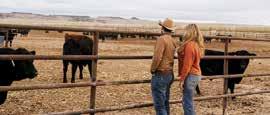
Since the Spanish first brought cattle into the New World, they have been crossing the border between Mexico and the U.S. For the most part, this has been a thriving business.
Once Mexico and the U.S. started patrolling the border, some restraints were implemented.
If a person stole horses or cattle, they were usually safe once they got to the other side.
About 10 years ago, along the South Texas border, the cartels bought most of the lands along the Rio Grande River for drug purposes, and Mexican cattle crossed over wherever there wasn’t a border wall on the U.S. side.
The U.S. Department of Agriculture’s (USDA) U.S. Animal and Plant Health Inspection Service (APHIS) had a whole army of wranglers, corrals and dipping vats to treat animals for potential diseases and pests before they were herded back to Mexico.
Nowadays, with the threat of New World screwworm (NWS), APHIS has shut down the border to any livestock crossings. But there has been talk about opening the border in Douglas, Ariz., where NWS has been confirmed over 800 miles away.
It’s really too bad NWS has made a comeback and hurt the cattle industry on both sides of the border.
On the U.S. side, it has hurt feedlots and meatpackers, and on the Mexican side, it has hurt cattle producers, as they could receive about double the money for a 450-pound steer by crossing the border.
Before NWS resurfaced, Mexican cattle imports averaged around 1.8 million head annually, which equaled 3.4 percent of the total U.S. calf crop from 2015-24.
On March 28, U.S. Secretary of Agriculture Brooke Rollins spoke on border crossings to the Texas and Southwestern Cattle Raisers Association and was somewhat positive the border may be opening soon. But when NWS was found 90 miles from the South Texas border, everything came to a halt.
Cattle producers were really hoping to have cattle crossing at least on the Arizona border, but I’m not sure any cattle crossings are going to happen for a while.
When the border does open back up, Mexican cattle will be required to stay in a pre-export inspection facility for three to five days where they will receive an Ivermectin vaccination or similar shot.
All cattle will have to swim through a narrow 30-feet dipping vat to kill any other insects on them. Then they will be moved to a certified APHIS inspection facility where they will be physically inspected for wounds and the presence of NWS. There, USDA veterinarians will conduct a final physical inspection and review travel and ownership documents.
Cattle crossing the border is not an easy process, nor should it be. The threat of a NWS infestation would shut down many states moving cattle. We just can’t afford to have it.
GUEST OPINIONS
Not long ago, it felt like beef had a target on its back. Between headlines about plant-based alternative proteins, questions about how cattle are raised and shifting consumer preferences, there was a lot of speculation about beef’s future.
As a young rancher, I heard those conversations just like everyone else, and like many producers, I wondered what they might mean for our industry long term.
Today, the conversation looks very different.
Beef demand is strong, even as prices remain high and supplies are tight, and this strength isn’t just anecdotal – it’s backed by data.
Beef Checkoff-funded research like the Meat Demand Monitor (MDM), a monthly national survey of U.S. consumers, continues to show consumers value beef for its taste, and this eating satisfaction plays a major role in their purchasing decisions.
In fact, a report summarizing the MDM’s findings from February 2020
By Jaslyn Livingston
to December 2025 shows more than 85 percent of Americans today identify as meat consumers, and consumer willingness to pay for beef at retail has increased faster than inflation.
Over this same period, the number of consumers identifying as vegetarian or vegan has declined from 14 percent to just seven percent.
At the same time, broader food and nutrition trends are working in beef’s favor. Protein continues to be top of mind for consumers, whether they’re focused on overall health, weight management or maintaining muscle as they age.
Even the rise of GLP-1 medications has reinforced the importance of nutrient-dense foods, with many users prioritizing protein to support their health goals.
I occasionally run ultramarathons and enjoy strength training, and I’ve experienced firsthand how important nutrition is when you’re pushing your body to its limit.
Athletes often tailor their diets
carefully, focusing on complete protein to support muscle development and recovery. Increasingly, more Americans – even non-athletes – are thinking about food in those same terms.
This trend plays directly to beef’s strengths as a flavorful, nutrient-dense protein.
It’s also reflected in the continued recognition of lean beef as part of a healthy dietary pattern in the latest Dietary Guidelines for Americans, reinforcing what many of us in the industry have long known – beef can absolutely be part of a healthy lifestyle.
This recognition doesn’t happen by accident. Research and education play an important role in helping consumers access accurate information about beef.
Producers are investing in nutrition research through the Beef Checkoff, and this research continues to explore beef’s role in healthy dietary patterns.
Meanwhile, outreach to health professionals helps ensure science-based
Adoption event set
As part of the Day of the American West, the Bureau of Land Management (BLM) Wyoming will offer trained wild horses for adoption on July 23 at Cheyenne Frontier Days, in conjunction with America’s 250th anniversary celebration. Following a live training demonstration beginning at 4 p.m., the BLM will offer halter- and saddle-started wild horses through a competitive-bid auction for qualified adopters.
Each of the animals available for adoption have been removed from overpopulated herds roaming Western public rangelands. Adopting or purchasing a wild horse from the BLM not only provides a rewarding partnership but also supports the agency’s efforts to responsibly manage healthy herds and healthy public rangelands.
Animals offered at this event are healthy, vaccinated and ready for their new home. BLM staff will be on site to assist with applications and answer questions.
To qualify, applicants must be at least 18 years old and able to provide a safe, humane home.
For more information, visit blm.gov/whb
Commission passes vote
The Wyoming Game and Fish Commission voted to increase non-resident preference points effective Jan. 1, 2027, a motion which was passed unanimously after some discussion.
The commission voted to increase non-resident preference point prices for elk, deer and antelope to the maximum amount permitted by the Wyoming State Legislature, which allowed limited increase in preference points and license increases per Wyoming Statute Section 23-2-101 in 2018.
The increases will include a $44 increase for antelope preference points, set at $31 to $75; a $34 increase to deer preference points at $41 to $75 and a $23 increase to elk preference points at $52 to $75.
Moose and sheep preference points had previously been increased to the maximum allowed on Jan. 1, 2018.
Wyoming Game and Fish Department Chief Fiscal Officer Meredith Wood said the revenue increase, based on current preference point sales, will provide the department with an annual revenue increase of an estimated $14.65 million.
This is the first increase for non-resident preference points since 2018.
During her presentation, Wood noted, since 2008, there has been a cumulative inflation of 68.3 percent, with a 35.7 percent inflation increase since 2020.
Commissioner John Masterson said the increase in preference points is a necessary step in managing the increased cost of wildlife management for the department, and will ultimately benefit residents and visitors alike.
information reaches the people influencing what we eat. On our ranch, we’ve seen demand play out firsthand. Cattle prices have remained strong for the past two years, which is a welcome change from years when we hoped to simply break even after accounting for feed, fuel and other input costs.
Strong cattle prices reflect the reality supplies are tight and demand for finished beef remains strong. Conversations with my neighbors suggest many operations are experiencing the same.
However, strong demand today doesn’t guarantee strong demand tomorrow. This is why continued investment in building demand, expanding market opportunities and strengthening consumer trust matters.
Like many producers, I think a lot about what it will take to keep family operations viable for the next generation.
Recent devastating wildfires near our ranch here in Nebraska are a reminder of just how quickly challenges can arise and how deeply they can affect our communities. While there’s no single solution, continued investment in building demand, expanding market opportunities and strengthening consumer trust plays an important role in helping keep operations viable and our industry strong.
As I take on a larger role in our family ranch, I’m encouraged, not just by where beef demand stands today, but by the factors supporting it.
My generation of cattle producers takes the future of this industry seriously. We want the opportunity to pass down healthy, viable operations to the next generation – just as previous generations did for us.
Jaslyn Livingston of Broadwater, Neb. is a member of the Cattlemen’s Beef Board (CBB) and the Beef Checkoff’s Research and Executive committees. This opinion column was originally published by CBB on April 15.
Ag Media Summit set
Agricultural communicators from across the country and beyond will gather this July 19-21 for Ag Media Summit (AMS) 2026 at the Hyatt Regency St. Louis at the Arch in St. Louis, Mo.
This is the 27th year for the annual professional conference hosted by the Agricultural Communicators Network and the Livestock Publications Council, with support from the Ag Media Council.
Accomplished editors, writers, photographers, designers and marketing communications professionals who deliver information to farmers, agribusinesses and the public inspired this year’s AMS theme, “AI: Authentic Intelligence.”
AMS conference activities will kick off with the World Famous Welcome Party on the evening of July 19 and run through late afternoon on July 21.
The optional post-AMS tour day on July 22 includes a visit to Gateway Arch National Park with a ride to the top of the arch and tour of the museum; a stop at ADM’s grain barge facility on the Mississippi River; lunch and tour at the Anheuser-Busch Brewery and an on-farm visit, video session and supper at Eckert Country Farm, Belleville, Ill.
For more information or to register, visit agmediasummit.com/ by May 17 for discounted early-bird rates. Regular registration is open online through June 25.
WCCA gala set
Wyoming Collegiate Cattle Association (WCCA), a recognized student organization open to all students interested in learning about the cattle industry, actively engages in a variety of events to foster learning and camaraderie within the cattle industry.
This year, WCCA invites the public to its Third Annual Western Poker Gala, set for May 2 from 5-9 p.m. at BR Infinity Events in Laramie.
The event will include a tri-tip dinner, a full bar and refreshments, music and dancing, an auction and a raffle for a Henry American Cattleman Tribute Edition Rifle.
Admission is $40 for members and $50 for non-members, and WCCA asks those planning on attending to dress in formal Western attire.
For more information or to RSVP, call Piper Crawford at 618-830-2600 or Braley Smith at 307-343-6487.
Interim director appointed
The University of Wyoming (UW) welcomes Professor and Laramie Research and Extension Center (LREC) Director Dr. John Derek Scasta as interim director of UW Extension.
Prior to his current role as director of LREC, Scasta served as UW Extension’s rangeland management specialist for more than a decade.
He will assume his interim appointment with UW Extension on April 27, following the departure of current Director Mandy Marney, where he will support personnel in county offices across the state in addition to working with college leadership and campus-based specialists.
Scasta entered the Extension system in 2004 after graduating from Texas A&M University with a bachelor’s degree in rangeland ecology and management.
As a county agent in West Texas, Scasta not only fielded questions from agricultural producers, but also coordinated 4-H events like county fair and contributed to communitybased initiatives outside his area of academic training.
Scasta then earned a master’s degree in crop science from Texas Tech University in 2008, followed by a PhD in natural resource ecology and management at Oklahoma State University, with the goal of becoming an Extension specialist.
In 2014, Scasta accepted a rangeland management specialist position at UW, a role which also included teaching and research responsibilities. In 2024, he was named director of LREC.
While he will continue to mentor UW students and conduct research, Scasta welcomes the opportunity to return to Extension as interim director. In addition to supporting county educators, he looks forward to strengthening relationships with stakeholders across the state, from community organizations and state agencies to legislators and industry partners.
“Extension is fundamentally about people, relationships, communities and extending the resources of UW to all corners of the state to help solve problems and enhance quality of life,” Scasta notes. “This resonates with me because I care about the people and communities of Wyoming.”
Scasta can be contacted at jscasta@uwyo.edu or 307766-5124.
Dr. John Derek Scasta Courtesy photo
Fuller noted the six segments include 3.55 miles of West Horse Creek, 2.75 miles of Klondike Creek,
6.39 miles of Rock Creek, 5.98 miles of South Beaver Creek, 16.44 miles of North Horse Creek, 12.77 miles of South Horse and 3.55 miles
of Maki Creek.
“We have not found any water rights at these segments or above them,” Fuller said. “We did fairly
WEDNESDAY, APRIL 29, 2026 - FEEDER SPECIAL
FEEDERS Boyd Yeik 240 Blk Strs & Hfrs, 680-700#, Weaned a long time, Bunk Broke, Been on a Grower Ration, Complete Vac. Program, Poured, Heifers are Bangs Vac., Heifers are Replacement Quality, Home Raised, Gentle and Easy to Handle on Foot or with a Working Dog, Sired by Doug Booth, Flag Ranch or Arrow Crown Blk Angus Bulls with some SimAngus Bulls
J & J Ochsner Livestock 140 Blk Angus Hfrs, 675-700#, Weaned a long time, Been on a Light Grower Ration, Full Vac. Program, Bangs Vac, EID Tagged, 1-iron, Home Raised Burks Wagon Tongue 132 Blk/Bwf Strs & Hfrs, 650-675#, Weaned a long time, Hay Fed Only, Branding Shots: Vision 7 w/Somnus, Pyramid 5+Presponse SQ, No Implants, Selling only due to dry conditions, Normally Sell on Labor Day Special weighing 925-1000# Robert Clausen 120 Blk Hfrs, 700-725#, Weaned since November, Bunk Broke, Been on a Grower Ration, 2 Rounds of Shots, Poured in January, Replacement Quality JT Nunn/Red Mountain 100 Blk Hfrs, 700-800#, Weaned since October, Bunk Broke, Been on Ground Hay and Distillers, Branding & Pre-cond. Shots: P:yramid 5+Presponse, Ultrabac 7 w/Somubac, Valcor, Weaning Shots; Pyramid 5+Presponse, Ultrabac 7 w/Somubac, Bovi-Shield Gold FP5-VL5, Valcor Wormer, Poured with Clean-up, Bangs Vac., Replacement Quality, Booster Shots given on April 16, 2026, Selling out of Replacements due to drought Conditions MR Angus 100 Blk Hfrs, 650-800#, Weaned a long time, Been on a Grower Ration Program that is Develop for Breeding Purposes, Complete Modified Live Vac. Prog, Bangs Vac, Pre-breeding Shots: Bovi-Shield Gold FP5 VL5, Some would make Replacement Heifers, Slicks, Home Raised Nelson & Hodge 90 Mostly Blk/Bwf Strs, 700-725#, Weaned a long time, Been on a Light Grower Ration, Complete Vac. Program, Green, Selling only due to drought conditions; Normally sell in August coming off grass weighting 1000#
Nathan Bowers 90 Blk/Rd Strs & Hfrs, 750-850#, Weaned a long time, Bunk Broke, Been on a Grower Ration, 2 Rounds of Shots Berger Ranches 75 Blk Angus Hfrs, 700-750#, Weaned a long time, Been on a Light Grower Ration (design for better breeding efficiency), Complete Vac. Program, Bangs Vac., 1st Breeding Shots: Preg Guard 10, Fancy Home Raised Heifers, 1-iron, High Elevation, Coming off their Replacements and Selling only due to dry conditions
Clinton Breeden 70 Hereford Hfrs, 700#, Weaned since October, Bunk Broke, Been on a Grower Ration, Complete Vac. Program, No Implants, Heifers are Bangs Vac., Producer All Natural, Some are Replacement Quality
Dr. Brent Kaufman 13 Blk Strs & Hfrs, 650-800#, Weaned a long time, Running out on Meadows supplemented with Hay and Lick Tubs, 2 Rounds of Shots, Wormed w/Safeguard and Poured w/Ivomec
Jeff & Amanda Cotton 13 Fancy Blk Hfrs, 800#, Weaned a long time, Running Out on pasture Supplemented with Hay and Distiller Grains, Complete Vac. Program, Safe Guard and Poured (2x), Home Raised, Sired by Dyesville Angus Bulls, Replacement Quality, These were intended to be their Replacements Heifers; therefore Selling only due to drought conditions
WEBO Angus 13 Blk Hfrs, 800#, Weaned a long time, Running out, Hay Fed, 3 Rounds of a Complete Modified Live Vac. Program, Poured (2x), Home Raised, Replacement Quality
John Murphy 7 Mx Hfrs, 700#, Weaned a long time, Bunk Broke, Complete Vac. Program Heath Hornecker 2 Hereford Str/Hfr, 700-775#, Weaned a long time, Complete Vac. Program
WEANED CALVES
TTT Ranch 90 Blk Hfrs, 550-600#, Weaned a long time, Running Out, Grass/Alfalfa/Barley Hay Mix, Agfinity Western Dry Grass, Balancer High Protein Lick Tubs, Branding Shots: Vista Once SQ, Vision 7 w/Somnus, Weaning Shots: Vista Once SQ, Vision 7 w/Somnus, Nasalgen 3 PMH, Cydectin, Bangs Vac., Coming out of their Replacements, Selling Only Due to Drought Conditions
DeGering Livestock 50 Blk/Bwf Hfrs, 600-700#, Weaned since September, Running Out on Pasture supplemented with Grass/Alfalfa Hay, 2 # of Cake, Complete Vac. Program, Bangs Vacc., No Implants, Home Raised, Replacement Quality, Coming off their Replacements, Being sold only due to dry conditions Cole Creek Sheep Co. 50 Blk Strs & Hfrs, 600#, Weaned since October, Running out on Pasture supplemented with Hay and Cake, Branding Shots: Vision 7, Pyramid 5 +Presponse, Ralgro Implant, Pre-cond. Shots: Vision 7, Pyramid 5+Presponse, Weaning Shots: Cydectin, Bangs Vac. Heifers received a Lutalyse Shot, Home Raised, Green Dennis Brooks 42 Red Angus Strs & Hfrs, 500#, Weaned a long time, Hay Fed, Complete Vac. Program Mike Miller 36 Blk Strs, 600#, Weaned a long time, Bunk Broke, Been on Hay Silage and Green Grass, Complete Vac. Program ZumBrunnen Angus 30 Blk Angus Strs & Hfrs, 500-600#, Weaned 60+ days, Been on a Grower Ration, Pre-cond. Shots: Nasalgen 3 PMH, Ultrabac 7, Weaning Shots: Nasalgen 3 PMH, Ultrabac 7, Fall Calves with few Late Summer Calves Sun Cattle Partnership 24 Mx Hfrs, 600-750#, Weaned a long time, Been on a Light Grower Ration, Complete Vac. Program Brenton Family Livestock 20 Blk Strs & Hfrs, 550-575#, Heifers are Guaranteed Open, Bunk Broke, Shots: Vista Once SQ, Poured Harvat Cattle & Hay 20 Blk Sim/Angus Hfrs, 500-600#, Weaned since November, Hay Fed, Branding Shots: Vista Once, Vision 7, Safeguard, Poured, No Implants, Bunk Broke, High Altitude Waddle Limousin 20 Blk (2 Rd) Strs & Hfrs, 500-650#, Fall Calves (Sept/Oct. Born) Weaned April 2nd, Bunk Broke, 3# of Pellet Feed Mix/hd, Free Choice Hay, Shots at Birth; 7-way, Branding Shots (Jan. 15): Bovi-Shield Gold One Shot, Inforce 3, Pre-cond. Shots; Bovi-Shield Gold 5, Vision 7 w/ Somnus, Vetrimec Pour On, April 20 Steers were Banded and give Tetnus Toxoid Shot, Heifers were Bangs Vac.
Dennis Birdsall 16 Hereford Strs & Hfrs 600#, Weaned 90 days, Been on a Light Grower Ration, Pre-cond. Shots: Pyramid 5+Presponse, Convexin 8, Dectomax Injectable
Barbara York 15 Blk Hfrs, 550-600#, Weaned a long time, Complete Vac. Program, Poured, Received first Pre-breeding Shot, Replacement Quality, Selling only due to dry conditions, Home Raised
Mike Norby 7 Red Bull Calves, 400-450#, Weaned 45+ days, Been on Grass & Oat Hay, Weaning Shots: Pyramid 5+Presponse, Ivomec Injectable, Poured w/Clean-up, Fall Calves, No brands
David Sherrod 5 Red Angus Hfrs, 600-700#, Weaned a long time, Been on a Grower Raion, Complete Vac, Sired by Schuler Red Angus Bulls Rex & Paula Fritzler 2 Blk Angus Hfrs, 550-600#, Weaned since October, Bunk Broke , Running out on Pasture supplemented with Alfalfa Hay, Range Cake, Branding Shots: Vision 7 w/Spur and Nasalgen 3, Pre-cond. Shots: Vision 7 Somnus, Vista Once SQ, Nasalgen 3 PMH, , Safeguard Wormer, Poured w/Ultra-Boss, April Born Calves, Hickok Granddaughters, Electric Fence Broke CATTLE COUNTRY VIDEO - 1:00 PM
Rod & Kathleen Smith 73 Black Steers. Base Wt: 935 lbs. Wt Stop: 960 lbs. Two Way Slide: 12 cents. Weigh: 3% on ground with certified portable scale. Two Rounds of Shots. Located: Newell, SD. Comments: Fancy, Home Raised. Selling 62,000 lb load or more, buyer’s option. Have a big truck available if needed. Rep: Richard Zweifel 605-209-6307. Randy & Adam Burnison 283 Blk/Bwf Heifers. Base Wt: 830 lbs. Wt Stop: 855 lbs. Two Way Slide: 16 cents. Located: 6 miles South of Alpena, SD; 50 miles North of Mitchell, SD. Rep: Richard Zweifel 605-209-6307. Monaghan Ranch 82 Black Weaned Strs. Base Wt: 610 lbs. Wt Stop: +/- 25#. 2-way Slide: 25 cents. Frame: Med; Flesh: Thin; Wt Var: Uneven. Origin: Ranch Raised. Located: 8 miles South of Laramie, WY. Delivery: 5/7/26 to 5/9/26. Feed: Running out, hay fed, supplemented with a little cake, free choice Agrifinity Mineral. Branding & Precond Shots: UltraChoice 7, BoviShield Gold One Shot, Inforce 3 (Branding) &Ivermectin. Programs: NHTC, BeefCARE, Veg Fed, Saudi Arabia EV and many would be Verified Natural thru IMI Global. BQA. Weigh: Early am gather, trail up to 2 miles, weigh on ground w/a 2% shrink, sort for loads. Comments: Fancy! Home raised, high elevation steers, hay fed, running out, super green. Calves should explode on feed. Usually run over on grass as yearlings and only selling early due to drought. Treated cattle not eligible for VNB will be identified (approx. 15%). Rep: Lander Nicodemus 307-421-8141. Monaghan Ranch 84 Black Weaned Strs. Base Wt: 515 lbs. Wt Stop: +/- 25#. 2-way Slide: 40 cents. Frame: Med; Flesh: Thin; Wt Var: Uneven. Origin: Ranch Raised. Located: 8 miles South of Laramie, WY. Delivery: 5/7/26 to 5/9/26. Feed: Running out, hay fed, supplemented with a little cake, free choice Agrifinity Mineral. Branding & Precond Shots: UltraChoice 7, BoviShield Gold One Shot, Inforce 3 (Branding) &Ivermectin. Programs: NHTC, BeefCARE, Veg Fed, Saudi Arabia EV and many would be Verified Natural thru IMI Global. BQA. Weigh: Early am gather, trail up to 2 miles, weigh on ground w/a 2% shrink, sort for loads. Comments: Fancy! Home raised, high elevation steers, hay fed, running out, super green. Calves should explode on feed. Usually run over on grass as yearlings and only selling early due to drought. Treated cattle not eligible for VNB will be identified (approx. 15%). Rep: Lander Nicodemus 307-421-8141. Darren & Molly Spell 70 Black Hfrs. Base Wt: 715#. Slide: 18 cents. Located: Bridgeport, NE. Delivery: 4/30/26 to 5/5/26. Flesh: Med. Shots: Complete Vac. Weigh: 2% on truck. Comments: 1st time CCV Consignor. Top end of 110 black heifers. Rep: Michael Schmitt 307-532-1776.
Darren & Molly Spell 70 Red Hfrs. Base Wt: 700#. Slide: 18 cents. Located: Bridgeport, NE. Delivery: 4/30/26 to 5/5/26. Flesh: Med. Shots: Complete Vac. Weigh: 2% on truck. Comments: 1st time CCV Consignor. Top end of 110 red heifers. Rep: Michael Schmitt 307-532-1776. FX Land Co 150 Blk/Bwf Yearlng Steers. Base Wt: 775 lbs. Wt Stop: 800 lbs. Slide: 18 cents. Frame: Med-Large; Flesh: Med; Wt Var: Uneven. Delivery: 4/30/26 to 5/4/26. Located: 20 miles North of Scottsbluff, NE. Feed: Native pasture, salt, mineral & cake. Shots: CCV Grass Vac Program. Complete vaccination program upon purchase, upped with 20/20 Vision 7/Spur & Poured. Weigh: Early am gather, sort for loads, haul on buyers pre-weighed trucks w/a 2%. Comments: Very light fleshed steers that will gain extremely well on grass or feedlot! All purchased in load lots from local auctions. Rep: Michael Schmitt 307-532-1776.
FRIDAY, MAY 1,
2026 - ALL CLASSES
CATTLE COUNTRY VIDEO PRODUCTION SALE SCHEDULE
High Plains Showcase - Laramie, WY
June 30th, 2026
Oregon Trail Classic - Gering, NE
August 4th & 5th, 2026
Frontier Fall Round Up - Cheyenne, WY
September 10th, 2026
thorough evaluations.”
Level one project
The project will measure “unassigned” in-stream flows upstream from any existing water diversions and water rights’ holders and look at extensive historic gauge, depth and velocity data.
“We’re not here to debate in-stream flows,” Tavelli said. “We have a statutory duty to do these studies. The water does stay in the stream.”
WGFD In-Stream Biologist Sydney McAndrews said the unallocated water could be essential for the Colorado cutthroat and fisheries.
To select segments, they moved past a private boundary or existing water right and then went upstream as far as it was reasonable in the watershed.
Fuller will measure each segment’s depth and velocity at its downstream end, compile historic and current data, past studies and reports, then make field visits in May and compile a complete hydrologic analysis to recreate streamflow within these creeks, he explained.
Fuller is also required to perform a storage analysis to meet or adjust the in-stream flow rates for the year, per WGFD.
“We will look at what types of storage would be required to meet the wate rights requirements,” Fuller said.
Tavelli emphasized permitting new water rights does not add or take away
allocated water to the tributaries or the Upper Green itself.
He said irrigation and water rights holders would not be affected, as none of the in-stream flow being quantified is allocated.
“It does not impact previously existing water rights. The water stays in the river. It doesn’t get pulled out. It’s not a sum total. Only within this segment is the amount of water being requested for permitting,” he added.
Flow requests
In the case of this year’s dry winter and spring likely lowering Upper Green water flows, McAndrews said in low snow years, the flows might not be met.
“Our requests for flows are only manageable if there is enough naturally available for what we request,” McAndrews said.
“If WGFD requests 10 cfs and there’s only four cfs in the creek – that’s hydrology,” Tavelli added.
When Fuller completes the Upper Green River Basin level one hydrology analysis, Tavelli and others will review the report.
The final report will be sent to the SEO for close scrutiny, and the SEO will then hold a public meeting next year – most likely in Pinedale – to take comments and determine the status of WGFD’s water rights application.
Joy Ufford is a corresponding writer for the Wyoming Livestock Roundup. Send comments on this article to roundup@wylr.net.
promotion, education and research funded by the state’s one-dollar-per-head Beef Checkoff.
Herne says changes in the beef industry that she has navigated throughout the past 25 years have been eye opening, particularly with regard to marketing and advertising.
As technology advances and advertising turns primarily digital and consumer facing, Herne says assuring producers of the many ways the checkoff and WBC works for them continues to be a priority.
“I want producers to know WBC is always working on their behalf,” Herne states.
Herne is well respected among her peers as a state beef council executive and has a great relationship with colleagues in the beef industry throughout the country.
“It’s been a tremendous gift to be able to spend the last 25 years of my career within this industry with people I respect and admire so much,” Herne says. “It’s been a really great trip, and I’ve enjoyed it tremendously.”
“I hope to continue to serve the industry for several more years,” she adds, emphasizing she’s always willing and available to discuss the checkoff with producers.
About WBC
WBC was established in 1971 to serve as the promotion, research and education arm of the Wyoming beef industry.
Their mission is to benefit Wyoming’s beef community and economy by increasing domestic and international beef demand.
WBC is comprised of five voting members appointed by the governor who represent all segments of beef production within Wyoming including range cattle, dairy cattle and feedlots.
– Crawford, NE 308-631-8513***Justin Smith - Lusk, WY
Garrett Nunn - Laramie, WY 307-460-1649 *** Scott Redden - Burns, Co 970-596-3588
Members’ responsibilities include setting priorities for WBC, determining funding allowances and evaluating programs funded by the one-dollar-perhead Beef Checkoff collected on all Wyoming cattle when they are sold.
Grace Skavdahl is the editor of the Wyoming Livestock Roundup. Send comments on this article to roundup@wylr.net.
demanding times in a ewe’s life and, therefore, proper management practices are key to ensuring health and longevity.
Stewart notes as a ewe begins to recover from lambing, lactation also increases dramatically. Although these are both natural processes, the combination of these factors can lead to stress, particularly with regard to nutrition.
Peak lactation usually occurs anywhere from 21 to 30 days after lambing, Stewart explains, and as ewes produce more milk to support their offspring, nutritional intake and energy output can sometimes become mismatched resulting in complications like declining body condition scores (BCS) and illness.
Negative energy balance
When a ewe is unable to consume enough feed to meet caloric requirements for body maintenance and raising her lamb, the result is a negative energy balance.
Stewart stresses the immense demands of the periparturient period mean a negative energy balance is a normal biological state to some extent following lambing, so producers should be able to recognize the signs and support the ewe through management practices during these times.
“Negative energy balance is normal and unavoidable until the ewe’s intake catches up,” he notes. “Proactive management matters because a lot of what drives a negative energy balance or decreasing BCS isn’t just lactation in itself, it’s everything else layered on top of it.”
In particular, Stewart emphasizes the importance of assessing BCS throughout the periparturient period and allocating feed accordingly, as well as reducing concentration of animals in enclosed environments like lambing sheds to limit the spread of disease.
In closing, Stewart reiterates the importance of continuing to assess BCS after lambing and allocating feed accordingly, making sure dietary contributions are adequate enough to incentivize intake in ewes.
He also provides advice on strategic management practices like accounting for weather-related stressors, providing access to highly-digestible feeds like soy hulls and processing hay to reduce particle size as ways of supporting ewe health and encouraging feed intake.
Nutrition considerations
Following Stewart’s comments, Laverell sheds additional light on meeting ewes’ nutritional demands
and reducing metabolic stress during the periparturient period.
He also discusses risk factors for two common pregnancy related metabolic disorders – pregnancy toxemia and hypocalcemia.
To begin, Laverell shares statistics on lambing rates across the country compiled by the U.S. Department of Agriculture (USDA) which reflect a 20 to 30 percent increase in reported lambing rates in Western states including South Dakota, Utah, Wyoming and Montana.
Laverell attributes this increase, in part, to the implementation of indoor lambing management practices as well as an increase in twin and triplet litters.
Although increased litter size means more lambs and more profit, it also leads to increased pressure on ewes.
“Unfortunately, an increased number of fetuses works antagonistically towards rumen size and volume, especially in the last trimester,” Laverell explains. “As we increase the number of lambs in the fetal space, we decrease the amount of feed a ewe can apprehend.”
With this, Laverell underscores Stewart’s comments about the importance of promoting good BCS leading up to lambing and providing nutrient
dense feedstuffs.
Disease factors
Next, Laverell shifts his focus to risk factors and management strategies relating to pregnancy toxemia and hypocalcemia.
Pregnancy toxemia is caused by severe energy deficiency and tends to affect sheep during late gestation, usually the last two to four weeks of pregnancy.
Ewes with poor BCS heading into lambing and ewes carrying multiple lambs are at highest risk for toxemia, as energy requirements spike in late gestation without the corresponding ability to increase feed intake.
“When a ewe is not get-
ting enough from her feed or is physically unable to eat more, her body starts breaking down fat for energy,” Laverell explains.
Hypocalcemia or milk fever is a sudden onset disease resulting from low levels of blood calcium as ewes work to produce milk and colostrum, and lambs finish growing in the final stages of pregnancy.
Pregnancy toxemia and hypocalcemia present with similar symptoms including excitability, muscle tremors and gait changes, but hypocalcemia is much faster acting and death often occurs six to 12 hours after clinical signs are first observed, Laverell explains.
He emphasizes combatting these diseases begins with proper management practices like maintaining and monitoring BCS leading up to lambing, providing ample clean bedding in lambing sheds and timing shearing in accordance with gestation to reduce stress on ewes in the final stages of pregnancy.
“As is the case with a lot of other things, the best way to manage pregnancyrelated metabolic dysfunction is through prevention,” he concludes.
Grace Skavdahl is the editor of the Wyoming Livestock Roundup. Send comments on this article to roundup@wylr.net.
ALB points out domestic product outpaced the overall category with dollar sales rising 9.4 percent and volume increasing 5.9 percent.
“This is a clear indication of the growing preference for American-raised lamb,” the board writes.
“This momentum reinforces the importance of origin, quality and the strong connection consumers feel to American agriculture.”
Supply
While demand remained strong, ALB’s report shows tight supply continued to be
a limiting factor. In 2025, the total U.S. sheep and lamb inventory was reported at 4.99 million head, with production posting a modest 0.4 percent increase.
Additionally, the inventory of frozen product remained historically low, supporting strong pricing across the market.
At the same time, imports – while down from 2024 – were the secondhighest on record, highlighting their ongoing role in meeting domestic demand.
“Strong prices are a pos-
itive signal of demand, but tight supply alone does not create a stable or growing market,” ALB states. “As consumer interest in lamb continues to expand, there is a clear opportunity for U.S. producers to capture more market share.”
The board continues, “With demand momentum already in place, the focus moving forward is not just on maintaining price strength but building a more resilient, growing supply to position the U.S. lamb industry for long-term success.”
Overall, ALB believes strategically growing the national flock and increasing production will help strengthen market stability over time, reduce reliance on imports, ensure consistent availability for retailers and foodservice partners and support the continued growth of American lamb’s market share.
Price and market trends
According to U.S. Department of Agriculture data, price trends throughout the year reflected the aforementioned strong demand for lamb and ongoing market adjustments.
At this time last year,
feeder lamb prices remained steady, particularly for lighter-weight lambs, while slaughter lamb prices varied across the U.S.
The National Negotiated Live Slaughter Lamb Price averaged $170 per hundredweight (cwt) in the first quarter of 2025, which was below the previous year but still indicative of solid market support. Lightweight slaughter lambs saw stronger gains, averaging $245 per cwt, up from 2024 levels.
Wholesale prices were more of a mixed bag, with the National Lamb Cutout Value slightly below year-ago levels, while some cuts such as shoulders held steady or improved and others – like loins and certain rack categories – struggled.
In 2025, retail performance highlighted consumers’ growing interest in versatile, easy-to-prepare lamb products. Ground lamb led category growth with a 13 percent increase in dollar sales and a 7.5 percent rise in volume.
ALB says these trends suggest consumers are integrating lamb into routine, everyday cooking, instead of just consuming it on holidays or special occasions.
In the U.S., ALB reports growth was seen across major markets, with standout performances in several key regions.
“Markets like Denver and Houston led dollar growth,
demonstrating the expanding reach and appeal of lamb nationwide,” ALB states.
Beyond domestic markets, exports were also strong in 2025.
ALB notes U.S. lamb export volumes increased 44 percent year-to-date, reaching their highest levels in more than a decade. Export value also climbed significantly, reflecting robust international demand.
“This continued growth in exports provides additional support and opportunity for the industry moving forward,” ALB says.
Looking ahead As the industry moves into the second quarter of 2026, ALB says the outlook remains positive.
“Strong consumer demand, growing market share for American lamb and expanding product versatility all point to continued opportunity,” the board writes.
“As we look at the momentum in 2025, it’s clear demand for American lamb remains strong and continues to grow,” adds ALB Chairman David Fisher. “From retail performance to export growth, our industry is well-positioned to build on this success and connect with consumers in new and meaningful ways.”
Hannah Bugas is the managing editor of the Wyoming Livestock Roundup. Send comments on this article to roundup@wylr.net.
Effective management practices during planting can help corn growers maximize their field potential and capitalize on yields.
“High yields are built on uniform stands which emerge quickly and evenly, supported by careful attention to soil conditions, weather forecasts and planter performance,” says Extension Corn Specialist Dan Quinn in a March 13 Perdue University Extension Entomology Pest and Crop newsletter. “While weather patterns, soil conditions and individual farm logistics will vary, the decisions made during planting will set the stage for everything that follows.”
As the growing season approaches, industry experts and leading farmers share practical planting strategies to help 2026 corn yields reach new heights.
Soil considerations
In the Midwest, the ideal corn planting window usually falls between late April and early May, after soil temperatures consistently reach roughly 50 degrees Fahrenheit.
Quinn says successful corn yields are built from the ground up and emphasizes the importance of soil conditions at planting.
He explains soil conditions impact crop uniformity, which is important because corn plants that emerge at different times compete unevenly for light, water and nutrients. Even small differences, Quinn cautions, can reduce yield potential across a field.
“Soil temperature, soil moisture, seed-to-soil contact and seed depth all interact to influence how quickly and consistently seedlings emerge,” Quinn writes.
In terms of temperature, Quinn notes overly cool and highly variable soil temperatures – especially when hovering near the lower end of 50 degrees Fahrenheit – can delay emergence, prolong seedling exposure to various stressors and result in uneven stands.
Similarly, Quinn observes inconsistent soil moisture caused by residue cover, variable soils or fluctuating weather can delay some plants and weaken performance.
For these reasons, monitoring soil temperatures at planting and the weather forecast in the days to follow while paying close attention to factors like seed spacing and depth can help planters get the most out of their crops.
Seed factors
Strategically selecting the correct seed genetics for the region and planting effectively is also crucial to achieving higher yields.
“Choosing resilient genetics can help producers deal with unpredictable weather and environmental changes,” reads an April 21, 2025 CROPLAN newsletter titled “Six Ways to Help Maximize Your Corn Yields.”
“The four key components of yield are plants per acre, ears per plant, kernels per ear and kernel depth and density,” the article continues. “Since kernel depth and density are determined later in the season,
it’s essential to continue managing performance through those later stages of growth.”
Additionally, Quinn reminds producers inconsistent seed depth can increase variability in germination and early growth.
“The planter’s job is to place every seed at a consistent depth, consistent moisture, in firm contact with the soil and with uniform spacing from its neighbors,” Quinn writes.
“Poor seed-to-soil contact due to residue interference, sidewall compaction from planting in wet conditions or improper furrow closure can further compound issues,” he continues.
Crop protection
Insects, weeds and crop diseases are consistent threats to higher yield, and managing these threats can lead to greater success.
Clearing crop residue is an important first step in disease and insect management, as pests thrive in leftover growth and their presence can make it difficult for emerging crops to compete.
Fungicides can help protect plants from yield-reducing diseases and insects, and experts with Bayer Crop Science recommend developing a management plan for individual fields which incorporate cultural, mechanical and chemical methods of pest control.
In addition, CROPLAN highlights the importance of early weed control, cautioning against waiting too long to apply post-emergence products or using inadequate preemergence herbicides.
CROPLAN also recommends scouting fields early in the growing season and during critical growth seasons to keep tabs on disease and insect populations to avoid potential yield losses.
Equipment
Finally, experts agree using the right equipment and keeping it in good shape can help corn growers maximize their yield potential.
“As equipment decisions are made ahead of the 2026 season, investments should be guided by specific stand establishment challenges already observed in individual fields,” Quinn says, noting specific issues with factors like inconsistent depth or residue interference may require adjusting or updating equipment.
“Just as importantly, routine maintenance remains critical,” he adds. “Worn components, improperly adjusted systems and overlooked mechanical issues can undermine planting performance as much as – or more than – the absence of the latest technology.”
Experts also recommend reducing traffic over fields, as large equipment can lead to increased soil compaction, and maintaining soil structure is key to long-term productivity and increased yields on an annual basis.
Grace Skavdahl is the editor of the Wyoming Livestock Roundup. Send comments on this article to roundup@wylr.net.
Austin Snook • 307-290-2161
Taylor Snook • 307-290-2273
Craig Deveraux • 307-746-5690
Dan Catlin • 406-671-7715
Clint Snook • 307-290-4000
Cheyenne Seymour • 605-641-0638
Casey Sellers • 307-217-2614
Jim Forbes • 307-351-5932
"From the ring, to the video, and in the country, we market your livestock the competitive way." BRED COWS
April 22, 2026
Bigger run of weigh-ups this week. Selling at higher market. Pairs and feeders next week. Thank you for your business!
OR TRINITY RODRIGUEZ,
BRED HEIFERS JOHN & BRENDA SNYDER, GILLETTE WY 6 HERE-BHFR,L 1134 3925.00 HD WEIGH UPS
Ray Siddoway Broadbent, age 87, passed away on April 18 surrounded by his loving family.
Ray graduated from Huntington Park High School in Los Angeles in 1956.
He faithfully served a
two-and-a-half-year mission in the Spanish-American Mission for The Church of Jesus Christ of Latter-Day Saints.
He attended the University of Utah, Utah State University and Brigham Young University, receiving a degree in animal husbandry and a Master of Business Administration.
Prior to becoming a fulltime rancher, he worked in banking for 10 years. He then devoted his life to the family ranch, working alongside his father and brother. Together, he and Joe ran Broadbent Brothers Livestock in Imperial Valley, Calif., where he raised his family.
Aug. 5, 1941 – April 10, 2026
Thomas “Tom” Seddon Taliaferro IV, age 84, a cherished resident of Green River, passed away peacefully on April 10. He was born on Aug. 5, 1941 in Rock Springs, the son of Edward Ludwell and Elva Angus Taliaferro.
Tom lived a full and impactful life devoted to
family, community and his passion for agriculture. Tom spent his youth in Green River, attending local schools before graduating from Lincoln High School in 1959. He pursued further education at the University of Wyoming, where he earned a bachelor’s degree in agriculture, a testament
Ray will be remembered for his lifelong service and for his loving, kind and charitable nature.
He had a deep love for ranching, but above all, he dedicated his life to Jesus Christ. Together with his devoted wife Carole Anne Hickenlooper Broadbent, he served two temple missions. He also served as a temple worker for more than 30 years in the San Diego and Ogden, Utah temples.
He held many church callings, but his greatest passion was genealogy work and performing thousands of ordinances for his ancestors and loved ones who had passed on before him.
He was the ultimate missionary, always willing and eager to share his testimony of Jesus Christ with everyone he encountered.
He left a legacy of faith, hard work, a love of country and a love of family. He
to his lifelong dedication to farming and ranching.
Tom poured his whole heart and soul into Green River Livestock and Big Sandy Livestock, serving as a farmer and rancher until his retirement in June 1999. His commitment to his craft and his community was unwavering.
WHAT SAVVY OPERATORS ARE DOING TO COME OUT WAY AHEAD
was loved by all who knew him, and he was known for the mischievous twinkle in his eye, a playful sense of humor and an infectious smile that could brighten any room he entered.
Ray is preceded in death by his parents JR and Lorna Broadbent, his wife Susan Moss Broadbent and his twin brother Joseph Siddoway Broadbent
He is survived by his children Joseph Lawrence (Anna) Broadbent, Emily Jane (Justin) Dennis and Jennifer Sue (David) Bennett; his younger sister Colleen (Tom) Paddock and seven grandchildren and stepgrandchildren, all of whom he loved and enjoyed.
Funeral services will be held on April 25 at 11 a.m. at the Evanston South Stake Center in Evanston. A viewing will be held in the morning from 9:30 to 10:30 a.m. prior to the services at the stake center.
A proud member of the Fraternal Order of Eagles #2350, the Lions Club and the Wyoming Wool Growers Association, Tom was also known for his love of the outdoors and the many adventures he embarked on whether camping, golfing, snow machining, flying airplanes, boating and having his daily nightcap.
There’s a trend happening across the Rocky Mountain West that doesn’t get much attention. Working ranch operators are selling their ground and coming out in a significantly stronger position — not to quit ranching, but because they understood the market better than most.
TWO BUYERS, ONE PIECE OF GROUND
A 400-cow year-round cattle ranch with a solid feed base might trade at $10 million — a fair number driven by carrying capacity and agricultural productivity.
Now add good elk and deer hunting to that same ranch. Suddenly there’s a second buyer in the room with entirely different motivations and a willingness to pay for things the agricultural buyer doesn’t value. That same ranch can push to $15 million, not because the grass got better, but because the recreational buyer is pricing something the operator wasn’t focused on.
An operator who doesn’t particularly care about hunting is sitting on $5 million in value they aren’t using.
WHAT SMART OPERATORS ARE DOING
The calculation is straightforward. Sell the $15 million ranch to the recreational buyer who values it most. Take those proceeds and buy a working cattle ranch 50% -100% bigger, running 600 to 800 pairs instead of 400. Same investment. Significantly larger operation. They didn’t exit agriculture. They upgraded their business by understanding that someone else placed a higher value on what they owned.
WHY NOW
This works because of a specific market imbalance — far more qualified buyers than available sellers. Recreational and lifestyle buyers are active and well-capitalized, and properties with strong wildlife or recreational value are drawing premium interest. Agricultural operators who recognize this have a window to capture value that may not always be there.
The sellers winning most right now aren’t waiting for the perfect time. They’re the ones who looked at what they owned, understood who would pay the most for it, and made a move while conditions were right. Sellers hold the cards. Don’t hesitate to ask how it would look for you.
We’ll find you back here in another week to discuss growing the ranch to be more drought resistant.
By Bill Bahny | Bill Bahny and Associates LLC
He relished a good debate, engaging friends and family alike with his wit and wisdom.
Tom is preceded in death by his son Seddon Taliaferro, his parents Edward Ludwell and Elva Angus Taliaferro, brothers-in-law James Masters and Kerry Hehr, paternal grandparents Thomas Seddon and Lucy Ramsey Taliaferro II and maternal grandparents Delroy and Alice Armitstead Angus.
He is survived by his wife Linda Taliaferro of Green River; his son Breck Jay Taliaferro of Green River; daughters Brooke (Shannon) Griffin of Grand Junction, Colo. and Christina (Mark) Sanders of Green River; brother Bill (Jan) Taliaferro of Rock Springs; sister Susan Taliaferro Hehr of Green River; sister-in-law Sheila (George) Palmer of Green River; 10 grandchildren and 15 great-grandchildren, as well as several cousins, nieces and nephews.
Cremation has taken place, and a graveside service and inurnment were conducted on April 20 at Riverview Cemetery in Green River.
The family respectfully requests donations be made in Tom’s name to Sweetwater County Farm Bureau, T.S. Taliaferro Memorial Scholarship Fund, PO Box 81, Farson, WY 82932.
Top Sellers
Lot 2 – Beckton Likable N134 A5 – Price: $18,000
DOB: 3/17/25 Sire: Beckton Likable K536 A4 Dam’s
Sire: Beckton Accent B549 N3 EPDs: BW: -3, WW: +71, YW: +113 and Milk: +31 Buyer: Simon Ranch, Laramie
Lot 39 – Beckton Likable N117 A7 – Price: $17,500
DOB: 3/15/25 Sire: Beckton Likable F287 J6 Dam’s
Sire: Beckton Accent B653 C3 EPDs: BW: -6.4, WW: +55, YW: +89 and Milk: +27 Buyer: Milk Creek Red Angus, Plevna, Mont.
Smart Starts for Healthy Backyard Flocks During Spring Chick Season
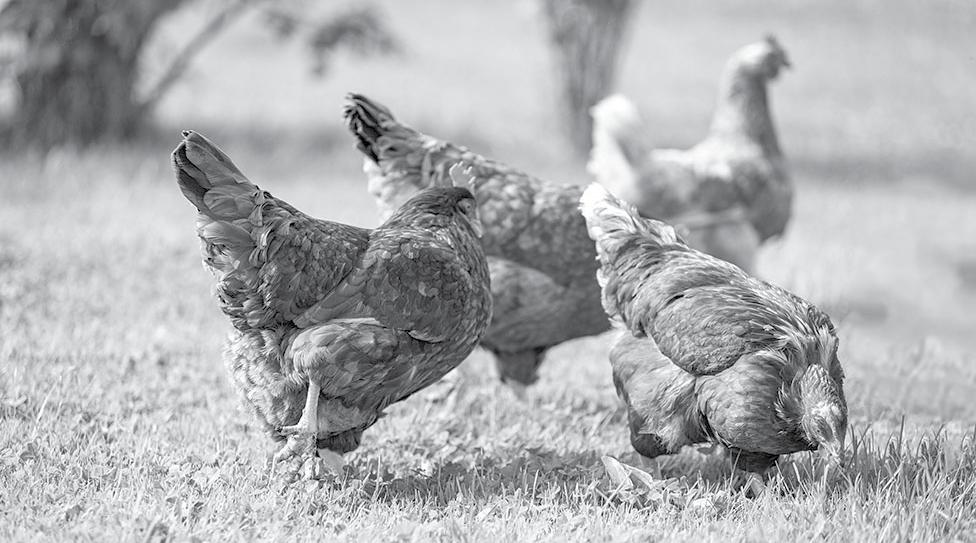
Spring is here, and it’s the season for baby chicks. The tubs full of fuzzy babies in feed stores are enticing.
However, as with bringing home any animal, there are things to consider to have the best transition and life for new chicks.
Purchasing chicks from big stores is actually not a bad thing. Those chicks are processed through disease-free programs and are vaccinated against several diseases. Adding chicks to the flock
For individuals who have other birds at home, new chicks can bring in diseases they aren’t immune to, so isolating new chicks for at least 10 days to watch for illness is imperative.
Also, older chickens will pick on babies. Do not mix ages until after the new chicks have adult feathers –around six weeks of age –and before introducing them to established flocks.
When the time is right, place new chicks in an enclosure inside of the chicken run, but still separate them from older hens.
After a week or two of close proximity, one can commingle the chickens.
Placing new chickens
in the henhouse at night –under the cover of darkness – is the best practice for integration. Chickens wake up together and don’t usually notice new members in the flock.
Providing plenty of space also helps with a cohesive flock. Adult chickens need four feet of indoor space and five to 10 feet of outdoor space.
A coop should be large enough to house chickens without overcrowding.
For 10 regular-size chickens, 30 square feet is ideal. Perch space should provide eight to 10 inches per bird.
Adequate space helps reduce bullying, cannibalism and disease.
Disease treatment and prevention
There are also various diseases to watch out for in chickens. Several of these can spread to humans and can lead to serious health problems or death.
Salmonella is a very serious disease associated with poultry. It is spread through droppings which contaminate eggs, coop surfaces and hands. It can also be spread by eating under-
cooked poultry or eggs from infected birds.
Chickens themselves don’t generally show symptoms, but chicks are a source of infections, especially in children who are prone to handling and kissing the chicks.
Symptoms in humans include fever, headache, nausea, vomiting and abdominal pain. According to the U.S. Centers for Disease Control and Prevention, salmonella causes as many as 26,500 hospitalizations and 420 deaths in the U.S. each year.
To protect oneself from the spread of salmonella, wash hands after handling birds, eggs or meat. Don’t kiss or snuggle birds. Rinse eggs and never soak them. Don’t wash chickens in the kitchen. If washing eggs off in the kitchen sink, disinfect the sink after. Cook poultry and eggs to an appropriate temperature of 165 degrees Fahrenheit. Disinfect surfaces that touch raw meat or eggs.
Highly pathogenic avian influenza is another bird disease impacting human health. This is a highly contagious virus causing sudden death in birds.
Wild waterfowl and other birds spread the virus to flocks by droppings or direct contact.
Common signs in chickens include sudden death, drop in egg production, difficulty breathing, tremors and discoloration or swelling of the head, neck or eyes. In humans, symptoms replicate influenza.
Flock prevention methods include limiting wild
For more information or helpful resources, visit healthybirds.info.
bird contact, limiting shared equipment and wearing clean clothes and shoes when in contact with other flocks.
Separate new birds to watch for illness.
Marek’s disease is another poultry illness. This disease can cause severe illness or death in flocks but does not spread to humans. This is a herpesvirus which triggers uncontrolled white blood cell growth.
Infected birds may have paralysis, neck weakness, collapsed crop, weight loss and death.
Marek’s disease spreads easily through feather dander and can survive for months. There is no cure but there is a vaccine.
Prevention measures include buying vaccinated chicks, separating new birds to watch for ill-
ness and washing and sanitizing hands and equipment between bird groups.
Lice and mites are also pests which infiltrate chickens, but don’t usually cause death. They will, however, cause itching, feather loss, anemia and weight loss.
Lice feed on the skin, feathers and blood of chickens. They spread from bird to bird through direct contact. They are detected by observing insects on the skin or feathers, egg clumps on feather shafts, feather damage, itching and egg decline.
Mites feed on birds and can burrow into the legs, causing a crusty buildup. Signs of mites include dark specks moving on the skin, pale combs, blood specks on eggs and crusty legs.
Prevention measures include cleaning coops
often and providing dust boxes and insecticidal dust.
Treatment for lice and mites includes spraying or dusting birds and coop surfaces.
For leg mites, isolate the bird and apply petroleum jelly daily for two weeks to suffocate the mites. Cleaning and treating for dust and mites regularly is necessary, as they develop resistance to treatments.
Chickens can be a beneficial addition to homes, while supplying fresh eggs and meat for families. Keeping flocks and families safe is part of a successful bird management.
Sara Fleenor is the University of Wyoming Extension agriculture and natural resources educator serving Crook County. She can be reached at sfleenor@uwyo. edu or 307-283-1192.
Consignments
Folsom, Jim - Thermopolis
2 Blk Hfr Clvs, avg. 575# $37500 STEERS
Verona Cattle, Inc. - Wyarno
10 Blk Strs, avg. 727# $40000
12 Blk Strs, avg. 855# $36950
Hoopengarner, Patricia - Kinnear
9 Blk Strs, avg. 763# $36000 STEER CALVES
Orchard Ranch LLC - Ten Sleep 20 Red Str Clvs, avg. 407# $65100
• Upcoming Sales • April 30 – No Sale
May 7 – Weigh-Up Special May 14 – Pair, Bred Cow & Heifer Special May 21 – Weigh-Up Special w/ All Class Cattle, Sheep & Goat May 28 – All Class Cattle
by Metallic Cat – cutting training
24 sorrel draft cross gelding – 20 rides
23 buckskin mare by Call Me Mitch by Metallic Cat – Riata Buckle – Royal Crown
08 sorrel mare granddaughter of High Brow Cat – team penning, cutting
• 7- 2025 fillies & colts by Played or Captain Cat
17 bay roan gelding by PFC Captain – ranch, rope
• 22 palomino gelding by Dun It With Rio – pretty, good broke
• 22 palomino gelding by Valiant Leader – ranch, team rope
bay gelding grandson of Mr Sun Olena – fancy ranch horse
• 16 sorrel mare by Moonstruck Pepto – 31 pts, raised colts
18 sorrel gelding by grandson of Two Eyed Red Buck –head horse
• 13 buckskin mare by Paddy Socks – team rope, brood mare 20 sorrel gelding by Metallic Gray – ranch
• 19 dun gelding grandson of Fairfax Joe- ranch/sale barn
Lot 28 – 14 bay gelding “Phillip” solid head & ranch horse
Lot 21 – 21 brown gelding by grandson of Genuine Doc- broke, breakaway kind 14.2 hands
Lot 55 – 19 red roan gelding by grandson Peptoboonsmal- ranch, heel horse
– 21
Lot 37 – 15 gray gelding grandson of OSU Powerslide- pretty family horse
25 –
Lot 43
red roan gelding by Poco Blue Bird-ranch horse/team roping
Lot
19 palomino gelding by Taco Tuck Leo- ranch, sale highlight
Adobe Stock photo
CALENDAR
April 1-26
Nebraska Sandhills Rancher Fire Relief Auction, online. To donate, visit farmauction.net/nsrfr-auction/?utm_source=FBInsta&utm_medium=post&utm_ campaign=nsrfr-auction&utm_content=post. To bid, visit bidkraupie.com/ auctions/5556-nebraska-sandhills-rancher-fire-relief-fundraising-auction?utm_ source=FBInsta&utm_medium=post&utm_campaign=nsrfr-auction&utm_ content=donations-auction-link
April 26 University of Wyoming Extension Harvest Wyoming Conference, Holiday Inn, Cody. For more information or to register, visit bit.ly/harvest-wy
April 28 Get Your Garden Started Webinar, 8 a.m., Zoom. For more information or to register, visit beatsbedsbrowns.com/get-your-garden-started-virtual-event/
April 28 Public Lands Council Federal Lands Grazing Roundtable, 1-4 p.m., Riverton. For more information or to RSVP, e-mail info@publiclandscouncil.org.
April 29 Growing Food in Wyoming Masterclass: Soil and Seeds, 7-9 p.m., Zoom. For more information or to register, visit dirtworkswyo.com
April 30 University of Wyoming Extension Wildfire Webinar Series: Integrated Fuels Management Within the Wind River and Big Horn Basin, 6-7:30 p.m., Zoom. For more information, visit wyoextension.org/wrir/wildfire-webinar/
April 30-May 1 2026 Wyoming Outdoor Recreation Summit, Platte Valley Community Center, Saratoga. For more information, visit uwyo.edu/worth/events/wors.html or contact Taylor Kruger at tkruger@uwyo.edu or 307-766-5019.
May 1 Wyoming Game and Fish Department Aquatic Invasive Species Inspector Training, 9 a.m.-4 p.m., Laramie Regional Office, Laramie. For more information or to register, visit wgfd.wyo.gov
May 1 Art and Authors Meet and Mingle: Sip, Savor and Shop, 5-9 p.m., The Red Lion Hotel and Conference Center, Cheyenne. For more information, contact Carol Horam at 307-112-8703.
May 2 Wyoming Collegiate Cattle Association Third Annual Western Poker Gala, 5-9 p.m., BR Infinity Events, Laramie. For more information or to RSVP, call Piper Crawford at 618-830-2600 or Braley Smith at 307-343-6487.
May 4 Uinta Veterinary Hospital Free 4-H Beef Class, 6-7 p.m., Uinta Veterinary Hospital, Fort Bridger. For more information, call 307-783-0570 or e-mail uinta@uwyo.edu.
May 5-7 2026 Animal Agriculture Alliance Stakeholders Summit, The InterContinental Kansas City at the Plaza, Kansas City, Mo. For more information or to register, visit animalagalliance.org/initiatives/stakeholders-summit/
May 7 University of Wyoming Extension Wildfire Webinar Series: Collaborative Community-Level Planning for Wildfire Risk Management, 6-7:30 p.m., Zoom. For more information, visit wyoextension.org/wrir/wildfire-webinar/
May 7 Wyoming Game and Fish Department “Carrying Capacity: The Hunt for Resilience” Film Screening, 6-8 p.m., Center of the Arts, Jackson. For more information, visit wgfd.wyo.gov
May 8-9 Sheepherder’s Festival, Rockpile Museum, Gillette. For more information, call 307-682-7523.
May 12 Washakie County Conservation District Annual Invasive Grasses Workshop, Washakie Museum and Cultural Center, Worland. For more information, contact Amanda Konkowski at 307-431-3163. To register, visit washakiecd.com/
May 13 Growing Food in Wyoming Masterclass: Fertilizer and Soil Amendments, 7-8 p.m., Zoom. For more information or to register, visit dirtworkswyo.com
May 14 University of Wyoming Extension Wildfire Webinar Series: Impacts of Wildfire Smoke on Livestock and Grazing After Wildfire, 6-7:30 p.m., Zoom. For more information, visit wyoextension.org/wrir/wildfire-webinar/
May 21 University of Wyoming Extension Wildfire Webinar Series: Best Practices to Reduce the Risk to You and Your Home, 6-7:30 p.m., Zoom. For more information, visit wyoextension.org/wrir/wildfire-webinar/
May 21-22 Stockmanship and Stewardship, Indian Livestock Days, Farmington, N.M. For more information, visit stockmanshipandstewardship.org/
May 23-24 37th Annual Wyoming Weapons Collectors Association Memorial Weekend Gun Show, Fremont County Fairgrounds, Riverton. For more information or to reserve a table, visit wyomingweaponscollectors.com or call 307-349-4914.
May 24 Wyoming Game and Fish Department Aquatic Invasive Species Inspector Training, 9 a.m.-4 p.m., Pinedale Regional Office, Pinedale. For more information or to register, visit wgfd.wyo.gov
May 27 Growing Food in Wyoming Masterclass: Managing Weeds Organically 7-8 p.m., Zoom. For more information or to register, visit dirtworkswyo.com
May 28 University of Wyoming Extension Wildfire Webinar Series: A Case Study of the 2024 Elk Fire Response, 6-7:30 p.m., Zoom. For more information, visit wyoextension.org/wrir/wildfire-webinar/
May 30-31 Dusty Vaquero Days, the CAM-PLEX, Gillette. For more information, visit dustyvaquerodays.com
June 1 Wyoming Game and Fish Department Aquatic Invasive Species Inspector Training, 9 a.m.-4 p.m., Green River Regional Office, Green River. For more information or to register, visit wgfd.wyo.gov
April 27-May 1 Lytle Red Angus Best Last Chance Sale, online on DVAuction, 605-4417658, lytleredangus.com
May 2 Leachman Cattle Grasstime Bull and Female Sale, Meriden, 970-568-3983, leachman.com
May 2 Lamar Community College Legacy Horse Sale, 2401 S. Main Street, Lamar, Colo., 719-336-6663, 719-336-1624,
May 2 Farm Equipment Auction, two miles west of St. Onge, S.D., 605-347-5110. 605-347-9293, casteelauction.com
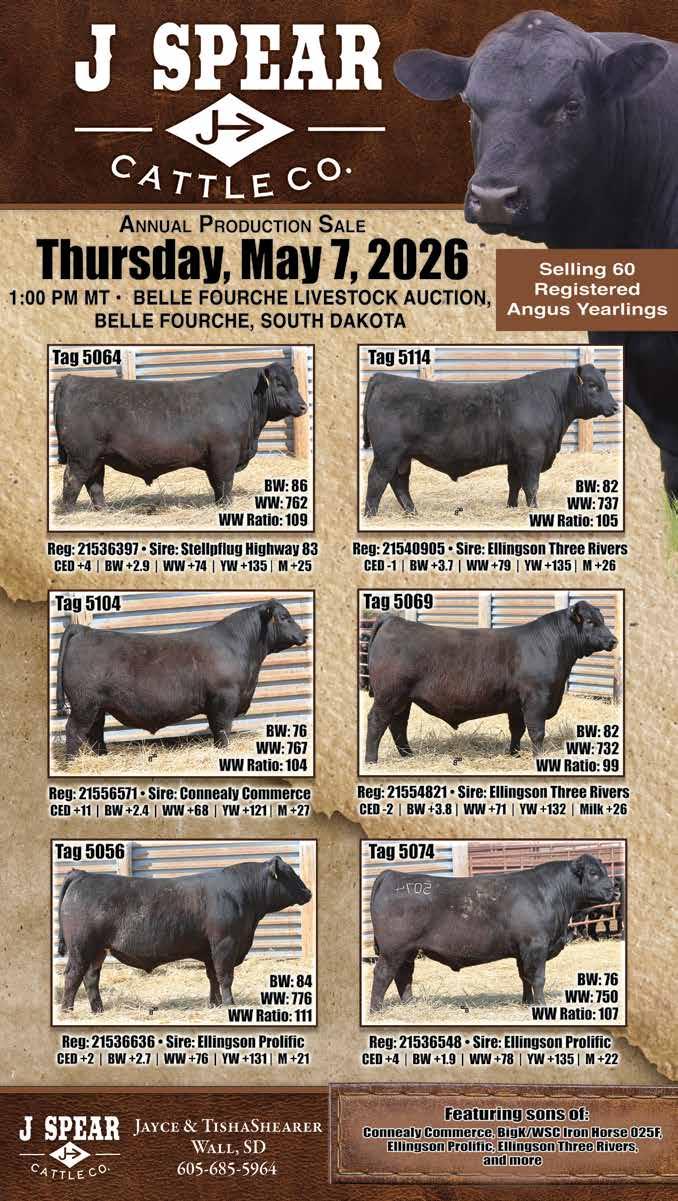
May 7 J Spear Cattle Company Annual Production Sale, Belle Fourche Livestock Auction, Belle Fourche, S.D., 605-685-5964, 605-279-1026
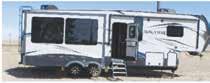
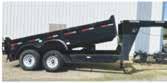
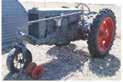
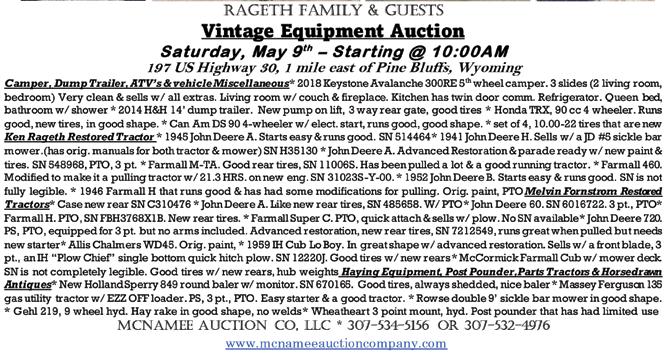
May 9 Vintage Equipment Auction, Pine Bluffs, 307-534-5156, 307-532-4976, mcnameeauctioncompay.com
May 16
Farmers and Ranchers Livestock Commission Spring Spectacular Catalog Horse Sale, Salina, Kan., 785-825-0211, 785-826-7884, fandrlive.com
May 23 17th Annual Full House Horse Sale, Weston County Fairgrounds, Newcastle, 307-746-5690, 307-746-8592, 307-746-8536, fullhousehorsesale.com
June 16-18
June 25
June 30
July 6-10
July 13-15
July 20
July 27-31
Aug. 4-5
Aug. 10-11
Aug. 17
Aug. 17-21
Aug. 22
Superior Livestock Auction Corn Belt Classic, South Sioux City Marriott Riverfront, South Sioux City, Neb., 800-422-2117, superiorlivestock.com
Northern Livestock Video Early Summer Special, 866-616-5035, northernlivestockvideo.com
Cattle Country Video High Plains Showcase, UW Marian H. Rochelle Gateway Center, Laramie, 888-322-8853, cattlecountryvideo.com
Superior Livestock Auction Week in the Rockies, The Steamboat Grand, Steamboat Springs, Colo., 800-422-2117, superiorlivestock.com
Western Video Market, Silver Legacy Casino Resort, Reno, Nev., 530-3473793, wvmcattle.com
Northern Livestock Video Auction Summertime Classic, 866-616-5035, northernlivestockvideo.com
Superior Livestock Auction Video Royale, Winnemucca, Nev., 800-4222117, superiorlivestock.com
Cattle Country Video Oregon Trail Classic, Gering Civic Center, Gering, Neb., 888-322-8853, cattlecountryvideo.com
Western Video Market, Little America, Cheyenne, 530-347-3793, wvmcattle.com
Northern Livestock Video Auction Early Fall Preview, 866-616-5035, northernlivestockvideo.com
Superior Livestock Auction Big Horn Classic, Sheridan, 800-422-2117, superiorlivestock.com
Memory Ranches Fourth Annual Foal Sale, at the ranch, Wells, Nev., 208412-6156, 208-695-0399, memoryranches.com
Sheep and Wool Notes
This week’s Postcard comes from the pages of the April 1, 1903 issue of the Wyoming Industrial Journal Enjoy.
The differences between the Carbon County flock masters and the authorities of Sweetwater County have been adjusted.
It has been arranged for the treasurer of Carbon County to levy and collect taxes on all sheep owned in the county and ranged in Sweetwater County, the latter county to receive onefourth of the amount collected and Carbon County to get the balance.
In this way, the sheep will be taxed but once, and both counties will be satisfied.
The day when it was necessary to have lambs Mexican bred and Colorado fed in order to top the market has passed.
H.H. Stedman of Shelton, Neb. came in with a double deck of lambs, brought down from Wyoming last fall, which sold on the market for $7.50 –the highest price ever paid for this class of stuff.
They were sold straight, too, without any being thrown out to cheapen up the bunch.
Omaha Drovers Journal-Stockman
Shearing has been commenced in Carbon
County.
At the Miller pens, 110,000 sheep will be sheared; at William Daley’s pens, 75,000; at Cow Creek, 50,000; at Fort Steele, 88,000; at Walcott, 60,000 and at Medicine Bow, 50,000.
This equates to a total of nearly 450,000 sheep.
To these figures should be added fully 350,000 sheep which will be shorn at private pens.
The Converse County Wool Growers Association has offered $1,000 reward for information leading to the conviction of the men who recently raided the Storrie sheep camps on Hat Creek.
The Natrona County Wool Growers Association has assessed its members 25 cents each for a fund with which they will
prosecute persons bringing scabby sheep into the county.
The annual wool sales at Cody City will be held on June 1 and June 28 this year. The indications are the sales there this season will be much larger than ever before.
A big steam shearing plant with 28 machines is being established at Corbett – the center of the sheep-shearing district of Big Horn County.
Sheep are being lambed under sheds in Fremont and Natrona counties. This experiment is proving a success.
A recent shipment from Wheatland of alfalfafed sheep topped the Chicago market at $7.60 per hundred.
Eight cents will be the average price paid for shearing sheep in Wyoming this season.
M. Gibson of Wheatland will feed 10,000 lambs next season.
Australia has about 87,000,000 sheep.
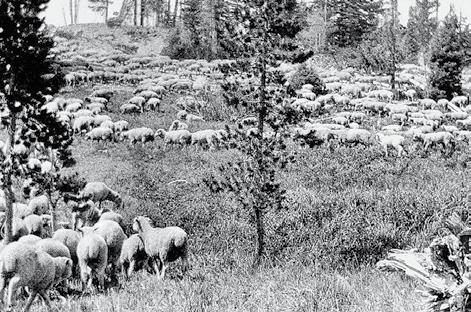
Pictured are sheep grazing on lush pasture in the Snowy Range around 1920. Photo from the Dick Perue/Bob Martin collection. Historical Reproductions by Perue
Dak 26-29/cwt
Source: USDA AMS Livestock, Poultry & Grain Market News, Torrington National Sheep Summary As of April 17, 2026
Compared to last week Slaughter lambs under 110 lbs mostly steady, over 110 lbs saw instances of 35.00 to 60.00 higher. Feeder lambs sold with steady to higher undertones. Slaughter ewes 15.00 to 20.00 higher. All sheep sold per hundred weight (CWT) unless otherwise specified. Slaughter Lambs: Choice and Prime 1-3: San Angelo: 40-50 lbs 357.00; 50-60 lbs 365.00-366.00; 60-70 lbs 368.00; 90-100 lbs 365.00.
Ft. Collins: 40-50 lbs 375.00. Replacement Ewes: Medium and Large 1-2: San Angelo: No test.
Billings: No test.
Ft. Collins: No test.
South Dakota: No test.
Sioux Falls: No test.
Sheep and lamb slaughter under federal inspection for the week to date totaled 34,000 compared to 30,000 last week and 44,791 last year.ss
Source:
As of April 17, 2026
Domestic wool trading had no confirmed trades reported this week. Prices reflect trades FOB warehouse in original bag or square pack, bellies out,
to original bag prices.
Source: USDA- CO Dept of Ag Market News Service, Greeley, CO
Nebraska Hay Summary
As of April 23 2026
Compared to the last report, Platte Valley and Central areas round bales of alfalfa and prairie grass hay sold steady to mostly 10.00 higher. Ground and delivered hay 5.00 to 10.00 higher. Alfalfa pellets sold steady to 10.00 higher. In the west, ground and delivered hay 30.00 higher and steady on the sun-cured alfalfa pellets. Contacts that still have hay said the phones have been busy. Very large areas of the state are extremely dry with several thousand acres burned. Hay supplies are limited in several areas, and some normal sellers have opted to not sell hay currently. Spring planting has started, per NASS as of Monday only 8 percent of the corn has been planted compared to 7 percent in 2025. Soybeans come in at 2 percent same as last year. Some hay producers have planted quite a few acres of alfalfa this spring. Knowing that forage production will be low due to lack of irrigation in the western side of the state.
Central Nebraska
Alfalfa Ground (Delivered) 140
Alfalfa - Good Large Round 85-100
Colorado Hay Summary
As of April 23, 2026
Compared to last report: Trade activity Very Light. Demand Good to Very Good as drought persists across the state with water allocation shortages heavily impacting crop planning, with farmers not sure how many acres of corn they will be able to plant for silage and alfalfa growers expecting only enough water to cover 1-2 cuttings. Regions across the state are indicating insect damage due to the warm temps we had in March. The late freeze last week has also impacted plant health in some areas. According to the U.S. Drought Monitor’s High Plains Summary for April 21, 2026, The region was mostly dry, with isolated rainfall in far southeast Nebraska, northern and southeast Kansas, and small areas of Colorado and North Dakota. Temperatures were generally above normal, with the warmest departures in southeast Nebraska and eastern Kansas. Dryness and a warm spring led to widespread degradation. Extreme drought expanded across central and western Nebraska and into northwest Kansas. Severe drought expanded in central and southwest Kansas, with new extreme drought in far southwest Kansas. Degradation continued across the plains of Wyoming and Colorado, with expansion of moderate to extreme drought.
Extreme drought was also introduced in southern South Dakota. Some improvements occurred in southeast Kansas, where moderate drought and abnormally dry conditions were reduced due to recent rainfall. For Drought Classifications, 57.86% of the state falls in Extreme-Exceptional drought (D3-D4) categories, and 42.14% of the state falls into the Abnormally Dry-Severe Drought (D0-D2) categories. The next available report will be Thursday, May 7, 2026.
CLASSIFIEDS
FULL-TIME RANCH MANAGER:
BISON RANCH, SHERIDAN, WY. We are seeking a dedicated, experienced ranch manager to join our growing bison ranch operation. This is a hands-on role for someone who takes pride in hard work, reliability and caring for land and livestock. Responsibilities: Daily care and management of bison herd. Maintaining fencing, equipment and ranch property. Assisting with feeding, health checks and handling livestock. General ranch maintenance and upkeep. Supporting ongoing growth and operations of the ranch. Requirements: Prior ranching or livestock experience (bison experience preferred but not required). Strong work ethic and reliability. Ability to lift heavy items and perform physical labor daily. Self-motivated and able to work independently. Available to start immediately. Salary starts at $145,000 and up. This is a full-time position with opportunity to grow alongside a rapidly expanding ranch. Apply today if you’re ready to work hard and be part of something being built from the ground up. Call Landon, 205-531-9819 or e-mail sheryl@ bisonunion.com 5/16
SUPERIOR CONTRACTING
Join the Gottsch Livestock Feeders Family! Gottsch Livestock Feeders is looking for Cowboys/Pen Riders for their feedyard in Red Cloud, NE. The main focus of the Cowboy/Pen Riders are spotting, pulling, diagnosing and taking cattle to the hospital and shipping fat cattle. This person will need to be a team player who is seeking a long-term position. You will have the opportunity to work with and learn from some of the best in the industry. We offer a benefits package that includes health insurance, dental, vision, 401(k), health savings, life insurance and paid vacation. Retention bonus offered to full-time employees. Incentives paid out at 6 months and 1 year of employment. If you are interested stop by and fill out an application or visit our website at
Call Mike Faimon at 406-469-1585 or Davin Arnold 970-301-3098 for more information.
IMMEDIATELY SEEKING FULL-TIME FARM/RANCH INDIVIDUAL FOR A REMOTE NORTHEAST WYOMING RANCH: The role supports the current foreman and works alongside to ensure smooth and efficient operation of livestock, haying, equipment and facility management. Applicant must have a strong agricultural background and a hands-on approach to problem solving and daily ranch work. This is a long-term position and offers a clear path to increased responsibilities, pay and leadership. Housing is provided. Must have a clean driving record. Please send resume with references and telephone number by mail or e-mail to: PeeGee Ranch, 1251 Lower Powder River Road, Arvada, WY 82831, pgranch@rangeweb.net. NO telephone calls 5/2
LOOKING FOR RANCH ASSISTANT PROPERTY MANAGER: Full-time position for large ranch located in Park County, WY. Responsibilities include: Lawn care, irrigation, agricultural equipment maintenance and general residential, building and property maintenance. Salary range of $45-$60K depending on experience. Living on property is required for employment. House and vehicle will be provided. Property is located 10 minutes from downtown Cody, WY. Position is available for immediate hire. Please send resumes to mgiliati@acpg.com 5/16
RANCH MAINTENANCE/ANIMAL CARE: Barn and kenneltype duties along with facility and grounds maintenance. Looking for a reliable self-motivated individual with a great work ethic who has some experience in caring for animals and ranchtype work. Proven organizational skills, attention to detail and a team player attitude are required. Job facilities are located 17 miles west of Cheyenne, WY. Applicants MUST possess a valid driver’s license, have reliable transportation and be able to work a flexible schedule. Rotating weekend coverage is mandatory for this position. Hiring for full-time position. Call 307-2752090 or e-mail resume to brittiny@rfholdings.org 5/16
FEED TRUCK DRIVER AND COWBOY WANTED: Western Nebraska calf grow yard is looking for a self-starter capable of supporting and working with a feedyard team to ensure general maintenance and caretaking of livestock, equipment and facilities. Ability to take work direction and change priorities as needed. Valid driver’s license required, CDL would be a plus. Knowledge and prior experience in feedlot and farm work preferred. Pay negotiable based on experience, housing available. Duties may include but are not limited to: Feed truck driving and mechanical skills for basic feed truck/tractor maintenance; farming to include all aspects of haying and irrigation; facility maintenance, build electric fence, repair pens, welding, stock tank and water line work, clean pens, hauling manure, spraying weeds; assist with the care and processing of cattle/pen riding. Send resume to P.O. Box 1248, Torrington, WY 82214, fax to 307-532-7899 or e-mail info@flagranchllc. com. Potential applicants with questions call 307-532-7885 or 307-534-6259 4/18
Help Wanted
RANCH HAND/GROUNDS
KEEPER: Full-time position at a family-owned ranch near Cody, WY and located in the Shoshone National Forest. Position entails lawn care, irrigation, heavy equipment operation, carpentry, equipment maintenance, building maintenance and overall residential and agricultural property maintenance. Experience is welcome but will train the right candidate. The ideal candidate will be reliable; have a strong work ethic; be able to perform individually and with a team; be a self-starter and enjoy working outdoors. Benefits include health, with optional dental and vision; paid-time off and 401(k) with employer matching contribution. For the right candidate housing on property is also available. Salary based upon previous experience. Send resumes to emilyb@colliergroupoffice. com and cg1@colliergroupoffice.com 5/2
LLC LOCATED IN WHEATLAND, WY, A FAST GROWING IRRIGATION COMPANY SERVICING PLATTE COUNTY, SOUTHEAST WYOMING AND SURROUNDING AREAS, IS IN SEARCH OF AN IRRIGATION TECHNICIAN SPECIALIZING IN THE INSTALLATION, maintenance and repair of precision agricultural irrigation equipment, primarily center pivots. One year minimum irrigation industry experience with certification. Proficient in technical knowledge of irrigation systems and troubleshooting along with system installation, assembly, diagnostic, repair, preventative maintenance and technology management. Able to work outdoors and operate heavy equipment. Must be able to perform labor-intensive tasks. Must be willing to work independently, possess excellent recordkeeping and have exceptional customer service skills. Must be able to be on call 24 hours during peak season. Training and continuing education provided. Valid driver’s license required and must pass a drug screen. Call 307-331-0257 or e-mail accounting@scllc19. com 4/25
SUPERIOR CONTRACTING LLC IS SEARCHING FOR AN EXPERIENCED HEAVY EQUIPMENT OPERATOR TO WORK
REMOTE: Duties will include operating, maintaining and inspecting heavy construction equipment (e.g., excavators, bulldozers, loaders, backhoes, graders, cranes) to perform earthmoving, material handling, site preparation and related tasks safely, efficiently and according to project plans and regulatory requirements. Operator must read and follow work orders, site plans, grade stakes and instructions from supervisors or engineers. Report mechanical issues promptly and coordinate repairs with maintenance staff or vendors. Position equipment accurately using survey references, GPS or laser grade systems to meet project tolerances. Load/unload materials, secure loads and assist with rigging and signaling when required. Follow site safety plans and OSHA regulations and use PPE and operate equipment in accordance with manufacturer and company safety procedures. Communicate effectively with site crews, foremen and traffic control personnel and assist with site setup and cleanup. Maintain daily logs of hours, material moved and work performed. Participate in safety meetings and trainings. Strong situational awareness and commitment to safety. Good communication and teamwork skills. Comfortable working outdoors in varied weather and at construction sites. Possible overtime, early starts, or weekend work depending on project schedules. Valid driver’s license required and must pass a drug screen. Call 307-3310257 or e-mail accounting@ scllc19.com 4/25
AGRI-ONE FINANCIAL: Farm/ ranch and all commercial loans. RATES AS LOW AS 5%. We have been helping with all aspects of agricultural, commercial financing and management for years. LET US HELP YOU on a consulting level with management to increase profitability, deal with and fix credit problems and for all your financing needs. WE CARE AND HAVE WORKING PROGRAMS designed for the farmer/rancher and not the banker. Please call Steve, 303-773-3545 or check out our website, www.agrionefinancial.com. I will come to you and get the job done!! 5/16
REGISTERED WYOMNG
BRAND: RSC, registered until 2027. Single iron. Also have an additional calf branding iron. $1,250 OBO. Call 307-4610356 4/25
REGISTERED WYOMING BRAND FOR SALE: LRC, LTH, renewed to March 1, 2033. $5,000. Call 307-358-3078 5/9
REGISTERED WYOMING BRAND FOR SALE: LSC, renewed to March 1, 2027. Call for pricing, 307-259-5485 5/9
ALL TYPES OF EQUIPMENT AND VEHICLE FINANCING. Great service!! Great rates!! Call Chuck Brown at C.H. Brown Co. LLC, 307-322-3232 (office), 307-331-0010 (cell) or e-mail chuckbrown@wyoming.com 4/25 Financial Services
REGISTERED WYOMING BRAND FOR SALE: LHC, LTH. Fees paid until January 2035. $3,500 OBO. Call 307-532-0112, leave message 5/2
WYOMING BRAND FOR SALE: LRC, LSS, LSH. Comes with 2 fire irons and 3 electric irons. Two of the electric irons are brand new. Can be used on horses, cattle and sheep. $3,000. Call or text for more information, 307-575-7065 5/2
REGISTERED WYOMING BRAND FOR SALE: RHC, RHS, LJH, renewed until 2033. $2,000 OBO. Call 307-575-1852 4/25
CAUCASIAN SHEPHERD
PUPPIES: Eight weeks old April 27. Good family and livestock guard dogs, $300. Text or leave a message, Ashley, 406-901-0565 5/9
PUPPIES FOR SALE: Border collie puppies, fourth generation working lineage, 16 weeks old. With some training. Three males and 1 female. $300. Call 307-2711009. To view photos, go to www. wylr.net in the classifieds 4/25
OWN A PIECE OF WYOMING HISTORY, OLD WYOMING BRAND FOR
SALE: LRC, LTH, originally issued in 1910. Purchased by my grandfather in 1913. Easy to read when placed on cows or horses, $12,500. ALSO, RANCH SADDLE manufactured by Fred Mueller Saddle Co., Denver, CO. Good condition, located in Cheyenne, WY, digital photos available, asking $400. Call 307-631-6838 5/2
CUSTOM FEEDING AND FINISHING FOR CATTLE AND SHEEP. Cactus Hill Ranch Company, Fort Collins, CO. Contact AJ Nelson, 970-372-8273 5/2
YEARLING BLACK ANGUS BULLS: AI sired by heifer bull Connealy Patent. Semen tested. Minatare, NE. Call Byron Miller, 303-818-8152, leave message 6/6
MYDLAND ANGUS RANCH: Yearling Angus bulls. Performance tested, EPDs available. Home raised. Call 406-591-3404 or 406-855-5598 5/2
YEARLING ANGUS BULLS: These bulls are grown, not fattened, will get out and cover cows. Many will work on heifers. We will deliver. Call Joe Buseman, 605351-1535 5/2
REGISTERED ANGUS YEARLING BULLS: Breeding soundness, fertility tested and PAP tested. Ready to go to work. Call Paul at TAG Double H Cattle Co., Ten Sleep, WY, 307-690-4225 5/2
Limousin
FERRAT RANCH LIMOUSIN OFFERING 18-MONTH-OLD REGISTERED PUREBRED LIMOUSIN BULLS BY PRIVATE TREATY THROUGH THE END OF APRIL: Athletic, pasture/forage raised, fall born. Fertility and DNA tested. Fully guaranteed and ready for delivery. Catalog available upon request. Call John 406-949-7911 or Samantha 406-949-0869, e-mail ferratranch@gmail.com 4/25
LS CUSTOM LEATHER: New tack, belts and cell phone cases. ALSO, SADDLE AND TACK REPAIR. Custom orders welcomed. Contact Lester, 307-631-1053, leave a message. Riverton, WY 4/25
SALE * CHRISTENSEN RED ANGUS * SALE: Registered, vaccinated and fertility tested bulls. We have a deep carcass, high ADG packaged with moderate to low birthweights available. Call 406-208-4315 or e-mail criters64@gmail.com 5/9
BEST LAST CHANCE SALE!!
LYTLE RED ANGUS is offering yearling bulls from our herd founded on 30+ years of selection for fertility, consistency and efficiency. Highly adaptable, our bulls have proven themselves from Arizona to New York state. Get your next bull through our online-only auction hosted by DV Auction. Opens April 27, closes May 1. Visit www. lytleredangus.com or call Zeb, 605-441-7658. To view photos, go to www.wylr.net in the classifieds 4/25
RED ANGUS HIGH-ELEVATION
YEARLING BULLS FOR SALE IN NORTHEASTERN UTAH: Out of AI and bull-bred sires. Will be trich, semen tested and fed for free until April 15. $3,500/head. Bar Lazy TL Ranch, David, 435-828-1320, barlazytlranch@ gmail.com 6/13
3/H SIMMENTAL RANCH, PLAINS, MT OFFERS POWER-
FUL SIMANGUS BULLS: Yearlings and 18-month-olds sired by top AI genetics. Bred for performance, soundness and longevity, with a strong emphasis on calm disposition. These bulls are built to work and last in real world conditions. Call Alan at 503-931-6815, to find the right fit for your program. To view photos, go to www. wylr.net in the classifieds 5/16
SIMANGUS YEARLING BULLS FOR SALE BY PRIVATE TREA-
TY: Bulls priced for every budget. Bulls have GE EPDS, are homozygous polled, most are homozygous black. Bulls can be inspected at Dilka Cattle, pictures available by request. Bulls sired by BAS Money Maker, Gibbs Essential, Gonsior Batman and CCR Pounder. All bulls guaranteed for first breeding season. Information on the bulls may be requested by e-mail at thedilkas@aol.com or calling 970-396-8791 5/2
TWO-YEAR-OLD HEREFORD
BULLS: Canadian registered. Fertility checked. View photos at www.workingherefords. com. Estermann Herefords, 308-340-4159 or 308-9634473 5/2
REGISTERED HEREFORD
BULLS FOR SALE: Overaged bulls to cover more cows! Videos, photos, EPDs and certificates available. Call Troy Rasmussen, TSR Cattle Co., 605-690-0100 5/2
HEREFORD BULLS FOR SALE: Yearlings and 2-yearolds. Polled and horned. Big, stout, sound Hereford bulls with calving ease and high growth potential. Lots of pigment and no extra white. Get 30-40 lbs. bigger weaning weights on your baldy calves through the heterosis factor from these bulls. We are passionate and committed at providing our customers with the top genetics existing in the entire Hereford breed. Come see our sons of Churchill W4 Sherman, the biggest trait leading bull in the industry from birth to growth, maternal and carcass. BUY WYOMING FIRST!! Gene Stillahn, Sticks & Stones Ranch, 307421-1592 4/25
SHORTHORN BULLS FOR SALE PRIVATE TREATY: Yearlings up to mature bulls available. Developed conservatively so they hold up. Remember a red Shorthorn bull on your homozygous black cows will give you black calves. Shorthorns are excellent maternal cattle that produce quality beef. Francis-Millvale Shorthorns, Gene and Roberta Francis Family, 701-331-2403, e-mail francis. millvale@gmail.com. To view photos, go to www.wylr.net in the classifieds 4/25
REGISTERED SIMMENTAL/ ANGUS YEARLING BULLS FOR SALE: Bulls out of some of the best AI bulls in the country. Including OMF Epic, Bridle Bit Recharge, Payroll and WHF Double Up. All bulls are out of high-quality cows with great bloodlines. Bulls have been semen tested with great scrotal scores. $5,000-$6,000. Call 801-722-9267 5/9
Wagyu bulls, red and black Akaushi, yearlings, 2- & 4-year-olds.
SUMMER PASTURE WANTED FOR YEARLINGS: Seeking summer grass for 2026. For 500-1,500 head. Wyoming, Colorado, Nebraska, South Dakota. Prefer long-term potential, competitive rates offered. Call Jon, 831-240-5795 TFN
LOOKING TO LEASE A RANCH FOR APPROXIMATELY 150-200 HEAD OF COWS. Prefer area in Johnson and Sheridan counties. Call 307-290-1643 4/25
WEANER PIGS FOR SALE.
ALSO, butcher hogs. Located in Powell, WY. For more information, call 307-271-1014 1/16
BARLEY STRAW: Certified weed-free small squares, $4/ bale. ALSO, 5x6 round bales, $125/ton. GRAIN OATS, wheat and barley, $20/cwt. Greybull, WY area. Call 307762-3878 or 307-899-4714, leave message 5/16
ALFALFA HAY: Round bales. ALSO, BALED CORNSTALKS in 4x4x8 squares. First come, first served. Call 970-522-5030 4/25
FEED/GRAIN FOR SALE: Alfalfa, cane and millet hay. Large squares and rounds. Semi loads only. Will deliver. Call 970-227-2760 5/9
BROME GRASS HAY FOR
SALE: 750 large round bales, 2024 and 2025, 10 miles from Miller, S.D., $130/ton, net wrapped, good quality. Call Tom 605-870-0719 or Tyler 605-871-3878 5/9
FOR SALE: 227 Caterpillar feller buncher with rotary cup saw, $30,000. Four ft. metal band saw, $375. 1985 Ford F150, 6-cylinder automatic transmission, $2,500. 1976 Ford F350, 12’ flatbed, 360 engine, 4 speed transmission, $3,000. Fiberglass 8’ camper shell, $300. Wheatland, WY. Call Greg at 970-566-6527 5/16
LODGEPOLE OUTDOOR FURNACES, 307-223-2046. Your authorized Central Boiler Dealer. Get your outdoor wood furnace today!! Efficient wood heat. Heat multiple buildings. Invest in your heating, don’t just pay for it!! See us at www.cb.lodgepoleproducts. com!! 4/25
ALFALFA HAY FOR SALE: 2025 and 2024, various RFV, various protein and various prices. Tested by Dairyland Labs. Call 605-530-8089, Miller, S.D. 5/2
PARK COUNTY, WY RANCH NEAR CODY, WY IS AVAILABLE FOR A LONG-TERM LEASE: The ranch has over 50,000 acres and supports an irrigated hay base with BOR water rights. Carrying capacity is 700 animal units year-round with hay production. Willing to split the hay ground and grazing. Please e-mail Melanie Giliati at mgiliati@acpg.com for details 4/25
FOR SALE: Landoll 6230 36’ rock flex disc with 3 bar mulcher. Phillips 4305 43’ rotary harrow. Sunflower 33’ cushion gang disc with 3 bar mulcher. 24’ portable ground hay/bale feeder. Vermeer BP 7000 bale processor with hydraulic deflector. Gehl 1410 manure spreader, 410 bushel with slop gate, double floor chains, tandem axle. Burns portable loading chute. Miller Pro 18’ chuckwagon with tandem running gear. 2022 Kenworth T680 day cab semi, PACCAR engine, automatic transmission, air ride, aluminum wheels, 486,242 miles, very nice. John Deere 714A and 716A chuckwagons with John Deere tandem running gear. H&S 7+4 16’, 20’ and 24’ chuckwagons with bunk feeding extensions and tandem 14 ton running gear. J&M 385 gravity box with 12 ton gear, truck tires. 12’ and 14’ HD box scrapers with tilt. All in very nice condition!! Call 605-999-5482 5/2
PREORDER YOUR 2026 NEW CROP ALFALFA HAY AT VALLEY VIDEO HAY MARKETS, LLC: Representing the best producers in eastern Wyoming and western Nebraska. Call Barry McRea, 308-235-5386, www.valleyvideohay.com 5/2
LAMAR COMMUNITY COLLEGE LEGACY HORSE SALE!! Join the Legacy. Lamar Community College has been training high-quality performance and ranch horses since the 1970s. JOIN US ON SAT., MAY 2 IN LAMAR, CO TO SHOP HIGH QUALITY HORSES. Mark your calendars and follow our social media pages to stay up-todate on the Lamar Community College Legacy Horse Sale. Previews at 9 a.m., sale at 12 p.m. 2401 S. Main Street, Lamar, CO 81052. Online as well with DV Auction. Call Savanna Mauch, 719-3361624 or Jaci Brown, 719336-6663 4/25
WANTED: Sugar Bars and non-Sugar Bars-bred saddle horses for the 24TH ANNUAL SUGAR BARS LEGACY
SALE SUN., SEPT. 20 Held in Sheridan, WY. NEW ONLINE BIDDING option thru Frontier Live. Please contact Jim, 406-812-0084 or e-mail deerrunranch@gmail.com for consignment and sale information 4/25
HAY FOR SALE: 2025 grass/ alfalfa, first and second cutting alfalfa, millet, haybet barley and CRP hay. ALSO, 2025 GRINDING HAY also available. All in net-wrapped round bales. Semi load deliv ery available. Call for pricing, ask for Klint, 701-290-4418, if no answer, send a text or keep trying 4/25
CERTIFIED WEED-FREE PURE ALFALFA HAY: 2025 third and first cutting avail able in small squares, averag ing 70-80 lbs. Will load trucks and any open trailer. MONIDA OATS: $16/cwt. Combine run, great for seed or feed. Will au ger into truck, trailer or large totes/ag bags. Located be tween Powell and Cody, WY. Certified scales on site. or text Knopp Farms for de tails, 307-254-0554 5/23
Angus Angus
Hereford
Hunting & Fishing Hunting & Fishing
The choice is simple. Big Horn Truck and Equipment Manderson, WY rairdenjlw@tritel.net • 800-770-6280 No wire to steal! Easier On You.
Copper wire is being stolen from electrically powered pivot systems world-wide. Many growers have resorted to 24-hour guards, razor wire, floodlights and daily disassembly to protect themselves. T-L’s hydraulically powered pivot systems can be designed with little or no wire to steal. Stop theft and discover T-L’s reliability, simplicity and low maintenance cost. T-L irrigation systems are easier on you - for life. Irrigation Systems
USED IRRIGATION PIVOTS FOR SALE, www.zimmag. com ● 2013 Valley 7000 7 tower 1,336’, 3,882 hours. Call 402910-3236 5/16
IRRIGATED 80 + FARM AND HOME : Classic, beautiful ranch-style home with a blend of country charm. Situated on 80 + acres with an irrigation well for the wiper pivot. Features a versatile Cleary building, well-maintained livestock corrals and a character filled antique loft barn. Positioned 6 miles northeast of Henry, NE in Sioux County. $775,000. PREMIER PIVOT AND GRASS PASTURE IN GOSHEN COUNTY, WY: This well designed 368 + acres hay and pasture property features an 86 + acre Reinke center pivot contiguous to native grass pasture with a stock well. The entire property is fully enclosed with perimeter fencing, with the center pivot separately fenced. Pivot is planted to alfalfa. Property can be split. $759,000. Pictures at www. buyaranch.com . Call Casey Essert, Land Broker, 307532-1750 TFN
WANTED: Old snub nose, cab over truck, 30s, 40s or 50s, any condition. ALSO 1932, 33 or 34 Ford car, restored or unrestored. Call Joe, 605-290-3208 4/25
BUYING AND SELLING SILVER BARS, SILVER DOLLARS, RARE COINS, GOLD JEWELRY, ANY GOLD-SILVER ITEMS, COLLECTOR COINS, CURRENCY: Forty-four years in business. I have a $1,500,000 line of credit and own 1,475 acres of land near Ormsby, MN. Call Kuehl’s Coins, 507-235-3886 or 507-399-9982, Fairmont, MN 4/25
PRAIRIE DOG PROBLEMS? Free extermination! Call 920609-8927 5/2
ANTLER MARKET STEADY TO STRONG!!! MAY 8-9 PETSKA FUR WILL BE BUYING ALL GRADES OF ANTLER AND LATE SEASON FUR IN THE FOLLOWING TOWNS AND LOCATIONS : MAY 8 : Ft. Bridger 6:15-6:30 a.m., Cash Store; Evanston 7:10-7:40 a.m., Prairie Inn; Kemmerer 8:409 a.m., Ham’s Fork Station; Cokeville 9:45-10 a.m., Flying J Truck (drive thru, call Greg); Afton 11-11:30 a.m., Tractor Supply; Thayne 11:45 a.m.12 p.m., Farmer’s Feed (drive thru, call Greg); Alpine 12:30-1 p.m. Grey’s River Saloon; Hoback Jct. 1:301:50 p.m., Hoback Market/ Exxon (drive thru, call Greg); Bondurant 2:10-2:20 p.m., Elk Horn Bar (drive thru, call Greg); Bondurant 2:30-2:45 p.m., Post Office (drive thru, call Greg); Daniel 3:15-3:30 p.m., The Den (drive thru, call Greg); Pinedale 3:45-4 p.m., Gannett Sports (drive thru, call Greg); Big Piney 4:40-5 p.m., Public RR/Visitor Info. Parking (drive thru, call Greg); La Barge 5:30-5:45 p.m., All American Fuel (drive thru, call Greg); Green River 7-7:20 p.m., Hitching Post (drive thru, call Greg); Rock Springs 7:408:10 p.m., WY Wool Warehouse; Wamsutter 9-9:15 p.m., Conoco (drive thru, call Greg). MAY 9 : Rawlins 6-6:15 a.m., Tractor Supply; Saratoga 7-7:30 a.m. Saratoga Feed & Grain; Elk Mountain 8:108:30 a.m., Conoco on I-80 (drive thru, call Greg); Hanna 8:45-9 a.m., Hanna Market (drive thru, call Greg); Medicine Bow 9:10-9:30 a.m., JB’s (drive thru, call Greg); Rock River 9:40-10 a.m., Rancher’s Supply (drive thru, call Greg); Laramie 10:50-11:30 a.m., West Laramie Fly Shop. For more information, call Greg, 308-750-0700 or visit www. petskafur.net 5/2
ANTLER MARKET STEADY TO STRONG!!! MAY 1315 PETSKA FUR WILL BE BUYING ALL GRADES OF ANTLER AND LATE SEASON FUR IN THE FOLLOWING TOWNS AND LOCATIONS: MAY 13 : Newcastle 7:10-7:30 p.m., Voelker’s Body Shop. MAY 14 : Newcastle 6:30-6:50 a.m., Voelker’s Body Shop; Upton 7:20-7:40 a.m., Joe’s Grocery (drive thru, call Greg); Moorcroft 8-8:20 a.m., The Coffee Cup (drive thru, call Greg); Sundance 8:45-9:30 a.m., Rapid Stop; Beulah 9:50-10:10 a.m., Truck Stop (drive thru, call Greg); Spearfish, S.D. 10:20-10:50 a.m., Butcher Block (sticking with old location on fairgrounds road); Belle Fourche, S.D. 11:20 a.m.-11:50 a.m., Runnings (Old Belle Inn parking lot); Aladdin 12:20-12:50 p.m., General Store (drive thru, call Greg); Hulett 1-1:30 p.m., Tower Valley Ag Supply; Alzada, MT 2-2:20 p.m., B&J Convenience (drive thru, call Greg); Gillette 7-7:30 p.m., Rocky Mountain Sports and Howard Johnson Motel room 143 7:45-8:15 p.m. MAY 15 : Gillette 5:45-6 a.m., Rocky Mountain Sports (drive thru, call Greg); Wright 6:20-6:50 a.m., Rest Area (drive thru, call Greg); Midwest 7:508:10 a.m., Sinclair Truck Stop (drive thru, call Greg); Kaycee 8:35-9 a.m., Sinclair Truck Stop; Sheridan 10:3011 a.m., Sportsman’s Warehouse; Buffalo 11:45 a.m.12:15 p.m., Good 2 Go; Ten Sleep 1:50-2:20 p.m., Pony Express; Hyattville 3-3:20 p.m., Paint Rock Processing (drive thru, call Greg); Manderson 3:40-3:50 p.m., Hiway Bar (drive thru, call Greg); Basin 4-4:20 p.m., Overland Express Mart (drive thru, call Greg); Greybull 4:40-5 p.m., Overland Express Mart (drive thru, call Greg); Lovell 5:40-6 p.m., Good 2 Go (drive thru, call Greg); Byron 6-6:15 p.m., Cardtrol Station (drive thru, call Greg); Powell 6:30-6:50 p.m., Murdoch’s (drive thru, call Greg); Cody 7:30-7:50 p.m., Nature’s Design Taxidermy; Meeteetse 8:30-8:45 p.m., on street in front of firehouse (drive thru call, Greg). For more information, call Greg, 308-750-0700 or visit www.petskafur.net 5/9
ANTLER MARKET STEADY TO STRONG!!! MAY 16-18 PETSKA FUR WILL BE BUYING ALL GRADES OF ANTLER AND LATE SEASON FUR IN THE FOLLOWING TOWNS AND LOCATIONS: MAY 16 : Worland 7:30-8 a.m., Coop One Stop; Thermopolis 8:50-9:20 a.m., Renegade Guns; Shoshoni 10:10-10:30 a.m., Fast Lane/Exxon (west of truck diesel pumps, (drive thru, call Greg); Riverton 1111:45 a.m., Vic’s Body Shop (behind the Dollar Tree); Hudson 12:10-12:20 p.m., Wyoming Custom Meats (drive thru, call Greg); Lander 12:501:30 p.m., Pit Stop; Jeffrey City 2:30-2:45 p.m., Split Rock Cafe (drive thru, call Greg); Muddy Gap 3-3:10 p.m., (drive thru, call Greg); Alcova 3:50-4 p.m., Sloanes General Store (drive thru, call Greg); Casper 4:30-5:15 p.m., Wagner Outdoor Sports; Glenrock 5:45-6 p.m., east exit on I-25 (drive thru, call Greg); Douglas 6:306:45 p.m., Douglas Feed. MAY 17 : Douglas 6:30-6:45 a.m., Douglas Feed (drive thru, call Greg); Orin Junction 7-7:10 a.m., Fast Stop (drive thru, call Greg); Lost Springs 7:30-7:40 a.m., truck pull off 1 mile east (drive thru, call Greg); Manville 8-8:10 a.m., Truck Stop (drive thru, call Greg); Lusk 8:30 a.m.-9 a.m., Decker’s Grocery; Hartville 9:45-10 a.m., Miner’s & Stockman’s Restaurant (drive thru, call Greg); Guernsey 10-10:30 a.m., Crazy Tony’s; Wheatland 11-11:30 a.m., Wheatland Travel Center; Chugwater 1212:15 p.m., Stampede Saloon (drive thru, call Greg); Cheyenne 12:45-1:15 p.m., Tractor Supply; Archer 1:40-1:50 p.m., Home on the Ranch Processing (drive thru, call Greg); Carpenter 2:10-2:30 p.m., Antelope Truck Stop (drive thru, call Greg); Pine Bluffs 2:45-3 p.m., Sinclair (drive thru, call Greg); LaGrange 5-5:20 p.m., Bear Mtn. Stage Stop; Hawk Springs 5:30-5:45 p.m., Longbranch Saloon (drive thru, call Greg); Yoder 5:45-6 p.m., Yoder Store (drive thru, call Greg); Lingle 6:30-6:45 p.m., Ty’s Pit Stop. MAY 18 : Torrington 6:50-7:20 a.m., Insight Precision Arms; Scottsbluff, NE 8:30-9 a.m., Murdoch’s. For more information, call Greg, 308-750-0700 or visit www.petskafur.net 5/9
Farmer's
BY RON RABOU Field
Think Before You Act
It’s after dark as I begin my trek from southern Iowa to the town of Washington, Iowa, where I’ll be delivering a keynote speech the next morning. It’s about a two-hour trip as I head north and east.
As crazy as it might sound to many, Iowa is incredibly beautiful and one
of my favorite states to visit. Even though I grew up on the Great Plains, which have incredible beauty of their own, I am a sucker for vast green farm fields, neatly kept farmsteads, trees and water – and Iowa has plenty of it. I have spent the past few days working with a variety of people on farm succession.
As I drive, despite the intense nature of the topics we covered, I find myself reflecting on the genuine and sincere nature of this group of individuals and their relaxed dispositions.
While traveling down the winding roads to my destination, something I had never noticed before grabs my attention. As I reflect on this revelation, I begin to recall the numerous miles I have traveled in this state. How did I not notice it before? On this night, it is as obvious as obvious gets.
My revelation seems simple, but here in Iowa, it is alarming to me. It’s alarming because, to the motorists I am
meeting, it must be commonsense and common courtesy – a simple act of grace and understanding.
Not one person in my two-hour journey tried to blind me with their bright lights as they approached from the other direction. Each one of them did what I was taught to do in driver’s education 38 years ago – they briefly flashed me to let me know my lights were on bright.
I was astonished, and since that time, I have taken note of the same courtesy each time I drive on Iowa highways.
The reason it jolted my attention was because this is a practice I rarely see here at home. I’ll be the first to admit I am often forgetful about leaving my lights on bright and forgetting to hit the dim switch when vehicles approach me at night.
It’s not at all intentional, so I always appreciate the rare person who briefly flashes me with this gentle reminder.
Unfortunately, this seems to be the exception. What I encounter mostly are drivers who apparently think they are “teaching me a lesson” by blinding me right before we meet, which causes me to wonder what they expect by doing so.
Do they think they are
making the road safer? Are they pleased with their prowess in exerting their authority as the headlight police?
I’m not sure, but what I am sure of is these folks should all attend a refresher driver’s education course about defensive driving and they should learn to take it down a notch.
A vehicle isn’t a weapon and should never be used as one. This sort of practice and others like it does nothing but increase the chances of causing an accident. It’s downright dangerous and completely unnecessary, if you ask me.
This is a big deal because the little things we do each day, in every way, actually matter. In our quest to conquer each day and outdo the next guy or gal, there is a cost we often forget to pay attention to.
Newton’s third law of motion states for every action, there is an equal and opposite reaction. Furthermore, as quoted from our friend artificial intelligence, “When object A exerts force on object B, object B simultaneously exerts an equal force in the opposite direction on object A. These interaction pairs apply to both physical forces and broader life consequences.”
We forget everything we do – even the “little things” – creates broader life consequences.
When we do things like trying to blind someone at night on the highway at 70 miles per hour, we have no idea what type of consequence it might bring. It may bring a level of “satisfaction” at times, but it might also cause a wreck where someone is maimed or killed and that person might be you.
The question we all need to ask ourselves is, “Are my behaviors and actions of the manner where they will create a positive reaction or healthy consequences?” If they are not, we should reevaluate and change whatever it is causing us to exude anger, malevolence, disdain and hostility. And yes, the little things like blinding someone on the highway can easily exemplify those types of mindsets, along with the numerous other things we do to invite negative reactions. Instead, in this instance, we should be thinking, “How can I play a role in making sure the road is a safer place?”
More broadly, “What am I doing and how are my behaviors and actions causing the world to be a better place?”
My message this time around is to think before you act. The little things matter in a very big way.
Stay In Your Lane by Lee Pitts
I admit I am prejudiced, and I don’t believe in intergenerational marriage.
For example, I don’t believe a Baby Boomer should ever consider marrying a member of Generation Alpha, who are currently one to 14 years old.
Don’t laugh. In 1880, 37 states set the legal marrying age at 10 years with parental consent, and in Delaware one could marry at seven years of age.
These days, one can legally get married at 16 years old in many states.
If you’re like me, you are having trouble knowing who’s who when it comes to the generations.
Currently, there are members of eight generations living at the same time, including the Greatest Generation; the Silent Generation; Baby Boomers; Generations X, Y and Z; Generation Alpha and Generation Beta.
This is why in America today we can have a 100-yearold bereaved widow who can remember her husband’s first kiss but has a monogomously-challenged great-granddaughter who can’t remember her third husband’s last name.
Baby Boomers were born between 1946-64, and currently there are 73 million of us but we’re dying like flies.
The only reason a member of Generations X, Y and Z should ever consider marrying a Baby Boomer is for resource extraction purposes, as Boomers are the wealthiest generation on the planet.
If you see a human standing in line at the bank, they’re probably a Boomer because all of the other younger generations either have no money to put in the bank or they bank online.
Baby Boomers have their own way of talking, which younger generations don’t understand.
We use words like “far out man,” “bummer” and “groovy,” while Gen Zers – also called Zoomers – use words like “rad,” “wazzup” and “awesome.” Members of Generation Alpha say things like “mad lit” and “mad drip,” which I have no idea what they mean.
How would an intergenerational couple even communicate?
Generally speaking, Boomers are self-centered and spoiled. We still read newspapers and magazines, while Millennials and all of the rest only read their phones.
Boomers have old fashioned names like Leland, Farnsworth and Winston, while Millennials are called things like Moon Unit, Cyanide, Phelony, Jacquell and Zooey.
Can you imagine the fight an intergenerational couple would have in naming their children?
Members of Generation X are often referred to as the MTV Generation or Latchkey Kids because they largely raised themselves since both parents were working. Currently they are broke, but interestingly, they are the highest spending of any generation, spending $15 trillion a year.
On average, they’re $142,000 in the hole – most of it student debt.
A member of Generation X should never even consider marrying a member of Generation Z because they are financially conservative. Can you imagine the fights they’d have over money?
The Millennials – also called Generation Y – are currently 45 to 60 years old and are licking their chops because it’s estimated they’ll inherit $68 trillion, which is why many of them are still living at home and have never had a job. It’s been said – not by me – Millennials are lazy, entitled, delusional, narcissistic, unreliable and financially insecure. They are also referred to as Generation Me and Echo Boomers.
The men of this generation wear their hair in a bun, are covered with tattoos and have more piercings than a seamstress’ fingers. They have no kids and no place to live other than with their parents. They cut the cord, don’t watch much TV, are addicted to their phones, have no brand loyalty, no patience and have never been inside a bank except to rob one.
Females be warned – many males of this generation never reach a marital age. Sounds like a real catch matrimonially speaking, don’t they?
Members of Generation Z got their first smartphone at age eight which means they don’t have to think and they spend four to five hours on social media. They carry no cash and pay for everything with their phone.
Generations Alpha and Beta are below the legal age for marrying. We wouldn’t touch them with a 10-feet pole, and neither should you. Our number one rule is you should never marry anyone who is younger than your oldest daughter.
One final piece of advice when it comes to matters of matrimony – stay in your own lane.
FARM EQUIPMENT AUCTION
MAY 2, 2026 – 10:00 A.M.
AUCTION LOCATION: 2 miles West of St. Onge SD on Highway 34 to 196th St. then 1 mile west. Watch for signs. EQUIPMENT: John Deere Model 6430 Front Wheel Assist, 3300 hrs. Triple Hydraulics, 3 pt.;
Deere
Wheel assist, 3 pt. with 640 John Deere loader; John Deere Model 7810, 16 Speed Power Quad Transmission, Front Wheel Assist, 2,543 hrs. 3 pt.: All tractors have cabs; John Deere 6415 2-wheel drive, 1900 hours, 3 Pt. cab; Hesston 9345 Swather, 9120- 16 ft. header, Diesel engine, cab, air, 2002 hrs. Vermeer Model 2300, side delivery V rake; Cambells double bale 3 pt. bale carrier; Melroe 220 Sprayer Coupe with 20 ft. booms. Haybuster Model 2650 Bale Processor; Bob Cat S 250 Loader, 6707 hrs. John Deere Model 3 pt. bale unroller; Vermeer Model 605N Round Baler, Select wide pickup, like new. 3 pt. Field sprayer; Hagedorn Model 2000, tandem axle, Hydra Spread manure spreader; 3 pt. side delivery rake; 4- 300 gallon fuel tanks on metal stands; 1,000 gallon fuel tank on skids with electric pump.
WOOD WORKING TOOLS: Craftsman 12 ½” Plainer Molder; Hatchi table saw; Craftsman Band saw; Rockwell portable wood vise; Makita router Model 3621; Craftsman sawsall; Dremel tool; 2 Roto Zips; Tap & Die set; Air nailer; Router table; 6” Grizzley Jointer; Dado blades; palm sander; Grizzley 14” floor model drill press; Craftsman Radal 10” arm saw; propane cutting torch, tank and cart. Stanborn Upright 60 gallon, 220 Volt air compressor; router table; Workmate table; Craftsman Dust Collector; Assorted step ladders; Tractor metal seat on wheel; ATV sprayer; Stihl chain saw. Shop vacuum; Assorted extension electrical cords; ¾”, 3/8” socket sets, Metric deep & Regular sockets; all sizes Cresent wrenches; open end, box end wrenches; electric pressure washer; creeper; hole saw bits; 8 piece plug cutters; punches; chisels; hammers; staple gun; gear pullers; air bumper jack; 2 ton standard engine hoist; Hobart Iron Man wire feed welder; Bench grinder on stand; DeWalt chop saw; 10 ft. 300 lbs. step ladder; drill bits; Makita cordless drill; vise grips; 3/8”- 1 ½” impact sockets; breaker bar; ¾” rachet; side grinder; 2- ½” air impact wrenches; air rotary grinder; 3/8” air rachet; wood clamps; battery charger; jigsaw; portable air tank; drills; shovels; potato fork; jump start unit; Skill saw; 40’extension ladders; 12 Volt ½” impact; weed wackers; pole saw; Coats air operated tire changer; Machinist box; assorted tools and related items.
FARM RELATED SUPPLIES: Head catch; 2- calf branding tables; cattle chute; some assorted size lumber; 12 sacks of cleaned alfalfa seed; ½ barrel uncleaned alfalfa seed; 20 rolls of water proof Bentonite sheeting; 20 ft. Cones storage container; 2 rolls baler hay net wrap; rear tine tiller; Tahoe 7000 Watt Generator, Condition unknown; 60 Watt PTO Gen Power generator, 2 small calf hauling trailers; Snowplow for Polaris ATV
HOUSEHOLD: Lighted Pontiac Clock; Pontiac sign; Apple press; Hand crack drill press; small tiller; Camouflage hunting gear; arrow machine equipment; Craftsman 5 hp. vacuum; backpack; Cannon printer; post pounder; bicycles; camping chairs; weight bench; 8 gun- gun case; fishing poles, 3- assorted fly fishing poles, 1- bamboo pole; green wood chest; video camera; dehydrator; assorted prints; Mannequin; misc. household items.
VEHICLES & TRAILERS: 2015 Ford F-250, 4 door, 4 X 4, gas engine, 76,196 miles, good condition; 2013 Ford F- 450, 48,935 miles, gas engine, 4 X 4, Dually,with metal flat bed, good condition; 2016 John Deere 825 I Gator, 430 hrs. 2,315 miles; Polaris Ranger; 1973 Chevy C618 truck with dump box; 1977 International truck, round bale rack on back; 1992 15’ X 7’ homemade trailer; 2009 7’ X 13’ Homemade trailer; 2000 8’ X 17’ homemade trailer; 1999 Circle D Gooseneck 8’ X 30’ trailer.
COMMENTS: Equipment is in good maintenance and good working condition.
Owners: Moe Farm & Ranch, Inc • Guest Consignor: Kelly Moe Estate, St. Onge, SD No Buyer’s Premium • Lunch Available • Terms Cash or Bankable Check with ID • Credit Cards Accepted Not Responsible For Accidents or Thefts For color pictures, go to www.casteelauction.com and click on
Junction Ave. Sturgis SD, 57785
Casteel-Auctioneer/Broker/Owner Call us at: 605-347-5110 or 605-347-9293; Fax us at: 605-347-6680.
While any official plans for a phased reopening have not yet been announced, cattle producers are keeping tabs on the developing situation and officials continue to monitor the spread of NWS.
Sterile fly facility
The Moore Air Base sterile fly production facility serves as a cornerstone of Rollins’ five-pronged strategy to combat NWS, which was first unveiled last August.
Constructed in partnership with the U.S. Army Corps of Engineers (USACE), the facility is being built with an aggressive timeline designed to quickly expand the nation’s sterile fly production capacity, according to an April 17 press release issued by USDA.
USACE is providing engineering, design, construction management and contract oversight for the project to ensure the facility meets the highest standards for biosecurity, reliability and long-term operational readiness, according to USDA.
“Breaking ground on this facility marks a major investment in safeguarding America’s livestock and the producers who feed this nation,” Rollins says. “This puts NWS sterile fly production in American hands,
so we do not have to rely on other countries for the best offensive measure to push screwworm away from our borders.”
“NWS threatens the health of our herds, the stability of rural economies and the resilience of our supply chain,” she adds. “President Donald Trump and his entire cabinet is committed to leveraging every resource necessary to contain this pest, protect American agriculture and ensure the longterm security of our food supply chain.”
USDA is aiming for production at the facility to reach 100 million sterile flies per week by November, with a goal of producing 300 million flies per week by the time construction is fully completed in 2027.
Once fully operational, USDA says this expanded production network will provide the speed, scale and domestic capability needed to rapidly counter threats from NWS, reducing risks to producers, protecting animal health and strengthening the resilience of America’s livestock industry as a result.
Potential phased reopening
Recently, Rollins has hinted a phased reopening of the border to livestock imports could be on the
horizon as officials continue to bolster mitigation efforts and monitor the spread of the pest.
She first commented on the potential for a phased reopening of the U.S.-Mexico Border, beginning with the Douglas, Ariz. port, while speaking at the Texas and Southwestern Cattle Raisers Convention on March 28.
“We are currently evaluating a potential phased-in strategy,” Rollins says. “We obviously will not be opening all four ports anytime soon, but there is a realistic conversation currently happening looking at that port which is 800 miles from the closest case.”
As of April 16, there were 1,300 active cases of NWS in animals, with 746 cases in bovine, according to data from the Mexican Department of Agriculture.
These included two active cases in the Nuevo León, Mexico area approximately 90 miles from the Texas border and multiple cases in Tamaulipas, Mexico roughly 800 miles from the Arizona port of entry.
Although an official statement regarding the potential phased reopening has not been made, Rollins emphasizes USDA is continuing to assess the situation during the Moore Air Base sterile fly facility groundbreaking ceremony on April 17.
“I want to be very clear – NWS is only about 200 miles from this border, so there will not be a port opening in Texas until it is significantly pushed back,” she says. “But, NWS is roughly around 800 miles from the Douglas, Ariz. port and the two ports in New Mexico.”
“Every day we are analyzing to make sure we are protecting our livestock and national security,” she adds.
In an April 3 article, an unnamed USDA spokesperson tells Drovers Editorial Leader Angie Stump Denton livestock imports will resume once the risk of NWS introduction into the U.S. can be adequately mitigated.
This determination will hinge on a combination of factors including “sciencebased import protocols, animal health status of
individual Mexican states and the degree to which Mexico’s national agriculture authority has made progress in implementing USDA recommendations.”
Market impact
As cattle producers await further updates, industry experts are monitoring what a phased reopening of the border could mean for U.S. markets.
In the April 3 Drovers article, Texas A&M University Extension Specialist Dr. David Anderson says a phased reopening should not significantly impact U.S. producers or markets in the immediate scope of things.
“Phased means a slow reopening, so this implies a slow or small effect on numbers and prices,” Anderson says. “While cattle would be imported, it should not
have a huge effect on the market.”
“It should take a while for imports to ramp up,” he adds. “There is not really a flood of animals waiting to come this way.”
Oklahoma State University Extension Livestock Marketing Specialist Dr. Derrell Peel has a similar outlook, noting futures markets could react but an immediate impact is not of particular concern.
“I suspect the futures market will react pretty significantly, but the fact of the matter is this is not that big a deal,” Peel says. “It’s not going to cause an immediate impact of any kind at this point in time.”
Grace Skavdahl is the editor of the Wyoming Livestock Roundup. Send comments on this article to roundup@wylr.net.
Troy & Maria Corbett- 134 Blk Ang Strs 700#. 68 Blk Ang Spayed Hfrs 625#. Rec 2 rounds vacc. Been on a light grower ration. Green. Good, high desert, reputation, one brand yearlings!
Valley Feeding- 100 Blk Ang Strs 700-750#. Rec 2 rounds shots. Been on a grow ration for grass. Frank Ranch- 45 Blk Ang Replacement Heifers 800#. Rec 2 rounds of shots. Bangs vacc. Nice set of high elevation, reputation, one brand heifers!
Ted Seely- 12 Blk Ang Hfrs 600#. Complete vacc. Long time weaned. Fancy! PAIRS
Frank Fear Cattle- 35 Blk Ang 3 yr old pairs. Good calves @ side, tagged to match. High elevation. Nice, one brand, reputation cattle! WEIGHS
Ted Seely- 5 open cows.
YEARLINGS
Pam Chrisman- 100 Blk Ang & AngX Replacement Hfrs 800-850#. Bangs Vaccinated. Rec Vista Once SQ, Vision 8 w/ Somnus, & Multimin @ branding & weaning. Fancy, high elevation big heifers, vermillion influenced, ready to breed!
John Chrisman- 30 Blk Ang & AngX Hfrs 750#. Bangs Vaccinated. Rec Vista Once SQ, Vision 8 w/ Somnus, & Multimin @ branding & weaning. Right off the replacements. One brand, one raising! TUESDAY,