Wyoming Livestock Roundup - Feb. 14, 2026 - Section A
Quick Bits
Snow Report
In the ninth snow report for Water Year 2026, the state’s snow telemetry data reads 80% of median, with a basin high of 110% and a basin low of 4%. Last year, the state was at 97% and at 84% in 2024. The report and a map displaying basin snow water equivalent percentages of median for the state may be found at wrds.uwyo.edu/ wrds/nrcs/nrcs.html
New Website
The Wyoming Livestock Board has collaborated with Colorado State University, New Mexico State University and Navajo Nation to develop a website for small flock poultry owners of all experience levels, with the goal to provide useful information on bird basics, poultry diseases and biosecurity. For more information, visit healthybirds.info
FY26 Sugar
On Feb. 10, the U.S. Department of Agriculture (USDA) announced updates to Fiscal Year 2026 (FY26) domestic sugar marketing allotments and company allocations for both cane and beet sugar. As required under the Agricultural Adjustment Act of 1938, USDA periodically reassigns sugar marketing allotments to ensure available domestic sugar can be efficiently marketed for food use in the U.S.
USDA Comment
The U.S. Department of Agriculture (USDA) invites public comment on a petition to deregulate Carrizo citrus rootstock using genetic engineering (GE) to produce resistance to citrus greening disease and an apple variety developed using GE to produce early juvenile blooming and near continuous blooming. The public will have 60 days to review and comment on the petition and draft plant pest risk assessment, which ends on April 13. For more information or to submit comments, visit regulations.gov/
On Feb. 9, Gov. Mark Gordon delivered his 2026 State of the State address to the 68th Wyoming Legislature.
In his address, Gordon called on lawmakers to prioritize Wyoming’s future while conducting business throughout the legislative session by
State of the State address
building upon fundamental practices which “keep families strong, communities stable and opportunities within reach” throughout the state.
Opening remarks
Gordon began his address by reflecting on the nation’s upcoming
250th anniversary, tying Wyoming’s path forward to the principles of federalism, limited government and local control.
“Wyoming stands strong and vibrant, anchored in our enduring
Educational Excellence
UNIVERSITY OF WYOMING RECOGNIZED AS TOP 100 U.S. UNIVERSITY
A new list recently published by TIME magazine recognizes the University of Wyoming (UW) as one of the top-ranking universities in the country.
According to a Jan. 30 press release published by the UW Department of Institutional Communications, TIME ranked UW in the top 100 of all public and private U.S. universities, naming UW as the nation’s No. 61 public university and the 99th best U.S. university overall in a list titled “The World’s Top Universities of 2026.”
“This new ranking by TIME shows the people of Wyoming can be justifiably proud of their land-grant, flagship university,” says UW President Ed Seidel. “We’re a rela-
tively small public university in the least-populated state in the nation, but we’re also a world-class institution that more than holds its own with bigger universities in the region, the country and across the globe.”
Determining rankings
In terms of rankings, TIME says the list was organized based on the extent to which students at each university “achieve extraordinary success” in leadership roles, business ventures, patenting new inventions and more.
Using public data collected across millions of college students, TIME determined the institutional rankings based
Please
NASDA sets policy priorities for 2026
The National Association of State Departments of Agriculture (NASDA) held its 2026 Winter Policy Conference Feb. 2-4, where commissioners, secretaries, directors of agriculture, federal agencies, Congressional leaders and industry stakeholders from around the nation gathered to discuss pressing agricultural and food policy issues.
During the conference, NASDA’s member-led Board of Directors adopted nine policy amendments and two action items and identified five policy priorities for the upcoming year, including the farm bill, pesticide regulations, agricultural labor reform, animal disease preparedness and traceability and regional food procurement and distribution.
“As the nonpartisan, member-led association representing state departments of agriculture, we sit at a unique intersection where federal policy meets on-the-ground implementation and national priorities meet local realities,” states Amanda Beal, NASDA president and commissioner of the Maine Department of Agriculture, Conservation and Forestry, in a Feb. 3 press release. “These priorities are grounded in what works, what farmers need and what states know. We will work urgently to address the opportunities these policy priorities represent.”
NASDA Chief Executive Officer Ted McKinney further remarks, “NASDA members have designated these priorities as critical to farmers, ranchers and consumers nationwide. They also represent key areas where state departments of agriculture are uniquely positioned to lead
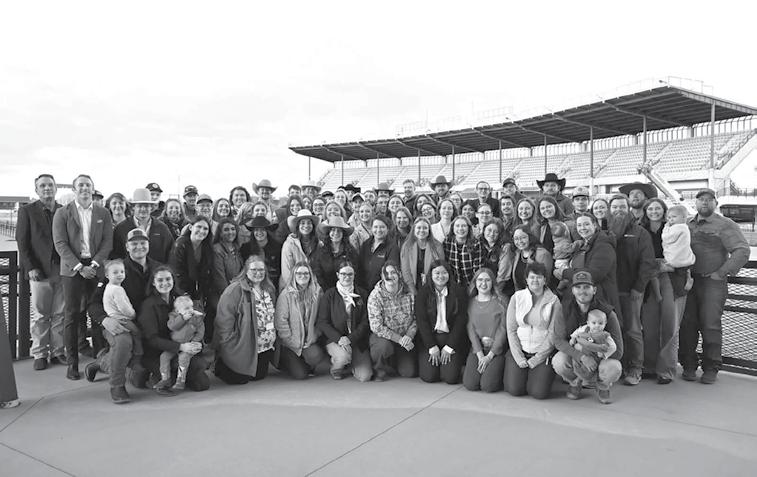
On Feb. 6-7, members of the Wyoming Farm Bureau Federation (WyFB) and Colorado Farm Bureau Federation (CFB) came together to hold the Joint Young Farmers and Ranchers (YF&R) Leadership Conference in Cheyenne.
With a theme of “Beyond Borders – United by Agriculture, Connected by Leadership,” farm bureau members from both sides of the state line gathered for two days of keynote speeches, leadership workshops and networking opportunities aimed at supporting young producers and securing the future of agriculture.
Beyond borders
This was the first year the leadership conference was held jointly with Colorado,
Candy to Cattle Feed
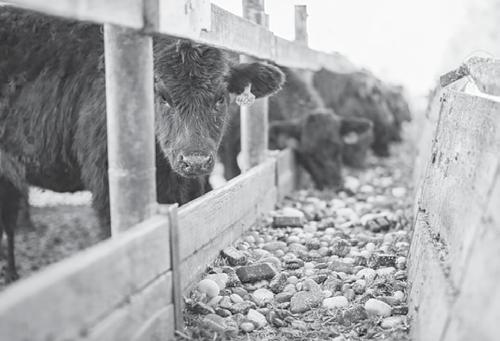
Holiday candy waste may be repurposed in livestock diets
As Americans load up on boxes of assorted chocolates and other candy this Valentine’s Day, few will likely consider where extra, unsold or imperfect sweets end up. For some of these confections, the final destination isn’t a landfill, it’s a feed bunk.
In fact, each year millions of pounds of candy failing to meet retail standards due to cosmetic defects, packaging errors or seasonal overproduction are repurposed as livestock feed.
For cattle producers facing volatile feed costs and/ or persistent drought conditions, candy waste has become somewhat of an unconventional energy source – one nutritionists say can safely replace a portion of traditional feed ingredients when managed correctly.
Using candy as cattle feed
According to multiple sources, producers began incorporating candy, pastries and other food byproducts into cattle feed rations decades ago, particularly during periods of drought or high grain prices.
Oklahoma State University Cooperative Extension
according to WyFB Executive Vice President Kerin Clark, who praised the wellattended conference as a great success.
“This has been an awesome conference with Colorado and Wyoming joining together,” said Clark. “We all share so much in agriculture, from lifestyles to issues and goals. Being able to expand our networks, reach beyond our borders and talk with young farmers and ranchers from both states has been incredible.” Clark further highlighted the importance of the YF&R program as a whole, noting the program has something for everyone searching to contribute to the future of agriculture.
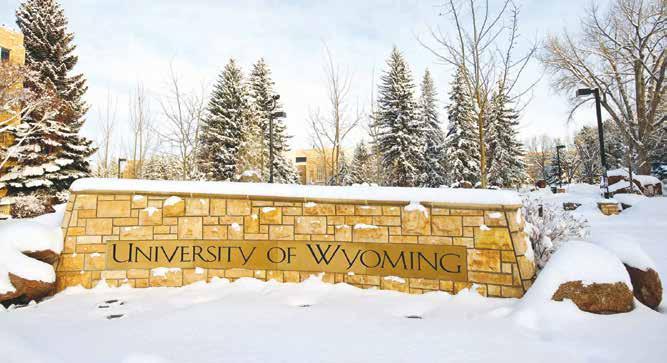
University of Wyoming photo
Gov. Gordon delivers 2026
Cattle producers who liked cattle prices in 2025 should be happy with the 2026 price predictions.
Economists have looked at current cattle prices and numbers and many are forecasting higher prices for 2026.
One doesn’t have to crunch many numbers to realize less cows, high beef demand and not much interest in holding heifer calves for breeding adds up to higher prices.
The cattle inventory report released by the U.S. Department of Agriculture (USDA) towards the end of January reflected the numbers currently driving cattle markets. Cattle numbers were down year-over-year, which included all ages of cattle, down 0.4 percent compared to last year.
The 2025 calf crop was at 32.9 million head, the smallest population since 1941. The beef cow herd dropped another one percent year-over-year as of January 2026.
Currently, the beef cow inventory is at 27.61 million head, the smallest number since 1961. Since the cattle cycle peaked in 2019, with 31.64 million head, the beef cow herd has decreased 4.03 million head, which is a total seven-year drop of 12.7 percent.
Then, if you take those numbers and add lower heifer replacement numbers, total cattle numbers are not going to change much in the next few years.
And, as we know, if you are keeping an 11-month-old heifer calf for replacement to breed in June, she won’t have a calf to add to cattle numbers until nearly a year and a half later.
U.S. Health and Human Services Secretary Robert F. Kennedy Jr. attended the 2026 Cattle Industry Convention and told the 9,400 attendees, “The U.S. needs more beef. We are begging you to increase the size of your herds.”
Kennedy continued, “The new food pyramid encourages consumers to eat more protein. We need a lot of beef, and we want to make it right here in America. We don’t want to be importing it from other countries.”
I don’t think Kennedy realizes we can’t just flip a switch and have more cows.
During the same week, President Donald Trump increased the tariff-free quota of beef from Argentina from 20,000 tons to 100,000 tons. Questions surrounding Argentina being able to actually supply this increased quota still remain, as does the fact lean beef trimmings for hamburger make up the majority of imports.
We realize Trump wants to lower grocery prices, but it is going to be hard to do with low cattle numbers, especially with his administration pushing beef as a protein source on the new dietary guidelines.
We’re all thrilled to see beef supported on the Dietary Guidelines for Americans, but it may be one of those issues where we need to let prices follow the market demand. In 2015, cattle numbers were low and prices were high. Ranchers were quick to hold back heifer calves for replace ments and cattle numbers climbed quickly in the following years. Those higher numbers killed the markets. This time, all of the experts are saying building back cow herd numbers will be a lot slower.
GUEST OPINIONS
Wyoming agriculture operates at the intersection of environmental reality and public policy.
For farmers and ranchers, decisions made in the legislature do not stay on paper – they affect how land is managed, how risk is controlled and whether farms and ranches remain viable from one season to the next.
This is why agricultural policy must be grounded in science and have a clear understanding of how farming actually works in Wyoming.
At the Wyoming Farm Bureau Federation (WyFB), we are dedicated to strengthening Wyoming agriculture and enhancing Wyoming’s communities. We serve as the voice for farmers and ranchers across our state, bolstering their needs to continue their farms and ranches.
Their contributions not only feed and fuel our state, they support a larger, national supply chain.
Any farmer will tell you, even
Todd Fornstrom
when their crop is not in season, they are working to maintain their land. The tools they use throughout the year are essential to making sure their crop is protected from weather, animals and disease.
These resources are the first line of defense against threats like cheatgrass and other toxic weeds. Unfortunately, we have seen efforts to try to limit these tools, without being mindful of consequences to farmers and the communities they feed.
The indiscriminate limitations and restrictions of crop protection tools only hurt crops and makes it more difficult for farmers to provide a safe, healthy and plentiful harvest season after season.
States like Georgia and North Dakota have already taken steps to protect farmers and crops from overregulation of the federally-approved tools they have available to them.
As lawmakers prepare for the
upcoming legislative session, agricultural policy must remain grounded in science, consistency and the protection of farmers.
Wyoming farmers and ranchers are leaders in conservation practices which protect soil, water and wildlife while keeping farms and ranches viable. Smart agriculture policy recognizes this reality and supports farmers’ ability to plan, invest and grow with confidence.
The decisions made during this legislative session will shape the future of Wyoming agriculture for years to come.
Lawmakers have a clear opportunity to stand with local farmers and ranchers – supporting science-based policy to protect food security, rural economies and the working lands that define Wyoming’s heritage.
Todd Fornstrom is the president of WyFB. He can be reached at tfornstrom@wybf.org or 307-630-7448.
Restriction waiver announced
Gov. Mark Gordon announced last month Wyoming submitted a Supplemental Nutrition Assistance Program (SNAP) Food Restriction Demonstration Waiver to the U.S. Department of Agriculture’s Food and Nutrition Service, marking a significant step toward strengthening nutrition outcomes for Wyoming families.
Approved under Executive Order 2025-07, the waiver proposes a phased approach to limiting the purchase of certain non-nutritive items with SNAP benefits, beginning with sweetened, carbonated beverages in the first year, followed by candy in the second.
The proposal was developed by the Department of Family Services (DFS) through a broad public and stakeholder engagement process including statewide surveys, public town halls and direct consultations with retailers, beverage distributors and SNAP Education providers.
This feedback consistently emphasized the need for clear definitions, strong education for participants and retailers, a phased rollout to allow merchants time to integrate new coding and communities time to adapt principles reflected directly in the waiver submission.
DFS also conducted internal evaluation of DFS personnel and timeline capacity for successful implementation.
If approved, the demonstration would apply statewide and is designed to encourage healthier purchasing decisions while preserving access to nutritious foods. Wyoming will continue to work closely with the USDA to ensure implementation is transparent, practical and focused on long-term health benefits for Wyoming families.
Webinar scheduled
Texas A&M AgriLife Extension Service will host a webinar on Feb. 19 focused on livestock guardian dogs (LGDs), specifically the Pyrenean mastiff breed.
The webinar is free and will begin at 3 p.m. Participants must preregister on the LGD Facebook page.
The Texas A&M AgriLife Research and Extension Center in San Angelo, Texas has a research program dedicated to livestock guardian dogs and utilizes them at its ranches and in partnership with private ranch owners.
The webinar is part of an ongoing series on LGDs, featuring AgriLife Extension and industry experts who cover a wide range of relevant topics.
The guest speaker is Karina Whittington, president of the Pyrenean Mastiff Association of America. Whittington is a member of the Spanish and Finnish breed clubs, Club del Mastin del Pirineo and Pyreneittenmastiffit Ry.
CattleCon breaks record
CattleCon 2026 has broken the all-time event attendance record, with more than 9,400 cattle producers and industry stakeholders converging in downtown Nashville, Tenn. Feb. 3-5. The largest event of its kind brings the cattle and beef industry together each year for business meetings, education and engagement.
“It is exciting to see thousands of producers gather together with the common goal of moving our business forward,” said National Cattlemen’s Beef Association President Buck Wehrbein. “This record attendance demonstrates the dedication our producers have to driving beef demand and creating policy to secure a bright future for the next generation of producers.”
Public workshops set
The Wyoming Game and Fish Department (WGFD) will hold public workshops on the Elk Feedground Management Action Plan (FMAP) process for the Pinedale and Jackson elk herd units.
The events will offer FMAP process updates and an opportunity for the public to engage in conversation and share input.
The workshops will take place on Feb. 26 at the Pinedale Regional Game and Fish Office in Pinedale at 6 p.m. and on Feb. 28 at the Teton County Library in Jackson at 1 p.m.
Following the Wyoming Game and Fish Commission’s approval of the Wyoming Elk FMAP in March 2024, the Jackson and Pinedale regions began developing specific FMAPs tailored to individual elk herds and their respective feedgrounds. There are three elk herd units in each region, which include 21 department-operated feedgrounds.
In the Pinedale Region, the FMAP development process started with the Pinedale elk herd unit. This herd unit encompasses elk hunt areas 97 and 98 and includes the Fall, Scab and Muddy Creek feedgrounds.
The Jackson Region began its process with the Jackson elk herd unit, which encompasses elk hunt areas 70 through 72, 75 and 77 through 83. This herd unit includes the department-operated Fish Creek and Patrol Cabin feedgrounds, as well as the federally-managed National Elk Refuge.
The FMAPs are intended to evaluate each strategy outlined in the FMAPs and determine how it can be uniquely and appropriately applied at the herd unit and feedground levels, while adhering to the commission-supported goals and sideboards established in the plan.
Public comment open
The Wyoming Game and Fish Department (WGFD) opened public comment for 2026 season-setting regulations on Feb. 6 and will host public meetings to discuss the hunting season proposals and gather input from the public.
Initial regulations were initially posted to the WGFD website in January to open the public comment period. Field personnel are currently analyzing data to formulate 2026 season recommendations. Revised draft regulations with updated season proposals will be available on the department website by March 18.
Anyone unable to attend a local meeting can view the season proposals when they are posted, provide online comment or download the written comment form at wgfd.wyo. gov/get-involved
Comments can be submitted through 5 p.m. on April 1.
NEWS BRIEFS
Seminar scheduled
On Feb. 26, the University of Wyoming (UW) College of Agriculture, Life Sciences and Natural Resources will facilitate a Ranch Management and Agricultural Leadership (RMAL) seminar about running a successful family-operated business.
The event, which is the second of UW’s 2026 RMAL series, will take place on Feb. 26 from 5 to 7 p.m. in Room 1032 of UW’s agriculture building and is available online.
The seminar series allows students, entrepreneurs and agricultural professionals to connect with each other and learn from experts in the industry.
All sessions are free and open to the public.
The upcoming seminar, titled “Spinning a Business Out of a Hobby,” will be delivered by Ben Hostetler, operations manager of Mountain Meadow Wool (MMW) in Buffalo. MMW uses wool from U.S. producers to create high-quality yarn, blankets and apparel.
Hostetler will share the story of how his mother’s knitting hobby has become the largest full-service wool mill in the West. Full-service mills take raw wool and transform it into finished products.
Community members can register for the event at bit.ly/ rmal-mmw. Each session is livestreamed and recorded via Zoom for participants who cannot attend in person. Registered participants will receive a Zoom link for the session they signed up for.
Following the session on Feb. 26, UW will host two additional seminars this spring, available in person and via Zoom. For more information or to register, visit bit.ly/rmal-series
NWS facility completed
On Feb. 9, at Moore Air Base in the Rio Grande Valley of Texas, U.S. Secretary of Agriculture Brooke Rollins and Texas Gov. Greg Abbott celebrated a significant achievement in the fight against New World screwworm (NWS) with the completion of a U.S.based sterile fly dispersal facility in Edinburg, Texas.
This facility expands U.S. Department of Agriculture’s (USDA) ability to disperse sterile flies along the border and into the U.S., if necessary.
In June 2025, Rollins announced a sweeping fivepronged plan to enhance USDA’s already robust ability to detect, control and eliminate NWS. As part of this announcement, she also shared plans to build the sterile NWS fly dispersal facility in South Texas.
The completion of the facility further expands the network of dispersal facilities through Central America and Mexico and solidifies the increased preparedness offered by having a U.S.-based facility.
On Jan. 30, USDA announced a shift in its 100 million per week sterile fly dispersal efforts to reinforce coverage along the U.S.-Mexico Border. While the sterile flies for this effort will initially be dispersed from the Tampico, Mexico facility, USDA is prepared to quickly and strategically shift operations to the new Texas facility should there be a change in the location or new concentration of NWS cases in northern Mexico.
Beef imports increased
On Feb. 6, USA TODAY reported President Donald Trump is allowing more beef from Argentina to enter the U.S. tarifffree as part of an ongoing bid to drive down grocery costs.
Trump signed a proclamation Feb. 6 allowing an additional 80,000 metric tons of Argentinian beef to be imported into the U.S. annually without facing tariffs, according to a White House fact sheet.
Argentina’s foreign ministry said the move, which is part of a broader trade deal, will dramatically increase the amount of its beef given preferential access to the U.S. market from the current 20,000 tons. The increase in Argentinian beef exports to the U.S. is worth $800 million, the ministry said.
The proclamation covers “lean beef trimmings” used to make ground beef. It notes the cost for a pound of ground beef spiked to $6.69 in December, the highest price since tracking by the Department of Labor began in the 1980s.
Trump has increased tariffs on a wide variety of products in his second term, touting the revenues they are generating, but he lately has sought to exempt products from tariffs or delay their implementation amid concerns about consumer costs.
The president announced last month he is delaying a tariff increase on upholstered furniture, kitchen cabinets and vanities amid rising concerns about affordability, and in November he announced tariff exemptions on a wide variety of products, including beef, coffee, chocolate, bananas, tomatoes and oranges.
The National Cattlemanʼs Beef Association has opposed the idea of bringing in more beef from Argentina, responding to comments Trump made about Argentinian beef in October with a statement saying it “harms American cattlemen and women.”
Trump has forged a close relationship with Argentine President Javier Milei, hosting him at the White House in October and advancing a $20 billion bailout to shore up the country’s economy.
Applications open
The U.S. Department of Agriculture’s (USDA) Foreign Agricultural Service (FAS) is now accepting applications for its agribusiness trade mission to Istanbul, Türkiye, scheduled for May 11-14.
U.S. exporters interested in exploring trade opportunities in Türkiye, the Caucasus and Central Asia must apply by Feb. 24.
The U.S. was Türkiye’s fifth-largest supplier of agricultural products in 2024, while Türkiye ranked as the 16th largest market for U.S. agricultural exports – a figure which has grown roughly 45 percent since 2020. Total U.S. agricultural product exports to Türkiye exceed $1.7 billion, including more than $590 million in retail-ready goods like snack and pet foods, fruits, meats and dairy products.
USDA sees strong opportunities for continuing growth in Türkiye and the surrounding region, reflecting increasing consumer demand and expanding supply chains for the product groups including tree nuts; soybeans; pulses; dried distillers’ grains and solubles; seafood; poultry; beef and pork; prepared foods, sauces, condiments, sweets and snacks; live animals, livestock genetics, hides and skins and alcoholic beverages, distilled spirits and wine.
Participants will join buyers from Türkiye, Armenia, Georgia, Kazakhstan, Ukraine and Uzbekistan for targeted business-to-business meetings to discuss market opportunities. FAS staff and regional experts will be on hand to host market briefings, site visits and networking events.
For more information, visit fas.usda.gov/topics/ trade-missions
Wyoming wins gold
In a Feb. 8 WyoFile article, Angus M. Thuermer Jr. reports Wyoming native Breezy Johnson won the gold medal in the women’s downhill at the Winter Olympic Games in Cortina, Italy.
Johnson, age 30, skied the course in one minute 36.10 seconds to beat Germany’s Emma Aicher by 0.04 seconds. Italy’s Sofia Goggia was 0.59 seconds behind Johnson and took the bronze medal.
Johnson won the race after posting the best time in the second training run on Feb. 7 by 0.21 seconds. She is the reigning world champion in the downhill, winning gold last year.
Born in a Jackson Hole blizzard, Johnson was forged by Teton mountain slopes, racing at Jackson Hole Mountain Resort, Grand Targhee and Snow King Mountain.
Her father, a skier who worked on local ski-race crews, first launched her down an inclined subdivision road outside her home in Victor, Idaho when she was three years old. Her mother is an attorney.
She skied in her first International Ski Federation competition in 2011 and began making a splash in 2016. She placed seventh in the 2018 Olympic downhill in PyeongChang, South Korea.
Beef Specialists Chris Richards and Dave Lalman explain, as ruminants, cattle are able to utilize feeds unsuitable for human consumption.
“Cattle are well equipped to utilize feed and forage resources not suitable for human consumption or use,” says Lalman. “This includes restaurant grease, unsold produce from the grocery store, outdated bread, water-damaged flour or cereal and, of course, grass.”
Richards explains, in the rumen, carbohydrates – especially sugars – are rapidly fermented into volatile fatty acids, which are then absorbed into the bloodstream and used as energy.
“For cattle, other than the taste difference, candy is no different than including corn in the diet,” Richards says. “It serves as an energy source for cattle. The bacteria in the rumen break down the candy into the same materials they would starch from corn.”
Lalman continues, “These acids are then absorbed and used by different tissues. Blood sugar does not vary dramatically in ruminants like it does in humans. It is highly regulated.”
While candy waste can certainly be used as a helpful tool to reduce feed costs, experts underscore the importance of using it in moderation, recommending sugary feeds be capped at a small percentage of the total ration to avoid digestive upset or mineral imbalances.
They note candy should be used as a complementary ingredient in a carefully-formulated and balanced ration alongside hay, silage, protein sources and minerals to meet nutritional requirements – not as a feed substitute.
“Nutritional expertise is required to create a balanced program, especially when dealing with feeds other than forage,” Lalman says. “The diet needs to be carefully balanced to keep everything in concert.”
Reducing feed costs and waste
Multiple sources note using candy as cattle feed can provide significant savings for producers, while simultaneously benefiting the environment by reducing waste.
Feed costs are one of the largest expenses for cattle producers, and fluctuating corn prices have historically driven interest in alternative energy sources.
Experts point out corn has sold for $300 per ton in some markets, while candy byproducts such as ice cream sprinkles, gummy worms, marshmallows, chocolate bars, bits of hard candy and powdered hot chocolate mix have been available at nearly half this cost.
“This has been a practice going on for decades, and it is a very good way for producers to reduce feed costs and provide less expensive food for consumers,” says Ki Fanning, a livestock nutritionist with Great Plains Livestock Consulting, Inc., in a Oct. 12, 2012 Farm Progress article.
Additionally, in an Oct. 29, 2025 Sentient article, Jessica Scott-Reid reports most candy fed to cattle comes from manufacturing byproducts – items deemed safe but unsellable. This may include broken chocolate bars, off-colored candy, outdated seasonal products or candies affected by packaging errors.
According to industry estimates, Americans spend more than $27 billion on Valentine’s Day each year, with tens of millions of pounds of chocolate and candy produced for the February holiday alone. Inevitably, some of the product goes unsold.
Rather than sending the surplus to landfills, manufacturers often sell it at discount to ingredient brokers who then supply it to livestock producers.
The ongoing, innovative partnership between the Hershey Company and Cargill is a prime example of this “upcycling” at work.
“Today we have an entire plant in Chambersburg, Penn. dedicated to this environmentally-, economically-, nutritionally-friendly effort,” states Cargill on its website. “There, our team turns tens of thousands of pounds of Hershey’s chocolate waste per year into feed ingredients for cows, pigs and other species of livestock.”
Richards adds, “Candy waste is either landfill material or can be repurposed for other industries. It’s a win-winwin. The candy company gets some revenue, the environment wins by avoiding landfills and the cattle get a great, tasty energy source.”
Hannah Bugas is the managing editor of the Wyoming Livestock Roundup. Send comments on this article to roundup@wylr.net.
The federal grazing fee for 2026, as calculated by the National Agricultural Statistics Service, is $1.69 per animal unit month (AUM) for lands administered by the Bureau of Land Management (BLM) and the U.S. Forest Service (USFS).
AUM – treated as equivalent measures for fee purposes – is the use of public lands by one cow and her calf, one horse or five sheep or goats for a month. The newly calculated grazing fee takes effect on March 1.
The fee will apply to nearly 18,000 grazing permits and leases administered by BLM and nearly 5,550 permits administered by USFS.
FEEDERS
The formula used for calculating the grazing fee was established by Congress in the 1978 Public Rangelands Improvement Act and has remained in use under a 1986 presidential executive order. Under the order, the grazing fee cannot fall below $1.35 per AUM, and any increase or decrease cannot exceed 25 percent of the previous year’s level.
The annually determined grazing fee is established using a 1966 base value of $1.23 per AUM for livestock grazing on public lands in Western states. The figure is then calculated according to three factors – current
private grazing land lease rates, beef cattle prices and the cost of livestock production. In effect, the fee rises, falls or stays the same based on market conditions.
BLM and USFS are committed to strong relationships with the ranching community and work closely with permittees to ensure public rangelands remain healthy, productive working landscapes. The grazing fee applies in 16 Western states on public lands administered by BLM and USFS.
Permit holders and lessees may contact their local BLM or USFS office for additional information.
WEDNESDAY, FEBRUARY 18, 2026 - FEEDER/CALF
SPECIAL
Reno & Gwen Shepperson 300 Blk Strs & Hfrs, 725-800#, Weaned 166 days, Running out Pasture supplemented with Grass Hay, SweetPro and Free Choice Mineral, Branding Shots: Vista 6, Vision 8, Once PM, Weaning Shots: Vista Once, Vision 7 w/Somnus, No Implants, Super Gentle, Jan/ Feb Born Calves
Chris & Erick Esterholdt 185 Blk Angus Strs & Hfrs, 550-800#, Weaned 90 days, Been on Long Stemmed Hay, Cake Broke, Complete Mineral
Program, Bunk Broke, Branding Shots: Ultra Choice 8, Weaning Shots: Pyramid 5, Poured, No Implants, High Elevation, 1-iron, Home Raised
Mike Norby/Kiowa Red Angus 27 Red Angus Hfrs, 750-775#, PTO @ ranch, Coming off grass, Complete Vac. Program, Bangs Vac., Coming off grass, (Note: Feed out his opens last year: 100% Choice on Cargill Sheet; weighed 1505# on truck Dan & Zach Ellis 22 Mostly Blk/Bwf (2 Rd) Strs & Hfrs, 650-900#, Weaned a long time, Bunk Broke, Been on a Grower Ration, Complete Vac. Program, No Implants, Home Raised WEANED CALVES
Cattlecorp LLC 70 Blk Hfrs, 400-450#, Weaned a long time, Running out, Hay Fed, Complete Vac. Program, Home Raised Jack Johnson Living Trust 40 Mx Strs, 600#, Weaned long time, Running out on grass with some Hay, Branding Shots, Producer All Natural Tim Sussex 10 Blk Hfrs, 500-550#, Weaned a long time, Bunk Broke, Cake Broke, Branding and Pre-cond. Shots, Home Raised Delaney Bend Farms 8 Blk/Bwf Hfrs, 600-650#, Weaned 75 days, Hay Fed Only (Grass/Alfalfa Hay Mx), 3 Rounds of Shots, No Implants, Bangs Vac., Replacement Quality
FRIDAY, FEBRUARY 20, 2026 - BRED COW SPECIAL
DISPERSALS Toby Kimzey/Y Cross Ranch 650 Mostly Blk/Bwf Cows, Complete Dispersal, Coming 4 yr olds and Older (mostly 4-8 yr old), Bred to Mostly Lucky 7 Angus Bulls, Ward Livestock & Berry Herefords few Sim/Angus Bulls, CF: April 15, Complete Modified Live Vac. Program (Bovi-Shield Gold 5 VL5 @branding time)
Special Comments: Complete Dispersal of coming 4 year olds and older off the Reputation Y Cross Ranch. High elevation cowherd, bred to moderate BW bulls that are expected to do it on their own. Strict culling practice have led to a low maintenance cowherd. Collar broke, electric fence broke, dog broke. Only selling due to drought conditions. Tons of Quality and Genetics behind this cowherd; many cows purchased from highly reputable ranches and bred to a lot of $10-$15K dollar bulls. Majority of the young cows would be home raised
Kelley Cattle Co. 240 Blk/Rd Angus Cows, Dispersal of All Aged Cows, SM-ST, Bred to Blk or Red Angus Bulls, CF: May/June, Shots at Preg Check: Cattle Master Gold, Staybred, Valcor, Poured with Clean-up BRED COWS Falls Ranch 120 Blk Cows, Mx Ages, Bred to Vermilion Blk Angus Bulls, CF: March 15, Home Raised Terry Brant 40 Red Angus Cows, 8-10 yr olds, Bred to K2 Red Angus Bulls, CF: March/April,
Jack Garson 25 Blk Cows, Mx Ages, Bred to Gunsight Blk Angus Bulls, CF: March/April,
Poured, High Elevation, Been on Normal Annual Vac. Program
SALE RESULTS -BRED COW SPECIAL FRIDAY, FEBRUARY 6 - 2333 HD
Truett Jaure 14 Brd Cow ST/Mar-Apr
$3,250.00
Rocky Top Ranch LLC 21 Brd Cow ST/Apr-May $3,235.00
Donald Cox Living Trust 9 Blk Brd Cow 3-SM/Mar-Apr $4,675.00
Helen Nicolls Rev Trust 8 Blk Brd Cow SM/Mar-Apr
Mirand Zielke 12 Blk Brd Cow SM/April
Mirand Zielke 35 Blk Brd Cow SM/April
$4,600.00
$4,485.00
$4,400.00
Ross Newman 3 Blk Brd Cow Hfr-SM/Apr $4,350.00
Donald Willis 3 Blk Brd Cow SM/Apr-May $4,150.00
Cody Bruegger 37 Blk Brd Cow SS/Mar-May $4,100.00
Helen Nicolls Rev Trust 10 Blk Brd Cow SS/Mar-Apr $4,050.00
Miranda Zielke 1 Blk Brd Cow 3Yr/April $4,025.00
Cole Creek Sheep Co 9 Blk Brd Cow 3-SM/May-June $3,850.00
Cottonwood Creek 9 Blk Brd Cow SS/Mar-Apr $3,550.00
Gardner Ranch 15 Blk Brd Cow ST/Mar-Apr $3,325.00
Darr Family Liv Trust 7 Blk Brd Cow ST/Apr-May $3,300.00
Quarter Circle J 62 Blk/Rd Brd CowST/Apr-May $3,425.00
Miranda Zielke 63 Bwf Brd Cow 3Yr/April $4,485.00
ZN/77 Reed 15 Rd Brd Cow 3Yr/April $4,700.00
ZN/77
TORRINGTON
LIVESTOCK AREA REPS
Michael Schmitt - Torrington, WY 307-532-1776
Ty Thompson – Lusk, WY 307-340-0770
Cody Thompson - Lusk, WY 307-340-0150
Zach Johnson Lingle, WY –307-575-2171
Jeff Ward – Laramie, WY 307-399-9863
Tam Staman – Crawford, NE 308-631-8513
Justin Smith - Lusk, WY 307-340-0724
Hunter Dockery - Lusk, WY 307-340-1202
Ben Kukowski - Kaycee, WY 307-217-1472
Scott Redden - Burns, CO 970-596-3588
“When we unite together as an organization, our united voice can impact change,” said Clark. “It is so very important to continue advocating for agriculture and to provide opportunities to develop leadership skills through opportunities like this conference.”
Speaker highlights A lineup of keynote speakers made their way to Cheyenne to spark conversations about leadership in the next generation of agriculturists.
On Feb. 6, American Farm Bureau Federation Director of Leadership
and Organizational Training
Maegan Meredith delivered a talk called “Calm, Cool and Conflict” which centered on developing effective conflict resolution strategies.
Next, Mercedes Roesch and Leah Peterson gave respective presentations on leadership and sharing agricultural stories.
In addition to being a fifth-generation agriculturist, Roesch is a philanthropic advisor at Luther Seminary.
Roesch’s talk was titled “Leaders Lead,” and in it, she challenged the audience to consider their lives and eventual legacy they might leave behind. She emphasized the importance of finding a clear “why” in their lives and work, beyond profit or job title.
“Your ‘why’ is the belief that drives you,” said Roesch. “Leaders who start with ‘why’ inspire action in others, create belonging and build loyalty. They sustain motivation through every difficulty, and they step out
of comfort zones to break down barriers.”
Known on social media as Clear Creek Ranch Mom, Peterson is a Nebraskabased rancher who has grown a large online following by sharing her agricultural stories with people from around the world.
“Tell your stories in big ways and little ways, and write them for yourself, even if you never share them with anyone else,” said Peterson. “In my opinion, this is how we remember the past, take care of the present and lay down a solid future for agriculture.”
Cassidy Johnston, a first-generation rancher and owner of CKJ Consulting, rounded out the first day of programming with a talk on goalsetting and navigating new ventures.
The conference continued on Feb. 7 with presentations from Martin Carcasson, director of the Colorado State University Center for Public Deliberation, and Tori Graves, a financial and business loan specialist with the U.S. Department of Agriculture’s Rural Utilities Service.
In addition, six producers highlighted their personal experiences with succession planning, offering tips on how to navigate the process during a panel discussion titled “Successful Succession.”
Collegiate discussion meet
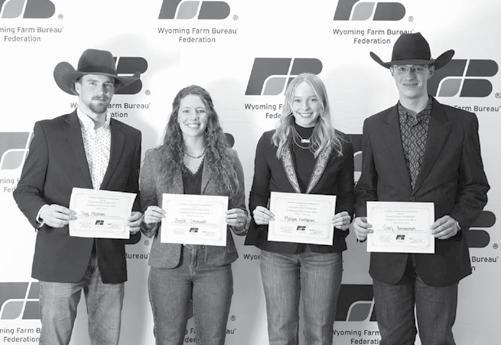
Two Sheridan College students – Tagg Mickelsen and Brook Greenwalt –came out on top during the 2026 Wyoming Collegiate Discussion Meet.
The competition is designed to simulate a farm bureau committee meeting, and contestants discuss relevant topics to gain experience analyzing and solving agricultural problems.
Mickelsen was crowned champion, receiving a $1,000 cash prize from WyFB and the chance to represent Wyoming at the upcoming National YF&R Conference in Portland, Ore.
Runner-up recognition went to Greenwalt, who received a $150 cash award from WyFB.
Rounding out the top four contestants were Gary Brenneman, also of Sheridan College, and Maylee Nordstrom of Central Wyo-
ming College. They each received a $25 cash award.
“Having three of the four finalists is a testament to the students and the work they put in,” said Angel Sparkman, collegiate farm bureau advisor for Sheridan College. “It’s so exciting to watch students step into a professional role and confidently talk about today’s agricultural issues.”
Additional highlights In addition to the lineup of speakers, conference attendees enjoyed tours of two of Cheyenne’s most iconic landmarks –the Wyoming State Capitol Building and the Cheyenne Frontier Days complex.
Breakout sessions throughout the afternoon featured interactive discussions on relevant topics to young farmers and ranchers, including a presentation on budgeting from Farm Credit Services of America Developing Markets Officer Robbie Alexander and a grant writing workshop led by CFB Member Emily Baylie. Also, WyFB Policy Advocacy Director Kelly Carpenter and CFB Vice President of Strategy and Advocacy Ashley House teamed up to provide federal policy updates, while AgrAbility Project Behavioral Health Specialist Chad Reznicek facilitated conversations about rural mental health and coping with stress.
The conference concluded with a keynote address from Texas FFA Foundation Executive Director Aaron Alejandro followed by dinner, dancing and live music by Caitlyn Oschner.
Keep an eye out for more from the 2026 Joint YF&R Leadership Conference in future editions of the Wyoming Livestock Roundup Grace Skavdahl is the editor of the Wyoming Livestock Roundup. Send comments on this article to roundup@wylr.net.
Beyond Borders – Members of the Wyoming Farm Bureau Federation and Colorado Farm Bureau Federation came together from Feb. 6-7 to hold the Joint Young Farmers and Ranchers Leadership Conference in Cheyenne. Callie Hanson photo
Collegiate champs – The Wyoming Farm Bureau Federation held its Collegiate Discussion Meet during the Joint Young Farmers and Ranchers Leadership Conference in Cheyenne on Feb. 5. Pictured from left to right are the top four finalists including Tagg Mickelsen, Brook Greenwalt, Maylee Nordstrom and Gary Brenneman. Callie Hanson photo
SALE REPORTS
Durbin Creek Ranch Annual Polled Hereford Bull Sale
Reported By: Curt Cox, WYLR Field Editor
Feb. 4, 2026
Big Horn Basin Livestock Auction, Worland Auctioneer: Joe Goggins
101 Hereford Bulls Avg. $8,856
Seven Open Registered Hereford Heifers Avg. $5,857
172 Open F1 Baldy Commercial Heifers Avg. $3,350
Top Sellers
Bulls
Lot 63 – DCR 228J Longest Yard 4017 – Price: $20,000 DOB: 4/4/24 Sire: EF MF Longest Yard 19Z 228J ET Dam’s Sire: DCR 453Y Unlimited 456 EPDs: BW: +2.9, WW: +67, YW: +105, Milk: +33 and M&G: +64
EPDs: BW: +3.2, WW: +83, YW: +139 and Milk: +16 Buyer: Rafter T Angus, Gillette
Midland bull test edition
Advertising Deadline: March 6, 2026 Insert Date: March 21, 2026
values and in the conservative principles that always carry our people forward,” Gordon began. “Our economy is hardy, more diverse and better prepared to capitalize on the multiple opportunities now facing our state.”
“As we celebrate our 250th year, we should remember the founding principles of our nation,” he continued. “We are a republic with a backbone of Federalism. We understand power belongs closest to the people, and we appreciate essentials are not handed down from some distant capital. The essentials are forged close to home by people who understand their moral obligation not just to today but to tomorrow as well.”
Reflecting upon the legacy and future of Wyoming, Gordon framed his 2027-28 biennial budget as a practical, conservative plan and
urged legislators to prioritize savings and continued development of Wyoming’s natural resources.
He also emphasized support for agriculture, rural healthcare, education, economic development and an efficient workforce achieved through a focus on “the essentials.”
“Essentials are those things without which families falter, communities fade and opportunity withers,” Gordon said. “This budget is not built on excess, but on the essentials that will build an enduring future for Wyoming.”
“My recommendation provides for an efficient government which is neither intrusive nor inattentive,” he continued. “It seeks to help people closest to the problems solve them for themselves. It represents the whole sense of our communities, and it is transparent and responsive while not burdening our citizens or
their industries.”
Savings and economic development
Key among the governor’s proposals was a call to restore his original recommendation to deposit surplus income into the Permanent Mineral Trust Fund.
He noted his budget originally left a surplus of $500 million but has harvested another $250 million in investment income since the release of the original budget recommendation.
“I ask you to restore my original budget recommendation and place $250 million of the surplus into permanent savings this year, beyond the reach of current temptation,” Gordon said.
“So far, Wyoming has benefitted from the spirit of previous generations of truly conservative leaders who understood discipline and restraint build the future.”
Gordon also called on the legislature to continue investing in competitive pay for state employees.
“Let us remember more
than half of Wyoming’s state employees work outside of Cheyenne,” Gordon stressed. “They are your neighbors, serving families, protecting livestock and keeping our parks and communities running. If we fail to remain competitive, we risk losing experienced and talented workers to surrounding states, weakening services for Wyoming citizens.”
In addition, Gordon praised the state’s thriving tourism industry and highlighted the potential relocation of the Professional Rodeo Cowboys Association Hall of Fame from Colorado Springs, Colo. to Cheyenne as an opportunity for continued growth.
He also asked the legislature to work with him to “rejuvenate, renovate and reimagine” the Wyoming Business Council and keep the Cowboy State’s industries competitive.
Energy and natural resources
Turning his attention to energy and natural
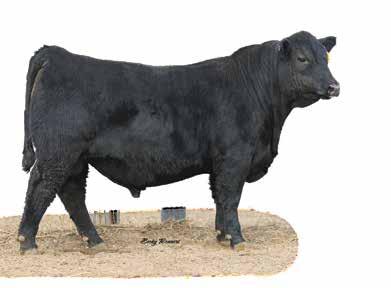
HAYNES CATTLE CO. 18TH ANNUAL
“Working Bull”
ANGUS SALE
SELLING 130
Registered Angus Bulls
n Stellpflug Hoffman Rise Above (20516965)
n 44 Good News (19971596)
n Schiefelbein Top Gun (20491889)
n Crouch Congress (20163340)
n Connealy Commerce (20132642)
n EZAR Step Up 9178 (19430597)
n HAYNES Exponential 3297 (20786423)
n B A R Dynamic (19923789)
n LAR Man In Black (19955191)
n HAYNES Headliner 1267 (20159337)
n Tehama Patriarch F028 (18981191)
n Tehama Tahoe B767 (17817177)
Buy ’Em Your Way!
n 100% AI from industry leading sires
n Free delivery in lower 48 states
n Genomic enhanced EPDs
n Developed on native range without creep feed
n Athletic and ready to work in big country
n Many heifer bulls in the offering and all are cow makers!
n First breeding season guarantee
n Sight unseen purchases are guaranteed
n Trich tested
n Ask about our “On Ranch Inspection” discount
n Volume and repeat buyer discounts
n Ultrasound data available early February
resources, Gordon stressed the importance of continuing to invest in the longterm growth of Wyoming’s energy and mineral industries, as well as continued attention to water issues and natural resource protections.
“As Wyoming approaches 30 years of drought, we all know we have a significant water crisis on our hands,” Gordon stated. “We must make sure we have the resources to address these issues.”
The governor referred to Wyoming as “out-manned and out-gunned by virtually every other state on the Colorado River” in terms of the ongoing water crisis. However, he acknowledged small progress on the national level.
To bolster this progress, Gordon recommended funding to shore up the State Engineer’s Office and the Office of the Attorney General in order to “protect Wyoming’s water use in all basins where water flows out of our state.”
In terms of energy, Gordon called for vigilance in defending interests and growing markets.
“Wyoming will stop at nothing to defend our right to reach markets eager to use the quality products only Wyoming can provide,” he stated.
Agriculture and education
Gordon’s comments on agriculture and education emphasized the importance of investing in the future.
As Wyoming agriculture continues to develop markets in Asia, the governor called on the legislature to fully fund the Asian trade office in order to continue expanding markets.
Gordon also acknowledged the efforts of the Cowboy State Agricultural Initiative Working Group and the Wyoming Hunger Initiative, which are committed to investing in local agriculturists and impacting Wyoming communities.
Members of the working group represent the industry on all levels, working to strengthen agriculture and help young farmers and ranchers start and maintain operations, as well as expand markets.
Gordon also expressed support for the University of Wyoming (UW), noting the university’s revitalized College of Agriculture, Life Sciences and Natural Resources supports the Cowboy State Agricultural Initiative, and the university as a whole contributes
significantly to the state’s diverse economy.
Stressing the importance of UW programming to the economic vitality of Wyoming, Gordon urged the legislature to reconsider budget cuts which would affect university operations.
“Now is not the time to ignore the vision set forth in our Wyoming Constitution regarding our land grant university,” Gordon stated. “This is a case where simply cutting a budget won’t lead to improvement, but a dialogue could.”
Gordon also called for increased attention to strengthening rural health and services and Veteran’s programming throughout the state.
Closing remarks In closing, Gordon urged lawmakers to focus on the future of Wyoming, calling for a pro-growth and pro-business model while emphasizing the choices made by the legislature have the power to either widen the state’s horizons or to stifle them.
“Our obligation today is to leave our state and her people better positioned to meet the challenges of an increasingly complex, challenging yet bright, future,” Gordon stated, highlighting a belief in accountability to Wyoming’s people – especially the younger generations – as legislative decisions begin to unfold.
He called upon the people of Wyoming to pay close attention to the legislative session and to hold lawmakers and government officials accountable to their task of building a brighter future.
“We are accountable to the people in this chamber and to those across Wyoming, but most of all to the generation that will live with the consequences of what we decide here,” Gordon said. “We do not owe them promises or platitudes. We owe them a future built on the opportunity to learn, to work, to build a business, to raise a family and to grow old with dignity in the communities they call home.”
“Wyoming was built by people who valued independence, responsibility and self-government,” Gordon concluded. “If we are worthy of their legacy, we will govern with the same resolve.”
Grace Skavdahl is the editor of the Wyoming Livestock Roundup. Send comments on this
Lot 4 – KJN Congresss 53N – Price: $27,000 DOB: 2/1/25 Sire: Crouch Congress Dam’s Sire: Musgrave Big Sky EPDs: BW: +0.7, WW: +70, YW: +124 and Milk: +22
Buyer: Mountain Valley Livestock, Douglas Lot 48 – KJN 241K Whitlock 530N – Price: $22,000
DOB: 2/20/25 Sire: KJN Whitlock 241K Dam’s Sire: Car Don Annuity 114 EPDs: BW: -0.4, WW: +99, YW: +167 and Milk: +33 Buyer: Rumsey Angus, Wiggins, Colo. Lot 65 – BDGW Millionaire 57 – Price: $17,000 DOB: 225/25 Sire: B&D Millionaire 127 Dam’s Sire: Connealy Consensus 7229 EPDs: BW: +2, WW: +61, YW: +96 and Milk: +23 Buyer: LD Ranch, Wheatland Lot 7 – KJN Congress 519N – Price: $16,000 DOB: 2/14/25 Sire: Crouch Congress Dam’s Sire: MGR Treasure EPDs: BW: +2.2, WW: +94, YW: +160 and Milk: +19 Buyer: Farthing Ranch, Iron Mountain Lot 49 – KJN 241K Whitlock 536N – Price: $16,000 DOB: 23/25 Sire: KJN Whitlock 241K Dam’s Sire: S A V Recharge 3436 EPDs: BW: +1.1, WW: +83, YW: +142 and Milk: +22 Buyer: Lucas Moore, Torrington
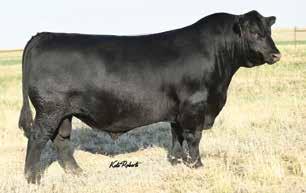
Montana Performance Bull Co-op™
Rapid City hosts 68th Annual Black Hills Stock Show and Rodeo
The 68th Annual Black Hills Stock Show (BHSS) and Rodeo took place Jan. 30 through Feb. 7 in Rapid City, S.D.
The two weeks of jam-packed action boasted over 120 events, ranging from elite horse sales and competitive livestock shows to exciting concerts and thrilling rodeo action, and new additions this year featured ranch horse versatility events and changes to youth stalling.
With an estimated 331,000 people and 400 vendors from 13 states in attendance, BHSS is the second-largest gathering in the state of South Dakota, following the Sturgis Motorcycle Rally.
According to the BHSS website, an economic impact study conducted in 2012 found the event brings in $21.9 million, with a
direct economic impact of $15.2 million.
“Our little Midwestern city becomes a slice of the Old West when cowboys and ranchers come to town to compete in 10 different breeds of cattle shows, ranch rodeos and 14 different horse events,” reads the BHSS website. “There is something for everyone, including concerts and a beer festival.”
The website continues, “An idea that started as a discussion in a laundromat by the Rapid City Chamber Ag Committee has since evolved into a multi-show event attracting people from a 13-state region. BHSS is committed to preserving the Western heritage of the state of South Dakota, while incorporating rural lifestyles into the urban community of Rapid City.”
CLAY CREEK ANGUS
We’ve removed the guess work, let our proven sire program add uniformity to
Melissa Burke photos
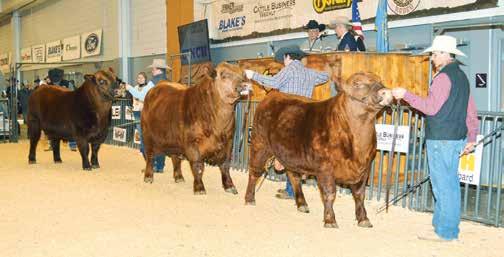
Bull power – Here, Red Angus bulls compete for grand and reserve champion honors.
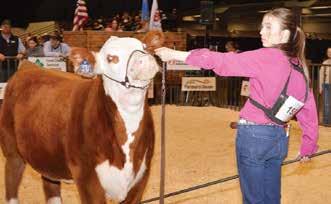
Eyes on the prize – Wynn West, age 14, of Sheridan sets up her Hereford market steer while keeping an eye on the judge during the 2026 Black Hills Stock Show Youth Beef Show. Wynn’s parents are Justin and Rindy West.
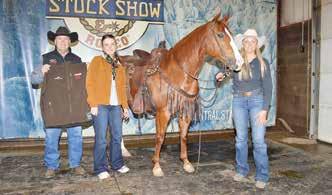
High seller – The high-selling horse at the All Breed Horse Sale was lot 155, Paddys Flingin Irish. A 2018 sorrel American Quarter Horse Association mare and a daughter of A Streak of Fling, she was consigned by Haley Brown of Ponca, Neb. and sold for $65,000 to Jaylynn Ravenscroft of Nenzel, Neb.
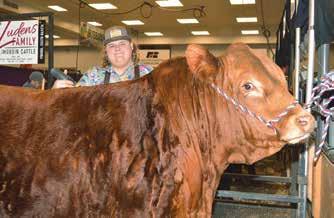
All cleaned up – After a bath in the washroom, this Limousin bull is blown dry by Tag Thompson of Powell. Tag is helping his grandfather Steve Thompson of Thompson Limousin fit the bull.
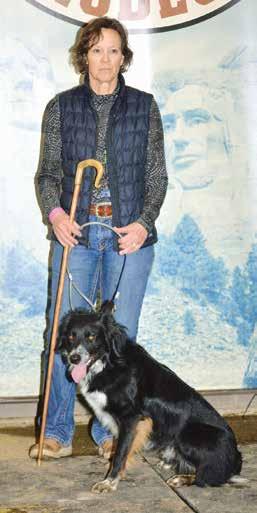
Winning team – Joni Tietjen of Clearmont and her dog Ash won the final round of the 2026 Black Hills Stock Show Sheepdog Trials with a time of one minute and 15 seconds.
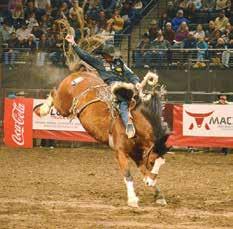
Bucking ‘em out – Brody Wells of Powell marks an 88.5-point ride aboard Catwalk to tie for second place in the Professional Rodeo Cowboys Association Extreme Broncs match.
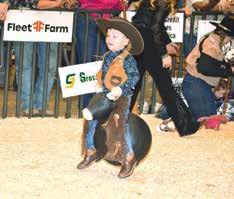
Little buckaroo – The World’s Smallest Rodeo consisted of kids ages three through five competing in barrel racing, bull riding and wild bronc riding using stick horses. This young cowboy is riding a bouncing “bull.”
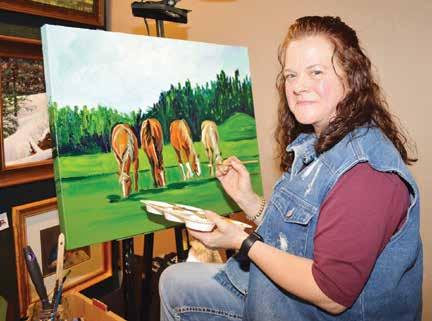
Show.
artwork.
Pictured is Lori Tobin of Rapid City, S.D. with her finished painting.
Parasites are a hidden drain on cattle performance, quietly stealing productivity and profit from herds across the country.
For producers, the cost isn’t just in lost weight gain, but also in overall herd health and efficiency. This is why veterinarians and ranchers alike are turning to improved parasite control strategies like combination treatment.
“Combination treatment is the use of two or more dewormers from different classes, each with a different mode of action, to get
Combination deworming can drive cattle production
more effective control,” said Dr. Matt Washburn of Boehringer Ingelheim. The advantage? Each dewormer targets parasites in a different way. When used in combination, they can help reduce the number of parasites left behind.
In fact, fecal egg counts in cattle herds have been shown to drop by nearly 99 percent when using dewormers from different classes.
Understand dewormer classes for smarter control
To get the most out of combination treatment, it
helps to understand how each class of dewormer works.
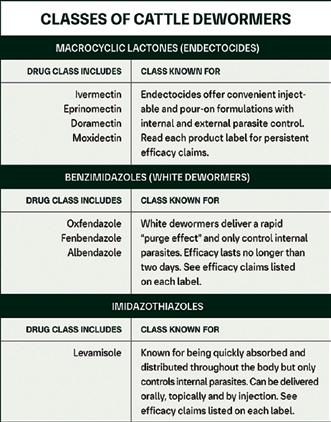
Dewormers can be divided into three different classes based on their chemical structure and mechanism of action –macrocyclic lactones or endectocides, benzimidazoles or white dewormers and imidazothiazoles.
Each class controls a distinct spectrum of parasites, and for a different amount of time.
“Some classes of dewormer do a better job controlling certain parasites than others,” stated Wash-
burn. “Endectocides provide strong coverage against both internal and external parasites, while white dewormers work well against only internal parasites.”
There are also differences in how long dewormers will persist in the animal.
“Most of our macrocyclic lactones have a persistence of about 28 to 30 days, with the exception of the extended-release dewormer, which we can get out to 150 days,” shared Washburn. “On the other side, we’ve got the benzimidazoles which are also known as purge dewormers because they’re going to clean the animal out, and in two days, they’re gone.”
Putting combination treatment into practice
Near Okemah, Okla., Rancher Buck Rich has been using a combination treatment for several years under the guidance of his Veterinarian Dr. Tyler Thomas to protect his nearly 2,000 cow/calf pairs as part of his deworming protocol at Leaning Oak Ranch.
“We’ll normally use an injectable, and then we’ll do an oral drench,” said Rich. “It seems to work really well for us, and it cleans cattle up a little quicker. This is our go-to protocol now.”
Depending on the time of year, Rich may apply a pour-on dewormer to calves instead of an injectable as part of his combination treatment protocol for additional coverage.
Strategic timing can also make combination treatment even more effective, especially when cattle are carrying their highest parasite loads.
“Using combination treatment results in a better clean-out up front, and we’ll
see it on the cattle, particularly coming out of winter, when our highest parasite load occurs,” said Thomas. “They’ll shed their winter coat off, they get fat and they look good.”
Recommending combination treatment to producers for the first time can sometimes be a tough conversation because of the additional cost of another dewormer.
“When going from a single class to combination therapy, producers are almost always on a macrocyclic lactone, and they’re adding a white dewormer to it,” noted Thomas. “I would just tell them it’s well worth it, it’s very economical and it doesn’t take much more effort. If anybody tries combination treatment, they can see the results in the cattle.”
Rich is one of the producers Thomas has worked with who has seen benefits from implementing a combination treatment protocol.
“We’ve seen a drastic change,” said Rich. “The cattle look better. Their hair coat is better. I really think combination treatment is worth it for our operation.”
Combining parasite control programs
Healthy cattle that put on weight and stay in condition are reason enough for Rich to continue implementing combination treatment and other deworming practices advised by Thomas.
“We’re getting paid for
pounds of beef at the end of the day,” related Rich. “Using a quality deworming program helps put on more pounds, which is always a benefit in our business.” For long-term success which helps drive performance and profitability, combination treatment should be part of a broader parasite control plan including performing routine diagnostic tests, such as fecal egg count reduction tests and coprocultures, which can help assess the effectiveness of a deworming program and identify parasites that may be surviving treatment and intentionally not deworming a small percentage of the herd, which is recognized as an important factor in delaying the onset of parasite resistance.
Producers can increase overall herd immunity through routine vaccinations and enhanced nutrition. They should also limit overgrazing, maintain appropriate forage height and rotate pastures if possible.
Boehringer Ingelheim provides innovation for preventing and treating diseases in animals. The company offers a wide range of vaccines, parasite-control products and medicines for pets, horses and livestock to veterinarians, animal owners, farmers and governments. For more information, visit boehringer-ingelheim.com/us/animal-health This
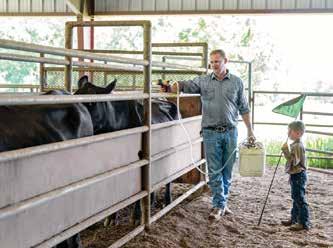
Working cattle – Rancher Buck Rich applies a pour-on dewormer to his cattle as his son looks on. Boehringer Ingleheim photo
Figure One – Pictured are the three classes of dewormers. Boehringer Ingleheim graphic
A COWBOY’S VALENTINE
BY STEVE LUCAS
on a series of criteria spanning from academic performance to global engagement.
Of this criteria, academic capacity and performance accounted for 60 percent of the universities’ overall score. This category was assessed by examining the resources devoted to teaching and research, along with the results achieved in terms of scholarly output, reputation and academic excellence.
The academic capacity and performance category was followed by innovation and economic impact, which accounted for 30 percent of the score.
This category was evaluated based on the university’s contributions to the advancement of science and technology, the diffusion of knowledge and the institution’s impact on economic decisionmaking throughout graduates’ careers, according to the UW Department of Institutional Communications.
Global engagement was also up for consideration, accounting for 10 percent of the overall score awarded by TIME
Staying competitive
As noted by the UW Department of Institutional Communications, the new TIME ranking is just the latest in external recognition for the university.
Last year, UW ranked No. 146 in a list titled “Best Universities in the U.S. 2025” compiled by Research.com Also in 2025, U.S. News listed UW at No. 172 out of all U.S. universities recognized in its “Best Global Universities” list.
In addition, the UW Department of Institutional Communications notes the American Council on Education and the Carnegie Foundation for the Advancement of Teaching recently designated UW as an R1 institution – an honor reserved for institutions conducting very high levels of research.
According to the press release, a mere 187 universities nationwide – just 4.8 percent of the country’s roughly 4,000 accredited, degree-granting institutions – have achieved dis-
Ladies,
don’t be disappointed if your cowboy valentine shows up late for your date without a rose, a card or wine.
It’ll probably be a miracle that he is there at all, ‘cause a cowboy’s day’s all work, no play and honest, he can’t call.
When there is no cell phone service, where he finds that missing cow back in the brush and he’s in a rush and she needs help right now.
She has just one leg showin,’ and he knows he has a date. but he hopes maybe he can pull that baby and not be too awfully late.
tinguished R1 status.
“Our research doesn’t sit on a shelf,” Seidel states. “It’s put to work for Wyoming, bolstering our communities, supporting our industries and helping build a strong future for this state.”
Doug Stark, interim director of UW’s Ranch Management and Agricultural Leadership Program within the College of Agriculture, Life Sciences and Natural Resources (CALSNR) and chairman of the UW Foundation Board, says this status reflects the impact UW has on both a state and national level.
“The impact the university has across the state and nationally is phenomenal,” says Stark, who also notes contributions from CALSNR are particularly impactful, as the college is one of the largest research entities on campus.
“CALSNR contributes significantly to the achievements of our university,” says Stark. “The work we do in agriculture across the state of Wyoming is a big part of accomplishing R1 status.”
Cowboy State commitment
Both Stark and Seidel say the rankings are reflective of UW’s broader commitment to its student body and the university’s impact upon the state and the nation.
“This growing strength isn’t about rankings – it’s about what Wyoming students and families get from Wyoming’s university,” Seidel says. “UW delivers an outstanding education, recognized everywhere, which is also accessible and affordable, just as our founders intended.”
Stark echoes these sentiments, noting more than onehalf of UW’s undergraduate student body is able to graduate debt-free and continue to make an impact long after graduation.
“We have a world-class university which is both affordable and accessible,” Stark comments. “The impact of graduates who come out of UW is often overlooked, but I really believe UW alums have out-punched their weight nationally.”
Stark emphasizes several graduates choose to remain
in Wyoming and contribute to the state’s many industries after earning their degrees, while those who move elsewhere carry foundations built at UW into national and
He ropes the cow and pulls the calf, then sees his time is close. No time to shop, no time to stop to wash up and change his clothes.
Now he’s standing at your door with calf slop on his chaps, his worn thin shirt covered with dirt and he’s holding a paper scrap.
On which he’s penned a poem, scribbled with a pencil stubble, some simple prose that he thinks he knows might get him out of trouble
So don’t be aggravated, it’s just a cowboy’s way to tell you true of his love for you on Valentine’s Day.
global successes.
“Many distinguished alums who received training from UW have gone on to reach high levels of leadership in nursing, healthcare,
business, agriculture and energy, and some have gone on to lead global firms,” says Stark. “This is really a hallmark of the impact the university has on our state and our nation.”
Grace Skavdahl is the editor of the Wyoming Livestock Roundup. Send comments on this article to roundup@wylr.net.
UW continued from page A1
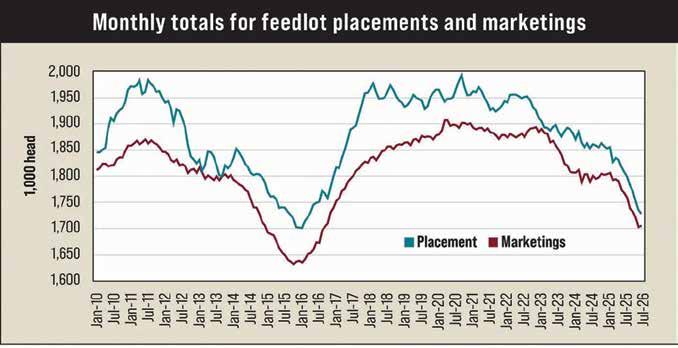
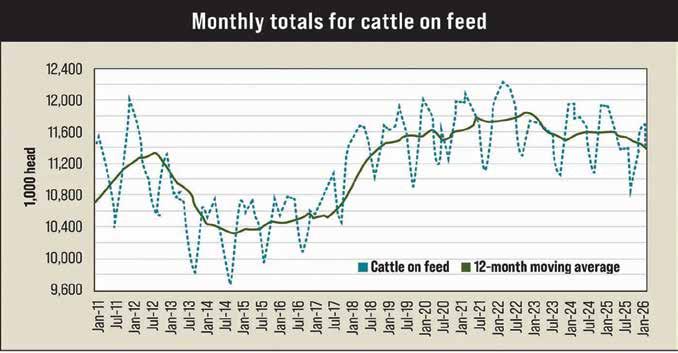
The January U.S. Department of Agriculture Cattle on Feed Report reveals a sharp decline in feedlot inventories, kicking off the year with 11.45 million head – down 3.2 percent year-over-year and the lowest levels since 2018.
With feeder cattle supplies tightening and placements dropping for nine straight months, feedlots are bracing for higher costs and shrinking margins.
This report marks the 14th consecutive month of declining feedlot inventories.
December 2025 feedlot placements were down 5.4 percent from one year ago and were the ninth consecutive month of lower placements.
Total placements for the past six months account for 92 percent of the current feedlot inventory and were down 8.2 percent year-overyear.
Feedlot marketings in December were higher than last year, up 1.8 percent yearover-year. Slightly higher December marketings follow an 11.9 percent drop in November marketings, and it was the first increase in monthly marketings in eight months.
Total marketings for the past six months were down 6.9 percent year-over-year. This sharp decrease in average feedlot placements and marketings reflects a declining rate of feedlot throughput.
Feedlot throughput has declined, reflecting the
fact total calf crops have declined each year since the cyclical peak in 2018.
Mexico imports affect feedlots
Despite tightening feeder cattle supplies, feedlots were able to hold feedlot inventories mostly steady from September 2023 through June 2025, with decreased feedlot turnover rates.
This, along with decreasing feedlot cost of gain, has kept feedlots mostly profitable up to this point.
However, fewer feeder cattle inevitably catches up with feedlots, and inventories have declined more sharply since last June and will continue to decline in coming months.
The lack of Mexican cattle imports contributes to an already limited feeder supply, especially in Southern feedlot regions. Feedlot margins are expected to tighten significantly in coming months as higher feeder cattle prices and limited feeder availability squeezes feedlot volumes and margins.
Regional cattle feeding differences have become more pronounced recently.
Drilling down on the numbers
In Nebraska, there were 2.62 million head as of Jan. 1, up 1.6 percent from one year ago, while Texas reported 2.53 million head, down nine percent yearover-year. The lack of Mexican cattle is exacerbating generally tight feeder supplies in the state of Texas. Kansas is third with 2.4 million head, unchanged from last year, and Colorado rounds out the top four feedlot states with 1.05 million head, down 15.2 percent year-over-year.
These top four feedlot states represent 73.6 percent
2008 LANDOLL 53’ HYDRAULIC TILT TRAILER. AG PULL OUTS. LOW MILEAGE USED ON RANCH TO MOVE BALER+SWATHER. NEW PAINT AND DECK. $75,000 OBO. 2022 BOBCAT E60 MINI EXCAVATOR 2022 BOBCAT T770 SKID STEER 2008 BOBCAT T250 SKID STEER JD 5093E TRACTOR 2016 KUBOTA MX5200D TRACTOR
2023 SA CARGO TRAILER 6X10 NEW PULLED 1500 MILES - $7,000.00
2024 BIG TEX 25GN-40DG1-MRBK - $24,500 2013 JLG G6-42A EXTENDED BOOM SKYJACKSJ7135 SCISSOR LIFT THE BEST PRICES YOU CAN FIND!!!!
of monthly feedlot inventories. The next four feedlot states – Iowa, California, Idaho and Oklahoma – add another 16.2 percent share to cattle feeding, making the top eight states account for 89.8 percent of monthly feedlot totals.
With feedlot margins tightening and turnover rates slowing, the industry is facing some big changes. The months ahead are going to be a real test of resilience as feedlots work through rising costs, regional challenges and the continued impact of shrinking calf crops.
Derrell Peel is the livestock marketing specialist for Oklahoma State University Extension. This article was originally published by the Missouri Ruralist on Feb. 2.
Figure one – Pictured is a line chart with monthly totals for cattle on feed. Derrell Peel graphic
Figure two – Pictured is a line chart with monthly totals for feedlot placements and marketings. Derrell Peel graphic
American Sheep Industry Association Annual Convention wraps up in Reno
The American Sheep Industry Association (ASI) gathered in Reno, Nev. Jan. 28-31 for the 2026 ASI Annual Convention, where individuals involved in all aspects of the sheep industry gathered for four days of networking, collaborative conversation and committee meetings.
In a Feb. 6 Facebook post, the association says the convention hosted 425 registrants, 12 industry groups, 16 vendors, 60 meetings and nine additional events including a fashion show and an awards ceremony.
“We know no numerical value can be placed on the impact of collaboration,” the post reads. “Every attendee brought unique insight from their corner of the sheep industry and region of the country, which truly helped make the event meaningful.”
The event kicked off with an ASI Executive Board meeting, covering everything from agrivoltaics, the H-2A visa program,
the ongoing 201 Trade Case and more, then ended with a reception for all attendees at the Atlantis.
Throughout the rest of the week, discussion continued to cover important industry topics including harmful lamb imports, labor shortages and lobbying the Trump administration for financial assistance to help offset low wool prices, just to name a few.
During the event, ASI also presented awards to several outstanding leaders who were recognized for their dedication, innovation and impact on the U.S. sheep industry.
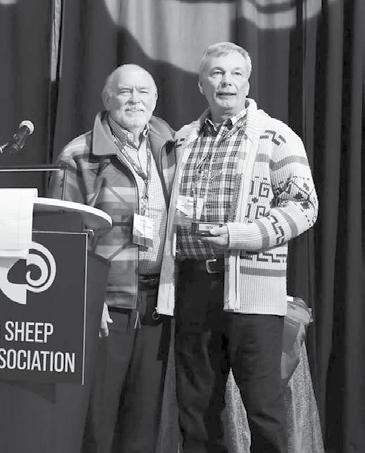
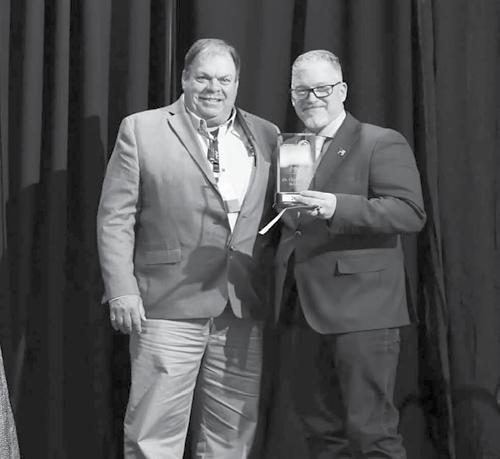
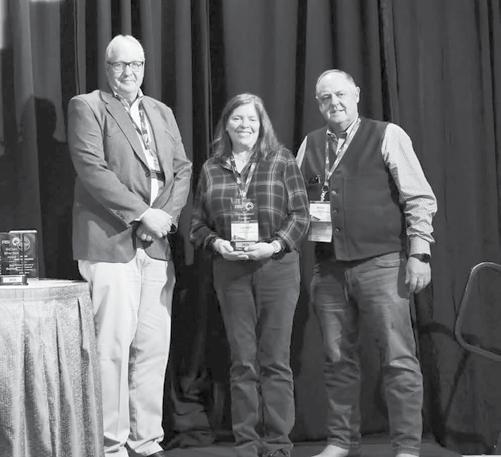
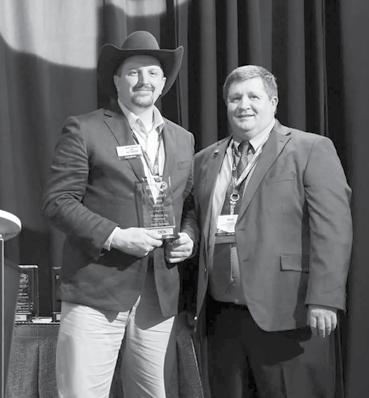
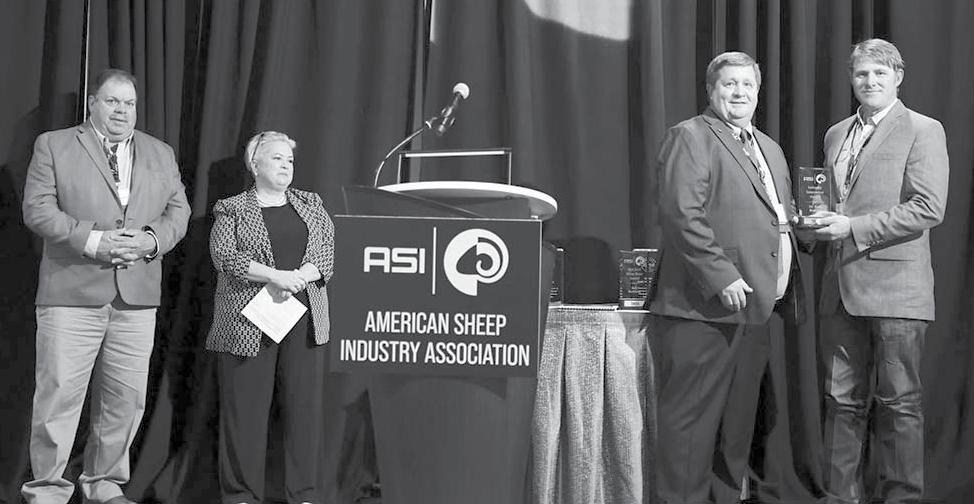
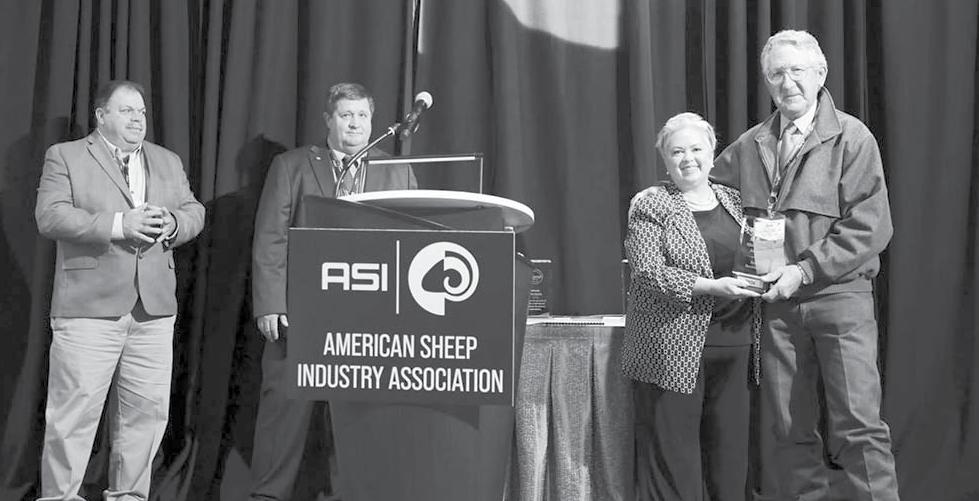
This year, Bob Buchholz was the recipient of the McClure Silver Ram Award, Dr. Reid Redden was the winner of the Industry Innovation Award, Brian and Carolyn Bitner received the Distinguished Producer Award, Northern Ag Network Broadcaster Andy Schwab was honored with the Shepherd’s Voice Award,
Dr. Christopher Schauer was the recipient of the Peter Orwick Camptender Award and Dan Gutzman was honored with the Wool Excellence Award.
On the last day of the convention, the ASI Board of Directors held its meeting
with a focus on board business, committee updates, policy considerations and financial reports.
John Noh of Idaho concluded his term and was rec-
ognized for his service, and David Julian of Wyoming was elected to the ASI Executive Board.
Blk Hfr Clvs, avg. 692# $35000 STEER CALVES T A Ranch Operations - Saratoga
13-16 in Charleston, S.C. Hannah Bugas is the managing editor of the Wyoming Livestock Roundup. Send comments on this article to roundup@wylr.net.
Distinguished Producer Award – American Sheep Industry Association (ASI) Past President Brad Boner, pictured left, presented the Distinguished Producer Award to Carolyn and Brian Bitner during the 2026 ASI Annual Convention in Reno, Nev. ASI photo
McClure Silver Ram Award – Pictured from left to right are American Sheep Industry Association (ASI) Vice President Joe Pozzi, President Ben Lehfeldt and Secretary Treasurer Tammy Fisher with Bob Buchholz, the recipient of this year’s McClure Silver Ram Award. ASI photo
Peter Orwick Camptender Award – American Sheep Industry Association (ASI) Vice President Joe Pozzi, pictured left, presented Dr. Christopher Schauer, pictured right, with the Peter Orwick Camptender Award. ASI photo
Wool Excellence Award – Dan Gutzman, pictured right, was the recipient of this year’s American Sheep Industry Association (ASI) Wool Excellence Award. ASI photo
Industry Innovation Award – Pictured from left to right are American Sheep Industry Association (ASI) Vice President Joe Pozzi, Secretary Treasurer Tammy Fisher and President Ben Lehfeldt, who presented Dr. Reid Redden with the Industry Innovation Award. ASI photo
Shepherds Voice Award – Northern Ag Network
Broadcaster Andy Schwab, pictured left, was the recipient of the American Sheep Industry Association’s (ASI) 2026 Shepherds Voice Award. ASI
President Ben Lehfeldt, pictured right, presented the award during the association’s annual convention. ASI photo
Feb. 16 The Essentials Budget: Protecting and Powering Wyoming’s Future Series, Cody. For more information, visit governor.wyo.gov
Feb. 17 Beef Feedlot Roundtable, 10 a.m.-3 p.m., Prairie Winds Community Center, Bridgeport, Neb. For more information, contact Dr. Galen Erickson at gerickson4@nebraska.edu. To register, visit go.unl.edu/2026roundtable
Feb. 17 University of Wyoming Extension Interactive Online 4-H Volunteer Training, 6 p.m., Zoom. For more information or to sign up, contact Tiera Bevilacqua at tarndorf@uwyo.edu or 307-367-4380.
Feb. 17 Wyoming Leadership, Education and Development Alumni Conference, Cheyenne. For more information, contact Cindy Garretson-Weibel at 307-2145080 or wylead@gmail.com.
Feb. 18 University of Wyoming Extension Pesticide Safety Education Program 9:30 a.m.-1:30 p.m., Heart Mountain Hall, Park County Fairgrounds, Powell. For more information or to RSVP, contact the Park County Extension Office at mgetz@uwyo.edu or 307-754-8837.
Feb. 18 Beef Cattle Research Council Practical Approaches for Managing Stock Water Webinar, 7 p.m., online. For more information or to register, visit beefresearch.ca
Feb. 19
University of Wyoming Extension Pesticide Safety Education Program, 8 a.m.-12 p.m., Platte County Agri-Plex, Wheatland. For more information or to RSVP, contact the Goshen County Extension Office at goshen.county@uwyo. edu or 307-532-2436.
Feb. 19 Texas A&M AgriLife Extension Service Livestock Guardian Dog Webinar 3 p.m., online. For more information or to register, visit @TexasA&MAgriLifeLi vestockGuardianDogProgram on Facebook.
Feb. 20-22 Up In Arms LLC Flea Market and Gun Show, the CAM-PLEX, Gillette. For more information, call 208-420-2295.
Feb. 23 University of Wyoming Extension Pesticide Safety Education Program 10 a.m.-2 p.m., Hot Springs County Weed and Pest Office, Thermopolis. For more information or to RSVP, contact the Park County Extension Office at mgetz@uwyo.edu or 307-754-8837.
Feb. 23-March 1 Wyoming Agriculture in the Classroom Second Online Auction, online. For more information or to preview auction items, visit WAIC2026.givesmart.com
Feb. 25 The Essentials Budget: Protecting and Powering Wyoming’s Future Series, Torrington. For more information, visit governor.wyo.gov
Feb. 25 University of Wyoming Extension Pesticide Safety Education Program, 9:30 a.m.-1:30 p.m., Park County Complex, Cody. For more information or to RSVP, contact the Park County Extension Office at mgetz@uwyo.edu or 307754-8837.
Feb. 25-March 1 37th Annual Winnemucca Ranch Hand Rodeo Weekend, Winnemucca Events Complex, Winnemucca, Nev. For more information, visit ranchrodeonv. com or call 775-623-5071.
Feb. 11-24
February Farm and Construction Online Auction, 208-431-9300, 208-5958561, bigmountainauctions.com
Feb. 16 Weaver Ranch 41st Annual Production Sale, at the ranch, Fort Collins, Colo., 970-568-3898
Feb. 16
Big Sky Salers 42nd Annual Salers Focus Bull Sale, Stockmen’s Livestock, Dickinson, N.D., 406-557-6259
Feb. 17 McClun’s Lazy JM Ranch Angus and Polled Herefords Annual Production Sale, Torrington Livestock Market, Torrington, 307-575-3519, 307-5752113, 307-534-5141, mcclunranch,com
Stellpflug Cattle Company Spring Bull Sale, Hoffman Ranch Facility, Thedford, Neb., 307-351-1712, stellpflugcattle.com
Redland Redbank Angus Fourth Annual Live Auction, Big Horn Basin Livestock Auction, Worland, 307-250-1548
Mt. Rushmore Angus Ranch 60th Annual Production Sale, at the ranch, Rapid City, S.D., 605-342-2449, 605-484-6731, 605-381-7361, mtrushmoreangus.com
Reyes/Russell 35th Annual Sale, at the ranch, Wheatland, 307-331-1530, 970-371-7819, 307-331-1568, mrangusranch.com
Circle L Angus Annual Production Sale, Dillon Livestock Auction, Dillon, Mont., 406-491-7363, circlelangus.com
Colyer Herefords and Angus 46th Annual Production Sale, at the ranch, Bruneau, Idaho, 208-845-2313, 208-599-0340, 208-250-3924, hereford.com
Barker Cattle Company Bull and Female Production Sale, Burley Livestock Auction, Burley, Idaho, 801-372-0996, 208-312-3085, barkercattle.com
JC Heiken Angus and Sons 19th Annual Production Sale, Miles City Livestock Commission, Miles City, Mont., 406-855-7839, jcheikenangusandsons.com
Haynes Cattle Company 18th Annual “Working Bull” Angus Sale, Ogallala Livestock Auction, Ogallala, Neb., 970-854-3310, 970-520-3374, haynescattleco.com
Hart Angus Farms 51st Annual Production Sale, at the ranch, Frederick, S.D., 605-380-0781, 605-329-7211, hartangusfarms.com
Source: USDA AMS Livestock, Poultry & Grain Market News, Torrington National Sheep Summary As of February 6, 2026
Compared to last week slaughter wooled and shorn lambs sold higher. Slaughter ewes sold firmer. All sheep sold per hundred weight (CWT) unless otherwise specified. Slaughter Lambs: Choice and Prime 1-3: San Angelo: 60-70 lbs 350.00; 100-110 lbs 295.00; 130-140 lbs 240.00-250.00.
Ft. Collins: No test. Replacement Ewes: Medium and Large 1-2: San Angelo: No test. Billings: No test.
Ft. Collins: 2-4 years old SPR 150-180 lbs 230.00-295.00 per unit. South Dakota: No test.
Sioux Falls: 2-6 year
Source: USDA AMS LPG Market News, San Angelo,
Source: USDA- CO Dept of Ag Market News Service, Greeley, CO Nebraska Hay Summary As of February 12, 2026
Compared to last report round bales of grass and alfalfa sold steady, Large square bales in the west sold 10.00 to 20.00 higher. Ground hay in the central area sold steady to 5.00 lower. Ground hay in the Platte valley sold steady and ground cornstalks sold 5.00 higher. Ground hay out west sold steady. Demand was mostly moderate, instances good. The dryness through the winter of 2025 and so far into 2026 is creeping into the minds of several hay producers, and livestock owners. Some sellers are thinking hay will creep up a tick and out west it has started that upward movement this week. In others area of the state the baled hay market is stagnate. Some hay producers are just now getting all of the 2024 hay off the place and are trying to sell their 2025 hay. Looks like their will be a rather large carry over of hay east of Lexington to the Missouri river, roughly that area. Some hay producers are thinking of tearing up established fields to plant into a row crop with other hay producers thinking of adding a pivot or two of spring planted alfalfa. Compared to the last report all reported hay sales sold steady with the exception of grass hay rounds, which traded $10/ton lower. Demand is mostly light to moderate on all classes.
Colorado Hay Summary As of February 12, 2026
Compared to last report: Trade activity light on moderate demand. Prices mostly steady across all hay types. Drought conditions have begun increasing since January with the more severe drought categories (D2-D4) covering almost 1/3 of the state, concentrated in Pitkin, Lake, Park, Clear Creek, Summit, Eagle, Garfield, Rio Blanco, Moffat, Routt, Jackson, and Grand counties. Currently, D2-D4 represents 31.66% of the state, compared to 7.08% for the same week last year. According to the U.S. Drought Monitor’s High Plains Summary for February 10, 2026, the High Plains saw little to no meaningful precipitation this week, with most of the region receiving less than 25 percent of normal and many locations at or below 5 percent of normal precipitation. Any snowfall was light and offered minimal liquid-equivalent benefit. In eastern Wyoming and eastern Colorado, precipitation deficits continue to deepen with soil moisture percentiles declining, and recent above-normal temperatures led to drying where snow cover is limited. This led to expansion of moderate (D1) and severe drought (D2) across parts of eastern Wyoming
and Colorado into the southwest South Dakota, the Nebraska Panhandle and the western Nebraska Sandhills. Similarly, growing short- to mediumterm precipitation deficits, below-normal soil moisture percentiles and elevated evaporative demand led to the introduction of extreme drought (D3) to Nebraska’s Panhandle. Eastern Nebraska also saw the expansion of abnormal dryness (D0) as the lack of precipitation has led to drying conditions. Across Kansas, degradations occurred primarily in the northwest, south and along the Missouri border in eastern Kansas following another dry week which, like the rest of the region, added to the growing precipitation deficits and drying soil moisture. The next available report will be Thursday, February 26, 2026.
policy solutions and serve communities across their states.”
The farm bill
The farm bill was on NASDA’s docket of priorities again this year, and because the legislation is important in shaping agricultural policy which supports farmers, ensures food security and promotes sustainable natural resource management, NASDA is urging lawmakers to recognize the diverse needs of producers and rural communities as farm bill negotiations continue.
During the 2026 Winter Policy Conference, the organization highlighted the importance of risk management tools – particularly crop insurance options to meet the needs of specialty crop growers and diversified operations – and amended policy to call for affordable, accessible crop insurance products with simplified processes and payout structures to encour-
age participation from small and medium-sized farms.
“Growers have shared with state agencies the complexity of current crop insurance programs excludes or dissuades specialty crop growers from applying for insurance,” Beal notes. “At a time when farmers are facing a tough and unpredictable economy, additional certainty for farm operations provided by insurance would offer significant help.”
“NASDA supports federal crop insurance changes which would address not only the resources of insurance products, but also the ease of access and implementation,” she adds.
Pesticide regulations
Pesticide regulations are another reoccurring priority for NASDA this year, with the agency noting it will continue to support a scienceand risk-based pesticide regulatory framework that maintains agricultural productiv-
ity and protects human health and the environment.
“To this end, NASDA supports state primacy in the enforcement of pesticide activities under the Federal Insecticide, Fungicide and Rodenticide Act and calls on Congress for appropriate and sustained funding for state lead agencies as coregulatory partners with the Environmental Protection Agency,” NASDA says.
Agricultural labor reform
Labor availability continues to be a major concern for all sectors of the ag industry and a priority for NASDA, which is urging Congress and federal agencies to pursue reform providing the industry with a legal, reliable workforce while simultaneously addressing regulatory barriers and rising costs associated with the H-2A visa program.
According to NASDA, labor shortages and program inefficiencies have created challenges for producers who already face tight margins and rising input costs. There-
fore, the organization is calling for an ag labor framework to balance workforce stability with worker protections.
Animal disease preparedness, traceability
Animal health has also been top of mind for many in the agriculture industry, especially as the threat of foreign animal disease (FAD) and emerging pests continue to grow.
One of the five prior-
MADDUX Cattle Company
“Maternalizer” MATURE BRED COW HERD DISPERSAL PHASE II
SATURDAY, MARCH 7, 2026 Ogallala Livestock Auction n Ogallala, Nebraska
THIS IS A GENERATIONAL OPPORTUNITY!
This sale represents Phase II of a three-year, nearly 6,000 head process to disperse our mature cow herd. These females represent generations of selection, retaining only the heifers that can graze our native Sand Hills, and raise a calf on their own year after year.
The cow herd has been built over decades with the goal of designing moderate, highly maternal, British based, low-input females. The herd is designed to thrive in a year-round grazing program. As a result, fitness and convenience traits have been a constant emphasis. The result is one of the largest, home-raised cow herds in America with generations of selection for udder quality, calving ease, and fleshing ability that deliver high fertility with maximum hybrid vigor.
SELLING APPROX. 3,000 HEAD OF HOME-RAISED, “MATERNALIZER” BRED FEMALES, INCLUDING:
500 2-year-old heifers
(including 300 AI bred to high use Sim-Angus sire)
850 3-year-old cows
1,175 4- & 5-year-old cows
500 6- & 7-year-old cows
ities outlined by NASDA for 2026 is advocating for strong animal disease preparedness and traceability programs to support early detection, rapid response and effective containment.
In a separate press release published on Feb. 4, NASDA notes robust animal health systems could save billions of dollars by preventing economically devastating disease outbreaks.
At the 2026 Winter Policy Conference, NASDA members amended policy to support the development of integrated, national action plans for diseases of national significance including highly pathogenic avian influenza, African swine fever and New World screwworm.
The amendment also requests close coordination between states and the U.S. Department of Agriculture (USDA), enhanced surveillance and biosecurity measures and the development of vaccines and other treatments where appropriate.
“Going forward, continued swift, collective action across levels of government is necessary for response plans to remain effective and consistent as needs to address the prevention of FADs are elevated,” McKinney says. “NASDA is advocating for the development of a standing national action plan for all animal diseases of significance to specifically include state agriculture departments as partners.”
Regional food procurement, distribution
Strengthening regional food systems is another key priority for NASDA in 2026.
The organization says it is advocating for policies supporting infrastructure investments, flexible state purchasing programs and expanded institutional procurement of locally-produced foods.
At the Winter Policy Conference, NASDA members amended policy to encourage federal investment in nationwide nutrition education programs tied to food assistance like the Supplemental Nutrition Assistance Program.
“State agriculture departments work to ensure their local communities are healthy and thriving with a safe, affordable and nutritious food supply, and nutrition education is a key component to helping accomplish this goal,” Beal says.
The agency also amended policy calling on
USDA to create additional pathways allowing meat and poultry products from stateinspected facilities to be sold across state lines, provided inspection standards are “at least equal to” federal requirements.
“One of state agriculture departments’ most critical roles is safeguarding the nation’s food supply, detecting and preventing the spread of foodborne illnesses and supporting small and medium-sized producers,” McKinney states. “With our ability to conduct inspections on behalf of the federal government – saving federal resources – paired with our close relationships with local processors, we have a unique opportunity to efficiently help small and mediumsized processors expand their markets regionally.”
He adds, “Allowing meat and poultry products from state-inspected meat processors to be sold in interstate commerce is a win-win for everyone, providing more market opportunities for small businesses, more options for consumers and saves federal resources.”
Emerging technology
In addition to its five primary priorities for 2026, NASDA members amended policy to encourage collaboration between USDA and public research institutions on artificial intelligence (AI) tools for agriculture.
NASDA says increased cooperation and research investments could help farmers and ranchers identify emerging technologies to improve efficiency, stewardship and economic viability.
“To best serve farmers, ranchers and consumers, it is imperative USDA and landgrant universities invest in helping the agricultural community take advantage of rapidly accelerating technologies such as AI tools,” McKinney states.
“The agriculture industry relies on a foundation of robust, evidence-based research to make decisions, solve challenges and develop innovative solutions across all sectors. Greater coordination between USDA and public research institutions will be critical for ensuring producers and consumers are able to benefit from the rapidly evolving nature of AI technology,” he concludes.
Hannah Bugas is the managing editor of the Wyoming Livestock Roundup. Send comments on
Adobe Stock photo
by Lee Pitts IT'S THE PITTS
Miss Understanding
Men can be such wimps.
I have come to the conclusion, after the death of their elderly spouse, women seem to have far less trouble than men who lose their spouse. Men just can’t seem to live without a woman in their life, but women seem to flourish without a man in theirs.
This became obvious to me after seeing four blue-haired widows getting smashed on wine margaritas at Olive Garden, laughing and having such a good time, the manager had to come by and ask them to tone it down.
A couple years ago, I had a rancher friend who had the misfortune of losing his dog and his wife in a span of six weeks. He completely fell apart and went to seed.
His once obese body was now skin and bones because he didn’t know how to boil water, and his clothes wouldn’t even make good shop rags they were so far gone. My friend didn’t know how to wash and dry clothes. He just wore them until they fell apart, and then he’d go to the hardware store and buy new ones. It was like he was having a mid-life crisis at age 75. The only thing he had going for him was he had inherited what was once a huge Mexican land grant some distant relative had finagled the Mexican government out of.
I felt sorry for my friend, and I tried to help him, advising him he would
be far better off just getting a new one right away.
Shortly after his wife died, I was surprised to hear he was a regular on the dating scene.
“What the heck are you doing?” I asked. “Don’t you think you should show some respect to your widow who stuck by you through thick and thin and was married to you for over 50 years? You should have waited at least a year.”
Dutch researchers have found men have, on average, four billion more brain cells than women, but I think they lose them all after their spouse dies.
My buddy got so desperate, he tried finding a mate on the internet but found no takers. Then, he tried a more traditional approach by advertising in the weekly newspaper’s classified ads, but he came off as sounding a bit too desperate.
His ad read, “Elderly rich guy in poor health looking for a new wife to cook and do laundry. PLEASE Dear God!”
When this didn’t work he resorted to the old triedand-true method of becoming part of the local bar scene seven nights per week.
It wasn’t too long before he had a new girlfriend who rode a Harley Davidson, chewed tobacco, hogged the remote control and had already been married four times. It was a total and complete trash landing.
His new girlfriend had spiked green and orange hair, was hopeless in the
NCBA president named
Since 1850, Gene Copenhaver’s family has been rooted in the land raising crops and livestock. The Virginia cattleman now takes the helm as the new president of the National Cattlemen’s Beef Association (NCBA).
Copenhaver’s new leadership role began at the end of CattleCon 2026, held Feb. 3-5 in Nashville, Tenn.
The 2026 NCBA officer team was approved by the NCBA Board of Directors and includes PresidentElect Kim Brackett of Idaho and Vice President Skye Krebs of Oregon.
Kenny Rogers of Colorado was elected chair of the NCBA Policy Division and Scott Anderson of Oklahoma was elected policy vice chair.
Travis Maddock of North Dakota and Dan Hanrahan of Iowa were elected as chair and vice chair of the NCBA Federation Division, respectively, and Brad Hastings of Texas will serve in the role of NCBA treasurer.
Copenhaver currently manages his family’s stocker operation in southwest Virginia with his son Will and was an agriculture loan officer for 38 years. He has been married to his wife Jodi for more than 35 years, and they have three grown children – Brad, Will and Jaymee – and three granddaughters.
The new president’s priorities are straightforward – continue what works, stay grounded in grassroots input, remain open-minded and focus on profitability. Copenhaver wants every sector and every scale of operation to be viable. This means pushing back against regulatory barriers, supporting policies allowing reinvestment and building on recent momentum around tax provisions.
kitchen, got drunk and liked to go dancing every night. In other words, she was the poster child for birth control.
My buddy’s new main squeeze looked a little rough around the edges to me, but my friend defended her and said she didn’t look all that bad after nine or 10 drinks.
Then my friend and his girlfriend went off to Las Vegas, and she got him hogtied for good all legal like. Before too long, my buddy started seeing the error of his ways. His new wife didn’t shave her legs or under her arms, snored so loud it registered on seismographs three counties away
and she had a weird fixation with firearms which made him a little nervous as two of her previous husbands had died under suspicious circumstances.
When my friend informed me he was getting remarried just five months after the death of his first wife, I blew a gasket.
“Are you crazy?” I asked He countered, “You’re the one who told me after the death of a loved one you should get another one right away to replace the one you lost.”
I replied, “I was talking about getting a new dog, not a new wife you imbecile.”
Rolly Redland- 220 Blk Ang Strs & Hfrs 525-600#. Comp vacc @ branding & weaning (11-1). Bunk broke. Sired by Low PAP Redland Redbank Blk Ang bulls. Summer @ 8500ft. Nice calves!
Bartlett Livestock LLC- 42 Blk Ang Hfrs 600-700#. Rec Vision 7 + Spur, Stimulator 5 & Probac 4 @ branding & weaning (Nov). No implants. Raised @ 7000-8000’. Sired by Lucky 7 Black Angus bulls. Bunk Broke.
Thomson Livestock- 15 Blk Ang Strs & Hfrs 400500#. Out of quality Blk Ang bulls (PA Fortitude 2500, Sitz Response 405C, & Stellar 726D). Rec 8 Way, Pyramid 5+ Presponse & Enforce 3. Heifers are Bangs vaccinated. Weaned Dec. 5th on alfalfa/ grass mix. Bunk Broke. High elevation calves! Bob VanRiper- 13 Blk Ang Yrlng Replacement Hfrs. Poured 10/15. Complete Dispersion of a Good