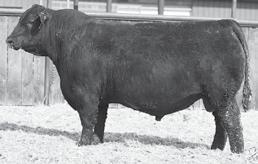
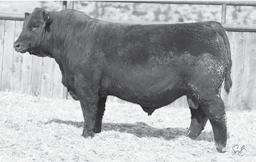
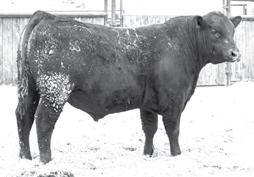
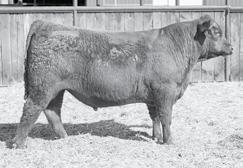
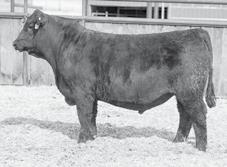
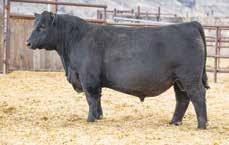
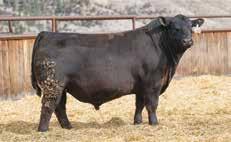
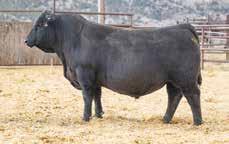
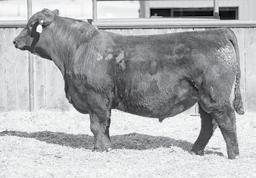
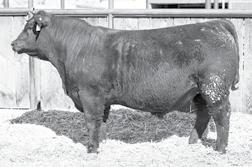
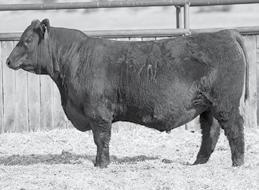
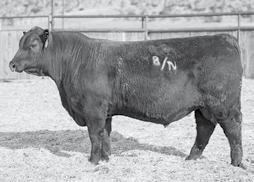
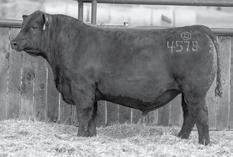
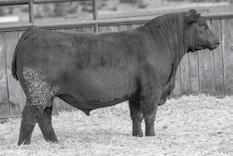
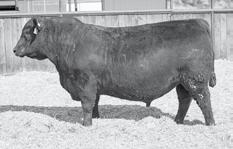
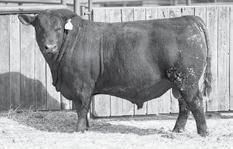
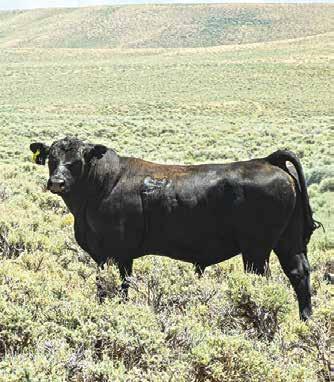
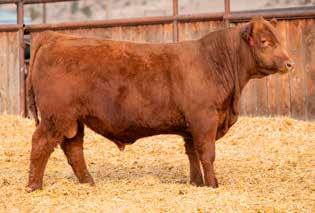
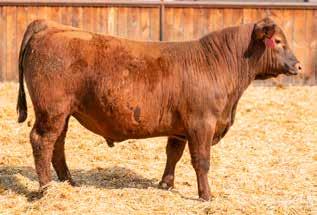
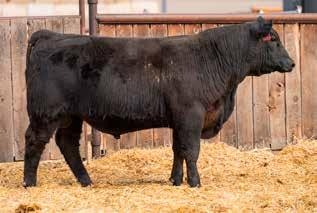
Wyoming Livestock Roundup - 2026 Midland Bull Test Edition
2026 MIDLAND BULL TEST
April 2-3, 2026
Columbus, Montana
Dear fellow cattlemen and cattlewomen, It is with great excitement we present this outstanding offering of bulls for your assessment. This sale would not be
possible without the progress-oriented consignors who dare to see how their bulls stack up against others from across the nation. We commend the consignors for their dedication to improv-
Index to results
Each year, Midland Bull Test publishes a list of the highest-achieving bulls for both average daily gain and weight per day of age by breed. The top five in each category for each breed is listed in the following pages of this edition.
Angus Pages 4-13
Simmental Page 13
Hereford Pages 14-15
Red Angus Pages 15-16
LimFlex Pages 16-17
Pinzgauer Page 17
Salers Page 18
Junior Consignors Pages 19-21
Additionally, pages 21-23 of this edition include a variety of information on selecting productive bulls. Enjoy!
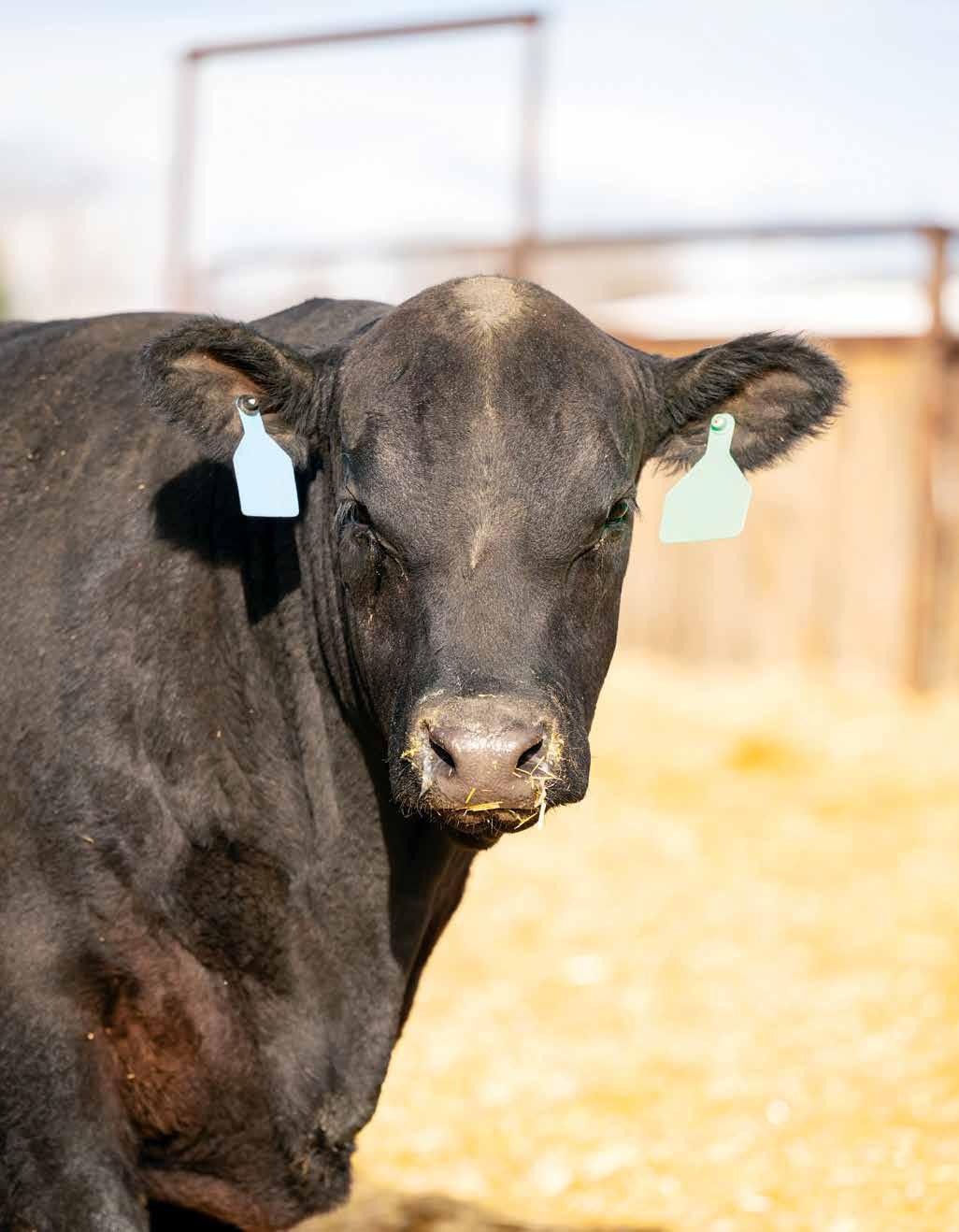
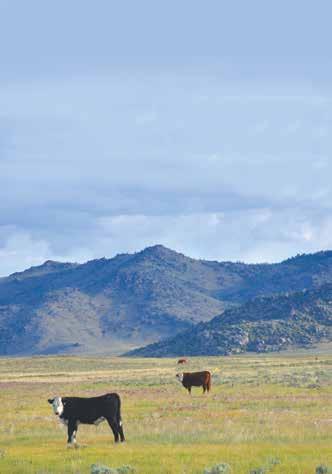
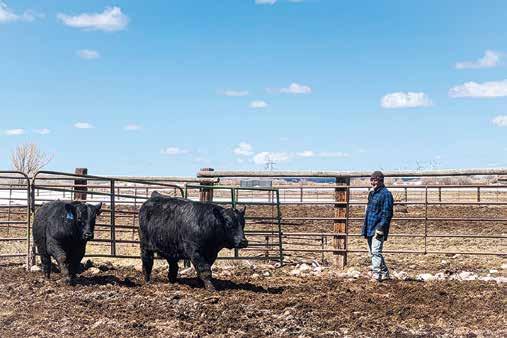
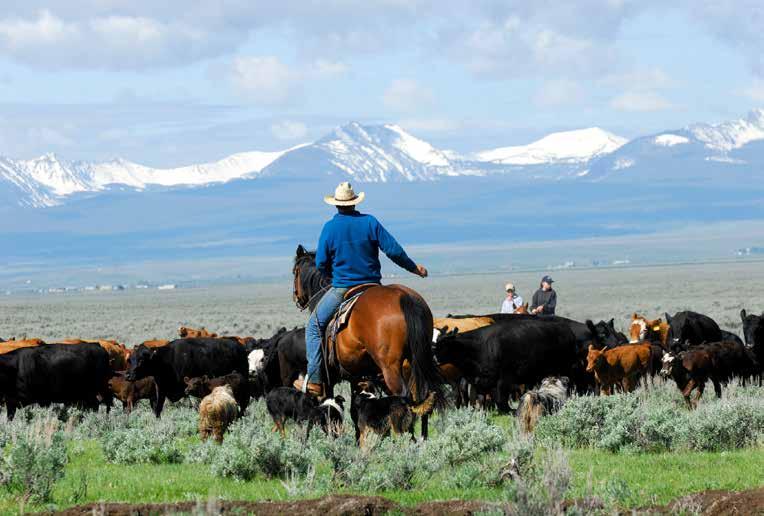
Cover photo by Chelsee Camblin
ing the quality of bulls year in and year out by using the data to make improvements in their offering.
There are very few bull sources with criteria evaluated by third parties. The bulls that rise to the top with these evaluations demonstrate great balance across an array of economically relevant traits important to everyone from the commercial cattleman to the feeder and even the consumer.
You won’t find an easier way to select for relevant balance than using the Midland Bull Test Index to identify cattle which excel in multiple traits across the board.
The calf market has been beyond incredible with the potential to continue for a few more years. Take this opportunity to position your cow herd with bulls that have the documented performance to propel your herd forward.
In this era of chasing
extreme expected progeny differences (EPDs) and indexes, it is still essential to cover the bases and ensure cattle have the appropriate foundation – body type, structure, length, capacity and frame. Without this solid ground, the performance potential of the EPD won’t be achieved.
Going through countless catalogs, I can’t help but notice how many only list EPDs with no phenotypical data, ratios or 205 weights. Midland has and will continue to maintain transparency by providing all of the data.
Because every program is different, we believe in providing all of the data to allow any buyer the opportunity to improve their program with a proven herd bull battery.
Efficiency claims are abundant, but this term requires actual measurement. We do it with thirdparty verification for accu-
racy. Without measuring, we are only assuming.
The economic impact of feed efficiency is profound and has a large impact on the net income for the commercial cattleman and the feedlot industry.
LEVEL UP YOUR HERD
Real progress means choosing sires with balanced performance, fertility, structure and feet, carcass quality, maternal influence and efficiency. You can’t improve what you don’t measure.
DATA ADVANTAGE
For over 50 years, top cattlemen nationwide have leveled up their genetics through Midland Bull Test. With decades of consistent measurement and the largest comparison base, Midland customers secure improved herd results using proven information.
Sale-day bulls will be on display prior to going through the ring, and the sale will be broadcast live for online bidding if you aren’t able to make it.
Sincerely, Steve and Amy Williams and the Midland Bull Test crew
As you study the information in this catalog, if Leo, Steve or Amy can be of any assistance, please let us know. We would be happy to answer any questions, elaborate on the measurements or help narrow down your selections. You are welcome to go through the bulls any time prior to the sale. Videos of the bulls will be available at midlandbulltest.com
ABBREVIATIONS
EPD – Expected Progeny Difference: The prediction of how future progeny of each animal are expected to perform relative to the progeny of other animals listed in the database
ADG – Average Daily Gain
BW – Actual Birth Weight: Expressed in pounds and a predictor of a sire’s ability to transmit birth weight to his progeny compared to when he is bred to a first-calf heifer
M – Milk: A predictor of a sire’s genetic merit for milk and mothering ability as expressed in his daughters compared to daughters of other sires; in other words, it is a part of a calf’s weaning weight attributed to milk and mothering ability
Eff – Efficiency: Optimizes balance between performance and efficiency, measures how efficiently the caloric content of feed is converted to pounds
MBT – Midland Bull Test Index: Combined ADG, nursing ration, yearling and efficiency ratios
RFI – Residual Feed Intake: Actual feed intake minus expected feed intake
WDA – Actual Weight per Day of Age
WW – Weaning Weight EPD: Expressed in pounds and a predictor of a sire’s ability to transmit weaning growth to his progeny compare to other sires
YW – Yearling Weight EPD: Expressed in pounds and a predictor of a sire’s ability to transmit yearling growth to his progeny compared to other sires
Midland Bull Test boasts largest feed efficiency testing program in North America
When Midland Bull Test was founded in 1962 by Leo McDonnell, Sr. and a small group of purebred breeders, the concept of weighing and measuring cattle and publishing the resulting data was not met favorably by other breeders across the nation.
“However, under this constant pressure from the opponents of performance, Midland Bull Test, the Montana Beef Performance Association and several staunch seedstock producers continued to define, refine and promote performance as a primary tool in managing the profitability of the cow herd,” notes the Midland Bull Test website.
More than six decades later, this resilience and grit gave way to the largest feed efficiency testing program in North America, offering producers a one-of-akind opportunity to develop and market sound, functional, total-performance bulls “that are ready to go to work.”
The test
Each year, Midland Bull Test evaluates about 1,100 purebred bulls from 200 consignors representing more than 32 states.
Bulls are entered in to a 112-day performance test in the fall, in which data is collected on average daily gain, weight per day of age, ultrasound, feed efficiency and breeding soundness. Then, the top 80 percent of bulls are sold in the Final Sort Sale.
“Over the last few decades, Midland has collected as much – if not more – ultrasound data than just about any other location in the country,” states the website, which goes on to explain ultrasound data is collected in accordance with guidelines developed by the Ultrasound Governance Committee, tasked with overseeing ultrasound matters of the U.S. Beef Breeds Council.
Ultrasound images are submitted to UltraInsights, a centralized ultrasound pro-
“Such a special bull comes out of Midland Bull Test because of all of the selection pressure. There is nowhere else in the world where producers can find bulls through such a strict criteria process.” – Leo McDonnell, Jr.
cessing lab, and data is submitted for all bulls enrolled in their respective breed association’s performance program.
Additionally, Midland Bull Test gathers efficiency data using a GrowSafe System known as Vytelle, which measures the feed efficiency of each individual bull by tracking feed consumption through an electronic identification tag. This is then used to calculate residual feed intake – a correlation of the pounds of gain to pounds of intake and, therefore, the increment cost of gain.
Bulls in the test are also required to pass a breeding soundness exam, which evaluates extension, motility, morphology, scrotal circumference and semen volume and concentration.
“Such a special bull comes out of Midland Bull Test because of all of the selection pressure,” shares Leo McDonnell, Jr. in an
AngusTV YouTube video celebrating Midland’s 50th anniversary. “There is nowhere else in the world where producers can find bulls through such a strict criteria process.”
The sale
This year, the Midland Bull Test Final Sort Sale will offer over 350 high-end bulls in Columbus, Mont. on April 2-3.
An impressive assortment of Pinzgauer, LimFlex, Salers, Simmental, Hereford and Red Angus bulls will sell on April 2 starting at 1 p.m., and Angus bulls will sell on April 3 at 11 a.m.
Prior to the test, Midland personnel will host a social gathering on April 1 from 3-7 p.m. to give buyers the opportunity to view bulls and enjoy complimentary hors d’oeuvres.
Following the multibreed sale on April 2, producers can attend a 5 p.m. social and 6 p.m. complimentary dinner at the new
Civic Center in Columbus, Mont., followed by live music from Kyle Shobe and The Walk ‘Em Boys from 7-9 p.m.
A complimentary lunch will be served on both days of the sale.
The website notes sale order will be determined by the Midland Bull Test Index and Estimated Sale Value, and sale order will be posted online on sale day.
Each animal will be sold to the highest bidder, with the auctioneer settling any differences.
Cattle will sell according to health regulations of the state of Montana. A transferred certificate of registry will be furnished to the buyer for each animal after settlement has been made.
Bulls sold into states requiring trichomoniasis testing will be tested after the sale, and trucking arrangements will be made in short order.
Cattle will be delivered to central locations, such as stockyards, in the lower 48 states. More information on delivery is available in the Midland Bull Test Final Sort Sale catalog. The sale will be broadcast live at cci.live. Buyers may bid online or use telephone bid lines at 406-322-9911 or 406-322-9044. All buyers must register prior to the sale, and new buyers must provide bank references.
Joe and Greg Goggins will serve as auctioneers for the sale. Breed field representatives and livestock publication representatives will be available.
A sale catalog is available at midlandbulltest.com On sale day, more information will be available online or by calling 406-322-5597 or 406-322-9911.
Hannah Bugas is the managing editor of the Wyoming Livestock Roundup. Send comments on this article to roundup@wylr.net.
Sale bulls in each breed qualify for Midland Bull Test Performance Awards based on performance, semen evaluation and soundness.
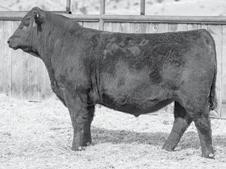
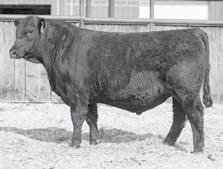
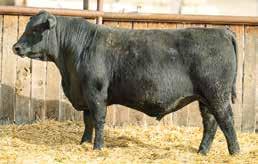
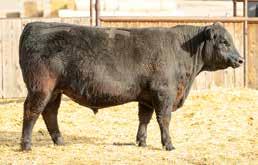
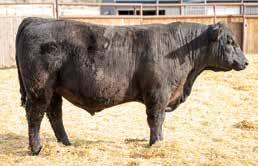
Angus bulls across all groups and classes qualify for awards including the Champion Pen of Three, the Champion Sire Group, the Champion High Indexing Bull, the Champion Average Daily Gain (ADG) Bull, the Champion Weight per Day of Age (WDA) Bull, the Champion Low Birth ADG Bull and the Champion High Efficiency (Eff) Bull.
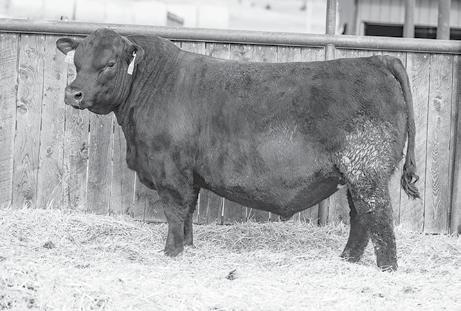
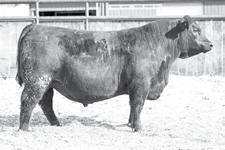
As of March 12, pending semen results and registration documents, the Overall Champion Pen of Three from both groups were lots 63, 64 and 65 consigned by 7 Oaks Angus of Durant, Iowa, with an average Midland Bull Test (MBT) Index of 115. Marda Angus Farm LLC of Lodi, Wis. had the Overall Reserve Champion Pen of Three with lots 101, 104 and 109 with an average MBT of 114.
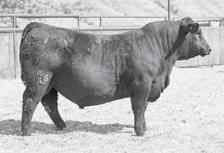
In Group 1, the Champion High Indexing Bull was lot 137, consigned by Deppe Angus of Waverly, Iowa, with a MBT of 120. Columbus, Mont.-based Les Craft Angus’ lot 31 was the Reserve High Indexing Bull with a MBT of 118.
Deppe Angus also consigned the Champion Group 1 ADG Bull – lot 137 – reporting an ADG of 5.27. Lot 184, consigned by 2XL Cattle Company of Boone, Iowa, was the Reserve Champion ADG Bull with an ADG of 5.13.
The Champion WDA Bull was 7 Oaks Angus’ lot 63 with a WDA of 4.22. The Reserve Champion WDA Bull was lot 204, consigned by Eagle Grip Cattle Company of Denair, Calif., with a WDA of 4.20.
Marda Angus Farm LLC took home even more honors. Lot 109 was the Champion Low Birth ADG Bull with an ADG of 5.09, while lot 106, also consigned by Marda Angus Farm LLC, tied with Hanover, Mich.-based Dawson Farms LLC’s lot 178 for honors as the Reserve Low Birth ADG Bull. Both bulls posted an ADG of 4.64.
The Champion Group 1 High Eff Bull was lot 78, consigned by Stewart Select Angus of Greensburg, Ind., with an Eff of 123. Honors for the Reserve High Eff Bull ended in a three-way tie between lots 31, 101 and 153, all of which posted an Eff of 119. Lot 31 was consigned by Les Craft Angus, lot 101 was consigned by Marda Angus Farm LLC and lot 153 was consigned by KB Angus of Merritt, Mich.
In Group 1, Marda Angus Farm LLC’s lot 104, 105 and 106 and Eagle Grip Cattle Company’s lots 50, 52 and 202 both received honors as the Champion Sire Group – all of which posted an MBT of 109. Lots 104, 105 and 106 were sired by BNWZ Nobility 1202, while lots 50, 52 and 202 were
Angus Award Winners
sired by Ellingson Deep River.
Byergo Beef Genetics LLC of Dearborn, Mo. took home Reserve Champion Sire Group honors with lots 159, 161 and 163, which were all sired by Connealy Craftsman.
In Group 2, Warden, Wash.-based Burkholder and Unruh’s lot 343 was the Champion High Indexing Bull, reporting a MBT of 117. With a MBT of 115, both lot 389, consigned by Johnson Bros. Angus of Egeland, N.D., and lot 403, consigned by Hone Ranch of Gardenerville, Nev., took home honors as the Reserve Champion High Indexing Bull.
The Champion Group 2 ADG Bull was lot 362, consigned by Kinsley Painter of Buffalo, Wyo., with an ADG of 4.51. The title of Reserve Champion Group 2 ADG Bull went to both lot 389, consigned by Johnson Bros. Angus, and lot 334, consigned by Woirhaye Cattle Company of Darby, Mont. Both bulls posted an ADG of 4.29.
Johnson Bros. Angus also consigned the Champion Group 2 WDA Bull – lot 389, with a WDA of 4.14 – and the Reserve Champion WDA Bull – lot 390, with a WDA of 3.86.
A two-way tie took place between Johnson Bros. Angus’ lot 389 and Woirhaye Cattle Company’s lot 334 for the title of Champion Low Birth ADG Bull in Group 2. Both bulls had an ADG of 4.29. Woirhaye Cattle Company’s lot 326 and Riverside, Utah-based Coombs Cattle Company’s lot 466 also tied for Reserve Champion Low Birth ADG Bull honors, both posting an ADG of 4.02.
The Champion Group 2 High Eff Bull was lot 402, consigned by Hone Ranch, with an Eff of 115. Lot 428, consigned by Reddin Angus of Darby, Mont.; lot 431, consigned by Marda Angus Farm LLC and lot 455, consigned by Jocko Valley Cattle LLC of Missoula, Mont. ended in a three-way tie with an Eff of 114 as the Reserve Champion High Efficiency Bull.
With an average MBT of 107, Great Falls, Mont.-based Granger Angus’ lots 306, 307 and 309, as well as Coombs Cattle Company’s lots 465, 466 and 468, both took home honors as the Champion Sire Group. Lots 306, 307 and 309 were all sired by Granger Pacman 224, while lots 465, 466 and 468 were all sired by Baldridge Gibson G859.
Reserve Champion Sire Group honors went to Granger Angus’ lots 302, 301 and 311 with an average MBT of 106. All bulls were sired by Basin Keystone 2021.
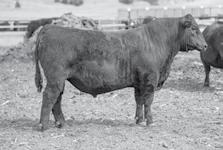
Among the Angus fall bulls, a three-way tie took place for the title of Champion High Indexing Bull between Dickinson, N.D.-based Bullinger Ranch’s lot 251, Eagle Grip Cattle Company’s lot 259 and Deppe Angus’ lot 268. All bulls posted an MBT of 118. Two bulls consigned by Deppe Angus also tied for Reserve Champion High Indexing Bull honors –lots 267 and 270 – both of which posted an MBT of 112.
Deppe Angus also consigned the Champion and Reserve Champion Fall ADG Bulls. Champion honors went to lot 268 with an ADG of 5.22, followed in reserve by lot 270 with an ADG of 5.18.
Lot 251, consigned by Bullinger Ranch, was the Champion Fall WDA Bull, reporting a WDA of 3.69, while Eagle Grip Cattle Company’s lot 259 took home honors as the Reserve Champion Fall WDA Bull with a WDA of 3.60.
The Champion Low Birth ADG Bull in the group was Deppe Angus’ lot 267 with an ADG of 4.96 and, with an ADG of 4.51, Shawano, Wis.-based Johnson Family Cattle’s lot 257 was the Reserve Champion Low Birth ADG Bull.
Rounding out the Angus awards, Johnson Family Cattle’s lot 254 was named the Champion High Eff Fall Bull with an Eff of 127, followed by lot 276, a consignment by T.J. Curtin Farms of Blue Mound, Ill. with an Eff of 122, in the reserve position.
Angus bulls data
The 2026 Midland Bull Test Final Sort Sale will offer a massive selection of over 300 top-notch Angus bulls which reported impressive breed data during this year’s test.
Spring-born Angus bulls were split into two groups and two classes. Class 1 includes low-birth bulls, while Class 2 consists of average- and above-average weight bulls.
Fall-born bulls were sorted into their own class.
Final test results show a collective ADG for Group 1 Class 1 bulls of 3.81 and a collective WDA of 3.27. Group 1 Class 2 bulls had an average ADG of 3.86 and WDA of 3.37, and fall Angus bulls had an average ADG of 4.00 and WDA of 3.12.
In Group 2 Class 1, the final report shows a collective ADG of 3.30 and a WDA of 3.14, while Group 2 Class 2 bulls had an average ADG of 3.31 and WDA of 3.21.
MORE ANGUS RESULTS ON THE NEXT PAGE
RESULTS
Hereford Leaders and Award Winners
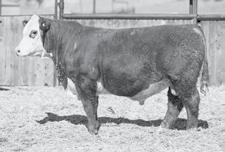
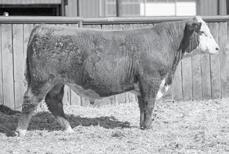
Sale bulls in each breed qualify for Midland Bull Test (MBT) Performance Awards based on performance, semen evaluation and soundness. Breeds with less than 30 head and all fall bulls qualify for honors as the MBT High Indexing Bull and High Efficiency (Eff) Bull.
As of March 12, pending semen results and registration documents, the Champion High Indexing Hereford Bull was lot 576 with a MBT of 111. Lots 578 and 579 tied for Champion High
Group 2 Hereford Bulls MBT
Red Angus Leaders
Group 2 Pinzgauer
3/4
Leaders and Award Winners
Bull.
Junior Consignor Leaders and Award Winners
of
To view test results in their entirety, visit midlandbulltest.com.
Many producers know choosing the right bull begins long before sale day and involves far more than flipping through a catalog.
Experts with the Canada-based Beef Cattle Research Council (BCRC) outline seven important considerations for producers selecting bulls in a Feb. 11 article titled “Road to Bull Sale Season – Seven Key Stops to Buying the Right Bull.”
“Bull buying is a multi-step process that starts with good records, clear goals and knowing what traits will move your operation forward,” BCRC shares. “By planning and sticking to a disciplined approach, you can ensure your next herd sire is a sound investment.”
Establishing
breeding goals
The first step in selecting herd sires is identifying breeding objectives for both
short- and long-term goals.
By clearly defining breeding goals ahead of the selection process, producers will be able to make
informed, data-driven decisions to improve herd genetics, profitability and sustainability, BCRC shares.
“Before looking at bulls, identify what you want your herd to achieve in the short
Calving Ease & Performance
and long term,” the authors write. “Your breeding program should align with your operation’s resources, management style and future plans.”
Focusing on traits
After establishing an understanding of breeding goals, producers can prepare themselves to match their goals with a prospective herd sire’s genetic potential through focusing on trait selection.
BCRC explains expected progeny differences (EPDs) help predict how a specific bull’s offspring will perform on average compared to offspring from another bull and recommends using EPDs to guide selection decisions.
Some questions BCRC offers for consideration include whether the bull will be bred to both heifers and cows, whether the calves will be retained as replacements and when the calf crop will be marketed.
“As an example, if you are breeding first-calf heifers, selecting bulls with higher calving ease is essential,” the authors share.
“In contrast, if you are not retaining replacement females and sell all calves after backgrounding, consider focusing on weaning weight and yearling weight, with moderate emphasis on carcass and feed efficiency traits.”
From enhanced carcass quality and increased weaning weight to reduced calving difficulty and improved feed efficiency, having a clear understanding of which traits will help drive success on a specific operation can aid producers in selecting the right bull.
BCRC reminds producers to avoid single trait selection and instead recommends prioritizing economically relevant traits and using selection indexes to combine multiple traits into one value.
Identifying seedstock suppliers
Establishing relationships with trustworthy seedstock suppliers helps build credibility and confidence when selecting a new bull, BCRC notes.
“Build relationships with seedstock providers who can explain the genetics behind their bulls, provide performance records and conduct bull breeding soundness exams (BSEs),” the authors recommend.
BCRC emphasizes these relationships allow producers to evaluate management practices implemented where the bull was raised, which is important since differences in production systems can impact performance and how traits are expressed in offspring.
Breeders can also offer advice on matching a bull’s genetics to operational goals, the authors note, and some may even
offer post-sale support or health guarantees. Evaluating and ranking bulls
After defining goals, getting familiar with EPDs and identifying potential seedstock suppliers, producers are ready to dig into the details of evaluating and ranking bull prospects.
BCRC recommends comparing bulls based on selected EPDs as well as physical characteristics such as structure, feet and temperament.
Sound physical characteristics can give producers peace of mind about the longevity and efficiency of a prospective herd sire.
“Bulls with correct leg, foot and joint structure can travel farther, mount more successfully and avoid lameness or injury,” the authors emphasize.
In addition, BCRC notes structural soundness and conformation are moderately heritable traits which impact a bull’s longevity, breeding efficiency, risk for injury and genetic influence on the herd.
The authors also encourage producers to confirm each prospective bull is upto-date on vaccinations and has passed a BSE, adding benefits of BSEs include higher pregnancy rates, tighter calving seasons, early detection of problems and reduced disease risk.
Following a thorough evaluation, BCRC recommends ranking bulls according to how closely they meet breeding goals and selection criteria, noting utilizing tools like spreadsheets or selection indexes to outline comparisons across key traits can help streamline the ranking process.
Budgeting and sale day success
When it comes time to
make the actual investment, BCRC emphasizes having a budget and sticking to a plan on sale day is key. The authors note bull
prices can range from a few thousand dollars to several thousand dollars depending genetics, pedigree and reputation.
With this, BCRC recommends producers estimate the break-even price of a bull based on considerations like operation size, feed costs, weaning rates and current market prices
before pulling out the pocketbook.
Whether buying through an auction or private treaty, BCRC says sticking to the plan is of utmost importance. “Focus only on bulls
which have been pre-evaluated and avoid impulse buys or being pressured into a purchase that doesn’t fit your goals or budget,” the authors write. “If the right bull isn’t available at the
right price, be prepared to wait or reassess rankings.” Grace Skavdahl is the editor of the Wyoming Livestock Roundup. Send comments on this article to roundup@wylr.net.