The Weekly News Source for Wyoming’s Ranchers, Farmers and AgriBusiness Community • www.wylr.net
A Look Inside
Lawsuit filed to ban hunting wolves on Wyoming border
New pig chute improves vaccination accuracy and lessens stress Page B2
Brazilian beef ban encouraged by NCBA in the U.S. Page B5
Quick Bits
Snow Report
The 14th snow report for Water Year 2023 shows Wyoming’s current snow telemetry data reads 118% of median, with a basin high of 150% and a basin low of 78%. In 2022, the state was at 86% and at 90% in 2021. The report and a map displaying basin snow water equivalent percentages of median for the state may be found at wrds.uwyo.edu/ wrds/nrcs/nrcs.html
Meeting Notice
The Casper Alcova Irrigation District Board has rescheduled their meetings for the second Thursday of each month from 2-5 p.m. at 745 Connie Street, Mills, WY 82644. This will be a permanent change. Scheduled board meetings will be held on March 23, April 27 and May 25 from 2-5 p.m. at the same location.
AHA MyHerd
The American Hereford Association (AHA) recently launched new search features in MyHerd to allow members and producers access to a robust set of information. Updated features include downloadable search results, lifetime dam production summaries, saved searches, animal lists and a mating predictor. To assist with learning these new tools, webinars will be offered on March 21 at 6 p.m. and March 22 at 11 a.m. For more information or to register, visit hereford. ac-page.com/search-toolsrsvp
IGS Summit
The national junior Limousin, Gelbvieh, Simmental, Shorthorn and Chianina associations are partnering up to host the Summit IGS Youth Leadership Conference July 20-23 in Phoenix. The event is an opportunity for members, ages 14 to 21, to develop leadership skills, gain new friendships and expand knowledge on current issues in the ag industry. To register, visit form.jotform. com/230465236531148
On Feb. 22, the Center for Biological Diversity notified the U.S. Department of Agriculture and the U.S. Forest Service (USFS) of their intent to sue over the “agencies’ failure to protect wolves from hunters in
the Medicine Bow-Routt National Forest.”
The notification came in response to several incidents of wolf killings over the past few years on the Colorado-Wyoming border, and the lawsuit seeks a ban on
Dealing with dystocia
Veterinarians remind producers how to properly handle difficult births during calving
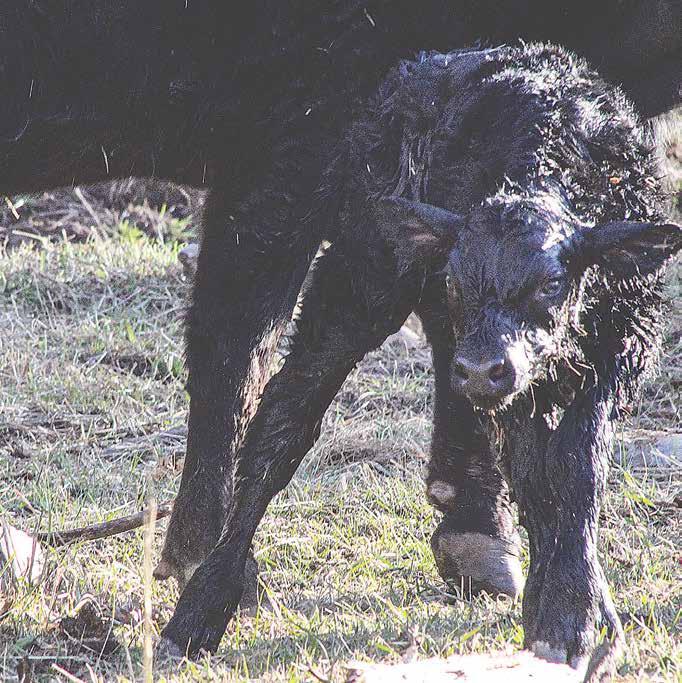
Many cow/calf producers with springcalving herds are deep into their calving season, and regardless of how much time and effort spent trying to prevent cases of dystocia, it is likely they will deal with a difficult birth at some point or another.
In January 2019, Louisiana State University (LSU) Veterinarians Dr. Christine Navarre, Dr. Matt Welborn and Dr. Chance Armstrong coauthored an article titled “Calving: When to Call for Help,” which looks at the potential negative impacts of mishandling cases of dystocia as well as offering ways to properly deal with the issue.
Potential negative impacts
If mishandled, dystocia has the potential to cause several negative outcomes.
The first of these issues is an increased chance of calves failing to ingest or absorb colostrum, which subsequently leads to an increased chance of sickness and death.
“Calves that get sick or do not get colostrum within the first 24 to 48 hours of life have decreased production throughout their lifetimes,” they say.
Additionally, the three note calves can become paralyzed and/or suffer life-threatening illness or death if the uterus, vagina

Please see DYSTOCIA on page A11
Hay demand holds strong
According to the March 16 U.S. Department of Agriculture (USDA) Wyoming Direct Hay Report, compared to the last report, all reported hay sold held steady and demand for hay remains strong. Most producers are almost out of hay to sell, and the bulk of produced hay seems to be staying in local trade areas.
When it comes to prices, large three by four feet square bales of supreme alfalfa ran $310 per ton. Large round bales of good alfalfa ran $285 per ton and large three by four feet square bales ran $270 per ton.
In the alfalfa premium category, small squares ran from $270 to $300 per ton, small, three-tie squares ran from $285 to $300 per ton and cubes ran $380 per ton.
For premium alfalfa-orchard mix, small squares ran from $285 to $300 per ton, and small square oat bales ran $200 per ton. Small squares of fair teff hay ran $200 per ton.
Hay outlook
Valley Video Hay Markets Owner Barry McRea has brokered hay for 30 farmers in the Torrington area over the past 20 years. He notes all of his customers are currently out of hay.
“For the last 30 days, prices have ran $285 per ton for rounds and squares and $300 to $310 for dairy hay,” he shares. “All at free on board (FOB) – price at place of origin, not including transportation charges – per stack.”
He mentions prices for hay this time of year, is excessively high, and last year, prices ran closer to the $210 per ton price range.
McRea predicts hay prices won’t go much higher, as
hunting and trapping wolves across the entire forest.
“When Colorado wolves, protected by the Endangered Species Act (ESA), cross the invisible border and land in Wyoming, they’re in the preda-
tor zone and don’t have any protection,” said Center for Biological Diversity’s Collette Adkins in a March 8 WyoFile article, written by Mike Koshmrl. “This is the problem we’re seeking to
see
Please
Ranch management
UW seminar welcomes presenters to further the human resources conversation
Sheridan – The University of Wyoming (UW) College of Agriculture, Life Sciences and Natural Resources held its second seminar in a five-part series on Feb. 19 at Sheridan College.
In the March 11 edition of the Wyoming Livestock Roundup, panelists discussed challenges associated with the hiring process, how to implement best practices and what to do when something goes wrong.
In the second portion of the seminar, Ranch Management and Agricultural Leadership Program (RMALP) Coordinator Anne DeMersseman, a leadership coach and former corporate consultant with years of experience in human resources and Cody Sinclair, chief development officer at Sheridan Memorial Hospital, facilitate a discussion and share suggestions on how to navigate difficult situations. Giving an accurate job description
WYLR photo
“The job description an
WWGA inaugural ewe sale a success
On Feb. 28, the Wyoming Wool Growers Association (WWGA) held their inaugural Wyoming Select Bred Ewe Sale in Gillette at the CAM-PLEX
“The first annual Wyoming Select Bred Ewe Sale was a great success,” noted WWGA Executive Director Dr. Alison Crane. “Ewes sold well from across the state of Wyoming and across age classes, from broken-mouthed ewes to ewe lambs. All ewes were bred with the exception of the ewe lambs.”
According to WWGA’s website, the inaugural Wyoming Select Bred Ewe Sale offered the highest-quality range ewes, meeting some of the most rigorous
standards of any sale in the country. The sale offered open ewe lambs, bred yearlings, running-age ewes, broken-mouthed ewes, Rambouillet ewes, Hampshire ewes Merino/Rambouillet and Targhee ewes.
With the exception of open ewe lambs, ewes were confirmed pregnant the day before the sale and strictly sifted based on their eyes, mouth, teeth, udders, teats, body and legs. Sifting was conducted by a panel of notable Western sheep producers and veterinarians.
Sale report
According to the first annual Wyoming Select Bred Ewe Sale report, a
periodical periodical
®
Volume 34 Number 47 • March 18, 2023
LAWSUIT
Please see UW on page A7 Please see HAY on page A8
on page A14
Please see SALE on page A10
High Altitude Bull Test field day and sale will be hosted by UW this spring Page A6 Chicken prices offer reprieve for inflation-weary consumers Page B1
As we are still digging out of snowbanks, I look forward to spring and what it will bring for the summer. When I glance at the current wool, lamb, calf and yearling markets, I’m pleased with what I’m reading. Then, I come back to all of the issues happening in our industry today, and I start to frown.
When I think about the high input and living costs we are suffering in agriculture – brought on by inflation, poor decisions from leadership and Washington, D.C. using politics to solve peoples’ issues – I realize the cost of energy effecting our businesses and everyday lives tops the list.
Since the energy market is based on global supply and demand, we don’t have a lot of control over it. Mix in the war in Ukraine, Russia stopping oil and natural gas from reaching Europe as they depended on Russia as a main source of oil and natural gas and the current administration hindering production of oil and natural gas in the U.S., it’s no wonder energy markets have been so volatile.
“The world is facing an energy supply and demand imbalance, which is causing global bottlenecks and price hikes,” says Suzanne Ogle, president and chief executive officer of the Southern Gas Association.
Right or wrong, the need to reduce greenhouse gas emissions has gained momentum and changed how energy is produced. We’re at the point where we should use some common sense instead of making issues more political than they already are.
Implementing more restrictions, which are unneeded and uncalled for, is not the answer.
I heard a quote saying, “Today, climate change is the new religion, replacing our church religion.”
As a country, we have to be energy dependent – just look at Europe. It is going to take all sources of energy to sustain our energy needs, and we need to have open minds since there is a place and need for all types of energy.
We need to recognize oil and natural gas are a part of our lives and will continue to be into the future. Turning to electric power for everything is a mistake. We just don’t have the infrastructure for it yet, and we may never have it.
Today, electric cars and trucks are just a fad. In many rural states, especially northern states, they are not functional. Maybe someday they will be, but not right now, especially for use in agriculture.
Individuals involved in family agricultural operations just want to farm, ranch or manage their businesses, as they have a right to do. They recognize a drought could be weeks away or a blizzard could blow through next week, and they all realize some days are better than others.
Regardless, they just want to manage their businesses with their families involved.
I read a quote from Cattleman Doug Ferguson, who said, “The end goal in cattle marketing is not to have an off-farm job.”
How true that is today. America’s farms and ranches produce the best crops, livestock and children with a work ethic and a learned common sense.
The most import things in life really aren’t things.
Wyoming Livestock Roundup
Reporting the News by the Code of the West
Wyoming Livestock Roundup (USPS # 005-774) is published weekly by Maverick Press, Inc. P.O. Box 850 • Casper, WY 82602
Periodicals postage paid in Casper, WY
Fax: 307-472-1781 • E-mail: roundup@wylr.net

Phone: 307-234-2700
800-967-1647 • www.wylr.net
HANNAH BUGAS, Managing Editor • hannah@wylr.net
BRITTANY GUNN, Editor • brittany@wylr.net
CANDICE PEDERSON, Production Coordinator • candice@wylr.net
JODY MICHELENA, Advertising Director • jodym@wylr.net


DENISE OLSON, Classified Sales Manager • 307-685-8213 • denise@wylr.net
ANDREA ZINK, General Manager • andrea@wylr.net
CURT COX, Director of Livestock Field Services • 307-630-4604 • curt@wylr.net

CALLI WILLIAMS, Livestock Field Services Rep. • 605-695-1990 • calli@wylr.net
Subscription Rates: 1 year: $60; 2 years: $90; 3 years: $130
Postmaster: Send address changes to: andrea@wylr.net Wyoming Livestock Roundup • P.O. Box 850 • Casper, WY 82602

GUEST OPINIONS
National Ag Day Celebrates 50 Year Anniversary
This year, National Ag Day will celebrate it’s 50th anniversary on March 21, and it’s a day to recognize and celebrate the abundance provided by agriculture. Evolution and progress have carried American agriculture into a new era since the first National Ag Day was celebrated in 1973.
Every year, producers, agricultural associations, corporations, universities, government agencies and countless others across America join together to recognize the contributions of agriculture.
The world population will reach nine billion by 2050, and there will be millions of new mouths to feed, many of whom rely on U.S. food production to meet this need.
According to the Agri-
 By Klodette Stroh
culture Council of America (ACA), one-fourth of the world’s beef and nearly onefifth of the world’s grain, milk and eggs are produced by American farmers. One farmer produces enough food for 165 people.
Agriculture exports
In these difficult economic times, U.S. agriculture has a positive balance in exports.
In fact, on Feb. 10, Agriculture Secretary Tom Vilsack announced, “The American agricultural sector posted its best export year ever in 2022, with international sales of U.S. farm and food products reaching $196 billion.”
The top commodities exported by the U.S. in 2022 were soybeans, corn, beef, dairy, cotton and tree nuts, which together comprised
more than half of U.S. agricultural export value.
The top 10 agricultural export markets in the U.S. include China, Mexico, Canada, Japan, the European Union, South Korea, Taiwan, the Philippines, Colombia and Vietnam.
Modern technology
As farmers, my husband Rick and I are always eager to keep up with new techniques to improve our farming practices. Using modern technology has boosted our crop yields and reduced waste.
Farmers use satellite maps and computers to match seed, fertilizer and crop protection applications to local soil conditions. Sophisticated global positioning systems can be specifically designed for spraying herbicides and pesticides.
Roundup ready sugarbeet seeds are a good example of the biogenetics process. Biogenetics is simply another technology to help with crop production. This is a feature implanted directly into the seed to protect it from certain herbicides or pests.
U.S. agriculture has been benefiting from this technology by using Roundup ready corn, soybean and sugarbeet seeds.
Wyoming agriculture
Wyoming’s agricultural sector added $1.83 billion to our economy. Animals and animal products are valued for $1.13 billion, crops are valued at $419 million and farm-related incomes are $288 million.
In Wyoming, corn, sugarbeets, barley and dry beans
Wyoming Livestock Roundup • Volume 34 No. 47 • March 18, 2023 A2 From the Publisher Dennis Sun
Ag Depends On Energy
Please see AG DAY on page A5 Lee Leachman, CEO • www.leachman.com Jerrod Watson, Bull Customer Service, (303) 827-1156 Aaron Rasmussen, Cowherd Advisor, (308) 763-1361 Semen Division: (970) 444-BULL (2855) • Office: (970) 568-3983 Visit leachman.com or call (970) 568-3983 to order your catalog today! 5 Star Cow Fertility, 5 Star Feed/Carc. $34,751 $Profit, $157 $Ranch 5 Star All-Around Bull! $32,389 $Profit, $158 $Ranch Reduce Feed Intake– Top 2% Feed:Gain! $22,978 $Profit, $117 $Ranch Awesome Feet, Udder, and Disposition! $21,512 $Profit, $100 $Ranch LOT 10 LOT 32 LOT 178 LOT 498 4.5 Star All-Around Bull and 5 Star Calving Ease $35,061 $Profit, $157 $Ranch 4.5 Star All-Around Bull. Great Marbling and F:G! $30,487 $Profit, $132 $Ranch 4.5 Star All-Around Bull. High Marbling and Efficiency! $33,058 $Profit, $139 $Ranch Stabilizer $30,855 $Profit, $139 $Ranch AAA #20312830 Udder and disposition improver! Stabilizer 5 Star Udder, Growth, and Feet! AICA F1324296 5 Star Growth, Top 1% $Terminal LOT 602 LOT 650 LOT 758 LOT 4 LOT 1 LOT 17 200 Elite Replacement Heifers Sell on Sunday, March 26th! Stabilizer, Angus, Red Angus, & Charolais LOT 616 Stabilizer Bulls Build Better, MORE FERTILE Cow Herds AND More Valuable Feeders Leachman Spring Bull & Female Sale March 25-27th, 2023 All events will be at the Leachman Bull Barn ▪ Fort Collins, CO Saturday, March 25th All cattle available for inspection. Come early, pick your lots. All lots sell via Superior. Females will also sell on DVAuction. Sunday, March 26th 11:00 AM Lunch 1:00 PM 200 Elite Open Heifers Sell Angus, Red Angus, Stabilizers & Charolais 5:00 PM Banquet & Entertainment, RSVP today! Monday, March 27th 10:00 AM 550 High $Profit, Stabilizer Bulls Sell BREEDINGBULLSSELLWITH GUARANTEE!SEASON Scan for catalog Every bull star scored for feet, udder, and fertility! 550 Bulls – Top 1% $Profit – Top 10% Cow Fertility DENNIS SUN, Publisher • Cell: 307-262-6132 e-mail: dennis@wylr.net Member: Wyoming Stock Growers Association Wyoming Wool Growers Association Wyoming Farm Bureau Federation • Wyoming CattleWomen Livestock Publications Council
Fremont
Green
Wyoming
• National Cattlemen’s Beef Association
County Cattlemen's Association
River Valley Cattlemen's Association
Angus Association Converse County Stock Growers Association Carbon County Stock Growers Association
This publication is © 2023 by Maverick Press, Inc.
UW team finishes strong
The University of Wyoming (UW) Collegiate Meat Judging Team wrapped up a successful spring season with a first-place finish at Iowa State University on March 4.
The team was named champion overall, placing first in all but one team division. Team members excelled individually as well, with all 10 students earning a spot in the Top 10 Total Contest or Top 10 Alternate Division.
Members of the 2023 collegiate meat judging team are Rachel Broyles of Arlington; Sophia Fuhrmann of Hoaglund, Ind.; Madeline Holmes of Humboldt, Calif.; Joseph Kennah of Hulett; Ashlyn Manuel of Montrose, Colo.; Tessa Maurer of Arvada, Colo.; Kara Reynolds of Laramie; Haley Rutsch of Pinedale; Casey Spencer of Petaluma, Calif. and Kylie Strauch of Van Tassell.
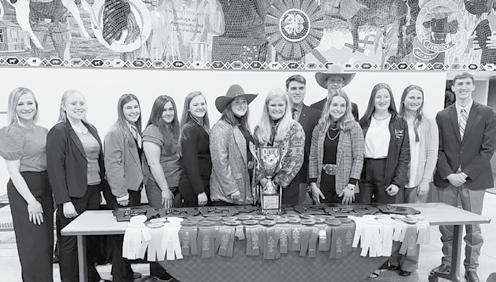
The team is coached by Head Coach Jake Gillespie and Assistant Coach Abby Vogl.
After a hiatus in 2022, this dedicated group of individuals revived the meat judging program, and the win at Iowa State University was the culmination of what the 2023 team dubbed UW’s comeback tour.
USDA awards funding
The U.S. Department of Agriculture’s (USDA) Animal and Plant Health Inspection Service (APHIS) announced on March 16 they are awarding the National Cattlemen’s Beef Association (NCBA) with $445,396 in funding to advance the Secure Beef Supply Plan (SBS) in the event of a foot and mouth disease (FMD) outbreak in the U.S.
“NCBA thanks USDA for awarding this critical funding to help continue defending the U.S. cattle herd from the threat of foot and mouth disease. The SBS combined with USDA’s national vaccine bank provides a strong safety net for cattle producers and multiple tools to mitigate risk from a potential outbreak,” said Allison Rivera, NCBA executive director of government affairs.
“This funding was made available through the 2018 Farm Bill, showing why continued support and further funding for animal disease preparation measures like the SBS and the National Animal Vaccine and Veterinary Countermeasure Bank are so important as Congress works on the 2023 Farm Bill,” she continued.
BLM to host tour
The Bureau of Land Management (BLM) will host a free public tour of the Wheatland Off-Range Wild Horse and Burro Corral on April 14. The tour will begin at 1 p.m.
Attendees will meet at the Wheatland facility located at 1005 N. Wheatland Highway, approximately 10 miles north of Wheatland. Participants will be taken as a group by bus around the facility where they will have an opportunity to view wild horses recently gathered from herd management areas in southwest Wyoming.
Those interested in attending will be required to RSVP and sign a waiver. To register, e-mail blm_wy_wheatlandORC@ blm.gov, and the waiver will be subsequently e-mailed. The BLM will use contact information provided to communicate important updates if needed, for example, postponement due to inclement weather.
NCBA’s airs special episode
Cattlemen to Cattlemen, the television show of the National Cattlemen’s Beef Association (NCBA), will air a special episode in honor of National Ag Day on March 21. The show will recognize the contributions of America’s cattlemen and women and feature several Texas cattle operations.
The episode will air on RFD-TV March 21 at 6:30 p.m., and it will rerun on March 22 at 10:30 a.m. and again on March 25 at 7 a.m. The full episode will also be posted to the Cattlemen to Cattlemen YouTube page.

“We are thrilled to celebrate National Ag Day with our viewers by highlighting the conservation efforts of several Texas cattle producers,” said Kevin Ochsner, host of NCBA’s Cattlemen to Cattlemen and a cattle producer from Colorado. “Featuring the 77 Ranch, JA Ranch, Bezner Beef, XIT Feeders and The Meat Board, this episode showcases the entire beef industry from gate to plate.”
For more information, contact Executive Producer Kate Maher at kmaher@beef.org.
USMEF schedules conference
The U.S. Meat Export Federation (USMEF) recently announced the speaker lineup and registration details for its 2023 Spring Conference, which is set for May 24-26 in Minneapolis.
The opening general session will feature USMEF’s senior staff from the Asia Pacific region, including Senior Vice President Joel Haggard and Vice President Jihae Yang, who will discuss emerging issues in key Asian markets, including how removal of many COVID-19 restrictions could provide momentum for the region’s foodservice sector.
The following day, USMEF will examine the state of U.S.-Mexico trade relations with Kenneth Smith Ramos, who served as Mexicoʼs chief negotiator for the modernization of the North American Free Trade Agreement, which led to the signing and ratification of the U.S.-Mexico-Canada Agreement.
At the closing session, former House Agriculture Committee Chairman Collin Peterson, who oversaw development of four farm bills during his 30 years in Congress, will discuss the challenges lawmakers face as they work to craft an effective, pro-trade farm bill over the coming year.
In addition to the general sessions, beef, pork, exporter and feedgrain and oilseed breakouts will provide in-depth discussions on topics relevant to each sector. Registrants are welcome and encouraged to participate in all breakouts regardless of membership sector.
For more information and to register, visit usmef.org
USDA webinar set
The U.S. Department of Agriculture (USDA) is inviting the public to attend a public meeting webinar on the McGovern-Dole and Food for Progress Programs’ Fiscal Year 2023 Notice of Funding Opportunities (NOFO).
This will be an informational session to discuss application requirements and technical areas of focus and address any stakeholder questions.
The webinar will be held on March 23 from 7:30-10 a.m. The session will be recorded, and the information will be made available after the public meeting.
To access the Zoom link, visit zoomgov.com/j/1611375 4577?pwd=ek0xTFpjSHZ2dHJRUVgrblhML0RFdz09 and use the Meeting ID: 161 1375 4577 and Passcode: NOFO. Interested individuals can also call into the meeting toll-free at 833-568-8864 or 611-375-4577 and use the Access Code: 428308#.
The privately owned, BLM-contracted Wheatland corral encompasses 200 acres and is designed to hold up to 3,500 animals. Currently, the corral holds approximately 2,850 wild horses and burros.
The animals at the facility receive daily care by the onsite contractor and BLM staff, as well as a local contracted veterinarian and farrier as needed. The animals at the Wheatland facility are made available for adoption through the BLM’s Online Corral website or at in-person adoption events.
An in-person adoption event is scheduled for April 28. For more information about upcoming events, visit blm.gov/whb/ events
A3 Wyoming Livestock Roundup • Volume 34 No. 47 • March 18, 2023 NEWS BRIEFS 77 Zuber Road • Riverton, WY 82501 • (307) 856-8123 carlsonequipment@gmail.com Visit our Web Site at: www.carlsonequipment.com Lakeland Wagon Portable Bunk Feeder, 6’x24’ $7,500 2654 NDE Feeder Mixer $29,500 New EZ Ration 6 Bale Feeder, pull type Call for Pricing Haybuster 256+2 Round Bale Feeder $3,950 1994 Kenworth w/ Knight 3070 Feed Box $79,000 Case IH 5 Bottom in Furrow Plow $9,500 Case IH 4 Bottom in Furrow Plow $4,950 New Artsway 166 6 Bottom Onland Plow $39,000 Brillion 30’ Roller Harrow $54,000 Brillion 25’ Roller Harrow $15,000 Kewanee 14’ Roller Harrow $5,500 Leon 808 Loader, bucket & grpl $7,900 Dual Loader $1,950 14’ Chisel Plow $3,900 580 Massey Ferguson 5 Bottom Plow $6,500 14’ International Disc $2,900 JD 10’ 3 PT Disc $2,950 20’ Disc $1,950 10’ IH Disc $1,950 10’ EZEE-On Disc $1,950 John Deere 8300 Double Disc Grain Drill $7,900 Rhino SE5 Rotary Mower $2,500 Allis-Chalmers 24’ Field Cultivator $3,950 John Deere 3 PT Field Cultivator $2,900 Small Fuerst Manure Spreader $2,900 Kewanne 9’ 3-Way Hydraulic Blade $7,950 Rhino 950 3-Way Hydraulic Blade $7,900 Leon Dozer Blade, 12’ $1,950 New Industries 8’ Tilt Box Blade $3,700 6”x32’ Grain Auger, PTO driven $950 9 Shank V Ripper $4,900 Meyers Ditcher, 3 PT $2,900 22” or 30” Morman Creaser, 9 row w/ markers $4,950 Ford 700 Truck w/ stack retriever $9,500 1979 Ford 8000 Truck, 2 ton w/ flatbed $2,950 IH 4700 Truck w/ flatbed and forklift attachment $9,500 Set of IH Duals 18.4 x 38 w/ clamps $750 Belltec Hydraulic Post Hole Digger w/ down pressure $1,950 Bradco Aster 9000 Skid Steer Post Pounder $4,900 New Arrowquip Hydraulic Cattle Chute Call for Pricing 1 1/4” 6 Rail 20’ Continuous Fence Panels Call for Pricing Case IH MXM190, MFD, cab & air, front weights, low hrs,1 owner $95,000 Case IH 2096 w/ cab, air $19,500 Case IH MX170, MFD w/ ldr, grpl $69,500 Case IH MX240, 4 WD w/ duals $89,000 Massey Ferguson 4243 w/ ldr, 1840 hrs $39,500 JD 2955, 4 WD w/ ldr, grpl $39,500 2019 Bobcat 870 Skid Steer, new tracks, 1370 hrs $79,000 JD 420 Dozer, antique $7,500 MX120, 2 WD w/ ldr $49,500 JD 310 Backhoe $12,500 Oliver 1800 Tractor $7,900 Ford 4000 Tractor $7,900 Best Buys in Used Equipment CARLSON EQUIPMENT TRACTORS/LOADERS MISCELLANEOUS EQUIPMENT New Holland 855 Round Baler $4,900 New Holland 855 Round Baler $2,950 2011 MF 2190 4x4 Baler w/ accumulator $119,500 Hesston 4910 Baler w/ accumulator $39,500 Hesston 4910 Baler w/ accumulator $24,500 Hesston 4900 4x4 Baler w/ accumulator $24,500 Hesston 5580 Round Baler $1,900 Case RS 561 Round Baler $19,500 Vermeer 605h Round Baler $2,950 Case IH 8870 Swather, 16’ head, 1 owner $43,500 Case IH 8840 Swather, 16’ head $32,500 800 Versatile Swather w/ draper head $2,950 Vermeer 2800 Rake $24,500 Hoelscher 10 pack w/ skid steer mount $3,500 New Holland Stackwagon, pull type $950 HAYING & FORAGE Annual Consignment Auction • April 8, 2023 - 10:30 • Call us with your Consignments For more information, call 307-672-3456 130 S Brooks St, Sheridan, WY 82801 The McCoy Insurance Agency also provides: • Hard to Place Commercial Risks • Cabins and Dwellings In Unprotected Areas • Equine Risks FARM AND RANCH INSURANCE, no matter what size your ranch is. We insure in Montana and Wyoming. Lifelong residents of Wyoming.
Successful season – The 2023 UW Collegiate Meat Judging Team had a successful spring season, ending on a high note with a firstplace finish at Iowa State University on March 4. Pictured from left to right, in the front row is Assistant Coach Abby Vogl, Sophia Fuhrmann, Ashlyn Manuel, Kylie Strauch, Rachel Broyles, Madeline Holmes, Tessa Maurer, Kara Reynolds, Haley Rutsch, UW Judging Coordinator McKensie Phillips and Head Coach Jake Gillespie. In the back row, pictured from left to right, is Joseph Kennah and Casey Spencer. UW Ag News photo
WEDNESDAY, MARCH 22 - YEARLINGS & CALVES CATTLE COUNTRY VIDEO LOTS
FEEDERS
Ryan & Bill Nichols 70 Mostly Blk/Bwf few Red/Char-x Strs, 675-725#, Weaned a long time, Grower Ration of Ground Hay & Beet Pulp, 3 Rounds of Shots, Producer All Natural
WEANED CALVES
Eric Eddington 160 Blk Strs, 625-750#, 3 Rounds of Modified Live Vac Program & Poured, Home Raised
Ron Lien 140 Mx Strs & Hfrs, 350-450#, Weaned a long time, Running out on Cornstalks & Grower Ration, 2 Rounds of Shots, Steers are Knife
Cut, Home Raised
Paul & Nancy Landeck 105 Mx Hfrs, 450-800#, Weaned a long time, Bunk Broke, Been on a Grower Ration, Branding Shots: 7-way
Doug Dunlap 15 Blk Angus Hfrs, 500-600#, Weaned a long time, Been on a Grower Ration, Branding Shots: Vista Once SQ, Vision 7, Weaning Shots: Vista Once SQ, Vision 7 w/Somnus, Poured Cattle Country Video - 1:00 pm
Neil Harrison
July 28, 1935 – March 6, 2022
telling stories, giving advice and shooting the breeze.
Stratton Sheep Co 288 Weaned Strs. 100% Blk. Base
700

720 lbs. Slide: .10 cents. Located: Lusk, WY. Delivery: 3/23/23 to 3/26/23. Feed: Growing ration. Branding & Weaning Shots. Weigh on the ground w/a 3%. Comments: Fancy steers, the biggest and best of 620 hd, pre-sorted March 7th. Summered at 8000 ft high desert. Selling 72 per load or option to take them all. Rep: Ty Thompson 307-340-0770.
Stratton Sheep Co 237 Weaned Strs. 100% Blk. Base Wt: 610 lbs. Wt Stop: 630 lbs. Slide: .14 cents. Located: Lusk, WY. Delivery: 3/23/23 to 3/26/23. Feed: Growing ration. Branding & Weaning Shots. Weigh on the ground w/a 3%. Comments: Fancy steers, summered at 8000 ft high desert. Pre-sorted March 5th. Selling 79 hd per load with option to take them all. Rep: Ty Thompson 307-340-0770.

Stratton Sheep Co 420 Weaned Hfrs. 99% Blk, 1% Bwf. Base Wt: 600 lbs. Wt Stop: 620 lbs. Slide: .14 cents. Located: Bridgeport, NE. Delivery: 3/23/23 to 3/27/23.
Feed: Growing ration. Branding & Weaning Shots. Weigh on the ground w/a 3%. Comments: Fancy hfrs, pre-sorted March 7th. Wintered to go to grass. Summered at 8000 ft elevation. Selling 84 hd per load or option to take them all. Rep: Ty Thompson 307-340-0770.
Truett & Tess Jaure 68 Weaned Strs. 100% Red. Base Wt: 690 lbs. Wt Stop: 710 lbs. Slide: .12 cents. Located: Lusk, WY. Delivery: 3/23/23 to 3/26/23. Feed: Growing ration. Branding & Weaning Shots. Weigh on the ground w/a
on the ground w/a 3%. Comments: Fancy Red Angus hfrs, pre-sorted March 7th. Frt Adj $600. Rep: Ty Thompson 307-340-0770. Pathfinder Ranch 90 Weaned Strs. Blk/Bwf, few Red. Base Wt: 660 lbs. Located: Wheatland, WY. Grower Ration, Bunk Broke. Complete Vac Program. Sort from 100 hd. Rep: Justin Smith 307-340-0724
Pathfinder Ranch 100 Weaned Hfrs. Blk/Bwf, few Red. Base Wt: 620 lbs. Located: Wheatland, WY. Grower Ration, Bunk Broke. Complete Vac Program. Sort from 117 hd. Rep: Justin Smith 307-340-0724 www.cattlecountryvideo.com
24 - BRED COW SPECIAL & ALL CLASSES
COMPLETE OR PARTIAL DISPERSALS
Bart & Gay Lynn Byrd/Byrd Family Rev Trust 296 Choice to Fancy Red/Rwf Cows, Complete Dispersal, Bred to Red Angus or Red Simm Bulls, CF: April 15th for 60 days (bulls in 7/6/22 to 9/7/22), Fall Shots: Vibrio Lepto & Vit A, Bangs Vac, Running Out, Not Pampered, Been on Grass & Cake, Lots of Genetics
Doreangi Living Trust 20 Angus/Hereford Cows (Blk/Rd/Bwf/Rwf), 1200#, Complete Dispersal, Mx Ages, Bred to Registered Angus or Registered Hereford Bulls, CF: May, Shots: Vira Shield 6VL5 Annually, Wintered on Pasture, Not Pampered

BRED HEIFERS
P H Livestock CO. 245 Blk Angus Heifers, Bred to Redland or Sinclair Low Birth Weight Angus Bulls (with O or minus BWEPD), CF: April 21 for 45 days, Fall Shots: Visin 7, Vira Siheld 6, Dectomax, Bangs Vac, Moderate Frame, Home Raised, High Elevation, Not Pampered, Running out on Hay Meadows, Lick Tubs and Snow!
BRED COWS
Cody & Joel Tremain 50 Blk Cows, 1300#, 3 yr olds to ST, Bred to Blk Angus Bull, CF: April 20th for 70 days, Been on a Modified Live Spring Vacc Program Gooseberry Creek Ranch 30 Mx Cows, SS-ST, Bred to Diamond D Angus Bulls from Valier, MT, CF: April 1 for 45 days, Shots: Preg-guard, Poured in the Fall, No Spring Shots, Running Out, Not Pampered, All Natural
Neil E. Harrison passed away in his home in the early morning of March 6, surrounded by his wife of 67 years, Vernice, his son, daughter and grandchildren. He was 87 years old.

Neil was born on the Harrison Homestead on July 28, 1935 in Powell, to Earl Harrison and Ethel Harrison née Caraveau. Neil and his sister Joane grew up on the homestead where their family farmed.
Neil graduated from Powell High School in 1954. He met his wife Vernice Loutt, daughter of Ed and Lydia Loutt, in Hardin, Mont. in the fall of 1955 while working in the oilfields. In 1956, the couple married in Hardin and settled in Powell, where they had three children.
Neil enjoyed farming from an early age. He was known for driving the tractor for hours on end without stopping. He farmed up until his last years of life with Vernice still bringing him lunch in the field while he drove equipment.
The shop at Neil and Vernice’s farm was a local gathering place where neighbors and farmers congregated over coffee or beer,
During his later years of life, Neil took immense pride in growing sweet corn and spent hours watching it grow from a swing shaded by the conifers in front of his home. He boasted it was the best sweet corn in the Basin and shared it generously with neighbors, friends and family.
Neil’s favorite hobbies included hunting, camping and fishing. He was the camp cook at the Elk’s Fork hunting camp, and his favorite places to fish were Island Lake and Beartooth Lake in the summer and Sunshine Reservoir in the winter.
Neil was well known for his excellent woodworking skills – building toys, furniture and other items such as gun racks, wine holders and rocking horses for his friends and family.
Neil served on the cemetery board, the Shoshone Irrigation District board and the FHA advisory board, which supported farmers during hardships. On weekends, Neil would often take his wife and friends for long car rides in the country and to Yellowstone National Park.
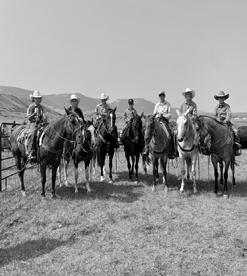
Neil is survived by his wife, his three children Rick (Karlene) Harrison, Vicki (Louis) Hetzel and Ned Harrison, 11 grandchildren and 16 great-grandchildren. Neil took care of his family and was outspoken and friendly to everyone.
Community members, friends and family celebrated Neil’s life at the Union Presbyterian Church in Powell on March 15.
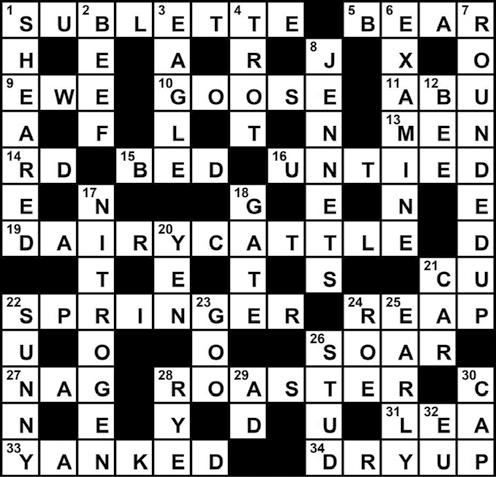
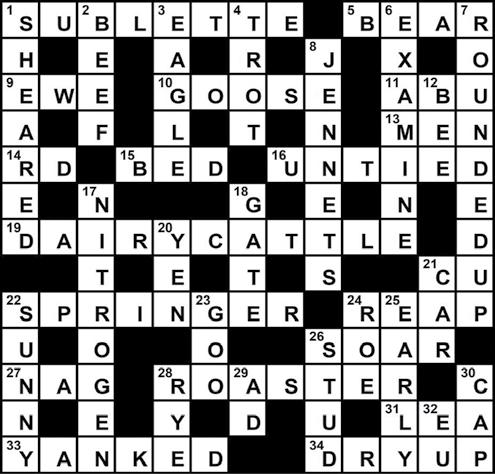
CROSSWORD
Wyoming Livestock Roundup Crosswords, created by Myles Mellor.
Solution for the March 11, 2023 crossword
Wyoming Livestock Roundup • Volume 34 No. 47 • March 18, 2023 A4 Torrington Livestock Markets PO Box 1097 • Torrington, WY 82240 307.532.3333 Fax: 307.532.2040 www.torringtonlivestock.com www.torringtonlivestock.com Lex Madden 307-532-1580 Chuck Petersen 307-575-4015 Lander Nicodemus 307-421-8141 TORRINGTON LIVESTOCK AREA REPS Cody Thompson - Lusk, WY 307-340-0150 Ty Thompson – Lusk, WY 307-340-0770
Johnson Lingle, WY –307-575-2171
Ward – Laramie, WY 307-399-9863
Staman – Crawford, NE 308-631-8513
Nicodemus – Cheyenne, WY 307-421-8141 Danny Nicodemus – Cheyenne, WY 307-632-4325 Chris Williams - Greybull, WY 307-272-4567 Justin Smith - Lusk, WY 307-340-0724 Scott Redden - Burns, CO 970-596-3588 Ben Kukowski - Kaycee, WY 307-217-1472
Zach
Jeff
Tam
Lander
“Follow Us” for Sale Updates, Results and News
MARCH
SALE RESULTS -FEEDER & CALVES WEDNESDAY, MARCH 15, 2023 - 4762 HD Jack Creek Land 71 Blk Strs 643 245.00C 1575.35H Lee Lohse 27 Blk Strs 626 236.00C 1477.36H Liscom Ranch 69 Blk Strs 652 229.00C 1493.08H Brad Foos 15 Blk Strs 679 227.00C 1541.33H Doug Derouchey 68 Blk Strs 702 225.00C 1579.50H Stark Ickes 34 Blk Strs 706 224.50C 1584.97H Brad Foos 75 Blk Strs 729 217.00C 1581.93H Jack Creek Land 13 Blk Strs 754 207.50C 1564.55H Tracy Preuit 35 Blk Strs 811 192.50C 1561.18H Don Simmons 65 Blk Strs 822 189.00C 1553.58H Doug Derouchey 37 Blk Strs 833 188.00C 1566.04H Don Simmons 138 Blk Strs 937 178.50C 1672.55H Tracy Preuit 25 Blk Strs 899 175.00C 1573.25H Gray Inc 103 Blk/Red Strs 717 200.00C 1434.00H Lee Lohse 66 Blk/Red Strs 827 184.50C 1525.82H Stark Ickes 26 Blk Hfrs 650 214.00C 1391.00H James Brow 16 Blk Hfrs 640 209.50C 1340.80H Doug Derouchey 46 Blk Hfrs 635 207.50C 1317.63H Lisco Angus 35 Blk Hfrs 686 198.50C 1361.71H Doug Derouchey 47 Blk Hfrs 699 188.50C 1317.62H Don Simmons 70 Blk Hfrs 783 182.50C 1428.98H Crockett Livestock 54 Blk Hfrs 752 175.00C 1316.00H Gary Lanphier 106 Blk Hfrs 771 175.00C 1349.25H Don Simmons 63 Blk Hfrs 863 174.50C 1505.94H Gary Lanphier 27 Blk Hfrs 868 170.00C 1475.60H Ruckas Livestock 41 Blk/Red Hfrs 736 177.00C 1302.72H MC Ranch 9 Blk Str Cf 437 281.00C 1227.97H Dewey Hageman 20 Blk Str Cf 481 266.00C 1279.46H Slash 3 Livestock 47 Blk Str Cf 536 259.00C 1388.24H Jack Creek Land 20 Blk Str Cf 539 252.00C 1358.28H Slash 3 Livestock 39 Blk Str Cf 619 250.00C 1547.50H McFarland Land 40 Blk Str Cf 595 247.00C 1469.65H Lee Lohse 55 Blk Str Cf 609 242.00C 1473.78H McFarland Land 12 Blk/Red Str Cf 495 264.50C 1309.28H Dewey Hageman 17 Char Str Cf 439 269.00C 1180.91H Dewey Hageman 38 Blk Hfr Cf 442 245.00C 1082.90H Swanson Livestock 46 Blk Hfr Cf 476 236.00C 1123.36H Ute Tribe 26 BLk Hfr Cf 542 235.00C 1273.70H Jack Creek Land 191 Blk Hfr Cf 575 225.50C 1296.63H Slash 3 Livestock 70 Blk Hfr Cf 542 220.00C 1192.40H Ute Tribe 23 Blk Hfr Cf 603 213.00C 1284.39H Brad Foos 69 Blk Hfr Cf 587 212.50C 1247.38H Tyson Murray 22 Blk Hfr Cf 647 206.50C 1336.06H
FRIDAY,
Wt:
lbs. Wt Stop:
3%. Comments: Fancy, home raised strs, summered at 8000 ft high desert. Sired by $12,000 to $17,000 Red Angus Bulls. Frt Adj $500. Rep: Ty Thompson 307-340-0770. Truett & Tess Jaure 57 Weaned Hfrs. 100% Red. Base Wt: 600 lbs. Wt Stop: 620 lbs. Slide: .14 cents. Located: Bridgeport, NE. Delivery: 3/23/23 to 3/27/23. Feed: Growing ration. Branding & Weaning Shots. Weigh
OBITUARIES We welcome obituaries. Obituaries are printed free of charge and can be sent to roundup@wylr.net. Subscribe to the Wyoming Livestock Roundup by calling 307-234-2700 ® The Weekly News Source for Wyoming’s Ranchers, Farmers and AgriBusiness Community
LETTERS
or e-mail to roundup@wylr.net. We reserve the right to edit letters.
It is the policy of the Wyoming Livestock Roundup that we do not print letters attacking individuals, groups or organizations within the Wyoming agricultural community.
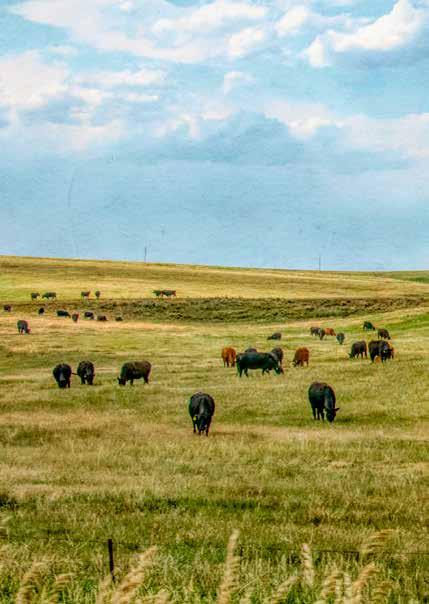
William “Bill” Sniffin is a columnist for Cowboy State Daily. This column titled, “Common Sense Republicans’ A Nickname For Practical Wyoming Folks Avoiding Progressive Trends,” was published by Cowboy State Daily on March 11.

Dear Editor, Almost two-thirds of Wyoming residents fit into a stereotype I call “commonsense Republicans.” These are folks who seem to be getting hammered for just wanting things to be more normal.
“Common-sense Republicans” is a nickname for folks who are anti-abortion, antigender-bending, anti-boys competing against girls, antipornographic books in our schools, anti-global warming hysteria, as well as those who are upset about the new emphasis on how bad America is, rather than how good it is.
Issues like the Jan. 6, 2021 Capitol riot and Liz Cheney’s ill-fated campaign last August also come under this description. Let’s discuss them.
Progressive WyoFile Columnist Kerry Drake wrote about transgenderism issues in his column recently.
He quoted a University of California-Los Angeles study which estimates there are 200 transgender students, aged 14 to 17, and 2,100 total transgender people in the state. This compares to 94,000 total school-aged students and a state population of 585,000.
These common-sense Republicans wonder why there are so many people even spending time talking about this. It seems like way too much attention for a tiny minority.
Common-sense Republicans recoil at the thought of experimental transgender drugs and procedures being used on young people. Common sense tells us this is crazy.
Most common-sense Republicans do not believe it is their mission to convince transgenders to change their lifestyle or beliefs. Commonsense Republicans just don’t want it flagrantly displayed, just like they don’t want to see overt displays of affection by heterosexual teens and adults.
Today, a person can

legally kill a baby as long as it is safely in the womb. If they wait until after it is born and then they kill it, they go to prison. This is crazy logic.
Women should have rights over their bodies, of course, but does not the child, with its active little brain and its beating heart, have any rights? A common-sense Republican sees this baby as a real human, not some kind of medical procedure which can be sloughed off and tossed into a medical dumpster.
Is it really time to ban books? I never thought I would ever write this. As a journalist, we defend printing and publishing everything, right? Wrong.
Common-sense Republicans wonder who in their right mind would want little kids to be exposed to explicit sex acts portrayed in pornographic books being promoted as health books in some of our libraries.
Common-sense Republicans delivered one of the biggest defeats of an incumbent in American history last August because our U.S. Rep. Liz Cheney did something that did not make sense during a non-scandal campaign.
Despite coming from a famous Wyoming political family and having served for three terms, she found out what happens when a person defies common sense. When she turned her entire Congressional effort seemingly to punish former President Donald Trump, she was, in turn, punished by common-sense Republicans back here in Wyoming where Trump’s policies had been well received.
Just about all of Wyoming’s voters did not support Cheney when she said she went after Trump on principle. They wondered why 230 of her Republican House colleagues did not share her view and neither did 45 Republican senators.
She defied common sense and was slaughtered at the Wyoming polls. Had not 25,000 Democrats and Independents crossed over, she might have gotten less than 24,000 votes by real Republicans in this election. Common-sense Republicans could not be swayed by the record $5 million she spent on her
AG DAY continued from page A2
were the largest crops raised.
Nationwide, Wyoming ranks fourth for sheep and lambs, fifth for production of barley and pinto beans and ninth for production of sugarbeets.

The largest federal irrigation project, the Shoshone Irrigation Project, is located in Park County, which ranks first in the state in sugarbeet and barley production, second in production of dry edible beans, fifth in corn production and ninth in all cattle.
American agriculture
reelection campaign.
Common-sense Republicans were appalled at the riot at the nation’s Capitol on Jan. 6, 2021. But, they also realized, out of thousands of peaceful protestors, just a tiny percentage of them crashed the Capitol building.
Common-sense folks wonder why a few undertrained and out-manned tour guides and Capitol Police were asked to hold back the crowd.
No common-sense Republicans are cheering for what happened that day. It was a very dark day in American history. I have friends who even equate it to 9-11.
Shortly after this event, newly elected President Joe Biden had 25,000 national guardsmen stationed to protect him during his inauguration.
Common-sense Republicans are baffled by how climate change international politics are being negotiated.
Woke government officials under President Biden want to close all of Wyoming’s coal-fired power plants while ignoring facts that countries like China and India are building new coal-fired plants as fast as they can.
India has 179 coal-fired plants, with no plans to retire any of them until 2030. China consumes six times as much coal as the U.S. and plans on increasing this total. It defies logic to assume there must be a different sky over those countries than what is over ours.
Common-sense folks are appalled when they see young couples choosing to
not have children because of their belief the world is going to end because of climate change. This world disaster scenario has been taught with religious zeal to our school
children for generations, and these fearful actions are the result. Common-sense folks scratch their heads because they look for evidence of an impending Armageddon, and it is hard to find.
These are just a few of the reasons why a majority of Wyoming people can be called common-sense Republicans.
William “Bill” Sniffin Lander
High Altitude, PAP-and Performance-Tested Bulls
High Country Bull & Ranch Horse Sale

Saturday,
Healthy livestock, soils, and wildlife depend on healthy native plants. But invasive weeds and pests pose a threat to these vital ecosystems. If left unchecked, they could devastate entire communities. By using certified weed-free hay for your livestock along with cleaning mud, seed and plant debris from your equipment you can help control and prevent the spread of invasive species.
is our nation’s most vital renewable industry. Every hour, the U.S. exports $6 million worth of agricultural products.
Give thought and praise for American farmers during National Ag Week. I pray and believe agriculture is the industry that will help our beloved country recover from any trial ahead.
Klodette Stroh is the sugar chairman for Women Involved in Farm Economics. She can be reached at strohfarms@tritel.net.
A5 Wyoming Livestock Roundup • Volume 34 No. 47 • March 18, 2023
Submit your letters to: Editor, Wyoming Livestock Roundup, P.O. Box 850, Casper, WY, 82602,
GET I NV O LVE D O R LEARN M O RE AT WYO WEE D.O R G
22, 2023
April
HERRING ANGUS
Ranch Sale Barn, Encampment, WY Herring Angus Ranch Kal & Vickie Herring Encampment, WY (307) 327-5396- Home (307) 329-8228- Cell Cody Miller, Horses (307) 329-7400
Angus and Black Composites Herring
EXTENSION EDUCATION
 By Shelby Rosasco, UW Extension Educator
University of Wyoming to host High Altitude Bull Test Field Day
Bull sale season is in full swing across the region. This is an exciting time for producers to think about what genetics they will be bringing into their herd this year.
It is also an opportunity to evaluate the genetic and marketing goals of an operation. These goals can help identify traits which are economically relevant to the operation and assist in the decision-making process.






For many producers across Wyoming and the Mountain West, brisket disease and successfully man-






aging cattle at high altitudes above 5,000 feet are significant considerations when making sire selection decisions.

Cattle grazing at higher altitudes, where oxygen levels are decreased, are at an increased risk of developing brisket disease, resulting in decreased performance and increased morbidity and mortality.









Brisket disease is complex, with breed, body condition, genetics, altitude and numerous other factors contributing to the variability in disease presentation.
High-risk cattle are more susceptible to developing right heart failure secondary to pulmonary hypertension, a condition commonly referred to as brisket disease, high altitude disease or high mountain disease.
Selecting cattle suited to their production environment and adapted to perform at higher altitudes is an important consideration for producers grazing and managing cattle at higher altitudes.

High Altitude Bull Test and Sale
Last fall, the University of Wyoming (UW) Department of Animal Science and Laramie Research and Extension Center (LREC) launched a high altitude bull test and sale.
The goal of the bull test and sale is to evaluate potential sires on their ability to serve producers at high altitudes, increase applied production agriculture experience available for students and engage pro-
ducers in research and education related to brisket disease and bull development.




Nine producers consigned a total of 41 bulls into the inaugural UW High Altitude Bull Test which launched in January 2023.
Bulls entered in the test are currently being managed at LREC, located at an altitude of more than 7,000 feet and were assessed for their risk of brisket disease and suitability to serve producers at higher altitudes.
The bulls have undergone carcass ultrasounding to evaluate ribeye area, fat thickness and intramuscular fat, as well as a complete breeding soundness exam.
In addition, bulls will undergo pulmonary arterial pressure (PAP) testing in late March to assess the risk of pulmonary hypertension.
Data collected on the bulls will provide producers with additional information to utilize when making sire selection decisions.
An important aspect of





























the bull test and sale was the development of educational opportunities for graduate and undergraduate students in the UW College of Agriculture, Life Sciences and Natural Resources.
The high altitude bull test course is comprised of a combination of weekly lectures covering material related to bull selection and development, as well as hands-on learning opportunities.
Students enrolled in the bull test course have assisted with the day-to-day management of bulls, carcass ultrasounding, fertility testing, picturing and development of marketing materials. These opportunities have allowed students to gain valuable experience in animal health, nutrition and reproduction.
Field day and private treaty sale
The UW High Altitude Bull Test culminates in an educational field day and private treaty sale on April 1 at the Hansen Teaching Arena at LREC. The field day is aimed at providing producers with new educational opportunities to learn about brisket disease and connect with faculty and students from the university.
The educational program will begin at 10 a.m. with a presentation from Landon Eldridge, UW Livestock Judging Team coach, on bull selection and evaluation. The program will continue with presentations on PAP testing and understanding bovine pulmonary hypertension from Chase Markel, UW animal science graduate student and Mark Enns, professor at Colorado State University.
Faculty, staff and students involved in the UW High Altitude Bull Test will also share an overview of

the results from this year’s test, as well as future directions for the program.





Lunch will be provided for attendees, during which time there will be a poster session highlighting current beef cattle research being conducted at UW.
Twenty of the bulls consigned to the High Altitude Bull Test will be available for private treaty during the field day. Bulls will be available to view throughout the day, with the private treaty sale starting after lunch at 1:30 p.m.
Angus, Red Angus, Simmental and SimAngus bulls will be available, with expected progeny differences (EPDs), PAP scores and carcass evaluation data available for all bulls.

Additional information about the UW High Altitude Bull Test and Sale can be found on the LREC website or the UW Beef Extension social media pages.
A sale catalog with information about the bulls available, the consignors, the private treaty sale and the field day will be available on the LREC website in coming weeks.
Faculty, staff and students involved in the bull test appreciate the support of the program and hope producers will come learn about the program, purchase bulls and enjoy the field day.
For additional information on the High Altitude Bull Test and Sale, contact Shelby Rosasco at 307-7662329 or Scott Lake at 307766-3665.
Shelby Rosasco is the University of Wyoming (UW) Extension beef specialist and an assistant professor in the UW Department of Animal Science. She can be reached at srosasco@uwyo.edu or 307766-2329.

Wyoming Livestock Roundup • Volume 34 No. 47 • March 18, 2023 A6 Brad Arntzen: 406.350.4000 Kevin Arntzen: 406.350.1612 Derik Arntzen: 406.350.1728 577 Arntzen Lane Hilger, MT 59451 arntzen@mtintouch.net www.arntzenangus.com POWER OF PREDICTABILITY What does 67 years of breeding with the same goal in mind get you? A consistent, predictable product that has stood the test of time. GDAR LOAD UP 7104 TEHAMA TAHOE B767 KG JUSTIFIED 3023 WOODHILL COMPLETE A130-C2 A A R KNUDSON 8241 A A R RAINIER ELLINGSON CONSISTENT 6235 A A R STUNNER 0549 A A R KNOCKOUT 8732 PINE COULEE HANNIBAL H316 MUSGRAVE 1676 STUNNER 809 SIRES INCLUDED 47th Annual Production Sale at the ranch APRIL 6TH, 2023 • 1:00 P.M. , 200 Bulls & 20 Top End Yearling Heifers Selling All bulls have genomically enhanced EPDs. A A R Complete K141 Reg.20468489 Complete x Ten Fold $M 108 BW WW Milk YW +1.9 +86 +32 +128 A A R Tahoe 2907 Reg.20502460 Tahoe x Load Up Loaded with cow power. BW WW Milk YW +1.0 +86 +39 +161 A A R Justified K173 Reg.20461688 Justified 8244 x Capitalist 316 Weaning Ratio 116 BW WW Milk YW +1.5 +89 +25 +150 TEF Tahoe 234 Reg.20384505 Tahoe x Outside 514 Maternal and growth. Top 1% WW and $M. BW WW Milk YW +1.3 +93 +18 +152 A A R Rainier K066 Reg.20466859 A A R Rainier x Justified Dam Average 3 NR 110 BW WW Milk YW +0.3 +74 +34 +136 A A R Knockout 2019 Reg.20457667 Knockout x Motive Top females stacked deep. BW WW Milk YW -0.1 +82 +25 +140 A A R Load Up 2006 Reg.20524517 Load Up x Frontman 7609 Long made and sound structured. BW WW Milk YW +0 +59 +36 +107 A A R Justified 2517 Reg.20457712 Justified x Load Up Calving ease with extra depth and muscle. BW WW Milk YW -1.2 +77 +25 +131 View bulls and bid online A A R Justified K012 Reg.20461662 Justified x Landmark Calving ease & growth. Top 1% $M. BW WW Milk YW +0.8 +84 +26 +143 1 LOT 4 LOT 37 LOT 92 LOT 6 LOT 8 LOT 5 LOT 45 LOT 2 LOT
employer writes down is really the expectations they have for future employees,” says Sinclair. “It’s clearly communicating what they want or need out of the job.”

He notes it’s important to include other duties, as assigned, in the job description because the job description is not an all-inclusive list, it’s just a snapshot.
“Depending on the size of a business or operation, when writing a job description for a job an employer hasn’t necessarily done themselves, it doesn’t hurt to run the job description by somebody else who’s been doing the job to ensure they haven’t missed anything important,” shares DeMersseman.
Sinclair recalls one of his former bosses telling him, “Every job is someone’s dream job.”
“When advertising a job, think about what makes it somebody’s dream job,” he says. “Keep an open mind, and even though it might not be a person’s favorite thing to do, it might be someone else’s.”
Interview process
From a consistency standpoint, Sinclair shares it’s important to ask every candidate the same question. Additionally, when it comes to certain job tasks, employers can also give potential candidates simple job tasks to ensure they have the skill set to complete the job.
“As an employer, I’d also suggest getting the potential hire around their team,” he says. “People skills are important. I like to get them around my team, because my team also has a good gut feeling. If they have a gut feeling, and it doesn’t feel right, it may mean the employer needs to go back and ask more questions – our gut feelings are pretty good.”
DeMersseman adds it’s important to ask scenario-based questions, as it allows the candidate to think and apply their own experience, education and/ or skills.
“Employers will want
times the information on a background check can be incorrect.
to know how they think through problem solving or a mid-level crisis situation,” she says. “Sometimes, they might hear an answer they may never would have thought of, so by asking these scenariobased questions, it really allows employers to pick up on those type of potential hires out of an interview process.”
In addition, she mentions the importance of calling and getting feedback from a former supervisor or professional or personal reference.
Sinclair says by conducting 10- to 15-minute phone calls with potential hires can really help give someone an idea if it’s an individual they want to spend the time to interview.
They both share the importance of being consistent, using the same questions for each interview and following a structured interview or conversation process for the candidate and reference, respectively.
At the end of an interview, DeMerrseman encourages employers to ask if the interviewee has anything else to add.

“This is a great question to get some important feedback an interviewer wouldn’t have known to ask about,” she says.
Background checks
The Fair Credit Reporting Act has several guidelines employers should follow in terms of conducting background checks.
The three main steps of a background check include authorization by the applicant, pre-adverse action notice and adverse action notice.
A pre-adverse action letter or notice is a written document informing a candidate an organization discovered questionable information as a result of their background check, whereas the adverse action notice informs the candidate the employer has gone with another candidate.
According to DeMerrseman, pre-adverse action notices are important because she has found, in her experience some-
Closing points
“In the interview process, the candidate is interviewing the employer as much as the employer is interviewing the candidate,” mentions DeMerrseman. “An interview is just as much a chance to share what makes a company unique and a great place to work.”
She adds it’s important to communicate with new employees and potential candidates about things one might forget to share, such as pay periods.
“The more surprises that occur when somebody starts in a new position, the worse off the overall experience will be,” she explains.
Sinclair notes the importance of understanding what is keeping people at an organization and what is causing them to leave. An exit interview can be really helpful in trying to
understand an employee’s perspective, although in some cases, some employees won’t be open to share.
In attempt to resolve issues as they arise, employers can do regular check-ins with employees to see how things are going and to try to fix concerns before an employee looks to leave.
The pair notes it is really expensive to replace an employee.
As an employer, employees want to be able to have trust, compassion, stability and hope in their workplace, mentions DeMerrseman.
“If employees get these four things from their employer, it can increase the chance of them staying longer,” she mentions. “It doesn’t cost money, but it can provide really big dividends for employers.”
She adds it’s important to develop connection and communication with positive feedback on a regular basis. It will make it easier
on both the employee and employer when negative or constructive feedback needs to be given.
“Employees need to know their work matters,” she says.
The next RMALP seminar on revenue diversification is scheduled for March
30 at Northwest College in Powell, and the Leadership Symposium and Luncheon is scheduled for April 20 at UW’s campus in Laramie.
Brittany Gunn is the editor of the Wyoming Livestock Roundup. Send comments on this article to roundup@wylr.net.


FOR SALE
Bryan:
A7 Wyoming Livestock Roundup • Volume 34 No. 47 • March 18, 2023 Videos
Herefords, RLLP or YouTube: Sidwell Herefords
on Facebook: Sidwell
PRIVATELY
970-381-0264 Linda: 970-381-6811 54286 CR 27, Carr, CO 80612 Catalogs available upon request Yearling Hereford Bulls • BALDY MAKERS • VIGOR • DOCILITY • ADDED VALUE • ADDED FEED EFFICIENCY UW continued from page A1 To view to the full seminar, visit youtube. com/watch?v=1IPfAJaJGe4 or for more information on upcoming seminars, visit uwyo.edu/uwag/rmal/. ® Call 307.234.2700 to receive a 6-week complimentary subscription!* *For new subscribers only The Weekly News Source for Wyoming’s Ranchers, Farmers and AgriBusiness Community
HAY continued from page A1
there isn’t much hay to bargain with, but as producers look to the spring and summer crop, prices are anticipated to come back down.
“Going into spring, it looks like the moisture in our area is good, and so, we should have a pretty good crop this year,” he shares. “Prices should level back down $20 to
$30 per ton for the first cutting.”
For second cutting, he mentions it will depend on other areas of the nation.
“Roughage is very short across the county, so until it has recouped, prices will stay pretty high,” he explains.
He notes it would have helped if producers had the chance to put up corn-
stalks as an alternative roughage, but due to an early snow and wet conditions, not many had the chance to.
Crop progress and condition report
The USDA National Agriculture Statistics Service Wyoming Field Office’s Feb. 23 Crop Progress and Condition Report notes Wyoming saw continued relief from drought conditions in February, with the majority of the
state receiving above normal amounts of moisture.
Isolated areas of southcentral and north-central Wyoming received precipitation levels as much as two inches above average.
Some areas in the western, southern and eastern parts of the state, however, received below average levels of moisture. Temperatures ran below normal for all of Wyoming in February. Western and central portions of the
state were hit the hardest with frigid weather.
Hay and roughage supplies for Wyoming were rated 23 percent very short, 16 percent short and 61 percent adequate, compared with seven percent very short, 23 percent short, 69 percent adequate and one percent adequate last month.
This time last year, hay and roughage supplies for Wyoming were rated 29 percent very short, 28 per-
cent short and 43 percent adequate, compared with 13 percent very short, 42 percent short, 44 percent adequate and one percent surplus the month prior.

The next monthly report will be released on March 27. The first weekly report will be released on April 3.
Brittany Gunn is the editor of the Wyoming Livestock Roundup. Send comments on this article to roundup@wylr.net.
EPA announces protections
On March 15, the U.S. Environmental Protection Agency (EPA) announced an effort to expedite protections on some high-risk uses of four organophosphate pesticides – diazinon, ethoprop, tribufos and phosmet.
EPA is releasing the updated occupational and non-occupational spray drift exposure risk assessments for these four pesticides several years ahead of the scheduled completion of their work on these chemicals in order to seek early mitigation prior to completing the standard registration review process.
Organophosphates are pesticides used in both agricultural – such as fruit and nut trees, vegetables, herbs and cotton – and non-agricultural settings for a range of purposes.
Diazinon and phosmet control insects, ethoprop controls worms and other soil pests and tribufos defoliates cotton prior to harvest.
These pesticides are currently undergoing registration review, a process which requires EPA to reevaluate pesticides every 15 years to ensure – as the ability to assess risk evolves and as policies and practices change – pesticides continue to meet the statutory standard of causing no unreasonable adverse effects on human health or the environment.
As part of the registration review process, EPA assessed the potential risks to people who mix, load and apply the four pesticides, farmworkers who work with crops treated with these pesticides and bystanders who are potentially exposed to spray drift, including families living in agricultural communities.
The updated exposure risk assessments are now available in the registration review dockets, EPA-HQ-OPP-2008-0351 (diazinon), EPA-HQ-OPP-2008-0560 (ethoprop), EPA-HQOPP-2008-0883 (tribufos) and EPA-HQ-OPP-2009-0316 (phosmet). They can be found at regulations.gov
Given the expedited nature of this effort, the EPA is not taking comments on these assessments.
Stakeholders will have an opportunity to comment on the four occupational and non-occupational spray drift risk assessments when the cases progress through the next step of registration review with the proposed interim decision, which will include the full updated human health risk assessment for each.
For more information, e-mail press@epa.gov.
Austin Snook • 307-290-2161
Taylor Snook • 307-290-2273
Craig Deveraux • 307-746-5690
Dan Catlin • 406-671-7715

Clint Snook • 307-290-4000
Cheyenne Seymour • 605-641-0638
Casey Sellers • 307-217-2614
Jim Forbes • 307-351-5932
Tye Curuchet • 307-351-8666
Daniel Escoz • 307-217-1440
Kade Kinghorn • 307-620-0525
Market Report • March 15, 2023

Bred cattle market steady, with the few feeders we had selling on an active market. Weigh up cows and bulls steady. Grass cattle, replacement heifer, and horses next week! Thank you and we appreciate your business!
www.buffalolivestockwyo.com
Wyoming Livestock Roundup • Volume 34 No. 47 • March 18, 2023 A8
• UPCOMING SALES • March 22 - Feeder Cattle Special and Horse Sale • March 25 - Sinclair Cattle Company Sale • March 29 - No Sale
BRED CATTLE RED FORK RANCH LLC, KAYCEE WY 15 RED-BHFR APRIL-MAY 940 1925.00 HD 15 RED-BHFR APRIL-MAY 921 1800.00 HD 9 BLK-BHFR APRIL-MAY 1015 1800.00 HD RANDALL A & TRISHA M CROWLEY, GILLETTE WY 13 RED-BHFR APRIL-MAY 993 1875.00 HD PERRY CATTLE LLC, CLEARMONT WY 25 BLK-BCOW 5,6 APRI-MAY 1398 1710.00 HD ERIC & ANNIE BUTLER, PARKMAN WY 7 BWF-BCOW,SM, 5,6, APRIL 1474 1900.00 HD 1 BWF-BCOW,BM APRIL 1580 1725.00 HD BROOK AND SYDNEY BUTLER, PARKMAN WY 1 BWF-BCOW 5,6 1500 1900.00 HD 1 BLK-BCOW,SM 1330 1900.00 HD KATHY LARSEN, SHERIDAN WY 5 BLK-BHFR APRIL-MAY 901 1610.00 HD RED PATH CATTLE LLC, BANNER WY 13 RED-BCOW 3&4 JUNE 944 1700.00 HD 7 RED-BCOW 5,6 JUNE 1169 1650.00 HD 3 RED-BCOW,SM JUNE 1258 1400.00 HD JARED M SCHAEFER, SHERIDAN WY 1 RED-BCOW,SM MAY 1365 1400.00 HD 1 RED-BCOW 5,6 MAY 1375 1400.00 HD PAIRS ACE HANCOCK, SHERIDAN WY 3 BLK-PAIR 1765 1850.00 HD FEEDER CATTLE DONALD JEFFERY &/OR JODY FENSTER, GILLETTE WY 19 BLK-HFR 736 185.00 WT 1,361.21 1 RWF-HFR 725 174.00 WT 1,261.50 ERIC & ANNIE BUTLER, PARKMAN WY 5 BK/RD-STR 691 205.00 WT 1,416.55 4 BWF-HFR 696 191.00 WT 1,329.83 CRAIG M OR JOLENE M DEVERAUX, NEWCASTLE WY 12 BK/RD-STR 536 220.00 WT 1,178.83 COWS/HEIFERETTES RED PATH CATTLE LLC, BANNER WY 4 RED-COW 1151 98.00 WT 1,128.22 3 RED-HFRTTE 847 127.00 WT 1,075.26 1 RED-COW 1270 85.00 WT 1,079.50 2 RED-COW 1330 83.00 WT 1,103.90 1 RED-COW 955 109.00 WT 1,040.95 PERRY CATTLE LLC, CLEARMONT WY 1 BLK-COW 1160 86.00 WT 997.60 LOMAX LAND AND LIVESTOCK, DAYTON WY 4 BLK-HFRTTE 993 117.00 WT 1,161.22 2 BLK-HFR 913 144.00 WT 1,314.00 STEVEN OR GINA KELTY, DAYTON WY 2 BLK-COW 1283 92.50 WT 1,186.31 MICHAEL OR TRINITY RODRIGUEZ, BUFFALO WY 1 BLK-COW 1310 85.50 WT 1,120.05 1 BLK-COW 1280 90.00 WT 1,152.00 LAUREN CLARK, HULETT WY 3 BLK-HFRTTE 963 145.00 WT 1,396.83 RAFTER STAR RANCH LLC, BANNER WY 1 BLK-COW 1510 90.50 WT 1,366.55 1 BLK-COW 1250 88.00 WT 1,100.00 1 RED-COW 1200 83.00 WT 996.00 1 BLK-COW 865 114.00 WT 986.10 SW LAND & CATTLE LLC, BUFFALO WY 1 BLK-COW 1295 92.00 WT 1,191.40 6F LIVESTOCK LLC, KAYCEE WY 4 RED-HFRTTE 860 117.00 WT 1,006.20 1 RED-HFRTTE 1015 105.00 WT 1,065.75 DENNIS & KENDAL HEPP, BUFFALO WY 1 BLK-HFRTTE 870 122.00 WT 1,061.40 1 BWF-HFRTTE 940 122.00 WT 1,146.80 THOMAS W. OR THOMAS J MICHELE, SHERIDAN WY 1 BLK-COW 1235 90.00 WT 1,111.50 OPEN BOX CATTLE CO, GILLETTE WY 1 BWF-COW 1240 93.50 WT 1,159.40 TRUE RANCHES LLC, NEWCASTLE WY 1 BWF-HFRTTE 845 123.00 WT 1,039.35 1 BWF-COW 1290 84.50 WT 1,090.05 JAYSON &/OR JENNA FOSS, BUFFALO WY 1 BLK-COW 1600 86.50 WT 1,384.00 JEREMY W. YEAGER, BUFFALO WY 1 BLK-COW 1400 86.00 WT 1,204.00 3 BLK-COW 1340 88.50 WT 1,185.90 VICTOR AND DARCY GONI, BUFFALO WY 1 BLK-HFRTTE 1090 110.00 WT 1,199.00 LUCAS JAMES CAMINO, CLEARMONT WY 1 BWF-COW 1435 84.50 WT 1,212.57 BULLS JEFF SHELLEY, BUFFALO WY 1 HERE-BULL 2135 112.50 WT 2,401.87 1 HERE-BULL 1945 104.50 WT 2,032.52 BAKER LIVESTOCK LLC, BIG HORN WY 1 BLK-BULL 2040 108.50 WT 2,213.40 NORTH FORK RANCH INC, BUFFALO WY 1 BLK-BULL 2090 116.50 WT 2,434.85 CRAIG A AND SARAH H EDWARDS, GILLETTE WY 1 BLK-BULL 1875 118.00 WT 2,212.50 RANDALL A & TRISHA M CROWLEY, GILLETTE WY 1 RED-BULL 1910 109.00 WT 2,081.90 MERLE CLARK, HULETT WY 1 BWF-BULL 1805 104.00 WT 1,877.20 CODY OR TYNIE SHAW, BUFFALO WY 1 BLK-BULL 1845 97.00 WT 1,789.65 1 BLK-BULL 1785 103.00 WT 1,838.55 DENNIS & KENDAL HEPP, BUFFALO WY 1 BLK-BULL 1850 99.00 WT 1,831.50 1 BLK-BULL 2055 107.00 WT 2,198.85 1 BLK-BULL 2095 101.00 WT 2,115.95 1 BLK-BULL 2125 117.50 WT 2,496.87 1 BLK-BULL 1720 109.50 WT 1,883.40 SIOUX RANCH INC, WRIGHT WY 1 HERE-BULL 1955 105.00 WT 2,052.75 1 BLK-BULL 1915 107.50 WT 2,058.62 4 RED-BULL 1593 98.00 WT 1,560.65 KALE K & KIM KRETSCHMAN, GILLETTE WY 1 BLK-BULL 1520 121.00 WT 1,839.20 E-mail us at: buffalolivestockmarketing@outlook.com Wyoming Beef Council PO Box 1243 . Cheyenne 307.777.7396 gary.gwin1@wyo.gov For more information about BQA please contact us: Uphold Consumer Confidence Enhance Profitability Improve Public Image Increase Marketability ONLY 1 3% OF AMERICA IS DIRECTLY INVOLVED IN AG AND SMALL FAMILY FARMS ACCOUNT FOR 90% OF THEM THANK YOU RANCHERS & FARMERS Agriculture is the Backbone of America THANK YOU TO OUR RANCH & FARM FAMILIES FROM SUNDANCE STATE BANK! National Ag Week March 21-27, 2023
"From the ring, to the video, and in the country, we market your livestock the competitive way."
Lot 275
Sired by Ashland
Need to improve Marbling scores he is in the Top 10% at +1.09; Top 45% RE at +.66 RE; he goes CAB for carcass; Both maternal sires 789 & 640 were Midland Bull Test feed efficiency graduates, Ended up #7 on test of 100+ bulls; WDA 3.01#’s; ADG 4.07#’s, feed 6.04 #’s to 1# of gain; BW 85#’s; CED +8 & BW +2; works on younger cows: Top 30% WW at +68; Top 25% YW at +124; PAP Epd -2.44; he ends up with just enough for value index’s Top 30% $B & Top 40% $C; He can take it! Carcass merit & Feed Efficiency, his daughters will make it to your replacement pen

Lot 252
Sired by Sterling Confidence Plus 804

Efficient genetics both sides pedigree, Effective 789 & Vermillion Countdown are proven; He ranked in Top 10% on test for all measurements but ended up #2 for all the combined measurements, overall Weight Gain; Average Daily Gain (ADG); Dry Matter Intake; Feed to Gain to get RFI. WDA 3.18#’s he just kept growing with ADG 4.06#’s; he ate 5.26 3#’s of feed per 1# of gain; BW 71#’s; CED +6 & BW of +1.0, kicks in pounds at +83WW in Top 5%; +158YW Top 2%; Carcass +.83 Marb Top 30% and +.90 RE Top 15%, He covers all the bases Top50% $M, Top 10% $W; Top2% $F; Top 25% $G; Top 5% $B; Top 5% $C
Lot 2125
Sired
supported by Angus GS DNA

+52 WW & +93 YW; HP +16.7 puts him in the Top 5%; Top 35% $ M keeps his maternal values strong; 2 and 3 year old females in our 707 herd have excellent feet are super tuff and stay in the herd, raising big soggy calves. We always give up a little to get heifer bulls, he will have enough, his calves will go on and grow, WDA 2.77#’s & ADG 3.46#’s; he ate 7.43 pounds of feed a day, we fed a ration with anticipated gains of 3.25#’s a day so he did a respectable job
Lot 2185
Sired by Deer Valley Wall Street

Cow Bull, he brings it! Super eye appeal; WDA 2.87#’ he kicked in the power to gain 4.21#’s a day. He doesn’t offer any extremes, just good honest numbers that will produce females and good solid feeder calves. +3 CED & +1.1 BW; 2 Star’s for Calving ease; will work on young cows; actual BW of 85#’s; +60 WW & +113 YW; Carcass Marbling +.50 and +.68 RE. Maternal stays in the Top 20% for $ Maternal and Top 3% for HP at +17.4.
Lot 234
Sired by Resilient
He works for younger cows CED of +4; He’ll contribute a bunch of power to a set of calves Top 3% at +87 WW & Top 15% at +YW; PAP Epd is -1.39; Sure has enough carcass Top 50% Marbling at +.62 & Top 30% RE at +.76; Loaded with maternal Top 1% for Heifer Pregnancy (HP) at +18.9; Value Index’s, Top 1% at +94 $M; Top 10% $W at +76; Top 35% for $G; Top 30% for $C at +261. He’s been a big boy all his life WDA is 3.56 #’s & ADG 4.17#’s; Feed to Gain 6.37 to 1# gain.
Lot 2136
Lot 221
Sired by Tahoe
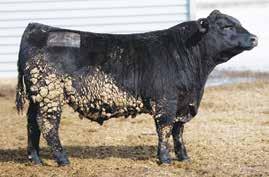
Heifer Bull Top 30% at +9 CED, Top 15% at -6 BW; His calves have enough performance to make the load +67 for WW; at +107 YW his steers will sure make big stout yearlings; plenty of carcass at +.50 Marbling and +.74 is Top 35% RE; He is loaded for maternal excellence; Top 2% for $M & Top 5% for $W, his heifer calves will deserve a look for replacement females; Gained 3.42#’s ADG, 2.83 WDA # , 7.14#’s feed to 1# Gain
Lot 198
Sired by TEX Playbook
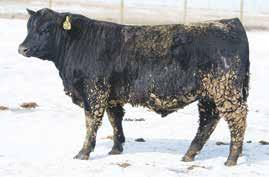
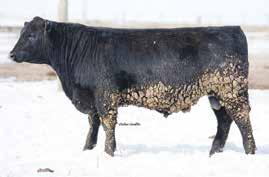
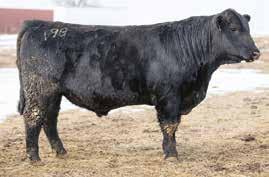
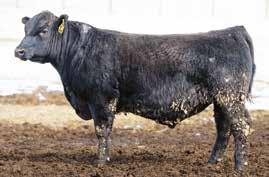
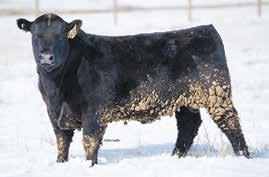
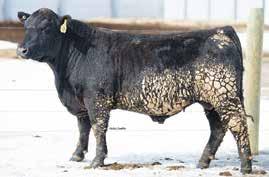
2 year old bull; need to cover country the 2 year olds are going to get it done for you. 3 Calving Ease Stars, 198 has a 65# BW; Range calving this bull will work for you, WDA 2.883’s; +8 CED is Top 35%; +.4 BW Top 30%; Top 30% +.68WW, at breed average +110 YW; he has maternal merit Top 30% at +13.7 HP & Top 15% at +77 $Maternal & Top 15% $Wean, Ranks Top %5 for docility
Lot 1118
Sired by Sitz Barricade 632F
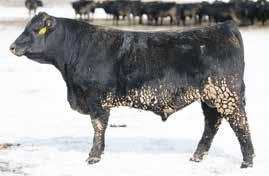
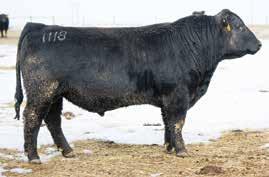
2 year old bull with 2 Calving Ease Stars, His sire packs a bit of birth weight, according to his numbers he could be a 3 star bull, look him over, check out his shape you decide. Range bull deluxe +8 CED in Top 35%; +1.3 BW; +66 WW Top 35%; above average at Top 40% +115 YW; PAP EPD -72, perfect milk for hard dry country at +24; Maternal merit he is in Top 40 HP at +12.5 and Top 20% $M with plenty of Weaning power with +62 Top 35% $W
A9 Wyoming Livestock Roundup • Volume 34 No. 47 • March 18, 2023 At the Ranch - Lusk, WY - 1 pm - Lunch at noon 8 miles east on Hwy 20 to Node, then 0.6 miles south on Pfister Rd This sale will be broadcast live on the internet Real time bidding and proxy bidding available April 4, 2023 www.WEBOANGUS.com Buttons York & Family P.O. Box 848 • Lusk, Wyoming 82225 Button’s Cell (307) 216-0090 • Odessa’s Cell (307)340-1182 Elly’s Cell (307) 340-1499 WEBO Angus Annual 22 head of PAP tested 2 year old bulls sired by our herd sires and 70 head of big strapping AI sired yearling bulls Selling: Turning Grass into Greenbacks Sired by KG Justified 3023 This bull has got it all! He Ranked #1 on Feed & Efficiency testing. Ranked #1 with ADG of 4.46 #’s ; Ranked #3 Feed to Gain 4.98#’s feed to gain 1#; ranked #2 in RFI with a raw score of -7.46; CED +6 and BW +.6 ; actual BW 90#’s ; WDA 3.80 #’s ; Weaned 757#’s for 124 WR; Top15% WW at +77; Top 15% YW at +135; - Carcass
dam is
real world brood
in
produces Top 10% $M; Top 4% $W
+.61 IMF is 50% ; Top 15% RE; packs maternal punch his
a
cow, stays
great shape and
by Sired by BAR Cash
3 Star Calving Ease Heifer Bull he’ll
Top 20%
707
sure work on most heifers. He is
for both +10 CED and -.2 BW is
testing;
total of 101 head were sold, with total gross sales equaling $17,650 and averaging $235.33.
Twenty-five of the total head sold were open ewe lambs, which averaged $230 and brought a total of $5,750 in gross sales, while 11 bred yearling ewes brought a total of $4,400, averaging $400.
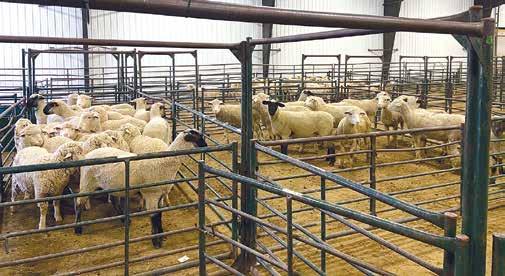
Fourty-four Merino/ Rambouillet and Targhee ewes were sold, averaging $184.09, with gross sales totaling $8,100. Thirtyone purebred Rambouillet ewes averaged $308.07 and brought a total $9,500 in gross sales. Thirty-nine head of broken-mouth ewes averaged $192.31 and brought a total
For more information on the Wyoming Select Bred Ewe Sale, visit wyowool.com.

of $7,500 in gross sales.
None of the nine bred running-age ewes or six Hampshire ewes were sold through the sale.
Second annual sale
Following the success of their first sale, Crane notes WWGA is already looking forward to the second annual Wyoming Select Bred Ewe Sale, scheduled for February 2024.
“While the Select Bred Ewe Sale is about the business of transferring genetics within the sheep industry, it is also a time when sheep producers get together to visit and discuss the indus-
COLORADO STATE UNIVERSITY

ONE-BAR-ELEVEN JOHN E. ROUSE
37th Annual Yearling Commercial Angus Bull Sale

We have officially rescheduled the sale for April 17, 2023
Lunch Served at 11:30 • Sale begins at 12:30 p.m.
try, while renewing old friendships and making new ones,” states WWGA on their website.

“The two days spent in Gillette are intended to be fulfilling, informative and

fun, and we hope to meet those goals each year,” WWGA continues. “Only the healthiest, highest-quality ewes from some of the nation’s premier breeders will be accepted to the sale,
assuring buyers our ewes are truly the best in the West.”
Send comments on this article to roundup@wylr.net.
Phoneand SealedBids
Accepted
Herd Records from over 60 years - In-herd EPDs, Daily Gain and Much More! Raised at 7200’ elevation, PAP tested by Tim Holt DVM, these calving ease bulls perform well at any altitude!
BEEF IMPROVEMENT CENTER Sale is
At One Bar Eleven Ranch • Saratoga, WY
SALE REPORTS
Reported By: Kevin Murnin, WYLR Field Editor
Details in the catalog. Please contact us if you need a catalog or more information.
Lindsey Wamsley 307-710-2938 or Mark Enns 970-491-2722 Colorado State University, Department of Animal Science

Sire: Musgrave Crackerjack Dam’s Sire: S A V Remington 5609 EPDs: BW: -1.5, WW: +63, YW: +111 and Milk: +31
Buyer: Belus Brothers, Buffalo Lot 2 – MTR Crackerjack 1102 – Price: $8,000 DOB: 2/20/22 Sire: Musgrave Crackerjack Dam’s Sire: Gmar Game Day A002 EPDs: BW: +1.0, WW: +63, YW: +113 and Milk: +30 Buyer: Belus Brothers, Buffalo
High Altitude Bull Test & Sale
Saturday, April 1st, 2023
10:00AM to Noon - Educational Program Bull Selection and Evaluation
Understanding Bovine Pulmonary Hypertension High Altitude Bull Test Data Overview & Future Directions Noon to 1:30PM - Lunch
Poster Session - Highlighting Current Beef Research at the University of Wyoming
1:30PM-3:00PM - Bulls Available for Viewing
20 Bulls Available for Private Treaty Sale
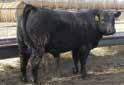
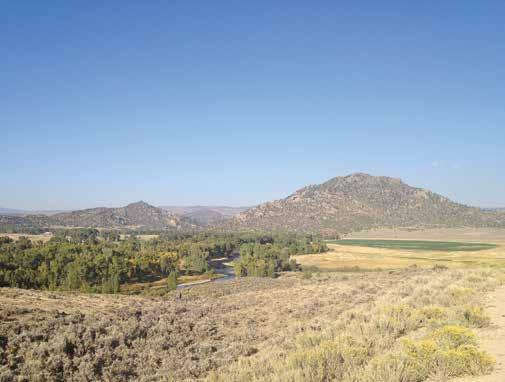
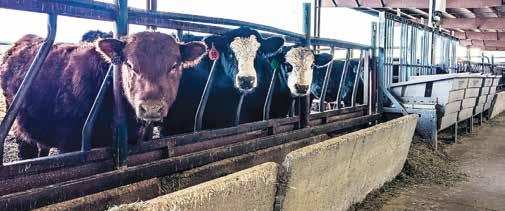
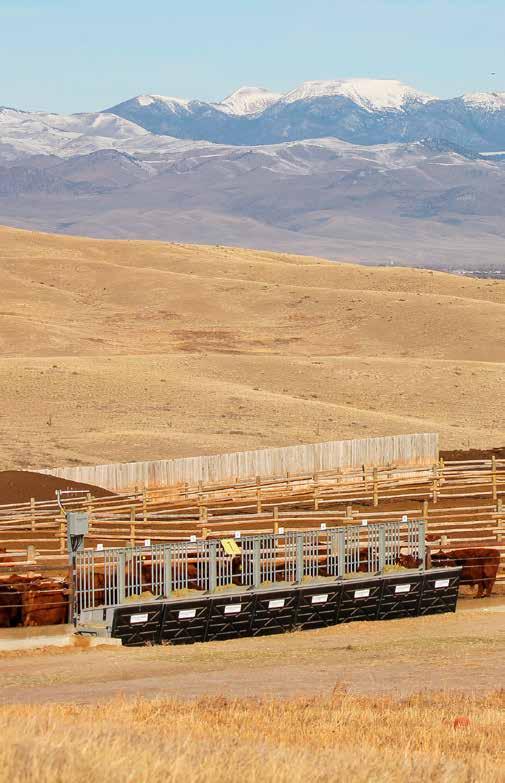
Angus - SimAngus - Red Angus
All bulls PAP & Semen tested, with EPDs and carcass evaluation data available Contact Scott Lake, 307.460.8129 | Shelby Rosasco, 209.753.8227
Wyoming Livestock Roundup • Volume 34 No. 47 • March 18, 2023 A10 SALE continued from page A1 The Larry Mehlhoff Family Sheridan, Montana 5lranch@3rivers.net 855-5L-Bulls • (406) 596-1204 5LBulls.com Scan the QR code for Data, Catalog & Videos: 5L 2023 Profit $eeker Bull Sale Friday, April 14, 2023 • at the ranch, Sheridan, MT • 300 Red & Black Angus, SimAnguys and Char x Red Angus Bulls • 100 Open Commercial Red Angus Replacements (Pelvic Measured, Tract Scored and Ready to Breed) All Sale Bulls Feed Efficiency Tested | WideBody Scored | PAP Tested Volume Discounts | 1st Season Bull Warranty | Free Bull Delivery (with min. purchase) What’ll You’ll Get at 5L: • Large Sire Groups of Balanced Trait, High Profit 5L Herd Sires • Superior Calving Ease Bulls that also predict Heavier Payweights and Conservative Mature Cow Size • More Bulls capable of earning PRIME Premiums - backed by the breed’s largest carcass testing program • Elite Fertility EPDs, which predicts more calves produced over these bulls’ daughters’ lifetimes • Elite $Ranch to improve stocking rates and produce more pounds of Calf per Acre
Hannah Bugas is the managing editor of the Wyoming Livestock Roundup.
Laramie Research and Extension Center Cliff and Martha Hansen Teaching Arena Laramie, WY 82070
held LIVE AT RANCH!THE
to be
Successful first sale – The Wyoming Wool Growers Association’s inaugural Wyoming Select Bred Ewe Sale, held in February, saw success with 101 head bringing in a total of $17,650 and averaging $235.33. Alison Crane photo
Sellers Lot 3 – MTR Crackerjack
$9,500 DOB:
Top
1622 – Price:
2/7/22
Buffalo Livestock Marketing,
Auctioneer:
Westland
Yearling
Bulls Avg. $4,686 MTR Cattle Company Annual Bull Sale
March 11, 2023
Buffalo
Curt
35
Angus
or blood vessels are torn. However, these complications are rare if dystocia is handled properly.
“Dystocia also negatively impacts breed back,” they say. “But, handling dystocia appropriately minimizes this impact.”
Recognizing signs of dystocia
According to Navarre, Welborn and Armstrong, the first step to properly deal with dystocia is to understand the stages of labor and what to expect during each one.
They explain the first stage of labor occurs when the uterus begins to contract and the cervix starts dilating. This stage can last from two to six hours.
Common signs include restlessness, pacing, repeatedly getting up and laying down, tail wringing and slight vaginal discharge. However, some cattle may show no signs at all.
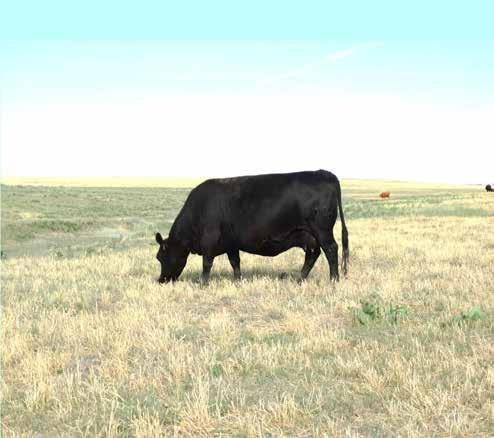
The second stage of labor includes forceful contractions, which should result in the birth of a calf. This stage is much shorter, lasting only one to two hours.
In order to prevent potential negative impacts caused by dystocia, the three veterinari-
ans encourage producers to frequently check their cows and heifers during calving season.
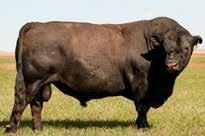
“If signs of stage one are noted, but no calf is delivered within six hours, call a veterinarian,” they say. “In general, once stage two is noted, cows should deliver a calf in 30 minutes and heifers in one hour.”
When to intervene
If producers are not around to witness the beginning of labor and are therefore not able to time the stages correctly, the LSU veterinarians advise them to assume it has been going on for too long and to intervene based on several criteria.
First, they encourage producers to call a veterinarian if the water bag is visible but there is no progress for two hours, if the feet are showing with the soles down but there is no progress for 30 minutes or if the feet are showing with the soles up.
If the feet and nose are out, but there is no progress for 15 minutes or more, they suggest attempting to pull the calf.
In order to decipher if a calf is coming backwards versus forward and upside down, producers need to look closely at the

calf’s joints.
The three veterinarians note if a calf is coming backwards, the first and second joints will bend in opposite directions, whereas if it is coming with the front legs first, the first and second joints will bend in the same direction.
“If a calf is presenting with the back feet first, make sure the tail stays tucked between the back legs and attempt to pull,” they say. “If upside down, wait for a veterinarian.”
The three experts also encourage producers to call a veterinarian if only the tail or head is visible; if there is only one leg visible up to the knee, with or without the head; if there are two legs up to the elbows without the head; if the cow is straining but nothing is showing; if there is a rest period between pushing longer than 15 minutes; if only the placenta is visible; if the calf has a swollen tongue or yellow staining or if the cow is sick or weak, has foul discharge or experiences severe bleeding.
“Do not try to manipulate a mal-presentation or pull a calf unless the head and feet are already out or the calf is back -
wards,” they state. “It is better to have an experienced person examine and determine if the cervix is dilated, if there is still enough lubrication and if the calf can be delivered vaginally or if a C-section is necessary.”
How to intervene
When attempting to pull a calf, the three veterinarians remind producers of a few things to consider.
First, they reiterate the importance of properly placing the chains to prevent cutting or breaking the calf’s legs. They explain chains should loop above the fetlock of one leg with a half hitch below the fetlock of the other.
If producers are trying to pull a calf from a cow that is down, Navarre, Welborn and Armstrong recommend rolling the cow on to her right side in order to straighten the calf out in the birth canal, which will make pulling easier.
“Careful
“For front feet first presentation, pull straight out from the cow until the head is completely out, then start to angle down slightly,” they explain. “Pressure should be limited to one person per leg.”
“Pull legs one at a time in an alternating fashion, always making sure the head is coming, and pull with the contractions of the cow,” they continue. “If the hips lock while trying to deliver the back end, rotate the calf slightly – about 45 degrees – and attempt to pull again.”
For a calf coming backwards, producers should rotate the calf to a 45 degree angle, pull straight out or slightly up, limit pressure to one per-
son per leg and pull both legs at the same time.
“If hocks pass the vulva, keep pulling,” they say. “If they won’t with the pressure of one person per leg, call a veterinarian.”
“Calves delivered backwards have the umbilical cord clamped while the head is still in the cow, which puts them at risk of inhaling fluid,” they note. “Careful consideration to determine if the calf can be delivered or not before starting is important to calf survivability.”
Hannah Bugas is the managing editor for the Wyoming Livestock Roundup. Send comments on this article to roundup@wylr.net.
A11 Wyoming Livestock Roundup • Volume 34 No. 47 • March 18, 2023 WY Livestock Roundup Spring 2023 Are You Tired... of Buying Bulls that Fall Apart? We specialize in Thick, Easy-Fleshing Bulls that are Developed Without Grain PHARO CATTLE COMPANY www.PharoCattle.com 800-311-0995 Bulls@PharoCattle.com Call or Email for a Sale Catalog and/or Newsletter One-Year Guarantee Guaranteed Calving Ease Selling Bulls for over 30 Years… and Counting Fleshing Ability has been Bred In — NOT Fed In Drought Tolerant and Parasite Resistant Evaluated and Scored for Disposition, Fleshing Ability, Muscling, Thickn ess, Masculinity, Grass Efficiency, Cow Long evity and Much More Over 30 Delivery Points across the Nation 190 Angus and Red Angus Bulls Burlington, Colorado — Monday, April 17 th Because of the way our bulls have been bred and developed, they can breed twice as many cows for twice as many years as bulls coming ou t of other programs. DYSTOCIA continued from page A1
consideration
determine if the calf can be delivered or not before starting is important to calf survivability.”
to
– Dr. Christine Navarre, Dr. Matt Welborn and Dr. Chance Armstrong, Louisi-ana State University
CALENDAR
EVENTS
March 21 Sheridan County Private Pesticide Applicator Program, 12-4 p.m. Sheridan County Extension Office, Sheridan. For more information, call Jaycie Arndt at 307-673-2856.
March 21 University of Wyoming 4-H Virtual Career Fair, 6 p.m. Zoom. For more information, visit wyoming4h.org/virtual-career-night or contact Amber Armajo by e-mailing amwall@uwyo.edu or call 307-347-3431.
March 21 National Cattlemen’s Beef Association’s National Ag Day Episode, 6:30 p.m. Streaming on RFD-TV. For more information, e-mail Kate Maher at kmaher@beef.org.
March 21-22 South Dakota Specialty Producers Association and Natural Resources Conservation Service Urban and Rural Ag Conference, Drifters Conference Center, Fort Pierre, S.D. For more information, visit sdspecialtyproducers.org, e-mail cburrus@sdspecialtyproducers.org or call 605-681-6793.
March 22 National Cattlemen’s Beef Association’s National Ag Day Episode, 10:30 a.m. Streaming on RFD-TV. For more information, e-mail Kate Maher at kmaher@beef.org.
March 22 Crook County Private Pesticide Applicator Program, 12-4 p.m. Crook County Extension Community Room, Sundance. For more information, call Jaycie Arndt at 307-673-2856.
March 22 State Trade Expansion Program Money Talk Webinar, online. For more information, visit sba.gov
March 22 U.S. Department of Agriculture Schedule F Webinar, 1 p.m., online. For more information and to register, visit farmersgov.com
March 23 U.S. Department of Agriculture McGovern-Dole and Food for Progress Programs Public Webinar, 7:30-10 a.m. Online. For more information, visit fas.usda.gov
March 23 Crook County Private Pesticide Applicator Program, 12-4 p.m. Greater Hulett Community Center, Hulett. For more information, call Jaycie Arndt at 307-673-2856.
March 23 Uinta County Private Pesticide Applicator Program, 1 p.m. Mountain View Library, Mountain View. For more information, contact Hudson Hill at 307-885-3132.
March 24 Crook County Private Pesticide Applicator Program, 12-4 p.m. Moorcroft Town Center, Moorcroft. For more information, call Jaycie Arndt at 307-673-2856.
March 24-25 Wyoming Bee College and High Plains Garden-to-Market Conference, Laramie County Community College, Cheyenne. For more information or to register, visit wyomingbeecollege.org
March 25 National Cattlemen’s Beef Association’s National Ag Day Episode, 7 a.m. Streaming on RFD-TV. For more information, e-mail Kate Maher at kmaher@ beef.org.
March 25 National Cattlemen’s Beef Association’s National Ag Day Episode, 7 a.m. Streaming on RFD-TV. For more information, e-mail Kate Maher at kmaher@ beef.org.
March 31- April 2 Moffat County Sheep Shearing School, Craig, Colo. For more information, e-mail megan.stetson@colostate.edu or call 970-826-3402.
April 1 Casper College 43rd Annual Lamb and Hog Show, 6 p.m. Grace Werner Agriculture Pavilion, Casper. For more information, call 307-760-1315.
April 2 Casper College 43rd Annual Lamb and Hog Sale, 11:30 a.m. Grace Werner Agriculture Pavilion, Casper. For more information, call 307-760-1315.
Big horn Basin
Worland, WY
SALES
March 22 NJW Polled Herefords Annual Bull Sale, at the ranch, Sheridan, 307-6723248, njwherefords.com
March 22 McCumber Angus Ranch Annual Bull Sale, at the ranch, Rolette, N.D., 701871-1072, 701-871-9800, mccumberangus.com
March 23 Gartner~Denowh Angus Ranch 56th Annual Bull Sale, at the ranch, Sidney, Mont., 406-798-3355, 406-798-3375, 406-798-3541, gdar-angus.com
March 23 Schuler Red Angus 41st Annual Production Sale, at the ranch, Bridgeport, Neb., 308-262-0306, schulerredangus.com
March 23 Vermilion Ranch Spring Performance Sale, South Pryor Development Center, Billings, Mont., 406-670-0078, 406-672-5844, vermilionangus.com
March 24 Vermilion Ranch Second Annual Embryo Sale, PAYS, Billings, Mont., 406670-0078, 406-672-5844, vermilionangus.com
March 23-25 Horse Creek Angus Online Auction, 307-421-4022, horsecreekangus.com
March 24 Lisco & M Diamond 31st Angus Bull Sale, M Diamond Angus Ranch, Glenrock, 307-359-0167, 307-359-1162, 308-430-2005, mdiamondangus.com liscoangus.com
March 24 Vertical Edge Genetics Annual Production Sale, at the ranch, Bancroft, Idaho, 208-390-6619, 208-540-2697, verticaledgegenetics.com
March 25 Sinclair Cattle Company Annual Production Sale, Buffalo Livestock Marketing, Buffalo, 307-254-1477, sinclaircattle.com
March 25 T-Heart Ranch High Altitude Bull Sale, at the ranch, LaGarita, Colo., 719850-3082, 719-850-3083, t-heartranch.com
March 25 Fifth Annual Mid States Hair Sheep Sale, Wahoo Livestock Sales, Wahoo, Neb., 402-443-3512
March 25 Diamond Peak Cattle Company Bull Sale, Loma Livestock, Loma, Colo., 970-326-8621, diamondpeakcattle.com
March 25 Valley View Charolais 55th Annual Bull Sale, at the ranch, Polson, Mont., 406-270-0222, vvcrbulls.com
March 25 Custis Show Pigs 18th Annual Final Drive Focused Sale, Carbon County Fairgrounds, Rawlins, 307-760-0327
March 26-27 Leachman Cattle of Colorado Spring Sale, Leachman Bull Barn, Ft. Collins, Colo., 970-568-3983, leachman.com
March 27 Snowshoe Cattle Company Annual Bull Sale, at the ranch, Arthur, Neb., 406-855-8288, 308-726-2138, snowshoecattle.com
March 27 Axtell Cattle Company Annual Production Sale, Sterling Livestock Commission, Sterling, Colo., 970-383-2332, 970-554-1132, axtellcattlecompany.com
March 28 Northwest Wyoming Angus Association 45th Annual Sale, Riverton Livestock Auction, Riverton, 307-868-2595, greatbearreflection.com
March 30 Gibbs Red Angus Annual Production Sale, Glasgow Stockyards, Glasgow, Mont., 406-977-2852, gibbsredangus.com
March 31-April 1 Montana Western’s Colt Challenge & Sale, Montana Center for Horsemanship, Dillon, MT, 406-925-1499, facebook.com/coltchallengeandsale
April 1 Botts Angus Ranch 10th Annual Customer-Oriented Bull Sale, at the ranch, Huntley, Mont., 541-263-0988, 541-263-0589, 308-430-2005, bottsangusranch.com
April 1 Gray’s Angus Ranch Bull Sale, at the ranch, Harrison, Neb., 308-668-2525, 308-668-2520, graysangusranch.com
from the Past
Compiled

Bad Winter of 1917
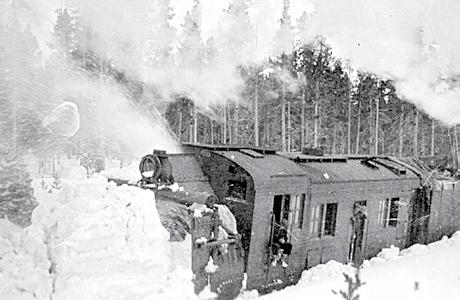
Warm weather and sunshine prevail as this “Postcard” is being written, but the forecast calls for more winter of 2023 which has hit most of Wyoming and looks like it will continue.

A little four-yearold boy in Saratoga was lost on the afternoon of Feb. 28 and when found that evening, was frozen standing in a crevice in a large snow drift.
$9050
1 Blk Cow, 1120# $8050
Kysar, Pam - Powell
1 Red Cow, 1175# $9050
Collingwood Living Trust - Greybull
1 Blk Cow, 1410# $9050
1 Blk Cow, 1275# $8600
Botke, Dale - Ten Sleep
1 Blk Cow, 1365# $9000
Bockman, Steven - Greybull
1 Blk Cow, 1420# $8950
Bischoff, Tyrell - Lovell
1 Blk Cow, 1525# $8800
Dale Lyman Ranch Inc.
However, according to the April 26, 1917 issue of The Encampment Record winter dominated through April. A news item noted: The following article was taken from the Mountain States Monitor, published monthly by the Mountain States Telephone and Telegraph Company of Denver. It reads:
and all attempts to open it since then have proven futile.
Since the closing of this railroad, these places have not been receiving any shipments of freight or express, and until recently, the mail was received but once a week, this being relayed by sled from Walcott, a distance of 30 miles to Saratoga and 50 miles to Encampment.
There have been very few days this winter where the mercury has gotten above zero.
With the coming of the spring thaw, an attempt will be made to dig out the S. and E. railroad and again place Saratoga and Encampment on the map.
Today, of course, some member of our “Old Geezers Coffee Klatch” just had to remark, “Good to see the snow since we sure need the moisture.” Supporting this sentiment was the April 26, 1917 issue of the Record, in which headlines proclaimed, “Good Crops This Year” and “Plenty of Snow Assures Plenty of Water for Irrigation” . . . but then, that’s another “Postcard.”
Red Str Clvs, avg. 847# $17950
10 Red Str Clvs, avg. 913# $16850
Miller, Winston - Basin
17 Blk Str Clvs, avg. 926# $16500
Our exchanges at Saratoga and Encampment – though small –have, through the able management of Miss Jessie Moore of Saratoga and Mrs. Helen Butler of Encampment, played a large part in maintaining good, telephone service and keeping the Upper Platte Valley in touch with the rest of the state.
Although located on a railroad, these two towns have been isolated since early in January, at which time the S. and E. railroad was snowed under,
Digging out the “Slow and Easy” railroad line from Walcott to Saratoga and then on to Encampment was a fulltime job during the winter of 1917, as reported in the March 27, 1917 issue of The Saratoga Sun. One headline reads, “S. and E. Line Will Be Opened Soon,” followed by “U. P. Engine and Rotary Snowplow Now Working in the Vicinity of Pass Creek.” This 1917 photo shows a rotary plow clearing deep snow from the S. and E. tracks between Saratoga and Encampment. Photo courtesy of Grand Encampment Museum. Historical Reproductions by Perue
Wyoming Livestock Roundup • Volume 34 No. 47 • March 18, 2023 A12
Submit your events to: Editor, Wyoming Livestock Roundup, P.O. Box 850, Casper, WY, 82602, or e-mail to roundup@wylr.net.
POSTCARD
by Dick Perue rrichardperue@gmail.com
LIVESTOCK AUCTION LLC Call to Consign Cattle Sale Barn: 307-347-9201 Danny Vigil: 307-388-0781
bighornbasinlivestock.com March 16 – 1,434 Head Feeders $4-$5 Higher • Cows & Bulls Steady BULLS Reed, Justin - Thermopolis 1 Blk Bull, 1735# $10950 3 F LLC - Worland 1 Blk Bull, 1560# $10500 1 Blk Bull, 1685# $10300 1 Blk Bull, 1655# $9450 L U Ranch - Worland 1 Blk Bull, 1770# $10450 Dale Lyman Ranch Inc. - Ten Sleep 1 Blk Bull, 1605# $10300 1 Blk Bull, 1805# $10050 COWS Redland, Adam - Burlington 2 Blk Cows, avg. 1620# $9600 1 Blk Cow, 1605# $9000 Sorenson, Aaron - Riverton 1 Blk Cow, 1190# $9450 1 Blk Cow, 1360# $9150 1 Blk Cow, 1405#
- Ten Sleep 1 Blk Cow, 1490# $8700 E.O. Bischoff Ranch - Lovell 1 Blk Cow, 1210# $8700 Bischoff, Dave - Lovell 1 Blk Cow, 1175# $8700 Hirsch, Todd - Kinnear 1 Blk Cow, 1550# $8650 1 Blk Cow, 1545# $8500 1 Blk Cow, 1330# $8400 TD Farms Inc. - Worland 1 Blk Cow, 1245# $8050 B & W Cattle LLC - Scottsbluff 1 Blk Cow, 1250# $7000 HEIFER CALVES Bar Half Diamond Ranch - Riverton 43 Blk Hfr Clvs, avg. 522# $23900 47 Blk Hfr Clvs, avg. 419# $22150 5 Blk Hfr Clvs, avg. 645# $21000 L U Ranch - Worland 35 Blk Hfr Clvs, avg. 530# $23000 Nicol, Bob - Fort Washakie 13 Blk Hfr Clvs, avg. 550# $22750 17 Blk Hfr Clvs, avg. 622# $20550 Michaels, Calvin - Burlington 49 Blk Hfr Clvs, avg. 556# $22600 11 Blk Hfr Clvs, avg. 426# $21750 Coble, Mike - Burlington 2 BWF Hfr Clvs, avg. 518# $22600 Double Dollar Cattle Co. - Lovell 9 Blk Hfr Clvs, avg. 533# $22500 4 Blk Hfr Clvs, avg. 645# $20950 Doyle McKim & Sons Inc. - Manderson 10 Blk Hfr Clvs, avg. 557# $22350 16 Blk Hfr Clvs, avg. 656# $18350 Whitt, Slim - Thermopolis 3 Blk Hfr Clvs, avg. 560# $22100 307 Wilderness LLC - Crowheart 2 Blk Hfr Clvs, avg. 445# $22100 Hamilton Ranch Inc. - Hyattville 10 Blk Hfr Clvs, avg. 497# $21950 Walls, Jerry - Deer Trail 15 Blk Hfr Clvs, avg. 530# $21700 Baird, John - Thermopolis 4 Blk Hfr Clvs, avg. 530# $21150 15 Blk Hfr Clvs, avg. 559# $19900 Rankine Livetock - Worland 39 BWF Hfr Clvs, avg. 451# $20800 McIntosh, Ruth - Burlington 1 CharX Hfr Calf, 535# $20200 Coble, Mike - Burlington 2 BWF Hfr Clvs, avg. 623# $19550 Deede, Frank - Byron 4 RWF Hfr Clvs, avg. 611# $19050 Riley, Michael - Burlington 9 Red Hfr Clvs, avg. 772# $17900 Redland, Adam - Burlington 14 BWF Hfr Clvs, avg. 754# $16800 Miller, Winston - Basin 12 Blk Hfr Clvs, avg. 788# $16300 14 Blk Hfr Clvs, avg. 876# $15800 STEER CALVES Bar Half Diamond Ranch - Riverton 20 Blk Str Clvs, avg. 336# $25750 27 Blk Str Clvs, avg. 420# $25250 2 Blk Str Clvs, avg. 720# $19800 Nichol, Bob - Fort Washakie 15 Blk Str Clvs, avg. 478# $25300 • Upcoming Sales • March 23 – All Class Cattle April 6 – All Class Cattle April 10 – Monday Feeder Special • Feeder cattle only April 13 – Bred Cow Special w/ AllClass Cattle April 20 – All Class Cattle, Sheep & Goat April 27 – All Class Cattle Visit Cattle USA for broadcasting and online bidding – auctions.cattleusa.com Danny Vigil • Northern Livestock Represenative 38 Blk Str Clvs, avg. 568# $24000 2 Blk Str Clvs, avg. 745# $19050 Lake, Jerry - Thermopolis 11 Blk Str Clvs, avg. 517# $25250 4 Blk Str Clvs, avg. 599# $20500 Double Dollar Cattle Co - Lovell 7 Blk Str Clvs, avg. 369# $25250 Michaels, Calvin - Burlington 12 Blk Str Clvs, avg. 443# $24300 45 Blk Str Clvs, avg. 634# $22650 Walls, Jerry - Deer Trail 34 Blk Str Clvs, avg. 502# $23700 31 Blk Str Clvs, avg. 553# $22350 30 Blk Str Clvs, avg. 613# $21750 Coble, Mike - Burlington 4 BWF Str Clvs, avg. 526# $23500 A Mill Iron LLC - Riverton 19 Blk Str Clvs, avg. 609# $22600 9 BWF Str Clvs, avg. 729# $19600 Doyle McKim & Sons, Inc. - Manderson 13 Blk Str Clvs, avg. 597# $22300 Hamilton Ranch Inc. - Hyattville 5 Blk Str Clvs, avg. 501# $22250 8
Apland,
Greybull
Vigil,
6
14
30
24
Blk Str Clvs, avg. 589# $20850
Rick - Worland 1 Blk Str Calf, 550# $21000
River Land & Cattle - Meeteetse 2 Blk Str Clvs, avg. 645# $20800
Michael - Manderson
Blk Str Clvs, avg. 693# $19550
Blk Str Clvs, avg. 750# $18500
Blk Str Clvs, avg. 754# $16400 Verona Cattle LLC - Wyarno
MARKETS
Service information and other sources
FOR THE WEEK ENDING March
17, 2023
FOR THE WEEK ENDING May 24, 2019
Source: USDA AMS Livestock, Poultry & Grain Market News, Greeley, CO
As of March 10, 2023
Compared to last week heavy slaughter lambs 7.00-9.00 higher, instances 15.00-20.00 higher; light slaughter lambs weak to 10.00 lower. Slaughter ewes mostly steady to 10.00 lower. Feeder lambs not well tested. At San Angelo, TX 6,289 head sold. Equity Cooperative Auction sold 750 feeder lambs in California. In direct trading slaughter ewes and feeder lambs not tested. 3,713 lamb carcasses traded with no trend due to confidentiality. All sheep sold per hundred weight (CWT) unless specified. Slaughter Lambs: Choice and Prime 2-3
San Angelo: wooled and shorn 110-145 lbs 135.00-172.00; 155-190 lbs 139.00-167.00.
Ft. Collins: wooled and shorn 135-145 lbs 127.50-130.00. South Dakota: wooled and shorn 110-155 lbs 137.00-153.00. Billings: wooled and shorn 100-145 lbs no test.
Equity Coop: no sales.
Slaughter Lambs: Choice and Prime 1-2
San Angelo: hair 40-60 lbs 290.00-324.00, few 331.00; 6070 lbs 259.00-310.00; 70-80 lbs 252.00-286.00; 80-90 lbs 224.00-281.00; 90-100 lbs 200.00-242.50, few 265.00. wooled and shorn 65 lbs 280.00; 70-80 lbs 264.00-268.00; 80-90 lbs
228.00-252.00; 91 lbs 230.00.
Ft. Collins: wooled and shorn 60-70 lbs 210.00-225.00; 80-90 lbs 195.00-215.00; 90-100 lbs 225.00-227.50. hair 58 lbs 257.50; 60-70 lbs 227.50-235.00; 70-80 lbs 225.00-230.00.
South Dakota: wooled and shorn 50-60 lbs 270.00-320.00; 60-70 lbs 255-285.00; 70-80 lbs 230.00-250.00; 90-100 lbs 192.50-215.00. hair 83 lbs 192.50; 101 lbs 160.00.
Billings: no test.
Slaughter Ewes
San Angelo: Good 3-4 (very fleshy) no test; Good 2-3 (fleshy) 93.00-108.00, hair 87.00-108.00; Utility and Good 1-3 (medium flesh) 116.00, hair 119.00-143.00; Utility 1-2 (thin) hair 90.00-119.00; Cull and Utility 1-2 (very thin) hair 96.00; Cull 1 60.00-82.00.
Ft. Collins: Good 3-4 (very fleshy) 67.50-87.50; Good 2-3 (fleshy) 70.00-92.50; Utility 1-2 (thin) no test; Cull 1 no test
South Dakota: Good 3-4 (very fleshy) 65.00-85.00; Good 2-3 (fleshy) 55.00-85.00, hair 100.00; Utility 1-2 (thin) 55.00-75.00; Cull 1 45.00-55.00.
Billings: Good 3-4 (very fleshy) no test; Good 2-3 (fleshy) no test; Utility 1-2 (thin) no test; Cull 1 no test.
South Dakota: bred young 235.00/head; bred middle age 160.00-175.00/head; middle age hair 153 lbs 125.00/cwt. Billings: no test.
Sheep and lambs slaughter under federal inspection for the week to date totaled 36,000 compared with 35,000 last week and 33,000 last year.
Source: USDA AMS Market News, San Angelo, Texas National Wool Review
As of March 10, 2023
In Australia this week, the Eastern Market Indicator was down 10 cents at 1358 cents per Kg clean from the sale a week ago. A total of 47,915 bales were offered with sales of 87.0 percent. The Australian exchange rate was stronger by .0156 at .6589 percent of the U.S. dollar. Australian wool prices are quoted US Dollar per pound, delivered, Charleston, S.C. The current freight rate is .15 cents per pound clean.
was down 10 cents at 1358 cents per kg clean. Australian exchange rate was stronger by .0156 at .6589 percent of the U.S. dollar.
Source: USDA- CO Dept of Ag Market News Service, Greeley, CO Wyoming Hay Summary
As of March 16, 2023
Compared to the last report, all reported hay sold fully steady. Most producers are either out or almost out of hay with a few unsold lots of hay around.
As
Compared to the last report, all reported hay sold fully steady. Most producers are either out or almost out of hay with a few unsold lots of hay around. Some snow melting has helped take some pressure off the market as cows can graze winter feed resources. Nebraska Department of Agriculture website has a hay and forage hotline with listings of hay for sale..
The latest markets data can be found by visiting USDA’s Agricultural Marketing Service at
mixed age hair 100-105 lbs 150.00-160.00/cwt. Ft. Collins: ewes with lambs 175.00/family.
A13 Wyoming Livestock Roundup • Volume 34 No. 47 • March 18, 2023 Un SETT PRICE Month Week Prev This Week Change WHEAT FUTURES MARCH 7.65 7.38 -0.27 MAY 7.76 7.50 -0.26 JULY 7.81 7.56 -0.25 SEPTEMBER 7.90 7.65 -0.25
SETT PRICE Month Week Prev This Week Change LIVE CATTLE FUTURES FEBRUARY 162.78 165.15 +2.37 APRIL 164.08 165.33 +1.25 JUNE 159.73 161.28 +1.55 AUGUST 158.78 160.10 +1.32 OCTOBER 162.90 164.18 +1.28 SETT PRICE Month Week Prev This Week Change CORN FUTURES MARCH 6.76 6.60 -0.16 MAY 6.75 6.59 -0.16 JULY 6.64 6.51 -0.13 SEPTEMBER 6.09 6.00 -0.09 SETT PRICE Month Week Prev This Week Change SOYBEAN FUTURES MARCH 15.26 15.34 +0.08 MAY 15.21 15.27 +0.06 JULY 15.13 15.19 +0.06 AUGUST 14.80 14.88 +0.08 WEEKLY CATTLE AUCTIONS Steers Heifers Compiled from USDA Market News
SETT PRICE Month Week Prev This Week Change OATS FUTURES MARCH 3.63 3.71 +0.08 MAY 3.51 3.44 -0.07 JULY 3.54 3.46 -0.08 SEPTEMBER 3.57 3.51 -0.06 WEEKLY SHEEP AUCTIONS
SETT PRICE Month Week Prev This Week Change FEEDER CATTLE FUTURES MARCH 186.23 189.23 +3.00 APRIL 190.60 193.68 +3.08 MAY 194.48 197.73 +3.25 AUGUST 207.85 211.35 +3.50 SEPTEMBER 210.73 213.68 +2.95 Location Under 400 400-500 500-600 600-700 700-800 Over 800 Sltr Bull Stock Cows Volume Sltr Cows Pairs PAYS 252.50-280 267.50-280 242-270 220-235 162-185 85-134 82-141.50 3-15 917 230-237 170-227.50 192-223 185-209 177-183 71-103 Crawford No Report Riverton 210 94-101 $1075-$1700 3-14 538 187.50 193.75 155.50-162 80-92.50 Torrington 285-291 260-285 240-263.50 220-251 195-225 178-199 110-118.50 121-149 3-15 5884 235 232-245 212-235 187-214 174-182.50 161-174 83-107 St. Onge 211-232 192.50 103-123 3-10 2497 205.50 202-211 81.50-129 Big Horn Basin 257.50 243-253 205-252.50 195.50-226.50 164-198 165-179.50 94-109.50 3-16 1434 208-221.50 199-221 183.50-209.50 163-179 158 70-96 Billings 270-280 185-272 155-256.50 223-237 190 165-185 90-139 105-149 3-16 1285 245-257.50 185-237 185-227 178-217.50 150-198 76-100.50 CUTOUT VALUES This Prior Last Week Week Year CUTOUT VALUES 288.41 288.91 261.16 Primal Rib 473.73 476.82 412.46 Chuck 228.28 229.03 210.72 Primal Round 224.40 226.47 218.95 Primal Loin 403.53 404.06 347.26
Centennial 190-202.50 172.50 168 98-123 $1175-$2500 3-10 202.50 172.50 165-170 72-92 $1650-$1850
https://www.ams.usda.gov/market-news Auction Volume Feeder Slaughter Slaughter Stock Slaughter Lambs Lambs Ewes Ewes Bucks Centennial 1625 165-285 125-250 62.50-140 180-250 85-190 Daily Grower Bids Region Price US #2 Yellow Corn Southeast WY 6.6275-6.8275 US #1 HRWW Southeast WY 7.5975-7.6975 US #1 Black Beans Min-Dak 40/cwt US #1 Dark Red Kidney Beans Min-Dak 45-48/cwt #1 Great Northern Beans Den-Rate 40/cwt #1 Light Red Kidney Beans Den-Rate 50/cwt Min-Dak 46-48/cwt US #1 Pea (Navy) Beans Min-Dak 37/cwt US #1 Pinto Beans Den Rate 36-37/cwt Min-Dak 34-35/cwt
Source: USDA AMS Livestock, Poultry & Grain Market News, Torrington
National Sheep Summary
San Angelo:
28
310.00; 30-40
280.00-316.00; 40-50 lbs 291.00-312.00; 50 lbs 322.00. Ft. Collins: 47 lbs 200.00; 58 lbs 210.00. South Dakota: 30-40 lbs 265.00-315.00; 40-50 lbs 280.00; 106 lbs 165.00.
test. Replacement Ewes: Medium and Large 1-2 San Angelo: yearling hair 110-120 lbs 160.00-195.00/cwt;
Feeder Lambs: Medium and Large 1-2
hair
lbs
lbs
Billings: no
Clean Del Price Change from 75-85 Percent Micron US Grade in U.S.
of Australia 17 > 80s 7.26 - .18 5.45-6.17 18 80s 6.17 - .15 4.63-5.25 19 70-80s 5.22 - .19 3.91-4.44 20 64-70s 4.73 - .17 3.55-4.02 21 64s 4.48 - .17 3.36-3.81 22 62s 4.33 - .04 3.25-3.68 23 60-62s 4.09 - .12 3.06-3.47 24 60s 25 58s ------------26 56-58s 1.86 - .11 1.40-1.58 28 54s 1.22 - .01 0.92-1.04 30 50s 1.14 - .01 0.85-0.97 32 46-48s 0.88 - .09 0.66-0.74 Merino Clippings 2.86 - .11 2.15-2.43 Eastern Market
Dollars Previous Sale
Indicator
Eastern Wyoming Alfalfa - Supreme Large Square 3x4 310 Alfalfa - Good Large Round 285 Large Square 3x4 270 Alfalfa Pellets 15% Suncured 390 Western Wyoming Alfalfa - Premium Small Square 270-300 Small Square 3 Tie 285-350 Alfalfa Cubes 380 Alfalfa/Orchard Mix - Premium Small Square 285-300 Grass - Good/Premium Large Square 3x4 265 Oat Small Square 200 Teff - Fair Small Square 200 Source: USDA AMS Livestock, Poultry & Grain Market News Torrington Nebraska Hay Summary
of
2023
March 16,
Alfalfa - Good Large Round 225 Alfalfa Ground 285 Corn Stalk Ground 160 Prairie/Meadow Grass - Premium Small Square 9/bale 5 AREA WEEKLY WEIGHTED CATTLE PRICE This Prior Last Week Week Year Live Steer 165.40 165.02 138.30 Live Heifer 164.98 164.89 138.14 Dressed Steer 265.32 264.43 220.11 Dressed Heifer 266.30 264.45 220.01 St. Onge 809 119-268 41-69 130-200 61 PAYS 1469 130-232 62-93 $80-$98 69-150 Buffalo 220 205 97-121 $1400-$1925 3-15 230 191 174-185 83-114 $1850 Prairie/Meadow Grass - Good Large Round 210-215 Large Round 225 Straw - Corn Stalk Round 110 Eastern Nebraska Alfalfa - Premium Small Square 10/bale Alfalfa Pellets 15% Suncured 420 Pellets 17% Suncured 430 Grass - Premium Small Square 8/bale Platte Valley Nebraska Alfalfa - Good Large Round 240 Alfalfa Ground 285-290 Pellets 15% Suncured 380 Pellets 17% Suncured 350 Corn Stalk Ground 160-165 Western Nebraska Alfalfa - Good/Premium Large Square 3x4 285 Alfalfa Ground 275 Source: USDA AMS Livestock, Poultry & Grain Market News, Kearny, NE
remedy by putting pressure on USFS.”
The wolf pack
According to Koshmrl’s article, wolves disappeared from the Southern Rockies in Colorado in the 1940s and have recently began to reestablish.
While the animals are protected by the ESA in the state of Colorado, they do not have the same protections across the border in Wyoming, where they were reintroduced 28 years ago.
“Individual wolves from Wyoming have occasionally crossed the WyomingColorado border into northern portions of Colorado. Over the past decade, Colorado Parks and Wildlife has
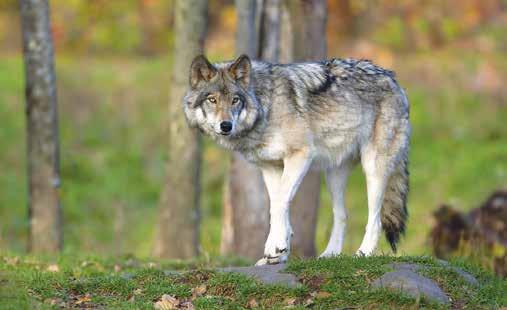
confirmed probable wolf dispersals in 2004, 2006, 2009, 2015 and then annually since 2019,” reads a Feb. 22 press release from the Center for Biological Diversity.
Koshmrl states, “Crossing the state border back into Wyoming has proven deadly for the few pioneering wolves that have successfully dispersed to the Southern Rockies, where wolf reintroduction is planned for 2024.”
His comment is a nod to a specific incident, in which three wolves from the first modern-day wolf pack confirmed in Colorado were reportedly shot in Wyoming in 2022.
“In January 2021, two
For more information on the case, visit wyofile.com/lawsuit-seeks-relief-forcolorado-wolves-gunned-down-atwyoming-border/.
wolves entering Colorado from Wyoming were documented traveling together,” explains the Center for Biological Diversity. “That June, agency staff observed six black pups with this pair in Jackson County, Colo. These pups are the first known wild wolves born in Colorado since the 1920s. This family is now referred to as the North Park Pack.”
In the fall of 2022, Colorado Parks and Wildlife received reports Wyoming hunters had killed three black sub-adult female wolves within 10 miles of the Colorado border, in central Wyoming near the Medicine Bow-Routt National Forest.
The Wyoming Game and Fish Department (WGFD) confirmed the killings, and agency scientists believe these wolves were part of the North Park Pack.
The lawsuit
According to the Wyoming Wildlife Federation, wildlife rights typically fall under the jurisdiction of

states, and in March 2017, ESA protections for gray wolves in Wyoming were lifted after far exceeding the state’s recovery goal.
In fact, according to U.S. Fish and Wildlife Wyoming Field Supervisor Tyler Abbott, the recovery goal for Wyoming’s wolves was 100 animals, but as of 2016, there were 380 in the state. Abbott notes this was too
Industry leading genetics and the highest quality Red Angus, with 78 years of Satisfied
Beckton has long been the premier breeder of Red Angus cattle which combine calving ease, maternal traits, and rapid growth to yearling age, for maximum overall profitability to commercial cow-calf cattlemen Beckton’s balanced genetics and emphasis on the maternal traits, have made them the leading choice for commercial replacement females and for building a productive cow herd. And the lower birth weights make them a first choice for breeding heifers.
As an indicator for "maternal" traits, the Herd Builder Index is dominated by Beckton bloodlines. 9 of the top 10, 18 of the top 20, and 43 of the top 50 sires in the breed for Herd Builder are Beckton sires or descended by Beckton sires.
In the Red Angus breed, 9 of the top 10 sires for Birth Weight EPD, 8 of top 10 sires for Stayability EPD and 8 of the top 10 sires for Marbling EPD are Beckton sires or descended from Beckton sires
Please join us at our 78th Anniversary Sale Selling 300 Red Angus - 250 Bulls and 50 Heifers
Tuesday, April 11, 2023
1:00 pm at our ranch 10 miles west of Sheridan, Wyoming
many for the national parks to home, and as the wolves began to expand their territorial range, they started to kill more livestock.
“The year 2015 was a record year for livestock depredations by wolves, and 2016 almost doubled those numbers of depredations. This is because wolves are expanding outside of their suitable habitat and looking for food to eat,” says Abbott.
Despite this, Adkins argues USFS can still take action.
“It’s very clear the federal government can preempt state laws,” she states. “There’s the ESA, but there are also other federal laws which speak to how national forests are to be managed –and those do take priority over state laws.”
With this, she cites an example of federal land managers trumping state laws to manage hunting in the Thunder Basin National Grassland, where they have placed a seasonal ban on the recreational shooting of prairie dogs in some areas.
“But, there are big distinctions between the group’s wolf hunting request
and the prairie dog hunting closure,” WGFD Director Brian Nesvik tells WyoFile. “This was a very specific agreement negotiated between the local public, all of the agencies involved and the governor’s office. It was an agreement more than some kind of a moratorium.”
Koshmrl explains there are three non-contiguous blocks of Medicine BowRoutt National Forest, spread across more than one million acres in the Snowy Range, Sierra Madres and Vedauwoo, that the planned litigation will target. But, Adkins notes it will only target national forest lands, not Wyoming’s predator zone.
“This lawsuit doesn’t hinge on the federal status of wolves in Wyoming, what it hinges on is the fact wolves are protected in Colorado,” Adkins says. “We’ve got federal land straddling the border. It really doesn’t make any sense to have wolves safe from hunting on one side and shot on sight on the other.”
Hannah Bugas is the managing editor of the Wyoming Livestock Roundup. Send comments on this article to roundup@wylr.net.
Willwood Herd Angus
Wyoming Livestock Roundup • Volume 34 No. 47 • March 18, 2023 A14 LAWSUIT continued from page A1 Call, write or email for a catalog www becktonredangus com becktonwyo@gmail com 37 Beckton Drive • Sheridan, WY 82801 307-674-6095 • 307-674-8162 - Evenings Fax: 307-672-7281 Cam and Trish Forbes Delivered free anywhere in the continental U S Video of sale animals will be available on our website Internet and direct line telephone bidding will be available
Customers
EARHART FARMS
Cattle Over 60 years of Breeding and Selection for the Total Package. J K J K Private Treaty Bull Sales Offering calves out of Baldridge Alternative E125, E & B Plus One, Springfield Ramesses 6124, KW Saeway 2020, Mohnen Prince 2959 Andrea Earhart Ryan Osborne (307) 272-8876 Powell, WY
Adobe Stock photo
The

Farmer's
Field
 BY RON RABOU
Sam 2.0
Life’s best lessons are often learned on the farm. There are no weekends, no holidays, no set hours of nine to five. There is no comp time, vacation time, benefits package, sick leave or retirement. There is just…well… work. That’s it.

On a farm or ranch there is always something to do. There’s always a job. And if we aren’t given one, we learn to find one.
The lessons I learned on our family ranch still serve as a powerful reminder of how to deal with the realities of life I have encountered as an adult. Those things can’t be learned in a book or at a seminar. They can’t be learned in school or through multiple degrees.
When it’s a raging blizzard and we can’t see three feet in front of us, with the wind and snow pelting our face relentlessly, the frigid temperatures are determined to break our resolve.
But, in our mind, the only thing we can think about is the goal and the mission –the cattle must be fed and the corrals and shelters must be cleared, or we risk losing the only income source we have. So, we press on. We are undeterred by the elements. We focus on what we must get done, and we don’t quit until we do.
Nearly everyone with an agriculture background has a similar story. A story about taking the next step even when they think they can’t.

I’d like to share one of those stories today. Let me introduce you to Sam.
Over the past several years, I have worked with Sam, and he has become my friend. He’s an awesome guy. He works hard, is raising two incredibly talented sons, he is highly successful in his career, and he is a total machine when it comes to racing bikes and working out.
He never stops working on becoming the best version of himself, and he’s always smiling. He’s truly an inspiration.
Just over a year ago, Sam was goose hunting on a beautiful, somewhat snowy Colorado morning. He and his buddies arose from their layout blinds and were admiring their recent volley of shots, which downed several geese, when Sam’s bird dog jumped from the blind to retrieve the birds.
In doing so, he stepped on the trigger of Sam’s shotgun, causing the gun to fire, so it literally blew off Sam’s leg just above his ankle. Sam was rapidly bleeding to death. His hunting partners sprang into action, and their quick thinking and heroic efforts undoubtedly helped save Sam’s life.
After arriving at the hos-
pital, Sam’s life hung in the balance. Doctors worked tirelessly for over eight hours and transfused 11 units of blood into his body. Sam tells me the body only contains about 12 units.
Doctors placed Sam in an induced coma, until they eventually woke him to talk about what needed to be done. Upon hearing his choices, Sam elected to have his leg removed below the knee. A few days passed and he returned home, where he would be faced with the reality of this life-changing event.
Each time I spoke with him, I was completely amazed by his attitude, his focus, his determination and his continuous, contagious smile. If I’m real honest, it was completely mind-blowing.
How is it possible to be so positive and so focused on relearning and rebuilding? No pity party, no “woe is me,” just grit, tenacity and determination. Even when he was faced with another surgery to take more of the leg, he never lost his resolve.
You see, to Sam, he was just feeding the cows in a raging blizzard. This is what he knows. His childhood experience on his family farm taught him to work until he gets the job done, no matter what kind of job it is and what it entails.
If we’re sick, hurt or sad, we just push through. If everything in us is telling us we can’t, we do it anyway. We do whatever we need to do to get to where we want to be.
In a recent podcast, I heard Sam talk about when people say, “I wish I could… (insert wish).” His response? “Well then just do it! That’s just the saddest excuse ever.”
I couldn’t agree more. Sometimes we get so wrapped up in the “stuff” of life, we forget to think about the fact that maybe the things that happened TO us, really may have happened FOR us.
Today, Sam is focused on “Sam 2.0.” He describes it as his version of being even better than he was before the accident. And, if he can inspire just one person to do the same, he’s helped make the world a better place.
Recently, Sam and I toasted to “2.0,” and I know beyond the shadow of a doubt, he would smoke me in a foot race. His can-do spirit is evident in all he does.
May we all have the resolve of Sam, look at our own lives and declare, “I am determined. I am worthy. I am strong. I am tenacious. I am courageous.”
I am and I can, thanks to Sam. Thanks, brother, for inspiring me and the rest of this world.
Sam can be found on Instagram @sammybev2.0.
A15 Wyoming Livestock Roundup • Volume 34 No. 47 • March 18, 2023
CALVES Fegler Farms – 100 Blk Ang & AngX Strs & Hfrs 600-650#. Rec Vista Once SQ & 7-way w/Somnus @ branding & weaning. Long time weaned, One Iron, fancy calves!


Applequist Ranch – 80 Blk Ang/BWF (F1) Strs 575-625#. Rec Vista Once SQ & Vision 7 spring & fall. Long time weaned. Hay fed. Choice, one iron, high desert calves!





Jordan Land & Livestock – 70 Blk Ang Strs 600-650#. Rec 2 rounds of shots. Weaned since November. Lucky 7 sired. High elevation, nice, powerful steers!
JF Ranch – 70 Blk Ang Hfrs 600-650#. Rec branding & weaning shots. Bangs vacc. Long stem hay & pellets.
Fancy, reputation calves!
Diamond X Ranch – 35 Blk Ang Strs 500-550#. Rec 2 rounds of shots. Weaned since this fall. Hay fed. High desert!
John Chrisman – 20 Blk Ang Strs & Hfrs 600-650#. Rec









2 rounds of shots. Long time weaned. High elevation!
Ralph Johnson – 10 CharX Strs & Hfrs 600-650#. Comp vacc. Long time weaned. Sired by Eaton Charolais bulls.
Kelly Burch - 3 Blk/CharX hfrs 600#. BULLS
Shippen Angus - 2 Virgin Blk Angus bulls. Out of 10X.
Fertility tested.
DAIRY COWS
Glick Ranch – 5 Jersey 3 yr old Bred Cows. Bred to
- Obsidian Angus, Hoggs Angus, Davidson Angus, & WYO Angus. Bulls are known for calving ease & growth. PAP, Semen & BVD Tested, Proven Sires! (1:00 PM) Contact Fred & Kay Thomas 307-868-2595 or any Breeder. GOATS
– 10



Ready Boer Goats
– 12 yr old Bay Mare. Anybody can ride. Been used in the mountains & with cattle.
Wyoming Livestock Roundup • Volume 34 No. 47 • March 18, 2023 A16 Subscribe to the Wyoming Livestock Roundup by calling 307-234-2700 bottsangusranch.com Follow us on FaceBook Family Owned Family Raised BEAU AND KRISTIN BOTTS BEAU CELL (541) 263-0988 KRISTIN CELL (541) 263-0589 BEAUBOTTS1@GMAIL.COM CALL OR EMAIL FOR A SALE BOOK. MARCY LIVESTOCK SERVICES GEORGE MARCY (308) 430-2005 SAME BULLS. SAME FAMILY. NEW LOCATION. NEW DATE. Selling 100 stout yearling Angus bulls. Lunch served at 11:30 AM CUSTOMER-ORIENTED BULL SALE Breeding for Balance and Function 10th Annual Sale - 1:00 pm APRIL 1, 2023 Huntley, Montana BULLS RAISED AND DEVELOPED AT THE BASE OF THE BIG HORNS. www.cattleusa.com riverton@winterlivestock.com 1490 South 8th Street East • Riverton, WY 82501 • (307) 856-2209 Tuesday, March 14 Market Report • 538 Head Sold RIVERTON LIVESTOCK AUCTION Contact: Riverton Livestock Auction (307) 856-2209 • Jeff Brown (307) 850-4193 • Tom Linn (307) 728-8519 • Mark Winter (580) 747-9436 www.rivertonlivestock.com • Also watch our live cattle auction at www.cattleusa.com Representative Sales Early Consignments TUESDAY, MARCH 21 FEEDER SPECIAL • START TIME 9:00 AM W/ WEIGH UPS TUESDAY, MARCH 28 ALL CATTLE CLASSES W/ SHEEP & HORSES • START TIME 9:00 AM W/ SHEEP & WEIGH UPS 45TH ANNUAL NORTHWEST ANGUS BULL SALE (1:00 PM) Northwest Angus Association - 55 Blk Ang Yrling Bulls TUESDAY, APRIL 4 BACK TO GRASS & FEEDER SPECIAL START TIME 9:00 AM W/ WEIGH UPS
Ang bulls.
TUESDAY, APRIL 11 BRED COW & PAIR SPECIAL START TIME 9:00 AM W/ WEIGH UPS COWS KINNEAR 2 Cow, 1495# $92.50 2 Cow, 1225# $92.00 RIVERTON 5 Cow, 1425# $91.50 FARSON 2 Cow, 1190# $91.00 LANDER 2 Cow, 1452# $90.00 RIVERTON 1 Cow, 1510# $89.00 LANDER 1 Cow, 1280# $88.50 2 Cow, 1375# $88.00 FARSON 13 Cow, 1121# $87.00 SHOSHONI 2 Cow, 1277# $86.00 LANDER 1 Cow, 1570# $85.00 FARSON 11 Cow, 1251# $84.00 HUDSON 3 Cow, 1208# $83.50 COKEVILLE 1 Cow, 1620# $83.00 4 Cow, 1320# $82.00 RIVERTON 1 Cow, 1395# $81.00 SHOSHONI 2 Cow, 1252# $80.50 KINNEAR 1 Cow, 1230# $80.00 BULLS RIVERTON 2 Bull, 2027# $101.00 SHERIDAN 4 Bull, 1758# $94.00 LANDER 1 Bull, 1930# $94.00 TUESDAY, APRIL 18 FEEDER SPECIAL • START TIME 9:00 AM W/ WEIGH UPS TUESDAY, APRIL 25 ALL CATTLE CLASSES W/ SHEEP & HORSES • START TIME 9:00 AM W/ SHEEP & WEIGH UPS TUESDAY, MAY 2 BACK TO GRASS SPECIAL START TIME 9:00 AM W/ WEIGH UPS HEIFERETTES HUDSON 1 Heiferette, 1040# $120.00 DUBOIS 2 Heiferette, 1065# $113.00 DUBOIS WY 1 Heiferette, 1085# $104.00 LANDER 3 Heiferette, 1191# $101.00 BRED HEIFERS SHOSHONI 2 Bred Heifer, 1450# $1,625.00 2 Bred Heifer, 1362# $1,600.00 KEMMERER 1 Bred Heifer, 1130# $1,575.00 BRED COWS SS (3-6 YR OLDS) SHOSHONI 1 Bred Cow, 1380# (3 YR) $1,700.00 RIVERTON 36 Bred Cow, 1040# (3 & $) $1,675.00 SHOSHONI 3 Bred Cow, 1350# (SM) $1,650.00 FORT WASHAKIE 2 Bred Cow, 1002# (SM) $1,575.00 FARSON 3 Bred Cow, 1253# (SM) $1,525.00 SM (7-9 YR OLDS) FORT WASHAKIE 5 Bred Cow, 1315# (SS) $1,325.00 ST (9+ YR OLDS) FARSON 13 Bred Cow, 1216# (ST) $1,160.00 14 Bred Cow, 1197# (ST) $1,125.00 15 Bred Cow, 1235# (ST) $1,075.00 REPLACEMENT HEIFERS SHOSHONI 82 Heifer, 742# $193.75 8 Heifer, 901# $162.00
Blk
Raised calves last year. Very gentle!
Chase
HORSE Brian Skorcz
Taylor
Market
