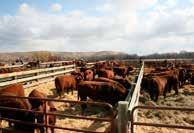
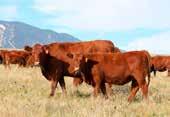
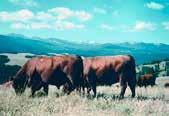
In the 14th snow report for Water Year 2025, the state’s snowpack telemetry data reads 99% of median, with a basin high of 112% and a basin low of 48%. Last year, the state was at 99% and at 122% in 2023. The report and a map displaying basin snow water equivalent percentages of median for the state may be found at wrds.uwyo.edu/ wrds/nrcs/nrcs.html
WLSB meeting
The Wyoming Livestock Board (WLSB) has scheduled a public meeting for March 25, beginning at 8:30 a.m. in the Turntable Room of the Thyra Thomson Building in Casper. Zoom is also available. Topics include approval of February minutes, a director’s updates, legislative updates, animal health updates and more. For more information visit, wlsb.state.wy.us
WSGLT award
The Wyoming Stock Growers Land Trust (WSGLT) is seeking nominations for the 2025 Bucholz Conservation Award. This award is meant to recognize an individual or family who advocates for conserving Wyoming’s farms and ranches, are stewards of the land and defenders of water conservation, have a personal commitment to habit conservation and are proponents of hunting and wildlife protection. Nominations must be submitted by May 2. For more information or to apply, visit wsglt.org/ bucholz-award/
Scholarship
Certified Angus Beef (CAB) is awarding $100,000 in scholarships through the 2025 Colvin Scholarship Fund to support students pursuing careers in food and agriculture. Applications are open through April 14 across three categories, with top winners receiving $7,500 and a trip to the CAB Annual Conference. Learn more and apply at certifiedangusbeef.com/en/ brand/colvin-scholarship
USDA offers positive outlook for 2025 farm income forecast
The U.S. Department of Agriculture (USDA) held its 101st Annual Agricultural Outlook Forum Feb. 27-28 as a hybrid event online and in person at the Crystal Gateway Marriott in Arlington, Va.
On the first day, USDA Economic Research Service Farm Income Team Lead Carrie Litkowski shared the agency’s farm income forecast for 2025, which seems positive overall.
Litkowski noted information in her presentation was compiled using the Jan. 10 World Agricultural Supply and Demand Estimates and was up-to-date as of Feb. 6.
Net farm income
First, Litkowski noted net farm income and net cash farm income reached record highs in 2024, and while it has since fallen some, USDA
Designed to Perform
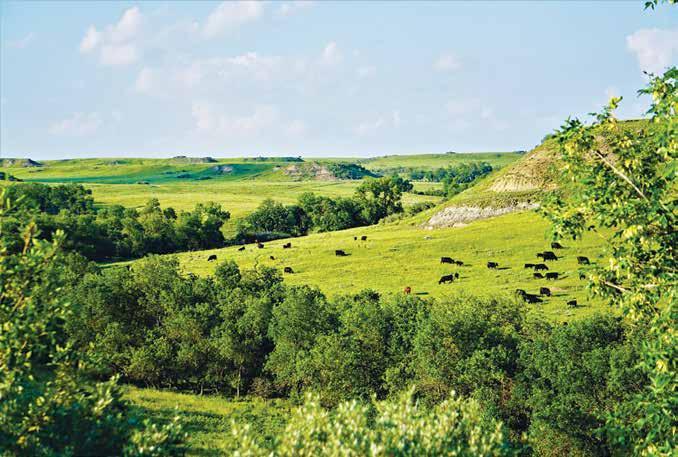
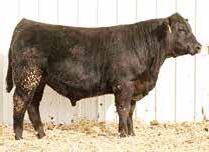
Elm Creek Ranch specializes in function and performance
Elm Creek Ranch (ECR), situated in Hebron, N.D., has proudly remained a family-owned and operated establishment since 1937.
In 1983, ECR established its registered Salers herd under the leadership of Stan Sayler and the dedicated support of his wife Rebecca.
Over the years, Stan and the ECR team – Forman Joe Nelson and South Ranch Manager Clint Baker –
have expanded their efforts to uphold the tradition of raising quality Salers, striving to establish a reputation for integrity and producing functional cattle with exceptional performance.
“We select for the most growth and require structural soundness from easy-natured cattle born early in the breeding cycle,” Sayler stated. “Salers make up
EPA plans to revise WOTUS
On March 12, U.S. Environmental Protection Agency (EPA) Administer Lee Zeldin announced the EPA will work with the U.S. Army Corps of Engineers to deliver on President Donald J. Trump’s promise to review the definition of Waters of the U.S. (WOTUS).
According to the EPA press release, the agencies will move quickly to ensure a revised definition follows the law, reduces red tape, cuts overall permitting costs and lowers the cost of doing business in communities across the country, all while protecting the nation’s navigable waters from pollution.
The recent landmark decision by the U.S. Supreme Court in Sackett vs. EPA presents an appropriate opportunity for the EPA to thoughtfully address this matter.
By doing so, the agency can offer American farmers, landowners, businesses and states clear and simplified guidance moving forward.
“We want clean water for all Americans, supported by clear and consistent rules for all states, farmers and small businesses,” Zeldin states. “The previous administration’s definition of WOTUS placed unfair burdens on the American people and drove up the cost of doing business. Our goal is to protect America’s water resources consistent with the law of the land while empowering American farmers, landowners, entrepreneurs and families to help power the great American comeback.”
“Farmers and ranchers are the best stewards of the land and need water regulations that are clear and practical, not burdensome,” states U.S. Secretary of Agriculture Brooke Rollins in the press release. “Thank you Administrator Zeldin,
On March 18, the U.S. Court of Appeals for the 10th Circuit located in Denver ruled in favor of four out-ofstate elk hunters who were sued for corner crossing to access public land in Carbon County.
A three-judge panel, comprised of David Ebel, Timothy Tymkovich and Nancy Louise Moritz, unanimously upheld a 2023 ruling from Wyoming U.S. District Judge Scott Skavdahl, siding with the hunters.
Court decision
A 49-page decision, written by Tymkovich, concluded the Missouri hunters did not trespass on Iron Bar Holdings LLC ranch property in 2021.
Women in ag history
Women have long played essential roles in the ag industry
Agriculture is one of few industries where women have always played a major role. In fact, research shows women have been involved in the process of growing and harvesting food since nearly 10,000 B.C. Today, women serve in a variety of capacities throughout the industry, with more than 1.2 million female producers scattered across the country. In honor of Women’s History Month, here is a quick look at the role of women in agriculture throughout history.
A look in the past
Often considered “silent contributors,” many sources indicate women have long played an essential role on the farm, undertaking tasks such as bookkeeping, gardening and caring for livestock. At the turn of the 20th century, women began utilizing their social skills and sense of connection to trade goods at local markets. However, as family farms began to dwindle and make the transition into agribusinesses, women took a back seat to men as far as leadership roles were concerned, as they were only
The court ultimately based its decision on a provision of the 1885 Unlawful Inclosures Act (UIA), passed by Congress to “harmonize the rights of private landowners and those accessing public lands.”
The court concluded, based on case law and language in the law, “any inclosure of public lands is prohibited, and no one may completely prevent or obstruct another from peacefully entering or freely passing over or through public lands.”
“The Western checkerboard and UIA reflect a storied period of our history,” Tymkovich writes. “Whatever the UIA’s merits today, it and the case law interpreting it remain good federal law. Applying
Courtesy photo
Rural areas across the country are very concerned about what the future holds for their mail service, and most rural residents have a negative feeling about what is going to happen.
Rural residents have been concerned about their mail delivery for a number of years as they, like everybody else, have seen their postal rates go up twice a year and their service diminish.
For a number of years, the U.S. Postal Service (USPS) has been in financial trouble – in the hole for billions of dollars every year. I think Congress has bailed them out a time or two, but mostly, they have just continued to raise their rates.
I’ve always thought one of the issues USPS had to deal with were the four unions involved. One of the union’s agreements was to always have five-year benefits and retirement funds on hand. This action usually kept USPS in the red.
The USPS seems to have a lot of managers. The Board of Governors of the U.S. Postal Service sets policy, procedure and postal rates for services rendered. Of the 11 members of the board, nine are appointed by the president and confirmed by the Senate.
The nine appointed members then select the postmaster general who oversees day-to-day operations. The Postal Regulatory Commission, an independent agency, is also responsible for oversight of the USPS, including oversight of rates and services, ensuring USPS meets all of its legal requirements.
So it’s safe to say, none of us as customers have much say in management. The same can mostly be said for Congress as well.
Wyoming’s Congressional members have been working with the folks back home to develop changes and stop unwanted actions by the postmaster general and Board of Governors. When we see them in the state of Wyoming, be sure to thank them. They have all been trying hard to clean up the postal mess while keeping quality services.
The funny thing is, the USPS blames Congress for their troubles – give us a break!
Under the “Delivering for America” plan, USPS recently came out with a letter detailing what they want to do. It explained the agency will be “working with the Department of Government Efficiency (DOGE) to improve the USPS. This 10-year strategy will address current mail trends and will work to solve financial challenges. This plan will be split into two phases and will affect first-class mail, periodicals, marketing mail and package services. The first phase will begin on April 1, where 14 percent of first-class mail will be downgraded to a lower standard and July 1 for other changes.”
The postmaster general wants to cut around 10,000 jobs out of the 640,000-man workforce. This latest effort is part of a broader attempt to curb costs, as it deals with calls for privatization and potential restrictions under President Donald J. Trump’s administration.
The outgoing postmaster general wants DOGE to examine the “unfunded mandates imposed on USPS by Congress,” as he calls them. Some of these are delivering mail six days a week and maintaining rural post offices. I believe those are services vital to rural America.
Trump wants to move USPS to the Department of Commerce. I think whatever they do, they need to get rid of the union workforce and top-heavy management boards.
Livestock Roundup (USPS # 005-774) is published weekly by Maverick Press, Inc. P.O. Box 850 • Casper, WY 82602
postage paid in Casper, WY Fax: 307-472-1781 • E-mail: roundup@wylr.net
GUEST OPINIONS
Ag Day 2025: Proven Sustainability
As we celebrate 2025 National Ag Day in Wyoming, certain words are key to understanding Wyoming agricultureʼs – past, present and future – “resilience,” “stability” and “longevity.”
Each of these can be used to describe the history of Wyoming agriculture, the current state of Wyoming agriculture and our vision for the future of Wyoming agriculture.
Agriculture in Wyoming, as we know it today, began in the 1850s with the trailing of cattle into the state to take advantage of abundant grass and water.
In projecting the future of this nascent industry, the Cheyenne Leader stated in 1868, “A future of the greatest importance is in store for the Western plain, no one who has traveled over and lived upon them for any considerable length of time can doubt.”
Four years later, the Wyoming Stock Growers Association (WSGA) was formed by these “cattle barons.”
In 2025, WSGA will celebrate its 153rd anniversary. WSGA and the many
By Jim Magagna
Wyoming farms and ranches honored each year by the Centennial Farm and Ranch Program stand as testimony to the resilience, stability and longevity of the state’s agriculture.
Wyoming agriculture has faced and overcome many challenges throughout its history.
Most recently this has included the concurrent impacts of the COVID-19 pandemic, drought, federal regulatory uncertainty and litigation. Throughout the darkest days of the pandemic, our farmers and ranchers tended their crops and livestock daily.
While they faced the challenges of shortages of supplies and labor, ingenuity and commitment compensated. When our schools were closed to inperson learning, many agricultural families welcomed having their kids at home to help with daily chores.
While consumers felt the impact of empty shelves in the grocery store, these were due to processing and transportation delays, not to any declines in
production at the farm or ranch level. Many consumers found relief in buying directly from the farm or ranch.
Once again, Wyoming agriculture demonstrated its resilience, stability and longevity.
Today sustainability has become the key word driving discussions about agricultural production. These discussions far too often ignore the proven resilience, stability and longevity record of Wyoming agriculture.
Wyoming agriculture remains vibrant today because our agricultural producers embrace each day with a commitment to ensuring sustainability for economic, environmental and animal care. We can be confident this commitment will continue in future generations of our agricultural producers.
National Ag Day 2025 is an opportunity for every citizen to show our appreciation for Wyoming agriculture.
Jim Magagna is the executive vice president of WSGA and can be reached by visiting wysga.org
HANNAH BUGAS, Managing Editor • hannah@wylr.net
MELISSA ANDERSON, Editor • melissa@wylr.net
CANDICE PEDERSON, Production Coordinator • candice@wylr.net
JODY MICHELENA, Advertising Director • jodym@wylr.net
CURT COX, Director of Livestock Field Services • 307-630-4604 • curt@wylr.net
CALLI WILLIAMS, Livestock Field Services Rep. • 605-695-1990 • calli@wylr.net
NEWS BRIEFS
Educational series offered
University of Wyoming (UW) Extension is proud to introduce a new educational series designed to support ranchers in navigating the complexities of modern livestock and land management.
Rancher’$ EDGE – Excellence in Development, Grazing and Economics – will be offered as three unique sessions throughout the year, providing a multi-season perspective on the ranching production cycle.
Each session will feature a mix of classroom instruction and hands-on field activities covering topics such as risk management, marketing strategies, livestock nutrition, ration balancing, body condition scoring and range management.
The sessions will be held in three locations across the state – in Sheridan on April 9-10, in Thermopolis on June 24-25 and in Laramie on Nov. 18-19. Each session will start at 1 p.m. on the first day and conclude at noon the following day.
The cost to attend each session is $250 per person, which includes a packet of materials, snacks and a complimentary dinner with presenters.
For more information or to register, visit wyoextension. org/ranch-management/?page_id=7
ASI plans scrapie discussion
The American Sheep Industry Association (ASI) will host the Scrapie Free in the U.S. – Moving from an Eradication to a Surveillance Program at 8 a.m. on April 9 during the National Institute for Animal Agriculture’s Annual Conference in Kansas City, Mo.
Topics of discussion during the half-day meeting include understanding the transition from an active eradication program to disease surveillance, changes to infrastructure and the industry benefits of being scrapie free.
ASI believes it is important for sheep producers to have a voice in the new framework, in partnership with key animal health officials and other stakeholders.
Discussion and collaboration among these groups will help answer questions about status requirements, producer responsibilities and the future of scrapie-free status.
China renews registrations
Recently, the U.S. pork industry faced concerns over potential disruptions to its access to the Chinese market. However, this situation has markedly improved.
According to a March 18 National Pork Producers Council (NPPC) press release, China has renewed the registrations of all 300-plus U.S. pork harvesting and cold storage facilities eligible to export to China.
As the world’s largest meat market, China remains an important destination for U.S. pork products, especially for offals, which return more value in China than in other markets.
While pork producers are celebrating a win, the U.S. Meat Export Federation pointed out U.S. beef facilities have yet to be notified of registration renewals for licenses which expired March 16.
USDA directs assistance
U.S. Secretary of Agriculture Brooke Rollins announced the U.S. Department of Agriculture (USDA) is issuing up to $10 billion directly to agricultural producers through the Emergency Commodity Assistance Program (ECAP) for the 2024 crop year.
Administered by USDA’s Farm Service Agency (FSA), ECAP will help agricultural producers mitigate the impacts of increased input costs and falling commodity prices. These economic relief payments are based on planted and prevented planted crop acres for eligible commodities for the 2024 crop year.
FSA will begin sending pre-filled applications to producers who submitted acreage reports to FSA for 2024 eligible ECAP commodities soon after the signup period opens on March 19.
Producers must submit ECAP applications to their local FSA county office by Aug. 15.
Visit fsa.usda.gov/ecap to apply using a login.gov account or contact their local FSA office to request an application once the signup period opens.
Lawsuit launched against FWS
Two conservation groups launched a suit against the U.S. Fish and Wildlife Service (FWS) over the “blanket rule,” arguing it disregards science and hinders habitat restoration efforts under the Endangered Species Act (ESA).
The Rocky Mountain Elk Foundation and Property and Environment Research Center (PERC) want the agency to adopt the approach used by the National Marine Fisheries Service (NMFS), which develops tailored regulations to recover threatened species guided by science and the specific needs of each species.
The ESA directs agencies to list species and take steps to recover them, but to do so, the agency is supposed to design science-based regulations tailored to the needs of each species.
Citing administrative convenience, the FWS established the “blanket 4(d) rule” to bypass this process, ignoring science and species-specific considerations.
As a result, the agency’s one-size-fits-all approach has yielded poor species recovery rates.
By comparison, the NMFS tailored strategy has recovered species at twice the rate of FWS’s blanket approach.
“While the blanket rule is certainly easier for bureaucrats to administer, it doesn’t work for species like the gray wolf, Greater sage grouse and Arctic grayling,” said PERC Vice President of Law and Policy Jonathan Wood. “Given the challenges of recovering America’s imperiled wildlife, the ESA needs to be as effective as possible by applying science, harnessing incentives and adapting to real world outcomes.”
Legislation introduced
U.S. Sens. Cynthia Lummis and John Barrasso, alongside Rep. Harriet Hageman (all R-WY), introduced legislation to rename the National Historic Trails Interpretive Center in Casper the “Barbara L. Cubin National Historic Trails Interpretive Center.”
In 1998, Cubin passed her legislation establishing the National Historic Trails Interpretive Center. The center is owned by the Bureau of Land Management (BLM) and is run through a public-private partnership with the BLM, the National Historic Trails Center Foundation and the City of Casper.
Cubin was the first woman elected to Congress from the state of Wyoming and served as a founding member of the Congressional Western Caucus. She represented Wyoming in the U.S. House from 1995 to 2009.
The Wyoming SHEEP Foundation wishes to thank our donors for their generous support of its mission to advance Wyoming’s sheep industry, its public value and storied history, through sheep heritage, education and/or environmental projects (SHEEP).
Bob Innes In Memory of Charleen Von Krosigk
Bob Innes In Memory of Pat Litton
Bob Innes In Memory of Eleanor Hamilton
Amy Hendrickson
The Wyoming SHEEP Foundation is a 501(c)(3) nonprofit organization. Tax-deductible contributions may be made to Wyoming SHEEP Foundation, 811 N. Glenn Road, Casper, WY 82601. For more information, email wySHEEPfoundation@outlook.com.
Funding applications open
Every year, the American Lamb Board (ALB) allocates funds through the Cooperative Funding Program for local sheep producer groups, lamb suppliers and direct marketers to share marketing costs for promoting American lamb. ALB is currently accepting applications until April 30.
Funds will be allocated to applicants for marketing initiatives focused on non-industry audiences and aligning with ALB’s mission to increase awareness and demand for American lamb.
Examples of local programs that could be funded include sharing recipes at local farmers’ markets and other consumer food events; working with an American lamb supplier to get American lamb into a supermarket; developing promotional materials, including packaging, flyers, websites, social media content, videos, etc. for needs not met by ALB resources and other promotional activities, including consumer advertising.
ALB will allocate funds through this program to support efforts by state and local industry groups, American lamb suppliers and direct marketers as the budget permits. The program will continue to support projects where applicants are willing to share costs and contribute additional resources to the funded project.
The deadline for current applications is April 30, and once the application process closes, no additional applications will be reviewed until Oct. 1.
For more information or to fill out an application, visit lambboard.com
FEEDERS
WOTUS
for your leadership on this critical rule. The U.S. Department of Agriculture supports EPA’s revisions to WOTUS which provides certainty and recognizes the key role agriculture plays in protecting our natural resources. We’ll keep pushing for policies that let producers focus on what they do best – feeding, fueling and clothing our nation.”
WOTUS review
The definition of WOTUS plays a crucial role in the implementation of the Clean Water Act (CWA).
It helps clarify the circumstances under which farmers, landowners and businesses may need to secure permits, thereby ensuring projects proceed in an environmentally responsible manner.
“To date, EPA has failed to follow the law and implement the Supreme Court’s
clear holding in the Sackett case,” reads the press release. “It is critical Americans know which waters are subject to federal jurisdiction under the CWA to grow economies and lower costs for American families while protecting human health and the environment.”
The EPA will begin its review by quickly gathering input from stakeholders who were overlooked during the previous administration.
The agency aims to collect targeted information on the main challenges faced by Americans.
Additionally, the agency will initiate a rulemaking process to revise the 2023 definition of WOTUS, focusing on clarity, simplicity and improvements.
While the rulemaking process may be ongoing, the agency will assist states using the pre-2015 definition of WOTUS to ensure compliance with current laws.
WEDNESDAY, MARCH 26, 2025 - FEEDER SPECIAL
Greg & Janette Starck 150 Blk/Bwf few Hereford/Rwf Strs & Hfrs, 650-785#, Weaned 120+ days, Bunk Broke, Been on Alfalfa Hay, Corn Silage, 3# Corn, Branding Shots: Pyramid 5+Presponse, Vision 7 w/Spur, Weaning Shots: Pyramid 5+Presponse, Vision 7 w/Spur, No Implants, Knife Cut, April/May Calves, Clean and Ready to go back to grass Robert Evans 140 Blk Strs & Hfrs, 700-850#, Weaned a long time, Been on Ground Hay and Silage, Branding Shots: Bovi-Shield Gold One Shot, Vision 8 Somnus w/Spur, Weaning Shots: MaxiGuard Noromectin, No Implants Mehling Trust 140 Blk few Red Strs & Hfrs, 600-800#, Weaned on Dec. 15th, Bunk Broke, Been on a Roughage Ration of Hay/Silage, Branding Shots: 7-way, Inforce 3, Shots on Feb. 1: Vision 7 Somnus w/Spur, Bovi-Shield Gold One Shot, Poured w/Clean-up, No Implants, No Feed Additives, Home Raised
R & P Farms/Paul Wangsgard 66 Mostly Hfrs few Strs, 750-800#, Weaned since Nov.. Been on Long Stem Hay, 2 Rounds of Shots: 8-way, 1 Round of Bovi-Shield Gold, Home Raised Harley & Dolores Cushman 57 Hereford few Bwf Strs, 675-775#, Weaned 120+ days, Bunk Broke, Been on Alfalfa Hay, Corn Silage, 3# of Corn, Branding Shots: Pyramid 5+Presponse, Vision 7 w/Spur, Weaning Shots: Pyramid 5+Presponse, Visin 7 w/Spur, No Implants WEANED CALVES
TTT Ranch 765 Mostly Blk few Rd Strs & Hfrs, 450-600#, Weaned since Nov., Been on Alfalfa/Grass Hay, SafeGuard Blocks, Branding Shots: Vista Once SQ, Vision 7 w/Somnus, Nasalgen, Pre-cond. Shots: Vista Once SQ, Vision 7 w/Somnus, Nasalgen, Booster Shots: Cydectin Injectable, No Implants, Knife Cut Forshee Land & Livestock 90 Blk/Rd Strs, 550#, Weaned a long time, Been on a Light Grower Ration, Complete Vac. Program,May/June Calves Paul & Nancy Landeck 71 Hereford few Rwf/Bwf Hfrs, 560-700#, Weaned a long time, Running out, Hay Fed, Complete Vac. Program, off grass Bennet Creek Cattle Co. 56 Blk Strs & Hfrs, 500-600#, Weaned since Oct., Hay Fed and Lick Tubs, Complete Vac. Program, I-Site, Booster Shots: Nasalgen 3 PMH, Poured w/Clean-up, Home Raised, Producer All Natural, Sired by Reg. Red Angus Bulls, Heifers are Bangs Vac. Hollis Givens 30 Blk/Bwf Hfrs, 500-600#, Weaned since October, Running out on Pasture supplemented with Alfalfa/Grass Hay Mix, Free Choice Trace Mineral, 2 Rounds of Shots: Vista Once, 7-way, Poured w/Clean-up, Poured with Clean-up again in February, Bangs Vac., Replacement Quality, Electric Fence Broke Cattle Country Video – 1 pm MT Lot 340 Lazy A One LLC (Mike, Bonnie & Clancy Anderson) 90 Weaned Steer Calves. 90% Blk; 10% Bwf. Base Wt: 650 lbs. Wt Stop: 685 lbs. Slide: .16 cents. Origin: Purchased from WY. Located: 25 miles NW of Mitchell, NE. Delivery: 3/28/25 to 3/31/25. Feed: 50% ground hay, 30% silage, 12% beet pulp, 7% corn, 1% balancer pellets. Frame: Med; Flesh: Med; Wt Var: Uneven. First Round Shots: Nasalgen 3 PMH, Vista BVD, SomuShield, Micro B, Multimin & Poured with Dectomax. Second Round Shots: Vista 5, Vision 7/Somnus, Vita and Poured w/ Ivermectin on 3/14. Weigh: Early am gather, sort as we load on buyer’s pre-weighed truck, haul approx. 25 miles to Mitchell, NE or Torrington, WY, weigh w/a 2% on truck. Comments: Purchased in large groups from Torrington Livestock Markets. Wintered to gain 1.5 lbs per day. Handled right and nice kind. Rep: Tam Staman 308-631-8513. Indian Creek Cattle 86 Steers. 100% Blk/Bwf. Base Wt: 695 lbs. Wt Stop: 730 lbs. 2-way Slide: .14 cents. Origin: Home Raised. Located: 10 miles N of Mitchell, NE. Feed: On light grower ration to gain 1.75 to 2 lbs/day. Spring Shots: Ultrabac 7 & Inforce 3. Fall Shots: Ultrabac 7 & BoviShield Gold One Shot. No Implants. Comments: Test weighed. Excellent for Grass. Rep: Richard Zweifel 605-209-6307. Indian Creek Cattle 225 Heifers. 100% Blk/Bwf. Base Wt: 660 lbs. Wt Stop: 695 lbs. 2-way Slide: .14 cents. Origin: Home Raised. Located: 10 miles N of Mitchell, NE. Feed: On light grower ration to gain
iShield
www.cattlecountryvideo.com
FRIDAY, MARCH 28, 2025 - ALL
SALE RESULTS -FEEDER/CALF SPECIAL WEDNESDAY, MARCH 19 - 1616 HD Indian Meadows 87 Black Steer 601 371.50 $2,232.72 Hester Farms Inc 109 Black Steer 718
A key priority for the Trump administration will be to collaborate with state partners, empowering them and local officials to safeguard their important water bodies while also promoting economic opportunities.
This approach will ensure decisions are made efficiently and effectively, leveraging local knowledge and expertise.
“EPA’s review will be guided by the Supreme Court’s decision in Sackett vs. EPA, which stated the CWA’s use of ‘waters’ encompasses only those relatively permanent, standing or continuously flowing bodies of water forming streams, oceans, rivers and lakes,” the press release states. “The Sackett decision also clarified wetlands would only be covered when having a continuous surface connection to waterbodies that are WOTUS in their own right.”
Industry response
National Cattlemen’s Beef Association’s (NCBA) Chief Counsel Mary-Thomas Hart issued the following statement on March 12 in response to the EPA’s release of guidance for implementing the “continuous surface connection” definition under WOTUS.
“For years, NCBA has worked across the federal government – educating members of Congress, participating in agency rulemakings and fighting for cattle producers in federal court – to secure a WOTUS definition which protects both our nation’s natural resources and Americans’ property rights,” states Thomas Hart. “We are proud of the Trump administration’s effort to further conform the WOTUS
definition to the Supreme Court’s decision in Sackett vs. EPA. Today’s guidance is an important step toward refocusing the CWA to its original purpose. NCBA thanks Administrator Zeldin for his work to finally close a decadeslong chapter of severe regulatory whiplash.”
American Farm Bureau Federation (AFBF) President Zippy Duvall also provided a comment on March 12, regarding the EPA’s announcement to begin efforts to clarify how it will implement the WOTUS rule to comply with the U.S. Supreme Court’s ruling in Sackett vs. EPA
“AFBF appreciates the EPA for taking a step toward providing clarity in how farmers and ranchers should comply with the WOTUS rule,” Duvall states. “The Supreme Court clearly ruled, almost two years ago, the government overreached in its interpretation of what waters fell under federal jurisdiction, but inaction and vague implementation guidelines by EPA led to permitting delays, litigation and uncertainty.”
Duvall concludes, “I’m pleased Zeldin has listened to the concerns of farmers and is making strides toward getting rid of the guesswork. The foundation he laid today is the first step toward creating clear WOTUS implementation guidelines, which will help farmers protect the environment while ensuring they can grow the food America’s families rely on.”
Melissa Anderson is the editor of the Wyoming Livestock Roundup. Send comments on this article to roundup@wylr.net.
CLASSES
Smith - Lusk, WY
Chris Williams - Greybull, WY 307-272-4567***Hunter Dockery - Lusk, WY
Nolan Brott - Lusk, WY 307-216-0033 ***Ben Kukowski - Kaycee, WY 307-217-1472*** Scott Redden - Burns, Co 970-596-3588
the foundation of our cow herd for legendary maternal traits, including trouble-free calving, longevity and survivability.”
According to Stan, two thirds of ECR male calves are marketed in the fall as feeder steers, which is beneficial for breeding a uniform set of calves that will perform for the feeder calf buyer, and leaves ECR seedstock customers choosing from the best one-third of the bull crop.
Breeding for success
“ECR artificially inseminates our cows during the first heat cycle, runs them with the bulls for the following two cycles and has been able to achieve a 98 percent success rate with live calves,” Stan explained.
Equipped with all of the necessary tools for success, calving begins at the end of January, and essential nutrients are supplied through baleage and dry hay harvested during the summer.
According to ECR, to enhance disease immunity, there is a comprehensive vaccination protocol in place and calves receive vaccinations at birth, followed by a modified live vaccine and an eight-way booster in the spring and fall.
During the summer, calves grow on a mix of diverse native and tame pastures without any creep feed.
After weaning, bulls that qualify for breeding stock are fed a high roughage diet to promote strong muscle
development suitable for their future roles.
"They have access to high-quality feed from the Glen Ullin Mill and free choise loose hay and baleage," Stan stated.
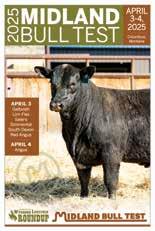
A uniform group of fertile and sound cattle with exceptional growth and comprehensive performance records can be found at the Northern Exposure Sale, held each spring at the ranch, and at the Midland Bull Test and Sale in Columbus, Mont. Midland Bull Test awards
ECR sets a high standard for performance and recordkeeping and has achieved the title of champion in the Midland Bull Test (MBT) Index, which evaluates three key metrics – weight per day of age, average daily gain and overall efficiency –over 10 times.
“ECR has been attending the Midland Bull Test and Sale for about 38 years,” Stan added. “For eight consecutive years, ECR has been recognized as the American Salers Association’s Performance Breeder of the Year, awarded for having the most comprehensive records among over 50 head.”
This year at Midland Bull Test, ECR celebrated success in the Salers spring bull category with multi-
ple bulls, including ECR 4294M of 97J, sired by Tehama Patriarch F028, and ECR 4105M of 17F, sired by TSB Jumbo 53J. Tehama Patriarch F028 has above-average foot and claw traits and a good heifer pregnancy rate.
TSB Jumbo sires offspring with above-average growth and averageto slightly above-average docility and has a good foot angle and claw structure.
TSB Jumbo sires a straighter hair coat with above-average birth weights and larger frames.
Last year, at the 10th Annual Northern Exposure Sale, ECR offered up to 40 bulls, where the average bull sold for $5,919.
ECR bulls will be sold at
the Midland Bull Test Sale on April 3 and at the ranch this April.
Melissa Anderson is the
editor of the Wyoming Livestock Roundup. Send comments on this article to roundup@wylr.net.
Lot 4167
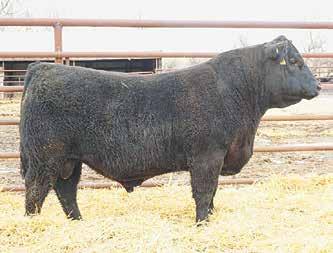
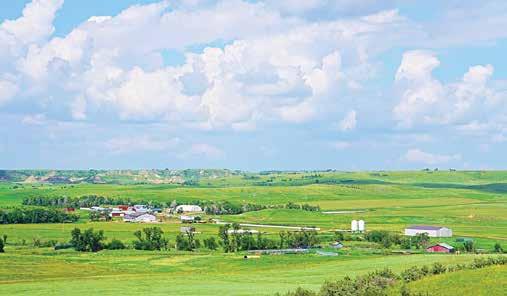
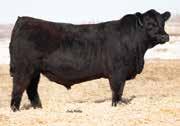
Family heritage – Elm Creek Ranch has proudly remained a family-owned operation since 1937, expanding their operation over the years. Courtesy photo
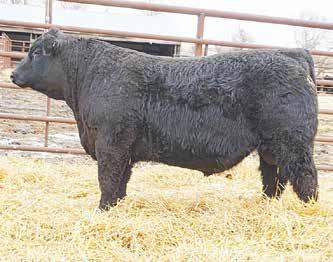
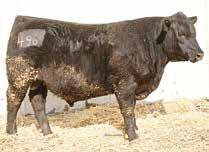
Breeding traits – Elm Creek Ranch breeds for structural soundness and easy-natured cattle. Courtesy photo
Top honors – For eight consecutive years, Elm Creek Ranch has been recognized as the American Salers Association’s Performance Breeder of the Year. Courtesy photo
The Wyoming State Geological Survey (WSGS) has released the latest update to the interactive oil and gas map of Wyoming. The underlying datasets of wells, fields, hydrocarbon facilities and development areas have also been made available as a digital data release.
The interactive online map was initially published in 2016 and is modeled after the WSGS’s tra-
WSGS expands interactive map
ditional oil and gas maps of Wyoming.
This update marks the seventh iteration of the online map and includes more than 450 new wells in named oil and gas fields and more than 1,650 new and historical wildcat wells.
Digital well data and oil and gas production data provided by the Wyoming Oil and Gas Conservation Commission (WOGCC) were cross-referenced against
historical documentation to verify well locations, productivity and status.
The interactive oil and gas map of Wyoming has historically been one of the WSGS’s most popular products and is widely used by industry geoscientists, contractors, private citizens and government stakeholders.
The web-based interactive platform includes oil and gas fields, produc-
ing reservoirs, vertical and horizontal wells, pipelines, oil refineries, gas plants and well production status.
The interactive map and data download can both be accessed from the main WSGS website. WOGCC well data and WSGS-generated oil and gas infrastructure data can also be downloaded directly, either in full or within user defined boundaries.
and 2 Year
Butch 308-430-4223 Adam 308-430-3742 Jake 308-430-5878
82 Highland Road ~ Crawford, NE email: ajsellman@bbc.net
Angus Sires:
• Basin Jameson 1076, 20071781
• Connealy Craftsman, 20132505
• Virginia Tech Statesman, 20085208
• Yon Saluda, 20336998
• Mr Crossfire 6P01, 18538274 Hereford Sires:
• Guardian, 44257548
• Generator, 44196588
this law here, Fred Eshelman’s landholding company cannot implement a program which has the effect of ‘denying access to federal public lands for lawful purposes.’”
In 2023, Skavdahl ruled the law prohibits private landowners from preventing others from corner crossing in the checkerboard area of Wyoming, as long as they do not step on to private property.
Tynkovich adds, “So, the district court was correct to hold the hunters could corner cross as long as they did not physically touch Iron Bar’s land.”
Moving forward
However, under the 10th circuit’s jurisdiction, this decision legalizes corner crossing between sections of federal land in six states including Colorado, Kansas, New Mexico, Oklahoma, Utah and Wyoming.
The case has implications not only for the 2.4 million acres of “cornerlocked” land in Wyoming, but also for 8.3 million acres across the West.
The practice of corner crossing involves navigating the intersection point where two corners of public land parcels meet, enabling hunters, anglers and other outdoor enthusiasts to access otherwise isolated sections of public land.
The recent federal court decision carries significant implications, as it may help clarify the legality of corner crossing.
State Rep. Karlee Provenza (D-H45) told Cowboy State Daily in a March 18 article by Mark Heinz, if the Wyoming Legislature were to consider banning corner crossing, federal law would prevent such a prohibition.
However, the case could also still be appealed to the U.S. Supreme Court, but unlike circuit court appeals, the Supreme Court is not required to hear the appeal, according to the U.S. Department of Justice.
Provenza shares she can see this as a possibility, but is confident the Supreme Court would uphold the 10th Circuit Court’s decision.
Supporters of corner crossing argue sometimes it is the only way for the public to access vast areas of federal land in Wyoming and other locations otherwise inaccessible.
On the other hand, opponents contend this practice infringes on private airspace, disrupts landowners’ enjoyment of their property and can lead to a decrease in property values.
Melissa Anderson is the editor of the Wyoming Livestock Roundup. Send comments on this article to roundup@wylr.net.
Hanford, Calif.
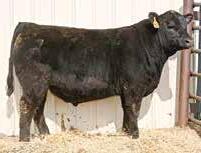
Lot 66 – Sitz Leverage 700M – Price: $52,500 DOB: 1/19/24 Sire: Raven Republic 1564 Dam’s Sire: Sitz Upward 307R EPDs: BW: -0.1, WW: +72, YW: +130 and Milk: +27 Buyer: Clear Creek Angus, Chinook, Mont.
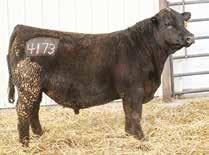
Lot 51 – Sitz Pilot 514M – Price: $37,500 DOB: 2/9/24 Sire: Bear Mtn Pilot 1520 Dam’s Sire: Connealy National 390C EPDs: BW: -1, WW: +81, YW: +140 and Milk: +37 Buyer: Split Diamond Ranch, Whitehall, Mont.
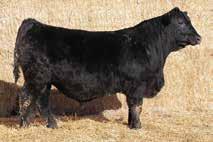
Lot 12 – Sitz Dignity 685M – Price: $36,000 DOB: 1/120/24 Sire: Sitz Dignity 599J Dam’s Sire: BUBS Southern Charm AA31 EPDs: BW: -2.7, WW: +70, YW: +124 and Milk: +26 Buyer: John Buchholz, Durbin, N.D.
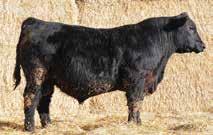
Lot 84 – Sitz Unity 468M – Price: $30,000 DOB: 2/19/24 Sire: Connealy Commerce Dam’s Sire: Sitz Resilient 10208 EPDs: BW: +1.5, WW: +90, YW: +153 and Milk: +29 Buyer: Stan Smith, Lehi, Utah
Lot 86 – Sitz Commerce 638M – Price: $30,000
DOB: 1/25/24 Sire: Connealy Commerce Dam’s Sire: Sitz Upward 307R EPDs: BW: +1.5, WW: +69, YW: +127 and Milk: +34 Buyer: Taylor Wakley, Deeth, Nev.
allowed to assist with marketing campaigns and educational programs.
But this all changed when World War I broke out, and men were called away from home.
At this time, women proved themselves highly capable and successful at keeping the American ag industry alive, and when World War II broke out 21 years after the first one ended in 1918, they proved themselves again.
In fact, by the end of World War II, U.S. food production had grown by 32 percent over pre-war levels, according to U.S. Department of Agriculture (USDA) data.
Remarkable women in history
While all women have been essential in shaping the industry, a few in particular stick out for their remarkable contributions.
Maria Sibylla Merian, a German entomologist who lived from 1614 to 1717 before entomology was a thing, was fascinated by insects and spent her time sketching her observations of their movements and lifecycles. She later published a two-volume book on the metamorphosis of the caterpillar titled “The Wonderful Transformation of Caterpillars.”
Harriet Williams Russell Strong was a widowed mother who, to make ends meet, became a widely celebrated inventor, agricultural entrepreneur, civic leader, philanthropist and advocate of women’s rights and higher education.
To save her land and family from debt, Strong pioneered new methods of water conservation and dryland irrigation to water her walnut, olive and pomegranate crops; created several inventions and patents and raised pampas grass to sell as plumes for extra cash.
Dr. Mary Engle Pennington, known as the “Ice Woman of the Cold Chain” revolutionized the food supply and distribution system by developing safe and sanitary methods for processing, storing and shipping dairy products, poultry eggs and fish.
A chemist and engineer who helped design and evaluate transportation methods to reduce bacteria counts in refrigerated and frozen foods, Pennington served on former President Herbert Hoover’s Food and Drug Administration and USDA. Alice Evans, nicknamed “the Pioneer of Safe Milk,” made significant contributions to the dairy industry with her research of diseases caused by raw milk.
Evans’ research focused on two specific strains of zoonotic bacteria found in raw milk. Due to her work, a new genus of bacteria – brucellosis – was named, which ultimately led to mandatory milk pasteurization.
Dr. Evangelina Villegas was a cereal chemist and researcher from Mexico who collaborated with Dr. Surinder Vasal, a renowned plant breeder, to develop a new variety of maize with increased levels of lysine and tryptophan.
In today’s day and age, Dr. Temple Grandin is a well-known name in the ag industry.
Temple’s life experience with autism influenced her work with animal behavior, leading to well-documented observation of handling and facility design on farms, ranches and slaughter plants. Her work has also led to the development of the Double Rail Restrainer Conveyor for Livestock Handling, a scoring system to assess animal welfare and curved-corral design to reduce animal stress.
Current stats
Today, women make up approximately 40 percent of the global farming workforce, according to Ag America, and data from USDA shows women account for 36 percent of America’s producers.
The 2022 Census of Agriculture shows more
than one-half of all farms –56 percent – have a female producer, while nine percent of U.S. farms are entirely run by women, a number that has tripled over the past 40-plus years.
The census also found beef cattle operations had the highest number of female principal producers, and female-operated farms accounted for 38 percent of U.S. agricultural sales and 43 percent of U.S. farmland.
In 2019, the American Farm Bureau Women’s Leadership Committee launched a survey specifically for women involved in the ag industry. Over 3,000 women from 49 states, Puerto Rico and the District of Columbia responded to the survey.
The survey found women are now involved
in every aspect of agriculture and have found growing success in establishing a huge variety of side businesses and revenue streams.
Women have also become more active in advocacy roles, with 95 percent of respondents indicating they frequently advocate for the industry and 92 percent noting they believe they possess the skills and knowledge to be
effective advocates. Additionally, many women in the industry have pushed for sustainable agriculture, often more focused on factors like the environment, health, food, nutrition and connection to the community.
Hannah Bugas is the managing editor of the Wyoming Livestock Roundup. Send comments on this article to roundup@wylr.net.
U.S. capital celebrates nation’s hardworking farmers and ranchers
On March 18, individuals from all walks of life gathered in Washington, D.C. to commemorate National Ag Day, a celebration of the abundance provided by agriculture, as well as the hardworking farm-
ers and ranchers who work around the clock, 365 days a year to provide one of the most efficient, safe, bountiful and high-quality food supplies in the world.
Conducted by the Agriculture Council of Amer-
ica and held on the U.S. Department of Agriculture’s (USDA) Whitten Patio in Washington, D.C., the National Ag Day program kicked off bright and early with Ag Day at USDA, featuring guest speakers U.S.
Austin Snook • 307-290-2161
Taylor Snook • 307-290-2273
Craig Deveraux • 307-746-5690
Dan Catlin • 406-671-7715
Clint Snook • 307-290-4000
Cheyenne Seymour • 605-641-0638
Secretary of Agriculture
Brooke Rollins, USDA Deputy Undersecretary of Farm Production and Conservation Brooke Appleton, American Farm Bureau Federation President Zippy Duvall and a panel of young agriculturists.
Kyle Kallhoff • 605-881-1526
Casey Sellers • 307-217-2614
Jim Forbes • 307-351-5932
Tye Curuchet • 307-351-8666
Daniel Escoz • 307-217-1440
Kade Kinghorn • 307-620-0525
Auctioneer: Curt Westland • 605-210-3329 Office • 307-684-0789 • Spring - Summer Sale Schedule • March
March 19, 2025 - No Sale
Thank
To view the consignment lists visit our website:
"From the ring, to the video, and in the country, we market your livestock the competitive way." www.buffalolivestockwyo.com
Praising producers Rollins addressed the crowd first, noting agriculture isn’t just about livestock and land, but the resilient people who keep the industry going.
“Today, on National Agriculture Day, we recognize the people who make it all possible – the farmers, ranchers and producers who dedicate their lives to feeding, fueling and clothing our nation,” she said. “Agriculture isn’t just an industry, it is a way of life, and every day, through challenges and triumphs, the men and women in agriculture show up. They adapt, they solve problems and they push forward, ensuring future generations can continue this proud tradition.”
“So today, let’s not just celebrate agriculture, let’s celebrate the people behind it,” she continued. “To every farmer, every rancher and every producer, we see you, we appreciate you and we thank you. Happy National Ag Day.”
of every American, but our farmers and ranchers do. Today’s ceremony allows us an important opportunity to formally reflect on the necessity of American agriculture for the prosperity of our country.”
She continued, “Agriculture isn’t just an industry, it’s a way of life, a cornerstone of our economy, part of the fabric of our daily lives and is essential to our national security, and the people behind it are some of the hardest working and most resilient individuals out there.”
“We know this past year has been tough, we know there have been challenges – from rising input costs to uncertainty in global markets – but one thing is certain, American producers always rise to the occasion, and USDA is here to support you every step of the way,” Appleton concluded.
Duvall also offered some comments, noting this year’s theme of “Together We Grow” is perfect for American agriculture’s current situation.
C SPEAR ANGUS
Additionally, Rollins highlighted the proclamation made by President Donald J. Trump in honor of National Ag Day, which underscored the essential role of American agriculture in the nation’s economy and way of life.
Trump stated, “From the earliest days of our Republic, our farmers and agricultural communities have been the source of American success, enduring the elements and defying hard conditions to cultivate our land and feed the people. Farming is indelibly engrained in our history, customs and culture and stands to this day as the bedrock of our economy and way of life.”
He said, “U.S. producers don’t just grow the nation’s food, fuel and fiber, they also grow innovation, technology, research and development to move their operations forward, to preserve natural resources and to create a sustainable environment. They grow in understanding by sitting down at the table to have conversations, and they grow communities, especially in rural America, where most men and women serve in local government and on various other boards.”
Celebrating the future
This year’s program also celebrated the future of agriculture by recognizing the 2025 National Ag Day video essay winners and hosting a panel of student leaders representing 4-H FFA and Agriculture Future of America.
“For centuries, American farmers and ranchers have been the lifeblood of the American economy. Today and every day, we extend our unending gratitude to the dedicated men and women in farming communities who embody the timeless virtues of hard work and self-reliance,” added Trump. “As we continue our new chapter of American prosperity, we commit to embolden the heroes of our agricultural community who work tirelessly with their unwavering American pride to nourish our nation, feed our families and fuel our way of life.”
Of the 150 video essays submitted by ninth through 12th grade students across the nation, three were honored at the National Ag Day celebration. The contest’s theme was “Why Food Security Equals National Security,” and prizes included $1,500 for first place, $1,000 for second place and $500 for third place.
Growing together
The program continued with comments from Appleton.
“For me and my team here at USDA, I would argue every day is National Ag Day,” she said. “Very few of us work in professions or pursuits that touch the lives
The 2025 first-place winner was Tuongvy Nguyen of Saint Petersburg, Fla., followed by Kristen Dallas from Las Vegas in second and Isabella Newell of Waltonville, Ill. in third.
Hannah Bugas is the managing editor of the Wyoming Livestock Roundup. Send comments on this article to roundup@wylr.net.
With a busy spring schedule ahead, 11 regions of collegiate athletes are focused on balancing rodeo season and their academic commitments, as the 2025 College National Finals Rodeo (CNFR) is fast approaching.
This year, the CNFR will take place in Casper on June 15-21. With half of the season still to go, teams are preparing for their best performances after spending the winter finetuning their skills.
As some regions have already begun their seasons, others will wait until later in the year, but at the end of the spring season, the top three contestants in the standings for each event in each region will secure their spots at the CNFR, competing for a national title.
Men’s team standings
As of March 17, the men’s team of Mid-Plains Community College of North Platte, Neb., the largest region covering five states, sits in the number one spot with 4,857 points, followed by the men’s team of New Mexico State University of Las Cruces, N.M. in second place with 4,742 points.
The Missouri Valley College men’s team of Marshall, Mo., with 4,265.5 points, is currently in third, while the men’s team of Idaho State University of Pocatello, Idaho is in fourth place with 4,040 points.
Rounding out the top five men’s teams with 3,995 points is Bismarck State College of Bismarck, N.D.
Currently, the University
of Wyoming (UW) men’s team is in 10th place, while the men’s team of Casper College (CC) sits in the 18th position.
UW’s rodeo teams opened the spring season on March 14-16 at Gillette College in Gillette.
UW stretched their overall Central Rocky Mountain Region (CRMR) lead over CC by accumulating 640 points.
Central Wyoming College of Riverton took second to the UW team with 395 points, while the CC Thunderbirds placed third with 365 points.
According to a March 17, UW News article, UW Head Coach Seth Glause states, “I’m very proud of the way our teams showed up to compete. They showed they were prepared and ready to have a strong spring season.”
Women’s team standings In the women’s team division, as of March 17, Lassen College of Susanville, Calif. holds on to first place with 2,658.5 points, while Gillette College follows with 2,598.33 points.
The women’s team from Blue Mountain Community College of Pendleton, Ore. holds on to third place with 2,450.5 points.
Rounding out the women’s rodeo teams in fourth place is Cochise College of Sierra Vista, Ariz. with 2,194.33 points, and in fifth place is the women’s team from Treasure Valley Community College of Ontario, Ore.
During UW’s first rodeo event of the year, the Cow-
girls were impressive by stopping season-long leader Gillette College’s momentum and scoring 520 points.
“It’s always great to get team wins,” Glause says. “We are going to enjoy this and come back in two weeks to do it again in Torrington for the next CRMR event.”
Cowboys to watch UW’s Bodie Mattson from Sturgis, S.D. delivered an impressive all-around performance at the opening spring rodeo.
Alongside his teammate Troupe Coors from Loveland, Colo., Mattson won both the short go and the overall team roping average.
In tie-down roping, he finished third in both rounds, securing third place in the overall average as well.
Other team scores were contributed by a trio of steer wrestlers. Rhett Witt from Valentine, Neb. finished as the runner-up, while Rio Nutter from Rapid City, S.D. placed fourth. Jacob Wang
from Baker, Mont. secured a sixth-place finish after winning the short go.
Nutter also earned team roping points alongside Heeler Coy Johnson from Gillette.
In the saddle bronc riding average, Dixon Tattrie from Youngstown, Alberta, Canada placed fourth, and Greybull’s Colton Farrow tied for sixth place in the bareback riding average.
Several individuals from UW who were not part of the six-man points team also achieved notable placements during the weekend competition.
Stefan Tonita from Saskatoon, Saskatchewan, Canada secured the runner-up position in bull riding, and David and Sam Gallagher from Brighton, Colo. finished third and fifth in steer wrestling.
Additionally, Sam teamed up with Heeler Trevor Sorge from Gillette College to place sixth in team roping.
Cowgirls to watch
The UW Cowgirls also had an outstanding performance at the first rodeo of the spring season, highlighted by Landry Haugen from Rapid City, S.D., who earned the title of all-around champion by placing in all three women’s events.
She won the breakaway roping, finished fourth in goat tying and took fifth in barrel racing.
Teammate Riata Day from Fleming, Colo. excelled in goat tying, sweeping both rounds of competition to secure the average title.
Josie Mousel from Colman, S.D. finished sixth in the goat tying average, while Rayne Grant from Wheatland secured sixth place in the barrel racing average.
Several individuals from UW who were not part of the four-member women’s points team also made impressive placements during the weekend competition.
Makenzi Scott from
Rock Springs was the runner-up in barrel racing, while Molly Rotenberger from Ludlow, S.D., the reserve all-around champion, placed fourth in barrel racing and was second in the goat tying average.
Teammate Emme Norsworthy from Thermopolis finished one place behind Rotenberger, and in breakaway roping, Jordyn McNamee from Buffalo placed fourth, while Hadley Furnival from Casper took sixth.
CRMR teams now turn their focus to the next college rodeo, scheduled for March 28-30 in Torrington at Eastern Wyoming College. Keep an eye out for CNFR updates in the Wyoming Livestock Roundup as the season continues, leading up to the final go in Casper this June.
Melissa Anderson is the editor of the Wyoming Livestock Roundup. Send comments on this article to roundup@wylr.net.
Industry leaders and producers from across the country came together to discuss the future of the pork industry, network with colleagues and shape the direction of the National Pork Board (NPB) and National Pork Producers Council (NPPC) at the 2025 National Pork Industry Forum, held in Orlando, Fla. from March 12-14.
Pork producers and industry stakeholders agree increasing demand should be the industry’s primary focus. Every survey and discussion have led to the same conclusion – boosting demand for pork is essential for long-term success.
In light of this, the NPB invested significantly in 2025 to grow pork demand by launching a new con-
The three-day event provided a platform for the NPB to unveil its new pork campaign and confirmed NPB’s and NPPC’s commitment to continued growth and innovation within the industry.
sumer campaign.
“This initiative isn’t just a campaign, it’s a transformational shift and a commitment to ensuring pork remains relevant and desirable in the marketplace,” reports the Pork Checkoff webpage. “NPB has spent the last 25 years focusing on the export strategy and how pork is positioned globally, but with the new segmentation research and consumer insights, it’s time to focus on domestic demand for pork.”
New campaign
During the forum, NPB unveiled the new tagline for its pork campaign, “Taste What Pork Can Do,” aimed at younger consumers in an effort to highlight the versatility of pork in various dishes.
The pork industry has not had a recognizable campaign since the tagline “Pork. The Other White Meat.” was established decades ago.
pork producers – they know about the product but want someone else to eat it.
“We already know what it tastes like, and we don’t need a tagline to eat it. We have to draw the attention of millions of people who have not experienced raising pigs or being in agriculture,” he adds.
thoroughly tested by professionals. It’s not for me – I’m going to eat my 55 pounds, regardless of what the tagline says. I’m probably not going to change my eating habits, but they may.”
According to a March 13, Farm Pork Journal article by Jennifer Shike, Illinois Pork Producers Association Executive Director and NPB Member of the Marketing Advisory Committee Jennifer Tirey mentions the new campaign is different and places a focus beyond the pork producer, who already loves the product.
“This is where I feel like we havenʼt hit the home run in the past. A lot of outside perspective was brought in, which is important to play at the level we’re hoping to play. Producers can have confidence this campaign is being built around what consumers say they want about pork,” she states.
Following her sentiment, fellow NPB Marketing Advisory Committee Member and Iowa Pork Producer Rob Brenneman reiterates the tagline isn’t meant for
Dr. Gordon Spronk, NPB member of the Marketing Advisory Committee and Pipestone, Minn. veterinarian, announces he is happy with the final tagline, as it utilizes the hard work, research and data NPB gathered to promote pork in the future.
This pork campaign will look different than past campaigns for a couple of reasons, Spronk mentions.
“It’s not going to be about billboards, it’s going to be about swipes, clicks and screens that pop up,” he says.
Pork research
Through consumer research, NPB knows more than ever before, and they are positioning pork to be a part of consumers’ everyday experience.
While conducting consumer segment research, NPB asked individuals who are not prime pork consumers how they feel about pork.
“NPB has a long effort in collecting data from those who are actually eating pork. We know consumption for Gen Zʼers and Millennials is much lower than Baby Boomers. We need to speak to them,” Spronk states. “This tagline has been
According to a 2023 study, younger Americans eat less pork compared to other generations, reporting per capita pork consumption for Gen Z is 5.8 pounds.
The study also reports, per capita consumption of pork decreases between Baby Boomers at 30.4 pounds and Gen X at 21.3 pounds. For Millennials, this is a significant drop to 13.8 pounds.
“A lot of the messaging and promotional campaign items they’re working on are going to be targeted to what consumers said,” Tirey adds. “It’s not going to be geared toward the traditional pork producer who loves making a great pork chop on the grill. It’s going to be about the consumer who doesn’t have as much knowledge about pork products and how they can start adding it in to their daily menus.”
She further notes the pork industry lacks the marketing budget to reach everyone, so making strategic efforts is essential when using consumer segmentation data as a guide to “fish where the fish are.”
Melissa Anderson is the editor of the Wyoming Livestock Roundup. Send comments on this article to roundup@wylr.net.
Joliet, Mont.
Yearlings
Lot 91 – Pine Coulee Glacier M307 – Price: $20,000 DOB: 1/1/24 Sire: Coleman Glacier 041 Dam’s Sire: S A V Resource 1441 EPDs: BW: +1.3, WW: +70, YW: +129 and Milk: +28 Buyer: Mitch Schoelerman, Mobridge, S.D.
Lot 90 – Pine Coulee Glacier 2M – Price: $16,500 DOB: 11/26/23 Sire: Coleman Glacier 041 Dam’s Sire: Sinclair Fortunate Son EPDs: BW: +0.2, WW: +59, YW: +108 and Milk: +24 Buyer: Mitch Schoelerman, Mobridge, S.D.
Lot 46 – Pine Coulee Crockett M352 – Price: $16,000 DOB: 1/5/24 Sire: Pine Coulee Frontier H572 Dam’s Sire: Eathington Sub-Zero EPDs: BW: +0.3, WW: +64, YW: +108 and Milk: +25 Buyer: Cross W Livestock, Ekalaka, Mont.
Lot 151 – Pine Coulee Rush M430 – Price: $16,000 DOB: 12/26/23 Sire: Ellingson Rush 0177 Dam’s Sire: Pine Coulee Hannibal H316 EPDs: BW: -2.3, WW: +66, YW: +125 and Milk: +32 Buyer: Flatland Acres Angus, Shreve, Ohio
OBITUARIES
Richard Lee Davis
Oct. 1, 1929 – March 15, 2025
Richard Lee Davis, age 95, of Gillette passed away on March 15 at the Legacy Living and Rehabilitation Center.
Richard was born Oct. 1, 1929 in Gillette to C.H. “Cliff” and Elma (Knoy) Davis. Richard and his siblings Norma (Schiermiester) and Wayne spent most of their youth on the family ranch located 50 miles north of Gillette on Elk Creek Road.
Richard attended Campbell County High School and played sports before graduating in 1947.
Immediately following State Basketball Tournament in March 1948, he joined the U.S. Navy and served
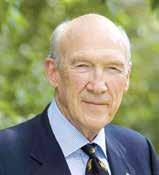
U.S. Sen. Alan K. Simpson
Sept. 2, 1931 – March 14, 2025
Former U.S. Sen. Alan K. Simpson of Cody will lie in honor at the Wyoming Capitol from 9 a.m. to 8 p.m. on March 27 and 7 a.m. to 2 p.m. on March 28. A celebration of life in Laramie will be held at the Arena Auditorium on the University of Wyoming campus in Laramie at 11 a.m. on March 29.
In Cody, services will be held on March 31 at 10 a.m.
Because of the restrictive size of Simpson’s church, the venue is open for invited guests only. The community is welcome to gather for a livestream of the services at the Coe Auditorium in the Buffalo Bill Center of the West.
The family will move to the Buffalo Bill Center of the West after the services for a public reception from 12-3 p.m.
The Cody and Laramie events will be broadcast live on TV and can be streamed online via Wyoming PBS. Simpsons family extends their deepest gratitude for everyone’s expressions of sympathy.
SALE REPORTS
Reported By: Curt Cox, WYLR Field Editor March 11, 2025
Loosli Red Angus, Ashton, Idaho Auctioneers: Kyle Colyer and Cotton Booker 106 Yearling Red Angus Bulls Avg. $6,583 62 Yearling Red Angus Heifers Avg. $2,404
Top Sellers
Bulls
three years. Upon discharge, he returned to Gillette and worked on the family ranch.
In April 1953, he married Dorothy Jean Hines. They spent their lives ranching 35 miles south of Gillette on the Iberlin Road, raising sheep and cattle.
Richard served on several county boards. He was a long-time active member of the Wyoming Wool Growers Association and the Wyoming Stock Growers Asso-
ciation. He was appointed to the Wyoming Livestock Board and served as chairman. He was a past director of the First National Bank of Gillette.
Richard and Dorothy Jean were avid University of Wyoming (UW) sport fans, having season football tickets for 40-plus years. They spent many winters on the Big Island of Hawaii, where Richard worked part-time for Hertz Car Rental.
Richard is preceded in death by his parents and sister Norma Schiermiester.
He is survived by his wife Dorothy Jean, son Tom (Renee), daughter Nancy (Ed) Mayer, five grandchildren, four great-grandchildren, many nieces and nephews and his brother Wayne.
A memorial service will be held on March 22 at 1 p.m. at Gillette Memorial Chapel with Pastor Marty Crump officiating. Inurn-
ment will follow at Mt. Pisgah Cemetery. In lieu of flowers, please make a donation to American Legion Post 42 of Gillette or the UW College of Agriculture’s sheep programs. Memorials and condolences may be sent in care of Gillette Memorial Chapel, 210 West 5th Street, Gillette, WY 82716 or expressed online at gillettememorialchapel.com/
Lot 127 – Miss Loosli Collusion 4301 – Price: $2,850 DOB: 1/15/24 Sire: C-Bar Fortune 263J Dam’s Sire: Brown CSB Triad 208 EPDs: BW: -2, WW: +70, YW: +116 and Milk: +26 Buyer: Dalton Cattle, Richfield, Idaho 51st Annual Loosli Bull Sale
CALENDAR
EVENTS
March 24 University of Nebraska-Lincoln Calculating Annual Cow Costs Webinar, 6:30-8 p.m., Zoom. For more information, contact Aaron Berger at aberger2@ unl.edu or 308-235-3122. To register, visit go.unl.edu/cow_costs
March 25 Wyoming Livestock Board Public Meeting, 8:30 a.m., Thyra Thomson Buidling, Casper. For more information, visit wlsb.wy.us
March 27 University of Nebraska-Lincoln Calculating Annual Cow Costs Webinar, 6:30-8 p.m., Zoom. For more information, contact Aaron Berger at aberger2@ unl.edu or 308-235-3122. To register, visit go.unl.edu/cow_costs
March 27-30 Regenerative Ranching School, Powderhorn Ranch, Douglas. For more information and to register, call 307-298-5461 or visit powederhornranchwy.com
March 28 University of Wyoming Extension Private Pesticide Applicator Program, 12-4 p.m., Teton County Weed and Pest Office, Jackson. For more information or to RSVP, contact Makayla Getz at mgetz@uwyo.edu or 307-754-8837.
March 29 Living on a Few Acres Workshop, 9 a.m.-3 p.m., Cody Auditorium, Cody. For more information or to register, e-mail shannon.darrough@usda.gov or call 307-271-3125.
March 29 University of Wyoming Extension Caring for Caregivers Retreat, 9 a.m.3:15 p.m., First Baptist Church, Basin. For more information or to register, e-mail mcook12@uwyo.edu or call 307-568-4160.
March 31 University of Nebraska-Lincoln Calculating Annual Cow Costs Webinar 6:30-8 p.m., Zoom. For more information, contact Aaron Berger at aberger2@ unl.edu or 308-235-3122. To register, visit go.unl.edu/cow_costs
April 3 University of Wyoming 2025 Ranching in the West Wyoming AgVentures: Exploring Agriculture, Agritourism and Ranch Life Seminar, 5-7 p.m., Yellowstone Building, Northwest College, Powell. For more information or to register, contact Dr. Randall Violett at rviolett@uwyo.edu or 307-766-4239.
April 5 2025 Ram Test Field Day, Laramie Research and Extension Center, Laramie. For more information, e-mail kkoepke@uwyo.edu or dlaverell@uwyo.edu.
April 7 University of Wyoming 2025 Ranching in the West Ranching Stewardship at High Elevations: Opportunities and Challenges Seminar, 5-7 p.m., Laramie Research and Extension Center, Laramie. For more information or to register, contact Dr. Randall Violett at rviolett@uwyo.edu or 307-766-4239.
April 9 American Sheep Industry Association Scrapie Free in the U.S. – Moving from an Eradication to a Surveillance Program, Kansas City, Mo. For more information or to register, visit animalagriculture.app.neoncrm.com/np/clients/ animalagriculture/event.jsp?event=706
April 9 2025 Yonts Water Conference, Panhandle Research, Extension and Education Center, Scottsbluff, Neb. Further information will be released at a later date.
April 9-10 University of Wyoming Extension Rancher’$ EDGE Program, 1 p.m., Sheridan. For more information or to register, visit wyoextension.org/ranchmanagement/?page_id=7
April 22 University of Wyoming Extension Private Pesticide Applicator Program 9 a.m.-12 p.m., Midvale Fire Hall, Pavilion. For more information or to RSVP, contact the Lander Extension Office at 307-3322363 or rfisk@uwyo.edu.
March 23-24
March 25
March 26
March 26
March 27
SALES
Leachman Cattle Spring Bull and Female Sale, Meriden, 970-568-3983, leachman.com
Northwest WY Angus Association 47th Annual Sale, Riverton Livestock Auction, Riverton, 307-868-2595
NJW Polled Herefords Bull Sale, NJW south ranch, Sheridan, 307-7518289, 307-751-9470, njwherefords.com
McCumber Angus Ranch Annual Bull Sale, at the ranch, Rolette, N.D., 701871-1072, 701-871-9800, mccumberangus.com
Gartner~Denowh Angus Ranch 58th Annual Production Sale, at the ranch, Sidney, Mont., 406-489-0172, 406-480-2761, 406-489-1762, gdar-angus.com
March 27 Gibbs Red Angus Annual Production Sale, Glasgow Stockyards, Glasgow, Mont., 406-977-2852, gibbsredangus.com
March 27
March 27
March 27
March 28
Schuler Red Angus 43rd Annual Bull Sale, at the ranch, Bridgeport, Neb., 308-262-0306, schulerredangus.com
Vermilion Ranch Spring Performance Sale, heifer sale at 12 p.m., South Pryor Development Center, Billings, Mont., 406-670-0078, 406-672-5844, vermilionangus.com
Fourth Annual Online Embryo Sale, at 5:30 p.m., PAYS, Billings, Mont., and online at northernlivestockvideo.com, 406-670-0078, 406-672-5844, vermilionangus.com
Vermilion Ranch Spring Performance Bull Sale, PAYS, Billings, Mont., 406670-0078, 406-672-5844, vermilionangus.com
March 28 Lisco & M Diamond 33rd Annual Angus Bull Sale, M Diamond Ranch, Glenrock, 307-359-0167, 307-359-1162, liscomdiamond.com mdiamondangus. com liscoangus.com
March 28
March 29
March 31
Mills Cattle Company Annual Production Sale, St. Onge Livestock, St. Onge, S.D., 307-756-2030, millscattle.com
Ochsner Limousin Pasture to Plate Performance Sale, live auction, Kersey, Colo, 970-396-5525, 970-222-1984, ochsnercattle.com
Snowshoe Cattle Company Annual Bull Sale, at the ranch, Arthur, Neb., 406-647-5233, snowshoecattle.com
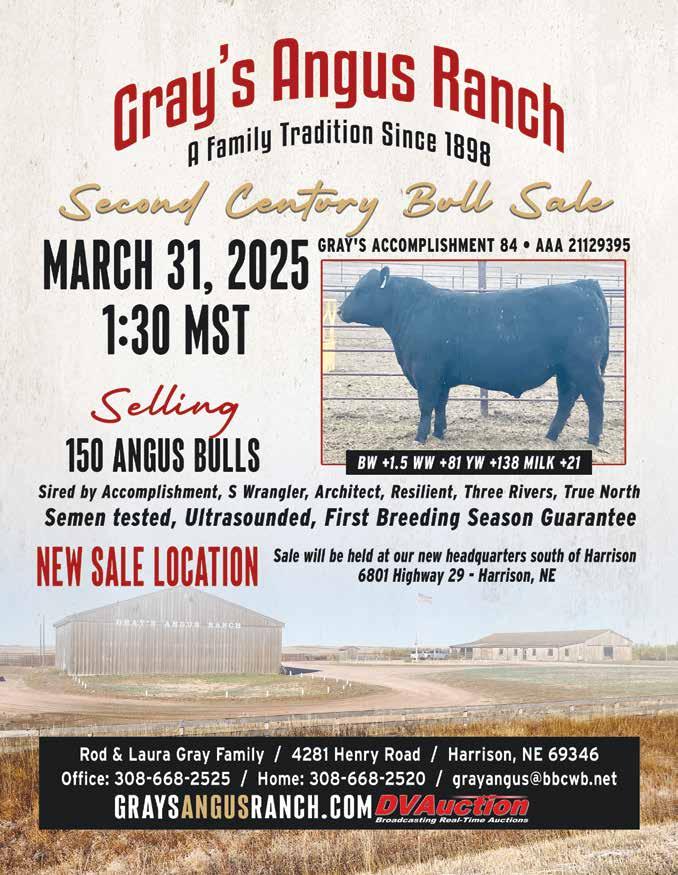
March 31 Gray’s Angus Ranch Second Century Performance Bull Sale, at the ranch, Harrison, Neb., 308-668-2525, 308-668-2520, graysangusranch.com
March 31
March 31
April 1
Sidwell Ranch and Frank Herefords Ninth Annual Production Sale Sidwell Barn, Columbus, Mont., 406-861-4426, 307-631-6012, sidwell-land. com, frankherefords.com
Axtell Cattle Company Annual Production Sale, Sterling Livestock Commission, Sterling, Colo., 970-383-2332, 970-554-1132, axtellcattlecompany.com
Webo Angus Annual Turning Grass into Greenbacks Bull Sale, at the ranch, Lusk, 307-216-0090, 307-340-1182, 307-340-1499, weboangus.com
POSTCARD from the Past
Compiled by Dick Perue rrichardperue@gmail.com
New Road to Brush Creek
The following was reported in the Grand Encampment Herald on Jan. 13, 1905: Petitions to the Board of County Commissioners are again being circulated, asking the board to construct a county road from Encampment to Brush Creek.
The main object of this move is to place the Butler Bridge over the Platte River into the hands of the board, eliminating the toll feature which now prevails.
The Butler Bridge was built by popular subscription, to which the Encampment merchants liberally contributed. It seems ex-commissioner Maxfield fought against the making of a county road between Brush Creek and Encampment, as the scheme directly interfered with the interests of his
constituents at Saratoga.
While it is fact such a road would be of special advantages to Encampment merchants, it must be remembered it would be as great an advantage to Brush Creek ranchmen and to ranchmen in this section of the North Platte Valley.
If a Brush Creek ranchman drives to Saratoga, he has a good day’s trip before him, for it is a 40-mile round trip from the Bennett Post Office. He can never make the trip in a day if he has any great amount of business to transact. If he takes his wife along and remains overnight, he spends several dollars in feed and hotel bills.
There is a reason then why the Brush Creek ranchman prefers to come to Encampment. He can hitch up and bring the
whole family, do his trading, gossip with his friends and be home in good season in the afternoon.
The ranchmen of Brush Creek and the people of Encampment are deserving of a county road between the two objective points, and it will not be Commissioner Smith’s fault if they do not get it. However, the Brush Creek people must not expect too much in the way of “damages.”
The following was reported in the Grand Encampment Herald on May 26, 1905: Right-of-way over bridge
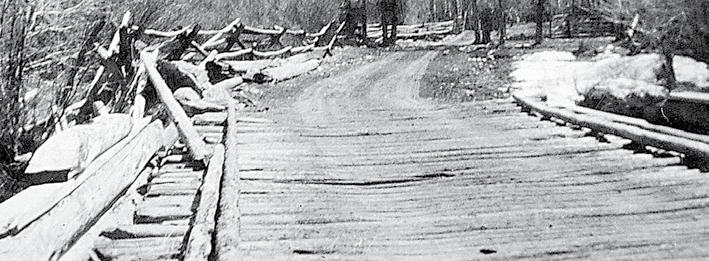
The board of county commissioners, through T.R. Smith, the member of the board from this end of the district, has secured right-of-way for a county road through W.H. Butler’s ranch for one and one-half miles, including the toll bridge.
Mr. Butler, for a consideration of $2,200, gives the right-of-way and agrees to re-plank the bridge with threeinch planks and to build bridges over Beaver Creek and Summers’ ditch. The settlement of the Butler Bridge question is very satisfactory all around.
Pictured is a portion of the Butler Bridge which needed replanting in 1905. The bridge washed
Source:
AMS Livestock, Poultry & Grain Market News, Greeley, CO National Sheep Summary As of March 14, 2025 Compared to last week slaughter lambs steady to as much as 40.00 lower. Slaughter ewes mostly steady to 20.00 lower. Feeder lambs 9.00 higher. At San Angelo, TX 9,740 head sold in a two day sale. No sales in Equity Cooperative Auction. 2,117 lamb carcasses sold with no comparison due to confidentiality. All sheep sold per hundred weight (CWT) unless otherwise specified. Slaughter Lambs: Choice and Prime 2-3 San Angelo: wooled and shorn 115-165 lbs 154.00-198.00. Ft. Collins: wooled and shorn 152 lbs 175.00. South Dakota: wooled and shorn 120-150 lbs 188.00-220.00; 150-165 lbs 177.00-187.00.
Billings: wooled and shorn 120-130 lbs 189.00-208.00. Equity Coop: no sales.
Slaughter Lambs: Choice and Prime 1-2 San Angelo: hair 40-60 lbs 326.00-354.00; 60-70 lbs 324.00346.00; 70-80 lbs 282.00-338.00; 80-90 lbs 270.00-308.00, few 322.00; 90-110 lbs 242.00-293.00. wooled and shorn 80 lbs 272.00; 98 lbs 256.00.
San Angelo: Good 3-4 (very fleshy) hair 1000.00-112.00; Good 2-3 (fleshy) 128.00-154.00, hair 120.00-150.00; Utility and Good 1-3 (medium flesh) 160.00, hair 128.00-154.00; Utility 1-2 (thin) hair 108.00-148.00; Cull and Utility 1-2 (very thin) hair 98.00-116.00; Cull 1 60.00. Ft. Collins: Good 3-4 (very fleshy) 85.00-112.50; Good 2-3 (fleshy) 85.00-120.00.
South Dakota: Good 3-4 (very fleshy) 70.00-110.00; Good 2-3 (fleshy) 80.00-115.00; Utility 1-2 (thin) 70.00-115.00, hair 65.00; Cull 1 20.00-90.00.
Billings: Good 3-4 (very fleshy) 99.00-104.00; Good 2-3 (fleshy) 97.00-112.00, hair 102.00-117.00: Utility 1-2 (thin) 100.00-113.00, hair 115.00-123.00; Cull 1 72.50. Feeder Lambs: Medium and Large 1-2
San Angelo: hair 30-40 lbs 344.00-350.00; 40-50 lbs 336.00370.00; 50-60 lbs 334.00-346.00. Ft. Collins: 39 lbs 277.50; 40-50 lbs 277.50-280.00. South Dakota: 39 lbs 415.00; 40-50 lbs 395.00-410.00; 65 lbs 303.00; 83 lbs 290.00; 99 lbs 208.00; 100-110 lbs 210.00232.00. hair 48 lbs 251.00; 73 lbs 234.00. Billings: 87 lbs 214.00; 95 lbs 208.00; 109 lbs 203.00; 120130 lbs 192.00-195.00; 130-135 lbs 190.00-193.00. Equity Coop: no sales. Replacement Ewes: Medium and Large 1-2 San Angelo: yearling
young hair 95-125 lbs 164.00-180.00/cwt; hair ewes and lambs 114.00/head. Ft. Collins: no test.
South Dakota: bred yearlings 260.00/head; bred middle age 250.00-270.00/head.
Billings: ewe lambs 104 lbs 217.00/cwt.
Sheep and lamb slaughter under federal inspection for the week to date totaled 38,000 compared to 39,000 last week and 44,000 last year.
Source: USDA AMS LPG Market News, San Angelo, Texas
National Wool Review
As of March 14, 2025
Domestic wool trading had no confirmed trades reported this week. Prices reflect trades FOB warehouse in original bag or square pack, bellies out, some graded, and 76 mm or longer. No allowance made for coring, freight, or handling fees at the warehouse level to reflect net grower prices. Wools shorter than 75 mm
discounted .10-.20 clean. Classed and skirted wools usually trade at a .10-.20
to original bag prices. Australian Wool Exchange Clean Del
CO
Wyoming Hay Summary
As of March 20, 2025
Movement is about the same since the last report, producers are saying they are seeing an uptick in demand this week and are hoping that it continues to trend up. Most hay that is moving is moving in small loads, but producers are saying they are seeing more hay on the road and less hay stacks this past week throughout the entire state. High quality horse hay that’s in two string bales seems to be moving more this past week. There hasn’t been a lot of dairy hay move this winter and some producers are saying they still have some high testing hay to sell. According to the U.S. Drought Monitor Website, Northeastern Wyoming is under Moderate to severe soil moisture, Southeastern Wyoming is mostly under extreme dry soil moisture, Northwestern Wyoming is moderate to severe dry with a small patch of extreme drought, Southwestern Wyoming is under abnormally dry soil moisture. According to the National Weather Service Website, precipitation was far below average for this time of year all over the state. Temperatures have been normal for this time of year. According to the NRCS Weekly Snow Report, Yellowstone is 95%-108% of median, Bighorn and Tongue is 103% of median, Powder and Belle Fourche is 82%-83% of median, Cheyenne range is 66% of median, Lower North Platte is 88% of median, Wind and Upper Green range is 108%-113% of median, Upper Bear and Lower Green is 109%-112% of median, Little Snake is 98% of median, Upper North Platte and Sweetwater is 101%-108% of median, Laramie is 98% of median, South Platte is 49% of median. According to the Wyoming Crop Progress Report, as of February 2025, hay and roughage supplies were rated at 73% adequate in the state. Pasture and range is 29% good condition and 41% fair condition, winter wheat is 10% good condition and 49% fair condition, all Livestock is 73% good condition.
Compared to last week bales of alfalfa and grass hay sold steady. Ground and delivered hay steady to 5.00 lower. Dehy alfalfa pellets steady. Buyer inquires picked up this week in several areas of the state. Especially, from cow/calf producers. The overall dryness is in the back of many minds and some feel like the
and
Rain changing to snow in some areas of the state. Many areas of grass land did not receive any moisture in the fast pace, windy last day of winter snowstorm. A lot of people east of York do not have power and some talks in might be a week before all get services. Little over a week away from April, hopefully spring rains will come to green up pastures and to aid in the growth of grasses and alfalfa for production.
Purina Animal Nutrition, along with the Land O’Lakes Foundation, has reopened its annual scholarship program designed to assist students with experi-
ence in livestock production and animal stewardship in pursuing their passions and furthering their education.
Undergraduate students and current high
school seniors who have experience raising and caring for small or large livestock, equine and/or poultry are eligible to apply for a $5,000 scholarship.
Four students will be awarded based on applications illustrating the impact animal agriculture has had on their lives, along with details on academic
Develop Your Rancher’$ EDGE
The University of Wyoming Extension is proud to introduce Rancher’$ EDGE (Excellence in Development, Grazing, and Economics) — a multiseason learning experience that gives ranchers the tools they need to improve their operations. Each session combines classroom learning with handson activities, ensuring you gain both knowledge and real-world skills.
Topics will include:
Risk management – Learn how to handle unpredictable markets and weather.
Livestock nutrition & ration balancing – Improve herd health and efficiency.
Marketing strategies – Develop a plan to maximize profits.
Grazing management – Optimize your land for long-term success.
achievements, leadership skills, community involvement and a clear vision for their future.
Scholarship applications will be accepted March 18 through April 17, and awardees will be notified in June.
Funds will be distributed for the 2025 fall semester at their current or anticipated educational institution.
The scholarship is open to all high school seniors who plan to enroll in full-
time undergraduate study at an accredited two- or four-year college, university or vocational-technical school for the entire upcoming academic semester/term and undergraduate students enrolled in an accredited two- or four-year college, university or vocationaltechnical school.
To learn more about and apply to the Purina Animal Nutrition Scholarship, visit purinamills.com/scholarship
Governor commends HB0199
Gov. Mark Gordon commended State Senate President Bo Biteman (R-S21) for his leadership in advancing House Bill (HB) 0199, The Steamboat Legacy Scholarship Act, which expands educational opportunities for Wyoming preschool through 12th grade students.
At a media gathering, the governor lauded the landmark piece of legislation as being responsive to the priorities of Wyoming families while maintaining fiscal accountability.
“I applaud Biteman for his leadership and tenacity in advancing two key conservative priorities, making Wyoming the first state in the nation to implement a pre-kindergarten voucher program to empower parents with more choices for young learners,” said Gordon. “This act also expands education savings accounts for kindergarten through 12th grade students to give families greater flexibility to choose the best educational path for their children.”
The governor also praised the bill’s accountability measures and its funding structure. He noted it was amended to be funded through the General Fund rather than the School Foundation Account and called it “a bold step towards strengthening the state’s future.”
Gordon underscored the importance of collaboration between legislative leaders and the Governor’s Office in delivering meaningful policies which benefit Wyoming families.
Who should attend?
This program is for ranchers, family members, and employees actively involved in the management and care of a ranching operation. This is an opportunity to network with other ranchers and industry professionals.
Dates and Locations:
• Sheridan: April 9-10, 2025
• Thermopolis: June 24-25, 2025
• Laramie: November 18-19, 2025
Space is Limited! Sign Up Today!
Registration is $250 per person for each session, which includes materials, snacks, and dinner with presenters. Participants cover their own lodging and travel. For more information
forecasts another increase in 2025.
“Income from cash receipts, cash farm-related income, government payments and cash production expenses are forecast to have decreased slightly in 2024 but will increase by about 19 percent, or $31 billion, in 2025,” she stated.
Litkowski further explained net farm income is a more comprehensive measure of income, including non-cash items such as economic depreciation, and accounts for changes in farm inventories. According to USDA, net farm income has decreased by about eight percent in 2024 and is forecast to fall another 26 percent in 2025.
She went on to describe some of the drivers behind this forecasted increase.
“If we start with crop cash receipts, they are forecast to decrease about $5.6 billion. Now for the net farm income measure, we make an adjustment for crop inventories, and we expect less will be sold from crop inventories in 2025 than 2024,” she said.
“When we combine cash receipts with this inventory adjustment, we get a measure of the value of production in a given year. Combined, the value of production is forecast to increase slightly for crops, by about $4.4 billion. For animals and animal product receipts, the value of cash proceeds are forecast to increase $3.8 billion, which would contribute to higher income in 2025,” she continued.
But, Litkowski said, she “left the biggest for last” – government payments, which are forecast to increase $33 billion.
“When we add it all up, this is a $41 billion nominal increase in net farm income or almost 30 percent, although most of the expected increase in 2024 is coming from government payments,” she reiterated.
Cash receipts
Next, Litkowski discussed cash receipts, which are the largest source of
income for producers.
In inflation-adjusted dollars, total cash receipts reached an all-time high in 2022, following increases in both receipts for crops and animal products, according to USDA. However, Litkowski said, they are expected to see a total decline in 2025.
“Specifically, we forecast they fell about two percent in 2024 and will fall another three percent in 2025, which would put total cash receipts at their lowest level since 2020,” she said.
For crop cash receipts, USDA forecasts a decline of 11 percent in 2024 and another decline of five percent in 2025, putting total crop receipts at their lowest since 2019. For animals and animal products, the agency predicts an increase of nearly six percent in 2024, which will likely hold steady throughout 2025.
Specifically, corn and soybean cash receipts are forecast to decline through 2025, driving most of the projected decrease in cash crop receipts.
“Because combined corn and soybeans account for about one-half of total crop receipts, corn specifically is forecast to fall about seven percent, or $4 billion, in 2025, while soybeans are forecast to fall $4 billion as well – about 9.5 percent,” Litkowski said.
“For both of these commodities, this would be the third year of declining receipts,” she added. “On the other hand, receipts for vegetables and melons are forecast to increase, as are cotton receipts.”
For animal-related receipts, USDA noted an increase in 2024, but the outlook for 2025 shows cattle cash receipts declining almost three percent in 2025 – the first actual decline since 2020, according to Litkowski.
Litkowski also noted egg receipts are forecast to decline four percent, while dairy, broiler and hog receipts are all forecast to increase throughout 2025.
Government payments
Litkowski reiterated the
CROSSWORD
majority of the increase seen in farm income is due to direct government payments – payments made directly to farmers, with no intermediaries, through the federal government and usually from farm programs or ad hoc disaster assistance programs.
In inflation-adjusted dollars, total direct government payments reached a record high in 2020, largely due to COVID-19 related assistance. Litkowski said government payments have declined each year since, but are forecast to increase in 2025, with most of this increase coming in as supplemental and ad hoc disaster assistance, most of which was appropriated in the American Relief Act of 2025.
“Then we have payments that are a function of commodity prices, like agricultural risk coverage and price loss coverage programs,” she said. “They are forecast to increase in 2025, as are conservation payments. But, in total, governmental payments are forecast at $42 billion in 2025, which would be an increase of $33 billion with inflation adjusted.”
USDA also reports data on net farm income excluding federal payments to farmers, which are forecast to remain relatively stable across 2024-25.
“They are forecast to increase about $5.2 billion, so even without these federal payments, other sources of net income would be slightly higher in 2025 and, primarily, this increase is coming from lower government payments expected in 2025,” she said. Input costs
Additionally, Litkowski noted production expenses increased every year from 2019-23, with the most notable increase occurring in 2022.
“In 2024, we are forecasting production expenses fell about four percent as prices for production inputs –or some of them – started to decline in 2024. In 2025, we project they will fall another one percent – or three percent when adjusted for inflation,” she said.
Of the items, USDA predicts will require lower spending, feed is at the top of the list, and feed expenses are forecast to continue to decline through 2025 after reaching a record high in 2022.
Litkowski said they are now forecast to see a 10 percent decline, which would be the largest percentage and dollar decline among these items, but there is also an expected decline for interest, fertilizer, pesticide, fuel and oil.
However, Litkowski admitted not all production
expenses are expected to fall in 2025.
She noted spending on labor and livestock and poultry purchases, which are expected to continue increasing in 2025, would reach record highs even after adjusting prior years for inflation.
“Specifically, labor is forecast to increase about four percent and livestock and poultry purchases by about seven percent,” she said. “Also, there is an expected increase in spending on seeds, taxes and fees and net rent.”
Debt
To wrap up her presentation, Litkowski made some comments on the current state of debt in the agriculture industry.
She noted farm equity, or asset-less debt, has increased every year since 2019 and is projected to continuing increasing another three percent in 2024, then another two percent in 2025. This is largely due to increases in farm real estate assets, which include the value of farmland and buildings, accounting for about 80 percent of all farm sector assets.
Furthermore, Litkowski pointed out debt has trended upward since 1994, but is forecast to increase about two percent in 2024 and another one percent in 2025.
“Solvency ratios can be an indicator of the farm sector’s ability to repay financial liabilities through the sale of assets,” Litkowski explained. “These have generally been improving since 2021, which is shown by declining values.”
USDA expects these ratios to improve slightly through 2025, remaining above the 10-year average.
“We can also try to look at aggregate rates in the farm sector by looking at liquidity and bankruptcy rates, which have been declining since 2020, and in 2023, they reached their lowest value in 20 years,” she said.
However, USDA projects these will increase in 2024.
“Service ratios indicate how much production income farmers are having to use in order to make payments on debt, and this ratio has been increasing in 202324, indicating reduced liquidity and that they are having to spend more of their production income on making debt payments,” she concluded. “But it is forecast to fall in 2025, largely reflecting expectations for lower interest expenses.”
Hannah Bugas is the managing editor of the Wyoming Livestock Roundup. Send comments on this article to roundup@wylr.net.
Wyoming Livestock Roundup Crosswords, created by Myles Mellor.
Gordon vetoes bill
In a public ceremony which included members of state, county and municipal law enforcement, Gov. Mark Gordon signed a letter vetoing Senate File (SF) 0196, Second Amendment Protection Act-amendments, calling the bill “overkill” which would punish first responders and threaten the cooperative work between Wyoming law enforcement officers and their federal partners.
“This act takes aim at –and potentially vilifies – law enforcement if, in the process of working to apprehend, prosecute and detain illegal aliens, drug mules, human traffickers, abusers and other miscreants, they
cooperate with the federal government and a gun is involved. Wyoming can do better,” Gordon wrote. He also exercised his line-item veto authority on SF0169, Strategic investments and projects accountrepeal, and left in place $10 million for the siting, design, construction and operation of a new State Shooting Complex. However, he questioned the inclusion of the shooting complex by usurping the supplemental budget process, while the legislature chose not to fund other capital construction projects, including a new Veteran’s home.
In his letter vetoing portions of SF0169, he says he has always supported simplicity in budgeting, but the repeal of the strategic investments and projects account (SIPA) removes the ability of the governor to use investment income which should be available to any governor in recommending a budget.
Gordon also vetoed Section Four, which would have terminated the Wyoming State Penitentiary Account, a subaccount of the SIPA.
The preservation of the account will enable the Department of Corrections to fund integrated security improvements.
Utah develops new treatment
In Utah’s arid landscape, cattle producers face a critical challenge – deficiencies in essential trace minerals like copper, zinc, manganese and selenium, which are vital for cattle health.
These mineral deficiencies, worsened by drought and environmental conditions, lead to severe health problems, including increased mortality and illness among affected livestock.
Dr. Kara ThorntonKurth of Utah State University, supported by a
Western Sustainable Agriculture Research and Education (SARE) grant, led a project to compare how various mineral supplementation practices impact deficiencies, feedlot performance and response to vaccinations.
Findings revealed targeted, feed-based mineral supplementation improved cattle health and carcass quality while being more cost effective than injectable supplements.
As a result, the project is enabling producers to make more informed
and cost-effective decisions regarding mineral supplementation practices to enhance the economic sustainability and production efficiency of their production systems.
“A couple of producers had gotten calves from areas that were mineral deficient. Some of them had up to 50 percent death loss and wanted to know what they could have done differently to change this in the future,” says Thorton-Kurth For more information on this project, visit sare. org/sare-impacts-sw18-058
PAVILLION
1 Bull, 2030# $156.50 HEIFERETTES
RIVERTON
2 Heiferette, 855# $236.00 STEERS
TEN SLEEP
6 Steer, 426# $419.00
CROWHEART
2 Steer, 392#
1 Cow, 1145#
4 Cow, 1521#
7 Cow, 1381#
2 Cow, 1352# $140.50
SHOSHONI
5 Cow, 1615# $139.50
1 Cow, 1330# $138.50
1 Cow, 1270# $136.00 RIVERTON
1 Cow, 1180# $134.00
2 Cow, 1265# $133.50
1 Cow, 1345# $132.50
RIVER
3 Cow, 1103# $131.50
3 Cow, 1311# $131.00 BULLS
1 Bull, 1085# $202.00 RIVERTON
FORT WASHAKIE
Heifer, 643#
$407.50
6 Steer, 526# $404.00 RAWLINS
2 Steer, 485# $400.00
3 Steer, 533# $398.00
TEN SLEEP
53 Steer, 541# $394.00
THERMOPOLIS
6 Steer, 525# $389.50
LANDER
5 Steer, 492# $385.00
FORT WASHAKIE
7 Steer, 585# $374.50
LANDER
78 Steer, 581# $363.50
THERMOPOLIS
611#
Steer, 628#
Steer, 641#
778#
766#
798# $284.00
Steer, 780#
5 Steer, 908# $264.00
Steer, 937# $257.50
1165#
Heifer, 510#
Ang) PAP Tested, Semen tested, out of ABS AI Sires. Calving ease bulls! For more information call
TUESDAY, MARCH 25 BULLS
ALL CATTLE CLASSES W/ SHEEP & HORSES 47th ANNUAL NORTHWEST ANGUS BULL SALE @ (1 PM) • START TIME 9:30 AM W/ SHEEP & WEIGH UPS
Northwest Angus Association- 51 Black Angus Yearling Bulls - Obsidian Angus, Hoggs Angus, Davidson Angus, Lazy BV, JOH Ranch & WYO Angus. Bulls are BVD, Semen & PAP tested. (1:00 PM) Contact Fred & Kay Thomas 307868-2595 or any Breeder to request a catalog or more information fkdramsrus@gmx.com. BREDS Vickery Ranch- 30 Bred Heifers (23 Black & 7 Red). Bred to LBW Blk Ang bulls for 45 days(pulled bulls). Rec Virashield 6 VL5, 8 way & 2 rounds of Scourbos. One brand. High elevation. Ready for calving!
TUESDAY, APRIL 8
Spayed Hfrs 650-675#. Received Pyramid 5 W/Presponse, 7 way & poured 3-12. Light grow ration, conditioned for grass. 100% spayed! Choice yearling Hfrs!! Ty Jamerman- 80 Blk Ang/AngX Spayed Hfrs 650675#. Received Pyramid 5 W/Presponse, 7 way & poured 3-12. Light grow ration, conditioned for grass. 100% spayed! Choice yearling Hfrs!! Evans Ranch- 70 Blk Ang & AngX Strs & Hfrs 575650#. Rec Vista Once SQ & 7 way @ branding & weaning(11-1). Sired by Oschner Blk Ang bulls. High elevation & fancy!!