The Weekly News Source for Ranchers, Farmers and the Agribusiness Community
Legislative session continues on at rapid pace
Cheyenne – With crossover on Feb. 26, the Wyoming Legislature is moving forward with only a fraction of the nearly 400 bills offered during the 2024 Budget Session of the 67th
Quick Bits
Snow Report
In the 10th snow report for Water Year 2024, the state’s snowpack telemetry data reads 88% of median, with a basin high of 106% and a basin low of 42%.
Last year, the state was at 108% and at 87% in 2022. The report and a map displaying basin snow water equivalent percentages of median for the state may be found at wrds.uwyo.edu/ wrds/nrcs/nrcs.htm
Energy Funds
U.S. Department of Agriculture (USDA) Rural Development is inviting grant applications from organizations to provide hands-on assistance to agricultural producers applying for Rural Energy for America Program funding, which will lower energy costs and make energy efficiency improvements in rural areas. Applications must be submitted by March 15. For additional information and submission details, see page 12,815 of the Feb. 20 Federal Register
Crop Prices
Corn prices fell two to three cents per bushel overnight, dropping nearby March 2024 contracts to $4.16 per bushel – the lowest price for the nearby contract since November 2020. May 2024 prices dipped to $4.29 per bushel, while December 2024 new crop prices dropped to $4.60 per bushel. Soybean prices fell six to eight cents per bushel overnight, dropping nearby March 2024 contracts to $11.72 per bushel, while May 2024 prices fell to $11.75 per bushel and new crop November 2024 futures dipped to $11.51 per bushel. Wheat prices fell two to five cents per bushel overnight as Argentina’s freshly harvested crop hits international channels, driving prices for ample-supplied Russia and Ukraine lower. The dollar steadied overnight, which weighed U.S. prices lower, but surplus global wheat supplies continue to keep the bulls away from the wheat complex.
Wyoming Legislature.
“Session is going rapidly,” commented Wyoming Stock Growers Association (WSGA) Executive Vice President Jim Magagna. “Legislators are focused on
the budget right now. The House had more than 80 amendments on Feb. 21, and the Senate had huge numbers as well.”
Wyoming Farm Bureau (WyFB) Director of Pub-
lic and Government Affairs Brett Moline echoed Magagna’s thoughts, noting there have been both wins and disappointments during the session.
Livestock analysts provides 2024 livestock and poultry outlook during 100th annual forum
The U.S. Department of Agriculture (USDA) held its 100th Annual Outlook Forum Feb. 15-16, providing a wealth of information for the nation’s agriculture industry.
On the second day of the centennial event, USDA Livestock Analyst Shayle Shagam provided the 2024 Livestock and Poultry Outlook, which is a mixed bag of negative and positive news.
To begin, Shagam noted 2023 saw the first decline in aggregate meat production since 2014, with total red meat and poultry production down nearly one percent to 106.9 billion pounds.
“This decline was driven almost entirely by lower beef and veal production with increases in pork, broiler and turkey production insufficient to offset the impacts of a multiyear drought on the cattle sector,” she explained.
Despite this, Shagam shared the USDA is forecasting red meat and poultry production to increase fractionally to 107 billion pounds in the coming year.
Cattle and beef
In 2023, the U.S. cattle inventory marked its fifth year of contractions, and according to USDA’s Cattle
Please see OUTLOOK on page A11

New data
USDA releases 2022 Census of Agriculture data
The U.S. Department of Agriculture’s (USDA) National Agricultural Statistics Service (NASS) announced the results of the 2022 Census of Agriculture on Feb. 13.
First conducted in 1840 in conjunction with the decennial census and conducted since 1997 by USDA NASS, the federal statistical agency is responsible for producing official data about U.S. agriculture, and the Census of Agriculture remains the most comprehensive agricultural data for every state and county in the nation.
The 2022 census report contains more than six million data points which were collected from farmers and ranchers across the U.S.
The information was collected directly from American producers and shows a continued decline in the total number of U.S. farms.
However, the data reported did show a rise in new farm operations, as well as an increase in young producers.
According to the USDA press release, NASS Administrator Hubert Hamer stated, “We are pleased to provide updated Census
USDA reports 2023 sheep and lamb loss
On Feb. 16, the U.S. Department of Agriculture (USDA) National Agricultural Statistics Service (NASS) released a report on 2023 sheep and lamb losses in the state of Wyoming.
Information in the report was compiled from a survey conducted by the NASS Regional Field Office, at the request of the Wyoming Business Council Agribusiness Division, which also provided funding for the project.
The survey utilized multi-frame sampling procedures and drew a random sample from a list of livestock producers maintained by the NASS Wyoming Field Office. Additionally, sheep producers living in a selected sample of area segments were interviewed.
According to NASS, this strategy assures complete coverage of sheep producers by accounting for ranchers and farmers who may not be on the list.
Wyoming sees increased loss
Overall, the report shows Wyoming producers lost 45,000 sheep and lambs to weather, predators, disease and other causes over the course of 2023, which represents a total value of $10.08 million.
The total number of sheep and lambs lost was 3,000 head more than the year prior, and the total value of lost inventory was 25.4 percent more than in 2022.
According to the USDA, Wyoming’s sheep herd totaled 335,000 head, as of Jan. 1, 2023, and the lamb crop was estimated at 220,000 head.
The number of deaths in 2023 represent 7.8 percent of Wyoming’s sheep and lamb supply for the year.
Crofts lives life on tradition and hard work
Braxton Crofts, a third-generation rancher and son of Rob and Carla Crofts, grew up on the family ranch running commercial Black Angus cattle on a cow/calf operation along the northern Sweetwater River.
“Coming from a family of ranchers –the Armada Ranches – my family has been in the livestock industry since immigrating to the U.S.,” Braxton said. “We’re old school by most folks’ standards, doing all of our cow work horseback and running in common allotments with other permittees.”
Braxton recalls being around old cow-
boys on the river, and shares that they were his mentors and heroes while growing up.
He said, “Those men fit the definition of tough and stubborn with no quit, and they taught me how to cowboy as soon as I could sit in a saddle.”
They taught him how to hold a herd, use a rope, wrestle calves, trail cows and how to work with neighbors to get the job done.
“At a young age, I learned to pay attention when they were talking, and now most of those old cowboys aren’t with us
periodical periodical
A Look Inside Please see SESSION on page A6 Please see SHEEP on page A8 Please see USDA on page A8 ® Volume 35 Number 44 • February 24, 2024
• www.wylr.net Please see CROFTS on page A6
Connecting Ag to Climate outlines recent and current events Page A6 BHSS breed show results posted Pages B1-B2 2024 winter hay stocks hold steady across the Great Plains Page B4
provides update at recent meeting
WLSB
Page B7
WYLR photo

To say those involved in agriculture are positive is an understatement. We all realize to be involved in agriculture, we have to be optimistic.
The products of agriculture are cyclical, influenced by supply and demand, and in the case of cattle and beef, there is an 11-year cycle. But, those with years of experience watching the current cattle cycle are not so sure of the timeline.
Cattle markets and beef prices are very good today, better than a month ago. So far this year, bred heifers have lagged behind other cattle, so much so, it was hard not to notice the concern of others in the business.
In the last couple of weeks, the bred heifer prices have turned around, and we hope they stay higher.
Some have said bred heifers are finally selling for well over what a cattle producer would have invested in them. There would be money to make in selling them now.
When cattle prices are this high, with higher projections running rampant for at least the next year or two, one starts to hear cattle producers are on a “bubble.” This tells us to enjoy the higher prices, but it’s also time to be cautious – all bubbles pop.
We all remember the high cattle prices in 2014 and the huge market crash of 2015. Some predictions were saying high prices were going to last a couple years or more.
I think there are always risks in the cattle business, so what is happening with high prices today has happened before. We do have some new concerns today, some of which are not going to be solved soon.
One of these is high inflation. This inflation has really hurt food and housing costs.
While there is still demand for beef in grocery stores, higher-priced cuts have less space on the meat counter than usual. I’m seeing more lamb, chicken and pork on the shelves, along with canned meats.
Demand for beef is still high because America’s beef keeps getting better due to genetics and care of the animals. Also, consumers are trusting ranchers for a safe, nutritious product which has been cared for since birth and has zero impact on the environment.
We need our Beef Checkoff now more than ever to develop new beef products and tell ranchers’ stories.
Another large concern is the national debt affecting America. We are almost spending the same on interest as our defense budget. We have to stop printing money to fund all of the do-good programs out there.
This may help get votes for those in power, but it is hurting America badly.
Some other concerns are political – the inability of our national government and state legislatures to pass good legislation is becoming hard to accomplish. There is a lot of yelling and finger pointing, but that’s about it.
For security purposes we need to get a handle on the immigration issue – one can’t just open the gates and walk away with threats against America. We have to take care of our nation first.
You can’t throw money toward agriculture with one hand and come up with new regulations with the other. It’s uncalled for government overreach with no other purpose than to put ranchers and farmers out of business.

Human ingenuity, not global climate initiatives, will promote prosperity and secure our future.
Last month in Davos, Switzerland the World Economic Forum (WEF) held its 54th annual meeting where world leaders suggested countries should make significant concessions to address climate change.
Ideas included having wealthier nations pay for so-called climate action in poorer nations and the phasing out of fossil fuels globally. It is not countries that sacrifice, however, but rather real people who lose opportunities for sanitation, food security, transportation and reliable electricity needed for clean water, home heating and many industries.
Much of the meeting’s climatechange talk echoed views expressed at the most recent United Nations Climate Change Conference (COP28) in Dubai last December.
By Cynthia Lummis
Chief among the talking points in Dubai and Davos was the world needs to transition away from fossil fuels. As is the case with many extreme climate policies, there was little to no acknowledgment of the harm and trade-offs from such initiatives.
For decades, climate extremists have tried to scare the public into huge, immediate sacrifices to address what they perceive as a crisis. They willfully ignore the significant and life-altering consequences of making such sacrifices, and they also ignore the reality a better tomorrow results from greater human ingenuity and abundance today.
Let’s assume governments all over the world did, in fact, mandate the phasing out of fossil fuels, as was pushed by COP28 and WEF 2024 attendees and supported by U.S. Special Climate Envoy John Kerry.
This would mean we’d give up essential resources – coal, natural gas
and oil – which currently meet more than 80 percent of the world’s energy needs, even though we lack reasonable and ready alternatives.
At home and abroad, people would face far higher prices to purchase even basic goods and services, such as food, housing and medical care. This would also eliminate reliable and affordable electricity.
Unfortunately, the current administration championed unrealistic pledges, and its latest regulatory proposals will limit Americans’ ability to buy gas-powered vehicles, help kill off coal and natural-gas power plants and severely limit the use of appliances such as gas stoves which are fueled by clean, affordable natural gas.
All of this at a time when Americans are already shelling out more than ever to keep up with rising energy costs.
For the Biden administration, it



Wyoming Livestock Roundup • Volume 35 No. 44 • February 24, 2024 A2 From the Publisher Dennis Sun GUEST OPINIONS What's Ahead? We Must Reject Our Elites' Failed, Top-Down Environmentalism
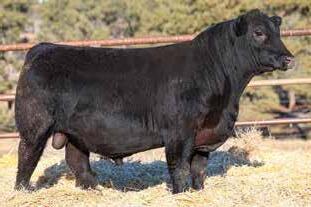
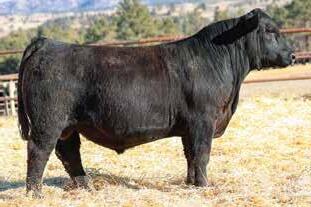
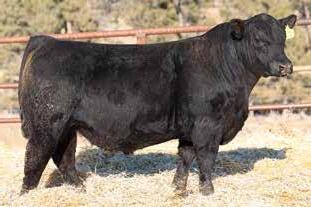
DENNIS SUN, Publisher • Cell: 307-262-6132 e-mail: dennis@wylr.net Member: Wyoming Stock Growers Association Wyoming Wool Growers Association Wyoming Farm Bureau Federation • Wyoming CattleWomen Livestock Publications Council • National Cattlemen’s Beef Association Fremont County Cattlemen's Association Green River Valley Cattlemen's Association Wyoming Angus Association Converse County Stock Growers Association Carbon County Stock Growers Association Subscription Rates: 1 year: $60; 2 years: $90; 3 years: $130 Postmaster: Send address changes to: andrea@wylr.net Wyoming Livestock Roundup • P.O. Box 850 • Casper, WY 82602 Wyoming Livestock Roundup (USPS # 005-774) is published weekly by Maverick Press, Inc. P.O. Box 850 • Casper, WY 82602 Periodicals postage paid in Casper, WY Fax: 307-472-1781 • E-mail: roundup@wylr.net Wyoming Livestock Roundup Reporting the News by the Code of the West Phone: 307-234-2700 800-967-1647 • www.wylr.net HANNAH BUGAS, Managing Editor • hannah@wylr.net MELISSA ANDERSON, Editor • melissa@wylr.net CANDICE PEDERSON, Production Coordinator • candice@wylr.net JODY MICHELENA, Advertising Director • jodym@wylr.net DENISE OLSON, Classified Sales Manager • 307-685-8213 • denise@wylr.net ANDREA ZINK, General Manager • andrea@wylr.net CURT COX, Director of Livestock Field Services • 307-630-4604 • curt@wylr.net CALLI WILLIAMS, Livestock Field Services Rep. • 605-695-1990 • calli@wylr.net This publication is © 2024 by Maverick Press, Inc. Please see ENVIRONMENTALISM on page A7 Pine Coulee Sale Bulls ad Wy Livestock Roundup 2/11,18 and 2/25 Issues Pine Coulee Angus 3/11/2024 Wagon Box Ranch, Hardin, MT Lunch at 11:00 • Sale at Noon SELLING 160 BULLS John Carrel (406) 855-2832 Jim Stampfel (406) 780-1230 PINE COULEE RAINFALL K583 S A V Rainfall 6846 X Coleman Donna 781 BW -.4 WW +64 YW +117 Milk +32 Sells as Lot 23 PINE COULEE BRAVO K592 Coleman Bravo 6313 X Pine Coulee Forever Lady Z805 BW -.2 WW +59 YW +95 Milk +28 Sells as Lot 5 PINE COULEE REAL DEAL K574 Duff Real Deal 19115 X Pine Coulee Ever Entense X64 BW +4.4 WW +48 YW +85 Milk +19 Sells as Lot 21 PINE COULEE RENOWN 121L S A V Renown 3439 X JC Miss Caroline 70A BW +1.7 WW +60 YW +95 Milk +24 Sells as Lot 67 LARGE SIRE GROUPS VOLUME DISCOUNTS ALSO SELLING SONS OF: Coleman Resolve 7219 • Pine Coulee Ovation Ingram Intensity 0030 • Blair’s External Law EAR Gold Rush H83 • Pine Coulee Countdown 111G S A V Renown 3439 • S A V Resource 1441
Program announced
Helping to cultivate the next generation of agricultural leaders is something Culver’s takes pride in – especially during National FFA Week, held Feb. 17-24.
To celebrate this year, the restaurant chain is announcing the FFA Ambassador Program, a new initiative which allows guests to nominate standout FFA members in their communities to represent Culver’s and their FFA chapter, as well as have the opportunity to earn additional prizes.
The FFA Ambassador Program is the latest chapter in Culver’s longstanding relationship with FFA. Culver’s partners with the organization through its Thank You Farmers Project, an initiative which aims to advocate for the positive impact of agriculture while investing in agricultural education in order to create a more resilient and sustainable world.
Recently celebrating a decade of the program’s existence, Culver’s has donated over $5 million to agricultural causes through the Thank You Farmers Project since its founding.
In the contest, guests can nominate an FFA member who is doing outstanding work for their chapter and their community. The nominator will answer three questions about why their chosen FFA member should become an FFA ambassador.
Through March 15, nominations can be made at culvers.com/ffa-ambassador-program-contest. Students must be active members of their FFA chapter for the 2023-24 school year to be eligible.
To make a donation to the Thank You Farmers Project and join Culver’s in the mission to secure the future of agriculture and create a sustainable food supply, visit ffa.givenow.stratuslive.com/culvers
BLM proposes gather
The Bureau of Land Management (BLM) invites input on a proposed wild horse gather in southwest Wyoming’s White Mountain Herd Management Area (HMA).
The White Mountain HMA’s appropriate management level is 205 to 300 wild horses. BLM completed a population survey for the HMA in 2022 and found 549 wild horses present on the HMA at the time.
Considering an estimated annual growth rate of 20 percent, the estimated number of wild horses within this HMA in 2024 is 791 animals.
Plans for the proposed gather are available for review and comment on the agency’s ePlanning website. To submit input, click the “Participate Now” link in the left-hand margin of the page. Comments must be submitted by March 22.
Legislation introduced
Wyoming Rep. Sandy Newsome (HD-24) is solving a crucial missing piece necessary for the deployment of outdoor recreation funds in Wyoming with House Bill (HB) 0067, Outdoor recreation and tourism trust fund administration-two. This bill establishes a framework for the Outdoor Recreation and Tourism Trust Fund, which was created last year to build a stronger outdoor recreation economy in the state.
The $6 million Outdoor Recreation and Tourism Trust Fund was passed into law and funded during the 2023 legislature but lacked a governance structure to allocate grants to invest in recreation projects in Wyoming.
The Newsome bill provides the elements needed to deploy funds to strategically grow the state’s outdoor recreation sector.
Similar to the administration of the Wyoming Wildlife and Natural Resources Trust, HB0067 would set up a nine-member, Governor-appointed, Senate-confirmed board who would develop rules and decide on the disbursement of funding for projects up to $200,000.
Larger proposals would require approval from the legislature.
IDF award launched
The International Dairy Federation (IDF) has announced the launch of the IDF Dairy Innovation Awards 2024.
The third annual awards are designed to demonstrate the innovation and dynamism of the dairy sector worldwide, offering a unique platform to showcase innovative processes, practices and products to improve the efficiency and sustainability of the global value chain and contribute to the United Nations Sustainable Development Goals.
Entries are invited in 10 categories, with a focus on sustainable and community-led initiatives, as well as advancements in new product development and innovative practices.
The awards are hosted by IDF, in partnership with Zenith Global. Further support comes from Tetra Pak, a world leading food processing and packaging solutions company and headline sponsor of IDF Dairy Innovation Awards 2024.
The IDF World Dairy Innovation Awards 2024 are open for entries until June 1. The award winners will be announced in a special plenary session on innovation at the IDF World Dairy Summit hosted in Paris, France on Oct. 18.
For more information, e-mail communications@fil-idf.org.
USDA publishes final rule
The U.S. Department of Agriculture’s (USDA) Animal and Plant Health Inspection Service (APHIS) is reminding the public of the final rule establishing new regulations and standards governing the humane handling, care, treatment and transportation of birds covered by the Animal Welfare Act (AWA).
The final rule applies to captive birds not bred for use in research.
For new AWA licensees and registrants, this rule will go into effect on Feb. 21. For current AWA licensees and registrants, this rule went into effect on Aug. 21, 2023.
The final rule will help ensure all birds subject to the AWA are raised and cared for in conditions which ensure their good health and well-being and that their physical and behavioral needs are met.
More information regarding birds covered under the AWA, including frequently asked questions and informational videos, can be found on the USDA APHIS website.
Tax webinar set
Tax season for agricultural operations can be challenging, especially if the operation has received a 1099 from the U.S. Department of Agriculture.
The public is invited to join Mark Dikeman of Kansas State University and Kevin Burkett of Clemson University for a free webinar providing information for farmers and ranchers to consider as they prepare to submit their taxes.
The webinar will take place Feb. 29 at 8 a.m.
To register, visit zoomgov.com/webinar/register/WN_WA_yXFDoTCCO4jy_wv49jQ?utm_ campaign=0221taxpayer&utm_medium=email&utm_ source=govdelivery#/registration
UW to offer programming
University of Wyoming (UW) Extension will offer four private pesticide applicator education programs in southwest Wyoming March 4-6.
Private applicator licenses are required for anyone who applies or supervises the application of restricted use pesticides.
The four-hour private applicator education programs provide an overview of certification requirements, pertinent regulations, pesticide safety and handling, proper disposal practices and more.
Applicators can attend any class that fits their schedule. All participants are required to bring a government-issued ID, such as a driver’s license, to their session.
Upon completion of a program, applications for private applicator licenses are submitted to the Wyoming Department of Agriculture for approval and issuance of licenses.
For a list of dates locations and times, visit uwyoextension.org/psep/private-applicators/licensing/

»
»
»
»
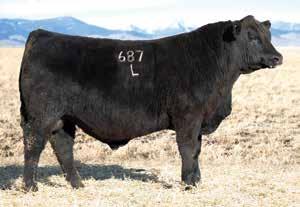
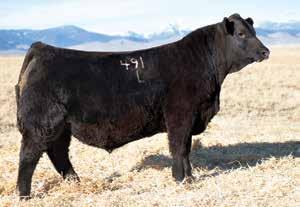
A3 Wyoming Livestock Roundup • Volume 35 No. 44 • February 24, 2024 NEWS BRIEFS 22nd Annual Spring Bull Sale March 13, 2024 12:30 PM (MST) At the Ranch | 9100 MT Hwy 91 North, Dillon, MT 59725 320 Yearling, PAP-Tested Angus Bulls 300 Open Commercial Replacement Females Jim Sitz (406) 683-5277 SitzAngus@gmail.com Bob Sitz (406) 581-9153 SitzAngusRanch@gmail.com Joe Jones (208) 670-2364 JoeJones@SitzAngus.com Catalog and videos available at SitzAngus.com or Bid.NorthernLivestockVideo.com SITZ Dynamic 687L Reg # 20614860 CED 13 BW -2.5 WW 85 YW 146 CW 70 MARB 1.17 REA 0.66 $M 77 $C 309 SITZ Reality 491L Reg # 20614818 CED 12 BW -1.5 WW 77 YW 133 CW 50 MARB 0.91 REA 0.74 $M 78 $C 282 SITZ Dignity 446L Reg # 20613399 CED 12 BW 0.8 WW 69 YW 122 CW 40 MARB 0.34 REA 1.13 $M 67 $C 230 » 25 years of PAP testing
SITZ bred, SITZ raised—no cooperators » 60 years of AHIR® performance testing
100% Sight-unseen purchase guarantee
»
»
Genomic-enhanced EPDs
First-year breeding guarantee » Free bull delivery up to 1,000 miles or sale day pickup discount
Repeat buyer discount
SITZ-influenced calf marketing options To find out more, call or visit SitzAngus.com
4-H coordinator hired
Wyoming gets big win
Wyoming’s coal industry earned a long-awaited legal win, as three Ninth Circuit judges unanimously sided with Wyoming’s arguments in support of the continuation of the federal coal-leasing program.
The decision vacated a lower court order which reinstated Obama-era coal-leasing restrictions and required federal officials to perform duplicative National Environmental Policy Act analysis.
“This ruling is an unequivocal win for our coal industry and a reminder the Biden administration has to follow the law,” Gov. Mark Gordon said. “The Department of Interior now has one less excuse to thwart its federal coal leasing responsibilities. I appreciate the attorney general and her staff for their excellent work on this case.”
Litigation costs for Wyoming were covered by the Federal Natural Resource Policy Account as directed by Gordon.

NSAC publishes report
On Feb. 20, the National Sustainable Agriculture Coalition (NSAC) released a new report titled “Unsustainable: State of the Farm Safety Net,” which features a comprehensive analysis of the accessibility and concentration of public dollars distributed through crop insurance premium subsidies, commodity programs and ad-hoc disaster assistance.
The report finds more than $142 billion was distributed through farm safety net programs from 2017-22 –$46 billion to crop insurance premium subsidies, $29 billion to commodity programs and $67 billion to adhoc disaster assistance.
The concentration of benefits across programs primarily in the Midwest and Great Plains appears to correlate more closely to the number of acres planted to covered commodities than to the number of farms in a state or its value of production.
Ultimately, the report recommends lawmakers adopt commonsense policy reforms to build a sustainable farm safety net that is fair, functional and informed.
As Congress proceeds toward a farm bill reauthorization in 2024, these recommendations help chart a path toward a strong, bipartisan bill.

University of Wyoming (UW) Extension recently appointed Ellie Riske as the state’s 4-H youth livestock coordinator. Previously, Riske served as an office associate at UW Extension’s state office in Laramie.

Earlier this month, she transitioned to her new role on the state 4-H team.

“This transition is a realignment of positions within the state office to better serve volunteers, families and youth,” says Mandy Marney, senior associate director of UW Extension.
Riske has a strong background in animal science and livestock and has taught classes on or raised animals in all of the main livestock classes, including sheep, goats, pigs, cows, rabbits and poultry.
She has also judged livestock competitions and served as a 4-H volunteer for more than a decade in Oregon, Wyoming and Colorado.
Riske earned a bachelor’s degree in animal and veterinary sciences from UW. During her undergraduate education, she was involved in the beef and sheep programs on campus and at the Laramie Research and Extension Center.
Currently, Riske is working toward a master’s degree in animal and veterinary science.

“We are thrilled Riske has joined the state 4-H team as the youth livestock coordinator,” says Marney. “She has a strong understanding of animal science programming and positive youth development, which will allow her to act as a resource for programs, events and activities.”
Riske looks forward to working with youth across the state, as well as educators, volunteers and parents connected to animal science programming.
She can be contacted at 307-766-5679 or eriske@uwyo.edu
WWPC shares tips
The Wyoming Weed and Pest Council (WWPC) is reminding citizens in the Cowboy State to be on the lookout for invasive species by using six tips to help prevent the spread of unwanted plants and insects.
The reminder is in conjunction with Gov. Mark Gordon’s proclamation that Feb. 26 through March 3 will be recognized as National Invasive Species Awareness Week.
The goal of awareness week, which was announced back in January, is to share information about invasive species and steps the community can take to protect the environment and themselves, whether they are boating, out on a hike or enjoying a picnic in the park.
“As people head outdoors this summer, we want them to know a little bit of prevention contributes to a greater effort of keeping Wyoming wild and beautiful,” said Donley Darnell, WWPC president. “Invasive insects, noxious weeds and plant diseases cost the U.S. an estimated $40 billion annually in damages to our lakes, forests and farms. They can threaten our state’s economy, food supply, environment, and in some cases, even public health.”
According to the National Wildlife Federation, invasive species are a major threat to native wildlife and ecosystems, with nearly 42 percent of endangered or threatened species at risk due to the spread.
While often unintentional, people can spread invasive species with anything that may be on the move, such as their boots and shoes, tires, boats, firewood, pets, horses and more.
For more information about WWPC and how you can help keep Wyoming wild and beautiful, visit wyoweed.org
Funding summit announced
U.S. Sens. John Barrasso and Cynthia Lummis (R-WY), along with Gov. Mark Gordon, announced the Second Annual Wyoming Funding Summit taking place in Riverton April 8-12.
“Navigating grant applications or even having a clear understanding of what is available on a state and federal level can be incredibly confusing,” said Barrasso, Lummis and Gordon. “We are proud to once again deliver a free, comprehensive workshop to empower Wyoming grant seekers to achieve success in the federal funding process and maximize funding available to them.”
The Wyoming Funding Summit provides two days of professional training on identifying, applying for, securing and managing grant funding, followed by three days of seminars, panels and open house discussions with state and federal agencies.
The entire event is free and open to the public. Towns and counties are strongly encouraged to attend.
For more information and to register, visit lummis.senate.gov/wyoming-funding-summit/
Wyoming Livestock Roundup • Volume 35 No. 44 • February 24, 2024 A4 NEWS BRIEFS 77 Zuber Road • Riverton, WY 82501 • (307) 856-8123 carlsonequipment@gmail.com Visit our Web Site at: www.carlsonequipment.com Lakeland Wagon Portable Bunk Feeder, 6’x24’ $7,500 2654 NDE Feeder Mixer $29,500 New EZ Ration 6 Bale Feeder, pull type Call for Pricing 2620 Haybuster Feeder $7,900 1994 Kenworth w/ Knight 3070 Feed Box $79,000 Peecon Feeder/Mixer Wagon $29,500 Case IH 5 Bottom in Furrow Plow $9,500 New Artsway 166 6 Bottom Onland Plow $39,000 Brillion 30’ Roller Harrow $54,000 Leon 808 Loader, bucket & grpl $7,900 Dual Loader $1,950 236 MF Front End Loader $1,950 14’ Chisel Plow $3,900 Case IH 345 Vibrashank $7,950 International 21’ Vibrashank $3,960 Krause 955A 25’ Disc $7,900 14’ International Disc $2,900 JD 10’ 3 PT Disc $2,950 10’ IH Disc $1,950 10’ EZEE-On Disc $1,950 New Idea Manure Spreader $6,500 Miskin 7 Yard Scraper $4,500 7’ Rotary Mower $1,950 Rhino 950 3-Way Hydraulic Blade $7,900 Leon Dozer Blade, 12’ $1,950 New JCT 72” Tiller Skid Steer Mount $1,800 Unused JCT 72” Rock Grapple Bucket Skid Steer Mount................. $2,900 Unused AGROTK Pallet Forks 48” for Skid Steer $850 6”x32’ Grain Auger, PTO driven............................................................$950 22” or 30” Morman Creaser, 9 row w/ markers $4,950 Ford 700 Truck w/ stack retriever $9,500 IH 4700 Truck w/ flatbed and forklift attachment $9,500 Set of IH Duals 18.4 x 38 w/ clamps $750 Bradco Aster 9000 Skid Steer Post Pounder $4,900 New Arrowquip Hydraulic Cattle Chute Call for Pricing 1 1/4” 6 Rail 20’ Continuous Fence Panels Call for Pricing CARLSON EQUIPMENT Annual Consignment Auction • March 9, 2024 • Call us with your Consignments invite you to the ranch
Ellie Riske Courtesy photo
Subscribe to the Wyoming Livestock Roundup for $60 per year by calling 307-234-2700
Dear Editor,
First things first, thank you for your service on the National Cattlemen’s Beef Association (NCBA) Board of Directors. This fiduciary body of the organization is extremely important in working toward the future we want for our industry.
As you heard me say in Orlando, Fla. during the board meeting, this work is personal. I am up for the fight to protect our industry for future generations and work against those who would deny consumers the best protein in the world.
We have many who
would rather we weren’t in business, from those who think it is fair for a family to be taxed out of business when someone dies –Death Tax – to those who ignore the science of an ecosystem – Endangered Species Act – to those who espouse inaccurate information about the nutritional value of beef in a healthy diet – work of the Beef Checkoff. This year will be full of opportunities for all of us to work together, keeping a sustainable business while at the same time providing consumers the best possi-

ble beef experience. We should be proud of the work done in Orlando, Fla. to prioritize the work of the Beef Checkoff through the Federation of State Beef Councils and our partnership with the Cattlemen’s Beef Board.
As the largest contractor to the national checkoff, we have an obligation to all beef producers to maintain our high standards in research, education and promotion. I am proud of the work we do.
During our Executive Committee meeting, we adopted the Policy Priorities for 2024. On this front, we will continue to work to get the farm bill across the finish line with the best possible outcomes for beef producers.
Among other issues remaining on the radar are international trade, animal identification and traceability, Waters of the U.S., cell-cultured meat and public land use.
As an NCBA member, you can rest assured while you take care of business at home, our team in D.C. will be looking out for your best interests based on the policies developed from the grassroots.
Leaving the sunshine of Florida and returning to a
foot of snow at the ranch in Wyoming was a reminder the fun and meetings are over, and it is time to get back to work caring for the animals and the land.
Yet, I realize my responsibility this year is not only on the ranch but also representing cattle producers across the U.S. For this privilege, I am humbled. Your officers and I are ready to serve. See you out on the trail.
Mark Eisele 2024 NCBA President

A5 Wyoming Livestock Roundup • Volume 35 No. 44 • February 24, 2024 CROSSWORD Wyoming Livestock Roundup Crosswords, created by Myles Mellor. Solution for the Feb. 17, 2024 crossword Veseth Cattle, where the focus is on the Female. (406) 658-2504 • djvsth@itstriangle.com 22787 Midale Rd • Malta, MT 59538 D ale & J anet V eseth Lunch at 11:30 • Sale starts at 1:00 pm Glasgow Stockyards in Glasgow, MT March 11, 2024 18th Annual Sale Selling 65 Red Hybrid Yearling Bulls 15 Red Bred Heifers to Start March 20th 40 Red Bred Heifers to Start April 20th 65 Red Heifer Calves – Bangsed 10 Black Heifer Calves – Bangsed 36 Short Term Cows Margaret Demarais Dispersal 10 – 12 Mature Cows www.VesethCattleCo.com LETTERS Submit your letters to: Editor, Wyoming Livestock Roundup, P.O. Box 850, Casper, WY, 82602, or e-mail to roundup@wylr.net. We reserve the right to edit letters. It is the policy of the Wyoming Livestock Roundup that we do not print letters attacking individuals, groups or organizations within the Wyoming agricultural community.
CROFTS
anymore,” he added.
Ag runs deep
continued from page A1
Braxton was an active FFA member throughout high school, serving terms as vice president and president of the Riverton FFA chapter. He competed in livestock judging, ag mechanics and sales, while also participating in career and leadership development event projects where he placed at the state convention.
“Every year I had
two or three steers for the county and state fair. I even showed goats one year. During my freshman year, we won the Greenhand Quiz Bowl and went to Louisville, Ky. for the National FFA Convention,” he stated. “During my senior year, I was the Wyoming Region One Star Farmer and Chapter Star Farmer.”
After graduating from Riverton High School in
CONNECTING AG to CLIMATE
 By Windy Kelley, Northern Plains Regional Climate Hub



Recent and Current Conditions
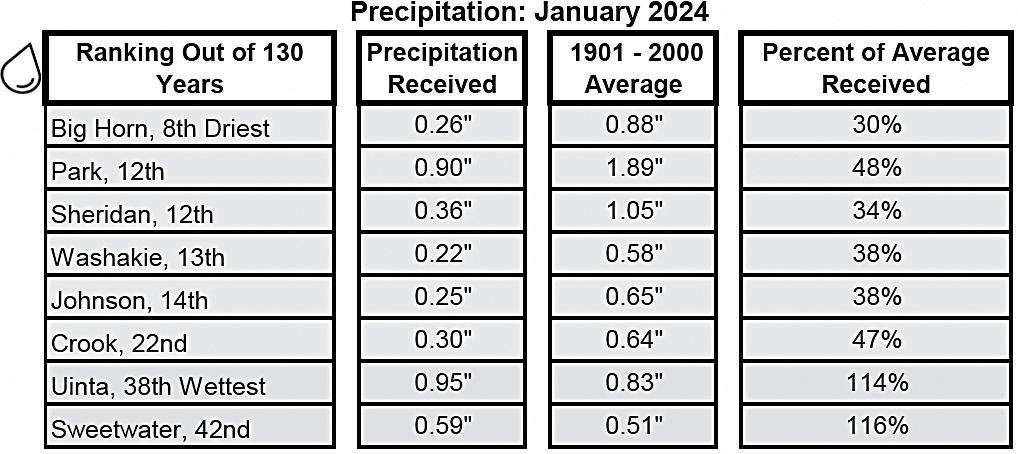
Wyoming experienced its 62nd coldest and 31st driest January out of 130 years, according to the National Oceanic and Atmospheric Administration’s (NOAA) National Centers for Environmental Information database, retrieved Feb. 21.
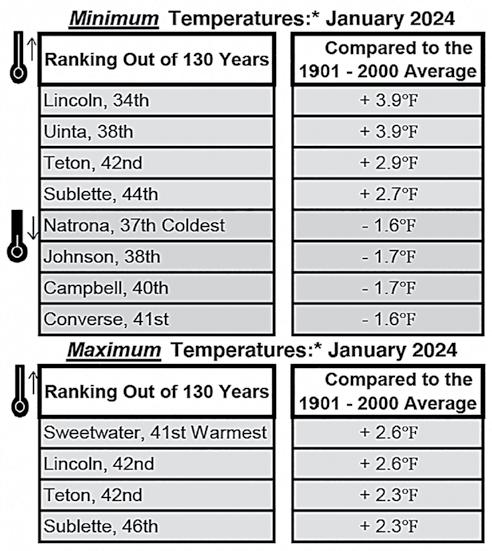
Scaling to the county level, the adjacent tables include temperature and precipitation rankings of select counties for the month of January.
The U.S. Drought Monitor (USDM) map for Wyoming, released Feb. 15, clas-
2017, Braxton attended the University of Wyoming (UW) where he continued livestock judging and studied ag business.
“I changed my major from ag business to animal science after a semester and couldn’t have been happier,” he said. “I spent three years at UW but left in March of 2020 when UW shut down for COVID-19. I wasn’t going to pay full tuition for online classes, so I bought some more cows and moved back home.”
Currently, Braxton is working on the family ranch with the goal of continuing to grow his own herd of cows and eventually purchasing some land and equipment, but he noted that’s a few years down the road.
He explained, “I’d rather have a solid set of cattle on leased pasture than a thrown together herd on my own ground.”
Braxton further noted his hobbies are a part of his day-to-day routine –training solid ranch horses, driving fast trucks and having good dogs at his side.
“My hobbies help me on the job, and they make my life easier,” he pointed out. “I enjoy getting out and seeing new country and taking some
sifies over 56 percent of Wyoming as being abnormally dry (D0) or experiencing severe drought (D2).
The remainder of the state – nearly 44 percent – is classified as none. In other words, these areas are not experiencing abnormally dry or drought conditions.
View the current USDM map at bit.ly/usdmwy. Consider submitting a Condition Monitoring Observer Report at bit.ly/ condtionreports
Eight- to 14-day and one-month forecasts
NOAA’s eight- to 14-day forecast for Feb. 28 through March 5, issued Feb. 20,
range tours just to see what other operations are doing. Everyone needs a vacation just to remember how good it feels when you get back home.”
Words of wisdom
“My advice for young producers is to set goals and hold yourself accountable. Figure out what it is you want to achieve in the next six months to a year and work towards that,” Braxtib remarked. “I’ve missed a few opportunities to expand and I regret not taking the chance, so consider the risks and rewards in whatever you do.”
shows a 33 to 40 percent probability of below normal temperatures for the western quarter of Wyoming, and a 33 to 40 percent probability for above normal temperatures for the eastern quarter of the state.
For the remainder of Wyoming, there is an equal chance for below, near or above normal temperature. For the same timeframe, there is a 33 to 40 percent probability for above average precipitation for all of Wyoming.
The one-month forecast for March, issued Feb. 15, indicates a 33 to 40 percent probability for above normal temperatures for most of Wyoming.
The exception is the greater southeastern corner of the state where there is an equal chance for below, near or above normal temperatures. For the same timeframe, the forecast shows a 33 to 50 percent probability for above average precipitation for nearly all of Wyoming.
The northern border of the state is the exception with an equal chance for
He continued, “You can’t be afraid to face a challenge, but you also can’t afford to be unprepared so plan for the worst and hope for the best. Ag isn’t a part of my life. It is my life.”
Braxton spends every day working towards one check at the end of the year, whether markets are low or high, they take the cattle to sale knowing how much they’ve put into their calf crop.
He said, “That part of the business has changed my mindset to face the reality of what we do as
below, near or above normal precipitation. For additional information and NOAA forecasts, visit cpc.ncep.noaa.gov
Windy K. Kelley is the regional Extension program coordinator and state spe-
producers. We try to be self-sustaining while our expenses keep changing. I don’t need to go out and gamble, I raise cattle for a living.”
“The best part of my job is being able to trot a horse for 15 or 20 miles and never hit a fence. I’ve never had to second guess what I wanted to be when I grew up – I’m still trying to be a cowboy like my dad,” Braxton concluded. Melissa Anderson is the editor of the Wyoming Livestock Roundup. Send comments on this article to roundup@wylr.net.
cialist for the U.S. Department of Agriculture’s Northern Plains Climate Hub, the University of Wyoming Extension and WAFERx. She can be reached at wkelley1@uwyo.edu or 307367-4380.
Wyoming Livestock Roundup • Volume 35 No. 44 • February 24, 2024 A6 Big horn Basin LIVESTOCK AUCTION LLC Call to Consign Cattle Sale Barn: 307-347-9201 Danny Vigil: 307-388-0781 Worland, WY bighornbasinlivestock.com Feb. 22 – 255 Head • Cows $2 to $3 Lower • Bulls $4 to $5 Lower • Upcoming Sales • Visit Cattle USA for broadcasting and online bidding – auctions.cattleusa.com Danny Vigil • Owner and Northern Livestock Represenative Layne Weber • Field Rep & Auctioneer • (307) 331-2222 BULLS Clark, J. Jon - Etna 1 Blk Bull, 2005# $11800 1 Blk Bull, 1845# $11700 Dobson, Martin - Burlington 1 Blk Bull, 1580# $11400 Friesen, Joshua - Cody 1 Blk Bull, 1795# $11300 Greet Ranch Inc. - Ten Sleep 1 Blk Bull, 1980# $11300 1 Blk Bull, 1925# $10450 Durbin Creek Ranch - Thermopolis 1 Hrfd Bull, 1360# $10900 Henderson, Tye - Powell 1 Blk Bull, 1815# $10700 Pierce, Karl - Deaver 1 Blk Bull, 1555# $10500 Dooley, Dustin - Worland 1 Blk Bull, 1895# $10200 COWS Johnson, Carroll - Otto 1 Blk Cow, 1505# $11350 Carter Cattle Inc. - Ten Sleep 18 Blk Cows, avg. 1328# $11275 Lungren Land & Cattle Co. - Worland 5 Blk Cows, avg. 1466# $11225 2 Blk Cows, avg. 1475# $11050 Vigil, Michael - Manderson 16 Blk Cows, avg. 1514# $11100 Brubaker Sheep Co. - Ten Sleep 1 Blk Cow, 1555# $11000 1 Blk Cow, 1345# $9750 Clark, J. Jon - Etna 10 Blk Cows, avg. 1252# $10950 10 Blk Cows, avg. 1433# $10850 W.S. Livestock - Lander 1 CharX Cow, 1520# $10900 Durbin Creek Ranch - Thermopolis 12 Hrfd Cows, avg. 1527# $10750 4 Hrfd Cows, avg. 1394# $10450 Greet Ranch Inc. - Ten Sleep 1 Blk Cow, 1285# $10700 Boreen, Katharine - Basin 1 BWF Cow, 1125# $10250 Dooley Livestock LLC - Worland 1 Blk Cow, 1240# $10100 Baker, Mike - Thermopolis 1 Blk Cow, 1345# $10000 2 Blk Cows, avg. 1310# $8600 Karst, Reese - Powell 1 Hrfd Cow, 1725# $9700 Dobson, Martin - Burlington 1 Blk Cow, 1110# $9650 HEIFERETTES Carter Cattle Inc. - Ten Sleep 6 Blk Hfrettes, avg. 943# $15950 Weber, Layne - Riverton 3 Blk Hfrettes, avg. 955# $15500 Clark, J. Jon - Etna 3 Blk Hfrettes, avg. 983# $14600 Feb. 29 – All Class Cattle March 7 – Bred Cow Special w/ All Class Cattle March 14 – Feeder Special w/ All Class Cattle March 21 – Weigh-Up Special w/ All Class Cattle, Sheep & Goat March 28 – All Class Cattle
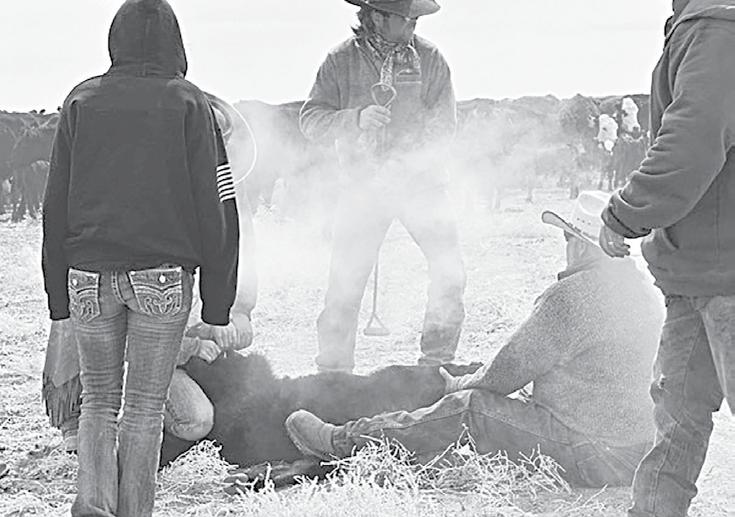
All in a day’s work – Braxton Crofts is hard at work with his family branding calves. Courtesy photo
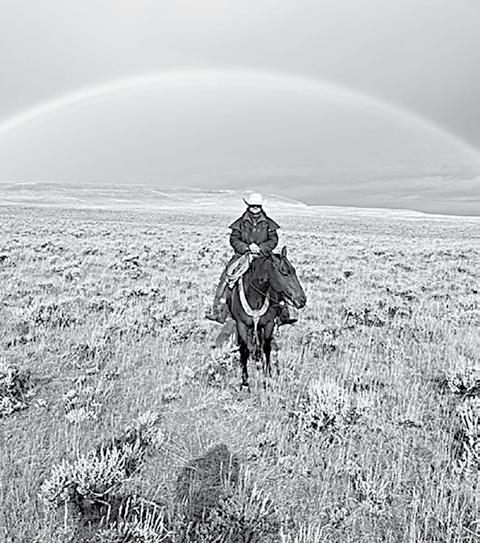
Living the dream – Braxton Crofts notes the best part of his job is being able to ride for miles without hitting a fence. Courtesy photo
Temperatures are observed daily & then averaged across those days for the given timeframe. ** Rankings & additional information are available at NOAA's Climate at a Glance website. *** Icons from the Noun Project.
*
ENVIRONMENTALISM continued from page A2
apparently doesn’t matter these rules would have a disproportionate impact on the poor, increase prices for consumer goods and undermine the electricity grid.
Nor do they apparently care these policies would erode Americans’ basic freedoms. Everything is about addressing climate change, no matter the cost to the American people.
What does all of this pain get us? Virtually nothing.
According to the Her-
itage Foundation, which relied on a clone of a widely used Energy Information Administration model, even if all Organization for Economic Cooperation and Development countries eliminated all of their greenhouse gas (GHG) emissions, “the world average temperature increase would be mitigated by no more than 0.5 degrees Celsius in 2100.”
Translation – these lifechanging and economy-killing proposals would offer
RAAA promotes Oliver
The Red Angus Association of America (RAAA) recently announced the promotion of Rachael Oliver to assistant director of commercial marketing. In this new role, Oliver will coordinate marketing team travel to bull sales, trade shows and Feeder Calf Certification Program sales and work with stakeholders to positively represent Red Angus across the nation.

“Oliver exemplifies the hard work and dedication to our producers that we want this team to be known for,” said Kelly Smith, RAAA director of commercial marketing. “Oliver has taken the lead on many projects, and we appreciate her integral role in building our marketing team.”
Oliver joined RAAA in January 2021 as a commercial marketing specialist. From Savage, Mont., she comes from and continues to be a part of her family’s beef operation. Prior to her joining RAAA, she spent several years working with cattle ranchers to reach their genetic improvement goals at Select Sires and Trans Ova Genetics.
A 2017 graduate of Oklahoma State University (OSU), Oliver was an active member of the OSU Collegiate Cattlewomen and served as secretary. Now, she enjoys volunteering with area livestock judging teams and spending time helping her family with backgrounding and developing heifers in their feedlot.
“My favorite part of my job is going and visiting one-onone with commercial producers and helping them in any way we can,” Oliver told Northern Ag Network. “We’re happy to help producers navigate the marketing of their cattle and line up relationships, whether its sale barns or video sale reps. Our goal is to build relationships within the industry so we’re all communicating together and working as one, so Red Angus can continue to be at the forefront of things.”

a practically undetectable level of improvement and this is only if we achieve the wildly unrealistic zeroemission scenario.
Instead of focusing on unrealistic and extreme measures, we should empower nations to deploy all-ofthe-above energy practices which create the resources and ingenuity necessary to address any challenges resulting from changes in the climate.
It is time to end this
administration’s assault on domestic energy.
Congress should adopt legislation such as the Protecting Our Workers from Exploitation and Retaliation (POWER) Act, which would prohibit any administration from blocking energy or mineral leasing and permitting on federal lands and waters without prior congressional approval.
Deposits of rare earth minerals needed to produce batteries capable of reducing GHG emissions are being discovered in quantities sufficient to end our
reliance on China. Yet, the Biden administration’s permitting restrictions prevent the U.S. from meeting its own needs.
The POWER Act gives us the best chance, short of a new administration, to limit further damage to our domestic energy production while putting America back in the role of world energy leader.
The next time world leaders meet and make promises about the future, Americans should begin and end with a focus on freedom. It is freedom and
a bedrock faith in human ingenuity that have been the recipe for countless breakthroughs and solutions to what appeared to be a crisis.
Either we position ourselves to solve problems as they emerge or we – and future generations – will bear the full brunt of them.
Cynthia Lummis (R-WY) is the Senate Western Caucus chair and Kent Lassman is the Competitive Enterprise Institute president. This opinion column was originally published in the National Review on Feb. 13.
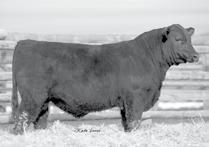
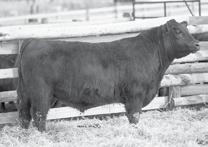
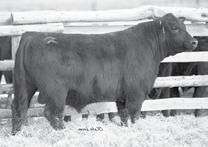
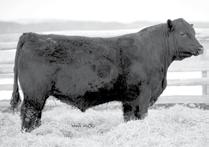
A7 Wyoming Livestock Roundup • Volume 35 No. 44 • February 24, 2024 SALE OFFERING 134 Yearling Angus Bulls 15 Reg. Angus Heifers 70 Hd Commercial Heifers SINCLAIRCATTLE.COM For more information and to request a catalog FEATURED SIRES: N Bar Emulation EXT • Reisig Longmire 8326 Coleman Keen • Connealy Gary • Sinclair Exquisite 9X15 Sinclair Executive 9UF3 • Sinclair Emulation XXP • Sinclair Timeless 8BA4 • Sinclair In Time 6BT39 • Sinclair Justified J574 Sinclair Justified J575 and other proven Sinclair and N Bar sires. SINCLAIR CATTLE COMPANY, INC . ANNUAL PRODUCTION SALE: SATURDAY, MARCH 23, 2024 BUFFALO LIVESTOCK MARKETING, BUFFALO, WY • In Person and Online Bidding at DV Auction and CattleUSA Genetics for the Long Haul SINCLAIR LONGMIRE L505 #20833609 LOT 1 SINCLAIR LONGMIRE L507 #20833626 LOT 2 SINCLAIR GARY L3 #20872799 LOT 4 LOT 8 SINCLAIR GARY L287 #20833590 SINCLAIR EMULATION L005 #220833652 SINCLAIR KEEN L5 #20872816 LOT 10 LOT 18 SINCLAIR EXACTLY L003 #20833650 LOT 38 SINCLAIR BLACK IRON L501 #20884399 LOT 65 SINCLAIR JUSTIFIED L577 #20870971 LOT 45 SINCLAIR GARY L002 #20837940 LOT 5
Rachael Oliver Courtesy photo
SHEEP continued from page A1
“Inventory plus lamb crop plus lambs lost before docking – 20,000 head –amounts to 575,000 head,” notes the report.
Predator-caused losses
Of the 45,000 total animals lost in 2023, NASS reports 21,300 head of sheep and lambs were lost to predators, down 500 head from last year. Lamb losses from all predators amounted to 19,700 head, up 5.9 from last year, while sheep lost to all predators totaled 1,600 head, down 1,600 head from the year prior.
Predator losses amounted to 3.7 percent of the state’s 2023 sheep and lamb supply and 47.3 percent of all sheep and lamb deaths.
According to the report, Wyoming producers suffered an estimated $4.71 million in losses caused by predators in 2023, up 7.4 percent from 2022.
The report shows coyotes remained the largest predator for both sheep and lambs, accounting for 65.3 percent of predator-caused losses and 30.9 percent of all death losses in the state.
Losses attributed to coyotes totaled $3.08 million.
Other notable predator loss in 2023 included 3,600 head lost to eagles, 900 head lost to foxes, 700 head lost to ravens, 600 head each lost to bears and mountain lions and 100 head each lost to bobcats or lynx, dogs and wolves.
Other sheep and lamb loss
NASS reports nonpredatory losses accounted for 52.7 percent of all sheep and lamb losses in 2023, and the total value of nonpredatory loss was $5.37 million, compared to the $4.23 million lost in 2022.
The total amount of sheep lost to non-predatory causes was 10,400 head, up
USDA continued from page A1
of Agriculture data to all those who serve U.S. agriculture, especially the producers who gave their time to complete the questionnaire. The Census of Agriculture data tells a story. This comprehensive snapshot every five years helps data users to see trends and shifts in the industry over time and helps producers do business.”
He continued, “Overall, though there are always changes across U.S. agriculture, the data remain largely consistent with the previous ag census. Data users will also notice some new data on the topics of hemp, precision agriculture

and internet access.”
Valuable insight
The 2022 census reported there were 1.9 million farms and ranches, down seven percent from the 2017 census report with an average farm size of 463 acres, up five percent, on 880 million acres of farmland, down two percent, accounting for 39 percent of all U.S. land.
Family-owned and operated farms account for 95 percent of all U.S. farms, and U.S. farms and ranches produced $543 billion in agricultural products, up from $389 billion in 2017.
The report further noted
52.9 percent from the previous year, while 13,300 head of lambs were lost to nonpredatory causes, down 100 head from a year ago.
The largest documented cause of non-predatory loss was due to weather conditions, which claimed 17,900 head of sheep and lambs during 2023.
Other non-predatory losses included 1,700 head lost to lambing complications, 600 head lost to enterotoxaemia, 500 head each lost to theft and old age, 400 each lost to disease and poison and 100 head lost from animals getting on their backs.
Lambs lost to all unknown causes totaled 1,900 head, compared with 1,700 head last year.
Hannah Bugas is the managing editor of the Wyoming Livestock Roundup. Send comments on this article to roundup @wylr.net.
farm production expenses were $424 billion, but U.S. farms had net cash income of $152 billion, the average farm income rose to $79,790, and 43 percent of farms had a positive net cash farm income in 2022.
In 2022, 116,617 farms sold directly to consumers, totaling $3.3 billion of sales, and the value of sales increased 16 percent from 2017.
It was reported 105,384 farms with sales of $1 million or more made up six percent of U.S. farms and 31 percent of farmland, and they sold more than threefourths of all agricultural products.
The census report disclosed 1.4 million American farms with sales of
Austin Snook • 307-290-2161
Taylor Snook • 307-290-2273
Craig Deveraux • 307-746-5690
Dan Catlin • 406-671-7715
Clint Snook • 307-290-4000
$50,000 or less accounted for 74 percent of farms, 25 percent of farmland and two percent of sales.
Nearly three-fourths of farmland was used by farms specializing in two commodity categories –oilseed and grain production, which totals 32 percent and beef cattle production accounts for 40 percent.
Producer data
The average producer age was reported to be 58.1, which is up 0.6 years from the 2017 census report, this is a smaller increase than average age increases between prior censuses.
There were just over one million farmers with 10 or fewer years of experience, an increase in the
Cheyenne Seymour • 605-641-0638
Casey Sellers • 307-217-2614
Jim Forbes • 307-351-5932
Tye Curuchet • 307-351-8666
Daniel Escoz • 307-217-1440
Kade Kinghorn • 307-620-0525
"From the ring, to the video, and in the country, we market your livestock the competitive way."
For more information on the USDA 2022 Census of Agriculture report, visit nass.usda.gov/AgCensus.
number of beginning farmers from 2017 of 11 percent.
Beginning farmers are younger than all farmers, with an average age of 47.1, with the number of producers under the age of 35 at 296,480, comprising nine percent of all producers.
The 221,233 farms with young producers making decisions tend to be larger than average in both acres and sales.
In 2022, 1.2 million female producers accounted for 36 percent
of all producers. Fifty-eight percent of all farms had at least one female decision maker.
It was also reported farms with internet access continued to rise from 75 percent in 2017 to 79 percent in 2022.
The response rate for the 2022 Census of Agriculture was 61 percent with more than 40 percent of responses submitted online.
Melissa Anderson is the editor of the Wyoming Livestock Roundup. Send comments on this article to roundup@wylr.net.
EPA announces upgrades
On Feb. 20, the U.S. Environmental Protection Agency (EPA) announced $42,956,000 from President Biden’s Investing in America agenda for Wyoming drinking water and clean water infrastructure upgrades.
“Over the past three years, EPA has invested nearly $175 million for new and upgraded wastewater and drinking water services in Wyoming communities through the Bipartisan Infrastructure Law,” said EPA Regional Administrator KC Becker. “These projects are building new treatment and delivery systems, creating jobs and securing healthy watersheds and safe drinking water across the state.”
Communities across the country are facing water infrastructure challenges. Many cities and towns have aging water infrastructure – old, broken or lead pipes carrying drinking water and wastewater treatment plants in need of major upgrades.
The funding EPA announced for Wyoming is part of a $5.8 billion investment through the Clean Water and Drinking Water State Revolving Funds (SRF), one of EPA’s signature water investment programs.
This multi-billion-dollar investment will fund staterun, low-interest loan programs to address key challenges, with $2.6 billion going to the Clean Water SRF for wastewater and stormwater infrastructure and $3.2 billion going to the Drinking Water SRF for drinking water infrastructure nationwide.
This announcement includes allotments for Bipartisan Infrastructure Law General Supplemental funds and Emerging Contaminant funds for SRF programs for Fiscal Year 2024. EPA anticipates announcing allocations for billions of dollars in additional resources for the Bipartisan Infrastructure Law Lead Service Line Replacement fund later this spring.
Wyoming Livestock Roundup • Volume 35 No. 44 • February 24, 2024 A8 Market Report • February 21, 2024 Grass cattle in high demand! Thank you to our consignors, buyers and employees! Thank you and we appreciate your business!
FEEDER CATTLE EARL & PATTY MCKEY, WYARNO WY 80 BLK-STR 604 328.00 WT 1,981.12 28 BLK-STR 512 334.00 WT 1,711.15 4 RED-STR 594 303.00 WT 1,799.06 27 BLK-HFR 562 295.50 WT 1,661.36 19 BLK-HFR 472 305.00 WT 1,439.92 4 RED-HFR 574 277.00 WT 1,589.28 CRAIG M OR JOLENE M DEVERAUX, NEWCASTLE WY 45 BLK-STR 564 309.00 WT 1,742.76 8 BLK-STR 486 332.00 WT 1,612.27 11 BLK-HFR 500 306.00 WT 1,530.00 TIPTON RANCH, WYARNO WY 6 HERE-STR 620 291.00 WT 1,804.20 BAKER LIVESTOCK LLC, BIG HORN WY 15 BLK-HFR 655 260.00 WT 1,703.86 3 BLK-HFR 580 290.00 WT 1,682.00 JOE & MICHELLE REINER, BUFFALO WY 7 BLK-HFR 580 289.50 WT 1,679.10 1 BLK-STR 590 292.00 WT 1,722.80 1 RD BROC-STR 575 295.00 WT 1,696.25 JERRY & SUSAN DOBRENZ, RANCHESTER WY 8 BLK-HFR 554 295.00 WT 1,633.56 PAULINE C. FISK, WYARNO WY 5 BLK-HFR 549 299.00 WT 1,641.51 SPRING WILLOW RANCH INC., WYARNO WY 2 RED-STR 693 256.00 WT 1,772.80 WEIGH-UP CATTLE PAB WIDENER JR REV TRUST, SHERIDAN WY 3 BLK-COW 1497 106.50 WT 1,593.95 1 BLK-COW 1275 127.50 WT 1,625.62 WAYNE & GAYANN GRAVES REV TRU, KAYCEE WY 1 BLK-COW 1495 109.50 WT 1,637.02 2 BBROC-COW 1270 108.50 WT 1,377.95 3 BLK-HFRTTE 1033 136.00 WT 1,405.33 TERESA OEDEKOVEN, SHERIDAN WY 1 BLK-COW 1790 111.00 WT 1,986.90 SCOTT SHACKELFORD, SHERIDAN WY 2 RED-COW 1410 107.00 WT 1,508.70 1 RED-COW 1700 106.50 WT 1,810.50 DANIEL LEN MARSHALL, BIG HORN WY 1 BLK-COW 1550 107.00 WT 1,658.50 1 BLK-COW 1510 105.00 WT 1,585.50 1 BLK-COW 1710 105.00 WT 1,795.50 1 BLK-COW 1465 97.00 WT 1,421.05 1 BLK-COW 1400 96.50 WT 1,351.00 1 BLK-COW 1370 102.00 WT 1,397.40 LINDA MULLINS, MANDERSON WY 1 RED-COW 1235 101.00 WT 1,247.35 CHARLIE OR HARLAN BRADSHAW, KAYCEE WY 1 BLK-COW 1570 98.00 WT 1,538.60 LINDA MULLINS, MANDERSON WY 1 BLK-COW 1405 97.00 WT 1,362.85 1 BLK-COW 1120 112.00 WT 1,254.40 MICHAEL OR TRINITY RODRIGUEZ, BUFFALO WY 1 BLK-BULL 2095 120.00 WT 2,514.00 DENNIS OR STRAUS HEPP, BUFFALO WY 1 BLK-BULL 1990 113.00 WT 2,248.70 www.buffalolivestockwyo.com • February 28 & March - april Sale Schedule • February 28 - Regular Weigh-up Cattle Sale • March 6 - Feeder Cattle and Grass Cattle Special • March 9 - MTR Cattle Company Bull Sale March 13 - Bred Stock Special with Weigh-up Cattle • March 16 - Hancock Livestock Bull Sale • March 20 - NO SALE! March 23 - Sinclair Cattle Company Bull Sale • March 27 - Regular Cattle Sale • April 3 - Bred Stock Special with Weigh-up Cattle April 10 - TTT Angus Bull Sale with Replacement Heifers and Feeder Cattle Special • April 13 - Best of the Big Horns Horse Sale April 17 - Regular Cattle Sale • April 20 - Bulls of the Big Horns Bull Sale • April 24 - Regular Cattle Sale April 26 - Open Consignment Horse Sale To view the consignment lists visit our website:
WYLR photo


Winter in Wyoming can be interesting in a lot of ways. There’s the obvious – like wind, cold and the unpredictability that comes with where we live. There are moments we step outside and discover there’s no such thing as solid footing on a sheet of ice.
Personally, I had no idea I could fall so clumsily and so quickly. Good thing no one was watching – this time. Sadly enough, I know there will come a day when I can’t just “walk it off.”
Then, there are the wonderful roads.
My family and I are blessed to live in the country and we love it, but there’s a price to pay, like long road trips on the ice and blowing snow, sometimes so severe it’s difficult to know whether you’re actually on the road.
My sons travel 40 miles roundtrip to school each day, and my wife travels over 100 miles roundtrip to work. We travel well over 600 miles each week hauling grain for the farm and over 100 miles to get parts to repair the equipment on our farm.
This time of year, I travel a fair amount giving keynote speeches, consulting in farm succession planning and working with farm families and agriculture organizations. In the past 45 days, I’ve found myself in Arizona; Washington; Idaho; Florida, twice; Colorado; Nebraska; Missouri and South Dakota.
I absolutely love what I do and wouldn’t have it any other way. However, this year seems to be picking on me a bit, and it’s more than just the weather.
In the past 30 days, I’ve landed Influenza A, strep throat and some horrific kind of stomach flu. To say I have felt a bit under the weather would be a gross understatement. The good
news is I’m on my feet, and I keep fighting through it all.
I’ve had great success in my work during this time, but it hasn’t gone without me asking myself what has happened to my immune system and why have I been catching what feels like everything that’s floating around.
It’s been a stark reminder of how easy it is to get down on yourself and your circumstances when you’re not at 100 percent.
Life has a unique way of forcing us to keep things in perspective.
I’ve often said if you are feeling sorry for yourself, all you have to do is look around. There are so many people who have it so much worse than a few illnesses that will heal up in a few weeks’ time. I know this, and it is something I consciously try to remind myself of.
What did it for me this time, however, was not the perspective piece. It was something different that caught me totally off guard.
Fortunately, I was home when I suddenly felt nauseous. I went in the bedroom to lie down and within minutes, grabbed my “bowl.” No sooner did I step out of bed, came the most horrific puking session I’ve had since I was a kid.
There’s no way to go about this quietly and respectfully, and I’m pretty sure my neighbors could hear me from over a mile away.
As a 51-year-old man, I lay crouched on my knees over the bowl when our toy fox terrier Sophie entered the room at full speed, hair standing up on her back, ready to take out what vile creature had entered our house without her permission.
As she began barking and attacking me, I was
helpless. Literally, all I could do was focus on the task at hand. Thankfully, my wife came to the rescue and retrieved the dog before I became a casualty of her massive five-pound body.
As my “session” continued for what seemed like an eternity, my wife, who was holding Sophie, laid in the hallway crying because she was laughing so hard. Apparently, Sophie was convulsing she was shaking so badly.
And, in all my misery, I began to laugh too. It was truly hilarious. Never in my life would I have imagined my situation garnering such a reaction from a dog who has only ever been successful at killing and eating bugs.
My point is this – no matter what kind of situation we find ourselves in, it’s important to remember to laugh. We live in a world where we are surrounded by the bad news of the day and it’s easy to immerse ourselves in it.
I think it’s important to keep it all in perspective.
There’s always some negative if that’s what we’re looking for. Conversely, there’s always happiness and laughter if that’s
what we’re looking for. Statistics tell us not only can laughter make us feel better, it can also help us live longer. No matter what we do or where we are, we should always remember to

look for the little things that make us laugh. We should stop taking ourselves too seriously and remember to laugh more. Our lives will be better because of it.


A9 Wyoming Livestock Roundup • Volume 35 No. 44 • February 24, 2024 Montana Performance Bull Co-op™ with Herd Bull quality in volume Large Groups of Half Brothers
230
For more information, contact any of the Montana Performance Bull Co-op consignors Brian Barragree • 406/780-1219 Rob Aumueller • 406/321-2470 Shane Whiteman • 406/366-0688 Doug Stevenson • 406/350-0350 Annual Bull Sale Friday • March 15, 2024 • 1:00 pm at the Midland Bull Test Sale Facility, Columbus, MT Basin Salvation 3533 2 Lot CED BW WW YW Milk CW Marb RE $M $C +3 +1.7 +84 +152 +26 +87 +1.58 +.77 +72 +382 Basin Jameson 3012 3 Lot CED BW WW YW Milk CW Marb RE $M $C +5 +3.5 +87 +143 +34 +81 +1.64 +1.11 +81 +382 Basin Rangeland 3511 17 Lot CED BW WW YW Milk CW Marb RE $M $C +2 +2.9 +87 +157 +32 +85 +1.16 +.84 +71 +352 BCC True North 36L 49 Lot CED BW WW YW Milk CW Marb RE $M $C +12 +0.1 +76 +137 +32 +62 +1.15 +.55 +94 +316 Basin Man In Black 3245 13 Lot CED BW WW YW Milk CW Marb RE $M $C +10 +0.9 +85 +155 +34 +84 +1.40 +.82 +68 +357 Basin Jameson 3263 5 Lot CED BW WW YW Milk CW Marb RE $M $C +11 +0.0 +83 +144 +39 +67 +1.16 +.73 +68 +300 Sire groups by: Basin Jameson 1076 • Basin True Grit 1021 Basin Jefferson 1104 • EZAR Step Up 9178 Musgrave 316 Exclusive • Sitz Stellar 726D Basin Safe Deposit 9324 • SG Salvation DA CF Payweight 513 812 • G A R Sunbeam Ellingson Rangeland • LAR Man In Black EDUCATION SCHOLARSHIPS $1,500 for one incoming freshman $500 for five incoming freshman $500 for three continuing education Visit wyfb.org and click the Get Involved/Education tab for application www.wyfb.org Nine scholarships will be awarded Membership required March 1, 2024 Deadline Farmer's BY RON RABOU The Field Laugh More Midland bull test edition ® 307-234-2700 • wylr.net To advertise in the Midland Bull Test Edition, contact Calli at 605-695-1990 or calli@wylr.net Advertising Deadline: March 8, 2024 Insert Date: March 23, 2024
Selling
Bulls
Sunflower production lowered
In a recent U.S. Department of Agriculture (USDA) supplyand-demand report, the global sunflower production forecast for Marketing Year (MY) 2023-24 was reduced by 0.5 million metric tons (mmt) to 55.08 mmt on lower production in the European Union (EU), Russia and Argentina.
The global harvested acreage forecast was lowered by 0.25 million hectares to 27.65 million on lower acreage in Argentina, Russia and the EU. With lower supply, the global sunflower seed export and crush forecasts were also reduced by 0.3 mmt and 0.5 mmt, respectively.
Global sunflower seed
ending stocks for MY 2023-24 are forecast to decline to 3.1 mmt, representing a decrease of 23 percent from last year’s stocks level of four mmt.
Earlier this year, USDA updated the MY 2023-24 production estimates for U.S. sunflowers from its October estimate. The final estimate for MY 2023-24 production was raised by 69.1 million pounds to 2.3 billion pounds on higher harvested area and yields.
Sunflower yields were forecast at 1,786 pounds per acre, nearly two percent higher than yields in MY 2022-23. Production for oil-type varieties was raised two percent to 1.97 billion pounds. The nonoil-type varieties increased
33.5 million pounds to 297 million pounds on higher yields.
USDA expects the higher total sunflower seed supply to result in additional non-oil use. Given ample seed supplies, sunflower crush is expected to be comparable to MY 2022-23. Sunflower seed ending stocks for MY 2023-24 are projected to be 286.4 million pounds, 80 million pounds below ending stocks for MY 2022-23.
This was welcome news in the U.S. sunflower market after dealing with burdensome stocks for the past year. USDA is forecasting the season average farm price for sunflowers at $19.50 per hundredweight.
SESSION continued from page A1
Top priorities
Magagna noted most of WSGA’s priorities moved forward, with the exception of bills on eminent domain sponsored by the Ag Committee.
“Other bills, including the ones on state lands, are moving along fine,” he said. “One of the most important ones left to us is wildlife damage.”
While House Bill (HB) 60 made it out of committee without problems, there are concerns from the sportsmenʼs community.
“The bill provides landowners will get paid 150 percent the going rate for private leases for wildlife damage,” Magagna explained. “I think this will probably be reduced as the bill moves forward, which is understandable.”
Property taxes
A continuing hot topic this session is property tax bills
continue to move forward.
Moline commented, “At least the majority of the property tax bills are going forward. We had hoped legislators would make up their mind, and instead of debating 12 bills, debate four or five.”
Moline also noted instead of being assigned to the Senate Revenue Committee, these bills moved through Senate Judiciary, which was an interesting development.
Getting the most press currently, Wyoming Rep. Steve Harshman’s bill HB 203, Property tax reduction and replacement act, proposes to exempt the fair market value of a single family home valued at $200,000 or less in 2024 and $1 million or less each tax year thereafter from property taxes.
At the same time, the bill would impose an additional
two percent sales tax, increasing the state sales tax from four percent to six percent.
“On the property tax side, we see relief, but a lot of things farmers and ranchers have to buy – like pickups and equipment – are subject to sales tax,” Magagna said. “We’re concerned over time, a sales tax increase could be a pretty big burden.”
Further, Magagna noted the bill could set a precedent to increase sales taxes when there are challenges in revenue.
Moline noted, “There are good things and bad things for all of the property tax bills. We’ll see more of these bills continue to progress, but I hope we see them narrowed down.”
Other ag bills
Magagna further commented, on bills which deal with federal involvement in the state, saying there is more work to do in the interim.
“We also got a bill out of the way which would have required more public disclosure on the initial nonnegative brucellosis test,” he explained. “We were not in favor of the bill, and it’s gone for this year. There were a number of other bills that just didn’t make it beyond committee.”
Moline noted water bills have gone forward, including Senate File 66, which addresses change in use, and bills about foreign ownership of land in Wyoming are in various stages of the process.
“There are still some concerns these bills are unconstitutional,” he said. “We’d like to see this discussed more in the interim, so we can have a good discussion on the topic.”
Legislative gatherings
Both the WSGA and WyFB hosted legislative receptions, inviting both members and legislators together to discuss issues important for their organizations.

Altenburg Super Baldy Ranch - Triangle J Selling 120 bulls - Fort Collins, CO
Saturday, March 16, 2024
Willie Altenburg, 970-481-2570
Baty Livestock
Spring and Fall Heifer Sales batylivestock@gmail.com Facebook/batylivestock
Black Summitt Cattle
The Quin LaFollette Family Bulls sell Friday, March 15, 2024 at Powell, WY • 307-899-3553
Bridle Bit Simmentals
All-Terrain Bull & Female Sale
Monday, March 18, 2024 at Walsh, CO Chad Cook, 719-529-0564
Campbell Simmental
Part of High-Altitude Bull Sale
Saturday, March 23, 2024 at LaGarita, CO Robert, 970-749-9708
Dilka Cattle
Yearling and 18-mo-old bulls, PT Briggsdale, CO • 970-396-8791 thedilkas@aol.com
Far Out Cattle Ranch
Jerrid Brisendine, 719-353-1747
All-Terrain Bull & Female Sale Monday, March 18, 2024 at Walsh, CO
Hill Brothers Livestock Bulls and Females always available. Paul, 417-849-6851
Facebook.com/hillbrotherslivestock
Jay Hill Family
Simmental & SimAngus bulls Private treaty • 970-520-1555 jaywhill@kci.net
Mari Simmental Breeders
Ron Mari • Holyoke, CO
Selling black % & PB ET bulls 970-520-7333 for EPDs & data
Phoenix Cattle Co. Fleckvieh Simmentals & Fleckvieh/Angus seedstock Roger Schager • 303-550-5592
Cody Pitt Black & Red bulls selling private treaty at Hotchkiss, CO 970-778-9267 • cmp5792@aol.com
Rains Simmental Bulls of the Prairie sale
Saturday, March 9, 2024 at Oakley, KS Mike Rains, 785-672-7129
Russell’s Reflected R Ranch
Top bulls for sale private treaty Call Curt, 719-469-2857 for data or go to www.ReflectedRRanch.com
T-Heart Ranch
High-Altitude Bull Sale, March 23, 2024 719-850-3082 or 719-850-3083 shane@t-heartranch.com

For sale dates, show details and event highlights, go to: wwwColoradoSimmental.com, e-mail colosimmental@gmail.com or follow us on Facebook
“Our meeting was pretty good,” Moline mentioned. “We had decent weather and good attendance.”
While legislator attendance wasn’t what they hoped, Moline also noted one of the hardest parts of the shortened Budget Session is organizations must stack their receptions on top of one another to provide opportunities for their membership to interface with legislators.
Magagna noted WSGA’s session was also well attended and a success.
“We can see some of the legislators are worn out. They worked until 11 p.m. or later on Feb. 19, and that’s tiring,” he said.
Both organizations anticipate crossover, which will weed out a number of bills that haven’t completed the process in their House of Origin.
“There is still a lot of work to do,” Magagna concluded.
Follow the work of the 67th Wyoming Legislature at wyoleg.gov
Saige Zespy is a corresponding writer for the Wyoming Livestock Roundup. Send comments on this article to roundup@wylr.net.
Wyoming Livestock Roundup • Volume 35 No. 44 • February 24, 2024 A10 Get your SimGenetics from these Colorado breeders: 7L Diamond’s Hi Altitude Bulls Leah and Peter Clark Bulls sell March 22, 2024 at Valley Livestock in Monte Vista • 719-849-8223
OUTLOOK continued from page A1
Report, the number of cattle and calves as of Jan. 1 was 87.2 million head, down two percent from the year prior and the lowest inventory on record since 1951.
“The number of cows and heifers that calved was estimated at 37.6 million head, down two percent from the previous year,” said Shagam. “The beef cow herd was estimated at 28.2 million head, two percent smaller than 2023 and the lowest since 1961. The 2023 calf crop was estimated at 33.6 million head, about two percent smaller than the 2022 calf crop.”
With this, Shagam pointed out the U.S. cattle inventory will likely continue to decline into 2024, considering producers retained one percent fewer replacement heifers and fewer numbers of heifers are expected to calve in the coming year.
Shagam also shared, so far in 2024, beef and dairy cow slaughter has been below 2023 levels, but this may reflect the effects of winter weather on mid-January slaughter schedules.
“Nonetheless, with a smaller cow base, cow slaughter is expected to decline during the year, but reductions may also reflect improved forage conditions and strong calf prices which would support retention of cows as a precursor to any herd rebuilding,” she said.
Additionally Shagam explained commercial beef production for 2024 is predicted to fall by three percent to 26.19 billion pounds and total beef exports are likely to decline to 2.79 billion pounds, while beef imports are forecast at a record 4.13 billion pounds for the coming year, up 11 percent from 2023.
Hogs and pork
Despite last year’s poor returns, Shagam noted the hog sector will likely see increased production in 2024.
She referenced the December 2023 Quarterly Hogs and Pigs Report, which shows the inventory of hogs and pigs as of Dec. 1, 2023 at just under 75 million head, unchanged from the previous year.
“The breeding herd, however, likely reflected weak producer margins, declining three percent to six million head,” explained Shagam. “Producers indicated intentions to farrow about 1.5 percent fewer hogs in the first half of 2024. However, the sector is facing a relatively large number of hogs which will have to be slaughtered during the first half of 2024, as the pig crop in the second half of 2023 was unchanged from 2022.”
“Moving into the second half of 2024, availability of hogs for slaughter will reflect lower farrowing in the first half of the year but will likely return to pre-COVID-19 rates of growth in pigs per litter,” she added. “As a result, the first half of the pig crop may be about one percent higher and these higher numbers will be reflected in continued higher year-over-year levels
of slaughter.”
Shagam further noted U.S. hog exports during 2023 increased a little over seven percent to 6.82 million pounds, with shipments to Mexico increasing nearly 10 percent, shipments to Canada increasing eight percent and shipments to Central America and the Caribbean increasing 16 percent.
In the coming year, pork exports are forecast to increase about four percent to 7.08 billion pounds, while imports are forecast at just under 6.65 million head, down nearly two percent from 2023.
Sheep and lamb
Moving on to sheep and lambs, Shagam noted the the Jan. 1 Sheep and Goats Report shows the U.S. sheep and lamb inventory at 5.03 million head, down two percent from a year ago.
Additionally, the Jan. 1 breeding ewe inventory was down two percent from 2022, and producers have indicated they are holding just over one percent fewer replacement lambs in the coming year, according to Shagam.
“For 2024, commercial lamb and mutton production is forecast to be 129 million pounds, a decline of just under one percent from 2023. The smaller lamb crop in 2023 would suggest lower supplies for slaughter in the first part of 2024,” she said.
“After dipping in 2023, lamb and mutton imports are forecast higher in 2024, reflecting in part lower U.S. production. Increased availability of sheep meat in Australia and stable U.S. sheep meat demand will also make the U.S. an attractive market,” Shagam continued.
“Lamb and mutton imports in 2024 are forecast at 305 million pounds, up seven percent from 2023, but below the import levels of 2021-22,” she added.
Poultry and eggs
To wrap up her presentation, Shagam provided an outlook on the poultry sector, including forecasts for broiler meat, turkey and egg.
Per the USDA’s report, as of Jan. 1, broiler-type layers were estimated at less than one percent higher than in 2023.
“For 2024, broiler meat production is forecast just under one percent higher to a record 46.8 billion pounds,” she said. “After a contraction in production in the second half of 2023 and indications of generally lower eggs set and chicks placed in early 2024, higher bird weights are helping underpin expectations of steady-to-slowly increasing production in the first part of 2024.”
“Egg fertility – hatchability – although relatively stable thus far in 2024, remains below historic levels,” she added. “Thus, the majority of the increase in production in 2024 will likely reflect higher bird weights.”
Shagam noted 2024 U.S. broiler exports are expected to decrease fractionally to 7.22 billion pounds over the new year, while broiler imports
will likely increase.
Likewise, 2024 turkey production is forecast to decrease one percent to 5.4 billion pounds.
“Flock depopulations in late 2023 and early 2024 due to highly pathogenic avian influenza (HPAI) are expected to constrain early2024 production,” she stated. “Monthly poult placements in November and December of 2023 were also below previous year levels. However, as the sector recovers from the depopulations induced by HPAI discoveries, bird numbers will likely increase.”
She pointed out turkey exports in 2024 are expected to increase five percent to 515 million pounds, with Mexico remaining the commodity’s largest export destination.
Lastly, Shagam shared total U.S. egg production is forecast to be 9.31 billion dozen, just over one percent higher than last year.
“The sector is continuing to recover from HPAI-related culls in November, December and early January, which
resulted in the depopulation of 13.6 million table egg layers,” she said. “Nonetheless, at the beginning of the year, the table egg flock was 311.8 million birds, 1.4 percent above 2023.”
“Gains in late-2023 production were also supported by higher levels of eggs per bird. Growth in eggs per layer is expected to carry into 2024,
but as new hens are added to laying flocks, some of the efficiency gain maybe lost,” added Shagam. “Thus, the lay-rate gains later in year may be somewhat slower than those earlier in the year and this will have a dampening impact on production growth.”
Shagam also noted egg and egg product exports in
2023 increased nearly 11 percent from 2022’s “depressed levels.” For 2024, exports are expected to decline four percent to 241 million dozen as international demand weakens.
Hannah Bugas is the managing editor of the Wyoming Livestock Roundup. Send comments on this article to roundup@wylr.net.


A11 Wyoming Livestock Roundup • Volume 35 No. 44 • February 24, 2024
Feb. 23-25 Up In Arms, LLC Flea Market and Gun Show, CAM-PLEX, Gillette. For more information, contact Lisa at 208-420-2295.
Feb. 26 University of Wyoming Extension Park County Private Pesticide Applicator Education Program, 1-5 p.m., Grizzly Room, Park County Library, Cody. For more information, visit uwyoextension.org
Feb. 28 University of Wyoming Extension Big Horn County Private Pesticide Applicator Education Program,1-5 p.m., Big Horn County Weed and Pest, Greybull. For more information, visit uwyoextension.org
Feb. 28 University of Wyoming Extension Goshen County Private Pesticide Applicator Education Program, 1-5 p.m., Platte Valley Bank, Torrington. For more information, contact Amy Smith at asmit207@uwyo.edu or call 307-532-2436.
Feb. 28-March 3 35th Annual Winnemucca Ranch Hand Rodeo Weekend, Winnemucca Events Complex, Winnemucca, Nev. For more information, visit ranchrodeonv. com or call 775-623-5071.
Feb. 29 University of Wyoming Extension Campbell County Private Pesticide Applicator Education Program, 12-4 p.m., Campbell County Extension Office, Gillette. For more information, contact Micah Most at mmost@uwyo. edu or call 307-684-7522.
Feb. 29 U.S. Department of Agriculture Tax Webinar, 8 a.m., Zoom. For more information and to register, visit zoomgov.com/webinar/register/WN_WA_yXFDoTCCO4jy_wv49jQ?utm_campaign=0221taxpayer&utm_medium=email&utm_ source=govdelivery#/registration
March 1-2 Green River Valley Cattlemen’s Association Annual Meeting, Marbleton Town Hall, Marbleton. For more information, e-mail grvcattlemen@gmail.com or call 307-760-5737.
March 1-3 Black Hills Gun Show, The Lodge at Deadwood, Deadwood, S.D. For more information, call 605-641-0870 or 307-751-1877.
March 4
March 4
March 5
March 6
March 6
University of Wyoming Extension Sublette County Private Pesticide Applicator Education Program, 9 a.m.-1 p.m., Sublette County Extension Office, Pinedale. For more information, contact Dagan Montgomery at 307367-4380.
University of Wyoming Extension Sweetwater County Private Pesticide Applicator Education Program, 2-5 p.m., Eden Valley Community Center, Farson. For more information, contact Dagan Montgomery at 307-367-4380.
University of Wyoming Extension Uinta County Private Pesticide Applicator Education Program, 12-4 p.m., Uinta County Extension Office, Evanston. For more information, contact McKenna Julian at 307-783-0570.
University of Wyoming Extension Washakie County Private Pesticide Applicator Education Program, 1-5 p.m., Washakie County Extension Office, Worland. For more information, visit uwyoextension.org
University of Wyoming Extension Albany County Private Pesticide Applicator Education Program, 8 a.m.-12 p.m., Albany County Fairgrounds, Laramie. For more information, contact the Albany County Extension Office at 307721-2571.

Feb. 25 Mt. Rushmore Angus Ranch 58th Annual Production Sale, at the ranch, Rapid City, S.D., 605-342-2449, 605-484-6731, 605-381-7361, mtrushmoreangus.com
Feb. 26 Reyes/Russell 33rd Annual Sale, at the ranch, Wheatland, 307-331-1530, 970-371-7819, 307-322-4848, mrangusranch.com
Feb. 26 Circle L Angus Annual Production Sale, Dillon Livestock Auction, Dillon, Mont., 406-491-7363, circlelangus.com
Feb. 26 Colyer Herefords & Angus 44th Annual Production Sale, at the ranch, Bruneau, Idaho, 208-845-2313, 208-250-3924, 208-599-0340, hereford.com
Feb. 26-March 2 Loya/Wardell Angus Online Sale, 970-396-0035, 970-396-1870, DVAuction. com loyawardellangus.com
Feb. 27 Haynes Cattle Company 16th Annual “Working Bull” Angus Sale, Ogallala Livestock Auction, Ogallala, Neb., 970-854-3310, 970-520-3374, haynescattleco.com
Feb. 27 JC Heiken Angus & Sons 17th Annual Production Sale, Miles City Livestock Commission, Miles City, Mont., 406-855-7839, jcheikenangusandsons.com
Feb. 27 Barker Cattle Company Bull and Female Production Sale, Burley Livestock Auction, Burley, Idaho, 801-792-1036, 208-312-3085, barkercattle.com
Feb. 29 Wooden Shoe Farms Annual Bull Sale, at the ranch, Blackfoot, Idaho, 208681-4169, 208-604-0235
March 2 Lucky 7 Angus Annual Bull Sale, Riverton Livestock Auction, Riverton, 307850-2514, 307-850-2053, lucky7angus.com
March 2 Sega Gelbvieh Pound-Makin’ Genetics Bull Sale, at the ranch, Pierce, Colo., 970-590-4862, 970-381-0600, segagelbvieh.com
March 2 3C Cattle 13th Annual Angus Bull Sale, Sutherlin Farms Feedlot, Stevensville, Mont., 406-360-1875, 406-207-9176, 3ccattlelcc.com
March 4 McCann Red Angus Annual Bull Sale, Billings Livestock Commission, Billings, Mont., 208-743-5517, 208-790-0646, mccannredangus.com
March 5 Ipsen Cattle Company 11th Annual Internet Bull Sale, 208-681-4794, 208681-4793, ipsencattle.com
March 6 Ox Bow Ranch Spring Production Sale, at the ranch, Wolf Creek, Mont., 541-965-0088, oxbowranchangus.com
March 7 Bieber Fever 49th Annual Performance Yearling Bull Sale, at the ranch, Leola, S.D., 605-439-3628, bieberredangus.com
March 7 Split Diamond Ranch 33rd Annual Angus Bull Sale, Dillon Livestock Auction, Dillon, Mont., 406-498-3005, 406-581-0612, splitdiamond.com
March 8 Green Mountain Angus Ranch Annual Spring Bull Sale, PAYS, Billings, Mont., 406-568-2768, 406-220-1975, greenmountainangus.com
March 8 Quest of the West 19th Annual Cattle Sale, Spanish Fork Fairgrounds, Spanish Fork, Utah, 801-420-2962, questofthewestcattle.net
March 9 MTR Cattle Company Bull Sale, Buffalo Livestock Marketing, Buffalo, 307217-0408, 307-217-0409, mtrcattle.com
 Compiled by Dick Perue rrichardperue@gmail.com

go the aches and pains, the corns, calluses, blisters, bunions and chilblains.


LEGENDARY SINCE 1971




Encampment Shows Highest Temperature
Livestock in good condition – feed, shipped to other sections
Thus reads the headlines in the Feb. 5, 1920 issue of the Encampment Echo, accompanied by the following article:
Encampment has been favored with especially fine weather for the past six weeks, the weather being almost spring-like.
historic newspapers on the Wyoming Newspaper Project website, I often find the advertisements as informative and entertaining as the news items.
Here’s an advertisement which appeared in the Feb. 18, 1914 Laramie Republican that struck my fancy. See the illustration below.
“TIZ” draws out acids and poisons which puff up your feet. No matter how hard you work, how long you dance, how far you walk or how long you remain on your feet, “TIZ” brings restful foot comfort.
“TIZ” is magical, grand, wonderful for tired, aching, swollen, smarting feet.
Ah! how comfortable, how happy you feel. Your feet just tingle for joy. Shoes never hurt or seem tight.








Prairie Dog Bait.
The weather bureau report for the week ending Jan. 26, 1920 shows Encampment as having the highest minimum temperature of any place in the state, giving 21 degrees above zero for the lowest temperature during the week.
Several points showed below zero temperatures, with Cody the lowest at eight below.
“TIZ” puts joy in sore, aching feet
“TIZ” makes sore, burning, tired feet fairly dance with delight. Away
Get a 25-cent box of “TIZ” now from any druggist or department store. End foot torture forever –wear smaller shoes, keep your feet fresh, sweet and happy. Just think – a whole year’s foot comfort for only 25 cents.





Of the 31 points in the state reporting, five reported the condition of livestock as poor, 21 fair and five good. Encampment is one of the five reporting stock in good condition.
This valley is especially fortunate in that besides having plenty of feed for the home stock, hundreds of tons of hay have been baled and shipped out to other parts of the state.
As I browse Wyoming

Wyoming Livestock Roundup • Volume 35 No. 44 • February 24, 2024 A12 CALENDAR Submit your events to: Editor, Wyoming Livestock Roundup, P.O. Box 850, Casper, WY, 82602, or e-mail to roundup@wylr.net. EVENTS SALES
from the
POSTCARD
Past
ROZOL PRAIRIE
Build your legacy with the legendary Rozol®
Brought to you by Liphatech Ag, your Most Valuable Partner for effective rodent control. Rozol Prairie Dog Bait is a restricted use pesticide. WE HAVE YOUR BACKS, BARNS AND BOTTOM LINES.
DOG BAIT
US
Source: USDA AMS Livestock, Poultry & Grain Market News, Torrington
Source: USDA AMS Livestock, Poultry & Grain Market News, Greeley, CO
National Sheep Summary
As of February 16, 2024
Compared to last week traditional slaughter lambs 12.00 higher, others mostly 10.00-20.00 higher. Slaughter ewes steady to 10.00 lower. Feeder lambs not well tested. At San Angelo, TX 4,547 head sold. No sales in Equity Cooperative Auction. In direct trading slaughter ewes and feeder lambs not tested. 5,009 lamb carcasses traded with no trend due to confidentiality. All sheep sold per hundred weight (CWT) unless specified.
Slaughter Lambs: Choice and Prime 2-3
San Angelo: wooled and shorn 110-140 lbs 180.00-202.00; 168 lbs 180.00.
Ft. Collins: wooled and shorn 100-125 lbs 195.00-270.00.
South Dakota: wooled and shorn 110-135 lbs 192.00-219.00; 150-160 lbs 179.00-181.00.
Billings: wooled and shorn 100-135 lbs 165.00-220.00. Equity Coop: no sales.
Slaughter Lambs: Choice and Prime 1-2
San Angelo: hair 40-60 lbs 254.00-286.00; 60-70 lbs 257.00285.00; 70-80 lbs 246.00-278.00, few 280.00-281.50; 80-90 lbs 230.00-270.00; 90-100 lbs 234.00-254.00. wooled and shorn 103 lbs 226.00.
Ft. Collins: wooled and shorn 43 lbs 275.00; 80-90 lbs 275.00282.50; 90-100 lbs 265.00-275.00. hair 47 lbs 242.50; 50-60 lbs 240.00-267.50; 70-80 lbs 245.00-255.00; 80-90 lbs 245.00270.00; 92 lbs 247.50.
South Dakota: wooled and shorn 70-80 lbs 265.00-295.00; 86 lbs 262.50. hair 66 lbs 255.00; 70-80 lbs 215.00-240.00; 88 lbs 230.00.
Billings: wooled and shorn 50-60 lbs 229.00-231.00; 60-70 lbs 225.00-235.00; 70-80 lbs 216.00-2343.00; 80-90 lbs 220.00-227.00; 90-100 lbs 192.50-215.00, few 219.00-230.00. hair 71 lbs 227.50. Slaughter Ewes
San Angelo: Good 3-4 (very fleshy) hair 70.00; Good 2-3 (fleshy) 88.00-102.50, hair 80.00-96.00; Utility and Good 1-3 (medium flesh) 95.00-99.00, hair 91.00-115.00; Utility 1-2 (thin) 90.00-93.00, hair 90.00-99.00; Cull and Utility 1-2 (very thin) hair 84.00-85.00; Cull 1 no test.
Ft. Collins: Good 3-4 (very fleshy) 102.50-125.00; Good 2-3 (fleshy) 75.00-110.00; Utility 1-2 (thin) no test; Cull 1 no test.
South Dakota: Good 3-4 (very fleshy) 75.00-100.00; Good 2-3 (fleshy) 60.00-125.00; Utility 1-2 (thin) 65.00-71.00; Cull 1 22.50.
Billings: Good 3-4 (very fleshy) 81.00-87.00; Good 2-3 (fleshy) 82.50-91.00; Utility 1-2 (thin) 77.00-88.00; Cull 1 65.00-72.00.
Feeder Lambs: Medium and Large 1-2 San Angelo: hair 38 lbs 270.00; 47 lbs 264.00; 53 lbs 260.00. Ft. Collins: no test.
South Dakota: 50-60 lbs 225.00-265.00; 62 lbs 253.00; 70-80 lbs 230.00-244.00; 98 lbs 216.00; 102 lbs 218.00. hair 56 lbs 265.00; 63 lbs 260.00.
Billings: 80-90 lbs 217.00-235.00; 105 lbs 211.00.
Replacement Ewes: Medium and Large 1-2 San Angelo: yearling hair 90-125 lbs 156.00-190.00/cwt. Ft. Collins: no test.
South Dakota: ewe lambs 107 lbs 219.00/cwt; bred yearlings 150.00-160.00/head; bred young 225.00-272.50/head; bred aged
115.00-185.00/head.
Billings: bred yearlings 195.00-350.00/head; bred young 185.00-275.00/head; bred middle age 140.00-225.00/head; bred aged 130.00-175.00/head. bred yearling hair 165.00/ head; bred young hair 185.00/head; bred middle age hair 115.00-185.00/head; bred aged hair 112.50/head. Sheep and lambs slaughter under federal inspection for the week to date totaled 39,000 compared with 39,000 last week and 36,000 last year.
Source: USDA AMS Market News, San Angelo, Texas
National Wool Review
As of February 16, 2024
Domestic wool trading had no confirmed trades reported this week. Prices reflect trades FOB warehouse in original bag or square pack, bellies out, some graded, and 76 mm or longer. No allowance made for coring, freight, or handling fees at the warehouse level to reflect net grower prices. Wools shorter than 75 mm typically discounted .10-.20 clean. Classed and skirted wools usually trade at a .10-.20 premium to original bag prices. Australian
Compared
to first cutting of alfalfa for the kickoff of the 2024 haying season, of course depending on what curveball Mother Nature might throw. Few, contacts have thought
Source: USDA
The latest markets data can be found by visiting USDA’s Agricultural Marketing Service at
A13 Wyoming Livestock Roundup • Volume 35 No. 44 • February 24, 2024 Un SETT PRICE Month Week Prev This Week Change WHEAT FUTURES MARCH 5.67 5.83 +0.16 MAY 5.67 5.79 +0.12 JULY 5.70 5.80 +0.10 SEPTEMBER 5.79 5.87 +0.08 FOR THE WEEK ENDING May 24, 2019 SETT PRICE Month Week Prev This Week Change LIVE CATTLE FUTURES FEBRUARY 183.40 183.50 +0.10 APRIL 185.60 186.55 +0.95 JUNE 181.88 182.70 +0.82 AUGUST 180.53 181.53 +1.00 OCTOBER 183.53 184.58 +1.05 SETT PRICE Month Week Prev This Week Change CORN FUTURES MARCH 4.18 4.06 -0.12 MAY 4.30 4.18 -0.12 JULY 4.40 4.31 -0.09 SEPTEMBER 4.45 4.40 -0.05 SETT PRICE Month Week Prev This Week Change SOYBEAN FUTURES MARCH 11.62 11.48 -0.14 MAY 11.66 11.52 -0.14 JULY 11.75 11.61 -0.14 AUGUST 11.69 11.56 -0.13 WEEKLY CATTLE AUCTIONS Steers Heifers Compiled from USDA Market News Service information and other sources SETT PRICE Month Week Prev This Week Change OATS FUTURES MARCH 3.82 3.63 -0.19 MAY 3.70 3.51 -0.19 JULY 3.63 3.46 -0.17 SEPTEMBER 3.67 3.51 -0.16
AUCTIONS MARKETS SETT PRICE Month Week Prev This Week Change FEEDER CATTLE FUTURES MARCH 247.10 252.05 +4.95 APRIL 250.23 256.70 +6.47 MAY 252.90 259.33 +6.43 AUGUST 265.95 268.35 +2.40 SEPTEMBER 267.68 269.63 +1.95 Location Under 400 400-500 500-600 600-700 700-800 Over 800 Sltr Bull Stock Cows Volume Sltr Cows Pairs PAYS 350-365 332.50-370 300-322.50 263-294 252-256 190-208 104-144 110-217.50 2-21 1169 269-301 230-243 92-121.50 Crawford 310-357.50 310-327.50 250-312 265 117.50-127.50 $1550-$2650 2-16 1100 298-321 259-300 231-274 83-119 Riverton 360 342 318.25-330.50 267.50-305 250-262.50 221-234.50 111-116 2-20 1305 319 317.50 271.25-305 265.50 233 104.50-138 Torrington 370-372 334-400 305-334 291-325.50 249-276.50 236-247.50 120-133.50 147 2-21 4170 329-349 391-343 291-307 254-283 231-247 229-232 110.75-130 St. Onge 97.50-131 $1975-$3075 2-16 91-108 Big Horn Basin 102-118 2-22 255 86-113.50 Billings No Report CUTOUT VALUES This Prior Last Week Week Year CUTOUT VALUES 294.37 296.59 272.72 PRIMAL RIB 461.01 466.97 449.14 PRIMAL CHUCK 253.47 256.56 213.99 PRIMAL ROUND 246.54 242.24 216.11 PRIMAL LOIN 383.97 387.62 383.68 FOR THE WEEK ENDING FEBRUARY 23, 2024 Centennial 322.50 323 300-302 239 115.50-136.50 2-16 239-300 272.50-288 199-252 96-110 Auction Volume Feeder Slaughter Slaughter Stock Slaughter Lambs Lambs Ewes Ewes Bucks Centennial 1000 155-290 85-150 97.50-150 5 AREA WEEKLY WEIGHTED CATTLE PRICE This Prior Last Week Week Year Live Steer 180.35 181.15 161.17 Live Heifer 179.97 180.99 160.87 Dressed Steer 286.61 287.37 256.78 Dressed Heifer 286.82 287.47 256.60 St. Onge 843 120-258 65-80 $130-$145 45-66 PAYS No Report Buffalo 332 292-334 256-328 113-120 2-22 300 305 277-306 260 96.50-127.50 Daily Grower Bids Region Price US #2 Yellow Corn Southeast WY 3.7100-3.9600 US #1 HRWW Southeast WY 4.8400-4.9900 US #1 Black Beans Min-Dak 40-42/cwt
#1 Dark Red Kidney Beans Min-Dak 41-43/cwt
Great Northern Beans Den-Rate 42/cwt
#1 Light Red Kidney Beans Min-Dak 41-43/cwt
Pea (Navy) Beans Min-Dak 30/cwt
WEEKLY SHEEP
US
#1
US
#1
#1 Pinto Beans Den Rate 38/cwt Min-Dak 37-40/cwt
Wool Exchange Clean Del Price Change from 75-85 Percent Micron US Grade in U.S. Dollars Previous Sale of Australia 17 > 80s 5.34 (0.12) 4.00-4.54 18 80s 4.75 (0.14) 3.56-4.03 19 70-80s 4.30 (0.02) 3.22-3.65 20 64-70s 4.08 0.00 3.06-3.47 21 64s 4.03 (0.03) 3.02-3.43 22 62s 4.01 0.02 3.00-3.40 23 60-62s -----24 60s 25 58s 2.28 (0.04) 1.71-1.94 26 56-58s 1.71 (0.08) 1.28-1.45 28 54s 1.22 0.00 0.91-1.03 30 50s 1.15 0.02 0.86-0.98 32 46-48s 1.09 0.03 0.82-0.93 Merino Clippings 2.26 0.00 1.69-1.92 Source: USDA- CO Dept of Ag Market News Service, Greeley, CO Wyoming Hay Summary As of February 22, 2024 Compared to last week hay sales sold steady to weak. Demand remains light. Some producers are thinking they will have to lower their asking prices to finish cleaning out their hay barns before first cutting of alfalfa hits the sheds in June. All types and qualities of hay left at most producers piles. Eastern Wyoming Alfalfa - Supreme Large Square 3x4 200 Alfalfa Pellets 15% Suncured 350 Western Wyoming Alfalfa - Premium Small Square 300 Small Square 3 Tie 300 Alfalfa - Good/Premium Small Square 270 Alfalfa - Utility Large Square 3 x 4 90 Alfalfa Cubes 400 Alfalfa/Grass Mix - Utility Large Square 3x4 110 Alfalfa/Orchard Mix - Premium Small Square 285-300 Source: USDA AMS Livestock, Poultry & Grain Market News Torrington Nebraska Hay Summary As of February 22, 2024
to last week bales of alfalfa and grass hay sold steady to mostly weak. Ground and delivered hay and cornstalks 15.00 lower. Alfalfa pellets traded steady. Demand was very light. Most hay contacts stated they have had more calls of producers wanting to sell hay than people wanting to buy hay. Mostly open winter, very warm, dry weather late in February has let cattle graze out on cover crops, stalks or winter pastures with limited supplementation. Quite a lot of alfalfa, grass hay, cornstalks, cane and other secondary feed sitting around the state. Roughly 90 days
about selling some corn silage as they have excess of that forage source. Central Nebraska Corn Stalk Large Round 70 Prairie/Meadow Grass - Premium Small Square 8/bale Prairie/Meadow Grass - Good Large Round 140-160 Prairie/Meadow Grass - Utility/Fair Large Round 100 Eastern Nebraska Alfalfa - Premium Small Square 10/bale Alfalfa - Good/Premium Medium Square 3x3 120 Alfalfa Pellets 17% Suncured 330 Brome Grass - Good Small Square 12-14/bale Wheat Straw Small Square 6.75/bale Platte Valley Nebraska Alfalfa - Premium Large Round 170 Alfalfa - Good Large Round 150 Alfalfa Ground (Delivered) 190 Pellets 17% Dehyd 375 Pellets 17% Suncured 375 Corn Stalk Ground (Delivered) 115 Western Nebraska Alfalfa Ground (Delivered) 150-180 Alfalfa/Orchard Mix - Utility Medium Square 3x3 115 Millet Large Round 125 Milo Large Round 80
Livestock,
Grain
AMS
Poultry &
Market News, Kearny, NE
https://www.ams.usda.gov/market-news
USDA’s Swine Health Improvement Plan centers on biosecurity, disease surveillance and testing
For more information on the U.S. SHIP program, visit usswinehealthimprovementplan.com.
SEGA GELBVIEH
invites you to attend our upcoming Pound-Makin’ Genetics Bull sale P March 2, 2024 M
How can the nation’s hog producers keep diseases such as brucellosis, swine influenza and African swine fever (ASF) out of their barns? North Dakota’s state veterinarian says programs like the U.S. Swine Health Improvement Plan (SHIP) can help.
“The U.S. Department of Agriculture reached out to the industry, and they started working together on an approach to deal with ASF,” Dr. Ethan Andress says. “They developed U.S. SHIP, which is based around biosecurity, disease surveillance and testing.”
Program goals
defined program requirements for biosecurity, traceability and disease surveillance.
The second is disease impact, which reduces the impact of recurring endemic diseases of high consequences through the sustainable advancement of sanitary standards and practices which mitigate disease spread into and between farms.
from each other to ensure if disease gets in, we’re able to isolate and prevent the illness from passing to another pig barn.”
States with a high density of hogs including Minnesota, Iowa and South Dakota might see challenges with isolating livestock during a disease.
BULLS AVAILABLE TO VIEW AT 10:30 AM
LUNCH AT NOON
SALE AT 1 PM
BID IN PERSON or ONLINE AT WWW.LIVEAUCTIONWORLD.COM!
STEVE & GAIL FIOLKOSKI
16509 WCR 86 | Pierce, CO 80650
Gail’s Cell: 970/590-4862
Steve’s Cell: 970/381-0600
Email: gafiolk@aol.com | www.segagelbvieh.com
Like us on Facebook @segagelbvieh
Modeled after the National Poultry Improvement Plan, U.S. SHIP works to establish a platform for safeguarding, improving and representing the health status of swine across participating farm sites, supply chains, states and regions.
There are three aims of U.S. SHIP.
The first is safer trade, which is focused on enhancing all aspects of trade impacting disease preparedness among participating producers, slaughter facilities and states through proactively establishing an industryinformed and working system of operations and certification built upon well-

And, the third and final goal is a customized program to provide U.S. pork industry participants a firsthand experience in developing and participating in a program customized to meet the needs of the U.S. pork industry.
“Approximately 30 percent of our pork is shipped overseas,” Andress says. “If we were to have a disease outbreak in the U.S., we would immediately have to shut our exports down, which will create a bottleneck in our system.”
“With products that don’t have a market anymore, our pork industry would be destroyed by the time we rebuild if it happens, which would cost us billions of dollars regardless,” he adds.
U.S. SHIP is one way producers can have peace of mind in keeping trade and exports open if a disease does reach the states, but North Dakota offers another big benefit to disease prevention – space.
Safety in space
“This is a time where our low pig population is very useful,” says Amber Wood, executive director of the North Dakota Livestock Alliance. “We’re able to start and place herds a respectful distance away
“Our herds might be able to stay clear enough where we would be able to continue meeting the needs of U.S. and international consumers,” Wood says.
U.S. SHIP is working to establish a national playbook of technical standards and associated certification, recognized across participating states, which centers on disease prevention in support of animal health, commerce and trade.
“ASF has had a devastating impact on the pig industry worldwide,” Andress says. “It weakens the immune system and allows a lot of other infections to come, which can cause up to 100 percent mortality.”
The disease has no effect on humans and does not increase risk in food supplies.
While vaccines and products are being tested, with varying levels of success, participation in the program is crucial, according to Andress.
“Right now, we have a large part of the industry participating, but we need to reach show pigs. We need to get all entities involved so we can all get on the same page,” he says.
Sarah McNaughton is an editor for Dakota Farmer. This article was originally published in Farm Progress on Feb. 14.

Wyoming Livestock Roundup • Volume 35 No. 44 • February 24, 2024 A14 2021 JOHN DEERE 6155R TRACTOR JD 5093E TRACTOR 2016 KUBOTA MX5200D TRACTOR 2022 BOBCAT T770 SKID STEER 2008 BOBCAT T250 SKID STEER 2023 CAT D6 DOZER CAT320 EXCAVATOR 2022 BOBCAT E60 MINI EXCAVATOR 2023 CAT 420 BACKHOE 2023 CAT 906 LOADER 2018 CAT 930M LOADER 2000 CAT 950G LOADER 2022 FRIESEN TRAILER AIR COMPRESSOR CAT REACH FORKLIFT (TELEHANDLER) 2023 SA CARGO TRAILER 6X10 NEW PULLED 1500 MILES $7,000.00 2 – 2001 REITNOUER STAINLESS STEEL TRAILERS 48’ SPREAD AXLE CLEAN & WELL CARED $16,500 each 2006 REITNOUER STAINLESS STEEL TRAILER 48’ SPREAD AXLE CLEAN & WELL CARED $17,500 1984 FRUEHAUF FB TRAILER $8,500.00 1988 LUFKIN FB TRAILER $9,500.00 Call us today! 307.856.1254 10749 N. Hwy 789, Riverton, WY 82501 FOR SALE OR RENTAL
Ten breeds of top-quality breeding stock were offered from Jan. 29 through Feb. 3 during the Black Hills Stock Show (BHSS) in Rapid City, S.D.
Of the hundreds of head of bulls and heifers offered, several Wyoming producers had cattle that topped their respective sales.
Angus
Angus cattle kicked off the BHSS breed sales on Jan. 29, boasting the highest revenue of the 10 sales. During the Angus sale, 48 head were offered, bringing a total of $320,250 and averaging $6,672 per head.
The sale included 23 yearling bulls, seven fall bulls, four two-year-old bulls, 13 registered heifers and one bred heifer.
Lot 39, Vantage Gold Standard V306, a yearling bull purchased by C-4 Land and Cattle, was the high seller in the Angus sale and across all breeds, at $22,000.
The high-selling Angus heifer, lot 10, KS Sara’s Dream 3100, was purchased by Delton Gimbel of Ree Heights, S.D. Bringing in a check of $18,500, this heifer was also the top seller across all breeds.
Charolais
Forty-one head of Charolais cattle sold during the BHSS Charolais Sale, which also took place on Jan. 29, including 20 yearling bulls, 11 fall bulls, five two-yearold bulls, three registered heifers and two bred heifers.
The bunch totaled $157,150 and averaged $3,833.
Lots 23 and 26X topped the sale, each bringing $9,500.
Lot 23, CAG MR Turnpike 3635L, was a yearling bull consigned by CK Cattle of Highmore, S.D. and sold to Cheyenne Charolais of Wasta, S.D.
Thomas Ranch consigned lot 26X, TR C&S MR Outsider, a two-year-old purchased by Levi Rees of Etna.
The high-selling Charolais female was lot 7, PGC BS Krissy 2324. This heifer was consigned by Paisley Carlson and purchased by Gage Hansen of Turton, S.D.
Hereford
The BHSS Hereford Sale took place on Jan. 31, offering 39 total head, including 19 yearling bulls, seven fall bulls, four two-year-old bulls, eight registered heifers and one bred heifer.
The Hereford sale brought in a total $158,500, averaged $4,064 per head, and one of Wyoming’s own topped the sale.
Consigned by Sticks and Stones Ranch of Laramie, GCS Broadway John 219, sold for $6,500 by Faessler Farms Limited of Bridgeport, Neb.
At $6,750, Arensen Farms of Florence, S.D. bought the top-selling female in the sale – lot 13 – a heifer by the name of JM MS Vicki 55D $K ET, consigned by New Trend Cattle Company of Boley, Okla.
Shorthorn
One yearling bull, a pair
of two-year-old bulls and six registered heifers sold during the BHSS Shorthorn Sale on Feb. 1. The sale totaled $25,000 across 10 head and averaged $2,590 per head.
Topping the bull sale was lot 13, VSF Statement 5L, a yearling bull consigned by Vogel Shorthorn Farm of Rogers, N.D. and purchased for $3,400 by Karen Cummins of Casper.
Lot 10, a bred heifer by the name of OS Dory 80K, was the high-selling female in the sale, bringing $3,800. She was purchased by Billy McLaughin of Hermosa, S.D. and consigned by Osterman Shorthorns of Conde, S.D. Gelbvieh
The BHSS Gelbvieh Sale offered a dozen lots on Feb. 1, including six yearling bulls, one fall bull, a pair of twoyear-old bulls and three registered heifers. The sale totaled $76,500, averaging $6,375 per head.
Selling in lot 6, BABR 3000L ET, consigned by Wes Brittney was the top selling bull in the sale. He sold for $16,500 and was purchased by Todd Ibach of Sumner, Neb.
The high-selling Gelbvieh female was lot two, Bea Lillian 301L, consigned by Beastrom Ranch and purchased by Trevor Tibbetts of Box Elder, S.D. for $4,000.
Red Angus
Red Angus cattle also sold on Feb. 1, and the sale offered 32 lots.
Nineteen yearling bulls, three fall bulls, six twoyear-old bulls and four registered heifers brought a total $155,800 and averaged $4,869 per head.
Topping the sale was lot 20, a yearling bull consigned by PGC Cattle of Pipestone, Minn. by the name of PGC MR Tycoon 3301. This bull was purchased for $15,500 by Greg Slack of Harrisburg, S.D.
Lot one, BJF Kitty 3097L, was the high-selling female and was purchased by Allen Stauffenecker of Greenbush, Minn. for $5,500. This heifer was consigned by BJ farms of Henning, Minn.
Chi-influence
On Feb. 2, seven head of Chi-influence cattle sold during the BHSS, including two yearling bulls, four registered heifers and one fall-calving bred heifer.
The BHSS Chi-Influence Sale brought a total of $29,500 and averaged $4,214 per head.
TTBR MR Primo 688L
1CA, a yearling bull selling in lot 13 and consigned by Beckett Ranch of Miller, S.D., topped the sale at $5,000. This bull was purchased by John Mertz of Hurdsfield, N.D.
Justin Holt of Aberdeen, S.D. consigned the high-selling female – lot 2X, JHC MS Koko 680K. She brought $5,750 and was purchased by Matt Hadwiger of Amherst, Neb.
Limousin
Thirty-four lots sold during the BHSS Limousin Sale on Feb. 2, bringing in a total of $183,500 and averaging
$5,397 per head.
The sale offered 16 yearling bulls, eight fall bulls, six two-year-old bulls, three registered heifers and one bred heifer.
Topping the sale was lot 39, L7 Koko 2064K, a twoyear-old bull consigned by Peterson’s L7 Bar Limousins of Pukwana, S.D. He was purchased for $15,000 by Chad Settje of Creston, Neb.
Lot one, MRL Lorissa 340L, was the high-selling female in the sale. She was consigned by Jeff Keyes and purchased for $7,750 by May Cattle Company of Mineral



Point, Wis.
Maine-Anjou
The BHSS Main-Anjou Sale also took place on Feb. 2, offering seven yearling bulls, one fall bull, one twoyear-old bulls, three registered heifers and one bred heifer.
The sale totaled $56,000 across 13 head and averaged $4,308 per head.
Lot 10, KKKG Last Call 339L, brought $7,250 to top the sale. This yearling bull was consigned by Koo’s Kattle Kompany and purchased by Kyle Brown of Sturgis, S.D.



The high-selling heifer was lot seven, DSCR Ravyn 221K ET, a bred heifer consigned by Dolieslager Show Cattle of Down, Iowa and purchased by Keith Englin of Bruce, S.D. Simmental Simmental cattle were the last to sell at BHSS, and 47 total head were offered on Feb. 3.
The sale brought a total $255,750, averaging $5,441 per head and featured 25 yearling bulls, three fall bulls, a pair of two-year-old bulls, 13 registered heifers and four bred heifers.


Lot 54, FRKG MR Rebel 217K, was the high selling bull at $12,000. This twoyear-old bull was consigned by Freking Cattle and purchased by Troy Baloun of Highmore, S.D. At a whopping $14,500, lot 6X, CKCC MS Liberty 3621L was the high-selling female of the sale. This heifer was consigned by CK Cattle and purchased by Dean Gosch of Selby, S.D. Hannah Bugas is the managing editor of the Wyoming Livestock Roundup. Send comments on this article to roundup@wylr.net.
















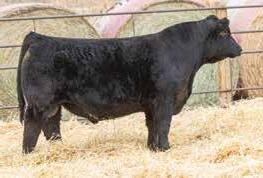



































A15 Wyoming Livestock Roundup • Volume 35 No. 44 • February 24, 2024 The LaFollette Family Powell, Wyoming Quin 307-899-3553 Gavin 307-899-1764 info@blacksummitcattle.com Wh e ca le that p f m g the ribb . Marty Ropp 406-581-7835 Corey Wilkins 256-590-2487 Jared Murnin 406-321-1542 www.alliedgeneticresources.com Bu Sale Black Summit Cattle Sale Facility || 1476 Hwy 14A, Powell, WY 82435 FRIDAY 1:00 PM MARCH 15 ANNUAL 80 SIMANGUS BULLS developed on “THE HILL” PAP TESTED PERFORMANCE TESTED BVD TESTED RIGHT CHOICE VERIFIED Homo Black, Homo Polled SimAngus™ $API 164 $TI 86 GW JOURNEYMAN 851H son. 381L ASA 4206442 G+ Homo Black, Homo Polled SimAngus™ $API 183 $TI 104 GIBBS FAST TRACK 0634H son. 303L ASA 4206364 G+ Homo Black, Homo Polled SimAngus™ $API 155 $TI 89 CLRS HOMELAND 327H son. 366L ASA 4206427 G+ ACCREDITED GENOMIC PLUS Homo Black, Homo Polled SimAngus™ $API 151 $TI 93 CLRS HOMELAND 327H son. 369L ASA 4206430 G+ ACCREDITED GENOMIC PLUS ATM Homo Black, Homo Polled SimAngus™ $API 157 $TI 92 CCR COMMANDER 4404H son. 385L ASA 4206446 G+ ACCREDITED GENOMIC PLUS O gu t y ha in s. FOR A SALEBOOK, EMAIL INFO@BLACKSUMMITCATTLE.COM Wyoming producers top sales at Black Hills Stock Show
3 Cow, 1335# $104.50
HEIFERETTES
PAVILLION
1 Heiferette, 950# $155.00
FORT WASHAKIE
1 Heiferette, 970# $145.00
KINNEAR
BIG
1 Bull, 1665# $126.00
2 Bull, 1847# $113.00
1 Bull, 2080# $112.00
2 Bull, 1897# $111.00
BONDURANT
8 Steer, 316# $360.00
FARSON
4 Steer, 446# $342.00
15 Steer, 543# $330.50
PINEDALE
66 Steer, 586# $318.25
FARSON
5 Steer, 604# $305.00
EDEN
62 Steer, 633# $294.50
LANDER
84 Steer, 648# $293.50
26 Steer, 659# $284.50
EDEN
33 Steer, 685# $271.25
6 Steer, 682# $267.50
17 Steer, 717# $262.50
THERMOPOLIS
EDEN
RIVERTON 14
2
BONDURANT
33
EDEN
FARSON
21
EDEN
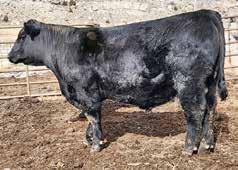
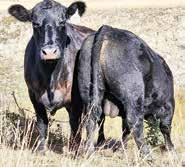


Wyoming Livestock Roundup • Volume 35 No. 44 • February 24, 2024 A16 OBSIDIAN ANGUS Bull Calves Available March 26, 2024 at the Northwest Wyoming Angus Association Sale Fred, Kay & Darryl Thomas Meeteetse, WY 82433 • 307-272-4911 • 307-868-2595 Cattle can be viewed under the Obisidian Angus Sale Tab at www.greatbearreflection.com LOT 26 OBSIDIAN BANK ROLL 838 02-14-2023 • AAA #20642373 PAP: 35 BW: 65 # 205-799 # EFF: 70% CED: +10 • Birth: +.1 • WW: +66 Yearling +120 Milk +28 $M: +69 $W: +65 $F: +97 • $G: +41 • $B +138 • $C +248 LOT 35 OBSIDIAN BLACK CASSIAR 850 03-03-2023 • AAA #20642385 PAP: 37 BW: 96 # 205-878 # EFF: 85% CED: -3 • Birth: +4.8 • WW: +90 Yearling +162 Milk +30 $M: +36 $W: +72 $F: +127 • $G: +33 • $B +161 • $C +245 LOT 34 OBSIDIAN GROWTH FUND 848 02-26-2023 • AAA #20642383 PAP: 39 • BW: 88 # • 205-853 # • EFF: 81% CED: +8 Birth: +1.0 WW: +73 Yearling: +133 • Milk +27 • $M: +73 • $W: +71 $F: +116 $G: +37 $B +152 $C +270
31 OBSIDIAN DNAMITE 845 02-24-2023 • AAA #20642380 PAP: 39 • BW: 72 # • 205-848 # • EFF: 75% CED: 10 Birth: -.5 WW: +76 Yearling: +136 • Milk +30 • $M: +57 • $W: +74 $F: +116 $G: +64 $B +180 $C +290 LOT 24 AND DAM OBSIDIAN FAST FORWARD 836 02-09-2023 • AAA #20642371 PAP: 35 • BW: 94 # • 205-876 # • EFF: 89% CED: +0 Birth: +2.9 WW: +67 Yearling: +109 • Milk +29 • $M: +71 • $W: +69 $F: +85 $G: +56 $B +140 $C +253 LOT 22 AND DAM OBSIDIAN BOMBER 832 02-04-2023 • AAA #20648690 PAP: 38 BW: 86 # 205-854 # EFF: 83% CED: +3 • Birth: +.7 • WW: +90 Yearling +154 Milk +20 $M: +56 $W: +77 $F: +126 • $G: +71 • $B +197 • $C +312 1490 South 8th Street East • Riverton, WY 82501 • (307) 856-2209 Tuesday, February 20 Market Report • 1,305 Head Sold RIVERTON LIVESTOCK AUCTION Contact: Riverton Livestock Auction (307) 856-2209 • Jeff Brown (307) 850-4193 • Tom Linn (307) 728-8519 • Mark Winter (580) 747-9436 www.rivertonlivestock.com • Also watch our live cattle auction at www.cattleusa.com Representative Sales Early Consignments TUESDAY, FEBRUARY 27 ALL CATTLE CLASSES W/ SHEEP & HORSES START TIME 9:00 AM W/ SHEEP & WEIGH UP FEEDER SPECIAL START TIME 9:00 AM WEIGH UPS TUESDAY, MARCH 19 ALL CATTLE CLASSES W/ SHEEP & HORSES 46TH ANNUAL NORTHWEST WYOMING ANGUS ASSOCIATION BULL SALE START TIME 1:00 PM START TIME 9:00 AM W/ SHEEP & WEIGH UPS TUESDAY, MARCH 26 COWS LANDER 3 Cow, 1120# $138.00 PAVILLION 1 Cow, 1125# $128.00 RIVERTON 3 Cow, 1041# $118.00 FORT WASHAKIE 1 Cow, 1290# $113.00 FARSON 4 Cow, 1273# $111.50 RIVERTON 2 Cow, 1137# $110.00 FARSON 1 Cow, 1305# $108.50 1 Cow, 1415# $107.50 4 Cow, 1275# $107.00 RIVERTON 3 Cow, 1305# $106.00 FARSON 3 Cow, 1428# $105.50 4 Cow, 1436# $105.00 DUBOIS
LOT
BULLS
2
PINEY
Bull, 1825# $116.00
STEERS
$259.75
71 Steer, 709#
14
$258.00
Steer, 701#
Steer, 709# $258.00
Steer, 752# $250.00
Steer, 802# $234.50
Steer, 862# $221.00 HEIFERS
SHOSHONI 67
22
Heifer, 343# $319.00
16 Heifer, 453# $317.50
Heifer, 505# $305.00
$282.75
Heifer, 549# $282.00
5 Heifer, 571# $272.00
35 Heifer, 594# $271.25 CROWHEART 49 Heifer, 645# $265.50 EDEN 3 Heifer, 771# $233.00 BACK TO GRASS FEEDER SPECIAL START TIME 9:00 AM W/ WEIGH UPS
APRIL 2 BRED COW SPECIAL START TIME 9:00 AM W/ WEIGH UPS TUESDAY, MARCH 12 DIAMOND PEAK BULL SALE START TIME 1:00 PM SATURDAY, MARCH 16 Diamond Peak Angus Bulls - 70 Blk Ang 2 yr old virgin bulls 40 Blk Ang Yearling bulls Calving Ease, High Altitude, PAP tested Black Angus Bulls Northwest Angus Association - 51 Blk Ang Yrling BullsObsidian Angus, Hoggs Angus, Davidson Angus, & WYO Angus. Many Heifer bulls, Top Female & Growth Bulls to round it out! PAP, Semen & BVD Tested, Proven Sires! (1:00 PM) Contact Fred & Kay Thomas 307868-2595 or any Breeder SO CATTLE ANGUS BULL SALE START TIME 1:00 PM BRED COW & PAIR SPECIAL START TIME 9:00 AM W/ WEIGH UPS TUESDAY, APRIL 9 LUCKY 7 ANGUS BULL SALE START TIME NOON SATURDAY, MARCH 2 Lucky 7 Angus Bulls - 265 Blk Ang 2 yr old bulls 55 Blk Ang 18 mo old bulls 52 Blk Ang Yrlng bulls PAP tested @ 7580 ft. Rugged High Country Range Bulls. FEEEDER SPECIAL START TIME 9:00 AM W/ WEIGH UPS TUESDAY, MARCH 5 CALVES Ed & Tory Burton- 100 Blk Ang Hfrs 550-625#. Rec Vista Once SQ, Vision7, Nasalgen 3 @ branding & Weaning (11-1). Sired by powerful Bl Ang Bulls, Bunk broke, summered on high desert range! Choice Steers!! Steve Ward- 30 Blk Ang Strs 550-625#. Rec 2 rounds of shots & poured this fall. Hay fed, nice steers! All sales are broadcast live on the internet at www.cattleusa.com. Please register online to bid on livestock. Be sure to check out our country cattle listings at www.cattleusa.com Check Us Out On Facebook! FACEBOOK.COM/WYOLIVESTOCKROUNDUP
30 Heifer, 552#
CROWHEART 6
KINNEAR
EDEN
TUESDAY,
