LutherLetter Sharing news of Luther College
Number 2, 2026
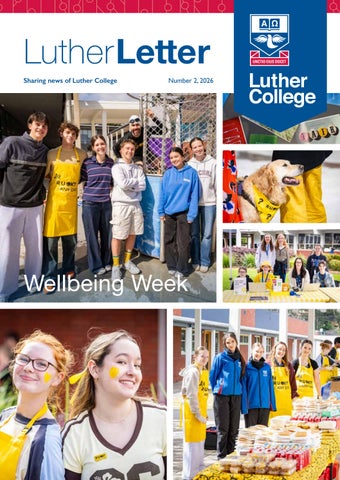
Wellbeing Week
Contents Principal’s Page
1
Leadership Updates
2
Pastoral Care & Wellbeing
4
Teaching & Learning
6
Around The Grounds
8
Care In Action
12
House Events
14
Performing Arts
16
Luther In Concert
18
Senior Years
22
Archives
23
Alumni
24
Luther College 1–39 Plymouth Road Croydon Hills Victoria 3136 (03) 9724 2000 reception@luther.vic.edu.au luther.vic.edu.au Principal Jacqui Layfield
Follow us on
Editor Lisa Trent
Principal’s Page Welcome to this edition of LutherLetter. Be completely humble and gentle; be patient, bearing with one another in love. Ephesians 4:2 This verse speaks to the premise that underpins Restorative Practice, a focus of this edition and the approach that continues to inform how we build, sustain and repair relationships. This is approach aligns with our Lutheran tradition which calls us to extend grace, to forgive as we have been forgiven and to work towards reconciliation rather than division. This edition also introduces the new Student Representative Council (SRC) which will launch in Term 4. The SRC is an important part of developing the agency and leadership we want every young person to carry with them when they graduate. It will provide a formal avenue for students to contribute ideas, provide feedback and take responsibility for initiatives that matter to them. On a personal note, many of you will know that I was away from the College for the first five weeks of Term 3 on sabbatical leave. I am very grateful to Mr Tim Martin, our Executive Leadership Team and our staff for giving me the space to step away and make the most of this time. Part of my time away was spent in Prato, Italy, where I had the privilege of representing the education sector and Luther College at the Monash University Global Leaders’ Summit. The gathering brought key industry leaders from around the world into conversation about the future of industry, leadership and learning. I thank the Vice Chancellor and President of Monash University, Sharon Pickering, for extending this exceptional opportunity to me. From there, I travelled through Germany in the footsteps of Martin Luther. I stood in the monastery at Erfurt where he wrestled with questions of faith and purpose, at the Number 2, 2026
Castle Church in Wittenberg where his challenge to the established order became a catalyst for change, and in the small room at Wartburg Castle where he translated the New Testament into German. Standing in these places, I was struck that Luther’s influence did not begin with power or position. It began with questions. Questions about faith, truth, grace and the practices of the Church. Those questions led him into deeper study of Scripture and his convictions gave him the courage to speak. Driving his work was the belief that faith and knowledge should not belong only to those with authority but should be accessible to everyone. That is a profoundly educational legacy. As a College carrying Luther’s name, we inherit more than a history. We inherit a challenge to remain curious, to keep asking what is true and what matters, to make learning accessible and transformative, and to question practices that have lost sight of their purpose. Martin Luther could not have known how far the influence of his ideas would travel. In the same way, we do not always see the full impact of our work. A question we encourage, an idea we make accessible or the belief we show in a young person may reach much further than we will ever know. I return to my role as Principal this term, ever grateful for the experience and with a renewed appreciation of the work we share and of the privilege of serving a College that carries Martin Luther’s name. Jacqui Layfield Principal
1
LEADERSHIP UPDATES
From the College Pastor Can you remember a teacher who deeply impacted you?
‘Ask and it will be given to you; seek and you will find; knock and the door will be opened to you. For everyone who asks receives; the one who seeks finds; and to the one who knocks, the door will be opened.’ (Luke 11:9-10).
When I think back on my journey through school, some of my best teachers were those who truly encouraged curiosity and deep questioning. I’ve often thought that our task, as we mentor and teach young people, is not to provide neat answers to every question, but to help people ask good questions. Curiosity is one of the most important qualities we have as humans. Some of history’s great teachers recognised that deep understanding often begins not with answers but with questions. Socrates famously taught through questioning, helping people examine their assumptions and think more deeply. Jesus did something remarkably similar. Throughout the Gospels, he asked hundreds of questions, and when people came to him seeking answers, he often responded with a question of his own, inviting them into deeper reflection and insight. Faith is not the absence of questions, or the ability to answer every question perfectly. Rather, it is the courage to keep asking them, trusting that truth can withstand honest inquiry and that God is present in the search. Luther College seeks to build curiosity as a key characteristic of students. Just as curiosity, an open mind and an open heart are vital for a life of learning, they are vital for a life of faith too. Sometimes our big
2
questions are messy, risky, even a little uncomfortable, and sometimes they don’t have neat answers. But God is bigger than our questions. God can handle anything we throw at him. One of the biggest questions I’ve been asked in my time at Luther has been: ‘Is God real?’ This is a brave, honest, and important question! I think one of the best answers I’ve heard to this question is this: ‘If you are genuine, keep on asking that question! God will show himself to you.’ Jesus himself promised: ‘Ask and it will be given to you; seek and you will find; knock and the door will be opened to you. For everyone who asks receives; the one who seeks finds; and to the one who knocks, the door will be opened.’ (Luke 11:9-10). As we come to the end of Term 3, and especially as our Year 12 students prepare for the conclusion of their school journey, their exams, and all that lies beyond, my prayer is that they, and all members of our College community, would continue to approach life with open hearts and curious minds. May we keep asking, seeking, and knocking, trusting that God meets us in our questions and faithfully guides us forward. And may we discover, in his timing, both the joy of finding and the grace of open doors. Nathan Hedt College Pastor
LutherLetter
LEADERSHIP
Student Agency Our students have always had a say. Now they’ll have a seat. The establishment of Luther College’s Student Representative Council (SRC) has been four years in the making. First raised by Principal Mrs Jacqui Layfield with the College Captains in 2023, the idea was grounded in a clear ambition to create a sustainable structure through which students could contribute meaningfully to the life and direction of their College. The concept was compelling but bringing it to life required considerable thought. Subsequent student leaders met with a Queensland school where an SRC was operating successfully, explored different models and wrestled with what genuine student representation should look like at Luther. There were important questions to resolve about membership, representation, purpose, authority and how the SRC would work alongside existing student leadership roles. Successive student leadership teams contributed to that thinking. Each group tested and refined the concept, adding to the work of those before them. Inevitably, however, leaders graduated and some momentum was lost as a new team began the conversation again. That experience reinforced the very reason an SRC was needed. Student voice should not depend solely on the interests or tenure of individual leaders. It needs continuity, collective ownership and a structure capable of carrying ideas and priorities from one year to the next. This year’s Student Leadership Team made progressing the SRC one of its priorities. Drawing on the thinking, research and iterations developed over the previous four years, the team has been able to move the initiative from concept to reality. Mr Rik Malone (Director of Pastoral Care and Wellbeing), Mr Thomas Schneider (Head of Senior Years), and Mr David Wildsmith (Head of Middle Years) have been pivotal in supporting the student’s work in this space this year. The structure has now been established, the students have been nominated, and the inaugural SRC Convention will be held in Term 4. For Mrs Layfield, this represents an important development in the College’s approach to student agency. “I have advocated strongly for an SRC because student leadership should be about more than wearing Number 2, 2026
a badge or organising fundraising activities. Those contributions have value but leadership must also create genuine opportunities for students to exercise agency, accept responsibility and help shape their school,” Mrs Layfield said. “I want the College to hear directly from students about the matters that affect them. Equally, I want staff and College leaders to have a representative group of students with whom we can test ideas, seek advice and undertake consultation. The SRC creates an exciting space in which staff and students can work together, discuss complex questions and co-create thoughtful responses.” Representatives from across the year levels will gather ideas and feedback from their peers and bring them forward for discussion. They will also be invited to consider College initiatives and contribute to projects where a student perspective can strengthen the outcome. In doing so, students will encounter the responsibilities that accompany authentic participation - listening to different views, considering what is beneficial for the whole community and weighing questions of child safety, practicality and resources. The inaugural convention is a significant achievement for the 2026 Student Leadership Team and for the leaders whose work laid its initial foundations. It is also only the beginning. The SRC will continue to develop as students and staff learn together how it can best serve the College, strengthen student agency and leverage the benefit that continuity of student leadership in this model will bring to life at Luther College. 3
PASTORAL CARE & WELLBEING
A Better Way Forward with Restorative Practice Strong pastoral care sits at the heart of Luther’s identity, underpinned by a relational mindset called Restorative Practice. To find out more, LutherLetter sat down with Director of Pastoral Care and Wellbeing, Mr Rik Malone. Schools are complex human organisations, where people and relationships matter most. At its simplest, restorative practice is a focus on improving how everyone interacts - not just student to teacher, but also student to student and staff to colleagues. This connectedness increases belonging and engagement. Restorative practice focuses on how we promote positive behaviours and how we manage wrongdoing. It changes the questions we ask when something goes wrong. Previously, we may have asked “Who broke the rule, and what’s the punishment?” Restorative practice asks something different: “What happened, who was impacted, and how do we put it right?” That shift sounds small, but it changes almost everything about how a conflict or incident is handled moving from blame, punishment and “case closed,” to a conversation that asks students to genuinely understand and repair the harm they’ve caused. It’s about addressing the core issues to build empathy, which in turn drives better attitudes and behaviours. It’s not a change Luther has made overnight, either. According to Mr Malone, this shift has been years in the making. “We have been working with Kristy Elliott from Restorative Pathways over a number of years. That has included Kristy working with the pastoral team plus all staff have undertaken professional development to discuss this mindset, and most recently a whole-staff PD day session this term,” he said.
4
Behind that investment sit three key reasons for the shift.
Relationships, not just rules, are what’s often broken Most conflicts between students are, underneath, a fracture in a relationship, a friendship, a working relationship, a sense of trust. A rule-based consequence doesn’t address the core issues.
It promotes personal involvement Individuals are most likely to trust systems when a fair process is observed. Students are more likely to cooperate when teachers work WITH them rather than TO them.
It reflects a real-world skill Learning to admit mistakes to repair a relationship after conflict is something that matters well beyond the school gate, in friendships, in workplaces, in families. It’s a skill we want students to leave Luther with. “Interestingly, approaches that are purely punitive encourages students to lie to minimise the punishment. So it’s more effective to ask them to understand the negative impact of their choices, or how it felt for the other person, or the classroom watching it unfold,” Mr Malone explained. Here’s a side-by-side snapshot of the traditional versus restorative approach:
Traditional Approach
Restorative Approach
Focus is on the past
Focus is on the past, present and future
Focus is blame and guilt
Focus is on the impact and harm
Student is often passive with no chance for reflection
Student is given opportunity to actively explain, reflect, and suggest solutions.
Deterrent is based on punishment
Deterrent is based on relationship and personal accountability
Negative outcomes include anger and shame
Positive outcomes include connection and moving forward LutherLetter
What Students Can Expect Messages about positive, respectful connection are shared with students throughout their years at Luther, such as through chapels, year level assemblies, programs and guest speakers. However, if students are involved in an incident whether they’ve caused harm or experienced it here’s what the restorative process generally looks like: • They’ll have the opportunity to explain what happened and share their experience. • They’ll hear directly how their actions affected someone else. They’ll be encouraged to be part of the solution.
What happened? Or what were you thinking when you…?
Who gets affected by this kind of behaviour? How does it affect others?
What are you thinking about now we are chatting?
What will fix this? Would you like my help to do that?
What’s a fair way to deal with it if this happens again?
What This Means for Parents It is inbuilt for parents to feel deep emotions when things don’t go well for their children. Despite knowing all too well that teenagers are not perfect and make mistakes, it can provoke emotions like disappointment, embarrassment, defensiveness and anger when it involves your child. This is all natural. Parents don’t need to become an expert in restorative practice to support it at home. In fact, there are two simple questions that mirror what happens at school, and using them at home helps reinforce the same thinking: 1. “What happened? How might you have contributed to this situation?” 2. “What can you do to help fix it?” Research suggests that home and school working in the same direction provides the best outcomes. Give your child practice at the kind of reflection and problem-solving we’re asking of them at school. “This restorative approach has transformed how the pastoral team manages conflict, helping us promote respectful interactions, positive wellbeing, and intentional conflict management. “Using a restorative approach doesn’t exclude or minimise consequences — in fact, consequences become more meaningful.
“It’s worth pointing out that the restorative conversation is often harder for the student, not easier. We are looking for our students to grow from these interactions and learn real-world skills about how to take accountability for their own behaviour and restore relationships,” Mr Malone said.
“Conversations with pastoral staff focus on character development: taking ownership, working through what happened, and problem-solving a way forward. We’re seeing genuine growth and positive outcomes because it teaches empathy, repairs harm, and strengthens connections,” Mr Malone finished.
Importantly, this isn’t reserved only for serious incidents. The same approach can apply for all aspects of school life: coming late to class, a falling-out at lunch, disrupting learning in class, not completing assessments on time, or a group work disagreement.
Schools are complex systems and Luther College is working towards a restorative approach through strategies and support networks focused on relationships. It’s a journey to belonging, a way of bringing people together to strengthen relationships and community.
Number 2, 2026
5
TEACHING & LEARNING
Growing the Whole Learner You may recall we introduced the Luther Learner Tree to bring our approach to contemporary teaching and learning to life. A visual reminder that growth happens above the ground and below it, in roots as well as branches. Last year, that thinking became something students actually see reflected in their progressive online reporting. In partnership with the University of Melbourne’s New Metrics for Success research community, we introduced the assessment of three student capabilities: Communication, Collaboration and Agency. This year, we’re rounding that picture out with two more: Critical Thinking and Creative Thinking.
Why capabilities, and why now? Academic results and regular, timely online feedback will always be central to how we track a student’s progress, that’s not changing. But increasingly, the question employers, universities and researchers are asking isn’t just what does this young person know? What can they do with what they know, and how do they work with others to do it?
That’s the gap capabilities are designed to close. A student can be strong academically and still need support in listening well in a group, backing their own judgement, or pushing past a first idea to a better one. These
are learnable, observable skills, not fixed traits, and naming them means we can actually help students grow them on purpose, rather than hoping they develop by accident along the way.
OUR FIVE CAPABILITIES Communication
How well can students communicate clearly and with purpose, in a variety of ways, for a range of audiences?
Collaboration
How effectively do students work respectfully and empathetically with others to achieve a common goal?
Agency
How independently do students take ownership of their learning and make good choices?
Critical Thinking
How active and intentional are students in their thinking?
Creative Thinking
How curious, questioning and imaginative is a student?
6
LutherLetter
Together, they give staff, students and families a much fuller picture of growth, not instead of academic results, but alongside them.
How progress is described? Rather than a specific mark, capabilities are reported against four stages of growth including Novice (Incubating), Developing (Fledgling), Proficient (Flying) and Expert (Soaring).
Number 2, 2026
The language is deliberate, as it mirrors the Learner Tree and reminds us that every capability is a process, not a fixed label. A student might be Soaring in Collaboration and Fledgling in Critical Thinking, and that’s exactly the point: it’s a map of where to focus next, not a verdict.
a genuinely comprehensive view of student growth, one that sits comfortably alongside academic achievement and reflects a much broader, and increasingly common, understanding of what it means to be a well-rounded learner in the 21st century.
With Critical Thinking now added, our capabilities framework gives
7
AROUND THE GROUNDS
Conspiracy Theories Test Thinking As part of their Year 9 Conspiracy Theories studies, Year 9 students set out to investigate one of Australia’s most enduring political mysteries: What really happened to Prime Minister Harold Holt when he disappeared in 1967? Travelling to Point Nepean and Cheviot Beach, where Holt was last seen, students examined evidence, considered environmental conditions, analysed primary sources and evaluated the conspiracy theories that have emerged over the decades. Back in the classroom, they then used their historical inquiry skills to develop and defend their own evidencebased conclusions about what happened on that summer day almost 60 years ago.
well-supported arguments and weighing evidence from primary and secondary sources. Students also learn to identify patterns of continuity and change and untangle the causes and consequences behind events. These skills sharpen critical thinking and evidence-based
reasoning, tools that extend well beyond the classroom. Harold Holt is just one aspect, students also study conspiracies around the death of John F Kennedy, the escape by three men from Alcatraz and the notorious Jack the Ripper.
Conspiracy Theories equips students with core skills of historical and critical thinking: building
8
LutherLetter
Maroondah Winter Shelter Appeal Term 2 saw our House Captains join forces to support the Maroondah Shelter Winter Appeal. They launched the Appeal with a Chapel service featuring a vlog challenge at Savers in Ringwood, where they had just $15 to put together a complete winter outfit. While Lach and Alistair made some practical choices, Ollie’s Hawaiian-inspired shirt didn’t quite seem warm enough for the season ahead. It was a great way to kick things off, and what followed was even better. Service Learning Coordinator Mr Matt Tichelaar said he was overwhelmed by the generosity shown by families. House Captains spent a lunchtime sorting through the many bags, crates and cases of clothing donated by Luther families,
including plenty of socks, jackets, t-shirts, trackpants and other warm clothing items. “It was a great feeling being able to hand over these donations, particularly as the colder weather was creeping in,” Mr Tichelaar said. Moments like these are what Service Learning is all about - giving our students the chance to live out one of Luther’s core values and experience firsthand the impact that generosity and community spirit can have on those in need. To all our families - thank you for your generous donations and for being part of our clothing drive.
ALWS Fundraising It is quite the tradition for our College Captains and Middle Years Captains to run fundraising events including Casual for a Cause and lunchtime BBQs throughout the year, raising money for the Australian Lutheran World Service.
Number 2, 2026
Whether we are celebrating love and friendship on Valentines Day, embracing the cold in winter with PJ Day or simply enjoying some music, food and fresh air these opportunities are a great way for the community to come together.
Each year we see quite an impressive total donated, which along with our Year 9 Rite Journey fundraising is making a significant difference in communities less fortunate. For more about the Australian Lutheran World Service visit www.alws.org.au
9
AROUND THE GROUNDS
The Future is Theirs Our campus was buzzing in July as students and families gathered for our Subject Selection Evening, connecting with teachers and Learning Leaders to explore the many pathways available at the College. From Year 9 into 10 through to VCE, conversations centred on students' interests, strengths and aspirations, empowering them to make informed choices for the year ahead. Our Careers Expo added another exciting dimension to the evening, bringing together representatives from 33 institutions, including universities, private colleges, academies and industry organisations such as Victoria Police. Families had the opportunity to ask questions, gain valuable insights and explore the many study and career pathways available beyond school.
their knowledge made the evening such a valuable experience for our students and families. It was wonderful to see Building W and the Chapel filled with curiosity, conversation and possibility as students explored the opportunities ahead. We look forward to continuing to support each student as they discover their passions, shape their pathway and prepare for the future with confidence.
A heartfelt thank you to our dedicated staff, whose expertise, encouragement and generosity in sharing
10
LutherLetter
The Arts VCE Art Students Explore Melbourne’s Gallery Scene Our VCE Unit 4 Art Making and Exhibiting students spent an inspiring day gallery hopping across Melbourne, exploring the behind-the-scenes world of art conservation, curation and exhibition presentation. As part of their Area of Study 3 learning, students visited three gallery spaces: ACCA, where they explored Are You Lonely Tonight? I’m So Lonesome I Could Cry; Off the Kerb Gallery, showcasing emerging contemporary artists; and Arts Project Australia’s A Current Affair, featuring neurodiverse artists. Together, the visits offered insight into how art is exhibited and supported across a major public gallery, an artist-run initiative and a not-for-profit.
Gallery professionals spoke about everything involved in bringing an exhibition to life, from transport and installation through to conservation and deinstallation, giving students a deeper appreciation of the work that happens behind the scenes.
Luther Portraiture Prize In Term 3 we celebrated the opening of the 2026 Luther Portraiture Prize Exhibition, showcasing the creativity and artistic talent of our students. This year’s theme, ‘In Their Element’, challenged students to look beyond the traditional portrait and capture someone important to them in a place, activity or environment that reflected who they truly are. The result was a thoughtful, technically accomplished and wonderfully diverse collection.
Congratulations also to every student who entered, the quality and originality on display made judging incredibly difficult. Thank you to the families and community members who joined us, and to every student who shared not just their talent, but the stories behind the people who inspired them.
CONGRATULATIONS TO OUR 2026 LUTHER PORTRAITURE PRIZE WINNERS: Junior Years Prize (Years 7–8) Yuen - graphite on paper, portrait of her sister. Middle Years Prize (Years 9–10) Erika - graphite on paper, portrait of her Nana. Senior Years Prize (Years 11–12) Amelia - acrylic on woodboard, portrait of her friend Ebony (Pictured). Bold Choice Award Alice - graphite and pencil on paper, portrait of her Dad. Number 2, 2026
11
CARE IN ACTION
Wellbeing Week In September, the College used R U OK Day as the launchpad for something bigger than a single conversation - a full week focused entirely on wellbeing.
12
Monday: Finding Beauty in the Mud
Tuesday: The Importance of Connection
Mr Rik Malone, Director of Pastoral Care and Wellbeing, opened the week with a hands-on Chapel exploring the idea of “mud” and the different struggles and messy moments we all carry in our lives. Using the lotus flower as his central image, he showed students how this flower doesn’t just survive in mud, but actually thrives.
Chapel moved into the hands of the College’s Heads of House, who led students through the theme of connection and why it matters, and how something as simple as reaching out to someone can make a genuine difference. The push for wellbeing wasn’t just for students, on Tuesday afternoon, staff came together for a wellbeing session of their own, travelling through a round robin of activities designed to spark conversation, encourage quiet reflection, and build in some genuine mindfulness.
LutherLetter
Wednesday & Thursday: Students Take the Lead The back half of the week belonged to students, with the Wellbeing Club hosting Chapel, delivering messages that were clear, direct, and unmistakably their own: • Be brave enough to have the tough conversations even when they feel awkward. • Be brave enough not just to hear, but to truly listen and understand.
Friday We wrapped up a fantastic week of wellbeing with a Chapel led by Director of Faith and Formation, Mrs Anita Foster and Mrs Simone Turner. It was a great week of activities but most importantly it got us talking. So don’t just ask R U OK on September 10, ask it any day, because life happens every day.
• Be brave enough to help build an environment where people feel comfortable, supported, and above all, valued. They also spoke candidly about self-care, even interviewing staff members about their own selfcare habits. Thursday also offered free dress (a splash of yellow), Home Group activities and a lunchtime to remember with a BBQ, music from the Soul Band, Wellbeing tents featuring our own Clubs, to external providers. Perhaps the most popular event was the Dunk Tank where Mr Schneider, Mr Scoble, Mr Jeffery, Mr Wildsmith and Pastor Nathan all succumbed to the icy water multiple times in the name of raising awareness.
Number 2, 2026
13
HOUSE EVENTS
House Competition Some competitions are won with stamina. Others with creativity. And some quietly, with strategic thinking, across eight-by-eight squares in a silent room. Across House Chess, Cross Country and the Performing Arts Festival, students proved that courage doesn’t look the same twice. It can be the last surge past the final marker, the hush before a decisive move, or the walk onto a lit stage in front of the whole school. Three different arenas. Three different kinds of courage. But in each one, the blue, red, yellow, green, orange and purple flags flying high are a reminder that competition isn’t only about who’s fastest, or cleverest, or most rehearsed. It’s about who’s willing to show up and try.
House Chess: Strategic Thinking Every match was a private battle of patience and foresight, played out one calculated move at a time but there could be only one winner, and it was Yarra House who prevailed. Here, the House points up for grabs was not decided by who moved fastest, but by who thought furthest ahead.
House Cross Country: Stamina If chess tested patience, cross country tested endurance. There’s nowhere to hide in a race, no teammate to pass to, no script to fall back on, just legs, lungs, and the will to keep going when the body wants to stop. Thankfully we had a bright yet chilly winter’s day, the perfect setting for a test of will, with House points up for grabs participation made the difference getting Warran House across the line.
14
LutherLetter
House Performing Arts Festival: Creativity By the time the Performing Arts Festival came along, our House competition got louder! Students traded quiet calculation for lights and imagination directing, starring and bringing to life their story. Courage here didn’t look like a finish line, but a polished performance including acting, dance, music and choir, all lead by our students themselves. Congrats to Yarra House.
Number 2, 2026
15
PERFORMING ARTS
The Little Mermaid Six sold out shows, standing ovations, happy tears, unforgettable performances and so many special moments - our College production of Disney’s The Little Mermaid was nothing short of spectacular. Each and every student whether they were on stage, backstage or part of the orchestra gave their everything, presenting a flawless show that had audiences spellbound. The work that goes into a production like this is often underestimated from casting, rehearsing every line, and considering every prop, set pieces, costumes, and musical cues. It’s a giant puzzle with countless moving pieces. Special thanks to Director Ms Kate Amey and the team around her for their hard work, vision, and support in giving our students opportunities beyond the imaginable. And to our audiences, thank you for cheering loudly, supporting wholeheartedly and making every performance so special. What a journey. What a show.
16
LutherLetter
Number 2, 2026
17
LUTHER IN CONCERT
A Feast of Musical Talent Our annual music showcase, Luther in Concert, was a resounding success in August. On the iconic Hamer Hall stage, the Collyer Symphony Orchestra opened with a wonderfully cinematic repertoire, and the concert built steadily from there in energy, variety and musical excellence. A highlight was seeing our ensembles come together through exciting collaborations - percussionists joining choirs, combined strings, singers performing alongside Stage Band, and our Year 12 musicians featured throughout the evening. A very special congratulations to Myah Armour and Hudson Malone on their outstanding VCE Music solo performances, the applause truly brought the house down. We also celebrated our Year 12 musicians through The Twelves, a student-formed band brought together by our Music Captains. Their performance of Don’t Stop Me Now was a fitting and memorable way to finish their final concert together. Across the evening, the incredible breadth of our music program was on show - from orchestral 18
and choral works to jazz, rock, contemporary and musical theatre. Our students brought extraordinary energy, enthusiasm and joy to their performances, and we were incredibly proud of the level of musicianship on stage. Congratulations to every performer! A huge thank you to Mr David George and Ms Laura Clisby for their leadership, and to our Performing Arts staff, Ensemble Directors,
accompanists and families for their commitment, encouragement and support in making this special evening possible. We are incredibly proud of all our students and staff who contributed to such a memorable celebration of music. What a night. What a stage. What an incredible celebration of music at Luther!
LutherLetter
A Fitting Farewell Each year we use Luther in Concert as an opportunity to celebrate our Year 12 music students, all of whom have contributed to the Luther music program year after year. From their roles as musicians to mentors, across a raft of cocurricular experiences, these are a truly gifted group of musicians. We see our students grow in skill and confidence year after year, and this group was no exception. They were a committed, talented bunch whose passion for music and performance was contagious. Number 2, 2026
There were more than a few tears and high emotions on the night too, as it dawned on everyone that this was their final performance as part of the Luther music program.
We wish them every success in whatever comes next and know the mark they've left on the Luther music program will endure for years to come. 19
MOTHER’S DAY
Mother’s Day Breakfast There was a wonderful warmth and energy across the College earlier this year as students, mums and grandmothers gathered for our annual Mother’s Day Breakfast. We were privileged to hear from guest speaker Samantha Gash - endurance athlete, social impact entrepreneur, founder of Her Trails, World Vision Goodwill Ambassador and mother. Her story of resilience, courage and purpose deeply resonated as she drew on her experiences running across some of the world’s harshest environments. Samantha encouraged students and mothers alike to consider their own “secret power,” and spoke about the importance of the work done “in the shadows” - the choices we make when no one is watching that quietly shape who we become. Thank you to the students who assisted throughout the morning, and to College Captains Harvey and Helena for their leadership.
20
LutherLetter
FATHER’S DAY
Father's Day Breakfast In September, we welcomed Australian cricket legend Damien Fleming as our special guest for our Father’s Day Breakfast. Damien shared stories from his journey to wearing the Baggy Green, reflecting on the significant milestones, pivotal moments and mentors who helped shape his cricketing career and his journey as a young person. He spoke with great respect about the many teammates and cricketing role models he looked up to throughout his career, and the importance of being willing to listen, learn and take inspiration from those around you.
The warmth continued over breakfast in the Building W Atrium, where students and their dads had the opportunity to connect, share the morning together, ask questions, take photos with Damien and celebrate the special role of fathers and family. A wonderful morning of family, connection, cricket and inspiration.
His message to our students extended well beyond cricket: have a dream, set yourself a goal, embrace the journey, listen and learn, find your niche, back yourself and don’t be afraid when things don’t always go to plan. He also spoke warmly about the importance of family and fatherhood, sharing the pride and love he has for his children and the joy he takes in supporting their own sporting passions and pursuits. With plenty of humour, memorable cricket stories and insights into the culture, leadership and teamwork that underpinned the Australian cricket team, Damien had our audience captivated and laughing throughout the morning.
Number 2, 2026
21
SENIOR YEARS
Year 11 Winter Ball The dance floor at Bramleigh Estate barely emptied all night, and when the final song of the evening, Mr Brightside hit the speakers, every last student was back out there for one last singalong. Held in July, the Year 11 Winter Ball brought students together in stunning dresses and sharp suits for a night of fine food, music and dancing. A very popular photo booth gave everyone the perfect opportunity to celebrate friendships, make new memories and enjoy this special milestone together. Special thanks to Head of Year 11 Miss Lauren Wynne and to everyone who helped make the evening such a success.
22
LutherLetter
ARCHIVES
From the Archives: 50 Years of Musicals In 2026, we celebrate 50 years of Luther College musicals - half a century of song, spectacle and student stars in the making. It all began in 1976 with our first production, Oklahoma!, which drew about a thousand people over three performances. Students later reflected in the Analecta that rehearsals had begun with questions of “can we do it?” but that they’d come away from opening night feeling like “Mission Impossible accomplished.” The first few decades of our musicals featured the cult classics of the era, staged under the dedicated direction of Head of English Richard Hauser and creative genius Rob Mau. The vibrancy and excellence of Luther’s musicals soon became a core part of our identity with Annie (1993) even featured a real dog trained for TV commercials. Much-beloved current teacher Kate Amey began directing Luther’s productions in the 2000s, bringing fresh passion and energy to our cocurricular performing arts program. She has continued to inspire students and create magic on stage ever since, with musicals that are colourful, poignant and joyful in equal measure. Luther’s sold-out musicals have always given students a special opportunity to perform alongside peers from different year levels. United by a shared love of music and storytelling, generations of students have cherished their Luther musical memories.
Number 2, 2026
Year
Musical
1976
Oklahoma
1977
Godspell
1978
HMS Pinafore
1979
My Fair Lady
1980
Fiddler on the Roof
1981
The King and I
1982
Salad Days
1983
The Music Man
1984
The Mikado
1985
Calamity Jane
1986
Half a Sixpence
1987
Pirates of Penzance
1988
Oklahoma
1989
The Sentimental Bloke
1991
The King and I
1993
Annie
1996
Godspell
1998
Fiddler on the Roof
2000
Pirates of Penzance
2002
The Wizard of Oz
2004
Hot Mikado
2006
Guys and Dolls
2008
Seussical
2010
Anything Goes
2012 Joseph & the Amazing Technicolor Dreamcoat 2014
Oliver!
2016
Hairspray
2018
Seussical
2020
The Little Mermaid (online)
2022
Shrek the Musical
2024
Charlie and the Chocolate Factory
2026
The Little Mermaid
2028
It’s anyone’s guess! 23
ALUMNI
Joanne Page Class of 1997 Some lessons stay with us long after the bell rings. For Joanne Page, Class of 1997, a single Year 12 Legal Studies class taken back in 1996 set the course for an entire career devoted to justice.
Jo’s beloved dog Zoe at the Yes rally
Jo took the subject a year early, as a Year 11 student, taught by Ms Julieanne Hughes. Three decades on, after a career spanning litigation, government policy and grassroots advocacy, Jo was compelled to track down that very impactful teacher. “I imagine as a teacher you may wonder if you have an impact on your students,” she wrote to Ms Hughes. “I wanted to let you know that you definitely did.” Jo’s story since leaving Luther College has been a rich and varied one. She went on to Melbourne University, completing an Arts degree majoring in Criminology and Psychology, followed by a Law degree. She qualified as a lawyer and spent three years in litigation before realising her true calling lay elsewhere: social justice. That realisation led her into legal policy work with the Victorian Government, where her career has taken her through some of the state’s most important social portfolios, including Aboriginal Health and Wellbeing, a review of the Disability Act, and family violence prevention work with Family Safety Victoria. Outside her paid work, Jo sits on the Victorian Women Lawyers’ Justice Committee and serves as a Community Visitor in the disability sector for the Office of the Public Advocate. Ms Hughes, also known as Julieanne or “Hughesy,” said she was deeply moved to receive Jo’s email. “As teachers, we often wonder what becomes of our students and whether the encouragement, support, and lessons we try to provide make a lasting difference,” she reflected. “Hearing from Jo has been a reminder of why I teach.” She was quick to point the credit back to her former student: “While I may have offered guidance along the way, Jo’s accomplishments reflect her own hard work, talent, and perseverance.” 24
Julieanne (back row, second from left) with her fellow Heads of House, the dream team of pastoral care.
Thinking back to that Legal Studies class, one case study left a particular mark on Jo: Tasmania’s decriminalisation of homosexuality, and activists Nick Toonen and Rodney Croome. It sparked a passion that has stayed with her ever since, today Jo is a committed LGBTQIA+ ally, having even formed a LinkedIn connection with Nick Toonen himself. Jo’s email wasn’t just a thank you, it was a window into a life well lived since leaving Luther College. She shared a little of her personal life too: she is married to her husband Trent, and together they share a golden retriever named Sadie. For Ms Hughes, and for every teacher who has ever wondered whether their work truly matters, Jo’s story is a powerful answer, proof that the impact of great teaching rarely ends when the school year does. As Ms Hughes wrote in her reply: “One of the greatest privileges of being a teacher is seeing former students grow into capable, accomplished adults who make meaningful contributions in their chosen field and communities, and Jo, you certainly have done that.” Joanne Page on Linked In www.linkedin/in/joanne-page
LutherLetter
David Greenthaner Class of 1975 In November 1998, a former Luther College boarder stood near a launch pad in Kazakhstan and watched a rocket carry the first piece of the International Space Station into orbit. His name was David Greenthaner. David grew up in Papua New Guinea, largely unaware of the professional world beyond it. Most of the careers and occupations others took for granted were simply unknown to him. When he arrived at Luther College as a Year 8 boarder, that changed entirely. The classroom opened doors he hadn’t known existed. Teachers handed him chemistry, physics, calculus, literature, and languages. Fellow boarders taught him something harder to quantify but just as valuable, how to live alongside others, resolve differences, and back yourself. He left Luther with a foundation in science, a love of language, confidence earned on stage, and a discipline forged in four years of boarding house life. What he built on that foundation is, to put it plainly, extraordinary, but we’ll get to that later. A proud member of Cheong House, David remembers his boarding experience with the vivid, affectionate detail that only comes from having truly lived somewhere. Lou Harms posting the weekly housekeeping jobs on the common room board, Ian Mibus leading dancing lessons for boarder girls and boys in the Assembly Hall, supper in the dining hall midway through evening ‘prep,’ rubbing black heel marks off the linoleum flooring, watching footy on the common room telly with boys who were, as he puts it, “buddies and brothers and adversaries all at the same time.” “We learned to protect each other and to resolve our differences,” he recalls. It is a sentence that speaks quietly to what boarding school at its best actually teaches, not just curriculum, but character,” David said
Number 2, 2026
David with wife Gayle and brother Pastor Mark Greenthaner
On the court, Luther’s basketball team was formidable. David played in the now legendary 144 to 0 victory over St. Leo’s College. In the 1974 House Drama competition, Cheong won, with David playing opposite Sue Ulbricht in William Saroyan’s Hello Out There. Every thread of confidence, every skill with language and performance, was being woven, even if he didn’t know it yet.
25
ALUMNI
David reconnects with former teacher Bruce Baum
Ask David which staff members helped shape him and the names come quickly, and warmly. Bruce Baum, Mal Beck, and Jack Caudle gave him chemistry, physics, and calculus. Esme Beck and Bill Oster ignited his love of languages. Robert Mau challenged his creativity. Anne Buck and Jill Barker handed him literature, particularly when Anne put Mikhail Sholokhov’s And Quiet Flows the Don in his hands and Jill introduced him to Rudyard Kipling’s If. Then there were Ian Brooke and George Carlos, through Boarders’ Choir and drama productions, who gave him something perhaps more valuable than any single subject: the ability to stand in front of people and command a room. “I left Luther well-rounded and solidly prepared for what lay ahead,” David said. That debt to his teachers came full circle in the most unexpected way. Standing out the front of the College on his return visit earlier this year, David came face to face with Bruce Baum, the very man who had given him his foundation in chemistry all those decades ago. Baum, who still helps Luther as a casual relief teacher, happened to be at the school that very day. Fifty-one years collapsed in an instant. It was quite the reunion. In December 1974, David moved to Milwaukee, Wisconsin for his final year of school. Within months he had landed the role of Captain von Trapp in a school production of The Sound of Music, also working as a bank teller after school to save for his first car. He 26
began university studying foreign languages, but an electronics hobby sparked at Luther drew him toward engineering. Night shifts loading trucks at a Pepsi-Cola factory funded his studies at Marquette University, where he graduated with a degree in Electrical Engineering. His first employer was Lockheed, at NASA’s Johnson Space Center in Houston, Texas, where he designed avionics hardware and software for the Space Shuttle. His projects included an all-solid-state mass memory, control modules using radiation-hardened microprocessors, and inertial navigation systems, with all software written in assembly language, as close to the machine as you can get. In 1987, NASA invited him to join directly, to manage the development of upgraded flight computers for the Space Shuttle Orbiter, each containing a thenremarkable 512 kilobytes of memory, with five running in parallel on every mission, voting with each other and commanding thrusters and elevons 25 times per second to keep the vehicle on course. He went on to work on the orbiter Endeavour, built to replace Challenger after the 1986 tragedy, and provided engineering support across 41 Space Shuttle flights. It was at NASA that he met his wife Gayle, also a NASA engineer. In the mid-1990s, the world’s space agencies turned their attention to something audacious: a permanent human outpost in orbit, built jointly by nations that LutherLetter
too, working on docking systems. In November 1998, they stood together at the Baikonur Cosmodrome in Kazakhstan to watch the first module of the International Space Station, Zarya, lift off into the frigid morning sky. In 2000, David was on console in the Russian Mission Control Centre near Moscow for the launch and docking of the Zvezda Service Module. The station that orbits Earth today carries the work of his hands and mind.
had spent decades as rivals. The International Space Station would require Russian modules fitted with German computers. It would require someone who understood avionics, spoke German and Russian, and could earn the trust of engineers in Moscow who had built the Soviet space shuttle Buran. NASA sent David. Detailed to the U.S. Department of State, he worked inside the highly secure RSC Energia facilities outside Moscow, the very design bureau of Sergei Korolev, the legendary Secret Designer who launched Sputnik and put Yuri Gagarin into orbit. Over cups of tea, David had conversations with Korolev’s own deputy, Boris Chertok. Gayle was there
Fav Movie: Chariots of Fire. Fav Food: During our recent trip to Australia, we enjoyed pies, pasties and sausage rolls. I still love Rosella tomato sauce. I introduced Gayle to the vanilla slice, hedgehog, and lamingtons. We returned to the Netherlands with Jaffas, Arnott’s Biscuits, and Vegemite. Fav Book: “And Quiet Flows the Don” by Mikhail Sholokhov. Thank you, Anne Buck! Fav piece of advice: “If” by Rudyard Kipling. Thank you, Jill Barker!
Number 2, 2026
After Russia, David consulted for the European Space Agency in the Netherlands, advising on the Automated Transfer Vehicle, an autonomous cargo spacecraft designed to carry supplies to the space station. In 2000, at the height of his NASA career, he was awarded the NASA Exceptional Service Medal, presented to him personally by John Young, a man who had flown two Gemini missions, two Apollo missions, walked on the moon, and commanded the very first Space Shuttle flight. That a figure of such stature placed that medal in David’s hands says everything about the calibre of the work he had done. Over a career spanning six countries, five languages, and seven spacecraft, it was, by any measure, a life boldly lived. He and Gayle now split their time in retirement between the Netherlands, where their youngest daughter was born and still lives, and Texas, where their son, oldest daughter, and three grandsons are based. He still writes encryption and server software, repairs vintage audio equipment, and runs regularly. It is a quietly contented life, and a well-earned one. David and Gayle toured the College earlier this year with former boarder and now Head of Enrolments Kim Kernich, and his brother Pastor Mark Greenthaner, a well-known figure in his own right at Luther College and Good Shepherd Lutheran Primary School. “The Luther staff and students had been my family from 1971 through 1974,” David said. That family gave him languages and equations, stage fright conquered, and the quiet, unshakeable belief that he was capable of more than he knew. His advice to current students is characteristically direct. “God has given you capabilities of which you may not yet be aware. Trust in the Lord and believe in yourself. Go with your intuition, follow your interests, and enjoy life every day.” From a boarding house in Croydon Hills to the launch pad at Baikonur. Not bad! 27
ALUMNI
Kylie Auldist Class of 1986 For years, Kylie Auldist tried jobs she wasn’t particularly passionate about, until she discovered she could get paid to do the one thing she loved most: sing! It’s a modest way to sum up a career that spans six solo albums, eleven more fronting Melbourne funk institution The Bamboos, live shows on every continent and a story of talent, hard work and drive. But for Kylie, the joy always came first, long before the ambition did. That joy started early, as a boarder at Luther College where she sang in chapel with her friends, apparently managing to smile and sing at the same time, an observation that stuck with then-principal Mr Graham Ottens for years after. Boarding shaped her in ways that have outlasted almost everything else from those years. “I absolutely loved boarding, it’s where I made lifelong friends who are like family to me,” she said. That bond hasn’t faded with distance or decades. Earlier this year, Kylie marked the 25th anniversary of The Bamboos with a special gig, and in the crowd was none other than boarding house mistress Mrs Lois Wenham. “I was absolutely honoured that she came along,” Kylie said. Not every Luther memory is warm nostalgia, some are simply very funny in hindsight. Kylie took up art late, in Year 12, under teacher Mr Rob Mau, and the beginning was rocky. “He told me I needed to learn the rules first, as in crawl before you walk, and that meant drawing circles, squares and triangles. That did not go down well with Kylie, her response was to sob uncontrollably outside the art classroom because she felt her artistic flare was being overlooked and dumbed down. “I was outraged,” she laughed. The standoff didn’t last. Kylie struck a compromise; she’d learn some rules of perspective in exchange for creative license and the result was better than either side expected. 28
“Amazingly my 3-piece artwork was chosen for a Year 12 exhibition in the city. It was pop art apparently, who knew!” she said. It’s a story that says as much about Rob Mau’s teaching as it does about Kylie’s stubborn creative instincts, both, it turns out, were right. If art class was a battle, music was where Kylie found her footing particularly with music teacher Mr Alan Collyer, whose influence she still speaks about in almost philosophical terms. “Music is a language that transcends age and rank. We can communicate in a different space, and Mr Collyer gave me confidence to try new things, even showing us possibilities when singing in a group, which is so important and underrated,” she said. Even Mr Ottens managed one more surprise, this time in the maths classroom, introducing Kylie to matrices and briefly making the subject fun. “I dropped the ball fairly quickly,” she said, though maths’ loss was music’s considerable gain. That ‘get paid to sing’ career has taken her further than she probably imagined back then. Kylie is the voice behind This Girl, the 2016 Cookin’ on 3 Burners v Kungs collaboration that hit number one around the world and has since racked up more than two billion streams. Coupled with eleven studio albums with The Bamboos, six under her own name, the most recent, LutherLetter
Hybrid, Kylie is well and truly an icon of the Australian music industry. Along the way she’s also picked up multiple awards and made connections across the world, but if you ask her about retiring any time soon, its simply not on the agenda. This year Kylie is touring nationally with the Late Night Orchestra, performing a set built around 90s trip hop and chill with Massive Attack, Portishead and the like and she’ll close out the year fronting The Bamboos at the Queenscliff Music Festival in late November, alongside local shows with her own band.
Kylie and her family
Next year takes her to Adelaide Fringe, for a show honouring the musicians the world lost in 2016, from Prince to David Bowie to George Michael.
Kylie and her Music family
“Touring the world with original music and still performing and writing in my 50s is something I probably didn’t see happening,” Kylie reflected, “but every day is a new day and there never seems a reason to stop. I’m fortunate enough to still be collaborating with so many different people.” Ask Kylie what she’s proudest of, and the answer isn’t just chart positions. “I guess the world number one song is up there, but so too is keeping the bonsai alive,” she smiled, only half joking. She’s tended the same bonsai for more than 20 years, and splits her downtime between music, cooking and gardening.
Fav Movie: Zoolander. Fav Food: Buffet, Thai and Lamb Chops. Fav Book: “Barefoot Investor (helpful and simple!). Fav piece of advice: My mum used to say “A man will wait a long time for a cooked pigeon to fly into his mouth” meaning success and good fortune rarely come to those who sit back and wait for it to fall in their laps.
Number 2, 2026
Family grounds the rest. Kylie has two sons, Reggie and Jimi. one musical, one sporty, both with partners she adores, a 13-year-old red and tan kelpie named Paul and let’s not forget husband Brett, of 26 years, who she claims, “puts up with me.” In November, the family grows again with the arrival of her first grandchild. “Staying married and seeing my children living their best life is super important,” she said. “I think grand parenting will be my new passion!” It’s a fitting endnote for a Luther story that began with a girl who loved singing in chapel and refused to draw circles, squares and triangles and who nearly forty years on, is still finding new ways to say yes to the next thing. Kylie Auldist on Instagram @kylieauldist 29
Luther College, Plymouth Road, Croydon Hills, VIC. 3136 (03) 9724 2000 www.luther.vic.edu.au