


As we move into Spring, I am reminded of a quote from C.S Lewis, who wrote:
‘There are far better things ahead than any we leave behind.’
His words will resonate with many of us all too aware of the pressures the solicitor profession, the legal services sector and the justice system have faced over the course of the last year.
I am in no doubt that better things are ahead of us as we work towards resetting our relationship with members and changing the way we define and deliver our core responsibilities.
The Society is in the process of developing its next Strategic Plan following engagement with stakeholder groups in the profession. This is a pivotal moment, and the new Plan will set out our ambitions and vision for the next five years. This will be one of the first major bodies of work for our newly elected Council.
I am pleased to report that realising these priorities has already begun and over the course of the coming months, we will be working hard to deliver the Society’s new communications strategy, and our membership services offer.
Our new approach will focus on better, timely and useful communications with our members including the next generation entering the profession as well as wider audiences.
This will include greater engagement and communications with our members through our work with the Local Association Forum, and listening to the concerns of members at events such as the Presidential roadshow events.
As part of our commitment, I am delighted to announce the appointment of Róisin McNamara as the new Head of Member Services, who will lead on improving the Society’s engagement and communication with all members. To support this important work, the Society has invested in bringing together an experienced new team to ensure the effective delivery of communications across every practice area and location. Look out for a more complete introduction to Róisin later in the issue.
We recognise that our profession is constantly evolving and whilst this brings with it challenges it also brings with it great opportunities.
Importantly, as we move forward this year, the Society will continue to focus closely on protecting our members and building on the work of the Solicitor Safety Group with the upcoming launch of a new toolkit for members. The toolkit will provide practical guidance to support our members to manage personal safety risks at work, home and in other locations and outline ways to identify risks, respond to threats and access support if incidents occur.
Finally, I would encourage members to look to the future with confidence and optimism and to get involved with the Society to ensure that members are at the centre of everything we do.
The theme for this issue is Careers in any Direction, and the subsequent articles and events highlight the vibrant, modern and ever-changing profession.
Please enjoy this latest issue.


When Róisin McNamara joined the Law Society of Northern Ireland in January as Head of Member Services, she brought with her years of experience working closely with membership organisations and businesses across the region. Now, she is focused on leading the Society’s efforts to deliver services that genuinely support and benefit its members.
Róisin’s career has centred on relationship development, business development, and account management across a wide range of sectors. She has worked with organisations of all sizes, with a strong focus on SMEs and micro businessesan important reflection of the Northern Ireland economy. This experience has provided a strong commercial mindset, an ability to understand member and customer needs quickly, and a track record of shaping services that add value, drive engagement, and build long term relationships. These capabilities directly align with the Society’s ambition to modernise, commercialise and enhance Member Services.
The President’s Local Association tour has begun for 2026 and Róisin is joining Mark Borland on his visits to various groups. This will provide an opportunity not only for Róisin to get acquainted with the membership and the challenges and successes encountered across Northern Ireland, but hopefully also a chance for many members to meet Róisin and share their vision of how the Society can enhance how it supports members across the jurisdiction. This tour will also see the progression of a more formal affiliation opportunity for Local Associations.
As she hits the ground running, Róisin acknowledges that there has been a lot of progress recently, and that she will be building on this by creating a clearer Member Services identity and value proposition, so members understand what is available and how to easily access it.

Member Services is particularly looking to strengthen engagement with small firms. At an organisation level data will be used more intelligently and the aim is to build a revitalised events programme that supports professional development, policy influence, enhances connection and reinforces the value of membership. Together, these developments will create an approach that keeps engagement continuous, relevant and firmly grounded in member experience.
Whilst Róisin is approaching this exciting and varied role with positivity, she is the first to recognise the many challenges that the sector faces. Pace of change, increasing pressures on small and rural firms, the burden of regulation, the need to maintain wellbeing and resilience, as well as overall recruitment and retention challenges are all areas that she will be keeping in mind when shaping the actions of the Member Services department.
If you'd like to discuss anything relating to Member Services with Róisin please get in touch at roisin.mcnamara@lawsoc-ni.org
The President of the Law Society of Northern Ireland has said that local solicitors must learn to adapt to an everchanging legal landscape of artificial intelligence and rapidly developing legal technologies.
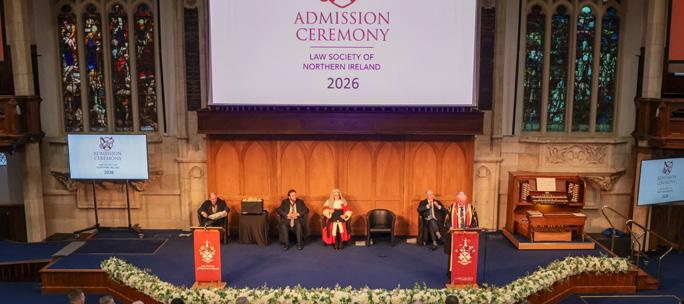
The President, Mark Borland, was speaking at the Law Society of Northern Ireland’s 2026 Admission Ceremony, which took place at Assembly Buildings in Belfast City Centre on Friday 20 February 2026.
The Ceremony is widely regarded as an important and popular event in the legal calendar marking the formal admission of solicitors to the Roll in Northern Ireland.
This year’s Ceremony was marked by several key milestones, including the admission of the first recipients of the Society’s Centenary Bursary, established in 2023 to address one of the key barriers to the solicitors’ profession faced by those from less advantaged backgrounds.
This year also saw an increase in those attending with 140 newly qualified solicitors accompanied by more than 500 guests, including Masters, friends, family and colleagues.
The Ceremony also welcomed 15 solicitors admitted to the Roll in Northern Ireland under reciprocal arrangements between England and Wales and the Republic of Ireland.
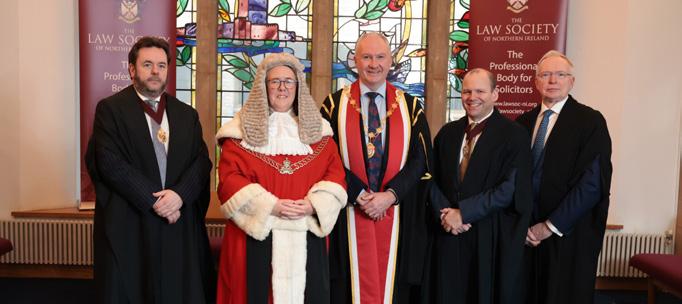
As part of this year’s Ceremony the Registrar of Solicitors, David A. Lavery CB, presented the newly admitted solicitors to the Lady Chief Justice for Northern Ireland, Dame Siobhan Keegan, and the Society’s President, Mark Borland.
During his keynote address to attendees, the President took the opportunity to welcome the next generation of solicitors and to remind them of their important role and invaluable services they provide to support clients and the local community throughout Northern Ireland.
Speaking, the President said:
‘I would also encourage you to look up occasionally and be mindful of the wider political, economic and legislative landscape that has a profound impact on our profession and our Society as a whole. As solicitors, we must ensure that the most vulnerable in our community – those who could not otherwise afford legal representation – are protected.’
During her address the Lady Chief Justice reflected on the important role that newly admitted solicitors have within the legal profession in Northern Ireland.
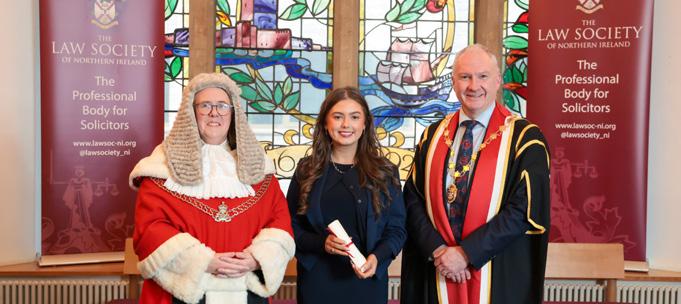
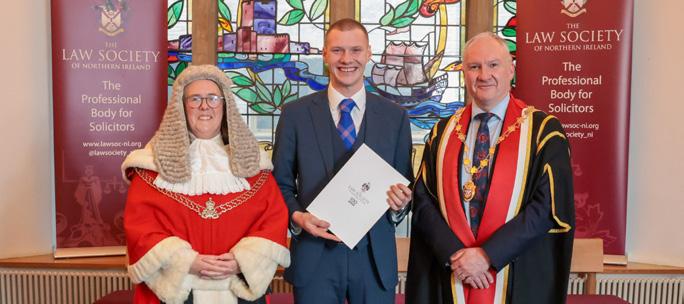
Following the admission of the newly admitted solicitors, the Lady Chief Justice and the President presented several prizes including:
• The Solicitors Accounts Regulations Prize, which was awarded to Mark McCullough, who attained first place in the Solicitors Accounts Regulations Exam for Trainee Solicitors.
• The Edward Bergin Prize which was awarded to Courtney Vance, who attained first place in the Professional Conduct Exam for Trainee Solicitors.
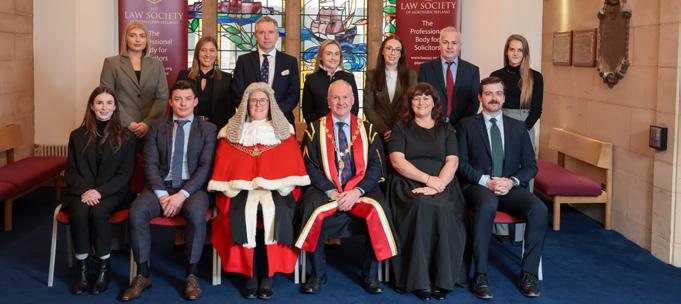
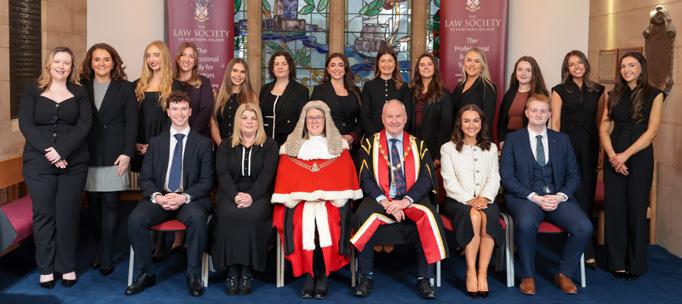
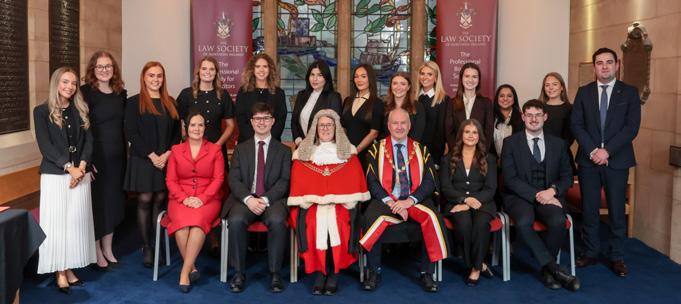
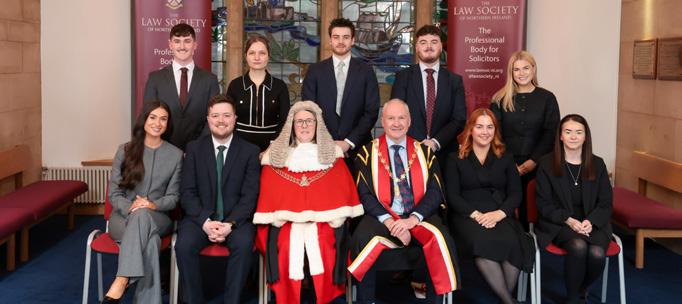
The Ceremony concluded with group photographs of all newly admitted solicitors with the Lady Chief Justice and the Society’s President.








IRLI is a civil society organisation supported by both branches of the legal profession across the island of Ireland.
In our lead article, Maria McCloskey talks to The Writ about her role with Irish Rule of Law International. This is the first of a series of articles showcasing points of view from legal professionals who have moved away from private practice into other sectors or areas of interest, reflecting the focus of this issue which is to showcase the increasingly wide range of career options open to solicitors in Northern Ireland today.
Can you outline your professional background. What drew you to law in the first place?
I qualified in 2007 after completing my training contract with Napier Solicitors. I was initially drawn to law because I like being able to argue someone’s ‘corner’, especially when they aren’t able to do so on their own, for whatever reason. I think advocacy, in all its forms, when done well, is so impressive. Two of my A-level subjects were English Language and Politics. That combination seemed to point clearly in the direction of law.
Tell us a bit about your current role
In December 2024 I took up my role as Executive Director of Irish Rule of Law International (IRLI). IRLI is a civil society organisation supported by both branches of the legal profession across the island of Ireland. We collaborate with legal practitioners and judges, among many others, to strengthen justice systems that uphold human rights across multiple jurisdictions.
In my first year, I visited our programmes in Malawi, Tanzania and Zambia, to ensure our strategic direction is grounded in programme realities. In October 2025, for the first time, our Malawi team travelled to Ireland to contribute directly to our strategic planning process, which has now culminated in the launch of our new five-year strategy.
During the visit, we hosted an event at the Bar, supported by the Law Society of Northern Ireland, where ICC Judge Beti Hohler delivered the keynote address, and we announced IRLI’s co-patronage by the Lady Chief Justice of Northern Ireland alongside the Chief Justice of Ireland. I am focused on strengthening our all-island identity, increasing visibility, and engaging more legal professionals from Northern Ireland in our work.
What drew you to human rights law in particular? Are there any issues that are of special importance to you?
In 2013, I spent three months volunteering with Young Africa in Mozambique. I came back with more questions than answers about global development, and enrolled on a Master's degree in Human Rights Law. I still struggle to understand why, despite all the legal obligations, international as well as domestic, vulnerable individuals have to fight to have their rights recognised and upheld. Through my work at Public Interest Litigation Support, it became apparent to me that human rights issues are very often interconnected: conflicts, the climate crisis, mass migration, wealth distribution (or lack thereof), etc. Add to this the challenges of mis- and dis-information, the rise in populism and authoritarianism. Ultimately, the need for strong, independent justice systems, capable of protecting individual rights and holding power to account, has never been more urgent.
Describe a typical workday
My week is structured. Mondays are for team alignment — reviewing priorities, anticipating deadlines and spotting challenges early. The rest of the week is reserved for deeper work: strategy implementation, reporting, and external engagement. I’m in Dublin regularly for in-person meetings, and I travel as required. I maintain a simple action list to track priorities — and I’m still perfecting the art of estimating what can realistically be done in a day.
Why did you decide to move from the solicitor profession to your current role?
Initially, following the Master’s, I wanted my legal work to focus on asylum and children’s rights. When a dedicated role supporting unaccompanied asylum-seeking children became available with Children’s Law Centre, it felt like a “now or never” opportunity — and at no point have I regretted taking it.
Is there anything you miss about working in private practice?
I miss my colleagues at Napiers. I was always supported in my work (I never had to ‘learn to swim’) while, at the same time, supported in pursuing my interests in human rights. The other teams I’ve been a part of were (and are) fantastic, too. But after 16 years at the firm, and at the risk of sounding cheesy, Napiers will always hold a special place in my heart. In terms of the work, I miss the ‘cut and thrust’ of going to court, and the feeling that I helped that one client resolve their case or legal dispute. I’m delighted that I still have the opportunity to support individuals in their legal issues, through my role as a Judge of the Appeal Tribunals of Northern Ireland, to which I was appointed in May 2024, even though my role there is entirely different. I also know how privileged and lucky I am to be working at IRLI, where I get to contribute to the ‘bigger picture’.
What is your favourite part of working where you do?
IRLI uniquely combines my interests in law, justice and global development. In Malawi in March 2025, I saw that in action through our work with partners in spearheading prison “camp courts”, where judges review cases of vulnerable, unrepresented accused persons inside prisons. That day, 34 men and boys had their cases reviewed: 14 were granted bail and two were discharged, having already served the time they would likely have received if found guilty. Most offences were non-violent and driven by poverty — for example, bicycle theft can result in a custodial sentence, given how vital bicycles are for work and transport. As those released walked out, the other inmates applauded. It was a powerful reminder of what access to justice can mean in practice.
Can you tell us a bit about the transferable skills you learned as a practising solicitor which are useful in your current role?
One of the best courses I’ve taken in my career is the Advanced Advocacy course, delivered by the Law Society of Northern Ireland in conjunction with the National Institute for Trial Advocacy in America. For me it wasn’t just about running my own hearings, although it helped me do that, too. It was also about gaining confidence and practising oral advocacy to be able to speak in meetings, negotiate settlements, and present in public forums. In my current role, I need these advocacy skills to communicate with and represent IRLI in front of different audiences.
What are the challenges you feel are particular to your current role? And to the charity/NGO sector in general?
Our work is taking place amid a global human rights and gender equality backlash, rising conflict and instability, and a sharply constrained development financing environment. At the same time, the World Justice Project continues to report on the deepening global rule of law recession. IRLI is fortunate to receive support from the Irish Embassies in our programme countries and from Irish Aid, the Government of Ireland’s development programme, alongside generous unrestricted contributions from solicitors of the Law Society of Ireland. In the current climate, sustained funding is essential to ensure that strong justice systems are not only built but protected.
Do you work as part of a team or on your own? Does organisational structure impact on your role?
Both. I work very closely with the staff team across the organisation, staying connected through regular meetings. I also work alone quite a bit.
Have you ever been faced with any ethical dilemmas or situations where your advice is either not welcome or not taken?
This doesn’t tend to happen as much in my current role, as I’m not providing legal advice. I do have to decide on organisational priorities and make decisions or recommendations. These won’t always align with everyone’s views across the organisation (be those from staff members, partners, or stakeholders). But it is my job to analyse issues and make decisions, or recommendations to the Board, which are in the best interests of the organisation as a whole.
What, if any, support would you like to see offered to those working outside of private practice? Are you part of any support groups or networks for legal professionals outside of private practice?
I still feel very connected to the profession through my work with the Advocacy Course Working Group, the Society’s Human Rights and Equality Committee, and, of course, the Appeal Tribunals. For anyone who is considering leaving private practice, I’d encourage you to think about these avenues, particularly a part time or fee paid judicial post. Related to that, I am delighted to see the ongoing support from the Law Society of Northern Ireland for the advancement and support of women in the profession. Many women choose to leave private practice for reasons which are obvious and detailed in recent surveys. The results from the 2025 Council elections prove that the Society’s initiatives are having an impact and I am sure will see the benefits of that in the months and years to come. Many people have been involved in this effort, but Brigid Napier deserves particular mention. I see how she supports the advancement and progression of women through her actions, as well as her words. I have also been the beneficiary of her support when, long after leaving Napier Solicitors, Brigid suggested I apply for my current role. I doubt I would have had the confidence otherwise, and I am very grateful for her ongoing mentorship. Having a mentor is so valuable and I hope I am ‘paying it forward’, supporting others in the early stages of their careers.
What role does AI play in your role or in the company at large? Can you tell us a bit about governance or regulation of AI?
I use AI to help, mostly, with getting documents started, such as an article. I have some concerns about the speed of developments and what it means for the future of the job market. At the same time, it offers significant opportunities in supporting access to justice work, particularly in our programme countries, and for remote, disadvantaged, and marginalised communities. The importance of regulation cannot be overstated, and there is no doubt guidance which is as clear and up to date as possible is required for lawyers, primarily from the regulatory bodies. There is also a piece of work to be done around managing clients’ expectations. I think we, as a profession, should think very carefully about how to use it responsibly, including the impact it will have on future generations of (would be) lawyers.
Do you find that your role offers a better work-life balance? Do you have typical ‘9-5’ hours?
I don’t work a typical 9–5, though I’m probably closer to it than I might have been in private practice. The pressures are different, but stress is part of any leadership role. Over time, I’ve realised the only real solution is learning how to manage it well — not checking emails late at night, protecting time off where possible, exercising, and trying to maintain perspective. The legal profession can place significant demands on people. Lawyers are human beings, with families and lives outside of work, and sustainable performance depends on recognising that. Our professional culture benefits from patience, thoughtful decisionmaking and space to develop skills — not just urgency.
How do you ‘switch off’ from your work?
I love music (be it a gig, festival, or playing the ukulele), going to the QFT, and hiking, mostly in the Mournes. I’m doing part of the Camino this May with my mum and a few others. Wish me luck!
I still struggle to understand why, despite all the legal obligations, international as well as domestic, vulnerable individuals have to fight to have their rights recognised and upheld.
Julie-Ann McCaffrey Director, DWF (NI) LLP

Tell us a bit about your current role
I am a Director in the Infrastructure, Construction and Energy team at DWF (Northern Ireland) LLP in Belfast. I have a background in both contentious and non-contentious construction and public procurement. I spend most of my time helping clients get their projects off the ground smoothly and with the right contractual foundations in place. That includes drafting and negotiating construction contracts, advising on procurement strategy, shaping risk allocation, and supporting project teams with the everyday reality of contract administration.
Describe a typical workday
No two days are ever quite the same! My day actually starts long before I open my emails - usually with the school run and making sure everyone gets out the door on time.
Once at my desk, I begin by reviewing overnight emails and prioritising anything that needs an immediate response; there is almost always something time-sensitive waiting. In between balancing client queries, reviewing contracts and progressing the team’s work, the day is usually filled with a mixture of client meetings and internal discussions on live matters. It is a busy, fastpaced role but that is exactly what I enjoy about working in a large, busy practice.
I also frequently have commitments outside of fee-earning, including Law Society Council and Committee meetings, and delivery and participation in CPD sessions. These tasks add pace to the day, but they also allow me to play an active role in shaping the profession, which is something that I feel strongly about.
The workday tends to finish with me moving seamlessly into my most important role –Mum. At that stage, the focus turns from contract drafting to homework negotiations, snack-based dispute resolution and ensuring that our very insistent dog, Molly, gets her evening walk!
Like many working parents, once the bedtime routine is complete and the house is finally quiet, I often find myself back at the computer catching up on the last pieces of work for the day.
Ultimately, there is no such thing as a ‘typical’ workday; every day is full, demanding and purposeful, but this is exactly the kind of balance that I aim to model where ambition and family not only coexist, but strengthen each other.
My favourite part of working at DWF is the people I work alongside every day. I am surrounded by talented, dedicated colleagues who bring energy, insight and technical strength to their work. The team is collaborative, supportive and genuinely invested in each other’s success.
We are fortunate to have an inspiring Managing Partner, Julie Galbraith, who has created an environment where people feel trusted, supported and encouraged to grow. Within the construction team, David McNeice leads with deep sector expertise and a collaborative, people-centred approach that brings out the best in those around him.
What also sets DWF apart is its genuinely forward-thinking culture. The firm embraces innovation, encourages flexibility of approach and is consistently open to new ways of working - whether that relates to client service, internal collaboration or career development. That flexibility makes a tangible difference in practice and contributes to a culture where people feel able to perform at their best.
Just as importantly, we work with an exceptional range of clients from public sector bodies to major contractors and developers whose ambition and diversity of projects make the work consistently engaging and rewarding.
You were previously an in-house lawyer - why did you originally decide to move from private practice to in-house?
Having begun my legal career at a commercial firm in Belfast, moving in-house exposed me to the operational pressures behind major projects, programme constraints, cost drivers and the complex relationships between employers, contractors and consultants.
I was also drawn to the opportunity to work directly with project teams and be involved in decisionmaking from the outset. Inhouse roles allow you to see why decisions are made, not just how, and offer a level of commercial exposure and organisational visibility that is difficult to replicate in private practice. Overall, it gave me valuable insight into the realities behind the legal issues we deal with in private practice.
After seven years working as an in-house solicitor, I made the decision to return to private practice. It was not a step taken because I was dissatisfied in my in-house role; I had thoroughly enjoyed my inhouse experience. However, as my career progressed, I recognised that private practice offered opportunities that aligned more closely with the path I wanted to pursue. I missed the breadth and diversity of clients that a firm environment provides. Returning to private practice has allowed me to contribute at a strategic level, lead and develop others, and work within a marketleading construction team where I can continue to grow, lead and add value.
What are the challenges you feel are particular to an in-house role?
A distinctive challenge for in-house solicitors is the constant tension between what is legally advisable and what is commercially necessary to keep a project or business moving. While the lawyer’s instinct is to mitigate risk, commercial teams may prioritise programme, cost or operational continuity. Balancing these competing priorities requires judgement, diplomacy and the ability to articulate risk in a way that supports informed decisionmaking without stalling progress.
Capacity can be another challenge. Many in-house teams in Northern Ireland are relatively small, which means that you are not only the lawyer but often the sounding board, and occasionally the mediator between competing internal priorities.
Unlike in private practice, with in-house roles you typically have just one client, and they’re usually close enough that you can hear them coming before they reach your desk! The upside, of course, is that you have unparalleled access to the business and a far clearer understanding of the practical realities shaping the legal issues.
Have you ever been faced with any ethical dilemmas or situations where your advice was either not welcome or not taken?
Ethical dilemmas and situations where advice is not followed are part and parcel of being a lawyer. There are occasions when advice is not taken, or is taken only in part, because the commercial context drives a different decision. In those situations, the role becomes one of helping clients understand the risks, exploring alternative approaches that may be more workable, and ensuring the potential consequences are transparently communicated.
What, if any, support would you like to see offered to those working in an in-house role?
There has been significant growth of inhouse legal practice in recent times, which is a continuing trend. Ongoing training, opportunities for skills development and clear guidance on emerging legal and regulatory changes is essential, particularly given the pace at which expectations on inhouse legal functions continue to evolve.
Peer networks are also incredibly valuable. Inhouse roles can sometimes feel isolating, especially where the legal team is small or embedded within large operational departments. Having access to forums where inhouse lawyers can share experiences, discuss challenges and exchange best practice helps create a sense of community and perspective.
Groups like the In-House Lawyers Group NI play a vital role in creating that sense of community and connection, offering a space where inhouse lawyers can exchange experiences and stay informed about industry developments.
DWF has been proudly involved with the In-House Lawyers Group Northern Ireland, including organising and sponsoring its inaugural conference in 2025. The conference, supported by the Law Society of Northern Ireland, was the first of its kind in the region, bringing together in-house legal professionals for a day of insight, reflection and collaboration. It was attended by more than 100 in-house lawyers from leading businesses operating across Northern Ireland. The agenda included discussions on the Post Office Horizon scandal and the changing in-house landscape. Given the positive feedback and success of the conference, plans are already in the pipeline for a similar event this year.
Did you find that an in-house role offered a better work-life balance in comparison to private practice?
There is a common perception that in-house lawyers enjoy a better work-life balance in comparison to those in private practice. In reality, it isn’t quite that simple. While some in-house roles can offer more predictable hours, many are every bit as demanding as private practice just in a different way. The pace is driven by the needs of the business, and deadlines are often immediate because you are advising the project team in real time.
Across the profession, in private practice and in-house roles alike, solicitors are increasingly recognising the importance of balance and the ability to switch off. From my experience, balance is less about the clock and more about the culture and choosing or creating a place where you can thrive both professionally and personally.
Emma Fox Solicitor, Fox Law, Omagh, County Tyrone and Co-founder of Lawri.ai

is your current role?
I am a practising solicitor with over 20 years’ experience in private practice, alongside a parallel role of developing legal technology. My career has been rooted in private practice, but over time it has expanded into legal innovation. That shift has allowed me to take the insight gained from years of practice and apply it in a broader way, looking at how legal work can be supported, structured, and sustained beyond a traditional approach.
After more than 20 years in private practice, what prompted you to develop a legal technology product?
Throughout my years working in rural private practice, conveyancing was often seen as a gateway to other legal services. However, while many describe conveyancing as ‘routine,’ I’ve found that it’s anything but straightforward. Handling residential property law means balancing risk, trust, tight deadlines, and the very real impact our work has on people’s lives. Day in and day out, I saw the same challenges cropping up: duplicated checks, scattered information, ever-changing compliance rules, and the mental load these place on solicitors.
What really motivated me to explore legal technology wasn’t wanting to leave behind the hands-on work of conveyancing, but to find a better way to do it. With experience, I realised which tasks could be made more efficient and which still demanded our judgement as professionals. I’d often feel frustrated by tech products pushed at solicitors—tools that promised a lot but didn’t actually fit our workflow or thinking. So, I decided to look for solutions that truly support legal professionals, rather than force us to adapt to ill-suited systems. My aim became to weave legal expertise into technology, making it work for practising solicitors and not the other way round.
How did completing a postgraduate diploma in legal technology influence your approach?
The postgraduate diploma was transformative because it gave me the vocabulary to bridge law and technology. Many solicitors find technology inaccessible not because it is alien, but because it is expressed in a language disconnected from legal reasoning.
The programme enabled me to articulate legal processes in a structured way without stripping out nuance. Concepts such as rules-based logic, explainability, data integrity, and decision pathways aligned naturally with legal analysis. That shared language made it possible to translate lived legal experience into structured systems, while still preserving accountability and professional judgement. I was also introduced to large language models (LLMs), which made it possible for the technology product I had envisioned to become a reality.
No two days are the same, which is part of what I value about my work. A typical day may involve reviewing legal workflows, refining rules or decision pathways, engaging with other professionals across law and tech, and staying connected to developments in regulation and practice.
I also spend time reflecting, and stresstesting ideas against real legal practice scenarios. Even when working away from a traditional caseload, my thinking remains grounded in practice reality - deadlines, risk points, client impact, and regulatory responsibility.
Do you have any other projects in the pipeline? What direction do you see your career heading?
My focus continues to be on work using technology to supplement legal expertise, whilst embedding professional standards. I am particularly interested in projects that support solicitors rather than replace them easing pain points in legal processes, to reinforce trust, transparency, and accountability in legal work.
Looking ahead, I see my career continuing to move fluidly between practice-informed innovation, advisory work, and contribution to wider conversations about the future of legal services. The goal is not to leave traditional legal practice behind, but to extend its influence into how legal work is designed, supported, and understood in the future digital landscape making technology work for practising solicitors.
How do you maintain a healthy work–life balance?
Balance has become more intentional over time. Legal practice can be demanding, and working across multiple roles requires clear boundaries and prioritisation. I am mindful of structuring my work so that it is sustainable, not just productive.
That includes being selective about projects that are important to me, building in time for reflection, and recognising that stepping back often improves decision-making. Experience has taught me that professional longevity depends as much on how we work as on what we do.
Is there anything else you would like to say about legal technology?
Legal technology in legal practice works best when it starts with the solicitor, not the tool. Systems should reflect legal reasoning, support professional judgement, and make risk visible rather than obscured. In areas like conveyancing, where trust is foundational, technology must earn its place through transparency and explainability.
The most effective innovation I have seen is not about disruption for its own sake, but about thoughtful evolution — preserving what matters in legal practice while adapting to modern pressures with care and clarity.
Laura Dawson Solicitor, Northern Ireland, Human Rights Commission

Tell us a bit about your current role.
I am a solicitor in the Northern Ireland Human Rights Commission.
The Commission’s governing legislation is the Northern Ireland Act 1998, which sets out our statutory functions. These relate to the protection and promotion of human rights in Northern Ireland and overseeing the UK Government commitment to ensure there is no diminution of rights under Article 2(1) of the Windsor Framework.
My role cuts across many of the Commission’s functions, but there is a particular focus on litigation and legal advice. The Commission has around 30 staff – 5 of us work in the legal team – 1 paralegal, 3 solicitors and 1 director. We work closely with other teams in the Commission to discharge its functions.
Why did you decide to move from private practice to your current role?
I have always had an interest in human rights law. Since the start of my career, the most impactful and rewarding cases I have worked on involved human rights. Working for the NIHRC- a National Human Rights Institution with ‘A’ status accreditation from the United Nations, seemed like the perfect place to further my career in the field of human rights.
As a mum of 3, I found it challenging to juggle motherhood and private practice, at a time when hybrid and flexible working was not commonplace. The Covid-19 pandemic changed my mindset permanently, as I think it did for many. The little things are the big things in life. Being able to do school dropoffs and be at home some days when the children get home from school has been huge. The Commission offers hybrid work and flexible hours to all staff, which I would go as far as to say has been life-changing.
The main streams of work for the legal team in any given week include dealing with queries that come to the Commission and with legal cases.
Because human rights law applies to all public functions, queries can relate to a broad range areas, from housing, health and immigration to education. Occasionally, these queries result in an application for legal assistance. The Commission may support individuals, intervene in cases, or instigate cases of its own volition. We do not do this lightly- only when there are systemic areas of concern for the Commission and the Board decides that our statutory criteria is met. We usually have a few cases ongoing at any one time and a lot of work goes in to them. Usually, our cases will be judicial reviews at the High Court, Court of Appeal or Supreme Court of the United Kingdom.
We also work with a wide range of stakeholders on international treaties, advise the NI and UK governments, work on investigations when there is one ongoing, and, increasingly, on matters involving Art 2(1) of the Windsor Framework.
What are some highlights that you have experienced working in this role?
Some highlights from my time in the Commission have been travelling to Strasbourg and Luxembourg, and working on the Commission’s investigation into RSE in schools which was a great learning experience.
As a lawyer though, litigation will always be my favourite. Two recent cases I have been involved in were an own motion case on housing intimidation, and a third party intervention on legacy. I really enjoyed working on the own motion case as these statutory powers are quite unique to the Commission and the case involved upholding the rights of a vulnerable group. I worked with a number of organisations and a diverse range of clients as well as organisations such as Women’s Aid and Extern.
The second case involving legacy was an opportunity to draw on the Commission’s work on the standards applied in legacy cases with the aim of informing the court of the requirements of Article 2 ECHR in the context of Northern Ireland coronial matters. Again, involvement in this case was only possible due to the unique standing of the NIHRC. Very occasionally, the Commission itself has been challenged. I therefore have had to advise the Commission as a respondent which I have really enjoyed. Acting for both applicants and respondents is an excellent experience for any lawyer.
Can you explain how inhouse counsel is regulated or supervised? What professional support do you have?
Working as an in-house lawyer means giving advice to your employer, and this can sometimes be challenging. Often you are advising the senior leadership team and colleagues who you may have a close working relationship with, which is very different to a “client” in private practice. The Board of Commissioners is removed from the staff team and it is the ultimate decision-maker in the organisation, so in this way it is a bit more like private practice.
In-house solicitors are regulated by the Law Society of Northern Ireland and we have different professional standards and obligations to adhere to. I can see how in-house solicitors could blur the lines and forget their professional obligations. Staying in close contact with the Society- through CPD, Women’s networking group events and being a member of the Human Rights and Equality Committee has helped me keep up to date with the various requirements and regulations. I am currently doing the Law Society of Northern Ireland’s Vulnerable Practitioner Couse which I have found invaluable. I hope to participate in the Society’s Mentoring Scheme in the near future.
I am supervised in my role by the Commission’s legal director who is very supportive- having previously practised as a barrister she recognises the role of legal professionals. The Commission is a very supportive place to work which makes any challenges easier to deal with.
Do you find that an in-house role offers a better work-life balance?
Do you now have typical ‘9-5’ hours?
Absolutely- I have found it immensely beneficial to be able to work flexibly. Hours of work can be varied so long as we work our contracted hours each week. The work is extremely interesting and rewarding but not as fast-paced or demanding as private practice. It is important to say that worklife balance is vital for all of us- not just for parents. Many of us have shifted our priorities and recognise that life outside of work is most important. Many of us, at some point in our lives, will be supporting or caring for a family member or dealing with an illness or disability ourselves or whatever else life may throw at us. Having a good work-life balance is increasingly considered a priority and I feel very fortunate to have found that at the Commission.
Deborah McCullough Ulster Bank

Please tell us a bit about your current role
My role is Senior Legal Counsel in the NatWest Group, a UK banking and financial services organisation serving over 20 million customers through brands including NatWest, Royal Bank of Scotland, Coutts and Ulster Bank.
I am currently working predominantly with the corporate and institutional side of the business but also support the retail and private banking divisions. My role is broad, spanning strategic advisory work, transaction support, product structuring, regulatory interpretation, governance matters and risk management. I work closely with stakeholders across the bank, including risk, compliance, finance, product development and operations teams.
A key feature of my role is that I am embedded in the business and involved in decision-making at an early stage. I advise on proposals with a view to ensuring they are lawful, compliant with regulations, sustainable, aligned with risk appetite, and consistent with the organisation’s ethical purpose and strategy.
There is no typical day for me, which is part of what makes the role interesting.
My time is divided between advising on new initiatives, supporting transactions, reviewing documentation, policies and procedures, attending governance committees or working groups and advising on how legal and regulatory developments affect the business.
The role is both proactive and reactive. My internal clients rely on us to translate complex legal and regulatory requirements into clear, practical and commercially focused guidance to enable them to reach the right outcomes.
Collaboration is central to the role - across the Legal function, the wider business and with external counsel and agencies when required.
Why did you decide to move from private practice to your current role?
The breadth and variety of work offered by the in-house role appealed to me. Moving in-house also offered the opportunity to become a strategic partner rather than an external adviser. I was interested in understanding the broader commercial context of the legal questions and tailoring my advice to the many considerations which are relevant to a large financial institution.
In Northern Ireland, in-house practice has become more established in recent years. It is recognised as a rewarding legal career path that leverages both commercial and legal skills.
Is there anything you miss about working in private practice?
I began my career in private practice with Reed Smith in London and later with L’Estrange & Brett in Belfast.
Perhaps due to the nature of my work in private practice and the scale of the Legal function I am now part of, the work is not that dissimilar. I still work on complex high value matters which require specialist technical knowledge and have regular exposure to new challenging legal issues.
I miss direct exposure to a wide range of local clients and working with local solicitors on an everyday basis.
I don’t miss time recording!
What is your favourite part of working where you do?
The most rewarding aspect is being part of a multidisciplinary team with a sense of shared purpose, solving problems and shaping outcomes for the business. It is satisfying to influence matters at an early stage and see projects through from concept to execution.
As in-house counsel, you are providing legal advice and helping to design workable, balanced solutions. Advice must also be focused on safeguarding the integrity, reputation and long-term sustainability of the organisation.
Can you tell us a bit about the transferable skills you learned in private practice which are useful in your current role?
My time in private practice equipped me with essential skills for my role - analytical discipline, precise drafting, the ability to identify and assess legal risk, sound judgement around materiality, and the capacity to manage competing pressures and tight deadlines. The ability to give candid advice in a clear, well-reasoned and proportionate manner is especially valuable.
Client management skills are just as important in-house as they are in private practice. NI firms are rightly known for nurturing strong client relationships and I am grateful for that foundation.
What are the challenges you feel are particular to an in-house role?
Being embedded in the business allows you to build strong relationships and develop a deep understanding of commercial objectives. However, it is essential to maintain professional independence and objectivity.
The role requires strategic thinking and commercial awareness as well as sound legal analysis. I need to remain professionally objective while being commercially engaged.
The breadth of subject matter can be demanding. In-house roles often require rapid immersion across multiple areas of law and regulation, and pragmatic advice is often required at short notice.
Do you work as part of a team or on your own?
Both. I sit within a large specialist legal team but much of my work is autonomous. In-house practice requires a high degree of self-direction.
At the same time, complex matters and large projects often involve close collaboration with multiple teams across the business, colleagues in Legal, external legal counsel and external bodies. Strong teamwork is essential.
Does organisational structure impact on the role of being an in-house lawyer?
Understanding governance structures, reporting lines and escalation frameworks is critical. In financial services institutions, decisions sit within layered formal oversight structures. Understanding these structures is essential to ensuring your advice supports the business effectively.
Have you ever been faced with any ethical dilemmas or situations where your advice is either not welcome or not taken?
There are occasions in private practice and in-house where legal advice constrains commercial ambition.
In my experience, advice is generally respected when it is well-reasoned, proportionate and aligned with the organisation’s long-term interests. Part of the job is to ensure that my stakeholders recognise legal advice is not given to obstruct but to support the long-term sustainability of the business by mitigating risk and preserving the integrity and reputation of the business.
My conduct and duties are governed by the same professional regulation applicable to all solicitors. Our core duties of independence, integrity and acting in the best interests of the client are not changed by the in-house context.
What, if any, support would you like to see offered to those working in an in-house role?
Are you part of any support groups or networks?
The in-house community in NI has grown steadily in recent years, and both formal and informal networks have developed.
Opportunities for in-house lawyers to connect with each other and with colleagues in private practice are very valuable, especially for smaller in-house teams.
I am a member of the In-House Lawyers Group Northern Ireland, which provides inhouse lawyers from a variety of businesses across NI with opportunities for connection, technical updates and professional development. The Group is supported by local firms who generously give of their time and expertise.
The Law Society of Northern Ireland’s Mentoring Programme includes in-house solicitors as both mentors and mentees. I have participated as a mentor and would strongly recommend the programme as a helpful source of professional support and development - for those in-house and in private practice.
Can you explain how in-house counsel is regulated or supervised?
In-house solicitors in NI are regulated by the Law Society of Northern Ireland and are held to the same professional standards as those in private practice. I am also regulated by the Solicitors Regulation Authority (England and Wales).
Our in-house legal function has robust governance structures and reporting frameworks in place, to ensure high professional standards are maintained. Effective line-management structures, alongside extensive training programmes, provide supervision and ongoing
professional development across the team.
What role does AI play in your role or in the company at large? Can you tell us a bit about governance or regulation of AI?
AI is increasingly becoming embedded in both legal practice and the wider business environment.
In my role, bespoke AI tools built for our Legal function assist with document review, research, creating first drafts and horizon scanning. These tools undoubtedly improve efficiency and free up time for higher value work but outputs are carefully reviewed and professional judgement remains essential.
Across businesses, AI may be used in areas such as fraud detection, risk modelling and customer-facing systems. From a governance perspective, the focus must be on responsible and ethical deployment, transparency and robust controls. The role of in-house lawyers is to ensure deployment of AI complies with existing (and evolving) legal and regulatory frameworks, including conduct, data protection and operational resilience obligations.
Do you find that an in-house role offers a better work-life balance? Do you now have typical ‘9–5’ hours?
It would be inaccurate to describe in-house roles as 9-5. The intensity is different rather than absent. There are periods of significant pressure, long hours and urgent issues requiring immediate attention.
However, to some extent there is greater predictability and autonomy over how work is managed compared to private practice. For me, this has generally translated into a more sustainable work-life balance.
In my experience, the main advantage of in-house practice in a large organisation has been the availability of flexible working practices when needed. While this remains subject to business need, it is recognised there are options which support a healthy work-life balance without compromising efficiency.
Jill Downing Housing Rights

Tell us a bit about your current role.
I work in Housing Rights which is a charity providing advice to home owners, private tenants and social housing tenants about housing issues including housing benefits and accessing homeless provision from the NIHE.
Housing Rights also provides training in housing law and practice.
Do you work as part of a team or on your own? Does organisational structure impact on the role of being an in-house lawyer?
Housing Rights currently has two part-time solicitors, a recently qualified solicitor and an apprentice solicitor.
Housing Rights has a helpline which is open Monday to Friday 9.30am-4.30pm into which initial enquiries come. If further assistance is required, the matter will be referred to advocates or, if there are court proceedings, to a solicitor.
One of the benefits of being an in-house solicitor is that enquiries will have been filtered through our advice process and therefore I am usually dealing with matters that require legal advice.
Describe a typical workday.
One of the main roles for solicitors at Housing Rights is providing assistance to social tenants who are facing repossession of their tenancies due to alleged nuisance, often referred to as anti-social behaviour. A significant number of these social tenants have vulnerabilities linked to poor mental and/or physical health. Housing Rights liaises with medical professionals and support agencies with a view to assisting the social tenant. If we are unable to negotiate a suspended possession order, we will apply for Legal Aid to represent the tenant in court and may seek expert evidence from psychiatrists to ensure that any outcome is proportionate.
I also work with colleagues across the organisation to discuss emerging legal issues and identify potential cases for strategic litigation.
What is your favourite part of working where you do?
In Housing Rights, all staff are highly motivated to assist clients with their housing needs as it is such a fundamental need. This creates a very positive working environment, notwithstanding the difficult nature of the work.
Why did you decide to move from the solicitor profession to your current role?
I specialised in family law for 25 years, including private and public Children Order proceedings and wanted to try something new.
Can you tell us a bit about the transferable skills you learned as a practising solicitor which are useful in your current role?
I practised Collaborative Law in private practice and tried to support people navigating challenges in their lives by minimising and avoiding adversarial approaches if possible. This included developing negotiating skills and working with other professionals such as social workers and Guardians to find solutions. However, if a solution cannot be found, a strong legal strategy must be pursued to ensure the best outcome for the individual, as the consequences, including losing your home, are very significant.
Is there anything you miss about working in private practice?
Unfortunately, the demands on all businesses, including legal practices, continue to increase, which make it less attractive. I was very lucky to practise at a time when my local association provided a network of support including the Young Solicitors Association. I was privileged to work with the first job-sharing solicitors. I hope that the efforts to promote and support women in the solicitor profession continue.
What are the challenges you feel are particular to an in-house role?
As an in-house solicitor at Housing Rights I specialise in the area of housing law and there are not that many other solicitors in this sector, save for solicitors working for Housing Organisations with whom I am often on opposing sides.
Have you ever been faced with any ethical dilemmas or situations where your advice is either not welcome or not taken?
Unfortunately, clients with vulnerabilities may not be able to engage with support to retain their tenancies and in the current housing crisis the consequences of having no access to housing are very real and severe.
What, if any, support would you like to see offered to those working in an in-house role? Are you part of any support groups or networks?
I benefit from the support of the Housing Rights structure both formally and informally. There is great emphasis placed on well-being.
I have also enjoyed participating in the Strategic Litigation group organised by the Northern Ireland Human Rights Commission, which brings together in-house solicitors working in organisations such as The Law Centre, Children’s Law Centre, Equality Commission and CAJ.
I have recently undertaken the Law Society of Northern Ireland Vulnerable Witness training and found this very beneficial, and I see the benefit of a formal Society group for Vulnerable Clients to improve skills and share experiences.
Can you explain how in-house counsel is regulated or supervised?
Housing Rights has LEXCEL accreditation and ensures that all requirements in relation to briefing counsel are met.
What role does AI play in your role or in the company at large? Can you tell us a bit about governance or regulation of AI?
Housing Rights does not currently use AI in its work. As part of our digital transformation plans, we hope to explore how we could make the best use of technologies like AI, while protecting and promoting client data and, critically, the quality of advice.
Housing Rights, like any legal practice or organisation, takes its legal responsibilities in managing personal information very seriously, with all staff regularly trained in GDPR.
Housing Rights continues to provide easily accessible and up-to-date information about housing law on our website to ensure as many people as possible can be informed about their rights. This is freely available.
Do you find that an in-house role offers a better work-life balance? Do you now have typical ‘9-5’ hours?
I am currently working 18.5 hours per week. Whilst Housing Rights are very supportive of good work-life balance, anyone who works part-time will know that it is hard to say no and switch off on time!
Conor McKillop HSF Kramer

Tell us about your role
Herbert Smith Freehills Kramer (HSF Kramer) is a global law firm, and I am a senior lawyer in the Disputes team of our Digital Legal Delivery (Digital) Practice Group, based in our Belfast office.
My role as a Manager is to have ultimate responsibility for the legal work that we deliver for clients.
What is the Digital Practice Group?
Our Digital team delivers legal services with greater efficiency by integrating legal delivery, technology, and process design. The team comprises lawyers, data analysts and technologists and we collaborate with all practice groups at HSF Kramer, and with all of our global offices. Our legal services span Disputes, Corporate, Finance and Real Estate, and many of our lawyers have hybrid skillsets across law and technology.
Belfast was our first ‘Digital’ office, having launched back in 2011; however, we now operate globally, with teams based in Australia, the UK, South Africa, the US, and Asia. We offer secure client data hosting in four key regions: Asia, Australia, the UK, and the US. Our global resourcing model enables us to rapidly scale in response to client needs.
What has been your career route?
Well, ignoring my father’s advice, I followed him into a career in law (he wanted a vet in the family!). I graduated from Queen’s University Belfast and started as an apprentice solicitor with O’Connor & Moriarty in Lurgan in 2009. This was, of course, during a time when the legal sector was feeling the effects of the global financial crisis and so it wasn’t an easy time to secure an apprenticeship – I have always been very grateful to Paddy Moriarty for taking me on at that time. After qualification, I remained with O’Connor & Moriarty for five years as an assistant solicitor, working mostly on criminal, family and conveyancing matters. Then, in 2016, I moved to Herbert Smith Freehills (as it was then) to join their Disputes team in Belfast.
Why did you choose to join Herbert Smith Freehills Kramer?
After five years of general practice, I was curious to try my hand at something a little different. I had some awareness of HSF Kramer and knew of its reputation as a global law firm that was utilising legal technology to work on the firm’s largest mandates. I’ve always been interested in technology, and I had a few friends from my Institute days that I knew had successful careers there, so I decided to give it a go and see if it was for me. Ten years later, I’m still here!
What type of work does the Digital Practice Group do?
Our Digital group implements the best technology solutions today, while experimenting with emerging tools to understand their practical applications for tomorrow.
We work on some of the firm’s largest mandates for key clients alongside the other practice groups of the firm, often delivering elements which are high volume and which we can streamline using technology and process. When the Belfast office first opened in 2011, our initial offering was to provide support with large-scale disclosure reviews, where we were able to provide an in-house alternative to outsourcing this work to external providers. Legal review remains a core service for the Digital Disputes team,
but we also carry out remediation projects, regulatory investigations and portfolio litigation management.
The Disputes team is, of course, only one part of the Digital Practice Group - we also have our Transactions, Advisory and Legal Technology teams, who assist our clients with corporate and commercial services, funds and asset management, commercial financing and technology consultancy
What does a typical workday look like?
As a Manager I lead on the legal delivery of matters for clients. This usually means leading a team of senior solicitors, solicitors and/or legal analysts to complete the legal work, whilst also looking after the project management aspects of the matter and liaising with our clients. Needless to say, it is a challenging and busy role, but I enjoy the opportunity to mix legal, business and people management skills. No two days are the same!
Early on in my HSF Kramer career, I also had the opportunity to go on secondment to a global financial services client, joining their in-house commercial legal team in London. It was initially a three-month secondment, but as the matter developed, I ended up staying with the client for eight years and transitioned to a “virtual” secondment model that allowed me to work from Belfast. This really was out of my comfort zone at the beginning, and it felt like a bad case of imposter syndrome, but it turned out to be one of the best career decisions that I ever made. During this secondment, I had the opportunity to advise on varied and complex areas of law, and I had to deliver to tight deadlines to support stakeholders at the most senior levels of the business. Interestingly, it also allowed me to develop relationships with many new teams within HSF Kramer as I was able to engage with them with my ‘client’ hat on. The challenge ultimately pushed me to be a better lawyer and to really hone the commercial aspects of my advice. I came back to HSF Kramer with a much better understanding of the client, the in-house role, and the ways in which we can work to better support them.
Moving from a high street practice to a global law firm was definitely a change. I’ve often said that I went from working on 100 small and medium matters to just one or two enormous matters! At its core, though, the role remains the same – providing a professional, high-quality service whilst building relationships with your clients and growing the business.
The work can be complex, particularly as our clients come from many different sectors. One day you are immersed in the minutiae of offshore oil production, and the next, it’s in all things cryptocurrency! Our clients rightly expect a lot from us, and there have been many difficult projects and late-night deadlines over the years. Luckily, I enjoy the challenge, and it gives me the opportunity to work with some extremely talented colleagues who are leaders in their fields. There is also a fantastic collaborative atmosphere within Digital, meaning that the team always pulls together to support each other during the crunch points.
The role is mostly office-based, which took a little getting used to, and I do miss the craic of bumping into colleagues at court and catching up over a cup of tea. Having said that, there aren’t any more nights and weekends spent in police stations, so it’s a case of swings and roundabouts!
I’ve always had an interest in technology, and this is something that I’ve really been able to lean into at HSF Kramer. Our clients expect us to embrace new technologies and in the Digital practice group we are at the cutting edge of what HSF Kramer is doing in this space. Naturally this means that we are heavily involved in driving the firm’s adoption of generative AI.
As we all know, generative AI is here to stay and it is clear that it is going to transform the way that we work and deliver legal services in the near to medium future. Copilot is now an everyday tool across Digital, helping with everything from first drafts of documents to transcribing and summarising meetings. As a firm, we have invested in Legora to be our firmwide general purpose AI platform but we remain flexible and agile to meet clients where they need support, for example, by using Harvey or Gemini.
In addition to general-purpose tools, we also focus on identifying and investing in more specialised legal tech where we can see the potential to really add value for our clients. A great example of this is Relativity aiR. Relativity has been our document review platform of choice for many years now, and the recent release of Relativity aiR gives us access to a suite of AI-assisted tools to help streamline our legal review processes. Some legal review mandates can see us working with a pool of more than 2 million documents, and so the ability to harness generative AI to help us to identify responsive content early on is a game-changer.
We often have the relationships in place to collaborate with providers to really refine these tools to our needs, and so, it is really exciting to be able to influence the development of the platforms that we will be using.
Working at a global law firm, how do you stay connected at a local level?
Whilst we don’t practise in the Northern Irish legal market, we’re very connected to the local community. I currently co-lead our Multiculturalism Network which aims to highlight and celebrate the diversity that we have in our Digital team, and in Belfast more widely, and we recently partnered with a local organisation to invite members of the
refugee community to come into the office and share their stories. I also previously co-led our Citizenship Network, where we partner with the King’s Trust (formerly the Prince’s Trust) to deliver employability workshops in local schools, and with the Social Mobility Business Partnership to provide access to high quality work experience for pupils from low-income backgrounds.
We have great links with both Queen’s University and the Ulster University, and we regularly take part in insight days, job fairs and deliver guest lectures. Last year we also took on our first legal apprentice through Ulster University’s Degree Apprenticeship programme, and we’re looking forward to growing that number this year.
What is the culture like in Digital?
We have a fantastic culture in the Belfast office, and across Digital globally. We are fortunate to be working daily with colleagues in London, Johannesburg and across the United States, and the breadth of different cultures across the Digital team really enhances our own. We have a deeprooted commitment to pro bono work in the firm, and over the years we have been able to help death row prisoners in Malaysia to appeal their sentences, provide advice on employment law to working parents and compile country-specific resources to assist members of the LGBTQI+ community when making claims for asylum.
Outside of ‘work’ work, we have social and family events throughout the year, a very active Sports Network that runs events for all abilities (even my own), and an Arts and Business network that has won three awards (and counting!).
Ballymena to Belfast, and from apprentice to President - a career shaped by judgement, adaptability and service.

When Rowan White qualified in 1977, legal practice in Northern Ireland was, by today’s standards, almost entirely analogue. The tools of the trade were letters, desk telephones and a growing stack of files. No email. No mobile phones. Not even a fax machine in the corner. Yet for all the upheavals that have followed - technology, specialisation, the arrival of global firms and the shifting expectations of clients and younger lawyers - Rowan’s view is measured rather than nostalgic. The Writ sat down recently with Rowan to mark his retirement after 50 years in practice.
‘The one constant throughout my entire practice and career has been change,’ he reflects. ‘Usually for the better, it has to be said, but not necessarily always.’
Over a career spanning more than five decades, Rowan has seen how quickly the profession can evolve, and how easily it can be unsettled by what feels new. He has also lived the counter-lesson: that change, approached with an open mind, can be an opportunity.
A general grounding and a baptism of fire
Rowan’s route into the profession began in September 1974, when he started his apprenticeship at a long-established Belfast firm: Crawford & Lockhart, Martin H Turnbull & Company. It was a firm with a certain old-world character and, Rowan recalls, with a reception area display ‘second to none of stuffed birds’, a feature that could be ‘a bit off-putting for some clients, not to mention some apprentice solicitors.’

The apprenticeship itself was broadly based, a ‘pretty general apprenticeship’ that exposed him to the everyday realities of practice. Shortly after qualifying, he was asked to move to Ballymena to help run an acquired office day to day, a move that brought responsibility early and, as he puts it, a steep learning curve.
‘I went up there in January 1979,’ he recalls. ‘That was a bit of a baptism of fire, because it was noted as a reasonably tough place to practise and I was rather wet behind the ears.’
The work was classic general practice: farming clients, wills and probate, conveyancing, bits of litigation, the ‘general run of the mill.’ It was, Rowan says, a valuable ‘general grounding’ that served him throughout his career, even after he later moved into specialist commercial work.
That breadth matters. In the current era, when newly qualified solicitors can find themselves channelled quickly into narrow practice areas, Rowan says this early broad experience gave him a foundation that later made him more adaptable and better able to spot problems coming from other directions.
‘I’ve always thought that the fact I had a broad general grounding was an advantage,’ he says. ‘Even in dealing with fairly substantial commercial property transactions, you come across other things pointing in different practice-area directions. Having some familiarity helps you identify issues and know when to consult others who know more than you do.’
Longevity, legacy and a sliding doors moment
By 1983, Rowan was ready to return to Belfast. He responded to an advertisement from a city-centre solicitor contemplating retirement and seeking someone to come in with a view to taking over. The solicitor was Leslie Kennett, a figure whose career told its own story about the culture of practice in earlier decades.
Leslie Kennett, Rowan explains, started as a 15-year-old ‘gopher’ in the office of a friend of his father’s, Norman Wilson, and worked his way up, qualifying as a solicitor and winning a gold medal in his final exams. When Rowan later became a partner in the firm in 1985, he was only the third person ever to have held partnership in the 80 year old firm, after Norman Wilson and Leslie Kennett, a detail that, Rowan notes, speaks to the longevity of careers in those days and the fact that people ‘tended to stay put… and not move around too much.’
The work remained broad and client-facing: probate, conveyancing, a bit of litigation more ‘general grounding’, but in a different setting. And then, in what Rowan describes as one of those ‘sliding doors moments’, a conversation with a school and university friend, Angus Creed, changed the course of his career.
Angus was working for a local bank and Rowan assumed he was fixed there for the foreseeable future. But, when travelling together to a college reunion in the mid1980s, it emerged Angus was keen to move on. Before long, Angus joined Norman
Wilson & Co, Leslie Kennett retired, and the two found themselves running the practice together.
Angus brought with him a significant stream of banking work, and with that, the firm’s direction began to shift. ‘His arrival brought a change in the dynamic of the firm,’ Rowan says. ‘He brought a lot of banking work, and we were able to reposition ourselves as more of a commercial firm than a general highstreet practice.’
It was an early example of the central theme of Rowan’s career: change is not only something you endure - it is something you can shape, if you recognise the opportunity it presents.
From photocopiers to fax machines and the AI question
To understand how dramatic the last 50 years have been, Rowan encourages people to remember what practice looked like at the start. When he qualified, everything was ‘entirely analogue’.
Photocopiers existed, but they were rudimentary and evolving and, in many ways, the photocopier was the most advanced technology in the office. Rowan remembers the era of ‘horrible paper’ where the text disappeared over time and the professional pride taken in owning a higher quality machine than one’s competitors.
Fax machines did not arrive until later. When they did, they were treated as a serious innovation and Rowan’s reaction is telling. He remembers being persuaded into acquiring a fax machine after a demonstration by BT. And then, he remembers becoming ‘extremely irritated’ when people used it for matters he didn’t consider urgent.
‘Why could they not just have written to me instead of sending faxes?’ he says, with the benefit of hindsight and a wry appreciation of what was coming next.
That perspective is useful now, as firms and practitioners debate the impact of AI. Rowan is careful not to pose as an expert. ‘I’m not in any way technically minded, so I’m probably the last person to ask,’ he says. But he has lived through waves of technological change and the anxieties they provoke.
‘I wouldn’t be surprised if it ends up with some jobs disappearing, some activities disappearing,’ he says. ‘But people have been saying that with every evolutionary trend. When computers first arrived, there was great fear people would lose their jobs. In fact, the opposite has happened… the legal profession has expanded greatly.’
His position is not complacent. It is pragmatic: technology can change work, but it can also expand what is possible and create new demand. If history is any guide, the profession will adapt and the real question is how well it does so.
The Times advert and choosing opportunity over threat
Rowan’s clearest example of embracing change arrived in October 1995, when he noticed an advertisement in The Times of London. Arthur Cox, the leading Dublin commercial firm, announced it was setting up an office in Belfast and was looking for corporate and banking lawyers.
For a small but high-quality practice with a growing commercial portfolio, the news could have landed as a threat. A major firm arriving could ‘hoover up’ work through Dublin connections and existing client relationships. Rowan and Angus considered precisely that. And then they made a decision that would shape the next three decades of Rowan’s career and Belfast’s commercial legal landscape.
‘It seemed to be both a threat and an opportunity,’ Rowan says. ‘We could have decided to stay put and plug away at what
we were doing. We were earning a decent living and we’d have been quite happy. But we thought that was the way things were going. There was an opportunity there. So, it was worth exploring.’ They established contact and discussions began. Arthur Cox’s Belfast office opened in January 1996. Norman Wilson & Co merged into it in July 1996.
It is a business story, but it’s also a leadership story: the ability to see that change will happen with or without you and that the best outcome often comes from engaging early and shaping it.
Joining Arthur Cox also changed Rowan’s practice in a more personal way: it gave him the opportunity to further specialise. Over time he gravitated into commercial property, ‘almost to the exclusion of anything else.’ It was a progression from general practice into a defined specialism - a route that, Rowan argues, has much to recommend it.
But he also offers a warning. Modern practice, especially in larger commercial firms, can pigeonhole solicitors almost as soon as they qualify. That can limit confidence and resilience. Rowan’s example is pointed and practical: will-making.
‘Very few people in larger commercial practices, unless they are already working in that area, would want to undertake preparation of a will,’ he says. ‘That’s something that, in my humble opinion, any self-respecting solicitor ought to be able to do at least at a basic level.’
The best firms, he believes, counter this by ensuring people develop ‘a second string to their bow,’ with enough breadth to adapt when practice demands shift, and enough understanding to communicate across silos. It is the same lesson Rowan learned early: depth matters, but breadth keeps you agile.

Rowan’s career also spans a dramatic expansion of the profession itself. When he qualified, he recalls around 600 practising solicitors in Northern Ireland. Today, around 3,200 hold practising certificates, alongside many others working in-house or in government roles.
Specialisation expanded alongside this growth, both in the degree of specialisation and the creation of entirely new practice areas. Procurement, environmental law, intellectual property, energy and other areas that previously ‘simply didn’t exist’ in the way they do now.
He also credits the peace process with changing patterns of professional migration. In Rowan’s school cohort, he estimates 70% went to university outside NI and 70% of those never came back. That, he believes, shifted in the early 2000s, as more young lawyers trained in major firms across the water but then returned to build careers at home, bringing new skills with them.
Another striking marker of this transformation is the arrival of external firms. Arthur Cox was among the earliest entrants in 1996. Since then, what began as a trickle has become ‘a veritable flood.’ He cites a 2022 Law Society of Northern Ireland report indicating that Belfast now has more international law firms than any other UK city apart from London - a statistic he describes as ‘absolutely astonishing’ given Northern Ireland’s earlier status as a relative legal backwater.
For Rowan, the deeper reason is not only economics. It is talent. Northern Ireland’s education system, he notes, produces ‘very well qualified and very talented people.’ Firms come for commercial reasons, but they stay because Northern Irish solicitors deliver.
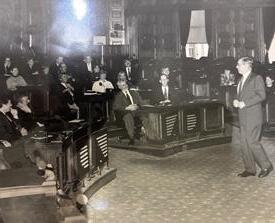

Alongside practice, Rowan has given significant time to the profession through the Law Society of Northern Ireland and local associations. His involvement began early, almost by accident. In Ballymena, senior practitioners found an effective way to avoid the responsibility of holding office themselves: they handed it to junior members. Rowan found himself chairing the local association at the age of 30 'to my surprise and slight embarrassment'
In Belfast, he became involved in the Belfast Solicitors’ Association and later chaired it, stepping into consultation responses and profession-wide issues. Through the BSA he joined Society committees, and in 2015 he stood for election to Council with ‘some misgivings,’ uncertain whether he would be elected or have a valuable contribution to make. He was elected, and he found the work both interesting and meaningful. He later served as President of the Society in 2019/2021, his term of office coinciding with the Covid-19 pandemic.
He is candid about motivation. Some of it is altruistic. Some of it is practical: understanding why change is happening before it becomes widely apparent, and being at the sharp end of decisions that shape the profession.
He also offers a clear explanation of the Law Society of Northern Ireland’s distinctive position: in the British Isles it is now unique in being both regulator and representative body. That dual role can create tension, he acknowledges, but he argues it is manageable and, crucially, preferable to external regulation.
Those who criticise the Society for focusing more on regulation than representation ‘need to be very careful what they wish for,’ he says. In other jurisdictions, external regulation has been “more expensive” and can bring risks of overreach. The Law Society of Northern
Ireland, he argues, regulates proportionately for a small jurisdiction, while still representing members very effectively. He says, from the inside, he has seen the Society work very hard to remediate problems facing the profession but that misunderstanding often grows where communication is thin.
‘The remedy for a lot of that is more communication, more and better communication,’ he says.
Pressure, boundaries and the cost of exhaustion
No honest account of legal practice can ignore pressure. Rowan speaks plainly about the forces that kept him going: professional duty and not wanting to let clients down. But he also believes the profession has, at times, allowed itself to be placed too much at the mercy of clients, particularly in commercial practice, where expectations of instant response can creep into evenings, weekends and holidays.
He senses the culture may be easing, with firms encouraging clearer boundaries and reminding clients that solicitors ‘are humans… and deserve a bit of downtime too.’ He hopes that trend continues, across both large and small practices.
He gives a memorable example from his own experience of what can go wrong. He was once involved in a major transaction where an all-parties meeting convened at 11am and ran until 7am the following morning. Rowan, exhausted, planned to travel home by train. He misplaced a file of papers somewhere in the station - a mistake that could have had serious consequences, although happily the papers were recovered intact.
It is an anecdote, but it makes a broader point: fatigue creates risk, not only to the individual but to clients and outcomes. Managing pressure is not a luxury; it is part of professional competence.
When asked what case stands out most, Rowan does not reach for the biggest deal, the most prominent development, or the headline transaction. He reaches for something smaller.
As an apprentice, he was given a case involving an elderly woman of modest means who had invested a substantial part of her life savings in a new kitchen. She paid up front. The kitchen units were manufactured. Before they could be delivered, the supplier went bust. The question was whether she had any rights to the kitchen units or her money.
Rowan remembered a provision of the Sale of Goods Act: if goods have been unconditionally appropriated to a contract, title passes to the buyer. He argued to the liquidator that the kitchen units had been manufactured and set aside awaiting delivery, meaning title had passed. The lady was entitled to her kitchen and she got it.
‘I did all of that on my own as a humble apprentice,’ he says. ‘That’s still one of my treasured successes.’
It is also his parting message to younger members of the profession: even early in a career, even without seniority, you can make a real difference to clients, and those moments can outlast the memory of large deals.
Rowan retired fully from Arthur Cox on 31 October last year. A few months into retirement, he says it feels good and he attributes that to how he approached the transition.
Around 2018 he stepped down from full-time to four days a week, only to discover that it did not work: ‘Everybody just assumed you’ll make up the fifth day during the four days you’re there.’ After a year or two, he reduced further to one day a week. That forced clarity, the firm had to make other arrangements, and it helped ‘stagger the blow’ of retirement.
His advice to those approaching the end of practice is direct: don’t slide gradually to four days and assume that is retirement-lite. Be more decisive. Structure the exit properly.
Rowan will also continue to serve in the Society for the next three years, having recently been re-elected to Council. It keeps him connected without keeping him tethered. ‘I still have some connection with the legal profession,’ he says. ‘I’ve not completely divorced from it… and for me that has worked quite well.’
The arc of Rowan’s career is, in one sense, a record of change: from carbon copy letters to email, from photocopiers to AI, from local firms to international entrants, from general practice to specialist teams. But it is also a record of how to respond: with openness, realism, and a willingness to explore opportunity rather than resist inevitability.
‘Change,’ Rowan says, ‘is better accepted voluntarily than forced upon you.’
For a profession still debating what AI will mean, still adjusting to new expectations from clients and colleagues, and still navigating a world in flux, that may be the most durable lesson of all.
Solicitor safety has become an increasingly urgent issue across the solicitor profession, with a significant and growing number of solicitors having experienced harassment, threats, intimidation, and physical violence in the course of carrying out their duties. These incidents are not confined to any single area of practice. They occur in contentious and non-contentious areas alike, they affect practitioners at all stages of their careers, and take place in a variety of settings.
A Solicitor Safety Group was established by the Society in June 2025. This brought together members who have experienced harassment, threats and violence in the course of their work to raise public awareness, identify practical solutions, and to advance policy and advocacy work aimed at strengthening protections for practitioners.
An active programme of political engagement and lobbying for legislative reform is underway. Proposals for greater protection of legal practitioners have been submitted to the Minister of Justice and Departmental officials, including:
• Solicitors to be recognised as frontline workers for the purposes of sentencing.
• Attacks and harassment against solicitors in the course of their duties to be treated as a statutory aggravating factor.
• A statutory presumption against suspended sentences in cases where the victim is an officer of the court, making custodial sentences the default unless exceptional circumstances apply.
It is vital that the essential public function performed by solicitors within the justice system and in upholding the rule of law is recognised through greater legal protections.
Engagement has also extended to MLAs, with the All-Party Group on Access to Justice focusing on the topic of lawyer safety at its latest meeting, highlighting the clear link between solicitor safety and effective access to justice. MLAs heard directly from a solicitor personally affected by incidents and the need for reform was
pressed. Further engagement with the Justice Committee is underway, focusing on advancing practical legislative reforms and ensuring that solicitor safety remains firmly on the political agenda.
Central to the Society’s engagement work has been gathering robust evidence. A profession-wide survey was carried out in February 2026, attracting 480 responses, demonstrating both the scale of concern and willingness of members to engage with the issue. A significant proportion of respondents reported being subjected to threats, abusive language, harassment and stalking. Some described physical attacks and credible threats of violence. These findings underline the reality that solicitor safety is a lived experience and concern for many.
In parallel with political engagement, structured collaboration with justice partners has been prioritised. Constructive discussions have taken place with various agencies including the Police Service of Northern Ireland (PSNI), the Public Prosecution Service (PPS) and the Northern Ireland Courts and Tribunals Service (NICTS). As a result, a dedicated Lawyer Safety Liaison Group has been established, bringing together representatives from the Society, Bar, PSNI, PPS and NICTS. This Liaison Group will meet quarterly to review emerging trends, share information on specific risks and develop coordinated responses to safety concerns.
Alongside policy and partnership work, practical support for members remains a core priority, and members are encouraged to report incidents to the Society. A Solicitor Safety Toolkit has been designed to assist solicitors in assessing, mitigating and responding to risks within their daily practice. The Toolkit addresses office security measures, safe client engagement practices, and incident reporting procedures. It also signposts members to appropriate additional support. It can be accessed on the following link: lawsoc-ni.org/agenda-forjustice/responses-to-policy-issues/solicitorsafety

Nuala McMahon Senior Policy Officer, Law Society of Northern Ireland
To complement this resource, a CPD series on professional resilience and personal safety is being launched soon. These sessions will aim to provide members with practical guidance and skills to navigate challenging and threatening situations with greater confidence.
The work of the Solicitor Safety Group reflects a broader recognition that protecting legal practitioners is integral to safeguarding the rule of law. Solicitors routinely act for individuals within lifechanging moments, such as family breakdown or facing criminal charges, and client needs are increasingly complex. In situations where emotions run high, solicitors often become the focus of anger and frustration. However, threats, harassment and violence should not be accepted as 'part of the job'
By combining evidence-based advocacy, legislative engagement, cross-agency collaboration and practical member support, this work is seeking to create meaningful and lasting change to address this growing societal problem. Solicitor safety does not only affect the individual concerned, but has a ripple effect on family members, colleagues, justice system and wider society, ultimately threatening the rule of law itself.

Law Society of Northern Ireland President Mark Borland attended the QUB School of Law Prize-Giving Ceremony on 3 December 2025. There, he presented the Law Society Prize, which is awarded to the student(s) with the best performance in a research project or undergraduate dissertation module in the last academic year.
Nathan McLorn was awarded the prize for his dissertation, ‘Truth Recovery and Reconciliation Through Criminal Justice and Amnesties.’
Benjamin Logan was awarded the prize for his dissertation, ‘The Increasing Militarisation of Space and growing Private Space Industry demand a Review of Current Space Regulations to mitigate the Rise of Space Debris’.
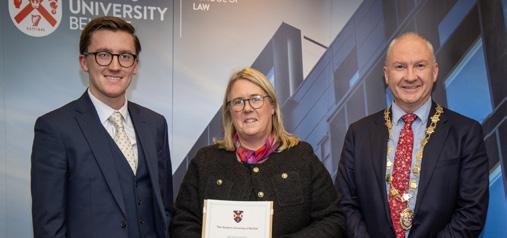
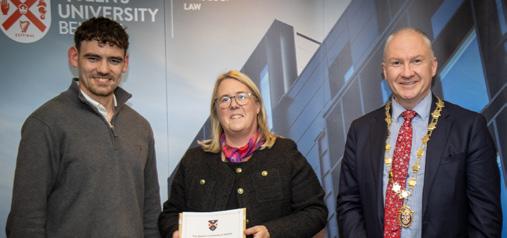

5 February 2026 saw Society staff take part in the inaugural Bake-Off competition. Staff and members came together for coffee, cake and chat, while judges Peter O’Brien and Mark Borland had the tough job of awarding prizes for the top entries.
£460 was raised for PIPS Suicide Prevention Ireland Charity, the Society’s charity of the year.

The BSA Solicitors’ Football Team played the Bar of Northern Ireland on Friday 19 September at Seaview. The team, managed by Chris McCann, was seeking its first win in two decades against a Bar Team managed by Paddy Taylor BL.
The solicitors got off to the best possible start with Stuart Harper of the IPLS scoring two headers from corners, followed by an excellent Messi-esque goal by Kevin Hegarty of Tughans to put the solicitors three up, before a 25-yard injury-time reply by new Bar recruit Ruairi Gillen left the score 3-1 at the break. Game on.
Goals by Michael Allison and James Ferrin put the solicitors 5-1 up early in the second half before a reply from Cormac O’Rourke BL made it 5-2. Peter Lockhart stretched the solicitors’ lead with ten minutes to go before Gillen immediately replied from the penalty spot, after a much-debated penalty awarded after what looked like a clean tackle by McCann on the pacey O’Rourke.
Michael Allison sealed the win for the solicitors with a goal in injury time, bagging the 7th in the 7-3 victory.
Paddy Taylor in goal, Conor Lunny, Dan O’Muirigh and Sean Mullan were the standouts for the Bar. The result could have been different bar the heroics of David Cairns in the solicitors’ goal. Ferrin, Andy Morrow and Pete McIlvenny ran the midfield for the solicitors, with the pace of Karl O’Hagan, Conor
A New year, a New Committee


Our committee for 2026 is as follows:
• Chair – William Wilson (Lacey & Co Solicitors)
• Vice Chair – Katherine Macauley (Joseph Magee & Co)
• Treasurer – Victoria Kinkaid (Carson McDowell LLP)
• Secretary – Aisling Creegan (Lacey & Co Solicitors)
• CPD Coordinator – James Greene (Elliotts Legal)
• Communications and Marketing Officer –Emma Doherty (Tughans LLP)
• Creative Content Officer – Morgan Pennie (Pinsent Masons Belfast LLP)
• Membership Engagement Officer –Michael Murphy (MKB Law)
• Charity Liaison Officer – Sarah Swan (DWF (Northern Ireland) LLP)
• Institutional Representative – Ronan Martin (Murphy O’Rawe)
This year, we have introduced two new roles: Communications and Marketing Officer, and Creative Content Officer, to strengthen our online presence and improve how we communicate with our members. We are also pleased to announce that NIYSA will, for the first time, adopt an annual charity partner. We are proud to support ADDNI this year and look forward to raising funds and awareness for their vital work surrounding Children and Adults with ADHD and Autism.
Alongside my role with NIYSA, I lead the Property Department at Lacey & Co Solicitors, and I am very grateful for the firm’s support as I take on the position of Chair. Their encouragement makes it possible to balance committee responsibilities with the demands of practice, and I’m pleased to represent both NIYSA and Lacey & Co within the wider profession and feel that all the committee members’ firms’ encouragement is to be commended.
Looking to the year ahead, my focus as Chair will be on renewal, visibility, and genuine engagement. A key priority is to update and modernise the NIYSA Constitution, ensuring that it reflects the realities of today’s profession and provides a clear, practical framework for the Association’s future development.
Engagement with our members across all six counties will be a central theme this year. We plan to reconnect with local solicitor associations and hold at least one event in each county, helping us to remain accessible
New players are welcome.
Contact Chris McCann at Harte Coyle Collins: cmccann@hartecoylecollins.com

Cunningham, Allison and Hegarty causing constant problems for the Bar, whilst Niall Colton and John McCloskey were solid at the back over the 90 minutes.
The now bi-annual fixture was played in great spirit and £755 was raised for this year’s BSA Charity Nexus, an NI charity supporting victims of sexual abuse and abusive relationships.
I am honoured to have been elected Chair of the Northern Ireland Young Solicitors’ Association (NIYSA) for the coming year. It is a privilege to follow the work of previous committees and to have the opportunity to build on the strong foundations already in place. I would like to thank the outgoing committee members for their contribution and commitment, and I look forward to working closely with this year’s newly elected team.
to young solicitors wherever they practise. We want NIYSA to be as visible locally as it is centrally, and this county-focused approach will be an important part of that.
Improving our communication channels is also a priority. We aim to establish a stronger and more consistent online presence, supported by the creation of a dedicated NIYSA website. This will allow us to share information more effectively, highlight events, promote opportunities, and further strengthen our sense of community.
Professional development remains at the heart of the Association. We intend to deliver a full CPD calendar and reintroduce our Annual Conference in December, restoring it as a key date in the professional calendar for young solicitors across Northern Ireland.
We are also committed to building on relationships with young lawyer associations in Ireland, England and Wales, Scotland, and beyond. Strengthening these links provides our members with opportunities to broaden their networks and engage with colleagues across multiple jurisdictions.
I am looking forward to working with the committee and our members to deliver a productive and ambitious year. Our theme - 6 Counties, 5 Jurisdictions, 1 Association - reflects the diversity, reach, and unity of young solicitors in Northern Ireland, and it will guide everything we do in the months ahead.
One of the most valuable aspects of studying law - and one that many students only fully appreciate as they progress through their degree - is the extraordinary range of career paths that a legal qualification can offer. While the traditional image of a solicitor or barrister remains central to the profession, the modern legal landscape is far more diverse, adaptable, and open-ended than it once was. A law degree no longer means a single career trajectory; instead, it opens doors to numerous professional routes. Understanding this breadth early on can transform how you approach your studies, your work experience, and your long-term ambitions.
The perception of legal careers has shifted significantly in recent decades. Historically, the route from law school to a training contract or pupillage was presented as the main, if not the only, path for graduates. Today, the structure of the legal sector looks markedly different. Firms operate internationally, digital tools shape daily practice, and legal services increasingly intersect with business strategy, risk management, and policy development. These changes have opened pathways not only within the traditional profession but also around it.
Even within private practice, opportunities have expanded. Trainees may find themselves working with cross-jurisdictional teams, participating in client projects, or taking part in secondments that immerse them in an entirely different working environment. These experiences provide broader insight than previous generations of lawyers typically received and reflect the profession’s growing emphasis on collaboration, commercial awareness, and adaptability.
In-house roles have become an increasingly popular and respected option for new lawyers. Instead of advising from a distance, in-house
counsel work at the centre of organisational decisionmaking. They see how legal advice affects day-to-day operations, budgeting, long-term planning, and risk. This closeness to the business gives in-house lawyers a practical, strategic perspective that appeals to many students who enjoy problem-solving within real-world constraints.
In-house departments span nearly every sector: technology, retail, healthcare, finance, manufacturing, education, and beyond. This variety allows graduates to choose an environment aligned with their personal interests, whether they are drawn to fast-paced commercial industries, missiondriven organisations, or complex regulatory landscapes. For those who enjoy collaborative work, direct communication with nonlawyers, and a proactive approach to advising, in-house practice offers a distinctive and rewarding career path.
The public sector also remains a vital and dynamic destination for law graduates. Legal work in government departments, regulatory bodies, public authorities, or human rights organisations provides the opportunity to contribute to policies and decisions that affect the wider community. These roles often offer early exposure to meaningful responsibility, whether drafting legislation, advising decision-makers, or engaging directly with issues such as environmental protection, social welfare, equality, or public health.
Students who are motivated by fairness, service, or systemic change often find the public sector uniquely fulfilling. It allows lawyers to use their skills to influence how society functions, sometimes at a structural level. Moreover, public sector experience frequently enhances a lawyer’s understanding of governance, regulation, and the broader framework within which private and commercial law operates.
One of the most significant shifts within the profession is the rise of legal technology and innovation roles. As firms and organisations adopt advanced systems to manage workflows, research, document automation, and client service, new positions have emerged that combine legal knowledge with technical understanding. Legal operations teams, innovation departments, and legal tech startups all seek graduates who can balance analytical thinking with an interest in systems, design, and efficiency.
These roles suit students who enjoy improving processes, experimenting with technology, or building solutions that improve access to justice or the delivery of legal services. They also offer a chance to influence the future shape of the profession, making them particularly attractive to those who want to be at the forefront of change rather than following established paths.
Not every law graduate ultimately chooses to practise law — and that reality is far from a disadvantage. The skills developed through legal study are widely transferable and highly valued. As a result, many graduates build successful careers in areas such as journalism, public affairs, corporate governance, compliance, management consulting, policy research, academia, or risk analysis.
What these fields share is a reliance on clear communication, structured reasoning, and the ability to handle complex information — strengths central to a legal education. For some, these paths become long-term careers; for others, they offer experience that eventually enhances a return to legal practice. The key point is that a law degree opens more doors than it closes.
Perhaps the most important idea for students to embrace is that careers today rarely follow a single straight line. Lateral moves, industry changes, international opportunities, and sector shifts are increasingly common. A modern legal career is shaped as much by interests, values, and experience as it is by formal qualifications.
A law degree is therefore not simply a credential but a platform. It gives you the tools to pursue a range of possibilities — and the flexibility to change direction as your goals evolve.
As you navigate your studies or career, allow space for exploration and consider all options. Speak to practitioners across different sectors, take on varied placements, or try something different to reflect on what aspects of the law genuinely interest you. Your career does not need to be predetermined. Instead, see it as an evolving journey, strengthened by the broad and adaptable foundation that a legal qualification provides.

Morgan Pennie NIYSA
Family law practitioners from across Northern Ireland joined colleagues from England, Wales, Scotland and Ireland for the thirty-first 5 Jurisdictions Family Law Conference, or ‘the 5Js’.
This year, it was the turn of the Law Society of Northern Ireland and the Bar of Northern Ireland to organise the conference, which took place on 23 and 24 January 2026 at the Ebrington Hotel in Derry City.
The renowned Northwest hotel provided the perfect venue for the Conference, which has been widely regarded as the key event in the family law calendar for the last three decades.
As in previous years, the 5Js Conference provides an opportunity for experts and family law practitioners to come together to discuss contemporary issues relating to family law and their impact on clients in the jurisdictions.
The Conference also provides a platform for professionals to share their insight, discuss the challenges ahead and the changing nature of family law in each jurisdiction.
The success of each 5Js conference over the last thirty years has been attributed to the camaraderie, quality and overall
Delegates had the opportunity to come together for a Friday night reception at the iconic Guildhall, featuring traditional Irish music, festival dancing and a drinks reception hosted by the Mayor of Derry, Councillor Ruairí McHugh.
The academic programme began on Saturday with an opening address from the Lady Chief Justice, Rt Hon Dame Siobhan Keegan, before delegates heard from a series of presenters on a range of important subjects.
Those attending were also provided with an update and overview of developments in the OurFamilyWizard app for use in private law contact arrangements between separated parents.
Speakers at the conference included:
• Professor Dr Jens Scherpe, Professor of Comparative Law at Aalborg University, Denmark and Emeritus Fellow at the University of Cambridge, who presented a comparative paper on the law of cohabitation in the various jurisdictions;
• Ms Harriet Wistrich of the Centre for Women’s Justice (London) and solicitor who spoke on improving criminal justice responses to domestic abuse;
• Representatives from KPMG, who presented on complex corporate structures, jurisdictional considerations in ownership assessment, minority discounts and practical realisability in ancillary relief cases; and
• Professor Sharon Thompson, whose paper was entitled ‘The road to equal partnership and refining the financial consequences of divorce.’
Feedback from those attending the Conference was positive, with many complimenting the venue, speakers and discussions and the entertainment programme.
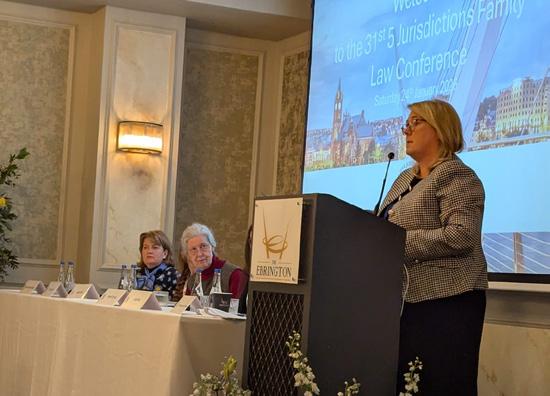
The Law Society of Northern Ireland is grateful to those who attended and who took time to travel considerable distances to make the 2026 Conference such a success.
There can be a lot to think about when deciding to leave practice. RunOff cover under the Law Society of Northern Ireland’s Master Policy is an important benefit to protect members against future claims, and it provides peace of mind to focus on retirement or other new ventures.
Run-Off cover is a specialised form of professional indemnity insurance designed to protect businesses and individual professionals after they close and cease operations or leave practice for any reason. In essence, Run-Off cover provides ongoing protection against potential claims made for work carried out during the period when the business or individual was actively trading.
Other jurisdictions in the UK require solicitors to hold an additional policy and charge an ongoing premium for Run-Off cover, which is both costly and time-limited (usually six years but often less). Typically, Run-Off cover attracts a premium of around three times the last annual premium paid for six years’ worth of cover, and the premium for one year can be the same as the last annual premium paid whilst still practising.
Fortunately, the situation is very different in Northern Ireland. The Society’s Master Policy provides automatic Run-Off cover to all solicitors at no extra charge. Cover for past acts continues without limit on duration, so that claims not yet notified but relating to past work may be brought many years later.
Run-Off cover extends to sole traders, partnerships, limited companies, and limited liability companies. It also operates to protect individual solicitors who leave practice for any reason, including retirement, career change or employment transfer to other jurisdictions.
Here is everything members should know about significant benefits of Run-Off cover under the Master Policy and how this works in practice:
• When a firm ceases to trade, Run-Off cover automatically comes into force from the cessation date and remains in place for as long as the Master Policy continues to be arranged in its current format. The Society is not anticipating any changes to this provision.
• Professional indemnity cover is offered to the standard Master Policy limit of £3 million.
• Professional indemnity cover is underwritten on a ‘Claims Made’ basis. This means cover is provided for claims in the period when the notification is made, regardless of when the alleged incident occurred. Normally, if a claim is not notified and made to Insurers whilst the Policy is still currently in force, there is no cover whatsoever – Run-Off cover addresses this issue, providing for ‘sleep easy’ protection.
• The policy does not contain a ‘retroactive date,’ meaning that all claims are included, no matter when the work was done.
• There are also important protections and benefits following the death of an insured solicitor. Cover extends to include the estate or legal personal representatives of a deceased solicitor.
• If future claims present under the Run-Off cover, then the policyholder / solicitor will remain liable for payment of any Claims Excesses as stated in their last Insurance Schedule. While the cover operates to address such claims, the Policy Excess still needs to be paid at that future point in time when the claim is made.
Finally, it is important to mention that no RunOff cover is provided for any additional higher Limits purchased under Excess Layer Policies if they are lapsed and not renewed. All Excess Layer cover will cease, and no claims can be accepted for work completed in the past.
Members should contact the Society’s brokers Brown & Brown if they have any queries about Run-Off cover.
Laura McClintock Head of Governance and Corporate Services, Law Society of Northern Ireland
Alan Boal
Account Director, Brown
and Brown
The development of a Charter for Effective Participation and Communication between Solicitors and Litigants in Person
Learning that you are having to deal with a litigant in person (LIP) in a case is often a moment that strikes dread in the heart of a solicitor, many of whom will share tales of their experiences like old battle scars.
However, this attitude may fail to recognise the shifting societal sands that leads LIPs to engage in the court process without legal assistance. The modern LIP is not so easy to disparage as vexatious or antagonistic, an evolution recognised by the Judiciary who have witnessed the rise in sophistication and competency of LIPs.
Lord Justice Stephens in his foreword to recent University of Ulster research said that,
‘Personal litigants come from a variety of different backgrounds and seek to navigate the legal system and court procedures as best they can. Going to court is stressful for individuals, particularly so where a person does not have a lawyer to assist with the legal requirements and procedures. … The research highlights the communication gap between personal litigants and lawyers and other court actors engendering a level of mistrust which operates to the detriment of everyone.’
There is no question that the prevalence of LIPs has increased over the last ten years or so and it is increasingly rare to find a court list without a LIP participant. Whilst up-to-date data is scarce due to NICTS not recording instances of LIPs in proceedings, NICTS management data over the period 2012-17 (not including small claims cases), showed an average of nearly 5,000 LIPs throughout the court system in Northern Ireland, representing approximately 5% of total participants.
There are many causes for this, the most common being the erosion of Legal Aid in certain types of action and the lower financial qualifying threshold; the increasing cost of legal representation coupled with the cost of living rendering many in reasonably well paid employment to be unable to meet the cost of engaging a solicitor; the democratisation of information via the Internet of free legal resources and social media forums; and personal motivation, particularly in family cases, where cases are prepared and studied for intensively.
As the profession confronts mounting pressures on the justice system, it can no longer treat litigants in person as peripheral or exceptional. They are informed, determined, and increasingly ready to challenge processes that feel inaccessible or unresponsive. Ignoring this shift risks eroding public confidence in the very system solicitors are entrusted to uphold.
But there is also a clear opportunity. By engaging with LIPs as legitimate participants and supporting reforms that make the system more navigable, the profession can demonstrate leadership rather than defensiveness. Doing so strengthens the credibility of legal practice, reinforces the profession’s role as a guardian of fairness, and helps ensure that justice remains a system the public can trust — not one they feel shut out from.
The Nuffield Foundation funded research in Northern Ireland from 2016-2023 examining how people who go to civil or family court without a lawyer were able to participate in their court hearings. The research, conducted by a team of researchers at Ulster University School of Law led by Professor Gráinne McKeever, resulted in the publication of four reports, which respond to a gap in research and policy on LIPs in Northern Ireland.
As part of ongoing engagement with LIPs, UU held a Conference in December 2023
which was opened by Dame Siobhan Keegan, Lady Chief Justice. Her remarks emphasised the growing numbers of LIPs and the challenges this creates for the justice system, including trauma, communication barriers, and the need for better support structures. Many LIPs spoke at the event and referred to the trauma they endured both through the circumstances that had brought them into the legal system and the court process itself, together with the lack of empathy they faced when managing their cases. Similarly, the level of distrust and fear held by solicitors in dealing with LIPs was apparent.
The Law Society of Northern Ireland committed to working with UU to create a document to be entered into at the inception of a case between the legal representative and the LIP in an effort to bring the parties together to communicate more freely and dispel some of the fears on both sides, in the hope that this would lead to expectations being better managed and each party having an insight into how the other operates. The view was to alleviate common pain points encountered on each side and lead to greater efficiency in LIP cases progressing through the court system.
A series of workshops gathered LIPs, solicitors, McKenzie Friends and other relevant stakeholders together to work through the various issues encountered by all. The result was the Charter for Effective Participation and Communication between Solicitors and Litigants in Person in Northern Ireland.
On behalf of the Society, I worked alongside Professor McKeever, Dr Lucy Royal-Dawson and Dr John McCord to co-produce this Charter which, it is hoped, will guide all court actors to better assist participants, Judiciary and court staff to build working relationships and encourage better communication and conduct throughout the cases in which they are engaged.
The Charter identifies specific ‘pain points’ under certain headings and endeavours to promote solutions or assistance in overcoming obstacles in the parties’ dealings. From the Society’s perspective, it was most important to ensure a fair balance on the part of solicitors to ensure that our already burdensome workload is not unfairly increased.
The main points of the Charter can be broken down into the following categories:
1.
Effective communication is essential to avoid escalation and delay. LIPs often find legal language intimidating and may misinterpret tone or intent. Solicitors should use plain English, avoid inflammatory language, and set realistic expectations around response times.
2.
LIPs may feel overwhelmed by court processes and require reasonable adjustments. Solicitors should identify potential vulnerabilities and alert the court where appropriate.
3.
LIPs may not realise they can engage constructively outside court. Solicitors should initiate and structure these discussions to narrow issues and support early resolution.
4.
Where communication becomes hostile, either party can request a reset. Deescalation protects case progress and, in family matters, children’s welfare.
5.
LIPs often lack procedural understanding. Solicitors should explain running orders, callover processes, and relevant protocols to support smoother hearings and reduce judicial time spent on explanation.
6.
Because LIPs cannot access ICOS, solicitors should anticipate gaps, avoid lastminute service, and ensure LIPs receive key documents and directions in time to participate effectively.
7.
Solicitors may need to provide procedural assistance when directed by the court. They must not exploit a LIP’s lack of knowledge but are not required to run the LIP’s case.
8.
Judges may spend additional time explaining matters to LIPs. Solicitors should prepare clients for this and support the court by suggesting steps that promote fairness and efficiency.
9.
McKenzie Friends vary in experience. Solicitors should treat them respectfully, ensure timely service of documents, and understand their confidentiality obligations.
10.
LIPs may not understand confidentiality rules, especially in family cases where disclosure can be a criminal offence. Solicitors should reinforce these obligations.
11.
Late discovery that the opposing party is a LIP can hinder early engagement. Early contact helps narrow issues and avoid unnecessary hearings.
12.
Clients may misinterpret the solicitor’s assistance to a LIP or the judge’s accommodations. Solicitors should explain their duties to the court and the benefits of supporting LIP participation.
This Code of Conduct was successfully launched last year and has been endorsed by the Judiciary. It is hoped that practitioners will avail of the opportunity and guidance it offers by sharing it with Litigants in Person once they have been identified in proceedings and use it to bridge those ‘pain points’ to create a more fertile working environment to reduce the delays and stressors commonly found in cases of this nature.
We also now hope to engage with the Institute to better equip the next generation of lawyers to deal with LIPs more effectively.

The purpose of mediation is to explore whether or not parties can be assisted in reaching an agreement. If agreement is reached, the terms of the agreement should be clear, unambiguous, and precise. As this article will show, this is not always the case in practice.
A recent High Court decision in England and Wales (Zaloumis v Steele [2025] EWHC 1858 (KB)) drew attention to the important area of mediation practice concerning Settlement Agreements. The facts are somewhat complex and unfortunate in that a son as a claimant sued his father for breaching an agreement reached to resolve prior financial disputes.
The core issue agreed at mediation was that a payment of £200,000 was to be made by father to son in exchange for the son resigning a directorship and transferring shares. The father paid late, and the son alleged that the late payment subsequently caused the loss of some business ventures and investments. He also claimed, with some imagination, £8 million in lost profits.
The son failed because the judge found that, although a breach of the Mediation Agreement had occurred, the damages were deemed to be too remote. The Court reviewed the authorities on remoteness of damages and considered the strength of the evidence given by the parties.
So far so interesting, but what of the role of the mediator? In mediation training, mediators are often advised that they should assist the parties to reach a settlement, but they should not draft the Settlement Agreement. In practice, many mediators who have been present with each party will have gained their trust and they are very well placed to assist in both ensuring that all the terms that had been discussed with the mediator are reflected in the Agreement, and that the language of the resolution is correct.
However, it is ultimately for the parties to draft the Agreement. In the Zaloumis case, the claimant was a litigant in person. It could be that the imprecise drafting arose because there was a lack of legal guidance on both sides. The Defendant’s lawyers apparently drafted the Agreement.
Some might say that the mediator should have stepped in to express a view as to whether the terms relating to payment were sufficiently precise and invite the parties to consider what should be the consequences of any late payment.
In the event, the Settlement Agreement did not sufficiently do its job in ensuring an enduring settlement with clear terms and clear consequences.
A Mediation Settlement Agreement of course simply creates a contract between the settling parties. That contract is as enforceable as any other contract. It is subject to the same legal rules which apply when enforcing a contract. These rules include the interpretation of the terms. A Court may have to imply terms if there is ambiguity or uncertainty. However, after going through a mediation to resolve one dispute the parties really do not expect to have another dispute to determine the true position of what they had in fact agreed.
Leaving aside the drafting responsibility or otherwise of a mediator, this type of case where there is dispute as to what the parties agreed or what they meant can give rise to complex problems of the mediator providing evidence of what had been agreed or what parties had said.
Mediation is a Without Prejudice and confidential process; however, there are exceptions to the rule of confidentiality, particularly where there is dispute as to what was agreed. In the Zaloumis case, emails between the parties and the mediator and the mediator’s responses were produced.
This, after the mediation, does give rise to significant questions as to the limits of mediation confidentiality and so-called mediation privilege. Although discussed over the years, mediation privilege has not yet become a firmly established legal principle.
When a dispute arises after a Mediation Settlement Agreement there will often be recollections of what the parties said to the mediator in the minds of the parties. However, the mediator cannot be responsible for how the parties ended up expressing what they had agreed in their written Agreement.
In the Zaloumis case, the claimant alleged that they had made clear to the mediator the importance of a timely payment of the sum they had eventually agreed to accept. The importance of the timely payment was disputed as the father said that he was not aware of the importance being attached to the timeliness of the payment.
This flags up a very central role for the mediator. This is to obtain authority for proposals that are made, and to ensure that the priority and importance of issues to one party and which are part of the rationale as to why they are agreeing, are communicated effectively to the other party. Then the mediator can assist in ensuring they are properly reflected in the eventual Settlement Agreement. In this case, it would have been incumbent on the mediator to have explained that the acceptance of the £200,000 was on the basis that it was critically important for a timely payment. The father should have understood the importance of the timeliness of payment.
There are some lessons from this case. One is that the mediator must be sensitive to
areas which are of high importance to each party. Those high importance issues must be reflected in any proposal that is made. The mediator will have to take care not to breach confidence in explaining why one party attaches importance to an issue.
The mediator should also take an interest in the terms of the Settlement. The mediator is being paid to assist the parties to reach an agreement. There is no point in reaching an agreement that is ambiguous or uncertain and simply gives rise to interpretation disputes or factual disputes or litigation arising from breach of agreement.
The question of whether the mediator themselves should take responsibility for drafting is perhaps not so clear. It is prudent
that the mediator, particularly where there are parties who are legally represented, leaves the drafting to the parties, but the mediator should intervene if some wording or phraseology does not capture what the mediator understands to be how the parties have in fact agreed matters.
Ultimately, the mediator’s role is to assist the parties to reach an agreement that will work, not to reach an agreement that will fail and potentially result in further negotiation or litigation.

Brian Speers Managing Partner, Solicitor and Mediator, CMG Cunningham Dickey

Probate: A Practical Guide to Estate Administration 2026
Thursday 2 April 2026
Click here to book
CNPG Series 2026: Birth Injury Claims and Effective Case Management
Thursday 23 April 2026
Click here to book
The Office of Care & Protection (Patients Section): Practical Guidance and Information
Wednesday 6 May 2026
Click here to book
Monitoring and Inspection: What you need to know
Wednesday 13 May 2026
Click here to book
Practical Workshop on: Accommodating the needs of the Vulnerable Client
Thursday 14 May 2026
Click here to book
Legal Bookkeeping Course: May 2026
Wednesday 27 May 2026
Click here to book
Bringing SARs to Life
Thursday 11 June 2026
Click here to book
British Sign Language: Deaf Equality
Thursday 3 September 2026
Click here to book
Client Complaints: Regulatory themes arising from Probate and effective complaint management
Thursday 10 September 2026
Click here to book
Legal Research Skills: In-person September 2026
Tuesday 15 September 2026
Click here to book
Risk Management-Pt 3: Implementation of Legal Complaints and Reg Act (NI)
Wednesday 14 October 2026
Click here to book
Legal Bookkeeping Course: October 2026
Thursday 15 October 2026
Click here to book
AML2: Key AML Updates in 2026 and beyond
Tuesday 20 October 2026
Click here to book
Thursday 22 October 2026
Click here to book
Annual Update on Defamation, Media & Communication Claims
Wednesday 4 November 2026
Click here to book
2026 - Common SDLT considerations for the Conveyancing Solicitor:
Thursday 5 November 2026
Click here to book
Legal Research Skills –Online
Tuesday 17 November 2026
Click here to book
Client Complaints Series: Regulatory themes arising from family and effective complaint management
Wednesday 18 November 2026
Click here to book
Accounts Regulations: What you need to know
Wednesday 2 December 2026
Click here to book
Protecting you & your firm: The role of the MLRO
Click here to book
Risk Management 2026: Part 1: Risk Management for Solicitors in 2026
Click here to book
An Introduction to AI for Solicitors (Recording)
Click here to book
AML 2024 – Part 1: Key AML Compliance Principles for Legal PractitionersRecording
Click here to book
AML 2024 – Part 2: AML in Focus & Recent Developments - Recording
Click here to book
AML 2025 – Part 1: Supporting Legal Professionals in Effective AML/CTF Practice - Recording
Click here to book
AML 2025 – Part 2: AML/CTF Practice –Effective Reporting Latest Updates and Guidance - Recording
Click here to book
A Lifetime Scenario: 2025 Recording
Click here to book
Easements: Consideration of the principles and recent case law 2024 - Recording
Click here to book
VAT and Disbursements
Click here to book
JAM Card Business Information Session (Recording)
Click here to book
LinkedIn for Legal Professionals(Recording)
Click here to book
Commercial Conveyancing Conference 2025 – as of 28/3/26
Click here to book
Legal Aid Management System: Guidance and Information Series for Family Law
Click here to book
Practitioners – Session 1: Representation Lower
Click here to book
Legal Aid Management System: Guidance and Information Series for Family Law Practitioners – Session 2 –Representation Higher
Click here to book
Legal Aid Management System: Guidance and Information Series for Family Law Practitioners – Session 3 – Appeals and Payments
Click here to book
Solicitor Disclaimers: When, How and Why
Click here to book
Divorce Petitions: Errors and How to Avoid
Click here to book
Requesting Payment in Article 3 FCC Cases
Click here to book
2024 Monitoring & Inspections, An Overview
Click here to book
2025 Monitoring & Inspections: Common Regulatory Themes arising
Click here to book
Introduction & Refresher to best practice in Clinical Negligence
Click here to book
Did you know that the Society’s Library services are available to all solicitors and trainees, including those working inhouse or in other, non-private practice, roles? Perhaps you have never used or considered contacting the Library, or maybe you last used it as a trainee or working in a previous role, but services
Services that we offer include:
• Remote research service –access journal articles, textbooks, legislation, templates and much more without leaving your office via professional librarians who can search a wide range of print and digital resources on your behalf.
• Precedent supply – the Library has access to various banks of precedents, which can be searched and any relevant templates sent on to you via email.
• Caselaw searches – do you need us to search for caselaw on a particular topic? Do you have a citation for a case that you can’t find anywhere? The Library staff are trained and experienced in searching for judgments and can use the various legal databases that we subscribe to to assist in this regard.
are available to all those currently registered on the Society’s Roll and Library staff are happy to assist you.
Or why not call in to the Library if you are based in Belfast or in the city for the day? The Library offers a number of desks for quiet study, as well as PCs,
free WIFI and printing facilities. We can also arrange access to Lexis for you if you prefer to do your own research in the Library.
So grab a coffee in our Law Club and pop in to the Library the next time you are in Law Society House!
• Expert witness details – have you been trying to source an expert for a report without any success? The Library maintains a register of experts in a number of fields whose details can be passed on to you at no cost. The Library also subscribes to a UKwide database with experts in a wide area, which again can be searched on your behalf should you need an expert outside the jurisdiction.
• Legislation queries – do you need a copy of legislation as enacted that you can’t find anywhere? Have you been asked for the equivalent NI provision to an English statute and aren’t sure where to begin? As well as physical copies of statute books, the Library team can search digital statute books for you, as well as legal databases, to check currency and extent. If you are new to legislative research, the team can provide guidance and give you a few ideas on where to begin your searching.
• Literature searches – the Library has a number of textbooks and journals in various practice areas, which staff can search for you for relevant commentary for your research query. Extracts (within the bounds of copyright) can be emailed to you. You can also access the Library catalogue - KnowAll - from the Members’ area of the Society’s website without any additional login details required. Search for a particular textbook or view/download NI caselaw, legislation, and practice directions.
For more information about the Library service or to request assistance, get in touch with Elizabeth or Derval: Email library@lawsoc-ni.org or phone 02890 231614
In addition to key practitioner textbooks in a range of subject areas, the Library maintains a collection of general textbooks that may be of interest to those working in alternative legal practice. We also subscribe to several journals, such as the Solicitors Journal or the New Law Journal. Library staff can set these aside for your use or search for further articles on your behalf. Below is a small sample of books and articles of possible interest to practitioners. Please get in touch for more details.
Paul Caddy, David Jackson and Tony Randle, Legal practice in the digital age (Globe Law and Business 2023).
Tracey Calvert, In-house lawyers’ risk and compliance questions and answers (Law Society Publishing 2024).
Tracey Calvert and Bronwen Still, Regulation and in-house lawyers: a compliance guide (Law Society Publishing 2020).
James Castro-Edwards, UK General Data Protection Regulation (Law Society Publishing 2022).

David Cowan, Effective communication for lawyers (Edward Elgar 2022).
Adam Curphey, The legal team of the future: law+skills (London Publishing Partnership 2022).
Matt Hervey and Matthew Lavy, The law of Artificial Intelligence (Sweet and Maxwell 2024).
Barney Jordaan, Negotiation and dispute resolution for lawyers (Edward Elgar 2022).
Richard Susskind, Tomorrow’s lawyers: an introduction to your future (OUP 2023).
Journal articles
R Atkinson and J Baxter, ‘A living resource - supporting good ethical practice’ [2025] 122(18) Law Society Gazette 32.
Katharine Freeland, ‘Beyond the Horizon: holding the ethical line’, [2024] 121(41) Law Society Gazette 31.
Mark Garrett, ‘In house, in demand’, [2025] 119(3) Gazette of the Law Society of Ireland 36.
Ziad Mantoura, ‘A brave new world?’ [2023] 173 New Law Journal 21.
Ellie Philpotts, ‘Behind the scenes of the in-house boom - why young solicitors are changing course’ [2025] Journal of the Law Society of Scotland, December.
Aine Rafferty, ‘Five steps to building a high performance in-house legal team’ [2024] Computers and Law, Spring 27.
Rebekah Stafford, ‘Human expertise when placing flexible legal talent’, [2025] 168(4) Solicitors Journal 18.
Inheritance Tax is no longer a niche planning issue. It is fast becoming a mainstream consideration for families, business owners and farmers alike.
The Office for Budget Responsibility now forecasts that IHT receipts will almost double over the next five years – rising from £8.7bn in 2025/26 to £14.5bn by 2030/31. The drivers are well understood: rising asset values,
frozen thresholds, and, critically, the forthcoming inclusion of pensions within the IHT net from April 2027.
For solicitors advising on estate planning, succession and probate, this reflects a notable change in the planning landscape. Planning timelines are becoming more defined, liabilities more visible, and outcomes increasingly influenced by early structuring.

In December 2025, the Chancellor increased both Business Relief and Agricultural Relief to £2.5m from £1m. That was welcome news. However, it does not remove the need for careful planning. From April 2026, clients who die owning qualifying business or agricultural assets may still face material IHT liabilities, depending on asset values and individual circumstances.
In our experience, whilst solicitors, accountants, and financial planners all work in the inheritance tax arena, the best outcomes for clients happen when all three work in tandem. Inheritance tax outcomes are highly sensitive to planning. Where individuals engage early and make use of established exemptions and reliefs, the eventual tax position can look very different from cases where no planning has taken place.
Time remains one of the most important tools in inheritance tax planning. From April 2026, we enter the final 12-month period in which pensions sit fully outside the inheritance framework. From April 2027, pensions will form part of the taxable estate, changing how they are considered within wider estate planning discussions.
For decades, financial planning has worked on a simple hierarchy: pensions are the last money a client should spend. ISAs, cash and other investments are drawn first, preserving the pension as a tax-efficient legacy vehicle. That hierarchy is now being reassessed.
Clients who continue to apply established planning assumptions may find that inheritance tax outcomes differ from expectations as the rules evolve.
Consider a married couple with a £1.2m estate today. With the combined Nil Rate Band and Residence Nil Rate Band, their inheritance tax liability may be around £80,000. If a £1m pension is added and the position is assessed post-April 2027, the same family could face a liability closer to £520,000. The change reflects the interaction of asset composition and updated tax treatment, rather than any change in lifestyle or spending behaviours.
A range of planning tools may be relevant, including trusts, lifetime gifting, insurance, business relief strategies, charitable legacies and pension withdrawal sequencing. In practice, these approaches typically require time, modelling and careful coordination between legal, tax and financial advice.
This is where collaboration is most effective. Financial planners can model scenarios, assess outcomes and help families understand different planning options over time. Solicitors provide the legal structures that give effect to those decisions.
Regular reviews will remain important. As pensions become part of the taxable estate, estate plans may need to be reconsidered to reflect a broader range of assets. The focus increasingly shifts from whether inheritance tax arises to how it is allocated across the estate and over time.
Where planning is undertaken in good time, there remains flexibility to structure outcomes in line with client objectives. Where reviews take place later, the range of available options may differ depending on timing and circumstances.
Law Society (NI) Financial Advice specialises in helping solicitors and their clients navigate complex changes in tax legislation. We can model the impact of 2026 reforms, explore tailored solutions, and work alongside legal advisers to ensure estates are structured in the most tax-efficient way possible.
This article provides general information only. It is not financial advice and should not be relied upon as such. Individuals should seek regulated advice for their specific circumstances.
Law Society (NI) Financial Advice is a trading name of Succession Wealth Management Limited, which is authorised and regulated by the Financial Conduct Authority. Financial Services Register number 588378.
For full risks and disclosures see: Succession Key Disclosures
The Financial Conduct Authority does not regulate advice on taxation or estate planning.

Andrew McColl Wealth Planner, LSNI FA

The taxation landscape for EOT transactions has shifted following the Government’s decision to scale back capital gains tax relief on qualifying sales. While the fundamentals of employee ownership remain strong, the changes have introduced new considerations for business owners, and for the solicitors who advise them.
So, what are the changes? What will the impact of these reforms mean in practice? And how should solicitors and other professional advisers in Northern Ireland respond so that they can continue to guide clients through this important area of succession planning?
Under the revised rules, business owners selling to an EOT will now face a CGT charge on 50% of their gain, rather than benefiting from the previous 100% exemption. It is important to emphasise that this change does not remove the fundamental attractions of the EOT model. However, it will inevitably reduce the net proceeds vendors receive and create a CGT liability that must be planned for as part of any transaction.
A further important detail for advisers is that the 50% portion of the gain now subject to CGT does not qualify for additional reliefs such as Business Asset Disposal Relief. Where applicable, a seller’s first one million of gain is currently taxed at 14%, rising to 18% from April 2026.
Although the reduction in relief is disappointing, vendors can still achieve significant tax savings when compared with other exit routes. When introducing the changes, the Chancellor herself acknowledged the importance of retaining strong incentives for employee ownership.
The Government continues to support EO and EOT structures, and a sale to an EOT remains highly competitive when compared with a third-party trade sale or management buyout.
For many Northern Ireland business owners, the non-tax advantages of EO remain compelling. The ability to keep a company independent, protect its culture, anchor it in the local economy and reward loyal employees will continue to be an attractive proposition for founders thinking about succession.
That said, some owners will understandably feel unsettled by the changes. As solicitors advising on succession planning, it is important to reinforce that the benefits of employee ownership extend far beyond fiscal measures. The core reasons why many owners originally considered an EOT, continuity, stability and legacy, remain entirely intact.
Any tax change introduced with immediate effect creates uncertainty. Our message to advisers and clients alike is to stay calm and focus on the fundamentals. Most business owners, once they assess the practical impact of the revised CGT position, will recognise that there are still few, if any, alternative exit routes offering the same combination of financial, cultural and strategic benefits.
For Northern Ireland solicitors, the changes do require a shift in how EOTs are discussed with clients. The narrative moves from a fully tax-free exit to a partially tax-advantaged exit. Advisers will need to assist clients in modelling their likely CGT liability, reviewing repayment schedules and updating cashflow projections so that vendors have clarity

Joan McCoy
Founding Director White Ink Architects and Board Member, Employee Ownership Ireland
around their net proceeds and how any tax liability will be funded.
One practical point likely to be of particular interest is the possibility of agreeing instalment arrangements with HMRC where the purchase price is paid over an extended period, a common feature of EOT transactions. Discussions are ongoing, but current indications suggest that, subject to HMRC approval, CGT payments may be capable of being spread over up to eight years, with 50% of each vendor repayment allocated towards the CGT liability. This will be an important consideration in structuring Northern Ireland transactions.
Support tools are already emerging to help advisers navigate the new landscape. Employee Ownership Ireland has recently launched an online comparison calculator at employeeownershipireland.com. This resource allows business owners and their professional advisers to input key transaction details and compare the indicative CGT position of a sale to an EOT against a third-party sale. Webinars and in-person seminars are also planned for early 2026 to provide practical guidance on the new tax environment.
For solicitors and other advisors across Northern Ireland, the message is clear: EOTs remain a powerful and viable succession option. Now more than ever, clients will rely on trusted legal advisers to help them understand the implications of the changes, structure transactions effectively and make informed decisions based on accurate information rather than headlines. With the right professional support, employee ownership can continue to play a vital role in future-proofing firms across Northern Ireland for generations to come.
As the legal sector evolves those within it are rethinking long standing norms. LawCare’s Life in the Law 2025 research highlighted that people in the sector are facing significant strain, raising urgent questions about long-term sustainability. Unless decisive action is taken now, the profession risks losing people, further erosion of mental health and wellbeing, and reduced public trust and confidence.
The pressures of legal work are nothing new. High stakes, long hours, and intense competition can make it a difficult environment for many people. These pressures are shaping not just daily experiences but career decisions across the sector. And while the nature of the job may always be demanding, the culture around it can change.
The choices being made by lawyers today about their careers reflect a broader reassessment of what a healthy, sustainable working life should look like. The Life in the Law 2025 report found that 56% of people who took part could see themselves leaving their current workplace within the next five years, with 32% saying they could leave the sector entirely.
These figures indicate that the legal sector is facing a crucial moment. Without change, more people will leave. They are already voting with their feet. As the pace accelerates it is time to ask what can be done to encourage them to stay.
People who completed the Life in the Law 2025 surveys, along with those who contact our direct support channels, report similar stories. They talk about the pressures of work and a lack of work-life balance, at times citing ‘toxic’ cultures and working environments. For some, this leads them to reconsider their position and ask what alternatives are available.
Redefining success - from targets to values
We are seeing a movement in how those in the sector measure their success and where they want to be. They are taking stock of what they want from their lives and seeing it as a whole, rather than as separate elements. This reassessment of what success should look like has the potential to create a healthier, more supportive legal sector. When people feel happier in their work, productivity improves and retention is more likely.
Why people are rethinking their roles and not just quitting them
However, the decisions people make aren’t always about leaving the profession, but about reshaping how they participate in it.
At LawCare, we are increasingly hearing from people pursuing portfolio careers or shifting into different roles within the sector as they continue to evolve, building on the knowledge and skills they have already developed. The standard career path is no longer linear and perhaps this is where the future of the profession lies.
Barriers to change and how to overcome them
Too often we hear that wellbeing only becomes a focus once problems have already taken hold. However, while expectations across the sector are evolving, many workplaces remain structured around outdated norms. These barriers can make meaningful change difficult.
Embedding wellbeing into everyday business decisions, management training, and workplace culture, rather than relying on policies or one-off initiatives, are all steps in the right direction. Looking after people should be a natural part of how firms operate, not an optional extra.
Improving wellbeing cannot fall on individuals or firms alone. Collaboration across the sector is essential to address the barriers, drive sustainable change, and create healthier, more supportive environments for everyone working in law. Emerging tools, including AI, are also presenting opportunities to reconsider workloads, and when used responsibly they can also support wellbeing.
From leaving to reshaping law
Now is the time to pause and think. What can you or your firm do? What measures can you put in place to ensure you retain talent? Perhaps considering the recommendations from the Life in the Law 2025 report could be a useful first step.
Are your managers supported? Is there additional training you could provide? What flexibility do you offer? Is flexibility embedded in your organisation in a way that supports the diverse needs of those who work for you?
By taking small, deliberate steps now to build healthier cultures, support managers, and offer meaningful flexibility, we can reshape legal careers into roles people want to stay in, not because they have to but because they feel valued and able to succeed, helping to secure a strong and sustainable profession for years to come.
At LawCare we are committed to supporting the mental health and wellbeing of those in the legal sector.
For more resources and information visit lawcare.org.uk
You can reach out to LawCare for free, confidential emotional support on 0800 279 6888, via email on support@lawcare.org.uk or through our live online chat at lawcare.org.uk

Niamh
Warnock
Engagement and Relationship Manager, LawCare

Ciara O’Hagan Arthur Cox
How does your journey reflect that legal careers can take many different directions?
I began a Bachelor of Education at St Mary’s University College, Belfast in 2018. At the same time, my sister and I co-founded a Performing Arts School teaching Musical Theatre and Speech & Drama.
After graduating, I completed the two-year MLaw programme at Queen’s University Belfast before starting my training contract with Arthur Cox NI in September 2025. My path shows there is no one-size-fits-all route into law.
How can the legal profession better recognise and support non-linear career paths?
The profession could place greater value on transferable experience rather than treating it as secondary to academics. Leadership, client work, entrepreneurship, and emotional intelligence are real preparation for practice.
This could include more flexible recruitment, mentorship from solicitors with diverse backgrounds, and training environments in which trainees use their full skill set instead of starting from scratch.
What skills from teaching performing arts have been most valuable in your legal training?
Communication has been key. Both teaching and law require explaining complex ideas clearly, engaging your audience, and adapting quickly—whether with pupils or clients.
Teaching also strengthened my organisation and time management skills. Balancing university with running a school prepared me well for managing workload and deadlines as a trainee.
Has legal training influenced how you approach problem-solving in your performing arts business?
Absolutely. Legal training has sharpened my risk analysis, decision-making, and forward planning. I’m more methodical in breaking down problems and identifying practical solutions.
It has also made me calmer and more adaptable under pressure—vital in business.
What advice would you give to aspiring solicitors with passions outside law?
Don’t abandon your passions to ‘look’ like a solicitor. The profession benefits from varied backgrounds.
While I lacked extensive traditional legal work experience, my firm valued the transferable skills I gained elsewhere—resilience, commercial awareness, and emotional intelligence.
I’m also a Director of Belfast Operatic Company, where many members work in law, highlighting the strong link between the professions.
Has prior teaching and leadership experience given you a different perspective as a trainee?
Yes. Managing people and responsibility has given me perspective and confidence. I’m comfortable asking questions, receiving feedback, and recognising what I don’t know.
It also strengthened my teamwork and professionalism through accountability to students, parents, and partners.
Looking ahead, do you see your career combining law and the arts?
I hope so. My Master’s dissertation focused on copyright law in the West End and Broadway. With the rise of AI, this area is increasingly important. It’s a field I’d love to work in, and I’ve already spoken with theatre producers about emerging legal challenges.
Can you share one key message for readers about pursuing law in their own way?
It’s okay not to have a fixed destination— careers grow in chapters.
There’s no ‘correct’ version of a legal career. Be yourself, bring your experiences and interests, and the right opportunities will follow. Dream big!

Holly Groves Northern Ireland Assembly
Describe your current role as a trainee solicitor at the Northern Ireland Assembly.
I work within the Northern Ireland Assembly Commission’s (‘the Commission’) Legal Services Office (‘LSO’), which forms part of the Legal, Governance and Research Directorate. The Commission is a body corporate of the Northern Ireland Assembly. The role of the LSO is to provide in-house legal advice to support both the Assembly and the Commission. In practice, this means training alongside solicitors who are instructed to advise the Speaker, Assembly Committees, and the Assembly Commission on a wide range of matters.
What attracted you to training in a parliamentary or government-focused environment?
Since completing my undergraduate degree, and prior to pursuing law, I have worked within the Court Services in both Scotland and Northern Ireland, gaining experience within the public sector. Throughout that time, I have always valued the sense of purpose that comes with contributing to public life. Therefore, training at the Assembly, the foremost public sector institution responsible for devolved legislation and holding Ministers to account, felt like a natural continuation of that commitment.
Which areas of law do you primarily work in, and how do they differ from private practice?
The work I am involved in is extremely broad and varied, which rightly reflects the role of an in-house legal department. My work spans constitutional, administrative, human rights, employment, contractual and procurement law, and litigation.
This differs significantly from private practice, as there is no single area of specialism. Instead, solicitors are required to engage with multiple areas of law and the full range of issues that arise within them. From a trainee perspective, the exposure is invaluable allowing you to become more informed about the different legal areas you may wish to practice in the future.
What advice would you give aspiring solicitors who are considering a nontraditional path?
I would encourage aspiring solicitors to embrace a non-traditional route, including in-house roles and opportunities within the public sector. There is a tendency amongst the sector to follow what is perceived as the expected, or the most visible path, particularly towards larger corporate firms, but training should be about pursuing what genuinely interests you rather than what you think you should be seen to be doing. Whilst different from private practice, these paths can be equally rewarding.
Which skills have you found most useful in your role at the Assembly?
I have found that being analytical, driven by my natural inquisitiveness, has allowed me to move beyond simply completing a task to understanding the purpose behind it. Knowing why a piece of advice is sought, such as for a Speaker’s ruling, a Committee’s vires or the competence of a bill, allows you to develop legal understanding and judgement.
Are there new skills or insights you have gained that you did not expect when you started your training?
One of the biggest insights has been realising that behind the political debate and ongoings, the Assembly is managed just like any large organisation. As a body corporate, the Commission is responsible for providing staff, services and facilities required for the Assembly to function.
How do you stay up-to-date with changes in legislation and policy?
Given the breadth of the role, it is essential to stay up-to-date with developments in legislation and policy. This involves keeping a watching brief in relation to Bills progressing through the Assembly, monitoring legislation being introduced in the UK Parliament, and keeping up-to-date with court judgments, particularly in those areas which affect law which the Assembly has competence to legislate for.
Being aware of developments in Westminster, the Welsh Senedd and the Scottish Parliament enable us to anticipate potential legal challenges and consider how similar issues might arise within Northern Ireland.
I also watch webinars, attend events run by relevant professional bodies and use platforms like Westlaw and LexisNexis to track legal developments, and access expert commentary and guidance.
Have you had opportunities to engage with the wider Assembly community beyond legal services?
I have had the privilege of volunteering with the Youth Assembly, which has just begun its 2025/2027 mandate. It is incredibly rewarding to support the young voices of the next generation. Volunteering has allowed me to build on professional relationships with colleagues who I wouldn’t typically interact with through my day-to-day legal work.
How does your work contribute to policy or public outcomes?
The contribution of public policy sits primarily with Government Departments; however, the advice I help prepare for Committees assists Committee members with scrutinising the work of those Government Departments, ensuring they are held to account, transparent and being run effectively.
A key part of my role also involves advising on the legislative competence of Bills, assessing human rights implications and the Windsor Framework. By ensuring that legislation is within the Assembly’s devolved competence, I help maintain public confidence in the law-making process.
What is one thing about your role you think would surprise law students or aspiring solicitors?
I think many would be surprised by the breadth of the work involved, within a single day especially when the Assembly is sitting (Monday & Tuesday). You could be advising on a parliamentary procedural issue, contempt matters, assisting with litigation, or analysing how a new piece of legislation affects the Assembly Commission’s corporate functions, all in a single morning. Overall, it is very dynamic and fast moving.
What’s your favourite part of your day-today work?
There are many parts of my day that I enjoy, from colleagues to the variety of work. However, what I enjoy most is simply working from Parliament Buildings each day - driving up Prince of Wales Avenue each morning never loses its sense of occasion.
In the matter of an application by Mary Braniff for leave to apply for judicial review between Mary Braniff and the Public Prosecution Service
Applicant is the wife of Anthony Braniff who was murdered in 1981 by the IRA after being labelled as an informer. - murder was investigated by Operation Kenova due to the alleged involvement of a state agent with a codename Stakeknife.Operation Kenova provided an interim and full report, including a family report for the applicant. - two decisions by the PPS are under challenge by the applicant. - respondent’s decision that there would be no prosecution in Mr Braniff’s case and that there would be no consideration given to health and safety issues arising from the findings of Operation Kenova.whether there is an arguable case with a reasonable prospect of success. - whether pursuant to the Windsor Framework, there is a breach of EU law in the decision not to prosecute. - HELD THAT leave to apply for judicial review of the PPS not to prosecute suspects is dismissed. - however, leave is granted on whether an individual or corporate entity should be prosecuted for health and safety offences which may arise from the management of state agents.
Divisional Court
Keegan, LCJ
23 January 2026
The Department of Justice v The Parole Commissioners for Northern Ireland and Martin McAllister and Northern Health and Social Care Trust
Whether the Parole Commissioners can lawfully direct the release of a prisoner on a conditional or contingent basis. - Mr McAllister, first notice party was convicted of conspiracy to commit arson, being reckless as to the endangerment of life in 2022. - custodial sentence of two years and an extended licence term of two years. - released after two years to Trust accommodation but due to behaviours on the first night, accommodation was withdrawn. - no suitable alternative accommodation available and Probation Board sought his recall. - whether risk of serious harm could be managed. - by the time application came on for hearing,
suitable accommodation had been found and in March 2025 Mr McAllister had been admitted on a voluntary basis to Holywell Hospital. - statutory construction. - consideration of R (Bowen) v Justice Secretary [2018] 1 WLR 2170. - HELD THAT the Parole Commissioners acted with best intentions, frustrated by delay and mindful of the need to support Mr McAllister.Department’s correspondence supported this approach. - statutory provisions provided some difficulty. - appeal must succeed.
Keegan, LCJ, Colton, LJ and McLaughlin, J 9 December 2025
Michael McKeown v Chief Constable of the Police Service of Northern Ireland
Plaintiff claims damages for personal injuries, loss and damage sustained by him by reason of false imprisonment, assault, battery, trespass to the person and breach of statutory duty of the defendant.proceedings arise out of arrest and search of the plaintiff at his family home in 2017 due to discovery of a suspicious package addressed to M McKeown with a significant smell of cannabis. - Royal Mail staff had contacted the police. - plaintiff was alone in the house when the police entered. - asked to remove his clothing and subsequently searched. - shortly after search, father of plaintiff (with the same name) arrived at house and accepted responsibility for the cannabis growing materials in the house and was subsequently prosecuted. - no action was taken in respect of the plaintiff. - whether arrest was lawful. - whether search was lawful. - HELD THAT there was no unlawful detention of plaintiff but the strip search was unlawful - consideration of psychiatric report and alcohol problems. - plaintiff entitled to £11,000. - costs to be paid by the defendant.
King’s Bench Division
Simpson, J 11 December 2025
Shauna McStravick Trustee of the Estate of Denise Montgomery (a Bankrupt) v Denise Montgomery, the personal representatives of the estate of Robert Montgomery (deceased) and Ryan Montgomery
Appeal by third respondent to the proceedings. - appellant seeks a stay of enforcement. - case management decision required in relation to the matter before the judge. - overriding objective - deal with cases justly. - mediation. - whether court has the power to direct that the parties use an ADR process. - whether court can adjourn proceedings. - definition of ADR. - whether a rule of court is required to provide the power to direct that parties hold a joint consultation. - consideration of Churchill. - HELD THAT neither the Master or the High Court has the power to direct that parties shall hold a joint consultation. - Master may have erred in that she did not encourage rather than direct the parties to negotiate. - appeal is allowed against the order for the joint consultation. - third respondent should file and serve affidavit by 20 January 2026.
Chancery Division Simpson, J 13 January 2026
Noel Shortt v Bank of Ireland (UK) PLC
Appellant is a businessman and property developer. - appealed against the judgment of Huddleston, J who dismissed his claim against the Bank of Ireland. - appellant owned certain properties in Derry with Mr Seamus Campbell which were charged to the Bank to secure lending which had been provided to acquire and improve the properties. - Bank issued a demand for repayment - elected to realise its security by selling the properties as mortgagee.whether Bank had acted in breach of the duties which it owed appellant by selling properties at an undervalue. - bad faith against the Bank. - whether Bank had taken all reasonable steps to achieve the best possible price. - appellant stated that the value of properties was much more than what was received. - whether there was an error of law. - whether apparent bias of Judge. - appellant’s expert witness valued the properties at a higher amount. - HELD THAT the bank complied with its duties to obtain the best price available in the market at the relevant time in order to maximise its recovery in the sale of the portfolio.appeal dismissed.
Court of Appeal
Keegan, LCJ, Treacey, LJ and Humphreys, J 19 December 2025
Julie Stamm and Steven Kennedy v Stephen Stamm
Defamation. - damages, aggravated damages and injunction in relation to emails sent by the defendant under a different name to various employees of the company where both plaintiffs, one of whom was wife of defendant, worked. - emails from an unknown sender stated that both plaintiffs who worked at Henderson Food Service had been engaged in a lengthy extramarital affair which led to the breakup of both marriages. - defendant did not attend and was not represented at hearing. - defendant accepted responsibility for his actions in a letter to the Master. - evidence of Julie Stamm. - Henderson Group is a conservative company who had high moral values and expected employees to behave in the correct way. - relationship with Mr Kennedy began after she had separated from her husband. - felt that she had been overlooked for new roles since the emails were sent. - evidence of Stephen Kennedy. - whether emails caused damage to personal and professional reputation.perception of what other people thought.whether defendant apologised to plaintiffs. - HELD THAT the evidence is contradictory and insufficient evidence of any significant damage to their personal and professional reputations. - both plaintiffs continue to work in their respective roles, are now engaged to be married and have moved on with their lives. - damages of £7500 for each plaintiff plus costs to be awarded to each plaintiff.
King’s Bench Division Master Harvey 16 January 2026
MacNaughton Blair Ltd, Steven White, Andrew McCarron and Ashleigh Morgan v Catherine Edgar
Addendum. - summary disposal.defendant had submitted a notice of motion for stay of execution and directions pending appeal. - did not intend to make any offer of amends. - defendant indicated that she made “a good faith offer to settle” in June 2024. - whether this offer was disingenuous. - whether court should make orders for summary relief. - defendant had admitted making the statements which plaintiff alleges to be defamatory. - no denial of publication. - damages. - injunction. - HELD THAT the second,
third and fourth named plaintiffs should be awarded £10,000 damages and the plaintiffs should be granted an injunction as set out on the schedule. - defendant shall pay plaintiffs’ costs.
King’s Bench Division Colton, J 16 January 2026
Law
R v Kornelijus Bracas
Sentencing. - defendant charged with the murder of his sister, Alesia Nazarova, the attempted murder of the deceased’s daughter, theft of a bank card and arson being reckless as to endanger life.deceased was a single mother, originally from Lithuania. - statement from father of deceased daughter. - daughter now living with father in America. - mother’s death as a result of haemorrhage from wound on neck and also had 60% burns to her body. - death occurred as a result of an argument with his sister and that he “snapped”. - sister had taken him in when he had been evicted from the homes of his father and mother. - defendant did not feel appreciated by his sister. - defendant already had four previous convictions and a past history of alcohol and drug abuse. - never sought mental health support.murder as headline offence. - mitigating factor - defendant’s guilty plea. - lack of remorse. - whether defendant should be deported. - HELD THAT the defendant is sentenced to 24 years in prison and also six months in respect of attempted murder of daughter, four years for arson and eight years in respect of attempted arson against daughter to run concurrently.
Crown Court
McBride, J 26 January 2026
R v Sebastian Kasak
Appeal against a sentence imposed for one count of attempted sexual communication with a child under 16. - guilty plea at arraignment. - custodial sentence of 12 months’ imprisonment split equally between custody and licence. - five year SOPO. - maximum sentence is two years. - whether sentence was excessive and wrong. - whether a community-based sentence could not have been considered. - whether judge erred in choosing a starting point of 18 months before reduction for the guilty plea which was too high. - appellant
engaged in sexual communication via Facebook with a decoy profile operated by a paedophile hunter group. - decoy claimed to be aged 14 and appellant sent a photograph of penis and asked her to comment on it. - he claimed to be aged 17 and then aged 26. - appellant had no previous convictions, stable relationship with parents and in employment. - low risk of reoffending. - remorse and victim empathy. - judge had referred to R v Watson [2022] NICA 71 as guideline for sentencing. - HELD THAT the judge should have given more active consideration to a community-based sentence. - a two-year probation order, with strong conditions is substituted for the custodial sentence that had been imposed. - SOPO remains in place.
Keegan, LCJ, Treacy, LJ and Smyth, J 9 January 2026
R v Gordon McBrearty Appeal against sentence imposed for one count of intentional touching. - sentence of 45 months, 22.5 months in custody and 22.5 months on licence. - victim gave an “achieving best evidence” interview.accepted that she had been drinking on the night in question in Belfast and was unable to get a taxi. - approached by applicant who was initially friendly and then touched her inappropriately while walking with her. - aggravating factors. - vulnerability of victim as a lone female under the influence of alcohol. - incident occurred in a public place. - aggression used. - whether offending justifies a starting point of five years. - victim impact statement. - HELD THAT judge had strayed beyond agreed facts and sentenced for more serious sexual offending. - appeal allowed and sentence is substituted to 27 months to be split equally between custody and licence.
Keegan, LCJ, McBride, J and Smyth, J 16 January 2026
In the matter of an application by JR338 and JR339 and by Yazim McGivernBelkessam acting by her mother and next friend Roise McGivern for judicial review and In the Matter of the Department of Education and Minister for Education’s Selection Methodology for the RAISE Programme
Applications for judicial review seeking to challenge the selection methodology used by the Department of Education to allocate funding for the RAISE programme. - RAISE aimed at the reduction of educational disadvantage. - JR338 is a primary school pupil at a maintained primary school.JR339 is at a maintained post primary school and the third applicant is at an Irish language primary school. - definition of educational underachievement. - eligibility criteria. - consideration of methodology used. - whether it discriminates against applicants and is procedurally unfair.Padfield v Minister of Agriculture [1968] 2 WLR 624. - whether methodology breaches the rights under article 2 Protocol 1 ECHR (A2PL) and article 8 ECHR. - procedural irrationality. - adequacy of reasons. - HELD THAT none of the applicants’ grounds of challenge are made out and the judicial review is dismissed.
King’s Bench Division Humphreys, J 12 December 2025
Armagh City, Banbridge and Craigavon Borough Council v Louis O’Neill
Respondent had successfully brought an unlawful discrimination on the grounds of his sex to the Employment Tribunal and Tribunal had found in his favour. - appellant Council appealed to Court of Appeal.dispute concerned the post of Corporate Planning Manager. - numerous extensions of claimant’s fixed term contract. - whether another female was deliberately moved so that she would be eligible for matching a permanent role. - whether a post had been created specifically for her. - whether claimant was treated less favourably. - Council defence and restructuring.consideration of female comparators. - analysis of Tribunal decision. - whether there were any findings of fact by the Tribunal. - consideration of the Council’s evidence. - HELD THAT the Tribunal’s
decision is unsustainable in law - case to be remitted to a differently constituted tribunal.
McCloskey, LJ, Colton, LJ and Kinney, J 5 December 2025
In the matter of the Child Abduction and Custody Act 1985 between SD and BC Appeal from a decision of Humphreys, J wherein he ordered the return of a child, MC to the Republic of Ireland.Hague Convention on the civil aspects of International Child Abduction 1980. - mother of child in a relationship and relocated to Northern Ireland to reside with her partner, whom she has since married. - MC and one of his siblings, KL moved from Republic of Ireland with mother and enrolled in school. - father did not consent to this move. - whether unlawful removal under the terms of the Convention.prior to the move, the mother and father maintained a co-operative relationship in relation to issues of residence and contact. - father had regular contact and mother was primary carer. -affidavit evidence of a criminal charge of violent disorder pending against father. - altercation outside a public house. - high risk father will receive a custodial sentence. - consideration of best interests of child. - whether welfare considerations were taken into account. - separation of siblings. - mother unable to be rehoused in the Republic of Ireland. - HELD THAT appeal is dismissed and MC to be returned to Republic of Ireland.following delivery of judgment, the mother wishes to extend the stay and bring an application for leave to appeal to the Supreme Court.
Keegan, LCJ, O'Hara, J and Smyth, J 14 January 2026
In the matter of the Child Abduction and Custody Act 1985 between HT and AT Plaintiff, HT is the father of three children and seeks a return order pursuant to the Convention. - defendant, AT is the mother who took the children on holiday from Portugal to United Kingdom in July 2025 and evinced that on holiday that she would not be returning. - children have been retained in Northern Ireland since July 2025. - HT and AT had been in a relationship and moved to Portugal from
Northern Ireland in 2013 . - married in 2019 and divorced in 2022. - plaintiff in a new relationship since 2024 and has another child with new partner. - plaintiff has rights of custody and parental responsibility over the three children following agreement when the two parties divorced. - in May 2024 defendant made an application to the Portuguese court seeking alteration of parental responsibility as there had been a change in the plaintiff’s employment and when he could see the children.whether children had also witnessed intense arguments with their father and new partner, including physical and verbal violence. - latter allegations only emerged after July 2025 . - children now did not want to return to Portugal. - Official Solicitor report.- concerns about the language used by children to describe father and his partner. - whether maternal influence. - father denies any form of violence. - habitual residence and custody rights. - whether return to Portugal grave risk to children. - HELD THAT the plaintiff is entitled to a return order and this will be subject to undertakings.
Family Division Humphreys, J 9 January 2026
JL v MA and A Health and Social Care Trust
In June 2023, care order had been made in respect of child, RA who is now aged five years and nine months. - since that date, parental responsibility has been held by applicant mother JL, the first respondent father MA and the Trust. - JL applies to terminate MA’s parental responsibility and the Trust applies for the care order to be discharged and substituted for a supervision order. - MA pleaded guilty to two charges of GBH, four counts of child cruelty by neglect and one of child cruelty by assault. - sentenced to custodial sentence of three years , one year in custody and two years on licence as well as a VOPO. - psychiatric report. - MA manifested features of a dissocial personality disorder and it would be unwise to allow MA parental responsibility for any child. - consideration of probation and social work reports. - evidence of JL. - HELD THAT a supervision order is put in place and a Prohibited Steps Order is put in place pursuant to Article 8 , that MA will not exercise his parental responsibility for a period of five years. - a Specific Issue Order for the same duration is put in place to dispense with the requirement of the father’s signature . - mother does not have
to provide any information to the father save for the child is suffering from a life threatening illness or the mother intends to leave Northern Ireland.
Family Division
Humphreys, J 2 December 2025
A Health and Social Care Trust v LP and RS Application by applicant Trust for leave to withdraw proceedings which sought a supervision order in respect of two children. - Trust is unable to establish the threshold for the making of a public law order.following a scheduled neo-natal review of two boys, BP and CP who were born prematurely, some marks were observed on their bodies - bruising, suggestive of a strap mark and faint purplish mark, but not confirmed as a bruise. - whether strap marks were suggestive of a seatbelt.whether clinical findings suggested physical abuse or accidental cause. - neither parent offered an explanation for the bruising.children discharged into the care of an aunt with supervised visits by parents. - mother eventually moved in with aunt. - delay in provision of expert medical report. - latter maintained marks on bodies were nonaccidental caused by a seatbelt while been transported. - Trust unable to satisfy the threshold. - HELD THAT application for leave to withdraw is granted.
Family Division
Humphreys, J 28 January 2026
Sarah Stewart v Northern Health and Social Care Trust
Plaintiff had made an application to the Master requiring the defendant Trust to make an interim payment of £500,000 to the plaintiff. - Master gave the defendant six weeks to make the payment.defendant appeals the order. - plaintiff had suffered back pain and also numbness from the umbilicus bilaterally. - attended Antrim Area Hospital and following various examinations was discharged with no prescribed treatment. - two days later she attended Royal Victoria Hospital, rushed through triage and discovered she had a large ruptured disc compressing on spinal cord and required surgery. - defendant did not admit liability but admitted a breach of duty by failing to diagnose cauda equina syndrome. - whether condition was
worsened by the delay in having surgery.claim for loss of earnings and care needs. - interim payments. - whether if action proceeded to trial, the plaintiff would obtain judgment for damages. - causation. - evidence of two experts. - HELD THAT appeal is allowed and the application for an interim payment of £500,000 is dismissed.
King’s Bench Division
Simpson, J 20 January 2026
Noelle McAshea v Murnaghan and Fee Solicitors, Donal Fee, Bernadette Duffy, Attracta Lunny and Nessa Murnaghan and Connon McBarron
Application for an interlocutory injunction. - plaintiff seeks an injunction restraining her brother, Connon McBarron from selling, letting, mortgaging, or otherwise disposing of or interfering with property previously owned by their deceased mother. - plaintiff believed that the property on the land would be inherited by her and the brothers would share the farmlands. - property was transferred to brother without her knowledge. - inter vivos transfer from deceased to respondent brother. - latter is now registered owner of property. - validity of transfer. - whether transfer was fraudulent. - whether mother lacked capacity to execute the transfer. - respondent currently rents out property. - respondent willing to remove personal items from home for applicant.respondent will not sell or dispose of the property until there is resolution of case. - HELD THAT the application for injunction is dismissed.
Chancery Division Scoffield, J 20 October 2025
Andrew Preston v The Executor of the Estate of William Preston
Dispute arising from the death of a testator, William Preston. - plaintiff is one of twenty nephews and nieces of the deceased, all of whom are beneficiaries. - plaintiff mounted a claim in proprietary estoppel in relation to several farms owned by the deceased.plaintiff remains on lands which he believes were promised to him by the deceased. - executor brought injunction proceedings to restrain the plaintiff from trespassing on or entering into or remaining on the lands and to remove all livestock and machinery.executor alleges the plaintiff had remained
on the land without paying a conacre payment - plaintiff had farmed the land for no remuneration believing he would receive the lands when his uncle died and asserts he made a conacre payment in 2022.other beneficiaries were unaware of the land being left to the plaintiff. - application for an interim injunction. - whether award of damages would be an adequate remedy. - HELD THAT defendant’s application for an injunction is allowed.
Chancery Division Simpson, J 20 January 2026
Northern Ireland Housing Executive v Grainne Carson
Northern Ireland Housing Executive (NIHE) sought against the defendant an order for possession of premises and a decree for arrears of payments to NIHE which was appealed by the defendant. - defendant’s father was sole tenant in 1985 and defendant’s mother was granted a joint tenancy the following year. - defendant’s father died in 2005 and mother was granted a succession tenancy. - defendant lived in premises with parents until she was 20 years of age and returned to care for her mother with her two children in 2021. - defendant is not a tenant but had permission to occupy, and in arrears of payments. - defendant applied for a succession tenancy following the death of mother but did not meet relevant criteria. - did not qualify for a statutory or policy succession. - whether defendant had exceptional circumstances and therefore merited a referral to the Director of Housing. - whether NIHE had the relevant information available to them to make the decision to refer the case to the Director of Housing. - Article 8 ECHR. - consideration of housing stock statistics for the area. - social housing points allocation. - defendant falls below level of points for housing in the area. - HELD THAT possession order by county court judge is affirmed. - decree in favour of NIHE for £576.60. - no order for costs.
Chancery Division Simpson, J 8 December 2025
In the matter of an application by Margaret Drake for judicial review
Application for judicial review. - request that applicant produce to the coroner an expert report by Dr Husain which the applicant had commissioned for the purposes of an inquest into the death of Stephen Moore. - applicant is deceased next of kin. - applicant informed coroner she did not propose to rely upon the evidence of the report by Dr Husain and refused to produce the report. - Mr Moore had fallen from a ladder on 17 September 2018 and suffered multiple injuries and was admitted to a cardiothoracic ward . - found dead in the ward by a nurse on 27 September 2018. - found hanging from a shower cord and was unresponsive.presumed cause of death was reported as suicide by hanging, traumatic rib fractures and delirium. - whether Mr Moore died by his own hand. - whether former mental health issues contributed to his death. - whether delusional behaviour whilst in hospital contributed to his death. - report from psychiatrist. - request by family to adjourn inquest whilst they got an independent psychiatric report which latterly they did not wish to rely on or produce to the coroner. - reference to Re Ketcher and Mitchell [2020] NICA 31.role of coroner. - two stage approach to disclosure. - public interest. - HELD THAT application for judicial review is dismissed.
King’s Bench Division McLaughlin, J 12 December 2025