Jewellery Council tees off with inaugural Golf Day
Precision, protection and productivity
Raw brilliance: nature's diamond sculptures
FROM THE JCSA OFFICE
Lorna Lloyd, CEO of the Jewellery Council of SA (JCSA), shares the latest developments from the council’s office
INDUSTRY INSIGHTS
• Jewellex Africa 2026 promises a “World of Colour”
• JCSA launches redesigned website
• Pandora introduces platinumplated jewellery
• Anglo American considers third De Beers write-down
• GIA identifies fracture-filled diamonds in jewellery
JEWELLERY COUNCIL TEES OFF WITH INAUGURAL GOLF DAY
The JCSA hosted its first-ever Golf Day at Randpark Golf Club, bringing together the industry for a memorable day of golf and networking
MINE TO MARKET CALLS FOR NEW MINING LEGACY
MineShift 2026 brought together industry players to explore a future in which Africa’s minerals generate enduring value beyond extraction
PRECISION,
PROTECTION AND PRODUCTIVITY
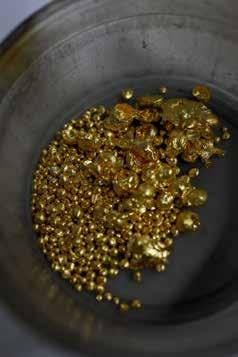
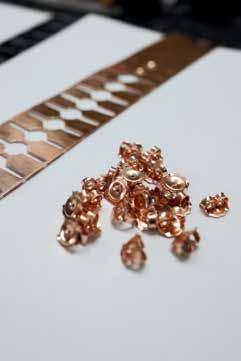
With gold and silver prices continuing to climb, accuracy, efficiency and material control have never been more critical in the jewellery workshop
22.
SETTING THE STANDARD
The hands shaping SA’s jewellery dynasty
A comprehensive directory featuring information and contact details of all members of the Jewellery Manufacturing Association of SA 20. 27. 37. 38. 41.
THE RISK REPORT
Malcolm Jenner, KwaZulu-Natal representative for the Jewellery Council Risk Initiative (JCRI), focuses on the critical role CCTV systems play
EDUCATIONAL INSERT
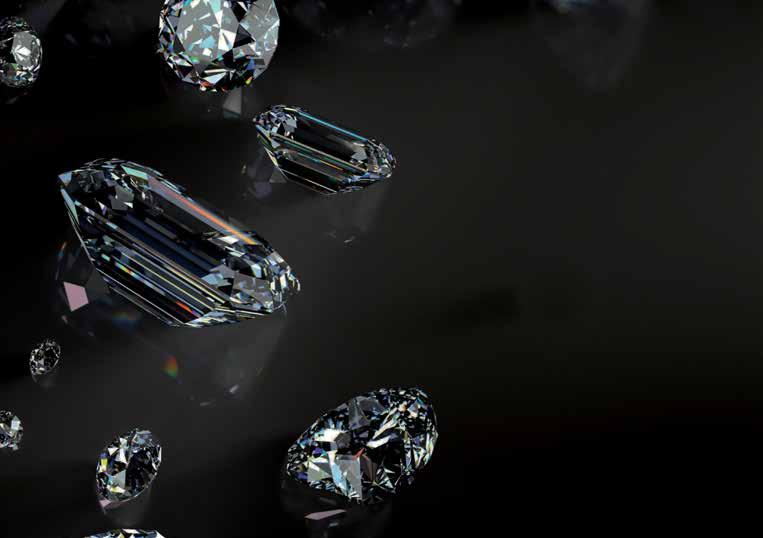
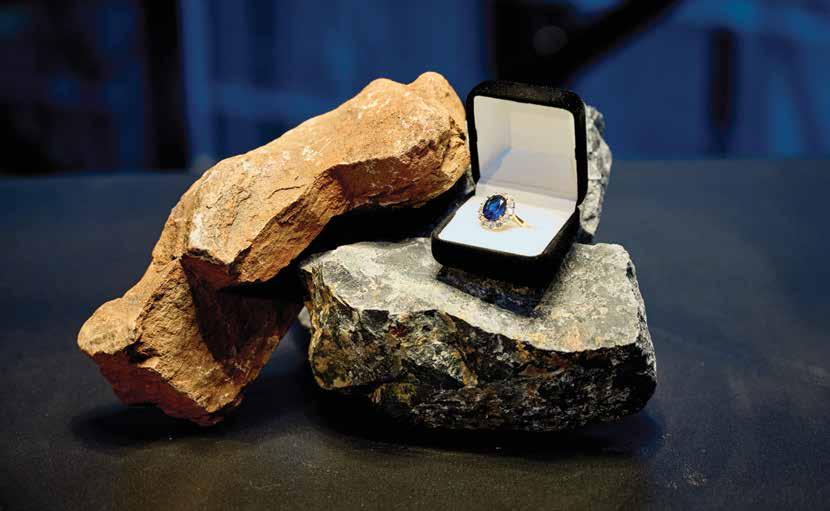
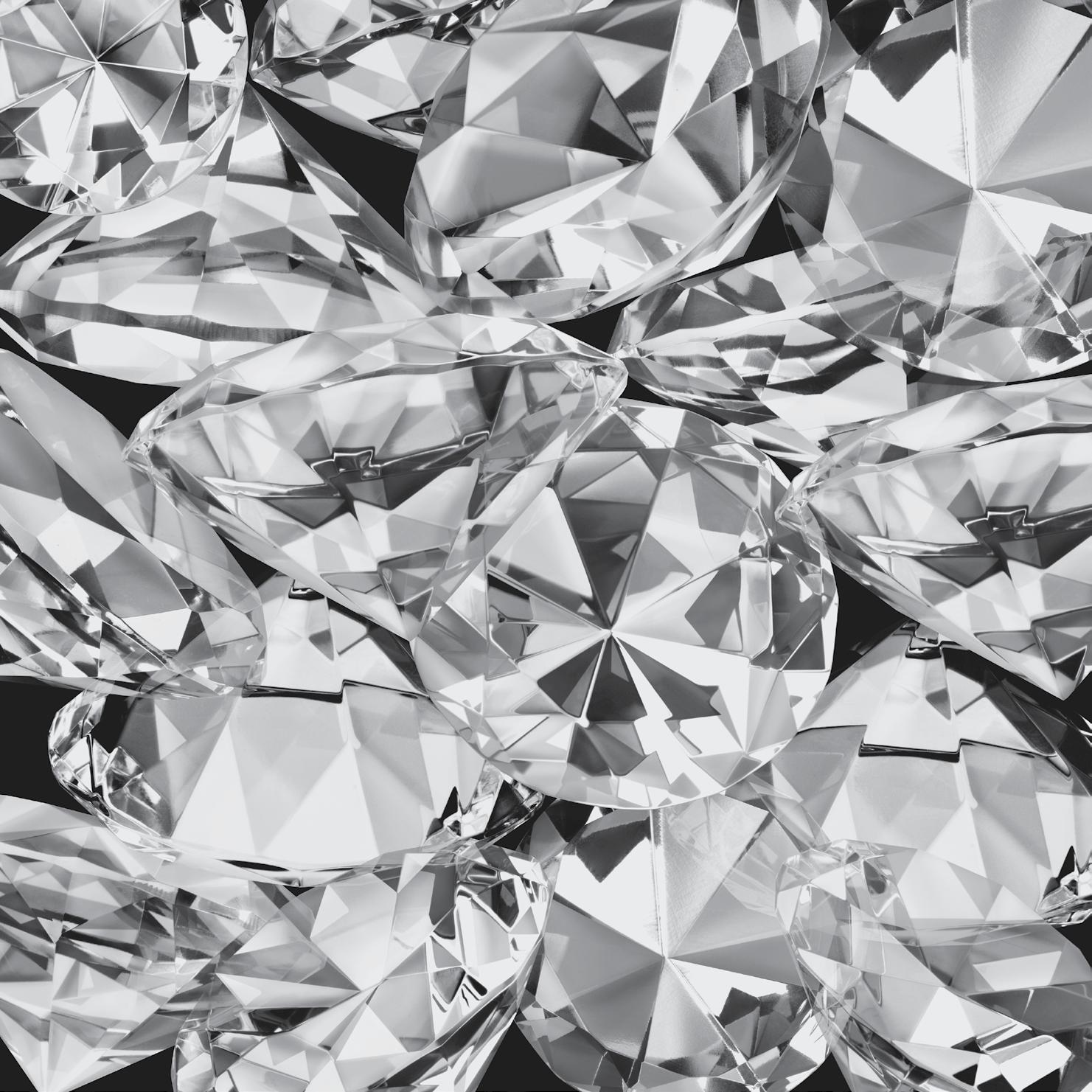
Raw brilliance: nature’s diamond sculptures
INDUSTRY EMPLOYMENT BOARD
Dedicated to supporting professionals within the jewellery industry who are seeking employment opportunities
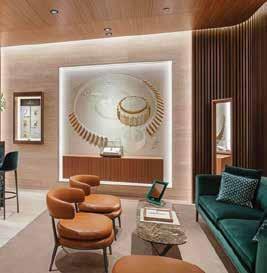
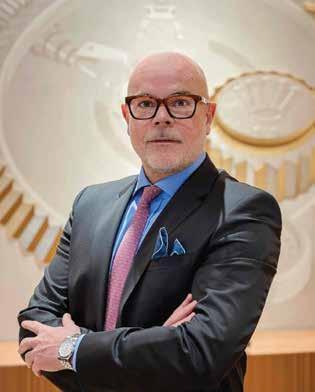
NEW ROLEX BOUTIQUE IN SANDTON CITY
A new Rolex boutique in Johannesburg’s prestigious Sandton City Diamond Walk reinforces the brand’s long-term commitment to SA
CPM HOSTS KWAZULU-NATAL NETWORKING EVENT
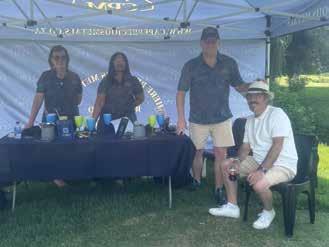
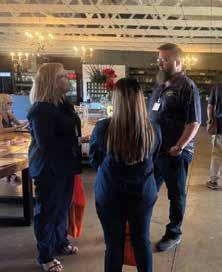
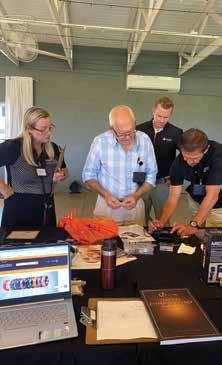
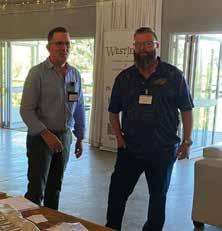
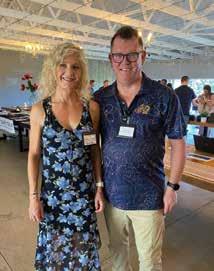
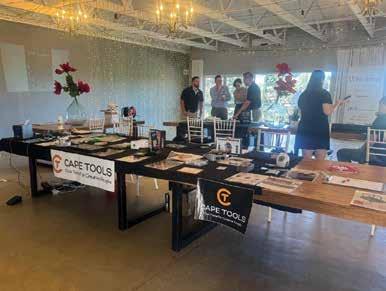
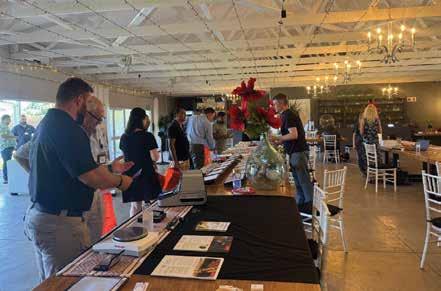
Cape Precious Metals’ industry networking event brought together professionals for a day of networking, live demonstrations and a lucky draw
BORN IN AFRICA
Jewellery Council of SA update
Lorna Lloyd, CEO of the Jewellery Council of SA (JCSA), shares the latest developments from the council’s office
THe Jewellery Council team has had a busy and productive start to 2026 and we are excited about the opportunities that lie ahead for our industry.
Jewellery Council team
We invite you to connect with our team, who are here to support members and help you gain maximum value from your membership. The strength of the Jewellery Council lies in the active participation of its members and we encourage you to engage with our programmes and make full use of the resources and initiatives available through the council.
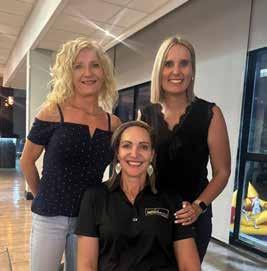
We are proud to introduce the dedicated individuals who work behind the scenes to serve you. Please meet our team:
• Lorna Lloyd – CEO.
• Elsa da Silva – Executive PA.
• Adri Viviers – Marketing Manager and Editor of the SA Jewellery News (SAJN) magazine.
• Thuli Majola – Administrative Manager and SA Jewellery News (SAJN) Sales Representative.
Annual report
We trust that members received the Annual Report, which was distributed earlier this year. The report may also be accessed on the council’s website at: www.jewellery.org.za.
Key strategies for 2026
Under the leadership of Chairperson Johan Bezuidenhout and Vice-Chairperson Grant Crosse (Metal Concentrators), the Executive Committee met in January to identify the Jewellery Council’s strategic priorities for 2026. The Executive
Committee includes: Sharon Eades (CPM), Khalid Mohamed (TFG), David Bolding (David Bolding Goldsmith), Fahmida Smith (Valterra Platinum), Adri Viviers (Jewellery Council) and Lorna Lloyd (CEO).
The key strategies can be summarised as follows: Financial sustainability and governance – To improve debtor management and expand and grow income streams.
Deregulation advocacy – To continue structured engagements with SARS, the SADPMR, the FIC and the MQA to identify and advocate the removal or simplification of onerous regulations.
Membership growth and value proposition – To define the council’s value proposition through a strong brand story by regularly communicating our achievements and actively promoting member benefits in SAJN. We will expand membership to include costume jewellery retailers and wholesalers. An industry status report and success stories will be shared at Jewellex Africa 2026.
Industry data collection – The council will launch a quarterly, anonymous SurveyMonkey questionnaire for members and non-members. Results will be shared with the industry.
Consumer marketing and trust-building – The council will embark on a campaign to promote member jewellers directly to consumers, emphasising “buying with confidence” from ethical, trusted retailers. We will use digital platforms such as the JCSA website, TikTok and Instagram. In addition, we will supply member jewellers with a JCSA consumer leaflet to distribute to customers, outlining the jeweller’s membership and adherence to a code of ethics, as well as consumer protections and support offered by the JCSA.
Consumer sales platforms and market access
– The council will assist local jewellers to create new market access opportunities by exploring a collaboration with the Investec Art Fair held at the Cape Town Convention Centre. We will also explore how Jewellex Africa 2026 can provide emerging jewellers with an opportunity to sell their jewellery.
Jewellex Africa 2026
We are pleased to announce that Jewellex Africa 2026 will take place on Sunday, 6 September and Monday, 7 September 2026 at the Gallagher Convention Centre in Midrand, Johannesburg.
Stand sales will open shortly. In the meantime, interested exhibitors are invited to communicate their interest by e-mailing: elsad@jewellery.org.za.
Jewellery Council Risk Initiative
Members are reminded that the Jewellery Risk Initiative has been brought in-house under the management of the Jewellery Council with effect from 1 January 2026.
For this initiative to be effective, active member participation is essential. We strongly encourage all members to report every crime-related incident, as timely information-sharing enables us to circulate alerts and CCTV footage as soon as possible.
Please e-mail all relevant details and footage to: admin@jewellery.org.za.
We are working closely with our security specialist, Carel Westraad, who assists in collating and analysing this information with us so that it can be shared with centre management, the SAPS and private security partners.
Members are also encouraged to refer to the security article published in this magazine for further insights into current risks and preventive measures.
WhatsApp groups
Members who are not yet part of the council’s WhatsApp groups are encouraged to consider joining. These groups are used to share important
and timely information that may be relevant to your business.
If you are concerned about message interruptions, you may wish to mute notifications and review updates at your convenience.
Settling membership fees
Members are reminded to ensure that their membership fees are settled in full each month. As a non-profit organisation, the Jewellery Council relies entirely on membership fees to operate and continue serving the industry. Timely payment is essential to sustain our operations and initiatives.
Monthly invoicing was introduced to assist members with cash flow management; however, we have noted that some accounts are not being settled in accordance with this arrangement.
When making payment, please use your membership number or invoice number as the payment reference to ensure accurate allocation.
New Jewellery Council decals
Members should have received their new Jewellery Council decals/stickers via post or courier. The updated decals feature the year of issue and a QR code linking directly to the council’s website, where customers can learn more about the ethical standards and practices our members uphold.
We encourage all members to prominently display these decals in your stores and offices. Doing so sends a clear message to both consumers and trade partners that your business adheres to a strict code of ethics and conduct.
If you have any queries, please contact the council at: Tel: (011) 484-5528
What a truly wonderful start to 2026! On 20 February, the Jewellery Council hosted its very first Golf Day and it was incredibly encouraging to see our industry come together with such great spirit. The day was filled with connection and conversation, reminding us of how important it is to create opportunities to engage face to face at the beginning of a new year.
It was equally encouraging to see the strong turnout at Cape Precious Metals’ KwaZulu-Natal networking event. These gatherings play a very significant role in strengthening our industry, as they allow us to share ideas, build partnerships and continue growing together as a professional community.
We have been very heartened by the positive response to our new The Risk Report security column. It is encouraging to know that this content is resonating with our readers. In this issue, the focus is on CCTV and the important role it plays in protecting businesses, assets and livelihoods within our sector.
Born in Africa, a comprehensive directory which includes the information and contact details of all members of the Jewellery Manufacturing Association of SA, appears in every issue of SA Jewellery News. To ensure that it remains a trusted and valuable resource, it is essential that member details are accurate and up to date. If your information needs updating, please e-mail me at: adriv@jewellery.org.za.
Helping members trade better.
Report crime incidents to the CGCSA. Robberies, break-ins and thefts remain a serious concern in our industry. Jewellers and industry members are strongly encouraged to report any such incidents to the Consumer Goods Council of South Africa (CGCSA) via e-mail: pulengr@cgcsa.co.za / crime@cgcsa.co.za. Please share detailed information, such as date, time, location, SAPS case number and any available photos or video footage, which are used to support investigations and help secure successful convictions.
ON THE COVER
We are also proud to include our new Industry Employment Board in every issue. This platform is dedicated to supporting professionals within the jewellery industry who are seeking employment opportunities. If you are currently seeking a position and would like your details included, please reach out to us.
These features are included with the intention of making SA Jewellery News not just a publication, but a meaningful and practical resource for our industry.
Happy reading!
Adri
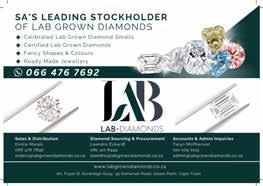
LAB Diamonds is South Africa’s largest supplier of IGI-certified lab-grown diamonds to the jewellery trade, offering over 10 000 competitively priced stones with nationwide delivery. Stock is held on hand for immediate availability, with sourcing and ready-made jewellery options available. Trade only. For more information: 066-476-7692 (Call / WhatsApp) | (021) 109-0115 | orders@labgrowndiamonds.co.za. Register at www.labgrowndiamonds.co.za
Africa is rich
In people, in culture, in precious metals.
Metal Concentrators’ vision is to grow Africa’s wealth, support local precious metal industries, tell our jewellers’ stories and create wealth products that invite all Africans to share in the richness of this land.
We call our vision The Evolution of African Wealth.
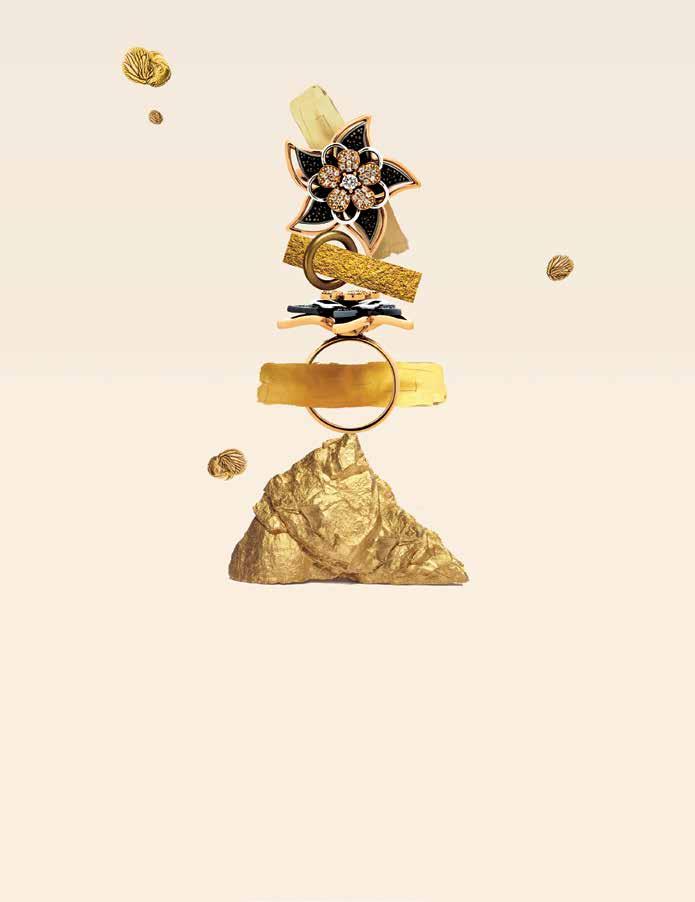
Ring design
by Nonhlanhla Mtshali, of Hodari Jewellery Creations, inspired by the effortless beauty of nature
Jewellex Africa 2026 promises a “World of Colour”
Jewellex Africa 2026 will take place at Gallagher Estate in Midrand on 6-7 September, featuring a vibrant new theme, A World of Colour, which reflects the creativity and diversity of the jewellery sector.
Hosted by the Jewellery Council of SA, Jewellex Africa is the country’s foremost jewellery and watch trade exhibition and remains the premier
platform for trade engagement in the region. With a legacy spanning more than four decades, the event brings together a comprehensive cross-section of suppliers, designers, manufacturers and service providers under one roof.
Jewellex Africa serves as a key marketplace for new merchandise launches, business negotiations,
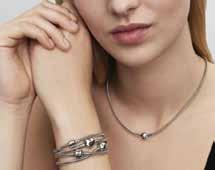
Pandora introduces platinum-plated jewellery
Amid rising silver and gold prices, Pandora is launching a platinumplated jewellery collection using its proprietary Evershine metal-alloy core. The new plating technique allows the brand to offer highquality jewellery while reducing reliance on sterling silver.
“Platinum plating enables us to navigate material costs while delivering elegant, durable pieces suitable for everyday wear,” says Pandora CEO Berta de PablosBarbier. A curated range of
platinum-plated bracelets will début at 30 stores and online across northern Europe, with a global roll-out planned for the second half of this year. Pandora, which has used 100% recycled silver and gold since 2024, plans to gradually include recycled platinum in its products to further reduce its environmental footprint.
The company also announced Philippa Newman as its new Chief Product Officer, overseeing global product development, design
trend discovery and orders for the critical festive trading season. It draws visitors and exhibitors from across SA and beyond, all focused on building trade relationships, sourcing the latest collections in fine jewellery, watches, gemstones, packaging, equipment and allied services and expanding market opportunities. Stand bookings for Jewellex Africa 2026 will open soon.
and collection management. She succeeds Stephen Fairchild, who becomes Chief Strategic Creative and Cultural Officer. Newman assumes her new role on 9 March in Copenhagen, Denmark.
GIA identifies fracture-filled diamonds in jewellery
The Gemological Institute of America (GIA) has detected fracture-filled diamonds in a necklace and a pair of earrings examined at its India lab following the 2025 IIJS Première. Two round diamonds in the necklace and one marquise-cut diamond in the earrings had been treated with a glass-like filler to enhance clarity.
Fracture-filling is a temporary clarity enhancement method which improves appearance, but may degrade over time due to heat, UV exposure, ultrasonic cleaning or chemicals. The GIA emphasises that such treatment significantly affects a diamond’s value, durability and care requirements and its laboratories do not issue grading reports for fracture-filled stones.
Anglo American considers third De Beers write-down
Anglo American, De Beers’ parent company, is reviewing the miner’s book value for the third time in two years due to ongoing weakness in diamond demand.
Production guidance for 2026 has also been revised, with output now expected between 21-26 million carats, down from the previous 26-29 million. The De Beers rough price index fell 12% in 2025, or 25% including stock rebalancing and large-volume deals. Consolidated rough-diamond sales grew 9% to $2,98
billion, with volumes rising 23% to 23,9 million carats. Earnings before interest, taxation, depreciation and amortisation for 2025 is expected to be negative.
Anglo noted regional production shifts: South Africa fell 10%, Botswana 56% and Namibia 21%, while Canada more than doubled to 949 000ct due to new ore at the Gahcho Kué site. A structured sale process for De Beers is ongoing as Anglo continues to explore divestment options.
JCSA launches redesigned website
The Jewellery Council of SA (JCSA) has launched its newly redesigned website. While the web address remains unchanged at www.jewellery.org.za, the platform has undergone a comprehensive redevelopment to incorporate the latest technology alongside a modern, intuitive and user-friendly design.
The enhanced website has been developed to better serve both consumers and members of the trade, positioning it as a valuable and informative resource for the South African jewellery industry.
A key feature of the redevelopment is the expansion of the consumer-facing section, which is designed
to educate and guide the public on the importance of purchasing from JCSA member jewellers. This section includes a comprehensive listing of accredited member retailers, information on consumer protection and clear explanations of the benefits of buying from JCSA members. In addition, educational resources are provided to help consumers make informed jewellery purchasing decisions with confidence.
For industry professionals, the trade section (which requires log-in access) now functions as a centralised information hub for JCSA members. It provides access to a complete directory of members, recommended trade practices, detailed information on membership benefits and official accreditation badges. The platform also features updates on industry events, important sector news and access to SA Jewellery News, alongside additional industry-related resources.
“The council invites all stakeholders to visit the website and explore the enhanced features and content,” says Lorna Lloyd, CEO of the JCSA. “The redesigned platform is intended to strengthen engagement, improve access to information and support greater connectivity across the jewellery industry, reinforcing the council’s role as a trusted industry authority.”
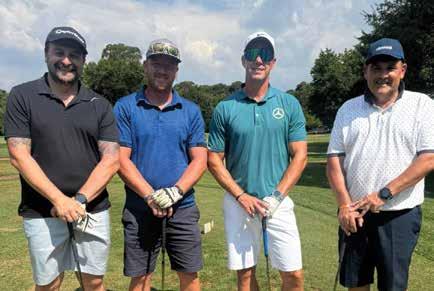
Jewellery Council tees off with inaugural Golf Day
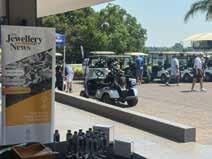
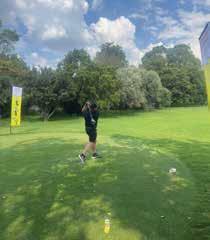
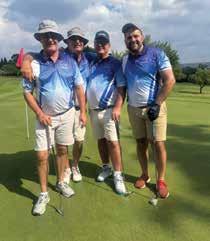
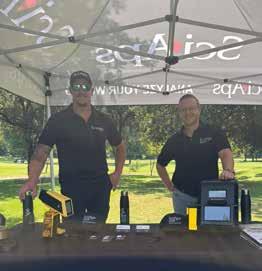
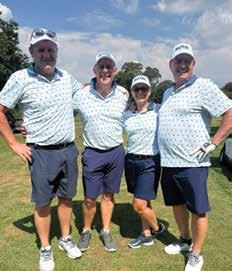
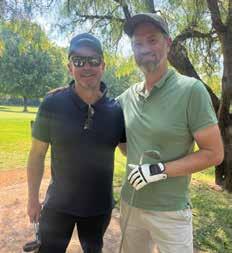
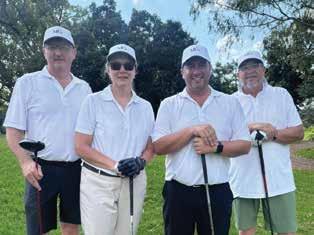
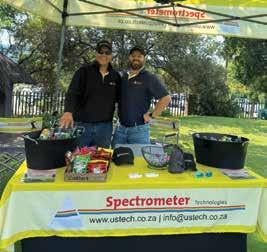
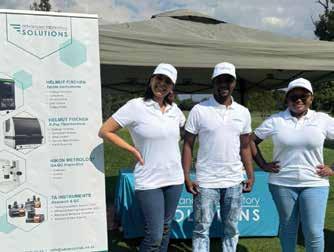
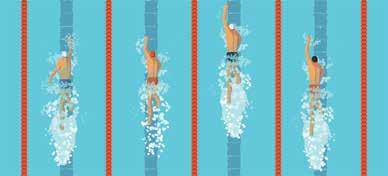
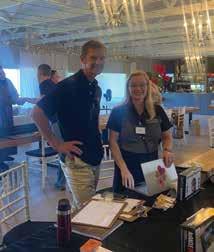
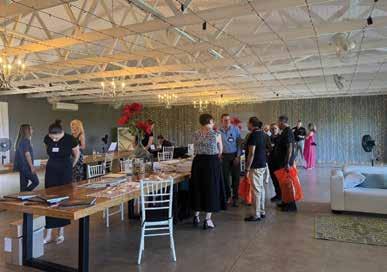
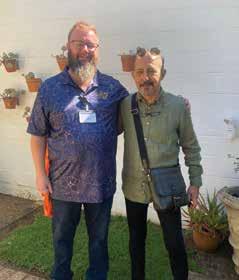
The Jewellery Council of SA (JCSA) hosted its first-ever Golf Day at Randpark Golf Club’s Bushwillow Course on Friday, 20 February, bringing together the industry for a memorable day of golf and networking
The JCSA proudly hosted its inaugural Golf Day at Randpark Golf Club’s Bushwillow Course, marking a milestone event for the local jewellery industry. The day was defined by strong industry camaraderie, meaningful networking and, of course, great golf.
The morning began bright and early, with hole sponsors setting up from 7am. Their enthusiasm set
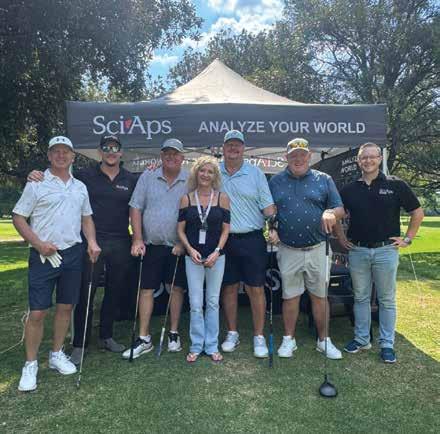
the tone for the day and players were welcomed by vibrant, interactive sponsor activations across the course. Sponsors brought energy and creativity to their respective holes, ensuring plenty of fun and engagement throughout the morning.
The players officially teed off with a shotgun start at 11am, as they took to the fairways in a spirit of friendly rivalry. Beyond the competition itself, the day provided valuable opportunities for connection, reinforcing the importance of collaboration within the jewellery sector.
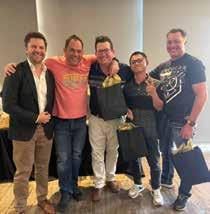
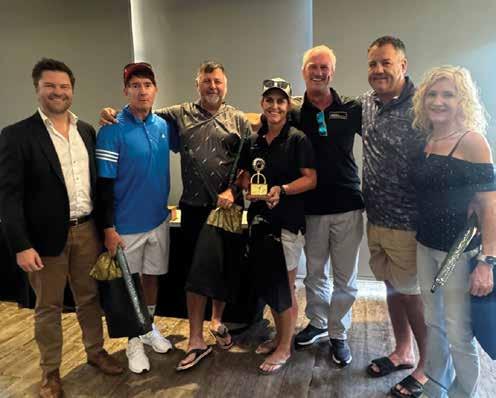
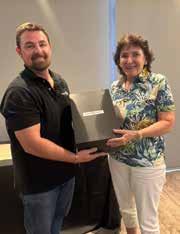
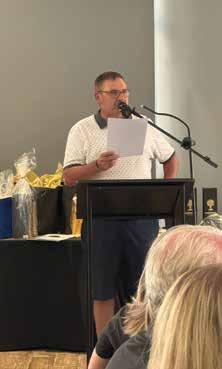
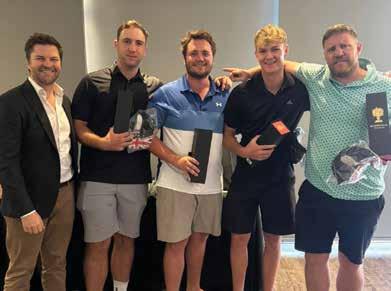
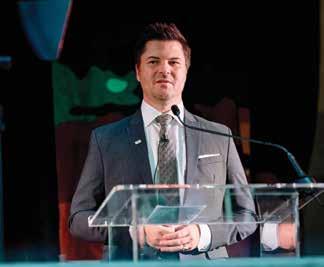
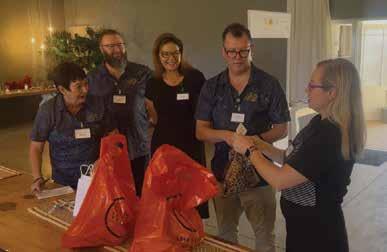
Following the day’s play, guests gathered in the Jacaranda Room, where JCSA Chairperson Johan Bezuidenhout welcomed attendees and reflected on the significance of the occasion. JCSA ViceChairperson Grant Crosse then presented prizes to
the day’s winners, celebrating both skill and sportsmanship.
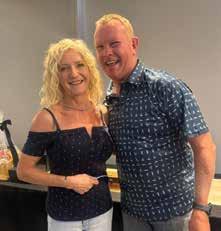
Lively entertainment by Gabriel added to the celebratory atmosphere, rounding off a wonderful and memorable occasion.
“Our inaugural Golf Day was more than a sporting event – it underscored how vital it is for the industry to come together, strengthening relationships and sharing insights,” says JCSA CEO Lorna Lloyd.
The JCSA extends its sincere appreciation to its generous sponsors for making the day possible:
• Advanced Laboratory Solutions
• BAC Logistics
• Brinks
• Bryte Insurance
• Cape Precious Metals
• Gestalt Consult
• Halcyon
• Innov-X Africa
• Metal Concentrators
• Mr K
• Precious Metals Tshwane
• SciAps – Scientific Applications
• Spectrometer Technologies.
“Our inaugural Golf Day was more than a sporting event – it underscored how vital it is for the industry to come together, strengthening relationships and sharing insights.”
JCSA Golf Day: where business met the fairway
Mine to market calls for new mining legacy beyond extraction
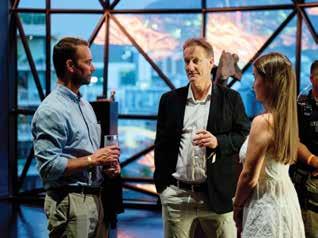
MineShift2026: Mine to Market brought together mining leaders, policy-makers, investors, jewellers, designers and cultural voices to explore a future in which Africa’s minerals generate enduring value beyond extraction. The event was hosted at the Zeitz Museum of Contemporary Art Africa (Zeitz MOCAA)
MineShift2026: Mine to Market reframed mining as both a finite act and a starting point asking what is built, retained and passed on once minerals leave the ground. It challenged conventional narratives around Africa’s role in global mineral economies, positioning the continent not merely as a source of raw materials, but as a creator of long-term industrial, cultural and brand legacy.
Opening the evening, Grant Crosse, MD of Metal Concentrators, emphasised that MineShift is designed to provoke deeper thinking and more ambitious action across the sector.
“MineShift isn’t about agreement and it certainly isn’t about easy answers. It’s about challenging assumptions, challenging comfort and challenging ourselves to think beyond the scraps of the past,” he said.
“The future of African mining won’t be defined solely by how much we extract, but by what we build, what we retain and what we pass on.”
Reflecting on Africa’s enduring relationship with gold, guest speaker Nere Emiko, founder and Executive Vice-Chairperson of Kian Smith Company, described it as “a historic, timeless legacy”. She noted that the continent is increasingly “looking inward as it looks forward”, with growing momentum behind beneficiation, value addition and market development.
From jewellery and design to story-telling and sound, MineShift2026 positioned minerals not only as commodities, but as cultural material capable of sustaining industries, skills and brands across generations.
The shared objective emerging from the evening was clear: to accelerate beneficiation, strengthen African value chains and ensure that Africa’s mineral wealth translates into enduring skills, industries and brands with lasting industrial capability and creative authorship.
“The future of African mining won’t be defined solely by how much we extract, but by what we build, what we retain and what we pass on.”
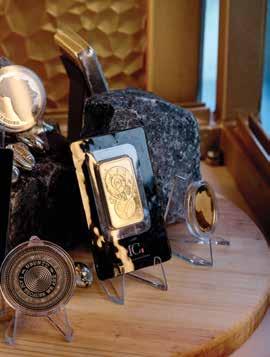
Know your metal: accurate testing matters
When precious metal prices are high, there is little room for error. Whether trading, buying or selling, jewellers must be confident that they are working with the correct gold or silver caratage. Reliable metal testing equipment is no longer optional – it is essential.
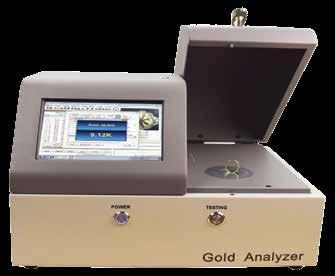
With a wide range of testing devices on the market, choosing the right system can be challenging. Key factors to consider include accuracy, ease of use, aftersales support, software updates and the availability of spares. After reviewing numerous demonstrations and brands, one standout option is the Gold Analyzer XRA All-in-One, which delivers excellent value for money at R150 000 excl VAT. Comparable systems from other brands often exceed R300 000 excl VAT, making this a practical investment for workshops that require consistent, professional-level testing. Backed
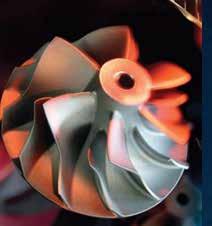
Precision, protection and productivity
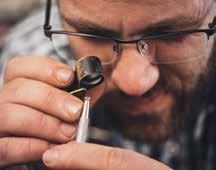
With gold and silver prices continuing to climb, accuracy, efficiency and material control have never been more critical in the jewellery workshop. From reliable metal testing and advanced laser technology to smarter casting solutions and time-saving finishing tools, this month’s article explores equipment that helps jewellers protect margins, work smarter and maintain the highest quality standards
by more than 20 years of industry presence, the system is supported by a long-established and reliable after-sales service network.
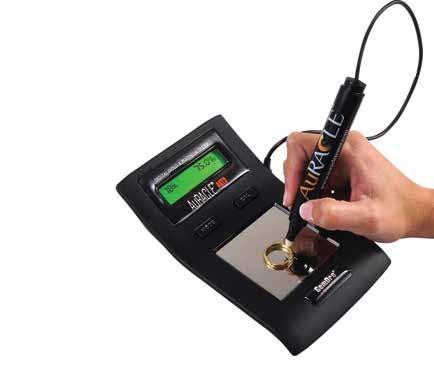
For smaller workshops or jewellers who simply need to verify what a customer wants to trade in, an entry-level electronic gold tester offers an affordable solution. This compact device displays fine gold content clearly and is priced at R17 000 excl VAT, making it ideal for front-ofhouse use or smaller businesses.
Laser technology: speed, strength and precision
Laser welders and engravers continue to gain momentum in jewellery workshops of all sizes – with good reason. These machines enable strong, precise
welds, fine engraving detail and high-speed cutting, all while minimising material loss. In an environment where time is money and lightweight, affordable pieces are increasingly in demand, laser technology plays a vital role.
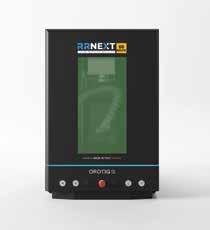
Italian manufacturer Orotig offers an impressive range of laser welders, engraving and cutting machines suitable for everyone from one-person workshops to large-scale factories. Designed for speed, accuracy and durability, these systems allow jewellers to achieve exceptional results with reduced turnaround times.
Casting smarter: automation and control
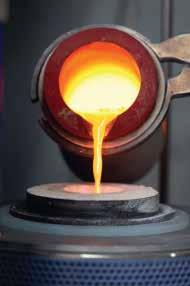
Casting technology has also evolved rapidly, with a clear shift towards automation and improved efficiency. German manufacturer Blue Power (Indutherm) offers a comprehensive range of casting machines, from compact desktop units ideal for small batch flasks to floor-standing models capable of casting several kilograms at a time.
Recently released machines further enhance precision, productivity and temperature control, helping jewellers reduce waste and improve consistency –key considerations when working with high-value metals.
Small tools, big impact: finishing made faster
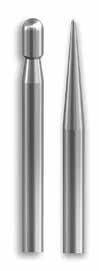
Sometimes the most transformative tools are also the smallest. Two innovative carbide burs from Busch Germany are designed to tackle one of casting’s most time-consuming challenges: the removal of casting skin. This rough surface layer typically requires extensive manual finishing, which can erode detail and consume valuable time.
These unique micro ram roller burs burnish surfaces quickly and effectively, even in hard-to-reach areas. They offer a fast, affordable alternative to larger finishing machines and tumblers, preserving detail while dramatically reducing labour time – a true game-changer for goldsmiths.
From accurate metal testing and laser technology to automated casting and intelligent finishing solutions, today’s tools are designed to help jewellers work more efficiently without compromising quality. Investing in the right equipment not only protects margins, but supports better craftsmanship, faster turnaround times and long-term business sustainability.
We thank Cape Tools & Jewellery Supplies for its ongoing support of the Tools of the Trade column. Its range of testing equipment, laser systems, casting solutions and finishing tools helps jewellers adapt to rising material costs while maintaining precision and productivity.
Navigating the MQA funding landscape: what jewellery manufacturers need to know
South Africa’s jewellery training landscape is facing significant challenges. In this monthly column, Faldilah Garrett discusses how shifts in the Mining Qualifications Authority (MQA) funding framework are reshaping the way jewellery manufacturers, training providers and studios can access financial support for occupational learning
SA’s jewellery sector has long relied on in-house skills development to sustain craftsmanship, innovation and global competitiveness. As the industry evolves, so do the mechanisms that support training. Shifts in the Mining Qualifications Authority (MQA) funding framework are reshaping the way jewellery manufacturers, training providers and studios can access financial support for occupational learning. These changes place a renewed emphasis on workplace-readiness, strategic planning and demonstrable commitment to skills development.
For the modern atelier, understanding these changes is no longer optional – it is a prerequisite for securing the financial support necessary to support and sustain the next generation of master jewellers.
At the centre of the new requirements is a stronger alignment between training intentions and
workplace capability. The MQA now requires formal workplace approval before funding can be granted for certain pivotal programmes. This approval is not a mere administrative step; it is a quality assurance measure designed to ensure that students are placed in environments equipped to deliver meaningful, industry-standard training. For jewellery manufacturers, this means demonstrating that their workshops, tools, safety systems and supervisory structures meet the expectations of a qualityassured learning environment.
Workplace approval also signals a shift towards greater accountability. The MQA aims to ensure that funded training leads to real, measurable outcomes and skilled artisans who can contribute to the sector’s growth. As a result, workplaces must show that they can provide consistent mentorship, adequate exposure to practical tasks and adherence to
occupational standards. For many jewellery studios, this may require formalising processes that were previously informal, such as documenting training activities, standardising safety protocols or upgrading equipment to meet compliance benchmarks.
Complementing this requirement is the renewed emphasis on the Workplace Skills Plan (WSP). This plan has always been part of the broader SETA landscape, but its role in accessing MQA funding has become more pronounced. Jewellery manufacturers seeking funding must now submit a detailed WSP that outlines their training priorities, skills gaps and development strategies for the year ahead. This plan must be both realistic and aligned with the sector needs.
The WSP serves as a strategic roadmap, demonstrating that the organisation has thought carefully about its talent pipeline. The MQA’s strengthened focus on the WSP encourages employers to think beyond immediate production needs and consider long-term workforce sustainability. Whether a studio specialises in fine jewellery, casting, gem-setting or design, the WSP ensures that training is intentional, structured and aligned.
For employers, the implications are clear: proactive preparation is now essential. Securing workplace approval may require early engagement with the MQA, investment in workshop upgrades or collaboration with accredited training providers. Developing a robust WSP may involve skills audits, consultations with staff and alignment with emerging industry trends. While these steps require time and planning, they ultimately position jewellery manufacturers to benefit from a more structured and reliable funding system.
As the MQA continues to refine its funding mechanisms, jewellery manufacturers who embrace
Faldilah is an expert in occupational programme development for the NQF, working with clients such as the MQA, SASSETA, the QCTO, the Reserve Bank and leading SETAs.
A qualified goldsmith since 1999, she has helped shape national jewellery and mining qualifications since 2002. She serves on the JMASA Executive Committee and has trained top skills providers.
these requirements will be best positioned to secure support for their training initiatives.
Compliance through MQA approval and WSP submission is the essential investment that transforms regulatory mandates into the vital funding required to sustain world-class South African craftsmanship. Here is a short process:
The new compliance frontier: workplace approval
To gain approval, a workshop must demonstrate that it possesses the requisite machinery, safety protocols and qualified subject matter experts. This process often involves a physical or desktop audit to verify that your environment mirrors the sophistication of the global market.
Navigating discretionary grants
Successfully submitting your WSP/ATR gives you access to discretionary grants. For 2026, the MQA has prioritised “sectoral priority occupations”. Jewellery manufacturing remains a priority, but funding is now contingent on having that prior workplace approval for the specific trade or internship.
Current changes highlight a “risk-based approach”, where the MQA may conduct student verifications before any grant tranches are paid. This ensures that the R240 000 grants for workplace coaches or the stipends for internships are reaching valid, highstandard environments.
The WSP process
Your appointed skills development facilitator (SDF) must register on the MQA’s digital portal to capture “source data”. This includes a detailed forecast of planned training, mapped to the latest organising framework for occupation codes. Submissions must be finalised by 30 April.
The path forward
To remain eligible, industry leaders should:
1. Appoint an SDF: Ensure that they attend the MQA’s provincial capacity-building sessions.
2. Audit your tools: Ensure that your workshop meets the MQA’s technical “site visit tool” requirements.
3. Submit early: The digital system generates error reports; early submission allows time to correct data mismatches before the April cut-off.
By embracing these rigours, the jewellery sector reinforces the structural integrity of South African craftsmanship, ensuring that our heritage of luxury can be preserved through a certified, world-class workforce.
About Faldilah Garrett
The Risk Report
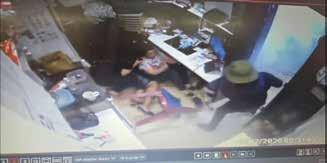
OCrime in the jewellery industry remains a serious concern and staying informed is essential. In this new monthly column, Malcolm Jenner, KwaZulu-Natal representative for the Jewellery Council Risk Initiative (JCRI) and Marketing and Administrative Director at Cape Precious Metals (CPM), shares practical guidance on staying vigilant, responding effectively to incidents and ensuring businesses have the right systems and measures in place to protect staff, customers and assets
ne of the most effective tools available to jewellers today is a properly specified and professionally installed CCTV system. Time and again, incidents reported through the Jewellery Council Risk Initiative (JCRI) have shown that highquality CCTV footage can make the difference between a case going unsolved and a successful arrest and prosecution.
However, not all CCTV systems are created equally. As Jacques Neethling of Techsome explains: “When jewellers are selecting a CCTV system, it’s important that they look beyond basic camera coverage and focus on specifications that address both real-world security risks and evidential requirements.”
Image quality is a critical starting point. Jewellery stores should be using high-resolution cameras, at least 4 MP and ideally 8 MP or 4 K, to ensure clear facial recognition, accurate product visibility and usable footage for investigations or insurance claims. Poor image quality often renders footage unusable when it matters most.
Equally important is low-light and night-time performance. Many incidents occur after hours or during load-shedding and cameras must be capable of capturing clear footage in low-light conditions. Infra-red or advanced low-light colour technology is essential, particularly in areas such as safes, strongrooms and stock storage areas.
Stores with glass shopfronts and bright display lighting should also prioritise wide dynamic range. This technology balances bright exterior light with
darker interior spaces, preventing glare or washed-out footage which can obscure critical details.
Modern CCTV systems now offer AI-based human and object detection, which significantly improves system effectiveness. These systems can distinguish between people, vehicles and irrelevant movement, reducing false alarms and ensuring that alerts are triggered only by genuine security events. AI-powered search functions also save valuable time during investigations by allowing users to locate specific incidents quickly.
More advanced systems can include facial and behavioural analytics, such as loitering detection, line-crossing alerts and the identification of unusual behaviour. These features are particularly valuable at entrances, high-value display areas and locations where repeat suspicious activity may occur.
Camera placement is just as important as camera quality. Strategic coverage should include entrances and exits, display counters, safes and strongrooms, stock rooms and staff-only areas. Eliminating blind spots is critical in a high-value retail environment.
Finally, jewellers should ensure that their systems include adequate recording and storage, typically retaining footage for 30-90 days, depending on insurer requirements. Redundant recording options and secure off-site backups add an extra layer of protection against data loss or system tampering. Remote monitoring and system health alerts can also notify users of camera failures or technical issues before they become a vulnerability.
CCTV is not simply about recording incidents after they happen. When properly specified and actively monitored, it becomes a powerful preventive tool, one that protects staff, reassures customers and strengthens the industry’s ability to respond effectively to crime.
Building a comprehensive, high-quality CCTV system in stages is a practical, cost-effective strategy for jewellery store-owners, allowing them to secure their premises without incurring massive upfront costs. As jewellery stores are high-stakes environments, a phased approach ensures that critical areas are protected first while allowing for future expansion.
- The JCRI extends its sincere appreciation to Jacques Neethling for his valuable guidance and recommendations above. Further information on Techsome can be found at www.techsome.co.za.
CALL TO ACTION: REPORTING INCIDENTS
All security-related incidents, whether successful or attempted, should be reported to the Jewellery Council of South Africa by e-mailing: admin@jewellery.org.za. Please include as much detail as possible, such as the date, time and location, a description of what occurred, any suspect details, vehicle information, CCTV footage or images and the SAPS case number, where applicable.
The following jewellery-related crimes, which occurred between 15 January 2026 and 15 February 2026, were reported to the Jewellery Council:
19 Dec 2025 13:15 SL Herman Jewellers Armed robbery Pretoria, Gauteng
20 Jan 2026 Meraki Jewellery Design Online fraud Bothasig, Cape Town
05 Feb 2026 Anna Rosholt Attempted online fraud Cape Town, Western Cape
09 Feb 2026 11:30 Cash Converters in Aero Centre Armed robbery Aero Centre, Kempton Park
13 Feb 2026 09:30 The Jewellery Club, East Rand Mall Armed robbery Boksburg, Gauteng
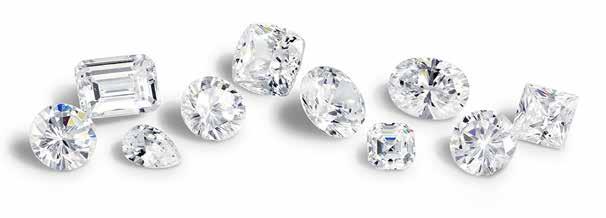
As demand for lab-grown diamonds accelerates across South Africa, jewellers are seeking trusted supply partners who can offer reliability, scale and competitive pricing. Based in Cape Town, LAB Diamonds has emerged as a leading force in the trade, combining extensive stock holdings, global supplier relationships and a service-driven approach tailored specifically to professional jewellers.
In an industry defined by precision, trust and relationships, reliability is everything. For jewellers navigating the fast-growing demand for lab-grown diamonds, having the right supplier is no longer optional – it’s strategic.
Based in the heart of Cape Town, LAB Diamonds has positioned itself as South Africa’s largest supplier of IGIcertified lab-grown diamonds to the jewellery trade. With over 15 years of experience in the diamond industry, founder Leandro Eckardt has built meaningful relationships with some of the world’s largest labgrown diamond manufacturers, giving South African jewellers direct access to thousands of diamonds at competitive prices.
“Let us do the groundwork in finding your clients the perfect lab-grown diamonds,” says
Leandro. And that’s exactly what they do.
A complete buying platform for jewellers
LAB Diamonds is not just a supplier – it is a complete buying platform designed specifically for the trade. Every certified stone is laser inscribed, ensuring full traceability and peace of mind. Their offering includes a wide
range of high-quality stones, all available with reliable grading. As South Africa’s largest stockist of IGI-certified lab-grown diamonds, LAB Diamonds carries all stock on hand, eliminating the delays that often accompany international sourcing. Jewellers can view stones in secure offices or arrange nationwide courier delivery, making the buying process seamless from start to finish.
Lab Diamonds: powering the future of South Africa’s jewellery trade
In addition, the company has introduced a budget-friendly range of certified lab-grown diamonds, locally certified by The GemLab, expanding accessibility for jewellers who require competitively priced, certified options for a broader client base.
Expanding into ready-made jewellery
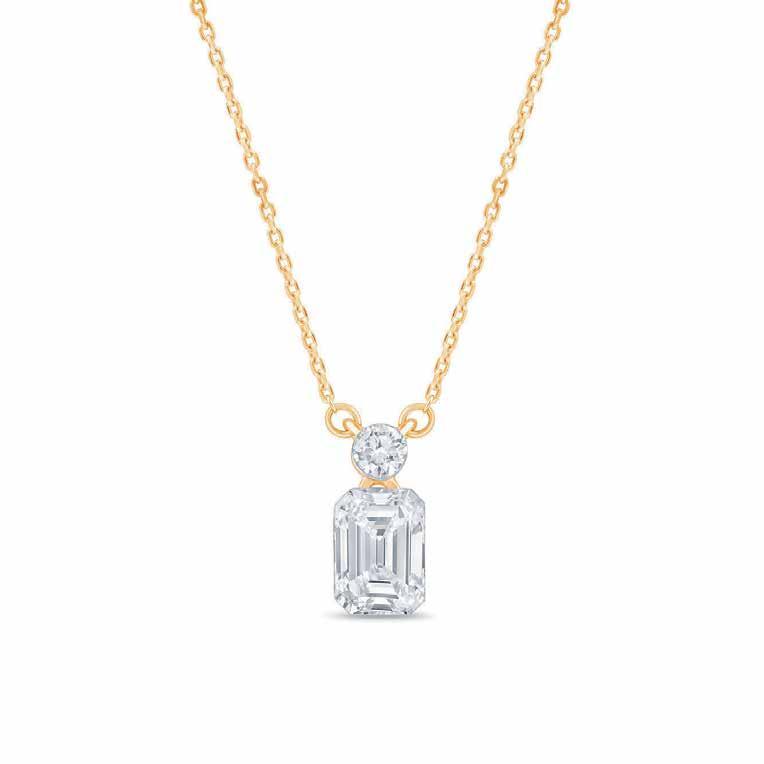
Recognising the evolving needs of the retail market, LAB Diamonds is expanding its offering beyond loose stones. The company plans to significantly increase its range of ready-made lab-grown diamond jewellery, giving jewellers the opportunity to stock and promote finished pieces directly in-store.
This expansion will allow clients to: Offer ready-to-sell lab-grown diamond jewellery without production lead times
• Test and grow their lab-grown category with minimal risk Access high-quality pieces immediately
By combining loose stone supply with finished jewellery solutions, LAB Diamonds aims to further streamline the buying journey, enabling jewellers to respond quickly to consumer demand.
Responsibly sourced. Consciously delivered.
Sustainability is no longer a trend – it is an expectation. LAB Diamonds partners with laboratories that use advanced technology and sustainable practices, resulting in a responsible and conscientious supply chain.
For jewellers, this means confidently offering clients diamonds that are not only high quality and competitively priced, but also environmentally considerate. Every stone reflects a modern approach to luxury – one that aligns with the evolving values of today’s consumers.
• Short approvals for approved client applications Calibrated smalls to order
• Secure offices for stock viewings
• Sourcing and importing of specific lab-grown diamonds
• On-hand stock for immediate availability
And if they don’t have what you’re looking for, they will source it.
A long-term partner in a growing market
As demand for lab-grown diamonds continues to rise across South Africa, jewellers require more than product availability. They need consistency, speed, competitive pricing, transparency and, above all, partnership.
With strong international supplier relationships, extensive stock holdings and a service-focused approach, LAB Diamonds is committed to building long-term business relationships rather than once-off transactions.
For jewellers looking to buy labgrown diamonds with confidence and efficiency, LAB Diamonds remains ready to enhance the diamond buying experience through innovation, technology and uncompromising service.
GEMS & GEMOLOGY
Diamond Reflections
Raw Brilliance: Nature’s Diamond Sculptures
Editor: Evan M. Smith
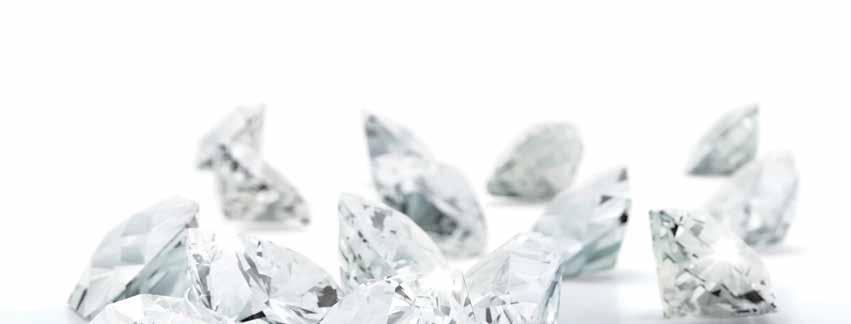
The basic shape of a rough diamond is all around us, from black diamonds on ski slopes to the familiar red diamonds in a standard deck of playing cards. These symbols are the silhouette of an octahedron, which is the archetypal diamond crystal. Indeed, the octahedron appears regularly within parcels of mined diamonds, but accompanying it are many other nuanced shapes, all sculpted by natural processes. GIA scientists recently had the opportunity to examine a suite of 264 rough diamonds handpicked over several years by Pintu Dholakia of Hari Krishna Exports for their unusual or interesting nature. Here we showcase some of these specimens to discuss their morphology and highlight their striking appearances.
and the expected mineralogy and phase changes within slab rocks. Overlaying the slab geotherms onto phase diagrams helps to illustrate where water-bearing phases break down and release fl uid, such as the relatively well-accepted loss of most water from warm slabs at relatively shallow depths (<200 km). This is the activity that generates melt and fuels arc volcanoes such as those of the Pacifi c Ring of Fire. Cold slabs, however, can partially bypass this shallow dewatering process and transport a budget of carbonate and water to depths beyond 300 km, where its later release can cause deep-focus earthquakes (figure 3).
Sculpted by Natural Growth, Breakage, and Resorption in the Earth Diamonds form deep in the mantle when carbon-bearing fluids migrate and interact with solid rocks. Chemical
Editor’s note: Questions or topics of interest should be directed to Evan Smith (evan.smith@gia.edu).
The cold slabs can be thought of as having a carbonated crust component and a hydrated/serpentinized mantle peridotite component that lies shielded beneath the crust, toward the interior of the slab. The deep release of carbonatitic melt and hydrous fl uid from each component, respectively, is shown in the two depth profiles in figure 3. The carbonated crust (mid-ocean ridge basalt, or MORB) of the slab surface will intersect a deep depression in its solidus, the curve describing the beginning of melting, meaning it exceeds the melting temperature. Beyond
reactions or other changes can decrease the solubility of carbon, forcing it to form solid crystals of diamond. In the simplest case, a growing diamond will take the shape of an octahedron. However, variations in growth conditions can lead to other shapes. By growing diamond crystals in different ways, nature can build diverse rough diamond shapes—as an artist might press clay together to create a masterpiece. Examples include variations of cubes (cuboids, cuboctahedra, re-entrant cubes with concave cube faces and protruding corners), spheres called ballas, and twinned triangular plates called macles (figure 1).
bearing minerals called dense hydrous magnesium silicates (DHMS) rather than breaking down. DHMS phases are a good vehicle for transporting water, with some carrying as much as 10% or more water by weight. The geotherm for the interior of cold slabs remains in the DHMS stability fi eld far beyond a depth of 300 km (far right in figure 3). The slab in figure 3 is shown defl ecting as it reaches the top of the lower mantle (at 660 km), where there is a change in mantle density and deformability. As the slab stalls and warms up, DHMS phases break down to form minerals that carry much less water, thereby causing water release (blue arrows in figure 3). These are the mechanisms proposed to trigger not only deep-focus earthquakes but also super-deep diamond growth (Shirey et al., 2021).
Despite its status as the hardest natural substance, diamond is not invincible. Natural stresses that squeeze or shear a diamond in the mantle or during transport to Earth’s surface in a kimberlite eruption can lead to fracture and cleavage. A diamond has four symmetrical planes within its crystal structure along which it can cleave, meaning that it can break apart with nearly perfect flat, smooth surfaces (see figure 1A). In addition to breakage, the shape and surface of a diamond can be refashioned by a process known as resorption. During resorption,
Inclusions in the smaller, lower-quality varieties of sublithospheric diamonds often show evidence of growth from carbonatitic melts derived from slabs (Walter et al., 2008), but hydrous/aqueous fl uids have also been implicated for some samples (Wirth et al., 2007; Pearson et al., 2014; Palot et al., 2016). Serpentinite in subducting slabs can be relatively enriched in boron, meaning that the eventual breakdown of
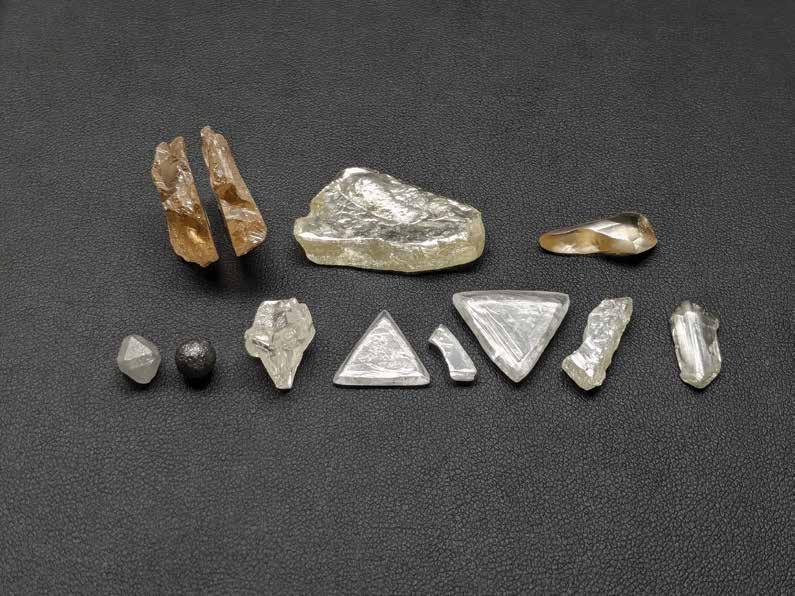
Figure 1 Examples of rough diamonds with shapes governed by various combinations of growth, breakage, and resorption: a diamond broken cleanly along a flat plane by cleavage (A); irregular broken fragments smoothed by resorption (B and C); cuboctahedron (D), ballas (E), and re-entrant cuboid (F) shapes produced during diamond growth; two macles resulting from twinned crystal growth, along with two fragments resulting from macle breakage (G); and an elongate fragment representing an edge broken from an octahedron crystal, with the former octahedron corners forming the ends (H). Specimens range from 1.08 to 28.08 ct, with the largest specimen measuring 27 mm in length. Photo by Evan M. Smith.
and the expected mineralogy and phase changes within slab rocks. Overlaying the slab geotherms onto phase diagrams helps to illustrate where water-bearing phases break down and release fl uid, such as the relatively well-accepted loss of most water from warm slabs at relatively shallow depths (<200 km). This is the activity that generates melt and fuels arc volcanoes such as those of the Pacifi c Ring of Fire. Cold slabs, however, can partially bypass this shallow dewatering process and transport a budget of carbonate and water to depths beyond 300 km, where its later release can cause deep-focus earthquakes (figure 3).
The cold slabs can be thought of as having a carbonated crust component and a hydrated/serpentinized mantle peridotite component that lies shielded beneath the crust, toward the interior of the slab. The deep release of carbonatitic melt and hydrous fl uid from each component, respectively, is shown in the two depth profiles in figure 3. The carbonated crust (mid-ocean ridge basalt, or MORB) of the slab surface will intersect a deep depression in its solidus, the curve describing the beginning of melting, meaning it exceeds the melting temperature. Beyond this point, carbonate melting (red arrows) is expected to occur within the top/crustal portion of the slab.
For hydrated/serpentinized mantle peridotite inside the slab, its stability also depends on temperature. If it remains cool, the serpentine can metamorphose into higher-pressure water-
through the creation of features including negative trigons, hillocks, and lustrous glossy surfaces (Robinson, 1979; Harris et al., 2022). Removing material from a diamond by breakage and resorption is akin to an artist taking a hammer and chisel to a block of marble. Mother Nature engages in both additive sculpture, by crystal growth, and subtractive sculpture, through breakage and resorption. The incredible array of natural diamond sculptures attests to the dynamic processes occurring deep beneath our feet over millions or billions of years.
Nature’s Windows
Depth (km)
bearing minerals called dense hydrous magnesium silicates (DHMS) rather than breaking down. DHMS phases are a good vehicle for transporting water, with some carrying as much as 10% or more water by weight. The geotherm for the interior of cold slabs remains in the DHMS stability fi eld far beyond a depth of 300 km (far right in figure 3). The slab in figure 3 is shown defl ecting as it reaches the top of the lower mantle (at 660 km), where there is a change in mantle density and deformability. As the slab stalls and warms up, DHMS phases break down to form minerals that carry much less water, thereby causing water release (blue arrows in figure 3). These are the mechanisms proposed to trigger not only deep-focus earthquakes but also super-deep diamond growth (Shirey et al., 2021).
Inclusions in the smaller, lower-quality varieties of sublithospheric diamonds often show evidence of growth from carbonatitic melts derived from slabs (Walter et al., 2008), but hydrous/aqueous fl uids have also been implicated for some samples (Wirth et al., 2007; Pearson et al., 2014; Palot et al., 2016). Serpentinite in subducting slabs can be relatively enriched in boron, meaning that the eventual breakdown of hydrous minerals from serpentinized peridotite can release boron-bearing hydrous fl uid, which has been linked with the formation of type IIb (boron-bearing) diamonds (Smith et al., 2018). Figure 4 shows a calcium silicate (breyite) inclusion with methane and hydrogen in a type IIb diamond. The original mineral inclusion may have been relatively hydrogen-rich
Diamond-bearing kimberlite eruption
Continental lithosphere
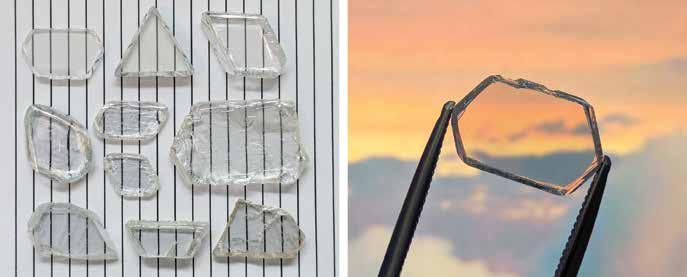
Geologists sometimes refer to diamonds as metaphorical windows into the mantle, but occasionally diamonds do emerge resembling windowpanes of glass. The transparent plate-like forms shown in figure 2 were created entirely by natural processes. Diamond can form excellent plates by cleavage, breaking along flat planes of weakness in the crystal structure. A single cleave may liberate the face of an octahedral crystal, for example, to make a flat plate shape. The 2.22 ct hexagonal-shaped specimen shown in tweezers in figure 2 was produced in this way. Examination using deep-UV luminescence shows that one side is the original exterior surface of the crystal, while the opposing face represents a cleave cross-cutting multiple growth layers. Despite its incredible transparency, small negative trigons (not shown) decorate all sides of this diamond, testifying to its natural unpolished state. In addition to cleavage, twinning can produce flat transparent plates. Macle twinned diamonds tend to grow as flat triangular plates (again, see figure 2, left). Natural transparent diamond plates can therefore form by either growth or breakage.
These shapes are evocative of portrait-cut diamonds, one of the earliest faceting styles, which some jewelers have recently repopularized. Portrait cuts possess two relatively large parallel facets and a thin profile and were originally intended for use as stylish protective covers for painted portraits. In a similar sense, diamond windows serve as transparent, yet robust physical barriers in devices such as high-power laser systems and synchrotron beamlines. Diamond windows can have high transmission across the ultraviolet, visible, far-infrared, and microwave regions of the electromagnetic spectrum, which, combined with their thermal and chemical resistance and high strength, make them ideally suited for some modern high-tech applications.
Oceaniclithosphere
Raw Baguettes
High-quality CLIPPIR and type IIb diamonds
Low-quality, non-gem sublithospheric diamonds
Lithospheric diamonds
Carbonated slab melting
Hydrous uid
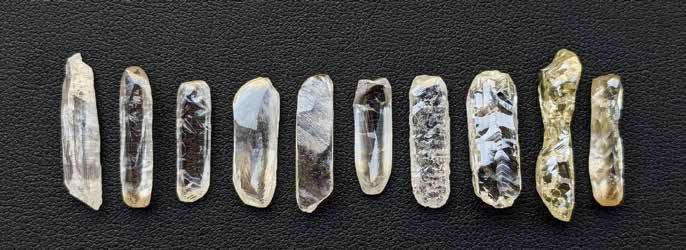
The elongated diamond forms shown in figure 3 are reminiscent of baguettes, both the cut style and the loaves of bread, though their shapes arise through crystal growth or natural breakage in the mantle. Whereas macle twinning provides a viable pathway to grow a natural plate-shaped diamond, there is no such straightforward mechanism to grow an elongate single crystal of diamond. That is not to say that it is impossible for a diamond to crystallize as an elongate rod, but the examples here appear to have been shaped by breakage. In nearly all cases, the direction of elongation is not random, but is aligned with the internal crystal structure due to breakage that occurred along cleavage planes. Some are further sculpted by resorption, creating smooth, glossy finishes.
Figure 3. Mantle cross section showing a relatively cool subducting slab, with an inset histogram of earthquake frequency (from figure 1). Profiles on the right show the slab surface and interior temperature during subduction. Where the slab surface temperature intersects the solidus of carbonated mid-ocean ridge basalt (MORB), partial melting may occur (red arrows). At the far right, a cold slab interior remains within the dense hydrous magnesium silicates (DHMS) stability field until the slab stalls and warms up, causing the breakdown of these hydrous phases and the release of hydrous fluid (blue arrows). Large white and smaller brown diamond symbols signify the growth of high-quality gem diamonds (CLIPPIR and type IIb) and low-quality, generally non-gem sublithospheric diamonds, respectively. Poorly understood mechanisms transport some diamonds upward where they can be swept up in kimberlite eruptions and mixed with common lithospheric diamonds (small black diamond symbols). Modified from Smith and Nestola (2021) with carbonated MORB solidus from Thomson et al. (2016b) and DHMS stability field from Harte (2010).
Among the specimens in figure 3, breakage has produced elongate diamonds in at least three distinct ways. The first
Figure 2 . Left: Transparent plate-shaped rough diamonds ranging from 0.99 to 9.67 ct. Ruled lines have 2.8 mm spacing. Right: The top left specimen (2.22 ct) against the sky. Photos by Evan M. Smith.
is depicted in figure 4, with the faces of the octahedron parallel to the four different orientations of cleavage planes within a diamond crystal structure. Cleaving a plate from an octahedron (like those in figure 2) and then cleaving one of the edges off that plate along a cleavage plane of a different orientation can generate a fragment that is elongated in a <110> crystallographic direction.
The cold slabs can be thought of as having a carbonated crust component and a hydrated/serpentinized mantle peridotite component that lies shielded beneath the crust, toward the interior of the slab. The deep release of carbonatitic melt and hydrous fl uid from each component, respectively, is shown in the two depth profiles in figure 3. The carbonated crust (mid-ocean ridge basalt, or MORB) of the slab surface will intersect a deep depression in its solidus, the curve describing the beginning of melting, meaning it exceeds the melting temperature. Beyond this point, carbonate melting (red arrows) is expected to occur within the top/crustal portion of the slab.
(DHMS) rather than breaking down. DHMS phases are a good vehicle for transporting water, with some carrying as much as 10% or more water by weight. The geotherm for the interior of cold slabs remains in the DHMS stability fi eld far beyond a depth of 300 km (far right in figure 3). The slab in figure 3 is shown defl ecting as it reaches the top of the lower mantle (at 660 km), where there is a change in mantle density and deformability. As the slab stalls and warms up, DHMS phases break down to form minerals that carry much less water, thereby causing water release (blue arrows in figure 3). These are the mechanisms proposed to trigger not only deep-focus earthquakes but also super-deep diamond growth (Shirey et al., 2021).
The second and third ways that natural breakage has produced elongate rough diamonds are less intuitive and involve macle twins, as illustrated in figure 5. In the second mechanism, an edge is broken off a macle (figure 5A). The breakage surface is not planar because of the change in crystal structure orientation across the twin plane. If this break occurs purely by cleavage, the broken surface will be re-entrant, or angled inward, leaving sharp edges that are likely to be rounded off by resorption. Some broken fragments have more irregular or curved breaks (such as the two broken macles in figure 1).
For hydrated/serpentinized mantle peridotite inside the slab, its stability also depends on temperature. If it remains cool, the serpentine can metamorphose into higher-pressure water-
Depth (km)
Continental lithosphere
Deep-focus earthquake activity
In the third mechanism (figure 5B), the breakage produces a fragment that is elongate in a direction perpendicular to a macle edge. In this case, the breakage surfaces are
High-quality CLIPPIR and type IIb diamonds
Low-quality, non-gem sublithospheric diamonds
Lithospheric diamonds
Figure 4. Three-part illustration showing how an octahedron (left) may cleave to yield an elongate parallel-sided fragment. The initial cleave (middle) produces a flat plate-shaped fragment. Cleaving an edge off the plate (right) creates an elongate fragment (as seen in figure 1H).
parallel to {110} planes. Although they are not perfectly planar breaks, it is possible that the diamond is effectively cleaving because diamond does possess a rarely seen cleavage in this orientation (Brookes et al., 1990; Smith et al., 2017). Unlike diamond’s typical {111} cleavage planes, there are three possible {110} planes that transect the twin plane and will align perfectly between both portions of a macle twin. Alternatively, these broken surfaces could develop by the combined action of multiple {111} cleavage planes, creating finely stair-stepped breakage surfaces that average out to a {110} plane. Some of these broken surfaces develop a characteristic chevron pattern.
Inclusions in the smaller, lower-quality varieties of sublithospheric diamonds often show evidence of growth from carbonatitic melts derived from slabs (Walter et al., 2008), but hydrous/aqueous fl uids have also been implicated for some samples (Wirth et al., 2007; Pearson et al., 2014; Palot et al., 2016). Serpentinite in subducting slabs can be relatively enriched in boron, meaning that the eventual breakdown of hydrous minerals from serpentinized peridotite can release boron-bearing hydrous fl uid, which has been linked with the formation of type IIb (boron-bearing) diamonds (Smith et al., 2018). Figure 4 shows a calcium silicate (breyite) inclusion with methane and hydrogen in a type IIb diamond. The original mineral inclusion may have been relatively hydrogen-rich
Diamonds Resembling Animals and Objects
Diamond-bearing kimberlite eruption
The complex sculpted forms of natural diamonds are fertile ground for lively imaginations. Depending on the lighting
Oceaniclithosphere
Carbonated slab melting Hydrous uid
Figure 3. Mantle cross section showing a relatively cool subducting slab, with an inset histogram of earthquake frequency (from figure 1). Profiles on the right show the slab surface and interior temperature during subduction. Where the slab surface temperature intersects the solidus of carbonated mid-ocean ridge basalt (MORB), partial melting may occur (red arrows). At the far right, a cold slab interior remains within the dense hydrous magnesium silicates (DHMS) stability field until the slab stalls and warms up, causing the breakdown of these hydrous phases and the release of hydrous fluid (blue arrows). Large white and smaller brown diamond symbols signify the growth of high-quality gem diamonds (CLIPPIR and type IIb) and low-quality, generally non-gem sublithospheric diamonds, respectively. Poorly understood mechanisms transport some diamonds upward where they can be swept up in kimberlite eruptions and mixed with common lithospheric diamonds (small black diamond symbols). Modified from Smith and Nestola (2021) with carbonated MORB solidus from Thomson et al. (2016b) and DHMS stability field from Harte (2010).
Figure 5. Illustration showing two ways (A and B) that a macle can fracture to yield an elongate parallel-sided fragment. Each fragment will still have a twin plane running through it (dashed line). In B, the breakage surfaces develop a chevron pattern that “points” toward the original point of the macle.
Figure 3. Elongate rough diamonds reminiscent of baguette cuts, ranging from 1.84 to 7.10 ct in weight and 16 to 24 mm in length. Photo by Evan M. Smith.
and the expected mineralogy and phase changes within slab rocks. Overlaying the slab geotherms onto phase diagrams helps to illustrate where water-bearing phases break down and release fl uid, such as the relatively well-accepted loss of most water from warm slabs at relatively shallow depths (<200 km). This is the activity that generates melt and fuels arc volcanoes such as those of the Pacifi c Ring of Fire. Cold slabs, however, can partially bypass this shallow dewatering process and transport a budget of carbonate and water to depths beyond 300 km, where its later release can cause deep-focus earthquakes (figure 3).
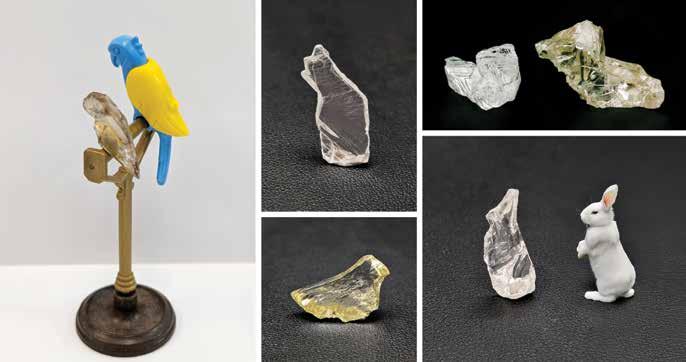
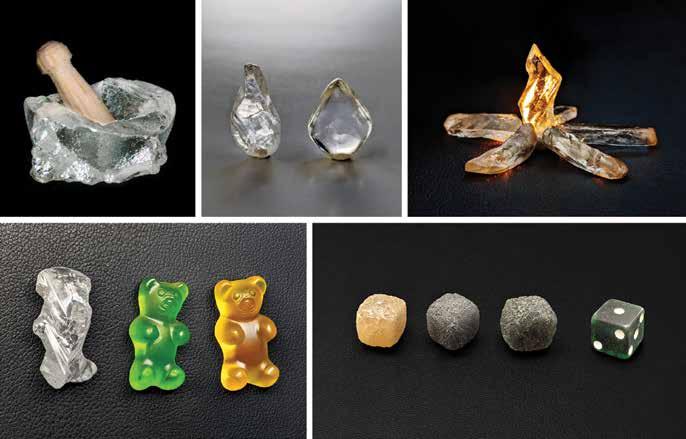
and viewing angle, some may resemble animals or familiar objects. Perceiving familiar shapes in inanimate forms such as clouds or rough diamonds is called pareidolia. In some cases, these forms have arisen predominantly by growth (additive sculpting), while in other specimens, breakage or resorption (subtractive sculpting) has been more important. For example, in figure 6C, the small colorless “dog” on the left, resembling a West Highland white terrier, is an irregular octahedral crystal with stepped surfaces, which grew in this shape. The yellow “dog” on the right, however, resembling a dachshund, likely looked much different before being sculpted into this shape by breakage and resorption. The two “raindrops” in figure 7B are another example of contrasting formation, with the right dominated by growth and the left dominated by breakage. Coincidentally, the resulting “raindrops” are of equal weight.
The cold slabs can be thought of as having a carbonated crust component and a hydrated/serpentinized mantle peridotite component that lies shielded beneath the crust, toward the interior of the slab. The deep release of carbonatitic melt and hydrous fl uid from each component, respectively, is shown in the two depth profiles in figure 3. The carbonated crust (mid-ocean ridge basalt, or MORB) of the slab surface will intersect a deep depression in its solidus, the curve describing the beginning of melting, meaning it exceeds the melting temperature. Beyond this point, carbonate melting (red arrows) is expected to occur within the top/crustal portion of the slab.
One of the most unusual morphologies in the collection is the “mortar” (pictured with non-diamond pestle) shown in fi gure 7A. This bowl-like specimen consists of a colorless, gemmy cuboid that is broken in half, revealing an octahedral-shaped internal cavity. The cuboid faces are convex and rounded between the protruding corners. The hollow central portion looks as though an octahedron has been plucked out, leaving a depression in the shape of the apex of a square-based pyramid. One possible explanation suggests that an inclusion formed
For hydrated/serpentinized mantle peridotite inside the slab, its stability also depends on temperature. If it remains cool, the serpentine can metamorphose into higher-pressure water-
a discontinuous layer, partially separating the inner core from the outer diamond rim (Harris and Stachel, 2024). The inclusion could have weakened the diamond, leading to breakage, after which the core and inclusion would have been released or etched away.
Superdeep Diamonds
bearing minerals called dense hydrous magnesium silicates (DHMS) rather than breaking down. DHMS phases are a good vehicle for transporting water, with some carrying as much as 10% or more water by weight. The geotherm for the interior of cold slabs remains in the DHMS stability fi eld far beyond a depth of 300 km (far right in figure 3). The slab in figure 3 is shown defl ecting as it reaches the top of the lower mantle (at 660 km), where there is a change in mantle density and deformability. As the slab stalls and warms up, DHMS phases break down to form minerals that carry much less water, thereby causing water release (blue arrows in figure 3). These are the mechanisms proposed to trigger not only deep-focus earthquakes but also super-deep diamond growth (Shirey et al., 2021).
Inclusions in the smaller, lower-quality varieties of sublithospheric diamonds often show evidence of growth from carbonatitic melts derived from slabs (Walter et al., 2008), but hydrous/aqueous fl uids have also been implicated for some samples (Wirth et al., 2007; Pearson et al., 2014; Palot et al., 2016). Serpentinite in subducting slabs can be relatively enriched in boron, meaning that the eventual breakdown of hydrous minerals from serpentinized peridotite can release boron-bearing hydrous fl uid, which has been linked with the formation of type IIb (boron-bearing) diamonds (Smith et al., 2018). Figure 4 shows a calcium silicate (breyite) inclusion with methane and hydrogen in a type IIb diamond. The original mineral inclusion may have been relatively hydrogen-rich
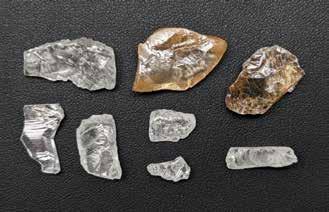
All mined diamonds originate at great depths and are transported to Earth’s surface by kimberlites or related mantle-sourced volcanic eruptions. Most diamonds crystallize in the base of old, thick parts of continental plates, at approximately 150–200 km deep. Some rare diamonds (estimated 1–2% of mined diamonds) originate from even greater depths, ranging from 300 to 800 km (Stachel et al., 2005; Shirey et al., 2024). Known as sublithospheric or superdeep diamonds, these curious crystals can carry mineral inclusions that provide invaluable insights into Earth’s interior. Superdeep diamonds possess highly irregular shapes (figure 8) resulting from stressful growth conditions and multiple episodes of breakage and resorption during the torturous journey to Earth’s surface.
The depth of crystallization is mostly based on inclusion mineralogy. Rocks and minerals undergo changes with increasing depth inside Earth as pressure and temperature increase. Some high-pressure minerals, such as ringwoodite, can only form at great depths, and when
Figure 6. Rough diamonds resembling animals: parrot, 5.99 ct (A); sitting cat, 5.68 ct (B); small dogs, 2.15 and 3.66 ct, respectively (C); yellow bird, 5.69 ct (D); rabbit, 2.79 ct (E; white rabbit for comparison created using Adobe Photoshop Generative AI). Photos by Evan M. Smith.
of high-quality gem diamonds (CLIPPIR and type IIb) and low-quality, generally non-gem sublithospheric diamonds, respectively. Poorly understood mechanisms transport some diamonds upward where they can be swept up in kimberlite eruptions and mixed with common lithospheric diamonds (small black diamond symbols). Modified from Smith and Nestola (2021) with carbonated MORB solidus from Thomson et al. (2016b) and DHMS stability field from Harte (2010).
within the top/crustal portion of the slab.
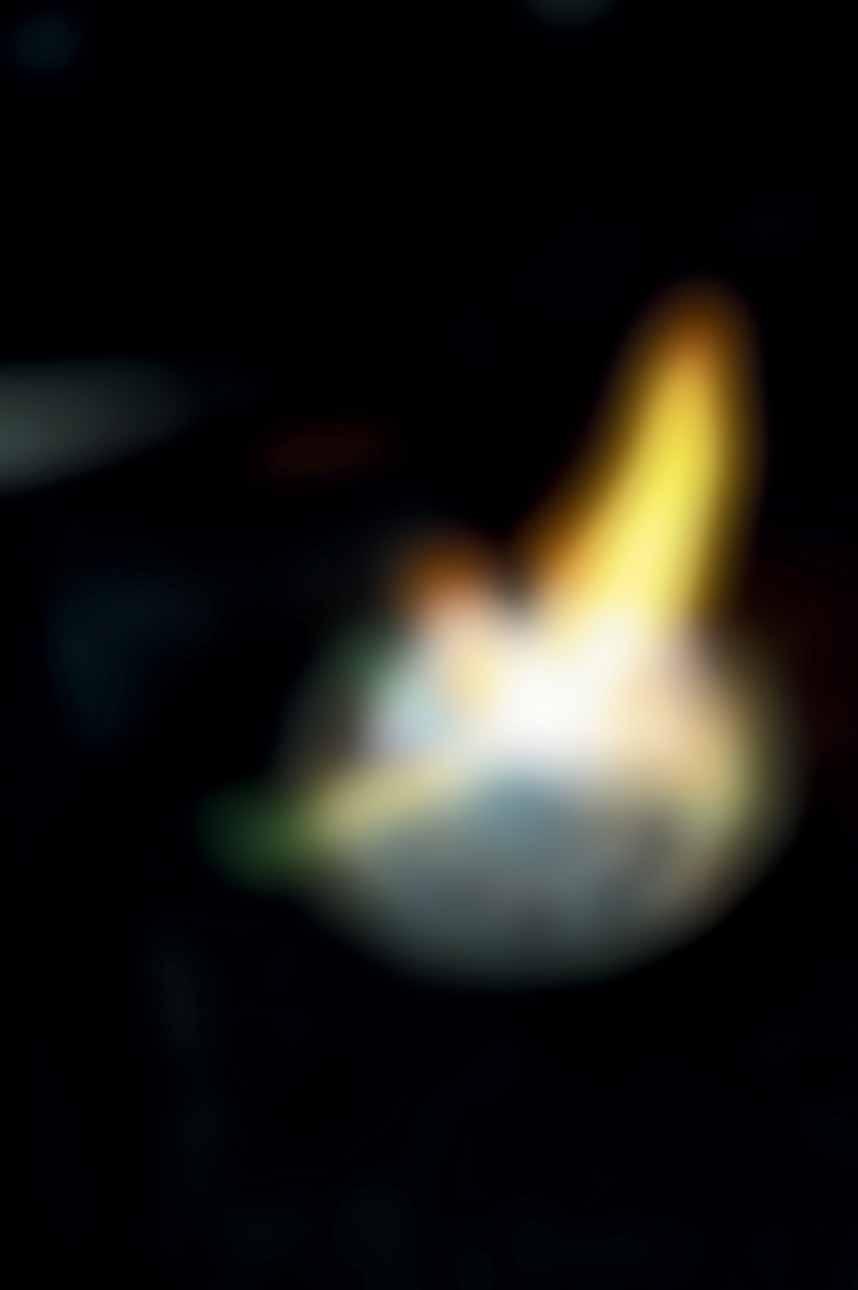
7. Rough diamonds resembling objects: mortar, 1.95 ct, with a pestle carved from a toothpick (A); raindrops, 3.23 ct each (B); campfire flame, 2.70 ct, backlit using orange light and placed with raw baguettes from figure 3 as firewood (C); gummy bear, 9.18 ct (D; colored gummy bears for comparison created using Adobe Photoshop Generative AI); fibrous diamond cuboids resembling dice, 22.45, 22.47, and 23.64 ct, respectively, shown with a superimposed 10 mm die (E).
For hydrated/serpentinized mantle peridotite inside the slab, its stability also depends on temperature. If it remains cool, the serpentine can metamorphose into higher-pressure water-
by Evan M. Smith.
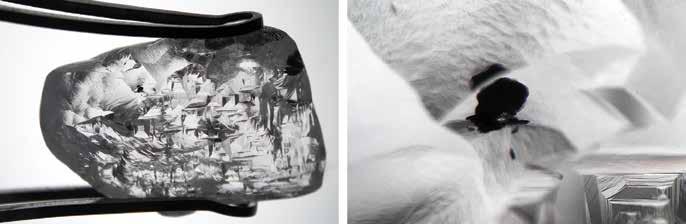
found as inclusions in a diamond, they indicate that the diamond must have crystallized at a depth where that particular mineral was stable. Combinations of multiple minerals also constrain the depth of diamond formation. The diamond at the center of figure 8 contains an inclusion identified as the mineral breyite (CaSiO3; figure 9), which is a calcium silicate that signifies an original depth of diamond growth deeper than 360 km (Anzolini et al., 2016).
boron-bearing hydrous fl uid, which has been linked with the formation of type IIb (boron-bearing) diamonds (Smith et al., 2018). Figure 4 shows a calcium silicate (breyite) inclusion with methane and hydrogen in a type IIb diamond. The original mineral inclusion may have been relatively hydrogen-rich
Diamond-bearing kimberlite eruption
Continental lithosphere
Deep-focus earthquake activity
out the characteristic morphology, being irregular in shape and highly resorbed, which are common traits across all superdeep diamonds.
Oceaniclithosphere
High-quality CLIPPIR and type IIb diamonds
Low-quality, non-gem sublithospheric diamonds
Lithospheric diamonds
Other diamonds in figure 8 have been deemed superdeep on the basis of iron-rich metallic inclusions consistent with those found in a variety of superdeep diamonds referred to as CLIPPIR (Cullinan-like, Large, Inclusion-Poor, Pure, Irregular, and Resorbed) (Smith et al., 2016; Smith et al., 2017). All specimens in figure 8 are tentatively classified as CLIPPIR diamonds. Here purity refers to the low nitrogen concentration of these diamonds, being either type IIa, with no nitrogen detectable by Fourier-transform infrared spectroscopy, or type IaB, with very low (<20 ppm) concentrations of nitrogen in the form of B-centers. The specimens in figure 8 are all type IIa except for the top right and top left diamonds. The CLIPPIR acronym also calls
In addition to CLIPPIR diamonds, the superdeep geological category encompasses type IIb (boron-bearing, often blue) diamonds as well as those typically less gemmy diamonds
8.
diamonds, ranging from 1.27 to 12.97 ct, with typical irregular sculpted shapes resulting from extensive breakage and resorption.
Figure 3. Mantle cross section showing a relatively cool subducting slab, with an inset histogram of earthquake frequency (from figure 1). Profiles on the right show the slab surface and interior temperature during subduction. Where the slab surface temperature intersects the solidus of carbonated mid-ocean ridge basalt (MORB), partial melting may occur (red arrows). At the far right, a cold slab interior remains within the dense hydrous magnesium silicates (DHMS) stability field until the slab stalls and warms up, causing the breakdown of these hydrous phases and the release of hydrous fluid (blue arrows). Large white and smaller brown diamond symbols signify the growth of high-quality gem diamonds (CLIPPIR and type IIb) and low-quality, generally non-gem sublithospheric diamonds, respectively. Poorly understood mechanisms transport some diamonds upward where they can be swept up in kimberlite eruptions and mixed with common lithospheric diamonds (small black diamond symbols). Modified from Smith and Nestola (2021) with carbonated MORB solidus from Thomson et al. (2016b) and DHMS stability field from Harte (2010).
21 mm
Figure
Photos
Figure
Superdeep
The top left specimen is
in length. Photo by Evan M. Smith.
(figure 3).
release (blue arrows in figure 3). These are the mechanisms proposed to trigger not only deep-focus earthquakes but also super-deep diamond growth (Shirey et al., 2021).
Figure 9. This 2.13 ct superdeep diamond (left; and shown at the center of figure 8) has an irregular shape and strongly resorbed surface marked by many square etch pits or tetragons, which arise from resorption of {100} cube-orientation surfaces. The inclusion (right; red arrow) is a colorless crystal of breyite surrounded by a black graphitic fracture. Photos by Evan M. Smith; fields of view 14.52 mm (left) and 1.58 mm (right).
transform infrared spectroscopy, or type IaB, with very low (<20 ppm) concentrations of nitrogen in the form of B-centers. The specimens in figure 8 are all type IIa except for the top right and top left diamonds. The CLIPPIR acronym also calls out the characteristic morphology, being irregular in shape and highly resorbed, which are common traits across all superdeep diamonds.
associated with the Juína region of Brazil and the Kankan region of Guinea (Smith et al., 2018; Shirey et al., 2024). All three varieties of superdeep diamonds can be found across multiple deposits worldwide, indicating that the processes that create these diamonds are not singular, but repeat through time and space (Smith et al., 2025).
The cold slabs can be thought of as having a carbonated crust component and a hydrated/serpentinized mantle peridotite component that lies shielded beneath the crust, toward the interior of the slab. The deep release of carbonatitic melt and hydrous fl uid from each component, respectively, is shown in the two depth profiles in figure 3. The carbonated crust (mid-ocean ridge basalt, or MORB) of the slab surface will intersect a deep depression in its solidus, the curve describing the beginning of melting, meaning it exceeds the melting temperature. Beyond this point, carbonate melting (red arrows) is expected to occur within the top/crustal portion of the slab.
Concluding Remarks
the processes that create these diamonds are not singular but repeat through time and space (Smith et al., 2025).
Concluding Remarks
The beauty of natural rough diamonds is easily overlooked,
In addition to CLIPPIR diamonds, the superdeep geological category encompasses type IIb (boron-bearing, often blue) diamonds as well as those typically less gemmy diamonds associated with the Juína region of Brazil and the Kankan region of Guinea (Smith et al., 2018; Shirey et al., 2024). All three varieties of superdeep diamonds can be found across multiple deposits worldwide, indicating that
For hydrated/serpentinized mantle peridotite inside the slab, its stability also depends on temperature. If it remains cool, the serpentine can metamorphose into higher-pressure water-
ACKNOWLEDGEMENTS
ACKNOWLEDGMENTS
Inclusions in the smaller, lower-quality varieties of sublithospheric diamonds often show evidence of growth from carbonatitic melts derived from slabs (Walter et al., 2008), but hydrous/aqueous fl uids have also been implicated for some samples (Wirth et al., 2007; Pearson et al., 2014; Palot et al., 2016). Serpentinite in subducting slabs can be relatively enriched in boron, meaning that the eventual breakdown of hydrous minerals from serpentinized peridotite can release boron-bearing hydrous fl uid, which has been linked with the formation of type IIb (boron-bearing) diamonds (Smith et al., 2018). Figure 4 shows a calcium silicate (breyite) inclusion with methane and hydrogen in a type IIb diamond. The original mineral inclusion may have been relatively hydrogen-rich
Diamond-bearing kimberlite eruption
with most people only encountering diamonds after faceting. But given the opportunity to take a closer look, it is hard not to admire the myriad of morphologies among rough diamonds. Natural processes of crystal growth, breakage, and resorption can sculpt almost anything, from the ideal octahedron to irregular shapes resembling animals and familiar objects. The shape of each rough diamond is a testament to unseen geological activity inside our dynamic planet.
The beauty of natural rough diamonds is easily overlooked, with most people only encountering diamonds after faceting. But given the opportunity to take a closer look, it is hard not to admire the myriad of morphologies among rough diamonds. Natural processes of crystal growth, breakage, and resorption can sculpt almost anything, from the ideal octahedron to irregular shapes resembling animals and familiar objects. The shape of each rough diamond is a testament to unseen geological activity inside our dynamic planet.
GIA gratefully acknowledges the generosity of Pintu Dholakia of Hari Krishna Exports for lending these specimens for scientific examination and for display at GIA-AGS Converge. They are part of a broader collection of notable rough diamonds assembled by Dholakia.
GIA gratefully acknowledges the generosity of Pintu Dholakia of Hari Krishna Exports for lending these specimens for scientific examination and for display at GIA-AGS Converge. They are part of a broader collection of notable rough diamonds assembled by Dholakia
Continental lithosphere
REFERENCES
Deep-focus earthquake activity
Oceaniclithosphere
Anzolini C., Angel R.J., Merlini M., Derzsi M., Tokár K., Milani S., Krebs M.Y., Brenker F.E., Nestola F., Harris J.W. (2016) Depth of formation of CaSiO3-walstromite included in super-deep diamonds. Lithos, Vol. 265, pp. 138–147, http://dx.doi.org/ 10.1016/j.lithos.2016.09.025
Brookes C.A., Brookes E.J., Howes V.R., Roberts S.G., Waddington C.P. (1990) A comparison of the plastic deformation and creep of type I, type II and synthetic diamonds at 1100°C under conditions of point loading. Journal of Hard Materials, Vol. 1, No. 1, pp. 3–24.
High-quality CLIPPIR and type IIb diamonds
Low-quality, non-gem sublithospheric diamonds
Harris J., Stachel T. (2024) A Russian doll diamond in the making. International Kimberlite Conference: Extended Abstracts, Vol. 12, http://dx.doi.org/10.29173/ikc4050
Lithospheric diamonds
Harris J.W., Smit K.V., Fedortchouk Y., Moore M. (2022) Morphology of monocrystalline diamond and its inclusions. Reviews in Mineralogy and Geochemistry, Vol. 88, No. 1, pp. 119–166, http://dx.doi.org/10.2138/rmg.2022.88.02
Robinson D.N. (1979) Surface textures and other features of diamonds. Ph.D. thesis, University of Cape Town, 382 pp.
Shirey S.B., Pearson D.G., Stachel T., Walter M.J. (2024) Sublithospheric diamonds: Plate tectonics from Earth’s deepest mantle
Carbonated slab melting Hydrous uid
samples. Annual Review of Earth and Planetary Sciences, Vol. 52, pp. 249–293, http://dx.doi.org/10.1146/annurev-earth032320-105438
Smith E.M., Chinn I., Timmerman S. (2025) Large irregular Type IIa and Type IIb diamonds: Valuable sublithospheric gems that elude conventional indicators. Mineralogy and Petrology, Vol. 119, pp. 305–325, http://dx.doi.org/10.1007/s00710-025-00901-9
Smith E.M., Shirey S.B., Nestola F., Bullock E.S., Wang J., Richardson S.H., Wang W. (2016) Large gem diamonds from metallic liquid in Earth’s deep mantle. Science, Vol. 354, No. 6318, pp. 1403–1405, http://dx.doi.org/10.1126/science.aal1303
Smith E.M., Shirey S.B., Richardson S.H., Nestola F., Bullock E.S., Wang J., Wang W. (2018) Blue boron-bearing diamonds from Earth’s lower mantle. Nature, Vol. 560, No. 7716, pp. 84–87, http://dx.doi.org/10.1038/s41586-018-0334-5
Figure 3. Mantle cross section showing a relatively cool subducting slab, with an inset histogram of earthquake frequency (from figure 1). Profiles on the right show the slab surface and interior temperature during subduction. Where the slab surface temperature intersects the solidus of carbonated mid-ocean ridge basalt (MORB), partial melting may occur (red arrows). At the far right, a cold slab interior remains within the dense hydrous magnesium silicates (DHMS) stability field until the slab stalls and warms up, causing the breakdown of these hydrous phases and the release of hydrous fluid (blue arrows). Large white and smaller brown diamond symbols signify the growth of high-quality gem diamonds (CLIPPIR and type IIb) and low-quality, generally non-gem sublithospheric diamonds, respectively. Poorly understood mechanisms transport some diamonds upward where they can be swept up in kimberlite eruptions and mixed with common lithospheric diamonds (small black diamond symbols). Modified from Smith and Nestola (2021) with carbonated MORB solidus from Thomson et al. (2016b) and DHMS stability field from Harte (2010).
Smith E.M., Shirey S.B., Wang W. (2017) The very deep origin of the world’s biggest diamonds. G&G, Vol. 53, No. 4, pp. 388–403, http://dx.doi.org/10.5741/gems.53.4.388
Stachel T., Brey G.P., Harris J.W. (2005) Inclusions in sublithospheric diamonds: Glimpses of deep Earth. Elements, Vol. 1, No. 2, pp. 73–78, http://dx.doi.org/10.2113/gselements.1.2.73
Did you know?
Platinum was considered a nuisance by Spanish conquistadors in South America, who called it platina ( "little silver") and threw it back into rivers because they could not melt it down easily.
All the gold ever mined in human history would fit into roughly 3,5 Olympic swimming pools – about 197 000 tons in total.
The Mir Mine in Russia is so large (525 m deep, 1,2km wide) that the airspace above it is closed to helicopters – the downdraft from the pit is strong enough to suck small aircraft in.
The global jewellery industry employs an estimated 300 million people when one includes mining, cutting, manufacturing and retail –making it one of the largest employers on the planet.
At age 12, Winston spotted a green stone in a pawnshop's costume jewellery tray. While the owner thought it was glass, Winston recognised it as a 2ct emerald. He bought it for 25c and resold it two days later for $800.
It takes an oyster between two to seven years to produce a single pearl – and many die in the process.
The round brilliant cut was not perfected until 1919, when mathematician Marcel Tolkowsky calculated the exact proportions needed to maximise light reflection and fire.
A stainless steel Rolex Daytona bought at retail in the early 2000s for around $5 000 now resells for $30 000–$50 000. The secondary watch market is now worth an estimated $22 billion annually.
India cuts and polishes approximately 90% of the world's diamonds by volume. The city of Surat alone processes an estimated nine out of every 10 diamonds that will ever be set into jewellery worldwide.
JEWELLEX AFRICA 2026
THAT WAS ABOVE PAR. THANK YOU. THAT WAS ABOVE PAR. THANK YOU.
The Jewellery Council of South Africa would like to extend our sincere gratitude to everyone who contributed to the success of our inaugural Golf Day.
To all the players who joined us on the course, thank you for your participation and support.
A special thank you to our valued sponsors. Your generous support made this event possible and we are truly grateful for your partnership and commitment to our industry.
Thank you to our sponsors
Industry employment board
This monthly section is dedicated to supporting professionals within the jewellery industry who are seeking employment opportunities and aims to help connect skilled jewellery professionals with businesses looking for talent
Qualified jeweller seeking employment –Gauteng
A qualified jeweller seeks employment within the jewellery industry in Gauteng. Having completed an internship at The Platinum Incubator in December 2025, she is eager to apply her training and skills in a professional working environment.
For her CV or further details, contact: timbanendzalama@gmail.com.
Jewellery industry professional available –Gauteng
An experienced jewellery industry professional is seeking employment in Gauteng. With strong skills in office administration, accounts, procurement, stock control and gemstone and diamond expertise, she would be an asset to any jewellery business.
For her CV or further details, contact: marykevanjaarsveld@gmail.com.
Trade work services available –Pretoria East, Gauteng
A skilled jeweller in Pretoria East offers all types of trade work, including repairs, casting cleanup, manufacturing and plating in silver and gold. With nearly 10 years’ experience, she provides precise workmanship and professional service to jewellers across Gauteng.
A skilled jewellery designer with a Diploma in Jewellery Design and Manufacture (Cape Peninsula University of Technology) and internship experience at The Platinum Incubator is seeking a design and manufacturing role.
For enquiries, contact: nkosithabisile07@gmail.com or 072-353-5356.
Qualified jeweller seeking employment –Gauteng
A certified jeweller based in Highlands North, Johannesburg, seeks a benchwork position. Holding a Diploma in Jewellery Design and Manufacture (UJ) and two years of practical experience, he is skilled in repairs, redesigns, stone-setting and various jewellery-making techniques.
Contact 063-077-8873 (calls) or 081-851-7937 (WhatsApp) for his CV or enquiries.
LOOKING FOR EMPLOYMENT IN THE JEWELLERY INDUSTRY?
SA Jewellery News is offering space for individuals seeking work to share a brief description of the type of role they are looking for – at no cost.
To be featured, simply send:
• A short description of your experience and skills (max 50 words) • Your region
• Your contact details
E-mail this information to: adriv@jewellery.org.za.
Shemer Jewellers has inaugurated a new Rolex boutique in Johannesburg’s prestigious Sandton City Diamond Walk, reinforcing the brand’s long-term commitment to the South African market and elevating the local luxury watch retail experience
Shemer Jewellers opened a new Rolex Boutique in Diamond Walk at Sandton City, Johannesburg’s premier luxury retail destination, at the end of January this year. Located among leading international brands and in close proximity to Nelson Mandela Square, the boutique offers a refined and discreet environment aligned with global Rolex retail standards.
New Rolex boutique in Sandton City
The opening marks a significant milestone in strengthening Rolex’s presence in South Africa and reflects a continued focus on enhancing the in-store customer experience. Each new or remodelled Rolex boutique worldwide is designed to embody service excellence, brand integrity and long-term client relationships.
Occupying approximately 200 m², the boutique has been carefully designed to deliver an immersive Rolex experience. Contemporary architecture is combined with warm, natural materials and distinctive brand elements inspired by the world of watchmaking. Private consultation areas and expansive display galleries allow for both comfort and discretion, while maintaining a sense of understated sophistication.
“Having represented Rolex in Bedfordview for over three decades, we’re proud to expand the brand’s presence in SA while upholding the highest standards of quality and service,” says Alan Carrington, owner of Shemer Jewellers. “The boutique showcases the timeless perfection of Rolex watches.”
Designed in close collaboration with Rolex architects, the Sandton City boutique reflects the brand’s core values of excellence and precision. The interior architecture draws subtle inspiration from Rolex watch design, creating visual continuity between the timepieces and the space in which they are presented.
The fluted bezel, a signature feature of many models in the Rolex Classic collection, is echoed in the fluted travertine wall treatments that define the entrance area. This architectural rhythm mirrors the tactile qualities of the watches themselves. Similarly, the iconic Cyclops lens is reinterpreted through custom-designed Cyclops lamps suspended above the sales counter and lounge area, providing softly diffused light that enhances product presentation.
A Verde Alpi marble wall serves as a focal point within the reception area, its illuminated veining evoking the marine world which is closely associated with Rolex. Adjacent to this, the boutique lounge has been designed as a warm and intimate space, introducing a new stucco wall treatment that adds depth and texture while
remaining true to Rolex’s design language. Customers can engage in unhurried consultations in an environment tailored for comfort and personalised service.
Part of a worldwide network of Rolex boutiques and authorised
partners, the new Sandton City location is entirely dedicated to the brand. It offers clients the opportunity to explore authentic new Rolex timepieces in an elegant, tranquil setting, supported by expert guidance. From pioneering the first waterproof wristwatch in 1926 to developing the Perpetual selfwinding mechanism, Rolex has shaped modern watchmaking through continuous innovation. The brand remains deeply involved in manufacturing excellence, the arts, sport, exploration and environmental initiatives.
“The opening marks a significant milestone in strengthening Rolex’s presence in SA and reflects a continued focus on enhancing the in-store customer experience.”
CPM brings KZN industry together
On 19 February, Cape Precious Metals (CPM) hosted its KwaZulu-Natal industry network event at Talloula in Botha's Hill, bringing together suppliers, experts and members of the jewellery trade under one roof.
The day offered attendees the opportunity to explore gemstones, tools and wholesale jewellery, experience product showcases and engage directly with industry bodies and experts. It was a valuable platform for connection, insight and collaboration within the KZN jewellery community.
BORN IN AFRICA
ADELE'S MANUFACTURING JEWELLERS
Tel no: 082 595 3868
E-mail: adele@amj.co.za
AFRICAN TRADE BEADS
JEWELLERY COLLECTION
Tel no: 011 726 7643
E-mail: tamiko@zazenconsulting.com
AFROGEM
Tel no: 076 726 8491
E-mail: k ylegilson@mweb.co.za; jess@afrogem.co.za; info@afrogem.co.za; accounts@jppe.co.za; leighann@afrogem.co.za
AKAPO JEWELS
Tel no: 011 038 3130
E-mail: wumba@akapo.co.za; labi@akapo.co.za
ALLOY JEWELLERY GALLERY (PTY) LTD
Tel no: 073 924 5254
E-mail: edna@alloygallery.co.za
ALTIN JUWELIERS BK
T/A ALTIN JEWELLERS
Tel no: 082 454 4430
E-mail: info@altin.co.za
AMBER & FORGE (PTY) LTD
T/A SCHERMANS
Tel no: 072 928 0385
E-mail: info@schermans.co.za
AMBIGO JEWELLERS
Tel no: 062 282 6924
E -mail: ntobekobasil@gmail.com
ANDREAS SALVER
MANUFACTURING JEWELLERS
Tel no: 011 706 6828
E-mail: andreas@andreassalver.com
ANKE LINDEN JEWELLERY (PTY) LTD
Tel no: 0 69 925 3699
E-mail: lindenjewellery@gmail.com
ANNA ROSHOLT JEWELLERY DESIGN
Tel no: 0 61 080 6481
E-mail: anna@annarosholt.com
ANNELLE MURRAY GOUDSMID
Tel no: 082 956 7747
E-mail: murrayannelle@gmail.com
A comprehensive directory featuring information and contact details of refining members and members of the Jewellery Manufacturers' Association of South Africa – proudly showcasing manufacturers committed to crafting quality jewellery locally.
All JCSA member details were correct at time of going to press. While every effort has been made to ensure the accuracy of contents, the Jewellery Council of South Africa cannot be held responsible for any omissions or errors; or any misfortune, injury, consequences or damages which may arise therefrom.
If there are any updates to your details, or to add your 10-word specialisation, kindly e-mail: adriv@jewellery.org.za.
JEWELLERY
Contact us so we can show you what type of specialist cover the
We carry an extensive selection of commercial and investment-grade diamonds, along with premium-quality Tanzanite, all available at highly competitive prices.