Take
Issue No: 45
April 2017
to Heart
Working together with individuals, families and medical professionals to offer support and information on syncope and reflex anoxic seizures
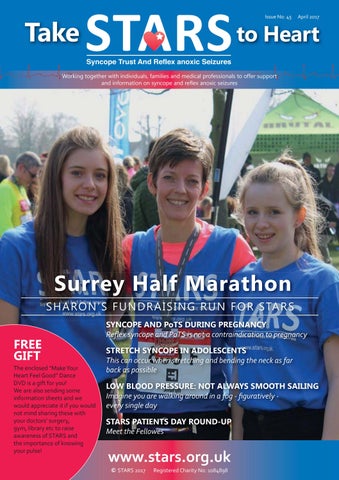
Surrey Half Marathon S H ARO N ’ S F U N DRA IS ING RU N F OR S TA RS
FREE GIFT The enclosed “Make Your Heart Feel Good” Dance DVD is a gift for you! We are also sending some information sheets and we would appreciate it if you would not mind sharing these with your doctors’ surgery, gym, library etc to raise awareness of STARS and the importance of knowing your pulse!
SYNCOPE AND PoTS DURING PREGNANCY Reflex syncope and PoTS is not a contraindication to pregnancy STRETCH SYNCOPE IN ADOLESCENTS This can occur when stretching and bending the neck as far back as possible LOW BLOOD PRESSURE: NOT ALWAYS SMOOTH SAILING Imagine you are walking around in a fog - figuratively every single day STARS PATIENTS DAY ROUND-UP Meet the Fellowes
SWALLOW SYNCOPE XXX
www.stars.org.uk © STARS 2017
Registered Charity No: 1084898
2
Syncope and PoTS during pregnancy felt appropriate by the obstetrician. It is accepted that an epidural can cause a drop-in blood pressure which could then precipitate a faint in a patient prone to one of these conditions. It is therefore essential the anaesthetist is briefed before they are asked to administer the epidural. Regular monitoring of blood pressure is performed during this procedure, together with ensuring that the mother has adequate hydration.
If a woman wishes to have a child, then reflex syncope, and postural tachycardia syndrome (PoTS) should not be considered a contraindication to pregnancy. Pregnancy would not normally need to be managed differently. Mums usually deliver normally although some may need intravenous fluids during labour to help. Neither reflex syncope nor PoTS is a contradiction to receiving pain relief in labour, whatever form is
It is important to be particularly aware of ‘supine hypotensive syndrome’. This is where blood pressure falls when you lie on your back and occurs in about 10% of pregnancies. It is caused by, compression of the major veins in the abdomen, by the uterus and foetus. This reduces the blood flow to the mother’s heart which causes a drop-in blood pressure. It normally occurs in mid to late pregnancy and is avoided by simply lying with a slight left sided tilt (the right side of the pelvis is higher than the left). For further information for yourself or your medical team please email info@stars.org.uk to receive our factsheets: Information for dentists and anaesthetists and Syncope and PoTS during pregnancy.
SAVE THE DATE GET INVOLVED HEART RHYTHM WEEK 5 – 11 JUNE 2017 “TAKE THE PULSE CHECK CHALLENGE”
Become Arrhythmia Aware This year’s Heart Rhythm Week focus is ‘Identifying the Undiagnosed Person.’ Our aim is to make m people pulse aware, take 10,000 pulse checks and identify , people with an irregular heart rhythm. We want all of our members to get involved and during April we will be sending links to awareness-raising ideas, materials and activities that you can use in your community to help us reach our goals!
Go onlin ne:: www.sttarrs.orrg.u uk • in nfo@sttarss.orrg.u uk
3
The importance of hydration We are sorry to bang on about the importance of fluids but if you want to try to prevent syncope or presyncope, then you must increase the amount of water you drink. The daily recommended amount of water for an adult is six to eight glasses to prevent dehydration. This is a minimum of two litres of water a day. However, if you are struggling with low blood pressure, try to drink three to four pints of water in the first few hours of the day and then enough to keep your urine clear. The simplest way to check your hydration levels is to check the colour of urine. A pale straw colour indicates the body’s hydration level is fine. If it is any darker, more fluids are needed. Dehydration, a recognized trigger for syncope, is a drop-in body weight by 2 – 3% which typically happens in warm environments. Symptoms include tiredness, headache, feeling dizzy or lightheaded and increased thirst.
Stretch syncope in adolescents
Our brain is 73% water; therefore, it is very important to stay hydrated for brain function. If you have difficulty drinking a glass of cold water, try warm water. It is much easier!
STARS has moved to Oxfordshire! We have moved offices to Chipping Norton but nothing has changed. We are still here providing information, support and reassurance through our dedicated helpline. Our address is: Unit 6B, Essex House, Cromwell Business Park, Chipping Norton, OX7 5SR. Our telephone number is unchanged at 01789 867 503.
Recently we have heard a number of cases of stretch syncope. This occurs through stretching and bending the neck as far back as possible. The sufferer will first experience light-headedness and visual disturbances and then passes out. Those who suffer with stretch syncope often have a family history of syncope. These attacks can be prevented by remembering not to extend the neck backwards when having a good stretch! Awareness of this kind of syncope is important to avoid unnecessary investigations.
Helpliine: 01789 867503
44
Fundraising From all of us at STARS, we’d like to send a huge thank you to all of our fundraisers! Sorry to those not shown, we just have too many fantastic fundraisers to list!
A blackout, or transient loss of consciousness (T-LOC) occurs because there is: • A disorder of the blood supply to the brain (syncope) • A disorder of the brain itself (epilepsy) • a disorder of the psyche (psychogenic blackouts)
Bob’s bike trek
The Snaith School 5k run
It was fantastic to see The Snaith School team raise money for STARS following support given to two pupils and their families. 13-year-old Katherine, who regularly struggles with seizures, organised the 5k run at her school raising a fantastic £1,139.91. Thank you to all at The Snaith School for your support and thank you Katherine for all your hard work.
Dr Adam Fitzpatrick
Bob Woodcock rode his motorcycle the length of Britain, from his home in Barnsley, down to Lands End, up to John O’Groats, then home to raise funds and awareness for STARS. He called into our office on his way through to say a quick hello! We at the office loved his bike, and are so grateful to Bob for all he does for our charity. He raised over £200!
Meg’s amazing race 15-year-old Meg ran the British 10K in London in July raising over £100 for STARS. Well done Meg and thanks for all your help! Meg says “It was hard work, and I didn’t really train enough, but I walked when I got a stitch. It was a good fun way to see the sights of my favourite city and raise money for a brilliant charity at the same time!”
Helen’s “my marathon” PoTS patient Helen Burton took part in her own “my marathon” through October. She walked 26.2 miles over the course of 2 weeks raising over £700 for STARS. Throughout her walk, she kept an online blog to keep her supporters up to date on her progress. You can read her blog by visiting http://helensmymarathon.blogspot.com. Helen has been an inspiration to us all, and we are so grateful to her for pushing through the pain and discomfort to do something so amazing.
Still supporting STARS after all these years
Following ten years of misdiagnosis, Richard Bowie was eventually diagnosed with vasovagal syncope (Issue March 2013) and discovered the STARS website. At the time, he raised over £7,000 for us and continues to keep in touch, whether for advice or because his company, Nexon Petroleum, have made a charitable donation. Today, we are saying another big thank you to Richard and Nexon for their recent generous gift of £2,000. Remember, we are always here for you, whether a new Friend of STARS or one from many years ago.
Go onlin ne:: www.sttarrs.orrg.u uk • in nfo@sttarss.orrg.u uk
5 Fiona Summers walked 54km in one day in the South Coast Challenge raising almost £350 for STARS. Thank you so much Fiona!
Thank you to Jackie Mellor who raised £25 by placing a collection tin at the garage on her road. We are very grateful for all donations!
Sharon Harrison raised a fantastic £795 in total after STARS gave her support and information following her daughter’s PoTS diagnosis. “When Rhian was first diagnosed, we were dealing with something that no-one we knew had ever heard of, including a lot of doctors that we saw. STARS really helped us with medical information, practical advice, and support.”
Lottie’s ottie’s dad dad, Ma M Matt, ttt to ttook ok part in The Three Peaks Challenge Challllenge with some friends and colleagues. As STARS is a charity close to Matt’s heart, he wanted to help boost our funds. Matt says: “Our neurologist pointed us in the direction of STARS, an amazing charity providing knowledge and support to families like ourselves and researching management options for the condition. The support on the end of phone and resources available online is invaluable to sufferers and relations alike.” The team raised over £3,500 for STARS. Well done to the Rambling Bustards. Keep your eyes peeled in our next newsletter for Lottie’s story.
Claire O’Sullivan suffers with vasovagal syncope, but still managed to run the Great North Run with her partner Dan in tow. She completed the half marathon before needing medical attention and raised almost £350 for STARS! Claire says - “STARS are a charity who work hard to support people like me who come to them with very little knowledge of what is happening to our bodies. It helps reassure us and provides us with lifestyle support and networking opportunities.” Emily Hartnell held a variety evening which was a great success. She raised a total of £743 for STARS. Emily decided to raise money for STARS after the support we provided her and her family. Emily was a normal healthy 13-year-old when she began to faint unexpectedly, often multiple times a day. After three years, she was diagnosed and was able to be treated. Emily, was shocked by the lack of knowledge, in the general medical profession, around syncope so when she heard about STARS she was keen to get involved in a hope to help others going through a similar situation. The show was a showcase of local talent, from a well-known local band and dance school, to a ukulele band from the village primary school. Everyone thoroughly enjoyed the evening. If you would like to do something to raise money for STARS, please get in touch! It can be anything, from jumping from a plane, to holding a bake sale! We will offer as much support and guidance as you need!
Helpliine: 01789 867503
6
EDS and Syncope - Nicola’s Story
w
hen I was diagnosed with vasovagal syncope at age 41, following a tilt table test at The National Hospital of Neurology in Queen’s Square London. I was referred to ‘The National’ following a diagnosis of Ehlers Danlos Syndrome Type 3 or Joint Hypermobility Syndrome (JHS) a year earlier. Blood pooling in the legs is very common in JHS. I first started feeling faint and dizzy in my early teens, when I would be standing in queues and pass out. I also struggled with chronic fatigue and found it hard to concentrate at school. I would often fall asleep in class, especially in the afternoons. I soon became very good at reading the warning signs when blood would literally drain from my head as I was standing chatting to a friend! I remember bumping into someone in our high street and before long my head was going very dizzy; I felt clammy and cold all at the same time and was shown to a step to sit down. I placed my head between my legs and slowly recovered enough to walk home. I always try to sit down wherever possible and, when I am at home, I lie down as I find it impossible to keep my head up for long periods without feeling dizzy.
“I felt clammy and cold all at the same time and was shown to a step to sit down.” The last time I went abroad, some ten years ago, I struggled in the heat and found myself unable to stand upright. One night, I was in a restaurant and had not consumed alcohol but in my desperation to find cold fresh air, I found myself stumbling across the room and knocking into tables and chairs as I went. Everyone thought I was drunk! I was involved in a motorbike accident but, fortunately, I only broke my nose and was quickly discharged. However, a few days later I went into shock and had to be put onto intravenous fluids. I have since found
out that people like me who do not normally have low blood pressure can suddenly develop hypotension when unwell. For example, loss of fluid can lead to shock. My blood pressure is border line but on the tilt table test it dropped to 98/50.
“My blood pressure is border line but on the tilt table test it dropped to 98/50.” Recently, I have experienced two vasovagal episodes where I have lost complete consciousness, which can be very scary. The thing I found most humiliating was losing complete control of my bowels, which can be common in blackouts apparently. It is not easy for me to admit this but it might help others who are in the same situation to realise they are not alone. I seem to spend most of my life in a daze and full of fatigue but I am determined to still find pleasure in the things I love doing.
Nicola Passmore, Surrey
Order your alert cards today!
STARS alert cards are the size of a credit card and provide key information on what to do in the event of an RAS or syncope attack. The cards reassure family and friends and are perfect to carry with you when travelling. They are particularly popular at schools for handing out to friends and teachers. Please call: +44 (0)1789 867 503 or email: info@stars.org.uk for more information.
Go onlin ne:: www.sttarrs.orrg.u uk • in nfo@sttarss.orrg.u uk
7
Me and PoTS - Pip’s Story
I
t was September 2010. I was fit and healthy, swimming every day, working full time (and overtime) as a nurse on a very busy unit, and partying hard in my spare time. I became ill and was admitted to hospital with Pyelonephritis (kidney infection). After five days of IV antibiotics and treatment for acute kidney failure I was discharged. After I was discharged I was very weak, collapsing whenever I walked anywhere and I had excruciating headaches. I had a couple of months off work, visiting my GP every week asking what was wrong with me and why am I not getting better? Unfortunately, all he said was “I’m sorry I don’t know”, “It is just a matter of time” and he named it as “prolonged post infection recovery”. Eventually, after a few months, this sympathetic tone turned into “Maybe you need to think more positively” and “Are you sure you’re not over thinking it? If you stop focusing on it, it will go away”. Basically “It is all your fault, get over it”. I changed my GP, and again, and again, all the tests they were doing were normal, blood tests, CT scan, MRI, ECG, Blood pressure. Eventually each doctor got bored with trying to work it out and sent me for counselling or mindfulness classes and the like (I would like to add that these were still useful as I was dealing with a lot of stress of not being well, not to mention intense intractable pain and doctors telling me I’m making it up. But the doctors had the cause and effect the wrong way round).
“Eventually each doctor got bored with trying to work it out and sent me for counselling or mindfulness classes or the like.”
the horrible toxic drugs used to treat these, I started to demand more answers for why I felt so ill all the time. Surely it was not migraine that was causing everything; dizziness, breathlessness, chest pain, and extreme fatigue. I had stopped collapsing all the time, but only because I had learned not to stand for too long and when not to stand at all.
“Eventually I had a 24 hour tape, then a tilt test, and I was given a diagnosis of PoTS.” Eventually I had a 24-hour tape, then a tilt test, and three years after I was admitted to hospital with Pyelonephritis I was given a diagnosis of PoTS. Such a relief. I had a chronic condition, it is incurable, and will likely never go away. But it had a name, and I wasn’t crazy (like so many doctors had made me start to actually believe). I started taking Ivabradine, which helped a bit, but I still felt disabled; unable to enjoy or do the things I used to, even basic things like taking a shower standing up, and cleaning the house in one day. The cardiologist discharged me, as there was nothing else to do. But I knew nothing about the condition I was to live with from now on. Looking at information on the internet was my only source of learning. Despite being a cardiology nurse, I had never heard of PoTS. I knew nothing about it, and yet I was living with it and had been for three years. I got myself referred to a specialist based in Bristol, who started off by telling me I was not mad and all the symptoms were real. He then gave me support and advice on how to live with PoTS. Drink loads of water and eat loads of salt, and try to exercise and build core strength. Although I still struggle with all the same symptoms and the lack of understanding from others, over time and with the support of my family and friends I have learned to manage. I work part time, never working two days in a row. I have learned to enjoy more sedentary hobbies like sewing, and crafts. I have worked out which foods exacerbate my symptoms and adapted accordingly. And I have even managed to start running, and hope that taking one step at a time PoTS will not rule my life.
After seeing numerous neurologists for my (now diagnosed) chronic intractable migraine and taking all
HH elp lin nin ee : :00 11 78 88 9988 66 77 55 00 33 eplp li 7
Pip, Bristol
8
Low blood pressure: not always smooth sailing patients may wind up having significant difficulties in school because of the symptoms related to low blood pressure. As hypotension, may be a result of a variety of disorders such as an underactive pituitary or adrenal glands, kidney problems, thyroid issues, anaemia, and many others, a thorough medical evaluation is clearly indicated. Many people are successfully diagnosed by Cardiologists/Electrophysiologists with experience in evaluating this condition and those with questionable symptoms may be offered a 24-hour blood pressure monitor or a tilt table test.
You may find yourself in London, or San Francisco, or perhaps Freiburg, and there’s a good chance you’ll encounter some fog. Now imagine that you’re walking around in a fog — figuratively — every single day. You have an annoying sense of lightheadedness just getting out of bed in the morning. Standing in line at the supermarket makes your head swim, and you can barely figure out how to get home. Exercise is out of the question, because it makes you feel like you’re going to pass out. Even sitting at work is a struggle because half the time you can’t think straight. You go to your GP for some answers, and all he can say is: “You’re fine, you do not even have high blood pressure! It’s nice and low, about 95/60, the lowest one I’ve seen all day!” “Then why don’t I feel right?” “Well, maybe it’s anxiety. I can give you a pill for that.” Sadly no one wants to admit that perhaps these debilitating symptoms could be due to your blood pressure being too low. Evaluating Low Blood Pressure Patients who are suspected of having symptomatic hypotension (low blood pressure) may be referred to a Cardiologist/Electrophysiologist (heart rhythm expert) who specialises in blood pressure abnormalities, dizziness, and fainting conditions. Unfortunately, general practitioners may not appreciate this diagnosis and have been known to prescribe medication for other conditions that can make matters worse. Clinicians often blame lightheadedness and fainting in teenagers on growth spurts, and these young
A blood pressure guide What is blood pressure and how do we measure it? That answer is pretty obvious – it’s the pressure of the blood in the arteries, which are the vessels that carry the blood away from the heart. Blood pressure is usually measured with an inflatable cuff around the arm and expressed as two numbers. The higher number is known as the systolic pressure and the lower number is the diastolic pressure. The systolic pressure is the highest pressure within the arteries when the heart is contracting, while the diastolic pressure is the lowest pressure in the arteries when the heart is relaxed and getting ready to squeeze again. How high is ‘normal’ blood pressure? Most children and adolescents feel perfectly fine walking around with a blood pressure in the range of 90/50. Most doctors start to pay attention only if the numbers are over 140/90 because they are primarily concerned with excessively high blood pressure or ‘hypertension’, a common medical condition that can lead to serious complications such as heart attack or stroke. Although most clinicians are comfortable with diagnosing hypertension, the definition of an abnormally low blood pressure is less well defined so it is sometimes difficult to point to this and lay the blame on it. Some of us can feel perfectly fine with systolic blood pressure in the 90s whilst others feel unwell. Treatment strategies vary widely depending on the severity of symptoms and the cause of the low blood pressure. Dr Nicholas G Tulllo Cardiac Electrophysiologist, West Orange, New Jersey Member of STARS Medical Advisory Committee The above is an excerpt from an article written by Dr Tullo. The full article can be read at www.stars.org.uk.
Go onlin ne:: www.sttarrs.orrg.u uk • in nfo@sttarss.orrg.u uk
9
STARS Patients Day 2017
Sunday 1 October at The ICC, Birmingham A full programme of top international speakers is planned for Patients Day 2017. As the biggest information and support event for STARS members and their carers in the country, it is anticipated that once again this will be a sell-out. Sessions with leading medical experts will include amongst others: o
RAS (reflex anoxic seizures) is frightening to witness but not life threatening
o
No faint is a simple faint: when to seek medical attention and intervention
o
Positive approach to falls in the elderly
o
Palpitations and the fainting teenager
o
Orthostatic intolerance and orthostatic hypotension
o
Equal importance must be given to psychogenic loss of consciousness and vasovagal syncope
For more information email Becky@heartrhythmalliance.org or call +44(0)1789 867 523
The cost to attend for a full day meeting with refreshments and lunch is:
Registration for non-members or on the day
£50.00 (if places available)
Friend of STARS
£25.00
Carer if registering with a Friend
£35.00
Early bird registration (until 31 July 2017)
Friend £20.00/Carer £30.00
Registration Form 1st attendee details Full name: I am: Patient Carer Other If other please state: .................................................... Special requirements (please give details) Dietary Access
2nd attendee details (if applicable) Full name: I am: Patient Carer Other If other please state: ..................................................... Special requirements (please give details) Dietary Access
Address: Postcode: Telephone:
Email:
Payment details - Please select your payment method below: Credit/debit card: Please call +44 (0) 1789 867 523 to pay over the phone Cheque: Please make cheques payable to ‘STARS’ Please send your cheques to: STARS, Unit 6B, Essex House, Cromwell Business Park, Chipping Norton, Oxfordshire, OX7 5SR
Helpliine: 01789 867503
10
Heart Rhythm Charity Award winners 2016 Amongst the winners of these prestigious awards was Gaynor Richards who won the Charles Lobban Volunteer of the Year Award. Gaynor, an arrhythmia nurse specialist in Dorset, supports ICD patients and also oversees her own ICD support group. This vital group is not just educational for patients but also tackles the social exclusion that is often felt by a patient with this device. The Charles Lobban award is very special for AF Assocation’s sister charity, STARS as Charles, Trudie’s late husband, was an integral part of ‘Team Lobban’ in establishing STARS in 1993. Congratulations must also go to the Cardiac Rhythm Management Team at Oxford University Hospital who won Team of the Year Award. This team is unique because the Advanced Nurse Practitioners are the only nurses in the UK who undertake advanced cardiac physiologist roles, including solo insertion of implantable loop recorders. This has allowed this common procedure to be removed from the EP and Device Labs, creating extra capacity and reducing waiting times, which is what we all want! The award to the Outstanding individual for contributions to arrhythmia service went to Professor Ben Freedman from the University of Sydney for his work in screening for atrial fibrillation.
New and updated booklets We introduced new and updated booklets at STARS Patients Day 2016. STARS produces a range of booklets and information sheets for patients. All materials published have been approved by the STARS Medical Advisory Committee and are endorsed by the Department of Health. Our newest booklet is called Cognitive Behavioural Therapy for chronic health conditions. We have also reviewed and updated our PoTS, RAS and Reflex Syncope booklets. To order your copies please email: info@stars.org.uk. Alternatively, all STARS resources are available to download from the website: www.stars.org.uk.
Charles Lobban Volunteer of the Year Award 2017 ...... Team of the Year Award 2017 ...... Outstanding contribution to arrhythmia services 2017 Do you know a healthcare professional, a team of unsung heroes, a friend or family member who has gone that extra mile to support you through the complexities of a heart rhythm disorder, providing reassurance and in some cases encouraging you to accept and adjust to your condition? If the answer is “YES” then in no more than 500 words, tell us why you are nominating this special person (s) for one of these awards. Email becky@heartrhythmalliance.org
Go onlin ne:: www.sttarrs.orrg.u uk • in nfo@sttarss.orrg.u uk
11
Meet the Fellowes Martin, Louise & Lucy Fellowes attend STARS Patients Day as a family every year. We sat down with them and asked them what encourages them to keep coming back. Please tell us a little bit about yourselves. Louise: I’m 44 and I live in Worcestershire. I have Ehlos Danlos syndrome and PoTS. I’ve been a member of STARS since I was diagnosed and I’m here with my family today. Lucy: I’m 19 and I also have EDS and PoTS which she passed on to me. I’ve been coming to STARS Patients Day for years and years. I’ve been coming for as long as I can remember. Martin: I’m husband and father to the two Potsies. I work in IT and work from home a lot which helps me look after Louise on her bad days, and I’m also the driver and carer of the family. What makes you keep coming back to Patients Day year after year? Louise: We find Patients Day invaluable. It keeps us up to date with all the new developments. They always have a fantastic range of speakers from all around the world; so much expertise we couldn’t hope to access ourselves. It’s fabulous. the other thing we find is that it’s very good to talk to other patients as well that are here. To mutually help each other (who they’ve seen, what treatments they’ve had etc.). We’ve always found it an invaluable resource to keep up to date and get further informed about the condition. Martin: The networking part is a really big deal because we have been doing this for a few years now and we can really shortcut people’s path to diagnosis and treatment by preventing them having to go through the years of getting nowhere that we’ve been through, up to getting them to the right people involved. Do you also find it helpful to meet other people with the condition where your own community may not understand the condition? Lucy: Yes, I find that actually when you look at me I just look like a healthy 19-year-old, whereas most people obviously don’t understand what’s going on inside and
how difficult normal things actually are. Whereas everyone here understands and it’s really nice to be around those kinds of people. Do you have any message for people who have been here today or are showing an interest in attending Patients Day? Martin: Just go home, assimilate what you have listened to and have a plan of launching into the next phase of where you want to go with treatment and find the right names. Use STARS as a place to find the right names for consultants and move forward from there. Do not give up because you have got to keep going on. Lucy: Additional to all of the doctors and professors, hearing the speakers that are also PoTS sufferers is important as it shows that PoTS isn’t completely who you are, it’s only a part of your life. The things that Adam has done are amazing. You can still go on and do things that everyone else can do. It is only a part of who you are. Louise: The opportunity at the end of the day to have the consultants and different speakers come around and talk individually to each table was amazing. You could personally ask any questions that you wanted to, that you did not perhaps want to ask in front of everybody and to have a really good discussion with them was fabulous. Martin: It beats the queue that you often get at these things where you see three people and walk away disappointed. It is nice that everybody gets a chance to speak to them. Louise: It was really useful to have a chat with everybody and to talk about all the different aspects from psychology to how they manage to have their careers and how they have managed to improve their health.
Helpliine: 01789 867503
12
Share your story Without your stories, we have no voice... Can you help? Share your story and help others who may be awaiting or undergoing treatment for syncope or PoTS. Your words can support and reassure patients on the road through treatment as well as those newly diagnosed or caring for someone with such a condition. Many of the people we speak to on our helpline are unsure about what to expect and the treatment options available to them; your words present a real-life account that can be shared to promote awareness and improve understanding. Please email your account to: info@stars.org.uk or call: +44 (0) 1789 867 503. To read patient and carer stories please visit the STARS website: www.stars.org.uk
Patient Support Groups The aims of patient support groups are to empower patients, improve knowledge, support and promote management of their own health. Patients are encouraged to share their experiences of living with a long-term condition. The meetings are supported by healthcare professionals, who will encourage a wide range of speakers to attend the meetings. Some of the support groups also have social events throughout the year as well as having medical presentations. Full details of our patient support groups can be found on our website: www.stars.org.uk
Please donate to STARS STARS relies on donations to enable us to maintain our helpline, resources and support services to patients and carers. Please support us, so that we can continue to support you. Please consider adding Gift Aid to your donations. Gift Aid adds a massive 25% to your donation at no cost to you. Every penny really does make a difference. Gift Aid can be arranged verbally, or alternatively, please contact us for a Gift Aid form. You can donate by calling: +44 (0)1789 867 503 or via our website: www.stars.org.uk.
Donate
Go onlin ne:: www.sttarrs.orrg.u uk • in nfo@sttarss.orrg.u uk