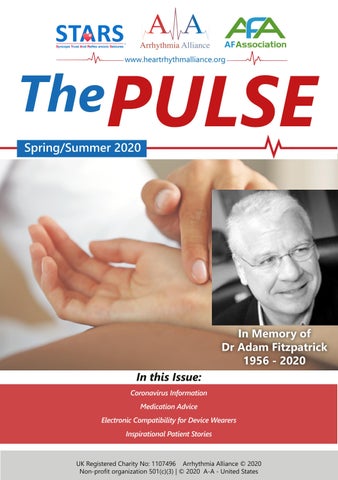
ThePULSE Spring/Summer 2020
In this Issue:
In Memory of Dr Adam Fitzpatrick 1956 - 2020
Coronavirus Information Medication Advice Electronic Compatibility for Device Wearers Inspirational Patient Stories
UK Registered Charity No: 1107496 Arrhythmia Alliance © 2020 Non-profit organization 501(c)(3) | © 2020 A-A - United States
PULSE The
A Letter From The Heart In these unprecedented times I want to reassure you that the
support and advice we have always provided has not changed and my patient services team are available to address your concerns
whether through the helpline or by email . Don’t forget to visit our coronavirus dedicated webpages and aducational videos.
UK Coronavirus Information - US Corinavirus Information As we emerge from the pandemic, I know you, like myself, will
appreciate the selfless dedication of our healthcare professionals.
There will be new found respect for those who provided essential services and we will appreciate our friends and families from whom we were separated so much more .
Together we are strong and together we will get through these difficult and for some , very sad , times. Please stay safe
Trudie A note from our Founder and CEO Trudie C A Lobban, MBE, FRCP (Edin)
Want to be featured in our next issue? Contact Us
UK
Call: +44 (0) 1789 867501 Email: info@heartrhythmalliance.org Visit: www.heartrhythmalliance.org
USA
Call: (+1) 843-415-1886 Email: info-us@heartrhythmalliance.org Visit: www.heartrhythmalliance.org/aa/us
To find out more click here in the UK and here in the US See page 44 for more information
Visit Our Online Shops We are offering Alivecor KardiaMobile devices at a subsidised cost of £80.00 + £5 P&P. We also have a limited supply of Alivecor Kardia 6L priced at £149.00 + £5 P&P. *Please note Kardia one-lead and sixlead devices are the only items we are able to ship during the time we are working from home, and these can only be shipped within mainland UK. Click here for STARS UK Shop
Click here for Arrhythmia Alliance UK Shop Click here for AF Association UK Shop
To access a KardiaMobile device in the US, email info-us@heartrhythmalliance.org
3
In Memorium
Dr Adam Fitzpatrick
28 December 1956 - 19 January 2020 as I was. From there on he became my partner in bringing about change; he did not hesitate when I asked him to become Chair of the STARS Medical Advisory Board. By 2003 we realised that the problem was not just syncope but all arrhythmias (heart rhythm disorders). When I asked for his support to set about changing policy in the UK he committed 100%. Over the following months he helped and guided me through the complex and often disjointed arrhythmia world and by May 2004 he agreed to be a founding Trustee of Arrhythmia Alliance as we hosted our first ARRHYTHMIA ALLIANCE TRUSTEE STARS MEDICAL ADVISORY COMMITEE ArrhythmiA Awareness Week (AAAW), later to become World Heart Rhythm Week. We CHAIR AF ASSOCIATION MEDICAL ADVISORY succeeded in changing policy in less than nine months, often by working through COMMITTEE MEMBER the night drafting proposals, meetings in London, phone calls and thousands of “COLLABORATION IS KEY...” e-mails (as those close to Adam know all The arrhythmia community suffered a great too well – why write one e-mail when a loss with the unexpected death of Dr Adam hundred will do?). Fitzpatrick on Sunday 19 January 2020. Once we had our new chapter added to the I first met Adam in 2001 at the launch National Service Framework for Coronary of the ESC Syncope Guidelines in Nice, Heart Disease, we set about ensuring it France. We immediately realised we had was implemented. Adam led the way so much in common. We both knew there in launching the Arrhythmia Alliance was so much work to do to prevent the Cardiac Update Meetings, followed by A-A unnecessary suffering and misdiagnosis of Heart Rhythm Congress (held annually in syncope. Something so simple and yet so Birmingham, UK) – two previously unheard complex that all too many doctors ‘got it of concepts, identifying local best practice wrong’ when treating patients presenting and then bringing them to the national with loss of consciousness. That day I finally arena. A-A HRC is still the only event in met a doctor as passionate about syncope the world that brings patients, healthcare
4
In Memorium professionals, policy makers and industry together to improve education, arrhythmia services and better outcomes for all those involved in or affected by cardiac arrhythmia. Adam never wavered in his commitment to all three charities and was forever working to deliver world class arrhythmia care to all patients. He established the world’s first Rapid Access Blackout Clinic in Manchester based on the STARS Checklist we had developed. Never before had anyone thought of something so simple and so far-reaching. It changed the approach to identifying and diagnosing those presenting with unexplained loss of consciousness – others have gone on to adapt and copy and we now see more syncope services than ever before, due mainly to the foresight of Dr Adam Fitzpatrick – a very special, caring individual. I think we all agree that the medical profession has lost a great man and the thousands of patients he treated will be forever grateful for his empathy, kindness and support. He has saved so many lives over the years; it is just so tragic that his own life could not be saved. Arrhythmia Alliance and its sister charities have lost a passionate and committed member of our ‘team’; the healthcare community has lost an exceptional doctor, and the arrhythmia world will be a poorer place without Dr Fitzpatrick – however his legacy will live on with the groundbreaking research he published and his unique way of improving and delivering first-class arrhythmia services.
Arrhythmia Alliance, STARS and AF Association are pleased to announce that his memory will live on through:
Adam Fitzpatrick Lecture to be held annually at A-A Heart Rhythm Congress (www.heartrhythmcongress.org). STARS – Syncope Pioneers Report –
HealthCare
showcasing best practice in memory of Dr Adam Fitzpatrick; this annual report will be published to coincide with A-A World Heart Rhythm Week as Adam was one of the instigators of launching an awareness week in 2004. Adam believed in collaboration – he was passionate in bringing people together to achieve greater results – he sought perfection and was never satisfied, always seeking new, innovative ways of improving healthcare. Arrhythmia Alliance was founded on our ethos of collaboration – it is the only way to achieve the best for patients worldwide. Patients, healthcare communities and our industry colleagues working together to provide rapid diagnosis and access to appropriate treatments to restore the patient back to a person leading as active a life as possible. It only seems fitting therefore and right for the three communities, and those who knew Adam well, to share their memories of Adam. Prof Richard Sutton trained Adam when he was a registrar in London. Pierre Chauvineau worked with Adam for many years supporting many of his research projects. Adam, Pierre and I became close friends and colleagues – The Three Musketeers as we jokingly called ourselves.
5
In Memorium
PROFESSOR
RICHARD
SUTTON:
I first knew Adam when he joined the Cardiac research team at Westminster Hospital in 1988. His arrival was not a breath of fresh air but more like a storm. Everything changed; he saw projects making no progress, took them and finished them. His productivity was huge. He was always a good person to work with bringing humour and unique insights to every situation. He cared for patients in a way that they were his own parents, brothers, sisters or children. Together we published 16 papers and 28 abstracts, book chapters etc. in his four years at Westminster. He also wrote his MD thesis on Syncope which passed with flying colours; the only criticism made by the examiners was that it was too long, going into two volumes. He left a huge hole when he departed. He went to Bournemouth, Royal Brompton, then Southampton as Senior Registrar and these posts were followed by three years in San Francisco to work with Mel Scheinman, ultimately being promoted to Assistant Professor. In the US and the other UK hospitals, he did equally well learning much that was not
6
available at Westminster, especially ablation of arrhythmias in San Francisco, returning to the UK to be Consultant Cardiac Electrophysiologist in Manchester. Again, he did an outstandingly good job there forming a busy Cardiac Electrophysiology Department. From my viewpoint, his great achievements were his approach to ‘blackouts’ which had profound influence on the care of these patients not just in UK but also worldwide. This combined with his great enthusiasm and guidance for the STARS charity proved to be an excellent partnership. Another important step was discovering that there is a much greater overlap between arrhythmias and epilepsy than had previously been thought. This finding was quickly supported by evidence that he gathered. He was the first in the country to appoint an arrhythmia nurse specialist. His health in the last three decades, unfortunately, attenuated his productivity contributing to his early retirement and, ultimately, to his untimely death. In Adam, we have lost a wonderful person, a superb physician, an excellent clinical researcher and a great friend to many of us.
In Memorium
PIERRE CHAUVINEAU: INDUSTRY Dear Adam, I want to remember all that you brought to us as a friend and as a physician. We met as you moved back to Manchester after your experience in San Francisco. You quickly impressed me with your fast thinking and your holistic approach to cardiology. When you talked to us about your willingness to create a Rapid Access Blackout clinic in Manchester, you made such a good case that it was not difficult to find the investment required. You had already been partnering with the neurologists to ensure patients would be treated holistically. You had drawn the clinical decision tree as if it was already in your head for a long time. You had a view that a number of epilepsy diagnoses had a cardiac origin and you set out to prove it clinically. Then I happened to cross Trudie’s path in Oxford. The outcome of that discussion was that Francesca, Trudie’s daughter who had numerous blackout episodes had not yet seen a Cardiologist. This is how I had the opportunity to introduce Adam to Trudie. From that connection came a long-lasting friendship between the three of us and a strong collaboration between the patients,
the clinicians and the industry. Some of the outcomes of that friendship were the creation of the Arrhythmia Alliance, the development of a patient focused Arrhythmia National Service Framework, STARS Medical Advisory Board among many other things. You used to call us the three musketeers! Adam, you always had a very witty and dry sense of humour. What mattered most to you was to ensure that everything you did went to improve patient care. You treated every one of your patients as if they were part of your family. You were always frustrated by all the processes and the internal barriers that prevented you from giving better care to your patients. When your health allowed, you had a relentless energy to remove barriers and obtain the data that would help you find the best way to treat your patients. On the personal side, you were a gentle giant who had a passion for rugby. You used to play second or third row and we could see it from your ears! You were always there when we needed you with your expert opinion. You lacked confidence despite your exceptional intellect, work ethic and tiresome dedication. You were a committed family man. Today, we are very sad you are no longer with us. However, over time we have built so many good memories and friendships with you that we will remember and value them. We will miss you as a friend and as a physician.
7
In Memorium
TRUDIE LOBBAN: PATIENT / CARER Adam was a personal loyal friend, he was committed, he was a professional, he was passionate about all that he did, he cared. Qualities that made him such a special person. Throughout the years he provided me with both professional and personal support and has encouraged and guided me through many challenges and difficult situations. “Adam, you were so supportive when my husband died – you wrapped your arms around me and my daughters in a huge, secure, comforting hug – reassuring us we would get through this... “Every six months or so you, Pierre and I would meet – checking to see if I was OK and putting the world to right. “And, of course, the endless, infamous, Adam Fitzpatrick e-mails! “Adam, we first met in 2001 and I think we can say our lives changed for ever. We had each found our ‘syncope’ partner. We both had the same commitment and vision and, boy, what a force to
8
contend with when we set our minds on something. “You had the expertise, knowledge and vision of what should and must happen to deliver first class arrhythmia services. You were like a tsunami, once you had the vision the solution just fell into place and nothing would get in your way until you achieved the unimaginable. People were blown away with your energy and passion. “However, I saw the other side of you, the one that agonised as to whether you were doing the right thing – not the right thing for yourself but for others. Perhaps that was your weakness – you cared too much for others and didn’t put yourself first often enough. “There are too many achievements for me to list but I want you to know, above all else, that you literally saved lives, not just the patients but their families as well. Any patient who was fortunate enough to be referred to you came away feeling they had been ‘heard’; someone had finally listened and more importantly understood. “We always kept in touch. Only a few weeks ago one of your famous e-mails arrived telling me you had lost your wallet, but you
In Memorium were at the gym – you made me smile. Not quite sure why you shared that with me – but I am glad that you did. “Adam, you never believed in yourself. I hope wherever you are, you will finally realise how many people believed in YOU. The difference you made to
thousands, yes thousands, of lives: patients, colleagues, healthcare services, and to me. “Adam, I will miss you but will always be thankful that I had the pleasure of knowing you and the honour of calling you my friend. My very special friend.”
Adam Fitzpatrick 28 December 1956 – 19 January 2020 9
Medical Article
Coronavirus (Covid-19) And Arrhythmias FAQs Am I more at risk of contracting coronavirus if I have an arrhythmia? You should not be more at risk of contracting coronavirus if you have an arrhythmia. However, it may mean that people with these conditions may have more severe symptoms and reactions to the infection if caught. This is because the virus can cause a drop in blood oxygen levels and blood pressure, which in turn causes the heart to work harder by beating faster to supply oxygen to the body.
•
comorbidities such as diabetes, high blood pressure (hypertension) or heart failure Congenital heart disease
Who else is considered to be high risk? • Those who are immunocompromised (have a weak immune system) • Organ transplant recipients • Cancer patients - both receiving treatment and those in remission • People with lung conditions such as COPD, asthma or bronchitis Patients with Brugada Syndrome may • Chronic kidney disease patients be more at risk, as one of the symptoms • Diabetes patients of coronavirus is a fever, and these • Patients who have a condition affecting patients must do their best to avoid body the brain including Parkinson’s Disease temperature over 39°C. The fever must • The elderly be treated with paracetamol and using • Pregnant women with heart conditions methods to cool the body. • People with a BMI over 40 (obese) If a patient with Long QT Syndrome catches the virus and is admitted to hospital, they will have to be treated with care as some of the medications used can prolong the QT interval. This could in turn cause a serious electrical disturbance in those with Long QT Syndrome. Which heart conditions are considered to be high risk? • Heart failure • Heart transplant • Cardiomyopathy • Coronary heart disease • Atrial Fibrillation (AF) if you have other
10
Those who are most at risk should have been contacted by the NHS or the government. This list is regularly updated in line with new developments and research. For the most up to date information, please visit the NHS website by clicking here. Why am I at a higher risk if I have diabetes or high blood pressure and an arrhythmia? It has become apparent through data collection that a large number of people who developed a more severe form of coronavirus had comorbidities such as high blood pressure or diabetes. This may be
Medical Article
because both conditions are more likely in the over 70 age group, where the infection rate is also highest. It is imperative if you have these additional conditions that you make sure that you keep your blood pressure, glucose and cholesterol as tightly controlled as possible.
as much as possible, you should stay entirely at home for 12 weeks if you are in the higher risk categories.
If you or someone in your home has displayed symptoms of coronavirus such as a cough, fever or chest infection, you should self-isolate completely for 14 days. What should I do to lower my risks of Even if you only have mild symptoms, it is contracting coronavirus? important to stay at home to minimise the The government guidelines on what we risk of the virus spreading. should do to avoid contracting the virus are as follows: For further guidance on self-isolating, • Wash your hands thoroughly with soap please click here. and water for 20 seconds regularly throughout the day, particularly after going outside or touching a foreign Should I continue to take my medication object or surface as normal? • Keep a minimum of two metres It is very important that you continue to distance from anyone that does not take any medication for an arrhythmia live with you or heart condition exactly as prescribed, • Avoid all non-essential travel unless advised not to do so by your doctor • Take precautions with hand hygiene or specialist. It can be very dangerous when going to communal places such to stop taking your medication or any as petrol stations and supermarkets other changes that you make without • Avoid people who are unwell the guidance of a medical professional. • Avoid touching your face It can put you at a higher risk of having • Regularly clean and disinfect surfaces complications of your condition and such as door handles and light may cause a ‘flare up’ or worsening of switches symptoms. • Cough or sneeze into a tissue or into If you have any questions about your your elbow medication or dosages, please contact • STAY AT HOME as much as possible your doctor. • Work from home if possible Should I stock up on my medications? Should I self-isolate? There is no reason to stock up, as Although we should all be staying at home everything is being done to ensure that
11
Medical Article essential medications are available. In fact, it is damaging to unnecessarily stock up, and will create problems for other patients. Currently there are no shortages of medications. Everything is being done to ensure that the supplies of essential medications are maintained. There is no cause for concern. The European Medicines Agency are monitoring the situation and to date have reported no shortage of essential medications. What should I do if I think I have caught coronavirus? The most important thing to do is to take a moment to evaluate your symptoms, and not to rush straight to hospital or A&E. This not only puts you at risk, but puts people around you and in the public at a much higher risk. Remember, some of these people may be very vulnerable. Most symptoms of coronavirus and similar conditions (cold, flu etc) can be managed at home by taking paracetamol (NOT ibuprofen), drinking lots of fluids and resting. If symptoms worsen, or you start to develop warning signs, including, but not limited to chest pain, shortness of breath, an increasingly bad cough, palpitations or fainting, please do call 111 immediately. You may need to be examined or even admitted to a hospital or coronavirus facility. I have an appointment scheduled; shall I keep my appointment? Many hospitals and GP surgeries are rescheduling most appointments and some are changing to telephone calls. Appointments that are deemed to be most important will still go ahead. Do not
12
cancel your appointment, or not show up without being instructed to do so by your GP surgery or hospital clinic. Am I protected from coronavirus if I have a flu vaccine? The flu vaccine will not protect against contracting the virus as it is a completely different type of virus. It will only protect against the influenza virus. Can people catch the virus multiple times? Although this is not known at the moment, preliminary research suggests that an immunity builds after being infected, which would mean it was highly unlikely to catch it a second time. This however could change once medical professionals and scientists understand more about this virus. Is it safe to leave my house? We should all be staying at home as much as possible, but we are allowed to leave the house for a few reasons; to shop for basic necessities, for food and medicine, which must be as infrequent as possible, a form of exercise each day, any medical need to provide care or to help a vulnerable person and travelling for work purposes, but only where you cannot work from home. Once we have left our houses, it is important that we maintain a minimum of two metres distance from anybody else, and practice caution when it comes to touching any foreign objects or surfaces. It is also important to get some fresh air if possible.
Medical Article I feel stressed and anxious, what should I do? Many people are feeling scared, anxious and stressed at this uncertain time, and • we hope that we can help to support our friends and patients as much as possible. There are a few things that we would suggest to help you get through this time, particularly if you are self-isolating: •
•
•
• •
Talk, talk, talk. Although we are • working from home, we are still here for you. We are only a phone call, social media message or email away, and although our support lines have become increasingly busy, we will always return your call quickly. Technology has also made it easier for • us to be in contact with our friends and family, a quick phone call or video call can make someone’s day. If you know someone who needs company, reach out to them. If you need some support, reach out to others. Make sure you are still taking your medications exactly as they are prescribed for you. It can be extremely damaging to your health to stop • taking any medications. Exercise! Even if it is a gentle walk or taking your dog for a wander, do your best to get out of the house. Fresh air can make a huge difference to how we feel, and exercising releases endorphins which makes us feel happier. If you do exercise outside of the house, be sure to keep a safe distance of at least two meters between yourself and other people. Stay hydrated. Drink plenty of water and stay as healthy as you can. Eat healthily to keep up all of your essential nutrients, vitamins
and minerals. Make sure you are maintaining your body’s natural strength. Keep yourself busy, and don’t read or listen to too much of the news. Although it is important to stay up to date with the current news from around the world, seeing too much of it can often cause more anxiety and feelings of stress. Use this time to rediscover passions and hobbies, you could read a good book, listen to music, catch up on that TV series you’ve been meaning to get to, take up knitting, practise yoga and meditation, there is so much to do to entertain yourself at home. Practise neighbourliness! Do you know of a vulnerable person who is unable to get to the shops or to collect their medication? Perhaps let them know that you are able to get small things for them as you are going, and make sure that you are there for support. Remember to practise social distancing at all times and leave their shopping at their door. Most importantly, unless it is necessary, stay home to protect yourselves, your loved ones, and all healthcare workers.
For regularly updated Coronavirus information, and to view videos from medical professionals:
13
Medical Article
Coronavirus (Covid-19) And Atrial Fibrillation Overall guidance for those with atrial fibrillation (AF) Those at a higher risk of becoming infected with coronavirus and developing serious complications are either: • Aged 60+ • Have a chronic condition such as heart disease, heart failure, high blood pressure, diabetes, lung disease/ COPD, cancer, kidney disease, liver disease, or other chronic condition (CDC).
currently known whether it might affect your INR levels. If you are taking warfarin and self-isolating and your INR levels are (reasonably) stable then you should continue as usual. If you are genuinely concerned about labile INR results, then you may discuss with your GP through a telephone consultation. In some cases, switching to a DOAC (Direct-acting Oral Anticoagulant) such as apixaban, dabigatran, edoxaban or rivaroxaban can be helpful as these do not require regular blood tests and have fewer dietary restrictions. This would require a doctor’s appointment so please consider carefully the urgency of discussing this matter with your GP.
It is our understanding that you are not at an increased risk if your only condition is AF. Being on anticoagulant medication alone does not increase your risk. Those with cardiovascular disease should be up to date on their flu and pneumococcal vaccinations. Should AF patients self-isolate? If you have an underlying condition listed Many AF patients have underlying heart previously, you should self-isolate. disease. The following information is If you are aged over 70, you should selfrelevant to those: isolate. • COVID-19 targets the lungs, making them work harder, thus causing the For AF patients under 70 with no underlying heart to work harder too. conditions, we recommend considering • Those with heart failure are especially self-isolation for 7-14 days. OR at very affected as the heart needs to work least, social distancing. harder to pump effectively. For regularly updated Coronavirus • Some heart patients might have information, and to view videos weakened immune systems, making it from medical professionals: harder to fight off the virus. If patients taking warfarin as an anticoagulant contract coronavirus, it is not
14
Medical Article
Coronavirus (Covid-19) And Inherited Arrhythmias We are aware that inherited heart rhythm disorder patients and their carers might have questions and concerns regarding the current COVID-19 pandemic. At present, there is no evidence to suggest that patients living with inherited heart rhythm disorders are at any higher risk of complications associated with COVID-19 than any member of the general public. Some conditions including coronary heart disease, hypertension and heart failure have been associated with increased risk of contracting the virus or developing complications from it. However, many patients with inherited heart rhythm disorders do not have these conditions and are not at an increased risk. We must remind those living with Long QT Syndrome (LQTS) or Brugada Syndrome of the importance of avoiding certain medications that might increase the risk of dangerous heart rhythms. It is important that you consult the ‘medications to avoid list’ with your doctor before taking anything to treat flu-related symptoms.
changed to phone appointments or even postponed. We support all advice provided by the government and other agencies. We recommend that everyone takes the same precautions (i.e. good hygiene - wash your hands frequently for a minimum of 20 seconds with soap and water) and minimize the risk of exposure where possible. If you have symptoms such as a dry cough, sore throat, breathlessness or fever, then please self-isolate and only if necessary, seek advice from NHS 111. For the latest advice, please visit the Public Health England website by clicking here.
For regularly updated Coronavirus information, and to view videos from medical professionals:
For those living with Brugada Syndrome, we must also highlight the importance of treating a fever immediately with paracetamol. During this pandemic, you should be aware that any clinic appointments may be
15
Medical Article
Recognising Strokes, Heart Attacks And Heart Failure During The Coronavirus Pandemic And Beyond
Professor Ahmet Fuat GP and GP Specialist in Cardiology We are hearing that fewer people are being seen in hospital with heart attacks, strokes and heart failure in recent weeks, which suggests that people are not seeking help when they should. If you have any of the symptoms described below, you should call 999.
There is no way of knowing if symptoms will pass or get better when they first start, so you need to seek immediate medical help. A stroke is a medical emergency. Always dial 999. The quicker a person arrives at a specialist stroke unit, the quicker they will receive appropriate treatment.
Stroke strikes every five minutes in the UK. It can happen to anyone, of any age, at any time. It is more common if you have poorly controlled high blood pressure, diabetes or if you have an irregular heart rhythm disorder called Atrial Fibrillation (AF). It is vital to know how to spot the warning signs of a stroke in yourself or someone else. Using the FAST test is the best way to do this.
The FAST test helps to spot the three most common symptoms of stroke. But there are other signs that you should always take seriously. These include: • Sudden weakness or numbness on one side of the body, including legs, hands or feet. • Difficulty finding words or speaking in clear sentences. • Sudden blurred vision or loss of sight in one or both eyes.
Signs of stroke - FAST test: Face: Facial weakness. Can the person smile? Has their face fallen on one side? Arms: Arm weakness. can the person raise both arms and keep them there? Speech problems: Can the person speak clearly and understand what you say? Is their speech slurred? Time: If you see any of these three signs, it’s time to call 999.
16
Medical Article • •
Sudden memory loss or confusion, • and dizziness or a sudden fall. A sudden, severe headache. •
Take a 300mg aspirin if you have one within reach Wait for the paramedics
If you spot any of these signs of stroke, do not wait. Call 999 straight away. Ambulance paramedics are trained in stroke, and will take the person to the best hospital for specialist treatment.
What is heart failure? Heart failure is a condition where the heart does not pump blood around the body in sufficient quantities or strength to nourish the body tissues.
Symptoms of a heart attack Heart attack symptoms vary from person to person. They can include: • Pain or discomfort in your chest that happens suddenly and does not go away. • Pain that spreads to your left or right arm, or to your neck, jaw, back or stomach. For some people the pain or tightness is severe while for others is uncomfortable. • Feeling sick, sweaty, light-headed or short of breath.
It is more common as you get older, if you have had a heart attack that damages heart muscle (one of the reasons why you should seek help urgently), if you have poorly controlled diabetes, high blood pressure, smoke, drink too much alcohol or have an irregular heart rhythm called Atrial Fibrillation (AF).
It is possible to have a heart attack without experiencing all these symptoms, and it is important to remember everyone experiences pain differently. This is common in the elderly or people with diabetes, as the condition can cause nerve damage which affects how you feel pain.
Patients can present with increased swelling of feet, ankles or lower legs, shortness of breath on walking, climbing stairs and sometimes lying flat in bed and some wake up suddenly from sleep struggling to breathe and coughing up frothy sputum. If you are getting any of these symptoms please contact your GP for assessment and tests, most of which can be done at the GP surgery. Do not delay because of fear of coronavirus because if diagnosed and treated early this can improve your symptoms, stop it getting worse and keep you out of hospital.
What should I do if I think I am having a heart attack? It is important that you get medical attention immediately. Do not worry about Heart palpitations ‘wasting’ paramedics’ time - a heart attack Heart palpitations are heartbeats that is a medical emergency. suddenly become more noticeable. Your heart may feel like it is pounding, fluttering You should: or beating irregularly, often for just a few • Call 999 for an ambulance seconds or minutes. You may also feel • Sit down and stay calm these sensations in your throat or neck.
17
Medical Article Palpitations may seem alarming, but in most cases they are harmless and are not normally a sign of serious problem. Sometimes you may feel an extra or missed beat. These are known as ectopic beats and are usually nothing to worry about. When to see a GP You do not usually need to see or speak to a GP if the palpitations pass quickly and only happen occasionally. They are unlikely to be caused by a serious problem and probably will not need treatment. But it is a good idea to see a GP if: • the palpitations last a long time, do not improve or get worse • you have a history of heart problems • you are concerned about the palpitations To help find the cause, a GP may: • ask about your symptoms and medical history • arrange a blood test • carry out an electrocardiogram (ECG) to check your heart rhythm (if the GP has the equipment available) If you cannot have an ECG at the GP surgery or the GP wants to arrange heart monitoring over a longer time period, you may be referred for tests at a local hospital.
When to get emergency help Call 999 for an ambulance or go to the nearest A&E if you have heart palpitations and any of the following symptoms: • Severe shortness of breath • Chest pain or tightness • Dizziness or light-headedness • Fainting or blackouts These symptoms could indicate a serious or potentially life-threatening heart problem that should be checked by a doctor straight away. Should I still call 999 or go to hospital if I’m worried about my health? Whether or not you have coronavirus symptoms, it is essential to dial 999 if you have symptoms that could be a heart attack or stroke, or if your heart symptoms get worse. Do not delay because you think hospitals are too busy - the NHS still has systems in place to treat people for heart attacks and strokes. You will be kept apart from patients suffering from suspected or confirmed coronavirus, making it very unlikely you will become infected. If you delay, you are more likely to suffer serious heart damage and more likely to need intensive care and to spend longer in hospital. For regularly updated Coronavirus information, and to view videos from medical professionals:
18
Arrhythmia Alliance World Heart Rhythm Week is an annual awareness week that focuses on detecting arrhythmias (irregular heart rhythms) through the promotion of our HeartSafe campaigns. Saving a life can be as simple as conducting a 30-second pulse check. During World Heart Rhythm Week, don’t miss a beat and help us spread the word!
How to get involved
See page 44 for more information
Medical Article
Electronic Compatibility For Device Wearers If you have been fitted with a device such as a pacemaker, ICD or S-ICD, one thing on your mind might be whether you can use certain electronic items without it affecting you.
Do not use: Talk with your doctor.
Boston Scientific, a manufacturer of widely used pacemakers, transvenous ICDs, S-ICDs and heart failure devices have provided a list of electronic devices which might affect how your cardiac device works. We have included a list of the most asked items, however a full list can be seen by clicking here or you can contact us for Ab-Stimulator Do not use: Muscle further information on specific items. stimulator is fitness-related equipment designed to stimulate muscles to improve muscle definition and fitness. It provides Terminology: electrodes that are placed on muscles, Safe under normal use: These items are such as abdominal muscles, and delivers only considered safe from electromagnetic electrical stimulus, usually strong enough interference with your device when used to cause the muscle to twitch.
normally in accordance with their intended use. Check with your doctor for any Activity Tracker Use precaution: This additional restrictions that you may have is a device or application that may track steps taken, distance walked, and in some for these items. cases, heart rate and quality of sleep. Use precaution: When you are near As this wireless technology usually uses any of these items, you should use Bluetooth, maintain at least six inches (15 precaution. Check with your doctor for cm) separation between the tracker and detailed information before using these your implanted device. items. Any medical equipment, treatment, therapy, or diagnostic tests that introduces electrical current into the body may have Car – Electric Use precaution: Do not the potential to interfere with implanted sit in the car while car is charging from charging tower. Professionals servicing the cardiac device therapy.
20
Medical Article
car should maintain at least 24 inch (60 cm) device. This stove differs from the more separation between running motor and common electric and gas stoves. With this implanted device. type of stove, a magnetic field heats the metal pots directly and only when they Convection oven Safe under normal use are placed on the stove top. The stove top remains cool to the touch. E-Book Reader Use precaution: Maintain at least a six inch (15 cm) separation Jackhammer Do not use: Consult heart between the reader and the implanted doctor. An electrical mechanical tool that device. combines a hammer and chisel to break up rock, pavement, and concrete. Electric Blanket Safe under normal use: Do not place transformer over implanted Kitchen countertop appliances (for device. example: electric can opener, toaster, kettle etc) Safe under normal use: Your Electric Toothbrush Use precaution: implanted heart rhythm device is intended Maintain at least a six inch (15 cm) to work properly around most appliances separation between the charging base and and equipment. Most standard items you the implanted device as radio frequency use at home in the kitchen are not likely fields may be present. Refrain from leaning to cause a problem with your implanted over charger. device. Hearing aid in ear or behind ear with a hard wired connection to an acoustical detector worn on the belt or other locations not close to the ear (most Cochlear implants) Use precaution: Clip the main unit to the waist on the opposite side of the implanted device. Also, the wire from the external acoustical detector to the hearing aid should be kept away from the implant site of the pacemaker/ICD.
Metal Detectors or Magnetometers (in jails, courtrooms, shops, airports and some schools) Use precaution: Tell security personnel you have a device and show medical device ID card. Low risk to walk through archway metal detector. If the archway detects metal in the device, request a hand search. If hand held metal detector wand is to be used, request that the wand not be placed directly over the device.
Induction Stove Top (AC Magnetic Field) Use precaution: Maintain at least a 12 inch Mobile/Cell Phone Use precaution: (30 cm) separation between stove top and Keep at least six inches (15 cm) separation
21
Medical Article between phone and implanted device. Keep at least 12 inches (30 cm) separation between cell phone and implanted device if phone/PDA transmits more than three watts. Hold phone to ear on the opposite side of the body from device. Do not carry phone in breast pocket or on belt if within six inches (15 cm) of device.
Theft detector pedestals (located at store exits) Use precaution: Walk through theft detection systems at a normal pace. Do not lean against or linger near security gates or tag readers that include Radio Frequency Identification (RFID) equipment. Theft detectors are used in stores and libraries. These systems are unlikely to affect implanted cardiac device function Shaver with electrical cord or battery when walking through security gates at a operated Use precaution: Maintain at normal walking pace. least a six-inch (15 cm) separation between the shaver and the implanted device. Avoid Tools Battery powered (cordless) - Use draping cord over implanted device. precaution: Consult heart doctor. Maintain at least a 12 inch (30 cm) separation Sleep apnea machine Use precaution: between the battery-powered tool, the Maintain a six inch separation between all charger, and the implanted device. Battery operated home and garden equipment power cords and monitor. includes: circular saws, drills, hedge clippers and lawn mowers.
For more information on devices and remote monitoring, download our booklets here:
Remote Monitoring Survey Please help us to better understand your experiences with remote monitoring. It takes less than 20 minutes to complete and it will help us to help you. Complete our remote monitoring survey here
22
Patient Story
Cycling With AF
Professor Nicholas Peters and Steve, London UK Professor Nicholas Peters is an electrophysiologist at Imperial College London. He specialises in the treatment of AF. In his spare time, Professor Peters enjoys cycling and is a member of a cycle club. Another member of the cycle club, Steve, is an AF patient. Here he talks about exercising with AF. Steve’s View I’d suspected something for a long time but have known definitively for the last two years that I am permanently in atrial fibrillation. It was picked up as a result of an entry requirement to enter Spain’s toughest amateur cycling event: the Quebrantahuesos, or “bone breaker” 220km over the Pyrenees from Spain to France and back. Time was short and although I arranged to see my GP, I actually obtained my certificate online. It was a leap of faith but then I had recently done, and survived, a few tough rides. Probably slightly reckless, but worth it. On return, and clearly still alive, I saw the GP and then a Cardiologist and understood I generally had a pretty healthy heart, but with persistent AF. Even though I know I have AF, I am not aware of any major symptoms or any limitations from it - and am certainly not aware of when or for how long I’ve had it. As a teenager I loved cycling, but got back
into it about 15 years ago having gradually increased in weight to over 120kg working in an office. Closer to 90kg now, diet has been the key change, but riding pretty much every day burns a lot of calories, keeps me away from the fridge and provides a big incentive not to be too heavy! Weekend social rides with a like-minded group of other late 50-something boys and girls in semi-rural Buckinghamshire provide a great social network: they have become very good friends and we have been through a lot together – births, deaths, marriages, divorces, etc. My fitness has improved gradually over the years since I re-started cycling, but since learning I am in persistent AF, I have become very much fitter and I’m cycling faster than I ever have. I ride most days between 50 and 80 miles, complete several structured training sessions a week and feel better than ever for doing so. I’m not concerned about having AF, everybody has something, but the one thing that I feel may result from being in AF is feeling anxious for no apparent reason. My measured resting heart rate is around 55, but I sometimes sense a higher rate or “flutter” when I’m sat quietly – and my heart rate monitor never registers anything but “good”, so clearly my rate is not dramatically elevated. I have researched this a bit and understand that in the same way that when we feel anxious our heart rate goes up, this head-heart interaction
23
Patient Story may work in reverse so that if the heart is beating faster for being in AF it can cause a feeling of anxiety. The way I see this is that my head is struggling to understand signals from my body – specifically my heart. By going out for a ride, my heart rate will rise but now my head has an explanation for it so it relieves my anxiety – not only during a fantastic ride, but for the remainder of the day – anxiety free I drop off to sleep quickly and wake early to take on the next day. “I do not consider AF to be a problem for me and do not consider it a handicap in any way. “ In my own way, I guess, I have turned my AF to my advantage by spurring me on to take daily exercise and really feel fitter than I ever have. Controlling what I can control. I do not consider AF to be a problem for me and do not consider it a handicap in any way. In fact, when I think about it, I have clearly taken ownership of it and almost got to the point where my ability to function so well with it makes me special rather than abnormal. So, far from letting my heart condition define me, I have taken control of it, to be the best physical me I can be. We only die once, we live every day and I’d much rather be out smelling the roses on a bike than sitting fearfully watching TV on a couch. Next step – seven-day gravel bike race in South Africa!
24
Professor Peters’ View Steve is one of my cycling buddies. All we had in common ten years ago was knowing one or two others and all fancied riding from a particular coffee shop in a particular village at a particular time on a particular day of the week – Sunday. Some are just “weekend warriors”, while others cycle several times a week - an increasing number given our ages and increasing control over our own time. In the years I’ve been riding with these guys and girls, I have to say I have grown to love them - and one of the many rich interactions within the group (that Steve referred to) is that several along the way have become patients. Amongst the group of 20ish, there are at least three with atrial fibrillation, two with pacemakers, two with bradycardia and degrees of conduction block - actually consistent with their general fitness and levels of exercise. A very low point for the group was when one of us, age 58, died suddenly of myocardial infarction (heart attack) during a ride. Sadly I was not there but the chaps and emergency services did all the right things. I have also acquired partners and children - also with pacemakers, palpitations and abnormal ECGs identified at school screening. This I guess would represent a typical cross-section of humanity - and the interesting thing is that the only things these people all have in common is that they take regular exercise themselves, which generally sets a tone in households and their family members, and generally therefore have respect for their bodies and,
Patient Story although enjoying life, tend not to over health-wise. Sometimes it is easy to feel indulge in too many respects. that you have drawn a particularly short straw in life and somehow have been picked And so what all this shows is that even if out as a victim of your genes and lifestyle you take an athletic bunch of around-60- – when the reality is that “everybody has somethings, there is a lot of stuff going on something“ - and coping with it is often simply a question of your frame of mind. “Steve is an awesome example to us all.”
Without your words, we have no voice. Help us to help others - share your story UK, Call: 01789 867502 or Email: info@afa.org.uk USA, Call: (+1) 843-415-1886 or Email: info@afa-us.org
25
Patient Story
Running With PoTS
(Postural Tachycardia Syndrome)
Emma, Warwickshire, UK The summer of 2012 saw my world change. I am a cardiac nurse and was at work when I suddenly became very hot and the next thing I was on the floor. Highly embarrassing but also distressing as I did not know how it happened. I was sent home and few days later saw my GP who thought I had an ear issue. Medication was prescribed but things did not improve. I was then seen by one of my cardiology consultant colleagues and was found to have postural hypotension. More medication was started, and life carried on to a degree. I would have good weeks and bad weeks; I required a fair bit of time off work and day to day life was a struggle and an effort. At times, I thought I must be making myself sick and imagining everything and that I must be mad.
medication. I had always loved to run and over the years went out regularly. Then my symptoms became worse and I stopped. I started with swimming and, to be honest, ten lengths put me in bed for the rest of the day. But I continued, slowly building up and increasing the length and time I went swimming. I can’t remember exactly when I re-introduced the running but in June 2016 I took part in my local 10km race (and I go back each year and run it again) and loved it. My running bug was back, my mental health improved, work became easier and life was improving. I did not tell anyone, but I continued with my training and in the October I completed a half marathon (only my second ever, my first was in 2010). As a girl I dreamed of taking part in the London Marathon and shortly after the half marathon I successfully gained a place with the local Air Ambulance. I soon met my running partner and together we trained for the London Marathon. Training was tough but my PoTS was well controlled, and I felt I had regained my life and direction. On 23 April 2017 I completed the London Marathon in four hours and 39 minutes, running every step of the way without stopping.
Two years later in October 2014 I started a new job and my new colleagues soon picked up that something was not right. I was referred to see another cardiologist and ultimately sent for a tilt table test. Not something I enjoyed but it showed I had PoTS. As a cardiac nurse, I had never heard of PoTS. 2015 was not a good year for me. I struggled to cope with my diagnosis, management of my symptoms and, in November 2015, I ended up going off sick for almost six weeks (unheard of for me). I could barely get out bed; I was depressed Since then I have not stopped running and fed up. (other than to have some surgery) and have now completed over ten half I was seen by a PoTS specialist who marathons and another full marathon. My suggested I tried to exercise alongside PoTS is generally well controlled. I have
26
Patient Story also learned to listen to my body, ask for help when I need it and recognise how running has had a huge positive impact on my PoTS. I have more races planned and have no intention to stop and will continue to run so long as my body will allow me to.
achieved now I would have laughed at you and never believed that it was possible. I take a number of medications, keep well hydrated and I still find stairs a big challenge. Living with PoTS is challenging and symptoms are variable between PoTS patients; we are all unique. I hope that I may have PoTS but it does not control my story will inspire or provide hope to me. I have been through some tough times someone. and if you had told me in 2015 what I have Believe that anything is possible.
Exercise - Know Your Limits have recently had a lot of enquiries asking what their maximum heart rate should be whilst exercising. So, we have asked an expert for you! Dr Kim Rajappan, Electrophysiologist at John Radcliffe, Oxford, has advised that when exercising, the maximum your heart rate should reach is 210 BPM (beats per Here at Patient Services, we often receive minute) minus your age. But you should calls from people who have been diagnosed not exercise continuously at this rate. Your with an arrhythmia (heart rhythm disorder) steady pace should be 75% of that number. but told they can continue to exercise. Unfortunately, this is all they are told, and Andrew is 65 years old. 210 minus 65 often, no advice is given on how hard they is 145. His maximum heart rate should should push themselves. be 145 BPM (beats per minute). When Andrew reaches this, he should slow The general advice is that you should “listen down a little, and pace himself at 75% to your body!”. Do what you can, but when of 145, so an average heart rate of 109 you feel it is too much, you are becoming BPM while exercising. breathless, or begin to feel palpitations – stop or slow down. Remember, this is when exercising. A However, because fitness watches and normal RESTING heart rate should be heart rate monitors are so popular now, we between 60 and 100 BPM.
27
Patient Story
A Baby’s Brugada Story
Darcie and Family, Worcestershire, UK Darcie: Hi, my name is Darcie and my parents say I am the bravest baby ever! I have an identical twin sister called Harper, a big sister called Caitlin and a big brother called Bailey. Two months ago, when I was seven months old, I was diagnosed with an extremely rare arrhythmia (heart rhythm disorder) called Brugada Syndrome after suffering life threatening tachycardia (fast heart rate). Brugada Syndrome is an arrhythmia that makes my heart beat dangerously fast which can cause sudden cardiac arrest and be fatal. I want to share my story with you to raise awareness of my condition. I am believed to be the youngest baby in the UK to have Brugada Syndrome and to be fitted with a lifesaving Subcutaneous Implantable Cardioverter Defibrillator (S-ICD) device. Darcie’s Parents: Darcie and Harper both became ill with a cough and cold on Christmas Day. On Boxing Day, they both had a fever which was controlled with infant paracetamol. Although Harper recovered well from her fever, Darcie was restless on Boxing Day evening and still had a fever the following day. She seemed ok in the morning, playing with Harper but dramatically went downhill a couple of hours later – she went lethargic, grey in colour, sweaty and limp. We took her to our GP, but Darcie’s heartbeat was so fast the GP could not count it and told us she would have to call for an ambulance.
28
We thought it was more precautionary than anything else and did not realise the severity of what was happening to Darcie. The paramedics arrived within minutes and took us to the ambulance where she was put on a heart rate monitor. The readings fluctuated between 200 – 300 Beats Per Minute (BPM) throughout the 20-minute journey to our nearest hospital. In the ambulance, Darcie started to turn blue, so was given oxygen to help her breathe. On arrival at hospital, a nurse was waiting for us and rushed us to a side room where Darcie was attached to another heart rate monitor, which read 310 BPM. Darcie was raced through to Resus where lots of doctors surrounded her trying to decide how to bring her heart rate down to a normal pace. It was then that we knew how serious Darcie’s situation was as the doctors explained they had never seen anything like this before in a baby. We were told that she may need her heart shocked by a defibrillator. It all happened so fast! She was given a very high dose of a drug called amiodarone which thankfully stabilised her heart rate. However, the doctors were still puzzled by the ECG readings and the cause of her tachycardia. After several hours in Resus, Darcie was moved to intensive care to be looked after by specialists while they investigated further.
Patient Story That evening we were transferred to the paediatric intensive care unit nearly 30 miles away as Darcie’s heart had gone into Ventricular Tachycardia (VT) and were given so much information that it was all a blur.
or three operations before she reaches adulthood, when she will have an ICD placed under her collarbone. We have since learnt that her fever on Boxing Day triggered the VT and unmasked Brugada Syndrome so we now must be cautious if she becomes ill. Additionally, the condition can be genetic, so Harper, Caitlin and Bailey have already had ECGs. Although these came back normal, there will be additional testing to be certain that they do not have it too.
When we arrived at the hospital, we were again surrounded by doctors - this time, cardiologists who had been advised by the previous hospital of Darcie’s condition. Darcie was immediately sedated and given medication to regulate her heart. A scan showed that her heart was structurally and functionally normal. Another ECG, with the pads positioned slightly differently, finally Darcie developed another fever soon picked up her condition. after being discharged. This was due to an infection on her S-ICD leads. After a week The next day, the cardiologist confirmed in hospital on IV antibiotics, she returned that she has been diagnosed with Type home and is now making a phenomenal One Brugada Syndrome. It was explained recovery. She’s back to her normal colour, that Darcie was extremely lucky, as Sudden and her usual happy self once again. Infant Death Syndrome (SIDS) is believed to be linked to Brugada Syndrome as It has been an extremely emotional and most fatalities happen whilst sleeping stressful period for us all, but we are so or at rest. Thankfully, Darcie’s symptoms grateful to everyone who has helped occurred during the day. We were told that Darcie. She may be little, but she is the because Darcie had already had VT once, strongest person we know and our true and survived, her risk of sudden cardiac inspiration. arrest was extremely high and that she would need to have an S-ICD fitted. The procedure took four and a half hours, and when the surgeon came to tell us it had been a success, we were so relieved, we hugged him and burst into tears! The device will be Darcie’s guardian angel and will shock her heart back into normal rate if she goes into VT again, and will prevent her heart from going too slowly too. As she is so tiny, it was placed in her stomach, and it will need to be replaced throughout her life as the battery runs out. She is expected to have another two
29
Medical Article
What Should I Do If I Forget To Take My Anticoagulants? Dr Matthew Fay, GP, Bradford A common question asked by people taking anticoagulant therapy to prevent AF-related stroke is “What should I do if I forget to take my anticoagulant?”
than one tablet in a single day. Take the next tablet on the following day at your usual time and then carry on as normal.
Warfarin (Coumadin) We asked Dr Matthew Fay, GP with special Take the dose as soon as you remember. interest in AF from Bradford for his advice. The following day, take the prescribed dose as normal. Apixaban (Eliquis) Take the tablet as soon as you remember and take the following tablet at the usual time and then continue as normal. Dabigatran (Pradaxa) A forgotten dose can be taken up to six hours PRIOR to the next dose due. Do not take double a dose to make up for any missed. Edoxaban (Lixiana) Take the tablet as soon as you remember. Do not take more than one tablet in a single day to make up for any forgotten dose. Take the next tablet on the following day and then carry on as normal. Rivaroxaban (Xarelto) If you are taking either 15mg or 20mg once a day and have forgotten a dose take it as soon as you remember. Do not take more
30
Patient Education Days 2020 Putting Patients First
We are busy planning virtual Patient Education Days! Do you have atrial fibrillation (AF), an arrhythmia or syncope related condition? Would you like to learn more about it? If you have answered YES to either of these questions, then join us and hundreds of other patients at our Virtual Patient Education Days. World renowned experts will be sharing their knowledge, giving you the opportunity to learn how to better manage your condition and what treatment options are available, from the comfort and safety of your own home. Share with us what topics you would like to know more about and how you would like to see them. Do you like videos, PowerPoint presentations or any other specific formats? Tell us and we will do our best to deliver! Email us: info@heartrhythmalliance.org
Register now
Medical Article
Managing Hay Fever With An Arrhythmia With Spring well and truly here, many of us will be spending a lot of time enjoying the sunshine, freshening up the garden, taking walks, and spending any spare second outside while we can! However, for people with an arrhythmia and hay fever, the summer is not all fun and games. It is well known that several types of over the counter medications can interact with medications for an arrhythmia, and some can even cause symptoms of an arrhythmia. Antihistamines, which are commonly used to treat hay fever symptoms such as a runny nose or sneezing, are generally safe for patients with an arrhythmia. However, it is thought that antihistamines taken in conjunction with some high blood pressure medications may cause a spike in blood pressure. People who take medication for hay fever can also develop an arrhythmia because of the medication they are taking. This over the counter medicine can act as a stimulant that can also cause palpitations.
without trying to control it. For others who find their experience is more severe and need help, there are other methods that you can try at home without reaching for more medication. Honey Locally sourced honey contains pollen from plants and flowers, which if taken early enough, may help to desensitise your body and lessen hay fever symptoms. Try adding small amounts daily to your diet in the run up to the hay fever season to see if this helps. Vitamin C
Vitamin C is a natural antihistamine, which may be helpful in controlling symptoms. As well as this, vitamin C is a natural decongestant which could be useful for a blocked or runny nose. Vitamin C can be taken through your diet by including lots of oranges, kiwi fruit and other fruits and vegetables to your diet, but if you are So, for people who suffer from hay fever and considering adding a vitamin C supplement find that they cannot take antihistamines, to your regime, make sure to check first what are the other options for controlling with your GP or pharmacist. those pesky symptoms? Chamomile Depending on the severity of a person’s hay fever, they may find that the symptoms Chamomile and nettle teas are known they experience are so mild that they would to contain antioxidants and natural rather just ride out those summer months antihistamines, which may be helpful
32
Medical Article
in lessening symptoms such as itchy eyes, runny nose and swelling. Some supplemental teas might affect INR levels if you are taking warfarin. You should check with your pharmacist. Acupuncture
of medicine, can provide relief from all of those miserable hay fever symptoms. If, however, this is a form of treatment you wish to try, it is advisable for sufferers to have between 4-6 sessions before your symptoms normally start.
Before making any significant changes to Acupuncture is something a little bit your diet, lifestyle or medication, remember different that some may want to try. It is to check with your GP or specialist first. thought that this ancient Chinese form Good luck in your quest to nip hay fever in the bud!
33
Patient Story
Honoring A Beautiful Life Cathy, Savannah, USA In May 2000, Tony suffered a fatal Sudden Cardiac Arrest. If a publicly accessible Automated External Defibrillator (AED) had been available, he might have survived. Here, his wife Cathy shares her story. Tony and I met in 1984. We were both students at the University of Illinois and lived in the same residence hall. Shortly afterwards, we got engaged May 3, 1985. We both finished undergraduate and graduate school. We moved to Savannah after I found a job. After some time, our daughter, Abbey, was born and it changed everything. We both wondered what we had ever done before that day. Nothing before Abbey seemed to matter. Tony was the best Dad. I was a workaholic. But all-inall, we had a fairytale life. In 1998 Tony, complained of chest pain. Since his father passed away suddenly due to a heart episode at age 50, hearing the words chest pain really grabbed my attention. When the cardiologist came to see Tony, he casually stated that Tony was not having a heart attack, which provided a temporary feeling of relief for us both. However, he went on to explain that Tony had Hypertrophic Cardiomyopathy (HCM) and an enlarged heart. He explained that this condition was rare and that the unusual electrical impulses and thickening of the heart muscles sometimes resulted in sudden death.
34
The cardiologist gave us some options and referred him to a doctor who specialized in overall wellness. He suggested that Tony make conditions as favorable as possible by getting into shape, losing weight, and eating a cardio-friendly diet. Tony did follow up with the wellness doctor. He lost weight, started walking and went on a lowfat diet. He saw the cardiologist again and eventually his appointments decreased. In February 2000, the cardiologist said he didn’t need to come back for a year because he was in great health. On May 15, 2000, Tony went to work just like any other day. Nothing unusual happened. That night, he took his turn reading “Junie B. Jones: Monkey Business” to our daughter Abbey. He fell asleep next to her, which we both did often. After 11 PM, Abbey came wandering out telling me “Daddy fell asleep and I don’t have my ni-night water.” I told her to go get into our bed and brought her water. As I set it down, I knew something was wrong. Tony’s snoring was loud and rhythmic, not just snoring. I flipped the lights on and tried to wake him but couldn’t and I immediately called 911 and started CPR since I was certified. When the ambulance arrived, they worked on him in the bed for what seemed like a long time. Then, they put him on a stretcher and took him to the ER in an ambulance. None of these efforts ever restored any vitals. Based on his cardiologist’s opinion,
Patient Story
nothing short of a defibrillator would have she continues to build a family of her own. helped at all in Tony’s case. This is part of the reason that defibrillators and AEDs By telling Tony’s story, it is my hope that I am able to bring awareness to the critical have become so much more prevalent. need for public access AEDs and CPR There have been so many priceless training. Reducing the number of families moments with our daughter, Abbey, that I that have to experience this type of heartwish Tony was here to see. Like recently, in breaking loss, would help us to honor the 2018, when she married the love of her life. beautiful life that Tony shared with us. I know Tony would be so proud of her as
Without your words, we have no voice. Help us to help others - share your story
UK, Call: 01789 867501 or Email: info@heartrhythmalliance.org USA, Call: (+1) 843-415-1886 or Email: info-us@heartrhythmalliance.org
35
This World Heart Rhythm Week, we are highlighting the importance of talking about your condition. It is so vital to talk with your loved ones. Tell them about your condition, and ensure they know how they can best support you. During these uncertain times, we are not allowed to meet up for a cuppa, but we can still chat through video calls. Why not host a virtual coffee morning, and donate what a takeaway coffee would cost to Arrhythmia Alliance. Now it’s even easier to donate! In the UK, you can text WHRW followed by your chosen donation amount to 70085 In the US, simply scan the QR code to the right, and donate via CashApp. See page 44 onwards for more information on WHRW
AF Association Global AF Aware Week 2019 (GAFAW) held 18 – 24 November, 2019 worked to raise awareness of our DETECT, PROTECT, CORRECT, PERFECT campaign with a focus on the DETECTION of Atrial Fibrillation (AF).
on an AF screening programme, and the implications of the NHS long-term plan with regards to AF.
AF Association hosted an event in Parliament to present the AF Association Healthcare Pioneer Awards 2020, showcase examples of best practice in the management of AF, present an update of the National Screening Committee recommendations
AF ASSOCIATION GLOBAL AF AWARE WEEK 2020
GAFAW 2019 showed an increase in European and international participation which was wholly facilitated from the UK The week encouraged and promoted the and through promotion at key events such importance of 30 second pulse checks as as Heart Rhythm Congress 2019. well as our ‘DETECT, PROTECT, CORRECT, PERFECT’ campaign. One of the simplest Thank you to everybody who took part and easiest ways to DETECT AF is with a in and supported AF Association Global AF Aware Week 2019. We look forward simple 30 second pulse check. to working with you again during GAFAW More than 800 “pulse packs” were sent 2020. out to patients and medical professionals, reaching countries around the globe including USA, Hong Kong, New Zealand SAVE THE DATE: and Canada.
16 - 22 NOVEMBER 2020
37
During these difficult times of uncertainty, we want to assure you that we are working from home, enabling us to keep our phone lines and emails open for you. We encourage everyone to stay alert and follow government guidelines. See our Coronavirus dedicated webpages for more information. UK click here
38
US click here
Fundraising and Donations
SHOW SOME HEART
Fundraise for STARS, Arrhythmia Alliance, or AF Association
STARS
Arrhythmia Alliance
or email:
or email:
info@stars.org.uk
info@heartrhythmalliance.org
UK Call: 01789 867 503
AF Association UK Call: 01789 867 502
UK Call: 01789 867 501
or email:
info@afa.org.uk
To request a fundraiser pack in the USA, please email: info-us@heartrhythmalliance.org *Pack contents may vary
To fund our vital and lifesaving work, donate today!
STARS Arrhythmia Alliance
Arrhythmia Alliance
AF Association
39
Fundraising and Donations
Arrhythmia Alliance The staff at AO.com have been fundraising to place a defibrillator in memory of their colleague Austin who passed away following a sudden cardiac arrest.
Due to COVID-19 (Coronavirus), The 40th Virgin Money London Marathon has been postponed until 4 October. But our runner, and events coordinator, Maddy is still training hard. You can show your support by clicking here and donating to her page We hope to catch up with Maddy in our next issue.
They have raised more than enough to place the defib now, and chose to place it at the information centre of Rivington Reservoir. A local beauty spot which attracts visitors from all around. If you’d like to raise funds to place an Automated External Defibrillator (AED) in your local area, you can get in touch by emailing info@defibssavelives.org for more information.
AF Association Brenda took part in Stop-tober and raised £135 for AF Association – Thank you Brenda! ***************************************** Mary took part in the 2.6 Challenge, even doubling it to 5.2KM! She raised a fantastic £60 for AF Association - Thank you Mary! ***************************************** Kim has raised £150 by setting up a JustGiving page in memory of her grandma. Such a lovely thing to do! Thank you Kim.
40
2019’s AF Association Volunteer of the Year, Bob is a classic car expert. He helped a friend choose a car to buy, and rather than charge a fee, he requested a donation to AF Association, raising a fantastic £150. Thank you Bob!
Fundraising and Donations
STARS 2019’s STARS Fundraiser of the Year, Grace’s total has now reached well over £44,000!! Amazing! Grace’s fundraising has included: • a netball tournament • dying her hair red • a half marathon with students and teachers from her school • her uncle David walking 100km from London to Brighton • her dad John walking the length of Britain! We are so grateful to all of Grace’s family, friends and supporters for all their donations. It is going a long way to helping us provide information to those newly diagnosed with RAS, syncope and PoTS. Our friend in the north, and 2018’s Fundraiser of the Year, Jane from Scotland held a tombola and baking stall next to her book swap stand over Christmas and raised more than £300! She has also had people visiting her bookswap during the lockdown whilst they do their essential shop! This takes Jane’s running total to more £4,500 in two years! What an achievement! The Co-Op has also kindly allowed her even more space for her books! She now has a proper bookshelf! If you would like to know how Jane set up her book swap scheme, please get in touch.
41
Connect With Us
You can always connect with us and other patients through various forms of social media. For instant updates and extra information, follow us: @blackoutstrust @syncopetrustUS UK Facebook: USA Facebook: Twitter: @BlackoutsTrust Twitter: @SyncopeTrust_US You can also connect with us on HealthUnlocked: www.healthunlocked.com/stars
@ArrhythmiaAllianceHHI @ArrhythmiaAlliance USA Facebook: UK Facebook: Twitter: @HeartRhythm_US Twitter: @KnowYourPulse
Instagram: @arrhythmiaalliance
You can also connect with us on HealthUnlocked: www.healthunlocked.com/heartrhythmcharity
@atrialfibrillation @AtrialFibrillationAssociationUS UK Facebook: USA Facebook: Twitter: @AtrialFibUK Twitter: @AtrialFib_US You can also connect with us on HealthUnlocked: www.healthunlocked.com/afassociation
Dates For Your Diary Don’t miss out on all the latest news and updates from healthcare professionals and industry, make sure to SAVE THE DATE for our upcoming events and annual awareness weeks.
Arrhythmia Alliance World Heart Rhythm Week, 1 - 7 June 2020 Patient Educational Days, DATES TBC Heart Rhythm Congress, 27 - 30 September 2020 AF Association Global AF Aware Week, 16 - 22 November 2020
42
Support Groups For additional information about Arrhythmia Alliance, AF Association and STARS support groups in your local area, please look on our website: www.heartrhythmalliance.org UK, Call: +44 (0)1789 867501 USA, Call: +1 (843) 415 1886 To find out about setting up a support group in your area: UK, Email: c.payne@heartrhythmalliance.org USA, Email: s.gavin@heartrhythmalliance.org
New Online Videos We are constantly working together with patients and medical professionals to bring you brand new up to date informative videos. These will help you understand your condition and the treatment and therapy options available to you. These videos are available to watch online below: RAS, syncope and PoTS UK click here US click here Arrhythmias, treatments, device therapy and remote monitoring UK click here US click here AF, treatment options and anticoagulation UK click here US click here Coronavirus and arrhythmia videos UK click here US click here
43
World Heart Rhythm Week Arrhythmia Alliance World Heart Rhythm Week (WHRW) is an annual awareness week held during the first week of June. Our mission is to raise awareness of heart rhythms all around the world and working to detect irregular heart rhythms (arrhythmias) through the promotion of our HeartSafe programs and campaigns.
What is an arrhythmia? A cardiac arrhythmia is the medical term for an irregular heartbeat or abnormal heart rhythm.
44
Who is affected by an arrhythmia?
What are the symptoms of an arrhythmia?
Anyone can suffer from an arrhythmia, of any gender, race or age.
Arrhythmias can present many symptoms, including;
Young children and teenagers often have symptoms of an underlying arrhythmia but go undiagnosed. Old age, obesity and preexisting conditions such as diabetes or inherited gene defects can increase your risk of developing an arrhythmia.
Premature beats, palpitations, skipped beats, tiredness, shortness of breath, dizziness or lightheadedness, blackouts or fainting (syncope), chest pain/discomfort (angina) and sleep disturbance or insomnia. However, it is possible that arrhythmias present no symptoms at all.
DETECT and IRREGULAR HEART RHYTHM ‘Know Your Pulse to Know Your Rhythm’ An underlying irregular heart rhythm (arrhythmia) can be detected quickly and easily with a simply 30 second pulse check. Both manual or mobile, routine pulse checks can DETECT several types of arrhythmia, including bradycardia, tachycardia, and the most common arrhythmia, atrial fibrillation (AF or Afib). To learn more about our ‘Know your Pulse’ program, visit www.knowyourpulse.org
Get Involved with WHRW 2020
There are many ways to get involved and show your support for Arrhythmia Alliance World Heart Rhythm Week 2020. DONATE Invest in what Matters most, invest in Matters of the heart - your financial support of World Heart Rhythm Week 2020, at any level, is instrumental to the success of our awareness programs and campaigns.
Every donation makes a difference and goes directly towards saving lives
45
SHARE
Share any and all fundraising or awareness events with us. We love to see how people, all around the world, choose to get involved with WHRW! Download and share our social media images
Dont forget to tag us in your social media posts; @ArrhythmiaAlliance
@ArrhythmiaAllianceHHI
@KnowYourPulse
@HeartRhythm_US
@arrhythmiaalliance
@arrhythmiaalliance
THANK YOU FOR SUPPORTING
Contact Us
UK
Call: +44 (0) 1789 867501 Email: info@heartrhythmalliance.org Visit: www.heartrhythmalliance.org
USA
Call: (+1) 843-415-1886 Email: info-us@heartrhythmalliance.org Visit: www.heartrhythmalliance.org/aa/us