www.heartrhythmalliance.org 5 Autumn 2015
Issue No: 7 April 2017
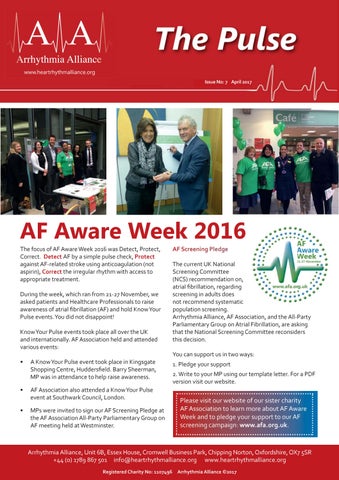
AF Aware Week 2016 The focus of AF Aware Week 2016 was Detect, Protect, Correct. Detect AF by a simple pulse check, Protect against AF-related stroke using anticoagulation (not aspirin), Correct the irregular rhythm with access to appropriate treatment. During the week, which ran from 21-27 November, we asked patients and Healthcare Professionals to raise awareness of atrial fibrillation (AF) and hold Know Your Pulse events. You did not disappoint! Know Your Pulse events took place all over the UK and internationally. AF Association held and attended various events:
AF Sccree eniing Ple edg ge The current UK National Screening Committee (NCS) recommendation on, atrial fibrillation, regarding screening in adults does not recommend systematic population screening. Arrhythmia Alliance, AF Association, and the All-Party Parliamentary Group on Atrial Fibrillation, are asking that the National Screening Committee reconsiders this decision. You can support us in two ways:
•
• •
A Know Your Pulse event took place in Kingsgate Shopping Centre, Huddersfield. Barry Sheerman, MP was in attendance to help raise awareness. AF Association also attended a Know Your Pulse event at Southwark Council, London. MPs were invited to sign our AF Screening Pledge at the AF Association All-Party Parliamentary Group on AF meeting held at Westminster.
1. Pledge your support 2. Write to your MP using our template letter. For a PDF version visit our website.
Please visit our website of our sister charity AF Association to learn more about AF Aware Week and to pledge your support to our AF screening campaign: www.afa.org.uk.
Arrhythmia Alliance, Unit 6B, Essex House, Cromwell Business Park, Chipping Norton, Oxfordshire, OX7 5SR +44 (0) 1789 867 501 info@heartrhythmalliance.org www.heartrhythmalliance.org Registered Charity No: 1107496 Arrhythmia Alliance ©2017
2
Defibss Save Liv vess Arrhythmia Alliance works to support the placement of lifesaving automated external defibrillators (AEDs) in the community. Our current campaign, Defibs Save Lives is one that everybody can join in to make their community HeartSafe. AEDs can be critical in increasing cardiac-arrest survival rates. 80% of deaths from sudden cardiac arrest could be avoided with the use of AEDs and CPR.
Defibs Save Lives - US
NEW! Defibs Saves Lives - US Campaign Story County
A Bluffton Police Officer is responsible for saving two lives in November thanks to quick action and the AED he carried in his police car.
Arrhythmia Alliance is collaborating with the Story County Sheriff ’s Office in Nevada, Iowa to place Automated External Defibrillators (AED) in all of their patrol vehicles.
Officer Jim Mendicino used an AED provided to the police department by the Arrhythmia Alliance - Gavin Quance Defibs Save Lives Campaign. The campaign provided every patrol vehicle with an AED. The AED tells the user exactly what to do, without prior training.
Together the aim is to engage with the local community to raise funds to equip all 45 patrol vehicles with defibrillators. To learn more please visit www.defibssavelives.org/usa
Well done Officer Mendicino!
Bernard Gallacher Defibrillator Campaign Following the huge success of our Bernard Gallacher Defibrillator Campaign, we are delighted to announce that a life was saved at Bushfoot Golf Club: “One of our members was talking with friends in the clubhouse when he collapsed. Our staff and members acted quickly using the defibrillator that we installed in the clubhouse several years ago. Tommy received three shocks from the defibrillator whilst the ambulance was making its way to the club. On arrival the paramedics took over caring for Tommy and stated that without
the defibrillator unit and the help of the members they would have been dealing with a very different situation.” Tommy spent nearly two weeks in hospital following the event and had to get a stent inserted in a blood vessel leading to the heart. He was back at the club soon after with hopes to get back out on the course. Ian, Bushfoot Golf Club To get involved with the campaign, please make your donation or email info@defibssavelives.org for more information.
ww ww.h hearrtrh hythm mallliancce.o org • inffo@ @he eartrrhyth hma allian nce.o org
3 Arrhythmia Alliance - Lilly-May Page g Campaign g
she may have survived. Claire is now determined to ensure that these lifesaving AEDs are made available in schools around the country, starting with her home town in Berkshire. To date, more than twenty schools have received HeartSine Samaritan 500PAD automated external defibrillators (AEDs), supplied with both an Adult and Paediatric Pad Pak, through the Arrhythmia Alliance Lilly-May Page Campaign. Recently Lilly-May’s mum Claire, welcomed a new chapter with the arrival of her little boy Mitchell.
Claire i Page iintroduces d b baby b son Mitchell i h ll Lilly-May was 5 years old when she suddenly collapsed and tragically died when being collected by her Mum and Nan at school on 15th May 2014. Lilly-May suffered a sudden cardiac arrest.
“It’s bittersweet of course, you want them to be their own person, but I see so much of Lilly in him. He has her eyes, and I think he is going to be as cheeky as her too. She would have been such a proud big sister.” If you would like to find out more about this campaign, please contact us at: 01789 867 501 or email us at: info@defibssavelives.org.
Her Mum Claire, firmly believes that if an AED (automated external defibrillator) had been available,
Arrhythmia Alliance places 3,000th public access defibrillator
– more than lung cancer, breast cancer and HIV/AIDs combined. We know of many people whose lives have been saved through the AEDs we and our partners have placed. However, more needs to be done, and our vision is to make AEDs as commonplace as fire extinguishers and smoke alarms across the UK.” Up to 250 people a day suffer a sudden cardiac arrest in the UK and will need an immediate response with CPR and an AED to restart their heart – calling 999 is essential, but time is critical if they are to survive. Without early intervention, a person has only a 5% chance of survival, CPR on its own increases this to 9%, but if an AED is used to defibrillate the heart the person’s chance of survival increases dramatically to 50% or more – it is crucial that the general public has access to an AED and together with CPR uses it to help save a life.
Trudie Lobban MBE, Founder & Trustee, Arrhythmia Alliance said, “To place 3,000 AEDs since we launched our Defibs Save Lives campaign in 2013 is a fantastic achievement, and will ensure many people’s lives are saved from sudden cardiac arrest, the UK’s leading killer
In the UK, the average time for an ambulance/ paramedic to reach someone in SCA is up to eight minutes – however, the chance of a person surviving an SCA decreases by 10% for every minute’s delay in defibrillation. AEDs do not require training and can be used by anyone to shock a person’s heart back to normal rhythm if they suffer a sudden cardiac arrest. If you are interested in becoming involved, and would like further information please call: 01789 867 501 or email: info@defibssavelives.org.
Help plin ne: 01789 867501
4
Su ubccuttan neo ouss Im mplan nta able e Cardio overterr Defibriilla ato ors (S--IC CDs) Andrew Grace, Consultant Cardiologist, Papworth Hospital, and the University of Cambridge Implantable cardioverter defibrillators (ICDs) represent one of the transformational technologies of contemporary cardiology. Effective protection against the consequences of sudden cardiac arrest (SCA) through the prompt action of ICDs has been proven effective in population-based studies pre-empting the good news stories for individuals and their families well covered in this newsletter and elsewhere. Lives saved, individuals reassured, families held together. The maturation of the conventional ICD to a generally applicable treatment followed the introduction of intracardiac ‘trans-venous’ leads used in conjunction with an ‘active can’. In this arrangement, potentially life-saving shocks are delivered between the device and a coil incorporated in the body of the lead. The problem is that the leads have to remain active and technically viable in what amounts to a hostile environment withstanding an annual 40 million cardiac contractions over a potentially 50-60 years. Although these leads have been highly engineered from the outset a series of problems were encountered a few years back that caused temporary concerns for patients and their referrers. There have been two responses that have been enormously beneficial effect in respect of the provision of safe, effective ICD therapy. First, conventional ICD systems have become increasingly refined with better software and hardware including more robust leads combined with more sophisticated programming. Second, a completely novel ICD system - the subcutaneous ICD (S-ICD) - has been developed that requires leads neither in the heart nor the circulation.
relatively straightforward approval first in Europe, then through the Washington-based Food and Drug Administration (FDA) (April 2012) and the National Institute for Health and Care Excellence (NICE), and was then awarded the Prix Galien in New York (2013) for ‘Best Medical Technology’. Current status of the S-ICD In observational studies the S-ICD provides favourable results when compared to conventional systems. It is seen to be highly effective, with a similar inappropriate shock rate to conventional systems and of course avoids completely issues directly attached to leads in the circulation. Comments from patients are generally very favourable. The device is now under formal evaluation in a prospective clinical trial (the gold standard test for comparative effectiveness). The second-generation EMBLEM device has been available over the last 18 months and is somewhat smaller and with a longer battery life than the initial device. There has developed a view now held by many that the S-ICD should be considered as an option in all patients who require protection against the consequences of SCA who do not also have a need for a pacemaker as well. In view of these various considerations there has been incremental increases in demand that are anticipated to continue. Future advances in the S-ICD There will be further physical iterations of the S-ICD with downsizing - one idea that is being examined is of units specifically developed focused on children and young adults that may have lower energy output (possible in those with smaller chests). Much research is also being conducted to examine the use of the S-ICD in conjunction with ‘leadless pacemaker’ devices.
S-ICD development In summary The idea of providing the advantages of the ICD without placing anything in (or on) the heart was that of Gust Bardy (Seattle). It would be a device designed to be focused in its actions and fit for purpose providing simple protection against the risks of SCA. Working with engineers in California and medical teams in Cambridge and Auckland the concept was transformed to practical reality. The period 2005-2011 was a time of variable, steady acceptance from the medical community as might be anticipated with a disruptive approach. Despite some soft opposition, the S-ICD gained
The S-ICD represents the first member of a new generation of leadless electrical devices that are poised to transform the management of patients who are at risk of disruptions of the cardiac rhythm. The device represents the output of a concerted, persistent interdisciplinary effort going back 15 years. The development of the S-ICD would however simply not have been possible without the selfless commitment of the many patient participants in clinical trials to whom we should all be grateful.
ww ww.h hearrtrh hythm mallliancce.o org • inffo@ @he eartrrhyth hma allian nce.o org
5
FIGURE 1: DEVELOPMENT OF KEY IDEAS IN ICD ARRHYTHMIA THERAPY A – Complex transvenous ICDs have represented the standard of care since the mid-1990s with demonstrable efficacy against ventricular arrhythmia having positive effects on mortality. However, the leads of these devices remain their ‘weakest link’. B – Cardiac Resynchronization Therapy with high-energy (ICD) capability (CRT-D) is appropriate to patients with impaired ventricular function. C – Subcutaneous devices e.g. subcutaneous ICDs (S-ICDs) have been introduced more recently essentially provide protection against VF and other than for a short period of time after defibrillation are unable to pace.
Figure 2: GENERAL SET-UP OF THE S-ICD SYSTEM A – Pulse generator is placed in left lateral location. Lead is tunnelled to left parasternal location with proximal (P), mid-coil (C) and distal (D) tip highlighted. B – Chest X-ray show ideal device location. It is important that the device is placed sufficiently posteriorly so as to capture as much myocardial tissue in the field of activity as possible. This CXR image is from the first patient to receive an S-ICD in July 2008. For further information on S-ICDs please visit our website: www.heartrhythmalliance.org or email info@heartrhythmalliance.org to order our CRT/ICD/S-ICD booklet.
Help plin ne: 01789 867501
6
Fun ndraiisiing Champions!
Will Helsby and his friends ran the Leeds half marathon for Arrhythmia Alliance in May 2016. It took them just 2 hours and 24 minutes. Will says he was glad to be back home, in the sun lounger with a beer in hand by the end of the day! Will’s family are extremely grateful for the professionals who came forward to ‘Restart his wife’s Heart’ when she suffered a sudden cardiac arrest as they left a Take That Concert in Manchester in June 2011. As a result Arrhythmia Alliance is a charity close to their heart; particularly our ‘Defibs Save Lives campaign to get defibrillators placed in as many public places as possible. This was the family’s 4th challenge for the charity, with an amount raised of over £3,000 so far! Will and his son Tom are donning their thinking caps to decide on what to do for us next. Previously, they have completed the Yorkshire Three Peaks Challenge in 2012, walking a marathon distance on the Cleveland Way in 2013, and the British 10K run in London in 2015. Mike Hattan rode his bicycle across the country from Morecambe to Whitby in order to raise money for Arrhythmia Alliance: “Having spent years racing bicycles, I can honestly say this was by far the hardest thing I have done on a bike. From the moment, I rode out of Morecambe at 8.30am I had a headwind. It continued in the same direction for the next 143 miles. The further East I cycled the stronger the wind got and the colder the temperature became. In the final 20 miles, it became thick fog, 5-6 degrees and 18+mph wind. However, 8hrs 45 minutes after starting I reached Whitby. NEVER TO BE REPEATED!!! It looks like I raised approx. £1,100.” “My fantastic support crew were so ‘focused’ on being there when I needed them that they only took one or two photos (all of which are blurry), apart from one taken just before I rolled out. I’m glad I did it but equally glad it’s done.” “Ps. My ticker behaved itself throughout!” ww ww.h hearrtrh hythm mallliancce.o org • inffo@ @he eartrrhythma allian nce.o org
7 Rachael Flavell held a charity day in aid of Arrhythmia Alliance in August. With stalls selling some lovely products, she raised a grand total of £760! After losing her friend in 2005 to an undiagnosed heart condition, Barbara Mills did the ‘Bauchaille Dash’ in July. A 16-mile journey, then a climb, back down, and 16 miles back again! She raised almost £500 for Arrhythmia Alliance.
Dave Fernandez used to be a runner, but after an ‘incident’ while running, had to have an ICD fitted. He can no longer run like he could, but he didn’t let that stop him, and raised £115 by hiking 12 miles.
Jonathan Imrie ran the British 10K in London in July raising £317 for Arrhythmia Alliance. He completed the race in just over 44 minutes, coming 446th out of over 11,000 runners! Jonathan wanted to help raise awareness of arrhythmias after his wife’s uncle passed away from Brugada Syndrome in 2015. Well done Jonathan and thank you for all your hard work!
Rebecca Hitchen and her team raised over £1,500 doing the Tough Mudder challenge for Arrhythmia Alliance! Thank you to the whole team. You’re all amazing!
Rachel from Patient Services and her daughter manned a stand at their local summer fete to raise awareness of arrhythmias. The day proved to be a success with lots of interest, and with the use of a treasure hunt with donations from local shops and a sweetie lucky dip for the children, they raised over £100. Rachel was able to show locals how to check their pulses, while her daughter shared balloons with the children. they even made the local paper!
If you would like to do something amazing for Arrhythmia Alliance, you can contact us at fundraising@heartrhythmcharity.org.uk. We will provide as much help and support as you need. We appreciate all donations - large and small. If you are unable to take part in any fundraising events but would still like to donate, please visit our website: www.heartrhythmalliance.org
Help plin ne: 01789 867501
8
HRC Awa ard d winn ners 2016 Outstanding Individual who has Contributed to Arrhythmia Services Professor Ben Freedman, Heart Research Institute, University of Sydneyy Over the past six years, professor Ben Freedman has developed a major interest in screening for atrial fibrillation. Pioneering studies using a smartphone ECG, Professor Freedman was the first to use the device and prompted the inventors to develop software especially designed to detect AF in the community. Professor Freedman has founded the AF-SCREEN International Collaboration. The group is only one year old but already has over 100 members from 31 countries. The collaboration seeks to promote discussion and research about screening for unknown or under-treated AF as a strategy to reduce stroke and death. Team of the Year Award Cardiac Rhythm Management Team, Oxford University Hospital The Cardiac Rhythm Management team at Oxford University Hospital is made up of Doctors, Specialist & Advanced Nurse Practitioners, and Cardiac Physiologist. However, it is the role of the Advanced Nurse Practitioner that makes this team unique. They are the only nurses in the UK who are able to undertake advanced cardiac physiologist roles. The CRM Cardiac Physiologists, in conjunction with the Cardiac Angiography Suite nurses, have been trained to undertake solo insertion of implantable loop recorders. This has allowed these common procedures to be removed from the EP and Device Labs, creating extra capacity, and improving patient flow. There could not be a better example of multidisciplinary teamwork with an exchange of skills, respect for each other’s knowledge and a willingness to support innovation and the breaking down of traditional boundaries. We hope that the recognition that would come with winning this award will inspire other centres to take inspiration from the success of this team approach. Charles Lobban Volunteer of the Year Award Gaynor Richards Gaynor Richards has worked tirelessly to improve the service offered to arrhythmia patients. Gaynor supports ICD patients in a clinical setting and also oversees her own ICD support group which she does in her own time. This vital group is not just educational for patients but also tackles the social exclusion that is felt by a patient with this type of condition. Gaynor has also raised funds for the placement of an AED in her community as well as organising several AF study days to improve the diagnosis and treatment for all those living with AF. Gaynor’s AF study days have helped raise awareness to other medical professionals in the South West region as well as bring them up to speed on new treatments. Gaynor has been published in the AF Association’s patient resources about what makes a good support group as well as presenting at this year’s Arrhythmia Alliance Patients Day.
ww ww.h hearrtrh hythm mallliancce.o org • inffo@ @he eartrrhyth hma allian nce.o org
9
Genetiic tesstin ng for in nheritted card diacc condittio onss Inherited cardiac conditions (ICCs), for example Hypertrophic Cardiomyopathy and Long QT Syndrome (LQTS), are conditions that can be passed down in families via your genes. Genes act as instructions telling our bodies how to grow, develop and function. There are many genes known to be involved with ICCs. A change or ‘spelling mistake’, in one of these genes can cause someone to be affected by, or be at risk of, an ICC. The way these ‘spelling mistakes’ are inherited can vary, but there is usually a 50:50 or one in two chance that a close blood relative (child, parent, sister, or brother) also has the ‘spelling mistake’ themselves, and therefore has the risk of developing the ICC too. Most people with ICCs do not suffer troublesome ongoing symptoms. However, a small number of people are at risk of dangerous heart problems and it is important to have regular heart checks, as many of these problems are treatable or preventable. A genetic test is a type of medical test that is used to try and identify the gene change, or ‘spelling mistake’ that can cause an ICC. For example: A correctly spelt gene: THE CAT SAT MAT A gene with a ‘spelling mistake’: THE CAT TSA TMA T Within genes that are associated with causing ICCs, there are a large number of different gene changes that can cause the condition. It is not always possible, using current technology, to find the ‘spelling mistake’. If this is the case, your sample may be kept and stored as it may be possible to do additional testing in the future. Even if the gene change causing the condition in your family is found, your sample may still be stored for further testing if and when medical knowledge increases and new technologies become available.
You will be asked for your written consent before you give a sample, and your permission will also be gained before any results are shared for the purposes of helping other family members who are also considering genetic testing. There are two different types of genetic tests: ‘genetic screening’ and ‘pre-symptomatic’ or ‘familial’ testing. The first affected person in the family to come forward for testing will be offered a genetic screen; if a causative spelling mistake is found, then their relatives may be offered a familial test. the process involved and implications to consider are quite different for each type of test.
To learn more about ICCs and genetic testing, please download our new and updated Genetic testing for inherited cardiac conditions booklet from our website. Alternatively, if you have any questions or concerns, please call: 01789 867 501 or email: info@heartrhythmalliance.org.
Help plin ne: 01789 867501
10
Arrh hyth hmia a Alllia ancce Pattients Day Fee edb bacck “I enjoyed the open discussions between patients and experts.” “It was good to listen to experiences of other ICD users.” “Hearing about the most recent technical developments and possibilities for the future was very interesting.”
! date e h t Save r tobe c O 1 2017
Ste ephen n’ss stor y My name is Stephen Bibby, I’m a cardiac patient and I had a cardiac arrest seven years ago, as a result of which I had an ICD implanted. From the Patients Day, I gather you’ve spoken today? Stephen: Yes, I gave a presentation on my living with my ICD. What were some of the questions that were asked by the patients? Stephen: Well I tried to do it in such a way that people didn’t so much ask questions, as give their versions of living with their ICD because I feel that one of the big things that we can gain from meetings like today is to learn from each other. So rather than them questioning me, I encouraged them as much as I was able, to actually just give their story a little bit. During the rest of the course of the day, we started to get more feedback so you get this relationship building up between individuals, both ICD patients and carers, and the professionals. In terms of from your perspective, what would you say are the three things that you would take away from Patients Day? Stephen: I think having had the opportunity to give my story to a greater extent is to have gained something from everybody else. I’ve learnt various
technical facts from the professionals today. I thought I knew quite a lot, I know a lot more now. I’ve learnt from the professionals and I’ve also learnt from other patients, where they’ve told me how they felt about different things; areas of anxiety in living with their ICD which perhaps I hadn’t realised I had been anxious about. In terms of your thoughts on people who are leaving today, what would you ask them to do when they get home? Stephen: Do you know what would give me the greatest possible satisfaction, whether it’s somebody who’s been here today; actually, I don’t care who it is; is to get Trudie’s message over to the public as a whole. 100,000 people or thereabouts die every year from sudden cardiac arrest. As she rightly said, if that was happening to 250 a
ww ww.h hearrtrh hythm mallliancce.o org • inffo@ @he eartrrhythma allian nce.o org
11 day by any other means, it would be not just life changing, it would change the whole policy perhaps of governments, certainly the policies of major companies and what really happens is very little changes. If somebody, somewhere, who’s been here today, or who has heard about today could even just begin to get that message across, I’d be so so happy. I would know then that something like that is going to save hundreds of lives; thousands of lives in fact. It’s a message that’s struggling to get across. Every premature death is a tragedy, there’s no question about that but when I read headlines that tell me, or hear headlines on the radio or TV that tell me that 130 cyclists die every year; that’s two and a bit a week; that does not compare with 250 a day. I am not belittling those deaths one little bit, they’re all important, they’re all tragedies but 100,000 a year; it is beyond the comprehension of ordinary humans I think. Do you perhaps think that that is because people tend to understand a cycling accident or a road death much more than they understand an arrhythmia or sudden cardiac arrest?
Stephen: I think there’s a lot in that. I think read a headline that says ‘female cyclist killed by tipper in central London’, then that could give a very vivid vision. If someone dies of a sudden cardiac arrest I would imagine a lot of people don’t actually know what a cardiac arrest is. They know that cardiology is something to do with the heart. Arrest - that’s what police men do. Maybe the message should start with educating people to realise what a cardiac arrest is and how devastating it is but how relatively simple it might be, not to save all of them because that’s not possible, but to save some of those people. I think as Trudie said, it is killing more people than AIDs and all sorts of cancers combined. I can’t help in a medical sense, because I don’t have the skills, equipment, or anything. As a cardiac arrest patient, I’ve got the capabilities of saving their lives potentially and that would apply to every member of the public. They have got the capability as well. If they can do CPR and if they can have access to an AED, there’s a strong chance of that person surviving.
Chriis’ss sttor y I’m Chris Solomons, I am a survivor of a cardiac arrest and I was invited to Arrhythmia Alliance Patients Day to demonstrate how defibrillators work and to show how CPR is done as well. What are the three things that you will take away from today? Chris: Meeting some new survivors, also meeting survivors that have what we call ICDs. I am lucky in a way because I do not have an ICD but it is great to meet them and to also hear their stories and find out how they’re living with an ICD. Also, seeing Trudie again. What would you like people to do that you’ve spoken to today? Is there something you want them to do when they go back home after today’s Patients Day? Chris: To go out and not be scared to used defibs simple as that. Quite a lot of people are scared to use defibs. Now I know most of those patients are
survivors of sudden cardiac arrest and we probably would be scared but I have just proved it to them. You do not need to be scared to use a defib. It talks to you, it tells you what to do.
Help plin ne: 01789 867501
12
ATRIAL FIBRILLATION in the UK AF: Understand the risk If you have AF, your heart beats irregularly and may not pump all of the blood through properly
If blood does not move quickly and smoothly dangerous blood clots may form
Blood clots that travel from the heart to the brain can cause a stroke
Know the facts of AF in the UK People are diagnosed with AF in the UK This number is increasing
This exceeds the number of people living in
Top 3 AF-related conditions
Birmingham
AF increases your risk of having an AF-related stroke
1. Hypertension
.3
2. Angina Pectoris 3. Diabetes
Prevalence in % by gender and age
Men are more often affected by AF than women
male female
The lifetime risk of getting AF is 1 in 4
In the UK every 18 mins someone suffers from an AF-related Stroke
The risk doubles with every decade after the age of 0-54
55-64
65-74
Check your pulse
75+
Most common symptoms Shortness of Breath
to see if your heart rhythm is regular
This equals 30,000 Strokes per year
Dizzyness
Tiredness
Hold out one of your hands, with your palm facing upwards and your elbow slightly bent.
Normal heart rhythm a) regular and b) betweeen 60-100 beats a minute when resting
Place your index and middle finger of your hand on the inside of your wrist.
AF heart rhythm a) irregular and b) sometimes abnomally fast
Press lightly. If you can´t feel your pulse, press a little harder and move your fingers.
In case of irregular or very fast heart beat See your doctor!
For more information visit:
anticoagulationeurope.org
stroke.org.uk
afa.org.uk
@AntiCoagEurope
@TheStrokeAssoc
@AtrialFibUK
heartrhythmalliance.org
thrombosisuk.org
nhs.uk
@KnowYourPulse
@ThrombosisUK
@NHSChoices
Brought to you by
Reminders for your medications
AF A
®
www.afa.org.uk
anticoagulation EUROPE © smartpatient gmbh
Sources: NHS, Anticoagulation Europe, British Heart Foundation, Stroke Association, Atrial Fibrillation Association, British Medical Journal
www.mytherapyapp.com/atrial-fibrillation-app
ww ww.h hearrtrh hythm mallliancce.o org • inffo@ @he eartrrhyth hma allian nce.o org
13
Battling AF online: Use your Smartphone
and PC to protect yourself and others The Internet has not only become a go-to destination for informing ourselves, websites and apps are progressively turning into tools that help manage AF. The “Battling Atrial Fibrillation Online” initiative aims to increase patient safety by educating patients and caregivers on AF and the new tools available. Originally initiated by AntiCoagulation Europe and the MyTherapy app, we joined in to spread the word and we think you should, too. Safety by education Adherence to anticoagulation therapy is key when it comes to safeguarding patients against AF-induced stroke. Often, we find that it is those patients struggling with adherence, that have not had the chance to understand how their medication works, e.g. patients stop taking their anticoagulant as they feel that it does not mitigate their irregular heartbeat. Similarly, patients miss more doses than necessary being unaware of supportive tools like specialised reminder apps. And while there is always room for improvement, doctors and nurses cannot close this educational gap alone.
Educating where the patients are More than 75% of UK internet users are regularly looking for health information online. Millions of them
are affected with Atrial Fibrillation directly or indirectly. With high-quality and easily digestible content, the “Battling AF Online” initiative aims to be where these patients are: On health websites and blogs, on social media sites like Facebook or Twitter, or on healthrelated apps. To achieve this, and to be more visible than much of the existing content of often questionable quality, we encourage everyone to join in: Supporting our cause is as simple as sharing our infographic and future materials on social media or putting it on a blog.
Staying protected with apps Educating others about managing AF is good, but staying protected yourself is more important. While apps neither can nor should replace a consultation with your healthcare professional, they can lower the burden of taking an active part in your own health. Apps like ‘MyTherapy’ support you in never missing a dose of your medications. The free app works with all medications. Whenever a dose becomes due, the app triggers an alert on your phone. No matter if you skip or confirm the intake, the app tracks your action with its built-in health journal. This not only proves handy in case you are unsure if you already took your dose for the day. You can also digitally share it with your caregivers, e.g. in the case of a missed dose, family can then immediately engage. Right from the app you can generate a PDF report of your medications and everything else you’ve tracked. You can use this for your records and, more importantly, take it to your doctor. Because also with digital helpers, when it comes to interpreting your data, your doctor is the person to trust.
The app for anticoagulant therapy. Protect yourself from stroke or pulmonary embolism: MyTherapy reminds you of your anticoagulant and other medications and keeps track of your weight, blood pressure and symptoms. Free Download – Try it out!
Help plin ne: 01789 867501
14
Arrhythmia Alliance Patients Day 2017 Sunday 1 October at The ICC, Birmingham A full programme of some of Europe’s leading heart rhythm specialists is planned for Patients Day 2017. As the biggest information and support event for Arrhythmia Alliance members and their carers in the country, it is anticipated that once again this will be a sell-out. Sessions with leading medical experts will include amongst others: o o o o o
Treatment options for atrial fibrillation Anticoagulant options Accessing the best available care for you How AF affects my emotional wellbeing Rhythm management
For more information email becky@heartrhythmalliance.org or call +44(0)1789 867 523
The cost to attend for a full day meeting with refreshments and lunch is: Registration for non-members or on the day £50.00 (if places available) Friend of Arrhythmia Alliance
£25.00
Carer if registering with a Friend
£35.00
Early bird registration (until 31 July 2017)
Friend £20.00/Carer £30.00
Registration Form 1st attendee details Full name: I am: Patient Carer Other If other please state: .................................................... Special requirements (please give details) Dietary Access
2nd attendee details (if applicable) Full name: I am: Patient Carer Other If other please state: ..................................................... Special requirements (please give details) Dietary Access
Address: Postcode: Telephone:
Email:
Payment details - Please select your payment method below: Credit/debit card: Please call +44 (0) 1789 867 523 to pay over the phone Cheque: Please make cheques payable to ‘Arrhythmia Alliance’ Please send your cheques to: Arrhythmia Alliance, Unit 6B, Essex House, Cromwell Business Park, Chipping Norton, Oxfordshire, OX7 5SR
ww ww.h hearrtrh hythm mallliancce.o org • inffo@ @he eartrrhyth hma allian nce.o org
15
SAVE THE DATE GET INVOLVED HEART RHYTHM WEEK 5 – 11 JUNE 2017 “TAKE THE PULSE CHECK CHALLENGE”
Become Arrhythmia Aware This year’s Heart Rhythm Week focus is ‘Identifying the Undiagnosed Person.’ Our aim is to make m people pulse aware, take 10,000 pulse checks and identify , people with an irregular heart rhythm. We want all of our members to get involved and during April we will be sending links to awareness-raising ideas, materials and activities that you can use in your community to help us reach our goals!
Charles Lobban Volunteer of the Year Award 2017 ...... Team of the Year Award 2017 ...... Outstanding contribution to arrhythmia services 2017 Do you know a healthcare professional, a team of unsung heroes, a friend or family member who has gone that extra mile to support you through the complexities of a heart rhythm disorder, providing reassurance and in some cases encouraging you to accept and adjust to your condition? If the answer is “YES” then in no more than 500
Arrhythmia Alliance has moved to Oxfordshire! We have moved offices to Chipping Norton but nothing has changed. We are still here providing information, support and reassurance through our dedicated helpline. Our address is Unit 6B, Essex House, Cromwell Business Park, Chipping Norton, OX7 5SR.
words, tell us why you are nominating this special person (s) for one of these awards.
Our telephone number is unchanged at 01789 867 501
Email info@heartrhythmcongress.org.uk
Help plin ne: 01789 867501
16
Sh harre you ur sto ory y
Without your stories, we have no voice... Can you help? Share your story and help others who may be awaiting or undergoing treatment for an arrhythmia. Your words can support and reassure patients on the road through treatment as well as those newly diagnosed or caring for someone with an arrhythmia. Many of the people we speak to on our helpline are unsure about what to expect and the treatment options available to them; your words present a real-life account that can be shared to promote awareness and improve understanding of cardiac arrhythmias. Please email your account to: info@heartrhythmalliance.org or call: +44 (0) 1789 867 501. To read patient and carer stories please visit the Arrhythmia Alliance website: www.heartrhythmalliance.org
Patient Support Groups The aims of patient support groups are to empower patients, improve knowledge, support and promote management of their own health. Patients are encouraged to share their experiences of living with a long-term condition. The meetings are supported by healthcare professionals, who will encourage a wide range of speakers to attend the meetings. Some of the support groups also have social events throughout the year as well as having medical presentations. Full details of our patient support groups can be found on our website.
Plea ase do ona ate e to Arrh hyth hmia a Alllia ance Arrhythmia Alliance relies on donations to enable us to maintain our helpline, resources and support services to patients and carers. Please support us, so that we can continue to support you. Please consider adding Gift Aid to your donations. Gift Aid adds a massive 25% to your donation at no cost to you. Every penny really does make a difference. Gift Aid can be arranged verbally, or alternatively, please contact us for a Gift Aid form. You can donate by calling: +44 (0)1789 867 501 or via our website: www.heartrhythmalliance.org.
Donate
ww ww.h hearrtrh hythm mallliancce.o org • inffo@ @he eartrrhythma allian nce.o org