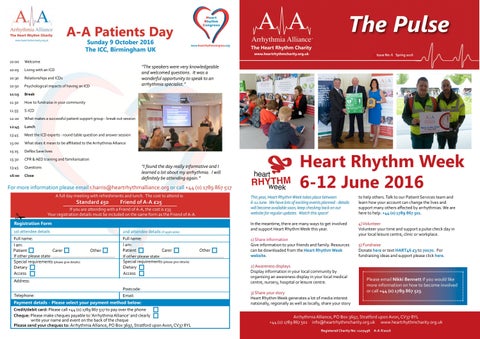
A-A Patients Day Sunday 9 October 2016 The ICC, Birmingham UK
10:00
Welcome
10:05
Living with an ICD
10:30
Relationships and ICDs
10:50
Psychological impacts of having an ICD
11:15
Break
11:30
How to fundraise in your community
11:55
S-ICD
12:20
What makes a successful patient support group - break out session
12:45
Lunch
13:45
Meet the ICD experts - round table question and answer session
15:00
What does it mean to be affiliated to the Arrhythmia Alliance
15:15
Defibs Save lives
15:30
CPR & AED training and familiarisation
13:45
Questions
16:00
Close
www.heartrhythmcongress.org
For more information please email r.harris@heartrhythmalliance.org or call +44 (0) 1789 867 517 A full day meeting with refreshments and lunch. The cost to attend is:
Friend of A-A £25
If you are attending with a Friend of A-A, the cost is £35 Your registration details must be included on the same form as the Friend of A-A. Registration Form 1st attendee details
2nd attendee details (if applicable)
Full name: I am: Patient Carer Other If other please state: ..................................................... Special requirements (please give details) Dietary Access
Full name: I am: Patient Carer Other If other please state: ..................................................... Special requirements (please give details) Dietary Access
Address: Telephone:
5 Autumn 2015
Issue No: 6 Spring 2016
“The speakers were very knowledgeable and welcomed questions. It was a wonderful opportunity to speak to an arrhythmia specialist.”
“I found the day really informative and I learned a lot about my arrhythmia. I will definitely be attending again.”
Standard £50
www.heartrhythmcharity.org.uk
Postcode: Email:
Payment details - Please select your payment method below: Credit/debit card: Please call +44 (0) 1789 867 517 to pay over the phone Cheque: Please make cheques payable to ‘Arrhythmia Alliance’ and clearly write your name and event on the back of the cheque Please send your cheques to: Arrhythmia Alliance, PO Box 3697, Stratford upon Avon, CV37 8YL
Heart Rhythm Week 6-12 June 2016 This year, Heart Rhythm Week takes place between 6-12 June. We have lots of exciting events planned - details will become available soon, keep checking back on our website for regular updates. Watch this space!
to help others. Talk to our Patient Services team and learn how your account can change the lives and support many others affected by arrhythmias. We are here to help: +44 (0) 1789 867 501.
In the meantime, there are many ways to get involved and support Heart Rhythm Week this year.
4) Volunteer Volunteer your time and support a pulse check day in your local leisure centre, clinic or workplace.
1) Share information Give information to your friends and family. Resources can be downloaded from the Heart Rhythm Week website. 2) Awareness displays Display information in your local community by organising an awareness display in your local medical centre, nursery, hospital or leisure centre. 3) Share your story Heart Rhythm Week generates a lot of media interest nationally, regionally as well as locally, share your story
5) Fundraise Donate here or text HART46 £3 to 70070. For fundraising ideas and support please click here.
Please email Nikki Bennett if you would like more information on how to become involved or call +44 (0) 1789 867 523.
Arrhythmia Alliance, PO Box 3697, Stratford upon Avon, CV37 8YL +44 (0) 1789 867 501 info@heartrhythmcharity.org.uk www.heartrhythmcharity.org.uk Registered Charity No: 1107496 A-A ©2016
3
2
Heart Rhythm Week 2015 - Thank you for your support
Since a series of parliamentary events to launch our manifesto, the outpouring of support for our plea, and positivity for the manifesto was simply astonishing. We received national TV coverage via NVTV who featured Trudie Lobban, Dr Ernest Lau and Robin McCready discussing AEDs, how simple they are to use, and how they need to be available for all to use.
New AF Association and STARS newsletters - out now!
Arrhythmia Alliance website - we need your feedback!
Kicking off on Monday 1 June at 11:00, the Heart Rhythm Week 2015 Thunderclap campaign was distributed, raising awareness of SCA and to help stop 100,000 needless death a year - ‘Now is the Time’. We exceeded our target of supporters by 207% and reached 472,930 people when our message was released via Facebook and Twitter. Thank you to everyone who joined our Thunderclap campaign, you have helped us highlight the importance of saving lives. Since 2004, when Arrhythmia Alliance successfully lobbied for a new Chapter on Arrhythmias and Sudden Cardiac Death in the National Service Framework (NSF) for Coronary Heart Disease, Heart Rhythm Week has been synonymous with activities across the globe. From pulse checks in Perth, Australia to an arrhythmia information bus in India, Heart Rhythm Week is a time to join in and help ensure we make a difference. To coincide with World Heart Rhythm Week, Arrhythmia Alliance also held a series of political events, which took place in each country of the UK. At each of these events Arrhythmia Alliance’s Manifesto on sudden cardiac arrest (SCA) was launched. This report tackles the disparity in accessing lifesaving automated external defibrillators (AEDs) across the UK. The manifesto includes a step-by-step guide, which both policy makers and professionals with an interest in SCA care can follow to push forward change. Once again, for Heart Rhythm Week (HRW) 2015, our supporters joined us and helped to raise awareness of how to Detect, Protect and Correct heart rhythm disorders. Awareness events took place across the UK & internationally, ‘Know Your Pulse’ was covered in the press, notably ITV’s ‘Lorraine’ and BBC’s ‘The One Show’ and Arrhythmia Alliance launched its manifesto on sudden cardiac arrest - Now is the Time for action to save lives. The full report can be viewed here.
Our Thunderclap 2015 campaign can be viewed here. #HeartRhythmWeek #nowisthetime On Wednesday 3 June, Heart Rhythm Week was featured on BBC 1’s The One Show, where Fabrice Muamba was interviewed about his SCA. There was also a feature on the history of defibrillators and most importantly, Dr Mark Porter advised on how to take your pulse and the difference between a regular and an irregular heartbeat. Paul O’Grady and Anita Dobson were guests on the show and also got involved in taking their pulse. On Thursday 4 June, Heart Rhythm Week was featured on ITV’s Lorraine; Dr Hilary showed how to take your pulse including a step-by-step guide along with showcasing AliveCor’s Heart Monitor.
The AF Association and STARS Spring newsletters are now available for download. AF Association provides information and support to those affected by atrial fibrillation (AF). We strive to continually improve our website to make it as useful as possible to those affected by arrhythmias. We are currently in the process of completely redesigning our existing website and need your feedback and comments on the current site.
To view the latest AF Association newsletter please visit: www.afa.org.uk. STARS (Syncope Trust And Reflex anoxic Seizures) provides information and support to those affected by syncope, reflex anoxic seizures or PoTS (Postural Tachycardia Syndrome).
We would be really grateful if you would complete our survey about our website by clicking here.
To view the latest STARS newsletter please visit: www.stars.org.uk.
Arrhythmia Alliance getting social Arrhythmia Alliance is able to offer patients the opportunity to connect with others to get advice, support or simply chat with people who understand their perspective and can offer some new insight by giving their own. To join the discussion, please visit our social media channels: www.facebook.com/ArrhythmiaAlliance
For more information about press coverage of HRW 2015, please click here. Together, we can work to secure early diagnosis and improve outcomes for the many millions of people across the globe affected by arrhythmias. Thank you to you all for your continued support.
www.heartrhythmcharity.org.uk • info@heartrhythmcharity.org.uk
www.twitter.com/KnowYourPulse
hu
www.healthunlocked.com/heartrhythmcharity www.healthunlocked.com/sca-heart-attack www.instagram.com/arrhythmiaalliance www.linkedin.com/company/arrhythmia-alliance
Helpline: 01789 867501
5
4
It’s a common misconception that sudden cardiac arrest (SCA) and heart attack are the same thing. In reality, they are quite different. Understanding the difference could save your life or the life of someone you love. SUDDEN CARDIAC ARREST: “AN ELECTRICAL PROBLEM” SCA is different from heart attack. While heart attack is described as a “plumbing problem, SCA is more of an “electrical problem” that prevents the heart from functioning effectively. Heart attack can lead to SCA, but there are many other causes, such as congenital abnormalities, severe heart failure, electrocution and drug overdose.
HEART ATTACK: “A ‘PLUMBING’ PROBLEM” Heart attack (the medical term is myocardial infarction or MI) occurs when part of the heart’s blood supply is reduced or blocked, causing the heart muscle to become injured or die. The person is awake (conscious) and may complain of one or more of the signs and symptoms of heart attack.
•
▶
SCA and Heart Attack Understanding the Difference
Signs and Symptoms of Heart Attack Most heart attacks involve discomfort in the center of the chest that lasts more than a few minutes or that goes away and comes back. Some heart attack victims experience mild intermittent chest discomfort that comes and goes over a period of days. These are early “warning signs” that may precede a heart attack. (Some victims, however, do not experience any warning signs.) Chest discomfort can feel like uncomfortable pressure, squeezing or fullness. It can evolve into crushing pain if nothing is done. Other symptoms of heart attack include: • Shortness of breath • A general sense of anxiety • Nausea, sweating, lightheadedness • A tendency to deny that anything serious is happening •Pain or discomfort in one or both arms, spreading to the shoulder, upper back, neck or jaw
Signs and Symptoms of SCA When SCA occurs, the heart stops beating altogether. As a result, blood is no longer pumped throughout the body, including the brain. The person suddenly passes out, loses consciousness, and appears lifeless - except for abnormal “gasping” which may last for several minutes. Occasionally, SCA victims will experience 10-20 seconds of seizure activity (shaking of the arms and legs) at the onset of the event as the brain stops receiving blood and oxygen from the heart. The SCA victim is never awake and needs immediate help. If nothing is done, the victim will die within minutes.
It’s important to act right away if these symptoms occur to maximize the odds of survival and minimise potential permanent damage to the heart. Signs and Symptoms of Heart Attack in Women The most common symptom of heart attack in women is the same as it is for men: chest discomfort or pain. Women are more likely than men, however, to experience other common symptoms such as:
Lifesaving Actions When SCA occurs, it is critically important that whoever is near the victim calls 999 immediately, checks for signs of life, and if there are none, gives cardiopulmonary resuscitation (CPR) and uses the nearest automated external defibrillator (AED). This is lifesaving care that any layperson can provide. It is best to be trained in CPR and the use of AEDs, but even without formal training, the rescuer can push hard and fast on the victim’s chest and follow the directions on the AED, while waiting for emergency services to arrive.
• Shortness of breath • Back or jaw pain
Sometimes women experience additional symptoms including: • Stomach or abdominal pain • Weakness and/or overwhelming fatigue • Swelling of the ankles and/or lower legs
How You Can Save a Life: Sudden Cardiac Arrest
Lifesaving Actions When someone experiences a heart attack, he or she is awake and the heart is beating. There is no need to give CPR or to use an AED. Instead, the correct action is to call 999 immediately to get emergency services on the way to help. The sooner the person is treated, the better the outcome.
What to do: • Call 999 immediately • Give CPR or at the very least chest compressions • Use AED What NOT to do: The worst thing for an SCA victim is to do nothing. Sometimes people hesitate to help because they are afraid they might do the wrong thing and hurt the victim. But the SCA victim is clinically dead and cannot get worse. Your actions can only help.
The Chain of Survival
www.heartrhythmcharity.org.uk • info@heartrhythmcharity.org.uk
• Fainting, nausea, vomiting • Cold, sweaty skin, paleness.
How You Can Save a Life: Heart Attack
What to do: • Call 999 immediately • Have the person rest or lie down while waiting for emergency services What not to do: • Refrain from driving the person experiencing symptoms of heart attack to the hospital. The only rare exception might be when the hospital is very close by and you expect emergency services to be delayed significantly in getting an ambulance to the scene. • Never drive yourself to the hospital if you are experiencing heart attack symptoms. • Do not delay more than five minutes from the onset of symptoms to call 999. • Do not hesitate to call 999 because you are embarrassed or don’t want to bother anyone. Emergency services are there for you and, it is better to be safe than sorry.
Helpline: 01789 867501
6
7
Sarah’s story
Andrew’s Story
I had my first sudden cardiac arrest (SCA) on the 27th July 2015; I have no memory of that day or the two weeks after, I can only tell you what I was told.
I was an active and fit amateur sportsman playing competitive rugby in my twenties and thirties and then moving on to racing sail boats and cycling in my forties.
I had just finished work in our local supermarket. I put my three year old daughter in her car seat and then quickly went back into the shop to speak with my colleagues. When I was walking back to my car, I said I didn’t feel well and down I went.
“…they continued CPR on me until the doctor and defibrillator arrived.” My colleague screamed and my boss came running out and was trying to get a response from me. They shouted for someone to phone the ambulance and a second colleague came out. He started CPR on me and then a customer came to help and take over. My angels; they continued CPR on me until the doctor and defibrillator arrived. In total I was told I was down for 45 minutes. Once the ambulance arrived, they continued working on me and I was flown by helicopter to hospital in Inverness, as we don’t have a proper hospital on the South Uist Island. I was then put into an induced coma. A week later I was brought out of the coma but suffered another SCA. I came round talking to my partner and mum but I have no recollection of the next week even though I was awake and talking. I do remember my last few days in hospital and when I also had my implantable cardiac defibrillator (ICD) fitted. Since coming home I have been tested for Long QT Syndrome.
on Christmas Eve. Thankfully my ICD did its job and I’m still here. I was able to get home on Boxing Day to be with my three children.
“You never really understand how important some things are until it happens to you.” Due to my experiences of suffering a SCA, I am looking to organise some CPR events to raise the awareness of underlying heart conditions and the need for AEDs in public places. I’m working towards placing two AEDs at South Uist Island as unfortunately there are currently no 24/7 public access AEDs available. I would like my friends, family, children and colleagues to learn CPR; not just for me, as who knows when they could need it. You never really understand how important some things are until it happens to you. Sarah, South Uist (2016)
Later on in the year, I went down to Yorkshire to spend Christmas at my parents where I suffered another SCA
Did you know? •
Sudden cardiac arrest is not the same as a heart attack. Although a person suffering a heart attack has an increased risk of SCA.
•
CPR alone saves just 9% of people who suffer from a sudden cardiac arrest.
•
CPR and an AED increases the chance of survival five-fold to 50%.
www.heartrhythmcharity.org.uk • info@heartrhythmcharity.org.uk
despite concerns that the amount of time I had stopped breathing may have caused brain damage, I made a complete recovery. Over the course of the next five days I had more tests, but to this day my SCA remains unexplained. Eventually I was transferred to another hospital and had an implantable cardioverter defibrillator (ICD) fitted and was put on a small dose of bisoprolol and discharged.
“Following numerous tests I was diagnosed as having had a SCA.”
My health had always been superb. The only time I ever needed doctors or hospitals related to self-inflicted sports injuries! Like most of the population, I did not know the difference between a cardiac arrest and a heart attack and I had no idea what the acronyms SCA or ICD stood for. All that changed after the 12th June 2008. My brother, who was with me, recalls what happened. “It was late morning. Andrew, my father and I were talking in our office when I noticed that Andrew had slumped in his chair with his head hanging down and breathing in a strange manner. I thought at first he was pretending to be asleep and snoring to show that he was bored with my conversation! I then realised that he was unconscious and struggling to breathe.
“All breathing stopped about three or four minutes before the paramedics arrived.” “I didn’t appreciate what was happening, so just put Andrew on the floor in the recovery position and asked my father to call an ambulance. His strained agonal breathing continued and he was foaming at the mouth. All breathing stopped about three or four minutes before the paramedics arrived. “The paramedics arrived about nine minutes after we first noticed Andrew in trouble. They leapt into action as soon as they arrived. Andrew was defibrillated five times before his heart responded. At least 20 minutes had elapsed between noticing Andrew unconscious to successful defibrillation. Once the paramedics had stabilised him, they carried him to the ambulance unconscious. “At hospital he was put into an induced coma and his body temperature was artificially reduced. We were told the situation was very serious and asked to get all the family to the hospital.”
Unfortunately at my first check-up and x-ray, a lead from the ICD into the heart had become displaced so I was operated on again to correct this fault. When I left hospital I was told to live a normal life with no restrictions on non-contact sports activities. Unlike a heart attack, my cardiac arrest had caused no damage to the heart muscle. However, the first time I went cycling again my heart went into another life threatening arrhythmia which prompted shock therapy from the ICD. It worked but the unexpected shock knocked me off my bike. Luckily I was unharmed from either the shock treatment or the fall. A few months later I was cycling to work, this time I was wearing a basic heart rate monitor and I saw my heart rate rise rapidly to 200 bpm and then 230 bpm (the max my monitor could show). I had time to stop cycling and dismount and prepare for the shock. The ICD then did its job of correcting my heart rhythm and saving my life again. Plus the pre-warning I had from my heart rate monitor saved me and other people from the harm of crashing from the shock therapy. These episodes led to further tests and adjustments of medicine levels. The bisoprolol level I now take appears to be doing its job, because despite constant rigorous sports activity, I have had no further appropriate shocks since 2008. I have had a number of inappropriate shocks and device lead issues over the years, but the lifesaving ability of these implantable defibrillators far outweigh the minor inconvenience and discomfort these issues have caused. I was extremely lucky to have had my original SCA in the UK with people around me and with excellent nearby hospitals that specialise in arrhythmias. The whole Cardiac Rhythm Management team at the hospital are simply superb; world-class. My SCA has left my brother and I in no doubt over the benefits of having portable defibrillators more readily available. To this end my brother has ensured his local Yacht Club now has one onsite and he always carries one in his car. Andrew, Dorset (2016)
Following numerous tests I was diagnosed as having had a SCA. I was brought out of the coma after 36 hours, and
Helpline: 01789 867501
9
8
Fundraising Champions!
The British 10k London Being diagnosed with a heart rhythm disorder, especially at a young age can be challenging, but we are so proud to see so many of you fighting back, with us there every step of the way. After being diagnosed with atrial fibrillation aged 30, Laura took on The Tough Mudder, “the toughest event on earth”, raising a fantastic £395 for us. Thank you Laura. We were delighted to hear that Chloe was to take to the skies to raise £439 for Arrhythmia Alliance. A big wow from us for taking on a tandem skydive which saw you flying 15,000ft to the earth.
Just as the Proclaimers sing “I would walk five hundred miles, and I would walk five hundred more”, and that is just what Margaret and James did; walked 1000 miles for Arrhythmia Alliance raising nearly £1000 in the process. Thank you for taking on this fantastic challenge to raise much needed funds for us!
The Tough Mudder course designed to test all-round strength, stamina, teamwork and mental grit was no match for Wayne, who raised £372 for Arrhythmia Alliance. Thank you Wayne.
In February this year, cardiac arrest survivor Chris Solomons took on the heights of the O2 Arena in London. At a staggering 52 metres high, Chris donned his gear and took on the climb of his life raising money for Arrhythmia Alliance with every step. Well done Chris and thank you for all you’ve done. Chris Solomons has helped saved many lives during his career. Working as an emergency medical dispatcher for Yorkshire Ambulance Service, the 51-year-old has dealt with many cardiac arrest calls - talking people through how to save the life of a relative, friend, colleague or stranger in front of them as they wait for assistance to arrive. Little could Chris have known that his colleagues would be fighting to save his life after he suffered a cardiac arrest at work one Saturday morning. Incredibly, the whole incident would be caught on camera as a BBC film crew had been recording the team for the BBC series Helicopter Heroes at the time. Watch Chris’s rescue here and read his survivor’s story here.
We’re looking for even more fantastic fundraisers to take on challenges and fundraising events to enable us to continue our vital work. If you have the determination and drive to fundraise for us, we’d love to hear from you! Check out fundraising ideas on our website or create your own! www.heartrhythmcharity.org.uk • info@heartrhythmcharity.org.uk
Run the World’s Greatest Route through the heart of central London passing many of the Capital’s truly world class historic landmarks. If you can take on this challenge and go the extra mile (or kilometre) for Arrhythmia Alliance please register here, or for more information call :+44 (0) 1789 867 501. *Limited places available.
Other ways to support us If runs and cake sales aren’t your thing, there are lots of other ways to support us now and in the future. •
Make a donation - please donate today or buy one of our brand new collection boxes for your home and start collecting any spare change to donate to us.
•
Nominate Arrhythmia Alliance - for workplace or group charity events, such as charity of the year or month.
•
Remember us in your Will - although we understand that your family and friends are your priority when writing your Will, we cannot express in words just how important your donations are to us. Including Arrhythmia Alliance in your Will could give other families affected by heart rhythm disorders the chance to spend more precious moments together. Find out more here.
Medical alert jewellery The ID Band Co The ID Band Company produces personalised medical ID jewellery, which in an emergency could provide medical professionals crucial knowledge on what the problem may be and how to treat you. Their range includes both adult and children’s jewellery, which can be inscribed with any wording you require. Have a look on their website or call 0845 2694523 for a catalogue. If you find the perfect thing for you, please give our code ‘990486’ and the ID Band Company will donate 12% of whatever you’ve spent back to Arrhythmia Alliance. MedicAlert MedicAlert is a global charity that provides a life-saving identification system for people with medical conditions which require specialist help. They offer a wide range of custom-made medical ID jewellery which is immediately recognised by medical professionals in an emergency. To receive a £5 discount on your first piece of MedicAlert jewellery when you join and set up your first annual membership, use our discount code 'AA5'.
Helpline: 01789 867501
10
Turn your community into a hearty success story
11
Arrhythmia Alliance Lilly-May Page
Every year in the UK, 100,000 people die of SCA, making it the nation’s biggest killer. It kills more people than lung cancer, breast cancer and AIDS combined. A person’s heart will stop beating without warning when they suffer SCA. They will collapse, lose consciousness and look extremely pale. Quick use of an AED can help to save lives. AEDs are designed to guide the user with visual and/or vocal prompts on when to shock the person and how. The device will not work unless it is placed correctly, therefore it is safe and straightforward to use.
Lilly-May was 5 years old when she suddenly collapsed and tragically died when being collected by her mum and nan at school on 15th May 2014. Lilly-May suffered a sudden cardiac arrest. An automated external defibrillator (AED) is an emergency life-saving device that can be used by anyone to restart the heart when a sudden cardiac arrest (SCA) strikes. The device is fully portable and gives the heart an electrical charge to establish a regular heartbeat. Arrhythmia Alliance worked in partnersip with Lilly-May’s mum, Claire, to launch Arrhythmia Alliance - Lilly-May Page, in order to place these life-saving AEDs in schools across the UK. To date, more than 20 schools have received AEDs, supplied with both an adult and paediatric padpak,through the campaign. Get involved
We have worked with many community groups, clubs and individuals to help place lifesaving equipment to use in the event of an emergency.
If you would like to find out more please contact us on: +44 (0) 1789 867 501 or email us: info@defibssavelives.org.
Anyone, regardless of their age or fitness level, can suffer SCA anywhere, at any time.
To donate please click here.
When AEDs get used - lives are saved!
Help to save a life by placing an AED To find out more about how placing an AED in your local area can help to save a life, please visit our website: www.defibssavelives.org, email: info@defibssavelives.org or call: +44 (0) 1789 867 501.
www.heartrhythmcharity.org.uk • info@heartrhythmcharity.org.uk
“
“
Survival rates drop 7-10% every minute without defibrillation. Quick action can make the difference between life and death.
“Before losing Lilly-May I had never heard of a defibrillator - if someone called for one I certainly would not have known what is was they were talking about. I will never know if Lilly-May could have been brought back if a defibrillator had been available, but what I do know, is it would have given her a better and higher chance of survival. It would also have bought her time in the nine and a half minutes it took for paramedics to reach us. I will never ever forget that day and no parent should ever drop their child at school and not bring them home again. Children spend a majority of their life growing up in schools and it is vital that every school is heart safe.” - Claire Page
Helpline: 01789 867501
13
12
News from AliveCor
AF Aware Week -Share your story
Meet Kardia - a proactive approach to heart health.
Without your stories we have no voice...
We have exciting news to share! We are thrilled to announce Kardia, the new name for all AliveCor heart health products and services. The AliveCor Mobile ECG is now Kardia Mobile and the AliveECG app is now Kardia. We can’t wait for you to see what’s new and take advantage of the features that are now available above and beyond your current AliveCor experience, including:
AF Aware Week, in November, helps raise awareness of atrial fibrillation and highlights the importance of detecting via a simple pulse check, protecting against AF-related stroke through the use of appropriate anticoagulation and ultimately correcting the heart rhythm.
• Voice memos to capture how you are feeling as you take an ECG recording • Integration with the Apple Health app and Google Fit app • Kardia Band for Apple Watch Read on to learn more! We’re Listening With the new Kardia app, we’ll ask “how are you feeling?” This will allow you to speak out loud to capture your symptoms and activities. The app will automatically transcribe what you say into a description and tags that will appear alongside each recording. Activity Data Kardia offers integration with Apple’s Health app and Google Fit, collecting heart rate and other activity data to provide deeper context to your ECG. You can configure this integration according to your personal preferences. Kardia Band An alternative to Kardia Mobile, the Kardia Band for Apple Watch enables you to record your ECG and capture a voice memo discreetly from your wrist. Kardia Band is pending 510k clearance and CE mark and is not yet for sale. Sign up here to be the first to know when Kardia Band is available. You Have Options The Kardia app now offers two levels of service: Kardia Basic offers unlimited ECG recordings with voice memos, unlimited instant ECG analysis, integration with Health app and Google Fit, and ECG experts (for an additional fee). Kardia Basic also allows you to save and share your most recent ECG recording. Kardia Premium deepens your understanding of your heart health by allowing you to store and share unlimited ECG data. Kardia Premium also provides personalized
reports using Health app and Google Fit data to provide insights and advice designed to help you care for your heart. As a thank you for your support and loyalty, all existing AliveCor customers will always be able to access their ongoing, detailed ECG recording history in the Journal feature of the Kardia app. Until September 30, all existing and new customers can try Kardia Premium free. We are so excited about Kardia’s proactive heart health capabilities. We hope you’ll learn more about Kardia, and give it a try. To your continued good health, Vic and the AliveCor Team.
In January 2016, AliveCor announced a strategic partnership with LifeWatch, a leading provider of medical solutions and remote diagnostic monitoring services. This means that Kardia will now be integrated into LifeWatch’s Cardiac Event Monitoring service. Remote monitoring allows patients to be in touch with their physicians, anytime, anywhere and most importantly outside of the care setting. This also lessens the burden on the healthcare system, enables healthcare providers to monitor patients, and help those patients retain their independence and control over their heart health. If you donate £65 to Arrhythmia Alliance, we will send you your very own Kardia mobile ECG hand held device. *Limited stock. Please call +44 (0) 1789 867 501 to check availability.
To donate please click here.
www.heartrhythmcharity.org.uk • info@heartrhythmcharity.org.uk
Save
7
21-2
There are many ways to get involved in AF Aware Week including sharing your story. If you would be interested in sharing your story to help others going through similar experiences please email: info@afa.org.uk or call: +44 (0) 1789 867 502.
!
ate d e h t
er
emb v o N 2016
To read patient and carer stories please visit the AF Association website: www.afa.org.uk.
Patient Support Groups The aims of patient support groups are to empower patients, improve knowledge, support and promote management of their own health. Patients are encouraged to share their experiences of living with a long term condition. The meetings are supported by healthcare professionals, who will encourage a wide range of speakers to attend the meetings. Some of the support groups also have social events throughout the year as well as having medical presentations. Full details of our patient support groups can be found on our website here.
Can’t see a group in your area? We are always looking for enthusiastic patients to start their own support group. Starting a support group in your area will create an opportunity for patients and their loved ones to discuss their fears or anxieties with others in similar circumstances. AF Association can offer help and support in setting up a support group. For more information please email Julie Fear or call +44 (0) 1789 867 533.
Helpline: 01789 867501
6-12 June 2016 Please update your details If you have moved house or wish to update any other details, please fill out this form and return it to us. Title and name the carer
Medical investigations
Date of birth Procedures
Ethnicity Address
As a registered charity, Arrhythmia Alliance (A-A) solely relies on Friends to continue to offer our valuable information and advice service. There are many benefits of becoming a friend today:
Become an A-A Friend
Diagnosis the patient
I am
Benefit now by becoming an Arrhythmia Alliance Friend
Monthly
50% discount
Bi-annual
e-news
for Patients Day
newsletters
Support in finding
A dedicated helpline
Online
a Heart Rhythm Specialist
+44 (0) 1789 867501
support networks
Personalised support
Access to regional
Free copies of
support groups
Arrhythmia Alliance publications
Devices Medications
Postcode Email address Telephone no
Cardiologist
Mobile no
Hospital attended
Tell us your story. You never know who it could support. Many people ask us if their experiences are unique. They are always eager to hear about someone who has been through similar challenges on their path to diagnosis or when finding the right course of treatment. Please complete the form below:
1. How did you discover you have an arrhythmia? 2. If you experienced symptoms, how long was it between first being aware of the symptoms and being diagnosed with an arrhythmia? 3. What treatments have you received? Oral anticoagulation (please specify) Other medication (please specify) Ablation
Pacemaker
Cardioversion
Left atrial appendage occlusion
Any other treatment (please specify)
via email:
info@heartrhythmcharity.org.uk
4. If you experienced difficulty accessing any treatment please share this with us
Please become a Friend today to help us continue to help you.
5. Has any treatment caused you to feel more unwell? 6. Have you experienced a stroke or TIA?
No
Yes - TIA
Yes - Stroke
7. Are you happy to participate in requests from journalists to feature in the news?
Yes
No
Please return completed forms to Arrhythmia Alliance. Do include any extra information on a separate sheet; we would welcome receiving a photograph of you to accompany your experience. Your help will assist us to inform and support other patients. Please return to: Arrhythmia Alliance, PO Box 3697, Stratford upon Avon, Warwickshire, CV37 8YL www.heartrhythmcharity.org.uk info@heartrhythmcharity.org.uk © 2016
The Heart Rhythm Charity
www.heartrhythmcharity.org Registered Charity No: 1122442