The Pulse
®
Issue No: 4
Spring 2015
Registered Charity No: 1107496 A-A ©2015
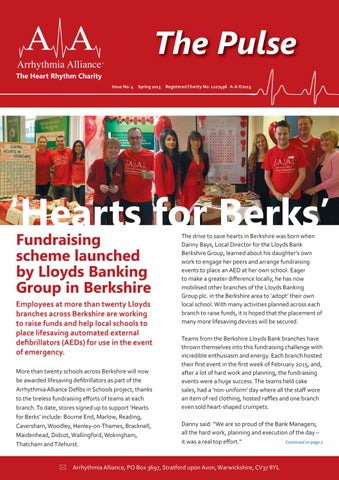
‘Hearts for Berks’ Fundraising scheme launched by Lloyds Banking Group in Berkshire
Employees at more than twenty Lloyds branches across Berkshire are working to raise funds and help local schools to place lifesaving automated external defibrillators (AEDs) for use in the event of emergency. More than twenty schools across Berkshire will now be awarded lifesaving defibrillators as part of the Arrhythmia Alliance Defibs in Schools project, thanks to the tireless fundraising efforts of teams at each branch. To date, stores signed up to support ‘Hearts for Berks’ include: Bourne End, Marlow, Reading, Caversham, Woodley, Henley-on-Thames, Bracknell, Maidenhead, Didcot, Wallingford, Wokingham, Thatcham and Tilehurst.
The drive to save hearts in Berkshire was born when Danny Bays, Local Director for the Lloyds Bank Berkshire Group, learned about his daughter’s own work to engage her peers and arrange fundraising events to place an AED at her own school. Eager to make a greater difference locally, he has now mobilised other branches of the Lloyds Banking Group plc. in the Berkshire area to ‘adopt’ their own local school. With many activities planned across each branch to raise funds, it is hoped that the placement of many more lifesaving devices will be secured.
Teams from the Berkshire Lloyds Bank branches have thrown themselves into this fundraising challenge with incredible enthusiasm and energy. Each branch hosted their first event in the first week of February 2015, and, after a lot of hard work and planning, the fundraising events were a huge success. The teams held cake sales, had a ‘non-uniform’ day where all the staff wore an item of red clothing, hosted raffles and one branch even sold heart-shaped crumpets. Danny said: “We are so proud of the Bank Managers; all the hard work, planning and execution of the day – it was a real top effort.” Continued on page 2
Arrhythmia Alliance, PO Box 3697, Stratford upon Avon, Warwickshire, CV37 8YL
The Arrhythmia Alliance Defibs in Schools project was developed in 2013 to support schools interested in placing defibrillators to help protect both students and staff in the event of emergency. The number of schools who have invested in the campaign has recently grown considerably, notably in response to the government establishing a provision for these life-saving devices in schools across the UK. Defibs in Schools joins the Arrhythmia Alliance Hearts & Goals and the Arrhythmia Alliance Bernard Gallacher Defibrillator Campaign under the Defibs Save Lives umbrella. Trudie Lobban MBE FRCP (Edin), Arrhythmia Alliance Founder and Trustee, said: “I am so very grateful to the teams at each and every one of these Lloyds branches. Their enthusiasm and passion for this vital cause is unparalleled.”
Trudie Lobban MBE
“Sudden cardiac arrest can strike anyone, at any time, and is the UK’s biggest killer, killing more people than breast cancer, lung cancer and Aids combined. All schools should have lifesaving AEDs available in cases of emergency.”
To date, fundraising events have already raised enough to place four AEDs in local schools, but the teams at the Berkshire Lloyds Bank branches do not plan on slowing down. With further fundraising events planned, including sponsored triathlons and charity auctions, we look forward to seeing many more schools protected under this initiative. Congratulations from everyone at A-A to all the staff members of Lloyds Bank Berkshire Group for your passion and for hosting such a fantastic first event! You are our new Fundraising Champions.
Is your local school registered under the Arrhythmia Alliance Defibs in Schools project? Please click here to learn more about lifesaving campaign in schools across the UK.
Become a Friend of Arrhythmia Alliance As a registered charity, Arrhythmia Alliance relies solely on supporters in order to continue providing valuable helpline services, information and educational activities. For just £15 per year or £2 per month, you can become a Friend of A-A and not only help us continue to help others, but also receive: •
Monthly eNews
•
Opportunities to attend local and national meetings
•
Free copies of our medically approved and Department of Health endorsed patient information sheets and booklets
•
2
A dedicated telephone helpline and email service
01789 867 501 @ info@heartrhythmcharity.org.uk
• Help in locating arrhythmia healthcare specialists • Opportunities to attend parliamentary events on arrhythmias
Sign up 01789 867 501
@ info@heartrhythmcharity.org.uk
www.bitly.com/becomeafriendofA-A
www.heartrhythmcharity.org.uk
Your stories Have a read of the some of the recent stories you have shared with us. From your experiences with catheter ablation through to treatment after sudden cardiac arrest, you have continued to share your experiences in great numbers and help provide an untold amount of support to others newly diagnosed or awaiting a procedure. Alison - I first started experiencing episodes of SVT in my early 20s. Episodes of my heart racing would last approximately 60 seconds, and then my heart would slow back down to its normal rhythm. They could happen anywhere, usually while I was resting. Stress and illness would bring on an attack. They happened very infrequently at first, once every 6 months or so. I wasn’t particularly worried at the time, so I did not seek medical advice. I was 26 when I fell pregnant with our first daughter. My heart started to race a little bit more often than usual. I mentioned it to my midwife at the next appointment; I was around 35+ weeks pregnant at this stage. Visit the Arrhythmia Alliance website to read the rest of Alison’s story and learn more about the catheter ablation procedure in her own words.
Sophie - I wanted to get my experience out there so that it might help others who either have this operation pending or have atrioventricular nodal reentrant tachycardia (AVNRT) and are struggling to decide whether or not to have cardiac catheter ablation. Had I of found something like this from someone my age before surgery maybe it would have helped me. From as far as I can remember, palpitations have always featured in my life. One memory in particular from when I was very young was getting overly excited on Christmas day about a new toy – this bought on extreme palpitations which then meant I spent the next two hours lying down. Visit the Arrhythmia Alliance website to learn more about some of the symptoms Sophie noticed shortly before she was diagnosed.
David - On 22nd November 2013, I suffered a sudden cardiac arrest whilst video-calling my mother. I was sat on the sofa with my wife, watching some Friday night television and video-calling my mother when I suddenly collapsed and went into a VF arrest. It had been a normal day; I had done a full day at work, picked my two young daughters up from school and cooked dinner. Once the girls were finally off to sleep, I took our dog for a quick run and returned home for a shower before joining my wife on the sofa. She rang for an ambulance and begun CPR on me straight away. When the ambulance arrived, the paramedics took over and shocked me with a defibrillator in order to restart my heart. I got back into a normal rhythm and I was whisked off to hospital. Read the remainder of David’s inspiring survivor story on the Arrhythmia Alliance Defibs Save Lives website.
Arrhythmia Alliance, PO Box 3697, Stratford upon Avon, Warwickshire, CV37 8YL
3
Where is your local ® The Heart Rhythm Charity
heart rhythm support group? London Syncope and PoTS Support Group Bradford Arrhythmia Support Group
ShefÀeld ICD Support Group Gloucestershire Arrhythmia Group Email daisy@heartrhythmalliance.org or call 01789 867 528 to conƤrm your place at the next meeting of your local group.
Is there a local Arrhythmia Alliance group near you? A local Arrhythmia Alliance aƥliated patient support group can provide an invaluable services to people diagnosed with arrhythmias and those close to them. These groups present a forum ideal for patients, their carers, friends and families to gain information, emotional support, share common experiences and learn more about their condition. For more information, support or to place an order for Arrhythmia Alliance patient information resources, please contact our dedicated Patient Services Team. Email jenni@heartrhythmalliance.org or call 01789 867 501. They are on hand to answer questions and provide information. If you are interested in Ƥnding out more about your local group, please contact Daisy Harris on 01789 867528 or email daisy@heartrhythmalliance.org You can Ƥnd out more by visiting our website: www.heartrhythmcharity.org.uk ®
www.afa-international.org
AfÀliate
4
www.stars-international.org
Registered Charity No. 1107496
AfÀliate
Fundraising How your funds help all those affected by arrhythmias £10 will help provide one hour of personalised support to a patient via our helpline about how to manage their condition
£35 will provide resources for a group learning how to save the life of someone suffering a sudden cardiac arrest using a defibrillator £80 will support an educational session for a class of school children learning about heart rhythm disorders
£150 will help set up a support group for arrhythmia patients and their carers
Donate
New online shop Please visit the Arrhythmia Alliance online shop to purchase Arrhythmia Alliance merchandise. From running vests to trolley key rings, we have a range of items available. All profits raised through the sale of items on our online shop help support our work to promote awareness and understanding of arrhythmias.
Medical Alert jewellery Our online shop now features personalised medical ID jewellery; used to highlight any pre-existing medical conditions and update medical professionals of any medications you are currently being prescribed. These devices are invaluable in providing healthcare professionals speedy access to medical information, which they might need to draw upon when treating someone in an emergency setting. Please visit our online shop to learn more.
Top 5 easy fundraising ideas for Arrhythmia Alliance
1. Homemade Party - invite your friends to bring homemade foods and drinks that they have made, with donations being made to the charity close to your heart. 2. Arts & Crafts Sale - Whether your talent is jewellery making, painting or woodwork, put your very best homemade goods up for sale at a unique arts & crafts sale for Arrhythmia Alliance. 3. Clothes Swap / Book Swap - Organise a swap shop at home, and invite all your friends and their friends to bring unwanted clothes and/or books. For each swap donate £1 to Arrhythmia Alliance. 4. Cake Sale - Organise a cake sale at your local community group, with all the proceeds going to Arrhythmia Alliance. 5. Give up something you love - Give up chocolate, wine, driving or something else that you love for a month or so and ask people to sponsor you or donate what you would have spent on these luxuries to us.
Latest additions The Fear by Mark Cunnington is a fictionalised version of real life events that have taken place during Mark's life. Mark's son Matt is central to this story; he survived a sudden cardiac arrest and subsequently became the first ever boy to gain a professional football apprenticeship after being implanted with an implantable cardioverter defibrillator (ICD). Read first paragraph and buy online
“The medical descriptions relating to sudden cardiac arrest are accurately written…something rare in newspapers and many books.” “The Fear is of great interest and an inspiration to others who have suffered a cardiac arrest.”
Arrhythmia Alliance, PO Box 3697, Stratford upon Avon, Warwickshire, CV37 8YL
5
Role of clinicians in your arrhythmia care and treatment Dr Kim Rajappan, John Radcliffe Hospital, Oxford UK
Have you ever wanted to learn more about the different people working in arrhythmia care and the role that they play in your treatment? Look no further than this easy to follow guide. GP The role of the GP in the care of arrhythmia patients cannot be underestimated. They are critical to ensuring that specialist advice given is carried out for the patient and monitored for any good or bad effects. If there is a change in the patient’s condition then the GP may be able to manage that themselves, or seek the advice of any one of the various people in this piece. Many GPs will have specialist interests, and for some this includes cardiology and arrhythmia treatment. Their role in anticoagulation of patients with AF is critical as they will see far more people with AF than any other doctors.
Anticoagulant nurse Appropriate anticoagulation is the most important aspect of atrial fibrillation (AF) treatment. In order to get this right specialist nurses will help in some hospitals/GP practices to, a) ensure that people who need anticoagulation are being offered it, b) that they are given appropriate counselling about why and which ones are available, and c) that the patient is then followed up appropriately and gets maximum benefit and minimum harm from taking any blood thinning medication. Their background will often be in haematology and whilst they are not specialising in Cardiology their role is key in reducing the risk of stroke in many patients.
Devices clinic / Catheter Laboratory The devices clinic is where you will go every six months or so to have your implantable device checked by a Pacing/ICD technician. A consultant EP and a team of nurses, technicians, and radiographers might work in the Cath Lab to perform elective surgery to treat arrhythmias. Procedures carried out here include catheter ablation and implants of pacemakers and ICDs.
6
Arrhythmia nurse This role is developed from a normal nursing role to provide the extended and specialist care that is often needed for arrhythmia patients. These nurses will often have a cardiology background and have then specialised in the care of patients with a variety of disorders. Some will also have even more extended roles that can overlap with cardiac physiologists and other roles outlined in this piece.
Electrophysiologist (EP) A cardiologist who specialises in the treatment of patients with heart rhythm problems is known as an Electrophysiologist. They will often provide a variety of services, including seeing patients referred to other medical professionals for an opinion and recommending specialised forms of treatment including medication. They will also assess anticoagulation in patients with AF and might recommend implantable devices and catheter ablation to eligible patients. EPs will perform procedures when appropriate and necessary.
Pacing/ICD manager and/or technician This person will normally be a cardiac physiologist who has responsibility for looking after patients with pacemakers and/or ICDs. They will often see patients in specific clinics to review how the devices are functioning and make any adjustments necessary to keep the devices working optimally. They can offer advice, liaise with the EP and will increasingly be monitoring devices ‘remotely.’
01789 867 501 @ info@heartrhythmcharity.org.uk
www.heartrhythmcharity.org.uk
Heart Failure / Cardioversion nurse These are two types of specialist nurses who may have a significant part to play in treating patients with arrhythmias. The Heart Failure Nurse will look after patients that often have an arrhythmia or cardiac device such as a CRT-pacemaker or ICD. The Cardioversion Nurse will normally arrange everything that is needed for a patient undergoing a cardioversion. This will include seeing them initially and ensuring they are on appropriate anticoagulation, ensuring it is monitored whilst the patient waits for the cardioversion, performing the cardioversion, and then following things up afterwards.
Cardiac Physiologist These are highly trained individuals who may have a variety of roles in the care of cardiac patients. These can include performing ECGs, supervising exercise treadmill tests and performing echocardiograms (ultrasound scans of the heart). They may also be even more specialised, and act as Pacing/ICD technicians and help in the Catheter Laboratory.
ICD nurse specialist This role developed from a normal nursing role to provide the extended and specialist care that is often needed for patients with ICDs. These nurses will often have a background in cardiology. They will often see a patient and provide them with information when they are first considered for an ICD, and then continue monitoring the patient when the ICD is implanted. These nurses provide a single contact point for queries, and some will also take part in the ICD implant and subsequent monitoring.
Question time with Dr Rajappan How many patients do you see on an average day? This varies on any given day. On a day when I have an outpatient clinic then I will see 30 or more. On a day when I am in the catheter lab performing procedures I may only see the patients that I treat. What do you enjoy most about your job? This is easy – the people! Not just the patients of course, a number of whom very much become friends, but also all of the wonderful team that I get to work with on a daily basis. It is also very easy to do a job where you see the transformation of people’s lives with treatment, such as ablation of Supraventricular Tachycardia (SVT) in patients who have had palpitations for decades and taken tablets for years. There are always new challenges and I still maintain that I learn something new every day so there is never a dull moment. How can a patient best prepare for an appointment with their consultant? A patient doesn’t necessarily need to prepare in any way before they see me. I just want them to come and tell me their story in their own words, perhaps with a bit of prompting from me too! If they have made a few notes about their symptoms, how often they happen, and if there are any things that trigger them then that can help. If the main problem is blackouts (or syncope as we would say) then an eyewitness version of events from someone else who has seen the patient blackout can be helpful too. Although there are some very good information resources out there, it is sometimes unhelpful if a patient has read something that is not quite correct so I would leave most of the information gathering to the consultation and then we can direct people to the best information sources.
We would like to reassure you that we will not share personal data with any third party outside Arrhythmia Alliance, or its sister charities AF Association and STARS. We comply strictly with the terms of Data Protection Act 1998. If you no longer wish to receive The Pulse newsletter, e-bulletins, or if you wish to have your personal details removed from our database altogether, please let us know and we will amend our database accordingly. Please email info@heartrhythmcharity.org.uk or phone 01789 867 501 if you wish to have your details removed from our database.
Arrhythmia Alliance, PO Box 3697, Stratford upon Avon, Warwickshire, CV37 8YL
7