www.heartrhythmcharity.org.uk
5 Autumn 2015
Issue No: 5 Autumn 2015
NOW IS THE TIME for Action to Save Lives
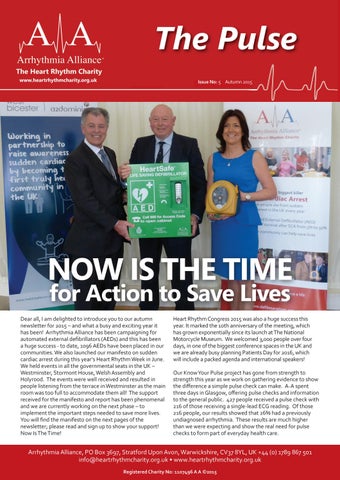
Dear all, I am delighted to introduce you to our autumn newsletter for 2015 – and what a busy and exciting year it has been! Arrhythmia Alliance has been campaigning for automated external defibrillators (AEDs) and this has been a huge success - to date, 1096 AEDs have been placed in our communities. We also launched our manifesto on sudden cardiac arrest during this year’s Heart Rhythm Week in June. We held events in all the governmental seats in the UK – Westminster, Stormont House, Welsh Assembly and Holyrood. The events were well received and resulted in people listening from the terrace in Westminster as the main room was too full to accommodate them all! The support received for the manifesto and report has been phenomenal and we are currently working on the next phase – to implement the important steps needed to save more lives. You will find the manifesto on the next pages of the newsletter; please read and sign up to show your support! Now Is The Time!
Heart Rhythm Congress 2015 was also a huge success this year. It marked the 10th anniversary of the meeting, which has grown exponentially since its launch at The National Motorcycle Museum. We welcomed 3,000 people over four days, in one of the biggest conference spaces in the UK and we are already busy planning Patients Day for 2016, which will include a packed agenda and international speakers! Our Know Your Pulse project has gone from strength to strength this year as we work on gathering evidence to show the difference a simple pulse check can make. A-A spent three days in Glasgow, offering pulse checks and information to the general public. 427 people received a pulse check with 216 of those receiving a single-lead ECG reading. Of those 216 people, our results showed that 26% had a previously undiagnosed arrhythmia. These results are much higher than we were expecting and show the real need for pulse checks to form part of everyday health care.
Arrhythmia Alliance, PO Box 3697, Stratford Upon Avon, Warwickshire, CV37 8YL, UK +44 (0) 1789 867 501 info@heartrhythmcharity.org.uk • www.heartrhythmcharity.org.uk Registered Charity No: 1107496 A A ©2015
2
“Today across the UK, up to 250 people will be struck down by sudden cardiac arrest and less than 20 will survive – in many other places across the world MORE THAN 100 of these people would survive and continue to live their lives.” TRUDIE LOBBAN MBE FOUNDER & TRUSTEE, ARRHYTHMIA ALLIANCE The Problem Every six minutes someone in the UK is struck down by sudden cardiac arrest. However, only one person in every hour will survive, yet in many other parts of the world five people an hour survive – why is this happening? What is Sudden Cardiac Arrest? Sudden Cardiac Arrest (SCA) is a condition in which the heart stops beating suddenly and unexpectedly due to a malfunction in the heart’s electrical system. The malfunction that causes SCA is a life-threatening abnormal heart rhythm; an arrhythmia. The most common arrhythmia is ventricular fibrillation (VF).When in VF, the heart’s rhythm is so chaotic (called “fibrillating”) that the heart merely quivers, and is unable to pump blood to the body and brain. Once a heart has entered VF, a sudden cardiac arrest may occur. All of this can happen quickly - in fact, in a matter of seconds... sudden cardiac arrest can strike anyone, at any time, any age, without warning. Unless treated immediately by CPR and defibillation this always leads to death within minutes.
The Solution
Arrhythmia Alliance believes… Now is the Time to stop talking and take action. We need to ensure the Chain of Survival is strong and used in the UK. We know what needs to be done to ensure at least 50% of those people with a shockable rhythm who suffer a SCA survive and continue to live their lives. Our Vision • Everyone (with a shockable heart rhythm) survives a sudden cardiac arrest. Our Aim • By 2020, 50% of sudden cardiac arrest victims in the UK, with a shockable heart rhythm, will return home alive and neurologically intact.
www.heartrhythmcharity.org.uk • info@heartrhythmcharity.org.uk
3 Our Seven Task Asks: Arrhythmia Alliance (A-A) has identified seven critical aspects of the Chain of Survival that when improved and embedded into practice will dramatically increase the number of lives saved from SCA. 1. Increase bystander action A-A will launch a public ACTION campaign at Heart Rhythm Congress 2015: ‘Now is the Time...for you to save a life’. Working in partnership with other stakeholder groups, A-A will convert existing awareness into action by building on and integrating all existing awareness and educational initiatives into a focused umbrella media campaign that will engage the public to act. 2. Increase the number of First Responders & co-responders Engage the existing network of Olympics and Commonwealth Games volunteers to increase the number of First Responders. Identify other groups where volunteering is a major part of their remit, for example Scouts, Girl Guides, RVS and build CPR training and AED familiarisation into their work. Emergency Services to work together and Fire and Rescue Services of Great Britain to build on good practice and become emergency co-responder service. 3. Ensure directive action by emergency service operators is mandatory All emergency service operators/dispatchers to be trained: • To use simple questions with caller to confirm a potential diagnosis of SCA • To direct bystanders on ‘hands-only’ CPR • To locate and direct immediate access to nearest AED • To dispatch nearest emergency service: first responder, co-responder (fire service), RRT 4. Improve quality of bystander ‘hands-only’ CPR Building on the success of other countries, ensure co-ordinated CPR training and AED familiarisation courses for schools and colleges are included in educational curricula as part of PHSE and good citizenship programs. Target additional training and familiarisation programmes towards young people (17-24 year olds) through inclusion of CPR training and AED familiarisation as part of learner driver scheme.
3
5. Efficient mapping and placement of AEDs A-A will build on the existing AED Locator national database in partnership with the UK’s ambulance services to create an efficnt AED mapping process and work with new technology partners to make this a reality (e.g. Android companies engaging with the NHS); request and require that ALL those raising funds for, and placing, AEDs log their details with the national database. A-A will work with the AED manufacturers and distributors to ensure all details of purchased AEDs are submitted to the national database so that these can be cross-referenced, tracked and logged; and ensure tracking and mapping devices are built into their latest AEDs and cabinets. Identification of existing AEDs through an efficient mapping process will provide a baseline from which a ‘National AED placement strategy’ will be created and implemented. 6. Embed an integrated management approach to the enhanced Chain of Survival A-A will co-ordinate all existing efforts from across the UK to ensure an enhanced, integrated Chain of Survival. All stakeholders - charities, emergency services, AED manufacturers, public health, healthcare professionals and policy makers - to become part of an Alliance for Action to ensure that the enhanced Chain of Survival is embedded across the UK. 7. Raise standards of practice through audit and evaluation of every event All SCA events will be recorded to determine what happened, what went well, what went wrong, what can be learnt and what needs improvement. This will become our audit and evaluation tool through which a national sudden cardiac arrest registry can be created.
truck , only in many our
est?
on in and e heart’s auses rhythm; thmia , the lating”) ble to a rrest
pulse, y to loses
d take hain of UK. o e with CA ves.
t arrest.
arrest heart
4
Time and the Chain of Survival The survival chances of a person in SCA decreases by 10% for every minute untreated. Survival from SCA without immediate CPR (cardiopulmonary resuscitation) and prompt defibrillation is less than 5%; administration of high quality CPR can increase survival to 9%, but when combined with timely defibrillation, survival from SCA with a shockable rhythm, can reach in excess of 50%. Time is the most critical factor in determining if someone will survive SCA: • Time for someone to start CPR • Time for defibrillation to be administered by use of an automated external defibrillator (AED) • Time to ROSC (return of a pulse and spontaneous circulation) and rapid administration of advanced life saving skills • Time to get the resuscitated victim to an appropriate cardiac centre for treatment All of these elements form part of the ‘Chain of Survival’ which a person must be taken through successfully in order to survive SCA and leave hospital alive and neurologically intact. Effective implementation of each step of the ‘Chain of Survival’ has been proven to dramatically increase survival from SCA.
All of this can happen quickly in fact, in a matter of seconds... Sudden Cardiac Arrest can strike anyone, at any time, any age, without warning. Unless treated immediately by CPR and defibrillation this always leads to death within minutes.
Our Seven Task Asks:
Driving policy on arrhythmias A-A was launched in 2004Alliance at the start ofhas theidentified first Arrhythmia (A-A) seven critic Heart Rhythmand Week in Westminster to raise embedded into practice will dramatically incre awareness and highlight the deficiencies in the treatment and1.care of arrhythmia sufferers. Increase bystander action A-A established a respected relationship with the A-A will launch a public ACTION campaign at government, resulting in a significant and vital Heart Rhythm Congress 2015: change within Government policy. ‘Now is the Time...for you to save a life’. Working in partnership with other stakeholder groups The charity was fundamental in pushing through A-A will convert existing awareness one of the most essential policy issues to affectinto action by and integrating all existing cardiology andbuilding cardiaconpatients, resulting in the awareness and educational initiatives into a focused umbrella media inclusion of the new Chapter 8 on Arrhythmias campaign that will engage the public to act. and Sudden Cardiac Death in the National Service Framework (NSF). Beforethe lobbying began, theresponders word 2. Increase number of first ‘arrhythmia’ was mentioned only once in the NSF for & co-responders Coronary Heart Disease; there were no guidelines Engage the existing network of Olympics and Commonwealth Games volunteers to increase dictating diagnosis, treatment or care for those with the number of first responders. other heart rhythm disorders relating to the Identify ‘electrics’ of groups where volunteering is a major part of their remit, for example the heart.
Scouts, Girl Guides, RVS and build CPR training and AED familiarisation into their work. Emergency services to Raising awareness of arrhythmias work together and Fire and Rescue Services of Great A-A runs awareness events throughout theand year, Britain to build on good practice become culminating inemergency an annualco-responder World Heartservice. Rhythm Week
and Arrhythmia Awareness Week held every June which encourages old and new supporters 3. Ensure directive action byto emergency service operators is mandatory promote awareness of cardiac arrhythmias. During emergency service operators/dispatchers Heart RhythmAll Week 2015, A-A is focussed on Detect, to be trained: Protect, Correct.
• To use simple questions with caller to confirm a potential diagnosis of SCA More than two million people in the UK have a heart • To direct bystander ‘hands-only’ CPR rhythm disorder – an arrhythmia - and as a core part • To locate and direct immediate access to nearest AED of its work, A-A aims to secure early diagnosis and first • To dispatch nearest emergency service: improve outcomes for these individuals. responder, co-responder (fire service), RRT 4. Improve quality of bystander Through its ‘Know Your Pulse’ campaign, A-A has ‘hands-only’ CPR been instrumental in the recent decision by the Building on the success of other countries, ensure National Institute for Health and Care Excellence co-ordinated CPR training and AED familiarisation (NICE), on their clinical guidelines on health checks. courses for schools and colleges are included in These recommend that practitioners perform a educational curricula as part of PHSE and good pulse check before taking blood pressure to detect citizenship programs. Target additional training and any pulse irregularities. Following this, towards individuals familiarisation programmes young people who are found(17-24 to have an irregular pulse should be training and year olds) through inclusion of CPR referred to their GPfamiliarisation for further investigation. AED as part of learner driver scheme.
Defibs Save Lives! Commitment: Toofensure the long-ter A-A works to support the placement Automated External Defibrillators (AEDs) up specific The seven tasksand focushas on set the first few critical minutes t campaigns to help increase the numbers of these there is also a significant need to ensure the long-term life-saving devices incan local communities. they return home alive and neurologically intact. A
board and relevant healthcare professional gr me... for you to save a life ...’ Campaigns suchadvisory post-resuscitation care, together with as Hearts & Goals, supported by an audit and eva
SCA survivor Fabrice Muamba, and the A-A Bernard Gallacher Defib Campaign, spearheaded by SCA survivor Bernard Gallacher, and supported by the
www.heartrhythmcharity.org.uk • info@heartrhythmcharity.org.uk
Mark - I survived a sudden cardiac arrest In December 1994, with no prior warning, I suffered a cardiac arrest on the street outside my office in North West London. Whilst the people in my office dialled 999, my boss administered CPR. He’d never done it before, but obviously, it worked until the paramedics arrived! I was defibrillated on the spot by the paramedic who, fortunately, was equipped with an AED. It took them half an hour to get a stable enough heartbeat to enable them to transfer me to the local A & E unit. I did not regain consciousness until the following day. I have no recollection of that episode until my wife told me the story in the cardiac ward. I was defibrillated on the spot by the paramedic who, fortunately, was equipped with an AED. One month later, I received an implantable cardioverter defibrillator (ICD). I went home a week after the implantation and eight weeks later, arrested at home.
Professional Golfers Association (PGA) raise awareness of sudden cardiac arrest and the important role of CPR together with access to, and prompt use of, an AED can make in saving lives. Together with local community and school initiatives, over 1000 AEDs have been placed by A-A since 2013. But more, much more, still needs to be done!
Commitment: To ensure the long-term survival of resuscitated SCA patients. The seven tasks focus on the first few critical minutes that will determine a victim’s chances of survival. However, there is also a significant need to ensure the long-term survival of those SCA patients who are resuscitated so that they can return home alive and neurologically intact. Arrhythmia Alliance proposes working with its medical advisory board and relevant healthcare professional groups to review and develop guidance for high-quality post-resuscitation care, together with an audit and evaluation process, so that patient survival is not in vain.
The ICD delivered a shock, as expected and saved me. I received two further shocks whilst fully conscious that year and was put on a beta blocker to control my tachycardia. The arrhythmia that had almost killed me was ventricular fibrillation. The most likely cause of this was a prolapsed mitral valve which I was born with; although causing me to have a diagnosed heart murmur, it was never symptomatic. I suffered another arrest in January 1999 whilst asleep at home. My ICD saved me again. I am now waiting for my fourth ICD to be implanted in early November, which is only necessary due to battery life. I haven’t suffered any further arrests since 1999, possibly due to having finally had open heart surgery in 2003 to replace my faulty mitral valve with an artificial one. My ICD saved me again. My family have been fantastic throughout all of this and I am still alive and kicking 20 years on at the age of 67. I have been doing so well that my cardiology registrar has reduced my beta blocker dosage by a third. My prognosis is optimistic, I suppose. Life has become almost routine except for regular monitoring of my now wireless ICD. Onward and upward! Mark, Middlesex (2015) Share your story
Share your story and help others who may be awaiting or undergoing treatment for an arrhythmia. Your words can support and reassure patients on the road through treatment as well as those newly diagnosed or caring for someone with an arrhythmia. Many of the people we speak to via our helpline are unsure about what to expect and the treatment options available to them; your words present a real-life account that can be shared to promote awareness and improve understanding of arrhythmias. Help us to help others, with your consent we will use your words and your voice as ammunition to promote awareness and lobby for improvements in diagnosis and management of arrhythmias. Email your story to info@heartrhythmcharity.org.uk or write to Patient Stories at Arrhythmia Alliance, PO Box 3697, Stratford upon Avon, Warwickshire, CV37 8YL.
Helpline: 01789 867501
6
Defibs Save Lives Arrhythmia Alliance works to support the placement of lifesaving automated external defibrillators (AEDs). FACTS & FIGURES When CPR chest compressions and a defibrillator are used together chances of survival from SCA increase from 9% to 50%. Every year in the UK, 100,000 people die of sudden cardiac arrest, making it the nation’s biggest killer. It kills more people than lung cancer and AIDS combined. Anyone can suffer a sudden cardiac arrest anywhere, atany time, regardless of their age or fitness level. What to do if someone suffers a sudden cardiac arrest? 1.Dial 999 for emergency services immediately 2.While you wait for paramedics, give CPR 3.Use an automated external defibrillator (AED) to restart the heart. You do not need training to use an AED, they are designed to guide the user with visual or vocal prompts on when to shock the person and how. The device will not work unless it is placed correctly. Therefore it is safe and straightforward to use.
Number of deaths from alternative causes in 2012
Previous campaigns and projects have included: Arrhythmia Alliance - Hearts & Goals Campaign – aims to place AEDs in all sports clubs Arrhythmia Alliance – Defibs in Schools Project – This was developed to support the 2014 government initiative to place these life-saving devices in schools. Arrhythmia Alliance – Bernard Gallacher Defibrillator Campaign – With support from Bernard Gallacher we are placing defibrillators into all golf clubs. Arrhythmia Alliance – Lloyds Banking Group plc. – Lloyds Banks in the Berkshire area are fundraising in order to place AEDs in their local schools. Arrhythmia Alliance – Lilly – May Page - Lilly-May suffered a sudden cardiac arrest at the age of 5 in May 2014. In her memory we encourage people to fundraise for defibrillators to be placed into local schools. Our current campaign, Defibs Save Lives is one that everybody can join in to make their community HeartSafe. If you are interested in becoming involved, and would like further information please call 01789 867501 or email info@defibssavelives.org
www.heartrhythmcharity.org.uk • info@heartrhythmcharity.org.uk
7
How to Fundraise for an AED There are lots of ways to raise money to support our vital work. From cake sales and bring-and-buys to marathons and skydives, whatever you decide to do, we will support you all the way. Have a look at our ideas and challenge events on our fundraising page, or create your own. John Clayton Fundraiser John Clayton, from Billingham, suffered a sudden cardiac arrest (SCA) on 4 April 2010 whilst playing football in a charity match. Unfortunately, John did not survive the SCA and sadly passed away, leaving behind his wife, four children and parents. Since then, John’s family have come together and fundraised tirelessly through our Hearts & Goals campaign in order to place automated external defibrillators (AEDs) in communities and sports clubs. Arrhythmia Alliance would like to say a huge “thank you” to the Clayton family and friends for placing 8 AEDs in their community. Team Graham Rides again On the 6th September a team of 5 tackled the London to Brighton cycle again to raise money to place their second AED into her local community in memory of Heather Richards’s husband, Graham Richards. The team have raised £1,135! Well done to all the team and thank you!
Where will my money go?
However much money you raise, you can make a big difference and help raise further awareness of arrhythmias. With your help, we are able to continue providing support to improve the diagnosis, treatment and quality of life for all those affected by arrhythmias. £10 will help provide personalised support to a patient via our helpline about how to manage their condition £35 will provide resources for a group learning how to save the life of someone suffering a sudden cardiac arrest using a defibrillator £80 will support an educational session for a class of school children learning about heart rhythm disorders £150 will help set up a support group for arrhythmia patients and their carers Make a Donation now to make a difference to arrhythmia patients
Helpline: 01789 867501
8
Fundraising From all of us at Arrhythmia Alliance, we’d like to send a huge thank you to all of our fundraisers! Sorry to those not shown, we just have too many fantastic fundraisers to list! Having an ICD didn’t stop Jake from taking on the London Bridges Challenge for Arrhythmia Alliance. Well done Jake and thank you for raising £160 for the charity close to your heart. Thanks to huge support from friends and family, Simon smashed his fundraising target and raised £447.50 for Arrhythmia Alliance by taking on the Stratford Half Marathon. Thank you Simon, we hope you’ll recover in time to run again next year! Paul and Keith joined thousands of runners at this year’s London Marathon raising a fantastic £3000 between them. We’re so grateful to both of you for representing us and doing a fantastic job to raise much needed funds. Family and friends of Charlie, rallied together in his memory to raise money for a defibrillator. Led by Charlie’s wife Rosie who arranged a polo tournament, raffle and hog roast, the group raised a tremendous £2896.82. It really is wonderful to see you all doing something positive in his memory, thank you. Father and son team Will & Tom took on the British 10k London Run for Arrhythmia Alliance raising £500. They told us “We finished in just over an hour. I can now see how people get the bug for this!
The atmosphere in central London was brilliant.” Adel held a work charity day, and with the support of her employer and colleagues raised a fantastic £992. Husband David followed suit with his friend to raise £350 doing the Great Manchester Run. It’s great to see your family spirit, we hope you will rally the family again soon. A special thanks to you all. Olivia (age 3) was inspired by her Mum running a marathon and wanted to take part in her own ‘big race’ so took part in the Bupa Westminster mile and raised an amazing £325. What a fantastic achievement, well done Olivia!
You can donate online using JustGiving - a secure donation website. Donate by phone by calling 01789 867501, or by post, click here to print form. Payroll Giving - Give as you earn, tax-free straight from your Payroll, Find out more here. Or Text HART46 followed by the amount in full pounds to 70070 e.g. HART46 £5 to 70070
9 A big thank you to Eileen for raising a tremendous £1065 for Arrhythmia Alliance. After setting herself the challenge of completing the sprint Triathlon at Virgin Active Lichfield, Eileen beat her target time and finished in an amazing 67 minutes, congratulations. Thank you to the Great British Food Festival at Stoneyhurst College for choosing to support Arrhythmia Alliance and raising a fantastic £207.38.
Have you visited our online shop yet? We stock t-shirts,keyrings and even two new DVDs - a dance exercise programme to help ‘Make Your Heart Feel Good’ featuring Strictly Come Dancing stars Flavia Cacace and Russell Grant, and a new Tai Chi & Relaxation programme for patients with high blood pressure combines mild exercises at home with relaxation techniques.
St Swithuns Stores in Dorset has raised an amazing £240 after coming up with the brilliant idea of setting up a second hand bookstall, thank you so much for your support!
Donate to Arrhythmia Alliance with your Travel Insurance When you have been diagnosed with a heart condition it can be very difficult and expensive to find travel insurance. Arrhythmia Alliance has found several insurers who are sympathetic to travellers who have a heart condition, find our list of insurers on our website or call 01789 867501 for more information. What’s more, many insurers have offered to make a donation to Arrhythmia Alliance for every policy purchased through us.
Helpline: 01789 867501
10
HRC Award winners 2015 Individual who has Contributed the most to Arrhythmia Services Dr Joseph De Giovanni, Birmingham Children’s Hospital Dr Giovanni has been at the forefront of Paediatric Electrophysiology and Arrhythmia care in the UK. He is an inspirational person in this field - he started the first EP ablation practice and implanted the first ICD in children in the UK. He has provided excellent service not only for the patients in the UK but also helped similar services to be developed in Europe and beyond. Team of the Year Award Westcliffe Community Cardiology Service From its conception as essentially a triage service for cardiology referrals from North Bradford PCT, the Westcliffe Cardiology Service has steadily evolved to an innovative service for both patients and clinicians, influencing the wider health environment. Charles Lobban Volunteer of the Year Award Lloyds Bank, Berkshire Lloyds Berkshire have carried out some amazing fundraising across the country and have given up a huge amount of their time to help place defibrillators in the Berkshire area. This has been through bake sales, coffee mornings, triathlons and marathons. It is clear that this team of people have a huge passion and dedication towards reducing the number of deaths in the UK from SCA. Medical Professional of the Decade Professor Blair Grubb Prof Grubb is a distinguished professor of medicine, cardiovascular medicine, paediatrics and Director of Electrophysiology Services. He is considered one of the world’s foremost authorities regarding syncope and dysautonomia, and has published hundreds of journal articles in the field of electrophysiology and autonomic research. Not only this but he has received a number of prestigious awards for his dedication and commitment to the profession of medicine. This year he has been recognised as one of America’s Top Doctors, which only 1% of doctors in America receive. Prof Grubb is described as having a dignified and quiet demeanour who demonstrates compassion, humility, patience and thoughtfulness in his interactions with staff, colleagues, medical students and patients. He is the quintessential gentleman and scholar. www.heartrhythmcharity.org.uk • info@heartrhythmcharity.org.uk
11
Introducing Professor John A Camm
Biography
Professor A John Camm is an internationally renowned expert in atrial fibrillation (AF). Professor Camm is President of the Arrhythmia Alliance, and also Co-Founder and Trustee of the AF Association. Professor Camm forms an integral part of the steering committee of the charity, working on the future direction and work plans. He regularly advises on projects and campaigns, as well as recommending the Arrhythmia Alliance to potential funders. Professor Camm has been involved in the production of numerous clinical guidelines. For example, he chaired the committee responsible for producing the European Society of Cardiology Guidelines for the management of atrial fibrillation, first published in 2010, and updated (with the European Hearth Rhythm Association) in 2012.
Cardiology Training • Professor Camm studied medicine and graduated at Guy’s Hospital Medical School, London Appointments • Professor of Clinical Cardiology at St. George’s University of London • Professor of Cardiology at Imperial University, London • Trustee of the Drug Safety Research Unit • Trustee of the International society of Pacing and Electrophysiology (now World Society of Arrhythmias) • Trustee of AF Association • Editor-in-Chief of Europace and Clinical Cardiology • Editor-in-Chief of the European Society of Cardiology Textbook of Cardiovascular Medicine • President of Arrhythmia Alliance • Awarded the Gold Medal of the European Society of Cardiology Research Interests • Cardiac Arrhythmias • Atrial Fibrillation • Stroke prevention • Anticoagulation • Clinical cardiac electrophysiology • Cardiac pacemakers • Heart Failure • Cardiomyopathy patients
He led the production of 2010 guidelines for England and Wales from the National Institute for Health and Care Excellence (NICE) about the treatment of unstable angina and NSTEMI (non-STsegment-elevation myocardial infarction – a type of heart attack). “The Arrhythmia Alliance brings together all of those who have an interest in heart rhythm disturbances and is a highly effective in promoting timely diagnosis, appropriate assessment and optimum treatment for those living with rhythm abnormalities that cause them symptoms or threaten their lives or livelihood.” Professor Camm has written or edited more than 40 books. He has authored or co-authored almost 1100 peer reviewed papers, more than 500 book chapters and has delivered more than 500 international lectures. He is particularly interested in clinical cardiac electrophysiology, cardiac arrhythmias and implantable devices for rhythm control. “I went into medicine because as a young boy I had to choose between history and biology and I chose biology. That seemed to consign me to a career in medicine. Interestingly I went into cardiology because I was fascinated as a medical student with the electrocardiogram. I studied it so much that I gained a reputation as the student who understood the electrocardiogram well. Although I tried several times to escape from cardiology, I always came back to it.” You can find Professor John Camm on our Heart Rhythm Specialist website. To find out if your doctor is registered please visit: www.heartrhythmspecialists.org
Helpline: 01789 867501
12 Providing information, support and access to established, new or innovative treatments for atrial fibrillation
AF Aware Week 23-29 November
AF Aware Week helps raise awareness of atrial fibrillation and this year highlights the importance of detecting via a simple pulse check, protecting against AF-related stroke through the use of appropriate anticoagulation and ultimately correcting the heart rhythm.
Key Messages 1. One in four people will develop AF; it affects an estimated 1.5 million across the UK and in excess of 16 million worldwide. 2. Every 15 seconds someone suffers an AFrelated stroke. AF is the most powerful single risk factor for suffering a deadly or debilitating stroke. 3. AF can be detected cheaply and easily with simple manual pulse checks. 4. Treatment with an anticoagulant is vital to reducing the risk of stroke. 5. For AF Aware Week, make the detection and protection of AF a priority.
The aims of AF Aware Week are simple: Detect:
A simple pulse check is the easiest way to detect an irregular heart rhythm. The importance of pulse checks should be widely publicised and undertaken both inside and outside of medical practices.
Protect:
AF is the single most relevant risk factor for stroke, increasing an individual’s risk five-fold and being responsible for at least 20% of all ischaemic strokes. AF-related strokes have the worst prognosis for severe disabling and mortality rates. Identifying and treating AF at an early stage will deliver significant health and cost benefits.
Correct:
Early detection, diagnosis and appropriate medical management leads to fewer appointments and admissions, saving individuals from long term ill-health. Information regarding AF risks, symptoms and therapy options should be routinely made available to all suspected and diagnosed patients and their carers. Patients should be monitored and reviewed within four weeks of initiation of therapy and referred for specialist consideration if first line therapy has not sufficiently improved symptoms.
AF Aware Week resources can be downloaded from www.afa.org.uk or contact t.murphy@afa.org.uk. www.heartrhythmcharity.org.uk • info@heartrhythmcharity.org.uk
13
Resources Please note, we currently have limited stock of our ‘ICD’ and ‘Physical Activity’ booklets which are going to be made online only resources. Order your copies while stocks last. For bulk orders please call 01789 867 501. Our new and combined CRT/ICD/S-ICD Patient Information booklet is now available. To order your copy, please email mark@heartrhythmalliance.org.
™
rg.uk
www.heartrhythmcharity.o
CRT / ICD / S-ICD Patient lnformation
IMPORTANT: Statement on Device Malfunction Following recent, inaccurate media reports on supposedly faulty devices the following statement is being issued jointly by Arrhythmia Alliance and British Heart Rhythm Society. Medical devices such as pacemakers and implantable cardioverter defibrillators ICDs are used to help manage and in the case of an ICD, prevent avoidable deaths due to a potentially fatal arrhythmia (heart rhythm disorder). These devices do not cure the arrhythmia, they monitor and correct as appropriate. Similar to chemotherapy treatment for cancer, medical devices prolong life and improve the quality of life for those suffering with cardiac arrhythmias. To read the full article please click here
AliveCor Heart Monitor AliveCor Inc. is a global innovator in mobile technology for heart health.The AliveCor Mobile ECG is powered by the free AliveECG app that runs on compatible smartphones or tablets. The AliveCor Mobile ECG records accurate ECGs and heart rate anywhere, anytime at an affordable cost
ent ve the diagnosis, treatm Working together to impro hmias those affected by arrhyt and quality of life for all
rg.uk
ythmcharity.o www.heartrh Registered Charity No. 1107496
Physical activity and exercis e advice for patients with an lCD
Watch BP Blood Pressure monitor The WatchBP home A is a blood pressure monitor that has the capability to detect AF with high accuracy during blood pressure measurement, without any extra effort. Promoting better understandin g, diagnosis, treatment and quality of life for those affected by heart rhythm disorders (cardiac arrhyth mias)
www.heartrhythmcharity .org. Registered Charity No. 1107496
uk
To find out more about these devices or purchase from Amazon please click here.
Helpline: 01789 867501
Go online: www.heartrhythmcharity.org.uk TM
THE S-ICD SYSTEM LEavES THE HEarT UnToUCHED
Take care of your heart so it can take care of you. Learn more about Sudden Cardiac Arrest and the available ICD treatments, visit www.s-icd.eu and find patient stories, info booklets, FAQs and much more.
14
Helpline: 01789 867501
15
Benefit now by becoming an Arrhythmia Alliance Friend As a registered charity, Arrhythmia Alliance (A-A) solely relies on Friends to continue to offer our valuable information and advice service. There are many benefits of becoming a friend today:
Become an A-A Friend Monthly
50% discount
Bi-annual
e-news
for Patients Day
newsletters
Support in finding
A dedicated helpline
Online
a Heart Rhythm Specialist
01789 867501
support networks
Personalised support
Access to regional
Free copies of
support groups
Arrhythmia Alliance publications
via email:
info@heartrhythmcharity.org.uk
Please become a Friend today to help us continue to help you.
The Heart Rhythm Charity
www.heartrhythmcharity.org Registered Charity No: 1122442