THE HIP-HOP ORCHESTRA EXPERIENCE
with Rodney Outlaw
Comon Pholk
5th Element Project
Friday, April 24 | 8 PM
Cordiner Hall
Made possible by the WW Symphony Guest Composer/Artist Fund - Underrepresented Voices
Supported in part by a grant from
ORCHESTRA PERSONNEL
Violin I
Vanessa Moss*, concertmaster
Henrietta Baker Kennedy Memorial Chair
Ken Wright
Mary Ann Ringgold Memorial Chair
Tricia Rice*
Carroll N. Baker Memorial Chair
Violin II
Việt Block *, acting principal
Robert C. and Iris Myers and Agnes V. Little
Memorial Chair
Alyssa Stremcha*
Anna Okada

Viola

Lyn Ritz*, acting principal
Walter and Elizabeth Egg Memorial Chair
Dan Wing
James and Dorothy Swayne Memorial Chair
Angela Schauer*
Cello
Edward Dixon*, principal
Grace Lazerson Memorial Chair
Annie Harkey Power
Harold E. Crawford Family Chair
Katherine Pearson
Mary Hooper Meeker Memorial Chair
Bass
Marella McGreal*, acting principal
Don and Claudia Tucker Chair
Soprano
Molly Holleran
Flute
Leonard Garrison*, principal Louis B. Perry Family Chair
Oboe
Pablo Izquierdo*, principal Emma Jane Brattain Memorial Chair
Clarinet
Shannon Scott*, principal William Tugman Memorial Chair

Bassoon
Ryan Hare*, principal
Helen Shepherd Trust Memorial Chair
Kirsten Boldt-Neurohr*
French Horn
Martin King*, acting principal
Coffey Communications Chair
Rebekah Schaub*
Stage Manager
Sara Pinkerton
Cordiner Hall Technician
Connor Anderson
Recording Engineer
Michael Simon
* Indicates members of the core orchestra
5TH ELEMENT PROJECT DANCERS
Born and raised in Denver, Colorado, Joshua Glenn is a hip hop dancer and urban choreographer, representing ThaHomies Dance Crew.

Peter de Grasse 'Studious P' (404 Crew/5th Element Project) is a career concert dancer turned college lecturer and co-founder of 5th Element Project, a local non-profit supporting Hip Hop culture and education in the Walla Walla area.
Meztli Mariscal Del Toro is a social dancer from Mexico who shares a love for all styles of dance, especially choreo.
Alejandro Mata represents Los Primos, a local Walla Walla Bboy crew, under the name That Pretty Matafacka.
Louie Miranda 'Bboy Louie' (Soul Felons/The Hoodz/5th Element Project) is a co-founder of 5th Element Project who has taught breaking to young people in Walla Walla for many years through a variety of institutions including Friends of Children of Walla Walla, 21st Century Community Learning Centers, YCCY, and others.
Ginny Robinson is a career dancer, personal trainer, and fitness instructor from the Pacific Northwest. Her approach to movement and fitness focuses on accessibility, education, and creating sustainable, confident connection to self.
Cynthia Saldaña is a hip hop dancer and teacher at Walla Walla Dance Company who is passionate about diversifying her knowledge and experiencing new dance opportunities.
Terri Berkshire
Laura Hall
June McKenzie
Nico Banderas
Sofia Banderas
Jaden Gooding
VOLUNTEERS
Deb Reno
Laura Sellens
LOBBY CREW
Eliza Juers
Henry Juers
Jill Juers
Sophia Sorensen
Jen Walden
Tarah Knight
Joseph Mallen
Nora Parsons
Ruby Taylor-Payne
We are grateful to our volunteers and lobby crew for helping make every concert welcoming for our community.
Want to get involved? Volunteer opportunities include ushering, helping with mailings and office work, and distributing posters around town. It’s a great way to meet people and support the arts in Walla Walla.
To learn more, contact Volunteer Coordinator Susan Greene at susan@wwsymphony.org
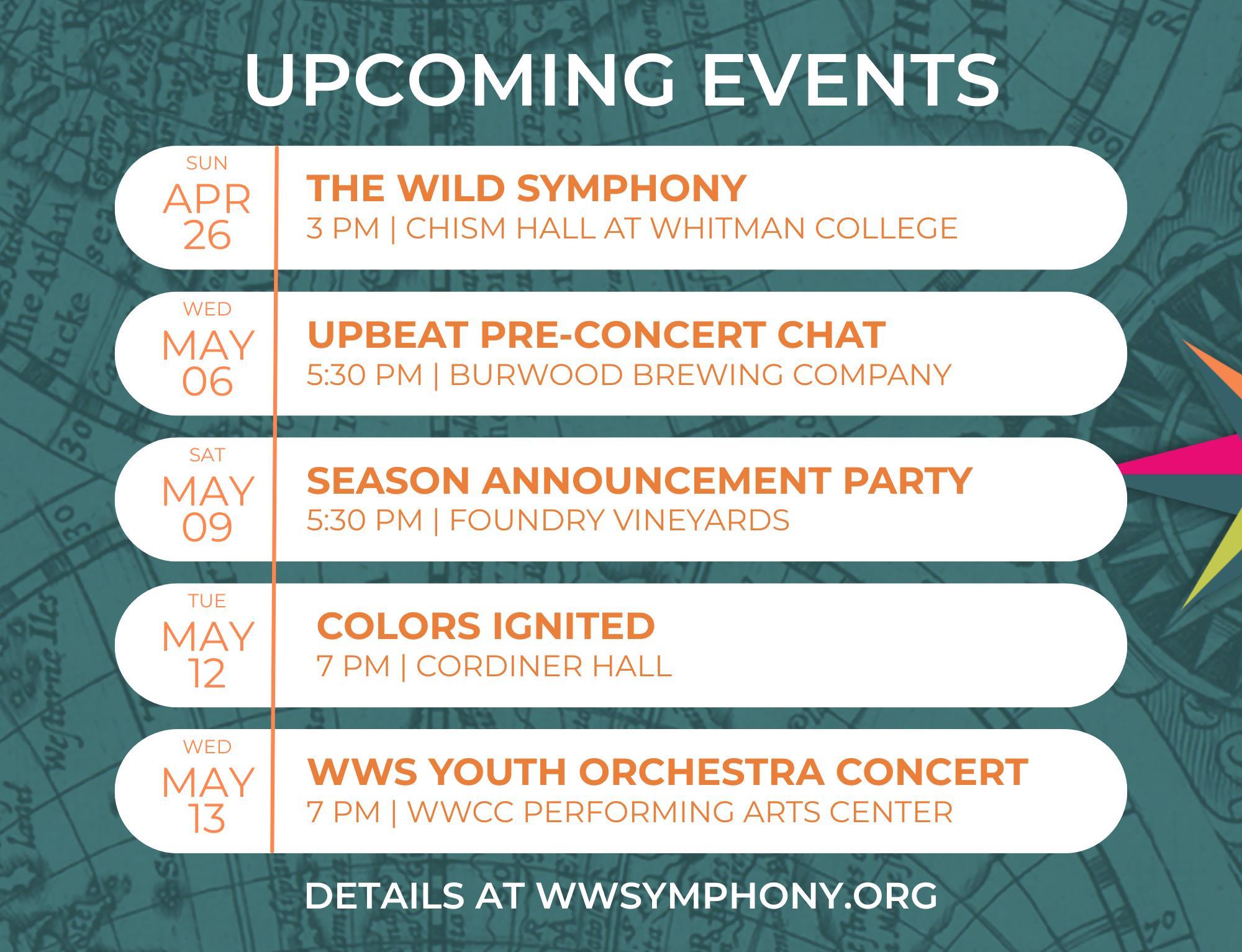
Join us for Sips & Sweets

in the lobby before the concert (until 6:50 PM) and during intermission. Enjoy a glass of wine from our featured winery, with all proceeds supporting the Symphony. Sweet treats and nonalcoholic beverages will also be available for purchase.

Scan for menu

Thank you to our donors this season
This list reflects gift made after January 16, 2026. A full listing is available on pages 40-42.
Bronze Circle $2,500-4,999
Mike and Sue Gillespie
Brenda Ramirez
Benefactor $1,000-2,499
Bob and Maryjo Fontenot
Lynn Glesne
Kathy Lamb
Wendy and Dick Rahm
Kent and Eileen Settle
Karen Summers and Bill Hickey
Margaret Tyson
Patron $500-999
Squire Broel
Gary and Helen Brownell
Drs. Elaine Eaker and Katherine Nordal
Gary and Helen Brownell
Dave Glenn and Laura Curtis
Michael and Terri Norwood
Ryan and Madeline Pennington
Lacey Perry
Ken and Kristin Reali
Robert and Jill Zagelow
Friend $200-499
Lance and Jet
Genta Ohgushi
David and Katie Rosenthal
Leah and Tor Sandven
Donor $75-199
Kathryn Amende
Sandra Coats
Fergus Coffman
Judy Gray
Michael and Kelli Ketover
Sterling McConnell
Chris Nulph
Susan and Don Zimmerman
Tricia Rice
Contributor – up to $75
Angela Aldrich
Bruce and Kay Barga
Michelle Conner
Katie Donlin
Melissa and Dean Holecek
Ray Isely
Suzanne Johnson
Karlton Keller
David Koenig
Alicia Malara
Aaron McAdie and Elena Velkov
David Obershaw
Jessica Taylor
Heidi Veldhuis
Hui Wan
Janice Zimmerman
In Memory of
Maurice Coats
Brenda Ramirez
If you enjoy this performance, we encourage you to consider a donation to the Walla Walla Symphony. Your contributions keep high quality performances in our community. Donations can be made at wwsymphony.org or by scanning the QR code.

HIP-HOP CULTURE by Peter de Grasse
Hip-Hop culture sprang to life in Black, Latino, Afro-Caribbean, and Afro-Latino communities of the South Bronx of New York City in the early 1970s, when Graffiti art dominated elevated subway routes, and DJs Kool Herc and Afrikaa Bambaataa hyped crowds by isolating the percussion breaks in vinyl records. Grandmaster Flash refined DJing through technological innovations and advanced craft that permitted percussion breaks from different records to be linked in a continuous live mix. Young people got down to these mixes in parks, housing project rec rooms, and community spaces, and called themselves Bboys and Bgirls - ostensibly because they got down to the Breaks. By the mid-to-late 1970s the Emcees who hyped DJs and activated crowds began to rhyme continuously in cadence with live breaks, a practice which by the 1980s gave rise to commodified derivatives. The widespread mediated consumption of rap music, in the absence of direct experience of Hip-hop culture, drives ongoing contemporary confusion between rap music and Hip-Hop culture.
Hip-hop culture has four elements: 1.) Graffiti art or 'Graf,' 2.) DJing, 3.) Bboying/Bgirling or 'Breaking,' and 4.) Emceeing and/or Rapping.
Adversity and violence in the South Bronx. Today there are between 300 and 400 homicides in New York City in a given year, and the number is falling. In the 1970s that number hovered between 1,500 and 2,000 at a time when fire destroyed entire census tracts, and tensions between young people in the South Bronx and NYPD erupted into police brutality and street-level armed conflict. Inspired by Black Power ethos and biker-gang toughness, the young people who created Hip-hop formed street families to protect themselves, contest rival territories, and secure resources for their neighborhoods. These same young people crossed gang lines to attend Hip-hop parties where they tested their skills against each other through DJing, Emceeing, and Breaking.
Emceeing traces Hip-hop cultural roots to times when Emcees took to the mic and hyped DJs' live mixes at underground parties. Contemporary Emceeing includes not only 'penmanship,' or the ability to generate scripted rhymes or 'bars,' and then work with beatmakers, producers, and engineers to spit those scripted rhymes in a finished recorded form, but also an understanding that an Emcee is a person who operates in a social sphere, and as such can freestyle, reflecting in words the rhythms and dynamics of their environment in real time. Through their social and political consciousness, the wisdom of penmanship, and the raw, moment-to-moment power of improvised freestyle, an Emcee becomes the narrator of their community, unifying it at parties or events as well as on the street. An Emcee is different from a rapper, who rhymes for the purpose of producing music, whether it be live or in packaged recorded form. A rapper may not necessarily embody or represent Hiphop culture in the manner of an Emcee.
A contemporary cypher traces its roots to the ring shout, in which enslaved Black people practiced African Atlantic religion in secret praise houses. In a true cypher emcees or dancers will enter a circle one at a time to build energy through the refined expression of craft. Not every circle is a cypher, as circles may not necessarily operate on collective spiritual intention, instead morphing into battles, throw downs, or a more casual sharing of skills.
Dance forms you will see from 5th Element Project:
Bboying/Bgirling or Breaking is the root dance form of Hip-hop culture, and includes top rock, footwork, freezes, and power moves such as halos, windmills, and headspins. 'Breakdancing' is a media-influenced moniker for Bboying/Bgirling that emerged in the 1980s when movies like Flashdance and Breakin' brought Bboying/Bgirling into mainstream market visibility. Because 1980s media productions often mixed Breaking with Locking, Popping, Jazz dance, and other forms, Breakdancing sometimes confuses or conflates dance forms with separate cultural origins and technical foundations.
Choreo is a commercial studio form in which dancers perform choreographed routines, in some cases incorporating movements taken from or influenced by Hip-hop aesthetics and culture.
Freestyle is a general term referring to a dancer responding to music spontaneously through real time improvisation that typically comes from one of many foundations. Dancers may freestyle in forms such
as Bboying/Bgirling or Breaking, Popping, Campbellocking or 'Locking', Crip Walk, Waacking, Vogueing, House, Krump, Turf Dance, Jookin’, Lite Feet, Flexing, and others. Freestylers may also draw from a variety of grooves and Black social dances. Conversations about which of these forms constitute Hiphop are ongoing in communities of practice.
Popping is a West Coast street style originally performed to Funk music in early 1970s Oakland, California. Popping includes foundational vocabularies such as Strutting and Boogaloo, and can include additional elements such as waving, tutting, and animation (You will see mainly waving in the performance). 'Poplocking' is a culturally specific approach to Popping that has L.A. roots and is arguably informed by robotting and Campbellocking or 'Locking.'
A note on the studio industry and 5th Element Project mission: 5th Element Project engages critical discourse around the proper differentiation of dance forms, both to raise public awareness of Hip-hop as a culture, and to correct public misperception of Hip-hop dance forms caused in part by industry mislabeling of Choreo as “Hip-hop.” Because Choreo enjoys high visibility through rap and pop music concert tours, music videos, social media and YouTube posts of choreographic routines, etc., the general public may come to view Hip-hop as a genre of choreographed dance – rather than a culture and community of practice that sustains root forms such as Bboying/Bgirling. Revenue from mislabeled choreographic forms also flows back into the studio/dance industry, rather than flowing toward Hip-hop’s communities of practice, including elders and key practitioners who create and preserve the culture. 5th Element Project aims to support Hip-hop culture and its communities of practice through accurate language usage, recognition and hiring for communities of practice and their members, and cultural education.
If you're interested in supporting the 5th Element Project, send a message to Peter de Grasse through the organization's Facebook page by scanning the QR code or searching for the 5th Element Project on Facebook.