The Black & White Vol. 56 Issue 6

Page 1


MCPS continues principal search process

The county is in the process of selecting the next Whitman principal after Alan Goodwin announced March 19 that he will retire at the end of this school year.

The time frame for applicants to submit resumés closed April 10. Of those who submitted resumés, MCPS identified three to five of the strongest candidates to complete a structured interview before a panel of community stakeholders April 27.

The panel was comprised of approximately 16-24 people, with four to six people from each stakeholder group: students, parents, Whitman staff and MCPS staff.

In the interview, each candidate had 30 minutes to address five questions, three of which were presented by MCPS’ Human Resources department. The other two were based on an online survey that was filled out by community members throughout April about what characteristics they want in the new principal.

The community has been especially vocal about their desire for a continuity of Goodwin’s accessibility and warmth with students, staff and parents, said Jennifer Webster, director of the Office of School Support and Improvement of High Schools for MCPS.

“What he brings is an openness with the kids, a trust of the kids and a willingness to let them act, lead, grow and make mistakes while trying to make things happen,” Webster said. “We need someone who can continue that spirit and belief in kids but also has high expectations, while still being able to be a politician.”

After the candidates interviewed, the panel discussed their reactions and any follow-up questions or concerns they had. There was no back-and-forth between the candidate and panel, and the panel had to sign a confidentiality agreement.

Community members were glad the process included a diverse group of stakeholders but had concerns about the rigidity of the interview.

“There are a lot of people at that preliminary interview, a lot of different folks, which strikes me as good,” parent Jim Kretz said. “But the fact that there isn’t interaction between the panel and the candidate strikes me as bizarre.”

Continued on Page 2

BOE approves Whitman turf field despite controversy

After repeated delays, the Montgomery County BOE approved the construction of Whitman’s turf field April 24. The field will be installed immediately after the spring sports season, and will be ready for use in the fall, MCPS official Essie McGuire said.

At the April 24 meeting, controversy erupted over the proposed infill material, ZeoFill. Several community members testified before the Board with concerns about ZeoFill’s safety and durability, and others emailed the BOE with similar concerns.

“I believe we don’t have the research,” Burning Tree Elementary School physical education teacher Susan Loftus said at the meeting. “Don’t experiment on children; find the research.”

The County Council man-

dated in 2015 that all new MCPS turf fields use a plant-based infill; however, after hearing issues with plant-based infills drying out, the Council decided to restart the bidding process, MCPS Public Information officer Derek Turner said. This time the county requested Zeofill infill—made from clinoptilolite zeolite, a naturally occuring mineral.

“It’s a material that is natural, so it meets the spirit of the resolution of the county, but it’s also well adopted so we’re not testing out something that’s completely unheard of,” Turner said.

ZeoFill infill has risen in popularity in the last three years, following the industry’s movement away from traditional crumb rubber. The product was first used in California and has since been used in a number of other states.

Criticism of the proposal focused on the fact that ZeoFill is relatively new, and there are no

long term studies proving zeolite is safe. Diana Zuckerman, president of the National Center for Health Research, emailed the Board the day before the meeting, challenging them to provide evidence of studies showing that zeolite is safe for daily use by children.

“There are several types of zeolite but they all have one thing in common: there are no publicly available data indicating that they, or any other materials used in artificial turf, are proven safe for longterm use by children or adults,” Zuckerman wrote in the April 23 email.

Others have also raised concerns about the durability of the material. Industry leader FieldTurf doesn’t use the product because they don’t feel they can offer a warranty on it and count on it lasting 10 years, company representative John McShane said.

Bruce Bagley is a consultant for a professional association of

soil scientists and acted as an independent consultant to FieldTurf. Bagley predicted that extensive foot traffic would cause the material to break apart and become increasingly powdery. After prolonged material breakdown, he said the infill would be “like concrete.”

The Gilman School, a private school in Baltimore, has had problems with their zeolite- based infill.

“The zeolite we had on our artificial service has broken down and became almost a paste,” athletic director Laurie Bristow said. “It caked up a lot and then clogged the holes in which the drainage occurs, so that causes a reduction in drainage and also ended up making the surface harder.”

After just a year of using the field, Gilman’s contractor FirstForm said they had received a “bad batch” of zeolite and replaced the infill, Bristow said. However, the same problems continued with the new zeolite infill. More work will

be conducted on the field this summer. The school intends to keep its zeolite and is working to find solutions to their problems, Bristow said.

Despite the concerns voiced by community members, MCPS officials remain confident in ZeoFill. While the product has not been in use long, it’s been vetted by the ASTM, an international standards organization. Major industry organizations such as the Synthetic Turf Council and American Sports Builders Association have also rated zeolite as a safe and legitimate infill material, said Jerry Harper, general manager of Act Global, the company subcontracted to build Whitman’s field.

“If we felt that it wasn’t a safe product, we wouldn’t even entertain doing it,” Harper said. “If we felt like it wasn’t going to last, we wouldn’t entertain doing it either.”

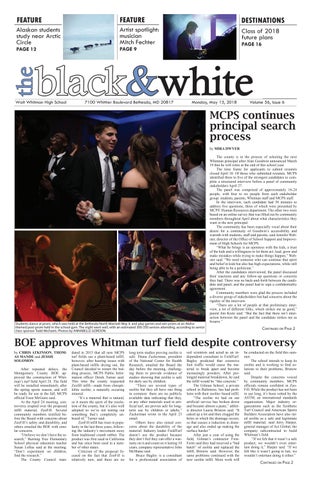
Students dance at prom, which was held at the Bethesda North Marriott May 4, and play games and win prizes at an Alohathemed post-prom held in the school gym. The night went well, with an estimated 300-350 seniors attending, according to senior class sponsor Todd Michaels. Photos by ANNABELLE GORDON.

MCPS excels on AP exams

The 2017 MCPS graduating class took more AP tests and scored higher on these tests than all other Maryland counties and other states, according to a March 23 county press release.

Two-thirds of MCPS graduates took AP exams, compared to half of Maryland public school graduates and 38 percent of graduates across the nation. Fifty-two percent of students who took exams earned a three or higher on at least one test. This rate is 20 percent higher than Maryland public school graduates and 30 percent higher than graduates across the nation.

“We should be proud that our students are outperforming their peers across the state and the nation, but we also know there is more work left to be done to make sure that all students are prepared for success after high school,” Superintendent Jack Smith said in the release.

Former student member of the board Matt Post attributes these successful results to MCPS’s equitable AP strategy.

“We’re going through every school to find the barriers that exist between underrepresented groups and advanced courses, then tearing them down,” Post said. “As we continue to open access to students who have previously been shut out of these courses, the average AP score and AP participation rate will increase.”

County surveys community on calendar preferences

MCPS surveyed community members throughout April to decide which days students should have off from school in the future.

After Governor Larry Hogan issued an executive order mandating that the school year start after Labor Day and end before June 15, there have been fewer possible days to have off from school.

The county also faced complications with changing demographics and now have to accommodate more religions, Student Member of the Board Matt Post said.

“For a long time in Montgomery County, we’ve had operational closures for our two Jewish holidays,” Post said. “But since we’ve started doing that, the demographics have changed pretty profoundly. The real problem is that we don’t have enough data to [know] whether or not religious holidays justify an operational need.”

County officials designed the 2018-2019 school calendar to satisfy the needs of Muslim students by including a teacher professional day on Eid al-Fitr. Still, this is different from an operational closure, which allows teachers to have the day off. Junior Ziyad Kamal, who celebrates Eid, believes the measure is unfair for some teachers, but credits the county for considering other religions.

“It’s important so that nobody feels discriminated,” Kamal said. “Everyone should feel equal and valued.”

BOE names first MCPS school after LGBTQ activist

The school board voted 6-2 to name a new Richard Montgomery cluster school after gay civil rights activist Bayard Rustin April 12. The cluster school, located in the Hungerford section of Rockville, will be the first school in MCPS to have an openly LGBTQ namesake.

A 12-person naming committee composed of mostly parents ranked Rustin fourth on the final list of name preferences submitted to the county March 15. Other proposals included four other African Americans as well as the name of the Dogwood tree, which the committee ultimately ranked second behind first choice activist-author Lillian Brown.

Many students are excited about the diversification of school naming in the county.

“It’s awesome since now the kids at that school are going to learn about the person for whom their school is named, which will finally introduce some LGBTQ history and education into the curriculum, especially since [now] it’s just lacking,” junior Urban Seiberg said.

Mark Eckstein Bernardo, the parent of two students who will be attending the new school, led several parents in the movement to use Rustin’s name.

“Rustin’s a powerful name for these marginalized [LGBT] kids and families—it’s a name that represents them. I mean, names for gender nonconforming and transgender names are like a bible,” Bernardo said. “It might be uncomfortable for people, but that doesn’t mean it’s wrong.”

Turf to be installed before fall season

Continued from Page 1

Harper said he had heard Gilman had received the wrong type of zeolite in the first batch that needed to be replaced; he believes their continued issues likely stem from maintenance problems, he said.

Act Global has installed more than 10 ZeoFill fields in California, and has yet to hear of

any problems with the infill, Harper said.

The Maryland Soccerplex in Germantown has three Zeofill fields. While the fields have only been in use since March, the staff has been extremely happy with them so far, executive director Trish Heffelfinger said.

It takes about six weeks for the ZeoFill to work its way into the the fibers, during which time it rests on

top of the fibers and can get white dust on the players’ shoes, Heffelfinger said. However, once it’s fully incorporated, you can’t see the infill at all, and the Zeofill remains set in the fibers, eliminating the “splash” that comes with crumb rubber infill, she said.

Heffelfinger said ZeoFill’s pros—no pellet splash, cooler surface temperatures and natural origin—outweigh the drawback of its

integration time.

“It’s certainly something I would recommend to others to install,” she said.

Many Whitman community members are happy to have their long awaited field.

“We’re thrilled,” sports booster club president Elissa Ginsky said. “This has been in the process for three and a half years, and I think it’s going to be great for our athletes.”

BOE will announce principal May 21

Continued from Page 1

Based on the feedback the panel offered, Webster will propose the names of the top two or three candidates to MCPS superintendent Jack Smith, deputy superintendent Kimberly Statham and Associate Superintendent of Secondary Schools Darryl Williams to interview. They will select the final candidate and present the decision to the BOE.

“At the end of that, it’s my job to listen to which of these candidates resonated,” Webster said. “If people feel strongly about one candidate or another, positive or negative, it becomes very apparent, and when there’s division over a candidate, that can be easily seen.”

With so much concern about Goodwin’s retirement and the selection of a new principal, there have been many questions about the identity of the candidates, executive vice president of the PTSA Mercedita RoxasMurray said.

“There’s certainly lots of deep sadness that Dr. Goodwin is leaving because he has so much respect from this community, not only from the parents, but also from the students and staff,” Roxas-Murray said. “I’ve heard a lot of parents asking ‘how are we going to select’ and ‘who is going to select’ because everyone wants to have their voices heard in the process, but I do believe that people generally trust those who are driving that process.”

The BOE will announce the new

p.m.

New classes to offer contemporary lessons in humanities, STEM fields

Four new classes across the English, science and foreign language departments will be offered as elective courses next year. English teacher Omari James will teach both Media in Society and Culture in Literature; biology teacher Mira Chung will teach Biotechnology and Bioengineering; and Italian teacher Olga Mancuso Moscato will teach Latin.

Media in Society and Culture in Literature

Both classes will be one semester long, with Media in Society being offered first semester and Culture in Literature offered second.

Media in Society will focus on how different media outlets affect our culture and perceptions. The class will be discussion-based to allow a more relaxed setting, James said.

“My ideal would be classes where students are engaged and interested but don’t feel like there’s a lot of high stakes pressure,” he said. “I just want to have a space where we can sit down and talk.”

James anticipated 15-20 students, but 30-35 students have registered. To compensate, some of the activities will have to be adapted, and the class will break up into smaller groups for discussions, James said. Registration for Culture in Literature has not happened yet.

Culture in Literature will examine how the world of writing affects our society in the same ways as Media in Society, but will approach the conversation by assessing acclaimed literary publications.

Many students are excited for the opportunity to discuss these topics of interest in a class with James.

“For both years that I’ve had Mr. James, he’s prompted kids to really think and try to discover things,” junior Sydney Maggin said. “These discussions have definitely been my favorite part of my English career at Whitman, and taking a class that is structured around them seems like such an incredible experience.”

Biotechnology and Bioengineering

The class will focus on biomimicry, prosthetics, ergonomics and ethical concerns surrounding editing genomes and genetic engineering. Chung started the class after students expressed interest.

“Bioengineering is a booming field,” she said. “You may be the ones majoring in these topics in college and creating solutions to problems that the older generations haven’t been able to solve due to lack of technology and resources. Now that we have so much of those, it’s great to offer a class where we can start delving into it.”

A surprising 89 students registered for the class next year, expanding the course to three classes. As of right now, Chung is the only teacher for the course. She’s worked with

science resource teacher Don DeMember to create a curriculum, which will be updated and improved after next year’s students give feedback on the course.

Latin

Mancuso Moscato, originally from Italy, learned Latin when she was 10 years old. Although Latin is rarely spoken outside of Catholicism, the language is still used in writing. The course has about 30 students registered for next year, which will fill one period. Mancuso Moscato hopes learning the language will make students more analytical thinkers.

Latin is most commonly used now in medical and legal documents and is thought of as a “higher-level” language, Mancuso Moscato said. She is most looking forward to the energetic students who will be in the class.

“The most important thing is that it creates a sort of order in your mind,” she said. “The ending and structure for words change a lot so you cannot speak lightly. You really have to think about what you’re saying.”

NEW CLASSES NEXT YEAR

Semester Classes

Culture in Literature Media in Society

principal during its public meeting May 21 at 6:00
Use this QR code to view a video about community members’ hopes for the new principal on our website: www.theblackandwhite.net

MCPS finds elevated levels of lead in 21 school fixtures

by REBECCA HIRSH and ZOE KAUFMANN

New laboratory tests commissioned by MCPS revealed elevated levels of lead in water from cafeteria sinks, high-traffic drinking outlets and faucets across MCPS. Twenty-one fixtures from 15 schools indicated levels above 20 parts per billion—the standard the EPA and the Maryland Department of the Environment have set as the threshold for remediation.

As this story goes to print, all 205 MCPS schools have been initially tested, and of the 60 publicly available reports, 17 drinking outlets at 12 schools—one high school and 11 elementary schools—tested above 15 ppb. In elementary schools, the vast majority of these outlets are “bubblers,” or drinking fountains attached to classroom sinks, intended for student use.

15 schools have at least 1 fixture above 20 ppb

The highest levels were at Gaithersburg Elementary School, where one classroom’s bubbler registered four times the limit at 81 ppb, and another registered at 253 ppb.

“It’s a concern as a parent, but I feel that the school is on top of this

and that we’re working with the appropriate people within MCPS to address this,” Gaithersburg Elementary School PTA president Carolyn Garvey said. “They’re able to do a lot more advocacy at that level. The school administration can only do so much. It’s in the hands of the [county] and it’s up to them to be addressing it as well.”

Lead likely entered the water through contaminated pipes and other plumbing materials, EPA environmental engineer Valerie Bosscher said. In previous years, MCPS has relied on water-quality tests from the companies that supply MCPS with water, MCPS environmental team leader Brian Millikan said, which some say can overlook sources of lead within schools.

The testing comes as a result of a state bill passed last year requiring all Maryland schools—both public and private—to check water for lead and copper contaminants every three years. The last complete test of MCPS’ water was between 2004 and 2007, and only new building additions or remodels have been checked since.

MCPS sub-contractors finished initial testing April 30 and plan to finish the second round of testing by June 30. Only schools with water fixtures that exceed 20 ppb of lead will be retested.

Concerned parents and community members, however, contend that the standard for remediation is too lax for water drunk mostly by small children, who are more susceptible to the negative effects of lead.

“There is no clear ‘safe’ level in water, because we believe that any elevation in the lead level in your body is likely to have at least some degree of negative effect,” pediatrician Jim Mattey said. “Even low levels of lead in the blood are associated with lower IQ scores, higher rates of attention deficit disorder, academic problems and conduct disorders. There have also been associations with reduction in growth during childhood and kidney disease as one gets older.”

MCCPTA committee leader Laura Stewart, who has previously advocated for a stricter standard in MCPS, was shocked by the high levels of lead discovered.

“I feel like Montgomery County should be a leader on this, and if we’re going to be a leader we need to try to get those levels down,” Stewart said. “The ultimate goal is one [ppb] or less, but the reality is five [ppb] would be a more reasonable goal in this case.”

After the test results are released, MCPS will create remediation plans, which will most likely include the removal or replacement of contaminated fixtures to minimize students’ lead exposure, Turner said. The county will make the necessary changes over the summer to avoid disrupting class time.

“There are very few that have levels above the action-level, but we don’t want to be complacent,” MCPS Public Information Officer Derek Turner said. “We want to continue to test and put ourselves on a cycle of testing so that we’re never in a position where we don’t know the status of the fountains and faucets in schools.”

Whitman, Whittier Woods Elementary School and the rest of the Whitman cluster were tested April 23—except for Carderock Springs Elementary School, which was tested April 16—but the results have not yet been released as this story goes to print. Principal Alan Goodwin predicts the school’s levels will be low due to the newly-installed water fountains.

“It’s always a concern because it can happen, but I’m not expecting any elevated levels,” Goodwin said. “It’s an important story, but we just don’t know until the results.”

New safety measures planned for Whitman’s back entrance

Community support is split on the State Highway Administration’s plan to improve the safety of the Braeburn Parkway and Pyle Road intersection with River Road by the exit near Whitman’s baseball field. Members of the surrounding neighborhoods gathered in the auditorium April 23 for a meeting held by Bannockburn Civic Association representative Richard Volta.

A majority of the over 200 Bethesda residents in attendance voted in support of designating a school zone on River Road near both the Whittier Boulevard and Braeburn Parkway exits of the school.

The State Highway Administration announced its funded plan to turn the temporary traffic plastic bollards into permanent concrete curbs at Braeburn Parkway intersection March 29. The plan also includes a pedestrian-activated traffic signal at Pyle Road.

The temporary traffic improvements were implemented in April 2017 following multiple accidents at the intersection, including a fatal crash involving a Whitman family in February 2016.

There’s already a pedestrian crossing at Pyle Road, but this plan would add a traffic light that will remain green until pedestrians activate the light by pushing a button and stopping vehicular traffic while crossing, SHA official Charlie Gischlar said. He estimates the construction will be mostly completed by the end of the year and completely finished

ty to get a traffic light there. It needs to be there yesterday,” one resident said. “We can get it next year. If we fight and argue over the overpass and everything, we will be here for five more years and nothing’s going to get done. It doesn’t mean that more changes can’t come later; it just means that we need something now.”

The meeting began with

“ “ It doesn’t mean that more changes can’t come later, it just means that we need something now. -community member

by spring 2019 in the case of bad weather or other issues.

A majority of community members voted in favor of the pedestrian-activated signal at Pyle Road, though opinions were split on the part relating to the Braeburn intersection, as many people felt that a more drastic change would be more effective. Proposed solutions include having a pedestrian bridge over River Road, a traffic light intersection installed or closing the Braeburn intersection altogether.

“We have the opportuni-

an introduction from principal Alan Goodwin and then a brief summary of background information from Volta. The floor then opened for an hour discussion session for the community to share their two-minute opinions on the changes. Many testimonies were touching, relating the issues back to students—past, present and future—and even one woman’s own near-death accident at the Braeburn intersection.

Although the community voted on the SHA’s proposal, the plan doesn’t

Record number of county candidates

Thirty-eight candidates are running for the four open atlarge seats on The Montgomery County Council. The end of the 2014-2018 term meant three of the four office-holders had to retire due to recent term limit legislation passed in 2016, inviting a variety of challengers.

This is the most candidates the at-large race has ever seen.

“Usually, you might get 10 or 12 candidates, but even that’s pushing the outer edges,” former council member Mike Knapp told Bethesda Magazine in February. “The exciting thing is that it shows a lot of pent-up demand and especially if you look at the breadth and diversity of those people running, it’s really cool.”

From one informal Bethesda Magazine online survey from February, top-polling candidates included incumbent Hans Riemer, radio host-producer Steve Solomon, Gandhi Brigade Youth media director Evan Glass, who previously ran for county council district in 2014 and former Obama administration employee Ashwani Jain. While some candidates have held political office or run for office before, many have not and include lawyers, realtors, community advocates and more.

Attorney Loretta Garcia decided to run about a year ago, motivated by her wish to give back to the county where she raised her family and worked in county government anti-discrimination work.

“Running is a really crazy process, so I just have to stay grounded and realize that I’m committed to making the county a better place to live and work,” she said. “Hopefully a lot of people feel like they’re involved in the process for the first time, or again after many years of not being involved.”

The 33 Democrats, four Republicans and one Green party candidate are campaigning over the next weeks leading up to the June 26 primary. The top four candidates of each major party will then move into the general election season.

Five classes cut for next school year

Administrators cut the Theater, Global Issues, AP Physics 2, Italian 1 and AP Art History classes for next year after fewer than 20 students signed up for the classes.

The cuts disappointed most of the teachers, like art history teacher Jean Diamond and theater teacher Danielle Fus. Theater only ran for one year.

“There are lots of different ways to be talented, and we aren’t all great artists and singers so it was a fun way for students to get their art credit,” Fus said. “But I’m obviously disappointed. It’s a good outlet for people who don’t have that outlet otherwise.”

need community support in order to be implemented. The SHA is under no obligation to adhere to the opinions of the community, though there is a strength in numbers, Volta said.

“We have significant leverage as a group — a unity --of concerned residents and elected leaders,” Volta said. “On the other hand, the SHA has the legal authority, the expertise and the resources to do what they want. But we can affect what they want to do.”

Many students use the back entrance to enter and exit school in the mornings and afternoons. The SHA’s solution will enable a safer transit in the future, students said.

“It’s a lot better that they have a more permanent solution because the current fix is really short term,” sophomore Alex Robinson said. “In terms of the Pyle Road crossing, I walk home from school sometimes, and it’s really dangerous to cross that road because cars don’t stop. This fix is really good, especially since there’ve been accidents.”

They also upsetted some students, like freshman theater student Hank Harris who had signed up for another year of theater.

“For me, I like to plan my schedule and have an even balance of academic classes and art classes,” Harris. “Having an arts or academic class cut can throw that out of balance.”

The Italian 1 class could only have happened if administrators decided to combine multiple levels of the language into one class, but this would’ve caused logistical problems, prompting the cut.

Despite disappointment from teachers and students, Goodwin said there is only so much money given for staff members, which justifies the cuts.

MD 2018 legislative session approves bills

Maryland’s 2018 legislative session, which ended May15, approved numerous pieces of bipartisan-backed legislation. Governor Larry Hogan deemed it one of the most successful session in the last four years, reported the Washington Post.

The Democratic-controlled session in Annapolis passed laws that will ban conversion therapy, increase the state subsidy for Metro by $167 million annually and set aside $380 million in taxes from insurance companies to mitigate healthcare premium rates, among others.

The session was marked by cooperation between both parties. For example, Governor Hogan backed Democratic mayor Catherine E. Pugh’s compromise bill that targets repeat violent offenders with stricter prison sentences.

On gun safety, the legislators strengthened gun control laws with a bill that would ban bump stocks and other rapid trigger devices. One approved bill will provide funding for increase police surveillance in public schools and install lockable classroom doors. Lawmakers also passed “red flag” legislation which makes it easier for judges to confiscate firearms from individuals deemed dangerous.

Q&A

The Washington Post won a Pulitzer Prize for National Reporting April 16 for their coverage of Russian interference in the 2016 campaign and their ongoing investigation of possible links between President Donald Trump and Russian officials. Ashley Parker (’01) was one of 11 contributors toward the Post’s award-winning series of 10 stories.

Parker joined the Post in 2017 and now works there as a White House reporter, after working 11 years as a political reporter for the New York Times.

Responses have been edited for length and clarity.

The Black & White: What does it mean to you knowing that your work contributed to the Post’s Pulitzer Prize?

Ashley Parker: It feels both totally surreal and totally exciting all at the same time. I started at The Post basically at the very beginning of January 2017 right around when President Trump was sworn in, and so for me personally, I just feel incredibly lucky and incredibly grateful that I was thrown on such an amazing story with such a talented and collegial group of teammates.

Ashley Parker (’01) of The Washington Post on their Pulitzer Prize

B&W: Since the beginning of your career, how has your job as a reporter and a journalist changed in the context of a Trump presidency?

AP: Throughout my entire career, even as I started covering politics, I never wanted to cover the White House. I thought it seemed kind of boring, controlled and constrained, and there were just so many other stories I wanted to do. I used to think, at least in theory, that [covering campaigns] was more free-wheeling and exciting, and it kind of has these larger than life operatic characters, but the Trump White House right now has that feel. I feel like there’s no bigger story than President Trump and his administration and in a lot of ways as a reporter covering it, there’s some of that same excitement and some of that same cast that you more traditionally imagine around a campaign and not in a more disciplined White House.

B&W: Do you think you and your colleagues realized the gravity of the story when you first began your reporting? Did the idea of this coverage being Pulitzerworthy ever cross your mind?

AP: I can only speak for myself, but I don’t think the idea of prizes, and certainly not a Pulitzer, was on any of our minds or was a driving force. I have to say what our execu-

Officials pass new school safety, gun reform legislation

With six mass shootings nationwide over the past year, the debate over the accessibility of firearms has escalated. Republican lawmakers have proposed arming more people to confront any gunmen, while others favor gun control legislation, including a ban on bump stocks and assault weapons.

Hogan had designated for school construction, would finance the changes.

“Classrooms should never be a place of fear for our children,” Hogan said in a Feb. 28 press release. “No mom or dad should ever have to worry when they send their kids off to school whether their son or daughter is going to come home safely.”

“ “ Classrooms should never be a place of fear for our children. - Gov. Larry Hogan

Maryland officials have also begun to address the issue; since the school shooting at Marjory Stoneman Douglas High School in Parkland, Florida, state and local officials have passed bills and resolutions aimed to increase school safety, limit gun access to domestic abusers and prevent the arming of teachers.

School Safety

Gov. Larry Hogan proposed spending $125 million to enhance school security just two weeks after the Parkland shooting.

The money would go toward reinforcing doors in all schools and implementing panic buttons so authorities can react to emergency situations quickly. Income from state casinos, which

Local officials have also ensured that teachers don’t become armed. The Montgomery County Board of Education passed a resolution March 28 on the issue.

Board member Patricia O’Neill proposed the resolution after community members emailed the board about their thoughts on the issue.

“I worry about children accidentally getting ahold of guns and teachers getting nervous,” O’Neill said. “The money is better spent on making our buildings more secure and providing more mental health support to students.”

The passing of the resolution means that there will be no further discussions on the issue unless a bill is proposed in the Gen-

tive editor Marty Baron said to us, which is, ‘We don’t cover this president any differently than we would cover any other president.’ But I do think we very quickly realized, as did our colleagues and competitors at The New York Times and our other friends in journalism, that the Russia story was a big story.

B&W: People have began throwing around guesses of indictment or impeachment. From your own reporting on Trump’s behavior, what are your predictions? Where do you see all of this going?

AP: I have no idea. One thing I learned very early on covering Trump is to stop making predictions because my instinct is almost always wrong. Also, Mueller’s team is incredibly private and leak free, and anyone who tells you they know what’s going on is merely guessing and surmising and reading the tea leaves. But I don’t think there’s anyone who could possibly know the objective truth of where he stands with his investigation right now.

B&W: There are comments on The Washington Post from practically all over the world thanking The Post for the work they do and congratulating them for their 2018 awards. What does that mean to you

knowing that your work has that kind of global appreciation and impact?

AP: I’m going to quote Marty Baron again, and I apologize, but he’s just very wise and very quotable. So he always says, ‘We’re not at war with this administration, we’re at work,’ which I think is very true. We certainly don’t see ourselves as an opposition to the Trump White House, but one thing that’s been really gratifying for me as a political reporter is, for whatever reason, how many people are so engaged with the news, with what’s going on in Washington, with what’s happening in the White House, in government agencies and with the work that reporters are doing and the stories that we’re writing. I think it’s just incredibly gratifying and exciting that so many people are interested in our political process, in our journalistic process and in our democracy.

eral Assembly.

“I think it’s a great resolution,” principal Alan Goodwin said. “If any money is spent, it should be for extra security.”

Gun Control

The state senate passed a bill March 20 to ban the sale of bump stocks, one week after state delegates passed a similar bill. Bump stocks are attachments to firearms that allow people to shoot rounds faster. They were most recently used in the Las Vegas shooting last October.

“There’s really no good reason for anyone to possess them,” Delegate Bill Frick said. “There was pretty broad consensus on banning the sale.”

The General Assembly passed two additional bills, and both bills received bipartisan support. The first requires convicted domestic abusers to surrender their guns, while the second allows judges to take guns from those who they believe pose an immediate threat.

“If we make it harder for people like domestic abusers to get guns, it will also make it harder for them to commit crimes,” sophomore Clara Koritz Hawkes said. “Having laws like what Maryland is proposing right now are really important to pass.”

Zoe Kaufmann contributed to this report.

Alumna Ashley Parker, a White House reporter for The Washington Post, contributed to coverage that won the newspaper a Pulitzer Prize for National Reporting this year. Photo courtesy ASHLEY PARKER.

Put parallel parking back on MD driver’s test

Almost every permit-holder in Maryland breathed a sigh of relief in 2015 when the Motor Vehicle Association announced it would remove parallel parking from the test to get a driver’s license. But these same drivers are now breathing in nervous spurts as they try to parallel park for the first time, alone, after they’ve gotten their license.

By including parallel parking on the driver’s test, the MVA guaranteed that people would learn the admittedly difficult skill. Now that it’s been taken off the test, people who should learn to parallel park aren’t bothering.

In order to ensure drivers are prepared for every situation, the Maryland MVA should reinstate parallel parking on the driver’s test, reversing their 2015 decision not to test the skill.

Without being required to learn how to parallel park, students may avoid driving in places like the District of Columbia where they know squeezing between two cars on the curb is inevitable. In an informal lunchtime survey of 30 students with their drivers’ licenses, only 12

felt comfortable parallel parking.

To be competent enough to get a driver’s license, people are supposed to be prepared to drive in all situations and places—including big cities where parallel parking is a necessity, says John Townsend, spokesperson for the American Automobile Association’s MidAtlantic region. It’s absurd that a driver would be deterred from going somewhere simply because of the lack of parking options.

Not only is not testing the skill impractical, but it’s also potentially

dangerous. It’s a safety hazard if a new driver needs to parallel park and has never practiced the skill with an experienced adult in the car. In the same survey, only half of the students had attempted to learn how to parallel park before taking their driver’s test.

Almost 65 percent of parking crashes involve vehicles backing into or pulling toward a curb, which are maneuvers associated with parallel parking, according to a study conducted by the University of Michigan.

MVA spokesperson Buel Young told The Washington Post that parallel parking was removed from the test for efficiency; he claims the reverse two-point turn tests similar skills. In reality, parallel parking is unique from simply backing up and turning, which is why many suspect the real reason for the MVA’s decision was to decrease failure rates on the driver’s test and subsequent wait times. But as annoying as long lines at the MVA can be, driver’s tests aren’t supposed to be designed so people

can pass them; they’re designed to test drivers’ skills and ensure our roads are safe.

Parallel parking will continue to be taught during some required in-car driver’s education classes. But if parallel parking isn’t tested, students don’t have to master the skill—whether it’s taught during in-car lessons or not.

Parallel parking is a necessity for all drivers. Not requiring students to learn this vital skill does them a disservice.

Student voices on mental health

Editor’s Note: Over the course of the past year, Whitman students and administrators have made efforts to address mental health issues among students, from scheduling mental health awareness presentations to promoting an SGA-sponsored app.

As student journalists, we’re proud of the role we get to play in facilitating these conversations by providing the space for two student opinions in this issue. Both are staff members who have chosen to omit their bylines due to the personal nature of their stories. As always, the opinions they voice are their own and do not represent the position of The Black & White.

Change the way you talk to people with anxiety

For me, anxiety is like my thoughts are a car that’s been set in park, but someone is pressing all the way on the gas pedal; everything is revving out of control, but I’m not making any progress. It’s like I’m trapped on a rollercoaster, and the seat belt is way too tight and I just want to get off. Saying this out loud makes me want to scream. Just writing it makes me sweat.

I’m telling you this because the mental health presentations, run by the Mental Illness Awareness Campaign Team at Whitman, didn’t say everything I think they should have. While I agreed with many of the statements on how to best communicate with someone who has anxiety, I think there’s a lot more to say. There’s a better way to address someone with anxiety that reminds them they’re bigger than the illness— but doesn’t pry too much, or say anything too artificial.

So many students walk around with the burden of anxiety: according to a Black & White survey conducted last year, 40 percent of Whitman students suffer from mental illnesses, while nationally that number is only 20 percent. And anxiety affects nearly 33 percent of the school.

Some people are going to be triggered by social situations, others by schoolwork and others by something more specific. To someone who doesn’t have anxiety, their reactions might seem ridiculous. But to someone with anxiety, it’s hard to control. The mental health presentations said this, but I’ll reiterate: in this situation, telling someone to just “calm down” or “stop overreacting” isn’t going to help them. In fact, it will probably only make them frustrated because they feel like they can’t do that.

33%

40%

of students suffer from a mental illness
of students have an anxiety disorder

Instead, someone should be reminded that they’re stronger than their anxiety. Tell them that what they’re feeling isn’t the reality. One of the most motivational things I’ve ever heard is that I can’t let anxiety live my life for me. If I feel like I can’t start my homework because it’s so overwhelming, I need someone—or hopefully someday just myself—to remind me that I can start my homework, and my anxiety is just trying to trick me.

My anxiety lives in me permanently, like the characters in the Disney movie “Inside Out.” The anxious voice is gruff, rude and cries a lot, and the normal voice is my normal, calm self. When the anxious voice is yelling at me, I need a way to remember I can overpower those feelings.

Saying things like, “Don’t worry, you’re not going to fail the test,” or “Everything is going to be fine” isn’t as effective as it sounds. Truthfully, everything might not be fine—there is no way to guarantee that it will be. It sounds sad, but it’s helpful. It’s in the person’s own power to to make sure that everything is going to be fine. Instead, say things like, “You can get through this,” or “You have the power to do this.” These statements are uplifting, and they give the person something to think about in that moment. Just saying “you won’t fail this test” might just add to that person’s pressure because they want to please you.

Anxiety can be really difficult to deal with at Whitman. To truly help out a family member or friend that’s struggling, you have to be careful what you say. But, it’s possible to conquer bouts of anxiety—the person just needs some encouragement.

Administrators should provide safe spaces for students with panic attacks

My heart was pounding, pounding in my chest—escalating, accelerating. Too fast. My vision blurred, and I could feel myself shaking. My whole body felt hot, like it was on fire, and I couldn’t form a coherent thought to save my life.

I rushed into the hallway and looked around, terrified. I didn’t know what to do. While I was scared of strangers seeing me in this state, I was also scared of people I did know seeing me. I couldn’t handle having somebody near me, let alone talking to me.

I ended up hiding in the second floor bathroom for twenty minutes, locked in a stall, standing straight up and trying desperately to calm myself down.

I don’t have panic attacks at school regularly, but when I do, I don’t know where to go to calm myself down. I try to go to my counselor, but the times I’ve gone and she hasn’t been there, it’s made everything worse. I’ve felt like my one chance at finding a safe place has been ripped away.

Because panic attacks require time and space for the person to calm down, administrators should work with teachers to create a list of open, staffed classrooms that will serve as a safe space for students experiencing anxiety or having a panic attack to go to when they feel overwhelmed.

Resource counselor Kari Wislar could reach out to teachers to ask who would

be willing to open their classrooms during planning or lunch periods. Counselors could then share this list with students they know have anxiety or panic attacks, or post the list on a wall in the counseling office so the classrooms are easily accessible by any student who finds themselves in need.

While Wislar said she would prefer for students to talk to a different counselor if theirs isn’t available, she agrees that there should be a safe place for students to go. To ensure the system wouldn’t be abused and to secure student safety, students could be required to check-in with a counselor, or have the teacher hosting them send them an email.

Counselors and administration support the idea. Wislar, principal Alan Goodwin, and assistant principal Kristen Cody said they would be open to help create the system for next year, and about a dozen teachers have already expressed interest in being part of the program.

No other student should have to stand in a cramped, dirty bathroom stall, or stand outside their counselor’s office with their whole body shaking as they struggle to take a breath. Mental health problems are increasing across all grades—ensuring that students in crisis always have a safe space would be a good step in the right direction for supporting these students.

Our heartfelt thanks go out to the over 200 Whitman families and over 100 local businesses and organizations who have generously supported Post Prom 2018!

- Dona Squeri, Louise Meyer and Lisa Stein

Post Prom Co-Chairs

Hawaii Level ($1000 +)

Arata Expositions, Inc. Geico

Maui Level ($500 - $999)

Armand’s Chicago Pizzeria

Galliher & Huguely Associates, Inc.

KRa Organic Sports Drinks

Lolli and Pops

Not Your Average Joe’s

Thomas W. Pyle Middle School PTSA

Oahu Level ($250 - $499)

Bannockburn Elementary School PTA

The Barking Dog

Burning Tree Elementary School PTA

C&C Complete Services

Carderock Springs Elementary School PTA

Flex Academy/Ashley Tutors

Georgetown Cupcake

Kendra Scott

Massanutten Vacations

Meridian Custom Builders

Quartermaine Coffee

Rad Orthodontics

Kauai Level (Up to $249)

Suburban Hospital

Regan Zambri & Long

Savant Capital Management

The Shop Salon

Suburban Florist

TicketCity

Viking Mat Club

Acqua Nails

All Fired Up

American Tap Room

Arclight Bethesda

Bed Bath and Beyond

Bethesda Bagels

Bethesda Big Train Baseball

Bethesda Sport & Health

Betru Salon

Blu Water Day Spa

Bradley Hills Elementary School PTA

Cava

Chipotle

Clyde’s Restaurant

College Bound

Dormify, Inc.

Down Dog Yoga

DrinkMore Water

Earth Treks

Founding Farmers

Georgetown Cupcake

Giant - Arlington Road

Giant - Westbard

Harris Teeter - Battery Lane

Henry’s Sweet Retreat

Jane Fairweather Team

Dr. Steven Joe

La Madeleine

Landmark Theatres

Lebanese Taverna

Ledo Pizza

The Margarita Man

Medium Rare

Millie’s Spring Valley

Modell’s

Mon Ami Gabi

Nails by Tammy

Nando’s Peri-Peri

Northwest Golf Course

The Original Pancake House

Outback Steakhouse

Panera Bread

Paper Source

Passion Fish

Pinstripes - North Bethesda

PJ’s Sports

Posezen Yoga

Potomac Pilates/Rock the Reformer

Pulse Fitness

River Riders

Salon Jean & Day Spa

Sal’s Italian Kitchen

Simon Says Yoga

Smathers & Branson

Smoothie King

Sports Extra

Summer House Santa Monica

Sweetbay Yoga

Tastee Diner

Dr. Steven Tigani

Valley Mill Kayak

Vamoose Bus

Westbard Hair Studio

Wild Tomato

Wood Acres Elementary School PTA

Zengo

Cold War codebreaker shares stories after 60 years

Whitman grandma translated Russian code for NSA

On a cold winter morning in 1953, the early days of the Cold War, Joan and her co-workers waited for the bus, like many others across the country. The unmarked vehicle picked them up in a spot different than the previous morning’s and transported them to a nondescript, massive building six miles outside of the District of Columbia. At the end of the shift, they’d learn the next day’s pick-up spot.

Joan—the grandmother of a Whitman student—spent three years working in that building, passing security checkpoints every morning to gain entrance to her cubicle, where baskets of paper scraps covered with Russian code waited. It was there, within the creamcolored façade of Arlington Hall, the Army codebreaking facility, that codebreakers translated Soviet ciphers for the National Security Agency.

Those codebreakers were prohibited from speaking about their work for 50 years after the fact, so Joan has been free to talk about her experiences for the last 10 years.

A few months before that chilly morning, Joan had graduated from Boston University, where federal agents had interviewed every person in her undergraduate Russian class.

“They never told me who they were,” Joan said. “Turned out it was the NSA.”

Students didn’t know what the interviews were for, let alone that

the NSA was conducting them, but the agents offered Joan, who was by then fluent in Russian, a job in the District translating Soviet code.

The process was tedious: at the beginning of shifts at Arlington Hall, codebreakers were given up to 50 slips of paper, each with five Cyrillic letters and breaks in between each sequence. The code itself wasn’t difficult—every letter was simply substituted for another letter along a set pattern—but it changed constantly. They translated on two fronts, figuring out which letters had changed and then putting the whole sequence into English.

to crack three more). The more they knew about Russian culture and current events in the Soviet Union, the better they could make connections and figure out the code.

“That was it; you just sat there all day figuring out, ‘Does this make sense?’ You watched for sentence patterns because it had to be a sentence, even though the letters had been changed,” Joan said. “Being good at crossword puzzles and things like that was a pretty good thing, and having a pretty strong Russian vocabulary and sense of the grammar and the sentence structure was important.”

That was it: you just sat there all day figuring out, ‘Does this make sense?’ You watched for sentence patterns because it had to be a sentence, even though the letters had been changed.

supposed to talk to each other,” Joan said. “Because we were surrounded by this shroud of secrecy, you liked the people you worked with, but you didn’t really know them well, and you didn’t develop too many friendships or long-term relationships. People tended to get moved around a lot.”

The NSA also offered a job to Joan’s husband, a fellow BU student, when they recruited her. His posting was different than his fiancée’s job in the District; as an intercept operator, he was stationed in the British Zone of divided Berlin, intercepting Soviet messages for codebreakers like Joan to decrypt back in the U.S.

from his posting, and they moved back to Boston. She got a degree in library science, became a housewife and then worked as a librarian in the local school system. She and her husband became parents, then grandparents, but the secrecy around their former jobs remained.

“My husband used to tell people that he used to be a Morse code transmitter, but nobody ever really asked me, and I never really volunteered the information,” Joan said.

The aura of secrecy was so strong that even 60 years later—10 years after the mandatory 50-year waiting period for discussing such classified information had lapsed— other former codebreakers whom Joan met later were still reluctant to discuss their old work.

- Former code breaker Joan

Codebreakers started by looking for the Russian for “I give” or “I send,” which most messages started with and looked for recognizable names or places to decipher more letters (Joan loved messages that included the word “Warsaw,” because it was bookended by two of the same letters and allowed her

The workplace itself was secretive; codebreakers were discouraged from sharing information with each other or forming relationships. Each worker had their own cubicle, the confines of which dictated the workplace atmosphere.

“There were certainly 50 people on my floor, but you weren’t

Because of the secretive nature of their work, Joan and her husband couldn’t discuss the specifics of their jobs with each other. Although they shared stories afterwards— Joan recounted that her husband, who wasn’t good with directions, once mistakenly transmitted a message that a Russian platoon actually in Finland was entering Paris—at the time Joan didn’t even know what her husband was doing for the NSA.

“I think I knew at the time, but all the signs were missing,” Joan said. “I couldn’t write to him except over an APO number because no one was supposed to know he was there. The Germans knew he was there and the British knew he was there, but no one else knew he was there except me.”

After three years working for the NSA, Joan’s husband returned

In fact, Joan’s most exciting memory from her tenure as a codebreaker involved such unspoken codes of conduct. One night, she recalled, there was an important breakthrough, and another codebreaker stood up in their cubicle, shouting “I got it!” The lights dimmed and Joan heard a roar: NSA cars leaving the Hall, driving to the White House or the Pentagon to address whatever urgent secrets the translated message had revealed.

“We were never even supposed to have noticed that it happened, but we weren’t stupid. We were curious, but whoever found it never admitted,” Joan said. “Those few years were very interesting.”

Junior Kalia Dell graduates early to study medicine

While most anatomy students are hurrying to finish their weekly article homework, junior Kalia Dell is already asking high-level questions related to the various medical journals she’s read this week.

Though still technically a junior, Dell has fulfilled all of the graduation requirements and will graduate in May with the class of 2018. Next year, she will study biomedical engineering at George Washington University on a pre-med track. Ever since surviving a serious skiing accident when she was 12, Dell has been determined to work in the medical field.

Dell decided in August

to graduate early after interning at GW’s Cardiovascular Physiology Lab over the summer. One of the main reasons she chose to graduate early is so she could get more experience in a lab rather than a classroom. Dell also continued her internship throughout junior year, working with Professor Matthew Kay from GW’s biomedical engineering department.

“I started working with people in the lab, and it’s such a collaborative learning environment because it isn’t just plug and chug,” Dell said. “I just knew that’s where I wanted to go to school, and I love my work there.”

In order to graduate

early, Dell had to fit in all her college testing and final graduation requirements through online classes while taking two classes at Whitman and working at her lab for the rest of the day.

Dell’s friends describe her as passionate, driven and determined. They’ve supported her decision and have watched how hard she’s worked throughout the year.

“If anyone can handle it, she can,” senior Ellie Trainor said. “It gives her a head start on a strenuous career path, and I think she’s too precocious to have enjoyed another year in high school. It’s the best choice she could’ve made.”

Anatomy teacher Melanie Hudock has taught Dell

for two years, for both anatomy and as the coordinator for her science internship. She finds Dell mature beyond her years because of her ability to dive deep into high-level medical topics and her success with hands-on learning.

Hudock believes in Dell’s work ethic, has been continually impressed by her knowledge of medicine and agrees that being in a college environment will be beneficial for Dell.

“She’s getting to be in a lot of new research, and they talk to her like she’s one of them. She fits there, and it’s where she needs to be,” Hudock said. “Some say it’s really hard for high schoolers to know what to do with their life, but Kalia does.”

Kids learn language, culture at Saturday Chinese school

Walk into school on a Saturday afternoon and the building is far from quiet and empty. The air is alive with cheerful Chinese conversation, the cafeteria is abuzz with parents practicing Tai Chi and the second floor classrooms are filled with students learning Chinese.

For the past 15 years, the Whitman building has hosted the Tzu Chi Chinese Academy, a school that teaches Chinese language and culture to children from ages three to 18, drawing students from all over the greater Washington area on weekends.

The school teaches reading and writing in Chinese and Chinese culture, including traditional customs, festivals and manners. It also hopes to improve its students as people, principal Susan Chen said.

“Overall, we want students not

only to gain knowledge about their language and culture but also as a human being, to have a purified mind that they can be a better person and also have a positive influ-

the extracurriculars, where the students can choose between a variety of Chinese sports, arts or martial arts. Stephanie Ho, a freshman at

“ My favorite part is the people that I’m around. I’ve been with them forever, so I basically know everyone, and they all know me, so we’re like a big family.
“- Glenn Burnie freshman Stephanie Ho

ence on society,” she said. Each week, the students take four different classes. The first two focus on learning Chinese, the third focuses on culture and character building and the last is dedicated

Glen Burnie High School, drives an hour from her home in Baltimore every Saturday to attend the Academy, a trek she’s made each week since first grade.

“My favorite part is the people

that I’m around,” Ho said. “I’ve been with them forever, so I basically know everyone, and they all know me, so we’re like a big family.”

Ho already spoke Chinese when she first came to the school, which she said was the case for most students there, but has improved her reading and writing. She has also enjoyed learning more about Chinese culture—both traditional and modern—and feels the Academy has brought her closer to her Chinese heritage.

The character emphasis of the education has been most beneficial, Ho said. She’s learned a lot about productivity and time management, important skills that don’t receive the same level of focus in her traditional school.

The school is part of the broader Tzu Chi organization, an international humanitarian aid group.

Because of this, the students’ learning often includes some element of charity, Chen said. The students do an annual Thanksgiving drive and donate the supplies to nearby homeless shelters, elementary schools or churches.

The school also provides services to parents during school hours, including Tai Chi and classes focusing on improving parentchild relationships. Some parents also teach at the school; all teachers are volunteers.

Everyone within the community is supportive, even towards people they don’t know, junior Katherine Luo, the only Whitman student at the school, said.

“It’s a really big family,” Luo said. “It’s just a good vibe. There’s not much negative feelings or anything, because we’re all just here to have fun and learn Chinese.”

Local group trains emerging female politicians

Last fall, 15 Maryland women—all politically-interested Democrats—met for the first time in a Rockville conference room. Some had served on school boards and committees, while others had no prior political experience. Many had successfully managed businesses and families, but lacked the confidence to campaign for a leadership position. Yet by the program’s end, half of them ran for political office, and of those women, 70 percent won.

In its 225 years, Maryland has elected a total of eight women to the U.S. House of Representatives, one woman to the U.S. Senate and no female governors. After noticing this trend, a committee of female Democrats introduced Emerge Maryland in 2012, Executive Director Diane Fink said. The program is one of 24 state programs created by Emerge America, which began in 2005.

Emerge Maryland aims to reduce the lack of female political representation by training women Democrats for political office. With less than six months until the 2018 midterm elections, 30 Emerge alumnae are set to appear on ballots across Maryland.

“Having equal representation in every level of government is important so that diverse voices can be heard, diverse decisions can be made and important legislation that affects the constituency in ways that haven’t been addressed in the past can be addressed,” Fink said.

Each class of women meets twice a month over the course of six months. Current politicians, former participants and campaign alumnae train women on seven key topics: public speaking and communication, fund-

raising, media and messaging, networking, campaign strategy, field operations and questionnaire and endorsement. Trainees also visit the Maryland Senate and mock-fundraise to emulate the campaign process.

For female high schoolers interested in politics, Emerge provides an opportunity to amplify women’s voices in government.

Senior Rabhya Mehrotra is interested in running for political office in the future. During her college search, she looked for schools that had programs like Emerge, she said.

“Going into college, one thing I was evaluating was whether they have these sort

of programs,” Mehrotra said. “I do think it’s important because there are so few women in political office.”

Montgomery County board member Mimi Hassanein applied to Emerge in 2013 after family and friends encouraged her to pursue politics. Though initially skeptical, Emerge gave Hassanein the confidence to run for Montgomery County’s Office of Community Partnerships, she said. She was elected in 2014 and will run for reelection in 2018.

“I always did a lot of volunteer work, and people were always telling me, ‘Mimi, you should run for public office.’ I didn’t

have the confidence. As an immigrant I’d never been involved with politics back home, so I didn’t really know what to do,” Hassanein said. “Also as women, we don’t think that we have the capability. But Emerge gave me confidence. Emerge helped me.”

Though victory isn’t guaranteed, participants leave Emerge with a group of both political allies and close friends, Hassanein said.

“When we graduate, we become sisters, and we help each other with fundraising and campaigns,” she said. “We’ve created a sisterhood.”

Members of Emerge MD’s graduating class attend a political workshop. A committee of women created Emerge Maryland in 2012 to train democratic women for elected office. Photo courtesy MIMI HASSANEIN.
Junior Kalia Dell sews in an aortic heart valve at the VA hospital. Cardiovascular-related medicine sparked Dell’s interest in the field; she will go on to learn biomedical engineering with a pre-med path at George Washington University. Photo courtesy KALIA DELL.

DESTINATIONS

Muhammad Zaki Agung Coventry University

Valerie AkinyoyenuYale University

Theodore AkpinarBrown University

Molly AlbertMiddle Tennessee State University

Charlotte AldenUniversity of British Columbia

Giovanni AmodeoUniversity of Maryland

Courtney AndersonUniversity of North CarolinaWilmington

Danielle Anderson Rollins College

Alice AubertÉcole Polytechnique

Abigail AudasBoston College

Amar AulakhUniversity of Maryland - Baltimore County

Atharva AvhadPennsylvania State University

Claude Ayo University of Toronto

Bente BackerRutgers University

Eleanor BakerUniversity of Maryland

Arianne BandaBoston University

Francisco Barahona PelaezReturning to Spain

Carsten BarnesColumbia University/Sciences Po

Christopher Barnhard Army

Nicholas BaronUniversity of Michigan

Jacob BartolomeiUniversity of Maryland

Anna BautistaThe Hill School

Gregor BayburtianUniversity of Maryland

Gabriel Bayona SapagUniversity of Maryland

Pablo Bayona SapagUniversity of Maryland

Konstantin (Koki) Belikow-Crovetto University of Maryland

Claudia Beltran ArguellesCharles III University of Madrid (Spain)

Asmara BensonHoward University

Samuel BentonMontgomery College

Iris Berendes-DeanUniversity of California - Davis

Danielle BermanUniversity of Maryland

Casey BettencourtUniversity of Maryland

Iakov BeylinUndecided

Shankar Bhat College of Wooster

Miguel Bishop-Torrago Gap year

Charles (Tiger) BjornlundJunior hockey

Clark BoinisButler University

Kelsey Bonham Colgate University

Grace BrennanBarnard College

Leonardo Brisigotti Boston Architectural College

Caroline BrodyUniversity of Pittsburgh

Christopher BrownThe New School of Drama

Zachary Brown St. Mary’s College of Maryland

Helena Buarque De MacedoLoyola Marymount University

Sarah Bucher College of Charleston

Rodrigo Bulhoes Gap year

Hugo Burbelo Oxford University

Morgan BurdickUniversity of East Anglia

Emma BuschUniversity of MassachusettsAmherst

Alexander ButmanUniversity of California - Los Angeles

Maya Caceres University of Kentucky

Chelsea CahillUniversity of Georgia

Christopher CahillUniversity of Colorado - Boulder

Courtney CahillUniversity of Georgia

Camille CalderaHarvard University

Paloma Calvar MorenoUniversity of Francisco de Vitoria

Andres Cantero Clavero Charles III University of Madrid

Devin Carone University of South Carolina

Taryn Carone University of Maryland

Maria Carriedo RosadoSalisbury University

Claire Carrington Gap year

Vaulx Carter University of Pittsburgh

Salome Castro RojasLeiden University

Benjamin Caudron de Coquereaumont University of Notre Dame

Jacqueline Champagne Saint Joseph’s University

Kasey Chatterji-LenColumbia University

Hanna ChaudhryDrexel University

Jessica Chelst Miami Univeristy of Ohio

Boyang ChenPurdue University

Natalie Chen Scripps College

Ava ChenokOccidental College

Sophia ChiricoCollege of William & Mary

Kyle ChoElon University

Faiza ChowdhuryUniversity of Maryland

Yexun Chu University of California - San Diego

William (Cal) Cibel University of South Carolina

Joseph Cloud Syracuse University

Anna Colabewala University of Maryland

Ethan Collett Working

Alexander Cooper Indiana University - Bloomington

Joshua Cooper Taking A Levels in UK

Joshua Corbin Montgomery College

Jordan Cornelius Towson University

Mackenzie Costley University of Colorado - Boulder

Lauren CoxUniversity of Pittsburgh

Alexa Crist Cornell University

Ray Crist Dartmouth College

Lucy Cronin Skidmore College

Lars Crovetto Soholt University of Maryland

Isabella Cruz-Hill University of Wisconsin - Madison

Clare Cunniff Elon University

Siyamthanda Dalton York University

Ekaterina DamskeyEckerd College

Gauri DandiNortheastern University

Emma Davis Tufts University

Amanda Day Oberlin College and Conservatory

Madison Day University of Maryland

Evan de Castro Virginia Tech

Fernando De Leon Maduro American University

Laura De Ravin University of Maryland

Kyle DeedsPennsylvania State UniversityHarrisburg

Xavier Del Cerro Aguilar Gap year

Grace DeLeon University of Maryland

Piper DeLeon St. Mary’s College of Maryland

Kalia Dell George Washington University

Beverly Dempsey Gap year

Harrison Desimone University of Colorado - Boulder

Samantha DialBoston College

Catherine DiGammarino University of MassachusettsAmherst

Lilly Ding University of Maryland

Molly Ding University of Maryland

Abdou Diouf Mount St. Mary’s University

Diksura Dissanayake University of Maryland

Anas Djibet Université de Montréal

Ethan Dodd Yale University

Katerina Dorian University of Virginia

Kaan Dramagil University of Maryland

Hannah Dritschilo University of Maine

Elise Druehl Rensselaer Polytechnic Institute

Kyra Du Wellesley College

Walter Durall Seton Hall University

Sebastian Duran New York University

Leticia Edelweiss Andrade F Teixeira University of Florida

Gihini Ediriweera Montgomery College

Katrina Eichhorn Montana State University

Lauren Eisel University of Vermont

Jenan El-Hifnawi University of Maryland

Joshua Engels Rice University

Amanda ErdmanTulane University

Diego Iñaki España Manzanilla Salisbury University

Andrew Ewing Lehigh University

Gabrielle Eyres University of North CarolinaWilmington

Kesli Faber Clark University

John (Jack) Farren Pennsylvania State University

Mitchell Fechter Tulane University

Luyang Feng Pennsylvania State University

Sofia Fiscella University of Pittsburgh

Emma Forde University of Michigan

Athena Forney York College of Pennsylvania

Lily Friedman University of Michigan

Dylan Furst University of Maryland

Runjia Gao Emory University

Alexander Garner George Washington University

Haley Garton Elon University

Emma Gatten Brigham Young University

Gabrielle Gillard University of Miami

April Ginns Brandeis University

Grant Glazier Carnegie Mellon University

Katia Goldberg University of California - Davis

Paola Gonzalez Hernandez University of Monterrey

Annabelle GordonSyracuse University

Maxwell Gordy University of CaliforniaLos Angeles

Benjamin Gorman University of North CarolinaChapel Hill

Joanna Gray University of South Carolina

Miriam Greenlee Cuesta Undecided

June (Meimei) Greenstein Undecided

Richard GrinschglUniversity of Richmond

William Grinschgl Gap year

Francisco Guerrero Badillo University of Southern California

Brooke Gumataotao University of California - Davis

Vimathi GummallaUniversity of California - Berkeley

Dana Gurland Virginia Tech

Nicholas HabibianUniversity of Maryland

Skye Hamilton Montgomery College

Su-Yun Han University of Maryland

Kevin Hatcher Savannah College of Art and Design

Campbell Headrick St. Mary’s College of Maryland

Robert HedbergFordham University

Stefan Heller University of Maryland

Abigail Hemmersbaugh Villanova University

Elene Henning Indiana University - Bloomington

David Hermes Lehigh University

Hope Hilsenrath Pennsylvania State University

Mary (Claire) Hisle Salisbury University

Yarden Hofer University Of Stockholm

Brooke Holden Virginia Tech

Adam HolliesUniversity of Rochester

Madison HoltIndiana University - Bloomington

Benjamin HortonUniversity of Maryland

Ethan HughesIthaca College

Maya Humeau University of Colorado - Boulder

Kodi Hunter Arizona State University

John Luke Iglesias University of Maryland

Adam Isaacs Montgomery College

Sophie Isbell Pace University

Shinnosuke Ishiyama Gap year

Ines Izquierdo University of Michigan

Ann Morgan JacobiWake Forest University

Lily JacobsonUniversity of Rochester

Amal JafraniCarnegie Mellon University

Amanda Jaley Montgomery College

Lia Janeiro University of Tampa

Erik Jensen Georgetown University

Yuning JiangSchool of the Art Institute of Chicago

Neha JodhunGeorge Mason University

Brandon JoeUniversity of Maryland

Connor JohnsonSyracuse University

Bready JohnstonDickinson College

Kasija JovanovicPennsylvania State University

Duncan JuiUniversity of Miami

Lisa KalnikUniversity of Pennsylvania

Eden KaracanSan Diego State University

Diego KarnsMarymount University

Versana KatariaUniversity of MarylandBaltimore County

Elliot KellyDuke University

Grace KemperTowson University

Freya KemperBrown University

Jayson KhaghaniUniversity of CaliforniaSanta Cruz

Caleb KimPrinceton University

Andrew KimUniversity of MarylandBaltimore County

Junichi KobayashiGap year

William Koenig University of Vermont

Luka KosanovicUniversity of Maryland

Madeline KostopulosUniversity of South Carolina

Patrick Kramer DePaul University

James Krauland Belmont University

Theodore KroegerRensselaer Polytechnic Institute

Thomas KrushTufts University

Adam Kupfer Transition Training for Independence

Kyle LaymanUniversity of Michigan

Devon LeeColgate University

Johnna Lee Cornell University

Sharon LeeUniversity of Maryland

Lauren LernerUniversity of Wisconsin - Madison

Rachel Lerner University of Virginia

Jared Lesley University of Maryland

Aiden LesleyUniversity of Wisconsin - Madison

Tatiana Lesme Segovia Internship

Ho

Jacqueline LesserUniversity of Connecticut

Andrew Leung Emory University

Yin (Calvin) LeungUniversity of Maryland

Reed Leventis Princeton University

Benjamin LevinUniversity of Maryland

Elea LevinUniversity of Wisconsin - Madison

Max Levine Washington University in St. Louis

Jared LevineTulane University

Eden Levit Pennsylvania State University

You (Leo) Li Dickinson College

Yingzhe Liu Johns Hopkins University

Braden Longstreth University of Wisconsin - Madison

Eduardo Lopes Monterio University in Portugal

Eliza Loberbaum Riverview School

Isabella Lorence Yale University

Sofia Luzuriaga Virginia Tech

Clara Lyra Duke University

James MackallUniversity of Maryland

Nathaniel Magnus Indiana University - Bloomington

Luxman MaheswaranUniversity of Maryland

Cormac Mahoney George Washington University

Jackson Makl Pennsylvania State University

Tucker Mandigo Alfred University

Alexander Manes University of California - Berkeley

Jianxiang Mao Rutgers University

Nora Marcus Gap Year, Tulane University

Zoe Marder Case Western Reserve University

Joao Mares Nosseis Gomide Montgomery College

Dmitry Markov University of Maryland

Ben Marks Pennsylvania State University

Jacob Marmol University of San Diego

Liam Marshall University of California - Los

Angeles

Athlete of the month: Rower Freya Keto commits to Brown

For senior Freya Keto, the journey to becoming a Whitman record-holder didn’t take long. She hadn’t touched an oar before her freshman season, had never used the word “ergometer” in a sentence and surely didn’t know her way to the Potomac boathouse by heart. Now, however, she rows yearround and can practically erg in her sleep.

Having committed to Brown University for crew earlier this year, Keto holds the fastest individual time in Whitman history for a 2,000-meter piece on an ergometer—an indoor rowing machine— at 6:59.2 minutes. Much like a mile time, a 2k is used to gauge a rowers speed and stamina. The average 2k time for the Whitman girls team is about eight minutes, putting Keto a full minute ahead of the pack.

“I lead mainly by example,” Keto said. “I work extremely hard and seek to show others how to work hard and how that directly translates to their improvement.”

Not only is her time the fastest in Whitman history, but she’s also one of the team’s most valuable rowers. Keto has been a driving force in Whitman’s first boat for all three years that she’s been on the varsity squad, head coach Kirk

team to a very high standard and is constantly inspiring the team to be better,” Zarate said. “She encour-

“ In all my years of coaching, I’ve never

had an athlete work so intensely.

Shipley said. Keto works especially closely with this year’s coxswain Katie Zarate.

“Freya holds herself and the

season at Whitman. He’s worked with countless student athletes over the years, but Keto truly stands out.

“Freya works extremely hard.”

Shipley said. “In all my years of coaching, I’ve never had an athlete work so intensely.”

to completely trust the eight other boat members, Keto said.

“You have to been able to relax, focus and move with the women in front of you,” Keto said. “Internal focus within your own boat is crucial.”

of the younger rowers,” Zarate said. “But her high level of selfmotivation and the pride she has in the sport is inspiring to the whole team.”

ages the team to work out even on days where we’re unable to practice to keep fitness levels high.”

Shipley is in his 17th rowing

Rowing puts a strong emphasis on the teamwork. Members must work together and remain in sync to obtain the best results. For Keto, the best moment of her Whitman rowing career was when the 2016-2017 team came in second at the Stotesbury Cup, the largest high school rowing regatta in the world. To bring home the second place win, each team member had

Leadership of the team is necessary on and off the water. Due to Keto’s unparalleled skill level and the individual nature of her training, it was a challenge at first to lead the team. However, over the past years she’s become a stronger leader.

“Freya’s demeanor and personal drive can sometimes be seen as intimidating especially to some

Keto is known within the team for her unmatched effort and dedication to her training. Her ability to completely focus on getting better and faster allows her to be the athlete she is today.

“Freya only has one speed: it’s go all the time.” Shipley said, “She has such high expectations of herself and the team that she goes to a place that few others can match.”

Sophomore turns from animal therapy to competitive riding

Abby Green gallops hopefully towards National Horse Show

Sophomore Abby Green leans forward in her saddle, puts her heels down, wraps her legs around her horse and tightens her muscles as her horse leaps over the first rail. The horseshoes slam against the ground, and Green’s focus intensifies as she concentrates on her 10 remaining jumps. She lets out a sigh of relief once her horse clears the last rail. After the last competitor finishes, Green anxiously waits to hear the judges announce her name in the top eight.

Competitions like this one are typical for Green, who now “shows” almost every weekend. She started horseback riding when she was seven years old to combat her anxiety through animal therapy. As Green rode more, her love for the sport grew, she said.

“I really liked it, so I kind of made it a hobby when I was younger,” Green said. “I was really excited about it, and I was obsessed with horses. Eventually I got more serious, and I moved to my third barn. My first one I learned how to ride, my second one I learned how to compete, and this one, I’m seriously competing.”

“ I like it because I get to work on myself while doing a competitive sport.
- coach Kirkland Shipley “
- sophomore Abby Green

Competitions are divided into three divisions: equitation, hunters and jumpers. Equitation is when riders are judged on what they look like going over jumps, hunters focuses

on the horse’s technique and jumpers focuses on speed. Judges use a 100-point scale for each division—a good score is anywhere in the 80s, Green said.

She predominantly competes in the equitation division, practicing five days a week at Lohman Stables in Poolesville with trainer and owner Alan Lohman to perfect her technique on the horse.

“I’d say it’s definitely harder than people think,” she said. “It happens really fast. You have to have good position to get over the jumps, you always have to find your perfect distance and you use your rhythm and your straightness which is from your legs, arms and body.”

Green’s favorite part of riding has been the growth she sees in herself as she’s progressed throughout the years, both physically and mentally.

“A lot of mistakes I make on the horse can relate to things I need to work on outside of riding, like my anxiety,” she said. “I like it because I get to work on myself while doing a competitive sport.”

Her riding friends notice her self awareness as well.

“She always has a positive attitude and is super energetic all the time, so she definitely inspires me to have the same energy and attitude toward my riding,” said Bethesda Chevy Chase senior Margo Tack, who trains with Green.

Lohman said Green’s knack for riding combined with her talent, dedication and determination sets her apart from competitors.

“Abby’s biggest strength is that she has a natural feel for the horses,” Lohman said. “Horses like her ride, and she has a good feel for what’s happening with them.”

Green hopes to ride in college, so she’s working on perfecting her position in order to get recruited. Last year, Green competed in the Washington National Horse Show in the

“I definitely want to compete and hopefully qualify for regionals or finals in the

to

to work really hard on my position and getting to know Luna better, so I can navigate the courses really well.”

Senior Freya Keto (far right) competes in a regatta with boatmates. Competing requires coordination and trust between team members. Keto will continue rowing on the Brown University crew team. Photo courtesy FREYA KETO.
District of Columbia and placed 13th, missing the cutoff for the finals by half a point. She aims to return to the National Horse Show this year with her horse, Luna, and place in the top eight at other big competitions.
Big Eq,” Green said. “I’m going
try
Sophomore Abby Green rides horses competitively, after an experience with animal therapy as a kid turned into a love for the sport. Her attitude, talent and dedication set her apart from her competitors. Photo courtesy ABBY GREEN.

Alum to compete in American Ninja Warrior

Former canoeing champion aims to qualify for finals

Gavin Ross (’14) is clinging on by his fingernails. His fingers grasp onto a ledge that’s just one inch wide. He must make it to the next ledge, or else he’ll plunge into the water below. The water spells defeat. The next ledge offers an opportunity to advance on American Ninja Warrior.

On the show, contestants must navigate through a series of demanding obstacles, ranging from the Warped Wall, where contestants are required to run up a curved 14-foot wall, to the Salmon Ladder, where contestants must jump a pull-up bar up numerous rungs on a ladder. The contestants are timed as they make their way through the obstacle

course, and the fastest 30 finishers from the city qualifying rounds advance to the city finals, where the 15 fastest advance to the national finals.

The show’s producers called Ross April 16, offering him the opportunity to compete in the Philadelphia City Qualifying round May 11-12.

Ross first applied to be on the show in 2017 after he turned 21—the minimum age requirement. He was denied, but when he reapplied in 2018, he was accepted.

“The hardest part is making a three minute video. You have to talk about yourself for a minute and then basically show off for the other two,” Ross said. “I talked about being a sprint canoeist and trying to make the

Rio [Olympic] team, as well as how many national championships I’ve won and how it would translate over well for Ninja Warrior.”

Ross has won numerous national championships in sprint canoe since he was a teenager. Canoeing, Ross said, is a natural base for Ninja Warrior. The sport keeps your bodyweight light, which helps during a course that frequently requires you to hang off precarious edges while also giving him phenomenal upper body strength.

Ross recently started training specifically for the competition by working out up to three times a day at Dynamite Gymnastics in Rockville.

“My strengths would be having upper body strength, having good balance and hav-

Freshman finds second family on cheerleading team

Tryout day is approaching. The 15-year-old constantly goes into her room to practice the cheer she has to master in preparation. She doesn’t practice in front of her family, friends or coaches until the routine is absolutely perfect: a standard she sets for herself. This is how freshman Devin Mitchell spent part of her summer preparing for cheerleading tryouts.

At tryouts, athletes are required to demonstrate their knowledge of a cheer and a dance. They learn this through a video, sent by varsity coach Kristi McAleese, made by professional cheerleaders who perform the routines at a very fast pace.

Mitchell’s mother, Gena Mitchell, asked varsity flyer Gracie Horn if she could help Mitchell learn these routines by recreating the videos at a much slower pace. Horn has known Mitchell for sever-

“ It was Coach Mac’s welcoming and family-like community that made this experience possible for Devin. - Gena Mitchell

Mitchell, who has Down syndrome, already knew the basics of the sport before coming to Whitman; she had been a cheerleader for several years.

“I’ve been cheerleading with Special Olympics since I was eight,” Mitchell said.

She loves every aspect of cheerleading: the uniforms, the pom-poms and the friendships that form. But to reach this point, Mitchell worked extensively to prepare for the cheerleading tryouts in the fall.

al years; she went to middle school with Mitchell’s older sister.

“She’s hardworking,” Horn said. “She just wants everything to be perfect, and I think that really shows in the effort she puts in.”

But while Horn was more than happy to help her prepare, coach McAleese emphasized that Mitchell would be held to the same level of competition at tryouts in order to earn her place on the team.

“She had a background in cheerleading already, so of course that does give her a little more

of an advantage over people that don’t come in with a background,” McAleese said. “She was still held to the same expectations as everyone else.”

The cheer squad has a communal atmosphere; they’re a very supportive and cohesive group, newcomers say.

“It was Coach Mac’s welcoming and family-like community that made this experience possible for Devin,” Gena Mitchell said. “Whether Devin would make the team or not was unknown because Coach McAleese treated her like every other person trying out.”

During the season, the bonds between teammates and coaches grew tremendously. Though Mitchell was shy at first, she became more outgoing and open as the season continued, and she knew that her squad supported her the entire way. Her hard work helped her become an active member of the team.

“When she first came in, she was overwhelmed, and she wouldn’t even come to the cafeteria and sit with us,” Horn said. “Then over time, she came out of her shell progressively and really started showing us that dazzling personality that she has.”

ing years of experience mentally preparing for high-level competition,” Ross said. “My weaknesses would be having too much fun and not concentrating.”

Jim, Ross’ father agreed that his mindset as an elite athlete will help set him apart on the show. Other competitors work regular day jobs and treat being an athlete as a hobby,

“ The hardest part is making a three minute video. You have to talk about yourself for a minute and then basically show off for the other two.
- Gavin Ross (’14)

but for Ross, competing is part of his DNA.

“Gavin is tenacious,” Jim said. “Face it, nobody can make someone do all the work to be the best in the United States at a sport or become an American Ninja Warrior. Canoeing helped teach him that he needed to work hard just to stay in the boat.”

Ross’s goal for the competition is to make it to the national finals, which are held in Las Vegas after the city finalists have been selected.

“I mean you always try and win, but it would be really cool for me, it being my first time on the show, to make it to Vegas,” Ross said. “Right now that’s the goal, but also just to have fun.”

Ross is also looking forward to carrying the flag for canoeists while on air. He will be the first canoeist ever on the show, and his teammates are excited about the prospect of their sport garnering national attention.

“I haven’t stopped smiling since I got the call,” Ross said.

During the summer, Mitchell will travel to Chicago with Special Olympics Cheer to celebrate and participate in the 50th Anniversary of Special Olympics. While she won’t be able to participate in the team camp the Whitman team attends, she will join her fellow teammates in the fall for the upcoming season.

The group’s unconditional support for each other is what makes this team so special, Gena Mitchell said. She had also never seen her daughter more driven or enthusiastic about something before JV cheerleading.

“I love my team so much,” Mitchell said. “They are all so nice, and I made tons of great friends.”

Freshman Devin Mitchell is a flyer for the JV Cheerleading squad. Throughout the season, Mitchell was an asset to the team. Photo courtesy GINA MITCHELL.
Gavin Ross practices handstands in preparation for American Ninja Warrior. Ross will compete in the Philadelphia City Qualification rounds May 11-12. Ross has competed in sprint canoe events since he was a Whitman student. Photo courtesy GAVIN ROSS.

Turn static files into dynamic content formats.

Create a flipbook
Issuu converts static files into: digital portfolios, online yearbooks, online catalogs, digital photo albums and more. Sign up and create your flipbook.