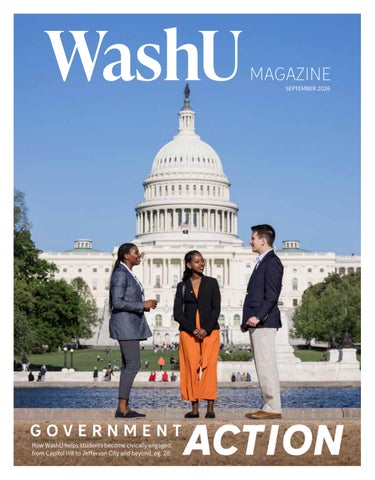
SEPTEMBER 2026
How WashU helps students become civically engaged, from Capitol Hill to Jefferson City and beyond, pg. 28.
SEPTEMBER 2026 VOL. 97, NO. 2
Cover: Student members of the Bears Caucus (from left) Omotunde Oguntoyinbo, Hieran Andeberhan and Ethan Skolnick take a break during WashU Day on the Hill in April. The event, sponsored by WashU Government and Community Relations staff, offers students a unique opportunity to get involved in government action. (See feature, pg. 28.) Cover photo: Whitney Curtis/WashU Background: Maggie Cheng, Class of 2028, performs for the 30th annual Lunar New Year Festival, which took over Edison Theatre in February for three exhilarating sold-out shows. Themed “Boundless Horizons,” this year’s performances benefited EarthDance Organic Farm School in Ferguson, Missouri. Background photo: Whitney Curtis/WashU
“ The more we can show, loudly and clearly, that our graduates are prepared, purposeful and ready to contribute, the more we rebuild the trust that our institutions depend on.”
EDITORS
Claire Gauen Leslie Gibson McCarthy CLASS NOTES EDITOR
Carl Jacobs
CREATIVE DIRECTOR
Jennifer Wessler
SENIOR GRAPHIC DESIGNER
Monica Duwel — C HANCELLOR ANDREW D. MARTIN, UPON RECEIVING THE 2026 CAREER SERVICES CHAMPION AWARD FROM THE NATIONAL ASSOCIATION OF COLLEGES AND EMPLOYERS IN JUNE. FOR MORE, SEE “THE UNIVERSITY CHALLENGE,” PG. 20.
PHOTOGRAPHY AND VIDEO
Joe Angeles Anne Cleary, AB ’03, EMBA ’25 Whitney Curtis Sherry Haines Thomas Malkowicz Javier Ventura CIRCULATION MANAGER
D E PA RT M E N T S
F E AT U R E S
IN EVERY ISSUE FROM THE CHANCELLOR 2 FEEDBACK 3
IN ST. LOUIS NEWS FROM AROUND THE UNIVERSITY
4
20
The university challenge As public trust in higher education falters, WashU leans into our strengths of affordability, career readiness and open dialogue.
CAMPUS NEWS 6 RESEARCH ROUNDUP 8 ON TOPIC 10 QUOTED 11 COURSEWORK 12 BOOKSHELF 14 POINT OF VIEW 16 BIG IDEA 18 Through the Gephardt Institute’s Civic
28
Government action
NEXT 42 THE WORLD OF OUR WASHU ALUMNI
ALUMNI PROFILES FIRST PERSON MY WASHINGTON ALUMNI ACTIVITIES CLASS NOTES IN MEMORIAM LASTING IMPRESSION
44 49 50
52
54 59 64
Action Lab, students are learning firsthand that democracy is a verb.
36
Defending the standard WashU is building a winning athletic program that prioritizes development of the student first and the athlete second — and one that will stay true to its mission in the chaotic world that is college sports in 2026.
Patrick Holt, MA ’22
CONTRIBUTING WRITERS
Mindy Charski, AB ’96 Blaire Leible Garwitz Diane Toroian Keaggy, AB ’90 Julie Kennedy, MA ’22 Mary Lee Terri Nappier Talia Ogliore Chris Quirk Ryan Rhea, AB ’96, MA ’01 Michael Sherraden Abbi Telander Marta Wegorzewska
CONTRIBUTING ARTISTS
Brian Bishop James Byard Jeff Curry Allyn DiVito Steve Frommell Carol Green Sid Hastings Keith Hengen Lauren Justice Gara Lacy Michah H. Manuel Jeanine Liautaud Maul Matt Miller Alex Paz Marcus Rahauser Theo R. Welling VICE CHANCELLOR, MARKETING AND COMMUNICATIONS
Julie Hail Flory, MA ’17
ASSISTANT VICE CHANCELLOR, STRATEGIC COMMUNICATIONS AND MARKETING
Jackie Schlarman
FROM THE CHANCELLOR
Photo: Gara Lacy
Giving generously and looking forward Andy Bursky (left), AB ’78, BS ’78, MS ’78, and Jane Bursky (center), AB ’78, have made a landmark commitment through the Bursky Family Foundation to accelerate the work of the School of Public Health, now named the Andrew M. and Jane M. Bursky School of Public Health. Sandro Galea, MD, DrPH (right), serves as the Margaret C. Ryan Dean and the Eugene S. and Constance Kahn Distinguished Professor in Public Health.
2 SEPTEMBER 2026
Think back to your time at Washington University. Did it change you? Did it change what you thought possible for your life — the path you took, the work you chose, the person you became? It changed me. I came here for my doctorate, and it’s here I had my first academic leadership role. The path to my chancellorship took several satisfying turns, but my return to WashU was a homecoming that has resulted in the most meaningful work of my life. I know that for Distinguished Trustee Andy Bursky, AB ’78, BS ’78, MS ’78, and Jane Bursky, AB ’78, the answer to the question I posed to you is a definitive yes. WashU is where their story began — not just their professional stories, but their life story together. They met here as students, their daughter was educated here, and for five decades, this university has been part of the fabric of their lives. Jane and Andy’s relationship with WashU has always been profoundly forward-looking. Many people seek to give back to their alma mater in gratitude for the ways it changed them, and to say thank you for what was. The Burskys’ contributions to WashU have always been about faith in what can be. After many years of support for scholarships and innovative health initiatives at WashU, this spring the Bursky family made a landmark commitment of $200 million through our With You campaign — the largest gift to WashU in our history — to accelerate the work of our new School of Public Health, now named the Andrew M. and Jane M. Bursky School of Public Health.
Not only is their investment a jaw-dropping act of generosity; it is a profound vote of confidence in what WashU can do. The Bursky School of Public Health is the first such school to be established since the COVID-19 pandemic revealed how fragile our established public health systems could be. The Bursky family’s gift provides the means to build a school specifically designed for the challenges we face right now. Jane and Andy knew they wanted to help WashU change the world, and they recognized that the moment provided an opportunity to maximize their impact. Is it important to give back to the people, places and institutions that change us? I believe it’s an essential component to building a life of meaning, whether our contributions are large or small, or even financial at all. And I believe we can do this best when we shift our orientation. Instead of thinking about what we owe, let’s think about what we hope to build. The same visionary spirit that inspired the Bursky family’s gift is what motivates so many of WashU’s supporters, whether they contribute to a scholarship, offer a summer internship, sit on a National Council or simply answer the call on WashU Giving Day. Whatever your connection to this university, I invite you to imagine what change you’d like to see in the world, and what giving forward might mean to you.
Andrew D. Martin, PhD ’98 Chancellor
“ I read and reread ‘A welcome instance of hope’ with great interest. I would like to point out an additional WashU connection. My team at Wyeth Research was part of this story. The development of moxidectin as a replacement for ivermectin was done in head-to-head clinical trials in Ghana conducted when I was VP of global development operations and vice-chief of development at Wyeth Pharmaceuticals. Moxidectin was originally invented at American Cyanamid, which Wyeth acquired in 1994. The Wyeth animal
FEEDBACK
“ I read and reread ‘A welcome instance of hope’ with great interest. I would like to point out an additional WashU connection. My team at Wyeth Research was part of this story.”
THE MARCH 2026 ISSUE
— IRA SPECTOR, BS ’78, BSEE ’78
2. 3.
1.
1. Elysha Konicov Nichols, AB `91 2. Margaret Demattia Demichele, BFA `91 3. Valerie Harding Wilder, BS `91
Multiple members of the first WashU women’s varsity soccer team reached out to identify the players in our latest “Lasting Impression” photo. Thank you!
“ On p. 53 of the March edition, the photo at the lower right looks suspiciously like my profile. I was a DJ at KWUR back when we played only LPs for music and commercials on 8-track tapes. As you point out in the article, we suffered from low wattage ... which obliged any classmates listening (and there were few) to move their portable radios around in the air to get the signal. Still, the experience reinforced my love for music, which led me to start StreetSide Records (with 3 undergrad friends) and eventually to serve today as board president of Corning Civic Music in the Finger Lakes of upstate New York.” — HARRY (HANK) JONAS, AB ’72, MA ’74, MSW ’74
For more snapshots and their story, visit magazine.washu.edu/online.
We want to hear from you!
PLEASE SEND FEEDBACK TO
Editor, WashU Magazine Washington University in St. Louis MSC 1070-0390-02 1 Brookings Dr. St. Louis, MO 63130-4899
wustlmageditor@wustl.edu
WashU
health division developed moxidectin for animal use to prevent heartworm. At Wyeth, we had a task force that routinely reviewed whether drugs developed for animal use could be repurposed for human use and vice versa; my clinical operations team was tasked with running human trials with this drug. A human version of moxidectin was developed, which was used in these clinical trials. After Pfizer acquired Wyeth in 2010, moxidectin was donated to the WHO. A human form of the drug was approved in 2018.”
WashU
SEND ADDRESS CHANGES TO
Advancement Services Washington University in St. Louis MSC 1082-414-2555 7425 Forsyth Blvd. St. Louis, MO 63105-2161
“ My congratulations to KWUR on their 50th anniversary of obtaining FCC approval and their very own FM frequency. I had the good fortune to work at the predecessor to KWUR! I joined KFRH (for K Forsyth Residence Halls) my sophomore year sweeping floors. Not long after, the program director, Stan Denis [BSBA ’72] let me do the late-night disc jockey job … I have great memories of that work and frankly learned valuable lessons with respect to the use of a microphone, speaking clearly and just getting over the fear of speaking in public, which helped me later in life as a trial lawyer and mayor of my hometown. Stan and I were roommates in my junior year and have been friends since. Go Bears.” — TODD MEIER, AB ’73
University Marketing & Communications publishes WashU Magazine (magazine.washu.edu). Unless otherwise noted, articles may be reprinted without permission with credit given to WashU Magazine.
wuaddatachange@wusm.wustl.edu
WashU
WashUSTL
Washington University in St. Louis
WASHU MAGAZINE 3
4 SEPTEMBER 2026
NEWS FROM AROUND THE UNIVERSITY
Runni ng start WashU Medicine faculty, fellows and students laced up their sneakers in April to volunteer at the Greater St. Louis Marathon. For the first time, WashU Medicine served as the event’s official medical provider, joining WashU as a major race sponsor. At four aid tents lining the 26.2mile route, clinicians offered on-the-go help for runners in need. Just past the finish line, 80 volunteers from the WashU Medicine Program in Physical Therapy, including Brooke Sutter (left), served some 620 runners in their post-race recovery. A fun-filled WashU hospitality hub also offered drinks, snacks and celebration.
Photo: Jeff Curry
WASHU MAGAZINE 5
CAMPUS NEWS
Rendering: Studio Ma
MCLEOD HOUSE RISING ON SOUTH 40
A new residence hall being built on the South 40 will be named the James E. and Clara P. McLeod House, in honor of the late vice chancellor for students and dean of the College of Arts & Sciences, and his wife, who urged the WashU community to know each student “by name and by story.” Fronting Forsyth Boulevard, McLeod House will accommodate 600 residents and is expected to be ready by August 2028. The new hall recognizes the enduring impact of the McLeods. Jim McLeod, who died of cancer in 2011, spent 37 years at the university on the Arts & Sciences faculty and in the administration, and he founded the John B. Ervin Scholars Program in 1986. The McLeod Scholars Program and the McLeod First-Year Writing Prize already honor him. Clara McLeod, who served WashU Libraries for more than three decades, is now special adviser and assistant to the vice chancellor for student success. She regularly meets with Ervin and McLeod Scholars and those from other scholar programs to support their growth as leaders and students.
NEW PHARMACY SCHOOL ON HORIZON
WashU and the University of Health Sciences and Pharmacy (UHSP) have entered into an agreement where WashU will assume control of UHSP, ensuring the legacy of the 162-year-old institution and first college of pharmacy founded west of the Mississippi River. UHSP’s central program, the Doctor of Pharmacy, will become WashU’s 10th academic school, to be known as WashU St. Louis College of Pharmacy. The agreement, pending regulatory approvals, marks a significant milestone in the long-standing relationship between the two institutions and reflects WashU’s continued investment in advancing health sciences education, research and clinical collaboration.
6 SEPTEMBER 2026
BROWN SCHOOL TO FULLY FUND PRACTICUMS FOR MSW STUDENTS
Brown School students seeking a master’s in social work (MSW) will no longer have to fund their own practicums — a required component of social work education long known for being unpaid. This semester, the Brown School becomes the nation’s first MSW program to fully fund practicum internship experiences and provide living stipends to students. “By helping to remove barriers to entry, our students can focus completely on becoming the best social workers possible without worrying about missed income or added debt,” says Dorian Traube, the Neidorff Family and Centene Corporation Dean of the Brown School. “We are setting a new national standard for social work education and responding to the growing call to address unpaid placements across the country.”
OLIN ADDS SPORTS MASTER’S DEGREE
This fall, Olin Business School became the only top-25 university in the U.S. to offer both undergraduate and graduate degrees in sports business. Olin’s new MS in the Business of Sports is a two-year, on-campus program that has three semesters of classroom instruction and a semester-long internship. The program also includes immersion trips around the country — a hallmark of the undergraduate program that launched in 2014. Through visits to professional franchises, college programs, and sports marketing and management agencies, students make important contacts and gain valuable experience.
I have a new name!
For the reveal, see pg. 54.
$200M
Landmark Gift
L a ndma rk g if t e stab l i she s Bu rs ky S chool of P ub l i c H ealt h At a defining moment for public health in the United States, a $200 million commitment was made this spring to fortify the School of Public Health. The landmark investment — the largest in WashU history — was made by the Bursky Family Foundation, established by Andrew M. Bursky, AB ’78, BS ’78, MS ’78, past chair of the WashU Board of Trustees, and his wife, Jane M. Bursky, AB ’78. The school will be named the Andrew M. and Jane M. Bursky School of Public Health. The gift, made through With You: The WashU Campaign, will drive growth, including faculty hiring, scholarships and new research initiatives, while advancing a broader effort to rethink how public health is taught, studied and applied. It builds upon decades of philanthropic support by the Burskys, focusing squarely on accelerating discovery and translating research into real-world impact.
NEW PODCAST MEETS THE MOMENT
“Everything starts with ideas and how we engage with them,” says Sandro Galea, MD, DrPH, in the trailer for the podcast “Ideas Matter.” Hosted by Galea, the Margaret C. Ryan Dean and the Eugene S. and Constance Kahn Distinguished Professor in Public Health, the podcast debuted in April with episodes on topics ranging from immigration to tariffs to artificial intelligence and creativity. “This moment is among the most consequential in history,” Galea said in the introduction. “Making sense of it demands a public conversation that is thoughtful, informed and engaged with the full complexity of the forces shaping our world.” The podcast, which draws in experts from around the world, is available on Spotify, Apple Podcasts and YouTube. New episodes drop every other week.
NEW DEANS FOR WASHU MEDICINE, SAM FOX SCHOOL
Two new deans began their tenures July 1. Bruce D. Levy, MD, a highly regarded leader in academic medicine and an accomplished physician-scientist in pulmonary and critical medicine, returned to his hometown as executive vice chancellor for medical affairs and the George and Carol Bauer Dean of WashU Medicine. Levy, who grew up in St. Louis, returned after a 35-plus year career at Harvard Medical School and Brigham and Women’s Hospital, one of Harvard’s leading teaching hospitals. On the Danforth Campus, Charlie White became the Ralph J. Nagel Dean of the Sam Fox School of Design and Visual Arts. White is a highly regarded artist and academic leader whose vision and student advocacy helped to build nationally recognized programs at Carnegie Mellon University and the University of Southern California.
Photo: Courtesy
Photo: Marcus Rahauser
A PLUS IN THE AI COLUMN
Artificial intelligence (AI) can never replace the creativity, disciplinary expertise and guiding values of an academic institution, but there’s no denying AI holds tremendous potential for any university community. To stay ahead of it, a new universitywide academic initiative called +AI launched in March. Headed by Provost Mark D. West, +AI aims to fuel student success, transform teaching and learning, accelerate research and support the region while acknowledging the challenges AI will create for students, the institution and society. “We do our best work when we ask the hard questions, test new tools thoughtfully and put human judgment at the center of what we do,” West says. “That approach will guide us here as well.” WASHU MAGAZINE 7
RESEARCH ROUNDUP
Blood test ‘clocks’ predict Alzheimer’s onset Researchers at WashU Medicine have developed a method to predict, within a margin of three to four years, when someone is likely to develop symptoms of Alzheimer’s disease — using nothing more than a single blood test. “In the near term, these models will accelerate our research and clinical trials,” Suzanne E. Schindler, MD, PhD, associate professor of neurology, says. “Eventually, the goal is to be able to tell individual patients when they are likely to develop symptoms, which will help them and their doctors to develop a plan to prevent or slow symptoms.”
PLANT SCIENCE WITH A TWIST
Plant roots “do the twist” all the time, making turns through soil to avoid rocks and debris. Scientists have long attributed such twisting to the absence, or null mutation, of a certain gene. Now, WashU researchers have discovered a more precise mechanism. It turns out that there’s no need for a full null mutation for the twist, only a change in gene expression in the plant epidermis. Scientists can now apply this knowledge to addressing challenges in agricultural science, such as the need for root systems that can thrive in challenging soil conditions. The research emerged from a nationwide consortium, co-led by WashU, that brings together biologists, engineers and physicists to understand how physical forces shape living systems.
GLACIER TRACKING
New estimates show that some areas of the Sunlight glacier system in northwest Wyoming could be ice-free within a decade or less. For the study, postdoctoral researcher Tyler Meng led a multi-institution team that deployed geophysical instruments, processed satellite data and developed new methodology to gather more than 100 years’ worth of documentation about Sunlight’s life — and its eventual death. They found that the glacier is melting up to 50 centimeters a year, with 5–20 meters of total ice left in place. Meng works in the radar geophysics lab of Roger Michaelides, assistant professor of earth, environmental and planetary sciences in Art & Sciences.
8 SEPTEMBER 2026
IRREGULAR HEARTBEATS AND THE NEED FOR PERSONALIZED MEDICINE
The 50-year-old drug mexiletine is commonly used to treat irregular heartbeat, or cardiac arrhythmia, but it works in only about 20% of patients. In a recent study, Jon Silva, professor of biomedical engineering at WashU McKelvey Engineering, and Martina Marras, a doctoral student in his lab, screened four genetic variants to see if any of them altered the effectiveness of mexiletine. They found that for patients with one common genetic variant, the medication can cause arrythmia rather than suppress it. The work raises a call to reconsider how drugs to treat arrhythmia are prescribed and the role of genetic testing in that process.
ROBOTS LEARNING FROM ROBOTS
Can a team of robots with different capabilities work together toward the same goal? A multi-institution team including Chongjie Zhang, associate professor of computer science and engineering at WashU McKelvey Engineering, decided to find out. The group developed a new method that enables robots to achieve intentions shown by their peers. The method, called IntentionAligned Imitation Learning (IAIL), is inspired by human cultural learning. The team tested IAIL with seven different robots in 30 scenarios, which allowed for multi-robot teamwork and showed the methods’ ability to adapt behaviors.
The AI next door
For more on university research and faculty achievement, visit source.washu.edu/news.
IN PURSUIT OF A CANCER VACCINE
The advent of mRNA vaccines changed the course of the COVID-19 pandemic. Now, the Nobel Prize-winning technology is being adapted to fight cancer, including melanoma and bladder cancer. Scientists had assumed that one specific immune cell subtype was required for mRNA vaccination to activate the immune system. But researchers at WashU Medicine show in a new study in mice that even without these cells, the mRNA vaccine still triggers strong cancer‑killing responses. The results offer a deeper understanding of how the immune system responds to mRNA vaccination and may guide the optimal design of a cancer vaccine.
A recent study by Xiang Hui, associate professor of marketing, shows that artificial intelligence (AI) can improve outcomes in real estate transactions. Using both a field experiment and evidence from an 18-city rollout in China, Hui and co-authors found that real estate agents’ access to an AI copilot raised the probability of a listing selling within three months; shortened seller time-on-market and buyer search duration; raised transaction prices; and increased ratings from buyers and sellers after the sale. The paper earned Hui his second Olin Award, which recognizes the impact of Olin Business School research.
ARTISTIC OUTPUT
A guaranteed income source for artists increased both motivation and creative productivity, according to a Brown School study. Stephen Roll, assistant professor, examined the effects of a foundation-funded, New York-based program that provided 2,400 artists with $1,000 per month in unconditional cash assistance for 18 months. The stable income led to several positive outcomes, he found, while showing no reduction in the artists’ other sources of income. Such support “helps ensure that we maintain a growing and healthy artistic culture,” Roll says. Another benefit: It may also help artists weather the changes wrought by the spread of AI.
NO SUCH THING AS PRESIDENTIAL ‘REMOVAL POWER’
A paper from Andrea Katz, associate professor of law at WashU Law, disputes a long-standing claim that America’s founders agreed the president holds unrestricted power to fire executive officials. Katz and her co-authors re-examined early debates and practices around the “Decision of 1789,” often cited as proof of consensus on presidential removal power. The found that deep and persistent disagreement, not consensus, defined the founding era. “In our view, the bulk of evidence from the early republic suggests that there was no such thing as a ‘removal power’ that most Americans understood to lie with the president,” Katz says.
WASHU MAGAZINE 9
ON TOPIC
Illustration: Keith Hengen
Catching Zzzs Biologist Keith Hengen’s research is getting deeper into sleep, unraveling the great mystery of slumber’s purpose in the brain and the body. The scientist is also an artist!
When you’re awake, all your brain’s functions gradually deteriorate. Sleep somehow restores them and may hold the key to understanding how brains operate. “Sleep is one of the great mysteries in biology,” says Keith Hengen, associate professor of biology in Arts & Sciences. “We all need it, but we don’t know why.” Hengen’s research focuses on understanding how sleep contributes to healthy cognition and how disrupted sleep worsens neurodegenerative and mental health disorders, like Alzheimer’s disease or depression. In 2024, Hengen and Ralf Wessel, professor of physics in Arts & Sciences, published a significant paper that reported the first direct evidence that sleep restores the computational power of the brain. They discovered that sleep has a fundamental purpose: resetting neural networks by restoring criticality, a state of mind that promotes optimal thinking and learning. Understanding this tipping point helps explain the incredible power of the brain. Up until recently, most people assumed that sleep must replenish some sort of crucial molecules that are depleted during waking hours. But what Hengen and Wessel found is that learning, thinking and being awake pushes the brain away from criticality — and that sleep is perfectly positioned to reboot the system. Now, Hengen is exploring new questions about the connections between sleep and disease. “Sleep is worth studying not only because of its innumerable health benefits but precisely because a brain without sleep falls utterly and completely apart,” he says. To tackle this research, Hengen and his team have developed a flexible brain-electrode interface that can record the activity of individual neurons in the living brain over extended periods of time. It’s an intensive process that delivers a staggering amount of data. “We’ve engineered systems that allow us to record for months at a time,” he says, “so we can observe how the same neurons behave over thousands
10 SEPTEMBER 2026
of iterations of sleeping and waking cycles, through light and dark and across conditions that can’t be captured quickly, like aging or disease progression.” This spring, Hengen and Luis de Lecea of Stanford University were awarded $2.7 million from the National Institutes of Health (NIH) for a five-year investigation into the power of sleep to prevent, delay and diminish Alzheimer’s and related diseases. They will examine the relationship between sleep patterns, criticality and brain function in mice engineered to be at high risk for an Alzheimer’s-like neurodegenerative disease. The scientists hope to develop targeted sleep interventions that could slow or prevent diseaserelated cognitive decline. This research could lead to new therapeutic strategies for neurodegenerative diseases that affect millions. “Breakdown in criticality seems to unify at least four molecularly distinct forms of neurodegenerative diseases,” Hengen says. “It’s almost like driving a car in the wrong gear for years; eventually, you start to destroy the engine. But by looking at subtle shifts, you can predict who’s vulnerable long before you start to see symptoms.” Hengen has also just begun to work with Aya Takeoka at the Japan-based RIKEN Center for Brain Science, investigating a sleeplike process in the spinal cord with funding from the Human Frontier Science Program. Sleep is traditionally considered a brain-centric phenomenon. But whether neural structures beyond the brain experience sleep remains an unexplored frontier — one with potentially profound implications. If the spinal cord exhibits autonomous sleeplike states contributing to motor memory consolidation, this would challenge and expand our understanding of sleep’s role in learning and neural plasticity. These new questions strike at the heart of what sleep is, why it is necessary and where in the nervous system it operates. “If the brain is a computer, my lab is trying to figure out the operating system,” Hengen says. “I’m convinced sleep is the key to how the brain works.” ■ TALIA OGLIORE
“ The pain we feel inside of us is power. If we can recognize how powerful it is, our own stories, our own feelings, and direct it somewhere, it can change the world.”
QUOTED
From Convocation to Commencement, here are some of the words of wisdom overheard on the Danforth Campus in the 2025–26 academic year.
“[AI tools] are amazing. If you don’t use them, use them. If you’re a student, use them. But remember also that they’re fools. They still hallucinate all the time; these agents make up garbage constantly.” NICHOLAS THOMPSON, CEO OF THE ATLANTIC, SPEAKING MARCH 25, 2026, DURING WASHU’S +AI PERSPECTIVES WEEK
AMANDA NGUYEN, THE FIRST VIETNAMESE-AMERICAN WOMAN IN SPACE, SHARING HER STORY OF ADVOCACY AND HOPE AS A SEXUAL ASSAULT SURVIVOR, APRIL 16, 2026, AT A FIRESIDE CHAT LECTURE
Courtesy photo
“ Sometimes the weird way to success is the right way to success.”
“ We believe in the power of friendship; we must continue to build bridges and pass on the torch to future generations.” LAURENT BILI, THE FRENCH AMBASSADOR TO THE UNITED STATES, SPEAKING AT OLIN LIBRARY FEB. 26, 2026, AT AN EVENT MARKING 250 YEARS OF FRIENDSHIP BETWEEN THE TWO COUNTRIES
ANDY COHEN, SPEAKING TO THE CLASS OF 2026 AT THE MAY 15, 2026, COMMENCEMENT
Photo: Joe Angeles
“ Ask yourself: ‘If there is a list that ranks every person in the world based on overall success and happiness, from 1 to 8 billion, where would I rank?’ I’m happy in life because I literally play this game all the time.”
Photo: Matt Miller
SAM GOODWIN, MA ’21 WRONGFULLY INCARCERATED FOR 63 DAYS IN A SYRIAN PRISON IN 2019, SPEAKING FOR THE WASHU ASSEMBLY SERIES, JAN. 21, 2026
WASHU MAGAZINE 11
COURSEWORK
PHTPS 6009: From the Inside-Out: Public Health and the Built Environment
What’s in a sidewalk? A graduate public health course examines the effects of built environments, from local crosswalks to global cityscapes. Believe it or not, something as simple as sidewalks can impact the health of those living in a neighborhood. Without safe sidewalks, residents have fewer places to walk. “And that’s going to impact your cardiovascular system and, eventually, your mortality,” Rodrigo Siqueira Reis says. In fact, many elements of where we live and work — such as the presence or absence of safe areas to exercise, affordable and healthy food options, and viable transit — can help us or hurt us. Reis, professor of public health, teaches students in the Master of Public Health program to examine their surroundings in his course “Public Health and the Built Environment.” The built environment is any aspect of one’s surroundings that has been modified by humans, such as sidewalks, streets, homes, office buildings, intersections, transit systems, parks, restaurants, grocery stores and water systems. These structures can affect aspects of health “ranging from chronic diseases to infectious diseases,” Reis says. “If you don’t have safe crosswalks to cross streets, you can be hit by a car,” he says. “If you work indoors and you’re sitting all day or you’re exposed to fumes or asbestos, that’s also going to impact your health.” Reis notes that cities are places where many people thrive, but urban environments can also present harmful or unhealthy conditions. Zoning and urban planning policies shape areas where people live and can create inequities along social, racial, ethnic and cultural divides. In this way, the built environment can provide opportunities for some but reduce opportunities for others. To understand these issues, Reis’ students hear perspectives from local, national and international guest speakers on bikeability, walkability, affordable housing, tree planting and many other topics. In one of several group projects, students evaluate the built environments of cities around the world. 12 SEPTEMBER 2026
“Some cities are doing better than others in a few areas,” Reis says. These cities can inspire improvements elsewhere. For example, Bogota, Colombia, closes 79 miles of streets to cars every Sunday, which provides walking and biking space for over a million people weekly. This type of solution can be implemented in low-, middle- and highincome nations, Reis says. Here in St. Louis, his students audit the built environment of a small area such as a single intersection. They look at the conditions of things like sidewalks, crosswalks, traffic signs, bike lanes, benches and bus stops. In another class project, they find and evaluate a proposed policy or project that’s still in the planning stages. These could be roads, sanitation systems, parks or housing developments. Students take what they’ve learned to a variety of careers. Reis’ students have gone on to work for nonprofits, local and state governments, and the Centers for Disease Control and Prevention. Some go to law school to study environmental law, and some earn doctorates in environmental science. “I know that what we discussed in this class will stay relevant no matter where I end up working,” says Claire Ami Pavlides, a secondyear Master of Public Health candidate from New York City. “I’ve come to see that health isn’t simply about hospitals, doctors or individual behaviors. It’s also about the spaces people live, work and move through every day,” she says. Reis hopes his students, who are from across the United States and around the globe, continue to link the conversations they have had in class to what they see around them. “This is not a hypothetical course,” Reis says. “To me, it’s a course based on your lived experiences. It’s important that students try to connect this course with places they have lived, where they live now and where they will live and work in the future.” ■ JULIE KENNEDY, MA ’22
COURSE GOALS
1. Understand that the built environment intersects with nearly all public health concerns. 2. Learn measures, methods and approaches to analyze the health impacts of the built environment. 3. C onsider how to recommend policy changes to make the built environment healthier.
Illustration: Monica Duwel
WASHU MAGAZINE 13
BOOKSHELF
Boy, interrupted Stefan Merrill Block’s memoir sheds a heartrending light on his experience with homeschooling. Stefan Merrill Block, AB ’04, was in fourth grade when his mother declared him a creative genius and pulled him out of his Plano, Texas, elementary school to homeschool him. Just him, and not his older brother. “Are you sure this is what you want?” his principal asked him as they walked out of her office. But with his mom hovering, Block simply said yes. At 9, he had neither the vocabulary nor the life experience to explain the complicated emotions behind the decision. Thus began his five-year odyssey in home schooling. It’s the story Block, an accomplished novelist, tells in Homeschooled (HarperCollins, 2026), a memoir of childhood and the suffocating lengths to which a mother goes to protect and nurture her son. The subject matter is timely. An estimated 3.4 million U.S. children — roughly 6 percent of school-age kids — are homeschooled. Yet in many states, there remains little to no regulation, even as it grows in popularity. Block’s homeschooling began in Texas in 1992, where there were few rules and no oversight, testing or accreditation. The “curriculum” his mother designed was loose, erratic and lonely. Aside from a few worksheets, Block was mostly left to his own education, which included reading and video games with only his mom as his social life. “My mother thought she was giving me all the things she didn’t get,” he says. “But one of the great challenges in writing this was wondering if indeed this experience was all in my head. And was this abusive in some way?” Block survived his isolated elementary years and rallied in high school, where after a rocky assimilation back into public education he quietly built a resume that included winning a national science fair. By the time he matriculated 14 SEPTEMBER 2026
at WashU in 2000, he was driven yet scarred by his homeschool experience. “I was completely focused on the idea of succeeding in college as much as I possibly could,” Block says. “I felt like I needed to succeed in order to protect my mother, to make what she had said about me come true for her.” Success meant giving up his mom’s chosenfor-him pre-med studies after mentors like William Paul, professor emeritus of film and media studies in Arts & Sciences, saw his gift for writing and encouraged him to consider a different path. Paul pulled Block aside early in a class during his first year and told him, “You should be in the humanities.” That gentle encouragement ignited a spark, and Block never looked back. He’d already written three novels to critical success when his mother died of cancer during the pandemic. He started writing about his mother as a way to deal with his complicated grief, and it grew into a memoir. A New York Times bestseller and a Today Show “Read With Jenna” selection, Homeschooled is a challenging yet rewarding read, and that’s intentional. “I didn’t want to come to easy conclusions for the reader,” Block says. “This story is complex and unsolvable, and I wanted to give space and let the reader sort through the difficulty themselves.” ■ LESLIE GIBSON MCCARTHY
FACULTY
Judy Blume: A Life
MARK OPPENHEIMER
In Judy Blume, Mark Oppenheimer, professor of practice and executive editor of Arc: Religion, Politics, Et Cetera for the John C. Danforth Center on Religion and Politics, peels back the curtain on one of the most iconic authors of young adult fiction of the 20th century. Oppenheimer reveals Blume in all her complex, multifaceted glory — a gift for anyone who grew up reading and loving her extraordinary books.
Kigali: A New City for the End of the World SAMUEL SHEARER
Michelangelo and Titian WILLIAM E. WALLACE
Samuel Shearer, assistant professor of African and African American Studies in Arts & Sciences, writes of Rwanda’s capital city in the wake of government officials seeking to transform Kigali from wounded urban area into a destination for foreign investment. The book offers a searing critique of capitalist solutions to climate change and alternative ways to understand sustainability.
A compelling account of two gifted rivals who inspired each other to test the limits of creative genius. In bringing Italian Renaissance art to life, William Wallace, the Barbara Murphy Bryant Distinguished Professor of Art History in Arts & Sciences, challenges the established narrative of the rivalry as one-sided, with the younger Titian sharing with Michelangelo patronage, power and sometimes friendship.
To Life: Jews Exploring Nature
The Last American Road Trip
The Unbelieving Yelp of Pray
To Life explores the Jewish relationship with nature by illuminating significant Jewish thinkers who deepened our understanding of various aspects of natural history. In a collection of eight compelling chapter-long biographies, naturalist Joel Greenberg, MA ’81, JD ’81, dives into Jewish environmental history and demonstrates the diversity of both Jewish identity and the natural sciences.
In the midst of covering the political turmoil of the past decade, journalist Sarah Kendzior, PhD ’12, is determined to show her children America from the family car. Part memoir, part political history, The Last American Road Trip is a mother’s promise to her children that their country will be there for them in the future — even as she struggles to believe it herself.
Alex Mouw, MA ’20, PhD ’25, confronts religious devotion as something to grasp and something that seizes in this book of meditative, ecstatic and sometimes snarky poetry. His poems seek the divine not only in the natural world, but also in science and personal history. Amid ordinary lives and crises of faith, revelation descends unexpectedly while talons extend in frightful welcome.
ALUMNI
JOEL GREENBERG
SARAH KENDZIOR
ALEX MOUW
WASHU MAGAZINE 15
POINT OF VIEW
Photo: Jeannie Liautaud Maul
16 SEPTEMBER 2026
Giving every child a future Child Development Accounts may seem like a new idea, but they’ve been around for 35 years. Michael Sherraden reflects on their origins and impacts. As a young professor teaching social policy at Washington University in the early 1980s, I was talking with a group of St. Louis mothers who relied on government assistance. They said they could never save for a better neighborhood or education because welfare’s asset limits meant even modest savings jeopardized their benefits. Meanwhile, my wife, Margaret, and I had one assistant professor salary, two young children, college debt and no savings. But something transformative had happened. When I accepted the faculty position, WashU opened a retirement account for me with an employer match and tax deferral. I barely noticed at the time; retirement felt so far away. In a few years, over $10,000 accumulated. We had never had much savings before. I attended a meeting to learn more about the account, and the lecture hall was full of faculty. Why were we all there? I soon realized that we came and paid attention because someone had arranged for us to accumulate assets. Having the assets changed how we acted. I thought about the mothers I had met. No one was helping them accumulate assets, and if through difficult sacrifice they managed to save, they risked losing benefits. The next time I met with them, I asked: If someone would match your savings, and your savings would not reduce your benefits, could you accumulate some money? They said yes — and said no one would ever do that for them. This response stayed with me. Why would public policy support professors and other working professionals in building assets for the long term but discourage poor families from doing so? After a period of reflection and research, this experience led to my 1991 book Assets and the Poor. I proposed that everyone should have access to an account for lifelong asset building, starting as early as birth. This became the foundation for Child Development Accounts (CDAs) — savings or investment accounts, opened automatically, to enable all children to begin accumulating assets early in life. Over the past three decades, CDAs have moved from idea to policy. I was a Fulbright Scholar at National University of Singapore in 1992, and Singapore adopted EduSave for all schoolchildren in 1993, later expanding assetbuilding policies for youth. In 1994, I started the Center for Social Development (CSD) at WashU to study such policies. From 2000–05, I advised the Tony Blair government as the United
Kingdom started the first universal CDA at birth. In 2007, CSD launched SEED for Oklahoma Kids, a rigorous experiment that generated impactful CDA evidence. Even the poorest families can accumulate assets, and as a result, they are able to think and act more constructively. Other countries initiated CDAs. Discussion of universal and lifelong asset-building policy, a concept that did not exist before 1991, grew stronger. In 2010, because of this work, I was named by Time magazine as one of the 100 most influential people in the world. In 2015, Israel launched a universal CDA with regular monthly deposits. In 2024, Kazakhstan launched a universal CDA with annual deposits using oil and gas wealth. Several U.S. states have started universal CDAs. The CSD has advised in all of these developments. Today, over 30 million children worldwide are building assets in CDAs. Research at CSD has been productive because of the extraordinary talents and dedication of CSD staff. I am fortunate to work with them. The CDA work has also informed parts of today’s Trump Accounts at the federal level. Unfortunately, the policy stops well short of guaranteeing every child an account. It could leave behind millions of children — especially children from the lowest-income families. But there is potential. Congress approved more than $16 billion in initial funding, and the Dell Foundation has pledged over $6 billion, with a focus on the lowest-income children. Congressional leaders and staff from both parties recognize the potential of an inclusive platform for asset building starting at birth. Policy windows rarely open in predictable ways. Trump Accounts are far from perfect, but the core idea — that every child should have an account for asset building over a lifetime — has now entered U.S. federal law with bipartisan and philanthropic support. If we can secure universal inclusion, adequate funding and sound administration, this could mark the emergence of permanent asset building for all children in the United States. We are aiming for that. Indeed, my vision, and CSD’s, is that every newborn on the planet will receive a Child Development Account, along with their immunizations and a birth certificate. This may sound audacious, but technology now makes it possible. Political and economic barriers can be daunting, but CSD will continue using evidence and partnerships to inform effective policy.
WHO
Michael Sherraden, the George Warren Brown Distinguished University Professor in the Brown School and the founder and co-director of the Center for Social Development EDUCATION
Harvard University, AB ’70; University of Michigan, MSW ’76, PhD ’79 UNDERAPPRECIATED HONOR
His research on the Civilian Conservation Corps of the 1930s contributed to the creation of AmeriCorps, part of the National and Community Service Trust Act of 1993. He was in attendance for the signing of the bill at the White House. VALUED MENTOR
“Michael doesn’t just build ideas, knowledge and policy — he builds people. Working with him for more than 20 years has been one of the greatest privileges of my career. He’s an extraordinary mentor — steady, generous, open and deeply committed to lifting others.” – Jin Huang, the Irving Louis Horowitz Professor in Social Policy and co-director of the CSD, speaking to the WashU Record
■ MICHAEL SHERRADEN
WASHU MAGAZINE 17
BIG IDEA
From campus to commerce
115
80%
WASHU STARTUPS
INVESTOR-FUNDED OR REVENUEGENERATING SINCE 2023
1,100
WashU faculty launch innovative companies and create life-changing technologies. Investors are taking notice.
WORKERS IN THE ST. LOUIS REGION EMPLOYED BY HOMEGROWN COMPANIES
Over the past several decades, 115 WashU startups have sprung into existence across industries, with biotech researchers at WashU Medicine leading the way. In recent years, success — and external investment — have reached new heights. Since 2023, 80% of WashU startups are investor-funded or revenue-generating. Homegrown companies now employ 1,100 workers in the St. Louis region. These are only a few of the numbers that tell the story of how WashU innovators strive to bring their ideas to scale — and to the people who need them most. ■ MARTA WEGORZEWSKA AND CLAIRE GAUEN
68 U.S. PATENTS RECEIVED IN FISCAL YEAR (FY) 2025
ACCELERATION THROUGH INVESTMENT
268
6 STARTUPS LAUNCHED, ALL REVENUEGENERATING OR INVESTOR-FUNDED, IN FY 2025
FACULTY INVENTIONS DISCLOSED IN FY 2025
8
$17M LICENSING REVENUE GENERATED IN FY 2025 — AND THEN INVESTED IN WASHU RESEARCH PROGRAMS
ACTIVE STARTUPS RECEIVED MAJOR PRIVATE FUNDING IN 2025
R EC
ET
G A M OU N T
18 SEPTEMBER 2026
PRIVATE-SECTOR CAPITAL INVESTED IN WASHU STARTUPS IN 2025
TIN
$1.7B For more on WashU innovation and commercialization, visit innovation.washu.edu
D -S
DISCOVERY AND INVENTION
OR
UPDATES FROM THE BIOTECH BOOM C2N Diagnostics Innovation focus: Alzheimer’s blood tests Recent milestone: The WashU Medicine startup expanded and is moving its 98 employees to the Cortex Innovation District, a premier destination for pioneering biotech and life science companies.
COMMERCIALIZATION SUPPORT AT WASHU: AN ABBREVIATED TIMELINE
Since 1986, WashU’s Office of Technology Management (OTM) has supported faculty through every stage of commercialization. The office helps protect intellectual property (IP), license technologies and launch startups. In recent years, OTM and other startup-savvy WashU initiatives have accelerated their activity and impact.
2014-24: Invention disclosures grow by 85% and patent filings by 92%, with a 70% increase in patent issuance. License agreements and startup licenses double.
Wugen Innovation focus: Cancer immunotherapy ecent milestone: R Wugen, a WashU Medicine startup, has launched a phase 2 clinical trial to evaluate an offthe-shelf “universal” CAR-T cell therapy for treating aggressive leukemias and lymphomas. DeepSight Technology Innovation focus: Next-generation ultrasound technologies Recent milestone: In 2025, the WashU McKelvey Engineering startup received FDA clearance to market its NeedleVue system to hospitals and physicians’ offices. The technology guides doctors in performing targeted biopsies, injections and other minimally invasive procedures.
2022: OTM launches New Ventures team to grow the number of high-value WashU IP startups. The team connects faculty innovators and entrepreneurs to tools, investors and mentors to catalyze startups based on WashU IP.
2023: OTM introduces the Washington University Gap Fund, which provides funding for WashU technologies to increase chances of attracting industry partners. WashU Medicine launches the Needleman Program for Innovation and Commercialization (NPIC).
2024: Doug E. Frantz becomes vice chancellor for innovation and commercialization, overseeing OTM, NPIC and more. Olin Business School launches the Business for Health initiative with biomedical commercialization as a pillar. 2025: The Venture Fellows first cohort completes its nine-month curriculum. The OTM program invites postdoctoral fellows to analyze potential startups and learn about company creation and venture capital investing.
2026: WashU becomes inaugural member of Third Coast Foundry. At a dedicated workplace in San Francisco, eight Midwestern universities build connections among researchers, investors, alumni and partners in the Bay Area.
WASHU MAGAZINE 19
Photo: Carol Green/WashU
20 SEPTEMBER 2026
The
University Challenge ■ BY CLAIRE GAUEN
As public trust in higher education falters, WashU leans into our strengths of affordability, career readiness and open dialogue.
WASHU MAGAZINE
21
LESS THAN A YEAR AGO, IN OCTOBER 2025, THE PEW RESEARCH CENTER RELEASED A TROUBLING SET OF FINDINGS. In its annual nationwide survey on higher education, the center included a straightforward prompt: Are colleges and universities in the United States headed in 1) the right direction or 2) the wrong direction? Among nearly 3,500 respondents, seven in ten chose the second option. These results, though stark, are not out of line with recent trends. With every passing year since 2020, Pew has found that a greater percentage of Americans in both political parties believes higher ed is going astray. In a separate poll last fall, Gallup revealed that only 35% of Americans deem college “very important,” down from 75% in 2010. Colleges and universities around the country have been closely tracking these ongoing shifts in public perception. Yale University, for example, created a Committee on Trust in Higher Education, which reported that Americans perceive the cost of college to be too high — and career outcomes too uncertain to justify that cost. The survey also pointed to broad concerns about political bias and a dampening of free speech on campuses. The 2025 Pew poll grounds these findings. The most damning critique points to the price tag of a college degree: An overwhelming 79% of respondents (including 82% of those identifying as Republican) said colleges and universities are doing a “fair” or “poor” job keeping tuition costs affordable. The steady decrease in public approval raises concerns for university administrators, faculty and anyone who cares about the purpose and success of these longstanding institutions. Because behind the sinking line on a graph, families and elected officials are debating realworld questions at dining room tables and in the halls of government — questions with deep importance for students and for society:
At WashU, the answers to these questions are clear: yes, yes, yes. Through programming, coursework, staffing and investments, university leaders express to those within our community — and increasingly, to outside observers — that WashU is tackling the university challenge head on. Our university is a place that values affordability, excels in career outcomes and actively cultivates free speech. The principles that guide these efforts have long been integral to the university’s mission of teaching, research and patient care. At a time of growing public skepticism about higher education, reaffirming those commitments, and sharing our successes, is essential.
1
Are college campuses places where freedom of expression matters and where differing viewpoints can coexist? Is the cost too high? Is a college degree even worth pursuing in 2026? 22 SEPTEMBER 2026
PERCEPTION NO. 1: A college education is unaffordable. There’s no denying it: costs have risen since readers of WashU Magazine first walked through the archway of Brookings Hall. For students in the Class of 2030, who celebrated Convocation a few weeks ago, the full cost of attending WashU this academic year, including tuition, housing, meals and fees, is right around $97,000. That price tag can shock those unfamiliar with the broad reach and impact of financial aid, says Mike Runiewicz, assistant vice provost and director of student financial services. The number, however, doesn’t tell the story of what WashU really costs for many of the students who excitedly waved flags at Convocation. “We meet 100% of need with no loans for any student,” Runiewicz says. “We let people know, number one, that we’re committed to their success and that we’re going to stick with them for all four years.” WashU’s no-loan undergraduate financial aid policy, in place since 2024, means scholarships, grants and work-study make up all financial aid offers — leaving little or no debt for families and for future graduates as they enter the workforce. Thanks to the policy, the percentage of WashU students who hold student debt declines every year, even as tuition costs rise. That reality isn’t widely understood, says Ronné Turner, vice provost for enrollment management. “The cost of higher education
The Class of 2029 gathered in Brookings Quadrangle Aug. 23, 2025, for one of WashU’s most beloved traditions: Convocation. Wearing the bright colors of their residential communities, 1,963 incoming students were officially welcomed to WashU with speeches and celebration.
Photo: Thomas Malkowicz/WashU
is confusing for people,” she says, with many families assuming either that a college degree is completely out of reach or that lower-tuition schools are the only feasible options. In fact, for lower- and moderate-income families, the cost to attend WashU may be less than a nearby public university. And these income groups represent more applicants than many expect. The university defines “moderate income” as $75-200,000 a year, and families earning up to $300,000 are expected to receive some financial aid, according to Runiewicz. The university’s need-blind admissions policy, adopted in 2021, also means that a family’s income has no effect on student admittance. To build transparency and awareness, the financial aid office has been stepping up its communications efforts. “We were the first school in the country to do an instant net price estimator,” says Turner, “which has really made it very easy for students and families. We have tools on the website to help.” The tools help applicants anticipate their family’s expected financial contribution, an individualized amount based on factors like income, assets and number of siblings. Beyond that out-of-pocket amount, financial aid covers 100% of the remainder. One thing the formula doesn’t include at WashU? The value of a family’s home. After all, a student moving into a dorm doesn’t mean their family has any plans to sell their house. “We’re one of the very few schools in the country that approach aid in that way,” Runiewicz says. “We do not consider home equity when we determine eligibility for need-based aid.” After a student applies to WashU, comm unication moves beyond the website and becomes hyper-personalized. Every student is partnered with a financial aid counselor who remains his or her contact for all four years. “They’re not having to tell their story over and over every time they have to reach out or every time they have a question,” Runiewicz says. “It started with WashU’s commitment to ‘know each student by name and story,’ and we really still live that in financial aid.”
“ We let people know, number one, that we’re committed to their success and that we’re going to stick with them for all four years.” – Mike Runiewicz
Reaching out Generous aid and personalized service make financial aid popular among those who attend WashU. In 2023, even before the no-loan policy took effect, the Princeton Review ranked the university No. 1 in the nation for financial aid, based on student satisfaction and other factors. Now, the office wants to raise awareness and build trust among an even broader applicant pool, including those in more rural areas. Multiple initiatives bolster this goal of greater access. A 2022 gift from Emerita Trustee Joyce Buchheit, BSBA ’76, MBA ’77, and her husband, Chauncy Buchheit, established the Rural Scholars Academy, a program that brings high school students from rural and small-town areas to WashU to learn about St. Louis, the university and its admissions process. Several attendees have gone on to enroll at WashU. The university is also a founding member of the STARS College Network, a nationwide, collaborative rural outreach effort supported by Trott Family Philanthropies. Through a newer pilot program, also funded by the family foundation, WashU hired three staff members specifically to work with talented rural students and their high-school counselors. “WashU being a part of the STARS network is an effort to reach communities that thought they were forgotten by higher education, and particularly highly selective institutions,” Turner says. “And I think that in the long run, if our effort is successful, it will change the perception of higher education in those rural communities.” In recent years, the university has also focused its outreach efforts closer to home through the WashU Pledge. The commitment provides a free undergraduate education to admitted students from Missouri and Southern Illinois with family incomes of $75,000 or less. This fall, 95 new WashU Pledge students arrived on campus. They join more than 350 students who have benefited from the program since its inception. The efforts are working. “We’re recruiting globally and broadly — rural, urban, suburban, public, private,” Turner says. “We’re trying to identify and attract talent, and once they’re admitted, we make it affordable.” There’s always room for improvement, Turner believes, and philanthropic support can help. For this reason, With You: The WashU Campaign centers “greater access” as a priority area of impact. “Several of our peers have announced tuitionguarantee programs, which tell a family, ‘If you make below a certain amount of money, you’ll pay no tuition,’” Turner says. “This type of program simplifies things, particularly for moderate-income families. They can more easily plan, see the institution as affordable and view higher education in a more positive way.” WASHU MAGAZINE
23
2
PERCEPTION NO. 2: Colleges and universities don’t prepare students for well-paying jobs. After the question of affordability, Americans in the Pew study expressed the most skepticism about graduates’ career readiness. When asked to rate how well colleges and universities prepare students for well-paying jobs in today’s economy, only 12% of respondents gave high marks. Had they been included in the survey, WashU recent graduates and their families might have skewed those results. The average starting salary for the Class of 2025 was $89,475, according to the university’s annual survey of graduating students. A nearly $90,000 starting salary is far above the norm — both nationally and among research universities with an “R1” designation. The National Association of Colleges and Employers (NACE) tracks career outcomes and salaries for new grads. In 2022-24, on average, WashU graduates have landed salaries more than $20,000 higher than their peers, including graduates from top research universities. A plethora of premier, high-paying job offers aren’t made solely because WashU graduates are intelligent and hardworking (though, of course, that’s often true). These stand-out results are due to WashU’s investment in career preparation for students, grounded in an active and strategic Center for Career Engagement (CCE).
“ We have one of the most comprehensive career center programs in the country when you compare us to other institutions our size, signaling that at WashU, our leadership really values the nextstep experience of our students.” – Norma Guerra Gaier
A student takes part in “Public Opinion and American Democracy,” a political science course in Arts & Sciences, in spring 2026. 24 SEPTEMBER 2026
Photo: Whitney Curtis/WashU
Career collaboration “We have one of the most comprehensive career center programs in the country when you compare us to other institutions our size, signaling that at WashU, our leadership really values the nextstep experience of our students,” says Norma Guerra Gaier, associate vice chancellor for career development and education. She points out that many students also successfully enter advanced studies or fellowships after earning their WashU degrees. Among the Class of 2025, 94% of those seeking employment or graduate study reported a positive outcome. Once again, this percentage is well above the most recent NACE national average. So, what’s the formula for success? With more than 30 years’ experience in higher ed and career development, including a stint as president of NACE, Gaier has deep knowledge of what employers seek in new hires. She has organized the CCE around the needs of both students and their future employers. The center’s four teams reach all of campus and beyond. They focus on academic partnerships (folding career skills into course work and other campus opportunities); employer engagement (cultivating a network of some 45,000 companies interested in recruiting at WashU); experiential learning and internships; and career coaching.
The coaching team includes internationally certified counselors with expertise in a range of professional paths, all organized into eight “career communities” largely centered on industries, rather than majors. “Students can indicate ‘I have an interest in healthcare’ or ‘I have an interest in technology,’ and they choose that career community,” Gaier says. “The career community wraps around them with in-person programming, virtual programming, potential part-time jobs and internships, and, of course, the postgrad experience.” Alumni and recruiting employers are also positioned within the communities, and the new Neil S. Hirsch Center will facilitate connections among these groups. Upon its opening in winter 2027, the Hirsch Center will house both the CCE and a welcome center for alumni. The career coaching team makes it a priority to incorporate career exploration and preparation into every phase of a student’s WashU journey, starting at day one — or perhaps day zero, depending on how you count. “We actually meet with first-year students during orientation,” Gaier says. “We end up seeing about 97% of first-year students who engage with us before classes even start.” Students are welcome, even encouraged, to shift their goals and plans over the years. But thinking about career preparation early opens a door that most students then choose to enter again. In addition to individual coaching, the center offers more than 500 in-person and virtual events every academic year. Tools abound for those students actively seeking opportunities. On Handshake, a national online platform widely used at WashU, “on any given day, a student can find up to 30,000 different internships and jobs listed,” Gaier says. Then, when applying for those internships and jobs, students know how to translate their academic and co-curricular experiences into the skills those jobs demand. “We have learned that employers are saying it’s not about the major; it’s about the competencies that students learn and hone during their academic careers,” Gaier says. A new program, the CCE’s Career Innovation Faculty Fellows, partners with faculty across schools to help students develop and communicate the all-important competencies they gain through WashU courses. The program welcomed six inaugural fellows last year, and more faculty members have joined this year. These fellows purposefully integrate skills like communication, critical thinking, teamwork and professionalism into courses in ways that students can articulate to themselves and to future employers. A related program in Arts & Sciences, Literacies for Life and Career, recently expanded. All 1000- and 2000-level courses in Arts & Sciences now actively incorporate at least one of 11 core literacies — such as critical and interpretive skills, data analysis or communication dexterity.
Importantly, the skills apply to more than students’ future career paths. In these programs and throughout the many activities and services offered by the Division of Student Success, WashU prioritizes students’ well-being, their personal fulfillment and their future roles as citizens and community members. Outside of course work, WashU actively supports opportunities like summer research and internships — increasingly important as employers seek skills and experience alongside degrees. Numerous funds at WashU help students secure and afford these opportunities. Chancellor Andrew D. Martin has long promoted experiences like internships and career preparation overall. He spearheaded the Summer Internship Fund and the Chancellor’s Career Fellows Program, which provides support for students with financial need to pursue internships and experiential learning. Under his leadership, the CCE unified into an all-campus model rather than career services being spread out among individual schools. In recognition of these efforts and commitments, NACE awarded Chancellor Martin the 2026 Career Services Champion Award — a national honor recognizing a university president or chancellor for visionary leadership in advancing career education and student success. “Higher education, as we all know, is facing a crisis of public trust,” Martin said upon receiving the award in June. “Too many Americans have come to question whether a college degree is worth it and whether our institutions are delivering on the promise we make to students and families,” he said. “The more we can show, loudly and clearly, that our graduates are prepared, purposeful and ready to contribute, the more we rebuild the trust that our institutions depend on.”
DEVELOPING FUTUREREADY LEADERS WashU is committed to preparing students to grow as principled, purpose-driven leaders. The university invests in exceptional career engagement and leadership development programming to put students on the path toward meaningful, rewarding careers. These resources enable students to apply their knowledge and skills after graduation and use their talents to create a more promising future for all. With you, we can cultivate the next generation of leaders. Visit withyou.washu.edu to learn more.
3
PERCEPTION NO. 3: Colleges and universities stifle differing points of view. Alongside career preparation, Chancellor Martin has long championed free speech on college campuses; he literally wrote the book on the subject. Free Speech: A Campus Toolkit was published in October 2025, the same month as the latest Pew report on higher education. Martin and his co-authors based the text on a WashU undergraduate course taught by Martin and WashU Law’s Lee Epstein, the Ethan A.H. Shepley Distinguished University Professor. The two political scientists’ work together has deep roots: Back in the 1990s, Epstein was the future chancellor’s doctoral adviser. Offered every spring since 2020, “Free Speech on Campus” teaches students the basics of First Amendment law, the foundations of free speech in the U.S., and how those laws and principles play out on college campuses. Case studies vary year to year, reacting in real time to events and controversies facing universities. This spring’s iteration of one assignment asked students to write statements in favor of, and against, Senate WASHU MAGAZINE
25
Students discuss “The Good Life between Religion and Politics” in a John C. Danforth Center on Religion and Politics course.
Bill 2972, a 2025 Texas law restricting protests on public university campuses. Students then identified which argument they found most persuasive. Introducing Ordered Liberty The course “Free Speech on Campus” is one of numerous avenues through which WashU students learn to listen actively, think critically and respond productively to arguments and opinions of all kinds. One year ago, Chancellor Martin announced the Ordered Liberty Project, an initiative that brings these opportunities together under a single framework. “The Ordered Liberty Project is not a departure from what we already do at WashU. It is a name for it,” Martin said in his announcement. “We are investing in the conditions that allow that work to flourish: freedom of thought, diversity of perspective, and a culture of serious argument and mutual respect.” Martin recruited Andrew Reeves, professor of political science in Arts & Sciences, and Stefanie Lindquist, the Nickerson Dean of WashU Law, to co-chair the project. Reeves remembers having discussions about the importance of free speech, viewpoint diversity and respectful dialogue with Chancellor Martin and faculty members well before the latest findings on trust in higher ed. In 2024, he recalls, administrators were considering how to best reaffirm the university’s commitment to open dialogue. As director of the Weidenbaum Center on the Economy, Government and Public Policy in Arts & Sciences, Reeves finds these questions and debates familiar. The center, which honors Murray Weidenbaum, a highly regarded economist and WashU faculty member who served in multiple presidential administrations, regularly brings in speakers from across the 26 SEPTEMBER 2026
“ Some critiques of higher education are unfounded, disingenuous or legally dubious,” Reeves says. “Others raise questions that universities should engage directly rather than dismiss.”
Photo: Whitney Curtis/WashU
political spectrum and from diverse academic and philosophical backgrounds. Universities are the ideal place for ideas to be “battle-tested,” with all sides of an argument presented and then given weight and consideration, Reeves says. At the Weidenbaum Center, this testing can mean honestly weighing the nuanced costs and benefits of policy proposals — universal healthcare or affirmative action, for example — that for many people have become wholeheartedly accepted or rejected based on their political affiliation. “The ‘civil’ in ‘civil discourse’ doesn’t mean nice. It’s fine to disagree passionately,” Reeves says. “The goal is to understand and engage the other side rather than simply defeat it.” He believes that together, the many facets of the Ordered Liberty Project will help the university community continue to keep this goal top of mind. “Some critiques of higher education are unfounded, disingenuous or legally dubious,” Reeves says. “Others raise questions that universities should engage directly rather than dismiss.” At WashU, Reeves sees a place where civil debate is “part of our DNA.” He finds students are willing to listen to those with differing viewpoints. When the Weidenbaum Center invited Aaron Hedlund, chief economist in President Trump’s Council on Economic Advisers, to campus in February, students “listened attentively, had sharp questions and then went about their day,” Reeves says. Much of Reeves’ time thus far as co-chair of the Ordered Liberty Project has been occupied with faculty searches. As part of its mission, the project is facilitating the hiring of new faculty members with expertise in classical liberalism to join WashU’s intellectual community, including two endowed professorships established through the With You campaign.
Photo: Whitney Curtis/WashU
Betsy Sinclair (left), the Thomas F. Eagleton University Professor of Public Affairs and Political Science, speaks with students during class in February. A faculty affiliate of the Ordered Liberty Project, Sinclair teaches “Public Opinion and American Democracy.”
As co-chairs, Reeves and Lindquist worked closely with six university schools and units, and the first hire under the project, Daniel Layman, recently joined the Department of Philosophy in Arts & Sciences. Previously the chair of the interdisciplinary major in philosophy, politics and economics at Davidson University, Layman researches the character of political liberty and is an expert on philosopher John Locke. When Layman begins teaching courses this semester, he enters a community with a commitment to free speech and civil discourse that contradicts national perceptions of college campuses today. Members of the Class of 2027, now seniors, have been enriched by these principles throughout their college careers. Three years ago, when that class celebrated its own Convocation ceremony, Chancellor Martin urged the new students to honor freedom of expression: “You may have heard of other institutions where individuals or groups seek to limit the types of questions students and professors can ask,” Martin said in the speech. “They do so because they don’t want to contend with the implications of the potential answers. “These challenges to freedom of inquiry aren’t limited to any one side of the political aisle, and they are always antithetical to who we are and who we wish to be,” he said. “I believe that the highest use of free speech is to search for the truth.”
ORDERED LIBERTY IN PRACTICE AT WASHU In Dialogue Across Difference, an eight-week undergraduate course, trained facilitators guide firstyear students to productively navigate charged topics such as politics, gender, race and free speech. The course was made possible through early support from WashU parents Thomas B. McGowan IV, JD, and Nicolle C. McGowan, MD. During the Model Constitutional Convention, hosted by WashU Law in May and supported by the John Storr Fund, 100 delegates from 79 unique institutions gathered to propose, debate, revise and vote on constitutional amendments addressing contemporary legal and constitutional questions. Ultimately, students adopted six amendments covering legal topics including digital privacy, gerrymandering, eminent domain and civil rights.
Leading the way As WashU bolsters its efforts in affordability, career readiness and open dialogue, the university serves as a leader for other higher ed institutions. If WashU can gain the full confidence of our community, our region and beyond, can we model how other universities might do the same? The answer, again, is yes. In March 2025, Chancellor Martin and Daniel Diermeier, chancellor of Vanderbilt University, invited college leaders to a meeting in Dallas to discuss the core principles of higher education and how to most effectively navigate this uncertain moment. The conversation followed Martin’s and Diermeier’s publication in February 2025 of an influential op-ed in the Chronicle of Higher Education titled “Universities must reject creeping politicization.” The Vanderbilt and WashU chancellors would have been happy if 10 people showed up in Dallas, Martin later recounted on the Heterodox Academy podcast. To their surprise, 45 leaders from research institutions around the country attended the meeting. Just like on our own campuses, WashU provided a space for people of different opinions and experiences to share their viewpoints and exchange ideas. Martin also continues to meet with elected officials in Washington, D.C., and across Missouri and the St. Louis region, building trust among the university’s neighbors as well as in the nation at large. WashU’s full-time staff members in D.C. also engage with leaders daily to reinforce the importance of the work we do and our positive impact on society. “There’s no shortcut to building trust,” Martin says. “At WashU, we’ll continue to listen, adapt and seek innovative ways to deliver on our promises to keep college within reach and prepare students for lives of purpose. “If we stay focused on what matters most, I believe WashU can be a powerful example of the value of higher education.”
The Civil Society Initiative in Arts & Sciences offers courses, speakers and a high school summer program. This spring, the initiative’s “Dinner and Dialogue” series broached questions like ‘Should animal testing be phased out?’ and ‘Should universities allow disruptive protests?’ The program received funding from the Frick Initiatives, established by a gift from Emeritus Trustee Robert Frick, BS ’60, MBA ’62, and his wife, Barbara. The Gephardt Institute for Civic and Community Engagement hosts the Longest Table, a civic dialogue event where students enjoy a meal and participate in facilitated discussions. Last fall’s event brought together 550 students and 56 administrators. (For a photo of the 2025 event, see back cover. For more on the Gephardt Institute and its Civic Action Lab courses, see pg. 28.)
WASHU MAGAZINE
27
GOVERNMENT
Photo: Whitney Curtis/WashU
28 SEPTEMBER 2026
■ BY DIANE TOROIAN KEAGGY, AB ’90
Through the Gephardt Institute’s Civic Action Lab, students are learning firsthand that democracy is a verb.
WASHU MAGAZINE
29
A
CROSS THE NATION, UNIVERSITIES ARE RENEWING THEIR COMMITMENT TO VIEWPOINT DIVERSITY, CIVIL DIALOGUE AND THE STUDY OF LIBERAL DEMOCRACY. No fewer than 20 civic centers have opened in the past five years, according to the nonpartisan Heterodox Academy, and countless institutions, Washington University included, have introduced initiatives that promote constructive dialogue and free expression. The Gephardt Institute for Civic and Community Engagement has been doing all of the above for more than two decades. Its programs, fellowships and growing catalog of courses dive deep into theory while offering students the unique opportunity to do the work — whether it be traveling to Jefferson City, Missouri, to advocate for research funding or awarding grants to local nonprofits working to improve the region. “Like a lot of the new civic centers, we provide students with a rigorous academic experience that explores theory, history and ethics. We also teach the importance of civic dialogue and free expression, which are central tenets for many of these new initiatives,” says Stephanie Kurtzman, the Peter G. Sortino Executive Director of the Gephardt Institute. “But what sets us apart is that we offer our students the opportunity to build civic engagement skills and put them into practice.” Founded in 2005, the Gephardt Institute is part of the Division of Student Success and leads a variety of campus initiatives, including WashU Votes, which provides students with voting information; the Longest Table, which brings together students at the beginning of each academic year for conversation and a meal; and the Civic Fellows and St. Louis 30 SEPTEMBER 2026
Photo: Whitney Curtis/WashU
OUR STANCE IS CLEAR. DEMOCRACY IS GOOD. — Alannah Glickman
Fellows programs, which combine intensive course work with a funded civic project or internship. These programs and others have experienced skyrocketing participation in recent years and, in the case of the fellowship programs, applications. The reasons are many: The institute provides fellows a generous stipend, throws a great Election Day party and understands the correlation between student turnout and free snacks. But the real draw, Kurtzman says, is that students want to learn how to make a difference in an ever-polarized world. In response, the Gephardt Institute has launched the Civic Action Lab, a suite of undergraduate courses that integrate academic, civic and experiential learning. Last spring, the program offered three courses (more on those below). This fall, there are four: “Engage STL,” “Foundations for Civic Engagement,” “Running for Political Office” and “Strategies for Engagement in U.S. Elections.” “Students are really hungry for civic learning opportunities,” Kurtzman says. “At the same time, higher education is asking how we can produce graduates who understand the rights and responsibilities that come with being part of our American society. This is not new. American higher education was founded on the idea that our education is not just for our own personal advancement, but to serve the public good.” Of course, what constitutes the public good is fiercely contested today, acknowledges Alannah Glickman, who serves as Gephardt’s associate director for civic engagement and has developed — and teaches — many of its Civic Action Lab courses. As a nonpartisan organization, the Gephardt Institute does not advocate for a particular party, politician or point of view except for one:
Photo: Whitney Curtis/WashU
On March 24, students and representatives from the Gephardt Institute, the Bears Caucus and the Office of Government & Community Relations met with state legislators in Jefferson City, witnessing government in action in the hallway (left) of the Missouri State Capitol and in the chamber (above) of the House of Representatives.
“Our stance is clear,” Glickman says. “Democracy is good.” This spring, WashU Magazine visited the Civic Action Lab courses for a firsthand look at how students learn what it means to live in a democracy — discovering the knowledge, skills and responsibilities behind real-life civic action. Date: February 24, 2026 Course: “Civic Action Lab: State and Local Government” Action: A visit with the county executive Beckett Grabner, a senior studying political science and history in Arts & Sciences, is well informed on any number of the debates before the U.S. Congress. But issues closer to home? “Not so much,” says Grabner, who grew up in Maryland Heights in northwest St. Louis County. That’s why he enrolled in “Civic Action Lab: State and Local Government” as a junior. The course explores the roots of federalism and different models of state and local policymaking and governance. The course also offered Grabner the opportunity to meet the leaders making the big decisions as well as a number of government staffers, lobbyists and activists at the local and state levels. The participating lawmakers included Comptroller Donna Baringer and Board of Aldermen President Megan Green at St. Louis City Hall; Sen. Tracy McCreery and Reps. Ian Mackey, Travis Wilson, Doyle Justus and Bishop Davidson at the Missouri State Capitol in Jefferson City, Missouri; and Sen. Erica Harriss and Reps. Kimberly Neely du Buclet, Katie Stuart and Amy Elik at the Illinois State Capitol in Springfield, Illinois. And, on this day, County
Executive Sam Page, MD, who shared with the students how he went from the operating rooms of a hospital to the top elected official of St. Louis County. “I went to medical school, did an anesthesiology residency fellowship in interventional pain management at WashU, had a busy pain management practice and then focused entirely on anesthesia in the operating rooms at Mercy Hospital,” Page said to the gathering of Civic Action Lab students. “It’s probably an atypical trajectory for someone in elective office, but it certainly prepared me for making quick decisions with limited information. “Now, what would you like to know?” One student asked Page how he works with the 87 municipalities within St. Louis County. “Governments are designed in our country to preserve the status quo,” he said. “So you can imagine, with the multiple layers of jurisdiction decision-making we have here, how hard it is to accomplish something.” Another asked about his experience as a Democratic representative in the Republicandominated Missouri House. “I learned how to work the process and found majority members WASHU MAGAZINE
31
Photo: Carol Green/WashU
EVERYBODY IS SO FOCUSED ON NATIONAL POLITICS, BUT LOCAL GOVERNMENT IS REALLY WHERE PEOPLE CAN HAVE AN IMPACT AND MAKE THEIR VOICES HEARD.” — Beckettt Grabner
In April, Chancellor Andrew Martin joined students from “Philanthropy Lab” in a ceremonial distribution of funds. Among the local charities receiving money were Give Kids a Smile (above left) and Casa de Salud (above right). Students in the course helped contribute $610,000 in funding to area nonprofits this year. 32 SEPTEMBER 2026
to sponsor my legislation and helped them get it done without worrying about getting the credit for it,” Page replied. Grabner then asked Page what he thought about “Better Together,” the failed 2019 effort to unite the City of St. Louis with St. Louis County. “I think we would be stronger and more efficient if we had fewer political subdivisions,” Page told the students. “But any sort of structural change needs to have community support, and that’s where they fell short. There are a lot of people who come together in groups and associations, who make big decisions, and they’re used to giving directives and having them happen. My perspective is that they didn’t recognize an important stakeholder, the municipalities, and misunderstood their political force.” Afterwards, Grabner recalls being surprised that Page and his staff were so accessible — and candid. “Everybody is so focused on national politics, but local government is really where people can have an impact and make their voices heard,” Grabner says. “I think we all instinctively knew that, but sitting down at the same table with these leaders gave me a clearer understanding of the work and its challenges.” Kurtzman says leaders are eager to speak to WashU students. Over the years, a number of mayors, lawmakers and high-ranking government officials have spoken at Gephardt events and classes. “I’m grateful for all of the people who dedicate time and open their doors to students,” Kurtzman says. “I think there’s a real willingness to support young people by teaching, mentoring and sharing the unspoken rules of the road about how you actually get things done.”
Date: April 16, 2026 Course: “Philanthropy Lab” Action: Gifts with purpose It’s decision day in “Philanthropy Lab,” an innovative course where students learn about giving by awarding real money — $120,000 last semester — to local nonprofits. The class comprises 30 students who are divided into six “foundations.” Each one is about to reveal the recipient of their grant, but not before sharing their foundation’s philosophy and what type of charity they sought to support among the range of nonprofits serving St. Louis that matched their intentions. The results followed a semester of rigorous course work in and outside the classroom, conducting site visits at nonprofits large and small, soliciting and critically reviewing funding proposals, studying the sector’s history and best practices, and meeting leaders in the field. The students also learned about themselves — which issues matter most to them and what sort of impact they want to make. The first question was easy for the six members of the foundation that called itself UCARE. With some of them pre-med students, the group sought to help vulnerable St. Louisans by supporting organizations that provide affordable and accessible healthcare. After identifying 10 healthcare nonprofits, the students visited five organizations: Give Kids a Smile, which hosts two no-cost dental clinics; iFM Community Medicine, which provides healthcare at partner clinics; Nurses for Newborns, which supports families through counseling, education and resources; Jamaa Birth Village, which focuses on Black maternal health; and Casa de Salud, which offers
Photo: Whitney Curtis/WashU
Rising senior Chantal Ogbeifun (second from right) and graduate student Isaac Plutzer (center) speak with lobbyist Jorgen Schlemeier and Chancellor Andrew Martin in the hallway of the state capitol in Jefferson City before meeting with state legislators March 24.
medical and mental health services to immigrants, refugees and other uninsured patients. “Each one of these organization’s great work is aligned with our overall mission, but our dollars would mean different things to each of them,” says Chloe Rado, AB ’26, a senior at the time who earned her degree in political science in Arts & Sciences a few weeks later. “So it was up to us to decide whether to spend the money to help fix a need right now or a need in the future.” The team ultimately decided to award a $10,000 grant to Casa de Salud. “We recognize that there is this incredible need right now for immigrant populations,” Leah Hayem, a then-junior studying biology in Arts & Sciences, explained to the class. “We also really appreciated that they provide specialized care and that all of their services are available in one location.” UCARE also allocated $4,000 for Give Kids a Smile and $1,000 to each of the remaining three nonprofits. Hayem said giving away the money was both harder and easier than she thought it would be. “I honestly didn’t believe it when I signed up for the class that we were getting real money to give to local nonprofits,” Hayem says. “It was a huge responsibility to give away so much money. When you meet these leaders, you can see how much the money means to them and how important their work is. The class taught us how to set priorities, ask questions of these nonprofits and evaluate impact.” So far, WashU’s six “Philanthropy Lab” groups have contributed $610,000 to local charities. The class is funded in part by the national Philanthropy Lab program, which has distributed some $19 million through 34 partner universities. “A lot of students come into this class thinking that only rich, old people can be philanthropists,” says instructor Barbara Levin, a retired teaching professor at the Brown School and founder of the Alliance for Building Capacity, an initiative that helps nonprofit organizations further their missions. “But they come to understand, through their readings and their conversations with people who do this work, that giving at different levels is still giving.” Philanthropy also is a form of civic engagement, Levin says. “What I hear from many of our students is that this is one of the most meaningful classes they experience in college,” Levin says. “Some continue giving or volunteering for the organizations they supported. Others express interest in serving on a nonprofit board or pursuing a career
with a nonprofit. All of them leave with a deeper understanding of the vital role philanthropy and nonprofits play in our community.” Date: March 16, 2026 Course: “Civic Action Lab: Skills That Turn Passion Into Policy” Action: Informed SWOT analysis As a WashU political science major, David Leipholtz, AB ’02, completed course work in American politics, political theory and data science. But he never had a class like the one he teaches today called “Just Do It! Skills That Turn Passion Into Policy.” For more than a decade, the course and its companion, a class on running for political office that’s being offered this fall, have provided students essential tools for engaging in the democratic process. “I had a great experience as a political science student here, but there was not an opportunity to have this sort of immersive experience. This class takes political science out of the philosophical and grounds it in the real world,” says Leipholtz, who serves as senior lecturer for the Gephardt Institute in addition to his role as co-founder and CEO of Civic Insight, a research and data strategy firm. The class introduces students from a wide variety of backgrounds and interests to lobbyists, communicators and other players in the political process and teaches them how to build coalitions, leverage data and research and develop an effective communications strategy. For their final assignment, students participate in a mock hearing, supporting or opposing an actual bill before the Missouri General Assembly. But today, they are conducting an assessment of their bill’s strengths and weaknesses, otherwise known as a SWOT analysis. (Continued on pg. 35.) WASHU MAGAZINE
33
Q&A WashU rising junior Bralin Duckett talks with Tonya Rice, assistant vice chancellor for advocacy and engagement, about the Bears Caucus and why an opportunity like this is so important for students. Rice: Why did you join Bears Caucus?
Photo: Whitney Curtis/WashU
‘LET’S SEE WHERE WE CAN GO’ Visiting the Missouri State Capitol in Jefferson City, Missouri, Bralin Duckett (above left), a junior in political science and sociology in Arts & Sciences, was struck by two things: First, the grandeur and elegance of the 102-year-old building. “As a Missourian, I felt a sense of pride in the beauty of our state capitol,” says Duckett, a native of Poplar Bluff, a city of 16,300 in Missouri’s Bootheel. And second, the willingness of Missouri lawmakers to open their doors to students like him. “I was prepared to explain, ‘This is what’s important to us. This is why it should be important to you,’” Duckett says. “But in talking to my state senator, Jason Bean, he made it clear early on when he said, ‘I know why WashU is important to you; it’s important to me too. Let’s see where we can go.’” Duckett is a member of the newly formed Bears Caucus, a group of student advocates dedicated to promoting the positive impact of WashU to local, state and federal officials. Sponsored by the Office of Government and Community Relations, the Bears Caucus traveled to Jefferson City and Washington, D.C., last spring. Tonya Rice (above right), assistant vice chancellor for advocacy and engagement, helped prepare the students for both visits. Their job, she assured caucus members, is not to recite recent discoveries or contributions to the economy, but to share their own stories of WashU’s impact in their lives and the region. “Legislators hear from lobbyists all the time, but to have a student come in and share why they decided to attend WashU and why WashU matters to them is really powerful,” Rice says.
34 SEPTEMBER 2026
Duckett: My first interaction with Bears Caucus was when you came to an Undergraduate Student Affairs Advisory Board meeting to talk about this new effort to build relationships with lawmakers. As a poli sci major interested in a career in politics, this felt like the perfect opportunity for me to learn more about what this world has to offer. Rice: What was the message you shared with government officials in St. Louis, Jefferson City and Washington, D.C.?
LEGISLATORS HEAR FROM LOBBYISTS ALL THE TIME, BUT TO HAVE A STUDENT COME IN AND SHARE WHY THEY DECIDED TO ATTEND WASHU AND WHY WASHU MATTERS TO THEM IS REALLY POWERFUL.” — Tonya Rice
Duckett: WashU is opening doors for students like me. Because of the tremendous generosity of the people who have donated money to WashU for scholarships, I have been able to have this truly transformational experience. I’ve been able to secure high-level internships and travel around our country — and out of the country — because of the relationships I’ve established at the university. I’ve also had access to even more amazing opportunities, from student research to being part of the Bauer Leaders Academy, where we’re building purpose-driven leaders of character and capability. Not only have these opportunities furthered my own goals; they also have the potential to benefit my community. I’ve worked with Maryland Governor Wes Moore, Senate Minority Leader Chuck Schumer and top business leaders. Now, they’ve heard of Poplar Bluff at least once. What small impact will that have on them? Can these positive interactions change how people in our capitol buildings and in boardrooms think about my hometown and my university? I would say yes. Rice: What would you tell students who are interested in joining Bears Caucus? Duckett: Do it. You don’t need to be a poli sci major or an expert in legislative politics to engage with lawmakers, you just need to be yourself. Have natural conversations about your personal experience. Your experience is what we’re looking for.
Photo: Whitney Curtis/WashU
Undergraduates (from left) Bralin Duckett, Tanya Keskar and Elena Wierich, all student members of the newly formed Bears Caucus, meet with Missouri state legislators Sen. Jason Bean (right) and Sen. Jamie Burger on March 24 in Bean’s office in Jefferson City.
I ALWAYS TELL THE STUDENTS THIS IS THE BEST TWO HOURS OF POLITICAL CONVERSATION I’LL HAVE DURING THE WEEK.” — David Leipholtz
“This will help you understand your audience because you’re not trying to convince people who agree with you,” Leipholtz tells the students. “You’re trying to reach people who may not be familiar with your issue which, don’t be shocked, can be legislators. They’re not experts on everything; they just got more votes than the other person. Maybe they are a teacher who knows a lot about education. That doesn’t mean they know everything about agriculture. There are all kinds of expertise.” Sophie Lyman, AB ’26, then a senior studying anthropology in Arts & Sciences, was on a class team that selected House Bill 1613, a bill that would move local elections to the November general election. “Strengths are reduced operational costs by consolidating to the same date and increasing voter turnout,” Lyman tells the class. “The weakness is that it decreases an emphasis on local issues by diffusing voter attention.” “Is this a Republican or a Democratic sponsored bill?” asks Portia Francois, a thenfirst-year student studying public health in Arts & Sciences. “Republican, but a past iteration of this bill had bipartisan support, so that is a potential opportunity,” Lyman says. “On the other hand, there is not a lot of grassroots support.”
During the break, Francois says the class has given her the tools to pursue her passion: advancing public health. “I’m just starting to realize the incredible complexity of the legislative process and what it takes to influence its outcomes,” Francois says. “But as someone who wants to lift health burdens for specific populations, it’s important for me to know more than just the science. I think that taking this class, especially so early in my college career, will prepare me to use data and effectively argue for policies that will push public health policies forward.” Back in class, Leipholtz helps the teams create a communications map. Keep it simple and be honest, he emphasizes. “You can tailor your vocabulary, analogies and data points to address the questions and concerns of different audiences, but never your core message,” he says to the class. Afterward, Leipholtz marvels at the quality and tenor of the day’s discourse. Despite the headlines about America’s civil discourse crisis, he finds his students curious and respectful. “I always tell the students this is the best two hours of political conversation I’ll have during the week,” he says. “I find that even in these highly partisan times, these students are seeking understanding.” WASHU MAGAZINE
35
Photo: James Byard/WashU
36 SEPTEMBER 2026
DEFENDING THE
S TA N DA R D ■ BY LESLIE GIBSON MCCARTHY
WashU has built an athletic program that prioritizes development of the student first and the athlete second — and one that is staying true to its mission in the chaotic world that is college sports in 2026.
WASHU MAGAZINE
37
IT’S NOT THE FIRST TIME COLLEGE SPORTS HAVE BEEN MARKED BY CHAOS AND UNCERTAINTY. In the post-World War II, G.I. Bill era, campuses all over the country were bursting in enrollment with students returning to the home front older, stronger and ready to compete. College athletics was marked by creeping professionalism, an abundance of money and virtually no rules or standards. And into the fray stepped Arthur Holly Compton. Yes, that Arthur Holly Compton: Nobel Prize-winning physicist, a key scientist in the Manhattan Project and newly minted chancellor of Washington University. Compton, a bit of a national celebrity in the postwar years, understood that college sports was at a crossroads. So he used his fame to make it clear where he stood on amateurism in college athletics, and what might happen if it disappeared. In January 1946 — less than a month before he would be officially installed as chancellor — Compton stepped to the podium at an NCAA executive meeting in St. Louis attended by coaches and presidents from across the country and issued a warning about the future of college sports: “The financial pressure to win games has many coach and college executives straining his conscience in employing athletes and urging students to devote to the game their time and their primary interest that should have been reserved for their studies,” Compton said. “If the heavy demand for intercollegiate games as sports spectacles interferes with a program of educational athletics, the institutions that are in earnest about education will be compelled to stop intercollegiate games.” Compton made it clear: In his view, the student came before the athlete. And he put WashU’s money where his mouth was. He abolished athletic scholarships at WashU — a highly unpopular decision at the time among students, alumni and local media who wanted WashU to have “Big Time” college football — and hired an athletic director, Blair Gullion, to implement WashU’s Amateur Athletic Program. Compton didn’t back down. His philosophy of amateurism would be the foundation for the creation of the NCAA’s non-scholarship Division III almost three decades later and remains the foundational tenet of WashU — a clear line to today’s student-athletes. Not about trophies — but winning them anyway Fast forward 80 years, to February 2026. Jenae Bothe, AB ’26, was competing in an indoor track meet at Illinois Wesleyan University when she hurled an 8.8-pound shotput 15.16 meters, farther than any woman in NCAA indoor track and field by that point in 2026. How did she celebrate? By doing homework on the bus ride back to campus. “I had a class presentation that Tuesday,” she says. “I had to organize my notes.” 38 SEPTEMBER 2026
Fred Ware, BSBA ’26, a four-year contributor at running back for the WashU Bears football team, started his final game last November, completed his undergraduate degree requirements at Olin Business School a few weeks after that, then began a job last spring with the Boston Consulting Group in Dallas. He returned to campus in May not only to graduate, but to address his classmates as Olin student speaker. “WashU was a place that, for me, ended up being the best choice I could have made,” says Ware, who grew up playing football in Texas and had Division I prospects. “I ended up with a fulltime job offer and found success in football with the winningest classes in WashU history.” Bothe and Ware were only two of the hundreds of athletes who competed in the WashU athletics program in 2025-26 on 19 intercollegiate teams. It was a season in which WashU had arguably its most successful run ever, adding two more Division III national team titles — women’s soccer and women’s indoor track. The academic year also boasted 10 individual national champions among the women’s and men’s indoor and outdoor track and field teams, as well as two national runners-up in women’s tennis and women’s outdoor track.
“WashU was a place that, for me, ended up being the best choice I could have made. I ended up with a full-time job offer and found success in football with the winningest classes in WashU history.” – Fred Ware
Photo: Micah H. Manuel
And then this: For the first time in program history, WashU was awarded in June the Learfield Directors’ Cup, presented by the National Association of Collegiate Directors of Athletics, as Division III’s best overall athletic program. WashU today boasts 29 national Division III titles among 10 teams, beginning with volleyball in 1989. That doesn’t begin to include 97 Final Four appearances, 276 conference championships and myriad other awards and accolades for individual athletes. A lot more accolades, including a crystal cup and two rectangular NCAA national championship trophies, were added to the shelves of the Athletic Complex last season. But Anthony J. Azama, associate vice chancellor for student success and the John M. Schael Director of Athletics, who is beginning his 10th year as A.D., is the first one to shout from the rooftops that Division III sports are not about trophies. Just as when Arthur Holly Compton defended “a program of educational athletics,” Azama continues to center WashU sports on athletes more than accolades. “WashU athletics is about the people, the tradition and the foundation that’s been laid by numerous legends who have come through
this program — student-athletes, coaches and administrators,” Azama says. “Our mission statement is ‘Building community; Developing champions; Impacting lives.’ Everyone in the building is committed to the heart of what we do, which is developing young people.” And it’s working. Azama cites a 3.67 cumulative GPA (for the 2025-26 academic year) among WashU’s “scholar-champions,” a term he coined at the beginning of his tenure in 2017. “Defending the standard is not a challenge,” he told the athletes at the program’s annual awards night in April. “It’s an opportunity.” “We’re helping student-athletes not just meet the moment, but own the moment,” Azama says. “We’re teaching them to take ownership of how they show up during practices and how they show up on game day. We’re teaching them to be really good teammates. But it’s not just the athletes, it’s also the coaches and staff. We have to be good teammates, too. We must continue to prioritize the culture and the process.” It’s a process that remains steadfast at WashU, even at a time when college sports — at all three NCAA levels — is changing, with name-image-likeness (NIL) rules allowing athletes to profit from endorsements, transfer at will and, at the Division I level, get paid to play thanks to a new policy of revenue sharing. Division III athletes can receive NIL money, but WashU has enacted Missouri state policies that must be followed. How the chaos of Division I sports affects Division III overall remains to be seen, but at WashU, the philosophy will not change. “Our goal will always be to help young people go beyond their aspirations,” Azama says. No going through the motions Azama arrived at WashU in the fall of 2017 with a vision, a proactive approach, to develop student-athletes into scholar-champions who would be fully prepared for life after graduation. In promoting university resources to student-athletes, this approach helped prepare student-athletes during their four years for the ultimate goal of experiencing lifelong success after graduation. “When you couple the WashU academic rigor with the life lessons you learn in sports, student-athletes are equipped with the transferable skills for success like resiliency, team work, perseverance and commitment, to name a few,” Azama says. Nearly a decade later, administrators, coaches and trainers are helping prepare students holistically in several key areas, not only for competition but for life beyond the Danforth Campus. The Sports Performance Center, for example, is a 7,000-square-foot workout facility for student-athletes to build strength; and WashU Sports Medicine features five full-time licensed athletic trainers — the largest staff WashU has had to date — to provide prevention, recognition and
A TRAILBLAZING PROGRAM
“There is no other way to receive this award than to earn it,” says Anthony Azama, associate vice chancellor for student success and director of athletics, upon learning that WashU had won the Learfield Directors’ Cup. As another season opens, the WashU Bears are the nation’s top Division III sports program for the first time, a “trailblazing achievement,” says women’s soccer coach Jim Conlon. The Bears have come close to claiming the title, for which points are awarded for where a team finishes in the postseason. WashU had finished in the top 10 for 22 consecutive seasons. This time, a strong spring put the Bears atop all other DIII programs for the first time. Among the 19 sports offered to WashU athletes, 18 teams made NCAA postseason play and four made it to the Final Four in their respective sports. The tally for 2025–26: Volleyball Sweet 16 Men’s cross country 16th place Women’s cross country 7th place Women’s soccer National Champions Men’s soccer Sweet 16 Men’s basketball Sweet 16 Women’s basketball Sweet 16 Women’s swimming and diving 13th place Men’s swimming and diving 10th place Women’s indoor track and field National Champions Men’s indoor track and field 8th place Softball Regional Final Baseball Regional Final Women’s tennis National Runner-Up Men’s tennis Regional Final Women’s golf 5th place Women’s outdoor track and field National Runner-Up Men’s outdoor track and field 14th place
WASHU MAGAZINE
39
Photo: Brian Bishop
rehabilitation of athletic injuries. In addition, athletics partners with other departments within the Division of Student Success to provide programming on everything from optimizing sleep, nutrition and mental health to marketing yourself as a student-athlete, post-graduation readiness, financial readiness and much more. The other two areas, campus-wide services tangentially connected to the athletics program, are nutrition and mental health services through the WashU Center for Counseling & Psychological Services. “If you walk around our building, it’s amazing to me how everybody buys into this mission of holistic student development,” says Summer Hutcheson, senior associate director of athletics. “We want to help our students improve, even if that’s only 1% better. And then do it again the next year, and then over four years, and then the next 40 years. These are the kinds of things you hear on a daily basis. “Students need to learn how to hold each other accountable, but in a positive way. How do they have those conversations without starting a rift? How do you keep yourself on track? Coaches, administrators, athletes, everyone is buying into this programming.” For Hutcheson, the holistic approach is a point of pride. “I can talk to almost any studentathlete in the hallway, and they can talk about some cool internship they’ve had, some research they’ve uncovered or a job that they’ve already secured. And I am proud of the fact that I work at a place where we’re helping them do that.” “We’ve developed a culture to where we’re not just recruiting athletes,” Azama says. “We’re recruiting students who want to become and graduate as scholar-champions. “There’s no going through the motions in this building,” Azama says. “Every interaction and engagement is intentional.” 40 SEPTEMBER 2026
WashU Athletics
At a crossroads Even with the success on and off the field, there’s no denying that Division III college sports is at what Azama calls “an inflection point.” As in the 1940s, institutions are going to have to define what athletics means at their campuses moving forward. But WashU will have a voice in that, Azama says. In February, Chancellor Andrew D. Martin began his first year as a member of the NCAA Division III President’s Council. As the highest governing body, the council establishes and implements policies, sets priorities and oversees the division budget. Azama is connected at the national level as well, as the newly elected 3rd vice president of the board of directors of the National Association of Division III Athletic Administrators. “This is going to be a very important time for DIII to define itself, and not as a ‘diet’ version of NCAA Division I,” Azama says. “Whatever the future looks like, WashU’s focus will remain developing young people and getting them ready for tomorrow’s challenges. Because at some point in every athlete’s life, the sweat dries and you’ve got to hang up the jersey, right?” While fully committed to preparing studentathletes for their post-college futures, Azama also stresses that for the four years that WashU teammates don a Bears uniform, the university will also provide a stellar environment to train and compete.
WashU teams provided plenty of opportunities to celebrate last season, from the women’s volleyball team (above center) earning a trip to the NCAA Sweet 16, to the women’s soccer team (upper left), winning its second straight national title. In January, the national runner-up women’s tennis team (above left), celebrated their success with administrators Dr. G (Anna Gonzalez, vice chancellor for student success), Chancellor Andrew D. Martin and Anthony Azama.
Photo: Alex Paz
Photo: Steve Frommell
The ability of Jenae Bothe (upper right) to throw an 8.8-pound shotput was a key reason why the women’s indoor track and field team won its national title. Her team was just one of 18 women’s and men’s sports teams that contributed to the WashU program winning its first-ever Learfield Directors’ Cup, presented June 9 to Anthony Azama (above center).
WashU Athletics
“I don’t think there’s anywhere else, no DI program for sure, where I could have accomplished all that and done it well, because it was hard.” – Jenae Bothe
That includes facilities. As students return this fall, a renovation of the Athletic Complex is underway and is scheduled to be completed by December. When finished, locker rooms will be renovated and expanded, and the equipment room will add much-needed space. The Field House is getting a fresh look as well. WashU athletes are on the move. “It’s been pretty cool seeing a culture evolve,” Azama says. “WashU is one of the few places where you can earn a world-class degree, compete for championships and be ready for post-graduation opportunities. And to see students go to NASA or hear a student-athlete say that one of the things that got her into law school was an internship at the Department of Defense. That’s something. Or a guy like Red Sox third baseman Caleb Durbin not only making it to Major League Baseball but getting his degree after he was drafted. Those are all proof points.” The athletes agree. “I don’t think there’s anywhere else, no DI program for sure, where I could have accomplished all that and done it well, because it was hard,” says Bothe, who is beginning classes this semester as a first-year student at WashU Law. “But I had support. Here, there’s this shared agreement with coaches and trainers and teammates where it’s like, ‘I guess we’re doing hard things, but we’re here for the right reasons. And we’re all trying to get you where you want to go.’” And there’s Ware, who told his Olin Business School classmates at the Commencement ceremony: “We got here through discipline, sacrifice, perseverance and the quiet decision to keep going, even on the days when quitting would have been a little easier. … We already have proof that we can succeed.” “We’re living our mission,” Azama says. “From administrator to athlete, we’re invested in the process. And that is our biggest success. “I’m pretty proud of the fact that WashU is a transformative place.”
WASHU MAGAZINE
41
A window to t he wo r ld Acclaimed artist John Moore, BFA ’66, works in his studio in Belfast, Maine. At 85, Moore is still painting everything from still-life arrangements to urban landscapes to his famous windows, as featured in the 2024 book John Moore: Portals.
Read about Moore’s artistic life that began in St. Louis: magazine.washu.edu/online.
42 SEPTEMBER 2026
THE WORLD OF OUR WASHU ALUMNI
Alumni Profiles First Person My Washington Alumni Activities Class Notes In Memoriam Lasting Impression
44 49 50 52 54 59 64
Photo: Whitney Curtis/WashU
WASHU MAGAZINE 43
ALUMNI PROFILES
The student becomes a master Three-time alumnus S. Hassan A. Akbari credits the connections he maintained with WashU mentors for shaping his career in medicine. As a pediatric neurosurgeon, S. Hassan A. Akbari, MD, improves the lives of children with cerebral palsy and other muscle spasticity disorders. His areas of expertise include selective dorsal rhizotomy, a procedure he learned at WashU Medicine from the late T.S. Park, MD, who pioneered the mobility-enhancing surgery. “When I was at WashU, I observed Dr. Park do countless selective dorsal rhizotomy surgeries,” Akbari says. “And I credit him for a lot of what I know about the surgery, as well as my passion for performing it today.” Akbari, AB ’08, MD ’12, MS ’18, attributes his close relationships with Park and other WashU mentors for his professional foundation and trajectory. In 2021, Akbari, who was then at Penn State Health, contacted Matthew Smyth, MD, a professor of neurosurgery and pediatrics at WashU Medicine from 2003–2021, to congratulate him on being named chief of the pediatric neurosurgery division at Johns Hopkins All Children’s Hospital. Akbari texted: “Congratulations. And if you ever have a job opening, let me know.” Smyth responded, essentially, “OK, let’s chat Monday.” Their follow-up communication led to a job offer. “And now I get to work closely with another of my longtime mentors,” Akbari says. At All Children’s Hospital, Akbari sees any pediatric patient who might need surgery for spasticity, a type of disruptive muscle contraction that arises from some neurological conditions. “I’ve created a spasticity clinic here with a physical medicine and rehabilitation colleague,” says Akbari, assistant professor of pediatric neurosurgery. “And I do my selective dorsal rhizotomy surgeries largely the way Dr. Park did them, except for a few minor adjustments.” Akbari also treats patients with Chiari malformation, a structural issue where the bottom part of the brain extends into the spinal cord. “Chiari malformations are the second most common condition pediatric neurosurgeons see,” Akbari says. “The first is hydrocephalus — buildup of fluid in the brain — because that can occur for a variety of reasons.” According to some reports, between 1% and 3% of people in the U.S. have a Chiari malformation. Akbari says that range might be low, though, because many people don’t know they have one until they get a scan for something else. “That’s another area where I credit WashU,” Akbari says. “I got involved with Chiari malformation research while I was an undergrad in the Philosophy– Neuroscience–Psychology program, working with Dr. Limbrick and the Park-Reeves Syringomyelia 44 SEPTMEBER 2026
Research Consortium.” David Limbrick, MD, PhD, co-leads the consortium — a nationwide group of children’s hospitals working to identify best treatments for children with syringomyelia, which is typically caused by Chiari malformation type 1. Children with syringomyelia can be asymptomatic, but those with symptoms typically require surgery. There’s no medication to help alleviate symptoms, including chronic pain, headaches and progressive weakness in arms and legs. “During surgery, you need to remove some bone in the back of the head, to give everything a little bit more space. And that’s usually enough,” Akbari says. “But sometimes you also need to open the lining to the brain, called the dura, and sew in a patch to give everything even more space.” Akbari assisted Limbrick with research that com pared these two surgeries — bone-only decompression versus decompression with duraplasty — asking which is better and when. “For the most part,” Akbari says, “we found the first option to be better.” Today, as director of clinical research for the pediatric neurosurgery division at All Children’s, Akbari researches Chiari malformation and other neurological disorders, as well as the sociodemographic barriers to neurosurgical procedures. Akbari also serves as the hospital’s director for undergraduate medical education, where he oversees medical students in different rotations, including pediatrics clerkships. He participates in educational outreach in the community, as well. In a program called Medical Explorers, for example, Akbari helps introduce high school students to different professions available in medicine. “We discuss the gamut,” he says, “to give them broad exposure to what’s involved in healthcare.” Akbari, who embodies the difference a good mentor can make, now relishes being the teacher. “When I was going through medical training, someone said, ‘You have two big decisions to make: One is medicine versus surgery, and the other is adult versus pediatric care,’” he says. Some medical students shy from pediatrics because it’s hard to deliver bad news to children and their families, Akbari says. “I viewed it more as an opportunity to help guide patients as well as their families. And then seeing kids who were in dire circumstance have good outcomes. It’s hard to argue with the amount of joy that brings to everyone.” ■ TERRI NAPPIER
WHO
S. Hassan A. Akbari, AB ’08, MD ’12, MS ’18 HOW IT STARTED
Akbari’s bachelor’s in philosophy–neuroscience– psychology from Arts & Sciences was supported by the Lizbeth S. and John W. Adams Scholarship. THE INTERDISCIPLINARY EFFECT
“As an undergrad, I didn’t see how philosophy would pertain to what I wanted to do,” he says. “But thinking about the meaning of life, or of prolonging life (or not), stretched my mind. We explored questions I consider daily.” THE THIRD DEGREE
After becoming a doctor, he continued his studies at WashU Medicine, earning a Master of Science in clinical investigation.
CourtesyHopkins photo All Children’s Hospital Photo: Allyn DiVito/Johns
WASHU WASHUMAGAZINE MAGAZINE 45
ALUMNI PROFILES
Building potential Scott Mitchell harnesses the power of robotic machines to create wow-worthy structures.
WHO
Scott Mitchell, MArch ’18, MS ’18 CUSTOM MADE
Mitchell’s tailor-made graduate program — with master’s degrees in both architecture and computer science — was the perfect bridge to his launching a company in computational construction. THE NEXT GENERATION
He returned to St. Louis this spring to teach “Intelligent Prefabrication” in the College of Architecture. Students used what they learned to create and install their own structure (visible in background).
Photo: Theo Welling
46 SEPTEMBER 2026
As a graduate student in architecture at the Sam Fox School of Design & Visual Arts, Scott Mitchell, MArch ’18, MS ’18, participated in a project that introduced him to the concept of misusing machines. The idea turned out to be a catalyst for a unique career. Mitchell is now CEO of STUD-IO Computational Construction, a company that uses algorithmic tools to turn architectural drawings into code that robotic and automated tools can read to create complex architectural structures. He co-founded STUD-IO in 2019 with Adam Barnstorff, MArch ’17, MCM ’18, who serves as CPO. During the graduate school project, which involved removing trees and clearing ground as part of renovations of the Sam Fox School site and buildings, Jesse Vogler, then an assistant professor, encouraged students to think creatively about their machines. “We used daylight equipment, which is for uncovering underground utility cables, to expose the root system of one of the trees,” Mitchell recalls. “And then Jesse tried to use a crane to pull an entire 80-foot tree up.” That attempt failed, as the roots were wrapped around a pipe, but the experience stuck with Mitchell. In his work at STUD-IO, Mitchell now programs algorithms that push robotic construction machines — which are often used to build prefabricated building WHO sections — to their limit. The work bridges his dual Caitlin Rankin, MA ’16, PhD ’20 science, which he degrees in architecture and in computer studied at the McKelvey School of Engineering. WHERE THE PAST MEETS THEto PRESENT “These machines have a capacity do much more than After 2022’s flash“Think of the basic tasks they were designed for,” he says. the St.circle Louis of them in terms of a Venn diagram.flooding There’sina little area, Rankin began things that people use the machine for, but there’s reconstructing what a much watersheds bigger circle where the boundaryregional is defined by the actual looked like it before constraints of the machine and the things can produce.” Euro-American In one instance, Mitchell foundsettlement that by calibrating a in order combination of holes that an automated to inform metal green fabricator projects punches in sheet metal, he couldinfrastructure create curved studs. and reduce flooding. “You start with that punch-out action and then compose It’s a daunting task, ideas and details and designs within the constraints,” considering 90% of the area’sthing wetlands and he says. “To me, that’s the exact same as music composition or playing chess.” natural streams have since been drained or For one high-profile project, STUD-IO diverted. designed a section to form the base of the Sphere entertainment HISTORICAL CONTEXT venue in Las Vegas. Mitchell and Barnstorff also worked Rankin is also exploring on Denver’s eye-catching One River North apartment climate change’s impact complex, as well as Super Nintendo at Universal overWorld the course of decades to better Studios Hollywood. Also in California, they installed a understand howfestival. to make building-scale sculpture at the 2026 Coachella cities and agriculture “People have been building structures for houses and sustainable. commercial buildings for decades, and these machines just do it faster,” Mitchell says. “But there’s a lot of latent potential to do things way beyond the manual labor they were designed to replace.” ■ CHRIS QUIRK
Photo: Sid Hastings/WashU
Valuable currency Jen Roth, a partner at Goldman Sachs, began her successful business journey at WashU.
WHO
Jen Roth, BSBA ’03 LOVE ALL
Roth says she loved her tennis team, being a college athlete for four years and traveling for matches. Her coach, the late Lynn Imergoot, “was like a mom to us,” she says. FAVORITE FOOD HANGOUT
Bear’s Den. “I loved my late-night chicken finger snacks there,” she says. PAYING IT FORWARD
Roth serves on the Olin Business School National Council and, with her husband, James, has made significant gifts to scholarships.
Jen Roth, BSBA ’03, was in high school when she decided to pursue a career in finance. It wasn’t an aspiration rooted in familiarity. Her parents weren’t in the industry — Mark and Linda Kivitz, both JD ’76, met at WashU Law — and she didn’t have a lot of exposure at her all-girls private school. “For some reason, I always thought of finance as this cool industry in New York City, which, coming from a suburb of Philly, seemed like a pie-in-the-sky, exciting place,” Roth says. Getting accepted into Olin Business School put her plan in motion, and a summer internship at Goldman Sachs in New York City before her senior year marked another step forward. Roth returned to the investment bank in 2003 after graduation and has been there ever since, moving up the ranks and becoming a partner in 2020. Roth now serves as the global cohead of Emerging Market and Foreign Exchange International Sales and head of Latin America Equities Distribution. Asset managers and hedge funds go through Roth’s teams when they want to execute a trade in an emerging market or foreign exchange product. Her teams, which include about 150 people, are scattered across the globe.
Roth travels regularly to meet with team members and clients. She says interacting with people from different cultures “is, hands down, the most energizing part of my job.” She also enjoys having the opportunity to learn something new every day. Roth’s interest in emerging markets was sparked at WashU, where she triple-majored in finance, international business and Spanish. She also spent a semester studying in Madrid. In hindsight, these decisions may appear to have been a master plan leading to her current career. In reality, “it was a lot more random than that,” she says. She credits her Olin coursework, as well as her time as a teaching assistant, for establishing foundational business skills that set her up for successful onthe-job training as an analyst. Courses like “Management 101” taught her how to multitask, make presentations and speak thoughtfully in a group. “You learned about the aspects of business, but you also learned about teamwork and about how different companies solve problems,” she says. Roth now lives in Westchester County outside of New York City with her husband, James, whom she met at Goldman, and their three kids. She has climbed the ladder in an industry that was still what she calls a “boys’ club” when she entered it. Today, Roth is passionate about participating in the Women’s Network, an inclusion network at Goldman. She has leadership roles in two subsets of the group, serving as co-head of the firm-wide Americas Women’s Network and as partner sponsor for the Global Banking and Market-Public Women’s Network. “I want to give back and show people that they can have similar experiences and success as I have,” she says. Roth extends her mentorship to WashU students who intern at Goldman and enjoys helping other Bears who reach out. She knows she’s not alone in her willingness to assist. “I really believe that WashU alumni want to help one another,” she says. It’s a benefit she referenced during her address to graduating students at the university’s Recognition Ceremony last December. “Being a graduate of WashU is a valuable currency,” she said in her speech. “Don’t forget to use it.” ■ MINDY CHARSKI, AB ’96
WASHU MAGAZINE 47
ALUMNI PROFILES
Photo: Lauren Justice
Advocating for artists A sitcom script and a WashU degree led to Nikki Tabibian’s award-winning career in entertainment law. WHO
Nikki Tabibian, JD ’21 FAVORITE WASHU MEMORY
“Trying fried pickles for the first time. They’re delicious!” PASSION FOR MUSIC
“I played classical piano for 10 years. Many of my friends are musicians, and I love going to their shows.” LAWYER LIFE
Follow her adventures in entertainment law on Instagram. @nikkitabibianesq
48 SEPTEMBER 2026
As an undergraduate studying television writing at New York University, Nikki Tabibian, JD ’21, penned a TV pilot called Meet Me in the Middle, which she based on her own life. “It’s about a secondgeneration Iranian girl who is grappling not only with traditional values but also with being a college student,” she says. While writing the script, Tabibian began thinking about how to protect the intellectual property of creatives like herself. “I’ve always been interested in the philosophical side of creativity and how to help artists create and monetize their work,” she says. After graduation, Tabibian worked in television production at NBCUniversal. She began making connections with entertainment attorneys across the company and decided to go to law school. “I wanted to understand the diff erent jurisdictional nuances of intellectual property law,” she says. “WashU’s law school had an incredible
intellectual property program and an international focus, which were the two things that I wanted to get out of my legal education.” Tabibian says the approach her law professors took when discussing patents, copyrights and trademarks became invaluable when she returned to NBCUniversal in 2021 for her current role as an entertainment lawyer. “My professors would focus on how to get to ‘yes,’” she says. “If we can’t secure a trademark, can we secure a copyright instead? Now when I’m faced with a legal issue, I’m not automatically shutting down and saying ‘no.’ I’m trying to help the client get to ‘yes’ through the channels of the law.” Tabibian’s practice group assists NBCUniversal’s global parks, like Universal Studios Hollywood, and location-based entertainment, such as Halloween Horror Nights and Fan Fests. She and her team handle licensing the company’s intellectual property within a theme park or an attraction with smaller licensees around the world. “I love that every day I get to think about legal issues from different international perspectives,” she says. Tabibian says her experience as a writer helps her better understand her clients’ needs and perspectives. “I’m able to break down difficult legal concepts in a digestible manner,” she says. Her hard work has not gone unrecognized. Her practice group recently won the general counsel award at NBCUniversal for outstanding legal support on the Wicked franchise. In January, Tabibian returned to WashU to lecture on entertainment law. “It was really satisfying to go back to the letter of the law and break things down for students,” she says. As for the future, Tabibian says she’d love to do more teaching and public speaking. “And I always think about revisiting the pilot I wrote,” she says. “I want to work closer with creatives because I enjoy helping them make something.” ■ BLAIRE LEIBLE GARWITZ
FIRST PERSON
The doctor is in (wherever you get your podcasts) One podcast episode at time, Margaret Duncan, MD ’21, is striking a balance between creative pursuits and her medical practice. A child and adolescent psychiatry fellow at Massachusetts General Hospital and McLean Hospital in Belmont, Massachusetts, Duncan uses her day-to-day training as the inspiration to explore the practice of medicine — from the clinician’s side as well as the patient’s — and to question the systems surrounding it all. As co-host of the podcast How to Be Patient, Duncan explores a more comprehensive approach to mental health. 3 I wouldn’t have taken on podcasting if I hadn’t been pushed by my friend and co-host, Preston Roche. Two years ago, he was approached to do a podcast by Dr. Glaucomflecken [the stage name of Will Flanary, MD, an ophthalmologist with a knack for medical comedy], and Preston immediately asked me to co-host. I was in my third year of residency at Harvard and thought, “I’m not ready — I’m not an expert!” But I was raised by a father who saw systems change throughout his decades of medical practice as a primary care physician. I was scared to do it, but if you’re going to complain about systems in healthcare and an opportunity comes along to have an impact, you have to accept — or else stop complaining. 3 When the lay public seeks medical information, that information may come from those who are more than happy to sell a product or protocol that isn't evidence-based. On How to Be Patient, we welcome researchers who spend their lives on their studies, many of which get either blown out of proportion or ignored by the media. We ask questions like, “What do you, the person who spent the last decade or more studying this, want people to understand about your paper?”
3 Transparency is so important. We want to be real about what it’s like to actually practice and be in medical training. Destigmatizing mental health is one thing, but we also talk openly on the podcast about what makes it frustrating to be in these systems and how to better support the longevity of healthcare workers. For us, discovering how we can all learn, build and think about the systems we’re in with more nuance is both a source of inspiration and an affirmation.
WHO
Margaret Duncan, MD ’21 A MULTIMEDIA TALENT
The How to Be Patient podcast is in its fourth season with more than 30,000 listens a month. Under the name Bad Art Every Day, Duncan can also be found on TikTok, where she has 104,000 followers; Instagram (31,000 followers); and Substack (10,000). A WASHU HONOR
Duncan received the WashU Medicine Alumni Emerging Leader Award in April.
3 The internet has opened up a Pandora’s box in a wild, sometimes bad, sometimes wonderful way. When I was in medical school at WashU, I thought this creative part of me that now makes the podcast would exist outside the margins of my life in medicine. But the very thing that I wished I could turn off then — my desire to write and create — has proven very, very important not only in my life, but in my career. If I can reiterate anything to anyone in medicine or in any demanding career where you feel as if you have to constantly be in the “now,” it is as the poet Mary Oliver says: “Keep some room in your heart for the unimaginable.” These other parts of you don't need to be truncated away from a career that you also find meaningful. ■ RYAN RHEA, AB ’96, MA ’01 @bad_art_every_day
@badarteveryday
Photo: Carol Green
WASHU MAGAZINE 49
MY WASHINGTON
Photo: Joe Angeles/WashU
50 SEPTEMBER 2026
Entrepreneurial engineer A scholarship and engaged professors accelerated Michael Lefenfeld’s success and motivate him to support WashU.
As a student at Syosset High School on New York’s Long Island in the ’90s, Michael Lefenfeld, BS ’02, undertook several extreme science projects, including one that replicated the groundbreaking Miller-Urey origins of life experiment from the 1950s. “They made me do it in the school’s basement because the chemical components could literally blow up,” he says. Lefenfeld’s curiosity and penchant for taking risks helped him pave an entrepreneurial path at WashU. As a chemical engineering student, he launched a startup to improve the design of sensors that measure blood oxygen saturation. The technology was eventually licensed and is now used in modern pulse oximetry devices. After graduation, Lefenfeld and a collaborator discovered a way to convert highly reactive alkali metals into stable powders. He co-founded SiGNa Chemistry to develop and market the innovative materials for oil and gas refining, pharmaceutical manufacturing, environmental remediation and more. After earning two master’s degrees from Columbia University, he led SiGNa for more than a decade, growing top-line sales to more than $1 billion. Since 2018, he has flexed his strategic and operational leadership skills as a turnaround growth expert for private equity-backed chemical companies. Currently president and CEO of Hexion in Columbus, Ohio, he is transforming the adhesive manufacturer into an AIbased performance material provider that helps customers around the globe digitize wood panel manufacturing. Lefenfeld holds more than 100 issued and pending patents. Among his many honors, he received an Alumni Achievement Award from WashU McKelvey Engineering in April. He maintains close ties with the school, serving on its national council since 2019
and the executive advisory board for the Department of Energy, Environmental & Chemical Engineering since 2009. In July, he joined the university’s Board of Trustees. Through his philanthropy, he has supported engineering scholarships and facilities. He also has made an estate commitment to the university.
I’m a big believer in taking chances and failing fast. But you never fail and walk away. You have to learn and apply the learning to other problems. In some of my companies, I’ve held funerals for projects that have “failed” in order to celebrate the ideation process — and to make sure bad ideas don’t come back.
HOW DID WASHU NURTURE YOUR GROWTH AS AN ENTREPRENEUR?
WHY DID YOU CHOOSE TO ATTEND WASHU?
My first company started as an extracredit project for one of my classes. I was very lucky to connect with professors who made themselves available. They were doing top-level research, but their doors were always open for students to ask questions or discuss their interests. I’ve been involved with a lot of universities, and I can say WashU is exceptional in this regard.
I grew up in Queens and had never left New York. My family didn’t have a lot of money. I was going to a community college if I didn’t get a scholarship, and WashU offered me one. It was a wonderful opportunity, and I took it. Though as I recall, the summers in St. Louis were brutal.
WHICH FACULTY MEMBERS WERE PARTICULARLY INFLUENTIAL?
People sometimes forget how college transforms a person. I don’t think anybody who knew me as a child thought I would end up where I am now. I like helping others become the greatest version of themselves. I’ve stayed in touch with one of my scholarship students who is now getting a PhD in the United Kingdom. She still reaches out for advice.
Ron Cytron in the computer science department was fantastic, as was the late Curt Thies in chemical engineering. Curt had a consulting company that I worked for. I learned a lot about how to start a business from him. And then there’s Mike Duduković [the Laura & William Jens Emeritus Professor]. He’s a phenomenal chemical engineer. There’s not a refinery you can visit that hasn’t been affected by his work. We became close after I graduated.
DESCRIBE YOUR WORK AS A PRIVATE EQUITY CEO.
It’s like sprinting a marathon. Typical private equity holding periods are about five years, so you have to get in and transform a company in a short time frame. A lot of books say you should wait 90 days before doing anything when you take over a company. But I believe in making reversible changes quickly. You have to get lots of ideas out there.
IS THAT WHY YOU SUPPORT SCHOLARSHIPS?
WHY HAVE YOU STAYED ENGAGED WITH THE UNIVERSITY?
WashU has been critical to my success. I didn’t know what an engineer was when I arrived on campus. The environment and support I received accelerated my growth. If I can help make it even better, I want to. Even today, the relationships I build through the university are impactful. I meet with professors and serve as a sounding board for other national council members. WashU has provided a steadfast community for me. ■ MARY LEE
WASHU MAGAZINE 51
ALUMNI ACTIVITIES
Above the fold Student Life journalists take campus lessons into national news. Student journalism can sometimes seem ordinary. Another guest lecturer, another Student Union debate about funding minutia. Sometimes, Student Life is … just student life. But there are times when the macrocosm hits home, and suddenly the world’s problems come to campus. Whether the moment is the March 2020 arrival of a highly contagious new virus or the report of an October 2023 terrorist attack, the challenge for student journalists is to make sense of major news while still making it to class on time. With neither a journalism school nor a universitysponsored student news outlet, WashU has had an independent student run-newspaper for 148 years. Student Life brings together students from all majors to learn how to research thoroughly and report evenly while giving them the opportunity to dig deep, take criticism and consider their roles in the wider community.
DATA OR IT DIDN’T HAPPEN
Emma Baker, AB ’21, MS ’22, fully intended to focus on humanities as an English major in Arts & Sciences. After less than a week on campus, she made her way to the Student Life offices in the Danforth University Center. “By the end of my first semester, I was hooked,” she says. “I found my spot, and it lasted my entire time on campus.” Baker worked her way up from a news reporter as a first-year student to editor-in-chief in 2019. Student Life opened doors to an internship at St. Louis Public Radio, introducing Baker to the concept of data journalism — how data and technology can influence traditional reporting. Her curiosity piqued, she dipped her toes into computer programming and eventually added a master’s in computer science. Data analysis turned out to be instrumental in the defining story of Baker’s tenure as editor-in-chief. 52 SEPTEMBER 2026
When COVID-19 struck in March 2020, unprecedented numbers flew around — infections, hospitalizations, surges, even deaths. “COVID was a prime example of a global story becoming local and impacting everyone in a way that felt unique,” Baker says. “We knew this was a news moment, but all we could do was follow the story. I like to think we held our own.”
NOT JUST THEORETICAL
Nina Giraldo, AB ’25, joined Student Life her first year at WashU and was excited to have a meaningful role. She knew the work would be substantive as she was assigned a story about WashU’s Consortium for Clean Coal Utilization her first semester. “At the time, I didn't know what the clean coal movement was or the backlash that existed,” Giraldo says. “I didn’t have to read any of it out of a textbook because I was interviewing professors spearheading the research. That was an ‘aha’ moment. I saw how journalism could open my eyes to what was going on where I was living and studying.” Two years later, Giraldo was co-editor-in-chief and a global studies major when she witnessed her community grappling with antisemitism and Islamophobia in the wake of the Oct. 7, 2023, attacks. In response, she started collecting personal stories. “It was hard to write about something so personal to your community,” she says. “But it was powerful to realize that if I didn’t get these stories and write them down, no one would ever know about them.” This was the crux of student journalism for Giraldo: finding connections and meaning in the hyperlocal. “There’s nothing I can do as a student about wars being fought on the other side of the world, but there is something I can do to help us understand each other,” she says.
For 148 years, Student Life has provided young reporters, writers and editors from all majors the opportunity to learn journalism by doing journalism, as it did for Emma Baker, AB ’21, MS ’22 and Nina Giraldo, AB ’25. Above are front pages from each of their tenures.
A LITTLE HELP FROM THEIR FRIENDS
Navigating real-life stories isn’t easy. Thankfully, Student Life journalists benefit from the mentorship of the 15-member Washington University Student Media Inc., advisory board. The group includes Student Life alumni like Jonathan Greenberger, AB ’05, recently named global editor-in-chief at Politico, and Laura Meckler, AB ’90, a Pulitzer Prize-winner and national education writer at the Washington Post. WashU’s administration has no direct control over the newspaper, which remains independently run. The advisory board counsels Student Life staff on business matters like budgeting and revenue generation. It also provides essential support and training. Baker says the advisory board is a gift. “I got all the help in the world when I was applying to my first internships,” she says. Now, Baker gets to pay it forward as a board member. “I love being a data point, and I love being part of the exchange,” she says. “The things that were relevant to me as a student — how to cover important pieces, what to pursue, how to make the newsroom a fun, happy and productive place to be — take on a different significance now as a member of the board.” Previous editors-in-chief have gone on to pursue
graduate degrees in medicine and law. Others have built careers in politics and graphic design. And some, like Baker and Giraldo, are forging careers in journalism. Baker now works from San Francisco on the New York Times’ interactive news team, which contributes data-driven tools that enhance traditional reporting. “When I was an intern at St. Louis Public Radio, I was entrenched in what it means to use data as a pillar of reporting,” she says. “Now, news organizations around the world are thinking about technology and how to make news more accessible.” Giraldo, who recently completed an internship with the Baltimore Banner, is now a New York City-based CNN news associate rotating across teams at cnn.com. Being on the live story rotation has helped her build on skills she gained at Student Life. “National news is its own beast,” she says. “The timetable is just a matter of seconds and minutes. It’s such a different framework, but it’s exciting.” Both Giraldo and Baker look back at their time as student journalists as invaluable. “Student Life and my mentors there taught me lessons I could not have learned in any class,” Giraldo says. “I consider Student Life my primary major and global studies my secondary major.” ■ ABBI TELANDER
WASHU MAGAZINE 53
t s e For SEEING THE FOREST
This spring, the Division of Student Success invited the WashU community to help decide the moniker for the university’s beloved — but until now, unnamed — Bear mascot. More than 1,100 participants answered the call. Out of 421 submissions, one emerged victorious: Forest. Students, faculty, alumni and staff all recommended the name, which harkens to WashU’s neighboring Forest Park. Our mascot Forest represents the connection between the Danforth and Medical School campuses and embodies a spirit of boundless curiosity and discovery.
Photo: Joe Angeles/WashU
54 SEPTEMBER 2026
What’s New? Let us know about recent honors, promotions, appointments, travels, marriages and births, so we can keep your classmates informed of important changes in your lives.
SEND NEWS: Class Notes, WashU Magazine Washington University in St. Louis MSC 1070-0390–03 1 Brookings Dr. St. Louis, MO 63130-4899
EMAIL: wustlmagclassnotes@wustl.edu Entries may take up to three issues after submission to appear in the magazine; they are published in the order received.
courtroom as a pro bono prosecutor for the City of St. Louis when the city faced a staffing crisis. He has concluded 25 homicide cases in this role, half by trial, and mentored younger prosecutors. Ankney is a senior counsel with Thompson Coburn. Perci Chester, BFA ’67, created the sculpture “Spiralitious” using repurposed spiral-shaped farm implements. Inspired by Chester’s love of slinky toys, the playful sculpture remains kinetic despite being 20 feet tall, bouncing slightly while anchored to heavy steel plate bases. The sculpture is looking for a permanent home. Jan Degenshein, BSAS ’67, became the oldest first-time elected city council member in the history of Norwalk, Connecticut. Degenshein also received the Community Beacon Award from the Westchester/Hudson Valley Chapter of the American Institute of Architects for 50 years of leadership, advocacy and commitment. Andrew Vogel Ettin, MA ’67, PhD ’72, penned The Five Biblical Scrolls (Cascade Press, 2025). The book is an introduction and guide to Ecclesiastes, Esther, Song of Songs, Ruth and Lamentations. Ettin retired from teaching English at Wake Forest University and is now an adjunct in religion at High Point University, as well as an ordained rabbi serving a congregation in Salisbury, North Carolina.
1953
1968
Herbert Winograd, MD ’53, was honored for being a founder of Phoenix Children’s Hospital, which opened in 1983 and is now a premier children’s hospital. When Winograd moved to Phoenix in 1972, pediatric services were divided among several hospitals. He was asked to help with planning Phoenix Children’s and served as its first chief of staff.
Jane Goldberg, AB ’68, published her ninth book, Wired for Why: How We Think, Feel and Make Meaning (self-published, September 2025).
1957 Mary “Jane” Ayer Mantini, DN ’57, lives in Tampa and recently had a reunion with classmates Georgette Hartner, BSN ’57, and Carolyn Steiner Johnson, BSN ’57. Mantini invites other classmates to get in touch. Mantini’s husband, Emil L. Mantini, MD ’58, died Aug. 16, 2023.
1964 Ivan Sherick, PhD ’64, wrote Development, Psychopathology, and Treatment Techniques Across the Life-Span: A Psychoanalytic Perspective (Ipbooks, March 2021).
1965 Martin A. Frey, JD ’65, an emeritus professor at the University of Tulsa College of Law, returned to the classroom at age 86 to teach contracts law for a semester.
1967 Gordon L. Ankney, BSBA ’67, came out of retirement in 2023, returning to the
1969 Elinda Fishman Kiss, AB ’69, retired in May 2025 as a professor of finance from the Robert H. Smith School of Business at the University of Maryland.
1970 Gary Feder, AB ’70, JD ’74, LLM ’80, was elected to a third term on the city council of Clayton, Missouri. He is beginning his sixth year on the council following retirement as a partner from Husch Blackwell. Feder has been an adjunct professor at WashU Law since 2013 and was chair of the Law Eliot Society. Jack Schnettler, BS ’70, transitioned after a 50-plus year career to part-time practice of transportation engineering and planning in South Florida for a global consulting firm while devoting more time to his wife, Joan, family, hobbies and community service.
1971 Allen Saxon, AB ’71, wrote Training in Charity (Christmas Lake Press, January 2026). Told with humor and empathy, the book captures what it meant to begin a life in medicine before computers and technology softened the edges — a time when skill was learned by
doing, compassion was earned at the bedside and the making of a doctor was raw and real.
1972 Shelley Dieterichs, BFA ’72, designed and illustrated the children’s book Fun ABC Flipbook (Fox Chapel Publishing, April 2024). The book uses six of her illustrated alphabet letters — boys, girls, sports, cats, dogs and zoo animal letters.
1973 William Thomas Little, PhD ’73, edited and translated into English The Perils of Persiles and Sigismunda, a Northern Saga by Miguel de Cervantes (Arc Humanities Press, November 2023). Little is an emeritus professor of modern languages and humanities at California Polytechnic State University.
1974 John Lewis, AB ’74, known as “Fish” to his classmates, will be inducted into the Wisconsin Billiard Hall of Fame in October. Lewis credits his passion for billiards to WashU, where he practiced often and researched the sport. His long playing career culminated with his winning an American CueSports (ACS) national title at age 70. In 2024, he was inducted into the ACS National Billiard Hall of Fame. Larry McCord, BS ’74, MDP ’77, was one of six honorees for the 2025 AARP Purpose Prize. The prize honors extraordinary older Americans who put their purpose into action. With his wife, Marian, McCord founded CHADS Coalition for Mental Health, which now offers up to 7,000 counseling sessions in St. Louis-area schools every year.
1975 Richard Holinger, MA ’75, wrote Unimaginable Things and Other Stories (Main Street Rag Publications, April 2026). The book contains surreal, Kafkaesque stories with an equal helping of humorous, semiautobiographical fictions about growing up on Chicago’s Gold Coast and summering in Wisconsin’s Northwoods.
1976 Ellen Barker, AB ’76, penned her fourth novel, Nothing North of Delmar (She Writes Press, April 2026). The story takes place at WashU and in the Delmar Loop in 1976 and 1977 and explores one young woman’s post-college foray into the adult realities of landlords, economics and urban politics.
1977 Ann Calandro, MA ’77, received a 2026 Individual Artist Finalist Award from the New Jersey Council on the Arts for “Lost in Words,” the title story in her collection of short stories (Serving House Press, 2025).
WASHU MAGAZINE 55
Doug Frohman, AB ’77, and Jonathan Haas, AB ’75, brought Carl Orff’s Astutuli to life April 24–25 at New York University’s Iris Cantor Theater. A comic fable, Astutuli blends music, satire and theatrical spectacle. Unlike Carmina Burana, it has remained largely unknown in the United States. David A. Robinson, JD ’77, and his wife, Esther, co-authored A Judeo-Christian Legal Guide to Human Resource Management (WestBow Press, August 2025). While primarily about employment law and HR management, the book includes some Bible quotes to help employers know and remember employment law.
1978 Carol Nelson, MD ’78, though retired, continues her medical career as a volunteer with the Minnesota-based nonprofit Rural Health Care Initiative. Nelson focuses on maternal and child health in rural Sierra Leone. She has assisted in program development, fundraising and management of the organization since 2013 and has made nine trips to the country.
1980 Scott Eveloff, AB ’80, MD ’84, wrote The Golem’s Holocaust (Histria Fiction, May 2026). The book reimagines the Jewish myth of the Golem set against the horrors of Nazioccupied Europe. His previous book, Do Not Resuscitate, won a 2026 Maxy Award and a 2026 Independent Press Award.
1982 Nathan Byers, BS ’82, has finally retired after 43 years as a consulting mechanical engineer. His firm, Sider + Byers Associates, will continue under his partners. He and his wife, Page, have two daughters: Hallie and Harper. Byers feels blessed his WashU degree propelled him into a fascinating career and is looking forward to a very active retired life. Maria De Lima, MSW ’82, retired after 45 years of clinical counseling. She practiced in the U.S., India and Australia with patients from 2–85 years old. De Lima writes she will always be indebted to the excellent professors, field supervisors and the International Student association at WashU.
1983 Kylie Heidenheimer, AB ’83, BFA ’83, had her “Here, Elsewhere” abstract paintings on display beginning November 2025 at the Private Public Gallery in Hudson, New York. In the works, Heidenheimer uses identifiable imagery to express the richness of paint.
1984 Lauren Adkins, AB ’84, landed her dream job as a historic preservation planner for her hometown of Hot Springs, Arkansas. In this role, she has contributed to a preservation plan adopted in September 2025.
56 SEPTEMBER 2026
John Miller, BS ’87, MS ’91, retired from a St. Louis-based career in structural engineering, moved to Santa Fe, New Mexico, and is working part time for a local structural engineering firm as a senior consultant. Even more exciting, he launched a wood furniture studio and has become very busy designing and making custom pieces for clients. Pete Woods, JD ’84, managing partner and a family law, business and commercial litigation attorney with Haar & Woods, LLP, was recognized in the 2026 edition of The Best Lawyers in America in the practice areas of commercial litigation and family law.
1986 Douglas M. Jacoby, BSBA ’86; JD ’96, published the semi-autobiographical novel Magic, Money, and Mischief: The Story of a Wall Street Lawyer (Word Association Publishers, July 2025).
1989 Curt P. Bogen, JD ’89, was elected by the Trumbull, Ohio, County Commissioners to the board of directors of the Trumbull County Children Services Board. An attorney and former court referee, Bogen has operated a private law practice in Warren, Ohio, since 1991, representing clients in domestic, juvenile and general civil litigation. Diane Peters, JD ’89, was appointed chief legal and compliance officer and secretary of Tides, a nonprofit and philanthropic organization dedicated to advancing social justice. Peters serves as a central leader across the Tides network, advising the boards and executive teams on legal and compliance strategy, risk management and organizational resilience. Peter Wolff, MA ’89, an architect in Florida, completed a multiyear passion project — a 100-year tribute to Le Corbusier’s 1920s Ville Radieuse (The Radiant City). Scaled at 1:160, Wolff’s tribute model includes homages to multiple Le Corbusier buildings, as well as transit systems and natural features.
1991 Reuben Shelton, MBA ’91, was appointed to the Harris-Stowe State University Board of Regents. Shelton served as the lead litigation counsel for Monsanto Company before his retirement in 2016. He previously served as special chief counsel for the Missouri Attorney General’s Office.
1992 Craig L. Finger, AB ’92, a partner at Fox Rothschild, was honored by the Philadelphia Business Journal as one of its Dealmakers of the Year. Gary Rosenblum, AB ’92, was appointed president and CEO of Carl Zeiss Vision Care USA, an eye health technology leader. Rosenblum lives in Princeton, New Jersey, with his family.
1993 Ed Boltz, AB ’93, was inducted as a Fellow in the American College of Bankruptcy in March in recognition of his leadership, scholarship and service in bankruptcy law and practice. Julie Hartzog Garcia, AB ’93, AB ’93, transitioned from director of social work at Monroe Carell Jr. Children’s Hospital at Vanderbilt to help develop a home visiting program for adults with chronic illness. Garcia and her husband, Roy Garcia, MArch ’97, now empty nesters, enjoy hiking in Tennessee and the Cumberland Plateau. Michelle Singleton, MA ’93, PhD ’98, was elected vice president of the American Association of Biological Anthropologists. She will serve on the organization’s governing executive committee and as program chair for its 2027 and 2028 annual meetings while maintaining her current roles as a research associate at the Field Museum and an assessment specialist in the American Dental Association’s Department of Testing Services.
1994 Joe Fiorill, MA ’94, joined Parker Poe as a partner in the firm’s Washington, D.C., office. Fiorill resolves high-stakes disputes, particularly those involving construction projects, commercial leases and development ventures. Jared Littmann, BS ’94, was sworn in as the mayor of Annapolis, Maryland, Dec. 1, 2025. Alan Stalcup, BS ’94, founder and CEO of GVA Real Estate Investments, launched a new scholarship designed to support emerging leaders pursuing careers in fields that improve community well-being.
1995 Tommie Pierson Jr., AB ’95, authored Mrs. Tan’s Grand Plan (Tulip Jar LLC, May 2025). The children’s book is about a charming town where young birds live in separate neighborhoods, unaware of how much they have in common. But Mr. and Mrs. Tan have a big idea — one that involves rhythm, melody and a dash of courage.
1996 D. Mara Lowenstein, JD ’96, was named general counsel and a member of the executive leadership team of quantilope, a global insights technology company. Lowenstein is an active panelist and member of The L Suite, a premier peer-to-peer organization for general counsels and chief legal officers.
1997 Margie Kraft Kindt, MAED ’97, co-authored the graphic novel Gilt Frame (Dark Horse Books, March 2025). The book is a classic whodunit murder mystery about an eccentric aunt and her nephew who solves crimes.
Photo WashU Archives
A BEAR-Y MEMORABLE DAY
In April 1983, at a ceremony celebrating the new Athletic Complex, Chancellor William H. Danforth posed with the thenunnamed Bear mascot. The photo first appeared in the Record. If you have memories of interacting with (or being!) the Bear, please let us know by writing to wustlmageditor@wustl.edu.
1998 Mike Uram, AB ’98, a rabbi, was named ninth chancellor of the Jewish Theological Seminary. Uram previously served as the first chief Jewish learning officer at Jewish Federations of North America. Over the course of his career, he has led and advised a wide range of Jewish educational and community-focused initiatives, including serving as chief vision and education officer for Pardes North America. Rin-rin Yu, AB ’98, penned her debut novel, Goodbye, French Fry (Penguin Random House, February 2026). The book’s main character is Ping-Ping, who has a lot going on as an American-born Chinese: She’s “more American” than people realize, but not “Chinese enough” for her relatives.
1999 Miwa Fujii, PhD ’99, received the 2025 Academic Educator Award from the Association for Death Education and Counseling, becoming the first Japanese recipient of this award. Fujii is a professor at the Graduate School of Human Welfare Studies, Kwansei Gakuin University, Japan. Christy Loebach, BSBA ’99, was appointed chief financial officer for the Chicago-based American Medical Association. Previously, she was chief financial and transformation
officer for O’Hara’s Son Roofing Company and was a former chair of the WashU alumni and parents admissions committee.
2001 Danica (Rodemich) Mathes, JD ’01, was named to Lawdragon’s 2026 “500 Leading Global Entertainment, Sports & Media Lawyers” list, which recognizes top counsel advising clients across the entertainment, sports and media industries. Mathes is a partner at Bell Nunnally in Dallas and heads the firm’s intellectual property, entertainment, advertising and media practices.
2002 Jessica, AB ’02, and Jason Garnreiter, AB ’02, relocated to Toronto with their teenage sons. Last October, Jason joined the faculty at the Hospital for Sick Children as a pediatric electrophysiologist, with a joint appointment as an associate professor in the Department of Paediatrics at the University of Toronto. Jessica Herczeg-Konecny, AB ’02, is lead technical analyst, digital asset management, at The Metropolitan Museum of Art, New York. She co-edited the anthology Digital Asset Management for Museums published by Bloomsbury and the American Alliance of Museums.
2004 Aleeza Granote, MSW ’04, has been named a 2026 Woman of Achievement, recognizing more than 15 years of extraordinary volunteer leadership supporting children and families facing cancer. Granote founded Care Card Connection in 2010 to send handwritten messages of encouragement to patients in treatment. The effort has grown into a nationwide network of more than 400 volunteers. The St. Louis Women of Achievement Award, founded in 1955, honors women volunteers. Ben Hodges, AB ’04, is a co-practice group leader of the litigation practice at Foster Garvey. Hodges is a patent attorney and focuses on guiding clients’ intellectual property portfolios and protecting them through litigation when necessary. Erin Hugger, AB ’04, married Nick Kahn, Sept. 6, 2025, in Beacon, New York. Bridesmaids included Ariel Schiff, AB ’04, Laura Lazarus Schreiber, AB ’04, and Amy Hochstein Wachsberger, AB ’04. Travis Petersen, AB ’04, penned his first novel, The Prayer of St. Francis (selfpublished, March 2024). The book centers on an ex-convict who helps other ex-cons stay clean and adjust to life outside prison walls. While investigating the disappearance of a former client, he becomes involved in a mystery that puts his sanity, sobriety and life on the line. WASHU MAGAZINE 57
2006 Faye Raquel Gleisser, AB ’06, was awarded the 2025 Charles C. Eldredge Prize by the Smithsonian American Art Museum for her book Risk Work: Making Art and Guerrilla Tactics in Punitive America, 1967–1987 (University of Chicago Press, 2023). The Eldredge Prize recognizes originality and thoroughness of research, excellence of writing and clarity of method. Gleisser is an associate professor of art history at Indiana University. Carolyn Kras, AB ’06, was named Emory University’s first Screenwriting Fellow for 2025–27. Previously, she was awarded the Fulbright Canada Research Chair in Society and Culture at the University of Alberta. During that time, she wrote a new script and gave a series of TV writing workshops to students. Steve Resnick, BS ’06, MS ’06, was named principal at Alper Audi. He joined the firm in 2014 and has 20 years of experience as a structural engineer. He previously served as a senior project manager with a focus on diverse projects including multifamily, educational, community, distribution and corporate developments. Erin Robinson, BS ’06, MS ’10, graduated in December 2025 with her doctorate in information science from the University of Colorado Boulder. Her research enables place-based organizations — especially field stations — to design and build sociotechnical infrastructure that connects research to the places from which it is derived. Anne Wynter, AB ’06, won the Texas Institute of Letters’ Brigid Erin Flynn Award for her 10th book, So Many Years: A Juneteenth Story (Clarion Books, May 2025). She also published her 11th book, While We’re Here (Clarion Books, March 2026), which Publishers Weekly called “a powerful view of the ease that can emerge from unstructured time.”
2007 Yu Araki, BFA ’07, was named to Forbes Japan’s 100 People to Watch. Araki, an artist and a filmmaker, has had many exhibitions and video installations of his work displayed in Japan. Gustavo Alonso López, MArch ’07, a flamenco guitarist and composer, released his third full-length studio album, Sonanta Con Metales, in April. Created in collaboration with trumpeter Jay Roulston, the new project presents the flamenco guitar in the context of a brass ensemble. Megan Rockwell, AB ’07, was promoted to partner at Golenbock. Rockwell is a New Yorkbased corporate attorney whose practice centers on capital-raising transactions and strategic-growth initiatives.
2008 Sarah T. Glaser, AB ’08, was elected managing director of Lloyd Gosselink Rochelle & Townsend, P.C. She continues to chair the firm’s Employment Law Practice Group and 58 SEPTEMBER 2026
advise employers on employment compliance and litigation matters. Alex Thrasher, AB ’08, was named partner at Bradley in its Birmingham, Alabama, office. He practices in the firm’s Construction Practice Group, advising clients on all aspects of project administration, dispute avoidance, claim management and dispute resolution.
2009 Emily Reisman, AB ’09, penned The Almond Paradox (University of California Press, October 2025). The book explores the contrast between divergent ways of knowing how much water or pollination almond trees need, and also which trees should be grown and where. Reisman is an assistant professor of environment and sustainability at the University at Buffalo, SUNY.
2010 Bong-Keun (Andrew) Jung, OTD ’10, joined the faculty at the University of Southern California Leonard Davis School of Gerontology. He serves as founding director of the Master of Science in Applied Technology and Aging program, leading research and education initiatives in AgeTech, wearable robotics and technology-driven approaches to lifespan health.
2011 Jessie Atkin, AB ’11, wrote her first board book. A silly, tongue-twisting counting book, Oodles of Noodles (Little Bee Books, July 2026) features food-filled animal adventures. Each animal is paired with a favorite food and a playful unit of measurement. Morgan Murphy, JD ’11, managing partner at Zevan Murphy, was elected president of the Saint Louis Bar Foundation, the charitable arm of the Bar Association of Metropolitan St. Louis. Murphy has served on the bar foundation board since 2023. Jessica Newman, JD ’11, was appointed to the Ferndale School Board. She has a passion for education and dedication to students.
2013 Kristopher L. Campa, AB ’13, wrote Sentinel’s Strength (self-published, November 2025), the third book in his urban fantasy series. The series explores themes of self-acceptance, prejudice and grief against the backdrop of modern cities like St. Louis, Chicago and New Orleans.
2017 Andrew Glantz, BSBA ’17, announced that Swipe Savvy has acquired his startup GiftAMeal, which will stay headquartered in St. Louis. Over 1,200 restaurant locations across the U.S. use GiftAMeal, which has helped provide nearly three million meals through local food banks. Ariel (Kobliner) Kauvar, BSBA ’17, founded Wulfsohn Rousso, a fine jewelry house, with Emily Rubin, BFA ’17. Drawing on backgrounds in business strategy, private equity and luxury retail, they created the brand to reinterpret heirloom design for the modern woman.
2018 Judah Silver, AB ’18, was named to Forbes 30 Under 30 in the Games category. A talent agent at United Talent Agency, Silver represents leading game developers including KO_OP, Nyamakop, Variable State, Landfall and Gylee Games. To date, he has closed more than 20 deals totaling $30 million in raised funds. Serena Solin, MFA ’18, published her first fulllength poetry collection. A Barer Sky (Winter Editions, April 2026) draws on sources from Dostoyevsky to Boyz n the Hood, Emerson to Olson, the Puritans to Honda Civics.
2019 Nicole Nidea, AB ’19, was honored as part of the Organ Donation and Transplant Alliance’s inaugural 40 Under 40 list in recognition of her leadership of Student Organ Donation Advocates (SODA), a nonprofit co-founded by Sara (Miller) Royf, BSBA ’17. Nidea led the original SODA chapter at WashU. Matt Rains, MBA ’19, is running for Montana’s 1st congressional district seat in the U.S. House of Representatives in the November general election.
2020 Aloukik Rana, BS ’20, MA ’23, lives in New York City and works as a senior associate of global research and data management at Synergos.
2021 Brooke Bulmash, AB ’21, earned graduate degrees from the University of Michigan in May 2025 in landscape architecture and in urban and regional planning. She is a landscape designer and planner at a civil engineering firm in Metro Detroit.
2014
2024
Kawana Tharps, AB ’14, is the site medical director of the newly opened Erie Sankofa Village Health Center in the Chicagoland area. The center provides high-quality, affordable and comprehensive medical, dental and behavioral healthcare to the West Garfield Park neighborhood, regardless of insurance, income or immigration status.
Laurence Chen, AB ’24, accepted placement in the 2026 cohort of Yenching Academy, a selective program at Peking University in Beijing. As a Yenching Scholar, Chen will research how public policy can be most effectively leveraged to improve population. Rachel Iverson, MA ’24, accepted a job at UC Santa Barbara as a resident director for the undergraduate apartments community.
IN MEMORIAM
Ralph S. Quatrano, an internationally renowned plant scientist, former dean of the School of Engineering & Applied Science (now the McKelvey School of Engineering) and former chair of the Department of Biology in Arts & Sciences, died Feb. 24, 2026. He was 84. Born and raised in a large, close-knit Italian family in Elmira, New York, Quatrano was an Eagle Scout, altar boy, athlete and student leader. He attended Colgate University, where he played football and lacrosse before discovering a lifelong passion for plant science and academic research. A pioneering plant biologist, Quatrano was among the first to apply molecular biology to the study of gene expression in plants. He served as corresponding author on a landmark 2008 paper arising from an international effort to sequence the moss genome. Over his career, he wrote more than 180 scientific papers, lectured worldwide, won multiple teaching awards and mentored generations of students and scholars. Quatrano held several leadership positions at WashU, including special assistant to the provost for corporate engagement; dean and the Spencer T. Olin Professor of Engineering from 2010–15; interim dean of the faculty of Arts & Sciences from 2008–09; and chair of the renowned Department of Biology in Arts & Sciences from 1998–2008. While serving as biology chair, Quatrano was director of WashU’s Division of Biology & Biomedical Sciences, a universitywide consortium including medical, engineering and science programs, from 2005–07. Chancellor Andrew D. Martin called Quatrano an exceptional leader and said that “very few” have had the impact on WashU that Quatrano did. “He was an incredibly distinguished scholar who contributed through his research and through the students that he taught and mentored,” Martin said. “Ralph was also an entrepreneur who thought deeply and carefully about how to take his science into the marketplace to help serve others.”
Donald “Don” E. Clayton, former associate vice chancellor of Medical Public Affairs at WashU Medicine, died Jan. 8 after a respiratory illness. He was 71. Clayton joined Medical Public Affairs (now Marketing & Communications) in 1982 as a medical science writer before becoming assistant public relations director, associate public relations director and director of medical communications. In 1990, he was promoted to associate vice chancellor and executive director of Medical Public Affairs, leading a staff responsible for medical news,
Peter H. Raven, the George Engelmann Professor of Botany Emeritus in Arts & Sciences, died April 25, 2026. He was 89. One of the most influential botanists of the 20th century, Raven helped define the international conversation around biodiversity and the urgent need to protect the planet. Named a “Hero for the Planet” by Time magazine in 1999, Raven championed research around the world to preserve endangered plants and was a leading advocate for conservation and a sustainable environment. Raven joined the WashU Department of Biology in 1971, the same year he assumed the role as director of the Missouri Botanical Garden. He was installed as the George Engelmann Professor of Botany in 1976. He served as president of the garden for nearly four decades, helping shape it into one of the world’s leading centers for botanical science, conservation and education. He retired from both positions in 2010 and served as president emeritus and consultant through 2014. In addition to his work at the garden, Raven taught and mentored generations of WashU students. He was chair or a member of the committees of more than 35 doctoral candidates, many of whom went on to their own distinguished careers. Raven was also the recipient of numerous prizes and awards, including the MacArthur Fellowship and the U.S. National Medal of Science, the country’s highest award for scientific accomplishment. He was a member of President Bill Clinton’s Committee of Advisors on Science and Technology. Raven also served for 12 years as home secretary of the National Academy of Sciences and was a member of the academies of science in Argentina, Brazil, China, Denmark, India, Italy, Mexico, Russia, Sweden, the United Kingdom and several other countries. His final publication, an autobiographical memoir, Driven by Nature, published in 2021 by Missouri Botanical Garden Press, chronicled his life across multiple continents and decades advocating for conservation and biological education.
publications, photographic services, special projects and media relations. In his roles, Clayton collaborated with leaders across the Medical Campus regarding the communications and marketing of major milestones that helped cement WashU Medicine’s reputation as a global leader. A native of St. Louis, Clayton was beloved by his staff and respected by deans, department chairs and other university leaders. Upon his retirement in 2014, Clayton received a lifetime achievement award from the Association of American Medical Colleges.
Helen Davis, who worked for decades at WashU, died May 21, 2026. She was 95. Among her many roles, Davis served as executive director of the WashU Campus Y from 1976–1995. Davis believed in empowering students from all backgrounds and saw student participation in the Campus Y grow from 400 to 1,600 active students during her tenure. When she retired, WashU established the annual Helen Davis Humanitarian Award, given to an outstanding student in recognition of Davis’ contributions to the university and to St. Louis. WASHU MAGAZINE 59
Kathleen Finneran, AB ’00, senior writerin-residence in the Department of English in Arts & Sciences, died Feb. 14, 2026. She was 68. Her celebrated memoir The Tender Land: A Family Love Story offered an intimate portrait of suburban family life — and of the overwhelming grief that followed the suicide of her younger brother, Sean, in 1982, at age 15. After earning her bachelor’s degree in literature and history from WashU in 2000, she taught at City University of New York, the Gotham Writer’s Workshops, St. Louis Community College at Florissant Valley, Webster University and the University of Missouri-St. Louis. She returned to WashU in 2005 as an instructor in the Summer Writers Institute and was appointed an adjunct lecturer in creative nonfiction in 2006. She was named writer-in-residence in 2008 and senior writer-in-residence in 2017. She also directed the Nemerov Writing Scholars Program at WashU from 2013–18 and served on numerous search and prize committees. In 2015, she received the James E. McLeod Faculty Recognition Award. Her many honors include a Guggenheim Fellowship in 2003 and a Whiting Award in 2001. Phil Geiger, BFA ’78, died Jan. 6, 2026, in Staunton, Virginia, after a two-and-a-half year battle with ALS. He was 78. Geiger taught studio art at the University of Virginia for almost 40 years and exhibited his paintings regularly across the United States. Geiger attended WashU from 1974-78. His wife, artist Elizabeth Geiger, writes that WashU was “a Gothic campus that felt like going to Europe.” Geiger earned his MFA from Yale University. Kasey Grelle, AB ’06, MBA ’14, died unexpectedly March 23, 2026, in Nicaragua following a tragic car accident. She was 41. After earning her undergraduate degree from WashU in 2006, she began working as a news reporter at KECI in Missoula, Montana. She returned to St. Louis at local station KSDK, eventually leaving broadcasting to earn her MBA from Olin Business School and then start Aux Insights, a marketing consulting company where she served as CEO. Shortly after Grelle moved back to St. Louis, she met and married the love of her life, Dave Grelle. The couple bonded over their love of music and their shared passion for adventure. Though her life was filled with titles, accomplishment and accolades, nothing made her prouder or gave her more meaning than being a mother. Grelle leaves behind her husband and their three children. Ella Johnson of Belmont, Massachusetts, a senior in Arts & Sciences, died Jan. 14, 2026, after a long and difficult struggle with mental health challenges. She was 21. Johnson is remembered by the WashU community as a gifted researcher, talented artist and caring classmate who showed her compassion for others in acts big and small, whether it be creating a handmade scrapbook to celebrate a friend’s birthday, helping fellow undergraduate researchers clean their data or giving a neighbor a last-minute ride to the airport. Johnson aspired to one day help young people with their own mental health issues. She was a valued member of the Lifespan Lab, a team that investigates how emotional processes change across the
60 SEPTEMBER 2026
adult lifespan. As a student, she worked in the Emotion and Mental Health Lab and was awarded WashU’s competitive 2025 Summer Undergraduate Research Guided Experience. Johnson was proficient in Spanish and studied abroad at the Universidad Autónoma de Madrid in Spain. She also was a leader in her sorority, Kappa Kappa Gamma. William T. Kaplan, JD ’66, died May 16, 2026, in Joliet, Illinois. He was 85. Kaplan graduated from Grinnell College in 1961 and went on to earn an MBA from New York University in 1963 and a JD from WashU in 1965. After being admitted to the Illinois and Missouri Bar Associations, Kaplan joined the Illinois State Commerce Commission, a state agency that regulates public utilities and transportation, in Springfield, Illinois. He then practiced trusts and estates law for more than 50 years, remaining an active practitioner for his clients until he retired at 84. Georgie Williams Meyer Lewis, AB ’47, died Feb. 26, 2026, in Gulf Stream, Florida. She was 103. Lewis was born June 10, 1922, the daughter of Eugene F. Williams, a prominent banker, and Marie Wight Williams. Lewis, a direct descendant of St. Louis co-founder Pierre Laclede, remained deeply rooted in the St. Louis community despite moving from the area in her 40s. In 2019, she established the Georgie W. Lewis Career Development Professorships to support exceptional, emerging WashU faculty at a pivotal time in their careers. A longtime donor, Lewis received a Distinguished Alumni Award from Arts & Sciences in 2023. Adrian Luchini, the Raymond E. Maritz Professor Emeritus of Architecture at the Sam Fox School of Design & Visual Arts, died Feb. 12, 2026, while visiting his native Argentina. He was 71. Luchini first studied architecture at the Universidad Catolica de Cordoba in Argentina. After graduating in 1979, Luchini spent a year practicing and then enrolled at the University of Cincinnati, earning a Master of Science in architecture in 1983. In 1985, Luchini earned a Master of Architecture from Harvard’s Graduate School of Design, where he studied with Frank Gehry, Daniel Libeskind and Rafael Moneo. Luchini joined the WashU faculty later that year. As senior designer with HOK from 1994–96, and as principal of architecture for Jacob’s Facilities (part of global engineering firm Sverdrup) from 1996–2001, Luchini worked on major projects in Argentina, China, the Philippines and across the U.S. At WashU, Luchini worked to advance the architecture program’s national reputation while sustaining and elevating a rigorous curriculum. In addition to directing graduate architecture and international programs, he encouraged studios to embrace a broader, more global perspective — ensuring that students engaged with design traditions, cultures and ideas far beyond their own borders. He was named professor emeritus in 2023. Collin Charles Maher, a student in Arts & Sciences, died by suicide May 15, 2026. He was 19 and had just completed his first year at WashU. Friends remember Maher for his open heart, big smile and the care he showed everyone he encountered. Maher
had a passion for country music, a knack for comic impressions and a love for WashU, which his mother, Ali Maher, called his dream school. Before arriving at WashU, Maher distinguished himself as an Eagle Scout, track and cross-country athlete in his hometown of Atlanta. He was founder of the Cocoa Classic, a charity 5K that delivered running shoes to 1,600 children in the Atlanta region. Christopher J. Moran, MD, professor emeritus of radiology, died April 30, 2026, of cancer. He was 78. Moran was a faculty member of WashU Medicine Mallinckrodt Institute of Radiology (MIR) for 45 years, during which he became a pioneer in a lifesaving technology to treat brain aneurysms. He retired from research and clinical practice in 2025. Born in Detroit in 1948, he earned his bachelor’s degree from the University of Notre Dame in 1970 and his MD from Saint Louis University School of Medicine in 1974. He completed both a residency in diagnostic radiology and a fellowship in neuroradiology in 1978 at MIR and joined the faculty as an assistant professor of radiology in the same year. He rose to full professor of radiology and of neurological surgery in 2003. Moran was part of the Pipeline for Uncoilable or Failed Aneurysms study, published in 2013. This multicenter clinical trial proved the safety and efficacy of the pipeline embolization device to treat brain aneurysms. Moran became an expert on the clinical use of the device and traveled around the world as a procedure trainer and proctor, visiting more than 200 medical facilities. Richard “Dick” Roloff, BS ’51, a former administrator and trustee, died March 6, 2026. He was 96. While executive vice chancellor from 1991–2006, Roloff led many WashU administrative areas — from finance and investments to landscaping and facilities maintenance — as well as construction and renovation efforts on university buildings. An alumnus, he served on the Board of Trustees from 1985–1991. Among Roloff’s achievements was spearheading the construction of McDonnell Hall, Goldfarb Hall, Anheuser-Busch Hall and the Charles F. Knight Executive Education Center, along with the South 40 residential colleges and Sam Fox School of Design & Visual Arts buildings. He also oversaw the planning, cost and completion of Seigle Hall, the Danforth University Center and the second phase of the Snow Way Garage. In 2008, he was appointed special assistant to Chancellor Mark S. Wrighton, providing guidance to senior leadership on capital projects and real estate matters. Roloff received an honorary Doctor of Laws from WashU in 2010. Marie-Louise Jeanne Rouff, BFA ’74, died May 13, 2026, after a long life of resilience, creativity, and devotion to the arts. She was 96. Born in Luxembourg, she became an accomplished artist and fostered an artists’ colony in St. Louis’ Benton Park neighborhood before moving to Martha’s Vineyard in Massachusetts. Her works are found in major international museum collections. She remained active into her 90s.
Donald Royse, professor emeritus of architecture in the Sam Fox School of Design & Visual Arts, died Jan. 31, 2026, at his home in Seattle. He was 93. Royse taught architecture and urban design at WashU for nearly 30 years. He also served, from 1990-93, as the first director of urban design for the City of St. Louis. In that capacity, he oversaw construction of the St. Louis Convention Center, the Dome at America’s Center, the MetroLink light-rail system, and the refurbishing of Kiel Center, among other projects. A native of LaPlata, Missouri, Royse earned a bachelor’s degree in architecture in 1961 from the University of California, Berkeley. After traveling and working in Europe, he earned a doctorate in urban design from MIT in 1968. That same year, he joined the WashU faculty, serving as chair of the Master of Architecture and Urban Design Program and directing the Urban Research and Design Center. He was named a professor of architecture in 1976. From 1975–79, Royse was chair of the St. Louis Landmarks and Urban Design Commission. Steven L. Teitelbaum, MD, a nationally recognized leader in bone biology research at WashU Medicine, died Dec. 15, 2025, in St. Louis. He was 87. Teitelbaum was the Wilma and Roswell Messing Professor of Pathology & Immunology and professor of medicine in the Division of Bone and Mineral Diseases. A highly accomplished and respected physician-scientist, he studied the balance between the cells that build up bone — the osteoblasts — and those that break it down — the osteoclasts. In particular, he studied what happens when osteoclasts are the more active of the two, leading to the development of therapies for bone-related conditions such as osteoporosis and rheumatoid arthritis. In the late 1970s, Teitelbaum developed a method to diagnose bone disorders and studied the role of vitamin D to overcome defective bone formation. Later in his career, his pioneering research focused on the interactions between bone, fat and energy metabolism, resulting in the discovery that fat cells release compounds that increase bone production. Herbert M. Winegard, JD ’77, died at his home in Lynchburg, Virginia, Oct. 19, 2025, after a long illness. He was 73. Originally of Wantagh, New York, he earned an undergraduate degree in physics from SUNY Stony Brook in 1974 and then a law degree from WashU Law in 1977. He was a gifted contracts lawyer who worked for the nuclear energy industry in Canton, Ohio, and later in Lynchburg and Charlotte, North Carolina.
The following death notices were submitted from Dec. 1, 2025–May 31, 2026. Please contact Advancement Services at WUADDataChange@wusm.wustl.edu to report the death of an alumna or alumnus. Please submit full obituaries for consideration to wustlmagclassnotes@wustl.edu.
1940–49 Virginia (Priebe) Haux, BSBA ’45; Jan. ’26 Kathryn (Vahlkamp) Stinson, BSBA ’45; Dec. ’25 Betty Jean Selzer Hoffman, BSBA ’46; Nov. ’25 Audrey (Novack) Lieberstein, BFA ’46; Feb. ’26 Georgie (Williams) Lewis, BA ’47; Feb. ’26 Fred G. Wooster, BS ’47; Jan. ’26 Warren W. Allen, BS ’48; Feb. ’26 Harvey M. Brown, BSBA ’48; April ’26 Lyle W. Burroughs, MD ’48; Dec. ’25 Raymond Sevett, BS ’48; Jan. ’26 Robert G. Watson, BS ’48; Dec. ’25 Grace (Vansant) Cameron, BARC ’49; Dec. ’25 Joan (Frankel) Horner, BSBA ’49; Jan. ’26 Willis A. Lorts, BA ’49; Jan. ’26 June Deicke Rodgers, BA ’49; Jan. ’26 Herbert J. Sobelman, BS ’49; Feb. ’26 Benjamin Weintraub, BS ’49; Dec. ’25
1950–59 Bernard L. Draper, BA ’50; Dec. ’25 Maynard C. Michel, BA ’50; Jan. ’26 James J. Nathanson, BA ’50; Jan. ’26 Mary Frances (Reeves) Packard, BS ’50; Jan. ’26 Jack S. Sanders, BA ’50; Dec. ’25 Amy (Gage) Skallerup, MA ’50, PhD ’53; May ’26 Roderick M. Coday, BA ’51, JD ’52; Dec. ’25 Ted N. Kurahara, BFA ’51; Jan. ’26 Richard A. Roloff, BS ’51; March ’26 William M. Bugg, BA ’52; Feb. ’26 Paul R. Christianson, BARC ’52; Jan. ’26 Granville J. Haven, BS ’52, MBA ’57; Jan. ’26 Constance N. (Kling) Levy, BA ’52, MAED ’74; Dec. ’25 James R. Miller, BA ’52; Feb. ’26 Morris Stern, BS ’52; Jan. ’26 Judith Saul Stix, BA ’52; April ’26 Donald W. Boekemeier, BS ’53; Dec. ’25 Marilyn I. (Brauer) Brandmire, BSN ’53; May ’26 Jack L. Fletcher, BA ’53; Dec. ’25 Mary (Rentschler) Puls Kretzinger, BSN ’53; Jan. ’26 Robert S. Mullen, BSBA ’53; Jan. ’26 John M. Singleton, BA ’53, MD ’57; Dec. ’25 Ethel May (Shrum) Ashley, BA ’54; Jan. ’26 Elliott Chubb, BS ’54, MS ’55; Dec. ’25 Stanley M. Edelstein, BSBA ’54; July ’25 Hazel (Worthington) Worrell, BSN ’54; Feb. ’26 Richard C. Bradley, BS ’55; Feb. ’26 Stephen R. Brown, BS ’55; Jan. ’26 Shirley Ann (Goetz) Franz, BA ’55; Dec. ’25 JoAnn Hediger, BSN ’55, MNUR ’65; Dec. ’25 Richard H. Meyer, BSBA ’55; Feb. ’26 Albert Oberman, BA ’55, MD ’59; Feb. ’26
Clarence C. Payne, BA ’55; Feb. ’26 Richard C. Shepard, BS ’55; Jan. ’26 Frank A. Traylor, MD ’55; Jan. ’26 Sonja (Leva) Friedman, MA ’56; Dec. ’25 George W. James, BSBA ’56; Dec. ’25 Harriet (Smith) Kaplan, MD ’56; Jan. ’26 Thomas M. Kempson, BA ’56; Dec. ’25 Jaclyn (Vandeven) Lawson, BFA ’56; Dec. ’25 Peter W. Likes, BS ’56; Jan. ’26 Robert J. Petersen, MD ’56; Feb. ’26 Charles W. Fawcett, BS ’57; Feb. ’26 Lillian Adams Parks, MA ’57; Feb. ’26 Richard V. Plat, MBA ’57; May ’26 William A. Sims, MD ’57; Feb. ’26 Donald G. Zytowski, MS ’57, EDD ’65; Jan. ’26 Mary J. (Hodge) Brauninger, BA ’58; Jan. ’26 John N. English, BS ’58, MS ’59; Dec. ’25 Robert W. Hortin, DDS ’58; Feb. ’26 Harold E. Meier, BS ’58; Jan. ’26 Philip W. Polgreen, MBA ’58; Dec. ’25 E. William Bergfeld, JD ’59; Feb. ’26 Paul R. Brennan, DMD ’59; Dec. ’25 Hiram R. Fry, DDS ’59; Feb. ’26 David M. Ladd, BS ’59; Jan. ’26 Paul T. Thiel, BA ’59; Dec. ’25
1960–69 Alan C. Barker, BS ’60; Dec. ’25 Dale Q. Fitschen, BA ’60; Dec. ’25 Ronald G. Garfinkle, BSBA ’60, MBA ’61; March ’26 Harlan Goldring, BS ’60; Dec. ’25 Nancy Stoutz Hultquist, BSOT ’60; Dec. ’25 Wilma (Gast) Johnson, BSPT ’60; Feb. ’26 Elaine (Lieberthal) Kahn, BA ’60; Feb. ’26 Robert H. Kratz, BSBA ’60; Jan. ’26 Charlotte (Sandve) McKenzie, BA ’60; Dec. ’25 Lon W. Moore, BS ’60; May ’26 Karl W. Noltemeier, MSW ’60; Dec. ’25 Judith Fuchs Rechter, BA ’60, MA ’69; Feb. ’26 Herbert H. Schaumburg, MD ’60; Nov. ’25 Velma Bischoff (Saylor) Smith, BS ’60; Dec. ’25 William L. Thiele, BA ’60; March ’26 Margaret Ann (Miller) Vaporean, BFA ’60; Jan. ’26 Francis D. Whelan, BS ’60, MS ’66; Jan. ’26 Frank J. Williams, BSBA ’60, JD ’63; March ’26 Jack H. Wolf, BSBA ’60; March ’26 Kathryn Muehlenbrock Wood, BS ’60; Dec. ’25 Kathryn (Kellogg) Flynn, BS ’61; Jan. ’26 Clarice (Butler) Hinch, BS ’61, MA ’75; May ’26 Martin L. MacIntyre, DDS ’61; Feb. ’26 William G. Mitchell, MHA ’61; Dec. ’25 Sue A. (Caldwell) Reisel, BA ’61; March ’26 Robert W. Shelton, BS ’61; Dec. ’25 Colman H. Bank, BA ’62; Jan. ’26 Preston W. Estep, BA ’62; Jan. ’26 Geoffrey M. Gilbert, BSBA ’62; Jan. ’26 Carolyn Wood Holmgren, BA ’62; Dec. ’25 Gail Kodner, BA ’62; Feb. ’26 Robert L. Proost, JD ’62; March ’26 Andrew Scott, BS ’62; Dec. ’25 Lindell R. Stacy, BS ’62; Feb. ’26 Walter W. Weaver, BS ’62; Feb. ’26 Ronald W. Barnet, MD ’63; Jan. ’26 David J. Cassady, JD ’63; Dec. ’25 William T. Hunter, BA ’63; Feb. ’26
WASHU MAGAZINE 61
Clyde R. Lazzareschi, BS ’63, MS ’66; Dec. ’25 Jane (Rudolph) Newman, BS ’63; Dec. ’25 Douglas K. Ross, DDS ’63; Dec. ’25 Daniel A. Smercina, BS ’63; April ’26 George H. Wittenberg, BARC ’63, BSAS ’63; Dec. ’25 Alan J. Baker, BA ’64, JD ’68; Dec. ’25 Beverly (Beitch) Balakhovsky, BA ’64; Feb. ’26 Tommie F. Brown, MSW ’64; Jan. ’26 Charles F. Fligel, BM ’64; March ’26 Mary Ellen (Yankoff) Joyner, BA ’64; Dec. ’25 John L. Manche, BS ’64, BS ’66; Jan. ’26 Melody (Reichman) Oxarart, BS ’64; Dec. ’25 David A. Reiter, BS ’64; Jan. ’26 James E. Shuffield, MSD ’64; Feb. ’26 Steven R. Skinner, BS ’64; Jan. ’26 Steven L. Teitelbaum, MD ’64; Dec. ’25 David West, MHA ’64; Feb. ’26 Gene A. Betz, BS ’65; Feb. ’26 Madonna Cinkle, BS ’65; Jan. ’26 Robert K. Gill, DDS ’65; Feb. ’26 Arthur P. Joerger, PhD ’65; Jan. ’26 Earl C. Schmidt, BS ’65; Feb. ’26 Theodore L. Schultz, MBA ’65; Jan. ’26 Carl K. Watanabe, MD ’65; Dec. ’25 John W. Eldridge, MA ’66; Jan. ’26 William T. Kaplan, JD ’66; May ’26 Bernice G. Kingsland, BS ’66; Dec. ’25 Cecil Lue-Hing, DSC ’66; Jan. ’26 Joseph N. McGill, BS ’66; Dec. ’25 Gary T. Sacks, JD ’66; Jan. ’26 Ronald S. Saks, BS ’66; Dec. ’25 Leslie A. Torgerson, MD ’66; Dec. ’25 Allen Yasgur, MSW ’66; Jan. ’26 James H. Collins, BFA ’67; April ’26 Americo L. Di Prete, MA ’67; March ’26 Richard T. Krohr, BS ’67; Jan. ’26 Sanford L. Schenberg, JD ’67; Dec. ’25 Joshua A. Burns II, MArch ’68; Nov. ’25 Jack M. Cooper, MS ’68; Feb. ’26 Wendy (Williston) Dunstan, BA ’68; Dec. ’25 Lloyd E. Frey, MS ’68; Jan. ’26 Joseph C. Meek, MBA ’68; Feb. ’26 Ronald J. Bishop, BS ’69 Sept. ’25 Rhett B. Dawson, JD ’69; Feb. ’26 Carol Kaufer Derfeld, BA ’69; Feb. ’26 Warren C. Gaskill, DSC ’69, MS ’70; Jan. ’26 Lorraine Fuchs Harrington, BA ’69; Feb. ’26 Randall J. Heidepriem, BFA ’69; May ’26 Martha B. (Paulson) Irwin, MS ’69; Feb. ’26 Nancy N. Jackson, MA ’69, PhD ’74; Dec. ’25 Mary H. (Ferkins) Mohr, MNUR ’69; Dec. ’25 Sam Williams, BS ’69; Jan. ’26
1970–79 James M. Phillips, MSD ’70; Dec. ’25 Allen E. Wagner, BA ’70, MA ’73, PhD ’78; Dec. ’25 Bonita G. (Coleman) Hayman, BA ’71, MA ’72; Dec. ’25 Ernest R. Hill, JD ’71; Dec. ’25 Jean (Winninger) Johnstad, MA ’71; Dec. ’25 Steven L. Schuckman, BA ’71, MArch ’73; Feb. ’26 Daniel J. Simmons, MA ’71; Feb. ’26 Michael J. Collom, BA ’72; Feb. ’26 Lowell T. Huffstutler, BS ’72, CERT ’69; Jan. ’26 Kenneth J. Lisberg, MD ’72; Feb. ’26 Helen (Dean) Moorman, JD ’72; May ’26 Stephen Preston Allen, MBA ’73; Dec. ’25 William M. Caplan, MD ’73; March ’26 Harold M. Gregg, DMD ’73; Feb. ’26
62 SEPTEMBER 2026
Lorna Ruth (Daniels) Nichols, BA ’73; April ’26 Richard A. Pidgeon, BS ’73; Jan. ’26 Ulysses Walls, MBA ’73; Jan. ’26 Joseph Stephen Feth, MHA ’74; Feb. ’26 Michael Harry Levine, BA ’74; Jan. ’26 Marie-Louise Jeanne Rouff, BFA ’74; May ’26 Christopher Michael Blanton, JD ’75; Jan. ’26 Janet Hupert Friedman, BA ’75, MA ’76; Jan. ’26 Marianne Gagel, BS ’75; Dec. ’25 Sonya Hennes Goldman, BS ’75; Dec. ’25 Linda June McClain, MSW ’75; Jan. ’26 Clarence Leon Partain, MD ’75; Jan. ’26 Russell Craig Pool, DDS ’75; Dec. ’25 Edgar James Rushing, BS ’75; Jan. ’26 Irwin Spirn, MD ’75; Feb. ’26 Linda Blair (Kennedy) Edwards, BA ’76; Feb. ’26 Alvaria (Simpson) Jaquess, BS ’76; Jan. ’26 William Randall McDonnell, MBA ’76; Feb. ’26 Barbara E. (Goltzman) Bader, MSW ’77; Dec. ’25 Howard Lawrence Chabner, BA ’78; Dec. ’25 William Walter Dumeyer, BS ’78; Feb. ’26 Patricia Villars Erickson, BSPT ’78; Dec. ’25 Philip Neil Geiger, BFA ’78; Jan. ’26 Jayne Lewis, BS ’78; Dec. ’25 Elvin Douglas McFarlin, BS ’78; Feb. ’26 Peter Niel Olafson, BA ’78; Jan. ’26 Ronald Ralph Whitener, BS ’78; Jan. ’26 Steven Thomas Jung, DMD ’79, MSD ’81; Jan. ’26 Richard Lewis Messerly, BS ’79; Jan. ’26 Robert Richard Soellner, BS ’79; Jan. ’26 Mary Lou (Spears) West, BSBA ’79, MBA ’84, JD ’85; Jan. ’26
1980–89 Behrooz Bakhshaei, MS ’80; Jan. ’26 Garret Kolman Krishan, MArch ’80; Feb. ’26 Barbara J. (Leftwich) Wieting, BFA ’80; Dec. ’25 Mary Sargent Coles, MA ’81; Dec. ’25 Michael David Davis, BS ’81; Dec. ’25 Joyce A. Powell Moore, MSW ’81; Jan. ’26 Raymond Lee Bullerdiek, BSPT ’83; Feb. ’26 Joan Elizabeth (Casey) Cushman, BSBA ’83; Dec. ’25 Andrew James Maniotis, BA ’83; Jan. ’26 Seth Warren Pois, BA ’83; Feb. ’26 Nancy Ford Bunzli, MAT ’84; Jan. ’26 Donna E. Vass, AB ’84; Sept. ’25 John Derwood Winter, BT ’84; Feb. ’26 Jack Joe Carmichael, BSPT ’85; Jan. ’26 James Lawrence Washburn, BT ’85; Dec. ’25 Steven Louis Bello, MD ’86, Res/Fel ’91; Dec. ’25 Martha Bogart Bohn, MSW ’86; Dec. ’25 Daryl Keith Daniels, AB ’86; Dec. ’25 Lucy McDonald McCown, MBA ’86; Jan. ’26 William Harold Reany, BT ’86; Dec. ’25 Charles Bozeman, MDP ’87; Jan. ’26 Jennifer Marie Gross, MSW ’87; Jan. ’26 Byron Lee Carr, DMD ’88; Jan. ’26 Marion L. Hawes, MHA ’88; Jan. ’26 Michael Donald Watson, BS ’88, BS ’88; Dec. ’25
1990–99 Gyan Singh Sidhu Brard, MD ’90; April ’26 Lonnie Frank Dueker, MBA ’90; March ’26 Lois (Schetzer) Frank, MLA ’90; Dec. ’25 Bob Paster, JD ’90; Jan. ’26 Sheryl A. Gibbs, JD ’91; Jan. ’26 Eric Thomas Heist, BS ’91, MBA ’92; Dec. ’25 Eric Turner Vaughn, MD ’91; March ’26 Judith Ann Cline, PhD ’93; Feb. ’26 Valerie Jane Obremski, PhD ’93; Feb. ’26 Patricia Catherine Elders, AM ’94; Jan. ’26 Alan Phuoc Nguyen, BS ’94; Jan. ’26 Elizabeth Helen (Wisgerhof) Pariano, AB ’94; Dec. ’25 George Peter Papacostas, AB ’95; Feb. ’26 John Christian Sawyer, MEM ’95; Feb. ’26 Lawrence O. Brase, MEM ’97; May ’26 Lisabeth Marie Hock, PhD ’98; Dec. ’25 Frank Lanus Zwemer, MBA ’98; March ’26
2000–2009 Kathleen M. Finneran, AB ’00; Feb. ’26 Georgey Killgore Herron, MSW ’00; March ’26 Linda (Becker) Langsdorf, MHA ’00; March ’26 Benjamin Robert Hord, AB ’04; Jan. ’26 Kasey Joyce Grelle, AB ’06, MBA ’14; March ’26 Franklin Zachary Wolf, AB ’06; April ’26 Kevin Cale Sprouse, MBA ’07; Jan. ’26
2010–2019 Tyler K. Erickson, MBA ’10; Jan. ’25 Peter James Nicastro, MBA ’10; March ’26 Fannie Marie Batt, BS ’11; Feb. ’26
2020–2029 Thomas Pisciotta, JD ’22; Jan. ’26
What if your planned gift could help solve the world’s most complex challenges — today and tomorrow? When you make a gift to With You: The WashU Campaign through your will, trust, or beneficiary designation, that “what if” becomes a shared commitment. From capturing carbon to curing cancer, we are pursuing education, research, and patient care that can shape a brighter future. And, with you, that future is within reach. Learn more by visiting giving.washu.edu/plannedgift or calling 800-835-3503.
LASTING IMPRESSION
Photo: WashU Archives
64 SEPTEMBER 2026
The day Aaron Copland came to town Lifelong classical music lover Ronald Krieger, AB ’59, wrote to WashU Magazine with a vivid memory of meeting noted composer Aaron Copland at WashU. Copland later gifted a complete set of scores, 157 pieces of music in all, to the university. Do you recognize any of the music students pictured here? If so, please let us know by writing to wustlmageditor@wustl.edu.
“
y lunch n spend m would ofte arr or The Record I s, ar ye y ous-B u universit During my ng over to Clayton Fam lunch money. And yo y rd ti o m o c o h re it sc breaks of their cords w and buy re Hall in one porary n tt e e st w li le to B Bar r at tem find me ove nly for con . might even ths. My taste was mai rs se o p m o oo merican c A y ll in Student listening b ia c ad e re usic, esp y 1958, I m ar u al n ic Ja ss erican in la c lorious day bbed the Dean of Am to WashU. g u Then one g in (d m d o n c on Copla oser) was e! u Life that Aar d my favorite comp tr as w it Yes, an meet him! 1958. He Composers ld be able to n Saturday, Feb. 15, in u o w I g e b do May t, examinin ble land arrive departmen la c ai si av u Aaron Cop t m o n e rst day at th fortunately, that was would re e n th spent his fi U ay s. d n Sun sic score apel However, o student mu Graham Ch ! y student. in g s n lo o o e ti g si a o , p e there com for me nly would b termission of Copland ai rt rt e e c c n o st c o a m be g. I ait for in conductin ld hardly w u o c I ! backstage at with Aaron h , was to go aven or w e as h y w I in I as y as W a copy of m y, n as sh stage with y plan, eve on h p ym S because m . I made my way back rd pland’s 3 o C im f tion h o t r vo e e e ve d m o and ut my ord c d an LP rec some comments abo graciously an m ra g ro e p e H e was. I mad ed for an autograph. ?I and there h a musician as n ask e w I th if d e an m ner. c d e si e u st k li m as d y is o h sl o to I was a g he curiou at n e th t th u d b e t, an did so, I was no d half of th replied that at to hear the secon e, I nervously se y years of ag 0 m 9 k to t! At I floated bac special lifetime even eting the highlight of hat a this me y.” concert. W d consider an r e b n Universit m e Washingto vividly rem to s k an th , life 9 my musical rieger, AB ’5 – Ronald K WASHU MAGAZINE 65
NONPROFIT ORG. U.S. POSTAGE PAID WASHINGTON UNIVERSITY IN ST. LOUIS PRSRT STD
MSC 1070-0390-03 University Marketing & Communications 1 Brookings Dr. St. Louis, MO 63130-4899
The Longe st Tab le Last September, roughly 550 students, faculty and staff gathered in Tisch Park for open conversation and dialogue over a shared meal. Begun by the Gephardt Institute for Civic and Community Engagement in 2023, the Longest Table gets bigger each year and is fast becoming a beloved campus tradition. Photo: Whitney Curtis/WashU