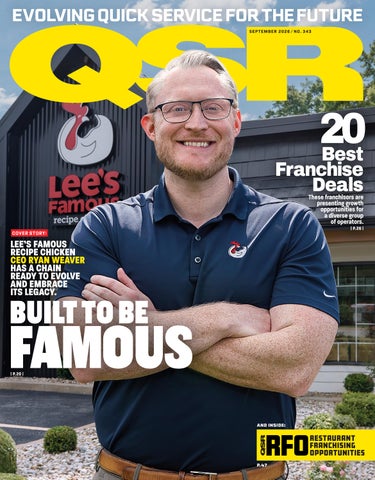
EVOLVING QUICK SERVICE FOR THE FUTURE SEP T EMBER 2026 ⁄ NO. 3 4 3
®
20 Best
Franchise Deals These franchisors are presenting growth opportunities for a diverse group of operators. | P. 26 |
COVER STORY:
LEE’S FAMOUS RECIPE CHICKEN CEO RYAN WEAVER HAS A CHAIN READY TO EVOLVE AND EMBRACE ITS LEGACY.
BUILT TO BE
FAMOUS | P. 20 |
AND INSIDE:
RFO P. 47
RESTAURANT FRANCHISING OPPORTUNITIES
One switch. Every advantage. PP Revolution
™
Recycle ready. Risk-free. Ready to run.
Pair with foil, metallized or or recycle ready easy-open lidding options to complete a fully optimized package.
Let’s transform your dip cup packaging.
Want to learn more?
800-544-4672
NorthAmericaFlexibles@amcor.com
SEPTEMBER TA BL E OF CON T EN T S / # 3 4 3
/ The Evolution Issue INSIGHT
4 BRANDED CONTENT 6 EDITOR’S LETTER
9 BEHIND THE COUNTER 46 ADVERTISER INDEX
NEWS
40 OPER ATIONS
Tijuana Flats is Betting on Franchising Again
The Mexican chain is hoping to spark growth in the coming years. BY SAM DANLEY
42 FRANCHISE FORWARD
Young, Driven, and Ready to Franchise FE AT URE S
20
Tradition Meets Tomorrow BY SAM DANLEY
After decades as a beloved regional brand, Lee’s Famous Recipe Chicken believes it has the people and playbook to become something much bigger.
An entrepreneur in his early 20s takes on Graze Craze, and finds explosive success. BY BEN COLEY
13 FRESH IDEAS
The Battle for the Bowl
The bowl has become a strong growth engine for multiple parts of the day. BY SAM DANLEY
17 ONES TO WATCH
Talkin’ Tacos How this concept reached nearly 40 locations in six years. BY BEN COLEY
18 WOMEN IN LEADERSHIP
Kayla Edidin Takes Ownership at Red Door The leader hopes to build back the business after a bankruptcy in 2025. BY SATYNE DONER
64 S TART TO FINISH
Amanda Hyde The Krystal COO believes in the future of the legacy slider chain.
26
20 Best Franchise Deals BY BEN COLEY
As franchise buyers raise the bar, this year’s standout concepts are proving that transparency, strong unit economics, and operational discipline matter more than ever.
RFO
RESTAURANT FRANCHISING P. 47 OPPORTUNITIES
Lee’s Famous Recipe Chicken CEO Ryan Weaver leads a brand with plenty of history. PHOTOGR APHY: LEE’S FAMOUS RECIPE CHICKEN KENNY WILLIAMSON/RKNPHOTO
QSR is a registered trademark of Arrowfly. QSR is copyright © 2026 Arrowfly. All rights reserved. The opinions of columnists are their own. Publication of their writing does not imply endorsement by Arrowfly. Subscriptions (919) 945-0704. www.qsrmagazine.com/subscribe. QSR is provided without charge upon request to individuals residing in the U.S. meeting subscription criteria as set forth by the publisher. AAM member. All rights reserved. No part of this magazine may be reproduced in any fashion without the express written consent of Arrowfly. QSR (ISSN 1093-7994), USPS PUBLICATION #20387 is published monthly by Arrowfly, 1111 Superior Avenue Suite 1120, Cleveland, OH 44114. Periodicals postage paid at Cleveland, OH and at additional mailing offices. POSTMASTER: Send address changes to Arrowfly, 1111 Superior Avenue Suite 1120, Cleveland, OH 44114.
2
SEPTEMBER 2026 | QSR | www.qsrmagazine.com
LEE’S FAMOUS RECIPE CHICKEN
ON THE COVER
When your food packaging needs to check every box,
start here.
Eastman Solus™ DBX coating helps deliver paper food packaging that is: Affordable Grease resistant Moisture resistant Compostable and recyclable1
Eastman delivers where you need it most.
Request a free sample kit
You get the experience, branding and performance QSRs depend on at a cost that makes sense. Get material solutions for home compostable cutlery and straws and coating solutions for paperboard food service items — all from one trusted partner. Suitable for selected recyclable or home and industrially compostable package designs. Performance and endof-life options depend on the complete package construction and local facilities. Scan QR for certifications and product-specific materials. 1
Eastman
Solus DBX ™
Eastman
Aventa
™
BRANDED BRANDED CONTENT CONTENT EDITORIAL
V ICE PR ESIDENT EDITOR I A L FOOD, R E TA IL , & HOSPITA LIT Y
BRAND STORIES FROM QSR
Danny Klein
dklein@arrowfly.com
QSR EDITOR
IN THIS ISSUE
Ben Coley
bcoley@arrowfly.com
FSR EDITOR
Callie Evergreen
48 48
AS SOCI ATE EDITOR
Satyne Doner
BAD ASS COFFEE / DANIEL RIVERA BAD ASS COFFEE / DANIEL RIVERA
50 50
Why Why Bad Bad Ass Ass Coffee Coffee Turned Turned Its Its Riskiest Riskiest Asset Asset Into Into aa Recruiting Recruiting Edge Edge Why Why
Bumpers Bumpers Restaurant: Restaurant: AA Brand Brand with with Room Room to to Grow Grow
Peggy Carouthers
pcarouthers@arrowfly.com
W R ITER , CONTENT S T UDIO
Drew Filipski
dfilipski@arrowfly.com
W R ITER , CONTENT S T UDIO
Ya’el McLoud
ymcloud@arrowfly.com
60 60
ART & PRODUCTION
SENIOR A R T DIR ECTOR
Tory Bartelt
tbartelt@arrowfly.com
V P, CR E ATI V E DIR ECTOR
Matt Claney
mclaney@arrowfly.com
56 56
AA Classic Classic Chicken Chicken Franchises Franchises Path Path to to More More Than Than 250 250 Locations Locations
SALES & BUSINESS DEVELOPMENT
SV P, FOOD, R E TA IL , HOSPITA LIT Y S A LES A ND ACCOUNT M A N AGEMENT
Matt Waddell
mwaddell@arrowfly.com 312-961-6840
N ATION A L S A LES DIR ECTOR
Amber Dobsovic
How How this this southern southern brand brand defines defines success success as as it it grows. grows. SPONSORED SPONSORED BY BY GOLDEN GOLDEN CHICK CHICK
adobsovic@arrowfly.com 757-637-8673
N ATION A L S A LES M A N AGER
Guy Norcott
gnorcott@arrowfly.com 854-200-5864
62 62
N ATION A L S A LES M A N AGER
Tom Boyles
How How Coffee Coffee Drive Drive Thrus Thrus Can Can Use Use Tech Tech Without Without Losing Losing Hospitality Hospitality The The best best
Why Why consistency, consistency, hospitality, hospitality, and and disciplined disciplined growth growth reign. reign. SPONSORED SPONSORED BY BY FREDDY’S FREDDY’S FROZEN FROZEN CUSTARD CUSTARD & & STEAKBURGERS STEAKBURGERS
Experienced Experienced restaurant restaurant manager manager says, says, “the “the future future looks bright.” SPONSORED looks bright.” SPONSORED BY BY BUMPER’S BUMPER’S RESTAURANTS RESTAURANTS
V ICE PR ESIDENT, CONTENT S T UDIO
The The evolution evolution of of one one of of the the restaurant restaurant industries’ industries’ most most recognizable recognizable brands. brands. SPONSORED SPONSORED BY BY IHOP IHOP RESTAURANT RESTAURANT FRANCHISING FRANCHISING
Why Why the the Better Better Burger Burger Segment Segment Continues Continues Winning Winning Over Over Guests Guests and and Franchisees Franchisees
52 52
CONTENT STUDIO
IHOP IHOP Stacks Stacks Up Up in in Non-Traditional Non-Traditional Spaces Spaces
FREDDY’S FREDDY’S
leaning leaning into into a a polarizing polarizing brand brand attracts attracts the the right right franchise franchise operators. operators. SPONSORED SPONSORED BY BY BAD BAD ASS ASS COFFEE COFFEE
Four Four decades decades of of consistency consistency pay pay off off as as consumers rethink consumers rethink where where they they dine. dine. SPONSORED SPONSORED BY BY CICIS PIZZA CICIS PIZZA
sdoner@wthwmedia.com
58 58
Long Long Before Before Value Value Became Became aa Trend, Trend, It It Was Was the Cicis Pizza Model the Cicis Pizza Model
A A people-first people-first coffee coffee brand brand built built on on 26 26 years years of of culture culture and and consistency. consistency. SPONSORED SPONSORED BY BY AROMA AROMA JOE’S JOE’S
sdanley@arrowfly.com
SENIOR EDITOR , WIR L
54 54
How How Aroma Aroma Joe’s Joe’s Keeps Keeps Growth Growth Personal Personal
Sam Danley
S SE EP PT TE EM MB BE ER R 2 20 02 26 6
GOLDEN CHICK GOLDEN CHICK
RFO
cevergreen@arrowfly.com
RESTAURANT RESTAURANT FRANCHISING FRANCHISING OPPORTUNITIES OPPORTUNITIES
CICIS PIZZA CICIS PIZZA
47 47
tboyles@arrowfly.com 662-607-5249
S A LES DIR ECTOR
Tony Bolla
systems systems remove remove friction friction while while keeping keeping baristas baristas at at the the center. center. SPONSORED SPONSORED BY BY THE THE HUMAN HUMAN BEAN BEAN
tbolla@arrowfly.com 773-859-1107
S A LES DIR ECTOR
Susan Shepherd
sshepherd@arrowfly.com 404-386-1709
ONLINE ONLINE SS EE EE TT HH EE SS EE SS TT OO RR II EE SS AA TT QQ SS RR MM AA GG AA ZZ II NN EE .. CC OO MM // SS PP OO NN SS OO RR EE DD
CU S TOMER SERV ICE R EPR ESENTATI V E
TRENDING TRENDING
CU S TOMER SERV ICE R EPR ESENTATI V E
TECHNOLOGY TECHNOLOGY
Tracy Willingham
twillingham@arrowfly.com 919-945-0704
INNOVATION INNOVATION
Brandy Pinion
bpinion@arrowfly.com 216-952-0877 FOUNDER
Helping Helping Restaurant Restaurant Brands Brands Drive Drive Real-World Real-World Results Results Analysis Analysis found found one one leading leading platform platform outperforming outperforming others others in in visitation visitation and and sales. sales. SPONSORED SPONSORED BY BY TUBI TUBI
4 4
Solve Solve the the One One Task Task Most Most Likely Likely to to Be Be Skipped Skipped During During aa Rush Rush AA repeatable repeatable way way to to
maintain maintain standards standards without without manual oversight. manual oversight. SPONSORED SPONSORED BY BY TENNANT TENNANT COMPANY COMPANY
SEPTEMBER SEPTEMBER 2026 2026 || QSR QSR || www.qsrmagazine.com www.qsrmagazine.com
BUSH’S BEANS BUSH’S BEANS
TUBI TUBI
TENNANT COMPANY TENNANT COMPANY
Webb C. Howell
How How Operators Operators Are Are Giving Giving aa Familiar Familiar Side Side aa Bigger Bigger Role Role on on the the Menu Menu Use Use one one versatile versatile foundation foundation to drive to drive flavor flavor and and satisfaction. satisfaction. SPONSORED SPONSORED BY BY BUSH’S BUSH’S BEANS BEANS
ADMINISTRATION 919-945-0704 / www.qsrmagazine.com/subscribe QSR is provided without charge upon request to individuals residing in the U.S. who meet subscription criteria as set forth by the publisher.
BETTER BETWEEN BUNS
YOU’LL LOVE IT WITH Request a sample and start drizzling: Request a sample
mikeshothoney.com/sample
EDITOR’S LETTER
Where Franchising Stands Today
R E L AT IONSHIP S B E T W E E N OP E R AT ORS A ND F R A NC HIS ORS A R E S T IL L E V OLV ING .
F
BCOLEY@WTWHMEDIA.COM QSR MAGAZINE
6
ranchising has always been one of the industry’s great engines of entrepreneurship. But becoming a franchisee today requires something that might have been easier to overlook during periods of cheap capital and rapid growth—conviction backed by proof. That idea kept surfacing as we put together this year’s Best Franchise Deals report. Prospective franchisees are dealing with higher labor and construction costs, tighter lending standards, expensive real estate, and consumers who remain careful with their spending. The financial commitment can stretch well into seven figures before the first customer walks through the door. Understandably, operators are asking more questions. Our Best Franchise Deals Council told us buyers want to see real unit economics, predictable cash flow, operational discipline, and evidence that existing franchisees still believe enough in the concept to invest again. A polished development pitch doesn’t carry the weight it once did. As Franchise Business Review president Michelle Rowan put it in our feature, “A franchise that looks attractive on paper is selling a story. A strong franchise opportunity is selling proof.” That distinction struck me because another story in this issue illustrates exactly what “proof” can look like. Lee’s Famous Recipe Chicken has been around since 1966. It has survived ownership changes, periods of expansion and contraction, and decades in which the industry transformed around it. Yet its story today isn’t simply about longevity. It’s about earning the confidence to grow again.
SEPTEMBER 2026 | QSR | www.qsrmagazine.com
After Artemis Lane Partners acquired Lee’s in 2021, its leaders didn’t immediately start selling an aggressive expansion story. They acquired restaurants from longtime operators, eventually building a sizable company-owned base. They upgraded technology, worked on operations, refreshed the brand, developed a new prototype, and began remodeling corporate locations before asking franchisees to make similar investments. In other words, they put their own capital behind the playbook. That matters. One of the most interesting voices in the Lee’s story is Jack Omer, grandson of brand cofounder Harold Omer. His connection to Lee’s goes back to childhood, but nostalgia wasn’t enough for him to become a franchisee. Before investing, he spent months talking with operators and company leaders because, as he explains, “Everything I have worked for up to this point is on the line.” That sentence probably captures franchising better than any statistic could. For a franchisor, expansion can be measured in development agreements, openings, and pipeline numbers. For the person signing the agreement, it could represent savings, debt, years of work, and the future of a family business. The strongest franchise systems understand the difference. And that may be the defining theme of franchising in 2026. Growth still matters. White space still matters. AUVs, startup costs, royalties, and restaurant-level margins certainly matter. But trust has become its own form of currency.
Ben Coley EDITOR
GET SOME OF THAT SWEET
WORD OF
MOUTH
WORKING FOR YOU.
KO REA N BBQ BÁ N H MÌ C HIC K EN S A N D W I CH
When you sauce it right, word gets around fast. People dish about how delish it is. With Sweet Baby Ray’s 24 varieties, you can easily create distinct new dishes with zero operational stress. Want to drive craveability, improve margins, and simplify operations? Think sauce first. Get ideas now sbrfoodservice.com
what’s missing in your market? Hot Dogs, Soft Serve, Chili Cheese Fries
AMERICAN FOOD
LESS LABOR
SIMPLE OPERATIONS
LOW FOOD COSTS
MULTIPLE BUSINESS FORMATS
GET MORE INFO HERE
BEHIND THE COUNTER
Breaking Down the QSR 50
There’s plenty of numbers to sort through in the annual list.
ADOBE STOCK / SONYAKAMOZ
THE QSR 50 WEBINAR WAS RELEASED IN EARLY AUGUST.
Scan the QR code to watch the webinar.
The QSR 50 has long provided a snapshot of the biggest players in quick service. But the rankings themselves tell only part of the story. Digging into the numbers can reveal where momentum is building, where pressure is mounting, and which trends could influence the restaurant industry in the year ahead. In August, QSR hosted a webinar taking a deeper look at the latest QSR 50, the magazine’s annual ranking of the largest quick-service restaurant chains in America by systemwide sales. The conversation explored the data behind the rankings, including systemwide sales, average unit volumes, and unit count trends across some of the country’s most recognizable restaurant brands. The webinar examined how industry leaders such as McDonald’s, Starbucks, and Chick-fil-A performed during the past year and what their results say about the state of quick service. The discussion also explored trends across major restaurant categories and what those developments could mean as brands begin looking toward 2027. And the conversation wasn’t limited to the companies at the top. The webinar identified brands gaining ground across the industry and emerging contenders worth watching as competition continues to evolve. Featuring insights from a trends expert and the QSR editors who helped assemble and analyze the report, the webinar offers additional context for understanding this year’s rankings and the stories behind the data. For operators, franchisees, investors, and anyone tracking the direction of quick service, the full webinar provides a closer look at what this year’s QSR 50 says about the industry—and what could come next.
www.qsrmagazine.com | QSR | SEPTEMBER 2026
9
BEHIND THE COUNTER
Restaurant365’s 2026 Mid-Year State of the Restaurant Industry report,
based on responses from more than 420 operators representing nearly 10,000 locations, examines the cost, labor, traffic, tech trends shaping the second half of the year. Food and Labor Costs
Staffing and Employee Retention
• Food costs increased during the first half of 2026 for 87 percent of surveyed operators, with most reporting growth between 1 percent and 5 percent.
• Recruiting and retaining employees was the top challenge for 33 percent of operators at mid-year, up sharply from 18 percent at the beginning of 2026.
• Another 78 percent expect food costs to continue rising through the end of the year, although that figure is down from 88 percent at the start of 2026. • In response, 52 percent raised menu prices, 22 percent increased inventory and waste tracking, and 20 percent changed suppliers or vendors. • Labor costs increased for 77 percent of respondents, down from the 93 percent who anticipated higher expenses at the beginning of the year.
• The share of operators reporting turnover between 0 percent and 10 percent reached 39 percent, the highest level in Restaurant365’s three years of data.
• Better training programs surpassed pay increases as the most common strategy restaurants have implemented to reduce turnover.
TRAINING PROGRAMS
SURPASSED
PAY INCREASES
• Shoulder-to-shoulder instruction remains the dominant training method, used by 55 percent of respondents despite the growing availability of digital tools.
AS THE STRATEGY TO
REDUCE TURNOVER .
INCREASED
DURING THE FIRST HALF OF 2026 FOR
87
%
OF SURVEYED OPERATORS
• Guest traffic improved considerably, with 49 percent of operators reporting gains in the first half of 2026 compared with 28 percent at the start of the year.
• The share of operators experiencing traffic declines fell from 55 percent at the beginning of 2026 to 31 percent at mid-year.
• Looking ahead, 62 percent expect traffic to increase during the second half of the year, compared with 9 percent anticipating further declines.
• Increasing sales remains the top operational priority for 49 percent of respondents, although enhancing the guest experience gained importance during the first half.
Technology and Artificial Intelligence • Restaurant AI adoption is concentrated in back-office functions such as reporting, analytics, scheduling, inventory management, and cost control.
10
• Reporting and analytics leads adoption, with 69 percent of respondents either actively using or piloting AI in that area.
SEPTEMBER 2026 | QSR | www.qsrmagazine.com
• Among operators using AI, 61 percent reported lower food costs, 62 percent cited lower labor costs, and roughly one-third achieved savings of at least 6 percent.
• Eighty-eight percent of AI users said the technology saves them time every week, reinforcing its potential as an operational efficiency tool.
ADOBE STOCK / FRANCISCOJAVIER, ADOBE STOCK / NDABCREATIVITY
Traffic, Sales, and Expansion FOOD COSTS
Strong performance found here en v o r p a o t e m o c l e W h t w o r g o path t
• Craveable, island-inspired menu stands out in a crowded category • Streamlined operations support a 30-second drive-thru service target • Open markets and flexible formats help you scale quickly
You should join us Scan the QR code to connect with our franchise development team or visit hawaiianbros.com/franchise. © 2026 Hawaiian Bros Island Grill The franchise sales information in this website does not constitute an offer to sell a franchise. The offer of a franchise can only be made through the delivery of a Franchise Disclosure Document (“FDD”). Certain states require that we register the FDD in those states. The communications in this website are not directed by us to the residents of any of those states. Moreover, we will not offer or sell franchises in those states until we have registered the franchise (or obtained an applicable exemption from registration), and delivered the FDD to the prospective franchisee in compliance with applicable law.
Pete erators, Texas d trusted by op an nt ra au st re Born in a to the ard Habanero from heat-forw , es uc Sa g in Buffalo W rm lp wings perfo Wing Sauce, he o al ff Bu al in thicker Orig ®
HBUAFFABLOAWNINGESRAUOCE U S F L AVOR A DV EN T URO G DABLE CLIN WITH DEPEN T. S U TR OP ER AT OR S Tex
shift af ter shift
.
TE. shback REBA E with our ca V A . S w d no an om uy B ce.c eteFoodser vi Go To TexasP
ere d tra dem ark as Pet e® is a reg ist
of TW Gar ner Foo
d Com pan y. 109 0-0
3-0 220 26
fresh ideas S E P T E M B E R
2 0 2 6
C A T E G O R Y
G R O W T H
PLAYA BOWLS HAS MORE THAN DOUBLED IN SIZE OVER THE PAST FEW YEARS.
THE
Once a specialty item, the healthy bowl is now a multi-daypart powerhouse.
BATTLE BOWL FOR THE
BY SAM DANLEY
B
owls have long been associated with health and nutrition, but the format now stretches far beyond its wellnessniche roots. From acai and smoothie bowls to salads, grains, and warm meals, bowl concepts are increasingly competing for everyday occasions—not just a post-workout snack or a light lunch. That shift shows up in consumer demand for portability, customization, recognizable ingredients, functional benefits, and food that still feels satisfying. For brands in the space, the opportunity is less about selling one definition of “healthy” than giving guests a flexible meal that fits their particular needs.
PLAYA BOWLS
An All-Day Occasion
Juice It Up! has been selling acai bowls for more than two
decades, back when the ingredient was unfamiliar enough that franchisees had to be taught how to pronounce it, says president and CEO Susan Taylor. The Southern California-based chain has watched the product move from a relatively small menu category into a much more central part of its business. Bowls historically have accounted for about 15 percent of the brand’s mix. Today, they are nearing 24 percent, Taylor says, with bowl mix up nearly 20 percent year over year. “It used to be something you’d see on the West Coast or Hawaii or in Florida,” Taylor says. “And then it’s just grown across the country.” Greater familiarity has helped. So has social media, which has made colorful, layered bowls more visible to younger con-
www.qsrmagazine.com | QSR | SEPTEMBER 2026
13
fresh ideas
C A T E G O R Y
sumers willing to explore new flavors and ingredients. But Taylor says the more meaningful shift is in how people are using bowls: not just as an occasional better-for-you treat, but as a meal that can fit throughout the day. Juice It Up! tracks four dayparts—breakfast, lunch, afternoon, and dinner—and Taylor says bowl sales have grown significantly in the morning and evening over the past two years. Some locations near gyms, for example, are seeing guests come in after workouts for a bowl. “It has legs to meet people where they’re at in how they want to eat during the day,” she says. The brand has responded by adding more options beyond a basic acai or dragon fruit base. Guests can choose from flavors such as coconut passion fruit and seasonal mango, layer in chia pudding or protein-infused yogurt, and build their own combinations. Texture, variety, and personalization are becoming bigger parts of the occasion. “Flavor and texture have become more of what I think the upand-coming generations really look at when they’re looking at products,” Taylor says. The idea is to let bowls serve different needs—breakfast, an afternoon break, a meal replacement, or a way to add protein and fiber—without making guests choose between function and enjoyment.
A Growing Category Gets More Competitive
G R O W T H
stabilizes around a core group of winners. For Playa, standing out means building bowls around four things: taste, a “beneficial” ingredient story, visual appeal, and operational feasibility. The brand’s Mermaid Season promotion was designed with all four in mind. Its Mermaid Mood Bowl combined pitaya with blue spirulina for a bright purple swirl, then layered in strawberries, granola, pineapple, coconut flakes, and a Nutella-filled seashell topper. Other items in the promotion included collagen peptides and blue spirulina. The idea is not to strip out every indulgent element. Instead, Playa aims to give most menu items a health-forward foundation while still creating food that feels fun and craveable. “We think that almost every product that we’re creating in our menu strategy should have a beneficial story to it,” Hackbardt says. “It doesn’t mean you can’t have something like Nutella on there that’s a little indulgent.” Customization remains part of the appeal, but it is not necessarily what drives the majority of orders. Playa offers build-your-own bowls, including the option to combine two bases, but most guests choose a signature recipe and may make smaller modifications from there.
PLAYA BOWLS LEANS INTO GUEST CUSTOMIZATION.
At Playa Bowls, the growth of the category has created a more segmented and competitive landscape. CMO Tim Hackbardt sees three broad buckets: classic acai shops, often independents or smaller chains; large smoothie brands that have added acai bowls; and bowl-first concepts like Playa, where smoothies are a secondary part of the business. “It’s been a very fast-growing category, at least for the past three years,” he says. “We’ve more than doubled in size ourselves.” That growth is likely to bring more competition, he adds, and eventually some separation between the brands that have a clear point of view and those that do not. Hackbardt expects the category to see some attrition over the next few years as the segment
JUICE IT UP!, PLAYA BOWLS
JUICE IT UP! HAS SEEN BIG BOWL SALES IN THE MORNING AND EVENING.
14
SEPTEMBER 2026 | QSR | www.qsrmagazine.com
CLEAN LABEL UNMATCHED NUTRITIONAL BENEFITS: • Tomato Puree is the FIRST Ingredient • Made with Real Sugar • No High Fructose Corn Syrup (HFCS) • 75% Less Sodium Than Other Leading Brands • No Artificial Colors, Flavors or Preservatives • Made Without Artificial Caramel Color • Sweet & Smoky Flavor • Gluten free RED GOLD® IS A REGISTERED TRADEMARK OF RED GOLD, LLC. ELWOOD, IN
REQUEST YOUR FREE SAMPLE
fresh ideas FARMSIDE KITCHEN HAS STORES IN NORTH CAROLINA AND VIRGINIA TRADE AREAS.
C A T E G O R Y
G R O W T H
Looking ahead, Hackbardt expects protein to remain an important conversation, alongside fiber, portion size, and calories. But the challenge will be pursuing those trends without chasing novelty for novelty’s sake—or creating menu items that cannot be executed consistently across the system. “We want to be on the leading edge of flavor and beneficial ingredients,” he says. “Not necessarily bleeding edge, but leading edge.”
Keeping Health Simple
Sam Danley is the associate editor of QSR. He can be reached at sdanley@ wthwmedia.com.
16
SEPTEMBER 2026 | QSR | www.qsrmagazine.com
FARMSIDE KITCHEN (2)
On the savory salad and grain bowl front, Farmside Kitchen is taking a deliberately more familiar approach to wellness. CEO and cofounder Meg Schiffman is bullish on the category, particularly in the suburban North Carolina and Virginia trade areas where the young chain operates. Demand has not eased for the brand’s mix of greens, grains, roasted vegetables, proteins, and house-made dressings amid a challenging consumer environment lately. Schiffman sees a larger shift at work: Health-conscious eating is becoming more mainstream, and consumers are more informed about what is in their food. They are reading labels, paying attention to processing, and looking for meals that make them feel better. But Farmside is not trying to build its menu around every emerging ingredient or wellness claim. Its approach is rooted in recognizable foods and familiar flavors—meals guests could make at home if they had the time, energy, and ingredients. “For us, it’s all about creating and bringing to the guests simple flavors that you can eat and feel really good about,” Schiffman says. That does not mean the menu lacks personality. Farmside’s consistent top seller is the Rancher, a Southwest-inspired bowl with greens, grains, chicken, avocado, corn, kale, and blue corn chips. Build-your-own bowls are the second-most-popular choice. The chain is also testing a Carolina Bowl, built around chicken, corn, pickled jalapenos, gluten-free cornbread croutons, a tangy barbecue drizzle, and ranch. It is an example of how Farmside thinks about innovation: familiar, Americana-forward flavors, but delivered through high-quality ingredients, texture, and a substantial bowl format. As wellness messaging becomes more crowded—with consumers hearing constantly about protein, fiber, supplements, and specialized diets—Schiffman sees value in keeping the proposition straightforward. “Healthy has this wider definition,” she says. “It’s not just low calorie. It’s not just low whatever. The cleanliness and straightforwardness of the ingredients, and the fact that you’re getting your protein, your fiber, your healthy fats—those are all coming together in every bowl.” That may be the bigger takeaway for the broader healthy bowl space, she adds. Whether it is a layered acai bowl, a blue-spirulina promotion, or a Carolina barbecue-inspired grain bowl, the brands finding traction are giving guests more than a health claim. They are offering an easy, satisfying meal that can work on an individual guest’s terms.
O N E S T O WAT C H
JORGE MAESTRE
p.m. because the duo spent the mornings prepping ingredients. The first few months were uneventful. Talkin’ Tacos sold about 10 meals per day until a TikTok video went viral. It wasn’t from an influencer; just a regular customer with a couple hundred followers who posted about a food truck serving birria tacos in Miami on Biscayne Boulevard. Overnight, tens of thousands of people viewed the video. “We had customers that were driving five hours from Orlando. We had a customer who came and said she was
OMAR AL-MASSALKHI (LEFT) AND MOHAMMAD FARRAJ FOUNDED TALKIN’ TACOS IN 2020.
Talkin’ Tacos
A Mexican chain grows to 37 locations in just six years after going viral on TikTok. / BY BEN COLEY
FOUNDERS: Mohammad Farraj and Omar Al-Massalkhi HEADQUARTERS: Broward County ANNUAL SALES: $82 Million TOTAL UNITS: 37
TALKIN’ TACOS (2)
T
alkin’ Tacos—a concept that’s surged to nearly 40 locations and over $80 million in sales in just six years— spawned from a card game. Around June 2020, cofounders and childhood best friends Mohammad Farraj and Omar Al-Massalkhi landed on the
idea for a new Mexican concept. The vision wasn’t far-fetched. Al-Massalkhi had previous experience in the restaurant industry and had an extra food truck that he wasn’t using amid the COVID outbreak. The plan came to life by September 10 in Miami, with the initial hope of earning an extra $500 per month, which wasn’t a small figure for either of them, considering both were married and had children. Farraj was still in school pursuing dentistry at this point too. The food truck opened every day at 6
from Guatemala. She flew in after she saw the video,” Farraj says. “... The lines just kept coming. And we would just tell them, ‘We’re so sorry. We don’t have enough food. We’ll be ready tomorrow for you guys.’ We thought it was a fluke, it wasn’t going to continue, and then the day after and the day after and, genuinely, it was like a blessing that came, and it just never stopped.” With lines wrapped around the block, Talkin’ Tacos used that momentum to close the food truck and open its first brick-andmortar store in May 2021. The chain prides itself on birria tacos, in addition to a full lineup of other tacos, burritos, quesadillas, bowls, and specialties, such as a Crispy Stack Wrap, Birria Ramen, Tomato Basil Ramen, and Birria Grilled Cheese. As of mid-July, the company had 37 locations in Florida, North Carolina, Georgia, New York, Texas, and Washington, D.C., growth that occurred without any outside investment. The first location was entirely bootstrapped; Farraj and Al-Massalkhi painted the walls and tables and renovated the kitchen and bathrooms. “This lasted for probably the first two years,” Farraj says. [CONTINUED ON PAGE 46]
www.qsrmagazine.com | QSR | JANUARY 2026
17
KAYLA EDIDIN BELIEVES RED DOOR BRANDS CAN BECOME A ROCKET SHIP.
Kayla Edidin Takes Ownership at Red Door Brands
With a 60 percent stake in Red Door Brands, Kayla Edidin is rebuilding trust—and writing her own next chapter. / BY SATYNE DONER
I
t’s a Tuesday afternoon, and Kayla Edidin is sitting outside of an Arby’s in Texas. For the first time in years, she isn’t selling franchises; she owns them, as the new chief operating officer and majority partner of Red Door Brands with a 60 percent stake in the company and all its subsidiaries. Red Door Brands is a Knoxville-based, multi-brand portfolio company that operates nearly 20 franchised restaurants, including McAlister’s Deli, Little Caesars, Arby’s, and Main Squeeze Juice Co. across North and South Carolina, Georgia, and Texas. Edidin came on board in
18
JANUARY 2026 | QSR | www.qsrmagazine.com
March 2026 to work alongside Argus Wiley, founder and CEO. For Edidin, the role represents a longheld wish being answered. After 20 years of operations experience as both a franchisor and franchisee, she moved into franchise development with Huddle House in 2018. She stayed on through Huddle House’s acquisition by Ascent Hospitality Management, which later also acquired Perkins Restaurant & Bakery, and went on to hold multiple roles leading franchise operations and development across the Ascent portfolio through 2025. “In my heart, I’m an entrepreneur, so
this scratches an itch that’s been on my vision board forever. It’s been great to be connected to the soul of the restaurant again, the people who run it, and the communities we serve,” Edidin says. “I love the opportunities we’re going to create within Red Door Brands. I’ve had some exciting roles, but shifting into an equity role within the company is a lot more fulfilling than just selling franchises.” By all accounts, Edidin was leaving a rocket ship—Mike’s Red Tacos, where she’d sold more than 200 franchises for the emerging brand in its first year as vice president of franchise development. But she believed Red Door Brands could be one, too. 2025 was a difficult year for Red Door Brands. Matadoor Restaurant Group, a Red Door affiliate operating 22 Del Taco locations across Georgia and Alabama, filed for Chapter 11 bankruptcy protection amid mounting financial pressure. The filing has allowed Matadoor to continue operating while restructuring its finances, and Red Door has used the past year to streamline operations and refocus on long-term performance heading into 2026. Edidin represents a new era of stability for Red Door Brands, bringing a focus on operational excellence, system standardization, strategic expansion, and a goal to attract new capital partners and scale the portfolio to more than 100 units by 2028. Above all, she hopes to rebuild, little by little, trust and motivation among employees who’ve felt the impact of a hard year. She sees herself in them—this industry gave her opportunities she never would have had otherwise, like completing not just her undergrad but also an executive MBA program. “I’m big on mindset. It’s been a tough season for Red Door, but we’re going to be better than we were yesterday. They may have lost their way a little bit, but we’re going to elevate our standards and lean back on the core fundamentals that made us successful in the past,” Edidin says. “This is a breath of fresh air for the company. There’s less uncertainty around the future vision of how people can grow and build a life with us.” Edidin believes nobody becomes excellent on the easy path. [CONTINUED ON PAGE 44]
RED DOOR BRANDS
WOMEN IN LEADERSHIP
Arrowfly.com A new name for the company behind the brands and events you trust.
WTWH Media is now
Why Arrowfly?
Over two decades, WTWH Media has grown from its engineering roots into a diversified portfolio of 40+ trusted media brands, 45+ industry events, and marketing solutions serving professionals across Engineering, Healthcare, and Food, Retail & Hospitality. While many know and trust our individual brands, fewer know the company behind them. Arrowfly gives us a stronger corporate identity that reflects the business we’ve become. The name represents forward momentum, direction, and growth, and our role in helping professionals and partners navigate change and move their businesses forward. Arrowfly represents where niche professionals gather for trusted journalism, industry intelligence, and measurable outcomes.
The Strength of Arrowfly Your Trusted Brands: All 40+ media brands and publications remain unchanged Our Events: All 45+ industry events continue with the same teams, content, and quality Editorial Independence: Our commitment to credible, independent journalism remains our foundation Clara Platform: Our proprietary performance platform continues delivering real-time campaign visibility and measurable results
Arrowfly is the preeminent live and digital destination for professionals across Engineering, Healthcare, and Food, Retail & Hospitality sectors. Editorial authority. Engaged communities. Measurable outcomes.
BRAND PROFILE
Tradition
Meets
Tomor20
row SEPTEMBER 2026 | QSR | www.qsrmagazine.com
CEO RYAN WEAVER CAME TO LEE’S FAMOUS RECIPE CHICKEN AFTER YEARS IN THE INVESTMENT AND PRIVATE EQUITY COMMUNITY.
BRAND PROFILE
After decades as a beloved regional brand, Lee’s Famous Recipe Chicken believes it has the people and playbook to become something much bigger.
LEE’S FAMOUS RECIPE CHICKEN / KENNY WILLIAMSON/RKNPHOTO
/
BY SAM DANLEY
Long before Jack Omer became a Lee’s Famous Recipe Chicken franchisee, he was a kid running around the restaurants his grandfather helped build. Harold Omer, who cofounded the brand alongside the eponymous Lee Cummings in 1966, wasn’t known for having much of a sense of humor. He was an engineer by trade, impeccably dressed, and serious enough that, according to his grandson, he’d mow the lawn in a coat and tie. But when he’d take Jack through the restaurants, another side of him came through. Jack remembers holding his grandfather’s hand as they walked through the kitchen, listening as he pointed out the fryers and reminded him not to touch anything hot. They’d share biscuits and fried chicken livers before Harold returned to work. Looking back, Jack realizes those moments probably wouldn’t have happened anywhere else. “He was an incredibly busy man, and he was always in the stores,” Jack says. “To be able to have those personal connections with him was only going to be had while he was working.” After Cummings—the nephew of Kentucky Fried Chicken founder Colonel Harland Sanders—struck out on his own following the sale of KFC in the early 1960s, he partnered with Harold to open the first Lee’s restaurant in Lima, Ohio. The concept caught on quickly. Built around hand-breaded, honey-dipped, preswww.qsrmagazine.com | QSR | SEPTEMBER 2026
21
sure-fried chicken, the fledgling chain reached 100 locations within six years, fueled by an aggressive early embrace of franchising and a willingness to convert inexpensive neighborhood filling stations into restaurants. “My grandfather and Lee understood pretty early that the brand could be much bigger than what they could build themselves,” Jack says. “Helping entrepreneurial-minded people become business owners was really the model.” Fast forward a few decades, and he’s now thinking about that legacy from a different perspective. After spending much of his career in corporate and nonprofit leadership, an unexpected layoff became the catalyst that pushed Jack toward entrepreneurship last year. “I decided I needed to be in charge of my own paycheck,” he says. “I didn’t want to be dependent on someone else’s success or failure in order to provide for myself and my loved ones.” When he decided to take the leap and pursue franchising, “there was no other obvious choice than coming back into Lee’s.” But family history alone wasn’t enough LEE CUMMINGS (LEFT) COFOUNDED LEE’S FAMOUS RECIPE CHICKEN IN 1966. to convince him to invest. Over nearly six decades, the chain had changed hands multiple times, experienced opportunity to acquire Lee’s emerged through former Apollo stretches of growth and decline, and settled into life as a colleague Sam Kaplan—now a managing partner at Artemis beloved regional brand with a loyal customer base but little Lane alongside Weaver—who had developed a relationship national visibility. In 2021, the company entered another new with the brand’s previous owner. chapter when private investment firm Artemis Lane Partners Pandemic-related uncertainty temporarily stalled discusacquired Lee’s with ambitions of modernizing the business sions before the deal came back to life in late 2020. Critically, and returning it to sustained growth. Weaver says, the seller wasn’t simply looking for the highJack spent months talking with franchisees and the lead- est bidder. ership team to understand where Lee’s stood and where it “They wanted somebody who was going to protect the was headed. brand, grow the brand, and really be a long-term steward,” “The brand itself has gone through some major peaks and he says. valleys,” he says. “You could argue that it probably shouldn’t That philosophy aligned with Weaver’s own impression of have survived as recently as 25 years ago. I wanted to make the business and vision for where it could go next. So, when sure this was a long-term strategy for success and growth, Artemis Lane acquired Lee’s in June 2021, it wasn’t chasing and not a short-term tactic for someone to come in, build the a traditional turnaround. brand, make a cash grab, and then exit.” “We didn’t think there was anything broken within the four walls of the restaurant,” he says. “The food was great. The people were great. They were running their businesses well. New Stewards But there just wasn’t much of a brand or a business around The more conversations Jack had, the more convinced he them. It was really a bunch of mom-and-pop businesses that became that Lee’s had the right stewards for its next chap- happened to share the same name.” ter. Chief among them was CEO Ryan Weaver. One of the earliest decisions Weaver and his team made Weaver came to Lee’s from outside the restaurant indus- was that they couldn’t reinvigorate Lee’s from the sidelines. try, having spent years in investment banking and private Part of their thesis from day one was to provide exit opportuequity, including nearly seven years at Apollo Global. The nities to long-time franchisees and licensees who were aging 22
SEPTEMBER 2026 | QSR | www.qsrmagazine.com
LEE’S FAMOUS RECIPE CHICKEN (3)
BRAND PROFILE
BRAND PROFILE
out, buying those locations and building a meaningful company-owned base. “I have a very strong belief that a franchisor shouldn’t be sitting in an ivory tower dictating things to a system when they don’t have skin in the game,” Weaver says. “We believed very decisively that we needed to be operators if we wanted to be a good franchisor.” Over the first few years they acquired 35 of roughly 130 restaurants in the system. Through that process they sharpened their perspective on where to invest. Weaver describes much of the modernization on the tech and systems side as “blocking and tackling” rather than flashy innovation: upgrading back-of-house technology, implementing better inventory and scheduling systems, consolidating disparate POS platforms, and achieving full data visibility across the network. At the same time, Lee’s embarked on a comprehensive effort to redefine how the brand looked and presented itself to customers. “It was a brand that had been put on pause,” says VP of marketing Dan Sokolik. “No evolution, no change, no forward thinking, just status quo for a very long time. The challenge that was in front of us was, how do we wake it up and come out of hibernation?” FRANCHISEE JACK OMER HAS GREAT TRUST IN LEE’S FAMOUS RECIPE CHICKEN.
The quick-service veteran came in not long after the ownership change with a mandate to modernize the brand. “The first thing I told Ryan is there’s not much I can fix from a marketing standpoint until we fix the overall look and feel, the visual identity of the brand,” Sokolik says. “It was a nonstarter. It had to happen.” That marked the start of a multi-year brand transformation, with Lee’s tapping restaurant design firm Chute Gerdeman to craft a broad reimagining of the customer experience. Before sketches were drawn or logos redesigned, the teams spent months visiting restaurants and conducting consumer research to better understand how guests perceived Lee’s. The findings were remarkably consistent, recalls Brian Seitz, who led the project at Chute Gerdeman before joining Lee’s as director of store design and construction last year. “The thing that stood out to me the most from the customer research was that everybody, to a T, said the food is fantastic,” Seitz says. “They come back for the food, but it just doesn’t seem like anybody cares about the brand anymore.” The company introduced a refreshed logo, updated packaging, new uniforms, redesigned digital channels, and a new chicken icon named Helen, giving the brand a brighter, more contemporary personality. It also shifted away from passive, traditional marketing in favor of more playful advertising. The goal, Sokolik says, wasn’t to reinvent Lee’s but to build a brand identity worthy of the product that had kept customers back over the years.
Built to Grow
The next challenge was translating that new identity into the restaurants themselves. Instead of designing a single new building, Lee’s set out to create a flexible design system that could shape both future locations and existing ones. The result was a new restaurant prototype built around the realities of today’s business. It features a brighter, more modern exterior, expanded windows, updated dining spaces, and a stronger architectural identity designed to make Lee’s restaurants more noticeable in their communities. The layout also was reimagined to better accommodate the way customers increasingly interact with the brand, with optimized drive-thrus and dedicated pickup areas for digital orders and third-party delivery. Behind the counter, Lee’s worked with industrial engineering and kitchen design consultants to streamline workflows by reducing unnecessary movement and simplifying what leaders describe as a labor-intensive chicken preparation method. As opposed to changing that process, the team designed the kitchen around it, preserving Lee’s decades-old method of honey-dipping, seasoning, and pressure-cooking fresh, never-frozen chicken. “When you think about the path that a single piece of chicken takes from the time it comes off the truck to the time it gets on the consumer’s plate, it is moving around a lot in LEE’S FAMOUS RECIPE CHICKEN
www.qsrmagazine.com | QSR | SEPTEMBER 2026
23
BRAND PROFILE
that kitchen,” Sokolik says. “The team worked really hard on making that piece of chicken move more smoothly, so it’s not zigzagging across the restaurant.” Much of that effort centered on improving functionality, though the redesign also introduced new equipment and technology. New holding cabinets help manage finished product, and the company developed a system that manages the flow of the fry line by alerting staff exactly when to drop product based on the current pace of orders.
franchisees to expand carefully into adjacent markets, prioritizing regions where it already has brand awareness and operational support. Lee’s footprint is concentrated predominantly in the Midwest, with stores sprinkled in some Southeast states. Sumner describes the operator base as a hybrid system with six or seven “really scaled players” running more than five locations each, alongside smaller franchisees and owner-operators with around two stores.
LEE’S FAMOUS RECIPE CHICKEN HAS COMPLETED MUCH WORK AROUND ITS STORE PROTOTYPE.
24
SEPTEMBER 2026 | QSR | www.qsrmagazine.com
Moving forward, he’s targeting a more institutional profile of franchisee. That means multi-unit groups and family offices that prioritize unit economics over category. “They’re looking for the best opportunity with the highest probability of success to invest their capital,” Sumner says. “They don’t care if that’s chicken or coffee or an oil change.” That business case is why Sumner describes Lee’s as an “old startup”—a mature brand with loyal customers and proven economics, but one that still has significant room to grow. He believes the company has capacity for roughly 800 additional restaurants within its existing footprint and neighboring states alone. “It’s hard to find a brand with that kind of staying power and still a ton of white space,” Sumner says.
Raising the Standard
The new prototype is the fixed visual and operational standard for all new ground-up development, but there’s flexibility for franchisees to apply those elements to second-gen buildings. Similarly, the same design language is being applied across Lee’s existing restaurant base through a systemwide remodel initiative dubbed “Reframing the Fame.” Rather than requiring every franchisee to complete the same expensive renovation, the company is taking a flexible approach that allows operators to incorporate the most impactful design elements based on the specific restaurant and its operational needs. “Our job is to work with you at the budget that you have to spend on your store,” Seitz says. “The worst thing that I
LEE’S FAMOUS RECIPE CHICKEN (2)
The company has also continued investing in artificial intelligence for the drive-thru. Lee’s became Hi Auto’s first U.S. pilot partner in 2020, before the ownership change, and today roughly 30 percent of restaurants use the voice-ordering platform. Lee’s is currently developing its first two ground-up restaurants using the new prototype, both in the St. Louis market, where the company already operates over a dozen locations. The first, in O’Fallon, Missouri, is expected to open this fall, with another following in nearby Overland. For Weaver, the projects represent more than new restaurants. They demonstrate how far Lee’s has come, building the expertise to expand its corporate footprint through groundup development instead of exclusively acquiring existing restaurants. “It’s a lot different to construct restaurants versus just buying them,” he says. “That’s a whole different skill set and team that wasn’t here a couple years ago.” In many ways, the company’s evolution has unfolded in stages. The first few years were spent listening to operators, acquiring restaurants, and building credibility as an owner. Next came the work of modernizing the brand—from its technology stack to its visual identity and restaurant design. Now, with those foundational pieces largely in place, leadership sees the focus shifting toward expansion. Continuing to grow the company’s owned restaurant base remains a priority, says chief development officer Logan Sumner, both to fuel expansion and to ensure Lee’s continues operating alongside its franchisees instead of simply directing them. Equally important is recruiting a new generation of
BRAND PROFILE
could do is go in and tell every franchisee, ‘You’ve got to rip up your flooring because you don’t have the right color brown.’” For a brand whose average restaurant is more than three decades old, the opportunity is significant. The first few remodels—all company-owned locations— were completed last year. One of the earliest lessons was simply that people started noticing Lee’s again. After the company completed a remodel in St. Charles, Missouri, local residents commenting on a popular community Facebook page
remarked that they had never realized the restaurant had been there, despite it operating in the same location for decades. “For us, that just proves we’re heading in the right direction,” Seitz says. Sumner adds that restaurants that have received exterior updates within the past decade already generate roughly 60 percent higher average revenue, and Lee’s is now seeing high single-digit sales lifts at its recently remodeled locations. The company opened its fourth updated corporate restaurant this summer, with additional projects underway. Sumner says Lee’s now has a clear path, from stores in design through active construction, to have more than half of the system remodeled within the next eight to nine months. The goal is to complete the initiative across the entire system by the end of 2028. “The remodel program is going to be massive for our business—it already is,” Sumner says. “We’re seeing really great year-over-year comps out of the remodel locations compared to the market, and there’s just so much more for us to unlock there.”
LEE’S FAMOUS RECIPE CHICKEN
The Next Chapter
For Weaver, one of the clearest signs that Lee’s is on the right track has nothing to do with sales or store counts. At last year’s annual franchise conference, leadership formally unveiled the Reframing the Fame systemwide remodeling initiative. The company was now requiring operators to invest in their own modernization for the first time in decades. And after years of the brand essentially drifting, the leadership
team wasn’t sure how the mandate would land. “You never know how that’s going to be received,” Weaver says. “It could have gotten arrows fired at the stage.” The consensus from the field wasn’t pushback but relief, he adds. “It was extremely collaborative, and people were really excited about it,” Weaver says. “What we keep hearing back is, ‘We’re glad we have a playbook now. We’re glad we have direction.’” He believes that buy-in only happened because the corporate team spent three years “living it” by buying stores and proving the strategy worked before asking the rest of the system to open their wallets. Jack came to the same conclusion through his conversations with operators last fall, when he was still scoping out the opportunity. For him, becoming a franchisee wasn’t just a sentimental impulse decision driven by his personal connection to Lee’s. It was a total professional and financial pivot. “Everything I have worked for up to this point is on the line,” Jack says. Between personal savings and SBA financing, he knows the bank and the government are just as interested in his P&L as he is. He spent his due diligence period ensuring he wouldn’t “inherit a dumpster fire,” but more importantly, he was looking for a reason to believe in the people at the top. “I will tell you, not a single franchisee had something bad to say about the vision and about the leadership,” he says. With that confidence, Jack acquired his first unit late last year, followed shortly by four more. The transition has been “humbling,” he says, with the first month spent simply observing and learning the rhythm of running the restaurants. Now, all five are somewhere in the remodel process. When Jack walks his stores today, his mind is on the future: leaning into IT-based operations to kill off paper-heavy redundancies and building out a catering business to capture the runway he sees in his markets. But he also finds himself thinking about those afternoons spent following his grandfather through Lee’s kitchens. It is a unique symmetry. While the brand’s namesake, Lee Cummings, was the “recipe guy,” Harold, was the “business guy”—the one who pushed for franchising when the concept was still something of a novelty back in the 1960s. Jack sees the current leadership as a direct continuation of that lineage, even if the tools have changed from handwritten tickets to voice AI. “Success for the next 60 years is as much about having the right leadership at the top as it is having good, committed, business-minded franchisees in the field,” Jack says. “The brand won’t survive if you don’t have both.” As Lee’s pushes toward its 100th anniversary, the “playbook” is finally in place. But the survival of the legacy still rests on the same thing it did in 1966: people willing to take the leap. “It’s a 60-year legacy, and that’s worth something,” Jack says. “It shouldn’t be taken lightly.” Sam Danley is the associate editor of QSR. He can be reached at sdanley@ wthwmedia.com.
www.qsrmagazine.com | QSR | SEPTEMBER 2026
25
20 BEST FRANCHISE DEALS
+
The 2026 Best Franchise Deals Council P 31
Best Franchise Deals Hall of Fame P 34
Seven Franchisors to Watch P 39
Best
/
BY BEN COLEY
Franchise
26
Deals SEPTEMBER 2026 | QSR | www.qsrmagazine.com
As franchise buyers raise the bar, this year’s standout concepts are proving that transparency, strong unit economics, and operational discipline matter more than ever.
ADOBE STOCK / SMILE STUDIO AP
BEST FRANCHISE DEALS
F
or many years, franchising rewarded momentum. A compelling concept, solid unit growth, and a polished sales presentation were often enough to attract development interest. Not anymore. As inflation, higher labor costs, tighter lending standards, and shifting regulations reshaped the operating environment over the past year, prospective franchisees have become far more selective about where they invest. Excitement still matters, but it no longer closes the deal on its own. “The past year has really acted as a stress test, and not everyone passed,” says Liane Caruso, owner of helloCMO and cofounder of Franchise Assembly. “The brands that held up were the ones with lean, simple operations and
realistic unit economics built for normal conditions.” That sentiment echoed across QSR’s 2026 Best Franchise Deals Council, a panel of franchise development, operations, marketing, legal, and investment experts assembled to help identify where the franchise industry is headed. The consensus was consistent. Franchise buyers are asking tougher questions than they were just a few years ago. They want proof instead of promises. They want to know how a concept performed when costs increased, labor tightened, and financing became more difficult—not simply how it grew during years of favorable market conditions. “A franchise that looks attractive on paper is selling a story. A strong franchise opportunity is selling proof,” says Michelle Rowan, president of
www.qsrmagazine.com | QSR | SEPTEMBER 2026
27
BEST FRANCHISE DEALS
Franchise Business Review. Today’s buyers, she says, are looking past projections to unit-level profitability, franchisee satisfaction, and candid validation from existing operators. Jonathan Hill, cofounder of Morrow Hill, has watched the same shift unfold from the real estate side. Inflation and labor pressures have forced brands to simplify operations, improve efficiency, and demonstrate predictable financial performance. “Clear, conservative financials and predictable cash flow are becoming table stakes,” he says. John Francis, whose franchise career spans more than three decades as a franchisee, franchisor, investor, and board member, believes prospective operators are also evaluating the strength of the organization behind the concept. “Paper looks the same for almost every brand,” he says. “What separates the real opportunities is operational discipline behind the curtain.” He argues the strongest systems have evolved beyond founder-led businesses into organizations with the infrastructure, leadership, and processes necessary to support
long-term expansion. Those changing expectations explain why some brands continue signing development agreements while others struggle to fill their pipelines. Council members repeatedly pointed to the same characteristics. Winning franchise systems demonstrate durable unit economics instead of relying on exceptional performers. They simplify operations, embrace technology that improves productivity, offer flexible development options, and provide meaningful support long after opening day. These successful chains are also attracting experienced multi-unit operators who are evaluating whether the underlying business is built to scale. This year’s Best Franchise Deals list represents more than high-performing brands. They showcase franchise systems that have earned confidence through transparency, operational discipline, and a proven ability to help franchisees succeed in a more demanding business environment. This is the 16th Best Franchise Deals in QSR magazine’s history. These brands are in no particular order.
Cheba Hut Number of U.S. franchise units:
82
Number of U.S. total units:
85
BOJANGLES
the concept offers an experience that stands apart from traditional fast-casual concepts. Cheba Hut has also taken an unconventional approach to financing its growth. In 2025, the company completed a $36 million royalty financing agreement with Diversified Royalty Group, securing capital for expansion without selling equity. The structure allows the brand to pursue long-term development and maintain alignment with franchisees. The chain plans to open approximately 20 restaurants annually and has a long-term goal of $3 million AUV.
The brand reported average unit volumes of more than $2.33 million in 2025 and surpassed $182 million in systemwide sales. Cheba Hut grew 22.73 percent during the year, opening eight restaurants, with four additional locations already added this year. Its counterculture-inspired identity is a key differentiator. Combined with a sandwichfocused menu and full bars in many locations,
Bojangles Number of U.S. franchise units:
601
Total systemwide sales:
$86,184,176.55
Franchise average unit volume:
$2,330,000
Franchise fee:
three-store package for $130,000
Number of U.S. total units:
882
Cheba Hut grew 22.73 percent during the year, opening eight restaurants, with four additional locations already added this year.
Total systemwide sales:
$1,947,896,352
Franchise average unit volume:
$2,1,56,135
Royalty:
5 percent
Franchise fee:
$35,000
Renewal fee:
50 percent of the then-current initial franchise fee
Royalty:
Marketing fee:
Renewal fee:
4 percent
2 percent
50 percent of the then-current initial franchise fee
Total start-up costs:
$631,150 to $2,086,100
28
SEPTEMBER 2026 | QSR | www.qsrmagazine.com
4 percent
Total start-up costs:
$2,851,880 to $3,951,200 Franchisee incentives:
CHEBA HUT
CHEBA HUT
THE SKINNY: Cheba Hut has built a franchise model around differentiated branding, strong unit economics, and disciplined growth. The cannabis-themed sandwich concept has established a distinct position in the fast-casual segment and emphasized franchisee profitability and measured expansion.
Marketing fee:
Minority, women & veterans program, $300,000 equipment reimbursement incentive program for multi-unit devel-
BEST FRANCHISE DEALS
port from an experienced leadership team as the brand continues to expand.
Huey Magoo’s Number of U.S. franchise units:
83
Number of U.S. total units:
85 BOJANGLES
Total systemwide sales:
Royalty:
5 percent
LEE’S FAMOUS RECIPE CHICKEN
Lee’s Famous Recipe Chicken has spent more than 60 years building its business around a focused menu, operational simplicity, and a loyal customer base.
then-current franchise fee being charged by us for new franchises.
93
Number of U.S. total units:
126
Total systemwide sales:
$229,000,000
Franchise average unit volume:
$1,680,000
Franchise fee:
$35,000 Royalty:
5 percent of gross sales Renewal fee:
LEE’S FAMOUS RECIPE CHICKEN
Renewal fee:
50 percent of then-current franchise fee at the time of renewal. Marketing fee:
2 percent
Total start-up costs:
$841,600 to $1,786,000 for an inline restaurant, $1,111,600 to $2,893,500 for a drive-thru/pick-up restaurant, and $810,600 to $1,571,700 for an express restaurant. Franchisee incentives:
for new development agreements of three or more restaurants, for restaurants that open at least 30 days prior to the development schedule and before december 31, 2028, we offer a reduced royalty of 4 percent and a reduced franchise fee.
3 percent brand cooperative advertising fund fee, plus required local advertising expenditures of up to 1 percent of gross sales and participation in regional advertising cooperatives if applicable. Total start-up costs:
Approximately $517,200 to $2,353,900, depending on restaurant format and market. THE SKINNY: Lee’s Famous Recipe Chicken has spent more than 60 years building its business around a focused menu, operational simplicity, and a loyal customer base. The brand offers franchisees a proven operating model supported by multiple restaurant formats that provide flexibility across a range of markets and development opportunities. Its emphasis on quality food, efficient operations, and a drive-thru-oriented business has led to strong average unit volumes across the system. Franchisees also receive ongoing sup-
HUEY MAGOO’S
Number of U.S. franchise units:
$2,045,100 $35,000
Marketing fee:
Lee’s Famous Recipe Chicken
Franchise average unit volume: Franchise fee:
opment agreement, and non-traditional equipment incentive program THE SKINNY: Bojangles occupies a distinctive position in the industry by combining strength in chicken and breakfast. The chain has built its business around both for nearly five decades. Breakfast is a meaningful contributor to the brand’s performance, accounting for roughly 30 percent of sales before 11 a.m. That established morning business complements lunch and dinner traffic, giving franchisees a diversified sales mix across multiple dayparts. Bojangles continues to see substantial whitespace for expansion across existing and new markets, supported by Southern-inspired flavors, hand-breaded chicken, scratch-made biscuits, and other signature offerings. The company also has a significant corporate presence, operating approximately 31 percent of its restaurants.
$155,188,975
HUEY MAGOO’S
THE SKINNY: Huey Magoo’s is a growing player in the quick-service chicken segment because of its focused menu and development model that can accommodate a variety of trade areas. Marketed as “The Filet Mignon of www.qsrmagazine.com | QSR | SEPTEMBER 2026
29
BEST FRANCHISE DEALS
VITALITY BOWLS
Chicken,” the concept has carved out a notable identity within one of the industry’s fastestgrowing categories. The franchise platform emphasizes flexibility in development. Operators can choose from inline, end-cap, drive-thru, conversion, and nontraditional formats. The brand has also introduced a smaller drive-thru design intended to increase site availability and support faster timelines. Additionally, Huey Magoo’s has invested in infrastructure to support franchise growth. The company provides assistance across operations, training, real estate, construction, marketing, supply chain, information technology, and menu innovation. VITALITY BOWLS
Vitality Bowls 69
Number of U.S. total units:
73
Total systemwide sales:
$39,471,264
Franchise average unit volume:
$561,266
Franchise fee:
$40,000 Royalty:
6 percent Renewal fee:
$10,000 (10 years) Marketing fee:
2 percent
Total start-up costs:
$250,000 to $600,000 THE SKINNY: Vitality Bowls has attracted franchisees by positioning itself squarely within the growing health and wellness category and offers a menu based on nutrient-dense, allergyconscious products. The chain is focused on ingredient transparency and features a range of açaí bowls, smoothies, fresh juices, and other items made with premium ingredients and organic superfoods. The franchise model is meant to provide multiple avenues for revenue throughout the day, with breakfast, lunch, snacks, smoothies, catering, and digital ordering contributing to sales opportunities. Franchisees are supported through a structured system that includes training, marketing assistance, and ongoing operational guidance. The company also offers incentives for multiunit development. 30
SEPTEMBER 2026 | QSR | www.qsrmagazine.com
Chicken Salad Chick Number of U.S. franchise units:
263
Number of U.S. total units:
338
Total systemwide sales:
$457,974,167
Franchise average unit volume:
$1,483,045
Franchise fee:
$50,000 Royalty:
5 percent of gross sales Renewal fee:
$5,000
Marketing fee:
CHICKEN SALAD CHICK
CHICKEN SALAD CHICK / KATHRYN McCRARY
Number of U.S. franchise units:
Chicken Salad Chick has cultivated an active franchise community that encourages collaboration among owners.
$10,000 for grand opening Total start-up costs:
$777,000 to $998,500; $802,000 to $1,033,500 THE SKINNY: Chicken Salad Chick has built a well-known identity by focusing on a category few competitors occupy. As a concept based on fresh, made-from-scratch chicken salad, the brand offers a specialized menu combined with an operating model that eliminates the need for fryers or ventilation systems. The business also benefits from a diversified mix of sales channels. In addition to dine-in service, franchisees can generate revenue through drive-thru, takeout, catering, and thirdparty delivery. The company has continued investing in its digital capabilities through tech-
nology upgrades that include NCR Aloha Cloud POS, an updated website and mobile app, and a loyalty program designed to strengthen guest engagement and encourage repeat visits. The company provides assistance with site selection, construction, training, marketing, and ongoing business consulting. Operators also receive community marketing guidance to help build local awareness through catering and neighborhood events. Chicken Salad Chick has cultivated an active franchise community that encourages collaboration among owners. Regular systemwide meetings provide opportunities to exchange best practices and share operational insights.
The 2026 Best Franchise Deals Council
Hawaiian Bros Number of U.S. franchise units:
48
GRAHAM
LIANE
JONATHAN
CEO ZorFORUM
Owner helloCMO Cofounder FRANCHISE ASSEMBLY
Cofounder MORROW HILL
MICHELLE
MIKE
JOHN
Chapman
Number of U.S. total units:
72
Total systemwide sales:
$149,200,000
Caruso
Hill
Franchise average unit volume:
$2,400,000
Franchise fee:
$50,000 Royalty:
5 to 6 percent of gross sales Renewal fee:
$25,000
Marketing fee:
Rowan
3 percent of gross sales Total start-up costs:
President and COO FRANCHISE BUSINESS REVIEW
$1,402,536 to $4,163,150 Franchisee incentives:
Drumm Founder DRUMM LAW
Francis
Expert/Speaker/Advisor Coach/Moderator JOHNNY FRANCHISE
5 percent royalty fees for first five years for development agreements signed before April 2027. THE SKINNY: Speed and simplicity have become defining traits of many fast casuals, but Hawaiian Bros has taken that philosophy a step further. By eliminating freezers, fryers, and microwaves, the concept has built its operating model around fresh preparation, streamlined execution, and a menu with fewer than 100 SKUs. That efficiency supports a menu centered on Hawaiian-inspired comfort food, including marinated grilled proteins, steamed rice, macaroni salad, and Dole Soft Serve. The approach
President and Founder ELYSIUM MARKETING GROUP
HAWAIIAN BROS
HAWAIIAN BROS
ELYSE
Lupin
has resonated with consumers, helping the brand grow to more than 750,000 loyalty members while earning an average guest rating of 4.8 stars. Menu additions such as bowls, sliders, and seasonal beverages continue to broaden appeal without adding significant operational complexity.
THERESA
Huszka
President BRIGHTPATH GROWTH ACCELERATOR
SHAY
Kleinschmidt EVP of Business Development FRANFUND
DAWN
Abbamondi CMO SMB FRANCHISING
BRIAN
Schnell
Partner FAEGRE DRINKER
GEOFF
Seiber CEO FRANFUND
ME T HODOL OGY:
QSR magazine’s Best Franchise Deals for 2026 were selected from a nomination process that ran from mid-May to mid-June. Information and insight into the franchising industry was provided by the Best Franchise Deals Council. For a fourth year, we recognized rising franchisors that are on the outside looking in and created a Hall-of-Fame for concepts that have graced the Best Franchise Deals list several times. (Hall-of-Fame brands are now allowed to keep appearing on future lists, but still not twice in a row). www.qsrmagazine.com | QSR | SEPTEMBER 2026
31
BEST FRANCHISE DEALS
Hawaiian Bros offers multiple restaurant formats—including drive-thru, end-cap, inline, and second-generation conversions—giving franchisees flexibility as they evaluate different trade areas. Strong financial performance has also helped fuel expansion, with systemwide average unit volumes of approximately $2.5 million and top-performing restaurants exceeding $3.5 million. Since launching franchising in 2023, Hawaiian Bros has signed agreements with experienced multi-unit operators to develop nearly 300 restaurants across more than 60 markets.
Total start-up costs:
$392,667 to $1,121,405
Teriyaki Madness
Franchisee incentives:
15 percent off initial franchise fee with proof of applicable hospitality management or ownership experience, which typically applies to those coming from the following industries: restaurants, retail, convenience stores and hotels.
Number of U.S. franchise units:
208
Number of U.S. total units:
210
Total systemwide sales:
THE SKINNY: Teriyaki Madness’ menu of made-to-order Asian-inspired bowls offers customization across a range of dietary preferences. It also offers a business model developed with off-premises dining in mind that has helped drive strong digital and delivery sales. Today, approximately 80 percent of system revenue comes from pickup, delivery, curbside, and catering. Teriyaki Madness generated $191 million in systemwide sales in 2025, opened 47 restaurants, surpassed 200 locations at the start of 2026, and reported a 28 percent year-over-year increase in systemwide sales during the first quarter. International expansion has also begun with the brand’s first location in El Salvador. Franchisees receive support through classroom instruction, in-store training, opening assistance, operational coaching, and ongoing education. The concept has also attracted experienced multi-unit operators from several established restaurant systems, while existing franchisees continue to expand within the brand.
$190,286,143
Franchise average unit volume:
$1,113,760
Franchise fee: $45,000 for one unit;
$99,000 for three units
Smalls Sliders Number of U.S. franchise units:
54
Number of U.S. total units:
Royalty:
6 percent Renewal fee:
$5,000
Marketing fee:
4 percent
54
Total systemwide sales:
$60,800,000
Franchise average unit volume:
$2,100,000
Franchise fee:
$35,000 Royalty:
6 percent of weekly gross sales Renewal fee:
3 percent of weekly gross sales Total start-up costs:
$1,408,948 to $2,137,427 THE SKINNY: Smalls Sliders has continued expanding beyond its Southeastern roots, entering markets across the Midwest and Western U.S. In doing so, it signed development agreements with experienced franchise operators looking to grow alongside the brand. The chain features a “Can” restaurant design, which comes with a compact footprint and a streamlined operating model intended to simplify development and day-to-day execution. The concept has also kept guest interest through limited-time menu offerings, including the BBQ Bacon Jalapeño Slider and Loaded Fries, without adding complexity. Expansion has been driven in part by interest from seasoned multi-unit and multi-brand franchisees, many of whom view the concept’s efficient format and scalable model as attractive attributes for future development. 32
SEPTEMBER 2026 | QSR | www.qsrmagazine.com
SMALLS SLIDERS
TERIYAKI MADNESS
Teriyaki Madness generated $191 million in systemwide sales in 2025, opened 47 restaurants, surpassed 200 locations at the start of 2026.
TERIYAKI MADNESS
Marketing fee:
SMALLS SLIDERS
20 percent of the then-current franchise fee of $35,000
CASH—
The Secret Ingredient. How the biggest names in the industry handle their cash.
Running a busy restaurant, you know that every detail matters—from nailing lunch rush and customer satisfaction to keeping costs in check. Top brands in the industry face the same challenges, and many have found a smart solution with SafePoint® by Loomis.
Save on labor and training costs.
Reduce the risk of internal theft and external threat.
Eliminate the need for daily trips to the bank.
Partner with cash handling experts.
www.loomis.us
sales@us.loomis.com
Gain real-time visibility into your cash flow.
Download the Cash Handling Comparison Guide
2500 CityWest Blvd., Suite 2300. Houston, TX 77042
713-435-6700
© 2026 Loomis Armored US, LLC. | All rights reserved
They rely on SafePoint® for the accuracy, speed, and reliability needed to handle high volumes of cash without the usual headaches. It’s a smart business decision: less time spent on manual counting, fewer discrepancies at the end of the day, and even faster access to funds. It’s a solution that works for those at the top, and it can work for you too.
BEST FRANCHISE DEALS BEST FRANCHISE DEALS
Taco John’s Number of U.S. franchise units:
316
Number of U.S. total units:
327
Total systemwide sales:
$391,393,000
Franchise average unit volume:
$1,173,000
Franchise fee:
$40,000 Royalty:
5 percent of net sales Renewal fee:
$10,000
Marketing fee:
4 percent of net sales for traditional restaurants and 2 percent of net sales for nontraditional restaurants. Total start-up costs:
The total investment necessary to begin operation of a Taco John’s franchise varies depending upon the size and seating capacity of the Taco John’s restaurant. The total investment for a freestanding traditional restaurant ranges from $811,400 to $2,034,250, for an endcap traditional restaurant ranges from $802,310 to $1,418,750, and for a drive-thru focused freestanding restaurant ranges from $1,066,100 to $2,010,750. This includes $40,000 that must be paid to us. For a nontraditional restaurant, the total investment ranges from $454,175 to $843,000. This includes $15,000 that must be paid to us. Franchisee incentives:
Selective incentives available for multi-unit development which include
reduced Initial Franchise Fee (IFF) as well as reduced royalties.
Hall Fame of
THE SKINNY: Taco John’s “West-Mex” positioning, loyal customer base, and menu spanning five dayparts—including catering opportunities—create multiple areas for franchisees to generate sales throughout the day. The concept also offers flexibility in development, with freestanding, endcap, and nontraditional restaurant formats that allow operators to tailor growth strategies to local markets. Taco John’s continues to build on its strong presence in the Upper Midwest while targeting expansion in adjacent, high-potential territories. Financially, the brand reports average unit volumes of nearly $1.9 million among its top-performing freestanding drive-thru restaurants. To support franchisees, Taco John’s has invested in technology that includes a cloudbased point-of-sale system, AI-powered tools, self-order kiosks, and alternative ordering platforms aimed at improving efficiency and enhancing the guest experience.
These brands will forever be highlighted in future editions. As chains reach four apperances, they will be added to the list.
WINGSTOP
2011, 2014, 2017, 2019
McALISTER’S
2014, 2015, 2016, 2022
NEWK’S EATERY
2012, 2015, 2018, 2019
TROPICAL SMOOTHIE CAFE 2015, 2016, 2020, 2021, 2026
JERSEY MIKE’S
2013, 2019, 2021, 2023
PENN STATION
2013, 2016, 2017, 2023
Smoothie King
FREDDY’S
2012, 2013, 2019, 2023, 2026
Number of U.S. franchise units:
SCOOTER’S COFFEE
1,200
2019, 2020, 2021, 2023
Number of U.S. total units:
1,242
CHICKEN SALAD CHICK
Total systemwide sales:
2019, 2020, 2022, 2024, 2026
$760,395,529
SMOOTHIE KING
Franchise average unit volume:
$662,015
2017, 2022, 2024, 2026
Franchise fee:
$30,000 Royalty:
6 percent Renewal fee:
Half of the current initial Franchise Fee and $775 renewal upgrade design fee (non-refundable) Marketing fee:
3 percent
Total start-up costs:
Endcap or inline: $329,850 to $683,715; Freestanding: $639,950 to $1,278,900
TACO JOHN’S
34
SEPTEMBER 2026 | QSR | www.qsrmagazine.com
TACO JOHN’S
Franchisee incentives:
Veterans Incentive: 20 percent off franchise fee + $500 credit toward opening inventory order. First Responders Incentive: 20 percent off franchise fee + $500 credit towards opening inventory order. Pioneer Market Incentives: Smoothie King offers targeted incentives spanning select pioneer markets (AR, AZ, CO, IL, MA, MI, MN, NM, OK, PA, UT, VA, WI).
BEST FRANCHISE DEALS
Zaxbys Number of U.S. franchise units:
865
Number of U.S. total units:
1,005
TROPICAL SMOOTHIE CAFE
Tropical Smoothie Cafe development options allow operators to pursue opportunities across multiple markets.
$2,763,000,000 $2,847,345
Franchise fee:
$35,000 Royalty:
6 percent Renewal fee:
50 percent of the current franchise fee Marketing fee:
3 to 4 percent Total start-up costs:
$1,460,000 to $3,810,500
6 percent of sales Renewal fee: Marketing fee:
updated branding, and localized marketing campaigns to build awareness as it enters new regions. The brand’s business fundamentals have also attracted experienced franchise operators. With average unit volumes approaching $3 million and more than 270 franchise commitments extending through 2030, Zaxbys continues to strengthen its development pipeline. Recent partnerships with accomplished multi-unit operators—including a franchise group featuring former NBA players Carlos and Charles Boozer— prove there’s growing interest in the concept.
Franchisee incentives:
20 percent off franchise fee for veterans THE SKINNY: Few restaurant categories have generated as much franchise interest in recent years as chicken, and Zaxbys has continued to capitalize on that momentum through steady geographic expansion and sustained unit performance. After surpassing 1,000 restaurants, the brand has extended its footprint well beyond the Southeast, entering new markets across the Midwest, Northeast, and West, including Nevada, Arizona, Illinois, Pennsylvania, New Jersey, and Maryland. The expansion strategy is supported by a range of restaurant formats, from traditional dine-in locations to drive-thru-focused and smaller-footprint prototypes, giving franchisees flexibility to pursue development opportunities across diverse trade areas. Zaxbys has also continued investing in digital capabilities,
Royalty:
$0
Total systemwide sales: Franchise average unit volume:
TROPICAL SMOOTHIE CAFE
THE SKINNY: Smoothie King has secured more than 200 new store commitments and identified over 1,500 trade areas for future development, and has continued to invest in menu innovation to broaden its appeal. Food has become an important part of that strategy. The introduction of flatbreads, alongside continued expansion of high-protein smoothie offerings, has created additional sales opportunities. To support the initiative, Smoothie King installed ovens across its system at no equipment cost to existing franchisees. Franchisees also benefit from a simplified operating model designed to promote consistency and ease of execution.
Tropical Smoothie Cafe Number of U.S. franchise units:
1,650
Number of U.S. total units:
1,651
5 percent of sales Total start-up costs:
$275,500 to $770,500 (average is $514,000) THE SKINNY: More than 1,700 locations and a high rate of reinvestment from existing operators have made Tropical Smoothie Cafe one of the industry’s most closely watched franchise systems. The brand’s continued expansion reflects confidence from franchisees already in the system, many of whom have chosen to grow their portfolios with additional cafés. Flexible development options—including traditional, drive-thru, and nontraditional formats—allow operators to pursue opportunities across multiple markets. Along the way, the company provides resources including site selection, construction, training, marketing, technology, and ongoing operational guidance. Tropical Smoothie Cafe offers smoothies alongside wraps, sandwiches, bowls, and other fresh menu items, creating traffic across multiple dayparts rather than relying primarily on beverage sales.
Total systemwide sales:
$1,512,851,000
Franchise average unit volume:
$978,298
Firehouse Subs
Franchise fee:
Number of U.S. franchise units:
$35,000 first agreement; $25,000 subsequent agreements; $17,500 military veterans
1,249
Number of U.S. total units:
1,291
www.qsrmagazine.com | QSR | SEPTEMBER 2026
35
BEST FRANCHISE DEALS
Total systemwide sales:
Franchise fee:
Franchise average unit volume:
Royalty:
Franchise fee:
Renewal fee:
Royalty:
Marketing fee:
$1,337,000,000
$60,000 to $69,100
$1,035,521
4.5 percent of gross sales
Franchisees pay a 6 percent royalty fee on gross sales Renewal fee:
$8,750
FIREHOUSE SUBS
FIREHOUSE SUBS
$20,000
Fifty percent of the then-current initial franchise fee Marketing fee:
5 percent contribution of national and local marketing funds Inline traditional restaurants: $405,350 to 875,950; inline endcaps with drive-thru: $528,159 to $1,087,050; freestanding restaurants with drive-thru: $767,950 to $1,577,750 Franchisee incentives:
GROW A-GAIN INCENTIVE: If we determine that you (1) should receive a grade of “A” using the then current operational metrics utilized by us to evaluate Firehouse Subs franchisees, (2) have been a Firehouse franchisee for longer than five years, (3) have not opened a Firehouse restaurant in at least the previous 5 years, and (4) you agree in your development agreement to open at least two Firehouse during the years 2026, 2027 and 2028, you may qualify for the amount of your 2026-2028 DIP Contribution under the 2026-2028 DIP development agreement to be increased to $150,000 per restaurant, provided that you may not also receive any other 2026-2028 DIP Contribution or a Bonus DIP Contribution. 10 IN 2 INCENTIVE: If you agree in your development agreement to open at least 10 Firehouse restaurants during the years 2027 and 2028, you may qualify for the amount of your 2026-2028 DIP Contribution under the 2026-2028 DIP development agreement to be increased to $100,000 per restaurant, and you may also receive an additional single contribution in the amount of $500,000 (“Tenth Restaurant Contribution”) if you open at least 10 restaurants under your development agreement all after January 1, 2027 and before December 312028, provided that you may not also receive any other 2026-2028 DIP Contribution or a Bonus DIP Contribution. The Tenth Restaurant Contribution will not be payable if the 10th restaurant opened under the development agreement opens at any time after December 31, 2028.
Accelerated Market Incentive:
If you agree in your development agreement to open at least three Firehouse restaurants within one of our accelerated markets, consisting of New York, NY; Boston, MA; Chicago, IL; Los Angeles, CA; Philadelphia, PA; Seattle, WA; Washington, D.C.; Minneapolis, MN’ San Diego, CA; Detroit, MI; Indianapolis, IN; and Providence, RI market areas (with the boundaries of the market areas determined by us in our sole discretion), then you may qualify for the amount of the 2026-2028 DIP Contribution for such restaurant under your 20262028 DIP DA to be increased to $150,000 for such restaurant, provided that you may not also receive 36
SEPTEMBER 2026 | QSR | www.qsrmagazine.com
CAPTAIN D’S
Captain D’s designs accommodate a range of development opportunities, including flexible footprints and conversion projects that can reduce build-out time and accelerate market entry.
any other 2026-2028 DIP Contribution or a Bonus DIP Contribution. These restaurants will also qualify for a reduced royalty rate (See Item 6 for more information.) Single-Store:
$75,000 cash for opening a single new location. Multi-Store:
$100,000 cash per restaurant for operators who develop two or more new locations. Veterans & First Responders:
An exclusive program offering qualified franchisees $100,000 per unit, aligning with the brand’s firefighter origins and history of working with first responders.
CAPTAIN D’S
Total start-up costs:
2 percent to 2.5 percent of gross sales Total start-up costs:
$1,435,000 to $1,862,000; $1,325,000 to $1,638,000; $752,000 to $1,185,000; $662,000 to 1,040,000 THE SKINNY: Captain D’s is the country’s largest fast-casual seafood franchise. Its seafood-focused menu offers an alternative to more crowded burger, chicken, and pizza segments and appeals to consumers seeking greater variety. Restaurant designs accommodate a range of development opportunities, including flexible footprints and conversion projects that can reduce build-out time and accelerate market entry. Drive-thru enhancements and a menu engineered for consistent execution further support day-to-day operations. Owners receive guidance throughout the development process, from real estate evaluation and restaurant opening to ongoing training, marketing initiatives, and operational consulting.
Hungry Howie’s Number of U.S. franchise units:
460
Number of U.S. total units:
494
Total systemwide sales:
$413,380,000
Franchise average unit volume:
$806,221
Franchise fee:
$25,000
Captain D’s Number of U.S. franchise units:
229
Number of U.S. total units:
514
Total systemwide sales:
$541,000,000
Franchise average unit volume:
$1,082,533
Royalty:
5.5 percent Renewal fee:
$1,000
Marketing fee:
7 percent
Total start-up costs:
$238,982 to $697,322 Franchisee incentives:
50 percent off franchise fee for qualifying owner/operator veterans
®
QSR’s webinar series tackles hot topics in foodservice— and best of all, you can learn from the comfort of your own office. Take a deep dive into our collection today!
EDUCATE YOURSELF WWW.QSRMAGAZINE.COM/WEBINARS
BEST FRANCHISE DEALS
Handel’s Number of U.S. franchise units:
178
Number of U.S. total units:
185
Total systemwide sales:
$176,103,241
Franchise average unit volume:
$1,115,650 HUNGRY HOWIE’S
Franchise fee:
HUNGRY HOWIE’S
Freddy’s Number of U.S. franchise units:
580
Number of U.S. total units:
542
Total systemwide sales:
$1,040,235,000 38
SEPTEMBER 2026 | QSR | www.qsrmagazine.com
Royalty:
6 percent Renewal fee:
$15,000
Flavored Crust pizzas, rotating limited-time offers, Secret Menu selections, and products such as Howie Bread give franchisees new ways to engage customers without straying from the concept’s core identity.
Marketing fee:
1 percent
Total start-up costs:
$404,500 to $1,043,700
FREDDY’S
Franchise average unit volume:
$1,859,481
Franchise fee:
$35,000 Royalty:
5 percent of gross receipts Renewal fee:
One-third of the then-current franchise fee Marketing fee:
2.5 percent of gross receipts
FREDDY’S
THE SKINNY: Hungry Howie’s has grown to nearly 500 restaurants across 18 states and kept a family-owned structure and franchise system focused on long-term operator success. Menu innovation remains a hallmark of the brand. Flavored Crust pizzas, rotating limited-time offers, Secret Menu selections, and products such as Howie Bread give franchisees new ways to engage customers without straying from the concept’s core identity. The carryout- and delivery-focused model also keeps restaurant footprints relatively compact, helping lower development costs and streamline operations. Owners receive assistance throughout the franchise lifecycle, including site selection, training, operational consulting, and continuing education. Protected territories provide room for future expansion, making the concept appealing to both first-time franchisees and experienced multi-unit operators looking to grow.
$50,000
THE SKINNY: After more than 80 years in business, Handel’s Ice Cream continues to post the kind of growth that attracts franchise interest. The brand has recorded more than a decade of consecutive average unit volume increases and ranks among the top performers in the ice cream segment. Expansion remains a key focus, with substantial territory still available in markets across the country. Existing operators have played a significant role in that growth, accounting for roughly 60 percent of new development through additional restaurant commitments. Strong financial performance, broad consumer appeal, and continued reinvestment from franchisees have positioned Handel’s for sustained expansion in the years ahead. Approximately 60 percent of the company’s growth comes from current franchisees.
Total start-up costs:
$854,834 to $2,802,000 THE SKINNY: Franchise development has remained a priority for Freddy’s, with the brand continuing to attract investment from both new owners and existing operators. In 2025 alone, the company signed 22 multi-unit development agreements representing 118 future restaurants across the U.S. and Canada. Expansion opportunities extend well beyond the brand’s traditional freestanding restaurants. End-cap, inline, and nontraditional formats—including airports, sports venues, and other high-traffic destinations—give franchisees additional options when evaluating new markets and real estate opportunities.
Wienerschnitzel Number of U.S. franchise units:
232
Number of U.S. total units:
317
Total systemwide sales:
$343,854,816
Franchise average unit volume:
$1,098,238
Franchise fee:
$40,000
Seven Franchisors to Watch These chains have never appeared on Best Franchise Deals, but are carrying plenty of momentum into the future.
Starbird
BEST FRANCHISE DEALS
convenience stores, travel centers, food courts, casinos, and retail locations. Those nontraditional formats carry reduced franchise fees, creating a lower-cost entry point for prospective owners. The company also offers incentives for multi-unit development, reducing franchise fees for additional locations as franchisees expand their portfolios.
Royalty:
5 percent of net sales Renewal fee:
$2,000 for each year of the renewal term Marketing fee:
3 percent of net sales Total start-up costs:
Number of U.S. franchise units:
Number of U.S. total units:
2
19
Franchise average unit volume:
$3,600,000
Taziki’s Mediterranean Cafe Number of U.S. franchise units:
Number of U.S. total units:
60
110
Franchise average unit volume:
$1,920,000
Surcheros
Number of U.S. franchise units:
Number of U.S. total units:
25
45
Franchise average unit volume:
$1,600,000
Currito
Number of U.S. franchise units:
Number of U.S. total units:
12
21
$561,000 to $2,645,500 Franchisee incentives:
The service fee (see Franchise Disclosure Document, Item 6; Ex. B (franchise agreement), Section 6) shall be temporarily reduced for the first three stores, and only the first three stores, in that new market to: 1 percent of net sales in the first year of the franchise agreement;
Shipley Do-Nuts
2 percent of net sales in the second year of the franchise agreement.
Number of U.S. total units:
Number of U.S. franchise units:
380 392
After the second year of the franchise agreement, the service fee shall revert to the service fee provided in the franchise agreement (i.e., 5 percent of net sales). Franchisee’s failure to open each store according to the mutually agreed upon schedule shall result in ineligibility for the reduced service fee incentive for all stores subject to this limited time incentive, including those that may have been paying a reduced service fee. (2) Franchisor and/or its affiliates will commit to spend at least $20,000 for local store marketing related to the opening of your first store in the new market.
Total systemwide sales:
$345,200,00
Franchise average unit volume:
$933,000
Franchise fee:
$40,000 Royalty:
5 percent Renewal fee:
25 percent of Shipley’s then-current initial franchise fee
THE SKINNY: Wienerschnitzel has structured its franchise program to lower the cost of expansion and give operators flexibility in how they grow. In addition to traditional restaurants, the brand offers development opportunities in
Marketing fee:
3 percent (1 percent regional co-op; 2 percent local spend) Total start-up costs:
Franchise average unit volume:
$516,512 to $855,147
$1,402,710
Angry Chickz Number of U.S. franchise units:
Number of U.S. total units:
2
38
$2,700,000
Clean Eatz
WIENERSCHNITZEL
Number of U.S. franchise units:
Number of U.S. total units:
114
116
WIENERSCHNITZEL
Franchise average unit volume:
Franchise average unit volume:
$1,030,285
Number of U.S. total units:
248
267
Franchise average unit volume:
$1,347,962
SHIPLEY DO-NUTS
SHIPLEY DO-NUTS
Cicis Pizza Number of U.S. franchise units:
THE SKINNY: Shipley Do-Nuts has entered a new phase of expansion, building on nearly 90 years of brand recognition with accelerated franchise growth and investments aimed at supporting long-term development. The company opened a record 35 restaurants in 2025, followed by four additional openings in the first quarter of 2026, and is on pace to surpass 400 locations this year. Growth is supported by multiple restaurant formats, relatively accessible startup costs, and a development process designed to move franchisees from site selection to opening in less than a year. Average unit volumes of approximately $1.2 million and strong top-tier profitability have also helped attract franchise interest. Shipley has also continued modernizing the business through AI-powered online ordering, an expanded beverage program, and a new catering platform intended to drive incremental sales. Ben Coley is the editor of QSR. He can be reached at bcoley@wtwhmedia.com.
www.qsrmagazine.com | QSR | SEPTEMBER 2026
39
AFTER FILING FOR BANKRUPTCY IN 2024, TIJUANA FLATS WANTS TO RE-SPARK GROWTH.
Tijuana Flats is Betting on Franchising Again After bankruptcy and a change in ownership, the legacy Tex-Mex brand is leveraging a new shared-services platform to fuel a comeback. / BY SAM DANLEY
T
ijuana Flats is back in the franchising game. The brand relaunched its franchising program this spring following a turbulent stretch marked by bankruptcy, restaurant closures, and a change in ownership. Now, the 30-year-old chain is emerging from that reset period under the recently formed Latitude Food Group. Latitude was created after &pizza acquired Tijuana Flats last fall, forming a two-brand platform built around shared services and multi-brand franchising. The
40
premise is to preserve the distinct personalities at the core of each concept while combining back-end resources to improve economics and create a more scalable foundation for operators. Tijuana Flats has taken a winding path through franchising. After beginning to franchise in the early 2000s, the brand halted new development in 2007 following a challenging early period and leaned more heavily on company-operated growth. It resumed a selective push in 2019, but that effort was paused a few years later.
SEPTEMBER 2026 | QSR | www.qsrmagazine.com
The company last filed its FDD in 2023, according to Latitude’s chief development officer Brett Willis. Tijuana Flats filed for bankruptcy in 2024 and closed dozens of restaurants. Under then-CEO Jim Greco, the company sought to stabilize operations, sharpen its positioning, improve menu offerings, and tighten restaurant-level costs. It emerged from bankruptcy in early 2025 before becoming part of Latitude later that year and officially relaunching franchising this spring. The immediate plan is twofold: refranchise select company-operated restaurants and pursue new development from both existing and prospective operators. Latitude is offering corporate stores in packages of three to five locations, with opportunities for larger packages, while conversations with existing Tijuana Flats franchisees are also underway. “Right now it’s heavily corporate owned,” Willis says. “We really want to take that more into a traditional franchising equation, meaning that 80 percent of the restaurants will be franchised and 20 percent will be corporate. We’ve kicked off an initiative alongside restarting our franchising program to sell some of our corporate shops to help spur some of that growth.” The company aims to sell about 20 restaurants this year—roughly 20 percent of the existing portfolio—and secure another 20 to 40 development commitments through a mix of new-build agreements and deals tied to refranchised locations. Initial development attention is centered on Florida and the broader Southeast, where Tijuana Flats has its deepest brand recognition and operating base. Latitude does not intend to eliminate its corporate footprint altogether. It expects to retain a core group of company-operated restaurants, particularly around its Orlando headquarters, to test new menu items, technology, and operational initiatives before expanding them throughout the system. For prospective franchisees, Latitude’s main selling point is the platform behind the brand. While &pizza and Tijuana Flats remain separate consumer-facing concepts, [CONTINUED ON PAGE 44] their parent company
TIJUANA FLATS
O P E R AT I O N S
JOIN THE FLAVOR REVOLUTION ai17829���28120_���_��
��_��a���d_����i��
$1M AUV
PORTFOLIO R U O Y W O GR INATE THE M O D S U HELP
! 5 7 I
MY
CY
CMY
K
TOP 25%
OF FRA NCH ISE D STO RES
Over 85 Stores and Growing!
BOLD FLAVORS! BETTER BURRITOS!
= EXISTING LOCATIONS
Ho t He ad Bu rri tos is ex pa nd ing wi th pu rpo se an d we are loo kin g for pa rtn ers wh o are hu ng ry for gro wt h.
= AVAILABLE LOCATIONS
The I-75 corridor is one of the most heavily traveled routes in the country, connecting major markets from Michigan to Florida. Our strategy is proven: #349
C
M
Y
CM
• Secure high-impact sites near interchanges • Expand into surrounding communities • Scale with a hub-and-spoke model
KE LLY@HOTH EAD B U R R ITOS.COM 937-470-3002 This advertisement is not an offer to sell a franchise. The offer of a franchise can only be made through the delivery of a Franchise Disclosure Document. Certain states require registration before the offer or sale of a franchise. We do not offer franchises in states where we are not registered. Hot Head Franchising, LLC, 2795 Culver Ave Kettering, OH 45429. *Total investment shown in item 7 of the 2025 FDD. Average Unit Volume of Franchised Restaurants shown in Item 19 of the FDD. **contact us for reduced royalty details
2.pdf
1
7/1/26
�:1� �M
F R A N C H I S E F O RWA R D
Young, Driven, and Ready to Franchise After spending his teenage years working restaurant jobs, Amaan Bhanji skipped the traditional college path to open a Graze Craze franchise at age 20. / BY BEN COLEY
A
42
AMAAN BHANJI’S FRANCHISING DREAMS BEGAN IN HIGH SHOOL.
AMA AN BH A N JI
handled nearly every responsibility. He worked the register, washed dishes, cooked burgers and chicken tenders, and stayed late for closing shifts. Later, Bhanji joined Nando’s, where he rotated through nearly every position in the restaurant. “I started as a food runner, worked my way up to cashier, front of house, and then I did dishwashing, prep cook. I did grill cook, expediter,” he says. “Learning a lot about people has helped me tremendously, especially in this industry. Learning that everyone has a different motivator, every-
SEPTEMBER 2026 | QSR | www.qsrmagazine.com
one has a different level of support that they need, and every relationship is different and unique.” A stint at Cheesecake Factory rounded out his education. Working in a scratch kitchen exposed him to a much larger operation, where he learned steak temperatures, food preparation, and what it takes to produce hundreds of menu items every day. “It was really interesting because I had three different levels of operations,” Bhanji says. “Those experiences really just helped me learn about the kitchen, food safety, learn about people and different journeys and different motivators.” Even with that experience, entrepreneurship wasn’t an obvious destination. Bhanji says he felt disconnected from the traditional college path that many of his classmates planned to follow. School never captured his attention the way work did. During high school, he often logged more than 40 hours a week in restaurants because he enjoyed earning money and [CONTINUED ON PAGE 44] seeing tangible results
GRAZE CRAZE (2)
maan Bhanji didn’t spend his high school years thinking about college applications. He spent them closing restaurant kitchens. By the time many of his classmates were deciding on majors, Bhanji had already worked in three very different foodservice operations, learning everything from dishwashing and grill cooking to food safety and customer service. Those experiences convinced him he wanted to own a restaurant. What he didn’t know was which path would get him there. That search eventually led him to Graze Craze, the charcuterie franchise where he signed a franchise agreement during his senior year of high school and, after two years of planning, opened a location in Arlington, Virginia, at age 20. Today, the business has grown enough that Bhanji has signed for a second territory in Washington, D.C. His restaurant education began long before his first paycheck. “My food experience began way before the commercial aspect, and I just grew up in the kitchen,” Bhanji says. “I have a story where I was cutting an orange when I was just a few years old and I cut off part of my finger. Those experiences help you learn knife skills and safety.” His first restaurant job came at a neighborhood pool snack shack, where teenagers
THE FT CONNECT IS A GAME CHANGER!
Stop Guessing
Implementation in your HACCP software possible
Scan here for more information
START TESTING
Change your oil only when it’s truly needed.
Call (407) 377-7769 and ask about the VITO VL Carefree Package! info@vitofryfilter.com | vitofryfilter.com
WOMEN IN LEADERSHIP / CONTINUED FROM PAGE 18
OPERATIONS / CONTINUED FROM PAGE 40
FRANCHISE FORWARD / CONTINUED FROM PAGE 42
Every aspect of Red Door Brands has been evaluated and refined, and that tough season has forced the company to ask the hard questions and pinpoint what it really needs to thrive. Number one on her to-do list is to bring in strong leadership and structure at the store level to guide and hold the team accountable in a positive way. Store-level managers are being elevated, and district managers are being hired to provide an added layer of support and sharpen employee skill sets. The next big piece of strategy is to leverage Red Door Brands as an operations company, providing operations services to other franchisees that have portfolios that need above-store support, from cost control to field leadership and brand execution. The infrastructure is already in place, and there are a few portfolios ready to be onboarded. “There’s a big void in the marketplace for those who don’t want to sell their investments but want more of a hands-off approach, and what they need are people who know how to run a restaurant,” Edidin says. “And that’s exactly who we are. We run restaurants, and our next big vision and strategy is to grow the operations portion of our business.” In this first year at Red Door Brands, success for Edidin is simple: to have everyone in the company know, feel and live the mission statement: to do as much as we can in the place that we are with the time that we have. Edidin understands that the frontline teams have had several leaders in the past few years. They have weathered a lot of changes. But she is here to build that trust and act on what she says, over and over again. It’s the reason why she owns a majority stake in the company but kept her title as COO. “Nobody has to wonder what Kayla is thinking, and I expect that level of candor and directness from the team. And this honesty will build what I’m looking for ... it’s important for them to know where my heart is,” Edidin says. “It’s my job to make them feel respected and supported. I don’t do things I say I won’t do, and I don’t promise things I can’t do.”
can consolidate purchasing, marketing, technology, training, HR, creative production, and vendor relationships. The goal is to lower recurring costs, strengthen support, and create more dollars for franchisees to either retain or reinvest in growth. “At the core, the shared-services model allows us to really leverage economies of scale, which ultimately result in better unit economics,” says CMO Sergio Perez. That can mean savings on everyday operating expenses or additional resources for revenue-driving initiatives such as loyalty, media, catering, and third-party delivery. Perez says the integration work has already surfaced practical opportunities to eliminate duplicate costs. “When we acquired Tijuana Flats, we had two of everything—two different POS services, two different printers,” Perez says. “Just the standardization and consolidation of that side of the business certainly creates real dollar savings for franchisees.” The platform could also give franchisees a path toward portfolio diversification. Willis says there has already been crosspollination between the concepts, with Tijuana Flats franchisees exploring &pizza and &pizza operators considering Tijuana Flats. For operators, that creates the possibility of adding a different restaurant category while maintaining access to the same broader support system. Still, Latitude is trying to draw a line between sharing infrastructure and flattening the brands into one another. That is especially important for Tijuana Flats, whose recovery depends in part on restoring the identity that helped it become a regional favorite. The company is avoiding the explosive growth traps of the past, opting instead for a steady-state climb, he adds. The goal isn’t to sign “1,000 units in a matter of minutes,” but to achieve sustained growth with a targeted annual unit-count increase of 10 to 20 percent. “We’re committed to making this work,” Perez says. “We have a clear line of sight as to our growth strategy, and we’re on our way.”
from his effort. “I knew that I felt a lot of pressure,” he says. “Everyone around me was talking about college and what they wanted to do, and they had that sense of relief that they knew what they were going to do. I never really felt that.” As he explored career options, Bhanji researched a variety of franchise concepts, including home services and technology businesses. Restaurant franchising appealed to him because it aligned with the experience he had already built. Graze Craze stood out for another reason. Unlike a full-service restaurant, the concept offered a simpler operating model without fryers or an expansive kitchen. That lowered the investment and allowed Bhanji to lean on his restaurant background without taking on the complexity of a much larger operation. “I saw Graze Craze and I saw that it wasn’t a full-service kitchen,” he says. “It was food service. It’s what I’ve done. I was able to leverage my kitchen experience and then focus more on the managing, the growing, and the business side of it.” The investment, however, proved larger than he initially expected. After presenting the opportunity to his parents, they decided to become business partners. For Bhanji, the cost was comparable to attending a four-year university, except the classroom would be a business he owned. He opened Graze Craze on March 6, 2024. One challenge quickly replaced another. “I remember the first week I was so worried,” Bhanji says. “No orders. It was daunting.” He credits Graze Craze’s national brand recognition for providing an early foundation, but says long-term growth came from refining the customer experience and staying flexible. After what Bhanji describes as an average first year, sales climbed more than 450 percent during the second year. The business is on pace to double sales again this year, and a second Graze Craze territory is already in development.
Satyne Doner is a staff writer for QSR. She can be reached at sdoner@wthwmedia.com.
Sam Danley is the associate editor of QSR. He can be reached at sdanley@wthwmedia.com.
Ben Coley is the editor of QSR. He can be reached at bcoley@wtwhmedia.com.
44
SEPTEMBER 2026 | QSR | www.qsrmagazine.com
KEEP MORE OF EVERY SALE Reduce your credit card processing fees Lightning-fast approvals and no setup fees
SWITCH NOW! get a FREE * TERMINAL
Chip card and contactless payment acceptance (Apple Pay, etc.)
PRICING PROGRAM 1
Seamless integration with your current POS system**
Rates as Low as Wholesale Pricing
Emailable and textable receipts
Standard Terminal
$295 towards any early termination fees
**
A secure online merchant portal
Accept EMV/NFC (Apple Pay, etc.)
0.05%
*
One-time and recurring invoices that you can upload in bulk**
Smart Terminal
Next Day Funding
ACCEPT EBT & Snap
PRICING PROGRAM 2
Access to multiple online payment gateways Free printer paper, and more*
Save Money with a Direct Processor! Go North. Call Today
866.481.4604
OR Accept Credit Cards Without Paying Processing Fees*
Edge program only from North is a true dual pricing program combining Flat Rate Pricing with Cash Discount.
nynorth.com
©2026 North is a registered DBA of NorthAB, LLC. All rights reserved. NorthAB, LLC is a registered ISO of BMO Harris Bank N.A., Chicago, IL, Citizens Bank N.A., Providence, RI, The Bancorp Bank, Philadelphia, PA, and FFB Bank, Fresno, CA. *Merchant Classification restrictions apply. Dual signage pricing required. Other fees may apply. Contact North for more details. **Some restrictions apply. Merchant agreement required. Hardware is free for use while processing and must be returned upon termination of merchant agreement. Other fees may apply. Contact 866.481.4604 for details.
www.qsrmagazine.com | QSR | SEPTEMBER 2026
45
AD INDEX
ONES TO WATCH / CONTINUED FROM PAGE 17
Ben Coley is the editor of QSR. He can be reached at bcoley@wtwhmedia.com. 46
SEPTEMBER 2026 | QSR | www.qsrmagazine.com
Timer Excellence. The Rhythm of Revenue.
Amcor......................................................................... 1 800-544-4672 | amcor.com
Eastman Chemical Company............................... 3 800-327-8626 | eastman.com
ECOLAB .....................................Inside Back Cover Ecolab.com/RushReadyQSRMag
Ghirardelli ................................Inside Front Cover ghirardelli.com/coating-wafers
Hawaiian Brothers................................................11
UNIVERSAL FIT Works with your current setup.
hawaiianbros.com/franchise
Hot Head Burritos.................................................41
PLUG & PLAY Up and running in minutes.
937-470-3002
Ken’s Foodservice.................................................. 7
CLOUD POWER Manage 1 or 1,000+ locations anywhere.
sbrfoodservice.com
Loomis......................................................................33
CREW MOTIVATION Boost speed with live leaderboards.
713-435-6700 | loomis.us
Mike’s Hot Honey.................................................... 5
MAXIMUM ROI Enterprise performance, unbeatable cost.
mikeshothoney.com/sample
NorthAmerican Bancard.....................................45
Stop leaving dollars at the window. 800-598-2370 | Sales@RFDriveThru.com
866-481-4604 | NYnorth.com
Ready Access.........................................................45 800-621-5045 | ready-access.com
Red Gold, LLC .........................................................15 redgoldtomatoes.com
RF Technologies, Inc. ..........................................46 ADOBE STOCK / BNENIN
“It really allowed us to have a very low startup cost for the restaurant from start to finish, and it allowed us to expand debt free.” In the first two years, Talkin’ Tacos debuted three locations. The rest of the footprint came online over the past three and a half years. By 2022, the chain was getting hounded by countless franchising inquiries. The demand was so high that Farraj and Al-Massalkhi signed three franchise locations in New York, Jacksonville, Florida, and Orlando. While those units have done well, the rest of expansion—including plans to double in size over the next 16 months—will be all corporately owned restaurants. Stores are based in inline or endcap locations, with the average square footage between 1,800 and 2,200. However, some are as low as 1,500, and others are as big as 3,500 square feet—the point being, the chain works with what it gets and takes a plug-and-play approach, according to Al-Massalkhi. The brand opened its first standalone drive-thru late last year near Miami International Airport. It has been done through cash flow. “We have a very healthy business,” Farraj says. “Our AUVs are relatively high compared to industry average for Mexican restaurants. We’ve done a very good job at controlling costs, whether it’s labor costs or it is cost of goods.” Along the way, training systems were built in-house. Farraj calls it “somewhat primitive, but very efficient,” and the results back him up. Talkin’ Tacos has an 81 percent retention rate for hourly employees and a 94 percent retention rate for store-level management. Also, labor costs are below 19 percent. “We take a lot of pride in providing the absolute best customer service and the absolute best quality of food,” Farraj says. “The best customer service entails the entire front of the house operation. Is every single customer being spoken to? Are the tables being cleaned in a properly timed manner? Are the bathrooms constantly cleaned? A lot of those systems that we developed are really focused on making sure that when a customer comes in, they are being greeted when they sit down.”
S P E C I A L R E P O RT S
Texas Pete...............................................................12 TexasPeteFoodservice.com
VITO Fryfilter, Inc. ...............................................43 407-377-7769 | vitofryfilter.com
Welbilt ....................................................Back Cover welbilt.com
Wienerschnitzel...................................................... 8 wienerschnitzel.com
RFO/ RESTAURANT FRANCHISING OPPORTUNTIES ...............................................................48-63 Aroma Joe’s Franchising LLC .................... 48, 49 aromjoes.com
Bad Ass Coffee...............................................50, 51 badasscoffee.com
Bumpers Drive-In of America.................... 52, 53 678-485-8413 | bumpersdriven.com
CiCi’s Pizza...................................................... 54, 55 cicis.com/franchising
Download the special reports from QSR to help busy restaurant operators understand current trends and sources in variety of areas vital to your business. www.QSRmagazine.com/downloads
Freddy’s Frozen Custard.............................56, 57 freddysfranchising.com
Golden Chick ...................................................60, 61 goldenchickfranchising.com
IHOP/Dine Brands......................................... 58, 59 franchise.ihop.com/en/us/request-more-info
The Human Bean, Inc. ................................. 62, 63 franchise.thehumanbean.com
SEPTEMBER/2026
INSIDE: 48 AROMA JOE’S 50 BAD ASS COFFEE
52 BUMPER’S RESTAURANTS 54 CICIS PIZZA
56 FREDDY’S FROZEN CUSTARD & STEAKBURGERS 58 IHOP RESTAURANT FRANCHISING 60 GOLDEN CHICK
ADOBE STOCK / STRATFORDPRODUCTIONS
62 THE HUMAN BEAN, INC.
RFO
RESTAURANT FRANCHISING OPPORTUNITIES
www.qsrmagazine.com | RESTAURANT FRANCHISING OPPORTUNITIES | SEPTEMBER 2026
47
SP O N S O R E D B Y AROM A J OE ’S
How Aroma Joe’s Keeps Growth Personal A people-first coffee brand built on 26 years of culture and consistency.
IN A CROWDED COFFEE FRANCHISE MARKETPLACE, engage with their communities. New partners enter a plenty of brands can point to strong unit economics. Fewer structured program covering operations, culture, and • 135+ locations can point to the people behind them. As Aroma Joe’s marks customer engagement, so every franchise owner underacross 8 states its 26th year in business, the drive-thru coffee brand constands the business and its culture. Ongoing market• Fueling tinues to set itself apart not just through operational disciing guidance, field support, and business coaching are communities pline, but through a simple belief: take care of your people, designed to help operators grow sustainably, not just since 2000 and the growth follows. quickly. • Founder-led That belief isn’t a marketing line. It’s built into the The brand’s drive-thru-first format still does the oper• 80%+ multi-unit brand’s leadership. Today, Aroma Joe’s is led by one of its ational heavy lifting: a narrower footprint than a tradifranchisees own founders, Mike Sillon, who has stepped into the role tional café, made-to-order coffee and espresso beverof CEO to guide the company’s next chapter. It’s a structure that keeps ages, Rush energy drink, teas and all-day food options that encourage the brand’s roots intact as it scales, ensuring the culture that built Aroma repeat visits across dayparts. But the thesis for franchisees is less about Joe’s from a single, 96 square foot location into a multi-state system isn’t the format and more about the people running it, and the people suplosing its way. For franchisees, that continuity matters. It means the val- porting them. ues shaping the brand today are the same ones that moved them to join As Aroma Joe’s enters its 27th year, the brand’s momentum reflects a the Aroma Joe’s family in the first place. philosophy that growth and culture aren’t in tension. They reinforce each That people-centered approach shows up throughout the system, other. For franchisees seeking an opportunity rooted in performance, purfrom how new franchise owners are trained to how store-level teams pose, and people, Aroma Joe’s offers a model built to last. w
For more information on franchising with Aroma Joe’s, visit franchising.aromajoes.com. 48
SEPTEMBER 2026 | RESTAURANT FRANCHISING OPPORTUNITIES | www.qsrmagazine.com
AROMA JOE’S
•
SP O N S O R E D B Y BAD AS S C OF F E E
Why Bad Ass Coffee Turned Its Riskiest Asset Into a Recruiting Edge Why leaning into a polarizing brand attracts the right franchise operators. to animals that were strong, stubborn and essential to the harvest. Those donkeys live on the brand icon, Jack, whose wink signals how the company carries the name. That boldness is backed by the product. Bad Ass Coffee partners directly with local Hawaiian farmers, sources premium beans from across the islands and treats quality in the cup as non-negotiable. “A name that promises boldness has to be backed by a product that delivers it,” says Iain Douglas, chief brand and strategy officer. The name does its most useful work in franchise development, before a customer ever walks in. Recruiting franchisees is often framed as a numbers game, where more leads are always better. Bad Ass Coffee sees it differently, holding out for the right partners the same way it holds out for the right coffee. “Operators • 47 Total who hear the name, understand the story Operating and feel energized by it tend to thrive, Units Douglas says. “While those who hesitate • 19% Increase in Average were probably never the right cultural fit.” Net Sales YOY* In practice, the name screens for con• 17 New Franchise viction. It attracts operators who want Locations to run a business with personality and Opened in 2025* belong to something the company calls *SOURCE: 2026 BAD ASS COFFEE OF HAWAII FDD its ‘ohana, the Hawaiian word for family. That alignment shows up in how franchisees welcome guests, hire their teams and serve their communities. A name with edge and no warmth reads as hostility, Jack’s wink keeps it playful. Baristas send guests off with the line, Make it a Badass Day. The name gets people in the door out of curiosity. The experience brings them back. “For franchisors weighing how to differentiate, the takeaway is to treat brand identity as a recruiting tool,” Douglas says. “The franchisees who self-select into a clear vision tend to become the best operators.” w
THE COFFEE INDUSTRY IS ONE OF THE MOST CROWDED CORNERS OF franchising. A prospective owner can choose among countless beverage brands, and most pour a good cup. When quality becomes the cost of entry rather than the differentiator, a harder question surfaces for any franchisor: how do operators stand out in a way that attracts both loyal customers and the right operators to run the business? Bad Ass Coffee of Hawaii answers that question in a way that runs counter to conventional wisdom. Rather than work around the most polarizing part of its brand, the company leaned into it. In this case, that means the name itself. A polarizing name can feel like a risk in a business built on broad appeal, but for Bad Ass Coffee it is the clearest expression of who the brand is. The name traces back to the donkeys that once carried heavy loads of coffee cherries down the steep volcanic slopes of Hawaii’s Kona region. The people of Kona called them the Bad Ass Ones, a respectful nod
Learn more at badasscoffee.com. 50
SEPTEMBER 2026 | RESTAURANT FRANCHISING OPPORTUNITIES | www.qsrmagazine.com
BAD ASS COFFEE / DANIEL RIVERA
•
MAKE YOUR PORTFOLIO A LITTLE MORE Badass! 44
TOTAL OPERATING UNITS
19%
INCREASE IN AVERAGE NET SALES YOY*
17
NEW FRANCHISE LOCATIONS OPENED IN 2025*
44%
FRANCHISE UNITS THAT EXCEEDED AVERAGE NET SALES*
*SOURCE: 2026 BAD ASS COFFEE OF HAWAII FDD
MEET ALLEN STANCZAK
Multi-Unit, Multi-Brand Franchise Owner SCALING MULTI-UNIT SUCCESS WITH BAD ASS COFFEE OF HAWAII A highly strategic decision for scaling a multi-unit franchise operation. Strong brand identity, proven business model, and growing market presence. Franchisor support reduces operational friction and accelerates growth. Resonates with communities, driving loyalty and long-term revenue stability.
Badass FUTURE! JOIN OUR ‘Ohana! MAKE IT A
"Beyond the numbers, the most compelling aspect of this investment is the strength of the franchisor’s support system. From leadership to operations, they demonstrate a high level of authenticity, industry expertise, and commitment to franchisee success, reducing operational friction and accelerating growth." Allen Stanczak, St. Augustine, FL
FRANCHISE@ROYALALOHA.COM 833.205.2224 BADASSCOFFEE.COM
SP O N S O R E D B Y BUM PE R’S RE S T AURANT S
BUMPERS RESTAURANT:
A Brand with Room to Grow BUMPERS RESTAURANTS BASED IN CANTON, MISSISSIPPI is one of those rare hidden franchise gems that makes a seasoned entrepreneur like James Brown sit back and take note. Brown was ready to be his own boss, and so he and his wife began exploring opportunities. Then Brown came across the Bumpers restaurant concept. Brown’s more than 20 years of restaurant management experience includes Wingstop, Jersey Mikes, and Subway. Bumpers began more than 40 years ago, in Brookhaven, Mississippi as a brainchild of Dr. S. L. Sethi. He created a simple concept that offers hot, fresh food quickly to guests in small to medium markets that are overlooked by bigger chains. “Doc,” as Dr. Sethi MIN. LIQUIDITY: is affectionately called, dreamed of his com$100K pany becoming involved in the community
•
MIN. NET WORTH:
$175K
ROYALTIES:
4%
INITIAL FRANCHISE FEE:
$30K
and offering the opportunity to give back with school, church and community fundraising opportunities. These opportunities would in turn provide avenues of growth for the Bumper franchisees in surrounding areas while increasing the brand’s footprint. With a modest investment of $30,000, a low four percent royalty percentage and a high average unit volume, franchisees can see a return on their investment faster than with other franchises. With an extensive sixweek hands-on training program, Bumpers gives the franchisee a real-life opportunity to gain experience in every aspect of the business. There are three building concept options; a drive-in that is reminiscent of a 50s and 60s drive-in, an endcap drive-thru, or a solo dine-in restaurant. Brown quickly said that after visiting the team, he was impressed with the simplicity of the model, the low labor requirement, and with the knowledge, tenure, and support of the corporate team. “The food is nothing like fast food, because of the brand’s dedication to fresh made-to-order higher quality ingredients with signature seasonings,” Brown says. “The Bumpers Philly Cheesesteak sandwiches are the best outside of Philly itself.” Truly standing out to the Brown family, after evaluating other brands, is how strong the guest relationships are and the tremendous opportunity for growth beyond a single store. Becoming involved in his community and growing a business legacy to make his family proud are the top priorities for Brown and his family. With grand opening planned for September 2026, Brown is looking forward to offering an experience that keeps the guests coming back. “Bump on into Bumpers”, located at 500 N. U.S. 79, Henderson, Texas. Bumpers owns and operates more than 35 stores in Mississippi and Tennessee and now franchising across the southern U.S. Offering a cost of entry often under $250K. Specializing in America’s favorites—burgers, fries, wings, sandwiches, salads, shakes, fountain drinks, ice cream, sundaes, and Mississippi fried catfish. w
To own a Bumpers, call Kat Davidson 678-485-8413 or KatD@bumpersdriven.com. 52
SEPTEMBER 2026 | RESTAURANT FRANCHISING OPPORTUNITIES | www.qsrmagazine.com
BUMPER’S RESTAURANTS
Experienced restaurant manager says, “the future looks bright.”
Become a Bumpers Franchise Partner! We offer area development opportunities with an exclusive franchisee territory to develop a number of franchise facilities and become a multi-unit owner.
Minimum Liquidity
Minimum Net Worth
Local Marketing Spend
Royalties
Initial Investment
Initial Franchise Fee
$100K
$175K
1% of sales
4% of sales
$336K-$1M
$30K
Now is the time to begin! Contact Kat Davidson by email at KatD@bumpersdrivein.com or call her at (678) 485-8413.
SP O N S O R E D B Y C IC IS PIZZA
Long Before Value Became a Trend, It Was the Cicis Pizza Model
Four decades of consistency pay off as consumers rethink where they dine.
LONG BEFORE VALUE BECAME THE RESTAURANT INDUSTRY’S FAVORITE BUZZWORD, it was simply how Cicis Pizza did business. For 40 years, the brand has built its reputation around giving families an affordable place to gather without asking them to compromise on quality, variety or experience. Today, that approach feels more relevant than ever as consumers become more intentional about where they spend their money. As operators continue navigating higher labor costs, food inflation and cautious consumer spending, many brands are facing softer traffic and tighter margins. Few restaurant leaders have watched those shifts unfold more closely than Jeff Hetsel. This year marks his 34th anniversary with Cicis, where he now serves as President while also owning a Cicis in Fort Worth. Having spent more than three decades with the brand, Hetsel has seen consumer expectations evolve through multiple economic cycles, yet the reasons guests choose Cicis have remained remarkably consistent. Hetsel believes that consistency extends beyond guests. Many of Cicis’ franchisees started their careers managing restaurants before becomhave regained attention from families looking to maximize every dining dollar. ing owners, and three corporate operators are • 270+ locations expected to become franchisees this year. For a While the core of the Cicis experience has remained consistent, • 20+ states brand that has been franchising for nearly four the brand continues finding new ways to keep guests engaged. • $500K net worth decades, it’s another sign that the people who This year, Cicis celebrated America’s 250th anniversary with the • $250K liquid know the business best are choosing to build their launch of America’s Triple Pepperoni Pizza. Less than a year after assets future with it. launching its first loyalty program, Cicis also surpassed one milDelivering value starts long before guests walk through the front door. lion rewards members, reflecting how the brand evolves while staying Earlier this year, Hetsel shared how Cicis reduced average food costs from true to the experience guests expect. 32 percent to 27.5 percent through operational improvements rather For prospective franchisees, that’s an important distinction. Restaurant than labor reductions, helping franchisees improve restaurant econom- trends will continue to change, but concepts with a clear identity tend to ics while preserving the guest experience. adapt more successfully than those chasing the latest consumer preferThose investments are showing up in the numbers. Over the last four ence. After 40 years of opening its first restaurant, Cicis continues attractyears, Cicis has reported 50.6% sales growth, even as much of the indus- ing operators looking for a concept built on consistent demand, strong try reports softer traffic. As consumers continue looking for dining expe- restaurant economics and a value proposition that has remained relevant riences that offer both affordability and variety, buffet concepts like Cicis through every stage of the industry. w
Learn more at www.cicis.com/franchising. 54
SEPTEMBER 2026 | RESTAURANT FRANCHISING OPPORTUNITIES | www.qsrmagazine.com
CICIS PIZZA
•
JOIN THE BUFFET CONCEPT BUILT FOR THE NEXT ERA Backed by 40 years of delivering TBPVA™ The Best Pizza Value Anywhere, Cicis Pizza is growing with experienced operators through a value-driven business model and continued investments in technology and operations.
Endless Franchisee Support Multiple Revenue Streams Family Friendly Game Rooms Strong Brand Recognition Diverse Menu Offerings
$1.43M
AUV*
CONTACT OUR FRANCHISE DEVELOPMENT TEAM JHALL@CICISPIZZA.COM | CICIS.COM/FRANCHISING *as referenced in the item 19 in the 2026 FDD
“This information is not intended as an offer to sell, or the solicitation of an offer to buy, a franchise. It is for information purposes only. Currently, the following states regulate the offer and sale of franchises: California, Hawaii, Illinois, Indiana, Maryland, Michigan, Minnesota, New York, North Dakota, Oregon, Rhode Island, South Dakota, Virginia, Washington, and Wisconsin. If you are a resident of one of these states, we will not offer you a franchise unless and until we have complied with applicable pre-sale registration and disclosure requirements in your jurisdiction.”
SP O N S O R E D B Y F RE D D Y’ S F ROZE N C US T ARD & STEA KBURG ERS
Why the Better Burger Segment Continues Winning Over Guests and Franchisees Why consistency, hospitality, and disciplined growth reign. genuine hospitality. Those aren’t one-time differentiators, but rather standards every restaurant is expected to uphold. That same mindset benefits franchisees. Freddy’s combines a simple operating model with comprehensive support across real estate, construction, training, marketing, supply chain, and operations, helping owners focus on building sustainable businesses instead of navigating unnecessary complexity. As development continues, the brand also offers multiple restaurant footprints— including standalone, end-cap drive-thru, inline, and conversion opportunities—giving operators greater flexibility to grow in today’s evolving real estate environment. Freddy’s reports an average unit volAUV: ume of approximately $2.6 million*, and $2.6 million* nearly one-third of their franchisees have LOCATIONS OPEN expanded their portfolios by purchasing 580+ additional territory. Those numbers suggest 8th Fastest confidence, not only in the brand, but in the Growing Chain system behind it. Recognition has followed. Freddy’s was named Franchise Times’ 2025 Top QSR Burger Franchise, recognized as a 2026 Franchise Times Deal of the Year finalist, ranked No. 6 on Fast Casual’s Top 100 Movers & Shakers, No. 7 on Yelp’s Fastest Growing Brands, and No. 85 on Entrepreneur’s Franchise 500. Awards don’t build successful restaurants, but they can validate what operators already see in the field: brands with disciplined operations, strong franchisee support, and a differentiated guest experience are often the ones positioned for long-term growth. As the better burger segment continues gaining momentum, Freddy’s remains focused on the same principles that fueled its first 24 years of growth. In an industry that often chases what’s next, The Freddy’s Way demonstrates the value of doing the fundamentals exceptionally well and building a franchise system designed to grow for decades. w
THE RESTAURANT INDUSTRY IS ALWAYS EVOLVING, but not every category grows for the same reason. The better burger segment continues to outperform because it delivers something guests consistently seek: quality food, genuine hospitality, and an experience worth returning for. Those same qualities are influencing franchise development. Experienced operators are looking for brands with a clear point of difference, operational simplicity, and a model that can grow alongside them. Freddy’s Frozen Custard & Steakburgers offers a strong example of what that looks like in practice. For more than 24 years, the brand has focused on the fundamentals that continue driving both guest loyalty and franchise growth. The company calls it The Freddy’s Way—a philosophy built around serving great food, treating people well, and giving franchisees the support to build businesses they’re proud to own. It’s a simple idea, but one that shapes everything from restaurant operations to guest interactions. Today, Freddy’s has grown to more than 580 restaurants across North America, with 60 openings planned this year and continued expansion across priority domestic and international markets. Guests experience The Freddy’s Way in the details: cooked-to-order steakburgers, freshly churned frozen custard, clean restaurants, and
For more information on franchising with Freddy’s, visit freddysfranchising.com. 56
SEPTEMBER 2026 | RESTAURANT FRANCHISING OPPORTUNITIES | www.qsrmagazine.com
FREDDY’S FROZEN CUSTARD & STEAKBURGERS
•
Franchise OWN THE
AMERICA CRAVES $2,606,743* Average Unit Volume
Every aspect of our franchise is doing the right things in the right way; with guests, with franchisees, and with our team.
World-Class Culture & Support Simple Operations Premium Ingredients & Standards
*This information reflects the Average Annual Gross Receipts of the top 25% of companyoperated and franchised Freddy’s Frozen Custard and Steakburgers restaurants that were in operation for the entire 2025 fiscal year. Of the 512 restaurants that were in operation for the entire 2025 fiscal year, 128 were included in the top 25% set and 42% obtained or surpassed the average gross receipts results. Please see Item 19 of our April 30, 2026 Franchise Disclosure Document for more information. This advertisement is not an offer to sell a franchise. An offer can be made only through the delivery of a Franchise Disclosure Document that has been registered and approved by the appropriate agency in your state, if your state requires such registration.
SP O N S O R E D B Y I HOP RE S T AURANT F RANC HIS ING
IHOP Stacks Up In Non-Traditional Spaces The evolution of one of the restaurant industry’s most recognizable brands. FOR DECADES, IHOP has been one of the restaurant industry’s most recognizable brands. Today, the franchise opportunity extends far beyond the traditional freestanding restaurant and the iconic blue roof. As airports, colleges and universities, hotels, travel centers and mixed-use developments continue searching for dining concepts that deliver both operational efficiency and broad consumer appeal, IHOP has evolved into a flexible non-traditional brand designed to meet guests wherever they are. IHOP is number one in breakfast*, but its strength extends far beyond the morning daypart. Serving breakfast, lunch and dinner allows IHOP to capture demand across multiple dayparts while appealing to travelers, students, office employees and families throughout the day. That versatility creates opportunities for consistent traffic from morning to night. Combined with 98 percent brand recognition**, UNITS OPEN: more than 1800 restaurants worldwide and over 50 1,800+ million annual guests, IHOP brings an established ANNUAL GUESTS: level of familiarity that can reduce the uncertainty ~5 million often associated with new restaurant concepts. ROYALTY FEE: For non-traditional venues, where guests are 4.5% often making quick dining decisions based on brands ADVERTISING FEE: they already trust, that recognition becomes a mean3.5% ingful competitive advantage. A key strength of the IHOP brand is its flexibility to meet the needs of diverse non-traditional spaces. Depending on the location and guest experience, the concept can range from traditional dine-in and reduced or patio seating to counter service and grab-and-go formats. Operators can also incorporate beverage stations, modified menus, self-ordering options, and off-premise capabilities, creating an IHOP experience tailored to the unique demands of each venue. These adaptable layouts allow operators to serve guests with different needs, from travelers grabbing breakfast before boarding a flight to students meeting between classes for a bite, and hotel guests dining at their convenience throughout the day. Counter-service formats can range from approximately 650 to 2,000 square feet, and menus can also be tailored to the demographics and operational needs of each location without sacrificing the brand experience. Streamlined kitchen designs, simplified service models and
grab-and-go capabilities allow the brand to adapt to environments where convenience matters just as much as hospitality. Today, IHOP’s non-traditional presence continues to expand across airports, colleges and universities, travel centers and other high-traffic destinations, giving operators multiple potential avenues for growth. For experienced operators, the IHOP non-traditional opportunity extends beyond the restaurant itself. IHOP franchisees benefit from an established support system spanning operations, training, restaurant openings, marketing, and more through Dine Brands. That infrastructure helps operators bring flexible formats to life while maintaining consistency across diverse operating environments. IHOP was built on breakfast. Today, it’s built for airports, colleges, hotels, and more. IHOP has been franchising since 1960, building a system that today includes more than 1,800 restaurants. For qualified operators interested in joining that legacy, select territories remain available nationwide. Prospective franchisees should have a minimum net worth of $1.5 million and $500,000 in liquid assets, with ongoing royalty and advertising fees of 4.5 percent and 3.5 percent, respectively. w *ENTREPRENEUR MAGAZINE FRANCHISE 500 RANKINGS **BASED ON INTERNAL PROPRIETARY BRAND DATA TRACKER.
To learn more about the non-traditional franchising opportunities with IHOP, fill out the inquiry form at franchise.ihop.com/en/us/request-more-info. 58
SEPTEMBER 2026 | RESTAURANT FRANCHISING OPPORTUNITIES | www.qsrmagazine.com
HOP RESTAURANT FRANCHISING
•
Built To Go Beyond The Blue Roof Flexible IHOP formats bring an iconic brand to high-traffic destinations: Airports
Mall
College Campuses
Hotels & Casinos
Travel Centers
And More!
Pre- & Post-TSA
Indoor & Outdoor
Explore Opportunities
VON DAWSON
Director of Franchise Sales von.dawson@dinebrands.com This is not an offer to sell a franchise, which can only be made through the delivery of a Franchise Disclosure Document. ©2026 IHOP. 10 W. Walnut St. Pasadena, CA 91103. franchise.ihop.com. 866-995-3463
SP O N S O R E D B Y GOL D E N C HIC K
A Classic Chicken Franchises Path to More Than 250 Locations How this southern brand defines success as it grows. THE CURRENT LANDSCAPE OF THE FAST-FOOD INDUSTRY shows that A brand with a streamlined menu and 60 years of history is a lucrathe great chicken wars have not been won. The market remains as com- tive proposition for franchisees. With a loyal customer base, the brand petitive as ever, with various franchises and legacy brands seeking to is poised for expansion in untapped markets. To cement this growth, carve out their own niche in the market. Golden Chick, a Texas-grown Eisermann points to two foundational philosophies: being the best concept, just celebrated its 60th anniversary and currently operates more chicken concept within the restaurant community and never having than 250 locations. With consistent growth over the past few years, the growth outpace support. “Our ultimate goal is to be over 400 locations by 2030,” Eisermann says. brand is now on a clear path to open 27–30 additional locations in 2026 and is aiming to have 400 locations by 2030. “For us to get there, it really comes down to the people. We are a family But what makes a chicken concept stand out for prospective operators, group, and we’re very proud of the relationships we’ve developed within our franchisees, and consumers? For Tony Eisermann, vice president of devel- system.” Part of that support includes revamped processes and technology. opment at Golden Chick, the answer is a commitment to quality “We developed a new-store opening tracking and support. “We try not to chase the trends or the fads that are system and weekly calls because we wanted to elimFRANCHISE FEE: out there,” Eisermann says. “We want to focus on the fact that inate stress during the opening process,” Eisermann $40,000 we have great fried chicken, bone-in chicken, wonderful sides, says. “We have representatives from every departLIQUID CAPITAL REQUIRED: and tenders that we will put up against anybody in the industry.” ment, along with the franchisee and contractors, $350,000 working through the process together. Those sysOPEN LOCATIONS: tems have helped make openings smoother, faster, 250+ and more efficient.” Golden Chick’s approach provides a roadmap from signing a development agreement through the grand opening and beyond. This is vital as the company moves into Missouri, Arkansas, Arizona, and Kansas. Eisermann remains intentional about this expansion. “We don’t just say, ‘We’re looking for anybody with a checkbook; you can come in and get a franchise,’” Eisermann says. “We want to make sure our growth is strategically placed. We are not trying to overshoot our expansion where we can’t support franchisees.” This commitment is reflected in the success of current operators, like a record-breaking franchisee in Wichita. “We have a franchisee in Wichita, Kansas, who is amazing to work with; he’s two hours from the closest store, but he has been breaking records. Although he didn’t have prior quick-service experience, he has taken to it like a duck to water and continues to lead the way. He even set a system-wide record for the most loyalty members signed up after we rolled out our new app.” w
To learn more about franchising with Golden Chick, visit goldenchickfranchising.com. 60
SEPTEMBER 2026 | RESTAURANT FRANCHISING OPPORTUNITIES | www.qsrmagazine.com
GOLDEN CHICK
•
SP O N S O R E D B Y T HE HUM AN BE AN
How Coffee Drive Thrus Can Use Tech Without Losing Hospitality IN COFFEE DRIVE THRUS, TECHNOLOGY is increasingly positioned as the answer to speed, accuracy, labor pressure, and tighter margins. But guests do not necessarily want a fully automated experience. According to the National Restaurant Association, 62 percent of limited-service guests prefer traditional employee-provided service over an experience involving technology. At the same time, 40 percent said they welcome technology that makes ordering easier and faster. For coffee operators, there should not be a UNITS OPEN: choice between tech and hospitality. Using tech186 nology to make hospitality easier to deliver is ROYALTY FEE: where the real opportunity lies. 0% “At The Human Bean, we start with the guest ADVERTISING FEE: experience,” says Scott Anderson, chief operating 1% officer of The Human Bean. “We call it the ‘Bean on Top,’ and it serves as the filter for every technology decision we make. Technology should support the connection between our baristas and guests—not replace it or create another obstacle.” That mindset creates a practical test for every new investment. Does it make ordering more convenient? Does it improve speed, accuracy, or consistency? And does it provide clear value to franchisees? If not, it may be interesting technology, but it is not necessarily the right technology for the brand. The most effective restaurant technology often operates quietly in the background. It improves information flow, gives teams more visibility, and removes moments of friction that can slow service or cause an order error. That is particularly important in specialty beverage operations, where customization can make accuracy difficult during high-volume periods. The Human Bean has worked closely with Toast to develop a drive-thru technology system around its operating model, including order-confirmation screens that give guests and team members additional opportunities to verify an order before it is completed. “Behind the scenes, the system also creates a clearer and more consistent flow of information from the point of order to the baristas preparing the drinks,” Anderson says. “That visibility helps reduce miscommunication, prevents mistakes from traveling further down the line, and allows corrections to be made before the guest reaches the window.” The result is fewer re-makes and stronger throughput, but the
•
advantage is bigger than efficiency alone. Better systems can reduce stress for baristas during a rush, giving them more capacity to focus on the drink and the guest in front of them. For The Human Bean, maintaining human connection means choosing tools that help baristas remain present in the experience. Rather than replacing order-taking with an automated voice, The Human Bean uses handheld devices that allow baristas to meet guests at their vehicles, take their orders face to face, and send those orders into the store in real time. Production can begin immediately while the guest still receives a personal interaction. “That approach allows technology and hospitality to work together,” Anderson says. “The technology improves speed, order flow, and execution, while the barista creates the personal connection that keeps guests coming back.” That distinction matters as automation accelerates across the industry. According to Toast’s 2026 Regulars Report, only 30 percent of guests say they consistently feel recognized by restaurants they frequent, while 48 percent say being remembered by staff is what makes them feel most valued—more than twice the share who prioritize points-based rewards. The same principle should guide technology that guests never see. AI and other tools can support forecasting, scheduling, training, communication, and decision-making, helping operators protect margins without treating labor as a function to eliminate. “The right balance is to automate tasks—not relationships,” Anderson says. “Use technology to remove friction, improve decision-making, and give team members more time to focus on guests.” For franchisees, that means adopting technology deliberately, with training, implementation guidance, and field feedback. The goal is not to make a coffee drive thru feel more automated. It is to give baristas the tools to deliver faster, more accurate, and more consistent service while preserving the neighborhood connection that gives guests a reason to return. w
Learn more on how to keep hospitality at the center of operations by visiting franchise.thehumanbean.com. 62
SEPTEMBER 2026 | RESTAURANT FRANCHISING OPPORTUNITIES | www.qsrmagazine.com
THE HUMAN BEAN
The best systems remove friction while keeping baristas at the center.
S TA R T T O F INISH
What was your first job? My first job was as a hostess at Bob Evans Restaurants. My hire date was June 6, 1988.
What’s your favorite menu item at Krystal?
I absolutely love our Spicy Chik! I request it with no mayo and extra pickles.
What’s your favorite cuisine aside from what you offer at Krystal? I love to cook and eat Italian food. Eggplant Parmesan is a favorite. I also make meatballs and my own rendition of the family sauce often.
Who inspires you as a leader? My husband
HYDE COO / KRYSTAL
M
y career in the restaurant industry began in 1988 as a hostess at Bob Evans Restaurant, where I quickly discovered my passion for hospitality and operations. I was drawn to the structure of the business, the fastpaced environment and the opportunity to make an impact through both guest service and team leadership. Those early experiences taught me the importance of discipline, accountability and building strong relationships, lessons that have guided me throughout my career. After being promoted to server, I entered Bob Evans’ Management-in-Training program at age 20 and became a General Manager by 23. Over the next decade, I developed a strong operational foundation before moving into multi-unit leadership. When Bob Evans acquired Mimi’s Café, I was selected to oversee 15 Florida locations as Director of Operations, gaining valuable experience leading large teams through growth and organizational change.
64
SEPTEMBER 2026 | QSR | www.qsrmagazine.com
Following the sale of Mimi’s Café, I joined Logan’s Roadhouse, where I continued advancing my leadership career and helped guide teams through significant industry challenges, including the COVID-19 pandemic and the company’s transition to SPB Hospitality. In 2022, I joined the SPB Support Center to lead Operations Services across the company’s restaurant portfolio, broadening my perspective on cross-functional leadership and enterprise-wide strategy. When SPB acquired Krystal, I had already built strong relationships with the brand while supporting its operations. In February 2024, I joined Krystal full time as Senior Vice President of Operations, and more recently, I was honored to be named Chief Operating Officer following G.J. Hart’s appointment as CEO of SPB Hospitality. Today, I have the privilege of partnering with leaders across every department to strengthen operations, elevate the guest experience and support Krystal’s continued growth.
What’s the best piece of advice that other restaurant executives should hear?
Be very self-aware of your own opportunities, and surround yourself with people who fill those gaps.
What are some of your interests outside of work? You can find
me playing with my dog, Gus, reading, walking or finding live music on the beach. We have four kids, one granddaughter and two more grandchildren on the way!
KRYSTAL / TONI SMITH
Amanda
inspires me as a leader. His positivity, charisma and energy in both the restaurant and meetings are contagious. My daughterin-law, a new executive with JnJ, inspires me as well. Her attention to detail and willingness to serve her team are unwavering and admirable. On a larger scale, I am inspired to be decisive, lead with confidence and ask probing questions by watching and working with our CEO, GJ Hart. I also have a renewed focus on the power of recognition based on the example he sets.
Introducing Ecolab® RushReady™ Making Every GM Your Best GM
Helping every GM Increase Profit by 10%+* AI-Powered Insights
+
Performance Coaching
=
Key Unit Level Performance Metrics Customized Insights and Recommendations
Data by Channel and Daypart
Learn how to unlock your team’s potential at Ecolab.com/RushReadyQSRMag * Customer reported increased profit of more than 10% across 40 of their locations. Results will vary for other customers based on factors and circumstances in their operations. ©2026 Ecolab USA Inc. All Rights Reserved
Elevated Results
Engineered for Discovery.
Designed for Results. INTRODUCING THE NEW WELBILT EXPERIENCE CENTER
Hands-on. Integrated. Innovative. Experience Welbilt Brands at full scale.
fsmarketing@welbilt.com | 877-375-9300 | welbilt.com