QSR 339 May 2026

Page 1


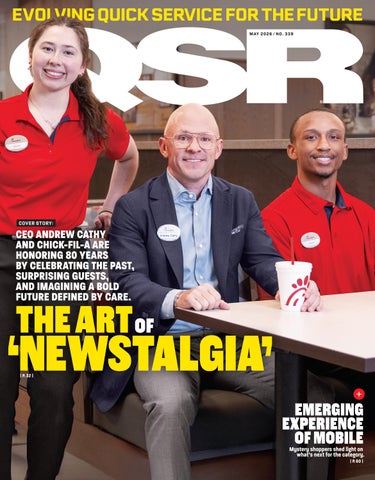
CEO ANDREW CATHY AND CHICK-FIL-A ARE HONORING 80 YEARS BY CELEBRATING THE PAST, SURPRISING GUESTS, AND IMAGINING A BOLD FUTURE DEFINED BY CARE.

The

FRESH IDEAS From the Menu to The Aisle

CPG has become a profitable business for a growing number of restaurants.

The rising chain creates wonder by turning science into delicious desserts.

The chain’s CMO gives insight into how the brand is growing awareness.

The Magnolia Bakery executive shares how leading with heart and creativity equals long-term success.

The

The Explosive Trend That Spread from Pizzerias to Dunkin’ From niche idea to national momentum, this spicy-sweet combo fuels LTO innovation.

How to Turn Drinks Into A Growth Engine Beverage programs are becoming a bigger contributor to guest traffic and average check growth. SPONSORED BY RED DIAMOND

How Burger King is Putting Growth Back in Local Hands

Why the Busiest Kitchens Need a Different Kind of Cash Protection Reduce downtime, strengthen security, and simplify daily deposits. SPONSORED BY LOOMIS

EDITORIAL

VICE PRESIDENT EDITORIALFOOD, RETAIL, & HOSPITALITY

Danny Klein dklein@wtwhmedia.com

QSR EDITOR Ben Coley bcoley@wtwhmedia.com

FSR EDITOR Callie Evergreen cevergreen@wtwhmedia.com

ASSOCIATE EDITOR Sam Danley sdanley@wtwhmedia.com

ASSOCIATE EDITOR Satyne Doner sdoner@wthwmedia.com

SENIOR VICE PRESIDENT AUDIENCE GROWTH Greg Sanders gsanders@wtwhmedia.com

CONTENT STUDIO

VICE PRESIDENT, CONTENT STUDIO Peggy Carouthers pcarouthers@wtwhmedia.com

WRITER, CONTENT STUDIO Drew Filipski dfilipski@wtwhmedia.com

WRITER, CONTENT STUDIO Ya’el McLoud ymcloud@wtwhmedia.com

WRITER, CONTENT STUDIO Abby Winterburn awinterburn@wtwhmedia.com

ART & PRODUCTION

SENIOR ART DIRECTOR Tory Bartelt tbartelt@wtwhmedia.com

VP, CREATIVE DIRECTOR / FSR ART DIRECTOR Matt Claney mclaney@wtwhmedia.com

SALES & BUSINESS DEVELOPMENT

SVP, FOOD, RETAIL, HOSPITALITY SALES AND ACCOUNT MANAGEMENT Matt Waddell mwaddell@wtwhmedia.com 312-961-6840

VICE PRESIDENT, BUSINESS DEVELOPMENT Eugene Drezner edrezner@wtwhmedia.com 919-945-0705

NATIONAL SALES DIRECTOR Edward Richards erichards@wtwhmedia.com 216-956-6636

NATIONAL SALES DIRECTOR Amber Dobsovic adobsovic@wtwhmedia.com 757-637-8673

NATIONAL SALES MANAGER Guy Norcott gnorcott@wtwhmedia.com 854-200-5864

CUSTOMER SERVICE REPRESENTATIVE Tracy Willingham twillingham@wtwhmedia.com 919-945-0704

CUSTOMER SERVICE REPRESENTATIVE Brandy Pinion bpinion@wtwhmedia.com 662-234-5481, EXT 127 FOUNDER Webb C. Howell

A New Flavor is Here.

Say hello to Peach—the newest addition to the DOLE SOFT SERVE® true-to-fruit lineup. Versatile, craveable, and easy to serve. It’s the perfect way to freshen up your menu and give your guests a true taste of summer.

VEGAN, DAIRY-FREE, GLUTEN-FREE, KOSHER OUD, LACTOSE-FREE

Learn more by scanning the QR code below or email us directly at Lucy@kentww.com.

SCAN FOR A FREE SAMPLE

https://bit.ly/4sBANww

The Trends RestaurantsDefining in 2026

SOME CATEGORIES ARE RISING. OTHERS NOT SO MUCH.

BCOLEY@WTWHMEDIA.COM

QSR MAGAZINE

As we approach the halfway point in 2026, a few things have become clear. Chicken and beverages are as strong as ever.

Large, mid-sized, and emerging chicken concepts, like Raising Cane’s, Huey Magoo’s, and Starbird continue to expand across the country. Customers are drawn to the variety, whether it’s tenders, sandwiches, or boneless wings, and many brands are pairing these menu items with innovative sauces to create a more distinctive experience.

We also can’t forget Chick-fil-A, which is on our May cover. Aside from its eye-popping AUV and sales numbers, what stands out about the brand is its constant focus on innovation and marketing. In March, the chain released a new Jalapeño Ranch Club Chicken Sandwich and Strawberry Hibiscus beverages, giving customers yet another reason to visit.

In beverages, numerous chains have launched their own spin on dirty soda. McDonald’s, the biggest chain in America, plans to debut a creative drink lineup later this year after extensive testing. Taco Bell is also expanding its beverage-forward Live Más Café in Southern California and Texas. Internationally, KFC rolled out Kwench to attract Gen Z and millennial consumers.

Another big storyline is the pizza segment’s struggles. Major players Pizza Hut and Papa John’s have experienced consistent sales declines and have announced hundreds of store closures in the U.S. The fast-casual pizza industry has been hurting for years. Pie Five, once dubbed the “Chipotle of pizza,” had 100 locations in 2017 but is now down to fewer than 20 res-

taurants. Pieology declared bankruptcy in December. MOD Pizza was acquired by new ownership and saved from bankruptcy, and Blaze Pizza recently hired a new CEO to chart a new direction.

However, not all pizza chains are struggling. Domino’s, in fact, is thriving. Thanks to a combination of value, menu innovation, technology, and operational improvements, the brand continues to gain market share and separate itself from the pack. Marco’s Pizza also appears to be performing well, after opening 60 units last year and planning 80 openings in 2026.

Value remains a fascinating storyline as well. McDonald’s, which added a $3-or-less menu and $4 breakfast combo in April, is the clear leader. The burger giant is determined not to be beaten in this area, and with its incredible marketing engine and resources, few competitors can match it. We’re also seeing lower price points from fast-casual brands, including $4.99 offerings at Panera and Smashburger, a protein cup for under $4 at Chipotle, and $1 sodas, $3 fries, and $5 shakes on Shake Shack’s mobile app.

Taken together, these trends show an industry moving quickly. In 2026, success increasingly belongs to brands that innovate while keeping prices accessible. Customers are demanding convenience, speed, quality, and a great experience. Expectations are higher than ever, and only the best concepts will meet the moment. There are still many months left in the year, and anything can happen.

what’s missing in your market?

Hot Dogs, Soft Serve, Chili Cheese Fries

AMERICAN FOOD

LESS LABOR

LOW FOOD COSTS SIMPLE OPERATIONS

MULTIPLE BUSINESS FORMATS

Protecting Profitability

Lessons on making better decisions at the restaurant level.

Tighter operations and sharper decision-making are defining success in quick service heading into 2026. With shifting traffic patterns, elevated food and labor costs, and continued pressure to deliver speed and consistency, operators are finding that even small adjustments can make a measurable difference across the system.

A new webinar from Restaurant365 takes a closer look at how leading QSR operators are approaching the year ahead. The session features David Mortensen, customer success manager at Restaurant365, alongside Jonathan Martin, cofounder of Pivot Accounting.

The conversation is built around one central idea: profitability is driven at the operational level. For brands managing high transaction volumes on tight margins, visibility into performance metrics and the ability to act on them quickly are becoming essential.

The webinar breaks down several key areas where operators are focusing their efforts. That includes tracking prime costs on a daily basis to identify issues early, adjusting labor schedules based on demand patterns and peak dayparts, and improving inventory controls to limit waste and reduce variance. Each of these areas connects directly to margin protection and consistency across locations.

Mortensen brings a background in back-of-house leadership and implementation experience, working closely with restaurant teams to apply technology in a way that supports real-world operations. Martin adds a financial perspective shaped by years of advising franchisees on growth, structure, and multi-unit strategy.

Together, the session offers a practical look at how operators can move from reactive decision-making to a more proactive, data-driven approach.

MARGINS REMAIN THIN IN THE FOOD INDUSTRY.

Qu’s 2026 State of Digital & Beyond:

The

Restaurant Technology Benchmark

analyzes how restaurants are adapting their technology strategies amid economic pressure, rising digital demand, and operational complexity.

Economic Pressure is Shaping Restaurant Strategy

• Restaurants are shifting from “growth at all costs” to strategies focused on efficiency, profitability, and margin protection.

• Rising consumer price sensitivity is forcing operators to balance value perception with the need to maintain healthy margins.

• Promotions, discounts, and limited-time offers have become the most effective tools for driving traffic and improving revenue performance.

• Inflation in food costs and rising labor expenses continue to create operational pressure, particularly for fast-casual brands.

• Restaurants are increasingly relying on menu innovation and demand-stimulation strategies to attract customers in a challenging economic environment.

Technology Investment Continues to Grow

• Nearly half of restaurant brands expect their technology investments to increase in 2026 despite ongoing margin pressures.

• Quick-service restaurant brands are increasing their technology spending faster than fast-casual brands in order to compete in high-volume environments.

• Restaurants are shifting their digital focus away from basic adoption and toward optimization, integration, and profitability.

• Technology is increasingly viewed as essential for improving operational efficiency and supporting guest experience improvements.

AI Investment is Accelerating but Results are Still Emerging

• A large majority of restaurant brands are investing in artificial intelligence either today or within the next year.

• While AI adoption is growing quickly, most companies are still in the early stages of realizing measurable value from these investments.

• Many operators report that AI currently provides limited or emerging value rather than transformative results.

• Restaurants are primarily investing in AI for marketing, personalization, predictive analytics, and voice ordering solutions.

• Quick-service brands are investing more heavily in front-of-house AI tools such as voice ordering and drive-thru computer vision.

Guest Experience is Driving Technology Spending

• Improving the digital guest experience is the top technology investment priority for restaurants in 2026.

• Marketing technology and loyalty platforms are also major areas of investment as brands seek deeper relationships with customers.

• Point-of-sale modernization and unified commerce systems are important investments to support seamless ordering across channels.

• However, fragmented technology systems and inconsistent data continue to limit the impact of these investments.

• Enterprise restaurant brands are more likely than mid-market brands to use advanced tools like customer data platforms to personalize the guest experience.

MORE THAN HALF OF RESTAURANT BRANDS NOW GENERATE OVER 25% OF THEIR TOTAL SALES FROM DIGITAL CHANNELS

Digital Sales Continue to Expand

• Digital channels are becoming a larger portion of restaurant revenue across the industry.

• More than half of restaurant brands now generate over 25 percent of their total sales from digital channels.

• Quick-service restaurants are rapidly increasing their digital sales share and closing the gap with fast-casual brands.

• As digital adoption grows, restaurants must improve system integration and operational readiness to manage the increased complexity.

Operational Complexity is Increasing with Digital Growth

• The rapid expansion of digital ordering channels is creating new operational challenges for restaurants.

• Many brands report that third-party ordering platforms and first-party digital ordering systems are among the most unstable technology systems.

• Improving order flow across all channels has become the top operational priority for restaurants heading into 2026.

• Restaurants are also prioritizing improvements in team workflows, order readiness accuracy, and real-time kitchen communication.

• Operational execution and labor challenges remain major barriers to delivering consistent guest experiences across channels.

fresh ideas

FROM THE MENU TO THE AISLE

What does it take for a restaurant brand to succeed on the grocery shelf?

In 1987, White Castle began offering microwavable sliders in grocery stores after then-CEO Bill Ingram noticed something unusual about how guests were ordering. Customers weren’t just eating sliders in the restaurant. They also were buying extra to take home and freeze for later.

That behavior sparked a simple question: if people were already turning their freezers into mini White Castles, why shouldn’t the company help them do it better?

When Ingram pitched the idea of a frozen slider line to contract manufacturers, the response was skeptical. Suppliers said the business would be too risky and complex to execute, so the company developed its own manufacturing process in-house.

Nearly four decades later, the retail division represents roughly a quarter of White Castle’s total revenue, selling a variety of frozen sliders and snacks in grocery freezer aisles nationwide.

But the frozen sliders represent more than just a second sales channel. Sarah Paulson, director of retail marketing, innovation, and licensing at White Castle, says the CPG business helps the company connect with fans who didn’t grow up with a White Castle nearby or who may have moved away from its core markets.

WHITE CASTLE HAS MAINTAINED A PRESENCE IN GROCERY STORES FOR DECADES.

fresh ideas

White Castle’s restaurant footprint remains concentrated in the Midwest and the New York metropolitan area. Retail products help the brand maintain relationships with consumers beyond those markets.

The company also takes a broad approach to where its products are sold. Rather than focusing only on traditional grocery chains, it distributes its frozen sliders across a wide range of retail formats, including grocery, club, and convenience stores, along with discount stores like Dollar Tree and Family Dollar.

“We really don’t try to limit where we sell,” Paulson says. “Anywhere that has a freezer door is an opportunity.”

Paulson also connects the current momentum behind restaurant-branded CPG products to the broader economic climate. With consumers facing tighter budgets and fewer discretionary dollars, more meals are being prepared at home. At the same time, shoppers still want convenience and familiar indulgences. Retailers have taken notice and are giving consumers more ways to enjoy recognizable restaurant flavors without the higher cost of dining out.

“They’re definitely tuned into that spending, and they’re continuing to add restaurant-style brands to their shelves–even to the point that there are brands that aren’t restaurants who claim ‘restaurant style’ on their packaging to help elicit quality and flavor,” Paulson says.

Restaurant brands moving into grocery isn’t new, but the pace accelerated during the pandemic, when lockdowns forced operators to rethink how they reached consumers. What began as a survival tactic when dining rooms closed has since evolved into a long-term strategy for many brands.

Consumers who became accustomed to eating more meals at home during the pandemic have continued seeking restaurantquality flavors in retail formats, driving demand for branded sauces, frozen products, and meal kits. Inflation has reinforced that shift, encouraging shoppers to look for lower-cost alternatives to dining out while still gravitating toward familiar brands.

Together, those forces have turned restaurant-to-retail expansion into a more permanent part of the industry landscape, giving

brands another way to interact with consumers beyond the traditional service model.

The list of chains entering the grocery aisle continues to grow. Walk through many supermarkets today and restaurant logos are increasingly visible on shelves and in freezer cases.

One newer entrant into the space is Dutch Bros.

The drive-thru coffee chain officially entered the consumer packaged goods market in early 2026 with the launch of its “Dutch Bros at home” line, designed to bring the brand’s signature flavors into retail and online channels. The assortment is available through Amazon and select Walmart, H.E.B., and Albertsons stores in markets where the company currently operates, with broader distribution expected to roll out across additional grocery, mass, convenience, and e-commerce retailers.

“From a strategic standpoint, CPG complements our shop business by meeting customers in retail environments they already frequent while strengthening the connection they’ve built with Dutch Bros in-shop,” says Tana Davila, chief marketing officer at Dutch Bros. “It is also helping us grow brand awareness, especially in newer markets.”

After a gradual rollout last year, the assortment is expanding to more stores and online in 2026. It includes signature ground coffee, ready-to-drink iced coffees and lattes, creamers, and single-serve coffee pods.

The five launch flavors–Vanilla Caramel, Chocolate Macadamia Nut, Caramel Mocha, Irish Creme, and Coconut Mocha–mirror the flavor combinations behind popular Dutch Bros drinks such as the Golden Eagle, Annihilator, Caramelizer, Kicker, and Cocomo.

“One of the challenges has been ensuring that we deliver the flavors our customers know and love as best as possible in the at-home format,” Davila says. “In our shops, so much of the experience comes from customization opportunities and the energy of our broistas, so bringing those familiar flavor profiles into packaged products takes thoughtful development.”

That challenge is common for restaurant brands entering CPG. Translating an in-store experience into a packaged product often

DUTCH BROS OFFICIALLY BEGAN ITS CPG JOURNEY IN 2025.

Many D

We provide the snacks and frozen treats that make memories in consumers’ minds. The ones associated with delight and good times. And they all come from one source.

Stop by booth #5607 at the National Restaurant Association Show for a free sample

SCAN FOR FREE SAMPLE

fresh ideas

requires finding ways to recreate familiar flavors and brand cues in a completely different format.

The dynamic works differently for Häagen-Dazs, where the relationship between shop experience and retail product often runs in the opposite direction.

For most consumers, the brand is synonymous with the grocery freezer aisle. Its U.S. CPG business generates about $1.5 billion in annual sales and, by the company’s measure, is the largest ice cream brand in the country, with a presence in “almost every store someone would go to,” says Rachel Jaiven, head of marketing at Häagen-Dazs.

The brand was founded in 1960 as a premium packaged ice cream company and didn’t open its first scoop shop until 1976. Today, the shop experience exists across 212 locations in 29 states, offering what Jaiven describes as a “deeper, more immersive expression” of the brand than consumers get from a pint at home.

The retail and shop businesses should never feel like two separate brands, she says. Large national marketing campaigns drive

awareness for the packaged products, creating a halo effect that brings consumers into scoop shops. In turn, the shops provide a fully sensory experience that can deepen brand loyalty, reinforce its premium positioning, and encourage guests to pick up a pint on their way home.

A few years ago, Häagen-Dazs also began redesigning its scoop shops to strengthen that connection. The brand overhauled the look and feel of its stores and has been rolling the new design across the network. Jaiven describes the effort as a way to “build that brand recognition more seamlessly from what they see on the shelf to what they see when they walk into a store.”

Innovation also flows between the two sides of the business. New flavors are typically developed first for the CPG channel and then selectively introduced in scoop shops when space allows. Sometimes those launches are synchronized across both channels, supported by national campaigns and local store promotions.

The shops can also function as testing grounds. When HäagenDazs upgraded its pistachio recipe to feature more real pistachio flavor, the company offered free tastings in scoop shops, helping drive roughly 75 percent sales growth for the flavor in that channel.

Through it all, Jaiven says the guiding principle is consistency.

“My job and our goal is to build love for the brand, no matter where they experience it,” she says.

For brands exploring the relationship between packaged products and brick-and-mortar experiences, Jaiven says the starting point is a clear understanding of the brand itself—and maintaining that identity across channels.

“First and foremost, it’s about that brand foundation,” she says. “It’s about making sure that the brand experience is consistent wherever you show up, no matter what.”

For Häagen-Dazs, that principle shows up in the smallest details. A scoop in a Brooklyn shop, she says, has to deliver the same flavor promise as a pint pulled from a grocery freezer in the Midwest.

Clarity of differentiation is just as critical when entering the retail environment. Grocery buyers evaluating new products want to know exactly what a brand brings to the shelf that competitors do not.

“When you go and speak to a grocery store chain or any kind of channel where CPG products are sold, they’re going to want to know: What are you bringing that’s unique and different to drive my sales?” she says. “That point of difference and that uniqueness needs to be very clear versus your competitors.”

Finally, she cautions against chasing distribution for its own sake. Häagen-Dazs enjoys widespread distribution across grocery retail, but Jaiven says restaurants entering CPG or new channels shouldn’t necessarily chase that kind of ubiquity out of the gate. Similarly, White Castle’s “every freezer is an opportunity” playbook won’t make sense for every brand at every stage.

“Everything informs the brand perception,” she says. “It’s really tempting to go everywhere, but just being aware that there are different choices you make around that and having a sense of what that reflects about your brand is important.”

Sam Danley is the associate editor of QSR. He can be reached at sdanley@ wthwmedia.com.

Flavor Runs In The Family.

Great menus need great flavor, but no single flavor is perfect for every menu. That’s why, when it comes to Ranch, the family behind Ken’s has spent decades collaborating with customers to craft 12 unique Ranch flavors. Whether your emphasis is fresh tangy buttermilk, savory herbs or the exciting smoky, spicy or cool flavors of Chipotle, Jalapeño or Avocado – we have a Ranch custom-built for your menu. No matter what your guests crave, Ken’s has it covered.

e Explosive Trend at Spread from Pizzerias to Dunkin’

By now, most pizzerias have heard of—or are serving—hot honey. But what some might not know is that the national trend started in a Brooklyn pizzeria. The “swicy” pizza topping took seven years of development, starting in 2003 with a nod to Brazilian chili-infused honey. From inspiration to overnight hit, it is taking the pizza and now, quick-service restaurants at large, by storm. Mike’s Hot Honey (MHH) has proved to be the starting point for a sweet-heat movement that has expanded into beer, ice cream, sandwiches, and more—always with an eye on its roots in pizza.

Trends like hot honey show how inspired foodservice operators and employees can challenge entire industries and create lasting momentum. MHH proved its appeal early on at Paulie Gee’s in Brooklyn in 2010, where Mike was working at the time. Paulie Gee, like many operators, recognized that Mike had landed on

FROM NICHE IDEA TO NATIONAL MOMENTUM, THIS SPICY-SWEET COMBO FUELS LTO INNOVATION. Learn how

a hit flavor combination the moment he tasted it and began serving small batches of MHH on the Hellboy pie with hot soppressata. Today, Mike’s Hot Honey is the fastest-growing pizza topping, up 406 percent in 2025, according to Datassential, but its popularity doesn't stop at pizza.

Mike’s Hot Honey took its roots with independent small operators and applied that level of care and customer service to its national accounts while keeping an eye on its flagship customers. “Our team and our passion for our customers are a big part of our success,” says Frank Speranza, national sales manager for Mike’s Hot Honey. “We care deeply about all our customers, whether they’re independents or national accounts, and we focus on each one with the same level of appreciation and passion.”

That passion is backed by consumer interest, which helps explain the steady stream of successful LTOs with both major brands and independents over the past few years. The Dunkin’ x Mike’s Hot Honey Bacon Breakfast Sandwich was met with widespread excitement, while permanent menu additions have followed at national brands like Casey’s.

Beyond flavor, Mike’s Hot Honey has become a cultural phenomenon, earning a distinct “cool factor.” Customers recognize the bright neon signage hanging in local spots and can even play an old-school arcade game called Slice Hunter, a nod to the 1980s slice-shop era, courtesy of Mike’s Hot Honey.

Some trends flare up and fade. Others become cultural moments before reaching ubiquity. That’s the path Mike’s Hot Honey is on. “We have lofty pizza ambitions, and we hope that in five years, Mike’s Hot Honey will be everywhere pizza is available,” says Michelle Lane, vice president of foodservice sales.

In the foodservice industry, Mike’s Hot Honey is proof that one thoughtful flavor decision can change the trajectory of a menu. What began as a small batch addition in a Brooklyn pizzeria became a nationwide staple without losing its connection to the shops that helped build it. In a category driven by creativity and craft, MHH reinforces an enduring truth: independents don’t just follow trends—they create them.

Chill-N Nitrogen Ice Cream

Exploring the brand’s formula for innovative ice cream, community chemistry, and successful scalability.

FOUNDER: Daniel Golik and Donna Golik (Son/Mother)

HEADQUARTERS: Miami, FL

YEAR STARTED: 2012

ANNUAL SALES: $6.8 Million

TOTAL UNITS: 16 across Arizona, Florida, South Carolina, Tennessee, and Texas. Seven are corporate owned and the other nine are franchisees.

Take a step into any Chill-N Ice Cream shop, and you’ll think you’ve entered the laboratory of a dessert-loving scientist. Hanging from the walls are a periodic table of flavors and a chalkboard with written equations for recommended ice cream blends. You also can’t miss a large vat of liquid nitrogen used to feed the machines, known as Lolas, assigned to create custom desserts for each guest. Behind the counter glass is an assortment of mix-ins, along with an eager team ready to serve up sweet eats.

Here, the “Chipotle effect” is in full force. Customers move through an assembly line, selecting from a variety of bases and flavors, then watch their creation undergo a rapid state change from liquid cream to a flash-frozen dish in under six minutes.

Chill-N was founded in 2012 after a medical degree ultimatum, a dose of curiosity, and a craving for velvety ice cream. Danny Golik, cofounder of Chill-N and a lifelong tinkerer, found himself experimenting in his parents’ garage after tasting nitrogen ice cream from a northern Florida cafe while on break from medical school. He noticed a lack of exactness in the manual

process. He discovered that having humans work with the nitrogen directly regularly produced variable textures, leading to uneven or runny outcomes. Having a scientific mind, he couldn’t shake his curiosity about how to create consistency across orders for this type of dessert.

Determined to find a better approach, Golik spent 12 months developing a system that would automate the thermodynamics of ice cream. “His parents said, ‘We’ll support this as long as you promise to go to medical school if it doesn’t work out,’” says David Leonardo, CEO of Chill-N.

The year of experimenting led to the development of Lola, a proprietary machine that uses a specialized algorithm to dispense bases and flavors with absolute consistency.

“The original goal of the founder was to automate the process to achieve con-

sistency and proper texture, avoiding the issues of overly hard or soupy ice cream that manual mixing could cause,” Leonardo says.

The machine reads the size, base, and flavor detailed in the order and calculates the exact amount of base needed. Different flavors interact uniquely with liquid nitrogen. For example, strawberries require less base because the fruit itself expands when it interacts with nitrogen.

When Leonardo joined as chief executive officer in 2019, his mission was to take Golik’s systemic scalability and professionalize the brand for national growth. He recognized that the brand’s true edge was its ability to produce a high-speed emulsion and provide a health-forward dessert. The emulsion process creates a texture that sits deliciously between a soft gelato and a tra-

CHILL-N NITROGEN ICE CREAM WAS FOUNDED IN 2012.

How to Turn Drinks Into A Growth Engine

Beverages are no longer just a sidekick to the main menu— they’re increasingly a primary driver of traffic and check growth in the quick-service restaurant space. According to Datassential, operators are expanding beyond traditional soft drinks into more dynamic, customizable o erings that can attract new occasions and serve as a tra c driver. Research shows beverages account

for roughly 10–15 percent of quick-service restaurant sales, and even modest gains in attachment rates can significantly lift average check. Together, these shifts are pushing operators to rethink their role not just as food destinations, but as beverage destinations.

Within this evolving landscape, innovation, speed, and consistency are critical to capturing demand and maximizing profitability. Solutions like Red Diamond’s® OmniBrew™ Program are designed to help quick-service restaurant brands meet rising expectations while simplifying beverage execution.

Labor shortages remain a persistent challenge for quick-service operators, and high turnover only adds to the strain in fast-moving kitchen environments. “More and more frequently, operators are having to choose between incremental profit or managing the stress of training an ever-rotating sta on a house recipe or multiple machines,” Emily Wood Forehand, executive vice president at Red Diamond Co ee and Tea, says. “It’s challenging enough to manage this in one restaurant, let alone across multiple locations. Red Diamond’s OmniBrew helps reduce that operational pressure while delivering a consistent product every time.”

Red Diamond positions its OmniBrew program as an answer to labor issues, operational stress, and space constraint while helping operators meet growing demand for variety and quality. The OmniBrew portfolio includes beverages and flavors that brew through one compatible brewer, allowing restaurants to consolidate beverage categories into a single system. “Operators can o er unsweet and sweet tea, iced co ee, flavored tea, lemonade, and hibiscus refreshers that are all freshly made," Forehand says.

OmniBrew products come in pre-measured bags designed to deliver a consistent taste with every brew. “Consistency is key, and a promise we like to keep,” Forehand says. “We o er options that brew three gallons or 1.5 gallons per batch. If set up correctly, the brewer can be run and left alone with a few pushes of buttons."

Simplifying beverage execution largely impacts employee satisfaction and retention. “In quick-service environments, the beverage station is often the place where chaos either blooms or gets quietly engineered away,” Forehand says. “When systems get simpler, sta feel it immediately.”

As operators work to become beverage destinations, confidence in a beverage partner matters. O ering co ee and tea can help quick-service restaurants capture more of those occasions in one visit. “Customers may buy breakfast at one location and drive to another spot to purchase their drink of choice,” Forehand says. “Those are incremental dollars that are flying out the door. O ering patrons a one-stop shop leads to improved customer satisfaction, higher repeat visits, and improved margin for the operator.”

With Red Diamond’s® OmniBrew™ technology, you can brew multiple high-demand beverages using one compatible brewer. For added operational ease, try our Simple Sweet™ line — featuring pre-measured cane sugar and real ingredients — to simplify execution while expanding variety.

Simple Sweet™

Scaling Dutch Bros Through Clarity and Culture

From CPG to coffee, CMO Tana Davila reveals her playbook for building a culture-first brand at scale.

Tana Davila was not a coffee drinker. Not for the first 30 years of her life— until one particularly tired “mom morning,” when a colleague introduced her to Dutch Bros. From then on, before heading into the office as CMO of P.F. Chang’s, she made a stop for coffee.

At Chang’s, Davila leaned into loyalty and delivery, sharpening her ability to use

technology as a growth engine. She even dabbled in beverage strategy—a detour that would later feel less like a side project and more like foreshadowing.

Her path to the C-suite wasn’t linear. She began in CPG, learning how to turn the dials of marketing and revenue growth— from product promotion to the fine details of shelf placement. From there, she stepped

into the restaurant space, serving as CMO of CKE Restaurant Holdings, overseeing Hardee’s and Carl’s Jr.

So when the call came in 2023 to join Dutch Bros as CMO and help guide its next phase of growth, it wasn’t really a question. She had worked with key members of the leadership team before. She understood the business. Most importantly, she believed in the brand’s culture.

“It’s been a combination of experiences over time that have put me in a good place to lead Dutch Bros,” Davila says. “What I initially loved about the brand is how I’d show up and be a little happier leaving than when I came. It’s the reason people come back—and it’s our role to make the guest’s day better than when they showed up.”

In 2023, Dutch Bros was still largely viewed as a regional coffee player. But the brand had the right bones to compete nationally—particularly as consumer demand surged toward cold beverages and energy infusions, one of the industry’s hottest growth segments.

For Davila, the mandate wasn’t reinvention. It was amplification: double down on Dutch Bros’ DNA and scale it without diluting what made it distinct.

The results have been hard to ignore. The company remains on pace to reach 2,029 shops by 2029. Dutch Bros closed 2025 with 1,136 system shops across 25 states, including its first walk-up-only location in downtown Los Angeles, which opened in November.

A recent acquisition of 20 Clutch Coffee Bar locations across North and South Carolina further accelerated that expansion. Rapid growth, however, can test a brand’s identity. For Davila, protecting it starts with clarity.

“Dutch Bros stands for positive energy, and we manifest that in different ways— whether it’s the friendly service we aspire to deliver every day or how deeply we’re ingrained in our communities,” she says. “We go beyond a very functional beverage. As our founder would say, we’re not in the beverage business, we’re in the relationship business—and the product is love. We don’t lose sight of that.”

Dutch Bros has captured the attention of Gen Z in a way few

CMO
TANA DAVILA JOINED DUTCH BROS IN 2023.

Evolution of Efficiency Through Smart Manufacturing

As quick‑service moves to digital‑first, operational efficiency is essential. At Tronex, our smart, dedicated manufacturing and resilient supply chain deliver the predictable, dependable, and consistent performance needed for today’s fast‑paced kitchens. Powered by advanced technology, we help teams work confidently and safely for over 37 years.

Partner with a trusted leader in gloves, medical‑grade face masks, and protective apparel.

Advanced Protection. Optimized Performance. Predictable Costs.

How Burger King is Putting Growth Back in Local Hands

Local leadership is bringing sharper execution and stronger restaurant culture.

As one of the most recognizable names in quick service, Burger King believes restaurants perform best when they are operated by owners who live in their markets, are closest to the guest, understand their communities, and take a more hands-on approach to the business. Key to the brand’s long-term turnaround strategy, Burger King is in the middle of a major restructuring e ort designed to return more restaurants to franchise ownership. In 2024, the brand

ing. Together, the two partnered to bring a more local, hands-on franchisee approach to the Florida market.

“At the end of the day, we’re in the people business,” Serafim says. “Even though it’s fast food, success is driven by the people. Local ownership brings operators closer to their teams and communities. They’re present in the restaurants, coaching employees, improving operations, and constantly elevating the guest experience. In a highly competitive industry, this level of engagement and accountability is a major advantage.”

Local presence also changes how decisions are made. “A local owner lives in the community and treats the restaurant like their own business,” Romeo says.

“That creates consistency, stronger relationships and a deeper understanding of customers.” Serfim adds:

“When ownership is purely financial, it’s easy to manage from a spreadsheet—and that’s a recipe for failure. Being local adds purpose and intention to every decision. Financials matter, but so does how we get there.”

acquired roughly 1,200 locations from its largest franchisee, and is in the midst of remodeling and transitioning them to local franchise operators ownership.

This is what drew former Burger King executives Eduardo Serafim and Willie Romeo to launch Nova Shores, a South Florida-based franchise group that now operates 33 Burger King restaurants. For Serafim, who previously led franchising and development for the brand, the move fulfilled a long-held entrepreneurial goal. “I always wanted to become an entrepreneur,” he says. “While leading franchising at Burger King, I saw firsthand the untapped potential of the brand and how franchisees could transform their lives and communities.”

Romeo, who also spent years with Burger King and was nearing retirement, saw the opportunity as a chance to build something last-

A similar hands-on philosophy shapes Nova Shores’ leadership approach. “We focus on four pillars: people, training, processes, and culture,” Romeo says. “We invest heavily in succession planning, development, and alignment with Burger King systems. We emphasize high standards and leadership development. We want a team of high performers aligned around shared goals—what we call ‘one team, one dream.’”

For operators considering franchising, Serafim notes Burger King’s current evolution makes this a particularly compelling time to get involved. “Being a part of a turnaround for such an iconic brand is beyond exciting,” he says. “We serve thousands of people daily, and even small improvements can impact their day in a meaningful way.” Romeo agrees, adding: “Everyday we feel more proud of what we’re building—not just our business, but Burger King as a whole. Seeing the progress in restaurants and hearing from guests makes it incredibly rewarding.” -By

EDUARDO SERAFIM AND WILLIE ROMEO

THE NATIONAL RESTAURANT ASSOCIATION SHOW PREVIEW

Featured Sessions:

Keynote ’26

PRESENTED BY

Who: Andre Agassi, award-winning tennis player and entrepreneur; Michelle Korsmo, President and CEO, National Restaurant Association

When: Sunday, May 17 1 pm

Where: Grand Ballroom S100

This year’s keynote kicks off with tennis legend, Olympic gold medalist, philanthropist, and education advocate Andre Agassi. Considered one of the most accomplished athletes of all time, Agassi will take the stage to share his journey—from the pressures of competing on a global stage to championing education rights for at-risk children.

Together with Michelle Korsmo, president and CEO of the National Restaurant Association, Agassi will dive into how the mindset of a champion applies across all facets of life, motivating foodservice professionals to push boundaries, embrace change, and lead with purpose and vision.

Using examples from his career—such as completing the Career Grand Slam after a dramatic five-set comeback victory in 1999—he will teach attendees how to reframe challenges as opportunities, embrace both personal and professional evolution, and recognize the importance of giving back.

This interview-style Q&A, led by Korsmo, will explore Agassi’s career evolution, philanthropic mission, and the principles that help leaders thrive in a rapidly changing environment—offering valuable lessons in resilience, perseverance, reinvention, and leadership.

FEATURED SESSION WITH TECHNOMIC /

Get it While it’s Hot: Driving Demand with LTOs

Who: Debbie Stroud, CEO, Whataburger; Jennifer Bell , CMO, Lettuce Entertain You Restaurants; Arthur Carl II, Vice President of Culinary, IHOP, Joe Pawlak , managing principal, Technomic

When: Monday, May 18 1 pm

Where: Grand Ballroom S100

Ready to discover the secrets to successfully leveraging limited-time offers? This session, led by Joe Pawlak, managing principal at Technomic, alongside three leading independent and chain operators, will give attendees a competitive edge in today’s rapidly evolving market.

Speakers will share strategies to identify top-performing LTO trends— and how to integrate them— using real-world examples and firsthand experience. Attendees will learn how operators are using these tools to boost sales, engage customers, and execute planning cycles effectively without overspending. This featured session blends innovation, strategy, and practical insight.

JOE PAWLAK
ARTHUR CARL II
JENNIFER BELL
DEBBIE STROUD
MICHELLE KORSMO
ANDRE AGASSI

SATURDAY, MAY 16

1 pm -1:45 pm

Money Matters: Food Choices in the New Financial Reality

What does “value” mean in 2026?

With inflation, higher interest costs, and shifting household priorities, consumers aren’t simply trading down—they’re value-flex splurging in smaller, more meaningful ways while cutting back elsewhere.

This session breaks down how that practical indulgence shows up across dayparts and channels, arming foodservice professionals with a playbook for balancing affordability and aspiration: where to premiumize, where to protect entry-level price points, and how to communicate worth in a skeptical market.

Attendees will also explore how offers, loyalty mechanics, and signals of real value—quality, functionality, and convenience—can resonate with consumers without causing fatigue or eroding margins.

Who: Suzy Badaracco, President,

Where: Room S403, South Building, 4th Floor

The 2026 State of the Industry: Position Yourself for Success in the Face of Uncertainty

It’s no secret the restaurant industry is facing unprecedented headwinds— from rising operational costs to cautious consumer spending and broader economic uncertainty. With the right strategies, operators can navigate this complex landscape and turn obstacles into opportunities.

Using findings from the 2026 State of the Industry Report by

the National Restaurant Association, this session will analyze industry challenges, evaluate strategic responses, and help operators develop action plans for sustainable growth.

Who: Chad Moutray, Senior Vice President, Industry Research & Knowledge, and Chief Economist, National Restaurant Association

Where: Room S502 , South Building, 5th Floor

2 pm -2:45 pm

AI + Predictive Marketing: Smarter Campaigns, Less Discounting

Less is more. This session will teach operators how to use AI to identify raw signals and pair high-intent triggers—such as daypart, weather, and local events—with the right outreach channel to avoid guest fatigue and blanket promotions.

David Ciancio and Luke Scharlatt will reveal a playbook for launching predictive messages that lift frequency, a 30-day test plan that fits inside nearly any tech stack, and a trigger-to-message matrix designed to aim—not spam.

Who: David “Rev” Ciancio, Co-Founder and CMO at Handcraft Burgers and Brews and CMO at Salad House; Kenneth Scharlatt , Founder and Executive Director at Savage Orchid Hospitality

Where: Room S404, South Building, 4th Floor

Training in the TikTok Era: Micro-Learning and New Expectations for Workforce Success

With Generation Z—and soon Generation Alpha—making up much of today’s workforce, operators must understand how to train them to stay competitive. They’re younger, faster-moving, and more techdriven than ever before, and this session explores how microlearning and career-focused education can boost retention, reduce turnover, and drive higher engagement and performance.

Panelists will share what’s working, offering actionable solutions that strengthen culture and make training less challenging.

Who: Steve Madonna , VP of Culi-

CULINARY DEMONSTRATIONS:

Are you ready to witness culinary excellence live on stage?

This year’s National Restaurant Association Show hosts food and beverage demos by restaurant masters at the top of their game. Be sure to stop by The Culinary Experience, Lakeside, Booth #12448.

Saturday, May 16

Leah Cohen

Chef, Television Personality, Owner, Pig & Khao

WHEN: 3:15 pm - 4:00 pm

SPONSORED BY: CJ SCHWAN’S

Sunday, May 17

Chris Cosentino

Chef, Author, Cyclist, Philanthropist

WHEN: 10:00 am - 10:45 am

SPONSORED BY: WARING AND CJ SCHWAN’S

Monday, May 18

Sarah Grueneberg

Chef, Television Personality, Author, Partner Monteverde Restaurant, Pastificio

WHEN: 3:30 pm - 4:15 pm

SPONSORED BY: THE EUROPEAN UNION AND CJ SCHWAN’S

nary, Connections; Shane Schaibly, Senior Vice President of Culinary Strategy, First Watch; Katy Velazquez , VP, Culinary Innovation at Qdoba Restaurant Corporation

Where: Room S503, South Building, 5th Floor

SUNDAY, MAY 17

3 pm -3:45 pm

10 Ways to Cut Food Costs Without Cutting Flavor

The pressure to balance rising food costs with delivering exceptional quality and flavor is higher than ever. But operators don’t have to

sacrifice their culinary vision to protect the bottom line. In this session, guided by Erica Holland-Toll, operators will discover ways to engineer menus that highlight high-margin items, reduce waste, and work with existing supply chains to manage inventory more effectively and maximize purchasing IQ.

Who: Erica Holland-Toll , Culinary Director, The Culinary Edge

Where: Room S403, South Building, 4th Floor

Cook Up Financial Security: Safeguard Your Restaurant From Lawsuits & Taxes

Slips and falls. Employee disputes. Costly tax burdens. These can threaten the financial future of

any business—especially those in foodservice. In this session, Larry Oxenham will teach operators how to shield their businesses from lawsuits, implement tailored taxreduction strategies, and plan for long-term success with an estate and business succession checklist.

Who: Larry Oxenham , Senior Advisor and Author, American Society for Asset Protection

Where: Room S502 , South Building, 5th Floor

Frictionless or Forgotten: Rebuilding the Guest Digital Funnel

Consumers want ordering, paying, and reordering to be easy. Their digital experience must be frictionless from start to finish—from discovery to first order to repeat purchase. This session breaks down how operators can streamline their and prevent revenue leakage by implementing AI upsells, smart menu routing, and QR journeys that actually work.

Attendees will leave with a playbook of low-lift steps that can be implemented across existing systems, along with a toolkit to track impact across AOV, turn times, and repeat rate through a simple KPI cadence.

Who: Kenneth Scharlatt , Founder and Executive Director, Savage Orchid Hospitality; Kayla Storey, Area Director of Sales and Marketing, Zieg Hospitality

Where: Room S504, South Building, 5th Floor

Training Without a Training Department: Practical Strategies for Restaurants

For independent operators, franchisees, and multi-unit managers, not having a training department— or a dedicated trainer—can be a

AT A GLANCE:

WANTING TO KNOW JUST WHERE TO GO?

Scan to access the National Restaurant Association Show floor plan.

challenge. Strong training is a cornerstone of restaurant success, from delivering consistent service to building guest loyalty.

This session will dish out actionable strategies for turning shift leaders and managers into confident, consistent trainers, building accountability through simple tools such as checklists and peer mentorship, and balancing speed and quality in onboarding and skills development—all without relying on a corporate training infrastructure.

Who: Kim Evans, Director of Training, Hopdoddy Burger Bar; Anna Mason , Vice President of People Experience, A.Ray Hospitality; Jason Lyon , COO, Wrap City Sandwich Company; Corban Nichols, Vice President of Restaurant Excellence, Piada Italian Street Food

Where: Room S503, South Building, 5th Floor

4 pm -4:45 pm

Community-First Marketing in a Tech-Driven World

With an ever-increasing focus on technology and AI, the human element of marketing can get overlooked. Session host Kristen Corral didn’t grow her restaurant by chasing likes and shares—she succeeded by owning her neighborhood.

She’ll share strategies to turn local partnerships, give-back programs, and local media into steady traffic, higher check averages, and repeat visits. Attendees will leave

knowing how to cultivate a ride-ordie fan base that keeps coming back because they care about the brand.

Who: Kristen Corral , Co-Founder, Tacotarian

Where: Room S504, South Building, 5th Floor

How to Turn Followers into Guests in the New Era of Social Media Marketing

How do thousands of likes translate into loyal foot traffic and real dining decisions? Join Hifsah Ahmed as she explores proven strategies for creating content that sticks, including short-form video, influencer collaborations, and trend-driven campaigns that deliver measurable results beyond vanity metrics. Backed by restaurant-focused case studies and actionable frameworks tailored for multi-unit brands and independent operators, this session will show attendees how to elevate visibility, strengthen customer relationships, and maximize ROI—including how to leverage micro- versus macro-influencers.

Who: Hifsah Ahmed , Content Creator and Influencer, Hifsah Ahmed

Where: Room S404, South Building, 4th Floor

The Adults’ Table: Winning Over the 50+ Diner

Consumers over the age of 50 account for more than half of all U.S. spending, yet they are often overlooked in the dining segment. Service fees, strict table time limits, and forced tipping can strip the joy from their dining experiences and drive them away entirely. Restaurants also increasingly limit group bookings to maximize turnover, overlooking the fact that this audi-

ence often dines together. This session will explore how operators can design appealing menus and leverage trust-based, community-rooted marketing to capture this loyal and influential demographic.

Who: Troy Kempton , General Manager, Wheat + Water; Carey Kyler, Senior Director of Insights, AARP Services Inc.

Where: Room S502 , South Building, 5th Floor

MONDAY, MAY 18

2:30 pm -3:15 pm

7 Numbers Every Restaurateur Needs to

Know

Join Anthony Lambatos as he pulls back the curtain on the seven key metrics every restaurateur needs to know to make better business decisions. These numbers track financial health, cost controls, sales and more, tying into current industry benchmarks and realworld applications. As a bonus, he’ll reveal how these numbers can also improve company culture.

Who: Anthony Lambatos, Owner, President, Footers Catering; President, Founder, and Speaker, MIBE Leadership & Culture Education

Where: Room S404, South Building, 4th Floor

A Year of GLP-1s: Consumer Behavior That’s Here to Stay

As of late 2025, roughly 1 in 8 American adults is actively using GLP-1 medications, shaping how guests engage with the foodservice industry. After a year of observation, this session unpacks what’s changed—

and what hasn’t—and explores what’s next.

Session host Rachel Royster will share practical menu and operations strategies that align with this shifting landscape while protecting brand identity and uncovering new revenue streams.

Who: Rachel Royster, Director, Strategic Planning & Innovation, Connections

Where: Room S403, South Building, 4th Floor

AI in Hospitality: Keeping the Human Connection

Artificial intelligence doesn’t have to replace human connection in foodservice. This session will empower operators to blend technology with the timeless values of hospitality—warmth, personalization and excellence.

Attendees will explore how AI can support operations by assisting in food and beverage menu design, streamlining SOPs and handling routine guest inquiries with speed and accuracy in a way that is cost-effective, data-driven, creative and operationally sound.

Who: Casey Gamblin , Area Beverage Manager, Ithaka Hospitality Partners; Jacob Hoop, Assistant Food and Beverage Director, Ithaka Hospitality Partners

Where: Room S502 , South Building, 5th Floor

Cultural Intelligence as a Growth Strategy for Modern Restaurant Brands

Today’s restaurant landscape is shaped by ever-evolving guest expectations, workforce dynamics and operating environments. In this session, Erika Cospy Carr will discuss how Cultural Intelli-

gence (CQ) functions as a business imperative, helping operators identify cultural blind spots, apply a repeatable decision-making framework and activate cultural intelligence within their teams.

Who: Erika Cospy Carr, Vice President at Multicultural Foodservice & Hospitality Alliance (MFHA)

Where: Room S504, South Building, 5th Floor

3:30 pm -4:15 pm

Keeping Customers

Curious: Bold Flavors and the Quest for Quality

The secret to activating fearless culinary innovation is a foundation of discipline. In this session, attendees will hear how flavordriven brands design structures and processes that support creativity and cultivate long-term customer loyalty.

Tamara Keefe will explain how experiences and brand partnerships can inspire unexpected innovation and differentiate offerings in a crowded marketplace—and how to strategically market, package and time launches so they resonate with customers and turn curiosity into sustained growth.

Who: Tamara Keefe, Founder and CEO, Clementine’s Ice Cream

Where: Room S504 South Building, 5th Floor

Making Hospitality Hospitable (Again)

Do your frontline teams have the right tools to deliver consistently inclusive experiences? In this session, Audrey Benet examines real-world scenarios involving language, accessibility and identity, identifying common gaps that impact both guest and employee experiences.

She’ll uncover the tools and strategies needed to provide respectful, personalized hospitality while fostering a culture of belonging across diverse teams— resulting in stronger staff retention and engagement.

Who: Audrey Benet , Associate Professor, Valencia College

Where: Room S502 , South Building, 5th Floor

The Restaurant Loyalty Roadmap for Lasting Customer Growth

All too often, restaurant activations generate excitement at launch but quickly lose traction. This session teaches attendees how to segment audiences, tailor offers and messaging, and design a “whole product” experience that combines menus, operations and marketing to scale successful ideas into sustainable growth.

Attendees will also learn how to apply trust-building tools such as reviews, loyalty programs and guarantees to boost repeat-visit rates and lifetime value.

Who: Andrew Gottlieb, CEO and Founder, No Typical Moments Where: Room S404, South Building, 4th Floor

n

TUESDAY, MAY 19

10 am -10:45 am Personalization Strategies for Exceptional Guest Experiences

Personalization and customizable experiences are more in demand than ever. This session highlights seasoned hotel and hospitality professionals, exploring how they approach experiential, tailored customer journeys.

Attendees will gain actionable insights into the art of personalization to better meet the evolving needs of today’s consumers.

Who: Michael Jacobson , President & CEO, Illinois Hotel & Lodging Association; Nick Johnson , Senior Vice President of Full Service and Lifestyle Hotels at First

Hospitality; Cannon Porter, Partner, Lettuce Entertain You Restaurants; Michael Wilson Director of Sales and Marketing, Hotel Zachary

Where: Discovery Theater, South Hall, 2693

11:30 am -12:00 pm

Mochi Innovation: Driving Business Success with Craveable Textures and Globally Inspired Comfort Foods

Sponsored by Mochi Foods and SpotOn, this session explores culinary’s next big trend: texture. Mochi-based methods can be applied to sweet and savory menu items, boosting differentiation, social media visibility and repeat purchases.

Attendees will learn how to infuse texture into their existing menus, streamline kitchen execution and increase perceived value without adding complexity to prep time or labor.

Who: Albert Lee, COO, Mochi Foods; Isabella Lee, Global Culinary Applications Manager, Texture Innovation, Mochi Foods; Pei Wu , Founder and CEO, Mochi Foods; Kevin Yu, Chef and Owner, 2D Restaurant Where: Innovation Theater North Hall, 5577

12:00 pm -12:30 pm

Fluid Motion: Smarter Bar Techniques and Design to Improve Efficiency and Execution

It’s time to get behind the bar. This mixology demonstration and educational session will teach attendees proper shaking techniques, tool usage and movement strategies that streamline cocktail preparation and enhance quality. Graham Essex will explain how thoughtful bar design and setup can improve bartenders’ physical well-being while boosting operational efficiency—ultimately increasing revenue and elevating the guest experience.

Who: Graham Essex , Awardwinning Bartender and Mixologist, Gibson’s Italia Where: The Beverage Room Stage, 13955

Why the Busiest Kitchens Need a Different Kind of Cash Protection

In quick-service restaurants, cash handling does not happen in a quiet back office. It happens in the middle of a fast-moving environment where managers are juggling shift changes, employees are rotating across stations, and every interruption can slow down service.

Rather than introducing another cash management device, Loomis designed a new system specifically around the operational friction points quick-service restaurant operators face most: security risks, equipment wear and tear, maintenance interruptions, and the need to keep systems running during peak periods.

“One of the main challenges was how to make this smart safe more secure while still keeping it economically feasible for quick-service restaurants,” says Alejandro Abatti, VP of Product at Loomis.

Reduce downtime, strengthen security, and simplify daily deposits.

wear down over time—especially in restaurants where deposits are frequent, grease and water environments are common, and equipment is used across multiple shifts.

“When people think about a safe, they think of a piece of metal that requires no maintenance,” Abatti says. “But smart safes include bill acceptors with sensors and gears that get dirty and wear out over time.”

Maintenance needs become more complicated because U.S. currency often carries dirt and debris, which can a ect sensor accuracy and trigger costly service calls. According to Abatti, the bill validator is often the most expensive component to repair or replace, and the most common reason of service calls. To address that issue, Loomis designed the SDM30 with a CIMA BV-XS validator that monitors sensor cleanliness directly rather than relying on usage counts as other brands in the market. The system includes dirt-sensor cleaning alerts to help operators perform maintenance only when necessary, avoiding unnecessary maintenance calls.

Developed with Italian manufacturer CIMA, the SDM30 smart safe was built for security and operational reliability. The safe features an 8-millimeter steel strong box, three times the steel thickness other manufactures o er, a five-point locking system, and fully separate main and drop vaults designed to reduce exposure during deposits.

Abatti says Loomis carefully evaluated how safes are commonly targeted in the field and reinforced the design accordingly. “We made changes to the thickness, where the locking plates are secured, where the hinges are placed, and how the safe is anchored to the ground,” he says.

Operators, however, know security is only part of the equation. Uptime matters just as much. Unlike traditional safes, smart safes rely on bill validators with sensors, rollers, and mechanical components that

“In the industry, maintenance alerts are often based on how many notes went through the acceptor,” Abatti says. “But that does not tell you if the sensors are actually dirty. Our system measures the real condition so operators know exactly when cleaning is needed.”

Ease of use was another priority. With high turnover common in quick-service restaurants, Loomis focused on making the system intuitive for employees across shifts. “Our end user might be someone who is comfortable with a touchscreen but not familiar with cash equipment,” Abatti says. “Depositing money is essentially a two-click experience.”

The design also reflects where safes are located in restaurants—near POS stations and kitchen areas where heat, grease, and heavy traffic are common. To improve durability, the SDM30 includes a tempered-glass touchscreen and a compact modular footprint to help withstand daily use.

Loomis’ goal was to design a smart safe that fits the pace of quickservice restaurants while reducing operational friction for restaurant teams. “Quick-service operators already manage a lot of complexity,” Abatti says. “Our focus is giving them equipment that holds up in the real world and makes cash handling easier.”

CASH— The Secret Ingredient.

How the biggest names in the industry handle their cash.

Running a busy restaurant, you know that every detail matters—from nailing lunch rush and customer satisfaction to keeping costs in check. Top brands in the industry face the same challenges, and many have found a smart solution with SafePoint® by Loomis.

They rely on SafePoint® for the accuracy, speed, and reliability needed to handle high volumes of cash without the usual headaches. It’s a smart business decision: less time spent on manual counting, fewer discrepancies at the end of the day, and even faster access to funds. It’s a solution that works for those at the top, and it can work for you too.

Save on labor and training costs.

Eliminate the need for daily trips to the bank.

Reduce the risk of internal theft and external threat.

Gain real-time visibility into your cash flow.

80 : CHICK-FIL-A AT

WHILE CONCRETE DATA ON THE SUBJECT IS DIFFICULT TO UNCOVER, likely because it’s so miniscule, the number of U.S. companies that make it to 100 years is theorized to be somewhere around half a percent. So maybe 1,000–2,000 nationwide, or somewhere in that range. What we do know from Bureau of Labor Statistics figures, though, is just 36 percent last a decade and a shade over 20 percent survive 20 years. It then tumbles, per the Census Bureau, to roughly 12 percent after 26 years.

WHERE MEMORYMEETS MOMENTUM

One of the industry’s most-iconic restaurant chains is bringing to life a “Newstalgia” campaign across 2026—its first yearlong program in brand history. Here’s what to expect, what’s evolving, and how some things in this industry never go out of style.

CHICK-FIL-A CEO ANDREW CATHY DID HIS BEST TO INVESTIGATE THE POINT AS 2026—THE BRAND’S 80TH ANNIVERSARY— APPROACHED. Again, there was no definitive feedback, but that fact didn’t change Cathy’s sentiment. “We take that very seriously,” he says of Chick-fil-A’s longevity, “in the sense of just being grateful of the way customers care for us.”

Roughly a year before turning 80, Chick-fil-A, with help from company historians (naturally, it has those), archives, family members, and long-tenured employees, began crafting a “Newstalgia” campaign to celebrate. This includes rolling touchpoints like retro-inspired cups, 3,000 of the now-viral Gold Fan versions, where customers can win Chick-fil-A for a year, frosted sodas and floats to trigger memories, and a host of packaging, marketing, digital, and culinary experiences to come.

To understand “Newstalgia” as it pertains to the brand, Cathy says, Chick-fil-A kept returning to perspective. His grandfather, S. Truett Cathy, started the Dwarf Grill (later renamed The Dwarf House) in 1946 with his brother, Ben, in Hapeville, Georgia. That’s where Truett invented a chicken sandwich that ultimately inspired the creation of Chick-fil-A in 1967 in Atlanta’s Greenbriar Mall.

But in those early days, Cathy says, Truett and Ben placed everything on the line to be successful. The restaurant industry, even more so than those larger business realities, is unpredictable. Any consumer-facing enterprise is a battle of trying to control the controllables while fate laughs. Everything from the weather to elections can decide if Year 2 arrives.

Considering the hazard and delicacy of this dream, Truett and Ben focused on diners com-

ing through the door. “It started with the food and hospitality,” Cathy says. “… And, of course, over the years, that’s how he built the business.”

Closing on Sundays. That was hardly uncommon in the 1940s. Truett, to his core, Cathy explains, felt if he was open 24 hours per day, six days a week, he needed a rest. He liked to go to church and wanted employees to know they had a day off every week. They could sleep. Spend time with family. It was about assurance.

“That’s one of those things that’s timeless,” Cathy says. “The real and innate focus on the food and excellent service is another thing.”

 CHICK-FIL-A’S ‘EAT MOR CHIKIN’ MESSAGING IS UNMISTAKABLE.

The capital “A” in Chick-fil-

CHICK-FIL-A TURNED 80 IN 2026.

A stands for “top-grade-A quality.”

And now, Cathy says, Chick-fil-A had a twofold goal on its mind for 2026. Firstly, it’s going to celebrate loyal customers who have helped the brand get where it is and honor those ideals. That means tapping the nostalgic well with launches like specialty plush cows, bringing back “Cow Appreciation Day,” and even reintroducing the “Cow Calendar” retired in 2018 after 20 years. As Cathy puts it, the brand will “create memories and flashbacks for those who have been with us over the years.”

Chick-fil-A’s iconic “Eat Mor Chikin” phrase began on an Atlanta billboard in 1995. The cows were inducted into the Madison Avenue Adver-

tising Walk of Fame in 2007.

As for the cups, which have garnered ample social media buzz, when Cathy saw the initial versions, he recalls, red shingles transported him to the early 1980s, when he was traveling with his father, Dan Cathy (second CEO in brand history), to openings and sampling food from mall locations. The cups with the stripes resurfaced high school and the 1990s working in restaurants. Cathy became an operator at a store in St. Petersburg, Florida, in 2005. A couple of years later, he joined Chick-fil-A’s support center staff as a franchisee selection consultant and, after leading the process—famously more difficult to secure a Chick-fil-A store than it is to get into Harvard—

CHICK-FIL-A EMPHASIZES THE IMPORTANCE OF GIVING BACK TO ITS EMPLOYEES.

he joined the company’s executive committee in 2015 as chief people officer before becoming head of operations. Cathy helmed international strategy in 2016 and was named VP of operations in 2019. He was appointed CEO in 2021.

“It just sparks those memories,” Cathy says. “For those customers, we hope that it creates fond memories as we think about experiences with Chick-fil-A. And as we continue to move into new markets and build new customers, we hope it’s a way for them to have fun with Chickfil-A and experience it in a unique way.”

The second-fold part is what Cathy referenced there at the end. When he became CEO, Chickfil-A was experiencing compelling growth. Dan

enue was $6.3 billion in 2022 and $10.3 billion in 2025. Average-unit volumes for freestanding drive-thrus climbed from $7.096 million in 2020 to $9.1 million that latter year.

Needless to say, Chick-fil-A has plenty of new customers to reach with “Newstalgia” as well as longstanding ones.

How it will do so, in addition to the playbook devised by corporate, comes down, as it always does for Chick-fil-A, to its owner-operator model that’s been going on since Truett wondered how he might be able to replicate his own success with like-minded partners 59 years ago. Chickfil-A started developing free-standing units in the 1980s as mall development slowed (the first

“For those customers, we hope that it creates fond memories as we think about experiences with Chick-fil-A. And as we continue to move into new markets and build new customers, we hope it’s a way for them to have fun with Chick-fil-A and experience it in a unique way.”

became president and COO in 2001 and CEO in 2013. He added chairman to his title following Truett’s passing at the age of 93 in September 2014. When he was first appointed president and COO, Chick-fil-A earned $1.24 billion in sales and had just more than 1,000 restaurants. By the time he became CEO, the company collected sales of $5.78 billion across 1,881 restaurants.

As Cathy assumed the reins, Chick-fil-A had closed 2020 with north of 2,600 restaurants. This past December, there were about 3,100 domestic units open and operating.

Its systemwide sales lifted from roughly $12.2 billion in 2019 to $23.9 billion in 2025. Total rev-

debuted on Atlanta’s North Druid Hills Road in 1986). But wherever stores popped up, the premise was to install a local leader invested in their community who understood the value of “secondmile service.” They were on the ground, listening.

Chick-fil-A buys the land, builds the site, and provides equipment, with owner-operators paying a $10,000 initial fee and giving 15 percent of gross sales plus 50 percent of pretax profit remaining each month to corporate. In a sense, it shifts the model to where Chick-fil-A doesn’t make its living on upfront fees. It needs stores to succeed.

Truett felt transactions followed localized focus. He never lost sight of his father’s struggles during the Great Depression and often referenced his Sunday School teacher, Theo Abby, as a model for how he wanted to live his life. Truett himself taught students for years and had an ardor for giving back he wanted restaurants to embrace.

It’s why Chick-fil-A remains so selective. Franchisors can only exact so much control, from hiring to pricing. But the brand figured if it picked service-minded leaders and then taught them the business, they’d form a fleet of stores that cared about hospitality in a way that mirrored its founder. And that’s what’s happened over the decades, Cathy says. A premise of “cared-for people care for people.”

This is true of 2026’s Newstalgia cam-

CHICK-FIL-A LAUNCHED A ‘NEWSTALGIA’ CAMPAIGN AHEAD OF ITS 80 TH ANNIVERSARY IN 2026.
ANDREW CATHY

paign as well. Cathy says Chick-fil-A wanted operators to get excited and have latitude to interact with customers. You more generally see things like daddy-daughter date nights and other events that embed stores into markets.

“As we think about that balance of new customers and customers who have been loyal all these years, we hope this is that blended piece of making those memories of the past but also creating curiosity to come and try us for the first time,” Cathy says. Expect to see some flavor innovation, like the recent Jalapeno Ranch Club, as well.

EXPECTATIONS ACROSS BOTH AISLES

January 5 ushered in, as noted, two new beverage platforms inspired by old soda fountain favorites. Both offered a twist on Chick-fil-A’s classic Icedream dessert.

Frosted Sodas are hand-spun with the product and served with a guests’ choice of fountain drink. Floats are layered with soda and Icedream to create a fizzy, foamy option. Core flavors extend from Coca-Cola to Dr Pepper to Sprite, Fanta, Hi-C, and more.

Here, too, the timeline stretches.

Truett’s customer-facing journey dates to selling six packs of Cokes for a quarter, or each for a nickel, in the summer of 1929. He saw a crossstreet neighbor sipping a Coke each afternoon. But she wouldn’t buy from Truett until he could ice them down during a time when many homes didn’t even have refrigerators. He set up shop in the front yard and chipped ice from his mother’s icebox to lower the temperature. His neighbor

became a regular and so did other residents.

That kind of “second-mile service” mindset— harkening to Truett’s famed commentary of being in the people, not chicken, business—has threaded operations throughout the years at Chick-fil-A. None more so than partner approval. The company last December announced it was shifting its licensed location strategy to transition “as many as possible” to the local ownership framework. So, college campus, hospital, and theme park locations will eventually benefit from the same zeroed-in approach.

In 2023, the brand shared it picked 94 owneroperators, which was less than a half of 1 percent of the applicant pool (Harvard’s acceptance rate is roughly 4 percent, per the U.S. Department of Education).

“Fortunately,” Cathy says, given the approach and regarding Newstalgia, “we don’t have to do a lot of arm twisting on this.”

“[The owner-operators] are entrepreneurial in the way they think about wanting to grow. They have a growth mindset. It’s fun to see the excitement from them as we roll this stuff out and show them what the place is and some opportunities they could use to leverage the business.”

This is the first time in 80 years Chick-fil-A has launched a year-long campaign. And as much as anything, one reality about “Newstalgia” is that it’s going to pulse across the calendar. That will give Chick-fil-A and its operators a chance to keep celebrating the company’s heritage while looking forward, and dropping experiences, merchandise, and products to generate news.

“New products and flavors and different things that reach people,” Cathy says. “There’s just genuine excitement about it. Across our business, and I spend a lot of time around the field, there’s so much optimism and excitement about some of the things coming and ways to connect with guests. That gets me really excited, too, to see their excitement for it.”

THE ENDURING VALUE PROPOSITION

Internally, Cathy can’t help but reflect as Newstalgia marches on. When you start looking at companies that do last through the decades, you tend to find ones that guard purpose. Chick-filA clarified its “Corporate Purpose” in 1982 as, “To glorify God by being a faithful steward of all that is entrusted to us. To have a positive influence on all who come in contact with Chick-fil-A.”

The brand’s DNA of generosity, Cathy says, remembers Truett’s history of being poor, but, if he had an extra dollar, also trying to find some-

THE CATHY FAMILY GRACED THE QSR MAGAZINE COVER IN MAY 2006 .
FROSTED SODAS ARE HAND-SPUN AND COME IN SEVERAL FLAVORS.

NRASHOW EXCLUSIVEOFFER

Full-Service Partner for Consolidation from Vietnam

As an award-winning food-service packaging manufacturer with three dedicated manufacturing facilities in Vietnam, Go-Pak is proud to introduce Go-Pak Internationala consolidation service designed to streamline your operations.

Instead of managing multiple factories or complex logistics, you work with one expert GoPak team. This “One-Stop Shop” provides a single point of contact to build mixed-container shipments of Go-Pak products, bespoke options, and audited third-party supplies.

Whether you need everyday essentials or bespoke packaging solutions, we help you build the exact product mix your business requires.

Claim this exclusive discount by visiting us at the NRA show.

*Offer valid between 16th – 19th May 2026. This offer can be withdrawn at any time.

t. +1 (210) 204 6093 e. GPICustomerService@go-pakgroup.com www.go-pakgroup.com

one to give it to. “That’s really in the spirit of the way we want to operate our business and have the kind of impact where customers not only get great food and service but come away feeling really cared for. That’s what we hope to not only continue but also take into the future.”

These are value-frenzied times in quick service. The past couple of years have been defined by tepid traffic and a consumer shouldering the weight of inflation.

Cathy says Chick-fil-A has always approached the topic holistically, and that’s proven evergreen. The brand fosters “value” from food quality, extra levels of service, and a setting you feel good about coming to, either in-restaurant or via the drive-thru.

“If you can create an environment like that where it’s, I got a great experience, food was off the charts, really good quality, it makes you feel like you got more than what you paid for,” he explains. “That’s where we’d rather err on the side of as we think about it. We’re a premium experience, more than [thinking] about what you paid.”

It doesn’t matter what business you’re in, Cathy adds, if customers feel like they got more than they expected, they correlate it to “value.”

EVOLUTION AND FUNDAMENTALS

All this isn’t to say the Chick-fil-A navigating 2026 looks like the one from the 60s. Cathy says the blueprint remains to reinforce mission and set core values. Those should be ironclad within an organization and lived out beyond a statement. “Everything else,” he says, “has to change and evolve.”

The first Chick-fil-A was a walk-up counter

with a register. Today, you have multiple channels operating within one of the highest-volume retail operations in the country. There’s a twostory, four-lane unit in McDonough, Georgia, capable of hosting 75 cars at once. Chick-fil-A is testing drone delivery. It even brought a beverage-focused “Daybright” concept to life in Atlanta suburb Hiram with options like made-fresh daily donuts and specialty coffees.

Chick-fil-A subsidiary Red Wagon Ventures (a nod to Truett’s Coke tale) was established to create new concepts and services beyond staple restaurants, with a mission of exploring fresh ideas. It also operates Chick-fil-A’s “Little Blue Menu,” which is a single venue in College Park, Maryland.

Additionally, the company expanded scope beyond the four walls in November 2024 with an entertainment-focused Chick-fil-A Play App. Cathy says the company constantly thinks about staying current, food or otherwise. There have been products over the years, like coleslaw, carrot and raisin salad, and lemon ice box pie, the brand discontinued despite years of success. Customer preferences changed and Chick-fil-A did so alongside them. Flavors emerge now, like jalapeno, unlikely to have made it 40 years ago.

And from mall counters to double lanes to drones, Cathy says, it’s vital to meet guests on their own terms.

He likes to think of business as driving a race car (perhaps because Cathy used to race motorcycles before he got older and wiser), where everything is changing quickly. And it’s best to spend more time looking through the windshield than the rear-view mirror.

“That’s why the windshield is so much bigger,”

 CUSTOMER SERVICE IS A MAJOR PRIORITY FOR CHICK-FIL-A.
DAYBRIGHT DEBUTED AS A STANDALONE BEVERAGE BRAND, BUT WITH THE SAME GUEST -CENTRIC FOCUS.

Hot dishes cooked in seconds!

he says. “You’ve got to be aware of the surroundings—competitors, customers. But you have to continue spending more time thinking about the future so you can be relevant and meet customers where they are, whether it’s food, sales channels, or all of the other things.”

Yet “Newstalgia” would just be “new” if it wasn’t for the other side of the coin. Cathy says Chickfil-A brainstorms often about how it can keep up without becoming unrecognizable. It must be fanatical about that, he says. Restaurants can introduce an app, features, products, campaigns, but if somebody leaves the drive-thru with the wrong order, or they didn’t get the service they expected, food was cold, etc., you’ve lost them. “And all the new app features are irrelevant,” Cathy says.

Chick-fil-A spent ample time in recent years, especially of late as consumers continue to pull back overall QSR spending, doubling, if not tripling down, he says, on the fundamentals of what guests want.

Service and running great restaurants is something Chick-fil-A stressed alongside 2026’s campaign. Cathy admits some pillars blurred a bit coming out of COVID when the task for restaurants turned to throughput and trying to satisfy drive-thru capacity when cafes closed. Most retailers were merely hoping to figure things out.

And Chick-fil-A, as shown earlier with revenue growth, welcomed a lot of customers, hastily. It lost sight at times, Cathy says, of some of those “second-mile service” elements.

In parallel with “Newstalgia” drops and unique products, the company retrenched the execution and hospitality parts of the business. Whatever

it can do, Cathy says, to “create that extra wow experience for customers.”

“We’ve got to do both those things,” he says. “It’s about the future, but food is food and service is service. And people want to have both of those. If you don’t do that, then the other stuff doesn’t matter.”

THE NEXT 80 YEARS

Given he’s just the third CEO in Chick-fil-A’s history, Cathy has a sharp sense of place. There are 12 people in his generation and 40 so far in “Generation 4.” Cathy has four children. What he hopes to instill going forward is a “spirit of stewardship.”

Cathy’s parents never pressured him to get into Chick-fil-A. He found his way to the business and grew up as his titles did. Whether it’s the family operation or not, however, Cathy wants to encourage this generation to find their callings and seek their passions.

“We’re here to try to improve, make it better, serve guests, serve our community, and use it in a way that really impacts people,” he says of Chick-fil-A.

And more broadly, Cathy hopes the restaurant industry can band together and fight hunger. There are 48 million people in the U.S. today who identify as food insecure. About 20 percent are kids.

“That’s an incredible need that we can work together on,” he says. “We can be competitors in the marketplace. But we can work together to make a difference. That’s my hope from an industry standpoint.”

He feels similarly about the type of food, packaging, and experience restaurants offer customers. There’s always room to get better.

Imagining the next 80 years, Cathy has a rough outline of what a 100-year-plan looks like for Chick-fil-A. It’s understandably impossible to envision the landscape then. But one thing he hopes customers still see from the brand in 2106 is a place they feel cared for.

“That they get great tasting food in a convenient way that meets their needs,” Cathy says. “But that we completely evolve in how that happens. I hope there are ways that people get food that would blow our minds today because we’ve continued to stay innovative and are thinking about the future. At the end of it, though, they still feel cared for, and we’re still known for making a difference in the communities that we serve.”

Danny Klein is the editorial director of QSR and FSR. He can be reached at dklein@wtwhmedia.com.

CHICK-FIL-A AIMS TO REMAIN RELEVANT ENOUGH TO ALWAYS MEET CUSTOMERS’ NEEDS.

FAST CASUAL’S

From Thai to Korean to Japanese, emerging chains are racing to scale cuisines that have long thrived in mom-and-pop restaurants.

AKS SETHI REMEMBERS the moment that changed the trajectory of his business. In 2014, the entrepreneur—then four years into running Thai Chili, a sit-down restaurant in Gilbert, Arizona—walked into a Chipotle and saw the future.

At the time, Thai Chili offered a sprawling menu of items rooted in the street food traditions of Thailand. But the visit to the fast-casual giant revealed a different path forward. Sethi already had the data showing which dishes guests ordered most often. Working from that insight, he and his team cut more than 90 items down to a focused lineup of about 15 core dishes built around curries, noodles, rice, stirfries, and a handful of appetizers.

The result was Thai Chili 2Go, a fastcasual spinoff that debuted in Queen Creek, Arizona, in 2015.

FRONTIER

Fast forward a decade, and the concept closed out its first 10 years with 18 units and another four openings slated for the year ahead. For now, the system remains concentrated in Arizona, where Sethi says the company will continue expanding as it identifies the right sites and communities.

But the brand is also beginning to explore its first move beyond state lines. Nevada and Utah are high on the list, in part because supply chain logistics play a major role in expansion decisions. Any initial move into a new state will likely be corporate-led, with the company aiming to open about five units in the market before considering broader growth through operating partners or franchising.

Supply chain control has been central to Thai Chili 2Go’s ability to scale. After running into the tight margins common across the industry, Sethi launched Amaya Trading in 2013. Operating out of a 25,000-square-foot warehouse, the com-

pany imports key ingredients from Thailand—including coconut milk, palm sugar, and other staples—while also serving as a commissary where sauces, curry pastes, and other core components are produced before entering the distribution chain.

That vertical integration has helped stabilize costs and create operational consistency across the system.

“The whole supply chain and commissary piece we have developed is definitely a big competitive advantage,” Sethi says. “It’s given us the scalability that we have today. I feel really confident going into a newer market knowing that’s in our back pocket.”

Another priority for the coming year is strengthening training and human capital. Thai cuisine can be operationally complex, and Sethi says the brand has been focused on simplifying execution without sacrificing authenticity. One internal breakthrough involved reducing the number of steps required to prepare dishes—for example, finding ways to turn a five-step pad thai process into four while maintaining the same culinary standards.

That philosophy extends beyond the kitchen. Sethi believes Thai food has become significantly more mainstream in the U.S. since the company’s early days, pointing to the growing presence of Thai flavors in everyday places—from airline menus to other restaurant chains experimenting with Southeast Asian ingredients.

He also points to the everyday dining habits of American consumers as evidence of underlying demand.

Almost everywhere, he says, people have a go-to “Chinese takeout place” or “my Thai takeout place.” For Sethi, that familiarity signals an appetite that has historically been served largely by mom-and-pop spots.

Thai Chili 2Go has focused on lowering the barrier to entry for those guests. When customers walk into a restaurant, the goal is to create a familiar fast-casual environment where the ordering process feels intuitive: pick an entrée, choose a protein, select a spice level, and watch the dish come together fresh in a wok-driven kitchen.

“Our number one goal has always been to make this cuisine more approachable,” he says.

The next phase will test whether that model travels beyond its home turf. Sethi describes the coming two years as an opportunity to effectively “copy and paste” the concept into new markets and validate that Thai fast casual can scale into a multi-market brand.

Across the country, a growing group of Asian fast-casual brands share that same ambition. Operators representing cuisines from Thailand to Korea to Japan are racing to fill a long-standing gap in the quick-service landscape—bringing flavors that have long thrived in independent restaurants into scalable, modern fast-casual formats with national aspirations.

That’s the mission behind Bonchon, which also traces its roots to a full-service restaurant model.

The South Korea-born fried chicken chain was founded in 2002 and arrived in the U.S. in 2010. Like Thai Chili 2Go, it began with a traditional sit-down format but has since evolved into a two-format system that blends its full-ser-

THAI CHILI 2GO WAS INSPIRED BY CHIPOTLE’S FAST-CASUAL MODEL.
AKS SETHI
THAI CHILI 2GO (2)

vice roots with a newer fast-casual model built for smaller footprints, faster buildouts, and greater operational efficiency. While most Bonchon locations today remain full-service restaurants, the fast-casual concept has increasingly become the growth engine behind its national ambitions.

Regardless of format, the food is prepared the same way. Bonchon has streamlined its kitchens to support dine-in, takeout, and delivery simultaneously, ensuring speed and convenience without sacrificing quality. Technology has also improved kitchen line builds and operational efficiency for franchisees while preserving the brand’s scratch-made preparation and its signature handbattered double-fried chicken.

The company’s commitment to its Korean identity has also been central to its evolution. In 2024, Suzie Tsai stepped into the CEO role and quickly signaled that protecting the brand’s heritage would remain a priority. One of her first moves was restoring the Korean letters in Bonchon’s logo—characters that translate to “my hometown”—as a visible reaffirmation of the brand’s cultural roots.

That identity has continued to resonate as the brand expands. Bonchon surpassed 150 U.S. locations last year and now operates across more than two dozen states. As the footprint grows, Tsai says she has noticed a shift in how American consumers engage with Korean cuisine.

“Even though Bonchon has been in the U.S. for 15 years, we’re still perceived as fresh and exciting in many of these emerging markets,” she says. “What stands out is the level of curiosity and engagement. Guests aren’t just trying our Korean fried chicken for the first time, they’re exploring our broader Korean menu, experimenting with new sauces, and asking us to bring back their favorite limited-time offerings.”

One way the brand has leaned into that curiosity is by showcasing the breadth of Korean cuisine beyond its flagship fried chicken. Bulgogi—thinly sliced marinated beef—has long been on the menu but recently expanded into new offerings like tteokbokki and udon dishes. Limited-time menu items have also bridged Korean flavors with familiar ingredients, including a lineup of bacon kimchi dishes such as Bacon Kimchi Fries and Bacon Kimchi Stir Fry Udon.

Even as Bonchon experiments with new items, Tsai says authenticity remains non-negotiable.

“For us, it’s not a choice between authenticity and broad appeal,” she says, adding that Bonchon won’t sacrifice the integrity of food in order to scale. “Ethnic food concepts should

not have to water down their recipes to succeed in new markets. Guests today want the real thing.”

That appetite for authenticity reflects how quickly consumer familiarity with Korean food has evolved.

“A few years ago, Korean food felt new to many guests,” Tsai says. “Today, diners walk in already knowing what gochujang is or asking for specific flavor profiles.”

Korean cuisine in particular appears to be benefiting from a broader cultural surge, adds Dok Kwon, president and COO of Cupbop, a chain originating from Utah that serves customizable Korean barbecue in a cup.

From music to television to food, Korean culture has exploded into the global mainstream. “K-Pop Demon Hunters” became Netflix’s mostwatched animated film in 2025, “Squid Game” remains the platform’s most-viewed original series, and Korean food exports have continued to climb year-over-year.

Kwon says those cultural tailwinds lower psychological barriers for consumers encountering Korean food for the first time.

“The beautiful thing is that the demand profile for food is extremely sticky—meaning once it lands, it lands,” he says. “Most Americans don’t know anything about Thailand except Thai food. They know nothing about Vietnam other than pho and the Vietnam War. Yet without any kind of big cultural impact or influence, the food still strikes a chord with American consumers, and it’s here to stay. With Korean, you have this wave of cultural influence on top of that. You couldn’t buy that type of marketing with a trillion dollars.”

Cupbop knows something about marketing momentum itself after its appearance on Shark Tank helped introduce the brand to a national audience. The concept began in 2013 as a food truck before expanding into brick-and-mortar locations, with its 2022 television appearance dramatically boosting brand awareness.

Today the chain still reflects its food truck roots: small storefronts, simple operations, and a build-your-own format where guests start with a base of rice, cabbage, and noodles before choosing proteins and sauces with heat levels ranging from one to 10.

Last year the brand simplified its menu even further. Historically, bowl combinations carried playful names like Bebop or Rockbop, which Kwon says were memorable for fans but confusing for first-time guests. The new structure instead guides customers through a more intuitive process: choose a

BONCHON MOVED PAST 150 U.S. LOCATIONS IN 2025.

base bowl, select proteins, and customize flavor with sauces and spice levels. The underlying food remains the same, but the streamlined format speeds ordering and makes the concept easier for new guests to understand.

Cupbop has also broadened the platform with additions like Korean-style corn dogs and Korean wings, expanding the menu without complicating the kitchen. Kwon says the goal is always to increase variety for guests while preserving the operational simplicity of the concept’s food truck days.

The brand’s growth strategy has followed a similarly measured approach. After Shark Tank, Cupbop received a surge of inbound interest from prospective franchisees. But rather than immediately launching a franchise program, leadership spent several years strengthening supply chain infrastructure and corporate operations.

Only after key proprietary ingredients were integrated into national distribution did the company quietly begin franchising last year—relying largely on operators who had already expressed interest rather than running formal recruitment campaigns. The strategy prioritizes experienced multi-unit operators and smaller initial commitments, allowing both sides to test the partnership before expanding territories.

For Kwon, the bigger goal lies further down the road. He recalls a conversation with a major Wingstop franchisee about why the brand broke out despite being a relatively simple concept. The real inflection point, they said, came around 200 locations when it finally had the scale to invest in national marketing. From there, awareness and demand accelerated, and growth took on a different trajectory.

“Hearing that, I realized there’s a flywheel effect you only unlock at scale,” Kwon says. “Up to now, we’ve basically had no marketing budget. We’re bootstrapped, so it’s been organic social and trying to go viral on TikTok. But that Wingstop story made me think: once we get to that 200-unit range, we’ll be able to do real national marketing, and the flywheel will start to look very different.”

That milestone—approaching or surpassing the 200-unit range—is a phase that Teriyaki Madness has been navigating for a while.

The fast-casual Japanese concept, known for its Seattlestyle teriyaki bowls layered with marinated proteins, fresh vegetables, rice or noodles, and signature sauces, was founded in 2003. When CEO Michael Haith acquired the brand in 2016, he relocated its headquarters to Denver and began expanding aggressively through franchising while upgrading systems and support infrastructure across the organization.

Today the chain operates just over 200 units nationwide, with another 125 already in real estate or construction. System growth has accelerated from roughly 20 percent annually to around 25–30 percent, and the company expects to finish the year with about 250 locations.

“Franchisees are scrambling to serve the needs of the customers,” Haith says. “They’re really expanding their footprint, going from one to five to 10 units pretty quickly.”

For him, the 200-unit stage forces brands to clarify their identity and ensure they can deliver consistency at scale.

“Any brand at 100–200 units, you really hit an inflection point,” he says. “Who are you? What are the customers’ expectations? How do you maintain consistency? How do you fulfill expectations? We’re there.”

Much of Teriyaki Madness’s recent investment has gone toward strengthening the infrastructure needed to support the next stage. The company has focused on improving systems and analytics that help franchisees make better day-to-day decisions.

“We want the franchisees to be able to take the weather and historical events and recent consumer sentiment and be able to help them order correctly, or be able to have labor savings,” Haith says. “We need to have the ability to get all of our questions answered really quickly, and in the smartest way possible.”

Operationally, the brand is heavily oriented toward its offpremises business. Roughly 82 percent of sales now come through takeout, curbside, and delivery channels—a mix that has influenced everything from real estate strategy to store design.

Haith says the off-premises focus matches how consumers interact with quick-service brands today and positions Teriyaki Madness as an easy fit for the rhythms of everyday life. At the same time, he sees the concept as a “better Asian” analogue to the better-burger movement because it is centered on made-to-order meals and higher-quality ingredients rather than an expansive menu.

“We don’t offer a huge menu, but what [CONTINUED ON PAGE 79]

A VAST MAJORITY OF SALES AT TERIYAKI MADNESS ARE OFF-PREMISES.

Attract More Customers To Your Business With FROZEN BEVERAGE PROGRAMS

Highly Profitable

Frozen beverages are highly profitable up to 80% gross profit, given that they are mostly made up of CO2 & water.

No Daily Hassle

The use of a closed sealed system, in conjunction with bag in the box technology (BIB), means no product mixing or daily disassembly to clean.

Increased Beverage Selection

Our machines are designed to help your customers create unique and personal experiences, while ensuring excellent product quality and consistency.

Low Operating Costs

FBD dispensers are engineered to make a frozen drink quickly and with minimal labor easy to execute and minimal labor- no product mixing or blending.

Burgers battle Better of R

Freddy’s, Smashburger, and Bobby’s Burgers are competing on value, innovation, and experience as the fast-casual segment faces economic pressure.

The fast-casual burger segment, like many other categories, finds itself in a difficult period amid inflation, a rough economy, and discerning consumers.

Quality and premium cues are still the hallmark of these chains. But the growing importance of value has pushed operators to rethink everyday affordability, menu news, digital engagement, and site selection to capture more visits.

Freddy’s, Smashburger, and Bobby’s Burgers are all fighting for market share in the space, but in different positions entering 2026.

Freddy’s is one of the largest players at nearly 600 locations. Last year, the company was acquired by investment firm Rhône Group for roughly $700 million after partnering with Thompson Street Capital Partners for four years.

The 190-unit Smashburger promoted Jim Sullivan to CEO last year and unveiled a new brand campaign and bold red and black logo. At a higher level, the chain is owned by Phillippines-based

Jollibee, which decided to spin off its international operations into its own public entity in the U.S.

Bobby’s is relatively new to the space, having been founded in 2021. It had 11 locations as of early March.

Freddy’s CMO Erin Walter frames the segment as a challenge and an advantage. Burgers are ubiquitous, which means every concept is battling for a share of stomach. It also means consumers already understand the product, so differentiation has to happen in experience and execution, not education.

But Freddy’s isn’t afraid of competition. Walter argues the most capable brands use it as fuel to create repeatable operating strengths that can withstand macro turbulence, shifting consumer expectations, and new entrants.

The chain, founded in 2002, relies on three pillars—quality, cleanliness, and genuine hospitality. All fit squarely with what guests want today, which is an elevated product, but also one that is worth their dollars.

Walter says that heightened expectations, sparked during COVID and still hanging around, have become the baseline.

“It is interesting that even five, six years later, which is so hard to believe, the COVID effect is still kind of lingering, and I think now even more, guests’ expectations are higher than ever, and it should be,” Walter says.

The CMO comes to the same conclusion that others have, which is that value is no longer just about price point. It must be bundled with product quality, hospitality, convenience, and speed. Delivering anything less than the full package is no longer accepted by guests.

“Value doesn’t always mean price, and for us, we always talk about that,” Walter says. “It really is that experience and what you experience as a guest at Freddy’s.”

Still, Walter acknowledges that price itself has become a louder part of the conversation.

Freddy’s leaned into that reality this year with a move that would have felt unlikely for the brand a few years ago—an aggressive entry-level LTO price point used to garner attention. That item was the Smash Burger Taco, priced at $3.49.

The brand used this menu innovation to get customers in the door and emphasized in-store operations to bring customers back for more visits and further exploration of the menu.

For Walter, the key is that the headline price attracts a lot of visitors, but the instore fundamentals keep them there and bring them back.

“When you get to the restaurant, the quality has to be amazing,” Walter says. “The hospitality has to be amazing.”

At Bobby’s Burgers, the focus is on chef-led execution and storytelling rooted in founder Bobby Flay, a well-known celebrity in the food space.

President Michael McGill sees better burger growth tied to culinary credibility and the trust that comes with it.

“The fast-casual burger segment remains highly competitive, but at Bobby’s Burgers, we’re seeing steady growth,” McGill says. “And for us, it’s really driven by our culinary creativity and credibility. Guests are really gravitating towards brands that deliver chef-driven quality, and we feel they do that at an accessible price point.”

The executive adds that momentum is also tied to where Bobby’s sells its burgers.

Airports, casinos, and other nontraditional venues have become meaningful battlegrounds, particularly when travelers want recognizable brands they can trust.

However, McGill emphasizes that these locations cannot become a watered-down version of the brand. Throughput,

ordering clarity, and consistency are still important.

“Value, speed, customization, quality—we want to make sure that we’re focused on those, but not one at an expense to any of the others,” McGill says.

He adds that “Value today means delivering a premium experience that feels worth the spend, not simply being the cheapest option.”

One key to maintaining a premium position is menu innovation.

“Bobby is inspired by global flavors that have really influenced his innovation, and that’s really throughout his career,” McGill says.

In 2025, Bobby’s rolled out LTOs for the first time, using them to explore regional identities without drifting away from its core. Some examples include the Greektown Burger, Little Italy Burger, Buffalo Burger, and Wild Mushroom Bacon Burger. All are crafted with fresh, certified Angus beef and made to order.

FREDDY’S HAS CLOSE TO 600 U.S. LOCATIONS.

Even with these LTOs, operational discipline prevents complications in the back of house.

“I think the simplicity on our menu as well really helped us maintain speed and consistency while still offering the personalization,” McGill says.

Smashburger recognized consumers’ economic struggles and responded with a permanent, everyday $4.99 value

menu featuring core products like the All-American Burger, Deluxe Burger, and Americana Big Dog. “If you come into a Smashburger, you’re getting an actual premium product at a $4.99 price point,” says CEO Jim Sullivan.

The executive says the brand combines this value offering with quality storytelling—a combo he thinks is hard to match in the fast-casual burger segment.

“I think that there’s a lot of space for growth within the better burger category,” Sullivan says. “I think that we position ourselves a little different because we were built around the idea of great taste and great food.”

Smashburger cofounder Tom Ryan says lines between fast casual, fast food, and casual dining have blurred in the past five years. To him, this creates opportunity if brands are willing to compete “up, down, and sideways” rather than staying stuck in a narrow positioning lane.

Ryan views affordability as a consumer value that is reshaping every segment. He sees it as a macro force that brands ignore at their peril.

He describes Smashburger’s approach as a three-part framework: premium burger innovation, a permanent $4.99 tier, and experimentation with adjacent platforms that broaden the occasion set.

“I think we’re really well-positioned to talk about the future,” Ryan says. “I think we play the high end really well, so our strategy is to own the innovation and the continuity around premium burgers and to innovate that and bring new cool stuff to the marketplace, have a permanent $4.99 tier that lets people in that mode use this all the time, and then play with new platforms that seem to be on trend.”

Smashburger deploys tests to understand whether certain items are keepers, rotational plays, or “take it away and bring it back” drivers. Ryan uses the example of mac and cheese, which is under a microscope to see “what its legs look like and what its depth looks like,” Ryan says.

Adequately fulfilling consumers’ desires is a continuous learning process. Last year, Freddy’s implemented the largest core menu update in company history and reduced its LTO frequency. The chain later realized it needed more news to maintain momentum.

Walter’s takeaway is that core menu strength can drive profitable trade-up, but LTO energy can create buzz, FOMO (fear of missing out), and marketing content.

This helped shape the 2026 plan. Walter says influencer activity will be larger this year, especially as Freddy’s tests items that skew younger, including beverages.

Walter describes an innovation process that begins with consumer insight and rigorous testing, then moves through

BOBBY’S BURGERS LEANS ON SIMPLICITY TO MAINTAIN SPEED AND CONSISTENCY.
BOBBY FLAY

Drop in. Stay open.

The 55” outdoor display that replaces your existing screen — with no structural modifications, no lane closures, and no compromise on visibility.

Built for real drive-thru environments.

Outdoor conditions are unpredictable. Your display shouldn't be.

The Hantarex Lux 55" is fully sealed, impact-resistant, and engineered to perform from desert heat to winter freeze — without a single external housing or enclosure.

Use your existing mount.

Replaces what you already have on site. No new metal, no redesign, no delay.

Lanes stay open.

Install without shutting down your drive-thru. Revenue keeps flowing.

Designed for franchise scale.

Simple remote tools for consistent deployment across multiple locations.

Works with your existing CMS.

Standard connectivity — no new media player or software investment needed.

Upgrade your drive-thru experience. HANTAREX Lux: Innovation. Semplicity. Performance.

a cross-functional system that avoids kitchen disruption and protects operations. Additionally, Freddy’s opened a new Training & Innovation Center at its headquarters in Wichita, Kansas. The brand uses this venue to pilot menu innovations and technology.

“We have an amazing chef on staff, Rick Petralia,” Walter says. “He’s amazing, and it all starts with the data. It all begins with the consumer and what they say. What do they want?”

She also acknowledges the internal hurdle of introducing something that looks “off menu” for a burger brand.

The Smash Burger Taco became a proof point, not just for guests but for franchisees who needed to see evidence before embracing a new format. She admits that some franchisees likely thought, “Have they lost their minds?”

But success gives Freddy’s room to experiment.

“It lets us get a little bit funky,” Walter says.

Bobby’s uses a different kind of creative latitude.

The brand can lean into Bobby Flay’s name as a built-in awareness driver, then rely on operations and menu quality to convert that trial into loyalty.

“I think the great thing for our brand is everybody knows Bobby Flay,” McGill says. “And Bobby has credibility and has

decades of experience and is recognized for that.”

He also mentions that Bobby’s doesn’t try to chase every social trend. The brand prefers influencer partnerships that fit the concept and help it enter new markets with local credibility.

“We selectively collaborate with influencers in ways that align with the brand and elevate the guest experience,” McGill says.

Technologies—such as digital menu boards, kiosks, and back-of-house systems—play a major role in maintaining throughput as more orders move through digital channels.

As off-premises grows, brand protection becomes a priority too, according to McGill.

“The thing that we’re really, really focused on is that we’re doing [digital sales] without diluting the in-store experience as well,” the executive says.

Freddy’s has seen meaningful progress on its digital journey. The chain didn’t have an app when Walter started four and a half years ago. It now has the infrastructure to scale, with personalization as the next frontier.

Walter believes Freddy’s is “still on the ground floor” when it comes to app awareness. The objective is to gather sharper data and send targeted messages, not a one-size-fits-all approach.

“We’re doing a nice job,” she says. “We have all the right people, partnerships in place, but that segmentation and that personalization is, I think, for 2026 going to be one of our biggest wins.”

Meanwhile, Freddy’s, Bobby’s, and Smashburger each foresee unit growth on the horizon.

As of press time, Smashburger has announced a new location in Huntersville, North Carolina, in partnership with longtime franchisee BeBurgers LLC. The operator has two other restaurants in the greater Charlotte market and has been part of the system for more than six years.

In 2025, Freddy’s opened 51 restaurants in the U.S. and Canada. As of January 2026, the fast casual had 580 locations systemwide, with another seven units scheduled to open in the first quarter. The brand also signed 22 multi-unit development agreements covering more than 100 restaurants across the U.S. and Canada.

Last summer, Bobby’s hired Patrick Cunningham as chief development officer to lead expansion. It also signed a multi-unit agreement in Arizona and opened locations in Raleigh-Durham International Airport and Muckleshoot Casino Resort in Washington. Internationally, the chain inked a 65-unit agreement to grow in Canada. In February, it announced the signing of its first Canadian lease.

All three appreciate the work franchisees do to make all of their strategies, menu movements, and unit growth possible.

“We couldn’t do this without our franchise partners, and they’re just really special,” Walter says. “And of course we can have our disagreements, but for the most part, they know that our team is very much focused on their success and vice versa.”

SMASHBURGER REVAMPED ITS BRAND TO RETAKE OWNERSHIP OF WHAT IT MEANS TO OFFER A TRUE ‘SMASH BURGER.’

THE EMERGING EXPERIENCES OF

Smiling increased the service score by 49 points

BY

Efficient orders were ready on time in

87 % of restaurants

ORDERING Mobile

 With on time orders the average time spent in store was 2m51s

6 mentioned app and technical glitches 

> Access the Full Report :

Mobile

8 instances of the food preparation not starting until the customer arrived or clicked “I’m here”

Focus on Mobile Order Ahead Experience for pickup in the drive-thru and in-store across nine major quick-service and fast-casual brands.

90 % of mystery shoppers had clear instructions on where to pick up food 

hit the restaurant industry. The skinny? There’s a lot to like about the progress so far.

Last year’s Emerging Experiences Report—the third iteration in partnership with Intouch Insight—took us across the QSR landscape to visit next-generation designs. Were these elevated, tech-enabled builds satisfying their premise? Had AI infiltrated the guest experience? The answers were a bit mixed, as you’d imagine. What it revealed, among other things, though, was the layered reality of “innovation.” 

You can’t talk about asset growth without touching on topics from kiosks to drive-thru to back-of-the-house kitchen upgrades. So, this time, in Year 4, we narrowed the spotlight to one particular avenue of disruption: mobile ordering.

Giving customers what’s essentially a menu board in their pocket changed every corner of restaurant operations. Brands needed to satisfy fulfillment on the go and embrace digital storefronts to mirror dine-in experience. And while adoption has become all but ubiquitous at this point, there are nuanced KPIs spread throughout execution.

In this report, Intouch Insight evaluated the mobile order ahead experience for pickup in the drive-thru and in-store across nine major quick-service and fast-casual brands.

At the drive-thru, Chick-fil-A and Dunkin’ were tested. Burger King, Chipotle, KFC, McDonald’s, Moe’s Southwest Grill, Whataburger, and Wingstop slotted into the pickup in-person bucket.

2026 EMERGING EXPERIENCES REPORT / MOBILE ORDERING

Intouch Insight mystery shoppers were instructed to place an order using their mobile device through the brand’s app or website. Shoppers ordered one main item, a side, and a beverage. They were also asked to customize either.

DRIVE-THRU WINDOW:

PICKUP IN-PERSON:

Pickup Instructions:

Mystery shoppers were instructed to place an order using their mobile device through the brand’s app or website (this is not a third-party delivery study). We visited 449 total shops, with 50 stores for each featured. Other than Dunkin’, which was shopped in the morning window (5 to 10:30 a.m.), every chain had half its stores piloted for lunch and half for dinner. Shoppers ordered one main item, a side, and a beverage. They were also asked to customize either. This took place from January to February.

AREAS EVALUATED:

• Ordering and pickup experience

• Friendliness

• Order accuracy

• Overall experience

Let’s get into the results.

Technical Glitches:

Order Accuracy:

• Speed of service

• Loyalty

• Food quality

Speed Perception:

449 total shops, with 50 stores for each featured. Study took place from January to February 2026.

Firstly, before unraveling topics, here were some insights that emerged.

EFFICIENT ORDERING FLOWS MATTERED

The greatest impact on pickup satisfaction owed to frustrations with ordering flow. Main drivers included technical glitches and unclear pickup instructions.

SOME ORDERS WERE STILL COMING LATE

One in five shops were not ready on time. Pickup satisfaction plummeted when that happened—from 97 to 76 percent.

GOOD SERVICE SAVED A CLUNKY EXPERIENCE

Even in today’s digital arena, humans had a chance to right wrongs. When orders were late, but service was still classified as “friendly,” pickup satisfaction was 80 percent. Late orders with a “neutral/not friendly” service rating touted 61 percent satisfaction. On the topic of flow efficiency, one in five stores had some level of frustration. Seventy-eight (17 percent) were slow or reported a minor hitch; 16 (4 percent)

Order Confirmation:

100+100100+100100+100100+100100+100100+100100+100100+100100+100 79+79+77+77+70+70+68+68+65+65+61+61+59+59+58+58+55+55

were labeled as frustrating. That had the biggest impact on pickup satisfaction.

When ordering flow was deemed efficient, the order was ready on time in 87 percent of restaurants. When it had hitches, the number fell to 53 percent. Inefficient and the percentage slid to 38 percent.

Whenever flow was inefficient and the order was not ready within a promised time—a combination of negative triggers— pickup satisfaction cratered to 20 percent.

Moving on to issues with flow, ordering process frustrations leveled the largest overall impact on pickup satisfaction. Out of the 14 comments left by shoppers who were frustrated, six mentioned app and technical glitches (like apps crashing, failure to submit orders, duplicated orders after error messages, or lack of estimated pickup times).

Another six noted pickup logistics and delays. A friction point was the handoff—pickup areas that were unused or ignored by staff, or orders that were not ready at the promised time.

Parting Remark:

Five mentioned missing items and accuracy. Four tacked on staff service and attitude.

When there were technical glitches, 74 percent of stores were viewed as inefficient or slow versus 16 percent when there weren’t any. And when pickup instructions were unclear, 43 percent were seen as inefficient or slow compared to 18 percent.

A straightforward way to put this is, restaurants suffer when there are compounded effects of friction. When ordering flow was efficient, speed of order was as expected or quicker in 94 percent of stores. Add in hitches, though, and it plunged to half.

When flow was frustrating and inefficient, 69 percent of restaurants were labeled as slower than expected. Pickup satisfaction was just 18 percent.

So, fixing operational friction is a multiplicative measure. It will improve speed perception and overall satisfaction alongside allowing for more orders.

Going deeper into time and expectations on arrival, as noted, one in five shops did not have orders ready when shoppers arrived. When there were technical issues, 34 percent of orders were late versus 20 percent when things ran smoothly.

Shops were more frequently late for in-store pickup (24 percent) than drive-thru (10 percent).

The average time spent in store for orders ready on time was 2 minutes and 51 seconds. When the order was late, it leapt to 7 minutes and 10 seconds. For drive-thru, the numbers were 4 minutes and 39 seconds and 7 minutes flat, respectively.

One point to note: there were eight comments complaining about food preparation not starting until the customer arrived or clicked “I’m here.”

Customer service still matters in order-ahead. For late orders, one in three had a neutral/not friendly service rating. With on-time orders, it happened in 16 percent of locations. These issues often centered on showing up, waiting, and never being acknowledged by an employee.

Again, friendly service can mitigate late orders (pickup satisfaction coming in at 80 percent when that was the case). Satisfaction dipped to 61 percent in the absence of it.

Apologizing for being late, managers stepping in, and other acknowledgements of an issue went a long way in keeping the interaction positive despite delays.

And how do you define “friendliness?” Eye contact and

10 8 10+ 14 22 20 20 24+ 28

pleasant demeanor had the largest impact on perception. Service was rated as friendly 59 percentage points more frequently when the employee made eye contact. That happened 54 percentage points more often when an employee carried a pleasant demeanor.

Additionally, smiling increased the service score by 49 points. Saying thank you lifted it 30 percent.

When employees did none of the above, pickup satisfaction fell 35 percent.

Mystery shoppers also investigated what having a dedicated lane for pickup at the drive-thru changed. Thirty-three percent of visited Chick-fil-A restaurants and 8 percent of Dunkin’ stores had the separate option. The Chick-fil-A stores with a dedicated lane proved 49 seconds faster than when the extra lane wasn’t set aside (5 minutes and 23 seconds compared to 6 minutes and 12 seconds).

Meanwhile, Dunkin’ restaurants with a dedicated lane got a bit slower, by 16 seconds, at 4 minutes and 7 seconds versus 3 minutes and 51 seconds.

Regarding Chick-fil-A, pickup satisfaction with dedicated

lanes was higher, reaching 100 percent (up from 97 percent). Service improved, too, with every shop deemed friendly (91 percent in non-dedicated lane locations).

RESULTS

The data broke apart into five sections—app ordering experience and usability; pickup interaction and logistics; speed of service; accuracy and quality, and friendliness, personalization, and satisfaction.

With the first topic, high-level results showed apps, by and large, were performing reliably, with 92 percent of users reporting a glitch-free ordering experience, a 2 percent improvement year-over-year. Additionally, the barrier to entry was low for loyalty program sign-up through the app, with 95 percent of new users saying the process to onboard was easy.

Apps appear to successfully replicate in-store order modification capabilities. Ninety-five percent of users said nothing blocked them from doing so. The few issues reported were due to missing special instruction boxes rather than technical failures.

Suggestive Sell by Brands:

Speed of Service (Total Time):

The user interface is also, mostly, bridging the gap between the digital order and physical location. Ninety percent of customers said they were provided with clear instructions on how and where to pick up meals. Still, there’s room to improve.

The frequency of upsells in this order-ahead study was 71 percent. That represented an improvement over legacy benchmarks. The drive-thru study was 58 percent and onpremises 60 percent, reinforcing, Intouch Insight explained, how mobile apps are more consistent at executing the “ask” than human staff. Similar results were reported from the voice-AI ordering segment of 2025’s Drive-Thru Study (also 71 percent).

In sum, technology continues to serve as a revenue generational lever.

For pickup interaction and logistics as a measure, mobile orders had a designed pickup area or lane 65 percent of the time. Results varied significantly across the study. One brand was 100 percent while others were as low as 8 percent.

Interactions with an employee during the pickup process were widely very common (86 percent of mystery shoppers saw this). The interaction rate was high across all brands,

ranging from 74 to 98 percent.

An improvement area emerged with order confirmation at pickup. Employees confirmed the order before finalizing the transaction only 66 percent of the time. Rates scaled from a high of 79 percent to a low of 55 percent.

And despite the promotion of advanced features such as “ready on arrival” or “mobile-thru lanes,” adoption of “arrival technology” to identify customers when they show up remains low in drive-thru and in-store pickup methods. There’s a “digital check-in” gap.

Progressing to speed of service, Intouch Insight evaluated the duration of the pickup experience. For orders being picked up in the drive-thru, the time started when the mystery shopper entered the lane. For in-store pickup, it was upon store entry.

The average time for the 2026 study was 4 minutes and 53 seconds—faster than the 5 minute and 35 second average from the Drive-Thru Study (so, order-ahead pickup is, relatively, a quicker experience). Leveraging mobile ordering to remove the ordering portion of the experience, the study showed, can enable brands to increase throughput, espe-

cially during peak periods.

Picking up orders inside restaurants also showed quick results, with an average experience time of 3 minutes and 53 seconds.

The majority of shoppers were satisfied with the speed of their order. Eighty-four percent stated it was either quicker than expected or arrived exactly as expected.

While the perception of speed results varied by location and brand, expectation levels ranged from as high (faster than expected) as 66 percent claiming their order was “quicker than expected” at one brand to 38 percent noting it was “slower than expected” at another.

Accuracy and quality was a strong area, as you’d expect for order-ahead that turns input into a digital process. Mobile orders were filled correctly 92 percent of the time—a sizable gap above the Drive-Thru Study (87 percent).

A solid portion of mystery shoppers said the appearance and taste of their food exceeded their expectations. Very few across the study reported their meal looked or tasted stale.

Maintaining the expected food temperature was also a strength for mobile ordering. Three brands hit perfect scores

37

in this year’s study.

On the final measure, most mystery shoppers described the ordering process as perfectly smooth and efficient. While many brands maintained high efficiency ratings, a large performance gap existed between the top-performing leaders and those at the bottom.

Although basic greetings were common, more advanced personalization (loyalty member recognition, for instance) remained low industry wide.

There was a measurable drop in the frequency of parting remarks, year-over-year. Some chains still excelled, but the larger industry seems to be focusing less on the final customer interaction.

And mobile ordering, sentiment wise, continues to be highly regarded. A large majority of shoppers reported they were likely to recommend the service to others. Overall satisfaction with the pickup experience was notably high across drive-thru and in-store methods.

Danny Klein is the editorial director of QSR and FSR. He can be reached at dklein@wtwhmedia.com.

Join us for informative sessions, expert speakers, and networking opportunities. At the QSR Evolution Conference, attendees will hear and share perspectives on running the restaurant of the future. You’ll find a dedicated and high-profile roster of speakers leading discussions on growth, innovation, franchising, labor, technology, and more— all with a focus on ensuring these markets continue to thrive.

A Reimagined Legacy for a New Generation of Franchises

After decades of family history with legacy brands, one operator is finding success by embracing the menu simplicity of modest brand, Hawaiian Bros.

In franchising, a successful legacy is marked by longevity and store count, a reality Zach Fugate, cofounder of Ohana Restaurant Group, which owns and operates seven Hawaiian Bros franchises across multiple markets, understands well.

Over fifty years, his grandfather built an empire of roughly 150 Pizza Hut and 75 Taco Bell locations, creating a model

for multi-unit advancement in small-town markets. Fugate began his career under his grandfather’s guidance, gaining decades of knowledge and insight into the restaurant industry. After his grandfather’s passing in 2025, Fugate wanted to explore entrepreneurship for himself. This led to the formation of the Ohana Restaurant Group, a collaboration with his cousins,

Nick and Nathan Blasi. The group’s launch began by franchising with Hawaiian Bros, a fast-growing brand best known for its Hawaiian lunch plates.

Partnering with Hawaiian Bros was both a strategic and personal decision. Fugate wanted to find a brand that matched his operational expertise while introducing something new to the community. “Hawaiian Bros, being that it got its start in Kansas City, was close to home,” Fugate says. “Their volumes were great,” he notes, adding that the corporate team was excellent to work with and the restaurant culture was infectious.

Fugate found the simplicity of the Hawaiian Bros’ menu and growth model to be appealing. In an industry challenged by ever-expanding menus and inventory complexity, this brand offered a clear alternative. “The ease of menu was one thing that I really like as an operator,” Fugate says. “We don’t have a super extensive menu... we don’t have as many SKUs as other brands.” This simplified process not only reduces stress on team members but also drives the brand’s main competitive advantage: speed. As guests’ need for quick service continues to rise, Hawaiian Bros has designed its kitchens to match or exceed those of some of the industry’s fastest competitors.

The Ohana Restaurant Group sets precise operational targets. While many brands aim for drive-thru times under three minutes, Fugate’s team strives to be even faster. “From the time an order is placed... in each window, our goal is 30 seconds,” Fugate says. “You might have 30 seconds in the pay window if there are two, and then 30 seconds to get the food out. I mean, it’s lightning fast.”

Achieving this efficiency requires a full commitment to the “people business” philosophy he inherited from his grandfather. “He would always say that we’re in the people business, we serve tacos and pizza, but this is a people business,” Fugate says. He now focuses that approach on his Hawaiian dishes.

The attention to fostering genuine connection has helped the group grow across Oklahoma City, Northwest Arkansas, Southwest Missouri,

HAWAIIAN BROS OPENED ITS FIRST RESTAURANT IN KANSAS CITY, MISSOURI.

Rewriting a French Classic

la Madeleine is charting its next chapter under CEO John Dillon.

la Madeleine’s chief executive doesn’t talk about the bakery and cafe chain like it’s just any other job. For John Dillon, it’s personal.

“I grew up on la Madeleine,” he says. “I’m from the Dallas area, where the brand was founded in 1983, so it’s been part of my life for a long time. It was my mom’s favorite brand, my mother-in-law’s favorite brand, and my wife’s favorite brand. My daughter even worked at la Madeleine in high school.”

When he and his wife moved to South Carolina years ago for his role at Denny’s, she asked him to look into opening a la Madeleine franchise there because she missed the tomato basil soup so much. So, when Dillon stepped into the CEO role at the beginning of 2025, it felt less like a career move and more like a full-circle moment.

“It really felt like it was meant to be,” he says. “I have a strong passion for the history of the brand, but even more for where we can grow. We like to say the brand is 43 years young.”

Dillon spent his early months in the role focused on understanding exactly where the brand stood. He immersed himself in the business, talking with team members across the system and spending time inside cafes observing day-to-day operations. Those conversations, paired with both qualitative and quantitative surveys of managers, helped him build a clear picture of the brand’s strengths and pain points. What emerged was a concept with deep emotional resonance among guests and a notably long-tenured workforce. At the

LA MADELEINE CONSCIOUSLY CHANGED ITS POSITION FROM ‘FRENCH’ TO ‘FRENCH-INSPIRED.’

same time, he identified a clear opportunity around relevance. la Madeleine had strong brand equities and a loyal following, but some of those strengths had grown dated and needed to be refreshed for a new generation of guests.

He also saw complexity as a barrier. The menu spanned multiple categories and carried more operational weight than a typical counter-service concept, which limited the brand’s ability to innovate. Simplifying the menu, he believed, would allow the company to execute at a higher level while reopening the door to more focused, consistent innovation—something that had been relatively limited for nearly a decade.

“I knew it was a brand with a story to tell and tremendous DNA, but some of those equities needed to be dusted off and made more relevant for today,” he says. “We needed to aggressively age down the

brand from a relevancy standpoint.”

One of Dillon’s first moves was repositioning the chain from a “French” brand to a “French-inspired” brand.

“It’s just one word,” he says, “but it’s a small, subtle change with a very big impact.”

In Dillon’s view, the old positioning risked making the brand feel intimidating to everyday guests.

“French can be powerful, but it can also feel limiting and unapproachable—people think escargot, caviar, white tablecloths, high prices, and menu items they can’t even pronounce,” he says.

The new language is meant to widen the target without abandoning the core identity.

“We’re very proud of being Frenchfounded and French-inspired, but we also need to be more approachable,” he says. “‘French-inspired’

JOHN DILLON

legacy beverage brands have. It strikes a balance between commerce and culture, curating content and products that reflect what its core customer is thinking and feeling.

From viral straw toppers to car magnets and sour candy straws, Davila spends time on social media watching what customers share, like, and comment on. Inspiration often comes from adjacent categories—ice cream, candy, and mixology—while ideas also flow organically from the brand’s ambassador program.

“The next generation of consumers values customization, which is central to what we do,” Davila says. “Going deeper, there’s this concept of ‘come as you are,’ and we’re very inclusive in everything we do. That resonates with a generation coming of age in a very wild world. Positivity that transcends drinks connects with this group and drives our success.”

Yet behind the personalization is operational discipline. Davila notes that the commercialization of customization is highly structured, allowing the brand to deliver consistent product quality at scale. While drinks can be customized, there are guardrails around how beverages are built and executed in shops, supported by infrastructure designed for consistency.

Now, with the rollout of its official CPG platform, Dutch Bros is building awareness at scale in parts of the country where its footprint is still growing. For Davila, it’s a full-circle moment, given her start in CPG.

“73 percent of our transactions go through the loyalty program, so we have a very one-to-one connection with our guests,” she says. “We want to be where our customers are and offer options for different occasions.”

Whether through drive-thru, walkup, or a grocery shelf, Davila maintains a people-centric approach as those touchpoints evolve.

Even with order-ahead, the model is designed for a physical handoff—an intentional moment of connection that reinforces the brand’s identity.

In CPG, that connection extends to purpose, with a portion of proceeds supporting the Dutch Bros Foundation.

FRANCHISE FORWARD / CONTINUED FROM PAGE 72

Kansas, and soon in Kentucky. Fugate stresses that managing multiple locations depends on hiring quality people who aren’t afraid to own their role and lead where they excel. “That’s just the most important thing in our business is who you hire and how you hire and the people that are taking care of stuff because when you have multiple locations, it’s not like you can be there every day for everything that happens,” says Fugate.

As the group has expanded, it has adapted to changes in technology and customer behavior. Fugate observes that while his grandfather’s era focused on dine-in experiences, today’s customers are often looking to eat on the run. This shift has led to the full embrace of thirdparty delivery services like Uber Eats and DoorDash. Although first-party ordering through their Toast-powered POS system is more cost-effective, Fugate chooses to meet customers where they are. “There are people who get their food every day... there’s no reason to fight that customer and try to get them out of their habits,” Fugate says. The Ohana Restaurant Group also leverages these platforms for marketing, offering regular deals to generate brand awareness.

This process is being tested as the Ohana Restaurant Group prepares to launch Hawaiian Bros in Kentucky. Its market entry strategy combines active community outreach with intensive training. Fugate’s team prioritizes grassroots marketing before the official opening. “We like to get into the markets and really do whatever we can with local schools, local businesses,” Fugate says. This includes delivering free food to colleges, hospitals, and first responder stations during opening week.

The name “Ohana,” meaning family, reflects the foundation of Fugate’s partnership with Nick and Nathan.

While Fugate leads operations, the cousins collaborate on all aspects, from construction to marketing. “We all really work together in a lot of it,” Fugate says, emphasizing that their joint commitment to the “people business” ensures a strong relationship.

OPERATIONS / CONTINUED FROM PAGE 74

opens the aperture for innovation and lets us introduce more craveable, relevant items while still staying true to our roots.”

That shift started coming to life in the middle of last year, when la Madeleine rolled out an all-day brunch platform that leans into familiar favorites through a French-inspired lens. The addition of items like French toast—something guests intuitively associate with the brand—was a move to meet expectations in a more accessible way.

The chain followed with items like avocado toast, new sandwiches and salads, and a line of refreshers, which are fizzy, iced drinks that blend fruit flavors with housemade lemonade, iced tea, or club soda.

“These aren’t inherently French, but they live in that sweet spot of Frenchinspired and American craveable flavors,” Dillon says.

la Madeleine has also shown a newfound willingness to move quickly when trends align with its DNA.

When Parisian hot chocolate started taking off on TikTok, the brand leaned into the moment.

“We leaned into our roots, put it on the menu, and saw great success,” Dillon says. “That’s the kind of thing we can uniquely pull off because of our Frenchinspired DNA.”

Behind the scenes, he is pairing that creativity with a more structured approach to menu cadence and complexity. Limited-time offers now refresh the menu about five times a year, alongside a couple of core menu updates.

The early indicators suggest that story is landing.

la Madeleine closed last year with four straight periods of positive sales and traffic, and Dillon says the brand is seeing continued momentum this year. Guest satisfaction scores and Google ratings are moving in the right direction, and franchise interest is picking up alongside the new prototype and positioning.

“There’s a general buzz that la Madeleine is back,” he says. “This has always been a beloved brand, especially among people who grew up with it, and you can feel that energy returning.”

Britt Engler is a staff writer for QSR magazine. She can be reached at brittanyfengler@gmail.com.
Satyne Doner is a staff writer for QSR. She can be reached at sdoner@wthwmedia.com.
Sam Danley is the associate editor of QSR. He can be reached at sdanley@wthwmedia.com.

ditional hard ice cream.

The menu continues evolving with a priority on sustainable sourcing, such as the recently tested macadamia base, which is dairy-free and sweetened with monk fruit.

“It’s really cool to partner with people who are about sustainable growth. They support the local communities, the farmers, and their employees,” Leonardo says.

This devotion to quality is also strengthened by a “cow to cup” initiative that the brand has been rooted in for years. “From the time it gets milked from the cow to the time it gets processed... you’re pretty much getting it in your cup within seven to 10 business days,” Leonardo says.

Beyond the proprietary algorithms and cryogenics, Chill-N is engineering a different kind of bond—community happiness. Through a partnership with “The Kindest Co,” the brand has launched a positive reinforcement program that turns every visit into an experiment in altruism. In February, guests were introduced to the “Me-We-Us” challenge. Via a printable handout, guests were given featured activities that ranged from speaking kindly to yourself to caring for nature. To invigorate this movement, children act as ambassadors, awarding kindness-spotting stickers to friends caught in the act of doing good. These stickers serve as a currency of goodwill, redeemable online for a free Kindest Cup of ice cream. This campaign is one that Leonardo is truly passionate about, and each month will bring a new set of things to try. “The fact that I get to do a job that is promoting happiness makes me the happiest guy in the world,” Leonardo says.

His goal for the next five years is to achieve a systemwide EBITDA optimization of 20 percent or more, a milestone several franchisees are already achieving.

With an objective of reaching 50 stores in the next five years by filling voids across Florida, Texas, Arizona, Georgia, and South Carolina, Chill-N is proving that its unique scientific approach to sweets and nurtured chemistry with the community are the formulations for success.

AD INDEX

Accurate Box 73 973-345-2000 | accuratebox.com

Anchor Packaging Inside Back Cover 800-467-3900 | anchorpackaging.com

Burger King .................................................... 22, 23 franchising.bk.com

Coates Group......................................................... 47 coatesgroup.com

Dallas Group of America, Inc 59 800-367-4188 | magnesol.com

DIRECTV for Business 17 207-395-6539 | DTV.BIZ/NATIONAL

Envysion 75 envysion.com

Frozen Beverage Dispensers ...........................51 210-637-2800 | fbdfrozen.com

Ghirardelli Chocolate ........... Inside Front Cover ghirardelli.com/professional

Global Display Solutions ....................................57 gdsdisplays.com

Golden Chick 67 972-831-0911 | goldenchick.com

Go-Pak International 39 210-204-6093 | go-pakgroup.com

Hawaiian Brothers 49 hawaiianbros.com/franchise

Intouch Insight .....................................................65 intouchinsight.com

J&J Snacks .............................................................11 jjsnackfoodservice.com/sample/

Ken’s Foodservice 13 800-633-5800 | kensfoodservice.com

Welcome to QSR+, our first peer-to-peer membership program geared for restaurant professionals like yourself. In this group, we’re creating an intimate community of top-level operators to elevate your business and your network. You’ll have a chance to learn from executives on the front lines and get the answers you need, on-demand,for the issues that matter most. QSR+ will provide insights and unparalleled access like we’ve never offered before. This group is intended only for restaurant operators.

Kent Precision Foods Group 3 800-442-5242

Kitchen Brains Back Cover 800-243-9271 | KitchenBrains.com

Loomis ..............................................................30, 31 713-435-6700 | loomis.us

MerryChef ..............................................................41 merrychef.com

Mike’s Hot Honey 14, 15 mikeshothoney.com/sample

Britt Engler is a staff writer for QSR magazine. She can be reached at brittanyfengler@gmail.com.

we do have is fresh cut vegetables, fresh chicken, the best rice and noodles we can find, and our own sauces that we make,” he says. “That’s what people look for, and that’ll always be what we do.”

Across the fast-casual landscape, Asian cuisine still represents one of the most fragmented categories. While independent operators have long introduced American diners to flavors from across the continent, only a handful of national chains have emerged so far—leaving significant room for more brands to scale.

Tsai believes the category is still in its early innings. Asian fast casual spans an enormous range of cuisines—from Chinese and Japanese to Thai, Vietnamese, Indian, and emerging Southeast Asian flavors—and much of that diversity has yet to be translated into scalable fast-casual formats. Long-term winners, she adds, will be the brands that pair authenticity with operational discipline and a deep understanding of their guests.

“Brands that protect the integrity of

their food, execute consistently, and adapt to evolving consumer expectations will rise above the noise,” Tsai says.

Kwon believes the brands that break out nationally will be the ones that build a deeper emotional connection with customers. He points to breakout chains like Crumbl, Dave’s Hot Chicken, Raising Cane’s, and Chick-fil-A as examples of brands that have moved beyond simply selling food to building passionate followings with customers who feel a genuine connection to the brand.

“People can copy your menu, and you can’t patent food,” he says. “The real moat is brand love—how people feel when they think about you. Once you become somebody’s favorite brand, that relationship is incredibly hard to dislodge. You can have all the capital and all the systems in the world, but if you don’t have that, it’s very hard to build something that lasts.”

KEEP THE LINE MOVING.

Save up to 50% on drive-thru headset repairs.

Two zero hassle repair programs: Insure & Premier.

Free inbound shipping

24-hour turnaround

Covers all major brands

One franchise group has already saved over $564,010 on repairs with the Premier Program.

ILLOYD

can’t remember a time when I didn’t love baking and cooking, coming up with new recipes, whipping things up in the kitchen and sharing those dishes with others. I grew up outside of Chicago and started baking with my mom and grandmother when I was very young, making some of our favorite family recipes like Jammy Thumbprints for the holidays and my father’s favorite weekly chocolate fudge cake. As I grew up, I got more interested in what I could do in the kitchen and took my first cooking class at age eight. I learned how to make easy dinners I could replicate at home so I could pitch in at dinnertime when my mom was working.

In my junior year of college, I made the decision to pursue my dream of becoming a chef and moved to Boston to attend the Modern Gourmet Cooking School. Two years after graduating, I opened American Accent in Brookline, MA, a restaurant cafe with a retail bakery. Our motto was, “if it’s on the table, we made it!” – from the savory dishes and bread to ice cream and all of the desserts.

After gaining so much experience at established restaurants, I partnered with a group of restaurant industry friends and we opened It’s a Wrap, NYC’s first gourmet wrap sandwich, smoothie, and juice restaurant. I opened the space in my Upper West Side neighborhood and loved being part of the broader community.

In 2006, I joined Magnolia Bakery as President and Chief Baking Officer, working across operations, production, finance, and everything in between to bring the beloved bakery to new locations, recipes, and fans around the world. While dessert is my first passion, I’m equally passionate about developing our team and spreading the joy of Magnolia Bakery to new places and ways.

This year we’re excited to open new franchise locations across the U.S., including Salt Lake City, Philadelphia, Louisville, Cleveland, Fairfield County, CT. Las Vegas, Detroit area and more.

What was your first job? I started working in the hospitality industry at 15. My very first job was at Cal’s Roast Beef in Elgin, Illinois.

What’s your favorite menu item at Magnolia Bakery? It’s hard to choose just one, so I’ll pick two! I really love the Chocolate Chip Caramel Sea Salt Cookie and the Double Fudge Brownie.

Favorite cuisine beyond Magnolia Bakery? Besides sweets and pastry, I love Mediterranean food, especially Lebanese or Greek.

Who inspired your leadership? I have been lucky to have many mentors in my career. Danny Meyer, who I worked with at Union Square Cafe in the late 80’s, taught me sincere hospitality and how to always make the guest and your staff the most important part of running your business. Today I work closely with Mark Ramadan, former CEO of Hu’s and co-founder and CEO of Sir Kensington’s, who always provides thoughtful advice from a new perspective.

What’s one piece of advice restaurant executives need to hear? This wise advice was given to me by Mark: “Leave room for magic. Don’t let logic control you.” And, “your secret ingredient is people.” It’s most important to recognize and invest in your people; the return is priceless.

Interests outside of work? I love to cook, read, travel, garden and run. I have ran 11 marathons in the US and close to 50 half marathons.

Bobbie

MORE THAN PRODUCTS, SOLUTIONS

Create experiences that keep customers coming back for more. Innovations that protect food quality, add convenience, and build trust turn guests into loyal regulars. Look for more from your packaging, paper products, cutlery, and more – look for solutions.

Touchscreen Timing Evolved: Experience the Future

Operate your kitchen with pinpoint precision and boost profits.

The

TT-700 Touchscreen Timer transforms kitchen operations with cutting-edge technology and intuitive design.

• Conquer Peak Hour Chaos: Multi-product timing and clear alerts keep your line running smoothly, even at the busiest times.

• Ensure Food Quality & Safety: Consistent timing and temperature monitoring mean perfect dishes, every time.

• Minimize Waste: Precise control reduces food waste, directly impacting your bottom line.

• Maximize Speed: Intuitive 7” touchscreen with visual programming for fast, accurate operation.

• Real-Time Intelligence: Wireless tracking and instant “Cook More/Prep More” alerts for peak productivity.

Scan the QR code to discover how the TT-700 can revolutionize your kitchen.

Turn static files into dynamic content formats.

Create a flipbook