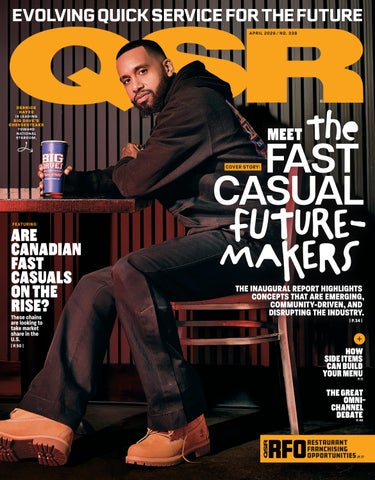
QSR 338 April 2026

Page 1


APRIL /

BRAND STORIES FROM QSR

SPONSORED BY AROMA JOE’S

20

Where Fast Casual Meets Hospitality: The Next Chapter for Fuzzy’s

Fuzzy’s Taco Shop’s tacos & margs concept and operational focus fuel franchise opportunities.

SPONSORED BY FUZZY’S TACO SHOP

Scratch-Made Bagels Meet Modern Franchise Innovation Built for operators who want quality and growth.

SPONSORED BY JEFF’S BAGEL RUN

performance.

SPONSORED BY THE HUMAN BEAN

A Multi-Unit Growth Platform in One of the Fastest-Rising Quick-Service Categories

An approachable format for teams and a craveable experience for guests.

SPONSORED BY NAZ’S HALAL

Sliders’ Winning Playbook on Nationwide Expansion

secret sauce of disciplined growth paired with focused operations.

Alliance From Day One How Valvoline Instant Oil Change turns franchise candidates into long-standing relationships.

EDITORIAL

VICE PRESIDENT EDITORIALFOOD, RETAIL, & HOSPITALITY

Danny Klein dklein@wtwhmedia.com

QSR EDITOR Ben Coley bcoley@wtwhmedia.com

FSR EDITOR Callie Evergreen cevergreen@wtwhmedia.com

ASSOCIATE EDITOR Sam Danley sdanley@wtwhmedia.com

ASSOCIATE EDITOR Satyne Doner sdoner@wthwmedia.com

SENIOR VICE PRESIDENT AUDIENCE GROWTH Greg Sanders gsanders@wtwhmedia.com

CONTENT STUDIO

VICE PRESIDENT, CONTENT STUDIO Peggy Carouthers pcarouthers@wtwhmedia.com

WRITER, CONTENT STUDIO Drew Filipski dfilipski@wtwhmedia.com

WRITER, CONTENT STUDIO Ya’el McLoud ymcloud@wtwhmedia.com

WRITER, CONTENT STUDIO Abby Winterburn awinterburn@wtwhmedia.com

ART & PRODUCTION

SENIOR ART DIRECTOR Tory Bartelt tbartelt@wtwhmedia.com

FSR ART DIRECTOR Erica Naftolowitz enaftolowitz@wtwhmedia.com

SALES & BUSINESS DEVELOPMENT

SVP, FOOD, RETAIL, HOSPITALITY SALES AND ACCOUNT MANAGEMENT Matt Waddell mwaddell@wtwhmedia.com 312-961-6840 VICE PRESIDENT, BUSINESS DEVELOPMENT Eugene Drezner edrezner@wtwhmedia.com 919-945-0705

NATIONAL SALES DIRECTOR Edward Richards erichards@wtwhmedia.com 216-956-6636

NATIONAL SALES DIRECTOR Amber Dobsovic adobsovic@wtwhmedia.com 757-637-8673

NATIONAL SALES MANAGER Guy Norcott gnorcott@wtwhmedia.com 854-200-5864

CUSTOMER SERVICE REPRESENTATIVE Tracy Doubts tdoubts@wtwhmedia.com 919-945-0704

CUSTOMER SERVICE REPRESENTATIVE Brandy Pinion bpinion@wtwhmedia.com 662-234-5481, EXT 127 FOUNDER Webb C. Howell ADMINISTRATION

919-945-0704 / www.qsrmagazine.com/subscribe QSR is provided without charge upon request to individuals residing in

Fast Casual’s Next Act

THE SEGMENT IS HAVING TO ADAPT TO A CHANGING ENVIRONMENT.

BCOLEY@WTWHMEDIA.COM

QSR MAGAZINE

Fast casual has never been a static category.

The segment has always been known as a hybrid of quality, experience, speed and convenience. In recent years, value has become a bigger buzzword, especially with large concepts like Chipotle, Panera, and Shake Shack unveiling price points under $5—measures that would be unheard of a decade ago, but now represent a clear reality.

Fast casual’s adaptability is being tested as restaurateurs navigate rising costs, labor pressures, evolving consumer expectations, and a more skeptical growth environment.

But the best always know how to recalibrate.

That belief is what inspired QSR magazine to launch the Fast Casual FutureMakers, a new annual report spotlighting the brands and founders shaping what comes next. The inaugural class shows a truth we see across the industry—success today doesn’t come from reacting to change. It comes from creating it.

We see three big themes emerging across the fast-casual space.

First, authenticity matters more than ever. Consumers can sense when a brand’s story is manufactured versus lived. Big Dave’s Cheesesteaks is a powerful example. Founder Derrick Hayes didn’t reverseengineer a concept for scale; he built a business rooted in personal history, community connection, and transparency. From humble beginnings in a gas station to early franchising momentum, Big Dave’s growth has been fueled by trust—earned through honesty, consistency, and a clear sense of purpose. The lesson isn’t that every founder needs a dramatic origin story, but that fast-casual brands win when they stand for something real and let that guide their growth.

Second, culture is no longer a “nice to have.” It’s a competitive advantage. Labor challenges have forced operators to rethink what work looks like at the store level, and La La Land Cafe shows what’s possible when culture is built into the operating model, not layered on top. By creating structured, supportive pathways for youth aging out of foster care, La La Land has reframed what a fast-casual job can be, and that’s without sacrificing operational discipline. The brand’s evolution underscores an important point—purpose-driven concepts only work when the mission is operationally sound and genuinely supported from the front line to the C-suite.

Third, the category is being reshaped by smarter design and tighter economics. As inflation pressures premium ingredients and real estate remains constrained, challenger brands are questioning longheld assumptions about size, menus, and throughput. Greenlane represents this next wave. Built from scratch as a small-footprint, drive-thru–only model, the concept shows how better-for-you food can be fast, affordable, and scalable when complexity is intentionally stripped away. Technology, in this context, isn’t about replacing people—it’s about empowering them and protecting margins.

Zoom out, and a bigger picture comes into focus. Fast casual’s future isn’t about chasing unit counts at all costs or copying yesterday’s winners. It’s about disciplined growth and clearer value propositions.

The operators leading this next chapter aren’t immune to today’s pressures. They’re simply building models resilient enough to withstand them.

QSR kitchens move fast, and flavor needs to keep up. Texas Pete ® portion-control packets deliver bold, restaurant-born heat in a clean, single-serve format designed for high-volume service. With five flavor options, operators can offer customization without slowing the line, adding labor, or sacrificing consistency.

Reliable flavor. Faster execution. Built for QSR operations.

Register for QSR Evolution

The informative and well-attended conference comes back for its fourth year.

WTWH Media, LLC, has announced registration is now open for the fourth year of the QSR Evolution Conference. The event will take place September 8–10, 2026 at the Hyatt Regency Atlanta, with a special welcome reception held on the evening of September 8.

New for 2026, QSR Evolution, in partnership with the NextGen Restaurant Summit, is presented as a single, combined event experience from the teams behind QSR and FSR magazines. This unified format brings together quick-service, fast casual, and full-service restaurant leaders under one registration, giving attendees the flexibility to choose the sessions most relevant to their business and growth goals.

The Year 4 event will begin with a “Welcome to Atlanta” welcome reception keynote with Chick-fil-A president Susannah Frost – the sixth person in the brand’s storied history to hold the role. She’ll share her journey and take attendees inside the iconic chain’s history.

The agenda is then highlighted by several keynote addresses, including an opening roundtable discussion with Jimmy John’s, Sonic Drive-In, Buffalo Wild Wings, Baskin-Robbins, Dunkin’, and Arby’s owner Inspire Brands. Also taking the big stage will be White Castle CEO Lisa Ingram, Shake Shack CEO Rob Lynch, and Texas Roadhouse CEO Jerry Morgan as we peel back the curtain behind some of the country’s most successful restaurant companies.

Early bird registration is available to operators of quick-service and full-service restaurants at a rate of $399 until June 1, 2026. The registration fee after that date will be $499 and late and onsite registration will be $599.

For more information about sponsorship opportunities, contact Eugene Drezner at edrezner@wtwhmedia.com

ATLANTA.

PROFIT MARGINS REBOUNDED TO DOUBLE DIGITS IN 2025, REACHING 10.5 %

TAKEOUT AND DELIVERY SALES INCREASED FOR 81% OF OPERATORS, CONFIRMING OFF-PREMISES DINING AS A PERMANENT CONSUMER BEHAVIOR SHIFT.

Financial Health

TouchBistro’s

2026 American State of Restaurants Report shows how restaurant operators across the U.S. navigated economic uncertainty in 2025 and positioned their businesses for stability and growth in 2026.

Staffing & Labor

• Labor costs increased for 96 percent of operators, largely due to wage pressures and competition for talent across the industry.

• Rather than cutting staff, most operators focused on productivity gains through cross-training, retention efforts, and improved scheduling practices.

• Technology played a critical role in labor management, with operators adopting tools like QR code ordering, order-ahead platforms, and AI-assisted scheduling.

• Staffing shortages worsened slightly, but declining training costs and improved onboarding processes helped ease the burden of hiring new employees.

Inventory & Menu Management

• Rising food costs and tariffs affected more than half of operators, making inventory management one of the most persistent operational challenges.

• Menu price increases returned in 2025, with most operators raising prices selectively rather than uniformly to preserve customer value perception.

• Many restaurants simplified menus, removed low-margin items, and adjusted portion sizes to control costs and reduce complexity.

• Locally sourced ingredients remained a priority, while interest in highly specialized dietary offerings declined due to inventory and cost concerns.

Takeout & Delivery

• Takeout and delivery sales increased for 81 percent of operators, confirming off-premises dining as a permanent consumer behavior shift.

• Online ordering platforms drove measurable gains, with operators reporting higher overall sales after implementing order-ahead solutions.

• Maintaining food quality and balancing dine-in and off-premise demand emerged as the biggest challenges as volume increased.

• Operators increasingly used a mix of first-party and third-party platforms to optimize reach, reliability, and profitability.

• Profit margins rebounded to double digits in 2025, reaching 10.5 percent for the first time since 2022 as operators made more disciplined pricing and cost decisions.

• Restaurant traffic continued to grow yearover-year, with 88 percent of operators reporting increased visits driven by shifting work patterns and stronger weekday dining.

• Operator debt levels declined significantly, with fewer restaurants carrying debt and average debt amounts dropping, signaling improved cash flow stability.

• Despite food and inventory costs remaining a major strain, operators relied on waste reduction, supplier diversification, and technology to protect margins.

Marketing & Loyalty

• Loyalty program participation declined as operators tightened budgets, but engagement among existing programs remained strong.

• Restaurant websites became essential, with most operators investing in owned digital channels to support online discovery.

• Social media usage shifted toward visually driven platforms, with Instagram and TikTok gaining importance for attracting new diners.

• Operators focused on targeted, personalized digital marketing rather than broad promotions to drive repeat visits.

FAST, FLAWLESS PORTIONS

Portion Pal™ Gen 2.0 is here.

NEW, UPGRADED DESIGN!

MORE DURABLE, MORE PRECISE.

what’s missing in your market?

Hot Dogs, Soft Serve, Chili Cheese Fries

AMERICAN FOOD

LESS LABOR

LOW FOOD COSTS SIMPLE OPERATIONS

MULTIPLE BUSINESS FORMATS

fresh ideas

SIDES SPOTLIGHT IN THE

Restaurants are getting sharper and more strategic with what surrounds the center of the plate.

Last December, Chipotle launched its first-ever snack-ready side item. Unlike many brands that chase incremental checks with ever-more indulgent sides, the fast casual leaned into a very different kind of craving with its High Protein Cup, a snacksized portion of its best-selling Adobo chicken, explicitly designed

for guests who treat the brand as part of their fitness routine.

“One of the dominant occasions for us is the post-gym workout,” says Stephanie Perdue, interim CMO at Chipotle. “We have a crowd that really cares about what they put in their body, building muscle, and being their best selves.”

That makes protein a natural focal point, particularly given Chipotle’s emphasis on “clean protein” with no antibiotics or artificial ingredients and chicken grilled fresh in-restaurant.

The protein cup didn’t come out of nowhere. For years, Chipotle has seen guests piling on extra protein, and high-protein digital builds have been among its top performers.

“What really unlocked the idea was social listening,” Perdue says. “We saw on TikTok that consumers were actually asking for

fresh ideas

sides of protein, and it really caught our attention.”

Formalizing that behavior as a standalone snack priced under $4 expands the brand into new use cases, she adds.

“Normally people would think about extra protein as connected to an entrée, so the fact that it’s in this more snackable format opens up different occasions,” Perdue says. “Think about what people have to do from a snacking perspective to hit their protein goals—all of the bars and shakes and jerky. Our Adobo chicken hits the macros, tastes great, and gives customers clean protein in a way that’s really hard to find in the restaurant category.”

Early results suggest Chipotle is seeing the highest add-on protein levels in its history. Behind the scenes, the move also brings structure, with a consistent portion, a clear price point, and straightforward execution for crew members.

I HEART FRIES BELIEVES FRENCH FRIES ARE A GREAT PLATFORM FOR PLENTY OF FLAVOR INNOVATION.

Protein is only one part of the chain’s innovation agenda. Chipotle has also leaned into flavor-forward sauces and dips to freshen up the menu. Perdue points to recent hits like Adobo Ranch and Red Chimichurri, which have outperformed their predecessors and validated sauces and dips as a growth platform.

That creates room to push into bolder, more expressive flavors without changing the underlying menu. Each new sauce becomes a modular “flavor switch” that can sit on top of existing proteins, grains, and formats, giving guests more control and a sense of discovery.

“You really can transform a core menu in a low complexity way,” Perdue says. “It’s obviously great to drive check, but more importantly, for us, it’s about that flavor excitement and bringing a whole new level of freshness to sauces.”

Consumers have been gravitating toward bold, saucy items for some time, and the most iconic side dish of all—the French fry—is a natural vehicle for flavor innovation, whether through toppings, sauces, or unexpected global twists.

That’s the idea behind I Heart Fries, an emerging chain with three units in Miami. The concept loads fries with toppings that match the region each dish is named after. The Venezolano, for example, comes with shredded beef, black beans, mozzarella, sweet plantain, and fried cheese. The Peruano is topped with Lomo Saltado, a popular Peruvian stir-fry dish featuring marinated strips of beef sautéed with onions and tomatoes.

Owner Jesus Araque started the business in 2019 after mov-

ing to Miami from Venezuela. One of the first things he noticed, he says, was “the lack of originality” in American restaurants, so he set out to create a concept with international flair that could “adapt to different regions and unite different cultures.”

“I started thinking about something that everybody loves or could fall in love with,” Araque says, “and I landed on French fries.”

He saw the potato as a flexible base that could carry flavors from many cultures, reflecting the diversity of Miami itself. The menu also includes burgers and wings, Venezuelan cachapas, a variety of international desserts, tequeños, and empanadas. Still, the loaded fries are the most popular offerings and the biggest traffic driver.

Araque says the concept is about pairing something new with something familiar, making Latin American fare from Venezuela, Peru, and other countries more accessible. Guests are often more willing to try unfamiliar dishes when they are served atop fries.

“It is a fusion between Latin American food and the most common side dish in the U.S.,” he says. “We wanted to merge them into one restaurant where everyone could get exactly what they wanted, whether they were craving Colombian, Mexican, American, or Peruvian.”

Fries also are a platform for innovation at Zaxbys. The chain’s Chicken Bacon Ranch Loaded Fries were so beloved as an LTO in 2022 that they earned a permanent spot on the core menu in 2024. Earlier this year, the company offered a new menu hack for its Zax Rewardz members by adding dry rubs to its Crinkle Fries.

fresh ideas

“It’s a fun, unexpected way to let a classic sidestep into the main character role,” says Ali Ghosh, VP of marketing, brand strategy, advertising, and menu at Zaxbys.

After seeing the response to Lemon Pepper Dry Rub last summer, one of the most successful limitedtime offers in the brand’s history, Zaxbys expanded its dry rub lineup with Nashville Hot and Garlic Parmesan as permanent additions. Long known for its 12 signature sauces, the move gives dry rubs their own spotlight and offers another layer of customization. For Zax Rewardz members, adding these dry rubs to Crinkle Fries further extends that flexibility.

The chain has been active in building out its sides menu with distinctive options, including bringing Veggie Eggrolls to the permanent menu as both a standalone side and an accompaniment to its Zensation Zalad after a successful limited-time run.

Zaxbys has also seen the rise of what Ghosh describes as secondary or premium sides. She points to the chicken finger quesadilla as an example of how the brand’s “guest is boss” mentality shapes

menu decisions. Initially positioned as a center-of-the-plate item, the quesadilla revealed a different pattern. Guests began adding it on top of a primary meal, such as a chicken finger plate, ordering it a la carte as a premium second side and often sharing it.

“Yes, we sell a lot of fries. Traditionally, they go out with every meal, and they’re definitely our no.1 side,” Ghosh says. “But something we’ve really leaned into are these secondary side items—like cheddar bites, pickles, quesadillas, even loaded fries—that people love to add onto their main meals. They have this special ability that helps us build check, and they really are destination drivers that set us apart from competition.”

Developing those items requires discipline, adds chef Gregg Brickman, senior director of menu innovation at Zaxbys. Flavor may draw interest, but permanent placement depends on brand fit, operational feasibility, financial performance, and guest reception. New sides must naturally pair with Chicken Fingerz and signature sauces, reinforce the brand’s Southern-inspired identity, and drive incremental add-on behavior rather than simply expanding the menu.

Another important consideration is that sides have very different success criteria than entrées. They operate under tighter operational constraints, requiring alignment between price point, storage space, cook time, and overall execution.

“That’s easier to do with a higher priced entrée, which often delivers greater incrementality to the business,” Ghosh says. “But when we can find a side that is craveable enough to add onto an order, not just shuffle mix, while remaining easy to execute and deliver strong margins, we know we have a winner.”

For smaller concepts thinking about leveling up their side offerings, Ghosh advises keeping the impact of each addition in mind. The goal is not simply to build a bigger menu with more sides, but to make sharper, more intentional additions.

“The right sides should feel true to who you are, encourage guests to spend a little more, and drive crave,” she says. “ Leveling up your side game should make your brand feel more focused, not more complicated. This discipline is what allows you to grow without losing what makes you special.”

Sam Danley is the associate editor of QSR. He can be reached at sdanley@ wthwmedia.com.

ZAXBYS CHEF GREGG BRICKMAN SAYS INNIVATION REQUIRES DISCIPLINE.
ZAXBYS VIEWS SIDES AS A WAY TO BUILD CHECK AND BECOME A DESTINATION FOR CUSTOMERS.

Gnocchi on 9th

How two friends turned a train conversation into a fast-growing pasta chain.

FOUNDERS: Michael Salzano & Ariel Strizower

HEADQUARTERS: NY, NY

ANNUAL SALES: $4M

TOTAL UNITS: 8

Eight stores in 20 months. That’s how quickly Ariel Strizower and Mike Salzano built their New York City–based Italian chain Gnocchi on 9th.

This cuisine wasn’t even their initial goal.

In early 2024, Salzano, working as a

realtor at the time, and Strizower found themselves on a train in NYC, pursuing Strizower’s long-standing dream of opening a fried chicken restaurant.

But that dream never happened. That’s because the duo couldn’t stop talking about pasta, with Salzano being Italian and Strizower loving the cuisine. They discussed the lack of on-the-go pasta options in NYC, and began brainstorming what could fill that demand.

The two landed on gnocchi, which Strizower refers to as “a little niche and

it’s fun and it’s always seen as a specialty pasta.” More importantly, the pasta style is easy to eat out of a container because of its size and shape, as opposed to spaghetti or any other long pasta. Also, as a fresh pasta, gnocchi takes around 90 seconds to boil, fitting squarely with the need for convenience and speed.

Once the two felt confident in their new idea, they cut short their list of fried chicken stops and immediately detoured to search for a small hole in the wall that could be suitable for a to-go pasta shop. Salzano and Strizower discovered a spot on East 9th Street in NYC’s East Village neighborhood.

About six weeks later, in April 2024, Gnocchi on 9th was officially opened.

“It was a very quick turnover,” Strizower says.

The two operators were in the store the day before it opened

ARIEL STRIZOWER (LEFT) AND MIKE SALZANO FOUNDED GNOCCHI ON 9TH IN APRIL 2024.

The Women Behind the Whopper’s Next Act

How Burger King’s female leaders are balancing nostalgia, scalability, and craveability.

Coin-shaped tots served in a treasure chest carton. Vanilla soft serve crowned with Oreo cookie crumbles, purple franken-candy syrup, and crackling green and violet popping candy. Whopper buns in purple, yellow, and orange hues, colored with purple potato and natural spices. A frozen pineapple beverage topped with tropical cold foam.

At Burger King, menu innovation has become both spectacle and strategy. Through high-impact partnerships like The Addams Family, Scooby-Doo and the Mystery Gang, and the Bikini Bottom

Bundle with SpongeBob, the legacy brand is transforming limited-time offers into cultural events. It’s as much about engineering craveability as it is about creating moments families can experience together.

Behind those headline-grabbing launches are three women shaping what millions of guests taste next. Inside the test kitchen at Burger King’s Miami headquarters, Charlotte Zuber, senior manager and product development chef; Gendel Militar, manager of commercialization for the U.S. and Canada; and Dianna Wilson, senior analyst of culinary and innovation for the

U.S. and Canada, translate imagination into execution. Together, they turn pop culture into product and creativity into commercial success.

Zuber pursued a culinary career because she loves making people happy, but she reached an inflection point midway through her time in fine dining. Growing up, Burger King was a special weekend treat—and when the opportunity came to drive innovation for the brand, it was an immediate yes.

“It felt limiting to only serve a small group of wealthy patrons, and I wanted to bring joy to everyday people, from construction workers to teachers,” Zuber says. “Food is so powerful. It can bring nourishment and happiness to people around the country.”

The transition from sit-down to drivethru was a complete reversal. In fine dining, Zuber pushed boundaries and incorporated distinctive ingredients into menus. Designing food at scale for more than 7,000 U.S. restaurants—majority owned and operated by independent franchisees and serving millions of Guests each year—requires a different mindset.

“Our menu has to be approachable and scalable, yet different from our competitors, so I often rely on my culinary background to enhance products through sub-ingredients, like Calabrian chili pepper in our Fiery Mozzarella Fries,” Zuber says. “For the Addams Family launch, we spent more than a year working with suppliers to get everything just right. We pulled from trends we had been seeing in New York, and our entire organization gave it their all to deliver a fun, family-friendly experience.”

Wilson has wanted to work in the culinary world since elementary school. In college, she competed in product development competitions, and when she joined Burger King, she gravitated toward beverage development. She has kept a close eye on the category, watching more brands lean into beverages as limited-time offers and accessible innovation platforms.

Her favorite project so far has been the Pirate’s Frozen Pineapple Float for the SpongeBob collaboration. She had a hand in the development from inception to execution, attending working

BURGER KING’S GENDEL MILITAR (FROM LEFT), CHARLOTTE ZUBER, AND DIANNA WILSON ARE MAKING AN IMPACT IN THE QSR BURGER SPACE.

WHY AROMA JOE’S IS BUILT FOR SMART GROWTH

A
brand rooted in positive culture and operational know how.

IN A CROWDED COFFEE FRANCHISE MARKETPLACE, GROWTH alone is not enough. The brands that rise above the noise are the ones that combine strong unit economics with a clear sense of purpose and an operating model built for modern consumers. Aroma Joe’s has spent more than two decades refining that balance, quietly positioning itself as a compelling franchising opportunity in the fast-moving beverage segment.

Founded in 2000, the brand was developed around a simple idea: serve handcrafted beverages with speed, consistency, and a positive human connection. That philosophy has guided its evolution into a drivethru-first concept designed to meet guests where they are: on the go,

mobile, and expecting quality without compromise. Coffee, tea, and energy drinks are made to order, supported by all-day food options that encourage repeat visits across dayparts. This format reflects changing consumer habits while helping franchisees operate with efficiency and predictability.

Operational focus is a defining trait of the system. Units are designed to streamline labor and simplify execution without sacrificing experience. A narrower footprint via drive-thru models reduces complexity compared to traditional café models, allowing operators to manage throughput while controlling costs. This approach aligns with a broader trend toward convenience-driven formats that still deliver premium products and services.

Support infrastructure plays a critical role in the franchise value proposition. New partners enter a structured training program that covers operations, culture, and guest engagement. In short, every franchise owner knows exactly what it’s like to be a barista. Ongoing resources include marketing guidance, field support, and business coaching intended to help franchisees grow thoughtfully and sustainably. Rather than chasing rapid expansion for its own sake, the brand emphasizes disciplined market entry and long-term relationships with operators who share its commitment to quality, growth, and community connection.

Culture is another differentiator. From store-level teams to franchise leadership, the organization prioritizes local engagement and authenticity. That community-centric mindset strengthens brand loyalty while giving franchisees the freedom to build meaningful relationships in their own markets. It also reinforces consistency across locations, as guests experience the same service standards whether they are in an established region or a newly opened territory.

As demand for specialty beverages continues to rise, concepts that blend speed, simplicity, and strong culture are positioned to lead the next phase of category growth. Aroma Joe’s represents a model built for that reality: operationally focused, guest-centered, and designed to scale without losing its identity. For franchisees seeking an opportunity rooted in performance and purpose, the brand offers a pathway to grow within a sector that shows no signs of slowing down.

WHERE FAST CASUAL MEETS HOSPITALITY: THE NEXT CHAPTER FOR FUZZY’S

Fuzzy’s Taco Shop’s tacos & margs concept and operational focus fuel franchise opportunities.

• 113 Operating Units

• 98% Franchisee Owned

• Franchising Since 2009

• 4 Dayparts available

AS FAST CASUAL CONTINUES TO EVOLVE, THE brands gaining momentum are those that go beyond speed and convenience to deliver memorable dining experiences. Today’s consumers are seeking a welcoming atmosphere and hospitality. They want reasons to stay longer, return more often, and dine with a sense of community. Fuzzy’s Taco Shop enters this next era of fast casual+ with a model designed to meet those expectations while remaining disciplined, scalable, and primed for franchise growth.

Over the past year, Fuzzy’s has sharpened its operational foundation while refining the elements that have always set the brand apart. Known for bold, coastal flavors and a relaxed, social environment, the brand focused in 2025 on simplifying operations and streamlining SKUs to improve consistency across the system. These efforts strengthened execution at the restaurant level while creating room for continued menu innovation and value-forward initiatives that resonate with today’s guests.

A key driver of the brand’s stability is its four day-part operating model: breakfast, lunch, happy hour, and dinner, which aims to provide consistent revenue streams throughout the day. With all-day breakfast

tacos anchoring early traffic and beveragedriven happy hour fueling afternoon and evening engagement, Fuzzy’s targets multiple occasions that extend beyond the traditional fast casual lunch-and-dinner model.

At the same time, Fuzzy’s has leaned into a meaningful evolution of the fast casual experience by expanding its Tacos & Margs concept. This next-generation format bridges fast casual efficiency with elevated hospitality, expanding beverage offerings and enhancing the dining experience. With a best-in-class bar program and design, according to internal proprietary brand tracker, elements that encourage guests to linger, the model further amplifies those four dayparts and looks to strengthen on-premise traffic.

That balance of experience and discipline is central to the brand’s franchise strategy. Flexible formats are intended to allow Fuzzy’s to grow across urban, suburban, and select nontraditional locations, while a focused real estate approach helps to position each restaurant for long-term performance. Backed by Dine Brands’ infrastructure in training, technology, and operations, franchisees benefit from systemwide support while operating within a brand that retains its entrepreneurial culture.

Operational leadership has been critical to ensuring that Fuzzy’s growth remains consistent and scalable. As the brand continues to evolve its prototypes and expand into new markets, maintaining clarity and execution across the system is a top priority.

With more than 100 restaurants operating nationwide and continued development momentum in key markets, Fuzzy’s Taco Shop is shaping what the future of fast casual looks like.

“Operational consistency is what allows us to evolve the guest experience without compromising performance,” said Marshall Claycamp, chief operations officer of Fuzzy’s Taco Shop. “Our focus has been on building processes that support franchisees as the brand grows, ensuring that new formats, menus, and service enhancements are backed by high operational standards that work at scale.”

With more than 100 restaurants operating nationwide and continued development momentum in key markets, Fuzzy’s Taco Shop is shaping what the future of fast casual looks like. By blending craveable food, beveragedriven engagement, and disciplined operations, the brand offers franchisees an opportunity rooted in relevance, performance, and long-term potential.

Fuzzy’s Taco Shop delivers fresh flavors, good vibes and a laid-back atmosphere that turns first-time guests into regulars. Backed by the scale and infrastructure of Dine Brands, Fuzzy’s is expanding with franchise owners who value brand personality, operational ease and long-term growth potential.

HOT, SCRATCH-MADE BAGELS MEET MODERN FRANCHISE INNOVATION

Built for operators who want quality and growth.

FRANCHISING IS CROWDED WITH CONCEPTS CHASING TRENDS, but longterm success still comes down to product, process, and people. Jeff’s Bagel Run was built on a simple belief: if you bake real bagels from scratch throughout the day and create a joyful in-shop experience, guests will notice. That commitment to craft has fueled rapid growth and created an opportunity for franchise partners who want to build a durable, highperforming business in their communities.

Every Jeff’s Bagel Run shop mixes, boils, and bakes bagels in house all day long. Guests see and smell the process. They feel the difference between a product that was shipped in and one that was pulled fresh from the oven minutes ago. With 16 bagel flavors daily, including a rotating bagel of the day, and 17 freshly whipped spreads featuring classic, seasonal, and non-dairy options, the menu is broad enough to drive frequency yet focused enough to execute consistently. A robust coffee program and limited-time offerings keep the brand culturally relevant and

Jeff’s Bagel Run is not chasing fads. It is building a categorydefining bagel concept rooted in craftsmanship and amplified by technology.

give franchisees built-in marketing moments throughout the year.

What makes the opportunity distinct is how the brand blends old-world baking with modern infrastructure. Nearly half of system sales currently flow through the loyalty platform, powered by proprietary, in-house technology designed specifically for the concept. That digital ecosystem allows operators to build repeat traffic and understand guest behavior. For franchisees, that means smarter marketing, better retention, and measurable performance at the store level.

Operationally, the model is designed for clarity and scale. The footprint is efficient, the labor model is straightforward, and the brand playbook emphasizes community engagement, catering growth, and local marketing execution. High-performing stores are proving the potential, with strong average unit volumes and meaningful upside for operators who fully lean into the system. As the brand expands into new markets, it is attracting experienced multi-unit operators as well as first-time franchisees who value structured support and a collaborative culture.

Jeff’s Bagel Run is not chasing fads. It is building a category-defining bagel concept rooted in craftsmanship and amplified by technology. For entrepreneurs seeking a food business with product credibility, digital sophistication, and room to grow, the opportunity offers both heart and horsepower.

Top Third Avg. Net Profit*

Top Third AUV*

$262,379

$1,421,960

*2025 fiscal year figures based on the top third of Jeff’s Bagel Run affiliate-operated stores open and operating for a full fiscal year as of 12/31/2025. There were six Jeff’s Bagel Run affiliate-operated stores open and operating for a full fiscal year as of 12/31/2025. Therefore, one affiliate-operated store exceeded these figures and five did not. Your individual results may differ. The bottom third had an AUV or average “Sales” of $821,416 and Avg. Net Profit of $19,487. See Item 19 of JBR Franchising Co’s Franchise Disclosure Document for definitions of “Sales” and “Net Profit” and additional information. Written substantiation for the financial performance representation will be made available to a prospective franchisee upon reasonable request.

This advertisement is not an offering. An offering can only be made by prospectus filed first with the Department of Law of the State of New York. Such filing does not constitute approval by the Department of Law. MN -11233. JBR Franchising Co, 4190 Millenia Blvd, Orlando, FL 32839

WHY CULTURE IS THE MOST OVERLOOKED GROWTH LEVER IN FRANCHISING

How people-first systems drive consistency, loyalty, and long-term performance.

IN TODAY’S RESTAURANT FRANCHISING ENVIRONMENT, growth conversations often focus on speed, scale, and systems. Brands refine prototypes, streamline menus, and optimize real estate to keep pace with demand. Yet one of the most influential drivers of long-term performance is frequently underestimated: culture.

For many franchise systems, culture is treated as something that naturally emerges rather than something that must be intentionally built. In reality, culture plays a direct role in execution, especially in drive-thru-focused concepts where teams operate at high speed and guest interactions happen in seconds. When culture lacks structure, inconsistency follows. When it is designed with purpose, it becomes a powerful operational asset.

At The Human Bean, culture has always been viewed as foundational to the brand’s success. Known internally as the With a Bean on Top ®

Clear cultural expectations reduce friction in hiring and onboarding, strengthen retention, and make day-to-day operations more predictable.

• 185 locations open

• 0% Royalty Fees

• Drive-thru focused model

• Multi-state franchise footprint

• Decades of brand growth

mindset, the culture emphasizes going beyond expectations in both service and leadership. It is not a tagline, but a standard that guides how teams show up for guests and for one another each day.

“That idea was important to my parents, Dan and Rhonda Hawkins, and their friends, Tom and Tami Casey (co-founders), from the very beginning,” says Lily Hawkins, Director of Training for The Human Bean. “They believed that how you treat people — guests and employees alike — would ultimately define the brand. That foundation still guides how we train and support our teams today.”

Rather than relying on individual personalities, the brand has focused on building culture into its systems. Training programs reinforce consistency, leadership development supports accountability, and daily routines are designed to encourage connection without sacrificing speed. This structure allows franchise partners to deliver a familiar experience across locations while still creating meaningful moments with guests.

For franchise partners, the benefits are tangible. Clear cultural expectations reduce friction in hiring and onboarding, strengthen retention, and make day-to-day operations more predictable. When teams understand the purpose behind their work, managers spend less time correcting behavior and more time coaching performance.

“Culture only works when it’s lived every day,” Hawkins says. “Our goal is to make sure franchise partners have the tools to carry it forward in a way that is authentic and repeatable, no matter the market.”

As franchising becomes more competitive, brands that treat culture as a system — not a side effect — are better positioned to scale sustainably. In a drive-thru economy built on efficiency, it is often the human connection that creates lasting loyalty. When culture is intentionally designed, it supports consistency, strengthens teams, and becomes a growth lever that endures.

A MULTI-UNIT GROWTH PLATFORM IN ONE OF THE FASTEST-RISING QUICK-SERVICE CATEGORIES

IN FRANCHISING, THE MOST COMPELLING OPPORTUNITIES ARE rarely found in the most crowded segments. Experienced operators understand that real upside often comes from categories where consumer demand is accelerating—but where national competition has not yet caught up. That is exactly where Naz’s Halal stands today.

Halal has quickly emerged as one of the most searched and soughtafter dining categories in the country, ranking among the top 10 mostsearched restaurant categories on Yelp. What was once viewed as niche has moved into the mainstream, driven by consumers seeking bold, wholesome, ethically prepared, and culturally authentic food. Naz’s Halal is positioned at the center of this category expansion.

What began as a street cart in Queens, New York, has evolved into a modern fast-casual concept built for scale—delivering craveable flavor, ingredient integrity, and an operating model designed for repeatability.

For multi-unit franchisees, Naz’s Halal represents more than a restaurant brand. It is a platform opportunity in a multi-billion-dollar category that remains significantly under-represented in franchising.

Naz’s Halal has been engineered with the multi-unit playbook in mind. The model is operationally streamlined, designed for efficient execution, and built to perform across a range of trade areas—from urban cores to suburban growth markets and campus-driven demand nodes.

This is the type of concept experienced operators look for: one that can be replicated consistently, staffed effectively, and scaled with disciplined infrastructure rather than unnecessary complexity. In an environment where labor efficiency, throughput, and simplicity matter more than ever, Naz’s Halal offers an approachable format for teams and an exciting experience for guests.

Successful multi-unit growth also requires more than demand—it requires operational standards, consistency, and franchisor discipline.

Naz’s Halal franchise partners have the opportunity to secure prime territories nationwide, allowing qualified operators to develop with intentional market coverage and first-mover advantage in key regions.

Naz’s Halal is focused on delivering the fundamentals serious operators expect: a repeatable system, clear brand execution, and the processes needed to support development across multiple locations while protecting product quality and guest experience.

The category timing creates an additional advantage. Halal is a multi-billion-dollar food segment, yet compared to other fast-casual spaces, it remains early in its franchising lifecycle. That creates meaningful whitespace for the right brand to establish leadership.

For franchise partners, this is a rare window: the ability to enter a high-demand category before the competitive landscape becomes crowded with copycats and late-stage consolidation. The brands that win long term are often those that secure territory early and build density ahead of the curve.

Naz’s Halal franchise partners have the opportunity to secure prime territories nationwide, allowing qualified operators to develop with intentional market coverage and firstmover advantage in key regions. For multi-unit groups focused on area development, territory strategy is where long-term value is created.

Naz’s Halal resonates because it delivers bold, craveable flavors paired with clean, wholesome food and a commitment to ethical sourcing and ingredient integrity. For qualified franchise candidates, Naz’s Halal provides detailed financial performance representations within Item 19, offering deeper insight into unit-level results and scalability. Naz’s Halal isn’t just participating in the halal movement— it is positioned to lead the next major wave of growth in quick-service restaurants. 

Join Naz’s Halal - Our simplified menu, operational efficiencies, and strong brand demand allow owners to replicate success across locations without reinventing the process every time.

Whether you already own restaurants or operate businesses in other industries, Naz’s Halal offers a proven path to portfolio expansion.

SMALLS SLIDERS’ WINNING PLAYBOOK ON NATIONWIDE EXPANSION

The Secret Smauce of Disciplined Growth Paired with Focused Operations.

AS THE RESTAURANT INDUSTRY CONTINUES TO EVOLVE, whitespace market expansion is expected to become a crucial growth lever for emerging brands. Concepts that balance speed of expansion with disciplined market selection are the best positioned to win over the next decade.

Smalls Sliders has built its expansion strategy around this philosophy, pairing strategic market selection with an operating model designed to perform across a wide range of communities. In tandem with the brand’s intentional marketing and standout brand identity, this strategy is launching Smalls to new heights; in 2025 alone, the brand increased year over year openings by 142 percent.

Smalls is a part of a new generation of quick-service restaurant brands that are rewriting the playbook. Instead of competing for crowded real estate and saturated guest attention in top-tier cities, emerging concepts

Smalls prioritizes areas where strong population growth, favorable real estate availability, and strong community engagement create ideal conditions for early brand adoption.

are finding success by entering high-growth markets and building strong brand equity from the ground up. Since launching its first location in Louisiana in 2019, Smalls Sliders has focused on building a highly focused, craveable menu centered around cheeseburger sliders, fries, shakes, and drinks.

That intentional simplicity allows operators to maintain speed, consistency, and strong unit-level execution. At the same time, the brand’s modular “can” restaurant model creates a highly visible, standalone presence that helps drive awareness quickly in both large and emerging markets.

Rather than chasing markets with major metropolitan saturation, Smalls prioritizes areas where strong population growth, favorable real estate availability, and strong community engagement create ideal conditions for early brand adoption. For franchise partners, this often translates into stronger visibility and the opportunity to grow alongside the brand as it establishes regional clusters. With this strategy, Smalls continues to attract both experienced multi-unit operators and hungry, well-capitalized, first-time franchisees seeking a streamlined operating model supported by strong brand momentum.

At the same time, that expansion tactic is amplified by a marketing approach built to generate immediate awareness and local relevance. Smalls leans heavily into distinctive brand language, bold visual identity, and communityfirst activations to quickly establish presence in new areas. This combination allows Smalls to enter emerging markets with confidence, creating buzz that benefits both early franchisees and the broader system as regional clusters take shape.

Smalls consistently introduces new markets, allowing the model’s operational simplicity and focused menu to help support consistent execution and strong local engagement. Franchisees recognize that the opportunity to enter a market early and scale alongside a growing brand may prove to be one of the most valuable advantages in modern franchise development.

DISRUPTIVELY DELICIOUS.

EFFICIENT DESIGN

INTENTIONAL & CRAVEABLE MENU

STREAMLINED OPERATIONS

DRIVE-THRU, WALK-UP, ORDER AHEAD & DELIVERY

SLIM CHICKENS SHARPENS ITS DOMESTIC GROWTH PLAYBOOK FOR 2026

Rather than chasing broad national expansion, the brand’s development activity reflects a targeted approach into high-density, high-barrier regions, particularly California and the Northeast, where site availability, labor challenges, and construction timelines require experienced operators and sophisticated market planning.

A key part of that development strategy is greater flexibility in how and where restaurants are built. Slim Chickens continues to expand beyond its traditional freestanding footprint with multiple development formats, including smaller-footprint restaurants, conversions, endcap drive thrus, in lines, and drive-thru-only locations. In 2025, the brand opened two drive-thru-only restaurants, reflecting a growing emphasis on real estate solutions that support convenience-driven demand and tighter site availability.

This direction is being reinforced by a leadership transition designed to sharpen focus on domestic performance. Christina Vaughan recently expanded her role as Chief Operating Officer to also serve as Slim Chickens’ first President, overseeing the U.S. business and leading domestic development priorities alongside operations and franchisee support. She is joined by Chief Development Officer Matt Green, a former Starbucks executive with nearly two decades of experience in site strategy and market development.

Operational discipline has become increasingly important as Slim Chickens continues to evolve into a predominantly franchised system. Today, the brand is 96 percent franchised and signed 110 agreement deals in 2025. From 2022 to 2024, systemwide sales increased by 57.7 percent, while unit growth rose 54.3 percent, an indicator of sustained franchise interest and consumer demand.

AS COMPETITION INTENSIFIES ACROSS THE QUICK-SERVICE CHICKEN segment, Slim Chickens is entering 2026 with a sharpened domestic strategy. The brand is placing restaurants in the right markets, supporting operators through real estate and construction environments, and concentrating growth where demand is strongest.

That strategy is already taking shape. In January alone, Slim Chickens signed nearly 40 new development agreements. New and existing multiunit franchise groups committed to 13 restaurants across New York and Connecticut, three in South Dakota, 18 in Central Florida, and several across California markets.

With more than 300 restaurants opened globally and 1,000 additional locations in signed development deals across the United States and international markets, Slim Chickens built its following around handbreaded, cooked-to-order chicken tenders made from premium, all-natural cuts, marinated in Southern-style buttermilk. The menu also includes wings, sandwiches, Chicken and Waffles, salads, signature sides, and 14 house sauces, elements that continue to anchor guest loyalty.

For 2026, Slim Chickens’ development strategy is defined less by total unit count and more by execution—placing the right formats in the right trade areas, helping franchise partners navigate complex real estate and construction conditions, and supporting consistent performance in some of the most competitive markets in the country.

BUILDING ALLIANCE FROM DAY ONE

100% franchise renewal rate *

Avg 11 employees on payroll per location

How Valvoline Instant Oil Change turns franchise candidates into long-standing relationships. • 9.85% Avg total system-wide same-store sales growth

WHEN ADAM WORSHAM TALKS ABOUT FRANCHISE DEVELOPMENT at

Valvoline Instant Oil Change, he doesn’t lead with statistics. He starts with a simple philosophy: the relationship begins before the ink dries on any agreement, and it continues long after the first service center opens.

“From the first conversation, our goal is to make the experience transparent, pressure free, and rooted in trust,” says Worsham, CFO at Valvoline Inc. It’s an approach that mirrors the brand’s “Happy to Help” ethos, applied equally to customers at the service bay and seasoned entrepreneurs weighing their franchise investment.

That relationship-first mindset matters most when candidates are making their final decision. When the business model and projections are impressive and the market analysis checks out across multiple industries, it comes down to people. Prospective franchisees want to know they’re joining a team that will provide support and proven solutions.

The development process is built around letting candidates see how things really work. Beyond the FDD, they spend time operating service centers, watching the day to day. They talk directly with existing franchisees, whose average tenure is over 25 years. Those conversations answer

Valvoline Instant Oil Change has posted historical same-store sales growth, and the operations are straightforward. Prospective operators don’t need an automotive background to run a successful business.

the questions numbers can’t: How does corporate respond when a location or operator needs assistance? What are the driving factors for consistent renewal?

That renewal rate sits at 100 percent, but Worsham doesn’t pitch it as a selling point. He sees it as proof the model actually delivers. Valvoline Instant Oil Change has posted historical same-store sales growth, and the operations are straightforward. Prospective operators don’t need a specialized automotive background to run a successful business.

When candidates ask about emerging risks (labor shortages, electric vehicles, supply chain), Worsham’s team addresses them head on. The model holds up in good economies and tough ones because preventive maintenance needs stay consistent. Cars on the road keep getting older. Whether people are buying new or maintaining existing vehicles, they need service.

Worsham knows no franchise system is bulletproof. When something misses the mark, they explain what happened, what they learned, and how they fixed it. That honesty matters more than pretending problems don’t exist.

For franchisees, working with corporate isn’t a transactional relationship. It’s collaborative. That’s why every first conversation is treated like the start of a decades-long relationship, because it usually is. 

In

its inaugural year, the report

spotlights brands redefining growth, culture, and disruption.

FAST CASUAL has always been a category defined by evolution. Built on the promise of quality, speed, and accessibility, it continues to adapt as operators face new pressures.

The Fast Casual FutureMakers is a new annual report from QSR magazine designed to spotlight brands and founders building what comes next. In its inaugural year, the report recognizes leaders who are driving meaningful progress across the category.

The 2026 class reflects the many ways success is taking shape in fast casual today. They aren’t just responding to change. They’re creating it.

The FAST CASUAL FUTuREMAKERS

THE RISING FUTUREMAKER: Big Dave’s Cheesesteaks

Derrick Hayes wants to be the first African-American to scale a billiondollar fast-casual brand, and he believes he’s on the trajectory to do so.

The growth engine is Big Dave’s Cheesesteaks, which operates 13 locations and a food truck in the Southeast. The brand is now in the early years of franchising, hoping to reach hundreds of U.S. stores and even an international presence.

“We’re going to do it proudly and respectfully, and we’re gonna do it with dignity and honor to get there,” Hayes says.

THE EMERGENCE

Hayes’ journey toward cheesesteak restaurateur—from being born and raised in West Philadelphia to creating his own stardom in Atlanta—is one born out of tragedy.

It begins with his father Dave Hayes, who was diagnosed with lung cancer. He couldn’t get into Fox Chase Cancer Center in Philadelphia, so he traveled to Emory University’s facility in Atlanta.

Hayes worked for the United States Postal Service at the time, but quit so he could tend to his father.

“When my dad got sick, I asked my man-

BIG DAVE’S CHEESESTEAKS OFFERS A VARIETY OF FLAVORS AND PROTEINS.

ager, I said, ‘Hey, my dad is sick. I need some time off.’ And it was during the holiday season,” he explains. “And he said, ‘I’m sorry. I know you work hard, but I need you here.’ So I said, look, I’m gonna get another job. I can’t get another father. I decided to jump in my Buick Lucerne and drive all the way to Georgia, where I took my dad back and forth from Emory University to Athens, Georgia, almost every day.”

Dave Hayes died on July 6, 2009. Beforehand, he left Hayes with the ultimate inspiration.

“He looked at me and he told me, he said, listen, I’m going to die. But I raised you to stand on your 10 toes, and I know that you’re going to break all the generational curses,” Hayes remembers.

Hayes wanted to honor his father in the right way, and he did so by becoming an entrepreneur.

Dave’s Philly Water Ice—a small Italian ice operation named after Hayes’ father—opened in 2014

inside a 750-square-foot Shell gas station at 5020 Winters Chapel Road in Atlanta.

The business was eventually rebranded to Big Dave’s Cheesesteaks, harkening back to the food his childhood home city is known for.

Popularity was elusive at first. For about a year and a half, Hayes didn’t have much traffic. He believed in the product, but couldn’t figure out why it wasn’t attracting customers.

Then one day, rapper and actress Eve, who was shooting the movie “Barbershop: The Next Cut,” happened to stop by the restaurant in 2016, along with a posse of about 15 to 20 people. The celebrity—also from West Philadelphia—hadn’t eaten a cheesesteak in a while because she was living overseas, and she wanted to see if Big Dave’s was “official.”

“I was on the grill. And I have never choked in my life,” Hayes says. “I used to play basketball,

 FAMILY IS A TOP PRIORITY FOR BIG DAVE’S CHEESESTEAKS FOUNDER DERRICK HAYES.

so I’m like, you better show out now.”

Hayes proceeded to put together a chicken cheesesteak with salt, pepper, ketchup, fried onions, and hot peppers “like my life depended on it,” he recalls. Eve enjoyed the sandwich from the first bite, so much so that she bragged about the food across her social media platforms.

Her followers were reading and listening. The next day, hundreds of customers showed up to the parking lot. Hayes was in disbelief. To keep up with demand, his cousin, who helped him run the restaurant, was constantly driving back and forth to Restaurant Depot, the food and supply warehouse where Hayes bought his steak.

While Hayes enjoyed the instant success, it wasn’t easy at first. He remembers walking toward long customer lines and just being transparent.

“We’ve never experienced this type of traffic, work with us,” says Hayes, describing the message to guests during the early days. “People just genuinely wanted to see Big Dave’s win. They wanted to see me win. Also, I would go on social media, and if I had a grill blow out or if I had a fryer blow out or if I had anything break, I would talk to them out of transparency, and say, ‘Hey guys, this is going to take a couple of days to get

fixed. We’ll be back open this week.’” By 2018, Hayes gained even more fame. He participated in The World Food Championship in Orange Beach, Alabama, and placed seventh in the sandwich category.

“I think that’s what really started my spotlight of national attention,” Hayes says. “A lot of journalists started to follow that story.”

Soon afterward, Hayes was able to move out of the gas station and open a flagship restaurant in downtown Atlanta at 57 Forsyth Street, where he earned about $3 million in his first year from a simple menu featuring a variety of cheesesteaks, egg rolls, fries, and water ice.

COVID arrived a few years later, which Hayes says “was the biggest pivot of my career.” While others were shutting their doors, he was growing his business and building relationships with the community. He wanted locals to know he was there for them, and not just for their money. So Hayes started to feed, and once had his team distribute 1,000 meals in one day. Then for 40 days, he fed almost every hospital inside and outside of Atlanta and surrounding counties to help doctors and nurses serving on the front lines. Along the way, his actions were picked up by promi-

 BIG DAVE’S CHEESESTEAKS IS READY FOR MORE GROWTH IN THE YEARS AHEAD.
VICTOR SANCHEZ

nent media outlets like the New York TImes, Wall Street Journal, and Daily Mail.

Big Dave’s reached another milestone in 2022 by establishing a location inside Mercedes-Benz Stadium, home of the NFL’s Atlanta Falcons. Hayes says the move was his “biggest blessing” because it helped the concept implement better systems and faster ticket times.

Hayes wasn’t alone in these efforts either.

“I was able to bring in corporate experience that I didn’t have,” Hayes says. “Corporate expe-

people around him.

“I think people started to fall in love with me just as much as they fell in love with the brand,” Hayes says. “They wanted to see it grow. They wanted to see me grow. And I think it became something like, I was for the people. It was bigger than food because I was actually changing lives inside the community and outside of the community. And I think when you’re doing these things, I think that people start to buy into you differently.”

And the more Big Dave’s grows, the more

“ Big Dave’s can be replicated in any city, any state, in the United States—and outside of the United States—and we’re going to prove that,” Hayes says.

rience that was more intelligent than me in the fast-casual space because I knew that I couldn’t do it alone. I needed the right people to scale with.”

In 2023, Big Dave’s officially announced intentions to franchise.

The founder says the brand looks for multi-unit operators who focus on unit economics, controlling EBITDA, and managing food costs. However, financials are only a piece. Each Discovery Day, before Big Dave’s enters the LOI phase, Hayes asks each prospective operator, “What can you bring to the table other than your bank account?” Thanks to these filters, the executive is confident in the operators the brand has selected thus far and the ones he will choose in the future.

Big Dave’s wants to first expand in the Southeast, and then it will consider the Northeast.

“Big Dave’s can be replicated in any city, any state, in the United States—and outside of the United States—and we’re going to prove that,” Hayes says.

WHERE TO NEXT?

Eve may have sparked Big Dave’s trajectory, but from that point, Hayes says he was able to “control the game from there.”

He knew he had to be the mascot of the brand, and he wanted to be the most authentic one possible. That mindset began opening doors. Hayes started appearing on national talk shows and gaining attention from the press. Not because he was doing anything special, but because he was being himself and telling the truth about what Big Dave’s was building. He used those platforms to tell his story and the stories of the

sophisticated it becomes.

In July 2025, Big Dave’s announced that Suhel Ahmed—an experienced franchisee with ties to Dunkin’, Dave’s Hot Chicken, and Little Caesars—joined the company as a strategic adviser.

Hayes refers to Ahmed as a “big brother” who’s led him into the right rooms and directions and helped him understand the QSR space in a different way.

The founder is also constantly supported by his wife Pinky Cole, who is known for her own brand, Slutty Vegan, and making her mark in Atlanta’s restaurant scene.

“She went out of the state before I did. She was able to scale faster than me in the beginning, and I was able to study her. And we treat each other like a guinea pig, honestly,” Hayes says. “So now that I’m franchising and she sees what I’m doing, she gets to learn the business through me. So she’s my biggest inspiration. Having your wife as your biggest inspiration is a blessing.”

In the next five years, Hayes’ mission is to keep signing franchisees and strong operators while growing awareness around what Big Dave’s stands for. That may include expansion into the Middle East, since the chain is a halal brand.

But he also emphasizes that BIg Dave’s will take its time. His motto is to “get there right, not just get there fast. And when we get there right, we know we can last.”

Through it all, he never forgets the man who pushed him to this point in the first place.

“Every time I get a new accolade or I open up a new store, I look in the sky and say, ‘Dad, we’re getting closer,’” Hayes says. 

 IN THE NEXT FIVE YEARS, HAYES’ MISSION IS TO KEEP SIGNING FRANCHISEES AND STRONG OPERATORS WHILE GROWING AWARENESS AROUND WHAT BIG DAVE’S STANDS FOR.

THE CULTURE & COMMUNITY FUTUREMAKER: La La Land Kind Cafe

Francois Reihani was just 20 years old when he opened his first restaurant. After transferring to Southern Methodist University in Dallas, the entrepreneurial-spirited student built a quick-service poke concept from scratch. He secured backing from friends and family, recruited a chef from Nobu, and landed a spot in one of the city’s busiest centers.

The restaurant was packed from day one, and by most measures, it was a major success. Still, Reihani found himself confronting a hard question: Was he actually happy?

“It felt like my life was all about making a bunch of money,” he says. “As much as I loved the hospitality side

 LA LA LAND KIND CAFE FOUNDER FRANCOIS REIHANI VIEWS COFFEE SHOPS AS A PLACE FOR NATURAL HUMAN CONNECTION.

of things, it just wasn’t very fulfilling.”

That unease led Reihani to get involved with Dallas CASA, an organization supporting kids in foster care, at the suggestion of a friend. At his first meeting, the discussion centered on youth aging out of the system.

The first speaker was a young man who described being removed from drug-addicted parents at age 10 and placed in a foster home that was “in it for the money.” Labeled a problem child, he was sent to an institutional facility, spent much of his childhood there, and was released at 18 with little support. Two young women followed with similar stories, leaving Reihani stunned.

He went home and began researching the issue, struck by both its scale and its invisibility. Each year, an estimated 20,000 to 23,000 young people age out of the U.S. foster care system, often without permanent family support and facing

heightened risks of unemployment, homelessness, and incarceration.

“One of the biggest problems is that nobody even knows it is a problem,” Reihani says. “If I talk to 100 people, maybe one of them has any idea about this. So, I felt extremely moved to do something.”

His first instinct was to create opportunities within his existing restaurant by hiring youth aging out of foster care. When his partner and investor declined to support the idea, Reihani took a different route, launching a nonprofit called The We Are One Project.

“Long story short, it was me being delusional,” he says. “I was thinking, ‘Oh, I’m going to solve this whole problem just by giving them housing, therapy, help with school, and job placement.’”

The reality was far more complicated.

“It was failing by the end of the first year,” Reihani says. “One of the main reasons was that as hard as we tried, we could rarely ever get them a job, especially a job that lasted.”

Even when participants were hired, often by large fast-food chains, the jobs rarely lasted more than a few weeks, underscoring how unprepared many were for the workforce.

“The fast-food chain on the corner doesn’t really care to deal with that,” he says. “You have a kid taking three buses to get to work who doesn’t understand the fundamentals of a job yet. They’re not going to be willing to teach them that on-site.”

Around that time, Reihani sold his stake in his first restaurant and assumed his hospitality chapter had closed. But the nonprofit’s failure revealed a key insight: youth didn’t just need jobs, they needed supportive environments. That realization pulled him back into foodservice and led to La La Land Kind Cafe, a purpose-driven coffee shop brand built to employ and mentor youth aging out of foster care.

Coffee was a deliberate choice. Reihani saw coffee shops less as a product and more as environments, places naturally suited to conversation and human connection. That’s something he felt was missing from his first restaurant, and it prompted broader questions about why that openness fades with age.

“There’s such a simplicity to life until you start to grow up, then it gets more complicated and people lose that spark,” Reihani says. “Why isn’t humanity closer together? Why don’t people care about each other? Why are strangers strangers? Those are the types of questions my brain was contemplating.”

La La Land’s design reflects that mindset,

 LA LA LAND KIND CAFE USES BRIGHT COLORS TO PROMOTE JOY AND OPTIMISM.

with mostly white interiors and pops of yellow meant to evoke joy and optimism, intentionally muted from what he describes as the “darkness and bickering” of the outside world.

The environment also supports the mission. Working as a barista felt like an attractive, accessible job for young adults entering the workforce.

“I wanted this to be a cool and fun job for our youth,” Reihani says. “Most importantly, I wanted them to be able to feel comfortable in a warm environment and connect with other human beings.”

Building the internship program proved far more complex than opening the cafés themselves. Early on, Reihani was deeply involved in interns’ personal lives, picking them up, dropping them off, and helping navigate daily crises. He realized that level of involvement unintentionally created dependency and undermined accountability. At the same time, store managers were expected to handle both operational performance and significant emotional challenges.

The breaking point came when interns were trained briefly and placed directly on schedules. When some didn’t show up, other baristas had to cover shifts, creating resentment and internal conflict. They also learned that clustering too many interns in one location limited growth and attention.

“There were so many different challenges that we figured out,” Reihani says. “These kids go through a lot—more than people think—and that comes with them to work for the first couple of months.”

Today, the internship program operates as a structured 12-week paid experience with both professional and personal tracks. Interns train instore while also working with a youth director on housing, education, transportation, therapy, and

Don’t expect to see a lot of fanfare as the program continues growing. Marketing the mission has never been the focus. Reihani says La La Land was built with the mission first and not as a café with a charitable add-on, and that distinction helps preserve the culture as the company grows. He adds that the mission is a big part of creating a strong internal culture and can play a big role in motivating employees at all levels of the organization, but only if it’s real. The brand operates in a “no bullshit environment,” where impact isn’t bolted on for optics but baked into daily operations.

At the same time, he acknowledges that it’s easier for corporate and area leaders to see the long-term impact than it is for baristas on the front lines, who are managing long lines, impatient guests, and the emotional demands of hospitality.

That’s why he’s focused on what he calls “Project Culture”—finding tangible ways to support and reward store-level teams so they can actually feel the difference they’re making. Those employees, he says, ultimately decide whether La La Land’s “more yellow” exists in practice or just in theory. Looking back on the journey and everything he’s learned along the way, Reihani has clear advice for others in the restaurant industry who want to build businesses with impact baked into the core. First, he says, be prepared for scrutiny. Expect people to question your intentions and challenge whether the impact is real.

Second, and most important, he believes building a mission-driven brand requires a level of conviction that borders on delusion. You have to believe deeply in what you’re building, he says, because if you see every risk and headwind too clearly, it’s easy to talk yourself out of moving forward. Over the years La La Land faced criticism,

“ I wanted this to be a cool and fun job for our youth,” Reihani says. “Most importantly, I wanted them to be able to feel comfortable in a warm environment and connect with other human beings.”

future planning, and each is paired with a mentor. At the end of the program, they can stay with La La Land or transition into another career path.

The current spring cohort includes 21 interns across 14 stores. That’s the largest group to date. While the scale initially gave Reihani pause, he says the team is confident in the model and plans to grow it carefully.

pressure, and repeated suggestions to save “hundreds of thousands, if not millions of dollars” by abandoning the program altogether.

“Everybody is going to tell you that it won’t work,” Reihani says. “We heard that a thousand times before we opened the first store and even afterwards. But if you believe in what you’re doing, you can’t give up. You have to be relentless.”

LA LA LAND KIND CAFE CURRENTLY HAS 21 INTERNS IN ITS PROGRAM.

Tinflection point. Consumer demand for healthier, faster, and more affordable options continues to rise, but the category is grappling with rising costs, labor shortages, and inflationary pressure on premium ingredients. Legacy premium salad chains are feeling the strain of rapid expansion, and many are retrenching to stabilize operations.

That shift is opening the door for challenger brands to reimagine the model entirely—using tech-enabled, small-footprint, drive-thru–only formats to deliver craveable, chef-driven meals at speed. At the forefront of this disruption is Greenlane, a concept built from scratch to solve the biggest challenge in better-for-you dining: how to make healthy food truly accessible without sacrificing convenience or quality.

spent decades as a franchisee operating legacy infrastructure for major quick-service players. While designing the concept of Greenlane from scratch, there were a few systems and processes from traditional models she intentionally left behind: large square footage resulting in unnecessary foot traffic for employees, and complex menus with long cook times.

The first Greenlane restaurant broke ground in Tampa in 2023. Although it’s a drive-thru concept, Spector Wishnow says customers don’t just pull around the building; they go through it, passing a bright green lenticular exterior, LED screens and menu boards, and pink bougainvillea flowers that cover the arc awning as they exit the restaurant. The building is multidimensional,

THE FIRST GREENLANE RESTAURANT OPENED IN TAMPA, FLORIDA. 

layered with bold shades of green. Then there’s Gigi, the pink bunny out front—immersing customers in Greenlane’s cutting-edge yet approachable brand identity.

The interior layout of the sub-2,000-squarefoot restaurant is meticulously planned to reduce friction. In the two minutes from the time an order is received, employees work assembly-line style, sometimes cross-trained in stations to maximize efficiency. Because there’s no dining room,

employees have the freedom to hype themselves up through music that echoes through the space. The open layout, with assembly stations in the middle, encourages camaraderie and closeness, with no single step going to waste from prep to execution.

Just as the physical space was reimagined to remove complexity, so was the menu. Spector Wishnow calls Greenlane’s offerings “familiar but intentional,” with fresh-made salads and

 FORMER NFL GREAT ROB GRONKOWSKI IS A GREENLANE INVESTOR.

wraps. In this segment, getting this right is crucial. There is a mindset that these items can’t be eaten in the car the same way a burger or nuggets can, but she aims to challenge that through menu innovation and smart design.

“We approach our menu to have structural integrity in the salads and wraps so that the foundation will hold. We know these ingredients can be delicate,” Spector Wishnow says. “Dressings are served on the side, so the greens stay crisp. Ingredients are layered throughout to prevent crushing or uneven distribution while traveling. Focusing on ingredient resilience helps both the texture and appeal of a meal. Even if it’s sitting in the car, it’s still craveable and on the go.”

Inventory is managed precisely to combat record highs on key ingredients, like romaine, and through years of proactive cost management and waste reduction by prepping every day. By sticking to core ingredients that can be matched across the menu, Greenlane can get competitive with its sourcing and pricing, finding premium components at the best value to trickle down to customers. It’s a process—and promise—years in the making.

“Making ourselves affordable and approachable for our guests takes a lot of work and discipline, but it’s critical,” Spector Wishnow says. “We make smart sourcing decisions, from packaging to ingredients and building materials. Every choice impacts the cost of our meals, but keeping

deploys technology to intentionally select sites and markets.

“We’re leveraging technology while looking at real estate to assess where to put our future Greenlanes,” Spector Wishnow says. “We’ve found this to be a critical component in the growth of our business. It’s been a game-changer in figuring out where our guests are, where our customers are coming from, where they’re going, and how we can support them in their communities.”

With four locations open in the Tampa Bay area, Greenlane plans to open 25 more restaurants across Florida in the next five years. The small footprint and drive-thru-only design will serve as its competitive advantage and engine of efficiency, driving low overhead and speed of service. Spector Wishnow says this, paired with the brand’s unwavering commitment to build-to-order, fresh ingredients, will keep the brand a differentiator in the segment. Growth is inevitable, but remaining methodical and picking the very best locations is paramount; she won’t compromise on this.

Then there’s the secret ingredient, championed by Gigi but lived out by the Greenlane team: people.

“Our brand is our people. We have a vibrant and inclusive culture that empowers our crew to be themselves and show up feeling valued,” Spector Wishnow says. “Preservation of this energy translates to our customers. Alongside our building and ingredients, people are the third cornerstone of Greenlane.”

“ Making ourselves affordable and approachable for our guests takes a lot of work and discipline, but it’s critical,” Spector Wishnow says.

a small footprint with lean labor, low overhead, and minimal waste creates direct savings that we’re able to pass on to our guests.”

Greenlane’s approach to technology centers around culture, not cost-cutting. Investing in kitchen automation that preserves ingredient integrity, ordering platforms that personalize the guest experience, and an app that allows customers to make more educated decisions about what they put in their bodies—this tech stack works quietly in the background to make everyone’s job easier. Because, according to Spector Wishnow, technology doesn’t enable culture—people do.

In a market where real estate is stretched thin and the right location is crucial, Greenlane also

As a disruptor in the category, Greenlane is always trying to stay ahead of the curve and evolve. Spector Wishnow sees hyper-personalization and being conscious of the sustainability of where the brand sits in the community as the next major fast-casual upheaval.

“Building a brand as a community is something we’ve been very methodical about, and I think that’s relevant in brands growing forward. We have Gigi, our mascot, who is interwoven with our community. We’re doing partnerships throughout Tampa to build brand awareness and lean into an authenticity that people are really craving now,” Spector Wishnow says. “Authenticity is one of those trends we’re building toward, and we’ll see more of it in the space.”

ARE OFF-PREMISES GAINS COMING AT THE EXPENSE OF IN-STORE CUSTOMERS?

The pandemic accelerated a digital shift that hasn’t slowed. Delivery apps, mobile ordering, and pickup have cemented themselves as permanent fixtures of the restaurant landscape. But as digital sales rise, operators face a pressing question: are those gains coming at the expense of in-store hospitality?

For many brands, the question isn’t simply how to grow digitally. It’s how to do so in a way that preserves quality, operational efficiency, and guest satisfaction across all channels.

Amanda Kahalehoe, chief operating officer of Vicious Biscuit, describes her brand’s approach as deliberately incremental. When she joined the fast-casual brunch concept, off-premises channels were limited and the company’s focus was almost entirely on in-store operations, especially during bustling weekend brunch rushes. Rather than rushing to adopt every delivery platform at once, the team took a measured approach.

“We layered in one third-party channel at a time, monitored how it worked, and then added more as we scaled,” Kahalehoe says.

Now, the chain is layering in its first-party channel. Earlier this year, it launched the Vicious Biscuit Rewards mobile app, offering mobile ordering, personalized loyalty, and catering integration. Beyond the transactional benefits, the platform has become a valuable tool for learning more about guests and capturing direct data. It also gives the team opportunities to translate some of the brand’s in-store personality into the digital realm—an important consideration for a concept that has built its reputation on hospitality and atmosphere.

Kahalehoe sees plenty of runway for continued off-premises growth, particularly as the company gains valuable insights and builds stronger direct relationships with customers. But the strategy only works because it was paced appropriately.

“Especially if you’re an emerging brand that’s growing, you have to baby-step your operations,” she says. “You can’t just assume that

This stepwise strategy gave the brand room to adapt. Vicious Biscuit adjusted workflows, reassigned staff responsibilities, and implemented new technology, such as production screens to better handle increased order volume. Each addition was treated as a process change, not just another toggle to switch on.

THE GREAT OMNICHANNEL BALANCE

you’re only going to get incremental revenue if you layer on another piece, because you can also end up stressing all of the other pieces.”

It’s no secret that many restaurant companies want to funnel more customers through their own digital channels and lessen dependence on third-party platforms. But within FAT Brands—a sprawling portfolio of more than a dozen restaurant concepts—the picture has been more complicated. Some brands found that third-party marketplaces significantly outperformed their own first-party platforms.

“We were like, ‘No, that’s backwards,’” says Lisa Cheatham, vice president of marketing revenue channels at FAT Brands. “We wanted all of our own data. We wanted our own customers. We wanted to be able to remarket to them.”

Initially, her team poured resources into converting customers from thirdparty apps to first-party channels. The playbook included free delivery campaigns, digital promo codes, coupons tucked into delivery bags, and messaging aimed at highlighting the cost savings of ordering directly.

“We weren’t really seeing that conversion happen, so we finally paused and took a step back,” Cheatham recalls. “We said, ‘OK, let’s just look and see what we can do to really optimize this channel instead.’”

That shift in mindset reframed third-party platforms from being a threat to being an opportunity. FAT Brands began treating them as legitimate storefronts. The focus moved to optimizing the guest experience on these platforms so that it matched the quality of its own ordering systems. To support the change, the company allocated advertising budgets specifically for third-party channels, using them as trial and acquisition tools. The payoff was tangible: more customer trial, broader reach, and incremental growth.

For Cheatham, the lesson is simple. Regardless of channel, operational standards and guest experience must remain non-negotiable. Her team tracks third-party operational metrics just as rigorously as loyalty, app, or in-store performance.

“Ultimately, if we’re giving the guest that’s ordering through a third party marketplace that same level of customer experience, then hopefully we have the opportunity to convert them over to our first party platforms in the future,” she says.

Together, Vicious Biscuit and FAT Brands underscore the same point: success in off-premises channels requires intentionality. Scaling too quickly, without coordination, risks straining staff and eroding the very guest experience that growth is meant to amplify.

Few brands embody that principle better than

The Chicago-based Asian fast casual has become a case study in omnichannel growth, expanding methodically across delivery, airports, college campuses, sports stadiums, and grocery stores. But its wide footprint didn’t materialize overnight.

Wow Bao was among the first restaurants in Chicago to adopt Uber Eats, a move that demanded both operational and cultural shifts. CEO Geoff Alexander says the key was never to treat emerging channels as experiments or distractions.

“It’s all about treating each of these opportunities as a business and taking it all very seriously,” he says. “If it’s just a side hustle, it’ll never grow.”

Part of “taking it seriously,” Alexander adds, is ownership and accountability. Each channel has dedicated leadership tasked with making it successful.

“We scaled delivery and made sure somebody owns that business,” Alexander says. “Then we went into airports, college campuses, and sports stadiums. Now, we’re in grocery. And we have different people who own each of those verticals.”

For Wow Bao, that approach has been critical to managing growth without diluting the brand. Channels don’t compete for scraps of attention; each is developed with resources, structure, and accountability.

These lessons—take it slow, treat every channel seriously, and build with ownership—are increasingly relevant as restaurants face another major balancing act: technology. The

Wow Bao.
VICIOUS BISCUIT IS CAREFUL ABOUT NOT OVERUSING TECHNOLOGY.

rapid rise of off-premises and digital channels has made the back-of-house more complex than ever, and operators are tasked with finding the “just right” level of investment in tools and systems. Too much tech creates redundancy and confusion. Too little leaves teams under-equipped to meet modern guest expectations.

Kahalehoe has lived this challenge firsthand. The key question is whether a given system can scale with the business. If not, she says, it will end up underutilized.

She also cautions against over-leveraging technology. Brands can quickly find themselves paying for multiple platforms that promise seamless integration but often don’t deliver.

“You end up with four pieces of technology telling you the same story, just in four different ways,” Kahalehoe says. That redundancy isn’t just inefficient, it can also confuse operators. “So, you really need to identify early on what your source of truth is going to be.”

Identifying a “single source of truth” is non-negotiable, she adds.

“Your restaurant operators are not technology specialists,” she says. “They’re just not. So, you need to pick the one source of truth for them, one source that they can go to for their operational data, their labor, their food costs, and so on.”

That doesn’t mean brands should avoid complexity altogether. Kahalehoe argues the corporate team should manage integrations and backend complexity, freeing operators to

focus on execution. Ultimately, technology is only as good as its adoption. If managers don’t trust the data, they won’t use it.

To prioritize effectively, Kahalehoe outlines three guiding criteria. First is scalability: the technology must align with growth goals, otherwise retrofitting later is disruptive and costly, especially for franchisees. Second is tangible ROI: the system needs to deliver measurable returns, not just interesting data. And third is operator usability: if a tool doesn’t make life easier for general managers, it risks becoming shelfware.

The right tech stack, she notes, doesn’t just enable digital success; it also supports in-store hospitality. Which brings the conversation full circle. After years of investment in apps and online platforms, the question becomes: what about the inside-the-four-walls experience?

Joseph Szala, vice president of digital experience at 3 Owl, says it’s an issue that comes up constantly with his clients. He hears from operators celebrating first-party sales growth or treating third-party delivery as table stakes. Off-premises channels may be “crushing it,” as he puts it, but the on-premises experience can’t be ignored.

The industry’s digital transformation has created new challenges: experience fragmentation, technical debt, and cross-channel tensions. And as Graham Humphreys, CEO of the Culinary Edge, points out, investment has been lopsided.

“It actually surprises me how little the inside-the-four-walls experience has evolved over the last few years, especially as we’re seeing more and more customers coming back to dine in, because the value in using a restaurant is the experience for a lot of folks,” Humphreys says.

He’s observed recurring issues with wayfinding and menu presentation—basic elements that can make or break a guest’s first impression.

Walking into a fast casual for the first time, guests are often confronted with crowded menu boards placed too far away or in poor lighting. Lines aren’t intuitive. The process feels fragmented.

“If anybody was designing your app or your website and you were sending somebody in two directions at once, you would say, ‘that doesn’t work, that isn’t streamlined,’” Humphreys says. “And yet, in restaurant after restaurant after restaurant this is what we’re asking customers to do.”

That’s why many of his clients are requesting menu simplification—not just for operational efficiency, but to create a more understandable and visually coherent guest experience.

Szala echoes the concern.

“We have hit a point where experience fragmentation and cross-channel tensions are really eating into the on-prem experience,” he says, “and that eats into the marketing effectiveness and, of course, operational sanity.”

For him, the challenge comes down to balance. Operators don’t have to choose between walk-in guests and app users. They need to, as he puts it, find “that middle ground where we’re thriving across all channels.”

Sam Danley is the associate editor of QSR. He can be reached at sdanley@ wthwmedia.com.

Northern Brands, Southern Ambitions

These fast casuals hail from the Great White North and are aiming to make their mark in the U.S. But what does it really take to succeed south of the border?

CANADIAN FAST CASUAL EDO JAPAN opened its first U.S. location last spring in Chandler, Arizona, under the Edo Japanese Grill banner. Known for teppan-style teriyaki, sushi, and bento boxes, it brought more than 200 Canadian locations and decades of experience to its U.S. debut.

Partnering with Western Retail Advisors associate vice president Alberto Caballero, the brand focused on a cluster of Phoenix-area submarkets chosen for population growth, higher incomes, and strong retail fundamentals. Familiarity helped, too. Many Canadians winter or own second homes in the region, giving the brand a built-in audience. Direct flights from Calgary, Alberta, allowed leadership to stay closely involved during the early launch.

Caballero says Edo was clear about its real estate priorities from the outset. High-visibility locations, national co-tenancy, and strong traffic patterns were non-negotiable.

“Let the real estate talk for itself,” he says. “When nobody knows your brand, the co-tenancy and the surroundings are what give you a chance.”

The first U.S. unit opened in a power center anchored by national brands and owned by Federal Realty, one of the country’s oldest real estate investment trusts. For Edo’s broker, the biggest challenge was convincing the landlord to back a Canadian brand unknown to U.S. consumers.

“You’ve really got to be buttoned up when you come to those guys, and you’ve got to be willing to play ball,” Caballero says, adding that landing the first site was pivotal because it gave Edo instant credibility with other landlords and made subsequent deals easier.

The second location opened in Scottsdale Fashion Square, one of the top indoor malls in the country. A third restaurant is slated to open in 2027 in a mixed-use, grocery-anchored development in Gilbert, Arizona.

Edo will likely pause further U.S. expansion until all three locations have operated through multiple cycles. The idea is to have a rounder picture of how the brand performs in various settings before committing to any bigger stateside expansion thesis.

For other brands looking to venture beyond their home turf in Canada, Caballero stresses a critical challenge that international operators often underestimate: how little a Canadian corporate guarantee matters to U.S. landlords.

“Landlords look at it as a high-risk scenario,” he says. “If the brand fails here, they can’t chase anything, because the company doesn’t own anything in the States.”

“ People like wings up here, but the enthusiasm for wings that I’ve experienced in the U.S. is like nothing I’ve ever seen anywhere in the world. It just wouldn’t make sense for us not to be a part of that.”

Brands may focus on operations, demographics, and growth potential without working out how to financially back leases in a way that satisfies U.S. ownership. Landlords typically look for one of a few tools to get comfortable. Letters of credit

EDO JAPANESE GRILL SEEKS HIGHLY VISIBLE LOCATIONS WITH STRONG TRAFFIC PATTERNS.
WINGSUP! VIEWS TEXAS AND FLORIDA AS PRIME GROWTH MARKETS.
WINGSUP!
“ Let the real estate talk for itself, When nobody knows your brand, the co-tenancy and the surroundings are what give you a chance.”

entity set up, you’ve got to fund it, and you’ve got to know what your letter of credit or security is going to look like. If you wait until you’re already negotiating, you’re too late. Banks are slow and there are a lot of moving parts.”

He also notes that brands need to plan for higher operating costs and a longer runway to profitability in the U.S. than they might expect. The market is more complex and competitive, particularly in fast-casual segments.

“If people don’t know your brand, it will generally take longer to hit the numbers you’d hope for, even with strong real estate,” Caballero says. “I think the brands that are going to succeed are the ones that can be patient. They can test the market. They can learn, adapt a little bit, and then scale to those other markets that might have similar demos.”

WingsUp! is taking a similarly cautious approach. The

from Canadian banks guarantee several months of rent but require locking up cash or tying up credit capacity. Larger security deposits are another option, sometimes demanding six months to a year of rent upfront. In extreme cases, Caballero has seen landlords ask for two years’ rent, which can kill a deal.

Complicating matters, many landlords have never handled cross-border credit, resulting in a dual learning curve. Some simply guess at guarantees or deposits to “feel safe,” while others aren’t aware of letters of credit until brokers explain them.

“Brands need to get ahead of the curve before they’re negotiating LOIs,” Caballero says. “You’ve got to have the U.S.

Canadian-born company sees the potential for thousands of restaurants across the U.S. but it wants to make sure it has the right foundation first before it starts chipping away at all of that whitespace.

The wing franchise built its early success by expanding throughout Ontario before pushing west into Alberta and British Columbia. President Darren Czarnogorski says the growth gave the brand confidence it could travel long distances within its home country and still resonate with customers.

That experience eventually led leadership to ask why crossing an international border should be any different. Texas, for example, is geographically closer to WingsUp!’s eastern Canadian base than Alberta or British Columbia.

From a market standpoint, the Lone Star State alone rivals Canada’s entire population.

“People like wings up here, but the enthusiasm for wings that I’ve experienced in the U.S. is like nothing I’ve ever seen anywhere in the world,” Czarnogorski says. “It just wouldn’t make sense for us not to be a part of that.”

The brand announced its intention to enter the U.S. last year but is deliberately moving slowly. As of early 2026, no deals had been signed.

Czarnogorski says the caution starts with franchise partners, since the first few U.S. operators will “make or break” the brand’s expansion south of the border. The wrong partners could set WingsUp! on a path “riddled with pain points,” while the right ones could establish a strong tone for longterm growth.

WingsUp! is currently in discussions with prospective partners in Texas and Florida, including site visits to Canada so operators can evaluate the brand and operating model firsthand. Still, Czarnogorski is quick to note that success in Canada does not automatically translate into credibility with U.S. franchise prospects.

“They still see us as a brand from another country,” he says. “They’re not always convinced that we are going to be able to penetrate those markets. So, there’s a lot of question marks that arise. Our job is to make sure that they feel comfortable and that they really understand what we’re all about so they can see if we’re a good fit for their local area.”

He contrasts this approach with what he views as a common misconception among Canadian brands: that attending a U.S. multi-unit conference and meeting a few large operators will quickly unlock large-scale development.

“My experience has been completely the opposite of that,” Czarnogorski says. “I think you have to win the hearts of individual franchise partners that see the vision—that want to be part of something new and exciting—and grow with them. It takes time before you can just set a path where you’re going to start growing super fast.”

One of the biggest early lessons for WingsUp! has been around choosing trusted advisors and service partners. Czarnogorski says operating in a new country magnifies the consequences of those decisions.

“You can stifle your growth in the future if you overspend on certain areas, and we’ve experienced that in a few cases,” he says. “We had to fix that by getting better recommendations, and we ended up working with wonderful people in the end. But sometimes there’s no way around it. You might have to work through a few different groups before you find those people you really trust.”

Operationally, the chain’s U.S. restaurants will look familiar, with only modest menu tweaks, such as adding sweet tea. One notable difference will be store size. While Canadian units typically range from 800 to 1,200 square feet, U.S. locations will likely fall between 1,200 and 1,800 square feet.

Czarnogorski points to more favorable rent economics in

targeted U.S. markets, along with consumer expectations for larger footprints that improve visibility and street presence. The brand also will continue prioritizing plaza locations in dense urban areas where customers live and spend evenings, aligning with its strong late-night business.

The biggest shift isn’t site type but the depth of data available to evaluate locations. Compared to Canada, the U.S. offers more granular, behavior-based insights.

“In Canada, the data is more about understanding the demographics of the area, like average earnings, ethnicities, and things like that,” Czarnogorski says. “When it comes to spending habits and the things you really want to know, the data in the U.S. is a lot more comprehensive.”

Czarnogorski adds that company-owned stores are on the table in the U.S., meaning WingsUp!’s footprint may not be fully franchised long term. The challenge is preserving the brand’s

Barrio credits its accelerating U.S. growth to the strength of its Master Franchise model, though Young cautions that approach isn’t right for every brand. Large multi-unit franchisees can deliver rapid market penetration and operational scale, but they can limit flexibility.

owner-operator model, which emphasizes hands-on leadership rather than a distant corporate presence. That makes leadership and accountability on the ground essential, and the brand is cautious about opening corporate units without the right people and support structure in place.

Given the size of the U.S. market and the challenges of crossing an international border, many Canadian brands choose a master franchise model to expand south. This approach allows rapid market entry while limiting financial exposure. By granting exclusive development rights to a local partner, companies gain insight into local regulations, real estate, and consumer preferences, all without heavy, capital-intensive oversight.

Barrio Burrito Bar follows this model. Chief development oficer Jeff Young explains that master franchisees take responsibility for developing and managing a territory, essentially “playing the role of the franchisor.” They open and operate a corporate store as a showcase and training facility, recruit operators, secure prime real estate, assist with store development, conduct training, and provide ongoing support. Increasingly, master franchisees are also awarding subfranchises to experienced multi-unit operators from other concepts, further strengthening Barrio’s system by bringing seasoned operators into the network.

The Tex-Mex chain awarded its first U.S. master franchise for Michigan and opened its first location in 2020, about 60 miles from the border. Trademark [CONTINUED ON PAGE 60]

Oberweis’ Second Scoop

With a new owner and fresh leadership at the helm, the century-old dairy brand is ready for the next chapter.
/ BY BY SAM DANLEY

Originating more than a century ago as a neighborhood milk delivery service, Oberweis Dairy built its name on premium ice cream and glass-bottled milk. What began in 1915 with Peter Oberweis selling milk from a horse-drawn wagon eventually grew into a vertically integrated dairy business spanning 40 retail scoop shops, a direct-to-consumer home delivery operation, and grocery distribution across the Midwest.

But despite its longevity, Oberweis struggled to adapt to a changing consumer landscape in recent years. Shifting demand away from conventional milk, rising costs, and a series of operational and financial missteps steadily eroded profitability. In the spring of 2024, it filed for Chapter 11 bankruptcy and laid off nearly 130 employees.

Oberweis was acquired that summer for $21.25 million by Hoffmann Family of Companies (HF Companies), a Floridabased private equity firm with holdings across hospitality, manufacturing, and consumer brands. The acquisition gave the 109-year-old dairy a lifeline and a chance to regroup after years of financial strain.

Late last year, HF Companies named Renato DePaolis II as Oberweis’ new chief executive, succeeding Adam Kraber, who remains with the company as senior vice president of sales and growth. DePaolis joined from HF Companies’ corporate team, where he had already been working closely with leadership on strategy and operational priorities.

For DePaolis, stepping into the top role

THE OBERWEIS DAIRY BUSINESS BEGAN MORE THAN A CENTURY AGO.

has been less about imposing change and more about listening. He describes his first months inside the century-old company as a deliberate effort to engage teams across every corner of the organization. His goal was to understand not just how the business operates, but what the brand means to the people who power it.

That listening process quickly crystallized into what he now calls the “One Oberweis” strategy.

“That means one standard, one experience, one culture,” DePaolis says.

Oberweis today runs three distinct but interconnected channels: scoop shops serving millions of customers each year with premium ice cream, a home delivery operation he describes as a “modern milk person” bringing glass-bottled milk and other products directly to doorsteps, and a grocery and wholesale arm that places Oberweis products into retailers such as

Jewel-Osco, Schnucks, and Meijer.

Unlike many competitors, Oberweis owns the entire cold chain end to end. That vertical integration, DePaolis argues, makes it fundamentally different from both single-format ice cream shops and third-party home delivery services. It also underpins what he sees as the company’s core growth engine: lifecycle loyalty.

“Think of it like you’re drawing a circle,” DePaolis says. “It starts with our scoop shops. It’s that place where you have that first memory and touchpoint with us. Then, from there, we have home delivery. You had a great experience and memory with our product, and now you have to get it and enjoy it at home.”

The final piece of that strategy is grocery, extending Oberweis’ presence beyond its own channels and keeping the brand accessible wherever customers shop.

“Our biggest advan-

RENATO DEPAOLIS

The Pizza Franchisee Who Keeps Customers Coming Back

How Shoaib Mohammed came to America with only himself and a dream, and became one of Pizza Guys’ most profitable franchisees.
/

At just 19, an eager Shoaib “Abe” Mohammed, a Pizza Guys’ franchisee who manages four locations in Northern California, traveled to America to pursue a degree in finance. “Coming to the U.S. to go to college was a pretty big deal for someone growing up in a middle-class family. I came here alone,” Mohammed says.

More than 20 years later, he finds himself to be one of the more successful franchisees of the pizza brand, and he attributes this to loyalty. Loyalty of team members, of guests, and the relationship built between the two.

“People go where they are treated right. If the customer has been treated right the whole time, they understand if we make a mistake,” Mohammed says.

Mohammed opened his first location in 1998 in Stockton, California, and he’s proud to note that his store was the 18th Pizza Guys restaurant. The brand now has over 100 stores nationwide. Several team members have dedicated their careers to making Pizza Guys the best it can be, with some veterans hitting 15 years or more with the franchisee.

“The first Pizza Guys location was not easy; we struggled for the first couple of years, but then figured out how to navigate it,” Mohammed says. “The biggest learning opportunity from the first store was finding the right team.”

Operating multiple locations requires trust in your employees to run with the resources provided to them. Pizza Guys’ corporate team works closely with its fran-

chisees, hosting marketing meetings every two to three months to discuss performance, review operational procedures, and brainstorm ideas. “I like that the founder, Shahpour Nejad, is very open to marketing ideas from the franchisees,” Mohammed says.

Over the years, Mohammed has operated 13 Pizza Guys locations, having a maximum of six open at once. Stores were closed for various reasons, mostly due to a shortage of talent in the area. His current four units reside in Stockton and Brentwood, but he has eyes to open more in the next five to 10 years. Fremont, San Leandro, and Los Angeles are a few areas he’s considering. Before opening new stores, however, he is focused on training and preparing his son, Sauman, to run the family business. Since graduating from college in 2023, Sauman has shifted his attention full-time to learning the ins and outs of the business and is excited to grow. Mohammed is teaching his son management, marketing, and the impact the economy can have on the bottom line.

The industry has had obstacles, with the main concern being the cost of labor and supplies. With California’s minimum wage increasing to $20 an hour from $15, the team has had to revisit its operations.

“It’s very hard to manage labor costs with $20 an hour. If you needed 10 people before, now you would schedule eight to nine,” Mohammed says.

He doesn’t want to pass increased costs to consumers. The franchisee has lowered costs in other ways, including changing suppliers throughout the years, and also working closely with the corporate team to negotiate better vendor contracts.

When asked which menu item a firsttime visitor should make sure to try, Mohammed recommends the “Cheezee Garlic Rolls,” which are rich, buttery garlic rolls made with the brand’s signature white garlic sauce and mozza-

SHOAIB MOHAMMED
ACQUIRED HIS FIRST PIZZA GUYS UNIT IN 1998.

WOMEN IN LEADERSHIP / CONTINUED FROM PAGE 16

sessions to create a custom cold foam and navigating multiple supplier iterations to ensure the beverage was scalable—both in a frozen version in the U.S. and a sparkling version in Canada and Honduras.

Balancing nostalgia with modernization for a nearly 75-year-old brand is a delicate strategy.

The team innovates within the boundaries of what consumers know, love, and expect from Burger King. The best example, Wilson says, is the many iterations of the iconic Whopper.

“We know that nostalgia is a trend, and I’m proud of our ability to lean into the things consumers have loved for years while still having a menu that feels fresh and exciting for families,” Wilson adds.

Like Wilson, Militar played with an Easy-Bake Oven and dreamed of a career combining food and science as a child. As a food scientist, she gets bored easily; for her, Burger King offered a fast-paced brand with room to get creative.

“Sometimes science can limit creativity,” Militar says. “But we’re able to bridge the two by taking learnings from different product categories and reusing them in innovative ways.”

Since its 2022 Reclaim the Flame strategy launch, Burger King has taken a steady approach to strengthening its menu through partnerships and collaborations.

Those creative LTOs are paired with another major focus heading into 2026: elevating the core menu and spotlighting fan favorites.

Inside the test kitchen, that strategy translates into execution. Beyond splashy collaborations, the trio has been focused on strengthening the foundation—refining core ingredients, improving build consistency, and ensuring that innovation enhances Burger King’s signature products rather than overshadowing them.

As Burger King sharpens its culinary focus heading into 2026, leadership is evolving alongside the menu. In late December, Amy Alarcon was appointed head chef for Burger King U.S. and Canada.

Militar calls it “inspiring to have that kind of female leadership coming in at the highest level.”

Satyne Doner is a staff writer for QSR. She can be reached at sdoner@wthwmedia.com.

NORTHERN BRANDS, SOUTHERN AMBITIONS / CONTINUED

issues required a name change from barBURRITO to BURRITOBAR, and in 2024 the U.S. brand identity evolved again into Barrio Burrito Bar. Young explains that the name “Barrio” means neighborhood in Spanish, reflecting the brand’s focus on local community and approachable dining. The name change was accompanied by an updated visual identity and a refreshed brand voice.

“The ideal scenario would be to use the barBURRITO name in the U.S. to capitalize on the strong brand recognition we have in Canada,” Young says. “Since this wasn’t an option, rebranding to Barrio Burrito Bar has taken the brand to a new level and elevated the look and feel of the restaurant.”

He notes that the renaming required extra effort to introduce the brand and build awareness in new markets. That work is especially important in a “massive and competitive” country like the U.S.

“With tenfold the population of Canada, there’s enormous upside potential,” Young says. “At our stage, we do not have the critical mass for large-scale media, so our strategy is to think global and act local. All of our brand-building initiatives are centered on the communities where our units are located.”

The brand’s refreshed identity included a new logo, fresh interior design, neighborhood messaging, and a “Feel Good Food” feature wall. Young says the color palette and upscale finishes create a distinct experience that separates Barrio from competitors.

Operational tweaks accompanied the redesign. The menu now features chicken thighs cooked on a charbroiler instead of breast meat in a combi oven. The beverage program now includes organic craft options alongside Jarritos and soda fountains. Positive reception to these updates has prompted the company to refresh Canadian locations with similar design and operational enhancements.

Despite the new name in the U.S., Barrio has largely replicated its Canadian playbook. After the first Michigan location, the chain steadily expanded, opening 10 units in 2025 and ending the year with 17 operating across Michigan, Ohio, Delaware, Iowa, Connecticut, Florida, Tennessee, Illinois, Maryland, and Hawaii. Young proj-

ects 55-60 new franchised units by the end of 2026.

Like in Canada, the brand is prioritizing suburban, secondary, and tertiary markets over urban centers.

“Since the pandemic and with a shift to work-from-home, urban areas are not as dynamic,” Young says. “Plus, rental rates are higher and there is no exclusivity with typical high street locations.”

U.S. locations are chosen for rooftops, young-family households, and high foot traffic in daily-needs shopping centers. The menu’s comfort food travels well, driving strong pick-up and third-party delivery performance in suburban markets.

Currently, Barrio has awarded 25 master franchise territories representing 1,592 committed units across the eastern seaboard, Sunbelt, and Midwest, with territories still available in the Northeast and Midwest.

Barrio credits its accelerating U.S. growth to the strength of its Master Franchise model, though Young cautions that approach isn’t right for every brand. Large multi-unit franchisees can deliver rapid market penetration and operational scale, but they can limit flexibility. Single-unit or smaller franchisees offer more hands-on management and local market knowledge, yet expansion is slower and more resource-intensive.

Whatever path a brand takes, careful planning, strong partner selection, and attention to local market dynamics are critical.

“If franchising, you need a U.S.-based franchise lawyer to prepare necessary documentation and registrations, adopt a proven real estate strategy, and engage experienced brokers,” Young says. “Other considerations include adapting the offering for U.S. tastes, portions, and pricing, and ensuring a reliable supply chain.”

He adds that financing can be challenging for new-to-market brands and recommends SBA listing.

“Make sure marketing drives traffic and consider overspending in the early stages,” Young says. “Finally, provide franchise support services and resources to ensure your franchise partners’ success.”

Sam Danley is the associate editor of QSR. He can be reached at sdanley@wthwmedia.com.

tage is that lifecycle loyalty engine,” DePaolis says. “It’s what differentiates us from other folks in the market and is going to enable us to grow and scale as we move forward.”

In practice, that means viewing each channel not as a standalone business, but as part of a continuous relationship that deepens over time. Scoop shops create emotional entry points. Home delivery reinforces habit and convenience. Grocery extends accessibility and keeps the brand present in everyday life. And digital tools currently in development are meant to tie those touchpoints together (more on that later).

Since the acquisition, DePaolis says HF Companies has taken a “forever mindset” toward the business, backing its ambitions with more than $20 million in investment across manufacturing, stores, and infrastructure. More than $6 million has already gone into upgrading the production facility to increase capacity and efficiency, while additional capital is being directed toward store refreshes and digital transformation.

In the scoop shops, modernization is already underway. Oberweis has begun refreshing interiors with a more contemporary aesthetic while testing digital signage across select locations.

“We’re finding it to be really exciting, both from a customer experience and an operational standpoint,” DePaolis says. “There’s a bit of menu simplification as well, which then allows us to create different experiences for our customers throughout the year and stay top of mind for folks.”

That flexibility is critical in an ice cream and dessert category driven by seasonality and novelty. Digital signage allows Oberweis to rotate offerings more easily, highlight limited-time flavors, and create reasons for customers to return throughout the year.

For DePaolis, however, the most complex part of the role isn’t the operations. It’s the emotional weight that comes with stewarding a brand so tightly woven into people’s lives.

His résumé is unconventional for a food and beverage executive. Over the course of his career, he has led teams through transformation across aerospace technology and global logistics, advised two U.S.

presidential administrations on national security operations, and managed large, operationally intense organizations. He holds an MBA from MIT Sloan, a master’s degree in global policy from Johns Hopkins, a JD from Boston College Law, and a bachelor’s degree from Tufts University. He is also a licensed attorney.

What’s new, he says, is the depth of emotional attachment.

Since taking the role, DePaolis has been struck by how employees and communities view Oberweis not simply as a product or an employer, but as something that holds a “special place” in their lives. Childhood memories. Family traditions. Friday night treats. Summer rituals.

After years without opening new stores, the company is once again expanding its physical footprint. Its first new unit since 2020 came online last summer. More new locations are planned for this year, including areas on the map where Oberweis hasn’t planted flags before.

Geographically, the brand remains concentrated in the Midwest, but DePaolis sees opportunity in warmer climates where ice cream is an all-season indulgence. Florida, in particular, represents a strategic expansion as the company looks to diversify beyond its historical strongholds.

Longer term, growth is expected to accelerate significantly once the company’s new digital platform launches.

“We’re going to really pick up that clip next in 2027 as we launch our digital experience,” he says. “We’ll be targeting 120-plus stores a year thereafter.”

Importantly, that expansion will remain corporate-owned rather than franchised within the Hoffmann family portfolio, allowing the company to maintain control over brand standards and execution.

That brings the focus back to the digital capabilities now in development. Oberweis is building a mobile-forward platform intended to connect scoop shops, home delivery, and grocery into a single, personalized ecosystem.

“We want to bring those channels together and unify them with a one-to-one, curated, super-premium Americana hospitality experience,” DePaolis says.

Sam Danley is the associate editor of QSR. He can be reached at sdanley@wthwmedia.com.

rella cheese. In terms of pizza, Mohammed points to any of the eight to nine specialty pizzas on the menu.

Mohammed remembers when restaurant marketing involved a lot of grassroots networking, such as visiting local businesses to hand out flyers and paper menus, placing an ad in the local Pennysaver, and sending out mailers. Now that society is going digital, marketing tactics have followed suit. Mohammed and his team utilize influencers and social media to raise awareness. The team focuses on connecting with local influencers, regardless of following size, and invites them to try a specialty pizza and popular side like the “Cheezee Garlic Rolls.”

The franchisee has an open-door policy and encourages his team to share any marketing ideas they may have.

“It helps because they are out there running the business. Any marketing ideas they bring, we try to incorporate them with whatever strategy we have,” Mohammed says.

For the past six to seven years, he has implemented a policy allowing any child who comes in with a parent to receive free ice cream when picking up a pizza. They also give free personal pizzas to kids doing well in school, usually through a coupon given by the teacher after an assignment or project is completed.

With team members and guests who have been with Mohammed for decades, the franchisee’s dedication to developing deep connections has contributed heavily to his success.

He has never lost sight of the discipline and hard work that defined his journey from Pakistan so many years ago. Today, seeing second-generation customers try his food is the ultimate reward for nearly 30 years of consistency and quality service. As he mentors his son to take over one day, the target remains scaling with purpose. According to the operator, guests fall in love with the food and the team, and keep coming back.

“Customers who have been coming from almost year one, we are now seeing their kids, a second generation coming back for Pizza Guys,” Mohammed says.

Britt Engler is a staff writer for QSR magazine. She can be reached at bengler@wtwhmedia.com.

with their written recipes, testing them out, making notes, and adjusting. The concept began with pomodoro (classic tomato sauce) and vodka (tomato and cream sauce) options, but has since expanded to feature flavors like bolognese, pesto, and cheese and black pepper. The brand also offers Caesar salad and tiramisu as side items.

“I’ve been cooking red sauce since I could reach over the stove with my father, so probably like 7 or 8 years old,” Salzano says. “It’s a bit of family recipes and things like that.”

There were no plans for a second restaurant. Strizower and Salzano wanted to keep their jobs in restaurants and real estate, respectively, and have one employee manage the store. That was the extent of their expectations.

“We knew that the idea was to open the shop and make enough money where Ariel and I could have some side income,” Salzano says.

However, life took another detour.

Soon after opening, Gnocchi on 9th welcomed regular customers, including one

that offered to make a TikTok. It didn’t take much. All she needed from Salzano was for him to smile and hand her the container full of gnocchi. By the next day, the social media clip had 500,000 views. By the end of the week, it had over a million.

“When that TikTok happened two weeks later [after opening], it turned everything upside down and completely changed the trajectory of the business and our expectations and plans,” Strizower says.

Expansion happened quickly, enabled by the fact that Gnocchi on 9th can fit into small footprints and doesn’t require venting. The chain is based across several NYC neighborhoods—East Village, Upper West Side, Greenwich Village, Lower East Side, Kips Bay, Midtown, and Upper East Side.

Salzano and Strizower were able to uncover spaces overlooked by most restaurateurs, such as barbershops and ice cream stores ranging from 140 to 450 square feet. Additionally, the brand requires only one to two employees to fully operate.

“Our biggest footprint would be an operational struggle for any restaurant to function in,” Strizower says. “I think what allowed us to find the locations that we did was because nobody else would be able to really look at them, especially not a restaurant. Maybe for a smaller retail situation, but because of how our concept operates, we’re really able to set up in an incredibly small space, and it doesn’t really inhibit us, whereas most other operators wouldn’t even be able to consider a space.”

In terms of business infrastructure, Salzano and Strizower have handled all of the high-level work, until recently when they hired one corporate employee. Before that, the two oversaw store scheduling and payroll, dealt with each of the 50 hourly workers one-on-one, and controlled all food and operational aspects. They are growing a loyalty program as well thanks to Salzano’s background selling marketing services to businesses.

More expansion is ahead. As of press time, Salzano and Strizower were negotiating leases in New Jersey and looking at spaces in Queens. The owners want to keep the brand within the tri-state market before venturing out.

BY DREW FILIPSKI
Why marketing is becoming foundational to how restaurants grow, di erentiate, and earn loyalty.

Marketing in restaurants has moved beyond campaigns and promotions. What’s emerging now is something more structural and more consequential. Marketing is being asked to carry real weight: shaping perception before a guest ever walks in, guiding decisions in the moment, and reinforcing trust long after the visit ends.

The question isn’t whether marketing matters. It’s whether it’s aligned. When messaging is disconnected from operations, when promotions outpace execution, or when channels multiply without coordination, complexity creeps in. Inconsistent experiences weaken trust. Reactive tactics dilute brand clarity. But when marketing is treated as an operating layer that is integrated with development, technology, sta ng, and execution, it becomes a stabilizing force in an increasingly fragmented landscape.

The brands gaining ground are narrowing their focus. They are simplifying messaging, aligning visuals with in-store realities, and building systems that scale across locations without losing local relevance. Instead of chasing every new channel or trend, they are prioritizing consistency, clarity, and disciplined execution.

The leaders featured in this section explore how marketing is evolving from a support function into core infrastructure that is shaping experiences, strengthening loyalty, and helping brands compete not just for the next visit, but for long-term relevance.

Start Exploring

NIKITA CHAWLA

What are the biggest challenges for quick-service restaurants with marketing today?

So much of the brand experience now happens outside the restaurant. Customers interact with brands across mobile applications, loyalty, delivery, social media, partnerships, and in the restaurant. It’s challenging

ence will be increasingly important. What mistakes do operators make with marketing?

Marketing is not a one-sizefits-all strategy. One restaurant location may operate di erently and serve a di erent consumer base than another location of the same logo two miles away. Consumer demographics and operational di erences should drive marketing decisions.

What misconceptions exist about marketing today?

It’s easy to focus on look and voice, but marketing cannot be delivered in isolation. A holistic understanding of products, channels, consumer behavior, and the physical space is essential to driving a powerful brand experience.

GREG BREYFOGLE

National Accounts Sales Consultant

What are the biggest challenges for quick-service restaurants with marketing today?

Quick-service restaurants are trying to build long-term loyalty in a world that feels short term. Guests have more choices than ever—not just other quick-service restaurants, but convenience stores, grocery grab and

to drive consistency in the emotive value of the brand across all channels while being mindful of the di erent ways a brand is consumed.

How are these challenges impacting the industry?

Brands are adapting to the channels they feel drive the most value, which impacts restaurant layouts, operations, and development priorities. Based on customer behaviors, they must balance an immersive in-restaurant experience with the traditional quick-service experience. There are now many ways a brand can di erentiate based on the channels it prioritizes.

What do you think will be the biggest challenges and opportunities in the next 10–20 years?

The use of AI will o er eciency in profitability, data-driven decision-making, and continuous learning. However, brands must ensure they aren’t sacrificing the overall experience for e ciency. Over automation may lead to interactions feeling impersonal and transactional, which could harm brand loyalty. A deliberate application of AI that doesn’t compromise the guest experi-

go, and a ordable sit-down concepts. At the same time, the cost of a quick meal has gone up, so people are more discerning with their dollars. That puts pressure on brands to deliver a consis-

campaign. In reality, marketing influences decisions over time. Another is that marketing is optional when times are tough. Pulling back often makes it harder to recover.

Is there anything else you would like the audience to know?

Marketing isn’t only about getting attention; it’s about shaping experiences that earn loyalty. When brands invest in consistency, clarity, and community connection, they’re not just competing for the next visit. They’re competing for the next decade.

MEREDITH YERKES

Senior Vice President of Commercial Growth & Strategy

What are the biggest challenges for restaurants with marketing today?

tent, positive experience across every location and channel.

How are these challenges impacting the industry?

They’re forcing marketing and operations closer together. You can’t separate brand from how the restaurant actually feels—whether the drive thru is stressful or simple, whether the store looks clean and current, whether the menu is clear when the guest has 10 seconds to decide. When those pieces don’t line up, the brand pays the price.

What will be the biggest challenges and opportunities in the next 10–20 years?

Spending power is shifting toward Millennials and Gen Z, who value experiences, convenience, and digital tools. The challenge is earning loyalty when they’re not naturally brand loyal. The opportunity is building experiences—in store, in app, and in the community—strong enough that people will pass other options to get to your brand.

What mistakes do operators make with marketing?

Common mistakes include relying too heavily on traditional tactics, letting messages go stale, or treating digital menus and in-store visuals like one-o posters rather than part of a strategy. Some operators reduce marketing when sales dip instead of using it to regain momentum.

What misconceptions exist about marketing today?

One misconception is that ROI is immediate and tied to a single

The quick-service restaurant marketing landscape is constantly evolving in response to economic factors, technological advances, and shifting consumer preferences.Social media and AI have changed how consumers search online. The proliferation of digital marketing channels and sheer volume of

competing messages facing consumers has made it harder for brands to cut through the clutter. Meanwhile, store-

level expectations have increased. Consumers expect an integrated, consistent, and frictionless brand experience across all marketing and physical brand touchpoints. The challenge will always be how to stay close to customers’ changing needs, preferences, and expectations while adjusting marketing strategy accordingly.

How are these challenges impacting the industry?

Only marketers who understand their customers will be able to deliver the right message to the right audience at the right time to drive store tra c. Then, at the store level, brands need to balance integrating their brand personality into the customer experience with meeting and exceeding customer expectations for operational ease, accuracy, and speed.

What do you think will be the biggest challenges and opportunities in the next 10–20 years?

In particular, complexity will increase as new technologies emerge and brands scale. Brands that keep up on market and consumer shifts, leverage their partners’ expertise, and stay flexible while maintaining brand focus will adapt faster and remain relevant. Organizations that think long-term and integrate well cross-functionally will also have an advantage.

How are operators addressing these challenges e ectively?

DSA has increasingly seen operators explore and adopt digital signage solutions in-store and in the drive-thru. The most successful are proactive about emerging opportunities, involve cross-functional teams early, and work closely with experienced partners.

What mistakes do operators make with marketing?

Treating marketing as an afterthought, chasing trends, prioritizing speed over consistency, and underestimating operational execution.

Is there anything else you would like the audience to know?

It’s critical that marketing engage operators, cross-functional partners, and vendors early and often if they want to deliver an exceptional guest experience.

ROBERT HEISE

Executive Vice President & General Manager

What are the biggest challenges for restaurants with marketing today?

Heise: Two major challenges are personalizing messaging and menus to match customer preferences while ensuring clarity and strong visual impact. In drive thrus, sunlight glare and harsh weather can hurt visibility.

When visuals are unclear, messages lose e ectiveness, which directly a ects ordering decisions.

How are these challenges impacting the industry?

They lead to lost sales opportunities, reduced customer retention, and frustration caused by unclear visuals. Unreliable displays increase maintenance costs and harm brand perception. Consistent uptime and professional presentation matter, because visibility directly influences revenue and loyalty.

What do you think will be the biggest challenges and opportunities in the next 5–7 years?

Technology advances quickly, so focusing on the next five–seven years makes more sense. Ordering processes are already transforming through AI, contactless ordering, and personalization. Challenges will

include sustainability and rising costs. Opportunities lie in future-proof technology that reduces energy use and adapts as customer expectations evolve.

What key tasks are being enhanced through marketing?

Moving from static to digital signage enables dynamic content. Many brands still replicate static layouts instead of leveraging customization by transaction or daypart. Targeted visuals can drive upsell, increase satisfaction, and raise average check size when messaging is timely and relevant.

How have customer expectations changed in recent years?

Customers expect seamless, highvisibility digital experiences in both outdoor and indoor environments. They want quick, engaging, personalized information rather than static signage. Clear, adaptable displays support those expectations for speed and relevance.

What misconceptions exist about marketing today?

A common misconception is that digital signage is limited to menuboards. In reality, it can support branding, storytelling, promotions, and broader engagement across the customer journey.

Why is partnering with a trusted brand

more crucial now than ever?

In a high-pressure environment with tight margins, minimizing risk and maximizing return on investment are critical. Choosing solely on cost can lead to downtime or poor visibility. Strong partners help protect investments and support long-term performance.

How are these challenges impacting the industry?

They are driving a more reactive approach. When clarity is lacking, brands chase tactics rather than build repeatable experiences. Frequent changes weaken brand recognition and increase operational strain. When experiences feel inconsistent, brands become easier to replace, which increases pressure on pricing and promotions.

What do you think will be the biggest challenges and opportunities in the next 10–20 years?

The biggest challenge will be meeting rising expectations without adding unnecessary complexity. Customers will continue to expect speed, convenience, and consistency across every touchpoint. The opportunity is simplification. Brands that invest in clear standards and scalable systems will adapt better as channels evolve.

How are operators addressing these challenges e ectively?

Strong operators narrow their focus. They simplify messaging, establish clear standards, and align marketing decisions more closely with opera-

What are the biggest challenges for restaurants with marketing today?

The biggest challenge is maintaining consistency at scale. Operators are expected to react quickly to shifting customer behaviors and promotions, often without time to evaluate what is actually working. Many brands have more data than ever, but that does not always lead to better decisions. The pressure to move fast pushes teams toward short-term tactics at the expense of long-term brand consistency. When messaging and execution vary across locations, it becomes harder to earn customer trust.

tions to ensure campaigns can be executed consistently across locations.

What misconceptions exist about marketing today?

One misconception is that more activity automatically leads to better results. Another is that marketing can compensate for operational issues. The strongest results come from alignment, not volume.

Is there anything else you would like the audience to know?

In a fast-moving industry, discipline and clarity matter. Brands that execute consistently for both customers and teams are the ones that perform well over time.

Patrick CONLIN

Growing up one of my first jobs was parking cars as a valet at a friend of mine’s familyowned restaurant & catering hall. That’s what got me interested in the restaurant business to start, and it hasn’t ended. Seeing people coming into the restaurant with friends and family excited to have a great meal and experience inspired me to get into this industry. While I never jumped into the full-service restaurant side - partly based on what my friend’s father told me about having to know how to cook for hundreds of people at a time, knowing how to bartend, and the complexities of running a fullservice kitchen - I have been in QSR and fast casual segments since I graduated from Rutgers University.

I’ve been with Wayback Franchising LLC, the parent company for Wayback Burgers, a fast casual burger franchise, for nine years, and time goes quick when you’re having fun! We have franchise restaurants in over thirty states. This year we’re opening in four new states, Kentucky,

Iowa, Kansas, Louisiana along with new restaurants in areas we currently have a presence. Wayback started as Jake’s Hamburgers back in 1991 in Delaware really as a local roadside burger joint. Quality burgers cooked fresh on a flat top griddle, fries, and awesome hand dipped, thick milkshakes, with great service. We’ve elevated our appearance over the years for sure from that roadside “shack” but never forgot the roots of great food, excellent service and a sense of nostalgia at the heart of everything we do.

Our success and growth as a franchise company comes from our franchisees. These are people that have that entrepreneurial spirit but want to ensure their success with a brand and systems that are in place for them to excel. That’s the responsibility for the team at the support center, to continue to develop great products, improve our systems and support our franchisees so that they can execute at the restaurant level and provide exceptional experiences for their guests.

What was your first job?

Younger people that read this are not going to believe there was a time when newspapers were delivered to homes, but my first job was a paperboy.

Favorite menu item at Wayback? That’s a tough choice! Depends on what I’m in the mood for, but what I order the most is a Cheeeesy Burger with bacon. Two beef patties, four, yes, FOUR, slices of American cheese on an inverted, grilled butter bun! It’s like having a grilled cheese with a burger in the middle of it, gooey, delicious, decadent, but simple. Naturally, I’d order an Oreo Milkshake with whipped cream. I’m not counting calories that day.

Favorite cuisine aside from Wayback Burgers? That’s easy, Italian food. I’m not a good cook; I can do basic things in the kitchen without hurting anyone.

Who inspires you as a leader? I have two people that I think of as leadersone in sports, one in music. My leader from the sports world is Magic Johnson. In the music space I take inspiration from the late Jimmy Buffet.

What’s the best piece of advice that other restaurant executives should hear? I would say stay true to your beliefs in business; you can’t send mixed signals that confuses your team. But be flexible enough to change on a dime when the situation dictates.

What are some of your interests outside of work? Spending time with family and friends is important and fun for me. It’s great seeing the next generation of your family growing up and seeing how little kids solve problems.

Turn static files into dynamic content formats.

Create a flipbook