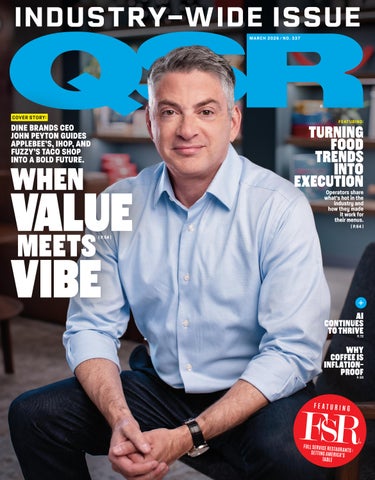
QSR 337 March 2026

Page 1


DINE BRANDS CEO JOHN PEYTON GUIDES APPLEBEE’S, IHOP, AND FUZZY’S TACO SHOP INTO A BOLD FUTURE.

WHEN VALUE MEETS VIBE

CAN YOUR SALSA JUG.

SAVE UP TO 30%

Fire the salsa jug and hire freshly crafted Red Gold® Salsa in our #10 can. Spend 30% less than jugs on salsa made with real tomatoes and fresh jalapeños for a classic mild heat. Plus, with double the shelf life, you don’t have to worry about waste.

Kick your jug to the curb and try a FREE #10

Making ChoicesClear as Categories Blur

Ben: We’ve talked about the blurring of lines between fast food, fast casual, and casual dining for years. Well, guess what? It’s still an incredibly relevant topic.

The lanes are just harder to see nowadays.

Fast-food brands are talking about food quality and atmosphere, not just drive-thru times. Fast-casual operators are adding lanes and tech that look a lot like quick service. Casualdining brands are simplifying menus and finding ways to serve guests faster with fewer hands on deck. Everyone is borrowing from everyone else because the guest has changed. Consumers no longer think in segments. They think in moments. A quick coffee before work. A relaxed lunch with a friend. A dinner that feels special without feeling expensive or slow. Brands that succeed are the ones that understand those moments and build flexibility into their model.

This shift is not about chasing trends. It is about survival. Labor is tighter. Costs are higher. Convenience is no longer optional. At the same time guests still want warmth, quality, and a reason to come inside.

The challenge for operators is knowing what not to copy. Speed alone is not a strategy. Neither is experience without efficiency. The brands that will win are the ones that make clear choices even as the categories blur.

The future of the industry will not belong to fast food or fast casual or casual dining. It will belong to restaurants that understand why a guest showed up that day and deliver exactly what they came for.

Callie: It’s always a balancing act for operators when deciding to implement something new, whether it’s a new menu item, a redesigned prototype or logo, or integrating new kitchen tech. Stray too far, and you risk alienating your core customers—at worst jeopar-

Restaurant

dizing your brand DNA beyond repair. But choosing not to change at all is also a risk, since evolution is inevitable and at some point, your systems will become obsolete.

It can also be easy to get stuck in decision paralysis mode, where you’re overwhelmed by the myriad options available—so some choose to put their heads in the sand and wait to see what their competitors do before taking the leap. Another mistake emerging brands can often make is growing too quickly without being methodical, or saying yes to franchisees who end up being a headache down the road.

The good news is, many of these pitfalls can be avoided with a few best practices that seem simple at first glance, but can make a meaningful difference. Surround yourself with a team of experts who balance out your strengths and weaknesses, stay true to your brand identity, and listen closely to the needs of your core guests and employees—then make collaborative decisions with those key stakeholders in mind. Find a way to retain your calm in the chaos. This is the winning strategy NextGen Casual brand Firebirds Wood Fired Grill utilizes to grow methodically, innovate around menu to mitigate macroeconomic challenges, and still keep value in mind; the brand didn’t change portion sizes or take a lot of price to ensure it didn’t drive away price-conscious customers (read more on page 9).

Throughout our March issue, you’ll find stories of restaurant leaders spanning various segments who are approaching innovation with data, tapping into trends with staying power, and making real-world impacts by focusing on their brand values and mission. Take note of their insights and learnings, and take the time to ponder how these lessons can apply at your organization to make better decisions.

EDITORIAL

VICE PRESIDENT EDITORIALFOOD, RETAIL, & HOSPITALITY

Danny Klein

dklein@wtwhmedia.com

QSR EDITOR Ben Coley bcoley@wtwhmedia.com

FSR EDITOR Callie Evergreen cevergreen@wtwhmedia.com

ASSOCIATE EDITOR Sam Danley sdanley@wtwhmedia.com

SENIOR EDITOR, WIRL Satyne Doner sdoner@wthwmedia.com

SENIOR VICE PRESIDENT AUDIENCE GROWTH Greg Sanders gsanders@wtwhmedia.com

BRANDED CONTENT STUDIO

VICE PRESIDENT, CONTENT STUDIO Peggy Carouthers pcarouthers@wtwhmedia.com

WRITER, CONTENT STUDIO Drew Filipski dfilipski@wtwhmedia.com

WRITER, CONTENT STUDIO Ya’el McLoud ymcloud@wtwhmedia.com

WRITER, CONTENT STUDIO Abby Winterburn awinterburn@wtwhmedia.com

DESIGN & PRODUCTION

QSR SENIOR ART DIRECTOR Tory Bartelt tbartelt@wtwhmedia.com

FSR ART DIRECTOR Erica Naftolowitz enaftolowitz@wtwhmedia.com

SALES & BUSINESS DEVELOPMENT

SVP, FOOD, RETAIL, HOSPITALITY SALES AND ACCOUNT MANAGEMENT Matt Waddell mwaddell@wtwhmedia.com 312-961-6840

VICE PRESIDENT, BUSINESS DEVELOPMENT Eugene Drezner edrezner@wtwhmedia.com 919-945-0705

NATIONAL SALES DIRECTOR Edward Richards erichards@wtwhmedia.com 216-956-6636

NATIONAL SALES DIRECTOR Amber Dobsovic adobsovic@wtwhmedia.com 757-637-8673

NATIONAL SALES MANAGER Tom Boyles tboyles@wtwhmedia.com 662-607-5249

NATIONAL SALES MANAGER Guy Norcott gnorcott@wtwhmedia.com 854-200-5864

CUSTOMER SERVICE REPRESENTATIVE Tracy Doubts tdoubts@wtwhmedia.com 919-945-0704

CUSTOMER SERVICE REPRESENTATIVE Brandy Pinion bpinion@wtwhmedia.com 662-234-5481, EXT 127 FOUNDER

Webb C. Howell

ADMINISTRATION

919-945-0704 fsrmagazine.com/subscribe qsrmagazine.com/subscribe

CONTENTS

Why fixing the experience— not just the menu— is driving a new growth plan for Dine Brands, and its concepts, Applebee’s, IHOP, and Fuzzy’s Taco Shop.

Industry experts explain why AI isn’t going away, and why it can’t be layered onto broken systems.

2026 / QSR - FSR CROSSOVER

CHEFS & INGREDIENTS

16 COMFORT IS THE NEW CURRENCY AT BREAKFAST

Learn how daytime chains are innovating and meeting guests’ needs.

BY SAM DANLEY

24 EMBRACING THE ZERO-PROOF TREND

Operators are exploring new, creative flavors for nonalcoholic beverages.

BY EMMA SCHMALZ

32 MAXIMIZING THE NEXTGEN PIZZA EXPERIENCE

Happy Joe’s and Mellow

Mushroom evolve the dine-in experience for pizza lovers.

BY CALLIE EVERGREEN

35 THE MISSION BEHIND MECHA

Tony Pham shares about his unique culinary journey, which includes a lot of noodles.

BY SAM DANLEY

DEPARTMENTS

45 V&E HOSPITALITY GROUP

The Miami-based company focuses on creating experiences for customers.

BY EMMA SCHMALZ

48 A NONLINEAR PATH TO LEADERSHIP

Erin Levzow has moved between multiple food segments and learned key lessons.

BY SATYNE DONER

85 A WINGSTOP OWNER GROWS HIS LEGACY

Franchisee Yogesh Patel is working on his next big venture—Currito.

BY EMMA SCHMALZ

88 INSIDE COFFEE’S INFLATIONRESISTANT APPEAL

Bad Ass Coffee CEO Scott Snyder shares why coffee is built to last.

BY SCOTT SNYDER

91 LEANING INTO THE UNEXPECTED

Heritage Restaurant Brands shares the growth journey of fast casual Press Quesadilla Grill.

BY CALLIE EVERGREEN

96 START TO FINISH: MARK KELEGIAN

The Randy’s Donuts CEO is building a new legacy with the cult-favorite chain.

Dine Brands CEO John Peyton leads some of America’s biggest casual-dining brands.

PHOTOGRAPHY: DINE BRANDS

IDAHO

Chef Antonio Incandela
Mariscos San Pedro
IDAHO ® YUKON GOLD POTATOES

P. 16

How Sauce Versatility Opens a Path to Profitability Differentiate menus without added complexity

SPONSORED BY GIRARD’S FOOD SERVICE DRESSINGS, A HACO CULINARY COMPANY

P. 22

How 2026 Flavor Trends Are Reshaping Beverage Menus Flavors with familiarity and no fatigue that 60 percent of consumers say they would order.

SPONSORED BY MONIN GOURMET FLAVORINGS

ONLINE

30

One Ingredient That Does Two Jobs Chefs and operators share how seasonality, versatility, guest demand, and freshness turn this ingredient into a strategic advantage.

SPONSORED BY CALIFORNIA AVOCADO COMMISSION

P. 52

The Fryer as a Strategic Profit Driver How oil selection and disciplined fryer management improve margins, food quality, and guest satisfaction.

SPONSORED BY STRATAS FOODS

The Community Alehouse Winning as a Franchise Concept This brand is thriving in small markets that competitors aren’t willing to enter.

SPONSORED BY WINGERS ALEHOUSE

FEATURED SUPPLEMENTS: TRENDING ON THE MENU /

Trending on the Menu

SMARTCHAIN

/

P. 77

Thought Leadership with the Biggest Names in AI and Automation Trends

A closer look at how AI and automation are moving from experimentation to essential infrastructure.

Key Players:

P. 37

The Next Evolution of Pizza What is driving the changes consumers clamor for with this classic, menu staple?

SPONSORED BY BELGIOIOSO CHEESE, INC.

Prolong Oil Life Twice as Long and Win on Flavor The science behind great tasting fried foods that consumers love and operators depend on.

SPONSORED BY COLUMBUS VEGETABLE OILS

Friends that stay and chat, order more. That’s the power of a Bavarian pretzel from the industryleading Brauhaus Pretzel® brand–it’s the order that starts all other orders. The salty flavor keeps drinks coming, and it’s the perfect size so there’s always room for an entrée or even another app. It’s the perfect centerpiece for friends, family, conversation…and your operation’s profits.

Request your free sample jjsnackfoodservice.com/request-free-samples

what’s missing in your market?

Hot Dogs, Soft Serve, Chili Cheese Fries

AMERICAN FOOD

LESS LABOR

LOW FOOD COSTS SIMPLE OPERATIONS

MULTIPLE BUSINESS FORMATS

Igniting Growth with Flavor, Family, and Fire

Firebirds Wood Fired Grill CEO Steve Kislow and his team like to say the experience starts the moment customers drive into the parking lot.

He conveys a scenario in which customers open their car door and are met with an aroma that reminds them of gathering around a campfire. The smell evokes emotion and memories. And according to Kislow, that fire is not only the heart and soul of the restaurant, but it’s also been the driver of “some incredible performance and growth over the years.”

ON THE GO

How Firebirds is combining smart strategy and consistent innovation to drive sales and expansion.

Last year marked Firebirds’ 25th anniversary. In that time, the brand has carved a space between casual and fine dining, with a $38 average check. The chain is satisfying customers from two directions—those trading up for quality and overall experience and others trading down for more value.

“The beauty of Firebirds is that we have consumers across all economic categories,” Kislow says. “So where you may see some of the lower-income consumers start to pull it back a lit-

tle bit, the higher-income consumer maybe isn’t going to The Capital Grille and Ruth’s Chris as much as they were before, and they come to Firebirds. So we’ve always been really insulated. And in difficult economic cycles we’ve done very well. Because if we lose to the left, we typically gain from the right.”

The numbers prove that Firebirds’ unique positioning works. The brand earned approximately $360 million in net sales last year, up from $245 million in 2021 and $180 million in 2018.

Consolidated EBITDA was about $55 million in 2025, an increase from $37 million in 2021 and $18 million in 2018. In 2024, the company posted a $5.6 million AUV and $1.2 million in average store-level EBITDA per unit, leading to average cash-on-cash returns of over 30 percent. The brand has also experienced positive samestore sales in 12 of the past 14 years (excluding 2020 due to COVID).

Food mixes 80 percent while bar takes up 20 percent. As for dayparts, dinner represents 70 percent of sales and lunch accounts for 30 percent.

“I would describe Firebirds as an American grill that has a little something for everybody,” Kislow says. “No veto vote on the menu whatsoever. When a family or when a group of people are trying to decide where to go for dinner, there’s something for everybody on the menu.”

Meanwhile, growth has been methodical. Firebirds finished 2025 with 69 units across 22 states. Here’s a look at how the brand has progressed over the years:

Firebirds opened five locations in 2025 (Rogers, Arizona; Chesterfield, Virginia; New Albany, Ohio; Liberty Township, Ohio; and Annapolis, Maryland). In 2026, the chain will debut seven restaurants (two in Phoenix; Lexington, Kentucky; Lincoln, Nebraska; Wake Forest, North Carolina; Wichita, Kansas; and Creve Coeur, Missouri). Another three are already scheduled for 2027.

The company’s go-forward strategy is to “grow where you know,” meaning the goal is to densify current markets and take advantage of existing multi-unit leadership, distribution, and brand awareness. For instance, the only new state this year will be Kentucky.

“When you put up a map and show 22 or 23 states, there’s so many of them that have one, two, or three locations, which really, it’s a story of opportunity,” Kislow says. “… We’re going into where people are aware, where the brand is already successful. And we’ll go right across town to another trade area in a successful DMA and open another restaurant.”

Over the years, the restaurant box has evolved. There was a time when most Firebirds were between 7,200 to 7,700 square feet, and then it became 6,400 to 6,800 square feet. Now, it’s around 5,500 to 6,000 square feet—a sweet spot that brings more energy, more favorable buildout costs, and a facility that’s “sexier than it’s ever been,” according to Kislow. He describes the design as contemporary with a brighter color palette and more natural light. The chain has also elevated the aesthetics of its bar and incorporated more fire elements to display outside of the restaurant.

“I think we’ve taken the box and put money into the right places and just made sure that there continues to be the right size for us as well,” Kislow says.

Firebirds hopes to shake off a 2025 that “had a lot of noise in there” between weather elements early in the year, constant inflation, and tariffs. Still, from a sales standpoint, the company finished flat-ish. One highlight was lower labor costs, thanks to the brand using technology to increase productivity.

In terms of COGS, Firebirds used menu strategies to mitigate “some of that tariff noise.” Because of that initial work, the brand didn’t feel as much cost pressure in the second part of 2025 as it could have.

Through it all, Firebirds never lost sight of

Cintas Duralite™

value. It didn’t change portion sizes or take a lot of price. For instance, the chain offers a three-course dinner available for $39.95, and that’s a permanent fixture on the core menu. LTOs were used to spark excitement as well, like the brand’s summer seasonal menu, which featured Roasted Chicken, Steak Frites, Shrimp & Grits, Butcher’s Meatloaf, and Steak Penne.

Another major element of 2025— the organization of data. Firebirds even created a business analytics department to better leverage all of the information at its fingertips. Kislow points to marketing and real estate as two high-impact areas. The new department allows Firebirds to “really understand from a more granular standpoint the impacts on the business, which helps us make the right decisions.”

The brand also uses an AI bot to help with phone reservations, which knows whether seating is available, answers questions, and can suggest alternative timeframes. This was tested early in 2025 and launched to the entire system in the second half of the year. Additionally, Firebirds partnered with Axial Shift to help with labor scheduling; the tech was piloted in 2025 and is currently rolling out to the rest of the footprint.

Looking ahead to 2026, the four priorities are drive sales (including more top-of-the-funnel marketing), innovate, control expenses, and attract and retain employees.

It’s an environment where Kislow feels Firebirds can win each day.

“I think one of the points of differentiation for us that I like to make sure we get across is, when you think about polished casual and the other players in polished casual, I don’t think anyone out there has the affinity for families—and families have the affinity for Firebirds—like we do,” Kislow says.

BEN

This report presents findings from a 2025 consumer survey conducted by PAR Technology examining the role of restaurant loyalty programs in a cost-conscious dining landscape. It explores how economic pressure, rising menu prices, and evolving expectations around value, convenience, and personalization are influencing loyalty program usage and restaurant choice.

LOYALTY PROGRAM USAGE IS INCREASING AS A COST-MANAGEMENT TOOL

• Survey results show that 33 percent of consumers are using restaurant loyalty programs more often due to economic uncertainty.

• An additional 36 percent report maintaining their current level of loyalty program usage, indicating that nearly 70 percent of diners are relying on these programs consistently or more frequently.

RISING MENU PRICES CONT INUE TO SUPPRESS DINING FREQUENCY

• Nearly half of respondents (45 percent) say rising menu prices have caused them to skip dining out altogether, even when loyalty discounts are available.

• Another 32 percent indicate that their decision to dine out depends heavily on the restaurant and the perceived strength of the deal.

• These responses demonstrate that loyalty incentives alone are often insuffcient to overcome infation-driven price sensitivity.

• Only 19 percent of respondents say they are using loyalty programs less or have stopped entirely, reinforcing loyalty programs’ role in managing dining expenses.

CONSUMERS ARE W ILLING TO SWI TCH RESTAURANTS FOR BETTER VALUE

• One-quarter of surveyed diners say they would switch to a less-preferred restaurant if it offered a stronger loyalty deal.

• An additional 47 percent report that their decision would depend on a balance of food quality and value, suggesting fexible brand allegiance.

• Half of respondents indicate they often or always compare loyalty offers before deciding where to eat or drink.

TRADITIONAL LOYALTY REWARDS DRIVE DINING DECISIONS MOST

• Discounts and coupons are the most infuential loyalty feature, cited by 40 percent of respondents as the primary factor affecting dining choices.

• Free items or upgrades rank second, infuencing 22 percent of consumers when choosing between dining at home, drive-thru, or sitdown restaurants.

• Features such as social incentives, exclusive access, or points toward long-term rewards are far less infuential according to survey responses.

How

Sauce Versatility Profitability

Opens a Path to

DIFFERENTIATE MENUS WITHOUT ADDED COMPLEXITY // BY CATHIE ERICSON

Menu innovation shouldn’t require a complete kitchen overhaul, yet too o ten, restaurant operators believe they must choose between sticking with the status quo and risking menu fatigue, or coping with ballooning ingredient costs and back-of-house complexity. The solution may be simpler than many operators realize. As a December 2025 Menu Trends Report from Technomic shared, “Sauce innovation is an easy way to add lavor or draw to classics consumers know and love.” No surprise, then, the global sauces, dressings, and condiments market size is projected to grow at a 5.65 percent CAGR between 2026 and 2031, according to Mordor Intelligence.

That’s where Girard’s Food Service Dressings, a leader in foodservice products and customization, can come alongside operators looking to push boundaries without disruption. “Our goal is to be strategic rather than transactional,” says Mike Dean, national accounts and culinary manager for HACO Culinary, who has 13 years of experience as an embedded chef in the foodservice industry.

In an industry where consumer palates shi t rapidly and vary significantly by region, restaurants are always aiming to stay ahead of lavor trends. Dean finds restaurants appreciate how Girard’s extensive portfolio can be transformed in on-trend ways to surprise and delight today's consumers. For example, he says

consumers continue to seek options that are “familiar with a twist” or feature added heat, with sweet and spicy lavors.

Girard’s Food Service Dressings aims to stay ahead of the taste game by treating trend intelligence as a core competency.

“Our culinary development team keeps on top of the latest menu ideas through constant research using various industry tools, smart experimentation, and partnerships with renowned chefs to ensure we develop new recipes to stay at the forefront of trends and satisfy evolving taste prefer-

geist of high-end, lavor-forward dressings guests, especially younger demographics, are seeking: Serrano Caesar Dressing with Yellowbird Serrano Hot Sauce, Sweet & Spicy Vinaigrette with Yellowbird Jalapeño Hot Sauce, and Habanero Ranch Dressing with Yellowbird Habanero Hot Sauce.

Operators looking to spice up their menu o ten turn to LTOs as a way to create buzz, drive traffic, and test new menu ideas. Technomic research from August 2024 found more than half of global consumers say on-trend menu items are

ences for operators,” Dean says.

This includes understanding the science behind lavor. The brand organizes its culinary dressings into five distinct categories: BOLD, TANGY, ZESTY, SAVORY, and ACIDIC. This framework allows the company to provide insights into how dressings balance with other dishes, helping operators think more strategically about their builds.

Trend awareness translates directly into product creation. As part of a recent collaboration with Yellowbird, Girard’s Food Service Dressings has developed three new products which capture the zeit-

is a no-no,” Dean says, pointing to dressings and sauces as an effective vehicle to upgrade an LTO from existing core menu items.

important when choosing a limitedservice restaurant to visit. Even more compelling, first-time guests are twice as likely to order restaurant LTOs according to an August 2025 Technomic report.

Yet LTOs present a paradox. While a crucial business driver, they can also overcomplicate operations if not executed thoughtfully. Dean cites the three guardrails most operators face: avoiding multiple one-off SKUs, managing the cost of final builds, and keeping back-of-house operations simplified.

“Chances are operators are going to have to pull in at least one SKU, but three

“Operators can create something special with just slight modifications to current make table ingredients, like combining various ratios and forms of existing builds as a low-risk way to differentiate a menu,” he says. And he adds, they typically appeal to a separate customer base, so restaurants can provide something fresh without cannibalizing existing menu items.

He cites some of the biggest growth opportunities in upscale aiolis, such as Garlic Parmesan, Thai Basil, and French Onion for chicken sandwiches, burgers, and wraps.

When it comes to alleviating the pressures of a busy kitchen, versatil-

ity can be one of a restaurant’s most valuable assets. Girard’s points to the strategy of “dressing across menus” to allow operators to reduce SKUs while still delivering variety and premium appeal. “We can expand the use of dressings far beyond salad applications and help elevate the menu across dayparts, particularly on high-volume items like burgers, chicken, and sandwiches,” Dean says, noting the nature of adaptable ingredients eases processes and complexities, while enhancing creativity.

Dean recalls one smaller franchisee who viewed LTOs as a disruptor to their existing operations, before Dean conducted a gap analysis of their menu, showing them how to cross-pollinate what they were already doing rather than introducing entirely new elements.

The advantages of multi-use ingredients are significant: They reduce the amount of inventory to purchase and manage; they maximize limited back-ofhouse storage; they simplify training for new kitchen hires (and even for experienced staff who are learning the newest LTOs); and they allow chefs to easily add lair to existing menu staples.

Girard’s Food Service Dressings’ true distinction is its commitment to functioning as a strategic partner rather than simply a product supplier. The company's experienced R&D and culinary resources team can help with formulation tailored to operator menus.

An operator’s “signature sauce” may be the one thing differentiating their burger or chicken sandwich from a competitor’s, and Girard’s excels at helping brands create their own proprietary blend. Its approach streamlines what would otherwise be a laborious process, delivering scalable, mass-produced dressings and sauces that ensure consistent quality in every container across all locations.

Dean has participated in several “culinary councils” across various brands, collaborating with different supplier chefs. “We brainstorm and write concepts from an operator’s briefs, filter them through online screening, come together in the kitchen to create gold-standard recipes, and then take them back to our R&D team to match,” Dean says.

A recent success story involved helping an operator develop a signature sauce. This involved a dine around of 15 different food industry locations, which in turn yielded five possibilities, with a mango habanero emerging as the winner—a choice aligning with two trends Technomic identified in its “2027 Menu Predictions.” While heat stays hot, it is also forecasted “fruity sauces and condiments” will enjoy significant operator penetration growth in the coming years.

“Our ability to plug and play with the lavor profiles in our portfolio gives us a great tool kit to build proprietary items for operators with more ease than they ever had before,” Dean says. Girard’s Food Service Dressings is ideally suited to help brands develop their signature items, offering smallbatch-size development and low minimum order quantities (moqs). The company offers various sizes and packaging options, including a recently introduced four-one gallon pack size for operators accustomed to working with the format.

“Our key wins don't come from oneoff executions,” he says. “They come from being strategically collaborative, understanding sustainable success is built on genuine partnership.”

DRESS YOUR BEST. Layer your creations with chef-tailored dressings and sauces that bring culinary flavor beyond ordinary salad toppers and into the rest of your menu. From timeless mainstays to trendy favorites, seasonal LTOs, and even customized recipes, our deep portfolio will leave your food looking and tasting better than ever before. Get a taste at girardsdressings.com

Chefs & Ingredients

BREAKFAST/BRUNCH | LIQUID INTELLIGENCE | NOW SERVING | CHEF PROFILE

Comfort is the New Currency at Breakfast

Daytime menus are shifing toward savory classics that feel worth the spend.

At one point, breakfast menus leaned heavily into inspirational eating with lighter, healthier options meant to help guests start the day on the right note. That era of avocado toast stacked high for Instagram appears to be fading, says George McLaughlin, cofounder and CEO of fast-casual breakfast and brunch chain Vicious Biscuit.

“There’s been this trend over the last couple of years where concepts are putting these healthier options on the menu that look great in a picture, but ultimately leave people hungry,” he

*Source: Euromonitor International Limited; based on custom research conducted September 2025 for volume sales (ounces/ml) in 2024 through all retail channels. Hot sauce defned as spicy table sauce/condiment made from chilies and excludes chili paste, chili oil, and dried chili powder/fakes.

says. “We really saw that value-driven culture in 2025, where people are thinking about how to get more for their dollar than they’ve been getting in the past. Those healthier but smaller and more expensive options aren’t really driving forces to create brand loyalty.”

McLaughlin adds that for Vicious Biscuit and much of the daytime dining segment, value has become the biggest driver of repeat visits, particularly as consumers grow more selective about discretionary spending. Today’s breakfast guest, he says, is prioritizing value, comfort, and familiarity, looking for plates that feel worth the price.

One of the brand’s biggest menu wins last year reflects that shift. The Firebird, formerly known as the Chicken Bacon Ranch biscuit, graduated from a limited-time offer to a permanent menu item after appearing twice as an LTO and consistently outperforming expectations. The hearty biscuit resonates with guests looking for something familiar, filling, and indulgent without crossing into novelty territory.

McLaughlin says the strong performance of classic, savory offerings also signals a broader move away from the overly sweet, confectioninspired breakfast items that once dominated the category.

“We’re seeing that sweet trend in breakfast drop off as people are looking for more of that comforting, chef-driven food,” he says, pointing to other recent successes like the Old Country Reboot, a bowl featuring potatoes, fried chicken, maple sausage gravy, egg, and peppers, as well as the Frenchie, a French Dip–inspired biscuit with roast beef, white cheese, and au jus.

As it brought the Chicken Bacon Ranch onto the core menu, Vicious Biscuit made several complementary adjustments. The S.E.C.—its Sausage, Egg & Cheese biscuit—joined the permanent lineup, while the chain also expanded its Southern comfort side offerings, including upgrading its signature grits with a cheesy preparation.

Similar forces are shaping menus at The Big Biscuit, which last year rolled out its largest-ever menu refresh. The update expanded the brand’s chicken and waffles section into a more prominent category, adding variations like Nashville hot and maple bacon.

“They are still takes on a classic dish, which is a big theme that we’re seeing—something that’s traditional and maybe a little bit more of a routine for people, but now they’re want-

ing more customization or elevation on it,” says Chad Offerdahl, CEO of the Kansas City-based casual-dining chain.

The Big Biscuit also introduced a line of chicken biscuit sandwiches, offering a traditional option alongside versions that mirror the bolder flavor profiles of its chicken and waffles. A similar strategy guided updates to the grits lineup, which now includes both classic country grits and more flavor-forward, customizable versions.

Another Broken Egg Cafe is also leaning into familiar comfort food. While the core menu already includes staples like shrimp and grits, chicken and waffles, and a Southern chicken sandwich, fresh leadership at the chain has focused on filling gaps with short-term, ingredient-driven offerings.

VICIOUS BISCUIT’S FIREBIRD (TOP) AND OLD COUNTRY REBOOT DISHES WERE HUGE SUCCESSES.

“The big wins for us lately have really come around how we look at our LTOs,” says Joel Reynders, the full-service brand’s VP of culinary and corporate executive chef. “We’ve been featuring seasonal items in a much more creative way.”

Standouts from the fall menu included a reimagined hash featuring shaved corned beef and honey-roasted Brussels sprouts, finished with lemon garlic aioli, sage leaves, and parmesan cheese, as well as the Louisiana Benedict, built on toasted garlic focaccia with grilled andouille sausage and a savory shrimp sauté.

“We got a lot of credit from our guests for the innovation on Benedicts and staying true to our Southern roots, but doing it in a way that’s more unique,” Reynders says.

Across service models, a consistent throughline is emerging: guests want classics and savory comfort food, but with just enough uniqueness to keep things interesting. That balance is espe-

 THE BIG BISCUIT WOWED GUESTS WITH A LINEUP OF CHICKEN BISCUIT SANDWICHES.

HTeaO is your perfect blend of simplicity and scalability that fits into your portfolio seamlessly — making ownership refreshingly easier.

Owning multiple HTea O locations provides many competitive advantages, like increased brand awareness and operational e f iciency.”

Bryan Benson

READY TO TAP INTO SOMETHING BIG?

HTEAO FRANCHISE OWNER

cially important as many brands navigate traffic pressure.

Offerdahl says guests today are “much more willing to explore beyond their usual orders,” showing increased openness to LTOs and new offerings. At the same time, he believes sprawling, page-heavy menus are falling out of favor. As brands double down on comfort-driven food, many are also trimming menus to reduce complexity.

Looking ahead, Offerdahl says The Big Biscuit plans to lean further into build-your-own formats in 2026, blending chef-curated options with customization.

“The oversized menus, the overabundance of options—we’re really trying to fight that,” he says. “For us, it’s about giving our guests a lot of choices and customizations without creating decision fatigue or having an enormous menu.”

A similar mindset is shaping the beverage program at “craft-casual” breakfast chain Biscuit Belly, where cofounder and CEO Chad Coulter says alcoholic offerings are being streamlined.

“We’re not a boozy brunch place and we don’t want to be,” he says. “So, we’ve been looking at how we can shrink that down so we’re just doing the favorites and we’re doing them really well.”

Coulter also points to declining interest in traditional hot coffee drinks, with guests gravitating toward sweeter, visually driven cold or iced beverages. And although Biscuit Belly operates as a fast-casual concept, he says the experience leans closer to full service.

“We always tell people the only thing that’s really fast casual about us is how you order, and then everything else is pretty full service after that,” Coulter says. “We’re running drinks. We’re

running food. You’re sitting down at a table.”

That service style allows room for creative, visually impactful beverages served in real glassware, such as an upcoming Cinnamon Swirl drink and a PB&J-inspired beverage using housemade berry jam.

Elevated, often non-alcoholic drinks are gaining traction across the category. The Big Biscuit has found success with its Western Sodas lineup, inspired by mocktails and the dirty soda trend, while Reynders says Another Broken Egg is seeing a “substantial lift” from flavored, menu-specific cold brews, particularly when paired with seasonal offerings. Eye-catching beverages, alcoholic or not, also tap into the social nature of weekend brunch, when guests are gathering face-to-face, sharing the experience, and lingering longer at the table.

That same social mindset is fueling renewed interest in shareable dishes. At The Big Biscuit, Offerdahl points to growing demand for items like biscuit baskets that allow guests to sample multiple offerings while reinforcing value. Reynders sees a similar opportunity at Another Broken Egg, where brunch is increasingly group-oriented.

“To us, shareables are really about filling a gap between the time you sit down at the table and the time the food comes out, not necessarily another course that’s extending the meal,” he says. “It’s a lot of fun with brunch because there’s so many different things that can be shareables. It can be candy bacon or it can be pull-apart biscuits—things that play a role with breakfast or brunch but are a little more unique than just a standard, traditional appetizer.” 

ANOTHER BROKEN EGG CAFE LEANS INTO FAMILIAR COMFORT FOOD.
BISCUIT BELLY CEO CHAD COULTER HAS SEEN SWEETER DRINKS RISE IN POPULARITY IN THE MORNING DAYPART.

A REALLY REAL

If you’re still using whole avocado fruit, you’ve probably noticed some challenges. Luckily, WHOLLY® Avocado products offer solutions. SOLUTION TO WHOLE FRUIT.

FOOD WASTE

100% yield saves you almost 4 lbs. of product per case.*

TIME No cutting, pitting or scooping saves 30 mins. per case.

SAFETY You won’t need knives, and we pioneered HPP to keep food safe.

READY TO GET REAL?

Scan here for a sample and see how WHOLLY® Avocado is better.

*Based

on a 25 lb. case of whole fruit and a 16 lb. case of WHOLLY® Avocado

HOW 2026 FLAVOR TRENDS ARE RESHAPING BEVERAGE MENUS

FOR RESTAURANTS HEADING INTO 2026, beverage strategy is carrying more weight than ever. Drinks drive traffic, build profit margins, and are one of the few menu areas where operators can move quickly without disrupting the kitchen. But speed only works when it is paired with confidence.

Guessing on lavor trends is risky, and backing decisions with real consumer data is no longer optional. That is the lens Monin used when developing its 2026 Flavor Trends and selecting Toasted Coconut as its Flavor of the Year. Rather than chasing novelty, the company focused on where multiple consumer behaviors intersect and where operators can realistically win.

Monin’s research shows that more than half of consumers treat food and beverages as a way to escape everyday stress,

driving demand for nostalgic and globally inspired lavors. But lavor preferences are also becoming more layered. Fortyeight percent of consumers say they are interested in sweet and savory lavor combinations, signaling growing acceptance of roasted, savory, and umami notes in beverages. Visual and ingredient transparency matter as well, as 43 percent of consumers say they want to see more naturally colored ingredients featured on menus.

Those forces come together across Monin’s five 2026 Flavor Trends: Whisked Away, Mediterranea, The Savory Shi t, Earth Tones, and Wellness Wonderland. Each trend re lects a different motivation, but

they all point to the same reality: consumers want beverages that feel intentional, elevated, and worth the spend.

Toasted coconut sits squarely at that intersection. Coconut is familiar, but layered toasted notes change the equation. The lavor shi ts from tropical and sweet to warm, rounded, and slightly savory. That depth allows it to perform across multiple menu applications without feeling repetitive. It fits naturally into moments rooted in comfort and escapism, from cold brew and lattes to dessert-forward dirty sodas and seasonal limited-time beverages, while also anchoring a savory shi t through roasted notes that pair easily with caramel, coffee, chocolate, and spice-forward profiles.

In fact, data from Datassential and Monin’s proprietary research shows toasted coconut beverage lavors have grown 38 percent on menus over the past four years, and 60 percent of consumers say they would order a toasted coconut latte, cocktail, or mocktail when dining out. That level of interest signals familiarity without fatigue, which is a critical balance for quick-service operators managing broad audiences. Operationally, the lavor works just as hard. Toasted coconut shines across every daypart, from morning smoothies and midday iced lattes to evening mocktails. It supports indulgent builds and better-foryou formats, including protein-forward beverages and functional offerings, without requiring operators to overhaul prep or retrain staff.

That lexibility matters as beverage menus continue to do more with fewer SKUs. Operators are looking for lavors that stretch across dayparts, deliver premium perception, and align with current wellness and transparency expectations.

In 2026, Monin’s Flavor of the Year is set to earn a permanent place on menu boards and perform consistently in real-world operations, offering a rare combination of consumer demand, menu versatility, and data-backed staying power that quickservice restaurants can build on with confidence. by Drew Filipski

Town

Embracing the Zero-Proof Trend

Operators are responding to the higher demand for more sophisticated zero-proof beverage options—from exciting new favor combinations to discovering new, groundbreaking products.

The nonalcoholic beverage category is rapidly expanding as restaurants rethink how they serve a broader range of guests. Beverage experts note that the movement’s sights are set on creating a safe space at their restaurants to include everyone during their dining experience. Whether a customer is an expecting mother, celebrating a sobriety journey milestone, or just wanting to cut back on alcohol, zero-proof drinks are becoming an accessible option that tastes just as

good when eating out.

“We didn’t want [sober] guests stuck with just water while everybody else gets the fun ideas, the fun drinks, all the creativity that comes from the bar. So we wanted to make sure that we built and formalized a zero-proof program that was all about including everybody at the table and also bringing the same experience that you get from our bar,” says Jason Murphy, director of marketing at Bad Daddy’s. Exploring different beverage possi-

THE GREENE TURTLE IS LEANING INTO NONALCOHOLIC DRINKS BECAUSE IT KNOWS THE TREND ISN’T GOING AWAY ANYTIME SOON.

bilities and combinations is at the forefront of the zero-proof trend. Beverage directors are straying away from garnishing mocktails with colorful straws or a cheesy umbrella. They want to create mature mocktails in both taste and delivery.

“I think that what we’re seeing is that the nonalcoholic drinker is, in a way, straying away from that dominant mocktail and settling into a space that’s … elegant,” explains Conrad C. Helms IV, beverage director at Lazy Betty. “Making a house tonic by itself really can speak volumes where a colorful fruit punch umbrella mocktail would come across as a little chintzy.”

Helms IV appreciates the zero-proof space because it helps guests feel seen. “I think it’s really cool to have equal representation in this space, because it’s such a neglected market,” says Helms IV.

He recalls guests even getting emotional over feeling included by Lazy Betty’s nonalcoholic menu options. “[A guest] said, ‘I’ve been sober for 30 years, and nobody has ever done something like this.’” says Helms IV. “You could tell it moved him, and that interaction right there is exactly why we do what we do. I think that as long as we continue to have these conversations and we’re able to provide for people that otherwise would be neglected based on their restrictions you’ll see that the industry explodes that way.”

Sarah Charles, the beverage director at Indigo Road, mentions how the pandemic spurred a focus on health and wellness that included

LAZY BETTY BEVERAGE DIRECTOR CONRAD C. HELMS SAYS NONALCOHOLIC DRINKERS ARE IN AN ‘ELEGANT’ SPACE.

nonalcoholic spirits. Her approach to creating elegant and unique zero-proof drinks is ingredient-driven, using techniques like carbonation to enhance flavors.

“My personal goal for this space is to be able to push that narrative so much further, being able to offer full nonalcoholic pairings with the components that we have available in the space,” says Charles. “Being able to utilize specific techniques to highlight specific ingredients is what we’re chasing here in this space at this time.”

Charles mentions that it’s important for her to stay ahead of the trends in the nonalcoholic beverage space while also staying true to her and her restaurants’ identities. She keeps up with new zero-proof innovations by staying in touch with beverage programs at other restaurants that continue to push the limits.

Stephanie Bricken, founder of Seraphim Social Beverage, created a wine alternative for the sober curious after going on her own personal wellness journey. After testing many batches of Serpahim on her friends, she submitted her recipe to the Rutgers Food Innovation Center back in 2020, and since then, Seraphim has excelled in the nonalcoholic beverage space.

Seraphim is brewed like a tea with organic sour cherries, wild blueberries, and red grapes. Then, reishi mushrooms, apple cider vinegar, and herbal extracts are added in the Cassia blend for immune system support and then oat extracts for nervous system support in the Cacao blend.

INDIGO ROAD BEVERAGE DIRECTOR SARAH CHARLES SAYS COVID SPARKED A DESIRE FOR HEALTH AND WELLNESS.
INDIGO ROAD’S APPROACH TO NONALCOHOLIC BEVERAGES IS INGREDIENTSDRIVEN.

“Every ingredient is from the earth, and every ingredient is good for your body. It’s a super intentional beverage,” says Bricken. “The other really fascinating, unique thing about it is it also makes

a mocktail. I don’t think there’s any other wine alternatives out there that do that.”

A challenge for Bricken has been customers questioning the price of her product, and not the ingredients. However, she has seen more and more people not questioning the price because of the general population educating themselves on the quality of food and how important it is.

“Alcohol has been what we do socially, right? That’s been the sexy thing, so nobody questions the price, right? And all of a sudden, a lot of people say, ‘Well, there’s no alcohol,’ but there’s all these other good ingredients that are helping your body and very high quality. It’s just a matter of time before people start to recalibrate their thinking,” says Bricken.

Kevin Curley, the vice president of culinary and concept development at The Greene Turtle, acknowledges that the zero-proof category is not going away, so as that trend grows, the sports bar chain’s menu will continue to grow with it.

“We’ve just had fun trying to create some unique cocktails,” says Curley. “We have a cucumber fresca, which is nice and refreshing, and then a blackberry refresher with real blackberry lemonade and fresh mint. They both definitely give you that cocktail feel without there being any alcohol in it.”

Finding the perfect nonalcoholic beverages and zero-proof spirits to put on drink menus is similar to sorting through alcoholic beverages, says Murphy. Start off by throwing costs to the side and focus on flavors, he advises.

“We do the same work with any beverage. We’re taste testing with our teams. We’re seeing how it pairs with food. We’re making sure the supplier can support us through distribution networks and then hit the right price points. We need to make sure the economics of it makes sense. But if it doesn’t taste great or work operationally, it doesn’t make the cut, and that’s the same as any drink,” says Murphy.

The zero-proof space isn’t going away anytime soon, and restaurants are only seeing a higher demand for more sophisticated, delicious mocktail and zero-proof beverage options—from exciting new flavor combinations to discovering new, groundbreaking products.

“We want there to be a purpose and an intentionality behind everything that we do. I think that mocktails showcase that,” says Helms IV. 

EMMA SCHMALZ IS A STAFF WRITER FOR QSR.
 THE GREENE TURTLE LIKES TO HAVE FUN CREATING NEW COCKTAILS.
SERAPHIM SOCIAL FEATURES A WINE FOR THE SOBER CURIOUS.

California Avocados bring fresh, creamy deliciousness to every dish and added value to your business because diners are willing to pay more for them.1 There’s more inside than their irresistible flavor; locally grown and sustainably farmed California Avocados help operators promote a positive reputation,2 just by being on the menu. From smoothies to flatbreads to poke bowls and more, California Avocados boost both your menu and patrons’ perceptions.

For menu inspiration and promotional support, visit californiaavocado.com/foodservice or contact us at CAC_Foodservice@avocado.org

Grilled California Avocados with Peanut Salsa Macha

ONE INGREDIENT THAT DOES TWO JOBS

CHEFS AND OPERATORS SHARE HOW SEASONALITY, VERSATILITY, GUEST DEMAND, AND FRESHNESS TURN THIS INGREDIENT INTO A STRATEGIC ADVANTAGE.

Fresh, creamy, and instantly recognizable, the avocado has become a staple across restaurant menus —but when in season and grown locally, it can do far more than simply elevate a dish. Sustainably grown, California avocados, available at peak season during the spring and summer months, offer operators a rare combination of culinary versatility and business value. Their rich texture and mild lavor make them an easy upgrade across dayparts and cuisines, while their familiarity and premium perception give restaurants a powerful tool for driving traffic, building checks, and engaging guests.

The value of California avocados becomes most apparent long before a dish reaches the dining room. It starts with how closely the ingredient is tied to seasonality, sourcing, and the demand and rhythms of the local market. These factors shape not just individual dishes, but the way menus evolve week to week.

For Chef Gavin Schmidt, chef and coowner of Morris Restaurant and Sirene Restaurant in the Bay Area, avocados aren’t a static menu staple so much as a seasonal ingredient he returns to when they’re locally sourced and at their best. His menus shi t with ripeness and availability, shaped by frequent farmers’ market trips and long-standing relationships with local growers.

“Our menus are really shaped by what’s happening at the market,” Schmidt says, noting avocados are almost always in rotation when they’re at their peak. When

THE MORRIS HALIBUT CRUDO WITH PASSIONFRUIT AGUACHILE AND AVOCADO

California avocados are in season, they naturally find their way onto the menu—not because they need to be forced in, but because their quality and freshness make them exciting to cook with.

Taking a seasonal approach opens the door to a wide range of culinary applications. Different avocado varieties, and even different stages of ripeness, lend themselves to different techniques. “Some are better served raw—sliced into a salad,” Schmidt says. “Some take heat really well, so I’ll char them and serve them warm. Others, when they’re so ter, work better in purees or a guacamole-style preparation.” This adaptability allows chefs to use avocados as a centerpiece or a supporting element, depending on the dish, while maintaining balance across the menu.

and are recognizable to our core audience. California avocados allow us to elevate familiar favorites while staying true to the hearty, craveable dishes our guests know and love—like huevos rancheros and omelets.”

Flexibility also makes avocados an ideal partner for showcasing regional ingredients. One of Schmidt's favorite dishes pairs avocado with passion fruit, citrus, and sea urchin—all sourced from the same stretch of the California coast. “The combination is really exciting,” he says. “The bright acidity of the passion fruit balances the richness of the avocado, and the umami lavor from the uni. It all comes from close to the same region, so it has that ‘what grows together goes together’ feeling—both on land and in the sea. It’s a fun balance, and it feels like a love letter to that part of California.”

The same sense of place and lexibility that chefs value also carries weight beyond the kitchen. When an ingredient resonates with guests and fits seamlessly into a menu, it becomes both a culinary choice and a tool operators can build strategies around.

Ingrid Martinez, vice president of marketing at the iconic Southern California diner chain NORMS, agrees California avocados check multiple boxes at once.

“Avocados play a thoughtful role in both our menu and our brand strategy,” she says. “They represent freshness, quality,

Seasonality plays a key role in how NORMS approaches avocado sourcing, even though avocado remains a yearround staple on the menu. “We carry avocados all seasons to meet guest expectations, but when California avocados are in season, we proudly make the switch,” Martinez says. “This allows us to highlight peak freshness, lavor, and quality while supporting local agriculture. Staying true to our California roots is core to who we are as a brand, and featuring California avocados during their season gives us an authentic opportunity to celebrate local sourcing in both our menu and marketing.” Beyond sourcing and seasonality, avocados also earn their place on the menu from a margin standpoint. Martinez notes while avocado pricing can luctuate, the ingredient consistently proves its value when evaluated through both cost management and revenue potential. At NORMS, avocados perform well as a premium addon, helping drive higher check averages without adding operational complexity.

“Guests clearly see the value in avocado and are willing to pay for it,” Martinez says. “Additionally, avocado’s versatility across multiple dayparts and menu categories allows us to leverage it efficiently. Ultimately, avocado delivers a strong return by enhancing perceived value, guest satisfaction, and overall profitability, making it a strategic ingredient to feature.”

One of the clearest examples of avocado’s impact at NORMS comes from menu innovation. Martinez points to the success of the brand’s huevos rancheros and California omelet, both of which initially launched as LTOs—dishes where the addition of avocado helped inspire the “California” name, much like the way a California roll signals avocado in sushi. “Their popularity was driven in large part by the addition of avocado, which guests viewed as a fresh, premium upgrade,” she says. “The strong sales performance, positive guest feedback, and repeat orders made it clear these dishes had long-term appeal. As a result, we transitioned them from LTOs to permanent core menu items—reinforcing avocado’s ability to elevate dishes, drive demand, and create lasting menu hits.”

As restaurants look ahead to spring and summer menu planning, California avocado season offers a timely opportunity to think beyond individual dishes. In peak season, California avocados deliver freshness, lavor, and quality that chefs are eager to work with, while giving operators a compelling story to share with guests. Whether used to anchor a signature item, enhance an LTO, or drive incremental sales through add-ons, California avocados prove that an ingredient doesn’t have to be either creative or profitable. At its best, it can be both.

TO LEARN MORE ABOUT HOW CALIFORNIA AVOCADOS DELIVER VALUE, OR TO INQUIRE ABOUT PROMOTIONAL SUPPORT, VISIT

Maximizing the NextGen Pizza Experience

Happy Joe’s and Mellow Mushroom are evolving the dine-in experience for pizza lovers while delivering convenience for of-premises guests—all while maintaining the high-quality standards both brands are known for.

Tom Sacco is bullish about the new prototype for Happy Joe’s, which delivers a bolstered family dining experience as well as modernized offpremises capabilities. A game room, a golf simulator, and a patio firepit overlooking a mountainside view are just a few of the features guests can look forward to at the brand’s upcoming location near Tucson, Arizona, set to open in spring of 2026 as of press time. This marks the brand’s first restaurant

in the state and, hopefully, the start of a broader regional presence. Happy Joe’s has three company-owned and 35 franchise locations throughout the Midwest.

Since the pandemic, Sacco—CEO, president, and “chief happiness officer”—admits the franchised pizza concept has had to “fight harder for the dine-in experience as off-premises continues to grow.” Thankfully, he says, the brand thrives on change,

innovation, and differentiation within the segment. That’s why Happy Joe’s has refocused its NextGen restaurant model to include more intentional entertainment—though not in a Chuck E. Cheese-style format, he’s quick to point out.

“Our entertainment is designed to complement our higher-quality menu, contemporary flavor profiles, and the uniqueness of our brand, with elements such as patio firepits, golf simulators adjacent to the bar where appropriate, and standout offerings like authentic smoked BBQ brisket pizza,” Sacco says. “Together, these elements help Happy Joe’s stand out and give families a compelling reason to choose us when they are looking for a quality dining experience paired with meaningful entertainment.”

“What truly completes it is our hybrid-service, hospitality-first model,” he adds. Historically, Happy Joe’s has operated in the fast-casual, counter-ordering, self-serve category. The brand’s lunch buffet, offered Monday through Saturday, continues to deliver significant value. By keeping pricing affordable at lunch, Sacco says, the brand remains accessible to guests on tighter budgets and in smaller markets where many locations have served their communities for 40 to 50 years. “Nationally, the cost of doing business has grown faster than incomes in many of these communities, and we’re mindful that smaller markets don’t always have the same financial resources as larger metropolitan areas,” Sacco notes.

At dinner, Happy Joe’s transitions to a full-service experience, with guests seated, refills delivered to the table, and a heightened focus on one of Happy

greatest strengths: cre-

Joe’s
HAPPY JOE’S MENU BLENDS FAMILIAR CLASSICS WITH BOLDER FLAVOR MASHUPS, LIKE THE BRAND’S FAMOUS TACO JOE PIZZA WITH SPECIAL REFRIED BEAN SAUCE AND TACO-SEASONED BEEF AND SAUSAGE, TOPPED WITH LETTUCE, TOMATOES, AND TACO CHIPS.

Spring into sophistication

It’s easy to elevate your springtime menu with Président® Brie. With its creamy texture and mild, buttery flavor, it’s the award-winning Brie that makes elegance accessible. Whether you’re serving salads and sandwiches or burgers and charcuterie boards, count on the quality and value of Président Brie to help you create gourmet every day.

Get a free sample of Président Brie—the #1 Brie in France and the U.S.

ating magical memories for families, he says.

The menu blends familiar classics like highquality pepperoni and cheese options with bolder flavor mashups, like the Sloppy Joe pizza, Cinnamon dessert pizza, and its famous Taco Joe pizza with special refried bean sauce and tacoseasoned beef and sausage, topped with lettuce, tomatoes, and taco chips. “We see the greatest opportunity for differentiation in combining innovative menu offerings with relevance, affordability tailored to each community, and staying actively engaged in the lives of families with school-age children,” Sacco says.

On the flip side, Mellow Mushroom CEO Richard Brasch and his team debuted a new prototype last year dubbed Project Wonderland—a smaller, counter-service concept designed for greater efficiency and flexibility. The new design cuts the traditional footprint of the 170-unit pizza brand nearly in half and trims complexity without cutting standards.

While the new model resulted in skinnying up the menu by 10 percent overall, it also added a pizza-by-the-slice option after listening to guest feedback and demand. The team moved quickly to implement the change: “We had to figure out … consistent with our brand, how do we have a great slice, what do we need to do? So we had to kind of ramp up.” Brasch notes that they committed to adding slices within four weeks, mobilizing their team to make it happen.

The result was successful, and exemplifies

MELLOW MUSHROOM’S LTOS LIKE THE TACO NIRVANA MENU AND THE MELLOW ROLLZ LAST YEAR EXEMPLIFY ITS FUN EXPERIMENTAL SIDE. THOSE MENU INNOVATIONS ARE GUIDED BY A SIMPLE PRINCIPLE: NEVER COMPROMISE THE INTEGRITY OF THE FOOD.

the company’s agile mindset. “Let’s figure it out. And if we make a couple of mistakes after we roll out, let’s figure it out after that,” Brasch adds. “That’s the fun part of it—we’re dedicated to basically getting this model worked out, but at the end of the day, it’s resonating with the public. The sales have been increasing every week.”

Crucially, Brasch frames the Project Wonderland model as an additive—not a replacement for full service. “Our full-service restaurants are basically the meat and potatoes of the company. We’ll continue to open up more of those stores,” he says, while also stressing corporate investment alongside franchising.

This decision reflects Mellow Mushroom’s broader strategy of staying responsive to customer preferences while maintaining their core brand quality, which also applies to the brand’s menu development process. The concept’s crust starts with dough made from five simple ingredients mixed with single-source Appalachian spring water before being hand-tossed and stone-baked. The crust is thicker than New York-style pizza and thinner than Chicago deep dish, resulting in a uniquely Southern-style pizza that competes in its own lane.

Mellow Mushroom sources preservative-free cheese, all-natural meats, and even pizza boxes with a negative carbon footprint. The mozzarella is a proprietary blend from the world’s greatest master cheesemakers, and the brand offers 10 unique cheeses from 100 percent sheep’s milk feta to Follow Your Heart dairy-free cheese. Another differentiator for the brand is its 10-inch signature gluten-free crust, which is carefully made without cross contamination and can be the base for any of Mellow’s pizzas.

The brand’s limited-time offerings, such as the Taco Nirvana menu and the Mellow Rollz last year, exemplify its fun experimental side. Those menu innovations are guided by a simple principle: never compromise the integrity of the food. “Adhering to those standards and being fixed on those principles is part of the reason that we have basically blind loyalty in many instances,” he says.

Brasch adds, “You still have to deliver the goods, you’ve got to make the food properly, you have to have great service—but we’ve always stayed aligned with our principles.”

The Mission Behind Mecha

Tony Pham is honoring his parents’ immigrant journey by pairing a good bowl of noodles with real-world impact.

Tony Pham’s family first entered the restaurant world in 2006 with a 900-square-foot Vietnamese pho restaurant in Connecticut that he affectionately describes as a “hidden gem.” At the time, Pham was in nursing school and had no intention of pursuing a career in restaurants. But as the oldest son of first-generation immigrant parents, he felt a natural obligation to help.

That sense of responsibility had been a part of his life since childhood, from translating labels in the grocery store to driving his mother to a restaurant where she staged to learn new techniques. Now, it extended to helping his parents establish their own business.

“We didn’t know anything about the restaurant industry,” Pham says. “All we knew how to do was cook, and my mom made me do the rest. I had to start an LLC. I had to figure out what the front of the house was about. I had to figure out the menus. Every little detail about the restaurant industry was thrown in my lap.”

He describes helping to open and run the restaurant as full of “blood, sweat, and tears.” The kitchen, he recalls, was “like a food truck, probably smaller.” Things could get tense on busy nights with the family working shoulder-to-shoulder in a confined space. Despite the struggles, the experience proved foundational. Pham learned not just the mechanics of running a restaurant but also the nuances

of building a small business. And he discovered a deeper love for food, enough that he ultimately gave up on becoming a nurse and decided to carve out a career in the restaurant industry.

He also credits his growing culinary passion to the “rock star status” of chefs like Anthony Bourdain and David Chang when he came of age. And while he deeply admired his parents and their work, the intensity of working alongside them in such tight quarters eventually spurred him to strike it out on his own.

At the time, ramen was just beginning to gain traction in the U.S. Pham spent months researching Connecticut towns for a potential location, ultimately settling on Fairfield for its college-town energy and proximity to

both New York City and Boston. But before securing real estate, he recognized that he needed to develop authentic ramen skills. His background in pho and Vietnamese cuisine wasn’t enough.

To build his expertise, Pham traveled to New York City to train with chef Shigetoshi Nakamura, a celebrated Japanese ramen master behind restaurants like Ramen Nakamura and Slurpeak. He returned to his family’s restaurant after honing his craft, combining his newfound ramen techniques with his Vietnamese culinary roots. The result was a unique style that became the foundation for his own restaurant concept.

Pham opened the first Mecha Noodle Bar location in 2013, taking much of what he learned from his parents’

TONY PHAM OPENED THE FIRST MECHA NOODLE BAR LOCATION IN 2013, TAKING MUCH OF WHAT HE LEARNED FROM HIS PARENTS’ VIETNAMESE RESTAURANT AND LAYERING IN OTHER INFLUENCES, NAMELY JAPANESE, KOREAN, AND LAOTIAN DISHES.
QSR FSR

Vietnamese restaurant and layering in other influences, namely Japanese, Korean, and Laotian dishes. Today the restaurant serves Asian-American comfort food with a focus on rich, broth-based pho and ramen, alongside street food like bao buns, dumplings, egg rolls, and fried rice, plus playful drinks and boozy boba.

“I wanted to create a place that wasn’t just about stellar food, but also had a cool playlist and ambiance and an emphasis on cocktails,” he says, adding that many “hidden gem” ethnic restaurants excel in food but often overlook the environment and other aspects of the guest experience.

Pham was deliberate about putting his own stamp on Mecha’s look and feel, drawing on his upbringing in Connecticut during the 1990s. Restaurant playlists lean heavily on the hip-hop and R&B he grew up listening to, and employees were encouraged to express themselves through casual, personalized attire rather than strict uniforms. The interior has a distinctive look as well, thanks to ceiling-mounted two-by-fours that evoke hanging noodles and appear at every location today. Mecha Noodle Bar’s early expansion beyond its first spot kicked off not long after the first restaurant opened, when Pham teamed up with his childhood friend Rich Reyes, also a son of immigrant parents, who joined as a partner with the second location. Early growth after that focused on Connecticut, with locations in Norwalk, Stamford, and New Haven.

By 2020, the brand was ready to push outside its home state. Plans were in motion to enter the Boston market, but nothing had been finalized yet when the pandemic hit.

“We were like, ‘OK, either we hide and wait this thing out, or we try to make a deal during COVID,’ which is risky because no one knew what was going on at the time,” Pham says.

Ultimately, they pressed forward and secured two deals: one in Boston’s waterfront Seaport neighborhood and another in the nearby suburb of Brookline. A few years later, in 2024, Mecha made an even bigger leap beyond its home turf, opening restaurants in Denver, Washington, D.C., and Columbus, Ohio, all outside its Northeast base and across different time zones.

“They were all hot markets with good real estate and good deals,” Pham says, pointing to the “fall forward” mentality he and Reyes have adopted over the years. “We said, ‘let’s try it.’ We could do one restaurant a year, or we could take

“Once I understood the ‘why,’ it made me put my head down and grow in a thoughtful way.”

 THE RESTAURANT SERVES ASIANAMERICAN COMFORT FOOD WITH A FOCUS ON RICH, BROTH-BASED PHO AND RAMEN, ALONGSIDE STREET FOOD LIKE BAO BUNS, DUMPLINGS, EGG ROLLS, AND FRIED RICE, PLUS PLAYFUL DRINKS AND BOOZY BOBA.

this leap. So, we said, ‘Let’s take another risk. What are our limits? How much can we grow?’”

The expansion, he notes, came with significant challenges, particularly when it came to marketing and public relations. Introducing an unfamiliar brand to entirely new regions required substantial energy and investment. After closing the Ohio location last year, Mecha opened a new restaurant in Philadelphia, keeping its total footprint steady at 11 units.

Looking back, Pham says the most meaningful moment in Mecha’s journey came in the early days, when the concept was still young and its footprint was limited to Connecticut. In 2015, he and Reyes founded Eat Justice, committing 50 cents from every ramen bowl sold to employeeselected charities. Since then, the “why” behind Mecha’s growth—using the restaurant as a vehicle to make a positive impact—has always been as important as the business itself.

“Once I understood the ‘why,’ it made me put my head down and grow in a thoughtful way,” he says. “We aren’t going to just open up as many units as we can like private equity would. It isn’t about making a ton of money. It’s about growing so we can scale Eat Justice.”

SAM DANLEY IS THE ASSOCIATE EDITOR OF QSR. HE CAN BE REACHED AT SDANLEY@WTHWMEDIA.COM.

Trending on the Menu

The Next Evolution of Pizza

What is driving the changes consumers clamor for with this classic, menu staple?

Pizza remains one of the strongest high-familiarity, high-affinity menu items, delivering comfort, consistency, and broad appeal across full service and casual dining. Datassential reports pizza appears on 31.5 percent of U.S. menus, with near-universal diner awareness and trial. More than 90 percent of consumers say they love or like pizza.

While menu presence has softened

slightly, consumer a nity has continued to strengthen. Pizza sits rmly in the ubiquity stage of Datassential’s menu adoption cycle. Guests understand, trust, and order the dish with con dence, shifting the opportunity for restaurants away from reinvention toward re nement.

In mature categories, Datassential notes operators succeed by improving execution and reinforcing quality rather than chasing novelty. Datassen-

tial shows cheese, pepperoni, and Margherita pizzas still lead menus. ese familiar builds remain strong because they are comfortable and predictable. e opportunity lies in elevating how those pizzas are executed rather than changing what they are, and cheese is the key to re nement.

“Pizza is familiar, which means guests notice quality immediately,” says Frank Alfaro, vice president of foodservice sales

BELGIOIOSO

is the heart of this specialty from Recco, Italy. Two paper-thin sheets of dough and a creamy, gently tangy center come together in a focaccia that’s crisp, delicate, and incredibly smooth.

Find out more about Crescenza!

3.5 lb. Crescenza Block

at BelGioioso. “Cheese in uences avor, texture, and visual appeal before the rst bite. When those elements are dialed in, pizza deliv ers on guest expectations.”

For many operators, main taining consistency remains the primary driver of pizza success. Datassential research shows famil iar items with reliable execution outperform more experimental builds in high-tra c environments.

“Consistency is critical in a category guests know so well,” says Umberto Marconi, vice president of marketing for Polly O. “When Mozzarella delivers dependable melt and stretch every shift, operators protect speed of service, food cost, and guest satisfaction. at reliability keeps classic pizzas relevant.”

Datassential notes ingredient-forward builds support higher price points in familiar categories. Rather than adding complexity, operators are focusing on fewer ingredients with clearer roles.

Cheese plays a leading role in this strategy. Mozzarella remains the base, while nishing cheeses and aged varieties provide the contrast and visual interest that signal quality. Aged Italian cheeses, such as Parmesan, American Grana, Fontina, Asiago, and Gorgonzola also appear more frequently as accents. ese cheeses add depth while aligning with pizza’s Italian heritage and familiar avor expectations.

“Guests make quality judgments quickly,” Alfaro says. “Cheese is one of the most immediate cues. When it looks intentional, it reinforces the idea that the pizza was made with care.”

cheeses ll that role.

Low-moisture Mozzarella continues to anchor traditional red- and white-sauce pizzas. Its neutral flavor and functional performance make it a foundation across menu types and volumes, while Datassential reports consumers are increasingly willing to pay

Fresh Mozzarella remains a cornerstone for Margherita- and Neapolitaninspired pizzas, offering a softer texture and cleaner milk avor. Burrata and Stracciatella are increasingly used after the bake, creating contrast in temperature and appearance that guests associate with handcrafted preparation.

“When cheese is used intentionally, it becomes a value cue,” Alfaro says. “A post-bake nish changes how guests perceive pizza. It feels more chef driven and more worth the price.”

Classic tomato sauce continues to dominate pizza menus, with white sauces maintaining a strong presence. ese familiar bases allow cheese to remain the focal point.

“Fresh Mozzarella and burrata pair well with olive oil-based pizzas, pesto, and white sauces because they add richness without overwhelming the build,” Alfaro notes. “Aged Italian cheeses add balance and depth.”

For execution, mozzarella continues to anchor performance. “Mozzarella keeps the pizza cohesive,” Marconi says. “It allows other elements to shine while maintaining the structure guests expect.”

Traditional pizzas benefit from cheeses that reinforce reliability and guest trust. Artisan pizzas bene t from cheeses that create di erentiation and support trade-up behavior. Together, these approaches allow operators to meet a wide range of guest expectations within one menu.

As pizza continues to anchor menus, the strategy is clear: Respect familiarity, re ne execution, and let cheese do the work. ✦

BELGIOIOSO
(2) BELGIOIOSO BURRATA FILLING OPENFACE AND SHAVED SALAD BLEND PIZZA

PLATINUM LABEL LOW MOISTURE MOZZARELLA LOAF

Premier cheese crafted for superior performance

Easily shreds, slices and melts

foodservice@belgioioso.com

877-863-2123

belgioioso.com/Foodservice

WATER PACK FRESH MOZZARELLA

Made to order for optimum freshness

Traditional clean, milky flavor

PLATINUM LABEL LOW MOISTURE MOZZARELLA SHREDS

Blend of Part Skim and Whole Milk Mozzarella

Smooth melt and even browning

Pizza Industry Trends

A FEW KEY INSIGHTS FROM DATASSENTIAL ON THE PIZZA INDUSTRY

• 98% of consumers are aware of Pizza, with greater awareness than 100% of all other items.

• 50% of consumers have had pizza many times, with greater regular consumption than 99% of all other items.

• 94% of consumers who have tried pizza love or like it.

• Gen X remains the leading generation of consumer affnity.

• Among visitors of quick-service and fast-casual restaurants, 93% of customers like or love pizza.

TRIPLE TREAT BOX Features two medium one-topping pizzas, fve breadsticks, and 10 cinnamon sticks.

PIZZA INDUSTRY MENU HIGHLIGHTS // COURTESY OF DATASSENTIAL
Chain: Pizza Hut // Consider Score: 84
EPIC FIVE MEAT PIZZA Housemade meatballs, cupping pepperoni, smoked ham, Italian sausage, and smoked bacon.
Chain: BJ’s Restaurant & Brewhouse Consider Score: 68

email info@polly-o.com to request samples

BACON SPINACH PARM PIZZA Baby spinach, hard ood smoked bacon, caramelized onions, smoked ro volone, creamy armesan sauce instead of red sauce , siago, and omano.

Chain: Donatos // Consider Score: 64

MEXICAN PIZZA EMPANADAS ree bite sized crispy empanadas flled it seasoned beef, a melty, c eese blend, and a bold avorful sauce. erved it e ican pizza sauce on t e side for dipping.

Chain: Taco Bell // Consider Score: 63

MENU ADOPTION CYCLE: PIZZA INGREDIENTS

INCEPTION rends start ere. ound in mostly fne dining and et nic independents, inception stage trends e em plify originality in avor, preparation, and presentation.

1. Clam

2. lack ruf e

ADOPTION ound at fast casual and casual indepen dent restaurants, adoption stage trends gro t eir base via lo er price points and simpler prep met ods. Still differentiated, these trends often feature premium and generally aut entic ingredients.

1. Pepperoni Cups

2. Gyro

PROLIFERATION roliferation stage trends s o up at casual and uick service restaurants. ey are ad usted for mainstream appeal. ften combined it popular applications burgers, pastas, etc. , t ese trends ave become familiar to many.

UBIQUITY bi uity stage trends are found every ere t ese trends ave reac ed maturity and can be found across all sectors of t e food industry. oug often diluted by t is point, t eir inception stage roots are still recognizable.

1. Salami 2. rugula
4.
1. Chicken 2. Mushroom
3. Stracciatella 4. Pistachio
5. Creme Fraiche
3. age 4. ig 5. Sriracha
3. Caramelized Onion 4. Goat Cheese 5. siago
3. Pesto 4. Ricotta
5. Red Pepper Flakes
PEPPERONI CUPS
ARUGULA PIZZA

ONES TO WATCH

V&E Hospitality Group

The restaurant group aims to create unforgettable experiences across various restaurant concepts.

FOUNDERS:

Jamil Dib. Simon Jacobo, Eduardo Araoz

HEADQUARTERS: Miami, FL

YEAR STARTED: 1997

ANNUAL SALES: $150M

TOTAL UNITS: 26 restaurants, 2 hotels.

Vida Estilo translates to “life and style,” which is a reflection of V&E Hospitality Group’s mission to create unique spaces and experiences for guests, says CEO Matias Pesce.

“The business vision was very clear, and the mission and vision are to create spaces where people feel special, welcomed, and valued. We try to reflect this from our guests to our employees, the partners, and the stakeholders, all the people that will be part of V&E,” Pesce says.

Pesce joined V&E back in 2017. He was attracted by the company’s strong foundation and concepts. Since 1996, V&E has opened and maintained several restaurants, from quick service and casual-dining spots to more highend concepts. Pesce mentions that it is important for the business to differentiate its portfolio of brands.

“It doesn’t matter if we are talking about a QSR like Cortadito Coffee House or Donatella, our boutique hotel, or our Cafe Americano brand, in general, we try to be consistently working on quality of services, overall opera-

tional level, and experience,” Pesce says.

There are five core concepts at V&E: Cortadito, Cafe Americano, Mercato Della Pescheria, Havana 1957, and Paperfish Sushi Bar. V&E’s longterm core strategy is prioritizing these concepts and expanding them. Other boutique brands under V&E’s umbrella are opened in specific locations to see

if they are successful and viable.

The group operates in the casualdining and quick-service segments to diversify its business, Pesce explains.

“From the QSR business to the highend restaurant experience, we keep all the essential important things that we want to represent—our lifestyle and our profile of business,” Pesce says. “We understand that taking this QSR

QSR FSR
V&E HOSPITALITY GROUP OPERATES 26 RESTAURANTS.

segment as part of our portfolio will diversify the opportunity for the F&B restaurant business.”

He acknowledges the challenges of managing both formats simultaneously. For Pesce and the V&E team, understanding the distinct business mindsets of quick-service and full-service operations was critical.

“This was the first main issue and challenge we have, because we came from casual dining with a lot of concepts, a lot of restaurants, and then when we created a QSR business, we thought in the same way, with the same mindset, and it was a terrible issue. Of course, the goals and objectives are different,” Pesce says.

While ambiance and service remain a common thread, customers visit each format for different reasons. Quick-service locations, Pesce has learned with Cortadito, are faster to develop, scale, and expand. Three or four additional coffee houses are planned for New York City in 2026.

When it comes to pricing, Pesce knows that customers are flexible to a certain degree in this economy.

“We know that increase of price is an issue for the customer in this kind of economic situation, so we try to renegotiate with our vendors in the best way to keep the quality, to keep the experience, absorbing some of the increase of prices, but keeping the same spirit with our customer,” Pesce says.

Staying competitive in the QSR space is a top priority for V&E, particularly when it comes to menu offerings. Pesce notes that competition has intensified over the past five years, making

it essential for business owners to be strategic with menu design, pricing, and other factors that directly influence foot traffic.

Trends occasionally sway the menus at V&E, but there is a model that Pesce likes to follow.

“Our business model for menu development is to have 60 percent of the menu with our core elements, items, food and beverage, that every concept represents. Then we have 20 percent of the menu that are for trends. We try to reflect what is trendy from the customer point of view, and then we have another 20 percent of the menu for innovation,” Pesce says.

Technological innovation and advancements are another key element. On the operations side of things, AI has streamlined sales forecasts, staff scheduling, and more, making these processes more efficient and accurate. V&E is also using technology to discover what works best for its customers.

“We are trying to understand all of this to make the experience and the story of our customer much deeper and fully personalized, to understand what they are looking for and why they are visiting us,” Pesce says.

V&E’s biggest innovations and future focus center on a customer-centric hospitality model. This could include AI-powered pre-check-in and integrating data from platforms like POS systems, OpenTable, and Eventbrite to track customer preferences, visit frequency, and more.

“We want to be sure that if you are visiting us at Marabú and before checking in, we want to know what are your favorite plates, your favorite drink, how many times have you been with us, if you have visited another concept or another brand in our umbrella group,” Pesce says.

Last year was major for V&E, and Pesce only wants to continue growing upward.

“We want to give back to the communities all we can, not only to be faithful and to develop the economy and the contribution with the communities, but also to develop the areas, the industry, and the professionalism of the communities,” Pesce says.  EMMA SCHMALZ IS

CORTADITO PLANS TO EXPAND IN NEW YORK CITY.
V&E HOSPITALITY STANDS BY A CUSTOMER-CENTRIC MODEL.

A Nonlinear Path to Leadership

What moving between QSR, FSR, and experience-led brands taught Erin Levzow about modern leadership.

What defines a career? Erin Levzow has mastered the art of the nonlinear path, navigating the quick-service, fullservice, entertainment, and hospitality industries with ease. She resists easy categorization. Early in her career, Levzow earned a degree in theater, dreaming of becoming an actress. She didn’t quite make it to L.A.—but she did make it to Las Vegas, where she slept on the floor of her apartment before landing a job in the box office at Caesars on the Strip.

A natural trainer and brand advocate, Levzow moved into a training and internet marketing role—until the recession hit. “Everyone in Vegas lost their job,” she says. Her hustle was unmistakable. Willing to do whatever it took to regain traction, she eventually landed at MGM Resorts, then the Palms Casino, where she entered her first run of senior marketing leadership roles.

Then came the call from Wingstop: a new city, a new industry, and one of the fastest-growing quick-service brands in the world. From there came Freebirds World Burrito, Del Taco— where she re-platformed an entire martech stack in just nine months— and the Museum of Ice Cream. Now, she consults as chief marketing officer across CapitalSpring’s portfolio

of brands, which include Fat Rosie’s, Newk’s Eatery, Bushfire Kitchen, Escalante’s Fine Tex Mex, and more.

Her experience moving between different hospitality categories has created a singular opportunity: to help people release, relax, and enjoy themselves—whether she’s marketing wings or a Vegas vacation—while making an impact and driving revenue.

At this stage of her career, Levzow is less focused on chasing titles and more invested in building durable

WITH OVER 18,000 FOLLOWERS ON HER PERSONAL LINKEDIN, ERIN

HAS

A THOUGHT LEADER IN THE HOSPITALITY SPACE AND IS THE COFOUNDER AND HOST OF BYTE-SIZED & BOSSY— ‘THE RESTAURANT PODCAST YOU DIDN’T KNOW YOU NEEDED’—AS WELL AS A MEMBER OF THE WOMEN IN RESTAURANT LEADERSHIP ADVISORY BOARD.

brands. Working across a portfolio has sharpened her belief that clarity—not complexity—is what ultimately drives growth. While tools, platforms, and channels continue to evolve, the fundamentals remain unchanged: know your guest, know your purpose, and execute with discipline. That perspective has also given her a front-row seat to how brands scale responsibly. Growth, she notes, isn’t just about expansion—it’s about alignment between leadership, marketing, and operations. When

LEVZOW
BECOME

those pieces work together, brands earn trust, loyalty, and relevance. When they don’t, even the strongest concepts can lose their footing.

“Marketing is still marketing, no matter where you go,” Levzow says. “Understanding what moves your product or brings consumers through the door requires establishing a connection. You have to understand what drives their decisions— and who’s involved in making them.”

In quick service, that connection often shows up through digital ordering, where attribution can be tracked end to end. In full service, success is more often measured through foot traffic, dwell time, and opportunities to upsell. As value wars continue to blur the lines between segments, average ticket prices in QSR and FSR are now competing in ways the industry hasn’t seen before, Levzow notes.

Ultimately, the biggest difference comes down to experience design. When Levzow compares a brand like Fat Rosie’s to Wingstop, the contrast is natural—pace, occasion, and expectation all differ. Speed matters. But the moment quick-service brands consistently deliver a truly exceptional experience, she says, the restaurant industry will reach a new inflection point.

Part of nailing that experience is building emotional connection at scale. For Levzow, that means creating marketing that sparks feeling— craveable, often humorous campaigns that may not drive an immediate purchase, but embed the brand in a consumer’s mind and move them along what she calls “a sequential journey” toward action.

Just as critical is the relationship between marketing and operations—one that doesn’t change regardless of segment. Marketing brings consumers into the four walls, whether physically or digitally. Operations delivers the experience in real time. And once the guest walks back out the door, marketing resumes the conversation— building loyalty, reinforcing trust, and earning the next visit.

In her current role, supporting numerous restaurant concepts ranging from fast casual to full-service and everything in between, Levzow is invoking a bit of mental fitness from her agency days—and that’s her favorite part. “The mental shifting I do daily is refreshing. I can be talking about tacos and experiential dining one day, and upscale casual dining the other,” Levzow adds. “Our concepts are growing exponentially, and even if they’re very different, I feel so grateful

“A lot of the narrative says that women need to own the room. And I love that, but I think it’s more impactful to say, let’s make room. Let’s make room for aothers, let’s own this room together.”

to be able to touch the marketing strategy in so many different restaurant categories at once.”

As the lines between quick-service and full-service restaurants continue to blur, Levzow predicts the most successful brands will be those that figure out what they stand for. Fastest, cheapest, expensive, experiential—she says a lot of times, brands will get confused on what it is they’re hanging their hat on—and it’s impossible to try to be everything to everyone. Levzow continues to serve as an advocate and mentor for women across all rungs of the restaurant industry— when she first started in this industry, there was only one seat at the table, reinforcing the idea that you have to fight for the top spot. Today, women across the industry are creating bigger tables, pulling up a seat, and making their own table. The biggest shift she’s seen is a mindset towards saying, “Do you want to sit with me?”

“A lot of the narrative says that women need to own the room. And I love that, but I think it’s more impactful to say, let’s make room. Let’s make room for others, let’s own this room together. We don’t want to be lonely at the top … we have to be inclusive. We’re all in this together,” Levzow says.

For women out there like Levzow, who are embarking on the road less traveled, building a nonlinear career across all these different segments, her advice is clear: it’s scary, but feel the fear and do it anyway.

“Worst case scenario, you fail. But then you get up and do something else. People are scared to fail, but the truth is, nobody is going to remember. Oftentimes, we feel like everybody is watching us,” Levzow says. “But that’s never the case. Just take the risk. There’s always room for you to pivot and reinvent yourself.” 

CASH— The Secret Ingredient.

How the biggest names in the industry handle their cash.

Running a busy restaurant, you know that every detail matters—from nailing lunch rush and customer satisfaction to keeping costs in check. Top brands in the industry face the same challenges, and many have found a smart solution with SafePoint® by Loomis.

They rely on SafePoint® for the accuracy, speed, and reliability needed to handle high volumes of cash without the usual headaches. It’s a smart business decision: less time spent on manual counting, fewer discrepancies at the end of the day, and even faster access to funds. It’s a solution that works for those at the top, and it can work for you too.

Save on labor and training costs.

Eliminate the need for daily trips to the bank.

Reduce the risk of internal theft and external threat.

Gain real-time visibility into your cash fow.

THE FRYER AS A STRATEGIC PROFIT DRIVER

IN MANY KITCHENS, the fryer is viewed as an essential piece of equipment, but it is also a strategic asset. Undervaluing the strategic value leaves real value on the table. Few back-of-house areas sit at a more direct intersection of food quality, speed, and profitability than the fryer, and when managed strategically, fryers can in luence several controllable cost levers at once—oil life, food waste, labor efficiency, and throughput, becoming one of the most valuable drivers of both margins and guest satisfaction.

Frying in full-service restaurants can look different than in quickservice restaurants. Many quick service restaurants rely on constant throughput and limited menus. Full service typically fry a broader range of foods—including appetizers, proteins, seafood, vegetables, and desserts that o ten share the same fryer vat. That broad menu introduces moisture, sugars, proteins, marinades, and breading particulates that stress oil and accelerate oxidation, commonly referred to as breakdown.

Rather than treating oil as one-size-fits-all, Stratas Foods works with operators to align the right base oils for their kitchen operation. “Fryer and frying oil management directly in luence food quality, daily oil cost, and guest perception, making it a kitchen asset where small decisions can deliver high-impact returns,” says Andy Crews, vice president of foodservice sales and marketing at Stratas Foods.

Many operators assume they have a “bad oil” problem, when the root cause is o ten one of three areas: fryer maintenance, frying procedures, or oil maintenance. Fryers must be cleaned and serviced on regular schedules, staff must follow proper frying practices (such as

correctly filled baskets and skimming debris), and oil must be filtered consistently to maximize performance.

“Gaps in any of these three areas can shorten oil life and degrade food quality,” says Josh Tuinstra, director of national account sales at Stratas Foods. “This directly impacts guest experience and daily operating costs.”

The cost implications extend well beyond the oil invoice. Poor frying performance drives hidden expenses throughout operations. Inconsistent food color or texture leads to food waste. Fried items o ten anchor menus, and when quality slips, guest perception and repeat visits suffer, even if the fryer is never identified as the source.

Frying is a kitchen operation where disciplined practices deliver immediate results. Again following procedures like consistent filtering , managing top-offs, and maintaining frying temperature all in luence cost per day. An o ten overlooked issue in kitchens is idletime management. “Leaving fryers at full heat during slow periods continues the acceleration of oxidation and breakdown,” Crews says. “Turning fryers down to during downtime can help extend oil life without adding complexity to daily routines.”

Stratas Foods helps operators evaluate frying as a process rather than a single product decision where operators can move away from uncertainty and toward more predictable results—whether using standard commodity oils to performance high-oleic oils. When frying is viewed strategically, it becomes a controllable process that protects food quality, strengthens margins, and delivers the consistency guests expect every visit. BY DREW

WHY FIXING THE EXPERIENCE— NOT JUST THE MENU— IS DRIVING A NEW GROWTH PLAN FOR DINE BRANDS, AND ITS CONCEPTS, APPLEBEE’S, IHOP, AND FUZZY’S TACO SHOP.

QSR FSR

THE NEXT ACT OF AMERICAN CASUAL DINING

John Peyton has spent most of his career welcoming people into places that aren’t quite home, but aren’t quite public either.

Hotels, resorts, real estate brands, corporate portfolios with long histories and big footprints. When he became CEO of Dine Brands in January 2021, he didn’t frame it as a pivot so much as a return.

“Restaurants are certainly a close cousin of hotels,” Peyton says. “It was a return to hospitality, and I loved the business of hospitality because in that regard, hotels and restaurants are very much the same. We’re welcoming people into our space for an hour or in a hotel a day or a week, and we’re there to provide a great experience and great service.”

Peyton joined Dine in the middle of COVID chaos, when restaurants weren’t just struggling, they were literally shut down, and so were the corporate offices. The CEO doesn’t mean to sound flip, but he knew at the time that matters couldn’t get any worse— they can only get better. These early trials and tribulations shaped the way he talks about the company now.

Dine is a franchisor with iconic names, a national footprint, and a customer base that behaves like a country of its own. Peyton says IHOP and Applebee’s appeal to everyone, so much so that 200 million Americans are served by the two chains each year. IHOP and Applebee’s are the second-largest and third-largest casual-dining chains in the U.S. in terms of unit count, ending Q3 with 1,670 and 1,465 stores, respectively (Waffle House is the largest with over 1,900 restaurants nationwide).

The question facing Dine in 2026 and beyond is not whether people know Applebee’s, IHOP, or even the newer Fuzzy’s Taco Shop. The question is whether the company can make those brands

“...We’re welcoming people into our space for an hour or in a hotel a day or a week, and we’re there to provide a great experience and great service.”

 JOHN PEYTON
APPLEBEE’S AND IHOP ARE SENSITIVE TO CUSTOMERS’ VALUE NEEDS.

feel newly useful in a dining economy that has changed the rules on value, loyalty, and what counts as a good night out.

The restaurant group’s answer is straightforward and a little audacious. Fix the experience. Make value feel complete, not cheap. Use marketing like a live wire instead of a megaphone. Build an operating model that can move faster without breaking. And take its two biggest names, Applebee’s and IHOP, and put them under the same roof in a way Peyton calls “truly unique in this category.”

“Americans and particularly the guests of Applebee’s and IHOP are certainly feeling economic pressure and are watching their wallets and they’re making very informed and choiceful decisions about when and where they spend their discretionary income, and so we’re in a very competitive marketplace right now where value matters,” Peyton says.

THE NEW VALUE EQUATION

To understand where Dine is headed, one must start with how its leaders describe the customer. Peyton says the post-COVID era came in phases. First, convince people it was safe to return. Then inflation arrived and rewired din-

ing behavior in a deeper way.

Value, in Peyton’s view, did not just intensify. It evolved.

“The definition of value has expanded and has changed over the last couple of years,” he says. “For many, many years, Applebee’s promotions more often than not tended to be some version of a promotion of an appetizer.”

That playbook worked until guests began demanding predictability. Customers wanted to know the full cost, which has led to a rise in structured value meals. One of the most obvious ones is McDonald’s $5 Meal Deal. Applebee’s has its own 2 for $25 offering (two entrées and one appetizer) and last year launched a $9.99 Really BIG Meal Deal. IHOP introduced a value-based House Faves menu in 2024, and that evolved into an everyday option starting last fall.

But, when Dine talks to guests now, the word they hear isn’t only price. It is the atmosphere. If people are going to spend, they want the whole experience to justify it.

“They want it to be great food, abundant, great quality,” Peyton says. “... And now they’re very much focused on the experience and the condition of the restaurant—that it’s clean and current and contemporary as well as the service that they receive is equally important.”

Like Peyton, Applebee’s CMO Michelle Chin defines value in two parts. The first is product and price, led by the aforementioned 2 for $25 offering, which she describes as a complete meal for two individuals to come together. The second piece is experience. The brand wants to offer customers reasonable value to draw them in, and leverage the dining room ambiance to keep them coming back.

Chin, who came onboard in September, was happy to learn that the chain’s tagline, “Eating Good in the Neighborhood” has been around for 25 years and that it’s still resonating with existing and new consumers.

For the marketing executive, the trick is honoring that core idea while updating what “neighborhood” means. Although Applebee’s has stuck to that community theme, the concept has unquestionably modernized. “Neighborhood” could be online. After all, the chain’s off-premises channel mixed 22.9 percent in Q3 (11.7 percent to-go and 11.1 percent delivery), far higher than the brand ever reached before the pandemic.

Chin leans hard into the idea of Applebee’s as a place for people to be with each other, even if

the “neighborhood” is less about geography and more about belonging.

“It’s really about being a connector, being a catalyst,” she says.

APPLEBEE’S REMODELS DINING ROOM AND MENUS

Dine and its Applebee’s franchisees are putting forth the cash to improve the atmosphere.

The chain is in the middle of a three-year reimage program, and Peyton talks about it with the detail of someone who knows what a tired exterior says to a passing driver. The “Looking Good” remodel program includes exterior and interior enhancements. More specifically, restaurants will see new signage, lighting, graphics, awnings, artwork, fixtures, repainting and refinishing. Post-renovation, stores are seeing sales lifts between 5 and 15-plus percent. As of Q3, 80 units were remodeled. The goal is to finish 50 percent of the portfolio by the end of 2027.

DINE BRANDS APPLEBEE’S
MICHELLE CHIN DINE BRANDS

The remodel work is paired with consistent menu cadence. During the Q3 earnings call with investors, Peyton said Applebee’s would sustain a pipeline “with a new appetizer and a new entrée added to our menu each quarter.” In Q3, the brand launched Chicken Parmesan Fettuccine, which became the brand’s best-selling standalone pasta dish, representing about 13 percent of transactions.

Peyton also pointed to the momentum around the Ultimate Trio sampler, allowing guests to pick three appetizers plus sauces. The product is tied to Applebee’s NFL partnership and offers over 80,000 flavor combinations. The CEO said this highlights “the power of choice that younger guests love without adding more SKUs or complexity to the kitchen.”

Chin speaks about innovation not as a departure from value, but as the reason value doesn’t

APPLEBEE’S KNOWS MENU INNOVATION IS KEY TO KEEPING THE CONSUMER INTERESTED.

become a trap. She doesn’t want Applebee’s to train guests to only show up for a deal. Her answer is to keep the menu moving in ways that feel fun and a little outrageous.

“We have a grilled cheese cheeseburger that’s out on our menus that guests love,” Chin says. “It’s taken the guests by storm because when it comes down to it, it’s two American favorites slammed together.”

Applebee’s started the new year with a bang by launching the O-M-Cheeseburger, which is the brand’s bacon cheeseburger cut in half, placed onto a hot skillet over sizzling queso.

Chin believes Applebee’s can make these moments work because marketing and culinary are built to collaborate.

“I very much believe in integrated marketing,” she says. “The culinary team reports into my organization and so we work hand in hand together.”

IHOP BRINGS MORE MAGIC

IHOP president Lawrence Kim talks about the breakfast giant the way someone talks about a hometown that still feels like home even when it has changed. He came to Dine from Yum Brands!, with a decade-plus in the industry, and he says what convinced him to join the company was not a slide deck. It was the people.

“I was traveling all over the country and I would stop by IHOPs, and I would meet with guests,” Kim says. “Every time I spoke with a guest, they would tell me how much they loved IHOP.”

Then he noticed something that can’t be faked with marketing. Many of the employees said they’ve been with the same restaurant for over 20 to 30 years. Kim says that love and attraction to the brand is infectious. Every location he visited, he felt magic.

“IHOP is a 67-year-old brand, but what attracted me is I really felt that IHOP is a 67 year young brand,” Kim says.

On the business side, Kim’s first major storyline has been value. When he joined, IHOP was preparing to launch its weekday $6 House Faves platform. The goal was to fix perception. Kim admits that before 2024, IHOP and value association weren’t the strongest. The chain’s new strategy was to go loud and shout “from the mountaintops.”

The results, he says, showed up in traffic and relative performance. IHOP outperformed Black Box Intelligence traffic every month of 2025, through at least the third quarter. In fact, Q3 was the chain’s first quarter of positive traffic in several years.

The bigger shift happened when guests began asking for the value menu on weekends. So IHOP adjusted. In September, it relaunched the value platform to be every day at the same $6 price point.

Dine positions it as a foundational move, not a temporary promotional spike. On the Q3 earnings call, Peyton coined the everyday value menu as “one of the largest launches in the brand’s history,” and emphasized that it was “designed and tested to be profitable.”

Still, the old fear remains. If you go too hard on value, you can drag check down. Kim says IHOP is managing that balance deliberately. When the brand first rolled out House Faves, value incidence was around 25 percent; as of Q3, it was approximately 15 percent, proving that guests aren’t just coming in for discounts.

IHOP deploys a barbell strategy—using upsells, premium offerings, and merchandising to pair with value.

Alongside the menu, Kim says IHOP works at “the speed of culture” to create true engagement and build authentic bonds with customers. He is not shy about big swings. IHOP has leaned into cultural stunts like Guinness World Records moments (most pancakes served in an eighthour period) and experimental LTOs, like the Dubai Chocolate Pancake launch—a moment, rather than just a menu drop. Another internet-ready promotion came in January. Kim and IHOP are very much aware of the 24-hour fantasy football punishment in which a last place finisher must spend 24 hours in an IHOP. Time spent in the restaurant is reduced by every pancake eaten. IHOP decided to flip the script by partnering with Malik Nabers of the NFL’s New York Giants to offer free bottomless pancakes. “Pancakes shouldn’t be about punishment, especially our pancakes. They’re world-class. They’re awesome,” Kim says. As more guests enter IHOP, they’re met with streamlined operations. For instance, in 2024, the brand had 26 LTOs. Last year, there were only

 IHOP SAW SALES MOMENTUM TOWARD THE END OF 2025.
 LAWRENCE KIM

six. The impact is measurable; speed improved by over six minutes and accuracy rose over 10 percent.

Speed is part of the promise for families who walk in hungry.

“I have two young kids,” Kim says. “Nobody wants to wait for their food for 20 minutes because then your kids get hungry.”

FUZZY’S COMES ALONG

Applebee’s and IHOP are the gravitational centers of Dine. Fuzzy’s is the test of whether the company’s platform can do more than just maintain two giants. Peyton sees the acquisition—which was first announced in December 2022—as both strategic diversification and a demonstration that the restaurant group can insert a smaller brand into its infrastructure. He adds that Applebee’s, IHOP, and Fuzzy’s are on the same platform where it’s common behind the scenes but it goes to market as red, blue, or green.

“We believe in the power of our platform,” he says. “We’ve built a technology stack… and so we can now plug additional brands into that structure.”

Fuzzy’s was attractive for category reasons, too. Dine was intrigued by fast casual and the

The most intriguing test is Fuzzy’s “fast casual plus” prototype. With the new update, the store looks more like a sports bar with TVs everywhere. Employees bring guests to their table and later their food.

fast-growing Mexican and taco segments. But Peyton is candid that the brand needed work. The menu has been streamlined and the quality of the tacos and proteins have been upgraded, he says.

The most intriguing test, according to Peyton, is Fuzzy’s “fast casual plus” prototype. At the typical restaurant, customers order at the counter, pay for the meal, and receive a buzzer when the food is ready. With the new update, the store looks more like a sports bar with TVs everywhere. Employees bring guests to their table and later their food.

The aim is not just hospitality for its own sake, but a higher check and a longer stay.

“That’s already showing us that we’re getting second orders of drinks or tacos,” he says.

He says 2026 is “the test for us,” with franchisees already developing new 2.0 locations.

In Q3, Fuzzy’s experienced modest improvements across sales and traffic. The chain finished the quarter with 113 restaurants systemwide.

BOLD CO-BRANDED PLAY

Dine has multiple levers it is pulling at once. Remodels. Menu innovation. Value platforms. Operational simplification. Digital engagement.

FUZZY’S FINISHED Q3 WITH 113 RESTAURANTS.

Fuzzy’s repositioning.

Still, the company believes the most powerful growth lever is also the most visible. Put Applebee’s and IHOP together as co-branded concept.

Peyton calls it “a big, potentially game-changing, idea” and he’s felt that way since visiting one in Mexico two years ago. He argues it works because it is not a marriage of two brands fighting for the same daypart.

“Only Dine Brands has a premier AM brand and a premier PM brand,” he says. “Putting complementary dayparts under the same roof.”

The CEO says it’s a victory on multiple levels. It’s a win for franchisees because they’re adding 1.5 to 2.5 times the revenue to their existing restaurant when they add the second brand. It’s a win for guests because they continually tell Dine they love the flexibility of ordering ribs, omelet, and burgers at the same time. And it’s a win for Dine because it’s accelerating unit growth and providing more royalty revenue.

The co-branded prototype began internationally and has done well overseas. The early U.S. performance has been compelling as well. The first domestic iteration opened in February 2025 in Seguin, Texas, and it’s now doing two times the revenue it did as just an IHOP.

Inside, the aesthetics and seating for each brand are represented in different sections, one being Applebee’s red and the other being IHOP’s blue. Customers can choose to sit on either side and are presented with one menu organized by daypart that has been simplified to include the best of both brands. There is one kitchen, POS, a cross-trained staff, and the same number of items as a single-branded restaurant. Peyton says the operational structure helps the team “focus on our guests and ensure they have a great experience.”

The sales mix, he says, reinforces the complementary daypart thesis. For each daypart, the off brand represents at least 15 percent of sales. This means Applebee’s sells in the morning and IHOP sells at night in meaningful ways.

Dine is also telling franchisees the economics are getting better as the process becomes standardized. The company expects a payback period of less than three years and four-wall margins are almost doubling.

Most of the dual-branded restaurants being built so far are conversions—more so Applebee’s being tacked onto IHOPs. And there’s logic behind that.

DINE BRANDS’ CO-BRANDED PROTOTYPE BEGAN INTERNATIONALLY, BUT IS NOW GROWING EXPONENTIALLY IN THE U.S.
DINE BRANDS IS HIGHLY CONFIDENT IN ITS CO-BRANDED STRATEGY.

“IHOP is currently open for dinner. And dinner has always been a challenge for that brand. So to add an Applebee’s solves an existing challenge for that brand,” Peyton told analysts during Dine’s Q3 earnings call.

Dine finished 2025 with about 40 co-branded restaurants internationally and 30 domestically. In 2026, it expects to debut at least 50 within the U.S. and about 40 more across the world.

According to the restaurant group, there is room for 900 dual-branded stores in the U.S. Half of those opportunities are new builds in markets where there is no Applebee’s or IHOP. The other half are existing Applebee’s or IHOPs that could take on a second brand without conflicting with the territory of an existing restaurant nearby.

One reason the co-branded strategy matters so much is that it sits alongside three other development plays.

IHOP, Peyton says, is already a durable development engine. For the past several years, the chain has opened roughly 40 units annually. To Peyton, “that’s extraordinary for a brand of its age.” He also notes that 90 percent of those

openings are existing operators and 80 percent are conversion opportunities.

The simplest version of Dine’s future is this: a company trying to make two legacy brands feel fresh and dependable at the same time, while building a new kind of growth machine around them.

He acknowledges, however, that Applebee’s development has slowed because of tougher unit economics. The cost to build became too expensive relative to the return. The response is a new, lower-cost prototype that removes a third of the cost. Dine will build one in 2026 to showcase the better financial figures to franchisees.

Then there is Fuzzy’s, the fourth lane.

“Our strategy is to have the right product in the right market for the right franchisee,” Peyton says.

WHERE DINE BRANDS IS HEADED

The simplest version of Dine’s future is this: a company trying to make two legacy brands feel fresh and dependable at the same time, while building a new kind of growth machine around them.

Peyton says the company is leaving 2025 with momentum. Applebee’s posted positive same-store sales in Q3 for the first time in years. IHOP’s traffic is on a similar track.

He insists it did not happen accidentally.

“It happened because of our relevant value strategies,” he says. “It happened because we’ve fine-tuned the marketing both in the content and the way in which we reach our guests.”

Chin describes Applebee’s future as a continuity story, not a reinvention fantasy.

“This year we celebrated our 45th anniversary,” she says. “How are we going to celebrate the next 45 years?”

Meanwhile, Kim says IHOP is “laser-focused” on driving profitable growth and “working at the speed of culture.”

Peyton, who came from hospitality where a refreshed lobby can change how a guest feels before they even see their room, keeps bringing the strategy back to what makes people choose one place over another.

“The definition of value is the full cost of the meal as well as the vibe in the restaurant,” he says.

“We’re keeping an eye on the state of mind of the guests because it’s a battle for market share right now.”

And Dine is acting like it intends to win it.  BEN COLEY IS THE EDITOR OF QSR. HE CAN BE REACHED AT BCOLEY@WTWHMEDIA.COM

Balance Value,Trends, Execution of The and

/ BY BEN COLEY

What today’s operators say it takes to turn a food trend into a viable menu item.

For years, menu innovation in restaurants followed a familiar rhythm.

A trend would emerge, spread quickly through social media, and operators would rush to decide whether to jump on it before it cooled off. Today, that approach feels increasingly outdated.

Across segments, from fast-casual tacos to breakfast brands and beverage-driven concepts, operators are taking a more deliberate view of menu development. The question is no longer whether a trend is popular, but whether it fits the brand, the operation, and the long-term business strategy.

One of the most frequently cited shifts is snackification, the blurring of lines between meals and snacks. While the trend is often associated with Gen Z, operators say it is influencing guest behavior across demographics.

Daniel Camp, director of culinary at Fuzzy’s Taco Shop, says the move toward smaller, more flexible eating occasions is accelerating for multiple reasons, including changing health habits.

“Snackification is big, not just for the Gen Z consumer,” Camp says. “I know everyone knows about GLP-1s and the consumer and that it’s going to just keep growing. Having smaller meals, having protein that meets those needs for those consumers is big.”

For Fuzzy’s, that shift has influenced both food and beverage decisions. Camp notes that while the brand operates full bars, non-alcoholic beverages are seeing meaningful growth.

“Non-alcoholic is still growing like crazy for us,” he says. “Not just for the younger consumer that may not want to drink as much, but also for those consumers that maybe they’re drinking this week and they’re not next week.”

That flexibility is increasingly important as guests look to customize their experience, whether for dietary reasons or personal preference. Camp feels it’s crucial for restaurants to give customers opportunities to have different flavors every time they come into the restaurant.

At Jamba, snackification is central to how the brand is rethinking its role in the day. Kate Morgan, vice president of marketing, says the company’s innovation efforts are less about chasing individual trends and more about evolving the core menu to meet more eating occasions.

SNACKIFICATION AND NON-ALCOHOLIC DRINKS ARE ACCELERATING IN POPULARITY.

“When we think about the industry trends that we’ve all been hearing about, it’s all about value,” Morgan says. “But beyond that, what some of you may call snackification, snack is meal.”

Rather than positioning Jamba solely as a smoothie stop, Morgan says the brand is focused on building meals that feel complete and affordable.

“Everything that Jamba is working on is how do we start to evolve and transform our menu over multiple years so that we can continue to expand into everyday meal occasions at a great everyday value for our guests,” she says.

That focus on everyday value has pushed brands to think carefully about portion sizes and price architecture. Instead of one-size-fits-all meals, operators are building menus that allow guests to assemble combinations that fit their needs and budgets.

At Jamba, that has included expanding bowl

JAMBA BUILDS MEALS THAT FEEL COMPLETE AND AFFORDABLE.

sizes and launching new beverage platforms designed to pair with food. In February 2025, the chain launched an expanded bowl line that had multiple sizes with new packaging at what Morgan calls “amazing price points.” This was Jamba’s way of creating a full meal replacement that drives frequency and check.

The brand also introduced an over-iced beverage platform, a move that reflects broader shifts in beverage consumption.

“When you think about the Dutch Bros of the world, dirty sodas, all of that creates a great high-frequency product,” Morgan says. “But at Jamba, we’re very fruit-forward. These are better-for-you types of products.”

Those beverages are designed to stand alone or complement food items, including the brand’s newer bites platform.

“That is so much of the innovation,” Morgan says. “It’s not just smoothies. It’s not just bowls.”

Jeremiah’s Italian Ice is taking a similar approach, using occasion-based thinking to expand beyond its traditional snack positioning.

Erin Buono, the brand’s director of research and development, says the company identified gaps where it was not present in guests’ lives. That thinking led to the development of Jelati Cakes, an entirely new category for the brand built using existing ingredients.

JEREMIAH’S ITALIAN ICE LAUNCHED JELATI CAKES AS A NEW MENU CATEGORY.
JAMBA INTRODUCED AN OVER-ICED BEVERAGE PLATFORM IN EARLY 2025.
JAMBA

JEREMIAH’S ITALIAN ICE’S TADPOLE MINIS ARE FOR GUESTS LOOKING FOR VALUE AND LIGHTER INDULGENCE.

“We were able to create an entire line of ice cream cakes with existing SKUs,” Buono says. “Because we were thinking about different occasions in places that we could meet our guests.”

The result not only expanded the brand’s reach but also improved unit economics; the cake is selling for $29, which she says franchisees love.

At the opposite end of the spectrum, Jeremiah’s also introduced a smaller portion size—the Tadpole Mini—aimed at guests looking for a lighter indulgence and better value.

While established brands are adapting trends to fit their systems, emerging concepts are often more selective.

Sean Lalehzarian, founder and CEO of The Red Chickz, says his brand does not feel pressure to follow every trend that comes along.

“Our focus is not necessarily to follow trends, unless it falls into our category or it represents who we are,” he says. “Other than that, we don’t really try to follow trends as they come about.”

The Red Chickz has seen firsthand how innovation and execution can collide. Lalehzarian recalls an early rollout of a French toast hot chicken sandwich that drew a massive crowd on launch day, only to be derailed by an unexpected power outage. There were about 250 people in line for rollout day, and everything shut off about 10 minutes before. It was out for two and a half hours.

THE RED CHICKZ FRENCH TOAST HOT CHICKEN SANDWICH WAS MET WITH MASSIVE DEMAND.

The product eventually found success when it was reintroduced at the brand’s first franchise location.

“Since then, it’s been our second best-selling sandwich on the menu,” Lalehzarian says.

For WOWorks, which operates multiple healthfocused brands including Saladworks, menu trends are as much about storytelling as they are about ingredients.

Joel Bulger, the restaurant group’s CMO, points to pickles as an example of how a simple ingredient can turn into a broader engagement strategy. Additionally, instead of stopping at menu items, the brand extended the trend into merchandise and influencer outreach.

“We created these pickle boxes,” he says. “We sent it to influencers and we asked them, just open up the boxes and tell us what you think.”

Bulger says the goal was not only to follow the trend but to amplify it in a way that felt playful and memorable.

That same thinking applies to trend ingredients like Dubai chocolate, which has generated significant buzz but comes with cost challenges.

“Dubai chocolate is super hot,” Bulger says. “But unfortunately, Dubai chocolate is $17, $18, $19 a pound right now.” The question, he says, becomes how to translate that excitement into something operationally viable.

As menus become more complex, measuring the success of new items has also changed. Performance metrics must account for operations, execution, and guest response.

Bulger says that while product mix remains a baseline metric, it is no longer enough on its own.

“P-mix is certainly the easiest way,” he says. “But really nowadays, you have to define it by what your customers want next.”

Operational impact is equally important.

“If we can do great products that don’t make

every franchisee hate you and call you and go, ‘What are you doing to us?’” Bulger says, “that’s another way to measure it.”

Camp echoes that sentiment, emphasizing consistency across teams.

“It doesn’t matter how great it is if not everyone can execute,” he says.

At Jamba, success is often measured over longer time horizons.

“It’s really about what is the business need and how are we solving that business need,” Morgan says. “Some things are a slow burn.”

Regardless, menu trends cannot succeed without operational buy-in.

Marita Swift, vice president of strategic growth at The Big Biscuit, says her team intentionally builds menu innovation around operational realities. The chain’s menu innovation committee comprises people mostly with

DUBAI CHOCOLATE HAS HIT MENUS AT SEVERAL RESTAURANT CONCEPTS NATIONWIDE.
WOWORKS HOPPED ONTO THE PICKLE TREND.
WOWORKS

operations experience—they understand what the brand is asking franchisees to do.

That perspective has helped the breakfast brand focus on high-protein offerings that align with guest behavior.

“We noticed guests were coming in after going to the gym,” Swift says. “They want to get their

eggs, their fruit bowl, and sit around after having worked out.”

By highlighting protein content rather than reinventing the menu, The Big Biscuit leaned into what guests were already seeking.

Bulger agrees that early involvement from operations is non-negotiable.

“The best way to keep operations in lockstep with you is to include them early,” he says.

That means limiting the number of new SKUs and being realistic about training.

Without proper training, guests won’t approve of the meal put in front of them.

“We’re not necessarily making decisions based on our emotion,” Swift says. “We’re simply making decisions based on the data that we see.”  BEN COLEY IS THE EDITOR OF QSR. HE CAN BE REACHED AT BCOLEY@WTWHMEDIA.COM

 THE BIG BISCUIT IS OFFERING WHAT PEOPLE WANT— MORE PROTEIN.

WHY RESTAURANT AI LIVES OR DIES ON DATA

AND WHY IT CAN’T BE LAYERED ONTO BROKEN SYSTEMS.

Lastsummer,ablockbusterreportoutof MITlandedwithathudacrossthebusiness world.Itfoundthatroughly95percentof investmentsingenerativeAIhadyetto delivermeaningfulreturns,anditbecamearallyingpointforagrowingcohortofAIskepticswho hadbeenquestioningwhetherthetechnology’s promisewasoutpacingitspracticalvalue. Thenanalystsbeganreferringtothefinalquarteroftheyearasthe“GreatDecoupling,”aperiod whenmarketsappearedtostoprewardingcompaniesforAIambitionalone.Instead,investorsbegan topenalizeorganizationsthatcouldnotclearly demonstratehowAIinvestmentsweretranslating intorevenue,efficiency,ormarginimprovement.

Lastyear,GartneralsomovedgenerativeAIinto whatitcallsthe“TroughofDisillusionment,”signalingthattheearlyexcitementphasehadpassedand thatbusinesseswereenteringamoredifficult,reality-drivenchapterofadoption.

The research firm said its reasoning for the downgradecenteredonawideninggapbetween expectationsandactualperformance.Bymid-2025, fewerthanone-thirdofAIleadershadreportedthat theirCEOsweresatisfiedwiththereturnsgenerated byAIinitiatives.Companieswerespendingcloseto $2millionperprojectonaverage,oftenwithoutseeingproportionalgainsinproductivity.Integration challenges,particularlywhenlayeringAIontolegacy systems,provedfarmoredifficultthanmanyorganizationshadanticipated.

Gartner also found that more than half of the companiesitsurveyedsaidtheirunderlyingdata environmentswerenotpreparedtosupportAIat

scale, effectively preventing pilots from moving into broader deployment.

That readiness gap is a critical part of the story, especially for restaurants, says Carl Osbourn, senior vice president at Invisible Technologies, an AI technology and solutions provider.

“The technology itself isn’t the thing that’s failing,” he says. “It comes back to things like change management. It comes back to things like integrations. And most importantly, it comes back to the challenge of data.”

Restaurants are particularly exposed. A typical multi-unit operator may rely on 15 to 25 different systems to run the business, from POS and loyalty platforms to scheduling, inventory, marketing, and delivery tools. Over time, those systems have created what Osbourn describes as a maze of disconnected data sources.

“What we’ve done is create a series of data silos that aren’t talking to each other,” he says, adding that the fragmentation becomes fatal once AI enters the picture. “When good AI meets bad data in a fight, the data always wins. So, if you are going to embrace AI, you have to do it with a data-first mentality.”

That shift requires rethinking how AI is framed inside organizations, adds Jen Kern, CMO at Qu, a restaurant software development firm. Too often, she says, it is discussed as a standalone capability rather than as something deeply dependent on the systems and processes beneath it.

“There is this view that AI is a feature,” Kern says. “Many operators fall victim to shiny object syndrome, bolting new systems onto shaky

The technology itself isn’t the thing that’s failing. It comes back to things like change management. It comes back to things like integrations. And most importantly, it comes back to the challenge of data.”

foundations. When integrations and data aren’t prioritized, everything eventually breaks.”

She also points to a growing sense of AI fatigue across the industry. After years of constant announcements, new tools, and shifting expectations, many teams feel drained rather than energized. The pace of change has created stress around adoption, retraining, and long-term relevance, especially when early experiments fail to deliver immediate wins.

“While AI fatigue is real, it is here to stay and can drastically improve operations,” Kern says. “But it requires clean, unified data and should be built into your foundation, not tacked on later.”

THE RIGHT FOUNDATION

Moving beyond shiny object syndrome often requires restaurants to fundamentally rethink how they approach technology. Rather than treating each system as a standalone solution, operators need to view their tech stack as a single, connected ecosystem. Before investing in AI, data must be centralized, standardized, and able to move freely across platforms.

One key step is adopting an API-first approach. Too many organizations attempt to

layer new AI tools on top of legacy systems that were never designed to communicate effectively. When core platforms like POS, loyalty, kitchen displays, and inventory systems lack open APIs, data gets trapped, forcing teams to rely on manual exports or fragile workarounds.

Another critical piece is standardizing how data is defined and stored. AI systems struggle with inconsistency. If the same menu item is labeled differently across locations or channels, analytics break down and insights become unreliable. Creating a single source of truth for menus and auditing customer databases to

in

in

labor costs

the full picture rather than isolated snapshots.

eliminate duplicates and inconsistencies are foundational steps that enable more accurate predictions and personalization.

Not all data carries equal weight. Building toward AI means prioritizing high-signal inputs, such as detailed transaction histories, real-time inventory and cost data, and labor patterns tied to speed of service. These streams form the backbone of more advanced applications.

Equally important is centralization. Sales data in the POS, guest feedback in third-party tools, and labor costs in spreadsheets limit visibility when kept separate. Bringing those streams together in a centralized repository allows AI systems to see the full picture rather than isolated snapshots.

This matters because more advanced forms of AI require broad context. Agentic systems, for example, need visibility into multiple dimensions of the business to make smart recommendations or take action. Without unified data, those systems simply cannot function as intended.

 AGENTIC AI WILL BE THE MOST TRANSFORMATIVE DEVELOPMENT FOR RESTAURANTS IN THE COMING YEARS.

Kern believes agentic AI will be the most transformative development for restaurants in the coming years. Unlike reactive systems that respond to prompts, agentic AI is designed to pursue goals, plan actions, and execute tasks autonomously. Instead of producing a single output and stopping there, these systems can monitor conditions, interact with other software, and follow through until an objective is met.

Agentic AI differs from traditional generative tools in several ways. These systems can break down complex objectives into smaller tasks, monitor real-time conditions, use external tools like APIs or databases, and maintain focus on a goal over time. Rather than acting as assistants, they function more like digital team members.

In practice, that could mean rerouting a delayed delivery without human intervention, resolving a customer issue end to end, or analyzing labor levels against live order volume to recommend staffing adjustments in the moment.

FROM BUSINESS INTELLIGENCE TO DECISION INTELLIGENCE

So, is AI truly worth the investment, especially compared to traditional analytics teams? One way to answer that question is to think about the distinction between business intelligence (BI) and decision intelligence (DI), says Tammy

Sales data
the POS, guest feedback
third-party tools, and
in spreadsheets limit visibility when kept separate. Bringing those streams together in a centralized repository allows AI systems to see

Billings, director of business development at restaurant technology and decision science firm SignalFlare.ai.

“Business intelligence is looking at reports and data,” she says. “That’s what most of our analytics teams are doing now.”

Billings describes business intelligence as the essential foundation. It involves gathering data, organizing it, and presenting it through dashboards and reports. Decision intelligence builds on that base, using AI to forecast outcomes, recommend actions, or automate decisions altogether.

“Decision intelligence is that next layer up,” Billings says. “I like to say it’s a business intelligence tool with artificial intelligence and decision intelligence.”

Her advice is straightforward. Before diving into advanced tools, organizations must ensure their BI and data infrastructure are solid. Without that groundwork, even the most sophisticated AI systems will struggle to deliver value.

Osbourn has seen what happens when analytics outpace decision-making. In a previous

“Business intelligence is looking at reports and data. That’s what most of our analytics teams are doing now.”

vice versus anticipating a failure and acting before it happens.

“That’s the type of decision we want to see in our restaurants,” Osbourn says. “And that means we need to be out of the latency, and we need the decision-making speed for that kind of thing to happen.”

Trust remains one of the biggest hurdles, too. With traditional BI tools, operators can retrace the math and verify results themselves.

role running the finance team for a multi-unit restaurant chain, he watched as the company’s analytics group produced roughly 360 different reports, creating a flood of information that overwhelmed teams rather than helping them act.

He says dashboards alone don’t help unless they translate into timely, specific actions. That gap between insight and execution is what he calls the latency effect. The longer it takes to act on information, the less useful it becomes. Modern AI systems, he explains, can shrink that gap by accelerating or even automating decisions.

He illustrates the difference with an operational example: the contrast between learning after the fact that equipment might need ser-

“Decision intelligence is that next layer up. I like to say it’s a business intelligence tool with artificial intelligence and decision intelligence.”

That transparency builds confidence. AI systems, by contrast, often operate as black boxes. The reasoning behind a recommendation isn’t always obvious.

“With a BI tool, you can go back and add up the numbers and go, ‘OK, it’s correct,’” Billings says. “How do you do that with AI? It’s a lot of learning and it’s a lot of training those models.”

Billings says trust develops over time. Early adopters closely monitor outputs, provide feedback, and adjust models until results align with real-world experience. That process explains why successful brands spend extended periods testing and refining AI before expanding deployment.

In that sense, she says, early adopters are laying the groundwork for those that follow.

Ultimately, moving from data to decisions requires more than clean inputs or advanced tools. Real value emerges when operators trust the system enough to act on what it produces. That means investing not just in technology, but in learning, confidence, and organizational change.

“Now, when do you start? Only you can make that decision,” Billings says. “But a lot of people started five years ago.” 

SAM

Automation Trends

Why AI and automation are becoming foundational to how restaurants run, scale, and compete.

AI in restaurants has moved past the hype phase. What’s emerging now is something more practical and consequential. Automation is being asked to shoulder real responsibility: taking orders accurately, managing demand during peak periods, supporting understafed teams, and delivering consistency across every interaction, every day.

The challenge isn’t whether AI belongs in restaurant operations. It’s whether it is being deployed with intention. When automation is introduced without clean data, clear workflows, or frontline buy-in, it adds noise instead of value. But when it is treated as an operating layer—integrated across ordering, engagement, labor, and decision-making—it can stabilize performance in an industry defined by volatility.

The operators gaining ground are using AI to reduce variability, not humanity. Voice automation, predictive insights, and intelligent workflows are helping teams move faster with fewer errors while freeing employees to focus on service and connection. Instead of chasing novelty, these brands are prioritizing outcomes: speed that holds up under pressure, accuracy that builds trust, and systems that scale without breaking.

The voices in this section share how AI and automation are evolving from experimental tools into core infrastructure, reshaping how restaurants deliver better experiences today while preparing for what comes next.

DANIEL GOLDFELD

What are the biggest challenges for restaurants with AI and automation trends today?

: Many restaurants are adopting AI that isn’t proven at scale, efectively becoming testing grounds. These tools struggle with menu complexity, LTOs, franchise variability, and regional diferences, leading to order inaccuracies, more voids, staf frustration, and poor guest experiences without delivering clear ROI at the store level. Operators also have a hard time distinguishing between AI vendors and the numbers shown to them. More sophisticated operators test multiple vendors at diferent levels of scale to understand which can truly deliver.

How are these challenges impacting the industry?

Unproven AI makes operators question ROI when it fails to improve labor efciency or the guest experi-

ence. Added complexity instead of stability creates frustration, slows adoption, and leads some brands to incorrectly view AI as inefective rather than recognizing the issue as immature implementation.

How are operators addressing these challenges efectively?

Goldfeld: Efective operators treat Voice AI as a core operational shift rather than a simple tech upgrade. They redeploy saved time into hospitality, order precision, and inventory management, relying on centralized data and clear procedural templates to drive decisions. When operations are fully aligned with AI, the technology stops being a stress reliever and becomes a performance engine that measurably improves guest sentiment and store profitability.

What key tasks are being enhanced through AI and automation trends?

AI ensures brand consistency and high-precision upselling across locations while providing objective data that allows operators to test and optimize service models. This shifts the focus from managing staf variability to managing a data-driven system that delivers a high-quality experience for every guest.

How have customer expectations changed in recent years?

Guests now expect AI to deliver speed, value, and a seamless, personalized experience that feels natural. The standard is efciency that rivals human performance without added friction.

What misconceptions exist about AI and automation trends today?

Many believe AI is meant to replace workers or can’t match human accuracy. In reality, Voice AI supports staf by handling order taking with the same precision as a well-trained employee, improving sales per labor hour and reducing stress.

Is there anything else you would like the audience to know?

Voice AI stabilizes order taking while improving scheduling and labor efciency, helping brands adapt to rising costs, tighter margins, and long-term industry pressures.

What are the biggest challenges for restaurants with AI and automation trends today?

Small and midsize operators are in uncharted waters. There’s a lot of attention on AI, but many aren’t sure how to apply it or what kind of return to expect. The challenge is knowing where AI actually drives performance at the store level and at the brand level without adding complexity.

How are these challenges impacting the industry?

They’re widening the gap between restaurants that can measure, adapt, and engage guests efectively and those that can’t. With margins under extreme pressure, every missed opportunity—from inefcient labor to poor guest engagement—has a real financial impact.

What do you think will be the biggest challenges and opportunities in the next 10–20 years?

Mitchell: The biggest challenge will be maintaining loyalty and profitability as the landscape changes. The opportunity is using AI to increase discovery across AI surfaces, create personalization, improve guest experience to increase visit frequency, and drive operational efciency.

ordering, recommendations, or support.

Is there anything else you would like the audience to know?

TONY ROY

COO and Co-founder

What are the biggest challenges for restaurants with AI and automation trends today?

How are operators addressing these challenges efectively?

The strongest operators focus on fundamentals: cleaning up operations, centralizing data, and defining what success looks like. They’re using AI to support guest engagement—like phone ordering, bots, and customized menu navigation—where customers are already interacting, and choosing the right technology to support those goals.

What mistakes do operators make with AI and automation trends?

Many expect AI to be a silver bullet or jump straight to automation without understanding the operational payof. Others discount themselves out of business with promotions instead of using data to protect margins and reward loyal customers strategically. Some replace the human experience with an AI solution that delivers a less optimal guest experience.

How have customer expectations changed in recent years?

Guests now expect speed, consistency, and ease by default. According to our recent survey, 54 percent of diners said they are comfortable with AI being used to improve the dining experience through

This year will continue to be tough. Operators will need to focus on customer loyalty, hiring and retaining strong (human) teams, and use technology to run operations smarter. After all, AI should simplify the business, not complicate it.

Roy: Consistency is one of the biggest factors influencing restaurant performance—from quality of food to how you market your business. AI and automation can help deliver that consistency, but many restaurants struggle to find technology that truly scales and ofers centralized control without sacrificing local flexibility. Another major hurdle is integration. AI should connect seamlessly with existing tools and be powered by your restaurant’s own data and guest insights. Without that foundation, content can feel generic rather than tailored and impactful.

How are these challenges impacting the industry?

Restaurant operators did not get into this business because they wanted to be technology experts. Navigating AI oferings can feel overwhelming, but with widespread adoption, AI is quickly becoming table stakes—not just for staying competitive, but for meeting consumer expectations around convenience, speed, and personalized guest experiences.

What do you think will be the biggest challenges and opportunities in the next 10–20 years?

Economic pressures will always be there. The restaurants that outperform competitors know more about their guests and stay in touch. AI makes it easy to automatically capture guest contact info, preferences, behaviors, and milestones—and turn that insight into personalized communications that run automatically, keeping restaurants relevant and competitive.

What mistakes do operators make with AI and automation trends?

Hesitating to embrace AI and automation can put operators significantly behind competitors. According to Popmenu’s study of 300 operators in September 2025, 51 percent currently use AI for marketing and another 29 percent plan to. The question isn’t, “Can I aford to implement AI?” The question is, “Can I aford not to?”

What key tasks are being enhanced through AI and automation trends?

AI strengthens guest engagement—from expanding a restaurant’s digital reach to creating brand-specific marketing content, automating campaigns, and answering phones with custom responses. Our survey research shows that a majority of restaurant operators feel AI can help make their day easier while increasing revenue and profitability.

What misconceptions exist about AI and automation trends today?

A common misconception is that AI detracts from the guest experience, when in fact it enhances it. Another myth is that AI is too complex or too expensive, despite many modern tools being intuitive and accessible.

cient consideration for data readiness, system integration, location variances, or frontline usability. Aligning technology with real-world workflows requires experience and a solid understanding of restaurant operations.

How are these challenges impacting the industry?

They are creating a widening performance gap. Operators that deploy AI with the right enterprisegrade partner are gaining resilience and consistency, while others experience stalled pilots, employee frustration, and technology fatigue. This has made operators more cautious and focused on measurable outcomes.

What do you think will be the biggest challenges and opportunities in the next 10–20 years?

What are the biggest challenges for restaurants with AI and automation trends today?

The primary challenge is translat-

ing promise into operational reality. Restaurant environments are fast, complex, and highly variable, yet many AI systems are introduced without suf-

The challenge will be managing increasing complexity, larger menus, labor volatility, and heightened guest expectations without sacrificing speed or quality. The opportunity is that AI can evolve into an adaptive operating layer that continuously learns and improves decision making across the brand.

How are operators addressing these challenges efectively?

Operators with successful AI implementations treat AI as a transfor-

mation, not a quick deployment. They invest in partnerships, validate impact before scaling, and prioritize trust and transparency so teams understand how AI supports rather than replaces their work.

What mistakes do operators make with AI and automation trends?

A frequent mistake is chasing providers without successful implementations at scale or restaurant experience. Another is underestimating the efort required to maintain AI systems over time. AI is not “set and forget”; it requires continuous tuning, governance, and human oversight.

How have customer expectations changed in recent years?

Guests expect faster service, fewer errors, and more personalization. When automation fails or slows things down, it feels unacceptable rather than experimental.

What misconceptions exist about AI and automation trends today?

That AI is primarily about labor reduction. In reality, its greatest value is improving decision quality, supporting employees, and making complex systems easier to operate at scale.

Is there anything else you would like the audience to know?

The winners will be those who partner with providers whose solutions are implemented thoughtfully, governed responsibly, and proven at scale.

BEN BELLETTINI

What are the biggest challenges for restaurants with AI and automation trends today?

Restaurants need to keep up with rising consumer expectations. Guests want faster, easier, and more consistent experiences across every touchpoint, whether that’s the drive thru, phone, kiosk, or mobile ordering. At the same time, operators are dealing with labor shortages, high turnover, and thin margins. Agentic-AI and automation can help, but only if the technology works reliably in real-world conditions and integrates seamlessly into existing operations.

How are these challenges impacting the industry?

Speed, accuracy, and convenience are no longer diferentiators— they’re expectations. When those expectations aren’t met, customers move on

quickly. These pressures are accelerating investment in automation that can handle high-volume, repetitive tasks, especially voice-based interactions. Restaurants that deploy the right technology are seeing measurable gains in efciency, revenue, and guest satisfaction.

What do you think will be the biggest challenges and opportunities in the next 10–20 years?

Customers will continue to demand experiences that are fast, seamless, and personalized. The opportunity lies in agentic voice commerce powered by personalization and loyalty. When voice AI is combined with data and order history, restaurants can create experiences that feel instantly familiar— remembering preferences, suggesting favorites, and making repeat ordering faster and more convenient.

How are operators addressing these challenges efectively?

The most successful operators start with the guest and employee experience, not the technology. They identify friction points like missed phone calls, long drive thru lines, or overwhelmed staf, and deploy agentic AI to remove those pain points. Clear KPIs like speed of service, order accuracy, adoption, and average check size help ensure real impact.

What mistakes do operators make with AI and automation trends?

Assuming all AI solutions are interchangeable. Voice and agentic AI require deep expertise to handle noise, accents, overlapping speech, and complex menus. Another mistake is treating AI as short-term experimentation instead of foundational infrastructure.

How have customer expectations changed in recent years?

Customers expect technology to “just work.” When AI delivers fast, accurate, and convenient experiences, adoption happens naturally. When it doesn’t, customers abandon it quickly.

Why is partnering with a trusted brand more crucial now than ever?

Operators need partners who understand both the technology and how restaurants operate day to day. A trusted partner doesn’t just deploy AI—they help brands evolve, scale, and stay competitive.

A Wingstop Owner Grows His Legacy

Franchisee Yogesh Patel’s journey with Currito began when he decided to try the concept for lunch one day around two-and-a-half years ago. The chain was—and still is—a small,

emerging health-focused chain, which aligns with Patel’s lifestyle.

“I went and tried. When I walked in, I loved the atmosphere, the cleanliness, and then the fresh food, obviously,”

Patel says. “When I tasted the food, I loved how it tasted and everything. Obviously me being vegetarian, I had a lot of options.”

Patel’s next venture is opening five new Currito locations, on top of the three he already has in Illinois.

Before Currito, Patel became involved with Wingstop franchising since his cousins and family members were already a part of the business. He joined when there were only about seven or eight locations. Today, the franchise ownership group has over 100 restaurants.

“It was a great journey, and we’re still growing. It’s a great brand. Obviously I joined when Wingstop was not a big brand. They were just barely starting,” Patel says. “ People didn’t even know what Wingstop was.”

Now, Patel doesn’t need to explain to friends what the Wingstop concept is, since the brand has grown popular over the past few years. He and his family expanded quickly because of their solid business foundation and faith that their stores would stick around even though the future was uncertain.

“It starts with having a good team and building a structure that lasts for you, and that helps with your growth. So those were the key points—having the right people at the right time, and believing in the brand,” Patel says.

The franchise group’s framework centers around allowing employees to grow from within. Handing out bonuses and providing business structure helps team members see leadership career paths and find opportunities to grow alongside the

Yogesh Patel, who is part of a franchise ownership group with more than 100 Wingstop locations, now has his eyes on expanding emerging concept Currito.
YOGESH PATEL IS OPENING FIVE NEW CURRITO LOCATIONS.

company, according to Patel.

The Wingstop business model set the brand up for success, especially during COVID. When many casualdining restaurants were struggling due to dining areas shutting down, Wingstop’s sales were predominantly digital. This made aggressive scaling possible.

“A lot of restaurants were scrambling, and we were set up for success because we were mostly DoorDash, Uber, and a lot of digital orders. We don’t have a lot of indoor dining. That really helped with upselling,” Patel says.

Now, Patel is expanding his reach through supporting the Currito brand. Not only does the chain blend a variety of cultures on its menu, but the health and wellness aspect spoke to Patel.

“If you looked at maybe 10, 15 years ago, not a lot of people were healthconscious. But if you look at now, everyone is watching their calories or working out and trying to intake healthy food. That’s another major point I would say that helped me decide too, is all the healthy options that they had,” Patel says.

Patel, from India, mentions how the country’s cuisine is getting healthier these days, which aligns with Currito’s food philosophy.

“It’s hard to find a lot of food with healthy options. Me and even my family are now all going towards healthier options. I think Currito fits great with what we’re trying to do,” Patel says.

Currito is not as established as Wingstop, so growth looks different. Patel’s main focus is to get the brand on customers’ radars through marketing and other tactics.

Familiarizing people with the Currito concept is all about getting them through its doors.

Patel hopes to open Currito locations nearby his existing Wingstop stores.

“The new ones that we open, we try to do that where we have a Wingstop and then Currito right next to it,

but it’s hard to do in Chicago,” Patel says. “If I do make a round, I can at least get to three or four Curritos in a day, and I’ll have my district managers and a team if I cannot make it.”

Long-term success for Patel means expanding Currito to as many markets as possible nationwide by attracting franchisees who believe in the brand and want to be active partners in the business.

He emphasizes that he’s invested in Currito not only financially, but personally—and encourages prospective franchisees to visit the restaurants and explore whether the concept aligns with their own goals.

“Sometimes people invest just to

invest, and they just don’t know if they’re fully invested in the brand. Obviously, I am invested in Currito, so now it is just bringing in new franchisees and having them come out and look at the concept, see the dayto-day operations, and help build the brand,” Patel says.

Once the next five Currito locations open, Patel plans to expand into additional states. He says the strategy starts with building strong teams within the brand’s existing Chicago restaurants, then scaling gradually into nearby markets, such as Southwest Indiana, before moving into other regions.

Patel’s advice to new customers is to try Currito, even if it doesn’t seem like something they would normally go for.

“Don’t be hesitant, because I kind of didn’t want to try it. But then once I tried, I was hooked and look now, I’m owning them, right? You just never know where life takes you, and you just have to try different things,” Patel says.

YOGESH PATEL WANTS TO GROW CURRITO IN ILLINOIS AND OTHER STATES.

Inside Coffee’s Inflation-Resistant Appeal

Consumption of the beverage has proven to be inelastic over the years.

Inflation, labor pressures, convenience, and shifting consumer priorities are testing the QSR sector, but coffee continues to prevail. While consumers pull back on discretionary spending and rethink recurring expenses, they’re reluctant to skip their daily cup. That unwavering demand has quietly positioned coffee as one of the most dependable

and resilient categories in food service.

The U.S. coffee industry is valued at approximately $343 billion, but the most compelling part of that story isn’t growth alone; it’s reliability. Coffee occupies a rare position as an “affordable luxury,” offering multiple engagements per day, strong margins, and predictable unit economics, even during periods of market instability. In an industry where volatility has become the norm, that level of stability stands out.

WHY COFFEE CONTINUES TO DEFY ECONOMIC PRESSURE

Coffee consumption has proven to be remarkably inelastic. Even during downturns, guests may trade down

elsewhere before they’ll give up their daily cup. That habitual behavior creates consistent traffic patterns, dependable revenue, and stronger lifetime customer value compared to many traditional food concepts. For operators, this translates into more resilient unit economics and greater confidence in long-term performance. This durability is also driven by coffee’s role in daily routines. It’s not a special-occasion purchase; it’s part of how consumers maintain their sense of normalcy. They start their day with coffee and continue to fuel themselves throughout the day with coffee while connecting with others through work, friendship and family. Coffee brings people together. That emotional and behavioral connection is difficult to disrupt, even when budgets tighten.

WHAT’S FUELING THE CURRENT INVESTMENT SURGE

Given those fundamentals, it’s no surprise that investment activity across the coffee category has accelerated. Private equity firms, multi-unit operators, and even convenience stores are leaning into coffee-focused models as a hedge against inflationary headwinds. Drive-thru-centric formats continue to develop since COVID, thanks to their convenience, efficiency, smaller footprints, and ability to serve high volumes with lower overhead.

At the same time, digital ordering and loyalty platforms extend customer lifetime value and provide convenience, consumer control and

THE U.S. COFFEE INDUSTRY IS VALUED AT ROUGHLY $343 BILLION.

deepening engagement with the brand that provides them with the products, tools and technology they need to fulfill their daily habit. When paired with disciplined real estate strategies and streamlined operations, coffee becomes not just scalable, but highly predictable; a combination investors are actively seeking in today’s market.

HOW CHALLENGER BRANDS ARE GAINING GROUND

While legacy brands still command scale, challenger concepts are reshaping the competitive landscape. Emerging coffee brands are differentiating through authentic storytelling, bold flavor innovation, convenience, and lifestyle-driven positioning that resonates with modern consumers. Just as importantly, they’re moving faster; adapting quickly on real estate, menu development, technology adoption, and local market engagement in

ways larger systems often cannot.

At Bad Ass Coffee of Hawaii, we’ve seen firsthand how agility and authenticity can create meaningful differentiation in an increasingly crowded space. Consumers today aren’t just buying a beverage; they’re buying into a brand story and an experience that reflects how they see themselves and how they want to move through the world. By grounding the brand in Hawaiian hospitality, bold flavor profiles, and a bold, badass lifestyledriven point of view, we’ve been able to create moments that feel personal rather than transactional.

That emotional connection, reinforced through consistent execution, community engagement, convenience and a clear sense of identity, is becoming one of the strongest drivers of loyalty and long-term value in the modern coffee category.

LOOKING AHEAD: CONSOLIDATION AND THE NEXT PHASE OF GROWTH

As the category continues to mature, the next chapter will be defined by consolidation and discipline. Brands with strong fundamentals, clear points of difference, a loyal fan base, and strong unit-level economics driven operational excellence will continue to attract capital, while those slow to evolve may find themselves increasingly vulnerable. The winners won’t simply serve good coffee. They’ll deliver great efficiency, consistency, and connection at scale. Coffee has always been part of daily life. Today, it stands as one of the most durable and investable categories in QSR. Proving that even in uncertain times, some habits remain unbreakable.

SCOTT SNYDER IS THE CEO OF BAD ASS COFFEE OF HAWAII.

Leaning Into the Unexpected

Heritage Restaurant Brands leverages speed at full-service concept Huckleberry’s, and hospitality at fast-casual concept Press to surprise and delight guests.

The idea for Press Quesadilla Grill was decades in the making, but it wasn’t until 2023 that Greg Graber and his team at Heritage Restaurant Brands decided to move forward with creating the fast-casual concept with high franchise growth potential.

Launched in San Luis Obispo, California, Press combines chef-inspired, Cali-cuisine with warm, authentic hospitality—a key differentiator in a

category that can often feel transactional. That focus on guest experience and stellar service was baked into the model from the beginning, Graber explains, and is directly related to the lessons he’s learned over the years from the full-service restaurant concept under his portfolio—35-unit Huckleberry’s Breakfast & Lunch, which Heritage acquired when it had just seven units.

“We were super intentional about

bringing hospitality, bringing connection into the building,” he says.

“We were really trying to be super thoughtful about how the place looks and how the place feels and the music, and even though [guests] might be in that building for a total of five minutes, we wanted an experience, and that starts with personal connection and connectivity.”

Part of his approach to set the right tone for the staff involved renaming positions on the line tied to casual-dining language; employees at the front of the restaurant who greet guests are part of “The Welcome Station.” Workers who check out guests are part of “The Gratitude Station.”

“We really ingrained hospital-

HERITAGE RESTAURANT BRANDS HAS SIGNIFICANT PLANS FOR PRESS QUESADILLA GRILL.

ity from the jump in every aspect of the organization,” Graber continues. “We get wonderful comments about the atmosphere and the music and especially the food. But our people get comments over and over again.”

Graber founded Heritage Restaurant Brands in 2016 with his wife, Jonette Graber, which has grown to include Huckleberry’s, six-unit Perko’s Cafe Grill, and now Press, which he believes has ample whitespace for expansion. The company sold Cool Hand Luke’s—a six-unit steakhouse and saloon concept—to its original franchisee in October 2025, which Graber describes as “really wonderful news for them, wonderful news for the brand … We wanted to give that brand the best chance for success, and for us, we want to put our resources towards our growth vehicles, which are Huckleberry’s and Press.”

Last year was transformative for Graber and his team as they refocused on the growth potential of those two very different brands, which are connected by the thread of hospitality. “You take the very best of what you learned over the years from opening so

many different concepts and brands, so many individual restaurant openings, then taking [those lessons] and putting that structure into place, but getting to do it in a way that’s uniquely ours that fits with the personality of our organization,” Graber says.

“That was really gratifying for me personally, just to see our team flesh this out, bring it to life, become so passionate about it. All the while, we’re not going to lose focus on being able to build what I’ll call foundational structure so we can go do this again and again,” he continues.

However, the journey wasn’t without hiccups. The first Press restaurant opened in November 2024, and even though Graber and his team were excited to see their dream fulfilled, they encountered a critical challenge on day one—“the general public just didn’t care,” he admits.

Building consumer recognition from scratch is no easy feat, and requires a multi-channel strategy—from leveraging analytics to partnering with social media influencers to get the word out. But there’s no substitute for word-of-mouth marketing and talk-

THE FIRST PRESS QUESADILLA GRILL RESTAURANT OPENED IN NOVEMBER 2024.

ing to people in person, Graber notes.

“It really takes a lot of heavy lifting to get a brand out of the ground from nothing. We really had to double down in our community involvement, and I’m talking about the owners of our company to every single person getting out, shaking hands in the community, because we thought we had something that was great,” he says.

Once reviews started rolling in, the momentum began building, and now Graber has a strong pipeline for growth. Franchisees are attracted to the lower buildout costs and smaller footprint—around 1,800 to 2,800 square feet—and have signed agreements for 10 Press locations in Orange County, 10 in Phoenix, and three in San Diego, with interest from prospective owners in multiple cities in Texas. “I really think that Press has some legs. It’s working,” he says.

On the full-service side, Huckleberry’s opened about four units last year and is getting ready to open its first location in Oregon in the second quarter of 2026, followed by a focus on developing Southern California, Texas, and Nevada next. Though, Graber is quick to mention that rather than chasing aggressive numbers, both brands approach growth as a reflection of operational excellence and staying true to their core values,

allowing interest and opportunity to drive strategic market selection.

“I always say that growth is the result of doing things right, not the definition of it,” Graber adds. “We’re really not ones to sit out there and say, OK, we’re going to do this many restaurants. I’ve gotten burned too many times… We’re just going to keep doing the right things, and the results are going to take care of themselves.”

Part of Graber’s strategy for success is subverting guest expectations. “There are lessons to be learned from both sides, and I think that you use the expectations of guests and try to surprise them in each brand,” he says.

For example, at fast-casual restaurants, customers expect food to be fresh and service to be fast. “But we lean into the unexpected, which is the hospitality aspect. Huckleberry’s is just the opposite. I would expect to be taken care of,” he continues. “And maybe we should lean into some speed

and convenience, and lean into guests being able to manage their experience, whether they want to get in and get out or stretch out a little bit. So I think we lean into the opposite of what guests would expect, because that’s the only way you can surprise and delight them.”

When it comes to technology, he thinks of it as an enhancer for a restaurant brand, not a defining factor. He also readily admits he doesn’t “know that we have unlocked technology for Huckleberry’s” just yet, beyond handheld tablets for servers to improve speed and accuracy and leveraging the website as a first-party ordering platform. The tech platforms and solutions operators choose to adopt should fit seamlessly into each brand, which requires a more thoughtful, methodical approach, he argues.

Graber’s extensive experience managing multiple brand platforms for over 30 years gives him a unique perspective on leading the company, and he illustrates his layered approach with an analogy: at 30,000 feet, their goal is to honor the past and build a legacy for the future; at 15,000 feet, the focus is on serving others to build something great together; and at 5,000 feet, it’s about improving the sales and profitability of each restaurant. This vision, supported by personal commitment and involvement, guides the organization’s priorities and culture at every level.

Cultivating a culture that naturally extends itself to authentic hospitality starts with hiring and day one of training, Graber notes, and should be an outpouring of your values and brand compass. “We have to loosen up a little bit and let folks use their natural personality. But we have to mean it. We have to be sincere and believe it from the inside out. Otherwise it’s just words, and it just doesn’t last.” 

CALLIE EVERGREEN IS THE EDITOR OF FSR SHE CAN BE REACHED AT CEVERGREEN@ WTWHMEDIA.COM.
HUCKLEBERRY’S BREAKFAST & LUNCH WILL DEBUT IN OREGON THIS YEAR.

START TO FINISH

Donut Driven

WHEN I BOUGHT RANDY’S DONUTS in 2015, I knew I wasn’t just stepping into a business, but instead I was becoming part of a cultural icon. For more than 70 years, the original Inglewood location has been a landmark recognized around the world, appearing in films, music videos, and countless photos from customers who grew up with the brand or traveled just to experience it. It represents fun, nostalgia, and the kind of simple joy that brings people together.

My path to the restaurant world wasn’t traditional. For nearly two decades, I worked as a litigation attorney. I began my career at Knapp, Petersen & Clarke and later went on to start my own firm in 1990, where I spent 15 years building and running a successful practice. That

Randy’s Donuts CEO Mark Kelegian has taken the cult-favorite brand to new heights.

experience taught me how to think strategically, navigate complex operational challenges, and lead teams through growth and change, all skills that have proven invaluable.

After leaving law, I transitioned into casino operations as an owner and managing partner, leading the acquisition and management of multiple casino properties. In this role, I gained handson experience in hospitality, guest engagement, and franchising. It was during this chapter that I discovered my passion for building brands centered on meaningful, memorable experiences. That passion ultimately led me to Randy’s Donuts. Since purchasing the company, my focus has been building on the brand’s legacy while modernizing and scaling its operational foundation. We’ve expanded the menu, strengthened franchise systems, invested in global growth, and elevated brand consistency, all while maintaining the authenticity and charm that made Randy’s Donuts famous in the first place. Watching Randy’s Donuts grow from a beloved local shop to a global name, now operating across multiple states and international markets, continues to be incredibly rewarding.

And, the exciting part is, we’re just getting started.

Our goal is to bring the same handmade, nostalgic experience that began at our original location to guests around the world, with donuts made fresh in-house daily using the same recipes that built Randy’s legacy. 

What was your first job? My first official job was as a litigation attorney. I started my own firm in 1990.

What’s your favorite menu item at Randy’s Donuts?

My favorite menu item is the Cinnamon Roll.

What’s your favorite cuisine aside from what you all offer at Randy’s Donuts?

In LA, we have so many great cuisines, but my favorite food has always been Fried Chicken.

Who inspires you as a leader? My father Haig Kelegian inspires me. He’s a great man who came from humble beginnings and grew a casino empire known as the “King of Clubs”.

What’s the best piece of advice that other restaurant executives should hear? It is a fine line between creating a great product and an average product. If you are not constantly striving to be the best in class than you are in the wrong business.

What are some of your interests outside of work?

I enjoy spending time with my family, practicing archery— fun fact: I competed in the Olympic Trials for the 2004 and 2008 games—and playing golf.

MARK KELEGIAN
QSR FSR

The next generation in high speed ovens

A revolutionary new design delivering the smallest footprint to cavity ratio of any high speed oven, up to 80% faster than conventional cooking methods. Streamline your kitchen with one fexible appliance to cook, toast, grill and reheat.

Fully trained and ready for action.

With over 100 delicious recipes pre-programed by our global team of chefs, simply select your menu, Press & Go!

Ventless I Compact I Fast I Efficient I Plug & play

Turn static files into dynamic content formats.

Create a flipbook