WATCH


Introducing
NEW Diced Pepperoni
New Margherita Diced Pepperoni delivers the authentic pepperoni flavor operators love—now in a perfectly portioned ¼” dice that’s ready to take your menu to the next level. From topping pizzas to adding craveable flavor to salads, sides and more, this pepperoni is the ultimate kitchen workhorse.
SCAN HERE FOR SAMPLES
Sample Margherita’s newest products including Diced Pepperoni at Pizza Expo, Booth #1301.


“DOES IT MAKE US BETTER?”
When Jon Bortles shows up at industry events, he’s often asked a familiar question: How many locations do you have? His answer—one—seems to sometimes disappoint. But on a recent episode of Peel: A PMQ Pizza Podcast, the owner of Woody’s Wood-Fired Pizza in Golden, Colorado, makes a compelling case for why one great store can be just as powerful, if not more so, than a handful. Bortles grew up watching his father, Bart, expand Woody’s to nine locations. He witnessed firsthand that stretching oneself too thin can take a personal and operational toll. When Jon returned to the business in 2015 and eventually took over, he chose a different path: building depth in the one storefront rather than chasing unit count. That philosophy has paid off. Woody’s—which has always been an elevated buffet concept—has added a dedicated takeout and delivery kitchen that generates well over $1 million annually. The shop launched a high-volume food truck that books events and weddings and has begun selling its dough through a distributor. Sadly, Bart passed away in 2024. But he still got the chance to watch his son grow Woody’s flagship location into a place that excels in a variety of capacities by asking a simple question: What’s next—and does it make us better?
Listen to Peel: A PMQ Pizza Podcast on Apple, Spotify and SoundCloud.
Scan this code to subscribe or renew your subscription to PMQ! Or visit PMQ.com/subscribe
ELEVATING THE BUSINESS OF PIZZA
WTWH MEDIA, LLC
CEO Matt Logan mlogan@wtwhmedia.com
CONTENT
EDITOR IN CHIEF Rick Hynum rhynum@wtwhmedia.com
SENIOR EDITOR Charlie Pogacar cpogacar@wtwhmedia.com
ASSOCIATE EDITOR Tracy Morin tmorin@wtwhmedia.com
ASSOCIATE EDITOR/ USPT COORDINATOR Brian Hernandez bhernandez@wtwhmedia.com
VP, EDITORIAL DIRECTOR Danny Klein dklein@wtwhmedia.com
ART & PRODUCTION
ART DIRECTOR Eric Summers esummers@wtwhmedia.com
SENIOR ART DIRECTOR Tory Bartelt tbartelt@wtwhmedia.com
DIGITAL PRODUCTION COORDINATOR Mariam Sedrakyan msedrakyan@wtwhmedia.com
A Publication of WTWH Media, LLC
Volume 30, Issue 2 | March 2026
888-543-2447 ISSN 1940-2007 | Permit #5040
CONTENT STUDIO
VICE PRESIDENT Peggy Carouthers pcarouthers@wtwhmedia.com
WRITER
Drew Filipski dfilipski@wtwhmedia.com
WRITER Ya’el McCloud ymccloud@wtwhmedia.com
WRITER
Abby Winterburn awinterburn@wtwhmedia.com
SALES & BUSINESS DEVELOPMENT
SENIOR VICE PRESIDENT, FOOD, RETAIL, HOSPITALITY SALES AND ACCOUNT MANAGEMENT Matt Waddell mwaddell@wtwhmedia.com
NATIONAL SALES MANAGER Tom Boyles tboyles@wtwhmedia.com
VP, BUSINESS DEVELOPMENT Eugene Drezner edrezner@wtwhmedia.com
CUSTOMER SERVICE REPRESENTATIVE Brandy Pinion bpinion@wtwhmedia.com
CUSTOMER SERVICE REPRESENTATIVE
Tracy Doubts tdoubts@wtwhmedia.com
FOUNDER Steve Green

PMQ PIZZA Issue 2 March 2026 (ISSN 1940-2007, Permit #5040) is published monthly in January, March, April, May, June, August, September, October, November and December by WTWH Media, LLC, 1111 Superior Ave #1120, Cleveland, OH 44114-2560.
Periodical postage pricing paid at Cleveland, OH. Additional mailing offices at Bolingbrook, IL.
POSTMASTER: Send address changes to PMQ PIZZA, 1111 Superior Ave #1120, Cleveland, OH 44114-2560.
Opinions expressed by the editors and contributing writers are strictly their own and not necessarily those of the advertisers. All rights reserved. No portion of PMQ PIZZA may be reproduced in whole or part without written consent.

March 2026
16
Two Goals That Will Move the Needle in 2026
Columnist Michael LaMarca says a ruthless menu review and an employee handbook are keys to creating a stronger foundation for your restaurant’s growth in the coming year.
34 The Glory of Garlic
With so many possibilities (and a few potential pitfalls), it’s time to learn how to maximize the mighty garlic bulb—as a topping and as an ingredient across your menu.
42 The Party Line

Catering can be a pizzeria’s superpower, providing a steady revenue stream when in-store traffic slows. Three experts share secrets that will make your food the life of every party.
48
The Phone Was the Problem
The owners of Sauced Wood Fired Pizza & Catering couldn’t help wonder: What if they stopped taking phone orders? Now no one misses the nonstop ringing.


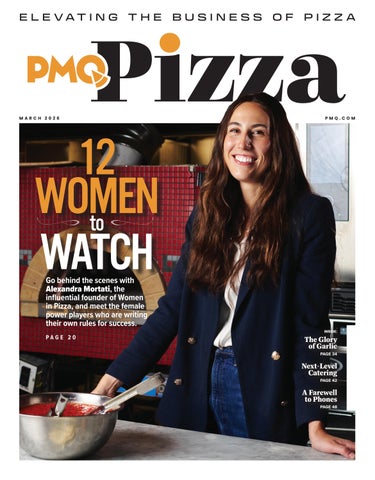
Women in Pizza: 12 Women to Watch
Women in Pizza founder Alexandra Mortati shares the story behind the game-changing movement, then turns the spotlight on female operators who keep raising the stakes.
BY ALEXANDRA MORTATI

SHARE YOUR STORY WITH THE PIZZA COMMUNITY
PMQ Pizza’s best pizzeria profiles often come directly from subscribers to our free e-newsletter, Pizza Pulse. So if you want to get your story told, sign up at PMQ.com/Pizza-Pulse to get our attention! Behind every print issue is a growing digital universe, and Pizza Pulse is the gateway. Print can only hold so much, but we can go bigger online: deep-dive profiles, videos, podcasts, social posts, webinars, reader surveys and more. Here’s a look at the latest:

10 Pizzeria Videos That Made Us Laugh (Or Just Feel Good)
Who’s the Kim Kardashian of pizza? The Pizza Princess of Twitch? Pizzeria owners, chefs, managers, servers, cooks, even busboys, are showing off their creativity and comedic chops on social media. Check out some of our favorites!
Read (and watch) at PMQ.com/best-pizzeria-videos
Aniello’s Pizza: An Old-School Shop With Modern Sensibilities
Founded by Salvatore Scotto in 1985, Aniello’s fires up New York-style pizza in East Haven, Connecticut—and that won’t change, even as the red-hot New Haven style keeps spreading. But Scotto’s son, Tony, is leaning into technology and modernization in other ways.

How a $19,000 Bet Led to a $21-Million Pizza Brand
Subscribe to Pizza Pulse for free at PMQ.com/pizza-pulse!
When Wayne Ulrey purchased a small pizzeria in West Jefferson, Ohio, for $19,000, the seller secretly expected him to fail—and planned to buy it back for a song. Fifty years later, Flyers Pizza & Subs has grown to 10 locations. Here’s how it happened.
Read it at PMQ.com/flyers-pizza


Why Crust N Fire Is Set for Massive Growth
After opening their first Crust N Fire in Mount Laurel, New Jersey, the Taccardis focused on regional domination: All five stores sit within about a six-mile radius. Now they’re looking for franchisees and say “anybody who’s willing to train with us” can replicate their success.
Want to Get PMQ’s Attention? Try this!
Create a Reel on Instagram, tag @pmqpizzamag and tell us why we should feature your pizzeria.
Read it at PMQ.com/crust-n-fire
Read it at PMQ.com/aniellos-pizza


MEETING A SPECIAL NEED
AFTER GRADUATING FROM HIGH SCHOOL two years ago, Grace Baker couldn’t wait to prove herself in the working world. But her job prospects were bleak: She was born with Down Syndrome, and employers wouldn’t give her a chance. Fortunately, her parents, Josh and Amy Baker, knew what Grace—and others with special needs—are capable of. So, in partnership with veteran operator Ron Burner, former owner of Nicolosi’s Italian Restaurant, they created a job for her. They founded Pizzabilities in Alpine, California, last August. It’s a fast-casual concept that’s tailor-made for workers of all abilities. And its success—a second location opened just three months
later in Santee, California—has been remarkable. The Bakers are privy to one of the best-kept secrets in the business: People with special needs are go-getters, and they’re excited to show up to work every day. And when you hire them, community decision-makers will line up to support you. Pizzabilities has landed school lunch programs with multiple local districts as well as catering deals with San Diego State athletics. “I want to show this idea off and tell people there are a lot of advantages to it,” Josh Baker says. “It’s not just a feel-good story. There’s a lot of business smarts to it.”
THINKING LOCALLY
Emmy Squared started as a local Brooklyn joint, but with a growing national footprint, is there a way to recapture the magic of a hometown shop? This promotion is a pretty good start: The brand rolled out a collection of market-inspired pizzas created and named by the local teams who run its restaurants every day. The initiative “gives the local teams a chance to create something directly for the communities in which they operate,” said director of culinary operations Kevin Stoeffler. “The recipes were created by team members who live, work and cook in the neighborhoods where they are being offered.” In Nashville, Louisville and Birmingham, The Sweet Melissa brings together grass-fed beef, American cheese, Sammy Sauce, greens, pickles and whiskey bacon jam. In Philadelphia, a pie called Min, Don’t Be a Jerk is topped with jerk chicken, red onion, bell peppers, miso green ranch and green onions. Miami has The Miracle Mile Pie, stacking black forest ham, mojo pork, yellow mustard, cilantro and pickles. Back in New York, the Thyme Squared was created by regional director Topher Bertone-Ledford, who drew inspiration from a rich steak-and-onion Christmas dinner finished with fresh thyme. That pizza pairs steak, Gouda, caramelized onions, parsley pesto and thyme, balancing smoky and savory flavors.


MODERNIZING LISA’S
Midway through last year, Hannah O’Hara woke up with severe vision loss in one eye. Tests revealed multiple sclerosis—lesions on her brain and spine—just months after she and business partner Dean Rein had poured their savings into buying Lisa’s Pizza, a 66-year-old neighborhood staple in Milwaukee. “It was terrifying,” O’Hara said. “But I decided I couldn’t let it stop me.” That mindset mirrors how the duo runs Lisa’s. When they purchased the shop in January 2024, the bones were strong—tasty recipes, loyal customers, deep roots—but the systems were dated. No POS. No online ordering. No delivery integration. O’Hara, with a background in manufacturing and process improvement, started modernizing everything. The upgrades paid off. In under two years, sales have nearly doubled. Lisa’s expanded from five to seven days a week, added lunch service, and grew staff from about 10 to 30. Third-party delivery, used strategically as a buffer during slower periods, now accounts for about 11% of sales. Since adding Detroit-style pizza, they’re exploring what’s next—from weekend breakfast to a second kitchen. And, for O’Hara, it beats working in a factory hands-down.

PAULIE GEE’S RICOTTA
BE KIDDING
ME
Ingredients
• 8-oz. pizza dough ball
• 3½ oz. Galbani® Fresh Mozzarella
• 2½ oz. sweet Italian fennel sausage
• 7 slices Canadian bacon
• ½ tbsp. fresh basil
• 0.05 g olive oil
• 2½ oz. Galbani® Ricotta
Directions
1. Stretch pizza dough to make a 12” pie.
2. Place mozzarella and sausage evenly over dough. Then arrange 6 slices of Canadian bacon in a circle and place 1 in the center of the pie.
3. Apply basil evenly, shiny side up, and drizzle olive oil over basil. Then bake pizza in oven until thoroughly cooked.
4. Remove pizza from oven and slice between Canadian bacon pieces.
5. Spoon 3 dollops of ricotta on top of each slice (2 near the edge, 1 near the center), serve, and enjoy!
This recipe’s no joke. By Derrick Tung
About the Pizza
What happens when the legendary Paulie Gee mentors someone like Derrick Tung? Pure magic—in pizza form, that is! After meeting years ago, their relationship quickly blossomed into a friendship. Soon after, Derrick opened his own Paulie Gee’s, bringing Brooklyn’s popular pizzeria to the Windy City. And he still pays homage to his friend by serving the classic pizzas Paulie Gee’s is known for, just like the Ricotta Be Kidding Me. Inspired by Paulie’s favorite calzone, this pie features sweet Italian sausage, Canadian bacon, and Galbani Ricotta and Fresh Mozzarella. It’s a combination of flavors that will tickle anyone’s taste buds.

Find
Ispirazione Italiana
What's my Italian Inspiration? It’s creating specials that are truly special. Our team members are constantly bringing new ideas to the table. So, we introduce pizzas every quarter that showcase our innovative thinking and unique flavors. That includes our “cheesavore” specials that focus on celebrating the cheese. We trust the Galbani® brand to help us create pizzas our customers crave.
Derrick Tung, Owner, Paulie Gee’s Chicago
Learn more at GalbaniPro.com


TWO GOALS THAT WILL MOVE THE NEEDLE IN 2026
Michael LaMarca explains why a ruthless menu review and a real employee handbook can set up your pizzeria for a stronger year.
BY MICHAEL P. LaMARCA
AS YOUR NEW YEAR’S RESOLUTIONS START TO FADE away and feel more unattainable—like my goals of starting an exercise routine and putting more vegetables on my pizza—your focus should be on two important goals for your business. Accomplishing these goals could make 2026 a winning year and create a strong foundation to grow your business.
Keep in mind that it’s important to plan out your goals and give yourself a realistic timetable to accomplish them. Break down your overall objective into a few smaller steps to make continual progress and keep moving forward. It’s impossible to get everything done in one day, but having real deadlines and giving yourself enough time to work on your goals will give you the best odds of achieving them.
Goal 1: Analyze Your Menu in Depth
The first goal should be to start each year with an analysis of your menu. What’s been moving the most and selling the least over the last six or 12 months? You should take your bottom sellers off your menu. For example, evaluate your specialty pizzas and individual toppings and decide what you should not carry anymore. Replace those bottom sellers with a new specialty pizza and bring in some new toppings.
Using numbers and real data will open your eyes to your menu’s true winners and losers. It’s easy to hang on to every menu item because they’re your creations and you’re emotionally attached to them. But listen to your customers: If they’re not buying it, don’t sell it. This is a great time for new creativity!
It’s also important go over your menu and make sure images, prices and overall look are cohesive and up to date. Go through each item and/or recipe on your menu and make sure your costs of goods sold (COGS) are still in line. You should monitor your COGS regularly throughout the year, but the beginning and midpoint of the year are especially great times to dig deeper into them.
During this step, it’s crucial to nail down the exact weight of each ingredient and the amount of any disposables or packaging that goes into each menu item. Every ounce of every ingredient needs to be accounted for and measured correctly. For example, if you buy cheese for $2.50 a pound and you put six ounces of cheese on your pizza, your COGS for the cheese alone would be $0.94.
Follow the same procedure with your pizza sauce, dough and all of your toppings. Include the cost of the pizza box, box liner, gloves and anything else you send out the door with the pizza. Add up the total of each item and divide it by the menu price to get COGS percentage. Total COGS of 30% and lower is an acceptable percentage for most business models in pizza.
The first goal should be to start each year with an analysis of your menu. What’s been moving the most and selling the least over the last six or 12 months?
Goal 2: Strengthen (or Create) Your Employee Handbook
Your second goal should be to either update or create your employee handbook. This should be your guide for handling every situation—with specifics—that might come up in your restaurant. If you don’t already have a handbook, a great way to start one is to write out and distribute one new policy each week. At the end of the year, you’ll have 52 new and established policies. Rome wasn’t built in one day, and your business doesn’t need to be, either.
Usually, federal, state and local governments come out with new laws, policies and/or regulations for a new year. This gives you a great opportunity to go over your entire handbook while you’re making these updates. You need to stay on top of these policies. Keeping up with new government regulations could be a full-time job. Getting

involved with your state restaurant association is a great way to save time and resources.
Comb through each section of your handbook and determine whether each policy still makes sense or needs to be updated. That being said, you don’t know what you don’t know. Everyday experiences will provide content for your handbook. The more situations, dilemmas, confrontations, accidents and issues you encounter, the more you’ll see that you need an answer for everything. It’s impossible to think of everything that needs to be in your handbook, so look at it as a living, breathing document that should be updated as needed.
The difference between having a great idea and a great plan is that ideas are in your head and plans are written out on paper. Have a plan and stick to it. You’ll see results in your business if you plan out and work on these two goals each year. That habit will create more goals and plans. The stronger you build your restaurant’s foundation, the further you can launch.
Michael LaMarca is a veteran pizzeria owner/operator and owner/CEO of Master Pizza Franchise Group in Cleveland. To engage with him directly, follow him at @michaelplamarca on Instagram and Facebook.
The Explosive Trend With Roots in Pizza
From a local pizzeria to the fastest growing pizza topping.
By now, most pizzerias have heard of—or are serving—hot honey. But what some might not know is that the national trend started in a Brooklyn pizzeria. The “swicy” pizza topping took seven years of development, starting in 2003 with a nod to Brazilian chiliinfused honey. From inspiration to overnight hit, it is taking the pizza scene by storm. Now, 16 years later, Mike’s Hot Honey (MHH) has proved to be the starting point for a sweetheat movement that has expanded into beer, ice cream, sandwiches, and more—always with an eye on its roots in pizza.
Independent pizzerias serve as a reminder that curating flavor in pizza is a constantly evolving art. MHH proved its appeal early on at Paulie Gee’s in Brooklyn in 2010, where Mike was working at the time. Paulie Gee, like many pizzaioli, knew Mike had landed on a hit flavor combination the moment he tasted it and began serving small batches of MHH on the Hellboy pie with hot soppressata. Today, Mike’s Hot Honey is the fastest-growing pizza topping, up 406 percent in 2025, according to Datassential.
Mike’s Hot Honey has never forgotten its beginnings in independent pizzerias, and Mike continues to instill the value of strong relationships with its flagship customers. “Our team and our passion for our customers are a big part of our success,” says Frank Speranza, national sales manager for Mike’s Hot Honey. “We care deeply about all our customers, whether they’re independents or national accounts, and we focus on each one with the same level of appreciation and passion.”
That passion is backed by consumer interest, which helps explain the steady stream of successful LTOs with both major brands and independents over the past few years. The Dunkin’ x Mike’s Hot Honey Bacon Breakfast Sandwich was met with widespread excitement, while permanent menu additions have followed at national brands like Casey’s.
Beyond flavor, Mike’s Hot Honey has become a cultural phenomenon, earning a distinct “cool factor.” Customers recognize the bright neon signage hanging in local spots and can even play an old-school arcade game called Slice Hunter, a nod to the 1980s slice-shop era, courtesy of Mike’s Hot Honey.

Some trends flare up and fade. Others become cultural moments before reaching ubiquity. That’s the path Mike’s Hot Honey is on. “We have lofty pizza ambitions, and we hope that in five years, Mike’s Hot Honey will be everywhere pizza is available,” says Michelle Lane, vice president of foodservice sales.
For independent operators, Mike’s Hot Honey is proof that one thoughtful flavor decision can change the trajectory of a menu. What began as a small batch addition in a Brooklyn pizzeria became a nationwide staple without losing its connection to the shops that helped build it. In a category driven by creativity and craft, MHH reinforces an enduring truth: independents don’t just follow trends—they create them.
Learn how to become a part of Mike’s Hot Honey journey at mikeshothoney.com/pages/foodservice.


2026
WOMEN in PIZZA � �
BY RICK HYNUM
Meet guest editor Alexandra Mortati, founder of Women in Pizza, and 12 female operators who are claiming their place in a community that needs them more than ever.
ALEXANDRA MORTATI, FOUNDER OF WOMEN IN PIZZA, started out as a girl in pizza—at 13, she was bussing tables at a Neapolitan shop and filing paperwork for her family’s food importing business, Orlando Foods. But after going to work full-time at Orlando Foods in 2019, she rarely saw women properly represented at industry events or in publications (like PMQ Pizza)—at least not as the leaders and innovators that they truly are. And that just didn’t make sense.

“It feels less like women are asking for permission and more like they’re claiming their place —and that shift has been really encouraging to watch.”
Alexandra Mortati

HOW TO JOIN, SUPPORT OR SPONSOR WOMEN IN PIZZA:
• Follow on Instagram at Instagram.com/womeninpizza
• Register as a member at WomeninPizza.com
• For more info, email Alexandra Mortati at azie@womeninpizza.com
Today, Mortati—known to her friends as Azie—leads a movement that has caught fire globally and elevated the entire pizza community. The nonprofit’s mission is stated forthrightly on its Instagram page: “We Empower Women in Pizza and Open Doors for Their Future.” Mortati inspired PMQ’s annual 10 Women to Watch report, which launched in 2024, and has served as its guest editor each year. She prefers to stay behind the scenes, interviewing female operators, chefs and managers for the Women in Pizza website and Instagram articles and letting them speak for themselves. But the woman who has helped so many other women find their voices deserves to be heard, too. Here’s what she has to say:
PMQ: Was there a specific moment that made you realize Women in Pizza needed to exist?
Mortati: There wasn’t one single “aha” moment, but there was a very clear realization early on. When I started at Orlando Foods, it was right after the Pizza Expo, where Orlando Foods…hosted a “Women in Pizza Power Hour,” creating a dedicated space for women to make pizza, connect and build relationships. I remember asking [Orlando Foods owners] Fred and Carlo [Mortati], “Why is this something that only exists for an hour at a trade show? You clearly see the need to make space for and celebrate women in this industry.” Their response was immediate and honest: “We’d love to do more, but we don’t have the time or resources right now. If this is something you’re passionate about, we’ll back you 100%.” At the same time, I was meeting women who were absolutely integral to their businesses—owners, operators, leaders—yet often weren’t the public faces of [those businesses]. I had grown up watching women like Giorgia Caporuscio, but I was now seeing how many other remarkable women were doing extraordinary work without the same visibility or recognition. When you don’t see yourself represented, it’s hard to imagine yourself succeeding, even when you know you belong. I realized I knew—and kept meeting—so many women whose stories deserved to be told, and that’s what pushed me to say, “OK, this needs to exist, and I’m going to do something about it now.”
PMQ: What’s something that women in the pizza community still feel pressure to prove that men usually don’t?
Mortati: I think we still feel a constant pressure to prove our credibility in ways men rarely have to think about. There’s often an unspoken expectation to be exceptional just to be seen as competent— to know more, work harder or justify your presence before your voice carries the same weight. Whether it’s being taken seriously in technical conversations, being assumed to be “the face” rather than the operator, or having leadership questioned in subtle ways, women are often navigating layers of validation that men simply don’t have to. It’s not always overt, but it’s persistent. And while that pressure can build resilience, it also highlights why representation and visibility matter so much—because the more women are seen in these roles, the less we’re asked to prove we belong there at all.
“When you don’t see yourself represented , it’s hard to imagine yourself succeeding , even when you know you belong .”
Alexandra Mortati
PMQ: How would you describe the progress that women are making these days?
Mortati: I think the progress has been real and visible, even if there’s still work to be done. Women are taking up more space, stepping into leadership roles, opening their own businesses and being recognized for their expertise—not just their presence. That includes more women holding influential positions at the companies that service and support the pizza industry, shaping decisions, driving innovation, and helping move the entire industry forward. There’s a growing confidence and sense of ownership that feels very different than it did even a few years ago.
What’s also changed is the conversation. There’s more awareness, more allyship, and more intentional effort to make the industry welcoming and inclusive. Women are supporting one another more openly, sharing knowledge, and advocating for each other in ways that create real momentum. It feels less like women are asking for permission and more like they’re claiming their place— and that shift has been really encouraging to watch.
PMQ: What kinds of stories do you hope we’ll be telling five or 10 years from now that we’re not quite ready to tell yet?
Mortati: I hope we’re telling stories where being a woman in pizza is no longer the headline; it’s simply part of the story. I’d love for the focus to be on innovation, leadership, creativity and impact, without gender being the qualifier or the surprise. I also hope we’re telling more stories about longevity and sustainability— women who have built businesses that last, who have grown teams, passed on knowledge and shaped the next generation. Stories where balance, boundaries and wellbeing are part of success, not something achieved at the expense of it.
Most of all, I hope we’re telling stories that reflect how normal it has become to see women competing, leading, mentoring and being visible at every level of the industry. When those stories feel ordinary rather than noteworthy, that’s when we’ll know real progress has been made. I see Women in Pizza as the conduit to helping expand these horizons and making this a future reality.
PMQ: For a woman who’s just entering the pizza business, what do you want her to know?
Mortati: I want her to know that she belongs here—fully and without question. You don’t need to wait until you feel “ready.” You don’t need to look or sound like anyone else, and you don’t need permission to take up space. Your perspective, your voice and your passion are valuable exactly as they are.
I’d want her to walk in understanding that there is room for her in this community and that she doesn’t have to do it alone. That she has support from all sides. This industry is built on relationships, generosity and shared knowledge, and there are so many people— especially other women—who want to see her succeed. Trust yourself, stay curious, and know that the pizza community is better because you’re in it.
Read an expanded version of this story at PMQ.com/Alexandra-Mortati.


Candy Yiu
Owner, The Turning Peel, Portland, OR
Growing up in a large family with little money in Hong Kong, Candy Yiu dreamed of exploring the world. “We would joke that we were the frog in the well,” she says. “But we always dreamed of jumping out of it.” Yiu leapt all the way across the Pacific Ocean—to Portland, Oregon. She worked for 13 years as a systems engineer for Intel, jetted around the planet to meet with fellow computer scientists, and invented patented technologies far too complex for a PMQ article.
Then she invented The Turning Wheel. It’s a veritable garden of Eden, resplendent with hanging plants and flowers—and pies that rival them in beauty. “We want to be a really romantic place for people to go for a date night but not have to spend $100,” Yiu says. “We feel like that’s a lot for many people. We want to create a place that’s affordable for everyone.”
Her weekly specials include the Fall Pie, with a pumpkin puree base and thinly sliced pumpkin. “Once you slice it really thin and roast it, it gives you a crunchy texture. We add Italian sausage, sage and fresh mozzarella, and then garnish it with aged Parm and extra-virgin olive oil. It’s really delicious.” For her popular
BY ALEXANDRA MORTATI
WOMEN WATCH IN 2026 to 12

Pepperoni Jalapeño Hot Honey, she uses pepperoni with “a really smoky flavor, which, with the jalapeños and hot honey, is also delicious. We use hardly any sugar. Most ingredients just have salt and pepper to allow you to taste the ingredients. When you eat a Margherita pizza, you taste the basil, tomatoes and cheese. When we make our soup, people always ask what the secret is. There is no secret! [It’s] tomato, garlic and onion. Not even water or stock…I try to make every ingredient shine.”
Every New Year’s Eve, Yiu and her family write down their wishes for the next year on slips of paper and place them in a jar. Her wish for 2025 was to employ a staff of five people. She ended up with nine. But another Turning Peel location isn’t on her list. “I don’t think my heart can split that way,” she says. “I don’t know how to control quality, so I’d rather not do that. I don’t want the pizza to be anything that isn’t what my customers came for.”
Read an expanded version of this story at PMQ.com/Candy-Yiu.


IP Phone Service
Increase revenue and lower cost
• No Busy Signals
• Call Recording
• Call Queuing / Auto Answering
• Multiple (random) start of call upsell messages
• On hold music/message loops
• Detailed reports—hold times, lost calls etc
• Callerid delivered to POS system
• Auto attendants— ”If you have arrived for curbside pickup press one ”


Cellular Backup Internet
Protect against outages
• When your Internet fails our cellular backup router keeps your phones, credit card processing and web orders all working.
• The backup kicks in automatically in seconds. So quickly you will not even drop calls in progress when your primary Internet goes down!
• The same router can be used to create chain wide virtual private network to connect your locations.
• SD WAN LTE/LTE A (4G/5G) modems.


On the PBX
“Press one to receive a text message with links to our onlne ordering ”.
SMS Marketing
Manage bulk text message marketing from our system to drive increased revenue. As low as $0.01 per message. Group text messaging to communicate with your employees (drivers, bartenders, all staff etc).
Donna Baldwin
Co-Owner, Truly Pizza, Dana Point and Laguna Beach, California
Donna Baldwin is a spiritual person, just like her former mentor and current business partner, John Arena. They co-founded Truly Pizza in Dana Point, California, in 2023 and opened a second location in Laguna Beach last year. But “full steam ahead” isn’t necessarily their motto, she notes. “When we have a hurdle to cross, sometimes we say, ‘Let’s just sit still and see what happens.’” In other words: Breathe. Watch. Listen.
As a high schooler, Baldwin worked for Arena at Metro Pizza in Las Vegas. After a stint as the VIP service manager for The Mirage, consulting for boutique hotels became her bread and butter. But she’d left a slice of her heart at Metro Pizza. She remained friends with Arena and attended pizza industry events. When they partnered up on Truly Pizza with Chris Decker and Mike Vakneen, they made sure to build a harmonious team with shared values and goals. Not to mention a pizza that’s “light and airy,” she says. “We’re doing something different with our fermentation process. Chris likes to say our squares ‘look like a brick and feel like a feather.’ It’s very digestible, which was superimportant to me.”

Baldwin’s advice to others: “Go for it. Don’t let fear stop you. If you have the right partners who have respect for one another and enough capital, you should reach for the stars. You know in your gut if people are good, so surround yourself with good people.” And, she adds, “Everything should be done with love in mind.”
Read an expanded version of this story at PMQ.com/Donna-Baldwin.


Emily Kwak and Christina Cord
Owners, Pizzeria Coco, Washington, D.C., Maryland and Virginia
Back in late 2023, Emily Kwak was vacationing in Korea when she got word that she’d been laid off from her tech job. As a self-taught pizza maker, she already wanted to dive into the pizza business. The email from her employer gave her the push she needed. Then a whisper from the spirit world made it feel exactly right. “Standing there,” she recalls, “a gust of wind hit me, and I knew that was my ancestors telling me everything would be OK and not to worry.”
Her friend, Cord, never doubted Kwak’s culinary talents. “Emily was making pizza that I knew people would pay for, but she didn’t believe me,” Cord recalls. “I recruited people to taste-test and give her feedback to prove it to her.” The next step was formal training; Houston pizzaiola Nicole Bean took care of that, and within months, Pizzeria Coco, a mobile catering business, was roaming the DMV.
Kwak looks to chefs like Ann Kim and Sarah Minnick for inspiration. “What made me fall in love with pizza was getting to be really creative with the topping choices,” she says. “I’m Korean-American, so when I saw Ann Kim put kimchi on pizza, I knew I wanted to as well.” That’s how the Seoul Street Pizza became one of Pizzeria Coco’s most cravable pies.
Kwak and Cord believe in seizing every opportunity “before it moves on to someone else,” as Kwak notes. Cord adds, “People think you need to have everything perfect before you start. You don’t! You should change and improve things as you go. Everyone started somewhere, and the people you look up to worked hard for years to get where they are. Emily and I always remind ourselves of that.”
Read an expanded version of this story at PMQ.com/Pizzeria-Coco.


Crystal Scherer
Owner, The Pizza Box 509, Kennewick, WA
With entrepreneurial vision, initiative and a go-getter attitude, Crystal Scherer (alongside her husband, Mark) leaped into the pizza business after spending decades in completely different industries. Whether refining dough techniques or social media strategies, teaching her young children the ropes or wrestling with local permits, Scherer proves that resilience, perseverance and determination are keys to success, no matter where or when you start.
As The Pizza Box 509 moved from a self-built trailer to a fullblown food truck, it found its home as the sole pizza concept at a local year-round food-truck food court called Summer’s Hub. The couple quickly built a reputation for their artisanal yet simple approach, plus family-style hospitality and a willingness to experiment. “I never imagined myself in this business,” Scherer admits. “Once we got our trailer and I was making pizza for customers, I told my husband, ‘Now, I’m part of the pizza community.’”

woman in pizza, she doesn’t always get the credit she’s due. “When we talk to people, they always address my husband,” she says. “I could have been the one to make the pizza, and they will go and compliment him.”
Fortunately, working with her best friends—Mark and her two kids, 12 and four, who have already taken a liking to the pizza biz—keeps Scherer grounded. That’s a must as she juggles everything from parenting and social media marketing to AI-assisted forecasting. And, as a
Regardless of the many struggles she’s faced, Scherer’s advice for others is to go for it. “Things are always going to happen,” she says. “Life is never going to go the way you want it to go. It’s just a matter of continuing to move towards your goal. It isn’t going to be easy, but it will be worth it.”
Read an expanded version of this story at PMQ.com/Crystal-Scherer.

Angelina DiMaggio
Owner, DiMaggio’s Pizza, Fairfield and Flora, IL
Overseeing her family’s second pizzeria location and continuing a 50-plus-year legacy while contending with mental health challenges like OCD and anxiety would be impressive for any woman in pizza. But Angelina DiMaggio is doing it all at the age of 19—while knowing that she has big shoes to fill. “I always compare myself to my dad or my grandpa—they know so much about the business,” she says. But then she reminds herself of her father’s wisdom: “He said it takes time and is a learning process, and that’s something I have to remind myself of daily. I’m still learning, but they are, too.”
In addition to a maturity beyond her years, DiMaggio carries a lifetime of experience at the pizzeria—starting at 12 years old with cleanup and becoming sole dough maker by 18. “As women, we are detail-oriented, so I’m thankful I can bring that,” she says. “Nothing was ever handed to me. I had to work for it, which has really built a strong work ethic in me.”
Still, DiMaggio is transparent about her unique mental health struggles and the personal growth she fosters by simply continuing to show up and challenge herself. “As a person with OCD, everything bothers me—even the smallest thing,” she explains. “[I can] put it all on myself. I had to get out of that negative rut. Everyone plays a part, so just be the best you can be every day, and that will show. You have to start somewhere, and it’s OK for it to be messy.”
Read an expanded version of the story at PMQ.com/Angelina-DiMaggio.
Aimée McElroy
Owner, CatBird, Asbury Park, NJ
Bread baking was Aimée McElroy’s entrée into the culinary world, including gigs at Il Buco Alimentari in New York City and Porta in Asbury Park. Her stint at the latter honed her pizza making skills, and she went on to open Medusa Stone Fired, also in Asbury Park, in 2016. Around the same time that Medusa had to close in 2022— the landlord declined to renew their lease—McElroy was diagnosed with breast cancer, leading to a double mastectomy. Closing Medusa was “heartbreaking,” she reflects, but her travails “helped me see all the things I wanted to focus on. It was a forced time-out….If I can’t stand in front of a pizza oven, what am I going to do?”
Today, she’s standing in front of the same oven at CatBird and firing up the “greatest hits” from Medusa and new items, too. And she doesn’t appreciate being underestimated because of her gender. “I’m not just [doing] the food end of it,” McElroy says. “I’m on the contractor end. I’m building it, painting it, putting the lights in.” She hires as many women as she can—and mentors them, too. “For me, it’s all about sharing and giving someone the tools to be better than me. That’s what my mentors have done for me: They have lifted me up and [said], ‘You can be whatever you want and be great.’”
McElroy’s best advice: “Get out of your head. I was 41 when I started this [career], and I had a lot of people tell me I couldn’t do it. It’s like the fire—you can’t put me out. My passion burns bright.”
Read an expanded version of this story at PMQ.com/Aimee-McElroy.

Amanda Senft
Owner, Leonardi’s Pizza, North Palm Beach, FL
“Leap, and the net will appear” is a phrase that Amanda Senft has embodied in her path to pizzeria ownership. With a background in marketing and event production, plus a natural eye for detail, this creative, grounded and capable leader poured intention into building every last facet of Leonardi’s, a New York-style slice shop, from the ground up. Senft has shaped the business behind the scenes—from branding and buildout to operations and customer experience—while her partner, Kris Leonardi, a former firefighter, labored for years to develop the couple’s perfect pizza recipe.
Senft blends tenacity and audacity with a beginner’s mind, showing a willingness to take risks and learn every day along the way. Her ability to balance behind-the-scenes logistics with creative flair have helped turn this apartmentbased pizza project into a thriving neighborhood slice shop. Sharing their story on Instagram (now grown to nearly 30,000 followers) helped, too—and whether online or through chatting with customers inside the pizzeria, the couple has struck a chord with locals since its 2025 opening. Senft proves that you don’t need a culinary background to create a winning concept—you just need heart, hustle and a clear sense of purpose. “Sometimes, you don’t want to overthink, and you have to close your eyes and take the leap,” Senft says. “Do it now. Don’t wait. Don’t question yourself. I think we, as people, and we as women specifically, are constantly (whether conscious of it or not) questioning if we belong in a certain space, and what our role in that space should be. Don’t question it—you are exactly where you need to be. Don’t question your role and who you are. You know who you are. Keep pushing yourself and growing into that person.”

Rebecca Scaramuzzino

Read an expanded version of this story at PMQ.com/Amanda-Senft.
Assistant general manager, Tony’s Pizza Napoletana, San Francisco, CA
Working in the pizza industry from her teen years, Rebecca Scaramuzzino is hands-on, self-taught and deeply committed to the craft, constantly pushing herself and those around her to grow. After noting the difference in job duties between men and women at her first pizza job—where she stayed for two decades—she took it upon herself to mentor young women, give them more opportunities, and lead by example, including for her young daughter.
Since entering Tony Gemignani’s San Franciscobased business empire, Scaramuzzino has joined the pizza competition circuit, earning attention for her creative pies and always pushing herself to place higher. Meanwhile, she juggles multiple roles at work. “I oversee the whole operation: the kitchen, back of house and


front of house,” she says. “It’s hard to balance all of it—there’s always something to do. I’m very happy doing what I’m doing, and I get to dabble in everything. I get to travel and network and do cool events and festivals….It’s such a blessing to embrace doing what I love.”
For Scaramuzzino, passion and persistence are key ingredients in the secret sauce of success. “My passion led me to where I am today,” she says. “It took me far beyond what I ever imagined. You have to do it 110%. Not halfway. With your whole heart….With my background, I had to be selftaught. If I wanted something, I was going to teach myself how to do it. You have to take initiative on your own. Why do I need someone to show me when I can figure it out? How you learn is how you grow.”
Read an expanded version of this story at PMQ.com/Rebecca-Scaramuzzino.

Pénélope Lachapelle and Lucie Nadeau
Owners, Nina Pizza Napolitaine and Nina Saint-JeanBaptiste, Québec City, Québec
Guided by a generous heap of moxie, liberal dashes of intuition, and a mission that reaches far beyond personal gain, Pénélope Lachapelle and Lucie Nadeau have carved out a two-location empire from scratch. They’ve also uplifted other women—and their entire community— along the way.
The pair, who met while working at the same restaurant in Québec City, learned the art of Neapolitan pizza in New York City from master pizzaiolo Roberto Caporuscio—then opened their doors to long lines and incredible demand back home in Canada. As the pizzaioli tapped into resources from crowdsourced capital to social media marketing, word quickly spread that they were changing the game for female-led operations. A second location, helmed by female employees who showed promise, cemented the partners’ local pizza legacy, while their movement, United Against Intolerance, ensures that their legacy reaches far beyond pizza. “For Pénélope and me, running this business is like a family,” Nadeau says. “It’s our place—our little world.”
Fortunately, being women in pizza worked in their favor, earning them priceless media attention.
“Restaurants are all boys’ clubs, so it was pretty singular that two women like Lucie and I would open one,” Lachapelle says. “A few others have opened them, but it’s not the norm. Women owners like us, with two pizzerias, are pretty rare.
“We’re so complementary,” Lachapelle adds. “We never really argue about anything, because we’re always on the same page. Each of us has skills and ideas, so we can develop anything….We knew that people were doubting us, but because we had each other, we could overcome the doubt.”
Read an expanded version of this story at PMQ.com/Nina-Pizza.

Jess Oberlin
Owner, Hope’s New York-Inspired Pizza, Eindhoven, Netherlands


Facing—and beating—colon cancer proved to be a revitalizing experience for Jess Oberlin. She was burnt out as a freelancer in the entertainment/culture space. Just checking email made her “panicky,” she says. Then, she discovered American pizzaiolo Frank Pinello’s segments on Munchies, a YouTube channel covering the global food scene. And it dawned on her: “If I could choose to do one thing every day for the rest of my life, it would be pizza.” Once she had a clean bill of health, she set out to make that happen, studying under Jenny Olbrich, owner of The Esters in Brooklyn, New York, then launching a pop-up operation for events back in Eindhoven.
There was just one problem: She wasn’t ready to invest in her own oven “since I was so set on opening a brick and mortar” and needed to save money. “I decided to use whatever oven was already there,” Oberlin says. But some ovens weren’t right for her type of pizza. After one event that didn’t go well, she ended up with 50 leftover doughs that had cold-risen for four days. “So I baked and froze them and reheated them at the next pop-up. I then pivoted to fully prebaking, freezing and vacuum-sealing my pizzas.”
That approach, she adds, “has become the most exciting part of the business.” In her formula, she mixes a portion of pâte fermentée (older dough) into a batch of fresh dough and cold-ferments the final dough for 72 to 100 hours. The result is deeper flavor and improved texture. “People think it’s going to be super heavy and a doughy mess, but it’s light and airy. Sometimes they eat two!”
Now Oberlin is perfecting her system “so that my pizza can live in freezers at bars, restaurants, hotels and, eventually, across borders,” she says. “The goal is to make it possible for people anywhere to experience my pizza…and to prove that scaling doesn’t mean cutting corners when it comes to craft.”
Read an expanded version of this story at PMQ.com/Jess-Oberlin.


The Gloryof Garlic
Explore the variety of prep techniques, menu applications and cross-utilization possibilities for a humble yet flavor-packed pizzeria staple: garlic.
BY TRACY MORIN G
ARLIC—WHAT WOULD WE DO WITHOUT IT? Raw or cooked, its taste can upgrade a dish from blah to bursting with flavor. Its unmistakable aroma can turn a house (or a pizzeria) into a home. And its versatility is rightly praised by chefs around the globe. With so many possibilities (and a few potential pitfalls), it’s important to learn how to maximize these mighty bulbs—both as a pizza topping and as an ingredient to incorporate across your menu.

Brush Up On Basics: Prep and Usage
Small but potent, garlic is a wonder in the kitchen, with myriad possible prep techniques—each offering its own flavor flair. “Garlic is such a versatile ingredient,” says Hayley Satler, director of menu innovation at Donatos Pizza, headquartered in Columbus, Ohio, with 179 traditional locations and 460 locations total. “Use it freshly grated or chopped in something like a salad dressing, and it comes across as garlicky and a little spicy. Roasting brings out the natural sweetness that’s so delicious you can just smear it on a slice of bread. Pickle it, and you add a sharp but slightly toned-down garlic note to anything in that brine. Age and ferment it, and it turns to black garlic, which gives you a complex umami flavor and a beautiful black color.”
Fouad Qreitem, CEO of Paisano’s, with 40 locations across Virginia, Maryland and Washington, D.C., has found numerous advantages of using garlic as a pizza topping. “It adds a deep aroma and savory flavor that elevates even simple pizzas, and it’s extremely versatile—raw, cooked and roasted,” he says. “It’s also an inexpensive ingredient with high perceived value, and it pairs well with cheeses and meats.”
On the other hand, adding garlic without the proper prep or recipe can also backfire. “There’s a reason that almost every recipe video you see on social media, when it comes to garlic, says, ‘Here is a starting point, but measure with your heart,’” Satler says. “Possible disadvantages are that it can overpower other flavors. When developing menu items with garlic, it’s all about finding the right balance with the other ingredients and using the form of garlic that best fits your application.

“Garlic-based pizzas often start as a white pizza or with an olive oil base, then are layered with roasted garlic, mozzarella and complementary toppings. Customers tend to respond very positively.”
Fouad Qreitem, Paisano’s
There are also some people who are allergic to garlic.”
Qreitem adds that garlic, especially in raw form, requires care when cooking. “Avoid placing raw garlic directly on top of a pizza without fat protection [such as cheese on top]; it burns quickly in high-heat ovens,” he warns. “It can become bitter or harsh if burned. And you can always pair garlic with fat to soften its intensity.”
Qreitem has found multiple ways to use this prized ingredient to delicious effect. His garlic go-tos include:
• Roasted: best for sweetness and depth; spreads easily and won’t burn
• Sautéed: soft, mellow and rich; excellent for white pizzas
• Fresh chopped: use sparingly; best added under cheese or post-bake
• Garlic oil or garlic butter: offers an even flavor distribution without harshness


At Donatos Pizza, roasted is the predominant garlic preparation. And it’s easy to make, Satler says: Simply cut off the top of the bulb and roast in an oven with oil. “This is a great option if you want to be able to easily squeeze out the roasted bulbs and mix them into a sauce, garlic butter, etc.,” she notes. “The other option, while technically not roasted but still providing a similar end result, is confit. Separate the cloves from the bulb and cook them in some type of fat. This builds that rich flavor with a hint of sweetness but leaves the cloves whole.”
Advanced Degrees: Combos and Cross-Utilization
For combining with toppings on a pizza (or in other dishes), garlic complements a long list of ingredients. Here are some of Qreitem’s favorites:
• Cheeses: mozzarella, ricotta, provolone, Parmesan
• Vegetables: mushrooms, spinach, caramelized onions
• Proteins: pepperoni, sausage, chicken, anchovies
• Herbs: rosemary, thyme, basil, oregano
• Sauces: white sauce, olive oil base, tomato sauce
“Garlic pairs well with almost any ingredient you might put on a pizza—it’s just about finding the right balance of flavors,” Satler says. “I once had a black garlic caramel sauce on a dessert that was amazing. Garlic added just enough umami to the sweetness of the caramel for a surprisingly perfect pairing. That probably won’t show up on a Donatos menu anytime soon, but never say never!”
For now, Donatos Pizza highlights its roasted garlic on the Chicken Spinach Mozzarella specialty pie, a longtime fan favorite. “It offers a lighter eating experience, with an olive oil base instead of our traditional red sauce—this allows the smoked provolone, mozzarella and Romano
cheeses to be the base of the pizza,” Satler explains. “Topped with fresh spinach, Roma tomatoes, grilled chicken and, of course, roasted garlic, it hits all of the flavor notes. The toppings meld together perfectly.”
Paisano’s has also served oven-baked garlic on a pizza—one with a sweet-and-savory spin, thanks to a hot honey drizzle for delicious depth of flavor. And Qreitem notes that there are many more ways to infuse a pizza with garlicky goodness: garlic-infused oil brushed onto the dough before baking; blending roasted garlic into white sauce or ricotta; and finishing pizzas with garlic butter or garlic oil post-bake.
“Garlic-based pizzas often start as a white pizza or with an olive oil base, then are layered with roasted garlic, mozzarella and complementary toppings,” Qreitem says. “Customers tend to respond very positively, because garlic delivers big flavor without needing heavy sauces. Plus, garlic is a familiar flavor with endless variations— customizable for both simple and upscale menus.”
Indeed, cross-utilization is easy with garlic. In addition to its garlic knots, Paisano’s uses garlic pre- and postbake on its Homemade Cheesy Breadsticks; in its Marinara and Alfredo sauces; and sautéed for pasta dishes. “This approach minimizes waste and reinforces a cohesive flavor identity,” Qreitem says.
“Separate the cloves from the bulb and cook them in some type of fat. This builds that rich flavor with a hint of sweetness but leaves the cloves whole.”
Hayley Satler, Donatos Pizza


Donatos also jazzes up its sides with roasted garlic. “On our Asiago Cheese Garlic Bread, the garlic takes a front seat and shines, while the cheese becomes the supporting character,” Satler says. “We also have a delicious garlic Parmesan sauce for wings (traditional and boneless). We’re always looking for new ways to incorporate the different flavors of garlic in our menu.”
Fortunately, when it comes to garlic, even simple combos can be winners. “Our Paulie’s Pizza is the perfect combination—just garlic with extra cheese and pepperoni—and it’s one of our best sellers,” Qreitem notes. “Used thoughtfully, garlic is a versatile, costeffective ingredient, making it a smart staple for any pizza operation.”
Tracy Morin is PMQ’s associate editor.
Shrimp & Garlic Pizza
Courtesy of Blaine Parker
Blaine Parker, chief creative officer and minister of pizza ops at FreeThePizza.com, is a devoted fan of garlic on pizza. “One of my signature pies is a New York-style cheese pizza topped with shrimp and fresh garlic, then a fresh cilantro garnish,” Parker says. “It’s a flavor bomb. Every time I serve it, someone loses their mind—in the best way possible. I’ve seen diners’ eyes roll back in their heads on several occasions.”
Parker’s cooking tips for this simple but flavorpacked pie: Since they’re 80% water, raw shrimp can make a swampy mess—par-cook them beforehand. And feel free to experiment with add-ons. “Raise the bar on this pizza even further with the addition of sliced alligator sausage,” Parker suggests. “Bacon and/ or sliced serrano chilis also work nicely. And, for the cilantro-averse, you can use fresh Italian parsley or chopped scallions instead.”
INGREDIENTS
• 400g/14-oz. dough ball (for a 14” neo-Neapolitan or New York-style pizza)
• 170g/6 oz. (41-60) medium shrimp
• 6 cloves fresh garlic, finely chopped
• 170g/6 oz. low-moisture mozzarella, shredded
• 30g/1 oz. Pecorino Romano, finely shredded
• 2/3 c. New York-style tomato sauce
• Olive oil for drizzling
“One of my signature pies is a New York-style cheese pizza topped with shrimp and fresh garlic, then a fresh cilantro garnish….Every time I serve it, someone loses their mind—in the best way possible.”
Blaine Parker, FreeThePizza.com

• Fresh cilantro for garnish (or Italian parsley or chopped scallions)
• Tony Chachere’s Creole Seasoning to taste
DIRECTIONS
Peel and devein the shrimp, remove the tails, and sprinkle the shrimp with Tony Chachere’s Creole Seasoning. Par-sauté them, cooking until they’re just beginning to curl, then cool them on a paper towel. Stretch the dough and top with the sauce and cheeses. Distribute the par-cooked shrimp evenly around the pizza. Sprinkle garlic evenly over the pie. Add a light drizzle of olive oil on the pizza. Bake in a 600°-700°F oven for 4-6 minutes or until done—with an acceptable degree of char, but without overcooking the shrimp. Remove the pizza and place on a cooling rack. Garnish with fresh cilantro (or parsley or scallions), slice and serve.

Nominate your brand or submit any nominations at PMQ.com/brands TODAY! Deadline for nominations: April 1
Every year, PMQ Pizza spotlights independent and multiunit pizza brands with an inspirational success story to share. Criteria include:
• Innovative marketing and impactful storytelling
• Strong corporate culture and values
• Proven dedication to the local community (or communities)
• Unique concept and/or specialty menu items
• High-resolution photos (minimum 300 dpi) are a huge plus!
Is your pizza business making an impact on your community and the pizza community as a whole? Tell us about it at PMQ.com/brands, and let’s keep lifting each other up!
THE Party LINE
Three experts share their top tips for pizzerias that want to boost revenue—and wow customers—with their catering services.
BY TRACY MORIN
AS A PIZZERIA OWNER, YOU ALREADY KNOW the joy of helping people make lasting memories. But are you tapping into this superpower by maximizing your catering business? Whether you leverage in-store space to host parties or orchestrate foodservice for outside events, catering can provide a steady revenue stream, even when in-store traffic slows. But it must be done right. Here, three industry experts share how to make catering a cash cow for your pizzeria while wowing customers with your service.


PMQ: How can catering provide a revenue stream to supplement restaurant foot traffic, even during tougher economic times?
Brasch: Catering shifts the revenue model from relying on individual check averages to guaranteed, pre-sold volume. The profit margins from a single catering order can equal dozens of dine-in tickets, with far more predictable labor and food costs. Catering also helps restaurants maximize off-peak hours, smooth out weekly sales fluctuations and extend the reach of the brand beyond the four walls.
Miller: While restaurants often feel seasonal dips, people celebrate yearround—birthdays, baby and bridal showers, graduations, corporate meetings, mitzvahs and more. Catering tends to experience fewer extreme slow periods, making it a strong complement to restaurant operations. Once you get into a rhythm, you’re able to look ahead and plan for seasons. There are so many different niches that you can explore, market to and cultivate business toward. And your storefront is a great opportunity for those potential customers to basically sample your business—it’s a great place to market and make those connections for catering.


Perez: Catering leverages existing kitchens, menus and teams, creating incremental revenue without the overhead of adding new locations. Catering also opens doors to customers who may not visit our physical locations regularly. When we cater an office party, we introduce our brand to dozens or even hundreds of potential new customers.
PMQ: How do you create catering packages that are priced for both profit and value? What kind of packages should you offer?
Brasch: The key is to design packages around operational efficiency, guest preferences and wide popularity, and perceived value—not just food cost. Focus on items that travel well, require minimal customization and can be produced in batches without disrupting regular service.
“The profit margins from a single catering order can equal dozens of dine-in tickets, with far more predictable labor and food costs.”
Elizabeth Brasch, Mellow Mushroom


Perez: For us, profitable catering starts with simplicity and scale. We focus on bundles built around our core products, including pizza, wings, salads and beverages, which already perform well operationally and deliver strong margins. Rather than relying on heavy discounting, we emphasize clear value through smart portioning and clearly defined bundles. When guests can easily understand what feeds 15, 30 or more people, it simplifies the decision without compromising profitability. Packages that are easy to order, simple to execute and flexible perform best.
PMQ: How do you attract new catering clients, then parlay one event into repeat business?
“Catering, especially at a high level, involves far more variables and requires the ability to pivot quickly.”
Jillana Miller, Miller Butler
Tray formats for appetizers, sandwiches, salads and desserts for large crowds are often preferable and easy to serve buffet-style at any event.
Offer packages in a tiered format, which starts with more streamlined, budget-friendly items, and level up to more premium add-ons, like protein additions or specialty items. Most successful programs offer at least several core package types, catering to celebratory events or in-office meetings.
Miller: Our pizza and salad station option is the base of everything, for a per-person price. Then, from there, customers can add on charcuterie, a grazing table, crudités, a pasta station, hors d’oeuvres, or a beverage station with iced tea and lemonade. The price can jump from $25 per person to maybe $60, $70 per person and beyond for bigger events. It’s about making it accessible and providing options.
Brasch: Catering must be easy to find on the website, clearly priced and simple to order without requiring more than 30 hours advance notice. Many guests don’t even realize their favorite restaurant offers catering unless it’s prominently promoted on their owned-channel platforms, as well as widely utilized third-party platforms, like ezCater.
We see strong results when catering is marketed directly to offices, schools and community organizations, not just guests. Partnerships with local businesses, event planners and venues are powerful referral sources. Most successful catering programs are led by an in-house catering manager and require full-time diligence and follow-up in regards to execution and client servicing.
Strong packaging is often critical to the program’s success and providing a “wow” catering experience. In professional and event-based environments, esthetics are especially key. Delivering with polished, clean, branded professional packaging that is easy to set up, coupled with great product, is a major win and a program differentiator.
Finally, ensure a flawless experience: On-time delivery, order accuracy, clear labeling and great presentation all build trust and repeat visits with catering guests. After the event, restaurants should follow up with a thank-you, a feedback request and a small incentive for future orders.
Miller: Each event, no matter how big or small, is its own thing, so zoom in on that project. Make sure you really build a relationship with the client and that all of their

“Every catering order is an opportunity to build a relationship. We follow up with loyalty enrollment, a thankyou message or an incentive for a future order.”
Genaro Perez, Peter Piper Pizza
needs are met—offer a full experience. We want each client to feel special and taken care of, and part of that is communicating it to the staff and getting everyone on the same page, knowing what our standard is. People talk about our ease of booking, so I think that’s a really important component as well.
Perez: While digital ordering is important, many catering decisions still happen at the community level. That’s why we focus on local marketing, building strong relationships with schools, businesses and community organizations. At the same time, we make catering easy to find and order through our digital channels.
The experience doesn’t end when the food is delivered. Every catering order is an opportunity to build a relationship. We follow up with loyalty enrollment, a thank-you message or an incentive for a future order. When the food arrives on time and satisfies the group, it builds trust.
PMQ: How do you leverage technology to maximize your catering operations?
Brasch: It is critical that the order experience, including the online ordering experience, of catering is topnotch—seamless and efficient. Technology tools should be in place, whether owned-channel or third-party, to
communicate with the customer when an order is placed and confirmed, and when the order is on its way and set to be delivered. Consistency in communication is key, especially when orders are so often being placed for timely professional events. Restaurants should also invest in a CRM program to maintain guest relations and follow-up.
PMQ: What other behind-the-scenes logistics provide a seamless service for customers and assist staff members?
Brasch: Successful catering execution relies on clear back-of-house operations and systems, including timely order flow, inventory management and standardized prep lists, proper staffing levels, excellence in training and presentation skills, and guest communication. A catering lead or manager in the restaurant is critical to ensure key personnel are in place to ensure success. Incentivize staff properly to grow the program’s sales and create positive guest experiences.
Miller: My father, a successful chef and caterer, used to say, “Push the panic button early.” In restaurants, there’s a level of predictability—you know the kitchen, the menu has been executed countless times, and guests come to you. Catering, especially at a high level, involves far more variables and requires the ability to pivot quickly. The goal becomes foreseeing potential hazards and minimizing how many pivots are actually necessary.
For me, “pushing the panic button early” really means pushing hard early with prep work: tight pack lists, detailed prep and mentally walking through the event ahead of time. Some potential stress points are unique to a location or event, and some are universal. The idea is to solve as much as possible before arrival.
Tracy Morin is PMQ’s associate editor.

IF YOU’VE EVER WORKED A PIZZA LINE DURING A FRIDAYNIGHT RUSH, you know the soundtrack: tickets printing like machine-gun fire, ovens roaring like a jet engine…and the phone ringing nonstop. Now imagine Craig Allenbaugh and Deserai Satullo, owners of Sauced Wood Fired Pizza & Catering, standing in that chaos and calmly thinking, “What if we just…didn’t do phone orders anymore?”
That’s right. They pulled out all the phones at their shop in Fairview Park, Ohio, and they did it for the most relatable reason: labor problems. “Not only were we short staffed,” Allenbaugh says, “but we were scheduling an employee just to answer the phone.” And in 2026, paying someone to play human voicemail is like hiring someone whose entire job is to rewind VHS tapes.
The Great Phone Breakup
The move wasn’t about being trendy or trying to force customers into the digital age against their will. It was

The Phone Was the Problem
It started with short staffing and ended with fewer order errors. Nobody misses the nonstop ringing at Sauced Wood Fired Pizza
BY BRIAN HERNANDEZ
&
Catering.
simple survival math. If one person’s entire shift is phone duty, that’s one less person stretching dough, topping pies, running ovens or carrying out other essential tasks. So here’s how it works now at Sauced: When customers call the shop, they get an automated message politely directing them to the website, or they can just walk in and order the old-fashioned way…with their mouth and words. Crazy, I know.
And the wild part? Customers barely flinched. “The first week in, we honestly didn’t even notice a change,” Satullo says. “Only a few missed phone calls, then we noticed those same people placing the orders online.” Sure, a few walk-ins complained about not wanting to order online. That was expected. Every major cultural shift comes with at least one person yelling, “I don’t trust this!” But overall? “No major changes in our weekly sales,” Satullo says. Allenbaugh and Satullo say the biggest benefit is obvious: They no longer need to staff someone just to answer the phone. And when they run tighter


andard in
and in piz za kitchens worldwide. Our new mini dough boxes are half the size of our standard dough boxes for smaller kitchens and cramped workspac es with unmatched s trength and durabilit

trength & durabilit y that outlas ts plas tic
Optimal dough protec tion and safe s torage deal for s toring, proofing, and c Won’t bend, dent or sag


crews, everything flows better. “Things tend to run more smoothly when we have less people on a shift,” Allenbaugh notes.
Even better: Online ordering reduces mistakes. “The customer is ordering online…so we are seeing less employee-generated mistakes in the ordering process,” Allenbaugh adds. In other words, if someone accidentally orders a pineapple-and-anchovy monstrosity now, it’s not on the staff. The customer has to accept they did that to themselves. That’s personal growth.
Fewer worries at the workplace also ensure that Allenbaugh and Satullo can get away for an adventure or two. For example, they headed off to Rimini, Italy, in late January to compete alongside fellow USPT members at SIGEP World, one of the biggest foodservice expos on the planet. They competed in the Pizza Senza Frontiere— World Pizza Champion Games, organized by Ristorazione Italiana Magazine and hosted inside SIGEP World’s Pizza Arena. It draws pizza pros from 30-plus countries across a ton of categories—everything from classic styles to modern creativity (including dessert pizza), all judged by a panel of industry experts. In other words, this wasn’t a casual trip to take selfies with the Trevi Fountain. This is high-level, international pizza combat.
Fortunately, they had the support and fellowship of eight USPT teammates, including team captain Tore Trupiano and his son, Damiano Trupiano (Mangia e Bevi, Oceanside, California); culinary coach Vitangelo Recchia (Bella Napoli Pizzeria & Restaurant, Port Charlotte, Florida); former team captain Michael LaMarca (Master Pizza, Mayfield Village, Ohio); Sean Dempsey (Dempsey’s Brewery Pub & Restaurant, Watertown, South Dakota); George and Patti Taylor (Taylors’ Pizza House, Endwell, New York); and Giovanni Labbate (Tievoli Pizza Bar, Palatine, Illinois).
For Satullo and Allenbaugh, the event turned out to be well worth their time, both as a learning experience and a personal triumph for Satullo; she took fourth place in the

Pizza Fritta category—an impressive showing for a firsttime competitor. “Overall, it was a good experience,” she said. “However, we were a little unprepared, with some unexpected challenges. No refrigeration, no provided utensils, no ice, but we made it work!
“This competition was way different than any other one we’ve done, from the way you need to pack to the way you’re judged and scored. What we learned and will know moving forward: Definitely over-prepare so you have all the things needed to compete. Do the research into where you’re going so you know what may and may not be available to you. Everywhere you go to compete is different. Never go in with the same expectations.”
Brian Hernandez is PMQ’s associate editor and director of the U.S. Pizza Team.


Pizza Senza Frontiere at SIGEP WORLD in Rimini, Italy, drew hundreds of elite competitors from around the globe across 17 categories, and PMQ’s U.S. Pizza Team proudly represented American-made pizza with championship-level results. From dessert gold to pairing podiums and top-tier finishes, our members proved that American pizza talent belongs on the world stage. We’re incredibly proud of this team for competing with skill, heart, and camaraderie in the birthplace of pizza. A huge thank-you to our generous sponsors and partners who help fuel the USPT mission and make these international opportunities possible.
USPT RIMINI PLACERS
• Sean Dempsey, Dempsey's Brewery Pub & Restaurant — 1st Dessert | 7th Mystery Box | Top-10 Pizza & Wine
• Giovanni Labbate, Tievoli Pizza Bar — 3rd Pizza & Beer Pairing
• Deserai Satullo, Sauced Wood-Fired Pizza & Catering — 4th Pizza Fritta
• Tore Trupiano, Mangia e Bevi — 7th Classica | Top-10 Gluten Free
• Vitangelo Recchia, Bella Napoli Pizzeria & Restaurant — 8th Pizza in Pala
• George Taylor, Taylors' Pizza House — Top-10 Pizza & Wine
For more information about the USPT's performance at the Pizza Senze Frontieres event visit: www.uspizzateam.com/carrots-take-the-cake-in-rimini/
more info, visit www.USPizzaTeam.com.


Grand Apizza
(Clockwise from top left) Fred Nuzzo, owner of Grand Apizza, poses with his brother, Nick Nuzzo, in 1970; the Nuzzo family (Michael Sr., Fred and Michael Jr.) show off a pie; Michael and Migdalia Nuzzo work at the shop in 1992; the Grand Apizza family includes Michael Jr., Migdalia, Mateo, Michael Sr., Daniella, Brittany, Marianne, Christopher and Luis; the Nuzzos (Michael, Rick, Rosemarie, Fred, Marianne and Dave) celebrate 40 years in 1995.

BY TRACY MORIN


After serving as a fighter pilot in World War II, Fred Nuzzo learned the pizza craft for seven years alongside his brother, Nick, at Modern Apizza in New Haven, Connecticut. In 1955, he struck out on his own, opening Grand Apizza. “My mother and father were scared to death when they opened up, because they were taking a big chance,” says Nick Nuzzo, son of Fred and current owner. “As soon as they opened the doors, by word-of-mouth, it took off.”
After 50 years in New Haven, the family sold their spot to employees and set their sights on Connecticut’s shoreline. Nick had opened his first location in Madison in 1993, moved it to Clinton in 2000, then in 2014 reopened a second location in downtown Madison. In 2015, a third outpost followed, in Guilford. Today, Nuzzo is relocating the Clinton location once more, renovating a historic bank building to accommodate a full bar and a dining mezzanine, scheduled to open in the fall.
With multiple locations, Grand Apizza requires a family effort. Nick’s oldest son, Michael; daughter, Brittany; wife, Migdalia; and youngest son, Christopher, all pitch in, while his sister, Marianne, runs the Guilford store with her husband, Luis. “Every day, there’s always a family member in each place,” Nick says. “That’s the way I like it. You can’t be
an absentee owner in this business. You have to be hands-on. It’s a big sacrifice.”
Still, operations stay simple and old-school, with a basic menu focused on apizza and a philosophy that trades advertising budget for community contributions that help out schools, sports teams, local police and firefighters. “We’ve added new things here and there, but we’ve had the same menu for 70 years, and it works,” Nick says. “I stick to my expertise, and we do just fine. My father said, ‘If it’s not broke, don’t fix it.’”
The formula works for customers new and old, some of whom have been visiting for decades. “People come into my restaurant, in their late 70s and 80s, who used to go to my dad’s when they lived in New Haven,” Nick says. “It’s amazing—they’re so loyal, and they say it’s part of their home. It’s part of their tradition. I love that they call my restaurant their home.”
Tracy Morin is PMQ’s associate editor.


