ALSO INSIDE: DESIGN WORLD ENGINEERING DIVERSITY + INCLUSION ISSUE www.medicaldesignandoutsourcing.com OCTOBER 2026
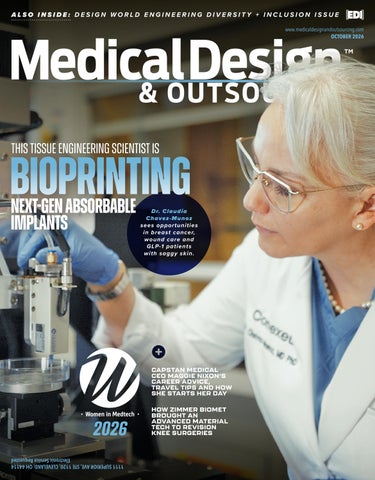
This tissue engineering scientist is
Dr. Claudia Chavez-Munoz sees opportunities in breast cancer, wound care and GLP-1 patients with saggy skin.
CAPSTAN MEDICAL CEO MAGGIE NIXON’S CAREER ADVICE, TRAVEL TIPS AND HOW SHE STARTS HER DAY
2026
HOW ZIMMER BIOMET BROUGHT AN ADVANCED MATERIAL TECH TO REVISION KNEE SURGERIES
1111 SUPERIOR AVE, STE 1120, CLEVELAND, OH 44114 Electronic Service Requested Cover_WIMT_OCT26_Vs2.indd 1
10/8/26 12:17 AM
Your Full- Service Development & Biocompatibilit y Partner. ISO 9001 | ISO 13485 | ISO/IEC 17025:2017
Located in Erie, PA, our business model enables us to support your product through its entire lifecycle. As sister companies, PSN Labs and PSN Manufacturing work hand-in-hand. PSN Labs leads the discovery and development phases of a project through their end-to-end engineering services, while PSN Manufacturing handles prototyping, tool fabrication, and full-scale production. This seamless partnership eliminates the hassle of managing multiple vendors and reduces the risks often associated with design and knowledge transfer as a project moves from development to manufacturing.
Engineering Services
Product Development
Testing Services
Biocompatibility & Toxicology
Production & Material Processing
Biocompatibility testing is often done late in development, which contrasts with the FDA's recent guidance urging a more stringent approach to biological risk evaluation. To comply with ISO 10993 and other standards, manufacturers shouldintegrate testing earlier in the process through Design for Biocompatibility (DFB) to ensure regulatory compliance. At PSN Labs, our DFB strategy includes early-stage decisions about material selection, manufacturing, and device construction. This ensures patient safety, simplifies regulatory compliance, and helps prevent delays or recalls.
PSNlabs.com 5368 Kuhl Rd, Erie, PA 16510 814-464-0790 | info@psnlabs.com
PSN Labs 10-26.indd 1
PSNmanufacturing.com 5650 Wattsburg Rd, Erie, PA 16509 814-464-0790 | info@psnmfg.com
10/8/26 12:28 AM
A TRUSTED PARTNER TO AMPLIFY YOUR INNOVATION
From components and finished devices to the next generation of medical technologies, now more than ever, you can count on us.
ELE CT RO PH YSI OL OG Y
ION T A L
DU
O OM
UR
NE
Neuro Leads
Electrophysiology Catheters
Aspiration & Thrombectomy Devices
Medical cal Textiles les
Em Embolization Devices
Delivery Systems
STRUCTURAL HEART
NEUROVASCULAR
Implantable Pulse Generator Systems
Guiding Sheaths
Cardiac Leads
Introducers Guidewires
CO R & V ON A AS RY, CU PE LA RIP R A HE CC RA ESS L
Batteries & Capacitors
HM YT NT H R E IAC GEM D R A CA MAN
Strengthen your innovation with our rapid prototyping and clinical know-how to take you seamlessly from concept to production Get to market faster by utilizing our platform technologies and market-ready products that provide differentiated performance and portfolio expansion Extend your reach through our global R&D and manufacturing capabilities to consistently achieve design requirements, quality standards, and on-time delivery
Integer 10-26.indd 1
Integer.net | 833.722.3657
Products pictured © 2026 Greatbatch Ltd. and its affiliates.
10/8/26 12:21 AM
PARTNERSHIP THAT POWERS POSSIBILITIES The experts in design, development, and scalable manufacturing of interventional catheter-based devices and implants.
NITINOL COMPONENTS NITINOL TUBING FILMCAST PTFE
Your trusted partner for bringing current and future medical devices to market Learn more about our offerings at www.confluentmedical.com or email sales@confluentmedical.com for a custom quote.
Confluent 10-26.indd 1
POLYMER TUBING CATHETER COMPONENTS BALLON CATHETERS BIOMEDICAL TEXTILES
10/8/26 12:19 AM
October 2026 • Vol.12 No.6 • medicaldesignandoutsourcing.com
WATCH EDITORIAL
CREATIVE SERVICES
PRODUCTION SERVICES
Editor in Chief Chris Newmarker cnewmarker@arrowfly.com
VP, Creative Director Matthew Claney mclaney@arrowfly.com
Customer Service Manager Stephanie Hulett shulett@arrowfly.com
Managing Editor Jim Hammerand jhammerand@arrowfly.com
Art Director Allison Washko awashko@arrowfly.com
Customer Service Rep Tracy Powers tpowers@arrowfly.com
Senior Editor Conor Hale chale@arrowfly.com
DIGITAL MARKETING
Customer Service Rep JoAnn Martin jmartin@arrowfly.com
Associate Editor Skyler Rivera srivera@arrowfly.com Associate Editor Julia Rock-Torcivia jrocktorcivia@arrowfly.com Managing Editor DeviceTalks Kayleen Brown kbrown@arrowfly.com
VP, Marketing Annie Wissner awissner@arrowfly.com Portfolio Marketing Manager McKenzie Burns mburns@arrowfly.com
LEADERSHIP TEAM CEO Matt Logan mlogan@arrowfly.com SVP, Sales and Strategy Amanda Buehner abuehner@arrowfly.com
2011 - 2020, 2024 - 2025
2014 - 2016
Customer Service Rep Renee Massey-Linston renee@arrowfly.com Customer Service Rep Trinidy Longgood tlonggood@arrowfly.com
TUESDAYS
2013 - 2017, 2021
AUDIENCE DEVELOPMENT Director, Audience Growth Rick Ellis rellis@arrowfly.com
DeviceTalks Tuesdays is a weekly virtual event that brings the insights and energy of our in-person events to your desktop.
SALES Ashley Burk 737.615.8452 aburk@arrowfly.com
Melissa Roberts 440.666.3111 mroberts@arrowfly.com
Brian Toole 267.290.2386 btoole@arrowfly.com
Heather Herbert 512.760.0570 hherbert@arrowfly.com
Colleen Sepich 857.260.1360 csepich@arrowfly.com
Amy Vodraska 862.274.1348 avodraska@arrowfly.com
2014 Winner
2024
Each DeviceTalks Tuesday will kick off with a quick briefing from the editors of MassDevice and Medical Design and Outsourcing. These presentations will give attendees insights on what trends will be moving medtech in the days to come. Be sure to check back frequently as new live events continue to be added.
MEDICAL DESIGN & OUTSOURCING does not pass judgment on subjects of controversy nor enter into disputes with or between any individuals or organizations.
1111 Superior Avenue, Suite 1120 Cleveland, OH 44114 Ph: 888.543.2447 Fax: 888.543.2447
MEDICAL DESIGN & OUTSOURCING is also an independent forum for the expression of opinions relevant to industry issues. Letters to the editor and by-lined articles express the views of the author and not necessarily of the publisher or publication. Every effort is made to provide accurate information. However, the publisher assumes no responsibility for accuracy of submitted advertising and editorial information. Noncommissioned articles and news releases cannot be acknowledged. Unsolicited materials cannot be returned nor will this organization assume responsibility for their care. MEDICAL DESIGN & OUTSOURCING does not endorse any products, programs, or services of advertisers or editorial contributors. Copyright©2026 by Arrowfly. No part of this publication may be reproduced in any form or by any means, electronic or mechanical, or by recording, or by any information storage or retrieval systems, without written permission from the publisher. SUBSCRIPTION RATES: Free and controlled circulation to qualified subscribers. Non-qualified persons may subscribe at the following rates: U.S. and possessions, 1 year: $125; 2 years: $200; 3 years $275; Canadian and foreign, 1 year: $195; only U.S. funds are accepted. Single copies $15. Subscriptions are prepaid by check or money orders only. SUBSCRIBER SERVICES: To order a subscription or change your address, please visit our web site at www.medicaldesignandoutsourcing.com/ subscribe-medical-design-outsourcing/
www.medicaldesignandoutsourcing.com
Staff page_MDO_10-26_Vs2.indd 3
10 • 2026
Medical Design & Outsourcing
wtwh.me/DTtuesdays
3
10/9/26 12:56 AM
WOMEN IN MEDTECH | ENGINEERING DIVERSITY + INCLUSION | CONTENTS
HERE’S WHAT WE SEE:.........................................6
INSIGHTS:............................................................40
Artificial Intelligence..............................................8
Are we progressing or backsliding on diversity and inclusion? .................................41 Dr. Lois Frankel
Now’s the time to take risks
AI is moving inside the device. Who owns the clinical risk?
Coatings...............................................................10
5 questions to ask when selecting hydrophilic coatings
Imaging ...............................................................13
Researchers experiment with rare-earth element for enhanced medical imaging
DEI may be under attack, but you can still live it
Engineering a more inclusive future ...................44 Kimberly Upton & Amanda Lucas
MIT researchers develop miniaturized breast ultrasound wearable
Commentary: What it takes to attract engineers like Brette Mullenaux ....................56 Brette Mullenaux
Noninvasive sepsis SaMD developed at Johns Hopkins offers early warnings
DigiKey - NW MN Chapter of Women in Electronics .......................................... 39
Miniaturization.....................................................14 Patient Monitoring...............................................16 Pediatrics.............................................................17 Cleared for every child, covered for none, priced for the parents who can pay
ALSO INSIDE: DESIGN WORLD ENGINEERING DIVERSITY + INCLUSION ISSUE www.medicaldesignandoutsourcing.com OCTOBER 2026
Software..............................................................18 Designing SaMD for safety and rethinking risk management through system architecture
WWW.DESIGNWORLDONLINE.COM
DeviceTalks..........................................................20
Dr. Claudia Chavez-Munoz sees opportunities in breast cancer, wound care and GLP-1 patients with saggy skin.
PG. 6
Cretex - Dawn Luehrs............................................. 36 Integer - Jacqueline Cullen..................................... 37 Vantedge - Jessica Schladweiler.............................. 38
TOC_OCTOBER2026_Vs2.indd 4
DESIGN WORLD
2026
HOW ZIMMER BIOMET BROUGHT AN ADVANCED MATERIAL TECH TO REVISION KNEE SURGERIES
1111 SUPERIOR AVE, STE 1120, CLEVELAND, OH 44114 Electronic Service Requested
Zimmer Biomet used its proprietary Tivanium alloy to create an alternative for knee patients with sensitivities to certain metals.
|
PG. 41
ON THE COVER: Dr. Claudia ChavezMunoz, Conexeu Sciences
10/7/26 1:58 PM
ON THE COVER: Design World’s Engineering Diversity & Inclusion 2026
ADVERTISER INDEX
How Zimmer Biomet brought an advanced material tech to revision knee surgeries.........31
Medical Design & Outsourcing
Are we progressing or backsliding on diversity and inclusion?
CAPSTAN MEDICAL CEO MAGGIE NIXON’S CAREER ADVICE, TRAVEL TIPS AND HOW SHE STARTS HER DAY
1111 SUPERIOR AVENUE, SUITE 1120, CLEVELAND, OH 44114 ELECTRONIC SERVICE REQUESTED
“If you don’t ask the right question, you’re never going to get the right answer. ... That can be applicable to business and applicable to life.”
Engineering a more inclusive future PG. 44
Final Cover DW EDI 10-26.indd 1
Capstan Medical CEO Maggie Nixon’s career advice, travel tips and how she starts her day...................................27
4
Medical Design & Outsourcing Women in MedTech
Dr. Claudia Chavez-Munoz sees opportunities in breast cancer, wound care and GLP-1 patients with saggy skin.
The three tests that decide whether a cleared device gets used
This tissue engineering scientist is bioprinting next-gen absorbable implants........................22
OCTOBER 2026
ALSO INSIDE:
This tissue engineering scientist is
All Motion ............................................................................6 Confluent Medical Technologies ..........................................2 Cretex Medical ................................................................. BC DigiKey ................................................................................5 Filmecc USA, a subisary of Asahi Intecc USA ....................25 Integer Holdings ..................................................................1 Interpower Corp. ...............................................................35 John Evans Sons, Inc .........................................................34 MICRO Medical Technologies, Inc. ......................................7 New England Wire Technologies .......................................26 Nitto Kohki ........................................................................29 Phillips Medisize .............................................................. IBC PSN Labs ......................................................................... IFC Vantedge ...........................................................................12
10 • 2026
10/9/26 12:43 AM
260825_SAE_DW_DivInEng_US.indd DigiKey - DW EDI 09-26.indd 1 1
8/24/26 2:41 10/7/26 1:00 PM
HERE’S WHAT WE SEE
Now’s the time to take risks.
W
e’re living through a period of unprecedented volatility. Rather than shrink in this moment, it’s an opportunity to take risks to keep the medical device industry growing. Our industry’s most influential women made that point in September at MedtechWOMEN’s annual conference, which I attended after taking a risk of my own. Three years ago, I was working in sports journalism at The Athletic (owned by The New York Times) and Major League Baseball. As a woman, I thought I could challenge the “boys club” and create a welcoming community for young professionals or contribute to innovation that would outlast my career. I wanted to leave a legacy in a way that mattered. But there wasn’t a large enough community of women and allies. In 2023, I took a risk. I quit. I found freelance work, but it wasn’t steady. I took another risk,
enrolling in a science writing master’s program without having any science writing experience. During the program, I landed a technical writing role at Edwards Lifesciences. It was my introduction to the medical device industry, and I’m glad I’m here. I launched myself into uncertainty to pursue a more fulfilling career supported by a welcoming community and because of that risk, I’ve found what I was searching for. This Women in Medtech edition of Medical Design & Outsourcing illustrates how innovators and leaders create a better industry and better outcomes for the patients they serve. The women in this issue took risks and found opportunities in disruption and because of them, medtech will prevail and continue to meet the needs of patients despite increasing volatility. Thanks to them for sharing their stories with us, and thanks to you for your support. Enjoy this edition of Medical Design & Outsourcing.
Skyler Rivera | Associate Editor | Medical Design & Outsourcing | s r i v e r a @ a r ro w fl y. c o m |
6
Editorial_10-26_Vs2JH FINAL.indd 6
Medical Design & Outsourcing
10 • 2026
www.medicaldesignandoutsourcing.com
10/8/26 12:31 AM
Advanced Medical devicE Manufacturing for Every Generation As medical devices have evolved, we have advanced our capabilities to meet your increasingly complex design requirements. Backed by over 80 years of proven manufacturing expertise and a laser focus on minimally invasive surgical instruments, MICRO delivers the highest quality components and complete devices, whether hand-held, rigid, articulating or robot-assisted.
Evolving our capabilities to help your devices excel Our full suite of services – from R&D through prototyping and full-scale production – plus our comprehensive machining, welding and laser capabilities assure that our components help your devices excel.
Contact us today to discuss your next project: sales@micro-co.com MICRO 140 Belmont Drive Somerset, NJ 08873 USA Tel: 732 302 0800 • www.micro-co.com FDA Registered • ISO 13485 • ISO 9001 • ISO 14001 Compliant MSC-3175-R18_MicroPrintAd-2026 Micro 10-26.indd 1 8.5x10.875 compliant.indd 1
10/8/26 9/4/26 10:18 12:22 AM
ARTIFICIAL INTELLIGENCE
AI is moving inside the device. Who owns the clinical risk? Mitigate the risk that medtech teams keep leaving unowned as artificial intelligence moves into Class II and III medical devices.
B
y the time a clinician trusts a wrong output from your artificialintelligence-powered device, every decision that made the trust possible was made years earlier. How many decisions go into a wrong output? Design made a decision. Quality made one. Regulatory made one, too. But none thought they were
B y D r. S a r a h M a t t Vital Werks
In a mechanical device, the clinician makes the clinical call at the bedside. In an Alenabled device, that judgment increasingly happens upstream, inside the model itself. Image courtesy of Dr. Sarah Matt
making an actual clinical call. The decision rooms of product development teams are often completely closed to the clinicians and true users of most of the innovations we create. The risk of the tools providers use everyday are being pushed off the clinician and back onto the AI model. These models are built far upstream where no single function is assigned to own what it actually decides. The question worth answering before clearance is simple: Where does that gap sit, and who closes it? The handoff nobody signs for Mechanical valves and pistons do what they were machined to do. They do the same thing on the first use as the tenthousandth time. A model doesn’t come with that same guarantee. Once a device’s logic stops being fixed and starts being learned, part of the clinical judgment that used to live with the provider moves into the software. A tool that flags a finding or recommends a setting is making a “decision” an actual person used to make alone. With the increasingly massive number of tools, patients, and tasks, those decisions are often deferred to the device without a second thought. Most companies are set up for the basics of piston quality and a “fix-itand-forget-it” mentality. Design will treat the model as a component among many. Quality will treat it as either “documented” or “not.” The regulator will treat it as “cleared” or “not.” Our user — the clinician at the bedside — will assume someone upstream
Design, quality and regulatory, and clinical and commercial each treat the model as someone else’s responsibility. The clinical-risk gap sits unowned in the center. Image courtesy of Dr. Sarah Matt
8
Medical Design & Outsourcing
AI_10-26_Vs4.indd 8
10 • 2026
www.medicaldesignandoutsourcing.com
10/8/26 12:35 AM
Traditional risk files catch visible, repeatable hardware failures. They have no equivalent column for drift, distribution shift, or automation bias. Image courtesy of Dr. Sarah Matt
understood exactly what was shipped. Everyone is partly right, which is exactly how the gap stays invisible. Now what? Name a clinical-risk owner before submission, not after the first field complaint. One person on the org chart needs to be accountable for what the model does to a real patient. An algorithm treated like a part FMEA and hazard analysis are core ways we ensure quality standards are met and kept. But these processes were built for parts like a bracket that cracks or a seal that leaks. The failures are visible and repeatable so the tools handle them well. AI, on the other hand, fails differently. It drifts as real-world data pulls away from the training set. It breaks when the distribution shifts and it meets a population or a care setting it never saw in development. It invites automation bias, where tired clinicians stop questioning it. So while the model can hold its accuracy, it can still lose calibration on the one subgroup that matters most, and nothing in a traditional risk file is built to catch it. Now what? Treat drift, distribution shift and other changes as first-class risks, each with a named detection method and mitigation. Regularly monitor the disaggregated subgroups, not just the overall accuracy. Everyone owns it, so nobody does Let’s walk through the life of a model. First it locks at submission, gets deployed into a hospital, and then drifts in month seven. Nothing looks off until it throws an error in month nine. Now we have a real issue. So who acts, and how fast? Design says the model is “working as designed.” Quality says the complaint is logged. Regulatory says the clearance still stands.
All while the commercial team is getting hammered by customers with hard questions. Each function “owns” it, so nobody does. The patient-facing risk sits between them, essentially unstaffed. The FDA’s predetermined change control plan (PCCP) defines what is allowed to change. But it doesn’t go so far as to name the person who owns the consequences when it does. Everything is crisp at launch, but that can all change during the slow degradation that no one is truly watching. And nobody is really paying attention because “watching” was never written into anyone’s job description. Now what? Assign an owner to each stage of the model’s lifecycle and decide upfront the degradation response well before you ship. Know what signals trigger action, who acts on them, and how fast. A field complaint should meet a wellthought-out plan, not a frantic fire drill.
Vital Werks founder Sarah Matt, MD, MBA, is a surgery-trained physicianexecutive and former Oracle Health VP who advises device and healthtechnology companies on clinical AI governance, commercialization, and adoption. She provides internal medicine charity care and is the author of a national bestseller, “The Borderless Healthcare Revolution.”
Accountability is clear at submission and deployment. By the time drift produces a field signal months later, no function on the org chart claims ownership. Image courtesy of Dr. Sarah Matt
www.medicaldesignandoutsourcing.com
AI_10-26_Vs4.indd 9
Build it in or else None of this seems far-fetched. It’s the discipline device teams already apply to every physical failure mode, extended to the one part of the system that keeps changing after it leaves the building. The teams that decide who answers for the model before they submit will be the most successful. Build that owner in before clearance, or face a public crisis later.
10 • 2026
Medical Design & Outsourcing
9
10/8/26 12:35 AM
COATINGS
Introducer sheath and catheter coating programs must consider clinical use conditions, device geometry, and scale-up requirements early in development. Photo courtesy of Freudenberg Medical
Five questions to ask when selecting hydrophilic coatings De-risk hydrophilic coating selection before you lock in process and regulatory plans with this practical checklist covering feasibility, validation, scale-up and supplier fit.
H
ydrophilic coatings are often selected to solve a straightforward clinical and usability challenge: reduce friction so devices navigate anatomy more smoothly and interacting components move more predictably. But in practice, the risk is rarely in the chemistry alone. It shows up later in feasibility handoffs, validation planning, scale-up, transfers between parties and even in commercial terms that complicate long-term supply and change control. Coating selection works best as program due diligence. These questions are designed to be practical and easy to apply, thereby helping teams evaluate not only whether a coating performs, but whether a partner can support development through commercialization with fewer surprises.
By Katharina Wiemer Freudenberg Medical
10
Medical Design & Outsourcing
Coatings_10-26_Vs3.indd 10
10 • 2026
1. What clinical problem are we solving and where does friction occur? “Lower friction” doesn’t mean just one thing. Navigation through anatomy is different from friction between two device components (e.g., a catheter within an introducer sheath) or between a delivery system and an implant (e.g., an intraocular lens passing through an injector). The clinical context drives what “good” looks like, including hydration conditions, contact surfaces and how the device is handled in the field. What to listen for: A strong partner will start by mapping the clinical workflow into clear, practical requirements: where friction occurs, what surfaces contact what, how and when the device is hydrated and how many passes/exchanges are expected. They should show they understand real-
www.medicaldesignandoutsourcing.com
10/8/26 12:42 AM
world use conditions (fluids, dwell times, handling steps) rather than responding with a generic coefficient of friction or a one-size-fits-all answer. 2. Which performance attributes matter most for this device and how will we define them? Hydrophilic coating performance isn’t one-dimensional. Most teams need to define three attributes together and accept that trade-offs are common: • Lubricity: how effectively friction is reduced when hydrated, and how consistent that is part to part • Durability: whether performance holds through expected handling and procedural steps • Particulates: whether the coating remains intact with minimal shedding during use What to listen for: Look for a partner who helps you translate these priorities into clear, shared requirements based on real use conditions without applying a onesize-fits-all definition. They should also be able to discuss trade-offs plainly and help you decide what comes first. A good prompt is, “If we prioritize maximum lubricity, what’s the plan to protect coating integrity and particulate control?” Priorities typically shift by application. For example, particulates are often highest priority in neurovascular use, while GI devices may weight lubricity/integrity more heavily. The best partners make
those choices explicit early so they don’t become late-stage surprises. 3. What substrates can you support and what needs special handling, including multimaterial devices? Substrate chemistry and construction details matter. A partner should be clear about what’s routinely supported and what requires an early technical review, especially for multi-material products. What to listen for: Clarity and transparency: which polymers/metals are typical, where pretreatment is needed (if any), and how multimaterial assemblies are approached in feasibility and customization programs. 4. How does device geometry affect coating uniformity and processing feasibility? Geometry can be a silent failure mode when it isn’t addressed up front. IDs, lumens, steps, tight radii and other complex features can create real-world constraints that affect coverage and consistency. Those issues may not become visible until later phases (e.g., during simulated use or process scaleup). The wrong “standard” approach can therefore trigger late-stage rework. What to listen for: A strong partner will proactively discuss geometrydependent considerations and whether your device fits a standard pathway or, for the most complex geometries, where tailoring the chemistry and/or process may be needed to achieve the
performance attributes you’ve defined. Prompt them to explain how they ensure uniform coverage on your ID/OD feature set, or how they plan to validate cure completeness for your geometry. 5. What does the manufacturing pathway look like: step count, cycle time, and scale-up practicality? Coating choice is also a manufacturing decision. Multistep chemistries add handling steps and failure opportunities, and the cure method can become a throughput bottleneck. Process complexity directly impacts yield risk and how smoothly you can move from samples to validated production. What to listen for: A clear, production-realistic story of how the coating process runs day-to-day and what changes (if any) are needed to scale, plus an ability to talk candidly about constraints and yield drivers. As you listen, use a few practical prompts to keep the discussion grounded: Is it single-step, or does it require a primer and topcoat? Is the cure UV or thermal and what are the cycle times? Can it run in-line, or is it batch-only? Is full or semi-automation possible? And where do they typically see scrap, and how do they mitigate it?
Go to wtwh.me/coatings for five more questions to ask when selecting hydrophilic coatings.
Katharina Wiemer is the director of product development within Freudenberg Medical’s coatings business. She led the team that developed and commercialized LUBRITEQ, Freudenberg Medical’s advanced single-step hydrophilic coating chemistry, and she leads the global technical teams partnering with hydrophilic coating customers globally. She has 10 years’ experience in the theoretical and practical application of drug and functional coatings for Class II and Class III medical devices.
Sampling of finished devices for dye-based destructive inspection is associated with yield loss of around 3-5%. With modern coatings, fluorescence-enabled optical inspection enables 100% nondestructive, in-line coating evaluation. Photo courtesy of Freudenberg Medical
www.medicaldesignandoutsourcing.com
Coatings_10-26_Vs3.indd 11
10 • 2026
Medical Design & Outsourcing
11
10/8/26 12:42 AM
Vantedge 10-26.indd 1
10/8/26 12:29 AM
IMAGING
Researchers experiment with rare-earth element for enhanced medical imaging The team added light-emitting europium to hydroxyapatite, the primary calcium phosphate mineral in bones and teeth.
A
B y J u l i a R o c k - To r c i v i a Associate Editor
University of California San Diego research team stabilized hydroxyapatite (which makes up human bones) with europium, potentially making the material more useful for medical imaging. By adding europium, which emits light, the researchers could see the material during bioimaging. This could allow scientists to track implants or boneregeneration scaffolds inside the body without surgery. The work was published in the Journal of Solid State Chemistry. The researchers modeled computationally how europium, a rare-earth element that behaves like calcium, fits into hydroxyapatite’s structure. That analysis ran on Expanse, the supercomputer housed at UC San Diego’s Halıcıoğlu School of Data Science and Computing, using time allocated through the National Science Foundation’s ACCESS program. “Density functional theory calculations play a crucial role in understanding the impact of elemental
The incorporation of dopants into the calcium sites of hydroxyapatite introduces atomic defects that endow it with unique luminescent properties for bioimaging applications.
UC San Diego Professor Olivia Graeve
Image courtesy of UC San Diego
www.medicaldesignandoutsourcing.com
Imaging_10-26_Vs1.indd 13
substitution on materials, while allowing for precise control over substitution sites and concentrations,” said Olivia Graeve, who directs UC San Diego’s Program in Materials Science and Engineering and led the research, in a news release. “Our simulations using NSF ACCESS allocations on SDSC’s Expanse showed that hydroxyapatite becomes more structurally stable — meaning its crystal structure is better maintained — when certain hydroxyl groups lose a proton and become oxide ions,” she continued. “That change helps balance europium’s extra charge, making the material more likely to settle into the calcium sites that better support hydroxyapatite’s structure.” Graeve sees the results as a step toward more reliable design of bone-like imaging materials down the line. Lab experiments backed up the simulation results, giving the researchers confidence the model isn’t just theoretical.
10 • 2026
Medical Design & Outsourcing
13
10/9/26 12:59 AM
MINIATURIZATION The miniaturized ultrasound system consists of a small ultrasound probe (left) attached to an acquisition and processing module. Photo courtesy of Conformable Decoders Lab at the MIT Media Lab
MIT researchers develop miniaturized breast ultrasound wearable The system could improve screening accessibility and detect breast cancer earlier.
By Skyler Rivera Associate Editor
M
assachusetts Institute of Technology (MIT) researchers have developed a miniature ultrasound system that could improve the accessibility of breast ultrasounds and enable earlier breast cancer detection. The system consists of a small ultrasound probe attached to an acquisition and processing module that’s slightly bigger than a smartphone and costs around $300 to make.
14
Medical Design & Outsourcing
Miniaturization_10-26_VS3.indd 14
10 • 2026
During a screening, the probe takes 3D images of the tissue and sends it to the motherboard for processing. The system connects to a laptop to reconstruct and view wide-angle 3D images in real time, according to a research study published by the team in Advanced Healthcare Materials. Its small, portable design allows breast ultrasounds to be performed more often in nontraditional settings, like at home or in a doctor’s office.
“Everything is more compact and that can make it easier to be used in rural areas or for people who may have barriers to this kind of technology,” said Canan Dagdeviren, the MIT associate professor of media arts and sciences who was the study’s senior author. Traditionally, ultrasound scans are conducted as a follow-up when a mammogram reveals an area of concern. Ultrasound machines for breast cancer detection are large and
www.medicaldesignandoutsourcing.com
10/9/26 1:00 AM
expensive, and require trained technicians to operate. “You need skilled ultrasound technicians to use those machines, which is a major obstacle to getting ultrasound access to rural communities, or to developing countries where there aren’t as many skilled radiologists,” study coauthor and MIT graduate student Shrihari Viswanath said. Frequent screenings with ultrasound in people who are at high risk for developing breast cancer can help detect malignant tumors early. With this system, Dagdeviren said more tumors could potentially be detected earlier which increases the chances of successful treatment. The system can image as deep as 15 cm into the tissue and image the entire breast from two or three locations, the researchers said. The images aren’t distorted, since the ultrasound device sits on top of the skin without pressing into the tissue like a typical ultrasound probe. “With our technology, you can simply place [the system] gently on top of the tissue and it can visualize the cysts in their original location with their original sizes,” Dagdeviren said. How it works In the new system, MIT researchers developed a novel chirped data acquisition system (cDAQ) that consists of an ultrasound probe and a motherboard. It uses a convolutional optimally distributed array (CODA) geometry to reduce the number of processing elements from 1024 to 128, limiting the system’s complexity without sacrificing accuracy. The probe is smaller than a deck of cards and contains an ultrasound array arranged in the shape of an empty square. That configuration allows the array to take 3D images of the tissue below. The data collected is processed by the motherboard and the images can be viewed by connecting it to a computer. All the electronics used in the motherboard are commercially available. The system uses less power than traditional ultrasound machines, meaning it could be powered by a 5V battery or AC/DC adapter used to plug
in small devices like portable speakers, making the system accessible to almost anyone, everywhere. “Ultrasound imaging has long been confined to hospitals,” said lead author Md Osman Goni Nayeem, a former MIT postdoc. “To move ultrasound beyond the hospital setting, we reengineered the entire architecture, introducing a new ultrasound fabrication process, to make the technology both scalable and practical.” How the concept was initially developed and what’s in its future In 2023, Dagdeviren and her colleagues developed an array of ultrasound transducers incorporated in a flexible patch that can be attached to a bra, allowing the patient to move an ultrasound tracker along the patch and capture images of breast tissue from different angles. The 2D images captured by the patch could be combined to generate a 3D reconstruction of the tissue, the researchers said there could be small gaps in the coverage and small abnormalities might be missed. But the array of transducers had to be connected to a traditional and costly refrigerator-sized processing machine to view the images. In this new study, the researchers developed a fully-portable, modified ultrasound array that could create 3D images of the entire breast by scanning two or three locations. They tested the system on a 71-year-old woman with a history of breast cysts and found it could accurately image the cysts and create a 3D image of the tissue without gaps. The research team is conducting
www.medicaldesignandoutsourcing.com
Miniaturization_10-26_VS3.indd 15
MIT Associate Professor of Media Arts and Sciences Canan Dagdeviren a larger clinical trial at the MIT Center for Clinical and Translational Research and at Massachusetts General Hospital. Dagdeviren is also working on launching a company to commercialize the technology. Since the system could be easily adapted for use in a doctor’s office, the researchers are working on creating a smaller data processing system, about the size of a fingernail, in hopes to enable the system to connect to a smartphone for image visualization. They also plan to develop a smartphone app that would use an AI algorithm to guide patients to the best location to place the ultrasound probe. Eventually, the researchers want to incorporate the technology into a wearable sensor that can be used at home. Dagdeviren and her colleagues’ first wearable ultrasound scanner allowed the patient to move an ultrasound tracker along the patch and capture images of breast tissue from different angles. Photo courtesy of MIT
10 • 2026
Medical Design & Outsourcing
15
10/8/26 1:05 AM
PATIENT MONITORING
Noninvasive sepsis SaMD developed at Johns Hopkins offers early warnings It’s the first FDA-cleared system for continuous AI/machine learning-based sepsis monitoring.
A
By Skyler Rivera Associate Editor
Bayesian Health co-founder and CEO Suchi Saria (left) began working on sepsis technology after her nephew died of sepsis in 2017. Photo courtesy of Johns Hopkins University
16
Medical Design & Outsourcing
PatientMonitoring_10-26_Vs2JH FInal.indd 16
10 • 2026
n early warning system for sepsis developed by Johns Hopkins University researchers has been commercialized by Bayesian Health and cleared by the FDA. The software as a medical device (SaMD) is the first continuous artificial intelligence/machine learning-based sepsis monitoring system to earn FDA clearance. The system detects sepsis hours faster than doctors and has reduced deaths by nearly 20%, according to a research study published in Nature Medicine. “Pre-suspicion screening is what creates lead time, and lead time is what changes outcomes in sepsis. Once a clinician already suspects sepsis, the clock has been running — often for hours or even days,” lead researcher and Bayesian Health co-founder and CEO Suchi Saria said in a news release. “No other cleared test or device monitors for sepsis prior to clinician suspicion.” She and her team designed the Bayesian Health Sepsis Flagging Device to assist clinicians in early sepsis detection and/or risk prediction of a patient developing sepsis within 24 hours by analyzing patient data from electronic health records, according to their FDA 510(k) submission. The system uses a machine learning algorithm to analyze patient data from health records such as comorbidities, chief complaint, lab measurements, vital signs, procedures, medications and consult orders. If the patient is at risk of developing sepsis within 24 hours, it displays a “sepsis risk high” flag in the patient’s electronic health record. The software provides a summary of clinical factors potentially contributing to the patient being flagged for sepsis risk so a healthcare provider can incorporate it into their clinical decision-making. Other FDA-cleared sepsis technologies require a clinician to suspect sepsis first before using biomarker-based diagnostic blood tests or calculating sepsis risk using software and the blood test results. “Catching sepsis before a clinician
suspects it is a needle-in-a-haystack problem. Sepsis prevalence in acute care is just 2-4%, while traditional diagnostic tests run at 20-40% on patients already suspected of having it. Missing a single case is catastrophic, and that demands a level of precision most AI can’t meet, even tools that look promising in preliminary studies,” Bayesian Health Head of Clinical Enterprise Dr. Neri Cohen said in a news release. “Few companies have done the rigorous data science and independent validation required to meet that bar,” he continued. “Fewer still have done the equally rigorous work that has to follow: building it into clinical workflows, earning clinician adoption at the bedside, and measuring outcomes long enough to know it’s still working.” Saria began working on sepsis technology after her nephew died of sepsis in 2017. Soon, Saria and her team at Johns Hopkins created a version of the sepsis monitoring tool (then called the Targeted Real-Time Early Warning system), which integrated electronic health records with advanced clinical AI to help clinicians detect sepsis cases nearly two to 48 hours earlier than traditional methods, the university said. The system earned FDA Breakthrough Device designation in 2013 and was integrated in select U.S. hospitals, “where it significantly reduced in-hospital mortality, morbidity, and length of stays for patients with sepsis,” Johns Hopkins said. With FDA clearance, Bayesian Health can begin commercialization, and hospitals using the system could receive Medicare and Medicaid reimbursement under the New Technology Add-on Payment program starting in October 2026. “FDA [clearance] is a regulatory first that shifts what the standard of care can be for a condition associated with roughly one in three in-hospital deaths,” Saria said. “This represents decades of clinical AI research at Johns Hopkins translated into practice — not just models built in the lab, but technology delivered where it matters: at the bedside.”
www.medicaldesignandoutsourcing.com
10/8/26 1:08 AM
PEDIATRICS
Cleared for every child, covered for none, priced for the parents who can pay A clearance is a safety finding, not an access plan. By Kolaleh Eskandanian MedStar Health Research Institute
M
y continuous glucose monitor once showed me that oatmeal spikes my blood sugar higher than ice cream does. I have worn one since January 2025, and that’s a disclosure, not an endorsement. What follows is not about whether the device works. When the FDA cleared Dexcom Stelo as the first over-thecounter CGM for children as young as two in June 2026, I read it first as a Stelo user, then as someone who has spent a career trying to get devices to children. The two readings did not agree. I want this technology in children’s hands. The clearance is broad: any child 2 and older who does not use insulin. The FDA built its case on prediabetes, which it says is rising in American children and pushing millions toward type 2 diabetes. That reaches two different groups: children with type 2 diabetes on oral medication, and children without diabetes whose families want to see how diet and exercise move glucose. For the first, a monitor can be useful as those children spent years shut out by insulin-based coverage rules. For the second group of healthy and prediabetic children, the harder questions begin. We should be precise, because the marketing is already blurring it. Stelo reached the market in 2024 with FDA 510(k) clearance, which means the agency found it substantially equivalent to a device already sold, Dexcom’s prescription G7. The pediatric expansion is the same. A clearance is not a finding that the product is affordable. It is not a finding that it is covered. It is not a finding that the children it is meant for can get it. Those questions sit outside the FDA’s authority, and we should stop treating a clearance as if it answered them.
Stelo sells over the counter for $89 to $99 a month out of pocket, or roughly $1,100 per year. Consider who it is aimed at. Pediatric type 2 diabetes and prediabetes fall most heavily on lowerincome families, and most low-income children are covered by Medicaid or CHIP, not private insurance. An over-thecounter, cash-pay device is not a Medicaid benefit. So the clearance framed as expanding access reaches the families who can write a check and skips the ones whose coverage will not touch it. I made this case previously: pediatric device coverage lives in Medicaid and CHIP, and our payment structures keep leaving those children behind. A second problem shows up every two weeks. Each Stelo sensor lasts about 15 days, and every change leaves two pieces of waste: the worn sensor (a sealed unit of electronics, battery, and adhesive with the filament that sat under my skin) and the applicator, which holds a retracting needle. Dexcom classifies both as biohazard and neither can be recycled, with no take-back program. Following local guidelines for biohazard waste in a house with a toddler and a kitchen trash can is a polite fiction. Across a national pediatric rollout, that is a disposal stream nobody has been asked to own. In December 2025, Insulet took its Omnipod recycling nationwide, decontaminating worn skincontact pods with an insertion needle. If a used insulin pod can be cleared of biohazard at scale, a glucose sensor applicator can be too. The constraint is not materials science. It is the absence of any obligation to build the pathway. This is not a case for reversing the clearance, but for treating it as the start of the work. Three questions decide whether a child is actually better off: who pays, what evidence stands behind use in healthy children, and who answers for the waste. www.medicaldesignandoutsourcing.com
Pediatrics_10-26_Vs2JH Final.indd 17
• Build a coverage pathway: If CMS and the states want a children’s device and not a consumer subscription, Medicaid and CHIP need a route to cover these monitors for the children at highest metabolic risk, the ones the over-thecounter model leaves out. • Require evidence, not just data: The clearance reaches healthy and prediabetic children whose families simply want numbers. Putting a sensor on them should carry an obligation to show it improves outcomes, not just generate anxiety. The FDA already tells anyone with a history of disordered eating to consult a clinician first. That caution needs pediatric evidence behind it. • Make the manufacturer own the waste: A recyclable applicator, a reusable inserter, or a take-back program should be a condition of selling a disposable device to millions of families, not an optional gesture. The FDA’s aim is to widen children’s access, and it did its part by clearing a device it judged safe and effective. Whether that access becomes real is not the FDA’s decision. It rests with the officials who set what Medicaid and CHIP cover for more than 36 million children, and with the company that decides what happens to every sensor once it is used. The clearance was the FDA’s to give. Access is everyone else’s to build. Kolaleh Eskandanian is the former VP and chief innovation officer at Children’s National Hospital, a senior research scientist at MedStar Health Research Institute, program director of the BARDAfunded SPARK for Innovations in Pediatrics, and founding principal investigator of the FDA-funded Alliance for Pediatric Device Innovation. She has worn a Dexcom Stelo since January 2025, paying for it out of pocket, and has no financial relationship with Dexcom, Abbott or Insulet. 10 • 2026
Medical Design & Outsourcing
17
10/8/26 1:14 AM
SOFTWARE
Designing SaMD for safety and rethinking risk management through system architecture A workflow-centric, slice-based approach makes risk more visible, traceable, and manageable throughout the lifecycle.
S
tandards like ISO 14971 define clear processes for identifying hazards, estimating risk and implementing controls. Organizations establish traceability between risks, requirements, and verification activities, and validation frameworks are well understood. Yet despite this rigor, meaningful risks continue to emerge late in development often during integration, usability testing or clinical evaluation. In many cases, individual components perform as expected, requirements are formally verified and even documentation is complete. And still, the system does not behave safely or intuitively in real-world use. More than a process issue, this is often a consequence of how systems are structured, and more specifically how that structure obscures risk until late in the lifecycle.
By Shreya Sridhar Medtronic
Vertical slicing is a workflow-centric alternative An alternative approach is to structure systems around end-to-end functional slices, rather than isolated layers. In a vertical slicing model, each slice represents a complete unit of functionality spanning user interaction, decision logic, algorithms, data handling and transformations, and integration points. Rather than developing these elements independently and integrating them later, they are designed, implemented and verified together. This aligns system structure with how the system is actually used, and importantly, with where risk actually occurs.
Image courtesy of Shreya Sridhar
18
Medical Design & Outsourcing
Software_10-26_Vs3.indd 18
Systems are designed differently than they are used Most software systems are decomposed along technical boundaries: user interface, application logic, data and algorithms, and integration layers. This layered approach enables modular development but introduces a fundamental limitation. Risk in medical systems rarely originates within a single layer. In fact, it emerges across interactions between them. From a user’s perspective, the system is experienced as a continuous workflow: user action to system processing to system response to user decision. This interaction loop is where many clinically relevant risks arise, such as misinterpretation of outputs, inconsistent system behavior across steps or workflow sequences that do not align with clinical expectations. When systems are designed and built in disconnected layers, these interactions are not fully exercised until integration when changes are more costly and constrained.
10 • 2026
www.medicaldesignandoutsourcing.com
10/9/26 1:05 AM
Image courtesy of Shreya Sridhar
Making risk visible earlier in the lifecycle When systems are developed as endto-end slices, failure modes that would typically remain hidden become visible much earlier. Each slice behaves as a miniature system, enabling early validation of workflow assumptions, exposure of cross-layer interactions and identification of edge cases under realistic conditions. This is particularly important in software-as-amedical-device (SaMD), where hazards are often tied not to component failure, but to unexpected system behavior in context. Insulin dosing in digital diabetes management as an example Consider a digital diabetes management system that provides insulin dosing recommendations. A typical workflow involves a patient entering their blood glucose level, the system processing this input alongside historical data, calculation and display of a recommended insulin dose, and the patient interpreting the recommendation and administering insulin. Each component can be validated independently. Input capture is accurate. The dosing algorithm performs correctly. The output is displayed as designed. However, the most significant risks arise across the interaction. The recommendation may be misinterpreted. Timing assumptions may not reflect real-world behavior. Data updates may lag or be inconsistent. The system may be technically correct, yet still guide an unsafe decision. These are workflow-level risks, not component failures. A slice-based approach evaluates the full interaction from the outset: user input to system processing to
recommendation to user decision. This allows teams to assess not only correctness, but interpretability, timing and sequencing and safety of user actions under realistic conditions. Strengthening traceability and verification Traceability between hazards, requirements, and verification is essential but often difficult to maintain in layered systems. Vertical slicing introduces a more cohesive structure wherein every slice represents a repeat end to end workflow. This enables hazards to be identified at the workflow level, which in turn lead to creation of requirements that get defined in behavioral context and verification which tests the complete interaction. This creates stronger alignment between risk controls, functional implementation and verification evidence. It also reduces verification risk, or the false confidence that arises when components pass tests independently but fail in combination. Reframing risk management as a design property Risk management is traditionally treated as a process applied to a system. However, system structure itself determines which risks are visible, when they are identified and how effectively they can be mitigated. By aligning system decomposition with real workflows, vertical slicing enables earlier risk identification, more meaningful verification and stronger, more maintainable traceability. In this sense, risk www.medicaldesignandoutsourcing.com
Software_10-26_Vs3.indd 19
management becomes not just an activity, but a property of system design. As SaMD systems grow in complexity — incorporating AI, adaptive behavior, and interconnected workflows — the limitations of traditional, layer-based design become more pronounced. Improving risk outcomes will require more than refining existing processes. It will require structuring systems in a way that reflects how they are actually used. A workflow-centric, slice-based approach offers a practical path forward, one that makes risk more visible, traceable, and manageable throughout the lifecycle. Medtronic Lead Technical Systems Engineer Shreya Sridhar leads the development of software-intensive and AI-enabled medical technologies, focusing on systems engineering, requirements engineering, and V&V for regulated SaMD systems. She specializes in bridging agile development practices with regulatory frameworks such as IEC 62304 and ISO 14971, with particular emphasis on requirements quality, traceability, and risk-informed system design. Sridhar has contributed to the development of large-scale medical systems through structured decomposition approaches, including her work on multi-level system slicing to improve requirements clarity and integration. She has published industry-focused work on software risk, system decomposition, and AI-enabled engineering practices, and is an active contributor to the systems engineering community through speaking engagements and peer review activities. 10 • 2026
Medical Design & Outsourcing
19
10/8/26 1:17 AM
DEVICETALKS
The three tests that decide whether a cleared device gets used Clearance is the beginning. For everything that comes after clearance, we spoke with leaders from Medtronic, Edwards Lifesciences, Biolinq and more.
By Kayleen Brown D e v i c e Ta l k s Managing Editor
W
hile every medical device company celebrates clearances, some cleared devices never get used. Clearance guarantees nothing about whether a device ever reaches a patient, a surgeon schedules the case or a hospital covers the cost. The world’s largest medical device company puts field and clinical teams inside the operating room so “we don’t drop something off in a hospital and
Medtronic Enabling Technologies U.S. Sales VP Melaine DiLuzio 20
Medical Design & Outsourcing
DeviceTalks_10-26_Vs5JH.indd 20
10 • 2026
then it becomes a coat hanger,” said Melaine DiLuzio, VP of U.S. sales for enabling technologies at Medtronic. Over season two of the DeviceTalks Women in MedTech podcast, DiLuzio joined former Medtronic Structural Heart and Aortic SVP and President Nina Goodheart, Edwards Lifesciences Public Affairs Corporate VP Sarah Huoh, Biolinq Advanced Sensor Technologies VP Rebecca Gottlieb, Plexāā Chief Operating Officer Gaele Lalahy, and Astrin Biosciences Chief Marketing Officer Jaime LaMontagne in identifying a critical gap between a device that clears and a device that gets used. These conversations kept coming back to the same three tests. Pass all three and a cleared device becomes a used device. Test 1: Did you ask the people who have to use the device? Lalahy came to Plexāā from Panasonic, where she led the marketing team for the Olympics. She arrived in medtech with no clinical training and treated that as an advantage. “The first thing I did is gathered patients,” Lalahy said. “And we asked
them, ‘What do you want? What do you need right now?’ We spent so much time immersing ourselves in their world to understand.” Taking it a step further at the breast cancer prehabilitation tech developer, she said, “we’re very proud of having a patient champion in our senior executive team.” Plexāā Patient Champion Carly Moussa is a breast cancer survivor, and “no big decision is ever made until we ask Carly,” Lalahy said. Adding to Lalahy’s point, Huoh described the patient engagement teams she leads at Edwards asking nearly identical questions: “What would you have liked to have known? What would you have as a resource?” And it’s not just talk. “At Medtronic … it was a much wider range of people with diabetes that helped me in understanding that this was different for everybody,” Gottlieb said of her time at Medtronic Diabetes, which has now gone public as MiniMed. “We would sit with patients and hear what drives them or inspires them or frustrates them about the devices and experiences they had.” Those conversations helped inform
Plexāā Chief Operating Officer Gaele Lalahy
Biolinq Advanced Sensor Technologies VP Rebecca Gottlieb
www.medicaldesignandoutsourcing.com
10/8/26 1:21 AM
Former Medtronic SVP and Structural Heart and Aortic President Nina Goodheart the needle-free glucose sensing devices that Biolinq now ships. To help patients with type 2 diabetes manage medications, diet, and exercise, “we have this really unique user interface giving people a range guidance,” Gottlieb said. “We’re saying: You’re in range or you’re not in range.” Patients are half the question. The device also has to survive the person holding it in the operating room. DiLuzio, who came up through the operating room herself, names the OR’s routine as where adoption breaks down. “I really think it’s workflow,” said DiLuzio. “If we launch something that requires a surgeon or an OR to completely abandon their existing workflow and adopt a completely new workflow, those technologies fail.” Not just underperform but fail. And DiLuzio has watched it happen often enough to say, “I can give you 200 examples of that particular problem.” Test 2: Do you have the evidence everyone needs to say yes? The first test earns you a device people want, but not a device people can buy. And the first yes belongs to the physician. Goodheart went looking for specific data nobody had and Medtronic ran the SMART (Small Annuli Randomized to Evolut or Sapien) trial to get it. “We see a lot of people talking about health equity,” said Goodheart. “But we decided to do a study to give physicians the data so that they can go back and say, ‘This is a way I can treat my patients better.’” Medtronic had to run the trial nobody had run. Plexāā had to prove the mechanism first. Plexāā founder Dr. Saahil Mehta conducted a full randomized control trial on patients in the U.K. and it “took him … about
Astrin Biosciences Chief Marketing Officer Jaime LaMontagne seven years to demonstrate the benefit of supraphysiological preconditioning on wound healing,” said Lalahy. The second yes is financial, and two people hold it. “If there isn’t going to be a Medicare payment strategy or the hospitals don’t have a way to actually cover this, patients still won’t get the access,” Huoh said. Adding to Huoh’s point, DiLuzio described what a hospital administrator actually asks. “It’s cost. What is the total cost of ownership? What’s my return on investment?” DiLuzio said. “There’s always a strong economic story that needs to come into play when administrators are making these decisions.” The final yes comes from inside the device developer. Regulatory and legal reviewers decide which claims the evidence actually supports, and every claim has to trace back to a source document. “My first role [at Medtronic] taught me that you can’t just say what you want to say. It has to be backed up with clinical evidence,” LaMontagne said. “The claims matrix was probably one of the first tools I had to learn how to use.” Test 3: Are you still there after the device ships? The first two tests can be passed once. The third test needs to be passed every day the device remains in use. For Gottlieb, that meant turning a daily habit into a standing structure for adoption at Medtronic Diabetes. “There wasn’t a great way to get information from patients every day back to the engineering teams. So I created Inventure, which was to draw ideas out from anywhere in the company,” she said. “We had teams that would come from the helpline, from manufacturing, from quality groups … and would bring ideas forward.” www.medicaldesignandoutsourcing.com
DeviceTalks_10-26_Vs5JH.indd 21
Edwards Lifesciences Public Affairs Corporate VP Sarah Huoh At Plexāā, staying starts before the device ever ships. “We’ve created a whole program pre- and postoperation,” Lalahy said. That starts with picturing the patient preparing to use the device the night before surgery. Lalahy wanted them “to see a product that looks pristine, already charged, with all the information you need,” but didn’t want to leave that up to care providers. “Instead of adding more burden to the hospital and asking them to rent the device to the patients and to charge it and please make sure it’s clean … we have a company in the U.S. make sure the product is tested, charged, looks new in a beautiful box with a return label, prepaid envelope and sent to the patient a week in advance,” she said. “… The hospital doesn’t have to worry. We’re taking care of the whole user experience ourselves just to make sure it’s the best it can be.” Medtronic makes the same calculation at scale, DiLuzio said. “We are very invested in the utilization of the technology and making sure that we’re building programs in partnership with our customers,” she said. “But that’s really the starting point of where things go, and after that we’re committed to the program.” This daily attention earns advocacy, which is something none of these companies can purchase outright. Pointing to patients who have received an Edwards heart valve and physicians who have run its clinical trials, Huoh said, “Hopefully, it’s other people that are speaking about it on your behalf rather than you having to say it yourself.” None of that happens because a device was cleared. It happens because somebody decided the device wouldn’t become a coat hanger, and then decided it again, every day after. 10 • 2026
Medical Design & Outsourcing
21
10/9/26 1:30 AM
CONEXEU SCIENCES
Conexeu Sciences cofounder and Chief Scientific Officer Dr. Claudia ChavezMunoz developed an innovative regenerative, bioabsorbable extracellular matrix (ECM) platform. Photo courtesy of Conexeu Sciences
g g
DR. CLAUDIA CHAVEZMUNOZ SEES OPPORTUNITIES IN BREAST CANCER, WOUND CARE AND GLP-1 PATIENTS WITH SAGGY SKIN.
22
Medical Design & Outsourcing
FEAT COVER_10-26_VS5.indd 22
10 • 2026
www.medicaldesignandoutsourcing.com
10/8/26 1:29 AM
C
This tissue engineering scientist is
onexeu Sciences co-founder and Chief Scientific Officer Dr. Claudia Chavez-Munoz co-invented and developed a regenerative, bioabsorbable extracellular matrix (ECM) platform for personalized breast implants, wound care for burns and other trauma, and tissue restoration for glucagon-like peptide-1 (GLP-1) patients. As a surgeon working with burn cases, she created the technology after seeing inadequacies in available acellular dermal matrices for wound healing. She set out to design a platform that was “ready to use, easy to use [and] would conform to any topography, any irregularity” before disappearing, she said in a Medical Design & Outsourcing interview. The result was the proprietary CXU platform, a thermosensitive ECM that transitions into a stable gel at body temperature. “That’s how CXU came to life,” Chavez-Munoz said. “The first thing is wound healing, and from there we have looked at many different verticals that can use this.” The company intends to first pursue FDA 510(k) clearance for wound care as the foundation for its eventual move into the $11 billion injectable medical aesthetics market that’s growing fast due to the GLP-1 drug boom.
next-gen absorbable implants BY SKYLER RIVERA ASSOCIATE EDITOR
“GLP-1 is one of the defining medical stories of a generation,” Conexeu Sciences President and CEO Miles Harrison said in a July 2026 announcement that the company had completed its 12-month preclinical study testing CXU’s tissue restoration performance as an aesthetic injectable. (continued on page 24)
www.medicaldesignandoutsourcing.com
FEAT COVER_10-26_VS5.indd 23
10 • 2026
Medical Design & Outsourcing
23
10/8/26 1:29 AM
CONEXEU SCIENCES
The 3D-printed BREAST implant is designed to promote tissue regeneration before bioabsorption. Photo courtesy of Conexeu Sciences
The absorbable BREAST implant incorporates Dr. Chavez-Munoz’s CXU technology. Photo courtesy of Conexeu Sciences
(continued from page 23)
The success of GLP-1s “has created an entirely new patient profile: people whose bodies have changed faster than the aesthetics industry was built to address,” he continued. “We believe no existing injectable was designed specifically for that gap.” As Conexeu explored additional indications for its technology, ChavezMunoz thought about a different patient population: cancer patients, specifically post-mastectomy breast cancer patients. “There are so many things they go through. These patients are hurting, and then going into the radical mastectomy, which removes everything and then leaves them with nothing,” she said. “When they look at their mirror, they’re like, ‘I feel empty.’ This was my purpose of creating BREAST.” What is BREAST BREAST stands for bio-regenerative ergonomically architected smart tissue. Chavez-Munoz designed it as a breast implant replacement to “support biological restoration rather than simply replacing volume.” 24
Medical Design & Outsourcing
FEAT COVER_10-26_VS5.indd 24
10 • 2026
Instead of using the same breast implants that are used in aesthetics, “why not have something better,” Chavez-Munoz said, “something that actually will produce tissue, and not necessarily have something that is a foreign body there?” Unlike Conexeu’s liquid-based CXU offerings, BREAST is a 3D-printed implant customized to match the anatomical geometry of each patient. “Our intent is not to sell different sizes of breast implants,” ChavezMunoz said. “Our intent is to do personalized medicine.” The implant’s 3D scaffold integrates CXU’s biomimetic ECM to control cell migration, vasculogenesis, tissue integration and tissue regeneration. Understanding how cells communicate with the body’s ECM was critical to developing BREAST and CXU, Chavez-Munoz said. Signals are emitted by cells after an injury, and the ECM captures these signals to help regulate the behavior of the cells. The ECM “tells the cell if there’s a stem cell that goes there because there is a lack of cells and then stem cells chime in,” she explained. When these cells arrive at the injury site, ECM directs the stem cells on
what kind of cell to become to promote healing and regeneration. Previously, scientists thought polylactic acid (PLA) and poly(lacticco-glycolic acid) (PLGA) scaffolds and any biosynthetic, bioresorbable, biomechanically functional, synthetic material could replace the body’s natural ECM, Chavez-Munoz said. But she said that’s no longer thought to be true. “There are specific proteins that have specific binding pockets where [ECM] signals are able to bind in place, and this is dictating the behavior of the cell,” she said. “Because we know this complexity, the design of BREAST was about how our body behaves and the composition of our body, and using those same proteins, we built the scaffold of BREAST. … People have tried doing collagen scaffolds, but collagen is only one protein out of many other proteins, sugars and [other components] in that extracellular matrix. We know now that one
www.medicaldesignandoutsourcing.com
10/8/26 1:31 AM
CONEXEU SCIENCES
component is not enough. We know that the activity is not the same.” While providing mechanical and biological support, Conexeu says its proprietary technology also promotes natural tissue regeneration without inducing an inflammatory response. BREAST’s biocompatibility with surrounding tissue allows the tissue to integrate with the device and migrate into the implant’s ECM platform. “Cells are able to migrate in, vascularity happens, cells are able to form their signals and communicate with other cells, and at the end it gets reabsorbed,” Chavez-Munoz said. She says the implant lowers the body’s immune response and that preclinical studies show the implant matrix allows host tissue to progressively replace the scaffold on its own timeline. “It’s almost like the body feels there was an injury, and it responds to that injury, but once we place [the
implant], we quiet everything,” she said. “The body knows that [the injury] already closed. It’s completed, so it doesn’t have to go through all those phases of wound healing. It goes just to the phase of migration, then [the cells] proliferate, and we see a very minimal proliferation. There’s not an active response, and eventually over time it gets remodeled.” Areas of opportunity for bioregenerative technology Chavez-Munoz said preclinical work for BREAST starts in fall 2026, but emphasized that the product still has a long path ahead before reaching breast cancer patients. “We don’t know exactly how many years it’s going to take us, but it’s going to be some years,” she said. “The most important thing is to make sure it works, that it’s safe for the patients, that it does what we have seen that it does.”
In early 2026, Conexeu transitioned its wound care program from research and development into manufacturing, testing, and regulatory planning. Conexeu plans to submit CXU for wound care to the FDA for 510(k) review in the first quarter of 2027. Aside from wound care, Conexeu aims to enter oral health with a periodontal ECM that’s in preclinical development, veterinary wound care (also in preclinical development) and facial and body contouring to address skin laxity in GLP-1 patients. “The future is regenerative medicine,” Chavez-Munoz said. But she cautioned the challenge is “not simply building devices [and] ensuring that the devices survive in the body, but also that they enable the potential of our body.” She continued, “That’s where they should disappear. In the end, it should just be our body’s tissue.”
Asahi_2026-MDO_7.5x4.88_printer.pdf 1 7/2/2026 12:28:55 PM
BEST IN CLASS, HIGH PERFORMING COMPONENTS FOR YOUR MEDICAL DEVICES
Product Design & Development/Contract Manufacturing of Finished Devices ISO 13485 • 9001
New Office Plymouth, MN
CDMO / CMO Services Minimally Invasive Device Solutions
• Precision Metal Components C
M
Y
CM
CUSTOMIZE our components to meet your performance requirements
• Extruded/Polymer Tubing • Filmcast PTFE CABLES
CABLE TUBES
COILS
PRECISION MACHINING
• Precision Machining • OEM Guidewire
CY
K
• Catheter Components • Injection Molding
MY
CMY
• Device Manufacturing; Sub-assembly/Finished
STREAMLINE your supply chain with value-added services
• Finished Devices ASSEMBLY
PTFE LINERS & COATINGS
TUBING & BRAIDING
INJECTION MOLDING
Filmecc USA, Inc. | 22 Executive Park, Suite 110 | Irvine, CA 92614 | Phone: 949.756.8252
FEAT COVER_10-26_VS5.indd 25
• Class 8 Cleanrooms • Design & Development
filmecc-us.com
10/8/26 1:31 AM
NO BOUNDARIES, JUST CONNECTIONS CUSTOM CABLE FROM COAST TO COAST
Since 1898, we've partnered with the most innovative companies around the world to solve complex challenges and advance technology. As industry leaders, you can depend on our decades of experience, unrivaled reliability, and custom cable solutions that power technology from coast to coast and around the globe.
New England Wire 3-24.indd 56
Manufacturing Custom Wire & Cable Solutions Since 1898 603-838-6624 • newenglandwire.com Lisbon, New Hampshire USA
10/8/26 12:22 AM
MEDTECH CAREER PROFILES
Maggie Capstan Medical CEO
Nixon’s
Capstan Medical CEO Maggie Nixon poses with the structural heart startup’s robotic catheter delivery system for heart valve implants. Photo courtesy of
career advice, travel tips and how she starts her day
Capstan Medical
“IF YOU DON’T ASK THE RIGHT QUESTION, YOU’RE NEVER GOING TO GET THE RIGHT ANSWER. ... THAT CAN BE APPLICABLE TO BUSINESS AND APPLICABLE TO LIFE.” BY JIM HAMMERAND MANAGING EDITOR
E
ngineer-turned-executive Maggie Nixon is leading one of the most exciting startups in medtech. She’s the CEO of Intuitivebacked heart valve implant and robotics developer Capstan Medical and has spoken often with Medical Design & Outsourcing to offer updates on the technology and advice for other device developers. For the first interview in our new MDO Medtech Career ProFiles series, we interviewed Nixon to learn more about how she built her medtech career, what her job is like at the Santa Cruz, California startup, and lessons others could learn from her career. The following has been lightly edited for space and clarity. www.medicaldesignandoutsourcing.com
FEAT Capstan Medical_10-26_Vs4.indd 27
MDO: How did you get into medtech? Nixon: “When I started at Stanford University, I thought I wanted to be a doctor. You hear a lot of folks in medtech say that. The summer after my freshman year, I had taken a bunch of the pre-med classes and went back home. My family had all moved during my first year of college to Neenah, Wisconsin, so I went to a place I’d never been before and got a job at the local hardware store. A neighbor came over to my parents’ house and said, ‘Hey, I’m a perfusionist and my perfusionist assistant just went into pre-term labor.’ We’re in a small town in Wisconsin. There’s not a lot of folks that are trained (continued on page 28)
10 • 2026
Medical Design & Outsourcing
27
10/9/26 1:07 AM
MEDTECH CAREER PROFILES
(continued from page 27)
up. And she said, ‘I heard from your parents that you’re in pre-med and I’ve got this opportunity until I get a final placement. If you want to get certified for this role, you could come be in the cardiac OR with me.’ So of course, I moved my hardware job to the evenings and she handed me eight binders. I took the tests on Monday, and on Tuesday I was her help in in the cardiac suite for open-heart surgeries: aneurysms and bypasses and valve surgeries. That was my introduction. I was an 18-year-old in the cardiac suite looking at all of the incredible technology serving those patients. I had always been a tinkerer and I very quickly realized I want to be working on these devices — not necessarily being the user — and thought about how many more patients you can impact by bringing a tool to those clinicians. I went back to school and pivoted with a design-your-own-major in medical device design called biomechanical engineering. The day after I got out of university, I took a job at Intuitive.” What was that first job? Nixon: “I was an instrument design engineer focusing on cardiac surgery instrumentation for my first several years at Intuitive.” How did you get into Intuitive? Nixon: “I went to college on a track
Evelyn Haynes, head of delivery systems and accessories at Capstan Medical, works on the device developer’s catheter-delivered heart valve implant. Photo courtesy of Capstan Medical
28
Medical Design & Outsourcing
FEAT Capstan Medical_10-26_Vs4.indd 28
This illustration depicts Capstan Medical’s nitinol heart valve implant being placed in the heart with a robotics-assisted delivery catheter. Image courtesy of Capstan Medical
and field scholarship, and you have to be very careful about the jobs you can take as a scholarship athlete. My big source of shampoo money was babysitting. I worked at Stanford Sierra Camp during the summers working with kids and babysat on the side during the year. When I got into my senior year, I realized I didn’t have a network to get an engineering job, so I sent my resume to all of the families I was babysitting for. Sure enough, one of the families sent my resume to his graduating class from business school that happened to be
a VC for Intuitive. The same resume stuck with me at Intuitive for the whole time, the one-pager with my parents’ address at the top. When I took this job as CEO, I sent the resume to my CTO — Dan Wallace, who was my first boss at Intuitive — and said, ‘Can you believe you hired me?’ And he was laughing because it was his handwriting at the bottom of my resume to give me a screening call back in the day when I was still a senior in college.” What were your track and field events? Nixon: “Shot put, discus and hammer. I threw heavy metal objects for a living.” What are the keys to success in medtech? Any advice for people trying to break into medtech or make it in medtech? Nixon: “Being really passionate about what you’re working on is important. That comes from two places. It’s the people you’re working with and the products you’re going to be working on, no matter what. Don’t be picky about what that role is, because you’re going to learn something from any role. If you like the people and you like the product and you connect with the mission, take a role. Especially these fast-moving companies, they’re
10 • 2026
www.medicaldesignandoutsourcing.com
10/9/26 1:23 AM
MEDTECH CAREER PROFILES
evolving so quickly. There are so many different opportunities and that only strengthens the company, because you’ve got people that understand the business from so many different directions. That feeds into how you think about growth. You don’t have to grow in only one vertical. Yes, I was an engineer or an engineering manager for my first decade, but you can take an engineering framework and mindset to problem-solve anywhere in a business: org design or financial modelings or failure mode, all of that can use engineering-structured thinking. It still serves me well. I still get out a whiteboard whether I’m mapping our next funding or thinking about our business model or an org design. Get out a whiteboard, put down the problem statement, and think about different ways to tackle it.” Are there any mantras, mottos or phrases that you often find yourself thinking or saying when working with your team or trying to keep yourself moving forward? Nixon: “When somebody comes and asks about something or is dealing with an issue, my first question is always, ‘What’s the impact to our patients?’ And I have a sign at my desk that’s a quote: ‘I would rather have questions that can’t be answered than answers which can’t be questioned.’” What’s an average workday like for you? Nixon: “I’m typically up fairly early, around 5 or 5:30. With a cup of coffee I’m making sure I’m locked in for my day: Do I have the right meetings on the calendar that are aligned to the priorities that we have right now? I try not to answer any emails until I’ve finished my first cup of coffee. I’ve found that that’s usually a good thing to do. I get my day squared away early. I used to bike (continued on page 30) Medical Design & Outsourcing
FEAT Capstan Medical_10-26_Vs4.indd 29
29
10/8/26 11:17 AM
MEDTECH CAREER PROFILES
(continued from page 29)
commute at Intuitive. It was a 10-mile bike ride and I could do it faster on my bike. It’s not quite as easy to get to Santa Cruz on a bike, but I do usually get a good workout in before I head into the office. Then I time my drive into the office so I can grab a catch-up with somebody to chat. My time in the office is usually very booked. If I ever need to carve out focused work time, I either need to block time on my calendar or I tuck myself away in a corner somewhere. But I do enjoy the chaos and like the context switching. I love that I go from chatting with you now into a clinical update meeting and then a one-on-one with one of my leaders and then into a product discussion. I like that dynamic nature of my day.” When are you usually heading back home? Nixon: “It depends. I’ve been traveling a bunch, so I try to be as present as possible in the office when I’m not on the road, so probably I’m back home around seven.”
Any travel tips? Nixon: “I covet plane time. Wi-Fi always sucks on a plane and your phone can’t ring, so I go into my flight time with things that I need to read, focused drafting time or editing time, things where I don’t need a million monitors. I have a ‘plane work’ meeting on my calendar with the actions that I’m trying to get done in that window. Sometimes it can be some of the best focus time out there. And I have music blasting in my headphones, cranking on the plane. … Usually, if I’m trying to think, I’m a music person, and that’s how I put myself in my own little bubble.” Do you read a lot for work? Nixon: “I’m always reading. The book we read within Capstan last year is called ‘The Geek Way,’ about thinking about the right things, bringing the right people into the room, having the right discussions, challenging each other in the right way. It was a great book to think through that. But it doesn’t have to be a business book to be valuable. The No.1 book on my list — because I always have a top 10 running — is called ‘A More Beautiful Question.’ It’s all about if you don’t ask
the right question, you’re never going to get the right answer, so have you thought through the question itself? And that can be applicable to business and applicable to life.” What frustrates you the most in your medtech job? Nixon: “I’ll be darned, it’s interesting how we’re going through this scaling right now in our organization and we’ve got so many different tools: Google versus Microsoft versus this versus that. When I’m struggling with my tool — SharePoint and PowerPoint on SharePoint were killing me — that’s when I feel so inefficient. I know exactly what I want to do, but my tool isn’t making it faster. It’s making it slower. And so I try to harness that back into how we think about products.” And what brings you the most joy? Nixon: “It’s being out in the clinic and seeing the product impact a patient. Without question, that is what hits home every single time. If it has been a good amount of time since I’ve been out at a hospital or in a clinic, it feels like I’m missing something. That’s why we get into medtech.”
Capstan Medical CEO Maggie Nixon and the structural heart robotics startup’s testing fixture for its system Photo courtesy of Capstan Medical
30
Medical Design & Outsourcing
FEAT Capstan Medical_10-26_Vs4.indd 30
10 • 2026
www.medicaldesignandoutsourcing.com
10/8/26 11:17 AM
ZIMMER BIOMET
Zimmer Biomet HOW
BROUGHT AN ADVANCED MATERIAL TECH TO REVISION KNEE SURGERIES
Zimmer Biomet’s Persona Revision SoluTion Femur is FDA-cleared for patients with severe knee pain and disability due to a variety of reasons including collagen disorders, post-traumatic loss of joint configuration, a range of arthritic conditions, and previously failed surgical attempts. Image courtesy of Zimmer Biomet
Zimmer Biomet used its proprietary Tivanium alloy to create an alternative for knee patients with sensitivities to certain metals.
BY CHRIS NEWMARKER EDITOR-IN-CHIEF AND CARRIE PALLARDY SPECIAL TO MDO
Z
immer Biomet’s Persona Revision SoluTion Femur is an FDA-cleared alternative for people who need revision knee surgeries and have sensitivities to nickel or other metals. The Persona Revision SoluTion Femur utilizes the company’s proprietary Tivanium (Ti-6Al-4V) alloy that was already used for total knee replacements. Treated with a special Ti-Nidium surface hardening process, Tivanium demonstrates a hardness comparable to implants incorporating the most common metal allergens such as nickel, cobalt and chromium. “There are patients out there that know they have metal sensitivities, others that might have suspected metal sensitivities,” Zimmer Biomet’s Cristina Piecuch said in a Medical Design & Outsourcing interview. “There really was a need to have both on the primary side and then also on this revision side of our portfolio a complete joint replacement offering that excluded stainless steel, which has the nickel content, and cobalt chrome.” >>
www.medicaldesignandoutsourcing.com
FEAT Zimmer Biomet_10-26_Vs2CNJH FINAL.indd 31
10 • 2026
Medical Design & Outsourcing
31
10/9/26 1:19 AM
ZIMMER BIOMET
The Persona SoluTion PPS and Persona Revision SoluTion Femur team at Zimmer Biomet included (from left) Mackenzie Schultz, Maria McCoy, Tory Leonard, Cristina Piecuch and Yulia Yatsenko. (Also on the team but not pictured is Abbey DeFranco.) Photo courtesy of Zimmer Biomet
femur using similar technology [utilizing a porous plasma spray and providing an option for people with a suspected bone cement allergy]. “Our process usually takes a few years from start to finish. Rightly so with medical devices, we have quite a bit of verification and validation we have to do. Particularly with these two products, there was manufacturing process development and then process validation work that we had to do.” Piecuch led the product development team in charge of the Persona Revision SoluTion Femur and is now a senior director of quality in robotics and digital technologies at the device developer. Composed entirely of women, the engineering team brought both expertise and passion to the project, in part due to the fact that research suggests metal sensitivity may disproportionately affect women. “This achievement represents a meaningful step forward in inclusive, patient-centered orthopedic innovation,” Piecuch said. “By leading the development of these nextgeneration implants, our team not only advanced patient care but also serves as a source of inspiration for young women pursuing careers in science and engineering.” Cutaneous metal hypersensitivity affects 10–15% of the general population, according to research from 2018 cited by Zimmer Biomet. That 32
Medical Design & Outsourcing
FEAT Zimmer Biomet_10-26_Vs2CNJH FINAL.indd 32
10 • 2026
figure may be as high as 25% among patients with metallic implants. “Metal sensitivity is one of the potential causes of revision procedures, and the Persona Revision SoluTion Femur is yet another innovation that delivers on our commitment to solve the most meaningful challenges in musculoskeletal health,” former ZB Knees President Joe Urban said when announcing the FDA 510(k) clearance in March 2025. Here is more of what Piecuch had to say about the development of the Persona Revision SoluTion Femur. The following has been lightly edited for length and clarity.
Did the process take longer because it involved some material innovations? Piecuch: “That’s right. The Ti-Nidium process that’s used to harden the Tivanium alloy to make it wearresistant and meet the wear properties has been around for a while for Zimmer Biomet. We’ve used it on some legacy products, but we took it a step further. We implemented some new final finishing and polishing processes, and it took a little time to get the equipment we needed to make sure the process was meeting our specifications and doing our validations on that process.”
MDO: How long was the development process for the Persona Revision SoluTion Femur? Piecuch: “I had a fantastic team on that project. Before that, the same team was working on Persona SoluTion PPS Femur, which is a primary cementless
What exactly is Tivanium? Piecuch: “It’s our internal trademark name for Ti-6Al-4V alloy. In our portfolio, we’ve used that trademarked alloy for around 17 years. Tivanium is just excellent from a biocompatibility perspective, corrosion resistance perspective and strength perspective.”
www.medicaldesignandoutsourcing.com
10/9/26 1:14 AM
ZIMMER BIOMET
There is still nickel in the implant, but the hardening process makes it more wear-resistant, correct? Piecuch: “It has a negligible amount of nickel in it. We didn’t get it certified that it’s nickel-free. If you look up the spec related to that alloy, it’s negligible. It is truly a metal-sensitive solution for patients that do have nickel sensitivity. Again, it eliminates the cobalt chrome element. “The Ti-Nidium surface hardening process is done under high temperatures in a nonoxygen environment. Nitrogen is infused into the structure of the metal, strengthening it. Then there’s a cooldown process that leaves that hardened surface finish.” What are the benefits of this process? Piecuch: “It is really around the wear properties we want to have. It has — through our testing — no statistical difference between it and cobalt chrome.” Can you talk more about how you created an implant for allergy sensitivity issues that would have the same benefits as one made with legacy materials? Piecuch: “Our cobalt chrome femur is cast cobalt chrome. The team makes sure we are getting the right material properties through the Ti-Nidium process, and then the strength of that process — the hardening — gives us the wear performance [and] we introduced a new final finishing polishing process that was automated. “Going back to the cobalt chrome casting piece, the team would transition over from castings to forgings. With that, we had to think about how to create the same features. It was really important to make sure that the femur geometry was the same between the cobalt chrome and our new Tivanium SoluTion Femur so there would be no difference in the surgical instrumentation that would be used, for simplicity for surgeons. “We wanted to make sure that we could incorporate all those features for that purpose, as well as for compatibility with existing augments
“This achievement represents a meaningful step forward in inclusive, patient-centered orthopedic innovation.”
and cones and stem extensions that allow the surgeons to fill in any bone defects and recreate the joint. We had to make sure all those features were machinable in our femur. “We had to go through validation processes afterward on the polishing method as well. We also were ensuring that the taper junction compatibility with those stem extensions wasn’t compromised, that we were going to get the right fatigue strength properties as well.” What kind of fatigue strength do you need for that? Piecuch: “There are standards that we use. We have to have it at the same level as our predicate device. That’s part of the process through the 510(k) pathway that we go through. We have to prove that we have equivalency or higher levels of performance than the product that we’re basing our 510(k) on.”
What can you say about the polishing process used to ensure equivalency to the predicate device? Piecuch: “I can’t get into too much of the details. It’s a little bit of the secret sauce. It’s an electropolishing process that we utilize. It’s automated.” The end goal, as far as surgeons are concerned, is to offer another Persona Revision, just made of something different? Piecuch: “Exactly. They have a seamless experience with it. They get to use the exact same instrumentation. They have all the same compatibilities with the adjunctive fixation devices like the augments, the cones, and the stem extensions that they might need to recreate the joint, to get the right kinematics and fixation that they would need for that patient. “With that, you have those engineering constraints you may not have with a product you’re designing that doesn’t have all of those legacy compatibilities.”
Zimmer Biomet also has a total hip solution that addresses metal allergy sensitivity. What is that product called? Piecuch: “For the hip side of our business, that’s a little different. We have quite a few different titanium alloy stems within our hip portfolio. Avenir Complete is one of our cementless products for primary hip replacement. “To recreate the joint, you’ll need a ball hip head. Our portfolio [includes] ceramic ball hip heads that can be used so you don’t need the cobalt chrome or the stainless steel hip heads. The cups tend to be titanium alloy. We do have a few cobalt chrome in the portfolio. Surgeons can readily recreate a joint for hip replacement patients who have metal sensitivity with our G7 shell system pairing out with a Vivacit-E poly liner using a Biolox Delta ceramic head.” Can you address potential materials sensitivity issues in knee replacements? Piecuch: “From a knee replacement perspective, it’s really been a challenge on the femoral side of the joint. Now, SoluTion products resolve that. You have that unique combination of the porous plasma spray, which is titanium alloy based. Now your wear surface, your articular surface, is where the challenge was. With the hardening process and then with the polish, and then pairing that with a Vivacit-E liner, you have a longlasting joint replacement that meets the patient’s needs. There is a unique subset of patients who could have a bone cement allergy, and that PPS addresses that.” >> 10 • 2026
FEAT Zimmer Biomet_10-26_Vs2CNJH FINAL.indd 33
Medical Design & Outsourcing
33
10/9/26 1:24 AM
ZIMMER BIOMET
“Usually, we kick off our meetings at Zimmer Biomet with our mission and guiding principles around alleviating pain and improving the quality of life for patients around the world. We have an implemented practice with our CEO to share a personal story or a story that really helps embody our mission. “Just when we were getting ready to release our Persona PPS Solution product, one of our team members who works on our legal team reached out because she had a friend of the family who was in a situation where they had metal sensitivity and bone cement sensitivity. They were told by their doctor that there really wasn’t a solution for them. There wasn’t a product out there that really addressed that for them. We were able with this release to help that patient, somebody close to one of our team members. It was impactful for the team working on this project.”
Looking ahead, are there any future developments you are excited for? What’s next? Piecuch: “We’ve been on this journey as a company of pairing the latest technologies from not just an implant material manufacturing process perspective but also digital technologies. I can only imagine what the next five to 10 years are going to look like for orthopedics. There is going to be so much innovation with respect to how the surgeons perform the surgery, the improvement in the information that they’re getting to inform their decision-making early before the cases, interoperatively to really help customize the solution for the patient and how they’re making the bone cuts and orientation of the product. “Persona really positions us well because it has such fine increments of sizing. That product paired with all of this information that the surgeon is going
to have at their fingertips, and then being able to use robotics and other technologies interoperatively to help them really dial in placement of the implant, and then even before that again the bone cuts, is just going to be tremendous.”
Zimmer Biomet Quality Senior Director Cristina Piecuch
Constant Force Springs
Spiral Torsion Springs
Helical Isolators
AMERICA’S FIRST SPRINGMAKER
Power Springs
Helical Springs
Torsion Bars
More than just a manufacturer. We set the standard for world-class precision springs.
Wire Forms
Mechanical Assemblies
Spring Reels
Stampings
Variable Force Springs
SpringCompany.com | 1 Spring Ave. Lansdale, PA 19446 | 215.368.7700
FEAT Zimmer Biomet_10-26_Vs2CNJH FINAL.indd 34
10/8/26 11:20 AM
The Prescription for Fluctuating Tariff Pricing— Interpower® Tariff-free Medical Cords. Fluctuating tariff prices on imported cords is enough to make anyone seasick. Why not order the best hospital-grade cords from an American manufacturer with 50 years of expertise? Interpower cords are durable and dependable, and they come with FAST U.S. lead times. It’s not just “Made in America” label swag—our North American and international hospital-grade cord sets provide the correct amperages and voltages for medical devices such as portable CT scanners, X-ray machines, surgical robots, or the medical office. The testing they go through surpasses UL and VDE standards. North American and Japanese hospital-grade plugs and receptacles bear the green dot, signifying they have passed the rigorous UL 817 Abrupt Removal Test (UL 817, 18.2.4.1) for hospital-grade cords. The three Interpower hospital-grade conductors inside the plug are anchored by a stainless steel ring that ensures electrical continuity whenever you need AC power in critical medical setting. • • •
FAST manufacturing lead times Same-day shipping on in-stock products Blanket & Scheduled Orders available
Learn More About Interpower Hospital-Grade Cords ®
®
Order Online! www.interpower.com Business Hours: 7 a.m.–5 p.m. CST
INTERPOWER | 100 Interpower Ave | Oskaloosa, IA 52577 | Toll-Free Phone: (800) 662-2290 | Toll-Free Fax: (800) 645-5360 | info@interpower.com
Interpower 10-26.indd 1
10/8/26 12:21 AM
Women in MedTech 2026 Dawn Luehrs Director of Quality Cretex Medical | QTS BS in Physics University of Wisconsin-River Falls Women in Medtech
Originally from Minnesota, Dawn Luehrs received her Bachelor of Science (BS) Degree in Physics from the University of Wisconsin–River Falls. She began her career as a Manufacturing and Project Engineer with a disc drive manufacturer in the Twin Cities, specializing in stamping and materials science. After moving to the Medical Device field, she became a Quality Engineer and then Operations Manager for a company making pulse oximeters. Later she managed contract manufacturers, OEM suppliers, and integration quality for Boston Scientific. Over her 6 years with Cretex Medical | QTS, Dawn has been Director of Quality Systems and Sterilization, and more recently her role has expanded to include supply chain sourcing and procurement. Outside of work, Dawn enjoys camping, hiking, and running. She recently completed her fifth triathlon.
What initially attracted you to the medtech industry? How has your perspective on the industry evolved over the course of your career? Many members of my family have benefited from medical device technologies, such as defibrillators and orthopedic implants. In the computer industry where I began, there were very tight tolerances and precise requirements. I knew there would be similar challenges in the medical devices field, so I felt I could make the transition. Over the course of my career the number of technical advancements and diseases we can treat has just exploded. It has been both fun and rewarding to be part of helping so many patients live longer and live better. As a seasoned professional in the industry, how do you envision the future of medtech? What emerging technologies or trends do you believe will have the most significant impact? The pace of advancements continues to accelerate as the medtech companies push boundaries, and each other, to find new solutions. Artificial intelligence, of course, will impact how we manufacture products, how physicians treat patients, and how we all share knowledge. The contract manufacturing space will continue to support OEMs as they create new advancements and as the CMOs focus on supply chain management and device manufacturing. The industry is full of big companies with resources and experience as well as small firms with new ideas. Investment by larger players in start-up companies will help drive innovations. Those relationships will help integrate advancements into the medtech ecosystem. From your experience, what are some of the key challenges that medtech engineers are likely to face in the coming years? How can professionals in the industry prepare for and navigate these challenges effectively? We have already begun to see the ongoing cost impact of global trade conflict. Onshoring and nearshoring come with risks, but I believe that this pressure may generate innovations as companies look to manage costs. To keep abreast of technical advancements and rapidly evolving regulatory requirements, it’s vital for medtech engineers to build connections with people from across the industry. That means taking the time to sit down with your colleagues regularly and share learnings. For the rest of Dawn Luehrs’ insights, visit www.medicaldesignandoutsourcing.com/women-in-medtech
36
Medical Design & Outsourcing
WIMT26_Cretex_Vs2.indd 36
10 • 2026
www.medicaldesignandoutsourcing.com
10/8/26 2:13 AM
Women in MedTech 2026 Jacqueline Cullen Senior General Manager Integer Business Management Waterford Institute of Technology Women in Medtech
Jacqueline Cullen serves as Senior General Manager at Integer Holdings Corporation, where she leads manufacturing operations, drives operational excellence and develops highperforming teams. With nearly 30 years of experience in the medical device industry, she has built her career around optimizing production processes, implementing lean manufacturing principles and creating cultures where associates are empowered to identify opportunities, solve problems and sustain meaningful change. She also partners with customers to drive value through process improvements and operational efficiencies.
What initially attracted you to the medtech industry? How has your perspective on the industry evolved over the course of your career? I was first attracted to medtech by the purpose behind the work. I was drawn to manufacturing because I liked being close to the process and seeing how people, equipment and systems come together to make something that matters. In medtech, that work has even greater meaning because every improvement we make ultimately supports a device that can improve or save a patient’s life.
Jacqueline’s decades at Integer and its legacy companies reflect a long history of hands-on leadership across manufacturing and continuous improvement. She has progressed through a variety of leadership roles, including Operations Manager, Continuous Improvement Manager, Continuous Improvement Coordinator and Production Manager. That career progression has shaped her leadership style, giving her firsthand insight into the challenges teams face and helping her build strong trust with associates at every level.
From your experience, what are some of the key challenges that medtech engineers are likely to face in the coming years? How can professionals in the industry prepare for and navigate these challenges effectively? I believe two key challenges for medtech engineers will be cybersecurity and the pace of change. As devices and systems become more connected, protecting patients and data will require ongoing diligence, education and defensive technology. At the same time, engineers will need to stay current as technology evolves, while balancing speed, quality and compliance. Staying close to the process, using data, applying systematic problem solving and continuing to learn through credible publications, training, conferences and networking will be essential. As my leadership journey evolves, I continue to draw on the value of staying close to the work and continuing to learn. That broad perspective helps leaders and engineers anticipate challenges, understand how decisions affect different teams and respond more effectively when conditions change.
As a seasoned professional in the industry, how do you envision the future of medtech? What emerging technologies or trends do you believe will have the most significant impact? I see the future of medtech being shaped by emerging technologies, especially artificial intelligence and machine learning. While AI has been around for decades, its use in medtech is still only beginning. As these tools become more advanced, they can help identify abnormalities faster, support more accurate treatment decisions and improve recovery times for patients.
In your opinion, what areas or applications within medtech have the greatest potential for growth and innovation? Why do you consider them promising? I see tremendous opportunity in technologies that help us manufacture medical devices with greater precision, consistency and speed. Automation, advanced inspection, data analytics and connected manufacturing systems are especially promising because they help teams see problems sooner, reduce variation and make better decisions. I also believe innovation grows when production teams are directly engaged, because the people closest to work often see waste, constraints and improvement opportunities first. For the rest of Jacqueline Cullen’s insights, visit www.medicaldesignandoutsourcing.com/women-in-medtech
www.medicaldesignandoutsourcing.com
WIMT26_Integer_Vs1.indd 37
10 • 2026
Medical Design & Outsourcing
37
10/8/26 2:14 AM
Women in MedTech 2026 Jessica Schladweiler Sr. Director of Strategic Accounts Vantedge Medical BS in Exercise Physiology University of Wisconsin-Eau Claire Women in Medtech
Jessica Schladweiler, Sr. Director of Strategic Accounts at Vantedge Medical, brings a clinically grounded perspective to the commercial team and a career-long focus on helping improve patient outcomes. Her curiosity for how things work started early, growing up as the light-holder and tool-runner for her father, an engineer and natural teacher. That hands-on exposure to problem-solving, combined with a passion for helping people, led Jessica to earn a degree and begin her career in Exercise Physiology. Jessica moved into the cardiorespiratory diagnostics space, building experience across technical support, sales, leadership, and commercial strategy, continually moving closer to the manufacturing side of MedTech and into the world of contract manufacturing. With a genuine passion for contract manufacturing, working at Vantedge continues to give her the opportunity to stay close to new, cutting-edge MedTech devices as they move through the product lifecycle. At the heart of her work, however, is the same conviction that shaped her earliest career choices: helping people, and improving patients’ lives.
What initially attracted you to the medtech industry? How has your perspective on the industry evolved over the course of your career? My path into MedTech wasn’t a straight line. It was shaped by curiosity and a deep-rooted desire to help people. Playing a part in bringing an industrydisrupting technology to life is incredibly exciting, and connecting that hard work with real patient outcomes is the real reward. What has evolved most profoundly is my perspective on what actually accelerates innovation. Early in my career, I focused on products, processes, and performance metrics. Over time, I’ve come to believe that relationships and partnerships are what fuel innovation faster, smarter, and more costeffectively than anything else. When trust exists between partners, problems are surfaced earlier, creative solutions are explored more freely, and the path from concept to patient impact is shorter for everyone. MedTech companies that will lead the next decade aren’t just investing in the best technology. They’re investing in the right partnerships; building the deep, collaborative relationships that turn good ideas into life-changing outcomes. As a seasoned professional in the industry, how do you envision the future of medtech? What emerging technologies or trends do you believe will have the most significant impact? The trend I find most exciting, and probably most telling about where MedTech is headed, is the rise of device-specific strategic partnerships. For a long time, if a large MedTech company wanted access to a new technology or capability, the answer was often M&A. That can work, but it is also slow, expensive, and disruptive. What we are seeing now is a more focused model: partnerships built around a specific technology or product line that let companies bring complementary strengths together without taking on the complexity of a full acquisition. Imaging and robotic-assisted surgery are a great example. When robotics platforms and advanced imaging companies work together, they can create more connected systems that combine precision, visualization, and real-time information in ways that would be much harder to build alone. To me, that is where things get interesting. The companies that will shape the next generation of surgical and diagnostic technology will be the ones that know how to build the right partnerships, stay focused on the desired clinical outcomes they’re after, and move quickly enough to turn those strategic partnerships into transformative or industry disrupting products that’ll change patients’ lives. For the rest of Jessica Schladweiler’s insights, visit www.medicaldesignandoutsourcing.com/women-in-medtech
38
Medical Design & Outsourcing
WIMT26_Vantedge_Vs1.indd 38
10 • 2026
www.medicaldesignandoutsourcing.com
10/8/26 2:15 AM
ENGINEERING ENGINEERING ENGINEERING ENGINEERINGRELIABLE RELIABLE RELIABLE RELIABLE PFA PFA PFA PFAPERFORMANCE PERFORMANCE PERFORMANCE PERFORMANCE With With With With With 60+ 60+ 60+ 60+ 60+ years years years years years as as as as as aaaglobal aglobal aglobal global global CDMO, CDMO, CDMO, CDMO, CDMO, Phillips Phillips Phillips Phillips Phillips Medisize Medisize Medisize Medisize Medisize collaborates collaborates collaborates collaborates collaborates with with with with with leading leading leading leading leading medtech medtech medtech medtech medtech firms firms firms firms firms to to to to to design, design, design, design, design, develop develop develop develop develop and and and and and manufacture manufacture manufacture manufacture manufacture custom custom custom custom custom devices devices devices devices devices and and and and and components. components. components. components. components. We We We We We help help help help help resolve resolve resolve resolve resolve PFA PFA PFA PFA PFA engineering engineering engineering engineering engineering challenges challenges challenges challenges challenges to to to to to advance advance advance advance advance programs programs programs programs programs from from from from from prototype prototype prototype prototype prototype to to to to to scalable scalable scalable scalable scalable production production production production production with with with with with lower lower lower lower lower risk: risk: risk: risk: risk: Modular Modular Modular Modular Modular high-voltage high-voltage high-voltage high-voltage high-voltage ready ready ready ready ready connectors connectors connectors connectors connectors and and and and and hybrid hybrid hybrid hybrid hybrid cable cable cable cable cable assemblies assemblies assemblies assemblies assemblies Automated Automated Automated Automated Automated fine-wire fine-wire fine-wire fine-wire fine-wire subassemblies subassemblies subassemblies subassemblies subassemblies for for for for for highhighhighhighhighyield yield yield yield yield scale scale scale scale scale up up up up up In-house In-house In-house In-house In-house testing, testing, testing, testing, testing, sterilization sterilization sterilization sterilization sterilization management management management management management and and and and and global global global global global production production production production production
Learn Learn Learn Learn Learn more more more more more at at at at phillipsmedisize.com/medtech at phillipsmedisize.com/medtech phillipsmedisize.com/medtech phillipsmedisize.com/medtech phillipsmedisize.com/medtech
©©2026 ©2026 ©2026 ©2026 Phillips 2026 Phillips Phillips Phillips Phillips Medisize Medisize Medisize Medisize Medisize - a- a-Molex aMolex - -aMolex aMolex Molex company. company. company. company. company. AllAllAll Rights Rights All All Rights Rights Rights Reserved. Reserved. Reserved. Reserved. Reserved. PM-MT-1724438899-AC PM-MT-1724438899-AC PM-MT-1724438899-AC PM-MT-1724438899-AC PM-MT-1724438899-AC
Philips Medisize 10-26.indd 1
10/8/26 12:27 AM
Cretex 10-26.indd 1
10/8/26 12:20 AM