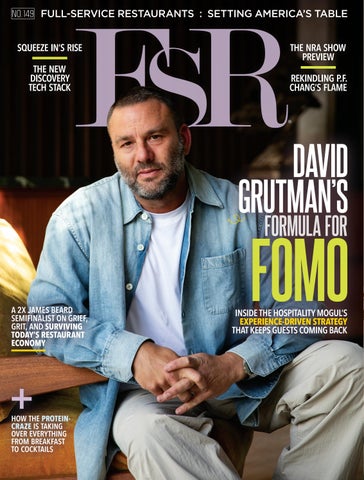
A 2X JAMES BEARD SEMIFINALIST ON GRIEF, GRIT, AND SURVIVING TODAY’S RESTAURANT ECONOMY
HOW THE PROTEINCRAZE IS TAKING OVER EVERYTHING FROM BREAKFAST TO COCKTAILS
![]()
A 2X JAMES BEARD SEMIFINALIST ON GRIEF, GRIT, AND SURVIVING TODAY’S RESTAURANT ECONOMY
HOW THE PROTEINCRAZE IS TAKING OVER EVERYTHING FROM BREAKFAST TO COCKTAILS
INSIDE THE HOSPITALITY MOGUL’S EXPERIENCE-DRIVEN STRATEGY THAT KEEPS GUESTS COMING BACK


TruFlavour by Monin delivers bold, authentic flavor with no added sugar or sweeteners—perfect for elevating a variety of beverages and culinary creations.

Scan to discover more.


Consumer preferences are rapidly evolving, pushing operators to adapt faster than ever to remain relevant and stand out, despite limited certainty.
Growing interest in health, wellness, and simple ingredients has also increased pressure on foodservice operators to find flavordriving solutions that don’t add operational time or costs, are made with clean ingredients, and don’t require intensive training— all while increasing sales.
Fifty-six percent of consumers reported they would pay more for clean-label products, according to Ingredion. Furthermore, 76 percent of consumers are inter-
ested in limiting or eliminating sugar from their diet, according to recent research from the International Food Information Council. This is a clear indicator that clean label and low- and no-sugar menu offerings can meet today’s consumer demands, resulting in increased guest traffic, greater menu-item satisfaction, and higher check averages.
As consumers gravitate toward better-for-you offerings, they will select drinks that still offer the same elevated experience they are accustomed to with craft cocktails. According to a survey by casinos.us, 67 percent of Americans are actively reducing their alcohol intake. Balancing
these consumer desires can be a tall order for restaurants looking for innovative menu items that fit within a budget, work across dayparts, don’t complicate labor, and include shelf-stable ingredients.
“Operators today are balancing creativity with efficiency while responding to growing demand for low- and no-sugar beverages and more inventive alcohol-free options,” says Sabrina Godfrey, director of marketing communications at Monin. To meet this moment, the company created TruFlavour by Monin, an innovative range of unsweetened, naturally colored, and clean-label flavors designed to add bold impact to bever-


age and culinary recipes without additional sugar or sweeteners.
There are 15 flavors in the TruFlavour range, including trend-forward options like coconut, pickle, and hibiscus. Crafted without any artificial ingredients, added sugars, or sweeteners, TruFlavour gives beverage creators and chefs more control to achieve layered, balanced flavor in their recipes without worrying about waste, prep time, or serving high-sugar creations to their guests. Adding layered flavor, like jalapeño, to a spicy mocktail or coconut to a watermelon refresher can help foodservice operators' menu unique creations while keeping operations streamlined and simple for quick, consistent execution.
“There’s long been a gap in quality between fresh ingredient prep and most alternatives, which come pre-sweetened,” Godfrey says. “TruFlavour bridges that space by delivering true-to-source flavor without sweetness, labor-intensive prep, or seasonal limitations.” The new line also boasts a subset of five culinary-specific flavors that work in a variety of applications, ensuring easy flavor enhancement doesn't end at the bar.
TruFlavour ranges from classic flavors like strawberry and mint to more unique options like cucumber and passion fruit. Additionally, the line includes culinary-specific flavors such as oak barrel, basil, and mushroom that can be used to enhance dips and sauces.
“Monin syrups deliver sweetness and flavor together,” Godfrey says. “But TruFlavour allows operators to add just flavor without any sweetness. That opens new creative possibilities for lowsugar beverages, mindful mocktails, savory applications, and more precise flavor layering within established beverage programs and culinary menus.”

Glassware: 12 oz. Glass
INGREDIENTS
¼ oz. TruFlavour Jalapeño By Monin
¼ oz. TruFlavour Watermelon By Monin
4 oz. Fresh Sour Mix
1 ea. Lime Wedge; Squeeze And Discard
GARNISHES
Jalapeño pepper, lime wheel, salt rimmer, watermelon
PREPARATION
Pour ingredients into an ice-filled mixing glass in order listed. Cap, shake, and strain into a serving glass filled with fresh ice. Garnish and serve.
The crossover between beverage and culinary applications also presents new opportunities for operators to maximize product usage. Ingredients that can seamlessly transition from a drink to a sauce or marinade help streamline inventory while encouraging menu cohesion. “Take TruFlavour Jalapeño, for example,” Godfrey says. “It can be used to create a spicy jalapeño ranch or add an extra kick to guacamole, and then you can take that same flavor to the front of the house in a swicy lemonade or even a skinny spicy margarita.”
“In beverages, about one-quarter ounce or a single pump of TruFlavour delivers balanced flavor,”
Godfrey says. “In culinary applications, two tablespoons per cup of base ingredient is a reliable starting point for most of the flavors, while TruFlavour Mushroom calls for even less. The product is shelf-stable and always in season, packaged in a 1L format that supports efficient service and consistent results.”
Beyond consistency, these products also open the door for menu experimentation without added risk. Operators can test limited-time offerings or trending flavors without committing to large volumes of perishable ingredients. This flexibility is especially valuable as flavor and health trends continue to influence consumer expectations.

Glassware: 16 oz. Glass
INGREDIENTS
¼ oz. TruFlavour Coconut By Monin
4 oz. Lemonade
3 oz. Fresh-Brewed Black Tea
GARNISHES
Lemon wheel, mint sprig
PREPARATION
Fill serving glass full of ice. Pour ingredients into serving glass in order listed. Add garnish and serve.

also serving as the base for a mocktail or lemonade. Similarly, savory flavors like pickle or jalapeño can enhance both low-ABV drinks and food items, creating a more integrated flavor story across the menu.
This kind of versatility aligns with a broader industry shift toward doing more with less— fewer SKUs, less waste, and more intentional menu design.
Looking ahead, the intersection of health, flavor innovation, and operational efficiency will continue to shape beverage development. Consumers aren’t just seeking better-for-you options; they’re expecting them to be just as dynamic and satisfying as traditional offerings.
For operators, meeting shifting expectation will require solutions that balance innovation with prac -
ticality. Solutions like TruFlavour that simplify execution, deliver clean label claims, and support menu differentiation are critical in bridging that gap.
In an industry where every menu decision impacts both perception and profitability, the ability to innovate without added complexity is now a requirement. TruFlavour offers an opportunity for creativity in the front of house or back of house in an easier, better, faster, liquid form—without any sweetness.
“TruFlavour represents a meaningful step forward in how we think about flavor innovation at Monin,” Godfrey says. “It reflects where the industry is heading with a stronger focus on clean


FROM HIS ICONIC LIV NIGHTCLUBS TO C0-CREATING JAPANESEINSPIRED STEAKHOUSE GEKKŌ WITH BAD BUNNY, DAVID GRUTMAN HAS MASTERED THE ART OF SOCIAL ENGINEERING REQUIRED IN HOSPITALITY.

16
The King of Miami Nightlife is building a 360-degree global lifestyle empire rooted in the highenergy theater of dining, alongside his winning strategy of “taking it personal” by building relationships.
A sneak preview and handy guide to the must-see sessions at the Western Hemisphere’s largest foodservice event this month.

The two-time James Beard Award semifinalist shares her experiences with grief, grit, authenticity, and survival in today’s restaurant economy.
From protein-packed omelets to chicken and waffles, restaurants are meeting wellness-minded diners without shrinking portions.
Protein-forward techniques are nothing new for the cocktail world, but social media and trend cycles are giving them a new spotlight.


What if restaurant design wasn’t just décor, but a direct revenue engine? That’s the idea Michael Tronn had in mind when designing TIMBR’s 8,500-square-foot space with three distinct yet connected spaces.
A new report shows nearly 72% of consumers think restaurant prices are going up—now higher than the perception of rising grocery store prices.
BACK OF HOUSE
49 P.F. Chang’s Rekindles Its Flame
WOMEN IN LEADERSHIP New CMO Holly Smith is blending storytelling, data, and global inspiration to reignite the iconic Pan-Asian brand.
Run by two sisters with a vision to expand to 100 units within a decade, emerging brand Squeeze In is slowly taking over the planet, one omelet at a time.
53 The New Discovery Stack
TECH CHECK Here’s how Gen Z, TikTok, and AI are challenging traditional restaurant search behaviors.
BEHIND THE SCENES Cai Palmiter shares her insights on her shift from brand building to “ecosystem building,” the importance of authenticity in marketing, and the power of finding a more intentional, grounded pace.
EDITORIAL
VP, EDITORIAL DIRECTOR: FOOD, RETAIL, & HOSPITALITY Danny Klein dklein@wtwhmedia.com
FSR EDITOR Callie Evergreen cevergreen@wtwhmedia.com
QSR EDITOR Ben Coley bcoley@wtwhmedia.com
ASSOCIATE EDITOR Sam Danley sdanley@wtwhmedia.com
SENIOR EDITOR, WIRL Satyne Doner sdoner@wtwhmedia.com
SVP, AUDIENCE GROWTH Greg Sanders gsanders@wtwhmedia.com
CONTENT STUDIO
VP, CONTENT STUDIO Peggy Carouthers pcarouthers@wtwhmedia.com
WRITER, CONTENT STUDIO Drew Filipski dfilipski@wtwhmedia.com
WRITER, CONTENT STUDIO Ya’el McLoud ymcloud@wtwhmedia.com
WRITER, CONTENT STUDIO Abby Winterburn awinterburn@wtwhmedia.com
DESIGN
ART DIRECTOR Erica Naftolowitz
VP, CREATIVE DIRECTOR Matt Claney mclaney@wtwhmedia.com

2024 REGIONAL GOLD AWARD: PUBLICATION DESIGN
2023 NATIONAL GOLD AWARDS: FRONT COVER (PHOTO), BEST USE OF COLOR NATIONAL SILVER AWARD: BEST USE OF TYPOGRAPHY
2016 MAGAZINE OF THE YEAR TOP 10 AWARD
2015 MAGAZINE OF THE YEAR FOLIO: Eddie Awards 2022 BEST FULL ISSUE HOSPITALITY 2022 BEST SPONSORED CONTENT 2021
MAGAZINE 2013
® SALES & BUSINESS DEVELOPMENT
SVP SALES & STRATEGY Matt Waddell 312-961-6840 mwaddell@wtwhmedia.com
VP, BUSINESS DEVELOPMENT Eugene Drezner 919-945-0705 edrezner@wtwhmedia.com
NATIONAL SALES DIRECTOR Amber Dobsovic 757-637-8673 adobsovic@wtwhmedia.com
NATIONAL SALES MANAGER Tom Boyles 662-607-5249 tboyles@wtwhmedia.com
CUSTOMER SERVICE REPRESENTATIVE Tracy Doubts 919-945-0704 tdoubts@wtwhmedia.com
ADMINISTRATION
CEO Matt Logan mlogan@wtwhmedia.com
919-945-0704 www.fsrmagazine.com/subscribe
FSR is provided without charge upon request to individuals residing in the U.S. who meet subscription criteria as set forth by the publisher.
REPRINTS
THE YGS GROUP 800-290-5460 fax: 717-825-2150 fsrmagazine@theygsgroup.com
Sponsored content in this magazine is provided to the represented company for a fee. Such content is written to be informational and nonpromotional. Comments welcomed at sponsoredcontent@ fsrmagazine.com.
FOUNDER
Webb C. Howell
LinkedIn.com/company/ FSR-magazine
Instagram.com/FSRmagazine Facebook.com/FSRmag

27517-2380.


For every case purchased, Red Gol donates to Folds of Honor, to educate and support the children and families of fallen or disabled American military service members and first responders.


• 1,000 - 7g Packets
• 1,000 - 9g Packets
• 1,500 - 9g Packets
• 16 - 20 oz. Bottles


• 25 - 20 oz. Bottles Scan here to learn more!

IN A TIME WHEN the news cycle feels heavier than ever, people are starved for a slice of joy and searching for a reason to be hopeful. Where do you turn when you’re looking for a quick escape? For many, it’s entertainment— and scrolling through social media doesn’t count, since you may end up getting rage-baited by trolls, bots, or a distant acquaintance from high school.
People want to feel inspired, and that’s exactly what I felt after leaving the movie theater after watching “Project Hail Mary” last month. I won’t spoil anything if you haven’t seen it yet, but it was a refreshing, heartwarming story with an optimistic tone—unlike many cynical sci-fi flicks—that left viewers feeling uplifted and encouraged. That’s the feeling we’re really chasing, and it translates to the restaurant and hospitality industries seamlessly.
There’s also the feeling or fear of missing out (FOMO) that drives people to take action, whether it’s seeing the latest hit movie, trying the latest Dubai chocolate trend, or checking out the new restaurant that’s trending on TikTok.
FOMO is a recurring theme throughout our issue this month. In our cover story ( PAGE 26), David Grutman’s powerhouse collective of next- generation restaurants, lounges, nightclubs, and hotels are known for creating immersive environments that combine upscale dining, high-impact design, marquee entertainment, and shareable moments. But Grutman’s “formula for FOMO” isn’t just about exclusivity or spectacle. It’s about understanding how modern consumers assign value, and then building environments that meet them there.
We have breakfast and brunch brands figuring out how to tap into the recent “protein-packed” craze on PAGE 16. Even beverage experts are spotlighting protein-forward cocktails with ingredients like aquafaba as a vegan stand-in for egg whites and the rise of milk punches, where dairybased clarification quietly brings protein into the glass ( PAGE 21).
Of course, there’s a difference between drawing attention versus sustaining it, and converting that attention into foot traffic for your restaurant. On PAGE 7, Michael Tronn shares how he just did that when he meticulously designed his 8,500-square-foot space, TIMBR, which has become the hottest ticket in town since opening last year.
“The way I approach design is it’s a stage, and everyone in it is playing a role, whether you’re a guest or employee, you are still producing some kind of theater,” Tronn says. “No matter what you are creating, it is a production, and it is an experience, and you have to be aware of that.”

Callie Evergreen EDITOR


Our May cover spotlights the “King of Miami Nightlife,” David Grutman, whose properties under Groot Hospitality now span some of the highest-grossing-per-square-foot restaurants in the country. Headquartered in Miami Beach, the portfolio includes his iconic LIV nightclubs; a Japanese-inspired steakhouse in partnership with Bad Bunny called Gekkō; Komodo; Papi Steak—which fuses Golden Era Hollywood with modern Miami and Vegas—and Casadonna (in partnership with Tao Group Hospitality), a coastal Italian-inspired waterfront restaurant in Miami.


LOADED POTATO WITH HOISIN GLAZED GNOCCHI

TIMBR’s “Flower Room” is a soaring, 33-foothigh space with a 20-by-20-foot skylight, a pergola-topped bar, and roughly 90,000 flowers climbing the walls and ceiling to create a lush, romantic garden atmosphere.

BY CALLIE EVERGREEN
What if restaurant design wasn’t just décor, but a direct revenue engine?
AN IMMERSIVE NEW RESTAURANT in Fort Lauderdale, Florida, is proving that intentional design, attention to detail, and premium positioning can outperform discount-driven traffic in full-service dining. Since opening in February 2025, TIMBR has attracted more than 32,000
Instagram followers, with design-forward content reaching north of two million views. But the concept has translated that attention beyond simple impressions into real foot traffic—garnering over 30,000 unique reservations in its first year in business, with an average of 7,000
reservations per month. It’s also earned a reputation as one of the highest priceper-head check averages in the city.
While modern guests are still looking for high-quality food and beverage, what they’re really seeking is a dining experience that goes beyond the ordinary and gives them something to brag about and post on social media.
“It definitely requires more than just food, and I'm seeing that a lot when I look around in contemporary restaurant design as well—there is always an experiential element,” says TIMBR cofounder Michael Tronn. “I think design and concept play a huge part in a restaurant experience.”
Tapping into his background in destination venues, Tronn designed TIMBR with every micro-detail in mind. The 8,500-square-foot restaurant tells a story across three distinct yet connected spaces: Guests first enter The Park, a ground-floor dining room designed like a twilight picnic, where nine 15-foot towering tree trunks and branches rise through the space, custom live-edge wood tables anchor the room, and denim-upholstered banquettes provide casual warmth beneath an 18-foot ceiling studded with some 750 custom “firefly” lights that simulate a starry night.
Beyond that lies The Atrium, often called the Flower Room, a soaring, 33-foot-high space with a 20-by-20foot skylight, a pergola-topped bar, and roughly 90,000 flowers climbing the walls and ceiling to create a lush, romantic garden atmosphere. Upstairs, The Lounge shifts the tone: darker, more seductive, and wrapped in greys and blacks, it extends the narrative to an intimate, evening-ready retreat. “They all work together, even though they’re all totally different,” says Tronn.
Tronn is adamant that while concept and design may draw guests through the door, it’s the fundamentals that keep them coming back, converting one-time Instagram visitors into regulars. “Concept will bring people several times," he says, but "food and beverage and service will bring people back repeatedly."

NEARLY 72% OF CONSUMERS SAY restaurant prices are going up, according to a new report from Revenue Management Solutions—now higher than the perception of rising grocery prices (68%).
*The study was based on a survey of 841 U.S. consumers conducted in early February.
ANOTHER KEY FINDING: Nearly 1 in 2 full-service diners are cutting back visit frequency, vs. just 1 in 3 QSR visitors.
BUT IT’S NOT ALL BAD NEWS FOR FSRs: Data suggests a future shift away from delivery toward dine-in occasions, with younger consumers being the most optimistic—29% of Gen Zers plan to increase dine-in visits, followed by 18% of Millennials, 12% of Gen X, and 11% of Baby Boomers.


We provide the snacks and frozen treats that make memories in consumers’ minds. The ones associated with delight and good times. And they all come from one source.
Stop by booth #5607 at the National Restaurant Association Show for a free sample


AT CHEENI, PREETI WAAS COOKS FROM SCRATCH WHILE REFUSING TO PANDER TO AMERICAN EXPECTATIONS OF WHAT INDIAN FOOD “SHOULD” BE.

BY CALLIE EVERGREEN
A 2x James Beard Award semifinalist on grief, grit, and authenticity.
PREETI WAAS FLOATS BETWEEN TABLES at Cheeni Indian Food Emporium, pausing long enough to sit down and have a meaningful conversation with each guest. Her daughter, Amy Waas, greets people as they walk in—acting as both host and server on the special preview day of the newest location of Waas’s beloved Cheeni concept in Durham, North Carolina. Housed in Horseshoe at Hub RTP (Research Triangle Park—AKA North America’s largest research park), the mixed-use development
complex is a futuristic take on what a “downtown” district can look like in the booming business-centric area. Tenants include the likes of IBM, Cisco, Fidelity, and many biotech and life science companies.
It’s where she also owns a boutique bodega called Nanny Goat, designed to be a neighborhood market with locally sourced produce, artisan gifts, and grab-and-go items. Located adjacent to Cheeni, the bodega and restaurant share a kitchen and prep space. Waas named Nanny Goat after the female goat who watches over other goats and kids in the herd, also drawing inspiration from the Nanny Goat Market in Philadelphia that served as a refuge and gathering space for Irish immigrants in the 1800s, before it burned down during riots.
In downtown Durham, another Nanny Goat is located less than a mile down the street from Cheeni Durham and The Bar Beej, a cocktail bar “built by the kitchen” driven by the spices, produce, discard, and flavor profiles of an Indian home kitchen. The concept was co-created by Waas and Amy, who designed the menu. The Bar Beej opened in June 2024, and in its first year, earned a James Beard Award nod as a “Best New Bar” semifinalist. Bar guests can also order dinner from the adjacent Cheeni.
The story of Cheeni evolved from humble 2017 beginnings as tiny market stands and a YMCA kiosk in Raleigh to a fast-casual cafe that turned heads and won Eater’s “Best New Restaurant.” While the original Raleigh location closed in April 2024 due to rising operational costs, Waas was able to pivot and focus her attention on Cheeni Durham, which opened in late 2023, and on her latest openings in RTP.
At Cheeni, Waas cooks from scratch with a stubborn refusal to cut corners or pander to American expectations of what Indian food “should” be. That means you won’t find chicken tikka masala, for example, which Waas clarifies is not an Indian dish—a fact that surprises many people. (The chicken curry dish is believed to have originated in Glasgow, Scotland, during the 1970s.)

PREETI WAAS (RIGHT) AND HER DAUGHTER AMY (LEFT) WORK CLOSELY TOGETHER, INCLUDING AT THE BAR BEEJ—WHERE AMY DESIGNED THE MENU THAT EARNED A JAMES BEARD NOD AS “BEST NEW BAR” SEMIFINALIST.
Instead, Waas serves a rotating menu of authentic Indian dishes as a seasonal, regional exploration that honors South Asian traditions.
At Cheeni Durham, the menu is divided into categories: Chhota Khana & Chaat (small plates) features dishes like keema samosas with tender minced lamb in a crisp golden pastry. Larger plates under the Kaaris & Such section offer creations ranging from the golden, silky fish moilee with coconut milk gravy and seared market fish filet served with paratha or rice to the “fiery hot” vinegar-spiked lamb vindaloo, cooked with onions, vinegar, dried red chilies, and warm spices, served with rice.
Under Sigri Se (from the grill), guests can order The Rani with preserved lemon labneh, grilled seasonal vegetables, served with spice & seed crusted house paneer & beetroot raita, and a pink yogurt dipping sauce. Even the breads are distinctive; the vegan naan (under the Sigri Mein section, which means “alongside”) is prepared thicker
GO-TO DRINK?
Black coffee
FAVORITE SPICE?
Star anise
IF YOU COULD ONLY COOK WITH ONE VEGETABLE?
Eggplant
ALT CAREER?
Pilot
SECRET COMFORT FOOD?
Fries
FAVORITE FOODIE CITY?
Charleston or Chicago and more like a traditional flatbread, while the flaky malabar paratha serves as a vessel for house-made achaars and seasoned gravies.
At Cheeni Indian Food Emporium in RTP, the lunch menu features dishes like dosa waffle & sambar with fermented rice waffle, lentil vegetable stew, tomato


For 37 years, Tronex has supported major foodservice and hospitality brands and operators with a dependable, technology‑driven supply chain. Through advanced manufacturing, we provide the precision and consistency our customers depend on.
Partner with a trusted leader in gloves, medical‑grade face masks, and protective apparel.
and coconut chutneys; and aloo chaat with fried potatoes, chutneys, tomatoes, onions, cilantro, house yogurt, and chickpea crunchies. Dinner menus here are six courses each, priced individually and only served dine-in, no takeaway: vegetarian is $50, pescatarian/omnivore is $55.
“From the consumer standpoint, everything is just so expensive … They don’t understand costs and why we have
taurant—a lesson for budding restaurant owners and chefs to learn from. “I made far too many mistakes that impacted me and my family in the learning of it, and I’m still impacted by those decisions. That’s something that I would have done differently,” she explains.
Despite all the challenges involved in running a family-owned and operated restaurant business, Waas stays

CHEENI’S NEW LOCATION IN HORSESHOE AT HUB RTP FEATURES A LUNCH MENU WITH DISHES LIKE DOSA WAFFLE AND SAMBAR WITH FERMENTED WAFFLE, WHILE DINNER IS A SIXCOURSE FORMAT SERVED EXCLUSIVELY DINE-IN.
to price things the way we do. So there is some level of customer dissatisfaction sometimes that we have to contend with,” Waas admits. “What I’m hoping and trying to do is, although our fixed costs are fixed—and I’m not about to compromise in terms of staff pay or ingredients—I’ve been trying to think about, how do I bring more value to the table? Does this feel like a comprehensive experience?”
Her main focus right now is simply keeping her restaurant doors open as costs and macroeconomic factors, like tariffs, pile up. “I think there was a point in time when we were all trying to justify our prices. I feel like we’re past that point,” Waas adds. “It doesn’t matter to the guest what we have to pay. They just know what they are able to and want to [pay], and sometimes they might want to pay more, but they’re not able to, because all of us are getting squeezed tighter and tighter.”
Looking back, Waas says she wishes she would have educated herself more on the business side of running a res -

grounded by her mission: “If I’m speaking from my heart, I can’t seem to stop feeding people,” she says. “One way or the other, that’s what I like to do.”
That fire within her to feed people fuels her steadfast mindset and survival instincts to endure, which also stems from her turbulent upbringing in India.
(Trigger warning: physical abuse; alcoholism.)
“My mother was not very maternal. My father was a violent alcoholic, and my mother had to be the breadwinner,” she recalls. As the youngest child, Waas was often the recipient of her mother’s anger and frustration and was “not fed” in the emotional sense she believes children need. At the same time, she was literally and figuratively nourished by an extended network of older sisters and aunts on both sides of the family.
Food became her means of survival in multiple ways. From a young age, it was her job to come home from school and cook for her intoxicated father, racing to get food on the table. “It was almost like a game of chicken—how fast could I get something on the table before he lost his patience and beat me terribly … That kind of broke my relationship with food,” she says.
What helped her heal her relationship to food was when she gave birth to her first daughter, and realized that breastfeeding was keeping her child alive, sustaining her, and helping her to thrive. “Then it became, ‘Oh, I get to feed my child. I get to take care of my child. I get to do this for my children,’” Waas recalls. “And that turned into joy, and then I couldn’t stop feeding people.”
Waas’s journey as a mother is also marked by profound recent loss. Her second daughter, Ellie, tragically passed away last year at just 21 years old. It was Ellie’s warm, intuitive presence at the original Cheeni location—her belief in and love for what the family was building—that became the reason Waas even agreed to open the second location.
When the Hub RTP development team first visited Cheeni’s location in downtown Durham, it was Ellie who served them. “They were so enamored by the experience she provided, because she believed in and loved what we did so much that they felt like they needed that here,” Waas says. “And so they actually really pursued Cheeni being in the space.”
While the new restaurant wasn’t constructed before Ellie passed, “Her spirit is here. She’s very present,” Waas adds. “We’re here because of her.”

With DONA MARIA® Mole Rojo , a twist of the cap and a stir of the spoon is all it takes to make the rich, authentic, deep flavor of Mexican mole sauce. Add it to traditional dishes, top off new fusions, even put it on dessert. But don’t wait around—this mole goes fast in every way imaginable.
ALSO AVAILABLE AT DOT FOODS ITEM #774328


WHILE TERMS LIKE “proteinmaxxing” and “fibermaxxing” might sound like trendy buzzwords, they’re actively reshaping how menus are designed and how brands compete for market share. A recent consumer survey conducted by Revenue Management Solutions (rms) found that nearly 50 percent of consumers will switch brands for high-protein products, while 45 percent are actively seeking high-fiber offerings.
The Big Biscuit, a breakfast and lunch concept with 30 locations across the
Midwest, kicked off 2026 with its “Protein Packed” campaign, highlighting some of the highest-protein breakfast dishes on its menu.
“While we’re known for impossibly generous portions of classic comfort foods like biscuits and gravy or platesized pancakes, we also offer a variety of high-protein options … and we recognize how important it is to support our guests’ health and fitness goals,” Katie Allen, director of marketing, says.
The initiative spotlights menu favor -
ONE COMBO IS GAINING MASSIVE TRACTION: FRIED CHICKEN AND WAFFLES. ITS ORIGINS TRACE BACK TO THE 19TH CENTURY, BUT THE PAIRING BECAME ESPECIALLY POPULAR DURING THE HARLEM RENAISSANCE IN THE LATE 1930S BEFORE SPREADING TO THE SOUTHERN U.S., WHERE IT BECAME A SOUL FOOD STAPLE.
ites that appeal to a wide range of proteinconscious consumers—from casual seekers to dedicated gym-goers. There’s the Kansas City Omelet, packed with smoked ham, bacon, sausage, and cheddar cheese, delivering 56 grams of protein. Also featured is the Ranch Hand Scram-Bowl, layered with grilled steak, jalapeños, peppers, tomatoes, onions, Monterey Jack, and cheddar cheese. A lighter option, the veggie omelet, delivers 32 grams of protein and features mushrooms, spinach, tomatoes, onions, and Monterey Jack cheese.


Great menus need great flavor, but no single flavor is perfect for every menu. That’s why, when it comes to Ranch, the family behind Ken’s has spent decades collaborating with customers to craft 12 unique Ranch flavors. Whether your emphasis is fresh tangy buttermilk, savory herbs or the exciting smoky, spicy or cool flavors of Chipotle, Jalapeño or Avocado – we have a Ranch custom-built for your menu. No matter what your guests crave, Ken’s has it covered.


During the campaign period, the brand saw a 14 percent year-over-year increase in sales of these three items, confirming guests’ interest in proteinforward breakfast options.
The campaign went beyond simply highlighting protein and analyzed the full macro profile of each dish before deciding which ones to feature. For example, Allen points to the 3 Car Pile Up, an enormous dish of buttermilk pancakes and biscuits, scrambled eggs, bacon, sausage, hash browns, and breakfast potatoes, all smothered in sausage gravy. While it packs more than 100 grams of protein, it ultimately leans more indulgent than fitness-focused.
“The success of this intentional campaign shows that our guests do crave dishes that help them find a balance between big flavor and health-conscious options,” Allen adds. “We listen to what our guests want and make data-driven decisions for our campaigns and menus. This was an authentic campaign that fit the brand because we already offered all the dishes featured.”
Across the segment, one ingredient combination in particular is gaining massive traction: fried chicken and waffles. While its origins trace back to

hand-breaded fried chicken, dill pickles, and a honey drizzle.
As the definition of “healthy” continues to evolve—and with a growing number of consumers using GLP-1 medications—operators are moving quickly to meet guests’ expectations with menu items that balance indulgence, creativity, and functional ingredients like protein and fiber.
the 19th century, the pairing became popular during the Harlem Renaissance before quickly becoming a soul food staple—and demand hasn’t slowed.
For operators, the appeal goes beyond flavor—it’s also about flexibility and functionality.
“Protein has become the headline nutrient at breakfast, and waffles naturally support protein-forward dishes without adding operational complexity. Chicken and waffles are one of the fastest-growing breakfast combinations because they deliver indulgence and protein in a format operators already know how to execute,” says Mike DiBeneditto, CEO of Golden Waffles.
In response to the growing demand, brands like Keke’s Breakfast Cafe, Hash House A Go Go, and Tupelo Honey have all added chicken-and-waffle variations to their menus. Chefs like Deborah VanTrece are also elevating the format at her restaurant, Twisted Soul, with dishes like fried chicken and vanilla bean waffles with maple bourbon syrup, or herb-spiced duck and sweet potato waffles with citrus bourbon syrup.
The Big Biscuit features its own spin on the trend with items like Nashville Hot Chicken & Waffles, topped with
But for Allen and The Big Biscuit, the strategy isn’t about downsizing portions. It’s about authenticity and meeting guests where they are.
“We’ve seen an emphasis on protein recently, but the overall ‘healthy’ conversation has evolved into finding balance rather than restriction. The Protein Packed campaign highlighted high-protein dishes, but we also wanted to show that meeting your goals doesn’t have to mean sacrificing flavor, feeling unsatisfied, or going out of your way,” Allen says.
“While we see diet trends and some brands downsizing menu items for GLP-1 users, The Big Biscuit is a guestfirst brand committed to offering impossibly generous portions of classic comfort food while expanding our offerings when it feels authentic.”
DiBeneditto shares a similar outlook on the future of breakfast innovation: adding functional benefits without sacrificing the comfort foods people already love or adding complexity to kitchen workflows.
“We are seeing momentum around functional ingredients like protein and fiber,” he says. “Moving forward, [ingredients like] waffles will continue delivering the comfort and creativity people love while quietly incorporating some of those functional benefits along the way. The foundations will always be the same.”
PITMASTER CRAFTED | 100% HARDWOOD SMOKED

SIMPLY SEASONED MEATS
LEARN ABOUT OUR TRADITION AND GRAB A SAMPLE TODAY.
When you start with AUSTIN BLUES® Smoked Meats, you can create authentic barbeque that makes your operation sing. We provide a full line of smoked meats born in the pit. You create plates of barbeque you can proudly call your own that guests will crave. That’s Your ‘Que.


MENTIONED IN THIS STORY THE DEARBORN • • FARM BAR •
ISTANBUL HAWAI‘I • • ADVENTURE TIME
FARM BAR’S GARDEN OF EDEN COCKTAIL FEATURES STRAY DOG GIN, BASIL SYRUP, CUCUMBER, AND FRESH LIME, SHAKEN WITH AQUAFABA—A STARCHY, PROTEINRICH LIQUID FROM COOKED LEGUMES— AND FINISHED WITH A DRIZZLE OF BASIL OIL.

BY SAM DANLEY
Protein is moving beyond the gym into the cocktail glass.
FROM GROCERY SHELVES to social feeds, the push for more protein has moved well beyond shakes and bars. It’s showing up in everything from fortified cold brews and protein sodas to high-protein ice creams, snack chips, and even candy.
Alcohol, so far, has been slower to follow. Major global beverage companies haven’t made a significant move into protein-enhanced beer, spirits, or cocktails, but a growing crop of start-

ups and emerging players is testing the waters with everything from whey protein beers and spiked protein drinks to protein-infused vodka waters.
What does this trend look like behind the bar? And how, if at all, are bartenders incorporating protein-forward thinking into cocktail programs?
At The Dearborn, an upscale American tavern in Chicago, beverage director Sarah Clark is happy to track trends— but only if they make sense for her guests and her brand. For her, protein-forward cocktails start to look shaky the moment protein powder enters the picture. She’s personally used plenty of powders in shakes and smoothies, but behind the bar, she sees a hard line. The Dearborn’s cocktails are designed around a specific flavor target and then engineered backward. Introducing an ingredient that’s main purpose is nutritional, not sensory, can topple the whole structure.
“It’s really, really hard—and I don’t actually know that it’s even achievable— to have a cocktail where you put some sort of supplemental protein in there, and you don’t taste it or have it take over the nuances of the drink,” she says.
Just as important, Clark doesn’t see real demand. Her guests are happy to chase protein at breakfast or lunch, but once they sit down at the bar, priorities
Not everyone is as skeptical. Ahu Hettema, owner of Istanbul Hawai‘i, a Turkish restaurant in Honolulu, sees protein-forward cocktails as “a key part of 2026’s shift toward purposeful and functional drinking.”
“Guests are seeking cocktails that offer more than flavor alone,” she says, adding that they’re increasingly looking for satiety, recovery support, or wellness alignment “while still honoring the ritual of cocktail hour.”
Like Clark, Hettema is quick to point out that protein in cocktails isn’t new. Egg whites in sours and dairy in punches or milk-washed drinks have long provided texture and body.

shift. “Are people that are consuming alcoholic beverages focused on trying to get their extra protein in that way? I don’t personally think so,” she says.
Where protein-adjacent techniques do make sense, Clark is already using them— just not under a “protein-forward” banner. She points to aquafaba as a vegan standin for egg whites and to the rise of milk punches, where dairy-based clarification quietly brings protein into the glass.
One standout at The Dearborn is the Punch! Boom! cocktail, a clarified milk punch built on matcha-infused Koval rye vodka and strawberry-infused Grey Goose, layered with yuzu, lime, and a hint of pandan. The mixture is poured over white chocolate ganache to create the milk punch effect, then stirred, rested, and carefully strained until clear and silky, softening the drink’s edges while adding subtle richness.
Clark notes that in a milk punch, bartenders mix the cocktail with milk so the proteins can bind to cloudy particles and color. Those solids are strained out, but a small amount of protein and dairy character remains in the finished, crystal-clear drink.
“What’s new is the intention,” she says. “These elements are now being reframed through a functional lens, emphasizing balance and how a drink makes you feel afterward, not just how it tastes in the moment.”
In her view, that shift is showing up in newer expressions, from clear whey isolates or hydrolyzed collagen incorporated into bright, transparent drinks like gin & tonics, spritzes, or margaritas to plant-based options such as pea protein or collagen peptides in RTDs and bar programs, as well as savory “brothtails” using bone broth for umami and perceived wellness benefits.
At Istanbul Hawai‘i, that thinking has carried into menu development, including a spring cocktail built with col-
AHU HETTEMA,
OF
TURKISH RESTAURANT IN HONOLULU, SEES PROTEIN-FORWARD COCKTAILS AS “A KEY PART OF 2026’S SHIFT TOWARD PURPOSEFUL AND FUNCTIONAL DRINKING.”


lagen peptides and centered on themes of rebirth and wellness. “The goal is not to spotlight the ingredients,” Hettema says, “but to create drinks that feel quietly nourishing and intentional.”
For Justin Young, head bartender at Chicago’s Farm Bar, techniques like milk punch and bone broth cocktails aren’t always a fit. The neighborhood Midwestern tavern operates with a strong farmto-table ethos—the owner is a farmer and beekeeper who supplies produce
starts with crimini mushrooms sautéed in garlic butter, then combines them with mezcal in a sealed jar. After resting, the mixture is frozen for several days, allowing the fat to solidify and separate while the mezcal absorbs the savory flavors. The result is a clear, mushroom-scented spirit that forms the base of a bright cocktail with an herbaceous liqueur, tomato shrub, lemon, and a touch of tonic.
For Young, the appeal is less about protein content than about flavor.

throughout the season—and Young builds his drinks around that pipeline of real ingredients. In his view, more involved techniques can be difficult to execute in a high-volume setting. Milk punches and similar preparations are labor-intensive, require careful storage, and can have shorter shelf lives, making them harder to manage without disrupting the rest of the program.
Looking at both his guests and the broader beverage landscape, Young doesn’t see much demand for protein as a wellness play in cocktails. What he does see are protein-based or fooddriven techniques—meat, vegetable, or fat-based infusions—where protein functions more as a culinary tool than a selling point.
At Farm Bar, fat-washing is the primary expression of that idea. Young is developing a bacon fat–washed bourbon for a maple Old Fashioned, but his current obsession is a mushroom-washed mezcal that appears on the spring menu. He

“I’ve found that fat washing with proteins—whether it be bacon, a mushroom, or something else that’s protein rich— helps to give your cocktail a more savory element,” he says. “People are moving away from sweeter drinks, so they like something that has more umami and maybe a little bit more salt in it.”
At Denver’s Adventure Time Bar, owner Sam Wood arrives at a similar savory territory through a more high-concept lens. His rotating-theme cocktail bar has become a testing ground for proteinadjacent techniques, from a French Onion Soup Martini built on vodka washed with buttermilk, beef bouillon, and onion caramel to the Cyber Punk Punch, a mezcal-and-miso milk punch, and a Thai tea cocktail that uses a milk-and–coconut
milk layer stabilized to mimic egg-white foam. He’s also experimenting with spirulina, a blue-green algae rich in protein and vitamins, as a color and flavor element in an upcoming menu.
For Wood, these techniques tie into a broader push toward umami and what he describes as “flavor hacking,” where the goal is to build drinks people want to keep sipping.
“You don’t want to make everything super sweet, or else people will end up feeling like they’re going to leave in a diabetic coma,” he says. “So, how do you get people to have another? You make it bitter, or sour, or savory, so they want another sip to keep washing their palate.”
He also sees a generational shift shaping the conversation. With younger consumers drinking less overall, Wood connects the rise of nonalcoholic cocktails—and now protein-forward framing—to a broader effort to make drinks feel more approachable.
“It’s almost like the NA push,” he says. “How do I make this appealing for people who don’t want to get hammered, but still want to relax a little bit and feel like there’s some benefit—or at least like it’s not the worst thing they could be ordering?”
In that sense, “protein-forward” can function as much as marketing language as technique, signaling a drink that feels less purely indulgent and more aligned with wellness, even when the underlying methods are familiar.
“To say that you’re not on board with it feels slightly silly,” Wood says. “We’ve been doing these things for shelf life and stability long before anyone started talking about them as ‘protein-forward.’”
Adventure Time hasn’t explicitly positioned drinks around protein, but Wood can imagine how it could fit within the bar’s rotating themes, such as framing protein-rich drinks as “health potions” or “barbarian’s rage” in a Dungeons and Dragons-inspired, medieval-themed menu. For him, the opportunity lies more in how the concept can be used to reframe existing techniques.
“The less we nay-say and the more open we keep our minds, the better the culture is going to be as a whole,” Wood says.

Designed and built in Milan, the Dalla Corte Icon is more than an espresso machine - it is a statement of craft.
Pairing timeless Italian design with advanced brewing technology, Icon delivers uncompromising precision and consistency, while intuitive controls empower teams to perform confidently through every rush. From refined dining rooms to high volume service environments, Icon delivers reliable, high-quality results throughout the day, bringing the art of Italian espresso to life with style, efficiency, and authenticity.


MODERN GUESTS WANT MORE THAN A MEAL. THEY WANT CONNECTION, STIMULATION, AND A REASON TO COME BACK—AND TO BRING OTHERS WITH THEM.

BY CALLIE EVERGREEN
The
“King of Miami Nightlife” is moving beyond the velvet rope and building a 360-degree global lifestyle empire rooted in the highenergy theater of dining, alongside his winning strategy of “taking it personal” by building personal relationships.

RESTAURANT OPERATORS, LISTEN UP: The nature of dining out is changing, according to David Grutman, who is credited with single-handedly transforming the global nightlife and hospitality scene. “No one eats an appetizer, soup, salad, main course, dessert— no one eats like that anymore,” he claims. Instead, modern diners are migrating toward sharable plates that are inherently more experiential. “When you’re tasting different foods with people, it creates a certain energy, and I love that at a table,” he says. “They’re discovering something new, and they’re doing it together, and they’re talking and communicating.”
What reads as a strategic shift toward experiential dining is, in many ways, a return to Grutman’s earliest lessons in hospitality. Long before he was dubbed the "King of Miami Nightlife" by Forbes, Grutman’s career began behind the bar at Biz Bistro in the Aventura Mall. A finance graduate from the University of Florida who once intended to pursue a steady career in title insurance, he quickly found himself attracted to the high-stakes service industry. He transitioned from mall bartending to managing the Velvet Lounge in Fort Lauderdale, followed by a transformational five-year stint at the helm of Tantra in South Beach.


It was during these years—navigating the shifting moods of the velvet rope and the demands of celebrity guests— that Grutman mastered the social engineering required to anchor a room. By the time he co-founded Miami Marketing Group (MMG) in 2008 and launched LIV, he had evolved from a tactical operator into a strategic visionary, using his early experiences as a bartender to figure out exactly what a guest needs before they realize it themselves.
Grutman’s collective business properties under Groot Hospitality now span some of the highest-grossing-persquare-foot restaurants in the country. Headquartered in Miami Beach with concepts strategically placed across Miami, Dallas, and Las Vegas, the portfolio includes his iconic LIV nightclubs; a Japanese-inspired steakhouse in partnership with Bad Bunny called Gekkō; a Southeast Asian-inspired concept, Komodo; Papi Steak—which fuses Golden Era Hollywood with modern Miami and Vegas—and Casadonna (in
partnership with Tao Group Hospitality), a coastal Italian-inspired waterfront restaurant in Miami.
“They all have a common DNA of energy levels and being in community. I’m in the fun business, so at the end of the day, they’re all about fun, and they all connect with each other that way,” Grutman says, adding that “just trying to do good and really trying to add value to people has really been my secret sauce.”
Grutman formed Groot Hospitality in 2018 to bring his concepts under one umbrella, as well as to bring “clarity” and the ability to scale. “Groot became the platform that allows us to build concepts with a consistent philosophy around hospitality, design, music, and energy,” he says. “It also gave us the structure to grow beyond Miami while still protecting what makes our experiences unique.”
Since its 2008 debut at the Fontainebleau Miami Beach, LIV has remained one of the most significant and highestgrossing nightclubs in the global hospitality landscape. Grutman’s first major
ownership project helped redefine the Miami nightlife experience by merging the high-energy theater of a concert with the exclusivity of elite bottle service, ultimately generating annual revenues that exceeded $45 million at its peak.
Designed to be a 360-degree sensory environment, the venue became a blueprint for the hospitality group’s philosophy—where A-list celebrity presence, world-class EDM and hip-hop talent, and "see-and-be-seen" architecture create a constant stream of viral, shareable moments. The brand’s enduring cultural relevance led to its recent expansion into Las Vegas at the Fontainebleau resort, where both the flagship nightclub and the French Riviera-inspired LIV Beach continue to cement the brand's legacy as a premier destination for immersive, high-impact entertainment.
Groot Hospitality’s powerhouse collective of next- generation restaurants, lounges, nightclubs, and hotels are known for creating immersive environments that combine upscale dining, high-

impact design, marquee entertainment, and shareable moments that effortlessly evoke FOMO (fear of missing out).
At Papi Steak, for example, a table ordering the now-famous “Beef Case” quickly becomes the center of attention: it’s a $1,000 diamond-studded gold briefcase holding a 55-ounce Australian Wagyu tomahawk steak. (The briefcase is apparently a nod to the one in Pulp Fiction that carried the soul of Marsellus Wallace.) The steak is presented with a laser light show and the diner’s choice of music, and the steak is “branded” at the table with a hot stake before returning to the kitchen to be carved and plated before returning to the table to enjoy.
What might otherwise be a simple food delivery transforms into a spectacle—and then becomes free marketing for the restaurant. Nearby tables turn, phones come out, and within seconds, the moment extends far beyond the guests who ordered it. (These over-thetop spectacles also attract celebrities like Drake and Rhianna.)

“People really eat by seeing first, so they love an aesthetic, they love a vibe, they love food that they could be able to post for their friends that have FOMO,” Grutman says. “All these [dining experiences] are engineered for people to be able to say to all their friends wherever they’re at, ‘Oh, look what you missed.’ We love to create FOMO. We love our guests to be able to create FOMO for their friends and family.”
With an all-encompassing approach that layers headline performances, curated interiors, strategic brand collaborations, and savvy social media storytelling, the concepts function as a connected ecosystem. And because those moments are rooted in real, high-energy experiences, they carry a level of authenticity that paid media often struggles to replicate. It’s not just about creating something worth posting—it’s about creating something worth being there for.
“A lot of operators still think in terms of just opening a restaurant. Today, you’re really building a brand and a com-
munity,” Grutman says. “People interact with your concept long before they walk through the door. They interact through social media, content, music, and design. Hospitality today lives both physically and digitally, and understanding that ecosystem is essential.”
That distinction helps explain why Grutman’s approach resonates so strongly with today’s diners, particularly younger audiences who prioritize experience over routine. The traditional format of dining—courses arriving in sequence, conversations contained within a single table—has given way to something more fluid and interactive. Dinner bleeds into nightlife. Music becomes as important as the menu. The line between restaurant and entertainment venue continues to blur—and that’s exactly where Grutman’s background becomes a strategic advantage.
Having come up through nightlife, he understands how to read a room in real time. He knows how to sense when energy is lagging, when it’s peaking, and

GRUTMAN SAYS GUESTS “REALLY DON’T WANT TO BE SHORTED ON THE INGREDIENTS, AND THEY KNOW WHEN SOMETHING IS LUXURIOUS OR WHEN SOMETHING IS JUST KIND OF SHODDY.”
when it needs to shift—an instinct that now informs how his restaurants operate. Music isn’t an afterthought; it’s programmed. Lighting isn’t static; it shifts and evolves throughout the night. Staff aren’t just trained in service mechanics, but in awareness—how to contribute to the overall rhythm of the space.
“When all of those elements work together, that’s when a place really becomes memorable,” Grutman says. “The magic happens when the cuisine, the atmosphere, and the service all elevate each other.”
Equally important for restaurateurs today is procuring amazing ingredients. Guests “really don’t want to be shorted on the ingredients, and they know when something is luxurious or when something is just kind of shoddy,” he notes.
And when the product is of high quality, it justifies premium pricing. At Gekkō, for example, The Wagyu Experience with olive-fed snow beef imported from Japan’s Miyazaki Prefecture is $295, or guests can opt for a bonein short rib with gochujang and pickles for $110. Maki and nigiri options round out the menu that also features entrees ranging from whole lobster with jah mama aioli for $92 to oak-smoked chicken with fennel, asian pear, and jerk marinade for $36.

Komodo—which has locations in Miami, Las Vegas, and Dallas—features chef’s omakase options like The Red Dragon ($180) with sashimi, nigiri, and maki, and #WhatTheFish for $48, which is a six-piece of chef-selected nigiri.
At Casadonna, the menu ranges from the Mediterranean branzino ($47) with leek caponata, pine nut, and mint vinaigrette, to a 34-ounce porterhouse steak ($197). Guests can also choose from six pasta options like the black truffle risotto ($38) with carnaroli rice and parmigiano reggiano, and the mafaldine astice ($42) with Maine lobster, cherry tomato, vodka sauce, and garlic breadcrumbs. Cold options like tuna tartare ($38) and hamachi crudo ($24) balance hot options like calamaria fritti ($26) and shrimp & ‘nduja ($41) with spiced Calabrian sausage, butter, lemon, and grilled focaccia.
High-impact, shareable items serve as anchors, drawing attention and setting tone, while more traditional offerings provide balance. Premium pricing, in turn, becomes part of the storytelling. When executed correctly, a $200-plus dish doesn’t just deliver on quality—it signals occasion, indulgence, and exclusivity. It tells guests that what they’re experiencing is not everyday dining, but something elevated, something worth documenting.
For all its spectacle, Grutman’s model is still grounded in a relatively simple premise: people going out want to feel something. “What are people really looking for? I think they’re always looking for escape,” he says. “We try to create worlds. When you come into our places, you’re transported to a different world, and it’s theater. It’s the fun business.”
Whether that escape comes in the form of a high-energy nightclub or a transportive dining room, the goal is the same—to create an environment where guests can step outside their routine and into a different world, even if only for a few hours.
That idea of escape also underscores why Grutman remains confident in the staying power of experiential hospitality, even as technology continues to reshape the industry. While AI can optimize operations and streamline decision-making, it can’t replicate the feeling of walking into a room that’s alive with energy, where every sense is engaged and every moment feels shared.
“We’re creating an experience for people,” he says. “And I don’t know if that’s something that could be replicated by a machine.”
His insistence on the human-focused element is the playbook Grutman has been running since day one. He worked his way up in the hospitality industry through building personal relationships, which he attributes as one of the main reasons for his success. It’s the reason why people show up to his grand openings, he says, and it’s the reason why people buy into his concepts. “It’s how I get people to populate my restaurants. It’s when I invest in a [consumer-packaged-good] brand, how I’m able to magnify the message on that to bring great people into deals,” he explains.


But perhaps even more important is his ability to connect with people at all levels and in all roles—not just those in powerful positions. “If I just talk to the celebrity or the power player in business at my dinner table and not everyone else at the table, I probably wouldn’t be here today,” Grutman adds. “So it’s just growing those relationships and knowing that to be authentic, go into it trying to ask [questions] and find out what their story is.”
That’s the thesis of his new book, “Take It Personal: How to Succeed by Building Relationships and Playing the Long Game,” which debuted on April 14. In his leadership manifesto, Grutman breaks down how he got to where he is today—by building relationships and businesses that last. Chockfull of behind-the-scenes stories from his career, the book is meant to be both entertaining as well as a practical guide for aspiring restaurateurs in accelerating their careers and unlocking their full potential.
“I called it ‘Take It Personal’ because that’s literally what I do—I take everything very personal, and I think then
people tell you don’t take it personal, they’re not doing you justice,” he says.
The book is based on a college course on entrepreneurship that Grutman has taught for the past five years at the Chaplin School of Hospitality & Tourism Management at Florida International University. The class covers lessons Grutman has learned “through success and failure” on building brands, and the importance of IP and building relationships. “It’s a mix of lessons and things that you have to know as you are building brands, and how relationships can really magnify everything and are so important,” he says.
It also covers topics that Grutman wishes he would’ve known earlier in his own career. For example, “I wish somebody taught me about IP when I was starting out,” he says. “They don’t really talk about how important IP is and what it means, and setting yourself up to have more than just one place or one unit,” he notes. He also writes about the process of preparing for an acquisition and important things to know when bringing on

a large business partner, inspired by his personal experience in the subject matter.
In 2019, Grutman sold a majority stake—51 percent—of Groot Hospitality to Live Nation Entertainment. The deal, which integrated Grutman’s high-touch hospitality ecosystem into the world’s largest live entertainment engine, marked a pivotal shift from a founder-led boutique firm into a globally scalable powerhouse. By aligning with a partner that dominates the concert and ticketing space, Groot Hospitality gained access to the infrastructure required to export Miami’s high energy to cities like Las Vegas and beyond.
Throughout the transition, Grutman has remained at the helm as CEO, treating the acquisition not as an exit, but as a "magnifier" for his personal brand of theater—demonstrating that even when operating within a corporate giant, the business remains personal at its core.
While the Live Nation deal provided the institutional muscle to scale, Grutman’s approach to the partnership—and all those that followed—remains rooted in a very specific hunt for complemen-

tary talent. For him, a successful alliance serves as a bridge between raw inspiration and operational excellence. The qualities Grutman looks for in any potential partnership is for the other party to bring something to the table that he doesn’t possess, whether it’s their creativity or particular thought process.
“I love being surrounded by the most creative people in the world,” he says, “and I think by identifying that and being able to see and take someone’s genius creation, and then being able to apply it to … something that’s a viable business is really special. I love that process.”
When it comes to partnering with celebrities, Grutman says one thing people might not expect is how collaborative those relationships really are. “With Bad Bunny, the conversations were always about culture and how to capture the energy of a moment,” he shares. “Those moments remind me that great hospitality is a creative process—it’s not that different from making music or producing a film.”
While some people might be starstruck meeting and working with so
many big names, Grutman carries the confidence of knowing he deserves a seat at the table, which helps to ground him. “I’ve done this for so long that I have a pretty good confidence that I understand [and can] translate what they’re trying to get out into something else,” he notes.
The best partnerships bring authenticity, he adds. “When we collaborate with someone like Bad Bunny, it’s not just about attaching a name to a project—it’s about working with people who have a real creative perspective and cultural influence. They help shape the concept, the music, the aesthetic, even the storytelling around the brand. When it’s done right, the partnership adds depth to the experience.”
That storytelling is now expanding even further with the launch of DGN Studios, Grutman’s production company focused on film, television, and digital content. For him, it’s a natural extension of hospitality. “A restaurant tells a story through food, design, and atmosphere,” he says. “DGN Studios is just another way to tell stories—through a different medium.”

This leap into multimedia is the latest chapter in a career defined by a refusal to sit still. Even in his earliest days, Grutman was constantly looking for the "ceiling" in any given room, looking for the next place to break through. When he was 21 years old and a bartender, he saw the ceiling of staying in that role, and he wanted to be a leader— so he became a manager. “I think also, don’t be afraid to take a step back in order to take a step forward,” he notes. “When I was bartending, I was making great money, and when I took that manager’s job, I was paid a quarter of what I was making as a bartender. But I knew that by taking that step and being able to invest in myself—I’m always a big believer in investing in yourself—got me to where I am now.”
That belief in investing in yourself is now embedded in how he builds culture across every concept. When it comes to cultivating a strong culture across a growing organization with diverse concepts, Grutman contends that culture starts with energy and leadership.

As Groot has grown, he has tried to stay as present as possible with his teams, ensuring they understand the importance of true hospitality and taking care of others. “When your team feels proud of the environment they’re part of, that translates directly to how guests feel when they walk in,” he says. “It’s something we work on constantly.”
After building some of the most recognizable venues in Miami, Las Vegas, and beyond, what still excites Grutman about opening a new concept is the blank canvas, he says. “Every concept starts with an idea; sometimes it’s a type of cuisine, sometimes it’s a space, sometimes it’s just a feeling you want people to have. Seeing that idea slowly come to life through design, food, music, and people never gets old. The moment when the doors open and guests experience it for the first time is still the most exciting part.”
As far as new markets go, Grutman is looking at potentially expanding Groot Hospitality into Nashville, Tennessee, and Scottsdale, Arizona. ”We’ve secured no deals in either market,” he clarifies, “but it’s something that’s really on our radar screen, and two places that we’d really love to be in.” He’s also setting his sights globally in locations like the UAE and Southern France.
When people look back at Grutman’s impact, he hopes they will say he pushed the hospitality industry forward and created places where people could celebrate life together. “At the end of the day, restaurants and clubs are about bringing people together—friends, families, and strangers who become friends,” he says. “If we’ve created spaces where people made great memories and entertain, that’s the legacy that matters most.”
When it comes to his personal legacy, Grutman also points to his family and his love for taking his 6-year-old and 8-year-old daughters to dinner at his own restaurants. “They start to look at the details, and they see that lightbulbs are out and stuff like that—they can’t wait to show me any kind of detailed thing at the restaurant,” he says. “And I love when we go out to eat somewhere else and maybe they haven’t bussed

the table quick enough, and my daughter will be like, ‘Daddy, our table is very dirty.’ It tells me they’re starting to get the details.”
At the same time, he has no plans to push the busy life of a restaurateur on them if they aren’t passionate about it. “I’d like for them to be able to get some free time in their lives, and in this business, you get zero. But if they love it, they love it,” he adds.
When it comes to balancing work and family life, it comes down to paying attention to the people you’re with. “You just have to be present when you do spend time with your family,” he says. “It’s better to give them an hour of undivided attention than five hours of just being on your phone and not really paying attention.”
His advice for budding entrepreneurs in the restaurant or hospitality industry is to focus on the guest experience
WHILE AI CAN OPTIMIZE BACK-OFFICE OPERATIONS, IT CAN’T REPLICATE THE FEELING OF WALKING INTO A ROOM THAT’S ALIVE WITH ENERGY, WHERE EVERY SENSE IS ENGAGED AND EVERY MOMENT FEELS SHARED.
above all else. “Trends change, menus evolve, neighborhoods shift, but if people feel something when they walk into your space, they’ll come back,” Grutman adds. “Also, be patient. Building something meaningful in hospitality takes time and resilience.”
For operators, the takeaway isn’t necessarily to replicate Groot Hospitality’s model in full. Not every concept can—or should—operate at that level of scale or intensity. But the underlying principles are increasingly hard to ignore. Guests want more than a meal. They want connection, stimulation, and a reason to come back—and to bring others with them.
In that sense, Grutman’s “formula for FOMO” isn’t just about exclusivity or spectacle. It’s about understanding how modern consumers assign value, and then building environments that meet them there.


A sneak peek and handy guide to the must-see sessions at the largest annual gathering of foodservice professionals in the Western Hemisphere from May 16-19, 2026.
BY SATYNE DONER
This year’s keynote kicks off with tennis legend, Olympic gold medalist, philanthropist, and education advocate Andre Agassi. Considered one of the most accomplished athletes of all time, Agassi will take the stage to share his journey—from the pressures of competing on a global stage to championing education rights for at-risk children.
Together with Michelle Korsmo, president and CEO of the National Restaurant Association, Agassi will dive into how the mindset of a champion applies across all facets of life, motivating foodservice professionals to push boundaries, embrace change, and lead with purpose and vision.
Using examples from his career—such as completing the Career Grand Slam after a dramatic five-set comeback victory in 1999— he will teach attendees how to reframe challenges as opportunities, embrace both personal and professional evolution, and recognize the importance of giving back.

This interview-style Q&A, led by Korsmo, will explore Agassi’s career evolution, philanthropic mission, and the principles that help leaders thrive in a rapidly changing environment—offering valuable lessons in resilience, perseverance, reinvention, and leadership.
WHO
Andre Agassi
Award-winning tennis player and entrepreneur
Michelle Korsmo
President and CEO, National Restaurant Association
WHEN Sunday, May 17, 2026, 1 p.m. WHERE
Grand Ballroom, S100

FEATURED SESSION: TECHNOMIC
Get it While it’s Hot: Driving Demand with LTOs
Ready to discover the secrets to successfully leveraging limited-time offers? This session, led by Joe Pawlak, managing principal at Technomic, alongside three leading independent and chain operators, will give attendees a competitive edge in today’s rapidly evolving market.
Speakers will share strategies to identify topperforming LTO trends— and how to integrate them—using real-world examples and firsthand experience. Attendees will learn how operators are using these tools to boost sales, engage customers, and execute planning cycles effectively without overspending.
This featured session blends innovation, strategy, and practical insight. WHO
Debbie Stroud CEO, Whataburger
Jennifer Bell CMO, Lettuce Entertain You Restaurants
Arthur Carl II VP of Culinary, IHOP WHEN Monday, May 18, 2026 1 p.m. WHERE Grand Ballroom, S100

Money Matters: Food Choices in the New
What does “value” mean in 2026? With inflation, higher interest costs, and shifting household priorities, consumers aren’t simply trading down—they’re value-flex splurging in smaller, more meaningful ways while cutting back elsewhere.
This session breaks down how that practical indulgence shows up across dayparts and channels, arming foodservice professionals with a playbook for balancing affordability and aspiration: where to premium -

ize, where to protect entrylevel price points, and how to communicate worth in a skeptical market.
Attendees will also explore how offers, loyalty mechanics, and signals of real value—quality, functionality, and convenience—can resonate with consumers without causing fatigue or eroding margins.
WHO
Suzy Badaracco
President,
Culinary Tides Inc.
WHERE Room S403
South Building, 4th Floor
WHEN
Saturday, May 16, 2026
1 p.m.-1:45 p.m

The 2026 State of the Industry: Position Yourself for Success in the Face of
It’s no secret the restaurant industry is facing unprecedented headwinds—from rising operational costs to cautious consumer spending and broader economic uncertainty. With the right strategies, operators can navigate this complex landscape and turn obstacles into opportunities.
Using findings from the 2026 State of the Industry Report by the National Restaurant Association, this session will analyze industry challenges, evaluate strategic responses, and help operators develop action plans for sustainable growth.
WHO
Chad Moutray Senior Vice President, Industry Research & Knowledge, and Chief Economist, National Restaurant Association
WHERE Room S50
South Building, 5th Floor
WHEN Saturday, May 16, 2026
1 p.m.-1:45 p.m.
Less is more. This session will teach operators how to use AI to identify raw signals and pair high-intent triggers—such as daypart, weather, and local events—with the right outreach channel to avoid guest fatigue and blanket promotions.
David Ciancio and Luke Scharlatt will reveal a playbook for launching predictive messages that lift frequency, a 30-day test plan that fits inside nearly any tech stack, and a trigger-tomessage matrix designed to aim—not spam.
WHO
David “Rev” Ciancio Co-Founder and CMO at Handcraft Burgers and Brews and CMO at Salad House
Kenneth Scharlatt
Founder and Executive Director at Savage Orchid Hospitality
WHERE Room S40
South Building, 4th Floor
WHEN Saturday, May 16, 2025
2 p.m.-2:45 p.m
With Generation Z—and soon Generation Alpha— making up much of today’s workforce, operators must understand how to train them to stay competitive. They’re younger, fastermoving, and more techdriven than ever before, and this session explores how microlearning and career-focused education can boost retention, reduce turnover, and drive higher engagement and performance.
Panelists will share what’s working, offering actionable solutions that strengthen culture and make training less challenging.
WHO
Steve Madonna VP of Culinary, Connections
Shane Schaibly
Senior Vice President of Culinary Strategy, First Watch
Katy Velazquez VP, Culinary Innovation at Qdoba Restaurant Corporation
WHERE
Room S503
South Building, 5th Floor
WHEN
Saturday, May 16, 2026
2 p.m.-2:45 p.m
The pressure to balance rising food costs with delivering exceptional quality and flavor is higher than ever. But operators don’t have to sacrifice their culinary vision to protect the bottom line. In this session, guided by Erica Holland-Toll, operators will discover ways to engineer menus that highlight high-margin items, reduce waste, and work with existing supply chains to manage inventory more effectively and maximize purchasing IQ.
WHO
Erica Holland-Toll
Culinary Director, The Culinary Edge
WHERE
Room S403
South Building, 4th Floor
WHEN
Sunday, May 17, 2026
3 p.m.-3:45 p.m.


Are you ready to witness culinary excellence live on stage? This year’s National Restaurant Association Show hosts food and beverage demos by restaurant masters at the top of their game. Be sure to stop by: The Culinary Experience, Lakeside, 12448
Leah Cohen
CHEF
TELEVISION PERSONALITY
OWNER: PIG & KHAO
WHEN:
Saturday, May 16, 2026
3:15 p.m.-4:00 p.m.
SPONSORED BY: CJ Schwan’s
Chris Cosentino
CHEF
AUTHOR
CYCLIS
PHILANTHROPIST
WHEN:
Sunday, May 17, 2026
10:00 a.m.-10:45 p.m
SPONSORED BY: Waring and CJ Schwan’s
Sarah Grueneberg
CHEF
TELEVISION PERSONALITY
AUTHOR
PARTNER: MONTEVERDE
RESTAURANT, PASTIFICIO
WHEN:
Monday, May 18, 2026
3:30 p.m.-4:15 p.m
SPONSORED BY: The European Union and CJ Schwan’s
Cook Up Financial Security: Safeguard Your Restaurant From Lawsuits & Taxes
Slips and falls. Employee disputes. Costly tax burdens. These can threaten the financial future of any business—especially those in foodservice. In this session, Larry Oxenham will teach operators how to shield their businesses from lawsuits, implement tailored taxreduction strategies, and plan for long-term success with an estate and business succession checklist.
WHO
Larry Oxenham
Senior Advisor and Author, American Society for Asset Protection
WHERE
Room S502
South Building, 5th Floor
WHEN
Sunday, May 17, 2026
3 p.m.-3:45 p.m.
Consumers want ordering, paying, and reordering to be easy. Their digital experience must be frictionless from start to finish—from discovery to first order to repeat purchase. This session breaks down how operators can streamline their digital funnel and prevent revenue leakage by implementing AI upsells, smart menu routing, and QR journeys that actually work.
Attendees will leave with a playbook of low-lift steps that can be implemented across existing
systems, along with a toolkit to track impact across AOV, turn times, and repeat rate through a simple KPI cadence.
WHO
Kenneth Scharlatt
Founder and Executive Director, Savage Orchid Hospitality
Kayla Storey
Area Director of Sales and Marketing, Zieg Hospitality
WHERE Room S504
South Building, 5th Floor
WHEN
Sunday, May 17, 2026
3 p.m.-3:45 p.m.
For independent operators, franchisees, and multi-unit managers, not having a training department—or a dedicated trainer—can be a challenge. Strong training is a cornerstone of restaurant success, from delivering consistent service to building guest loyalty.
This session will dish
out actionable strategies for turning shift leaders and managers into confident, consistent trainers, building accountability through simple tools such as checklists and peer mentorship, and balancing speed and quality in onboarding and skills development—all without relying on a corporate training infrastructure.
WHO
Kim Evans
Director of Training, Hopdoddy Burger Bar
Anna Mason
Vice President of People Experience, A.Ray Hospitality
Jason Lyon
COO, Wrap City Sandwich Company
Corban Nichols
Vice President of Restaurant Excellence, Piada Italian Street Food
WHERE Room S503
South Building, 5th Floor
WHEN
Sunday, May 17, 2026
3 p.m.-3:45 p.m


With an ever-increasing focus on technology and AI, the human element of marketing can get overlooked. Session host Kristen Corral didn’t grow her restaurant by chasing likes and shares—she succeeded by owning her neighborhood. She’ll share strategies to turn local partnerships, give-back programs, and local media into steady traffic, higher check averages, and repeat visits. Attendees will leave knowing how to cultivate a rideor-die fan base that keeps coming back because they care about the brand.
WHO
Kristen Corral
Co-Founder, Tacotarian
WHERE
Room S504
South Building, 5th Floor
WHEN
Sunday, May 17, 2026
4 p.m.-4:45 p.m.
How do thousands of likes translate into loyal foot traffic and real dining decisions? Join Hifsah Ahmed as she explores proven strategies for creating con-


tent that sticks, including short-form video, influencer collaborations, and trenddriven campaigns that deliver measurable results beyond vanity metrics.
Backed by restaurantfocused case studies and actionable frameworks tailored for multi-unit brands and independent operators, this session will show attendees how to elevate visibility, strengthen customer relationships, and maximize ROI—including how to leverage microversus macro-influencers.
WHO
Hifsah Ahmed
Content Creator and Influencer, Hifsah Ahmed
WHERE
Room S404
South Building, 4th Floor
WHEN
Sunday, May 17, 2026
4 p.m.-4:45 p.m.
Consumers over the age of 50 account for more than half of all U.S. spending,
7
Join Anthony Lambatos as he pulls back the curtain on the seven key metrics every restaurateur needs to know to make better business decisions. These numbers track financial health, cost controls, sales and more, tying into current industry benchmarks and real-world applications. As a bonus, he’ll reveal how these numbers can also improve company culture.
As of late 2025, roughly 1 in 8 American adults is actively using GLP-1 medications, shaping how guests engage with the foodservice industry.
After a year of observation, this session unpacks what’s changed—and what hasn’t—and explores what’s next.
yet they are often overlooked in the dining segment. Service fees, strict table time limits, and forced tipping can strip the joy from their dining experiences and drive them away entirely. Restaurants also increasingly limit group bookings to maximize turnover, overlooking the fact that this audience often dines together.
This session will explore how operators can design appealing menus and leverage trust-based, community-rooted marketing to capture this loyal and influential demographic.
WHO
Troy Kempton
General Manager, Wheat + Water
Carey Kyler
Senior Director of Insights, AARP Services Inc.
WHERE Room S502
South Building, 5th Floor
WHEN Sunday, May 17, 2026
4 p.m.-4:45 p.m
WHO
Anthony Lambatos Owner, President, Footers Catering; President, Founder, and Speaker, MIBE Leadership & Culture Education
WHERE Room S404
South Building, 4th Floor
WHEN
Monday, May 18, 2026
2:30 p.m.-3:15 p.m.
Session host Rachel Royster will share practical menu and operations strategies that align with this shifting landscape while protecting brand identity and uncovering new revenue streams.
WHO Rachel Royster Director, Strategic Planning & Innovation, Connections
WHERE
Room S403
South Building, 4th Floor
WHEN
Monday, May 18, 2026
2:30 p.m.-3:15 p.m


is the heart of this specialty from Recco, Italy. Two paper-thin sheets of dough and a creamy, gently tangy center come together in a focaccia that’s crisp, delicate, and incredibly smooth.
Find out more about Crescenza!


Artificial intelligence doesn’t have to replace human connection in foodservice. This session will empower operators to blend technology with the timeless values of hospitality—warmth, personalization and excellence.
Attendees will explore how AI can support operations by assisting in food and beverage menu design, streamlining SOPs and handling routine guest inquiries with speed and accuracy in a way that is cost-effective, datadriven, creative and operationally sound.
WHO
Casey Gamblin
Area Beverage Manager, Ithaka Hospitality Partners
Jacob Hoop
Assistant Food and Beverage Director, Ithaka Hospitality Partners
WHERE
Room S502
South Building, 5th Floor
WHEN
Monday, May 18, 2026
2:30 p.m.-3:15 p.m
Today’s restaurant landscape is shaped by everevolving guest expectations, workforce dynamics and operating environments. In this session, Erika Cospy Carr will discuss how Cultural Intelligence (cq) functions as a business imperative, helping operators identify cultural blind spots, apply a repeatable decision-making framework and activate cultural intelligence within their teams.
WHO Erika Cospy Carr
Vice President at Multicultural Foodservice & Hospitality Alliance (mfha)
WHERE Room S504
South Building, 5th Floor
WHEN
Monday, May 18, 2026
2:30 p.m -3:15 p.m


The secret to activating fearless culinary innovation is a foundation of discipline. In this session, attendees will hear how flavor-driven brands design structures and processes that support creativity and cultivate longterm customer loyalty.
Tamara Keefe will explain how experiences and brand partnerships can inspire unexpected innovation and differentiate offerings in a crowded marketplace—and how to strategically market, package and time launches so they resonate with customers and turn curiosity into sustained growth.
WHO
Tamara Keefe
Founder and CEO, Clementine’s Ice Cream WHERE Room S504
South Building, 5th Floor
WHEN
Monday, May 18, 2026
3:30 p.m.-4:15 p.m.
Do your frontline teams have the right tools to deliver consistently inclu-
sive experiences? In this session, Audrey Benet examines real-world scenarios involving language, accessibility and identity, identifying common gaps that impact both guest and employee experiences. She’ll uncover the tools and strategies needed to provide respectful, personalized hospitality while fostering a culture of belonging across diverse teams—resulting in stronger staff retention and engagement.
WHO Audrey Benet Associate Professor, Valencia College WHERE Room S502
South Building, 5th Floor
WHEN Monday, May 18, 2026
3:30 p.m.-4:15 p.m


The Restaurant Loyalty Roadmap for Lasting Customer Growth
All too often, restaurant activations generate excitement at launch but quickly lose traction. This session teaches attendees how to segment audiences, tailor offers and messaging, and design

a “whole product” experience that combines menus, operations and marketing to scale successful ideas into sustainable growth.
Attendees will also learn how to apply trust-building tools such as reviews, loyalty programs and guarantees to boost repeat-visit rates and lifetime value.
WHO
Andrew Gottlieb
CEO and Founder, No Typical Moments
WHERE Room S404
South Building, 4th Floor
WHEN
Monday, May 18, 2026
3:30 p.m.-4:15 p.m.
Personalization and customizable experiences are more in demand than ever. This session highlights seasoned hotel and hospitality professionals, exploring how they approach experiential, tailored customer journeys.
Attendees will gain actionable insights into the art of personalization to better meet the evolving needs of today’s consumers.
WHO
Michael Jacobson
President & CEO, Illinois Hotel & Lodging Association
Nick Johnson
Senior Vice President of Full Service and Lifestyle Hotels at First Hospitality
Cannon Porter Partner, Lettuce Entertain You Restaurants
Michael Wilson Director of Sales and Marketing, Hotel Zachary
WHERE
Discovery Theater South Hall, 2693
WHEN
Tuesday, May 19, 2026
10 a.m.-10:45 a.m


Mochi Innovation: Driving Business Success with Craveable Textures and Globally Inspired Comfort Foods
Sponsored by Mochi Foods and SpotOn, this session explores culinary’s next big trend: texture. Mochi-based methods can be applied to sweet and savory menu items, boosting differentiation, social media visibility and repeat purchases.
Attendees will learn how to infuse texture into their existing menus, streamline kitchen execution and increase perceived value without adding complexity to prep time or labor.
WHO
Albert Lee
COO, Mochi Foods
Isabella Lee
Global Culinary Applications Manager, Texture Innovation, Mochi Foods
Pei Wu
Founder and CEO, Mochi Foods
Kevin Yu Chef and Owner, 2D Restaurant
WHERE Innovation Theater North Hall, 5577
WHEN Tuesday, May 19, 2026 11:30 a.m.-12:00 a.m.

Fluid Motion: Smarter Bar Techniques and Design to Improve Efficiency and Execution
It’s time to get behind the bar. This mixology demonstration and educational session will teach attendees proper shaking techniques, tool usage and movement strategies that streamline cocktail preparation and enhance quality.
Graham Essex will explain how thoughtful bar design and setup can improve bartenders’ physical well-being while boosting operational efficiency—ultimately increasing revenue and elevating the guest experience.
WHO
Graham Essex
Award-winning Bartender and Mixologist, Gibson’s Italia
WHERE
The Beverage Room
Stage 13955
WHEN Tuesday, May 19, 2026 12:00 p.m.-12:30 p.m
New CMO Holly Smith is blending storytelling, data, and global inspiration to reignite the iconic PanAsian brand.
IT’S THE YEAR OF THE FIRE HORSE, and Holly Smith has arrived at P.F. Chang’s with unmistakable momentum—tasked with helping write the next chapter for one of the restaurant industry’s most recognizable brands.

Smith joined the PanAsian restaurant chain in January as its newest chief marketing officer, following the appointment of chief executive officer Jim Mazany last November. The pair has worked together for the past 15 years across multiple brands, and Smith was one of Mazany’s first hires.
In this new role, Smith is tasked with evolving the P.F. Chang’s brand, deepening guest connections, infusing creativity across campaigns, and strengthening the company’s position in a competitive restaurant landscape.
“We are so uniquely positioned as the only national Pan-Asian brand and have a unique market share that we can capture,” Smith says. “P.F. Chang’s is iconic … everyone has memories with this brand, and the mission moving forward is pulling people back in and encouraging them to remember those moments. Whether it’s a special dinner, your everyday lunch spot, or off-premises, we have a tremendous

ability to serve many different occasions.”
This isn’t Smith’s first time leading a brand revitalization. Known as a commercial brand architect, she has led brand transformations for multiple concepts, including Rosa Mexicano, Yardbird, Macaroni Grill, and Joe’s Crab Shack.
As a leader, she describes herself as the team’s compass—and in her first 90 days at P.F. Chang’s, that process begins with deeply immersing herself in the existing team.
“Everything starts with clearly setting the direction and aligning the team around strategic priorities with measurable goals we can work toward,” Smith says. “[At P.F. Chang’s] we have an incredibly talented team who are experts in their lanes. Now we have to figure out
how to combine those talents, create synergy, and bring initiatives to life.”
Whether it’s unifying creative and marketing platforms, evolving menu and pricing strategy, or integrating omnichannel campaigns that scale legacy brands while keeping them culturally relevant, Smith says her favorite part of the restaurant industry is shepherding ideas through their full life cycle, eventually seeing them come to life at a restaurant table. It’s a playbook Smith has refined across several restaurant brands—enter, listen carefully, and then align strategy around a clear, measurable vision.
For Smith, data sits at the center of brand transformation. Decision-making within organizations can sometimes become paralyzing—especially when every choice feels critical to the brand’s

future—but she believes strong data alignment is key to building high-performing teams and delivering on strategy.
“It is so important to analyze data alongside your cross-functional teams, whether it’s finance or operations,” Smith says. “That healthy and communicative relationship needs to be there. I’ve learned to sit down and level-set on what the data is telling us and how it can help us make better decisions for our guests. At this point in the business, there’s no lack of data, so we need to make sure we’re using those insights to our advantage.”
Storytelling, however, remains at the heart of Smith’s philosophy as a marketer. As P.F. Chang’s evolves to attract younger guests while maintaining loyalty among its legacy customers, she says the brand must remain authentic to its heritage as the first internationally recognized multi-unit concept centered around the centuries-old tradition of wok cooking.
“Every brand has its individual voice and story. Whether it’s four restaurants or 400, we have to stick to telling that story in a meaningful way while protecting the distinctiveness of the brand,” Smith says. “We’ve been talk-
work around innovation, but the broader vision for the brand is to remind people why they love P.F. Chang’s and amplify our market position as the premier PanAsian brand both domestically and internationally.”
As the brand evolves externally, internal marketing strategies are also shifting. With a growing focus on strengthening brand relevance and elevating the guest experience, the company is investing more heavily in behavioral guest data to better guide customers through the marketing funnel.
EARLIER THIS YEAR, P.F.
PAID
TO JAPAN’S CHERRY BLOSSOM SEASON WITH ITS FLAVOR IN BLOOM CAMPAIGN, FEATURING BRIGHT COLORS AND SPRINGFORWARD FLAVORS DESIGNED TO BE JUST AS EXPERIENTIAL AS THEY ARE VISUALLY APPEALING.
ing a lot recently about taking the story of P.F. Chang’s and figuring out how to amplify it across our channels and make it relevant for all generations.”
That philosophy is already influencing how the brand approaches innovation and guest engagement. Smith says the company is experimenting with themed nights, special events, and menu innovation designed to translate well both inperson and on social platforms.
Earlier this year, the brand paid homage to Japan’s cherry blossom season with its Flavor in Bloom campaign, featuring bright colors and spring-forward flavors designed to be just as experiential as they are visually appealing.
Smith says P.F. Chang’s global footprint also creates opportunities to discover new culinary inspiration. The next innovation test includes sushi boats served with dry ice—an experiential presentation designed to emphasize the theatrical nature of in-person dining and celebration.
“Being able to have conversations with global leaders is so compelling to me because we can use influences from around the world to be relevant domestically,” Smith says. “We’ve done a lot of
For example, media strategies are increasingly designed to speak to guests individually—using behavioral insights to understand online habits and deliver content that feels personally relevant.
“It’s a big task to conquer data in this way—to segment and truly understand our guests—but when we fully figure that piece out, we’ll begin to see meaningful success metrics,” Smith says, pointing to the company’s Valentine’s Day campaign as an early test of the approach.
“We’re onboarding many of these new strategies, and they’re already proving helpful for us. I’m excited to see what the future holds with this information at our fingertips,” she adds.
As a woman in restaurant leadership, mentorship and personal affirmation play an important role in Smith’s leadership approach. “It is a point of pride for me to have made it to this position, and it’s extremely important to see others succeed as well,” Smith says.
“Being a mentor means taking the time to have the ‘conversation after the conversation’ with people. I wake up every morning, look in the mirror, and say positive affirmations. Stay true to your authentic self, trust your gut, and help others believe in themselves and use their voice,” she says, principles she hopes will guide not only her team but the next era of the P.F. Chang’s brand.
BY BRITT
Run by two sisters with a vision to expand to 100 units within a decade, emerging brand Squeeze In is slowly taking over the planet, one omelet at a time.
YOU MAY HAVE HEARD the phrase “squeeze in,” or perhaps have said it yourself now and then, to express the desire to have someone join you at your table. There’s a magical connection created when being told there’s always room for one more, and that is the vibe that Squeeze Restaurant Group is built upon.
Since 1974, in Truckee, California, Eggheads everywhere (the moniker lovingly given to Squeeze In loyal eaters) have grown to expect extraordinary experiences, alongside generous portions and eccentric decor, all packaged in tight spaces. The first location measured a modest 10 feet wide by 62 feet long, transforming a literal hallway into an energetic, community-driven breakfast nook.
It wasn’t until 2004, when the Young family took over the store, that the brand began spreading its culture of radical kindness to other areas. Today, Squeeze In operates eight locations throughout California, Nevada, and Texas, with additional locations scheduled to open later this year. Alongside the eclectic decor, guests will notice several space and alien-related items, with a key focus on one green alien guy in particular. While he doesn’t have a name, he plays a key role in the brand’s storytelling and has a curious backstory.

HQ: Reno, Nevada UNITS: 8
FOUNDERS: Kay Young & Shila Morris
CUISINE TYPE: Brunch
“My grandfather made these wooden aliens as yard decorations. And so our family always had green aliens in our front yards,” says Kay Young, co-owner and vice president of sales and marketing for Squeeze In Restaurant Group. “Our tagline is ‘best omelets on the planet.’ When we took over the first location, this skier came in and wrote ‘best omelets in the universe’ on the wall. And then we were like, ‘Oh, we’ve got to bring the alien in here because he’s here to say this. It’s official.” Ever since seeing that scrawled note on the walls of their Truckee location, the family took it as a sign to commit to the alien aesthetic.
While the corporate headquarters is now based in Reno, Nevada, every location maintains a signature, fiery
orange-to-yellow wall gradient, along with a funky collection of knick-knacks on the walls and in surrounding areas, like the first location. It’s a space where guests are encouraged to sign the walls, making them a permanent part of the brand’s atmosphere.
Franchisees are encouraged to explore aesthetics that fit their community’s personality. This freedom has led to some intriguing decor choices, including a full-sized “Jurassic Park” dinosaur prop that guards the patio at the restaurant in Fernley, Nevada.
Managing a growing brand requires a functional foundation, and for Squeeze In, that foundation is built on a strong sisterly bond. Young works alongside her sister, Shila Morris, co-owner of Squeeze In, in what they call a “sister conglomerate,” where they own additional businesses beyond their brunch spaces.


They’ve defied the old adage about not going into business with family by stressing a functional relationship over all else. Their secret to remaining aligned and sane? “French Fry Fridays.” Every week, the pair meets at a different Squeeze In location to review financials and corporate strategy while sharing a plate of crispy fries. Once they have finished their work, they shift to their roles as sisters and best friends, discussing family and life. This fusion of professional ambition and sisterly rapport has allowed them to scale from a single-unit family cafe to a growing franchise with a vision of reaching 100 units within the next decade.
While many in the industry are scrambling to find staff, Squeeze In has experienced a turnover rate of just 34 percent, an impressive metric compared to the 50-55 percent industry average. This solidity isn’t accidental; it’s the result of a culture that puts affection and warmth at the heart of its operations.
The brand’s five core values are Live to Serve, Show the Love, Provide an Experience, Celebrate to Elevate, and Grow. One example of these values in practice is how Young implemented a policy of paying the team for their 30-minute lunch breaks and covering the total cost of their meals.
By removing the monetary burden of taking a break, the brand has eliminated workplace tension and built a clear sense of loyalty.
To grow, you have to be willing to evaluate your operations and determine efficiency opportunities. In 2021, amid a labor crisis, Squeeze In made the bold move to downsize its menu from 70 items to 45 compelling dishes.
Legendary items like the Racy Tracy Omelet (which was featured on Food Network’s “Throwdown with Bobby Flay”), the G Breakfast Sandwich, and the workhorse breakfast burritos remain top favorites. The brand’s breakfast potatoes are a reason in themselves to visit. The process takes a full 24 hours, involving boiling, parboiling, 24 hours of cooling, and hand-chopping into one-inch squares before hitting the fryer for that perfect tender-yet-crispy finish. Additionally, cinnamon rolls have become a popular shareable appetizer, helping increase overall check size.
Squeeze In is an emphatically alcoholforward brand, with Young explaining that, “You can’t drink all day unless you start in the morning.” Double-digit alcohol sales prove the brand has established itself as a place where guests can relax with a few rounds of mimosas, bloody marys, or specialty cocktails—though perhaps best known for its 12-ounce
heavy pour mimosas, providing guests with a generous serving that takes their dollar further.
“A breakfast brand with basically a full bar isn’t something that we see all of the time,” says Young.
The brand is also looking to attract sober-curious Gen Z brunchers, making sure to explore different NA beverage styles that are just as fun as their alcoholic counterparts. While Squeeze In has always offered mocktails, recommending substitutions of champagne for sparkling water or Sprite, the team is currently expanding their NA category with more creative options. It’s important to the Young family that all diners can clink their glasses with friends and family, regardless of alcohol percentage. Marketing a brand with a fun attitude requires keeping ahead of digital trends. In April 2024, Squeeze In migrated its Eggheads’ loyalty program, which has been running in some form since 2008, to the Thanx platform. “When we were deciding on a loyalty platform, it was all about, ‘How are we going to communicate with guests in the way that they want to be communicated with?’” says Young.
Through guest feedback, the brand discovered that most guests preferred in-app communication since many were already familiar with that format. When it came to in-store connection, Young wanted to make sure the experience was frictionless, which is why an integrated credit card point tracking system became important. The program now nurtures 95,000 email subscribers and 17,000 active app users who continuously engage with the brand.
The most intriguing component of the loyalty program is its “Skip the Line Pass.” In a sector where it’s not uncommon for weekend wait times to hit upwards of 90 minutes, allowing regulars to trade stars for a VIP next table experience has helped the brand increase guest engagement. It provides high-value guest satisfaction without costing the company
How Gen Z, TikTok, and AI are challenging traditional restaurant search behaviors.
RESTAURANTS HAVE ALWAYS faced tough competition, whether it’s finding the right market or standing out among similar businesses. Today, the main challenge is optimizing digital discovery. In recent years, there has been a noticeable decrease in guests relying on static search results; many have shifted to using visual, interactive, and chat-based platforms to inform their dining decisions. Leading brands are focusing their marketing efforts in areas where guest intent is highest, prioritizing relevance over vanity metrics.
For years, social media has been the main tool for discovery among Gen Z. In recent years, TikTok has surpassed Instagram and Google as this generations’ preferred search engine. According to LT Agency’s 2025 Franchise & MultiLocation Trends Report, 43 percent of Gen Z in the U.S. use TikTok to learn about brands. For these guests, it’s about previewing experiences to help ease the uncertainty of trying something new.
“I think that there’s a little bit of anxiety within that generation that is quelled by getting to see things firsthand,” explains Hannah Tooker, senior vice president of content and organizational transformation at LT Agency. “If I actually get to see where I’m going and what’s going to happen when I get there, I feel better, and I want to go have that experience”.
This firsthand look answers practical

questions: What’s parking like? How do I order? Is the atmosphere right? For Barro’s Pizza, a family-owned pizza chain with 48 stores nationwide, the balance is to develop a strategy that blends usergenerated content that captures real moments, alongside branded storytelling. Consumers have been trained to easily spot genuine content against paid messages. Brands have found more success by partnering with micro-influencers.
“There’s a shift in how people want to interact with them and they actually want that one-to-one relationship,” says Tooker. “It’s parasocial where people are really invested in the influencers’ life and I think the ones that are going to be successful are the ones that can invest back in their audience.” This type of creator already loves the brand—they have shared posts about it in the past without being prompted, so when they do part-
ner with a brand, their audience sees it as symbiotic.
Social media sparks initial interest, and AI is changing how guests narrow their choices. If you’ve been on LinkedIn recently, you may have seen some personalities touting that search engine optimization is dead, but that’s far from the truth. AI-driven search is simply a new arena where visibility relies on best SEO practices. The main change is how people search: guests use longer, detailed prompts in tools like ChatGPT or Perplexity.
These are what Ryan Jacobsen, senior vice president of growth marketing at LT Agency, calls “fan-out queries.” A user may ask: “I’m looking for a place downtown with a dog-friendly patio, good parking, and a menu that accommodates glutenfree diners.” The AI then performs multiple Google or Bing searches, reads 10-20
BARRO’S

web pages, and harmonizes its findings into a response that feels conversational.
“We treat AI-driven search as the new ‘Front Page of the Internet,’” says Troy Honaker, digital content manager for Four Peaks Brewing, which operates three locations throughout Arizona. “We ensure our business descriptions are optimized for AI, so when a user asks ‘Where is the best place to get a local craft beer in Phoenix?,’ Four Peaks is the definitive answer.”
To show up in these AI-powered results, restaurants need strong SEO basics. AI tools draw on what Google already knows, not on indexing they’ve done themselves. This makes it necessary for a brand’s website to answer key questions clearly. Having updated details for hours, parking, and responses to common guest questions are critical since large language models are populating these answers into their chats when addressing a user’s question.
Despite AI and TikTok growth, Google remains the main information source for older Millennials, Gen X, and Boomers, who trust traditional search and reviews. Successful brands treat Google Business Profiles as living landing pages, updating them regularly
rather than leaving them static. Four Peaks Brewing updates its Google Business Profile each month with lifestyle photos of current tap lists and responds to all reviews within 24 hours. “That responsiveness is a key ranking signal for Google,” says Honake.
The priority is clear information. When someone searches for a brewery in Phoenix, they want to know what’s on tap and opening hours, not just learn the vibe of the store. Keeping this data accurate on Yelp, OpenTable, Google, and a brand’s website requires persistent attention.
While digital discovery is important, the real test for repeat business relies on the presentation and feeling guests experience during their visit.
Culinary legend and restaurateur Stratis Morfogen presses that in the age of viral marketing, restaurants are not simply in the food business; theyalso have the responsibility to provide beautiful moments that guests are compelled to capture.
“We’re in the theater business,” Morfogen says. “When you’re creating that waffle... double stack it with ice cream... drip maple honey and butter on top of it. The customer is going to pull out their phone.
And once they pull out their phone, we win.” At Diner24, a tech-forward, NYC diner owned and operated by Morfogen, the team has reached 18 million monthly impressions by building moments guests want to share. Nostalgic details like Bluetooth jukeboxes let guests play their own music, while premium ingredients like dry-aged ribeye are served in a classic diner setting. By making every dish and detail ready for social sharing, the guest becomes a natural brand ambassador.
As platforms become more pay-toplay, many marketers feel forced to boost every post. Still, experts agree that organic social is the best testing ground for brand-building. “Organic is the fun, playful testing ground for what we can do,” says Mitchell Sauve, content marketing manager for LT Agency.
For brands like Barro’s, the approach is to let content run organically for a few days to see what connects before investing in ads. For smaller budgets, Jacobsen recommends a strict hierarchy: start with Google Ads as the ultimate “pull channel” to capture high-intent searches (“pizza near me”). Only after that channel is fully used should brands move into push channels like Meta or creator collaborations.
Looking to the rest of this year and beyond, brands risk irrelevance if they ignore prioritizing the performance of their discovery stack. If restaurant marketers don’t maintain accurate digital data and a theatrical physical product, they will slip in search and organic reach.
“Millennials and Gen Z are discovering new places to eat and drink through social channels, not by just walking or driving around,” says Honake. The brands that excel value the customer experience over price alone, and empower each location to create personalized, authentic content that makes them the obvious local choice.
Winning new guests today isn’t about following every new tech trend. It’s about using modern tools to strengthen brand awareness, followed by creating an unforgettable experience that brings guests back many times over. “We’ve found that when the presentation is visually striking, the guest does the marketing for us,” says Honaker.


CAI PALMITER
ROLE: Head of Marketing
BRAND: JW Concepts
HQ: Houston, Texas

Since being featured on the cover of FSR in January 2024, Cai Palmiter has expanded her scope beyond a single brand and now heads up marketing for JW Concepts, a multi-unit franchise operator of concepts like JINYA Ramen Bar, Paris Baguette, Kung Fu Tea, Gen Korean BBQ, and more. Palmiter shares her insights on her shift from brand building to “ecosystem building,” the importance of authenticity in marketing, and the power of finding a more intentional, grounded pace.
BY CALLIE EVERGREEN


What’s been the biggest shift in how you approach brand strategy across a portfolio versus a single concept?
At JINYA, I was focused on telling one story very well. Now, it’s about zooming out and thinking bigger; how each brand plays a vital role in the portfolio. I still protect each brand’s identity, but I’m also looking at how they can learn from each other and grow smarter together. It’s not just brand building anymore, it’s ecosystem building.
What’s working at the unit level when it comes to driving real foot traffic—not just impressions?
Authenticity. Every time. Micro-influencers who genuinely love the brand outperform bigger names. And it only works if there’s something real to show up for an experience, an event, a limited-time offer. Impressions are great, but if they don’t drive someone to walk in, it’s just noise.
What advice would you give to other highachieving hospitality leaders?
People often feel like they’re falling behind if they aren’t constantly “on” or proving their worth through a title. But the minute you let go of that fear, you realize you don’t have to prove your value to anyone. You can pick right back up and be even better because you’ve decluttered your life. Live in the moment, give time to your family, and don’t feel like you’re missing out. You aren’t behind; you’re just becoming a sharper version of yourself.
Looking back since your FSR cover, what’s something you’ve learned about yourself—and how has that shaped your leadership style?
Staying grounded matters more than anything. Titles change; roles get bigger, but the way I lead hasn’t. I believe in listening, collaborating, and letting the best ideas rise, no matter where they come from. That’s what drives results. I’ve always believed in being true to myself and knowing what I’m capable of doing and offering to the table. The best ideas don’t come from titles; they come from people.

From marinades and glazes to dips and dressings, TruFlavour by Monin gives you bold, authentic flavor without extra sugar, sweeteners, or prep time.
Yield: 1 Pint
2 ½ tbsp. TruFlavour Basil by Monin
7 oz. crumbled feta cheese
½ cup milk
½ cup sour cream
1 oz. lemon juice
½ tsp. chili flakes
¼ tsp. garlic powder
Add all ingredients to a blender or food processor, and blend until smooth. Transfer to a serving dish and garnish with fresh basil. Serve with crisp veggies and warm toasted pita.
