FSR April 2026

Page 1


SOURCING

SEAFOOD

APPROACHABLE

INSIDE OJOS LOCOS

LOYALTY &

RISING STARS

RISING STARS

40 UNDER 40

THESE UP-ANDCOMING LEADERS ARE BLAZING THE FUTURE OF FOODSERVICE

REGGIE DOTSON DREAMS BIGGER

THE BUDDING CHEF IS MAKING WAVES AT AWARD-WINNING ASH’KARA

HOW CHEF

MICHAEL DIAZ DE LEON IS UPENDING EXPECTATIONS OF MEXICAN FOOD

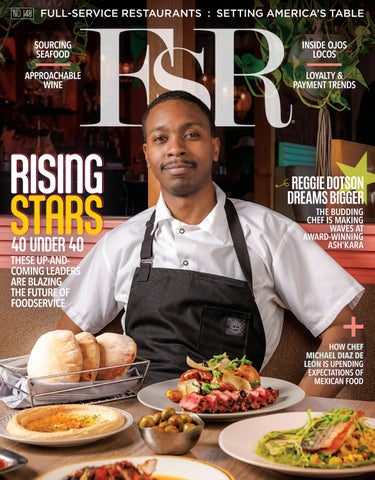
RISING STAR REGGIE DOTSON IS LEAVING HIS MARK AT AWARD-WINNING ASH’KARA WHILE INSPIRING THE NEXT GENERATION OF CHEFS.

22 Rising Stars

These 40 under 40 restaurant leaders are line cooks turned culinary mavericks, beverage pros embracing the nonalcoholic movement, savvy marketers, and operators who are as fluent in food costs as they are in the importance of staff mental health and mentorship. Spotlighting Ash’Kara executive chef Reggie Dotson, whose story is defined by curiosity and grit.

CHEFS & INGREDIENTS

11 Rewriting the Mexican Food Narrative

BY

Michelin-star chef Michael Diaz de Leon is upending expectations of what Mexican food “should” be at his Denver restaurant, Molino Chido, and on screen competing on “America’s Culinary Cup.”

16 Seafood That’s Hooked on Transparency BY

From Florida’s line-caught wahoo to wild Alaska halibut, operators are leaning into traceability, sustainability, and guest education.

LIQUID INTELLIGENCE

19

When the Wine List Works

A wine list is only as good as it moves, according to sommelier and GM Fabien Jacob, who is uniting service and cellar strategy at Brasserie Mon Chou Chou.

7 Why Diners Aren’t Dead BY CALLIE

Here’s how legendary New York restaurateur Stratis Morfogen is shaking up the 24-hour diner model and proving the format isn’t dead—it’s just in need of disruption.

8 Pack in the Protein BY CALLIE

Consumer demand is driving restaurants to bake higher protein and fiber into their menus.

OF HOUSE

33 Stewardship at Scale BY

WOMEN IN LEADERSHIP At Heritage Restaurant Brands, a cross-functional team of women leaders is protecting emotional equity while modernizing systems to drive sustainable franchise growth.

35 Ojos Locos is Changing the Game BY BRITT ENGLER ON THE RISE Here’s how a 35-unit Mexican cantina concept is becoming a yearround destination for sports fans.

37 The New Reign of Human-Centric Loyalty BY BRITT

TECH CHECK Restaurants are updating loyalty programs and payment tech to remove friction and strengthen guest relationships.

40 Flipping the Script BY CALLIE EVERGREEN

BEHIND THE SCENES Kevin Santiago of Heirloom Restaurant Group reveals how he turns failing restaurants into success stories.

EDITORIAL

VP, EDITORIAL DIRECTOR: FOOD, RETAIL, & HOSPITALITY Danny Klein dklein@wtwhmedia.com

FSR EDITOR Callie Evergreen cevergreen@wtwhmedia.com

QSR EDITOR Ben Coley bcoley@wtwhmedia.com

ASSOCIATE EDITOR Sam Danley sdanley@wtwhmedia.com

SENIOR EDITOR, WIRL Satyne Doner sdoner@wtwhmedia.com

SVP, AUDIENCE GROWTH Greg Sanders gsanders@wtwhmedia.com

CONTENT STUDIO

VP, CONTENT STUDIO Peggy Carouthers pcarouthers@wtwhmedia.com

WRITER, CONTENT STUDIO Drew Filipski dfilipski@wtwhmedia.com

WRITER, CONTENT STUDIO Ya’el McLoud ymcloud@wtwhmedia.com

WRITER, CONTENT STUDIO Abby Winterburn awinterburn@wtwhmedia.com

DESIGN

ART DIRECTOR Erica Naftolowitz enaftolowitz@wtwhmedia.com

2024 REGIONAL GOLD AWARD: PUBLICATION DESIGN

2023 NATIONAL GOLD AWARDS: FRONT COVER (PHOTO), BEST USE OF COLOR NATIONAL SILVER AWARD: BEST USE OF TYPOGRAPHY

2016 MAGAZINE OF THE YEAR TOP 10 AWARD

2015 MAGAZINE OF THE YEAR

FOLIO: Eddie Awards

2022 BEST FULL ISSUE HOSPITALITY

2022 BEST SPONSORED CONTENT

2021 BEST PROFILE FEATURE

2017 BEST FULL ISSUE FOOD & BEVERAGE

2013 BEST DESIGN, NEW MAGAZINE

2013 BEST FULL ISSUE, FOOD SERVICE/HOTEL

® SALES & BUSINESS DEVELOPMENT

SVP SALES & STRATEGY Matt Waddell 312-961-6840 mwaddell@wtwhmedia.com

VP, BUSINESS DEVELOPMENT Eugene Drezner 919-945-0705 edrezner@wtwhmedia.com

NATIONAL SALES DIRECTOR Amber Dobsovic 757-637-8673 adobsovic@wtwhmedia.com

NATIONAL SALES DIRECTOR Edward Richards 216-956-6636 erichards@wtwhmedia.com

NATIONAL SALES MANAGER Tom Boyles 662-607-5249 tboyles@wtwhmedia.com

CUSTOMER SERVICE REPRESENTATIVE Tracy Doubts 919-945-0704 tdoubts@wtwhmedia.com

ADMINISTRATION

CEO Matt Logan mlogan@wtwhmedia.com 919-945-0704 www.fsrmagazine.com/subscribe

FSR is provided without charge upon request to individuals residing in the U.S. who meet subscription criteria as set forth by the publisher.

REPRINTS

THE YGS GROUP

800-290-5460 fax: 717-825-2150 fsrmagazine@theygsgroup.com

Sponsored content in this magazine is provided to the represented company for a fee. Such content is written to be informational and nonpromotional. Comments welcomed at sponsoredcontent@ fsrmagazine.com.

FOUNDER Webb C. Howell

LinkedIn.com/company/ FSR-magazine

Instagram.com/FSRmagazine Facebook.com/FSRmag

Time to Transform

SPRING IS THE SEASON OF TRANSFORMATION AND CHANGE —concepts restaurant leaders are no strangers to. From switching up menus to include more seasonal ingredients to continually updating business practices to stay compliant with shifting rules and regulations, being a part of this industry requires an understanding and willingness to pivot as needed. Yet at the same time, operators must remain levelheaded amid those changes and not lose sight of what’s important: staying true to your core DNA and values, and making sure you’re taking care of both your employees and guests first and foremost.

Speaking of, I want to note a few small changes we recently made at FSR : We added a new standing department feature, “Tech Check,” which will focus on a different tech-related topic each issue. This month is all about loyalty and payment trends, and how restaurants are simplifying rewards and giving guests more control at checkout to remove friction and strengthen relationships (check it out on PAGE 37).

Additionally, we’ve shifted our “Rising Stars” feature—normally in our September issue—to April, which means this month’s magazine spotlights our newest class of 40 under 40 up-and-coming leaders (PAGE 22). This new generation is reshaping what restaurant success means, and they are as fluent in food costs and P&L sheets as they are in mental health, mentorship, and making space at the table for voices historically left out. Together, they are building the next era of human-first hospitality.

Our cover subject—Rising Star and Ash’Kara chef Reggie Dotson—says what excites him most about the industry right now is the young, hungry team he cooks with; people eager to dig into the nuances of cuisine and define their own style. At the end of the day, Dotson always seeks to inspire the person next to him, “as well as try to use the form of hospitality to make something better,” he adds. “That’s always been one of my biggest goals as a chef—to be remembered in a variety of ways.”

Cheers to the start of a new season—hopefully one that’s filled with brighter days, new ideas, and embracing change.

cevergreen@wtwhmedia.com FSRmag @FSRmagazine

On the Cover

This month’s cover of Ash’Kara executive chef Reggie Dotson Connor Stehr —a photographer based in Denver, Colorado, who is originally from Texas. He specializes in the food and beverage industry and loves capturing the small details created by chefs and bartenders. You can find more of his work at shakeandstehr.com or follow him on Instagram @shake_and_stehr

Cintas

IDAHO ®

IDAHO ® RUSSET POTATOES

POTATO & BEET TARTARE

IDAHO ® FINGERLING POTATOES
Chef Stephen Toevs Marriott International

Why Diners Aren’t Dead

Here’s how a New York restaurateur is disrupting the 24-hour diner model.

STRATIS MORFOGEN IS REIMAGINING one of hospitality’s oldest formats—the diner—for the digital-first era. Anything retro and nostalgic is trending, but with a digitalfirst lens—typically catering to what looks good aesthetically on social platforms like Instagram and TikTok. Morfogen

First Course

Guests can find a $10 burger or basic omelet at Diner24, but the same menu stretches up to a $39 “trifecta” triple burger or a surf-andturf double burger topped with lobster.

designed Diner24 NYC with that in mind. Located near Gramercy Park in New York City, Diner24 opened in spring of 2024, and has since garnered nearly 6,000 5-star reviews and amassed more than 79k followers on Instagram. “We’re not in the restaurant business anymore,” Morfogen

says. “We’re in the reaction business. We’re in the theater business.”

Diner24 is also an attempt to revitalize an iconic part of NYC’s restaurant scene, the 24-hour diner, after COVID shuttered many round-the-clock institutions. Diner24 honors the culinary history of the “city that never sleeps” while reimagining what diner food can look and taste like. “We make restaurantquality food in a diner with the same high-end vendors I used at Brooklyn Chop House,” says Morfogen.

Morfogen sees the diner as both an iconic American brand and an underoptimized business model—one that suffered not because people fell out of love with it, but because too many operators stopped innovating. By tightening the menu, upgrading ingredients to restaurant-quality standards, and layering in technology—from SEO and AI-driven marketing to TikTok-friendly dishes—he’s proving that a 24-hour diner can still be a growth engine in a modern, hyper-competitive market.

From the jump, Morfogen approached Diner24 like a digital-era business, not another corner coffee shop. He named the concept “Diner24” to hardwire key search terms like “24 hour diner” and “24 hour breakfast” directly into the brand. The payoff has been massive: Diner24 pulls roughly 18 million impressions a month on “diner near me” alone.

Many of the brand’s most viral menu items were developed by Morfogen’s teenage daughters, whose milkshake creations alone have generated more than 300 million views on TikTok. The restaurant isn’t in a typical tourist location, yet he estimates about 60 percent of the business now comes from visitors who discovered the concept online.

“Everybody called me crazy to go back into the diner business, because the diner was ‘dead’—and that’s the best drug for me. Proving everybody wrong,” he says.

TO LEARN MORE, CHECK OUT ‘THE RESTAURANT INNOVATOR’ ON ALL PODCAST PLATFORMS.

Pack in the

Protein

As the number of people using GLP-1 drugs like Ozempic has continued rising— coupled with the evolving functional food trend—restaurants are responding as consumers seek out menu options with higher protein and fiber. According to data from Revenue Management Solutions (rms)’s newest consumer survey, 50% of consumers will switch brands for high-protein options.

The competitive power of protein:

62% of respondents actively seek highprotein options when ordering

38% are willing to pay premium prices for high-protein meals

70% of Millennials actively seek highprotein options, and

57% would switch brands

CULINARY INSPIRATION AND STORIES FROM INDUSTRY TRAILBLAZERS

MENTIONED IN THIS SECTION MOLINO CHIDO • • HUNGRY EYES • • SOPHIA’S TRATTORIA

THE MENU MOVES FROM CRUDOS (CEVICHE, AGUACHILES, RAW VEGETABLES) TO MASA-DRIVEN PLATES LIKE TETELAS AND FLAUTAS (PICTURED), INTO LARGE-FORMAT “GRANDES” THAT SERVE TWO TO FOUR PEOPLE RANGING FROM A $25 MILANESA DISH TO A $58 CARNE ASADA STEAK.

Chefs & Ingredients

Rewriting the Mexican Food Narrative

Michelin-starred chef Michael Diaz de Leon is upending expectations at Molino Chido.

MICHAEL DIAZ DE LEON NEVER THOUGHT he’d end up cooking on TV. But when the opportunity arose to compete on America’s Culinary Cup starring 16 of the country’s most elite chefs clamoring to win $1 million, it was simply (and obviously) “too good to pass up.”

A first-generation Mexican American born in the border town of El Paso, Texas, the budding chef developed an early and enduring affinity for com-

munity, connection, and storytelling through food, which continue to influence his culinary and leadership style today. He earned an associate’s degree in culinary arts from El Paso Community College, where he says he fell in love with the culinary profession and never looked back.

After cooking his way through a variety of environments and establishments—from food trucks and grill and bars to country clubs and Michelinstarred restaurants—Diaz de Leon was hired as chef de cuisine of Taft Diaz, a high-end Mexican spot in his hometown. Two years later, he moved to Denver and secured the role of sous chef at Old Major—but in 2020, the pandemic forced the restaurant to close. Still, Diaz de Leon found a way to keep working.

POST-SHIFT DRINK?

Pineapple Tepache (fermented NA Mexican beverage with soda water) or wine

FAVORITE DENVER RESTAURANT (OUTSIDE YOUR OWN)? Hop Alley

SECRET COMFORT FOOD?

Anything dip related— buffalo chicken dip, hummus, chips & salsa

GO-TO PIZZA TOPPINGS?

Classic jalapeño and pepperoni, drizzled with hot honey

FAVORITE FOODIE CITY? Mexico City or NYC

He made sandwiches at his local grocery store and partnered with Kelly Whitaker to spearhead an advocacy kitchen.

Diaz de Leon hosted weekly taco omakase pop-ups at Whitaker’s openfire-driven concept, BRUTØ, and was soon tapped to lead the high-end concept as executive chef, with complete control over the intimate chef’s counter. There, Diaz de Leon crafted technique-driven dishes rooted in sustainability, celebrating traditions from Latin America, México, Texas, and Colorado. His work at BRUTØ centered on relationships with farmers, ranchers, and artisans, weaving their stories into the dining experience that nurtured a deeper conversation among guests.

With Diaz de Leon at the helm, the restaurant was awarded its first Michelin

star in 2023, plus honored with a Michelin Green Star for sustainability. The same year, he was recognized when he became the state’s only James Beard Award finalist for Best Chef, Mountain Region. But on November 11, 2023— his three-year anniversary at BRUTØ— Diaz de Leon announced his departure from his role on Instagram, writing that he was “in a place of starvation for exploration, growth, and connection with the world. It’s time for me to experience other cultures, approaches, and practices that the world has to offer and teach me.”

He also wrote, “The journey from Burger King to BRUTØ has been beyond incredible, and I am forever grateful to each stepping stone that has led me to this moment.”

Diaz de Leon took a breath, spent time with family, and traveled to Uruguay and back to his roots in El Paso. “In the interim of me leaving BRUTØ to where I am now, I was traveling, doing pop-ups, consultancies, kind of just re-finding my love for food, trying to figure out next steps,” he says. Before returning to Denver, he called up his friend, prominent chef Tommy Lee—the founder of Uncle restaurant and modern Chinese spot Hop

MOLINO CHIDO (2) / DANIEL BRENNER
A FIRST-GENERATION MEXICAN AMERICAN BORN IN THE BORDER TOWN OF EL PASO, TEXAS, MICHAEL DIAZ DE LEON (LEFT) DEVELOPED AN EARLY AND ENDURING AFFINITY FOR COMMUNITY, CONNECTION, AND STORYTELLING THROUGH FOOD, WHICH CONTINUE TO INFLUENCE HIS CULINARY AND LEADERSHIP STYLE TODAY.

You should know—you’re one of them.

You’re what we at FSR like to call “tablesetters.”

You make things happen in the restaurant industry.

You’re an innovator on your menu and in all aspects of your operation.

You’re watched and emulated by other restaurateurs.

You lead the markets you operate in.

These are the characteristics that make a tablesetter. And FSR is the trusted source of information for these most influential chefs and restaurateurs in the industry. Request your free subscription today by visiting FSRmagazine.com/subscribe

Restaurants : Setting America’s Table

THROUGH

LARGE FRONT WINDOWS, GUESTS AT MOLINO CHIDO CAN WATCH STAFF MAKE THE DOUGH AND TORTILLAS BY HAND. INSIDE, THE SPACE IS OPEN, VIBRANT, AND GREEN, CHANNELING A MEXICO CITY MARKET WITH A SERIOUS BAR PROGRAM.

Alley—to see if there was an opportunity to do a pop-up or collaborate again. That conversation led to touring potential locations to open a Mexican restaurant, he recalls. At the time, he already had a desire to open his own restaurant. Fast forward three months to Lee and Diaz de Leon signing a lease at Stanley Marketplace, and then to November of 2025, when they opened the Mexican City-inspired taqueria, Molino Chido.

Molino translates to “mill,” and chido essentially means “cool.” The restaurant embodies an intentional approach to hospitality rooted in heritage and craft. They honor an ancestral technique to make masa dough, which becomes corn tortillas, called nixtamal. Heirloom corn— grown in southern Colorado in partnership with the Ute Mountain Ute Tribe—is cooked and soaked in an alkaline solution, which also improves nutritional value, then ground into masa. Guests can see this process through large front windows, watching staff make the dough and tortillas by hand. Inside, the space is open, vibrant, and green, channeling a Mexico

City market with a serious bar program. With Molino Chido, Diaz de Leon is also challenging preconceived notions of what Mexican cuisine can—not “should”—be. “I am very much a person that likes to push the envelope on certain things,” he says. “So when people found out that we’re opening a taqueria, which is somewhere you get tacos, there’s automatically this idea of, ‘Oh, I’m just gonna go get street tacos, and there should be a certain price, and Mexican food shouldn’t be expensive, it should be cheap’—which is obviously complete bullshit.”

The menu moves from crudos (ceviche, aguachiles, raw vegetables) to masadriven plates like tetelas and flautas, into large-format “grandes” that serve two to four people ranging from a $25 Milanesa dish with fried chicken cutlet, rajas con queso, xnipec, and umami slaw, to a $58 carne asada steak with a 16-ounce New York strip, tomato tamarind chutney, cebollitas, chiles toreados, and tortillas.

Six rotating seasonal tacos also offer guests a diverse selection, from a $4.85 al pastor with marinated pork and pineapple to a $11.85 beef strip loin with

green peppercorn, onion, con costra (cheese crust). However, Diaz de Leon has watched some customers “refuse to pay $4.50 for a taco,” to which he simply responds, “Well, then the restaurant’s not for you.”

Diaz de Leon and his team spend time educating consumers on why certain decisions were made, from not having avocado on the menu due to deforestation issues in Mexico to why they don’t serve rice. “You don’t get rice in taqueria,” he says. “There’s just this misconception of, every Mexican restaurant should be the same, chips and guac, rice and beans and fajitas.”

He adds, “I’m a highly trained Michelin-starred chef that thinks outside the box. If anything, you’re going to get the complete opposite of that. So it’s been really interesting to just get people to understand that we’re looking at it from a different perspective.”

When approached with the opportunity to appear on America’s Culinary Cup, Diaz de Leon, who describes himself as “hyper competitive,” was attracted to the chance to challenge himself and see where he stacked up against some of the best chefs in the country. He also took the time to think about what the exposure could mean for himself and Molino Chido. “I was opening a restaurant, and I have to think about the bigger picture, which is the wellbeing of that restaurant and the employees that we are responsible for,” he says.

“And I have a big responsibility to the community, not only here in Denver, but as a Latino man in this country,” he adds. “I want to represent the young Latinos and Latinas that are coming up and give them an example of, ‘Hey, this young man from a border town with immigrant parents went from nothing to now being on the biggest stage on TV … if he does it, then I can do it too.’”

America’s Culinary Cup premiered its first episode in March, hosted by Emmy Award-nominated food expert Padma Lakshmi, with acclaimed chefs Michael Cimarusti and Wylie Dufresne as judges. New episodes will continue to air on CBS and streaming on Paramount+.

DANIEL BRENNER

Hooked on Transparency

From Florida’s line-caught wahoo to wild Alaska halibut, restaurants are leaning into traceability, sustainability, and guest education.

IT’S A BRIGHT EARLY MORNING at Ponce Inlet on Florida’s east coast. Lines of small boats sit docked as fishmongers display the day’s catch—harvested by spearfishers, rod-and-reel anglers, and longline fishermen trained to return bycatch to the sea quickly to protect fish stocks for future generations.

Such is the work of Simple Seafood, which supplies fresh, sustainably harvested, handpicked fish to restaurants like Sophia’s Trattoria at Conrad Orlando at Evermore. The restaurant serves coastalinspired Southern Italian fare, and for chef Stephen Ullrich, the partnership is essential to a seafood-forward menu.

“Having a direct source has a lot of advantages. We get fish we wouldn’t normally receive from a freshness standpoint, which is a value-add we pass on to our guests. We also get to highlight the many offerings of Florida fishing grounds,” Ullrich says. “By not using nets, utilizing line-caught fish ensures we’re all doing our part to be able to enjoy seafood 15 years from now. At the rate we’re going, everything is going to be predominantly farmed, which is a shame.”

Because the menu depends on what fishermen catch, Ullrich and his team must remain flexible. Flipping from snapper to grouper is simply the cost of doing business, he says. However, one native fish is consistently available yet often unfamiliar to guests: wahoo.

At Sophia’s Trattoria, wahoo is grilled and served over spaghetti alla puttanesca with spicy tomato, capers, and olives, alongside squid ink potato purée. Firm yet flaky, the fish grills like a steak.

“This is a native Floridian fish that guests rarely see at the supermarket

SOPHIA’S

or on menus, but it’s delicious,” Ullrich says. “It exemplifies opening the lens for a client. It sheds light on a local fish that doesn’t quite have a spot in the market yet, only because people don’t know and aren’t asking for it.”

Guest behavior is also driving the rise in sustainable seafood. More than ever, diners value wellness and transparency about where food comes from. Fish, Ull rich says, is not heavily manipulated; it’s served light and flavor-forward. The fish speaks for itself.

“These conversations around the pro cessing of ingredients wouldn’t have hap pened five years ago. It just wasn’t in the vernacular. But as chefs, we’ve been very cognizant and made pivots to align with what people really want on their plate,” Ullrich adds. “I think we’ll continue to see snapshots and captions on menus that delineate whether something is farmed or wild-caught because guests make decisions now based on that.”

PHIL CENAC, CO-CHEF OF HUNGRY EYES ALONGSIDE MASON HEREFORD, SAYS GUESTS ARE INCREASINGLY INTENTIONAL ABOUT THE SOURCE OF THE SEAFOOD IN THEIR DIETS. THEY WANT TO KNOW: WHERE DID IT COME FROM? IS IT WILD-CAUGHT? WAS IT SOURCED IN THE U.S.?

in the United States? Today, nearly 30 percent of diners say these claims are key motivators.

In the heart of New Orleans, seafood has always been interwoven into the city’s culture—it’s on nearly every street corner. But Phil Cenac, co-chef of Hungry Eyes alongside Mason Hereford, says guests are increasingly intentional about the source of the seafood in their diets. They want to know: Where did it come

“Everyone seems to be waking up and paying more attention,” Cenac says. “There are major events occurring all around us, and they’re putting more thoughtfulness into things like global warming. I think everything is political, especially food … and guests are more intentional about what they decide to support.”

Alaskan seafood, with its wild origin and American harvest, is outpac -

ing 5.4 percent year-over-year growth. It is often frozen within hours of harvest using cryogenic blast technology to lock in flavor and nutritional value. At Hungry Eyes, Cenac and his team use this method for Alaskan halibut.

“We’re using the whole halibut, breaking down one fish a week and portioning it into blocks, ensuring we’re using the whole fish and reducing waste,” Cenac says. “From a sustainability aspect, it’s great. But it also helps us with labor pressure because it’s so quick and consistent.”

One of Cenac’s favorite dishes is halibut crudo, combining raw, cubed fish with pineapple, cinnamon, nam prik broth, and crispy quinoa. The dish balances crunchy, salty, sweet, and acidic notes, pulling inspiration from both Vietnamese and Mexican flavors.

It reflects what he expects guests to order more of in the future—as temperatures rise, raw fish prepared in acidic applications is gaining traction over heavier fare. Still, he says, the story behind the dish matters most.

“The storytelling aspect of how the fish was caught and where it comes from is one of the things that will help us move a specific menu item more so than if it’s just written out on a page,” Cenac says. “Every time we have a premeal, we’re educating our servers on all of these talking points. The story goes such a long way with today’s diner.”

THE BRANZINO AT SOPHIA’S TRATTORIA IS BUTTERFLIED AND BONELESS, PAIRED WITH A CHERRY TOMATO VINAIGRETTE, LEMON CONFIT, AND FINE HERBS.

FILLING PORTION CUPS SLOWING YOU DOWN?

Introducing the FIFO Fill Station™

High-Volume Portion Pump

Designed for fast, one-step portioning in high-volume commercial kitchens.

Fully manual operation, with no electronics or motors, eliminating service network costs and downtime.

Simple disassembly and cleaning.

Certified for food safety

Adjustable portion sizes from 1 oz - 10 oz. Dispense instantly in a

TRENDS AND CREATIVE APPROACHES TO SPIRITS, WINE, AND BEER.

MENTIONED IN THIS STORY BRASSERIE MON CHOU CHOU

Liquid Intelligence

WHEN THE WINE LIST WORKS

IF THE LIST FEELS APPROACHABLE, IF THE TEAM FEELS CONFIDENT, AND IF THE GUEST FEELS HEARD, THEN THE PROGRAM MOVES.

The point isn’t just selling more bottles— it’s making the experience worth it.

AT SOME RESTAURANTS, the wine list can turn into a trophy case. Bottles sit. Servers hesitate because they don’t want to sound wrong or get stuck in a conversation they can’t finish. Guests take one look, default to the safest

choice, and move on.

That’s exactly the scenario general manager and sommelier Fabien Jacob works to avoid at Brasserie Mon Chou Chou in San Antonio’s Pearl District. For him, a wine program isn’t “good”

LIQUID INTELLIGENCE

because it looks impressive on paper. It’s good because it moves.

That matters in 2026, when Jacob says he’s seeing the same shifts operators across the country are navigating. “People now are more cautious about wine,” he says. “They’re trying to drink less alcohol, but they’re spending more money per bottle, so they’re drinking better.”

Mon Chou Chou operates in an environment that demands that kind of practicality. The restaurant sits in the middle of the Pearl, a high-traffic district that pulls in locals and destination diners in the same night.

The menu leans into traditional French comfort food while reflecting the regional backgrounds behind the concept, and it changes throughout the year to match seasonality. The dining room, Jacob says, is built for guests who range from confident wine drinkers to people who would rather not pronounce a French appellation out loud.

That mix is one reason Jacob’s role is so central to how the program works. He isn’t operating as a sommelier who swings by a few tables and disappears back into the cellar. He runs the floor and the list. Service strategy and wine curation live under the same leadership, which gives him a clear view of what sells, where the team freezes up, and what guests actually want when they ask for help. It also keeps him grounded in what the job really looks like day to day.

“Eighty percent is just managing numbers and making sure everything is ready and set up for the staff to be successful on the floor,” Jacob says. “They can only be successful if they have all the tools to play with.”

That mindset shapes his leadership philosophy. “To me, leadership is mentorship and empowerment,” he says, describing an approach built around giving his team ownership of the experience. But empowerment doesn’t mean turning every table into a classroom. Part of the job is knowing when to lean in and when to pull back, reading the room and meeting guests where they are.

“It’s a fine line between teaching and being welcoming instead of talk-

ing down,” Jacob says. “Sometimes, you can be condescending when you have too much knowledge. Sometimes, the guest is just here to enjoy the moment, not to be taught something. Some people geek out, and some people just want to get their wine.”

“To me, when you come to a restaurant, it’s to enjoy what the chef does,” he says. “The food is the painting. As a sommelier, I always want the wine to be the frame around it. A good frame can enhance a nice painting, and a bad frame doesn’t do it justice.”

That framing doesn’t mean guests aren’t intentional about what they order.

That balance shows up most clearly in how Jacob talks about wine’s role in a restaurant. He’s trained as a sommelier, but he doesn’t treat wine as the main event.

MON CHOU CHOU’S WINE PROGRAM IS BUILT FOR THE ROOM AND CLIENTELE IT ACTUALLY HAS—A FRENCH BRASSERIE IN A BUSY DISTRICT, SERVING A BROAD MIX OF GUESTS IN A HIGH-VOLUME ENVIRONMENT.

In fact, Jacob sees the broader wine market shifting toward more thoughtful consumption.

In Europe, he says, wine has historically been treated as a normal part of everyday meals. In the U.S. and other “New World” markets, it often functioned more as a status marker, with guests ordering by label, reputation or price rather than personal preference or pairing logic.

Now, Jacob says, the conversation is different. Guests are paying closer attention to alcohol content, additives, and how wine is made. Interest has grown in organic, biodynamic, and lowerintervention bottles as part of a broader health-conscious mindset.

He also pushes back on the idea that natural or lower-intervention winemaking is a new concept. “It’s a full circle,” Jacob says. “We started by making the wine naturally, and now we’re actually coming back to that old school of winemaking.”

In his view, that doesn’t mean every restaurant needs to reinvent its list overnight. At Mon Chou Chou, he didn’t walk in and blow up the program. He inherited a list he describes as thoughtful and not overwhelming, with core regions

FABIEN JACOB (BELOW) AVOIDS ARRANGING THE WINE LIST BY PRICE BECAUSE OF HOW QUICKLY THAT CAN MAKE GUESTS SELFCONSCIOUS. INSTEAD, HE PREFERS A PROGRESSIVE FORMAT—LIGHT TO HEAVY, DRY TO SWEET— BUILT AROUND HOW GUESTS ACTUALLY DESCRIBE WHAT THEY WANT.

represented and enough range to offer different styles without creating a wall of labels. His focus has been on making sure guests can use it and staff can sell it. His biggest advice for operators starts with cutting the insider instincts out of list design. “I would prioritize a wine list that is easily digestible for the customer,” Jacob says. The list doesn’t need to be packed with details that only a small slice of guests understand well enough to shape their decision.

“Make it simple,” he says. “It shouldn’t be daunting. It should be inviting.”

Jacob avoids arranging the list by price because of how quickly that can make guests self-conscious. Instead, he prefers a progressive format—light to heavy, dry to sweet—built around how guests actually describe what they want.

It’s also a training advantage, he notes. “You just have to teach them to

ask the right questions.”

That training is the bridge between a good list and a list that moves. Jacob spends significant time coaching the front-of-house team, but he isn’t trying to turn every server into a sommelier. He’s giving them a framework and the confidence to guide guests without jargon or making wine feel like a test.

In his view, that same thinking now applies beyond traditional wine. Beverage programs aren’t just about alcohol anymore. Non-alcoholic offerings have to be taken seriously because many guests avoid alcohol for religious, medical, or lifestyle reasons but still want to feel included in the dining experience.

At Mon Chou Chou, the NA program includes nonalcoholic beer, wine, and cocktails, and Jacob says the team approached product selection the same way they approach the rest of the list: by tasting broadly and choosing what fits the market, not his personal preference.

“We tried at least 10 or 20 bottles of nonalcoholic wine,” he says. “Some of them are excellent. Some of them are not to my liking, but you need to find what’s best for your customers and for your market.” His method is direct: involve the whole team and follow the majority. “The best way to do so is to ask everyone, ‘Hey, can you please try these for me and tell me which one you like the best?’ If five of them choose the same one, then take it and that’s it.”

The throughline in all of it—traditional wine, NA options, list structure, staff coaching—is that the program is built for the room Mon Chou Chou actually has. It’s a French brasserie in a busy district, serving a broad mix of guests in a high-volume environment. Jacob’s job is to make the wine work inside that reality, not in an imagined world where every guest is a collector and every server is a wine nerd. If the list feels approachable, if the team feels confident, and if the guest feels heard, then the program moves.

And for Jacob, the point isn’t just selling more bottles. It’s making the experience feel worth it. “We are the only job in the world that can create memories every day,” he says.

40 RESTAURANT LEADERS UNDER 40 ARE RESHAPING THE FUTURE OF FULL-SERVICE HOSPITALITY

RISING STARS

«THE NEXT EVOLUTION OF FULL-SERVICE DINING isn’t being mapped out in boardrooms or think tanks; it’s taking shape on the line, at the host stand, behind the bar, and in the back office where a new generation of leaders is reshaping what success means. They’re as fluent in food costs and P&L sheets as they are in mental health, mentorship, and making space at the table for voices historically left out.

Our Rising Stars are line cooks turned culinary leaders, beverage pros embracing the NA movement with open-minded creativity, operators who see spreadsheets and staff well-being as equally nonnegotiable, and marketers who understand that restaurant stories travel far beyond four walls. What unites them is a shared conviction that restaurants can be creative, profitable, and humane, all in one.

These 40 restaurant leaders under 40 share a common instinct to question the way things have historically been done. Not only that, but they’re bold enough to envision a better path forward. Together, this class of Rising Stars is building the next era of human-first hospitality. BY CALLIE EVERGREEN

Reggie Dotson

AGE: 38

EXECUTIVE CHEF

ASH’KARA DENVER, COLORADO

Chef Reggie Dotson’s story is defined by grit, curiosity, and big, uncompromising dreams. He began his cooking journey at a young age out of necessity, preparing meals for his younger brother to help out his mother, who worked two jobs and had late nights as a nurse. “The way I contributed most was using my talent for cooking … The act of just making people happy and satisfied turned into something more,” he recalls.

In high school, Dotson took a foodservice management class at Denver’s Career Education Center, where he learned the basics of how a professional kitchen operates. On a class field trip to a hotel, he arrived determined to land a job, tracked down the chef, and persisted until she let him fill out paperwork. That led to a weekend job in the hotel kitchen during his senior year, followed by culinary school—and his career has been building ever since.

He earned degrees in culinary arts and food management from Johnson & Wales University, which was no easy feat while working 60 hours a week and going to school fulltime. “I always said to myself, ‘If I can get through this and be able to put my head down and really strive and make this accomplishment by just graduating school, then I can take this same drive and put it to becoming a chef or owning a restaurant one day, hopefully,’” Dotson says.

The Denver native sought to continue expanding his culinary knowledge after graduat -

ing and rediscover his familial roots in South Carolina—where his grandmother grew up—so he made the move to Charles ton where he worked at Kiawah Club for about two and a half years. “I really started trying to learn everything I could about food, and use some of that her itage to my advantage,” he says.

While there, Dotson’s exec utive chef surprised him one day when he called him up with an opportunity to cook in the Caribbean during the res taurant’s slower winter season to help him grow his leader ship skills. They sent him to St. Kitts for two three‑month stints over Christmas, returning to Charleston each summer—a journey he hadn’t planned on, but one he describes as “really fruitful.”

“Everyone has a different style of personality whether it’s Southern hospitality or whether it’s Denver, where it’s a little more laid back and chill,” he says. “Just being able to pair every single thing that I've learned from all the people that I've been around to create the little bit of nuances that I have has been the best thing.”

He returned to Denver in 2013 and kept building his culi nary chops at The Brown Palace, Acorn, and Bar Dough—where he worked as a sous chef under Carrie Baird—before joining Ash’Kara, a three time Michelin Bib Gourmand winner that cel ebrates the flavors of North Africa, the Middle East, and the Mediterranean.

“We were one of the first here in Denver to receive a Bib Award, and honestly on a semi personal kind of accomplish ment, that’s been probably one of my biggest professional ones, because I’m at the helm,” says Dotson, who rose to the rank of

executive chef and has created roughly 90 percent of the current menu.

Though leading menu development at Ash’Kara wasn’t easy for Dotson at first since he wasn’t as familiar with Mediterranean and Middle Eastern cuisine, he welcomed the challenge. He credits restaurant owner Juan Padro and chief culinary officer Max MacKissock for pushing him out of his comfort zone. “They wanted me to grow as a chef more than just as another person or manager,” he says.

Dotson also spent time learning from Boston chef Ana Sortun—who competed on the second season of “Top Chef Masters”—studying her Turkish-inspired cooking. From there, he’s gravitated toward a Turkish-leaning style viewed through a global lens, pulling in influences from places like Morocco, South Africa, and Greece to create a broader, world-spanning culinary perspective.

Dotson’s “day one” dish at Ash’Kara— a za’atar-roasted half chicken with housemade harissa chicken butter, garlic, lemon, and reduced chicken stock—has never left the menu. “Honestly, that’s kind of the thing that everyone would freak out if I took off the menu,” he says. At the same time, he keeps pushing himself creatively with new, globally inspired plates like a pomegranate-braised lamb shank served with roti, red pepper jelly, gem lettuce, and caramelized onions as a shareable sandwich. For him, the fun

lies in having few limitations and pulling inspiration from across the Mediterranean and beyond.

Reflecting on how he has grown as a leader in the kitchen and beyond, Dotson says he thinks of every day as a lesson, trying to find the best version of yourself. “The truer you stay to yourself, the more that people tend to follow you as a leader. I’ve always been a kind of putyour-head-down first kind of person to show leadership in that way,” he says.

A big learning moment for Dotson was learning how to delegate to his team members. “Being able to say, ‘I'm not going to be the one that does this, but I can show you how to do it, and you can take that and run with it’—that's been probably where I've grown the most, and where I've found the most excitement as in being a chef, is because I'm able to one, motivate people, and two, show them the craft that I've been working on,” he explains. “And hopefully, one day they're in the same kind of position, and they will be able to share their craft with someone.”

Dotson’s advice to other rising chefs is to trust the experience and instincts they bring to each moment. For him, good decisions come from a balance of inner conviction and leaning on trusted people around you for support, while remaining humble at the same time. “Being humble is something that I've never really had too much of a problem

with, just because I grew up in a family where humble beginnings were part of the start,” he adds. “Having trust in the people that have helped gotten me here, having good mentorship, good conversations with people that I trust, and just being able to look at the person next to me and know that we're in it for the same reason, and that I can trust in them to get the same goal accomplished.”

Though he doesn’t forget his humble beginnings and the lessons that came alongside his journey, Dotson also isn’t afraid to dream bigger and strive for more. Looking ahead, Dotson’s goal is to open and be at the helm of his own restaurant some day, though the concept and cuisine type is still up in the air at the moment. What excites him most about the industry right now, Dotson says, is the young, hungry team he cooks with—people eager to dig into the nuances of cuisine and define their own style. At the end of the day, Dotson always seeks to “inspire the next person, cook for the person who's next to me,” he says, “as well as try to use the form of hospitality to make something better—whether it's a diner who sits in front of a plate of food and sees it for the first time and experiences something new and memorable, to something that creates nostalgia for them. That's always been one of my biggest goals as a chef—to be remembered in a variety of ways.” FROM HOUSE-MADE PITA TO SOCIABLE MEZZE PLATES—LIKE HAND-WHIPPED HUMMUS, TO LARGE-FORMAT PROTEINS AND TAGINES SERVED IN TRADITIONAL CLAY POTS—ASH’KARA SHOWCASES THE

Michaela (Mich) Finlayson

AGE: 27

GENERAL MANAGER

YOUR 3RD SPOT

ATLANTA, GEORGIA

Michaela Finlayson has quickly emerged as a standout leader at Your 3rd Spot, rising from server to general manager in just seven years. She pairs strong operational command—spanning P&L, labor, and cost management—with exceptional emotional intelligence. Finlayson leads with a calm, steady presence and a commitment to honesty that builds trust while maintaining high standards. Her impact is especially clear in her mentorship, successfully moving hourly team members into leadership roles. Focused on culture as much as execution, Finlayson represents the next wave of hospitality leadership.

AGE: 33

BAR

CHEEKY’S ST. PETERSBURG, FLORIDA

Berk Guldal

AGE: 34

OWNER/CHEF

HAMDI

SEATTLE, WASHINGTON

Berk Guldal stands out as a handson owner-operator at Hamdi, leading every service from the line with a focus on craft and consistency. He designs the full menu, drawing from childhood memories, family recipes, and global experience, including time at Eleven Madison Park and training at Turkey’s historic Hacı Abdullah Lokantası.

Opening Hamdi on his own immediately following COVID was one of Guldal’s greatest challenges and proudest accomplishments. He launched the restaurant with only a $10,000 credit limit, despite widespread concerns about the difficulty of opening during that time. The restaurant’s name, Hamdi, honors his grandfather and reflects Berk’s commitment to legacy, resilience, and purpose.

Jacob Ceciro brings a playful, guest-forward approach to the bar at Cheeky’s in St. Petersburg. Guided by a “fun first” philosophy, he has built a cocktail program that ranges from polished martinis to easygoing frozen drinks. Ceciro, a Clearwater native with more than a decade in craft cocktails, previously helped launch Tampa’s M. Bird rooftop and sharpened his skills at Ciro’s speakeasy. A decorated competitor and BAR 5 graduate, Ceciro blends technical credibility with an approachable style.

Jacob Ceciro

Diana Guzman

AGE: 30

GENERAL MANAGER

COLLETTA (INDIGO ROAD HOSPITALITY GROUP)

CARY, NORTH CAROLINA

Over six years, Diana Guzman climbed the ranks from waitstaff at O-Ku Raleigh to bar management, then to assistant general manager at Colletta in May 2023—before stepping into the general manager role she holds today. Known for her competitive spirit and determination, Guzman is deeply committed to her team’s success. She practices servant leadership, focusing on empowerment, proactive support, and leading by example. With a sharp eye for quality and precision, she consistently challenges her team to raise standards while fostering a culture built on trust, accountability, and pride.

Julia Ramirez

AGE: 31

DIRECTOR OF MARKETING

ESCALANTE’S FINE TEXMEX & TEQUILA (MASMEX)

HOUSTON, TEXAS

Julia Ramirez is helping redefine what modern Tex-Mex marketing looks like. At Escalante’s, she leads brand strategy across seven Houston-area locations, blending data-driven precision with authentic storytelling. Starting her journey as a hostess, Ramirez brings frontline insight to every campaign, aligning marketing with real operational needs. Her collaborative, consumer-first approach has strengthened guest engagement, sharpened the brand’s voice, and positioned Escalante’s for continued growth in a competitive casual-dining landscape.

Liz Senyak

AGE: 36

DIRECTOR OF OPERATIONS

SEED & FEED HOSPITALITY

ST. PETERSBURG/ TAMPA, FLORIDA

Anthony Jones

AGE: 37

EXECUTIVE CHEF

MARCUS DC

WASHINGTON, DC

Anthony Jones turned his childhood memories of cracking crabs with his family into one of DC’s most sought-after dishes: Mel’s Crab Rice, a mix of crunchy shallots, okra, obe, and uniinfused béarnaise. In six months, he spearheaded a menu capturing the Black diaspora at Marcus DC as a Black, gay chef. He says, “It’s when we can be comfortable about who we are, and express our creativity through our identity, when the ingredients become bigger than the dish—it becomes joy on the plate.”

He was named a James Beard Award semifinalist for Emerging Chef and is a contestant on the newest season of “Top Chef.”

Liz Senyak is a results-driven operations leader shaping performance across Seed & Feed Hospitality, where she guides strategy, builds leadership teams, and drives consistency across hospitality-forward concepts. Senyak has been instrumental in sustaining the long-term success of Mandarin Hide and led the high-volume opening of Perry’s Porch on the St. Pete Pier, building scalable systems from the ground up. Known for high standards and people-first leadership, Senyak consistently develops strong teams while delivering reliable, culture-driven results.

Niki Pattharakositkul

AGE: 36

FOUNDER / CEO 26 THAI GROUP ATLANTA, GEORGIA

In 2016, Niki Pattharakositkul opened her first restaurant at just 26 years old—the now flagship location of 26 Thai Kitchen & Bar in Buckhead, Atlanta. The name was inspired by her age and her belief in taking bold chances.

“I always wanted to open a restaurant, so it was like a dream,” she recalls. Ten years later, she has expanded her concept to nine locations and counting, plus opened other restaurants Blackjack Bar Tapas, Pink Lotus Thai and the forthcoming concepts, Terminal 26 and Khao Thai Isan. She co-owns the restaurants with her sister, Tanya.

Born and raised in Thailand, Pattharakositkul moved to Atlanta and worked as a server, gaining firsthand experience in the hospitality industry before starting her own rising restaurant empire.

From traveling throughout Thailand and around the world in search of inspiration to working closely with culinary and beverage teams, she plays an active role in menu development and concept creation.

Remy Loet

AGE: 32

SENIOR SOMMELIER

ARIA ATLANTA, GEORGIA

Loet, senior sommelier at Aria, pairs deep wine knowledge with genuine hospitality. Since joining in 2022, he has helped elevate the program through thoughtful curation, expert pairings, and an approachable style that puts guests at ease. Loet excels at connection, turning each recommendation into a memorable experience. Beyond the floor, he trains front-of-house staff and fosters a culture of learning and mentorship. Driven by constant curiosity and passion for his craft, Loet continues to make a meaningful impact on both guests and colleagues.

Shawna Sauter

AGE: 31

OYSTER SHUCKER, AM LINE COOK BLUE ISLAND OYSTER BAR AND SEAFOOD

LONE TREE, COLORADO

Shawna Sauter quickly emerged as a standout at Blue Island Oyster Bar and Seafood. Joining in August 2025 as an oyster shucker and AM line cook, she impressed early with focus, reliability, and pride in her work. Sauter has since become a trusted presence in daily operations, supporting teammates and stepping in wherever needed to keep service running smoothly. Her enthusiasm for seafood and hospitality lifts both team morale and guest experience. Currently working toward her Kitchen Supervisor certification, Sauter pairs a strong work ethic with clear leadership potential well beyond her tenure.

Remy

RISING STARS

Elijah Pulley

AGE: 29

EXECUTIVE CHEF

SADDLE AND CYCLE CLUB

CHICAGO, ILLINOIS

Andrea Veach

AGE: 32

DIRECTOR OF MARKETING

BIG WHISKEY’S AMERICAN RESTAURANT AND BAR OZARK, MISSOURI

Chaz Lindsay

AGE: 36

CHEF/OWNER

PULITO OSTERIA

JACKSON, MISSISSIPPI

Kori-Leigh Gross

AGE: 32

BRAND MANAGER

BRAVO! ITALIAN KITCHEN & BRIO ITALIAN GRILLE ORLANDO, FLORIDA

Michael Dunning

AGE: 38

EXECUTIVE CHEF MIZUNA DENVER, COLORADO

Abby Zimmerman

AGE: 35

GENERAL MANAGER LUCA (BONANNO CONCEPTS) DENVER, COLORADO

Alison Templin

AGE: 33

VP OF SALES PALONA AI PALO ALTO, CALIFORNIA

Brooke Townley

AGE: 37

SENIOR DIRECTOR OF PEOPLE SERVICES

SPB HOSPITALITY NASHVILLE, TENNESSEE

Michael Diaz de Leon

AGE: 37

OWNER/FOUNDER

MOLINO CHIDO

AURORA, COLORADO

Jennifer Lougee

AGE: 34

SENIOR F&B OPERATIONS MANAGER TOPGOLF DALLAS, TEXAS

Jennifer Lougee’s Topgolf journey began in 2011 as a drink runner and has evolved into a national leadership role shaping food and beverage strategy across more than 100 venues. Now senior F&B manager, she pairs frontline insight with disciplined execution, driving measurable gains in cost control, menu performance, and guest experience. Lougee led a major menu redesign, strengthened beverage results, and supports UK operations to ensure global consistency. Known for her steady, solutions-oriented leadership, Lougee consistently finds ways to simplify complexity while elevating performance across the system.

Sarah Charles

AGE: 39

DIRECTOR OF F&B THE FLAT IRON HOTEL (INDIGO ROAD HOSPITALITY GROUP)

ASHEVILLE, NORTH CAROLINA

Sarah Charles brings a people-first, sustainability-minded lens to F&B leadership. At The Flat Iron Hotel, she pairs creativity with cross-functional collaboration, working closely with culinary teams to tell a unified story. A standout example: partnering with a local distillery on a seasonal Ramps Gin that mirrored the kitchen’s ramp-focused menu. Charles is equally focused on team well-being, and fosters environments where high standards and genuine care can coexist. Her impact extends beyond the glass, showing up in stronger teams, thoughtful partnerships, and intentional guest experiences.

Lauren Kershner

AGE: 34

OWNER/FOUNDER

SONGBIRD PARLOUR

GLEN ELLEN, CALIFORNIA

Lauren Kershner is a hospitality powerhouse and entrepreneur. Frequently described as a “triple threat,” she launched three successful hospitality businesses by the age of 33. From early farm roots to becoming an executive chef at 25, she developed a deep respect for local sourcing and thoughtful service. Kershner founded Goodness Gracious Private Chef and Catering, later expanding into Valley of the Moon Kombucha, West Wine Tours, and Songbird Parlour. Viewing hospitality as an act of service, she blends entrepreneurial drive with community focus to create distinctive, locally rooted experiences.

Logan McNeil

AGE: 24

CHEF DE CUISINE TAMBOURINE ROOM BY TRISTAN BRANDT MIAMI, FLORIDA

At just 24, Logan McNeil is quickly rising in South Florida’s competitive culinary scene. In June 2025, he became chef de cuisine of Tambourine Room by Tristan Brandt at the Carillon Miami Wellness Resort, helping redesign the restaurant’s multicourse menu. McNeil held the same role at “Top Chef” Jeremy Ford’s Stubborn Seed, contributing to its Michelin Star and Green Star recognition. Deeply committed to responsible sourcing, he now drives a program at Tambourine Room where roughly 95 percent of produce comes from local organic farms.

Matt Weinstein

AGE: 39

CULINARY DIRECTOR OF LODGING

INDIGO ROAD

HOSPITALITY GROUP

CAROLINAS & GEORGIA

Matt Weinstein is helping shape lodging-driven dining across the Southeast at Indigo Road, where he oversees diverse culinary programs while mentoring chefs across multiple concepts. His career began in Virginia, working from the dish pit to the line before graduating from the CIA. After earning recognition leading Oak Steakhouse at Skyline Lodge, he stepped into a broader role. Known for collaboration and operational discipline, Weinstein consistently elevates guest experience while investing in team growth.

Ysatis Gonzalez

AGE: 27

FIELD TRAINING MANAGER

MAC HAIK RESTAURANT GROUP (FIRST WATCH) HOUSTON, TEXAS

Ysatis Gonzalez began her journey in the restaurant industry at 18 as a server and certified trainer at Cheddar’s Scratch Kitchen. Now a field training manager with Mac Haik Restaurant Group, she has contributed to opening 21 new First Watch franchise openings while building scalable learning and development programs. Gonzalez creates training pathways, audits locations, and also supports emerging concepts. Known for her hands-on leadership and forward-thinking mindset, she bridges frontline insight with enterprise strategy. Gonzalez continues to expand her impact, helping shape stronger teams and more consistent operations.

AGE: 34

GENERAL MANAGER

BUENA VIDA TAPAS BAR ATLANTA, GEORGIA

Whitney Hicks

AGE: 32

EXECUTIVE PASTRY CHEF

INDIGO ROAD HOSPITALITY GROUP

CHARLOTTE, NORTH CAROLINA

Whitney Hicks is elevating dessert programs across Charlotte as executive pastry chef for The Indigo Road Hospitality Group. She oversees pastry strategy for Mizu, O-Ku, Oak Steakhouse, and Indaco, creating seasonal desserts that reflect each concept while maintaining portfolio-wide consistency. A Johnson & Wales Charlotte graduate, Hicks joined the company in 2023 and quickly stepped into a leadership role focused on innovation and execution. Known for strong organization and mentorship, she actively develops rising pastry talent with a blend of creativity, discipline, and people-first leadership.

Lorenzo Masini stands out at Buena Vida for blending operational discipline with genuine care for people. As general manager, he builds a culture where guests, staff, and partners feel valued, often supporting team members beyond the workplace and mentoring employees across all roles. Masini is also deeply engaged in the local community, strengthening the restaurant’s neighborhood presence. With an owner-like mindset and collaborative leadership style, he consistently drives both performance and team loyalty.

Julian Silvera

AGE: 28

EXECUTIVE CHEF

VICINITY AND TASTING HOUSE

LOS GATOS, CALIFORNIA

Julian Silvera crafts menus designed to capture a precise moment in time, grounded in hyperlocal sourcing and culinary curiosity. Before becoming executive chef of Los Gatos concepts Vicinity and Tasting House, Silvera sharpened his skills in New York kitchens before helping Florida’s Knife and Spoon earn a Michelin star. Today, he partners with more than 30 regional purveyors and always considers local ecosystems when crafting a menu, aiming to introduce guests to overlooked native species while spotlighting invasive ones, like purple sea urchin; he even leads seaurchin foraging trips with the restaurant team to help restore balance.

Silvera is energized by a new generation of chefs who connect community, land, culture. He views the role as an endlessly curious lifestyle—one that stretches beyond long hours in the kitchen to hands-on exploration, from foraging trips to early-morning oyster tastings.

Julie Brown AGE:

32

DIRECTOR OF MARKETING SIXTY VINES PLANO, TEXAS

Julie Brown is reshaping how Sixty Vines connects with younger diners. As director of marketing, she blends storytelling, digital strategy, and immersive events to build authentic brand momentum. Brown has turned restaurant openings into buzzworthy moments—from Cava Bubble Bars to theatrical martini pours—while keeping wine culture approachable for a new generation. With prior experience at Darden and ALDI/Winn-Dixie, she brings both creative vision and strategic rigor, positioning Sixty Vines for sustained relevance with Gen Z and millennial guests.

Katie Allen

AGE: 28

DIRECTOR OF MARKETING

THE BIG BISCUIT

KANSAS CITY, MISSOURI

Katie Allen stands out for connecting marketing, operations, and people into one cohesive strategy. At The Big Biscuit, she partners closely with franchisees and operators to ensure brand initiatives are practical and scalable. A member of the Menu Innovation Committee, Allen translates trend insights into clear rollout plans that support systemwide execution. Known for her collaborative leadership style, she also mentors emerging talent and supports industry organizations—positioning her as a thoughtful, cross-functional leader to watch.

RISING STARS

Haley Bouchereau

AGE: 24

BRAND MANAGER

CODY’S ORIGINAL ROADHOUSE AND SANTA FE CATTLE COMPANY

BATON ROUGE, LOUISIANA

Logan Brown

AGE: 29

DESIGNER AND VISUAL BRAND SPECIALIST

R&R BRANDS

BATON ROUGE, LOUISIANA

Briana Mansberger

AGE: 32

EXECUTIVE CHEF

THE WINE KITCHEN FREDERICK, MARYLAND

Sushan Prajapati

AGE: 26

RESTAURANT SUPERVISOR

THE BETTY AT THE KIMPTONSYLVAN HOTEL ATLANTA, GEORGIA

Brittany Snyder

AGE: 29

EXECUTIVE CHEF DINER ROSS

LAS VEGAS, NEVADA

Haleigh Saenz

AGE: 29

EVENTS AND SALES MANAGER HAYWIRE

AUSTIN, TEXAS

Gracey Strevel

AGE: 23

DIRECTOR OF MARKETING / BRAND MANAGER PARTY FOWL

Allie Haskell

AGE: 38

VP, CLIENT SUCCESS AND ENGAGEMENT

CBS NORTHSTAR IRVINE, CALIFORNIA

Bailey Richard

AGE: 29

DIRECTOR OF PERFORMANCE MEDIA

R&R BRANDS

BATON ROUGE, LOUISIANA

Women in Leadership

Stewardship at Scale

At Heritage Restaurant Brands, a cross-functional team of women leaders is protecting emotional equity while modernizing systems to drive sustainable franchise growth.

HERITAGE RESTAURANT BRANDS

was formed in 2016 with a clear mandate: steward legacy concepts with care while positioning them for long-term growth. The company oversees three family-founded brands with deep industry roots—Huckleberry’s, a Mississippi Bayou–inspired breakfast and lunch concept; Press Quesadilla Grill, a Californiainfluenced, from-scratch kitchen; and Perko’s Cafe Grill, built on classic American comfort fare.

For the leadership team, that responsibility is both protective and progressive. The weight of legacy extends beyond recipes and décor to encompass values, hospitality standards, franchisee relationships, and community ties. At the center of that stewardship is a largely female leadership team spanning marketing, finance, HR, training, and digital—tasked with preserving what guests love while modernizing how the system teaches, coaches, and supports today’s operators.

“We’re more than a business; we represent tradition, trust, and emotional connections for both our guests and franchisees,” says Rachel Mansell, controller. “As a leader, it’s my responsibility to protect brand integrity by preserving

core values and maintaining consistency across generations. In my role specifically, I take responsibility for sustaining long-term profitability to ensure we are building a legacy for the future.”

Alignment comes before ambition at Heritage. Growth initiatives are filtered through what leaders describe as a “system-first” lens, with scalability for franchisees serving as the ultimate benchmark. Before any major initiative moves forward, departments collaborate early, mapping operational ripple effects across marketing, finance, HR, training, and digital to ensure ideas can execute at the store level—not just on paper.

That discipline requires restraint. Not every trend or technology warrants immediate adoption, and leaders say part of their responsibility is protecting operators from initiative fatigue. The goal is not constant change, but thoughtful evolution—implemented at a pace franchisees can sustain.

For Mallory Graber, director of digital marketing, that means understanding how a campaign will impact everything from technology infrastructure to operator workload. The question isn’t just whether something will drive traffic, but whether it can be sustained consistently across the system.

“When priorities compete, alignment comes from asking one question: What best supports our franchisees and our store teams right now? That keeps us focused and unified,” says Nicole Echelard, director of training and development.

FROM LEFT TO RIGHT: NICOLE FAIRWEATHER, JACQUI JUNO, JULI GLENNON, STEPHANIE COCHRAN, JONETTE GRABER, MALLORY GRABER, RACHEL MANSELL, REEM FAHOUM, AND AMBER ANDERSON (NOT PICTURED: LORI KINLAW).

Women in Restaurant Leadership

“In practice, cross-functional alignment looks like shared ownership. Training is often brought in early to help bring projects into execution, identify potential gaps, and ensure communication is clear.”

Franchisees often view change as risk—especially when it impacts operations and profitability. When Heritage brought all three concepts under one banner in 2016, hesitation was natural. Leaders say trust was built through transparency, collaboration, and measurable proof of value—reinforcing the belief that franchisor and franchisees succeed or fail together.

“Deliver the data to show proof of concept and ease doubts,” says Mansell. “Change is growth that directly impacts brand health and allows us to stay relevant and competitive while driving the guest experience. Delivering on promises and celebrating wins builds trust— and turns resistance into advocacy.”

New initiatives are frequently validated in select markets before systemwide rollout, allowing franchisees to see results firsthand before committing. Piloting ideas creates space for feedback, refinement, and shared learning—reducing uncertainty and reinforcing partnership rather than mandate.

One recent example is a cross-functional effort between marketing and IT to overhaul how digital advertising performance was measured. Previously, Google Ads were optimized around page views, treating traffic and transactions the same. By shifting to revenue-based tracking and calculating true return on investment, the team was able to make budget decisions based on actual sales impact—giving franchisees clearer visibility into marketing performance and reducing guesswork.

Launching Press Quesadilla Grill tested that alignment in real time. Unlike modernizing an existing concept, building a brand from scratch required defining everything from operational playbooks and hiring models to brand voice and vendor partnerships—all while ensuring the concept could scale responsibly within a franchise system.

“In 2024, we started a brand-new concept, Press Quesadilla Grill. Every department, from operations to human resources to marketing and purchasing, had to work together to build the brand up from scratch,” says Jacqui Juno, director of human resources and administration. “This project is a huge testament to how well we work together and use

our different functions to create a brand from the ground up and ensure each decision we make is a long-term one that will support all of our future franchisees.”

That collaboration extends beyond major initiatives and into daily operations. Mansell and Juno align on workforce planning, benefits strategy, and long-term labor investment—ensuring that financial stewardship never comes at the expense of employee well-being. In a franchise system, that balance directly impacts retention, morale, and ultimately the guest experience.

“Transparency is the cornerstone for building trust, especially from the perspective of a financial controller,” Mansell adds. “Being transparent builds credibility, reinforces integrity, and shows we are committed to the mutual success of ourselves and our franchisees.”

With diverse perspectives shaping the organization, the female-led executive team has cultivated a culture of collaboration, empathy, and strategic foresight. For Mansell, that makes decision-making more inclusive and resilient. It becomes more than a collection of departments—it becomes a unified leadership force.

“We approach challenges with a higher level of empathy and practicality. Whether it’s franchisee concerns, team member realities, or guest expectations, decisions are made with an understanding of real-world impact,” says Reem Fahoum, vice president of marketing and franchising. “We celebrate together, we lean on each other, and we drive the business forward. Our team is one-of-a-kind, and I’m proud to work alongside a strong, thoughtful group of women leaders.”

The result is a leadership culture that sees legacy not as a constraint, but as a responsibility to evolve with intention.

For Heritage Restaurant Brands, success means honoring the past while building a sustainable future. “Fueled by culture and driven by purpose, the women leading the way at Heritage Restaurant Brands define every day what it means to lead with strength and imagination,” says Greg Graber, CEO. “Simply put, they are an inspiration.”

THE FEMALE-LED EXECUTIVE TEAM AT HERITAGE RESTAURANT BRANDS (FRANCHISOR OF HUCKLEBERRY’S, PRESS QUESADILLA GRILL, AND PERKO’S CAFE GRILL) HAS CULTIVATED A CULTURE OF COLLABORATION, EMPATHY, AND STRATEGIC FORESIGHT.

Ojos Locos is Changing the Game

Here’s how a 35-unit Mexican cantina concept is leveraging scratchmade food, authenticity, and a neighborhood-first mentality to become a year-round destination for sports fans.

WALKING THROUGH THE DOORS

of your local Ojos Locos Sports Cantina, you’re greeted with bright smiles and perky waitstaff, referred to as Chicas Coquetas, ready to welcome you for a good time. “We’re like Hooters, but with hotter chicas and better food,” jokes Destinee Rollins, chief marketing officer for Ojos Locos Sports Cantina, which operates 35 locations spread across Texas, New Mexico, Arizona, Nevada, and California.

It’s hard to overlook the ‘balons’ on every table. Originally coined by the brand, ‘balon’ refers to a large, 100 fluidounce (approximately three liters) tall, round pitcher of ice-cold beer designed for sharing. To further reinforce the sports theme, the pitcher is shaped like a fútbol (soccer ball), making for a great photo opportunity.

Along the walls, you’ll find sportsrelated and celebratory sayings written in Spanish. Whether it’s a traditional Mexican drinking toast, “arriba, abajo, al centro, y pa dentro”—where people move their glasses up, down, center, and then drink—or an inspirational blurb like “si, si se puede ” (yes, we can), you can feel the Latino culture in every detail of the restaurant.

HQ: Dallas

UNITS: 35

FOUNDERS:

Rich Hicks and Todd Istre

CUISINE TYPE: Tex-Mex

FOUNDED: 2010

Energetic music fills the air, the brightness of screens fills the otherwise ambient-lit room, and the smell of birria and hand-pressed tortillas wafts by, leading to más cravings and signaling it’s time to grab a beer, watch the game, and eat. The brand was created in Dallas by friends Rich Hicks and Todd Istre in 2010 after becoming frustrated with finding a local spot to watch the World Cup. The duo identified a void for an authentic Tex-Mex Hispanic environment that celebrated Latino sports. By creating a comfortable, laid-back environment, the brand quickly built an organic following. Serving as the “Cheers for Cantinas,” Ojos Locos is seen by many as a home away from home. “We are one of the very few concepts where a guest is coming in to see the Chica,” says

Rollins. “He or she wants to come in and have that experience and feel as though it’s an escape.”

The Chicas are lovingly referred to as the heartbeat of Ojos Locos, and the brand prioritizes empowering its female staff—despite the preconceived notions some have around “breastaurant” concepts. During the hiring process, the brand seeks smart, ambitious candidates who are excited to become leaders and grow their careers with the brand. The training process for these women is a vital component in ensuring long-term success and is a top priority for the team.

At its launch, Ojos Locos used handpressed tortillas, and everything was made from scratch whenever possible. As the brand opened more locations, it found it difficult to remain consistent

THE MENU AT OJOS LOCOS OFFERS A VARIETY OF CULTURALLY RICH ITEMS, INCLUDING THE ELOTE LOCO, BIRRIA DE RES, WINGS, AND ROASTED POLLO (PICTURED ABOVE).

and, as a result, strayed from its roots. But the brand has worked tirelessly to get back to the soul of its menu. “As we continue to refine the food and beverage execution, we’re not putting out any shortcuts. It’s about getting back to the roots and the basics to create that authenticity,” says Rollins.

To enhance its offerings and revamp operations, the brand has leveraged its team’s expertise. Leadership has listened to what has worked and not worked at other concepts, and used recommendations and feedback to make impactful improvements. Some of these conversations led to discoveries, such as learning that many of its cocktails were too sweet on the palate. Through experimentation and taste testing, new recipes have been added to the menu. A few guest favorites include a spicy strawberry margarita, espresso martini, Milagro Mexica martini, Horchata Sin Dolor, and creatively flavored paleta shots.

When it comes to menu offerings, visitors can choose from a variety of culturally rich items. A few standouts include the Elote Loco, Birria de Res, wings, and traditional hand-pressed tortillas.

Grassroots Marketing & Growth

Connecting with the surrounding community of each location is a priority for the brand. They want guests to feel comfortable enough to visit after work with-

out having to dress up.

“We’ve recently rolled out a local store marketing ‘boots on the street’ program, which I think ties in so nicely with this cantina neighborhood field connection,” says Rollins. For many of the brand’s customers, visiting Ojos Locos has become part of their weekly routine. The brand has daily specials so there are always savings opportunities for value-minded guests and something exciting to look forward to, no matter the day you stop in.

“In a perfect world, I hope everybody that’s a raving fan already is going to order that thing, and then next week they’re going to say, ‘Hey, I brought two brand new buddies that have never been here before, because this deal is so good I have to come and get it,’” says Alex Sadowsky, vice president of training, culinary, and beverage. The brand has seen a 10x lift in sales on some featured menu items as a result of these daily specials.

Because of this reliability and genuine excitement guests feel, much of the buzz around the brand has been organic. It wasn’t until recently that it began exploring influencer campaigns. The bubbly personalities of the Chicas, the massive balons of chilled beer, the commotion of the dining room when a team scores, and the bright colors of the food all create engaging social media content. It feels natural for the guest to want to share their experience with friends and family.

To better connect with its guests, the brand has introduced a new loyalty program called Loco Rewards. The brand chose a bankable rewards system where guests earn five points per dollar spent, earning a $5 reward once 500 points are accumulated. “We have always been about bringing communities together over shared love of food and sports, and Loco Rewards gives us a new way to recognize the guests who continue to choose Ojos Locos as their place to gather, enjoy a meal, and watch the game,” says Rollins.

While currently a regional powerhouse, the brand is eyeing new markets in Virginia, New Jersey, Florida, and beyond. The leadership team is actively building the framework for franchising to ensure that, when it’s ready to take that step, partners can easily replicate the authenticity of Ojos Locos’s food and culture that the team has worked so hard to build. When considering potential franchisees, the brand stresses that it’s not looking for “the mayor of one cantina,” but rather for entrepreneurs committed to multi-unit growth.

In the meantime, the brand is focused on optimizing its existing locations. “We’re putting a lot of focus toward preparing our guests for those exciting moments that we can showcase and build,” says Rollins. “And we’re going to be focused in the summer on extending premises. So, out into the parking lot, what are those watch parties that we can really capitalize on?” When asked when fans can expect the next round of locations to open, the brand hints that it will be at the end of this year.

OJOS LOCOS IS EYEING NEW MARKETS IN VIRGINIA, NEW JERSEY, FLORIDA, AND BEYOND, AND IS ACTIVELY BUILDING THE FRAMEWORK FOR FRANCHISING.

The New Reign of HumanCentric Loyalty

By simplifying rewards and giving guests more control at checkout, restaurants are leveraging updated loyalty programs and payment tech to remove friction and strengthen real relationships.

AS LOYALTY AND PAYMENT

technologies become standard across the industry, the real competition has shifted. The question is no longer whether restaurants offer these tools, but whether they use them to create experiences that feel effortless, valuable, and human.

Gen Z consumers in particular are looking for high-value rewards with quick gratification, leading brands to introduce micro-rewards and challenges as part of their marketing strategy. When evaluating original bankable rewards programs that require multiple visits before the first redemption opportunity, brands like Cafe Gratitude, Gracias Madre, and Old Chicago Pizza & Taproom are creating engaging points of interest with low redemption thresholds.

With three locations in the Los Angeles area, Cafe Gratitude’s and Gracias Madre’s original loyalty program was a dollars-to-points system that encouraged guests to save 300 points and exchange them for $10. “It took a lot longer to get there and more spend and so we noticed that we weren’t getting a lot of signups during a period of time like we initially were,” says Patrick Hotchkiss, chief operating officer of the plant-based

restaurant concepts. “What can we do to enhance this into something that people want to sign up for? And how do we make it easier for them?”

The brand lowered its reward threshold from 300 points to 200 points, offering a $5 reward instead of $10. Along with this change, the brand recognized that the sign-up process was too long. They streamlined this experience by eliminating the address field and only requiring first name, last name, phone number, and optional birthday information to be eligible for the brand’s $10 birthday reward.

With this change in place, the team has received positive feedback from its guests and team members. “Most people like it because it’s so easy at the cashier station or even at the table-side ser -

vice, we have a QR code that they scan,” says Hotchkiss. To make the program even more alluring during the pitching process, the brand has instituted a $10 sign-up reward, providing guests with an instant gift.

Revamping loyalty programs has been a common exercise for brands lately. Old Chicago Pizza & Taproom is no exception. With a dollars-to-pointsbased system as well, where every $1 equals one point and 75 points get you $5 OC Bucks, the brand felt a need to improve participation so guests could get their $5 quicker. In January of this year, for the first time ever, the brand introduced its “Make it or Break It” campaign, which rewarded guests differently based on their order choices.

“You’re either going to make it or break

WHEN TECHNOLOGY REMOVES FRICTION FROM KEY MOMENTS, IT CREATES MORE SPACE FOR HOSPITALITY, CONNECTION, AND GENUINE GUEST ENGAGEMENT.

it,” says Dana Aydlett, brand marketing manager of Old Chicago, which operates over 52 restaurants throughout 21 states. “Either way, we’re going to reward you. I know a lot of restaurants out there might focus onJanuary only, where we’re doing promotions on salads and healthy stuff, but we thought, we’re not perfect. We’re humans. e might be perfect six days a week, but seven days a week, we may want that slice of pizza and a Coke. And we wanted to reward our customers for making whatever decision they wanted.”

Old Chicago has long incorporated challenges, known as mini tours, centered on seasonal themes, cultural moments, and brand anniversaries. Running for seven to eight weeks, these activations encourage guests to try new menu items, cocktails, or beers. Extra points are then rewarded to engaged participants. Often, the reward guests are working toward is either a T-shirt, a long-sleeve T-shirt, or a sweatshirt. “We have a very dedicated

following of people that really look forward to collecting these T-shirts and look forward to coming in and trying the new menu items,” says Aydlett. “It’s just a fun way to engage with our customers.”

To continue fostering engagement after these challenges or mini tours are completed, the brand also looks at guest behavior. Based on purchase behavior and frequency, Old Chicago divides guests into segments, and from there, the brand then develops personalized messaging. This avoids overwhelming the guest with marketing communications and speaks directly to an action they have already taken based on previous habits and interests.

To further improve the guest experience, Cafe Gratitude and Gracias Madre looked for ways to streamline the check process. At the time, the brand wasn’t necessarily searching for a solution, but when sunday reached out, the team was intrigued. Sunday is a built-by-restaura-

teurs payment platform that is used by over 50 brands across 3,000 restaurants nationwide. “[Sunday] was really in line with our ethos of a sustainable practice and reducing our carbon footprint and the printer paper,” says Hotchkiss.

With sunday’s innovative approach to payments, the checkout process no longer feels like an interruption, but is an opportunity for guest connection. Guests can leave a review, join a brand’s loyalty program, or be recognized as a returning customer. If a guest starts to leave a poor review, the team can respond in real time. “If there is an issue and a customer is leaving a review that is an area of improvement, then our managers can touch the table and find out,” says Hotchkiss. “We can potentially recover this customer from leaving a bad review or not coming back because we built the relationship.”

Sunday also gives guests the power to decide when to pay after their meals. “Faster checkout doesn’t mean rushing guests, but giving them more control over when they leave,” says Christine de Wendel, co-founder and CEO of sunday. “For operators, it translates to better table flow, reduced congestion, and more predictable service pacing without compromising hospitality.” On average, restaurants that have incorporated sunday into their operations have seen savings of 12 minutes per table compared to other forms of payment, according to de Wendel.

As restaurants look to improve their tech stacks, the biggest thing to keep in mind is selecting solutions that don’t require team members or guests to undergo a large learning curve. Whether it’s engaging with loyalty, completing payment, reading reviews, or investigating operational performance, the tools used should feel natural, human, and almost second nature to the user. By applying new technologies and continuously studying guest behavior, restaurants can build real relationships while simplifying common pain points for both guests and operators. “Now everything is in real-time,” says Hotchkiss. “You can really use trends and real-time information to better run your business.”

BY SIMPLIFYING ENROLLMENT AND OFFERING INSTANT REWARDS, CAFE GRATITUDE AND GRACIAS MADRE MADE LOYALTY EASIER TO JOIN AND QUICKER TO USE.

BelGioioso

920-863-2123 | belgioioso.com

cintas.com/KitchenSolutions

Group of America

800-367-4188 | magnesol.com

Fifo Bottle

fifoinnovations.com

Ghirardelli Chocolate

ghirardelli.com/professional

Idaho Potato

208-334-2350 | idahopotato.com

Monin Gourmet Flavorings

flavoroftheyear.com | monin.com

Bancard

866-481-4604 | nynorth.com

ProgressiveCommercial.com

ruggieroseafood.com Vito Fryfilter

404-377-7769 | vitofryfilter.com

Behind the Scenes

ROLE:

BRAND:

Restaurant Group

LOCATION: Provo, Utah

Kevin Santiago has built a career on stepping into restaurants with great food but broken business models and turning them around. He oversees a growing portfolio in Utah Valley including Communal, Pizzeria 712, Black Sheep Café, Five Star BBQ, and more. In this conversation with FSR, Santiago shares how he approaches turnarounds, why independents still have advantages over larger chains, and the fundamental focus every restaurant needs to succeed in today’s economic environment.

Flipping the Script

What do you look for when evaluating whether a concept can succeed?

It’s a mix between people and product. My first trigger is to just look at the numbers and say, is there interest in this food? Is the food magical? Is there already a demand? What’s keeping it from going to the next level?

Can you give an example of leading a turnaround?

I had never run a restaurant when I bought Five Star BBQ. I knew nothing about barbeque; I only knew the numbers, constraint management, how to coach people up, how to build confidence, and how to build a team. So I say to the manager, I’ll give you 10 percent of the business as long as you work here. That’s been part of our magic—our kitchen staff owns 10 percent of the profit of the business. That brings me so much joy and satisfaction. It’s so magical to see human beings who are hungry, and you give them a little bit of direction, and they’re really great operators, but they didn’t know what they didn’t know. Once they know it, then it made a difference.

What advantages do independent restaurants have over larger chains?

Necessity is the mother of innovation. When you’re small, you innovate. Money isn’t always the solution, and bigger isn’t always better. I can be really flexible. My menu can change every couple weeks if I need it to. There are lots of times to be agile and think on your feet. It’s really the idea of seeing that as a real competitive advantage and turning your brain on. You can’t go to sleep. You have to be watching and knowing what your pricing is.

Given rising costs and pressures, what fundamentals does every restaurant operator need now?

The biggest thing you can do is focus on your menu and your stars and duds. Dial in and say, what do I really sell? Because that’s going to tell you why your customers come, and then you can look at your contribution margin and from evaluating that, you can start to say, how could I design my menu better to sell? What products do I actually want my customers to buy?

RETHINK YOUR ENERGY

Each 1-oz. serving (2 pumps) of Orange Cream contains 80 mg of caffeine.

Like all flavors in the Monin Brilliance Natural Energy range, Orange Cream combines the power of green coffee extract, Coffeeberry® Energy, guarana, L-theanine, and vitamin B12 with natural color and authentic fruit flavors to create delicious and clean label iced energy drinks.

Scan here to learn more.

is the heart of this specialty from Recco, Italy. Two paper-thin sheets of dough and a creamy, gently tangy center come together in a focaccia that’s crisp, delicate, and incredibly smooth.

Find out more about Crescenza!

3.5 lb. Crescenza Block

Turn static files into dynamic content formats.

Create a flipbook