Tompkins Flanges
Mary C. Gannon • Editor-in-Chief


Mary C. Gannon • Editor-in-Chief
OVER THE PAST FEW YEARS, I’ve noticed a fundamental shift in how many fluid power companies are viewing themselves and the technologies and services they provide. Rather than calling themselves pump or cylinder companies, they are positioning themselves as system partners who are delivering more fully integrated systems that bring together the best of all engineering disciplines — hydraulics, electric, pneumatics, and mechanical systems.
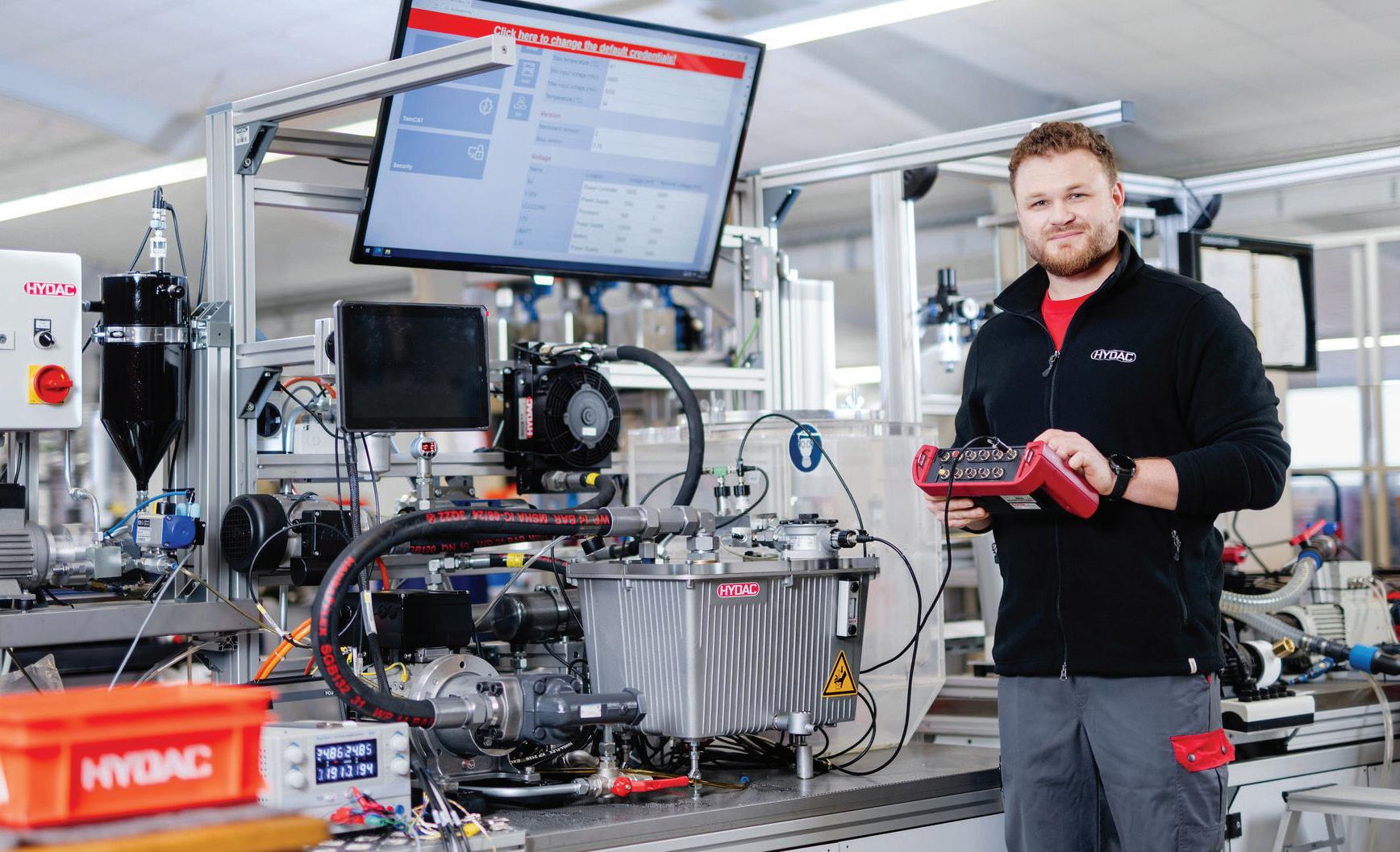
Especially at CONEXPO this year, fluid power manufacturers say there is a need to have a complete grasp on all systems as OEMs are looking to build machines that are more intelligent, automated and electrified. Most of the larger fluid power companies demonstrated this with machines on the show floor. Hydac, for example, used its skid steer platform to showcase how its hydraulics, electronics, sensors, controls, and safety functions can be delivered as a cohesive package, particularly for midsized OEMs that lack the in-house engineering horsepower of major players.
HydraForce and Bosch Rexroth described this as a “fully integrated solution program” where customers can either take a full system or selectively cherry-pick components from a seamlessly compatible portfolio. Similarly, Danfoss displayed a massive board of a machine model in their booth, showing all the systems where their technology comes together. For example, the
integrated X1P pump and Editron motor are presented not as separate SKUs but as a single tuned e-pump system running on its Plus+1 control software, to keep the combination operating in its sweet spot. Additionally, Danfoss emphasized hybrid architectures and digital displacement, focusing on reducing throttling losses and optimizing subsystems at the machine level rather than trying to improve individual components in isolation.
In both cases, the message is clear: the value proposition is no longer just a cartridge or valve; it’s in the way these components are packaged together. The differentiation now lies in how electric, hydraulic, and mechanical subsystems are designed, controlled, and supported as complete systems. As I continue to read through more discussions from CONEXPO, it’s clear that success increasingly depends on systems thinking, software competence, and close collaboration with OEMs.
We’re taking that approach here at Fluid Power World, trying to package our content together, focusing on more complete systems versus educating on just one single piece of technology. That’s why we designed our current webinar series to tackle the more common technologies and their final design into a system.
Although we’re midway through the sixpart series, you are welcome to watch the first two on-demand webinars, Hydraulic
Valves: Precision Control for Smarter Systems, and Hydraulic Cylinders: The Workhorses of Linear Motion. But I’d like to invite you to join us for the remaining live events, which are all held on the following Thursdays at noon.
• Thursday, May 28 - Pumps & Motors: Power and Performance in Motion
• Thursday, June 4 - Filtration & Sealing: Contamination Control as a Design Priority
• Thursday, June 11 - Hose Assemblies: Safe, Flexible Fluid Connections
• Thursday, June 18 - Hydraulics in Harmony: Integrating Components for Efficient System Design
Stay tuned as you’ll see more content like this from us as we work to match the industry’s demands and needs in education on reliable, efficient and safe fluid power design. FPW


Mary C. Gannon • Editor-in-Chief mgannon@wtwhmedia.com linkedin.com/in/marygannonramsak
Imagining the future of mobile machinery design
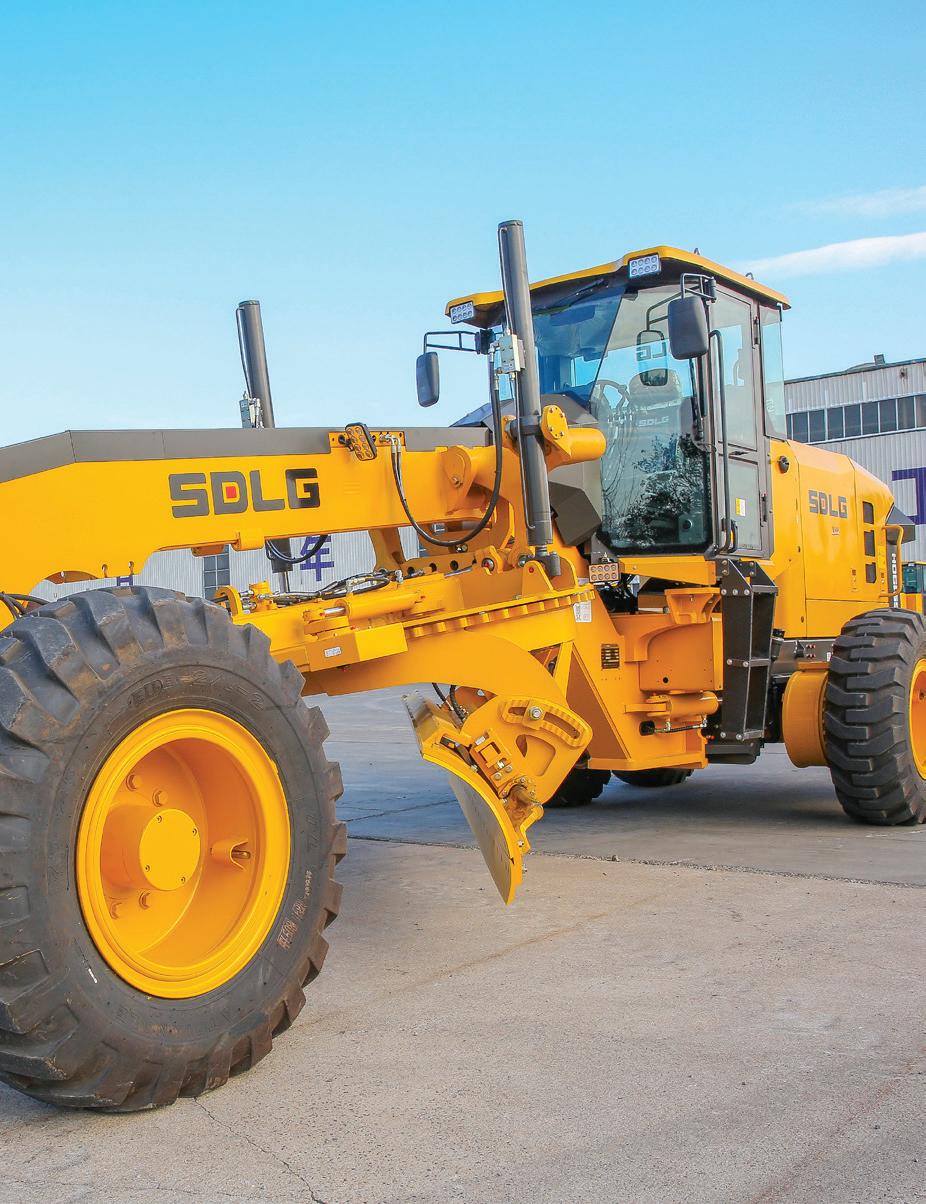
Following a successful CONEXPO showing, Lingong Group’s chief engineer talks hydraulics.
Hydraulic valve fundamentals
Read an overview of the many valve types, and then read about some of the latest innovations of these critical hydraulic system components.
Bosch Rexroth deepens investment into HydraForce’s U.S. operations
Learn what the future holds for the manufacturer of compact hydraulics, as the acquisition of HydraForce by Bosch Rexroth is complete.


EDITORIAL
VP, Editorial Director
Paul J. Heney pheney@wtwhmedia.com
Editor-in-Chief, FPW Mary Gannon mgannon@wtwhmedia.com
Contributing Editor Josh Cosford
Contributing Editor Carl Dyke
MARKETING
VP, Marketing Annie Wissner awissner@wtwhmedia.com
Digital Marketing Manager
Taylor Meade tmeade@wtwhmedia.com


VP, Creative Services
Matthew Claney mclaney@wtwhmedia.com
Art Director
Eric Summers esummers@wtwhmedia.com
Director, Audience Growth Rick Ellis rellis@wtwhmedia.com
Senior Associate, Audience Development Marie Claussell mclaussell@wtwhmedia.com
SALES
Amanda Buehner abuehner@wtwhmedia.com
Ryan Ashdown 216-316-6691 rashdown@wtwhmedia.com
Jami Brownlee 224.760.1055 jbrownlee@wtwhmedia.com
Jack Gillerlain 773.909.2718 jgillerlain@wtwhmedia.com
Susan Powers 708.341.3370 spowers@wtwhmedia.com
Judy Pinsel 630.538.2638 jpinsel@wtwhmedia.com
PRODUCTION SERVICES
Customer Service Manager
Stephanie Hulett shulett@wtwhmedia.com
Customer Service Representative Tracy Powers tpowers@wtwhmedia.com
Customer Service Representative JoAnn Martin jmartin@wtwhmedia.com
Customer Service Representative
Renee Massey-Linston renee@wtwhmedia.com
Customer Service Representative
Trinidy Longgood tlonggood@wtwhmedia.com
CEO Matt Logan mlogan@wtwhmedia.com
Co-Founders Scott McCafferty Mike Emich
44114
Ph: 888.543.2447 • Fax: 888.543.2447


FLUID POWER WORLD does not pass judgment on subjects of controversy nor enter into dispute with or between any individuals or organizations. FLUID POWER WORLD is also an independent forum for the expression of opinions relevant to industry issues. Letters to the editor and by-lined articles express the views of the author and not necessarily of the publisher or the publication. Every effort is made to provide accurate information; however, publisher assumes no responsibility for accuracy of submitted advertising and editorial information. Non-commissioned articles and news releases cannot be acknowledged. Unsolicited materials cannot be returned nor will this organization assume responsibility for their care.
FLUID POWER WORLD does not endorse any products, programs or services of advertisers or editorial contributors. Copyright© 2025 by WTWH Media, LLC. No part of this publication may be reproduced in any form or by any means, electronic or mechanical, or by recording, or by any information storage or retrieval system, without written permission from the publisher.






SUBSCRIPTION RATES: Free and controlled circulation to qualified subscribers. Nonqualified persons may subscribe at the following rates: U.S. and possessions: 1 year: $125; 2 years: $200; 3 years: $275; Canadian and foreign, 1 year: $195; only US funds are accepted. Single copies $15 each. Subscriptions are prepaid, and check or money orders only.
SUBSCRIBER SERVICES: To order a subscription please visit our web site at www.fluidpowerworld.com
FLUID POWER WORLD (ISSN 2375-3641) is published six times a year: in February, April, June, August, October, and December by WTWH Media, LLC; 1111 Superior Ave., Suite 2600, Cleveland, Ohio 44114. Periodicals postage paid at Cleveland, OH & additional mailing offices.
POSTMASTER: Send address changes to: Fluid Power World, 1111 Superior Ave., Suite 2600, Cleveland, OH 44114



Josh Cosford • Contributing Editor
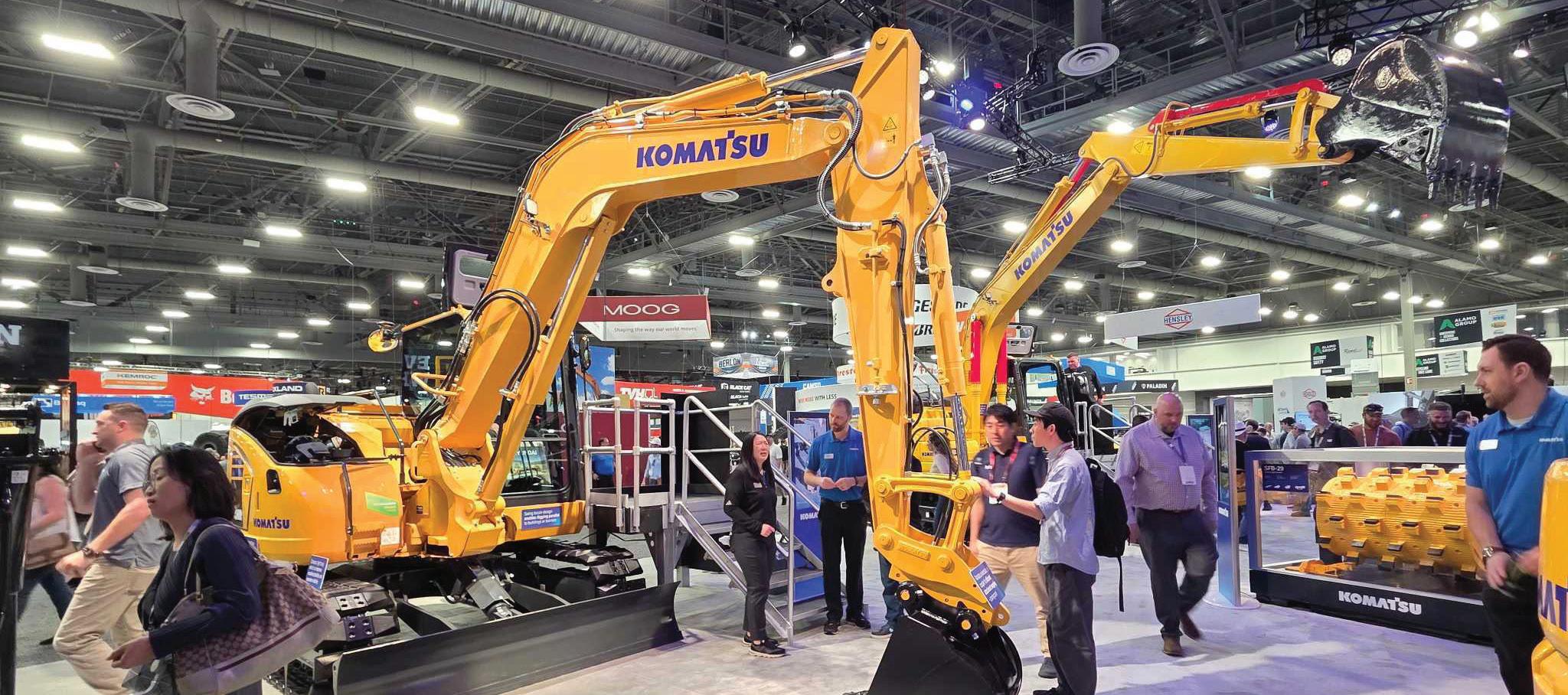
OVER THE COURSE OF THE TRADE SHOW WEEK, I averaged almost 17,000 steps per day. Indeed, the 2026 CONEXPO/CON-AGG exhibition was absolutely massive, but I took advantage of their (slow and infrequent) lot shuttles. In most cases, it would have been faster to walk, but I made the rookie error of wearing dress shoes on day one. That mistake aside, this show is so large that I’d say very few people could have visited every exhibitor.
Overall, the show was great, and it's clear that mobile hydraulic machinery is transitioning to electrification, albeit more slowly than one might think. I did see some trends and made some observations, so here are the top five things I learned at the 2026 CONEXPO trade show:
1. Electrification of hydraulics is moving away from analog electronics and into digital electronics. The proliferation of Controller Area Networks (CAN) is increasingly popular, and the future is digital. Each node in the system, whether a valve controller or a pressure transducer, will now be its own microcomputer that accepts programming signals and also outputs whatever data is asked of it. We no longer need a centralized CPU to handle every input and output. Whether Bluetooth or CAN, these systems skip traditional analog outputs such as 4-20 mA, reducing wiring to and from each individual valve, pump, or sensor.
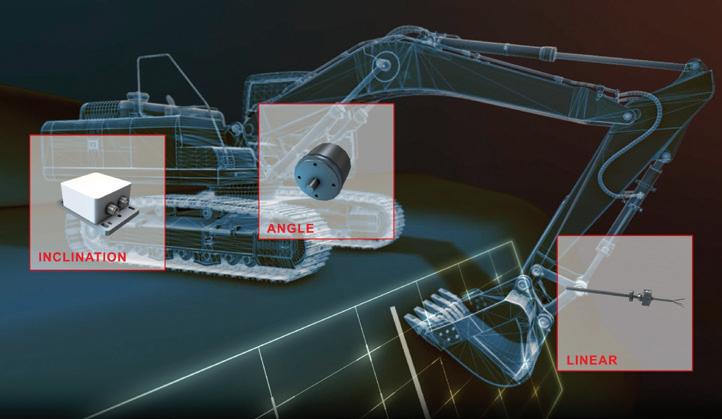
2. Robots are everywhere, and now they're hydraulic. Various OEMs offered both remote-controlled and autonomous hydraulic robots, with brush mowers appearing to be a popular option for many. I also saw robotic drilling, material handling, forklifts, and ditch-digging machines. Hydac, in particular, displayed their robotic mini-excavator prototype, which used a combination of linear and angle sensors to allow full automation.
3. Hydraulic cylinders are still king. Everywhere I went, manufacturers offered technologies that replaced wheel-drive systems or various versions of electrically driven hydraulic pumps. However, despite technological advancements, electric linear actuators remain bulky, slow, and underpowered. Sure, they operate independently of a centralized hydraulic pump, but a hydraulic (or air) cylinder is about as perfect a linear actuator as can be.
4. Wires will soon be a thing of the past. I realized this when I was discussing the Bluetooth pressure transducers one exhibitor offered. They offer live, accurate pressure readings, and the free app logs data such as peak pressure, average pressure, and the number of cycles, all powered by a watch battery with a three-month lifespan. Why supply even a digital servo valve with four CAN wires when it can be powered by advanced lithium batteries and controlled wirelessly?
5. Hydraulic machinery is going nowhere, perhaps ever. Despite all the electric technology at the show, the vast majority of the machines were traditional hydraulics operated by electric valves. The all-electric machines were few and far between, and mostly offered by startups with less
experience in the mobile machinery realm. Despite me poking my nose into as many undercarriages and open panels as I could, I didn't see many all-electric designs. There was an overwhelming presence of hydraulic valve manifolds, electroproportional sectional valves, and a surprising number of lever valves.
Sure, most machines now eschew traditional panels of switchgear and pressure gauges in favor of digital displays and HMI panels, but the machines are otherwise fundamentally hydraulic. I found that most manufacturers displayed their advanced technology from a "look at what we can do" perspective, but when I dug deeper, many admitted none of their customers are currently using it.
Despite missing CONEXPO in 2020 and being too busy in 2023, I will definitely be back for the 2029 show. There is so much to see, and technology is moving too quickly for me to miss another show. Do you think it's too early for me to book a daybed at the Circa Stadium Swim? FPW
Josh Cosford • Contributing Editor jcosford@higginson.ca linkedin.com/in/joshcosford

, you generally expect to open a plastic bag filled with O-rings, rod seals, end seals and other synthetic rubber bits used to freshen up an old air or hydraulic cylinder. Often, we call such an assembly of parts a seal kit, which completely forsakes a family member necessary for the function and reliability of every cylinder: the wear rings.
These strips or stubby-cut, flat circles answer to many names: guide bearings, wear strips, wear bands and bushings. Regardless of nomenclature, these strips are essential to the function and reliability of any air or hydraulic cylinder. The wear ring helps to guide and support both the piston and the rod, keeping it aligned axially while acting as a low-friction sacrificial surface.
The piston almost always employs a wear ring, which is the point of contact between the piston assembly and the barrel wall. As the cylinder strokes, the wear ring guides the piston through the barrel and helps support any radial loads created from the attachment end of the rod. Wear rings are highly resistant to compressive forces and should always sit proud of the machined groove they call home. You want your wear ring to fail long before your piston or barrel inside surface.
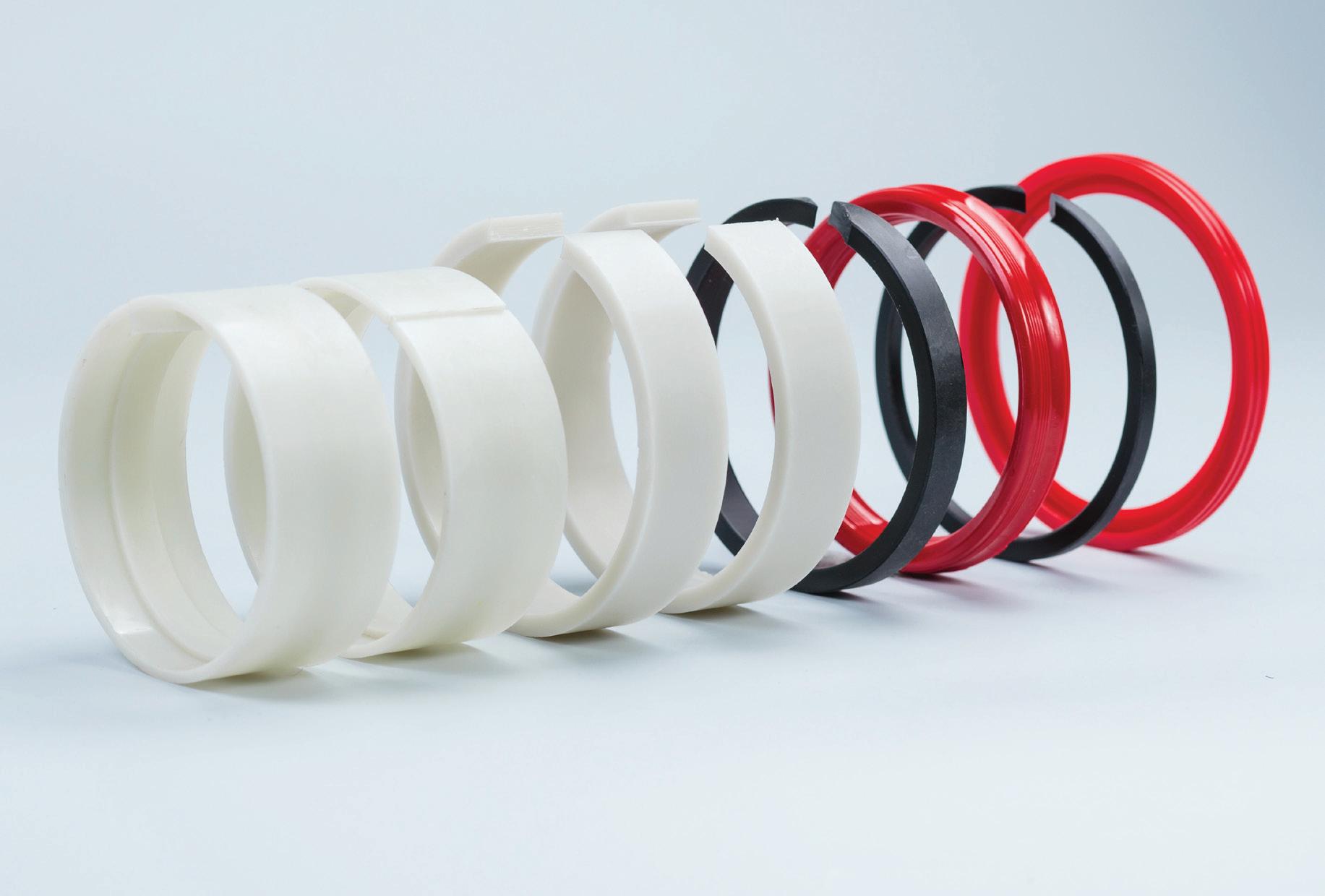
Manufacturers offer wear rings in a plethora of materials for customizable support solutions. Nylon and phenolic materials are stalwarts in our industry, offering an economical and robust choice for many applications. However, their usable temperature and velocity range don't match the designs of newer materials.
Some cylinder manufacturers also install wear rings to help guide and support the rod. Rather than reside on the OD, such as with a piston, these will slot into the ID of the head or gland, holding the rod centered as it strokes. Piston rod wear rings offer an inexpensive solution compared to bronze bushings, although they don't offer quite as much load-bearing support. Piston rod wear rings are a must for special applications, such as a stainless-steel gland for specific applications.
The bronze-filled PTFE material provides superior high-velocity performance across an insane temperature range, although it provides little compressive strength compared to other materials. If your application is side-load prone, modern material technology offers better solutions, such as synthetic fabric thermoset resin. This material offers superior compressive strength, although it gives up some high-velocity performance.
The big daddy of wear ring technology is the multi-layer compound bushing some manufacturers offer. An example of such an animal is
the steel-bodied, bronze-lined and PTFE/Lead overlain bushing that offers the trifecta of performance every cylinder deserves — high-temperature range, high velocity and extreme compressive strength.
Wear rings come as long coils of strip material, preformed rings, or two-piece sets. With the bulk strip material, you simply cut the size as required to fit your piston or rod and save the rest for later. These coils are perfect for shops repairing all makes of cylinders while avoiding excessive stock for multiple bore sizes. Wear rings are frequently scarf cut (cut on a bias angle), making it easier to insert pistons into barrels or rods through the gland.
Any way you slice it (pun intended), wear rings get no respect for their role in ensuring cylinders operate at their highest performance potential and longest operating life. FPW

Ron Marshall • Contributing Editor
WHEN LISA FIRST TOOK OVER as plant engineer at a food processing facility, she inherited a compressed air system that seemed to run well enough — or so everyone thought. The compressors were tucked away in a room at the far end of the plant, and as long as production lines kept moving, no one paid much attention to what was happening behind those closed doors.
One Monday morning, production came to a sudden stop. Pressure dropped across the plant, tools sputtered, and operators scrambled to figure out what had gone wrong. Lisa rushed to the compressor room and discovered that one of the main dryers had failed. The filters were clogged, drains were stuck open, and oil carryover had started to contaminate the system. It was a maintenance nightmare that could have been prevented.
Over the next few weeks, Lisa dug into the history of the system. She learned that maintenance had been handled reactively — only when something broke. Filters were changed long past their useful life, drains were rarely inspected, and the compressors themselves were often running hot due to poor cooling airflow. It wasn’t that her team didn’t care; they simply had never been trained to think of compressed air as a utility that required consistent, proactive care.
Determined to make a change, Lisa introduced a new approach. She started with regular inspections: checking pressure drops across filters, monitoring differential pressure, and verifying that drains were functioning properly. She scheduled preventive maintenance for the compressors, making sure oil levels, belts, and cooling systems were reviewed on a set timetable. She also invested in a simple monitoring system that tracked power, flow, and pressure trends, so the team could see when performance started to drift.

The results came quickly. With clean filters and properly working dryers, air quality improved, reducing equipment issues downstream. Stable pressure meant operators no longer struggled with underperforming tools. The compressors themselves began running cooler and more efficiently, lowering energy costs. Perhaps most importantly, the number of emergency shutdowns dropped dramatically.
Lisa shared the data with her management team, showing not only the reduction in downtime but also the energy savings and longer life expectancy of the equipment. She explained that every neglected filter, every unchecked drain, and every missed inspection had been quietly draining profits. By shifting from reactive
fixes to proactive care, the plant was now saving money and avoiding the stress of unplanned outages.
Her story became a lesson for the entire plant: compressed air is not just a background utility; it is the lifeblood of production. And like any critical system, it performs best when maintained with attention and care.
For operators and maintenance teams, the takeaway is simple. Don’t wait for a failure to force action. Routine checks, timely filter changes, and preventive maintenance keep systems running at peak efficiency. As Lisa proved, the effort spent maintaining compressed air doesn’t just protect equipment — it protects the bottom line.
By Josh Cosford • Contributing Editor
extremely common but occur in certain circumstances, which may lead to expensive damage. Pressure spikes occur in poorly designed systems or those that are misused, and you’d be surprised by the actual cause. When they do occur, pressure spikes can damage plumbing and cause erratic operation and component failure.
Pressure spikes don’t just happen from bad luck or poorly adjusted valves. Believe it or not, pressure spikes are a result of motion and not spontaneous rises in pressure. When fluid or actuators stop abruptly, it’s the kinetic energy of the fluid or load that creates the pressure spike. The larger the load or volume of moving fluid, the larger the resulting pressure spike, within reason. Many people refer to the sudden arrest of high-volume fluid as a “water hammer.”
A system appropriately designed to handle high flow and massive loads is less susceptible to pressure spikes. High-volume systems with large diameter pipes and hoses may flow enough volume for the mass of the fluid to carry enough kinetic energy to create pressure spikes when valves close. Even more extreme is when you combine highflow circuitry with massive loads that would prefer to keep moving with respect to Newton’s First Law.
Pressure spikes also occur when loads suddenly cease motion when physically opposed. An excavator’s bucket may suddenly smack against a large stone, and the inertia of the slewing excavator must be fully absorbed by the fluid as pressure. To be fair, excavators are designed for such incidents, but such situations occur in presses, hydrostatic propulsion systems, and injection molding machines.
Some of the above machines also experience pressure spikes as a result of pressure drops. Decompression shock occurs when a high volume of pressurized fluid suddenly releases into the exhaust path, as can be expected when large bore cylinders punch through heavy wall steel on a stamping press. The spike occurs in the return line when a high volume of pressurized fluid suddenly surges into the plumbing.
The best medicine for pressure spikes is prevention. It’s best to avoid opportunities for inertia from fluids or actuators to stop suddenly. Sometimes, machine design calls for highspeed, high-inertia operation, so controlling deceleration is the best method. Using servo or proportional valves to meter the flow during directional changes does wonders. Instead of abrupt stops, the load is decelerated using reduced flow, and when done well, it can be mostly imperceptible.
Even without expensive high-response valves, there are other methods to prevent sudden spikes. Some manufacturers offer “soft shift” solenoid valves that use spools with metering notches to prevent instantaneous flow rate changes. And, of course, most mobile-style lever valves come from the factory with metering notches, although the ultimate size is limited due to difficulties in construction and operation.
If possible, direct-acting pressure valves should be chosen for systems susceptible to pressure spikes. Compared to pilot-operated valves, which offer higher flow with less pressure drop, direct-acting valves open more quickly to relieve pressure since there is no secondary spool or poppet to operate.
Finally, if you’re experiencing pressure spikes for an unavoidable or unexpected reason, consider adding a hydro-pneumatic accumulator. Accumulators excel at absorbing energy and can nearly instantly absorb pressure spikes. The larger the spike, the more quickly the differential acts upon the bladder or diaphragm to provide a temporary flow patch for the offending fluid. Of course, they should be the correct size to absorb the maximum amount of fluid without rupturing, and the precharge pressure chosen to offer the most responsiveness.
Pressure spikes are a natural occurrence with dynamic hydraulic machines. In most cases, the spikes can be designed out or made benign in the engineering stage. When pressure spikes arise in already-commissioned equipment, there are many tools for the technician to ameliorate the systems. FPW
Fluid Power World’s Mary Gannon sat down with Christopher Kolbe, Senior Vice President of Sales and Marketing at HYDAC Technology, to discuss the mix of electronics and hydraulics that are shaping the future of fluid power, with a focus on HYDAC’s fluid system architecture approach.
Gannon: What is one industry assumption about hydraulics that you think is outdated, especially considering the technology you’re developing?
Kolbe: One thing that I think is outdated is that there is nothing left to change, that hydraulics is mature and at its peak. But when we look at our technology development and the integration of electronics with hydraulics, that notion is completely thrown away. When we come to our customers with a whole different system approach, we can offer a 20% increase in hydraulic efficiency. This can mean a significant reduction in initial cost of the vehicle, because we can have a smaller battery and a smaller electronic motor driving the hydraulics. Or we get longer run time. And both of those things are very important to the end customer.
Gannon: How do you break down the opportunities for improving hydraulic efficiency?
Kolbe: We look at three levels: components, subsystems, and full system architecture.
1. At the component level: You focus on individual parts — valves, filters, etc. Any pressure drop creates heat and wastes energy, so we redesign components to minimize that drop. For example, we use our Sustainmicron filter, which features a less restrictive filtration media and optimized valve flow paths. This typically yields single-digit percentage gains, but they’re relatively easy and quick to implement.
2. At the subsystem level: Here you look at how components work together. Take a lifting function: instead of just a valve, you consider the valve, plumbing, restrictions, sensors, and how they’re packaged — often into a manifold. With load sensing and electronic control, you can increase the valve opening electronically which in turn optimizes flow and pressure more intelligently, and that can deliver 10–15% efficiency improvements.
3. Finally at the system architecture level: This is where the largest gains are — 25% or more — but it requires rethinking the whole system with the OEM. One example includes gravity lowering a boom by electronically controlling valves and routing oil so you can sometimes lower without running the pump.
You can also use multiple pumps so low-pressure functions aren’t forced to operate at the highest system pressure, which otherwise just turns into heat.
The greatest efficiencies require upfront consultative approaches to the design. We must get involved early with the OEM on how they're going to approach the solution and what their mechanical challenges are and what their mechanical devices are doing.
Gannon: At HYDAC, you call this your new “fluid system architecture” principle. What does that entail?
Kolbe: Fluid system architecture rests on three pillars:
1. Fluid power engineering – understanding hydraulic behavior and fundamentals.
2. Controls – both hydraulic and electronic, and how to apply them effectively.
3. System or vehicle knowledge – knowing what the machine does, its duty cycles, and what the OEM is trying to achieve. When you bring these three together, you can design architectures that truly optimize performance, efficiency, and cost. It’s not just a fluid power problem, or just a controls problem, or just mechanical design — it’s the intersection of all three. That’s why collaboration and trust with the OEM are critical. You’re getting deep into their machine and business, so it must be a genuine partnership.
Gannon: How do you see the broader future of hydraulics in this context?
Kolbe: The future is about integration — electronics, mechanical systems, and fluid power working together. If you only understand one discipline, you tend to over-apply it. But some problems are best solved hydraulically, some mechanically, some electronically. When you understand all three, you know which lever to pull to get the best result. With today’s pressure for speed to market and the shortage of deep technical expertise, OEMs increasingly need partners who can bring that holistic view and help them move quickly and intelligently. FPW


HYDAC helps OEMs improve machine efficiency through integrated hydraulic systems, intelligent controls, and application engineering.



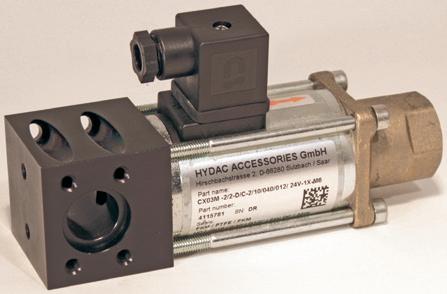
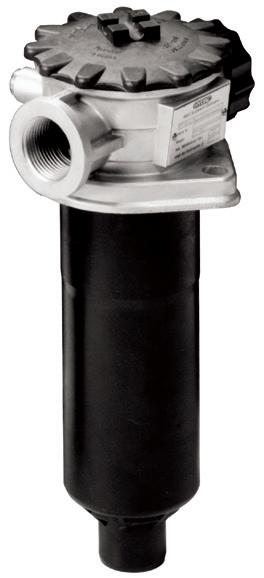
Advanced filtration, valves, and flow-path design reduce pressure loss, heat generation, and energy waste.
Integrated manifolds, sensors, and smart controls improve responsiveness, emergy management, and machine performance.
Built through collaboration.
HYDAC combines:
• Fluid power engineering
• Electronic and hydraulic controls expertise
• Deep machine application knowledge
Resulting in smarter, more integrated machine performance.
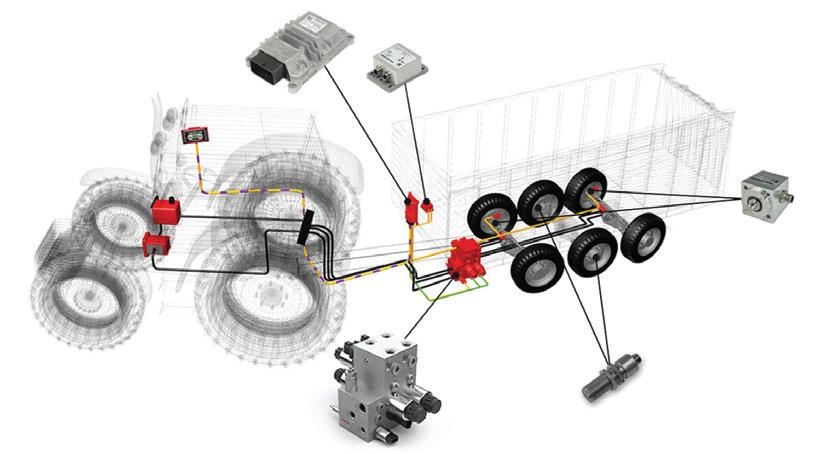
A systems-level approach helps OEMs reduce energy consumption, extend runtime, improve packaging flexibility, and support electrification goals.
Following a successful CONEXPO showing, Lingong Group’s chief engineer talks hydraulics.
By Paul J. Heney, VP, Editorial Director
AT THIS YEAR’S CONEXPO-
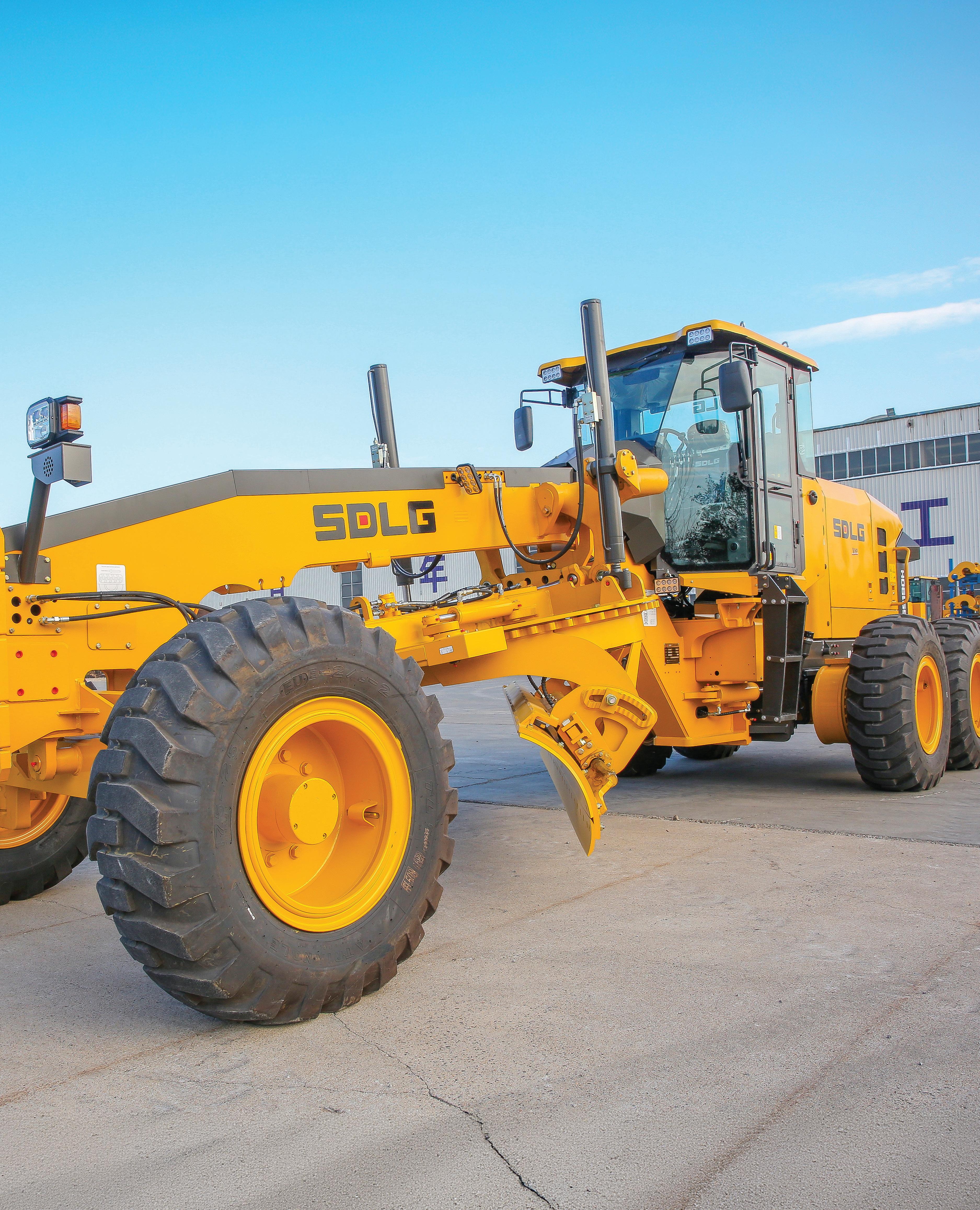
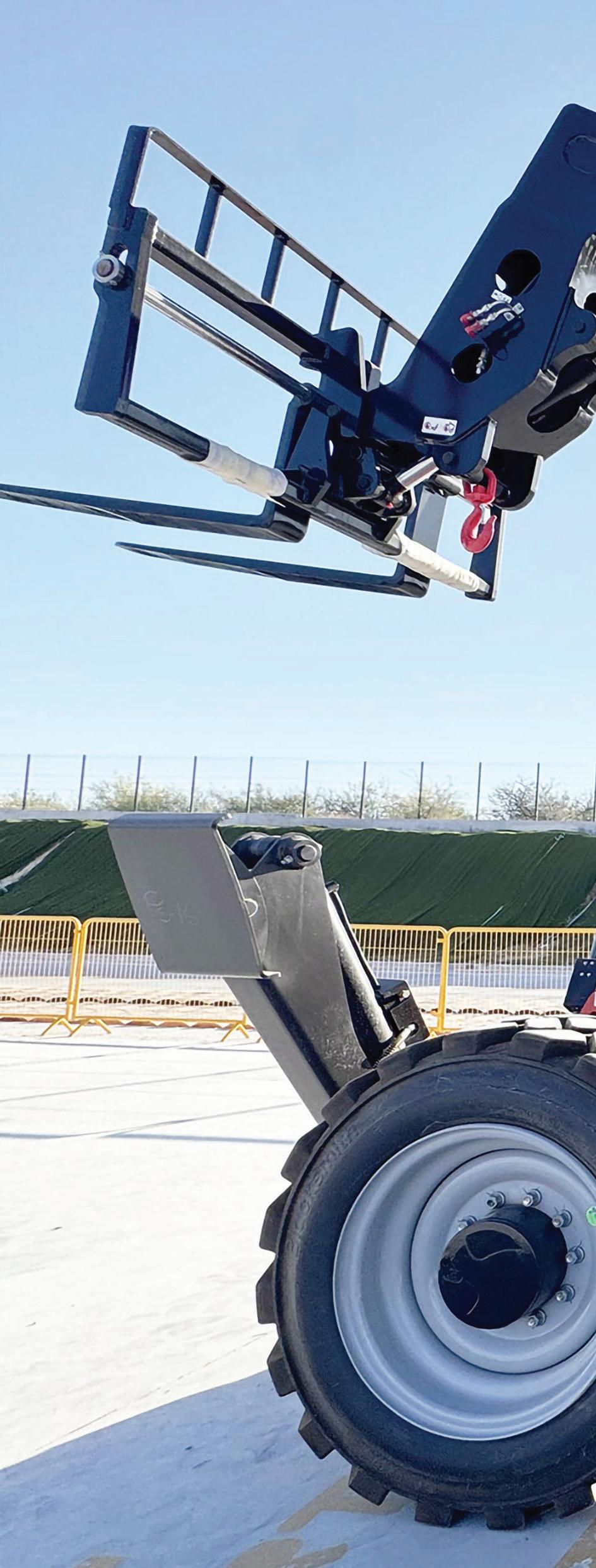
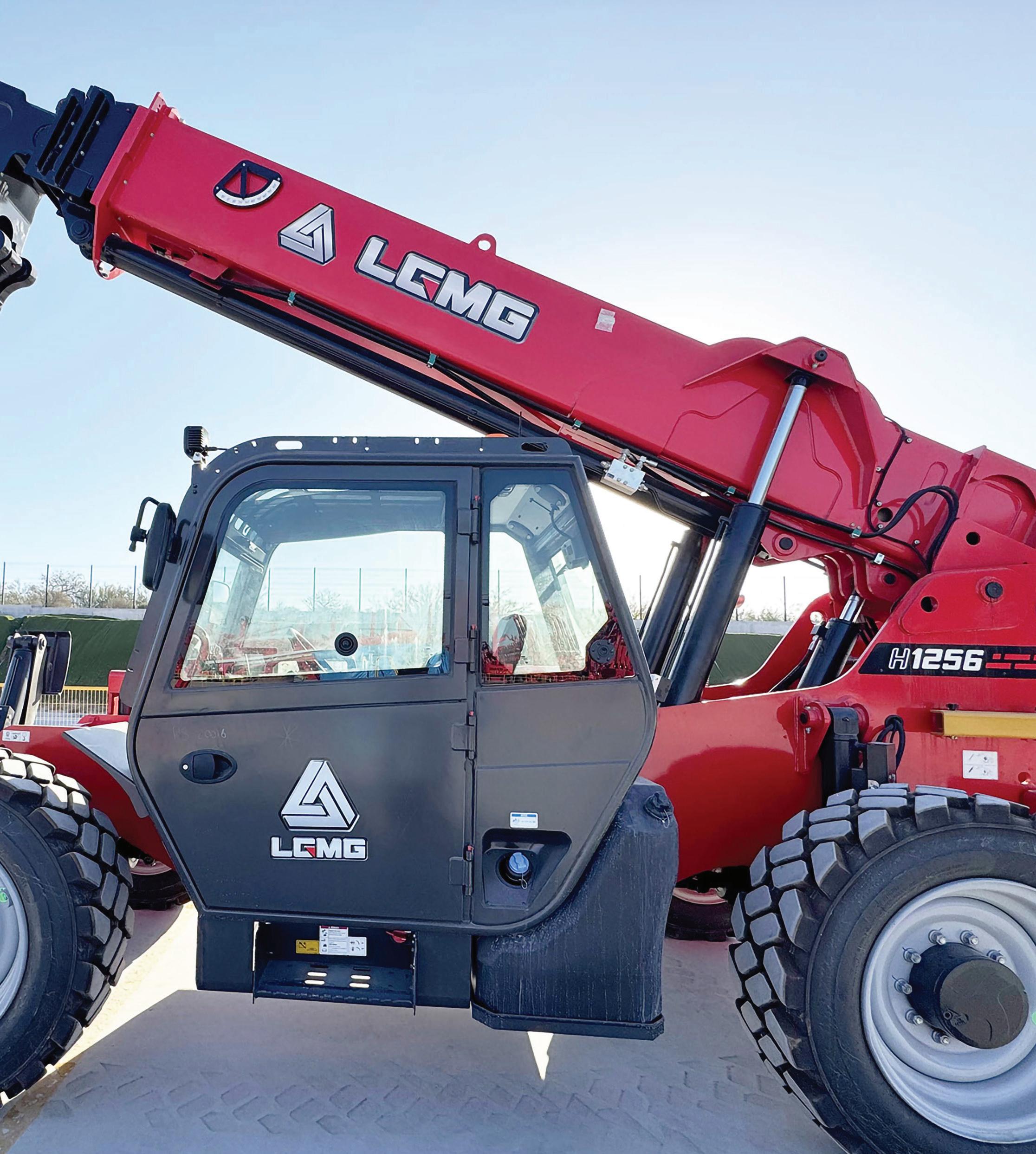
CON/AGG SHOW in Las Vegas, Lingong Group unveiled an expanded construction equipment portfolio and a new global service platform to better support customers across North America, Europe and other key markets. The group’s core subsidiaries, Shandong Lingong Construction Machinery (SDLG) and Lingong Heavy Machinery (LGMG) introduced new product lines such as loaders, aerial work platforms, and industrial vehicles. There was a focus on newenergy powertrains, intelligent control platforms, and user-centric designs, along with enhanced efficiency and operator control.
Lingong, founded in 1972, had 2024 revenues of $5.7 billion and is now in 140 countries and regions, with more than 110 dealers and 60 subsidiaries, along with four R&D centers, and five manufacturing bases. Fluid Power World had an exclusive interview with Feng Chi, SDLG’s Executive General Manager and Chief Engineer about the future of mobile equipment and fluid power’s evolving role.
FOCUS ON EFFICIENCY
Chi said that the biggest remaining efficiency gains in hydraulic systems lie within three key areas that he sees as the most promising: optimization of hydraulic system architecture, intelligent control, and electrification.
“Pump and motor mechanical structures have already reached a relatively mature stage. However, reducing throttling losses, overflow losses, and pressure coupling losses during combined operations through improved system architecture remains a key focus for existing conventional products,” he said. “During system control, the load characteristics of actuators can be combined with the efficiency characteristics of pumps and motors to optimize operation in real time, ensuring that pumps and motors remain within their high-efficiency operating range. Electrification of the hydraulic power source also provides a more straightforward way to implement variable-speed and variable-displacement control for hydraulic components.”
“In the future, we expect electrohydraulic and traditional hydraulic systems to coexist and complement each other.”
He also noted that as intelligent AI selflearning capabilities develop at the machine level, systems will be able to automatically analyze pressure–flow coupling losses during operations — and optimize machine control accordingly.
“This can further reduce losses caused by operator skill differences during combined movements and improve overall system efficiency,” he explained.
Energy recovery has been another focus with a lot of manufacturers, especially in high-cycle applications such as excavators or loaders. But how far can energy recovery go?
“Energy recovery in excavators mainly relies on two approaches: swing braking and boom lowering,” Chi said. “Swing braking can typically achieve energy recovery of around 6–10%, while boom lowering can recover about 8–12%. The ongoing electrification of excavators is making energy recovery easier to implement and more effective in practical applications.”
Compared with the previous CONEXPO held in 2023, Chi said that electrification has become significantly more important in hydraulic systems.
“Pump and valve control is increasingly moving toward full electronic control. At the same time, electrified machine platforms enable optimized variable-speed control of pumps. This allows machine functions to be increasingly defined by software and operating behavior to be customized, helping meet the needs of different application scenarios and operator preferences.”
Chi said that this sort of electrification brings about three major changes:
• Pump selection: There is a greater emphasis on power density and response speed, with electronically controlled variable pumps becoming the mainstream solution.
• Control strategy: Designers shift from hydraulics-dominated control to electrohydraulic coordination, enabling demand-based energy supply and energy recovery.
• Thermal management: The thermal loads of electric drive systems and
hydraulic systems become coupled, requiring system-level thermal balance design to improve overall energy efficiency.
He also noted that they are indeed seeing electrohydraulic actuators (EHA) gradually replacing traditional hydraulic systems in auxiliary functions such as fan drives and steering assistance, as well as in some medium and low-power systems.
“However, in heavy-duty, high-impact, and high-frequency operating scenarios, traditional high-power hydraulic systems still maintain clear advantages. In the future,
we expect electrohydraulic and traditional hydraulic systems to coexist and complement each other,” he said.
Software and control systems are shifting from a supporting role to a leading role, said Chi. In the past, efficiency improvements mainly relied on optimizing mechanical structures. But today, electrohydraulic systems can identify operating conditions in real time and dynamically match pump displacement with load demand to meet the
requirements of different working scenarios.
“Many functional requirements are now defined by software, including hydraulic coupling and decoupling control during combined movements, optimization of pressure-flow coupling losses during multifunction operations, and variable-speed and variable-displacement control of pumps and motors based on component efficiency characteristics,” Chi explained.
Beyond that, companies like Lingong Group are designing hydraulic systems for predictive maintenance rather than reactive service.
“We are ... developing modular, configurable hydraulic platforms that can maintain performance while enabling compatibility across different power platforms.”
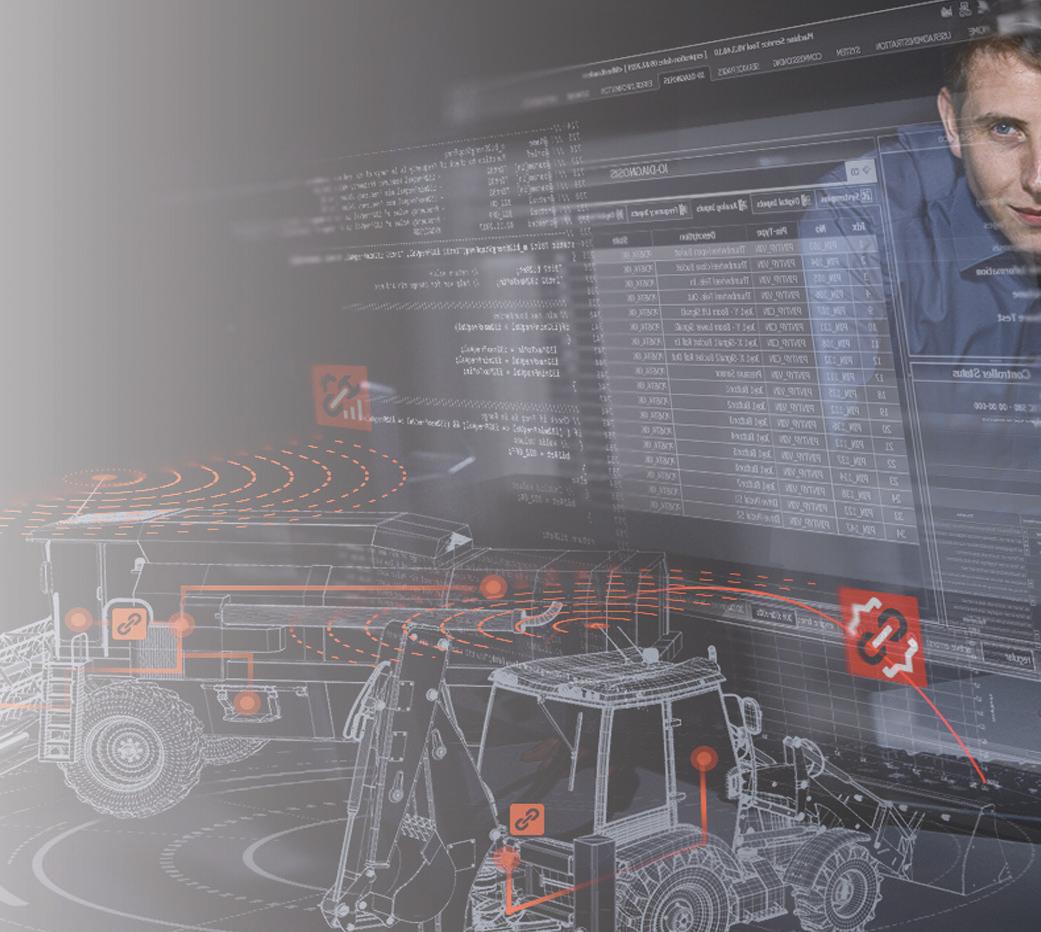
“By embedding sensors into key hydraulic components, we can monitor parameters such as pressure, temperature, flow rate, and contamination levels in real time,” he said. “Combined with edge computing and cloud-based AI models, this allows us to build a health profile for the equipment. As a result, maintenance can shift from reactive repair to predictive maintenance, improving machine availability and reducing lifecycle operating costs.”
Chi had plenty more to offer for design engineers looking at the market today and in the future. Among his other thoughts:
On labor shortages driving efficiency — “Labor shortages are an important driver, but improving productivity remains a core source of competitiveness. These two factors together are accelerating demand for automation. Our automation strategy aims to address both challenges at the same time, making machines smarter and equipment more efficient.”
On preferred power solutions in mining vs construction — “This divergence is already emerging. The mining sector is increasingly favoring electrification and autonomy to reduce cost per ton of material, while the construction sector remains
more diversified, adapting to different working conditions and energy infrastructures. This trend places higher requirements on hydraulic systems. We are therefore developing modular, configurable hydraulic platforms that can maintain performance while enabling compatibility across different power platforms.”
On modular hydraulic platforms for diesel, battery-electric, hybrid, or hydrogen powertrains — “This is one of our current key R&D directions. We are developing a scalable and adaptable modular hydraulic platform that can quickly integrate with different powertrains, including diesel, batteryelectric, hybrid, and hydrogen. This approach helps shorten development cycles, reduces system complexity, and increases cross-platform component commonality.”
On hydraulics’ role in 2036 — “One widely accepted assumption today is that hydraulic systems are inherently complex
and difficult to deeply integrate with electronic control systems. We believe this view will look outdated in ten years. Hydraulic systems will become more intelligent, simpler, and more programmable, evolving into an integrated part of the machine’s digital architecture rather than remaining a ‘blackbox’ subsystem.”
On his vision of actuation for an all-new machine in 2040 — “It would likely be a highly integrated, intelligent electrohydraulic system featuring adaptive capabilities.
• Actuators with self-sensing, self-decision, and self-execution capabilities
• Intelligent energy flow management
• AI-driven real-time optimization of control strategies, and
• Seamless integration with the machine’s operating system, supporting cloudbased fleet coordination and management.” FPW



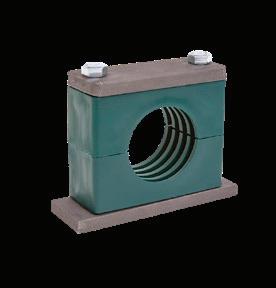
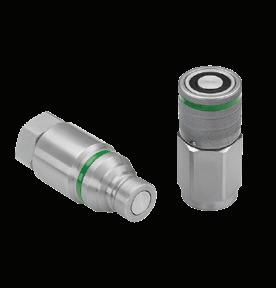
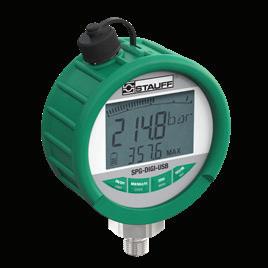
From the original STAUFF Pipe Clamps to our Metric Tube Fittings and Quick Release Couplings, STAUFF offers port-to-port hydraulic solutions, components, and accessories for hydraulic systems and applications.
STAUFF is your trusted source for industrial and mobile fluid power components and solutions worldwide.

www.stauffusa.com


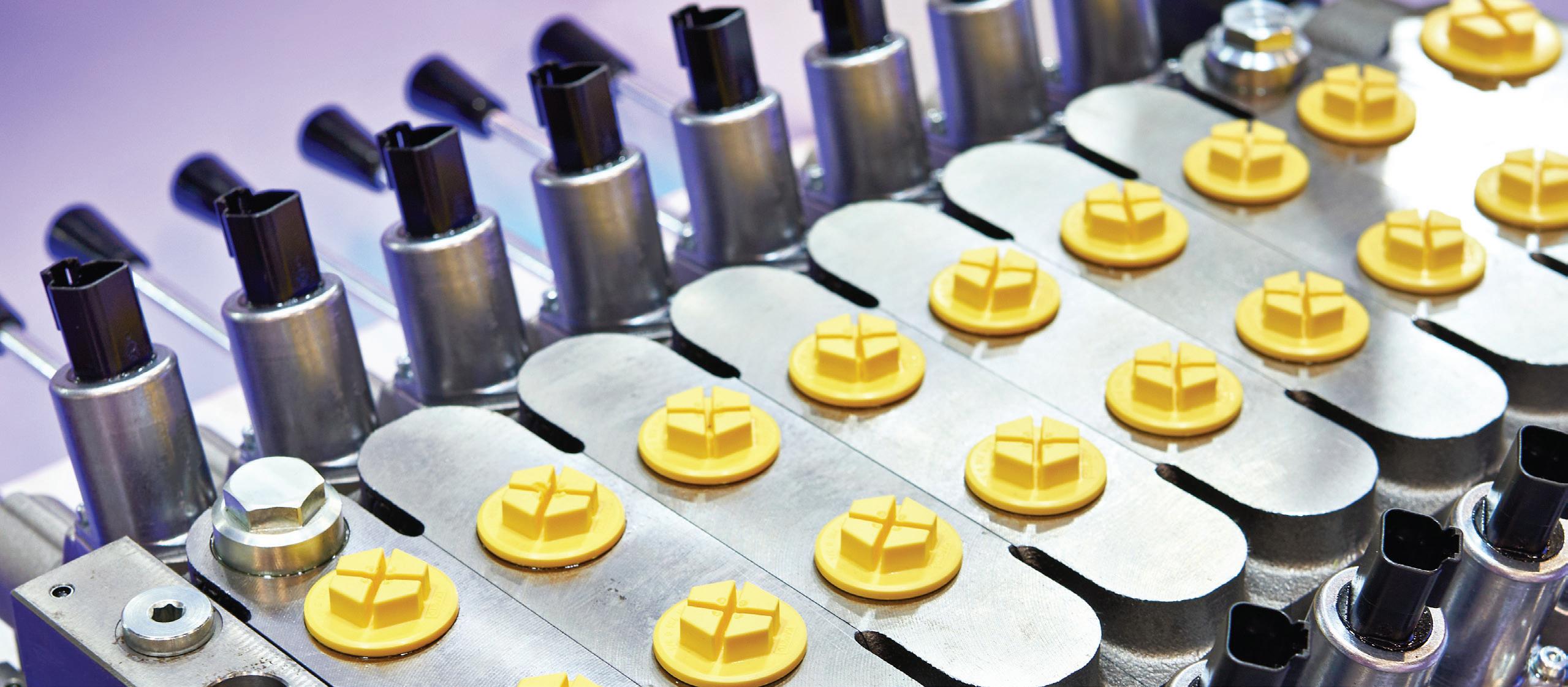
HYDRAULIC VALVES, USED IN conjunction with actuators, help hydraulics control force, torque and motion. Valves govern the direction, pressure and flow of hydraulic fluid, enabling smooth, safe control of actuators.
A valve’s purpose may be as simple as relieving pressure to protect your pump and actuator or as complex as electronically controlling both pressure and flow with a proportional valve. A valve circuit may contain a single lever valve or an extensive complexity using a dozen valves per function, as seen in custom manifolds.
The directional control valve controls the path of fluid flow. They manage fluid by
blocking, diverting, directing or dumping. Their complexity varies immensely, as does the integration method. Valve construction runs the gamut from cartridge valves to monoblock valves or subplate mounted valves to inline valves.
The most basic directional valve is the check valve; it allows flow into one work port and blocks flow coming back through the opposite port. Alternatively, directional valves with complex construction are also common, such as with the pilot-operated valve, which uses a small valve to control a larger one. A standard solenoid spool valve has one directly operated component (the spool) that controls fluid direction when it shifts. As flow increases, the force upon the spool also increases, and these flow forces can prevent a spool from actuating.
Read an overview of the many valve types, and then read about some of the latest innovations with these critical hydraulic system components.
By Mary C. Gannon, Editor-in-Chief and Josh Cosford, Contributing Editor
Directional valves are often described by the number of “ways” fluid can travel through them and also by the positions available into which the valve may shift.
The ways are equal to the number of work ports, so a 4-way directional valve contains Pressure, Tank and A and B work ports.
Positions are equal to the number of positional envelopes. For example, one would describe a double-acting single monoblock valve as “4-way, 3-position,” or simply a 4/3 valve. Very few valves offer more than three positions, although the snowplow float valve is one such animal.
Directional valves are available in monoblock or sectional valves, common to the mobile-hydraulic industry, as well as subplate mounted industrial type valves such as ISO style D03, D05 and so on. Also com-
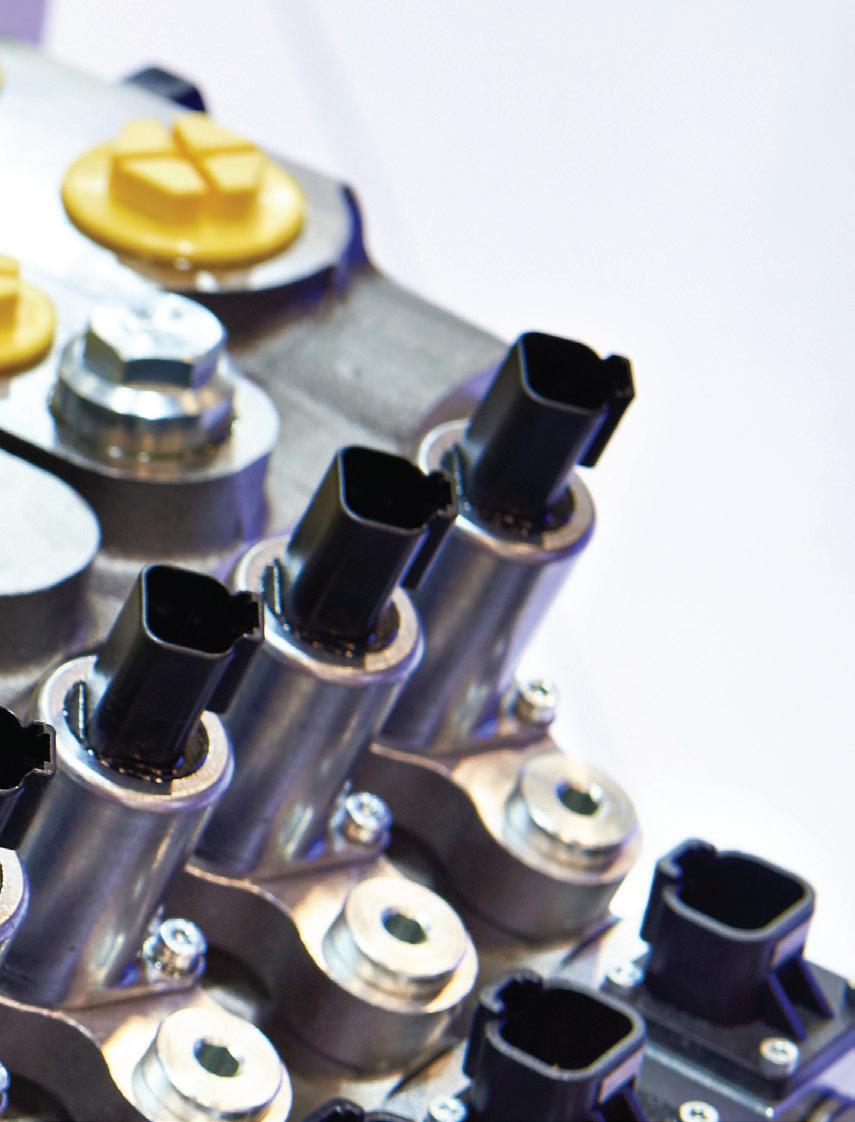
mon to mobile and industrial markets are cartridge valves installed into manifold blocks. Inline valves offer a standalone combination of valve with a ported body, which must be plumbed as a separate component not directly interfaced with any other manifold or body.
A pressure valve offers designers an option to limit pressure. They use spring-energized poppets pushed against a seat with some form of adjustment screw to modify the spring’s pretension. Pressure valves often use a simple ball and spring configuration or spools for high flow circuits. Relief valve operation is simple: a spring pushes the poppet against a seat, and when pressure from the system is strong enough to counteract the force of the spring, the valve will slowly open, proportionally bleeding off fluid to limit pressure.
A relief valve limits maximum pressure for either the entire system or a sub-circuit, with the lowest pressure parallel valve opening first. Pressure takes the path of least resistance. Selecting a pressure valve downstream with a lower setting than the main system relief valve will see all pump flow dump through the valve with the lower setting, thereby leaving no hydraulic energy source for other actuators.
Most other pressure valves are based
on the relief valve’s simple spring-loaded ball or poppet construction. Sequence, counterbalance, and brake valves are variations of the relief valve but with added utility or functionality, such as reverse flow check valves or integrated pilot operation. The pressure-reducing valve differs from the other pressure valves because it limits pressure downstream rather than upstream. Reducing valves are used when sub-circuit pressures need to be lower without sacrificing pressure performance in the rest of the system.
Sequence valves are pressure valves that remain closed until upstream pressure overcomes the valve’s spring setting. At this point, it simply opens to pass flow to a downstream subcircuit. Sequence valves may be specified with a reverse flow check valve that allows the flow to bypass in the reverse direction. Sequence valves, or any valve with pressure at all work ports simultaneously, should contain a method to drain the spring chamber of trapped pressure. Without a drain, pressure becomes trapped in the spring chamber, which is additive to the spring valves. The result is a valve that opens later than intended or not at all.
Counterbalance and brake valves are motion control valves designed to safely limit and control loads with overrun potential. Essentially any cylinder that may pull or drop under load, or any motor with constant tension, should use a motion control valve. Installed on the actuator port where load-induced pressure occurs, these are essentially relief valves that require extensively more than load pressure to open directly.
Pressure reducing valves remain open until downstream pressure rises above the valve’s setting, an effect much different from other pressure valves, which remain closed until cracked open by pressure. They may reduce pressure on either work port or the primary pressure port and also perform best when their spring chambers can drain to tank. They operate by modulating incoming flow rate, which in turn reduces downstream pressure.
Flow control valves control or limit flow by one of various methods. They are often just a needle valve, which is just a variable restriction, adjusted by a screw or knob, to restrict the cross-sectional area to reduce flow. When installed with reverse flow check valves, we change the name from needle valve to flow control. Flow control valves can sometimes have multiple ports, such as a priority flow control. They provide controlled, fixed flow to one part of the circuit, but only if input flow is high enough for its priority demand.
Flow controls are pressure compensated, allowing the valve to maintain its set flow regardless of load-induced pressure variances. Pressure compensators are a type of flow control valve available as a single component, often added to other valves in a circuit to provide flow rate accuracy independent of load.
Proportional valves are considered both flow and directional valves to meter flow and control the direction in which flow is metered. They use pulse-width modulation to vary current while they maintain voltage. This modifies the force of the magnetic field and subsequently how far the spool or poppet moves within its body, changing the size of the opening for fluid to take, which of course, limits flow.
An electronic valve controller can provide adjustable minimum and maximum settings. A minimum current value is needed to move the spool past its “dead zone” overlap where it “starts” to flow. Also, a maximum current value prevents too much electric juice from fatiguing the valve and coil when only a couple of amps are required to achieve full flow anyway. A proper controller and driver provide a dither signal to the valve, which vibrates the spool so that static friction doesn’t allow the spool to stick inside the body. The spool movement is unnoticeable but is enough so that when a change in current is required, the spool responds rapidly without overshooting the desired new position. FPW
NOW THAT WE’VE COVERED HYDRAULIC VALVE FUNDAMENTALS, we’ll look at some newer technologies available in the market. Read on for some of the latest hydraulic valve technologies launched in the last several months.
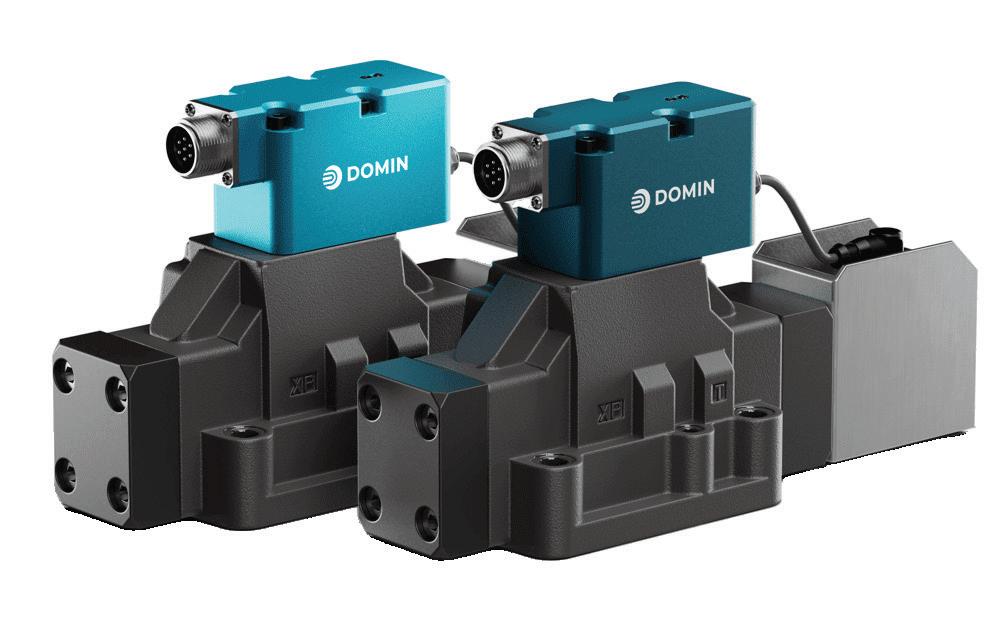
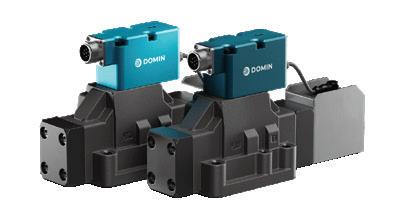
Domin introduced the S12 Pro and P12 Pro valves, which give engineers and system designers a clearer choice for NG16 applications and open the door to new levels of control, uptime, and system capability.
The S12 Pro is a high-performance two-stage servo valve for NG16 applications, engineered for improved efficiency, reduced size, and lower leakage. It delivers precise, stable control in performance-critical systems where safety and throughput depend on control quality. It is best suited for test and simulation systems, large presses, turbines, and high-power motion platforms. It offers a 6.5 msec response time, is rated for flows of 250 to 580 lpm, and less than 1.81 lpm leakage rate. Additionally, hysteresis is less than 0.2%. It has a greater than 100 Hz frequency response.
The P12 Pro is a two-stage servo proportional valve using the P6 Pro as its pilot stage. It is Domin’s industrial performance valve for NG16 systems where stable, repeatable control and predictable lifecycle cost are the priority. It is built for reliable, repeatable control in industrial applications at scale, and prioritizes compact size and robust design for long-term durability. It is rated for 160580 lpm flow, and has less than a 12 msec response time. Leakage is less than 2.51 lpm. Additionally, hysteresis is less than 0.2%. It has a greater than 60 Hz frequency response.
Domin Ltd. domin.com
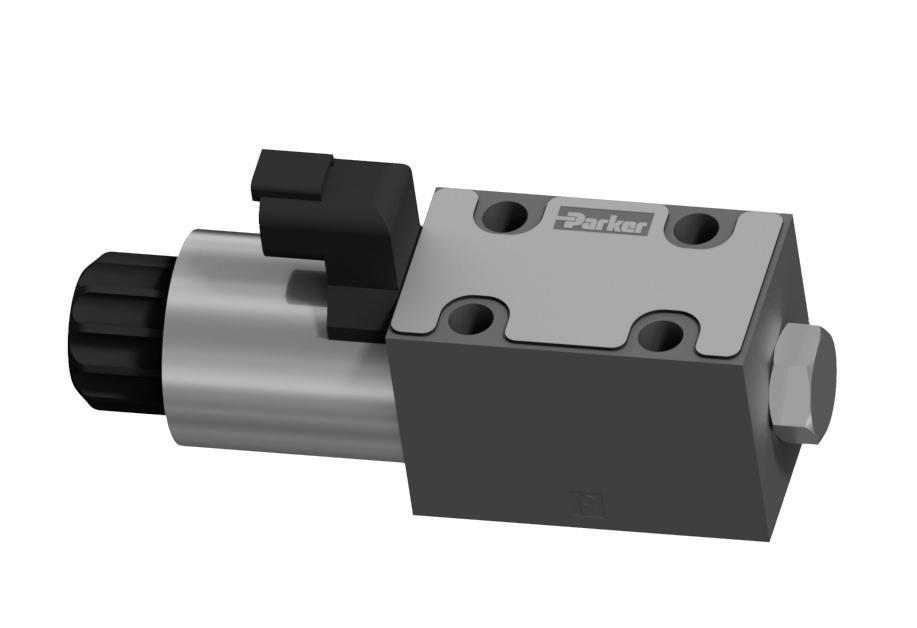
Parker Hannifin is advancing brake-by-wire technologies with the introduction of its PE06 proportional pressure reducing valve which combines a proportional valve piston with an internal hydraulic feedback piston. This design allows precise control of the reduced pressure along with a high-volume flow over the valve. Other benefits include a low internal leakage rate and a proven, reliable and robust design.
Brake-by-wire replaces mechanical links with electronic signals to improve safety, efficiency, braking response time, and design flexibility, while also saving on the weight and space needed for heavy hydraulic components. It reduces the risk of catastrophic failures in cases of nonperformance of one circuit or electronic path. This compact valve enables advanced brakeby-wire systems by providing fast, precise hydraulic pressure control for electric/electro-hydraulic braking, which is critical for autonomous and automated vehicle control systems and is key to creating hydraulic-free cabins which help to reduce noise, heat and production time, since many cabs come preassembled. It is rated for leakage of 25 cc at 200 bar, maximum inlet pressure of 250 bar and control pressure up to 170 bar. It offers flow rates of 30 lpm (pressure-dependent). A simple design revision can adapt/customize the valve to two pressure levels — 120 and 175 bar — to meet specific customer requirements. Parker Hannifin parker.com
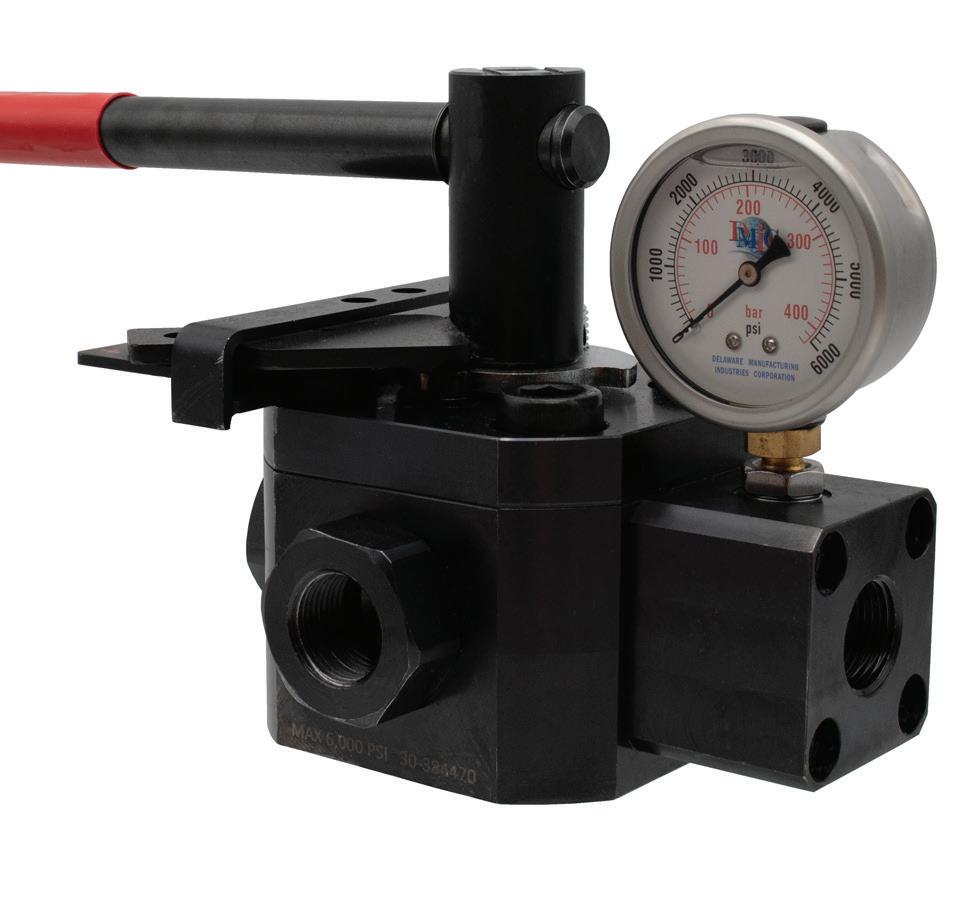
Ross Controls has introduced its new H L-O-X series hydraulic lockout valve for machine guarding applications. It blocks the flow of hydraulic fluid to stop cylinder motions.
Energy isolation is required for all energy sources when performing any maintenance related tasks on machinery. Hydraulic Energy isolation requires both pump flow and downstream pressure to bleed to tank. The H L-O-X valve accomplishes this safely through its own independent, full-flow exhaust lines. This is achieved using a manually operated handle that has the capability to accept a lock or hasp to prevent the reapplication of pressure buildup. The valve is tamper-resistant to ensure that the locking out of the hydraulic system cannot easily be bypassed.
H L-O-X valves have a pressure rating of 6,000 psi (414 bar) and are available in three port sizes: 1/2, 3/4, and 1-1/4 in. with flow rates of 20, 35, and 50 gpm, respectively. Each valve is made of carbon steel and includes Delrin and nitrile rubber (Buna-N) seals. A pressure measuring device is also included to confirm the removal of downstream pressure.
Ross Controls rosscontrols.com
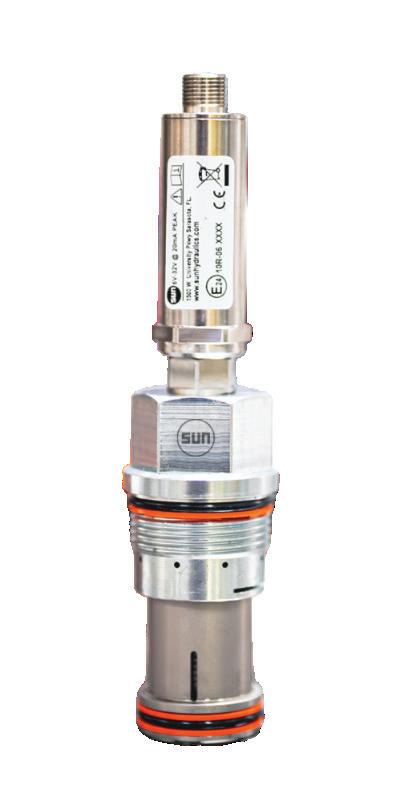
Sun Hydraulics released its QMEH cartridge-style flow meter, which features a new custom-built, state-of-the-art position sensor and is suited for use on hydraulic power units, aerospace ground support test equipment, telehandlers, and excavators operating in high-pressure environments.
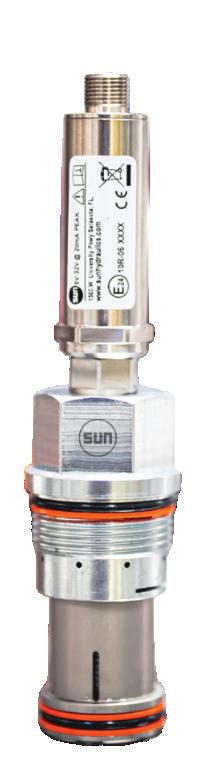
Engineered to deliver precise, real-time flow measurements, this solution ensures reliable, high-precision performance in critical systems. Designed for seamless integration and regulatory compliance, QMEH features a proprietary, state-of-the-art position sensor certified to CE standards. It has been proven to operate reliably in electronically noisy vehicle environments without causing or experiencing interference, making it a dependable choice for modern and electrified hydraulic systems.
The proprietary design incorporates a coiled flexible printed circuit board, enabling a compact sensor footprint. The valve leverages this sensor technology to precisely measure flow and convert electrical signals into proportional flow rates. Available in multiple flow ranges, QMEH supports operating pressures up to 5,000 psi (350 bar) across all ports, ensuring consistent performance even under extreme conditions. The cartridge is designed to fit Sun’s T-16A cavity for effortless integration in demanding hydraulic systems.
Sun Hydraulics sunhydraulics.com
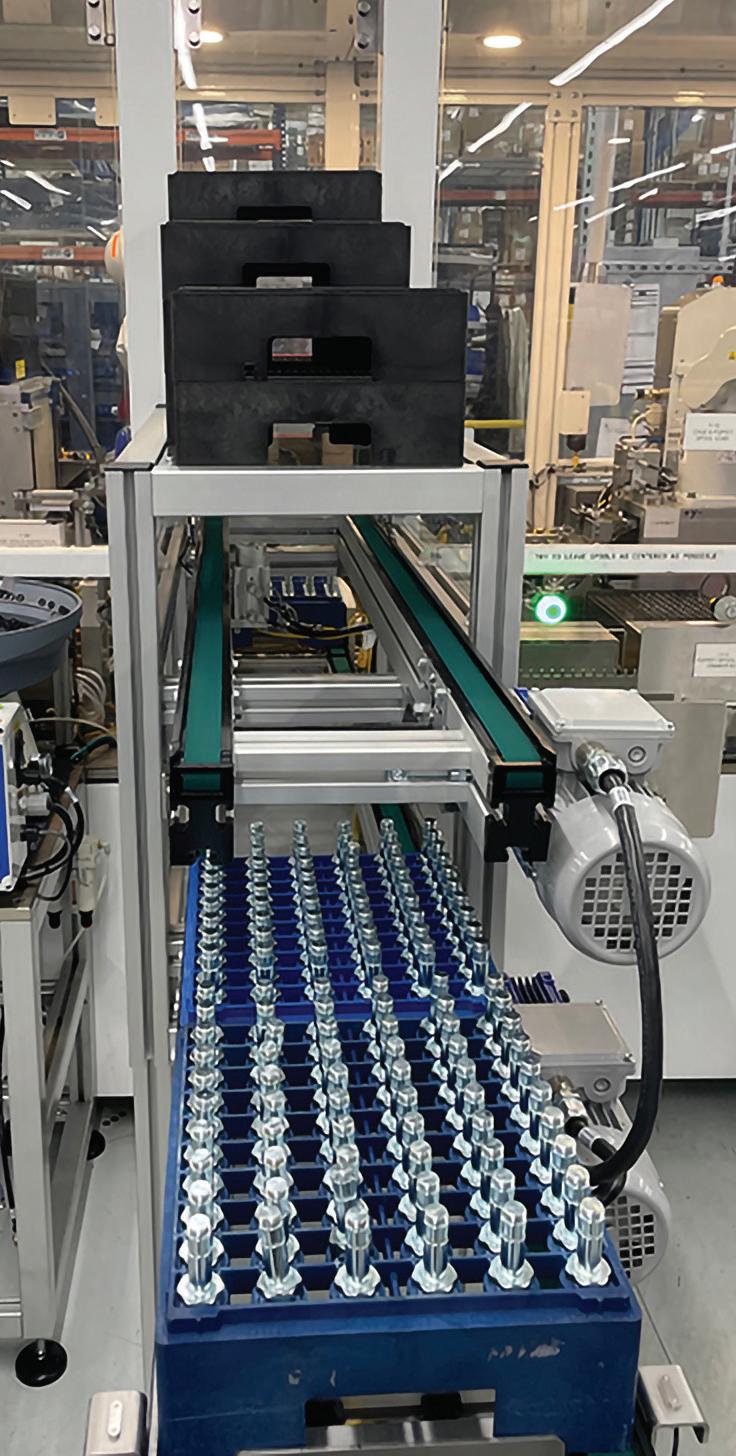
HYDRAFORCE HAS MADE INVESTMENTS IN AUTOMATION TO MEET CUSTOMER DEMAND, TO STAY COMPETITIVE IN THE MARKET AND DELIVER HIGH-QUALITY PRODUCTS FOR ITS CUSTOMERS.
Learn what the future holds for the manufacturer of compact hydraulics, as the acquisition of HydraForce by Bosch Rexroth is complete.
By Mary C. Gannon, Editor-in-Chief
Earlier this year, the acquisition of HydraForce by Bosch Rexroth was finalized, making the merger between the two hydraulics powerhouses complete. At CONEXPO/CON-AGG, Fluid Power World Editor-in-Chief Mary Gannon had a chance to sit down with the new leadership for Rexroth’s HydraForce operations in Illinois. Learn what Matthias Goebel, CEO Bosch Rexroth Compact Hydraulic, and Angelo Nicola D’Ammando, VP Sales Compact Hydraulics, say the future holds for the Illinois manufacturer of compact hydraulics.
Q: What led Bosch Rexroth to shift leadership roles to North America?
Goebel: North America is an extremely important market for us, and that’s one of the reasons we made changes to our management board. At the end of the day, it was my decision to move forward with a team I know well. We shifted the position of our chief sales officer, Angelo D’Ammando, and my role as CEO from Italy to the U.S. in order to emphasize the importance of the North American market. We’ve invested a lot in the HydraForce brand, which is a great brand, and we want to build on that. Our board has
four members: one responsible for sales, one for operations, one for engineering and myself as CEO. The engineering role remains in Italy, but the other positions are now here in the U.S.
Over the past three years, we’ve done a lot of hard work on integration. The product portfolio needs to be aligned. Production worldwide needs to be aligned. We need to be organized well for production, local-for-local.
Now we’re closing the post-merger integration phase. Of course, there are still things to do, but we want to shift from integration mode to full power in the market, focusing on customers, bringing value and driving growth, so this means more investment, especially in sales and engineering.
Q: Do you expect to see more manufacturing and product localization in the United States?
Goebel: We have products from our Italian brand, which was formerly Oil Control, and are making them usable in the U.S. We’ve
already started doing that and have assembly lines here.
We make money if our customers are happy and if they are competitive, and therefore we have to find the right tradeoff between having cost optimized, technical products and having a very stable supply chain.
Q: How does Bosch Rexroth approach localization more broadly?
D’Ammando: Localization is really a matrix, a sort of cube with three dimensions. One dimension is the dimension of the products. For a company like us, there is nothing comparable in the market. We have a tremendous, wide product range and localization means to be able to supply locally, maybe with local assembly or local production or local supply chain behind the production.
Another dimension is to keep the product available, especially facing this current moment with all these geopolitical challenges. We are really in a good position there, because we can keep production quality and standard, with the same results, with the same tolerances, anywhere in the world.
The third dimension is the supply chain. Being such a big company, we can exploit the knowledge in terms of suppliers, in terms of also supply chain for different industries. For example, we can validate in an easy way a local U.S. supplier for solenoids. That’s why I call it a cube, because localization is happening on several levels at once.
Q: What kinds of investments have been made in North America to support this strategy?
Goebel: For the last three years, we spent a lot of energy on integration of our product portfolio from Italy, from Oil Control and HydraForce. We invested a lot in production and logistics. Now the next step is that this product portfolio will become a real, fully integrated solution program to our product portfolio, which we offer for a machine. At the end of the day, we have a sector or a machine, and for that machine, we have a product portfolio. And this is an
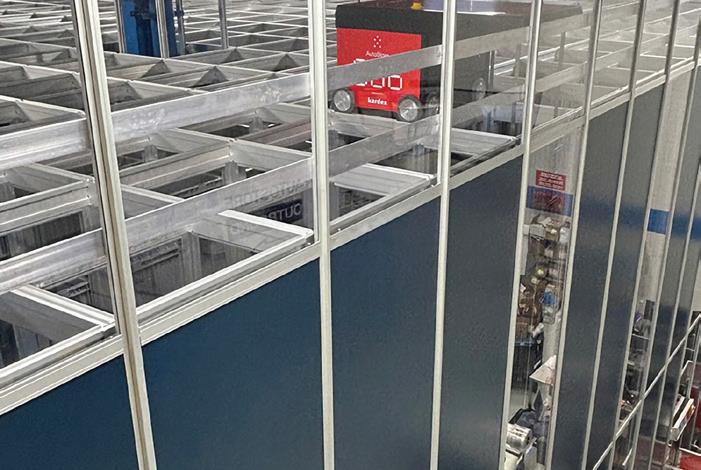
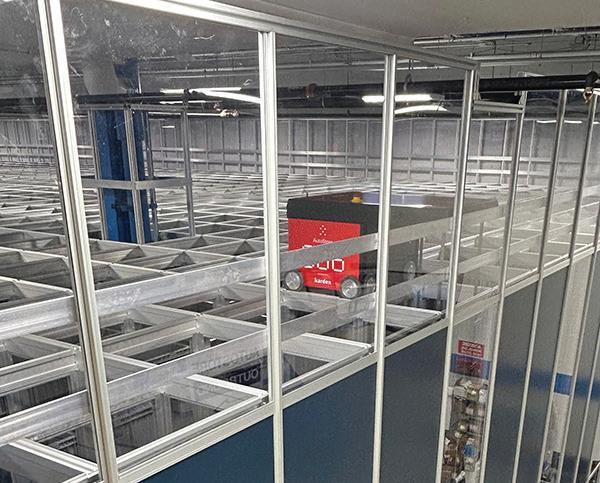
HYDRAFORCE HAS MADE DOUBLE-DIGIT MILLIONDOLLAR CAPEX INVESTMENTS OVER THE LAST FEW YEARS TO IMPROVE OPERATIONS, FACILITIES AND AUTOMATION. AN EXAMPLE IS A MULTI-MILLIONDOLLAR AUTOMATED STORAGE AND RETRIEVAL SYSTEM (ASRS) IN LINCOLNSHIRE TO IMPROVE PRODUCT AVAILABILITY AND RESPONSIVENESS.
ecosystem which is coming from our division, mobile hydraulics.
Q: Where have those investments been focused?
Goebel: We invested a lot in technical capacity, so we are ready for whatever boost which is coming. That was also why we decided that Angelo and I would move to North America, to help our sales and application organizations speed up.
Q: How do those investments support customers?
D’Ammando: If you remember the cube I mentioned earlier, these investments touch all three dimensions. So for compact hydraulics in Lincolnshire, we now
have the full production line for compact power modules in Lincolnshire. Second, we’re improving our internal processes and production resources. And third, we’re strengthening the supply chain by working toward more local sourcing.
So the investment supports the product side, the manufacturing side and the supply-chain side all at once.
Goebel: We’ve made a big investment in a fully optimized storage and retrieval system, which is just ramping up right now. We’ve also implemented a new ERP system in Lincolnshire, to help bring costs down, being more flexible, being quicker. We are here to really to ramp up and to fill up the facility.
Q: Will the HydraForce brand continue to exist as Bosch Rexroth moves forward?
MATTHIAS GOEBEL, PRESIDENT & CEO BOSCH REXROTH COMPACT HYDRAULICS

ANGELO D’AMMANDO, VP SALES COMPACT HYDRAULICS

Goebel: Absolutely. I’ve been in the hydraulics industry for about 30 years, and HydraForce is an iconic name in the market. From a marketing perspective, that’s extremely valuable. As long as I’m responsible for this business, we will promote the HydraForce brand. There is a lot of history behind that name — the people who built the company and the relationships with customers. That kind of heritage has real value.
Q: What comes next after the integration phase?
Goebel: The next step is making our full ecosystem easier for customers to use. Today we have a very comprehensive portfolio for mobile applications, from hydraulics and valves to motors, gearboxes and electronic control systems.
The challenge now is making this portfolio easy to understand and easy to use. We want to make it more digital so engineers can access it easily. We want to help them quickly find solutions, pricing and designs. In the future, digital tools and AI will help make that process even faster.
Our goal is to help engineers and customers quickly find the right solution within our ecosystem and make it easier to work with the full range of products we offer. FPW
Edited by Mary C. Gannon • Editor-in-Chief
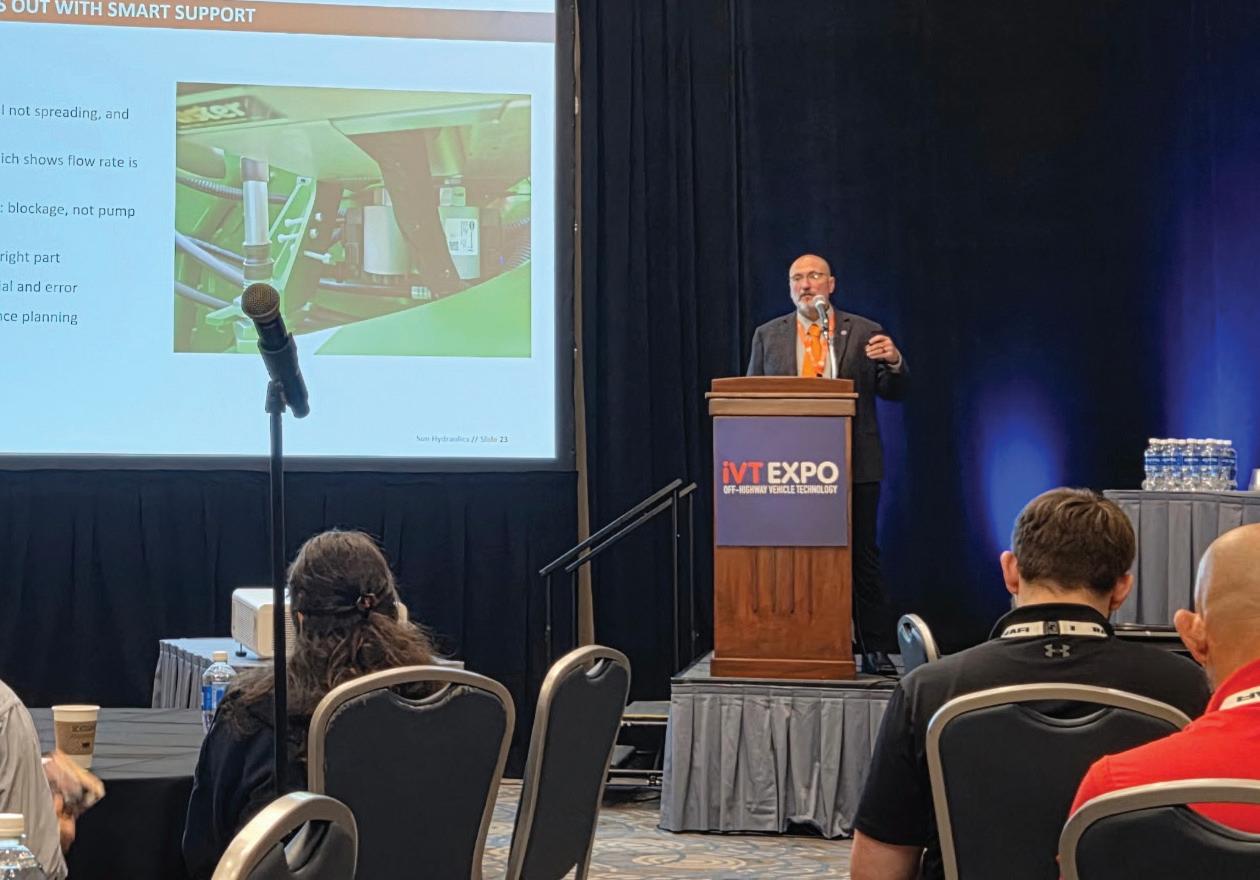
USUALLY, SUMMERTIME IS QUIET in terms of events and conferences, but not so for the National Fluid Power Association, which has three events slated for the coming months. The technical conferences — Automate Show and iVT Expo — coming in June and August continue to grow each year and the Industry Economic Outlook Conference is always an industry favorite.
Mini conference at the Automate show Hydraulics and pneumatics have long been key actuation technologies for all kinds of industrial and in-plant applications. Recent advances in fluid power have increased their capabilities and provided for deeper hybridization and integration with electrical and other systems on industrial machines. The NFPA is presenting a track of education programs on this topic at the Automate Show in Chicago June 22-25. Three presentations from NFPA members will showcase the application of these new technologies in the in-plant environment.
The confirmed schedule for June 24 is:
1:30-2:15 PM Choosing the Best Fit Motion Control Components & Systems, presented by Frank Langro, Director, Product Market Management, Festo Corp. Just as there are many ways to get from point A to point B, in the world of automation we can move, pick, and transport parts in numerous ways with a large variety of automation components to choose from, often leaving the system designer/engineer with the challenge of how to select the best fit actuators to match the application. Learn how to choose the right technology and zero in on pneumatic actuators and navigate through the various options available. The session will discuss the pros and
cons of pneumatic actuation and electric actuation along with some guiding considerations as to choosing the best fit technology. It will also help attendees decide on the best fit pneumatic actuator, be it a traditional piston rod type cylinder, or guided or rodless type actuators, and the steering questions to make the right choice for the application.
2:30-3:15 PM — From Crankshaft to Electro-Hydraulic: Closed-Circuit Drive & Control Solutions in Cryogenics, presented by Jon Frey, Head of Product Area New Business, Bosch Rexroth Corp. The session will address a joint development project toward next generation liquid-to-liquid (LH2) and liquid-to-high-pressure gas (GH2) CryoPumps for hydrogen refueling stations. This electro-hydraulic drive and long-stroke cryogenic pump solution, as an integral part of the overall station architecture, intends to revolutionize the hydrogen refueling infrastructure by optimizing logistics, reducing footprint, and reducing operational costs at refueling stations. Existing CryoPumps, often designed for LNG, and crankshaft driven, are not optimal for liquid hydrogen due to vastly different physical properties such as boiling temperature, latent heat, and sensitivity to boil-off. Efficiency losses of (30-50%) and reliability issues (200h) further curtail adaptability in fuel stations associated with consumer-driven consumption cycles, in contrast, for example, to industrial applications which may have more predictable, stable consumption requirements throughout the day, and can tolerate space requirements for buffer tanks. Additionally, their placement in open environments to prevent explosions complicates noise dampening and increases station complexity due to the need for additional high-pressure storage tanks, valve panels, and cooling systems.
3:30-4:15 PM Smart and Sustainable Monitoring Solutions for Pneumatically Driven Machines, presented by Jon Jensen, Industry Projects Manager – Energy, SMC Corp. of America. Optimize productivity, CO2 reduction, and energy savings through enhanced monitoring. Learn how the design and implementation of smart devices at the machine level can help to achieve production goals, reduce downtime, and cut costs by making data-driven decisions. This presentation will explore the ramifications of adding significant monitoring and communication to the standard modular air preparation system in the industrial automation workspace. Such a system can reduce compressed air use while digitally finger-printing the machine's current performance. Let's use a case packer as an example: Typically, these machines have many large actuators that operate at a very high cycle rate. If the case packer is outfitted with sufficient monitoring, communication, and control, the end user can very quickly realize deep energy savings (25-40%) by “automati-
cally” switching the machine into 1 of 2 possible “Eco modes” when the machine is idle. The end-user can also take full advantage of the monitoring (perhaps via an OPC-UA interface) to collect and analyze machine performance and establish condition-based-maintenance (CBM) algorithms, thus minimizing breakdowns due to pneumatic component failure. The data stream should bypass the traditional methods of PLC mining and go directly to the end-user’s SCADA system to minimize integration effort, particularly on legacy machines.
All three sessions are included in the Automate Conference registration. Visit www.automateshow.com/conference to register.
The Industry & Economic Outlook Conference, fondly called the IEOC, will be held August 17-19 at the Oak Brook Hills Hilton, outside of Chicago. This event highlights key market trends to help fluid power professionals strengthen their business strategy. Attendees will hear from top economic analysts and industry experts, as well as enjoy multiple networking opportunities.
This year’s lineup will begin with valuable insights and economic discussions. The conference kicks off with “Expectations and Practical Strategies for Trade and Tariff Environment,” by Nathaniel Bolin, K&L Gates. Nico Palesch, Oxford Economics, will provide “Oxford Economic’s Global Forecast and Outlook on Key Issues and Markets.”

After lunch, several breakout sessions will be offered, including:
• Practical Applications of AI for Distributors and Manufacturers, by Senthil Gunasekeran, PhD, and Pradip Krishnadevarajan, PhD, ActVantage
• Heavy Truck Market Forecast, by Eric Starks, FTR Transportation Intelligence
• Channel Alignment Principles and Techniques, by Senthil Gunasekeran, PhD, and Pradip Krishnadevarajan, PhD, ActVantage
• Construction Machinery Forecast, by Alastair Hayfield, Interact Analysis
• Agriculture Machinery Forecast, by Georg Stieler, STM Stieler
• Inventory Management Principles and Techniques, by Senthil Gunasekeran, PhD, and Pradip Krishnadevarajan, PhD, ActVantage
Tuesday will wrap up with audience favorite, Taylor St. Germain, ITR Economics, with his “US Forecast for Key Markets and Fluid Power,” followed by dinner reception.
Wednesday opens with the Foundation Report, followed by a short half-day program. Scott Hazelton, S&P Global Insights, will provide an “Outlook for Major In-Plant Sectors,” followed by “OEM Perspectives on Technology Developments and Requirement,” a panel discussion moderated by Eric Lanke, NFPA.
The event concludes with “Geopolitics, MacroTrends and the Soft Skills Leaders Need,” presented by Sam Potolicchio, President of the Preparing Global Leaders Forum.
Afterwards, NFPA will provide a shuttle to the iVT EXPO, at the Rosemont convention center.
Early bird pricing is available through July 11, and hotel rooms through the discounted NFPA-room block must be booked by July 18. Visit nfpa.com to learn more and register.
For the third year, the National Fluid Power Association will deliver its Advanced Hydraulics Conference at iVT Off-Highway Vehicle Technology Expo, slated for August 19 and 20 at the Donald E. Stephens Convention Center in Rosemont, Illinois.
Running alongside the Off-Highway Evolution Summit, this two-day conference will feature discussions on the latest advances in hydraulic technology for attendees and exhibitors.
Topics will address:
• Advanced electrohydraulic systems and controls
• Hydraulic efficiency and energy management
• Hydraulics for automated and/or AI-driven machines
• Integration of hydraulics with electrified powertrains
• Digital hydraulics and smart fluid power systems
• New architectures for high-performance mobile machinery
While the conference is still under development, some speakers have been determined. They include Bruno Dupuis, corporate accounts manager, Famic Technologies Inc.; Luka Korzenioswki, director -product development, Leggett & Platt Hydraulics; DJ O’Konek, engineering manager, Nott Co.; Nathan Martinez, apps engineer, Turntide Technologies; Darren Lockyer, VP of electronics, Bailey International; David Stevenson, vice president of sales and marketing
- BH Americas, Bucher Hydraulics; Andy Gray, director of sales, Scanreco; Kyle Myers, engineering manager, Parker Hannifin; Nathan Pedigo, head of engineering, Wilkes and Mclean; and Adam Livesay, CEO and co-founder, Elevat.
Visit ivtexpo-usa.com for more details and to register. FPW
Fluid Power World’s Design Guide library features a variety of downloadable resources to help educate you on fundamental hydraulic and pneumatic technologies and components.
Design Guide: Preventing Failure in Your Fluid Power Systems
Failure is a term that no engineer or technician wants to hear.
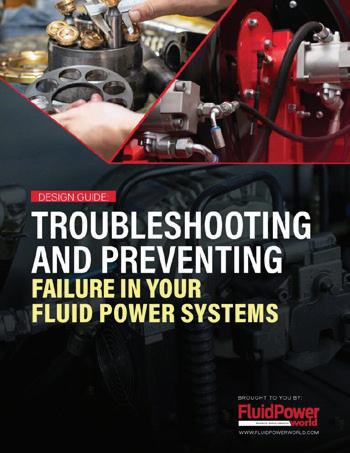
Reliable uptime is crucial for every system and machine. In this design guide, we highlight key system prime movers as well as accessories that fail. Here, you will learn to recognize some of the signs of systems that are at risk of failing, how to diagnose them, and how to prevent them from failing in advance.
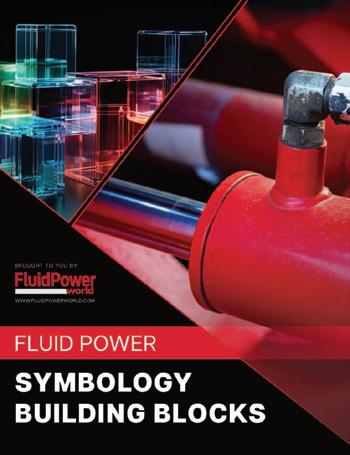
Design Guide on Symbology
Building Blocks
Hydraulic
symbology is a standardized system of symbols used to represent the components and functions of hydraulic systems. These symbols provide a clear and universal way to communicate the design, operation, and flow of hydraulic circuits. Here, we build upon basic elements and shapes to discuss the most common components in a hydraulic system.
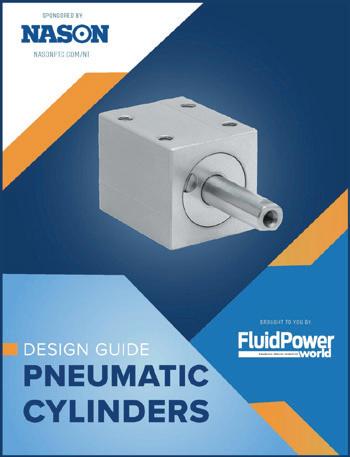
Design Guide on Pneumatic Cylinders
Pneumatic cylinders use compressed air to produce linear motion. They consist of a cylindrical chamber, a piston, and a rod, and convert energy from compressed air into mechanical force. Learn about the many types, including single-acting, double-acting, and rotary cylinders, that are used in industrial automation and motion control applications.
Design Guide on Hydraulic Filtration
Filtration quality is the single most important measure of hydraulic machine health.
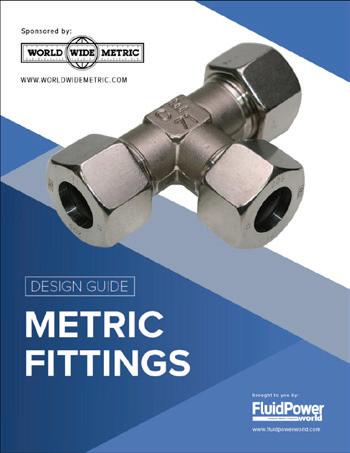
Design Guide on Metric Fittings
Many different standards of fittings exist throughout the world — JIC, O-ring face seal, BSP, JIS, and more. Metric hydraulic fittings hydraulic hoses, tubes, and pipes to pumps, valves, and other hydraulic components. Learn where they’re used and how to specify them.
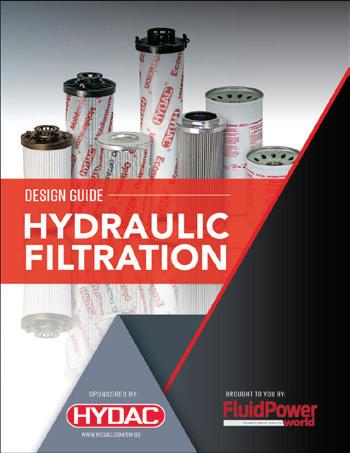
More hydraulic failures are a result of particle contamination than any other cause. To effectively apply filtration, it is important to know to size, location and quality. Learn more on this critical system technology.
Visit www.fluidpowerworld.com/category/design-guides/ to learn more and download these helpful resources now!