FIRE-RESISTANT FLUIDS p.6
FLUID CONDITIONING WITH HEAT EXCHANGERS
p .8
PROFILES IN FLUID POWER: ROBIN HODGSON p.14
www.fluidpowerworld.com
PROACTIVE HOSE INSPECTION MATTERS
WHY
PAGE 10
July 2026
STRENGTH YOU CAN FEEL WITH EVERY TURN. Tompkins Ball Valves
connect on a different level tompkinsind.com | 800.255.1008
FLUIDLINES Mary C. Gannon • Editor-in-Chief
Fluid Power World’s parent company, WTWH Media, rebrands as Arrowfly FLUID POWER WORLD’S parent company,
WTWH Media, this month announced it has rebranded as Arrowfly, to unify its 40-plus brands under a new identity. The new name and identity reflect our parent company's transformation from a specialized trade publisher into an omnichannel B2B media, events, and marketing company where professional decision-makers, like engineers such as yourself, gather for trusted journalism, industry intelligence, and high-impact experiences that move their markets forward. Arrowfly serves professionals across three industry networks: Engineering; Healthcare and Life Sciences; and Food, Retail, and Hospitality. The company’s portfolio includes more than 40 vertical media brands and more than 45 industry events, from intimate executive forums to large-scale conferences and expos, all built on the editorial independence, subject-matter expertise, and deeply rooted professional communities that WTWH Media cultivated over two decades. While the name and visual identity are new, everything that has made the organization the preeminent destination for professionals across engineering remains unchanged. For Fluid Power World partners and audience, the rebrand reinforces the strength of our community while positioning the company for future growth and expansion.
www.fluidpowerworld.com
We began our journey back in 2006, when WTWH was founded to launch Design World, the original magazine that started it all. Several brands were soon added to meet the needs of various markets, with focuses on specific technologies, such as motion control, mobile hydraulics, bearings, connectivity, and more. Fluid Power World came a few years later in 2014, and then the ball kept rolling. We began to grow through acquisition and soon, we were no longer an engineering-only media company. We now have brands in the healthcare and food service spaces, where events and digital content are changing the way our company serves its core communities. It’ll continue to be business as usual for me and Fluid Power World content, so don’t look for changes there — but if you’re a connection or subscriber, you will see a new email coming into your inboxes. Please be sure to look for your Fluid Power World emails coming from an email ending in @arrowfly.com. Check those spam folders and save our email addresses so you don’t
miss the latest updates to all hydraulic and pneumatic technology news. As we grow, too, look for more new programming. Stay tuned for our August issue, where we’ll be announcing another new avenue to share content with our community. I’ll wrap up with thoughts from our CEO, Matt Logan, on the name change and where we’re headed. “We built this company by earning the trust of professionals in industries where editorial authority matters," said Logan. “The name is new, but the foundation is the same: editors who speak each industry’s language, events that connect buyers and sellers who would never meet otherwise, and communities that professionals rely on for the insight and intelligence they need to make real decisions. Arrowfly gives us a brand that matches the scale and ambition of what we have become.” FPW
Mary C. Gannon • Editor-in-Chief mgannon@arrowfly.com linkedin.com/in/marygannonramsak
JULY 2026 • FLUID POWER WORLD
1
C ONTE NTS | V O L . 1 4 N O . 6
FluidPowerWorld.com
J U LY 2 0 2 6
F E AT U R E S 10 HYDRAULIC HOSE Why proactive hose maintenance matters Preventing downtime before it starts is crucial to safe, cost-effective and reliable hose assemblies.
14 PROFILES IN FLUID POWER From sweeping floors to leadership Robin Hodgson steers SFP Hydraulics into its next chapter.
JULY 2026
ADOBE STOCK
2
FLUID POWER WORLD • JULY 2026
D E PA R T M E N T S 1
FluidLines
4
Perspectives
6
Component Focus
7
Energy Efficiency
8
Fundamentals
18
Association Watch
ON THE COVER
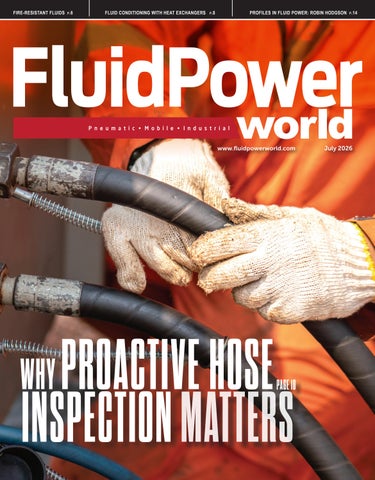
Regular hose inspection ensures you catch issues like abrasion and wear before a hose fails. ADOBE STOCK
www.fluidpowerworld.com
July 2026 • vol 14 no 6 • www.fluidpowerworld.com
EDITORIAL
PRODUCTION
PRODUCTION SERVICES
VP, Editorial Director Paul J. Heney pheney@arrowfly.com
VP, Creative Services Matthew Claney mclaney@arrowfly.com
Customer Service Manager Stephanie Hulett shulett@arrowfly.com
Editor-in-Chief, FPW Mary Gannon mgannon@arrowfly.com
Art Director, FPW Eric Summers esummers@arrowfly.com
Contributing Editor Josh Cosford
Director, Audience Growth Rick Ellis rellis@arrowfly.com
Customer Service Representative Tracy Powers tpowers@arrowfly.com
Contributing Editor Carl Dyke MARKETING VP, Marketing Annie Wissner awissner@arrowfly.com Digital Marketing Manager Taylor Meade tmeade@arrowfly.com
www.nfpa.com
Senior Associate, Audience Development Marie Claussell mclaussell@arrowfly.com SALES
Customer Service Representative JoAnn Martin jmartin@arrowfly.com Customer Service Representative Renee Massey-Linston renee@arrowfly.com Customer Service Representative Trinidy Longgood tlonggood@arrowfly.com
Amanda Buehner abuehner@arrowfly.com Ryan Ashdown 216-316-6691 rashdown@arrowfly.com
LEADERSHIP
Jami Brownlee 224.760.1055 jbrownlee@arrowfly.com
CEO Matt Logan mlogan@arrowfly.com
Jack Gillerlain 773.909.2718 jgillerlain@arrowfly.com
Co-Founders Scott McCafferty Mike Emich
The Gold Standard in Live Swivels. INLINE & 90° NO KINKS
NO TWISTS
FULL FLOW
Susan Powers 708.341.3370 spowers@arrowfly.com Judy Pinsel 630.538.2638 jpinsel@arrowfly.com
Arrowfly 1111 Superior Ave., Suite 2600, Cleveland, OH 44114 Ph: 888.543.2447
•
Fax: 888.543.2447
2011- 2020
FLUID POWER WORLD does not pass judgment on subjects of controversy nor enter into dispute with or between any individuals or organizations. FLUID POWER WORLD is also an independent forum for the expression of opinions relevant to industry issues. Letters to the editor and by-lined articles express the views of the author and not necessarily of the publisher or the publication. Every effort is made to provide accurate information; however, publisher assumes no responsibility for accuracy of submitted advertising and editorial information. Non-commissioned articles and news releases cannot be acknowledged. Unsolicited materials cannot be returned nor will this organization assume responsibility for their care. FLUID POWER WORLD does not endorse any products, programs or services of advertisers or editorial contributors. Copyright© 2025 by Arrowfly. No part of this publication may be reproduced in any form or by any means, electronic or mechanical, or by recording, or by any information storage or retrieval system, without written permission from the publisher.
www.fluidpowerworld.com
2014- 2016
2014 Winner
2013- 2017
SUBSCRIPTION RATES: Free and controlled circulation to qualified subscribers. Nonqualified persons may subscribe at the following rates: U.S. and possessions: 1 year: $125; 2 years: $200; 3 years: $275; Canadian and foreign, 1 year: $195; only US funds are accepted. Single copies $15 each. Subscriptions are prepaid, and check or money orders only. SUBSCRIBER SERVICES: To order a subscription please visit our web site at www.fluidpowerworld.com FLUID POWER WORLD (ISSN 2375-3641) is published six times a year: in February, April, June, August, October, and December by Arrowfly; 1111 Superior Ave., Suite 2600, Cleveland, Ohio 44114. Periodicals postage paid at Cleveland, OH & additional mailing offices. POSTMASTER: Send address changes to: Fluid Power World, 1111 Superior Ave., Suite 2600, Cleveland, OH 44114
SuperSwivels.com Made in the USA. Patent #5547233.
JULY 2026 • FLUID POWER WORLD
3
PERSPECTIVES Josh Cosford • Contributing Editor
Fluid power is a tech industry
can also control a hydraulic one. The fundamentals of hydraulics and electronics are so similar that engineers from one field easily crossover to the other, as not only are the principles the same, but so too are the schematics. So, let’s change how we approach what fluid power is and what fluid power can do by all agreeing that it’s also a tech industry. We’re way past the pigeonhole of grease monkeys and wizards, but rather, deep into the Industry 4.0 weeds where tech professionals implement the same technologies that are soaring in automation, automotive, and aerospace. But be that as it may, learn as much as you can from those Boomers and Gen X. You never know when the zombie apocalypse era hits, and you’ll be called upon for your fluid power black arts. FPW
Josh Cosford • Contributing Editor jcosford@higginson.ca linkedin.com/in/joshcosford
ADOBE STOCK
PRETTY MUCH EVERY FLUID POWER industry meeting I’ve been to in the past decade included at least some mention that we are stirring the embers of the final hearth of knowledge, which will die with the wave of upcoming retirements from Boomers and Gen X. From the IFPS to NFPA to CFPA, round table discussions about how to replace us are always a priority discussion. The clash between us old-school, tribal knowledge professionals practicing voodoo, and the fresh meat, who want to keep their fingernails clean so they can finger through TikTok when their Adderall wears off, is only as old as the veteran Millennials. The draw towards software, tech, and AI seems like a no-brainer when your office employs a full-time barista, and AI give them what they need, in the and you can work from Bali if you want to avoid amounts they need. Let's face it, neither you the inner-city grind. nor I will ever take a night class on mixology, Our branding problem is our own fault, of but we're happy to ask ChatGPT how to make course. We've spent more time trying to con- the perfect Raspberry Collins. vince the younger generation to replace us likeWe may be losing the millwrights who can for-like, such as setting up kiosks at technical tell the compensator is sticking just by holdcollege job fairs instead of scouting MIT for the ing their hand on the return line, but do we next William C. Moog, who could be working really care when the 23-year-old mechatronon superfluid helium hydraulics or some crazy ics graduate used his tablet to diagnose the technology not yet invented. servo valve's amplifier card failure, which only But now, I believe we are actually doing occurs when the accumulator cycles while oil enough to glamorize the technology perme- temps are above 130°F? ating fluid power, as evidenced by the number Hydraulics, more than ever, relies on the of autonomous hydraulic robots entering the most current technology to produce the most market and by the rise of sophisticated digital advanced and powerful machinery in the hydraulics, including artificial intelligence. No world. Closed-loop fly-by-wire controls used on longer does the upcoming generation need to advanced aircraft like the Airbus A350 and Boelisten to Old Man Jenkins' “back in my day” sto- ing 787 operate flight control surfaces to within ries about waiting in line two days for Zeppelin ±0.1mm, which translates to around 0.02° to tickets, in between explanations on derivative 0.05° angular precision, all while approaching gain when setting up a servo valve. 5,000 psi. There aren't many tech graduates The kids these days prefer microlearning. who wouldn't love to sink their teeth into codThey’d rather acquire knowledge "just in time," ing such an application. and in small bites rather than spend months Hydraulic actuators are just the “thing that bored in class with "just in case" piles of per- does the work,” and every bit of advanced digiceived useless information. YouTube, Google, tal technology used to control an electric robot
4
FLUID POWER WORLD • AUGUST 2026
www.fluidpowerworld.com
DON’T MISS OUR DESIGN GUIDE LIBRARY!
Fluid Power World’s Design Guide library features a variety of downloadable resources to help educate you on fundamental hydraulic and pneumatic technologies and components.
Design Guide: Preventing Failure in Your Fluid Power Systems Failure is a term that no engineer or technician wants to hear. Reliable uptime is crucial for every system and machine. In this design guide, we highlight key system prime movers as well as accessories that fail. Here, you will learn to recognize some of the signs of systems that are at risk of failing, how to diagnose them, and how to prevent them from failing in advance. Design Guide on Symbology Building Blocks Hydraulic symbology is a standardized system of symbols used to represent the components and functions of hydraulic systems. These symbols provide a clear and universal way to communicate the design, operation, and flow of hydraulic circuits. Here, we build upon basic elements and shapes to discuss the most common components in a hydraulic system.
Design Guide on Pneumatic Cylinders Pneumatic cylinders use compressed air to produce linear motion. They consist of a cylindrical chamber, a piston, and a rod, and convert energy from compressed air into mechanical force. Learn about the many types, including single-acting, double-acting, and rotary cylinders, that are used in industrial automation and motion control applications.
Design Guide on Metric Fittings Many different standards of fittings exist throughout the world — JIC, O-ring face seal, BSP, JIS, and more. Metric hydraulic fittings hydraulic hoses, tubes, and pipes to pumps, valves, and other hydraulic components. Learn where they’re used and how to specify them.
Design Guide on Hydraulic Filtration Filtration quality is the single most important measure of hydraulic machine health. More hydraulic failures are a result of particle contamination than any other cause. To effectively apply filtration, it is important to know to size, location and quality. Learn more on this critical system technology.
Visit www.fluidpowerworld.com/category/design-guides/ to learn more and download these helpful resources now!
COMPONENT FOCUS Josh Cosford • Contributing Editor
FOR THE SAME REASON you should never put your hand on a hydraulic hose to check for leaks, never use traditional hydraulic oil anywhere near a heat or flame source. No, being around a hot ingot or furnace won't give you injection wounds, but a pinhole spray from a 3,000 psi hose can quickly turn itself into a flame thrower. In standard fluid power systems, mineralbased hydraulic oils are the default choice due to their excellent lubricity, common availability, and low cost. However, in high-heat industrial environments, like steel mills, die-casting facilities, and glass manufacturing plants, a standard oil leak can quickly turn catastrophic. The issue leading to my earlier example is that mineral oil can atomize into a highly flammable mist when subjected to high pressure (think pressure washer and not garden hose). To mitigate this risk, facilities use fire-resistant hydraulic fluids, commonly abbreviated as FRHFs. To properly select and maintain these fluids, ISO breaks them down into four primary categories based on their chemical composition and fire-retardant mechanisms. These four categories are generally split into two major groupings. The first are water-based fluids that rely on steam to choke out a fire, while synthetic hydraulic fluids rely on chemically engineered, self-extinguishing compositions. The first category is what we call HFA, which consists of oil-in-water emulsions that feature a very high water content, typically around 90-95%. Although HFA fluids offer excellent fire resistance and low cost, they suffer from very low viscosity and poor lubricity, making them suitable mainly for specialized applications such as mining longwall shields (roof support). I know what you’re thinking … HFA doesn’t seem to line up with Oil-In-Water as an acronym. It’s actually the ISO naming convention of Hydraulic Fluid A-Version. The second category is HFB, or invert emulsions, which feature water-in-oil mixtures containing roughly forty percent water dispersed in oil. HFB fluids offer better lubricity than HFA,
6
FLUID POWER WORLD • JULY 2026
but they are less common today due to fluid separation issues. The third category is, you guessed it, HFC, and consists of water-glycols, which are the popular workhorse in industrial hydraulic environments. Containing roughly 40-45% water dissolved in glycol, HFC fluids deliver outstanding fire resistance and good low-temperature flow, making them ideal for die-casting and automotive stamping, for example. The final category is HFD, of course, which represents fully synthetic, water-free formulations typically made from polyol esters or phosphate esters. Because they contain no water, HFD fluids provide superior lubrication and high-pressure performance, though they require seal materials such as Viton to operate reliably. Understanding how these fluids prevent Dante’s Inferno-level disaster is fundamental to system design. When a water-based fluid like HFC sprays onto a hot surface, the intense heat instantly vaporizes the water content. This rapid evaporation creates a localized blanket of steam that displaces oxygen, effectively smothering the ignition source before the remaining chemical components can catch fire. Synthetic, water-free HFD fluids operate at the molecular level, and while they can technically ignite if exposed to a continuous external flame, their chemical bonds resist rapid propagation, so the fluid naturally stops burning and
puts itself out once the heat source is removed. Switching your hydraulics from a standard mineral oil to a fire-resistant fluid is never a simple, drop-in replacement, and a baseline course requires understanding three critical maintenance factors. First, because water is a poor lubricant compared to mineral oil, water-based fluids cannot support the same heavy physical loads inside a pump. Pumps must often be operated at lower speeds or reduced pressures to prevent premature internal wear. Second, chemical and seal compatibility must be verified because synthetic HFD fluids, particularly phosphate esters, will aggressively attack standard nitrile seals, causing them to swell and disintegrate. Systems running HFD must therefore be retrofitted with fluorocarbon or Viton seals, which may or may not be easy, so it's best to design the hydraulics with fire resistance in mind. Third, fluid health must be monitored religiously, so be prepared for regular testing to maintain the correct water-to-glycol ratio, because if the water evaporates over time due to system heat, the fluid loses its fire-resistant properties. By matching the correct fluid classification to the operating environment and then ensuring strict component compatibility, fluid power technicians can drastically improve plant safety without sacrificing mechanical reliability. FPW
www.fluidpowerworld.com
ADOBE STOCK
The lowdown on fire-resistant fluids
ENERGY EFFICIENCY Ron Marshall • Contributing Editor
Stop the silent thief: Save money with compressed air efficiency system performance, interpret data, and identify improvement projects with measurable savings. It’s especially valuable for professionals involved in audits, energy management, or system optimization projects. Together, the Fundamentals and Advanced courses give participants a strong foundation for understanding not only where compressed air waste occurs, but how to fix it, and serves as an on ramp for achieving a passing grade on the CAGI Certified Compressed Air System Specialist (CCASS) exam. Of course, training is only part of the solution. Good reference materials are just as important when it comes time to apply what you’ve learned back at the plant. That’s why
many in the industry are looking forward to the upcoming release of the Best Practices for Compressed Air Systems Manual in electronic PDF format. Long considered one of the most respected reference guides in the field, this manual provides practical, field-tested guidance on everything from compressor room design and controls to air treatment, storage, piping, and end use. Having that information available in a convenient digital format will make it easier than ever for plant personnel, consultants, and service providers to access key recommendations when they need them most. In addition, a variety of training materials and technical resources are available through the CAC Bookstore, making it easy for professionals to continue building their knowledge between courses. The bottom line is simple: compressed air efficiency doesn’t happen by accident. It happens when people understand how the system works, where losses occur, and how small changes can produce meaningful savings. Whether the issue is air leaks, pressure drop, inappropriate controls, poor storage, or inefficient air treatment, the opportunity to improve is often much larger than expected. If your plant uses compressed air, there is a good chance money is being lost somewhere in the system. The good news? With the right training and the right resources, those losses can often be found and fixed.
hear it, the steady hum of compressors, the hiss of air tools, the pulse of production. To many, it sounds like business as usual. But to someone who understands compressed air systems, that same sound can also mean one thing: Money leaking away! Compressed air is often called the “fourth utility,” yet it remains one of the most misunderstood and expensive resources in many facilities. Since 1999, the Compressed Air Challenge (CAC) has helped plant personnel, engineers, and energy professionals better understand how to reduce waste, improve reliability, and lower operating costs through proven compressed air system best practices. One of the best ways to uncover those opportunities is through training. The CAC’s Fundamentals of Compressed Air Systems training provides an excellent starting point for anyone who wants to better understand how compressed air systems really work. Participants learn the basics of compressor types, controls, storage, treatment, distribution, end use, and system efficiency. It’s the kind of practical knowledge that can help maintenance staff and plant managers identify hidden problems before they become costly ones. For those ready to go deeper, the CAC also offers Advanced Management of Compressed Air Systems training. This course moves FIG. 1. OPPORTUNITIES TO REDUCE COMPRESSED AIR COSTS ARE EVERYWHERE beyond the basics and IN YOUR PLANT, BUT YOU MUST BE TRAINED TO RECOGNIZE THEM THOUGH focuses on how to evaluate PARTICIPATION IN COMPRESSED AIR CHALLENGE SEMINARS.
www.fluidpowerworld.com
FPW
RON MARSHALL
WALK THROUGH ALMOST ANY MANUFACTURING PLANT and you’ll
JULY 2026 • FLUID POWER WORLD
7
FUNDAMENTALS By Josh Cosford • Contributing Editor
Heat exchangers: champions of hydraulic fluid conditioning is maintained at an optimal operating temperature. As oil temperature drops, the viscosity of the fluid increases, making it more difficult to pump, creating higher pressure drop and increasing the chance of cavitation. As oil temperature increases, the viscosity of the fluid decreases, which reduces lubricity, increases oxidation rate and can cause the fluid to varnish. Hydraulic systems use heat exchangers to control oil temperature — and therefore viscosity — within an optimal range, where the fluid has the best combination of properties useful to the components of the hydraulic system. Although a few hydraulic machines can make do without external cooling, such as small, lowduty or load-sensing systems, most require a device to keep oil in its ideal temperature range. This is where heat exchangers come in. What a heat exchanger does is self-explanatory. It will use a fluid such as water or air to transfer heat into or away from hydraulic liquid; very simple. However, the nature in which heat exchangers transfer heat can vary vastly. Liquidto-air and liquid-to-liquid are the two primary types of heat exchangers, and you can imagine they can use air and water, respectively, to remove heat from a hydraulic system. Liquid-to-air coolers transfer the heat from the hydraulic fluid through radiation and convection. The simplest liquid-to-air coolers are radiators that count on the thermal difference between the hydraulic fluid and the ambient air. The rate in which a heat is removed from the oil is factored only by the temperature difference between the air and the oil (higher differential means more cooling) and by the existence of airflow (which is sometimes likely in a mobile application). The basic tube and fin cooler is the most economical method of cooling hydraulic fluid, but is for light duty applications, such as low duty cycle or low horsepower applications.
8
FLUID POWER WORLD • JULY 2026
They are often very small, such as the type used in a vehicle’s transmission fluid cooler, but in hydraulic applications, they can be sometimes paired with light duty fans to improve efficiency. This type of cooler is small and light enough to be attached to the back of an electric motor to take advantage of the motor’s cooling fan. They’re constructed by forming a copper tube into a snaked web, and then aluminum or copper fins are added to surround the tubes. Heat energy is imparted from the oil, to the tube wall, to the fins and then to the air. The more efficient liquid-to-air cooler is the plate and bar style. It will use thick and deep channels of rectangular aluminum with spans of aluminum fins separating them. The better coolers will come with a rough internal finish to those channels to add turbulence to the moving liquid. Although this technique adds pressure drop to the cooler, it removes heat with more efficiency. The fins on the air side of the cooler can also be crimped for a rough finish, increasing air turbulence and improving the rate of heat transfer to the air. Regardless of liquid-to-air cooler construction, any design will more rapidly remove heat
with the addition of convection. Adding a fan to a cooler increases cooling exponentially. Cooling fans can be any size, from tiny dc fans used in the computer industry, to high horsepower ac motors used in industrial applications. Extreme duty mobile applications using dc fans can pull upwards of 40 A, which is the upper range of reasonable usage for 12 V applications, and is taxing on the electrical system in the best of cases. When mobile applications are severe, the fan motor can be hydraulic. With hydraulic energy, the fan can be high power while using absolutely no electrical current. If massive amounts of heat must be removed from a hydraulic system, air coolers aren’t the most efficient option. Although some electric coolers can remove over 300 hp worth of heat, they can block a commercial doorway because of their unwieldy size. Liquid-to-liquid coolers use water or coolant to remove heat from the hydraulic fluid. Water transfers heat orders of magnitude more efficiently than air, and the same wall of air coolers could be matched in performance by a shell and tube cooler the size of a small bazooka. The problem, of course, is liquid-to-liquid CROSS SECTION OF OIL COOLER HEAT EXCHANGER
ADOBE STOCK (2)
ONE OF THE CRITICAL CONDITIONING REQUIREMENTS of hydraulic fluid is that it
www.fluidpowerworld.com
SHELL-AND-TUBE HEAT EXCHANGER
heat exchangers require water or coolant to copper tubes installed into a larger tube shell. do their job. The copper tube can be a single bent tube, or If you have unlimited supply of fresh water, can be many small tubes spanning two plates you can simply use that water to continuously on either side of the shell. Either method will run through your cooler (or control its flow use a ported shell, itself just a metal barrel, with thermostatically). Tap water can also be used water flowing into one end and out the other. for cooling, although it can be expensive using Water or coolant passes across the copper tubthe municipal water supply. In large plants or ing, transferring heat from the hydraulic fluid factories, a centralized cooling system can be to the cooling medium, and then discharging put in place to supply coolant to the various it to wastewater or back to the coolant system. machines of the plant. This is the most environThe most efficient method of cooling mentally friendly option, but requires expen- hydraulic fluid is with the brazed plate cooler. sive infrastructure, such as complex plumbing The same cooling capacity requiring a wall of and large chiller units exterior to the building. air coolers or a bazooka tube can be achieved The shell and tube cooler features a series of with a plate cooler the size of a textbook. It has
long, wide plates brazed together to optimize surface area for heat transfer, and spaces the plates to alternate coolant with hydraulic fluid. Because they are so efficient, the brazed plate cooler can make do with half the water or coolant compared to shell and tube types, although they still need that fresh supply of water or coolant. Some large variants of the plate type cooler can remove a jet engine's worth of heat, although those versions do require extraordinary amounts of cooling medium. It should be noted that any liquid-to-liquid heat exchanger can be used to warm hydraulic fluid as well as cool it. By simply running hot water or coolant through the cooler instead of cold, heat can be transferred to the hydraulic oil. Most often, hydraulic oil is heated electrically, because using warm water requires a more complex cooling system circuit. Regardless, until hydraulic systems have nearly perfect efficiency, heat exchangers will always be a big part of hydraulic systems. FPW
From the original STAUFF Pipe Clamps to our Metric Tube Fittings and Quick Release Couplings, STAUFF offers port-to-port hydraulic solutions, components, and accessories for hydraulic systems and applications. STAUFF is your trusted source for industrial and mobile fluid power components and solutions worldwide.
www.stauffusa.com
www.fluidpowerworld.com
JULY 2026 • FLUID POWER WORLD
9
HYDRAULIC HOSE
WHY HOSE INSPECTION PROACTIVE
METAL AND RUBBER HOSE CAN WEAR AND ABRADE IF THEY RUB TOGETHER OR AGAINST OTHER SYSTEM COMPONENTS.
MATTERS Preventing downtime before it starts is crucial to safe, cost-effective and reliable hose assemblies.
SEH
By Trey Travis, Vice President of Operations, Southeastern Hose
10
FLUID POWER WORLD • JULY 2026
www.fluidpowerworld.com
HYDRAULIC HOSE
REGULAR HOSE INSPECTION HELPS YOU CATCH ISSUES LIKE ABRASION AND WEAR EARLY BEFORE A HOSE FAILS CATASTROPHICALLY.
ADOBE STOCK
www.fluidpowerworld.com
JULY 2026 • FLUID POWER WORLD
11
I
N MANUFACTURING ENVIRONMENTS, reliability is everything. Production schedules and worker safety all depend on systems operating as intended. While pumps and control systems often receive significant attention during maintenance planning, industrial hose assemblies are frequently overlooked until a problem occurs. Unfortunately, hose failures rarely happen without warning. Small signs of wear can develop into leaks, pressure loss, contamination issues, equipment damage, or complete system shutdowns. The financial stakes are significant. According to Siemens' 2024 "True Cost of Downtime" report, the world's largest manufacturers lose approximately $1.4 trillion annually to unplanned downtime, representing roughly 11% of annual revenue. The report found that the cost of downtime has increased substantially in recent years as manufacturing operations become more interconnected and production schedules more demanding. Industrial hoses play a critical role in transferring liquids, gases, chemicals, steam, hydraulic fluids, and other materials throughout manufacturing facilities. They are designed to withstand demanding conditions, but like any component operating under pressure, they experience wear over time. Exposure to vibration, temperature fluctuations, abrasive environments, pressure surges and harsh chemicals can gradually degrade hose assemblies and increase the likelihood of failure. UNDERSTANDING THE TRUE COST OF HOSE FAILURE When a hose fails unexpectedly, the consequences often extend far beyond the cost of replacing the component itself. Production lines need to be shut down while maintenance personnel diagnose the issue and complete repairs in most cases. Unplanned downtime remains a persistent challenge across manufacturing. Siemens research found that major manufacturers experience an average of 20 unplanned downtime incidents per facility each month, highlighting how even seemingly minor component failures can contribute to recurring operational disruptions.
12
FLUID POWER WORLD • JULY 2026
HOSES THAT ARE BENT BEYOND In industries such as chemiTHEIR MINIMUM BEND RADIUS MAY cal processing, power generation, DEVELOP KINKS OR PERMANENT DEFORMATION, RESTRICTING FLOW semiconductor manufacturing, AND PLACING ADDITIONAL STRESS ON steelmaking, and pulp and paper THE ASSEMBLY. production, even a brief interruption can result in substantial financial losses. Depending 0.7" on the application, a hose failure may also create safety concerns by releasing pressurized fluids or hazardous materials into the 3.9" work environment. There is also the potential for environmental impacts when fluids are released unexpectedly. This can lead to fines from regulatory organizations compounding the overall cost of the failure. For many facilities, the greatest cost is not the replacement hose itself but the unplanned downtime Environmental conditions can also conthat follows. Industry research shows that tribute to hose degradation. Excessive heat, downtime costs can range from approxultraviolet exposure, chemical contact, and imately $25,000 per hour for mid-sized aging can cause hose materials to become manufacturers to more than $500,000 brittle and develop cracks. While these per hour for large industrial operations. In imperfections may appear cosmetic at first highly automated sectors such as automoglance, they often indicate that the hose is tive manufacturing, downtime costs can approaching the end of its service life. exceed $2 million per hour, demonstrating Similarly, hoses that are bent beyond how even a relatively inexpensive compotheir minimum bend radius may develop nent failure can trigger substantial operakinks or permanent deformation, restricttional losses. ing flow and placing additional stress on the assembly. Connection points should also COMMON WARNING SIGNS OF be closely monitored. Corrosion, loose fitHOSE DETERIORATION tings, damaged threads, or signs of leakage One of the most common misconceptions around couplings frequently signal develsurrounding hose assemblies is that failoping issues that can lead to failure if left ures occur suddenly and without warning. unaddressed. In reality, most failures develop gradually Bulging or blistering along the hose body and present visible indicators long before a should be treated as a serious warning sign. catastrophic event occurs. The challenge is These conditions may indicate internal damthat these warning signs are often missed age or reinforcement failure and often prebecause hoses receive less attention durcede a rupture. Hoses should be thoroughly ing routine inspections than larger pieces inspected anytime a system experiences an of equipment. over pressurization event. Abrasion remains one of the leading causes of premature hose failure. Over time, BUILDING A PROACTIVE repeated contact with machinery or surINSPECTION PROGRAM rounding surfaces can wear away the hose The most effective way to reduce hosecover. Once the outer layer is compromised, related downtime is through a structured reinforcement materials become vulnerable inspection and maintenance program. to damage, significantly increasing the risk Rather than waiting for failures to occur, of leaks or ruptures. facilities should establish routine inspection
www.fluidpowerworld.com
LUNCHBOX SESSIONS
HYDRAULIC HOSE
HYDRAULIC HOSE
schedules based on operating conditions and manufacturer recommendations. Regular visual inspections allow maintenance teams to identify developing issues before they escalate into larger problems. Even simple inspections performed consistently can help detect abrasion, cracking, leaks, or fitting damage early enough to avoid costly repairs. Documentation is equally important. Tracking hose specifications, installation dates, operating conditions and replacement history enables facilities to better understand service-life expectations and identify recurring issues. This information can support more informed maintenance decisions and improve long-term reliability. INSTALLATION PRACTICES MATTER Many hose failures can be traced back to installation issues rather than product defects. Improper routing, excessive twisting, insufficient support and exposure to avoidable stress can significantly reduce hose life. During installation, hoses should be routed to accommodate movement and vibration while maintaining proper bend radius requirements. Contact with abrasive surfaces should be minimized whenever possible and adequate support should be provided to prevent unnecessary strain on fittings and connections.
By addressing these factors during installation, facilities can often prevent many of the premature failures that lead to downtime and maintenance costs later. MOVING BEYOND A RUN-TO-FAILURE MINDSET A common mistake in industrial maintenance is treating hose assemblies as components that only require attention after a failure occurs. While this approach may appear cost-effective initially, it often results in higher overall costs due to emergency repairs and unexpected production interruptions. Preventive replacement strategies allow facilities to replace critical hose assemblies during scheduled maintenance windows rather than during unplanned shutdowns. For applications where uptime is essential, this proactive approach can significantly reduce operational risk. Training operators and maintenance personnel to recognize early signs of wear further strengthens these efforts. Employees who interact with equipment daily are often the first to notice changes that may indicate developing problems. A SMALL INVESTMENT WITH SIGNIFICANT RETURNS Industrial hose assemblies may represent only a small fraction of a facility's overall
equipment investment, but their impact on operational reliability is substantial. A single failure can halt production, damage surrounding equipment, create safety risks and generate significant maintenance costs. For many manufacturers, the cost of downtime far exceeds the cost of prevention. Recent industry estimates indicate that large manufacturing operations can lose an average of approximately $260,000 for every hour a critical production line remains offline, making proactive maintenance one of the most cost-effective reliability investments available. By adopting a proactive approach to inspection and preventive maintenance, manufacturers can improve reliability, enhance workplace safety, minimize the opportunity for impactful environmental releases, extend equipment life and minimize the disruptions associated with unexpected downtime. In today's manufacturing environment, where efficiency and uptime are more important than ever, proactive hose maintenance is not simply a maintenance task. It is a strategic investment in operational continuity. FPW
Southeastern Hose Inc. sehose.com
ADOBE STOCK
EXCESSIVE HEAT, ULTRAVIOLET EXPOSURE, CHEMICAL CONTACT AND AGING CAN CAUSE HOSE MATERIALS TO BECOME BRITTLE AND DEVELOP CRACKS.
www.fluidpowerworld.com
JULY 2026 • FLUID POWER WORLD
13
PROFILES IN FLUID POWER
ROTH HYDRAULICS
ROBIN HODGSON ON THE PRODUCTION FLOOR AT ROTH HYDRAULICS (FORMERLY SFP HYDRAULICS) IN KATY, TEXAS — WHERE THE PACE NEVER SLOWS.
14
FLUID POWER WORLD • JULY 2026
www.fluidpowerworld.com
PROFILES IN FLUID POWER
FROM SWEEPING W FLOORS TO LEADERSHIP: ROBIN HODGSON STEERS SFP HYDRAULICS INTO ITS NEXT CHAPTER
HEN ROBIN HODGSON LEFT HIGH SCHOOL in the UK, he had a few options: continue onto the higher education route, leave for a Government Student Employee Scheme, obtain an apprenticeship, or drop out of school. He chose the third option, which put him into a life-long career in fluid power as just a teenager. He started his career as an Apprentice Mechanical Engineer working for a privately owned company called K&B Beattie Ltd, in his hometown of Ashington, in the North-East of England. KBB had two entities in Northumberland and Aberdeen, Scotland which supplied hose assemblies and hose and fittings to the oil & gas industry, which was economically booming at the time. Hodgson is truly one of those fluid power professionals who has held every job in the field, starting by sweeping the shop floor, and learning all aspects of the hose business. Before he honed in on sales and business development, he worked as a machinist, CNC machining programmer/operator, hose assembler, in coupling assembly, inspection/testing/packaging, global logistics, onshore/offshore installer/lead, manufacturing and production process, costing specialist, internal and external sales and business development/account management, IT specialist (SAP implementation and ERP/MRP process and trainer), finance and P&L ownership, and finally, management and team building. “Throughout my career, I’ve worked in small companies which have required me to wear many hats, hence the experience in every department of the entire business process, and scaling up and growth initiatives,” Hodgson said.
Earlier this year, Robin Hodgson was tasked with fully bringing SFP Hydraulics into the Roth Hydraulics’ fold.
By Mary C. Gannon, Editor-in-Chief
www.fluidpowerworld.com
The impact of people Because Hodgson was so young when he entered KBB, many of those early managers had a great impact on his career and helped shape the professional he has become. He especially appreciates Ken Beattie Sr. and Brian Beattie of K&B Beattie Ltd for giving him a chance with his apprenticeship opportunity. It was there he learned the company values that formed his early working years. Additionally, his apprenticeship manager, Ian Latimer instilled a sense of pride, an unstoppable work ethic, a safety culture (especially for PPE) and quality values for
JULY 2026 • FLUID POWER WORLD
15
PROFILES IN FLUID POWER
THE ROTH HYDRAULICS USA TEAM WITH A SELECTION OF THE COMPANY'S BLADDER, PISTON AND DIAPHRAGM ACCUMULATORS AT ITS KATY, TEXAS FACILITY.
HODGSON TALKS STRATEGY WITH ALEKSA SAMARDZIJA, HEAD OF OPERATIONS, AT THE COMPANY'S KATY, TEXAS, HEADQUARTERS.
pany, I ended up playing with the head of Bluewater and the tournament organizer. I won the longest drive competition (by luck rather than design),” Hodgson said. This, ultimately, led to Beattie Jr. then offering him the opportunity to move to the USA and help establish a sales team of a greenfield facility in Houston . “By this time K&B Beattie had been acquired by Phoenix AG out of Germany and, all of a sudden, I was employed by a global German corporate powerhouse. Later, Phoenix was acquired by Continental AG, a $20BB revenue company and I worked for the ContiTech division of Continental which in itself was a $6BB division,” Hodgson said. He would like to give kudos to Peter Neale for helping with temperament on the job. “Peter is also from the UK and he was a long-term Phoenix employee who came to Houston as Managing Director of ContiTech Beattie (where by then I was the Global Sales Manager),” Hodgson said. “He BLADDER ACCUMULATORS FROM ROTH HYDRAULICS. CUTAWAY VIEW SHOWS INTERNAL BLADDER SEPARATING THE NITROGEN GAS FROM THE HYDRAULIC FLUID. RELIABLE ENERGY STORAGE AND PRESSURE CONTROL.
16
FLUID POWER WORLD • JULY 2026
was the last and most influential manager I worked for. He was multilingual, spoke German and French fluently and was calmness personified — to this day, when I have challenges with team members my wife always says to me ‘Be like Peter Neale.’” Building Roth Hydraulics in the U.S. Hodgson was appointed president of SFP/ Roth Hydraulics earlier this year, bringing the bladder accumulator expertise of SFP together with the piston side from Roth. Now, the company has a well-rounded product line with a team of people wellversed in both technologies. “When you marry the two — piston accumulators and bladder accumulators — you've got the best of both worlds,” he said. “SFP has been playing in the oil and gas channel, but now, we've got the entirety of North America, South America, and multiple channels to get after.” Hodgson has been tasked with integrating the privately owned company into a much larger organization of Roth Hydraulics and positioning it for growth. “That entails retaining our own identity which has made the company successful so far whilst embracing and adopting the new cultures and best practices that have made Roth a global powerhouse and growing the company and positioning us for future success,” Hodgson said. “The most exciting aspect is leading the team through the upcoming
www.fluidpowerworld.com
ROTH HYDRAULICS (4)
all aspects. “Ian had a serious tone that demanded attention to detail but also a fair and rewarding side when you met those demands,” Hodgson said. Ken Beattie Jr., Managing Director/Owner of K&B Beattie, took a chance on him and moved him into a sales role. “After an unbelievable networking opportunity to go and play golf in Holland and represent the com-
PROFILES IN FLUID POWER
challenges we will inevitably encounter and watching the team grow, learn and pass on the same values and knowledge that I have been fortunate to learn myself over the years.” Hodgson noted that sometimes, the most essential aspects of running a business are the least exciting. “While it may not be the most exciting part of the job, dealing with administrative processes, compliance requirements, audits, reporting, and documentation is essential,” he said. “These activities don't always generate revenue directly, but they provide the foundation that allows a company to scale, operate safely, and maintain the trust of customers, employees, and stakeholders. The exciting projects often get the spotlight, but success is usually built on disciplined execution behind the scenes.” The current transition of SFP to Roth is probably his biggest career challenge to date, but he’s up for it. “Success is not guaranteed. It requires, hard work, determination, difficult conversations, failures, change and learning. But what I have learned over the years is that when goals and objectives are clear, direction is provided, support is provided and information is transparent and open then these are the core values that facilitate that success,” he said. “We will be successful because everyone is working with this mindset and our customers will be the beneficiaries of the process. “This almost feels natural to me — it feels like everything I have done before was geared towards this very role. This is almost the easiest part; it’s simply a change in name and not a change in company. SFP Hydraulics compliments Roth Hydraulics and enhances the Roth portfolio and catalog,” he said. “I would consider it a marriage made in heaven where we can take the best of what we do and add the best of what Roth can do and bring it to North America and across the world and become a familiar and global brand name that people know and trust.” What’s easy here, said Hodgson, is that there are several long-term employees at SFP, like Christine Hughey, Inside Sales Manager, who knows its market, customers and
www.fluidpowerworld.com
products like the back of her hands. “Christine has dedicated more than 25-plus years to the accumulator industry, beginning with Olaer USA before joining Parker following the acquisition. She later became employee number one at SFP Hydraulics and has played a critical role in building the company's reputation for customer service, technical expertise, and responsiveness,” Hodgson said. “Her experience and commitment represent the type of long-term industry knowledge that continues to drive success throughout the fluid power sector. “We also have Visu Muga, Head of Engineering & New Product Development, with more than 15-plus years’ experience in engineering and who has worked handin-hand with Christine together across the same companies. They both also joined SFP Hydraulics in the early days,” Hodgson said. “Together they form the backbone of experience and knowledge within the company and are going to be equally responsible for the further development, training of new employees, and growth of the company as we diversify into new industries with the new products. With them at the helm and with the backing of Roth they can now look forward to maximizing their full potential.” A flourishing career and future Hodgson has spent his entire career working in the fluid power space and wants to show how wonderful it is to young people. “Engineering and fluid power is applicable across multiple industries and global footprint,” he said. “It literally moves the world, inside and out!” After his own wonderful experience as an apprentice, he wants to introduce an apprenticeship program at SFP/Roth Hydraulics. “I don’t see apprenticeships as often as I used to and I feel like the majority of the world overlooks this, looking at college or university as the gold standard. But there’s still a need for the hands-on learning,” he said. “I was able to successfully learn a trade, learn invaluable life skills and values all while being paid to do so. Who wouldn’t want that opportunity?” Although the industry has changed over his career with more technology and auto-
AS PRESIDENT OF ROTH HYDRAULICS USA, HODGSON IS FOCUSED ON UNITING SFP'S BLADDER ACCUMULATOR EXPERTISE WITH ROTH'S PISTON TECHNOLOGY UNDER ONE GLOBAL BRAND.
mation, the relationship side of fluid power is still strong. Hodgson said it’s still critical to have trust, reliability and the ability to solve customer problems. “Looking forward, I believe we will continue to see increased automation, smarter hydraulic systems, improved condition monitoring, and greater integration of data and diagnostics,” he said. “At the same time, there will always be a need for skilled technicians, engineers, and hands-on problem solvers. Fluid power may not always be visible to the public, but it remains one of the critical technologies that powers industries around the world. The biggest challenge facing our industry is attracting and developing the next generation of talent. That's why apprenticeship programs, mentorship, and hands-on learning opportunities are so important.” But he plans to provide similar opportunities to continue to grow the industry. “Fluid power has given me opportunities I could never have imagined as a 16-yearold apprentice in a small town in Northeast England,” he concluded. “It allowed me to learn a trade, travel the world, build lifelong friendships, raise a family in another country, and lead businesses and teams that I am incredibly proud of. If I could go back and do it all again, I'd choose the same path without hesitation.” FPW
JULY 2026 • FLUID POWER WORLD
17
ASSOCIATION WATCH Edited by Mary C. Gannon • Editor-in-Chief
New central location drove NAHAD Annual Meeting attendance in May at the JW Marriott in Indianapolis, NAHAD welcomed an outstanding turnout, including its largest group of first-time attendees and industry professionals, reflecting the continued growth and momentum of the community. With more than 120 exhibitors showcasing the latest products, innovations, and services, there were ample opportunities to explore new solutions and connect with key partners across the industry. This year marked a strategic shift for NAHAD — from resort-style destinations to a more accessible, costeffective, and centrally located event aimed at driving higher attendance and broader company participation. This convention successfully repositioned NAHAD's flagship event by: • Expanding attendance and inclusivity • Increasing education and leadership development • Strengthening business networking and commercial outcomes The event delivered strong turnout, including a large influx of firsttime attendees, signaling continued industry growth. Attendance trended higher than prior years due to affordability and Midwest accessibility. This in turn resulted in high participation across education, networking, and exhibit activities, reinforcing attendee engagement. The event offered a significant increase in educational content versus prior years. Programming included: • The annual economic outlook provided by ITR Economics • Leadership and team dynamics workshops • Sales execution and company transformation sessions • An emphasis on practical, business-relevant learning aligned with member needs. Additionally, NAHAD introduced LEAD (Leadership Exploration and Development Program), which was its first ever in-person training component, including mentorship pairings and DiSC-based leadership development. The organization is positioning this as a long-term pipeline investment in next-generation industry leaders, said Molly Alton Mullins, NAHAD Executive Vice President. As usual, networking played a huge part, with a strong focus on structured and informal networking, with the opening and closing receptions, industry roundtables, dedicated company meeting rooms
18
FLUID POWER WORLD • JULY 2026
for 1:1 business interactions, and continued emphasis on facilitating real-time business connections and deal flow. The Showcase of Hose Solutions, always an attendee favorite, featured more than 120 exhibitors showcasing products, innovations, and services. Mullins attributed the success to the event’s strategic location shift. Indianapolis was chosen to reduce cost barriers, enable companies to bring larger teams, and increase accessibility for its heavily Midwest membership base. “This decision directly contributed to attendance growth and expanded participation across roles and levels,” said Mullins. “It effectively served as a more scalable, business-focused model for future conventions — balancing cost efficiency with high-value programming and industry connectivity.” The NAHAD Annual Convention next year will be held April 10–13, 2027, in Austin, Texas, at the Fairmont Austin Hotel. Learn more at nahad.org. FPW
www.fluidpowerworld.com
NAHAD/ROSS STEWART PHOTOGRAPHY
AT ITS 42ND ANNUAL MEETING & ANNUAL CONVENTION
NFPA announces scholarship winners THE NFPA EDUCATION AND TECHNOLOGY FOUNDATION
ADOBE STOCK
has awarded 20 $2,500 scholarships to students pursuing fluid power related fields of study. A minimum GPA of 2.5 out of 4.0, 500-word essay, and letter of recommendation were required from each applicant. The NFPA Foundation’s goal is to help graduating high school students, and individuals enrolled in community colleges, technical schools and universities pursue their academic interests in fluid power. The following students were awarded a $2,500 Fluid Power Scholarship: • Alexander Allen, Pennsylvania State University-Lehigh Valley • Anna Westenhofer, University of Alabama at Birmingham • Bashara Sherif, University of Illinois Urbana-Champaign • Drew Autry, Dartmouth College • Jack Crowe, Michigan Technological University • Jayden Joseph, Georgia Institute of Technology • Jessica Dennehy, Carnegie Mellon University • John Holland, Purdue University • Kacie Cheng, Johns Hopkins University (Raymond Hanley Memorial Award) • Kenny Nguyen, Coastline Community College • Logan Lackey, Kansas State University • Mahek Parvez, Purdue University • Maryn Shank, Northeastern University • Maxwell Mamishev, University of Illinois Urbana-Champaign • Sarah Campbell, Maine Maritime Academy • Trevor Werdel, South Dakota State University • Zachary Been, California State University, Fresno (Robert Mackey Memorial Award) Additionally, three students were recognized with special awards from the Tom Wanke Legacy Fund. Thomas Wanke was a monumental figure in fluid power, active for more than 50 years and influencing generations of fluid power engineers through his work at the Milwaukee School of Engineering, its Fluid Power Institute, and with the National Fluid Power Association. To ensure that his positive impact on fluid power education continues to be felt, the NFPA Education and Technology Foundation administers the Tom Wanke Legacy Fund. To honor his memory, the following students were selected to receive a $2,500 Tom Wanke Legacy Fund Award: • Jake Druley, South Dakota State University • Lucas Hoobler, University of Southern California • Winston Lin, Georgia Institute of Technology
www.fluidpowerworld.com
The awards were chosen by a committee of industry members. The NFPA Scholarship Review Committee included: Bill Haley of FORCE America, BJ Wagner of the International Fluid Power Society, Bob Borowski of Engineering Technology Services, Bradlee Dittmer of IMI Norgren, Caleb Vickers of Power Systems Inc. of Florida, Daniel Hurst of SKF Group, David Shier of Danfoss Power Solutions, Frank Langro of Festo, Holden Galvan of Permco, Jarrod Sheetz of Motion, Joe Solano of Camozzi Automation, John Jennings of Lexair Inc., Jonathan Steigerwald of Gates Corporation, Jordan Kopka of Custom Hydraulics and Design, Jose Solorio Cervantes of Parker Hannifin, Kevin Crary of Hydraulic Controls Inc., Louis Tisch of ROSS Controls, Michael Cook of Trelleborg Sealing Solutions, Neeraj Singh of Danfoss Power Solutions, Ryan Huang of Endeavor AI, Shanmukh Sarode of Parker Hannifin, Shauna Bard of Danfoss Power Solutions, Shawn Moore of ROSS Controls, Spencer Tiegs of Milwaukee Tool, Stephanie Sayre of Auburn Gear, and Tom Peterson of Husco. To be a judge for next year’s NFPA scholarship programs, contact Haley Nemeth at hnemeth@nfpa.com. FPW
JULY 2026 • FLUID POWER WORLD
19
DON’T LET DOWNTIME COST YOUR COMPANY
Contamination within any system affects the overall performance of your machines, which can lead to millions in downtime Utilize preventative maintenance with MP Filtri to facilitate a longer, healthier service life for your systems PASSION TO PERFORM
www�mp�ltri�com sales�mp�ltriusa�com 215-529-1300