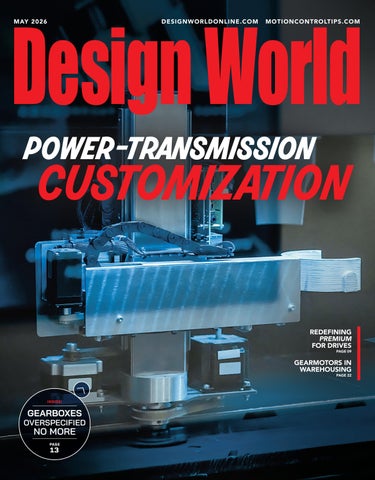
Design World Motion Control Power Transmission Guide | May2026

Page 1


Affordable Power Transmission

Guide tracks with PTFE

Over 2,000 best-value components available starting at just $3.50 (60XL025NG)

Available components include:

• Linear motion slides and actuators

• Linear guides & rail systems

• Linear shafts and shaft supports

• Polymer bearings

• Precision gearboxes

• Strain wave gearboxes

• Helical gearboxes

• Cast iron, stainless, & aluminum worm gearboxes (to fit NEMA and IEC motors)

• Rack and pinions

Power transmission products transfer mechanical motion from its source to where it’s needed to perform a task. Most commonly used in mechanical drivetrains to create movement, these devices can alter the source motion’s direction, torque, and speed.

• Linear bearings and rails

• Timing belts/pulleys/bushings

• A host of shaft couplings, and other mechanical components

BUILT FOR EFFICIENCY

Engineered reliability to keep you on course

In today’s fast moving intralogistics environments, efficiency and uptime drive performance.

From high-efficiency gearmotors with 40%+ energy savings to intelligent conveyors that detect downtime before it occurs, Regal Rexnord delivers a portfolio that is backed by trusted brands and decades of engineering strength. Our solutions are built to support the critical movements that keep warehouses running efficiently, so you’re ready for the challenges of tomorrow.

Learn more at rrx.link/regal-rexnord-packaging

Motor

Bauer™ Gear
Perceptiv™
Kollmorgen™
Thomson™
Arrowhead™
Rexnord™
Browning™
Boston Gear™
LEESON™
Regal Rexnord, Arrowhead, Bauer Gear Motor, Boston Gear, Browning, Kollmorgen, LEESON, Perceptiv, Rexnord, and Thomson

ALGORITHMIC LEARNING ON OLD WEIRD COMPUTERS

Many Generation Xers

from normal families were blessed with Ataris and Nintendo NESs, and maybe even Apple IIs or Commodore 64s if especially privileged, but a curious subset of us had none of these — and played knockoff arcade games on 5.25-in. floppy disks.

Far and away my favorite game was TI invaders — Texas Instruments’ version of Space Invaders. A close second was Home Bound, an off-brand Frogger-like adventure. My mom or somebody copied the code wrong, so if your frog died, it really died — and it was back to the tedium of reloading the Disk Manager and then reloading the game with a determined vow not to mess up again.

An informal survey of my cousins via text has revealed that some of us were especially traumatized by the TI game called Hunt the Wumpus. Blindly bumbling through a cave system, the player endured tense fear of being suddenly devoured by the lurking Wumpus. 8-bit-esque In the Hall of the Mountain King by Edvard Grieg accompanied the deadly jaws closing ‘round.

Very briefly, I want to say from 1987 to about 1988, I played such games with such a setup in my bedroom of all places. It was a massive hand-me-down Texas Instruments beast from my engineer uncle Rob that put the load capacity of its laminate-oak computer-station perch to the test. Most likely it was a TI-99/4A with a TI-99 Peripheral Expansion Box … complemented by an old TV for a monitor, a sickly-beige keyboard, and (of course) a black and red joystick ruggedized to withstand abusively aggressive steering from sweaty little hands. I can work to confirm hardware details with family members if any Design World readers care to know for certain.

Into the expansion box would go a 5.25-in. disk labeled DOS followed by another labeled Parsec or Munch Man or something else equally hilarious. I’ve only just learned that “DOS” may have been TI’s disk operating system called Disk Manager (integrated with TI BASIC and Extended BASIC) and definitely not IBM’s MS-DOS for PCs.

Unlike more mainstream systems, these computers demanded patience during a slow boot sequence that felt like an eternity to a 10 year old. In hindsight, I also realize the user interface and startup menus were also quite weird: DO YOU NEED INSTRUCTIONS? CONTROLS: ARROW KEYS. USE S/D TO LICK BEE. FREE FROG EVERY 1000 POINTS. GOOD LUCK... PRESS ANY KEY. For me, the kooky games on this inscrutable system were early lessons in algorithmic thinking while making programming feel at least approachable. I don’t think it’s a coincidence that several Gen-Xer cousins in my family who got to goof around with these old TIs are in engineering and other technical fields requiring a good deal of persistence and tolerance for muddling through. •

BRING ON the BRUTE FORCE LOADS

MTB Series Linear Actuator Line

The MTB Series is a belt driven, profile rail linear actuator that has a number of sizes with some design configuration availability to meet high loads and stroke length.

MTB actuators are fully enclosed systems that perform at speeds up to 3000 mm per/second. The newer MTB 105 linear actuator can move a static load of 7500 N and has a thrust capacity of 2750 N. Learn More Here

MTB105

Applications:

Packaging and Assembly Automation

Cartesian Multi-axis Gantry Systems

Pick & Place Gantries

Automated Door Systems

Manufacturing Equipment Motion

Premium should mean efficiency, long operating life, high reliability, low CRM demand, upgradeability, and recoverability at end of life.

REDEFINING PREMIUM FOR INDUSTRIAL DRIVES

Global circularity

has slipped to 6.9% which indicates industries are consuming resources faster than they can be recuperated. Efficient motor drives can help close this gap.

Data from the most recent Circularity Gap Report underscores today’s environmental challenges and companies’ structural challenges. For the latter, long-term competitiveness depends on the ability to design industrial assets that consume less, last longer, and preserve critical raw materials or CRMs upon which modern technologies rely.

For manufacturers and operators supplying or operating motor-driven automation, variable frequency drives or VFDs are long-life assets. Their service life and material efficiency shape their energy consumption, uptime, and waste generation over decades of use.

That’s why the definition of premium in the context of VFDs must evolve beyond just purchase price and efficiency ratings to include durability, reliability, material-efficient design, and the ability to remain valuable throughout multiple life cycles.

POWER TRANSMISSION RETAINING DEVICES & maintenance & assembly tools

WHITTET-HIGGINS manufactures quality oriented, stocks abundantly and delivers quickly the best quality and largest array of adjustable, heavy thrust bearing, and torque load carrying retaining devices for bearing, power transmission and other industrial assemblies; and specialized tools for their careful assembly.

Visit our website–whittet-higgins.com–to peruse the many possibilities to improve your assemblies. Much technical detail delineated as well as 2D and 3D CAD models for engineering assistance. Call your local or a good distributor.

ABB quality and reliability testing (including that at its Helsinki laboratory) investigates the mechanisms of component degradation. Electron microscopy, accelerated aging, and vibration and corrosion exposure inform design work to ensure VFDs last as long as possible and CRMs are preserved.

Circularity is often misunderstood as an end-of-life consideration. But for industrial drives, it starts at the level of design, materials, and operating life. Preservation and efficient use of CRMs is now a central strategic priority, which means equipment must be designed with fewer dependencies, longer lifetimes, higher recoverability, and clearer traceability. For drive manufacturers, this means: Designing modular systems that decouple lifetime from individual components.

Image: ABB

Extending equipment’s operational lifetime, with more durable electronics, better cooling, and protection against harsh conditions.

Reducing the use of scarce materials through smarter architecture, lightweighting, and recycled inputs.

Ensuring valuable materials (such as rare earths, copper, and other high-

performance electronic materials) can be reused or are recoverable at end of life. So, reliability is an engineering target as well as a resource-conservation strategy.

Part of the approach includes the use of fewer materials. Every kilogram of avoided material and every kilowatthour saved over a drive’s operating life contributes to the preservation of

non-renewable materials and meeting climate goals. Recent redesigns from some suppliers show how modularity and lightweight construction can reduce overall material demand and boost installation flexibility.

The biggest circularity impact comes from energy efficiency. Globally, most industrial motors still run direct-

on-line or DOL so operated at full speed regardless of actual load conditions and mechanically throttled. This is one of the largest untapped opportunities for industrial decarbonizat ion. Speed control through drives can reduce a motor’s energy consumption by 25 to 70% and boost process yield, reduce wear on mechanical systems, and avoid unnecessary electricity use.

Increasing drive adoption rates is therefore one of the most effective ways to reduce total lifecycle material and energy consumption across industries. Of course, efficiency ratings only tell part of the story. A truly premium drive performs reliably over the long term, delays replacement cycles, and minimizes downtime — reducing the pressure on critical raw material supply chains. This is the core of circular design.

VFDs must also remain relevant even as customer requirements, digital ecosystems, and regulatory expectations evolve. Modular, forward- and backwardcompatible architecture reduces the need for full replacements and keeps CRMintensive components in productive use.

Upgradable electronics and cooling modules along with firmware-based performance enhancements extend usefulness without consuming new materials. Digital diagnostics prevent premature replacement and optimize maintenance schedules to avoid wasteful spare-parts usage of fixed service schedules.

When the time comes, materials and components from end-of-life units are reclaimed and reintroduced through takeback and remanufacturing programs. So, their technical and material value aren’t lost to waste streams.

So, how to rethink premium in the decade ahead? Industrial drives and motors convert more than 40% of global electricity into motion. Their ability to accelerate the green transition is enormous, but only if adoption increases in currently under-automated DOL applications, and if the drives themselves are engineered for circular material flows. This is one way end users can boost performance and profitability while creating a leaner and cleaner industry.

Image: ABB

CHRIS HANDCOCK

DESIGN LEAD

ELECTRO MECHANICAL SYSTEMS

HERE’S THE GOAL WITH GEARBOX CUSTOMIZATION

Shown here are lightweight precision transfer gearboxes for a healthcare application. Gearbox design for such uses must satisfy competing requirements. The tradeoffs between performance, size, and cost demand careful system-level decision-making rather than isolated component optimization.

From the whisper-quiet precision needed in medical devices to the durability required in aerospace applications, fully customized gearbox design and manufacturing is often the answer.

Fully custom gearboxes are typically specified when the compromises associated with off-the-shelf products are unacceptable. Constraints around space, weight, or cost often mean standard gearboxes meet individual requirements but fail to optimize overall system performance.

According to the Worldwide Industrial Single-stage Gearbox Market Research Report 2026, Forecast to 2032, more than 60% of end users express a preference for customizable options that meet unique operational requirements.

Custom solutions are also needed when applications demand materials or features unavailable in stock products. For example, harsh or specialized environments may need enhanced ingress protection, non-outgassing materials, or application-specific lubricants. In many cases, customization also enables functional integration so multiple components are consolidated into a single gearbox to simplify procurement and assembly.

Such requirements are common medical technology needing noncorrosive materials and smooth cleanable surfaces as well as light weight — particularly in handheld devices.

No wonder design engineers rarely present with fully defined specifications. Instead, custom design begins with system-level definition of the application

via physical modeling and theoretical calculations of loads, speeds, duty cycles, and service life.

Where an existing solution is in place, it’s possible to reverse engineer and analyze real-world performance to identify quality or reliability issues caused by off-the-shelf gearboxes operating beyond their datasheet limits. By instrumenting systems with sensors and capturing operating data, suppliers can help design engineers develop accurate specifications that still fit an existing design’s available space and behavior.

COST VS. EVERYTHING ELSE

Of course, gearbox customization comes with its own tradeoffs — namely, that of performance versus cost and performance versus size or weight. Design engineers

often seek high torque density, compact packaging, and long service life at a competitive price. Managing these competing demands is key.

In Apex Dynamics’ Servo Gearbox Secrets, author Mike Guilliford emphasizes the growing importance of precision in modern gearbox technology: “The demand for higher accuracy, efficiency, and reliability in components across industries is increasing … and [the importance of] gearbox selection is often underestimated.”

Gearboxes must meet clearly defined requirements for load, speed, and duty cycle but satisfying these targets incurs a cost, particularly when bespoke components or high-end materials are required. So, some suppliers of custom gearing work to reduce component counts, sell fully bespoke parts only when warranted, and offer proprietary

components where appropriate. In some cases, functionality may be simplified to reach a better balance between cost and performance.

This is where motor selection becomes a clear contributor to these tradeoffs. High-performance motors can deliver the needed power within tight spatial constraints though their cost must be considered alongside that of the gearbox design. The final solution is often a system-level compromise rather than a gearbox-only decision.

SIZE, WEIGHT, AND OVER-SPECIFICATION

Constraints around size and weight are especially challenging. Where the available envelope is fixed, maintaining performance may need adjustments elsewhere, such as reducing safety factors

Superior encoders for position and motion control

With

or optimizing material selection. It’s possible to balance this through detailed verification calculations, ensuring that critical components such as gear teeth and bearings remain robust even when space is limited.

Safety factors account for real-world uncertainties such as load variation, thermal effects, and manufacturing tolerances that can’t be fully simulated. Gear teeth and bearings are typically designed with margins of 1.5 times to twice the expected operating load so stresses remain well below material yield limits. These margins are reviewed and refined during prototyping and testing, where designs can be reinforced if required.

Material choice is also key: While commercial-grade steels are cost-effective and well understood, medical and aerospace applications often need lighter, corrosion-resistant or higher strength-toweight materials, such as stainless steels or titanium alloys. These materials enable compact, lightweight designs but are more challenging to verify and manufacture, meaning that prototyping is used to confirm performance.

VALIDATING GEARING PERFORMANCE

Simulation, prototyping, and testing all play an important role in validating a custom gearbox design, but their effectiveness depends on how well the operating conditions are understood. Computational simulation can be valuable for analyzing individual components or simplified load cases including gear tooth stresses or housing strength under known loads.

However, many applications involve complex duty cycles, shock loading, thermal variation, and environmental factors that are difficult to accurately model. So, simulation outputs depend on accurate use data — something that isn’t always available at the early development stages.

For this reason, productionrepresentative prototyping and realworld validation are critical. Specifically, some suppliers focuses on developing

prototypes intended to operate as they would in service, rather than proof-ofconcept models optimized purely in software. By validating gearboxes within the customer’s actual application, issues can be identified that would be extremely difficult to predict through simulation alone. Take for example failures that occur only under specific environmental or operational scenarios.

Testing is often accelerated to condense years of operation into shorter timeframes, using representative loads, speeds and control electronics. This approach allows the performance, durability and failure modes to be assessed realistically, while accounting for many of the variables present in real use. Depending on the program, some suppliers may validate defined aspects of the specification internally, while design engineers carry out broader system-level testing.

This aligns closely with the goal of designing the gearbox as part of a complete drive system, rather than treating the gearbox in isolation. Custom

When managed correctly, gearbox customization (as of multi-stage gearboxes with worm drives as shown here) can yield application-specific performance from concept to completion.

drive solutions allow the gearbox to be matched precisely to the motor’s operating characteristics, whether the customer’s priority is maximum power density, high efficiency or long lifecycle.

For instance, a motor may be capable of delivering high power within a small envelope, but getting long life may need operating it at a lower speed and selecting a gearbox ratio that shifts the operating point accordingly. This means that bearing arrangements, lubrication strategy and housing design are all selected to support these operating conditions.

At the mechanical interface level, custom housings can be designed to integrate directly with the customer’s subsystem, eliminating the need for adaptor plates or secondary fixtures often needed with off-the-shelf gearboxes. This consolidation improves alignment, reduces assembly complexity and enhances overall system robustness to produce a gearbox that works seamlessly in the needed application. •

ELECTRO MECHANICAL SYSTEMS EMS-LIMITED.CO.UK/BLOG

Image: ELECTRO MECHANICAL SYSTEMS

For most motion-control applications, standard servodrives are the most suitable solution. Off-the-shelf units balance proven performance, immediate availability, and straightforward integration for a wide array of industrial, commercial, and consumer equipment. In contrast, certain applications involving challenging space constraints, harsh environments, and unique controls need custom drives.

MEETING PHYSICAL AND ENVIRONMENTAL CHALLENGES

Standard servodrives typically come in panel-mounted or PCBmounted formats, which work well for conventional installations. In contrast, specialized equipment often has limited real estate for electronics, making standard shapes or sizes impractical. For high-volume OEM design engineers who don’t need all the connectors and full functionality of a standard enclosed product, some suppliers sell board-only versions of standard products. These boards pair with custom heat sinks to deliver the same performance as standard off-the-shelf solutions but in a smaller package.

Embedded drives (integrated directly with the motor to make a motor-mounted drive) are another customized option. Or for systems that can’t accommodate a typical rectangular enclosure, there are round drives that directly mount onto motor ends. Yet other drives can be customized into ultra-compact PCB assemblies or with adapted standalone chassis mounts to fit specific enclosure or mounting schemes.

Drives can also be customized with ruggedization features to withstand:

• Applications with ambient temperatures exceeding 100° C or operating outside standard industrial temperature ranges.

• Military and defense systems needing drives that satisfy MILSPEC requirements for shock, vibration, and temperature extremes.

• Deep-sea and marine applications, which need structural modifications to withstand high pressures at depths reaching several thousands of meters.

To protect against contaminants, drives can be customized with covers, conformal circuit-board coatings, or even encasement in potting compound for complete contamination prevention. Such modifications are employed most in food and beverage processing, industrial machinery, and agricultural automation.

Case in point: One supplier developed an IP69K-rated drive-motor package for an agricultural application in which up to fifty drives and motors mount onto a tractor implement. The latter automatically controls dispensing for each row in a field being

For some applications, stock servodrives are the most suitable. Elsewhere, custom solutions justify the extra investment.

SCOTT ROHLFS ELECTROCRAFT

farmed. Basically, a standard drive board and motor were given a sealed enclosure with waterproof cables and connectors. The assembly’s IP69K rating ensures the drives withstand high-pressure washdown as well as the tractor’s extreme vibration and exposure to outdoor temperatures. Consider another example: One custom drive integrates into the joystick of a steering system needing haptic force feedback. The drive meets MILSPEC requirements for shock, vibration, temperature, and ingress protection with a conformally-coated board in a sealed package.

MATCHING DRIVE POWER TO MOTOR AND DUTY CYCLE

A motor’s duty cycle and size may need input power beyond that of a standard servodrive. Because standard servodrives offer fixed ranges of operating voltages and output currents, precisely matching the power source to a specific motor often requires a custom unit. That’s also true of an application needs current or voltage levels beyond standard specifications — for example, an output between the continuous currents of standard models or a very specific voltage for efficient operation.

Other important factors are duty cycle and torque requirements. Highacceleration applications — sometimes called pulse-duty operations — demand substantial peak current to generate the peak torque needed for rapid starts

ElectroCraft builds comprehensive protection into standard products as a matter of good engineering practice. Based on years of customization experience, these features have moved from “nice to have” custom requests to standard offerings.

and stops. Some drives typically allow peak current values that are double the continuous rating for a couple of seconds, which is useful for quickly accelerating heavy loads. The drives automatically limit current and reduce performance until operation returns to the continuous range, preventing thermal damage. If the needed peak current and continuous current exceed what a standard drive can handle, a custom solution becomes essential to prevent overheating and failure.

DON’T FORGET REGENERATIVE BRAKING

Applications needing regenerative braking represent another scenario

ENGINEERS WITH VERY SPECIFIC REQUIREMENTS should look for a supplier that can customize drives for any voltage or any wattage within their platform’s capabilities and any reasonable current level.

Recently, a large OEM in laboratory diagnostics needed a drive to control a NEMA 34-frame BLDC motor in a low-current application — only 3 to 4 A. The specification also called for a universal ac lineinput capability because the drive needed to accept 85 to 26 Vac anywhere in the world and convert it to dc to run the motor without any jumper settings or physical adjustments.

A customized solution from ElectroCraft includes an integrated power factor controller that reduced harmonics on the ac line while allowing operation at universal voltages — similar to a laptop power supply. So there’s no need to size electronics to the highest voltage (220 V) when using 120 V and pay for the higher voltage capability. The power-factor controller draws current in phase with the line voltage to producing constant dc power and run the motor at the appropriate stepped-down voltage. In fact, standard ElectroCraft offerings are scaled at 6-A, 12-A, 24-A, 40-A, and 50-A continuous with the largest drive capable of 100-A peak, but end users needing specific current ratings between these values can request custom configurations.

where standard drives might not suffice. When motors decelerate under load — common in robotics and electronics manufacturing — they generate energy that flows back into the drive. Many standard drives handle this with an onboard shunt regulator that dissipates the excess energy as heat to keep DC bus voltage safe ... and have fixed limits for how much regenerative power their internal shunt can handle. But applications with high-inertia loads or vertical axes, such as elevators or gantries where gravity assists downward motion, can generate more power than a standard shunt can dissipate. When the regenerative continuous or peak power exceeds typical built-in limits, a custom drive with enhanced capabilities or a standard drive with an external shunt resistor module becomes necessary to safely handle the additional energy and prevent drive damage.

CONTROL ALGORITHMS FOR SPECIALIZED MOTION PROFILES

Standard drives come with preconfigured algorithms that work well for typical applications. For example, some standard drives include advanced field oriented control (FOC) for brushless and closedloop stepper motors, delivering good dynamic response and acceptable torque ripple for most use cases. Certain

For thermal protection, all ElectroCraft standard servodrives include over-temperature monitoring with customizable and adjustable temperature threshold parameters. Drives also support motor thermistors with selectable drive parameter settings to accommodate a variety of thermistor types.

ElectroCraft can customize drives for any voltage or any wattage within the platform’s capabilities and any reasonable current level. Standard offerings are scaled at 6-A, 12-A, 24-A, 40-A, and 50-A continuous with the largest drive capable of 100-A peak, but end users needing specific current ratings between these values can request custom configurations.

universal drives can run brushed dc, BLDC, and stepper motors with the unique ability to control steppers as if they were brushless motors using FOC. This feature provides both cost and mechanical advantages. BLDC motors tend to have longer and skinnier form factors while steppers are shorter and wider, giving designers greater mechanical flexibility when space constraints vary.

Additionally, built-in motor databases and preconfigured settings allow engineers to complete most configurations in seconds, with auto-tuning handling basic optimization. For applications needing standard velocity control, torque control or basic positioning, these algorithms are more than sufficient.

Customization often becomes necessary when the motor-load combination has characteristics that standard tuning can’t accommodate, necessitating custom control algorithms and feedback processing. For example, applications needing smooth motion at low speeds, minimal torque ripple or precise tracking may need highly specialized parameter tuning. In these use cases, suppliers can develop custom-tuned FOC algorithms specifically matched to the motor’s electrical characteristics and the application’s performance requirements.

The choice of commutation method also factors into customization decisions. Some suppliers can implement simple trapezoidal commutation for costsensitive or basic applications or deploy more advanced sinusoidal commutation with custom FOC algorithms when applications need high efficiency and control resolution.

Consider an application benefitted by custom software: In the semiconductor industry, an inspection station needed positioning accuracy within 50 mrad of the commanded position for precise instrument alignment — a resolution that no encoder could directly sense. One motiontechnology supplier developed a unique algorithm using software interpolation to control the torque vector in the motor, maintaining accurate positioning.

Because the application used a small motor, engineers rescaled the drive’s voltage and current feedback to maximize resolution. Starting with a standard 48-V

ElectroCraft drives include built-in electromagnetic brake control — a feature that many vendors don’t offer. Electromagnetic brake control is essential in vertical-axis and safety-critical applications.

drive with 16-bit PWM, engineers dropped the voltage to 12 V — making each PWM step four times smaller. They also reduced the current measurement range from 10 A to 500 mA full-scale, spreading the finite digital resolution of the analog-to-digital converter across a narrower range to increase feedback resolution and fidelity.

The motion-technology supplier later adapted this same fine-resolution technology for another use case — a vinyl turntable manufacturer. The tight control enabled detection of flaws in master discs by virtually eliminating wow and flutter.

INTEGRATING NONSTANDARD FEEDBACK DEVICES

Drives can also be customized for feedback. Standard drives work with common encoders and sensors using industry-standard interfaces. These units typically support Hall sensors for commutation and optical encoders for speed and position along with Sin-Cos encoders, magnetic encoders, various serial encoder protocols, and other feedback types through selectable drive parameter settings.

One caveat: When applications use proprietary position sensing technology or nonstandard feedback devices the drive must be customized to correctly accept, process, and communicate those specific signals. Similarly, while standard drives provide basic fault diagnostics, custom versions can be configured to monitor and report specific internal

functions such as following error or other application-critical parameters.

BRIDGING COMMUNICATION GAPS WITH CUSTOM PROTOCOLS

Beyond modifications to the drives themselves, customization also addresses how servodrives communicate and integrate with broader control systems. Servodrives need to integrate into large often complex communication networks and system architectures. Standard units support common industrial protocols such as CANopen or EtherCAT, but applications that need integration with unique, specialized, or proprietary networks outside these standard offerings may demand a custom solution.

Leading suppliers have extensive experience creating custom serial-based control protocols (RS-232 and RS-485) when standard interfaces can’t meet an application’s requirements. This capability is particularly valuable for integrating drives with legacy equipment or when a new accessory must work in harmony with existing systems using proprietary communication schemes.

Further, in distributed control systems that put drives closer to motors, custom features let the drives serve as intelligent nodes that can command electronic gearing or motion trajectories for tightly coordinated or synchronized axes. These advanced control features are key in industrial automation, medical and

laboratory equipment, and semiconductor processing applications.

CUSTOMIZING I/O FOR ENHANCED FUNCTIONALITY

Custom I/O is perhaps one of the most frequently requested customizations. Here, custom drives often include modified firmware to let I/O invert inputs, provide an indicator status, or report feedback based on control variables. For one design, the motion-technology supplier created a drive that is preconfigured to automatically select one of eight configurations based on I/O pin states. Using a custom harness that tied specific pins to ground, the drive detects and loads the appropriate configuration so there’s no need for manual setup steps.

WHEN CUSTOMIZATION MAKES SENSE

Standard servodrives work well when an application fits within typical voltage, current, and environmental ratings, requires basic control functionality, and uses common form factors and protocols. Custom drives often become necessary in applications with space constraints, harsh environments, demanding power requirements, ultra-precise motion control, non-standard interfaces or advanced features such as haptics.

In addition, customization is suitable high-volume OEMs. Buying large drive volumes justifies the development effort for optimized solutions at a lowest cost per unit. Engineers also avoid paying for unnecessary features while gaining precisely tailored capabilities.

Because standard products serve as an excellent jumping-off point for custom solutions, it’s recommended to start with standard off-the-shelf options to test and validate performance requirements. When a standard drive performs well but needs additional features or modifications, that’s the suitable time to explore customization. This approach reduces risk by proving the basic concept before investing in custom development. •

ELECTROCRAFT | ELECTROCRAFT.COM

GEARMOTORS IN WAREHOUSING EQUIPMENT

Today’s automated warehouses are often designed by a small group of mechanical engineers and a veritable army of software engineers — especially where coordination of purpose-built autonomous robot fleets is involved.

Even so, cruise the next MODEX or ProMat show and it will become clear that warehouse equipment relies heavily on electromechanical systems — and especially the noble fractionalhorsepower gearmotor. For example, robotics to move product racks or pallets include gearmotors for traversing factory floors, for turning in place, and (in some cases) for lifting transported items — as with a jack screw, for example.

Gearmotors are also found on warehouse conveyors such as accordion-style conveyors and flexible powered conveyors. These are scissor-leg material-handling systems with powered rollers ganged together with round belt at their ends. Often the conveyors move goods through facilities or interface with flatbed shipping trucks at loading docks to hasten loading and unloading. Some accordion-style conveyors are also broken into zones so that conveyed goods are moved along a section at a time.

At loading docks, gearmotors can also power locking restraints that prevent accidents. More specifically, these motorized claw-type dock constraints engage with hardware on trucks to prevent drivers from pulling away when personnel on foot or forklift are still traversing over the area where the backs of trucks interface with the loading docks.

Motorized caster wheels are another place where

gearmotors impart motion in warehouses. These wheels in turn install on carts, trollies, and dollies that are meant to move extremely heavy workpieces not easily, ergonomically, or safely moved by manually propelled equipment ... especially in settings to support the assembly of big equipment with big and heavy subsystems. Heavily relying on gearmotors are also man lifts with socalled crow’s-nest buckets in which operators can ride as well as ergonomic workpiece lifts with trolley wheels (sometimes motorized) and a motorized Z-axis platform or end-effectors in the form of pneumatic suction-cup arrays to let operators safely raise and lower items.

CONTROLS: SIMPLE (STANDALONE) TO COMPLEX (INTEGRATED)

A wide variety of controls get paired with these gearmotor-based designs. Most dock restraints are pretty much self-contained, so operate through a simple on-off switch complemented by a conveniently located emergency-stop button. So too are lift trucks — self-contained units sans any master control. After all, warehouse personnel operate and steer these vehicles. So for

Bodine has supplied motors to the makers of various conveyor types.
Image: ADOBE STOCK

AD INDEX

EDITORIAL

VP, Editorial Director

Paul J. Heney pheney@wtwhmedia.com

Chief Editor Rachael Pasini rpasini@wtwhmedia.com

Executive Editor Lisa Eitel leitel@wtwhmedia.com

Managing Editor Mike Santora msantora@wtwhmedia.com

SALES

Jami Brownlee jbrownlee@wtwhmedia.com 224.760.1055

Mike Francesconi mfrancesconi@wtwhmedia.com 630.488.9029

Ryan Ashdown rashdown@wtwhmedia.com 216.316.6691

Susan Powers spowers@wtwhmedia.com 708.341.3370

Colton Stefanich cstefanich@wtwhmedia.com 331.223.2047

Mary Ann Cooke mcooke@wtwhmedia.com 781.710.4659

Tom Duggan tduggan@wtwhmedia.com 773.724.1638

Melissa Roberts mroberts@wtwhmedia.com 440.666.3111

CREATIVE SERVICES & PRINT PRODUCTION

VP, Creative Director Matthew Claney mclaney@wtwhmedia.com

Senior Art Director

Tory Bartelt tbartelt@wtwhmedia.com

Director, Audience Growth Rick Ellis rellis@wtwhmedia.com

PRODUCTION SERVICES

Customer Service Manager Stephanie Hulett shulett@wtwhmedia.com

Customer Service Representative Tracy Powers tpowers@wtwhmedia.com

Customer Service Representative JoAnn Martin jmartin@wtwhmedia.com

Customer Service Representative Renee Massey-Linston renee@wtwhmedia.com

Customer Service Representative Trinidy Longgood tlonggood@wtwhmedia.com

ONLINE DEVELOPMENT & PRODUCTION

Web Development Manager B. David Miyares dmiyares@wtwhmedia.com

Digital Production Manager Reggie Hall rhall@wtwhmedia.com

LEADERSHIP TEAM

Senior VP, Engineering

Amanda Buehner abuehner@wtwhmedia.com

CEO Matt Logan mlogan@wtwhmedia.com

CFO Ken Gradman kgradman@wtwhmedia.com 773.680.5955

FINANCE

Controller Nirmit Shukla nshukla@wtwhmedia.com

Accounts Receivable Specialist Jamila Milton jmilton@wtwhmedia.com

MARKETING

Digital Design Manager

Samantha Goodrich sgoodrich@wtwhmedia.com

Digital Marketing Manager Taylor Meade tmeade@wtwhmedia.com

Webinar Manager Jill Lowe jlowe@wtwhmedia.com

DESIGN WORLD does not pass judgment on subjects of controversy nor enter into dispute with or between any individuals or organizations. DESIGN WORLD is also an independent forum for the expression of opinions relevant to industry issues. Letters to the editor and by-lined articles express the views of the author and not necessarily of the publisher or the publication. Every effort is made to provide

DESIGN

Subscription

Subscriber

POSTMASTER:

many lift trucks, there’s just a simple current-limit control (with motor torque directly proportional to current) to command the truck to accelerate, hold speed, and change direction (between forward and reverse).

For such designs, some fractional-horsepower gearmotor suppliers sell simple speed controls with on-off and speedadjustment functions. However, it’s more common that gearmotors get paired with controls designed by the original equipment manufacturer (OEM).

That’s because from a capital-equipment standpoint, it’s easier for an OEM to design their own controls or outsource PC boards to their design. Plus, OEMs typically aim to integrate a given gearmotor’s controls into global controlsystem functions. So, instead of buying a separate board here and a separate board there, OEMs often design systems so a single board executes all functions.

Reconsider flexible powered conveyors. These include centralized controls that coordinate separate command zones. One long

conveyor of this design has a motor (and interconnected controls) every five feet or so — in some cases, flat pancake motors with flat drives. Then switches detect the presence of boxes or workpieces in each zone and activate its motor to carry the items through. Once a zone is cleared of items, it’s automatically turned off and the next zone powered on … and on down the line in a domino effect.

HOW GEARMOTORS ARE TYPICALLY PROCURED

Typically, it’s OEM design engineers or purchasing managers armed with a wish list from the design engineers (and not plant engineers) who interface with suppliers to size and specify components such as gearmotors for standard lifts, conveyors, and other equipment. Distributors and system integrators might then interface with plant engineers to tailor solutions to a given setting. In the past when gearmotors from certain manufacturers have suddenly become unavailable, but OEM designs are already finalized and engineering specs set, purchasing managers have led the hunt for new suppliers.

These insights were gained in a recent conversation with Terry Auchstetter of Bodine Electric Co. For more information, visit bodine-electric.com. •

Read more about another warehouse application for gearmotors — in automated guided vehicles (AGVs) — at this link.
This GlobalTek conveyor features a Bodine Electric gearmotor and speed control.
Image: BODINE ELECTRIC CO.

From Dock to Shelf with Bodine

From the truck restraint at the dock to the flexible conveyor for unloading to the mobile lift that carries the load to the high density storage system –we keep today’s automated warehouses moving. Whether paired with simple standalone controls or fully integrated OEM systems, our gearmotors deliver dependable motion to keep warehouse operations efficient, safe, and productive.

Bodine Gearmotor Drives Warehouse Lifter

Learn how our low-voltage gearmotor delivered over 440 lbs of lifting force.

Turn static files into dynamic content formats.

Create a flipbook
Design World Motion Control Power Transmission Guide | May2026 by WTWH Media LLC - Issuu