Medical www.designworldonline.com
A Supplement to Design World - June 2022
ft, so ips o cr il Mi , Ph care , J h n zo , J& ealt lain a e p Amoogl E H s ex G nd G der a lea
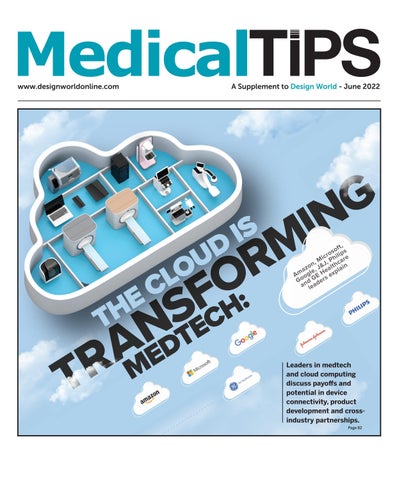
Leaders in medtech and cloud computing discuss payoffs and potential in device connectivity, product development and crossindustry partnerships. Page 82
Medical Tips cover 6-22_V1.indd 81
6/1/22 4:04 PM
82
June 2022
CloudFEAT_MedTips Supp_6-22_Vs2.indd 82
www.designworldonline.com
DESIGN WORLD
6/1/22 4:07 PM
Leaders in medtech and cloud computing discuss payoffs and potential in device connectivity, product development and crossindustry partnerships.
J I M HAMMERAN D MAN AGI N G EDI TOR
I
f knowledge is power, that power comes from a steady stream of information, and we know there’s no shortage of that in healthcare. The challenge has long been how to capture that information, store it, analyze it and deploy it to improve medical product design, manufacturing and the health of patients. Then came the cloud, and with it a host of acronyms: software as a service (SaaS), platform as a service (PaaS), infrastructure as a service (IaaS), and — following the same convention — software as a medical device (SaMD). Over the past few months, Medical Design & Outsourcing connected with leaders in medtech and cloud computing, including the three largest providers of cloud computing services: Amazon, Microsoft and Google. They offered examples of success stories in the cloud, ways the cloud can lift medicine to new heights, and some advice for medtech insiders looking to harness the power of cloud computing. The following excerpts have been edited for space and clarity. Go to medicaldesignandoutsourcing.com for longer interviews and more on cloud computing, artificial intelligence and machine learning.
ft, o os ilips r c Mi , Ph care , on J&J alth ain z a e, e pl Amoogl E H s ex G nd G der a lea
MDO: What are some surprising and inspirational examples of what cloud computing enables with regard to medical device design, manufacturing and capabilities/performance?
Google Cloud Global Lead for Medtech Strategy and Solutions Alissa Hsu Lynch
DESIGN WORLD
CloudFEAT_MedTips Supp_6-22_Vs2.indd 83
www.designworldonline.com
Alissa Hsu Lynch, Google Cloud global lead for medtech strategy and solutions: Researchers at Emory University used Google Cloud to create an algorithm that uses 71 factors to predict the onset of sepsis in patients within four to six hours with 85% accuracy, improving the time to diagnosis. [On another front], DeepMind’s AlphaFold machine learning system recently helped solve the protein structure problem, which has been a grand challenge in biology for 50 years. Research organizations can now leverage AlphaFold to better understand complex diseases and accelerate the development of new treatments, such as life-saving cures that disproportionately affect poorer parts of the world. >>
June 2022
83
6/1/22 4:07 PM
THE CLOUD IS TRANSFORMING MEDTECH
Microsoft Global Chief Medical Officer and VP of Healthcare Dr. David Rhew
Amazon Web Services Chief Medical Officer and Director of Machine Learning Dr. Taha Kass-Hout
Dr. David Rhew, Microsoft global chief medical officer and VP of healthcare: Sensoria makes a boot for diabetics to track pressure and movement and a variety of things, allowing us to pull all that data into the cloud and apply advanced analytics and AI to potentially predict pressure ulcers. We can think of putting sensors of any type on any device you wear or implant in your body. From there, the question is what do you do with the data? And that’s where artificial intelligence and machine learning can come in. Dr. Taha Kass-Hout, Amazon Web Services chief medical officer and director of machine learning: Ambra Health used AWS to expand its software as a service medical imaging data platform to five new countries in order to meet strict data security requirements. Butterfly Network is an innovator with Butterfly iQ, one of the first handheld whole-body ultrasound systems that uses AWS for making medical imaging universally accessible and affordable, providing a personalized experience for healthcare providers at drastically lower cost. Roshy Francis, GE Healthcare life care solutions chief technology officer: The pandemic overwhelmed hospital systems, and patient complexity has increased with multiple comorbidities. These dynamics require multi-specialty care teams to collaborate to make timely and accurate decisions in acute care settings. Clinical care teams can now virtually come together around a patient, with a complete picture of the patient from various systems, without having to be physically present at the bedside. We have deployed solutions on the cloud that help ensure care protocol compliance in the ICU and Labor & Delivery for timely interventions that lead to improved patient outcomes. We are now deploying solutions that allow complex procedures like anesthesia delivery to be monitored and guided by experienced anesthesiologists remotely.
MDO: What are some previously unthinkable advances that now seem increasingly likely to become reality? Larry Jones, Johnson & Johnson group CIO and global vice president of medical devices: Can you simulate a surgery? Can you create a digital twin of a hospital? Can you create a more personalized experience for surgery or any point of care? … If there’s an accident on the roadway and there’s trauma, shouldn’t the ambulance be the first data collection? Leveraging the cloud, leveraging IoT (the Internet of Things) that by the time that patient gets to the hospital, the oncoming care team is already aware of everything about that patient, has the right equipment and makes sure that patient goes to the most appropriate hospital. … Healthcare should be a lot cheaper, and a lot of folks should have access to it. And I think technology can really, really help that. The art of the possible is extraordinary in a sector, quite frankly, that’s fraught with inefficiency. (continued on page 86)
Johnson & Johnson Group CIO and Global Vice President of Medical Devices Larry Jones
GE Healthcare Life Care Solutions Chief Technology Officer Roshy Francis 84
June 2022
CloudFEAT_MedTips Supp_6-22_Vs2.indd 84
www.designworldonline.com
DESIGN WORLD
6/1/22 4:08 PM
COUNT ON INDUSTRY-LEADING PRECISION & ACCURACY
WHEN THERE'S ZERO ROOM FOR ERROR. Control solenoid valves from The Lee Company offer superior quality, proven reliability, and long-lasting performance. For your most demanding medical and scientific applications, choose a valve that hits the mark every time.
Scan to explore our full collection of control solenoid valves.
LeeCo_DsgnWrld_ZeroRoom_June22.indd 1 THE LEE CO 6-22.indd 85
5/6/22 2:00 PM 6/2/22 10:39 AM
THE CLOUD IS TRANSFORMING MEDTECH
Philips Virtual Care Solutions Business Category Leader Christine Storm
GE Healthcare SVP and Imaging Solutions GM Rekha Ranganathan
Christine Storm, Philips virtual care solutions business category leader: In healthcare, there are many data sources holding personal, operational and clinical data such as EMR, Laboratory, ECG, PACS or other data lakes. At the same time, many patients and caregivers are trying to access the information using applications or solutions along the care pathways but are struggling to access this data due to a very fragmented IT infrastructure. Digital platforms, such as Philips’ HealthSuite, provide the capabilities to unlock and integrate the data from various sources, and allow caregivers and patients to interact seamlessly with this data, and gain actionable insights from it. Rhew (Microsoft): We know the duration of a surgery has a direct impact on surgical outcomes. We now can get more granular. And that’s what’s exciting because we’re starting to gather patient-specific information but can start also thinking about different devices and different procedures being done within, say, the surgical unit. We can then start pulling all that together and analyzing across the board, comparing hospitals to hospitals and providers to providers. There is so much variation in care, and a lot of times it’s unwarranted, and there
are often best practices that can be gleaned. If we can understand what the benchmarks are and strive toward those, we can lead to better quality improvements. And that can only be done when you have data that’s accessible at the granular level, roll it up into different areas, benchmark it and allow for AI to be applied on top of it to provide real-time guidance and support and improve patient outcomes. Rekha Ranganathan, GE Healthcare SVP and imaging solutions GM: Interventionalists can collaborate with each other with videos streaming realtime from cath labs or operating theaters, especially for complex procedures, to bring the best patient care possible. With healthcare organizations moving toward value-based care models, collaboration is essential between doctors, departments, and even institutions. Medical providers can transfer data between each other through a cloud computing server, boosting cooperation, discussing dashboards and treatment options for increasing patient care and making it more personalized for better treatment.
D E S I G N I N G A L I F E - S AV I N G D E V I C E O N T H E C L O U D In its quest to build a better blood and vaccine cooler, Delta Development designed its Autonomous Portable Refrigeration Unit (APRU) over the cloud. The APRU refrigerates fresh blood and vaccines with a battery that lasts for days on a single charge. The cooler constantly monitors temperature and can withstand outdoor elements and extreme temperatures. Chief Technology Officer Robert Futch shared his team’s experience using cloud tools to design, manufacture and sell the device.
86
June 2022
CloudFEAT_MedTips Supp_6-22_Vs2.indd 86
“Cloud-based design had a bunch of benefits for my team. No. 1 on the list is that it didn’t slow down our development when everybody went to work from home at the beginning of the pandemic,” he said. “Onshape was a big part of this, but a few other tools like Greenlight, Dozuki, Github and good old Google Docs were also important.” Other benefits included version control, the ability to quickly scale with remote contractors, faster software bug fixes and manufacturing procedure updates, faster
www.designworldonline.com
collaborative reports leaving more time to design and build, and “super easy” customer support and phone call management. Cloud collaboration ultimately made employees happier, Futch said. “They have flexibility and also had more time to go back to school,” he said. “It is easier to keep track of productivity as well. There’s no tribal knowledge and less supervision required. Everyone is aware of what they have to do and where to find the right information.”
DESIGN WORLD
6/1/22 4:15 PM
MDO: What sort of big, futuristic dreams do these or other advances inspire? Lynch (Google): With the exponential growth of data in healthcare, the future of medtech will be about connected care. And in the future of connected care, technology will be a gateway to healthcare. I think it’s important to say that while AI has the potential to expand access to better care, we need to find ways to ensure equity, access and improved outcomes for everyone. AI technologies should work for the common good. I truly believe that big data and AI can help transform healthcare from reactive care to predictive, personalized and proactive care. But it will take all of us working together across the ecosystem — medtech and Big Tech, governments, health plans, health systems, research institutions and other stakeholders — to make this vision a reality. Peter Schulam, Johnson & Johnson MedTech office of digital innovation leader: There’s a lot of friction in healthcare, and we have to remove that friction. We’re focused on being smarter, less invasive, more personalized, but our overarching thing is we need to decrease patient outcome variability and improve operational efficiency. When we look at outcomes, we think there’s two main contributors: caregiver skill and provider judgment. And I think we have the ability through our assets that we’re innovating around to actually have impact on that. And if we do that, then we really believe that patient outcome will be improved. The standard of care will be improved. I tell everyone the variability that we see — if we narrow that variability and shift that whole curve to the right — that’s a good vision.
800-528-8650 eagletube.com
From Design Concept To Finished Product Eagle specializes in stainless steel, aluminum, copper, nickel and nickel based alloys.
Johnson & Johnson MedTech Office of Digital Innovation Leader Peter Schulam
CloudFEAT_MedTips Supp_6-22_Vs2.indd 87
June 2022
• Custom tube sizes and drawn shapes • Precision cut-to-length tubing • Wire EDM and Laser Machining • CNC Machining (size range .062-2”) • Bending and Coiling • End Forming
ISO 9001 & ISO 13485 DESIGN WORLD
• Stainless steel tubing – hypodermic, fractional, metric, pipe, bar, wire
• Assemblies and more
87
6/1/22 4:15 PM
THE CLOUD IS TRANSFORMING MEDTECH
Kass-Hout (AWS): Equity in care. How are we able to take all this information to provide more equitable care? Healthcare is a $7.5 trillion business globally, yet more than 4 billion people don’t have access to care — forget about high-quality care, just access to care in general. I believe AI and technology have to be part of a solution to creating that more equitable access. The future of healthcare is so vibrant and dynamic right now. It’s so dependent on big data, on AI and on cloud computing. Promising innovations like precision medicine, conversational chatbots, intelligent scribes, and APIs for data and interoperability may make healthcare better and more efficient and more equitable in the future. MDO: What does cloud computing mean for how medical device designers and engineers should be thinking?
CAN YOU HEAR IT? For those resting and convalescing, the benets of quiet are clear indeed. Whether at home or in a medical setting, the last thing a patient needs is a medical device that clatters or vibrates or otherwise distracts. That’s one reason device manufacturers specify Nitto Kohki pressure and vacuum pumps. With extremely low vibration and less ambient noise than a light ballast, Nitto pumps leverage their linear-piston design (just one moving part!) for remarkably simple and dependable operation. Among other benets:
EXCEPTIONAL RELIABILITY
HIGH ENERGY EFFICIENCY
LONG SERVICE LIFE (>10,000 HRS.)
DC-DRIVEN
Schulam (Johnson & Johnson): When you’re looking at a medical device in the conventional manner, you spend a long time developing, you launch, and then you never iterate. Guess what? In the software world and the agile world, it’s exactly the opposite: a minimal viable product and multiple iterations. We have to create this hybrid innovation cycle. Jones (Johnson & Johnson): It means designing connectivity in your solution. Design with security in mind as part of the product offering. Be very proactive in what sensors you’re using, what are you designing, even to the point of what preventive maintenance looks like. Learning from Microsoft, as we’re designing products, don’t try to solve problems that’ve already been solved. There’s a lot of leverage across the board, and that’s why we’re we believe this audacious task is gonna take partnerships to do that. I remember when we had constraints on any product design. Storage was expensive. Computing was expensive. Battery life was challenging. Things like connectivity and speed, with 5G, 6G forthcoming with the cloud and being able to amass unlimited storage at a fraction of a cost, those constraints in your design aren’t as plentiful as they were in the past. I’m not a mechanical engineer, but I do believe that you’re now building without constraint.
FIND OUT WHY YOU SHOULD KNOW NITTO: 800.843.6336 | NITTOKOHKI.COM/PUMPS
88
CloudFEAT_MedTips Supp_6-22_Vs2.indd 88
June 2022
DESIGN WORLD
6/3/22 7:48 AM
TUBING TALKS
Catheter delivery could enable better brain implants Synchron’s catheter delivery could make brain-computer interface technology simpler, safer and more accessible than the leading alternative: open-brain surgery.
O Jim Hammerand | Managing Editor |
fficials at Synchron, developer of the catheter-delivered Stentrode brain-computer interface (BCI) implant, believe they’re the only BCI company tapping into blood vessels to capture signals from the brain. New York–based Synchron recently said four ALS patients with a Stentrode implant had no serious adverse events one year after their procedure. The implants allowed the paralyzed patients to control a computer for online shopping, banking and text communication without using their hands or voice for input. “BCI has been on a bit of a journey,” Synchron Director of Neuroscience Peter Yoo told Medical Design & Outsourcing. “It’s been in the making for a few decades now, but it hasn’t quite translated into the real-life patient setting yet. It’s largely been an engineering problem because people need to pave the way of getting into the brain or getting inside the skull to record these high-fidelity signals.” Synchron’s catheter approach Synchron uses catheters to feed the Stentrode device to a blood vessel on top of the brain, rather than the open-
DESIGN WORLD
Tubing_6-22_Vs3.indd 89
www.designworldonline.com
brain surgeries used by other neurotech developers like Elon Musk’s Neuralink. Once inside the vessel, Synchron’s mesh-like device expands to line the vessel wall so its 16 electrodes can capture and relay movement signals from the brain’s motor cortex to another device in the chest that translates the signals into laptop computer commands. “The novel approach of the catheter delivery increases the number of physicians who can deliver our devices compared to a very specialized type of surgery, “ Yoo said. “The techniques that we use are standard angiography procedures and other neurointerventional techniques performed by stroke doctors. We’re hoping that it’ll help with the proliferation of the technology and access to the technology, that it can be cheaper and more available for the patients who are in need.” The devices remained in place throughout the first year of the study, and the blood vessel remained open, Synchron said ahead of a presentation at April’s American Academy of Neurology conference. While Synchron is studying the safety profile of removing the device, the implant is designed to be permanent
June 2022
89
6/1/22 4:22 PM
TUBING TALKS
because the stent’s incorporation into the brain is helpful in a few areas, Yoo said. “[It] improves the isolation of the electrodes, so it doesn’t come in contact with the blood and other things that are conductive,” he said. “The electrodes inside the blood vessel secure the device in position and improve our ability to record the signal, so that increases stability and fidelity.”
Synchron Director of Neuroscience Peter Yoo
Synchron cofounder and CEO Dr. Thomas Oxley
FREE CATALOG
Small Mechanical Components
Stock and Custom • One Single Source Precision Gears and Gearboxes Timing Belts & Pulleys Couplings Bearings Gearheads Check out our Motors Engineering Resources
Breaking new ground Synchron said it is the only company with FDA approval to conduct clinical trials of a permanently implanted BCI. The company achieved the first human implantation in 2019, was granted breakthrough device designation by the FDA in 2020 and an investigational device exemption (IDE) in 2021. “These results are a huge advancement for the field of BCI,” Synchron co-founder and CEO Dr. Thomas Oxley said in a news release. “We’ve shown that our endovascular BCI approach is safe, and allows patients to accomplish daily online tasks without invasive brain surgery. Years of research and technological development culminated in this moment, and as we continue to develop our technology, it has the potential to change the lives of millions of patients globally who suffer from paralysis and other debilitating neurological and brain-related diseases.” Synchron’s team overcame several challenges along the way, Yoo said. “Mounting electronics onto stents that are going to be permanently implanted didn’t exist prior to us,” he said. “We started off manually making them; now we’re printing them. All of those processes and methods had to be created from scratch, leaning on a lot of other manufacturing practices and know-how.” Once they had the recording heads, the question was how to connect those sensors into the blood vessels and relay the signals out of the patient. “The tortuosity of the blood vessels means that the device had to be flexible, yet firm enough so that you can push the device into the brain through those tortuosities,” Yoo said. “Getting those sweet spots right was definitely a challenge.” The main challenge was a lack of chronic data concerning a permanent device inside a blood vessel, but they looked to a
Call Us at 516-328-3300 or Shop SDP/SI at www.sdp-si.com
In December 2021, ALS patient Philip O’Keefe was the first person to post a message on social media directly through thought using an implantable brain computer interface, Synchron said. Photo by Paul Burston/University of Melbourne
We have the expertise, state-of-the-art CNC machinery and world-class manufacturing facility you need.
90
June 2022
Tubing_6-22_Vs3.indd 90
www.designworldonline.com
DESIGN WORLD
6/1/22 4:23 PM
HOW THE SYNCHRON STENTRODE BCI IMPLANT U S E S C AT H E T E R S A N D L E A D S TO TRANSMIT BRAIN SIGNALS
The Synchron Stentrode brain implant expands inside a blood vessel, placing its electrodes against the vessel wall to sense brain signals. Image courtesy of Synchron
routine treatment for intracranial idiopathic hypertension, where intracranial pressure builds up. “People have been putting a stent into the transverse sinus — which is the sinus that runs along back of the head sideways — permanently placing stents there with less than a 2% major complication rate,” Yoo said. “But that’s the only chronic-stenting-inside-the-brain data that’s available. So we had to do a lot of work in the background, benchtop testing and some large-animal testing to make sure that leaving a permanent device with the lead inside the blood vessel doesn’t cause thrombosis or any other health risks.” What’s next The company conducted the safety study with support from the U.S. Defense Advanced Research Projects Agency (DARPA), the Office of Naval Research, the National Health and Medical Research Council of Australia, the Australian Federal Government Foundation and the Motor Neurone Disease Research Institute of Australia. The study will continue in the U.S. and Australia as it opens to more patients. Meanwhile, Synchron will continue ongoing R&D in miniaturization and improved access to other blood vessels in the brain. Yoo described a future where Synchron’s technology might be able to diagnose conditions like epilepsy or perform deep brain stimulation without a craniotomy. “Reaching those areas through the blood vessels and stimulating from within the [vessels] means that we don’t need to come in contact with the brain directly, which has its own set of advantages in terms of immune responses,” Yoo said. “It’s nice to just leave the brain alone and … speak to it from a distance.”
DESIGN WORLD
Tubing_6-22_Vs3.indd 91
Yoo explained how the catheter-delivered device makes its way to the brain and sends signals back. The following has been lightly edited for space and clarity. “We do a direct internal jugular vein (IJV) puncture — we don’t do a cut-down — to access the blood vessel. For most individuals, there is a pathway through the IJV that goes off the sigmoid, which is this coily, roundy bit, into the transverse sinus and then into our target vessel, which is the superior sagittal sinus at the top of the brain. Once you’ve delivered the device through a series of catheters and unsheath all the catheters, you have the lead of the device sticking out from the IJV. From that point, we do a standard tunneling procedure —often done in the cardiac EP space for implantable pulse generators — to tunnel the lead under the skin into a small chest pocket and place the telemetry unit inside the chest pocket. Everything’s completely inside the body. That’s obviously very good for infection control. "With our Some of the other devices device, we have transcutaneous connections, which means really made that it’s not fully implanted. careful designs With our device, we really made careful designs to make to make sure that the sure that the implantables are fully implanted and the data implantables transmission is wireless, are fully because we’re getting to the brain and we’re very implanted proactive about controlling and the data infection. Our current iteration of the device is transmission is transmitting raw data from wireless." the implantable through an RF link. Because it’s a custom communication protocol, it goes into a little intermediary box so we can sample the signal, and then that goes straight into a commercial laptop running our algorithms so we can translate the incoming signals into digital outputs so the patient can use generic, consumer-grade software and hardware at home.” Read more from the interview at https://wtwh.me/bNy
www.designworldonline.com
June 2022
91
6/1/22 4:23 PM
MEDICAL MEDICAL 92
June 2022
Medical Tips 6-22_Vs1.indd 92
Eagle Stainless Tube & Fabrication Inc. Eagle Stainless Tube & Fabrication Inc. is the leading supplier of ultra high precision, cut-to-length, stainless steel tubing, nickel alloys, and alluminum for medical, electronic, semiconductor industrial, and aerospace applications. ISO 13485 & ISO 9001 certifications have reinforced Eagle’s commitment to each and every customer to provide the ultimate in quality, service and reliability. • • • • • • •
Tubing - Hypodermic, Fractional, Metric and Pipe Bar Stock Custom Sizes and Shapes Custom Fabrication Precision Cut-to-length Laser Welding & Cutting CNC and more!
At Eagle we welcome the opportunity to share our expertise in developing product concepts and helping you solve your engineering problems.
Eagle Stainless Tube & Fabrication Inc. 10 Discovery Way Franklin, MA 02038 E-mail: info@eagletube.com www.eagletube.com Tel: 1-800-528-8650 Fax: 508-520-1954
DC Motor-Driven Pumps Nitto Kohki’s DC motor-driven air compressors and vacuum pumps are ideal for applications requiring exceptionally reliable air flow, pressure or vacuum performance. Featuring oil-free operation, a single moving part, low noise, and low vibration, this line of linear air compressors comes in 12V and 24V models. Other benefits include: • • • •
Very low power consumption Self-cooling design Exceptional service life (rated at 10,000 hours) Easy maintenance
Ideal for demanding applications in the medical device and laboratory equipment industry, including dialysis machines, blood separators, blood analyzers, incubators, heart assist devices and more.
NITTO KOHKI U.S.A., INC. 46 Chancellor Drive Roselle, IL 60172 Toll Free: (800) 843 6336 Phone: (630) 924 8811 Fax: (630) 924 0808 E-mail: info-pumps@nittokohki.com www.nittokohki.com
www.designworldonline.com
DESIGN WORLD
6/7/22 9:11 AM
MEDICAL
SDP/SI – One Single Source SDP/SI creates precision gears, superior mechanical components, and customized motion control solutions for medical device OEMs. With over 70 years of experience and proven performance SDP/SI provides the reliability that the medical industry requires. Partnering with companies that include Abbott Laboratories, Intuitive Surgical, Siemens Healthcare, Medtronic, and many more, we provide support from the early design stage through delivery. • Precision CNC Manufacturing • Engineering Development – with years of experience we know how to make systems smaller, lighter, and faster. • ISO 7 Class 1000 Cleanroom for Assembly • Gear Cutting / Bevel Gear Cutting • Custom Drive Systems / Gearboxes
Send an RFQ online, discuss your project with our engineers, visit our facility. We look forward to working with you!
Stock Drive Products/Sterling Instrument (SDP/SI) 250 Duffy Avenue, Hicksville, NY 11801 https://www.sdp-si.com sdp-sisupport@sdp-si.com (516) 328-3300
Santa Clara Convention Center
2022 CO-LOCATED EVENT
robobusiness.com
Sponsorship opportunities are available for future ROBOBusinessDirect programs.
For more information, contact
COURTNEY NAGLE
cseel@wtwhmedia.com | 440.523.1685
DESIGN WORLD
Medical Tips 6-22_Vs1.indd 93
www.designworldonline.com
June 2022
93
6/1/22 4:27 PM