CStoreDecisions
®
Solutions for Convenience Retailers
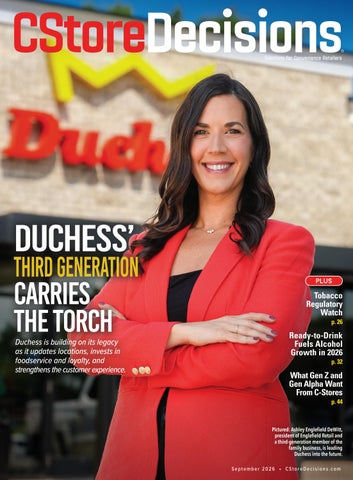
DUCHESS’
THIRD GENERATION
CARRIES THE TORCH
Duchess is building on its legacy as it updates locations, invests in foodservice and loyalty, and strengthens the customer experience.
PLUS
Tobacco Regulatory Watch p. 26
Ready-to-Drink Fuels Alcohol Growth in 2026 p. 32
What Gen Z and Gen Alpha Want From C-Stores p. 44
Pictured: Ashley Englefield DeWitt, president of Englefield Retail and a third-generation member of the family business, is leading Duchess into the future. September 2026 • CStoreDecisions.com
2026 September CVR.indd 1
8/19/26 1:40 PM
E THE M O MIZ I X SC
AR ST
T
CSD_Ad_Template.indd 2
HERE
WI
TH A SA M
PL
E
AN
T. EN M
M A
CONV E NIE NC E
8/11/26 8:38 PM
WARNING: Tobacco smoke increases the risk of lung cancer and heart disease, even in nonsmokers.
ARCTIC ARRIVAL INTRODUCING WHITE OWL
ARCTIC GRAPE
For more than 135 years, White Owl has delivered cigar innovation—Arctic Grape introduces a bold new cigarillo to our lineup.
AVAILABLE IN 2 FOR $1.19 AND SAVE ON 2 FOR MORE INFORMATION CONTACT YOUR SWEDISH MATCH REPRESENTATIVE 800-367-3677 • CUSTOMER.SERVICE@SMNA.COM
WHITEOWLCIGAR.COM For Trade Only. Not for Distribution to Consumers. © 2026 SMCI Holding, Inc.
CSD_Ad_Template.indd 3
8/11/26 8:39 PM
the CSD Group 7
www.cstoredecisions.com
EDITORIAL
SALES TEAM
Danny Klein
Matt Waddell
VP EDITORIAL — FOOD, RETAIL & HOSPITALITY
dklein@arrowfly.com EDITOR-IN-CHIEF
Erin Del Conte
edelconte@arrowfly.com SENIOR EDITOR
Emily Boes
SENIOR VP OF SALES & STRATEGY
mwaddell@arrowfly.com (774) 871-0067 KEY ACCOUNT MANAGER
John Petersen
jpetersen@arrowfly.com (216) 346-8790
eboes@arrowfly.com
SALES DIRECTOR
ASSOCIATE EDITOR
pmcintyre@arrowfly.com (216) 372-8112
Kevin McIntyre
kmcintyre@arrowfly.com EDITOR EMERITUS
John Lofstock COLUMNISTS
Huy Do Jeff Keune CONTENT STUDIO VP, CONTENT STUDIO
Peggy Carouthers
pcarouthers@arrowfly.com WRITER, CONTENT STUDIO
Ya’el McLoud
ymcloud@arrowfly.com WRITER, CONTENT STUDIO
Drew Filipski
dfilipski@arrowfly.com
Patrick McIntyre
mlogan@arrowfly.com CHIEF OPERATIONS OFFICER
George Yedinak
CStore Decisions is a three-time winner of the Neal Award, the American Business Press’ highest recognition of editorial excellence.
gyedinak@arrowfly.com CHIEF REVENUE OFFICER
Scott Kelliher
skelliher@arrowfly.com VP OF MARKETING
EVENTS
Robert Buhler, President and CEO Open Pantry Food Marts • Pleasant Prairie, Wis.
Deena Rubin
Herb Hargraves, Chief Operating Officer Sprint Mart • Ridgeland, Miss.
SALES DIRECTOR
DIRECTOR OF EVENTS
Bill Kent, Chairman and CEO The Kent Cos. Inc. • Midland, Texas
sshepherd@arrowfly.com (404) 386-1709
cdollar@arrowfly.com
Nick Triantafellou, Director of Marketing & Merchandising Weigel’s Inc. • Knoxville, Tenn.
SALES DIRECTOR
Tony Bolla
tbolla@arrowfly.com (773) 859-1107
Susan Shepherd
NATIONAL SALES DIRECTOR
Amber Dobsovic
adobsovic@arrowfly.com (757) 637-8673 ACCOUNT MANAGER
Tanner Hartwick
awissner@arrowfly.com VP, EVENTS
drubin@arrowfly.com
Cassidy Doller
EVENT MARKETING SPECIALIST
Emma Paul
epaul@arrowfly.com
Jeannette Hummitsch jhummitsch@arrowfly.com
NATIONAL ADVISORY GROUP (NAG) BOARD Greg Ehrlich, (Board Chairman) President Beck Suppliers Inc. • Fremont, Ohio Joy Almekies, Senior Director of Food Services Global Partners • Waltham, Mass.
PORTFOLIO MARKETING MANAGER
CUSTOMER SERVICE REPRESENTATIVE
Dyson Williams, Vice President Dandy Mini Marts. • Sayre, Pa.
EVENTS MANAGER
thartwick@arrowfly.com (571) 596-0375
Matthew Claney CREATIVE DIRECTOR
Matt Logan
EDITORIAL ADVISORY BOARD
Jane Cooper
mclaney@arrowfly.com
Leading Through Innovation
CHIEF EXECUTIVE OFFICER
Annie Wissner
CREATIVE SERVICES VP, CREATIVE DIRECTOR
LEADERSHIP
Jeremy Burge, Chief Operating Officer Louisiana Truck Stop & Gaming • Saint Rose, La.
jcooper@arrowfly.com
Tracy Willingham
Jeff Carpenter, Director of Education and Training Cliff’s Local Market • Marcy, N.Y.
twillingham@arrowfly.com
Richard Cashion, Chief Operating Officer Curby’s Express Market • Lubbock, Texas
Erin Canetta
ecanetta@arrowfly.com
Tiffany Fraley, CEO InConvenience Inc. • Chicago Kalen Frese, Director of Merchandising Warrenton Oil Inc. • Warrenton, Mo.
1111 Superior Ave. Suite 1120 Cleveland, OH 44114 Ph: 888-543-2447
Joe Hamza, Chief Operating Officer Nouria Energy Corp. • Worcester, Mass. Beth Hoffer, Vice President Weigel’s • Powell, Tenn.
SUBSCRIPTION INQUIRIES:
To manage current print subscription or for a new subscription: https://cstoredecisions.com/cstore-decisions-subscriptions/ SUBSCRIPTIONS: Qualified U.S. subscribers receive CStore Decisions at no charge. For others, the cost is $80 a year in the
U.S. and Possessions, $95 in Canada, and $150 in all other countries. Single copies are available at $9 each in the U.S. and Possessions, $10 each in Canada and $13 in all other countries.
CStore Decisions (ISSN 1054-7797) USPS Publication #5978 is published monthly by Arrowfly, 1111 Superior Ave., Suite 1120, Cleveland, OH 44114, for petroleum company and convenience store operators, owners, managers. Periodicals postage paid at Cleveland, OH, and additional mailing offices. POSTMASTER: Send address changes to CStore Decisions, 1111 Superior Avenue, Suite 1120, Cleveland, OH 44114. GST #R126431964, Canadian Publication Sales Agreement No: #40026880.
David Land II, Director of Marketing The Kent Cos. Inc. • Midland, Texas Brent Mouton, President and CEO Hit-N-Run Food Stores • Lafayette, La. Lenny Smith, Vice President Crosby’s • Lockport, N.Y. Dyson Williams, Vice President Dandy Mini Marts • Sayre, Pa. Hussein Yatim, Vice President YATCO • Marlborough, Mass. Vernon Young, President and CEO Young Oil Co. • Piedmont, Ala.
CSTORE DECISIONS does not endorse any products, programs or services of advertisers or editorial contributors. Copyright© 2026 by Arrowfly. No part of this publication may be reproduced in any form or by any means, electronic or mechanical, or by recording, or by any information storage or retrieval system, without written permission from the publisher.
4
CSTORE DECISIONS •
04_Masthead_0926_V1EB.indd 4
September 2026
cstoredecisions.com
8/17/26 8:20 AM
CSD_Ad_Template.indd 17
5/12/26 8:25 AM
CONTENTS September 2026
•
NUMBER 9
•
VOLUME 37
CStoreDecisions
®
FRONT END
8 Editor’s Memo: Competing Locally as a Regional Chain 10 Quick Bites: Doubling Down on Drinks FOODSERVICE
22 Embracing Breakfast CATEGORY MANAGEMENT
26 Tobacco Regulatory Watch 32 Ready-to-Drink Fuels Alcohol Growth in 2026 TECHNOLOGY
36 The Case for Self-Checkout OPERATIONS
40 The Vertical Integration Advantage 44 The Next Regulars: What Gen Z and Gen Alpha Want From C-Stores
BACK END
COVER STORY 12 D uchess’ Third Generation Carries the Torch
48 Product Showcase 49 Ad Index 50 Industry Perspective: ‘We’re From Here’ — A Competitive Advantage Over Larger Operators
Duchess is building on its legacy as it updates locations, invests in foodservice and loyalty, and strengthens the customer experience.
6
CSTORE DECISIONS •
06_TOC_0926_V1EC.indd 6
September 2026
26
cstoredecisions.com
8/17/26 8:23 AM
CSD_Ad_Template.indd 7
8/11/26 8:40 PM
Editor’sMemo
Competing Locally as a Regional Chain AS COMPETITION HEATS UP in the convenience store industry, regional chains are maintaining an advantage by doing what they do best. This month’s cover story profiles Englefield Inc.’s Duchess convenience stores, a regional chain with 115 stores in Ohio and West Virginia. Ashley Englefield DeWitt, third-generation member of the family business, now leads the c-store division as president of Englefield Retail. As national players enter Ohio, Duchess is leaning into its local roots while investing in foodservice, updating stores, growing its loyalty program and focusing on strategic growth. “Over the last couple of years, it feels like everyone wants to be in Ohio,” DeWitt laughed. “We’ve really leaned into the fact that Duchess was founded here 65 years ago. We’ve been here, we’ve been your neighbor and we’ve been part of these communities. We’re family owned, we care about our customers and our people, and we have a great offering. We’re staying true to who we are.” In this month’s Industry Perspective, Glennie Bench, chief operating officer for Southwest Georgia Oil Co., which operates 91 SunStop stores in Alabama, Florida and Georgia, also shared her viewpoint on competing locally as a regional chain in today’s environment. “The c-suite of our company is connected to each retail store, and the management team is directly involved in the success of each SunStop. That allows us to respond to the needs and performance of each store with unique, site-specific solutions,” Bench said. “Regional chains like SunStop can strike a balance between meeting customer expectations at every location and offering a local experience — that is a distinct advantage over national and international chains that offer a cookie-cutter experience.”
This month’s feature article “The Vertical Integration Advantage” includes information on how chains, including CStore Decisions’ Chain of the Year Toot’n Totum, which operates 98 c-stores across Texas, Oklahoma, Kansas and New Mexico, are leveraging vertical integration to improve efficiency, strengthen supply chains and create a competitive advantage. While c-store chains have to weigh the investment required with the potential for cost cutting and quality control, small and mid-sized chains can often get started with something as simple as managing their own maintenance or lawn care. Toot’n Totum is being honored as CStore Decisions’ Chain of the Year on Oct. 7 from 6:15 p.m. – 9 p.m. at Piero’s Italian Cuisine in Las Vegas during the NACS Show. Retailers are invited to attend and can register here: Cstoredecisions.com/2026-chain-of-the-year. Regional chains like Toot’n Totum, SunStop and Duchess are the backbone of the convenience store industry. Even as major chains continue expanding into new markets, successful regional operators are meeting the competition by leveraging their strengths, deep community roots, local knowledge and customer relationships to remain competitive and drive growth.
Erin Del Conte
For any questions about this issue or suggestions for future issues, please contact me at edelconte@arrowfly.com.
8
CSTORE DECISIONS September 2026
08_Edit Memo 0926_V2EB.indd 8
c s t o r e d e c i s i o n s . co m
8/18/26 11:00 AM
WARNING: This product contains nicotine. Nicotine is an addictive chemical.
KEEP YOUR COMPETITIVE EDGE ZYN is scaling up in a big way. Stock our full lineup of varieties to engage new clientele and satisfy your regulars. Call 800-367-3677 or contact your Swedish Match Rep to learn more.
©2026 Swedish Match North America LLC. For Trade Only. Not for Distribution to Consumers.
CSD_Ad_Template.indd 9
8/11/26 8:40 PM
QUICKBITES DOUBLING DOWN ON DRINKS The beverage cooler and coffee station offer significant opportunity for c-store retailers that invest in the latest trending flavors and formats.
DON’T FORGET TO HYDRATE
Water is a significant profit driver for c-stores, especially while the weather is warm. Capturing the customer looking to make hydration part of their routine is a great way to continue boosting these sales. • Over 95% of Americans say hydration is important, yet only 44% feel hydrated on a daily basis. • 8 in 10 experience “hydration regret.” Nearly half don’t consistently carry a water bottle, simply forget (25%) or report being too busy (17%). • 82% report connecting better with others when properly hydrated. Source: Liquid I.V., “Liquid I.V. Hydration Vitality Barometer Report,” June 2026
SUMMER SIPPING When asked, “What alcoholic drink do you enjoy drinking most in warm weather?” the number of respondents who said mixed drinks and wine increased this year compared to 2022, while the number of respondents who said beer decreased.
STRATEGIZING AT THE BEVERAGE STATION • The number of beverages offered by the top 500 chains has increased 9.2% over the past four quarters. • R etailers are adding cold beverages like specialty iced coffee, punch, chillers and energy drinks. •4 5% of consumers prefer cold or iced specialty coffee beverages as an indulgent treat during the mid-afternoon. • Gen Z is more likely to drink tea or tea-based beverages at happy hour over other generations; only 20% of operators offer tea-based mocktails. Source: Nestlé Professional Solutions, “Turn Summer Trends Into Year-Round Traffic,” April 2026
Source: CivicScience, “Summer Alcohol Trends: Gen Z Looks to Drink More, While Travelers Continue to Embrace ‘Dry-Tripping,’” June 2026
BEVERAGE CULTURE BREAKDOWN
FLAVOR TRENDS
Consumers are demanding differing and unexpected flavors in their beverage options, and younger generations are associating beverage choices as a component of their identity.
• 58% are seeking unexpected flavors, 57% want globally inspired options, and 56% say limitededition beverages influence what they choose. •5 8% of Gen Z and Gen Alpha say what they drink reflects who they are (vs. 41% millennials and older), and they’re twice as likely to choose brands that signal something about them. • 81% want fruity/juicy profiles, 75% sweet/indulgent, 72% citrus-forward and 64% bold flavors. Souce: Keurig Dr Pepper, “2026 State of Beverages Trend Report,” May 2026
10
CSTORE DECISIONS •
10_Quick Bites_0926_V2EB.indd 10
September 2026
Retailers can anchor variety to a few proven formats, such as one coffee base with rotating syrups. According to Nestlé, the fastest-growing beverage flavors are: • Pumpkin Spice (up 325%) • Blue Raspberry (up 73%) • Graham Cracker (up 63%) • Lime (up 53%) • Fruit Punch (up 53%) Source: Nestlé Professional Solutions, “Turn Summer Trends Into Year-Round Traffic,” April 2026
cstoredecisions.com
8/18/26 11:07 AM
CSD_Ad_Template.indd 17
7/15/26 8:55 AM
COVER STORY / DUCHESS
Duchess’
Third Generation Carries the Torch Duchess is building on its legacy as it updates locations, invests in foodservice and loyalty, and strengthens the customer experience. Erin Del Conte • Editor-in-Chief
12-20_CVR_Duchess_0926_V1EC.indd 12
8/17/26 8:33 AM
AS ENGLEFIELD INC. CELEBRATES 65 YEARS IN BUSINESS, its Duchess convenience store chain, now guided by the third generation of family leadership, is entering a new chapter. Founded more than five decades ago, Duchess has grown its footprint to 115 locations, including 114 stores across Ohio and one in West Virginia. This regional powerhouse is doubling down on strategic growth, operational excellence and maintaining the community connections that have fueled its success from the beginning. Today, Duchess is focused on updating legacy locations, investing in a commissary and foodservice expansion, and driving growth through item-level inventory management, private-label products, a loyalty program and other initiatives designed to better serve its customers. THREE GENERATIONS & COUNTING
Englefield Inc. can trace its roots to 1961 when F.W. Englefield III started the company with three service stations and an office, which he operated out of his basement. “He started in the oil and fuel business, supplying fuel to dealer-operated locations, and eventually grew that into the convenience store business,” explained Ashley Englefield DeWitt, president of Englefield Retail and a third-generation member of the family business. In 1975, Englefield Oil Co., as it was then called, opened the first Duchess c-store in Lancaster, Ohio, and F.W. continued to grow the business through a combination of acquisitions and new store builds. His sons, F.W. (Bill) Englefield IV and Ben Englefield, began helping at the stores when they entered high school. When they officially joined the company as adults, F.W. had already significantly grown the Duchess footprint. The second generation spearheaded the aggressive expansion of Duchess’ footprint in Ohio. One of their most significant contributions was the completion of a 42-store acquisition from BP in the Columbus market in 2009 that pushed Duchess’ store count over 100. “This was when BP was getting out of company-operated locations and divesting its AMPM stores,” DeWitt said. Today, Bill and Ben serve as presidents of Englefield Inc. Bill’s son, (Will) Englefield V, now acts as president of Englefield Energy, which houses the company’s fuel division, lubricants and a recently launched propane business. Will also oversees the company’s logistics business and all fuel delivery. DeWitt, who is Ben’s daughter, oversees the company’s quick-service restaurant (QSR) business in addition to its Duchess c-stores. The third generation officially stepped into their current roles in September 2025. “Will and I always joke that we’ve been in and around the business since birth. It was just part of our family conversations growing up,” DeWitt said.
12-20_CVR_Duchess_0926_V1EC.indd 13
8/17/26 8:33 AM
COVER STORY / DUCHESS
Top: Ben and Bill Englefield, presidents of Englefield Inc., and the second generation of the family business. Left: Englefield Inc. can trace its roots to 1961. Founder F.W. Englefield III, pictured with his grandchildren Will Englefield and Ashley Englefield DeWitt.
“My grandpa always stressed how important it was to learn every part of the family business so you could really understand how it all worked together,” DeWitt said. The second generation did just that, focusing on everything from the stores to the fuel warehouses. “They both really worked across all parts of the business. They worked in the stores, pumped gas, washed windows, spent time in our distribution company and even remember doing things like digging ditches for tanks. They grew up in the business, learned it from the ground up and worked their way into leadership — and Will and I have really
done the same,” DeWitt said. “I feel fortunate that I’ve had the opportunity to work alongside my dad and uncle and learn from them over the years. They’ve given Will and me a great foundation as we’ve stepped into our roles.” DeWitt’s younger brother, Cody Englefield, now in his 20s, has also begun working with the family business in the construction department, helping with store remodel projects. Time will tell if the fourth generation joins the business. DUCHESS CROWNS DEWITT
DeWitt, who has a business degree from Ohio University, always knew she
Ashley Englefield DeWitt, president of Englefield Retail, and Will Englefield, president of Englefield Energy, are the third generation of the business. They officially stepped into their current roles in September 2025. 14
CSTORE DECISIONS • September 2026
12-20_CVR_Duchess_0926_V3EB.indd 14
wanted to join the family business, but it took time to determine where her skills were best suited. “When I joined the company, I worked throughout the office and trained with people across different divisions so I could learn every part of the business,” she said. She found herself most drawn to the retail side of the business. The fast-paced environment and employee and customer interaction appealed to her immediately. After learning different areas of the retail division, DeWitt spent significant time working at the store level before eventually progressing into a district manager role. “We didn’t really have a marketing department. It was being done through merchandising and other groups, so I saw a need and created a marketing department and launched our loyalty program,” she said. After some time as a marketing director, DeWitt added merchandising director to her role around 2020. Five years later, she began to oversee the entire retail division. DeWitt has spent the past year listening to feedback from team members as she charts Duchess’ path forward. “We have a great team, so I never felt like I needed to come in and change a bunch of things,” she said. Instead, she’s focused on leadership development and ensuring employees understand
cstoredecisions.com
8/18/26 11:01 AM
TURNING PIZZA INTO PROFITS FOR GENERATIONS. With over 11,000 locations and counting, Hunt Brothers® Pizza has been helping c-store owners for decades to make 50% profit margins or higher without adding labor or operational headaches. Realize your business’s full potential by calling (800) 453-3675 or visiting huntbrotherspizza.com/pizzatoprofits.
Visit us at our NACS Show booth #C4622
35 YEARS
© 2026 Hunt Brothers Pizza, LLC
CSD_Ad_Template.indd 15 Turning Pizza into Profits_Booth_CSN Sept_8x10.875.indd 1 26-HBP-0004 M1bT Anniversary
8/18/26 10:40 7:45 AM 8/17/26 AM
COVER STORY / GOOD TO GO
Left: Duchess’ grab-and-go program, “The Deli at Duchess,” includes a large line of grab-andgo subs and proprietary food items served in the hot and cold cases. This includes breakfast sandwiches, pizza and Duchess Stuffers, among other options.
the opportunities for career progression at the company; adding tools such as item-level inventory to make smarter, faster decisions; evolving data strategy with accuracy and speed in mind; adding operational execution tools to better allocate team members’ time; and investing in the food and beverage side of the business, which has included
16
adding a commissary and evaluating and improving its food programs. LEGACY MAKEOVERS
One of DeWitt’s big focuses has been upgrading legacy locations. Over the last two years, the chain has remodeled about 25 stores, with plans for another 12 over the next year. The remodels range
CSTORE DECISIONS • September 2026
12-20_CVR_Duchess_0926_V3EB.indd 16
from raze-and-rebuilds to smaller facelifts where elements from Duchess’ prototype design are added to older stores. Changes include refacing the front exterior with new bricks and awnings, replacing internal elements such as cabinets and countertops, and adding new food and beverage equipment and merchandising displays. “So really modernizing the store with a retrofit of our (latest) design,” DeWitt explained.
cstoredecisions.com
8/18/26 11:01 AM
“Real estate is another big area I focus on,” DeWitt said. “We’re actively looking for new sites and new construction opportunities, and we’re about to bring on two new-to-industry (NTI) sites this calendar year.” One is located in St. Marys, Ohio, and the other is in Mt. Vernon, Ohio, where the company already operates one site. Duchess’ largest stores measure 5,500 square feet, and it has a second design to accommodate its 4,500-square-foot sites. “Those are the two store sizes we would typically choose from for an NTI site,” DeWitt said. The latest interior design puts a special emphasis on Duchess’ food and beverage offerings within the store. The company worked with a designer that helped create different destinations within the store, from the food and
beverage area to the center store section and then the checkout where team members welcome every customer who enters the store. The stores feature a red and yellow color scheme and a lot of natural light, wood accents and an open ceiling. Each store includes a wall that welcomes guests, includes local tie-ins and says, “Our Family Fresh Tradition since 1961.” In the forecourt, 90% of the stores fly the BP flag, while a handful have Duchess-branded gas. Going forward, DeWitt is focused on growing Duchess’ footprint strategically in a “smart and steady” fashion in areas that make sense for the chain, rather than “growth for the sake of growth.” “We do really well in rural communities where we have strong local ties, so we’re continuing to look for areas like that. We’re not just looking for land anywhere;
cstoredecisions.com
12-20_CVR_Duchess_0926_V1EC.indd 17
we’re focused on communities where we believe Duchess would be a good fit.” FRESH FOOD
Duchess operates Tic Tac Taco Mexican Kitchen, a proprietary QSR concept at two Duchess stores, as well as four Taco Bell franchises at four locations. Last year, it launched its Royal Craft Kitchen, a commissary that delivers fresh food to stores in three of its 12 districts so far. The chain expects to expand the commissary service to more locations going forward. The stores not served by the commissary make sandwiches and other items fresh in the stores. Duchess’ grab-and-go program is called “The Deli at Duchess” and includes a large line of grab-and-go subs and proprietary food items sold in the cold and hot cases. That includes a popular line of breakfast September 2026 • CSTORE DECISIONS
17
8/17/26 8:33 AM
COVER STORY / DUCHESS
Duchess’ deli subs are a fan favorite. The Spicy Italian is the chain’s most sought-after sub. Limited-time deli offerings have included a pancake breakfast sandwich and a waffle breakfast sandwich, and the chain also offers a popular Eggwich.
sandwiches that has included limitedtime offers like a pancake breakfast sandwich and a waffle breakfast sandwich. At lunchtime, pizza is a popular menu item. “We’ve always had pizza, but now we’re making it ourselves,” DeWitt said. “A few years ago, we launched our Duchess Stuffers — basically a biscuit filled with different breakfast or savory options,” she added. Breakfast Stuffers include a sausage, egg and cheese variety and a Sausage Gravy Biscuit Stuffer. In the afternoon, guests can find Pizza Stuffers, among other flavors. The chain also offers a popular Eggwich, which is a high-protein breakfast sandwich that includes two fried egg patties with sausage and cheese. Duchess’ deli subs are also a fan favorite. “Our Spicy Italian is our most sought-after sub,” DeWitt said. The Tic Tac Taco offering is a made-toorder concept where customers go down the line and pick their own ingredients for burritos, bowls, quesadillas or nachos. The program also features breakfast, which is a differentiator for the c-store chain. “We have a couple of signature
18
combinations customers can choose from, or they can build a breakfast burrito or bowl with the ingredients they want,” DeWitt said. The chain also has a Tic Tac Taco food truck that it uses to test the concept at different stores to gauge demand before rolling out a full program in that area. The truck also attends local community events. “The food truck also gives us a way to test different menu items, see what resonates with customers and then bring the best ideas into our stores,” DeWitt said The chain’s third Tic Tac Taco is set to open next year at its Newark, Ohio, cstore, which will include a pickup window specifically for the food offering. SPECIAL OFFERINGS
Duchess stores feature some locally sourced “Ohio Proud” products and also sell popular squishy sensory toys for kids. The chain has a line of private-label Duchess-branded products, including bottled water, snacks and candy. Next up, it’s launching its own private-label energy drink on the fountain machine called “ROYL Energy.” “Energy has been a growing category
CSTORE DECISIONS • September 2026
12-20_CVR_Duchess_0926_V3EB.indd 18
for us, as it has been across the industry, so we wanted to lean into that trend with something of our own,” DeWitt said. ADVANCING WITH TECHNOLOGY
Duchess is celebrating the 10th anniversary of its Crown Card Rewards program this year, which customers can access via the chain’s mobile app or by using a physical card. “The app has grown significantly over the last few years as more customers have embraced that technology. Our marketing team has done a great job growing that customer base,” DeWitt said. Duchess partners with Rovertown for its mobile app. The chain provides targeted offers through the app, as well as gamification, which has helped drive app usage. “Customers can win things like free products, cents off fuel or discounts on in-store items by playing different games in the app,” DeWitt said. Crown Card Rewards is a tiered program where guests earn points, including 20 points for every gallon of fuel and 20 points for every dollar spent in-store. Higher tier members also get club benefits, such as a free coffee or fountain drink after
cstoredecisions.com
8/18/26 11:01 AM
Duchess customers looking for an afternoon snack or dessert can find offerings from the deli such as cookies and bite-sized treats.
buying five, free air and more, as well as personalized perks. The loyalty program also has an employee tier. “We can use the program for employee sales incentives and rewards, as well. Employees can earn Duchess Dollars and use them on food or other products in our stores, which has been a really nice way to recognize the team,” DeWitt said. Several Duchess locations offer selfcheckout, which has been successful in higher-volume stores. “We’ve made a conscious decision not to roll self-checkout out chainwide because I still really value the human interaction, and I think our customers do too. But in some of our higher-volume stores, it’s a great option
for customers who just want to get in and out quickly,” DeWitt said. On the inventory management front, Duchess rolled out item-level inventory management. “It’s been incredibly helpful in understanding what products are
cstoredecisions.com
12-20_CVR_Duchess_0926_V1EC.indd 19
moving and what aren’t, so we can make faster, better decisions about what we put into our sets,” DeWitt noted. As the chain continues to focus on operational execution, it implemented an RTO (Ready Training Online) program
September 2026 • CSTORE DECISIONS
19
8/17/26 8:33 AM
COVER STORY / DUCHESS
Duchess carries a line of private-label products, including bottled water, snacks and candy.
last year to provide a more structured training experience for employees. Duchess also rolled out new tablets for its team members. “We’re looking at a task-based program that would give our district managers better visibility and accountability around what needs to be done on each shift. The goal is to make things easier for our teams, move away from outdated processes and give them better tools to stay organized,” DeWitt said. PREPARING FOR TOMORROW
Looking ahead, DeWitt plans to continue reinvesting in the stores it currently operates through remodels and raze-and-rebuilds while seeking “those special communities or pieces of land where we can bring an NTI site, as well.” DeWitt also plans to continue growing Duchess’ food and beverage business. Additionally, the chain’s Crown Card Rewards loyalty program is a high priority going forward. “We’ve increased our member base significantly over the last few years,” DeWitt said, adding Duchess is strategizing new ways to expand
membership and cater to loyal customers. For DeWitt, it all comes down to smart growth and continuing the legacy her grandfather started. Whether it’s Duchess, Englefield Energy or new ventures like propane, Englefield Inc. is expanding strategically while finding complementary growth opportunities between its businesses. DeWitt had the chance to work with her grandfather for a few years before he passed. “He always talked about how we wouldn’t be where we are without the incredible people who work here,” she said. “We truly believe our people are our most important asset. We’ve grown into a good-sized company, but we still operate with those family-business values. In a lot
Duchess offers cold-case grab-and-go food options such as fruit cups and yogurt cups. 20
CSTORE DECISIONS • September 2026
12-20_CVR_Duchess_0926_V3EB.indd 20
of ways, it still feels like a smaller team running a much larger business.” The chain has a lot of long-time employees, including its director of operations, Mary James, who started as an assistant manager and worked her way up and is now celebrating 35 years with the company. “We have something called the Duchess Difference,” DeWitt said. The employee and customer-focused program is designed to reinforce the importance of strong customer service and employee engagement. It reflects the chain’s five core values: safety, quality, respect, friendliness and honesty. “They’re simple words, but they really describe how we want to treat our team members and, in turn, how we want our customers to be treated every day. That commitment is what we call the Duchess Difference,” DeWitt said. As a regional chain, Duchess is seeing increased national competition entering Ohio, but the family-owned chain isn’t afraid of a little competition, and in response, it’s leaning into its local roots. “Over the last couple of years, it feels like everyone wants to be in Ohio,” DeWitt laughed. “We’ve really leaned into the fact that Duchess was founded here 65 years ago. We’ve been here, we’ve been your neighbor and we’ve been part of these communities. We’re family owned, we care about our customers and our people, and we have a great offering. We’re staying true to who we are.” CSD
cstoredecisions.com
8/18/26 11:01 AM
CSD_Ad_Template.indd 21
8/19/26 1:13 PM
FOODSERVICE COLUMN / BREAKFAST
EMBRACING BREAKFAST C-stores are going head to head with quick-service restaurants over ownership of the breakfast daypart, and c-stores might just have the edge. Jeff Keune • 4910 Consulting
THERE IS A LOT TO BE HAPPY about right now in convenience store breakfast. Several strong chains have leveraged the morning daypart to win against the quick-service restaurant (QSR) giants. Together, they’ve built a growing consumer sentiment that maybe c-store food is better than they once thought. At the same time, fast-food giants have either made breakfast a foundational daypart (McDonald’s, Dunkin’, Einstein Bros.) or tried breakfast (Taco Bell, KFC) in an effort to shore up struggling sales at lunch and dinner with mixed success. C-store breakfast is not new, and at chains like Buc-ee’s, Wawa, Sheetz and others, it’s core to their reputation and success. Lunch, the dinner drive time and late-night are all strong opportunities as well, but there are many reasons to grow and protect the breakfast daypart specifically. For one, some QSRs are struggling and looking to shore up their breakfast business overall, while lunch and dinner face challenges. RISE AND SHINE
The morning drive time is a key period for fuel sales. A strong forecourt marketing plan, combined with a compelling breakfast offer, is an opportunity to attract more consumers into the store and take morning sales to higher levels. The fact
22
that consumer behavior and visits have been more positive post-pandemic only strengthens the case that a better breakfast program can drive performance. Convenience does need to find stronger ways to compete, however. Breakfast is rebounding in QSRs post-pandemic. Just a year ago, Circana reported 39% of consumers reported eating breakfast before 8 a.m., which is a five-point increase from 2020. The research firm also found that breakfast was the best-performing daypart in 2025. The battle now is: Who will own the daypart moving forward? QSRs are getting concerned as the convenience industry continues to invest and innovate in the morning daypart offering. There was a time when we talked about convenience store food as being something you ate only when there were no other options. Today, the platforms and products being served up at many strong convenience brands are as good as or better than QSR options. Convenience retailers should see this as an invitation to make moves in a.m. foodservice. More convenience brands have an opportunity to elevate their food platforms and drive not only traffic but also brand equity and reputation. If you already
CSTORE DECISIONS • September 2026
22-24_FS Column_Breakfast_0926_V2EB.indd 22
have strong foodservice, expand it and innovate. If you have not invested beyond the bakery case and roller grill, there is nothing wrong with that, but there is an opportunity to elevate right now! Consumers have shown they will at least try it, and, in many cases, embrace it. The opportunity is there: Steal share from struggling QSRs and build incremental sales by competing and winning against QSRs in your trade area. Now is the time to broaden your menu and introduce advertised limited-time offers (LTOs). QSRs do this regularly. The point is to maintain a steady stream of strong trafficdriving messages that bring consumers into the store. LTOs, or specials, may not be what consumers ultimately purchase.
cstoredecisions.com
8/18/26 11:07 AM
CSD_Ad_Template.indd 23
8/11/26 8:43 PM
FOODSERVICE COLUMN / BREAKFAST
“If you have not invested beyond the bakery case and roller grill, there is nothing wrong with that, but there is an opportunity to elevate right now!” Still, they are an opportunity to boost sales, even if consumers instead buy more of the products they already love. BEST PRACTICES FOR BREAKFAST SALES
There are other pages the convenience industry can steal from QSRs. For example, combo meals marketed with signage and other promotional elements inside and outside the store can increase traffic and incidence. In many cases, they also elevate the average check, as consumers will purchase items in other categories — an advantage QSRs don’t have. Bakery case and roller grill will always have their place, but expanding the menu, whether it is hot-hold or made to order, will help your brand grow and has the opportunity to not only satisfy the guest but also to drive new transactions. Here are some best practices that some brands are already capitalizing on (and you can too): • Create a strong foundation menu and offer more than the standard packaged commissary items. • Create a calendar of LTOs to give your stores something new on a consistent schedule and provide updated content for marketing and signage to drive traffic. • Work with suppliers to get their latest elevated limited-time products or to create something new. • Complement your growing and limited-time menu with strong, efficient marketing. New news isn’t enough; you need to make sure consumers are aware of it and excited about it. • Give your team members opportunities to promote and upsell items and to execute them well. • Use whatever media fits your budget
24
to boost awareness and trial of the foodservice. It is not great innovation if your guests are not aware of it. THE OPPORTUNITY IS HERE
Fast food is increasingly concerned about the opportunity convenience stores offer the consumer. Morning commuters increasingly consider convenience stores an incredibly viable alternative to fast food. In some cases, consumers see c-stores as the better experience because of the overall variety of store options and because they feel more in control. What we as an industry should consider is what it will take to satisfy and delight guests. Innovation and expanding the
CSTORE DECISIONS • September 2026
22-24_FS Column_Breakfast_0926_V1EC(1).indd 24
menu to better compete with QSRs is worth it. Your job is to create a consistent, elevated experience that earns loyalty and builds a strong habit of visitation. Jeff Keune is founder and principal consultant for 4910 Consulting, based in Boston. 4910 specializes in driving performance and profitability, physical space behavior, strategic initiatives, menu and merchandising innovation, brand management, and digital activation including loyalty optimization. Keune is a former retail executive who was instrumental in building successful food and merchandising programs for Yesway, Thorntons, American Natural and other convenience retailers and QSRs. Reach him at jeffkeune@4910consulting.com.
cstoredecisions.com
8/17/26 9:22 AM
ALL DAY
FLAVOR STARTS WITH
SLICES Johnsonville® Ultimate Sausage Slices Bold Flavor. Premium Quality. Give your customers quality they can see and taste. And keep your menu execution fast and easy. Johnsonville® Ultimate S AT
26 T HE 20
HOW S S C A N 17 h #C47 V ISI T U
Boot
Sausage Slices bring a bold lineup of flavors designed to expand menus and elevate protein builds across dayparts.
Find your slice at Johnsonvillefoodservice.com Johnsonville • Family owned since 1945 • Proudly made in the USA ©2026 Johnsonville, LLC
CSD_Ad_Template.indd 25
8/11/26 8:44 PM
CATEGORY MANAGEMENT / TOBACCO LEGISLATION
Tobacco Regulatory Watch C-store operators manage flavor bans, enforcement priorities, tax shifts and directories as they head into the 2026 fall season. Emily Boes • Senior Editor
AS CONVENIENCE RETAILERS SHIFT into their autumn planograms, tobacco category managers are keeping an eagle eye on the regulations that will affect their backbars in the cooler months. No longer a stranger to flavor bans, increased taxes and Food and Drug Administration (FDA) fluctuations, tobacco retailers are setting their sights on flexibility and compliance. FEDERAL UPDATES
In May, the FDA released enforcement guidance for tobacco products marketed without premarket authorization. “FDA does not intend to prioritize if a product has a pending application that has been accepted and filed, or when a manufacturer has a pending and accepted supplemental PMTA (premarket tobacco product application), and if FDA has determined the application includes data
26
necessary to evaluate whether the product is appropriate for the protection of public health in the case of non-tobacco flavored ENDS products,” the organization stated in its announcement. Unless these products contain elements appealing to youth, enforcement won’t be prioritized. However, the FDA will consider whether a tobacco product presents a significant health or safety concern. The FDA will also create and maintain a publicly available list of products in which it doesn’t intend to prioritize enforcement. “I think that what’s really happened in the past … 60 days with the FDA taking this approach to non-enforcement of some products has really created a cyclone of activity that feels chaotic right now,” said Melissa Donoghue, category manager, cigarettes and other tobacco products for Atlanta-based RaceTrac.
CSTORE DECISIONS • September 2026
26-30_CM_Tobacco_0926_V3EB.indd 26
8/18/26 11:02 AM
CSD_Ad_Template.indd 27
8/19/26 1:11 PM
CATEGORY MANAGEMENT / TOBACCO LEGISLATION
SMOKELESS AND ACCESSORIES LEAD THE PACK
Spitless tobacco (+25.9%), vaping accessories (+40.5%), cigar accessories (+31.3%) and pipe tobacco (+3%) saw positive dollar sales. Dollar Sales Product
Dollar Share of Category
% Current 1-Year Change Current
Unit Sales
Price Per Unit
1-Year Change
Current
1-Year % Change
Current
1-Year % Change
Cigarettes
$50.8 B
0.0%
100.00
0.00
4.97 B
-5.2%
$10.22
5.5%
Smokeless Tobacco
$13.5 B
12.2%
100.00
0.00
1.86 B
9.3%
$7.26
2.6%
Spitless Tobacco
$7.41 B
25.9%
54.82
5.96
1.15 B
24.3%
$6.44
1.3%
Snuff
$5.97 B
-0.6%
44.15
-5.69
692 M
-8.5%
$8.62
8.6%
Chewing Tobacco
$136 M
-11.5%
1.01
-0.27
18.5 M
-8.2%
$7.37
-3.6%
Chewing Tobacco Alternative
$3.09 M
-8.9%
0.02
-0.01
678,697
-12.9%
$4.55
4.5%
Electronic Smoking Devices
$6.22 B
-5.7%
100.00
0.00
304 M
-13.7%
$20.45
9.3%
Vaping Products
$5.94 B
-7.1%
95.52
-1.47
283 M
-15.1%
$20.96
9.4%
Vaping Accessories
$279 M
40.5%
4.48
1.47
20.6 M
12.2%
$13.51
25.3%
Cigars
$4.11 B
0.3%
100.00
0.00
1.90 B
-5.5%
$2.17
6.1%
Large Mass Cigars
$3.86 B
1.0%
93.90
0.67
1.81 B
-4.7%
$2.13
6.0%
Premium Cigars
$214 M
-10.2%
5.20
-0.61
72.7 M
-21.0%
$2.94
13.8%
Little Cigars
$36.8 M
-6.9%
0.89
-0.07
10.9 M
-9.8%
$3.37
3.1%
Tobacco Accessories
$640 M
13.1%
100.00
0.00
267 M
7.7%
$2.40
5.0%
Cigar Accessories
$340 M
31.3%
53.14
7.39
147 M
19.5%
$2.31
9.8%
Cigarette Accessories
$201 M
-3.1%
31.34
-5.21
81.6 M
-4.1%
$2.46
1.0%
Tobacco Accessories
$98.8 M
-0.8%
15.44
-2.15
38.1 M
-3.6%
$2.60
3.0%
AO Accessories
$387,209
-21.8%
0.06
-0.03
177,782
-27.8%
$2.18
8.3%
Pipe Accessories
$112,306
-6.8%
0.02
0.00
38,920
-11.3%
$2.89
5.1%
AO Smokeables
$118 M
1.1%
100.00
0.00
11.6 M
4.7%
$10.17
-3.5%
Pipe Tobacco
$83.9 M
3.0%
70.85
1.35
8.49 M
10.1%
$9.89
-6.4%
Roll-Your-Own Tobacco
$34.5 M
-3.4%
29.15
-1.35
3.16 M
-7.5%
$10.94
4.5%
Source: Circana Total U.S. Convenience data for the 52 weeks ending July 12, 2026
RaceTrac operates 862 RaceTrac and RaceWay stores in 14 states, largely concentrated in the South. “I certainly have been in tobacco for 16 years. I haven’t seen it like this before in terms of the amount of new products coming and specifically within the modern nicotine category. …” she continued. “(FDA has) opened a window. I think it will close at some point, which is why everyone’s rushing in.” The FDA also proposed a rule in June that would require foreign tobacco product manufacturers to register their
28
establishments and list their products with the FDA, an action currently required of domestic tobacco product manufacturers, before the products are imported into the U.S. As of press time, the proposed rule is available for public comment until Sept. 14. REGULATION AT THE STATE AND LOCAL LEVELS
C-store retailers are contending with state and local legislation of tobacco, too. In Louisiana, the state legislature recently clarified that all nicotine/vape
CSTORE DECISIONS • September 2026
26-30_CM_Tobacco_0926_V3EB.indd 28
products are subject to a three-tier system, further regulating the industry in a state that already has a vape registry. The intent is to “keep bad players out and a level playing field. It is my understanding our state alcohol and tobacco control (agency) is actively seizing illicit inventory to deter bad actors,” said Annie Gauthier, CEO, St. Romain Oil Co., which operates 17 Y-Not Stops. Market research firm Circana data found electronic smoking device sales are down 5.7% in dollars and 13.7% in units for the 52 weeks ending July 12.
cstoredecisions.com
8/18/26 11:02 AM
CSD_Ad_Template.indd 29
8/11/26 8:50 PM
CATEGORY MANAGEMENT / TOBACCO LEGISLATION
In Minnesota, anti-tobacco organizations (ATOs) are meeting with county administrators, county commissioners, mayors, city councils and city administrators, according to Lance Klatt, executive director of the Minnesota Service Station & Convenience Store Association. “These (flavor ban) policies take effect, retailers can lose anywhere from 35-55% of their tobacco/nicotine sales, not to mention ancillary sales of fuel, candy, beverages, etc. These ATOs are getting ahead of retailers as retailers need to play defense. Time to be more on the offense,” he said. Just as at the federal level, enforcement is also a topic of concern statewide. Klatt noted lack of enforcement in Minnesota and other states where flavor bans have been implemented, stressing an absence of violations for retailers selling flavored products when there is an ordinance not to do so. “City and county officials pass a flavor ban and other anti-tobacco ordinances as an opportunity to enhance their political agendas. It’s too easy to pass anti-tobacco ordinances — one thing to say something, another thing to enforce,” he continued. And, if retailers own locations in multiple cities/counties, it presents a particular compliance challenge. Employees might forget to act on an ordinance if they are accustomed to a different ordinance in another city/county. RaceTrac, operating in multiple states, must constantly keep on top of the differing regulations. Luckily, it has the resources to employ a government affairs and legal team that is heavily involved in federal and state legislation. The retailer also follows tobacco news outlets and listens to its supplier partners to stay abreast of looming legislation. “It is a balancing act, but we have a lot of support in that,” said Donoghue. Still, the backbar in one store can look very different from a store one town away. Minnesota retailers are losing sales and foot traffic due to current legislation. “I’ve seen nearby retail locations selling flavored tobacco sales increase by 30-40% when one city has a flavor ban vs. a neighboring city, county or even state. The state tobacco tax for locations near bordering states has a huge impact, not
30
RaceTrac’s government affairs and legal team is heavily involved in federal and state legislation. The chain also follows tobacco news outlets and listens to supplier partners to stay abreast of tobacco legislation as it maintains its backbar in multiple states.
to mention the fiscal note this also has on revenue for the state of Minnesota. It creates challenges for many retail locations with category management and planograms,” Klatt said. Other legislative trends Minnesota retailers should be watching are increasing fines, employment age to sell tobacco, distance from schools, minimum retails on tobacco and nicotine products, and a moratorium and sunsetting of tobacco licenses. TAXES AND DIRECTORIES
Like Minnesotan retailers, RaceTrac has been dealing with changing taxes. More states are considering taxing nicotine pouches differently, Donoghue said, with some states opting out of taxing these and other states taxing them as an other tobacco product. “With the recent FDA authorization of ZYN to be marketed as a less harmful tobacco nicotine product, some states are then looking at segmenting those items differently and applying a lower or reduced tax to them. It’s really running the spectrum of taxation from no tax to a low tax to a high tax,” she said. A bigger concern for the chain, however, is the total nicotine directories that states are evaluating. These would slow the release of products if retailers were unable to stock them until they are published on a state’s directory. RaceTrac operates in two states with directories, which are slow to react.
CSTORE DECISIONS • September 2026
26-30_CM_Tobacco_0926_V3EB.indd 30
“As new products are launched and we’re able to get them into our other stores, we’re not able to bring them in (to the stores in these two states) yet. I think that’s one of the biggest challenges we’re facing,” Donoghue said. She noted that convenience stores are known for speed to shelf and wishes that lawmakers better understood that they can execute more quickly than other formats, including big box, mass and grocery. Legislation such as the directories isn’t a bad idea, per say, but they need to work faster. “They’re not able to keep up with the changes in the industry as quickly as they’re happening, and it’s hurting cstore businesses,” Donoghue said. Klatt advocated that retailers pay attention to the legislative happenings in other states. Many retailers are worried about their future and that of the industry. “Preemption would be good. Get more involved with city leaders (and) community, local and state politicians and leaders. Retailers seem to act when it’s too late. Get involved. It’s your future,” he advised. Immerse yourself in the category, Donoghue added. Build relationships; focus on inventory, pricing, promotions and other aspects that matter to operational partners; and leverage trade associations. Klatt also noted that operators can focus on additional methods to increase foot traffic. “Adapt or die.” CSD
cstoredecisions.com
8/18/26 11:02 AM
CSD_Ad_Template.indd 31
8/17/26 10:12 AM
CATEGORY MANAGEMENT / ALCOHOLIC BEVERAGE
Ready-to-Drink
Fuels Alcohol Growth in 2026 C-store alcoholic beverage sales are evolving as ready-to-drink cocktails, premium beers and occasion-based purchasing reshape assortments, cooler space and merchandising strategies. Kevin McIntyre • Associate Editor
THE TYPICAL C-STORE ALCOHOL consumer looks significantly different in 2026 compared to previous years. Historically, retailers could depend on beer to drive the majority of alcoholic beverage sales. But today, consumers are expecting more segmented, diverse offerings that extend to premium beers, limited-time seltzers and spirits. While beer continues to dominate the category as a whole, generating $24.6 billion in dollar sales and 731 million units sold for the 52 weeks ending July 12, according to c-store research firm Circana, new SKUs are steadily gaining market share year over year. Pre-mixed cocktails, for example — a relatively new segment in the c-store space — saw a sales uptick of 48.1% for the same 52-week period. They accounted for a staggering $1.4 billion in dollar sales for the year, surpassing wine sales, which came in at $1.12 billion. “The (alcohol) category remains important to convenience retailers, but growth is becoming more segmented than broad-based,” noted Tim Powell, managing principal at Foodservice IP, a convenience store consulting firm. “Traditional beer is mature, while premium imports, Mexican beers, flavored malt beverages and ready-todrink (RTD) cocktails continue to attract attention. Retailers are increasingly
32 32
managing the category around specific consumption occasions rather than simply expanding assortment.” Powell mentioned “value sensitivity, convenience and occasion-based purchasing” are some of the biggest factors influencing the category today. “Consumers continue to watch discretionary spending, making promotions and package size important,” he said. “At the same time, shoppers want beverages that fit immediate consumption occasions, whether that’s after work, before an event or alongside a prepared meal purchased in-store.” This behavior shift has led to moredeliberate purchase decisions. Powell noted customers are more willing to spend for products they see as premium and unique while also seeking value. “There’s also continued interest in portability — single-serve formats and products that require little or no preparation,” he continued. “Shoppers increasingly expect retailers to make decisions easy through curated assortments rather than overwhelming choice.” This shift toward quick, convenient and flavor-forward alcohol offerings has set the RTD segment up for continued success in 2026 and beyond. “RTDs combine convenience with consistency,” said Powell. “Consumers can enjoy a cocktail-style experience
CSTORE DECISIONS • September 2026 CSTORE DECISIONS • August 2026
32-34_CM_Alcohol_0926_V3EB.indd 32
without buying multiple ingredients or investing time in preparation. They also align well with convenience stores’ core strength, (which is) providing quick solutions for immediate consumption. As product quality improves and flavor innovation continues, RTDs appeal to consumers who want variety beyond traditional beer.” FROM ‘NICE TO HAVE’ TO ‘MUST HAVE’
Retailers are also noticing the RTD surge. John Parduski, director of merchandising for Onvo, operating over 40 locations in Pennsylvania and New York, said the current state of the segment is reminiscent of the 2019 seltzer boom. “We have expanded both styles of RTDs (liquor and malt) in all of our locations,” said Parduski. “The popularity and demand for these products required us to look at these items as a new category. In the past, they were a ‘nice to have’ in our locations, but they are now a ‘must have’ in every store. Managing the space allocated to these products brings new challenges we have not seen since 2019 when seltzers exploded in the market. RTDs have earned their way into the conversation when deciding what to place in your planograms.” Following broader industry trends, Parduski noted customers are often
cstoredecisions.com
8/18/26 11:02 AM
seeking out smaller pack sizes for these products, such as singles and six-packs. Malt-based RTDs are also driving sales. “The other sub-department that is seeing strong growth is malt-based RTDs,” he said. “We created an entire planogram just for these items due to the growth we began seeing toward the end of 2025. When we introduced liquorbased RTDs, we weren’t sure if it was going to cannibalize our beer and wine sales. We quickly learned that wasn’t the case, and we continue to see growth in both segments.” ALLOCATING COOLER SPACE
To determine which RTD products deserve space, Parduski and Onvo work with the Pennsylvania Liquor Control Board to review the purchases being made by other retailers, spot trends and see which products customers are purchasing from competitors. “Once we determine a product line to bring in, they are introduced typically to the shelf, and we review sales data and determine if cold vault space
Onvo has expanded both liquor and malt ready-to-drink (RTD) beverages in all locations due to high demand. Given the popularity of RTDs, the chain is considering them as a new “must-have” category.
occasion,” said Powell. “Space should increasingly reflect local shopper demand and purchasing occasions. He added that successful retailers will balance proven core brands with emerging segments but will avoid adding too much assortment as that can lead to shopper confusion.
is warranted,” Parduski continued. “Currently, we are basing it off of sales by location because no two stores are alike. We are looking at each store on its own and listening to what our customers are telling us based on their purchases.” Customizing your beverage selection based on your community’s preferences on a store-by-store basis, according to Powell, is exactly what retailers will need to do more of in the future. “Rather than simply adding new products, retailers should continuously evaluate productivity by SKU and by
ALCOHOL EXPECTATIONS
The alcohol category is set to be defined by premiumization, more occasion-based merchandising and “continued growth in products that blur
NON-ALCOHOLIC A BRIGHT SPOT IN BEER SEGMENT Non-alcoholic beer sales surged 30%, while the category as a whole stayed relatively flat. Dollar Sales Product
Dollar Share of Category
% Current 1-Year Change Current
Case Sales
Price Per Case
1-Year Change
Current
1-Year % Change
Current
1-Year % Change
Beer
$24.6 B
-0.4%
100
0
731 M
-2.4%
$33.70
2.0%
Total Domestic Beer
$12.9 B
-1.1%
52.5
-0.36
456 M
-2.9%
$28.36
1.8%
Domestic Premium
$5.70 B
-4.6%
23.14
-1.01
203 M
-6.0%
$28.00
1.5%
Domestic Super Premium
$2.55 B
5.0%
10.37
0.54
76.3 M
4.4%
$33.44
0.6%
Domestic Sub-Premium
$3.08 B
-0.6%
12.53
-0.02
144 M
-2.4%
$21.48
1.9%
Craft
$1.59 B
1.7%
6.45
0.13
32.3 M
-0.5%
$49.23
2.1%
Import
$6.80 B
0.3%
27.61
0.19
166 M
-1.0%
$41.01
1.3%
Beer Seltzer Centric
$1.65 B
3.1%
6.71
0.23
36.3 M
0.5%
$45.43
2.5%
Flavored Malt Beverages
$3.01 B
-1.9%
12.2
-0.19
67.5 M
-4.8%
$44.51
3.1%
Cider
$160 M
9.2%
0.65
0.06
3.03 M
6.8%
$52.94
2.2%
Non-Alcoholic
$81.1 M
30.0%
0.33
0.08
2.24 M
20.9%
$36.19
7.5%
Source: Circana Total U.S. Convenience data for the 52 weeks ending July 12, 2026 cstoredecisions.com
32-34_CM_Alcohol_0926_V1EC.indd 33
September 2026 • CSTORE DECISIONS
33
8/17/26 8:37 AM
CATEGORY MANAGEMENT / ALCOHOLIC BEVERAGE
PREMIXED COCKTAILS SURGE
As RTD beverages continue to gain market share, premixed cocktails are the big winners with a 48.1% uptick in dollar sales. Dollar Sales Product
Dollar Share of Category
% Current 1-Year Change Current
Case Sales
Price Per Case
1-Year Change
Current
1-Year % Change
Current
1-Year % Change
Spirits
$4.09 B
16.0%
100
0
31.4 M
23.9%
$130.63
-6.3%
Premixed Cocktails
$1.40 B
48.1%
34.16
7.39
15.8 M
52.7%
$88.55
-3.0%
Whiskey
$1.03 B
1.9%
25.05
-3.48
4.20 M
0.9%
$244.22
1.0%
Vodka
$646 M
6.3%
15.77
-1.44
3.93 M
4.0%
$164.38
2.3%
Spirits Seltzer Centric
$276 M
4.6%
6.73
-0.74
4.48 M
4.7%
$61.62
-0.1%
Tequila
$275 M
9.4%
6.71
-0.41
679,145
10.8%
$404.71
-1.3%
Cordials
$219 M
10.2%
5.33
-0.28
1.04 M
10.7%
$210.29
-0.4%
Rum
$112 M
-3.5%
2.73
-0.55
596,900
-2.9%
$187.33
-0.6%
Brandy/Cognac
$111 M
1.8%
2.72
-0.38
345,979
7.5%
$321.76
-5.2%
Gin
$21.1 M
1.0%
0.52
-0.08
97,940
-0.7%
$215.95
1.7%
Non-Alcoholic Mixers
$11.9 M
2.4%
0.29
-0.04
190,840
14.3%
$62.58
-10.4%
Source: Circana Total U.S. Convenience data for the 52 weeks ending July 12, 2026
traditional category lines,” per Powell. Parduski expects craft and specialty beers to drive sales growth in the coming months, noting this could be an underappreciated trend to capitalize on. “While mainstream beer has its rightful place in all planograms, craft and specialty beers are a category that needs to be fine tuned,” he said. “These items are often sold in singles or six-packs. Three shelves can hold approximately 15 different six-pack varieties. We transitioned those shelves to singles, and
now we can carry 30 varieties of craft and specialty beers. This gives our customers wider selection without losing space for the must-have items.” Powell also expects retailers to become more data driven as they manage their alcoholic beverage assortment at the store level and move away from a one-size approach. Additionally, Powell believes foodservice will be a key growth driver for alcohol sales, giving retailers an opportunity to merchandise adult
beverages alongside meal occasions. “From my perspective, it’s helpful to view adult beverages as part of the broader immediate-consumption mission,” Powell said. “Convenience retailers are increasingly competing for meal occasions and food-away-fromhome spending. … The operators that succeed will be those that merchandise beverages as part of a complete eating and drinking occasion, making it easier for consumers to purchase everything they need in one stop.”CSD
WINE STAYS FLAT AS WINE SELTZER DIPS
Dollar sales in the wine seltzer segment decreased 37.5% as sparkling and still wine experienced small dips. Dollar Sales Product
Dollar Share of Category
% Current 1-Year Change Current
Case Sales
Price Per Case
1-Year Change
Current
1-Year % Change
Current
1-Year % Change
Total Wine
$1.12 B
-1.8%
100
0
10.2 M
-3.9%
$110.10
2.2%
Still Wine
$1.04 B
-1.9%
92.56
-0.11
9.7 M
-4.0%
$106.83
2.1%
Sparkling Wine
$83.5 M
-0.3%
7.44
0.11
469,546
-3.6%
$177.83
3.4%
Sparkling Wine/ Champagne
$83.2 M
-0.1%
7.42
0.13
467,065
-3.2%
$178.21
3.2%
Wine Seltzer Centric
$263,600
-37.5%
0.02
-0.01
2,481
-41.4%
$106.27
6.6%
Source: Circana Total U.S. Convenience data for the 52 weeks ending July 12, 2026
34
CSTORE DECISIONS • September 2026
32-34_CM_Alcohol_0926_V3EB.indd 34
cstoredecisions.com
8/18/26 11:02 AM
WARNING: Cigars are not a safe alternative to cigarettes.
WHERE HERITAGE & CRAFTSMANSHIP COLLIDE A PREMIUM EX PERIENCE NOW W ITH A WOOD TIP
WO O D TI P CL ASSI C Authentic wood construction backed by more than 135 years of White Owl innovation leadership.
AVAI L ABLE IN 2-for-$1.29 & Save-On-2 Resealable Pouches For more information contact your Swedish Match Representative (800) 367-3677 | customer.service@smna.com
WHITEOWLCIGAR.COM For Trade Only. Not for Distribution to Consumers. © 2026 SMCI Holding, Inc.
CSD_Ad_Template.indd 35 25SWM0609_WO_WoodTip_TradeAd_CSD_r1.indd 1
8/11/26 8:46 PM 1/22/26 4:11 PM
TECHNOLOGY / SELF-CHECKOUT
The Case for
Self-Checkout
C-store operators are positioning self-checkout as an additional tool to offer speed, convenience and flexibility to the customer. Emily Boes • Senior Editor WHILE NOT EVERY CONVENIENCE retailer offers selfcheckout, those who find success with the technology say the same thing: It can’t be a stand-in for employees. Traditional stores still need team members manning the counter. Gier Oil, operating over 50 Eagle Stop locations in Missouri, installed self-checkout in seven of its sites. Its initial focus has been on new builds and major remodels to create a more modern, upscale c-store experience centered on speed, convenience and customer choice. Nick Lepper, director of retail operations for the chain, noted that self-checkout shouldn’t be viewed as a replacement for customer service, but rather, as another way to serve your customers. “Self-checkout will never replace our sales associates. At Eagle Stop, customer service remains one of our highest priorities. We’ll always have at least one sales associate in the transaction area, and during our busiest times, we’ve had two traditional checkout lanes open while a third team member assists customers using self-checkout,” he said. Good 2 Go takes a similar approach. The 76-store chain, operating in seven Western states, teaches its employees that self-checkout does not mean self-service. “Our team still needs to interact with the customer, be visible and be ready to jump in and help. They need to make sure items are being scanned correctly, payments go through and customers aren’t standing there wondering what button they’re supposed to push. Basically, the machine can handle the transaction, but our people still handle the experience,” said Tim Smith, VP of operations for Good 2 Go. In a new-to-industry build, Good 2 Go typically has three selfcheckout units in its queue. Ian Forsyth, director of operations for FKG Oil Co. dba MotoMart Convenience Stores, which operates 84 locations in six Midwestern states, also stressed the importance of the customer experience, noting self-checkout isn’t a substitute for a human cashier.
36 36
CSTORE DECISIONS • September 2026 CSTORE DECISIONS • August 2026
36-38_Tech_Self-Checkout_0926_V1EC.indd 36
Forsyth likened the technology to a pressure escape valve. “We think of it more as a way to deal with that customer traffic volatility, rather than just a standalone alternative checkout mechanism,” he continued. MotoMart offers self-checkout in 10% of its stores, primarily in the larger-format ground-up builds that it’s been constructing since 2019 and in extensive remodels where there is space. WHERE OPPORTUNITY LIES
Self-checkout allows retailers a chance to improve speed, convenience and efficiency of labor. “The retailers who I’ve seen be most successful with selfcheckout have gone beyond a rip-and-replace of a traditional point-of-sale (POS) register,” said Mike Templeton, partner and VP of advisory firm NexChapter. “Self-checkout has a different labor model — inherent in the name — but it also requires rethinking your customer flow to ensure it is inviting, thoughtfully integrated and able to be managed by existing staff.” For Eagle Stop, the biggest opportunity with self-checkout is convenience. It values the benefit of labor efficiencies, but its primary objective is improving the customer experience by reducing perceived wait times and providing more flexibility. “One lesson we learned early was that placement matters. In our original layouts, the self-checkout wasn’t positioned as the primary interaction point, so customers naturally gravitated toward the traditional registers. We’ve since adjusted our store designs to place self-checkout in a more prominent location, which has significantly improved adoption,” said Lepper. Store layout, customer education and employee engagement are just as important as the technology itself, he added. Team members actively encourage customers to use selfcheckout during busy periods, which increases comfort levels and drives faster adoption. Good 2 Go realized the tech was a win for both its slower stores and its busy stores. cstoredecisions.com
8/17/26 8:38 AM
Source: Circana OmniMarket Total U.S. Convenience data for the 52 weeks ending July 12, 2026. cstoredecisions.com
36-38_Tech_Self-Checkout_0926_V1EC.indd 37
September 2026 • CSTORE DECISIONS
37
8/17/26 8:38 AM
TECHNOLOGY / SELF-CHECKOUT
As for loyalty integration, it has been “a big win” for Good 2 Go, Smith said. Participation has continued to grow, with customers signing up and using the loyalty program while checking themselves out with ease. Age verification is another possibility for self-checkout. Eagle Stop has opted to support this function; the system automatically pauses the transaction so a sales associate can verify identity. OVERCOMING CHALLENGES
Eagle Stop installed self-checkout in seven of its sites, focusing on new builds and major remodels.
At slower stores, it takes employees out from behind the register and onto the sales floor, allowing them to greet people, help customers locate items, face the store, clean, stock and generally oversee the store. At busy stores, customers have another option to checkout without standing in line. “And here’s the funny part — we’ve learned that some customers absolutely love self-checkout, while others basically say, ‘Nope, I want my person!’ And that’s okay! We love that our customers have a choice. We will always have someone up front ready to provide that personal touch,” said Smith. MotoMart places self-checkout stations on the side of the pay counter, positioned where associates can keep track of it but not front and center. The chain prefers to see a balance between selfcheckout transactions and employee-assisted transactions. “We like to see a certain amount of customer traffic going through the self-checkouts, because that means that our associates are engaging people on how to use the self-checkouts,” said Forsyth. “It means that it’s functioning appropriately as that pressure release mechanism for long lines. But we would get concerned if we actually see too many transactions going through the self-checkout because that might mean that the associates aren’t engaging our customers … or there could be some operational issues tied to too high of a usage.” Templeton confirmed that self-checkout that’s relegated to an out-of-the-way corner or isn’t perceived as being faster will deter customers. Adding instructive signage and strategic placement of the unit within the primary customer flows are two of the most important considerations. “To drive adoption of self-checkout, the terminal must be just as capable as any other POS. This means loyalty integration, tap-to-pay options and functionality like pre-paid fuel. And don’t forget about payment options like cards and cash recyclers to ensure you can meet the needs of all customers,” he noted. Forsyth, however, approaches self-checkout with cash vendors differently. Although MotoMart offers this option, it has posed operational challenges for the chain, such as expensive maintenance. He does encourage the use of substantial units, though, as well as mobile payments.
38
CSTORE DECISIONS • September 2026
36-38_Tech_Self-Checkout_0926_V1EC.indd 38
Many customers are already familiar with self-checkout. “We have to give some credit to the ‘big box’ stores. They trained our customers for us. By the time we rolled out selfcheckout, many customers already knew exactly what to do,” said Smith. Forsyth also recognized the value of these larger retailers already familiarizing customers with the tech. Initially, in some of its more rural communities, self-checkout saw resistance. “A lot of the narrative at that time around self-checkout was that we were going to cut our labor hours dramatically and force people to check themselves out. And then … over the course of a month, that feedback completely stopped. It’s like the public just accepted that this was a thing, I think mostly because, on a really large scale, these machines were installed en masse by all the big-box retailers. …” he said. Eagle Stop also saw hesitation from first-timers, but once employees encouraged them to use self-checkout, their confidence grew and they were more likely to use it in the future. Initial customer concerns at the chain included checking out fountain beverages or prepared food. However, the touchscreen organizes these products into intuitive categories, making them easy to locate. At Good 2 Go, though, configuring the screens so they are simple and intuitive has posed the greatest challenge. Another trial with self-checkout is preventing theft. Good 2 Go’s loss prevention team constructed strong training for this, expecting team members to continuously interact with customers and be aware. “The message to the customer is simple: We see you, we’re here to help you, and we’re paying attention. That customer interaction is actually one of our best tools. Great customer service and good awareness can go a long way in preventing problems,” said Smith. Forsyth believes that theoretically, c-stores are better positioned to handle self-checkout in terms of loss prevention than other retail formats. “In c-store, the rings are relatively small, and you also have your associate that’s right there and also additional tracking features built into the machine. It really discourages the kind of large-scale theft that we’re seeing at some of these other retail establishments,” he said. In all, challenges don’t have to outweigh the benefits, particularly as the tech evolves, as it already has with computer vision and artificial intelligence models. “These types of experiences are becoming more and more common across all of retail — and convenience should be the most convenient way to shop,” said Templeton. CSD
cstoredecisions.com
8/17/26 8:38 AM
CSD_Ad_Template.indd 5
8/14/25 2:20 PM
OPERATIONS / VERTICAL INTEGRATION
The Vertical
Integration Advantage
C-stores are cutting costs and taking control by bringing more operations in-house. Erin Del Conte • Editor-in-Chief
AS COSTS GROW and competition ramps up across the convenience store industry, more chains of all sizes are considering how various levels of vertical integration can help improve efficiency, strengthen supply chains and create a competitive advantage. The benefits to vertical integration are many. It can result in lower product costs. It can give a chain better control over its product supply and reduce the risk of product shortages. It can offer more control over the quality and consistency of products or services. Bringing various businesses inside the company can also make things happen more quickly, whether it’s servicing equipment that has gone down or getting a new foodservice innovation onto the menu. The tradeoff, however, is the large upfront investment, which can make vertical integration more challenging for smaller chains. It also comes with increased responsibility and complexity as chains begin managing more parts of the business on their own. CStore Decisions’ 2026 Chain of the Year, Toot’n Totum, with 98 c-stores across Texas, Oklahoma, Kansas and
40 40
New Mexico, is known for its approach to vertical integration. “Vertical integration is something that has completely set us apart,” said Toot’n Totum CEO Andrew Mitchell. “It all started back with a whole warehouse distribution center, where we could bring in items and things that other convenience stores couldn’t get.” The warehouse distribution center first opened its doors more than 15 years ago, and the chain has been handling its own warehouse distribution ever since. These days, it distributes supplies and retail items to its stores once or twice a week, depending on the location. This shift has allowed the c-store chain to move product quickly. It has also allowed the chain to bring in local and niche items. “A local distributor, a local provider can’t get to 98 stores on a weekly basis … so we can bring that (item) into our distribution center and move,” Mitchell said. Seven years ago, it added transportation affiliate SUPA Inc., which handles about 90% of the chain’s fuel transportation to its sites, including diesel exhaust fluid deliveries. By owning
CSTORE DECISIONS • September 2026 CSTORE DECISIONS • August 2026
40-42_OP_Vertical Integration_0926_V1EC.indd 40
its own dispatch system, the company has greater control over fuel deliveries and can better ensure its locations have the supply they need. But vertical integration doesn’t have to mean investing in large-scale operations like distribution centers or transportation businesses. Smaller chains, in particular, can identify the recurring services and functions they rely on most and bring them in-house. In fact, getting started with vertical integration can be as simple as taking care of your own lawns, Mitchell advised. Toot’n Totum has a landscaping business called Lawn Pros, which manages all grass, tree and landscaping
cstoredecisions.com
8/17/26 8:39 AM
needs across its sites. It also runs Cleaning Pros, a cleaning business that handles power washing lots, deep scrubs and parking lot cleanup. In both situations, owning these businesses allows Toot’n Totum to ensure cleaning and lawncare are handled at the right times so they don’t impact guest traffic. “We’ll do (power washing) late at night when we know the business is slow,” Mitchell explained. The company also operates a sign division called Sign Pros, which handles all signage installations on new builds as well as maintenance on signs throughout the company. When issues arise, Toot’n Totum doesn’t have to wait for a third-
party provider to attend to the issue. It’s able to service equipment immediately. “We pride ourselves on equipment being up and functional,” he noted, adding if the equipment isn’t working that interferes with guests, something Toot’n Totum looks to avoid. “We try and make it where our guests are never interfered (with) whatsoever from start to finish,” he said. These examples are just a few of the ways Toot’n Totum employs vertical integration. It also has in-house marketing and IT teams and a centralized kitchen that acts as a commissary where the chain produces fresh products daily and delivers them warm or cold throughout
cstoredecisions.com
40-42_OP_Vertical Integration_0926_V2EB.indd 41
the day to neighboring locations. Vertical integration allows Toot’n Totum to ensure it’s handling all aspects of its business “The Toot’n Totum Way.” “There’s nobody that takes care of Toot’n Totum like Toot’n Totum,” Mitchell said. “We’re going to take care of ourselves, and we’re going to make sure that our guests never have an issue as they frequent our stores.” Retailers are invited to help CStore Decisions celebrate Toot’n Totum as our 2026 Chain of the Year on Oct. 7, from 6:15 p.m. – 9 p.m. at Piero’s Italian Cuisine in Las Vegas during the NACS Show. Register here: Cstoredecisions. com/2026-chain-of-the-year. September 2026 • CSTORE DECISIONS
41
8/18/26 11:03 AM
OPERATIONS / VERTICAL INTEGRATION
BALANCING COSTS WITH SAVINGS
Another chain known for its strong vertical integration is La Crosse, Wis.based Kwik Trip, which operates more than 900 stores across seven Midwest states. Kwik Trip operates its own bakery, dairy, kitchens, food-safety lab, distribution center and transportation company, just to name a few of the business segments it has brought inhouse. Inside the stores, 80% of the products are Kwik Trip-branded items that have been made, shipped and sold by the company. “Vertical integration allows us to reduce costs of production and transportation, provide the highest quality and freshest product, and maintain a food safety chain unmatched in the industry,” said Dave Niemi, public relations, Kwik Trip Inc. Kwik Trip’s website boasts that the chain bakes 10 different varieties of fresh bread daily and more than 225 loaves per minute. It also makes muffins, cookies and cinnamon rolls fresh daily and bottles more than 80,000 gallons of milk per day while its kitchens serve 40,000
42
pizzas a day. When deciding which parts of the supply chain to bring in-house vs. which are better left to third-party partners, Niemi noted that Kwik Trip considers “the investment cost compared to potential savings considering the volumes we produce.” The chain considers key questions such as, “Do we have the in-house expertise and talent to implement the project? Does it fit our business model?” Niemi explained. As customer expectations continue to shift toward fresh food, quality and value, it’s not always easy to balance the advantages of owning more of the supply chain with the need to stay agile and innovate quickly. Kwik Trip relies on the expertise of its food research and development team that constantly tests limited-time offerings. “This team meets regularly with our production team to discuss scalability,” Niemi said. With inflation soaring, more c-stores are finding that vertical integration is an increasingly valuable strategy that can help them manage costs. “With rising costs and stiff competition
CSTORE DECISIONS • September 2026
40-42_OP_Vertical Integration_0926_V1EC.indd 42
from grocery stores, ready-to-eat chains and other c-stores, we need to eliminate as much third-party expense as possible,” Niemi said. For c-store chains considering taking more control over their supply chain, Niemi advised them to ask themselves, “Will our current or predicted sales volumes generate actual savings considering the investment cost.” “Innovation is one of our core values,” Niemi said. “We are blessed with ownership that supports that innovation in concept and in reality.” CSD
FAST FACTS: • Vertical integration can help chains reduce costs and manage product quality and consistency. • To get started, retailers can identify recurring services or functions they can bring in-house. • C-stores must balance investment costs with savings potential.
cstoredecisions.com
8/17/26 8:39 AM
C O N G R AT U L AT I O N S T O T H E C S T O R E D E C I S I O N S CHAIN OF THE YEAR!
CStore Decisions is proud to announce Toot’n Totum as its 2026 Chain of the Year. With over 75 years in business and 98 locations in Texas, Oklahoma, Kansas and New Mexico, Toot’n Totum continues to grow and adapt while remaining deeply rooted in local values. The Amarillo, Texas-based chain stands out for its people-first culture; commitment to tech innovation and vertical integration; its strong proprietary foodservice, grab-and-go and commissary program; and its stateof-the-art new-to-industry stores and focus on continued internal growth and footprint expansion. CStore Decisions’ Chain of the Year Award honors a c-store, travel center or petroleum chain that has established itself as a superior retailer and innovator in the industry.
OCT. 6:15 7th 9:00pm
PIERO’S • LAS VEGAS 355 CONVENTION CENTER DRIVE LAS VEGAS, NV 89109
THANK YOU TO OUR 2026 SPONSORS!
COY_2026_House Ad_sponsors.indd 43
8/18/26 12:46 PM
OPERATIONS COLUMN / UNDERSTANDING GEN Z AND GEN ALPHA
THE NEXT REGULARS: WHAT GEN Z AND GEN ALPHA WANT FROM C-STORES Demands from Gen Z and Gen Alpha in food, technology and value are shaping the future of the convenience retail industry. Huy Do • Datassential
TWO GENERATIONS WILL DECIDE what the convenience store becomes. One is already the industry’s most frequent shopper. The other is still in middle school, arriving with more developed opinions about food than any cohort before it. WHAT GEN Z ALREADY CHANGED
For Gen Z, the convenience store is already a true food destination. According to Datassential’s 2026 C-Store Keynote Report, 47% of Gen Z consumers visit convenience stores at least several times a week compared with just 18% of boomers, and 53% purchased a prepared food item on their most recent visit versus 35% of boomers. Buying patterns shifted with them: Among Gen Z shoppers who made an impulse purchase on their most recent c-store visit, 39% bought prepared food — up 12 percentage points compared to 2023 data. More broadly, 56% of Gen Z shoppers say they’re buying more c-store foods and beverages to eat on the go in 2026, compared with 13% who are buying more to eat in-store. What Gen Z has not brought is engagement with traditional loyalty tactics. Only 9% cited a loyalty card as
44
the reason for their last c-store choice, the lowest of any generation. Valuedriven pricing does that work now. When asked what would make them pick one c-store over another for prepared food, 71% named buy-one-get-one offers, 69% said combo pricing and 64% pointed to “happy hour” pricing — all significantly above boomers.
promotion, down from 23% in 2023. Instore cues mattered far more: an unusual or interesting item they had never seen before (30%), a limited-time callout (27%), a featured item on display (27%) and combo pricing (23%) all ranked higher. Digital fluency shapes how younger consumers pay, but discovery still occurs on the store floor.
DIGITAL: NECESSARY, BUT NOT
WHAT IS ACTUALLY RESONATING
DRIVING TRAFFIC
Technology divides the customer base almost in half. We asked c-store shoppers about their potential interest in 13 specific technologies, from mobile apps to facial recognition software. Gen Z interest more than doubled boomer interest on every form tested: mobile apps (53% vs. 21%), scan-and-pay (49% vs. 15%), predictive ordering (42% vs. 6%), or artificial intelligence (AI) tools for frontof-house (28% vs. 7%) and back-of-house applications (33% vs. 6%) alike. However, even for these younger, techsavvy shoppers, digital tools are more likely to be perceived as table stakes or nice-to-have enhancements rather than a reason to walk in. Among Gen Z shoppers who tried something new on their last visit, only 10% credited a social media
CSTORE DECISIONS • September 2026
44-46_Oper Gen Z Alpha Column 0926_V1EC.indd 44
At c-stores, Gen Z over-indexes on French fries, warm bakery sweets and burritos compared to older shoppers. Prepared beverages are doing more work: 46% buy retail-prepared drinks like smoothies, slushies and specialty coffee frequently or always. Flavor is where Gen Z separates itself most clearly. They are driving demand for flavored ketchup (31% interested), dry herb and spice shakers (28%) and Tajín (13% vs. 2% of boomers) while showing markedly less interest in the yellow mustard and plain mayonnaise that anchor older palates. Bolder condiments are among the cheapest ways to make a familiar item feel new. STRONG VALUES
SIGNALED QUIETLY
Like millennials before them, Gen Z
cstoredecisions.com
8/17/26 8:40 AM
CSD_Ad_Template.indd 45
8/18/26 8:13 AM
consumers are heavily driven by personal values and strive to act on them. In a May 2026 survey, 63% of Gen Z said it is extremely or very important to make environmentally sustainable choices, the highest of any generation, and 48% say their values always or very often influence their decisions. Over the past year, 41% of Gen Z consumers directly supported businesses owned by communities they care about and 30% supported brands committed to sustainability while 27% directly avoided brands whose public positions they opposed. Gen Z now shows the strongest demand for global flavors at home and away from home. Gen Z also views authenticity and invention as complementary. While 58% of Gen Z prefer global dishes faithful to their original roots over Americanized versions, that share sits below millennials (62%) and Gen X (63%). And while 68% say authenticity matters more to them now than it used to, 71% also see fusion as creativity rather than a dilution of tradition. For c-stores, that combination offers flexibility: Gen Z will embrace a gochujang-glazed sandwich or birria-style burrito without demanding strict authenticity as long as it delivers on flavor and feels thoughtfully developed. GEN ALPHA
Gen Alpha may not be old enough to have complete spending autonomy, but they are already active participants in the food ecosystem. In a January 2026
46
Datassential survey of 754 parents of Gen Alpha children, more than 40% said they take their children to a convenience store at least weekly. Ninety percent say their children have some influence over what goes into the grocery cart, and a similar share say their kids influence where the family eats out. Money is already part of their lives: 79% receive an allowance, and 39% may spend it as they please. Their everyday habits already point toward the c-store aisle. Eighty percent of parents prioritize food that travels well for school, sports and other on-the-go occasions, and 73% look for items their children can prepare without adult help. Choice matters just as much as portability: 79% of parents say their children want variety and options in their daily routines. The beverage case may be where these habits land first: among 13-15-year-olds, 67% already drink specialty coffee beverages, and 63% drink energy drinks, categories in which convenience stores hold a commanding position. As this generation gets older and develops firmer preferences, how might Gen Alpha differ from Gen Z? The difference may rest with their parents. Gen Z was largely raised by Gen X, while Gen Alpha is being raised primarily by millennials, the generation most passionate about food, beverage, restaurant experience and social values. That passion is being passed down. Three-quarters of parents say they explain unfamiliar foods to their children while
CSTORE DECISIONS • September 2026
44-46_Oper Gen Z Alpha Column 0926_V1EC.indd 46
grocery shopping, 74% give their kids hands-on roles in the trip, and nearly two-thirds have taken them to a farm or farmers’ market so they understand where food comes from. The results show up early. More than 80% of parents say their children’s tastes keep expanding as they age, 61% say they watch cooking shows for entertainment and 85% report that their child already has favorite restaurants they ask for by name. It is not unreasonable to expect this cohort to grow into adults who are even more food adventurous than Gen Z, since they’re being handed the exposure and the skills a decade earlier. Where the two generations converge is appetite. Both look to food and drink for delight, for something unique that also tastes good. That shared pull toward indulgence and discovery is the opening for convenience retail across packaged shelves and prepared counters alike. Huy Do is a trendologist and research & insights manager at Datassential, where he helps the food and beverage industry make sense of what’s happening now and what’s coming next. At Datassential, he leads the development of forward-looking studies that explore emerging food and beverage trends, shifts in consumer behavior, and the many economic, technological and cultural forces shaping them. He has spoken at conferences such as the CIA’s Menus of Change Summit and has been quoted by outlets including MarketWatch and CNBC. He holds a Bachelor of Science degree from Northwestern University and a Master of Arts degree from DePaul University.
cstoredecisions.com
8/17/26 8:40 AM
april 11-13, 2027 New Orleans, LA
Presented by:
Visit our website for more information and future registration
c storeconnec tions .co m
Connections27_0926_Vs1.indd 47
8/18/26 10:52 AM
PRODUCTShowcase
Business Intelligence Software Solution ADD Systems has introduced ADD Atlas Intelligence, an evolution of its business intelligence software, Atlas Reporting. ADD Systems’ solution has enabled users to combine silos of data to create dashboards and deliver automated reports and alerts to gain actionable insights into their entire operation. The announcement of Atlas Intelligence introduces new features coupled with artificial intelligence capabilities, such as: • A new search bar to quickly jump to the report or alert you’re looking for and a redesigned menu to easily navigate across Favorites, Reports and Alerts. • New copy feature for subscriptions and views. • New exception alerts for user security changes, processing invoices, managing time clock hour overages, missing paperwork, out-of-stocks and electronic data interchange invoice warnings.
ADD Systems www.addsys.com
Wing Sauce-Flavored Chips
Jambalaya Krispy Krunchy Chicken Jambalaya brings bold Cajun flavor to foodservice. Made with seasoned rice, savory spices and classic Louisianainspired flavor, it’s a hearty, satisfying side that pairs with Krispy Krunchy Chicken’s signature hand-breaded chicken and tenders. For operators, Jambalaya also offers a smart way to make the most of every batch: leftover chicken can be added to create an even heartier offering while helping reduce food waste. Easy to serve and packed with bold flavor, Krispy Krunchy Chicken Jambalaya brings a little taste of Louisiana to menus nationwide.
Pringles and Buffalo Wild Wings are bringing three wing sauces to the stackable crisps for the first time. The new Pringles x Buffalo Wild Wings lineup delivers a flavor roster with a range of heat levels. The launch is expanding nationwide this month for a suggested retail price of $2.69. • P ringles x Buffalo Wild Wings Parmesan Garlic: Featuring a tangy citrus note followed by aged parmesan, roasted garlic, Italian herbs and a hint of red spice. • Pringles x Buffalo Wild Wings Medium Buffalo: A tangy Buffalo flavor with cayenne heat and a smooth buttery finish. • P ringles x Buffalo Wild Wings Asian Zing: A sweet heat with notes of tanginess from rice vinegar, followed by heat from chili peppers and balanced with a hint of soy sauce and ginger.
Mars Inc. www.mars.com
On-the-Go Meal Boxes
Krispy Krunchy Chicken www.krispykrunchy.com 48
CSTORE DECISIONS • September 2026
48-49_PS_Sept26_V2EB.indd 48
Energy drinks are projected to grow by 33% in the next four years, and Wrangler Energy with bag-in-box convenience is now available to c-store retailers. It works as a non-alcoholic beverage or the base for your own cocktail or mocktail. Loaded with 80 milligrams of caffeine and B vitamins, convenience retailers can offer these energy drinks from the fountain.
Heartland Food Products Group www.heartlandfpg.com
cstoredecisions.com
8/18/26 11:05 AM
PRODUCTShowcase
Pain Relief Roll-On Icy Hot introduced Icy Hot Revive & Recovery No-Mess Pain Relief Roll-On, a new product collection that pairs targeted physical relief for daytime with vibrant, fresh scents. Formulated with 8% menthol and powered by Icy Hot’s signature Ice + Heat Therapy, the sensory-driven Revive & Recovery product features a convenient, mess-free rollerball applicator and is available in three complementary fragrances: Energizing Citrus, Refreshing Lime & Mint and Revitalizing Tropical Rush. To help shoppers explore this new collection, Icy Hot is bringing scent innovation to the shelf with the topical pain category’s first scratch-and-sniff packaging. The new Icy Hot Revive & Recovery No-Mess Roll-Ons are available at select retailers nationwide with a suggested retail price of $7.99.
Classifieds/Ad Index
Opella www.opella.com
800-358-8100 KretekSales@Kretek.com www.Kretek.com
Hunt Brothers Pizza
15
J&J Snack Foods Corp.
21
Johnsonville C-Store
25
www.HuntBrothersPizza.com/cs jjsnackfoodservice.com/sample/ www.JohnsonvilleFoodservice.com
JTI Liggett
800.966.9709 / www.jti.com
Kretek
29
Krispy Krunchy Chicken
23
Loomis
39
McLane Company, Inc.
7
MegaMex Foods, LLC
2
NorthAB, LLC
51
NRS Petro
19
Reynolds / Vuse
31
www.krispykrunchy.com
Whole Grain Oat Shake Quaker Oat Shake & Go is a whole grain oat shake that you prepare in the bottle — add your liquid of choice, shake and enjoy — in two flavors, Strawberry & Banana and Cinnamon Vanilla. Quaker Oat Shake & Go delivers 23 grams of protein per serving when prepared with eight ounces of milk as well as 16 grams of whole grains and three grams of fiber per serving. The method: Pour choice of cold milk, milk alternative or water up to the dotted line. Place the cap back on the bottle, turn it upside down and tap the bottom until the powder has fallen into the liquid. Shake well until smooth. Drink immediately.
PepsiCo www.pepsico.com
Next-Gen Commercial Toaster Prince Castle announced the launch of Toast EZ, a nextgeneration commercial toaster. Designed to solve a persistent bottleneck in high-volume kitchens, Toast EZ combines dual independent lanes, two belts, intuitive tap-to-switch icon controls and efficient infrared radiant heat to deliver speed and consistency. Toast EZ allows operators to toast two bread types at once and switch settings in seconds. The result: steady throughput and fewer delays for both crews and guests. At the center of the design is a large, highly visible control panel with 32 programmable bread icons. The icon-based interface supports multilanguage teams and high-turnover environments.
5, 51
713.435.6700 / www.loomisus.com www.mclaneco.com/visit
megamexconvenience.com 866.481.4604 / nynorth.com 888.260.0112 / www.nrspetro.com www.vusevapor.com
Swedish Match
800.367.3677 / customer.service@smna.com 9 www.zyn.com www.gamecigars.com 27 www.whiteowlcigar.com 3, 35
Swisher International
52
Warrenton Oil Company
45
XCaliber International
11
800.874.9720 customerservice@swisher.com https://woilco.com
888.4.XCALIBER www.xcaliberinternational.com
Marmon Foodservice Technologies www.marmonfoodservice.com cstoredecisions.com
48-49_PS_Sept26_V1EC.indd 49
September 2026 • CSTORE DECISIONS
49
8/18/26 8:18 AM
{ Industry Perspective }
‘We’re From Here’ — A Competitive Advantage Over Larger Operators SunStop competes locally through its community connection, flexibility and local roots.
Glennie Bench, president and chief operating officer, Southwest Georgia Oil Co.
Emily Boes • Senior Editor
COMPETING WITH LARGER CHAINS is an ongoing challenge for smaller c-store brands. Luckily, small to mid-sized chains often have advantages competing at the local level. CStore Decisions reached out to Glennie Bench, president and chief operating officer for Southwest Georgia Oil Co., which operates 91 SunStop stores in Alabama, Florida and Georgia, for her take on competing locally.
at every location and offering a local experience — that is a distinct advantage over national and international chains that offer a cookie-cutter experience.
{CStore Decisions (CSD)} How do you position your brand to stand out and win customer loyalty at the local level? {Glennie Bench (GB)} SunStop emphasizes “We’re from here” to remind our customers and the communities we serve that we have local roots. We back that up with a commitment to local schools, chambers of commerce, churches, charities and civic organizations in every community where we have a retail presence. Winning customer loyalty at the local level also means focusing on local ties in our hiring and training of sales associates and kitchen staff. Our staff knows they are serving their neighbors, and treating our customers as neighbors builds loyalty. We want our customers to feel like SunStop is THEIR store!
{CSD} As competition intensifies, how do you determine when to compete on price and when to differentiate through areas such as foodservice, customer experience or community engagement? {GB} These are probably the most intense conversations we have on our management team. Despite our commitment to community engagement, the customer still expects us to be competitive in our pricing. And despite being competitive on price, customers still expect us to support their community and offer a “better than expected” customer experience. So, the answer changes, and that is where smaller chains have an advantage. We can adapt to situations today, then change the emphasis when factors allow it. For instance, as fuel prices jumped above $4 and $5 a gallon this year, customers were far more sensitive to pennies per gallon. When prices are lower, a retailer might have some leeway in their pricing strategy. Smaller retailers must always be on alert for opportunities to find the edge.
{CSD} What advantages do regional and independent retailers have that larger chains may struggle to replicate? {GB} The c-suite of our company is connected to each retail store, and the management team is directly involved in the success of each SunStop. That allows us to respond to the needs and performance of each store with unique, site-specific solutions. Regional chains like SunStop can strike a balance between meeting customer expectations
{CSD} What have been the most important investments SunStop has made in recent years to remain competitive in its markets? {GB} Our Eat’s Southern Cookin’ delis are our primary differentiator. Our delis have freshly prepared food, cooked by our staff on-site, with a menu that varies daily. We have expanded our grab-n-go options as well — both hot and cold selections. We have also worked hard to make sure our exterior presence has the appearance of
50
CSTORE DECISIONS • September 2026
50_0826_Industry Perspective_V2EB.indd 50
a national chain. Recently, we expanded our fuel offering at several locations to add diesel and non-ethanol where it was needed. Finally, we have focused on our product lines to make sure we offer some local products — beyond boiled peanuts. {CSD} What is one lesson you’ve learned about competing against larger operators that you think other retailers would benefit from hearing? {GB} The most important lesson is to hang in there. Most national chains are very aggressive when they first open, but if smaller retailers can focus on the areas they can control — not worrying about what you can’t control — the market will return to “normal.” That is not to say we can ignore a strong competitor moving into our markets; in fact, we must respond. But we can respond with strong customer service, local connections, a stepped-up merchandise mix and attention to detail, and our customers will stick with us. {CSD} What do you believe will be the biggest competitive differentiator for c-stores over the next five years? {GB} The competitive landscape will only get more intense as retailers reach further into previously untapped markets. Smaller retailers need to make sure we have strong vendor relationships, and we will have to leverage those relationships more aggressively than in the past. Truthfully, the differentiators will be the same as in the past — offering what the national chains cannot — neighborly customer service, locally sourced foodservice, unique merchandise mix and strong ties to local organizations. “We’re from here,” SunStop’s tagline, will continue to drive our success.
cstoredecisions.com
8/18/26 11:06 AM
CSD_Ad_Template.indd 5
11/12/25 12:57 PM
CSD_Ad_Template.indd 52
8/11/26 8:57 PM
KEEPOFMORE EVERY SALE
Reduce your credit card processing fees SWITCH NOW! get a FREE * TERMINAL
Accept EMV/NFC (Apple Pay, etc.) Smart Terminal
Pay-at-the-Pump Compatible
Next Day Funding
“We were losing thousands of dollars every year in hidden processing fees. The transition was seamless and we saw savings in the first month.”
Standard Terminal
PRICING PROGRAM 1
PRICING PROGRAM 2
Rates as Low as
Accept Credit Cards Without Paying Processing Fees*
0.05%
OR
*
Edge program only from North is a true dual pricing program combining Flat Rate Pricing with Cash Discount.
Wholesale Pricing
No setup fees
Payment Links available
Chip card & contactless payment acceptance (Apple Pay, etc.)
$295 towards any early termination fees**
Seamless integration with your current POS system**
A secure online merchant portal Access to multiple online ACCEPT EBT payment gateways & Snap Free printer paper, & more*
One-time & recurring invoices that you can upload in bulk**
Point of Sale Systems
Recommendations, Solutions & Integrations
COMPATIBLE with GAS CARDS
Wright Express Fleet Cards Voyager and More...
SAVE MONEY using a Direct Processor!
Go North. Call Today nynorth.com ©2026 North is a registered DBA of NorthAB, LLC. All rights reserved. NorthAB, LLC is a registered ISO of BMO Harris Bank N.A., Chicago, IL, Citizens Bank N.A., Providence, RI, The Bancorp Bank, Philadelphia, PA, and FFB Bank, Fresno, CA. *Merchant Classification restrictions apply. Dual signage pricing required. Other fees may apply. Contact North for more details. **Some restrictions apply. Merchant agreement required. Hardware is free for use while processing and must be returned upon termination of merchant agreement. Other fees may apply. Contact 866.481.4604 for details.
CSD_Ad_Template.indd 53
8/14/26 11:21 AM