

Ashley White, category manager — other nicotine
Casey’s,


www.cstoredecisions.com


EDITORIAL
VP EDITORIAL — FOOD, RETAIL & HOSPITALITY
DannyKlein dklein@wtwhmedia.com
EDITOR-IN-CHIEF
ErinDelConte edelconte@wtwhmedia.com
SENIOR EDITOR
EmilyBoes eboes@wtwhmedia.com
ASSOCIATE EDITOR
KevinMcIntyre kmcintyre@wtwhmedia.com
EDITORIAL ASSISTANT BrittEngler bengler@wtwhmedia.com
EDITOR EMERITUS JohnLofstock
CONTRIBUTING EDITORS
AnneBayeEricksen MarilynOdesser-Torpey BradPerkins
CONTENT STUDIO
VP, CONTENT STUDIO
PeggyCarouthers pcarouthers@wtwhmedia.com
WRITER, CONTENT STUDIO
Ya’elMcLoud ymcloud@wtwhmedia.com
WRITER, CONTENT STUDIO DrewFilipski dfilipski@wtwhmedia.com
WTWHMEDIA,LLC 1111 Superior Ave. Suite 1120 Cleveland, OH 44114 Ph: 888-543-2447
SUBSCRIPTION INQUIRIES:

SALES TEAM
SENIOR VP OF SALES & STRATEGY MattWaddell mwaddell@wtwhmedia.com (774) 871-0067
KEY ACCOUNT MANAGER JohnPetersen jpetersen@wtwhmedia.com (216) 346-8790
SALES DIRECTOR PatrickMcIntyre pmcintyre@wtwhmedia.com (216) 372-8112
SALES DIRECTOR MikePeck mpeck@wtwhmedia.com (917) 941-1883
ACCOUNT MANAGER TannerHartwick thartwick@wtwhmedia.com (571) 596-0375
PORTFOLIO MARKETING MANAGER JaneCooper jcooper@wtwhmedia.com
CREATIVE SERVICES VP, CREATIVE DIRECTOR MatthewClaney mclaney@wtwhmedia.com
CREATIVE DIRECTOR ErinCanetta ecanetta@wtwhmedia.com
LEADERSHIP
CHIEF EXECUTIVE OFFICER MattLogan mlogan@wtwhmedia.com
CHIEF OPERATIONS OFFICER GeorgeYedinak gyedinak@wtwhmedia.com
CHIEF REVENUE OFFICER ScottKelliher skelliher@wtwhmedia.com
VP OF MARKETING AnnieWissner awissner@wtwhmedia.com
SENIOR VP, AUDIENCE GROWTH GregSanders gsanders@wtwhmedia.com
EVENTS VP, EVENTS DeenaRubin drubin@wtwhmedia.com
DIRECTOR OF EVENTS CassidyDoller cdollar@wtwhmedia.com
EVENT MARKETING SPECIALIST EmmaPaul epaul@wtwhmedia.com
EVENTS MANAGER JeannetteHummitsch jhummitsch@wtwhmedia.com


To manage current print subscription or for a new subscription: https://cstoredecisions.com/cstore-decisions-subscriptions/
SUBSCRIPTIONS: Qualified U.S. subscribers receive CStore Decisions at no charge. For others, the cost is $80 a year in the U.S. and Possessions, $95 in Canada, and $150 in all other countries. Single copies are available at $9 each in the U.S. and Possessions, $10 each in Canada and $13 in all other countries.
CStore Decisions (ISSN 1054-7797) USPS Publication #5978 is published monthly by WTWH Media, LLC., 1111 Superior Ave., Suite 1120, Cleveland, OH 44114, for petroleum company and convenience store operators, owners, managers.
Periodicals postage paid at Cleveland, OH, and additional mailing offices.
POSTMASTER: Send address changes to CStore Decisions, 1111 Superior Avenue, Suite 1120, Cleveland, OH 44114. GST #R126431964, Canadian Publication Sales Agreement No: #40026880.
CSTORE DECISIONS does not endorse any products, programs or services of advertisers or editorial contributors.
Copyright© 2026 by WTWH Media, LLC. No part of this publication may be reproduced in any form or by any means, electronic or mechanical, or by recording, or by any information storage or retrieval system, without written permission from the publisher.


EDITORIAL ADVISORY BOARD
Nate Brazier, CEO
Stinker Stores • Boise, Idaho
Robert Buhler, President and CEO
Open Pantry Food Marts • Pleasant Prairie, Wis.
Herb Hargraves, Chief Operating Officer
Sprint Mart • Ridgeland, Miss.
Bill Kent, Chairman and CEO
The Kent Cos. Inc. • Midland, Texas
Nick Triantafellou, Director of Marketing & Merchandising
Weigel’s Inc. • Knoxville, Tenn.
Dyson Williams, Vice President Dandy Mini Marts. • Sayre, Pa.
NATIONAL ADVISORY GROUP (NAG) BOARD (RETAILERS)
Greg Ehrlich, (Board Chairman) President
Beck Suppliers Inc. • Fremont, Ohio
Joy Almekies, Senior Director of Food Services
Global Partners • Waltham, Mass.
Jeff Carpenter, Director of Education and Training
Cliff’s Local Market • Marcy, N.Y.
Richard Cashion, Chief Operating Officer
Curby’s Express Market • Lubbock, Texas
Ryan Faville, Director of Purchasing
Stewart’s Shops Corp. • Saratoga Springs, N.Y.
Cole Fountain, Senior Director of Merchandising
Gate Petroleum Co. • Jacksonville, Fla.
Kalen Frese, Director of Merchandising
Warrenton Oil Inc. • Warrenton, Mo.
Joe Hamza, Chief Operating Officer
Nouria Energy Corp. • Worcester, Mass.
Beth Hoffer, Vice President
Weigel’s • Powell, Tenn.
David Land II, Director of Marketing
The Kent Cos. Inc. • Midland, Texas
Brent Mouton, President and CEO
Hit-N-Run Food Stores • Lafayette, La.
Lenny Smith, Vice President
Crosby’s • Lockport, N.Y.
Dyson Williams, Vice President
Dandy Mini Marts • Sayre, Pa.
Hussein Yatim, Vice President
YATCO • Marlborough, Mass.
Vernon Young, President and CEO
Young Oil Co. • Piedmont, Ala.
Supplier Members
Kyle May, Director External Relations
Reynolds Marketing Services Co. • Winston-Salem, N.C.
Todd Verhoven, Vice President of Sales
Hunt Brothers Pizza • Nashville, Tenn.
Steve Yawn, Director of Sales
McLane Company Inc. • Temple, Texas
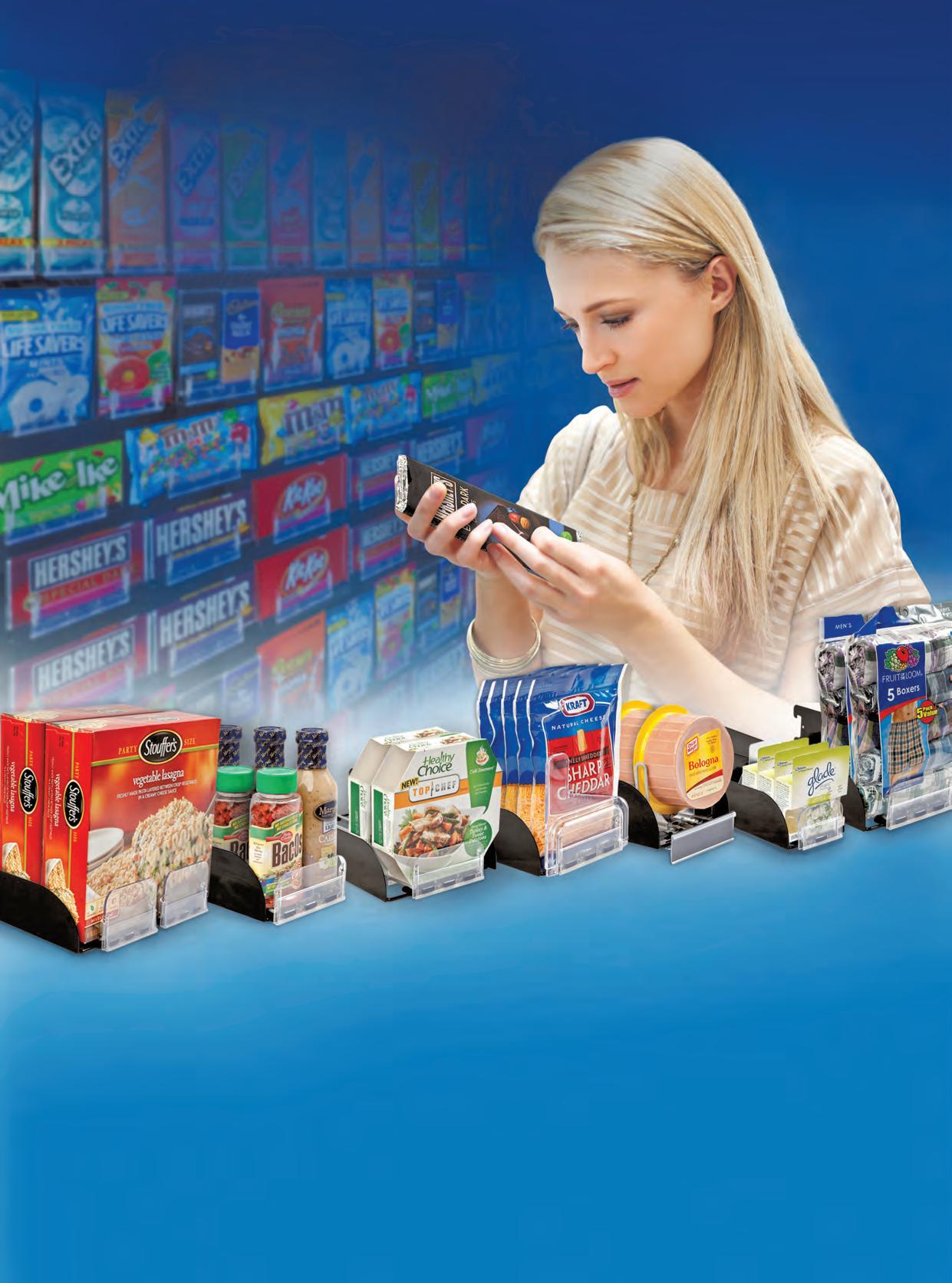


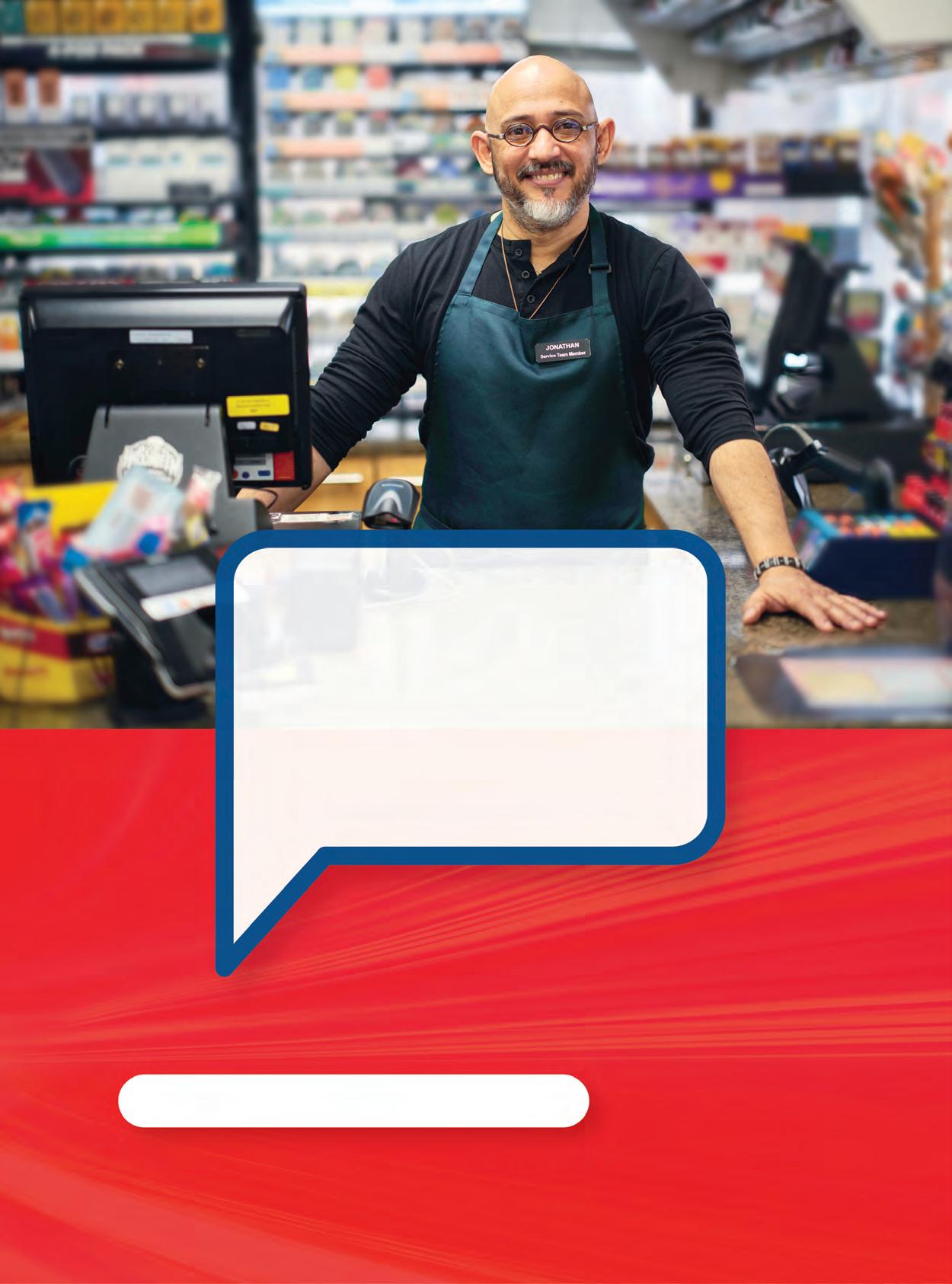
Attracting more customers means putting more over-the-top flavor, more exciting variety, more more all over your store. And we’ve got more than you can imagine, from the brands they love in the formats you need:
Want to maximize the moment? CONTACT US TO LEARN HOW.

OVER THE PAST SIX YEARS, we’ve seen evolution transform c-stores from technology advancement to the rise of foodservice to the integration of electric vehicle charging to rapid industry consolidation and backbar shifts to comply with ongoing local and state tobacco regulations. Now, evolution is coming for the aisles.
While shoppers may want convenience more than ever, they are also increasingly demanding “health and wellness” from products, and we’re seeing this trend begin to infiltrate everything from the cooler case to the snack aisle.
Of course, the wellness trend has been slowly picking up steam over the past six years. At first retailers assured me, “That’s what customers say they want, but it’s not what they’re actually buying.” Now, in 2026, the health trend is front and center for many c-stores, but it looks different than it did in the past. For many customers, especially GLP-1 users, healthy means high protein and getting eight glasses of water a day, while for others, it means high fiber, gluten free, low calorie, low sugar, prebiotics, low carb, functional attributes, clean ingredients and much more. Gone are the days when adding a salad to the menu checked the healthy box. Today, everyone has their own definition of what healthy means. And while c-stores are rarely on the cutting edge of trends, which usually build first in adjacent industries before reaching ubiquity and infiltrating c-store aisles, in 2026, the wellness/healthy trend in all its iterations is top of mind for c-store shoppers.
“For c-stores, this marks an inflection point to evolve from vice-based to wellness-led convenience,” NielsenIQ pointed out in a February infographic, as noted in this month’s Category Management Handbook. Across this month’s Category Management Handbook, which begins on p. 18, CStore Decisions details the data, trends and retailer insights across core c-store categories and their subsegments. And one theme that increasingly stands out is that even though c-store shoppers historically swing toward indulgence and impulse, having items that are perceived as healthy, particularly to the GLP-1 crowd, is crucial for sales momentum in the year ahead.
As trends change, today’s category managers are having to increasingly think outside the box and find innovative ways to drive sales that their predecessors never had to consider.
Each March, CStore Decisions recognizes two category managers who are making a measurable impact at their chains. Angelica Serna, category manager at Texas Born (TXB), as seen on p. 12, has stood out for employing a speed-to-shelf strategy
within the chain’s toy and novelty programs that resulted in great success. “I introduced collectible items such as Labubustyle plush and Pokémon cards. I found great vendor partners that helped me source these items and launch in stores while the trends were still hot,” she said. Serna is known among colleagues for being a visionary for her categories, striving to be first to market with new innovation where it makes sense while driving top-line sales and bottom-line revenue.
Ashley White, category manager — other nicotine products, Casey’s, as seen on p. 14, recently led a tobacco backbar project across Casey’s footprint that involved adding new fixture displays and increasing both signage and space. Her efforts boosted sales and trial-to-adoption and expanded market share for the category. In the last fiscal year, White grew her categories by more than 15%, exceeding growth of the entire store.
Both category leaders demonstrate that creativity is key in category management today. Category management in 2026 isn’t about simply optimizing shelf space or following last year’s planograms — it’s about rethinking the role each category plays in the shopper’s mission.
Today’s category managers are navigating higher expectations than ever before as shopper behavior changes rapidly, making strong category leadership more important than ever.
At this year’s CStore Connections conference, April 19-21 in Jacksonville, Fla., there will be a special breakout session on merchandising mastery, where retailer experts Sean Carroll, director of category management, Good 2 Go; Hussein Yatim, VP, YATCO; Cole Fountain, senior director of merchandising, Gate Petroleum Co.; and Sam Dearden, senior category manager, Good 2 Go, will share their tips for merchandising success. The session will explore proven merchandising strategies tailored for the c-store environment, from optimizing product adjacencies and signage to leveraging data and seasonal trends. See the full CStore Connections agenda where we’ll have a range of mainstage sessions, breakouts and burning issue exchange roundtable discussions on hot topics: CStoreConnections.com/agenda.
And, I hope this month’s Category Management Handbook helps set you up for success and spurs new ideas for the coming year.

Innovation, category trends, perception and sales data are all important factors to consider when retailers update their shelves.
When asked, “Which of the following product innovations from existing brands do you classify as 'new' items, if any?” respondents said:
New flavors from existing brand
Seasonal version of an existing brand
New product features or product claims from an existing brand
New texture variations from an existing brand
New functional benefits-based formula from an existing brand
New cooking method from an existing brand
New dietary-restriction based formula from an existing brand
New collaboration with another existing brand
New packaging size from an existing brand
New packaging from an existing brand
New sponsorship from an existing brand
When asked, “For each of the following categories, how often do you notice new items?” and “Which of the following categories are you likely to try new items from?” respondents said:
Over 90% of c-store consumer packaged goods dollars lies in tobacco and alternatives, grocery and alcohol, with liquor as a top category growing in dollars and units, according to NielsenIQ.
Source: 84.51º LLC, Kroger Precision Marketing, February 2026
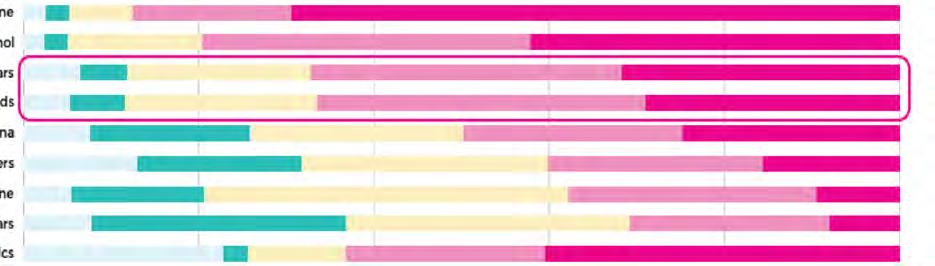
As customers become more health conscious, processed food and sugars are more widely viewed as moderately to very harmful, according to Brightfield Group.
By pairing a speed-to-shelf formula with a relationship-building approach, TXB’s Angelica Serna is tapping into new trends while boosting performance across a range of categories in 2026.
Erin Del Conte • Editor-in-Chief
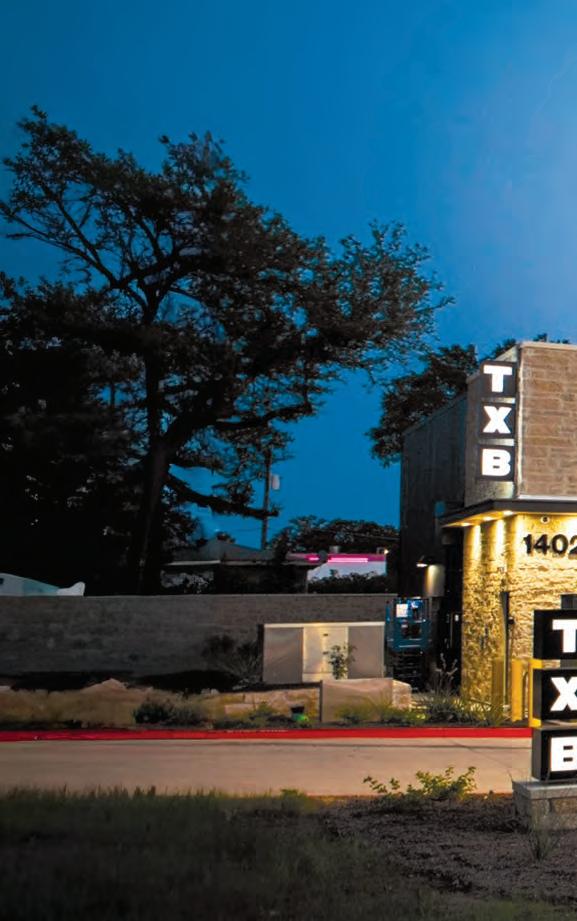
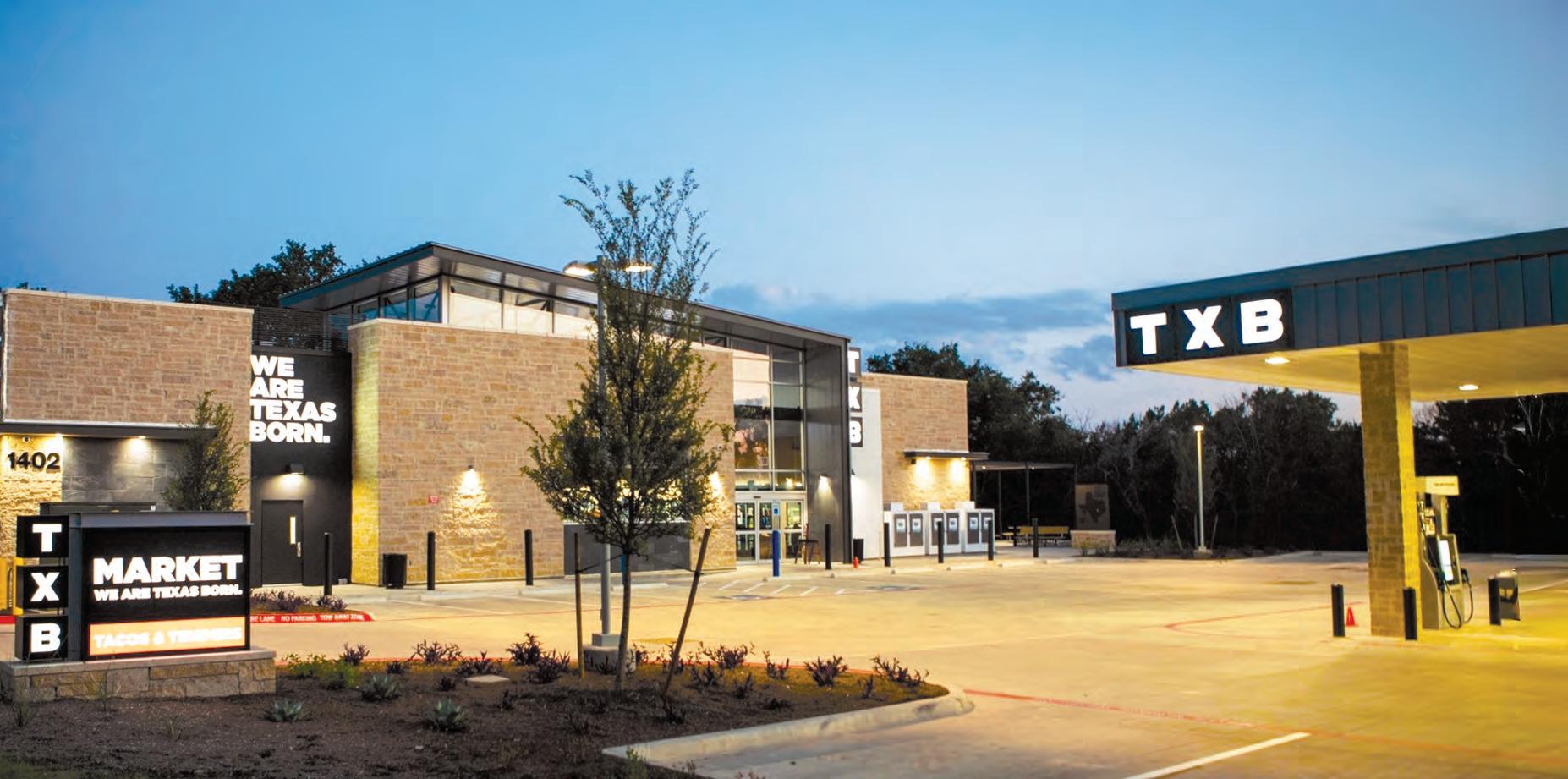
ANGELICA SERNA, CATEGORY MANAGER at Texas Born (TXB), manages the candy, salty snacks, alternative snacks, sweet snacks, meat snacks, general merchandise, and health and beauty care categories for the Spicewood, Texasbased chain, which operates 54 stores in Texas and Oklahoma. Her role involves
optimizing the assortments for her categories based on key performance metrics while keeping an eye on trends and opportunities for growth.
“I partner with various manufacturers to ensure we have the best products available at the best cost to better serve our customers and drive profitability,” Serna said.
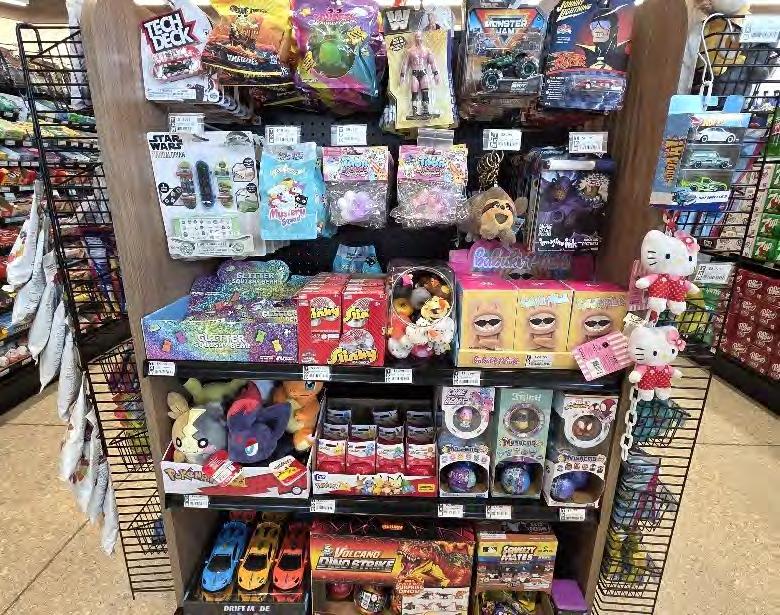
While in her role, Serna has captured attention for growing TXB’s general merchandise category by employing a speed-to-shelf strategy within the chain’s toy and novelty programs. “I introduced collectible items such as Labubu-style plush and Pokémon cards. I found great vendor partners that helped me source these items and launch in stores while the trends were still hot,” she said. “In securing Pokémon new release expansion packs to ship and execute in stores along with national release dates, we grew incremental dollars right after summer, when trips tend to slow down.”
Placing these high-demand items in the right locations helped reduce inventory risk and improve turnover.
“Since then, we’ve launched more Pokémon drops and other novelty toys, which continued our momentum into the holiday season and increased sales volume well into January,” she said.
Serna is known among colleagues for being a visionary for her categories, striving to be first to market with new innovation where it makes sense while driving top-line sales and bottom-line revenue. She’s not afraid to take calculated risks for the betterment of her categories and has strong relationship-building skills.
For all this and more, CStore Decisions is recognizing Serna with a Category Management Award.
Serna began her career in buying and private-label product development for a big-box/sporting goods retailer.
“It was there that I found my passion for merchandising and assortment planning while also learning the importance of working closely with manufacturers,” she said.
Serna went on to work for several consumer packaged goods (wholesale) companies as a product manager. “I enjoyed sourcing and creating a variety of different types of products, but my favorite role was working closely with the research and development team at a bread manufacturer,” she said.
Still, Serna missed the buying and merchandising side of the business and moved back in that direction. She took a position buying for specialty retail before joining the c-store industry, managing the candy category at Murphy USA.
“I learned a lot at Murphy and had great success working with amazing vendors and a strong merchandising team,” she said.
In June 2025, Serna took on her current position as category manager at TXB and
in a brief span has already left a big mark. “I have experienced so much in such a short time, as my area of responsibility has a big impact on our stores,” she said. Her favorite thing about her job is taking on the challenge of driving her categories and delivering value in a way that delights shoppers.
“I love being able to introduce new innovative items, leveraging data to make decisions, and creating exciting programs and promotions that drive profitability,” Serna said.

She credits the strong partnerships she’s developed with manufacturers and brokers as helping her succeed. “Collaborating with manufacturers and suppliers is the other part I really like about my job, and it feels great to see a program come together as a result,” she said.
As Serna sets her sights on growth in 2026, she’s preparing to launch several new endcap programs.
“One of my favorite endcaps is a multicategory endcap, with the assortment focused on snacks that our GLP-1 users can enjoy. With the number of people using GLP-1 and other weight management
medications, we need to provide easy snacks that are high in protein and low in sugar and fat.” Serna said. “I partnered with several manufacturers who have developed health-conscious snacks with fewer and cleaner ingredients and developed promotional plans to drive trial, build baskets and improve customer trip frequency. I’d love our stores to become a destination for customers with GLP-1 specific dietary needs. I’m looking forward to seeing how our customers respond.”
As for personal goals, Serna is focused on continuing to grow as a category manager. She credits mentors throughout her career who inspired her passion for learning and stretching to reach new heights.
“I am constantly reviewing my category performance to reflect on what is working and how I can improve programs that are not working,” Serna explained. “I aim for balance between celebrating wins in the present, while planning and strategizing for the future, as the next new trend is always right around the corner.”
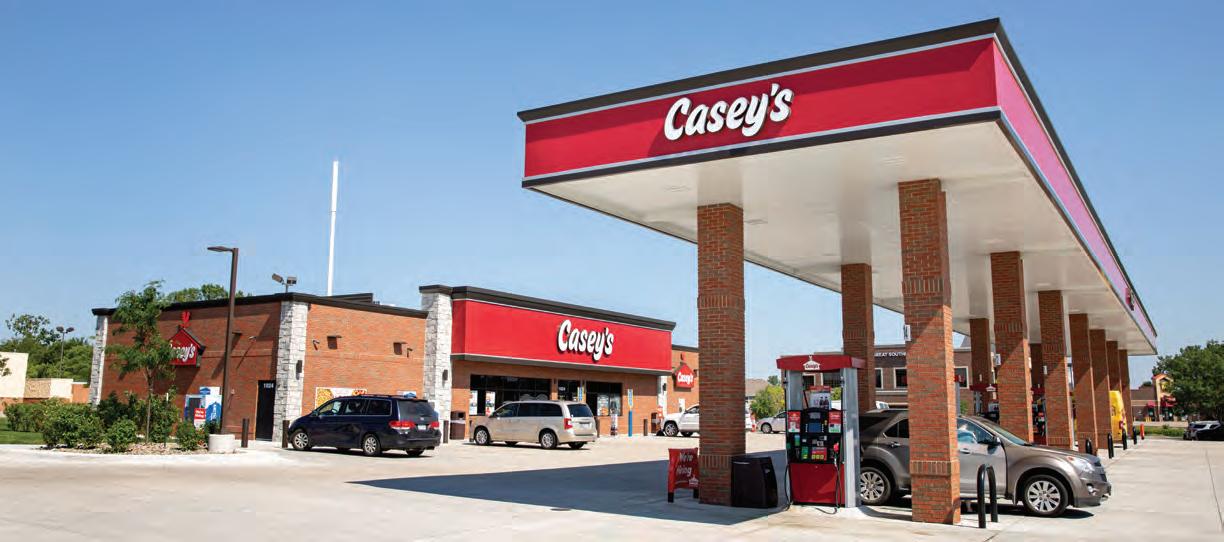
Drawing on her apparel merchandising roots, Ashley White is driving double-digit growth in the other nicotine products category while giving back as a leader and committing to personal development.
Erin Del Conte • Editor-in-Chief
ASHLEY
WHITE, CATEGORY MANAGER
— other nicotine products, Casey’s, has been a “champion” at the Ankeny, Iowa, c-store brand, working across departments to build collaborative teams to manage the portfolio while introducing new innovative products.
White recently led a tobacco backbar project across Casey’s footprint that involved adding new fixture displays and increasing both signage and space. Her efforts boosted sales and trial-toadoption and expanded market share for the category. In the last fiscal year, White grew her categories by more than 15%, exceeding growth of the entire store,
according to her colleagues.
“These efforts involved a thorough analysis of current store layouts and product placements, with a focus on streamlining the shopping journey and making it easier for guests to find and explore new items,” White explained.
“By optimizing shelf space and introducing innovative merchandising strategies, these resets have supported both guest satisfaction and category growth, particularly within emerging segments like nicotine alternatives.”
For all this and more, CStore Decisions is recognizing White with a Category Management Award.
White graduated from Iowa State University with a degree in apparel merchandising, design and production and spent 10 years in the apparel industry in roles spanning operations, store leadership, category management and buying at organizations such as Von Maur, Buckle and Cato.
“The apparel sector is characterized by its dynamic nature and rapid evolution, which provided continual professional growth and exposure to prevailing market trends,” White explained.
In her search for new challenges and
professional development, White pivoted to the c-store industry and joined Casey’s in 2018 as an associate category manager, overseeing the lottery, newspapers and video gaming categories and supporting the team with new product introductions and pricing strategies.
“As an Iowa native, Casey’s was a staple in my life, and I have always appreciated its impact and presence within the local community. I may be biased, but a slice of Casey’s breakfast pizza on Saturday morning was and remains the best way to start the day,” White said. “The organization’s commitment to guest-centricity and community involvement strongly aligned with my values, making Casey’s an ideal fit for the next phase of my career.”
In 2020, White was promoted to category manager, overseeing candy, health and beauty, general merchandise, propane, and automotive/seasonal products.
“My career has evolved across industries, but merchandising has always been the common thread and the place where I feel I can make the most significant impact,” she said. “From my early days in apparel to the current days in the c-store industry, the core principles of merchandising, such as understanding consumer preferences, optimizing product assortment and enhancing in-store experiences, have remained central to my professional approach.”
In 2021, White’s role expanded again as she took on her current position as category manager of other nicotine products, overseeing nicotine alternatives, moist snuff and vapor products. White also leads an associate category manager, who oversees the cigars, roll-your-own tobacco and lighters categories, and facilitates new store nicotine backbar fixturing.
“My primary responsibilities include developing and executing merchandising strategies across all 2,900-plus Casey’s locations in 19 states. Analyzing market trends is key to understanding the guest needs, especially considering the dynamics across various states,” White said.
In her current role, White has also driven “continual alignment on supplier programs,” by implementing and optimizing scan data processes. She has collaborated closely with supplier partners to enhance data accuracy and transparency, which has resulted in more targeted promotions and
Ashley White is category manager of other nicotine products at Casey’s. She oversees nicotine alternatives, moist snuff and vapor products. Additionally, she leads an associate category manager and facilitates new store nicotine backbar fixturing.

stronger inventory management. White has also optimized processes related to pricing and promotional activity.
White also has her sights set on giving back through leadership while growing herself professionally.
She currently serves as president of Casey’s women’s resource group, iWill (Women Inspire to Lift and Lead), and as a brand ambassador for NextUp, a nonprofit leadership organization fostering leadership development.
“I am also currently supporting our learning and development team by facilitating a leader excellence certification to impactful leaders here at Casey’s on core organizational leadership attributes,” White said. “I am so grateful to represent an organization internally and externally who takes pride in cultivating an inclusive, development-forward and empowering environment.”
In addition, she completed her MBA in 2024, which she credits with further strengthening her strategic and analytical capabilities, allowing her to approach challenges with a broader perspective.
“The advanced business knowledge gained through this program has informed my approach to category management, supplier collaboration and team leadership, resulting in more effective decision-making and value creation for the organization,” she added.
Looking ahead, White plans to continue collaborating with cross-functional teams to pinpoint innovative approaches for her categories that help advance Casey’s key objectives. She noted that could include new product lines, reimagining guest experiences or leveraging data-driven insights to drive category performance.
When it comes to personal goals, White said she is eager to continue to broaden her leadership experience.
“This includes taking on new challenges that stretch my capabilities, leading cross-functional initiatives and mentoring future leaders within Casey’s. By cultivating a diverse and inclusive team environment and embracing new perspectives, I hope to drive innovative solutions and meaningful change. Ultimately, my goal is to grow into roles of increasing responsibility where I can influence strategy, inspire others and help shape the future direction of the organization,” she said.
When asked what she loves most about her role at Casey’s, White pointed to the ability to bring her authentic self to work each day.
“The culture at Casey’s encourages openness and embraces individuality, allowing me to contribute ideas and perspectives that reflect who I am. This environment fosters a sense of belonging and enables me to perform at my best, knowing that my unique experiences and principles are respected and valued,” White said.
She added that she values the collaborative nature of her role that involves working with a wide range of individuals inside and outside of Casey’s.
“Whether it’s collaborating with supplier partners, coordinating with operators or teaming up with colleagues from various departments such as marketing, accounting and legal, these interactions are essential for driving successful merchandising initiatives,” White said.
“The collective effort, mutual respect and shared expertise help us achieve our goals and create meaningful impact for our guests.”
Nate Brazier is a dynamic and people-first executive with over 20 years of experience in the retail and convenience store industry. Known for his ability to inspire and mobilize high-performing teams, Nate is passionate about creating exceptional experiences for both employees and customers. His leadership style blends strategic clarity with a deep commitment to culture, empowerment, and operational excellence.
Nate currently serves as President and CEO of Stinker Stores, where he leads with a purpose-driven mindset: to make the world a better place—one employee, one customer, and one community at a time. Under his leadership, Stinker operates 105 stores across Idaho, Colorado, and Wyoming, serving thousands of customers daily and standing out as a “Bright Spot” in the lives it touches.

Nate Brazier
President and CEO
Stinker Stores

19-21, 2026
SUNDAY, APRIL 19
12:00pm – 6:30pm Registration
1:00pm – 4:00pm Store Tours
5:00pm – 6:30pm Welcome Reception
MONDAY, APRIL 20
8:00am – 9:00am Breakfast
9:00am – 9:45am GENERAL SESSION #1
AI at Work: Transforming the Future of the Convenience Store
Artificial Intelligence is no longer a futuristic concept—it’s here and already reshaping the convenience retail landscape. In this eyeopening session, discover how AI is being used by forward-thinking c-store operators to enhance foodservice operations, streamline labor management, and solve everyday business challenges. You’ll learn the steps you should be taking now to lay the groundwork for tomorrow.
Erin Del Conte (moderator) | CStore Decisions
Michael Salafia | Re-up
Sorin Hilgen | EG America
Mike Wilson | Cubby’s Inc.
Scott Smith | Parker’s Kitchen
9:45am – 10:30am
GENERAL SESSION #2
Optimizing the Kitchen: Boosting Foodservice Profitability While Managing Costs
In a competitive convenience retail landscape, a profitable foodservice program can be a game-changer — but only if costs are kept in check. This session dives into practical, high-impact strategies to manage and reduce foodservice expenses without sacrificing quality or customer satisfaction. Join us as we explore strategies for keeping costs down. This session will touch on effective pricing, efficient inventory management, commissary and self-distribution models, and maximizing labor efficiency. Learn how reducing food waste, leveraging local sourcing and integrating the right technology solutions can drive bottom-line results.
Jac Moskalik (moderator) | Global Partners
Jeremy Haack | Kwik Trip
Mario Spina | Parent Petroleum Inc.
Beth Hoffer | Weigel’s
10:30am – 11:00am Networking Break
11:00am – 12:00pm
Burning Issues Exchange - Round #1
Choose from
• Balancing Tech With Customer Experiences
• Investing in Food Programs
• Labor Crisis Strategies: Hiring, Retention & Workforce Optimization
• What’s Your Strategy for CBD, THC and Functional Beverages
12:00pm – 1:00pm Lunch
1:00pm – 1:45pm Breakouts - Round #1
Choose from
• Merchandising Mastery: Elevate Your InStore Experience
• Loyalty Reimagined
• Leadership in a Changing Retail Landscape

2:00pm – 3:00pm Burning Issues Exchange - Round #2
Choose from
• Balancing Tech With Customer Experiences
• Investing in Food Programs
• Labor Crisis Strategies: Hiring, Retention & Workforce Optimization
3:00pm – 3:30pm Networking Break
3:30pm – 4:15pm Retail Leaders Exchange
All retail attendees are pre-assigned to a discussion group with non-competing chains.. No sponsors are permitted to attend.
4:30pm – 5:15pm KEYNOTE SESSION
Owning Your Culture: Why Great Companies Don’t Leave It To Chance
Nate Brazier, CEO of Stinker Stores, CStore Decisions’ 2025 Chain of the Year award winner, shares an inspiring keynote on the power of company culture. Discover how a strong, values-driven culture can drive performance, attract top talent and foster innovation — and learn firsthand how Brazier has strategically shaped a thriving culture at Stinker Stores, a 105-store chain with locations in Idaho, Wyoming and Colorado, in a relatively short time. Every organization has a culture — whether it’s intentionally developed or passively formed. If you’re not actively investing in it, you’re relinquishing control over what it becomes. In this keynote, Brazier shares why culture isn’t just a “nice to have” — it’s a strategic advantage — and how leaders can create a thriving, engaged organization from the inside out.
Nate Brazier | Stinker Stores
5:15pm – 6:00pm Cocktail Reception
8:30pm – 10:30pm Social Networking

TUESDAY, APRIL 21
8:00am – 9:00am Breakfast
9:00am – 9:45am
GENERAL SESSION #4
CStore Strategies in the Face of Changing Competition
As top-quartile chains expand outside their traditional operating areas, small and midsized regional chains are having to adapt to heightened competition. Retailers discuss how they’re staying competitive, from maximizing store profitability and leaning into the advantages that come with being mid-sized to adding vertical integration.
Erin Del Conte (moderator) | CStore Decisions
David Barkett | Triumph Energy
Glennie Cox Bench | Southwest Georgia Oil Company, Inc.
Joe Hamza | Nouria Energy Corp.
9:45am – 10:30am
GENERAL SESSION #5
The Future of Convenience & How to Future-Proof Your Chain
Change is coming fast — and the most successful convenience store operators will be those who prepare for it now. In this forward-looking session, we’ll explore the key trends, technologies, and consumer behaviors reshaping the convenience retail landscape — and how you can adapt to stay ahead.
Greg Ehrlich (moderator) | Beck Suppliers Inc.
Jared Scheeler | The Hub Convenience Stores
Brian Unrue | Clark’s Pump-n-Shop
Pervez Pir | Loop Neighborhood
10:30am – 11:00am Networking Break
11:00am – 12:00pm
Burning Issues Exchange - Round #3
Choose from
• Order Ahead, Delivery & Data: Driving Foodservice Growth in the Digital Age
• Navigating M&A: Integration Challenges, Culture Building
• Succession Planning for Leadership Teams
• Mentorship Matters: How to Find — and Become — a Great Mentor
12:00pm – 1:00pm Lunch
1:00pm – 1:45pm
Breakouts - Round #2
Choose from
• Strengthening Teams: Talent Retention & Leadership Development
• Serving Up Success: Marketing Strategies for Foodservice Growth
• The Power of Private Label
2:00pm – 3:00pm
Burning Issues Exchange - Round #4
Choose from
• Order Ahead, Delivery & Data: Driving Foodservice Growth in the Digital Age
• Navigating M&A: Integration Challenges, Culture Building
• Succession Planning for Leadership Teams
• Mentorship Matters: How to Find — and Become — a Great Mentor
3:00pm – 3:30pm Networking Break
3:30pm – 4:00pm
GENERAL SESSION #6
Taking It Home: Lessons, Takeaways & Next Steps
In this closing session, participants will come together for an open group discussion to reflect on the key insights, experiences and lessons learned throughout the week. This is a chance to share personal takeaways, exchange ideas with peers and identify actionable steps to bring back home. Whether it’s a new strategy, a shift in mindset or a fresh connection, this session will help translate learning into meaningful action.
Let’s talk about what’s resonated most — and how you plan to put it into practice.
Erin Del Conte (moderator) | CStore Decisions
Greg Ehrlich (moderator) | Beck Suppliers Inc.
4:15pm – 5:00pm Board Meeting


6:00pm – 8:00pm
Closing Reception & 40 Under 40 Celebration
CStore Decisions dives into trends, data and retailer insights across today’s core c-store categories.
Erin Del Conte • Editor-in-Chief

IN 2026, PRICES ARE RISING, customers are feeling the pain, and it’s showing in their purchasing behavior.
Convenience store trips per buyer fell 2.2% (through Nov. 29, 2025), with 33% of shoppers reporting that they are visiting less, according to a February 2026 infographic from NielsenIQ (NIQ). A whopping 50% of customers pointed to higher prices as their top reason for visiting less often, although other reasons for the dip, per NIQ, include shoppers drinking less, avoiding impulse buys and fewer trips to gas up, among others.
C-store retailers are aware that reining in costs is key, especially as they strive to appeal to value-minded foodservice shoppers as they work to steal share of stomach from quickservice restaurants.
Prepared food offers a big opportunity for retailers in 2026. While NIQ found 37% of shoppers are planning to reduce their away-fromhome food spending, among those that reported increasing their c-store visits, 15% pointed to prepared food as the driver, while 13% referenced specialty coffee and 12% said dispensed beverages. In other words, if you’re planning to grow your business, foodservice is an important area in which to put your focus this year.
Surprisingly, even as economic pressures grow, the health-minded shopper segment is increasing and now accounts for about 40% of all food and beverage sales, per Chicago-based research firm Circana.
Circana noted generational shifts are redefining how customers view wellness, which is now seen through a more “holistic lens that encompasses physical, mental, emotional and functional needs.”
NIQ pointed out that “BetterFor” is outperforming in convenience stores with “double-digit growth and aboveaverage gains” when products highlight protein, gluten free or no artificial colors. While shoppers are making it clear what they want, c-stores are only partially meeting these rising demands. “For c-stores, this marks an inflection point to evolve from vice-based to wellness-led convenience,” NIQ noted.
We’re seeing this trend toward “wellness” extend beyond traditional foodservice categories, as well. In dairy, as noted on p. 43, a demand for protein is giving items like yogurt and cottage cheese a renewed appeal. In the health and beauty aids segment (p. 56), vitamin dollar and unit sales saw double-digit upticks, per Circana data for the 52 weeks ending Dec. 28, 2025. And, better-for-you demand is causing shifts in
the snacking aisle.
As Walter Thomas, category manager for center store at Massachusetts-based Yatco, said in this month’s candy and snacks feature on p. 36, “This has really become the year of the GLP-1. Customers are reading the backs of packages and looking for the highest protein with the least calories from carbs.”
The trend is also popular from the fountain area to the cold vault, with more customers demanding functional beverages with added proteins and fibers, and clean ingredients, as seen in the beverage feature on p. 30. Functional extends to energy-boosting benefits, and on the alcoholic beverage front, there’s a greater opportunity for non-alcoholic beer as more customers opt out of alcohol.
Convenience stores have always been good at adapting to change, and 2026 is going to be a year of evolution for a lot of chains, from expanding deeper into foodservice, incorporating wellness trends and navigating the ongoing changes that are impacting tobacco backbars (as seen on p. 44).
On the pages that follow, the CStore Decisions annual Category Management Handbook is here to help you identify the trends, challenges, shifts and celebrations across core c-store categories to help you prepare for the year ahead.

C-store foodservice is evolving in 2026, driven by consumer demand for fresh, flavorful and convenient meals that balance quality, value and innovation.
Marilyn Odesser-Torpey • Contributing Editor
IN TODAY’S CHALLENGING ECONOMY, the combination of quality and value offered by convenience store foodservice continues to drive sales. In this breakdown of the seven foodservice subcategories, retailers and experts forecast what’s in store for 2026.
BURRITO BOOM
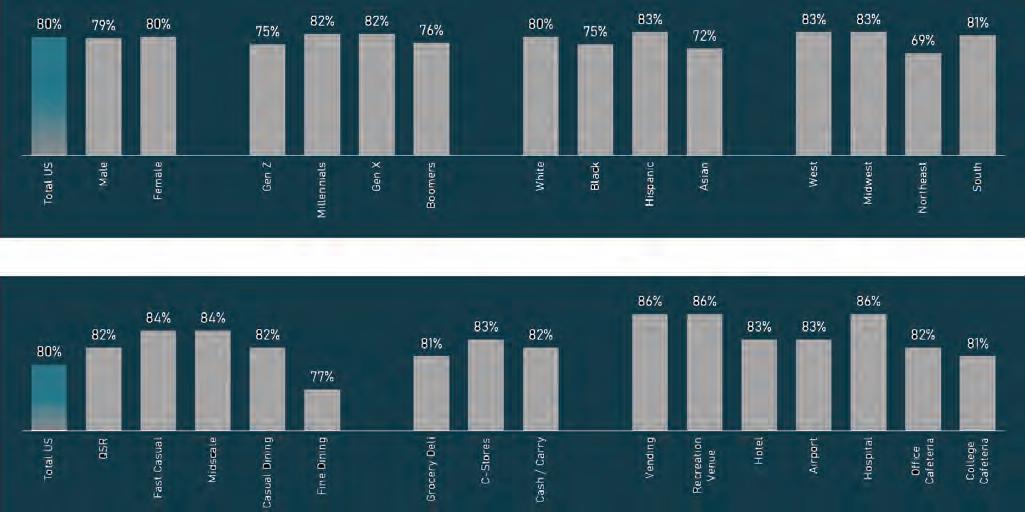
Tacos and burritos show strong consumer interest at 83% of survey respondents, highlighting an opportunity for continued growth in this subcategory, according to Datassential’s “Global Flavors Keynote Report” from July 2025.
In its “Burrito Food Profile” report from Q4 2025, 80% of survey respondents said they love or like burritos. The report projected a 7% increase in burrito sales over the next four years.
Onvo convenience stores, with 41 locations in Pennsylvania and New York, introduced its Food on the Fly program, consisting of made-to-order trademarked Craverito brand burritos, quesadillas, bowls, snacks and an array of beverages, in 2024, said Harman Aulakh, VP of marketing for Onvo.
“We offer a variety of flavors, ranging from Tex-Mex inspired to traditional
Eighty-three percent of c-store shoppers love/like burritos, per Datassential.
American in the burrito and bowl formats,” he stated. “Our Southwest Chicken and Fajita Steak Craveritos are two of our most popular entrées.”
When the program was first launched, he explained, there was a strong interest in the most indulgent recipes. Recently, however, as guests return to the store on a day-to-day basis, they are opting for more traditional proteins such as grilled chicken or steak over pulled pork or fried chicken. Guests can also add extra proteins on any of the entrées to help them meet their intake goals for the day.
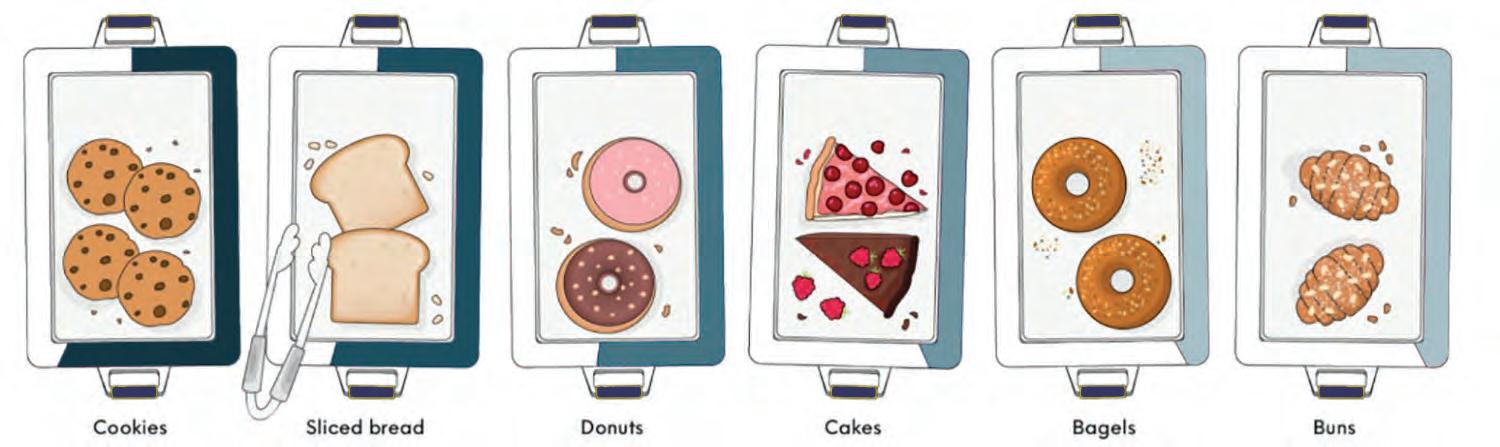
Sliced bread and doughnuts were also popular in-store bakery purchases in 2025.
For value-driven customers who want to mix and match flavors, Onvo expanded its grab-and-go menu to include tacos and snack-sized burritos. A variety of limited-time offers (LTO) allows the company to experiment with new flavors.
Aulakh predicted the category will continue its growth trajectory this year.
While managing rising food costs is a challenge, Onvo has implemented strong portion control measures at store level, he noted.
“This ensures that we achieve cost control, while our guests are getting the full value they expect from us,” he said.
According to Mintel’s “US In-store Bakery Market Report 2025,” the purchase of baked goods is climbing, “highlighting consumers’ cravings for both indulgent treats, like doughnuts, and everyday essentials, such as bread.” Category sales, the report predicted, are expected to grow from an estimated $23.5 billion in 2025 to $26.5 billion by 2029.
“The ideal in-store bakery experience lies in combining sensory appeal with value and convenience, leveraging discounts and special offers and creative usage ideas,” the report continued.
To meet the needs of consumers’ ethnic diversity, propensity to snacking and smaller household sizes, the report suggested that stores introduce more
globally inspired products or offer smaller portions such as half-loaves of bread, individual cake slices and singleserve pastries. Younger consumers, from millennials to the emerging Gen Alpha, crave more diverse flavors, innovative formulas in baked goods and a memorable in-store experience, the report noted.
Kwik Trip/Kwik Star, with 879 locations across seven states, is relying on product flavor innovations, LTOs and sensory cues to keep customers engaged with its bakery offerings, said Will Welch, a director of foodservice for the chain.
“We crank out over 225 loaves a minute in 10 different varieties daily,” he explained. “And, yes, it smells amazing.”
On the sweet side, doughnuts are big sellers at the stores, their signature Glazers variety leading the way. Welch pointed out that premium doughnuts and artisan pastries are increasingly popular among customers.
Fruit flavors remain on trend, particularly seasonal variations, which the stores offer through LTOs.
In addition to the individual items in their bakery cases, the stores offer three-, six- and 12-packs suited to any family size.
Welch explained that rising food costs sometimes require adjusting consumer prices, but the company only uses this strategy as a last resort. In some cases, it may instead require a change in the product lineup.
Whether bone-in Southern fried, tenders, baked, or fried livers and gizzards, SunStop Convenience Stores and Markets’ proprietary chicken offering is “the core of our foodservice program,” stated Michelle Weckstein, director of food and beverage brands for the 82-store chain with locations in Alabama, Georgia and Florida.
“Consumers are looking for value, and, since chicken prices have not increased like beef, we can offer meals within the $5 and $6 price points,” she said.
She pointed out that more quickservice restaurants (QSR) are getting into the tenders business and pushing this item through their advertising, which keeps chicken top of mind and equated with value for consumers. Chicken is also becoming increasingly popular at breakfast as customers “shy away from more expensive pork products.”
“We plan to have a chicken sausage patty on our menu by second quarter,” Weckstein commented.
As the company looks for new potential items to bring in for LTOs “we negotiate hard with new manufacturers who want to get a place on our menu,” she remarked. “We may negotiate for marketing dollars, and we pass the savings along to our customers.”
Jessica Russell, food service director at Clark’s Pump ‘n Shop, a 64-store chain in Kentucky, Ohio and West Virginia,
Chicken consumption has grown over the past 30 years, now nearly neck and neck with total red meat consumption, which has declined over the same period.
Source: National Chicken Council, data from World Agricultural Supply and Demand Estimates/USDA, updated December 2025
believes that chicken will remain “the top consumer choice” this year because “innovation in this category is really unlimited.” For the retailer, she noted, chicken’s relatively modest pricing helps keep food costs in check and margins strong.
Describing keeping up with food costs as a “never-ending battle,” Russell sees some light at the end of the tunnel in the form of “some small decreases.”
“Hopefully it will continue in that direction,” she said.
She foresees cash-strapped consumers will continue to “watch their spending closely,” making value meals a smart strategy for driving repeat visits. Innovation through LTOs also shows that the stores “treat our food as a destination rather than an add-on.”
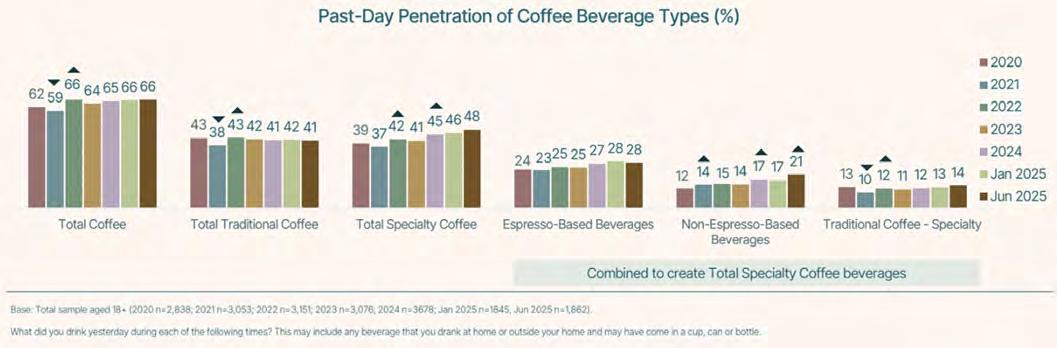
The National Coffee Association’s (NCA) “Fall 2025 National Coffee Data Trends” report found that in the past week, 66% of Americans consumed at least one cup of coffee, stated the organization’s president, William “Bill” Murray. Survey respondents reported drinking an average of three cups per day. Sixty-nine percent of cups drunk the day before were hot.
The report also showed that specialty coffee, defined as espresso and non-espresso beverages brewed from premium whole bean or ground varieties, scored a record 48% of American adults’ consumption in the past day. Much of the growth in specialty brew consumption can be attributed to coffee fans aged
18-24, 46% of whom reported drinking a specialty coffee in the past day.
Thirty-six percent of respondents said they purchased their coffee outside of their homes in the past day. Fifty-nine percent of them purchased it at a drivethru, and 36% of past-week drinkers ordered through an app, both trends indicating that consumers are increasingly “looking for convenience and customization.” NCA’s “2025 National Coffee Data Trends Specialty Coffee Report” found preparation at convenience and gas stores (6%, up 3% vs. 2024) has rebounded to pre-COVID levels.
Customization is the key to coffee sales at Cliff’s Local Market’s 22 locations in New York State, said Derek Thurston, director of foodservice operations for
This chart shows the percentage of people who consumed each type of coffee beverage in the last 24 hours.
Source: National Coffee Association, “Fall 2025 National Coffee Data Trends”
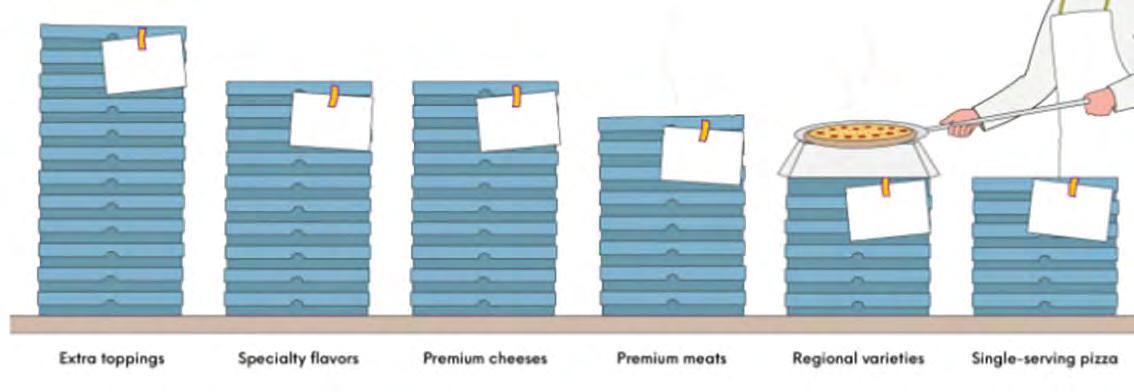
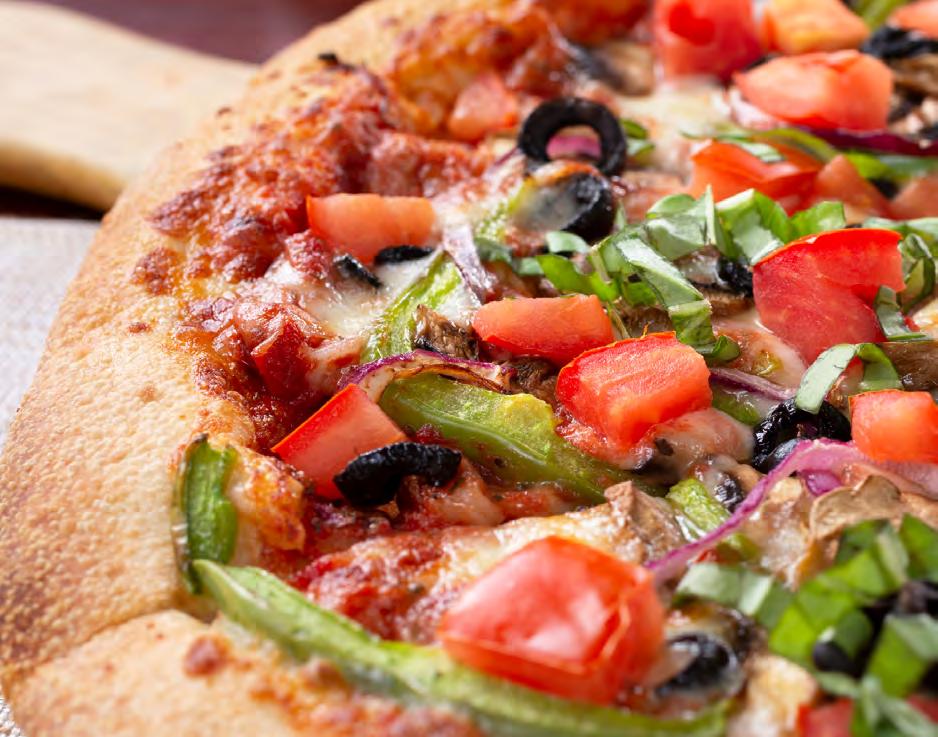
Specialty flavors and premium cheeses ranked higher on pizza shoppers’ list than premium meats and regional varieties.
Cliff’s. Every day, the stores feature six to eight drip coffee options from a local roaster, including a highly caffeinated blend and seasonal flavor.
“Our customers, especially younger ones, are looking for a wow experience like interesting bolder flavors, including fruity and floral; more caffeine; and an assortment of milks, syrups and sweeteners,” Thurston added.
Coffee tariffs have necessitated two price increases, so Thurston is focusing his attention on unit growth. Last year, the company achieved a 5% unit growth, and, so far this year, unit growth has reached 2%.
“I think by offering bold flavors and
highly caffeinated selections, we can drive higher unit sales this year,” he projected.
Since transitioning to a fully proprietary program two years ago, pizza at FriendShip Kitchen, with 31 locations in Ohio, has risen from 5-6% of foodservice sales to 25%,” said Kirk Matthews, VP retail for Beck Suppliers, parent company of FriendShip Kitchen. Slice sales have soared 400%.
In recent years, Matthews has noticed a shift in customer topping preferences.
“Heavy meat and processed meat toppings are dying off a bit,” he reported. “More people are asking for chicken,
veggie and plain cheese toppings.”
As consumers face rising food costs, they are increasingly turning to pizza for a value meal that combines high quality and affordable pricing, he said.
“Most pizza retailers cut their pies into eight slices for grab and go; we cut our 16-inch pies into six slices,” he went on. “Our two-slices-for-$5 deal accounts for a lot of our pizza business.”
Matthews is leveraging that value halo to drive whole pizza sales at dinnertime.
“People can feed their families for under $12,” he explained.
Loyalty between FriendShip and its suppliers goes a long way toward mitigating higher ingredient costs.
Pizza eaters ages 35-54 and 18-34 are most likely to select “any store-bought pizza,” followed by “any homemade pizza,” while 45% of both age groups opt for ready-to-eat hot pizza from the prepared foods section of a grocery store.
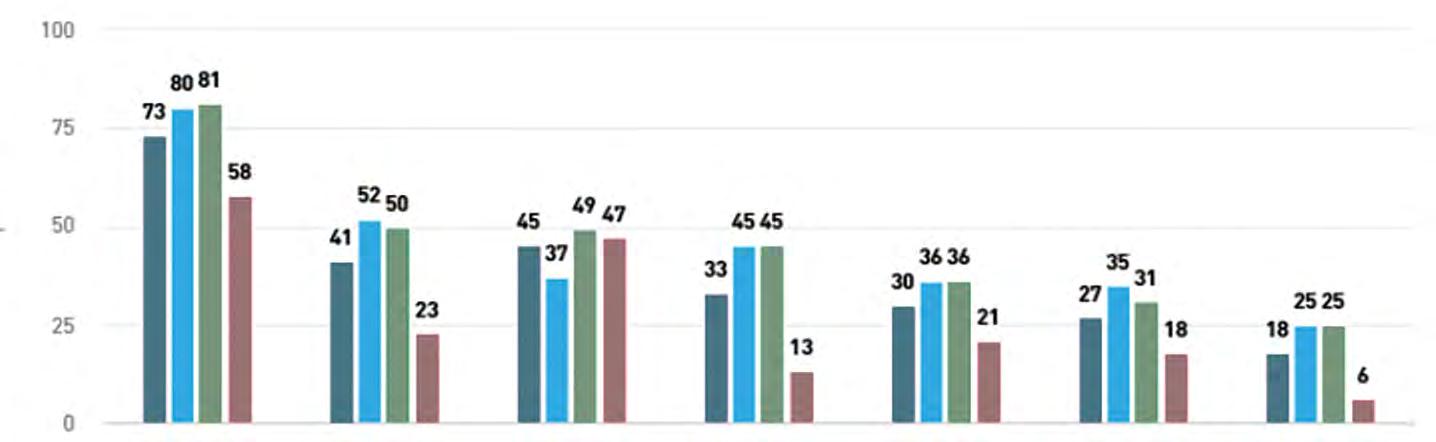
Source: Mintel, June 2025




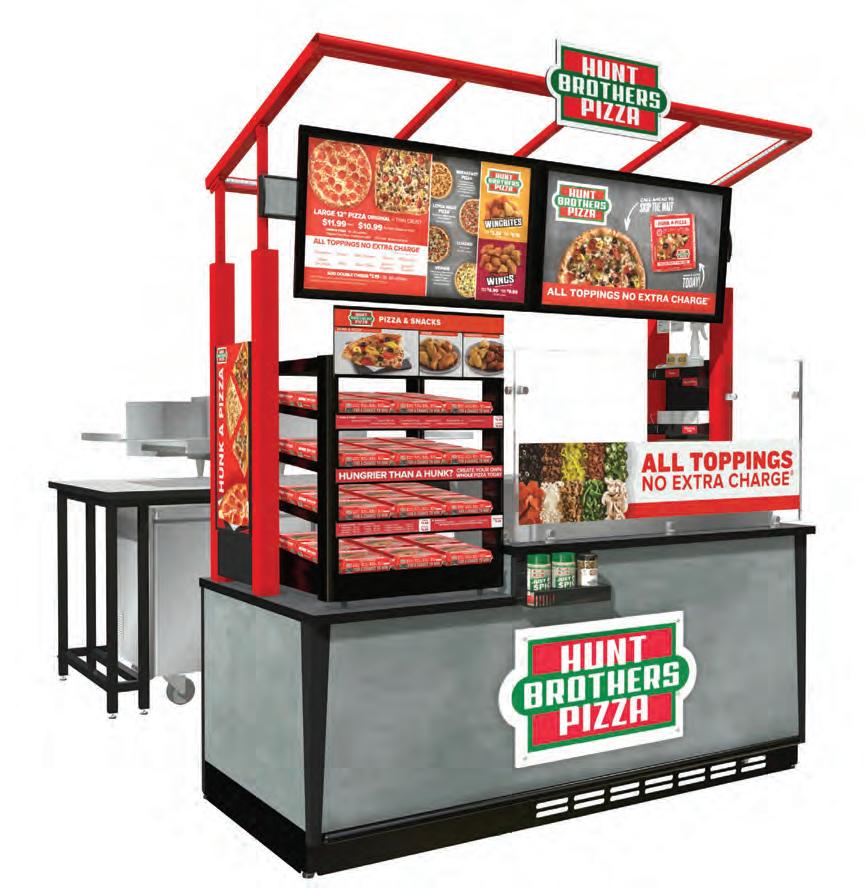
We are not a franchise. We do not have franchise fees, royalty fees or marketing fees.
With over 30 years of experience in the c-store industry, Hunt Brothers® Pizza has perfected a program designed to maximize your profits. The only ingredient missing is you.
“We negotiate because we don’t like to raise prices for our customers,” he emphasized. “Our suppliers work with us to keep costs as low as possible without cutting corners.”
Pak-A-Sak, a 24-store Texas chain featuring Hunt Brothers Pizza, also promotes its value proposition. Instead of traditional slices, the program sells individual portions as “hunks,” each equivalent to one-quarter of a 12-inch pie.
“We’re several years into the Hunt Brothers program, and our sales have grown every year,” noted Russell Barber, district manager at Pak-A-Sak. “Pizza is a quick, easy and affordable meal, so we expect to see continued growth this year.”
As food costs crept up and margins slipped in some stores, Pak-A-Sak asked Hunt Brothers to help identify problem areas. One solution was more consistent topping measurements. Another was determining how much pizza was needed to cover peak periods while reducing costly leftovers.
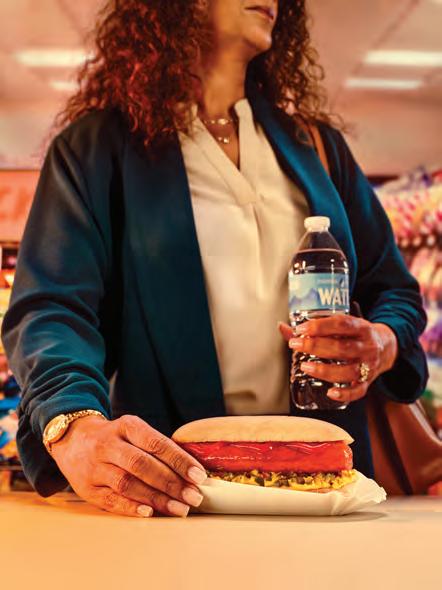
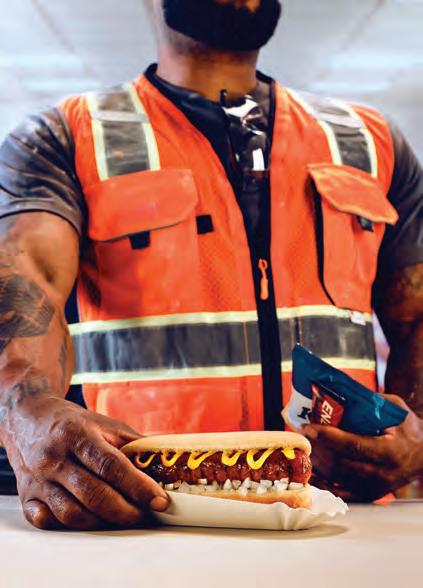
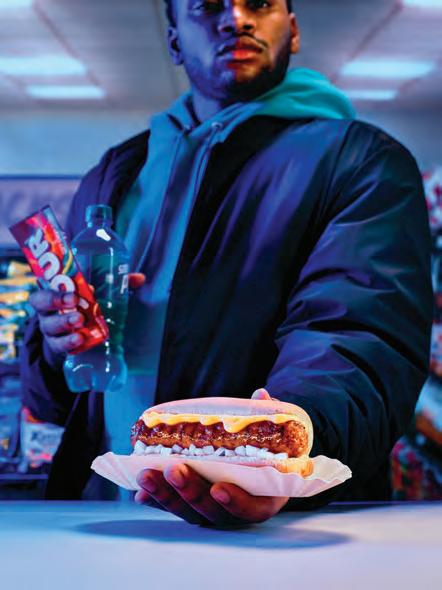
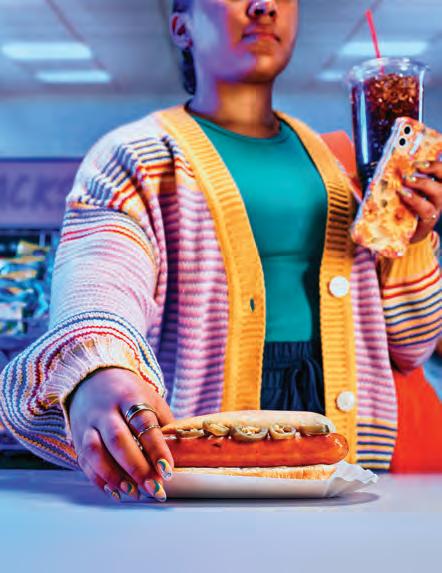
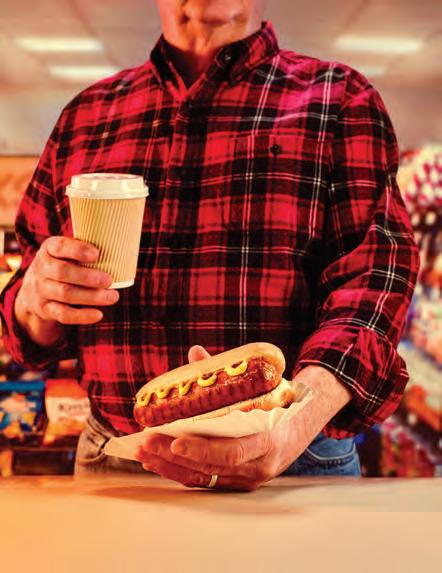
Hot dogs and sausages, two roller grill staples, saw slight sales increases last year, according to the National Hot Dog & Sausage Council.
“Driving sales is the popularity of highprotein foods and interest in natural and organic products,” said Eric Mittenthal, the organization’s president. “New products are mostly brand favorites reformulated with a reduced fat content or increased protein content.”
“Hot dogs and sausages offer the high protein people are demanding but largely have not been marketed with a protein focus,” he said.
In a recent survey, 60% of respondents, mostly older consumers, said they preferred all-beef hot dogs. Younger consumers opted for other proteins such as pork and chicken.
“We’re also seeing new flavors such as honey and brown sugar, barbecue, Cajun, spicy, and teriyaki hit the market in the last few years,” he continued.


& Sausage Council,


Multioutlet unit sales of sandwiches were down 4.7% in January of 2025 but ended the year up 13.3%.
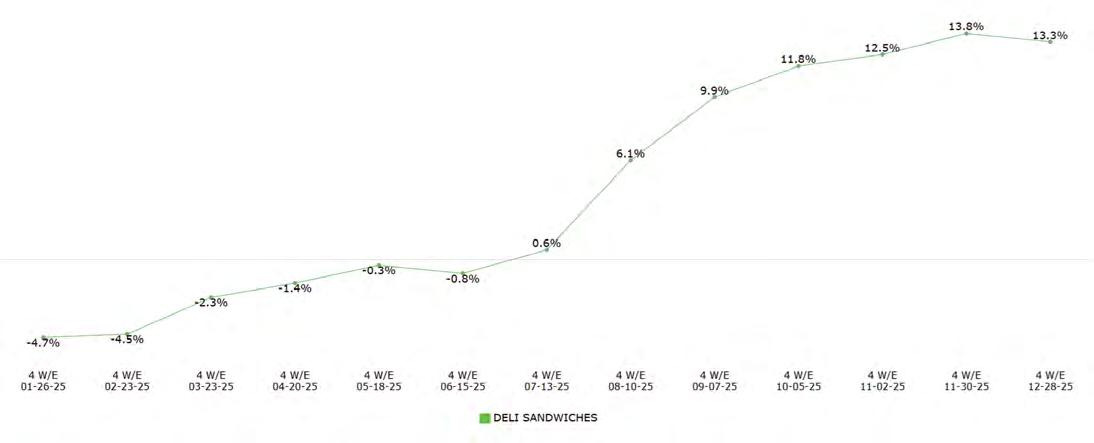
Source: IDDBA and Circana: unit sales % change vs. YA, total U.S. – multioutlet-plus, latest 13 quad weeks ending Dec. 28, 2025 UNIT SALES % CHANGES VS YA TotalUS-MultiOutlets+Latest13QuadWeeks
The roller grill program is a “core, high-velocity part” of the foodservice offering in nearly all of Rutter’s 93 convenience stores across Pennsylvania, Maryland, Virginia and West Virginia, reported Philip Santini, senior director of advertising and foodservice at Rutter’s. He expects growth to be driven by innovation, premium offerings, bolder flavors and strong execution as guests continue to seek out fast, affordable meals.
He also pointed to a growing interest in nostalgic flavors that bring comfort foods back in a new way. As an example, he mentioned exclusive launches such as Rutter’s SPAM Dog.
Managing rising food costs while providing premium products for customers requires strategic pricing, portion control and ingredient crossutilization to allow introduction of new flavors without adding operational complexity, Santini stated.
“Strong vendor partnerships and disciplined LTO planning also help offset price volatility and protect our margins,” he continued.
Grills are kept full throughout the day, with production guided by sales patterns to ensure freshness while minimizing waste. Santini noted that roller grill items are positioned as entry points into broader food baskets, encouraging guests to add sides, beverages and other complementary items.
Customers at Duchess Convenience Stores’ 116 locations in Ohio and West Virginia are craving spice on their sandwiches and subs, a flavor profile that Nathan Arnold, director of marketing for Duchess’ parent company, Englefield Oil, described as more than a passing trend.
“The preference for spicy in this category continues to grow so strongly that it has taken over the top spot in sales,” he elaborated. “Sauces and condiments help us deliver those bolder flavors.”
Arnold explained that over the past year, Duchess has seen consistent sales growth across its foodservice category, led by sandwiches and subs.
“By introducing new flavor profiles, loyalty card rewards for purchases and targeted promotions, this category will continue to grow,” he said.
To keep rising food costs under control, the Duchess foodservice team continually analyzes sales and waste across all food items to ensure a good balance between producing enough food to meet sales demand without increasing waste.
“We also work closely with our vendors to negotiate buys,” Arnold said.
In Global Partners’ Alltown Fresh and Honey Farms Market stores that have deli kitchens, 72% of sales come from foodservice, the majority of which are sandwiches, said Jac Moskalik, VP, head
of food, innovation and strategy, Global Partners. She noted that for Gen Z and millennials, the customization and variety that made-to-order sandwiches offer is a big draw for the sandwich sector.
Keeping ahead of trends is a fulltime job at Alltown Fresh’s 16 stores in Massachusetts, New Hampshire, New York and Connecticut and Honey Farms Market’s four stores in Massachusetts.
“We make menu changes on a quarterly basis because trends are constantly changing,” Moskalik pointed out.
Customers also respond to the wholesomeness communicated by the company’s acknowledgement of local ingredient suppliers, its “clean-label promise” and “no-no list” that ensures dyes and preservatives are never used, she continued.
Moskalik explained that the company tries to manage rising food costs without passing along the increases to customers by negotiating with existing suppliers and putting out requests for proposals for other ingredients.
What’s clear is customers are craving a wider range of quality food from convenience stores, and retailers are meeting that demand with smarter, elevated menu offerings that combine value, convenience and both traditional favorites and LTOs. 2026 is shaping up to be a pivotal year for foodservice in the c-store industry. CSD







































































Consumers are leaning into health-minded beverage consumption as functional innovations trend high.
Emily Boes • Senior Editor
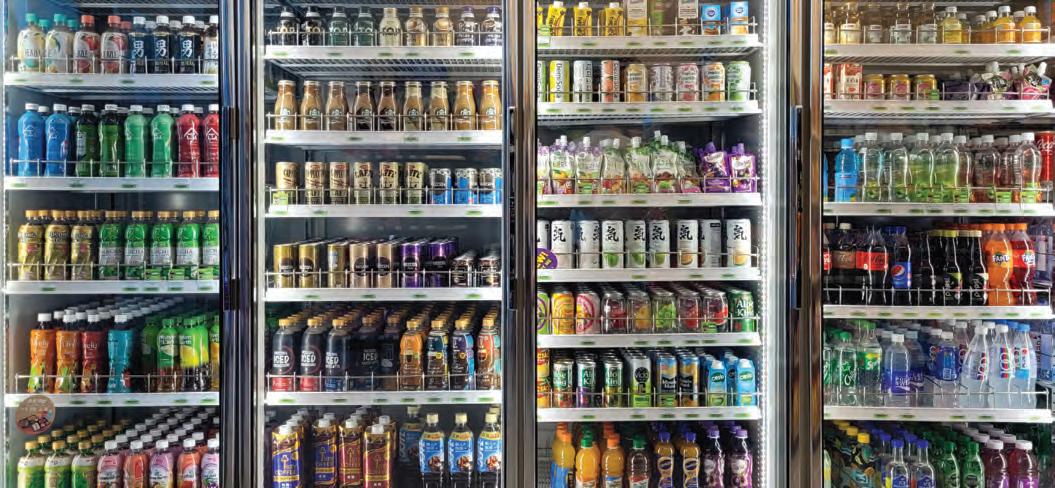
began to pick up steam among consumers, and two years later, the trend is still alive and well. Particularly with the introduction of accessible GLP-1 medication, customers are focusing on health, and specific functional attributes within beverages are climbing the curve.
For instance, protein is often a soughtafter benefit, and for some, fiber has surpassed it as a priority.
“Fiber is the new protein,” said Kate Stevenson, director of client strategy for research firm Brightfield Group. “(We’re) seeing many brands continue to innovate by adding fiber to protein applications, in both snacking and beverage.”
“I think protein drinks will continue to grow at double-digit trends because of the GLP-1 need to have protein in your
system. Better-for-you (BFY) will continue to trend in every category, whether it’s soda to juices to protein drinks to energy drinks,” added Daniel Leto, category manager for packaged beverages and adult beverages at Giant Oil, operator of On the Fly c-stores.
As of press time, the company is set to reach 107 stores by the end of March in Ohio, Kentucky, Indiana, Pennsylvania, Mississippi and Florida.
Leto also noted suppliers leaning toward healthy as they try to market to female consumers.
Brightfield Group agreed, observing women driving change in the landscape.
Notably among older women, as the conversation around perimenopause becomes bigger, there is a need for a greater protein intake, said Stevenson.
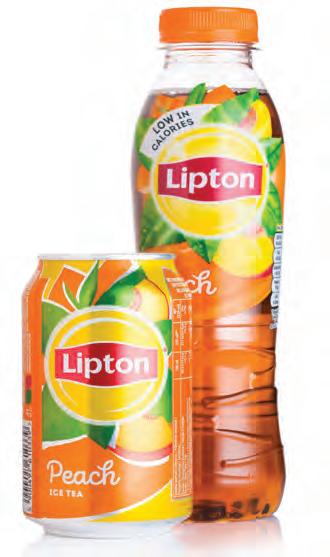
Soft drinks are typically viewed as unhealthy beverage options, and to cater to the growing crowd of health-seeking consumers, retailers are stocking functional sodas.
Prebiotic, BFY sodas came to mind for Stevenson. Momentum in this area is skyrocketing, with many brands continuing to go mainstream.
Additionally, protein sodas have launched and are on the rise, some containing both fiber and protein. Following on the heels of the prebiotic sodas, these are likely to be the next big innovation for the carbonated soft drink category.
In 2025, the category reached $10.8 billion in sales, according to research marketing firm Circana, third in packaged beverage only to beer and energy drinks.
Carbonated beverages raked in nearly $11 billion in 2025, coming in flat for the year, despite a 4.2% increase in price per unit, as unit sales dropped by 4%.
Source: Circana total U.S. convenience data for the 52 weeks ending Dec. 28, 2025
Loop Neighborhood, operating 155 locations in California, has clocked the appeal of functional beverages.
Fiber-forward sodas, noted Marat Yeshchin, senior category manager for Loop, are expected to trend in 2026.
At On the Fly, carbonated soft drinks that are standing out are “predominantly your normal Coke and Pepsi, but it’s also all the variants of such, plus Mountain Dew and Dr Pepper. Dr Pepper is still surging,” said Leto.
As for the chain’s functional sodas, they tend to perform better nearer the grab-and-go prepared foods, as they’re more expensive than long-time soft drink options, and hesitant customers will shy
away when they see the price stickers next to each other.
Placement is key for newer products.
Gary Hemphill, managing director of research for Beverage Marketing Corp., noted the necessity of merchandising new innovations not just in the coolers, but also at the point of purchase.
As the healthier soda trend continues to sweep beverage retail, consumers will likely come to expect c-stores to stock these options, as well.
“The success of gut-health sodas has proven sodas can be successfully marketed as healthy drinks. I would anticipate more new product activity along these lines,” Hemphill said.
The carbonated soft drink is not the only segment where customers are buying healthy. Consumers are increasingly choosing enhanced waters, as well.
“If you look at water in general, it’s doing extremely well,” said Leto.
Bottled water is the star of the mainstream categories, added Hemphill.
Bottled water sales in the c-store space reached $5.92 billion in 2025, a 1.3% increase from 2024, per Circana.
Flavored seltzer, sparkling and mineral water saw the biggest boost in the category, going up 25.2% in dollars and 14.2% in units. Following that, nonflavored seltzer, sparkling and mineral
Seltzers, sparkling water and mineral water saw dollar gains in 2025, 25.2% for flavored varieties and 14.6% for non-flavored. Flavored still water also saw an increase (6.9%), although bottled non-flavored still water dipped by 2%. Sports drinks remained relatively flat in sales.
Source:
Coke Freestyle flavors that over index the most for each hour of the day at c-stores.
Cherry,Vanilla12AMto2AM Lemon3AM
Lime4AMto5PM
Pineapple6PMto8PM
Vanilla9PM
Cherry,Vanilla10PMto11PM
Source: Coca-Cola Freestlye 2025 data for the c-store channel
water jumped 14.6% in dollar sales (8.1% in units), and flavored still water upped 6.9% in dollars and 2.8% in units.
Clearly, sparkling water varietals are appealing to the c-store consumer.
This has proven true at Loop, where sparkling water is exceeding the chain’s expectations and demonstrating strong consumer demand alongside functional beverage offerings.
Leto again observed those on GLP-1 diets influencing purchasing behavior.
“If you’re on GLP-1s, they ask you to drink a half gallon of water a day. So we see with ‘buy one, get one for $1,’ ‘buy one, get one free,’ ‘buy two for x,’ people buy the two. No matter what we put it on, we could put it on a gallon, they’ll buy two gallons,” he said.
He’s noticed 24-packs of water gaining traction among consumers, as well.
Leto also noted the popularity of the isotonic space, particularly with brands such as Electrolit.
Electrolyte water meets that hydration need, added Stevenson.
Yeshchin, too, expects rapid-hydration beverages to perform well in 2026.
As for other sports drinks, “Gatorade 28-ounce has taken a big comeback” at On the Fly, according to Leto.
Sales of sports drinks remained relatively flat in 2025, notching $4.82 billion. Of these, aseptic sports drinks held only a minute dollar share. Non-aseptic Gatorade took home $3 billion in dollar sales.
Energy drink momentum continued in 2025 and is projected for 2026, as well.
Circana data shows energy drinks were up 10.1% in sales in 2025, hitting $16 billion. Shelf-stable, non-aseptic energy drinks amounted to $15.5 billion (up 10.7%), and energy shots saw $517 million in sales (down 5.9%).
“Energy drinks continue to be a star in the c-store channel. They are highly impulse-driven purchases and are very profitable thanks to their higher price points in contrast to other beverage categories,” said Hemphill.
They should maintain solid growth in the next years, he continued; the need state is “massive, so the opportunity for marketers remains significant.”
At Loop stores, energy drinks are a standout category. Yeshchin noted the year-over-year growth energy experiences despite questions about when the category might plateau.
“Energy brands are marketing companies. They continue to allocate more
Source: Circana
to innovation and research and development. We bet we will see top energy brands enter the cognitive and BFY categories soon,” he said.
While Loop hasn’t yet introduced cognitive energy offerings, the chain is actively monitoring several brands and anticipating testing select products during the summer.
For On the Fly, Leto believes energy drinks will hit double-digit growth. In line with the trend toward healthy, he predicted Red Bull’s sugar-free options will greatly appeal, and Alani Nu will be an up-and-coming brand.
Location also plays a factor in drink preference among consumers.
“If you have a heavy-traffic-flow area, where you’re off the interstate, your energy drinks are going to be through the roof,” Leto said.
A new trend, clean energy is an attribute that Brightfield Group sees gaining prominence among consumers. A “clean” energy drink is one with new ingredients that sustain energy beyond just caffeine or in addition to caffeine. This can include L-theanine “that helps balance the peaks and valleys of energy experience,” said Stevenson.
The energy profile is maturing and expanding to new demographics, and manufacturers are responding with “female-positioned” energy beverages with cleaner ingredients and less sugar. Energy waters, a new energy format, are also hitting the beverage scene. Savvy retailers should keep an eye on it.














Aseptic juices jumped in sales over the last year (20.7%), while kombucha sales plummeted (-85.6%). Generally, juice and tea sales saw mixed results.
Source: Circana total U.S. convenience data for the 52 weeks ending Dec. 28, 2025
Straddling the line between energy and tea, yerba mate contains caffeine and is very popular in the tea category. Served in a single-serve ready-to-drink (RTD) format, the drink is an easy purchase for tea consumers on the go.
In general, however, canned and bottled tea sales at c-stores are down, units decreasing 7.4%, per Circana. Refrigerated teas, on the other hand, are up 1.7% in units.
According to Brightfield Group, c-stores are over indexing with boba tea, protein coffee, matcha and yerba mate — aligning with the growing appeal of functional or healthier options.
Leto also noted tea is trending toward premium and healthy.
Bottled juice sales are down 7.1% in units for 2025, while canned juice remained stable at just -0.9% in unit sales, per Circana. Refrigerated juice drinks were down 9.1% in units in 2025.
Trending positively, however, aseptic juices were up 12.7% in units and 20.7% in dollars, led by Vita Coco.
Beverage Marketing Corp. projected fruit beverage retail dollars to grow 2.6% for the full year 2025.
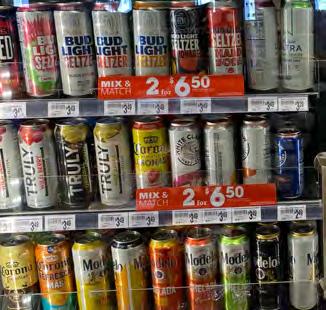
As consumers look toward alternative beverages, some are stepping away from
traditional cases of beer to look for nonalcoholic substitutes.
At Loop, non-alcoholic beverages are likely to build in sales and unit volume.
Still, that doesn’t mean beer sales can’t pick up in 2026.
“Beer sales struggled in 2025 but should make a slight comeback this year. Increased commuting and the return of more consumers to the roads should fur-
ther support growth in the convenience channel,” said Yeshchin.
Single-serve, three-packs and fourpacks were the only formats within beer to show same-store sales growth for Loop in 2025.
“This trend reflects a broader shift in consumer behavior, as overall alcohol consumption continues to moderate. Consumers are increasingly favoring smaller package sizes, driven not only by reduced consumption but also by a greater focus on value and affordability,” said Yeshchin.
Hemphill concurred with the notion of decreased alcohol consumption among consumers, noting it’s experiencing strong headwinds. The opportunity for non-alcoholic beer and other alcoholfree products, he said, is growing.
Beer volume fell by 4.2% in 2025, per Circana, with dollars dipping 2.2%. Still, the category notched $25.1 billion for the past year, indicating that despite the decline, the category is going nowhere.
As an upward trend, Loop saw imports, seltzers and malt liquor outperform.
That said, tetrahydrocannabinol (THC), seems to be an alternative that’s growing among consumers.
THC-based products are doing well, said Leto, and while highly scrutinized, it’s worth carrying where it can be sold.
“What we’re seeing is craft beer and
Premixed cocktails soared in dollars by 57.6% and units by 60.7% in 2025, followed by spirits and spirits-centric seltzers. Wine-centric seltzers dropped the most in sales (-38.3% in dollars and -44.1% in units).
Source: Circana total U.S. convenience data for the 52 weeks ending Dec. 28, 2025 Case Sales — Beer: per 288 fluid ounces (24-by-12-ounce cans). Case Sales — Wine and Spirits: per nine-liter cases (12-by-750-milliliter bottles)
super premium … are definitely losing share of transactions to THC drinks when they’re available,” he said.
While he’s noticed THC taking share of beer and RTDs, he doesn’t believe it’s taking away from wine.
He thinks that the prevalence of GLP-1 is affecting change in this area, too. “They make you sick. THC doesn’t make you sick; it actually helps you calm nausea. So I still say that the GLP-1 trend is probably the No. 1 trend that’s affecting restaurants and c-stores.”
Consumers are looking to THC beverages, agreed Stevenson, particularly younger generations. And as beer dips among consumer adoption, non-alcoholic beer and non-alcoholic wine are trending up.
According to Circana, table wine is down in sales, along with sparkling wine and champagne.
At Loop, wine-based RTDs saw strong momentum, “with brands such as BuzzBallz, BeatBox and Big Sipz delivering double-digit same-store sales growth, underscoring continued consumer interest in convenient, affordable and ‘quick buzz’ RTD alcohol options,” said Yeshchin.
Premixed cocktails have surged in sales, the segment having witnessed a 57.6% growth in dollars, per Circana.
Outside of packaged beverages, c-stores are taking note of what’s popular among their dispensed beverages.
“Anything blue” is standing out within dispensed beverage at On the Fly.
Additionally, some retailers are moving to private-label energy in the fountain.
Dirty sodas are another trend seeming to sweep the c-store channel, but not everyone believes in its vitality.
“The dirty soda is hit or miss,” said Leto. “The fountain is what people use as a low-price alternative to packaged beverage, so when you start doing dirty sodas, it raises the price. I don’t know if that’s the customer.”
Instead of dirty sodas, Leto is noticing on-the-go cocktails trend.
Innovation is widespread at the fountain, as different retail chains offer different options to customize. Indeed, innovation is rampant among the entire beverage category. With this, potential supplier constraints and shifting trends in mind, c-stores are paying careful attention to their merchandising strategies.
“Innovation, a carefully curated assortment and disciplined pricing strategies will be critical this year as economic conditions and marketing dynamics continue to influence consumer behavior,” said Yeshchin. “Shoppers remain interested in new and differentiated products, while ongoing assortment optimization will be essential. We will continue to eliminate underperforming items and focus on maintaining an efficient, high-performing SKU mix, as carrying an excessive number of SKUs does not drive operational or financial efficiency.” CSD
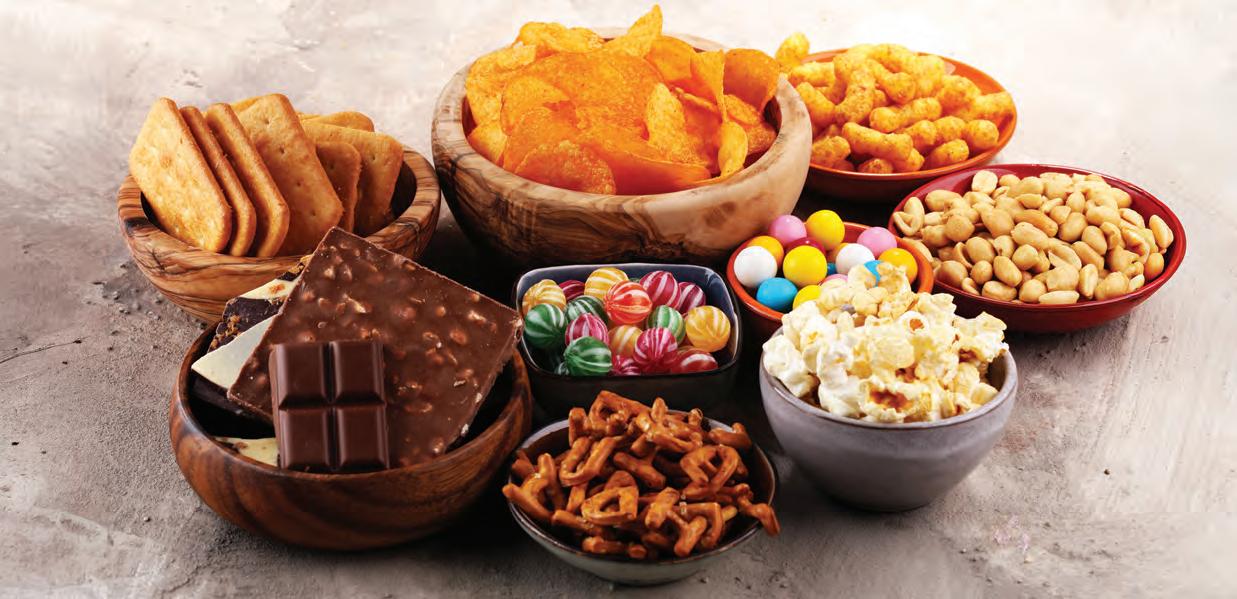
In 2026, the c-store customer is demanding healthy alternatives, bold flavors and innovation from candy and snacks — but without breaking the bank.
Kevin McIntyre • Associate Editor
OVER THE PAST SEVERAL YEARS, convenience store retailers have dealt with mounting inflationary pressures, volatile consumer spending and the lingering effects of the COVID-19 pandemic. What has not changed, however — and will likely never change — is the c-store industry’s role in the candy and snack categories.
Customers have long seen c-stores as their go-to spot for quick, indulgent
bites. And while that candy- and snackfocused consumer is still purchasing sweet and salty treats, preferences have begun to shift from indulgent to rational. This rings true especially for candy.
“This year, candy has become all about value,” said Walter Thomas, category manager for center store at Yatco. “With the rising cost of sugar and cocoa, our customers are leaning more and more toward our non-chocolate categories,
while still looking for value in chocolate.”
Yatco operates 20 c-stores across Massachusetts, Connecticut and Rhode Island. Thomas noted that as customers increasingly look for non-chocolate offerings, the chain is leaning into new innovations in the confectionery space.
“Customers are also very interested in trying some of the new flavor profiles that bring sweet and spicy to candy,” he said.
At Portland, Ore.-based Plaid Pantry,
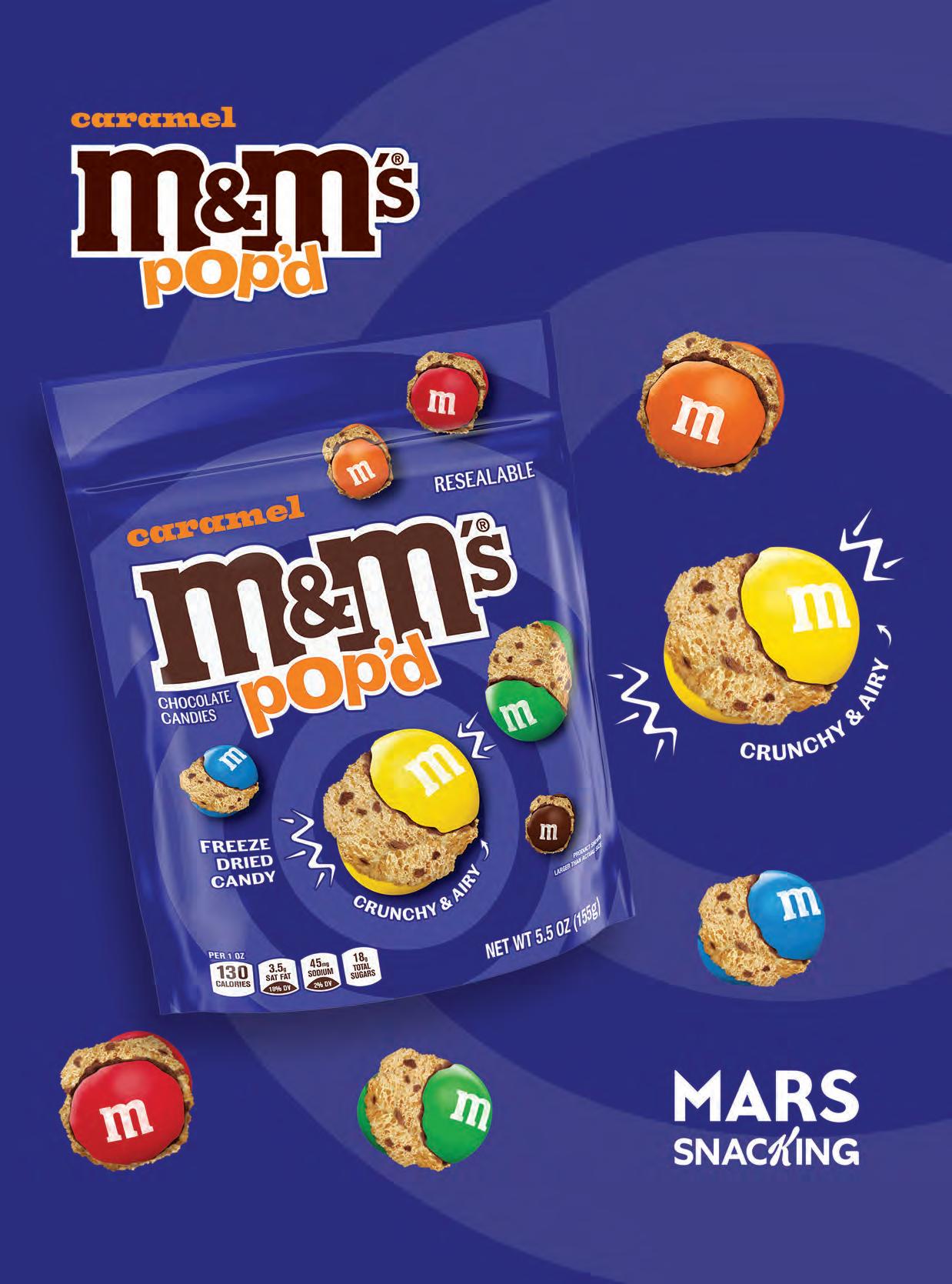


Snack nuts and sunflower/pumpkin seeds sustained a modest dip in dollar sales, while toasted corn nut snacks experienced a 2.8% drop.
Dollars and units fell for salty snacks in 2025 overall, however, corn snacks (up 9.6% in dollar sales and 9.7% in units) and cheese snacks ( up 1.8% in dollar sales and 2.2% in units) showed promise.
Source: Circana total U.S. convenience data for the 52 weeks ending Dec. 28, 2025
which operates 107 locations across Oregon and Washington, customers are similarly seeking value as wallets tighten and costs continue to rise.
“Deals and promotions are top of mind for me and my team, especially as the category continues to absorb higher prices,” said Jon Manuyag, director of marketing for Plaid Pantry. “Finding ways to deliver value to customers is becoming increasingly important for keeping shoppers engaged.”
In short, the value proposition has never been more crucial, and c-store retailers will need to get creative in order to draw in more price-conscious consumers.
“We know our customers are looking for value, and we have strived to keep our retails in candy as low as we can — in some cases 10-40 cents less than other stores in our area,” said Thomas. “Customers might not remember the price they paid for a ‘Walter bar,’ but they will
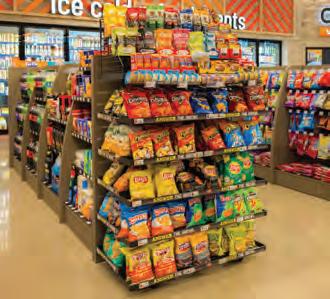
always remember the store that had the best price on Snickers.”
Similarly to Yatco, Plaid Pantry is seeing an increased demand for candy that features bold and adventurous flavors.
“Consumers, especially younger shoppers, are gravitating toward more exciting and unexpected flavor profiles,”
Manuyag said. “This continues to drive interest and helps bring energy back into the category.”
In the 52 weeks ending Dec. 28, 2025, salty snacks accounted for $7.82 billion in dollar sales, notching a 2.6% fall compared to the prior year, according to c-store research firm Circana. While the majority of segments within salty snacks saw modest decreases in dollar sales, there were a few segments that stood out from the crowd.
Corn snacks, for example, saw a 9.6% uptick in dollar sales and a 9.7% increase in unit sales. Additionally, cheese snacks marked a 1.8% increase in dollar sales and a 2.2% uptick in unit sales.
Snack bars and granola have been the shining stars for snacks, notching a significant 8.2% increase in dollar sales, led by nutritional and better-for-you value
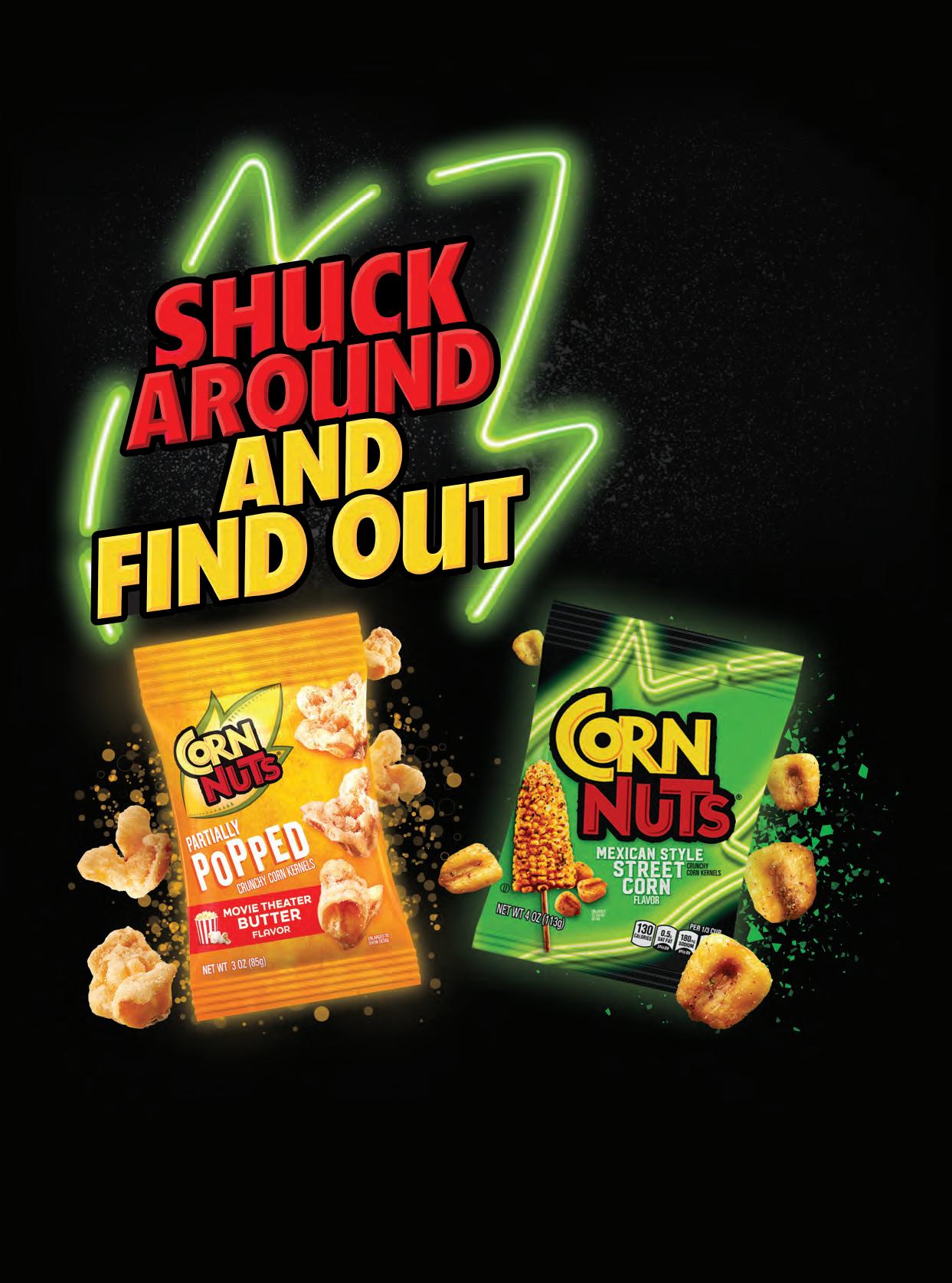
LEGENDARY FLAVORS, IRRESISTIBLE TEXTURES ARE YOUR SHELVES READY?
No matter what your customers are craving, the CORN NUTS® Brand has a flavor to satisfy.









Price per unit increased across the board for chocolate, excluding novelty chocolate candy prices, which decreased 1.2%.
Source: Circana total U.S. convenience data for the 52 weeks ending Dec. 28, 2025
bars, which saw a nearly 15% increase in dollar sales last year.
On the candy front, chocolate still reigns supreme, while non-chocolate continues to slowly close the gap. Chocolate candy dollar sales came in at $3.76 billion, while non-chocolate represented $3.31 billion. Interestingly, larger packaged chocolate outperformed snack-sized offerings, with the former marking a 14.3% increase in dollar sales.
For non-chocolate, novelty saw the most success at an 11% increase in dollar sales, reinforcing Thomas and Manuyag’s contention that customers are seeking new, unique and intriguing offerings.
One trend that has continued through 2026 is the meteoric rise of better-for-you candy, snacks and alternatives.
“This has really become the year of the GLP-1,” said Yatco’s Thomas. “Customers are reading the backs of packages and looking for the highest protein with the least calories from carbs.”
Plaid Pantry is also seeing increased demand for better-for-you offerings, with Manuyag noting that the chain is “putting more attention on better-for-you and functional candy.”
“Items with low sugar, added benefits
or cleaner ingredients are gaining traction, and we’re looking at ways to give these products better visibility in our sets,” he said.
This emphasis on health and function has led to increased sales from segments like meat snacks, snack bars and jerky, all of which saw positive dollar sales in 2025. Meat snacks and jerky are on healthminded customers’ radar due to their protein content.
Yatco has capitalized on this growth by partnering with several jerky companies to add new brands to its lineup, which will be introduced in the coming months, according to Thomas.
Non-chocolate candy rolled in flat in dollar sales while down 7% in unit volume, but novelty, powered by a 25.6% jump in price per unit, saw a notable uptick in dollars by 11.2%













































































































































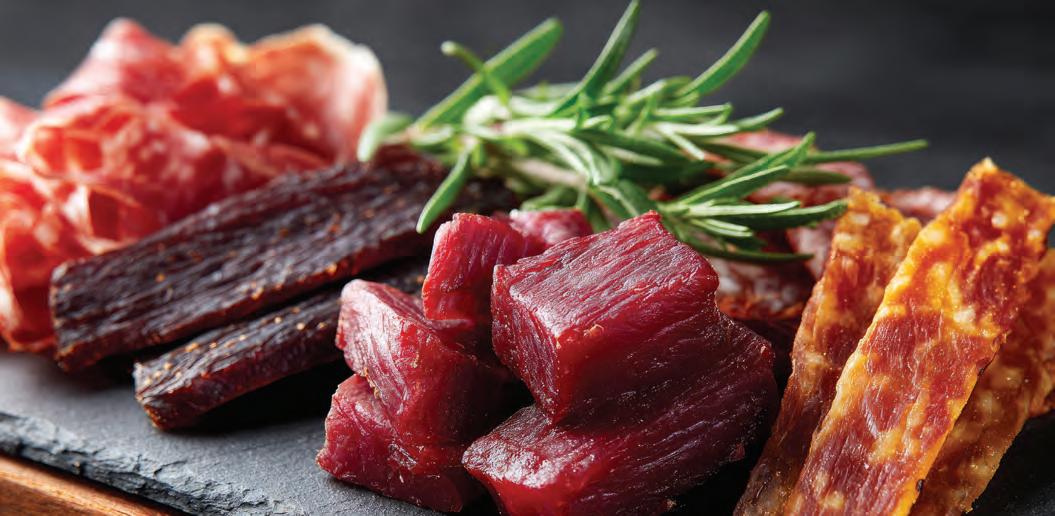
Jerky saw the most growth in sales for dried meat snacks, up 4.4% in dollars and 2.8% in units.
Source: Circana total U.S. convenience data for the 52 weeks ending Dec. 28, 2025
“Meat snacks have really increased across the category, as we have partnered with Righteous Felon, Bridgeford and a new brand coming to our market called Prime Cuts,” he said. “We have worked very hard with our broker so that this brand will be introduced in our stores very soon with a full shipper that I’m sure will sell out very quickly.”
Dried meat snacks were a bright spot in the snacking category in 2025, notching a 1.7% increase in dollar sales and accounting for just over $2 billion in sales through December, per Circana. Jerky also saw positive results, rising 4.4% in dollar sales to $859 million for the same period.
Despite their high protein content and health halo, nuts and seeds dipped last year, seeing a slight decrease in dollar sales and a 3.7% downtick in unit sales. Sunflower and pumpkins seeds
stayed relatively flat, decreasing 0.7% in dollar sales but still accounting for nearly $352 million in sales.
Overall, Manuyag noted that his categories are generally “slightly up in dollars and down in units due to pricing action in 2025.”
Plaid Pantry took a similar approach to Yatco, expanding its alternative snack set to include new and innovative brands that focus on protein and functional qualities.
“We recently expanded our alternative snack sets to include brands like Quest and MET Rx with their protein-focused salty snacks,” said Manuyag.
Going forward, both Yatco and Plaid Pantry plan to combat pricing concerns with strong and lasting manufacturer partnerships, value-focused promotions
and innovative offerings — all while keeping an eye on current trends and customer preferences.
Manuyag noted that Plaid Pantry will continue to focus on digital marketing — especially through social media — which it uses to drive impressions, build awareness and highlight new product innovations.
“The goal is to excite customers and encourage more in-store visits,” he said.
At Yatco, the chain is focusing on meeting customers where they are.
“We are working to deliver memorable value-driven promotions to encourage (customers) to shop more often and try more flavors,” said Thomas. “The results are showing us that if you give the customer what they want, when they want it and at the price they want, they will reward you with their loyalty time and time again.”
CSD
Despite dairy milk declines, high protein demand bolsters desire for other dairy items.
Brad Perkins • Contributing Editor
on package size, convenience and, sometimes, flavor. Now, health and social media trends are driving the category.
“Over the last couple of years, milk has become more ‘purpose driven,’” said Nick Triantafellou, director of marketing and merchandising at Weigel’s, which operates 90 stores in Tennessee. “Guests still buy traditional gallons, but growth is coming from specific needs like high protein, better-for-you and flavored single-serve.”
So, despite overall declines of 7.6% in dairy milk and 5% in flavored milk in c-stores for the last year, per Chicagobased research firm Circana, there is positive movement in the category.
“Increasing consumer focus on health, as well as GLP-1s, have fueled
leader at Circana. “Many high-protein dairy products leverage ultrafiltration techniques that help brands deliver higher protein.”
Health trends are also driving other areas of dairy, with cottage cheese up 20% in 2025.
“TikTok is boosting cottage cheese sales with recipe ideas and protein messaging,” Altobelli said. “Many dairy categories are seeing bolstered sales as a result of the GLP-1 user focus on high protein and low-fat and low-sugar products, including yogurt, cottage cheese and value-added milk.”
Ice cream is less susceptible to health trends, since many customers prefer the tried-and-true with a splash of new flavors and special editions.
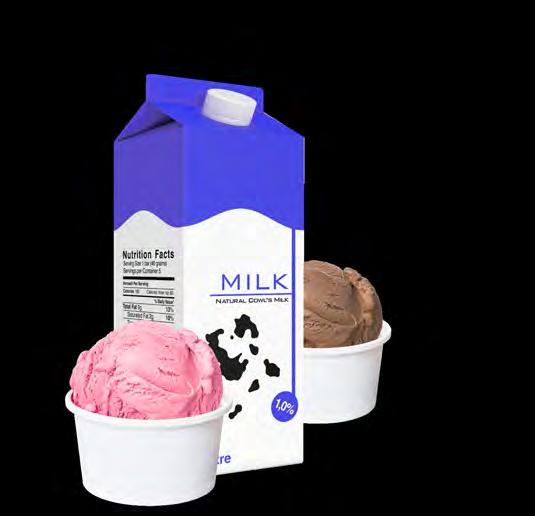
“For ice cream, classics remain the foundation, but limited-time and “nostalgia” flavors create spikes, especially when there’s a clear message and the product is easy to spot,” Triantafellou said. “What has changed
is that guests are more willing to try something new but only if it comes from a brand or format they already trust.”
Regular ice cream continues to own the majority of sales in the category, despite a 2.6% drop in 2025, per Circana. Dollar sales of sherbets, sorbets and ices, which tend to skew lower calorie and lower fat, rose 24.7% over the same period.
Still, people want to be able to purchase the products, so visibility remains important.
“If the freezer is light or frosted over, guests walk away,” Triantafellou said. “Coffin coolers, door clarity and easy-to-find top sellers matter. The right mix of everyday value and occasional excitement drives trial without training guests to wait for discounts.”
And in both categories, value and assortment remain vital.
“When budgets tighten, shoppers don’t necessarily leave the segment, but they trade between formats, sizes and features,” Triantafellou said. “Value matters, and so does clarity in what you’re getting for the price.” CSD
Dairy milk sales dipped by 7.6% in the past year, declining 9.5% in units. Plant-based milk fell by nearly 20% in dollars and units, but ice cream/sherbet sales dropped by a smaller 1.9% in dollar sales and 4.7% in units.
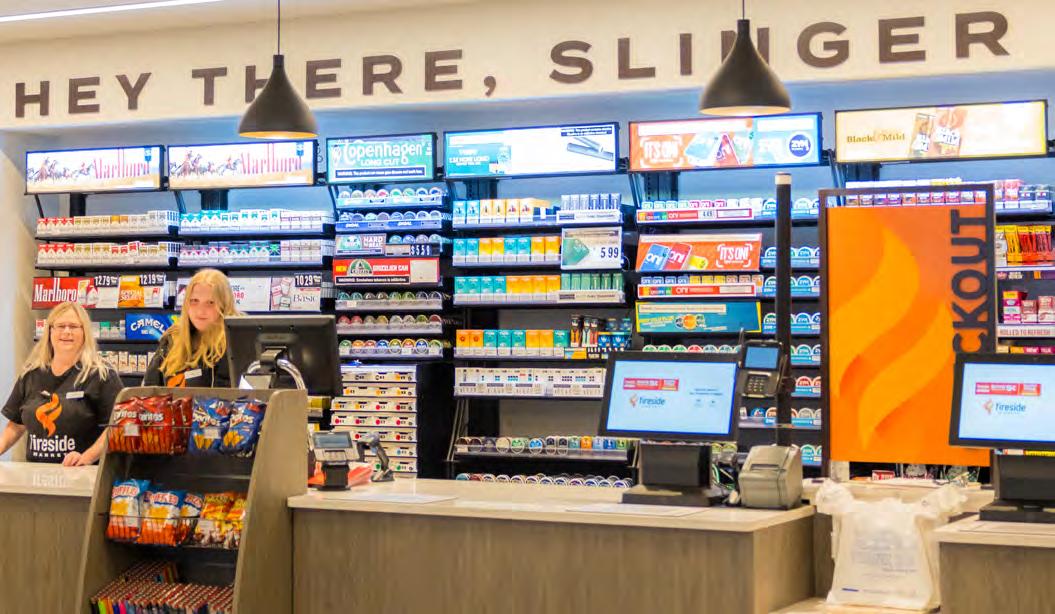
C-stores are reassessing backbars for maximum performance this year while still dealing with ever-changing regulations and market shifts.
Anne Baye Ericksen • Contributing Editor
WHEN DESIGNING THE BACKBAR for the six new stores Yatco Energy opened last year, Director of Category Management & Merchandising Anna Bettencourt shuffled emphasis, placing modern oral nicotine pouches front and center and allocating less real estate to traditional smokeless and vape. Yatco currently owns and operates 17 convenience stores throughout Massachusetts as well as one site each in Connecticut and Rhode Island.
“We also will replace older fixtures in stores this year to better accommodate
how tobacco and nicotine products will perform in today’s environment,” Bettencourt added.
Category managers across the country have made similar decisions regarding planogram strategies in recent years, and it’s a trend that probably will continue as the tobacco/nicotine category undergoes further metamorphosis due to regulatory actions and evolving consumer behaviors. Figuring out those strategies for 2026 requires thorough examination of each product segment’s recent production.
ECONOMICS BOOST DISCOUNT CIGARETTES
2025Review: Sales volume of combustible cigarettes continued to fall last year; however, according to the Goldman Sachs Nicotine Nuggets survey of approximately 40,000 tobacco retail sites, that dip softened slightly during the third quarter: -5.7% versus -7.7% for the preceding three months. Why the adjustment? Analysts point to downtrades.
“Ongoing economic pressures are stretching household budgets and forcing trade-off decisions at the shelf. As a result,









Cigarette sales held at $50.5 billion as units dropped by 7.1%, cushioned by a 5.7% increase in price per unit.
lower-tier, value-priced brands continue to capture share by offering a viable alternative to premium offerings, which have seen notable price increases,” said Joseph Bortner, senior category manager for York, Pa.-based Rutter’s, which operates 93 locations in four states.
Circana market research of the convenience store channel indicated cigarettes’ price per unit climbed by nearly 6% for the 52 weeks ending Dec. 28, 2025. Ironically, the shift away from premium has paid off for some c-stores.
“Since coming off the everyday low price program last year, we have seen double-digit growth in our cigarette category, and all our growth is from fourth-tier cigarettes,” said Sean Bumgarner, VP for Scrivener Oil Co. which has 12 Signal Food Stores in Missouri.
2026Outlook: Per the Nicotine Nuggets assessment, c-store cigarette sales most likely will have a repeat performance this year. Analysts anticipate volume to lessen again and economic conditions to further push price gaps between premium options and lower tiers.
2025Review: Once again, the modern oral nicotine segment, specifically nicotine pouches, outperformed most of the other tobacco/nicotine category
product lines. Circana reported dollar sales throughout last year grew by nearly 30% and units jumped by more than 25%.
Goldman Sachs highlighted promotional efforts by manufacturers as key to some of the growth. More than three-quarters of retailers responding to the Nicotine Nuggets survey cited campaigns, such as a free pouch with purchase of any nicotine item, for attracting new customers to the alternative.
“The nicotine modern oral (NMO) category in our stores is continuing its impressive growth. We have expanded the space for this category, but only (four) brands, ZYN, Velo Plus, ON! and Rogue, move significant volume for us,” said Bumgarner.
“Growth is being fueled by expanded milligram levels and flavor innovation, giving consumers a wide range of options,” added Bortner.
2026Outlook: The pace of Food & Drug Administration (FDA) Premarket Tobacco Product Application (PMTA) determinations for synthetic nicotine products remains a top concern for the c-store industry. Although some products have received authorization to be sold, dozens more are still pending despite a pilot program the agency launched last fall aimed to restructure and speed up the review process.
“What is interesting is that many brands are on the approved state directory list in Massachusetts, but because the FDA has not given some of these products in the modern oral category authorization, we cannot sell them in some local municipalities,” said Bettencourt.
“State directories have been helpful in some places. They offer a workaround for businesses that are not getting good information from the federal government. However, there is still inconsistency from state to state, and that can make it difficult for stores,” added Doug Kantor, general counsel for the National Association of Convenience Stores (NACS).
Also, a leading manufacturer recently submitted modified risk applications to the FDA for its pouches, hoping to reserve the right to be marketed as less harmful. That said, it’s difficult to predict when that review will conclude.
“The lack of information until decisions are made makes it hard to know exactly what types of products are applying for (modified risk classification) and where they are in the process,” said Kantor.
VAPE’S BLACK MARKET BATTLE 2025Review: “Demand for vape products was flat for us in 2025. We used










































































some of the vape space to expand on NMO, which helped increase the sales of that category,” Bumgarner noted.
Circana found dollar sales of vaping products were down by 8.1%, and even though units totaled more than $305 million, the product lines fell off approximately 14% in volume for the 52 weeks ending Dec. 28, 2025. 2026Outlook: Vape and e-cigarettes also felt the sting of stalled PMTA decisions for another year; however,
while the industry awaits FDA announcements, manufacturers have innovated with various technologies. Vaping devices now feature options such as Bluetooth connection or intelligent processors controlling power and temps. These features enable users to customize their experience.
At the same time, the vape sector faces upticks in illicit products. While Kantor noted enforcement activity has picked up on finding and removing
contraband at the point of import, the black market continues to thrive.
“It would be helpful if enforcement was done in concert with (PMTA decisions) so good actors in the industry know when they’re doing the right thing and when they aren’t doing the right thing,” he added. “Then, once we know what products are allowed, a strong enforcement is necessary and makes sense. The other thing to watch for this year is counterfeit products, especially on


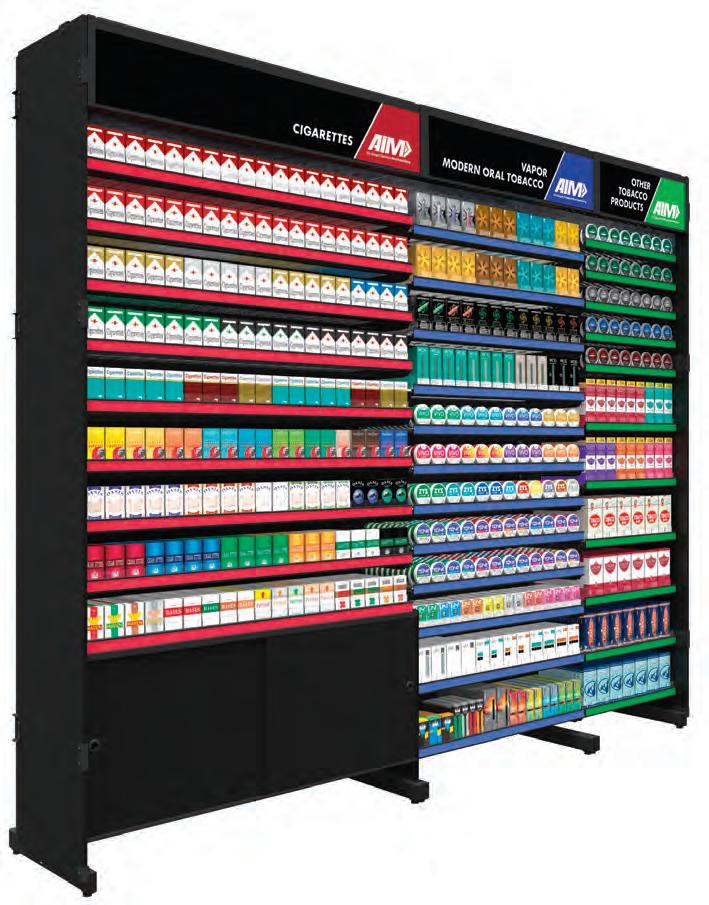
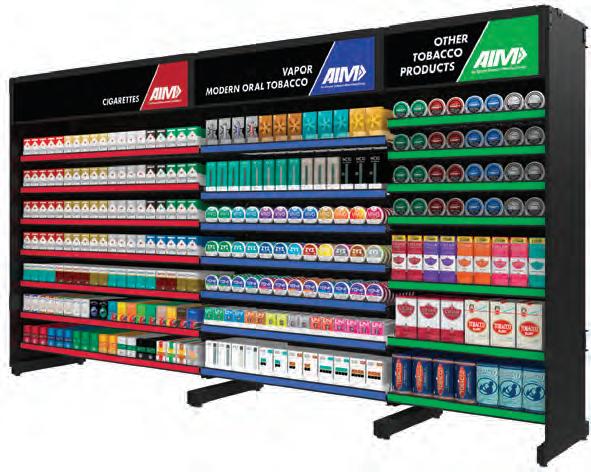
Spitless tobacco drove the positive 13.4% sales growth for the smokeless category, notching a 29.1% rise in dollars and a 25.2% increase in units. Snuff dollar sales remained relatively flat, while chewing tobacco and chewing tobacco alternatives showed declines.
Source: Circana total U.S. convenience data for the 52 weeks ending Dec. 28, 2025
pouches. Retailers should be wary and working with reputable distributors so they don’t get counterfeit product.”
2025Review: Overall, the smokeless tobacco element gave up market share to modern oral last year. Per Circana, snuff lost 6.45 of dollar share, but remains No. 2 in the segment. Chewing tobacco pretty much maintained its position, but dollar share pales in comparison to spitless. However, Bumgarner sees a benefit of consumers combining nicotine purchases.
“We had more poly-use, traditional smokeless users also purchasing NMO products than in previous years,” he explained. “Also, due to strong multipack offers, traditional smokeless products were up slightly for us in 2025.” 2026Outlook: Most industry watchers anticipate a similar environment for chewing tobacco and snuff throughout
the rest of this year. Of course, new state and local regulations may hamper sales for this and other segments within the tobacco/nicotine category. For example, on Jan. 1, Washington state enacted a new excise tax of 95% of wholesale price on the sale of tobacco/nicotine products, which ties it with Minnesota as one of the highest state rates, per the National Association of Tobacco Outlets.
2025Review: This time last year, there was plenty of uncertainty on how tariffs would affect cigar imports. Looking back, imports of premium brands actually increased for at least the first half of the year, reported Cigar Aficionado.
“Tariffs did impact certain imported cigar products, but the overall effect was less disruptive than many initially projected. Our scale and long-standing supplier relationships allowed us to mitigate cost pressures through advance
purchasing, strategic sourcing and thoughtful assortment adjustments,” said Jeremy Weiner, category director of cigars and premium products for Smoker Friendly. The Colorado-based company is part of the family of stores owned by The Cigarette Store Group, which includes Tobacco Depot, Smoke ‘N Go, Havana Manor and Gasamat retailers.
But high-end cigars represent a small portion of the subcategory sold in convenience stores. Rather, massproduced cigars and cigarillos, or small cigars, combine for almost 95% of dollar share in the c-store channel, per Circana, and each classification experienced downturns. Little cigars registered the biggest falloff: almost 24% in dollar sales and more than a one-third drop in units.
“Cigarillos remain one of the most regulation-sensitive product lines I manage. Flavor bans — particularly at the state and local level — have reduced availability in certain markets,
Large mass cigars slowed by 6.2% in units in 2025, holding steady in dollars. Premium and little cigars showed steeper drops, although they hold lesser category share.
Source: Circana total U.S. convenience data for the 52 weeks ending Dec. 28, 2025















Source: Circana total U.S. convenience data for the 52 weeks ending Dec. 28, 2025
but consumer demand has not disappeared,” said Weiner. “Where flavored products are permitted, cigarillos continue to perform well and drive traffic, especially among valueconscious adult consumers.”
2026Outlook: Like so many products, cigars are competing with the popularity of pouches. Weiner anticipates adjusting backbars to accommodate the current status of consumer preferences. And of course, he’s waiting for FDA and state
lawmakers’ decisions on possible further flavor restrictions.
“The growing patchwork of regulations remains one of the biggest challenges for retailers, as it directly impacts assortment planning and in-store execution. Our focus is on staying proactive — working closely with our compliance teams, suppliers and operations partners to ensure Smoker Friendly remains agile, compliant and well positioned to serve adult consumers,” he said.
TOBACCO ACCESSORIES: HOLDING GROUND
2025Review: Tobacco accessories added nearly $585 million to the c-store channel last year. Cigar accessories, according to Circana, led in dollar sales with gains of approximately 18% and an almost 10% jump in unit sales.
“While still a relatively small segment, accessories — particularly wraps — have shown steady growth and increasing consumer interest,” Bortner noted.



Cigar accessories jumped up in sales in 2025 by 17.9%, up by 9.6% in units. AO accessories, which fell by 34% in units, only dipped 2.2% in dollars due to a 48.3% increase in price per unit.
2026Outlook: Most category managers don’t expect this sector to pick up much steam but hope customers find the convenience of c-stores stocking lighters, papers and other accessories worthwhile, even if the prices keep inching upward.
“This category often flies under the radar, but maintaining a thoughtful, curated assortment is important. A broad selection isn’t necessary, but having a presence in this space is essential to avoid missed opportunities,” advised Bortner.
2025Review: According to Circana data, cannabidiol (CBD) sales in c-stores grew by more than 11%, but specific product options had varying results.
Last year, consumers gravitated toward carbonated beverages, alcohol, cocktail mixes, hard seltzers and cigarettes containing cannabidiol elements. Sleeping aids, smokeless tobacco, tobacco accessories and vitamins each slipped in dollar sales.
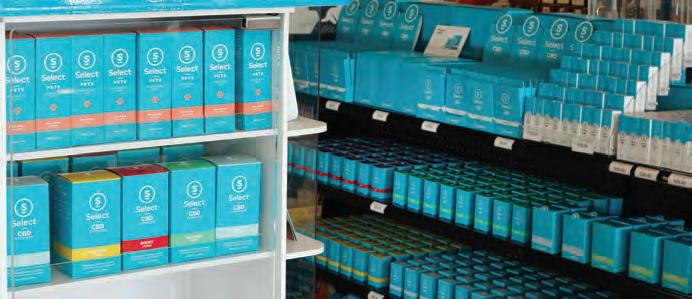
CBD sales increased by 11.4% in dollars and 27% in units. Price per unit dropped by 12.3%.
2026Outlook: Thanks to language in the Continuing Resolution and Appropriations (CR) bill passed last November, manufacturers may have to reformulate their CBD products by this coming November. The change in the law states hemp products must be defined by total tetrahydrocannabinol (THC) rather than exclusively by delta-9 THC, which has been identified as the primary psychoactive agent in cannabis.
“We’re working (with lawmakers) to try to get clarity and seek more reasonable limits on THC content or to get a delay of the effective date to give the time needed to work out the right way to regulate products,” said NACS’ Kantor.
Prior to the CR passage, Bettencourt contemplated adding a variety of CBD/ hemp options to stores, but for now, she’s holding off until further clarification.
“I feel like it’s a viable market as a whole, but the government needs to revisit it,” she said. “Stores will have to change their assortment and bring in what is allowed, but not necessarily what the customer wants, if this goes into effect.”
While certain product lines within tobacco/nicotine likely will continue to feel the effects of encroaching regulations, the category remains a top producer for c-stores, totaling over $74.3 billion in 2025. CBD added another $45.8 million. Keeping tabs on developing trends allows stores to focus on satisfying customer demand and experience, thereby evolving the category. CSD
1839 cigarettes are made from the finest flue-cured tobacco to deliver the flavor and value your budgetminded consumers crave. Available in a variety of styles to satisfy every taste.



Shoppers are opting for trial-sized products and those with functional and wellness-boosting properties while showing signs of being both value conscious and brand focused on different items.
Britt Engler • Editorial Assistant
C-STORE HEALTH AND BEAUTY AID
(HBA) shoppers are gravitating toward products that promote overall body care and improved wellness in 2026.
Customers are drawn to convenient, immediate-use products, said Nathan Arnold, director of marketing for Englefield Inc., operating 119 Duchess c-stores in Ohio and West Virginia. “Whether it’s allergy, pain reliever, other medication or personal care products, sales in this subset are increasing.”
Arnold also noticed more manufacturers launching products with energy and protein-boosting benefits. “Customers are looking for these enhancements not only in traditional food or beverage items, but in supplements, vitamin packs and wellness shots.”
Meanwhile, at Army & Air Force Exchange Service (AAFES), “body care, sun care, men’s grooming and Korean beauty (segments) are showing strong
momentum,” said Kye Corn, divisional merchandise manager of AAFES, which operates over 350 c-stores worldwide.
Unit sales of facial cosmetics soared 1,343.6% in c-stores following a 58.5% plunge in price per unit in 2025, per research firm Circana, while hair conditioners saw a 9.9% increase in unit sales amid a price drop of 12.7% — signals shoppers are responding to value-driven offerings. AAFES saw this trend firsthand with hair care products. At the same time, shoppers are proving they’re willing to pay more for trusted brands and functional benefits. Vitamins totaled $881 million in sales and grew 14.6% in units, despite an 11.1% jump in price for the same period, per Circana. Dollar sales for weight-control products rose 13.6%, with units up 8.6%, paired with a 4.6% uptick in price.
Facial cosmetics saw a 1,343.6% increase in unit sales following a 58.5% drop in price, while lip cosmetics rose 130.3% in unit sales despite a 5.3% price jump. Vitamins and weight-control products saw unit sales bumps of 14.6% and 8.6%, respectively, despite price hikes.
“Customers have resonated toward the name-brand items over any cost savings they may receive for a generic,” said Arnold. As a result, Duchess stores are adding more brand-name products while removing generic items in 2026.
AAFES has noticed a similar trend, particularly when it comes to over-thecounter medications, which remain a key segment of the category. “Shoppers want trusted, quality brands that are recognizable and reliable,” Corn said.
Trial-sized items continue to perform well. At Duchess they now account for 48% of category sales. The chain has expanded its selection and sees a demand to further increase it. “Store locations are paramount to the success,” Arnold said. “Locations near hotels, interstates, campgrounds or other travel and tourism locations makes this category stronger.”
“Travel-sized products that are portable and affordable continue to perform well,” agreed Corn. Over the last year, AAFES “...expanded its core personal care categories, such as shampoo and conditioner, deodorant, and oral care, to offer more premium and clean-label options in smaller formats.”
Corn anticipates gradual sales increases for the HBA category overall in 2026, especially for both body care and health-related products. “Health care, oral care and shaving perform the strongest for health and beauty care in Exchange Express stores.”
Arnold sees the HBA category as “pretty steady” with year-over-year sales “generally flat.”
“While within the category there are some products with good growth, the category overall tends to be consistent,” he said. CSD
Source: Circana total U.S. convenience data for the 52 weeks ending Dec. 28, 2025
Reframe provides premium, alcohol-free cannabis spirits crafted from organic, hemp-derived tetrahydrocannabinol (THC). The brand recently introduced its Reframe Minis, which are twoounce bottles with ten milligrams of THC per serving. Available flavors include Citrus, Tropical and Mixed Berry. The brand emphasizes clean ingredients, meaning no artificial dyes or flavors, and the brand prides itself on providing fun without a hangover and encourages its customers to “Rethink Your Drink.”
Reframe www.drinkreframe.com
Altria Group Distribution/Marlboro 2 877.968.5323
Calico Brands, Inc. 52 800.544.4837 / www.calicobrands.com
Candy Dynamics’ Slime Licker brand welcomed its Slime Licker Spray to its lineup of products, offering shoppers an alternative experience to their candy consumption. The Slime Licker Spray comes in 12-packs for display, with each individual spray bottle available in 0.95 fluid ounces. This product has a recommended price of $2.49, and available flavors are Blue Raspberry and Strawberry.
Candy Dynamics www.toxicwastecandy.com
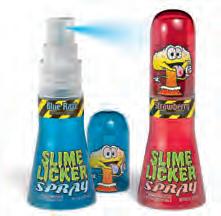
The Alpha Grill is a clamshell grill engineered to simplify how burgers are cooked in quick-service restaurant kitchens. Alpha Grill combines advanced robotics, artificial intelligence and smart cooking technology to deliver performance at scale. This product features a dual-sided griddle system — cooking up to eight patties at once or 200 patties per hour. Once the patties are placed on the griddle, they are automatically lifted and pressed against the heated top griddle, ensuring fast, even searing on both sides. Once fully cooked, the patties are automatically lifted and transferred to a warming tray ready to be assembled.
Aniai Inc. www.aniai.ai
C-store retailers can elevate their merchandising skillset with tips such as setting benchmarks for new items and recognizing where to be flexible.
Emily Boes • Senior Editor
AS C-STORE RETAILERS ROTATE new products, new flavors and new formats in and out of their shelf space, it’s important to hone the skillset needed to effectively merchandise their inventory, particularly within categories rampant with innovation. To learn a few strategies to keep in mind, CStore Decisions spoke with Louis Leandre, category manager for Kayrouz Petroleum, which operates 10 stores in Massachusetts and Connecticut.
{CStore Decisions (CSD)} What top three merchandising strategies do you swear by?
{Louis Leandre (LL)} Put high-margin and high-velocity items at a high level or to the left or the right of an item that is moving very well. Move slow-movers up from a bottom shelf to a high level, or on the top shelf, and then rotate the hero SKUs and put them in a strike zone. These are the three merchandising strategies that I personally swear by.
{CSD} What’s your first move when a product isn’t doing that well?
{LL} I move it next to a light product at a high-level strike zone. If it continues to not do well, I could jump the price or put it on a weekly merchandising cycle to give the product a chance to be seen or for customers to be able to buy it
at a lower price. And if it continues (to perform poorly), then the rest of it is just, “Get it out.”
{CSD} How do you incorporate seasonal merchandise?
{LL} I would have an endcap that would have all my seasonal items. If I have, let’s say, a display, a shipper, that would contain seasonal merchandise, it would be grouped next to that endcap for customers to be able to know that is where you go in that particular store for (seasonal products).
{CSD} What does success look like in the first 30-60 days for a new item?
{LL} In our business, trial plus velocity equals demand. You have the trial, then you have to work for the velocity. The velocity is a consistent weekly movement that you look for. … Sometimes you can establish a benchmark for that item, saying, “Hey, I want to make sure that I sell 10 a day.” So that will be your benchmark. Then you can calculate your velocity: repeat purchases, healthy gross margin, minimum markdowns or writeoffs or damage. And one of the things that I’ve been saying for years, every time you see a product that does not have time to let the dust settle, that is a product that is moving.

{CSD} What advice would you give to operators with limited space?
{LL} Avoid duplicates. … Get rid of slow movers, because they’re not paying for the real estate that they’re sitting on. Let velocity pick your assortment. Don’t be stubborn and say, “Oh no, I like this product. I want to sell it.” Let the velocity, let sales, make that decision for you. In our business, the top 20% of our SKUs get 70-75% of the facings. So, if you let velocity do the job, you will get the top 20% of the SKUs to get 70-75% of the facings, and this is how you’re going to see big sales dollars.
{CSD} With which categories can you be most flexible, and which do you have locked in?
{LL} The categories that are very flexible are in the center of the store; we’re talking about candy, gum, and salty and sweet snacks. When you look at these four categories, although they have their core items within them, these are the items that I’m usually very flexible with, because every three months there are a slew of these items that come out. Then you want to try them, you want to place them in there to see how they’re going to do. These items, if they don’t do good, then we get rid of them. And if they do good, then they end up getting a home.