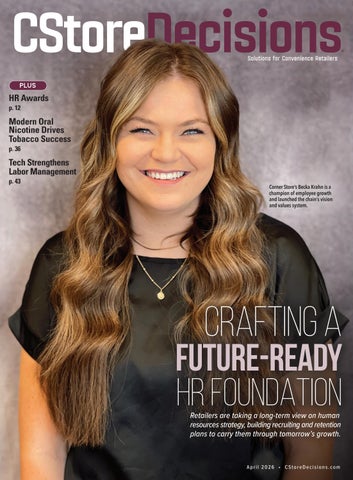

Corner Store’s
is a champion of employee growth and launched the chain’s vision and values system.
![]()


Corner Store’s
is a champion of employee growth and launched the chain’s vision and values system.
Retailers are taking a long-term view on human resources strategy, building recruiting and retention plans to carry them through tomorrow’s growth.


www.cstoredecisions.com


EDITORIAL
VP EDITORIAL — FOOD, RETAIL & HOSPITALITY
Danny Klein dklein@wtwhmedia.com
EDITOR-IN-CHIEF
Erin Del Conte edelconte@wtwhmedia.com
SENIOR EDITOR
Emily Boes eboes@wtwhmedia.com
ASSOCIATE EDITOR Kevin McIntyre kmcintyre@wtwhmedia.com
EDITORIAL ASSISTANT Britt Engler bengler@wtwhmedia.com
EDITOR EMERITUS John Lofstock
COLUMNIST
Lorissa Martin
CONTENT STUDIO
VP, CONTENT STUDIO Peggy Carouthers pcarouthers@wtwhmedia.com
WRITER, CONTENT STUDIO Ya’el McLoud ymcloud@wtwhmedia.com
WRITER, CONTENT STUDIO Drew Filipski dfilipski@wtwhmedia.com
SALES TEAM
SENIOR VP OF SALES & STRATEGY Matt Waddell mwaddell@wtwhmedia.com (774) 871-0067
KEY ACCOUNT MANAGER John Petersen jpetersen@wtwhmedia.com (216) 346-8790
SALES DIRECTOR
Patrick McIntyre pmcintyre@wtwhmedia.com (216) 372-8112
SALES DIRECTOR Mike Peck mpeck@wtwhmedia.com (917) 941-1883
NATIONAL SALES DIRECTOR Amber Dobsovic adobsovic@wtwhmedia.com (757) 637.8673
ACCOUNT MANAGER Tanner Hartwick thartwick@wtwhmedia.com (571) 596-0375
PORTFOLIO MARKETING MANAGER Jane Cooper jcooper@wtwhmedia.com
CREATIVE SERVICES VP, CREATIVE DIRECTOR Matthew Claney mclaney@wtwhmedia.com
CREATIVE DIRECTOR Erin Canetta ecanetta@wtwhmedia.com
WTWH MEDIA, LLC 1111 Superior Ave. Suite 1120 Cleveland, OH 44114 Ph: 888-543-2447
SUBSCRIPTION INQUIRIES:


LEADERSHIP
CHIEF EXECUTIVE OFFICER Matt Logan mlogan@wtwhmedia.com
CHIEF OPERATIONS OFFICER George Yedinak gyedinak@wtwhmedia.com
CHIEF REVENUE OFFICER Scott Kelliher skelliher@wtwhmedia.com
VP OF MARKETING Annie Wissner awissner@wtwhmedia.com
SENIOR VP, AUDIENCE GROWTH Greg Sanders gsanders@wtwhmedia.com
EVENTS VP, EVENTS Deena Rubin drubin@wtwhmedia.com
DIRECTOR OF EVENTS Cassidy Doller cdollar@wtwhmedia.com
EVENT MARKETING SPECIALIST Emma Paul epaul@wtwhmedia.com
EVENTS MANAGER Jeannette Hummitsch jhummitsch@wtwhmedia.com


recognition of editorial excellence.
EDITORIAL ADVISORY BOARD
Nate Brazier, CEO
Stinker Stores • Boise, Idaho
Robert Buhler, President and CEO
Open Pantry Food Marts • Pleasant Prairie, Wis.
Herb Hargraves, Chief Operating Officer
Sprint Mart • Ridgeland, Miss.
Bill Kent, Chairman and CEO
The Kent Cos. Inc. • Midland, Texas
Nick Triantafellou, Director of Marketing & Merchandising
Weigel’s Inc. • Knoxville, Tenn.
Dyson Williams, Vice President Dandy Mini Marts. • Sayre, Pa.
NATIONAL ADVISORY GROUP (NAG) BOARD (RETAILERS)
Greg Ehrlich, (Board Chairman) President
Beck Suppliers Inc. • Fremont, Ohio
Joy Almekies, Senior Director of Food Services
Global Partners • Waltham, Mass.
Jeff Carpenter, Director of Education and Training
Cliff’s Local Market • Marcy, N.Y.
Richard Cashion, Chief Operating Officer
Curby’s Express Market • Lubbock, Texas
Ryan Faville, Director of Purchasing
Stewart’s Shops Corp. • Saratoga Springs, N.Y.
Cole Fountain, Senior Director of Merchandising
Gate Petroleum Co. • Jacksonville, Fla.
Kalen Frese, Director of Merchandising
Warrenton Oil Inc. • Warrenton, Mo.
Joe Hamza, Chief Operating Officer
Nouria Energy Corp. • Worcester, Mass.


To manage current print subscription or for a new subscription: https://cstoredecisions.com/cstore-decisions-subscriptions/
SUBSCRIPTIONS: Qualified U.S. subscribers receive CStore Decisions at no charge. For others, the cost is $80 a year in the U.S. and Possessions, $95 in Canada, and $150 in all other countries. Single copies are available at $9 each in the U.S. and Possessions, $10 each in Canada and $13 in all other countries.
CStore Decisions (ISSN 1054-7797) USPS Publication #5978 is published monthly by WTWH Media, LLC., 1111 Superior Ave., Suite 1120, Cleveland, OH 44114, for petroleum company and convenience store operators, owners, managers.
Periodicals postage paid at Cleveland, OH, and additional mailing offices.
POSTMASTER: Send address changes to CStore Decisions, 1111 Superior Avenue, Suite 1120, Cleveland, OH 44114. GST #R126431964, Canadian Publication Sales Agreement No: #40026880.
CSTORE DECISIONS does not endorse any products, programs or services of advertisers or editorial contributors.
Copyright© 2026 by WTWH Media, LLC. No part of this publication may be reproduced in any form or by any means, electronic or mechanical, or by recording, or by any information storage or retrieval system, without written permission from the publisher.
Beth Hoffer, Vice President
Weigel’s • Powell, Tenn.
David Land II, Director of Marketing
The Kent Cos. Inc. • Midland, Texas
Brent Mouton, President and CEO
Hit-N-Run Food Stores • Lafayette, La.
Lenny Smith, Vice President
Crosby’s • Lockport, N.Y.
Dyson Williams, Vice President
Dandy Mini Marts • Sayre, Pa.
Hussein Yatim, Vice President
YATCO • Marlborough, Mass.
Vernon Young, President and CEO
Young Oil Co. • Piedmont, Ala.
Supplier Members
Kyle May, Director External Relations
Reynolds Marketing Services Co. • Winston-Salem, N.C.
Todd Verhoven, Vice President of Sales
Hunt Brothers Pizza • Nashville, Tenn.
Steve Yawn, Director of Sales
McLane Company Inc. • Temple, Texas


THIS MONTH MARKS MY 17TH WORK ANNIVERSARY with CStore Decisions. I never imagined I’d spend this much of my career at one publication, but as many of us in this industry understand, the convenience store world has a way of pulling you in and holding on tight. It’s the down-to-earth people, authentic relationships and the constant industry evolution that has helped keep my interest for well over a decade.
Before I started writing about c-stores, I covered topics like muffins and inclusions for a baking magazine, and after a while, there were only so many ways to write about muffin trends. But 17 years into my c-store writing career, I can honestly say the same can’t be said for this industry. Every article topic, podcast interview and event panel still feels different, fresh and engaging. That’s a testament to just how much change and innovation convenience stores navigate year after year. Even after all this time, I’m still learning and still finding new angles to explore. Over the years, I’ve also watched the way c-stores’ approach to hiring and retention has and continues to evolve.
While convenience stores are usually associated with high turnover, I’m continually struck by how many retailers have team members who’ve been with them for decades, sometimes 25 years or more. Retailers today are taking retention plans seriously as seen in our human resources (HR) cover story on p. 22. In fact, thanks to an increased focus on retention, more retailers are reporting decreases in turnover at their chains. Looking ahead to tomorrow, retailers are laying the groundwork now for a strong culture and HR strategy that can grow with them as they expand.
As Renzo Bassanini, SVP of HR at Parker’s Kitchen, pointed out in this month’s cover story, “The focus in 2026 isn’t just staffing — it’s building an infrastructure that supports growth without compromising culture.”
Also in this issue, we explore how technology is influencing HR practices (p. 43) and how retailers are approaching foodservice training (p. 32). Our HR Awards on p. 12 highlight two HR executives who are standing out for their contributions at convenience stores. I hope this issue spurs ideas for how you can elevate your chain’s HR strategy in the coming year.
If you’re focused on labor management in 2026, you’ll want to check out the upcoming CStore Connections conference, set for April 19-21 in Jacksonville, Fla., which has several sessions that cover leadership and culture. Nate Brazier, CEO of Stinker Stores, CStore Decisions’ 2025 Chain of the Year, is scheduled to give a keynote on “Owning Your Culture: Why Great Companies Don’t Leave It to Chance.” Breakout sessions include topics like “Leadership in a Changing Retail Landscape” and “Strengthening Teams: Talent Retention & Leadership Development.” And, we have burning-issue exchanges where retailers come together to discuss challenges and solutions around hot topics, including “Succession Planning for Leadership Teams,” “Mentorship Matters: How to Find — and Become — a Great Mentor” and “Labor Crisis Strategies: Hiring, Retention & Workforce Optimization.” The event also includes ample sessions on technology, foodservice, merchandising and more. I hope you can join us. View the agenda and register at CStoreConnections.com.


Successful employers understand the ability and confidence level of their employees as well as how best to provide for their greatest workplace needs.
As of November 2025, 51% of employees in the U.S. are watching for or actively seeking a new job, the same as one year prior and up from 48% in November 2023.
Source: Gallup, “Employee Retention & Attraction,” February 2026

Nearly nine in 10 managers are confident in their abilities, and over eight in 10 believe they have necessary leadership skills, according to CivicScience data. Less than two-thirds of employees believe their manager to be effective, however.

Source: CivicScience, “Pulse of the U.S. Workforce Report Insights: Activating Managers and Untapped Leaders for the Future of Work,” November 2025
When asked to indicate how important each of the following is when considering whether or not to take a job with a different organization, respondents noted the percentage of very important for each is:
The top hardest-working cities in the U.S., according to WalletHub, are, in order:
1. Cheyenne, Wyo
2. Anchorage, Alaska
3. Washington, D.C.
4. Sioux Falls, S.D.
5. Irving, Texas
Source: WalletHub, “Hardest-Working Cities in America (2026),” February 2026
The top five states with the happiest employees, based on income growth, work hours, and time available for personal life after work and sleep, among other factors, are:
1. Hawaii
2. Delaware
3. Maine
4. South Dakota
5. Connecticut
Source: Wave Connect, “States Where American Employees Are Happiest,” December 2025
Source: Gallup, “Employee Retention & Attraction,” February 2026


Keep lines moving and keep flavor options wide open with Texas Pete ® portion-control packets. Built for fast-paced C-store foodservice, these single-serve packets deliver bold, restaurant-born flavor with clean, no-mess execution. With five bold flavors to choose from, Texas Pete ® lets customers customize their food while operators maintain speed, consistency, and portion control.


Ideal for roller grills, grab-and-go meals, and made-to-order favorites.


AT THE UPCOMING CSTORE CONNECTIONS conference, set for April 19-21 in Jacksonville, Fla., c-store veteran Doug Galli, of The Reid Group dba Crosby’s, will be honored with the Lifetime Award for Convenience Retailing, the event’s exclusive lifetime achievement award.
Galli, who is retiring this year from The Reid Group after more than 20 years with the company, has devoted his extensive retail career to elevating the c-store industry and has a long history of giving back to the retail community through service on industry boards, including the National Advisory Group (NAG).
Galli joined the NAG board of directors in 2017 and served as chairman of the board from 2019 to 2021. The NAG
The industry veteran has spent over 50 years in the c-store industry and will receive the Lifetime Award for Convenience Retailing at the 2026 CStore Connections conference in Jacksonville, Fla.
Erin Del Conte • Editor-in-Chief
conference changed its name to CStore Connections in 2025, but it remains the signature event for small, mid-sized, family-owned and regional chains. And it continues the original NAG mission of providing industry retail leaders a peerto-peer forum for the exchange of ideas
to improve their business performance. As a member of the NAG Board, Galli used his extensive industry experience to help the board identify burning issues for upcoming conferences, selecting speakers and serving as an ambassador for new and existing attendees.
Throughout his tenure in the c-store industry, Galli has been known as a tireless advocate for the retail community, and his leadership and insight have guided peerto-peer learning and strategic initiatives.
Throughout his tenure in the c-store industry, Galli has been known as a tireless advocate for the retail community, and his leadership and insight have guided peer-to-peer learning and strategic initiatives. His commitment, vision and dedication make him an influential figure in the c-store community, and this honor reflects the profound impact he has had on both his colleagues and the industry at large.
Galli has been with The Reid Group, parent company of Crosby’s, since 2004. Prior to that, he spent 29 years with Tops Markets/Wilson Farms having worked in both the supermarket and convenience store division. He served on the board of the New York Association of Convenience Stores (NYACS) and is a past chairman of the state association. He also served for 15 years on his local school board.
A lifelong New Yorker (and Yankees fan), Galli was born and raised in
Liverpool, N.Y., a suburb of Syracuse, and currently resides in Amherst, N.Y., outside of Buffalo. He has been married for 51 years to Karen, and the couple has three daughters and four grandchildren. Galli is an avid runner with numerous marathons under his belt.
Galli will accept the Lifetime Award for Convenience Retailing during the closing reception of the CStore Connections conference on the evening of April 21. He is joining an elite list of c-store veterans who have been awarded this exclusive and distinguished honor.
2015 David Johnson - Vice President of Operations, Toot’n Totum Food Stores
2016 Bill Weigel - Chairman and CEO, Weigel’s Inc.
Mary Banmiller - Director of Retail and Hotel Operations, Warrenton Oil
Peter Tamburro - General Manager, Cliff’s Local Markets
View the agenda for the CStore Connections conference at CStoreConnections.com/ agenda and register for the event https://wtwh.me/ConnectionsRegister.


Becka Krahn helped establish the mission of Corner Store while encouraging employee growth.
Emily Boes • Senior Editor
KNOWN AS THE “HR Department of One” at Texas-based four-store chain Corner Store, Becka Krahn has played an integral role in defining the mission of the company. She led the charge to create concrete goals and a vision under which the chain has since thrived, providing a steady backbone that has united the stores and employees.
She also coaches store managers and provides a space for Corner Store employees to discuss their problems and successes, something for which the smaller size of the chain has been distinctively ideal.
To acknowledge these achievements and more, CStore Decisions is recognizing Krahn with an HR Award.
Krahn began her career with Corner Store nearly five years ago. She started as a part-time weekend cashier, a role she held for seven months.
“And then (Bobby Teichroeb, owner of Corner Store) approached me the first time, and he’s like, ‘Hey, we’re about to open our third store. Would you be interested in taking on the management position?’” said Krahn.
Krahn declined, unsure about managing a 24-hour store and having recently returned to the credit union where she worked previously.
A few weeks later, Teichroeb approached her again, this time for HR, as he intended to develop a corporate

setting as the chain grew.
Krahn had never taken on a role like this in the past, so again, she hesitated.
“But we live in a small town, and everyone knows everyone, and my dad and Bobby had worked together for a long time, and so he was very familiar with our family. And he’s just like, ‘I’ve known you for a long time. I know this is something that you would be good at.’ And he really reassured me that I would get the training that I needed, but he just would love for me to be on his team,” said Krahn.
After consideration, she took the job, noting it was a good decision and she’s glad she made it.
A few weeks into her new position, she attended her first industry conference (NAG, now CStore Connections). Heading to her first-ever conference felt overwhelming at the time. Now, she’s grateful to have stepped out of her comfort zone; in the years since, she’s had the opportunity to network with many others and learn from them.
“And it’s been great. I love it. Now, looking back, I’m glad I stayed persistent and I followed through with it, because it’s crazy how things have changed in four years. I’m just glad to be here. I love it,” she said.
The first major project Krahn started was creating Corner Store’s core values. When she first signed on to HR, the company operated without a mission statement or handbook. She knew, however, that establishing these was crucial to the

Becka Krahn helped develop Corner Store’s mission and values, one of her biggest accomplishments to date in her role with human resources. Establishing these shifted how the stores operate in a positive manner.


future of the chain.
“Bobby and I, we sat down and we got really intentional about who we are and what we do, and I will forever be proud that I was able to play such a huge role in not only bringing those factors to life but also being able to coach our leadership through them,” said Krahn.
Teichroeb recognized the shift in how the stores operate due to the new values and acknowledged their necessity, a great compliment to Krahn.
“It’s become a really big part of who we are and why we do what we do. It didn’t exist, and over the last four years, it’s come to life, and it’s flourished, and I got to play a part in that,” said Krahn.
Since her start with HR, Krahn has made the job her own. She onboards employees, heads monthly leadership meetings with management staff, manages benefits enrollments and offers employee manager coaching.
“And then anything in between that comes up, really. I am always hands on and troubleshooting,” she added. Her favorite aspect of the job is interacting with employees and knowing that her role allows her to have a positive impact on others. The stores are near each other, and with only four, it’s been easy for Krahn to step into the stores and form a personal relationship with each of them.

She’s been able to guide store managers, helping them grow into their roles, and as most were promoted from within, she’s had the opportunity to actively watch their progress.
“I know I’ve had a few incidences where they’ll come to my office and they have a situation that’s going on that’s heavy for them, or they’re overwhelmed, and then they’ll leave my office with this newfound confidence, and they’re relieved. And I just love those moments, because I made a difference, and I was able to help them. I live for moments like that,” Krahn said.
Still, Krahn recognizes that HR often has a negative connotation, believing it to be a notable challenge for those in the field. Not everyone is comfortable speaking with their HR manager or director, and Krahn, having been a store employee as well as in an HR role, understands the perception of the department from both standpoints.
“I’ve made it my personal goal to just make sure that our employees see that I’m available and that I want to help them. I’ve never forced myself, but when they see me having these conversations and being able to problem solve and help people out, they’re more open to (seeing), ‘Oh, she’s not this scary lady. She has a job to do, and it’s not always fun, but at the same time, she’s also here to help us,’” said Krahn. CSD


Caroline Grubbs strategically progresses RaceTrac’s integration, culture and leadership development goals.
Emily Boes • Senior Editor
GRUBBS
WORKED with RaceTrac for over a decade, and in that time, she has established herself as an essential component of the chain’s operational success. From human resources (HR) intern to executive director, people & culture, Grubbs was instrumental in evolving the chain’s HR Business Partner to a more strategic model and rolling out an enterprise-wide Employee Value Proposition.
Grubbs’ level of impact scales across the chain’s 610 RaceTrac, 240 RaceWay and 1,160 Gulf locations.
She oversees learning and development, talent acquisition, employee experience and the HR Business Partner organization, ensuring they operate as one integrated people strategy.
For her dedicated work and accomplishments, Grubbs is recognized with a CStore Decisions HR Award.
When Grubbs first started her career with RaceTrac as an HR intern, she focused on evaluating the talent and performance processes and looking for a system that could automate that work.
“That experience gave me a frontrow seat to how the entire HR function operates and the systems that connect it all. It was great hands-on exposure to how people strategy drives business outcomes,” said Grubbs.
When her internship completed, she obtained a full-time role within talent
management, and in the 14 years since, she’s been able to intentionally broaden her scope and work across multiple areas of HR as the organization has grown.
“What started as a focus on talent systems has led to my current role (with many stops along the way) as executive director, people & culture, focusing on workforce strategy, organizational design and shaping how HR enables enterprise growth,” she said.
In this role, she wears many hats.
Grubbs is responsible for building a function that delivers quality talent at scale, focusing on how RaceTrac attracts, assesses and hires while strengthening partnership with business leaders. She is
also focused on capability building and ensuring the company is equipping leaders and front-line teams with the skills, clarity and performance frameworks they need to execute.
Additionally, her role entails looking at the entire team member lifecycle and ensuring that from onboarding to recognition to listening strategies, RaceTrac’s value proposition is real, measurable and consistently delivered. And, she manages the HR Business Partner, whose functions serve as the connective tissue and translate enterprise strategy into action within the business, advising leaders on organizational design, talent decisions and workforce planning.


Caroline Grubbs, executive director, people & culture, RaceTrac, is responsible for aligning talent, capability, culture and structure so the business can grow without outpacing its people systems.

“Ultimately, my responsibility is to align talent, capability, culture and structure so the business can grow without outpacing its people systems,” she said.
Grubbs has noticed during her time with RaceTrac that her work is tangible and directly connected to business performance. She enjoys that aspect, noting that growth, operational strength and profitability all hinge on the people, from hires and team structure to leadership development and how performance is reinforced.
“If done right, HR anticipates workforce needs, strengthens leadership capability and builds systems that allow the business to scale. That level of impact is what makes the role meaningful and what I like the most,” she said.
During her tenure, Grubbs has had the chance to be involved in multiple HR projects and initiatives. Evolving to a more strategic HR Business Partner model stands out.
“As the company scaled, it became clear that traditional HR support wasn’t enough. We needed HR leaders embedded in the business who could think beyond transactions and operate as advisors,” she said.
HR leaders needed to understand the
chain’s business strategies and challenges and offer solutions to drive those initiatives forward.
“It positioned HR as a thought partner, not only a service function. It has been great to see the adoption and impact of shifting to this model,” she added.
Grubbs also helped define and roll out the chain’s Employee Value Proposition. RaceTrac formalized what it stood for as an employer and how that appears across the employee lifecycle, rather than allow culture and experience to be merely implied.
“We are continuing to align recruiting, onboarding, development, rewards and listening strategies so that what we promise is actually what employees experience. It is leading to clarity internally and continued differentiation externally,” Grubbs said.
Recently, RaceTrac acquired Potbelly, and in 2026, it’s continuing to integrate the restaurant into the c-store chain’s broader enterprise.
“From an HR perspective, integration is about aligning culture, leadership expectations, talent processes and employee experience while respecting the strengths that make each brand successful,” said Grubbs.
Caroline Grubbs’ role entails looking at the entire team member lifecycle and ensuring that from onboarding to recognition to listening strategies, RaceTrac’s value proposition is real, measurable and consistently delivered.
With Potbelly’s integration, Grubbs is focusing on creating consistency where it drives scale while maintaining the operational flexibility each brand needs to win in its market.
As she sets her sights on this goal, she’s also working to combat modern HR challenges.
For example, workforce expectations around flexibility, career mobility, personalization and purpose are evolving. Grubbs noted discipline and clarity are required to successfully meet these new expectations. Economic pressure is also real, she commented, as HR leaders are asked to differentiate their employment brand and strengthen engagement while managing costs.
Also, from a technology standpoint, HR leaders are tasked with finding opportunity with tools such as data analytics and automation.
“Ultimately, the biggest challenge is that HR must operate proactively,” she revealed.
Grubbs’ approach to HR is shaped by a performance-driven and operationally focused culture.
“We must build people strategies that are practical in a front-line retail setting, developing leaders who can translate strategy into results and maintaining clear standards as we scale,” she said.
Watching these leaders realize the scale of their influence has been one of Grubbs’ defining moments.
“In 2023, we hosted our first-ever general manager summit where 600-plus leaders came together, and we were able to reinforce their role in driving strategy, developing their teams and create a sense of ownership. It’s rewarding to me to see us equip leaders with the right tools and perspective, and that in turn cascades through teams and creates a ripple effect,” she said. CSD


Nate Brazier is a dynamic and people-first executive with over 20 years of experience in the retail and convenience store industry. Known for his ability to inspire and mobilize high-performing teams, Nate is passionate about creating exceptional experiences for both employees and customers. His leadership style blends strategic clarity with a deep commitment to culture, empowerment, and operational excellence.
Nate currently serves as President and CEO of Stinker Stores, where he leads with a purpose-driven mindset: to make the world a better place—one employee, one customer, and one community at a time. Under his leadership, Stinker operates 105 stores across Idaho, Colorado, and Wyoming, serving thousands of customers daily and standing out as a “Bright Spot” in the lives it touches.

Nate Brazier
President and CEO
Stinker Stores

19-21, 2026
SUNDAY, APRIL 19
12:00pm – 6:30pm Registration
1:00pm – 4:00pm Store Tours
5:00pm – 6:30pm Welcome Reception
MONDAY, APRIL 20
8:00am – 9:00am Breakfast
9:00am – 9:45am GENERAL SESSION #1
AI at Work: Transforming the Future of the Convenience Store
Artificial Intelligence is no longer a futuristic concept—it’s here and already reshaping the convenience retail landscape. In this eyeopening session, discover how AI is being used by forward-thinking c-store operators to enhance foodservice operations, streamline labor management, and solve everyday business challenges. You’ll learn the steps you should be taking now to lay the groundwork for tomorrow.
Erin Del Conte (moderator) | CStore Decisions
Michael Salafia | Re-up
Sorin Hilgen | EG America
Mike Wilson | Cubby’s Inc.
Scott Smith | Parker’s Kitchen
9:45am – 10:30am
GENERAL SESSION #2
Optimizing the Kitchen: Boosting Foodservice Profitability While Managing Costs
In a competitive convenience retail landscape, a profitable foodservice program can be a game-changer — but only if costs are kept in check. This session dives into practical, high-impact strategies to manage and reduce foodservice expenses without sacrificing quality or customer satisfaction. Join us as we explore strategies for keeping costs down. This session will touch on effective pricing, efficient inventory management, commissary and self-distribution models, and maximizing labor efficiency. Learn how reducing food waste, leveraging local sourcing and integrating the right technology solutions can drive bottom-line results.
Jac Moskalik (moderator) | Global Partners
Jeremy Haack | Kwik Trip
Mario Spina | Parent Petroleum Inc.
Beth Hoffer | Weigel’s
10:30am – 11:00am Networking Break
11:00am – 12:00pm
Burning Issues Exchange - Round #1
Choose from
• Balancing Tech With Customer Experiences
• Investing in Food Programs
• Labor Crisis Strategies: Hiring, Retention & Workforce Optimization
• What’s Your Strategy for CBD, THC and Functional Beverages
12:00pm – 1:00pm Lunch
1:00pm – 1:45pm Breakouts - Round #1
Choose from
• Merchandising Mastery: Elevate Your InStore Experience
• Loyalty Reimagined
• Leadership in a Changing Retail Landscape


2:00pm – 3:00pm Burning Issues Exchange - Round #2
Choose from
• Balancing Tech With Customer Experiences
• Investing in Food Programs
• Labor Crisis Strategies: Hiring, Retention & Workforce Optimization
3:00pm – 3:30pm Networking Break
3:30pm – 4:15pm Retail Leaders Exchange
All retail attendees are pre-assigned to a discussion group with non-competing chains.. No sponsors are permitted to attend.
4:30pm – 5:15pm KEYNOTE SESSION
Owning Your Culture: Why Great Companies Don’t Leave It To Chance
Nate Brazier, CEO of Stinker Stores, CStore Decisions’ 2025 Chain of the Year award winner, shares an inspiring keynote on the power of company culture. Discover how a strong, values-driven culture can drive performance, attract top talent and foster innovation — and learn firsthand how Brazier has strategically shaped a thriving culture at Stinker Stores, a 105-store chain with locations in Idaho, Wyoming and Colorado, in a relatively short time. Every organization has a culture — whether it’s intentionally developed or passively formed. If you’re not actively investing in it, you’re relinquishing control over what it becomes. In this keynote, Brazier shares why culture isn’t just a “nice to have” — it’s a strategic advantage — and how leaders can create a thriving, engaged organization from the inside out.
Nate Brazier | Stinker Stores
5:15pm – 6:00pm Cocktail Reception
8:30pm – 10:30pm Social Networking

TUESDAY, APRIL 21
8:00am – 9:00am Breakfast
9:00am – 9:45am
GENERAL SESSION #4
CStore Strategies in the Face of Changing Competition
As top-quartile chains expand outside their traditional operating areas, small and midsized regional chains are having to adapt to heightened competition. Retailers discuss how they’re staying competitive, from maximizing store profitability and leaning into the advantages that come with being mid-sized to adding vertical integration.
Erin Del Conte (moderator) | CStore Decisions
David Barkett | Triumph Energy
Glennie Cox Bench | Southwest Georgia Oil Company, Inc.
Joe Hamza | Nouria Energy Corp.
9:45am – 10:30am
GENERAL SESSION #5
The Future of Convenience & How to Future-Proof Your Chain
Change is coming fast — and the most successful convenience store operators will be those who prepare for it now. In this forward-looking session, we’ll explore the key trends, technologies, and consumer behaviors reshaping the convenience retail landscape — and how you can adapt to stay ahead.
Greg Ehrlich (moderator) | Beck Suppliers Inc.
Jared Scheeler | The Hub Convenience Stores
Brian Unrue | Clark’s Pump-n-Shop
Pervez Pir | Loop Neighborhood
10:30am – 11:00am Networking Break
11:00am – 12:00pm
Burning Issues Exchange - Round #3
Choose from
• Order Ahead, Delivery & Data: Driving Foodservice Growth in the Digital Age
• Navigating M&A: Integration Challenges, Culture Building
• Succession Planning for Leadership Teams
• Mentorship Matters: How to Find — and Become — a Great Mentor
12:00pm – 1:00pm Lunch
1:00pm – 1:45pm
Breakouts - Round #2
Choose from
• Strengthening Teams: Talent Retention & Leadership Development
• Serving Up Success: Marketing Strategies for Foodservice Growth
• The Power of Private Label
2:00pm – 3:00pm
Burning Issues Exchange - Round #4
Choose from
• Order Ahead, Delivery & Data: Driving Foodservice Growth in the Digital Age
• Navigating M&A: Integration Challenges, Culture Building
• Succession Planning for Leadership Teams
• Mentorship Matters: How to Find — and Become — a Great Mentor
3:00pm – 3:30pm Networking Break
3:30pm – 4:00pm
GENERAL SESSION #6
Taking It Home: Lessons, Takeaways & Next Steps
In this closing session, participants will come together for an open group discussion to reflect on the key insights, experiences and lessons learned throughout the week. This is a chance to share personal takeaways, exchange ideas with peers and identify actionable steps to bring back home. Whether it’s a new strategy, a shift in mindset or a fresh connection, this session will help translate learning into meaningful action.
Let’s talk about what’s resonated most — and how you plan to put it into practice.
Erin Del Conte (moderator) | CStore Decisions
Greg Ehrlich (moderator) | Beck Suppliers Inc.
4:15pm – 5:00pm Board Meeting


6:00pm – 8:00pm
Closing Reception & 40 Under 40 Celebration
Retailers are taking a long-term view on human resources strategy, building recruiting and retention plans to carry them through tomorrow’s growth.
Erin Del Conte • Editor-in-Chief

IN 2026, C-STORE RETAILERS are facing an intensely competitive labor market for front-line employees, making the hiring and retention of top talent increasingly challenging.
Amid this heightened competition, operators are focused on finding the most effective ways to attract and retain high-quality employees. Many operators are recognizing that short-term hiring tactics are no longer enough and are instead turning their attention to ensuring they have a strong, scalable foundation for their culture and human resources (HR) strategy that will serve them in the long-term as their business expands.
“The focus in 2026 isn’t just staffing — it’s building an infrastructure that supports growth without compromising culture,” said Renzo Bassanini, SVP of HR at Parker’s Kitchen, which operates 100-plus stores in Georgia and South Carolina.
Part of creating that infrastructure requires added emphasis on retaining employees over just acquiring new hires. “Organizations are investing more in internal mobility and development. People getting into our industry are not as abundant as in previous years,” Bassanini pointed out. C-store chains are likewise prioritizing what Bassanini called “leadership depth,” or having a pipeline of employees preparing for leadership roles.


“As companies grow, the pressure to build succession benches beneath high-level leadership positions is real,” he said.
Retailers are also integrating technology into their HR practices. Artificial intelligence (AI) is a major trend that’s only just starting to impact HR management practices at c-stores.

“We’re just beginning to fathom the ways our environment and the way we do business will change in the coming years,” said Lesley Segadelli, VP – people & culture, Stinker Stores, which operates 92 locations in Idaho, Colorado and Wyoming. “This is simultaneously the most innovative technology has ever been but as outdated as it will ever be. We’re really trying to balance ways to incorporate AI where it makes sense, not just for cool factor.”
Stinker is exploring ways that AI can support its marketing team with design concepts and to analyze large data sets to improve data quality.
“Where I’m deliberately cautious is in areas like recruiting. Until I’m confident that screening and selection AI tools can meet compliance, fairness and consistency standards, we’ll continue to review applications the traditional way,” Segadelli said. “I want to make sure any AI we adopt enhances our integrity or improves efficiency without introducing risk.”
Bassanini concurred. “AI and automation are improving speed in recruiting, but they require strong governance and human oversight. Things are too loose right now,” he said.
Bassanini also observed that HR compliance is becoming more complex for retailers. “Multistate employers are navigating wage, leave and healthcare regulations that continue to evolve,” he noted.
And then there are evolving employee expectations that savvy retailers are working to meet. “Team members want clarity around career paths, schedule flexibility and competitive value propositions, not just wages,” Bassanini advised.
Employee expectations now also encompass meaningful support for mental health and overall well-being. “I think employee mental health, wellness and staying in front of burnout will continue to be an important issue to stay in front of for 2026,” said Segadelli. Stinker Stores, CStore Decisions’ 2025 Chain of the Year, prioritizes creating a people-first culture, and that commitment extends to employee well-being.
“People are navigating more stress and complexity in their lives than ever before. We want to make sure our employees know that we care about them,” Segadelli said. “Life happens, and if we can help navigate that with them or be the reason they have one less thing to worry about then I’m all in for that.”
Also on Segadelli’s radar for 2026 is developing career planning for employees.
“How do we create paths for people to make Stinker their career instead of just a job?” she proposed. “Identifying potential, bringing some intentionality to development opportunities and stretching people through opportunities to be the best version of themselves at work are all things we’re working on. Today’s workforce expects employers to invest in them and when we do, loyalty and engagement follow naturally.” Stinker is leveraging its HR information system to initiate conversations around career planning, goals, performance and recognition so it can best respond to changing expectations.
Retailers across the board agreed that staffing remains highly competitive in 2026. On the bright side, “… it’s not as volatile as it was in 2021–2022,” Bassanini said. “I would describe 2026 as disciplined competition rather than a crisis.” While openings can be filled, he noted that speed and candidate experience matters, and the employer’s brand matters more than ever.
“Organizations that rely solely on posting and waiting are struggling,” Bassanini said. “Those that treat recruiting as a marketing function are doing better.”
Segadelli has seen the job market shift in the last one to two years. “Stinker is seeing an uptick in applications, but that hasn’t translated to an increase in qualified candidates for non-entry level positions,” she noted.


allowing it to be more selective. “We are more intentional with the hiring process to ensure we get the right person for the right position,” explained Kelly Bowling, director of HR for Weigel’s, which operates 89 c-stores in Tennessee.
At Spinx, with 107 stores in North Carolina and South Carolina, applicant flow has followed the same trends as previous years, with high competition as foodservice, quick-service restaurants (QSR) and retail industries vie for candidates from the same labor pool, explained Melody Rampey, director of people and culture, The Spinx Co. “Staffing continues to be a challenge, particularly for overnight shifts, high-volume locations and rural markets,” she said.
“Our time to fill runs about 18 days on average for retail openings, but we are okay with that. We’ve encouraged our leaders to make smart hiring decisions over fast hiring decisions. We’ve shifted the focus to quality of hire, and we see the results in our retention.”
Across the country in Tennessee, Weigel’s is also seeing an increase in the talent pool available,
Entering the c-store marketplace in today’s competitive landscape isn’t for the faint of heart. Inconvenience Inc., which operates Gas Spot and Good Spot stores, was founded in February 2024, and its first remodeled site opened its doors in September 2024, so it’s relatively new to the c-store industry.
“We can’t speak to 2026 yet, but in 2025, we were brand new in all our markets, and it was difficult bringing (employees) into a new business and finding the right people to represent our brand,” explained Cailyn Hanson, retail manager for Inconvenience Inc., which operates 20 stores in Iowa, Missouri and Arkansas, with five more set to open.
In 2026, retailers agreed that having a clear recruiting strategy is crucial, but what works can vary between regions and chains with common tactics including word of mouth, brand differentiation, community outreach, social media and job board outreach, and employee referrals, among others.
As the new chain on the block, Gas Spot and Good Spot

stores are opening applications earlier in new markets, “because being a new business with no brand awareness made recruiting hard in 2025,” Hanson said. To combat the challenge, InConvenience Inc. has relied on people in the local communities to help spread the word about the business and the brand. The brand plans to continue to rely on this word-of-mouth approach to help boost applicants moving forward.
InConvenience Inc., founded in 2024, relies on word-of-mouth tactics to attract applicants for its Gas Spot and Good Spot stores, an approach that has helped spread the word about the newer chain. The company also makes a point to recognize employees by listening to their feedback and featuring an employee of the month.

Stinker is focused on uncovering the key differentiators that influence a customer’s decision to choose the brand. “We’ve had to think differently about how to compete with not just other c-store chains, but QSRs, grocery stores and every other job in our salary point. When everyone out there offers the same pay, schedules, benefits, etc., we’ve chosen to differentiate through our culture and brand,” Segadelli said. “We are uniquely Stinker, and we are building a culture where people want to live the ‘Stinker Life.’” To that end, the chain has added elements of its unique brand into its job descriptions to make sure potential employees are a good fit with the chain’s fun-loving culture.
Spinx reaches prospective employees via social media, employee referrals and hiring events. While the chain hasn’t changed anything about its strategy for 2026, it is continuing to track what works best, Rampey said.
Meanwhile, Weigel’s is getting out into the community to continue to boost the talent pool. “We moved from recruiters working applications in the office to going out in the field to recruit, visit colleges, the Chamber of Commerce, churches, competitors and small box retail,” Bowling said.
Parker’s approach centers around three pillars. “1.) Speed and simplicity — We’ve streamlined application processes and
shortened time-to-offer cycles. 2.) Technology plus human touch — We leverage AI-enabled sourcing tools, but we still emphasize recruiter engagement and relationship building. 3.) Internal mobility — We actively promote from within, which strengthens retention and reduces external dependency,” Bassanini explained. “A continued challenge is candidate reliability and availability, particularly in hourly roles. We mitigate that by building talent pools in advance of openings.”
Overall, retailers reported that turnover decreased in 2025. Bassanini noted that where Parker’s has observed improvements in turnover, it is largely attributed to clearer expectations at hire, better


front-line leadership development, structured onboarding and stronger communication around career progression.
“Retention is rarely solved with pay alone,” Bassanini pointed out. “It’s heavily influenced by manager capability and workplace culture.”
In 2026, Parker’s retention strategy is focused on offering leadership training at multiple levels, defining career pathways for employees, creating performance accountability frameworks, offering a competitive and responsible “total rewards design,” and providing an open communication culture, Bassanini explained. “What’s changed recently is a stronger emphasis on internal certification and development infrastructure. We’re building depth beneath high-level leadership positions to ensure scalability,” he said. “The biggest challenge remains consistency, ensuring that leadership quality is uniform across all locations.”
Stinker has also employed a multifaceted approach to retention, and the results speak for themselves.
“We’ve been able to see a consistent downtrend in our turnover the last few years, finishing 2025 at 83%,” said Segadelli. “Leadership skills training for our store managers, centralizing our recruiting and hiring process to the Skunk Den (headquarters) rather than at our stores, and creating new hire training programs that set our teams up for success are just some of the biggest contributors to that number.”
Spinx also saw a reduction in overall turnover over the past
year. “We attribute this to our investment on hiring right the first time, leadership and career development, and living out our core values,” Rampey said.
To hire right, the chain has invested in training its recruiters and hiring managers on best practices to ensure they’re bringing in the best candidate. Its leadership and career development opportunities for field staff include “a structured program for (an) internal pipeline in store operations,” Rampey said.
Weigel’s attributed its decrease in turnover last year to its HR, training and operations departments working together to ensure Weigel’s is an employer of choice. The chain has restructured its compensation model to ensure it aligns with performance and growth.
“Our recruiters are doing a 90 (day) check-in with all new hires to ensure they have/are receiving the tools to succeed,” Bowling added.
Inconvenience Inc. noted it hasn’t been in business long enough to determine turnover trends at this point. “We attribute last year’s turnover to competitive wages and resistance to the policies and procedures of our new business. Overall, we trended under the industry average for turnover, and we’re proud of that,” said Rachel Kemph, director, retail and lease administration, Inconvenience Inc.
When it comes to retaining workers, Hanson noted the chain believes strongly in the importance of recognizing employees. “Without our employees, we just simply wouldn’t be here. We
1839 cigarettes are made from the finest flue-cured tobacco to deliver the flavor and value your budgetminded consumers crave. Available in a variety of styles to satisfy every taste.


From competitive pay to above-minimum incentives, here’s how convenience store chains are approaching wages in 2026.
Erin Del Conte • Editor-in-Chief
WHILE WAGES ARE NOT the only thing employees are seeking from employers today — after all, culture, benefits and career path are high on workers’ list of demands in 2026 — competitive pay is increasingly important in today’s labor environment. This is especially true as prices continue to rise and paychecks don’t go as far as they did only a couple of years ago.
As a result, many retailers report that labor costs are growing, both because they’re working to incentivize employees with proactive wage hikes and because of an influx of minimum wage legislation.
While the federal minimum wage has held steady at $7.25 per hour since July 24, 2009, at the state level, the minimum wage has continued to climb for much of the country. According to the National Conference of State Legislatures, 34 states, territories and districts have minimum wages higher than the federal minimum. Meanwhile, five states — Alabama, Louisiana, Mississippi, South Carolina and Tennessee — don’t have a state minimum wage, while Georgia, Oklahoma and Wyoming have a minimum wage below $7.25 per hour. In these states, the federal minimum wage generally applies.
In 2026, a whopping 19 states instituted minimum wage increases on Jan. 1, including Arizona, California, Colorado, Connecticut, Hawaii, Maine, Michigan, Minnesota, Missouri, Montana, Nebraska, New Jersey, New York, Ohio, Rhode Island, South Dakota, Vermont, Virginia and Washington. Washington has the

highest minimum wage at $17.13 per hour, while Connecticut ($16.94), California ($16.90) and New York ($16) are close behind. New York City’s minimum wage has increased to $17.
And, more states are set to experience wage upticks later in the year. Alaska, Oregon and Washington, D.C., are set to see minimum wage increases in July, while Florida’s minimum wage will rise to $15 on Sept. 30.
With many c-store retailers operating across several states, wage changes can bring added levels of complication.
Stinker Stores, which operates 92 stores in Idaho, Wyoming and Colorado, was impacted by the Colorado hike.
“Where we see minimum wage increases consistently is in Colorado overall and Denver locally. Just since I started with Stinker in 2021, Denver has gone from a $14.77 per hour minimum to $19.29 per hour this January,” said Lesley Segadelli, VP – people & culture, Stinker. “There is definitely a snowball effect, and we try to manage compression very thoughtfully and strategically to address compression as rates come up. At the end of the day, that is just the cost of doing business in that market. We know that our labor numbers are going to look different in Denver than they are going to look in Casper, Wyo., or even Boise, Idaho.”
InConvenience Inc., which operates 20 Good Spot and Gas Spot stores in Iowa, Missouri and Arkansas, was impacted by the minimum wage hike in Missouri where the wage went from $13.75 to $15 in 2026. The chain is managing the increase by operating
efficiently across the business.
“As a new company, we have worked hard to save where we can. Doing weekly sales data analysis with district managers and our corporate team has built awareness of all the costs that come at the store level, but it’s a work in progress,” noted Rachel Kemph, director, retail and lease administration, Inconvenience Inc.
With 89 stores in Tennessee, Weigel’s hasn’t seen a recent increase in minimum wage in its operating area, given that it’s located in a state that adheres to the federal minimum wage, but the chain stays competitive by remaining well above the minimum, explained Kelly Bowling, director of HR for Weigel’s.
Similarly, Parker’s Kitchen, which operates 100-plus stores in Georgia and South Carolina, takes a proactive stance on wages. “Our approach is not to anchor pay solely to the legal minimum,” noted Renzo Bassanini, SVP of human resources at Parker’s.
Instead, Parker’s evaluates wages based on the competitiveness in a given market and long-term sustainability. “Increases in wage floors require thoughtful balancing, ensuring we remain competitive while protecting operating margins,” he explained.
When Parker’s considers its wage strategy, it looks beyond just the base pay to also consider incentive structures, benefits value, development opportunities and ensuring scheduling is stable.
“Wage strategy today is less about reacting and more about forecasting,” Bassanini said. “Predictability and alignment with long-term growth plans are critical.”
Stinker Stores has made a deliberate, conscious effort to increase communication between the leadership team and employees. One of its most successful launches has been its monthly leadership and development call, known as “Refocus and Refuel.”
want our employees to feel seen and heard, so we take in their feedback,” Hanson said. “We’ve added a monthly employee newsletter that highlights employee words of wisdom along with an employee-of-the-month spotlight in the newsletter and on social media.”
As competition for employees continues, cstore retailers aren’t waiting around for things to improve. Instead, they’re upgrading their approach to ensure they remain employers of choice.

Weigel’s realized that while it had been holding store leaders accountable for turnover, some didn’t fully understand what turnover entailed in terms of the overall cost to the chain and employee morale. Weigel’s responded by developing a recruiting and retention class for all store leaders. All managers have also attended Myers Briggs and Situational Leadership classes taught by Weigel’s Director of Training and Development Brad Anderson. The chain is teaching its managers that employees have different personalities and therefore receive feedback differently. “Next, we are rolling out Radical Candor,” Bowling said, which she described as “the sweet spot of giving feedback that is both kind and clear, specific and sincere, to help (employees) improve.”
Over the past year, Parker’s has expanded its structured leadership development programs, enhanced performance dialogue training and added technology enhancements in recruiting and onboarding. “These programs are performing well in terms of internal promotions and leadership readiness. Our focus has been sustainability rather than quick wins,” Bassanini noted.
At Stinker, transparency and communication have been major areas of focus for the chain over the past year. “We weren’t doing a poor job before, but as a leadership team, we challenged ourselves to take a deeper look at how information was being communicated and whether it was reaching the right people in the right way,” Segadelli said. “We’ve made a deliberate shift toward more proactive, consistent communication, always explaining the ‘why’ behind initiatives, decisions and changes.”
One of Stinker’s most successful launches has been its monthly leadership and development call, known as “Refocus and Refuel.” “It gives our Stinker leaders real-time visibility into updates, results and progress on key priorities,” she noted.
“More importantly, it creates an open forum where anyone can ask questions directly to the leadership team.”
Engagement in the Refocus and Refuel calls has been strong. “It’s been a meaningful step forward in building connection and trust across the organization,” Segadelli said.
In 2026, Stinker is set to roll out a touchpoint performance feature designed to encourage leaders to give real-time feedback to employees.
“This will integrate into their formalized performance evaluations at the end of the year. It isn’t just about the feedback though, it’s about creating a space for store employees and their leaders to come together and have a dialogue,” Segadelli said. “The ultimate goal is to create a culture driven by honest communication and feedback. I’d love to see formalized evaluations disappear completely at some point in the future because we’ve perfected real-time performance feedback.”
Segadelli is thankful that Stinker sees the value in giving HR a seat at the table. “Knowing that people are the heart of what we do every day, I love that this is a company that truly treats my amazing people team as the trusted advisors they are and not just a tactical resource to hire, fire, (etc.),” she said. “We’ve been able to build a true partnership between HR and operations, and you see the return on investment of that commitment in our retention numbers. …”
Bassanini noted that for him, the biggest lesson of 2026 is that HR is no longer just a support function but a growth enabler. “Organizations that treat talent strategy as a core business strategy are outperforming those that treat it as an administrative function. Scalable culture is the real competitive advantage.” CSD
FOR YEARS, CONVENIENCE STORES WERE DEFINED by fuel, fountain drinks, and cigarettes. Today, the fastestgrowing operators are redefining themselves around foodservice. Still, hesitation lingers. C-store operators don’t hesitate because they hate profit. They hesitate because hot food feels too daunting: more labor, more complexity, more ways to disappoint customers.
Chris Schulz, vice president of U.S. Field—East for Krispy Krunchy Chicken®, has heard every version of that concern over his 14 years in the business, and he’s blunt about what’s really happening.
“C-store operators are not traditionally in the food business,” Schulz says. “But we’re getting them in as they seek new ways to positively impact their bottom line.” Krispy Krunchy is built as a system, not a “good luck” recipe. Most resistance comes down to four persistent myths—none of which reflect what is happening in stores today.
The first: hot food requires chefs. While most c-stores don’t have dedicated kitchen staff, Schulz says that’s not a dealbreaker—it’s a design constraint solved with structure. “We’ve taken employees from gas pumps and trained them how to run a kitchen,” he says. “We have step-by-step systems and processes and follow a checklist.” Timers, rotation guides, prep charts, and defined duties create repeatable execution, whether a store has one employee or ten.
The second myth is that chicken slows service. Operators worry about bottlenecks during peak hours, but Schulz says execution should be proactive, not reactive. Product is batch-

The truth about unlocking a new revenue stream and increasing profitability.

cooked to match traffic patterns, staged in the hot case, boxed quickly, and handed off at the counter. “The person working the register and lottery can also serve the chicken while a dedicated team member runs the cook cycle in the back,” Schulz says. “When it’s run correctly, operators should be able to serve customers within a minute.”
Then there’s the myth that you’re in this alone. Instead, Schulz outlines a structured rollout: readiness inspections, on-site setup, and a five-day ramp to independence. “We get stores open and running in five days,” he says. A two-week follow-up corrects shortcuts before they become habits, followed by regular 30-day visits and retraining as needed.
Finally, the myth that hot food isn’t profitable enough. If an operator says the program isn’t profitable, Schulz says we nearly always identify execution gaps, such as closing the case too early, giving away too many sauce cups, heavyhanded portioning, or mismanaging dayparts. “We can tell when there’s something broken somewhere,” he says. In one reset, correcting those inefficiencies saved a store more than $1,000 per month.
Beyond item-level margins, transaction-level debit and credit card data comparing c-stores before and after adding Krispy Krunchy Chicken to similar control stores in the same time periods shows foot traffic typically climbs 10–12 percent, with overall merchandising sales up 15–20 percent. For operators still hesitant, Schulz keeps it real: “Risk aversion will keep your store behind. Don’t avoid it. When executed right, the upside is fantastic. Krispy Krunchy ensures operators win.”
-By Drew Filipski


Hands-on training, a focus on food safety and reducing complexity can help c-store retailers raise the bar on their foodservice programs.
Britt Engler • Editorial Assistant
CONVENIENCE STORES have increasingly focused on foodservice as customer demand for delicious, quick food options continues to grow. Transitioning from a traditional retail mindset to a highperforming food operation requires an essential shift in training techniques and safety procedures.
Experts and retailers agree that the difference between a profitable program and a struggling one often comes down to how well team members understand brand processes and the confidence leadership can instill in its employees.
One of the most common shortcomings in modern foodservice is unnecessary complexity. Jeff Keune, founder and principal consultant at 4910 Consulting Inc. and a former retailer who helped develop successful foodservice programs for Yesway, Thorntons and others, noted many retailers neglect to consider the changing nature of labor when designing their menus. “Great food does not always mean it needs to be complicated,” explained Keune. He emphasized that managing the number of steps and the breadth of the menu limits mistakes that can ultimately damage a store’s reputation.
This sentiment is reflected by Jessica Russell, food service director at Clark’s Pump-N-Shop, which operates 64 locations across Kentucky, Ohio and West Virginia. Several years ago, Russell made the strategic decision to scale back the chain’s offerings to ensure the team remained engaged with specific brand partners.
“We want to be best known for quality, not quantity,” said Russell. “The broader the options, the more difficult it is to maintain a strong, well-trained operation with minimal overhead.”
When rolling out new items or limitedtime offers (LTO), successful retailers often look for “like items” that can be produced with existing equipment and ingredients. At Clark’s, LTOs typically highlight existing menu items with “a little dazzle,” such as a new sauce for a pizza or chicken
tender. Similarly, Angelle Cloud, foodservice compliance director and dietitian for Shop Rite/Tobacco Plus, which operates 60 locations in Louisiana, noted the chain often uses current menu items as specials to build on existing sales and familiarity.
Although digital tools have their place, industry leaders overwhelmingly agree that hands-on training remains the gold standard for foodservice. “I have always been a huge fan of hands-on training,” said Cloud. “There are just some things that come up in conversation and through watching techniques that we may have missed or weren’t explained well in the instruction manuals.” For Cloud, seeing an employee prepare a menu item is the only way to truly test their knowledge.
Shop Rite uses a multitiered approach to training, ensuring visual aids and indepth resources for processes are thoroughly introduced to the team.
“The binders contain each item, ingredients needed, steps to follow and all information needed for sale,” explained Cloud. “Our signage is segregated into item categories and uses color to list all ingredients and amounts needed for each item.”
In addition to resources and hands-on training, managers and shift leads are responsible for confirming their team’s understanding and knowledge. “Training isn’t just about food performance; it’s about employee confidence,” said Cloud. “You are creating your own team, your next leaders and the face of your company.”
At Clark’s Pump-N-Shop, the approach is equally direct: “We see it, and we correct it immediately,” shared Russell. If a location experiences high turnover, Clark’s leverages its brand partners to send in a team for “top to bottom training,” essentially treating the store like a new grand opening.


A major mistake in many operations is training only a select few foodservice experts. Keune argued that “best-inclass” training in 2026 must be holistic. “It is important that there are not just certain team members taking care of the foodservice platform, but everyone can jump in and execute at all dayparts.” This ensures that, whether a customer visits during the breakfast rush or late at night, the quality remains consistent.
This culture of support is vital during peak periods. Shop Rite relies on a philosophy of “aces in their places.” “If our new employee does not have a team to back them, then they are already set up for failure,” said Cloud. Associates are encouraged to lean on veteran team members to ensure customer experience isn’t sacrificed for speed. Clark’s supports its teams during these highvolume times by using scan data to create expectation charts, allowing staff to prepare in advance.
How do you know if the training is working? For Russell, the answer lies in a blend of internal audits and third-party brand inspections. Brand representatives

Shop Rite/Tobacco Plus uses a multitiered approach to training, ensuring visual aids and in-depth resources for processes are thoroughly introduced to the team. Associates are encouraged to lean on veteran team members to ensure customer experience isn’t sacrificed for speed.
visit Clark’s locations at least once a quarter to review essential points and retrain on the spot if necessary. “Visits are unannounced to the staff, as we hope we are ready at all times,” she said. Any concerns identified in these audits are typically addressed within 24 hours.
At Shop Rite, feedback is more localized but equally rigorous. Leadership determines who has mastered the foodservice lessons and which employees need additional training, as foodservice performance is commonly tied to employee confidence. Cloud also pays attention to customer feedback, whether it’s through surveys, Google reviews, social media chatter or in-person chats. If a customer notices an item looks different than the day before, it signals a training gap that needs to be addressed immediately.
Food safety needs to be a top priority for any foodservice operator and a core part of employee training.
“Do not shortcut procedures. Do not sugarcoat anything when it comes to food safety,” Russell said.
Taking time to ensure accuracy in all operations will show up positively through the guest experience and the
bottom line. As retailers explore their food offerings, it’s vital to “know your menu, have set expectations, and put it all into words that can be shared easily across the board,” said Cloud. Training should not be viewed as a checklist; it’s an ongoing investment that reflects a company’s values, mission and goals. As Cloud put it, “A confident associate is exactly who I want to be on my team and leading the kitchen when I’m not there.” By prioritizing simplicity, hands-on engagement and total team involvement, c-store retailers can ensure their foodservice programs aren’t just an offering but a profitable, high-performing core of their business. CSD
• Unnecessary menu complexity can negatively impact quality and consistency.
• Hands-on learning, cross training and measuring results are key in today’s labor management environment.
• Food safety should be a top priority and a core element of any foodservice training plan.


The tobacco category is evolving past traditional cigarettes and into alternative offerings as spitless products drive sales during a period of shifting consumer behavior.
Kevin McIntyre Associate Editor
THE TOBACCO LANDSCAPE in the c-store industry has seen countless changes over the past several years, from shifting consumer behavior to rising costs, increased regulation and the growth of new tobacco segments. To combat this volatility, retailers will need to keep a keen eye on the category and their customers to ensure they are offering the products and accessories that customers are demanding at the right price point.
In 2026, the tobacco customer is discerning. With inflation continuing to apply pressure to consumers’ wallets, the value proposition has never been more important. Combined with a strategic and optimized backbar, there is significant upside potential for the category moving forward, especially with tobacco brands that are typically considered “non-premium.”
“Tobacco consumers tend to be price conscious,” said David Spross, executive director for the National Association of Tobacco Outlets (NATO). “Therefore, inflation continues having an impact as some will down-trade to nonpremium products.”
This perception has led tobacco consumers to shift their purchasing behavior, opting for new and unique products that can be offered for a lower price. Backbars, as a result, have become more expansive as retailers adapt to the wide range of products consumers are demanding.
GAME® LEAF GIVES CUSTOMERS WHAT THEY WANT
In 2015 Game Leaf was introduced as part of the Garcia y Vega portfolio of cigars, revolutionizing the Rolled Leaf cigar category. Now, as part of our 10th anniversary celebration, we’re reintroducing Game Leaf with colorful, eye-catching, consumer-tested 3-cigar packaging designed to bring Rolled Leaf customers more of what they want.
AVAILABLE AT 3 FOR $2.19 TRIAL PRICING AND SAVE ON 3


3 REASONS FOR 3-PACK SALES


In 2024, the 3-pack was the only Rolled Leaf format to show volume growth, along with a 5.7% increase in share of the market.
While all other Rolled Leaf formats showed velocity declines in 2024, the velocity for 3-packs rose by 15%.
Rolled Leaf 3-packs were added to shelves in over 9,700 c-stores in 2024, an 11% increase in store count over 2023.


3 REASONS TO GO WITH GAME LEAF


Game Leaf is able to build on the tremendous brand equity of Game, the #1 selling Natural Leaf cigar in the US.
Game Leaf’s commitment to quality and stringent quality standards—from broadleaf crop selection through manufacturing—ensure the best quality Rolled Leaf cigar available.
Consumers equate the Game Leaf brand with the Garcia y Vega tradition of quality and craftsmanship, as Garcia y Vega has been making Natural Leaf cigars since 1882.
Vaping accessories notched a notable 26.1% increase in dollar sales, boosted by a price per unit increase of 30.6%. .
Source: Circana total U.S. convenience data for the 52 weeks ending Feb. 22, 2026
“The tobacco and nicotine category continues to evolve to where many adult consumers are ‘poly-users,’ meaning that they use many different types of products depending on the situation,” said Spross.
The tobacco customer in 2026, Spross continued, is more accurately described as a nicotine consumer. Historically, convenience store retailers have seen consistent success with traditional cigarette offerings, but today, nicotine is the main
focus for customers, with “many (consumers) using different products such as vapor products and nicotine pouches” in addition to cigarettes.
Sean Bumgarner, VP of Scrivener Oil Co., which operates 12 Signal c-stores across southwest Missouri, has seen similar changes over the past several years.
“The biggest thing is that customers aren’t sticking to just one product anymore,” said Bumgarner. “We’re seeing

a lot of poly-use, where a customer who usually buys traditional smokeless tobacco is now grabbing a pack of nicotine pouches at the same time. Also, if there isn’t a multipack deal, they’re looking for the cheapest option on the shelf.”
At Signal, tobacco is still a dominating force when it comes to total in-store sales. The retailer is continuing to leverage its expansive backbar to appeal to as many poly-use customers as possible.
“The tobacco category is still a huge deal for us,” Bumgarner continued. “It is one of the main reasons people walk through the door. The big change is what they’re buying. It used to be all about premium cigarettes, but now we’re leaning way more on budget smokes and nicotine pouches to keep the numbers up.”
Any c-store retailer who has been paying attention to industry tobacco trends knows that modern oral nicotine is a segment that continues to grow exponentially as consumers lean away from combustible tobacco products.
Spitless tobacco sales alone, according to the most recent available data from Circana, a Chicago-based research advisory firm, increased by over 31% for the 52 weeks ending Feb. 22, accounting for more than $6.8 billion in annual sales.
The smokeless tobacco category at

Cigarette unit sales took a 6.1% hit, while smokeless notched an uptick of 11.5%.
Source: Circana total U.S. convenience data for the 52 weeks ending Feb. 22, 2026
large brought in nearly $13 billion for the c-store channel, with the bulk coming from spitless and snuff, the latter seeing nearly $6 billion in annual dollar sales.
Unsurprisingly, cigarette sales still make up the bulk of purchases, accounting for over $50 billion in dollar sales. Unit sales for the segment, however, decreased by 6.1% for the period, as opposed to smokeless tobacco, which saw a jump of 11.5%.
“Cigarettes are expected to decline by recent levels of approximately 6-8% on an annual basis,” said Spross. “Many adult consumers have migrated away from traditional cigarettes to non-combustible products such as vapor products and nicotine pouches.”
At Signal, keen trend observation and adaptability have allowed the retailer to double down on value to keep cigarette sales in a healthy range.
“(The tobacco category) is a bit of a mixed bag,” said Bumgarner. “Our cigarette sales have seen double-digit growth since we dropped the Every Day Low Price program last year, however, all that growth is coming from the cheap, fourth-tier brands. People are looking for value. On the flip side, modern oral nicotine is performing very well and showing impressive growth.”
This growth on the retailer side matches Spross’ insights, noting that the modern oral nicotine segment “continues to see substantial growth year over year. These products provide a safer alternative to smoking, while also providing
nicotine in a ‘cleaner’ spitless format.”
Bumgarner sees modern oral nicotine as the “clear winner” of the tobacco and nicotine backbar in 2026.
“Five years ago, it was all about having every brand of cigarettes available and a good front-line price on them,” he said. “We don’t need every single cigarette SKU anymore. We need Marlboros, a cheap option and good ‘two for’ prices, and loyalty offers.”
As convenience operators continue to build out their backbars with new, relevant and, crucially, value-conscious offerings, regulation is always a concern. Shakeups at the Food and Drug Administration (FDA) could change the way the agency approaches its regulation efforts going forward.

“With new leadership at the FDA’s Center for Tobacco Products now in their roles for a year, I would expect more action, including increased enforcement against illicit products and more pre-market tobacco product application (PMTA) decisions to occur in 2026,” said Spross.
In March, the FDA released draft guidance titled “Flavored Electronic Nicotine Delivery Systems (ENDS) Premarket Applications – Considerations Related to Youth Risk,” which outlines how the FDA plans to evaluate PMTAs for flavored vaping products.
“When reviewing flavored ENDS PMTAs, the FDA will be weighing the applicant’s: evidence of potential benefit of the flavored product for adult smokers in switching behavior or significant reduction in tobacco use; scientifically valid evidence characterizing the relative appeal of their proposed flavored ENDS among youth; and proposed marketing restrictions and other mitigation efforts to reduce the risk of youth initiation and use of tobacco products, including advertising and promotion restrictions and novel device access restrictions (e.g.,
NATO

Matches saw a 68.1% increase in dollar sales and a 3.6% uptick in unit sales, with price per unit up 62.3%.
Source: Circana total U.S. convenience data for the 52 weeks ending Feb. 22, 2026

explained. Comments on the guidance should be submitted by May 8.
A top concern for retailers overall is the possibility of flavor bans, which could significantly reduce offerings and cut into overall profitability. As it stands, only two states have authorized flavor bans on all tobacco products — California and Massachusetts, which each passed bans about five years ago.
“While other states have considered implementing bans, no other state has — partly because of the role flavors have in getting adult cigarette consumers to migrate to less risky products, partly because of the impact it has on the loss of state revenue and partly because flavor bans increase the illicit market,” said Spross.
Spross expects the FDA and other enforcement agencies to ramp up efforts in 2026. Retailers have expressed frustration in the past due to a lack of clarity from the FDA over which products can or cannot be legally marketed, seeing as the agency does not publish a comprehensive list of products that are illicit, according to Spross.
To provide information for retailers,
NATO maintains a list of vapor products that have received enforcement actions on its website.
“We’re always staying on top of age verification, but lately, we’ve had to spend more time making sure our staff actually knows what all these different nicotine pouches are so they can answer customer questions,” noted Signal’s Bumgarner.
Spross expects that over the next five years, the nicotine category and the retail backbar will continue to evolve with innovative products that provide adult nicotine consumers with choices. Those product offerings, he said, will include cigarettes, smokeless tobacco, nicotine pouches, vapor products and tobacco heating products.
“This is an exciting time for the tobacco industry that includes innovative products that provide adult nicotine consumers less risky options compared to combustible products,” said Spross. “Finding space for all these products in the backbar can be challenging for a retailer, but it is quite a positive evolution from 20 years ago where that space was just cigarettes and a few offerings of smokeless tobacco.”CSD

Retailers are using employeefacing tools such as mobile apps and predictive analytics to improve efficiency and communication in the workforce.
Emily Boes • Senior Editor
AS TECHNOLOGY CHANGES the customer experience year after year, it also alters what employees encounter behind the scenes. Artificial intelligence (AI), software upgrades and mobile apps are streamlining efficiency and improving workplace culture for convenience retailers.
The question regarding how technology is shaping workforce management, according to Ed Collupy, president of Collupy Systems and Solutions LLC, is answered in three primary pillars.
The first is labor optimization, the second is retail execution and the third pillar is front-line engagement.
Scheduling software and data analytics that use historical information to forecast need are guiding retailers to better answer how to effectively staff a store.
Pete’s Convenient Stores, with 53 locations in Kansas, Oklahoma and Missouri, transitioned from manual payroll processes and scheduling with

spreadsheets to an all-in-one human capital management (HCM) platform last year.
This includes an employee app portal.
“This has been a game changer for us in all aspects of managing labor. We are now able to set and monitor schedules for all our locations within the platform,
whereas before, schedules for our 50-plus locations were contained on 50-plus spreadsheets, one for each location, and had to be manually created and emailed to stores,” said Dustin Mccrary, director of human resources (HR)/safety, Pete’s.
Mccrary further elaborated that any

changes to the spreadsheet would need to be emailed again, leading to confusion if the changes were not communicated to every employee.
“Now, employees can see their schedule from the employee app, including any changes that are made in real time,” he said.
At Prince Oil, operator of 10 locations in Mississippi, labor management is approached as an operational system. Its core platform gives the company visibility into sales, inventory and labor metrics across stores.
“From there, we focus on three areas,” said JD Leverette, retail analyst and IT manager, Prince Oil. These are smarter scheduling tied to demand, — aligning staffing levels with historical sales patterns, fuel traffic and seasonal trends — the ability to quickly see labor percentage against sales so managers can adjust during shift, and predictive tools to forecast demand and help stores plan staffing around real activity.
“The overall goal is simple: right people, right shift, right workload,” she continued.
Collupy’s retail execution pillar refers to task management, whereby a gatekeeper assigns tasks or groups of work to be completed on behalf of the larger organization. The gatekeeper collects

tasks from the marketing department, HR department, merchandising department, etc., that need to be executed at store level and prioritizes them, sends assignments and creates a work item to be completed.
“And the key around these task managements is about getting it executed on time and getting it done well. So these systems often measure compliance and how well an assignment got completed,” said Collupy.
Prince Oil is evaluating task management tools so employees can use downtime more productively. That said, introducing new technology often leads to integration and adoption challenges.
Mccrary noted that getting employees to trust the technology and overcoming the “will it work?” stigma are often the biggest hurdles to tech adoption.
“Somone once told me, ‘Either you’re going to trust the GPS or you’re not, and we are trusting it. So, hang on, here we go!’ Not everyone has that same outlook, so I find it takes a lot of educating and reassuring of employees and leadership regarding new tech to get the buy-in that will make it all work efficiently. New labor tech, like with any tech, must be embraced from the top down to really be effective,” he elaborated.
At the end of the day, new labor technology needs to increase efficiency and give time back to employees to focus on
other tasks.
This is Pete’s goal as it considers the types of technology in which to invest.
“When it comes to what problems we are trying to address with tech, I would say
“Employees increasingly expect the same experience they get with consumer apps. If they can bank, order food and communicate from their phone, they expect work scheduling to operate the same way.”
- JD Leverette, retail analyst and IT manager, Prince Oil
we are using tech to add as much efficiency to our processes as possible. If I can log in to our HCM system and look at a dashboard view of our labor metrics without a lot of manual processes, it frees up time that I can devote to the human aspect of
HR, which is connecting with our humans, aka our employees,” said Mccrary.
Prince Oil is also using tech to free up manager workload.
“Store managers already wear 10 hats. Good labor tools reduce the time spent manually building schedules or correcting payroll issues. If technology doesn’t simplify the manager’s day, it usually fails,” Leverette said.
The third pillar of workforce management, according to Collupy, is centered around employee communication, such as offering the opportunity for employees to move shifts or put their shift into a “marketplace” for someone to pick up.
Currently, Prince Oil is evaluating mobile scheduling to allow employees to view shifts, request swaps and communicate with managers.
“Employees increasingly expect the same experience they get with consumer apps. If they can bank, order food and communicate from their phone, they expect work scheduling to operate the same way,” Leverette said.
Training is also placed in this category.
Pete’s is currently in the process of adding a learning management system (LMS) to administer company training and track completion of training.
“Again, replacing several manual processes with automation through tech.

The new LMS system will integrate with our HCM system, further eliminating any manual or redundant processes currently in place,” said Mccrary.
Reducing redundancy, he continued, along with added global visibility to its workforce, is where the company has seen the most return on investment.
Often, there are separate solutions available for each of the pillars mentioned above. However, retailers are hoping to see system integration soon, allowing for a more seamless use of technology for labor management.
“I truly believe AI could deliver help with that integration along the way. But I don’t think it’s there today,” said Collupy.
C-store retailers, if not already, will be asking for integrated solutions to reduce their technology footprint and better manage costs. This communication between technologies not only creates efficiency but also opens the door to better communication with employees.
Efficient labor management, Mccrary said, is “walking a tightrope of employee satisfaction to help control turnover, scheduling enough labor to provide
great customer service and controlling labor cost by not having too much labor scheduled. I would say the one thing that makes all these things achievable is effective communication, and we are using the tech to be as efficient in our communications to our employees as we can.”
Mid- to smaller-sized retailers, in particular, are often researching solutions that will help them better communicate and engage with employees, Collupy added.
Like Pete’s, Prince Oil is also focused on cost control, clear communication and consistency.
Still, labor technology should never be viewed as just a cost-control tool, Leverette said. “The best systems actually improve employee experience by giving staff more schedule visibility, easier communication and fewer last-minute changes. In a tight labor market, that matters.”
Looking ahead, while tech in the HR space continues to evolve, Mccrary warned there may be a pushback to “keep the ‘human’ in HR, because at the end of the day, connecting with another human will, in my opinion, always be better than chatting with a bot or some form of AI.”
Nevertheless, c-store operators should continue to watch for tools that
engage predictive operations.
“Retailers will increasingly rely on systems that automatically forecast: staffing needs, inventory demand, peak traffic periods,” said Leverette. “AI will help connect these data points so stores can adjust staffing dynamically. Instead of managers guessing schedules, they’ll start with data-driven recommendations and then apply their operational judgment.”
Engaging with our people, Collupy added, is equally as important when deciding in what to invest. When retailers come together to discuss solutions, “it’s often around, ‘How do we keep employees engaged? How do I better communicate with them so that they feel engaged and feel a part of the company?’” CSD
• Technology is helping retailers shape workforce management via labor optimization, retail execution and front-line engagement.
• Tech integration is the next frontier for c-store retailers.

Sanpellegrino announced its newest line of beverages, Sanpellegrino Crafted Soda Italiana. These drinks are sparkling Italian sodas that offer fruit-forward flavors low in calories, high in vitamin B6 and including magnesium. Cherry Sorbetto boasts a vibrant flavor profile of ripe cherries and cool sorbet. Strawberry Crema has a strong taste of fresh strawberries and velvety vanilla. Each soda is made with 7% real fruit juices, consists of 20 calories or less and has zero grams of added sugar. Consumers can purchase these items in six-packs for a recommended price of $7.49.
Nestlé www.nestle.com
OH SNAP! introduces a new flavor of pickle bites to its product line, Chil-lime Bites. This pickle chip features a blend of chili heat and lime flavors. Like many of the brand’s products, this item is vegan, gluten free, fat free, kosher, low calorie and keto friendly. Available in 3.25-ounce bags, this new product is part of the brand’s larger campaign, “Snap Out of the Ordinary.” The flavor is available nationwide at retail outlets.
OH SNAP! www.ohsnappickles.com

V8 announced its upcoming release of zero-sugar energy drinks with the introduction of three fruity flavors, blueberry raspberry, strawberry lemonade and cherry lime. Each eight-ounce can contains 80 milligrams of caffeine, similar to a cup of coffee. The blueberry raspberry drink is bold, juicy and has a strong berry flavor. Strawberry lemonade is bright, refreshing and fruit forward. Cherry lime is crisp, tangy and has notes of citrus. These beverages are officially available at the beginning of this month.
The Campbell’s Co. www.thecampbellscompany.com

General Mills introduced a new collaboration between its iconic brand Chex Mix and M&M’s. Chex Mix Sweet & Salty with Milk Chocolate M&M’s is a ready-to-eat mix that pairs milk chocolate M&M’s with crunchy Chex pieces, rye chips, pretzels and roasted peanuts for a sweet-and-salty combination. The snack is available in 4.5-ounce bags for a suggested retail price of $3.79.
General Mills www.generalmills.com
Mars
www.mars.com

Sun Cruiser is expanding its flavor lineup with the introduction of its Blueberry Lemonade & Vodka, made with real ingredients and premium vodka. Just like the brand’s other flavors, this beverage has 4.5% alcohol by volume, 100 calories, one gram of sugar and no bubbles. This product comes in both all Blueberry Lemonade and variety packs of eight and 12 cans. Other variety packs that the brand offers include Lemonade Variety Pack made up of Blueberry, Pink, Strawberry and Classic and a Sampler Variety Pack which features top tea and lemonade flavors.
The Boston Beer Co. www.bostonbeer.com

Krispy Krunchy Chicken’s new $4 Value Meals deliver premium fried chicken at a price that fits budgets. Designed for today’s on-the-go, budget conscious consumer, each meal features a choice of hand-breaded, mildly Cajun-spiced favorites, either two pieces of dark-meat bonein chicken or two all-white-meat tenders with sauce, served with crispy potato wedges. For c-store operators, the offer is built to drive traffic, increase frequency and boost in-store profitability with a compelling, high-value hot food solution. It’s valid at participating locations only for a limited time and isn’t available via online ordering platforms.
Krispy Krunchy Chicken www.krispykrunchy.com


Good2grow has added a new flavor of juice to its BIGGER juice line, Watermelon Berry Twist. Each drink comes in a 10-ounce bottle and contains 65% more juice than the brand’s flagship six-ounce juice. Sitting on top of each spill-proof spout is a collectible character, such as Sulley from “Monsters, Inc.” At just 100 calories per serving and no added sugar, this is a healthy alternative to other traditional fruit juices.
good2grow www.good2grow.com
The Sparkling Ice brand, crafted by Talking Rain Beverage Co., has collaborated with LIFE SAVERS Candy, blending the taste of LIFE SAVERS with sparkling water. Four flavors are available, including Wild Cherry, Strawberry, Pineapple and limited-edition Green Apple. This beverage comes in a 17-ounce bottle and hit shelves this spring.
Talking Rain Beverage Co. www.talkingrain.com
Mars www.mars.com

Mr. Pibb is welcoming new twists on its spiced cherry-flavored Mr. Pibb drinks with two additional flavor options. Punchin’ Peach introduces vibrant peach notes, providing a fruitier taste profile. Thrillin’ Vanilla offers a smooth vanilla experience that ends with an indulgent finish. Both flavors are available in 12-packs of 12-ounce cans as well as individual 20-ounce bottles.
The Coca-Cola Co. www.coca-colacompany.com


Bang Energy has launched a new flavor, Lime Pop Drop, which tastes like lime candy with notes of sweetness and tang. With its neon-green aesthetic, lime profile and 300 milligrams of caffeine, Lime Pop Drop brings a fresh jolt of excitement to the energy drink category. Like many of Bang Energy’s products, this flavor has zero calories, zero sugar, zero artificial flavors, and is gluten free and vegan.
Bang Energy www.bangenergy.com

Mom Water, a fruit-infused vodka water brand, is introducing its first line of ready-to-drink Iced Tea + Vodka for the spring season. This line is available in 12-ounce cans with less than 5% alcohol per volume per can and only 80 calories. The brand has crafted four unique flavors, including Classic (Jenny), Peach (Katie), Raspberry (Nikki) and Strawberry (Lisa).
Mom Water www.drinkmomwater.com

Lorissa Martin • Wills Group Cos.
IN CONVENIENCE RETAIL, talent is easy to treat as overhead. At Dash In and Splash In, we see it differently: our people strategy is the engine of our growth and our clearest differentiator in a crowded market.
We constantly ask: What can we do to make this process better, not just for hiring teams, but for candidates themselves? Friction in the hiring experience is a competitive disadvantage we can’t afford.
We’ve gotten more intentional about where we source talent and which partnerships we invest in. We’ve also made interview quality a core competency: dedicated training sessions, micro-learnings in onboarding, and an artificial intelligence (AI)-supported interviewing platform that gives interviewers real-time feedback on technique and consistency. Every candidate should leave with an experience that reflects our culture.
We’ve also revamped our store manager incentive program to be more competitive. If we expect more from our leaders, we have to show up for them in kind.
The return on talent investment isn’t always a straight line, yet the signals are already there. Since updating our recruitment strategy, time to fill has decreased 13% and time to hire has decreased 10%. For any operator who has managed through an extended open role, those numbers matter: fewer days with a stretched team and fewer days of compromised guest experience.
The deeper return shows up in brand perception. We’ve had candidates come
to us specifically because of a guest experience at one of our locations that stood out from anything else they had encountered in c-store or car wash. When your culture sells the job for you, that is a sign the investment is compounding beyond what any single metric captures. Talent investment leads to exceptional guest experiences leads to stronger brand affinity, and that cycle compounds over time. We’re still early in tracking the full picture, but the leading indicators are pointing in exactly the right direction.
The store manager role has changed more in the past five years than in any period I can point to, and I don’t think the industry has fully reckoned with what that means for development.
Project management, data analysis, change management and human resources (HR) skills are now table stakes for strong store managers, but five years ago, most of us weren’t recruiting or developing for those capabilities. Today’s manager isn’t just running a shift. They’re leading a team through continuous change, interpreting performance data to make real-time decisions, navigating complex HR situations and managing multiple initiatives simultaneously.
We’ve acted on it: our store leaders are completing courses and obtaining certifications in these areas. The operators who build for this now, rather than waiting for the gap to become a crisis, will have the most resilient teams five years from now.
If I’m honest, the biggest people-related risk in our growth plan is culture

maintenance. As we expand, the closeknit feel that makes our stores special can dilute without active protection. Culture is not self-sustaining at scale; it requires deliberate effort from everyone, not just leadership.
The fact that we worry about losing it means we have built something worth keeping. But that care has to show up daily in onboarding conversations, in what managers reinforce on the floor, in how we celebrate what makes our stores different. Culture maintenance is not a project. It is a practice.
Across my conversations with peers, one issue comes up consistently: underinvestment in continuous upskilling. Too many operators treat development as a finishing step for high performers only. The shift that needs to happen is recognizing that every employee is developable, regardless of role or tenure.
Whether it is uncovering a hidden skill that benefits the team or elevating a top performer to mentor others, there is always a return on that investment. Commit to that philosophy at every level and the results show up in retention, guest experience and store financial performance. It is one of the highest-leverage bets in this business and one of the most underplayed.
The operators who figure that out are the ones who will define what this industry looks like in the next decade.
Lorissa Martin is the senior manager, talent acquisition, for Wills Group Cos., which operates more than 60 Dash In convenience stores as well as Splash In car washes.


