September 2026
www.clubandresortbusiness.com
®
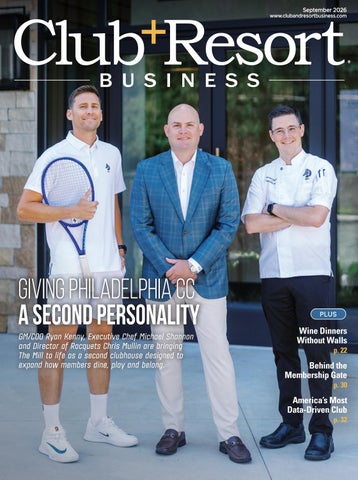
GIVING PHILADELPHIA CC A SECOND PERSONALITY GM/COO Ryan Kenny, Executive Chef Michael Shannon and Director of Racquets Chris Mullin are bringing The Mill to life as a second clubhouse designed to expand how members dine, play and belong.
plus
Wine Dinners Without Walls
p. 22
Behind the Membership Gate p. 30
America’s Most Data-Driven Club p. 32
001_COV0926.indd 1
8/25/26 10:15 AM
BONNIE BRIAR CC Larchmont, NY
rience e p x E e l b forgetta OM
bers1899
ham Follow @c
ERSUSA.C an Un r o f / CHAMB e T c N E n M E a R i OCU mb IGN / PR RIOR DES E T IN Elevated A / CTURE PLANNIN
G / ARC
HITE
CONTACT US TODAY! Visit our website or call 410.727.4535
CRB_MAY26.indd 3
4/20/26 12:09 PM
EUSTIS CHAIR
165,000+ Options... Or Custom if That’s Not Enough
The Most Durable and Highest Stacking Hardwood Chairs Proudly Made to Order in the USA
EustisChair.com
978-827-3103 sales@eustischair.com CRB_SEPY26.indd 3
8/20/26 3:15 PM
EDIT MEMO Editorial
EDITORIAL DIRECTOR
Joanna DeChellis
jdechellis@arrowfly.com • 412-260-9233 SENIOR EDITOR
Isabelle Gustafson
igustafson@arrowfly.com • 314-606-9430 ASSOCIATE EDITOR
Madison Hartline
PHILADELPHIA, FORWARD
mhartline@arrowfly.com.com • 330-704-8417 VP, EDITORIAL
Danny Klein
dklein@arrowfly.com • 919-945-0726
Content Studio
VP, CONTENT STUDIO
Peggy Carouthers
pcarouthers@arrowfly.com PHILADELPHIA IS VERY GOOD at history.
It is also, apparently, good at refusing to be trapped by it. We didn’t set out to put two Philadelphia stories in this issue. But the coincidence became more interesting once I realized how differently the two clubs are answering essentially the same question. How does an institution with a lot of history keep moving forward without losing what made it distinctive in the first place? At Philadelphia Country Club (see pg. 12), part of the answer is The Mill, a new, $16 million clubhouse that gives the club room to create a different experience without asking its historic clubhouse to become something it isn’t. At The Union League of Philadelphia (see pg. 32), the work is happening largely behind the scenes. The club has spent roughly a decade connecting member data across its operations and is now
using AI and custom technology to make service more personal and decisions more informed. One club built something its members can walk into. The other built something they may never see. Both show that a club can protect what matters about its history without standing still.
WRITER, CONTENT STUDIO
Ya'el McLoud
ymcloud@arrowfly.com WRITER, CONTENT STUDIO
Drew Filipski
dfilipski@arrowfly.com
Art + Production
VP, CREATIVE DIRECTOR
Matthew Claney
mclaney@arrowfly.com CREATIVE DIRECTOR
Erin Canetta
ecanetta@arrowfly.com
Sales + Business Development SVP SALES & STRATEGY
EDITORIAL DIRECTOR Joanna DeChellis jdechellis@wtwhmedia.com 412-260-9233
Matt Waddell
mwaddell@arrowfly.com • 312-961-6840 NATIONAL SALES MANAGER
Amber Dobsovic
adobsovic@arrowfly.com SALES DIRECTOR
Scan this QR code to sign up for our newsletter and join the conversation.
Patrick McIntyre
pmcintyre@arrowfly.com • 216-372-8112 SALES DIRECTOR
Tony Bolla
tbolla@arrowfly.com • 773-859-1107 KEY ACCOUNT MANAGER
John Petersen
jpetersen@wtwhmedia.com • 216-346-8790 ACCOUNT REPRESENTATIVE
Tanner Hartwick
1111 Superior Ave., Suite 1120 • Cleveland, OH 44114 Ph: 888.543.2447 www.clubandresortbusiness.com • www.clubandresortchef.com
thartwick@arrowfly.com • 571-596-0375 CUSTOMER SERVICE REPRESENTATIVE
Tracy Doubts
tdoubts@wtwhmedia.com SUBSCRIPTION INQUIRIES To enter, change or cancel a subscription: Web (fastest service): https://clubandresortbusiness.com Phone: 888-543-2447 (U.S. only, toll-free) Mail: Club & Resort Business 1111 Superior Ave., Suite 1120 Cleveland, Ohio 44114 Copyright 2026, Arrowfly
4 Club + Resort l September 2026
04_0926_Edit Memo-Mast_V3_JD-F.indd 4
Subscriptions: Qualified U.S. subscribers receive Club + Resort Business at no charge. For all others the cost is $75 U.S. and possessions, $90 Canada, and $145 all other countries. Per copy price is $3. Club + Resort Business does not endorse any products, programs or services of advertisers or editorial contributors. Copyright© 2026 by Arrowfly. No part of this publication may be reproduced in any form or by any means, electronic or mechanical, or by recording, or by any information storage or retrieval system, without written permission from the publisher.
Club + Resort Business (ISSN 1556-13X), USPS Publication #23658 is published 6 times: (January, March, May, July, September, November) by Arrowfly, 1111 Superior Avenue, Suite 1120, Cleveland, OH 44114 Copyright© 2026. Periodicals postage paid at Cleveland, Ohio, and additional mailing offices. Postmaster: Send change of address notices to Club + Resort Business, 1111 Superior Ave., Suite 1120, Cleveland, Ohio 44114.
Leadership CEO
Matt Logan
mlogan@wtwhmedia.com CHIEF OPERATING OFFICER
George Yedinak
gyedinak@wtwhmedia.com CHIEF REVENUE OFFICER
Scott Kelliher
skelliher@wtwhmedia.com VP OF MARKETING
Annie Wissner
awissner@wtwhmedia.com www.clubandresortbusiness.com I www.clubandresortchef.com
8/25/26 2:47 PM
CRB_JULY26.indd 5
6/15/26 11:29 AM
Contents
September 2026 • Vol. 22 • No. 5
12
CLUB PROFILE :
GIVING PHILADELPHIA CC A SECOND PERSONALITY
GM/COO Ryan Kenny and his team are using The Mill, Philadelphia CC’s new $16 million second clubhouse, to create more ways for members to dine, play and spend time at the club. (Cover photo and photo above courtesy of Philadelphia CC)
4
26 GOLF
EDIT MEMO: Philadelphia, Forward
A Junior Program With No Dead Ends
8 C LUB PEOPLE ON THE MOVE:
At The Golf Club at Lansdowne, Brian Rogish has grown a 25-player junior golf program to 150 by creating a development path with room for beginners, multisport athletes and serious competitors.
Sponsored by Kopplin, Kuebler & Wallace
10 SPONSORED CONTENT
The Bear: Beautiful Dysfunction and Why Leading a Private Club May Be Hospitality’s Greatest Leadership Challenge Sponsored by Kopplin, Kuebler & Wallace
28 R ACQUETS + FIELD SPORTS
The Changing Role of the Racquets Pro
As racquets programming expands beyond tennis, today’s pros are expected to be coaches, community builders, operators and member-experience leaders.
16 DESIGN +RENOVATION
More Than a Locker Room
At Desert Highlands, tradition and history meet modern amenities in the new men’s locker room, signifying a new space for members to gather and connect.
30 M EMBERSHIP + MARKETING Who Gets In?
At Addison Reserve, Desert Mountain and Sycamore Hills, three very different membership structures shape who can apply, who gets approved and how much control the club has over the process.
22 FOOD + BEVERAGE
When In Wisconsin
Ozaukee CC’s new Executive Chef shares his experience and strategies for hosting successful indoor and outdoor wine dinners.
32 T ECHNOLOGY
24 BANQUET
Is This America’s Most Data-Driven Private Club?
Oahu CC’s Community Campout
The Union League of Philadelphia is using AI and custom technology to turn a decade of member data into better service, sharper decisions and predictive operations.
Members of all ages come together for an annual night of outdoor fun, food, and community.
Ad Index CHAMBERS USA www.chambersusa.com
2
KOPPLIN KUEBLER & WALLACE www.KKandW.com www.ClubLeadershipAlliance.com
9
CLUB RECRUITER www.clubrecruiter.com
7
5
35
PEACOCK + LEWIS AIA 561-626-9704 | 239-631-2332 www.peacockandlewis.com
EUSTIS CHAIR 978-827-3103 | sales@eustischair.com
3
PREFERRED CLUB 800-523-2788 | www.preferredclub.com
19
INFRARED DYNAMICS 888-317-5255 | www.infradyne.com
18
SIMPLY BRUSH 800-477-4283
17
JBD/JGA DESIGN AND ARCHITECTURE 401-721-0977 | Pcafaro@JBDandJGA.com
20
THE VERDIN COMPANY 800-543-0488 | www.verdin.com
36
CRES COR www.crescor.com
6
Club + Resort l September 2026
06_TOC0926_V6_MH.indd 6
www.clubandresortbusiness.com I www.clubandresortchef.com
8/25/26 10:59 AM
CRB_SEPY26.indd 7
8/20/26 3:24 PM
CLUB PEOPLE ON THE MOVE
MATTHEW BERGH & STEVEN JONES, MBA GolfNext, a leading European GolfTech partner trusted by many of the continent’s most respected private members’ clubs and golf resorts, welcomes Matthew Bergh and Steven Jones, MBA as UK Sales Managers. Since 2012, GolfNext has worked alongside clubs to modernise the way golfers access and enjoy facilities, replacing outdated, manual processes with elegant, intuitive payment and self-service solutions for driving ranges, digital receptions, vouchers, and simulators. With more than 500 installations across 18 European countries, GolfNext combines proven technology with a deep understanding of club culture, service standards, and member expectations. Bergh was most recently Commercial Sales Manager at Club Systems International in Manchester, England.
ANDREW HEDRICK Set on over a thousand acres just south of Flagstaff, Ariz., offering members a private mountain lifestyle amid Ponderosa pines and the San Francisco Peaks, Forest Highlands Golf Club welcomes Andrew Hedrick as Director of Golf. The club features two distinct clubhouses, two nationally recognized championship golf courses designed by Tom Weiskopf, with the Canyon Course co-designed by Jay Morrish, robust racquets and fitness programs, hiking trails, and family recreation, all within a gated, self-contained community known for stewardship and strong community connection. Hedrick was most recently General Manager & Director of Golf at Red Sky Golf Club in Wolcott, Colo.
MARION HEFFRON ZACH CHRISTIAN Located in Naples, Fla., The Country Club of Naples welcomes Zach Christian as Golf Course Superintendent. The club is committed to fostering a sense of community and providing the highest quality goods, services, and facilities for enjoyment at all levels. Members and families enjoy a home-away-from-home experience with amenities that include a newly built, world-class golf course, tennis, pickleball, bocce, dining, and a variety of social engagements. Christian was most recently Golf Course Superintendent – North Course at Johns Island Club in Vero Beach, Fla.
Spread across two club campuses in Baltimore, Md., Baltimore Country Club welcomes Marion Heffron as Director of Catering & Events. The club blends rich history with a dynamic, family-friendly community. Members enjoy two premier golf courses, historic and beautifully renovated clubhouses, exceptional racquet facilities, three pools, and comprehensive fitness and wellness programs. From tournaments to social events, the club offers a warm, active environment with amenities that support recreation, connection, and lifelong memories for all ages. Heffron was most recently Executive Assistant / Operations Support at Actalent in Baltimore, Md.
KRISTINA CLABEAUX, CCM Tulsa Country Club, a premier private club just minutes from downtown Tulsa, Okla., welcomes Kristina Clabeaux, CCM as General Manager/ COO. The heart of the club is a classic 18hole course, designed by A. W. Tillinghast and restored by Rees Jones. Beyond golf, members enjoy tennis, pickleball, and a refreshed resortstyle pool with shaded lounges and seasonal dining. Recently, the club completed a $15 million transformation initiative, unveiling enhanced dining and pool grill, upgraded locker rooms, a Golf Performance Center, new bag storage, and a Turf and Landscape Maintenance Facility. Clabeaux was most recently Assistant General Manager at Ridglea Country Club in Fort Worth, Texas.
BERNARDO ESPINEL, MS, CEC, CHE Known for championship golf, exceptional service, and a welcoming, member-focused culture, High Ridge Country Club in Lantana, Fla. welcomes Bernardo Espinel, MS, CEC, CHE as Executive Chef. The club offers outstanding amenities, including golf, tennis, pickleball, and vibrant dining and social experiences within a beautiful, modern clubhouse. The local area features stunning beaches, shopping, dining, and year-round outdoor living. Espinel was most recently Executive Chef at Fisher Island Club in Miami Beach, Fla.
SHANE KING Founded in 1999 and headquartered in College Park, Md., Junior Tennis Champions Center welcomes Shane King as Chief Operating Officer. The organization operates 15 indoor and 15 outdoor flagship facilities with satellite locations in Virginia, Maryland, and Florida. Over time they have expanded from high-performance junior training to inclusive programming for youth, adaptive athletes, military veterans, and adults, earning recognition from the United States Tennis Association. King was most recently Chief Operating Officer at ACT in Annapolis, Md.
BRETT NINNESS, CCM Belle Meade Country Club in Nashville, Tenn. welcomes Brett Ninness, CCM as General Manager/COO. With more than a century of history, Belle Meade is a distinguished and widely recognized club known for its traditions, Southern hospitality, and exceptional member experience. The club features premier amenities, including a championship golf course, multiple dining venues, swimming, racquets, and a state-of-the-art wellness center. Ninness was most recently General Manager/COO at Augusta Country Club in Augusta, Ga.
Placements made recently by Kopplin Kuebler & Wallace. More Club People announcements are published every other Wednesday on www.clubandresortbusiness.com.
8 Club + Resort l September 2026
08_People0926v1EC.indd 8
www.clubandresortbusiness.com I www.clubandresortchef.com
8/25/26 10:06 AM
PEOPLE FOCUSED, QUALITY DRIVEN "We improve the well-being of our clients, advance the careers of our candidates, and have fun every day." THE PARTNERS | KOPPLIN KUEBLER & WALLACE Derek Domeracki | General Manager The Pacific Club
Jason Logie | Assistant General Manager The Amelia Island Club
Matthew Dubrowski, PGA | Director of Golf Banyan Golf Club
Brian Lord, CEC, AAC | Executive Chef Capital City Club - Brookhaven
Stephen Flanagan | Chair The National Golf Centre at Woodhall Spa
Valerie Mancuso, CPA | CFO/Controller American Yacht Club
Brian Gillespie | General Manager/COO Bocaire Country Club
Lauri Moore | Assistant General Manager DeBordieu Club
Boris Gradina, MCM, CCE | GM/COO Mariner Sands Country Club
Jason Myers | Executive Chef Manufacturers' Golf & Country Club
Pamela Green | Director of People Hogs Haven Golf Club
Katherine Newton, CCM | VP of Dining Services Montereau
Salvatore "Sonny" Grosso | GM/COO Harbour Ridge Yacht & Country Club
Jose Pacheco | Executive Chef Villa Grande Club at Porto Vita
Dylan Hallas | Executive Chef Monterey Peninsula Country Club
Ron Parris | General Manager/COO The Golf Club at Palmira
Lawrence Brubaker | Executive Chef Crystal Downs Country Club
Darren Hendry | Executive Chef Manor Country Club
Dorian Porada | Director of Tennis Oceanside Country Club
Fenella Buss | Head Professional Royal Ashdown Forest Golf Club
Seth Higginbotham | General Manager Princeton Terrace Club
Brandi Ramirez, CCM | General Manager Longwood Cricket Club
Eamon Chesser | General Manager CostaTerra Golf & Ocean Club
William Hyche | Club Manager Wicker Point Golf Club
Kathleen Sharkey | Executive Chef The Quarry at La Quinta
Harris Coble, CCM, CCE, CS | General Manager Denver Country Club
Irakli “BB” Jorjadze | General Manager Circuit of the Americas
Shannon Speese | General Manager Kalamazoo Country Club
Kendrick Condes, CS | Food & Beverage Director LedgeRock Golf Club
Jessie Kneitel | Assistant General Manager Sawgrass Country Club
Lily Steinbach | Director of Finance Burlingame Country Club
Gregory Constantinou | Assistant General Manager Wianno Club
Mark Kunkel | Executive Director The Vintage Club Community Association
Jason Tilmann | Executive Chef Kent Country Club
Howard Craft | General Manager Moor Park Golf Club
John-Paul Lechtenberg | Executive Chef Sharon Heights Golf & Country Club
Shelley Whyte | Financial Controller Hogs Haven Golf Club
Katherine Davis | Director of Operations Country Club of Little Rock
Hervé Levy, CCM, CCE | General Manager Fremont Hills Country Club
Pat Wilson, CPA | Dir. of Finance & Accounting The Country Club of Jackson
s n o i t a l u t a r Cong ! s e h s i W t s e &B Arthur Barajas, CCM, CCE | General Manager/CEO Crane Creek Country Club Rob Baynard, PGA | Director of Golf Cold Spring Country Club Michael Broughton | Deputy General Manager Community & Member Experience Pelican Bay Foundation
KKANDW.COM | KKANDW.COM/INTERNATIONAL | CLUBLEADERSHIPALLIANCE.COM ARIZONA | COLORADO | FLORIDA | GEORGIA | KANSAS | MICHIGAN | NEBRASKA | NEW JERSEY | NEW YORK NORTH CAROLINA | OHIO | TEXAS | WASHINGTON D.C. | AUSTRALIA | CANADA | NEW ZEALAND | UNITED KINGDOM
SCAN TO BROWSE OUR ACTIVE CAREER OPPORTUNITIES Specializing in GM/COO, CEO, AGM, Clubhouse Manager, F&B, Finance, Golf, Culinary, Agronomy, Racquets, HR, Fitness & Wellness, Membership/Marketing, Activities/Recreation Director Searches.
08_People0926v1EC.indd 9
8/25/26 10:06 AM
SPONSORED CONTENT | KOPPLIN KUEBLER & WALLACE
THE BEAR:
Beautiful Dysfunction and Why Leading a Private Club May Be Hospitality’s Greatest Leadership Challenge IF YOU’VE WATCHED the hit TV series, The Bear, you know it isn’t really about a restaurant. It’s about people. It’s about pressure. It’s about purpose. It’s about the beautiful dysfunction that exists inside every great hospitality team. Anyone who has spent time in hospitality can recognize the characters almost immediately. The perfectionist. The quiet workhorse. The rising star. The veteran who struggles with change. The young employee looking for confidence. The leader carrying the weight of everyone else’s success while quietly battling their own doubts. That’s hospitality. From the outside, members and guests see polished service, beautiful dining rooms, and flawless events. But behind the scenes? Its controlled chaos packed with emotions, budgets, stress, long hours, miscommunication, staff challenges and deadlines. Yet somehow, a team comes together to create experiences that look effortless. That’s what makes hospitality so extraordinary. The best teams are rarely perfect. In fact, they’re often wonderfully imperfect. They disagree. They challenge one another. They make mistakes. They frustrate each other. But they show up every day because they believe in something bigger than themselves. One of the greatest leadership lessons in The Bear is that excellence doesn’t come from eliminating dysfunction. It comes from learning how to channel it. 10 Club + Resort l September 2026
10-11_0526_KKW sponsored article_V1EC.indd 10
Every organization has conflicts. The difference between average organizations and exceptional ones isn’t the absence of conflict. It’s whether trust is strong enough to survive it. Hospitality is emotional work. We ask people to care deeply about guests while caring deeply about teammates while simultaneously managing budgets, staffing shortages, demanding customers or members, impossible expectations, working long hours and chasing the relentless pursuit of excellence. Stress exposes personalities. But it also reveals character. The strongest cultures aren’t built because everyone thinks alike. They’re built because people with different talents learn to trust one another enough to pursue a common purpose. Every successful club I’ve worked with has experienced moments that looked remarkably similar to The Bear. There were heated conversations. Impossible deadlines. Unexpected setbacks. Staffing shortages. Equipment failures. Events that changed at the last minute. Member complaints. But when the doors opened, the team came together and delivered an experience the members never forgot. That’s hospitality. Leadership isn’t about finding perfect people. It’s about helping imperfect people become an extraordinary team. The best General Manager/COOs understand this instinctively. They know when to push. When to listen. When to
challenge. When to encourage. When to step in. And, perhaps most importantly… when to step back. One of the most powerful messages from The Bear is that people don’t become family because everything goes smoothly. They become family because they’ve been through difficult things together. The pressure. The disappointments. The victories. The impossible weekends. The celebrations after surviving another successful event. Shared adversity creates uncommon trust. That trust becomes culture. That culture becomes excellence. In hospitality, we’ll never eliminate the chaos; nor should we try. Because somewhere inside the beautiful dysfunction is where great teams are born. But as much as I love The Bear, there is one important difference between Carmy’s world and the world of a private club General Manager/COO: • Carmy has one restaurant. •A General Manager/COO has an entire community. Imagine asking someone to be the CEO of multiple hospitality organizations operating simultaneously, each with different customers, different employees, different financial models, different personalities and different expectations. That’s the modern private club. Before 8:00 a.m., the golf operation is already running. The superintendent has been on property for hours preparing the golf course. The practice facilities are www.clubandresortbusiness.com I www.clubandresortchef.com
8/25/26 10:05 AM
opening. The tee sheet is filed. The golf shop is busy. And at the same time… Fitness classes have started. The spa has appointments beginning. Tennis and racquet professionals are hosting lessons and clinics. Pickleball courts are full. The aquatics department is preparing for another busy day of activity. The maintenance team is solving problems most members will never notice. Housekeeping is preparing every space for the day ahead. The accounting department is closing last month while planning next year’s budget. Human Resources is recruiting for positions that turned over yesterday. Membership is selling the club’s future. Marketing is telling its story. Security is protecting the campus. Technology is making sure everything works. Meanwhile, the executive chef is preparing hundreds of meals to serve multiple locations. Banquets are setting rooms for weddings, board meetings, golf outings, and member events. The à la carte restaurants are preparing for lunch and dinner. And that’s when everything is going as planned and there’s no unexpected challenge such as… • A pipe breaks. • A member walks in the office with a complaint. • A key employee resigns. • The weather changes. • A wedding moves indoors. • A board member calls. • An employee needs clarity to complete a project. • A guest has a medical emergency. • A tournament schedule changes. • A refrigeration unit fails. • A social media post goes viral. Welcome to Tuesday! Unlike almost any other hospitality business, private clubs don’t operate one business exceptionally well. They operate dozens simultaneously. Every department has its own culture. Its own financial realities. Its own staffing challenges. Its own definition of success. The golf professional thinks differently
than the executive chef. The superintendent faces challenges unlike those of the membership director. The spa director measures success differently than the controller. The racquets professional leads differently than the food and beverage director. Yet somehow, every one of those departments must feel like they belong to one club, one mission, and one team. That’s where the General Manager/COO comes in. The best General Manager/ COOs aren’t the best golfers. They aren’t the best chefs. They aren’t the best accountants. They aren’t the best agronomists. Their greatness comes from something else. They make all of those talented professionals better. They create alignment where competing priorities naturally exist. They build trust across departments that could easily become isolated. They help members think like owners. They remind employees that members don’t experience the club one department at a time…They experience it as one organization. One brand. One culture. One promise. That’s why leadership matters so much. Members don’t remember organizational charts. They remember experiences. They don’t care whose department made the mistake. They simply know the club either delivered on its promise or it didn’t. That is why the General Manager/COO must think differently than almost any leader in hospitality. Every day requires balancing member expectations, employee engagement,
Thomas B. Wallace, III, CCM, CCE, ECM Partner at KOPPLIN KUEBLER & WALLACE WWW.KKANDW.COM | 1-833-KKW-HIRE
www.clubandresortbusiness.com I www.clubandresortchef.com
10-11_0526_KKW sponsored article_V1EC.indd 11
financial stewardship, long-term capital planning, board governance, strategic vision, operational execution, and culture. All while ensuring every department feels supported, respected, and aligned. It’s one of the few leadership roles where you are expected to be strategist, operator, coach, diplomat, mentor, financial steward, crisis manager, communicator, and culture builder…all before lunch. Perhaps that’s why The Bear resonates so deeply with so many of us. It reminds us that excellence is never really about food. Or golf. Or tennis. Or pools. Or clubhouses. It’s about people choosing to pursue something extraordinary together. The greatest private clubs are not built because every department is perfect. They are built because imperfect people learn to trust one another, challenge one another, support one another, and unite around a shared purpose. That is the beautiful dysfunction of hospitality. And nowhere is that more evident, or more inspiring, than inside a great private club. Because in the end, the greatest achievement of a General Manager/COO isn’t delivering a perfect meal, a perfect golf course, or a flawless event. It’s building a team that continues to deliver excellence, together, long after the applause is over. That’s the real story behind The Bear. And that’s the story of every great private club. To every chef reading this, consider this article my sincere chef’s kiss, because before anyone else can serve excellence, you have to create it.
September 2026 l Club + Resort
11
8/25/26 10:05 AM
CLUB PROFILE
Giving Philadelphia CC a Second Personality GM/COO Ryan Kenny and his team are using The Mill, Philadelphia CC’s new $16 million second clubhouse, to create more ways for members to dine, play and spend time at the club. By Joanna DeChellis • Editorial Director
FOR MORE THAN a century, membership at Philadelphia Country Club (Gladwyne, Pa.) came with a clubhouse experience. Now it comes with two. The Mill, Philadelphia CC’s new $16 million second clubhouse, was designed to add another dimension to life at the club. Members can grab pizza at Merc’s, watch the Eagles at 1601, work from the business center or walk off the tennis courts and stay for a drink. It is still Philadelphia CC, experienced differently.
Philadelphia CC’s polo roots date back to 1890. The Mill carries that history forward with Merc’s, named for Mercury, the club’s first polo pony. 12 Club + Resort l September 2026
12-15_0926 Club Profile_V4_JD.indd 12
Creating that second experience required the club to think beyond what to put inside a new building. It had to decide what The Mill should feel like, how it should operate and what would give members reasons to use it. “The building was designed with a lot of intent,” says GM/COO Ryan Kenny. “We wanted to create something unique for our members.” That intent runs through the three areas that have come to define The Mill. Kenny shaped the broader strategy around the building and its role within the club. Executive Chef Michael Shannon and Sous Chef Anthony Spiezio developed a culinary program specifically for it. And Director of Racquets Chris Mullin is already seeing the new environment change how members behave before and after they play. MORE THAN A COLLECTION OF AMENITIES For Kenny, creating another way to experience Philadelphia CC meant considering not only what members might want, but when and how they might want to use it. Take 1601. Philadelphia CC could host an Eagles game before The Mill opened, but the experience was limited by the space. Members might gather around a televi-
sion tucked into the corner of a dining room. At 1601, sports are part of the reason the room exists. “We never really had a place where we could say, ‘Come to the club and watch the game,’” Kenny says. “Now we do.” Food and beverage required a similar level of specificity. Kenny wanted The Mill to expand Philadelphia CC’s dining options without simply moving familiar menus into a new location. “We were very conscious about making the offerings unique enough that we weren’t cannibalizing the dining rooms we already had,” he says. That still leaves room for some overlap. A cheesesteak, for example, isn’t disappearing from the main clubhouse. At The Mill, the culinary team can offer a different interpretation. “The advantage of a new build is that you can build the kitchen line around the programs you’re actually going to offer,” Kenny says. The club also developed individual identities for the spaces members would encounter. The Mill takes its name from Spring Mill Road. Merc’s, its Italian concept and pizzeria, is a nod to Mercury, Philadelphia CC’s first polo pony. The sports bar, 1601, takes its name from the club’s address. Other spaces widen the range of reasons members might find themselves www.clubandresortbusiness.com I www.clubandresortchef.com
8/25/26 10:02 AM
there. The marketplace provides prepared foods and takeout. The business center offers a place to work. The racquets shop expands the club’s retail operation with more leisurewear and apparel geared toward the pool and casual use. The Mill also changes what Philadelphia CC can accommodate. The club has more than 1,000 members, 27 holes of golf and, according to Kenny, more than 272,000 sq. ft. of buildings across the property. Yet there is unused capacity. The 27-hole golf operation doesn’t reach 30,000 rounds annually, and Kenny sees additional room within aquatics and racquets. Philadelphia CC now has the capacity to grow its membership by roughly 20%. “There’s room,” Kenny says. The building was designed with that longer view in mind. Kenny says three different structures had occupied the site over roughly 40 years. He doesn’t expect The Mill to follow that pattern. “You don’t want to design for today,” he says. “You want to design for 10 years from now, 20 years from now.” Then he extends the timeline considerably. “This is a 100-year building.” GIVING THE MILL A CULINARY IDENTITY Shannon had one word in mind as he began developing The Mill’s culinary program: “Approachable.” From there, the building itself helped point him toward the food. “When I think of a mill, I think of flour, rustic food and fresh pasta,” Shannon says. “The idea is simple food executed at a very high level.” That thinking became the foundation for Merc’s, where fresh pasta and pizza anchor the menu. Pizza, in particular, became a months-long project. Philadelphia CC already served Neapolitan-style pizza, so Shannon and his team experimented with dough formulas and techniques to develop something different for the new restaurant. “We did a lot of R&D,” Shannon says. “Pizza dough is really more of a formula
GM/COO Ryan Kenny says The Mill was designed to evolve with Philadelphia CC, with flexibility for how members may use the club 10 or 20 years from now.
www.clubandresortbusiness.com I www.clubandresortchef.com
12-15_0926 Club Profile_V4_JD.indd 13
September 2026 l Club + Resort
13
8/25/26 10:02 AM
CLUB PROFILE
Pizza started outdoors while The Mill was under construction. Today, it anchors the menu at Merc’s after months of R&D on dough formulas and techniques by Executive Chef Michael Shannon and Sous Chef Anthony Spiezio, who now serves as Chef de Cuisine at The Mill.
than a recipe. There’s a lot of chemistry behind it.” Members became part of that development process before The Mill ever opened. Beginning in January, Shannon started running dishes intended for the new menus as weekly specials in the main clubhouse. “By the time we opened, the recipes were structured, the binders were built, and the team had a foundation to work from,” he says. Shannon was simultaneously working through how those menus would be produced. While reviewing the plans, he noticed a lower-level area with stainlesssteel tables, a walk-in cooler and freezer that had been designated for storage. He saw a production kitchen. “I told the designer, ‘This needs to be prep space,’” Shannon says. Without it, cooks would have been forced to prep at their individual stations. “If you’re not heavily involved in the process, you can end up with a kitchen that doesn’t work for the way you actually cook,” he says. That production space now supports an operation that extends beyond the restaurants themselves. The marketplace, for example, carries prepared foods produced by Shannon’s team, with attendants monitoring inventory and 14 Club + Resort l September 2026
12-15_0926 Club Profile_V4_JD.indd 14
communicating what needs to be replenished. The club can shift to a self-scan model during times of year when staffing the market becomes more difficult. The Mill has also given Shannon room to reconsider what happens in the main clubhouse. “When you’re doing 200 covers, it changes how you approach the food,” he says. “It still has to be great, but it has to be more straightforward.” With another culinary operation absorbing some of that volume, Shannon sees an opportunity to push the main clubhouse dining program further. “We can give the main clubhouse a little more elevation,” he says. “That can become the place where you bring a business client [and] where we can continue to refine the dining experience.”
The additional operation is changing how Shannon thinks about his culinary team, too. He is working toward a more traditional brigade structure in the main clubhouse, with cooks becoming more specialized by station, while the broader operation gives Philadelphia CC more ways to develop employees with different strengths. Kenny sees an opportunity to build a stronger pipeline from culinary schools into that structure. “We can build our internship program, develop culinarians and give them a path into more sophisticated dining,” he says. For Shannon, The Mill has expanded the culinary program in both directions. It is giving him a new operation to build while creating more room to evolve the one Philadelphia CC already had. GIVING MEMBERS A REASON TO STAY For Director of Racquets Chris Mullin, court time has never been the entirety of the racquets experience. Members want to play, but they also want what happens around the game— the conversation before a clinic, the drink afterward, the chance encounter with someone they weren’t expecting to see. “They want more than to show up for their scheduled play and then leave,” www.clubandresortbusiness.com I www.clubandresortchef.com
8/25/26 10:02 AM
Mullin says. “They want to run into people, socialize and spend time together.” For a stretch, doing that became particularly difficult. Construction of The Mill displaced the racquets operation for more than a year. The pro shop moved across campus into the squash building. Platform tennis players used a party tent outfitted with heaters and fire pits as a temporary warming hut. At times, construction immediately beside the courts restricted play. The programming continued, but much of what surrounded it disappeared. “It became a ‘show-up, play, and leave’ scenario,” Mullin says. The Mill has reversed that dynamic. Members can finish a match and walk directly into 1601. The permanent platform tennis warming hut sits beside the courts. Food and beverage is steps away. A player whose family is elsewhere at The Mill doesn’t necessarily have to choose between staying at racquets and joining them. “I don’t think many racquets operations share a building with restaurants,” Mullin says. “You can walk off the court and go straight into a sports bar overlooking the golf course.” Mullin is already seeing the effect extend beyond the members who regularly play. “The program has always had a lot of energy,” he says. “Now we’re getting
energy from people outside the program who want to get involved.” Some are coming to him with a basic question: Where do I start? “They’re asking, ‘How do I get into this program?’” Mullin says. “They know they’re going to be spending a lot of time in this building.” That gives Mullin an opportunity to introduce racquets to members who may have previously had little reason to spend time around the courts. It also changes what he can build for the members already there. He expects participation to grow, but lessons and clinics are only part of the opportunity.
Director of Racquets Chris Mullin (right) expects The Mill (top, right) to help grow tennis, pickleball and platform tennis participation while creating more opportunities to build social events around the club’s racquets programs. www.clubandresortbusiness.com I www.clubandresortchef.com
12-15_0926 Club Profile_V4_JD.indd 15
“The next phase is creating a giant social event around racquets every month or every couple of weeks throughout the year,” Mullin says. “Members join to use the courts, but they’re also here for the social atmosphere.” The events themselves aren’t new. The scale can be. “The space will make them better and make it easier to grow them,” he says. Even the club’s squash players, whose courts remain several minutes away in a separate building, now have a natural destination after play. “Finish your squash match and come over to The Mill,” Mullin says. “We’re not separate.” July’s typically a quieter month at Philadelphia CC as members travel. This year was different. “It certainly didn’t feel like a quiet month with The Mill,” says Mullin. What happens over the next year will be less about introducing members to a new building than watching them decide where it fits into their lives at the club. Some will know The Mill primarily through Merc’s. Others will come for 1601, racquets, the marketplace or simply because someone they know is already there. That is where Philadelphia CC’s second clubhouse becomes more interesting than the sum of what was built inside it. The club created the possibilities. Members will decide what to make of them. C+RB September 2026 l Club + Resort
15
8/25/26 10:02 AM
DESIGN + RENOVATION
Photo courtesy of Hatch Design Group.
More Than a
At Desert Highlands, tradition and history meet modern amenities in the new men’s locker room, signifying a new space for members to gather and connect. By Isabelle Gustafson • Senior Editor
IN YEARS PAST, men’s locker rooms might’ve been dark and tucked away— hardly a design feature, nor a place to gather. The goal now is “to create a much more open space that is more inclusive and welcoming,” says Joan Sykora, Chief Brand and Experience Officer for Desert Highlands in Scott16 Club + Resort l September 2026
16-20_0926 DR MenLockerRoom_V5_IG.indd 16
sdale, Ariz. To achieve this, the club is investing $3.5 million in its men’s locker room, which includes the men’s grill and lounge and the new Nicklaus Room. Modern finishes, improved lighting, upgraded amenities, and an overall refined design will create a contemporary, welcoming environment for members.
“We wanted to create something that brought light in, while also acting as a great gathering space,” Sykora says. “So we’re opening up walls. We’re adding windows. We’re doing accordion doors that open up to an outdoor patio.” The Nicklaus Room, a fireside lounge, will pay homage to Desert Highlands’ www.clubandresortbusiness.com I www.clubandresortchef.com
8/25/26 9:28 AM
CRB_SEPY26.indd 17
8/20/26 3:26 PM
DESIGN + RENOVATION
legacy as the world’s first Jack Nicklaus Signature Golf Course. “The Nicklaus Room is going to have beautiful, oversized leather chairs and a huge bookshelf,” notes Sykora—“a good place to have a cocktail or a bourbon by the fire, among the richness of that history of Jack Nicklaus and the traditions here at Desert Highlands.” Darker wood tones and wainscoting will nod to traditional design, while windows and modern fixtures will bring in light. Meanwhile, the shower and restroom areas will be fully modernized for design and functionality. “The countertops will have a dark, leathered granite look,” adds Sykora, “so it’s not shiny or polished—very traditional colors with antique or champagne brass fixtures in some areas and black matte in others.” The goal is for this space to be completed by the end of the year. A GOOD PARTNER This past November, Desert Highlands completed a $9.8 million restoration project to its golf course, which included design enhancements to several holes, greens reconstruction, tee reconstruction, bunker reconstruction, desert de- and re-vegetation, and restoration of the turf found on the tees, fairways and rough. The club also completed a $2.5 million modernization of its golf shop and women’s locker room. The golf shop now 18 Club + Resort l September 2026
16-20_0926 DR MenLockerRoom_V5_IG.indd 18
www.clubandresortbusiness.com I www.clubandresortchef.com
8/25/26 9:28 AM
Photo courtesy of Hatch Design Group.
The renovated men’s grill and lounge will be designed as a gathering space, with new windows bringing in more natural light and accordion doors opening the room to an outdoor patio. The space is part of Desert Highlands’ $3.5 million men’s locker room renovation, which also includes upgraded showers and restrooms and the new Nicklaus Room.
features a redesigned layout with an expanded entrance and a relocated retail counter. The women’s locker room offers brighter finishes, a refreshed card lounge, upgraded vanity and wet areas, and a new self-serve station that includes snack drawers and grab-and-go lunches, plus wine and beer on tap. “We looked at the men’s locker room like phase two of our lower clubhouse,” says Sykora. “Phase one was our golf shop and our ladies’ locker room because we wanted to do the ladies first, and we knew this was a little bit of a bigger project. We were moving and removing walls and adding windows, so there were some structural elements.” The process for the men’s locker room began about a year ago. “We have a small committee of members that we put together to get their input and their involvement in what we wanted and how we wanted to do it,” says Sykora. “We did some member forums, where we went over concepts with them and got feedback.”
Club Insurance FORE the Unexpected
PREFERERED CLUB protects all your club’s insurance needs from Tee to Green and everything in between. This year, get the best insurance for your PREFERRED CLUB. Ask your insurance agent to contact us for a competitive quote.
800- 523- 2788 ext. 300 | preferredclub.com/quote
www.clubandresortbusiness.com I www.clubandresortchef.com
16-20_0926 DR MenLockerRoom_V5_IG.indd 19
September 2026 l Club + Resort
19
8/25/26 9:28 AM
DESIGN + RENOVATION
Desert Highlands has 563 memberships, all tied to homeownership. “We don’t have categories of memberships,” notes Sykora. “Everybody has access to everything.” At members’ request, the club went through a bidding process before ultimately continuing its relationship with the general contractor who did construction in the other parts of the clubhouse, alongside the design and architectural firms. “That’s probably the most important thing,” says Sykora. “Making sure you have a good partner in your design firm that knows your club and understands your history.” C+RB
20 Club + Resort l September 2026
16-20_0926 DR MenLockerRoom_V5_IG.indd 20
Photo courtesy of Hatch Design Group.
The renovated vanity areas feature dark, leathered-granite countertops with antique or champagne brass fixtures in some areas and matte-black fixtures in others.
www.clubandresortbusiness.com I www.clubandresortchef.com
8/25/26 9:28 AM
The Club + Resort Business Engagement Summit brings together the professionals responsible for how clubs position themselves, communicate with members, and sustain long-term growth. Over two days, Directors of Membership, Marketing and Communications, along with General Managers, will examine the strategies shaping club engagement today—from onboarding and retention to brand clarity, digital presence and technology decisions that support stronger connections with members and prospects. Sessions are led by industry peers sharing how they are approaching these challenges inside their own clubs. The focus is practical perspective, useful ideas, and candid discussion about what is evolving across the industry.
AGENDA OCTOBER 5TH
2:00 - 3:00 PM: Fireside Chat Fireside Chat with Club Leaders
8:00 AM - 9:00 AM: Breakfast
3:00 - 3:30 PM: Networking Break
9:00 - 10:00 AM: Education Session Beyond the Logo: Building a Distinctive Club Brand Melissa Hansen, Director of Membership Melissa Hansen and Marketing, The Club at Olde Cypress
3:30 - 5:00 PM: Workshop The Social Standard: A Social Media Workshop Emory Patton, Director of Membership & Marketing, The Standard Club
10:00 - 11:00 AM: Panel Discussion The Modern Member Experience: Elevating Every Touchpoint Moderated by Melissa Hansen, The Club at Olde Cypress Panelists: • Liz Markel, Membership Manager, University Club of Chicago • Hillary Wiedemann, Senior Membership Manager, University Club of Chicago •L eslie Bradberry, Director of Membership, University Club of Chicago 11:00 AM - 12:00 PM: Education Session The Membership Sales Blind Spots Clubs Can’t Afford to Ignore Justin Kuehn, Vice President of Sales and Marketing, Hampton Golf
Emory Patton
5:00 - 6:30 PM: Networking Cocktail Reception
12:00 - 1:00 PM: Networking Lunch 1:00 - 2:00 PM: Education Session 3 Email Campaigns Every Club Should Already Be Running Danita Osborn, Director of Membership and Marketing, Shadow Wood Country Club
Bonnie Scoggins
2:30 - 3:30 PM: Roundtable Discussions Engagement Summit Roundtables Moderated by Melissa Hansen The Club at Olde Cypress *Agenda subject to change
OCTOBER 6TH 8:00 - 8:30 AM: Breakfast 8:30 - 9:30 AM: Education Session What Clubs Keep Overcomplicating About Engagement Melanie Halpert, Director of Membership Sales, Desert Mountain Club
2026
OCTOBER 5 - 6
UNIVERSITY CLUB OF CHICAGO
Melanie Halpert
9:30 - 10:30 AM: Industry Partner Session
Justin Kuehn
1:30 PM - 2:30 PM: Education Session The Club Industry’s Identity Crisis Bonnie Scoggins, Chief Marketing Officer,Concert Golf Partners
10:30 - 11:30 AM Education Session Branding Matters: Building an Identity Across the Club Molly Carroll, Vice President of Communications & Marketing, Ocean Reef Club
THANK YOU TO OUR SPONSORS:
Molly Carroll
11:30 - 12:30 PM: Networking Lunch 12:30 - 1:30 PM: Industry Partner Session
Danita Osborn
EVENTS.ARROWFLY.COM/CRB-ENGAGEMENT-SUMMIT
Engagement Summit_Agenda_FP_V4_MH.indd 21
8/25/26 12:30 PM
FOOD + BEVERAGE
When in Wisconsin
Ozaukee CC’s new Executive Chef shares his experience and strategies for hosting successful indoor and outdoor wine dinners. By Isabelle Gustafson • Senior Editor
SIX MONTHS INTO his tenure at Ozaukee Country Club (Mequon, Wis.), Jack Wagner has wrapped his third wine dinner, and he’s readying two more in the next two months. The club has over 400 members and does around $1.6 million in annual food and beverage revenue. Wagner works with a relatively small culinary team: four cooks and two salaried staff. “Making relationships with the team and building that foundation was important for me,” Wagner says. “I have a really good CDC and sous chefs, and I’ve been relying on them to help me take this program to the next level.” And the club’s membership is largely on board. “I took over for someone who was there for 27 years,” Wagner notes. “Some don’t want to see change, and others want more change. [Overall, though], the response has been great. We’re doing action stations, and we’re out there in front of membership, trying to be as front and center as we can be because we know how important that is.” Prior to joining Ozaukee, Wagner spent two-and-a-half years at Brentwood Country Club. But wine dinners weren’t as prominent there, given the Los Angeles club’s location and its proximity to Michelin-starred restaurants. “But in the Midwest,” Wagner says, “wine is king.” 22 Club + Resort l September 2026
22-23_0926 FB Wine Dinners_V3_IG.indd 22
www.clubandresortbusiness.com I www.clubandresortchef.com
8/24/26 4:32 PM
Ozaukee does about six wine dinners per year, though Wagner aims to do more. The most recent wine dinner was al fresco, on the golf course, for about 30 guests. “I cooked everything outside,” he says. “It [requires] a lot of planning—how are you going to keep purees hot, and do you have enough equipment? ... We started planning this weeks in advance because of the extensiveness of doing a kitchen outside. It’s a whole different way of cooking.” It’s worth it, though, to give members and staff a unique experience. “We have a beautiful club,” Wagner notes. “But we only get four or five good months of weather here. So I love to do the dinners outside where we can utilize the great outdoors, the beautiful golf course, and showcase these Midwest sunsets.” GAME ON For this outdoor dinner, Wagner took the lead in planning after the club’s F&B director departed mid-season and his CDC was away. “I ended up working with the rep to finalize this dinner and to put it all together,” he says. Tastings for the July wine dinner started in early June. “I reached out to the reps and said, ‘Send me all the information you have. The more information, the better.’ And then I researched [the wines] in my own time. I went through my books, I pulled up The Flavor Bible, I looked at what’s in season— all before I tasted the wines. Then once I’d tasted them, I’d think, how close was I? Maybe I tasted something that I wasn’t expecting. It gives me a new perspective.” Because he hadn’t done many Spanish wine dinners, Wagner tasted a whole profile of wines to ensure he was fully familiar and had the pairings just right. “There were some good ones that I had to turn away to make sure that we were really choosing the correct wines for the food that we wanted to prepare,” he says.
Executive Chef Jack Wagner (right) and his culinary team prepare courses outdoors for Ozaukee CC’s July wine dinner, held on the golf course for about 30 members.
Two-and-a-half weeks before the wine dinner, he shared a variation of the menu with the members who’d be attending. “I want them to know what they’re eating,” Wagner says, to glean dietary restrictions and aversions, “but I leave it vague; I just had pictures of the animal. They didn’t really know what was on the menu, but they knew the proteins. As long as they were okay with eating octopus and Hamachi, it was game on.”
Among the courses was charred octopus with chili-mango granita, avocado mousse, cara cara supremes, puffed rice, and mint oil, paired with a 2025 Albariño from Rías Baixas, Spain.
www.clubandresortbusiness.com I www.clubandresortchef.com
22-23_0926 FB Wine Dinners_V3_IG.indd 23
In addition to his upcoming wine dinners, Wagner’s planning to host chef’s tables in the club’s newly renovated kitchen. He’s already getting requests from members. “Those will start once golf season ends and I can catch my breath a little bit,” he says. “I want to give it the attention and time that it deserves.” C+RB
September 2026 l Club + Resort
23
8/24/26 4:32 PM
BANQUET
At Oahu CC’s annual family campout, members of all ages come together for a night of outdoor fun, food, and community. By Isabelle Gustafson • Senior Editor
AT OAHU COUNTRY CLUB in Honolulu, Hawaii, the annual family campout transforms the club into an overnight experience for about 150 people of all ages, complete with a big BBQ dinner and a bento breakfast by Executive Chef Michael Longworth and team. “Each year, we really try to up the game with what we offer,” says Melissa
Warner, CCM, Oahu CC’s Director of Membership. “Everybody camps outside. They bring all their own supplies, their tents and sleeping bags. A lot of people have been investing in air mattresses. It’s a lot of fun.” This past year, the event featured a kids’ pajama party rave. Right before bedtime, the indoor space was trans-
Oahu CC’s annual family campout features an outdoor BBQ (weather permitting) and breakfast for about 150 people by Executive Chef Michael Longworth and team. 24 Club + Resort l September 2026
24-25_Banquet_0926_V6_IG.indd 24
formed into a glow-in-the-dark dance floor with neon accessories, glow balloons, and a smoke machine. The club’s fitness manager served as the DJ, while on-site staff joined the dance floor alongside members. “This year,” Warner says, “we’re doing a big game of capture the flag over some of the course.” Longworth has been with the club for the past 10 years, so he’s seen the campout from its inception pre-pandemic to today. The food on offer varies some, but the idea is the same: comfort food that speaks to the casual nature of the event. “We’ve done it different ways,” notes Warner. “Sometimes it’s traditional barbecue food—hot dogs, hamburgers. Sometimes there’s sausage or chicken. We’ll have watermelon, chips, usually potato salad—classic comfort food.” Weather permitting, cooking happens outside on the grill. If the movie’s inside, or if the weather doesn’t cooperate, there will be an indoor buffet. “In the morning, we do breakfast bentos [with] pancakes, scrambled eggs, and bacon,” says Warner. “It’s an early morning, but it’s so fun to see everyone outside the norm. Usually everyone in www.clubandresortbusiness.com I www.clubandresortchef.com
8/25/26 2:12 PM
F&B at Oahu CC’s annual family campout centers traditional summer barbecue favorites for members of all ages.
the club is in their golf attire, or dressed to the nines, so it’s fun to see [the membership] more casual and comfy.” FAMILY-CENTRIC The club has 1,300 memberships, or close to 3,000 people, including spouse and dependents. “It’s in our mission statement to be as family-centric as possible, and it’s something I think we’ve really strived for
over the past few years, especially since the pandemic, to try to integrate more family programming,” says Warner. Other family-friendly events include a Fourth of July celebration, a Halloween party, and a kids’ art show.
Last year’s campout at Oahu CC featured a kids’ pajama party rave. The indoor space was transformed into a glow-in-the-dark dance floor with neon accessories, a smoke machine, and the club’s fitness manager as DJ. www.clubandresortbusiness.com I www.clubandresortchef.com
24-25_Banquet_0926_V6_IG.indd 25
“Of course, we have brunch with Santa and the Easter Bunny,” Warner notes. “We really try to do a good variation of bigger events and then some of the smaller, more niche events for the kids.” “And we have a huge golf program,” she adds, “so it spans not just clubhouse programming, but also junior golf. We have the PGA Junior League teams, we do clinics multiple times a week, and monthly tournaments for the juniors.” In keeping with the club’s ‘”familycentric” mission, Longworth and his team recently rolled out weekly lunch and dinner menu specials just for kids, in addition to the standard kids’ menu. A few recent specials include pigs in a blanket, baked spaghetti, and ravioli. “Simple stuff, but different than your traditional cheeseburger and chicken tenders,” Warner says. “The pigs in a blanket was the most popular so far—with a lot of adults trying to order it, too.” C+RB September 2026 l Club + Resort 25
8/25/26 2:12 PM
GOLF
A Junior Program With No Dead Ends At The Golf Club at Lansdowne, Brian Rogish has grown a 25-player junior golf program to 150 by creating a development path with room for beginners, multisport athletes and serious competitors. By Joanna DeChellis • Editorial Director
WHEN BRIAN ROGISH, PGA, arrived at The Golf Club at Lansdowne (Leesburg, Va.) in 2017, he had a vision for junior golf. He did not, however, have much experience teaching juniors. Rogish had built his career at resorts including Nemacolin, Turning Stone and Crystal Springs, where the golfers in front of him were primarily adults. Lansdowne presented a different audience. Its membership was younger, with an average age in the mid-40s, and many members were raising families. “I have this vision for a family golf program,” Rogish remembers telling John Leven, then a young assistant golf professional at Lansdowne who would help him build the academy. “Within that family golf program, it had to start 26 Club + Resort l September 2026
26-27_Golf_0926_V5_JD.indd 26
with juniors.” The first class had about 25 kids. Today, Lansdowne caps its junior program at 150 players each semester. It has operated at that capacity for the past two years. Rogish, now Director of Golf at Lansdowne and Troon’s 2026 Coach of the Year, says growth has become difficult to measure because the academy cannot accommodate many more players. Instead, he watches how quickly registration fills and how many names land on the waiting list. Rogish and his team built the program around the idea that children of different ages and abilities needed different ways into the game. He describes a family arriving at Lansdowne with a 6-yearold, a 12-year-old and a 15-year-old, all interested in golf but needing different
places to begin. “We wanted to make sure we had a natural entry and access point for each of them,” he says. For the youngest players, that entry can come at age 3. Classes last 30 minutes and are less about developing a golf swing than getting children around the game and making golf familiar. Rogish credits the coaches who work with those players with helping establish a foundation that becomes apparent several years later. “A few years of that program has really done wonders for the 8-to-12-yearold range,” he says. At that age, the emphasis begins shifting toward the course. Every week, Lansdowne provides what it calls a match opportunity. Playwww.clubandresortbusiness.com I www.clubandresortchef.com
8/25/26 11:00 AM
ers begin closer to the green and move progressively farther away as they shoot designated scores. “We want them to be on the golf course as much as possible,” Rogish says. They are. According to Troon, Lansdowne’s academy now generates nearly 3,000 additional junior rounds annually. Around ages 11 to 13, the program splits. Players interested in pursuing golf at a higher level can move into a competitive development track. Those who like golf but do not want to pursue it as their primary sport can follow a recreational track. “We wanted to make sure that we weren’t alienating the kid who just really liked golf, but it wasn’t their main sport,” Rogish says. He has seen how quickly those priorities can change. A player may spend several years concentrating on lacrosse or basketball before returning to golf. By then, Rogish says, college golf may no longer be realistic, but that does not mean there is no longer a place for that player in the program. In fact, the recreational track has become the larger of the two. And while Rogish knows how many players from the competitive side eventually play college golf, that is not how he judges the academy’s success. He is more interested in how many players, competitive or recreational, stay in the game.
Brian Rogish works with golfers at The Golf Club at Lansdowne, where the junior program has grown from 25 players to a capacity of 150 each semester.
For juniors who have progressed through Lansdowne’s program, he estimates that figure is nearly 100 percent. “The big metric is like, how many of them become members at a place or how many stay in the game?” he says. The answer has implications well beyond junior golf.
Lansdowne junior golfers present a donation to Folds of Honor following an early edition of the Lansdowne Cup, which has grown into a major fundraiser for charitable organizations. www.clubandresortbusiness.com I www.clubandresortchef.com
26-27_Golf_0926_V5_JD.indd 27
According to Troon, academy revenue has grown multiple times over since 2016, while nearly 30 percent of new club memberships have been tied directly to academy programming. The program has also contributed to increased family engagement and member retention. For Rogish, those results are connected to the way the program was built. A junior does not have to be on a college-golf trajectory to remain part of it. Players can continue to develop as their interests, abilities and ambitions change. And the longer they remain connected to golf, the greater the opportunity for that relationship to extend to the rest of the family and, eventually, the club. “We want people to enjoy the game and give families something they can do together,” he says. For a program built around keeping people in the game, the waiting list may be one of its clearest measures of success. C+RB September 2026 l Club + Resort 27
8/25/26 11:00 AM
RACQUETS + FIELDS
THE CHANGING ROLE OF THE RACQUETS PRO
As racquets programming expands, today’s pros are expected to be coaches, community builders, operators and member-experience leaders. By Madison Hartline • Associate Editor
THE RACQUETS WORLD has undergone some major changes in the past few years. With the boom of pickleball and the steady rise of padel, club racquets professionals are no longer responsible for a single sport or a single community of players. “We now have three different racquet programs with three different audiences we have to reach,” says Jose Pastrello, Director of Court Sports at Quail Creek Country Club (Naples, Fla.). For Pastrello, that has changed what the job requires. Managing courts and teaching lessons are still part of it, but today’s racquets professionals also need to understand the different communities 28 Club + Resort l September 2026
28-29_Racquets_0926_V3_IG.indd 28
developing around each sport. “Before it was just a sport,” says Pastrello. “Now it’s a community, and we are expected to build those relationships and be hybrid.” That shift has also changed what clubs need when hiring. In the past, being a strong tennis player could go a long way toward preparing someone to be a tennis pro. Now, with tennis, pickleball and padel all competing for programming, staffing and court space, it’s not realistic for pros to be experts in every sport. “The focus has shifted to budgeting, programming, staffing and projects,” says Pastrello. “We are in the memberretention business. Customer experience
is a huge part of that. So, managing our relationships with members and trying to retain them on the courts drives that.” BEYOND TENNIS Member expectations of pros have changed along with the job. “We have to be able to speak the pickleball language as well as the padel language,” says Pastrello. “We can’t be driven by one sport. We have to be able to deal with the gray area instead of being so black and white.” Before the integration of different racquet sports, Pastrello says pros delivered a product that members came out to experience. Now, the lines between those www.clubandresortbusiness.com I www.clubandresortchef.com
8/24/26 4:35 PM
Quail Creek CC’s expanding racquets program now reaches 500 to 600 members across tennis, pickleball and padel, broadening both the department’s audience and the role of its professionals.
underneath me,” he says. “Before, I was the person who dealt with 250 people on the tennis courts. Now, I am the person who deals with 500 to 600 people, so my program becomes much larger.” With that growth, racquets professionals have a much larger role in the club’s success, he adds. But that level of responsibility also comes with challenges. “We’re a lot more in the people business, and that changes how we approach our day-to-day work,” he says. “Here, I have nine tennis courts, six pickleball courts, three bocce courts and three padel courts. That means I am responsible for 21 courts at the club.” Pastrello says pros with similar responsibilities are also booking programs across the racquets operation and buying and selling gear for multiple sports.
audiences are increasingly fluid. Tennis players are becoming pickleball or padel players, and pros have to be prepared to engage them across sports. That puts more emphasis on the member experience and less on how accomplished a player the professional is. “We have to be leaders and not be as technical,” he says. “The whole thing is about the people, not so much the game.” It’s also important, according to Pastrello, to show members that the three racquet sports are not competing with one another. “I happen to have three kids myself,” he explains. “Tennis was my firstborn;
pickleball was my second-born; and padel is my third-born.” MORE SPORTS, MORE POSSIBILITIES The evolution of the racquets professional’s role isn’t necessarily negative, says Pastrello. The introduction of new sports gets new members out on the courts. From grandparents to kids, Pastrello says it gives pros much more to work with and expands the reach of the department within the club. “One thing I have noticed is that it’s so much easier to get a project passed at a club because I have so many more sports
www.clubandresortbusiness.com I www.clubandresortchef.com
28-29_Racquets_0926_V3_IG.indd 29
A ROLE STILL IN MOTION Pastrello believes the role of a racquets professional will continue to evolve over the next five years. “We need to be coaches, community builders, leaders, businesspeople and more,” he says. “I think this will continue to be the case in the future.” As the sports themselves mature, so do members’ expectations. Pastrello says the responsibility falls to pros to keep creating experiences that give members reasons to return. “For example, pickleball is huge here in Naples, and it has matured from when it was first introduced,” he says. “What was first extremely inclusive has transformed into leagues, tournaments, mixers, trips and more.” C+RB September 2026 l Club + Resort 29
8/24/26 4:35 PM
MEMBERSHIP MARKETING
WHO GETS IN? At Sycamore Hills, Desert Mountain and Addison Reserve, three very different membership structures shape who can apply, who gets approved and how much control the club has over the process. By Joanna DeChellis • Editorial Director
THERE IS NO STANDARD PATH into a private club. At Sycamore Hills Golf Club in Fort Wayne, Ind., someone can inquire directly about membership without an existing connection to the club. At Desert Mountain Club in Scottsdale, Ariz., prospective members must own property in the community, but buying a home does not guarantee membership. At Addison Reserve Country Club in Delray Beach, Fla., the club and homeowners association are merged, tying residency and membership together. All three clubs have applications, vet prospective members and have an approval process. But what those processes accomplish is very different. SYCAMORE HILLS STARTS WITH THE CONVERSATION At Sycamore Hills, candidates referred by existing members move through an expedited introductory process. Those already familiar with the club may not need a formal tour or introductory meal, and a sponsoring member can host a preview round. Prospects who contact the club directly begin with a discovery call with General Manager/COO Christopher Hampton. The conversation establishes what the person wants from a private club and whether Sycamore Hills offers it. The club focuses on golf and dining. Hampton says prospects looking for amenities such as tennis, pools or fitness 30 Club + Resort l September 2026
30-31_Membership_0926_V4_IG.indd 30
are directed to local clubs that may be a better match. Qualified prospects are invited for a private tour and meal. Hampton does not provide the fee structure until meeting with them in person, keeping the initial discussion focused on the club experience rather than price. Hampton also considers immediate requests for complimentary golf a red flag. Prospects who want to play after touring can pay the standard unaccompanied guest rate, which is credited toward the initiation fee if they join. Once an application is submitted, Sycamore Hills conducts criminal and credit background checks on adult applicants. Hampton contacts any member sponsors to discuss the candidate’s character and fit. The application then goes to the club’s four-person ownership group for a vote. There is no Membership Committee or posting period. Hampton manages the process from inquiry through onboarding. Approval typically takes five to seven business days, although background checks can extend that timeline. The club added background checks in 2019-20. “I think what we do works really well for us, but I will admit it won’t work for all clubs,” Hampton says. DESERT MOUNTAIN REQUIRES PRE-APPROVAL Desert Mountain also ties membership to real estate, but differently.
A prospective member must own property within Desert Mountain to join. Purchasing property, however, does not guarantee club membership. Director of Membership Sales Melanie Halpert encourages prospective buyers to seek membership pre-approval before purchasing a home. Once approved by the Board, they can continue their real estate search knowing membership has been secured. Before sending an application, Halpert meets with the prospective member. The meeting allows her to explain the club and membership expectations while learning what the prospective member is looking for. Applicants provide four personal references, who receive questionnaires about the candidate. The club also requests references from a previous or current club and an existing Desert Mountain member. Prospective members undergo background and social-media screening and an interview before Membership Committee review and Board approval. Desert Mountain also shares prospective members’ names with the membership, allowing information about an applicant to surface before approval. Approximately 90 people are waiting for golf membership, with Halpert estimating a four- to five-year wait. Those individuals already own property within Desert Mountain and can become Lifestyle members while they wait, providing access to non-golf amenities and the club community. www.clubandresortbusiness.com I www.clubandresortchef.com
8/24/26 4:36 PM
Desert Mountain has approximately 90 people on its golf membership waitlist, estimated at four to five years. Property owners can become Lifestyle members while they wait, with access to the club’s non-golf amenities.
The waitlist doesn’t eliminate the application process. Applicants still have to go through it. ADDISON RESERVE CONNECTS MEMBERSHIP TO THE HOME At Addison Reserve, the membership process begins with real estate. The club has 717 homes and just over 1,300 individual members, and each property has an associated membership. A prospective buyer may tour the club before purchasing, but Membership/ Marketing/Communications Manager Denise Saari cannot distribute the application until there is an executed contract for a home. The package includes authorization for background and credit checks, along with information about assessments, club amenities and onboarding. The Membership Committee reviews the completed application and makes a recommendation to the Board, which provides final approval as required by
the club’s bylaws. Because Addison Reserve’s club and homeowners association are merged, the process operates differently than at Sycamore Hills or Desert Mountain. Property ownership and club membership are connected, giving the club less discretion over admission once a home has been purchased. It retains financial safeguards, including the ability to require an additional deposit based on an applicant’s credit. The structure also affects membership capacity. Addison Reserve offers full and partial golf memberships, with the category associated with the property. Someone who purchases a partial golf membership and later wants full golf joins a waitlist. At the time of the interview, 25 members were waiting to make that change, which Saari described as a multi-year conversion. Movement depends on full golf members choosing to step down,
At Addison Reserve, each of the community’s 717 homes has an associated membership. Full and partial golf categories are tied to the property, with 25 members currently waiting to move from partial to full golf. www.clubandresortbusiness.com I www.clubandresortchef.com
30-31_Membership_0926_V4_IG.indd 31
something that has become increasingly uncommon as full golf membership has added value to the associated real estate. Saari said Addison Reserve had not completed a conversion since December 2024. The home someone purchases therefore helps determine both the path into the club and the membership privileges available once they arrive. THREE PROCESSES BUILT FOR THREE CLUBS The differences among the three clubs aren’t cosmetic. Sycamore Hills can determine whether a prospect fits the club before a formal application reaches ownership. Desert Mountain requires a connection to its real estate community while maintaining a separate process for determining whether a homeowner will become a member. At Addison Reserve, the application process operates within a residential model in which property ownership and membership are closely connected. Put the three processes side by side, and there is no obvious best practice to borrow wholesale. Each has been shaped by the club it serves. What the comparison does offer is a reason for clubs to look more closely at their own process. What is each step meant to accomplish? Is it there to evaluate prospective members, educate them, manage demand, satisfy governance requirements or some combination of all four? The answers will be different from club to club. What matters is knowing why each step is there. C+RB September 2026 l Club + Resort 31
8/24/26 4:36 PM
TECHNOLOGY
Is This America’s Most Data-Driven Private Club? The Union League of Philadelphia is using AI and custom technology to turn a decade of member data into better service, sharper decisions and predictive operations. By Joanna DeChellis • Editorial Director
SEAN PALMER KNOWS who is coming to dinner. On his screen is a member of The Union League of Philadelphia with a 5:15 reservation. There is his photo, his profession and where he went to college. Palmer can see how often he visits, at which clubhouse he typically spends the most time, what he orders and what he drinks. He can see whether he plays golf, stays overnight or buys apparel in the golf shop. Palmer, PGA, Chief Operating Officer of The Union League, calls it a “scouting report.” “If I have 60 covers coming into our high-end dining room tonight, we should know something about every one of those members,” he says. “The host and servers should know who’s coming in so they can recognize them and have their favorite drink ready.” For years, The Union League already had much of that information. The problem was that it lived in different places. A dining reservation might be in one system, a tee time in another. Hotel stays, purchases, event registrations and account activity could all sit somewhere else. Over roughly a decade, The Union League has worked to connect those pieces across seven geographically separate properties. It built dashboards 32 Club + Resort l September 2026
32-34_Technology 0926_V3_IG.indd 32
capable of pulling data from multiple systems and answering questions that once required hours of exporting, crossreferencing and spreadsheet work. Now the organization is layering AI and custom applications over that foundation. The result is beginning to change how The Union League staffs banquets, connects members and even greets someone pulling through the gate. BUILDING THE FOUNDATION Palmer started thinking seriously about data while working at Merion Golf Club (Ardmore, Pa.), where he spent nine years before joining The Union League in 2014. Questions would arise about golfshop sales or rounds compared with the previous year. Palmer wanted context behind the numbers. “Public operators and resorts are really good at using data to understand performance,” he says. “They’ll look at the year and say, ‘We had six fewer playable golf days, so we had six fewer days to sell the golf course.’” He began building spreadsheets. “The data doesn’t lie,” Palmer says. “It can kind of tell a story.” That mindset became more important as The Union League expanded. Growth
Sean Palmer, PGA, Chief Operating Officer, The Union League of Philadelphia
brought more properties, more members and more software. “The same member that books a tee time and then buys golf balls is using two different pieces of software,” Palmer says. An overnight stay and dining reservation could each involve another. About a decade ago, The Union League began bringing those disparate sources together and building dashboards that could examine spending, demographics, events and member behavior. “Every electronic interaction with the club creates data,” Palmer says. “If a member buys something or checks in somewhere, we have a record of it.” By the time generative AI arrived, The Union League had already done the hard part. It had organized its data. The dashboards, however, still required someone to know how to use www.clubandresortbusiness.com I www.clubandresortchef.com
8/25/26 11:01 AM
GM Dashboard
them. Palmer did. A handful of other people did. But the Union League employs approximately 1,200 people. “We had built these powerful tools, but they still required some expertise to use,” Palmer says. “I was using them, along with maybe a handful of other people at the club.” AI offered another way to distribute that intelligence. “A lot of people think of AI as, ‘Help me write an email or a paper, or organize my calendar,’” Palmer says. “What we’re doing takes it to the next level.” The organization has an on-site IT team, including a programmer who uses AI tools to build custom applications over the club’s existing data. “Getting to this point was really hard because the member’s picture might be in one database, golf information in another, overnight stays in another and reservations somewhere else,” Palmer says. “We had all of these different pieces sitting in 15 different buckets.” “AI is pulling all of that information together and putting it into a format that’s actually easy to use,” Palmer says. LOOKING FORWARD One of The Union League’s most ambitious applications looks at something clubs already know a great deal about— upcoming banquet business. Palmer pulls up the Banquet Intelligence Report. “This is pretty wild,” he says. The system can look 30 or 60 days ahead at upcoming events, guest counts, meal periods and locations. Palmer selects a day with 259 banquet covers and can see how that business breaks down. The Union League can then layer operating assumptions onto it. “For a plated event, we can set staffing parameters based on the number of guests and determine how many servers we’ll need,” Palmer says. The system can begin recommending staffing levels. Eventually, Palmer believes, it could help draft schedules. That moves decision-making ahead of
the expense. Traditional financial reports may not show Palmer a labor problem until well after the month closes. “If I don’t get my financials until 12 or 15 days after the month closes, I’m already halfway through the next month before I can correct a problem from the month before,” Palmer says. Banquet business is already booked. The data can help managers anticipate the labor and purchasing it will require.
www.clubandresortbusiness.com I www.clubandresortchef.com
32-34_Technology 0926_V3_IG.indd 33
Palmer thinks it could eventually change the workflow inside the kitchen. “Eventually, this could replace the traditional BEO meeting and the clipboards on the wall,” Palmer says. “It could completely change how we manage events.” He imagines chefs, cooks and events managers seeing live information tailored to their roles. When something changes in the underlying event system, it updates for everyone. September 2026 l Club + Resort 33
8/25/26 11:01 AM
TECHNOLOGY
With seven geographically separate properties, The Union League of Philadelphia began connecting data across its sprawling operation nearly a decade ago, long before the current AI boom. Today, that foundation is allowing the club to build custom tools that anticipate member and operational needs.
“People worry that AI is going to replace jobs,” Palmer says. “I see it making people more efficient by taking away the hours they spend entering information into spreadsheets. The hardest part is changing how people think about the work. We have teams who have been running BEO meetings the same way for years.” THE CLUB AS MATCHMAKER Other applications are aimed directly at member engagement. “Our job is to connect people,” Palmer says. “We’re matchmakers. Those relationships are what create the culture and sense of community within a club.” The Union League has information members provide about their interests, professions and families, along with behavioral data showing how they actually use the club. The organization has built a tool that brings those signals together and identifies members who may have something in common. The value of those connections becomes particularly clear when members leave. When The Union League reviews 34 Club + Resort l September 2026
32-34_Technology 0926_V3_IG.indd 34
resignations, Palmer says, the membership team often sees a pattern. “It’s usually the members who haven’t found a group,” Palmer says. “They’re not part of the men’s golf group or the fishing club. They don’t have those relationships pulling them back to the club.” The club is beginning to use the technology to identify prospects for affinity groups. Palmer sees similar potential in new-member onboarding, where the club could recommend groups and experiences based on an individual member rather than handing everyone the same information. TWO MINUTES AHEAD The gatehouse application Palmer’s team is finishing may be the clearest example of how all of this can translate into hospitality. At several Union League properties, members might arrive for golf, a lesson, dinner, an event or a meeting. The organization already knows about those reservations. The new application puts that information in front of the person at the gate.
If Mr. Jones arrives for a lesson with Billy, the employee can see his photo and know why he is there. “The employee can greet him by name and say, ‘Mr. Jones, have a great lesson with Billy today,’” Palmer says. The employee clicks his picture. At the bag drop, another employee gets an alert. “The bag drop gets an alert that Mr. Jones is about two minutes away, along with his photo, vehicle and reason for visiting,” Palmer says. “They can have his clubs ready before he arrives.” By the time he arrives, his clubs will be waiting. The technology itself, however, largely disappears from the member experience. WHAT COMES NEXT Some of what Palmer demonstrates is already in use. Other applications are only months old or remain in development. Security and access remain considerations as The Union League determines how widely to deploy them. But the work has already changed Palmer’s thinking about club technology. For years, he says, The Union League searched for a single platform capable of handling everything. “For years, we chased the unicorn,” Palmer says. “We kept looking for one software platform that could do everything and replace all the others.” He no longer believes it exists. Instead, Palmer wants the strongest technology for each function and a way to connect the information underneath it all. “You need the best technology for each part of the operation,” Palmer says. “The future is finding a way to connect all of it.” C+RB www.clubandresortbusiness.com I www.clubandresortchef.com
8/25/26 11:01 AM
(Perfect fit for clubs & resorts!)
OVENS LEFT TO RIGHT Under Counter*: RO151XWUA5DX Half Size*: RO151HWUA9DX Stacked: RO151XWUA5DXSTKM2081 Full Size: RO151FWUA18DX *Shown with optional stand and window. (Roll-in racks and Pass-Through ovens also available.)
QuikThermTM Cook-n-Hold Convection Ovens Air Fry, Bake, Cook, Roast, Rethermalize and Hold with precise temperature and humidity control. • Quicker temperature start-up and recovery times.
• Operate all fans on high for air frying crispy foods.
• Power boosting switch allows end user flexibility to increase or reduce air flow.
• Models available with or without humidity. Full, half and under counter sizes available.
CRB_MAY26.indd 7
• Non-venting; does not require a hood. (Check with your local codes.)
• Available in 208/240V, or 480V.
4/20/26 12:15 PM
CRB_JAN26.indd 44
12/15/25 1:48 PM