THE SOUND OF MEMBER SATISFACTION
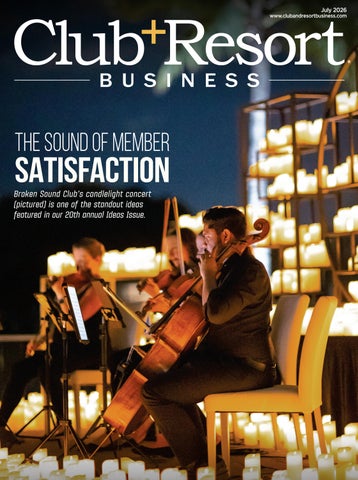
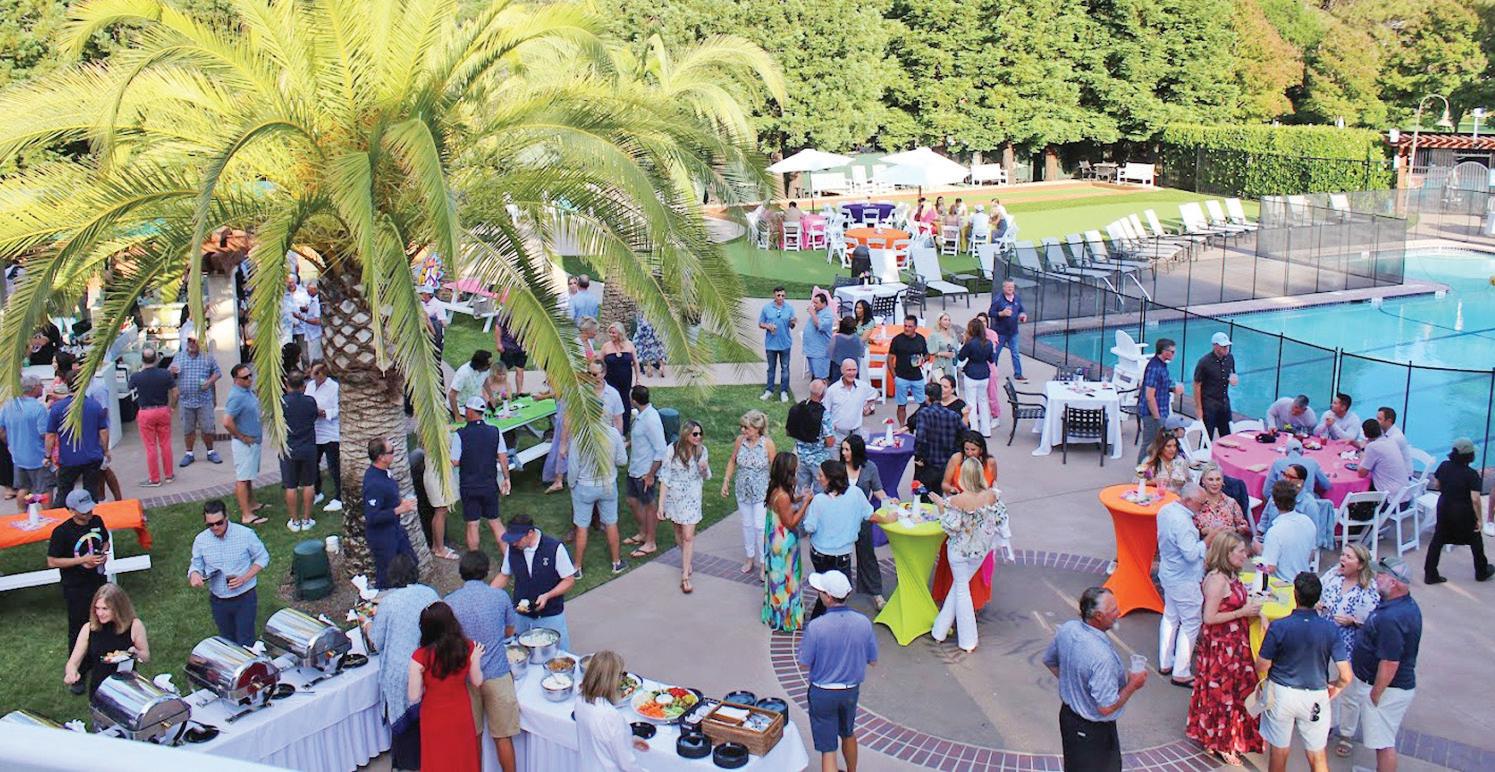
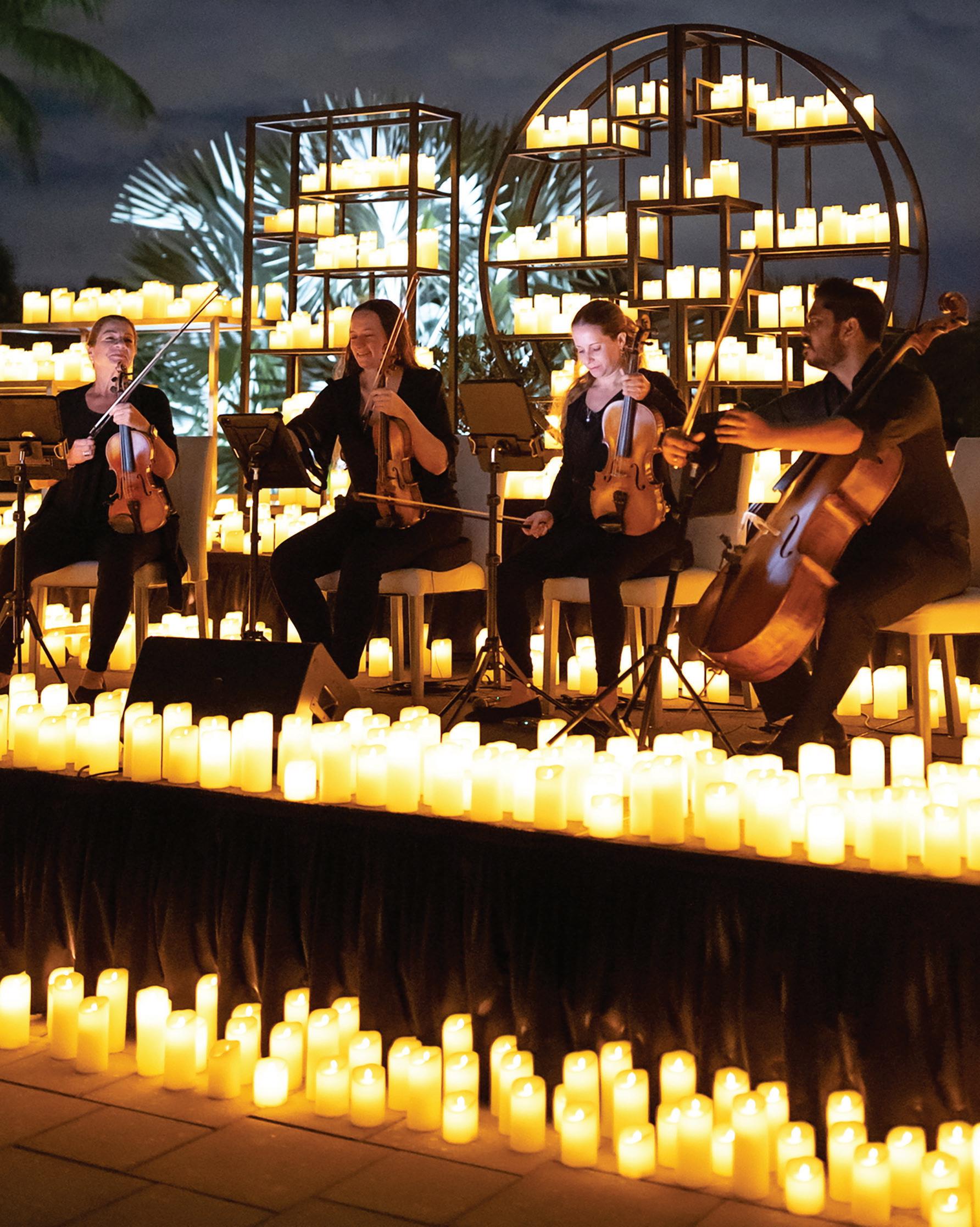
Broken Sound Club’s candlelight concert (pictured) is one of the standout ideas featured in our 20th annual Ideas Issue.











THE 20TH ANNUAL IDEAS ISSUE
4
6 SPONSORED
The Finance Decision Hiding in Your Org Chart Sponsored by Kopplin, Kuebler & Wallace
8 DESIGN + RENOVATION
Pools to Park: Marin CC’s Reimagined Pool Center Crafting Willow Oaks CC’s Cab
12 COURSE + GROUNDS
At Castle Pines CC, Every Drop Counts Collier’s Reserve CC Sets its Sights On Platinum Turning Course Care Into Community
16 FOOD + BEVERAGE Will Brake for Allergies Field Club of Omaha Crafts Happy Hour Lotto Lakeside CC’s Pearl of Wisdom
20 GOLF OPERATIONS
A New Kind of Holiday Havoc at Anthem Country Club The Walking Difference at East Lake StoneWater Uses Community to Bring More Women Into the Game

The Day the Juniors Took Charge
Where the Pros Come to Play
28 RECRUIT + RETAIN Investing In Employees A Structured Approach to Employee Feedback
30 MEMBERSHIP MARKETING
A Mascot, a Mission, and a More Connected Membership Documenting a Defining Moment
32 MEMBER EVENTS
When Members Teach Members The Sound of Member Satisfaction From Screen to Club Scene
WHAT DO YOU DO WITH AN IDEA?
WHEN MY KIDS WERE YOUNGER , one of their favorite books was 'What Do You Do With an Idea?' by Kobi Yamada.
In it, a young boy gets an idea he's not quite sure what to do with. At first, he's skeptical. He wonders if it's silly. He worries what other people will think. He goes through all the internal deliberation that comes with trying to decide whether something is worth pursuing or whether it would be easier to let it go.
Instead, he keeps coming back to it. He nurtures it. He gives it room to grow.
As we worked on the 20th annual Ideas Issue, I kept thinking about that story. Every initiative featured in these pages began with someone wondering if an idea was worth pursung or if there might be a better way to do something. And now, look (see pgs. 8-34). Some of the clubs in this issue have transformed governance or rethought their approach to employee retention. Others have found new ways to connect with members. Still others have taken seemingly small concepts and turned them into programs, traditions, and experiences that have become defining parts of the member journey.
WTWH MEDIA, LLC
1111 Superior Ave., Suite 1120 • Cleveland, OH 44114
Ph: 888.543.2447

What I love most about this issue is that none of these ideas arrived fully formed. They were tested. They were refined. In some cases, they look very different today than they did in the beginning.
That's often how innovation works. It starts with someone paying attention to a possibility long enough to see what it might become.
So, what do you do with an idea?
You give it a chance.
The stories in this issue began with people who saw a possibility and decided to pursue it. Everything that followed grew from there.

EDITORIAL DIRECTOR

Joanna DeChellis jdechellis@wtwhmedia.com
Scan this QR code to sign up for our newsletter and join the conversation.





www.clubandresortbusiness.com • www.clubandresortchef.com
SUBSCRIPTION INQUIRIES
To enter, change or cancel a subscription: Web (fastest service): https://clubandresortbusiness.com
Phone: 888-543-2447 (U.S. only, toll-free)
Mail: Club & Resort Business
1111 Superior Ave., Suite 1120 Cleveland, Ohio 44114
Copyright 2026, WTWH Media, LLC
Club + Resort l July 2026







Subscriptions: Qualified U.S. subscribers receive Club + Resort Business at no charge. For all others the cost is $75 U.S. and possessions, $90 Canada, and $145 all other countries. Per copy price is $3. Club + Resort Business does not endorse any products, programs or services of advertisers or editorial contributors. Copyright© 2026 by WTWH Media, LLC. No part of this publication may be reproduced in any form or by any means, electronic or mechanical, or by recording, or by any information storage or retrieval system, without written permission from the publisher.
Club + Resort Business (ISSN 1556-13X), USPS Publication #23658 is published 6 times: (January, March, May, July, September, November) by WTWH Media, LLC, 1111 Superior Avenue, Suite 1120, Cleveland, OH 44114 Copyright© 2026.
Periodicals postage paid at Cleveland, Ohio, and additional mailing offices. Postmaster: Send change of address notices to Club + Resort Business, 1111 Superior Ave., Suite 1120, Cleveland, Ohio 44114.
Editorial
EDITORIAL DIRECTOR Joanna DeChellis jdechellis@wtwhmedia.com • 412-260-9233
SENIOR EDITOR
Isabelle Gustafson igustafson@wtwhmedia.com • 314-606-9430
ASSOCIATE EDITOR Madison Hartline mhartline@wtwhmedia.com
VP, EDITORIAL Danny Klein dklein@wtwhmedia.com • 919-945-0726
Content Studio VP, CONTENT STUDIO
Peggy Carouthers pcarouthers@wtwhmedia.com
WRITER, CONTENT STUDIO Ya'el McLoud ymcloud@wtwhmedia.com
WRITER, CONTENT STUDIO Drew Filipski dfilipski@wtwhmedia.com
Art + Production VP, CREATIVE DIRECTOR Matthew Claney mclaney@wtwhmedia.com
CREATIVE DIRECTOR Erin Canetta ecanetta@wtwhmedia.com
Sales + Business Development SVP SALES & STRATEGY Matt Waddell mwaddell@wtwhmedia.com • 312-961-6840
NATIONAL SALES MANAGER Amber Dobsovic adobsovic@wtwhmedia.com
SALES DIRECTOR AND BRAND LEADER Patrick McIntyre pmcintyre@wtwhmedia.com • 216-372-8112
KEY ACCOUNT MANAGER John Petersen jpetersen@wtwhmedia.com • 216-346-8790
CUSTOMER SERVICE REPRESENTATIVE Tracy Doubts tdoubts@wtwhmedia.com
Leadership CEO Matt Logan mlogan@wtwhmedia.com
CHIEF OPERATING OFFICER George Yedinak gyedinak@wtwhmedia.com
CHIEF REVENUE OFFICER Scott Kelliher skelliher@wtwhmedia.com
VP OF MARKETING Annie Wissner awissner@wtwhmedia.com
www.clubandresortbusiness.com
The Finance Decision Hiding in Your Org Chart
LABOR IS THE SINGLE LARGEST operating expense at most private clubs, and turnover is one of the most expensive line items on the P&L. Wage-and-hour exposure is one of the fastest growing sources of legal costs in the hospitality industry. Each of these is a finance issue. Each of them ultimately traces back to a single org chart decision that many clubs make once and never revisit: to whom does the senior Human Resources leader report?
In recent years, the industry has begun to elevate the Human Resources function in a way it never has before. The emergence of the Director of People and Culture role at clubs across the country reflects a quiet but important shift. Boards and General Managers are recognizing that talent, retention, and culture are not soft topics. They drive labor cost, member satisfaction, and increasingly, legal exposure.
Yet at many clubs, the structure has not kept pace with the thinking. The senior Human Resources role still reports
to the Chief Financial Officer. It is one of the most common mistaken org chart decisions in the Club world, and one of the most quietly damaging, both to the Club’s financial situation and to the member experience the Club exists to deliver.
THE STRUCTURAL CONFLICT GENERAL MANAGER/COOS SHOULD RECOGNIZE
The Chief Financial Officer and the head of Human Resources are both stewards, but of different assets. The Chief Financial Officer protects capital, controls costs, and is measured on financial discipline. The head of Human Resources is responsible for the workforce, which means advocating competitive compensation, investing in development, and helping to build the culture that retains the people who deliver the member experience day after day.
Asking one executive to referee that tension inside their own function is asking the impossible. Charlie Gray, founder of Human Resources consultancy Gray
Scalable, said it plainly in CIO magazine:
“A senior Human Resources leader should never report to the Chief Financial Officer because the two roles are often in strategic conflict, and Human Resources becomes a non-strategic function if it reports to the head of finance. The reporting line predetermines the outcome.”
That is not a knock on any Chief Financial Officer. It is the job. The problem is that the structure asks the Chief Financial Officer to suppress half of their mandate to lead a function that often needs to push in the opposite direction. For the General Manager/COO, it means the people strategy you need to deliver the member experience never arrives at the executive table intact. It is pre-budgeted out of existence before you see it. For the members, it shows up as inconsistency, front-of-house turnover, and a service culture that never quite feels settled.
THE HIDDEN RISK BOARDS SHOULD ASK ABOUT
This is the issue Boards most often fail to see, and it is the one with the largest dollar consequence.
When an employee has a concern about pay, classification, overtime, harassment, or retaliation, the first place they go is Human Resources. The credibility of that channel determines whether the complaint stays internal, where it can be investigated and resolved at modest cost, or escalates externally to the state Department of Labor, the EEOC, or a plaintiff’s attorney, where the cost is measured in five- and six-figure sums before anyone reaches the merits.
Now consider what happens when Human Resources reports to the Chief Financial Officer and the complaint involves payroll practices, worker misclassification,
overtime calculations, or someone in the finance department. The person investigating reports to the executive whose function is implicated. Employees read that structure instantly and stop reporting internally. When they start reporting externally, the Club no longer controls the timeline, the narrative, or the cost.
THE QUIETER COST: TURNOVER THE P&L DOES NOT SHOW YOU
There is a second cost that shows up long before any complaint, and it is the one Finance Committees might underestimate. When Human Resources reports through finance, people decisions get filtered through a cost lens before they ever reach the strategic conversation. Compensation benchmarking gets compressed, training budgets get trimmed, and replacement hires get delayed. Each decision looks defensible on its own. The cumulative effect is turnover.
Industry research has long pegged the fully loaded cost of replacing an hourly hospitality employee at roughly 30 to 40 percent of annual wages, and considerably more for management positions. That cost lives across recruiting, onboarding, training, lost productivity, and overtime paid to cover the gap. None of it shows up in a single GL account, which is precisely why finance-led Human Resources structures consistently miss it.
Members feel it first, in the small moments that add up. The familiar server who is no longer there, the new hire who does not yet know how Mr. and Mrs. Smith take their drink, the valet who hesitates at the gate and forces a longtime member to introduce himself at his own club. Every one of those moments eventually traces back to a people decision made through the wrong lens.
WHERE THE ROLE SHOULD SIT
The Director of People and Culture, or whatever your Club calls the senior Human Resources role, should report directly to the General Manager/COO, with a dotted line to the Board President or the appropriate Board committee responsible for governance, compensation, or Human Resources matters.
The dotted line is not symbolic. It is the safeguard that protects the Club when a serious matter involves senior leadership, including the General Manager/COO, the Chief Financial Officer, or any Board member.
This structure delivers what the finance-led model cannot:
1. Workforce decisions get discussed strategically, with member experience and cost weighed at the same table.
2. Employee concerns route through a credible channel, dramatically reducing the probability of external escalation.
3. The Board gains direct visibility into turnover, compensation equity, and workforce risk, alongside financial risk.
4. Recruiting strong Human Resources leadership becomes possible.
As Jodie J. Cunningham, SHRM-SCP, SPHR, Human Resources/Talent Strategist and Search & Consulting Executive at KOPPLIN, KUEBLER & WALLACE, explains:
“If a Club wants Human Resources to operate as a strategic talent partner and contribute meaningfully to club business objectives, the function should report directly to the General Manager/ COO rather than Finance. Reporting to the Chief Financial Officer signals that Human Resources is viewed primarily as a cost center rather than a strategic business partner, which impacts both perception and recruitment.”
Cunningham adds:
“Additionally, reporting structure is a non-negotiable priority for experienced Human Resources Director candidates. In my experience, top candidates immediately lose interest when Human Resources reports to Finance, as this clearly signals an outdated, administrative model rather than the strategic leadership role they expect. This structure
directly undermines efforts to attract strong Human Resources talent.”
At a time when Clubs are competing for experienced Human Resources leaders capable of navigating labor shortages, compliance risk, compensation strategy, employee relations, and culture development simultaneously, the org chart itself has become a recruiting signal.
5. The Chief Financial Officer is free to focus on the strategic financial work the Club actually needs from that role.
THE QUESTIONS WORTH PUTTING ON THE AGENDA
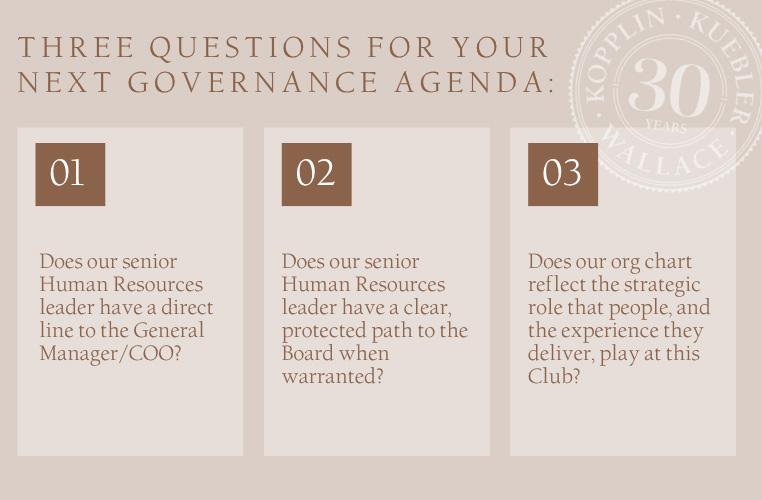
If your Club currently has Human Resources reporting to the Chief Financial Officer, the conversation is not about blame. The structure made sense at a time when Human Resources was viewed primarily as transactional, and many clubs never revisited it. The industry has changed. The legal environment and the labor market have changed. Most of all, member expectations have changed. Three questions belong on the next governance agenda:
1. Does our senior Human Resources leader have a direct line to the General Manager/COO?
2. Does our senior Human Resources leader have a clear, protected path to the Board when warranted?
3. Does our org chart reflect the strategic role that people, and the experience they deliver, play at this Club?
If the answer to any of those is no, the fix is not complicated. Your org chart is a document your members never see, but they read it every day in the experience you deliver. Where Human Resources sits on that chart tells your team and your next great hire exactly how seriously you take the people side of the Club.

By Michelle A. Riklan Career Strategist, Search and Consulting Executive, specializing in Finance and Accounting talent placement at

Pools to Park: Marin CC's Reimagined Pool Center
By Isabelle Gustafson • Senior Editor
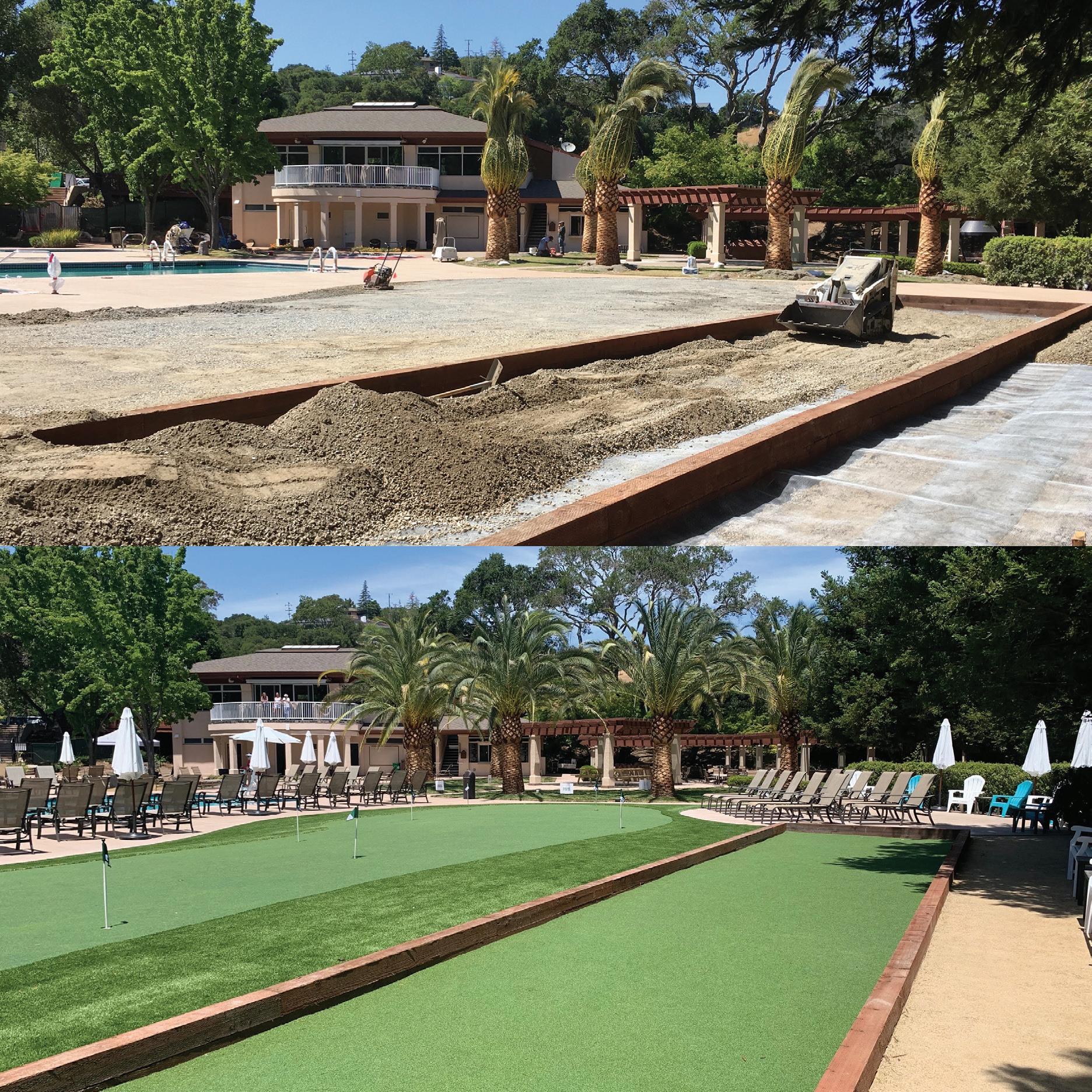
AT MARIN COUNTRY CLUB in Novato, Calif., historically, the pools sat largely unused during the off-season. Since its “Pools to Park” initiative, however, the space has been completely reimagined.
“While it may not always be warm enough for swimming, it is often perfect for spending time outdoors with family and friends,” says Heather Peterson, Marin CC's Director of Marketing and Communications. “To take advantage of that opportunity, the club made the decision to fence the pools during the off-season and [rethink] the area as a safe, park-like gathering space.”
The goal was simple, Peterson says: Create an inviting and safe environment where families could spend quality time together, children could burn off energy, and adults could relax and socialize.
THE CHALLENGE:
Create an inviting and safe environment to enable use of the area surrounding the pools during the off-season.
THE RESPONSE:
Fence the pools during the off-season and reimagine the area as a safe, park-like gathering space.
THE RESULT:
Members are happy with the space and are therefore spending more time outside at the club year-round.
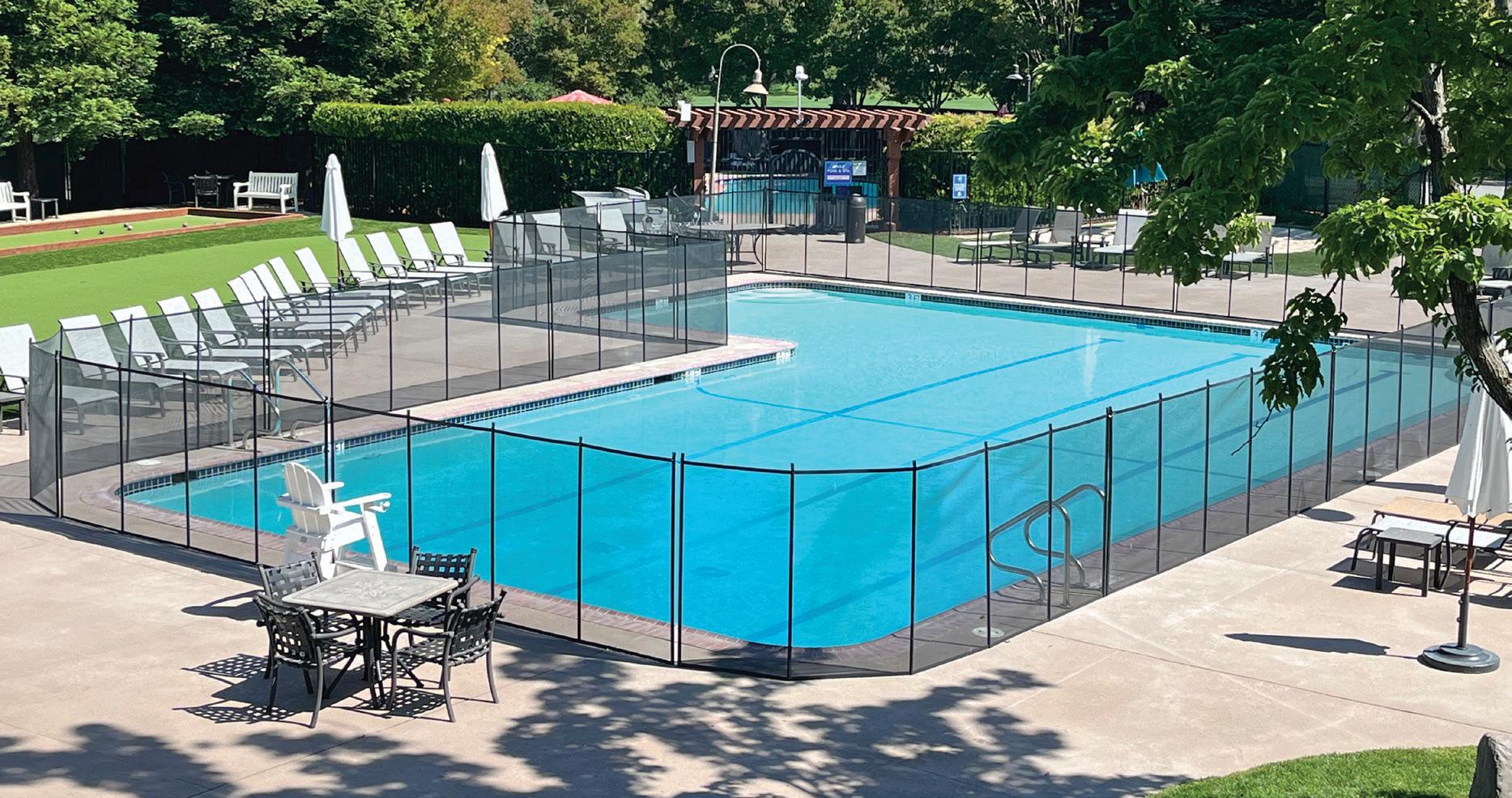
Secure, temporary fencing is now installed each year in late October, then removed in early April. The fencing fully encloses the three pool areas, while keeping the remainder of this outdoor space open and accessible. This maximizes the use of existing amenities, increases off-
season engagement, and provides parents peace of mind.
“We expanded the experience even further by adding bocce courts, a putting green, volleyball, play structures, and additional gathering spaces with TVs and fire pits,” says Peterson.
Marin CC expanded its off-season outdoor experience by adding bocce courts, a putting green, volleyball, play structures, and additional gathering spaces with TVs and fire pits.
The change has been “a tremendous success,” Peterson notes. “It has also allowed us to host family-friendly activities such as Easter egg hunts and seasonal events that would previously have required extensive supervision around the pools or in other areas of the club, including blocking off portions of the golf course or driving range.”
While the pool snack window's not open during the off-season months, members are able to order food from the restaurant inside through the club's app and have it delivered to them outside.
“This allows families to comfortably spend an entire afternoon enjoying the space,” Peterson says.
Crafting Willow Oaks CC’s Cabana Bar
By Isabelle Gustafson • Senior Editor
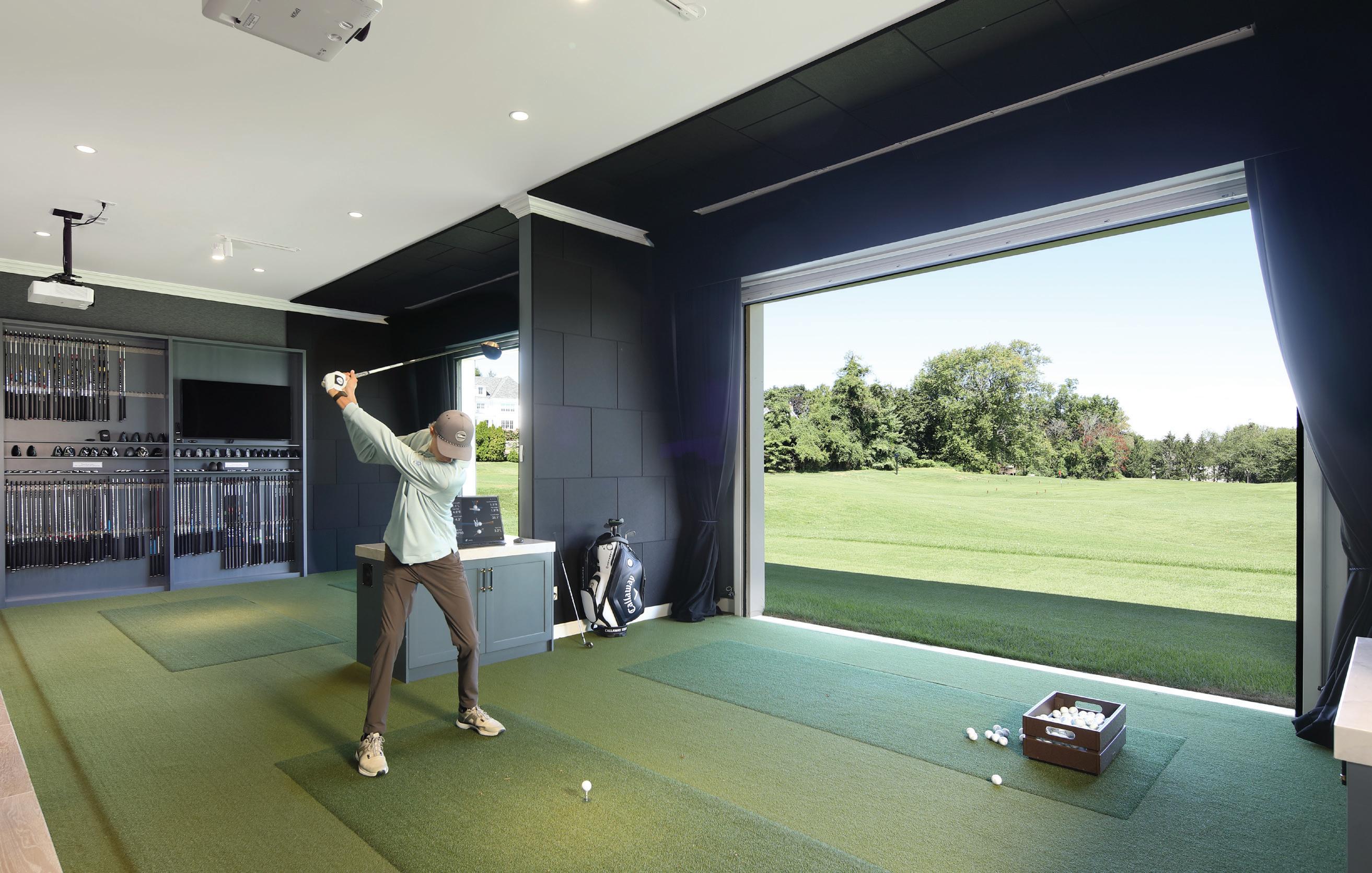
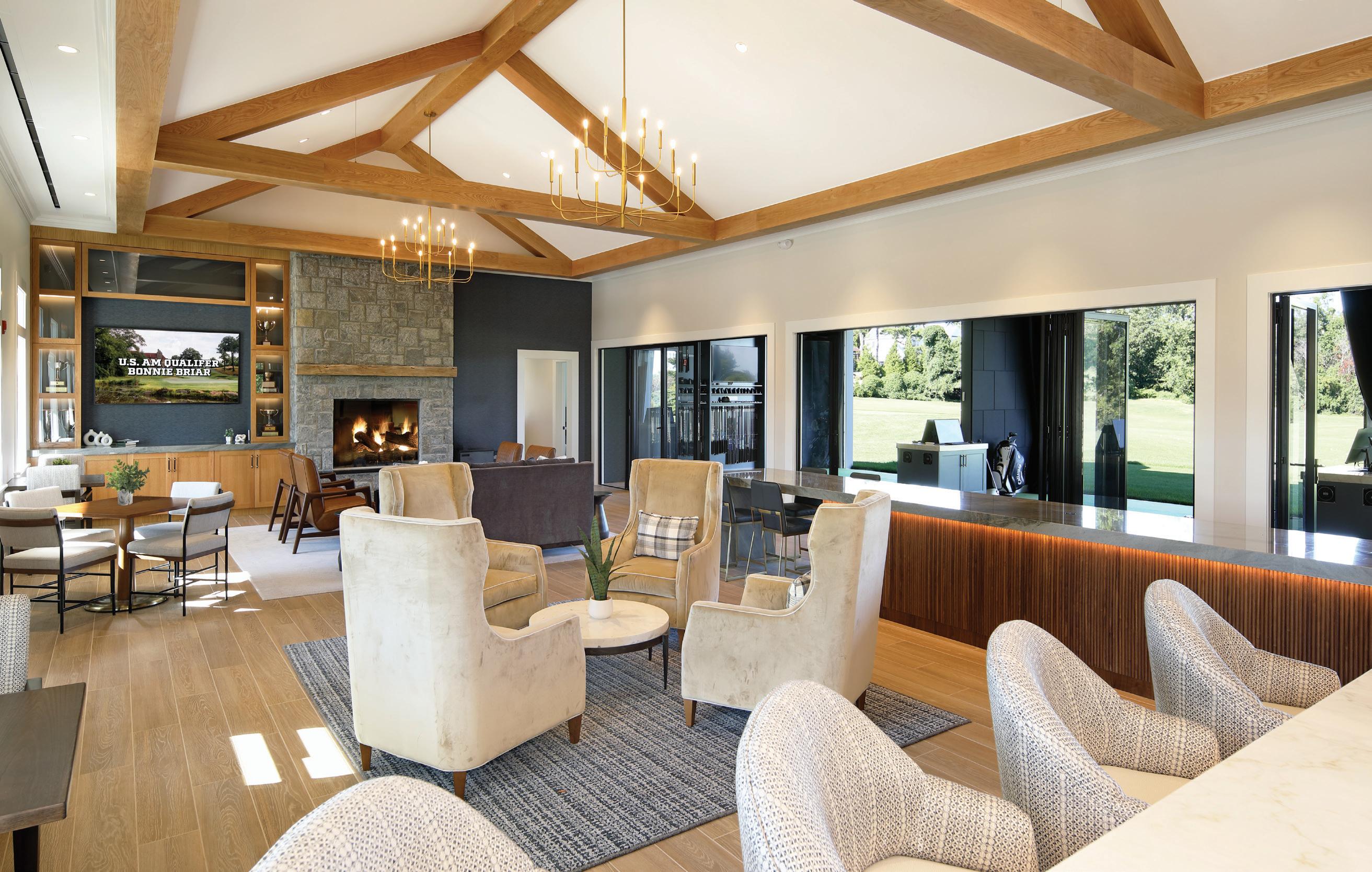
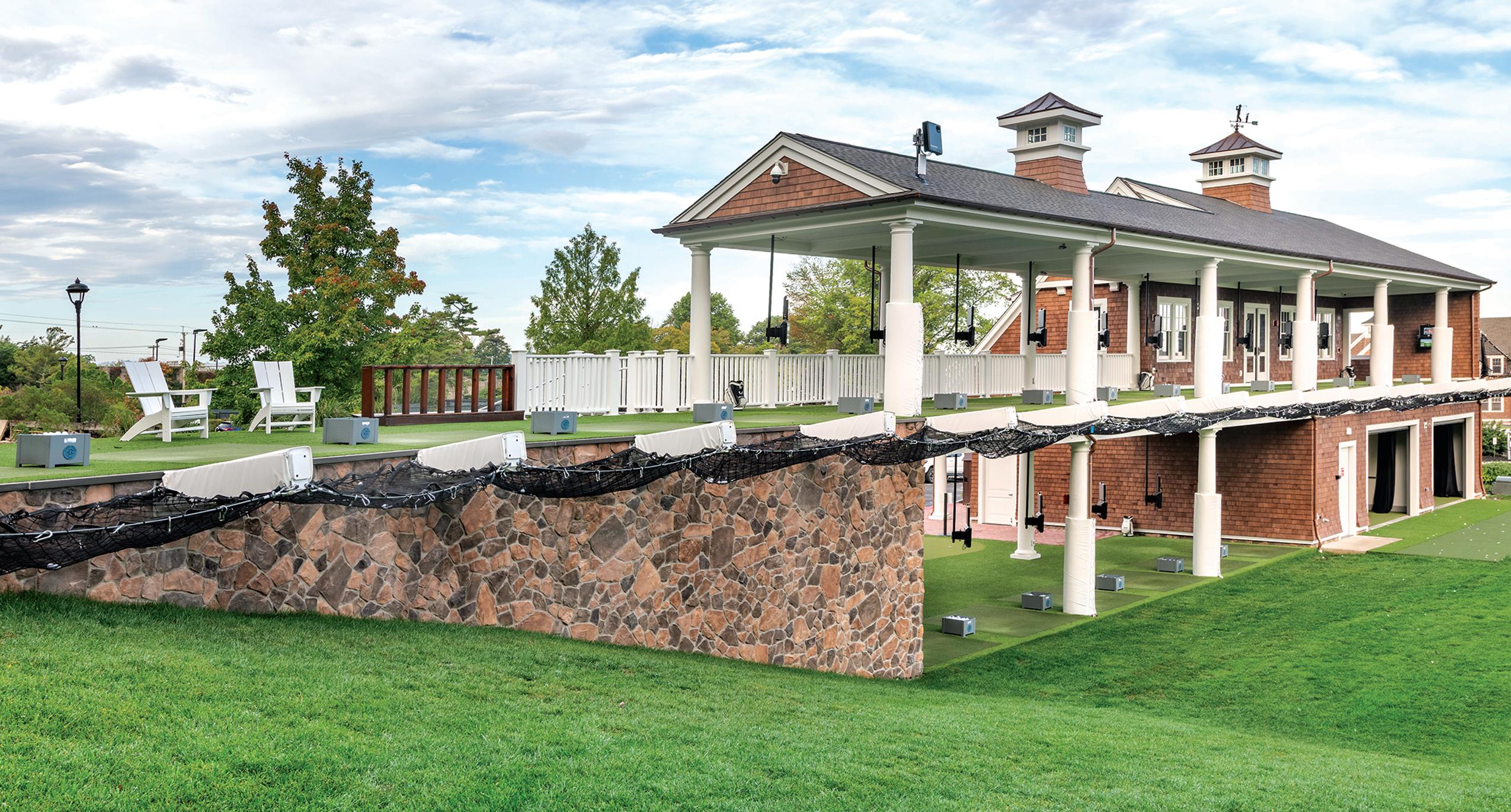
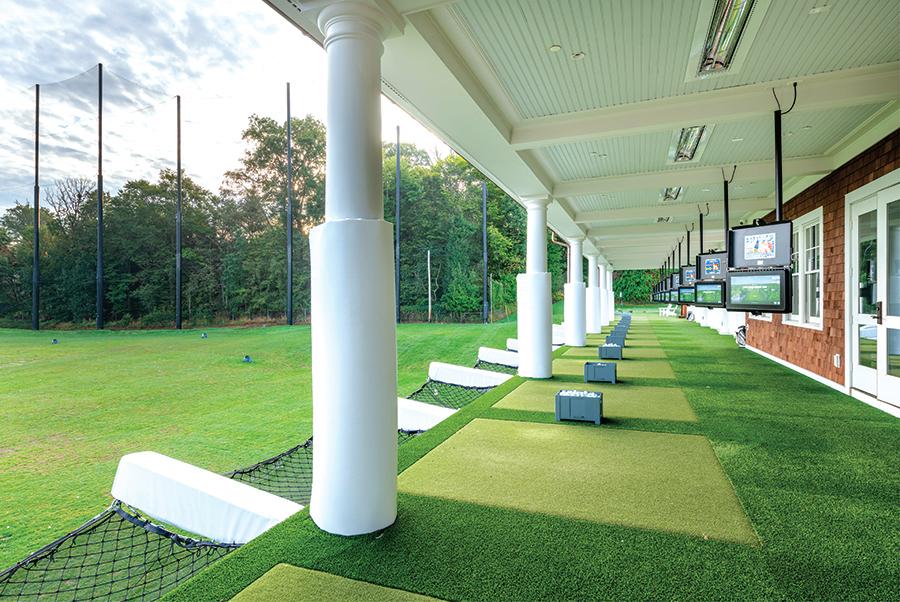
AT WILLOW OAKS COUNTRY CLUB in Richmond, Va., the Cabana Bar marks the first phase of a $15 million expansion. The bar's thoughtful, intential design sets the tone for the rest of the project, the full scope of which will include a complete renovation and expansion of the clubhouse and kitchen, the addition of pickleball courts, and a golf performance center, including four indoor/outdoor hitting bays, a lounge with bar service, a dedicated teaching bay and offices.
Courtenay Cranford, Director of Marketing and Communications for Willow Oaks CC, says the Cabana Bar was specifically designed to be accessible from nearly every area of campus.
“Members can enter from the pool deck through multiple gates or from outside the pool area, making it a natural gathering place for golfers, tennis players, swimmers, and families alike,” she says.
The space has quickly become a hub. Members might grab a drink after golf or a tennis, for example, or parents can relax or work while their kids are at swim practice.
“The bar's open, square design creates sightlines and conversation opportunities on all four sides,” Cranford notes, “encouraging members to socialize with one another.”
Family-friendly seating also provides another dining opportunity at the club, to remain open for adults and kids throughout the summer season and into the fall.
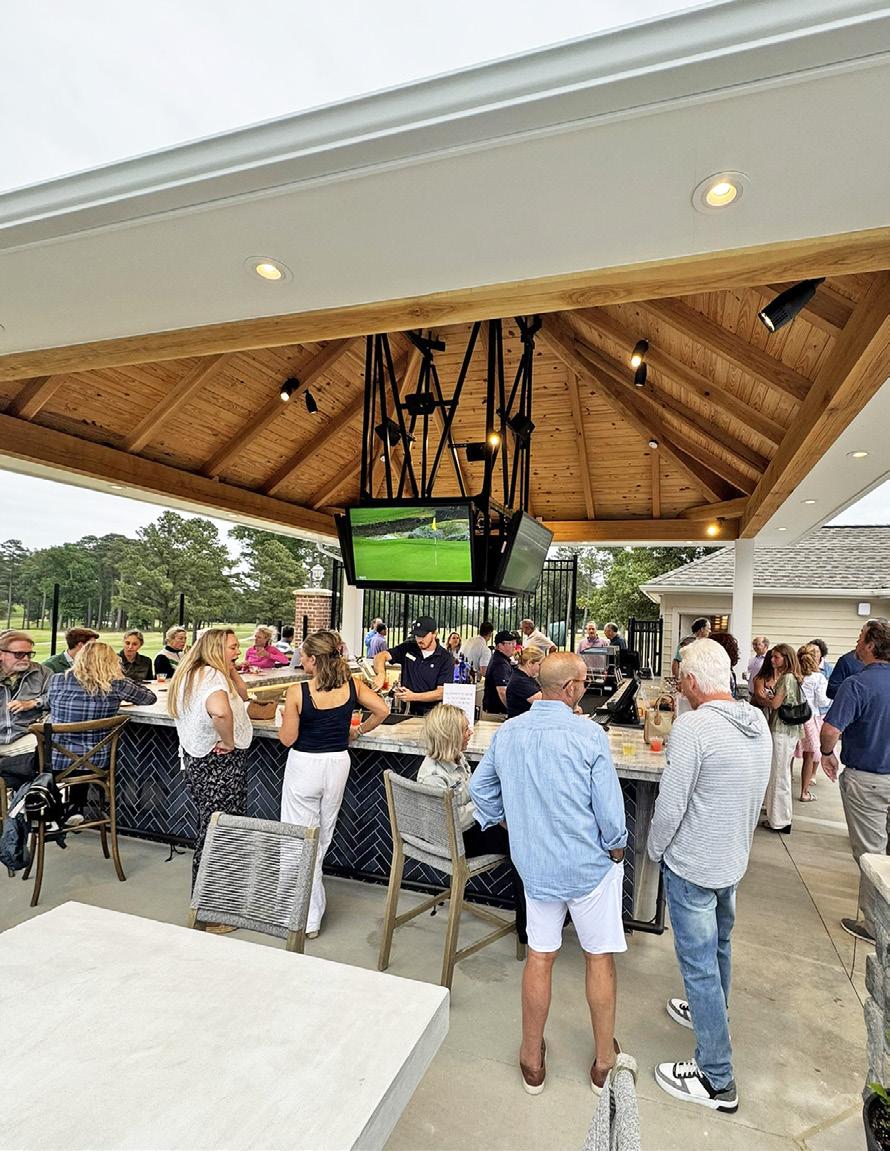
THE CHALLENGE:
Create a new outdoor bar that acts as a hub for socialization.
THE RESPONSE:
The Cabana Bar was completed as a first step in a larger renovation. The bar's central location and its open, square design enhances sightlines and conversation opportunities.
THE RESULT:
Because of its location and design, the Cabana Bar is a natural gathering place for all facets of membership.

At Castle Pines CC, Every Drop Counts
By Madison Hartline • Associate Editor
CASTLE PINES COUNTRY CLUB
(Castle Rock, Colo.) has reduced annual water consumption by 17 million gallons over the past two years by changing how it measures moisture across the golf course.
The club recently introduced moisture mapping sensor technology that allows the grounds team to collect thousands of moisture readings in minutes and make irrigation decisions using real-time data. Since implementing the technology, Castle Pines has reduced average moisture levels from 18 percent to 11.5 percent while maintaining course conditions.
Director of Grounds Lance Lauer was first introduced to the technology by a colleague in 2023. He was so impressed with the data and ease of use that he spent his first season presenting the idea
to the club's General Manager and board.
In January 2024, the club approved the purchase. This is now the third season that Castle Pines has utilized the sensors.
FIVE MINUTES, 10,000 READINGS
Sensors mounted on the club's utility carts collect seven moisture readings per second as the grounds team drives across the course. Each reading measures moisture at a four-inch depth.
After gathering the data, the team uploads it to the cloud, where the platform provides an overview of moisture readings across the property.
The process is significantly faster than relying on handheld moisture sensors.
“If I were to send out a staff member to gather 10,000 readings on a fairway

THE CHALLENGE:
High water consumption and reliance on manual moisture testing resulted in increased labor demands and limited irrigation efficiency.
THE RESPONSE:
The club mounted moisture sensors to utility carts, collected 10,000 data points per minute on fairways and adjusted their water usage based on the data.
THE RESULT:
The club successfully reduced its annual water usage by 17 million gallons over two years, while simultaneously transforming an eight-hour manual task into a five-minute automated process that strengthens the club’s environmental stewardship.
with the handheld sensors, they'd be out there for eight hours or more,” says Lauer. “With the new sensors, it takes five minutes.”
The time savings allow the grounds team to focus on other priorities instead of spending hours monitoring moisture levels and adjusting irrigation. The club also uses a formula developed by Dr. Bill Kreuser at the University of Nebraska that incorporates forecasted evapotranspiration, average root depth of turfgrass, and the property's wilt point to determine the minimum moisture level needed to avoid turf stress on a given day.
BEYOND IRRIGATION MANAGEMENT
While the technology was adopted to improve irrigation management, it has also helped Castle Pines address growing public scrutiny around golf course water consumption.
Before Lauer stepped into the role, the club was using nearly 82 million gallons of water annually. By providing a clearer picture of moisture levels across the property, the sensors have helped the grounds team better understand exactly where water is needed and where it is not.
“Fairways used to be managed around 20 to 25% moisture, and we are down to 12 to 14% in our fairways now,” says Lauer.
The club's goal is to use the minimum amount of water necessary to maintain the conditions members expect while remaining environmentally conscious. Lauer expects those gains to continue as the team becomes even more proficient at using the technology and applying the data it provides.
Collier’s Reserve CC Sets its Sights On Platinum
By Madison Hartline • Associate Editor
IN 1993, COLLIER’S RESERVE Country Club (Naples, Fla.) became the first golfing community in the world to be designated an Audubon International Signature Sanctuary. Now, more than 30 years later, the club is vying to become the first ever facility to be recognized with Audubon International Platinum Signature Sanctuary certification.
The status represents the highest possible acknowledgment of a club’s community-wide commitment to sustainable practices and biodiversity.
“Over the years, our members and leadership recognized that sustainability is not just about maintaining a golf course responsibly—it’s about protecting and enhancing the entire ecosystem and community surrounding it,” says Ken Kleinedler, CGCS, Golf Course Superintendent.
A PLATINUM-LEVEL NEXT STEP
Pursuing this certification is a natural next step for the club because it allows its efforts to be elevated into a comprehensive, community-wide initiative focused on conservation, education, wildlife, water quality, and long-term environmental stewardship.
Creating a model other private club communities can follow is a driving factor behind gaining this certification.
“More importantly, we want to create a lasting framework that helps preserve the natural beauty and ecological health of Southwest Florida for future generations,” says Kleinedler.
Protecting the native Gopher Tortoise and its habitats is a key way the club is working toward this goal.
The club has protected active habitats throughout the property, implemented

THE CHALLENGE:
Developing a comprehensive conservation strategy to support biodiversity, environmental stewardship, and qualification for Audubon International's highest level of certification.
THE RESPONSE:
Collier’s Reserve adopted a community-wide sustainability strategy that combines habitat preservation, native plantings, water conservation, wildlife protection, member education, and cross-department collaboration.
THE RESULT:
The effort strengthens environmental health, increases member pride and engagement, enhances property values, and positions the club as a model for sustainable golfing communities.
operational practices that minimize disturbances, and developed educational materials to help residents understand how to safely coexist with the species, which was once on the endangered species list.
Collier’s Reserve is also protecting natural vegetation by expanding native planting areas, preserving natural buffer zones, enhancing pollinator habitats, installing and monitoring wildlife nesting boxes and bee hive boxes, improving water quality initiatives and reducing inputs through precision-management practices.
THE PAYOFF FOR MEMBERS AND THE PROPERTY
The greatest payoff of the club's efforts is the long-term preservation and enhancement of the natural environment surrounding its community, notes Kleinedler.
“Achieving this status also helps create a stronger sense of pride and engagement among residents," he adds, "while positioning Collier’s Reserve as a leader in environmental stewardship within the industry.”
Turning Course Care Into Community
By Madison Hartline • Associate Editor
GLENMOOR COUNTRY CLUB
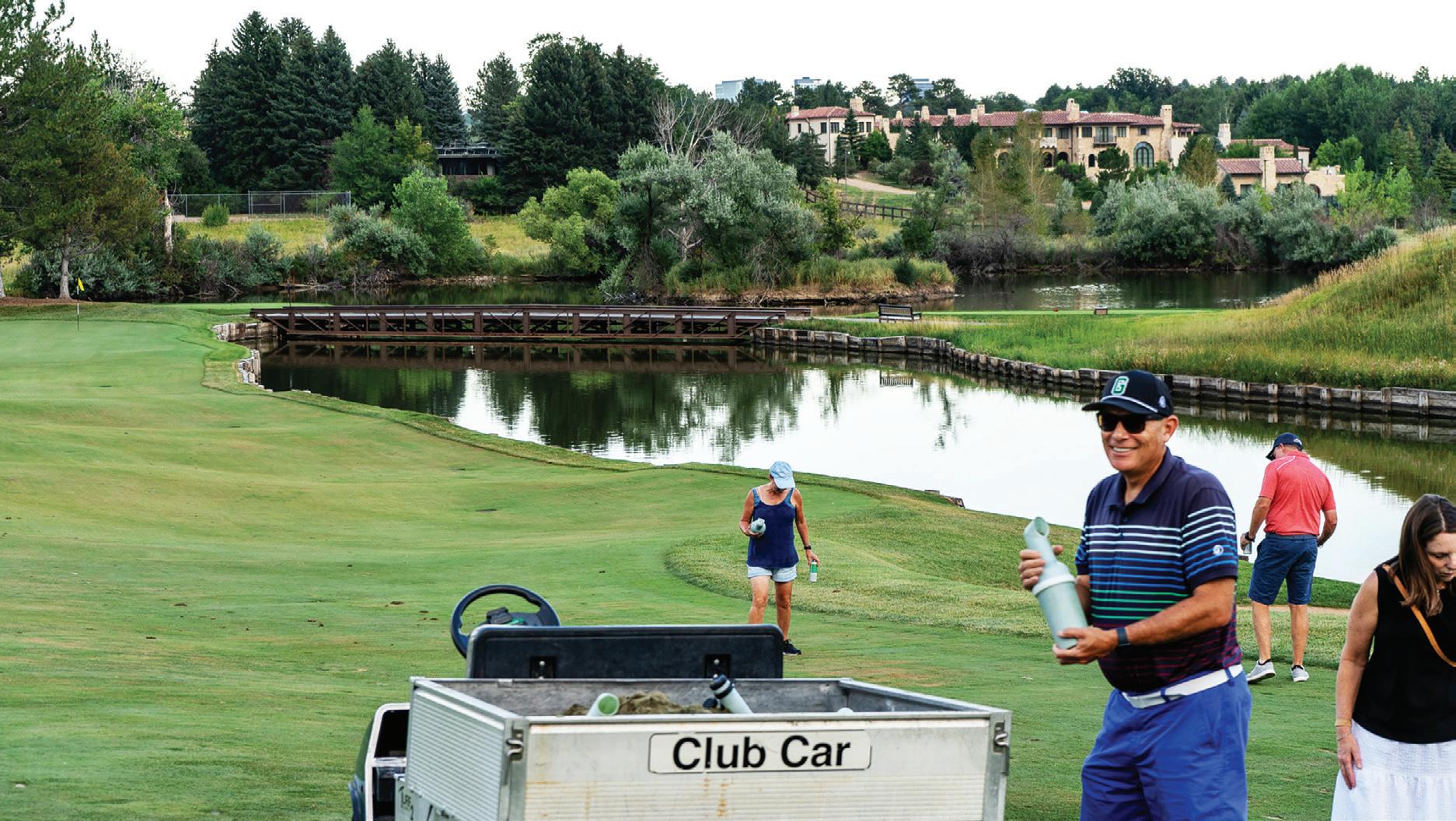
(Cherry Hills Village, Colo.) hosts its Divot Happy Hour not because the golf course is in poor shape, nor because the club can’t afford to pay staff to fill the divots themselves. Rather, the initiative has proven to create strong and lasting community engagement among membership.
In fact, Alan Palmer, Glenmoor CC's Head Golf Professional, says this event has become an often-asked-about member staple.
Palmer uses the event to create a social environment where members gain respect for the course, talk with maintenance crew, and create lasting memories with other members.
A SIMPLE FORMULA FOR MEMBER ENGAGEMENT
Palmer usually holds the event in late summer and early October, averaging around 30 to 40 members per session.
Before heading out to the course, Palmer runs members through a quick tutorial on how to fix ball marks and replace divots with the original grass, sand or seed.

“We get a lot of families and couples that participate in the event and then stick around to grab dinner in the clubhouse after,” says Palmer.
Following the demonstration, members are split into 10 groups of three. This way, they're able to interact with one another and take advantage of the beverage cart and appetizers Palmer and his team set up for the event.
Food and beverage make up most of the costs, which ends up around $300.
“In the late summer, we focus on the front nine. I split the groups up by having one group focus on holes one through three and another group focusing on four through six and so forth,” he says. “Then, maybe a month or so later, we head back out and do the back nine holes.”
The grounds crew delivers around three to six golf carts with sand and seed in the back of the bed. Each group takes one to two carts and uses it to refill their bottles as they move throughout the course.
MORE THAN A MAINTENANCE PROJECT
The event allows Palmer, the club's GM, and other members of the team a new op-
THE CHALLENGE:
Finding new ways to connect members with the golf course and the team responsible for maintaining it.
THE RESPONSE:
Seasonal Divot Happy Hours where members learn courserepair techniques, work in small groups across the course, and enjoy food, beverages, and interaction with staff and club leadership.
THE RESULT:
A member-favorite tradition that strengthens relationships, increases appreciation for course maintenance, and reinforces a sense of pride in the golf course.
portunity to interact with members. And Glenmoor CC's members leave with a sense of shared culture and investment in their course.
“Members love this event. It’s a great way to get them involved in the club and to generate excitement about the course,” says Palmer.
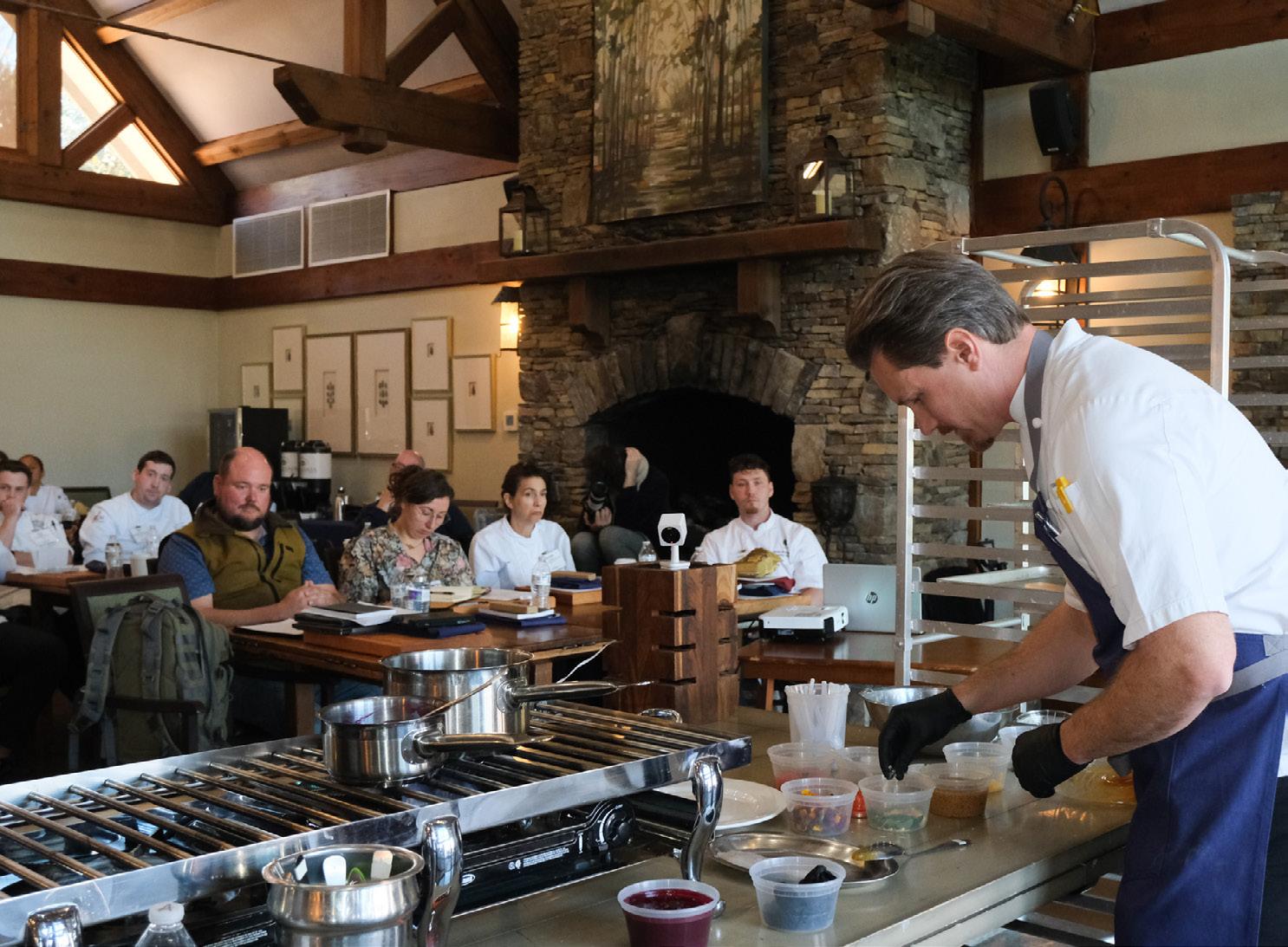
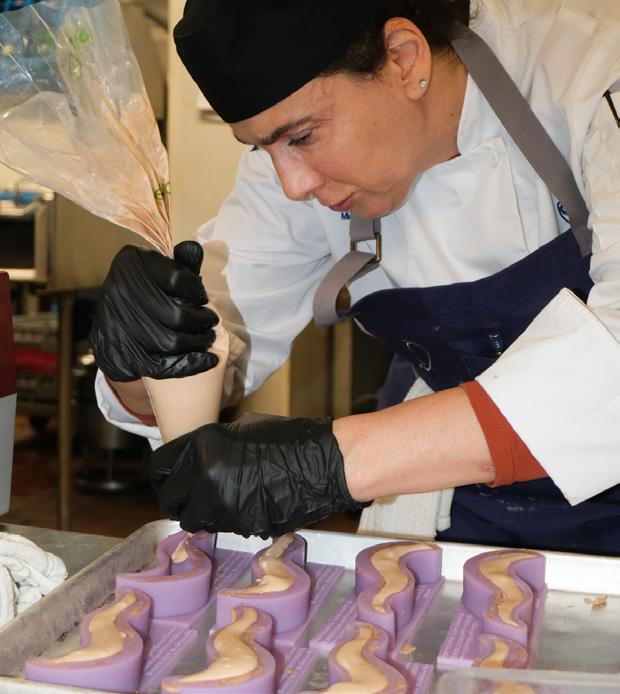
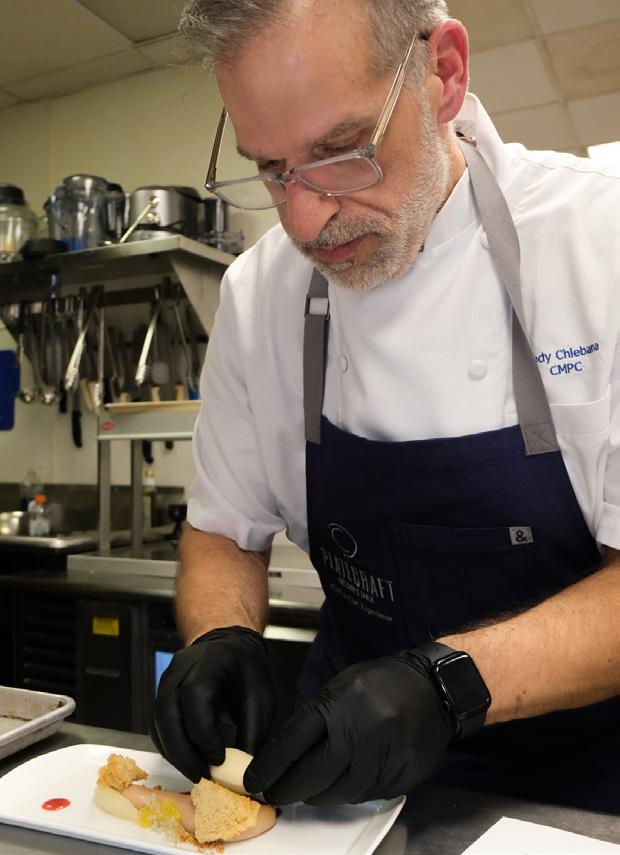
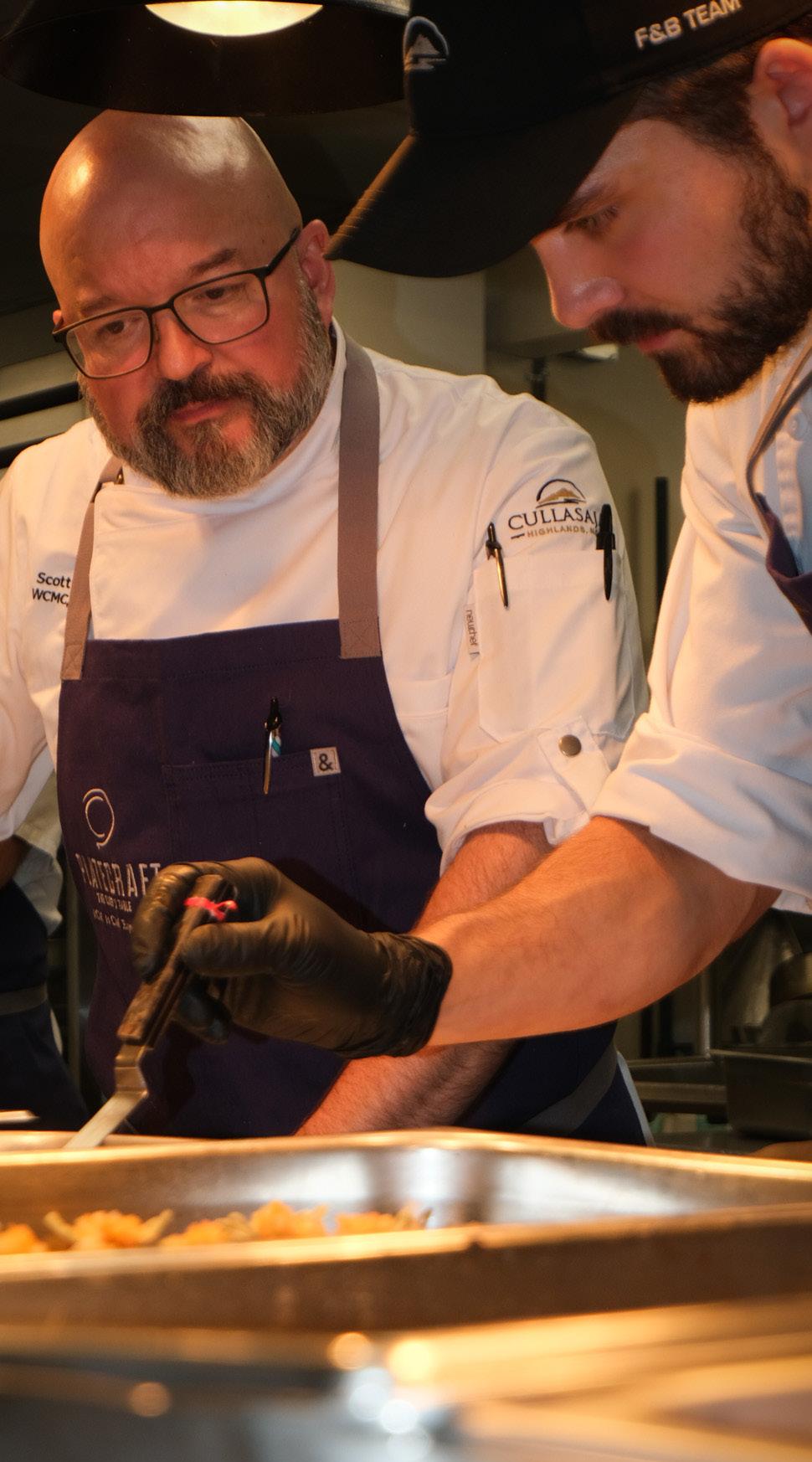
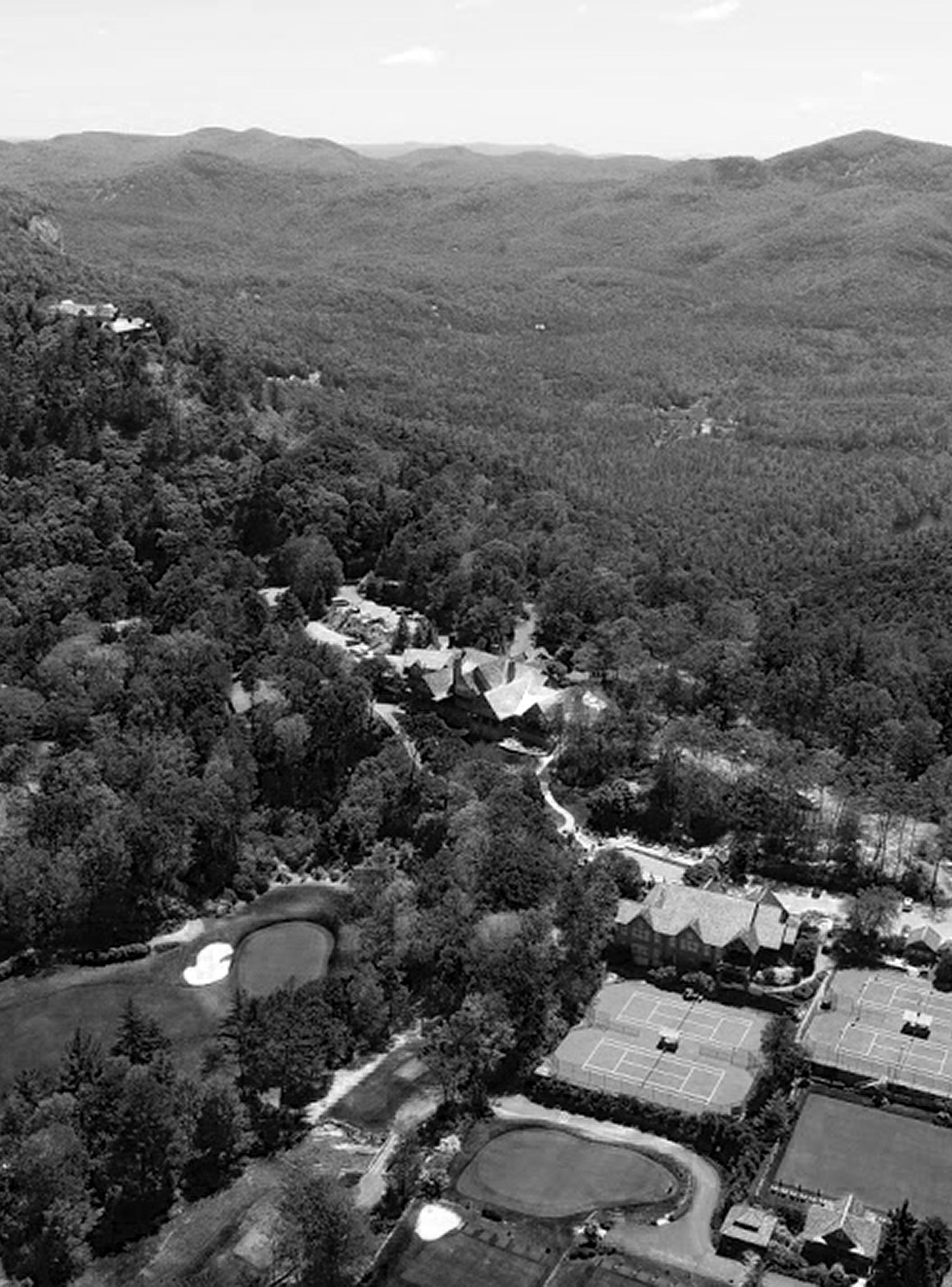
NOVEMBER 1-3, 2026
CULLASAJA CLUB IN HIGHLANDS, N.C
Will Brake for Allergies
By Isabelle Gustafson • Senior Editor
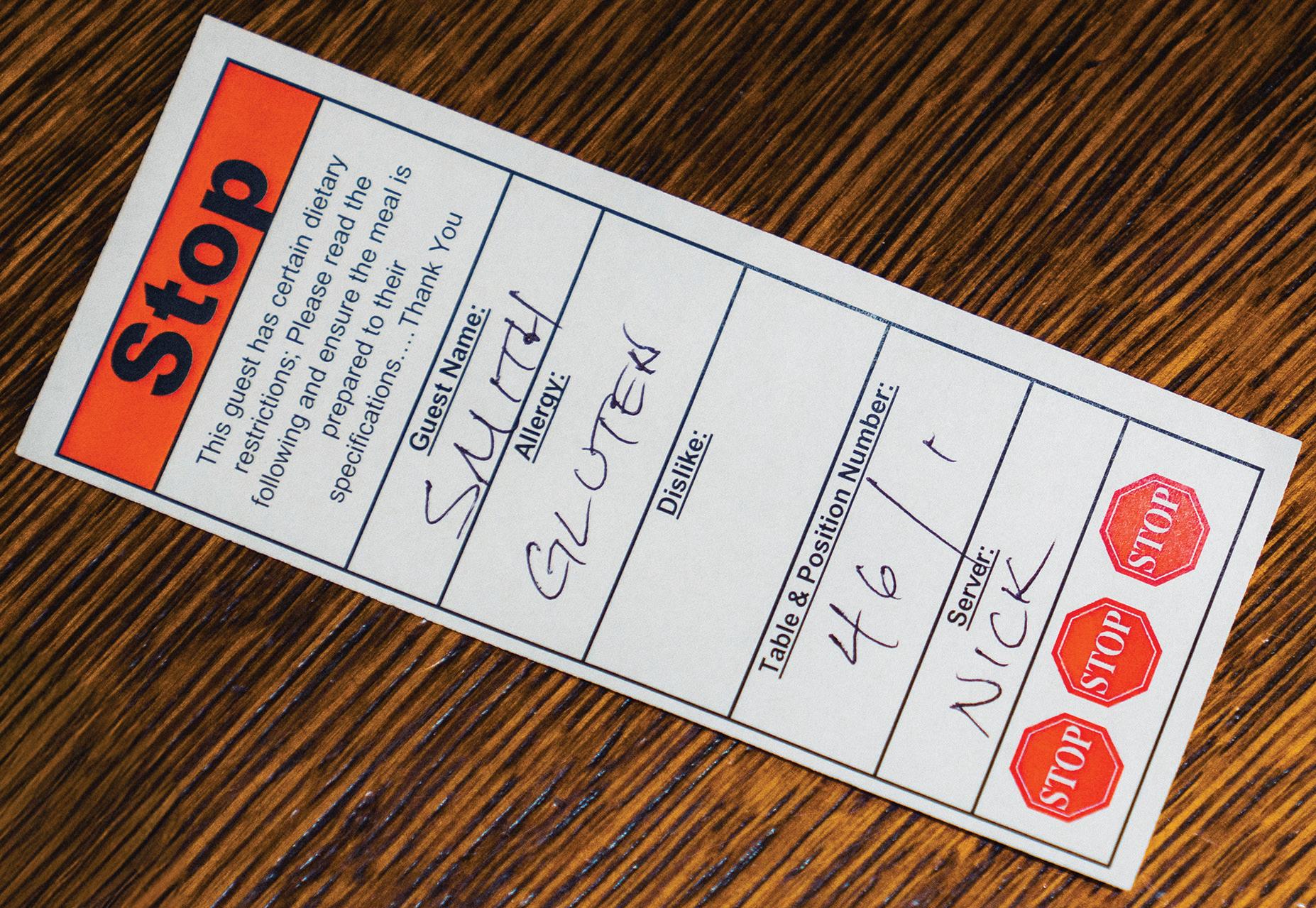
THE DETROIT ATHLETIC CLUB (DAC) Allergy Stop Ticket program treats allergies not as an inconvenience but as a critical safety and service issue, adding a tangible, easily repeatable step to every a la carte dining ticket.
Introduced in January 2025, the tickets, featuring a bright-red stop sign, are now used in all of the club’s dining outlets.
The process begins with the reservation: Hosts and managers ask about allergies and dietary restrictions and record them digitally. In addition, when members and guests are seated, servers ask an openended question to pinpoint any other allergies or aversions.
After taking the order, the server enters the order that's then printed on the kitch-
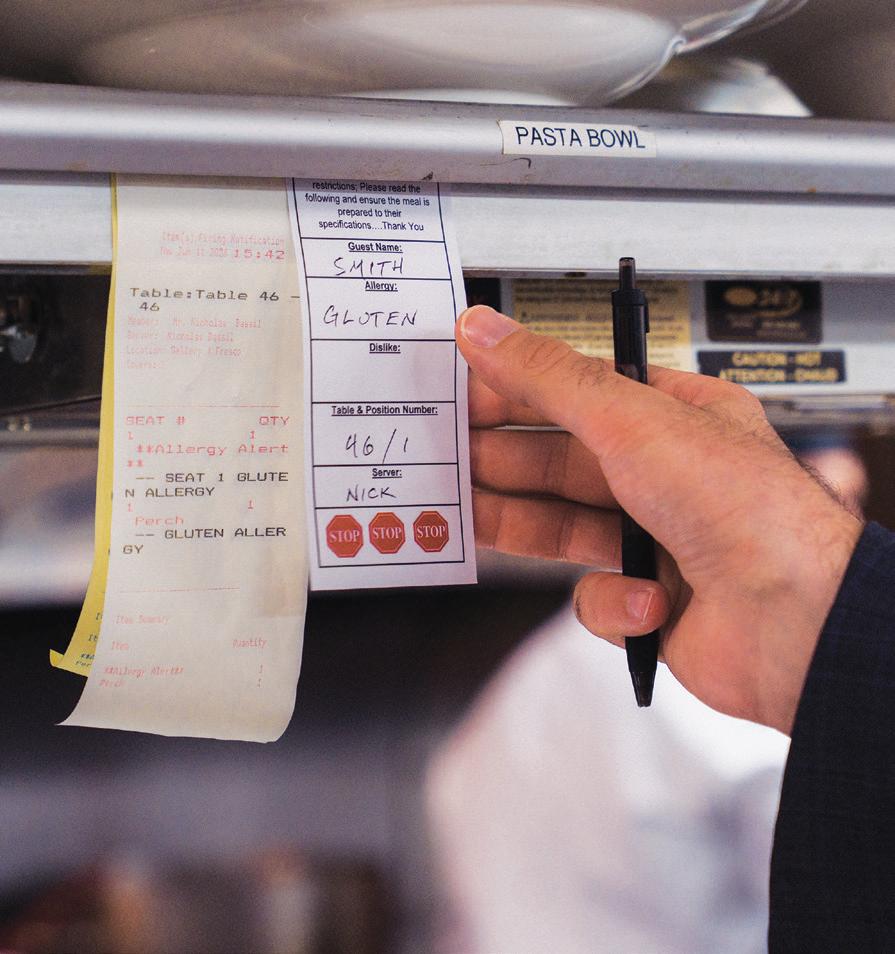
en chit; fills out an Allergy Stop Ticket with table number, member/guest name, seat position and all allergies/aversions; then hands the ticket to the chef or cook on the line. The Allergy Stop Ticket is clipped to the corresponding kitchen chit, stays with it through preparation, and is saved for 30 days to allow review as needed.
This program essentially formalizes what used to rely primarily on verbal communication and memory. And it creates a clear SOP that spans reservations, frontof-house and back-of-house operations. The visual “STOP” cue reduces the risk of human error during service, clarifies accountability, and provides documentation if a concern arises later. It also supports service customization by capturing food
aversions alongside life-threatening allergies—allowing the club to deliver a better dining experience while managing risk more effectively.
"Food allergies require more than just a note in the system—they require communication,” says Executive Chef Shawn Loving, CMC, AAC. “This process gives our culinary team an additional layer of verification before a meal leaves the kitchen."
Members and guests rarely see the Allergy Stop Tickets themselves; the process is intentionally behind the scenes. What they experience is confidence that their needs are taken seriously and that the club can accommodate increasingly complex allergies and F&B preferences or modifications.
"The allergy stop ticket serves as a final checkpoint," adds Loving, "allowing our team to confirm allergy information before a dish is delivered to the table."
By implementing the program across all a la carte venues, the DAC reinforces its dedication to detail and memberoriented hospitality.
Used across all a la carte dining outlets, the Detroit Athletic Club's Allergy Stop Ticket program adds an extra layer of communication and verification to help members and guests dine with confidence.

"As dietary restrictions and food allergies have become more common, it has become increasingly important to build safeguards into our service process. This initiative is one way we're adapting to meet those expecta-
tions,” says Director of Food and Beverage Paul Jennette. "We want members to feel confident that when they dine with us, their dietary needs are understood, respected and carefully managed.”
THE CHALLENGE:
Ensure member allergies and aversions are taken seriously and handled with the utmost consideration and communication.
THE RESPONSE:
Allergy Stop Tickets, featuring a bright red stop sign, are used in all the club’s dining outlets.
THE RESULT:
The DAC has strengthened both safety and service, quietly building an additional layer of protection into every meal while reinforcing its commitment to anticipatory, member-focused hospitality.
















Field Club of Omaha Crafts Happy Hour Lotto
By Isabelle Gustafson • Senior Editor
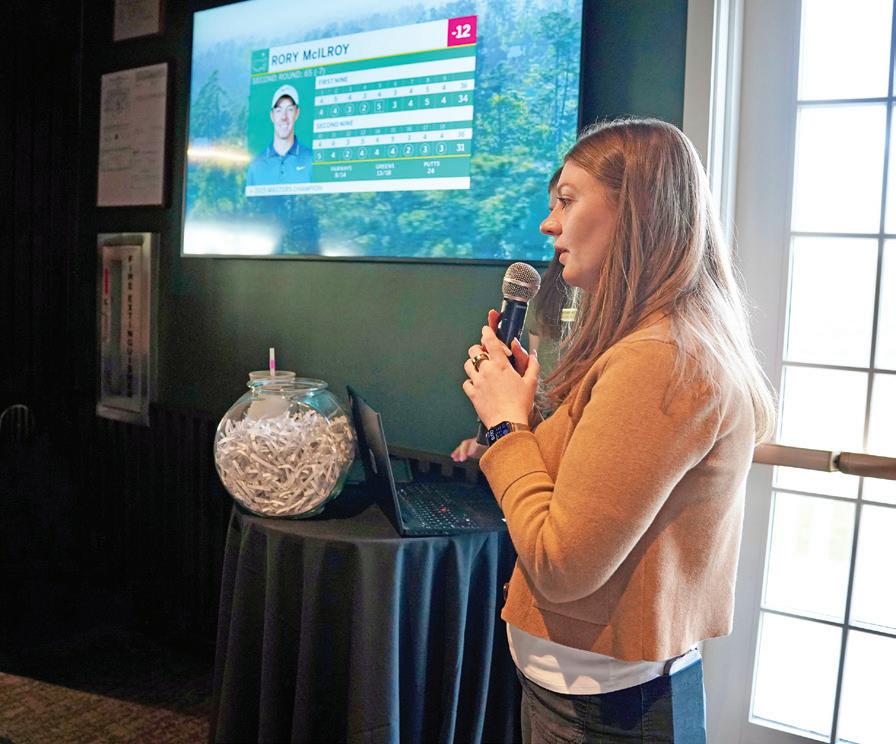
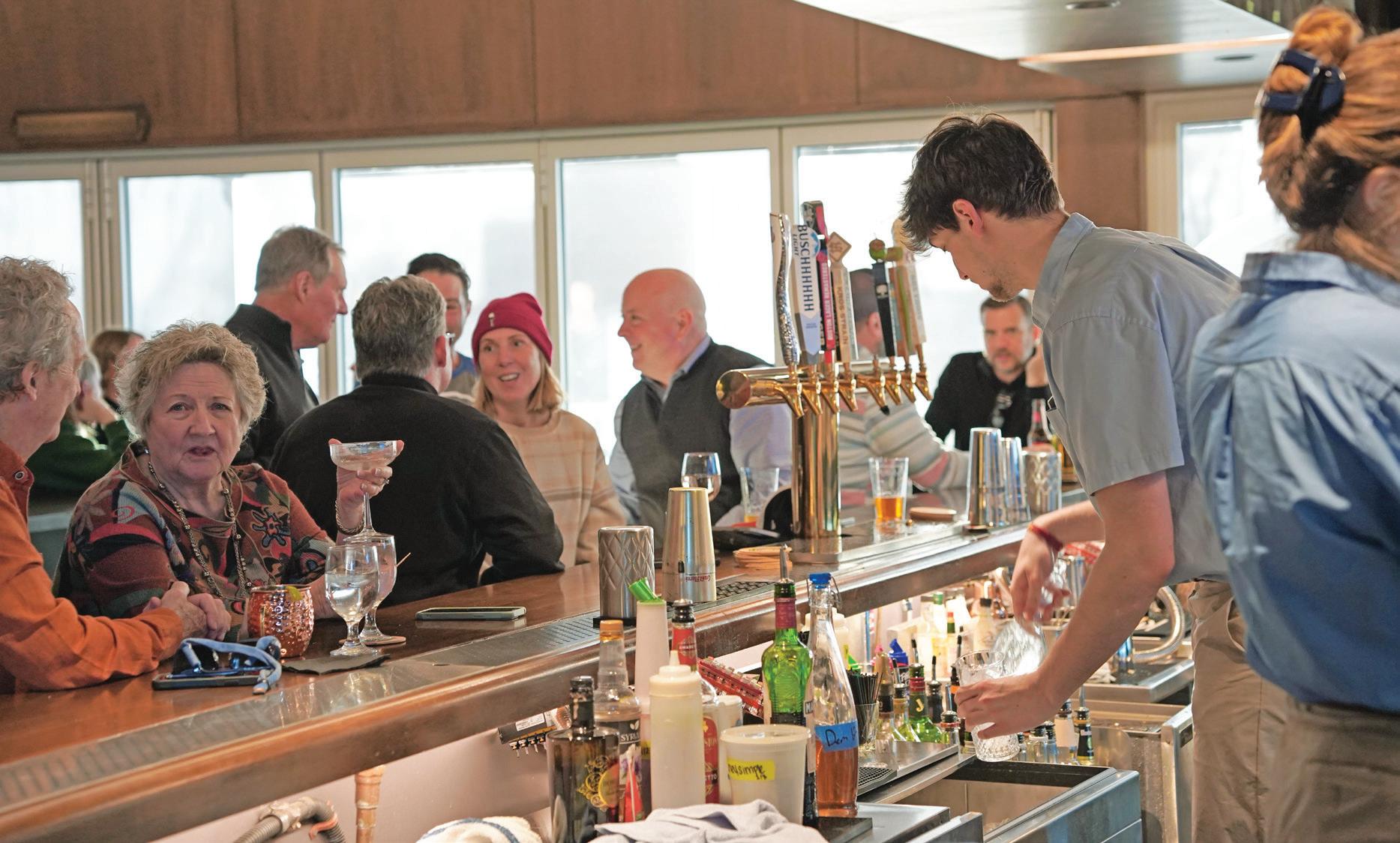
AT THE FIELD CLUB OF OMAHA , a weekly lottery is drawing members to the main dining room on Friday nights.
“Every member who has a tab open by 6pm will have their name added in the pot for the accumulator draw the following week,” says Rylee Roberts, Food & Beverage Director.
If the selected member is present at the time of the drawing, they are credited with the current lottery amount on their membership account. The lottery pot begins at $500 and increases by $25 each week if the selected member is not present.
The goal of this initiative is to drive increased traffic to the dining room while creating a fun, engaging event that members look forward to each week.
The program was first introduced by General Manager Greg Gilg, CCM, CCE, PGA, modified from a similar program at Blue Hills Country Club in Kansas City.
“[Gilg's] idea of adding an additional name slip for each person who attends our accumulator happy hour has created consistent volume on Friday nights,” Roberts notes.
THE CHALLENGE:
Increase dining room traffic Friday nights.
THE RESPONSE:
Host a weekly lottery drawing for members attending happy hour.
THE RESULT:
Each Friday night, a fishbowl containing the names of all eligible members is brought into the dining room, and one name is drawn to determine the accumulator winner. If the selected member is not present, three additional names are drawn for complimentary drink tokens.
Members look forward to gathering on a dedicated night, the excitement of the drawing, and socializing with other members in the process.
Roberts notes that even members who don’t win consistently have expressed appreciation for the lively atmosphere
Members love the initiative, and Friday nights are now the busiest night of the week in the dining room.
and strong sense of camaraderie the lottery creates.
In fact, Friday nights are now “consistently the busiest night of the week in the dining room.”
“So busy,” she says, “we have extra servers and bartenders on staff to handle the volume.”
Since the Field Club of Omaha started its Happy Hour Accumulator, Friday nights have become the busiest night of the week in the dining room.
Lakeside CC's Pearl of Wisdom
By Isabelle Gustafson • Senior Editor
IN 2025, LAKESIDE COUNTRY CLUB partnered with the Galveston Bay Foundation to recycle oyster shells from the club’s culinary operation. Recycled oyster shells help restore reefs, improve water quality, and protect Gulf Coast shorelines from erosion.
Shells are separated after service and collected in a special recycling bin. When the bin is full, the service is called for pickup. The shells are then taken to a site where the cleaning and curing process begins before being reintroduced to the coast line or for special projects.
More than 4,000 oyster shells were recycled in the first year.

THE CHALLENGE:
Banquet Operations Manager Shannon Ladd says the idea was influenced by her experience in Boston, where shell recycling programs are more widely established.
“After relocating to Texas,” she says, “I became interested in similar Gulf Coast initiatives, which led us to partner with the Galveston Bay Foundation to bring this effort to our club and support local reef restoration.”
Support Gulf Coast restoration efforts. Turn a culinary byproduct into a sustainable practice.
THE RESPONSE:
Oyster shells are collected during service, sorted and stored by the FOH and BOH teams, then transported by Galveston Bay Foundation for curing before returning to the bay.
THE RESULT:
Lakeside CC is established as an environmental leader— at no cost to the club.
The program received full support from the club’s leadership, Ladd says, allowing the team to seamlessly integrate it into daily operations.
And the logistics are relatively simple: Shells are collected during service, sorted and stored by front- and back-of-house teams, then transported by Galveston Bay Foundation for curing before returning to the bay.
The response from both our team and membership has been overwhelmingly positive, says Ladd, who attributes the success of the program to a strong internal effort across departments.
“We’re especially proud that there is no cost to the club—our members contribute simply by dining with us,” she says. “Additionally, Lakeside Country Club is proud to be the first country club in Houston to participate in this program.”

A New Kind of Holiday Havoc at Anthem Country Club
By Madison Hartline • Associate Editor
THE
TEAM AT ANTHEM COUNTRY CLUB (Henderson, Nev.) brought the holiday cheer to the golf course this year by updating the “superintendent’s revenge” with a Grinch-themed experience that prioritized laughter and creativity over the scorecard.
“The concept has existed in golf for years, but we loved the idea of reimagining it,” says Jennifer Neal, Clubhouse Manager. “It gave us the opportunity to create something festive, interactive, and unexpected while staying true to the spirit of the game.”
HOW THE GRINCH STOLE THE SHOW
The entire event was designed around the goal of creating a lighthearted, entertaining atmosphere that members would not forget.
“[We wanted] to give our membership something fun, unique and memorable during the holiday season—an experience that went well beyond a traditional golf event,” says Neal. “We wanted members to laugh, connect with one another and
THE CHALLENGE:

enjoy a completely different kind of day at the club.”
Director of Golf Travis Long took on the role of the Grinch. Long, who has been with Anthem for more than 17 years, fully embraced the character, adding another layer of entertainment to the day.
Meanwhile, the grounds team got to work creating Grinch-inspired challenges throughout the golf course.
To break away from the standard holiday tournament format by creating a festive, highly interactive, and memorable "superintendent's revenge" experience for the membership.
THE RESPONSE:
Transform the course using themed obstacles built by the grounds crew, positioning the Director of Golf as a roaming Grinch, and utilizing a four-month planning window to coordinate efforts between the events, F&B, and golf teams.
THE RESULT:
The event drew 90 participants in its first year and generated months of organic member buzz, proving that low-overhead, high-creativity events can successfully differentiate the club experience.
“Think piled tires, tree obstacles and other unexpected challenges placed strategically throughout the course,” says Neal. “The creativity of the setup is really what brought the theme to life and gave golfers something to react to at every turn.”
Neal says 90 members participated—an overwhelming and gratifying response to a first-year event.
CLUBWIDE COLLABORATION
As members took part in the fun, plenty of planning happened behind the scenes to bring this event to life.
Alicia Dominguez, Director of Events and Communications, says the club began preparing about four months in advance, with departments working together to develop the course challenges, coordinating logistics, and building excitement among membership.
“This was genuinely a club-wide effort,” says Neal. “Our events team handled planning and execution, the golf team managed tournament operations and member engagement, food and beverage ran beverage service throughout the course, and our grounds team designed and built the themed course challenges.”
The payoff was clear. Members embraced the event, generating the kind of organic buzz clubs hope for when launching something new.
“Months later, people are still bringing it up,” she says. “That’s the best feedback we could have asked for.”
Sometimes the most successful events happen when everyone—members and staff—gets to have fun and not take themselves too seriously, Neal says.
The Walking Difference at East Lake
By Madison Hartline • Associate Editor
WHILE MANY CLUBS embrace convenience, East Lake Golf Club (Atlanta) doubled down on walking and caddies as a way to strengthen culture, member interaction, and course conditions.
To Chad Parker, President and General Manager of the club, this decision reflects both tradition and philosophy. Plus, it strengthens the club’s caddie program.
WALKING AS A CLUB PHILOSOPHY
While the club historically had golf carts, today the club operates as a walking-only course, with carts available only to those with medical needs. Caddies are also required for all players.
“Golf was originally designed to be played on foot, and we believe walking allows players to experience the course the way it was intended—strategically, socially, and aesthetically,” says Parker.
Being a walking-only course, the pace of the game is slowed, creating a connected rhythm and reinforcing the culture and traditions that define East Lake GC.
Parker says walking encourages engagement with the golf course, deeper interaction among players, and stronger relationships between members and caddies.
“Our caddie program is an important extension of our broad ‘Golf with a Purpose’ mission,” says Parker. “Beyond enhancing play, the program creates meaningful employment opportunities and mentorship experiences for our caddie team.”
Another benefit of a walking-only course is the agronomic advantage. Reduced cart traffic minimizes turf compaction, wear patterns, and stress around tees, fairways and high-traffic areas. It also reduces the need for extensive cart path infrastructure and helps maintain cleaner aesthetics across the property.
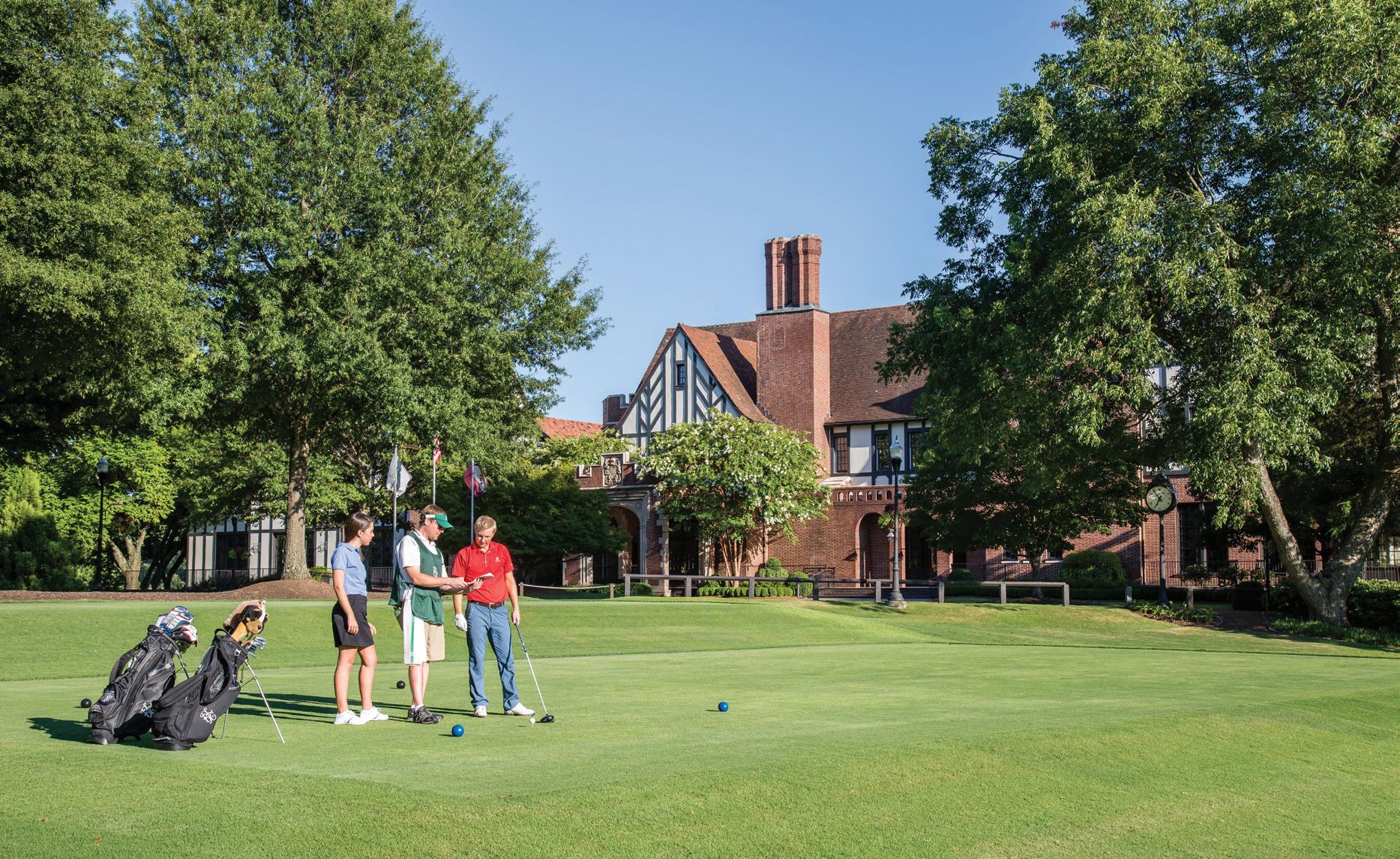
“Walking rounds—especially with experienced caddies—often move more efficiently and consistently than cart golf,” says Parker. “There tends to be less leapfrogging, less waiting around carts, and better overall group flow.”
However, from an operational standpoint, a walking-only course requires a disciplined caddie schedule and careful tee sheet management to ensure proper coverage during peak periods.
The caddie experience becomes inseparable from the golf experience, thereby making staffing and training critical.
THE CULTURAL PAYOFF
The payoff of this initiative is cultural as much as operational, according to Parker.
“Walking helps create a distinct identity and experience that members cannot easily replicate elsewhere,” he says. “It reinforces tradition, strengthens community, elevates the role of caddies, and creates a more thoughtful and connected version of golf.”
And members love it. Parker says feedback is always extremely positive. Conver-
THE CHALLENGE:
Create a more connected and intentional golf experience rooted in tradition.
THE RESPONSE:
Require caddies and walking rounds while supporting the model through staffing, training, and tee-sheet management.
THE RESULT:
A stronger club culture, healthier turf, meaningful member-caddie relationships, and a distinctive golf experience that sets East Lake apart.
sations last longer, relationships deepen, and members engage in more meaningful ways with one another, their caddies, and the course itself.
“Once people acclimate to the walking course, they often find it difficult to imagine the course functioning differently,” he adds.
StoneWater Uses Community to Bring More Women Into the Game
By Madison Hartline • Associate Editor
STONEWATER GOLF CLUB
(Cleveland, Ohio) believes the future of women's golf starts with belonging, which is why the club is partnering with a local influencer and community builder to create an entry point into the game.
“With more women getting involved in the sport, we wanted to create an event that felt approachable and fun,” says Lindsey Neidus, Chief Marketing and Development Officer of StoneWater. “Less about being ‘good at golf’ and more about community, confidence and trying something new.”
To do this, StoneWater Golf Club partnered with Rebecca Maxwell, a Cleveland influencer focused on creating a community of women looking to connect, meet new people and experience new things through her company, She’s Company. Maxwell and She’s Company aligns with what StoneWater is trying to achieve by

bringing people together in an authentic way and making women feel welcome and connected.
Maxwell's social following allows StoneWater to reach different audiences of women, bringing them into a space in which they may not traditionally see themselves represented.
REMOVING THE PRESSURE
The evening, set for July 29, will bring together women of varying ages and skill levels for a relaxed, social and approachable golf experience designed around community as much as competition.
“The biggest goal is to make golf feel accessible and inviting to more women,” says Neidus. “Golf can sometimes feel intimidating if you didn’t grow up playing, so we want women to realize they belong here—whether they’ve never picked up a club before or already play regularly.”
Neidus and Maxwell designed the event to remove the pressure members associate with golf. The event will be more social and instructional rather than competitive.
Participants will have the opportunity to learn fundamentals, get tips from StoneWater’s golf professionals, practice in a relaxed environment, and meet other women who are either new to the game or looking to get more involved.
StoneWater’s instructors from its new Linksman Golf Academy will lead the experience, ensuring it feels welcoming for all skill levels.
“We’re really hoping to attract women who may have always been curious about golf but never felt like there was a place for them to start,” says Neidus. “That could be young professionals, moms, beginners, social golfers, or women simply
THE CHALLENGE:
Lower the barrier to entry for women interested in golf by creating a social, low-pressure environment that prioritizes community, confidence, and belonging.
THE RESPONSE:
The club partnered with a local women’s influencer to host an approachable evening of instruction, social connection and community designed to reach audiences who viewed the sport as intimidating or exclusive.
THE RESULT:
A new demographic is introduced to the club, building a pipeline for future participation while establishing the club as a modern, welcoming leader in the movement to grow women’s golf.
looking to meet new people and try something different.”
MORE THAN PARTICIPATION
Ultimately, Neidus has noticed women who golf at the club are often in search of community, experiences, social connection, and flexibility. She hopes new people discover the sport and view it in a positive, welcoming light.
“Events like this help introduce people to StoneWater and can lead to future membership or participation,” notes Neidus. “But the bigger win is creating a community people want to come back to. If someone leaves feeling more confident, makes a new friend, or decides they want to keep playing golf, that’s a success.”
Hillcrest CC's Future Proofing
By Joanna DeChellis • Editorial Director
HILLCREST COUNTRY CLUB (Boise, Idaho) was beginning to think about its future, but General Manager and Chief Operating Officer Nolan Halterman, CCM, PGA, believed planning required more than identifying projects.
"The club didn't have a strategic plan, so we started there," says Halterman.
The process prompted Hillcrest's leadership team to reexamine many of the traditional planning exercises clubs often undertake.
"Everybody comes up with mission statements, vision statements, core values, and brand statements," says Halterman. "We got rid of all of that and said, 'Okay, we're starting over. Who is Hillcrest?'"
The answer became the foundation for everything that followed. It led to a purpose statement focused on creating a welcoming community where friendships thrive, families connect, and exceptional experiences are the standard. From there, the club identified five priorities that would guide future decisions: financial sustainability, member experience, membership structure, brand and value proposition, and governance and communications.
THE CHALLENGE:
Keeping the club focused on longterm priorities as boards and member expectations evolve.
THE RESPONSE:
Create a framework that connects strategic planning, leadership development, member communication, and master planning.
THE RESULT:
A roadmap that helps future leaders make decisions aligned with the club's vision and goals.

GM and COO Nolan Halterman, CCM, PGA (inset), says Hillcrest CC's planning efforts are focused on creating a club that remains relevant for future generations of members and their families.
For Halterman, those priorities became the foundation for everything that followed.
Today, those priorities inform a facilities master plan and golf course master plan that will help shape the club over the next 10 to 15 years. Potential areas of focus include fitness and wellness, racquet sports, family activity spaces, and golf course improvements. The planning process has also influenced how the club approaches governance and communication.
Hillcrest restructured its nominating committee into a year-round nominating and leadership development committee and expanded onboarding for new board members. The club also established a communication strategy that provides regular updates to members as planning efforts progress.
"We communicate consistently with members so they understand the plan and what comes next," Halterman says.

The objective is to create alignment around a shared vision for the future and ensure that major decisions remain connected to the club's priorities as boards change over time.
That long-term perspective extends beyond current members.
"We're building the club for their kids and their grandkids," Halterman says. "Over the next 10 to 15 years, this is what they're going to want out of the club."
For Hillcrest, future planning is about more than determining what gets built next. It is about creating a club that remains relevant to the generations that will inherit it.


The Club + Resort Business Engagement Summit brings together the club leaders responsible for membership growth, communication, branding, and member experience.
Over two days, attendees will explore the strategies shaping engagement today through presentations, panel discussions, workshops, and peer conversations designed to deliver practical ideas and fresh perspective.
AGENDA
OCTOBER 5TH
Education Session I
Beyond the Logo: Building a Distinctive Club Brand
Melissa Hansen, Dir. of Membership and Marketing, The Club at Olde Cypresss
Why do some clubs feel distinctive while others feel interchangeable?
Melissa Hansen explores how clubs translate identity into member experience, communication, culture, and reputation.
Panel Discussion
The Modern Member Experience: Elevating Every Touchpoint
Moderated by Melissa Hansen, Dir. of Membership and Marketing, The Club at Olde Cypresss
Panelists:

Education Session II
The Membership Sales Blind Spots Clubs Can’t Afford to Ignore Justin Kuehn, VP of Sales and Marketing, Hampton Golf
Many clubs track inquiries. Far fewer have clear visibility into what drives conversion. Justin Kuehn shares how clubs can identify sales bottlenecks, improve pipeline visibility, and make more informed membership decisions.

• Liz Markel, Membership Manager, University Club of Chicago
• Hillary Wiedemann, Senior Membership Manager, University Club of Chicago
• Leslie Bradberry, Director of Membership, University Club of Chicago
From the first tour to everyday interactions, member perceptions are shaped by hundreds of small moments. This panel explores the operational and communication decisions that create stronger engagement and lasting loyalty.

Education Session III
3 Email Campaigns Every Club Should Already Be Running Danita Osborn, Dir. of Membership and Marketing, Shadow Wood Country Club
Most club emails inform. The best ones influence behavior. Through real-world examples, Danita Osborn shares three campaigns that help clubs strengthen engagement, increase participation, and support membership growth.
Workshop I
The Social Standard: A Social Media Workshop
Emory Patton, Dir. of Membership & Marketing, The Club at the Strand
Build a practical framework for a more strategic social media presence and leave with ideas you can implement immediately.

Melissa Hansen
Justin Kuehn
Danita Osborn
Emory Patton
MEMBERSHIP, MARKETING AND COMMUNICATIONS FOR

OCTOBER 6TH
Education Session IV What Clubs Keep Overcomplicating About Engagement
Melanie Halpert, Dir. of Membership Sales, Desert Mountain Club
What actually builds connection inside a club community? Melanie Halpert shares lessons learned, assumptions challenged, and the strategies that have had the greatest impact on engagement at Desert Mountain.


Education Session V
Branding Matters: Building an Identity Across the Club
Molly Carroll, VP
of
Communications & Marketing, Ocean Reef Club
A strong brand is built through consistent communication and shared experiences. Molly Carroll explores how clubs create trust, strengthen loyalty, and evolve alongside changing member expectations.
Education Session VI
The Club Industry’s Identity Crisis
Bonnie Scoggins, Senior Vice President of Marketing, Invited Clubs
Many clubs struggle to clearly articulate what makes them different. Drawing on experience across more than 150 clubs, Bonnie Scoggins explores how leading clubs define their identity, communicate authentically, and stay relevant without losing what makes them unique.
Workshop II Engagement Summit Roundtables

REGISTRATION INCLUDES
• Access to all education sessions, workshops, and roundtable discussions
• Welcome reception at the University Club of Chicago
• Two networking breakfasts and two networking lunches
• Peer-to-peer conversations with club leaders from across the country
• Speaker presentations and takeaways
• Access to sponsors and technology partners serving private clubs
• CE credit opportunities
EARLY BIRD RATE: $900 THROUGH SEPTEMBER 1 CONFERENCE PASS: $1,100
Join peers facing similar challenges for facilitated discussions on branding, communication, engagement, retention, and member experience. Compare approaches, share ideas, and leave with practical takeaways.
*Agenda subject to change

OCTOBER 5 - 6 2026 UNIVERSITY CLUB OF CHICAGO
Melanie Halper
Molly Carroll
Bonnie Scoggins
The Day the Juniors Took Charge
By Madison Hartline • Associate Editor
LAST SUMMER, BAY
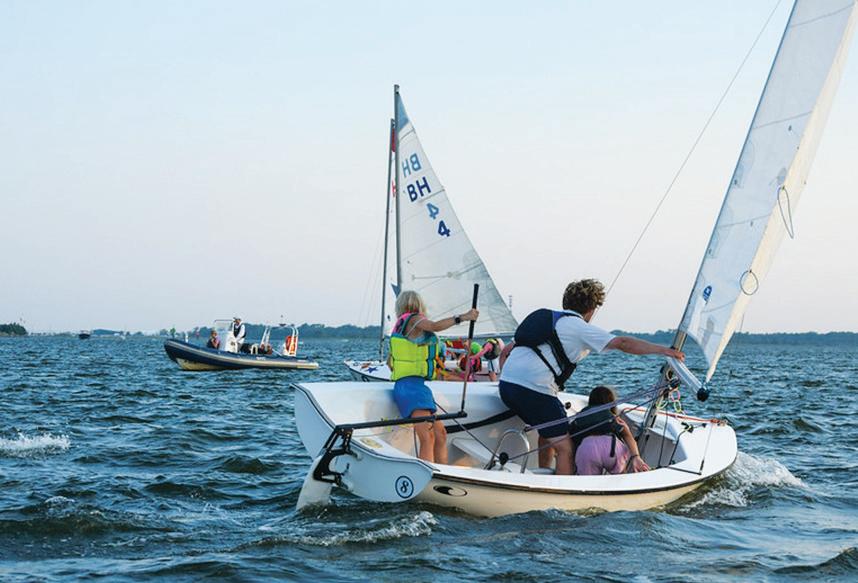
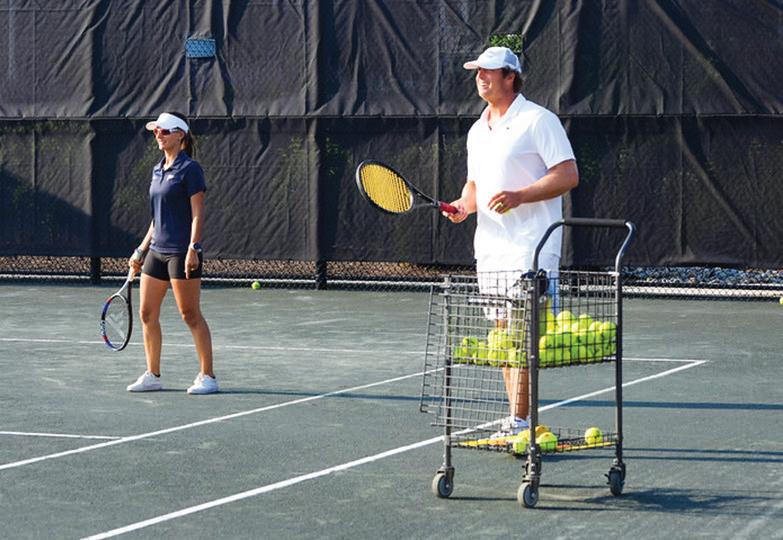
HEAD (N.J.) Yacht Club set out to bring its junior programs together in a meaningful way. Junior Sunset Swing & Sail—combining sailing and racquets, the club's two most popular junior programs—did just that.
“The biggest goal of this event is building connections,” says Holly Bilotti, General Manager, Bay Head Yacht Club. “We wanted to create something that brought together juniors, instructors and families in a way that felt social, lighthearted, and memorable.”
WHEN INSTRUCTORS BECAME STUDENTS
Bilotti says the concept for the event was simple: Let the kids reverse roles with the instructors for the evening.
The sailing instructors would head to the tennis courts and learn from the kids, and later the racquets instructors would head onto the water and do the same with sailing.
“What made the event so special was seeing the juniors step into leadership roles,” says Bilotti. “They were teaching,
THE CHALLENGE:
Despite the popularity of its sailing and racquets programs, Bay Head Yacht Club wanted to create more opportunities for juniors, instructors, and families to connect across activities.
THE RESPONSE:
A role-reversal event allowed junior sailors and tennis players to teach instructors their respective sports, combining leadership development, social interaction, and friendly competition.
THE RESULT:
Junior members gained confidence and leadership skills, families became more engaged, and the event strengthened connections across the club.
coaching, critiquing and encouraging the instructors the entire night. It gave the kids a huge confidence boost and created such a fun, relaxed atmosphere for everyone involved.”
Bilotti says junior programs are the heartbeat of Bay Head Yacht Club during the summer. “For us, investing in junior programming is really investing in the future of the club,” adds Bilotti. “When kids genuinely love being here, they stay engaged, families become more con-
nected, and the club becomes stronger as a whole.”
Sailing and tennis teach juniors skills beyond the sport itself, acknowledges Bilotti. She says teamwork, leadership, communication, resilience, and independence naturally develop through these programs.
Creating a more relaxed and social environment where the juniors can practice these skills is among the greatest benefits of the event.
CREATING A CLUBWIDE EXPERIENCE
Throughout the event, Bilotti says participants formed genuine connections. Juniors gained confidence by stepping into teaching roles, while parents had the opportunity to watch their children lead and have fun.
“At the end of the day," Bilotti says, "that's what the event is about: creating experiences that make kids excited to come back to the club year after year."
The sailing and racquets departments at Bay Head Yacht Club work closely to coordinate schedules, align staff, manage dinner logistics, assign boats, monitor weather, and to oversee safety preparations and communication with families.
Where the Pros Come to Play
By Madison Hartline • Associate Editor
WINTER
PARK (FLA.) RACQUET CLUB is entering its 23rd season of hosting its Annual Pro Exhibition, growing the event from a member-inspired tennis showcase into one of the club’s signature annual experiences.
GM and COO Ian Munroe believes the club's racquet history and professional staff are what set it apart.
“As far as the caliber of people we have, most of them are former tour players, tour coaches or running big facilities,” says Munroe. “Our reach into the [Association of Tennis Professionals] and [Women's Tennis Association] to get pros to come do this exhibition separates us from most.”
FROM EXHIBITION TO EXPERIENCE
The event originated with club professional Robert Kendrick, who was actively competing on the professional circuit at the time.
“The event still carries its original spirit and showcases the racquet club, celebrates high-level tennis, and gives members a rare, up-close experience with professional players in a setting that feels personal and uniquely ours,” says Munroe.
This member-only event features current pros competing against one another and interacting with members through meet-and-greets, challenges and more.
“If you wanted this level of tennis this close, you would have to buy front-row seats at Wimbledon," says Munroe.
Attendees can participate through general admission (GA) tickets or sponsorship packages. GA is designed to be an all-inclusive experience with premium food and beverage offerings, entertainment, exhibition matches, and access to the overall event.

Sponsorship tiers elevate that experience even further. Premium VIP seating, known as the Baseline Club, offers dedicated service staff, branding opportunities, enhanced hospitality experiences, and additional interaction with the pros.
WHY THE EVENT CONTINUES TO DELIVER
Munroe says many members view the Pro Exhibition as the highlight of the club’s calendar, creating memories that go far beyond simply watching tennis.
“Members are interacting with players, playing sets with professionals, attending meet-and-greets, bringing family and guests, and experiencing something they would only associate with major international tournaments,” says Munroe.
“That level of personal access is incredibly rare in the tennis world and is a major reason why the event continues to be such a meaningful tradition at the Winter Park Racquet Club.”
THE CHALLENGE:
To create a signature member event that showcases the club's deep connections to the professional tennis world while strengthening engagement with its racquet program.
THE RESPONSE:
The club leveraged its staff's relationships with professional players to create an annual all-inclusive exhibition featuring elite competition, member interactions, premium hospitality, and sponsorship opportunities.
THE RESULT:
A marquee member experience that celebrates the club's racquet culture and delivers unparalleled access to professional tennis.
Winter Park Racquet Club's Annual Pro Exhibition offers members up-close-and-personal access to high-level tennis and players.
Investing In Employees
By Joanna DeChellis • Editorial Director
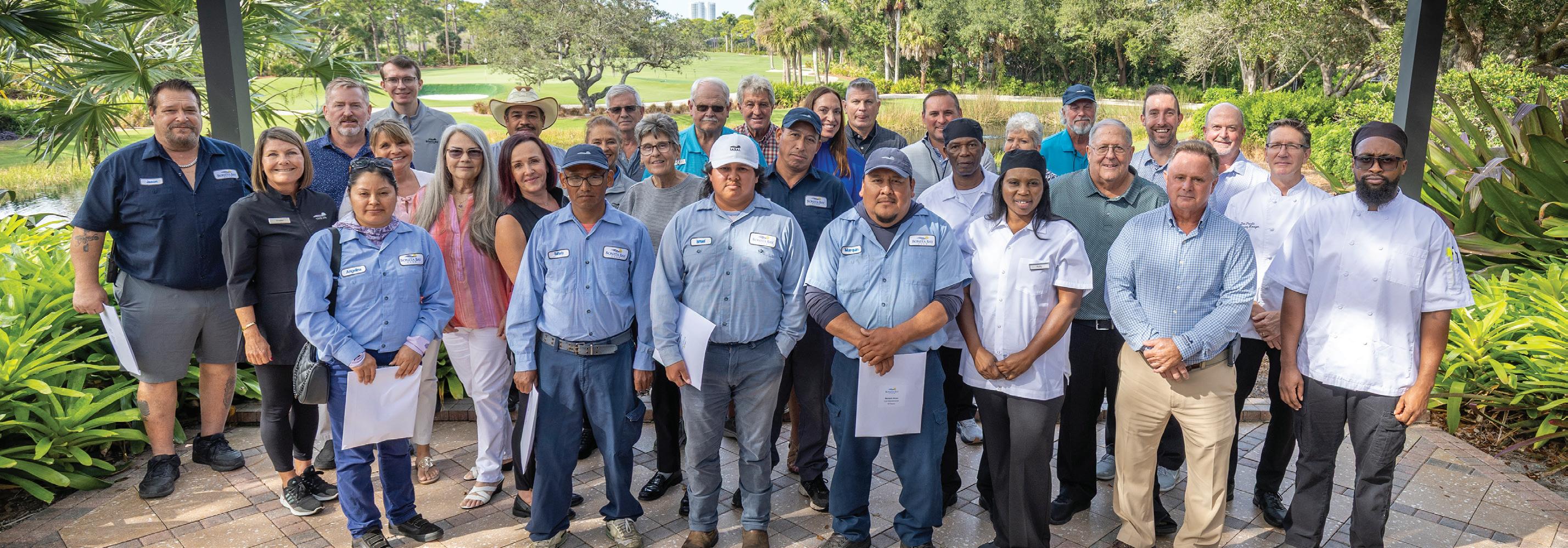
FRED FUNG'S PHILOSOPHY on employees
can be summed up in a single sentence.
"Hire the right people, give them purpose, and treat them well," says the CEO/ General Manager of Bonita Bay Club in Bonita Springs, Fla.
At the Southwest Florida club, that belief has been reinforced through decisions that touch nearly every aspect of the employee experience.
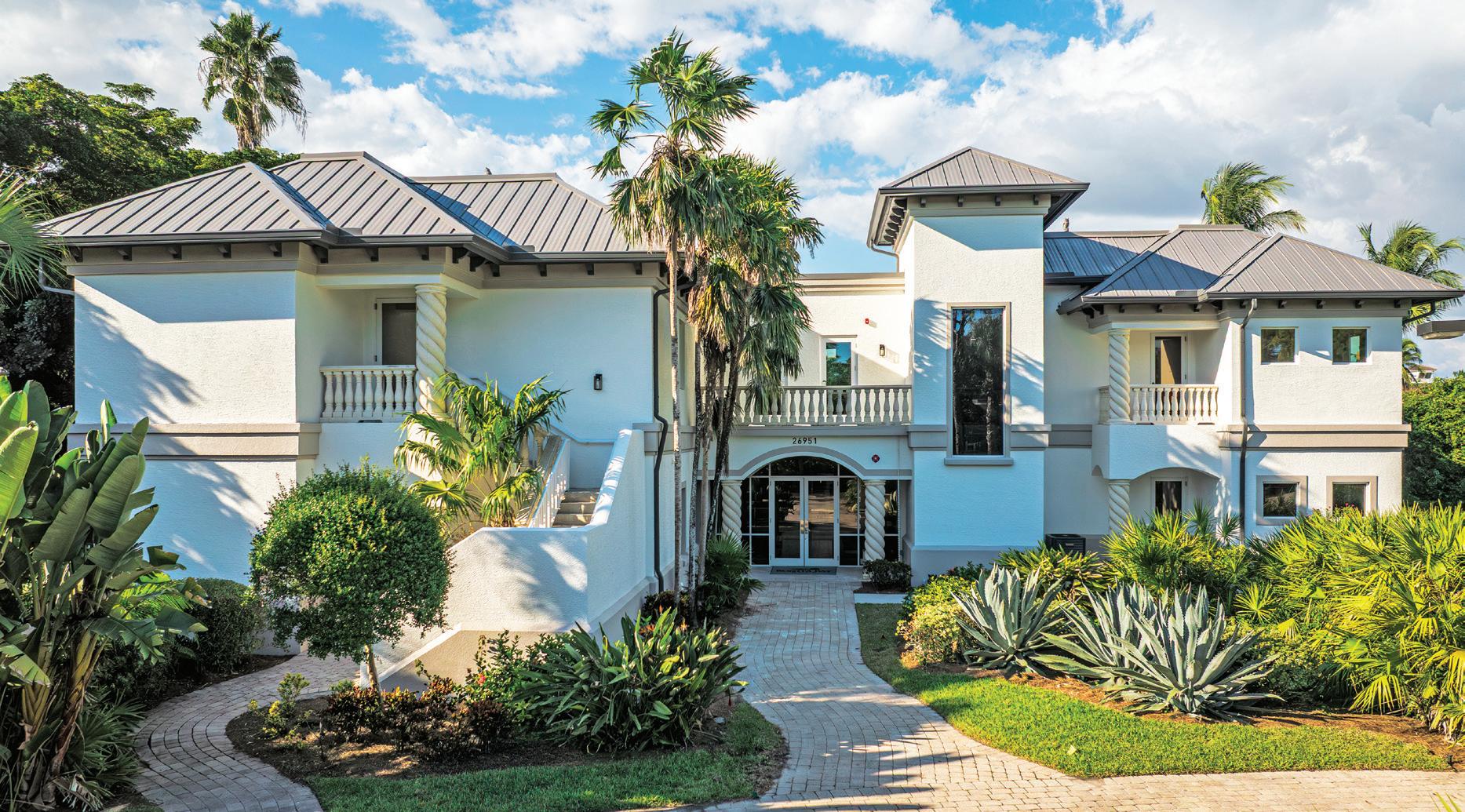
Over the past several years, the club has built employee housing within walking distance of the property, opened a
dedicated employee fitness center, expanded scheduling flexibility, and watched members raise more than $1 million to support employees during the pandemic and Hurricane Ian.
Viewed individually, those initiatives address different challenges. Together, they reflect a broader belief that employee experience deserves the same level of attention as member experience.
Fung believes those investments begin with the people the club chooses to hire.
"We prioritize attitude over experience,"
THE CHALLENGE:
Creating a workplace employees want to be part of for the long term.
THE RESPONSE:
Backing the club's culture with investments in employee wellbeing, development, flexibility, and support.
THE RESULT:
An average senior leadership tenure of 20 years and one of the lowest employee turnover rates among its peer group.
he says. "With the right attitude and aptitude, there is no limit to an individual's success here."
The club's leadership team offers several examples. Bonita Bay Club's Director of Golf began cleaning golf clubs. Its Assistant General Manager started as a food busser.
For Fung, those career paths reinforce the value of investing in employees over the long term.
“Employees are proud to work at Bonita Bay Club,” says Fung. “They know their mission and believe that their work is important to the success of the club. They care for their co-workers and the members they serve, which is what happens when people feel valued by the organization they work for.”
New employee housing is located within walking distance of the Southwest Florida club.
A Structured Approach to Employee Feedback
By Joanna DeChellis • Editorial Director
WHEN HUNTERS RUN COUNTRY CLUB (Boynton Beach, Fla.) pursued Great Place To Work® Certification, leadership viewed the process as an opportunity to better understand the employee experience.
The club wanted a clearer picture of how employees felt about communication, leadership, recognition, and workplace culture. Rather than relying solely on annual surveys, Hunters Run established multiple ways for employees to provide feedback throughout the year.
"Our success is driven by our dedicated employees, and we deeply value their feedback and contributions," says Larry Savvides, General Manager and COO.
The process begins during onboarding. New hires participate in 30-, 60-, and 90day check-ins designed to answer ques-
THE CHALLENGE:
Understanding employee concerns and engagement across a workforce of nearly 400 team members.
THE RESPONSE:
Creating formal opportunities for employees to share feedback, beginning with onboarding and continuing throughout the year.
THE RESULT:
Improvements in communication, recognition, wellness initiatives, retention, and recruiting, along with Great Place to Work® Certification.

tions, identify training needs, and gather feedback about their experience. The conversations help managers address concerns early and provide additional support when needed.
Employees can also share input through engagement surveys, departmental meetings, listening sessions, conversations with managers, and the club's “YouMatter” platform, which connects employees directly with Human
Resources and leadership.
"We do not view feedback as something to simply collect. We view it as an opportunity to improve," says Emily Roeckle, Director of People and Culture.
According to the club, leadership reviews feedback, identifies recurring themes, and develops action plans in response. The approach has helped shape employee initiatives while contributing to stronger retention and recruiting efforts.
A Mascot, a Mission, and a More Connected Membership
By Madison Hartline • Associate Editor
FOR MANY CLUBS, building a brand that resonates with members is an ongoing challenge. At Manasquan River Golf Club (Brielle, N.J.), that challenge led to the creation of an unexpected mascot—an osprey.
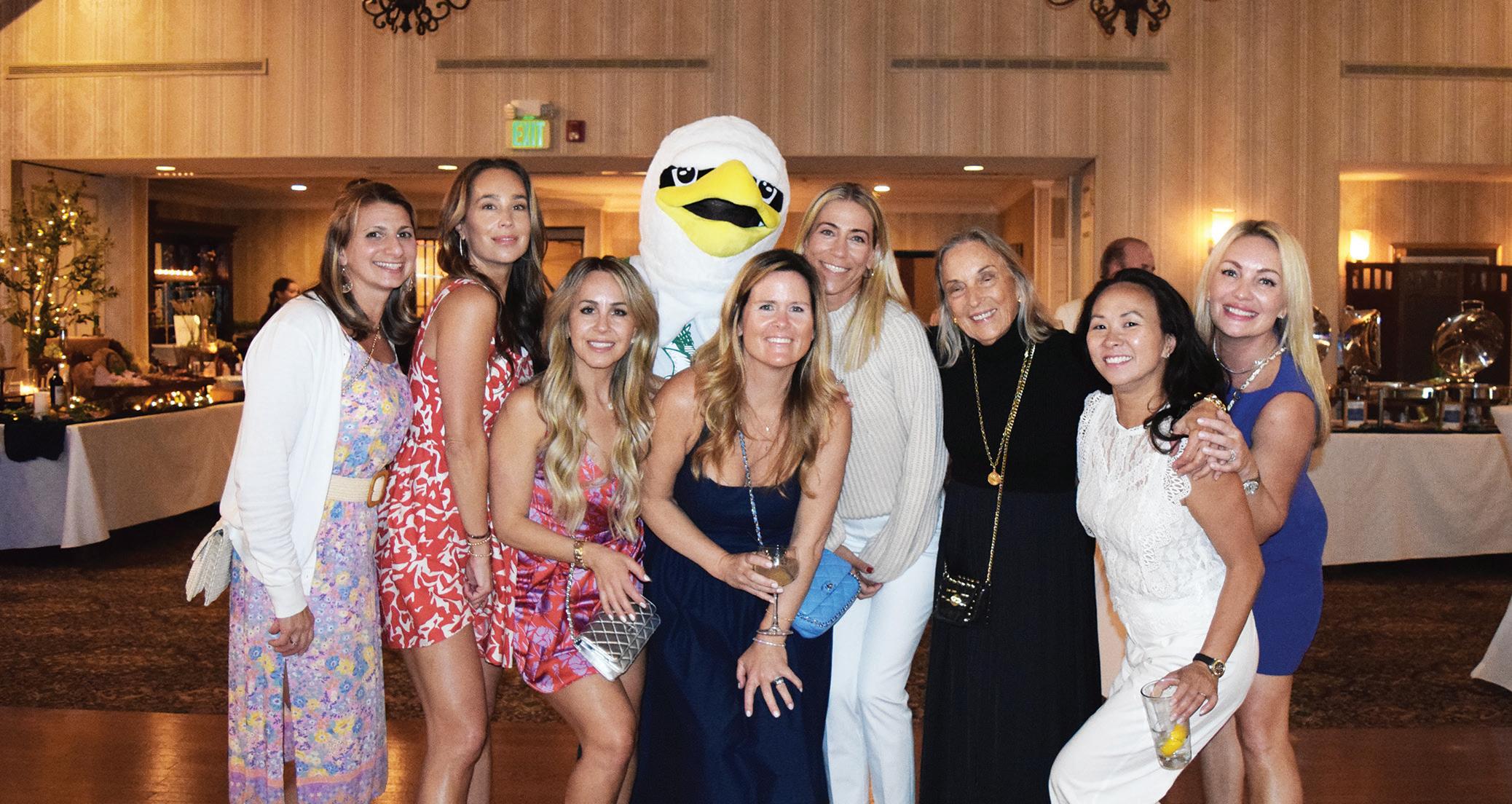
Debuted in 2025, Ozzy The Osprey is a symbol of joy, camaraderie, and the welcoming spirit that makes Manasquan River GC feel like home for its members.
FROM LOGO TO LIVING SYMBOL
The idea for a mascot came when Jessica Mascali, Director of Marketing & Communications, and her team began looking for a way to enhance the member experience by strengthening emotional connection, community spirit, and engagement.
Because the club's logo already included an osprey, it was a natural fit for the bird to become the mascot.
“Being located on the Manasquan River, ospreys are common,” notes Mascali. “We even have an elevated perch on the course where the birds build their nests.”
A key goal for Ozzy is to bring joy to both everyday moments and major club events.
“On a rainy Thursday, you can find Ozzy cheering on the 9-Holer ladies golf group, or you can see him swinging a club during a junior golf lesson,” says Mascali.
Rather than making a formal announcement, the club introduced Ozzy through memorable experiences, including a dramatic zipline entrance at the club's Fourth of July party.
The organic rollout allowed members to discover Ozzy through those moments, Mascali says.
“We officially introduced him at our 2025 Season Kick-Off Party,” she adds. “Memorial Day Weekend is a staple at the Jersey Shore, and we wanted to start the summer off with a bang. Ozzy was on the dance floor and shooting pool with members. It was a fun surprise at such a premier event.”
EVERYONE PLAYS A ROLE
Mascali describes Ozzy as “a concept with such little overhead that has brought so much energy to the daily lives of our membership.”
THE CHALLENGE:
Creating a stronger emotional connection among members and reinforcing the club's welcoming, family-oriented culture.
THE RESPONSE:
Transforming the osprey from a logo into a club mascot and incorporating Ozzy into events, celebrations, and everyday member interactions.
THE RESULT:
A low-cost, high-impact initiative that creates memorable moments, generates member excitement, and strengthens community throughout the club.
Ultimately, it's the team at Manasquan River GC that brings Ozzy the Osprey to life.
“We are lucky enough to have an incredible staff that is willing to go above and beyond for the membership, so anybody could embody the role of Ozzy,” she says.
Employees were trained on how Ozzy would be used at events and celebrations, ensuring appearances felt coordinated and purposeful.
“We have a program we call 'All the Little Things,' where we encourage staff to celebrate life’s small milestones and create lasting memories every day—Ozzy encapsulates that,” says Mascali.
Ozzy has added a fresh and personal dimension to the club experience. Members of all ages enjoy spotting him around the property, stopping for photos and interacting with the character during events and everyday club activities.
Documenting a Defining Moment
By Madison Hartline • Associate Editor
WHENEVER A RENOVATION
takes place at a club, there is a delicate balance between preserving the history and modernizing for the future.
Cincinnati Country Club (Ohio) has found a creative way to bridge that gap by creating a documentary focused on the club's course redesign project and the team behind it.
CAPTURING A MILESTONE
"The idea for the documentary developed from our belief that the renovation represented a historically significant moment for the club," says Joe Zinchini, GM of Cincinnati CC. "Once the project was completed, we felt it was important to create a permanent record that captured the vision behind the renovation and the impact it would have on future generations of members."
Zinchini notes that this is one of the most significant projects ever undertaken at the club, and leadership felt it was vital to document it for current and future generations of members.
The idea came shortly after the club's videographer, Evan Maines, created a video in 2025 documenting member tours of the new course led by Mike Hurdzan, the course architect. The response to that project demonstrated members' interest in learning more about the renovation and the people behind it.
Building on that momentum, the club created a documentary after the renovations were completed. Filming allowed members to hear directly from Hurdzan, Zinchini, the club president, and other leaders about their perspective on the project.
"We felt it was especially important to capture the perspective of Dr. Mike Hurd-

THE CHALLENGE:
To preserve the story behind one of the most significant projects in the club's history and help members understand its long-term impact.
. THE RESPONSE:
In collaboration with Cincinnati CC's videographer, the club produced a documentary featuring interviews with the course architect, club leadership, and others involved in the project, capturing both the vision behind the redesign and members' reactions to it.
THE RESULT:
The film has given members a deeper appreciation for the renovation's scope, created a lasting record of a pivotal moment in club history, and provided a valuable tool for onboarding future members and sharing the club's story.
zan, whose vision guided the project, and our club president, who represented the leadership and membership that made the renovation possible," says Zinchini.
The documentary also serves as a way to thank members for their patience, support, and investment.
REINFORCING EXCELLENCE
Zinchini believes that this documentary reinforces the club's commitment to
investing in its facilities and enhancing the member experience.
"It celebrates a milestone that our membership made possible through their support and patience, but it also provides a glimpse into the club's culture, long-term vision and dedication," he says.
The documentary was able to capture the beauty of the redesigned course as well as member excitement and enthusiasm as they experienced it for the first time.
When Members Teach Members
By Isabelle Gustafson • Senior Editor
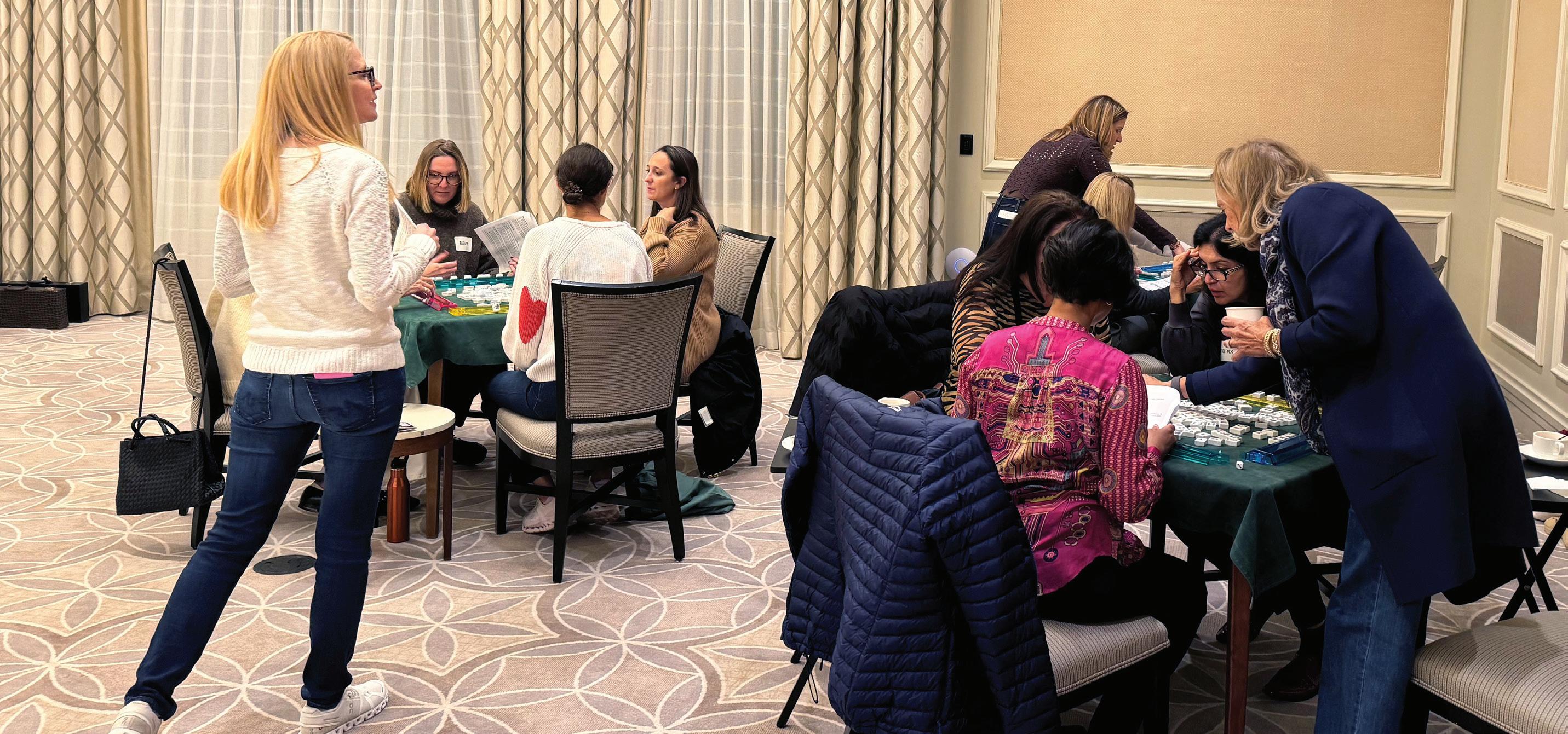
MAHJONG’S NOT NEW, but its popularity has surged in recent years, and Belmont (Mass.) Country Club was quick to embrace the trend.
The game, believed to have originated in China during the 19th century, first gained widespread popularity in the United States during the 1920s. More than a century later, it is experiencing a resurgence among players of all ages.
Last year, Belmont CC hosted its first Intro to Mahjong event, which quickly became one of the club's most talked-about new social experiences.
With a professional mahjong instructor among the club's membership, the club offered a series of instructional evenings for members of all ages and experience levels. The sessions provided a relaxed way to learn the game while meeting new people
and building connections.
The format encouraged conversation and gave members an opportunity to learn something new. It also highlighted how members' own talents and expertise can help shape club programming, creating experiences that feel authentic to the club's culture and community.
"There has been a ton of interest in the game following the event," says Belmont CC Director of Communications and Membership Kate Mason-Carl.
Members have since started organizing their own games before and after lunch in the club's Grille Room, extending the social connections formed during the introductory sessions.
"We're also planning a nighttime mahjong party because of all the interest," adds Mason-Carl.
THE CHALLENGE:
Capitalize on growing interest in mahjong by creating an accessible social experience that appealed to members of varying ages and skill levels.
THE RESPONSE:
The club hosted a series of instructional evenings led by a professional mahjong instructor who is also a member, welcoming participants from across the membership.
THE RESULT:
Members learned a new game, formed new connections, and generated enough enthusiasm to spark ongoing play and additional mahjong-focused events at the club.
The Sound of Member Satisfaction
By Isabelle Gustafson • Senior Editor
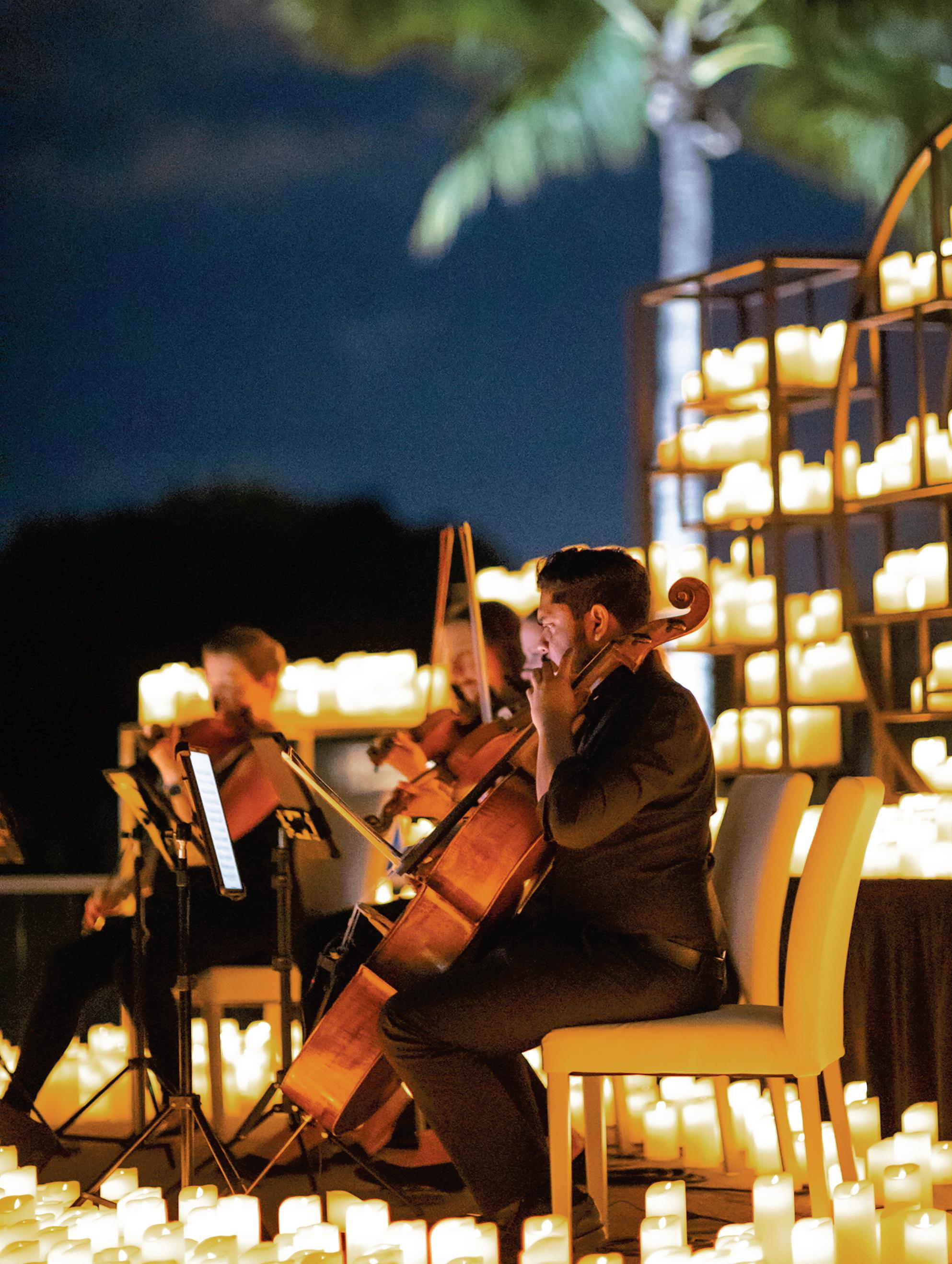
AT BROKEN SOUND CLUB in Boca Raton, Fla., thousands of candles transformed the club's terrace into an intimate concert venue for an evening that quickly became one of the club's most popular events of the season.
The club's "Candlelight Concert" welcomed more than 260 members. The evening began with a dessert reception before members settled in for the performance. A live string quartet performed classic rock favorites, blending classical instruments with modern and familiar songs.
Anna Erickson, Director of Catering and Club Events, says member response exceeded expectations.
“We focused heavily on creating an immersive experience from the moment guests arrived,” she notes, “with candles lining the valet entrance, lobby, and pathways leading to our outdoor terrace, immediately setting the tone for the evening.”
The event exceeded attendance goals to such a degree that the club had to get creative with seating and event flow in order to comfortably accommodate all guests. The response reinforced members' appetite for unique, experience-driven programming that feels different from a traditional club event.
“Because the concept felt so fresh and unique, we would absolutely consider bringing it back in the future,” Erickson says. “We would likely allow some time to pass before repeating it in order to preserve the excitement and originality of the experience.”
THE CHALLENGE:
Create a unique entertainment experience that would feel fresh, immersive, and memorable for members.
THE RESPONSE:
The club transformed its terrace with thousands of candles and paired a dessert reception with a live string quartet performing classic rock favorites.
THE RESULT:
More than 260 members attended, exceeding expectations and making the event one of the club's most popular of the season.
From Screen to Club Scene
By Isabelle Gustafson • Senior Editor
AT CHAMPIONS RUN in Omaha, Neb., some of the club’s youngest members got the chance to celebrate the hit movie and accompanying soundtrack known 'round the world as K-Pop Demon Hunters.
Fully leaning into the fandom at the height of its popularity, Champions Run transformed into an immersive K-Pop Demon Hunters experience.
“Rather than creating a traditional themed event, we approached it like a concert and immersive show,” says Raychel Reed, Champions Run’s Marketing Manager. “Members entered a space featuring theater-style seating, a massive screen playing the movie, and a dedicated dance floor where kids could sing, dance, and perform alongside their favorite characters. The energy in the room was electric from start to finish.”
In fact, the event became one of the most-talked-about youth events that Champions Run has ever hosted.
“One of the biggest reasons this event was such a success was timing,” notes
THE CHALLENGE:
Create a youth event that tapped into a rapidly emerging pop-culture phenomenon while the excitement was at its peak.
THE RESPONSE:
Transform the club into an immersive K-Pop Demon Hunters experience featuring themed entertainment, activities, food stations, and character interactions.
THE RESULT:
The event generated exceptional engagement and quickly became one of the most-talked-about youth events in club history.

Reed. “We hosted our K-Pop Demon Hunters event right when the movie and soundtrack were exploding in popularity.
"Our Events Director, Kayla Ryan, recognized the trend early and did an incredible job bringing the entire experience to life,” she adds.
“Every detail was thoughtfully designed to connect back to the film,” Reed says.
“One of the most popular attractions was our custom hair-braiding station, where children could choose colors and styles inspired directly by the characters. The line never seemed to end.”
Food played a major role in the experience as well.
“We featured a themed ramen station with character-inspired signage and displays, along with a candy sushi station that fans of the movie immediately recognized and loved,” Reed says. “We also created themed photo opportunities throughout the event, giving families plenty of memorable moments to capture and share.”
Perhaps the most-talked-about feature

was the debut of the Derpy (character) costume, Reed notes, custom-made specifically for this event.
“The character became an instant celebrity,” she says, “creating excitement and interaction throughout the evening.”
Ultimately, what made the event so memorable was the club’s commitment.
“It demonstrated how powerful it can be when creativity, timing, and attention to detail come together,” Reed says.




OVENS LEFT TO RIGHT
Under Counter*: RO151XWUA5DX
Half Size*: RO151HWUA9DX
Stacked: RO151XWUA5DXSTKM2081
Full Size: RO151FWUA18DX
*Shown with optional stand and window. (Roll-in racks and Pass-Through ovens also available.)
Air Fry, Bake, Cook, Roast, Rethermalize and Hold with precise temperature and humidity control.
• Quicker temperature start-up and recovery times.
• Power boosting switch allows end user flexibility to increase or reduce air flow.
• Operate all fans on high for air frying crispy foods.
• Models available with or without humidity. Full, half and under counter sizes available.
• Non-venting; does not require a hood. (Check with your local codes.)
• Available in 208/240V, or 480V.