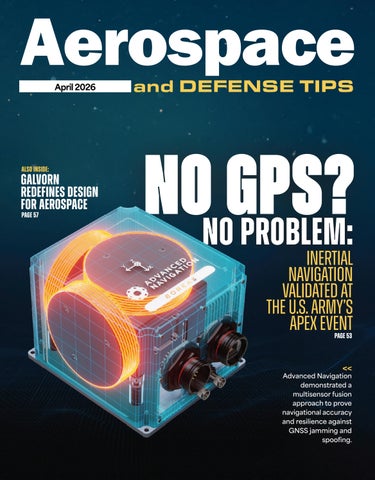
Aerospace & Defense April 2026

Page 1


Advanced Navigation

Modern warfighters operate in electromagnetic environments more contested than any previously encountered — conditions where GPS and communications may be degraded, denied, intermittent, and lowbandwidth (DDIL). GPS satellites orbit at approximately 20,200 km (12,550 mi) above Earth with a 12-hour orbital period. The signals they transmit are exceptionally weak by the time they reach a receiver, making GNSS jamming easy and even accidental.

“You get accidental jamming through LTE or any other out-of-band emitters

all the time,” said Andrew Dries, sales, engineering, and support manager for the Americas at Advanced Navigation. “And it doesn’t take a lot of energy for adversaries to engage in this as well.”

Dries noted that many systems across defense, agriculture, and mining rely heavily on GNSS as a single source of navigational information. Though the information is accurate and useful, overreliance on GNSS in defense applications has led to challenging situations and brittle systems that can fail in contested environments.

GNSS jamming in military environments involves the deliberate

transmission of radio-frequency (RF) interference at the same frequencies used by satellite navigation systems, making such signals unusable by overwhelming receivers with noise or false signals. Modern adversaries deploy groundbased and airborne jamming systems that can create denial zones ranging from localized tactical areas to broad regional coverage, with some systems also capable of spoofing — transmitting false GNSS signals that deceive receivers into calculating incorrect positions.

In ISR (intelligence, surveillance, and reconnaissance) platforms that use dual GNSS receivers to derive heading, if

The Boreas D90 is an inertial navigation system with a northseeking fiber-optic gyroscope, providing reliable navigation in GNSS-denied environments.

Aerospace&Defense

The LVS provides ground-relative, drift-free velocity measurements, as long as it maintains a clear line of sight to the ground or a stationary surface. Advanced Navigation

jamming eliminates the GNSS signal, the platform loses its heading reference entirely.

“All of a sudden, you lose your GNSS. You have no idea where you're pointing. And so, you have a lot of people scrambling to figure out how to adapt,” Dries said. “That’s where the inertial navigation solutions come in.”

In an inertial navigation system (INS), the inertial measurement unit (IMU) contains accelerometers and gyroscopes to continuously calculate a platform's position, velocity, and orientation without external references. The system measures accelerations and rotational movements, then integrates the measurements over time from a known starting position to track the platform's current location. For example, Advanced Navigation’s Boreas

fiber optic gyroscopes (FOGs) are sensitive enough to detect Earth’s rotation and determine true North without relying on magnetic fields or external references. This provides autonomous navigation immune to jamming or spoofing, which is obviously favorable for applications in GPS/GNSSdenied environments.

“An inertial navigation system is built, as the name implies, around the inertial sensors. Inertial measurement units, as people know, are your three-axis accelerometers and gyroscopes,” said Dries. “Your accelerometers are measuring acceleration. This is the second derivative of position, which, when noise and bias are added in, is not the most convenient thing to detect, in terms of a navigational aiding source. And then you have your gyroscopes, which are giving you your

angular rates and degrees per second, which is a more convenient measure… In order to turn that information, the acceleration and the angular rates, into useful navigation, you need to utilize sensor fusion and state estimation techniques.”

Advanced Navigation describes inertial sensing as part of the “nervous system” of a navigation solution, which includes multiple sensors collecting information and AI-enabled software calculating the state solution.

“In the 1960s, Rudolf Kalman developed the Kalman filter, which is what inertial navigation systems have been designed around,” said Dries. “The Kalman filter enabled both sensor fusion and state estimation. The sensor fusion part allows us to blend information from various sensors that are reading different pieces of information.”

Dries explained that the software fuses measurements from the accelerometers and gyroscopes with the GNSS information that estimates position in a geodetic reference frame. It can also fuse that information with a laser velocity sensor (LVS) or wheel speed encoder, for example.

“The next part is the state estimation, which is going to be calculating your state solution. So that'll be your body velocities, your body angular rates, your position and latitude, longitude, acceleration, in a global reference frame,” he said. “Essentially, you're weighting these various sensor solutions that are coming in against the noisiness of the solution. The interesting thing about the Kalman filter is the Kalman gain, and the Kalman gain is optimized so that you reduce the covariance of your error. You come up with a minimum error solution, essentially.”

Errors are unforgivable in military environments, making continuous accuracy a critical requirement. To evaluate technologies for potential use in DDIL environments, the U.S. Army holds an annual All-domain Persistent Experiment (APEX) event (formerly the Positioning, Navigation, and Timing Assessment Experiment, or PNTAX).

Advanced Navigation evaluated the performance of its Boreas D90 FOG INS

when fused with complementary aiding sensors at the APEX event on White Sands Missile Range in New Mexico in December 2025.

During APEX, Boreas D90 with AdNav Intelligence software was integrated with an LVS and a wheel speed encoder aboard a four-wheel-drive vehicle. The demonstration was conducted during night operations, and the event organizers created an environment of complex and emerging electronic warfare threats by conducting GNSS jamming.

The Boreas D90-LVS configuration achieved a 0.012% error per distance traveled (7.5 m over 65 km), and the Boreas D90–wheel encoder configuration achieved a 0.018% error per distance traveled (11.7 m over 65 km), without reliance on GNSS, even under deliberate jamming.

Wheel speed encoders are a rugged, cost-effective option that work well on firm terrain and structured routes.

Advanced Navigation

“Our laser velocity sensor is giving a ground-relative velocity. You have three lasers that are about 120° pointed away from each other, and you're using the Doppler shift that's occurring as the lasers are returned back off of the ground, and it's directly proportional to the velocity. It's a highly accurate system,” said Dries. “In fact, what we've seen at APEX, and we've proven this quite a few times, is that you're able to get multiple orders of magnitude improvement over self-positioning performance over just the INS alone, when you add the velocity sensing.”

Each LVS measurement is independent and unaffected by previous measurements, so it does not accumulate systematic errors over time. When fused with an INS, this drift-free velocity reference helps bound inertial navigation errors by providing periodic corrections

Aerospace Materials

CS Hyde is your supplier for high performance materials made for aerospace nishing & manufacturing.

Adhesive Tapes

Aerospace&Defense

that prevent the position estimate from drifting unbounded, which is why the Advanced Navigation system achieved such high accuracy.

As for the wheel speed encoder, it measures wheel rotation to determine ground speed and distance traveled. Though it must account for factors such as wheel slip, tire wear, and terrain variations that can affect measurement accuracy, wheel speed encoders offer a more rugged, cost-effective, simpler option suitable for firm terrain and structured routes.

“With the wheel encoder, you're inferring velocities from the wheel rotation,” said Dries. “There are various error sources that get introduced. You need to accurately know your wheel diameter and the distance off of the baseline, because the wheel is going to be rotating faster around turns. And then, most importantly, there's wheel slip, and you can't account for that. It just happens and introduces errors. And for some applications, especially for heavy wheeled and tracked vehicles, wheel slip occurs all the time, so it just becomes impractical.

I don't want to disparage them. They're good sensors.”

Dries noted other considerations for wheel speed sensors, such as mounting. It is common to use a simple external configuration that mounts to the hub and attaches to the lug nuts, which, in reality, is impractical for many applications because they are likely to detach. Therefore, it can be a mechanical engineering challenge to design an enclosure that can protect it.

Though the APEX evaluations were focused on proving the INS and complementary aiding sensors' accuracy, it is clear that selecting one of the tested configurations depends mainly on cost and application.

“The trade-offs you have around an LVS compared to a wheel speed sensor are probably going to be more around cost than anything else,” said Dries. “The reality is, if you're looking for a high accuracy solution, the LVS is going to beat out the wheel speed encoder every single time.”

alignment of some optical or radar sensor, and it needs to be operating in GNSSdenied, then that D90-LVS with the antijamming, anti-spoofing modules — that's what you're looking for.”

Aside from defense applications, the mining industry has an interest in improving underground navigation, increasing throughput, and removing operators from dangerous conditions. Autonomous solutions prove challenging, so accurate navigation is critical. Subsea applications are also pursuing similar solutions for surveying, for example.

“There's a lot of interest in pairing systems with what's referred to as a DVL, a Doppler Velocity Log,” said Dries. “These are fundamentally acoustic sensors. They're doing largely the same thing as the LVS, but in a subsea situation which enables them to have really accurate positioning underwater.”

Miniature Metal Bellows

World’s Finest Metal Bellows

Servometer® - PMG, LLC

Custom Designed

Miniature Electrodeposited

Nickel Bellows have diameters as small as 0.020 inch (0.5mm), are ideal for dynamic applications where reliability and long life are critical requirements.

The applications for the LVS are not limited to ground vehicles, however. Last year, Advanced Navigation conducted an independent evaluation of a Boreas D90-LVS configuration for long-range aerial missions, ISR platforms, helicopters, and fast-moving fixedwing aircraft. Over 100 km traveled, the configuration achieved only 29 m error (0.03% of distance) without GNSS.

“What you're really trying to do is pair the navigation solution with the requirements of that system,” Dries said. “The same application might be able to get away with a smaller SWaP, lower cost solution, if they're not going to be going into GNSS-denied areas. But if you need a super critical heading accuracy, especially

Dries identified several areas he anticipates seeing development in the coming years. On the software side, he mentioned AdNav Intelligence and perhaps some interesting advancements that could be made in AI-enabled maintainability. As for hardware, he noted ongoing development of more resilient GNSS solutions, including anti-jamming and anti-spoofing modules and antennas, that can be integrated into Advanced Navigation’s layered navigation approach. He also expressed personal interest in visual-based navigation and terrainrelative navigation (TRN), a technique that uses camera or infrared imagery to match terrain features against a map, providing a positioning reference that plays a similar functional role to GNSS. Fused with an inertial sensor, he said, this approach could enable long-duration GNSS-denied navigation on small, cost-constrained uncrewed aircraft systems where size and weight prevent the use of higher-end inertial systems. A&D

GALVORN REDEFINES DESIGN FOR AEROSPACE

Tougher than steel, less dense than aluminum, as conductive as copper. Galvorn is a flexible, lightweight conductor for wiring, carbon fiber reinforcement, and strengthening composites.

Copper has been the default conductor in aerospace wiring for decades. However, the case for copper is becoming more complicated across the supply chain. On the supply side, copper sourcing is increasingly worrisome. A January 2026 study by S&P Global projected that global copper demand will reach 42 million metric tons by 2040 — a 50% increase from current levels — while production is expected to peak in 2030 and then decline. The International Copper Study Group forecast a refined copper deficit of 150,000 tons in 2026 alone, and J.P. Morgan Global Research projected a U.S. refined copper deficit of 330,000 metric tons this year. Competition from AI data center buildouts, defense spending, and electrification is intensifying pressure on a resource that is already difficult to bring to market. With global copper grades falling below 0.7% — down from 1 to 2% historically — miners are processing more rock per ton of output, driving up cost and carbon footprint. As such, the U.S. designated copper a critical mineral in 2025.

Recycling Galvorn is relatively simple. Products can be treated as feedstock, dissolved with the same solvent as raw CNTs, and processed the same way.

Brushless Motors

Solid or hollow shaft, high performance, housed and frameless, brushless motors and matching drives for demanding applications.

On the design side, the weight of copper wiring has always been a tradeoff that aerospace engineers have had to live with. For instance, a Boeing 747 (retired from production in 2023) contains over 150 miles of wiring, weighing upwards of 3,500 pounds. Modern aircraft are increasingly complex, with more sensors, fly-by-wire controls, communication systems, and avionics than earlier generations — requiring more wire runs and more EMI shielding. Lightweighting is an ongoing engineering objective in aerospace, and every gram saved in the electrical system is a gram available for structure, fuel, or payload.

• •

• •

Hall or sensorless motors and drives for surgical tools, aerospace, military, and scientific instrument applications.

Custom drive programing and designs available.

Motors up to 95% efficient, power up to 1,500 watts. Highest power density in the industry.

Operating temperatures from -73C to 150C

Slotless and slotted designs. Available with encoders and gearheads and separate or integral electronics.

Quantities 1 to 5,000.

www.koford.com

Contact us at mail@koford.com

Plus, EMI shielding adds to the challenge. As aircraft pack in more electronics and operate in denser electromagnetic environments, the conventional solution of braided copper shields is effective but adds weight and bulk. A braided shield inherently has

gaps in coverage, and at higher signal frequencies, the skin effect reduces the amount of the copper cross-section doing useful work. Engineers working on nextgeneration aerospace platforms need next-generation solutions.

Carbon nanotubes emerge from the lab and into engineering designs

Carbon nanotubes (CNTs) have attracted research attention for decades because of properties that seem almost too good to be true at the nanoscale: tensile strength that exceeds steel by a wide margin, electrical conductivity comparable to copper, and low density. The challenge has always been translating those nanoscale properties into materials that engineers can actually use, such as fibers, tapes, cables, and composites, at scales and costs that make sense for manufacturing.

The main obstacle is that individual nanotubes are extraordinarily small. Getting millions of them to cooperate — align, pack tightly, and bond effectively — in a macroscale material requires precise processing. Early CNT fibers demonstrated the concept but fell short on performance and were nowhere near commercial scale. That is the problem DexMat has been working to solve.

DexMat, founded in Houston in 2015, produces a carbon nanotube fiber it calls Galvorn. The technology traces back to Rice University, where research from Nobel Prize-winning scientist Rick Smalley

DexMat

established the scientific foundation for CNT fiber development. A 2004 paper demonstrated that wet-spinning processes could produce fibers from carbon nanotubes at scalable quantities. Dmitri Tsentalovich, cofounder and CTO of DexMat, began his PhD at Rice in 2008 and worked on the development of that process.

“DexMat produces Galvorn, which is a lightweight, flexible, carbon-based conductor,” Tsentalovich said. “It bridges the gap between metals and high-performance polymeric materials, because it’s both highly strong and flexible like Kevlar and Dyneema, but it is able to conduct electricity like metals such as aluminum and copper.”

After enough lab-scale results accumulated to suggest commercial viability, DexMat was founded. Today, Galvorn is available in several engineering form factors: fiber tow, twisted yarn, braided wire, tape, film, and fabric. Each opens different application possibilities depending on what engineers need — a wire replacement, a shield layer, a composite reinforcement, or some combination of all three.

To produce Galvorn, DexMat uses a wet-spinning method, the same general approach that has been used for decades to produce high-performance polymer fibers such as Kevlar. Tsentalovich explained that dry spinning, an alternative CNT fiber approach, does not scale economically the way wet spinning does.

The process begins with raw carbon nanotubes, produced from methane feedstock by a small number of suppliers that meet DexMat’s quality standards. Tsentalovich said that two feedstock material characteristics primarily drive performance: defect ratio and aspect ratio. Defects on nanotube sidewalls reduce conductivity and make alignment harder. The aspect ratio, the ratio of nanotube length to diameter, has a documented power-law relationship with fiber strength and conductivity, where the higher it is the better.

“Once we get the raw material, we dissolve it in a solvent that is able to individualize the carbon nanotubes, and this forms a liquid crystalline phase, which means that the carbon nanotubes, when they get to a certain concentration, start to spontaneously align…Once we flow align them and squeeze them through a series of small holes called a spinneret, that causes all the nanotubes to line up and pack densely close to each other,” said Tsentalovich. “We then put them through another liquid, a coagulant, and this removes our solvent, but it causes the nanotubes to coalesce and coagulate into a solid structure where they have this preserved alignment. Then that’s wound up roll to roll, and you get the tow filaments, which is standard for processing fiber materials.”

The process does not require high-temperature carbonization postprocessing steps, which are a significant

CONNECT TECHNOLOGY WITH CONFIDENCE

Harwin’s connector products are proven to perform in extreme conditions, with shock, vibration and temperature range rigorously tested.

WITH OUR QUALITY, SERVICE, SUPPORT, AND HIGHLY RELIABLE PRODUCTS, YOU CAN DEPEND ON HARWIN.

Galvorn can be sewn into carbon fiber, as shown inside the white lines, to reinforce composite materials. DexMat

cost and energy input in conventional carbon fiber production. The material is also fully recyclable, in which Galvorn fibers can be redissolved in the same solvent and reprocessed from the start of the production line with no reported loss of properties.

“What actually gives you the strength and conductivity is that those nanotubes are right next to each other,” Tsentalovich said. “When we actually break the fibers, we're not breaking the individual nanotubes, we’re just pulling them past each other. So, it’s important to use particularly long nanotubes in order to get the strength.”

Despite what Galvorn has already demonstrated, Tsentalovich said the material is operating well below its theoretical ceiling. Current fibers are at approximately 10% of the theoretical electrical conductivity limit and less than 10% of the theoretical tensile strength limit.

“The thing that [has been] driving improvements is a combination of better processing, but also using higher aspect ratio nanotubes,” Tsentalovich said. “If our suppliers can develop even higher aspect ratio nanotubes while maintaining quality, there’s a pathway to get to absolutely ridiculous numbers in terms of performance.”

Galvorn for aircraft signal cabling and EMI shielding applications

For aerospace wiring, DexMat’s current focus is on data and signal cables rather than high-current power transmission. Galvorn’s electrical conductivity is nearly equivalent to copper on a per mass basis (6,150 Sm²/kg for Galvorn compared to 6,300 Sm²/kg for copper), but for power transmission, a Galvorn conductor carrying the same current as a copper equivalent would need to be slightly larger, which reduces its weight advantage in that use case. However, for signal cables, which make up a large amount of the wire runs in any modern aircraft, Tsentalovich said that “for the majority of cable runs that are only a few meters long, this is way more than sufficient performance.” EMI shielding is another application and benefit. DexMat has demonstrated, in testing with a cable manufacturing partner, that Galvorn film used as a shield layer can meet military specifications for shielding effectiveness while producing a cable that is up to 60% lighter. Plus, the material itself is more than 20 times stronger than copper

by mass, which is an advantage in aerospace environments where vibration and mechanical robustness are also concerns.

“If you use the solid copper sheath, you get really good shielding, but then you have a perfectly stiff cable that you can’t bend and route. The advantage with Galvorn is that we can essentially apply the shield as a film, or multiple layers of film, that give you full coverage while maintaining the strength and flexibility,” said Tsentalovich.

Hybrid designs are also possible. Depending on the frequency range and shielding requirements of a specific cable, an engineer might replace one of two copper braid layers with a Galvorn film layer and still achieve 20 to 30% weight reduction, while retaining copper’s low-frequency shielding strength.

“Because it’s a multifunctional material that also has structural applications, one opportunity is to actually put the wiring, or the Galvorn, directly into the structural components,” Tsentalovich said. “For example, you can imagine a drone [with] a composite body, where the Galvorn is already insulated by the epoxy or resin, and it’s also being used to conduct current to the rotors and the motors. That’s something still in the very early stages of development, but potentially a completely different design system. You take advantage of the material properties that Galvorn offers the copper and that other metals don’t have.”

One mechanism Tsentalovich highlighted for Galvorn’s EMI shielding advantage — particularly at higher frequencies — is reduced susceptibility to the skin effect. In conventional copper conductors, alternating current at high frequencies is concentrated near the surface, leaving most of the crosssectional area effectively unused. Tsentalovich noted that published research indicates CNT conductors maintain current conduction across a larger portion of their cross-section at higher frequencies.

“This difference in the skin effect enables us to significantly outperform copper, especially at higher frequencies. At the very low frequencies, sometimes you might still need the copper, so that’s where constructions that have both copper and Galvorn may make more sense,” said Tsentalovich. “But especially for next-generation data transmission cables that are operating at higher frequencies, that’s the biggest advantage that we see.”

Design engineers evaluating Galvorn for cable applications will need to account for termination compatibility. Galvorn is compatible with crimp-style terminations, but soldering is more complex, as standard commercial solders do not readily wet the material. DexMat’s cable manufacturing partner has developed proprietary solder formulations that work with Galvorn, and Tsentalovich acknowledged that this is an area where the broader ecosystem of compatible materials is still developing.

“As cables made with Galvorn become more prominent, there’s going to be more of those types of solutions,” Tsentalovich said.

Beyond wiring: structural sensing, de-icing, and heat shielding

Aerospace customers have approached DexMat on a range of additional applications that take advantage of the material’s multifunctional properties, including:

• Embedded strain sensing: Galvorn fibers integrated into carbon fiber composite structures to enable damage detection.

• Electrothermal de-icing: Galvorn fibers embedded in wing skins to provide resistive heating for ice prevention or removal.

• Heat shielding: Tsentalovich said Galvorn can withstand temperatures exceeding 1,000° C in inert environments and is being used in a space application.

The material also shows resilience across a range of environmental conditions, including low and high temperatures and humidity variation, and is not susceptible to galvanic corrosion. Tsentalovich said it performs well in salt fog and even seawater immersion.

“Galvorn really redefines the physical limits of a traditional conductor,” Tsentalovich said. “Historically, you have to choose either conductivity or structural

Precision Stamped Components for the Aerospace & Defense Industry

Boker’s provides custom stamped component parts to accommodate nearly any aerospace and defense application, including avionics, control systems, engines, hydraulic, pneumatic and other equipment that require unique specifications. Boker’s Quality Management System is certified to the stringent AS 9100:2016/ISO 9001:2015 standard, and can comply with DFARS and RoHS, with the ability to manufacture to customer provided AN, NAS, MS and MIL spec standards.

At Boker’s, we know that aerospace and defense OEMs demand manufacturing partnerships with the highest levels of precision, quality management and performance, along with a strong understanding of unique industry requirements ranging from space/non-space qualifications to AMS specifications. For over 100 years, Boker’s continues to meet the evolving design needs of the aerospace, aviation and defense industries.

performance. This is a material that offers you both — the very good mechanical properties alongside the high conductivity — and so it allows people to think in a different design space.” A&D

DexMat dexmat.com

Sources:

• Copper in the Age of AI: Challenges of Electrification, S&P Global Energy & Market Intelligence: https://wtwh.me/spglobal

• Copper Market Forecast 2025/2026, International Copper Study Group: https://wtwh.me/ICSG

• Copper prices could soar further amid a tightening market, J.P. Morgan Global Research: https://wtwh.me/jpmorgan

• www.bokers.com

Kapton® polyimide tape with a low outgassing adhesive

This specialized Kapton® tape joins treated polyimide film with 3M™ 966, a 2 mil. High temperature (up to 400°F) acrylic adhesive laminated on one or two sides. The balanced performance properties of polyimide and an adhesive with low outgassing, low-leachable chloride makes this tape ideal for different aerospace applications, including label overlays, flexible circuit attachments, and wire or harness cable wrapping. PTFE, Nylon, Mylar, PEEK, and ULTEM can also be laminated with 966 adhesive. Customizable in sheets, rolls, or die-cut parts.

CS Hyde Company Lake Villa, IL 60046

800-461-4161 • www.cshyde.com

New England Wire Technologies

Advancing innovation for over 100 years

Why accept a standard product for your custom application? NEWT is committed to being the premier manufacturer of choice for customers requiring specialty wire, cable and extruded tubing to meet existing and emerging worldwide markets. Our custom products and solutions are not only engineered to the exacting specifications of our customers, but designed to perform under the harsh conditions of today’s advanced manufacturing processes. Cables we specialize in are LITZ, multi-conductor cables, hybrid configurations, coaxial, twin axial, miniature and micro-miniature coaxial cables, ultra flexible, high flex life, low/ high temperature cables, braids, and a variety of proprietary cable designs. Contact us today and let us help you dream beyond today’s technology and achieve the impossible.

New England Wire Technologies www.newenglandwire.com 603.838.6624

Rotor Clip Wave Springs are engineered to save space and weight by reducing spring heights up to 50%. Our experienced engineering team is ready to assist you in specifying a standard spring or developing a custom design in the material and size you require. From prototype to production, we'll provide you with the perfect spring solution for your application.

Coil Spring
Rotor Clip Wave Spring

Turn static files into dynamic content formats.

Create a flipbook