
WTCA JUNE2023
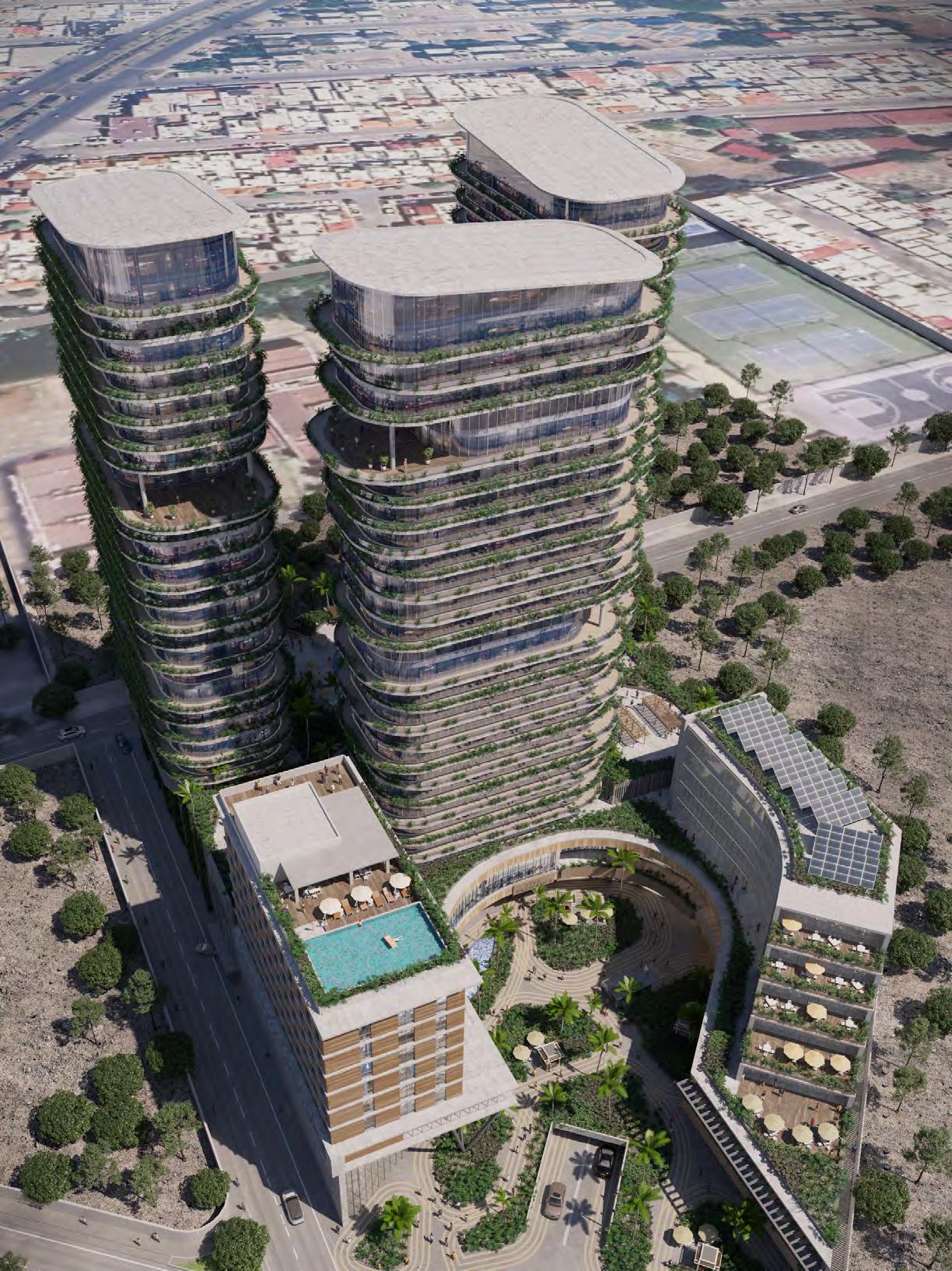 Foto WTC Mazatlán Mejico
EMBRACING TECHNOLOGY
The commercial real estate sector has always been dynamic, but in recent years there has been an unprecedented transformation, especially in the office market. As businesses navigate the changing landscape of work models and integrate cutting-edge technologies, the commercial office industry is at the forefront of a wave of innovative trends that are fundamentally redefining the nature of work. This evolution is driven by the convergence of technology and the changing dynamics of the modern workforce, and it is imperative that companies understand and embrace these trends to remain competitive and promote an environment of innovation.
One of the most prominent trends shaping the future of office spaces is the increase in labor flexibility. The traditional 9 to 5 workday is giving way to more flexible hours that accommodate a wide range of preferences. This change has given rise to the proliferation of co-working spaces, where professionals can choose the most appropriate environment for their tasks, whether it is a collaboration area or a quiet corner to focus on work.
Another significant transformation is the adoption of remote work. Technological advances have enabled seamless communication and collaboration, regardless of physical location. Companies are recognizing the benefits of remote work in terms of attracting talent, reducing overhead costs and increasing employee satisfaction. Virtual teams are becoming more common and companies are investing in digital tools to ensure that their remote workers stay connected, engaged, and productive.
The concept of smart buildings is revolutionizing office spaces by incorporating advanced technologies to improve efficiency and the user experience. These buildings are equipped with IoT (Internet of Things) devices that collect and analyze data to optimize energy use, space utilization, and overall comfort. Smart buildings not only offer cost savings but also contribute to sustainability efforts, in line with the growing awareness of environmental responsibility.
Data-driven decision-making is becoming the cornerstone of business success. In the context of office spaces, data analytics provides valuable insight into how space is used, allowing companies to optimize layout, services, and resources. With the evolution and appropriation of new technologies, the office market is about to experience new transformative advances. The incorporation of advanced technological solutions such as artificial intelligence, augmented reality, and advanced robotics could redefine the way we interact with physical office spaces.
In conclusion, the commercial real estate sector, particularly within the office market, is undergoing a remarkable evolution driven by the merger of technology and changing work dynamics. Companies that embrace these trends are better positioned to remain competitive and offer their employees an environment that fosters innovation, adaptability, and collaboration. The shift to flexible working arrangements, remote working, smart buildings, virtual reality, datadriven decision-making, and initiatives focused on health are transforming the future of office spaces in profound ways.
As technology continues to surmount limitations, the office market will witness new advances that will redefine the very nature of work and the way we engage with physical office settings. As the success of global brands like our World Trade Centers proves, the integration of a strong, global identity adds tangible momentum to any infrastructure, underscoring the importance of branding in this evolving landscape
 Robin van Puyenbroeck Chief Executive Officer and Business Development, WTCA


LATIN TRADE Chief Executive Officer Santiago Gutiérrez • Editorial Assistant: Angélica Mahecha Research and Editing: Álvaro Moreno Design Camilo Jaramillo studiovisual.co • Photos by WTC / Envato www.latintrade.com
WTCA PRIME OFFICE INDEX-LATAM JUNE 2023


LATIN TRADE and the WORLD TRADE CENTERS ASSOCIATION present the report on the current situation and outlook for Latin America's premium office leasing and sales. This document is based on the sixth edition of the biannual survey of experts in the field. The report is divided into four blocks: the current situation for leasing, the current situation for sales, the outlook for leasing over the next six months, and the outlook for sales also over the next six months.
WTCA
The WTCA PRIME OFFICE INDEX ,which has been calculated since 2020 based on the responses obtained for each half-year, summarizes the situation of the premium office market in Latin America. The graph shows that, from semester to semester, the indicator has shown a steady improvement, which is consistent with the impact of and subsequent recovery from the pandemic in this market. From negative results in both December 2020 and June 2021, the indicator turned to an incipient positive index in the second half of 2021. In the first half of 2022, growth continued, became more pronounced at the end of 2022, and in the first half of this year, there was a significant increase in the index, which stood at 20.1. This is striking because last December the consulted experts expected a deterioration of the index for this semester.
INDEX - LATAM is an indicator that ranges between -100 and 100. Negative (positive) values denote a balance between past realities and negative (positive) future perceptions of the premium office market in Latin America. For the construction of the index, experts were consulted in 17 cities in the region: San Salvador (El Salvador); Mexico City, Guadalajara, Nuevo Laredo, San Miguel de Allende, (Mexico); Santa Cruz de la Sierra (Bolivia); Santiago de Chile (Chile); Buenos Aires (Argentina); Panama City (Panama); Curitiba and São Paulo (Brazil); Montevideo (Uruguay); Bogota, Medellin and Cali (Colombia); Santo Domingo (Dominican Republic) and Valencia (Venezuela).
WTCA PRIME OFFICE INDEX- LATAM TENDENCIA HISTÓRICA 2020 A 2023 dic. 2020 jun.2021 dic. 2021 jun. 2022 dic. 2022 jun.2023 30 20 10 -10 -20 -30 -40 -50
PRIME OFFICE
-42 -40 1.2 2.2 5.4 20.1 3
WTCA
WTCA PRIME OFFICE
INDEX-LATAM
JUNE 2023
The consulted experts have various explanations for what happened in the first semester, but in general, they agree that there is an evident recovery in activity, which is progressing slowly.
The WTCA PRIME OFFICE INDEX is made up of a performance indicator for the semester that just ended and another indicator for the semester just beginning. The index for the semester that just ended, which shows the actual performance of leases and sales for the first half of 2023, stands at 17.6, the best performance since this measurement started to be made.
The Expectations index shows the results of what experts expect for the second half of 2023 in office leasing and sales. In this case, it is evident that there is very good progress – just as in the Performance Index – with an index of 22.5, which translates into the best of all historical results in this item.
As mentioned above, both the performance indicator for the first half of 2023 and the expectations indicator for the second half of the year are positive. This results in a continuation of the trend presented since the beginning of the measurement, in 2020, which shows higher future expectations than the performance presented. The table summarizes the information on the performance and expectations indicators and the indexes that make them up.

WTCA PRIME OFFICE INDEX- LATAM DEC.2020 TO JUN. 2023 DEC.20 JUN.21 DEC.21 JUN.22 DEC.22 JUN.23 Previous semester’s performance indicator -53% -60 -11% 0,8% 0,2% 17,8% Next semester’s expectations indicator -32% -19% 14% 3,5% 11% 22,5% WTCA PRIME OFFICE INDEX - LATAM -42% -40% 1,2% 2,2% 5,4% 20,1%
SEMESTER´S PERFORMANCE INDEX 2020 TO 2023 2020/2 2021/1 2021/2 2022/2 2022/1 2023/1 30 20 10 -10 -20 -30 -40 0 -32 -19 3,5 22,5 14 11 SEMESTER´S PERFORMANCE INDEX 2020 TO 2023 2020/2 2021/1 2021/2 2022/2 2023/1 2023/2 20 10 -10 -20 -30 -40 -50 -60 0 -53 -60 -11 0,8 -0,2 17,6 4
LEASING MARKET PERFORMANCE
The Leasing Performance Index is calculated with four of the questions asked in the survey: the average rental prices, the vacancy rate, the average time it took to lease the properties, and the favorability of the economic situation. For these four variables, a balance is obtained that results from the percentage of positive responses minus the negative responses to this same question.
For the first semester of 2023, this balance was 29.4, much higher than that obtained in all the other semesters of the measurement. According to some of the experts, this behavior is related to the fact that office construction is not increasing, so the available office space is being leased at a relatively good pace.
As for average rental prices in the first semester, the Index shows a slowdown in the hikes. Still, 41% of the experts observed rising prices, compared to 12% who observed drops, and 47% who reported stability. The graph shows the balance for the first semester of the year at 29, lower than the previous semester, but in any case, with rising prices.
1S-2023
At the same time, in the last semester, the average level of rental prices was mostly (47%) between $12 and $18 a square meter. The other majority block of respondents (41%) found increases above $18, while only 12% said that prices were below $12.
The vast majority of respondents (53%) perceived that the vacancy rate had decreased in the first half of 2023. Only 6% stated that it had increased. Therefore, the balance increased greatly compared to the rest of the periods analyzed, as shown in the graph.
The time it takes to rent offices decreased somewhat in the past six months. 35% of respondents had such a perception, while 18% said it had increased and 47% said it remained the same as in the second semester of 2022.
The economic situation for leasing premium offices has been improving consistently since 2021. In this survey, 35% of respondents found it favorable, compared to 12% who said it was unfavorable, and 53% who found it neutral.
FAVORABILITY INDEX OF THE ECONOMIC SITUATION FOR OFFICE LEASING 2020-2 2021-1 2021-2 2022-1 2022-2 2023-1 40 30 20 10 -10 -20 -30 -40 -50 -60 -70 -80
LEASING PERFORMANCE INDEX 2020-2 2021-1 2021-2 2022-1 2022-2 2023-1 40 30 20 10 -10 -20 -30 -40 -50 -44 -40 21 25 35 29 AVERAGE RENTAL PRICE INDEX 2020-2 2021-1 2021-2 2022-1 2022-2 2023-1 60 50 40 30 20 10 -10 -20 -30 -40 -50 -60 0 47 -45 -25 -50 -6 -50 -75 -16 0 15 24 LEASING
2020-2 2021-1 2021-2 2022-1 2022-2 2023-1 40 30 20 10 -10 -20 -30 -40 -50 -60 -70 -80 -36,1 -62,5 1,3 0,0 -3,8 29,4
MARKET PERFORMANCE 1S 2023
5
LEASE
LEASING MARKET EXPECTATIONS FOR 2S-2023
The survey measures expectations for four premium office leasing market variables: average prices, average vacancy level, average time it will take to lease an office, and the favorability of the economic situation. The Leasing Expectations Index in the graph summarizes the analysis, with the balances of the responses. The value of 23.5 is very close to that of the 2S 2021, the highest in the series. These optimistic expectations, according to the interviewees, are related to the fact that available offices are decreasing and can be leased more quickly, as well as because, as mentioned above, the construction of new offices is stalled
For the second half of the year, 18% of the experts consulted expect rises in average rental prices, while the vast majority (82%) believe that they will remain stable. It is noteworthy that none of the interviewees thinks that prices will go down. The balance of this question shows that prices are expected to increase to a lesser extent in the second semester of this year than in the second semester of last year.

The average vacancy level shows that, in the opinion of 24% of the experts, these terms will drop and only 6% say it will increase. Moreover, 24% say the average time it will take to lease an office will decrease, while no respondent believes it will increase.
The economic situation will be favorable for rental according to 41% of the respondents. Only 6% believe it will be unfavorable. As a result, the balance for S1 2023 is an index of 35, the highest of all measurements so far. The drop in inflation and the prospect that mortgage interest rates will stop rising may have influenced this perception.
AVERAGE RENTAL PRICE INDEX 2020-2 2021-1 2021-2 2022-1 2022-2 2023-1 60 50 40 30 20 10 -10 -20 -30 -22 -20 21 30 55 18 FAVORABILITY INDEX OF FUTURE ECONOMIC CONDITIONS FOR OFFICE LEASING 2020-2 2021-1 2021-2 2022-1 2022-2 2023-1 60 50 40 30 20 10 -10 -20 -30 -40 -50 -60 32 35 25 10 -53 -28 LEASING EXPECTATIONS INDEX 2020-2 2021-1 2021-2 2022-1 2022-2 2023-1 40 30 20 10 -10 -20 -30 -40 -50 -26,4 23,7 23,5 1,8 8,8 3,8 6 WTCA
SALES MARKET PERFORMANCE FOR 1S-2023
The Sales Performance Index takes three variables into consideration: sales prices, the average time it took to sell, and the favorability of the economic situation for premium office sales.
Thus, the Index stood at 5.8 for the first half of the year, the best historical result of the survey. In any case, the experts surveyed believe that the index may drop because they find that investors are losing interest in investing in premium offices and are focusing on other types of real estate.
In the first half of the year, sellers and investors in premium offices saw prices increase. Thirtyfive percent of those interviewed said they increased their prices, while no one said the price decreased. Thus, the balance of 35 is 20 points higher than the previous half year, but it also continues the upward trend in the data series that had stalled in 2S 2022
Average sales prices for the semester have been overwhelmingly (65% of respondents) between $2,000 and $3,000 a square meter, which contrasts with 6% who found prices below $2,000. A considerable percentage, 29%, found prices above $3,000.
Premium office sales times, unlike in the case of leasing, increased in the past six months. While 18% of respondents perceived a decrease, 29% saw an increase in the time to sell these spaces. The graph shows that the trend of previous surveys, in which terms were shortened, was reversed. Experts attributed this result to an increased preference for leasing over buying office space.
The economic situation is related to a shift in preference for office purchases. Nineteen percent of respondents said the economic situation - which includes high inflation, high interest rates, and reduced aggregate demand - was unfavorable for premium office sales in the past semester. Thirteen percent said it was favorable. Looking at the graph with the balance over time, it is evident that, although it is negative, it is much better than what was previously observed.
FAVORABILITY INDEX OF THE ECONOMIC SITUATION FOR OFFICE SALES 2020-2 2021-1 2021-2 2022-1 2022-2 2023-1 20 10 -10 -20 -30 -40 -50 -60 -70 -80
AVERAGE SELLING TIME INDEX 2020-2 2021-1 2021-2 2022-1 2022-2 2023-1 40 30 20 10 -10 -20 -30 -40 -50 -60 -70 -80 -37 -12 20 15 -75 -67 SALES PERFORMANCE INDEX 2020-2 2021-1 2021-2 2022-1 2022-2 2023-1 20 10 -10 -20 -30 -40 -50 -60 -70 -80 AVERAGE SALES
INDEX 2020-2 2021-1 2021-2 2022-1 2022-2 2023-1 40 30 20 10 -10 -20 -30 -40 -50 -60 -70 35 15 0 -45 -72 -72 -55 -26 -25 -25 -6 15 1,7 -58,3 -70,4 3,3 5,8 -21,1 7
PRICE
SALES
SALES MARKET EXPECTATIONS FOR 2S-2023
The Sales Expectations Index for the second half of the year is calculated considering expected average sales prices, expected average time to sell an office, and the expected economic situation for office sales. As in almost all other expectation indexes, this survey finds the best expected outlook since this measurement started to be made, standing at 21.6. In this section, experts indicate that the drop in interest rates may help improve sales performance. However, they also indicated that the growing trend of offering vertical housing spaces, and the integration with co-working and mixed-use spaces may counteract this trend.
A good portion of respondents (29%) expect premium office sales prices to increase in the second semester of 2023. Only 6% believe they will drop. The balance for this question (24), shown in the graph, shows an increase in the perception of rising prices vis-a-vis the first half of 2022.
While the majority of survey respondents (65%) expect sales prices to be between $2,000 and $3,000 a square meter, there are greater upward pressures above $3,000 (29% said they will exceed such a level), than downward pressures below $2,000 (only 6% forecast a price below such a threshold).
As for the time to sell a premium office, the balance of 18 shows that more respondents expect this to fall in the semester. In fact, this time around, none of the respondents expect the time to increase. This result consolidates the trend that started in the first semester of 2021 and continued throughout the measurements.
Finally, in this edition of the survey, the trend in which the respondents expect that the economic situation will be favorable for premium office sales in the semester ahead became consolidated. This is clearer with the last piece of data which is higher than all the measurements made since the beginning of these semi-annual surveys.
FAVORABILITY INDEX OF FUTURE ECONOMIC SITUATION FOR THE SALE OF OFFICE SPACE 2020-2 2021-1 2021-2 2022-1 2022-2 2023-1 30 20 10 -10 -20 -30 -40 -50 -60
AVERAGE
2020-2 2021-1 2021-2 2022-1 2022-2 2023-1 40 30 20 10 -10 -20 -30 -40 -50 -60 -16 18 0 5 -55 -39 OFFICE SALES EXPECTATIONS INDEX 2020-2 2021-1 2021-2 2022-1 2022-2 2023-1 30 20 10 -10 -20 -30 -40 -50 AVERAGE
2020-2 2021-1 2021-2 2022-1 2022-2 2023-1 50 40 30 20 10 -10 -20 -30 -40 24 40 26 -15 -22 -50 -50 0 -15 15 24 5 -1,7 -40 -37 18,3 21,6 3.5 8
FUTURE OFFICE SALE TIME
INDEX
FUTURE OFFICE SALES PRICE INDEX
BACK TO THE OFFICE

Recently, Apple, Google, Meta, Warner, and even Zoom itself, have required their employees to go to the office at least three days a week since, contrary to what was thought at first, productivity at work is higher when performed in the office, not to mention the dynamics produced in meetings among colleagues both during working hours and breaks, which allows a greater collaboration that is limited in the case of work from home.
While higher productivity can be achieved with work in the office, everything seems to indicate that employees are happier when working at home, and thus the call is to a partial return that, in most cases is three days a week, although some firms are demanding four days of work at the office. Perhaps in the remainder of this year, and as the clouds of a global recession dissipate, we will be able to learn where the middle ground between productivity and happy workers will be.

A recent article published by The Economist presents some academic papers that show that there is greater productivity with office work. A study by Atkins and Schoar at MIT and Shinde at the University of California in Los Angeles found that, in a case study in India, those who worked from home were 18% less productive than those who worked at the office. Another study by the University of Chicago for a technology firm in Asia shows a 19% productivity difference. Going back to the issue of the dynamics of collaboration among colleagues that result from in-person work, the aforementioned magazine cited a work that evidenced that the professional networks in Microsoft became more static to the detriment of creativity.
Be that as it may, this trend will have a great impact on office occupancy and it is likely that the trend in the Index produced by Latin Trade and WTCA, which shows a growing recovery of the market both for sales and rental of the prime offices in the region, will be the result of such a return to the offices

9
Regional Director for Latin America, WTCA
Carlos Ronderos
PROPERTY TECHNOLOGY (PROPTECH)


In this edition, Latin Trade and the World Trade Centers Association (WTCA) sought to research and analyze the use and appropriation of PropTech, technological applications for the real estate sector based on the use of information and communications. Some examples of PropTech include property management through digital panels, smart-home technology, data research and analysis, technology-enabled listing/ brokerage services, mobile applications, residential and commercial loans, 3D modeling for online portals, automation, collective finance for real estate projects, management of shared spaces as well as organization, analysis, and extraction of key data from rental documents. Essentially, PropTech aims to reduce friction in the purchase, sale, or rental of real estate.
To know in greater detail both the current situation and the prospects of PropTech in premium offices, a survey was carried out among 17 experts from Latin America, members of WTCA. First of all, they were asked whether customers value PropTech applications being offered in premium office buildings when searching for such properties. 53% of the experts consulted said it was highly valued, compared to 41% who responded that the customer cares little, and 6% who said it doesn’t matter at all.
IN THE MEDIUM TERM, DO YOU BELIEVE THAT CUSTOMERS WILL VALUE PROPTECH APPLICATIONS IN PREMIUM OFFICE BUILDINGS WHEN SEARCHING FOR PROPERTIES?
As for the question of whether, in the medium term, customers will value PropTech applications in premium offices in Latin America when searching for them, the answers show that a categorical 82% consider that, in fact, they will be highly valued while only 18% do not believe so.
A LOT A LITTLE 20% 40% 60% 80% 100% 0% 10
A LOT A LITTLE NOT AT ALL 10% 20% 30% 40% 50% 60% 0% CUSTOMERS CURRENTLY VALUE PROPTECH
IN PREMIUM BUILDINGS
SEARCHING
PROPERTIES 53% 41% 6%
MANY COMPANIES IN LATIN AMERICA ARE INCREASING THEIR DEMAND FOR PROPERTY TECHNOLOGY (PROPTECH) SOLUTIONS, ESPECIALLY AFTER THE DISRUPTIONS CAUSED BY THE COVID-19 PANDEMIC IN THE REAL STATE COMPANIES.
APPLICATIONS
WHEN
FOR
PROPERTY TECHNOLOGY (PROPTECH)
Moreover, 64.7% of the respondents consider that the most commonly used applications at present are:
• Smart cards for access doors to buildings..
• Security measures to access buildings such as biometric checks or facial recognition cameras.
• Management tools such as electronic contract signatures.
• Automated safety measures, such as closedcircuit television that manage alarm signals without human intervention.
As for the applications that are used or that will be used in the medium term in premium office buildings to get new customers, the answers are varied, but automation, digital marketing, tools to promote real estate, as well as facial recognition and biometrics stand out. As regards those that will be used to make administration more efficient, there is a wide variety of opinions, but facility management tools as well as programs and applications that allow the allocation of jobs during the week, among others, stand out, as well as the use of parking lots, and in general all those that allow optimizing times, movements and costs.
As for the applications that make it easier to sell new units, there are those relating to systematization, safety, marketing, economies of scale, as well as the maximization of property benefits such as those generated as a business and institutional ecosystem. In relation to the applications that have already been used by respondents in their most recent constructions, it is noteworthy that more than 40% of the experts use the technology of Building Information Modeling (BIM).
Regarding the factors that would favor customers being more interested in solutions related to PropTech, first of all, there is efficiency and expediency, selected by 82.4%
of the experts, while in a distant second are marketing strategies, with an 11.8% score, and environmental consciousness with a 5.9% score. Options related to new generations and prices were not valued by any respondent.
When asked what should be the main driver for more PropTech applications to be adopted in premium office buildings in Latin America, again the responses were varied, however, those related to efficiency, ease of use, those that improve the quality of life and well-being of users and, finally, that "the buildings be conceived as the synergy of high-quality habitat real estate and business ecosystems of high productivity, profitability, and valorization, integrally managed with a systemic approach that articulates with the co-owners, tenants, and users markets” stand out.
Finally, when asked about what is missing for more investors to manage their premium offices
with these technological solutions, experts agree that both, a reasonable cost, which is also associated with an improvement of the market for this type of property, and the provision of adequate information, should be taken into account highlighting that users are increasingly showing interest in spaces that are sustainable and that also offer new experiences. All of this comes along with realizing "the benefits of using such a technology from design to real estate management.”
EFFICIENCY AND CONSISTENCY 0% 20% 40% 60% 80% 100% MARKETING STRATEGIES ENVIRONMENTAL CONSCIOUSNESS 5,9% NEW GENERATIONS / PRICE 0%
82.4% 11.8% 11
WHAT DO YOU THINK WOULD MAKE CUSTOMERS MORE INTERESTED IN PROPTECH SOLUTIONS?
WTC MAZATLÁN – A NOVEL MIXED-USE CENTER
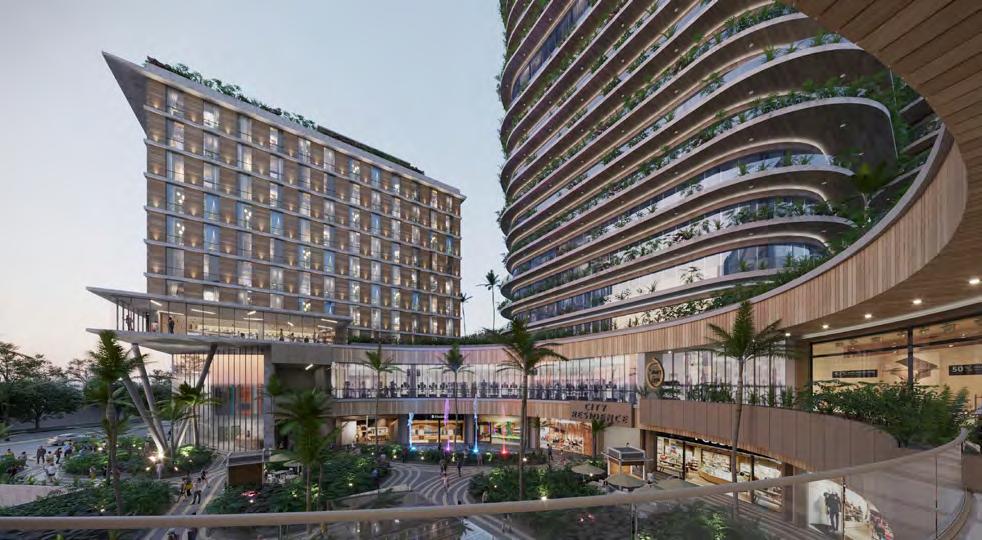
The city of Mazatlan, located in the Mexican state of Sinaloa, will host a novel World Trade Center of ultra-mixed uses. This is as defined by Álvaro Gutiérrez, director of the real estate division of the Grupo Inmobiliario Arhe (GIA), who explains that if everything goes as planned, the WTC Mazatlan will have office spaces, a large business center, convention areas, and event halls, more than 1,500 housing units, commercial premises, a 5-star hotel for the business executives segment and a high-level hospital.
The WTC Mazatlan project has plans for the construction of five towers to fulfill its promise of multiple mixed uses. The smallest tower would house the hospital, in which the main healthcare chains in Mexico have already shown interest.
Three towers would be earmarked for living units, each designed to have 520 high-level apartments, each with a height of 25 floors. The emblematic tower, however, will have 30 floors and will house the WTC’s premium offices area and the business class hotel which, to date, already has offers from five hotel chains of excellent reputation.
A development of such magnitude, built on the grounds of the once famous bullring of Mazatlan will constitute what Gutiérrez calls GIA’s ambition to build a vertical city. The project will be imple-
mented in the city’s geographical center, an area that has been in the process of reshaping for a few years, an example of which is the modern commercial center that started operating in the area recently," says Gutiérrez. Y no es para menos, el WTC reafirmará la nueva cara que viene configurándose a lo largo de la avenida Rafael Buelna, una ubicación envidiable por su cercanía a la playa, pero con una movilidad fluida por no estar exactamente en la zona más turística y comercial. And this is no wonder; the WTC will reaffirm the new face that is being shaped along Rafael Buelna Avenue, an enviable location because of its proximity to the beach, but with fluid mobility as it is not exactly in the more touristic and commercial area.
The WTC Mazatlan’s bet is to house under its roof the offices of international companies that find their permanent residence in this city every day, thanks to the economic dynamism of this region and its agricultural, fishing, and logistics hub potential. It is also expected that they will continue to choose Mazatlan to set up their domestic service, hotel, insurance, construction, and financial headquarters, as a result of the impressive development that the city has been experiencing in recent years.
Since it was announced, the project has been very well received by the banks
and by potential investors - as the main investment funds in the country -, one more example of the potential development of this region, since the total project will cost around $200 million and will be built in four stages, the first of which will start with the construction of three housing towers in the second half of 2024.
GIA has a long history in the real estate construction sector and has used different business models to promote its properties. But one thing that is very clear to Álvaro Gutiérrez for this particular project is that, given its premium features and the potential customers they want to attract to settle in this real estate complex, adhering to the World Trade Center model is the gateway to achieving the level required by the changes that are taking place at the level of the city of Mazatlan. It goes without saying that the construction will be done with the highest standards of environmental sustainability and the use of technologies that are being employed in WTC projects around the world today. This way, an authentic vertical city that meets new lifestyles and innovative ways of doing business in optimized spaces that include a wide range of services and eliminate mobility, pollution, and security problems typical of large cities will be achieved.
Foto WTC Ciudad del Este
12