

By Wayne Gibbons and Israa Merhi
Western Sydney University’s (WSU) long-awaited student union has formally registered with the Australian Securities and Investments Commission (ASIC).
This marks a critical step towards the Unions establishment, in which Professor Alphia Possamai-Inesedy, Pro Vice-Chancellor, Student Success, has stated is “expected to begin operations in early 2026”.
Though a specific date has not yet been announced, Professor Possamai-Inesedy further stated that planning has begun for the first meeting of the Unions Board of Directors, an event which would mark significant progress in the Unions establishment.
Possami-Inessedy’s claim is substantiated by string of posts shared to LinkedIn by Michael Conelly, the Managing Director of CPR Group, an organisation who help navigate “change in studentlead organisations through trainings leaders, business optimisation and empowering good governance.” In a post Conelly has claimed to have
helped the Union with the formation of its “constitution, regulations and operating documents”.
Functionally Student-led
Stated on the WSU website, the Western Sydney University Student Union (WSUSU) will be a “student-led organisation created to give students a stronger voice and greater control over the services that shape their university experience.”
In practice, the Union will function as a “controlled entity of the University”, says Professor Possami-Inessedy, but will fundamentally be “governed by its own Board of Directors”.
Stated on the University’s Student Representation and Participation webpage, “Students will hold the majority of seats on its Board of Directors”, a measure that ensures students hold the balance of power.
For Bailey Anderson, the SRC President, the advantages of the student majority are “plain and simple”, as it allows the Union to address “real issues


that matter to students”.
Funding: SSAF
The Union will receive its funding through an allocation of no less than 40% of revenue generated from the Student Services and Amenities Fee (SSAF) fund.
In the SSAF 2024 Allocation Report, WSU received $12,149,579.
Assuming similar revenue in 2025/6, and an allocation of 40%, WSUSU is likely to receive approximately $4,859,430 in which they can use for the provision of certain services listed by the Higher Education Support (Student Services, Amenities, Representation and Advocacy) Guidelines 2022 (HES Guidelines).
The HES Guidelines list a total of 19 services of which the SSAF can be spent on, including, “promoting the health or welfare of students”, “helping students with their financial affairs”, “providing food or drink to students on a campus of the higher education provider”, and “helping meet the specific needs of overseas students relating to their welfare, accommodation and employment”.
Legal Requirement:
The Universities Accord Importantly, the Union is being
established in line with the University’s obligations under “Universities Accord (Student Support and Other Measures) Act 2024; legislation in which was born from the “Australian Universities Accord Final Report”, published in February 2024, of which Professor Barney Glover, WSU’s ex-Vice Chancellor, was a Panel Member.
Schedule 2 of the Act amends the Higher Education Support Act 2003, establishing that universities must allocate no less than 40% of SSAF to a “student led organisation”, and that the governing body of the “student led organisation” must be made up of a majority of students.
What happens next?
Under the legislative amendments made by the “Universities Accord (Student Support and Other Measures) Act 2024” to the Higher Education Support Act 2003, WSU is legally bound see through the establishment of the Union and the allocation of SSAF to the Union.
As a developing story, W’SUP is committed to providing updates on the establishment of the WSUSU.
By Jasmine Kaur
The first few weeks of university feel a little magical. Everything is new. New campus, new faces, new independence.
You walk around thinking this is my fresh start - and it is - but if I could sit beside my first-year self with a chai in hand and give her some real, big-sister advice, here’s what I’d say.
First, plan your money early, especially if you’re an international student. Placement sounds exciting until you realise it’s basically fulltime work with little or no pay. During my placement, I barely had time for shifts, and savings became survival. Start putting money aside from day one. Even small amounts help. Future you will be grateful.
Take every student discount you can. Western offers heaps, and services like UNiDAYS are a lifesaver.
Groceries, clothes, tech, it adds up. Second, use the university like it’s your home. Because it kind of is. Go to community lunches, dinners, free counselling, yoga, and wellness sessions. Check out WesternLife. There’s always something happening, and most of it is free. I met some of my closest friends at random

By Keely Marsh
Thinking about becoming more active at university this year?
Whether it’s to play socially, meet new people or compete at a higher level, Western Sydney University offers a range of sporting opportunities for students in 2026.
While some programs are still being confirmed due to a recent university restructure, WSU sport will be running various social sport competitions throughout the year. This allows students the chance to get involved on campus in a fun, low pressure environment.
One of the key events to look out for is Campus of Origin, scheduled to take place sometime in March. This event brings together students from each WSU location to compete, represent their campus and enjoy the community aspect of university sport. Students who are interested in representing the university at a higher level, keep an eye out on WESTERNLife for updates on Unisport Nationals.
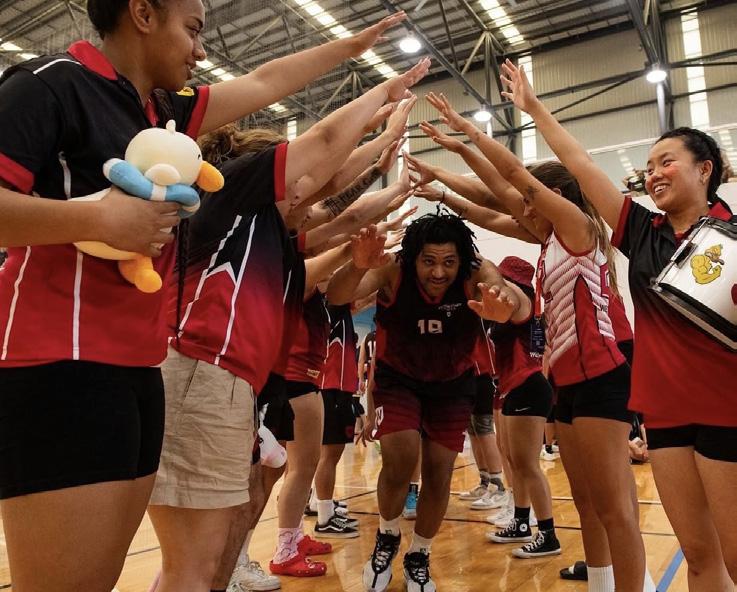

According to the Unisport Australia website, Nationals will be hosted in Perth, WA in 2026 with no official statement yet of which university will headquarter the games. Unisport Nationals expects over 5000 students competing in around 30 sports over the weeklong event. While the WSU teams attending are still to be decided, trials for nationals are expected to be held from late March through to mid-April.
For those eager and ready to play, completing the WSU sport Expression of Interest (EOI) form, ensures students receive the latest updates regarding trials, events and opportunities, as details are finalised throughout the year.
Register your interest via the WSU EOI form at https://au.cglink.me/2ih/ s3921. Students can also contact unisport@westernsydney.edu.au, or message @westernsydusport on Instagram for more information.
If you’re keen to play, compete or connect through sport this year, don’t miss out! Register your interest and be a part of WSU sport this year.
By Bianca Stanton
“All around the country, National Tertiary Education Union (NTEU) members are standing up to reckless and unjustified job cuts – and winning”, said NTEU National President Dr Alison Barnes.
On October 3rd 2025, the NTEU announced that as a part of their continuous fight to advocate for staff, they consequently upended the 400 job cuts that were announced at Western Sydney University (WSU).

After discussions between NTEU members and WSU management, both parties have reached an agreement to provide further job security for WSU staff. “The commitment reached here shows that secure jobs and institutional sustainability can go hand in hand”, said NTEU NSW Division Secretary Vince Caughley.
As part of this agreement, the NTEU announced that any current WSU staff member whose previous role has been disestablished will now be offered suitable alternative roles at the university. The NTEU further ensures in the agreement that WSU will be committed to not making use of any forced redundancies. According to @ stop_wsu_cuts on Instagram, staff at the University of Technology Sydney (UTS) and Australian National University (ANU) have also faced proposed job cuts. Looking to the future, Caughley said “It is now crystal clear that change does not have to mean forced redundancies, and we urge other university managements in NSW to take note”.
By Bianca Stanton
At Western Sydney University (WSU), multi-faith spaces are a safe space for the university community to meet, pray, reflect or meditate. The WSU chaplaincy service and multi-faith spaces operate across all campuses for the university community. “Multi-faith spaces offer a quiet space for students who need to step out of the flow of business and social exposure when that feels overwhelming,” said Daniel Jantos, WSU Inclusive Communities Coordinator.
Jantos said that it is important “to support the uniqueness of particular cohorts of students” and invites students “to be curious about those who are not the same as them.”
The Chaplaincy and Inclusive Communities team play a key role in fostering inclusion and understanding across the university’s diverse student population.
The Inclusive Communities webpage lists that the multi-faith spaces are served by chaplains from a variety of denominations. Some include, Anglican, Buddhist, Catholic, Christian, Hindu, Islamic and Jewish. The chaplains serve both religious and non-religious students. “Students facing difficulty often

want to connect to the familiar and seek strength from that connection. We have those people available for them to reach out and connect to,” said Jantos.
To further foster connections, the multi-faith spaces also function as a meeting place for the university community. “Chaplains create discussion groups, afternoon tea occasions, culture club occasions for meeting new friends and confidential conversations of support,” said Jantos.
The multifaith spaces offer an environment of kindness and understanding, allowing students from diverse backgrounds to connect, build friendships and leave the university with greater openness, empathy and respect of others.
By Nataša Aster-Stater
After nine years and forty-two episodes, Stranger Things has finally come to an end. The series finale, ‘The Rightside Up’, aired on New Year’s Eve. Now that the strangeness has settled in Hawkins, Indiana, there’s a famous line I think of, which encapsulates the remarkable story we’ve all been on with these characters, told by Hellfire Club’s own Eddie Munson: “That was as unambiguous a sign of true love as these cynical eyes have ever seen”.
And viewers have loved it. This ragtag crew of misfits and outcasts have shown audiences and Vecna that they can put up a good fight as they spent years taking on Demogorgons and The Mind Flayer – as well as the ordinary, too: school bullies, a corrupt government, sinister scientists, angry Russians, and even their own personal demons. Because when these kids are together, they’re a force to be reckoned with. Their friendship could flip a cynic’s view upside down.
Despite an array of mixed reviews online following the series’ finale, in its fifth season the show was watched by more than 100 million people, by not only Millennials, but Gen Z and Gen X too. There’s something super about that, yet also a little strange.
Because on paper, Stranger Things is a show set in the 80s, with telephones instead of mobile phones, and the internet’s not yet been invented. So, how does the show attract so many viewers of different ages?
The phrase “2026 is the new 2016” is currently trending on social media, with TikTok and Instagram users posting and sharing memes, photos and videos with the “2016”

filter. According to TikTok, there was a 452% rise in users searching “2016” in the start of the new year, and Spotify has reported a 71% increase in listeners creating 2016 playlists. This strange phenomenon has been linked to “The Great Meme Reset” movement, says the BBC, where Gen Z and young Millennials had less worries about Artificial Intelligence (AI), there was more optimism about job security, and doomscrolling happened a lot less.
Right now, people around the world are romanticising 2016, thinking of that time as the “good old days”.
Another thing that came out in 2016 was the first season of Stranger Things. And despite all the “cool” advancements in technology, it seems people in 2026 would love nothing more than to revisit a time when you had to physically see your friends to catch-up, instead of messaging.
The heroes of Hawkins give that to viewers, who perhaps need it now more than ever: it’s nostalgia.

2026, the new 2016
by Satya Patel and Jasper Brady
This illustration features nostalgic trends of 2016, with the subject being the iconic round galaxy glasses remain salient on an orange cat, surrounded by stars, a grey pusheen, and the renowned nyan cat. The galaxy background ties together this colourful piece, ultimately calling for a return to 2016 in 2026.
EDEditor


Ever tried taking your ‘hot take’to the next level? Come write about all the stories people should know with W’SUP. Our editorial team is looking for three more; available positions include Digital Design Editor, Print Editor-in-Chief, and Print Editor. Applications close at 11:55PM Sunday, March 1st. Scan the QR code for more information.
By Nataša Aster-Stater
From January 1st, 2026, Australian universities have been legally required to comply with the National Higher Education Code to Prevent and Respond to Gender-based Violence (GBV). Under the new National Code, higher education providers such as Western Sydney University must act and implement preventative steps to reduce incidences of GBV, such as providing education and training to students and staff, and to ensure victimsurvivors are better supported.
A Western Sydney University spokesperson has confirmed “students and staff can expect to see these measures being actively operationalised throughout 2026”, adding that the university will ensure “trauma-informed and consistent responses” to any complaint of GBV.
According to the eSafety Commission, GBV is “any form of physical or non-physical violence or abuse against a person or group of people because of biased or harmful beliefs about gender”, and can include sexual harassment, and
gendered hate, threats and assault.
The Australian Government Department of Education has stated the Code not only applies to campuses but also student accommodation which that university owns and operates, as well as on public transport and campus-related activitie. The Code now legally enforces accountability and consequence, and compliance with these new standards in prevention and response to GBV now sits with the Vice-Chancellor of each Australian university.
If a student’s complaint has been made, but they’re not satisfied by their university’s response or the staff’s handling of their trauma, their complaint can be escalated to the National Student Ombudsman (NSO), which is a free and independent Australian Government body. The National Higher Education Code to Prevent and Respond to Genderbased Violence now sets national expectations for how universities address gender-based violence.


We’re hot for journalism, but your voices matter so we also want your must-tell stories! Overheard something juicy while studying in Penrith’s massive library, get stuck in the lift at Parramatta City, get lost in the Campbelltown rabbit warren, or did a cow at Hawkesbury eat your hat?! Tell us about the embarrassing, crazy, funny things you’ve experienced! Scan the QR code and tell us all about it - we don’t bite!