Contents: Fall 2012
The Homecoming Issue
Blast from the Past
This year’s WSU Homecoming theme is “Blast from the Past.” To celebrate, alumni from five eras look back at their time on campus.
A Journey Home
Page 12
Fulbright Scholar and English professor Ruth Forsythe explores the rich literary traditions of Japan.
Page 16
Climbing to the Top Alumnus Alex Kasak discovers adventure physiology on the slopes of Mt. Everest.
Page 7
Meet the President
News & Highlights.................................. 2 The Miracle Workers............................... 4 Athletic News......................................... 5
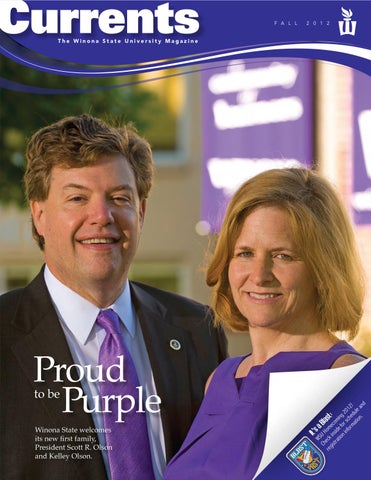
Dr. Scott R. Olson, the university’s fifteenth president, says he’ll spend his first few months finding the “common threads” that make Winona State great.
Cover photo: Steve Woit Photography
Class Notes.......................................... 20 Current People.................................... 28
Winona Currents is published by Winona State University’s Division of University Advancement and is distributed to more than 46,000 alumni and friends of Winona State University. The Winona State University Magazine
www.winona.edu/currents
Currents is copyrighted material. Articles may be reprinted with permission. Comments on this publication should be directed by mail to: WSU-University Advancement, PO Box 5838, Winona MN 55987-5838; by email: currents@winona.edu; online: www.alumni.winona.edu. Address changes and Class Notes should be directed by mail to the Alumni Relations Office, PO Box 5838, Winona MN 55987-5838; by email: alumni@winona.edu.
POSTMASTER: If undeliverable as addressed, please send Form 3579 to Alumni Relations, PO Box 5838, Winona MN 55987-5838. Winona State University is an equal opportunity educator and employer. This document can be made available in an alternative format to individuals with disabilities by contacting the magazine staff at the address above.
WSU on the web: www.winona.edu
News & Highlights
Standing Testimony WSU professor’s new book chronicles Dakota women Collette Hyman, professor of history at Winona State, has published a new book that traces the lives and culture of Dakota women from the early 1800s through the rebuilding of their culture.
Museum Quality Film projects by a group of Winona State University students and associates at Diné College in Arizona will be archived at the Smithsonian Institution’s National Museum of the American Indian.
Editor’s Note The term “Blast from the past” was probably coined by a 1960s radio DJ, a catchy rhyme to introduce an old record. For those of us who still listen to the radio, the phrase can still conjure a tingle of anticipation. Is that tune from high school or freshman year in college? What was I doing last time I heard that song? When I learned that the 2012 WSU Homecoming theme is “Blast from the Past,” it seemed like a great opportunity to unearth a few memories. We counted back decade-by-decade – 1962, 1972, 1982, 1992, 2002 – and looked at the significant events from each of those years. Then we prompted our alumni and friends to something from that time: the atmosphere on campus, a memorable person, a transformative experience. You can read their recollections throughout the magazine. And in the back of this issue, find the 2012 WSU Homecoming schedule and complete registration information. Why not come back this fall and stir your own memories of great times at Winona State, and the impact that the university has made on your life? See you at WSU Homecoming, October 18-20, 2012. Brett Ayers, Editor
The Navajo Oral History project started in 2009 with the collaboration of Diné College in Tsaile, Arizona, and has continued annually. Each summer, Winona State and Diné College students research, write, interview, photograph, and videotape to investigate the lifestyle of the Navajo. The students eventually combine all these elements into a documentary film. “It’s quite an honor for the students to have their work archived at the most important museum in the world,” said Tom Grier, WSU professor of mass communication and co-director of the Navajo Oral History project. “This means their work will live on and provide important historic and cultural information for future researchers.” Follow the Navajo Oral History project blog: masscommunimania.blogspot.com
Black Katts Convert Winona State’s women’s rugby team, the Black Katts, made their first trip to the Division II National Championships a highly successful one. Appearing in the final four for the first time in their 20year history, the Division II Midwest champions placed second. They opened with a 24-12 victory over Shippensburg State University on May 11 at Stanford University in California. The following day, eastern power Norwich University overwhelmed the Black Katts 82-12. Following their runner-up performance, honors began rolling in for the Black Katts. Kourtney Kavajecz, a freshman from Roscoe, Illinois, was invited to play with the USA Under-20 Rugby Team in Denver, Colorado. Because the NCAA does not sponsor championships in the sport, Winona State’s women’s and men’s club rugby teams compete under the auspices of USA Rugby. Find the latest in WSU rugby: winonastaterugby.wordpress.com
2
WSU Currents • Fall 2012
Second Act Tiffany Streng, a Winona State theatre graduate, was awarded the Margolis Method Summer Intensive Fellowship at the Irene Ryan National Acting Scholarship Auditions at the Kennedy Center on April 20. Tauseef Hemayet
Streng, who earned her degree in May, advanced to the national scholarship auditions after receiving the regional Kennedy Center American College Theatre Festival Irene Ryan Scholarship at the competition held in January. She and her acting partner, WSU student Anthony Schliesman, were selected along with 15 other national nominees to perform at the Kennedy Center. The Irene Ryan Foundation was established in 1971 to award scholarships to the most talented student actors in the Kennedy Center American College Theatre Festival. For arts and culture events in Winona: www.winona.edu/arts/winona-area-arts.asp
Dakota Women’s Work (Minnesota Historical Society Press) examines how the decorative work of Dakota women reflected the changes in their lives, starting before the arrival of whites; the years of treaties and shrinking lands; the removal, starvation, and shattered families after 1862; and then the transition to reservation life, when missionaries and government agents worked to turn the Dakota into Christian farmers. The book is part of an initiative to commemorate and provide a deeper understanding of the U.S.-Dakota War of 1862, an important chapter in Minnesota history. Hyman, who teaches history and women’s studies at WSU, is also the author of Staging Strikes: Workers’ Theatre and the American Labor Movement. Read more about the U.S.-Dakota War initiative: www.usdakotawar.org
Dakots’s Women’s Work Chops Hancock
Want more Winona State news? Follow the WSU News Blog. www.winona.edu/news
WSU Currents • Fall 2012
3
News & Highlights
Standing Testimony WSU professor’s new book chronicles Dakota women Collette Hyman, professor of history at Winona State, has published a new book that traces the lives and culture of Dakota women from the early 1800s through the rebuilding of their culture.
Museum Quality Film projects by a group of Winona State University students and associates at Diné College in Arizona will be archived at the Smithsonian Institution’s National Museum of the American Indian.
Editor’s Note The term “Blast from the past” was probably coined by a 1960s radio DJ, a catchy rhyme to introduce an old record. For those of us who still listen to the radio, the phrase can still conjure a tingle of anticipation. Is that tune from high school or freshman year in college? What was I doing last time I heard that song? When I learned that the 2012 WSU Homecoming theme is “Blast from the Past,” it seemed like a great opportunity to unearth a few memories. We counted back decade-by-decade – 1962, 1972, 1982, 1992, 2002 – and looked at the significant events from each of those years. Then we prompted our alumni and friends to something from that time: the atmosphere on campus, a memorable person, a transformative experience. You can read their recollections throughout the magazine. And in the back of this issue, find the 2012 WSU Homecoming schedule and complete registration information. Why not come back this fall and stir your own memories of great times at Winona State, and the impact that the university has made on your life? See you at WSU Homecoming, October 18-20, 2012. Brett Ayers, Editor
The Navajo Oral History project started in 2009 with the collaboration of Diné College in Tsaile, Arizona, and has continued annually. Each summer, Winona State and Diné College students research, write, interview, photograph, and videotape to investigate the lifestyle of the Navajo. The students eventually combine all these elements into a documentary film. “It’s quite an honor for the students to have their work archived at the most important museum in the world,” said Tom Grier, WSU professor of mass communication and co-director of the Navajo Oral History project. “This means their work will live on and provide important historic and cultural information for future researchers.” Follow the Navajo Oral History project blog: masscommunimania.blogspot.com
Black Katts Convert Winona State’s women’s rugby team, the Black Katts, made their first trip to the Division II National Championships a highly successful one. Appearing in the final four for the first time in their 20year history, the Division II Midwest champions placed second. They opened with a 24-12 victory over Shippensburg State University on May 11 at Stanford University in California. The following day, eastern power Norwich University overwhelmed the Black Katts 82-12. Following their runner-up performance, honors began rolling in for the Black Katts. Kourtney Kavajecz, a freshman from Roscoe, Illinois, was invited to play with the USA Under-20 Rugby Team in Denver, Colorado. Because the NCAA does not sponsor championships in the sport, Winona State’s women’s and men’s club rugby teams compete under the auspices of USA Rugby. Find the latest in WSU rugby: winonastaterugby.wordpress.com
2
WSU Currents • Fall 2012
Second Act Tiffany Streng, a Winona State theatre graduate, was awarded the Margolis Method Summer Intensive Fellowship at the Irene Ryan National Acting Scholarship Auditions at the Kennedy Center on April 20. Tauseef Hemayet
Streng, who earned her degree in May, advanced to the national scholarship auditions after receiving the regional Kennedy Center American College Theatre Festival Irene Ryan Scholarship at the competition held in January. She and her acting partner, WSU student Anthony Schliesman, were selected along with 15 other national nominees to perform at the Kennedy Center. The Irene Ryan Foundation was established in 1971 to award scholarships to the most talented student actors in the Kennedy Center American College Theatre Festival. For arts and culture events in Winona: www.winona.edu/arts/winona-area-arts.asp
Dakota Women’s Work (Minnesota Historical Society Press) examines how the decorative work of Dakota women reflected the changes in their lives, starting before the arrival of whites; the years of treaties and shrinking lands; the removal, starvation, and shattered families after 1862; and then the transition to reservation life, when missionaries and government agents worked to turn the Dakota into Christian farmers. The book is part of an initiative to commemorate and provide a deeper understanding of the U.S.-Dakota War of 1862, an important chapter in Minnesota history. Hyman, who teaches history and women’s studies at WSU, is also the author of Staging Strikes: Workers’ Theatre and the American Labor Movement. Read more about the U.S.-Dakota War initiative: www.usdakotawar.org
Dakots’s Women’s Work Chops Hancock
Want more Winona State news? Follow the WSU News Blog. www.winona.edu/news
WSU Currents • Fall 2012
3
News & Highlights
Athletic News “It was an exciting day for me and my family,”
A Job I Love Miracle Workers Make Coming Home a Little Safer By Margaret Cox
New parents dream of bringing home their little ones to grow and thrive. In the future, new parents, especially those of premature babies, will be able to do so more easily. Winona State students Chase Lundstrom, Parbati Sanjel, and Tauseef Hemayet, dubbed the “Miracle Workers,” have developed an infant sleeping pad called the Cloud Monitor to protect babies from the tragedy of Sudden Infant Death Syndrome (SIDS). Created as an entry for the 2012 Microsoft Imagine Cup competition, the Cloud Monitor took on a life of its own, providing an exceptional hands-on learning experience for its creators. The Cloud Monitor is a soft pad with sensors inside that monitor a baby’s heart rate, respiration, and movement. A microcomputer collects information from the sensors and transmits it to the parent’s cell phone. If the baby’s vital signs fall below or above the pre-set ranges, the parents are alerted. “Initially, our incentives were to boost our resumes and gain exposure,” says Hemayet, “but we gained so much more. This project allowed us to apply what we’ve learned over the last four years.”
Miracle Workers Tauseef Hemayet, Chase Lundstrom, and Parbati Sanjel received a People’s Choice Award in the Imagine Cup Competition with their Cloud Monitor for premature infants.
4
WSU Currents • Fall 2012Andy Nyhus
The Miracle Workers consulted professors from the WSU Nursing Department to learn more about SIDS, researched sensory devices with the Physics Department, and explored microcomputer and mobile technology through Information Technology Services. Mass Communication helped create a video to showcase the device for the Imagine Cup competi-
Chops Hancock
tion. When the project was selected as a top-ten finalist, University Communications and professors in the College of Business helped the Miracle Workers hone their presentation skills. Web Communications assisted in launching a social media campaign that helped the Cloud Monitor project win the Imagine Cup People’s Choice vote. A WSU entrepreneurial organization, Stage One Group, connected the team with members of the business community to offer advice in preparation for the contest. “Speaking as an alumnus, it’s not that they’re a top-ten finalist, although that’s a huge win,” says John Freund, founder of Stage One Group. “Just to see how this whole campus came together and got behind these three students, that’s the most exciting piece of this.” At the finalist competition in Seattle, the Miracle Workers took second among the U.S. teams and were invited to the international competition in Sydney, Australia. The team has already been approached by several venture capitalists offering to purchase the idea. Instead, they decided to form their own company, secure a patent, and develop the Cloud Monitor into a viable product. For parents like Miracle Worker Chase Lundstrom, that makes coming home with a baby even sweeter. “Children are what you do everything for,” he says. “They come into your life and completely change it.” In the much the same way, the Cloud Monitor is positioned to transform the way hospitals and parents monitor premature infants.
Eric Schoh excited to be Warriors’ new athletic director By Grant Wall
A lifelong dream came true for Eric Schoh on May 24. In front of a crowd of Winona State employees, supporters and friends, Schoh was introduced as the school’s new athletic director. A La Crescent, Minn., native, Schoh has always had his sights on the Warrior athletic program. “It was an exciting day for me and my family,” Schoh said. “To be able to have my wife, mother and aunt there in the audience made it really special. This is a great school, both academically and athletically. There have been successes in both areas, which make it an attractive job on a national level. Having grown up in the area and to be able to do the job that I love in basically my hometown is a combination that doesn’t come along very often. “There is the excitement of a new job and everyone has been talking about the new chapter of Winona State Athletics. When you combine those things, it made for a really special day for me.” Schoh came to Winona State from Wayne State College where he spent eight years as the school’s athletic director. In that time his eye for putting the right person in the right position and an innovative approach to fundraising helped make Wayne State into a consistent presence on both the regional and national stage. “At Wayne State the things that helped us the most there were the people I hired and the fundraising we were able to do,” Schoh said. Those things helped Schoh spearhead a series of facility improvement projects that directly impacted every athletic program at the school. Schoh has hit the ground running since entering his office for the first time on June 11, building a staff and making preparations for the 2012-13 academic year. With his feet on the ground, Schoh is working to gather as much information as he can about the university. “Before I can determine what I need to focus on, I have a lot of information to gather and people I need to visit with,” Schoh said. “I have some ideas of where the pieces of the puzzle fit together, but I still need some more background information. There was an immediate need to fill three positions, and we have those filled with great people.” “Now we need to make sure the staff gets out and fundraises to get ready for the fall. From there we will start putting a plan together for what a year from now and five years from now looks like.”
WSUWSU Currents Currents • Spring • Fall2012 2012
55
News & Highlights
Athletic News “It was an exciting day for me and my family,”
A Job I Love Miracle Workers Make Coming Home a Little Safer By Margaret Cox
New parents dream of bringing home their little ones to grow and thrive. In the future, new parents, especially those of premature babies, will be able to do so more easily. Winona State students Chase Lundstrom, Parbati Sanjel, and Tauseef Hemayet, dubbed the “Miracle Workers,” have developed an infant sleeping pad called the Cloud Monitor to protect babies from the tragedy of Sudden Infant Death Syndrome (SIDS). Created as an entry for the 2012 Microsoft Imagine Cup competition, the Cloud Monitor took on a life of its own, providing an exceptional hands-on learning experience for its creators. The Cloud Monitor is a soft pad with sensors inside that monitor a baby’s heart rate, respiration, and movement. A microcomputer collects information from the sensors and transmits it to the parent’s cell phone. If the baby’s vital signs fall below or above the pre-set ranges, the parents are alerted. “Initially, our incentives were to boost our resumes and gain exposure,” says Hemayet, “but we gained so much more. This project allowed us to apply what we’ve learned over the last four years.”
Miracle Workers Tauseef Hemayet, Chase Lundstrom, and Parbati Sanjel received a People’s Choice Award in the Imagine Cup Competition with their Cloud Monitor for premature infants.
4
WSU Currents • Fall 2012Andy Nyhus
The Miracle Workers consulted professors from the WSU Nursing Department to learn more about SIDS, researched sensory devices with the Physics Department, and explored microcomputer and mobile technology through Information Technology Services. Mass Communication helped create a video to showcase the device for the Imagine Cup competi-
Chops Hancock
tion. When the project was selected as a top-ten finalist, University Communications and professors in the College of Business helped the Miracle Workers hone their presentation skills. Web Communications assisted in launching a social media campaign that helped the Cloud Monitor project win the Imagine Cup People’s Choice vote. A WSU entrepreneurial organization, Stage One Group, connected the team with members of the business community to offer advice in preparation for the contest. “Speaking as an alumnus, it’s not that they’re a top-ten finalist, although that’s a huge win,” says John Freund, founder of Stage One Group. “Just to see how this whole campus came together and got behind these three students, that’s the most exciting piece of this.” At the finalist competition in Seattle, the Miracle Workers took second among the U.S. teams and were invited to the international competition in Sydney, Australia. The team has already been approached by several venture capitalists offering to purchase the idea. Instead, they decided to form their own company, secure a patent, and develop the Cloud Monitor into a viable product. For parents like Miracle Worker Chase Lundstrom, that makes coming home with a baby even sweeter. “Children are what you do everything for,” he says. “They come into your life and completely change it.” In the much the same way, the Cloud Monitor is positioned to transform the way hospitals and parents monitor premature infants.
Eric Schoh excited to be Warriors’ new athletic director By Grant Wall
A lifelong dream came true for Eric Schoh on May 24. In front of a crowd of Winona State employees, supporters and friends, Schoh was introduced as the school’s new athletic director. A La Crescent, Minn., native, Schoh has always had his sights on the Warrior athletic program. “It was an exciting day for me and my family,” Schoh said. “To be able to have my wife, mother and aunt there in the audience made it really special. This is a great school, both academically and athletically. There have been successes in both areas, which make it an attractive job on a national level. Having grown up in the area and to be able to do the job that I love in basically my hometown is a combination that doesn’t come along very often. “There is the excitement of a new job and everyone has been talking about the new chapter of Winona State Athletics. When you combine those things, it made for a really special day for me.” Schoh came to Winona State from Wayne State College where he spent eight years as the school’s athletic director. In that time his eye for putting the right person in the right position and an innovative approach to fundraising helped make Wayne State into a consistent presence on both the regional and national stage. “At Wayne State the things that helped us the most there were the people I hired and the fundraising we were able to do,” Schoh said. Those things helped Schoh spearhead a series of facility improvement projects that directly impacted every athletic program at the school. Schoh has hit the ground running since entering his office for the first time on June 11, building a staff and making preparations for the 2012-13 academic year. With his feet on the ground, Schoh is working to gather as much information as he can about the university. “Before I can determine what I need to focus on, I have a lot of information to gather and people I need to visit with,” Schoh said. “I have some ideas of where the pieces of the puzzle fit together, but I still need some more background information. There was an immediate need to fill three positions, and we have those filled with great people.” “Now we need to make sure the staff gets out and fundraises to get ready for the fall. From there we will start putting a plan together for what a year from now and five years from now looks like.”
WSUWSU Currents Currents • Spring • Fall2012 2012
55
1962
“ Homecoming was one of the events that brought the campus together,”
“Homecoming was one of the events that brought the campus together,” says Marilyn Grob ’62 when she recalls the events she experienced 50 years ago when she was a student at Winona State College. “Then it was kind of a ‘suitcase’ school, particularly for students whose hometowns were only 30 or 40 miles away,” adds Gary Grob ’62, who went on to earn his master’s in 1965. “For homecoming there was a week full of social and athletic activities that everybody got excited about.” Marilyn and Gary have attended a lot of Winona State Homecomings. Gary, after all, spent 44 years as a student, teacher, and baseball coach at Winona State. Marilyn taught elementary school just a few miles from campus and faithfully attended hundreds of baseball games. In her senior year, Marilyn was on the Homecoming Court. She remembers that Furs by Francis outfitted the entire group for the Saturday morning parade through Winona. Mums were sold on campus for boys to present to their dates. And the Warriorettes, of which Marilyn was also a member, “marched all over.”
COMMON THREADS
Currents meets Winona State’s new president, Dr. Scott R. Olson. “ I’m going to enjoy hearing the stories that make up Winona State University. That’s where we find our common humanity, our common purpose … where we come to a common agreement about the things that matter to us.”
A giant bonfire, built behind Somsen Hall where the Performing Arts Center now stands, lit up the Friday night sky and roused campus for the next day’s parade and football game. “Football had a big following and the emphasis was on alumni coming back for the game,” says Gary, whose brother played on the team. Both Marilyn and Gary say that WSC Homecoming was a highlight of the year on campus. “Everyone was involved,” says Marilyn. “Even President (Nels) Minné attended most of the events during homecoming week.” Gary Grob is professor emeritus at WSU, a member of the Athletics Hall of Fame, and the first baseball coach in Minnesota to reach 1,000 victories. Marilyn (Schroeder) Grob taught elementary school in the Winona area for more than 20 years.
6
WSU Currents • Fall 2012
WSU Currents • Fall 2012
7
1962
“ Homecoming was one of the events that brought the campus together,”
“Homecoming was one of the events that brought the campus together,” says Marilyn Grob ’62 when she recalls the events she experienced 50 years ago when she was a student at Winona State College. “Then it was kind of a ‘suitcase’ school, particularly for students whose hometowns were only 30 or 40 miles away,” adds Gary Grob ’62, who went on to earn his master’s in 1965. “For homecoming there was a week full of social and athletic activities that everybody got excited about.” Marilyn and Gary have attended a lot of Winona State Homecomings. Gary, after all, spent 44 years as a student, teacher, and baseball coach at Winona State. Marilyn taught elementary school just a few miles from campus and faithfully attended hundreds of baseball games. In her senior year, Marilyn was on the Homecoming Court. She remembers that Furs by Francis outfitted the entire group for the Saturday morning parade through Winona. Mums were sold on campus for boys to present to their dates. And the Warriorettes, of which Marilyn was also a member, “marched all over.”
COMMON THREADS
Currents meets Winona State’s new president, Dr. Scott R. Olson. “ I’m going to enjoy hearing the stories that make up Winona State University. That’s where we find our common humanity, our common purpose … where we come to a common agreement about the things that matter to us.”
A giant bonfire, built behind Somsen Hall where the Performing Arts Center now stands, lit up the Friday night sky and roused campus for the next day’s parade and football game. “Football had a big following and the emphasis was on alumni coming back for the game,” says Gary, whose brother played on the team. Both Marilyn and Gary say that WSC Homecoming was a highlight of the year on campus. “Everyone was involved,” says Marilyn. “Even President (Nels) Minné attended most of the events during homecoming week.” Gary Grob is professor emeritus at WSU, a member of the Athletics Hall of Fame, and the first baseball coach in Minnesota to reach 1,000 victories. Marilyn (Schroeder) Grob taught elementary school in the Winona area for more than 20 years.
6
WSU Currents • Fall 2012
WSU Currents • Fall 2012
7
The editors of Currents interviewed
Dr. Scott R. Olson, Winona State University’s fifteenth president, says he’ll spend much of his time listening in his first few months in office. With his background at institutions with missions similar to that of Winona State, Olson believes that he can help craft a “common narrative” that will guide the university. Olson began his leadership of WSU on July 16. He came from sister institution Minnesota State University, Mankato, where he was provost, vice president for Academic and Student Affairs, and professor of Communication Studies since 2003. During the 2010-11 academic year, he served as interim vice chancellor for Academic and Student Affairs for the Minnesota State Colleges and Universities. Before moving to MSU Mankato, he was dean of the College of Communication, Information and Media at Ball State, a public university in Muncie, Indiana. While he was at Ball State, Olson helped create the Global Media Network, which won a national award from the American Council on Education, and the Center for Media Design. Olson began his academic career at Central Connecticut State University where he was professor, associate and assistant to the dean of Arts and Sciences, and director of Graduate Studies in the Department of Communication. He has published two books, 30 book chapters, and 22 academic papers, and served on 21 different international, national, and local boards.
8
WSU Currents • Fall 2012
Your biography notes that you grew up in the Twin Cities. What was your early life like? My grandfathers and dad were dentists but there never was any expectation that I would do that. My dad was also a part-time ski instructor. One of my happiest memories is being with my family skiing at Buck Hill [in Burnsville, Minn.]. Growing up I loved to make movies with friends. This was in the days of Super 8 film, before digital video. One of our friends went on to be a writer in film and television; he’s written for the “X-Files” and other shows. Later, I got a job as an animator’s assistant at a company in Edina. That was pretty great. Did those experiences lead to your academic interest in communication and media studies? As an undergraduate I was a history major. A friend of mine was working on a movie for his senior project and asked me if I would do the animation. I started working on it and thought, “This is awesome.” So I entered graduate school thinking, “Okay, I’m finally going to do this.” I wanted to maybe be a writer for film or television. It didn’t really dawn on me until I was near the end of my master’s, but I discovered the scholarship interested me more than the doing of the thing. The thinking, the research, writing, the teaching, I thought it was fascinating. I enrolled in the doctoral program and pursued a career as a professor. I found the right path. I love academics and being in the university culture. Your teaching and research interests involve how media is received by and adapts to global cultures. Does this inform your communication style? I’m very interested in common wisdom, common understanding. That’s one of about three good ideas I’ve had in my life. [Laughs] Another was to marry my wife, Kelley. The other was to come to Winona State. I love stories. I love hearing stories. And I kind of like telling them. They’re where we find our common humanity and also where we find our common purpose. Do you think you know the story of Winona State? Not fully. What I have is broad sense of the “epic” story: the good that it’s done, the greatness it engenders, faculty members and staff members and students doing incredible, amazing things. Over the next few
President Olson on June 22, 2012.
months, I’m really going to enjoy hearing the stories that make that up. Part of my job is to help figure out the common threads, and help craft them into a bigger narrative. And see where that might lead us. The story has been amazing so far, but that’s not to sit back and say, “That’s it. We did it.” Winona’s greatest days lie ahead. I wouldn’t be here if I didn’t believe that. Your career has been at well-regarded regional public universities. Was that a deliberate choice? My education is from a different kind of place. While I wouldn’t diminish the important role that universities like that play, I chose to work at institutions that, 150 years or so ago, were normal schools. Today they’ve evolved into the “people’s university.” This is where access, opportunity, and success occur. These are the universities where we care deeply about our students in ways that I didn’t experience as an undergraduate. That mission was appealing to me. What is their role in higher education? The beauty of Winona State and institutions like it is that they give students from all kinds of backgrounds, all kinds of experiences, a shot at the American dream. Students come here – maybe the first from their family to go to college, maybe they didn’t think they could come to a place this great – because the faculty and staff care passionately about them. Lives are changed, transformed, every day. You see it on orientation day, a kind of wonderment: “I can’t believe we’re going to be part of this.” Then you see it again at commencement. The same wonder is there, but it’s different: “You did it! This place has opened for you pathways to whatever it is you wanted to be.” Do universities like WSU face challenges? At the moment, we’re challenged by the squeeze caused by the state not appropriating the resources it once did, and our commitment to keep tuition as low as possible. But the mission has not diminished one bit. It’s needed more now than ever. You may be the first WSU president to have won an Emmy, for a documentary on digital learning. I was executive producer – the idea guy, the budget
WSU Currents • Fall 2012
9
The editors of Currents interviewed
Dr. Scott R. Olson, Winona State University’s fifteenth president, says he’ll spend much of his time listening in his first few months in office. With his background at institutions with missions similar to that of Winona State, Olson believes that he can help craft a “common narrative” that will guide the university. Olson began his leadership of WSU on July 16. He came from sister institution Minnesota State University, Mankato, where he was provost, vice president for Academic and Student Affairs, and professor of Communication Studies since 2003. During the 2010-11 academic year, he served as interim vice chancellor for Academic and Student Affairs for the Minnesota State Colleges and Universities. Before moving to MSU Mankato, he was dean of the College of Communication, Information and Media at Ball State, a public university in Muncie, Indiana. While he was at Ball State, Olson helped create the Global Media Network, which won a national award from the American Council on Education, and the Center for Media Design. Olson began his academic career at Central Connecticut State University where he was professor, associate and assistant to the dean of Arts and Sciences, and director of Graduate Studies in the Department of Communication. He has published two books, 30 book chapters, and 22 academic papers, and served on 21 different international, national, and local boards.
8
WSU Currents • Fall 2012
Your biography notes that you grew up in the Twin Cities. What was your early life like? My grandfathers and dad were dentists but there never was any expectation that I would do that. My dad was also a part-time ski instructor. One of my happiest memories is being with my family skiing at Buck Hill [in Burnsville, Minn.]. Growing up I loved to make movies with friends. This was in the days of Super 8 film, before digital video. One of our friends went on to be a writer in film and television; he’s written for the “X-Files” and other shows. Later, I got a job as an animator’s assistant at a company in Edina. That was pretty great. Did those experiences lead to your academic interest in communication and media studies? As an undergraduate I was a history major. A friend of mine was working on a movie for his senior project and asked me if I would do the animation. I started working on it and thought, “This is awesome.” So I entered graduate school thinking, “Okay, I’m finally going to do this.” I wanted to maybe be a writer for film or television. It didn’t really dawn on me until I was near the end of my master’s, but I discovered the scholarship interested me more than the doing of the thing. The thinking, the research, writing, the teaching, I thought it was fascinating. I enrolled in the doctoral program and pursued a career as a professor. I found the right path. I love academics and being in the university culture. Your teaching and research interests involve how media is received by and adapts to global cultures. Does this inform your communication style? I’m very interested in common wisdom, common understanding. That’s one of about three good ideas I’ve had in my life. [Laughs] Another was to marry my wife, Kelley. The other was to come to Winona State. I love stories. I love hearing stories. And I kind of like telling them. They’re where we find our common humanity and also where we find our common purpose. Do you think you know the story of Winona State? Not fully. What I have is broad sense of the “epic” story: the good that it’s done, the greatness it engenders, faculty members and staff members and students doing incredible, amazing things. Over the next few
President Olson on June 22, 2012.
months, I’m really going to enjoy hearing the stories that make that up. Part of my job is to help figure out the common threads, and help craft them into a bigger narrative. And see where that might lead us. The story has been amazing so far, but that’s not to sit back and say, “That’s it. We did it.” Winona’s greatest days lie ahead. I wouldn’t be here if I didn’t believe that. Your career has been at well-regarded regional public universities. Was that a deliberate choice? My education is from a different kind of place. While I wouldn’t diminish the important role that universities like that play, I chose to work at institutions that, 150 years or so ago, were normal schools. Today they’ve evolved into the “people’s university.” This is where access, opportunity, and success occur. These are the universities where we care deeply about our students in ways that I didn’t experience as an undergraduate. That mission was appealing to me. What is their role in higher education? The beauty of Winona State and institutions like it is that they give students from all kinds of backgrounds, all kinds of experiences, a shot at the American dream. Students come here – maybe the first from their family to go to college, maybe they didn’t think they could come to a place this great – because the faculty and staff care passionately about them. Lives are changed, transformed, every day. You see it on orientation day, a kind of wonderment: “I can’t believe we’re going to be part of this.” Then you see it again at commencement. The same wonder is there, but it’s different: “You did it! This place has opened for you pathways to whatever it is you wanted to be.” Do universities like WSU face challenges? At the moment, we’re challenged by the squeeze caused by the state not appropriating the resources it once did, and our commitment to keep tuition as low as possible. But the mission has not diminished one bit. It’s needed more now than ever. You may be the first WSU president to have won an Emmy, for a documentary on digital learning. I was executive producer – the idea guy, the budget
WSU Currents • Fall 2012
9
guy – which means that I didn’t get to have any fun! At Ball State a colleague and I received funding from the Lilly Foundation to look at the issues around converting from analog to digital media. One thing we did was a documentary about how the digital environment can transform learning. We looked at schools, in Mexico, Germany, Japan, that were using technology and at how kids there learned. The film aired on PBS and won five or six Emmys. Did the color purple influence your decision to pursue the presidency here? [Now joined in interview by wife Kelley Olson] It’s absolutely our favorite color. It’s in our blood. Of the five places we’ve been, three have been purple. [Kelley Olson]: What color could be greater than purple? It’s a dignified color. It’s a royal color. It’s an academic color. My doctoral robe is purple. We’re thoroughly committed to purple.
My first priority is to understand what it is about Winona that has made it great for 150 years. This seems like a good way to get at that. When we told our two daughters, who are both college age, they said, “Dad, you’re out of your mind. Those students don’t want you there.” What do you enjoy outside of campus? [Kelley Olson]: Right now I work as development director for the YWCA in Manakato and have always had a mission-driven career in development. I’ve also done some marketing and public relations. Both Scott and I love music and theater. We’re really looking forward to the Great River Shakespeare Festival performances when we get to Winona. Scott Olson]: I’m a voracious user of the media. It fascinates me and it’s my scholarly area, so I read and watch a lot when I’m not working. You probably won’t see me out in the garden that much, but you might see me at the Winona movie theater with Kelley. We have a family cabin up north and like to spend time there relaxing and reading. And of course, I love skiing. [Kelley Olson]: I go with him but would much rather look down from the top of the mountain than ski down.
It seemed all things were possible. By Jerome Christenson
along with daughters Katie and Lucie – plans to be “very visible on campus and in the community.” Here’s a brief overview of Winona State’s first family.
If men could go to the moon and Nixon could be elected president – what couldn’t be done? The times were a’changin’, even if it took change a little longer to reach Winona State College – where the virtue of female students was protected by curfew and proprietary hours, although the Greek sponsored Playboy Club Dance was an annual affair. A thick blue cloud still lingered in the Smog – which took its name from ambient air quality, not Tolkien’s dragon. Students and professors routinely lit up in the classroom and the Winonan advertised the best deal on tap and suds for your next kegger.
Scott, a Minnesota native who earned his bachelor’s and doctoral degrees at Northwestern University, enjoys skiing, scuba diving, sailing, and music
We were young people on a young campus. In 1970, the PAC was still unfinished and Minné Hall still a row of ramshackle houses along a city street. State funding kept tuition low so a kid with a part-time job and a little help finished with a degree and no debt.
There’s a rumor that you plan to live in an apartment on West Campus at first. We thought it would be a good way to get a crash course in Winona State culture. To get to know the students, campus, to get to know the community much more quickly than if we had bought a home already.
Very much a team, the Olson family – Scott and Kelley
Naive? Yeah, probably. Why else would we try to end a war with shouted slogans and a 20-minute sit down strike at Main and Broadway? Naive enough to believe change was possible, and then to try to make it happen.
Kelley grew up in Michigan and earned her bachelor’s at Northwestern. She has worked as a development and marketing professional for St. Joseph College, the Connecticut Easter Seal Society, and the Mankato YWCA. She enjoys tennis, watching sports and movies, and theater. Katie is a student at Minnesota State University, Mankato, and is a budding writer who has written a novel and scripts for television shows. She enjoys tennis, skiing, and art. Lucie is beginning her freshman year at the University of San Diego. Her parents say she is inclined towards math and science and is interested in service work. A gymnast, she also plays tennis and skis.
10
1972
WSU Currents • Fall 2012
And it did.
The Olson family: Lucie, Scott, Kelley, and Katie.
Never one to hurry a good thing, Jerome Christenson attended Winona State from 1970-77. These days, he’s a columnist for the Winona Daily News.
WSU Currents • Fall 2012
11
guy – which means that I didn’t get to have any fun! At Ball State a colleague and I received funding from the Lilly Foundation to look at the issues around converting from analog to digital media. One thing we did was a documentary about how the digital environment can transform learning. We looked at schools, in Mexico, Germany, Japan, that were using technology and at how kids there learned. The film aired on PBS and won five or six Emmys. Did the color purple influence your decision to pursue the presidency here? [Now joined in interview by wife Kelley Olson] It’s absolutely our favorite color. It’s in our blood. Of the five places we’ve been, three have been purple. [Kelley Olson]: What color could be greater than purple? It’s a dignified color. It’s a royal color. It’s an academic color. My doctoral robe is purple. We’re thoroughly committed to purple.
My first priority is to understand what it is about Winona that has made it great for 150 years. This seems like a good way to get at that. When we told our two daughters, who are both college age, they said, “Dad, you’re out of your mind. Those students don’t want you there.” What do you enjoy outside of campus? [Kelley Olson]: Right now I work as development director for the YWCA in Manakato and have always had a mission-driven career in development. I’ve also done some marketing and public relations. Both Scott and I love music and theater. We’re really looking forward to the Great River Shakespeare Festival performances when we get to Winona. Scott Olson]: I’m a voracious user of the media. It fascinates me and it’s my scholarly area, so I read and watch a lot when I’m not working. You probably won’t see me out in the garden that much, but you might see me at the Winona movie theater with Kelley. We have a family cabin up north and like to spend time there relaxing and reading. And of course, I love skiing. [Kelley Olson]: I go with him but would much rather look down from the top of the mountain than ski down.
It seemed all things were possible. By Jerome Christenson
along with daughters Katie and Lucie – plans to be “very visible on campus and in the community.” Here’s a brief overview of Winona State’s first family.
If men could go to the moon and Nixon could be elected president – what couldn’t be done? The times were a’changin’, even if it took change a little longer to reach Winona State College – where the virtue of female students was protected by curfew and proprietary hours, although the Greek sponsored Playboy Club Dance was an annual affair. A thick blue cloud still lingered in the Smog – which took its name from ambient air quality, not Tolkien’s dragon. Students and professors routinely lit up in the classroom and the Winonan advertised the best deal on tap and suds for your next kegger.
Scott, a Minnesota native who earned his bachelor’s and doctoral degrees at Northwestern University, enjoys skiing, scuba diving, sailing, and music
We were young people on a young campus. In 1970, the PAC was still unfinished and Minné Hall still a row of ramshackle houses along a city street. State funding kept tuition low so a kid with a part-time job and a little help finished with a degree and no debt.
There’s a rumor that you plan to live in an apartment on West Campus at first. We thought it would be a good way to get a crash course in Winona State culture. To get to know the students, campus, to get to know the community much more quickly than if we had bought a home already.
Very much a team, the Olson family – Scott and Kelley
Naive? Yeah, probably. Why else would we try to end a war with shouted slogans and a 20-minute sit down strike at Main and Broadway? Naive enough to believe change was possible, and then to try to make it happen.
Kelley grew up in Michigan and earned her bachelor’s at Northwestern. She has worked as a development and marketing professional for St. Joseph College, the Connecticut Easter Seal Society, and the Mankato YWCA. She enjoys tennis, watching sports and movies, and theater. Katie is a student at Minnesota State University, Mankato, and is a budding writer who has written a novel and scripts for television shows. She enjoys tennis, skiing, and art. Lucie is beginning her freshman year at the University of San Diego. Her parents say she is inclined towards math and science and is interested in service work. A gymnast, she also plays tennis and skis.
10
1972
WSU Currents • Fall 2012
And it did.
The Olson family: Lucie, Scott, Kelley, and Katie.
Never one to hurry a good thing, Jerome Christenson attended Winona State from 1970-77. These days, he’s a columnist for the Winona Daily News.
WSU Currents • Fall 2012
11
A Journey through
Literature, Culture, and Place
By Sarah Certa ’10
Fulbright Scholar Ruth Forsythe explores the rich literary traditions of Okinawa
W
hen Winona State University English professor Ruth Forsythe received news that she’d been granted a Fulbright Scholarship to teach for five months in Japan, she imagined the experience would be an extended revisit to her homeland. Although her parents are originally from the Midwest, Forsythe was born and raised in Japan. She moved to the United States to attend college when she was 18, where she studied English at St. Olaf College and went on to earn her Master’s and PhD in comparative literature from the University of Minnesota. She has since visited Japan many times, but never for an extended period, and so her decision to apply for the Fulbright was both out of “personal interest and academic enthusiasm.” Forsythe was surprised, though, when she discovered her placement was Okinawa, a subtropical island that lies more than 400 miles south of Japan’s mainland. Although unfamiliar with the island, Forsythe says she’s become intrigued by Okinawa’s multicultural atmosphere, something the mainland doesn’t offer. Because her main area of study focuses on cultural displacement and hybridity, Forsythe says her placement in the culturally rich Okinawa “makes sense from an academic standpoint.”
“
My hopes for my Japanese students are my hopes for all my students: that they will read more broadly and appreciate literature and all it can do for us.
Beginning in September Forsythe will teach English courses at the University of the Ryukyus, where she plans to discuss topics that include American pop culture, politics of identity and place in literature, as well as how AsianAmerican literature has been received, or perhaps misperceived, in the west. “I’m interested in how Japanese students will respond to texts I’ve used at Winona State,” she says. “I’m interested in what young people now in Japan are
thinking about literature and how they are using it in their lives.” Forsythe has always been drawn to literature as “a wonderful way” to understand how people think, and she says she’s especially interested in the connection between cultural values and aesthetic and how they guide narrative structure. “I knew early on I wanted to do more with comparative literature, to understand the different ways writers tell their stories,” she says. Her visit to Japan will also be an excellent opportunity to witness firsthand how cultural values shape the ways in which readers approach a story. Cultural values influence teaching and learning styles, too. Although Forsythe is fluent in Japanese, she will have to contextualize material for students and take into consideration, for instance, that Japanese classrooms utilize lecture over interactive strategies. Reading levels in Japan differ, and, unlike American students, Japanese students are not expected to come to class having completed preliminary critical reading. Preparing to teach in Japan is perhaps one of the greatest challenges, but it’s also something Forsythe enjoys. “I like to think about what I can do to make the material accessible to students, how I can adjust both the content and the way I teach.” Forsythe hopes to expand her own reading experience beyond the Japanese canon she is so familiar with and into Okinawa’s rich literary tradition. Because Okinawans find themselves as a minority of the dominant mainland, their writers don’t receive the same exposure as some of Japan’s other great literary figures. Forsythe is excited to explore some of these writers and,
especially, to raise awareness of these texts by integrating them into her WSU classes when she returns. “I always try to bring in material students are not familiar with,” she says. “One of the major reasons I applied for the Fulbright is so I can bring my experiences back to my Winona State classrooms, to expand their knowledge and remind students that we do read texts differently based on our cultural backgrounds.” When she’s not in the classroom, Forsythe plans on devoting time to literary research projects as well as learning more about Japanese literature from her colleagues. She hopes to find herself in “a community with connections,” and to discover the tastes, sights, and sounds of the island. Okinawans are known to be among the most healthy and longlived people on the planet. “Maybe my time there will even add on a few years to my life,” Forsythe jokes. In addition to having time for research and learning the ways of the Okinawan culture, Forsythe says she most looks forward to interacting with the students. She hopes that, through the vehicle of literature, she can encourage her students to connect with the imaginations of cultures that receive limited exposure. “My hopes for my Japanese students are my hopes for all my students: that they will read more broadly and appreciate literature and all it can do for us.”
“
Forsythe will spend her Fulbright term on Okinawa, one of Ryukyu Islands about 400 miles south of Japan’s mainland.
12
WSU Currents • Fall 2012
WSU Currents • Fall 2012
13
A Journey through
Literature, Culture, and Place
By Sarah Certa ’10
Fulbright Scholar Ruth Forsythe explores the rich literary traditions of Okinawa
W
hen Winona State University English professor Ruth Forsythe received news that she’d been granted a Fulbright Scholarship to teach for five months in Japan, she imagined the experience would be an extended revisit to her homeland. Although her parents are originally from the Midwest, Forsythe was born and raised in Japan. She moved to the United States to attend college when she was 18, where she studied English at St. Olaf College and went on to earn her Master’s and PhD in comparative literature from the University of Minnesota. She has since visited Japan many times, but never for an extended period, and so her decision to apply for the Fulbright was both out of “personal interest and academic enthusiasm.” Forsythe was surprised, though, when she discovered her placement was Okinawa, a subtropical island that lies more than 400 miles south of Japan’s mainland. Although unfamiliar with the island, Forsythe says she’s become intrigued by Okinawa’s multicultural atmosphere, something the mainland doesn’t offer. Because her main area of study focuses on cultural displacement and hybridity, Forsythe says her placement in the culturally rich Okinawa “makes sense from an academic standpoint.”
“
My hopes for my Japanese students are my hopes for all my students: that they will read more broadly and appreciate literature and all it can do for us.
Beginning in September Forsythe will teach English courses at the University of the Ryukyus, where she plans to discuss topics that include American pop culture, politics of identity and place in literature, as well as how AsianAmerican literature has been received, or perhaps misperceived, in the west. “I’m interested in how Japanese students will respond to texts I’ve used at Winona State,” she says. “I’m interested in what young people now in Japan are
thinking about literature and how they are using it in their lives.” Forsythe has always been drawn to literature as “a wonderful way” to understand how people think, and she says she’s especially interested in the connection between cultural values and aesthetic and how they guide narrative structure. “I knew early on I wanted to do more with comparative literature, to understand the different ways writers tell their stories,” she says. Her visit to Japan will also be an excellent opportunity to witness firsthand how cultural values shape the ways in which readers approach a story. Cultural values influence teaching and learning styles, too. Although Forsythe is fluent in Japanese, she will have to contextualize material for students and take into consideration, for instance, that Japanese classrooms utilize lecture over interactive strategies. Reading levels in Japan differ, and, unlike American students, Japanese students are not expected to come to class having completed preliminary critical reading. Preparing to teach in Japan is perhaps one of the greatest challenges, but it’s also something Forsythe enjoys. “I like to think about what I can do to make the material accessible to students, how I can adjust both the content and the way I teach.” Forsythe hopes to expand her own reading experience beyond the Japanese canon she is so familiar with and into Okinawa’s rich literary tradition. Because Okinawans find themselves as a minority of the dominant mainland, their writers don’t receive the same exposure as some of Japan’s other great literary figures. Forsythe is excited to explore some of these writers and,
especially, to raise awareness of these texts by integrating them into her WSU classes when she returns. “I always try to bring in material students are not familiar with,” she says. “One of the major reasons I applied for the Fulbright is so I can bring my experiences back to my Winona State classrooms, to expand their knowledge and remind students that we do read texts differently based on our cultural backgrounds.” When she’s not in the classroom, Forsythe plans on devoting time to literary research projects as well as learning more about Japanese literature from her colleagues. She hopes to find herself in “a community with connections,” and to discover the tastes, sights, and sounds of the island. Okinawans are known to be among the most healthy and longlived people on the planet. “Maybe my time there will even add on a few years to my life,” Forsythe jokes. In addition to having time for research and learning the ways of the Okinawan culture, Forsythe says she most looks forward to interacting with the students. She hopes that, through the vehicle of literature, she can encourage her students to connect with the imaginations of cultures that receive limited exposure. “My hopes for my Japanese students are my hopes for all my students: that they will read more broadly and appreciate literature and all it can do for us.”
“
Forsythe will spend her Fulbright term on Okinawa, one of Ryukyu Islands about 400 miles south of Japan’s mainland.
12
WSU Currents • Fall 2012
WSU Currents • Fall 2012
13
1982
There was never any doubt that I would attend Winona State. By Cathy Faruque ’82 There was never any doubt that I would attend Winona State. I grew up in Winona. I’m one of three siblings who went to WSU. It was the place my mother attended as a business major. It was where her children would go. I had the distinction to graduate with a BS in sociology with an emphasis on social work, and I still have my commencement photo of me shaking hands with President Robert Hanson.
Now I’m a professor at WSU. Naturally, I look back on my senior year from that point of view. We all remember the trial of the student accused of killing her newborn and the debates it sparked on campus. And the Tylenol tampering case in Chicago, not so far from Winona. Campus was smaller then. Frequently I would park on Washington Street, where Krueger Library stands today. In 1982, Maxwell was the library. I’m still a close friend with my faculty advisor, Hosea L. Perry. He encouraged me to go for both my master’s and PhD. I visited him whenever I came back to campus, along with Jim Reynolds and Ron Stevens, who taught my mother. When you talk about faculty-student interaction, these are classic examples. Thirty years later, the same thing is bringing students and their families to WSU.
14
WSU Currents • Fall 2012
Cathy Faruque returned to Winona in 1997 after earning MSW and PhD degrees. She is now professor of social work at WSU.
WSU Currents • Fall 2012
15
1982
There was never any doubt that I would attend Winona State. By Cathy Faruque ’82 There was never any doubt that I would attend Winona State. I grew up in Winona. I’m one of three siblings who went to WSU. It was the place my mother attended as a business major. It was where her children would go. I had the distinction to graduate with a BS in sociology with an emphasis on social work, and I still have my commencement photo of me shaking hands with President Robert Hanson.
Now I’m a professor at WSU. Naturally, I look back on my senior year from that point of view. We all remember the trial of the student accused of killing her newborn and the debates it sparked on campus. And the Tylenol tampering case in Chicago, not so far from Winona. Campus was smaller then. Frequently I would park on Washington Street, where Krueger Library stands today. In 1982, Maxwell was the library. I’m still a close friend with my faculty advisor, Hosea L. Perry. He encouraged me to go for both my master’s and PhD. I visited him whenever I came back to campus, along with Jim Reynolds and Ron Stevens, who taught my mother. When you talk about faculty-student interaction, these are classic examples. Thirty years later, the same thing is bringing students and their families to WSU.
14
WSU Currents • Fall 2012
Cathy Faruque returned to Winona in 1997 after earning MSW and PhD degrees. She is now professor of social work at WSU.
WSU Currents • Fall 2012
15
Climbing to the Top Alex Kasak ’09 discovers adventure –
“ Many of the symptoms observed at altitude – back-flow between heart chambers, fluid accumulation in the lungs, muscular wasting – are the same as seen with cardiac disease,” says Kasak, a graduate of the exercise science program at Winona State University.
and a career – in exercise physiology
ALEX KASAK ’09
sits in a coffee shop across the street from Saint Mary’s Hospital in Rochester, taking a mid-afternoon break from his work as a research assistant in the Department of Physiology and Biomedical Engineering at Mayo Clinic. He starts describing his twenty-fifth birthday, celebrated just a couple of weeks ago. Nothing special, he says. The usual office affair. A cake, maybe a little lumpy. Candles to wish upon and blow out. The traditional strains of “Happy Birthday to You.” Kasak seems unfazed that the party took place at a base camp on the approach to Mt. Everest, a world away from his hometown of Austin, Minnesota. That he was perched on a 400-foot-thick slab of ice. That Sherpa porters baked the cake. That, in the rarified air of 17,600 feet, summoning the breath to blow out candles took a little extra effort. That the chorus serenading him included his fellow members of the Mayo Everest Research Team and a group of climbers preparing to summit the world’s highest peak. Although he turned a year older on the slopes of Everest, Kasak was the youngest member of the Mayo team. Five other researchers in Kasak’s lab group made the month-long trek to the Himalayas, along with a contingent of scientists, expedition specialists, reporters, photographers, and nine climbers backed by the National Geographic Society and outfitter The North Face.
Alex Kasak at his Mayo Clinic physiology lab.
The goal, according to Kasak, was to conduct “every physiological test you could imagine” to measure the human body’s responses to extreme altitudes and conditions. The Mayo team is using the data it collected on Everest to learn not only how the body adapts to high altitude, but also to understand the physiology of cardiovascular disease. “Many of the symptoms observed at altitude – back-flow between heart chambers, fluid accumulation in the lungs, muscular wasting – are the same as seen with cardiac disease,” says Kasak, a graduate of the exercise science program at Winona State University. A focus of the project, led by Mayo researcher Dr. Bruce Johnson, is how the lungs handle fluid changes. That’s commonly the problem that forces climbers down from the mountain, and patients with heart disease into the hospital. Kasak and the Mayo Everest Research Team spent months preparing for the trip, which included performing baseline physiological testing on the climbers and control groups, and selecting, optimizing, and packing about 1,500 pounds of testing equipment.
16
WSU Currents • Fall 2012
The goal, according to Kasak, was to conduct “every physiological test you could imagine” to measure the human body’s responses to extreme altitudes and conditions.
WSU WSU Currents Currents • Spring • Fall 2012 2012
15 17
Climbing to the Top Alex Kasak ’09 discovers adventure –
“ Many of the symptoms observed at altitude – back-flow between heart chambers, fluid accumulation in the lungs, muscular wasting – are the same as seen with cardiac disease,” says Kasak, a graduate of the exercise science program at Winona State University.
and a career – in exercise physiology
ALEX KASAK ’09
sits in a coffee shop across the street from Saint Mary’s Hospital in Rochester, taking a mid-afternoon break from his work as a research assistant in the Department of Physiology and Biomedical Engineering at Mayo Clinic. He starts describing his twenty-fifth birthday, celebrated just a couple of weeks ago. Nothing special, he says. The usual office affair. A cake, maybe a little lumpy. Candles to wish upon and blow out. The traditional strains of “Happy Birthday to You.” Kasak seems unfazed that the party took place at a base camp on the approach to Mt. Everest, a world away from his hometown of Austin, Minnesota. That he was perched on a 400-foot-thick slab of ice. That Sherpa porters baked the cake. That, in the rarified air of 17,600 feet, summoning the breath to blow out candles took a little extra effort. That the chorus serenading him included his fellow members of the Mayo Everest Research Team and a group of climbers preparing to summit the world’s highest peak. Although he turned a year older on the slopes of Everest, Kasak was the youngest member of the Mayo team. Five other researchers in Kasak’s lab group made the month-long trek to the Himalayas, along with a contingent of scientists, expedition specialists, reporters, photographers, and nine climbers backed by the National Geographic Society and outfitter The North Face.
Alex Kasak at his Mayo Clinic physiology lab.
The goal, according to Kasak, was to conduct “every physiological test you could imagine” to measure the human body’s responses to extreme altitudes and conditions. The Mayo team is using the data it collected on Everest to learn not only how the body adapts to high altitude, but also to understand the physiology of cardiovascular disease. “Many of the symptoms observed at altitude – back-flow between heart chambers, fluid accumulation in the lungs, muscular wasting – are the same as seen with cardiac disease,” says Kasak, a graduate of the exercise science program at Winona State University. A focus of the project, led by Mayo researcher Dr. Bruce Johnson, is how the lungs handle fluid changes. That’s commonly the problem that forces climbers down from the mountain, and patients with heart disease into the hospital. Kasak and the Mayo Everest Research Team spent months preparing for the trip, which included performing baseline physiological testing on the climbers and control groups, and selecting, optimizing, and packing about 1,500 pounds of testing equipment.
16
WSU Currents • Fall 2012
The goal, according to Kasak, was to conduct “every physiological test you could imagine” to measure the human body’s responses to extreme altitudes and conditions.
WSU WSU Currents Currents • Spring • Fall 2012 2012
15 17
The Mayo Clinic team built a full physiology testing lab on the shoulders of Everest.
Early April to late May is prime season on the 29,000foot Everest, when the weather is less severe and Sherpa guides have established climbing routes. The conditions remain unpredictable, and dangerous: during the 2012 season, there were about 500 summits with ten confirmed deaths. Kasak’s team, supported by a coterie of guides and porters, set up a full physiological testing lab at more than 3 miles above sea level. Despite the remote location on a glacier surrounded by towering peaks – and the constant sounds of creaking ice and falling rocks – Kasak says that the base camp was “like a small city with hundreds of tents,” that sheltered climbers waiting to scale Everest. “There was everything from a helicopter landing pad to wireless Internet,” says Kasak. Getting there wasn’t easy, however. After flying first to Kathmandu, Nepal, and then to a village on the slopes of the Himalayas, Kasak and the Mayo group hiked 53 twisting miles to base camp. The trek took eight days, giving the team time to acclimate to the high altitude. Kasak says that living conditions along the way, in isolated outposts and ramshackle guesthouses, were Spartan. But the distinctive peak of Everest was always just around the next bend. KASAK’S JOURNEY towards physiology research has been nearly as convoluted as the path ascending to Everest. As an undergraduate at Winona State, he was more interested in a career in strength and conditioning with a college athletics program or professional sports team. Right after earning his degree in exercise science in 2009, Kasak got his chance: a choice internship as a strength coach with the St. Louis Rams. “I knew almost immediately that I couldn’t see myself going in that direction, not in the long term,” says Kasak. He returned home to Austin, Minnesota, weighing his options. A few years earlier, to complete degree requirements, Kasak completed a clinical experience in the same Mayo lab in which he now works. Bruce Johnson had been his advisor. Kasak revisited the lab – he says he’s uncertain about what led him back there – and eventually ran into Johnson. Johnson offered Kasak a deal he couldn’t refuse: a research assistant position in a productive lab, with the opportunity to immerse himself in the nuts and bolts of physiological testing, albeit unpaid. Kasak worked unpaid
18
WSU Currents • Fall 2012
for about eight months, putting in long hours and living with his parents in Austin to make ends meet. The risk paid off for Kasak. He first moved to a halftime position in the lab and shortly after full-time. He has now been working with Johnson and his group of doctoral and post-doctoral students for about three years. WHILE KASAK KNEW that the focus of Johnson’s lab was respiratory physiology under various conditions, he was initially less aware that its research interests would send him to exotic locations around the world. In addition to working with the Everest climbers, the Johnson’s group has also conducted testing in the Antarctic, Croatia, and the Swiss Alps. “There’s no way to simulate the conditions of these areas,” says Kasak to explain what he terms “adventure physiology.” “Reproducing the reactions to trekking all day at altitude, sleeping in harsh conditions, and then doing it all again the next day. There’s only so much you can do in the lab.” The Mayo Everest Research Team did its best, however, to recreate its research lab at its Himalayan base camp. Kasak and his fellow researchers set up in two large tents, packed with the equipment they brought up and powered by generators. MAYBE THAT’S WHY, a few weeks later, Kasak seems nonchalant when talking about Everest. He saw the outside of the tents only occasionally while at base camp, except for a few hikes on the glacier. “I worked all day, every day, doing blood draws, body composition measurements, stress testing, organizing data,” he says. “We even collected data while the climbers slept to measure heart rate, blood oxygen, breathing, brainwave patterns. It could be mentally taxing and physically exhausting.” Kasak is unsure where he’ll spend his twenty-sixth birthday. Perhaps the question is a little unfair since he’s barely had time to thaw from the zero-degree nights on Everest, and the thousands of samples collected there await analysis in his lab across the street. He’s certain, however, that he’s found his niche in research and is contemplating entering the University of Minnesota’s graduate program in exercise physiology. The next adventure awaits.
An imperfect cake can be forgiven when it was baked at more than 17,000 feet.
1992
I was drawn to Winona State by the small town atmosphere
By Nicole Wood ’92 I was drawn to Winona State by the small town atmosphere and the womens’ gymnastics program. The teams were good and I along with three other freshmen were dynamite. We became known as the “Freshman Four.” The big, fluffy hair and jeans rolled up at the ankles were everything you’d expect from the late 1980s. My life was transformed when I was a sophomore. While I planned to major in elementary education, the exercise science program began that year. I immediately thought, “That’s what I want to do.” Gymnastics probably had something to do with it. It made me want to understand physiology and movement. Dr. Randy Miller, who founded the program, was an inspiration to me. My focus was cardiac rehabilitation and he helped facilitate an internship at North Memorial Hospital in Robbinsdale. I was able to land a job there. Twenty years later, I work at one of the largest medical device companies in the world. That small town feeling at WSU has stayed with me. The camaraderie I experienced with my teammates while I was a student grew into meaningful relationships today. Looking back at those years, it was a remarkable time for me. Nicole (Setnicker) Wood was an All-America and Academic AllAmerica gymnast at WSU. Today she is senior clinical research specialist at Medtronic, Inc. She lives with her family in Rogers, Minnesota.
WSU Currents • Fall 2012
19
The Mayo Clinic team built a full physiology testing lab on the shoulders of Everest.
Early April to late May is prime season on the 29,000foot Everest, when the weather is less severe and Sherpa guides have established climbing routes. The conditions remain unpredictable, and dangerous: during the 2012 season, there were about 500 summits with ten confirmed deaths. Kasak’s team, supported by a coterie of guides and porters, set up a full physiological testing lab at more than 3 miles above sea level. Despite the remote location on a glacier surrounded by towering peaks – and the constant sounds of creaking ice and falling rocks – Kasak says that the base camp was “like a small city with hundreds of tents,” that sheltered climbers waiting to scale Everest. “There was everything from a helicopter landing pad to wireless Internet,” says Kasak. Getting there wasn’t easy, however. After flying first to Kathmandu, Nepal, and then to a village on the slopes of the Himalayas, Kasak and the Mayo group hiked 53 twisting miles to base camp. The trek took eight days, giving the team time to acclimate to the high altitude. Kasak says that living conditions along the way, in isolated outposts and ramshackle guesthouses, were Spartan. But the distinctive peak of Everest was always just around the next bend. KASAK’S JOURNEY towards physiology research has been nearly as convoluted as the path ascending to Everest. As an undergraduate at Winona State, he was more interested in a career in strength and conditioning with a college athletics program or professional sports team. Right after earning his degree in exercise science in 2009, Kasak got his chance: a choice internship as a strength coach with the St. Louis Rams. “I knew almost immediately that I couldn’t see myself going in that direction, not in the long term,” says Kasak. He returned home to Austin, Minnesota, weighing his options. A few years earlier, to complete degree requirements, Kasak completed a clinical experience in the same Mayo lab in which he now works. Bruce Johnson had been his advisor. Kasak revisited the lab – he says he’s uncertain about what led him back there – and eventually ran into Johnson. Johnson offered Kasak a deal he couldn’t refuse: a research assistant position in a productive lab, with the opportunity to immerse himself in the nuts and bolts of physiological testing, albeit unpaid. Kasak worked unpaid
18
WSU Currents • Fall 2012
for about eight months, putting in long hours and living with his parents in Austin to make ends meet. The risk paid off for Kasak. He first moved to a halftime position in the lab and shortly after full-time. He has now been working with Johnson and his group of doctoral and post-doctoral students for about three years. WHILE KASAK KNEW that the focus of Johnson’s lab was respiratory physiology under various conditions, he was initially less aware that its research interests would send him to exotic locations around the world. In addition to working with the Everest climbers, the Johnson’s group has also conducted testing in the Antarctic, Croatia, and the Swiss Alps. “There’s no way to simulate the conditions of these areas,” says Kasak to explain what he terms “adventure physiology.” “Reproducing the reactions to trekking all day at altitude, sleeping in harsh conditions, and then doing it all again the next day. There’s only so much you can do in the lab.” The Mayo Everest Research Team did its best, however, to recreate its research lab at its Himalayan base camp. Kasak and his fellow researchers set up in two large tents, packed with the equipment they brought up and powered by generators. MAYBE THAT’S WHY, a few weeks later, Kasak seems nonchalant when talking about Everest. He saw the outside of the tents only occasionally while at base camp, except for a few hikes on the glacier. “I worked all day, every day, doing blood draws, body composition measurements, stress testing, organizing data,” he says. “We even collected data while the climbers slept to measure heart rate, blood oxygen, breathing, brainwave patterns. It could be mentally taxing and physically exhausting.” Kasak is unsure where he’ll spend his twenty-sixth birthday. Perhaps the question is a little unfair since he’s barely had time to thaw from the zero-degree nights on Everest, and the thousands of samples collected there await analysis in his lab across the street. He’s certain, however, that he’s found his niche in research and is contemplating entering the University of Minnesota’s graduate program in exercise physiology. The next adventure awaits.
An imperfect cake can be forgiven when it was baked at more than 17,000 feet.
1992
I was drawn to Winona State by the small town atmosphere
By Nicole Wood ’92 I was drawn to Winona State by the small town atmosphere and the womens’ gymnastics program. The teams were good and I along with three other freshmen were dynamite. We became known as the “Freshman Four.” The big, fluffy hair and jeans rolled up at the ankles were everything you’d expect from the late 1980s. My life was transformed when I was a sophomore. While I planned to major in elementary education, the exercise science program began that year. I immediately thought, “That’s what I want to do.” Gymnastics probably had something to do with it. It made me want to understand physiology and movement. Dr. Randy Miller, who founded the program, was an inspiration to me. My focus was cardiac rehabilitation and he helped facilitate an internship at North Memorial Hospital in Robbinsdale. I was able to land a job there. Twenty years later, I work at one of the largest medical device companies in the world. That small town feeling at WSU has stayed with me. The camaraderie I experienced with my teammates while I was a student grew into meaningful relationships today. Looking back at those years, it was a remarkable time for me. Nicole (Setnicker) Wood was an All-America and Academic AllAmerica gymnast at WSU. Today she is senior clinical research specialist at Medtronic, Inc. She lives with her family in Rogers, Minnesota.
WSU Currents • Fall 2012
19
Class Notes 1960s
Clairvaux McFarland ’67 (Rochester, Minn.), a member of the Sisters of Saint Francis, celebrated the order’s Diamond Jubilee on May 10. She obtained master’s in art education and administration from Winona State. Sister Clairvaux went on to serve in education and art administration in Portsmouth, Ohio, and Delano, Austin, Waseca, and Winona. David Meisner ’67 (Oakdale, Minn.) has been selected to the Northern Sun Intercollegiate Conference Hall of Fame. A basketball star, David graduated from WSU as its all-time leading scorer with 1,658 career points. He worked as a teacher in the Minneapolis area before moving to a career in sales. He was elected to the WSU Athletic Hall of Fame in 1986. Roger Wistrcill ’68/’70 (Cumberland, Wis.) was inducted into the Austin (Minn.) Pacelli High School Hall of Fame in June. Roger was a three-sport star at Pacelli and was an all-state football player in 1963. He went on the play football for four years at WSU. Gene Schultz ’69/’76 (Lansing, Iowa) was tabbed as Baseball Coach of the Year by the National High School Coaches Association. Gene just completed his 43rd year as coach at Lansing-New Albin High School. He leads the nation in wins (1,963) and has won eleven state titles. Gene played baseball for the Warriors. Bruce White ’69/’73 (Hamden, Conn.) recently won the James Marshall Award for faculty service at Quinnipiac University. Bruce, professor of information systems management, serves on Quinnipiac’s Faculty Senate, University Review Committee, Information Technology Committee, and advises three student groups. He also won the Center for Excellence in Teaching Award in 2008.
Shining Star Siobhan Bremer ’85 is spending her summer as a member of the cast for the Guthrie Theatre’s production of The Sunshine Boys. She plays the role of a CBS executive in the Neil Simon comedy about a bickering vaudeville team reuniting for a television special. Siobhan, an associate professor of theatre arts at the University of Minnesota-Morris and the daughter of WSU professor Vivian Fusillo, has been acting since the age of four when she appeared as a munchkin in The Wizard of Oz. She has also acted at the Commonweal Theatre, Northern Lights Playhouse, and Bountiful Theatre, and directed at the Barn Theatre, Northern Lights, Winona Community Theatre, and Minnesota-Morris. She has taught at Minnesota-Morris for 11 years and has also taught at universities in Michigan, Wisconsin, and Minnesota. Catch her performance at the Guthrie through September 2.
20
WSU Currents • Fall 2012
1970s
Join Us on
@ winona.edu/WinonaStateU @ winona.edu/WinonaStateAlumniandFriends
Barry Nichols ’71 (Delphi, Ind.) retired after 17 years as chemistry professor at Southeast Kentucky Community and Technical College in Middlesboro. Katherine (Hathaway) Moeller ’72 (Spring Valley, Minn.) has retired from teaching at the Kingsland Public Schools. Kathy taught first grade for 28 years at Kingsland. “During my high school years, I spent some time volunteering in a first grade classroom and my career path was set,” says Kathy. Her teaching career spanned 38 years. She now plans to garden, quilt, read, bike, and spend time volunteering, traveling, and spending time with family. Robert Schmitt ’74 (Shakopee, Minn.) retired in June 2008 after 34 years with the Scott County Assessor’s Office. He married wife, Nancy, on April 20, 2011 and now has a stepson and two step-grandchildren. Robert reports that he underwent successful brain surgery last year to terminate seizures and is now back on the golf course and volunteering with Junior Achievement. Sandra (Brandhorst) ’74/’80 and Mark Bestul ’77 (Lake City, Minn.) both recently retired. Sandra retired after working 34 years as a special education teacher in the Lake City Public Schools. Mark retired after a 34-year teaching career in industrial technology with the Goodhue Public Schools. The Bestuls have two daughters and a grandson. Barbara (Bonow) Borgwardt ’76 (Fountain City, Wis.) and husband, Daniel, celebrated their 40th wedding anniversary on June 30.
Jon Knopik ’78 (Saint Cloud, Minn.) has joined Lakewood Health System as community outreach coordinator for Psychiatric Services. He will serve as an educational resource for the community and contact for healthcare providers. He has more than 20 years of experience in public education and working with older adults.
1980s
Kent DeYoung ’80 (Mesa, Ariz.) retired after 25 years of working in public finance in Arizona. His last position was chief financial officer for the Higley Unified School District in Gilbert. Katy Smith ’84 (Winona), the 2011 Minnesota Teacher of the Year, has been named one of just 32 NEA Pearson Foundation Global Learning Fellows. She is a parent education teacher with the Winona Area Public Schools Community Education Early Childhood Family Education Program. Katy earned her bachelor’s in social work at WSU. Elizabeth (Colapietro) Vozzola ’84 (West Hartford, Conn.) has been appointed to a three-year term as director of the Honors Program at the University of Saint Joseph. She is a professor of psychology at Saint Joseph. Michael Kramer ’86 (South Bend, Ind.) has been appointed chair of the Department of Communication Studies, Dance, and Theatre at Saint Mary’s College in Indiana. Michael’s fiveyear-old daughter, Daisy, just started playing soccer and Fiona, who is two, likes to climb things.
William Ihrke ’87/’03 (Plainview, Minn.) coached the Minnesota All-Star Football Game. Bill is the highly successful head coach at Plainview-ElginMillville High School and began his coaching career while still a student at Winona State. His team won a state title in 2002 and he has compiled a 132-57 record in 18 seasons. James Herbert ’88 (Marine on St. Croix, Minn.) is vice president and branch manager at First State Bank & Trust. He manages two brances in the Stillwater area. He’s been married to wife Esther, who attended WSU in 1989, for 23 years. They have four boys, Shane, Eric, Ryan, and Cole.
Dan Schumacher ’89 (Channahon, Ill.) is the new director of intercollegiate athletics at Chicago State University. He was formerly at Lewis University in Romeoville, Ill., and has also worked in athletics development at Winona State.
1990s
Andy Siegal ’90 (Visalia, Calif.) has been named offensive coordinator at the University of Nebraska at Kearney. The Illinois native was most recently director of league development for the World Professional Football League. He earned his bachelor’s in physical education at WSU and played football and wrestled.
Advocating for Children Victor Vieth ’84, the executive director of the National Child Protection Training Center, has been awarded the Pro Humanitate Award for Child Advocacy, North America’s premier honor for child advocacy. Victor is founder of the NCPTC, which is the largest provider of training and technical assistance to child protection professionals in the United States. The center, headquartered on the Winona State campus, provides forensic interview training in 20 states and in Columbia and Japan. Victor is an advocate for reforming undergraduate and graduate training of child protection professionals and has helped implement reforms at dozens of colleges, including the Child Advocacy Studies program at WSU. In making the award, the North American Resource Center for Child Welfare said that Victor has demonstrated “the courage to challenge political and conventional barriers to improving child welfare services.”
Class Notes 1960s
Clairvaux McFarland ’67 (Rochester, Minn.), a member of the Sisters of Saint Francis, celebrated the order’s Diamond Jubilee on May 10. She obtained master’s in art education and administration from Winona State. Sister Clairvaux went on to serve in education and art administration in Portsmouth, Ohio, and Delano, Austin, Waseca, and Winona. David Meisner ’67 (Oakdale, Minn.) has been selected to the Northern Sun Intercollegiate Conference Hall of Fame. A basketball star, David graduated from WSU as its all-time leading scorer with 1,658 career points. He worked as a teacher in the Minneapolis area before moving to a career in sales. He was elected to the WSU Athletic Hall of Fame in 1986. Roger Wistrcill ’68/’70 (Cumberland, Wis.) was inducted into the Austin (Minn.) Pacelli High School Hall of Fame in June. Roger was a three-sport star at Pacelli and was an all-state football player in 1963. He went on the play football for four years at WSU. Gene Schultz ’69/’76 (Lansing, Iowa) was tabbed as Baseball Coach of the Year by the National High School Coaches Association. Gene just completed his 43rd year as coach at Lansing-New Albin High School. He leads the nation in wins (1,963) and has won eleven state titles. Gene played baseball for the Warriors. Bruce White ’69/’73 (Hamden, Conn.) recently won the James Marshall Award for faculty service at Quinnipiac University. Bruce, professor of information systems management, serves on Quinnipiac’s Faculty Senate, University Review Committee, Information Technology Committee, and advises three student groups. He also won the Center for Excellence in Teaching Award in 2008.
Shining Star Siobhan Bremer ’85 is spending her summer as a member of the cast for the Guthrie Theatre’s production of The Sunshine Boys. She plays the role of a CBS executive in the Neil Simon comedy about a bickering vaudeville team reuniting for a television special. Siobhan, an associate professor of theatre arts at the University of Minnesota-Morris and the daughter of WSU professor Vivian Fusillo, has been acting since the age of four when she appeared as a munchkin in The Wizard of Oz. She has also acted at the Commonweal Theatre, Northern Lights Playhouse, and Bountiful Theatre, and directed at the Barn Theatre, Northern Lights, Winona Community Theatre, and Minnesota-Morris. She has taught at Minnesota-Morris for 11 years and has also taught at universities in Michigan, Wisconsin, and Minnesota. Catch her performance at the Guthrie through September 2.
20
WSU Currents • Fall 2012
1970s
Join Us on
@ winona.edu/WinonaStateU @ winona.edu/WinonaStateAlumniandFriends
Barry Nichols ’71 (Delphi, Ind.) retired after 17 years as chemistry professor at Southeast Kentucky Community and Technical College in Middlesboro. Katherine (Hathaway) Moeller ’72 (Spring Valley, Minn.) has retired from teaching at the Kingsland Public Schools. Kathy taught first grade for 28 years at Kingsland. “During my high school years, I spent some time volunteering in a first grade classroom and my career path was set,” says Kathy. Her teaching career spanned 38 years. She now plans to garden, quilt, read, bike, and spend time volunteering, traveling, and spending time with family. Robert Schmitt ’74 (Shakopee, Minn.) retired in June 2008 after 34 years with the Scott County Assessor’s Office. He married wife, Nancy, on April 20, 2011 and now has a stepson and two step-grandchildren. Robert reports that he underwent successful brain surgery last year to terminate seizures and is now back on the golf course and volunteering with Junior Achievement. Sandra (Brandhorst) ’74/’80 and Mark Bestul ’77 (Lake City, Minn.) both recently retired. Sandra retired after working 34 years as a special education teacher in the Lake City Public Schools. Mark retired after a 34-year teaching career in industrial technology with the Goodhue Public Schools. The Bestuls have two daughters and a grandson. Barbara (Bonow) Borgwardt ’76 (Fountain City, Wis.) and husband, Daniel, celebrated their 40th wedding anniversary on June 30.
Jon Knopik ’78 (Saint Cloud, Minn.) has joined Lakewood Health System as community outreach coordinator for Psychiatric Services. He will serve as an educational resource for the community and contact for healthcare providers. He has more than 20 years of experience in public education and working with older adults.
1980s
Kent DeYoung ’80 (Mesa, Ariz.) retired after 25 years of working in public finance in Arizona. His last position was chief financial officer for the Higley Unified School District in Gilbert. Katy Smith ’84 (Winona), the 2011 Minnesota Teacher of the Year, has been named one of just 32 NEA Pearson Foundation Global Learning Fellows. She is a parent education teacher with the Winona Area Public Schools Community Education Early Childhood Family Education Program. Katy earned her bachelor’s in social work at WSU. Elizabeth (Colapietro) Vozzola ’84 (West Hartford, Conn.) has been appointed to a three-year term as director of the Honors Program at the University of Saint Joseph. She is a professor of psychology at Saint Joseph. Michael Kramer ’86 (South Bend, Ind.) has been appointed chair of the Department of Communication Studies, Dance, and Theatre at Saint Mary’s College in Indiana. Michael’s fiveyear-old daughter, Daisy, just started playing soccer and Fiona, who is two, likes to climb things.
William Ihrke ’87/’03 (Plainview, Minn.) coached the Minnesota All-Star Football Game. Bill is the highly successful head coach at Plainview-ElginMillville High School and began his coaching career while still a student at Winona State. His team won a state title in 2002 and he has compiled a 132-57 record in 18 seasons. James Herbert ’88 (Marine on St. Croix, Minn.) is vice president and branch manager at First State Bank & Trust. He manages two brances in the Stillwater area. He’s been married to wife Esther, who attended WSU in 1989, for 23 years. They have four boys, Shane, Eric, Ryan, and Cole.
Dan Schumacher ’89 (Channahon, Ill.) is the new director of intercollegiate athletics at Chicago State University. He was formerly at Lewis University in Romeoville, Ill., and has also worked in athletics development at Winona State.
1990s
Andy Siegal ’90 (Visalia, Calif.) has been named offensive coordinator at the University of Nebraska at Kearney. The Illinois native was most recently director of league development for the World Professional Football League. He earned his bachelor’s in physical education at WSU and played football and wrestled.
Advocating for Children Victor Vieth ’84, the executive director of the National Child Protection Training Center, has been awarded the Pro Humanitate Award for Child Advocacy, North America’s premier honor for child advocacy. Victor is founder of the NCPTC, which is the largest provider of training and technical assistance to child protection professionals in the United States. The center, headquartered on the Winona State campus, provides forensic interview training in 20 states and in Columbia and Japan. Victor is an advocate for reforming undergraduate and graduate training of child protection professionals and has helped implement reforms at dozens of colleges, including the Child Advocacy Studies program at WSU. In making the award, the North American Resource Center for Child Welfare said that Victor has demonstrated “the courage to challenge political and conventional barriers to improving child welfare services.”
Class Notes Milwaukee’s Best These three 2006 grads reconnected at a March alumni event in Milwaukee, Wis. Pictured left to right are Jessica (Wessa) Quintanilla, Diana Hornak, and Ali Ho.
2000s Linda Cibulskis ’91 (Fountain Hills, Ariz.) writes that in 2011 she won the Nursing Excellence Award in the category of Management for the Mountain West Region, sponsored by Nurse Week magazine and Nurse.com. She is currently house supervisor at Mayo Clinic in Arizona, where she celebrated her 21st year this summer. Matt Bollant ’94 (Green Bay, Wis.) is the new women’s basketball coach at the University of Illinois. He enjoyed a successful stint as head coach at the University of Wisconsin-Green Bay, where he compiled a 148-19 record over the last five years. Kent Kindschy ’94 (Ladysmith, Wis.) accepted a principal position at Turtle Lake K-12 School. He and wife, Debra (May) ’93 and their two sons moved to Turtle Lake in June. Sara Haley Kreibich ’98 (Somerset, Wis.) has been chosen Distinguished High School Teacher of the Year by the Wisconsin Council for the Social Studies. She has been a social studies teacher for 12 years and currently teaches at Somerset High School. She earned degrees at WSU, the University of Wisconsin-River Falls, and Silver Lake College, where she received her master’s in administrative leadership. She and husband, Cory, a third grade teacher, have three children. 22
WSU Currents • Fall 2012
Amanda (Keiser) Brinkman ’00 (Blaine, Minn.), vice president for branding and creative services for Allianz Life Insurance Co., was honored by the Minneapolis/St. Paul Business Journal’s Women in Business in May. Jeff Kocur ’00 (Bloomington, Minn.) won the 2012 Educator of the Year from the Minnesota High School Press Association. Jeff is a teacher at Hopkins High School and advisor to its yearbook and newspaper. He began teaching English language arts and advising the newspaper in 2000. Both Hopkins publications have won state and national recognition for excellence. Christopher Bode ’01 (Dubuque, Iowa) has a new book: 4th Quarter Madness: A Football-Style Guide For Stay-At-Home-Dads. He has been a stay-at-home father for eight years to his three daughters. He earned his bachelor’s in elementary education at WSU and also a history degree at the University of Iowa. Luke Merchlewitz ’01 (Winona) has been selected to serve on the National Education Association Foundation’s Senior Fellows Advisory Group. He joins six fellow educators to shape the NEA mission and consult with staff. The appointment caps a two-year run of accolades, during which Luke has
been named a Minnesota Teacher of the Year finalist and the Minnesota Teacher of Excellence. Reggie Olendieck ’01 (San Antonio, Texas) is the new boys’ basketball coach at Marshall High School in the Northside ISD in San Antonio. Stefanie (Steimann) ’02 and Jeremy Schussler ‘02 (Savage, Minn.) welcomed their first child, Miles Cory, on March 6. Holly (Marten) Sieve ’02 (Round Lake, Minn.) and husband Jason welcomed daughter, Monroe Rae, on November 21, 2011. Big sisters Presley and Madison love her so much! Holly also celebrated ten years as marketing coordinator at Sanford Worthington Medical Center in May. She started at the hospital just a week after graduating from WSU. Mike ’02 and Jackie (Kuehlmann) Skroch ’01 (Holmen, Wis.) welcomed Molly Elizabeth to the family on January 27. Peggy (Seitz) Reimers ’03 (Green Isle, Minn.) was promoted to dispatch supervisor at the Nicollet County Sheriff’s Office in St Peter. She is responsible for daily operations and oversees the dispatchers. She has been employed with Nicollet County since 2005. Carrie (Semling) Bork ’04 (Trempealeau, Wis.) and husband, Michael, welcomed son Garrett on June 9.
Amanda (Bagniewski) Gillett ’04 (Winona) welcomed daughter Dakota Joe Gerilaine on May 18. Jeffrey O’Donnell ’04 (Rushford, Minn.) married Chelsea Kopperud on June 30. Jeffrey is self-employed in Rushford while Chelsea works at Fastenal. Jennifer (Cuculi) ’04 and Nick Jaeger ’04/’06 (Champaign, Ill.) welcomed their first daughter, Avery Patricia, on April 1. Amy (Andresen) ’04 and Daniel ’04 Moses (Sugar Land, Texas) welcomed a baby girl, Maycee Harper, on July 3. Jeffrey O’Donnell ‘04 (Rushford, Minn.) married Chelsea Kopperud on June 30. Jeffrey is self-employed in Rushford while Chelsea works at Fastenal. Jennifer (Einspar) ’05 and Tyler Carlson ’05 (Iowa City, Iowa) welcomed daughter Lydia René in November 2011. The Carlsons were married in July 2007. Jennifer received her master’s in Physician Assitant Studies at the University of Iowa and works at the Veterans Affairs Medical Center. Tyler is a deputy sheriff for Johnson County.
Steve Opgenorth ’05 (Winona) has been named offensive coordinator at Colby College in Waterville, Maine. The cum laude graduate of WSU moves from his alma mater, where he coached receivers and special teams and was recruiting coordinator. Melissa (Wolf) Schulze ’05 (La Crosse, Wis.) has joined the Neurology Unit at Gundersen Lutheran. She earned her advance practice nursing degree at WSU and provides care as a certified family nurse practitioner in neurology. Nicole (Aschenbrener) ’06 and Gregory Fedor ’01 (Winona) had their first son in April. Miranda (Kleinbeck) Ziebell ’06 (Saint Paul, Minn.) and husband, Matt, had a daughter, Norah Jane, on March 13.
Angela (Schroering) Hazelton ’07 (Winona) married Bryan Hazelton on April 28. Angela and Bryan both work for Mayo Clinic. Rebekah (Ditthardt) Van Dalen ’07 (Rochester, Minn.) and husband, Justin, welcomed Jude Lincoln Van Dalen on January 18. The Van Dalens live in Rochester where Rebekah works a supplemental position as an RN in primary care internal medicine at Mayo Clinic.
Swenson Heads East After eight years as director of Alumni Relations at Winona State, Mike Swenson ‘01/’05 is crossing the river to become executive director of the Western Technical College Foundation in La Crosse, Wis. Mike, pictured above with his wife Becky ’03, son Alex, and daughter Evelyn, will oversee development and alumni affairs. Western Technical College maintains seven campuses and serves about 20,000 students each year. Student Senate president as an undergraduate at Winona State, Mike worked at his alma mater for more than ten years. At press time, a national search was underway to find his replacement.
Matt Appleman ’08 (Minneapolis, Minn.) has forged an entrepreneurial outlet for his passions of engineering and cycling. Matt’s custom bike frame shop, Appleman Bicycles, was recently featured in the Minneapolis Star Tribune. He crafts about a dozen custom fit frames a year from carbon fiber for performance cyclists and enthusiasts. Matt was a founder of the cycling club at WSU and graduated with a degree in composite materials engineering. Kelly (Paszkiewicz) Kruchten ’08 (Rockland, Wis.) and husband, Jeremy, welcomed their first child, Cooper Michael, on March 13. Kelly works for Sprint in West Salem, but she was born and raised in Winona and visits often! Taylor Martinson ’08 (Minneapolis, Minn.) joins metroConnections as a production services coordinator. metroConnections provides conference, event, stage production, and transportation for meeting and event planners. Taylor previously worked in the green building industry in event coordination, meeting management, and fundraising.
Class Notes Milwaukee’s Best These three 2006 grads reconnected at a March alumni event in Milwaukee, Wis. Pictured left to right are Jessica (Wessa) Quintanilla, Diana Hornak, and Ali Ho.
2000s Linda Cibulskis ’91 (Fountain Hills, Ariz.) writes that in 2011 she won the Nursing Excellence Award in the category of Management for the Mountain West Region, sponsored by Nurse Week magazine and Nurse.com. She is currently house supervisor at Mayo Clinic in Arizona, where she celebrated her 21st year this summer. Matt Bollant ’94 (Green Bay, Wis.) is the new women’s basketball coach at the University of Illinois. He enjoyed a successful stint as head coach at the University of Wisconsin-Green Bay, where he compiled a 148-19 record over the last five years. Kent Kindschy ’94 (Ladysmith, Wis.) accepted a principal position at Turtle Lake K-12 School. He and wife, Debra (May) ’93 and their two sons moved to Turtle Lake in June. Sara Haley Kreibich ’98 (Somerset, Wis.) has been chosen Distinguished High School Teacher of the Year by the Wisconsin Council for the Social Studies. She has been a social studies teacher for 12 years and currently teaches at Somerset High School. She earned degrees at WSU, the University of Wisconsin-River Falls, and Silver Lake College, where she received her master’s in administrative leadership. She and husband, Cory, a third grade teacher, have three children. 22
WSU Currents • Fall 2012
Amanda (Keiser) Brinkman ’00 (Blaine, Minn.), vice president for branding and creative services for Allianz Life Insurance Co., was honored by the Minneapolis/St. Paul Business Journal’s Women in Business in May. Jeff Kocur ’00 (Bloomington, Minn.) won the 2012 Educator of the Year from the Minnesota High School Press Association. Jeff is a teacher at Hopkins High School and advisor to its yearbook and newspaper. He began teaching English language arts and advising the newspaper in 2000. Both Hopkins publications have won state and national recognition for excellence. Christopher Bode ’01 (Dubuque, Iowa) has a new book: 4th Quarter Madness: A Football-Style Guide For Stay-At-Home-Dads. He has been a stay-at-home father for eight years to his three daughters. He earned his bachelor’s in elementary education at WSU and also a history degree at the University of Iowa. Luke Merchlewitz ’01 (Winona) has been selected to serve on the National Education Association Foundation’s Senior Fellows Advisory Group. He joins six fellow educators to shape the NEA mission and consult with staff. The appointment caps a two-year run of accolades, during which Luke has
been named a Minnesota Teacher of the Year finalist and the Minnesota Teacher of Excellence. Reggie Olendieck ’01 (San Antonio, Texas) is the new boys’ basketball coach at Marshall High School in the Northside ISD in San Antonio. Stefanie (Steimann) ’02 and Jeremy Schussler ‘02 (Savage, Minn.) welcomed their first child, Miles Cory, on March 6. Holly (Marten) Sieve ’02 (Round Lake, Minn.) and husband Jason welcomed daughter, Monroe Rae, on November 21, 2011. Big sisters Presley and Madison love her so much! Holly also celebrated ten years as marketing coordinator at Sanford Worthington Medical Center in May. She started at the hospital just a week after graduating from WSU. Mike ’02 and Jackie (Kuehlmann) Skroch ’01 (Holmen, Wis.) welcomed Molly Elizabeth to the family on January 27. Peggy (Seitz) Reimers ’03 (Green Isle, Minn.) was promoted to dispatch supervisor at the Nicollet County Sheriff’s Office in St Peter. She is responsible for daily operations and oversees the dispatchers. She has been employed with Nicollet County since 2005. Carrie (Semling) Bork ’04 (Trempealeau, Wis.) and husband, Michael, welcomed son Garrett on June 9.
Amanda (Bagniewski) Gillett ’04 (Winona) welcomed daughter Dakota Joe Gerilaine on May 18. Jeffrey O’Donnell ’04 (Rushford, Minn.) married Chelsea Kopperud on June 30. Jeffrey is self-employed in Rushford while Chelsea works at Fastenal. Jennifer (Cuculi) ’04 and Nick Jaeger ’04/’06 (Champaign, Ill.) welcomed their first daughter, Avery Patricia, on April 1. Amy (Andresen) ’04 and Daniel ’04 Moses (Sugar Land, Texas) welcomed a baby girl, Maycee Harper, on July 3. Jeffrey O’Donnell ‘04 (Rushford, Minn.) married Chelsea Kopperud on June 30. Jeffrey is self-employed in Rushford while Chelsea works at Fastenal. Jennifer (Einspar) ’05 and Tyler Carlson ’05 (Iowa City, Iowa) welcomed daughter Lydia René in November 2011. The Carlsons were married in July 2007. Jennifer received her master’s in Physician Assitant Studies at the University of Iowa and works at the Veterans Affairs Medical Center. Tyler is a deputy sheriff for Johnson County.
Steve Opgenorth ’05 (Winona) has been named offensive coordinator at Colby College in Waterville, Maine. The cum laude graduate of WSU moves from his alma mater, where he coached receivers and special teams and was recruiting coordinator. Melissa (Wolf) Schulze ’05 (La Crosse, Wis.) has joined the Neurology Unit at Gundersen Lutheran. She earned her advance practice nursing degree at WSU and provides care as a certified family nurse practitioner in neurology. Nicole (Aschenbrener) ’06 and Gregory Fedor ’01 (Winona) had their first son in April. Miranda (Kleinbeck) Ziebell ’06 (Saint Paul, Minn.) and husband, Matt, had a daughter, Norah Jane, on March 13.
Angela (Schroering) Hazelton ’07 (Winona) married Bryan Hazelton on April 28. Angela and Bryan both work for Mayo Clinic. Rebekah (Ditthardt) Van Dalen ’07 (Rochester, Minn.) and husband, Justin, welcomed Jude Lincoln Van Dalen on January 18. The Van Dalens live in Rochester where Rebekah works a supplemental position as an RN in primary care internal medicine at Mayo Clinic.
Swenson Heads East After eight years as director of Alumni Relations at Winona State, Mike Swenson ‘01/’05 is crossing the river to become executive director of the Western Technical College Foundation in La Crosse, Wis. Mike, pictured above with his wife Becky ’03, son Alex, and daughter Evelyn, will oversee development and alumni affairs. Western Technical College maintains seven campuses and serves about 20,000 students each year. Student Senate president as an undergraduate at Winona State, Mike worked at his alma mater for more than ten years. At press time, a national search was underway to find his replacement.
Matt Appleman ’08 (Minneapolis, Minn.) has forged an entrepreneurial outlet for his passions of engineering and cycling. Matt’s custom bike frame shop, Appleman Bicycles, was recently featured in the Minneapolis Star Tribune. He crafts about a dozen custom fit frames a year from carbon fiber for performance cyclists and enthusiasts. Matt was a founder of the cycling club at WSU and graduated with a degree in composite materials engineering. Kelly (Paszkiewicz) Kruchten ’08 (Rockland, Wis.) and husband, Jeremy, welcomed their first child, Cooper Michael, on March 13. Kelly works for Sprint in West Salem, but she was born and raised in Winona and visits often! Taylor Martinson ’08 (Minneapolis, Minn.) joins metroConnections as a production services coordinator. metroConnections provides conference, event, stage production, and transportation for meeting and event planners. Taylor previously worked in the green building industry in event coordination, meeting management, and fundraising.
Class Notes Samuel Baker ’10 and Katie Ganshaw ’11 (Plymouth, Minn.) announced they will marry on May 26, 2013.
Baby Pool
It was an eventful year for this group of Winona State UniversityRochester nursing students. All of them graduated in spring 2012, and all had babies during the academic year. Pictured front row (L-R): Rachel, Schmidt, Erin Aubuhl, Holly Wirta, and Camille Thompson. Back row (L-R): Ashley King, Elizabeth Olsen, Kelly Hovel, Kimberly Hair, and Hayley Exe. Not pictured: Brittany Barrett.
Kyle Witt ‘08 (Waupun, Wis.) has been added to the lending staff at Farmers State Bank. Kyle graduated with a double major in business administration and finance. Before joining the Farmers State Bank, he served as a financial consultant and investment representative for Primerica Financial Services. Jennifer (Clobes) Brooks ’09 and Glen Brooks ‘09 (New Ulm, Minn.) married on August 11. Jennifer is a kindergarten teacher while Glen works at 3M.
Terri Douglas ‘09 (Winona) joined the Winona Health Urgent Care Clinic as a certified nurse practitioner. She earned her BSN at Winona State and master’s from Frontier Nursing University in Kentucky. Terri has worked with Winona Health since 2006. Jonte Flowers ’09 (Cottage Grove, Wis.) returned to the WSU campus over the summer after playing basketball overseas in Sweden and France. The former Warriors All America anticipates playing in Finland next season. He and wife Jennifer (Jepson) ’03 have a 14-month-old daughter, Ayanna.
Alisha Hanson ’09 (Eau Claire, Wis.) married Ben Staads on August 18. Alisha works in accounting and human resources at Metropolis Resort. Ben, a graduate of Iowa State University, is a mason at Stone Pro. Christopher Landsom ’09 (Winona) will marry Kim McGriff on October 6. Chris works for State Farm in Winona; Kim is employed by Sport & Spine Physical Therapy.
Trevor Carrier ’10 (Winona) and his wife Kayla welcomed a son, Ayden Thomas, on June 12. David Dockter ’10 (Houston, Minn.) married Kelly Kuehn on August 4. David works for the U.S. Department of Agriculture while Kelly works for Kuehn’s Trucking. Elizabeth (Evans) ’10 and Nick Furlong ’10 (Whitefish, Mont.) wed on April 28 in Winona. Beth is a nurse and Nick is a photographer and marketing director. They met during their sophomore year at the Mass Communications photography show. Abby Lindquist ’10 (Medford, Minn.) was announced as Rochester Century High School’s new volleyball coach. She is also the main office receptionist at Century. It’s her first high school head coaching position. She is also married former Warriors baseball
player Ben Barrone ’10 in August. Ben is a juvenile corrections officer in Rochester. The couple has a daughter, Caliegh.
Stephen LaValla ’11 (Buffalo City, Wis.) and wife Jenifer announce the birth of his son, John Edward, born on June 9.
Prapti Shrestha ’10 (Eagan, Minn.) is working on an MS in software engineering at the University of Minnesota.
Amanda (McCabe) Thomas ’11 (Cresco, Iowa) married Joel Thomas on July 14. Amanda teaches at LeRoy-Ostrander School District; Joel works in facilities operations at Mayo Clinic.
Michael Carr ’11 (Farmington, Minn.) married Brooke Atwood on June 2. Brooke is a professional nanny and co-owner of ShopCarr.com. Michael earned his degree in business administration and is assistant store leader at Kwik Trip in Farmington and also co-owner of ShopCarr.com.
Matt Ulrich ’12 (Rushford, Minn.), a standout defensive tackle for the Warriors, has signed a free-agent contract with the Minnesota Vikings. Matt was a three-time All NSIC player and All America for WSU.
Tyler ’11 and Leah (LaFond) Faust ’12 (Red Wing, Minn.) wed in May. Tyler earned his nursing degree and works at Mayo Clinic. Leah received a social work degree and is employed at 180 Degrees and works at a group home in Rochester.
Mike ’02 and Jackie (Kuehlmann) Skroch ’01 (Holmen, Wis.) welcomed Molly Elizabeth to the family on January 27.
Three Generations We want to hear your news! Submit notes, photos, and news online at www.winona.edu/currents. Email your class notes to alumni@winona.edu or currents@winona.edu. Still like to use mail? Send notes to Alumni Relations, P.O. Box 5838, Winona, MN 55987. Read Currents online: www.winona.edu/currents Join Winona State on Facebook: www.facebook.com/WinonaStateU Alumni & Friends is on Facebook: www.facebook.com/WinonaStateAlumniandFriends
24
WSU Currents • Fall 2012
Lindsey (Cadwell) Hoffman ’05, joined here by her father Kim Cadwell ’75, welcomed her first child, son Guenther Nelson Hoffman on April 22. Lindsey, Nels, and Kim are pictured here in Red Lodge, Mont., which Lindsey calls home.
We enjoy receiving your baby pictures and publish selections in each issue of Currents. Email your baby photos to alumni@ winona.edu, or, submit them at the Alumni & Friends website: www.alumni.winona.edu.
Class Notes Samuel Baker ’10 and Katie Ganshaw ’11 (Plymouth, Minn.) announced they will marry on May 26, 2013.
Baby Pool
It was an eventful year for this group of Winona State UniversityRochester nursing students. All of them graduated in spring 2012, and all had babies during the academic year. Pictured front row (L-R): Rachel, Schmidt, Erin Aubuhl, Holly Wirta, and Camille Thompson. Back row (L-R): Ashley King, Elizabeth Olsen, Kelly Hovel, Kimberly Hair, and Hayley Exe. Not pictured: Brittany Barrett.
Kyle Witt ‘08 (Waupun, Wis.) has been added to the lending staff at Farmers State Bank. Kyle graduated with a double major in business administration and finance. Before joining the Farmers State Bank, he served as a financial consultant and investment representative for Primerica Financial Services. Jennifer (Clobes) Brooks ’09 and Glen Brooks ‘09 (New Ulm, Minn.) married on August 11. Jennifer is a kindergarten teacher while Glen works at 3M.
Terri Douglas ‘09 (Winona) joined the Winona Health Urgent Care Clinic as a certified nurse practitioner. She earned her BSN at Winona State and master’s from Frontier Nursing University in Kentucky. Terri has worked with Winona Health since 2006. Jonte Flowers ’09 (Cottage Grove, Wis.) returned to the WSU campus over the summer after playing basketball overseas in Sweden and France. The former Warriors All America anticipates playing in Finland next season. He and wife Jennifer (Jepson) ’03 have a 14-month-old daughter, Ayanna.
Alisha Hanson ’09 (Eau Claire, Wis.) married Ben Staads on August 18. Alisha works in accounting and human resources at Metropolis Resort. Ben, a graduate of Iowa State University, is a mason at Stone Pro. Christopher Landsom ’09 (Winona) will marry Kim McGriff on October 6. Chris works for State Farm in Winona; Kim is employed by Sport & Spine Physical Therapy.
Trevor Carrier ’10 (Winona) and his wife Kayla welcomed a son, Ayden Thomas, on June 12. David Dockter ’10 (Houston, Minn.) married Kelly Kuehn on August 4. David works for the U.S. Department of Agriculture while Kelly works for Kuehn’s Trucking. Elizabeth (Evans) ’10 and Nick Furlong ’10 (Whitefish, Mont.) wed on April 28 in Winona. Beth is a nurse and Nick is a photographer and marketing director. They met during their sophomore year at the Mass Communications photography show. Abby Lindquist ’10 (Medford, Minn.) was announced as Rochester Century High School’s new volleyball coach. She is also the main office receptionist at Century. It’s her first high school head coaching position. She is also married former Warriors baseball
player Ben Barrone ’10 in August. Ben is a juvenile corrections officer in Rochester. The couple has a daughter, Caliegh.
Stephen LaValla ’11 (Buffalo City, Wis.) and wife Jenifer announce the birth of his son, John Edward, born on June 9.
Prapti Shrestha ’10 (Eagan, Minn.) is working on an MS in software engineering at the University of Minnesota.
Amanda (McCabe) Thomas ’11 (Cresco, Iowa) married Joel Thomas on July 14. Amanda teaches at LeRoy-Ostrander School District; Joel works in facilities operations at Mayo Clinic.
Michael Carr ’11 (Farmington, Minn.) married Brooke Atwood on June 2. Brooke is a professional nanny and co-owner of ShopCarr.com. Michael earned his degree in business administration and is assistant store leader at Kwik Trip in Farmington and also co-owner of ShopCarr.com.
Matt Ulrich ’12 (Rushford, Minn.), a standout defensive tackle for the Warriors, has signed a free-agent contract with the Minnesota Vikings. Matt was a three-time All NSIC player and All America for WSU.
Tyler ’11 and Leah (LaFond) Faust ’12 (Red Wing, Minn.) wed in May. Tyler earned his nursing degree and works at Mayo Clinic. Leah received a social work degree and is employed at 180 Degrees and works at a group home in Rochester.
Mike ’02 and Jackie (Kuehlmann) Skroch ’01 (Holmen, Wis.) welcomed Molly Elizabeth to the family on January 27.
Three Generations We want to hear your news! Submit notes, photos, and news online at www.winona.edu/currents. Email your class notes to alumni@winona.edu or currents@winona.edu. Still like to use mail? Send notes to Alumni Relations, P.O. Box 5838, Winona, MN 55987. Read Currents online: www.winona.edu/currents Join Winona State on Facebook: www.facebook.com/WinonaStateU Alumni & Friends is on Facebook: www.facebook.com/WinonaStateAlumniandFriends
24
WSU Currents • Fall 2012
Lindsey (Cadwell) Hoffman ’05, joined here by her father Kim Cadwell ’75, welcomed her first child, son Guenther Nelson Hoffman on April 22. Lindsey, Nels, and Kim are pictured here in Red Lodge, Mont., which Lindsey calls home.
We enjoy receiving your baby pictures and publish selections in each issue of Currents. Email your baby photos to alumni@ winona.edu, or, submit them at the Alumni & Friends website: www.alumni.winona.edu.
In Memoriam Ewald Hertz ’66 (Wausau, Wis.) passed away on January 28, 2011.
1930s
Elda Louise Ann (Korn) Luehmann ’36 (Spring Park, Minn.) passed away on June 10 at age 97. She taught elementary school in Rochester and Stockton, and later owned and operated Luehmann Implement in St. Charles with her family. She is remembered for her joy of flower gardening. Elsie (Finkelnburg) Rhea ’37 (Citrus Springs, Fla.) passed away on April 9, 2011, at age 96. She grew up in Winona and was an art teacher for 20 years in Minnesota and Michigan. After retiring to Florida in 1972, she enjoyed a second career in real estate. She was an avid sewer, painter, and golfer who won many tournaments.
1940s
Dorothy (Millar) Burt ’41 (Owatonna, Minn.) passed away on October 10, 2011. She taught in Iowa and Minnesota and for 20 years worked for newspapers in Red Wing and Owatonna. Helen A. Flemming ’41 (Winona) died on April 25. After graduating from Winona State Teachers College, she taught in Marshfield, Wis., and in 1978 was District Teacher of the Year. She returned to Winona following retirement in 1983. Planetta “Netta” (Lang) Capetz ’42 (Scottsdale, Ariz.) passed away on March 2. She was 90 years old. A music and English major, she worked for 31 years with Northwestern Bell Telephone Co. She enjoyed movies, reading, crosswords, golf, and travel. Helen Rose (Daskoski) Norberg ’44 (Fargo, N.D.) passed away on March 27. Kenneth Dale Seeling ’44 (St Paul, Minn.) passed away on March 6. He taught social studies, algebra, and trigonometry and also served as guidance counselor at the Dawson-Boyd Schools. He also served as football coach from 1948 until 1970. “Mr. Seeling” earned a reputation as an effective and caring teaher with a knack for wisecracks.
26
WSU Currents • Fall 2012
Elizabeth “Betty” (Klavitter) Bergler ’47 (Winona) passed away on January 23. She was a teacher and tax consultant who managed to travel to all 50 U.S. states, and also to China in 1983. Kathleen Hester Crotty ’47 (Great Falls, Mont.) passed away on December 23, 2011. She retired as a kindergarten teacher for the Santa Barbara School District. Patricia (Mullin) Harcey ’48 (Elgin, Minn.) passed away on June 3. She first taught in Lake Crystal and then St. Charles where she instructed elementary grades and served as a principal. She also founded and operated Harcey’s Dairy Farm with her husband. Quentin R. Sabotta ’48 (Cedar Rapids, Iowa) died on April 11. A member of the U.S. Army Air Corps, he was a POW for more than three years during World War II. He was senior class president at Winona State College and went on to earn his MA at the University of Minnesota. He taught for 23 years in Cedar Rapids and worked for 35 years as an evaluator for the Iowa Division of Vocational Rehabilitation.
1950s
Martin “Marty” Beyer ’50 (Plainview, Minn.) died on April 12. A U.S. Navy veteran, he graduated from Winona State and worked as an interior and exterior decorator and later as Wabasha County treasurer from 1967-93. Luverne “Irish” Scanlan ’50 (Clam Lake, Wis.) passed away on March 31. He served with the U.S. Navy after World War II and taught industrial arts and word working and after attending Winona State, where he played golf. He was also a coach and won several conference championships in Lanesboro, Minn., and Fountain City, Wis. He retired in 1985 to Clam Lake, Wis., to a log cabin he and friends constructed. Robert (Bob) Welte ’50 (Rochester, Minn.) passed away unexpectedly on January 30. He served in the U.S. Navy during World War II and then earned his teaching degree at Winona State. He moved west to Nevada to teach auto shop and band and later taught in Colorado until his retirement in 1983. He and his wife,
Audrey, spent 20 years travelling, covering every state and province in North America and also Europe, Russia, North Africa, and Australia and New Zealand. Dawn Marie (Smith) Fellows ’51 (West Concord, Minn.) passed away on June 22. She taught third grade and also owned a craft shop in West Concord and was later city clerk for her hometown. Joanne M. (Hauge) Trainor ’51 (Winona) died peacefully on May 4. Her first teaching job was in Dodge Center before returning to Winona. Joseph Lynch ’52 (Waseca, Minn.) passed away on October 11, 2009. He taught business in high school and coached in Ellendale before moving to Waseca to teach at the University of Minnesota Southern School of Agriculture and Waseca High School. He was an avid sportsman and football and basketball referee. He retired in 1987. Robert Hurley ’53 (Chatfield, Minn.) passed away on March 9. Bertha (Lunt) Everson ’55 (Austin, Minn.) died on June 2. She was a teacher for 53 years. Daryl Wohlert ’58 (Eau Claire, Wis.) passed away on December 14, 2011. He taught math and physical education until retiring in 1991.
1960s
Jeffrey Kremer ’65 (Rialto, Calif.) died on May 29. He played football at Winona State and was named to the A.P. Little All America team in 1965. A woodworker and cabinet maker, he enjoyed spending time at a cabin he built in Richfield, Utah. Evar Silvernagle ’65 (Rochester, Minn.) passed away on March 1. Born in Sweden, he was a star athlete at the University of Wisconsin-La Crosse. A distinguished teacher and coach in Austin, Minn., and Rochester, he led teams to 12 state swimming championships and 200 wins with only ten losses. He was named Minnesota Swimming Coach of the Decade (1960-70) and was inducted into halls of fame in both Minnesota and Wisconsin.
Dennis “Denny” Peterson ’66 (Rushford, Minn.) passed away on May 9 at his home. After receiving his associate’s degree in business at Winona State, he worked for Tri-County Electric Cooperative for 32 years. He also farmed. He served with the Rushford Fire Department for 30 years and also volunteered for numerous organizations in his community. Clifford “Cliff” Sorensen ’66 (St Louis Park, Minn.) passed away on January 13. He served in the U.S. Army from 1943-46 and taught high school industrial arts for more than 30 years in Westby, Wis. Esther “Red” DeVine ’69 (Slayton, Minn.) passed away on May 20. She taught in Worthington, Hillsboro, Ore., Jasper, and Peterson before settling in Lanesboro in 1963. A first grade teacher, she retired in 1995. She loved spending time with her children and grandchildren. Mary Lynn Gustafson ’69 (Red Wing, Minn.) died on April 20 at her home. She taught elementary school for 39 years in Red Wing and enjoyed Bible study, gardening, summer vacations, and the arts. Helen Elizabeth Lynch ’69 (Plainview Minn.) passed away on August 29, 2011. She first attended Wayne State College and the earned her bachelor’s at WSU. For several years she taught developmentally disabled children in the Wabasha-Kellogg schools and also taught Head Start in Wabasha.
1970s
Daniel Wenkman ’72 (Necedah,Wis.) died on February 18. He earned a master’s at WSU and finally his PhD at the University of Wisconsin in 1993. Dan dedicated his life to teaching as a teacher, coach, and principal. He was the youngest elementary school principal in Minnesota when he served at St. Thomas Elementary in Minneapolis from 1972-76, and later went on to serve as principal of Sullivan Elementary for 28 years. During his career he touched the hearts of innumberable students, parents, and fellow staff members. Donna G. Weber ’73 (Winona) passed away on May 3 at her home. She received her nursing degree from Winona State and then her master’s as a nurse practitioner
from Marshall University. She worked for the Olean Medical Group until she retired in 2010. Patricia (Sheehan) Fredrickson ’74 (La Crescent, Minn.) passed away on November 7, 2011 after a five-year battle with cancer. She taught in La Crescent for 34 years and was recognized as Teacher of the Year in 2001. David B. Gieske ’74 (Onalaska,Wis.) died on November 24, 2008. David worked for Hormel Foods in Austin and Key Cadillac in Edina before starting Classic Components, where he specialized in restoring classic Chevrolets. Earl Good ’74 (Onalaska, Wis.) passed away on October 1, 2011. JoAnn (Marcou) MacBrine ’74 (Dowingtown, Pa.) passed away on April 23. She graduated from WSU with a degree in special education and after post-graduate work, began her career as a teacher fo the Devereaux Foundation. While working for the Chester County Intermediate Unit, she was honored by former First Lady Laura Bush for outstanding service. Most recently, she taught at Lionville Elementary School in Lionville, Pa. Ruth Ann Radke ’75 (Balsam Lake, Wis.) passed away on September 28, 2011. She was a registered nurse in the Twin Cities area for more than 30 years. Gail Bergaus) Bradbury ’76 (Winona) passed away on May 7 at her home. A CPA, Gail devoted a great amount of her time to volunteer work with Project FINE, the Dakota Homecoming, and ushering at concerts of all kinds. She played clarinet in the Saint Mary’s Concert Band, was a master gardener, and enjoyed traveling the world with her husband, Bernard. Michael Kerrigan ’77 (Little Rock, Iowa) passed away on July 6. He served in the U.S. Air Force and earned his business management degree at Winona State. He spent many years of his career working with the American Legion and later worked as an IT consultant.
1980s
Mark H. Ekstrand ’80 (Wabasha, Minn.) passed away on June 10. He earned a biology degree at WSU and worked as an EMT for the Austin Ambulance Service and later as an emergency room technician at Austin Medical Center. He was also an avid fly fisherman and golfer. Alice Jane Wagner ’84 (Rochester, Minn.) passed away on June 11 at her home. She returned to school to earn her BSN at Winona State and worked for Wabasha Public Health for 18 years before retiring in 1955. She remained active as a volunteer for Mayo Medical Relief Missions and the Haiti Mission for 27 years.
1990s
Karlyn Sue Keuter-King ’95 (Dubuque, Iowa) passed away on May 31 after battling cancer. She was an outstanding athlete at WSU in both volleyball and softball and respected for her business career, volunteer work, and devotion to her family.
2000s
Laurie Keller ’06 (Owatonna, Minn.) passed away on July 21, 2010.
Faculty, Staff, Friends
George M. Christensen (Winona) passed away on March 7. A professor of psychology and a clinical psychologist at Winona State, he earned his undegraduate and graduate degrees from the University of Minnesota. He retired in 1990.
Loretta (Thulien) Brown ’77 (Fairmont, Minn.) passed away on February 23, 2009. Timothy J. Steffes ’78 (Winona) died on March 24. He served in the U.S. Air Force and retired from CenturyTel in 2007. He loved music, hunting and fishing, golf, curling, and walking.
WSU Currents • Fall 2012
27
In Memoriam Ewald Hertz ’66 (Wausau, Wis.) passed away on January 28, 2011.
1930s
Elda Louise Ann (Korn) Luehmann ’36 (Spring Park, Minn.) passed away on June 10 at age 97. She taught elementary school in Rochester and Stockton, and later owned and operated Luehmann Implement in St. Charles with her family. She is remembered for her joy of flower gardening. Elsie (Finkelnburg) Rhea ’37 (Citrus Springs, Fla.) passed away on April 9, 2011, at age 96. She grew up in Winona and was an art teacher for 20 years in Minnesota and Michigan. After retiring to Florida in 1972, she enjoyed a second career in real estate. She was an avid sewer, painter, and golfer who won many tournaments.
1940s
Dorothy (Millar) Burt ’41 (Owatonna, Minn.) passed away on October 10, 2011. She taught in Iowa and Minnesota and for 20 years worked for newspapers in Red Wing and Owatonna. Helen A. Flemming ’41 (Winona) died on April 25. After graduating from Winona State Teachers College, she taught in Marshfield, Wis., and in 1978 was District Teacher of the Year. She returned to Winona following retirement in 1983. Planetta “Netta” (Lang) Capetz ’42 (Scottsdale, Ariz.) passed away on March 2. She was 90 years old. A music and English major, she worked for 31 years with Northwestern Bell Telephone Co. She enjoyed movies, reading, crosswords, golf, and travel. Helen Rose (Daskoski) Norberg ’44 (Fargo, N.D.) passed away on March 27. Kenneth Dale Seeling ’44 (St Paul, Minn.) passed away on March 6. He taught social studies, algebra, and trigonometry and also served as guidance counselor at the Dawson-Boyd Schools. He also served as football coach from 1948 until 1970. “Mr. Seeling” earned a reputation as an effective and caring teaher with a knack for wisecracks.
26
WSU Currents • Fall 2012
Elizabeth “Betty” (Klavitter) Bergler ’47 (Winona) passed away on January 23. She was a teacher and tax consultant who managed to travel to all 50 U.S. states, and also to China in 1983. Kathleen Hester Crotty ’47 (Great Falls, Mont.) passed away on December 23, 2011. She retired as a kindergarten teacher for the Santa Barbara School District. Patricia (Mullin) Harcey ’48 (Elgin, Minn.) passed away on June 3. She first taught in Lake Crystal and then St. Charles where she instructed elementary grades and served as a principal. She also founded and operated Harcey’s Dairy Farm with her husband. Quentin R. Sabotta ’48 (Cedar Rapids, Iowa) died on April 11. A member of the U.S. Army Air Corps, he was a POW for more than three years during World War II. He was senior class president at Winona State College and went on to earn his MA at the University of Minnesota. He taught for 23 years in Cedar Rapids and worked for 35 years as an evaluator for the Iowa Division of Vocational Rehabilitation.
1950s
Martin “Marty” Beyer ’50 (Plainview, Minn.) died on April 12. A U.S. Navy veteran, he graduated from Winona State and worked as an interior and exterior decorator and later as Wabasha County treasurer from 1967-93. Luverne “Irish” Scanlan ’50 (Clam Lake, Wis.) passed away on March 31. He served with the U.S. Navy after World War II and taught industrial arts and word working and after attending Winona State, where he played golf. He was also a coach and won several conference championships in Lanesboro, Minn., and Fountain City, Wis. He retired in 1985 to Clam Lake, Wis., to a log cabin he and friends constructed. Robert (Bob) Welte ’50 (Rochester, Minn.) passed away unexpectedly on January 30. He served in the U.S. Navy during World War II and then earned his teaching degree at Winona State. He moved west to Nevada to teach auto shop and band and later taught in Colorado until his retirement in 1983. He and his wife,
Audrey, spent 20 years travelling, covering every state and province in North America and also Europe, Russia, North Africa, and Australia and New Zealand. Dawn Marie (Smith) Fellows ’51 (West Concord, Minn.) passed away on June 22. She taught third grade and also owned a craft shop in West Concord and was later city clerk for her hometown. Joanne M. (Hauge) Trainor ’51 (Winona) died peacefully on May 4. Her first teaching job was in Dodge Center before returning to Winona. Joseph Lynch ’52 (Waseca, Minn.) passed away on October 11, 2009. He taught business in high school and coached in Ellendale before moving to Waseca to teach at the University of Minnesota Southern School of Agriculture and Waseca High School. He was an avid sportsman and football and basketball referee. He retired in 1987. Robert Hurley ’53 (Chatfield, Minn.) passed away on March 9. Bertha (Lunt) Everson ’55 (Austin, Minn.) died on June 2. She was a teacher for 53 years. Daryl Wohlert ’58 (Eau Claire, Wis.) passed away on December 14, 2011. He taught math and physical education until retiring in 1991.
1960s
Jeffrey Kremer ’65 (Rialto, Calif.) died on May 29. He played football at Winona State and was named to the A.P. Little All America team in 1965. A woodworker and cabinet maker, he enjoyed spending time at a cabin he built in Richfield, Utah. Evar Silvernagle ’65 (Rochester, Minn.) passed away on March 1. Born in Sweden, he was a star athlete at the University of Wisconsin-La Crosse. A distinguished teacher and coach in Austin, Minn., and Rochester, he led teams to 12 state swimming championships and 200 wins with only ten losses. He was named Minnesota Swimming Coach of the Decade (1960-70) and was inducted into halls of fame in both Minnesota and Wisconsin.
Dennis “Denny” Peterson ’66 (Rushford, Minn.) passed away on May 9 at his home. After receiving his associate’s degree in business at Winona State, he worked for Tri-County Electric Cooperative for 32 years. He also farmed. He served with the Rushford Fire Department for 30 years and also volunteered for numerous organizations in his community. Clifford “Cliff” Sorensen ’66 (St Louis Park, Minn.) passed away on January 13. He served in the U.S. Army from 1943-46 and taught high school industrial arts for more than 30 years in Westby, Wis. Esther “Red” DeVine ’69 (Slayton, Minn.) passed away on May 20. She taught in Worthington, Hillsboro, Ore., Jasper, and Peterson before settling in Lanesboro in 1963. A first grade teacher, she retired in 1995. She loved spending time with her children and grandchildren. Mary Lynn Gustafson ’69 (Red Wing, Minn.) died on April 20 at her home. She taught elementary school for 39 years in Red Wing and enjoyed Bible study, gardening, summer vacations, and the arts. Helen Elizabeth Lynch ’69 (Plainview Minn.) passed away on August 29, 2011. She first attended Wayne State College and the earned her bachelor’s at WSU. For several years she taught developmentally disabled children in the Wabasha-Kellogg schools and also taught Head Start in Wabasha.
1970s
Daniel Wenkman ’72 (Necedah,Wis.) died on February 18. He earned a master’s at WSU and finally his PhD at the University of Wisconsin in 1993. Dan dedicated his life to teaching as a teacher, coach, and principal. He was the youngest elementary school principal in Minnesota when he served at St. Thomas Elementary in Minneapolis from 1972-76, and later went on to serve as principal of Sullivan Elementary for 28 years. During his career he touched the hearts of innumberable students, parents, and fellow staff members. Donna G. Weber ’73 (Winona) passed away on May 3 at her home. She received her nursing degree from Winona State and then her master’s as a nurse practitioner
from Marshall University. She worked for the Olean Medical Group until she retired in 2010. Patricia (Sheehan) Fredrickson ’74 (La Crescent, Minn.) passed away on November 7, 2011 after a five-year battle with cancer. She taught in La Crescent for 34 years and was recognized as Teacher of the Year in 2001. David B. Gieske ’74 (Onalaska,Wis.) died on November 24, 2008. David worked for Hormel Foods in Austin and Key Cadillac in Edina before starting Classic Components, where he specialized in restoring classic Chevrolets. Earl Good ’74 (Onalaska, Wis.) passed away on October 1, 2011. JoAnn (Marcou) MacBrine ’74 (Dowingtown, Pa.) passed away on April 23. She graduated from WSU with a degree in special education and after post-graduate work, began her career as a teacher fo the Devereaux Foundation. While working for the Chester County Intermediate Unit, she was honored by former First Lady Laura Bush for outstanding service. Most recently, she taught at Lionville Elementary School in Lionville, Pa. Ruth Ann Radke ’75 (Balsam Lake, Wis.) passed away on September 28, 2011. She was a registered nurse in the Twin Cities area for more than 30 years. Gail Bergaus) Bradbury ’76 (Winona) passed away on May 7 at her home. A CPA, Gail devoted a great amount of her time to volunteer work with Project FINE, the Dakota Homecoming, and ushering at concerts of all kinds. She played clarinet in the Saint Mary’s Concert Band, was a master gardener, and enjoyed traveling the world with her husband, Bernard. Michael Kerrigan ’77 (Little Rock, Iowa) passed away on July 6. He served in the U.S. Air Force and earned his business management degree at Winona State. He spent many years of his career working with the American Legion and later worked as an IT consultant.
1980s
Mark H. Ekstrand ’80 (Wabasha, Minn.) passed away on June 10. He earned a biology degree at WSU and worked as an EMT for the Austin Ambulance Service and later as an emergency room technician at Austin Medical Center. He was also an avid fly fisherman and golfer. Alice Jane Wagner ’84 (Rochester, Minn.) passed away on June 11 at her home. She returned to school to earn her BSN at Winona State and worked for Wabasha Public Health for 18 years before retiring in 1955. She remained active as a volunteer for Mayo Medical Relief Missions and the Haiti Mission for 27 years.
1990s
Karlyn Sue Keuter-King ’95 (Dubuque, Iowa) passed away on May 31 after battling cancer. She was an outstanding athlete at WSU in both volleyball and softball and respected for her business career, volunteer work, and devotion to her family.
2000s
Laurie Keller ’06 (Owatonna, Minn.) passed away on July 21, 2010.
Faculty, Staff, Friends
George M. Christensen (Winona) passed away on March 7. A professor of psychology and a clinical psychologist at Winona State, he earned his undegraduate and graduate degrees from the University of Minnesota. He retired in 1990.
Loretta (Thulien) Brown ’77 (Fairmont, Minn.) passed away on February 23, 2009. Timothy J. Steffes ’78 (Winona) died on March 24. He served in the U.S. Air Force and retired from CenturyTel in 2007. He loved music, hunting and fishing, golf, curling, and walking.
WSU Currents • Fall 2012
27
Current People: Jon Kester ‘02 “ I was surrounded by people [at WSU] who wanted me to succeed. They helped me find a career I really love.”
By Margaret Cox Homecoming wouldn’t be the same without football, and football is exactly what Jon Kester ’02 does all year. Employed by the Green Bay Packers, Kester serves as liaison between the community and the team, helping to coordinate events at Lambeau Field. His path to the Packers was a reward that came from determination and love of the game. From Wisconsin Rapids, Wisconsin, and a Packers fan from the start, Kester chose Winona State University because of the small-town feel and beautiful campus. At WSU, he built important skills such as critical thinking, leadership, and goal setting. After graduating with degrees political science and public administration, he decided to further his education. “I’ve always been interested in sports,” says Kester, “and I knew sports management was a good fit for me.” In 2004 he earned a master’s at the University of Wisconsin-La Crosse. Kester spent several years working for the La Crosse Loggers, an ultimate fighting training center, and the La Crosse Night Train, an indoor football team. Meanwhile, his interest in physical activity turned into a passion for bodybuilding and strongman competitions. Competing on a regional and state level, he gradually moved through the ranks. “It’s a slow process, to build up enough strength to compete in strongman,” he says. “But I set goals and discovered that hard work is rewarded.” This same persistence is what brought Kester to the Packers. After researching opportunities, Kester approached the organization and waited for a response. Finally, the HR director, a fan of strongman, recognized Kester’s name and wanted to meet him in person. Kester has worked in Atrium Operations ever since, ensuring that events at Lambeau Field run smoothly. The lessons learned at WSU have served him well. “I learned a lot about leadership styles in my political science courses,” says Kester. “When you have 30,000 people at an event, it’s important to keep it a safe and positive experience.” He also says that an international relations course helped him relate with the 250 full-time and 750 seasonal employees who assist during the NFL season. Each year brings something different, but one thing remains constant: the joy on people’s faces as they come to Lambeau. “It’s a special place to be. Green Bay has a small town charm, and the players are not flashy. The team reflects the community.” Highlights of Kester’s career with the Packers include everything from a trip to the 2011 Super Bowl to escorting player Clay Matthews through a mob of autograph-seeking fans. Through it all, Kester is thankful for his experience at WSU. “From my roommate, Mark Finucan, to the faculty, to my advisor, Matt Bosworth, I was surrounded by people who wanted me to succeed,” says Kester. “They helped me find a career that I really love, and I’m very grateful for that.”
28
WSU Currents • Fall 2012